MOST REV. JAMES E. QUIGLEY A rcltbishop of Chit.路ago, a patron of learning and a clzamjion of Catlzolic schools, w}to presided at the dedicatiott exercises .
I
1i I
I,
I I
Viatorian Community Archives Scanned 2015
Original page blank
. ·' •'i .l'
'- .
. ··J
fTHE VIATORIAN Facet Spera VOLUME 25 ·'
OCTOBER 1907
.
NUMBER 1
'
'
I
j
. J
..
A NEIW YEAR.
7Tr 0 the W t~o?· ·
new student at St. V iatcur's. there is much for admira~ The massive, s~ one buildings with thei_r sentinel pillars, . nsmg to stalw art ne1g ht; the vast sweep of open court with its boulevard bo rde rs and the extensiv e campus with its equipment are obj.ects th at afford a treat to the eye longing f9r b eauty apd_ grandeur. · T o. tl~ e old st u dent these obj ects awakened. a feelino· of b gratification ra~ h er t han of wonder fo r h e has se~ n th eir g rowth day after clay an d h~ has been partake r in th e sacrific·e and labor .· that rh ade thei r existence possible. T 'h ey a r e more than g raceful piles of stot1e oi· avenues of sp lendor , t hey a r e endu ring monu m ents t o on e he learn ed to love , to Fat he1: l\1 arsile. Th e ar du ous duties of p resident for twent y-seven .y ea rs wrou g ht their claims upoi1 t he h ealth of Fath er Marsile and sever al ti m es had h e·· tendered his resignat ion before it could be a c.. ~ ep~ed . When F'ather Ma rsile Game to B o urb ~;mna i s man hood's ~ ~tmm e r w as sti ll ~unny in hrs cheeks and no storms of care had .: .s w.epL his t) l a.c iG::i~llfrow. A ll the t alents of a gifted ··m ind, every ' ' s in'ew h£ a vj go~~ ous body h e at once devoted to the nursling that n ow st ands fu ll g row n on old L ~vasse ur hill. .There · was no nook or corner- of t he cam pus that did not ) en ow his h a llowed' foot pri nt , no h all t h at did n ot .echo the music of his t opgue,,and. no :asseh i.bly th at did riot feel t he thril,l of his _inspiri ng p r ese11"de. ·, .N'bne }VlJO h i.v e attended St. Viatew:'s can forget the 1 ·. fr a'g.ran ce.9 ( sanctity t h at fe ll from. F ath er l\;farsile in t he discharge of ·h is pdestly fu nctions ; but it is .as a potent t eacher t hat h e -w ill ·be chiefly r em em.h e red. Conversant w ith t he doctrines of t h eology, philosophy , and th e sciences, ve rsed in th e erudition of th e saints he was ably fitted t o exp ound the truths of Christianity and lead the young along the r esplendent ways of righteousness. Manifoli as his presidentid and priestly duties were they did not rob him of his favorite pursuit, the study of literature. When the colleo-e curfew proclaimed the restful slumbers of the students Father M,; r1
J
l lj . 1
THE VIATORIAN
2
sile would retire to the illumined chambers of. the classics and far into the night he could be found a companion to the great in .rnind and soul. From this frequent converse with masters he gatnered 路
-,
~
.
. t,fi ' :t
VERY REV. M. J. MARSILE, C. S. V. For
twenty-sev~1t
years the President of St. Viateur's
the material for his plays which have delighted cultured theatre goers in Chiaago and the large cities ot Canada. But the noble work of this whole-souled man, this affectionate father, this unselfi_s h priest does not cease for it will be carried along
'
THE VIATORIAN
•
3
by the one on whom hi mantle of office h_a fallen, Father o~Ma honey. .. There i a singular paralleli m in the live of Father Marsile and · his succe or. Both were about the same age when the .appointment of president wa a igned to them and both had distinguished them elves i• the studie of philo ophy and theology. They were alike in their love of the clas ics and while fJJather Man- · sile was profess-o.r of l~terature in French, Father O'M-.ahoney wa~ .acting as , instructor in the same branch in Engli h. To. F athe'r .·O'Mahoney belongs the credit of having b rought the college cu r-' riculum . to its present degree of excellence and under his supervi. sion as prefect of studies th~ classes were resumed almost . imme di.ately after the fire and continued in all their vigor with graduation iil: the different departments of cia ses yet to be . surpassed. The new pre ident was born in Annascaul Co., Kerry, Ireland, in !877. Shortly aftet, his parents can~e to America and at an early age he entered St. Viateur's Normal In. titnte at Chicago. In I90I · he received his degree of bachelor of arts at St. Viateur's College, . wipning the gold medal for the high est honors in the department of philosophy. In 1903 the degree of Master of Arts was conferred upon him in recognit1m1 oi his success in the field of letters and in April IC/04 he w2.s elevated to the priesthood.. -
W . J. K. I
-r
H O N OR. M. J. Boland . i7f EDIOUS has been the labor and long the search of sages for ~he discovery of the science tin~ would convert ba_se metal mto gold and the fabulous fountam of youth has led mnumerable knights to br<'..v~ the dangers of storm and tempest. Although these problems still d-efy discovery there is something , the possession of which is far better-something in which there is splendor, glory and power, and that is honor. Honor 1s not r eputation , for as such it is nothing better than a marketable product Huctu~ting fro -:11 one extreme to the other; it i something more enduring, something that continues firm and iriltnovable before the withering blasts of scorn or in the quicksands of blandishments and allurem~nts; it is in its noblest, its best, its highe t a pect nothing else than fidelity to duty. In honor thus defined I have said there is splendor. Splendor is a grandeur be it phy ical or moral which arrests our admiration. When the student· i - · found late at night conning over the pages of Shelley's lyrics ' it
\:1
•
THE VIATORIAN is because of the splendid m:arch of their rhythmic lines; or when he seems loathe to leave aside his Ed und . Burke it is because of the splendor of his logic and hi-s diction. Now I claim for the man . in whom this ·principle of honor is found, in whom there breathes this spirit of fidelity to duty a splendor far surpassing any ..creation of p en or brush. There is scarcely any one .of us who has .nqt at some time or other beheld deeds that elicited our admiration. History t eems with,. them; the annals of every nation are replete with them, the ·chronicler of alm cst eve ry hamlet has .recorded them. kt this Vf4-y h our there is a sun in the eastern sky, a sun of· dazzling splendor, :a sun to which .all Christen4om looks for light and hope, a su1~ i;11 ... w'hose glow the Churth seems set with all the brilliancy . of oriental grandeur, a s un that is rising to its zerl.ith and in its zenith will stay until every cloud of despotism. breaks and vanishes into airy . vapors and that sun is ·. P:ius X. ~ All the intrigues of dever .diplomats, aJl the broadsid es of denunciations d,ealt him from the . government stronghold of. France; all the volleys of repudiation sen.t hiq1 fr om infid el . infantry the world over hav e left him unscathed ancl U11 SC a ~-red with not a crevice in his SeFene brow for he is firm )n hi.s purpose, true to his position and he stands like a,nother Gibraltar defi.a nt to roar of wind or splash of wave. It is only one who is ;in close touch with the nature of the present Pontiff's position, ont who has ·felt the mighty pulsation of every heart b eat impelling him in the dinection of love and his reason and duty in another direction, it is only such a one who can fully appreciate the s ublime firmness of the Pontiff. In the kingdom of France, ju st a step from th e thres hold o.f his own native land he sees a ma ss of we::tlth slipping away from the hands of those who earned it and which he could restore with a word; he sees his children evicted from their ho·mes, he s·e es their piteous eyes turned towards him for relief, h~ hears their heartrending lamentations for bread which he could procure for them w ith a simp1e wafture of his sceptr e but his duty is in the way. He would welCome th e gloom of prison walls, he would sacrifice life itself fQr his children bnt he c::innot sacrifice his duty. Besides the element of splendor there is another note1in ·honor no less attractive; that of glory, but here we must make a distinction. Glory is of t wo kinds, external and · internal. One is a Pagan, the ot her a Christian heritage; one is known by the blasts of trumpets the other the sec ret voice s of the heart. · The life of Alexander presents us a good exampl e of the fir st. To have the world beneath his sway; to step1to martial strains in the midst of gorgeous pageants was his glory and ambition but bo'th passed with his· death. But the glory that belongs to honor is an internal one; it is the testim ony of one's own conscience that he has been faithful to
THE VIATORIAN
5
his. trust and no matter what the obstacles wer-e· no matter what ~hn_sequen ces follow there is a tranquil satisfacti~n in the thought that one has doric his duty. T11is 'Yas the glory of the martyrS! and it was an inqoluble problem to the ·Pagans how the Christians could be peaceful and serene under persecutions. The Lives of the Saint~ is a variegated garden in wh ich we could cull exam:ple after exampfe, from the full blown flower to the tender bu_d j_ust opening its slen'der petals to the sunshine of life, of the peace and joy arising from fidelity to duty. Time and ~p<ice permit only- one · example. D'uring the reign of l\1aximian there lived in a fashionable district of Rome a family in which there was a child reared from infancy in the doctrine of the true bith. When she arrived at the age of thirteen there were many Pagan suitors for her hand but to all she returned a refusal. O:n the accusations of one of these rejected suitors she was apprehended and thrown into prison but the gloom of prisot walls in no way disturbed th e serenity of h er comi.tenance or her soul. On the m orrow she was led to execution, and \ intrepid before a frowning emperor, an array of soldiers and courtiers, unmoved by their threats and entreaties she bow·ed her head to the execu,tioner and w hen his sword fell the name of a child, of St. ·A gnes, was inscribed on the roll of honor. · The third note of honor is power. T h ere is scarcely · anyone who has not at sor;-Je time or other desired to have some power within his possession. Because there is power in money men spare no pains to amass it; because there 1s power in a fully developed. athlete youths of all times have spent long periods in probation. But this power like external glory is subj ect to the "Q'icissitudes of time and fortune and the imposing tower of one day may be a heap of ruins the next. But the power that belongs to honor is a moral power. It is a power against which the fury of the elements may beat without causine- it to waver one jot from its position. With three centuries of prejudice against him ; with the door of the English Parliament closed by venomo us hatred against hinT, D~ aniel O'Connell , armed with nothing except the righteousness of his cause and his man ly fidelity to that cause, thrust open the doors of parliament: refused to take the blas phemous oath, demanded a seat,. got it and won the emancipation of the Catholics of Ireland. The student whose character remain s i11'delibly imprinted upon the memory of his compai1ions is not the one who has be:en moved to mean and petty artifices by others. Such a weakling flows with the tide and he is soon lost in the broad sea of humanity; but the ' one who strives to stem t he tide; the one who stands like a rock in the ;nidst of 'an on-flow ing river, · this is the one we recall when we open the diary of our college days. · What is the splendor of the sun, the glory of monarchs, the
.
..
·
) ~
. :'.
THE VIATORIAN. power of.wealth, when com~ared with honor? Away with the pomp_ a nd parade of s~<;nv, .away w1th the sheen of shekels and let us ding to honor for th1s will make us splendid, glorious and powerful.
''WHE N! R:EfVEN'Q E GR!OW S OO!L D'. " 0. J. M~cDonald . UT in the western part of the State, lying snugly between_the \!1:1 gr.eat Father of Waters and the peaceful Illinois River, is · Pike County. Associated with Pike County, indeed so close~ ly associated with her, as to form a part. of her, since it is to be foun·d throughout her entire length, is the well known, often respect ed, and many more times · often feared Sny Levee. _ History, Romance, and Fiction hinge upon the Sny Levee and open to all thos;c tales of interest, so wierd, strange and unusual, which for years have thrilled the hearts of the Piker. Olften has a n1other subdued a restless child, and caused eyes of astonishment to open wide at some \vondrous .narration. Often has a father .caused the -little ones to shiver and shake by telling what the Sny. Levee might do if little boys and girls would not be good . . Thus, children are inclined to hark to the very mention of Sny Levee with a feeling of awe and reverence. Little boys who have the chance to walk upon its sumn;it consider themselv.es so greatly privileged as to have something of which · to boast before the less fortunate lads. But of course as they grow older they become reconciled to a different view of the subject, and whenever the furious Mississippi , hegins to heave his proud old breast; when the limpid waters overflow the banks and inch by inch mount the bold staunch wall; when they from below can look .up and see the foam from the splashing waves, vault the levee, they zealously rush to guard it! And it might be well here to state that during s.eiges of high water a large amount 6-f the danger, and likewise a large percentage. of the losses from overflow are due to "lev ee cutters" who seek to profit at another's loss. On this account, armed guards are stationed along the levee to prevent such work. It was during such times of danger that two young men, Frank McQuin and John Tilly took rapid strides into prominence, in and around the Sny Bottom. Both were about the same age and had been close a sociates from their boyhood day~ when they went to school together. Although they had always been chums, it was
Itt\
THE VLA.TORIAN
7
·readily coriceded by all that -Frank M'c Quin was Tilly's sup~rior, ·· in every thing that c-cilled for knowledge, 'reason. or ability. · In a ·~ word, Frank was appreciated by all, and especially by Tilly, as the sort · of a _fellow . to fall in with, while Tilly, though admired by some, was more particularly pointed out for his short comings, and principal among ·these were_a fiery temper and his long continu~d habit of partaking to excess, certain favorite beverages. The great contrast between .the habits and characteristics of the two' asso- dates gave rise to rnuch. discussidn and COffiim.e nt among the Sny B-ottom gossipers . . Reproaches V\i'e r·e often hurled at Frank for keeping company with a character of such a low; caliber, 'Yhile friends were wont to aclvi_s e -Tilly to turn over a new leaf and be more · like M·cQui.n. . . ' Hnw·ever,. Tilly could not see things that way, probably because he_was better acquainted vvith the true relation between himself and Frank. At any rate, no im.provem.ent did Tilly give signs · · of, and one day . the neighborhood was thrown into astonishment - by .the. report that up along. the Levee McQuin and Tilly were seen, "both drunk." Then to their great chagrin, the many ad- . mirers of Frank saw that i~stead of his turning Tilly, as they_ had hoped, Tilly had influenced him.. . Sny Bottom h;td centered its. fondest hop·es in Frank and awaited in eag1er expectation for the day when Success should open1 her golden gates ·and. bid him enter. But that fond .hope was shattered, and disappointment loomed up in its pla.ce. To all it was p.Jain that Frank w'a s fast getting the habit and that ere long, like Tilly, the habit would fast have him. However, while this news was yet battling with the hearer's dis.b elief, there occurred an accident that severed the association of Frank with . John, and put a climax to the disgusts and disappointments of tormer friends. (fhe M;ississippi was high and the Levee was nobly doing its work. M:cQ·uin and Tilly were walking down the Levee on their return~ from Clarkshill- where evidently both had gone through those preliminaries w·h~ch generall.y are. followed by -a _"_g?od drunk." Of the two, Tllly ¥/as dec1dedly 111 the worse cond1hon. -They were ·w alking side by side, Tilly next to the river's edge. A watchman, attracted · hy their talk, hid to await their coming. . ·) · ·: ~ when· opposite the ' watchman, Frank exclaiin~d, "How _long and how well has this old levee kept the water out!" ' aM'e thinks. it keeps the water in," blurted out Tilly.. _ .. '~All depends f.rom :vhich side y~u_Iook at th~ qu.~stion, but 'tis platn that a levee 1s bmlt to keeP' the water ou.t, satd Frank. . . . . . uAnd 'tis::nP less plain,· ·it is to keep the ~ater in," shouted !lilly, as his inteq~st .arose to excitement -over the matter. · '
8
. THE .VIATORIAN :-· .. -/~
~~;.
.-,
~
~ ·
"An_y _fopl knows that this levee was built to ~eep the. wat~r out," persisted Frank. · . ~xcitemerit ~axed stron&" on bqth. sides of the argument and especially was this true of Tllly, who m accordance with his dis. position, became furiously an·g ry and after pulling something out of his coat pocket, . he ordered, "Look here, take this bottle Sun~( Bro_o k. Is. that cork V!~.;,e . to .keep: the whiskey in or ·ott~ ·?" ·. . But a cork IS not a levee, shouted Frank, who w·a s gettmg disgusted about the matter. · •· · ·· · ' Tilly lost aJl self 'c ontrol, and diving into ·his po~ket h.e brought out his knife and , turni:ng qui'ckly, drove it deeplyXinto his old pal's · side, who fell, untoriscious, to the ground . With a. malicious smile . Tilly viewed the gushing blood as it form,ed a little poo( near the fallen body. ''There's a cut in your side, maybe you'd better tie it · up to keep the blood in, or out, w:hichever you think. Lay there and think it over," said he, and he turned to move on; In. another I11loment he was in the watchman's grasp. Frank was taken home and another -month found ,him slowly recovering from the wound, while Tilly, ·vowing vengeance, was speeding ori ·a train for a· ten years' stay in the "pen." ·· ' During his recove ry Frank realiz ed the ra?h step that he had taken and shortly after he got well he was even more keenly impressed regarding his error, when by thel bedside of his · dying fath,.. er he received his father's bkssi ng and h eard hi s earmest prayer that in the futur e his sori might bel as a man. L et it suffice to say that Frank was a changed man and that after hi s father 's departure from. this world he again aros e in the esteem of ·former frie.n d s. As, when the river was high, the L evee protected his hom e, .so too, when temptation was near .did he guard his honor. . For eleven years he did this without_ interruption. But ei·even years creates a: new scene. Again we find the water m:Qunted high on the Levee's side. From various sources danger is imminent, so · Frank IvicQuin now guards along t~e Levee. The moon is shining brightly. on the river's broad · expanse and silvery rays 'reflect from every little ripple as they travel to .·the shore. A br.eeze breaks through the willow~ and cools the · sultry night. The frogs down in the marshes, the crickets in .t he trees, the lonely hoot of the distant owl, with now and then a fl.o pping fish, are all that! break the silence of .the night• . The ··river still is rising and to the guard it seem•s , that every little ;.'ro:Uing w av e splashes nearer to ·liis feet. . E.r e one mor~ sun . has -dtsappeared behind th~ pistant hi'lls, he fancies. all Sny Bottom sunk heneath the floodi~g water.s. Long anxiot~s hour,s thus he spen_ds .. and though danger threatens near, he g~ards the Ley ee, . ~-atches closely, listens for the softest step, but th_ough no: .sound breaks. _o n .
of
.J
·'
::
~
.- .
..
' ~- ~
·r~
.
~
L , t ..•
...' :'
• _, \
} '!:. f :
•.
.
t
;
'
.•
\
THE VIA TORIAN
9
· the' bree.z~ ~ thoug·h· no l~mnan being does he see, yet some are near, d~ftly h1dtng, yva1tmg• hke the crouching tiger, ere he springs upon h1s prey. . . As the w.atchman lingered at the · crossing on the Levee, a niuffled voice ordering ~' Hands up," struck terror to his heart. But in hi_s hand he held his weapon, and though apparently he was •peedily. obeying the · com·m and , he found it convenient to let fire into the dense shade of the willows, whence the sound came; - A fla_s h of a rifle, groans and .a crash told . bini that he had made a ·It.!cky shot and instantly he rushed for shelter, but he felt aj twinge of pain ih his shoulder and stumbled to the ground on the river's 8icle of th e Lev ee. Another lucky s hot had b een mad e. Two m en rus hed out of the shadow , bent ove r the form of their companion, then over the wounded watchman, and th en hastened down the ·Levee. T en-minutes later F rank open ed his eyes upon a kn eeling 'form above him. H e gave a s udden start as the thought . of duty fla ~d1 ecl throug h him , but a ke en pain in his shoulder made him s in k back with a g roan. Then h e said, "Closer str.anger., list en , then thoug h yo u mu st defy danger -and face death , for the sak e of y our hom e, for th e love of cl ear on es, at honor's p ri ce and duty's bidding, act. L evee cutte rs are at work, 1nos t likely b elow th e cr oss in g. ]\fak e has t e, for ev en n Q·w it may b e late." T l1 e strange r t ar ried, and th e w atchman , exh au sted, closed h is e)' E'S. T h e E-t ran ger as k ed a quest ion , bu t th e wat chman fainting away, h eard on ly th ese las t few wor ds, "To keep th e wat er in or cut?" H e p lac ed his hand t o the bl ee din g wo1-~n d· and faintly r ep lied, aln. " It was s ufficient. T h e stran ger di d his bidding . Th e two me n stood b es ide th e levee cut , wat chin g the w ater rush throug h. I n t en mi nut es m or e n othin g coul d stop it. Two quick , a <;curate sh ot s an d both m en fell ac ross th e fas t w idening a cqueduct , and in stantly th e stran ger w as ab ove th em refillin g th e breach , w hil e they kep t th e w ate 1"~ in check. . He · had aim ed t o kill , an d neve r for a m om ent did h e do ubt b ut that they we r e dead. Nor w as he w rong, for after h e had m ade th e Levee as strong as ever, h e r em oved t h e bodies f~ om th eir ·w ate ry . bed . and fo un d that th ey must h ave m et death m st antly . ''W:ell , I kill ed a cou ple of ba d ones, but I g uess I saved m'Ore . good ones," said he t o him se lf, as he r eturned t o th e side of the wounded man . W ith a feeling of ·r.egret, h e gazed upon the sil ent form , ly in g there just as it did eleven years pa~ t. T hen, r even ge lived in hi s h eart ; now, compassion had tak en 1ts pla ce. At daybreak came at~oth e r wat ch , and h e said the ri ve r was. fall ing, so t he t wo took t he un consciou s form hom.e. When Frank again a woke, he w as ly ing on a soft bed and a phy sician was sitting 1
1
I
'-'(
/
\ ; ..
"
.
IO
.
,. _.
'-:
.
THE VIATORIA N . : .
n ear. He. awoke as and as bent over . . if f ro m . " a . r. everie . . ' . . . t h e d9ctor . him , he fa intly w hts p-er ed , It mu st have be.e n J ohn. '' . ·~ . · Later w hen h e w as t o ld all , h e s mil ed an'd said,- ''No one el · e could have cl one it so well. " · . . · , ·' · To day, Frank M cQuin _and JOl}n Ti lly are fast friends . In the eyes of eac h oth er th ey are brothers. In th e eyes of Sny Bottom t h ey are h eroes. F r ank is th e sa m.e as of old, b u t Tilly has chan ged. F or eleven years th e fir e of r eve n ge w as kindl ed and fl ouri se d in h is h ea rt , only t o b ~ cooled a n d extinguished by a t ear w hich g u s h ed from th e .foun t ain of love. .
"
.
CHURCH E OO'r E:NSION. :
"
~
'!;";.....,_ •
~
-S·. McMirhon, 'og . .~ A I_LY obsef vati:)n in t he g r e.at .center_- of American civilization lJ;I bn ngs befo r e our eyes magm ficent ed tfices, erected for th,e wor. shi p of God,. m odels of ~rc hi tect u ra l art, interiorl y adorn ed with sp len did paintin gs, ma r ble alta r s and l:ichl y -carv ed furnishings; we a lso see ·imposin g sc hools an d co ll eges, cons ec rated to the inculcat ion of Cath olic doctrin e at1@ t h e pi·incip les of Chr istian living and aga in do we v iew beaut iftll pa rson ages and convents, the homes of th e mini st ers of God ancl th e t each er s of H is divine wo r d. These ex1 e rw~. 1 e·,ricle 11 ces of t he ti1a.ter ial prosperity a n cl su ccess of the Catho li.c Church in thi ·~ co untry a r e b efittin g t h e sover eig n majesty of her Div it•<: i<'o unc1er and a prop er recognition of His su p reme .domini on over all cr eatur es a i1d th in gs of ea rt h ; fo r not h ing is too g"Cl•J 1; t~ o~· hin g t oo o~ pt n s i ve; nothing t oo magnifioen t for Him who is th e A uth or of our exist ence .. B ut ~in · t h e ou twa.rcl appearan ces of th e 'v:veal t h an d po-we r of t he Church , we see somethincr greater nobl ei· a nd fa r mor e p leasing t o God; we see t h e devotion and zeal of the Cath ol ic p eop l·e, C:•t1d we p er ceive t h at t h is external magnifi cence, t h e n1ani fes t a ti o1' of h er eart hl y g lory, is but the symbol, the mere ,sen~- i b l e rc: •r esen tC:itiori of a m or e su b lime and lasti11'g glory, the sp iri t na l co n dit ion of her chi ldren, for it r eflects a pion's, we ll ed uc;,ted an d f1o ur ish:ng pri esthood, zealous for the salvation of the :-:oul s co n ficJecl to t h eir ch a rg;e, n u merous devoted communjti es and ba nds of hro~hers and i1un s. dedicating their lives to the great work of Cathc lie C'cl u cation and Christian charity; and a faithful laity, obedient and snbmissive to the decrees of properly constituted anthcritv and eae-er for the onwarcl march of Catholicity. The rfmarkable progress and rapid gro'''th of the .true Church o.f Ch r ist in re ent years is the marvel q.nd wonder of our non-Cath-
.:·t''
·~~
:.!•
•
I,
't;
JJ
..
i_ .
~
,:.
I '1'
'
:•'
·"''
.•
I
< •
I
J'
.. '
~
~·
;
;
... ..
•I
- ··t
otic ~~ .:ht.ern ;Bllt' <D.Ur gnea.t. ia:umePw~l t ~- tl~ .anw.:m.- · rit)] 'p tti ~o Fitityd~ ·intJt> : o : mn:Leh· :a ~c:au ·uf·,admirD>tibn)tort:b,..remza ~- ·the: m:ark d , de~otion .· and· ·acUrer.ence·· of ·our-,people to ;iheit-~ fa.ith, ~thei-r ·.Ull iWet-V:omg loya'lty and attachment' tO the vi ·'bfe ·head_; of the Oiurcb •'the
~
Vicar of Christ, their: trict and ready · compliance .with ·the· doctt.fnes of Catholici m. However~ in the mid t of thi -splendor and magrrificellce, we too often forget or fail to realize that ev.en in our own. land there are many of the Catholic faith who ar:e denied these ad~ vantages and who are unable· to assi t at tlle holy sacrifice of the ma or to hear the divine word preached. In our prosperity, we lose sight of those who, on account of their remotene s from centers o.f civilization, the scarcity of their numbers· a well a.s their poverty, are unable to obtain for themselves and their po terity the ble ings of religion. In the 'vVe tern and Southwestern States and Territories where towns and villages are few and far apart and where the refinements of modern American culture have not pen-etrated, the need of Catholic priests and churches is sadly felt. Here dioceses extending over thousands of miles of territory are adm.i nistered by one bishop and a few priests. A noteworthy instance is that of the Archdiocese of Santa Fe, in 'New M.exico, presided over by the l\1ost Rev. Archbishop Bourgade, where the spiritual necessities of one hundred a:~~1'd thirty-three thousand Catholics residing in a district one hundred and four thousand square miles in area are ministered to by one archbishop, one bishop a.n.d fi.ftyfive- prie sts. Just think of a diocesan territory ten times the size of the Archdiocese of Chicago with only fifty-five pFtests. The Archdiocese of Sante Fe is so poor that Archbishop Bourgade and his auxiliary, Bishop Pitaval, have been compelled to <visit outside dioceses and there take up collections to maintain the parishes already in existence and to attempt in a small way to build up their diocese. Nor is th_is an isolated example of conditions in the Southwest antl the We t. I could mention other dioceses- in these parts of the country where conditions are as deplorable and where the spread of Catholicity is impeded through lack of priests and funds. In these dioceses .. priests have traveled sometimes for two or three month at a time to visit the various stationS/ and missions of their pa~i s hes under the most unfavorable circumstances and suffering fron1 the instense heat of a torrid sun. These priests and their bi hops are doing marvelous ·work: and enduring the hardships, the discomforts and inconveniences of this religious pioneering with the pirit of the missionaries who first planted the seed of Catholicity on these American shores. The bishops and priests of the West and Southwest are too few in numbers, their dioceses and parishes too large to enable them to cope in any adequate manner·
•
•
with the. s ituation. : ~g-a in, ·the :· p eop le are· too .poot , an d ·they·,::'a.re -. not comp~a ct ly_ ~nough ' Ae-ttled . to .w arranLthem in under.taking the constructiOn o~ churcheS: .and ·chapels, not .t o speak of schools 'and co~leges for the Catholic haining of· the youn g .. Hence it , is that · ch1ldren! go. for lon~ periods of tim e without the; regenerating waters. of baptlsl'n., the1r parents are not offered an . opportunity of as~ · sisting at the holy sacrifice of the mass, and the sick arid infirm · _ma-ny times di.e without the consolation of-the last sacram·ents and are buried witho.ut the· solemn and impressive rites of the Church. · It is people, circumstanced such as these and especia'lly their offspring who fall easy ppey t o the proselyti zin g efforts of Protestant _ religious societies. U nable themselves to provide the sui~able ac- . companiments of Catholi city, th e pr~est and the chapel, many · of th em lose the fa ith or tL1rn to that cr eed which offers them a church and r.-=li g ious service,. hav in g been previously allured t o its folds throug h entertainm ents,. and in many instances, through financial assistance. D·esp it e op inions to the con t rary, it has b e,en asserted and maintained that th e Am.eri can people are of a religious .t emperament and that deprived of the mini trations of one church, they . will turn to another. This saying seems to bave b een sufficiently ve rifi ed in different parts of the United States, whe re the. Catholic serv ice and th e inst ruction of the people have been neglected . throug h th eir po\'e'rty or through some other apparently .good reason. He1:e they have affiliated themselves t o other creed for the s piritual solace th ey seek, and hence it is that we now have not a few fam ili es w ho se fathers on ly a generation q.r two back were · good Cath oli cs at th e prese11t day enrolled on the parish sheets of . lVIethoclist, Baptist, Episcopalian congregations. The evil has been . clone and it is very .ha rd to repair it espec ia lly among the children of s uch fami li es who have been brought up in ·the tenets of Protestantism and entirely ignorant of the truths and principles of the Catho li c fa ith. For man y" yea r s w.e have been sending missionaries into the jun g les of Africa and I ndia, into the hills of China and Japan, to convert the h eathen and the Pagan to Christianity. l\1 uch money has been spent in procuring literature and articles of religiou ' ignification, t o carry instru ct ions to these misguided people, and many ai ntl y men .have laid down their li ve~ to preach the tt:ue gospel to them. It is truly a great work and one de erving of every commendation, but alth ough granting that the preaching of the gospel to the heathen and Pagan is one of great m'erit, till it eems to me that it would be a better policy for; the Church in America to exert h er fullest endeavors to the r etention of her own children,.' to the preservation of the Catholic faith to the Catholic people cattercel in spar ely settled portions of our O\vn country, and who have
.
-~.
"':~
·f
';i~ ·'~ · .}~;:
,
...~ 1/t~l
.,
"'f!:
.,
.,.
~t
...t. ~·.
'
."r,
.. '!,
I
1
~ean?··.t& ·lli.ai-iW~Bn ~ ~r 1pii€~-=i, WJiot'i,.. ~~?ek1Ngq tiYe'.r t~Yiversfot\~ ~r other· peG~ lieS. ; ;;ff' i$~:·pref'er·abJe / · !i£~n1·f bpini:o:Ji~' ;tO( '1\)'·a·~ni~iij O;Qe~.S ril9t th~
_ own be'f.or-ct' streh:ning 6ut '.fo.f ·thaF of otWer·s > Wt!rr o!tcbire1:l rtchari'ty.' 'begirts at hon'l·e~' ''• Ag·aih \h~ ,p·";rb6-r'e'~s of th~ t~itn; i W: ' ~dfp' irtW' of 3th is" ' ' b ., . . . ' (,:0Ui1tty is .·tetatde&' by the ·practice p·f-'assisl~n:g ·ca.tfilol'ics :of ·S6•rtte, E~r~pean · COU~1'tries 'to erect fnagriificent '· cath'eddd~': and, 'c61'leges~ Qften rriore :~nagnificent ' a.n d co-stly' than - b·t tr 6;wr1. : T'he rriori,e.y · which is ·ani1t1a1ly contributed by the faithful in the · United States fo~ this purpose could be · applied mo:re 'beneficially in the building of small mission chapels here at home ·in to·w ns and villages where none exist. · The leading Protestant denori11~1ati;~s· ,.have fo1~ l'nany years conducted , in addition to their Foreign lVIission Societies, Church Exten sion Boards, whose functi on it i,s to look after the. .spread of the respective cr'e eds ·in this country.'' The l\l[ethodist Board has· a standing off-er of two hundred and fifty dollars .to aiel in the erection of a church of their denomination in any of the frontier states. According to th@ annual report o£ this Board we learn that to the close of the year 1904, it had assisted thirteen thousand nine ' hundred and fourteen churches, and that in 1904 from various sources -collections, bequests and individual contributions, etc., this board had received for the ',york o.f exten sion alone the sum of $429,150.81. Pause a moment and consider the work this religious society is doing with a sttength numerically several times inferior to ours in this country and cease to wonder why it is be.c oming strong. Think . what an-immense amount of good, how many churches and chapels en"cted, how many poor congregations assisted , and · how' mariy worthy priests enabled to push on in their struggle for the eternal salvation of souls if a sum equal to this were at the disposal of a sim.ilc:rly constituted board for the work of Ca~holic ext1e.nsion, and a sk y< 1urselves if it is not time that th e Catholics of this country bfcame conscious of their duty in this respect. Yes, the time has arrived \V hen the Catholics of this country shall make an effort to cope ·in an adequate manner w ith the situation, a11cl moreover, the work. has ah•eady been commenced, for twi<.)_ years ago there was br· · ·t~ght into existenc.e at the residence of His Grace, the Archbishop of Chicago, an organization to be henceforth known as uThe Cathnlic Church Extt:nsl')n Society of the United States," a society irrcorporateJ -Linder .the laws of the State of M·ichigan. At this meeting w .e re g atherec_ representative Catholics from all parts of the country, leading church dignitaries and laymen who, by their very presence t<:>stifiecl their si11cere love for the Churc!1, and w!1o recognized cl early that the struggle of the Catholic Church in ·the United State's is not pas::,rc1, _but that the base of operaiim1s has .p e.e p transferred from the large f:ities and populous di.s tricts to· the '
.
-
-
'
l
"'
H
THE .¥1ATOR1AN.' poorly settled portions of ·the .lan'd and ,particularly to · the~ ·gr-e~t Wlest and Southwe5t. They realize ft11ly the duty of -Catholics to cla-im this vast territory for Catholicism and they ene·rgetically set about to accomplish it. In the words of the constitution of the society its purpose is set forth, "To assist in the .erection of parish buildings for poor and needy places; to support priests for the poverty stricken districts; to send the comfort of religion to pioneer localities; in a word t o preserve the faith of J es·us Christ to thousands of scattered Catholics in every portion of our land, es ... pecially in the country districts and amongst immigrants." These men r ealized the necessity of counteracting the mission ... ary work being done by: Protestant denominations amongst Catholics ; of abating the great evil which arises from our permitting the ·children of Catholic parents to g row up in ignorance of the faith of th eir fathers, or to fa ll into the -hands of the - zealots of Protestantism. 1\!Ioreover, they observed the danger of immigrants from Catholic coun t ries being drawn into the folds of these r eligions societ ies and they resolved to take steps tor prevent it. The society has received t he approval of highest ecclesiastical authority. The h eirarchy of the United States has sanctioned it, and in fact, several of th e Ardibishops are very actively engaged in assisting the society. Rec e:v-tly it has been favored in a sign'a l way with t he earnest approbation of th e Sovereign Pointiff, Pbpe Pius X. The Holy Father, in a lette r to Archbishop Quigley says: "We also see that th e work is most opportun e in a country where owing to the multitude of imn1igrants of various pationalities, a great and extended field lies open for the upbuilding of the Kingdom of God, -and more so as the endeavors of associations hostile to the Catholic na1ne are so active and so effective and so widespr ead . This hostile influence, unless coped with unceasingly and prudeutly, w ill .dQ_no little harm, especially among the simple folk of rural districts." As a further stamp of his approval and as an encouragement to the Catholics to actively co-operate with the society, His Holiness has decreed numerous . and rich indulgences to all w ho assist in the work, and he has designated St. Philip N eri, the A postlc of Rome, to. be the sp-ecial patron of the So-ciety. Sanctioned by such authority and supported by the active cooperation of the leading archbishop , bishops and Catholic laymen of the country the Catholic Church Ebcten ion Society seems to rest on a solid' foundation and to be destined for great things. Its affairs are in charge of men who are knowt]- to be thorough busine~s men. The management of affairs is entrusted to a Board of Governors t h e chairman of which is the 1\1ost Rev. James E. Quigley, A rchbishop of Chicago, a prime mover ?~ the or~ni~a tion, a churchman fnlly conver ant with the cond1t10n which the
..
,
' .
J
•,(l'
-~
::_ ., ~/ "'"~ · soci:~ty was -. o~gariizec1 1 to meef an_d '"Vvifpati pra·~ti.ccfl ttp-to-date business . ma,n~ arid· tlje executive work of-the society is ;.in the ·hands ·· of the Rev. Francis C. K:elley, who has -studied conditions in 'the neglected parts of the Lord's vineyard · in this . country Q.nd knows· n'0w ~o best adval).ce the interests of Catholicity in these localities. Thus far in its short career the Catholic Extension Society has accomplished· ·wo,nders! It has. erected chapiels and churches and assisted priests of needy parishes and has responded to nine- tenths of the worthy applications received. Within the past few months through its agency a chapel car, tpe finest of its kind, donated _by Mr. ·Ambrose Petry, a founder o.f the society, has been dispatched on its mission of Christian zeal. This car is fitted out with chapel, confessionals, ·library, liv ing rooms for the priest in. charge and his assistants. It was dedicated in Chicago on June 16th, of the present year, by Archbishop Quigley, and was imm.ediately sent to Kan sas , w here, under the direction of ~.i s hop Hen'nessy, it has traveled through the Wichita D·iocese, stopping every Sunday at some place remote from a Catholic church. Mass is celebrated; the sacraments admini stered , and Catholic literature diss eminated. The society int ends in a short time to equip an:o th-· er car of this. kind and w hen the need arises, others. A noth er feature of the mean s emp loyed by th e society t o furth er th e cause of the church extension i th e publication of a monthly magazine, "Extension,' ' enterta iningly w ritten and treating of th e principal subject s of Catholic interest unde r present day discussion. Th.e proceeds o·f the magazine over a~1d above expenses is turned into the treasury of the society to further the general purposes of its organization. Churcb extensioN is somethin g which should enlist the hearty support of every Catholi c in the. United States, for it is a practical work, the n ecessity of w hich every true son and daughter of the church must admit, and now since the movement of church extension has been started, let J.1 S render it a.ll assistance. Let us not in the prosperity of the church in our own Diocese or Province beguile ourselves into the belief that the church is equally prosper·o us in all parts of the co:untry, or from our ptesent s,urroundings , lull ourselves into a fal s-e sense of securi ty, begotten in ignorance of conditions not within our imm ediate ·vision. But rather, let us ·look .things s quare in the fa ce, r-.ealize the danger of our brethren less fortunately situated than we, losing the faith , and by our support, moral and financial, lend encouragem,ent and impetus to the grand and noble work so auspiciously undertaken by th e Catholic Church Ext1ension Society of the United States "for the greater glory o£ Go-d.'' ,I?
.··;
I
('""'' ··.
.J.EE. .~!A. TQ,Rlt(~ . /
,~-. .~·-:
..'.t.
-~;i~ "f'·vj
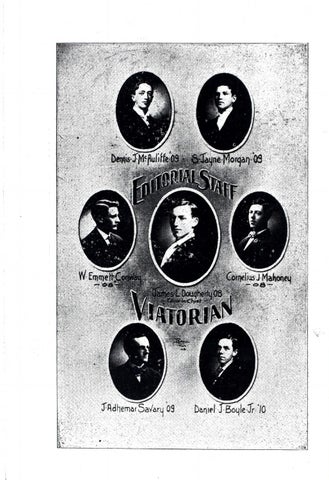
i'r
- Ediftor in Chief. J. DOUGHER'L'Y, '08. Exchanges--- E. CONWAY, '08. Athlet~cs-G. KILEY, . 'll. So-cieties-A. 'SAVARY, '09. Person.a is-.-D. BOYLE, '10 . ."' . .'· Locals-D. Mc.A tJLIFF'B1, · ''09: .
Entered at the Bourbonnais Pos't Office as second-class matter
...
All correspondence 7Jtust, b~ addressed "Th.e Viatorian," Bo~rbonnais , Illinois ~ Subscription prire One Dollar per year, payable in advance. All business co1nmunit;ations should be addressed . Rev, J . .r: Ryan, St. Via~ teur~s College, Bourbonnais, Illinois.
:@DITO,R IAL. Once more there has been g ive n to u s opportunities unlini.ited by the openi ng of a new scholastic yr:=ar. Possibilities an d op ~ portunitie.s undreamt of now loo m up before us and clairn our attention ai1cl they are fraught with too weighty con?equences to be s1::orn ed or sc-o ffed at. T'he road to failure is w·ell paved with unseized · opportunities that presented themsdves not on ly once but whic h r eturned with each s ucceeding year. we sh ou ld not let ·om" present opportunities! be possibilities " in potentia,··· we should m·al<),e them a.ctualities, and when we have them w ithin our actual possession we w'i11 discove~ other and higher thi ngs and try to realiz e them. School and opportu nity are twin s isters. W h ere one is, ther,e tl1e other is found and where these two dwe ll there the land of possibility is m ost fertile. Have we made t he most of the opportunities placed at our disposal? Are we allowing some golden opportunity to slip through our fing~rs? Let u s take heed. We can n ever reap even a grain, let alone a harv.est, from th~ land of .po ss ibilities unless we first grasp, the sickle of opportu:. nity. B'ut the se izing of opportunities mean s work, yea hard and ceaseless work but the success that follows is worth the labor and i<he gains such as rttst c~lll neve:- corrode or defaulters ever pilfer.
"''
·I
I
.l
~ ~-.
·_,,
·' .
~
<'·, :: \-.'f,lfiEJ ~ B.i :B;¥!F:AlN:,Sr. OIF ;N.':Y'O!LEElN·$t:.' ·. •• '
• '
. - : ' .· ..... 1···.:"1..~.:~ ~:.· ~.
•
.
:_ .
.·
.
t •
•~ .' f ·
. .-
~ ~~~~ ; ~: 1
·;.
. '~ :ij~ ·-q._;iy.- -~s>t 1~t1'g ~g?'i 'w h:il e)
•' '
'
··:· ,
•
; , ··· . ; ,
, · _., '
1
, •
r•
'
I
was ._ · iou~g_1ng .. in ... the- iobby 11 \!V· of the Rest Hotel," whi'ch v.•as situated on the· ·. ~~ir1 :_-. _tljo·j)ugl;_fare · o~ ·. a good · sized S<:tuthern town;.. ·my attention . was attracted by the entrance of a :-' " b ell . hop,'' · :·,(md,ly . caliing m y nam e·. Upon - ·my answering, he: cam1e • "Over and informe d me that a delegation of "smoky ben.t lemer/' we re in the office awaitin g m y pleasure. .Be. ·ing s·om.ew hat . s urprised and anxio·l.ts to· asc·ertain th e reason 'why I . was disturbed, I ·tq lcl him t ha t he ri1ight "sh o·w ' in" th e visitors:_. After a few m.inutes I h eard a hurried tramp lin g outside and a. seco.p.d later ·a hurried mutte r-ing and growlin g fro·m· .the soft mellifluous voices of the "sons of night'' informed me rhat my "vis:-i~ors ·'' were present and besides w·ere- making themselves at home . . A lull in tlieir. conversation ens tied, but sudden ly one of their num- . · b.er, an ungainly "buck," who- seemed to be arotmd the age of 30,. and who was a source of admiration to his _fellow citizens, thr01--1gh h1s ambidexterity an'cl skill in "roltin g de bones ," advanced with a sullen air, and as n early as I r emember, p oke th e foll owing word : "·We hab been delegatE;d by de m emb er s ob de Sweet Potato an'q ._ Yaller . Po~ss um ·c1t1bs ob dis yere city ob N'Yole ens to protest .;"· a:hout de discrimerm a tio n ob w hid1 yo ah g uil ty 'fru yo' buildin' a. ·_ screen ·in yo' base bal l pahk fo ' de wh ite folks and fru ' yo' refusal t_q, do de same fo' de ccllud patrons ob yo' nine ." A t orrent of cri es · of. s~1ch nature as " D·2..t's ri g ht, Sam," informe,('\ me that I was in the wrong. F or a moment I was dumbfounded and all at sea, forto place any additi on al expe n~e in the park yvo uld m ean that · my labor for th e year wou ld be represented by a " negative gain," and that the season, w hich was j t~st beginning, wo uld b e a failure. On the other hand, if I refus ed t hem , I wo uld lose a. hrge part of the· . patronage o.f the ne o-roes, w hich amounted t o a co nsid erab le sum . . , While pondering ove r the matter, the gigant ic form of ''Hi" Robertson passed te door. "Hi" stood s ix feet ancl five inches in his stockings, had play-e d through th e previous season, in another towi1, w ithout an erro-r, and 1-,ad b een signed to play first base. On his sudden appearanc e an idea fla shed throu g h my min ~1 , so bestirring myself I resolved upon a bold cour ~ e. lTti li zing w hat little oratory I possessed, I comm en ced to speak: "Ge ntlem en of the Sweet Potato and Ye11ow Oposs um so~ ie ties · and citizen9- of N'Yoleens/' said I , " I hav~ e always encl ea vo red to satisfy the base ball needs. of the colore'-{ citizens of our fair city... Consequ ently when the white people of thi s urb ane spot petition eel that a screen should be placed oi1 their stand, I hesitate-d some time before I
, ..
'
I
~
!•
.
. . :•,.
ra: ·.
.
.
'·
granted their r.8j:u:estLt~l{ ' f!hi~:f\V l'i-l.f.& ·~a:s i.'~itik!li.ig of _the ' me~ns by which the honest wrath whjsJ.L<!_:slight to you -woutd occasion, co.uJd be 4ppea~ed. All day long w~uld I pond~r . and vainl.Y; ·.-w ou:f4_ ts:eek r~st ii1,'..th_~:~· tlt?w~y ·itrms. ·of ' '1\1b~I?heus·. ~.- · · At' .1as:t~':· wfii1'ef;~~ team was Oh 1ts preltm1nary tnp, the ·mystery Whltlr 'had ' tau~<! , tri~ ' ihan)' .anxiO~lS days and sleepless nights, w·a s ~lved. ·\ Stgned R6bertson to play' Rrst b~s~ . . "As _yot1 kti'qw h@"'···mia~rio errors last . season, furthermor·e ' fie allO\ved no balls to be: thrown over his head. Knowii1g these facts, I signed 'him, all the time thinking of you. Now why do you complain? The Caucas.ian ·dement of this dty has a wire stop in front of their stand, through which they must gaze. On the other hand the · colored citizens have· a human screen. They can safely bring their ladies to the park 'Yithout suf:.. fering the inconvenience of gazing through a rusty wire screen. They can proudly boast of their movin'g hu.m.an screen~ In _concl"usion, gentlemen, if you will kindly . step into the next .room you will be able to enjoy a good smo~e." With profu se thanks the delegation shuffled into the next room, and that afternoon· and on ~very succeeding day throughout the season, there was not a vacant seat in right field. The colored citiz·e ns were happy ·over the thought that the white people were placed in an inferior position through the lack of a moving human screen .. S. JYLorgJClln '09. :_.:
... •
I
A FIS·H ST'O·RY. aWell sir," began Uncle Ben, "Talking 'bout fi shin' reminds 1ne of the day Si Perkins and your old t.mcle fetched in 'bout a hundred pound in less than half an hour. " . We knew a good story was coniing, and so the camp group took easier positions and waited. After n1-e thodically refilling his pipe, the old fellow assumed a pensive .a ir and continued, "Yes sir, it was dovVin to Horseshoe Lake, back in '83. Si Perkins and ] hed been line fishing fer 'bout two hour:s and hed only caught a couple little fellers ·' bout the size of yer han:d. W !e. knew the fish was there all right, but the cusses wouldn't bite. Nbw I allus did say Si was scientifically inclined but boys, I admit Uncle Ben wasn't quite prepared fer what he did. "Ben," sez he , "I got an idee, an if yo u'll stick by me I guarantee we'll have more fish· in an hour than we kin carry." Well sir, I didn't take much stock in his idee, but "Si" sez I, "count me at your comnnands." His fir st orders wnz fe~ shore, and the next thing I knew he'd• raced up ter the house an come down agin with a big paper bag. '•
..
Jl
'··
~~-
'•.
... .J
~
..
~ ~r .
1:
'·
.. : ' • '
"' I ·:THE VIATORIAN .. \
•. ) ~
•
I
•
.
~
:;..
.
'
;
. '.. 19 :;. . '
I
::
.
."Ben: Hedges/' sez he handii1 ·the. bag to me . . uYou now have . in your hands1 ·the f~tnous:..to-be Perkins Fish Elnsnarer." Well Sir, I adrnit I nad ter laug;: when I opened t!Iat there bag, it wa.s nothing .bul dried ·13.ppies straight froni the kitchen As I said· before, I l3:ughed, butS~ only looked grand like ~ncl quoted · something bout laughin lc\.st. N'o w, I never }]earn, . t~ll· of dried apples fer b;a it; but it being -~i 's l eacl I reaches fer the poles an · ·Starts 'fer the boat, but there' s .· where · I makes my m.i stake. "Put · · fhei11 .poles dovviT;" sez Si, "an get inter this boat." W 'e ll sir, · I wuz thu'nclerstruck, the' idee of )ishin 'thout poles. B!ut I obeys an Si after rowin a bit, drops · the · oars, an reaches fer that bag an then starts throw in .them dried apples overboard. When they W:ere all in-the water, he turns to me and takin out his watch sez in a superior ~vay "Well Ben, in five minutes we'll begin takin i11· the catch." I really felt so rry £or Si then , hoys, for it s ure looked : like he w·a s cra.ckecl. But would you believe it, in five minutes J h~ arn a splash, then another, and ariother an ~l purty soon the water all round u s wuz cover ed with the members of the finny tribe ftoatin o!1 their backs . AJ l there ·wuz left to do then wuz to £etch 'en) in, which; same we did." . ·" B ut Ur1cle Ben,''someone asked, "w hat maclle the fish act that way?" ' "W hy y,er see" ans\:verc~ the old man, "when the poor cusses , et th e dried apples, th ey gulped some water in at the same titne and the w·ater swdlin the dried apples they eventttall y burst " and with this exp lanation , we all turned 111. , ]. G. K. 1 •
'.
!.
~
• ,
When the R v. P . .l\1[. }~lannigan died the parish of St. Anne, Chicago, suffered a lamentabl-e loss but with the promotion of Rev. Edward Kelley as his successor there cam.e a prompt and wholesam'-:; consolati on. Like hi s p1:edecessor the! present pastor is a man whose work has l.eft its impress on the Cat ho lic fold of th e state's metropolis. The hi story of the Church's growth in Chicago is the history of the life of it!:' p_a~tor~ anc! _ thi ~ is especially so in the parishes of St. . Ann.e . and St. · Cecelia. These m en have clone the pioneer's wo·rk in t~e reli g ious fi-eld. They have cleared a wilaerness irrio·atecl a .barren land .. ancl made it a wholesome oas is of •" ' b . C9:tholi c · truth . . O nr . c·o ngratulations to the parishioners o_f St. Anne's and our best wishes to · their pastor . .,. .."Greater St. Viateur ' ~'· is $Grpet hing n1.ore than 11'ominal t? th.e . :R ev. H. D't1 rkin of Rantoul , IlL When , the doors of the_ n ew mst1-
:20
T "H E VIA TORIAN
· !utio~ were opened in September, Father Durkin brought for reg...
·tstratwn ·a large group of boys from his parish. Dnselfish interest ·in his boys is one of Father Durkin's admirable traits and it is a .source of much pleasure to him- as well as to St. Viateur's that 'Bishop Spaulding's choice for R ome fell upon . one of his boys, Mr. _ ~-Frank Walsh '07. The :Viatotian .extends its best wishes to Messr~. Marcotte ~nd ~ Lambert who have taken up the h~rdware business of the Fraser . ~Hardware Co. Although the v isit of Father Fitzpatrick of Elmwood and -Father White of Cullom wc..s brief it was pleasant and· we will ex~pect a longer stay from th em soon. .
.
-
Announcements are mad e of the coming nuptial s of Dr. E. A. ~ach of St. Bernard's hospital Chicago and M"iss Mary Boyle --whose brothers have been students at th e college for several years. Mr. Murphy of Chicago paid his son .of the Junior department -a pleasant visit Sunday, Sept. 29th. M r. John Rainey of Chicago spent a few pleasant hours with ·. his brother, Frank, Sept. 29. Rev. Father Vaughan, of oratorical fame, treated Kankakee to ·.some of his e loquence in the presentation of his favorite of the Shakesperian dramas, "The Merchant of Venice." The occasion was th e anniversary of the dedication of St., Patrick's church. We · hope that the tim e is not distant when we can again hear tli.e :famous orator.
< .
'
M r. Frank vV.:,lsh 'o7, Mr. Henry Fitzgerald 'o7 and Mr. H 'enry Webber '07, were called upon to con:p lete their studies in "Rome, at the A1nerican college. They sailed from New York October 1oth. The faculty and student body extend their heartfelt ·wishes for a pleasant voyage and success in their new situation. Mr. D. Boyle of <=;hicago spent --recently.
a pleasant day with his sons
OBITUARY. R ev. G. P. Mulvaney was summoned home Thursday, Oct. 3rd, -because of the dangerous illness of his father. N'ews reached the "college faculty and students the following day that Mr. Mulvaney ~-
I
I
';['HE VIATORIAN
· ·_.had · pass~d -aw-ay:. -Brother Mttlvaney's mariy friends wish to express the~:r- deep condolence and heartfelt sorrow for his late affliction . . '
. •;
.
I
Sorrow thre\V its mottrnful garb over St . . Viatet'tr.'s when re·ports ca~e /ortp that Harold·· Palgin ' a Ii.te ·s tud,e nt of the c6Uege·, had crossed the l.astearthly 1threshold. · ·Ha·rold was a ·graduate of the Valparajso. hjgh school and ·caine Saint , V~at~ur's w~'ith bright hopes of finishing q; college cot:lfse._A short tim'e fLf1er: his arrival' he was · stricken with' a · spdden. illnes's '"'which ~ai-fi~4 :i him· aw(ly quite unexpectedly. Be was the· only son of 'M:r. and~ M:J:S. ;.Pa-gin of Valparaiso, both of \V'hom came to IZ:ankakee when apprised of the ser-· ious condition of their boy. His rem1airts were.. t 'a ken to Valparaiso . I where the funeral cerem:onies took place. · . . , .· .· ·
lo
;
•
'
--
'
Jercbanges
I
.
-
.
. ·~ · . . . .. I
• '
ggg~ggggg~ggggggggg.g ' '•
.
.
..
we
At last 'the m~ori1e.nt, which for some tirhe. ha\re fearf~tliy _ y~t eargerly awaited, has arrived;' at list the · 6pp.o ttui1ity 'is ·befoi·e us, when ' pen in hand and shro:.tded .in 'the powed\tl .garl~ of critic, our fervid brain aglow. with the enthusiasri1 .arud possti-bilities .of· the _p rofession, and conscious of ot1r ·.dut'ies to:Wards our brethr'ert ·of the editorial woi-ld, we may peruse with critical_eye the efforts of our . contemporaries and ·w ith unlimiN~ d rn~gnanim'ity and justit~, procla'it11 to _.t he eager arid expectant m.ultitud~ oqr ~ppreciation o.t con. demnati~n . of their productions;; . Fq'r S\1\e:~y. t() :~he young a~4 in-, experienced ex-m1a n the wodd can no:t app~ar p;th~r th~n · exp_e ctanL With his boundless .energy :and , zea) , h_e "f~hply .- imagi,n~s · ~hft his words produce . wouderf,ul effeCts ; and _a re ".W~ igltt;d ' anc1 COlJS~qe·red with great respect in the- world · ~f. tholig~:f; _-and .. :v~· ':'~II ~e ·so .. cruel as . to dispel these fond fanCies;? Let hnn F,e'J:9'Ce .1h l;ns ex;· pectations ·for it is in such enthusiasr:rt that th~ germs ;Qf .: strcce ~s~. are ·deveio· pe· d · · , ·. · · · . · · ·· ·· · .,.....:, · ,;·: · ·.. ·· ': . · Lik~ all aspiif'ing ex-men ( cb·ns.Ci6tts. their great i'mpo.rta.Hce,) '
• •
•
;
of
}
•
. :'' •
I
•';
•:.
o
•·
•
.,
/{
•
~
'
'~
,,
..- ,
: ) J ~- /'...
•
.
, ...
J. ..
•: ,. ':.;I ,$
·~
I
•
~1 '
5. ; ·'.
...
,
< I
'"'~
·~~;;'~ '-:,;
~:
:f
22
.
THE V-I-A TORIAN .
we have adopted resolutions, to which at the present moment, we fondfy believe we may adhere~ They differ pot in t11e least from • those which have been in common use from the very creation <Of the exchange department; so why enumerate them? They conrt:.ain the same good wishes and the same determination to receive criticism gratefully which have marked the appearance of so many exmen; they contain the same desires to do our share to benefit college letters and be worthy representatives of our respective Alma: Mater. And thus with the full consciousnes~ of our responsibili· ties we humbly take our place in the exchange world with the wish that our. humble efforts may be of some avail to the young people of our little sphere. Among the many and various journals which have found their way to our sanctum, one of the most attractive and truly meritorious is the midsummer number of the St. Thomas Collegian. Distinctly classical and well edited from cover to .cover, it harmoniously blends the best features of a college journal--choice essays and orations alternating with pleasing verse. The address on ·"War" is especially novel in its treatment, the vvriter considering war as a necessity for the uplifting of mankind. "Peace" in the same number falls short of its opposite, "War," the writer contenting himself with picturing the horrors of war while he devotes but a few lines to his side of the question. "The Lost Chord" is a creditable piece of verse that strikes the humorous v ein of the reader and leaves a pleasant impression. Novel, neat and entertaining is the Alumnae number of the Loretto Magazine. Published by the loyal alumnae of the Academy it abounds in stories of travel and interesting reminiscences, interspersed with terms of regard fot Alma Mater. The short biography of 1\tlary Jane Lancaster Spalding, mother of the present bishop of Peoria, is an ·excellent article and well describes an ideal mother. In "The Trend of Modern Literature" the writer bemoans the degrading influence of present day novels as compared with those of former d.ays. To meet with popular approval, the author must be spicy in ton'e and avoid all moralizing much to t~ detriment of the young reader; in a word he must adopt the "receipt for · modern novels which seems to be, 'Live without love, sin and suf. · fer, then write what you know.' " It is .to he regretted that such . an inspiring ·article must be confined to the limited c~rculation of a college journal. The Notre Dame Scholastic, always among the first to arrive, has begun its weekly visit and is receiyed with great interest. By a judicial mixture of prose and verse it. continues to hold its place among th~ leaders in college journalism.
.,
,,
. ,. '~
{
oi
;'
~:
I
~·~
'
I
j,
.
·~
.., l·
''i ~
t #
.,.
<1'1
1
1 ''{
•
~
't_:r
,-
'
•
.,..
·•'
• t
•
'
'
-f'
..
\
IIEI....---'-IB---tb-le-tic_n_o_ ,te-----.sl•l Now that the -' rain-soal.c~d !!pirit of baseball has retired dripping and unwilling to his winter quarters, th e question of football's re- . ception .n aturally arises. The Athletic A.ssodation met, and_after .· ~ature deliber'a!iol! and discussion decided to put the rough gentleman on the ·berich for this season. In 0ther words, the College will . have no ,representative varsity eleven. O·f course ~the boys may do a few fa.n.cy ..stunts on the gridiron against local teams, merely to ward off ennui but in the w'o rds of the new manager, "We will not undertake · any games with College or . Un,iv;ersity teams that are" really in our cb.ss" and the association gives maryy reasons for this step,. In the fir!lt place the material on hand for even a passable s~quad is · decidedly ·poor; secondly, new equipment is need'e d and football togs make- great rents in funds-of course w.e very s·eldom allo·W pecuniary reasons to influence our decisions, yet we can't · help but feel that with football on the shelf the association treasurer would strongly resemble a Pittsburg millionaire; thirdly many of our football' players are also bq.seball men and-well we're not taking _any chances 011 . their getting hurt. Baseball has always been our long suit and as the coming nine promises to be a world beating · aggregation, :\vhy not save men ·and money · for big games in the spring. · Basket-ball will soon be cl~im.ing1 our attention and as I sit here tapping my teeth with my pen I can't help feeling that a "classy' 1 five will wear .the gold stockings this year. The outlook certainly appears good frol.n her,e·. The correct basket-hall "dope" however will, no doubt, be rendered by "Steve" in the near future so we will 'content our?elves with hoping our expec"tations are realized. ,
It m.ay be merely an idle rumor but th,ere has been som·e talk rOf going inl strongly for indoor baseball this w·inter. To the old fellows who have seen · some rather fancy games in fhe days of the league thi-s' sounds good. They know we have the g:e ntlemen who tan handle the padded baseball to .perfection, and feel that if the . league is again! organized with St .. Viateur's on the list the season . will bring out some interesting games. L_et us hope then that the talk materializes .and that indoor joins basket-ball in robbing the winter. m onths of their dreariness.
1
1
THE VIATORIA.N
LOCALS. Again-the ·simple life. Roy Hall has its "400"-A real high set too. Sick relatives may have their drawbacks but they mighty handy duritrg the post season series.
come in
Football retired early but as usual left a mark· of it affection after it-This ti~1~ on Jiin's collar.,.bone. "Philosophers are all right as Philosophers but they can't p1ay ltall"'"-Manager Bergin. · •
Doick-"Gee, I'll bet that new Singer building in New York is a hummer." "Turkey" was overheard humming the follow-ing: :-~·d" Th e "N ew .t'-1 . His heart has -one unchanging theme One thought away from books, H ,e wanders 'round as in a drean1 With melancholy looks. ' In vain we try with lively air To coax his mind to roam, That voice of other times is there And echoes-Home sweet hom~. 1
._}
D~nny-"Why
do stock farmers like a lot of stair climbing?',. Group (in chorus )~"What's the answer?" D•i nny-"It develops the calves." (Exit Dinny.) Lost~Two
rooms, one , in Chicago, the other in the village. Finder please return to ''Gus and Jerry." S. V. C. - Poetry Teacher-"What are feet essentials of?" Eclgar-''\ ,Y alkin or rurinin." "Do yon take Saltus and Levi?" Bert-"Whither goe'st thou 'D·avis ?' " F. L ynch W. S. (White Sox)-"To Detroit, to represent the Athletic Association." .. Dancing classes to be organized in gymnasium. Apply to Prof. Morgan. Vi itor (passing room 324)-"Is that music I hear?" Eddy-''Yes, 'Turkey in the traw.' It' Culleton snoring."
i
THE VIATO·RIAN
..
2$
The Freshmai1 dass Is a_real fresh class, I have no doubt at all --~But" the Caesar class Is the b.anner class, When it comes to downright· Gaul.
. '-'i~e~re is_, to. be .a Junior Hop in the gymnasium tonight." So. s~id .t he Junior class "a11.d hue to their w·ord, pi·omptly at seven, :o'clpck th~~-- class president appeared and amid the plaudits of his~ --~fdlow.\;clq,'ssmen, placed a tiny gr~ssb. opp-er on the gym floor and'- depart,eld. . .
~
'·L~ttle Bear. "I shure do-want some mo Worn Kinks."
Of all the sad words of tongue or pen, The saddest are -these, "I've flunked again."
1•
~ ~..
' ('' -~(
... .
j · • A . ._ Wy~wqn-:-;Wh~n -~2s this. chick~n killed? c:t:. ,. · Waiter~\f\Ze ~dpn't fbrnish elates with. chickens. Just the gravy._ •
.1
•
'
·•
~
•
!
.
,,< ·. · ·Liv~~~of football men remind us, We cah write our names in blood; And departing leave behind us, Half our fac~es in the mud. Freshie-Faci~ -· . f?-J:~re,
feci, fake it:
Ckh! said Stad,,. I'lYtrever. be q.ble to. put these . shoes on unti iD 1 wear thein a day g:r two~---: - · ' ..
~
'"
...•
.
.
.
'
- · POet-Have you read my "Descent to Hades?" ·Editor. "No; but I'd like to see it." The-fellow. w-ho -brags of his .college And all his great ·learning 's;·a ·bore, ·The m·an.-_who is proud of his knowledge Is· baclly in need of som.e more. • <
.. . .
\.-.;
~
·.
. I
The.Standard Roofing Co• . ·c~..
290-.294 N. HALSTED STREET CHICAGO, ILLINOIS
Phone Monroe 430
Medal and Diplomas at World's Columbian Exposition, Chicago, I893 / American Institute t;f Architects' E xhibit, Chicago, I 894 ·
ESTABLISHED 1884
JOHN CARETTI & CO. JOHN D. AMBROSIO, P.r:oprietor
Roman and Venetian
Mosaics Marble and Terrazzo
Ceramic and Tile Works
Brtfstfc 'Umork for (!burcb (!on\"ent :tBufl~fngs
an~
47 W. Lake Street, Chicago, Illinois Telt!phone: MAIN 4859
~·
.