~~~~~~~~~~13~
I THE Vlfl!?!ls:~路
.
c
~
APRIL,l905.
~NN~~~~~-: ~路mf\(~
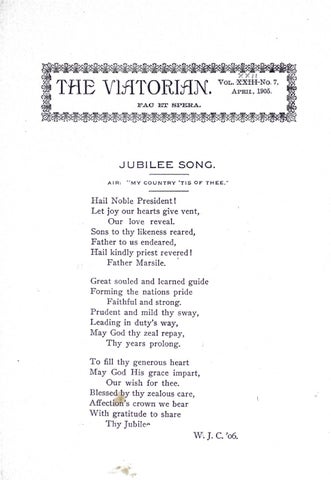
.JUBILEE SONG. AIR :
"MY COUNTRY 'TIS OF THEE,"
Hail Noble President! Let joy our hearts give vent, . Our love reveal. Sons to thy likeness reared, Father to bts endeared, Hail kindly priest revered! Father Marsile. 路 Great souled and learned guide Forming the nations pride Faithful and strong. Prudent and mild thy sway, Leading in duty's way, May God thy zeal repay, Thy years prolong. To fill thy generous heart May God His grace impart, Our wish for thee. Blessed by thy zealous care, Affection's crown we bear With gratitude to share Th'y Jubilep W. J. C. 'o6.
2!2
THE VIATORIAN.
WOMAN REHABILATED. One of the all engrossing topics of this present day is woman and her rights. In our own country the agitation of woman suffrage has become so marked as to excite little comment.. Placid Germany has been disturbed to its depths of late by the ominous sounds of a female conve~tion and all over Europe some of the women are making themselves prominent by their insistence upon having their rights. At this junct~tre of affairs I have little diffidence in thrusting before your notice this evening, the subject of woman's elevation. Her present elevation, the different aspects of that elevation and its cause cannot lack interest. That she has been elevated is made evident by a passing glance at her history and it is equally as evident that her elevation was simultaneous with Christianity; we need but to consider the position in which antiquity placed her, the position that she, today,occupies in lands which the light of Olristianity has not yet reached and compare that position with the position of the Christian woman. In Greece,that land of all culture and refinement,with its annals resplendant with the names of heroes and warriors, of poets, of mighty orators, and profound philosophers, there, we might expect to find woman in a most exalted seat. But with all that art and culture,in spite of the beautiful sentiments in which Plato invested her, the tender strains of Pindar and Homer, hers was but a pitiable condition. As a wife she was but the slave of an indifferent husband; her relation to him was not that of a lifelong companion ~nd partner in all his joys and sorrows. She was inferior to him, for the Grecian wife was unlettered and uncultured, only fitted to keep the dwelling while her lord went forth in search of diversion, which was but too frequently a violation of his fidelity to his spouse. The. educated and intellectual women, those women whose names have been inscribed on the pages of Grecian history, the Helens., the Phyrns and Aspasias,were nothing less than prostitutes. The . virtuous women, in that ''fierce democratic" were accounted nothing. That was the position in which you find the women of Athens,of Thebes and of Macedonia. A condition more degraded or more hopeless than that
T'H'J~
VIATORIAN.
2I3
of the women in Sparta cannot be conceived. In that peculiar government where every citizen was but the part of an awful machine, the woman considered as nothing more than a means of perpetuating the race-she was a concubine. The woman of Rome was no better off than her sister in Greece. 'In the early days of Rome, those days of stern simplicity and austere virtue, we find the woman on a higher moral plane, it is true, but she was degraded socially; she was almost co_mpletely disregarded. As a maiden, in her paternal halls, she was totally subject to her father, her very life was his and he might take it if he so desired. Nor was her condition bettered by marriage, her husband held supreme dominion over her, she was his chattel, his slave, and he might cast her aside or kill her, as he willed. That was the condition of woman under the kings of Rome. In the latter clays of the republic, in the classical period, her position was decidedly changed. . . Then woman be路c ame almost completely her own mistres s. She might discard a husband and sever the marital bonds at her own fickle will. B'ut marriage had become an almost forgott en thing at Rome, it had degenerated into a mere temporary cohabitation. No longer was the matron found in her place at the family hearthside, for there was no family hearth. The family had grown to be an object of derision. Men preferred to live single, where they might the better indulge in their revolting excesses and w oman had grown to be more vicious than man. She looked up on him as he looked upon her, as nothing more nor less than an instrument of pleasure. As Rome was, so was the rest of the world, the woman in the provinces may not have been so vicious as sh e w as in R ome, but she was but a step higher. The barbarian woman w as to be . foun d in that same debased state in which she has ever been found , among semi-civilized peoples. Whenever you look in the ancient pagan world you find the woman either a chattel and a slave or w hen emancipated, morally depraved.. And today, among unchrist ian peoples; what is. h er position? In China, that land w here it is considered a disgrace to own a daughter, where the girl baby is abandoned and ldt to starvation and death, you know too w ell in w hat estimatio11 she is held. You likewis e know at what yalue she
2!4
1
T H E VIATORIAN.
is held in India, where she is married when scarcely thirte路e n years -old and till a few years ago, was condemned to be burnt alive in the flames oJ a husband's fun eral pyre. Why should I describe her a.s . she is in the Mbhammedan harem, considered as a mere animal, without any rights w hatsoever, a slave to the sensuality of a licentious husband,debased by polygamy and t he lust of man, forbidden that which is her very g reatest right, t he true heart-love of her fellow-being. We have dwelt long enough upon the unenviable lot of woman in lands w hich Christianty has not blessed and it is a relief to turn our attention to that mo re dignified, more r efined and more exalted place to w hich Christianity has assigned her. I have said that her elevation was simultan eou s with Christianity,and why should it not be thus,when she,w ithout w hom Christianity had never been,was ma,de Christ himself,not alone submitted to birt h of a woman,but blessed, dignity and sanctity of her blessed office, was t o serve as proto-type and model to the Christian woman t hroughout all succeeding time? Why should w oman not have been elevated by Christianity when Christ himself, not alone submitted to birth oJ a woman, but blessed forgave and exalted one who had been a public sinner, a harlot? When he dignified the marriage bond, and made woman an equal recipient with man of the laws and g races of his church, laws and graces which could do none other than elevate and r egenerate? H is church ev er since has been carrying on t hat n oble work. It has made woman equal morally and intellectua.lly with man.. It has assigned to each sex its proper place. W hile the weighty burdens of the priesthood were deemed too heavy for t he fragil~ srroulde,rs of the gentler sex, to her was given an office scarce inferior, to her we entrusted the sacred offices of prayer and of charity. She was not loaded with the onerous duties of the magistrate or ruler but to her, to the mother, the sister, the daughter, was given the duty and delight of ministering knowledge at the fireside circle, of forming and uprearing those who were to be the future n ation. Convents were built within whose sheltering walls t he virgin might dwell in the love and worship of her heavenly spouse. T he Christian woman is given the care ofthe sick and the suffering, a vocation where all t he sympathy and gentleness and spontaneous g enerosity, which
'THE ViATORIAN路. marks the gentler sex, might be brought into a.c tion. The true test of a cause is in its effect and the true test of what Christianity has done for woman and what was the the power of its impetus can be ascertained by a consideration of what the Chrisitan woman is. The Christian heroine has become the mnst inspiring object in history. Recall those early days of persec.u ted Christianity. Consider the legions of Christian maidens and matrons whose unimpeachable sanctity graces the pages of our martyrology. If you wish to see the Christian woman in all her glory and dignity let your gaze rest upon- those holy and undaunted women who stand forth in all the strength and splendour of their unshakeable virtue within the walls of Rome~pagan Rome, reeking as it was with vice and crime. See her as she steadfastly clings to the cross on the blood-stained sands of the arena, facing the beasts which, raging in their hunger, threaten to tear her delicate frame assunder. We see in those tro~bled times,Agneses and Lucys,and Caecelias, without number, their virginal breasts inviolate amidst all the rotteness of paganism. What a change from those days of voluptuaries and adulteresses,those licentious Helens and _Cleopatras. And see her in the family,the mother in the midst of her offspring, botind to them by a love which Christianity had blessed and hallowed and increased a hundred-fold. See her, as she imparts to her babe with the milk from her heart, the sweetest maxims of Christianity. Com.pare that woman, I say, with the child murderers of paganism. Compare those women who have vowed themselves body and soul to God, and consecrated to his service their perpetual obedience and chastity, compare them with the scarlet women, the harlots of Greece and Rome. Compare the Christian wife, as she clings to her spouse amid trials and tribulations for better and for worse, compare her and her constancy and fidelity, with the divorcie of Rome. See her, as she is today, an intellectual force, the pen with all it's powers for good and evil grasped in her hand and compare her with her benighted sisters in unchristian lands. She tends the sick, soothing the fevered brow of the stricken, smoothing the pillow of the invalid with tender and tactful hand ~ See her, as you have all seen her, garbed in modest black in the streets of our cities,
~, !t' t
'·
d '
~
216
THE VIATORIAN.
begging the bread for her pauper charges. See her in the schoolroom, in the midst of the little ones, giving them the food of learn~ ing together with that of religion. It is the Christian woman that you see, the most heautiful, the most inspiring wo·r k that Christianity has produced.-F M.-'o6.
THE O·fVORC :E EVIL. 'I'
One of the chief evils of our present day is the evil of divorce. Its prevelance is rapidly becoming more and more ·a flarming. The number of divorced people in the United States within the past ten years has made an increase of twenty-five per cent. To the dishonor of our nation and to the disgrace of our great American civilization, divorce is more common in the United States today than in any equally civilized country on earth. How sad does it seem to the loyal American citizen who loves to uphold the dignity of our laws and customs and to live in an atmosphere where society is not suffered to be contaminated by the filthy passions of men. In this age f enlightened civilization w hat a rebuke there is Jor us when we consider that in pagan Rome for a period of thirty years not a single divorce was known. It behooves us, therefo:re, to look to the causes, the nature and the effects of this all-corroding evil and to apply the proper remedies if possible. In seeking to determine the causes of tJ:lose family broils ,that usually lead to the disgraceful divorce, we find that they ran be shifted to two. Those people who after having been married for a certain length of time desert their spouses, have either been incapable of entering the married state or they have a false conception of the nature of marriages. The first is due to a lack of domestic education. If the matron knows not how to manage the domestic affairs of her household, or if through her incapability of ministering to the proper needs, she fails to make the home a happy one for husband and children-the traditional earthly . paradise that it is, then domestic broils will inevitably follow. A nother cause of divorce is the wrong idea of the nature of matrimony. According to the laws of the United States marriage· ·
"'·
I
THE VIATORIAN. is classed as a civil contract. Simply an agreei11ent betw~en two individuals. Say what you will of the joys, the sanctity, the happiness of your home-marriage in the eyes of the law, it is nothing more than a civil contract created by the individual agreement of man and woman. A concept that 1s altogether false. Marriage is not a civil contract, nor has it ever been created by man or woman. Marriage is a state that has an antiquity and sacredness that antedates all human institutions. Aristotle tells us that man was a conjugal being before civil laws ex isted. It was instituted by the Creator as a part of the original plan of creat~on. According to the laws of nature and the commandments of God, marriage is a perpetual bond. A child that is brought into this world is not like the rest of animals. There are some animals that can take care of themselves from the moment of their birth. Others need the care of the mothers only, while there are still others that n~ed the care of both parents but for a short time. But the child needs the care of both father and mother till he is reared to manhood and parents are responsible before God for the proper rearing and caring of their childen. Hence it is necessary that they must pass their lives together and they must be naturally devoted to the proper caring of their family. The God of nature has forged the wedlock band and when man and woman have once closed their destinies by the irrevocable seal of matrimony they can no longer dictate their own terms. According to the laws of God, there can be no such a thing as divorce. For better or for worse, w hen once the infrangible links have been placed no human power can remove them for Christ has said, ''What God hath joined together, let no man cast asunde[路." . If all the peop.Je were thoroughly imbued with this true idea of the nature of matrimony then there certainly could not be so many homes that are filled with sorrows and aching hearts. He who wou ld haste to the marriage altar instead of being dazzled by the bright dreams of future bliss would stop and consider well the final step he is about to take. He would think that perhaps there is a darker side, that all is not sunshine and merriment to the married couple, that perhaps they are assuming a responsibility which they are unable to bear, And I se\y that he who enters the married tie who has
. ~路
THE VIATORIAN. been thoroughly imbued with this true idea of the nature of matri.mony and afterwards seeks a divorce so as to marry again~ such a person is inconsistent with himself, a disgrace to the human racet and a moral monster in the sight of God. 路 In th e exercise of its judicial powers upon marriage, it may be justly said that the state is assuming a power to which it has no lawful right. It is certainly just and right that the state should keep a record of marriages, so that in times of disputes or where a proper division of prop erty has not been made, the proper parties should receive their righteous heritages, but when the state claims the1 right to grant divorces they usurp a p-ower which can never be theirs. The state is a civil institution but marriage is a Divine one and in granting divorces it impiously usurps the authority which belongs to the Author of Nature, by declaring that to be . lawful which by the laws of God we know to be unlawful and under no circumstances admissable till death alone shall bid them part. If you have followed me you will easily conclude with me that divorce is contrary to the very nature of marriage, which in itself, is an indissoluable contract, that divorce is an outrage of the sacred rights of childhood and a flagrant violation of God's own clear laws, But let tts now see how the outraged laws of nature and of God visit their dreadful punishment upon the guilty individuals and states. The evils are manifold. It exercises a baleful effect upon the divorced, upon society and the innocent children o-f such an unhappy union. Whether inno-cent qr guilty, there is a disgrace forever attached to the name of a divorcee. There is the everlasting rebuke of a misdirected choice, disgraceful family fued and of a failure which means that the life of such a person has been spent in vain. Of second marriages from what has already been said it is not necessary to speak. While the lawful wedded spouse of either party is still alive there can be no such a thing as a second marriage, stilt this is generally the primary object and the ultimate issue of a divorce. To the unfortl.!nate children of such parents it means an irreparable loss. Nothing is more indespensible for the proper rearing up and the education of children t han is the benign influenGe of the
· . Tl-tl! VIAT0RiAN. training at home. If instead ofbeing ~nimated by the inspiring examples and the kind teachings of a devoted father and mother, their lives are overshadowed ·by the disreputable conduct of either or both; or if the training which they should receive at home is neglected and the realization of ·their parents' dishonor is perpetually before them, how can they help from digressing from the paths of honor and rectitude? Upon society the evil of divorce is more strikingly seen. As the home is the social unit, whatever tends to destroy the home is. the most dangerous foe to society and to the nation. It is not socialism or anarchy that are the greatest perils of a nation so long as there ~sa system or a movement in vogue that strikes at the very root of society by destroying the home in the weakening of the marriage tie, and degrading m~nkind to the level of brutes.. In the newspapers and public opinions of today many bold and unblushing pleas can be read for divorce, but the evjl of divorce is the greatest that can afflict a nation. . In a country where divorce is openly fostered, as it actually is in many of the states of our union, how can a man there be animated with a loyal love for his country which instead of protecting and guarding that which is most dear to him on earth, his home and his family, severs its connecting bond and destroys the family? But the patriotis.m of a nation must be kept alive or it is doomed to speedy disruption. vVhat a splendid example· of morality is placed before a nation where divorce: is common? It opens the flood-gates of passion and stifles the promptings of virtue. Although .A:merican society has frequently been shocked by the disgrace·ful divorce, it is still gratifying to know that the greatest men of our present day have not failed to realize its. danger and are making efforts to remove the disgraceful stigma of divorce from the face of our American civilization. In a recent address to some noted clerics on the question o-f divorce our great president,Theodore R'o osevelt has said: "Questions. like the tariff and currency are of literally no consequence whatever compared with the vital question of having the unit of our social life, the home, pres:erved. If the average husband and wife fulfil their duties towards themselves and towards their children then we may rest absolutely assured that )
TH~
VIATORlAN.
the other questions will solve themselves. But if we have solved every other difficulty in the wisest possible manner it will profit us nothing if we do not have the relations of the family put upon the proper basis. One of the most unpleasant and dangerous features of our American life, is the diminishing birth rate and the loosening of the martial tie among the American families. It goes, therefore, without saying that as for the individual as for the nation no material prosperity or business growth will count if the race commits . 'd e. " SUICl It is therefore evident that something must be done to stem tqe tide of divorce. I would heartily endorse the movement that has already been put on foot, the joint efforts of all the churches to influence legislation in behalf of the family tie. If instead of being in conformity with the passions of men in this respect, the laws of the country were more rigid then divorce would be less common than it is today and after all as the great Balmes has said the only way to remedy an evil is to stamp it out entirely. Another路 of the great sources of our present day evils is the sadly neglected morals of our country. Where the hearts of a community are corrupted their virtue will never flourish. The wisdom of Solomon would 路be as vain and futile in reclaiming them by laws. And if we wish to remedy the evil of divorce we must begin by improving the morals of our citizens and never can this be rightly路 clone till religion shall be more universally taught and men shall be brought into a closer union with the salutary teachings of Chrisitanity. Why should vve try to weaken the marriage tie? It has been wrought by the hand of God and blessed by the power that made it. But the same divine power that has made marriage one of life's holiest aims now declares that it must endure forever. There is therefore no other alternative. Though the passions of men may impel them to onslaught and rebellion, the decrees of nature and of nature's God shall forever confront them. vVhen the laws of the state shall be made in conformity . with Heaven's eternal ones and men shall be brought to a clearer understanding of the dignity, the sacredness and the holiness of the mar. riage tie, then the evil of divorce will be a thing of the past. James Hayden, 'o6.
l J
I t
THE VIA TORIAN.
22I
•
ST. PATRICK S DAY. The feast of St. Patrick, one of the most interesting and enjoyable festivals of the scholastic year w as celebrated with beautiful and symbolic impressiveness on the seventeenth. The pomp with which tradition has vested the feast at St. Viatuer's., the harmony of rcigious and intellectual circumstance, was sustain ed as befits the r evered apostle of Ireland, patron alike of Erin's sons and students the world over. Solemn pontifical mass was sung in the chapel of the Sacred Heart at 8:20 o'clock. Rt. Rev. 1,1gr. Legris, D . D., was celebrant, assisted by Rev. J. Kelly, of Gilman, Ill., as deacon, l\1r. J. l\1ciYfullen, as sub-deacon and Rev. P. F. Brown, C. S. V., master of ceremonies. The power of words can but ill portray the sublimity of the most august sacrifice, offered upon the spotless marble altar amid the inspiring charm of myriad lights and sweet flowers and with the melodious s.ong bursts of the hundred well trained voices of the choir. Like the presence of a beloved father, the image of St. Patrick resposed in its shrine of Bowers above this scene of homage and veneration. All a picture of the glorious ceremonies of the church which could never be forgotten. Yet would it be incomplete without the voice of a scion of Ireland's apostle to recall to our appreciation the mission of Erin's children. The eloquent pulpit oratoF, Rev. Father Aylward, of Kankakee, was chosen as the worthy exponent of Ireland's apostleship, and selected for his theme the portrayal of the fidelity of the race to their faith, their priesthood and the Pope. The Reverend Father praised the unswerving fealty of the Irish people, and set forth in glowing words their providential calling to spread the truth amongst indifferent nations as well as the undying love and protection manifested by the sons of Patrick to Christ's Ambassadors. To the excellence of his sermon the orator added grace of delivery and charm of word pictures, such as could not fail to imprint a lasting lesson upon his auditors . The choir, which has been drilled to the point of perfection, by the able Director, Rev. L. G. Goulette, C. S. V ., was never heard to better advantage and displayed a harmonious volume and fini sh seldom attained in large orgnizations. The following program was given; Kyrie~ Bollman; Gloria, Farmer; Credo, Boll..
.l' l
222
man ; Sanctus, Heethovea. The A"flilU? Dei by Concone, with , io.. lin obligto, sung by Mr~ J. Monahan, was indeed an artistic treat. Rev. E. L. Rivard, C. S. V., Rev. J. Roche, C. S. V .., Mr. J. Monahan and Master Anderson, were the leading soloists for the mass. Before the sermon the Veni Creator by Monti was sung by Rev. A. St. Aubin, C. S. V., whose rich and powerful voice is well known and admired by lovers of music. Iviiss C. Monahan, of Chicago, sang Cherubini's Ave Maria, during the offertory. Gifted with a soprano voice of clear quality and sweetest tone, Miss Monahan ably interpreted the beautiful composition of Cherubini.
THE DRILLS. At eleven o'clock the visitors were received in the gymnasium where they were entertained by the military department. The Columbian guards commmand.ed by Captain Orion Ford and Lieutenants T. H 'a rrison and M. M路c DeWitt received a hearty ovation and proved themselves worthy of their popularity. It is indeed marvelous how these little fellows can perform their intricate evolutions with such speed and accuracy. They displayed 'surprising ease and finish in movements which would seem to require years of unflagging practice. We had been led to believe that their tireless instructor, Rev. A. St. Aubin, C. S. V., had exhausted the list of fancy movements, and hence were doubly surprised and gratified by the introd~ction of several new features, particularly the "ladder pyramid." The difficult manoeuvers of these budding West Pointers were the admiration of all who had the pleasure of being路 present. The Ford Zouaves under their commander,Col. J. B. Sheil, next appeared on the program in their natty uniforms and were equally well received. Their formation drills in bewildering figures were cleverly executed but the manual of fancy movements was perhaps even better and called forth rounds of applause. The members of the squad have attained great prolicinecy by devoting themselves to frequent practice and well merited the compliments ~howered upon them and their commander, Col. Sheil. It is to be regretted that the exhibitions given by the Zouaves do not take place more
often.
!'
l,
l
1
THE VIATORIAN.
223
THE PLAY. A banquet was tendered to the visitors at noon after which the 路.V ery Reverend President, M. J. Marsile, invited all to the gymnasium for the rendition of Shakespeare's "Taming of the Shrew." The presentation of a Shakespearean production under the masterly tutelage of Father Marsile is sufficient guarantee of worth and the "Taming of the Shrew" has added but another t9 the list of successes. The cast was carefully selected and capably drilled and the improvement manifested in young actors who essayed their premier .bow as stars, is a striking example of the superior training which is the eminent faculty of Father Marsile. The role of Petruchio was very capably interpreted by l\1r. John Hickey, who displayed great 路s kill in the difficult impersonation. :Mr. Hickey is gifted with a fine voice and forceful expression, such as happily combined to 路render the character impressive. Mr. Fred Shippey as Katharina, was equally successful. He has a fine stage presence, a flexible voice and grace of movement which marked his work as worthy of great praise. Mr. J. B. Sheil, 路as Baptista, was the type of the benevolent father, and Mr. F. Rainey, as Gremio, a graceful and pleasing suitor. Mr. A. Drolet has added to his laurels by clever character work as Grumio, whilst Mr. R. Thiers, as Bianca, was indeed a sweet and winning contrast to the stormy Katharina. No less at home on the boards were the other actors, M'e ssrs. C. Mahoney, as Hortensia; J. Legris, as Tranio; J. Long, as Biondello; J. Mullaney, as Vincentia; T. Brankin, as Lucentio; E. Russell, as Curtis and E. Burke, as Tailor. Though the entire play was capably presented and well received,especially noteworthy was the interview between Petruchio and Kantharina in Act II. and the banquet scene in the last act. The young artists are to be congratulated for adding such pleasure to the feast day. During the acts Miss K .Monahan sang two solos which :were enthusiastically received by the large audience and Mr. Ethier, the Messala of Klaw and Erlanger's Ben Hur production, recited a selection from Carleton. Mr. Ethier is a thespian of great note and
I
acquitted himself in a manner :Wl:tich-;·afforded a rare treat for lovers of artistic elocution. The orchestra, _which, , .by the way is acqun;mg considerable .f;a.m-e for excellent music, .contributed the fol1owing program: Irish .A irs, Bit of .Blarney, Golden Tress Waltz, The Billionaire, ·Men o"r Yost, -Moonlight Serenade, and Dream of Pea.ce. ,
ST. ·P AT ·R IC 'K S NOTES. St. Patrick's Society, in consequence of its increased treas ury has been enabled to purcha-se a number of new books for its library,. The last several meetings have been enlivened by a profusion of oratory. Speeches were given by Mr. F. Walsh on Robt. Emmett;_ ·M r. J os. Hayden on the "Evils of Divorce;" Mr. M. H 'a yes, on "Fr... .Mathew;" Mr. Louis O'Connor, on "Time," and F. Miller, on "Woman under Christianity." A debate was held on the question _:.: "Whether military drill should be abolished in Colleges," between Messrs. E. Conway, J. Brady, C. C. Roche, Wm. Reynolds, respec-tively affirmative and negative. The question was decided in favor of the negative. A novelty was witnessed at the last meeting (Mar.. 22rtd) in an impromptu debate, on the question: " Resolved, that thestudy of Latin and Greek is useless," in which all the members participated; the decision was finally given to the negative. Another meeting was held on the 29th. A criticism was read. by Mr. Brady, after which Mr. Kelly took the floor with an oration on " Christian Education." The moderator then submitted to the society a proposition for the closing of the society's year. He pro-posed a banquet to be given on the 13th of April. By unanimous vote the moderator was intrusted with the whole charge of th epreparation for the banquet. Toasts and speeches will be given and. an elaborate spread will be provided. F. M .- 'o6 .
..
Circulars will soon be sent out by the alumni committee an-nouncing the exact date and th~ program of the Jubilee exercises_ It is: thought that a date will be selected between the r2th and the 25th of M:a y. ..,.
.
THEVlATORI
l
•
pr~Sents-
itself to us of St. Viateur's under sev-eral unusually pleasant circtrrrtstances this year. · The first of these ·circumstances to- be taken cognizance of is that under which fhe month is ushered in each year, namely, the renewal of our pledges 'Of love artd gratitude to the· Blessed Virgin. The second is one that thrilfs' the faculty and student-body, to a man, with added joy arid gratification, for it signalizes the approach of an event made welcome in the name of one whom we delight to own as leader and. father, and whom those of the outer world, who know him,are proud to call friend. We speak of the Silver Jubilee of the Presidency of Very Rev. Fr. Marsile.. We have waited for it patiently and the announcement of the exact date of its celebration-we have only known that it will take place about the middle of May-has been a. matter of interested conjecture for many months. Anyone that has ever felt the caressing influence of loyal student comradeship, anyone whose heart has evet bounded to th e strains that only healthy, manly, college spirit can voice-for thos e are strains quite unlike any others-any man,in short,whose youthful efforts have been fired and uplifted at the sight nf duty nobly don'e by his precursors in life's path, can appreciate with us the significance of this day's approach and can conjure up a vision of its joys and the ever recurring inspiration that never fails to come at sight of the "old boys" who return once again to the scene that their young years of aspiration and labor have made holy ground. This year the alumni will return with their wonted fidelity, for the "old. boys" do not forget, and while they deliver their words of congratu-· lation and acknowledgement to the guide of their "salad days, when they were green in judgment," their gaze will wander to the pile of uncut stone that marks the material in~eption of a cherished ambition, a hope that Fr. Marsile has nurtured in the warmth of his great heart for years, the building of an edifice that will completeGreater St. Viateur's. The twenty-five years of labor that our president has given t<J>
The month of May
...
THE VIATORIAN. t his corner of the Ivlaster's vineyard have been marke~ by a steadY) progress in the cause of Christian education. To house the factors 'Of this Christian education suitably, however, is a formidable task, particularly is it so in view of very limited resources, but labor and . ;sacrifice in so noble a cause are never undertaken in vain and路 suc<:ess has crowned the sometimes painful toil of the Sons of St .. Viatuers . Only the limitation that insuperable obstacles impose can be said to qualitfy this success. Slow growth is characteristic of -substantial development and such is the fact that the past quarter of a century has seen demonstrated here. The new building has been projected in response to a demand that development and recognition of merit have engendered; it is the bark of the oak yeilding to the impulse within and to the need of more sheltering branches without. While there are larger alumni associations than this of ours the fact in no way detracts from the spirit displayed when the former :s tudents assemble. Love, veneration and ambition for alma mater are the watchwords on all hands, And how could it be otherwise? Does any son love his mother less because the family is small? Is there any mother less tender to, and less solicitous for her sons 'V.'hen they are few than when they are many? Assuredly not. A lloving mother is now calling to her sons ; she is preparing to wel-come them back to her hearth-stone; the broad roof tree of her ~1ouse is about to echo the strains of half-forgotten songs and to ;give back the tones of voices that years have made deep and strong 路 ;and vibrant with truth. And they will answer the call-what son w ould willingly refrain? And with the light of other d~ys in their ::eyes they will troop through corridor and class room and study'hall, bringing hope of a future like unto their present to the youths who have taken their places, and bringing ioy, the joy of the full 拢heaf, to him whose silvering locks, the honorable badge of his grand climacteric, are the happiest testimony of the fruitful years t hat have lighted him to his Silver Jubilee. Learn the ''Jubilee Song'' and swell the chorus. Publishers' illustrated annuoncement of "Views of Dan:te" will he inserted in this issue. First come first served. Avoid rush!
·o ··R-rA· THE·.'f.,. v;I,'A!:r.. !!.~ N~ •
I
1
EXCHANGE-S .-
·-~
·
Is it because a sign post does not travel in the direction m which it points that the Fordham Monthly, in a little more than a. half page of its March number undertakes to tell several of its peers how to run their exchange columns? Although "feeling that the usual high standard is being kept up" (great snakes!) it points out ·. "the striking defect," namely, the "absence of necessary exchange . department" in several papers in the course of an inexcusably brief and puerile effort, and wind~ up in disappointment becaus·e the bunch hasn't been applauding hard enough. That's not half bad, though, in comparison with what it does to "The Mountaineer/' ''an attractive small publication." Perhaps the Mountaineer doesn't have the same feelings about such patronizing airs as ·we do- b.tit . that -"small publication" has to it a ring that recalls the :big boy across the street who_u sed to let us play ball on condition that w_e furnish the necessary paraphernalia. The writer. of "The Simple . Life · in Horace" has read vVagner intelligently, in pa-rts at least, and has rendered some Horatian odes into English that reads easily . . In .h is opening paragraph,however, he stumbles ove·r a simile and falls into an inconsistency. "Just as on a cloudy day the sun · somct~mes breaks through the sea of clouds that obscures its light, so in this monotonous life of ours there springs up now and then fwhat is termed in common parlance, a fad." The Simple Life is the "fad" at present. Tht n follows a definition of the Simple Life. · "It is the life in which unnecessary needs and an accumulation of material cares and complexities must be sacrificed to the spiritual development of man, of his character, and his will * * * * philosophers have sung its praises, holy men and. saints have Lived and preached it, in fact, it is the life of the true Christian-the spiritual life." It is summarized in the divine words : "Blessed are the poor in spirit." If the foregoing ideas are positively meant to be associated the writer of the article in question must own to the unique distinction of having been the first of men to characterize "t11e life of the true Christian," summarized" in the Beatitudes, as a fad. "To I_reland" typifies well the destiny of Erin by a comparison with the Saviour when "Tho~1 ~a vest others; save thyself/' was flung ,at
,•
THE VIAT'ORfAN. Him. When one sees about him the multitude o·f misfits in all the professions he can easily agree with the writer of . "How Can VIe Tell Our Calling in Life." The idea of a Bureau of Choice (of callings), entailing a "capacity test," is ingenious enough-and plausible enough, too-to open an interesting discussion on the subject. Like Jerome K. Jerome's wonderful stage Irishman, the hero of ''The Adventures of Michael OFlynn," in the Egypti,uses ''begorry" and like that other nuisance for whose resignation the A. 0. H. is clamoring, he wears a suit of green and yellow plaid. Throughout, the brogue that is intended to give the story an amusing turn is of an extremely wooden quality-so clumsily handled is it that if his dialect were the sole evidence of his nationality, Michael could easily be taken for a Swede. .B y way of a leader the Egypti ex-man remarks that "the dominant features of the exchanges this month seem to be the covers." What could be more natural? When editors of school papers discover that the comment most often made in respect to their papers is some silly, inane stuff and nonsense about their "covers" is it any wonder that they have come to the conclusion that the best side of their papers to develop is the outside? Extensive cover comment is not only superficial but poor taste-almost as poor taste as to throw boquets at oneself by printing such tommy rot as "What Others ~ink of Us." There is lightness of touch, a suggestiveness of talent along lines of observation and facility of expression, contained in "Samuel Nehemias Brown-Strategist," in the Longwood Alpha Pi Mu, that is refreshing. · A pretty cameo in verse is "To Jesus at the Tomb of Lazarus," in the Young Eagle. Although done in a religious strain its charm is chiefly due to the touch of clay that marks its inspiration. Being very human it is very appealing and it is in no wise extravagant to say that it reflects John Tab b. A music lover should appreciate this delicate conceit from "The Violins." "Violins speak unto the soul and keep the heart from breaking." · Although we have heretofore been to all intents and purposes properly "squelched" by the Eagle's touchy "ex-man" we are so bold as to hope that no evidences of re·crnd~scence (a fine large
TBE_VIA TORIAN. word, Skirmisher ) will appear if we presume to ask a question. It is about your cover design. Were those two tender,slender things represent~d therein ext racted from the Butterick Pattern-book in a. spirit of homage to that arbiter of fashion s or do they represent , two members of th~, staff taking the Kneipp Cure? Honestly we want to know- there's a bet on. We don't often trifle with other peoples Alumni Notes, so it was quite by accident that we noticed that a certain alumnus spoken of in the "Buff and Blue" had been "enscounced" and another had been married to "a hearing lady." It is possible that the former is 'to be commiserated but the latter is surely 路 to be congratulatedgenerally the man has to do the hearing. Maybe it would be well to empfoy a seeing printer or a waking proof-reader. Under ordinary circumstances we would rather be caught saying "up to its usual standard" or "well-worth reading" than to be discovered in the act of making note of a cover, but the March Lincolnian appears in green- therefore we are licensed to mention it. The "Knight's Tale" as a piece of literary appreciation wears the ear-marks of mediocrity in this sentence, "Chaucer's description of the preparations made for this tournament is fine." Fine- , well, abas fine! . Judging from the spasm of exchange doggerel in the Patriot number. of the Record somebody in Sioux City has been eating literary green apples. Like that of young Falconbridge the make-up of the contribution is nondescript- it borrows its rhyme from Butler, 路its metre fron1 WhitJ;nan, only the ideas, having no resemblance to anything else must be indigenous. That minority of students who love Greek, students who just study Greek, students who have Greek thrust upon them and students who spend the Greek period gazing out of the window (and whose name is stratia) might find something to interest or depress them -in two articles, "The Place of Greek in Higher Education" in the University of Ottowa Review, and "Is Greek Worth While?'路' 111 the College Index. . Both articles are bolstered with sufficient
2j6
authority to gain them a respectfui hearing but as we belong to the class Qf those whom the severe view of the Index article is calculated to depress, we haven't the nerve to attempt such seriotts c~路m颅 ment as the scholarly article deserves. Someone-wasn't it Bishop Spalding?-once said: "Democracy does not mean the ostracism of superior men-it means placing them in the van of progress." "Democracy Can Exist With Social Distinction" in the M'e rcury is a pithily put development of that quotation and in a brief space-too brief indeed-~the mooted ques,.. tion of equality is treated with commendable directness .. It will not he a great while before America's budding literati will camp on the trail of certain Englishmen and ''make them eat" the words that Sydney Smith once uttered regarding American books and plays, that is if the "Mbre Fortunate Ending of Romeo and Juliet." is a fair example of what an undergraclun..te can do with blank verse and an inspiration from Shakespeare. There are some more or less impressionable people who would like to have this modern version to dry their eyes with when reading, or witnessing a performance, of the genuine article. "How do vVomen in General Influence Politics?'' is modestly couched and convincing withal. The general make up of the Mercury is in advance of previous issves, clever verse, both grave and gay, alternating with carefuJ'.y penned prose to make an altogether agreeable total. But as "fly paper to the foot" or as a sick egg in Lenten times is the dinky little exchange department that setteth of the whole and is the end therof. By the way, who is to blame that ''among those present" the name of this sheet is printed "Vialonian ?" A recent visitor worked off a piece of pleasantry (it really wasn't a joke) on us on the head of that misprint. Picking up the Mercury and glancing . at the exchanges he said, ''Here's a fellow who has you. down as a 'vile-onion.' " It was only after the orthography of "vile-oni0n'' had been settled tha~ we calmed down sufficiently to say pleasant things about exchanges. --------------~
. O'h servation has taught the writer of "My Grandfather's Wooing" in the S. V. C. Student some Hibernian characteristics and has given him some (n. b. some) inkling as to how Irish dialect should
.THE V1ATORIAN. be handled. The fact that it is amusing and rather well delivered is redeeming since it lacks the merit of originality, having spent many seasons in_the home of "Twice-Told Tales." A man may not . be to blame when his parents take a mean advantage of his defenceless infancy by saddling him with a name suggestive of red neckwear and frills, but when a story writer like the author of "How No. 4 Vvas Saved" afflicts his hero, a grimy engine oiler, with "Percy" in dead earnest, he ought to square himself in some w.a y. "Percy" may be an all right name but with H '. Flaccus "nunc non erat his locus." There is no mistaking the lineage or at least the leaning of some of the Bee's staff in the March number of their paper, more power to em! By far the best thing in the issue is ''Life's Golden Years,'' several stanzas of which, however, are open to criticism for grammatical reasons. When the name of a person or thing is in the vocative case the verb which expresses the action of the person or thing should be in the second person, following the old rule of agreement of person and number. To instance " Oh age! who dreams of bygone days 路 And, retrospective, lives the past Nor fears, but freely shows thy work Thou hast content and peace at last" Would read more correctly if the verbs 'dream' 'live' 'fear' and 'show' were put in the second person, as is ''hast." ''Age," and its appositive "who," in the case of address and therefore in the second person, are the subjects of those verbs. Coming out bi-monthly gives the Abbey Student a chance to fatten for the sacrifice. The stories, essays and poetry of the February issue balance well as to quantity with a slight advantage in favor of the essays as to quality. There is a temptation when one has gone through a two-foot stack of exchanges,reading verse after verse of-well, verse, to forego comment on that commodity. Criticism at such a time produces much the same sensation as that experienced when one tries to enjoy a smoke when his tongue is blistered-as the editors of the Loretto, Longwood, Criterion et al. will
THE VIATORIAN. testify. Several years ago Hamlin Ga:rland delivered som,e very interesting lectures on the methods of great actors, notably Booth, in their Shakesperean interpretations. The lectures. were well received and proved of more than ordinary value to students, both of . the dramas as poetry and as vehicles for histronic art. ''Mans.field's Shylock" in the Student, follows in the wake-albeit unwittinglyof Mr. Garland's efforts and deserves more than passing notice. The writer has gone to the theatre with his eyes open and his mind alert, and the result of his account of what he saw is at once a pleasant and instructive demonstration of the fact that the theatre, as a school, is lost only on those who go there solely for amusement. Given the opportunity of seeing various dramatic productions of indisputable merit and witnessing them with a view to recounting the salient features of the different interpretations, the author of the sketch mentioned might open the way for a series of papers that would be worth while. In the Niagara Index Table of M1arch 15, are to be found some wholesome observations anent the Notre Dame Scholastic's endorsement of a certain editorial which lately appeared in the New York Post. The drift of the Post article, though not intended to splash cold water on aspiring youngsters, does, on the other hand, administer balm to those spirits within college walls who chafe under the demand for careful, conscientious, and downright earnest work theme-writing. It tends to make current the thread-bare, but oftemployed banality of ''striking the average." It is because the Index takes cognizance of the fact that students should be encouraged to mak'e an effort at writing, when of themselves they fail to recognize the necessity for effort, that it takes exception to the Scholastic's attitude toward the Post article. There be "fine writers" who take themselves seriously, no doubt, and think that gr,andiloquence is the measure of all attractiveness in writing. Still as it is easier to trim a tree than it is to add branches . to it, so also路, is a flowery young .writer, well in the hands of his 路instructor ' better than a do~en of the ''let-well-enough-alone" variety who prefer to stay in the bush. A student who is addicted to ornamentation,fluoresence or any of the peccadillos of ''fine writing," can more surely arrive at the precise'
THE VIATORIAN. ne·s s, o'r whatever els'e 'tiHl~ c0nstitute the end all and the be all of good wr.i ting,' .b y knea:Cling and thumping his floridity under the direction o£, "red ink theorists," than he can by going in immediately for the features that wil-l·qualify his manuscript for entrance into the jaws of a newsp~aper sanctum. The whole scheme of good writing means work, work, work, and any utterance from high places that tends to put any other aspect to the problem should :iwt receive s.upport. Despite the fact that the Post means to be "kindly and ratinrra1" the construction that students would ordinarily put upoh its words is that what they are doing in school is not much use after all, -a nd after finishing they will have to begin all over again t'<) acquire the things "not dreamt of" by their instructors, so what's the use anyway, etc. , and the result will be precisely what the Index ·insinuates. What the Scholastic means, presumably, is that young· writers should realize that all that glitters is not gold. It might be supplemented to the platitude also that it is a pretty safe wager that when a thin.g does glitter it isn't mud either. Therefore when a youngster takes on a shining surface-even though it be counterfeit; let ,him be daubed with red ink without mercy until the tinsel has c0rroded, the personal equation was worked in, and style, his very own, has, as Howell puts it, "been added unto him." Things must work out so-the theorists must stay at their posts and the young man must believe in them in the face of all "kindly and rational editorials" whatsoever. And why, morevover, posit the Post as an exemplar? N 6 one can adopt a style successfully. News columns rarely have style, because it is a case of news first and perso·na1ity 'a tterwards. When Big Bill wears Little Jim's coat he luoks awkward, and when a young writer cramps himself to fit into the columns of the gen·e rality of newspapers he does so at the expense of a good fit of the c0gs of his existence. We need good writers, writer.s who have an .ego and who dare to o~n to it, vastly more tlll3A1 . th'e writers themselves need the dollars that the Post pays for. sp-?tce filling; .people who yearn to write, be it remembered, having no. particular right to possess appetites, or cold feet. It is not becaus-e the Post sits as a ''memento mori" at college feasts of reason .that ·its re·mad{s are not to be taken seriously for there were red inkers before the Post and •they will ''walk slow" behind it in
THEVIATOlU the years that are to come. There is this mueh of certain it, the average student, in his specialty of dodging ork --.~~~ coaching.
o
OBITUARY NOTICES. Rev. ] ohn Rouque, the venerable French mtsstonary of lro路 quois county, Ill., died in Peoria, March 24, and was buried in h Maternity cemetery at Bourbonnais, March 28. Solemn funeral services were held in St. Rose's church, Kankakee, at which Rev. M. ]. Marsile, C. S. V., preached the sermon. R. I. P. We tender our sympathy to Rev.]. Cannon and to his brother and sisters for the loss they sustained in the death of their mo-ther. May her soul rest in peace. It is with regret we learn of the death of Mr. A. Hansl, the father of :Messrs. Proctor, Arthur and Raleigh Hansl, who were aU students here a few years ago. Mr. Hansl practically appreciated the education given the young in institutions such as this. He is gratefully remembered as the generous donor of the annual gold medal in the course of mental philosophy. We condole with the members of his bereaved family. Another afflicted family which claims our symp~thy is that of Mr. John Monahan, whose wife died April 5路 May the soul of this good Christian mother soon enjoy her reward. The faculty and student extend to Rev. V. W. LeOaire, C. . V., their sincerest sympathy on the loss of his father, elson LeOaire, who died in Oconto, Wis., April 4th. May he rest in peace.
1r. and Mrs . Frederick Legris who lament the death of their new born on will piou ly con ole them elves wtth the thought that of such is the Kingdom of Heaven.
:fHEl VI.AtfORfAN.
235
PERSONAL AND . LOCAL. On March 19, Rev. John Mlorrissey was sending to his college friends greetings from the land of the Sphynx and the pyramids .. Rev. Daniel Feeley, who was ordained in Chicago, M:a rch 17, . visited Alma Mater March 28. At his mass a beautiful musical program was rendered and Father Feeley gave his first blessing to 路 all the students and members of the faculty. The new Father is to . exercise the holy ministry in the diocese of St. Joseph, Missouri. Vl e heartily wish him all success and happiness. Mr. G. Gannon writes from Tucson,Arizona,that his health is improving and that he expects to return in May and to assist at the Jubilee celebration. A warm welcome awaits Mr.. Gannon. Among our recent distinguished visitors were the Rev. Fathers P. Tvfenard, of Escanaba, A. H.; 0. Kelly, of Streator; B. H 'a.user, of Sene:ca; M. Sammon, of Peoria; -.;vv. P. Burke, of Ashkum; T. Dugas, C. S. V ., of St. Mary's; C.. Quille, of Chicago; J. Levasseur,路 of L'Erable; Z. Berard, of St. Anne; A. Labrie, of Momence; and the V. Rev. Vicar General Weldon, of Bloomington. Rev. J. Armstrong, assistant to V. Rev. Father Weldon, of Bloomington, is rapidly recovering from an attack of smallpox contracted while visiting the sick. We trust that Father Armstrong will soon be well and will be long spared to continue his apostolic labor. Rev. E. Barnes, o路f Keithsburg, paid St. Viateur's his first visit to the college since his ordination, April 5, and was joyfully received . by his many friends here. The students of the theology and philosophy departments were granted a recess upon the occasion路 ofhis visit. Rev. E . L. Rivard, C. S .. V., has been appointed by the college committee of the Catholic Education Association to prepare a paper to be read before the Conference of the Catholic Colleges of the United States, which will be held in New York next July. Mr .Thomas Legris and Rev. S. Boisvert, C., S. V., made a trip to Denver, Colorado, recently to examine a mine in which several .o.f our friends here and in Chicago are interested. A ver;y artistic sacred copcert wa~ given in St. Rose's church,
THE VIA:T ORlAN. Kankakee, April 4, under the auspices of the sisters of St. Josephs Seminary, who are contemplating a large extension to their present building in the near future. A' force of college musicians lent their aid to the good work. Besides the local talent of Kankakee, which is of a very high order, Prof. Oscar Martel, of Chicago, took part in the program and furni shed entertainment keenly relished by all those who had the good fortune to be present. Rev. W. Clifford, C. S. V., recently returned much improved from the Mercy Hospital, Chicago, where he was treated for blood poisoning and ear trouble by Dr. J. Z. Bergeron. Fathers Vien, Marsile and Rivard, have been alternately mini s~ tering to the Catholics of Manteno during the illness of their devoted pastor, Father Bourdeau, who underwent an operation for appendicitis at Mercy Hospital, early in March. From Kentucky and from far off Montana, from New York and from the sunny south, from near and far news arrives that promises a large gathering at the 1fay Jubilee. Some wag says the old boys will have class in the morning and conge in the afternoon. Father Beaudoin, the venerable pioneer who planted the seed now grown into a mighty tree,is visibly ageing,but still cheerful and ever interested in the games of the campus which he often comes to witness.
OLD JOKE REVIVED. If e'er you're feeling sickly
Or you're dizzy in the head; And can't get up for breakfast, Just take a roll in bed. Cal 0. Han-"There's only one thing I like about you." Scanlan- "What's that?" Cal. 0. Han.- "Your surroundings."
, r
·TH'E VIATORIAN. THE PASSING OF PETRUS. Togge.d out in a high silk hat betokening superior dignity and lofty ideas, a brand new shave, a cutaway coat of 'o6 pattern, a tie of variegated colors p·r esented by the K. M''s. a silk bosomed shirt, pink pajamas, open worked socks and tanned shoes, Petrus the idol of the Fanny's, and Grand Chancellor of the Order of the Bucket and Broom Brigade, presented himself at the college stage to bid farewell to the scenes of his childhood. Hand-ball and base-ball were suspended for the day and over the village was a hush broken only now and then by a war whoop from the University .quarters. A very distinguished assemblage composed of President Rosenfeldt, D1aniel Dupey, John D1• Bockefeller, the Honorable Justice of the Peace, occupied seats on the right, J\ndrew Tarnegie,Madame Laflere, Sunny Jim and Old Chick, were on the left, in the hall were 231 Tete-rnges,217 Keefes,and 193 Morgans, all intimate friends of the passing hero, while the ghost of a Savage haunted the door way. Petrus had of late been the victim of many jokes and besides was barred from the sqort stop position on the base-ball team. He had taken several prizes in the potato gathering and mush bowling teams,but favoritism was shown and he was also seized with an inward inexpressibility of an outward alloverishness-in other words he was in love. He had been reading Bill N ye and learned how Bill had triumphed over his enemies, so he resolved to go west to gather some of the money as it fell off the trees.. However pecuniary difficulties induced him to desist and after mature deliberation resolved to strike out for the W'indy City. The long dreaded parting had come. The college orchestra struck up Chopin's funeral march and a loud mournful bellowing and rooting came from the barn yard. The treasurer shed tears from the cataract of affection, the custodian of the cellar was wrung with paroxysms of grief, the dentist was looking clown in the mouth, the baker was giving away what he needed most, and the cook died of joy. Petrus was gone. After buying a few gold bricks and a large tract of land on the lake front for little or nothing, he went to Belmont & N . 40th where he intends to make a clean up and gather in the dust, and brush up for higher society. 0. Riginal,
'os.
THE VIATORIAN. The students of the graduating class of the Commercial De~ partment, under the direction of the teacher, Rev. G. P. Mulvaney, C. S. V., have re-organized St. Viateur's Banking Association. Having just completed a system of Business Practice the members will become familiar with the office work in Banking and Counting Houses. At a meeting of the association the following officers were chosen: President-William Reynolds. Vice-President-Antoine Demers. Cashier-Con Shiel. Manager-Thomas St. Jacques. Receiving Teller-Arthur Pepin. -) Paying Teller-Thomas Hart. General Book-keeper-Arthur Lowenthal. Individual Book-keeper-Frank Donovan. Discount Clerk-Frank Stuffiers. 路.
ATHLETIC NOTES. D路u ring the past three weeks the squad has been taking hard out door practice and the players are rapidly becoming accustomed to their different positions. The in-field has\ been definitely chosen and puts forth the following line-up: Martin p and capt. Stack c and I b. Kelly I b and c. McDonald 2 b. Hickey ss and p. Shiel 3 b and p. The out field will be chosen in less than a week as the college season will open the middle of the month. In the first practice game with the Kankakee Anchors the varsity did excellent field work though many of the men are notably weak at batting. As most of the practice during the next two weeks will be given to stick work it is expected a decided improvement will be made before the game with Northwestern April IS. The most important games placed on this season's schedule are: April IS- Northwestern University. April 29-American JYiedics. May 5- University of Notre Dame. May I3- Armour Intstitute. May 2o-Knox College.
XHE VIATORIAN. May 27-Lake Forest University. June 4-St~ Ignatius College. June ro-University of Beloit. With the exception of the Armour Intstitute game, which will be played in Chicago, all the games will be played on the local diamond. Now rooters, to the front with your loyal support for the 1905 base ball team, which through the untiring energy of the coach is developing into a consistent and hard hiting <,l.ggregation. Remember, a fair chance to all and gentlemanly encouragement to the old gold and purple. The Junior Shamrocks have organized and these future professionals are preforming some lively stunts on the south diamond. The coach has favored us with the following line-up: Malloy 2 b and capt. A. Dandurand c. Thiers I b. Savary p. McCarthy 3 b. Elfelt ss. Corkey c f. Delaney 1 f. Breecher r f. The senior league has been formed and four evenly matched t eams chosen to compete for the championship of the yard. The schedule will open about the middle of the month and indications are that many interesting and hard-fought games will be played before the prize can be awarded. The following teams have entered the contest. Team-Dodgers- Hickey Captain. Battery-Hayden p. Hickey c. Team-.Colts-Shiel Captain. Battery-Devine p. Shiel c. Team-Kids-Kelly Captain. Battery-M'a honey p. Kelly c. Tea.m --Invincibles--Stack Captain. Battery--Schanze p. Stack c. -,.
W. M.
THE VIAT'ORIAN. VIA TORIAN. ' ' Unabell! Vale . P'eter ! Views of D:a ndies ! Et tu Petre! Watch the ball, Dupey! Cum si cum sa! The Doctor has taken to fishing! Lubricate the wheels of sociability! Election day in Bourbonnais! The birds has once more came again already yet! The editors are extremely grateful to the Oconto H owler and Summit Glob'e for past favors. Why is a man with a bald head like a hound? .., Because he makes a little hair go a long way .. Why does a sculptor die a most horrible death? Because he makes fa.ces. and busts. What is the greatest feat of eating? T'he man who bolted a door, swallowed a story and threw up a window. Who was the fastest runner in the world? Adam, because h~ was first in the race. What was. the difference between Joan of Arc and Noahs ark? One was maid of Orleans and the other was made of wood. Why is a fisherman grouchy? Because his business makes him sell fish. Why is a Weary Willie like a flannel shirt? Because he shrinks from washing.