'f.
t: ;路
} i路~
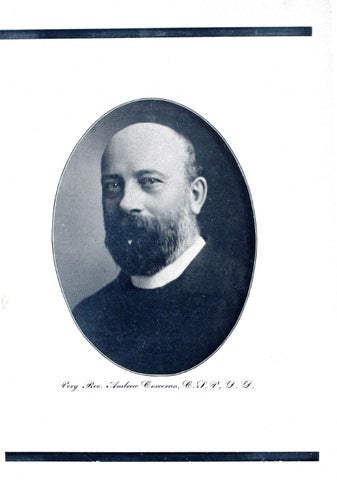
TO THE 路 MEMORY OF REV. A. CORCORAN, C. S. V.
Upon a simple, humble bier A pall is gently thrown Concealing in its folds a form From which a ~oul bas flown. H ere was a man , aye, one indeed Full worthy O'f the name. Wbo 路e soul so burned with love for man 'Tw a s one consuming flame. H is herut, though masculine in strength, Was like a ruother ' s wrought. 'T would bless , 'twould love, forgive, forget, E'en while with sorrow fraught. I n vai n his life h as not been spent ; N o good i s done in vain. Hi s life and teachings still shall guide Those sailin g o 'er life' s main . M J . B. '04 .
I.
l
I
V. REV. A. CORCORA , C. 5.
.•
.,
o. 0.
Ve ry Rev .. ndr ' Corcoran, C. S. r., D. D., Provincial uperior of the Cleric: of t. Viateur , Chicago, died Jan nary 2 th, at Phoenix, A rizona. Hi · death wa due to a complication of heart and lun g trouble , brought on by three eyere attack of pneumonia. Father Corcoran wa in the prime of manhood, beino· only 48) ear old. His physician ord ered !rim to leaYe Chicago during the winter . cason and sugge ted the dry, mild climate of Arizona. In company with Father Joly, ·. S. Y., of Canada, he \Vent to Phoenix a few months ago. For a time hi health eemed to improye rapidly, and it was h oped the change of climate would oon restore him to perfect health. Dut the imp roYement wa only temporary, and before long the alarming complicatiotL, w hich re. ulted in hi ~ death, began to develope rapidly. Father Corcoran wa born at Rawdon, P. Q. Canada, in 1856. Fie entered th e novietiate of the Clerics of St. iateur in 1870 at the early age of 14. Even as a boy, h e gav evidence of those uncommon talent , which made him, throughout hi life, a eli ·tingui hed and influential member of hi community. HaYing fini shed hi _ cJa ~ ical cour e, he wa ~ sent by his superiors, to Pari ~ , and afterward s to Rome, w here he pur ued an advanced course in philo ophy and theology. He sncce , ·fully defended 46 th e e before man y of the mo t emin ent professors in Rome and a large gathering of t ndent from the different national college . and received his degree cum magna laude. He wa ~ ordained to the prie ' thood by rchbi hop Fabre in r88;. For several year after hi , return from Rom e, he taught philo ophy in Joliette College, Canada, y·h ere he i till remembered by all who followed hi co11r e not only a an able and pain taking prof e. or, but ~ till more a a man of mo ~ t lovable character. In 189w, Dr. Corcoran " a alled to I ari by the Very ReY. P. D . Lajoie, uperior general, to a i ~ t him in the fulfillment of hi on erou dutic. Father Corcoran entered upon hi new labor 'vith hi - charact ri tic zeal '' hich together "·ith h.i ~ rare ability made him uch an efficient worker in w hat oever capacity he wa em~lo r ~ - · b 9 . 4.ienc fl.· r,e11 g~r~g h.tabl~ .. ·iq: o hi onrm nit}'
ill• f't.l
!
'l
~· i
•
THE VIA TORIAN.
139
j. '
by his prudent administration of affairs, by his wisdom and counsel and his tact in dealing with difficult situations. All these qualities and the wide experience he had acquired during his connection with the general administration, marked him out as a man eminently fitted £or the office of superior in a young and growing community. At the earnest solicitation of the Chicago province, he was appointed provincial superior in 1901 and since that time he has labored earnestly, without a thought of self, for advancement of the province committed to his care. I-fis headquarters ·were at St. Viateur's Normal Institute, Chicago, v,rhere, with several able assistants, he had charge of the parish of St. Viator: \ Father Corcoran was a persuasive preacher,- a profound theolog ian, a nian endowed with an original and penertrating mind and a sympathetic heart. He won not only the esteem and confidence but the affection of all with whom he came in contact. Although his learning was solid and extensive, it was especially his amiability of character that distinguished hm. He was a man who would have graced any office he mght have been called to fill. His death . is a seve re blm~~ to his community. He was an honor to the priesthood, an ornament to religion and an efficient instrument in the hand s of God for the spread of Christ's Kingdom on earth. THE LAST RITES.
1,. ~~··
During his last illness in Arizona, Father Corcoran had as hi s constant companion, Father Joly C. S. V., of Joliette, Canada, who wrote very edifyingly of Father Corcoran's last moments. His last words were words of Christian re signation , in which he offered up his death in comparative exile for the good of his cherished institute. \Vhen alarming news of Father Corcoran's condition was received Rev. J. J. Cregan, C. S. V., of Chicago, left immediately for Arizona, but arrived in Phoenix a few hours after the death of his confrere. He accompanied the remains back to Bourbonnais, where the solemn funeral was held February 2nd. The requiem mass was sun g by V .. Rev. C. Fournier, C. S. V., assisted by V. Rev. Ivi. J. J\IIa rsile, C. S. V, as deacon, Rev. T. J. :M cCormick, C. S. V., as . sub-deacon, and Rev. J. J. Cregan, C. S V, as master of ceremonies; in the sanetuary were Rt. Rev. Mgr. Legris, D. D., and Rt. Rev. P.
1'4 Muldoon, D. D. , w ith Rev. F at her Gallagher, of Notre Dame, Ind., and Rev. P. !Vlenard , of E scanaba, 1\Iich., a chaplain . Notwithstanding t he incl emency of t he weather, a numerou ~ clergy wa. pres-ent from Chicago and vicinity. The impre _ i\•e Gregarian mass for the dead was w ell r ender ed by the college choir. In hi beaut iful address R t. R ev. Bishop 11 uldoon, after paying a fitting_ tribut e to th e memory o f Father Corcoran, for hi qualities of heart and mind, said that t he most striking le son of death for Christian s Y•tas th e obliga tion ·to pray for the dead, to meditate upon the vanities of life and the meaning of death_. and to resolve that our lives in every practica l detail ~ hould be ' uch a. to 111 ure tt a happy death. After th e sermo n t he Rt. Rev. Bishop ga,·e the la t absolution and the choi r csang th e la t " Lib era.'' The remains could not be taken to th e cemetery tha t da y on account of the forbidding condition of the snow-drifted roads an d a sever e blizzard, such a rarely v isits these parts. The _nex t clay, however, the body wa s taken to its last resting place and interred nea r th e cent ral eros, in the I\faternity cemetery. His Grace, !v1 ost Rev. Archbishop Q uigley wa=-> prevented from being pres ent at th e ceremonies by a previous engagement in the city, at St . ic ha el's church. A mong t he clergy present were the Rev. J. D. L ap lante, C. S. V., A. rdartel, C. S. V., A. Champoux, C. S. V A. D. Mai nvill e, C. S. V·. of St. Viato r s onnal Institute, Rev. A. Tardif, C. S, V ., Rev. T. Duga , C. S. V., Rev. A. Granger, Rev. \V. Granger, R ev. J. TraDchemontagne, R ev. A. Labrie, Rev. Z. Berax:d, R eY. F. T ce ley, Rev. D. O 'D·wyer, R eY. J. Bourdeau, Rev. vV. Kearney, R ev. Chancelor F . Barry. An:10ng those .from afar_who assi t ed at the ceremonies were 1fes.~rs. J. T .. Corcoran and R. I. Corcoran, of Pitt burg, Pa., h o cou~in of the R ev. decea ed; . 'f ather Xayier, uperiore. s of the o rph~D- _asyl.u:t:n.. near. lr; ing Park· Siste~ 11. \ Vilfred t he able principal of St. \ iator' parochi-al schooJ · and a large delegation of parjs_h oners from St. Viator·s and St. Edward' , came topay thei-r la t re P-~-~t . _to one whom they had learned to loYe. ).1ay he rest in pea<;~. '\ , J. B. 1
MOST REV. ARCHBISHOP A. LANGEVIN'S VISIT. ] anuary the 26th was a red-letter day in the calendar of college joys. The presence among us of Moni.taba's great bishop will certainly be remembered as one of the most joyous and inspiring - events of the present school year. It seemed. as tho the spirit of cheerful festivity had been the herald of the coming of this prince of the church. Every face was lit up with most lightsome gladness, every heart felt and every voice sang uwelcome." After being received by the m embers of the faculty in the Rev. ·P resident's parlors, Hi s Grace was escorted to the gymnasium hall where the students vv' ere ass embled. Amid spontaneous actlamations and the strains of the orchestra the archbishop and accompanying clergy proceeded to the stage., whence they witnessed a fine display of military manoeuvres by the battalion and the minims' sword squad. After ·the rendition by select voices of several songs of · welcome and of patriotoic airs. The following address was read by Mr. D. Feely:
..
TO HIS GRACE ..
.The J'r:fosb Reverend A(lelarcl Lan_devin, D. D·
Archbishop of St. Bonifaee. Your G!'<Lcc: -Ever since we heard the glad news of your visit to Chicago to seb the seal of your approval and encour~gement upon the work of one of our alumni, we have felt as though we owed you a personal debt of gr~titude· Indeed you have journeyed a long distance and in inclement weather to come and give words of cheer and benediction to one of Chicago's large congrega tions and to bid these good people exult and rejoice, and pl·aise and thanic God who so visibly and abundantly blesses them. Because the honor a.n d the inspiration which you give to Notre Dame aud to Father Bergeron, who is one of ours, we account as bestowed upon ourselves, we claim the privilege of thanking you most sincerely and cordially . Your presence in the archdiocese of Chicago at a distance so remote from the far north to assist at the solemn dedication of what bas been beautifully called ''The Gem of the Great City's Cb urches 1" is in i ts~lf the :most princel1 sanction of wor~ we.ll done, and is to 4
THE VIATORIAN. ci.ll tho e wh o engage in the hol y work of educa ti ng men and inspira ti on and a n engageme nt. r
aving
oul
an
•
But we h ad .yearned' 'for e ven anoth er rea on t o be grateful to Y our Grace, and th a t w as th e favor of your visit. F or ever al days h a ve w e lived upon the fond expectation of t he great honor which mark t his bli ful mo~ ment. No furth er ne d h a ve we t o b id you welcom e at S t. Viateur's College· N o need have we .to hand you the symbolic k ey b y who ~ e t ur nin g you " ould g a in a cess to our hearts. Th e h earts and arm of t h e youth of St. Viateu r are always ope n to r eceiv e a fa.ther and a friend , an apos t le a nd a teacher. Often have we read the thrilling narrative of the apo3tolic labors of h o e grea • m issionaries, tlie t r ue ci-vili zer s of t h e vast North West, in who e foot· ste.ps y u ,are now so faithfully tr~ adin g. w·Qn d o we know the hard hips which t h 8 ~ pi neer bi hqps, t h e Provanchers , the T ache · , the Clut;s, t he Gr'a ud1ns, you r pr e"de · e ·sors and ontemporari es, have h ad to"endure an d the bristly zeal which they displayed in owing OYer t h e snowy ·.vildernesse of '~i ld N orth West th e eeed of fai th , which even no w has b lo ·omed into t h e 'h und r ed s of cro s -c rowned teepl e th ~t do t t hi • ast ter r it ory _
•ro
You are of that famil y of indefa tigable workers fur a can e that ha a.lwaylll appeale d to elite. souls a nd in a field in which only those who a re hod wi th th e com·age of apostl es will venture . While no doubt m uch of vour time and energ-y must need · be pent on mission a r y jo u rneys, still yo u have not been unmindful of the means for th e ad'ianceme nt of th e people confided to your care. :Many and vi t al are the need s of a . coun t ry in wh ich colonization is g oing on . ' uprem e am ong yo ur cates for the benefit of th e gi.·owing population of Manit oba has been the pr ocuring of Catholic schools forth lambs of your flock. W ith open arms you h Rve appealed to yo ur countryme n in the word s of Christ: ' ' uffer the little ·hildren to com e to me a nd forbid th em not." We h ope to see the day when your championi ng of this goodly ('aU e will be cro wned with full succes . 'l'hen, and then ·only shall we feel assu red that the civil iza t ion of t h e N or th West will r est upon a ecure b asis a nd that it will grow so grand , o trong a.nd so b eautiful as ·to set · the standard for all America . If we h ave allowed ourselve uch a heart to hear·t t a lk with Y ou r Grace , i t was because w e were r eminded that yo u were once your elf a. student ahd one of t he di ting uished professors of the ~reat U ni versity of 0 t &wa., which we hope, will oon ri ~ from Ollt of its ashes, more than ever power ful for good. K no wing as you do the. fondue s with which college me n and bo s gat her h e words of wisdom t h at fall from the lips of the g reat, an d bow sacredly wereg a.rd t he blessing of pries ly hands, you will , we feel confiden t g-ra ify both our w i he . On ce more, Most Reverend A rchbLhop, be a u red of our re pectful a:ffec ion and mos cordial welcome. F ACU LTY A ND T U DE TT ,' t . V ia.lieur' Coile Bourbonua.ie ·nl. J an. 1904 . t . : , ~
TI-I:E ViATORIAN. 1\!Ir.
Feely's masterly reading of the -address brought out so well the different points of it that frequently the audience applauded its well spoken sentiments. The archbishop rose to reply in a veritable storm of applause. It was apparent that the student拢, knowing the reputation of their distinguished guest,as an orator, expected a good speech; and they were not disappointed. His Grace spoke with as much ease and grace as with feeling and warmth. His thoughts and sentiments, distinguished now by loftinesss, now by tendernes3, 路now by gravity, and again by good-natured joviality, were cheered to the echo. He congratulated the students upon the faultlessly rendered program which had been presented, and said they could not begin now to realize the immense advantage they had in being under the tutelage of such ab1e preceptors as the Fathers and Brothers of St. Viateur's, whose devotedness and exceltent work he had had the opportunity to note in Canada. Under the wise direction of all such thorough educators, he said, you will learn to become complete men , with symmetrically developed minds and hearts, the best generals of the future of your great republic you love so well, the b~st pleaders for justice, the best physicians, the holiest priests and bishops of your glorious American church. This must be, unless causes cease to produce their effects. I like your patriotism, your military proficiency and your country love-songs. Everyone should love his country, and should be prepared to take up her defense in case of need and to further her progress at all times. There is no better school of patriotism than the church. The Catholic American should be proud for his church who has written her name across the vast continent. \iV hile yoL1 love your country and its institutions, you, who are of foreign birth, should not forget, but sedulonsly cultivate your mother tongue; if you are descendants of French Canadians, let your tongue never unlearn th e sweet accents of th e sweetest of mortal tongues. I like your allusion to the glorious achievements of one of your alumni, the undefatigble and artistic Father Bergeron, whose glory indeed reflects upon you. This college spirit, this college solidarity is no less commendable than it is admirable. I am also v~ry sensibly touched by your thoughtful words of cheer to the address of Ottawa University. This is really aCathollc sentiment and I shall" be most
,
THE
~ IA'fO'RIA
'.
.
happy to convey to our Fathers in Ottawa your beautiful expr,e ton of sympathy. At th e close of his remarks, the archbishop ga e hi bles ing t the students, and granted a }1oliday. He was then hown through the different halls and class-rooms, the refector1e , domitorie and the chap el, w hich he pronouced an in. piration to piety. His Grace celebrated holY, mass !n the college chapel rv edne day the 20th, and left Bourbonnais fo r Chicq,go, in the afternoon. During his sojourn in Illinois, the archbishop vL ited a number of French Canadian parishes in Chica.go and in the vicinity of Kankakee, w here he spoke of t he ad antages of colonization in the 1 oth \ Vest. The Rev. Father A . Dug:ts, vicar-general of the archdiocese of St. Boniface, and Rev. J. Soumis, pastor of Stillwater, :Minn., accompanied His Grace of :Manitoba, on hi visits. W.McKENNA, First Rhetoric.
WINTER SCBNES.
Par ties out sleighing Prancing steed neighiug, Tugging at reins beld by sinewy h and31 n e11s gayly jingling; Voices comminglin g Laden with laugh te r from merry young b3.nd . now flakes descending I n unity blending lathing the earth with a garment of white, Bright cr ta!s glitt'ring, 'now ong ters twitt'ri ng Filling all hearts with a thrill of delig ht . JAS DOUGH ERTY,
Sacond Rhetoric.
.SARDOU'S PLAY.
There are many reasons why Sardou's "Dante" is accounted by knowing critics a failure, a dramatic gold brick, a satire upon one of the greatest men that every lived, and a travesty of history. Only Titans should try to move mountains; Sardou is a pigmy. Some years ago Tennyson, when asked by Irving 拢or a. play on Dante, declined the task, saying tbat it would take a Shakespeare to attempt the dramatization of Dante. Yes, Calderon or Shakespeare -but none less. Shakespeare w as great enough for such a great theme. Besides he proved himself able to hand le Catholic subjects and certainly could have done so creditably had he applied his genius to the dramatic pres entatio n of Dante. But Sardou is too narrow and too prejudiced a mind for this. The I tali an Carducci refused the honor of writing a poem to the name of Dante on the occasion of his centenary some years ago, urging as his reason that only a c:;atholic could v1路orthily sing the praise of Dante. The author of the 'Hymn to Lucifer' felt that his own infidelity and the remoteness of his sympathies with the spiritually vibrant soul of the author of the Divine Comedy, altogether disqualified him from undertaking the delicate office, and he sensibly declined. Sardou should have declined for this among many other reasons. Sardou confessed he did not know. mu ch about Dante and his age. His play verifies his humiliating confession. His ignorance cf the man he was writing about is another reason why he should not have inflicted his unspeakably wretched elrama upon the unoffending public. This elrama is especially offensive, because it paints Dante as an immoral man and as a consummate hater of the Catholic church. This is a monstrous historical lie, with not a jot of truth, a foul calumny from beginning to end. But this peculiar presentation of Dante is what Sardou called the moral Dante! the type of liberty! Rather of libertinism, let us remark! For tto place Dante as Sardou do es in his play, in not only questionable, btit criminal relation with several women is not only purely (or impurely) imaginary, fict.itio1-1s and clean out of all connection witfi Dant~'s
THE VIATORIAN. li fe, bu t ou t of a ll connection with the entire life of the age in which Da n te lived. 'That type of man, who after all is none el e than a Pa ri s ian r ou e, could be fitted only to the modern age of pagan de~ g cne r acy. As an attempt then to present a type, or to give u the mo ral Da n te, Sar dou's play i an egregiou artistic mi take. For th e ideali zi ng of human character mu t always ha e some foundation on r ea lity if it is to have the merit of being at lea t intere ting. Now it is established by sPell competent criti cs a Ozanam for in sta nce, that Dante was a faithful 1m band. Therefore to represent h im a a debauche, to bring out tbi a the mo ' t salient trait in the ch a r acter and life of this great man is the mo t flagrant calumny that co ul d b e committed this side of the Inferno. And of course Sa rdo u co ul d not befoul Dante '~路 ithout defiling several others. This P ia w ho app ea rs in Purgatorio, C. V ., 131, i a very pious and p ath etic fi g ur e. T h is penitent spirit thus speaks to Dante, a king pra ye rs fr om hi m. " Ah! w h en t hou lo t h e world shalt be returned, and re ted after th y lo ng roa d, th en r emember me. I once wa Pia. Sienna gave me life; :M arem m a too it from m~. That he knmvs, who me with jewelled ring ha d fir st espo used."- Tow these few lines are all there i 路 in th e Div ine Com edy about this mysterious Pia. But is there anything in th is sweet ap peal fo r t h e alms-giving of a prayerful remembra n ce t h at s uggest even rem8tely her culpable intimacy with Dan tc d ur ing h er earthly life, that liaison round about which the entire Dante of Sardon is built? Not the least. The cynicism implied in the s uppo . . it io n t hat he who i pleading for prayers i Dante's own accompli ce in t h e _in of infidelity, i imply r1<1on trous and inconcievably re voltin g. I t de troy all the poetic beauty of one of the mo t spiritual g em -=> in the Divine Comedy. But evidently Sordou car e little for t hat. To doubt he pretends to have a right to imagine that Dante and Pia wer e the intimate friends in life which he makes them in hi ~ p lay . Tow that we have e tabli hed that it i prepo tero u to eek to m ake D ante out a having been in hi life a profligate ~ ince it i knovvn th at he v a a faithfu l htL band, it i clear that wha 路 relation he may h av e had with P ia mu t have been above reproach ~
:-
~
.路.~ 路
THE VIATORIAN.
I47
About Pia herself commentators of the Divine Comedy say that she was remarkable for her beauty and grace and for her misfort~ une. Italian archives mention that during her wido\v-hood, after the death of her fir st husband, Tolemei, she was tenderly preoccupied with teaching her boys the art of reading. Having married a . certain N ello aello Pietra, she became the victim of his insane and desperate jealousy. A s he could not endure to have other men look upon her great beauty he shut himself up with her in a castle of Maremma, where they were both stifled to death by the pestilential air of that region. This is the view taken of her by Sestini in his romantic poem. Pia no doubt had her failings, and it is to expiate these that she is in purgatory singing the l\1iserere with those who met a violent cleath,ancl like them all pleads for the suffrages of th e living. The distortion of this and other characters in Sardou's play is anything but' artistic. For information on Pia read "Les Femmes dan s !'Oeuvre de Dante,'' by Lucie Felix Faure. Again Sardou's peculiar modern French bent of mind discloses itself in his undisguised attempt to picture Dante as the irreconcilable foe of the Catholic church. This really modern French free..., thinker is th e ideal Dante in Sardou's incurably irreligious mind. But here again the clown dramatist blunders. For in reality there never was eith er in his life or in his writings a more uncompromis. ing lover of the Catholic church t han Dante. His whole life was on e of constant adherence to the beliefs and practices of the Catholic r eligion; and his immortal song, the Divine Comedy, which is not_hin g else than the Summa of St. Thomas set to the mu sic of epic verse, is the solemn profe ssion of his Catholic orthodoxy before the ages. That he con sign s certain pages to hell is, as Ozanam puts it, only a proof of his inten se, too inten se love of the papacy. The whole 路career of Dante then protests against the view taken of him by Sardou, who has therefore absolutely no foundation in fact for his recliculous travesty. Of course in Sardou's mind Dante, who was a man of wit, un homm e cl'esprit, ought to have been a church hater. But he was just the opposite. It is too bad for Sardou and for his play that the facts connected with Dante's life and character offet' so little ground for the peculiar idealization of him wrought by a
路THE VIATORIA batch of so-called French dram atists who are o much at home in pornography and lib eralism. rfhe e are all pretty conclu ive r easons why Sardou should not have written his play of Dante. In simple truth, he should have been more regardful of the high standing of InTing in the dramatic world and he should ha e ap.p lied all his talents to the producing of a pay that would be worthy of Irving and \\路ould call forth the very best efforts of this histrionic genius . But i t appea rs that lr\' ing is di sappointing in the tite role of Sardou's sinister Dante far.c c. /
Of course, out of sheer respect for the puLlic, and regard for decency, if he could calculate the demoralizing effects that the production of su ch a dr:1 ma could w ork upon the more or less uninform., eel and the easi ly misled, Sardou should not have written this unfortunat e play ; an d for the same r eeason Irving shoulcl not disgrace himself by pl::tying it. But, of course, Sardou cares little enough for what b e:::omes of the morals of the young after they have witnessed his "moral'' D ~nt e ; anu the dra matic "profession" are more eager for " effec ts " than they are concerned about educating mankind to lofty :mel in spi rin g icle cals of tr uth and righteousness. Let m e clo<:e these remarks -vvith the expression of views of eye witnesses of th~s dr<:ma , w l~ o, ;:~ ft e r co mmending the performan ce on the sc ore of its spcct ::t cnbr me rits, do not hesit ate to condemn th e play as a who le. 1\Orman H a~) good, dramatic crit ic for Collier's vVeekly, say ~ ' that this drama is preposterous ;he calls it a hodge-poclge of scenery, a mass of il1 -a~路 <:or~c~l inc icl ents,acomplicateu hash, etc, rendered endu rabl e only by i.be acting of TrYing. Sidney Brooks, inHarper's vVeekly, after co:nmcndinn- the effective appea ran ce and posing of Irving a D ;:.m t<', remarks l.hat the final impres ~ ion one takes away, from the play is al 11ost one of des ecration and he feeels as though a g-reat theme ha d been splendidly vulgarized.
The most dfe tive protest that an indignant public can make against _.nch a play i ~ t o stay at home and let the actors, Q!eat or small, enact the outrageous farce before empty chairs which neither applaud nor pay round dollar~ .
E. L. R,
COMMBRCIALISrt. Commerce is a lawful and praiseworthy occupation. When honestly carried on it is, like a thousand other avocations, a means of self-improvement in manifold ways; it contributes to the social well b~ing and to nafional de vclopement. But commercialism, which makes of commerce an end instead of a means and which is but the natural outcropping and the practical application of positivism and utilitarianism, is demoralizing both to the individual and the nation. It is not rash to say that commercialism IS the standard that guides the public acts of a very large number of our public men. If there is money or profit in a deal or in a policy, that deal or policy is, ip so facto, good and to be pursued. It matters little w heth er essential justice and honesty are respected.. If the mea ure is gainful it is honest enough for them. vVhen men are lecl by the principle of commercialsm they do not hesitate t0 debauch legislatures, or to form giant combinations, that crush the 11fe out of honest private enterprise. These evils are not only a national s hame, they are public menace. Venal iegilatures by playing in to th e hands of ncb buyers, are not only recreant to the sacred interes ts of the public which they are sworn to guard, but they are setting up as the supreme power of the land _the money; power, they are literally enthroning a plutoracy than which there is no agency more pit iless, more r egardless of the rights of the multitude, more conscienceless, and more tyrannical , more absolute, and more eager for the very power to rule w hich it is in no vvay: qualified to exercise especially in a commercial country like ours. The r eason why commerciali sm is so full of dire menace, and' why it is so ill s uited to guide either private enterprise or public policy is becam:e it is es¡s entally selfish; it aims solely at self-ag• grandizement. and that too, independently of the rights of ot11ers. 'I' here are already heard on many sides quite audibl e mutterings of discontent from the ill-used multitudes. If commercialism keep s on developing itself and applying its principles, the evils w hich th e crowd complain of will not be lessened nor will comm erciaHsm supply to the people whos~ patienq~ jt so far tax es any very adequate
THE VIATORIAN. moti \' es for uffering patiently. The unhappines of the great majority, to '' hich commerciali m leads, i not a ery reas uring per.. spective. It \·vill either break out in open revolution or it will gradualTy settle into the pitiable apathy of people who e life has all been crushed out. And even if commercialism should develope condition that would prove sati ··factory to all, it would be a very low tandard of individual and national life. . To trade, to exchange commodities, to pile up profit ~ and enlarge one's s tore so as to trade yet more exten ively to gather yet larger gains---and thus on indefinitely or rather until death ensues-is not a most ennobling occupation. This accumulation of large private fortune or this extension of national domain and wealth i not a lofty id eal either for a man or for a people. The individual should look upon wealth a a means to the pre ervation and the improvement of hi being. \ Vealth hould be in his hands the instrument wherewith he will develope his physical and intellectual nature and become a better man 111 every . en e; it should be an element of healthier, more contented happi er and high er life, an inspiration to nobl r deed ·, an impulse to the grandest 'achievments. nation that posses e wealth should use it to illustrate how might can rule with ju t ice; it ~ hould use it to help ~ prcad · enlightenment among it people and to a si t all the agencie that make for the attainment of the ideal of righteou ne ~ . In tead of plundering other nations and robbing them of their territoy, it hould liter~lly take from them tho e piritual good - which it i no theft to take, for they are not dimini ·hed by bein o· taken, i. e., their love and culture of perfect art, their refinement, their higher poli h, and better manner , in a word, the fine traits of their civilization. But of course, coar e commercialism will never advert to these better things---it will always reach for the tangible and meaner goods and for these alone.
J.P.
AN OUTING ALONG THE KANKAKEE. '"'
'
路The Start. 1' was a perfect day in early autumn, just such a day as mvites for a jaunt . through sylvan dells and along purling brooks. And, good thing too, it was an "all-clay conge," and some eight of us college comrades,. new-comers mostly, were eager to explore the woods and ravines that line the beautiful river of Kankakee. Brother B., -vvho is well acquainted with _the woods, and knows the hiding places of the finny tribe, kindly consented to accompany us and we were not slow in making complete preparations for- a day out. "Whafare you taking ali these sacks for?" asked Percy. "Why, dont you know the woods are full of hazel-nuts and hickory-nuts and walnuts and haws and sour apples, wild grapes, bananas and pine-apples?" said Jack, with a wink. "You and I will pack all the pine-apples home, Percy," put in Jerry, who is not fond of heavy burdens. . "Put these loaves of bread in those gunny-sacks; that's the easiest way 路to carry them, and then the baskets will be more easily handled/' ordered Jack, \vho was fairly aching to start. ''And those water-melons?" asked Harry, ushall we take them?' ''No," replied J e路rry, "haven ~ t yve got ten cans of sardi-n es,- a whole brick of cheese, three pies and a great big cake, and meat enough for t'wo meals?" "Let's go, fellows, " called Jack Brother B., is waiting for us at the door. Percy, you bring these fishing rods." In five minutes we had passed the village forge, and in ten we were half-way up the lane that brought us to the fir st of the many barb-wire fences whi.c h we had to cross that day. At brisk step we passed the pari sh cemetery, and plunged into the woods along the p1acid river.
1
\;'-
,,1"'
In the Hazel Bushes. We crossed a picturesque little ravine over whose rocky s helves leaped a slender current of clear water, and whose massiv e wans were tapestried with pretty fe rn ~ apcl overhej.nging vines. '
.
TI-IE VIATORIA . Then we climbed the high bank that overlook the river ' hich " inds its tortuous \vay through the wood . At every turn the ~ cene grew more beautiful, and \ve certainly enjoyed merely looking on the panorama that unfolded it elf before our eye a we journe •ell along. Soon, howe,·er, we entered into a clearing and aw immediately on the opposite side a thicket which Brother B., said was full of hazel-nuts. vVe all plunged into the bushes and be_gan culling the green and light brown bunches depending fron1 the lender branches. ui can't find any,'' cried out Percy, "wont you how me where they are?" ((Why look/' said Jack, "there are all kind right in front of you. There, see? and there, and right here under the lea yes, do you ec them?" ''Oh yes!'' exclaimed Percy, delighted; and he proceeded to strip the surrounding shrubbery of it's rich burden. "Here is another patch, fello\vs, great big ones too; bring the bags over," honted Harry, a short distance away. \ Ve were all soon im·acling the new field anJ fa.-t filling the sacks. "vVont it be fun eating these when we get back to the college?" said Jerry. "\Vhy, we 'II have euough to giYc 1·he whole junior department a hazel-nut banquet!''
"Oh! Look at what I found, boys," exclaimed Percy, ''i - that good to eat?'' ((Of course it is; that i - '1 walnut· where did you g t it?'' queried V\Till. "] ust over here under that big tree; the ground them."
i~
covered with
A detachment was oon on the oTound towing away into a capaciou bag the fallen harvest of walnuL. " \ Vbat's the matter, Jerry, are you hurt?" a ked Tom. ":;'\ o, but you tr,y a bite of you '11 ~ how it feels/'
OJ1C
of thewe small green apple? ancl
THE '\l'IATORIAN . "Don't you know that these apples are so meanly sour that even if they grew in Graveline's orchard and you stole them they would not taste sweet?" rejoined Tom. "Let's go over and see if Ben and the rest of them have captured that squirrel they just treed a while ago." Ben had clim.bed a big oak in pursuit of a squirrel that had climbed to its nest and five of the boys were below armed with sticks to receive the squirrel when it came down from its hiding place. Just as Ben called out: "There he goes, boys," a light brown. streak was seen among the leaves and along a big limb of the tree, and we all expected that when that squirrel reached the end of the branch it 路would simply topple to the ground and we'd have him. But to our amazement, what did he do but jump almost \Yith the agility of a bird into another tree, and from that into a third, from which he descended on the side opposite us and off he ~ ped so fast that we had to gi-ve up the chase. Having collected our baggage, we cut across a piece of meadow and come to a large tree which cast its shade over a thick carpet of soft grq.ss and here we rested. Opening one of our lunch baskets we too路k out one nf the big cakes and each one was served with a goodl'Y piece of the luscious bread Never did cake taste sweeter .than this, which we enjoyed while going over the pleasant incidents of the morning and listening to an occa,sional bear-hunting anecdote from truthful Joe. As it was after ten o'clock and we had planned a boat-ride before dinner, we resumed our tramp through the woods and struck the river at the Big Island. There were patient anglers knee-deep in water waiting for bites. They showed us some beauties they had captured and this \vas encouraging. \'li..Te pushed forward with alertness, and expectations of big bites when-as we followed the stream, we came to a pasture whi-ch stretched its grassy greenness the very edge of the water. In it browsed a large herd of cattle apparently watched b.y a dog. Our objective point for dinner, boating and fishing, being a cool spring and a pretty ravine, that lay beyond this pasture, we simply had to dash across that field. \Vhat adventures befell us I leave for our next. (To be Continued.)
A . '
Published monthly by the tudent . Edited by the students of St. Viateur's ollege, Bourbonnais Gro e, IlJ. All correspondence must be addre ed: THE VIATORIAN, Bourbonnai Ill. Subscription price, one dollar per year, payable in ad ance. Entered at the Bourbonnais P. 0. as second clas matter. Q""All busine s communications should be addre sed to RE P. O'MAHO YEY, St. Viateur' College, Bourbonnais, Ill.
BOARD OF EDITORS. W. MAHER,
s. SULLIVAN, J. LONERGAN,
J. DRENNAN, J. RAYDE1r.
A.
LECUY~,
EDITORIALS. The semi-annuals are over. They were in many way an interes ting retrospect. vV e shall, however, refrain from moralizing and pointing ·out hi duty to the indolent student who failed and propose to fail agian. About the only argument that would prove effective wit h such a recalcitrant subject would be the now famous a posterior, · argument, ad mini tered so tellingly a to land him in another , phere, out ide the college sphere. !\·f ore power to the industrious majoritie .
OUR 11EED OF SY11PATJ..IY. The ~ tudents of t. Viateur~ College take a large ·hare of the sorrow which pre ently afflicts the member of the community, 'vho mourn the lo s of their piritual Father, the V. Rev. A'. CorcOt·an, C. ., Provincial uperior of the Cleric of St. Viateur of Chicago: We did not ha e the advantage of that per onal acquaintance and of those per onal relations with Father Cor oran which have won him the esteem and affection of hi fello -religiou~ and of hi parishioner . Still Father Corcoran wa not a tranger at t. iateur' . He is remembered here a not unfrequently cha tinrr affably ' ith group of tudent , v hom he -v a alway delighted to meet on his hurried yj ~ it . Hi keen intere t in the building of the g-ymna ium and in the general improvement contemplated for the
· THE VIATO:RIAN. •.
•
J
~
•
•.
..
155
near future is ~1ot unknown tQ us. But it i.s especially as a toUn$elor of youth, as an earnest pre~_cher that we knew Father Corcoran, who , w e may not say frequently, yet often en'o ugh spoke to us to leave upon our mi.nds deep and .pleasing impression$ of the important lessons he desired to convey. One CQttld feel that he drew from an inexhaustible store of well ordered knowledge and that .his heart was even warm~r than his mind was .lumitl;O,US. His weird .w as an encouragement to the strug,glit~g youth . not to desist, l:)ut to persist in our efforts. to scale the heights. \Ve are confident, from the universal reveren,ce in w_h ich . he is held by _his own, . that he was as kind as he was a wis,e an.d just governor of his religious prov ince; and, while we . express our sy.mpatJ1y to his bereaved family, to his community, many of whose mem_bers are our own able preceptors, \Ve pray and wish peace to his soul. THE NATION'S HOLIDAY. t -·
The pass ing of Washington's birthday during this month awak en s in the breast of every true-born son .o f liberty, sentiments of fili al reve rence and pride. On that clay we ;love to fondly engarland in floral wreaths, the image of the "Father of our Country," and to r ecall hi s memory in accents of praise and patriotic song. On that day he stand s out more prominently before our mental vision as ·the em bod im ent of an ideal,wh i~.h it is both delightful and profitabl e to cont emplate. In our times when there is apparent a disposit ion to depart from the e<;trper t ypes of America11 citizen~hip and fr om the traditional aims of American government, it is a comfort and indeed ·a help to turn back to the birth-time of this young republi c and to elwell mentally upon those types of sterling honesty, of statesmenlike prudence, and of pfitriotic . devotion, who htid the corn er-stone of our government, who have won the applausive respect of tb e nations, and who certa,inly cl e$.e rve to remain alike the obj ects of tb e \vorshipful veneration of every private citi i en and the exe mplars of every public man . Georg e Washington was first in w ar; trul y a brave man and a gr.eat g:,e neral. He had most of t he qualit ies, :mel few of the s trong wea1~~~~· sses of other great leaclFS of armi es: He ·WqS satisfi~cl wiH1 enough. H·~ djd pot aHow
THE
VIATORTA . .
1
ambiton after victory, to goad him on to other brillant con que t simply for the sake of more territory, of aggrandizement of enlargement of his sphere of influence. He carried on ''ar ' ith all the intense earnestneus of a patriot, consciou of the justice of hi course. But he was as moderate after victory as he was brave in battle, and in this he stands out as the best type of the American warrior. He was as eager to be first in peace as he had been willing to be first in war. When piping peace had once more taken her abode on this continent he applied all the energies of his re ourceful mind to provide the new-born nation with a wisely devised goYernment. He showed his deep penetration and his appreciation of the unique condition of the new American state when he in ~ isted upon avoiding any and all entangling alliances with foreign powers. After refusing a crown, after twice serving his country as president, and launching the s hip of state upon the safe waters of pro perity, he retired into private life and died in honored age. \Ve uelight to recall and to honor the memory of this American, as v 11 as that of Illinois' own gr_e atest g lory, Abraham Lincoln. While we most enthusia tically give ourselves over to rejoicing on the e national and state holidays, it were meet that we pau e, consider and conclude. . ..
.r _
EXCHANGES. ..
~- -
-.
""'.;.
In one of our recent exchanges, the exman frankly made a confess ion, which \ e have been expecting for a long' 路h ile, and . which, coming as it did from o competent a critic, brought with it not a little plea sure and consolation . In ubstance it wa thi - : There are many thing~ in this world les difficult than writing exchange notes; and if you are inclineu to ha\'e any erious doubts a to the tru th of that statement make a ' tren uou bid for the e.路changc editor's position , and , if you ncceed in getting it, you r donbts ' ill be very qu ickly di pelled. In fact, literary critici m of any kind L not as ea y a is generally uppo ed, and a five or ix page appreciat ion o拢 the reali m or piritualit of a canto of Dante Di\rine Come d r will make that e' iqent ~nough, too. ow, 111 peakino- of how
THE VIATORI'AN ..
±s7
diH1'Cnlt it is and how nlt:tch. time it takes to wfite exchange notes, be it understood·· that vve mean real exchange notes, honest and thorough efforts to criticise in accordance with the principles of litcrary criticism. The exman whose critical stock in trade is confined to such trite, things as "This article is good," "That story is inteTesting," The "Dawn is an .excellent poem," "The cover of the 'Librarian' is the prettiest of the month," cannot be said, in our opinion, to write exchange notes; at least, if his mere m.e ntion of the rnagazines that come to his table deserves to be called literary criticism; it is criticism, you will admit, five or ten pages of which may be dashed off in as many minutes. Nor do we think that that exman criticises from whose notes it is evident that he mistakes conceit for knowledge and abuse for argument. It may appear all right to some exmen to la'bel ther column "exchanges" and then, instead nf trying to criticise to the best of their ability go on to inflict a few ancient jokes on their readers, say anything at all that comes to their mind about a magazine and its contents, or perhaps resort to s•e nseless ridicule or despicable personal abuse. But that's not criticism, and we presume the exman ought to criticise. Al'l of which is generaUy given for the benefit of those exmen w ho fail to give real litetat~y appreciations of college journals, and for the consolation and encouragement of those who ma·ke it a p'o int to do so. In view of these remarks be it known that we of the \ Tiatorian fully re·alize that our column is at best but passable and that its commendable features, if it have any, are outnumbered and otitweighe'd by it defects. Most exmen will, no doubt, concur with u5 in this opinion. Bttt maybe we are 11ot to blame,for we are always tTyi'n g to g·i ve ou.'r journal .the best of which we are capable under the c·i rcumstances, ever aspiring to do better and become more perfect at ottr work, and that cannot be said of many exmen who probably think they are the mold of literary form and excellence, and who at the sam·e time embody none of th e traits or characteristics that go to make an even tolerably good exman. We have been a very long time trying to solve a problem that month1y comes to our sanctium ; and that problem or puzzle, is the
THE VtATORIA , . "Queen's Univer ity Journal." We infer from the title that it i th monthly publication of a university, and hence, we presume, it may be called a college journal. But it is remarkably unlike e ery oth r college journal with which we exchange. In the fir t place, if are not greatly mistaken, its literary department generally, if not always, consists of one contributon which is sometime a tor,.,, more frequently an essay. Now, it is not our contention that the " Queen's" is, at all cen m·able ·for limiting it literary feature to one essay or story, but we merely wi h to remark that in o doing it distinguishes itself from the vast majority of college journal which are unwise and extravagant enough to give to their reader two or three essays, a tory, and, for the sake of greater variety, CJ number of poem s. Speaking about poems, by the way, remind:us that the ladies, and gentlemen who write for the "Queen' '' are fearfully shy of courting the mu e. After all there is nothing ery blame worthy in this, for said ladies and gentlemen have a perfect right to write whatever they please, and if they, do not choose to write poetry, that's their busine , and not ours. But we beg to remark, that, again in this respect, the "Queen's" po ition among college journals 1 - certainly unique for mo t college journals have the bad ( ?) habit of studding each i ~ ue ' ith a number of literary gems in the form of poetical effu ion . The De~ cember, January and February numbers of the esteemed publication in question are before us, and indeed we are sorely tempted to uncork the vials of our wrath and say rude things of them, but we forbear. A tory, the ''Governor," in the December i ue, i no el in plot and situation, and quite well told. A Sunday afternoon's addres on what to do to be aYed, i , no doubt, thoughtful and eloquent, and takes the rio·ht view of al ation. The January number contain not a ingle poem or tory, but one olitary e ay on ' ·Health," which, though of great length, give nothing we did not know perfe tly well before reading it. An oration on the "Unity of ~ cien e," the . ole literary feature of the February edition e ince much cholarly ability, together with depth and broadne s of ie~ . Before a ing 'Au revoir' to the' orthy journal, we ' ·ould like to know why the Queen l niver ity Journal' each montb ha uch
THE Vi.ATORrAN.
159 an exceedingly small literary department, why it absolutely spurns poetry and why so many professor's addresses and essays are printeel in prefer ence to productions by th e student s ? The .~N iag a ra Index," of February I st, is an excellent edition of that model jou rnal. The op enin g essay on th e " Importan ce of Human Testimony;'' in matters of fact, deserves to be highly commenclecl, for the author re sists th e t emptatiou of giving us in substan ces,if not ver bat im ,what Zighiara and Sanseverino have to say on human wit ness es. And w ho w ill deny that a college student, w hen treating <:t philosophical question, gen erally gives us almost verb atim the discussion contained in his manual of philosophy. 'I' he introduction of the essay in qu estion, is somewhat elongated, and henc e a t rifl e out of proportion t o, the other parts of the composition. U nit y an d order, however, ar e evident throughout, th e author's position is firmly establish ed, and the conclusion is especial ly convincing in t one; all in all, it is an exceptionally able and successful effort. We did not r ead the ess ay on " Lib ert y," but we pres um e it is as good as most essays appearing in the " Index", which enj oys a very envia ble r ep utation for didactic compositions . The editorial in defense of A rchbi shop Quigley on t he ed ucational quest ion, is to t he poi nt (which the attacks on the position of His Grace 路we r e not) ancl makes a stron g plea for Niagaras illustrious alumnus. .
.
Anw ng t he ever welco m e visitors rec eive d h ere are the " Phoenix," rrDial,:' ((Sentinel ," "T ran sylvani a," "Sacred Heart Collegian," "College R eview," and numerous others. We hope tore路v iew the above m entioned in detail n ext month, when yo uthful collegians, actuated by a spirit of tru e patriotism , shall have waxed eloqu ent on th e characters of Lincoln and \ i\Tashin gto n. W . J. MAHER, '04. PERSONALS路 Rev. F. N . Perry, pasto r of the church o:f O ur Lady of Lourdes, Ravenswood, left Jan . 24th, for a two months trip t o Europe and the Holy Land. vV e w ish Father Perry a bon voyage. Rev. Father Reid, Fath er Perry's abl e assist ant, is th e acting pastor and is aidecl by Father Lee .
.
roo
THE VIATORIAN.
Rev. ]. Soumi , wa .. recently transferred from Dayton, inn., to Stillwater. He accompanied M.:ost Rev. A. Lange in, D. D. and his vicar general, Rev. F. Dugas, on their recent vi it t hicago, Kankakee and the neighboring parishes. 1\tfr. Samuel Saindon, who has been engaged in educational work in the west for several years, now holds an important position as principal of the Sisseton Indian school in South Dakota. 1vir. Thomas Cahill, who has been pursuing medical tudies iu the Rush college, Chicago, is on the list of graduates for 1904. At a recent meeting of former students held in the rectory of I orte Dame church, Chicago, plans for a college buildin g were discu sse d. As a res ult a building committee was formed \vith Re \'. A. L. Bergeron as chairman, Rev. P. C. Conv.ray as secretary, and I\1r. Freuerick Legris as treasurer. This committee will duly inform St. Viateur's alumni of the imperative need of new buildings to accomodate the growing number of students, an4 will be in\路ited to subscribe. We hope to sec such a commendable movement meet with favor with all the loya l sons of Alma I\1ater. Rev. Joseph Kelley, of St. I\lary's Cathedral, Peoria, wa - a welcome visitor at the college car ly in February. Father Kelly made arrangements with Father Marsile for an operetta to be enacted upon the occasion of the opening of St. I\1aris new parochial school, about Easter time. We are sure that the libretto of an original and very appropiate mu ical play for children will not fail to reach Father Kelly in the near future; and we are equally certain that under Father Kelly' able and careful direction all th~ sw et charms of this new compo it ion of our Rev. Pre~ ident ' ill be 路killfully brought out. Re\'. A. L. Bergeron, pastor of Notre Da1i1c church, hicago, ~ pent a few days with relatiyes and friends in Bourbonnai in the early part of February. Father Bergeron i to be congratulated upon the arti tic succe of the religion fe tival recent! held in his chu rch upon the re-openino- of the nev. rly decorated otre Dam<"'. which i , now declared the o路e m of Chicago' churche . The occa _ion wa elebrated ,;vith all the pomp of religiou ceremon , all the harm of acr d nn1 ic, the fervid eloquence of di tingui hed pulpit
orators and in a church where the chisel of th e sculptor and th e magic brush of the painter, have give n voices to th e wall s an d dome s. That priest does well who can make his church a place of in spiration. R ev. F ather A . Seifert, C. P. P. S. , Pres i<;l ent of St. J oseph's Col lege, Renssalaer, Ind., and R ev. B. Besin ger, C. P. P. S., J'vfast er of di sciplin e in the same institution, w ere th e gu es t s of th e faculty in th e early part of February, and visited th e coll ege buildings and gymnasium in v iew of improvements contemplated at St. J oseph 's. \ 7\1 e hope soon to hear that our cousin s a cross th e border are enjoy ill g a w ell equipped gymnasium and that w-e may h ave th e pleasur e of some contests with them on the athletic field. R ev. H. Darkin, pastor of Rantoul, Ill. , paid th e co llege a visit 1-ebruary 8th, and .\1\ras entertained by l\1essrs. Frank and Jam es Go rd on and Frank \\l alsh, of Rai1tou1. Rev. J. Cannon, pastor of St. Patrick's church, U rban a, accom panied to the college l\'Ias ter. Fernand P et erson , w h o was enroll ed in t he Junior departm ent February 8th . Rt. R ev. Bishop 路路Clui.tron; D . D. , vvho visited this inst it uti on oYe r a y ear ago, when on his collecting tour for his poor J apan ese Chri stians, writes that he has just r eached hom e and sen ds thanks to all his acquaintances, and the g enerou s fri ends w ho a ided him. R ev. W . J. Bergin, . S. V ., our abl e l\1aster of discipline and of s tudi es, lectured before the St. Viateur 's council of th e K. C's., and t heir numerou s friend s at the evenin g entertainm ent g ive n Feb. 8th . Father Bergin entertained hi s audi ence w ith his st ro ng a nd eloquent oration on " Character. '' vV e w ho are occasionally tr eat ed t o Father Bergin's fine feast s of eloqu ence, are not surpri se d to h ea r that the Columbians and their fri end s, w ho are all peo pl e of t as t e, \vere delighted with their Jate lectur e . . . Rev. J. Le s ag ~, pastor of Sacred H eart church , A uror a, Ill. , spent a .few. clays in Bourb.onnais v istn g r elat ives a n d old college acq~aintance s the second week in February. Dr. A. Lesage is returning to Fowl er, Ind ., w h ere he inten ds to locate permanentl y. We w ish th e youn g do ctor su ccess in h is profession.
c ::: I) ear.
..
,.
Hippo. Toodles. Trinkets. Hy--le Hy--lo. Tush! Tush. Pussy Meow. Oh! common sense, no. Pass up the mnshrooms. Daffy-Down-Dilly. \Vhy, my name is Hiram. How is your cousin, Frit z ? Douch--bis-Glimmer. His brown hair was sprinkled with sifyer. Look at Sentimental Shorty. vVhy isn't A lex writing poetry this year? I am a Kentuckian blonde of brunette type. vVho took my birthday cake off the chiffonier? Charl ey knows an E kimo w ho will be at the St. Loui Fair. Did yo u see the pneumatic fire escape? Did you laugh, dearest? No vVillie, I coughed. \ 楼 ha t is necessary to con titute a valid contract? J -- . 11 utual lm路e and affection. he ter returned la;;t v,reek from Egypt, and the 1\ile. He ha~ g ive n up his position in Japan until the dreadful war i over. Do not sp eak harshly in the presence of milk: rem emb er eyen milk will turn. Taking up a big collection in Chicago now, Bill. Going to end Bidelia back to leland? ((Not this time, Foxy. It's Hiawatha, ba ~k to the wood ." Alex-\Vhy Charley seems to haye gotten awful neat lately? He i alway cl eaning hi clothe ~ with ga olin e. Kell --Ye , he think. if he goe around melling like gasoline, people will think he'. got an automobil e. J oe- hy do yon think the Columbian Army will get past olon if it land there in invading Panama?
THE VIATORIA.N. Shorty-Because a colon is not a full stop. A lex has w ritten a new so ng entitled: 'On the I ankakee River in t'he Spring.' Got a dead s ure thing at Frisco tomorrow, Ralph. It will bf': at about twenty-five to one. L et ' play it. vVhat is it ? -Lunch. I have go t inside informati on , Reginald. That·so? Y e~, I w ant a drink. A few lin es from t he poet la ureat e of the '.!5tucly hall, to his fri end, Charl ey, in St. J oe's. Yo ur business has to do with light, A nd y our head is quite light too: . On the other hand light's always bright, Yet not a bit bright are you! I would like to be a Chaffeur behind a fine pair of thoroughbl'cds. I s Savage going to Russia? CII'11 hav e a little Hunter." " Hunt er what?" " Hunter Rye." '·Ha·v en 't got any." " vVell , I '11 take a little vViison." "Wilson \vhat ?" 'That's all. '' T he important soci ety events of the past b vo weeks wen~ the s kating and robogganing. These sports we re confined almost exclu ~ i ve l y to the l\tiinims and Juniors, to whom the present cold snap is a boon. Eve ry conge afternoon the thundering of sleds down th e long gridiron and the ecstatic howl s of yo ung vo ices echoed from one end of the large campus to the other. · The last coasting vvas topped off by an informal dinner and musicale, w hich took place in th e gym nasi um. The table decorations ·were of lilacs and or chid s. 1\ficha el Hayes, acting manager of th e Orioles golf t eam gave t he programme accompanying him self on the pian o. There was a slight interruption during the dinner ser vices, on e of the junior g ues ts b ecomin g a ngry over a m ere trifle and exclaiming loudly.-"\ ¥ aiter, is this wate r, yo u have brought, supposed to be mock turtle so up r' ' 'Yes, s ir, " said the wait er, t r embling. "Then carry it bacl~ t Q t ht cool< a,11 d tell him he has carried th~ mockery too fa.r ,"
Since the !ast is ue of the VIA TORI A , the meetings of St. Patrick's Society have been regular and the programs ' elf fiUecf. On the evening of December 17th, the subject "Resohed that th · coal mines should be owned and controlled by the government" was the theme of a lively and interesting debate. The affinnati e was upheld by Messrs. W. G. Burke and J. Hayden, and the negative by Messrs. ~f. Hayden and W. 1vicKenna. Victory w declared in fa vor of the negative. A speech on "Longfellow s E ange• line" by l'vfr. F. J\.funch and also one on "Remini cence of Ireland,' by !VIr. 11ichael Hayes contributed much forthe instruction and en .. tertainment of the society. On the following meeting a speech on Moore's Irish Melodie: . delivered by Mr. James Donahoe, brought from his audience an en . . thusiastic applause such that one who is well deserving of the name of orator is alone capable of producing. The masterly manner in which he handled his theme not only gave evidence of ca·re;.. ful preparation but showed oratorical tact. A declamation by :Mr. John Monahan, entitled ' Eque tr ian Courtship," showed well the rare. elecutionary talents for which our esteemed fellow member i well known, both at St. Viateur's and abroad. On the evening of Jan. 7th, the progamme consi ted of an oration on the life of Joan of Arc, by I\.Ir. Paul Legris, and a debate on the subject, "Resolved that department store are an injury to the country." An attempt to critici e the speech on Joan of Arc would be useles . The saintly and inspiring life of thi great heroine wa skillfully, and, from a Jiterary standpoint, faultle ly brought before us. s for the debate, the subject proved to be of absorbing inte-re t and presented a difficult propo ition for the judg-e to decide as to ' hom first honor should belong. The decision wa however, a" arded to the negati ve, which '"'a upheld by 11e srs. J. HoO'an and Cha . Savage. The affirmative wa up ported by Albert Ji. elly and James· Dougherty. Each individual participant de er e to be congratulated for the able and logical manner in which he handled hi- ubject. The la · t regular meet before the emi-annual examination: wa held on the e e of Jan,. 2 th. An oration on Daniel 0 Connell, ubj t d liv reel by Mr. Loui 0 Connor and the debate on th
THE VIATORIAN.
105
"Resolved, that the average young man of today has greater opportunities of making life a success financially than his fore-fathers," were the respective numbers of an instructive programme. :f...tfr. O'Connor's eulogy on Daniel O'Connell, gave ample evidence that the speaker had not only a thorough knowledge of his theme but that he was perfectly competent to treat it. In neatly rounded periods, he beautifully portrayed this illustrious son of the Emerald isle as an orator, patriot, Chi:istia n and statesman. In the debate on the subject above named, the affirmative side, which was ably upheld by :f...tfessrs. F. W d sh and Harry Butler, carried the decision of the judges. Tbe negative was supported by Messrs. A. Dumont . and B. Smith. The debate was,. spirited and interesting from beginning to encl. JAS. HAYDEN. INDOOR BASE BALL.
The indoor team thus far has been very successful. The prospe cts of the team reaching first place are very good and with a continuation of the work displayed last month the team will not fail. Th e most sen sational game of the season was played on January 31, between the college and 2oth Century Club; score resulting I I to IO, in favor of the former. Every member of the college team was in the game from start to finish. The 2oth century club defeated the crack Chicago Unions at the college on the afternoon of February 7th, by a score of I6 to 15. Games lately played are as follows: . College 9; French club o. College I2; Company L. 6. College II; 2oth Century Club 10. College 6; Schaffer Piano Co. S路 The clubs rank as follows: 2oth Century Club, won 5, lost 2, Per. 7.14. College, won 5, lost 3, per. 6.25. Schaffer Piano Co., won 5, lost 3, per. 6.25. Company L. won 4, lost 4, per. s.oo. French Club, won r, lost 6, per. 1.42.