路
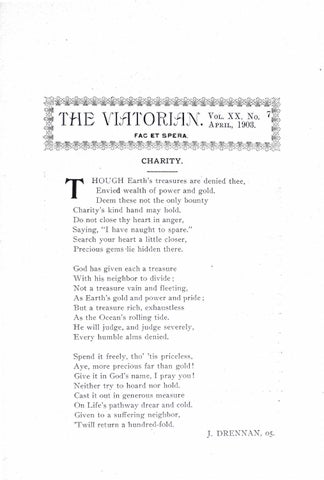
HOUGH Earth's treasures are. denied thee, . Envied wealth of power and gold. Deem these not the only bounty Charity's kind hand may hold. Do not close thy heart in anger, Saying, ur have naught t o spare." Search your heart a little closer, Precious gems "li e hidden there.
T
God has given each a tr eas ur e vVi th his n eighbor to divide; Not a treasur e vain and fl eeting, As Earth's gold and power and pride; But a treasure ri ch, exhaustless As th e Ocean's rollin g tide. He will judge, and judge seve rely, 'Every humbl e alms denied. .'
'Spend it fr eely, th o' 'tis priceless, Aye, more precious far than gold! Give it in God's nam e, I pray you! Nei th er try t o hoard nor hold. Cast it out in genero us measure On Life's pat11way drear and cold. Given to a sufferin g neighbor, ''TwiT! return a 11tmdrec1-fo1d.
J.
DRENNAN, os.
The Vi a torian.
THE EDUCATIONAL MISSION OF THE STAGE~LEVIS :: A HISTORICAL DRAMA IN FRENCH VE:RSE. FR. MARSILE'S DRAMATIC WRITINGS. I
F the several poetical and dramatic works of Rev. M. J. Marsile, C. S. V., President of St. Viateur's Coll ege, Kankakee r Ill., " Levis," w hi ch was recently published b y Beauchemin, of Montreal, is the most important and mo st fini shecL Long ago. Lis "Epine s et F leurs," a booklet of fugitive poem s, a nd " Liola," a. wetri cal romance, and " L es Fils de Cloclomir." a drama in verse,. 2.lr eady gave promise of w hat the author's muse would 路b e able to 路 accomp li sh in a higher strain. His several s uccesses as a librettist of most g rac eful and p leasing operettas, su ch as " The Young 1\!Iart y r s," 11 The Young Crusaders," " St. Patrick," and "S t. Columbkill ," evid en ced und oubted skill in the dramatic treatment of historical" an d r eli g iou s themes : Father l\tfarsile has b een a student of the Gr eek, th e English and th e French drama. He is a believer in the ed u cational mission of the stage and has so u g ht to inculcate into the minds of the students a taste for th e masterp ieces of dramatic lite rature. No t a year passes but w itnesses at St. Viateur's coll ege the pro du ction of a Shakesp ear ean p lay or of so m e of th e best plays o f the F r ench masters . Believ ing, as h e do es, in th e educative power of the hi strionic art, and kn owi ng w hat a fine vehicl e it is for the conveying of the lofti es t morals and r eligio us id eas, h e uses 路 hi s own talent as a w rit er in th e preparation of historic-religio us plays, in w hi ch are imparted lessons of Chri stian zeal and h eroism , lesso ns of l"'. igh-minded patriotis m .
0
Analysis of "Levis:" " L evis" is on e o f th e~e inten sely patriotic i)lays ;路 ever y line vihrates, like t h e s trin gs of the Jewish h arps, w ith the thought of God a nd co untry. It deal s with th e conquest of Canada by the Engli sh . 1N ith indignant p en the poet-priest traces the sce n es of woe brought vp on th e Canadian coloni sts through the rapacity and profligacy of Bigot and the n eglect of Louis XV.
The Vi atorian.
-,
The Canadian women's 'a ppeal for bread, in the first act, and their curse of the odious Bigot and the worthless women arourid him, is a scene t hat is full of power, which one would almost call sublimely feri-ib le. One sees here wli.at heroic sacrifices these honest colonists were willing to impose tipon themselves in order to save their country from the rule of England, to save their country for beloved France. But in the s'econd 路act the valiant Levis himself -p leads for help iri the palace of Versailles and there, in the presence of La Pompado~r and Louis XV., he hears Voltaire triumph with his infamous advice to the king: 路 "What are a few acres 路 of snow to us?" Levis returns, still hopeful. Treason opens Quebec to the English. Montcalm is defeated by Wolfe. In the fourth act is celebrated the victory of the Canadian forces at St. Foye and their eager Lope for succor from France. But no; the vessel which is descried ~n the distance is not a French vessel, but an English warship. The final capitulation is witnessed in the fifth act. One of the r.-oblest passages of the play occurs here, when Levis, refusing to ~urrender his standards, orders the soldiers to build a pyre, whereupon he burns the flags of New France, and, kissing his trusty sword, breaks it in twain rather than surrender without the honors of war. The speeches of the standard-bearers as they consign to the cruel flames their loved ensigns are full of soldierly pride and iove, beautifully set in vigorous verse. Levis' own adieu to his cal eer, to his sword, to his patriotic dreams and ambitions, is full of the grandeur of a great military soul, full of the warmth of an intense patriot. Throughout this play there is a wealth of imagery and a strength and var iety of emotions which one would naturally expect in the poetic treatment of a historical event. The author's lively ~imagination and his easy command of figurative language are dis~played to good advantage and with fine effect. The writer also evi nces his ability to strike the various chords of human feelin g , placing himself easily in the position of the characters he draws, and making trem give v~nt to tho_se st~ong emotions which must be .~tro,ngly felt ~n order to be strongly expre~sed. 路 it may appear to some that there is ii1 this play a lack of in:.
tno
/
The Viatorian.
tr1gue, a lack of interest-proyoking pl<?t. . To those who overly. fancy dramatizations of love stories, or plays whose burthen ever is the over-wor.ked _te11der passion, "Levis" may appear ~ull, in spite· of the lights flashed upon La Peant' and La.' Pompadour~ · One who lcoks ·dee.p lyii1to this dran:a will,-I think, find in)t a unifying idea well w'o rked out, viz: the developinent of the patriot 'under diverse and ' mainly adv'e'r se circumstances. Should OI~e, however read the . ·' drama superficially, ifs five 'a cts 'm ay appear .a:? merely distinct episodes · in the life of a grea:t man. When this -drama is fittingly staged .~nd handled by capable q.ctors its real dr~matic force cannot iail to imp res's the inost p.hlegmat'ic. -·· · '
'
':
.
•
'
1.
'
"
'
•
Its Merits as -an Historical Drama.- ·
As an historical play its merits are undeniable. While one can. read in its lines the staunch patriotism of its author,yet there is; too, w ritten in these pages the la'r ge-mindedriess and farsighte.dness o£· a n unbiased man, who is-holding up to the present and fo the future· a faithful picture of the scenes enacted in 'that eventful period of the history of Canada. Because of the fervid intensity with which these themes are handled, because of the glow.of ideality which the lJOet-dramatist casts upon the living truths, one cannot but help retain a livelier impression of these great historic facts than if he had learned them from the· unadorned pages of a mere chronicler. Not only will one discover the author of this drama revealing himself as a poet, as dramatist, as historian and patriot, but he wiU not fail also to recognize the priest. · There are in the speeches · of these valiant men, especially of Levis himself, lofty and stirring 1 eligious ideas, which could have been penned only by one who is a master in the priestly art of preaching. This fine Canadian drama should meet with i warm welcome·, not only in Canada, but here in Illinois, where there are so many important groups of Canadians, and east and west of us, w.here Canadians have also founded their homes ·and planted the loved traditions of their dear Canada. ~·
Eulogies From . Eminent
Writers~
It may be of interest to book lovers to know what is . thot1ght .o f tl}is ·drama by Canadian writers and critics~ The follow_it1g brief
The Vi 1torian.
2II
extracts from letters apd newspaper articles tell how " Levis" is being recei'ved by the Canadian press and by men of letters: Louis H. Frechette, Canada's poet laureate, in a letter dated from Montreal, February 13, 1903, salutes Father Marsile as his "brother in poesy," offering him his most cordial fel'icitations upon "the picturesque drama, Levis." "So complex and so cruel," says lVIr. Frechette, "are the events crowded into the page of our history which you have dramatized, that it was very difficult to treat this subject successfully in a literary way. But you have succeedt.d in drawing th erefrom a work both solid and strong. And certainly your merit is enhanced by the difficulty of the task whicl you essayed." Ri:. Rev. Mgr. 0. E. Mathieu, rector of Laval UniYersity, Carr ada, acknowledges with thanks Father Marsile's " charming Levis.: Abbe Georges Dugas, author of several important historical works on the Church in the Northwest, says: "'Levis' bespeaks the. remarkable talent of Father l\1arsile, who relates an episode of our history in a way which cannot fail to thrill every Canadian 1-.eart with patriotic sentiment. Placing as it does, before our eyes such clearly defined situations and such deeply stirring scenes, the play cannot but make us all realize what sad and, at the same time, vvhat glorious trials our ancestors had to traverse in those eventful clays." . Rev. C. Ray, literary critic of the "N awvelle France," congratt1lates Father Niarsi le upon the selections of his subject, so fecund and so well adapted for dramatic treatment, finds the work interesting by reason of the author's personal appreciation of the events and characters dealt with , and applauds the patriotic pride displayed in the vibrating pages of "Levis." In the same strain write Rev. S. Nan tel, rector of the Seminary of Ste. Therese; Rev. C. Carrier, rector of the College de Levis; Mr. Augustin Leger, professor of the Laval University of-Montreal. " L 'Evenement," of Quebec, dated Feb. 28, 1903, devotes 4 columns to a criticism of "Levis" quoting many of the most dramatic vassages of the play. The critic finds certain minor faults in thr details, but remarks that even these would likely disappear if th( play were seen acted instead of only read. He welcomes the write
.: ~' .
lll2 '
/
The Via_tori.an.
as a man of tal ent a11.d, after commending his _choice of such a patri otic s ubj ect, says that the dramatist has dressed the historic episode in a poetic ga rb of incont estable ri chn ess . Jean Paul. This cntlque on the latest pub lished work oi the Rev. l\11. J. Marsile, our esteemed president, appeared. in the April number of the R eview of Catholic Pedagogy. We reproduce this a nd with it the following clippin gs from the New World and th e Chi cago American, as evidence of the live ly interest with which ~h e works of Father Ma rsile are r eceived in the literary world. New Wo rl d, Ap ril r8 : R ev. Father M arsile's New Play.-_ Rev. NI. J. Marsile, C. S. V ., president of St. V iateur's College, Kankal,ee, is the author of several litera ry wo rk s which are winning him merited distinction l: oth as a writer and as an educator. The April (eview of Catholi c Pedagogy contains an inter esting notice of .<at h er Mars il e 's works and especia ll y of his " L evis," a historical lrama in F r enc h verse. The r ever end author is said t o be a b eliever in the educational mission of th e st age, hen ce many of his effort:' h ave been di r ect ed along dramati c li nes. In his plays Father M arsi le has sought to portray tl.i-ode ls of Christia n zeal and h er oism and to inculcate lessons of hig h-minded patriotism . . "~ev i s " deals with th e cession of Canada to England, a"fter th e struggles of \N olf and Montcalm , and offe r s~ the author an excell ent opportunity for the display of th e many qualities w hi ch th e brave Canadians needed in t h e time of their seve r e trial. "Th er e are," says t h e Review, "in the s peec h es of these va liant men, and ~spec 足 iall y of Levis himself, lofty and sti rring r eligiou s ideas which cou ld have been penned only by one w h o is a mast er in th e priestly art of preaching." This play, w hi ch is in five acts and makes a dainty booklet 01' some r so pages, cannot fail t o interest lovers of th e best t ype of litet ature written in the sweet accents of Racine ai1d Co rneill e. Heroic Struggles cf Colonists in Verse.
Kankakee, Ill. , April 4.-(Sp ecial t o th e American.)- From; quaint li ttle Bourbonq.ais, the dignified Ca nadian suburb of Kankakee, in whose classic g~ov,es i1estle schools, ;:t college and an ~cad- . emy, comes a vo tce celebrating in th e ringin g accents of dramatid
The Viatorian.
213
French verse the heroic struggles of the Canadian colonists against Wolfe and the final cession of Canada to England.. In a quaint booklet the Rev. M. ]. Marsile, C. S. V., the poet-priest now well known in literary circles, draws vivid, moving pictures of the severe t rials endured by the Canadians under the governorship of the infamous Bigot, of the fatal neglect which they experienced from Louis 路 XV. , and of the inevitable defeat of these unaided Canadian patriots. The play, which is in five acts and employs a large cast of . men and women, is full of grandly dramatic situations. It. cannot fail, when either r ead or seen enacted,. to excite th e most patriotic sentim ents. The presentation of this play with the costumes of that period and with all the scenic properties, wo uld be a history .路 lesson nearly as elaborate and striking as Shakespeare's "Julius Caesar," now played by 1\tfans:field . According to 1\1r. L . H . Frechette, Canada's greatest living poet, this play has distinct historical and literary m erits . This historic drama is entitled " Levis" and is an important addition to the literary products of Illinois. Father Marsile, C. S .. V ., who is president of St. Viateur's College at Bourbonnais and has路. been engaged in educational work there for the last thirty years, is . the author of several ly ri cal wo rks in French and has also written many beautiful operettas in English. He is a believer in the educa~ ti onal mission of the stage.
BLEEDING HEARTS. HERE are h earts that pin e and worry In a sadn ess mos t intense. Yearnin g for a wo rd of comfort That wo ul ~ ease th eir g reat susp en se; But th e s igh s that sp eak th eir feelings Di e unh eeded on th e air, F or th e wo rld is n e'er attentive T o a s ad and pl aintive pray er.
T
•
The Viatorian.
-2 14
There are some tJ:at nigh are broken From the crushing grasp of woe, And their fitful breaths are echoes Of a life that's eb bing low ·; But their sobbings wake no answer From the busy, pushing throng That is crowding Life's ar ena, Seeking ri ches, right or wrong. There are others that seem happy And quite free from every car e, But a little shade of sadn ess Lies beneath th e brightest glare. Yet though hearts may writhe in so rrow, And go achi1~g all through life, Their requite!) shall be measured In proportion to their strife.
:rvr. J. B., 'o4.
ETHICS: ITS EXCELLENCE AND UTILITY. nature spreads before our wondering gaze all its gra.nde u~- s in 1:1ost pictt:r:sq11e profusion, we sometimes dehght 111 lett1ng our VlSIOn rest upon the snow-capp ed summits of lofty mountains, those cathedrals of nature, whose sunldssed heads bring earth nearer to heaven. And, likewise, w hen we · o bserve the works of man we love to look upon th ose majestic Go mes which his art has suspended in mid-air as though they were ..,;Jinged spirits resting for a moment up on our dusty g lob e. Now, as the noblest of edifices are crowned with b eautiful domes; as the thorny stems of plants blossom forth in fair flowers; as the ru gged trunk and branches of nob le trees produce lux uriant foliage and abundant fruit, so too, is the edifice of know ledge crowned with its 1 g lorio us cupola; s ~f~ the tree of science adorne.:l with its fresh foliage, its fragrant blossoms and its, nourishin g fruitage. If we were to compare the science of philosophy to an edifice, we could say that man ·w ith his reason 'is the architect; that his materials are ideas and l1.is tools the laws of thought as laid clown in logic. He
W
HE
The Viatorian.
215
Jays down the foundation of this structure wh en h e handles th os e fundamental notions which are explained in g eneral m etaphys ics or o ntolog y ; that is , the notions of b eing, of essence, of sub stan ce, of ;.1ccident, of cause and effe ct. U pon th ese solid prin ciples he proct: eds t o erect th e sup erstructure; he builds th e wo rld , h e a cco urits for th e constitution of bodi e~ li v in g and in ert , and places th em in th eir prop er ord er . This is th e body itself of th e edifice-it is w hat p hilosop hy call s cos m ology. vVh en he has thus acco unt ed for th e ·(_·r igin a nd purposes of the unive rse in g en eral, h e p roceeds t o a :study of deta ils. ,. He studi es m an a nd God. Th e tru t hs w hich he -d iscover s about Go d and mar.t b eco m e th e st r ong pilla rs th.at lend ·8olidity an d bea uty to th e edifi ce of his knowledge . B ut ab ove and ov~ r all t hese an d to crow n them all , th e ar chitect w ill place as th e ·:::.ky-kissing do m e..,th e scien ce of m oral acti on or ethics. T o see, th en, w h at is th e n atur e an d excell ence of th is scien ce, to ascer tain its utility and t o not e what erroneous by-w ays ar e to be CJvoid ed in seekin g it, she uld be subj ects not lackin g inter est. In th e fir st pla ce, I say th at th e scien ce of m or als is r eally a sc ien ce, a nd w h y ? Simply becau se its co nclusions ar e de rived from p rin cipl es that are certain. N o syst em of et hics can pret end to th e ·d ig nity of a scien ce unl ess it is based u pon solid and ir refutabl e J.>rinciples of m etaph ys ics and es pecially of psychology and th eodi cy. -~. nd e p e nd e nt ethi cs, or ethi cs , that is th e r es ult of sentim ent, is not scie1i.tifi cally base d and is more d ese r vin g of pity than it is wor t hy b-tr> 1/t.t-.J.f tvt.t <'-' -of r efutation What ca n be ·th e r eal v alu e of a m oral syste m th at -does n ot r est up on th~ fr eedo m of th e human w ill , tCod's exist ence :and1other equally fundamental and s imilarly we ll e~tablished p rincipl es of m et aphys ics? Indeed, if we cas t an eye back up on th e hi sto r y of philosophy do w e not see that if So crates or Plato or th e ·S toi cs or eve n th e Pos itivists have· m ade efforts to m odify philo· ~o phic prin cipl es, it w as alw ays w ith th e avowe d purpose of mocli·iying publi c and privat e m oral s ? Surely, if th ey h ave striven t o r e\ eal t o mankind th e b eauty of truth as th ey conceived it, it w as in -o r der that th ey mig ht lead m en logicall y t o th e attainm ent an d enjoym ent of th e hi ghest good. Secondly, I say that Ethics is a practi cal science. Other sci,cn ces ar e speculative; th ey t ak e u s up to A lpine sum m its and from ·.this v&l.4-t.a-g-e- g-re t.:rrr? show u s th e w hole r ealm of truth w hich th e t16---I.A- YLC-t1 a.f. lll~ I. (J ( ~
.
The Vi atorian. ii1tellect 1elights to behold. But moral science deals with action; it guides the actions of man to their last end. It is essentially practical; it lays down rules of moral conduct and points out the waysand means whereby the highest l~uman perfection may be attained. It tells man this: " You must not rest satisfied with the contempfation of the truth, but you must be up and doing and with ali the energies of your soul make for the conquest of the good. You ha:e not only an intel~ect to understand, but a will to love. Come,. then, and I will show you how you may clasp to y.our heart that good in which alone you can find perfect happiness." Let me now bay a word on the surpassing excellence of this sC'i et1Ce.
.
.
Now we may assume it as a certain principle that the loftier is the object of any science the greater is the dignity and excellence路 of that science. I do not think that this principle can be gainsaid .. But the object of moral science is the ultimate end of man or the supreme good, than which there can be no nobler or more excellentobject. We can easily conceive, therefore, that moral science occupies, the prima.cy among all the sciences. Physical sciences teach us many things that must be known in order to make progress in thematerial order; to live safely and comfortably. But allv this concerns our material or bodily welfare, a thing that is surely not to be c'isregarded. However, the claims of ethics are not lessened by the 路 service which these other practical sciences render humanity; for Ethics teaches us how we may attain that spiritual excellence with-c ut which all the comforts of the body were but paltrY. possessions .. As mind is above matter, as the soul 1s more than the body,. <-'S heaven is above earth, so is ethics queen among the sciences. It is this both by the loftiness of its object and by its all inclusive uni-versa lity. For>why should we try to know anything and all things, . if not in order to become better men? To the attainment o.f morar excellence all the other sciences are made subservient. All converge there; all have the last reasOli. of their being there. It is tru e that metaphysics is a very noble science; but after all it only teaches us to know; ethics teaches us to do; and as to act 1;obly, to act heroically is more e)\.cellent than merely to know well, . t' O , again, does ethics take the precedence even . over the dignified: science of metaphysics. But is it useful to learn ethics?. When a means is indispensa-
The Viatorian.
2I'f
ble for reaching a certain end, may we not say that this means is not only useful but that it is necessary?. But such is ethics. Un..;. Jess we develop our native moral sense and become deeply impress{:d with the truth about moral freedom and responsibility, about ~1uman duty and human right, about our real purpose and destiny in this worl_d, we have not the means to reach that end or destiny. And yet this is the one important thing. There is no success like <Jttaining this ultimate end because this is the success of all suc路cesses, and there is no more complete or disastrous failure than fail1..tre to reach this supreme good. Moreover, it is useful to be forewarned and forearmed in the strife which life is, i. e., a strife against our own evil inclinations, .a gain st the solicitations of vice and evil example. It is necessary, :n our day and place, to be w ell taught in moral sci ence and w ell <:1rilled in moral habits in order to opp ose the corrupting influence -of fal s e teachers, whos e pernicious errors ar e spread broadcast by th e pr ess . O n e must have .. strongly ground ed moral convi ctions- if l1e is to r emain firm and faithful w hile divorce is being procl aim ed -o n th e one hand, and anarchy and so cialism on th e oth er ; w hile the black imps of infid elity ar e dan cing in front of him and all th e w ild -saty rs of pl easure-w orship fill th e w oods around. l\/[o ral scien ce is not onl y us eful as a weapon of defen ce, it is 路useful as is an alp enst ock to climb; it is useful as an instrum ent of -progr ess . A science w hose purpose is t o m a ke m en Go d-fearin g an d law-abiding, a s cience w hi ch w ill make m en hon est , t empe rat e, chast e an d kin d, certainly cannot b e a useless scien ce. I s it not -i mm ediat ely evid ent that a science of this kind m akes directly for -i ndiv idual im p rovem ent, for social progr ess and for th e tru es t nation al g ran deur? l\/[o r eove r , ethi cs, wh en it has b ee n seriously stu died, disposes th e mind to a ccep t th e hi gh er t eachin gs of faith an d this is by no m eans th e least of th e man y valuabl e ser vices that this scien ce r end ers man kind. It is cl ea r , th erefore, th at ethics is a p r acti cal s ci ence, that it is a ver y nobl e scien ce an d, at th e same ti m e a very serviceable science. Now in pursuin g this scien ce w hat e rror s are we to g uard a g ainst? In saili"n g ove r th e sea of eth ics w h at shoals ar e t o b e avo id ed ? We must g uar d against t hose who (.xaggerat e th e claims of r eason , or of r evelation , or of exp erien ce, in a wor d: rationalis m, traditional ism and positivism.
I
~-
The Viatorian. R easo n , exp eri en ce and r eve lati on ar e the ind efeasibl e tripl e ~dl iance w hi ch w ill keep th e m or a list safe fr om any of th e m a n y erro rs t h at ar e t o b e g uard ed a g ainst . R a tion ali sm , w h eth er of th e stamp of Ro usseau or of Kant, ri dic ulously exagger at es tll e powe rs uf reason, fo r wh ich it claim s t h e co mpl et est a utonomy. It r ej ect s ~ t h e offi ces of expe ri ence and th e supe rn a l lig ht of r ev elation. The mod-ern p h ilosop her can not, w it ho ut offending r eason , procee::l to const r uct a mo ra l syst em an d ig nor e th e sup erior m oral influen ce_\v h1ch Christ ianity has exer cised up on societ y for now well ni gh two t housan d years. P r epost erous a r e his att empts t o brin g us back to pagan idea ls of hu ma n con du ct and t o th e primitive lesso n s of teachers w ho, because th ey kn ew n ot r evelation , err ed so egr egiously in r elig iou s an d m or a l m att ers. No r may we w ith Lam enai s a n d the trad itionali st s insult r eason and say that man can know nothing at all wo rth kn ow ing in r egar d t o r elig ious and moral duty wit hout t h e t eachin g of auth ority or r evelation . Tradition and histo ry ar e h er e again woefull y exaggerated. W hil e th e voic e of histo ry an d exp eri en ce is u seful and utters many solemn warnin g s,. yet its t eac hings have not in th em selves th eir own ultimate r eason. 拢or instan ce, it is n ot b ecause ce rtain thin gs hav e tak en place in th e past , or certain cust om s have prevailed, that we ~re justified in imit ati ng th ese thin gs; th e guidin g v alu e of hist ori cal fact s ~11ust be deter m in ed by th e co nformity of th ese fa ct s with th e eternal an d imm utabl e p r in cipl es of ri g ht m oral action and not vi ce v ersa. Postitiv ism , w ith its r ejection of logic, of metaphysics, of every .c:ogmati c asse rti on , wo ul d have th e fl ower of m orality without th e 8tem of positi ve beli ef. Th e amus ing p erforman ce of p ositivist mo r alists is li ke that of childr en building card castles upon th e movin g san ds of th e .b each. A m uch mo r e pe rni cio us error is that of moral evolutionism ,. w hich , as Spencer says, t eac h es w ith scientifi c a cc uracy n ot w hat man m u st do, for h e ha s no lib erty' but w hat h e w ill do in given circumstances. E thical sci_en ce is r educ ed t o m er e statisti cs; it is a me r e mech ani cal device like a barom et er. It t ell s w hat a man w ill do w h en h e is hot w ith passion , o r w h en h e is calm . It looks C路 n man as going throug h an irresistibl e process of evolution-to :whom it were a~ u seless t o sp eak of duty as it is unr easonabl e t o
i •. ~ •- -
The Viatorian.
219
-offer him comfort and encouragement. This materialisti c and particularly earth-bound view of n1an is a prin cipl e of moral degradat ion that wo ul d soo n plunge society into an ab yss of corruption and cf infernal despair. No less suspicio us is the eas ily adjustable ethics of the n;o ral skeptics w ho se di ctum is that as there are no r eally universal or immutable princ:pl es in metaphysics or mathematics, ::-o there ·a re no moral principl es or laws tl:at are fix ed and immuta•..-tJ q .. ble and the same for all m en c.. nd all plac es. Nloral laws ;._nn1st lbe . made to suit the temp erament of ip1i') duals/& th e p eculiar difficulties 0 and exigencies of tim es and plac~s.' M~:/rti · scie~-1~~ . .cl~al s with rig hts . <md duties of conscience; it must be th e enlightener of conscience, z. nd conscience it self cannot be a safe guide unless it is certain. It is very clear, th erefore, that skepti cal et hi cs is no eth ics at all, even though Montagu,e or som e other brilliant writer com~1 l ains of the difficu lty of getting at certainty and wo ul d have us r es t satisfi ed ·w ith probabilities. Equally unsatisfact ory and indeed fraught with danger ar e th e vahous other syst ems "w hi ch on acco unt of th e predominant error they contain ar e denominated humanitaria ni sm, altruism or utilitanam sm . In non e of th ese w ill the stud ent , or for that matter th e m er e curious passerb y, find any r eal motive pow er that will lift hi m up above purely selfi sh ends, earthl y ends , and fir e him with en thusiasm to beco me less human and more God-li ke. Th e sanest counsels of Confucius, th e w isest t each ings of Pytha go ras, the most bea utiful things which Socrates and P lato have ~; aid-the s e were in lar ge m ea sur e cr ys talli zecl in th e ethi cs of A ristotle, and th e et hi cs of A r istotl e havin g filt er ed throu gh th e minds of Chri stian scholars, has been inco rp orated into th e philosophic syst em of moral philosop hy, w hi ch the schoolm en have given the wo rld. When th e mu se of spec ulative philosophy had grown accu st om ed t o look at thin gs in th e rays of th e " Light of th ~ World," sc holastic ethics was fitted upon her brow as the m os t fitting ornam ent of her b eauty. It is in thi s perfect philosophy of human life that all th e purposes of other knowl edg e find at on ce th ei r term and th~e ir explanation ; and it is in thi s philosop hy alone that individuals as well as nations wi ll find th e moti ves of that conquering power v1hich uplifts man above self and w hich makes nati ons fit to do the deeds of God. R. I
/
~
•Ll / ,
•220
The Viatorian.
HOME. N the gently rolling prairies, Where the Indian used to roam, Toward th e blushing s ummer sunset, Lies m y humbl e, country home.
I
In th e midst of wa,ving corn field s, And of meadows fair and green, Stands the hom es t ead of my fath ers, 'Neath the azure sky ser en e. Round our co tta ge stat ely maples Ri se majesti c towards th e sky. In their shadow bathes t h e g reen sward, Tempting all the passers-by. Oft in sweet , refulgent s umm er Have I lingered t he r e to r est, ¡ Underneath their spPeading branch es, Whe re the r obins buil d th eir n est . Oft we gath er ed rosy apples, A n d we reaped the golden corn. A n d th e w inds gave back our laughter T hat it stole in early morn. But far different in th e w int er , W hen the old December's roar Whistled o'e r the giant tree tops And ar ol.md our cottage door. Then we gath ered round th e fireside, N"ear its warm and ruddy glow. Whi le without the sto rm was raging And the gro und w2s robed in snow. Years have passed, but lov,ing memories, Li ke th e ebbing of a sea, With its soft and nl.urmuring w hisp ers, Once again return to me.
.l
iThe Viatorian .
. 22I
Not in a ll my yo ut hful wan de rings ;Neath t he spacious dome of T im e, H ave I met with s uch contei1tment As i in that hom e of mine. E . J. PHE L A N , F irs t Gra111m a r Class . •
INDIFFERENTISM.
·w
H E N t h e immort al S hakesp ear e describ ed th e r ati onal anim al thu s: "W hat a piec e of wo rk is m an! H ow no1)]e ' .. in r easo n , how infini te in fac ul ty ! In form and m oving how express and a dmirabl e in action ! In a ct ion how lik e an an g el! In appr ehension how li ke a god! T.h e b ea uty of th e world , th e parago n of animals" ! I say, w hen th e prince of dramat ist s penned 1h ese lin es he mus t have"' b cen in an exceedingly charitable and optimi stic fram e ·of mind. H e assembles in one pi cture and presents to our admirin g gaze all t hat is gr eat and spiritual and noble in man . Th e d escripti on is such a b rill ia nt st roke of genius that w e <:!re, for a tim e, dazz led by it s splendor , and a r e li abl e too hastily t o co nclud e that m a n is, afte r all , li tt le less t han th e angel in every res pe ct. But, unfor t un ately , s uch is not t h e case. Ind eed, your <::.ve ra ge r eli g ious indiffe r en t ist affo r ds a strikin g exampl e of a man w ho is , in many r esp ect s, diam etri cally oppos ed and in marke d contrast to th e on e w hich th e g reat paint er of hum an natur e has so admirabl y portraye d. • If we t a ke in to cons ide ration th e fa ct t hat th er e is t oday no g r eater s pir'tual ev il and social m ena ce t ha n r eli gious indiffer enti::.m , if w e co nsid er t h at t h e dispos it ion t o un dervalu e and neglect thin gs spiritu al is pos itive ly chara ct eristi c of A m er icans as a people, th at our temp le of w orsh ip ar e dail y b eco min g mor e and mor e e~ mpty , and . t hat t he tr em end ous hos t of r eligions indiffer entist s is co ntinu all y sw elli ng, t h en we w ill perc eive th at this pap er is not w holl y un wa rra nt ed an d p urposeless, for it w ill end eavo r to show th at r elig ious in differ en ce is ab s ur d, a nd t h at t hose pe rsons w ho ~ s !t a r e tmreasonabl e and imp ious. B ut befor e we ?roceed 1·
rrof
•
222
The Viatorian.
, furt h er with o ur disc ussion it will be well to und erstand what is m eant by the t erm , indiffer entism. It co mprises two distinct notions of religion. The ab so lyte indifferentist is one who ·beli eves that God does not care for th e ob edienc e and adoration of m en and, l onsequ ently, . r eli g ion is something .unn ecessa ry and use less. The a.bsolu te indifferenti st rejects religion , bo th in th eory ·and practice. On the othe r hand, the mitigated or theor etical indifferentist admits that r eli g ion is n ecessa ry and commanded by Go d, but holds that all kin ds of r eligion s ar e eq uall y good and pleasing to God, and that we a r e not obliged to em brace any special so rt of worship. Either cont ention is far from the truth, impious and illogical. Agains t him who would have us believe that God does not care for th e homage and obedi en ce of His creatures and who proclaims as a great truth that religion is u seless and unnecessary, we sa y that th e Cr eator has th e stri ct right to b e worshipped ii1 a r eligious · w a nner by all men; in ot h er words, man is bound to practice r eligion. Vl e do n ot speak of any particular r eligion, but simply of re. Egion in general, which consis ts in· acts of adoration, thanksgiving, petition and repentance, addressed to the Supreme Lord of th e Unive rse ancl Giver of all gifts. By adoration is m eant the ac, · knowledge m ent of God's supr eme dominion and infinit e power over His cr eatur es. Now . is not every intellec tual creature in the unive rse b ound t o ado r e God? Certainly; for it is He who h as created · all b eings, who sustains th et}1 in existe nce by His all-supporting h and, and who co ncurs with them in th eir every action . Imagin e, · t h en , th e se rious erro r of th e ab olute r elig io us indiffer entist, pictur e hi s s hocking impiety and monumental impuden ce, in deliberately refusing to admit th e absolute dominion and power of God over His c reature$-Of God, who has brou ght them from nothingness into b eing, w ho, by a co ntinual influx of b eing pi·events them from falling into non entity, and who mak es th eir eve ry act possible by v irtue of Divin e con curren ce ! A nd s hould not man render t hanksgiv in gs to A lmig ht y Go d, who has given him life and all thanksgivings to A lmig f1t y God, He who has given him life and all that h e has? Nor a r e we inclined to think that the · absolute religio us indifferenti st is self-suffi cient and possessed of all graces. Let him h?-ve r~course t o p'ra1er and ask of GQcl a,ncl h e. shall recdve,
The Viatorian. It is also perfectly safe to say that his life is by no means irreproachable. What sort of monster is he, if h e is not sorry for th e outrages and insults he has offered to a loving and m erciful God?, How blind is his mind, how like a stone his h eart! I think we are justified in concluding from these few brief considerations that every man is bound to believe in and practice religion ; and consequently absolute religious indifferentism is absurd and insulting to God . It now remains to be shown that mitigated indifferentism 路 is equally false and' illogical , and offensive to the A lmighty. 路 , T o say that all r eli gions are equally good is to deny the unity of truth, which would lead to great metaphysical errors and wonlcl place us in a labyrinth of contradictions, from which escape would t;tterly be imposs ibl e. Every religion differs from another in many 1 espects. One sect t enaciously adheres t o w hat it considers .q.s fundam ental , esse ntial truths ; another r ejects them with scorn anci derision. The basic principles and 'importan t t eachin gs of one r elig ion are condemned b楼 another as destructive and false. Now, evidentl y all th ese religions, so w id ely different in their .r espective Leliefs, cannot be tru e and equall y good. Some particular ope of them must be the tru e r eligion and better than the oth ers, since truth is essentially one and immutabl e. Therefore, th e mitigated indiffer enti st is wrong and illogical w h en h e wou ld have us beli eve that all r eli g ions are equally good and pleasing in the sight of God, for God, w ho is Infinite Truth, can accept nothin g contrary to hi s own attributes. J\1oreover , t o admit such a doctrine wou ld be t o suppose that polytheism and monotheism, th e most outrageous sup erstitions of idolators and t h e su blim e wors hi p of Christians are equally pleasing to an A ll-Wise and ju st God. Let me ask th e indifferentists and you, my gentl e r eader, a question: Are you ready to believe that the ancient orgies and bacch analia, so criminal , so shameful, so base and outrageo us, ar e as good and pleasing to God as the rJure, humbl e, beautiful , s ublim e, tru e worship of th e Christiaq. martyrs and solitaries, and of Christian s in general? I think not, for such a belief wou ld be an in sult to Infinite J\1ajesty. We have the most authentic proofs that God forbad e idolatry. He inflict ed a sco urge upon t he Egyptians, from among w hom h e led hi s chosen peop le, g uidin g them with a cloud by clay and a pillar of ~r ~ t
•
. I.
1~he
vi atoriah .
by night, making th e waters of th e R eel Sea th eir guardian, feeding them with manna in th e desert, and finall y bringing them into the rromisecl land flowing with milk an 1 honey. Can you not see that he did not warit th em to fall into th e idolatry and immoraliti of the Egyptians? Again, did not God become angry with the I sraelites when they had set up a golden calf and worshipped it? If we need any further proof that God does not equall y approve of true and fal~e religion s, let us rem emb er that H e sent His Divine Son to die on th e cross for sinful man to perfect His law, to establish the most perfect religion and to overthrow th e false, li centious worship of the old pagans4 After th ese refl ection s it must be evident that mitigat ed indifferenti sm is abst1rd, in that it denies the unity of tn t h , and impious in that it contends all r eligiou$ are equally pleasi;. ~· in the sight of God. Now let us consider what kind of a man the average r eligious indiffere ntist is. l-Ie thoroughly enjoys a.ll the benefits of Chri stian civilization; he is surround ed by an atmosphere of purity and justic e.· Splendid success smil es on all his efforts. H e has wealth , position and influ enc e, has been married and divorced severa l times, and is still looking for another b eautiful woman with a fortun e, w ho w ill be foolish enou gh to entrust it to his tender keeping. H e prides him self in b eing so popular and in flu ential in th e community and lulls his so porific h ead to sleep in lethargic dream s of hi s own goodn ess and hon es t y. His immediate fri ends, too, point to him as a man of character and moral in- · tegrity. But let us not be satisfi ed with a mere surface view of such a man. Could we but get a good view of hi s own inner self, of the real inward man , we would undoubt edly find that his virtues are very few, his vices num erous. H e does not dese rve the success he is having in this life. H e is not hon es t, for h e who denies to God the worship clu e to Him , th e worship demanded by Him is supremely dishonest, s ince he refuses to m eet his obligations to Him w ho is the Supreme Lord and Master of th e univ erse to Him who has said, "render to Caesar th e things that are Caesar's, and to God the things that are God's," What, think you, shall be the fate of such a man on th e clay of judg m ent? Error opposes truth 6n eve ry sid e. As Chri stian s, who are ardent b elievers in a di vin ely found ed r eli gion, and especially as Cath -
, {- f r~
•
·"'
1 •~
I
•
The V1atoriarl. olics, firm possessors and zealous guardians of God's truth, we must always be prepared to meet and fairly combat our unbelieving opponents. But we will certainly noft find a more numerous and pet · sistent enemy than the motly array of religious indiffer"entists, who are all the time and everywhere in _evidence. Let us, then, as far as possible, discountenance these mistaken views with regard to r e' . ligion, so that all may be assembl-e d under one banner and united in cne grand realrl}, alike believing and practicing the same thing-s , and there "shall be but one fold apd one Shepard."
· W. G. MAHER, 'o4 . .-
..
. .
..
,..,,·i·~···
/···~· . .......'·\~ ... •... '···~· * ....... -~· :t "'t ~ ••·•
+' ~; ~~~) \
·~~~
\ ~......... .. .... · ~.i;..~'"•i., , .. .. ... ../ ....,.,...,..,..,.
t
'
The_Viatori_ani
Published monthly by the students. _ Edited by the students of St. Viateur's College, Bourbonnais Grove, Ill. All correspond.ence must be addressed: THE VrATORIAN, Bourbonnais, Ill. Subscription price, one dollar per year, payable in advanee. Ente red at the Bourbonnais P. 0. as second class matter.
BOARD- OF EDITORS. J. LYNN, R. RICHER, 8. SULLIVAN,
P. J. DUFAULT, J. DRENNAN,
W. J. CLEARY W. MAHER.
EDITORIAL. "Know Thyself." Self-knowledge is the first, the most ,necessary and the most profitable kind of knowledge a man can acquire. Ever since the maxim, "know thyself," was enunciated by the Grecian sage, it has been looked upon by mankind as the wisest, most profound and allembracing precept ever uttered by human tongue. Yet, despite the fact that the true knowledge of oneself is the most necessary, it is Fkewise that which is most frequently neglected. Some men are c total strangers to themselves. They go through life ever laboring under the delusion that they are what they imagine themselves to be. ·We know in what pleasing, but delusive colors the imagination presents to us those th!ngs which are closely related to u~: and for which we have a special predilection. We may then, with reason suspect that the fair image of ourselves which we see reflecteel in our own imagination is not after all a facsimile of the origiEal. The cunning artist may have removed some odious blemishes; he may have introduced some roseate tints which gives to the sickly countenance the glow of health. But all this is deception- that deception which deceives ourselves only, and prompts us to place c•urs elves on a point of eminence before the searching gaze of a critical world which shall view us, not as we appear in our own poor, deluded imagination, but as we are in reality with all our perfection s and imperfections, our qualities and defects, ou_r virtues and vices . Then all that is ,v icious in us will not be hidden from v iew ; but, like thos e excrescences which we see sometimes disfigurin g the human count enance , will cause the beholder to turn away in
disgust.
. ..
'
....
..
.
--
-The ·Viatorian.
227
In this all important study we should not trifl e, w e shp uld not allow our fancy to deceive us, we should have the courage to m eet CJurselves face to fac e, we should p ee r into th e v ery depths of our soul and there study our inmost self for what w e are outwardly is but the refl ex of what we inwardly ar e. 1\!Iask it how you may, th e inward soul will still r eveal itself in th e outward act. '\f\Te should not deny to ourselves that know ledge which we cannot help r eYealing to oth er s. \ i\T ith r e ga~d to oth er things m en are anxiou s to outstrip all eomp etitors in th e race for knowl edge, but with r egard to thi s, th e most importal}.t scien ce of all, th ey allow others t o vutrun th em. Th ey are known by oth ers long before they ar e Lnown by th ems elves . P erhaps th eir pre-occupation with minor affairs, which through a mi stak en notion th ey consider of supr em e importance, prevents th em fr om att endin g to that which should be ofvital int er es t to th em. P er haps, w hil e th ey ar e engaged in viewing with a mag nify in g glass th e fat'llts of oth ers, they fail to look even with the naked e_ye up on th eir ow n. P erhap s, in the serene corhplacenc y with which th ey co nt emplate t heir imaginary virtues , they lose siglit of their r eal vices . ·\N e m ay find in on e: or the other ~· f th ese suppositions, or in all , th e r eason why so v ery many m en ltave s uch an erroneous id ea of themselves and why so v ery few )mow them selves as th ey oug ht. To . be profitabl e, this study of s elf mu st not be self-complacent but critical and m ade with an eye t o im provement. vVe must seek o ut the motiv e of eve ry a ct and co nsid er w h eth er or not it is in conformit y with th e immutable standard of r ec titude ; we must co nsider how w e are influenced by th e variet y of circum stan ces in which w e are dail y placed ; w e mu st kn ow w h eth er we ar e w eak and vacillating, co ntinuall y contradictin g our principl es by our actions; or wh eth er we a re m en p osse~se d of th e co ura ge of th eir conviction, 1vbeth er w e have that m or al st amina w hich enabl es m en to ob ey th e ~t e rn and un compromi sin g commands of ch1ty, eve n thou gh a thou::; and difficulti es co nfront th em , e~e n though a t housand adve r e influ ences are brought t o bear on th em , eve n th O\J g:h th e alli ed pow( rs of mali ce and pleasur e . consp ir.e again st th em . . But if w e wish t o r eap th e full ben efit of this knowledge, we must not content our;. e l v~s wj th th ~ m e r ~ know l e d ~e, but mu st avail ourselves of it to
•
' rid us ? f our· defects and streti:gthen· us· in "0 ur~·petfections; we must Hot rest satisfied with the lrnowfledtge uf\what''lWe are, but 'Ye must app ly it to ourselves to become.'what ·w e ou:ght to be- noble men, "the grandest work of God." ." If we wis'h, ·then, to be considered truly wise, we must not cont1pt 'o,u rsHves with appreciating the w isdo m of Socrates, who form ~t,Jate d the •sage ·advice, " know thyself,'' but we must imitate those who, ·a·lthot'l:ghthey lived long before the Ath enia n philosop her cam~ to ·en'l'ighten the wor1d, yet, ·not knowing this wise precept in the form-ula, knew "it in pract i~~c
A n exchange column whis)l app+ies , the . principles of literary criticism to all compositions- n~ticed, ·s·howing wherein they are ini. harmony o r at variance with these' pr·incip1es, is certainly a desirable ·and useful feat ure of a college · jour-nal. W ·hether, through i'ts me~_ <lium praise or blame is given,,·'the writers w•hose work is cntl.:. c;zed, are benefitt ed; for nothi~g so co~ntr1butes to improve a student in th e literary lin e as to 11_<:\:~e- his-exceHenci,es or shortcomings, in thought or st y le, clearly poiri1zed out by ·s·ome judicious, painstak.:. ing exc hange ed itor. When su ~:h notoriety a·n d· publicity are given to the good or bad points of the sht'dent's composition, he will undoubt edl y be incited to do bett~r and will endeavor to avoid· in the L.tture the indicated d ·::.fects ir.. ~:";' es·say, story or poem. There are oth er considerations which cou1c;i be urged ;.., favor of an exd1ange column , but at present we hav e neither the ti111e nor sp?~e for them. ·we make th ese remarks for the benefit of those collet:,~ journals ·w hi ch either conduct no exchange column or one that is sadly if. need of improvem ent. Fortuna't ely, there are but few college publications that entirely ignore this important departm ent. There :·ho uld be no ne. \Ve are -absolute ly ·at a loss to see an y va lid reat;O n for com plet ely discarding the exchange column. vVith one of cur esteemed contemporaries we are ready to meet any legitimate quias on this point. C)ln t he other hand , there is a little tribe of exchange editors · w h ose stock in trad e consists in " this is good," "that's nicely writt en," " th e ----.- has a very pretty ~9ver/' and gth <;i r su~h childi;;;h
/
The Viatorian.
229
<~ssertions.
And we regret to be obliged to say that such common·-places often pass for criticisms in not a few respectable college pub.lications. We wou ld earnestly suggest that such ex-men as these, should wake up, cease to be so indifferen t and make an effort at criticism. The first number of the St. Ignatius "Coll egian" has come to o0 ur sanctum, and a most welcome visitor it is, and ever will be. \t\ e confess we have not read the entire contents of the journal, but ·the few contributions ·vve have perused, pleased us very much. The ·spee:::h on the "Trusts" is hig hly commendable for str ong, sensible argumentation, and the simple and captivating style in which it is vY ritten. " Resignation" is an excell ent poem whi ch exhales the perfume ~f sweet, Christian .thoughts. The exchange column is evi·dently in able hands. Come again, Collegian! " L or etto Magazin e," ;for March, is certainly far superior in the 'line of poems to any other of our sisters' publications. "To My Al1na · Mater,'' "An In dian Portrait," "To a Friend," "A- Villanelle," w ould do credit to a mu ch more pretentious magazin e.than the modest " L or etto ." We consider the last two m ent: on ed th e bes t in this 'ISSUe.
In the 1\!larch numb er of th e "Mountain eer" th ere appears an ·essay on "Cardinal New man ," which is equal, if not s up erior, to an y essay we have read in last month's exc han ges. It is evident that th e writer is thorough ly acquainted with his subj ect, which, in the case of the many-sided New man, says much in his favor. His 'Co111position, though of g r eat length, is remarkable for its order; his diction is harmon ious, g raceful and po li shed. There is, however, a noti ceable sameness in his tran sitions from one poi nt to another. · ~l his may b e a minor def ect, but still it detracts somewhat from the excellence of the who le. The Mar ch number of "B uff and Blue" is , to our mind, a .very <:oubtful quality. The article on "Queen Victoria," though w ritten jn a pleasant style, is, by ti.o means, flawl ess. In the fir st plac e it is ·entirely too hort. "Let Us Go Back," says th e wri-ter, "to the be-
•
•
The Viatorian. gin ning of Queen Vi~toria's reign and watch her as s he, with the:· reins of government firml y in her hands, guides the nation safely th r ough six ty-four yea rs of sunshine and storm. " Then the writer proceeds to review the political r eign of V icto ria in about a " doz en " ·lines on the coronation and m a rriage of the deceased queen; and dispatches Victoria, the t y pe of woma nh ood, in about as many more. We ar e not qui te r eady to admit that Victoria is one of the " g rand est characters in the hi sto ry of England," nor do· we think s h e held the r ein s of government as firml y in her hands during her regime as yo u would have us b eli eve. Hcwever, sh e was, in many re s pe::~ s , a goo d wo m 3.n. " L eaves F r om a J ournal" is, in parts, . am us: ng and in te r esting, fatiguing in others. -vV hy onl y one poem of yo ur ow n in t hi s i su e? For good, solid r eading matte1c a nd p lain, v igorous Englis h, the B ull et in is inferior to none of our Mar ch exchanges. The essays ( ;n Cardinal vViseman a.nd Fra ncis Bacon are inter esting, sc holarly 2nd ins tructive, from the fir st wo rd to the last. " Hail, Holy Jo- · s ep h !'' is a sweet po em , fuli of Christia n se ntiments and admirable for the mu ical run of its ve rses . The exchange departm ent is certainly ve ry we ll hp..ndl ecl . -' Where is the " Xavier?" and to w hat t oo loft y h eights hath the ''Young Eagle" fl own? W. ]. MAHE R.
PERSONALS. Rev. Father Clermont, one of th e first priests ordained fronT St. Viateur's, has resigned his pastorate in V\Test Covington, Kent ucky, after many years of ardent lacor in that city. On his way to St. Anne's college, Canada, where he intends to spend the rest of l1is clays, Father Clermont called at the college to visit his friends: '/Ve w ish the good priest that rest to which his zealous efforts in the past so we ll entitle him. Very Rev. P. Beaudoin, C. S. V., who has suffered much from · rh eumatism, at differ ent periods during the past three months, finds.
J'he Viatorian. himself much improved w ith the return of the pl easant weather. Although ab le to go around a littl e and to say his dai ly mass, yet thegood father looks very weak. vVe hope that the balmy weathe r wi ll restore to him some of the str en gt h and vigo r of his yo un ger days. Rev. F ather Ro u qui er, of Kankakee, recentl y made his fir st visit to the college since h.is· r et uri1 from R ome. Though far advanced in the eighties, the aged cl ergyma n enjoys good h ealth and seems mu ch benefitted b y his tour abroad. R ev. J. H. Naw n attend ed a r ecent meeting of th e K ni ghts of Columbus at Kankakee. Before ·returning t o the city he paid a. pleasant vis it to his friends at the coll ege. Rev. P. H. Durkin, Rantoul , III. , was one of last month's pleasan t call ers. W hil e h ere h e made arrarigements w ith th e musical. director to have several ;1umbers of th e mus ical concert which w ill take place at Rantoul, May 13 , fill ed by the senior and junior quart ettes of the college. Rev. T. l\1cDev itt , St. Columbkille's church, Chicago, recently ~pe nt an aftern oo n w ith hi s friends at the college. The members of the Theology cl ass recently received the very vleasant visit of a former member of the class, Rev. ] . Doran, w ho is now engaged in the ministry at Gilman , Ill. A ll were p leased to· see Father Doran looking so we ll. Rev. T. Dugas, C. S. V., pastor of St. l\!Iary's church, Beaversv ille, III., w as rere wi th hi s fri ends re cently. R ev. Father Granger, Kankakee, Ill.; R ev. Father Berard, St. I Anne, Ill.; Rev. Father Labrie, Momence, Ill.; Rev. Father Fortin r Kankakee, III., and Rev. Father Gelin as, Chicago, recently met at the college and spent a few ve ry pleasant hours \vith the Rev. President, Father l\/[arsile ~mel other friend s .
•
•
The Viatorian. Rev. M. Letellier is at present assisting Rev. D . L. Crowe, Kew anee, Ill. Rev. J. Kelly, Gilman, Ill., spent an afternoon wjth his friends .at the coll ege a short time ago.
.. Rev. Father Whalen, pastor of St. Patrick's church, Kankakee, J 11., called on th e president of th e college recently.
;a
R ev. J . Lamarre, Iotre Dame church, .Chicago, recently spent ve ry enj oyabl e aft ernoon with hi s friends at the college.
R ev. l\IL A . Dooling, pastor of St. J ohn's church, Clinton, Ill., \ v as the g u est of the president and faculty one clay this month. Rev. A . Tardif, C. S. V. , o f St. Viator's church, Chicago, recently spent a few days with his confreres and fri ends at the college. Rev. Brother Senecal, C. S. V., who was very sick for a few ·days, is, we are pleased to stat e, so far recover ed as to be able to take a littl e r ec r eation in the open air. l\1r. J ohn l\1 . Sullivan, a former student, was united 111 marriage Ap ril 15 to Miss l\1artha Gill eas, at Fort Dodge, Iowa. \ Ve w ish th e yo un g coupl e a lon g and prosperous life in the married .state. · Very Rev. Mon signor Legri s, D. D., will pontificat e at the 'Cteclication of S t. Patrick's church at Urbana, Ill. Th e dedication ·wi ll take place on l\1ay 24. O n the evening of that elat e the Rt. Rev. J. L. Spalding, D. D. , bishop of Peoria, will lecture. The ·beautiful Gothi c stru cture which w ill b e dedicat ed to the service of God on that clay, is another lasting monument to the zeal of its wo rthy pastor, Rev. Father Cannon, an alumnus of St. Viateur's. T hough yet in the fir st decade of his ministry, Father Cannon has ·b uilt seve ral b eautiful churches in the diocese of Peoria. The col1ege choir wi ll sing La Hache's Missa pro Pace on this occasion . •
The Viatorian. Rev. L. J. Goulette, C. S. V., musical director~ will preside at the organ. The senior quartet~ consisting oJ Rev. E. L. Rivard, C. S. V., D. D., :Nir. D. Feely, Rev. A. St. Aubin, C. S. V., and lVI r. R. A. L 'Ecuyer, assisted by the junior quartette, consisting of Masters F. Doherty, John Monahan, George Esterbrooks and John Birren,. wi ll sing the mass prepared specially for this occasion. vVith sincere regret we read in the Joliet Republican the account of the sudden death of Mr. Robert Maher, one of our form er stude\1ts. He was employed as an engineer in the narrow gauge service of the Illinois Steel company. He. was killed almost instantly while running his engine on the night of March 25 th. While leaning out of his cab window his head collided with the end of a guard· rail, crushing his skull and causing injuries from which he died within a few minutes after the acc:dent. Mr. Maher was a popular· young man, who won the high esteem of .a wide circle of friends by his many sterling qualities. Our heartfelt sympathy goes forth t o his bereaved family in their great sorrow and our earnest prayer is that God may strengthen them to bear their grief and give to the · so ul of our friend eternal rest. Mr. F. Holland, of the senior department, will sail for Europe-· May 24th. He will spend two months making a tour of the principal countries of the Continent. We wish our genial friend bon1 voyage. We are always pleased to hear from the old students and to · learn how they are getting · along. Hence it was gratifying to us to receiv e news of Mr. L. T. M ullins, who studied here in the· nine-· bes. \lV e were glad to learn that our former st ud ent has a sp lendid position in the "Maintenance of vVay" department of the Chicago a nd Alton Railway company at Bloomington, Ill. Success to our est eeme d friend . On the fifth of April, over I ,ooo Knights of Columbu s assisted ctt the inaugural function s of the Kankakee court. A large number of the visiting knights were former students, many of whom avail- t-el themselves of the opportunity to make a call at the college ..
' The Viat'orian. Among others we re the followin g, whose fac es ar e still . familiar: f,1ess rs. D. Ca rroJI , J. Higgins, D. Cunningham, J. Cremins, J. Con' " . en, Rev. J. N awn. The n ew court consists of one hundred m embe rs, many of w hom a r e form er stu dents, r esidin g in K.a nkak ee or Bot: rb onnais. Rev. J. F. Ryan, C. S. V ., v ice pres ident, a.nd the fo llow: n g students, were knighted: 1\Iessrs . J. Armstrong, D. Feely, J. K leinso rg, P. Griffin, J. Lynn, P . Eagan, J. Car ey, J. Dren·narJ., P. Kaiser, '1\T. Hayden, P. Wall and R. E. L 'Ecuyer. The new co urt, as was s uggested by L awyer Condon at th e inaugural meet·ing, was na med at a r ece nt mee ting, St. Viat eur's Co urt. A t th e banquet given in hon or of the inau guration of the n ew court, th e Junior Co ll ege Q uartette? consisting of ,f aste rs J. Monahan, A. Birre n, G. Esterb rooks and C. Ost , cr eated quite a furore with their \;;ell r end er ed selections . The annual easter retreat fo r the class ical st ud ents was preachl'd on Thursday a nd F riday of Holy Week by th e R ev. Father 1\Iarsile, C. S. V. The st ud ents ent ered earn estly into the spirit of the ret r e~t and ev idently profited by these few clays set apart for pray·e.r and self-exam ination. O n Ap r il 14, the stud ents r epo rt ed for duty, after three clays of v acation during w hi ch th ey celebrat ed Easter with their fri ends. B ut few r emained here d uring th e Easter holidays, yet n early all \ive r e back on th e app ointed day. Rev. · J. E. Lab er ge, D. D. , assisted R ev. Father Tinan at Pull·man Qn Easter Sunday. Rev. E . L . Rivard , C. S. V., D. D ., assisted Rev. }~a l b, durin g H oly Week.
J.
Solon, De
Rev. W. J. Bergin, C. S. V ., preached the Easter sermon in St. Patri ck's chur ch, Kankakee, Ill. Rev. M. J. 1\!Iarsile, C. S. V., preached the Jtibilee sermon at ·s t. Xavier's Academy, Ch,icago, on the occasion of Sister Victoire's ·fiftieth anniversa ry, which took place on th e 13th of April.
The Viatorian.
235
BASEBALL. St. Viateur, 13; Kankakee Anchors, z'. The 'Varsity t eam opened its season on April 26th, by playing a practic e game at th e college with the strong Anchor team , from Kankakee. Two · hundred lusty fans came out to cheer for the v isitors al)d exult in a victory over the youn g coll egians, but, before th e game was well started, the Kankakee root ers became manifestly silent. The coll ege t eam t ook it easy on the start, but by the fifth inning they had piled up enough runs to smother the much.:.tout ed Anchors. Capt. l\1artin was on the s lab and, although startin g with a few wild ones, he soon settJ ed down, proving an enigma t o the visiting slugge rs. H e re ce ived excell ent supp ort throughout,Houde \at ching a steady and con si tent .gam e, whi le th e infield played fast , f. nappy ball. Legris, at fir st , displaye d his usual reliable form , and McDonald was ther e at all stages, although he met but few of the visitors at the second•s ack. Sheil, at short, is even fa st er than last year and p erfectly at home in hi n ew position, where h.e plays fast ball at a ll times. Hickey, at third, covers t erritory like a vete ran. Holland, W. Burke and A . B urk e accepted th eir several easy chances in faultle ss st y le. In fact , th e enti 1~e t eam played excep tionally strong ball for th eir fir st appearance, and swatt ed the hi de r elentlessly for a total of nin e singles an d a brace of doubles. The fe ature for th e A nchors was Porter's sensational catch of a sky ~cr ap e r fr om l\IIcDonald's bat, which sailed throug h th e trees in the right garden and came down close to the fence. $ummary. Ht. Viateur's
A BR H P 0 A 6 3 3 2 I
1\/[cDonald, 2b H olland, 1. f. . . . . . 1\1artin (Capt) p .. Hickey, 3b . . Houde, c . . . . . . . W. Burke, r. f ... . ]. Legris, Ib . . . . Car ey, c. f ...... . A . Burke, c. f. . . . Sheil, s. s. . . . . . . .
6 5
5 5 5 5
2 2
I I I I I o 4 I 5 I
o 3 I I I I o o I
I o I o I 3 o I o
o 2
4 2
o 6 o o I
E
o o I I o o o o o o
Anchors
P ort er , r. f ..... . .. \ Veave r, Ib. . . . . . . Richards, 1. f . . . .. Jesse lso n, 3b. . . . . . A ndr ews (Cap t ) s. s. Ziemer, 2b. . . . . . . . Egloff, c. f. . . . . . . Deneau, c. . . . Stevens, p. . . . . . .
AD R H P 0 A E 4 I o 2 o 2
4 4 4 4 4 4 4 4
o I o o o o o o
o o 2 I I o o I I o I 2 r I o o
6 2 o o 5o
5
2
2
5
o o 4 2 o o
'
The Viatorian. St. Viateur's Anchors ....... .
............ I
5
3
2
. . . . . . . . . . ... I 0 0 0 0 0 0
I
0 2
0 0
0-I3: 0- 2 路
Two-base hits: Richards, W. Burke, Houde; stolen base~: Anchors, 3; St. Viateur's, I3; double plays, Weaver to Jesselson; bases on balls of(Martin, 5; off Stevens, 3; struck out: Martin, IO; Stev ens, 9; wild pitches: Martin, I; Stevens, 2. Umpire- Maher.
St. Viateur, 14; Onarga, 15.
On April 29th the college team 'journeyed to Onarga to play the seminary nine. It will be remembered that a football eleven irom the latter institution played at St. Viateur's last fall and weretreated in most fair and sportsmanlike manner by the student body,. team and spectators, which is the prevailing custom at St. Viateur's and, as we have been led to believe, at all schools where clean ath~ ietics are fostered. Hence we are entirely at a loss to explain the路 contemptible treatment which was dealt out to the college nine on this occasion. Nay, more, we believe that civilized people would be shocked at the retrogade progress in even common decency which was exhibited on Onarga's grounds by a crowd of rowdies representi ng a responsible institution of learning. The college team we re greatly handicapped by a diamond which would have been a credit to the aboriginal mound builders, a rough field where the safety of browsing live stock would be at a premium . Such an in_ronvenience was trifling, how ever, compared to the fanatical recep tion given the v isitors. C_ommon morality ai1el self-respect for-路 bids m ention of a display of idiotic bigotry and shameless contume~ ly which we could n ot believe had a place outside of a certain fiery section of the universe. Thanks to th e sp irit of innat e manhood, vv hich dec ries such infamy, it was not general arnongst the spectators, though even its prese nce was an everlasting blot, not only on ;; so-call ed civilized locality, but more so up on the institution whose students so lower ed themselves. Nor was this alL The display of riotous tactics by th e "students" of the seminary wou1d 1114ke an anarchist blush. Threats of bodily injury and violent .
I
'
The Viatorian.
237
1t reatment were hurled" at the ·unofferiding college nme from th e :s tart of the game until the final man was out. They swarmed about :home plate and crowded the base lines like South sea cannibals .aro und their human feasts (with apologies to
th~
South sea men),
-interfered with batters and, especially, basemen on the college team, :and declared themselves ready to convert the "game" into a fight, -~~ hould St. Viateur eventually wfn out.
.s ixth inning. '
.
The climax came
in th e
In spite of the rough field and menacing crowd, St.
V iateur had been effectual .with the stick and the score stood 13 to
:8. Onarga's umpire was instru cted to steal the gafne, and, becom.ing imbu ed with the insane fury of the rabble, he deliberately call·ed a foul hit safe . The nex t mart t.1p hit a pop-tip to third, when a :.s eminary player hurled himself at
Hickey's feet, causing him to
fa ll. . Tvv<? passes to first by the umpire anq nervous han dling of the .ball , which caused costly .. errors, gave the seminary six scor es. It ·was doubtless a case of providential robbery fer the college team, C1S
the crowd was openly declaring for riot. In the final inning, with
·. the seminary one to the good, McDonald was intentionally knocked ·out at first, and compelled to retire.
£:
...}·····
..
\1\Te fear for the safety of an
.. institution which pe rm}ts . su ch flagrant v iolations of even decent ·I , . :. ·condt.1ct, and ~u c h degenerate disp lays of barbarism. Conduct · w hicl~ ~ s out . of place in a South Afr ican jungle, should not l~ e a l1 . lowed in ' a civilized locality, much less amongst a student body, - els~ they i11ay appear t() hail _frorn a sai1itarium for mental aberra~ tion. Lacl~ of space forbid s mention of the game in detail. It was t 1ow' a~1cl loosely played and had few redeeming features. Sheil, for St. Viateur's made his debut as a pit ~ her, throwing a steady g am e at all times and showing masterful control and h eadwork in _the face of poor support and unmerciful guying. The Scms. solved 'his delive ry for a total of seve1i. hits, two of these doubtful, whi le .deven fanned the air. The other features were a running catch by A. Burke in deep center, completing a double by a remarkable :throw to · first, and a one-hand ed catch of a line drive from Martin's ;bat by· Carter, i11 deep center.
•
The Viato·r:an.
Summary. A BR H P 0 A E
St. V iateur·s
McDonald , 2b. . . . 6 2 2 o o I H olland, I. f. . .... 6 3 2 2 o o :Martin (Capt) s. 6 o 2 o 2 I Hickey, 3b. . . . . . 5 I 2 o o I Houde, c. . . . . . 5 o o I o· 04 \ A!. Burk e, r. f ... 5 3 2 o o o L egris, Ib. . 5 I o I 6 4 A. Burk e, c. f. . 5 3 I 3 I 2 Sh ej l, p. . . . 5 I I o 3 o
s:
•
j
..... .
/~--
Onarga
Brooks, r. f .. Harper, s. s .. A nderson (Capt) Ib Carter, c. f. • . . . .. Kerns, 2b. . . . . .. . Lewis , 3b . . . . ... Pri ce, I. f. .. . Chamb ers, c .. Jv1 ill er, p ....
ABRHPOAE
6 2 50 5 3
I 0 0
3
I
I
4
2
2
2
I
3
5
I 0
5
2 0 0
5
2 0 0
I 2 0
4 4
2 2
53
2 0
I 0
5
I
I
3
5
I 0
I
2
0 2 0
St. V iateur.. . . . . .. .. ... . .......... . 2 4 3 3 o I I o o-I4 O narg a Seminary . . . . . . . . . . . .. . ..... . 2 o 3 I 2 o 6 I *- IS Three -base hit: Martin ; two-base hit: Hickey, \ V. Bvrke,. T\ rooks, A nd erson; stolen bases: O narga, IS ; St. Viateur, IC'; <-;o ubl e play: A . Burke to Legris, Harper to Kerns t o A nderson ; i1 ases on ball s: off Sheils, 4 ; off MiJ1 er, 5; hit by pitch er: Price, l\fil-k r, Holland ; struck out: Sheil, I I; Miller, 7· Umpires-Mah er an d ?.1eans.
St. Viateurs,
I I;
Lewis Institute, 5·
O n May 2 th e fast Lewis Institute team played the Varsity at the coll ege in a fa st and interesting game. The Institute boys. s howed a thorough knowledge of the fine points of the game, but were entirely lost before the assortment of benders which were ~<-' rv ed up by Capt. Martin, six hits being their limit. The college team fi eld ed in grand st y le and hit Woods' wide ones for a total of elev en safe ones. Martin , Hickey and W. Burke led with the stick. T he gam e in detail: McDonald led with a single to third and retired at fir st; H olland laced _one to right for two bases and scored on Ivfartin 's singl e ; Hickey fouled out to Mead and Houde· was down nn a hot one to the same te.rritory; Lewis was blanked and neither· ~ id e scored in the second. Sheil was first up in the third , and bahged a hot one, which w ent through \Voods and was juggled by -Borg~
The . Viatorian.
..
McDonald was beu"ched on three miss~s and Sheil stole second, go- . ing to third on error by Miner; Holland was soaked on the arm and ·. • both scored on Martin's corker to short left ; Woods caught Martin: off first and Hickey biffed th~ hide. into left gar.den for three racks, . imt was out for stepping over the initial sack; Lewis failed to tq.Uy; · Houde h~d a life on a transport, but was na1led at second, W .. Burke swinging at the air; Legris straightened one out into the orchard for two cushions; A. Burke jabbed one to short and both ~;.ubled around the circuit on the strength of Borg-'s arm. Score, St. Viateurs, 5; Institute, o. Wo~ds raised a sky scraper to A. Burke, . ·..vhich ·was promptly devoured; Falls was dead on a weal( one t o· .L\!fartin and lVIead swatted ~ a vicious ·one into short right, which Burke fell over and he rested safe on the third station, ramblin.g in on an error by Houde ; Hoffman and Tracy sawed the atmosphere. St. Viateur's failed to show. Borg lined an easy one to third and' i1ustled home on Hickey's wild throw; Ray, Miner and Goehring succumbed on pop-ups. Houde got free passage to first and pilfereli . a sack, scoring on Burke's corking hit to right; Legris and Bt~rke fanned, vV. Burke taking second; Sheil singled over s~cond, sending Burke to third, but was caught by :.M iner's whip to Ray ; \ i\1 oods swatted the leather to right, and advanced to second on· Falls' sacrifice; Mead roll~d one tn first and Legris threw home, but everybodv wa::; safe. Hoffman was benched on three benders and· Mead racerl to second, scoring on Tracy's single to the right garden; Borg walked and Ray !lied out to Martin. Score, St. Viateur's, 6 ; Lewis Institute, 4· St. Vi·ateur's cinched the game in the sev~ enth and eighth on errors by Borg, Miner and Mead and sizzlers by· 1\1artin, Hickey and W. Burke, running the totals up to eleven. ! .ewis added one to their four at their final appearance on a misun dPrstanrling by A. Burke and McDonald regarding Goehring's popnp and a wild throw by W. Burke.
Summary: A B R H P 0 A E
St. Viateur
McDonald, 2b .. Holland, I. f .. Martin .(Capt) _p . _. Hickey, · 3b ...... .
..
5
I 0 0
53 I 5 I 4 5 I 2
0
3
2
I 0
I 2. I 0
3
0
ABRHPOAE"
J.ewis In.st.
.... 5 Ray, 2b .. rvfiner, c: .... . . . 5 Goehring (Capt) 1. f 5 Woods, p .. ..... . . . 5
.
0
9
I
4
0 "'
0
I 0
I
z
I 0 0 0 .0 ' I
I 0
3
I
'
• The Vi'atori<iA. ~Houde,
c ....... . W. Burke, r. f ... . Legris, rb . . . . . . . .A. Burke, c. f .... . :Sheil, s. s ....... .
Fails, rb. . 2 2 I 2 Ivfead, 3b.. . . I I 8 I Hoffman, 3b ...... 4 2 03 0 0 Tracy, c. f. . . ..... 4 I I I I 0 Borg, s. s. . . . . ...
5 I 50 5 I
0 0 0 I
St. Viateur . . . . . . . . . ............. r o 2 .Lewis Institute .. . ..................... o o o
5 4 4 4 4
2
o
1
1
·r
2
o
1
o
7b
2
2 1
32
o o o o b• o 1 4 0 o I o 2 o 2
3. 2 o o
o-11 1-
5
Three base hit: Hickey; two be.se hits: Holland, J\1artin, Le:. gris; stolen bases: Lewis Institute_, 5; St. Viateur's, 9; bases oi:: balls off Martin, 2; off Woods, 2; hit by pitcher, Holland· struck ·out: Martin, 11; Woods, 9· Umpires-Maher and Kelly.
Batting Averages. Martin. . . . . . . . . . . .................. . Hickey ................................. . ]v1cDonald ........ .· ...................... . :Burke, W ............................... . -J-Iolland . . . . . . . . . . . . . . . . ..... ; . . . . . . . .. . ~Sheil. . . . . . . . . . . . . . . . .... : . . ............ . Burke, A ................................ . Legris, J ............................... . :-Houde .. ·........................ .. ..... . ' Legris, T ...
2I I9 22
19 22 18 17 19
IS 4
10 6 6 5 5 4 3 2
I 2
-470 ·316 .273 .263 .227 .222 .I76 .I05 .067 .
.soo
SE:COND TEAM NOTES. Reserves,
I I ;
Kankakee High School, 7.
On May rst the second team defeated their old rivals the Kan.:kakee High School by a score of I I to 7· The game was interesting .·from beginning to end, the High School boys playing a much faster ;ga me than usual. Not until the seventh inning did our boys .take a ·de cided lead. A. Burke was in the box for us and pitched an excel-1e nt game; striking out elev,en men and allowing only five walks to first. To pim belongs the honor of playing the best game for the -Reserves. Staeling was on the slab for the High School and though -'Dn the whol_e ·he pitched good ball, he became wild at times, hitting _--<:wo men and giving sevefi their base on balls. For the ~igh School -:shoven and :Sta:eling played the best game .
. . ,"'s
•
The Viatorian. Summary. K . H. S.
Brad ley, s. s ...... Lord, Ib .. . . ..... Staeling, 1 p .... Smith, 1. f.. . . . . . . Shoven, c .. .. Gerrish , 3b . . Pomber , 2b .. .. P ierson , _c. f. . . . . . Sells, r. f. . . . . .... 0
0
••
RH 0 0
I 0 I 0 2 2 3 I 0 I 0 0
o o o o
PO
A E
Reserves
POA 2 2 3 I I 0 I 2 I I 6 4 I I II 2 I 0 3 2 0 3 0 0 I 0 0 I 2 o I o 2 o ·I o
R H
3 I O'Connell , 2b .. ,.. 0 I A. Kelly, s. s .. J 2 0 0 J\tlcEvoy, c .... 2 0 I Keefe, Ib .. . . ..... IO I 0 J os. Daily, 3b .. :~ 3 I Legris , c. f. . 0 2 3 vVeurst , r. f . ... 2 o 3 Pichette, 1. f. . . . o o o A . Burke, p. . . . 0
•
•
••
•••
•
0
0
£.. 0
I 3 2
2 I 0
o o
Two base hits: O ' Conn ell and L egris. Struck out by Burke, I I ; by Staeling, 5 ; base on balls : by B urke , 5; by Staelin g, 7 ; hit by pitc hed ball: Pichette and vVe urst. U mpires- Smith and l'vlaher. Reserves, I I ; Junior Shamrocks, I o. Seve ral fa st games have been played betwee n the Junior S hamrocks and th e R ese rves. The closest W ?-S a seven inning gam e playe d on l\!I ay 3rd, in whic h the Se niors w ere victo ri ous by only on e score. Th e Juni ors of this year have ce rtainl y an excell ent t C:'a m; und oubted ly the b est that ever played on th e south diam ond. W ith E. Stack in b ox, J . L egris as cat ch er, B . O'Co nn ell on fir st, \lv. Foley on second and F . l\1 unsc h on third base, they can show that th eir am bition in chall eng in g the Re ser ves is not an unr easo nable one. Thi s is evide nt fr om th e fo llowin g summary of th e game: Summary. Junio rs
' .
O'Conn ell , Ib. . Legris, c. . . . . . . . o Stack, p. . . . . . l\1onah on , s. s . . l\ [a g uy, C. f . . . . . . Kot ze nb er g, r. f. . . . S mith , 2b. . . . . . . . J\1 unch, 3b . . . . . . . . lVIcCarty, 1. f .......
R H P 0 A E I o 9 2 2
o o 5 3 I I I 3 3 I o 3 2 I I 0 I o o o I I 2 o I I 3 I o o o o
I o 3 0 I
o 2 I
R ese rves
2
H p {'\ AE I I I 0
0
I
0
2
I
5 2 2
3
I
13
0
3
I
3
0
I
2
I
0
0 0
I
I
I
0
0
I
o
I
I
I
2
o o 2 4
R
\ Ve nrst, p .... Kell y, s. s .. . . 1\!Ic E voy, c .. . . Keefe, Ib .. . . . ... . Daily, 3b .. .... . . . l\!I udd , r. f . ....... Pichette, 1. f .. ..... ·L egri s, c. f. ....... 1\!J oran, 2b. . . . . . . . •
0
••
5
2
I
Two base hits: J\ti unsch , Stack, Moran, Daily, 2; stru ck out by Stack, 6; by W eurst , 5; base on balls : by Stack, 2 ; by V\Teurst, 2 ; h t b y pitched ball : Kotzenberg. W. McKenna.