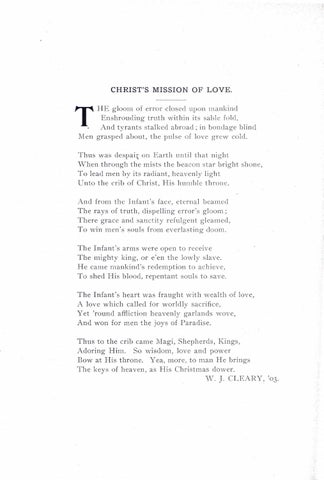
CHRIST'S MISSION OF LOVE. HE g loom of error closed up on mankind Enshrouding truth within its sable fo ld , And tyrants stalked abroad; in bonda ge blind Men grasped about, th e pu lse of love g r ew co ld.
T
Thus was despai \ on Earth until that ni g ht When through th e mist s th e b eacon star bright shon e, To lead men by its radiant, h eave nly light Unto the crib of Christ, His humbl e throne. A nd from the Infant's face, et ernal bea m ed The rays of truth, disp elling error 's g loom ; There grace and san ctity r eful ge nt g leamed, To win men 's so ul s from everlasting doo m. The Infant's arm s w ere op en to r eceive The mighty king, or e'e n th e lowly slave. He came mankind's red emption t o achieve, To sh ed His blood, rep entant so ul s to save . The Infant's h eart was fraught w ith wealth of love, A love which called for worldly sacrifi ce, Yet ' round affliction h eavenly garland s wove, And won for m en the joys of Paradise. Thus to the crib came lVIagi, Shepherd s, Kings, Adoring Him. So wisdom, love and power Bow 路at His throne. Y ea , mor e, to man H e brings The keys of h eaven 1 as His Christmas dower. W. J. CLEA RY , 'o3.
.
.-~
~
~
f.,
I
NTONE the ~irge of sorrow ~ Behold路 a nat1on weeps ! A noble life is ei1ded:
A loved hero sleeps. vVrap him ii1 his winding sheet, The flag for which he bled; And lay the fallen warrior 'l\1ith his country's honored dead. \1
''He hath died for love of co-untry. All honor to the brave !n So says the marble shaft that marks An earthly hero's grave.
* * * * * * * *
* *
* *
Ring out the bells of gladness ! Behold th e angels sing ! As they bear a soul untarnished Before their heavenly King . .r
He hath fought Life's glorious battle: V irtue's armor bravely borne, U ndaunted by the jeering Of the \ 7\f oriel's cold voice of scorn. I~
.'
.
The place where lies his mortal dust, o marble shaft may bear; But angels ever guard the spot, For a saint is sleeping there. J. B. DRENNAN , 'o5.
. B
THE ADIEU IN CHILDE HAROLD.
YRO N excells m his ''adieu s." The fa rewe11 to hi s native -路 land in Ca nto I. is in many ways characteristic of Byron . ., The thoughts and sentin~ents, t h e r egrets a nd conce rn s expressed by the littl e page and the staun ch yeoman are ve ry tru e to natur e, and b eautiful in thou g ht and wording; but Byron 's att empts at comfortin g h is regr etful companions a r e n ot so happily ~ ur ned. They are v oid of deep sympathy, and especia lly his words to the yeo man are exemp t of solid motives for t akin g comfort. Th t: yeoman we eps at th e thought of his lon ely wife an d fatherle ss children. Byron t ells him no t to trust the see ming s ig h s of his wife at parting; that other lovers w ill dry t h e eyes h e lat ely s aw streaming o'er. Powerful r easo ns to take co mfort, s ure ! Grief, regr et s; sign s and tea rs, accor ding to Byron , see m befitting th e g uil elessn ess of untaught youth s and of un so phi s ti c ate'~ ru stics; but th ese a ll see m pitiab le weaknessv.J to a superior man like Byr on, whose ill r elations with mankind have so soured hir. 1 that h e no longer b elieves in hum an s incerity. We h ate to h ear humanity thus d ecri ed by pessim ist s, even w h en they sing their illtuned song up on th e lyre of the. 2"0clS J vVe could app laud Byron ~H-1.;4. ~ if he urged men t o t eac h th eir ~.s-~ to b e proud, to lift them 路selves above th eir preserit trials and to tru st in an eve r -watchful Divin e Prov iden ce; the S?.ints l1ave acted thus , they conquer ed so rrow by placing their tru st in God and riot a hopeless mistrusting ol th eir f ellow-men .. Byron's grea t est grief is that h e lea_ves nothing that claims a t ear. "W l1y, th en, sh ould I g roan for others, when none w ill s igh for m e?" T hi s is exceedinglY; paganly, selfis h . But Byron was selfish. The ch ief merit of this adieu is t h e easy grace and t1,.m eh1l sweetn ess in w hi ch it is penn ed. R.
RELIGION AND ECONOMICS, . NE great fa ult w hi ch a ll right-thinking peop le hav e to find with o ur age, and especially is it true in this co untry of u,1rs, i ~ its irr路elig ion or materialism. The maJority of people today look: at everything through materialistic spectacles. ] ' h ey direct th eir time a nd efforts to the attainm ent of pl easure and
0
~h ~
temporal evanescent goods of this miserabl (f e:xistynce.,
whido,
,:-·\'
. The·Viatoriart.
'..
to them seems t o b e th e summum bonum. They are stron:gly . in-clin ed to co nsid er all questions, whether social, political, edtlCational , philosophical or scientific, from a mat erialistic . this-world point of view. A bout the last thing to enter th eir mind when,a s~ riou s question is evolved is the id ea of r eligion , of the sup ernaturaL of God. ''
A stri kin g examp le of how this materialism or irreli'g ion sol1)etimes manifests .itsel(i s. to b-e founcl in a rec ent iss u e of th e Lte1:~ry Digest, w h er ein app ear ed a review of Bishop Spalding's late work, "Socialism and L abor." Th e critic, after a few r emarks on the tim elin ess and many ~xce lle'n c i es of th e work , says that th e bishop hets failed to · solve the socia1i stic · evil. Now Bishq.p Spaulding adv.ocat es, ·as the sur est and best. soh1tio,n of th e difficulty, pure ' r eligi011 , b ett er ethi cs a nd ri ght C_h ristian living, which are wofully w antin g in this cot1ntry. The ·critic says this is a poor way to extricate our-· selves fro111 th e difficulty~·because , to u se his own wo rd s, " this , ethical method obviot1sly has its limitations in dealing ,with purely. social qu es ti011S. A n economi c argum ent cannot :b e met with an ·ethi cal formula. " Wl-ien he us es these words, h e does w hat h e says B ishop Spaulding has done,- plac es him self in a V1.11n erable possition : As a matter of fact, h e is wrong, for he .loses sight of the great _principle th at eve ry social and political questio,n finall y r esolves itself into, a question of ethics :Omcl .th eology. 'Y;es, go deep t o the bottom and yo u ·wi,U ~ncl that r eligion and theology are t he ver y fo undati 61~ ar1d supp ort of all governme;1t. When th ese charige or cease to b e, so does governm ent. Ther efor e, far from believing him to w h en Bishop Spauld},ng ad, b e- wrong, we think that . vacat es a pure r elig ious spir it a nd practic e and their c9nse qq ent a m elioration of ethic - and morals as th e solution .of th e socialisti c evil , h e gives us t he true on e, and th e 01:e ta~1ght by probaply th ,~ strongest t hinker ' of the nin et e.erith ce ntury, Don<;)Zq Cortez. '·This gr eat Spanis h philosopher has so. for cefully proved, or rather r epresented t he old truth, that ~-eligion ~ncl theology are not only the fo u ndation on ~h'i c h political gove rrim ent r est s, but also. th e p rincipl e of the h ealthful life o( th e State, t hat we cannot r efrair1; fro.m g iving in. sub stance his sage, r efl ections o_n..this s t~bj ect. Theology, inas;nu ch as . it,i s the science of God, is t he. ocean •
.
.
.
''
.
.
'
r
'
'
.
'
w hi ch contains and em braces all th e sc1ences.
\
•
•
•
t
••
••
Consequ ently, as
·'
108
The Viato_rian.
long as a nation's theology remai_ns unshaken and unchanged, tha t nation 's social and political scien·ces · and the institutions built . on these sciences will be strong, solid aiid uncorrupted. But undermin e its theology, attack its religion, le( it cast the principles of ethics to the winds and yo u will see that a igreat and complete change .will come over that State, because its ~ upport and vital principle ha;:; been <;:orruptecl, or taken away. The truth of these observations · can best be show n by referring to historical facts, especially that colossal one of antiquity, the Roman Empire, and the absolute transformation thereof. That religion is the indestructable foundation of human society has been admitted by all men in all places. But let us concern ourselves with the governments of antiquity just before Christianity appeared , which practically means the government of the Roman Empire. That the Roman people alwa:ys believed their government, in fact , all government, to be based on religion, is a fact: known to every student of history. The Roman people were th <: greatest of antiquity preCisely because they were the most religious. While their theology and ethical principles remained · anc~ were lived up to, th eir government was good and strong, their State grew and flouri shed. But a Divine child, born of a virgin , appeared ,_ on earth , grew to manhood, declared hintself the Christ and Messiah, chose a dozen co-laborers, taught a new religion and ethical system vastly different from the Rom~n ones. When, lo ! how very different in almost every respect does the Roman Empire become ! What ; remarks Donozo Cortez, is the cause of these great changes and transformations? What is the cause of this great desolatiO i1 and tmiversal cataclysm? What has occm-red? Nothing, onl y some new theologian s are going about through the world announc -ing a new theology. Thus , from these few considerations, we see that religion, or theology, is not only the foundation and life principle of all political and social institutions and systems, but is 'is the container of aU the social sciences. Vv e see that as it becomes corrupted or taken away, there must needs result a bad reaction in the social organization, or the complete transformation of the society. Consequently, we do not think Bishop Spaulding's solution of· the socialistic evil is the wrong one, as the critic in the Literary Digest would have us believe. O n th e contrary, we feel certain that the learned bishop r
·~
•
~,
The V.iatorian.
I
IOg.-
has struck upon th_e best' and true solution, because he has not lost sight of th e gr~at fact and principle th;;tt every social o.r political question is, at bottom, a reiigious or theological one; and, moreover, b ecause th e serious, learned prelate is aware that if we want to have th e super.s tructu r e of the Stite strong and firm, the -foundation must be 'such; if we want to improve th e condition of the social a.nd econoniic branches of th e State, we m ust see that they teceive proper sustenance, nourishment and v itality fron1: the roots below., or , in other words, our relation with God must' be the :very best pos- . sibl e, our reli g ion and ethics mu st be pttre, firm an:d ih1mutable. W. J. ·1viAHER, 'o4.
•
\VOMAN, THE CHURCH AND CIVILIZATION.
. A
~
~,., •·
(Oration Delivered Before th e O ratorical SoCiety.)
NY instituti?n whi~h .aims at the amelio.rati?n · o~ ·the .human rac e 1s certamly worthy of th e notice ·" and mvesbga.,. tio"n of all intelligent men, and especially· if it has endt.tred many yea rs, affected many nations and accomplished the ptir-· pose for which it was founded. The Catholic Church is an institu~ tion of this kind, and one which has so admirably fulfill ed its mis sion of upliftin g humanity as to elicit the unbouri aed admiration o.f her followers, ::.ncl even to force from her astonishetl enemies an ac...: . kn?wledgement of her grandeur and power. And this is not to be wonder ed at, for, w h en we stop to consider what the Church· has accomplished, w hen we view the wonderful chan ge, which throttg'h her agency bas been brought about in th e world , we are led to ex.:. claim with wonder and admiration: "The Finger of God is Bed:~ !' ' for never co ul d such stup endo us resu lts have been accomplished b y any mere human power. However, these results of the civilizing influence of the Church' · are so vast, extensive and nun1erous that we shall not undertake to examin e them all, but shall merely endeavor to show how th e Church has beneficially affected the co ndition of 'Y0111an, ·and how, in doing this, sh e has greatly advanced the c'i_v iiization of th·e world . ·' But little knowledge of history is 1~equired to understancl ·that th e condition of woman , before the advent 9f Christianity, was in
rro
The Viatoriari.
sore ne ed of amelioration, for a g lan ce is suffi cient to s how us the depiot"able conditit) n of degradation to w hi ch woman had been r educed und er th e Greelzs, th e Roman s and oth er pagan nations. Ex- • eluded from th e rank s of civi l socie ty, consigned to th e lowest -pos ition in the fam-il y, degraded in h er .qw n perso n .by polygamy and divorce, redu ced to the condition of being no more than th e slav e and chattel of man , she was looked upon as a n inferior human be ing . . Is it surp ri sing that ·hun1.anity s hould have s un k into the lowest state of barbarity and corruption , w hil e woman, th e daught er, the wife, th e mother, was so degrad ed? No! for a nation ris es or falls as th e home presid ed over by woman rise s or falls, for upon woman depend s 1he t on e of the moral s of a people. Remove the up lifting and 1~efi ni n g inf-lu en ce of liV Oman and the hi g hest civilization cannot endure. No one will deny the sanctifyin g influence of a good woman, especially of a good mother, for she is th e g uardi an angel of th e family and up on tJ-:: e fami ly depends soc iety. But the woman's influence depends upon t he degree of estee m in which s he is h eld , and everything among pagans tended to depre ciate and degrade h er. In cultured Greece and powerful Rome, woman enjoyed regard only inasniuch as sh e bore childr en to the State, and as sh e co1Jld look , with tearles s eye, up on the s laught er of a husband or son. In the family she was looked up on as inferi or to h er ow n children; she was solei, borrowed, lent and put away, as if s he we r e the rn er es·l chattel. Contemned a nd sco rn ed by all , what influ ence could_she have? Even philosop h ers rai sed their vo ice to joi n i!1 degrading h er, declaring that s he h ad no so ul , or if she' had one it was inferior to that of man. Even the divine P lato taught that the sinful so uls -of men were punished by passing into the bodies of women! That the souls of women were but the di sfigur ed, sin-stained, polluted souls of m en. Thus, we see that woman 'was deprived not only of her civil and social rights, but even of that respe ct and consideration clue to h er as a human being. Let th ese few r emark s suffi ce to recall the clark picture which the woeful cond ition of woman presented at th e advent of Christianity, for we do not wish to elwell at length upon the inhumanity with which s h e was trea'ted, nor th e depravity of morals that r est.lltecl from s uch treatment; we .shall not attempt to further r emov·~ the ve il of hi st o ry · that hid es so mu ch corruption. O h! how th e
f~~
t;
:.,
"'':1· ~'·?;
t
t·~.
The V.iatorian.
tu
heart heaves with disgust, and bow the eyes turn with aversion in the presence of the atrocious injustice and the revolting indignity to which pagan women were subjected! Let what has b~en sai-l s uffice to show what a task the_degradation of mankind had prepared fo-r Christianity. But no labor was too great for that institution which was es tablished by Christ, and which - consequently possessed the God" given vital power to regenerate. Bearing the flc_ ~11ing torch of heaven's own t~·uth, ~he · was po~tent to dispel the darkness of ig norance and the heavy mists of prejudice; and glowing with the warmth of God's own love she :was able to melt the icy hearts of men and to fashion them to better loves. Like the angel spol(en of in Dante's Inferno, with one toL~ch of her wand the Church forceJ open the barriers· that obstructed the way. ·VVo man was raised from her abjection and restored to her proper rank as the companion and social equal of man and permitted to join in the march to ward higher civilization. The Church forced man to acknowledge woman's true position as his cornpanion, it taught him that she wa-; i1ot his slave ·and the vile instrument of his pas sion. N ') longer was a man pern~itted to have several wives , or to put away his lawful consort at his caprice; he was taught to "love hi s wife as Christ love d the Church," to "leave his father and moth er and cieave to his wife," and to " honor her as the co-heiress of the grace of life." v.;
1
Long w as the struggle and ai~duous before the Church s ucceedeel in establishing monogamy an;d the indis solubility of marriage, the two ·m ea ns by which she efi~cted the regeneration of woman, th e l)urification, of morals , the firm establishment of the family, thereby opposing an impassible barrier to the torrent of evils which i1 ~~ from dis regarding the sacred laws of marriage; long, I say; and v iolent was the struggle of the Church against these ingrown evi ls of societ y, but aided and st-r engthened by Him who was so indulgent to the penitent Magdalen, who sympathized with the siste r · of Lazar us, compassionated the daught ers of Jerusalem and was not forgetful of his Mother, even while He was s uffering tln tortures of the Cross, the Church finally s uc ceede d in remedying an evil ·which threatened to destroy society. A ncl society, inoculated with a new and vivifying principle, envigoratecl by the vitaliz · ing tonic: of truth, aw~kens t o a n ~w )jfe 1 beg ins tc cloth~ it~~lf in
The Viatotian.
~ II2
.:_.~·
· ,
· forms of moral beauty that stand out in striking contrast with all the turpitudes · that formerly disfigured it. ·What a grand and what an encouraging spectacle it is to see this Tegenerative principle unfolding itself, leavening the whole 1nass of society, and forcing it to assume the seemly proportions of a well ordained whole! Like the principle of life itself, not only i t causes the social organism to burst forth from the unsightly shells tha·t held it captive, but it upbuilcls and strengthens and beautifies that organism. · A1id, thus, through Christianity, not only was an evil destroyed, but an imi11ense good conferr~d on mankind, for now, woman, · raised to her new state of respect and dignity, took an active awl importarit part in the affairs of the world. Ever since Mary followeel the· bloody footsteps of her Jesus, who, bruised, weary and houn'ded by men, was pursuing his torturous way to Calvary, wonian has followed the doctrines of Christ and even shown herself · ii16re · susceptible of receiving and more devoted to these divine truths and refining principles than man. When men heaped curse.;; and ignominious language upon Jesus, woman's tears of sympathy were silently falling. When man smote the meek Saviour, it was ;~ woman who wiped away the blinding blood. When man put th -; " . hand of doubt into the Saviour's side, woman knelt in faith before the risen Saviot,lr. Purified and prepared by her long probation and strengthened by these principles which she showed herself so eager to accept, woman set to work with great energy to assist th -= • Church in her God-given task of regenerating the world. The hom ~ iras ·regenerated by woman and became the nursery of manly and womanly courage, the school of economy and prosQerity, and th .-. natural outcome of this was a government of justice and freedom. ai-rel social' institutions that were more liberal a11cl pure. Worn: en made their influence felt in all walks of life, ancl t) ·s lidw tl1e spe'c i.es and extent of this influence it is only necessary ·to retail names such as those of Mary, St. Helena, St. Clotilda, St. Motiica, Joan of Arc, Isabella of Castile, Queen Blanche of Franc ~ ' ;and intit.tmerable others, who, . by their ·example and instruction~ urged on and led men to higher perfection in all things, but especially · in that most important of all·: the work of salvati'on. They becam~ the gu;;trdian angels of the · arts ~P~l' ?cie~t~.es, ~J1<:l tl1e ~:c:n ~ : c:Jf a!~ th~t is noble and pti':~ 1 · ·
p8.-
'
'
-
.!..
j'
The Viatorian.
IIJ
A woman inspired Dante to sing that celestial song which fo~· so many centuries has filled the ears of his enraptured audience ' .. w ith the sweetest melody ; and a woman, hi s mother, taught S1:. Louis of France the horror of sin and infused into him the virtues of a saintly ruler. A woman, St. 1\tlonica, by her tears and prayers, t_u rnecl the great St. Augustine: from the path of corruption and led him to devote his genius. to God . . - .. Thus, the Church having found woman pros trat e · at the feet of degraded pagan: man, ..raised her to her rightful position, .wiped frori1 her fair brow the :.~tain which man h ad branded therP., <;tpcl even made out of this erstvvhile object of contempt an instruthent for the material, intellectual and spiritual advancement of hul\~ anity . In causing the e~isting prejudices against wo man to vanish forever, a s th.e clark clouds ar:e dissipated b y the penetrating rays of the sun, the Church caused. the amelioration of individuals and . of the social s'ta.te, and thus manifested her civilizing power. No,· has she lost any of her youthful life and v igor. She s,t ill possesse<; that vital energy which enable~ her to overcom e those gigantic so cial evils, and hence she is able . t o solve and· rem edy the lesser social problem s which are now presented to h er. A. L. G., '04. ~
PRAYE-R IN DANTE'S PURGATORY . .. (O rati on Delivered Before the Oratorical Society.) N influenc e that imposes .silence up on th e vo ic.e of levity and · causes tears to well from the eyes of ste rn ess is a powerful . influ en ce. You have s~~n light-hea rted children stop their play and bow reve rently upon. the approach of a procession along -wh ose line sounded the voice of prayer. Something tells them that the time and moment a re sac red , that it. is time to speak to God . So, too, the _stern judge who has all clay· withstood with un y ielding ·ri go r the a ppeals of the offenders of justi ce; w h o has heard , unI11ovecl, th e s upplications of th e friends and relatives of the culprits, .comes home and melts,into tears at the sight of hi s own child at its mot h er 's knee as it learn.s to l.isp the words: " Forgive us our tresJ; asses as vv.e . forgive those who . tr espass against us." Without do,ubt there is a magic in prayer that has power to draw from heav· .en th«;! gra c ~ thett ~ l yyqt ~s: inv i &"? rat ~s c;tncl sw ~ et~ns 111a1).'s lift; ,
A
The Viaforiari. It is certain that anyone who teaches us to think highly of pra)Ye1·, ; who encourages us to use it, places within our hands one of the most effective instruments, wherewith we may build up ' ou ~ lives into strong and fair edifices that shall not · crl.1mble into clt.1st, but shall endure before the admiring eyes' of men and the approving smiles of angel~. The man who teaches us confidence in praypr and who urges us to its frequent use is one of the greatest civilizers. ~t is my purpose to show that Dante, in his Purgatory, teaches us the va lue of prayer as. a principle · of · high · moral life. . Purgatory fairl y teems with examples of fervent · prayer, thost ele- · vations of the soul to God in accents of gen~roi.1s thanksgiving or in hl.lmble supplication s for grace and par(lon. Is it nbt with a ·keen s·e11se of pl easure that we 1"ecall · the scene in which is described the arrival of the angel-guid ed . bark at the shore of Purgatory? Do we not · · delight · to ' recall the joyous exultations of those hundred holy sou ls who ·burst forth in geh erous outpourings of their gratit ude to God, and in loud accents s irig the "In Exitu Israel?" They, too, like the Istaelite s have just been delivered from a heavy bondage and have crossed th e sea to the land of liberty. \1\Tith what holy fervency they chant their iriclebtedness 'to the grac ious bounty of · God, and in what loud and harmonious chorus they proclaim the infinite power of their deli---v ere r. Here, we not onlv admire the artistic fitness of the compariso n of these holy souls to ·. the Jewish people clelivei·ecl · by Moses from the bondage of Pha raoh, but we h eartily applaud their sentih1ents of gratitude; and what is more, we learn that we, too; ought to be thankful to God for delivering us· through His saving grace from the evils that encompass our earthly life. But this is not the only instance in which Dante teaches the . beautifui doctrine of eucharistic prayer. When the ·soul has· gone through the purifying rounds of purgatory it ·takes· its flight, ·says Dante, to the abodes of the blessed amid the applause ~mel exulting so ngs of the other spirits, who g lorify God's mercy while the very mounta~n shakes with joy and gratitude. Have you ever . doubted · the · efficac y of prayer? If you have, · then no book is better calculated to dispel your doubts than the Purgatory of Dante. The spirits of Purg·atory confess that it was the imploring of God's mercy during ·their . earthly existence that won them salvation. · M~nfred,·· whos~ · lif ~ · hq.d · b~ e n a ~o~1~. i~1-; ~
'
~.
I
,.
.. '
\
!
.,
ns·
The · viatorian.
;.
nal offense in the face of G,od and nien; whose sins- were hordh'le, receives two mortal blows ~mel, before expiring, turns. to the ·w ide arms of infinite mercy, cries for pardon and is forgiven. Th'is same sp irit asks Dante to bid his good Constanza pray for hiin tha't his·· term of interdict may be shortened, for he .says: ~<Look, therefore, if thou canst advance my bliss; Rev ealing to my good Consianza how Thou hast beheld me and, beside, the terms Laid on me of that interdict; for here By means of those below much profit comes." .' Likewise, Nino asks that his virtuous daughter, Giovanna, address her prayers for him to the throne of mercy, where always a reply is made to inhocence. Can any· teaching be clearer than this'? A nd Belacqua, too, makes the same request. "Here must I long remain .if prayers do ,not aiel me first That riseth up from heart which lives in grace." Do you not reca ll how · Forese _praises and acknowledges the prayers offered in his behalf by . his virtuous wife, Nella? This Forese was destined to remain a long time in ante-purgatory 'for having delayed his repentan.ce while on earth; but through the sighs, tears and prayers of his pious wife his term of expectance shortened 'and h e is soon advanced to the terrace where he is purged of his sins of gluttony. ' ' In the sea of fire where impure sinners are expiating th e it~ :Sins Dante meets one who· exclaims: . ':Oh, if thou have any favor with heaven, where Christ reigns Say thou one paternoster for me." A nd yet another thus supplicates the two pilgrims Virgil and Dante: " I pray ye by the worth that guides ye up unto the summit of this mountain In time remember ye .my sufferings. " And is a ll this reasonable? . Can prayer bincll~eaven 's just decr ee? ' DOe s not reas011. ask how prayers can aid those who are undergoing · a just punishment of their sins? Yes; reason raises a doubt; · but teason answers it in the words of the learned Virgil. God's justice has assigned a punishment; but God's loving met'cy acc epts in lieu of the entire punishment th e free h eart offerings o! : ;!
is
I
~~)·
t
>
~·~
i
~
t.·.
"'
;
:; .
; ~
'· '
.·,!!,
II6
The Vi atorian.'
friends . who through sufferings and the g~ving over of their merits satisfy God's justice and allow lo~:e to triumph. The souls in Purgat~ry pray for_.their own protection and their l)raycrs are answere d. v\.i hat is a 111<fTC striking proof of the speedy . . 1. ' answer ma cJe. to prayer than the one ~ f the two angels sent to guard the vale of the princes? It was evenlng; the holy spirits, after say. I ing that hopeful h ymn the Salve Regina, .address themselves to God for protection. Immediately two green-clad angels. messengers of ' heaven, sent by Mary, descend and put to flight the enemy of the souls . . These holy souls not on ly acknowledge the efficacy of the prayers address ed to God in their behalf, but they also pray for the livin g. At the close of the paternoster we hear the spirits saymg: "This last petition, clearest Lord, is made J\Jot fer ourselves, as that were needless now, But for those who after us ~emain . " Not only clo these spirits bid us pray to God directly, but to the saints, also . S urely the instance of Buoncot1te, so dramatically related in the fifth Canto, could not have escaped you . It would be impossible to find a more striking confirmation o£ the doctrine taught by St. Bernard, that no one ever had recourse to Mary and was left un ~ i· clecl. Tbis wretched man, in the throes of his _last agony, invokes Mary and from her receives the grace of one poor tear, an act of perfect contrition, and wins his soul's salvation. In ans·w er to the pious wish of Conrad, Lucia descends from heavei1, not only to illumine Dante's pathway to the gate of Purgatory, but to carry him bodily thither. Finally, it is upon the desire of Beatrice that Matilda makes Dante drink of the Eunoe, whereupon he b ecomes fit to mount to the starry spheres. Now, my friends, when we have visited the regions of Purgatory with Dante, when we have heard the solicitous requests of the spirits for· the prayers of the living; when we have compassionately · listened to them pleading for the intercession of the saints and the mercy of God, then we cannot ]~ut realize that the Divine Comedy nobly fulfills an apostoli c ·mission. M. J. B., '04.
i.li
t' .
The Vi ate rian-: THE VISION OF GELASIUS.
URING the thiteenth centur,y there lived in an old mQnastery of France . a pious and holy monk, by the ·name of ,Gelas ius. Being still very young when he entered the .religious ;; : life, he had now grown old in years and ·iJ1 the service of the Lord. , The monastery, or rather the abbey, as it was . then calkd; where. . this saintly monk had spent his life was situated in the -little town ., of R emiremont in "the Vosges Mountains, and was · in a flourishi.ng . cm~dition during the thirteenth century, a period so remarkable ~11 mediaeval history for the spirit of faith and the zeal: for learning that animated the people. It continued to exist and flouri$h during , the Midlle Ages and until the eighteenth century, when :it was de:- .· molished and utterly destroyed by the fanatics during that terrible and impious revo lution that took place in France at the time. The monastery was a venerable old pile of Gothic architecture, but as simple and austere in appearance as the. holy monks that inhabited it. All in and around it breathed ~ spirit of piety .· and sweetn ess that often compelled those that passed by to·.s,t op and •. . kneel on its pavement where after having r~cited a humble p~ayer ;: .· \. they felt their souls filled with peace and consolation. The <,Jld a~;tcl saintly monk that forms the subject of my sketch was the ·a,pbot of this monastery and, although very. simple in his app-earance , w~?, nevertheless, 'a learned and accomplished man; the. time he , dicl.IJ.Qt · · spend in holy prayer and meditation, he spent in the script9fi.t.p11 , w hi ch, as you know, was a spacious room where the nJ.onks werg·_. :: employe d in transcribing books during the ·hours allotted .to man.uat . labors. But, besides the long hours spent in the scriptorium, J i;e , was also very fond of his laboratorium, where he also spent -many 1 long hours, which he devoted to divers studies, but, especially:., to the study of chemistry, medicin e and painting. This room · cQntaitJ.~ ' eel many curious objects, such as quaint instruments, olcl::rdiq; : a;tJ:~L . specimens, all n eatly arranged on lahelled shelves . . These h e would.··,·...
D
show with great satisfaction to all those that visited him. 'But the : ' · favorite occupation and pastime of th e' old abbot was paili.tii1g, :i•il ·' '. w hich h e excelled to such a degree that many of the beautiful production s of his brush had found a conspicuous place in vanous churches and eve n in som e of th e principal cathedrals of France,
The
n8
Vl.~toriarL
Thus th e good abbot spent a happ y and virtuo us life, which was entirtly devoted to industry and prayer. Tov.rarcl s the clo se of his life ~., h e good abbot had for many n-~ vnth s ·been labo ring w ith unu sual· pains and ardor on a picture r ep res ent ing th e "First Christ mas at .· Bethleh em. " T his h e intende- d as his m asterpie ce, w ith which h e would emb elli s h the chap el of I· he monastery. Tt 1:\ras to be exhibited for th e first time on Chri stmas night on th e altar of the Madonna_. So, a~ least , th e good IT].Onk int end ed . B ut , fond as h e w as of his picture, this piou s a rti st had , out of lcrve for the Divine Child whose nativity was soon to ·b e cele-brat ed, m ade t he g r ac iou s and liberal promise that, despit e hi s attachment to this beautiful poduction of hi s love and labor, h e would, n eve rth e less, pa rt willingly w ith it if he knew that by so doing h e \VOt1ld pro cur e Hi s g lory and find an opportunity of m an ifesting: hi s affection towar ds Him. A nd thi s promise h e w as wo nt t o Tepeat w hil e engaged in thi s se lf-imposed task of love, As Chri stmas was drawing clos e the good A bbot was putting forth redo ubl ed effo rt s to breathe, as it were, up on the canvas th e inspiration s w hi ch .Hooded hi s mindwith heav enl y lig ht. \ i\T hen th e fini s hin g t ou ches vve r e g ive n , the artist was ''transported with joy at the m a rve lous ach ievem ent of his art, labor and lov e. Fired w ith th e desire of 's eeing how it would adorn the littl e chapel on Christmas ni g·ht , w hen it would be s urrounded . with lig hts and flow er s, the monk , ava ilin g him self of th e time w hen th e other r eli g ious were at their labor in the sc riptorium, quietly iss ued from his ce ll and s il entl y pacing clown th e long corridor, entered into the chap el with his preciou s burden. He placed the pic·ture on the altar and,having s urround ed it with li g hts, lookecllong and admirin g ly upon it from different points of vantage. Ravished by the b eautiful sight it present ed, it see1:ned that h e could not pr_e vail upon himself to leave the chapel and return to hi s studio. But he was about t o ~l epa rt w hen , s udd enly, h e h ea rd a strok e of the bell s ummonin g him to th e parl or , whe r e his presence was request ed. Without a hl.oment's hesitation, he left all as it was anc'r repaired at onc e to the parlor, where he fo und awaiting an old man , who see med ver y p oo r and mi se rabl e, but whose looks were full of kindnes s and s inc erity. The stranger r eprese nt ed himself as a pilgrim , who had come to the city for charity and thq.t, aft er having applied at different places w hi ch h e thoi.1ght inhabited by rich inmates, h e had eve ry I
.
'
J,
•
L
•
The V1atonan. time been directed to th e monastery, with the assurance that there he wo~tlcl be well treated and cared for. Consequently, he had come to the monastery and vyas begging for alms. After a short silence the abbot, looki'ng at the beggar, said to him: "My clear ])rother, I have no money to give you, for I have none; but what I have I will give you, all for .~ he sake of our clear Lord and Savior, who made Him self miserable and poor for our salvation. I have a painting that I prize very much, and that has cost me much labor and pains, but, in virtne of a promise I have made to our Lord, I will give it to you with the greatest joy, hoping that it will bring you comfort and happiness." Thereupon the good abbot went to the chapel and, taking th e pictur1e from its altar, brought it down to the parlor and, · presenting it to the old man, said: "Behold the picture that I have mentioned. I had intended it for the chapel of the monastery, but with the hop e that it might make you happ y I give it to you. It is yo urs, do what you please with it. I ask but one favor from yo u in return: it is to remember me in your prayers." The old man, fill ed with th e deepest emotion, could scarcely speak and, taking the hand of th e abbot, he kissed it tenderly and with tears rolling clown hi s cheeks assured the good abbo't that. he would never forget him. Thereupon he left the monastery and dir ected · his footsteps towards the cit y, carrying along with him the valuable picture. The good abb ot r epaired to the chapel where, after having fervently tha11kecl God for having deigned to condescend to his wishes in giving him such an opportunity of manifesting his love towards him , he went, full of joy and co ntentment, to rejoin his fellow-monks at their occ upation. Soon th e bell rang and the holy monks, after having offered in se raphic acc ents th eir nightly oriso ns, marched in file to their respective cells for th eir we ll-n eeded res t , and, last of all to enter his cell , was our ve nerabl e abbot . . Afte r lis ping a few short prayers, in which he recommended his so ul to tJ1 e protecting wings of his Guardian Angel, h e retired and soon sank into a deep slumber. He had not lon g been sleep in g, h owever, when he had a mysterious dream, in which h e thought that he heard sweet sounds of music softly ringin g in his ears and th en saw, amidst a radiant effulgence of h eaven!y light, a choir of ange ls singing in melodious strains these wo rd s of Christ: " \i\T hat yo u do to on e of these you also do to me." T hi s they r epeated' several times. Three angels clad in
The Vi_a torian.
!20_,
snow,-whit e ga rb s and standing in front of th e choir were holding in their hands the picture that he had given to the beggar. The choir of angels th en g racefull y receding apart, ther e appeared in _t h eir midst a n o ld man, who was the very sa me one that th e good abb.ot had .favored during the ' clay. He was .clad in h eavenly garment$ fhat outshone the raclia\nt rob es of the angel s that surround-• eel h\m. rn one ha nd h e held a stroll and in the other the gospels, pres's ed to his h eart. A ft er r epeating th ese words of Christ: " I was nak ed <mel yo n have cloth ed m e; I was hungry and you hav e given m e to eat ; I was a stranger ai1cl you took me in ," th e form of 'th e old man vanished a nd there app ear ed in hi s s te ~ d the b enig n p erson of Christ Hit;nself, _arrayed in majesty and g lory. vVhereupon all the · angels prostrated themselves thre e times in adoration , and, ri sing, sang th e canticle : "Be hold tli.e Laml) of God." Wh en they had cea?ecl sing ing th ei r melodious strains, the Divin e Savior, ad-, dressing the good abbot, said to him: " Gelasius, thou hast clone we ll ; know that th e begg~~ tha.t th ~u hast so generously favored for my sake was my apostle, John , -v~hom I sent to thee und er the g ui.se of a b egga r to try thy v irtue and the sincerity of thy love for l\1~; thou hast proved s incere in thy w g_rd s and thy act was most pleasing to me . . Behold, I come to say these things to the in order thq_t thot:1 _mightst rejoice in Me and persevere unto th e end in my iov-<t , and th e p:actice of virtue.'' After hearing these words from the lip ~ of Chirst, h e clreame ~l that he saw the three foremost ange l_s,-detach th em selves from the choir ' and descending gently place the picture on- th e eas,e l wl~~;e h e had painted it and, reascending, t hey .s ang, with; the other angels, these words of the psalm: ." B less Y.e, now, the Lord, all ye who are His servants," and receding softly, th.ey at last vanished and with them the celectial m elody sw eetly died away. With th~ 1"ecess of the vision the good abbot woke th e s ubject of a fa_ir illusion or _whether he had been favor ed with a real ..vision . . His cell was_fi.lled wit~ light and a fragranc e as· of in-_ cense. Ito ascertain whether what had happened was only a dream · or a rea] v ision,. h e looked at th e. easel 1 where he had dreamed the' ai1g.els had 'depositecl the· picture. What..was his aston1s hn1 ent when •.
, .
.
.
'
.
I
• ..
h e saw on th e easel the very same picture which now looked all the mo~e b eautiful , as though 'a heaven ly lust er had been i-mparted t~ it. ..
for,~
'
.
.
'
I
.
'
'
'
'
i11de.es:l, it was rr1ore ravi shing than it had been fo rm erl y . The
,j
The Viatorian.
if,. ~·-
good abbot then saw that h e B ~ d not been thesubject of an illusion, but that his dream had been a true vision, and, filled with sentiment s of awe and fer vo r , he prostrated himself on the ground and . thanked with all . the power· of his soul the good Lord who had vouchsafed to reward him .s.b bountifully for the act of virtue he had performed. · Taking an ~ld lute that was suspended to the wall of his cell and upon which 1{~ often played as he sang holy hymns t.o God and to the Virgin, ·h'e began in fervent accents the canticle Te Deum , which he sang with much unction and fervor. Scarcely had he completed the words of the last verse when he softly sank into a s lumb er, .and he was heard no more. As the day · advanced, several monks, not seei ng as usual thei_r beloved father in their midst, called on him at his studio, but they could not find him there . •They began to conj ectt1re that something had happened · to their father. The door of his cell was opened by the prior and, accompanied by other monks, he entered the room, but what was their grief an astonishment when they saw that their much-loved father was no more among the living: h1s soul wafted upon the sweet breath of prayer and melody, 'h ad taken its flight to the celestial abodes, where the meek and the humble r ejoice in the company of the Lam b. The cell vvas still filled with a fragrance and a lustrous light surrounded the holy abbot, who was seated in the center of his cell, his lute on hi~ lap and his face gently uplifted towards heaven in a contemplative mood , as though he had been ravished in ecstacy and in his fervor had breathed out his spirit into the hands of his M.aker. Then the good monks knew all and , filled in their turn with sentiments of awe and admiration, praised the Lord that He . had deigned to visit them in so visible a manner and for having taken from their midst their holy.. father to place him among the blessed in heaven. A few clays afterward the holy abbot was laid to rest in the crypt of the monastery, where many of his fellow-monks of1forn1er days also slept th eir last. For many years and even for many cen. turies , the memory of the saintly abbot lived among the irihabitants of Remir.emont and the neighboring county, where he was honored under the name· of Gelasius the Venerable. l\1:any pious pilgrims came to pray .at his tomb and r eturned ascribing many favor s to his · interc ession. As to the v/onderful picture itself, it was placed in th e chapel of th e nwnastery, where it was also venerated -~
',,
.
The Viatotiiart. ciuri_1ig many long ages, under the nanre ·of "The Holy .'Picture of the Mot.1nt,'! uil.til both the tomb of the abbot a:nd the ho.ly piett~re , . wen~ sacri:Jigiously destroyed during the fearf~ll · revolution ,6£the eighteerith c~e htury , so that today in that very place nothing· o( them is 'to be seen; and few, indeed, know or have heard of ·G elasius the Ve1l.erable, and of the " Holy Picture of the Mount."
R. RICHER, 'o3.
.
..
)\'
'
•1
••••
.
.~
j
1'
1
).
The Viatorian; Publish e d m onthly by th e stud ents . Edi ted by the students of St. Viateur 's Coll ege, Bourbonnais- G rove · Ill. A ll corresponden ce must b e addressed: THE VI A'I'ORIAN, Bourbonna is, Ill. · ·· . S ubscr iption price , one dollar p er year , p ayable in acJvanee. E nter ed a t the Bourbonnais P. 0. as second class matter. .
.
'
.
.
'
.
•' f'
BOARD OF -:ED[TORS. J. LYN N, R . RICHER, S. SULLIVAN ,
P. J. DUFAUL'I' , J. DRENNAN,
W , J . .CLEARY ' W. MAHER .
. EDITORIAL. Th e se111i-anm7al examination will begin- on .Thursday, Januar.y 29, and will ·end within a week from that elate. This exam.ination: mar ks th e end of the fir st scholastic t erm and, as a rule;. furnis hes a m ple eviden ce of th e mann er in w hich th e individual student . has em ployed hi s tim e and tal ents.. Happ y is th e student who can ap-, p roa ch th e board of examin ers with th e since re con viction that h e has , during th e pas t five m onth s, emplo ye d his. talents t o advantage . He, like· th e faithful se rv ant mentioned in th e gospel, shall be con1 ~ men de d .fGr his faithfuln ess and industry. He shall win th e es t ee m of hi s t each ers. His parents s hall r ejoice in learning from .his r e-:po r t t hat · th e lab or, love and s elf-sacrifi ce which prompted th em t o g iye their so n an opportunity of ad v an cing in life, . has not b ee n . throvv n aw ay . B ut, _o n th e oth er hand , what s hall we say of th e· indo len t stud ent H ow does he feel as th e clay of tTial approa che? ? D.oes h e thin k that h e has a ct ect rightly by using his time and whatever tal ents nature has placed' at his disposal in devising m eans of . avoiclii1g w or k, of shirkin g th e tasks assig ned him? Has he no r emo rse for ~h e golden opportuniti es los t? Does h ~ not consid er h in1s elf a fr a ud w h en h e poses as a stud ent , wher eas h e does· not st ri ve t o fost er that spirit of activ ity whi ch is essenti al t o a stu .:. den t? Does he not loo k up on him self as unjust t owards his parents w ho, prompted by a love ·Such onl y as can sp rin g ,fro m a p 9-r- . ent's h eart, stri v e ·co ntinually t o bring w ithin his r each an opport uni ty w hich , p erl;aps, circumstan ces prevent ed ,th em from enj oyin g? I t wo itld b e we ll if th ose w h o find a p lace in th e und esirable society of t he-indolent and indifferent stud ents, should r efl ect up on p1 eir co n duct an d at th e beginnin g of th e second term 1~ eso ly.~ ~ !}1c\ll:-
124
The Viatorian.
fully to employ the few remaining month s of thi s scholastic year in such a inanner as to comp ensate for what th ey have lost in 1路he past.
Success \ iV hat magic in th e word ! With irres istible charm it fires the blood of thot.tsand s, fillin g _them w ith the desire of fighting for its attainment. It is the laurel-crown for which all are striving, and the ardor of each one in the battle is proportioned to the esteem in which it is held. It is, oi- shot,.tld be, the object of each one's endeavor in what station of li.fe soever one ni.ay be placed . . It should be -especially the desire of students, iri whose young hc:;arts all noble sentiments should hold chief plac e. Sluggish, indeed, is the young man whose am bi~i o n does not point t o the top of the wo rld 's ladder, who is content to r emain below and behold the onward progress of oth ers, equal at'ld eve n inferior to him . . Such a .man is unworthy of th e t:ame of . st udent. But while the summit o f s uccess is longed for by all, few are 路 courageous enough to brave th e"'' hardships of the ascent. Like the serenely majestic, yet, apparently, inaccessible crest of some Alpine peak, it seems to man y surrounded w ith in surmountable difficulties. 1\!Iany who have endeavored, again and again , to ascend, have as often fallen back, exhattsted and disheartened, deeming success im~ possible of achievement. Such a co'n clusion , how eve r, is fal se. In the fi-rst place, it must b e rememb ered that success is relative, and therefore open to all. Therefore, had th ey endeavored properly, they would not now stand back, spiritl ess, and supin ely watch others pass them in the race. There is, then, a means by which each one can become a master, a tali sman w ithin th e reach of all, enabling its possessor to achieve apparently impossibl e t riumphs. This "Open Se,s am e" is concentration, th e .habit of menta l concentration, of application. It is not that self-conc entration which is sy non y111-0llS with selfis hn ess, or egotism, bur.l.s an intent .application of th e mindto a task o r duty to be perform ed, so that the b es t possible result will be obtained. S uch concentration did ~h e ancient artisan possess, who, having with much labor and pains performed the task imposed on him by his king, thus reporte d his achievement: uS ire . it ~an not be better d<;m~/' That map ~va~ c;e rt9-inly a m.~~t~r i vV~
1.
!tl· '
The Vi torian. would call him a "success. " Not because of the startlin~g and ·.inag·:.. nific ent action performed; perchance it was very commonplace~ but .. . r b ecause his work was whole-souled) because he himself was <i ' cons ummate worker. And he was such , simply because for yea1~s, no doubt , he had, silently, perhaps, yet withal surely, built up the man within him by the thorough perfo·r manc e of his every duty. This, . then, is the result of concentration, a p erfect man, a· strccessful man. If you desire t o be successfu l in life, resolve to ac·qt't'il"e, at ·arl.y cost, a habit of mental concentration. This eve ry : student . can and should do. Into every action put your whole heart ·::ind sbuli;· let yo ur work be done for its own sake, better still, for the 1 j)'roper m oldi ng of your mind. Consider youi.· wo.rk, for such it ' reallj 'is, you r mind's gymnasium . You pay for the privilege of 'exercising yo ur muscles, of acquiring physical culture, in some gyinnasiu1i1, w hil e in every action of the day, you can, by concentration; perfect ' yo ur character by tl~aining it to habits of exactn es~, ·of ·n.deli:t'y \ t 6 duty, to a sense of justic e and a love of w hat is right and ' go6d:, which will be t o you of far greater val ue than unlinl.ited wealtk 'or popular favor. Thus does concentration build you np into a pedect, a succ essful man. But to obtain this d es ired re sult , you must devot e your en erg ies, you must concentrate . your mind upon eve ry a·c tion yo_n p erfo rm. At fir st , and for som e tim e, perhap s, for all depends ·on 'the firmne ss of your determination , it w ill be difficu lt to acqtiire this habit of earn est application; hut yo u will, eventually, find it · ve ry easy . . Begin now. C. ··· '
} f .
EXCHANGES .. f.
'·
)
'
·'
Seldom have we seen so many or such sttiking evidences of 'POet ic talent displayed in th e pages of college j·ournaJs as we b. ~ve w hil e reading ove r our exchan ges for Dece mb er. Scarc el y a ·riui11ber d id we find without its fitting poem, either on th e great' festivaJ of C hristmas, or on some oth er subj ect of a high ahd holy nature. l\!lay our youn g poets co ntinu e the good '\;V(H·k, and daily' g row triotc proficient i11 this noble art. · For w hat eldc1Lien ce, after all , ·is thei·e ~ 0 sparkling, S O · elevatin g, SO capable of adoni.ing ,·the printed page ·as that of th e' po·et w h en his · soul moun~s' t o realms·· far above ·th:is . ,,planet and holds comm union w itp th e inhabitants . · of ·a h:igher
.
!'
..
~·
"'k· ~.,
i:.
1:,
.
! ,;2.6
The 路 Viatorian ~
w orld? N on e. Rich , indeed, is th e college journa l w herein on e can always find a poem , whi ch, once r ead, will be r e-read and with r enewed pleasure at eve ry r e adin~ g. B ut how poo r beyond all pove rty the one which appears month aft er m onth and alw ays found wanting in this most ex cell ent sp ecies of our . lan g uage. It w ould be difficult t o find a m or e co mpl et e 路 jo urnal in eve ry detail than the "Fleur de Lis," fo r Janua ry . T h e three poem s : " Christmas Be.lls," " Sacrific e" and "Th e S pirit of P rayer ," ar e productions of which the journal may w ell b e proud. A ll its articles are written on well-chosen subj ects and in a v ery interestin g sty le. " The Church in the Philippines" is the s ubj ect of an instructive and interesting oration. There is much in th e sa y ing : " D ont judge a book by its cover ," and ,wh oeve r r eads th e D ecem ber iss u e of th e "N azarin e". will be more thorottghly convinced of thi s than eve r. This little journal is not clothed in a full dress suit, by. any m ea n s, it ,has n o tin sel or glitters around . its cove rs, but this lack is amply m ade up for 路by the matter which it .contains. T h e article entitl ed " The M ission of the Angels," and th e short essay on Dr. B rownson ~ r e es p ecially praiseworth y, both for thou g ht and st y le. An eve r welcom e vis itor at our ,d es k, and on e in w hose co m pany w e can always sp end a profitabl e hour , is "St. M ary's Sentin el. " The littl e poe m w ith w hi ch it op ens for Deceni b er w ill doubtless be read with pleas ure by a ll into w hose han ds th e journal shall . have found its way . Th er e are many a rticl es of m erit in this numb er of the Sentin el, but its exchange column is wo rth y of sp ecial commendation. A m o ng our exc han ges th er e is non e that hold s a hig h er r ank than "The A bbey Stud ent. " Indeed, this journal m ig ht ve ry we ll be called th e " Stud ent's F ri end ," fo r h e can u suall y find in its cho ice selection of articles one w hi ch w ill have a dir ect bea rin g on himself, and 路 w hi ch , m o r eove r, w ill off er su g g es tions that if faithfully foll ow ed, mu st g r eatl y facilitate hi s lab ors in study . Th e D ecem ber iss u e of "Th e A bbey Student" h as two su ch a rticl es, viz., "Aids . t o Ben eficial R eadin g," and "Meth od in Study ." We w ould r ecomm end a perusal of th ese t o every stud ent,
..
The Vi torian.' For several reason s we always feel a parcticular interest in essays on Dante . . ('Th e Holy Cross Purple" for December contains a remarkably we ll written article on ((Dante and Poe." Notwithstanding the fa ct that these two poets appear altogether too far apart to admit of comparison ; notwithstanding the fact that comparing such men is someh'o w leveling the mountain peaks of literature, one can r ead with pleasure and not without profit such stttdies as that on (( Dante and Poe." The two poets resemble each other, it is true, inasmuch as both portrayed the gruesome, the awful. But it must b e r ememb ered that Dante did not write only the "Inferno. " . We think the writer strikes a true note when he places amon g the chief qualities of Dante 's . genius sincerity, intensity, force, brevity, definiteness. "This last quality," he says, 11 determin es the nature of th e Italian's faculty of vision, which stands out in its pow er , un iqu e among the wo rld 's poets. There is no scene, no portrait, be it of infernal darkness or dazzling radiance of heaven which can elude that wondrous power of his." Again the writer aptly points out th e different m otiv e of the two poets in their employment of th e aw ful. "With Dante," he says, "it is the only way of v ividly picturing to man the hid eous horro r of the. regions of sin and death eternal; it beco mes in his hands a means to an encl. With Poe it is itself the effect h e wo rks to attain, the chord he wants to strike; it is not the means to an end, but the very end itself." But why not r~th e r compare Dante with Milton, or Klopstock, with Virgil or Hom er? The essay on A ubr ey de Vere is a beautiful tribute to that ami~tble poet. W e regret the absence of the exc han~ e colnm n in ((The Holy Cross P urpl e." J. A. L. 1;.
~-... '1
PERSONALS.
~ ~··
T h e Very Rev. A . Corcoran, C. S. V., D. D., ProvinCial Superior, is suffering from a severe attack of ):)neumonia. The latest reports from hi s bedside are encouraging, as the crisis is · passed and h e is on the road to re cove ry. "\fl e sincerely hope the Rev.; Father will soo n be r esto r e.cl to perfect health and that his life of. usefulness may b e pr0lon ge d ad mitltos annos. · R e·v . Fath er Lauriault, of Rock I s land , Ill., contemplates a trip to New l\lfex ico in tl1C near future. vVhile th ere, in the int er est.of
•
• /
The Viatorian. his · health , he' ·wl'll be the gt.test of his brother. W e hop e that th e change of climate may h av e a beneficial eff ect on th e h ealth of our form er student. R ev. F ath er Six t , of K ankakee, Ill. , was th e g u est of t h e R ev. P r esident on Janu ary 2oth . · We : learn ed w ith sincere regr et of the rece nt death of M rs . Boeck elman, th e moth er of o ur es teemed fri end and alumnus, R ev. H . Boekelman, of Elkha rt, Incl. The Viatorian, in · b ehalf of th e fac ulty and oth er fri ends of F ath er Boek elman,ext encls t o him h eart felt sympathy in his sorrow. R ev. F ath er Berard, St. A nn e, Ill. , paid th e colr'ege in th e course of th e month.
i
a v isit to his fri ends at
Mr . P . ··T. Tynan, Chi cago, Ill. , v isited the coll ege r ecen t ly in . c6i11pariy w it h his littl e cou sin , M ast er L . vV arn er, whom he ent ereel as a stud ent in th e Junior departm ent.
! '
R ~v.
•
T. Dugas, C. S . V ., pastor of St. M ar y's~ B~ave rv ill e, Ill. , ca ll ed cl uhn g th e h olidays to extend in p erson th e greetin gs of th e seasori t o his confr eres at th e coll eg e. R e·v . ]. Cannon, U rbana, Ill. , w as on e of our pleasant and ver y we lcom e call er s of the past month. Father Cannon expect s t o have th e beautiful n ew church which has been built by his untiring zeal and th e h ea r t y co-op eration of hi s parishion ers, dedicat ed in a few months. · ·· l'v1r. T . 0 .. Harvey, San Francisco, Cal. , r ecently v isited his son, E arl, of th e Senior departm ent. ''·· M r. H . Mattie , traye ling salesman fo r th e Dia m011cl Compound company, of Chica go, spent a few ve ry pleas;;tnt h our s w ith hi s b:r'oth er, 'Arthu r, r ece ntly. r: f··
1
:. J<.ev.· ]. H . Naw n; St. M ary's cht.1rch, Chicago, was on e of our very w ~ l coni.e v isitors of th e p ast w eek. .
The . Viatorian. . ·.
·9f
. . !fr. Geor ge Rafter, one the students of last year, is at present emp loyed in the Hub clothing house Chicago. George has a ~ plendid position. Vv e wish'I our youn g friend that success for . . w hi ch. we fe.e l confident hi s ' ~nbi ti on wi ll prompt him to strive. '
Rev. J. D. Laplante, C. §'. V . and R ev. A. Champeau, C. S. V., bot h of St. V iator's Nor mal Institute, Chicago, spent a few days with their confreres at the college during the Christmas holidays. Father Laplante exp ressed him self as agreeably surprised at the .many improvements -w hich hav e b een made here during his absence of four yea rs, in Europe. Rev. R. ·M orin, C. S. V., who for the past month has been visiting his confreres in the U nited States, has r eturned to Canada .
.
Amo ng those w ho called on the Rev. President during the holidays were Rev. Father Bergeron, Chicago; Rev. Father Labrie, :Mc;m1ence, Ill.; Rev. Father Tapin, Papineau, Ill., and Rev. Father Lesage, A urora , Ill. Rev. J. Doran , who was ordained recently, visited his friends and fellow students at the college on January 9th. Father Doran celebrated the community mass, at the close of which the students and professors in a body approached the altar to receive the ble_ssing of the young priest. · His man y friend s at St. Viateur's' wish him success in his high calling. Mr. H. C. Lacharite and Miss Alta . E. Hight were united in . the holy bonds of matrimony on Thursday, January I 5, at Assumption, Ill. Mr. Lacharite was one of our former students. vVe wish the young couple a long and happy weddec.l life. Mess rs. Frank and Bert .Fitzgerald, of Indianapolis, visited friends at the college recently. We learned with sincere regret of the sad death of their brother, · George, who had been accidentally shot by a playmate. At the time of his death he, with his brother, John, were studyi ng in Europe. The latter brought the remains of. his broth er to this country and then r eturned to Europe.
.
The Viatodart. Rev. D. O'Dwyer, Chebanse, Ill., lately made a pleasant call on his friends 'at St. Viateur's. The Rev. l\11. A . Doolii1g, pastor of St. J ohn 's church , C lint~ n , Ill. , _IiVaS amon g his fri ends at t11e college in th e early part of the month. Many n e\1\T.arrivals have registered since the r es uming of class--~e? . · ]'he st eady ·increase· in the numb er of s tudents that · h as been :"g·oing on since September makes it evident that th e -regl..tfar att end. ance for this year is the largest in th e history of the ·college. Art1oi1g those who have ente red during this month are the following: :M ess r s. · C. Savage, F. N ugent, B. Smith and R. B urns, Seniors; Maste rs··. L . Warner, F. S mith , A . B urn s and W. Foley, Juni ors; Mas~e r s L. Benoit, J. B r eli\:'er , lVL Dillon, E. Doerr, A. Gunclerla ch .. and A: Panlissen, lVIinims. . j '!:
\ Ve have re ceived a ve ry encourag ing r eport fr om tb.e ,tn~t s i ta l department. The numb er of stud ents in this department i s . S.o l ~rge that the director, Rev. L. J . Go ul ett e, C. ~~ V., found it ne~~ssary to app ly for another assistant. Rev. W. Surprenant, C. S . V., was ·appo inted to that position, his office as assistant prefect of the M in Im depa rtm ent being fill ed by R ev. A. Vigneault, C. S. V. ~
'
.
,· .
;j;.:; .·.
I •· ,'
SOCIETIES.
n1 e . different literary and debatir:g: societies are doin~. good
work. Th e efforts di s pla ye~l .b y the members in forwardin g th e intet,e~ t s ? f their r espective societies furni sh convincing proof that all have ~a rn est l y ent ered into th e spirit of th ese institutions. The niemb'ei-ship of St. Patrick's societ y now numbers thirty. A t th e weekly meeti11gs of this society th er e is generally a full attendance. O rations on literary s ubj ect s, r ecitations and debat es on current topics · form the principal part of the programme for su ch occas iohs. A very interesting debate on th e " Direct , Popular Election · of U nited States Sen,atots.., is expect ed at the . next meeting. 1\llf . V\T. Mah er, s~co nd ed by 1\l[ r. W. Moran, w ill uphold . th e present method of election. They w iil be opposed by 1\/[r. L 'Ecuyer, ass isted hy Mr. R. Weurst.
'I
' The Viatorian.
xg.t
The members of St. John Baptist's society are al o thoroughly im bu ecl with the spirit of debate. Excellent programmes are rendered at the bi-monthly m eetings of this society. At one of the recent meetings the merits and .demerit of strikes were fully cliscu sed by Mr. A. Martin and Mr. R . Richer. Mr. P. Dufault was electeel s,ecretary at this meeting.
VIATORIANA.
1903. 0 fudge 0 scissors ! Ha ! ha ! Is that you , A I? You talk like a gin fizz. Yo u'r e jealous becau e I 'm a blonde. If- then I 'd be sati fi ed with life. l\Ios t of us know who got the toastserina. l\1y ! but doesn 't time fly? It doe . fly .. I pryth ee, gentlemen, don't forget the se mi-annual exammation _. Di ll-1\ii r. vV., wi ll yo u please s have dow n? Peter-That's all I can shave. "It's a safe bet that yo u gat hered in a few during vacation," saicl Dick to Wi lli e H. , having n oticed his drea.111 y 路 eyes and tired look. " I s that so?'' r etorted \ Villi e. ''Well , yo u ' just mind yo ur own business, and get und er the s ink, with th e rest of the pipes." P refect (anx iously, to new stud ent)-''Well , Nathan , you eem to be lost. Looking for your history class, are yo u?. Very we ll. Have yo u seen the R evolutionary War?' ' New Stud ent (recently arrived from. precincts so mewhat s ub urban )-"vVhy, no, broth er ; I haven't seen it, but I haYe read abo ut it." . 路, . $ro Reward ! For th e arr est a nd con victiof1.路 of the culprit who s tol e B ro. C.'s canary bird and s ubstitut ed in its stead an old, fast-dying hen. Five d o lla~ s to th e one r eturning the bird. Do you know Hiram Brown from Joy, Illinois? __
132
The Viatorian.
The rooters are unanimotls in the opinion that our foot ball prospects for next season are unus_ually bright. Professor of Geometry-" What is a four-sided polygon?" Student-" A quadruped. " One certain gentlemari, resident in a rural district, had th e boldness during vacation to smoke an Old Vit:ginia cheroot in th e presence of his father. Whereupon ,. the parent remarked that it would surely rain. " How do you know?'' queri ed the son, with the cigar resting immovably in one corner of his face. 路 " Because a pig has a straw in its mouth," replied the father. Et filiu s jam hnnat. A mother was chasing her boy around the room, was chasing her boy round the room, c:tc. , etc. The foregoing is a joke, gentle. men, so laugh and then repeat chorus. 路 . " Speaking about elongated . ejaculations,'' said Willie K. , " I much prefer " ornithological bipeds of similar plumage congregate gregariottsly,' to 'birds .of a feather flock together;' or 'my horologue . possesses a decided inclination to over-accelerate the rate of speed of its mechanism ,' to1'my watch is fast. ' " \ ,\Tillie is in oratory this yea.r, and is very fond of reading Sam Johnson. .W. ]. l'vf.
J
,-_
-~颅 f I
'~
if .
~
.~
'