110~-i/OV )\( 0 '
~
:::
Pf ' lf~; , 72.
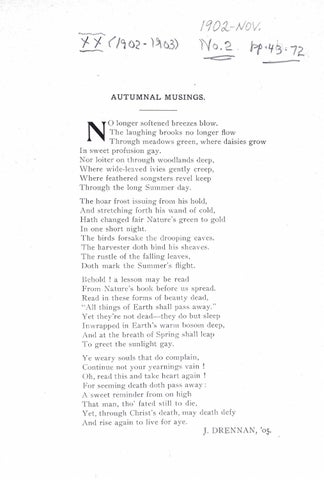
AUTUMNAL MUSINGS.
0 longer softened breezes blow. The laughing brooks no longer flow 路Throug h m eadows green, w h ere daisies grow In sweet profusion gay. No r loiter on thro ugh woodlands deep, vVhere wide-leaved ivies gently creep , Where feath er ed songs t ers revel keep Through the long Summer clay.
N
The hoar fro st iss uin g fr om his hold, A nd s'tretching fo rth hi s wand of cold, Hath changed fair Nature's g r ee n to gold In one short night. The bird s forsak e th e drooping 路eaves. The harves t er cloth bind his sh eaves. The ru stl e of th e fallin g leaves, Doth mark th e S umm er's fli g ht. Behold ! a lesson may be read From . Natur e's book b efor e us s pr ead. R ead in th ese forms of b eauty dead, ''A ll th ings of Earth shall pass away." Yet they'r e not dead-they do b ut sleep In wrappe cl in Earth 's warm boso m deep, A nd at t he breath of Sprin g shall leap To g r eet th e sunlight gay. Y e weary souls that do comp lain, Co ntinu e not yo ur y earnin gs vain O h, read t hi s and tak e heart again ! For seeming d eath cloth pass away: A sweet rem in der fr om on hig h T hat man , tho' fated still to die, Yet, thro u gh Ch rist's death, may death defy And ri se again to li v~ for aye.
DANTE'S "LUCIFER" AND MILTON'S
"SATAN~"
I'viONG the many portraya ls that have been drawn of Satan non e are sur ely more remarkable and m or e universall y known than Dante's Lucifer an d lVfilton 's Satan. These two wonderful cr eations have t h eir r espective merits and admirers. Con sequently a comparative study of the tw o is sur ely not devoid of inter est and profit to the stu dent of lit eratu r e; but, notwithstanding all th e merit and praise that has bee n lavis hed upon Dante's creation, I am con 路 fident in affirming that as a matter of fa ct th e pre-eminence of ran l( and merit belongs to Mi lton's s up erior creation. To be convinced of this we have but to compare both descriptions of Satan with that g iven in Scripture.
A
j'
, We know from Scrip') 1re that th e devil was form erly a bright a nd powerful angel , the ri g ht est in h eaven; but owing to his rebellion against God he ~' as h e utter ed the blasphemous cry, " now se rv iam," hurl ed fr orh is h eavenly thron e, with all his followers, into th e dark abyss of h 1, where they suffer and are doomed to eternal punishment. Scri ptu r"S._ t each es us also that Satan, thou g h fallen, remains a fallen angel, wh&"-is now as despicable and wicked as h e formerly was admirabl e and gQod; and that, a-lthough he has been hurled from his h eave ly throne, h is character of pride and malice has not ~han ged, but, on the contrary, he r emains, as at th e first moment of his fall, the great enemy of Go d and the archfiend of hell who seeks eve ry possible m ean s to ven t his sp ite on the Creator; now: by going throughont ~ l:c world li ke a fer ocious lion , seeking whom to devo ur, and again by waging a s pecially cru el and unremitting war against tho se w ho prove ever faithful to duty and virtue. In fact, Scriptur e r ep r esents to u s the devil as the Prince of this world, wieldin g his sceptr e over a countless multitude of souls w hom he un ceasing ly excites to evil , and throug h whom he sows broadcast the seeds of his malicious designs. So true is this that we are accustomed t o say that a person who deviates fr om the path of duty to emb r ace th at of evil performs the task of th ~ devil. Such in a few words, is th e description that Scripture gives us of Satan,
and such is. the very idea that Christianity has always had of him. But let us now see how Dante and Milton have each depicted their devil, and which description is m ore in bearing with the idea of Scripture and, finally, which surpasses the other from the artistic point of view. The author of the Divine Comedy represents Satan as a huge and disgusting monster, that lies at the bottom of hell, pent up in " the ice to mid-breast, motionless and powerless. On his head he has three faces, one of vermillion hue, o:1c " 'twixt wan an垄 yellow," and the other clark-complexioned; at six eyes he weeps and the tears mixed with bloody. foam trickle down his three chins. In each _ mouth he champs a sinner; in the upper mouth is Judas, in the other two are respectively Brutus and Cassius. Under each face shoot forth two mighty wings that lie flaps in the air with such force that three winds issue from him, wherewith the Lake of Cocytus is frozen. This, in brief, is the description that Dante has given ns of Lucifer in his Inferno. Let us now consider Milton's portrayal of Satan. In Paradise Lost Satan is represented as a huge giant, full of majesty and t error, who rules over the boundless realm s of h ell with th e sceptre of a mighty monarch, and. to whom all bow and pay rever ence. He is proudly eminent above all his fellow clemons-in stature like a frowning tower. His fac e has not lost all of its original brightness, but bespeaks an Archangel that is ruined and 111 w horn excessive glory is obscured. In his face deep scars of thunder路, wherewith h e was hurled clown from heaven into th e lowl y abyss, are deeply entrenched; und er brows of dauntless co urage and arrogant pride, waiting for r evenge, two cruel eyes cast signs of r emorse and passion, and deep care sits on his fad ed cheeks. Such, in a few word , 1s Milton's portrayal of Satan. From this brief ' but literal, sketch of the two pictures of the . devil it is not difficult to determin e at once to whom the pre-eminence of rank and merit really belongs, as far as the artistic point of view is concerned. But, let u s continue th e comparison and view more fully the two creations from the standpoints of Scripture, art and moral value.
For what is Dante's creation especially remarkable? To me he is especially r emarkabl e for th e disgu st h e inspires : there h e lies at the bottom of h ell, a disgustin g, motionless, and h elpl ess being, only active to become ridi cul ous, first in th e act of chewing up three sinners and th en by constantly flapping six la r ge wings, with which he fr eezes hi s own ice b ed. B ut all this appears ruite in sig nifi cant when we represe nt to ou rselves the fa ct that Dant e a nd Ver gi l ai-e made to perform th e eve r so remarkaabl e feat of ascending on his back as they would have clon e on any cliff or hill without th e huge fiend ever making the leas t move to se ize or at leas t oppose th e rash intruders, or even inquiring from them w hor~1 th ey were anc1 what was th e ob ject of th eir visit in the very bottom of h ell. B ut, on the contrary, they ar e a llowed to scale the huge monst er fr eely, and th ey finall y iss ue from the mos t terrific place of h ell without having b een so mu ch as apparently n otic ed. In pas sing, I ventu,r e to say with perfect ass ura n ce that n o mortal or spirit would ever dare perform s uch a feat on the perso n of l\1 ilton's d 9L-il, oth erwise he would not be long 路 before finding out on w hat so rt of g round \ he treads and , to hi s gre\t mi sfortun e, he might have to r elinquish ' all fond hop es of ever ' 'b e l~o lclin g th e stars again." But is the portrayal Dante h as g iven us ~ Lu c ifer in any way strikin g ly wonderful? Does it not appear to 1~ rath er tame and even g rot esque for the natur e and chara ct er of s u e>\ ~. wonderful s ubj ect, and is it fit to inspire anything else than m e r ~ ~g u s t a nd even ridicul e? Where is that dreadful and maliciou s being,, of Scripture, full of ardor and activity and who , fro ug ht with purposes of deepest malice, does not cease to give baneful o rd ers t o his fellow-fi ends of h ell and then goes throug h out th e wo rld lik e a ferociou s lion , seeking whom t o devour? Where is that b eing so fearful and t error-in spiring that a mortal co uld not look u pon his fa.ce and live? F ear, as we shall see later on , is what th e Evil Sp iri t ou ght to inspire above all things ; disgust, and m erely that,, is not suffici ent, for it , cannot g ive an adequate idea of th e devil's n atur e, n or can it produce upon th e mind of the r eader an impression that is really whol.e som e and lasting. In m y judgment, th e sole m erit of Dante's cr eation lies in its originality and in the graphic way in ~ hich it is depic~ed, and, above all, in the pow er it has of inspiring disgust; so 'that , all in all, it fall s far below t he Scriptural and universal idea of th e devil, and is s urely mor e of ,a defective feature in th e Divine Comedy than a
47 rea1 great creation of genws 1 and, in truth, it can not in the least compare with that grand and terrifi c clescript~on that Milton has given us of Satan. \ 7\f e shall now sLJcly the latter from the same stan cl point. What can be more in accordance with the idea of Scripture than the description that represents to us Satan as the Prince of hell, ruling the realms of eternal darkness with a masterly and un., disputed sway, and to whom all the fiends of hell pay rev erence as to their superior and atknow leclged lc J.cl er ? L ow, indeed, he croucheel at the bottom of hell, crushed and s ubdu ed by the thunderbolts of the Almighty, but even then his face glows with th e g lare of arrogant pride and vain passion and his cruel eyes show signs of desperate remor~e ,a nd dir e revenge. Here is where we find the true Satan, such as we know him from Scripture: the archfiend of heli , full of -pride and maliciousness and continually plotting against th e Creator and seeking by every possible means to satisfy his passionate desire for revenge. Next ~ what c~n surpass in artistic grandeur and daring sublimity the grand and wonderful description of Satan's journey through chaos ? It is especially here that lV[ilton , from the artistic point of view, far surpasses Dante in his description of the archfiend of hell. The imagination r eels with aw e and amazen1ent at s uch a feat and in our enth usiasm we are forced to admit that anything more s ublime is simply impossib le. Let us, then , consid er Satan in his wonderful journey throu g h chaos in search of the newly created world. After the Stygian council has dissolved, Satan -puts on swift wings and, like a pyramid of fire , springs fronl. his nethermost abyss towards the gates of hell. On he flie s, exploring his solitary flight with wing and foot , now scouting to th e right and th en to the left, now shaving the deep with a level wing and th en soarin g up to the fiery concave , until finally he comes to the hu g e portals of bell, which, aft er a parley with his daughter, Death, ar e flun g op en 路 . to him and, alighting on the brink of h ell, h e sto_ps and loo ks abroad , pondering his long v oyag e through chaos . A t last h e s preads his broad wings for fli ght and, uplifted in a cloud of sm ok e, spurns the ground and, like a mi g hty whirlwind, ris es upwa rd with maj es t y and velocity until , t ow erin g hi g h with alacrity and veh em ence, he wings his course, undaunt ed, through th e wast eful dee p, for cing his way through the h ollow deep, tr eadin g th e crud e consist en ce, h alf
on foot and half flying, now pu rsuing his way with head, hands and wings or feet, now swimmin g or sinking, wading, creeping, or flying. For many thousands and thou sand s of leagu es the g r eat enemy of God and man speeds in this m ode through th e darksom e void. At the horrid hiss of his ru s tling win gs the solemn qui et of sable Night is broken for th e fir st time and Chaos is fright ened in his lonely r ealm. A t last, in th e r emotest distance, a faint lig ht ap. pears, spreading amidst dim N ight a glimm ering dawn , which • marks the end of the empir e of Chaos and the b eginning of N ature's realm. Now Satan , with less toil and with ease wafts on the calmer wave und er the influen ce of dubious li g ht and, as a ship that is weather-beaten and t orn , hails with joy the y et distant port; so Satan, tired and weary from a journ ey so long, beholds, far off, with joy and contentment, th e em pyr eal h eaven and, in the farthest distance, suspended t o h eaven 's battl em ents with a go lden chai n , th e utmost orb of this frail wor ld, in bign ess no greater than a star. Thither, fraught with mischievous r evenge, Satan ste ers his course ; first he flies to the orb of the s un, wher e he finds UfTe l, the regent of that orb, and , assun.'t.i ng th e form of a bri g ht angel, inquires of hitn the place of the hab¡tation of man , feigning a zealous desire to behold th e new creation a 1cl man placed ther e by God. Having been directed by U ri el, h e tak leave of him and speeding anew with hoped success he fli es w ith un staid progress towards the coast of the earth beneath, where, afte \ a steep and g ladso me flight, he at last alights on JVIount N iphates. ~
.
',
Such, in sub stance, is th e incom parabl e and magnificent description that Milton has drawn of Satan's flight through Chaos , and which alon e could h ave forever immortali zed his name among all th e nations of the earth. Here is th e r eal ferocious lio n of Scripture, full of activ ity and m a lice, who goes throughout the world in order to devour man by leading him into s in . But, besides maj est y and power, for w h at is Milton 's Satan remarkabl e? Milton's Satan is wonderfu ll y remarkable for th e deep terror he inspires . He is a hu ge giant, that stands like a frowning tower and whose fa ce b ea rs deep sca rs of thund er aJicl is aflame with arrogai1t pride and passionate r evenge; he springs from the deep abyss like a huge pyramid of fir e and in his flight through the clarksome void fright en ed Ch aos by the horrid hiss of his w ings; at his stentorian voice a loud a nd terrific roar r eso und s through eternal
.'<
night, causl.ng the r emotes t soiitudes of h ell to tr embl e in their . profound retreat ; at his word the se rva nts, th e peers, and the princes of Pandemonium ri se up and ~ is t e n w ith th e keenest attention to his sp ee ch es and bow submiss ion to his dreadfu l decrees-so much are th ey awed by the dread and power of th eir terrib le leader. Milton always represe nts Satan as th e great ene my of God and man, intent with purposes of blackest malic e and co ntinua lly striving to put them into exec uti on. H e, fir st of all, s uggests and th en un.d ertakes in perso n the long and pc:::: :c us j 6 ur~~ey to the n ewly created world, in ord er to de ceive new~ born man iss uing forth innocent and holy fr om th e hands of his Make·r, and lose him betim e w ith his posterity by urging him into a r evolt against God, findin g in the fall of man th e lon·g desired opportunity of r enewing hi s war with Heaven. (To be Continued.)
R. RICHER, 'o3.
THE HUMAN SOUL AND ITS FACULTIES.
T
HE soul of man is a sub ject of exhaustless inter es t . Like all
thin gs invisibl e, ye t of m os t unclou bt ecl r eality, it exc ites both our curiosity and our admiration. Although it is far beyond the power of th e bodily eye to contemp late its untold b eauti es, though we ar e unable to touch it or with ' any sense t o a ppreh end its substance, ye t so wonclerf ul and so evident are its actions, its visib le and tangible effect , that not only must we a dmit its presence but we are struck with astoRishm ent at its manifold and myst eriou s pow ers. A lthough we find it impossible to examine, even with the aiel of a microscope, that g r eat inv is ible agency which eve r like th e power that s ustains the star-cl otted h eavens escapes th e most earn es t and • most intense scrutiny, yet it is certain that with th e eye of th e mind we can peer suffi cientl y deep in to the innermost r ecesses of the soul to see and t ell w hat it is and thus distinguish it fr om ot her beings . In this m ann er we are enabl ed to define th e so ul and classify its manifold a nd v ari ous powers .
In the, fi_rst place, we know as a self-evident fact that every material thing that lives, lives by a principle other than the matter which enters into its co mp o~; ition; beca use if things lived by reason of their matt er th er e is no conceivab le reason why eve ry material thing should not h ave life. Bu t y ou may say, so me material things do live. Thi s is , ind eed, ve ry true and that distinct principle by which th ey live, grow, feel, or think, is what we call the soul. The soul, then, is th e fir st princi p le of life. It is the ene r gy that inwardly moves us , th e s uperior princip le that specifies matter that rais es that which otherwise wo ul d be inert , into the hi g h er r ealms of liv ing ~eings. The pow er of th e so ul dignifies matter, ennob les, en-路 richen s, enlivens it and endow s it with certain force s by which ii.. dominates inert thin gs . The t erm soul is connotative : it s ignifies a thing not ab solutely, but c.,s having an intimate relation with some body 路 of matter. The reaso n of thi s is, that the soul, unlike a pure sp irit, perform s most of its actions through the organic assistance nf the body. This is what we mean when we say that the s oul is in close relation w ith th e body . By the aiel of this principle we are enabled to move fr eely fr om place to place. The zephyr may rustle the leaves of a tiny sl~)-~ lb or a driving blas t may sway the g iant branch es of a mighty oak路 yet neither the shrub nor the oak has any intrinsic power to move i self. Vve n eed not wait, like the flowers of the fi eld or th e tr ees of the forest , for the wind to blow us to and fro. O ur motive power is n~:trensic ; for an act of the will is suffici ent to set the mechanis1~, ~:f'i!>}~ocly in motion. The soul, then, is that pow er throu g h wh1ch we mo路Ke, see, hear and perform the other operations of sen se and r eason . I
N o.w that we have defined the soul it remains :for u s to unveil the wonderful richn ess of its faculties, to show w hat manifold and precious powers are root ed in its fertile soil.
\ TV e know that th e power s of the sou l are many and o:f va rious natures. How vast, h ow wonderful , how admirable, and how necessary a r e the, powers of th e soul ! How busily and orderly it works in th e rapid and steady produ cti on of the organisms which it need s for th e performance of its functions. In many ways the body may b e compared to a locomotive. The bones and mu scl es answer for th e machinery and the motive power is produced by the foo d we eat . By reason of this we are kept
,,._.,.
watmJ muscular force is developed and the levers and joints move as in the engine. There is, however , an important differei1Ce between the two. The engine wears o路:tt, it must be stopp ed, taken. apart and repair ed. O ur bodies are also wearing out, but they are constantly repairing themselves. In this way we may easily see how the body far surpass es the engine in the perfection of its mechanism. Our admiration is arous ed by the marvelous and fascinating works of some intricate machin e. But in the human body we find not only a most p erfe ct and deli cat e r-:. achine, btit on e which far St\rpasses the handicraft of man, endow ed, as it is, with life, motion and intelli gence. We might dwell at len gth upon th e excellence of the human bod y, a:1d s how how digestion , a ssimilation, increase, repair and r eproduction takes place ; but beautiful th ough th ese vegetal operations b e in their silent and ceaseless activity, th er e ar e in man more dignified, noble, attractive energies. By sentiency th e soul grasps and makes its own th e entire material world. Through the eyes, th ose w indows of th e so ul's temple, it contemplates the beauty of go rgeo us s unsets, tarry nights, pictures que landscap es, st orm -tossed ocean s, sparklin g streams, and all th e charms of color. T hrough th e ear th e soul r eceives sweet harmony into its hom e. Th e ocean 's roar, th e babbling of the brook; the tumult of th e elem ents , th e gentl e w hisp ering of the evenin g breeze ; th e va ri ed caden ce of th e human vo ice, th e merry warblin g of th e wo odlan d son b"ster : each plays up on th e soul in a key which g ives expression to m os t entrancing music. The other s ens es ar e likewise channels throug h w hich oth er wealth is conveyed to th e soul. Besides th e outw ard senses , which ar e, as it w er e, th e sent in els and purveyors of th e soul, th er e ar e inward sens es which, like familiar servants, go hith er and thith er , ministerin g in its inn er sanctuary . On e of th ese, th e judicial fac ulty, det ermi nes th e goodn ess or badness, th e fitne ss or unfitn ess of obj ects pr esented t o th e s enses. The imag ination r eprese nts absent obj ect s as if th ey wer e present. It paints pictur es that far excel the most p erfect productions of the artist 's brush . By th e aid of this pow er cr eation s of th e most fabul ous b ea ut y con ceiv able can be 路 b~ought t o th e mind. Gracefttl and t owerin g str.;t.~,c .tur;es, -vv:h'o se loft y pinnacl es pier ce t h e snowy clou ds , 路m ~:y b e 'r eadilY:.. presented t th e m ind through this I
w onderful agency . Pictur es ot crystal r ive rs, w hos e p iz.c idly flowing wat er s a r e now and t h en dist urbed by t h e da rt ing hit h er ariel thith-er of go lden fi s h es may be concel.v ecl an d, in fact, ev en th e wil dest fan cy may en t er t h e so ul of ma n thro ug h t his p orta l. Agai n, in th e soul we fi n d a mea ns b y w hi ch it r et a ins a ll that ent er s it. B y t h is n1 ean s t hi n gs seen in y ea rs gon e by an d thin gs learn ed w h en we w er e m er e childr en can be viv idly r ecall ed t o th e mind. In a way, t his fa culty of t h e so ul makes w h at it on ce k nows part of itself. T h u s vari ou s, th us ma ni fo ld a n d t hus excell ent a r e th e veget at iv e and th e se nti ent fac ulti es of th e so ul. B ut th at by w h ich t h e hu man soul ri s es ab ove th e so ul that veg et ates in t h e p lants, above th e soul t h at feels in t h e brute,-that b y w hi ch t h e h u man so ul r eac h es to kinshi p w ith th e an ge ls and w ith Go d, is it s intell ect ua l p owe r. By thi s power th e so ul k nows mat eria l t hings in an imm a t eri a l way ; a nd knowin g th em t hus it k nows th em in a hi g h er and a nobler way . It kn ows th e esse nc e of materi a l obj ects, 'i t is tru e; but t h at ess en ce, t h e intellect abstracts fro m all mate~li ty : st ri ps of all mat erial con ditions, and t~u ~ ob ta i n ~, as it w : r e, ~ ~ lr~ arl y disti lled r esult , a n int e ll ~ct u a,l s u~颅 lnnat e, o r , 1f you w ill , a~1~e a of esseri ces th at have t h eir bem g 111 mat eria l t hin g s. This r efin e4 concept is far sup eri or t o th e cognition s of sens e, b eca use it is so'i~ from m at eriality and because, a s a r es ult, it b ecomes unive rsal,- t hat i s, a notion that can b e app lied t o an y numb er of ind ividua ls of th e same natur e. JVIor eov:er , t h e in t ell ect has pow ers of judgment and of r easonin g, w hi ch are still m or e w on derful an d sp lendid in their r esults th an the pow er of sp ir it u a l conc eption. Throug h judg m ent it v ariou sly compounds t h ese imn'lat eri al id eas w hi ch it has first a c路路 quir ecl th ro u g h s imp le appr eh en sion ; it a ffir ms or deni es th e ide n' tity or li k en ess th at is obser vab le betw een th es e. co ncepts as co mp ared. T h en it t r avels fur t h er , it ent er s in t o th e mor e co m p licat ed ope ration of r eas onin g, comparin g judg m ents a n d de riv ing from th es e, ot h er judgm ents or con cl u sions w hi,c h r eveal n ew truth s. T hrou gh t h ese wond erful powers th e intellect goes on explo ring t he w hole r ea lm of knowable t hi n gs, passing fr om on e di scovery t o anoth er , eve r en richin g it s st or e of k nowledge a n d buildin g up for
. n.
ns o n contemplation and delight coge nt ys tems of science, of p hil o ophy of r eligion, w hi ch are the noblest, t ronge t, most beautiful and most enduring fabrics t hat man can build. We have ye t to consider the g reatest g ift whic h God has bestowed up on man-free wi ll, the nob lest faculty possessed by intellect ual age nt s. During th e years of in fancy and ea rly childhood the human being is co mplet ely the creature of im p ul se. The precise elate of the fir st e. erci se of fr ee will can not be determin ed in any individual. Bnt there must come a m om ent w hen the child outgrows its an imal life and rises to intell ective, co nscious , free and responsible activity. This free election of acts, this assertion of one 's own dominion ove r his acts, good or bad, is an inseperab le endowment of rational b eings. Now we know that if a man does not possess free w ill if he can not by hi s ow n energy oppose him self to the current of influences which swa y him , then be is really nothing more than an • irrespon ibl e machine. His m ec hani sm may be most ingenious, the agencies 0.t wo rk innum erabl e; but if his cond uct is eve r the resultant of the fcr::es playing up on him there is no esse ntial difference, as Father l\/l_aher says, between the acts wi ll ed b y him and the movements of the madman , the bru te, or t he rain cloud. By w ill or ratior"! c.: l app el ite we mean the fa culty w hi ch inclines or directs the so ul to so:11e object w hi ch is apprehend ed as good. Th e wi ll can be irres ist ibi y drawn only by that object w hi ch r easo n proposes as so uni-v-;:-rsall y attractive that it contain s no dissatisfactory feat ure. The will is movecl to des ire an object onl y in so far as that object is goo d. O ur fre edom co nsists in our power of choosi ng b etween the manifol 1 kin ds of good ;• it is a free ac eptance of intellectual jucl_gment concerning the (Jesirability of thou g hts and ete rnal actions. It is m a n 's free w ill th at makes him acco untabl e for the actions he perform s . \ V hat a g rand creati on 1s the human so ul ! In it we have a miniature unive rse. O h! how entr an cin g is th e sight of the soul a it is in itself. I s it , then, a wonder that saints have been raised into a tran port of ecstati c delig ht at a gli mpse of the spiritual wo rld , vou chsafed th em eve n while on earth ? Bpt E;Ye.n tho ugli
54 w e are left t o cont emp lat e t h e so ul from afa r a n d th rough th e thi ck mi st of mater ia l su rround ings, yet in its effect s we see a p a rtia l r efl ection of its b ea ut y . W h en we consider its s ilent and ceaseless op erati ons of vege:1tion, w h en we exa min e its co m plex an d intricat e op er at ions of sen ti en cy an d w h en we come fin a lly to study its hi g h est op er ations-intell ection a n d vo lition-th en , ind eed, do we excla im: (,T rul y , th e soul is t he mos t perfect wo rk of Go d! "
J. c.. '03.
EDITORIAL.
•
Soon out door sports wi ll b e abandoned; alr eady th e tim e fo r re cr eation has b e ~ n shorte n ed, in a word , we are in that p eriod of the s cho lastic yea r\~ . nown t o man y stud ents as t h e gloo m y seaso n .. F or some, u ndo u bt e ly th e w int er term is m ost dr ear and gloom y , for they k now not ho \ t o m ake a little s un shine for th emselves . It w oul d be w ell for s u ch 5~u de n ts t o for m som e plan by which th ey can r ob t h e w int er of its gr~1. We wo ul d su ggest that th ey e n~ g age mo r e dilig entl y in th eir s-tu clLes, that th ey learn how t o find sunshine b et ween th e covers of a book, an d t hat th ey t a k e an a ctive par t in so m e on e of th e societies w hich ar e organi zed, n ot less for t h e p leas u·r e th a n t h e intell ectua l advan cem ent of t heir members. Every stu dent w h o is elig ible should not fail to b e a member of one of his college societi es.
·If we desire to know a man's :::h a r 2- ct er , if w e w ish to form a corr ect estim a t e of his int r in sic w ort h , if w e v1ant t o per ceive w heth er h e is possessed of g r eat ness o r littlen ess of soul , w e closely study his action s-not this or tha t isolat ed act , but seve r al act s, elicited in differ ent circum st a n ces. T he stan dar d, th ~ n , by w hich w e judge a man is his mann ers. By closely ob serv in g h ow h e behav es in different cir cum stances,w e r 2adily per ceiv e wh ich v irtues h e possesses and w hich h e lacks. By a look, by a wo rd , by a m otion on e betrays his
I,
55
feelin gs and shows whether he has command over him self or not. No mor e trul y does th e lig ht of the s un make the beauty or deforn1ity of material objects perceptible than do th e manners of a person reft ec t the perfections or imp erfections of hi s soul. Each one tl1en carries about with him a mirror in w hi ch . oth ers can see a correct image of hi s soul. The close r elation between good manners and good morals is evident. The former ar e based upon the latter. \\There we find sound morality there we w ill also find tru e. courtesy. As .t.he fr agran ce r eveals th e presenc e of the Bower so true courtesy n-.akes known the presence of v irtue. A co urt eo us man, a gentleman, is a m an, the r efin em ent of w hose nature makes him shrink from inftictin g pain 01~ others. If on e lacks feeling h e will not know wh en b e infticts pain on oth ers. The pain w hi ch a gentleman refrain s fr om inflictin g on others is not merel y that which results from violence, for , after a ll , s uch pain is very often less bitter, less distressing, less hurtful , th an that wh ich un k indn ess, sarcasm or contempt beg r: t. It m ay be necessary at t imes to inflict pain on others, t Llt a gen tl eman w ill do so sparin g ly -and only as a last reso rt. V,r" hy should we not try to lessen th e miseri es and s ufferings of life 路vvre n we can do so w ith s uch ease and so much profit? He who makes z:..not h er happ y car1not do so w ithout in cr easing his own stock of happin ess. There a re many thin gs to b e lea rn ed by the student during his cc [ ege life, but he w ho goes forth wit hout having learned to be a gentleman , even sh ouicl h e h ave distinguish ed him self in the sc ien ces and philosophy, wi ll lea rn by bitter experi ence that he has ne g lected tha,.t which is most essenti al. 路
ST. VIATEUR'S DAY.
NCE more we a re called upon t o chronicle on e of those joyo us 路 celeb rations which are s uch p~ eas ~ng feat ur es. of college life. T hose pleasant fe stal clays which mterrupt, w ithout destroying, the regularity of stu dent life are productive of oth er than the short-lived happiness of a day; w h en they appear in the dim di tance
0
of futurit y th ey enkindl e in th e hearts of stud ents 路and teachers, joyfu l anticipations, whi : : h rob prese nt trials and difficulties of their arduous natu re, and , on the oth er hand, when they have flitted by, th ey leave b ehind them, entwin ed around the h eart, fond memories w hicl1, in times of sorrow, wi ll com e forth to dispel the gath ering clou ds. S t . V iate ur' s Day, th e 路first of our college festiv iti es , was, in accordance with th e traditions of the college, celebrated this year wi th a grande ur and magnificence' which can be produced only by the unit ed effort s of r eligion and art. The scene presented in the chap el when the different meinbers of th e flock approached th e.i r good pastor to r eceive from his hands th e Bread of Life, was certainly on e whic h th e angels mus t have loved to look upon.
Pontifical High Mass, at 8 o'clock, was celebrated by the Rt. Rev. J. Chatron, D . D. , B ishop of Osaco, Japan. His grace was assist ed by R ev. P. Menard, Escanaba:, M ich. , as arch-priest; Rev. M. A. Dooling, Clinton, Ill., and R ev. P . Langan, E scanaba, Mich. , as Deacons of Hono~ . R ev. P . H. Dwrkin, Rantoul, Ill. , and Rev . W. Burk:, Peoria, Ill. , were Deacon and Sub-J?eacon of the Mass, respective ly. Rev. J. . Laberge, D. D. , ass tsted by Rev. 0 . E. Paquin , C. S. V., was JV~'a~ter of Ceremo'n~ie~ .. Rt. Rev. Mgr. Leg_ris, D. D., Rev. M. Letellier~~ Rev. C. Foutm er , C. S. V., were pt esent in the sanctuary. The "serrgon was preached by Rev. ]. H. N awn, St. lV[ary's chur ch, Chicago. The Acolythical Society is to b e complimented for the knowl edge a nd accurate observanc e of the ceremoni es w hi ch its members displayed on this occasion. Mast ers B. JVIars il e, W. Keefe, J. F inn, W. Maguy, J. Legris, E. Burke, J. Mo nahan, T. Wright, H. Dunham served at th e Pontifical Mass. 1'he choir, co nsisting of eighty students, many of whom were new members, sang in a mann ct which showed skillful training on the part of th e dir ector, and diligent application, as well as talent, on the part of th e s ingers . The very difficult program, which is g iven b elow, was r endered in an inspiring manner. Th e following new soloist s d istinguis hed themselves on' this occasion: Rev. ]. Corb ett, Mess rs. R. W eurst , W. Cleary, F . Holland , ]. Hogan and l\1asters C. Ost, T . N :::lson, A. Lambea.u. The ch oir 1s under the
able management of Rev. C. Raymond, C. S. V.
57 The program of the mass was; K yric . . . . . . . . . ..... .. .... . .. . . ....... Farmer's Mass ' in B Flat Gloria- Messe Solennelle . . . . . . . . . ... . .... ....... ...... Gounod Veni Creator . . . . . . . . . . .. .. . ... . . . . . . . . ............... Millard Credo . . . . . . . . . . ................ . , .. ... . Bollman's M ass, in C Et Incarnatus Est-Missa Pro Pace . . . . . . . . . ..... . ... La Hache Sanctus-Messe Solennelle . . . . . . . . . . . . . . . . . . . . . . . .. . . Go unod Agnu s Dei . . . . . . . . ... : . . .. . . .. . . . . . . .. L eo nard's :M ass, in B F lat The sermon , delive red by Father N awn, was all that a se rm on s hould be: The orator combined harmoniously th e many and varied eleme nts that constitute a good sermon. His discourse was orderly, clear, literary; it had that pious strain which should characterize a good sermon, and it was very practical. Taking for his t ext the following passage from th e twenti eth Psalm: " He asked life of thee: and thou hast given him length of days for eve r and ever," Father N awn introduced his theme by considering the beauty of God as manifested especially in his saints, " thos e masterpieces of th e Divine Attist." In th e body of his discourse Father Nawn, after briefly s umming up th e life of St. Viateur, pointed out in a s trikin g mann er how the humble cleric renounced wealth, pleasure and p owe r t o follow more _closely in the foot steps of his Divin e l\1odd. In conclusion, he exhorted his hearers not only to admire but also to imitate the sublime examples of th e saints. The whole se rmon was characterized by lofty id eals nobl y conceived and beautifully exp ressed. The ardor and earnestness of the speaker, springing from his deep conviction and exp r essed not less by his looks, ges tur es and action than by his wo rds, we r e powerful factor s 111 elevating his audi ence to his own elevated plan e. A brief intermission elapsed between mass and the military tournament, w hi ch took place in the gymn as ium. The battalion , und er th e s up ervi sion of Colonel \1\T. Clear y, presented a good appearance, .in num her s and efficiency . T he Ford Exh~bition Squad went through its many and intri cate movements in a mann er cr editable to its members and r efl ectin g g r eat praise up on its offi cers. Scarcely had the echo es of the applause which th e se niors r eceived, died away, when th e Columbian Guards, those champions of the M ini m Department appear ed, conscious that th e laurels of v ict ory
58 ~
were theirs; nor were they disappointed. The life and buoyancy with which the minims executed their intricate . maneuvers is what made them the special favorites of those who viewe9 the . military display. Their colonel, Master R. Daley, dese~~es great commendation for his proficiency. In giving over one hundred and fifty different commands he did not hesitate once. In fact, all the officers. are well chosen. From the manner in which the different military companies performed their part in the celebration we are led to ex.p ect much from them as the year grows older. The afternoon was taken' up principally with the banquet and the play, "King John," given by th e Thespians . . The following is. the cast of characters: Dramatis Personae.
King John ..... . .......... ... . , ............... J . M. Kangley P rince Henry . . . . . . . . . . . . . ...... . ............. .. . Charles Ost P rince Arthur .............................. ·......... R. Daley Earl of Pembro e ................................. F. Holland Earl of Essex . . . . . ................................ F. Rainey Earl of Salisbury . . . . . . . . . . . . .... .' ............... W. Moran. Robert Bigot . . . . . . . . . . . . . . . . ..................... P. Legris . Hubert ........ .... .... ....~ ................... T. Cosgrove Faulconbrige .................................... A. L'Ecuyer Peter of Pomfret ..... ......................... . ... W. Burke Philip of France ...... ... ·. , ........................... J. Carey Lewis of France . . . . . . . . . . . . . . . . . . ................ W. Maher Archduke of Austria . .. : . . . . . . .................... \ 1\!. Cleary Cardinal of Pandulp . . . . . . . . . . . . . . . ................. M. C9tter Chatillon ........................................ R. Weurst Queen Elinor ' . . . . . . . . . . . . . . . ..................... B. McCarty """' Lady Constance ...... .. ... .... . .................. J. Monahan B lanche . . . . . . . . . . . . . . . . . . . . . . . . . ... '................ J. Finn_ Citizens of At;Igiers, Soldiers, Etc.
•.
59 All who took part'1n the pJay acq"~1;itted themselves of their resp-e ctive parts in a manner which made the whole rendition one which reflected glory on the Thespians. This certainly is high praise, when we consider the former triumphs which this society has won; but it is no less certainly deserved. 1\!I r. J. M. Kangley, as King John; 1\!Ir. J. Carey, as King Philip; M r. A. L . L 'Ecuyer, as Faulconbrige; M r. T. Cosgrove, as Hubert;. 1VIr. M. Cotter, as th e Cardinal; Master R. Daley, as Hubert; M . Cotter, as the Cardinal; M ast er R. Daley, as Prince Arthur, and :Master J. 1\'Ionahan, as Lady Constance, especially distinguished themselves in th ei r very difficult rol ls, as was evidenced by the rounds of applause w hi ch they received. The realism with wh.i ch Mr. Kangley presented the death scene of K ing John gave ample eviden ce of his histrionic ability. Mr. T. Cosg rove and Master R. Daley gave as perfect a rendition of the pathetic scene between Hubert and Prince Arthur as is ever seen on the local stage. Mr. Cotter imp ersonated the Cardinal with a grace and dignity which we ll befitted his rol e. The conscientiou Ph ili p of France was exce ll ently interpret ed by 1\!I r. Carey. Mr. L'Ecuyer rend er ed in a spirited manner the kee n wit and burning satire of Faulconbrige . The inten se grief and pa sionate outburst of Lady Constance were portrayed in an admirable manner by Master J. Monahan, whose whole..-sou l was in hi s utterance. Between the acts th e audience were given so me choice selections by the college orchestra and band, both of which are under the directorship ¡o f 1\ti r. G. Martineau. The m emb ers , as well as the elirector, are to be complimented on the excellence with which they rendered the excell ent selctions prepared for the occasion. The celebration of St. Viateur's Day of 1902 was certainly all that it could be desired. Even the weathe r was most favorable. The large numb er of distinguished visitors, who attested b y their presence the interest they take in our institution, w ere evidently delighted with the different features of the celebration. •
•,::;·.:
OBITUARY. · It was w ith fe€ lings of deep r egr et that we heard of the death o f Rev. P . Desjardins, C. S. V. For tl~ e past two years his health had been rapidly failin g, so that when his encl . came, at J oliette, Canada, Octobe r 30, it was not un expect ed. D uring his long life in religion, a period extending over thirty-seven years, Brother Des:jardins labored zealously in ,different institution s of his comm unity 1 both in Canada and in th e United States. For several years h e was P rofessor of l\1 usic at St. Viateur's coll ege. His many friends in the U nited States will learn w ith sorrow of hi s death and will, we hope, unite with the community of which h e w as a faithful me mber, ~ n praying for the repo se of his so ul. R. I. P.
It is ou A sad duty to r ecord th e d eath of l\1 r. \ lv . Wiatr. hi I9oo lVIr. Wiat t finished the philosophical course her e, winning the hon o rs of his c ass. Th e following ye ar h e began his theologica~ course at St. Fra is' Seminary, \!Vis. But scarc ely had he begun h~s cours~ when. the :l zead sympt01:1s of con sumption forced him to g ive up his studi es and tr'<;1._y~l for his health. After two years sp ent in th e south ern and west ern stat es h e r et urned t o his home in Calumet, M ich. , where h e died in .the early part of October. During the tim·e spent h er e in studi es, l\/[r. \ Viatr gave promise of a successful car ee r in the vocation for which h e was preparing. We extend to his parents and friend s o ur h eartfelt sympathy and the assurance that we w ill n ~t forget to pray for his so ul. R. I. P.
\Ve r eceived with g reat sorrow the nevv·s of the tragic death of M r. W. Barr and ti1at of his brother, J cihn. Both yo un g m en wer e suffocated in a well, into which th e,y had desce nded for water. William was one of our former stud ents, who, during his stay with u s, was well liked, both by his fellow students and teachers. On Wednesday, Novembe r 5, r equi em high mass was sung in the col-
6r · lege chapel for th e r epose of t h eir so uls. We con dol e with their bereaved pa-r ents and fri ends in th eir sorrov1. R. t P.
EXCHANGES.
/A
COLLEGE journal may be right ly cons id er ed as the mental exponent of its stud ents. It is, so to speak, the intellectual barom et er of whateve r se at of learn ing it r epresents, for on its pages we see regi ste red tb e p1·ogr ess t hat is being made there. This prog r ess is u su all y m an ifested by th e nature of th e subjects treated, an d th e manner in w hich th ey ar e tr eated by th e students th emse lves, but sometim es it app e:1rs mo r e especially froni the character of th e extracts w hich th ey select from other journals. If t hese, w h eth er in pr o ~ e or \·ers e, a re of an elevating nature, if they insp ire the so ul w ith noble sentiments, if they arouse the mind to t he c9ntemplati on of hi g her t hi ngs, and make it love that which is beautiful , then may w e ri g htl y conclude that the journal which selects fo r it s pages su ch extracts, th e journal w hich thus tacitly ex·press es its app r eciation for t houg hts exp r essed by · high ·thinking minds, is on e w hich indicat es th a t ther e is a hi gh grad e of mental' culture Hourishin g in t h_e college w hi ch it r ep r esents . . Such a11 ap~
preciation we a r e pl eased to see has bee n manifes ted by the "Gt;tt ys burg 1\tl er cury'' for Oct ober. This journal contains two entire poem s, t aken from the Viato ri an , on e en titl ed, "The Leper Priest," the other, '' In Vain. '.' O f th e bea uty of exp ress ion and loftiness of th oug ht in th ese it is not for u s to say, but it is for us to say, and we tak e a just pride in say in g it , t hat both are from the pen of one whose writings, both in prose and ve rse, are by no means unfamiliar to any of our exchanges. We; th er efor e, con gratulate the author of th e poe ms and a lso the ·' Gett ysburg l\!Ie rc ury" on the excellent taste which it has disp layed in se lectin g them. We wish that we· co uld stop w ith th ese cong ratul ations , but we find that it is the duty of th e ex-man t o call att ention to the clark as well as to the b ri g ht side of a journ a l, an d, to our mind , the Me rcury has also its clark side. \ Ve r efer to thos e pages w hich it devot es to an article entitled , " Barriers t o Scien ce, " By the m er e b eadin g of this article -.
we were naturally lead to think that the writ~r had made some important discoveries, consequently we proceeded w ith a ll possible curiosity to see what th ey we re . But, alas! What a clisappointi11ent! The only barriers we co uld find were super natura l r eve latiori and ecclesiasti cs, and these soon proved to be, even according to the w rit er's own admission, not barriers. at all, but just th e contrary-aids. We may infer, however, from the general t one of th e essay, that s u ch an adm ission on the part of the writer was uninten tional-probab ly a s lip of tl1e pen-for before making it we notice his attempts to belittle s up ernatura l revelation and show its insufficiency for th e growing mind. For instance, h e says : "Tru e, the children of I srael did have a s upernatural revelation to g uid e th em , bnt how imp erfectly slid it se rve th em. Toget her w ith the other nations th ey seek after other gods to worship." B ut this proves nothin g against the suffi ciency or excell ence of supernatural r evelation. If it proves anythin g, it proves that the children of I s rael were .:; ubj ect t o mental wanderings and delusions, just as are the children o( the Darw inia n school. T h ese have unchall engeable proofs drav-~ from the very natur e of thin gs, w hi ch show th e fixit y and stability 6~ f species. Yet, how imp erfectly do these proofs serve them! They t um on the man-monkey theory to th e disgust of all who h ear them a in spite of a ll proofs to t h e contrary. But does this fact in any way , sen the valu e of the proofs? Not at all. 路 B ut where-the writer appea rs to wax especially eloquent is .in his description of the _conflict between th e scientist, who rejects revelation , and the ecclesiastic, who r ever es it. Speaking of the scientist, he says: "He peers und er 路the surface of the earth to di s.cover its hist ory . He examines and compares th e inorganic and organic creation in order t o determine the processes through which t hey have been evolved. He proves his investigations, and submits them for our consider ati on." "His facts are generally accepted, except when they seem t o co nflict with ( onr ) supernatura l r evelation . A t this point we h ear the cry of 'Halt! ' Ecclesiastics say it is .a t h eisti c. Th ey say it is co ntrary to the account given in Genesis. 'S hall we beli eve that man 路is descended from the monkey, w hi ch belief is not only contrary to Genesis, but degrading to man?' " \ Ve ll , if by '' hi s facts"
the 路w-riter means those conclusions which the
scientist deduces
from right princ1ples and arrives at by the right use of reas.on ; then his facts are not g~nerally accepted, but are always accepted, f.o.r it is ip:tpossible that such fact s col.tld be in co nflict with (our) . supernatural revel ation-tru t h ca nn ot be opposed to truth, any more than light can be opposed to light. A nd here let us remark, by way of digression, that the writer's ·'ou r" in parenthesis is uncalled for, and if this is merely an atte mpt at sarcas m he should re-:member . that he is dealing with som ethin g sac r ed-~o mething which spurns the idea of even an 'o2 man triflin g with it. But, to return to facts: If by " his fc,tct s" we are to und erstand the hypothesis or suppositions of the scientist, these, w e admit, are generally accepted, but at a discount proportionate to the · degree in which they seem to conflict with the Word of God. · Th ey ar e not, however, as the writer would have us believe, rej ected if they only seem to be in conflict with supernatural revelation. · Finally, if by "his facts" the writer means those affirmations which ar e directly opposed to revealed truth , and even to common sense, such, for instance, as his quotation from Emerson, th e po et, preacher and philosopher: "The chenJ,ic lump arrives at th e plant and g rows; arrives at the quadruped and walks; arrives at man and thinks." " Facts" like tl)ese, no matter by whom presented, are always rejected as counterfeit coins, and it is only when the scientist trys to palm off such facts that he hears the cry of " Halt! " . But is th e cry of ".H alt" at such a point as th~s to be cons idered a barrier to science?
\V e are unable to dete ct in this entire article anything t11at can justify its title.
The "St. Joseph Collegian" opens with a beautiful litHe poem, entitled, "The Queen of the Ros ary. " In this the writer has ex-pressed many inspiring thoughts , but his concluding lines are es"7 pecially elevating. Another articl e in this journal which attracted our ;tttention and which indeed mu st be of more than passing interestto every student, is "College Life and Vacation." Here the writer s ho·w s in clear terms that va cation does not, as som e may think, · offer any impediment to int ~ ll ect u a l progress, but, on th e contrary, that it offers innumerabl e advantages to th e student; that it eriables him to see life, not ' in books, but in its reality, and gives. him a
• f
1
''·
.b.roadminded ness, witho ut w h ic h his ed ucatio n must necessarily be incomplete. We admire th e writer, both for his style and for the" admirable way in which he has defended a tim e sacred to u s all. .; :
'
\Ve have r ead with much p)easure a ·w ell written and instructive articl e in a September iss u e of the Scholastic, that entitled, "Sir Thomas Moore." The writer, in order t o better s how forth the admirable virtues of this great man, contrasts hii11 with one o.f the most despicab le characters in . the annals of hi story· Cromwe.li. Truly, he selects a backgrourid wher e " lig ht is si lent all ," and this has ·its advantage, for it mak es J\1oore s hin~ e forth with still greater t:esplenclence, just as a star "that sends down its lovliest l'ight -whe11 ·a midnight sky is round it. "
~
. are pleased to add · to our list of exc.hanges several new names t ~·smonth , so me of w hi ch a re first iss u es. Amo ng these we mnst ma . e special mention of "The Columbiad.'' This journal, in · it~ infancy, iz full of health and vig01:; and we ~re confident that it w1l1 be a welco~e guest at ':'hatever san ctum 1t appears. . . ~. _ · " .. . J. LYNN. ,
:l1
PERSONALS.
Rev. T. Gaffney, who is at present following an advanced course in Theology at the Catholic U niv ersity, Was hington, called in the early part of October upon his fri ends at the college. . All were delighted to meet him and to lea rn tha.t his health is goocL He · has the best wishes of those w ho knew him during his stay of three )rears at St. Viateur's.
R~v,
p, )VIoore, '98,
rec ~n tly
visited u s to m ~et .old fri e n4 ~ .<:tnd
..- :
jJ
form n ew acquaintances. At present Father Moore is pursumg special courses at th e Catholi c U niversity, Washington. His presence awakened pleasant mem on e and we long to see him agam within our halls.
R ev. F. X . O'Connor was one of our pleasant vis itors recently. At on e tim e Father .O'Con nor was our Profe so r of Rhetoric, but now Hannibal , Mo. 1s th e scene of his labor s, w her e he is acting as a. s ist ant pastor.
One of our earlist graduat â‚ŹS, Rev. ]. Lesage, pastor of Sacred Heart church, A uror a, Ill. , r ecent ly v is ited t h e preside nt and oth er friend s at th e college .
.. Among the recent a rrivals in t h seminary departm ent Messr s. P. H. Pyterek and E, A. Kowalewski, of Chicago, Ill.
~re
1\fr. J. Gran ge r, '96, is attending the Northwestern School of Law, Chicago. We wish our former student the success to w hich his high intell ectual and moral qualities entitle him. ' •.
1\i[r. P. Kirley, Terraville, South Dakota, one his way to Chica-
go, call ed at th e co ll ege to see his brother, Rev. J. D. Kirley. Mr. lzirley has large interests in o ne of the principal gold mines of South Dakota.
During A ll Saints' Day and A ll Souls' Dayr Rev. Father Brady, S. J- ~ conducted a r etreat f0r the student s and faculty.
The -correspondent for the New World writes: '"M·r. and Mrs. A. Bergerron ·celebrated th ~i r golden wedding here, Sunday, Octobe.r 26, with great solemnity. Rev. A. L. Bergeron, of 'Notre Dame, Chicago, sang mass, at which music was furnished · b y a ·powerful choir from Chicago. Rev. M. J. Marsile, C. S. V., preached a very beautiful sermon on the occasion." The many friends of Mr. and Mrs. A. Bergeron at the college extended to them congratulations arid best wishes for a continuance of their happiness.
\ '·.
We wei-e pleased to hear of the appointment of one of our former professors and assistant prefect of discipline, Rev. Father Sammon, to th e pastorate of St. Bernard's church, Peoria, Ill. We congratulate him on his promotion and wish him succes.s in the management of the affairs of that important parish.
~. J.
·~+.··
U: r~cently.
t~
Kelly called upon We were sorry learn ' th.at Fa.t~ ~elly's health makes it necessary for him ~o spend th·e wmter 111 .~~ado. However, Father Kelly does not mtend to remain inactive Cl'~1g his sojourn in that State; he has been appointeel to a church in ks·p-en, Col. We hope that Father Kelly will return,. enjoying perfect health.
Rev. W. Burke, '98, has been appointed as assistant at the cathedral, Peoria. We congratulate Father Burke an4 wish him that success to which his matl.y sterling qualities of mind and heart entitle him. ,
_Rev. Father Grosb ush, pastor at Loretto, Ill., called upon h~ ~ fri~ncls at the college. tecent1y.
Mr. John Fitzgerald) who comp·l:eted the
comt'l1erci~l.l :course
with tl1e c;ass or 路99, 1s now scuaym g at the American Strassburg, Germ any. Success to our form er student.
College,
News路 v~as r eceived recently from Mr. Hugel, who formerly studied her e. He is now servin g his country on board the U . S. F. S Rainbow, in l\IIanila Bay. VVe had the pleasure of smokin g some Philippin e cigars, w hi ch he sent us. He is making a collection . of curios for th e mu seum. Vve are always pleased t o h ear from th e old students and always feel grateful for any assistance given towards increasi ng th e numb er of volum es in th e library o r th e scientific coll ections . Mr. VV. W. Parish, '72, one of the leading busin ess men of Mom ence, Ill. , was elected re cently t o the State Legislature. We congratulate M r. Parish upon his success.
SOCIETY NOTES: .
The Literary and Debating societies of the college were reorganized im mediately after St. V iateur 's Day. A ll repo rt a large membership. T h e tal ent of the college is well represented in th ese organi zati ons and, judging from the enth usiasm with which th e students have enter ed into thi s work, we can, !n all probab ility, say th e practical results of su ch institutions wi ll b e great. The officers of St. Patrick's Literary and Debating Societ y are: Mr: W. J. Cleary, president; Mr. W. 1\!Iaher, \rice-p r esident; M r. A . . . L 'Ecuyer, secretary; M r. ]. Drennan, treas ur er; J\!I r. W. McKe nna, librarian, and Mr. W. Burke, sergeant-at-arms .. . St. J ean Baptiste So ciety elect ed th e fo llowin,g members: Mr. 路 R. Richer, president; Rev. 0 . E. Paquin, vice president; Rev. E. Boileau, secretary; JV[r. Dufau lt, assistant sec r etary; M r. A. Ma r~ tin , treasurer; Mr. P. Legris, sergeant-at-arms, and Mr. L . Rivard, assist ant sergeant-at-arms.
J,
FOOTBALL. American Medical College, 5; St. Viateur's, o ..
On October 4th the American 1\!Iedical College came' down from Chicago to try conclusion with our eleven, and after a fiercely fought battle, returned hom e with our s.c alp at their belt, though it must be said 111 justi ce to our men, luck favored · the visitors to some extent. The game was intensely interesting from first to last and replete with many remarkable features. The star performers for St. Viateur's were Jones and, especially, JVIartin, whose terrific linebucking and herculean efforts to advance the ball have seldom been equalled on the college grounds in recent years. · Time and again ( they tore large holes through the visitors' line, when a failure to gain meant a surrender of the ball But their mighty efforts, it s~ed, were to no avail, for the defense of the visitors was at time~ · invulnerable, and stopped the heavy rushes of our men rather easily. The work of Curran in the line, and the tackling and general defens ·-v~lay o.f Cleary, at end, were the other features· for St. Viateur's. . ~ · Quille at quarter, Demings at left-half, and Hayward at fullback, did the best work for the visitors, but the stubborn defense put up by the whole team was the feature of their play. A detailed account of the game is as follo'ws: · Martin kicked off for St. Viateur's and Brown fell on the ball. After two ineffectual attempts to g·ain, the Medics ki~ked to St. Viateur's 25 yard line, where l\1artin caught it and return ed it eight yards. By a series of line-bucks by Martin and Jones and end runs by Holland and Cleary, St. Viateur's brought the ball to the visitors' r 5 yard line, where a failure to gain in three trials gave it to the opponents. They had succeeded in bringing the pigskin back to their own so yard line when time was called. Young kicked off. for the Medics in second half, who ~ecured the ball imm ~diate ly on :i fwnble. They advanced it to St. Via~
,.
teur's 10 yard line, where they lost it on a fumbie. St. Viateur's, in turn, fumbled , after having gained six yards. The Medics ran the ball back seven yards, and St. Viateur's got it on a fumble and made eight yards and were then forced to punt. Brooks caught the ball and flew around St. Viateur's left for a touch down. Hayward missed goal. Martin kicked off to the Medics, who advanced the ball to the middle of the field, when time was called . ......___
LINE UP.
---St. Viateues.
Medics
Positions.
I
f
Cleary . . . . . . . .. , . . . . , . Right End . . . . . . . . . . . . . ... Burt6n Hayden . . . . . . . ~ ...... Right Tackle . . . . . . . . . ...... Anderson Quirk . . . . . . . . . . . ..... Right Guard , . . . . . . . . ...... Brooks McDonald ....... ... , ..... Cehter . . . . . . . . . . . ....... Murphy Curran . . . . . . . . . . . ..... Le~路t Guard . . . . . . . . . . . . . .. Young Hickey ................ Leff' Tackle ... , . . . . . . . . . . ... Brown Smith . . . . . . . . . . . ........ Le-拢1: End . . . . . . . . . . . . . . McCarthy ... Carey . . . . . . . . . . . . . . . . Quarter Back . . . . . . . . . . . ...... Quille Holland . . . . . . . . . ,..... R. I-{ Back . . . . . . . . . . . . . . .... Smith Martin . . . . . . . . . . . . . . . . Full Back . . . . . . . . . . . . . . . Hayward Jones . . . . . . . . ......... L. H J Back . . . . . . . . . . . . . . .. Demings '
Summaries. Referee and umpire-Maher and Jameson. TouchdownsHayward. Linemen-Burke and Kramer. Time of halves, . 20 minutes.
Kankakee High School, o;
R~erves,
o.
Two days previous to the game with the Medics, the Reserves met the Kankakee High School football team , on the latter'& grounds, with the usu-al result-neither side scored. Notwithstanding these tie games, the Reserves are, confident th~y will eventually beat the Hi"'h School boys.
,
•' ""
VIA TORIAN A.
The Kaiser's Banquet. . NE Rainey day, Cyr knight rode forth To banquet with the Kaiser, . And many followed in his train All armed with Shield and saber.
0
A Page, a Kirley headed lad, Clad in a jerkin Short Followed his knightly master Unto the Kaiser's court. The J\1 udd so deep upon the road Their progress much .retarded. A bridge, they built, up ~:m the ·w ay, L 'Est-a-brook must ;:oee ds b.e Ford-ed. I!
~
'
At length arrived before the Wall ,. They loudly claimed admiss1on. · . ~ utler met them in the hall Where'-a.l.Lwas great confusion., The Cook preparing for the feastHis Hand-s, indeed, were doughyHad thrown the Curran-ts in the yeast, He was in such a hurry. And, hence; the fea st was not the Best. The guests were feeling Moody, But e'en the Weurst was yet to comeThe antiquated Turk-ey. Long did th ey hack and saw and sweat The knight e'en broke his saber. · In vain they .stl:ove to carve the hird : It was a useless labor .
'.
At length, despairing o± the task, Some fell to l\.1 unch-in g cra ckers. The Cook was in as great a st ew As any of th e Oyst ers . The subj ect s, a ll so stanch and tru e, Sought to co nsole the Kaiser : In Rich B row n ale th ey drank to him · U ntil th ey topp led over. Th e Cox an noun ced th at morn had co m e. Th e g u ests were soundly snorin g. Upo n the hearth-stone, snug ly curl ed, The Katz were soft ly purring. The s un was high up in the ·sky. The g u ests prepa r ed to go. T h e Kaiser cried: "I ne'er did give A feast that I did Rouss eau !''
rD .
.Ce rta inl y one of th e fierc es t foot ball games playe d on our grounds in ri1any a clay was t he one between Onarga Se min ary and the college eleY en , on October r8th, resulting r r to 6, in favor of the visitors.
..
It ·w as · a game whos·e eqtta l is se ldom seen, w heth er we consider line bucking, ·en d running, tackling or kicking. We may sum up th e excellence of bot h t ea ms in thi s w ay: St. V iat eur's eas ily excelled in ·li ne buckin g and tacklin g, Onarg a in end r unnin g and i~1 th e · kicking dep ar t m ent of th e gam e. Th e two grand features of the day were th e dead ly t a ckling of Cleary and the catap ulti c lin e smashing by J on es . Cosgrov e, at qu art er, was always in the thickest of the fight, used good judg m ent and passe d the ball accurately and fast. Wall a nd Curra n proved invu ln erabl e in the lipe. This was the form er 's fir st gam e with th e r egt1lars and he certainly was a tower of stren gth on th e defensive. M cDonald and H ickey played the garrte with th eir usual det ermin ed s pirit and fought hard to
the very last, and Carey Smith gained much ground for our team, while Holland . alternated with Jones in succ~ssfnl lin~ plunging. \Vhite, at center, snapped back in grand style and his usual defensive strength was in evidence. The features of the game for the visitors were their splendid interference when skirting the ends, the individual playing of Bulwer at quarter, who passed the ball and tackled, Daly-like, and the end running of Ramsey, who never failed to gain at least ten or fifteen yards. Owing to the limited amount of space· at our disposal, we will not give a detailed account of the game. Suffice it to say that during thirty of the forty minutes taken for the game, the ball was in Onarga's territory and their goal almost always in danger. Their victory is to be attributed to their fine · end running and a lucky trick play, which baffled our men and scored a touchdown. The line-up was as follows: St. Viateur's.
Onarga.
Positions.
W.h ite . . . . . . . . . . . . ... Center .................. Beeby Curran . . . . . . . . . . ..... Left Guard . . . . . . . . . . . . Brown M,cDon.ald . ~. . . . . ...... Right Guard . . . . . . . . . ..... Burrows Wall ... ·. . . . . . . . . . .... Left Tackle . . . . . . . . . . . . . . Townsend .Hickey . . . . . . . . . ....... Right Tackle : . . . . . . ....... O'Malley Sini-th .. ; . . . . . . ........ Left End . . . . . . . . . . . . . .. Ramsey Cleary . . . . . . . . . . . ...... Right End . . . . . . . . . . . . . .... Cog lin Cosgrove . . . . . . . . . . . .... Quarter. . . . . . . . . . . . . . ..... Bulwer Jones . . . . . . . . . ........ L. H. Back . . . . . . . . . .......... B ric:e Carey . . . . . . . . . . . . . . .. R. H. Back . . . . . . . . . . ... Westerfield HoHand . . . . . . . . . ....... Full Back . . . . . . . . . . . . . . . . Breitman j
•••
ToJ:t.thclowns-Carey, Ramsey! \Vesterfielcl .; _goals-McDonald, Bulwer; officials-] a.mes and Maher; time ~f halves-20 minutes. -- . . :._ ·-
-
~- MA}I~R, '94.· l.