~
;·
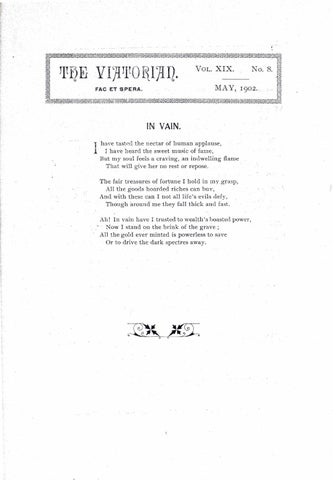
IN VAIN . . .
~-
. ' ·'
I
.
.
-
.
have t~st~d the nectar of hutr_~an appJause, I have heard the sweet music of fame, But my soul feels a craving, an indwelling flame That vvill give her no rest or repose. ·-.'
'
-
The fair treasures of for~une I hold in rny ..grasp, A·l l the goods hoa rded riches -can buv, And with these ca~1 I not all life's evils defy, Though around-me they fall thick and fast. Ah! IIi vain have I trusted to wealth's boasted power, ·, ." · Now I stand :On the brink of the grave; All the gold ever minted ispowerless to save -Or to drive the dark spectres away.
''
... .. (
.
. ':· ·:
. . .,
;~':-· ~··
..
·.
. ., ' .. .~ ! > )
,. .
.
.
\
~
•,
.·
'
.. ·~·
.
THE VIA TO-RIAN ~
4
·oA·NrE's ;~ ·t:oc·t·fE.R'' AND
rro one
MtLToN·' s "·sATAN."
who has read Dante's "Inferno" and· Milton's ~ ''Paradise Lost' ' · can have failed to notice the marked contrast which exists between the Lucifer of the one and the Satan·-of the other. . The;Lucifer of the " Inferno ,·, is a monster, so repu1sive that we are forced to turn away our eyes fr01n it in loathing a1l d ,disgust; a being in which we see nothing but ugliness and' terror-a being, as the poet would express it, " that to be hated needs but to be seen." The Satan of. the " Paradise Lost " is a great warrior, who, though cast from Heaven for his sin of pride, still retains some of his original beauty; he is .clothed in the richest gannents and is the emboditnent of heroic valor-a being as s01ne one has well said, ':that do wh_at you will, de1nands a human sytnpathy." Now to what must we attribute this contrast? Certainly there is · nothing in the being itself, nor in the diverse names used by the poets to designate it, that _ca!?: warrant such a vast dissimilarity, for whether that being b~~alled ·Lucifer, or Satan, or Prince of Dar.k ness, it always r~mal'tis-tru-e--t-h-atifl.s the same essential being-the arch-enemy of God and man-the devil. Perhaps if we turn to the poets themselves we will :find a solution to our question. Dante . and Milton lived in different ages, . -in different countries, and they differed in religious faith. Dante lived in the thirteenth century, Milton in the seventeenth; Dante was a Florentine, Milton an E 'n glishtnan ; Dante was a Roman Catholic, Milton a Puritan. But again, these might be considered as only accidental differ-· ences, and can hardly account for the heroic Satan and the despicable Lucifer..
THE VIA TORIAN.
5
We shall probably find the cause of this contrast in the diverse ends which the poets proposed' to themselves when writing their re.spPctive poems. Dante, in writing his "Inferno," aimed not so much at tea~hing the world a great ' lesson in the art of writing poetry as in teaching it a grand 1norallesson. His object was hot to make men write better, but to live better. He sought to inspire his reader with a salutary fear of, and hatred for the Evil One, and it is for this reason that he paints Lucifer in his true colors-the most ferocious and ugly of the fallen angels. It is for this reason too that he does not allow us to look upon the accursed emperoi'" of the realm of woe until he has led us through the 1nany-chambered hall of tortures; until he has shown us the countless souls that are here enduring eternal pains-the work of that fiendish seducer; until he has brqught us over the bleak Cocytus in whose icy en1brace we behold a nlultitude of shades fixed ' immovable. Until we have descended with Dante to the lowest pit of hell's dread abyss, he does not show us the creature once eminent in beauty, but here what a sight! Here it is that we are forced to exclaim corruptz"o optintzi p essz.ma. Here we see a being who once occupied the highest place of all the angels in heaven, now imbedded in the lowest depths of hell; a being who before his impious rebellion was the most beautiful of all the angels, now the ugliest of all the devils; a spirit who before his sin of pride enjoyed the most absolute freedom, now writhing in his own. shackles ; . a creature who once raised its voice against the Creator, now silent forever.
6
THE VIATORIAN.
Listen to the poet'-s own description of Lucifer: '' . . : . That emperor, who sways The realm of son-ow, at mid breast from the ice Stood forth ; . . . . . . . 0 what a sight ! How passing strange it seem 'd, when I did spy Upon his he~d three faces, one in front Of hue vermilion, the other two with this Midway each shoulder join'd ,a nd at the crest; The right 'twixt wan and y ellow seem'd; the left To look on such as come from whence old Nile Stoops to the lowlands. -~.h~der each shot forth Two mighty wings . . . . . No plumes had they But were in texture like a bat ; and these He flapp ' d i' th ' air, that from him issued still Three winds, wherewith Cocytus to its depth \Vas frozen. At six eyes he wept: the tears A down three chins distill' d with bloody foam . At every mouth his teeth a sinner champ'd , Bruised as with ponderous engine ; so that three Were in this guise tormented ."
And would you know how this dread abode was formed in which we see Lucifer held a captive? 路 '' . . . . . . . On this part he fell down From heaven; and th' earth, here prominent before, Through fear of him, did veil her with the sea 路 And to our hemisphere retired." ~--....
These few li-n es w~~uffice to express the unspeak_able deformity of Lucifer had ~thing more. Let us now cast a glance at the Miltonic Satan in " Paradise Lost." Here indeed we will find the scenery changed, but the change need not astonish us. The aim of Milton,_ unlike that of Dante, was to give the world 路a great epic poem; a tide of gorgeous eloquence regardless of any moral tonic. Hence it is that the Lucifer which we have 路just seen becomes a skilled commander at the head of an innumerable anny of the fallen angels'' ; no longer is he held a captive in the frozen Cocytus ; no longer is it his j i
THE VIATORIAN.
7
business to gnaw and bruise sinners in his tria,d of nuuky mouths ; no longer are his own sufferings so intense 路 that they cause tears n1ixed with bloody foan1 to trickle down. and besn1ear his 1nonstrous face ; no longer, in a word, -is he the san1e contemptible devil as that which we ha~e seen in the " Inferno." We see hin1 first awaking fro1n . his stupor, which was caused probably by ,his rapid transit frmn heaven; he finds hin1self and his horrid crew the occupants of a wild waste "As far removed. from God and light of heaven As from the centre thrice to the utmost -pole."
Yet he has enough' courage left to keep him from g1v1ng :UP the field for lost; enough f>uritan pride to wage war against the throne of heaven, ''where power and will are one.'' Hear his address to the rebel hosts that lay vanquished around hin1: '' 0 myriads of immortal spirits! 0 powers Matchless, but with the Almigh.t y ; . . . . . How such united force of gods, how such As stood like these could ev'e~ know r~pulse? . . . . who can yet believe though after loss, That all these puissant legio;1s, whose exile Hath emptied heaven, shall fail to r e-ascend, 路 Self-raised, and repossess their tiative seat? . . . . . . . War, then, war ' Open or und erstood must be resolved."
Nor are his words of inciten1ent without producing their effeCt, for immediate} y . . . Out fl ew " Millions of flaming swords, drawn from th e thig h s Of mighty cherubl.m; the sudden blaze Far around illuminated heli ; highly th ey raged Against the Highest, and fierce with grasped arms Clash 'd on their sounding shields the din of war Hurling defiance toward the vault of heaven."
THE VIATORIAN.
8
But Satan has not yet a temple in 路 which to hold a solemn council on this great war question, and open-air assetnblies are no longer in keeping with his royal dignity. Marr1~non, therefore-.-one of the spirits whom we beheld ''with face to feet arched like a bow" in Dante's Cocytus'leads a brigade of spirits, armed with spades and pickaxes, to a neighbouring hill wherein they open a spacious hall, arid 路 here we are to g-et a glimpsEf ' of a cosy corner in Milton's hell: Out of the earth a fabric hue Rose like an exhalation, with the sound Of dulcet symphonies and voices sweet, Built like a temple, where pilasters round Were set and Doric pillars overlaid With golden architrave ; nor did there want Cornice or frieze, with bossy sculptures graven: The roof was fretted with gold."
"
\
Nor is this infernal, though stately pile, bereft of light, for ' ' . . . . . From the arched roof Pendent by subtile magic, many a row Of starry lamps and blazing cressets, fed With napth~and asphaltus, yielded light As from the s~~
What a contrast bet~fH:.s-nlagnificence and 路the stonn-swept Cocytus! And how differently they are formed! The earth yields its best treasures for the erection of the one; it flees away and veils itself with water in abhorrence of the other. ~:i_~)n Cocytus Lucifer stands imprisoned by the jaggy ice; in this palace Satan, surrounded by peers, sits on a throne. ' ' . . . . . . . . . . . . . . Which far Outshone the wealth of Ormus and of Ind, Or where the gorgeous east, with richest hand; Showers on her Kings barbaric pearl and gold."
THE VIATORIAN.
9
Milton)s Satan, as I have already said, is the e1nbodin1en t of heroic valor. Hear him express his willingness to undertake the perilous task of liberating all the fallen angels from their prison : '' . . . I should ill become this throne, 0 peers, And this imperial sovereignty, adorned With splendour, arm ' d with power, if aug ht proposed And judged of public moment, in the shape Of difficulty or danger, could deter Me from attempting . . . Go, therefore rtrighty powers · . . . . . . . . Intermit no watch Against a wakeful foe, while I abroad, Through all the coasts of dark destruetiou, seek Deliverance for us all."
He is a skilled co1nrr1ander. See him with his 1nighty standard upreared and his imperial ensign unfurled as he stands in the midst of his united forces ; l··
l·
'
•(l·
I I·
r
" . . . . . . He thro' .the armed files "Darts his experienced eyes . . . . . The whole battalion views, their order due, Their visage and stature . . . . . . . Their number last he sums."
He has not lost his heavenly beauty: See hin1 as he ~nquires fron1 Uriel in the orb of the sun) about the new . creation) and n1an whon1 God has placed there: " . . . . . Now a stripling youth he appears Not of the prime , yet such as· in his face Youth smiled celestial, and to every limb Suitable grace diffused . Under his coronet his flowing hair, In curls on either cheek, play 'd; wings he wore Of many a colored plume, sprinkled with gold."
What a change! Here, in Paradise Lost, we see a devil decked in colours that would grace an ·a ngel of heaven-a s1niling youth adorned with flowing hair, and " wings of many a colour'd plume." There, in the Inferno, we see none
.'
IO
THE VIATORIAN.
of this splendour, -none of this tinsel and ·g litter . . No, there we see the. Evil One painted in the vilest and most repulsive colors; there we see him deprived of every vestige of be~uty; deprived of liberty of n1ovement, liberty of speech, and all hope of ever regaining a single moment's happiness. There he may flap his leathern wings, · indeed~ but never soar. Here he may spread his variegated plumage and wing his flight to the very orb of the sun. There he is held an agonizing captive in the gloomy Cocytus, bruising and lacer'a ting his victims. Here he parades like a drill-sergeant through the gilded halls of Pandemonium ; now reviewing his rebel troops, now inspiring them with courage and tP,e hope of regaining their native country. The grandeur of Milton's Satan is unquestionably one of the most objectionable features of the "Paradise Lost." Surely the poet could have expended his in1aginative powers in a higher and holier cause than in putting frills and curls • and gilded wings Qtl the grizzly monster · which he found in ~ . . Dante's Cocytus. Bu't~re again we must revert to the fact that Milton's ain1 in writi~Paiadise Lost" was not to make his readers hate evil and its parent, but to bequeath to them a grand epic wherein they might ·read the description of a great celestial battle, a battle between two mighty intelle&ual powers; God and his angels on the one side; Satan and his demons on the· other. To realize this aim the poet found it necessary to paint Satan as he did- a gigantic warrior marshalling his hellish legions against their heavenThis undeniable fact remmns, however; ly enemy.
•
THE VIAOTRIAN .
rr
although Milton's Satan is an immeasurably greater production of poetical imagination than is Dante's Lucifer, yet the dingy denizen, the unkemp and ugly Emperor of the "Inferno," is an incomparably superior creation if we look upon it from a moral standpoint, and we must not forget that it is from such a standpoint that Dante /w ould have us. view his " Lucifer."
. J.
~·
'.
t
I
\
).
t ~.
\
.,
•
'.~ ~ t
t. ~
!
t f•'
1-
I ~
r ~,,. t
i'· i.
'
A.
LYNN, 'o2 .
12
THE VIATORIAN.
THE CHARACTER OF DANTE. y the term charaCter, taken in its widest sense, we . mean an
¡,p
assemblage of those marks w.hich distinguish one man from
})
thousands, and the thousands from one another ; but by . the
,
term noble charaCter we mean that desirable treasure which all men love from the very impulse of their ,nature ; that treasure which far surpasses all . the riches of the earth; that treasure in comparison to which precious ~tones are vile, silver is clay, and purified gold, grains of sand. But here it becomes interesting and necessary for our purpose to enquire into charaCter as we commonly use the term. Since a I
man's external aCtions are but the refleCtion of his mental .disposition, charaCter is evidently to be sought in the mind, and especially in the two principal faculties of the mind- the intelleCt and the will. Now, charaCter is not in the intelleCt precisely, because the intelleCt is concerned with the investigation or the conteti1plation of truth. It must then be chiefly in the will, the source of aCtion, the rational appetite. l\'Ien are good or bad ac~ording as their will follows the di&ates of right reason or otherwise.
CharaCter,
then, means thatwhi~gnishes a 'inan with reference to his aCtion or conduct. But since- a&-io..n- Gr'Conduct consists in habits acquired through repeated acts, it is the will that makes the man ¡ -that distinguishes him from his fellows. Hence, we say that a man's character is what he is. What wonder then if one shows some diffidence in speaking of the qualities of a man whose name is synonomous with this precious treasure; a man in whom some of the noblest traits of human nature are carried to so high a degree of development that his fame, like a star that has passed from our region of the firm ament, still leaves a trail of light in the heavens ; a christian in whom we find a fullness of hope and charity ; a citizen who was •
THE VIATORIAN. at once the victim of oppression and a cham pion of justice and
liberty.
Such in general was Dante, the great Florentine poet
.:and patriot. · · -· '· Dante Allegheri was born about the year r265 and died 132i. Since the references of history in regard to this distinguished man are few and meagre, the principal if not the only means therefore left us for forming an acquaintance with him-for beholding him as he was in life-are his writings; for, as the morning air is fired by the · splendor of a summer's sunrise, · so too the writings of Dante are lit up by thoughts that breathe the sentiments of a truly great and noble character. Through every page ·'GJf these we will see his . many admirable qualities reflected as so many' resplendent beams from a mirror held before the noonday s_un. · In studylng his works we may easily trace the development of his character, for in these we see him as the man, the scholar, the christian and the <;itizen.
If, for example, we take the first part of his
<~New
Life,'.' we will see that as a child he was of soli tary disposition and that he evinced a marked inclination to study. Here, too, he qescribes his first meeting, in his ninth year, with Beatri·ce, a modest, gentle, dignified child about his own age, and who from that moment became the one object of his love, a love pure as the dewdrop that glistens on the petal of a rose at -early morning ;' a love that scorned the false lustre of every licentious thought; a love proper to the age of chivalry in which he lived; a lo,·e which in the progress of years became spiritnalized, and of which Beatrice was the ideal. ~is young heart so overflowed with this love for Beatrice that he sought all opportunities of seeing her. We see him . modestly and timidly standing on the street through . •
which she is to pass, or reverently kneeling in the· Church in which she is accustomed to pray. If occasionally she speak to hi.m we see him turn away to brood in solitude over his happiness.
THE VIATORIAN. On flows the course of his life, pouring itself out iti. fervent effusions of love and admirati.on to Beatrice. Although she married another man, yet Dante ceased not from afar to admire her virtues and to praise her loveliness. After her death 'he cah·o nized her and promised to celebrate her in a song whose sound should carry her name and fame to the end of· all time.
The :D ivine Comedy attests how
well this devoted lover has redeemed his pledge, for in this great song he says· of her what has nev~r been said of any other woman. Such is Dante as a lover, and now we come to consider him as a husband and . a father. ·Commentators tell us that after the death of Beatrice, ·w hich was, no doubt, to him a subject of inexpressible grief, was induced by the solicitations of his frie1ds to marry
he
Gemma Donati, in order to console himself for the loss of her who had been to hi 1 N all in all. That Dante was a faithful hu"sband there is no room:. for doubt, and that he was a tender lover of his childre11 is evident from his many and earnest entreaties to be pennitted to return to them after he had been sent into exile:
We
can infer from the dre11dful punishment which in hell he inflicted upon the pernici ou-s'{aulo and the unfaithful Francesca that . D~nte appreciated conJu_~fide~ity, an~. that he WdS hi.t1lself a fatthful husband; we can read---ui-t--hei)tttful tale of Ugoltno and his four children in the tower of famine, that Dante was a tender father and that his children loved him. But what shall we say of Dante as
~
scholar!
This is
another of the great disti:pctive marks by which we are enableq to single him out from the millions . . He was grave, serious and deep, · and so ardent was his desire for knowledge that neither the troublesome times in which he. .lived nor e_x ile itself were able to . preventhim •from seeking it. It is related··:,by early writers that ,
.
he studied at Bologna and Padua, as well as in his native city. So great, indeed, had his eagerness .for mental improvement grown,
THE VIATORIAN.
, f路
''" 路 ~J
15
that it led him as far as Paris and even Oxford. We know from his works, and especially from his immortal poem, that he was a man of very keen intellect and marvelous imagination; a man who delighted to revel in the problems of Scholastic Philosophy ; a man who possessed wide and deep information on all great questions of his day. In this great song we find em braced a m an encyclopedia the politics, science, classical learning, philosoph y and theology of h~s time. Let any student of literary accomplishment turn at random to a canto anywhere in the Purgatorio and examine the characteristics of the page before him, and I shall be surprised if he do not exclaim:. "The whole range of literature hardly supplies a parallel phenomenon to this." I shall be sur~ prised, too, if he is not forced to acknowledge that almost ~very sentence of it contains enough of the solid gold of poetry to be beaten out by a modern literary manufacturer into an acceptable poem. Thus far we have merely considered Dante's character as a man and a scholar; we have said nothing of his beliefs, in other words of his faith; we have not considered the chara,c ter of Dante the Christian, and have, therefore, omitted the most important quality of the man. This is the sacred fountain from \Vhence issues all the virtues that make his name immortal. Dante was a Christian in the highest sense of the word ; he was a man of firm belief, for in matters of faith his reason alvyays submitted itself to the word of God, and what he could not comprehend he would believe because it was written. Hear his profession of faith to St. Pet.er, in. the 24th canto of the Paradiso: '' I in one God believe ; One sole eternal God-head of whose love All heaven is moved . Himself unmoved the while. Nor demonstration physical alone, Or more intelligential and obstruse, Persuades me to this faith ; but from that truth
•
'1'
{
•<t,
ic. '·
THE VIATORIAN. It cometh to me rather, which is sh ed 'Through Moses ; the rapt Prophets ; and the Psalms ; The Gospel; and what ye yourselves did write, When ye were gifted of the Holy Ghost. In three eternal persons I. believe ; Essence three·fold and one ; mysterious leag ue Of union absolute, which many a time The word of gaspel·lore u.pon my mind Impriu.ts; and from this germi this firstling spark, The lively flame dilates; and, like heaven's st,a.r, Doth glitter in me."
Dante was an ardent lover of the Church and an uncoi11pro- · mising hater of the abuses of Eccl~~iastical po~er by church·men; h e unmercifull y · lashes those who practice simony, nepotism, and all who are swayed by wrongly directed ambition , On the other hand he holds in high esteem all great and good men. .St. Francis and St. Dominic he presents to the whole world as the two ideql types of right human conduct. So full of love for God and all his saints, and ·s o zealous was he for God's greater honor and glory . that he detested all pretenders who preached a religion of their o\Yn, not for conscience sake, but for the sake of gaining notoriety, or for the sake of belonging to a certain faction . Listen to him as he speaks of th~se:
ai~U
''The is how to shine: e'en those Whose effice 'is ~each the gospel let the gospel sleep, And pass their own i~ff-tllstead . . One tells how at Christ's suffering the wan moon Bent back her steps, and shadowed o'er the sun With intervenient disk, as she withdrew. Another, how the light shrouded itself Within its tabernacle, and left dark The Spaniard, and the Indian, with the Jew. · Such fables Florence in her pulpit hears, Bandied about more frequent than the nam es Of Bindi and of Tapi in her streets. The sheep, meanwhile, poor witless ones, return From pasture, fed with wind ; and what avails · For their excuse, they do not see their harm? Christ said not to his first conventicle,
THE VIATORIAN. <Go forth and preach impostures to the world,' But gave them truth to build on; and the sound Was mighty on their lips."
As we are forced to admire the character .of Dante as a ~ian, confirmed
Chris~
in the true religion and a fearless defender of that
religion, so too. we a re forced to admire his character as a citizen . He was an ardent lover of his native country a nd ' a bitter enemy of her crimes; he identified himself with her politics and was will . . ing to give and take his share of hard blows when necessary. We find him taking: a prominent part in the battle of Campaldeno 1n which the Grielphs of Flo路r ence defeated the Ghihelines.
That
he loved Florence is evident fro'jll Jhe fact that he rebukes and ad monishes her citizens for their sins, j.ust as would a father his wayward children.
He knew full well that nations like iridiv id u-
als prosper or decay according as , they .. approach nearer to or withdraw farther from the standard of nTorality. was his love for Florence care for her welfare.
th ~ t
路So great indeed
even in exile he did 110t cease to
vVe see him write a letter full of reproach
to the Florentines for their conduct) and another to Henry VII of German_y, urging him to hurry on the w~rk of the regeneration of Italy which so long had been neglected by her .rulers. The sou l of this man flames with righteous indignation at the sight 路of baseness and corruption. '' Ah, Slavish Italy 1 thou inn of grief 1 Vessel without pilot in loud storm 1 Lady no longer of fair provinces, But brothel-house impure ! this gentle spirit, Even from the sound of his dear land Was prompt to greet a fellow citizen With such g lad cheer : while now thy living ones Ih thee abide not without war ; and o11e Malicious gn.a ws another; ay, of those Whom the same wall and the same moat contains Seek, wretched one! around thy sea-coast wide ; Then homeward to thy bosom turn ; and mark, If any of thine sweet peace en joy. What boots it, that thy reins Justinian's ha11d
THE VIA TORIAN.
r8
Refitted, if thy saddle be unprest? "Naught doth he now but aggravate thy shame. Ah people! thou obedient still shoulds't live, And in the saddle let thy C~sar sit, If well thou rnarked'st that which God commands."
How terrible a blow must not his exile have been to Dante, that whole-souled citizen, driven from his home and family, from his native city which he had always loved with a passionate devotion ; his goods confiscated and he himself forced to become a · wanderer and a beggar on the f7se of the earth?
Yet in the
midst of all these trials and sorrows we find the same manly character.
We find him scorning the unprincipled and scheming
exiles \vho were ready and willing to return to FI'orence under tlle most humiliating and debasing conditions.
Hear the words
of this wandere.::-, when he had learned some of the · conditions under which he would. be permitted to return :
"What, can I
not look . npon the fa<;e of the sun and stars anywhere?
Can I
not meditate anywhere under the heavens upon the most sweet truths unless I first render myself inglorious, nay, ignominious to the people and state of Florence?
No, if Florence can be entered
by no other path, thep never will I enter Florence." ~·
0 proud exile, gr"e~ christian, true citizen and wonderful scholar· in whom we find th'-1-s---t-r~.f character--strong intellect, the sweep of whose glance compasses the heavens above and · the shades beneath, searching into hidden mysteries and portraying them to men; whose mighty will turned to lofty ideals and perse- · vered in their pursuit unto the end-from whose lips have fallen so many words of wisdom and truth ; words that show the workings of an elevated mind and a generons heart; words which portray the sentiments of a grand and noble character- receive a tribute of respect and love from us, thy humble admirers; allow us to place upon thy sorrow-plowed brow the lanrei-wreathes of onr sincere admiration, and to be the heralds of thy fame and glory to our own and succeeding ages.
P . V.
EGAN.
'03.
THE VIATORIAN.
MOLIERE AND SHAKESPEARE. ·N
J JJ
a pn:vious essay I ·endeavored to
~how
that Moliere is a
greater cm~edian than Shakespeare, for the folle>wi~1g · n~~~o ns : he has wrrtten a greater number of real comedies; he has
created more humorous characters, one of whom (Scapin) is at
least equal to Falstaff-Shakespeare's greatest humorous creation -whilst he has produced four or five others with whom Shakespeare has nothing to compare.
But above all; because, in
order to be witty, Moliere neve1 descends to vulgarity, licentiousness or immorality.
When he is most humorous he is seldom
vulgar and never licentious, whilst Shakespeare can rarely be either witty or humorous even in his tragedies without ~escend. · ing to a gross vulgarity that is at once offensive to good morals and refined taste.
This last point is so importa·n·t that I think taken
alone it is sufficient to establish th e superiority of Moliere) for assuredly that comedian has a higher claim to our esteem and admiration who can draw freely fron1 the best sources of humor without transgres~irig 1:he bomi.ds of decency and decorum, than th e one who scar cely seems to know a11y smuce of hunior except th e low, vulgar or li centious-whose language would never be tol erated in respectabl e society. A comparative study of the two dramatists wi ll make this dear. I will select especially three characters from l\1oliere and com pare the situation in ·which we find them with similar scenes in Shakespeare.
The three whori1 I select to represent Moliere
are De Ponrceaug nac, Jourdain and Argan.
Any one of these can
be well compared w}th Scapin or Fal staff for humor.
They are
essentially humorous men w h ose very appearance on the stage is s ufficient to' excite laughter, yet they are ent irely diffe rent. Ouc is a foolish lover, another is a retired merchant, and the last is an imaginary invalid.
'
i(
~!,.,
Moliere has made of each a master-piece of
zo
THE VIATORIAN. '
humor.
It would be difficult to assign a solid reason for pref.::rring
one to another, but this I may say without any ~ear-any <ille .of them would have been sufficient to imn1:ortali~e the name of Moliere as a creator of humorous character.
Of course all I can ·'·
do is to give a faint idea . of these men ; in order to see how humorous they really are, it will be
necess~ ry
to
read the comedies.
H ere it mav be remarked that Moliere is one of those very- . few ~
dramatists that are as interesting read as when seen on the '- (when ,, stage. From the first moment Pourceaugnac
app ~a rs
on the stage
until he leaves it, the humor is irresistible and the spectator or reader :finds himse.lf entering heartily into the good natured fun . In this comedy Moliere reveals a power that Shakespeare has not: . that of sustaining his humor throughout his whole play. a thing that Shakespeare has never done. worse than this he is vulgar and immoral.
This is
At times he . is sad, or When a man must
burn the heart and defile the mind in order to be humorous or witty, it is far better that he shmlld always confine himself to the faCt · t.~
cannot escape the attention of any intel-
ligent reader, th~t whe,
Shakespeare tries to be humorous h~ is
tragic.
It is a
perhaps always vulgar or i~·e-t=al}--.a___thing which is so true that even in his great tragedies when he tries to be witty he is open to this charge.
Why even in Hamlet, his masterpiece, when he tried
tu be witty, in that conversation between Hamlet and Ophelia in th e third act, he becomes vulgar and immoral.
It is the same
thing in Othello in a c~nversation between !ago, Desdemona and · Emelia, etc, yet all this is suppose-d to be Shakespearean wit! · But when Moliere is most humorous and witty, when he makes us laugh the most, he is never immoral and seldom vulgar. Nothing niore humorous than De Pourceaugnac can be conceived, yet he is a1ways a moral man-a moral fool if you "':ill-but il! my opinion a
THE VIAOTRIAN. 路 moral fool is superior to a clever rascal.
2t
Pourceaugnac is harmless
and his conversation only makes us laugh, but Shakespeare's s mart rascals are dangerous, and their conversations are such that no polite societ~路 will tolerate them even on the stage and still less in real life. There are many humorous scenes and comical situations in this comedy of Moliere's.
One of these is when a young man
makes Pourceaugnac believe that he is an . o-ld friend 路of. his and of his family, while in faCt he then met him for the first time.
Be a
man ever so phlegmatic he cannot fail to be moved to laughter by this scene.
Now if we compare this with that scene in Shakes-
peare, where Portia and Nerissa try to make their husbands confess that they have given their rings to other women, we shall see the superiority of Moliere over Shakespeare.
In order to .p roduce
this humorous (?) scene Shakespeare has marred -th ese two charact ers.
Up to this time th ey were both admirable, but in order to
tickle the vulgarity, or worse, of some of his aridience; Shakespeare makes these two ladies speak a lang uage as unbecoming as
it is offensive.
It seems strange to me that Shakespeare could
never produce a 路 character like De Pourceaugnac,
3.
man that'
would make us laugh not by his unbl em ishing lewdness but by his simplicity.
What the cause of it may be I know not, but I do
not believe if Shakespeare had been ab le to amuse his audience without being vulgar or immoral, that he would h ave had recourse to such extremes. No less humorou s is Jourdain, "the would be noble," but He was a rich he moves in an entirely different sphere. merchant that came to live in the city as a gentleman of leisure. A lthough he is quite advanced in years, yet he t akes lessons in music, dancing, military exercise and philosophy.
One day all
these 'd ifferent professors happen to meet at the old man's house
,~j.!: ·.Z'vgr~~
.
!...';!
THE VIATORIAN.
22
and each one ·begi ns to praise his· a:'t and to dispra ise those of theothets till finall y it ends by a free for a ll fig ht.
This is one of
the m ost ht1111orons scenes that Moliere has created and ~ vie can. fin d n one in: Shakespeare to eq ual it:
It becomes grander and.
.M oliere rises higher in our estimation whe11 we compare. it with that scene of Shakespeare
i11
which a fight occurs between Falstaff
and Pistol and those two dishonest aad immoral creatures, whose very names cause disgust. Moli~!e in this scene is moral and refined ; Shakespeare is immoral, licentious and vulgar ;. the personages that fi g ure in the scene of Moliere are men of refinement ; it is a professor of dance, of mnsic, of military ex ercise, of philosophy ; those who fi g t1re in the scene of Shakespeare are dis.hones t and immoral ; it is a drunken, brutal and licentious Falstaff ;. 1t is that scoundrel Pistol ; it is that gossiping woman u Mistress Qt1ickly ,n and it is that disgrace and reproach of her kind , (( Do11 Tearsheet.''
Now every one will enjoy · this scene in
Moliere whether it be e11acted
on
the stage or in realit y.
But no
compan y of actors w_o uld dare to present thi s other scene from Shakespeare withotit'--~ak1ng man y important changes. there are not three of
Sli:a~speare's
on th e stage precisely as 11e
In fact
plays which can be brought
Wrot-e-t-1-~ hil st
nearl y all Moliere's
comed1es can be acted without t he al t.e ration of a single word. There is in thi s com edy another very humorous· scene. It
1s
wh en a yo tmg ·man, wh o is in love with J o urdain's dallghter, d isguises him self as a Turki sh noble and confers on th e old man th e titl e of "Mam ama m oncbi ," with all the magnificence and gra ndeur that are wont to attend such a ceremony.
The height of
th e ludicrous is reached when th e old man goes through this mock cerem ony with all th e di g nity of a king.; while those who are taking part must make sn pre me efforts to preserve a becoming gravity.
We can conceive nothing more hnmorous, not even that
THE VIATORIAN.
23
famous scene m Henry IV, where Falstaff r eveals him se1f to be . a 路splendid liar-a liar that passes all bounds of common sense :and probability. Of course in_this scene again Shakespeare is not :always mora] and refined whileMoliere is. This scene of Shakespeare takes place in a tavern; that_ of Moliere in a respectable house.
Ag-ain in this comedy Moliere
sustains his humor throughout the whole play.
There cannot be
found one 'scene in which there is not something humorous or witty, and yet he is always moral and refined.
How mtich he
oiffers from Shakespeare, who can hardly sustain his humor or wit ;'t
through one ad without sinking into vulgarity.
In this drama)
Moliere teaches a very -praCtical lesson: he shows how ridiculous a man becomes when he tries to force himself into a station of life for which he is wholl y unsuited both by nature and education. Moliere has create~ another charaCter that is certai nl y as humorons as any we have yet seen : Argan in ~' Le Malade Imag-inaire," a man who really beli eves he is sick while h e eats three square meals a day and sleeps soundly through the whol e nig ht. But before going any further it may be well to remark h ere that Moliere in this com ed;.路, as in many others, attacks the physicians. That he was justified in hi s day in doing this there is n o doubt. There w.e re, at that tim e in Paris, man y physiciaris who were not up to th_eir profession and it is th ese ignorant doCtors that h e ridicules.
Moliere has 路in this comed y also sustained his humor
and still kept up to the same highlevel of morality and refinement. If we compare a scene of this comedy with a similar scene in
Shakespeare we will see again that Moliere is at least equal to the English bard in wit and humor without any of his grossness. Because Argan was always sick-at least h e thought he was-he wanted to marry his daughter to a doCtor, who was somewhat thick-headed, as all of Moliere's doCtors are.
As the young lady
THE VIATORIAN. was
111
love with another y01:ng man she did not care for the
doCtor, yet she dared not disobey . the command of her father. · The servant girl Toinette comes t9 her help.
This Toiuette is.
one of Moliere's most witty charaCters and one of the most moral and refined.: ~ What is
Be~trice in comparison with -this
poor girl, even though on\y a servant 1 It seems to me that when . . . ' compared with the gross and . yulgar Beatrice she appears as 3 . ~
queen.
There is son1tthing grand and noble in: Toinette.
Every-
body loves her. She has a gre~~~' sympathetic heart, and above all she is pure and i\nselfish. ~s ,f or Beatr1ce, she appears to me as selfish and cold, and though she
n~ay
aCtions, yet she is in her conversation. ' witty
not 'be immoral in her, A very humorous · and
scent occurs · when Toinette opposes Argan in his very
presence and gravely forbids his daughter to meet the doCtor whvrn he wishes her to accept as her husband.
The old man
becomes so enraged to see that his servant girl opposes him that he can no longer control himself.
When Toinette sees that he is
becoming really dangerous, she kindly reminds him that he has forgotten his danger011s malady, then he falls into a chair completely exhausted. -R0~ admirable is this scene when compared with
that continual batt e · of
coarse,: vulgar and sometimes
licentious wit between Benedi these is most amusing?
anrieatrice.
Now
~hich of
There is no doubt that everybody from
the J::hild to the man bowed down under years, will enjoy this scene of Moliere, btit who will enjoy this scene of Shakespeare? Why · even Taine, who is by no means a scrupulous man, turns .
away frnm it irt disgust.
'
If a man like ,Taine finds it miendurably
vulgar, we may be sure it is not fit for civilized ears.
There are
other comical scenes in this drama, especially when Argan has a quarrel with his doctor, and when Toinette dresses herself as a physician and pays ·the old man a visit.
All these are very
, I
THE VIA TORIAN. humorous and witty, yet .they are always moral and refined. But Shakespeare has nothing that in any 'way could. compare with these, and as this is intended to be a comparative study I wil'l be obli?"ed to pass them in silence. Now Moliere has cre'a ted two other humorous characters that are wrought in his best vein and with whom Shakespeare has none to compare. But as this essay threatens to become tedious I will only mention their names. I They are: Sganarelle in "Le Medecin Malgre Lui," and Sganarelle in "Le Marriage Farci." Of course these two Sganarelle are not the same person. It is a name that Moliere uses 1n many of his dramas to designate different characters. Believing that I have given sufficient reasons to sustain the assertions that I made itt beginning this study, namely that Molie re ·is a far greater comedian than Shakespeare., I will now conclude this comparative study by making a few general remarks on Shakespeare · and Moliere. Shakespeare is a · more universal genius than Moliere. The English tragedian is the dramatist of the world, the French comedian' is the dramatist of one class of people-the middle or common people. · If Shakespeare represents all classes of people, while Moliere represents but one class, it is but natural that he should excel him in the representation of this one class. Shakespeare's heroes and heroines, in his great trag·edies, are usually taken from the nobles ; those of Moliere from the common people. They are both great moral teachers. Shakespeare teaches grander and sublimer lessons in his tragedies, but Moliere teaches more practical lessons. Shakespeare preaches against great crimes that are uncommon among us; Moliere against vices and weakness that are very common around us today as well as in his time. It is for th~se reasons that I believe that
if the works of Moliere were translated into as many languages and spread all over the world as those of Shakespeare are, that he would become the most popular dramatist that the world has ever seen, because he is by excellence the dramatist of the people. P. B. DuFAULT, 'o3.
·'~ ·
THE VIATORIAN.
THE VIATORIAN. P u b lis h ed m o nthly by th e stud ents . Edited by th e stude nts o f S t . Vi a t e ur 's College, Bo urbonna is G r ove, Ill. m ust be add r essed : T HE VIATOR IAN, Bourbo nnai s , Ill. Su bscri ptio n price , o n e do lla r p er year, p ayable in ~dva n ce. E nte r ed a t t h e Bour bonn a is P . 0. as seco nd class m a tte r .
All co rresp o nde nce
B.OARD OF EDITORS .
F . S. CLARK .
R . R ICHE R, P . D . D UFAULT, W . J. CLE AR V, J. F. SULLI VAN , L . J. FINNIGAN, J. F. CANNON.
EDITORIAL-" A GENTLEMAN." 路
' 0 matter how brillia~t a 1nan's intellectu~l endowments i11a y be, or how vaned and profound h1s fund of acquired knowledge, he can never win the love or estee-m of good 1nen if he has not those qualities of heart and character which distinguish the gentleman. There are n1en upon whon1 nature seems .to have lavished n1ental treasures with prodigal generosity, and yet they are mnongst the n1ost brutal and least lovable of men. I fancy few men could ----.._,_ really love Swift. ~ ey 1night treat hin1 with great civility and even take great p ai~o conciliate his good will, but this treatn1e'nt was pretty suretooethe offspring of fear rather than of love. Gifted though he was with a penetration and a c01nprehension of mind such as few men possess, he was yet but little bettPr than a savage by 路reason of his satanic pride and his heartless disregard of the sufferings he inflicted upon others. 路 Great talent, or even genius, does not, then, constitute the gentleman. These are only powers, and power may be a fearfully destructive a1S well as a highly useful and beneficent thing.
THE VIATORIAN.
\
What is it that entitles a man to be called a gentlen1an? We have just seen that it is not talent and still less is it wealth, or the know~edge of the latest style of dress, or acquaintance with all the niceties of etiquette, or a perfeCt familiarity with the conventional formalities of what is . termed polite society. These things are only the outward trappings of manhood, and are as easily .within the reach of the scoundrel as of the true gentlen1an. A gentleman can be known only by his aCtions, by his relations with his fellow n1en, consequently the rule, which pefeCtl y regulates these relations, will also be the standard by which we can best distingu:ish the gentleman. Now the most perfeCt, the most extensive and all-en1bracing rule of conduCt ever taught for the guidance of men is the golden rule-'•' Do unto others as you would have others do unto you."
·H e is a gentleman whose conduCt is in conforn1ity
with this rule of aCtion, and in so far as one fails to realize
,,·-
this simple, yet sublime precept, in his relations with · his fellow men, in so far does he fall below the ideal type of the gentleman. Here is a rule which the illiterate can understand and apply as easily and as perfeCtly as the cultured.
When
therefore we wish to know how a gentlen1an 'Would act under given circun1stances, we have only to ask ourselves how we would wish to be treated by those with whon1 · we are dealing in the
pr~sent
case.
When we find a: 111an who never inflicts
needless pain, who is as considerate· of the feelitigs of others as he is of his own, who n1akes the golden rule the stai1dard of conduct, we have found a · perfect gentleman.
,
'I
THE VIATORIAN.
The number of students whose conduct towards their fellow-students · and professors will abide this test is by no means large. How brutal, how savage, how utterly un- . worthy · the character of a gentleman the detestable custom of hazing appears when measured by this lofty stand~rd of conduct r There are large numbers of students who believe · they are giving infallible signs of cleverness when they n1ake some weaker-minded (, classmate the butt of their practical jokes. If it is mean, base and cowardly to insult and bully the maimed ot the blind, it is no less so to torture those who are so feeble-minded or intellectually blind that they cannot defend themselves. The more important the I organ is of which a man is deprived, the greater is the sytnpathy and compassion he deserves, and the more brutal it · becomes to tnaltreat him. Consequently he is even less of a gentleman who inflicts suffering on those who are mentally weak than he who tyrannizes over the physically tnaimed. . ··~~ . Whoever finds pl~~ in the pain of others is no gentleman, no matter how f~uliiessfy he may dress, or how large his pocket-book. He has the instincts of a savage or worse, because the savage delights in the suffering of those only who have injured him or who he regards as his enemies. And yet how often do we hear students boasting of the mean, contemptible tricks ·by which they annoy and pain professors- students too who regard themselves as the very glass in which man~hood is mirrored. These . thoughtless or malicious boobies sometimes cans~ a sensitive spirit .an anguish of · mind, compared to which
'<
·I
· THE VIATORIAN.
physical pain would be a relief. Take the case of the Cambridge r_uffians . who so embittered . the life of the _poet Gray that, as he hi1nself said, "I would . rather starve than remain longer at Cambridge." No doubt these students conside.r ed th~II1selves gentlemen and probably some of the1n were the presumptive heirs to large estates and honorable titles. These sq-c~1led titled gentlemen tho.u ght it a good joke to frighten Gray from his sick-bed by a false alarm. of fire and to let him down from the thi~d story by a rope. It was probably the brutality, heartlessness and meaness of his fellow~students that drove Shelly to infidelity and to a fierce hatred of . the institutions of society in general and · those of . England in particular. These ·~r are not without their imitators in our day. They never measure their conduet by that noble standard of manhood-" Do unto ' . . . others as you would have others do unto you." r
~
.
.
-
' !
'!
',
-,
'
\.. 1
. .
~
.
•
.. '
I
.
•
. THE VIATORIAN . .
' Jl'
EXCHANGES.
HE Dial " is one of the few among our exchanges ~ whose perusal affords gen nine . pleasure. Its excel" lent features can be very profitably imitated by many college journals generally considered, and sometime~ considering then1selves, as excellent and irreproachable models of college journalism. Though not so bulky as tnany of its contemporaries, in point of lit~ rary excellence it is by no means the least. In the April number there is an excellent essay on " Evolution and Assun1ption." We congratulate the author not only on his thorough treatment of the subjeCt, but also, what is more difficult, on the lucidity with which he expresses his ideas, thus enabling the reader to thoroughly enjoy what would be otherwise a dry and ~nin teresting treatise. ·H e succeeds well in refuting the un tenable theories and unstable argntnents of the evolutionists, and evinces throughout a thorough knowledge of the n1atter treated. We tnigh~emark in passing that the denunciation of the essay in co~iournalism by some few ex-n1en, meets here with an excellent--------------rebuttal. Their assertion that the reading of the college essay occasions a serious loss of time and a tax ·on one's patience, ·can be true only of essays which treat of subjeCts fron1 a wrong point of view, or in a feeble manner, whereas the essay founded upon truth is ever worthy of serious attention; and when, as iri this instance, . the beauty of truth is enhanced by the charm of an ·elegant style, then is the essay a source of mental profit and pleasure rather than of "intelleCtual dissipat1on." The two short stories appearing in this number are praiseworthy )
THE VIATORIAN.
31
from the fa& that, instec;td of dealing tn the sickening, insipid sentimentality displayed by the generality of college fiction, they treat of subjects interesting at least to students. 路Of the verse, we consider " The Martyr " best, becau~e of its nervous expressipn of beautiful thoughts. Its happy effect is, however, much marred by the first and the last lines, which are very weak and of a character entirely _unbefitting the main piece. '' Menoetes on the Rock" is an apt in1itation of Longfellow's style. The edito-rials are well written, and the exchange column is in very efficient hands. " The Holy Cross Purple" for April abounds with essays, stories and poems of no n1ean worth. The first story, " A LPgend of the Cheyenne," unlike its con1rades, is a very commonplace attempt at spinning a yarn. The others are more graphically told, but in the end their perusal affords no benefit to the reader either in the line of acquiring useful knowledge or of drawing some moral, and we hold that unless a story fulfils these ends it is not worth writing or reading. Yet some of our respeCtable contemporaries entertain a different opinion, and even go so far as to assert that the short story should hold the tnost prcnninent place in the college journal. Such a principle is positively unsound. Theoretically, of course it were difficult to prove the superiority of the well written essay over the perfect story, since both are 路 good in their proper sphere, the one addressing itself to the intelleCt, the other to the heart. The primary purpose of the essay is to instruCt, of the story to. amuse and to entertain ; and when both fulfill these ends
32
'THE . VI~OTRIAN.
properly, when the one inculcates truth, the other sound ·. morality, then the superiority of the one ·o ver· the other depends on the supremacy of the heart or of the intellect over each other. N6w experience demonstrates very satisfactorily, that, while the essays . of college . journa]ists cannot indeed, as a rule, be :'c mnpared with the 'productions of the masters, yet in them we may find, riot infrequently presented in a carefully -wi0ughJ style, niuch that is instructive, whereas, on the other hand, with the exception of three or four journals, we very frequentlY' find the stories of collegians censurable, by reason either of their hackneyed plots, of_ their disgusting sentimentality, or of the absence of any moral. · For these rea,son·s we consider the essay· in college - journalism far p·r eferable to the 'story. -The essay on the " Three Philosophies of Life" is neatly and concisely written, and on the ·whole is very prO'fitable reading. The writer seeks the answer to the " problem of life" a-mong the various system~ ~hilosophy founded s~lely on human . ' ' reason, but finding lJ:-ri~r!, every .solution of the problem afforded by human w1saom, he nghtly concludes that in Christianity alone is there to be attained happiness, both in this life, and in the next. Another very enjoyable essay is that on "Wordsworth's Intimations of Immortality." Unlike that excellent criticism of the saine poem .- whi~h appeared in n The Bee" for Christmas, and which considered and found wanting therein aught of beat-i.ty save that of versification, this paper seeks to re~oncile the informing idea, the bea~ifully expressed ideas of the ode with Wordsworth's "1nental experiences," - his own interl.or -bellefs. After
THE VIA TORIAN.
33
showing how 1nany of the sen~iments of the ode quadrate . with the ideas of Wordsworth's childhood, the writer finally asserts that wordsworth hiniself put li~tle credence in the theory of pre-existence, making · use of it 1nerely as a po:=t. He aptly .-remarks n' as -~ poet' covers a multitude of short-· con1ings, for his charn1 and fire could ill be dispensed with." "The' Good Old Tin1es ,; would be 1nuch 1nore interesting if the subjeCt: were treated less cursorily, and more attention were devoted ·to elegan-ce of style. The subjeCt: is capable of a ~uch more extended develop1nent than it receives at the hands of this write-r. ' In regard to verse, " The Purple n is by no means deficient. The triolets entitled "Kind Words" are neatly done. Taken separately the different passages of " Christ is Risen " · are very graphic, and evinc2 poetic power, but as a whole, they make, at the very least, a discordant sonnet. The other poems have merits and den1erits of their own, but lack of 'space forbids particular 1nention of all. The · editorials are certainly well written; that one treating of athletics being especially noteworthy as an excellent reply to the arraignment of atheltics by that brawling con1icality, Rudyard Kipling. We. are 1nuch disappointed to find no exchange column in "The Purple," for judging by the general efficiency . . of its editorial staff, such a department would be undoubtedly well conducred. In a recent issue of the "Notre Dan1e Scholastic" (4r 2-02) exception was taken by the ex-man to the opinion of the "S. V. C . Index" ex-man that in a college journal everything save the well written essay is practically useless, and the assertion was n1ade . "that it is an extremely violent forn1
34
THE 路 VIA TOR TAN.
of mental dissipation to read the essays of college journalists." The argument made use of in support of this statement-experience, "extensive acquaintance vyith college magazines "-can .with much more truth, be empioyed against iL Ta:ke as an example the " Scholastic " itself, and compare it with this very "S. V. C. Index." Examina.., tion reveals the evident superiority of the latter over the forn1er as a literary factor. 2And. ,that the college journal should be a literary factor is a point which 路we think will be conceded by all. The " Index" contai~s poems, essays and . stories ; the '' Scholastic '' poems and stories. There is .indeed an attempt made at writing an essay, entitled '' Trusts," but its only value is what the '' Scholastic " ex-man says of the college essays, '' as an alleviator of insomnia," which state1nent could very justly have been called forth by a . perusal of the work of his own journal. If the reading of anything be an ((extremely violent form of mental djssipation," surely it n1ust b~the. ~perusal of such stultiloquence as '' So Sudden," "In the Mru1~ Picture," "A Detern1ined Lover," " A Practical Joke,"" A QlleStion Yet Unanswered," "A Strange Occupation,"" A Failure," and all the attempts at description in the number before us, together with innulnerable pieces of such trivial rubbish to be found in the recent weekly numbers Qf that distinguished journal. On the oth~r hand, with . the exception, perhaps, of " A Desert Rose," every article in the April "Index" is worthy of 路 con1n1endation. Again the" Scholastic" ex-rnan slurringly
'
'
THE 'VIATORIAN.
35
remarks: "We notice in . this critic also a penchant for deductive reasoning," to which, nothing, not even the "Scho~ lastic's" penchant for insipid, and mawkish fiction;路 is preferable. He tern1s criticism : " an explanation of .man's conscious relation to art." What is the signification of this incom_p rehensibility, we are at a loss to know. Our astute contemporary . should not be so 路unmindful of that rule of rhetoric inculca't ing clearness as the most essential element of a faultless style, as to be guilty of such .question as the above. F. S. Clark, 'o3.
,,
THE VIATORIAN.
BASE BALL. ST. VIATEUR
9,
MOMENCE 2.
T
HE first of the series of games with Momence was played at Momence on April 2oth and resulted in a viCtory for us by a score of 9 to 2. The game was one-sided and uninterest-
ing from beginning to end, Momence being dangerous at no point of the game: In faCt the boys from down the river failed to get a man past second after the first inning, while our boys- completed the circuit nine times an& pilfered ' sacks almost at will. Capt. Martin was in the box for us_ and pitched 路 in rare form, a11owing a single hit, and giving but four passes to first. Momence was utterly unable to solve his swift inshoots throughout the entire game arid only succeeded in getting the ball out of the diamond once, when Marshall drove out a high fly to deep right which Carey gathered in with ease. Our new men, O'Brien and Shields, showed np in fine style. O'Brien made his initial appearance behind the bat and proved to be an old timer with the mask and glove.
Nothing was too difficult for him-he gathered in
everytl~mg ~ at
in sigfit---~ kep~ the Momence boys huggi.ng tl~e bags all times, few of them~mg to take any chances w1th h1s good
right wing. Shields playedbrs-ii.r-St-game at third for us and was 1ightning fast at that quarter, accepting eight difficult chances with but one error. Smith proved to be the best batsman of the day, pounding out three safe drives. Jones and McDonald also played clean fielding games. Hoag was on the slab for Momence and pitched good ball at times, but on the whole \Yas wild and erratic, giving six transports to first, three of which resulted in runs. 路 For Momence, H. Halpin and Shortridge played the best game. 路
.
THE ,VIATORIAN. ·
37
SUMMARY. MOMENCE .
R.
H. p 0 A.
ST. VIATEUR.
E.
- - - - - - -1 1 -- - - -
H. Halpin; Ib . . . . F. Halpil], lf .. . . . Shortridge, ss. . . . . H. Haipi"n, 2b . . . . Hoag, p . . . . . . . . . . Morris, c . . ~ .. . ·. . . Marshall, cf ... .. :· Van Jnwegan, rf . Brassa~d, 3b . . . . . .
d ' ~io
5· ,o I · I o I o· o ' 5 o ·I o o o 8 o o· I b o I o o 2
......._:~-----
o o o, o 3 2
I
2
I
3
I . 4 o
I
o I
I
o
2
"'l
R.
H. Po A.
E.
-- -- -- -- - -
Smith, Ib' ..... •. ... o ' 3 Io O'Brien, c . .·. . . I 0 .. 5 Martin, p. . . . . . . . . I 2 I Shields, 3b . .. . ... ·. 2 0 3 . Jones, ss. . . . . . . . . . 2 0 · 2 Legris, cf . . . . . . . . . I I 0 ·. McDonald, zb. . . . . I 0 4 · ·Carey, rf ........ : o o I Lonergan, lf.. . . .. 1 I o
o
o
I
1
4 5
C)
I
0
I
0
0
0
o·
o o
o o
II
2
-.. ~~---- 1 -- - - - - - - - 2
I
24
IO
9
I I
6 27
Struck out by Hoag 7, by Martin 3· . Base _on bal ls by . Hoag 6, by .Martin 4· P~ssed balls, Morris A , :O'Brien r. ·Stolen bases, Smith, O'Brien, Jones 3, F. Halpin, Morris. Sacrafice hits, Smith, Shortridge, H. Halpin. · Hit by pitched ball, Martin, Jones. Umpire, Armstrong.
ST. VIATEUR .
r6,
ST. VINCENT '
·-
5·
,. . T just required about three innings ·for our boys to convince
J
the. aggregation of ball t~~sers _from St. Vincent's C~llege that theu hopes of the champwnslnp of western Catholic colleges were not well founded. On _M ay I I this team . came down from Chicago wi_! h the dete~~ination of ·adding our name ·to their
formidible list .of viCtories, but in this they we~e disappointed. We belie':'e, however, that their hopes of defeating us were not very high, and that they had already marked this game do\Vn on the debit side of their a~count. The team is rather young and light and were clearly outclassed b y o·n r older and more experienced team. Making due allowance for these handicaps, they certainly play a good game of ball.
•
THE VIATORIAN. · There is not much to be said about the game in detail, as it was largely a repetition of our first game with Momence. Donahue, who caught. for the Chicago boys, made several bad errors~: allowing five or six balls to roll to the back-stop, three of them being third strikes with men on base. Morrison, at short, who has the reputation of playing a . clean, clever game, must have been badly excited, for he fumbled nearly everything . that came his way. Kersten pitched a good game, though he was hit rather freel y. Our boys found him fof a total of eleven safe hits, yet had . he received proper support the score would not have been so high. It is only fair to say that the St. Vincent boys were not accustomed to play on such a fast diamond as ours, and this may account for some of the errors. · ·Capt. Martin officiated in the box for us and had .on hand a supply of twisters which were Chinese puzzles for the' . St. . Vinc.. e nt . batsmen. None of them saw first base for five innings, all going .
.
.
. .
I
out in one, two, three order. After th~ slaughter was over it was found that only . two or at most three safe hits had been made,_ whilst eight fanne·a~ e ·air in vain endeavors to connect with the
ba~l.
?'Brien also _aid~~er~ materially in. achievi~S:· .the vict~ry, bemg 1n the game at al f"h~catching some difficult high fouls. Kersten, Griffin and Lejeurne played the best gan1e for St. Vincent. McDonald carried off the batting honors for us, getting four · safe hits and a base on balls. · He was however responsible for three of the runs made by St. Vince.nt by ,-naking two wild throws on easy chances. The St. Vincent boys · are ·a · most gentlemanly set of ball players and we hope to have the pleasure of seeing them again
m:
our diamond.
•
J
.,
",,!
1
1
1,,
THE VIATORIAN.
39
THE LINE UP. · ST. VINCENT.
< ST. VIATEUR.
Morrison, s. s. Donahue, c·.
Smith, 1st b. . O'Brien, c. McDonald; 2d b. Shields, 3d b.
Griffin, c. f. Kersten, p. Gorman, r. f.
Jones, ss. Legris, c. f. Martin, p.
Moore, 2d b. . Lejeurne, rst b.
Burke, r. f.
. Britt, 1. f. Roy, 3d b.
Lonergan, 1. f. ··Cannon, r. f.
Two-base hits, McDonald 2, Shields, Jones. ·. Legris, Gorman.
Sacrifice. hits,
Stolen bases, Lejeurne, O'Brien ,' Jones 2, Legris,
McDonald, Martin, Smith. Passed balls, O'Brien r, Donahue 5· Struck out by Martin 8, by Kerst.e n 4· Hit by pitched ball, M~ Donald, Jones.
U m-
Base on balls, hy Kersten 3, by Martin r.
pire, Armstrong.
J. F. Sullivan, 'o3.
THE S. V. C. LEAGUE.
Four teams have been .organized in the Senior department to battle for championship honors and incidentally for an ice-creamstrawberry festival at the close of the season. So far some very exciting games have been played.
On several occasions two and
three extra innings were reqtiired to determine the winner.
At
the present writing the teams stand as follows: NAME.
CAPTAINS.
All-Stars ...... . . Boisvert Creole Bells . .. . ... . Fuchs The Classics .. .. . . . Hickey Americans .. . ... O'Brien
»
•.
'
PLAYED.
WON.
7 7 7 7
5 4 4 I
PER. CT.
....
;.
·714 ·57 1 ·57 1 .143
Rivard Bros. & Balf.
~ewell's Stu~io.
·special attention given to student's trade.
C~ll
here for everything up .. See our lat est W alkover sh oes for young to.,.date in the line of Photog= rnen 's wear. · raphy. ~ankakee, Illinois.
The Kankakee Electric Light ·Co.
DR. HUOSON,
B. G. S MIT H , Superintendent.
!Dentist.··_
Arc and Incandescent Lighting.
·Kankakee,
KANKA K EE, ILLINO IS .
If You are Weak
~rv
*' *'
tp'
Pot Fancy
Illinois. Staple Groceries
and
CALL.ON
1Rabeke' a
August D. Ehr.ich,
"'JLtqutt> malt."
··where satisfaction is guaranteed
It h as wonde_rful re~u pe rative powers a nd h~s ' t h e added m ent of b e m g r e fres hmg a n d pleasa nt
Radeke Brewing Co.,
Kankakee, Ill.
Kankakee, Ill.· ·--
------------.......,.--~
• )
;.,..
'. . '
..
~
"
'I,,
...
), •• , )' ,
~
~-
.'•
'
.' '•
f
.'. )
I-· •'
. ~
..,
I
'\
•
~
• . ,I•
•
~
•
•
:.·r,•· :: }•i
...
.'
.
,. '
,
J
)
!' ·.
"' ·f~_.'... ,.
.... ,
·~ :·
'
···,,
.
' · I
. j • . ;.
t· ·'!!i ..
.. '
j
.