'.
THE VIATORIAN: FA:C
VOL. XV.
ET
SPERA:.
MAY, 1898.
NO.8
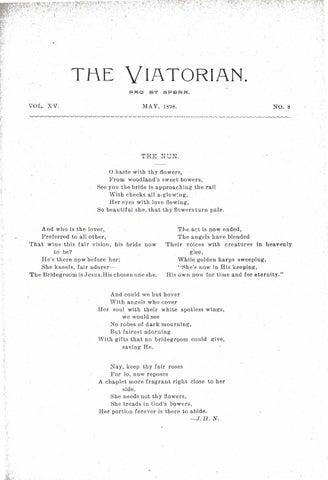
THE NUN. 0 haste with thy flowers,, From wood land's sweet bowers, See you the bride is approaching the rail With cheeks all a-glow!og, Her eyes with lo ve flowing, So beautiful she, that thy flowers turn pale. And who is the lover, · Preferred to all other, That wins this fair vision, his bride now to be? He's there npw before her; She kneels, fair adorerThe Bridegroom is Jesus, His chosen one she.
•,
The act is now ended, The ange ls have blended Their voices with creatures in heavenly glee, While golden harps sweeping, "She's now in His keeping, His own now for time and for eternity."
And could we but hover With angels who cover Her soul with their white spotless wings, we would see No robes of da.rk mourning, But fa irest adorning With gifts that no bridegroom could give, saving He. Nay, keep thy fair r-o ses For lo, now reposes A chaplet more fragrant right c·Jose to her side. She needs not thy flowers, She treads in God's bowers, Her portion forever is there to abide. -J. Ii. N .
THE VIATQRIAN. '
148
METAPHYSICS.
that science which gives wings to reason by which reason is enabled to To pass for a man of refined taste soar above the material "Universe ,and and liberal culture, it has now become peer into the very essences of things. almost necessary to look upon meta- To gaze with wonder and delight into physics with a fine contempt and to ex- the infinite expanse of eternity and to press our unlimited pity for the poor view · the primal origin of things at misguided mortals who wasted their the very source. Shall we c~ll that time and energies in pursuit of mota- science useless which gives th'e final physical phantoms. If the opinion of answer to the everlasting why that these men be correct then metaphysics every rational creature is asking himis the most unprofitable, unfruitful, self from the time that his amazed delusive study that ever engaged the eyes first catch a glimpse of the attention of a thoughtful mind. After visible universe until they are closed a slight examination of the subject, forever by the Angel ofDeath? Shall however, we will find that this is the we consider .that science beneath our judgment of ignorance and prejudice. notice .which has engaged the attenIt is true that metaphysics does not tion of minds well nigh divine in their increase our material comfort or serve magnificent manifestations of intel. what is commonly called a useful pur- 1ectual power? · How small and weak pose; but does it follow from thence do our modern , scoffers appear when that.it is entirely useless or superflu- placed by the side of those intellectual ous? ·If a man were a mere brute giants, Aristotle, St. Augustine, and without an immortal soul or an ever- St. Thomas, who scaled ~he cloudinq u isi ti ,ve intellect, rnetaph ysics would piercing summit of metaphysics and not only be entirely beyond his corn- rendered vocal the celestial harmony prehension but also altogether useless . of the universe! These men were not Material comfort and wealth are riot mere dreamers. Their keen vision man's only good, nor are they the high- penetrated beneath the surfaces of est. He ·has quite another kind of things into their very reality. hunge~ besides that of the stomach. Metaphysics serves a noble purpose. He has an ardent desire to know the It gives the mind a vantage ground why and how of things. It may hap- . from which it can view the worlds of pen that this much-despised science spirit and matter. By showing the supplies these higher needs of man's mind the essences of different beings intellectual nature and satisfies the it enables it t!:> judge with some degree cravingE of his soul. of accuracy of their relative. value. What .then is metaphysics? It is It teach~s ' man his own dignity by that 's cience which investigates the clearly proving that he is indeed a supreme and supersensible reasons of microcosm, superior to the whole anithings that cannot be ascertained by ·mal and vegetable kingdoms. Equal either experience or testimony; it is , to plants because he bas the same
I
.~~· •r
.,_, ~ : •,/
t-
0 "'' •; ,; -
i
' r '•
'.
TRE VIATORIAN,
.r
power,of vegetatio~ which they have; ¢qu~l t·o. animals because he has the same Sense organism they enjoy. Su-' . ;rer~o,r to both because he has an immo:r~al s.pirit with the God-like ~ift of r~asen. · Nay, it · mounts upward to ~?e 'fOrld of · spirit ~nd even reaches to the verythrone -of God, and reverently gazes into the unfathomable . depths of the etern.a l. . " ' . ' I :w~a,.t ma;d.folly and gross ignorance therefore ·. .are t:Pey guilty of who despise · this S"Ublime science and merge themselves wholly in the material, sensible world! No wonder if they bec.o me warped ~nd misshapen in their gloomy prison house of clay where. tpe , light of eternity never penetrates. '',M an,'' says Bishop Spalding, . "becomes like. to the things he works in," S:O the_se materialists, dwelling ever in . the presence of matter, become of the earth earthly. Did metaphysics do nothing else but lead the mind through the wonderland of in~nitude, it would be a highly bene- · ' Jicial s.cien'ce. What matters it to me though my house be brilliantly lighted with electricity, if my mind be enveloped by the gloom of ignorance, doomed to forever feed ' upon itself and beat the narrow walls of its clay prison 1,mtil it sink groveling to the earth where it m·u st forever lie? · What matters it t.o me though I were wh1rled over the Jand with the speed of the wi.nd whilst I recline at my ease on a cushioned seat, if my soul, fettered by the s.hackles of mater.ialisrr., have no free range beyond the limits of time and space . into infinity? '•Wealth makes not the m.iser rich nor its want
'
1~9 . •.
'
the true man poor;" neither does comfort make the voluptuary happy nor its lack the enlightened man wretched . . · W. J. B. LADY MACBETH. A FAVORABL.E VIEW.
Qf all the creatures of fancy so distinctly set befo:re us by the world.' s prince of dramatists, none have been made the object of so much un.deserved reproach as has L~dy Macbeth." Let us enter the hall of fantasy with the poet and there observe the words and acL_ions of this child of. his imagination and then we shall be better prepared to form a correct' estimate of her character. We must set aside all preconceived, prejudiced opinions concerning her, fpr we have already learned from critics unfavorably disposed that she was a woman devoid of principle and sympathy: They . would have us see her as possessing all the ferocity of the enraged lioness combined with all the guile and intrigue .of the .old serpent. She is said to be the caus.e : of all her husband's cruelty, and when the two are contrasted her enemies make her stand for all that is devilish and inhuman . We do not claim that she was an ideal woman, blJ.t merely that in the murdering of Duncan she, is less culpable than her husband and that if her life and fortunes had been linked with those of a man of more deserving qualities and greater strength of purpose her love for him would have been productive of results as meritorious as they appear censur~ble in her present circumstances.
'
I
·.
~·
.' ' . .
THE' VIA TeRIAN.
150
.
'
Lady Macbeth first presents herself while r·e ading a letter from her husband in which he apprises her of his meeting wi.t h the witches and their predictions which were already confirmed by qeing partly fulfilled. It is thought by some critics that .-the plan of murdering Dun·c an and thus acquiring the ~rown was devised by Lady Macbeth; but this is in n~ way substantiated by anything found in the play. On the contrary, we find much to make us believe that it originated with Macbeth himself, ;:tnd was not even suggested to him by the witches, fo'r they merely struck the right chord in his heart; they only harped upon a desire already fostered within his breast. It seems indisput_able that it was not with Lady Macbeth for, upon the visit of Duncan to Macbeth's castle, th·e latte~ in talking with his wife says, "l dare do all that may be. come a man, etc." Lady Macbeth replies, "What beast was it then that made you break this enterprise to me?" From this it is evident that she was not the author of this plan, although she afterwards aided in the execution of it. But in this she 1s not so much to blame as ' at first appears, for she did not stop to con~ider the hideousness of the crime which she and her husband were about toperpetrate upon the innocent, defenseless Duncan. She did not for a single moment weigh the evil consequences either in this world or in the next, but being a woman of great sympathy, she readily seized upon the scheme of murdering Duncan and thus procuring the crown for
: her husband, And can we say· that .s·he was lJ.,nnatural in this? Is it not a wornan':s nature to be guided by fiery · imp11lse rather than by cool · r·eason 't . Do they not . invariably jump ·at clusions as if by instinct, which men reach · only by long pl'bcesses of re~S - on-ing? This ·was just the case with Lady Macbeth and, although it does not excuse her from the crime, yet who · would hesitate to say tliat she is less to be blamed than her cbwarqly husband who desired the end but was unwilling to use the means himself, who weigh~d well the whole affair and was prevented from putting it into execution, not indeed through fear of the consequences in a future life;-oh, no! he · would take his chances about 'that', but by fear of earthly conseq1,1ences. He knew well what he was doing. He fully realized that to murder his king was a crime against both God and man, but be would be impious enough to defy tb~ former if the latter would only let him alone. But lie feared that by teaching bloody instructions they would return and -plague the inventor. What a villainous coward was he! But Lady Macbeth entered upon none of these considerations. Her excessive love for her husband led her to sacrifice her ·own individuality for his advancement and to do things most repugnant to her nature. She had to nerve herself by artificial means when the time came for the execution of their - plans. When her husba!ld turns coward she says, "Had be not resembled my father as he slept, I bad done it.'' Here we find filial piety joined towifely · devotion. She must have been a kind
con-
. I
,
,.. 1
'
THE VIATORIAN.
151
and loving daughter or else she would . "'Tis safer to be that which we destrov, not ·then ha.ve hesitated to strike the Than by destruction dwell in doubtfu1j oy ,r." _blow herself. The fact that the sleep- ' and also her unworthy' husband, · who ing king resembled her father was · -nowappearstohernotastheconqueror . enough to pre~ent her from accomp- ·of cities and armies but as the cow ~ . lishing the object of . her life when it . ardly, callous, criminal wretch that he. would have been so easy for he·r to do was,-all t 1hese combined to break the it. She wished to grasp this golden heart of Lady Macbeth, · and her overopportunity of Duncan's visit for it taxed nerves induce mental prostra- . seemed to her a gift of fate. · The fit- tion. How sad is her case indeed! She ness of the time and place were the has done all she could for the ido~ of · making of her while they unmade Mac- her heart and the hero of her girlhood beth. She becomes ambitious but it days, and now he proves incapable of is only by sympathy for her husband. sustaining himself in the place to It is not that she may be queen that . which she did so much to raise him. she wishes him to be king but it is for His lack of interest· in he:r must also his sake alone. · She merely allies her - have been a severe blow to her. Herself with his master passion and be- . husband now felt that he could get comes its minister. She has been along without her, and she partiCiwilling to dissimulf!.te during the whole pated in his plans no longer. This invisit of Duncan in order that their deed must have been a bitter draft for plans may not fail. She scorns the her to swallow, and we may · believe bare idea that they should fail, and ex- that it was this, toget]fer with a sense hibits a firmness of purpose that can of his unworthiness, which signed her scarcely fail to excite admiration. But death warrant, and she died as any of when the crime has been committed her sex . naturally would-brokenher overwrought nature gives way. hearted, because she found the man-of When her husband relates with the . her .choice unworthy of the trust she blackest hypocrisy to the. hastily- reposed in him; she saw only a wretch aroused and surprised attendant's the with all -the depravity of a criminal condition of their murdered king she but without any of his redeeming feacan hold out no longer. S~e faints and tures. S. N. M. is carried away. It is her woman's nature asserting itself once more. NOT SO F AVOR A BLE. Macbeth now becomes a worse cowLady Macbeth is one of the .m ost ard than ever. With new fears come new crimes and deeds totally unworthy ·remarkable female characters crea,ted of one who had once been a valiant by the great Shakespeare. Some re soldier. His after life shows how cent critics have attempted to show . crime degrades and hardens the hu - that she is a woman of g enerous impulses, who would have been a model man hGart. wife and moth er had sh e the g ood fo rBut the feeling tha,t ·
''
'-l
\ 'r
'I.
,.
152
• I
THE VIATORIAN.
tune to be wedded to a man of lofty The effect and .it! Come to my woman 's brea!'lt character. It is very difficult, howAnd take my milk for gall, you murd'ring ever, from a calm and careful study ministers of the portrait drawn of her to concur Wherever in your sightless substances in this opinion. .From the prst mo- . You wait on nature's mischief! Come thick night ment she makes her appearance in the play until she loses the use of her rea- And pall thee in the dunnest smoke of hell! That my keen knife son, she is a murderess. She enters See not th e wound it makes." * * * reading Macbeth's letter, in which he only hints at the murder of Duncan. This frame of mind can result from What would have shocked the moral a long series of unnatural crimes and se.nsibilities of an ordinary . woman from nothing else. Therefore I would arouses all the fiendish fury of her conclude Lady Macbeth is an abancruel soul. doned criminal long before the murder "Hie thee hither, of King Duncan. This opinion derives Tha!, I may pour my spirit into thine ear ad~itional confirmation fror:n the 'conAnd chastise with the valor of my tongue sidera tiori of the different effects the ·All that impedes thee from the golden crime had upon Macbeth · and his wife. round." .She fears that Macbe-th, if left to him- ~acbetb had been bred from his youth self, will recoil from the commission to the din of arms, and bad fought on of the awful deed and she resolves to many a bloody field'; he was accususe all her power and influence as a tomed to the sight of blood, and yet wife t'o goad him on. Can we conceive · the bleeding corpse of his victim, and a woman unaccustomed to crime all at the remorse of a guilty conscience fill once transformed in to a blood thirsty him with inexpressible horror. Not so Lady Macbeth. Within her obdutigress? . . Never do men and still less women rate soul remorse finds no echo. She cannot understand Macbeth's agitaphu~ge all at once into the most abo·minable crimes. Yet we find Lady Mac- tion. Why should murder excite horbeth wi·t hout the slightest provocation ror in . the mind of anyone? A little and with the composure of a practiced water washes away'all traces of blood. cutthroat contemplating the murder To her it means no more than if she of a man who not only has never in- bad killed a brute. Not pleasant work, jured her or hers but who had heaped certainly, but yet very serviceabLe to many honors upon herself and husband. attain one's end. Come, come, you Spirits That.tend on mortal thoughts, unsex me here! And fill me fro!ll the c.rown to tht;l toe topful Of direst crue_lty! Make thick my blood , Stop up the access and passage of remorsfl, That no compunctious visiting of nat~.ue Shake my fell purpose, nor keep peace between
Let us turn again to Macbeth after he has committed many murders. Now we se-e the callousness of Lady Macbeth repeated in him . No longer does remorse rack his mind. He orders the death of in~ocent perso~s with the same unconcern that a man woul
}
'
••. i~:,_,·
' '
.. THE VIATOR!AN . feel iu performing the ordinary occup.a tions of' life~ Wh:en he hears that Malcolm is marching against him with a large. force, he orders his secretary to haive the heads of those cut off who only talk of fear. It must ever come to this. When a man gives himself up to the promptings of passion, he gr~dually loses the sense of moral responsibility, and habit makes the commission of crime a second nature for him. In my opinion, Macbeth arrives at the same state of moral degradation toward the end of his career, that Lady Macbeth is in when. she first appears upon the scene .. When a man reaches such a state that he can commit the most revolting crimes without remorse, ,his case is well n'igh hopeless. Furthermore, men never become so . abandoned to all sense of right and wrong until after a long series of crimes. Since, then, we fi~d Lady Macbeth in this state from the very first mome.nt of her appearance, we cannot help concluding that she has passed through all the inter. mediate stages of criminality. B.
THE WITCHES I OF MACBETH.
Shakespeare's use of th,e witches in Macbeth . is often questioned, and on examination we find that, although appearing bu·t thrice throughout the play, their parts are important . for their · saymgs .are expresstve of what follows; so much ·s o, that they cast an influence or mist over the entire drama, which can be. dispeU/e d only by a careful perus al of these mysterious beings.
The presence of the witches in the drama is best explained by quoting Coleridge who says: ''The appearance of the witches is ~o strike the key-note. of the character of the whole drama." These fantastic creations of the au. thor's mind are but the temptations which try man, but by their use the true character of those with :who:r,n they come in contact is clearly shown. The meeting of the witches by Macbeth lays bare his conscience, · sh~wing us a man who, . being evil in his ver;y nature, needed but the whisperings of . temptations to strengthen his foul designs. Corson most wisely remarks: ,·, The devil visits those only who invite him in." And the contrast between Macbeth and Banquo, when tempted by the witches, supports the . remark; for while o~e sees, in these temptations, those of his inner self, the other, having a clear conscience, repels or defies these · ungodlike · thoughts, saying: '' Speak then to me who neit.her beg Nor fear your favors nor your hate."
The more we admire the action of the witches, the more we · admire the art of a master ·who, knowing the love the human mind has for the mysterious, p'lunges us into its depths arid thus commands our attention and arouses our interest in what is about to relate. So, in the very first scene, the author overwhelms us with the power of theS'e fantastic beings to whom the elements bow in submission, of course, to make them appear with reason, he shows with whom they are to deal .
he
I
'·
<\-
it(~'':(--'';;:,;' 1
'
,.
\
TRE VrATORIAN.
1M
" Where th e place?- Upon the hea th : There to meet Mac beth."
The next appearance of the witches is in the third scene of the first act, · and, our author knowing that we are all imbued with a love of the romantic, · what better means coul:l he have taken to arouse our interest in the future of Macbeth, than a scene between him and spirits of an unknown world, for such a scene cannot but make us hope · and fear for his future actions. In this scene Shakespeare also shows the perversity of the witches, ~ut in such a way as to leave our imagination . to conceive their actions. Certain · it is : that their actions never tended toward - good ~ Their motto well expresses their · state : " Fair is 1oul, and foul is fair ; Hover through the fog and filthy a.ir. "
the witches. These witches, who at first inspired awe , now appear as objects of our scorn; the cauldron and its contents are disgusting, and as Macbeth, now king of Scotland, not only countenances but bargains with their . masters, the spirits darkness, he is degraded in our esteem. Thus the witches fulfill their purpose; they do more than relate or express mere ex tyrnal things ; they give us an insight into the very inmost recesses of the mind of the leading personage, Macbeth, whom at first they elevate, but in the end bury in the mire of degradation, thus showing the lesson' in tended, namely : Evil for a tim'e may . reign supreme, but sooner o.r later there will come a day of reckoning, and right will prevail. C. J. Q.
of
The author, by having the witches relate their doings, impresses us, makes A BOARDING HOUSE ROMANCE. us regard them with awe. The super naturai power attributed to these sorHe was a poet, wi:th long auburn ceresses gives a semblance 'of truth to locks, and his countenance continually the knowledge of events to come, of wore a starved expression. He wrote which they speak and which exert such poems for the magazines (those which - an influence on the future actipns of would accept them), poems with such Macbeth. poetic titles as ''How Beauteous is the . We do not again hear of the witches Night," through which there ran a distill the fourth act, when the hero of the cerdant note that sadly marred the _. play , if suyh we may call Macbeth, (al- nocturnal beauty. There were ·only · though "vi~lain" would be more appro- two faults to find with him ; he was a priate) having reached the pinnacle of poet, and hence a dreamer ; tberi his his amb~tion, the crown, of Scotland, is name was very unpoetical, plain John . now . t.D be. degr.. a. ded and receive the Smith. Notwithstanding these incon. punishment justly his. Shakespeare . gruities, he was a good fellow-at here shows' a master's band, for he · least eve1'yone who knew him saicl so. makes us gradually1ose our admiration He lived in a boarding house in a subof Mac~eth,and turns it into contempt. urb of' New York, and his landlaqy As ·a means for doing this, be uses- was one of his chief adm,i rers; ;osten;
. I
'{f'"t~:1 ~::''tK~~~1'1~~:$r~~~ j;:i'li'i-~:rr~~<!!i~~~c;;;:~t~t~~~riij~f~~:~~ . :··· -,! ··1-~i. ~·:;.:.:~~~t .. r:_ -:_ ... ,_.~; '\ :~-;_-:~'tt:·r·~~\. ··-~~ . .~--.'1 :,.I ' I
TRE VrA'rORIAN. s~bly
beeal!se ''her heart yearned so towards those savage looking scribes," but the . reason w.as that he never _g.-r:\im~led over the burnt steak,charred bis~cuits, and s.our milk] but seemed to take them all as a poet's dues. The landlady had a daughter, a bewitching maiden of nineteen or twenty, and she was the only one in Mrs. Lipp's board,ng house , who apparently was not struck with the poet's charms. . Now,, no one would ever suspect John Smith of being in love; but, to tell the truth, he had_ written more . sonnets about Melinda than all the lines and v'erses he had ever published. Nor did it ever occur to his landlady that he could have intenti~ns upon her daughte-r. If it had, John's reputation would have suffered sadly in her estimation. But he was madly in love with Melinda, anci hi~- poetic soul conceived her as a being so high above him that he sought rather to worship her at a distance, and to write poetry about her in the recesses of his ''den,'' than to come forward and defile her fair spiritwith his earthly adoration. But Melinda had never thought -much about John; she barely noticed him, perhaps because her mother was always harping on his good qualities. · There was another boarder with Mrs. Lipp who aspired to the hand of her daughter; and with a lover 's watchfulness and jealousy he properly interpreted-perhaps he was the only one ~ho did- J ohn's covert glances toward Miss Melinda, and recognized him ·as a rivaL · Walter Claribel-·· that was his name ·-was a clerk in a . down-town dry
teal
·, -~-
~-
~~ ~--.
~
I
~·.
. '
155
g oods store. He was a tall, slim, young fellow, with flaxen hair invariably parted carefully d9wn the middle. He wore glasses over a pair of steel-gray eyes, and covering his lip there was a shadow of a fair moustache as carefully br~shed as his hair. When Walter discovered that the object of his and John 's frequent and enraptured glances was identical, he determined to· press his suit with all possible force and expedition. Before he had been in the house a month his devotion to Melinda was the standing joke of the other boarders and a cause of serious trouble to John Smith. This continued for several weeks; and the poet, as a last . resort, came forward in his true character as an aspirant for the hand of Miss Melinda. The whole house was now on the alert, excepting Mrs. Lipp, who was sublimely unconscious of it all. Which would win? The young man wP.o played the races even went so far one morning at breakfast as to bet the minister ' five dollars on the poet; and to the consternation of all the minister took him up. The boarders were about equally divided, and, as for Melinda, she showed no preference for either. The two young men scarcely ever addressed. each other, and wore continual scowls when in each others presence. Things were rapidly approaching a climax; an open rupture was expected. Several more bets were made, some on the coming encounter, some on the ultimate outcome. But, as is usual, the unexpected happened. John Smith being a poet, was naturally oppos,ed to a common mundane I
... -,
~ (r..'
~' 1-
I
'·
i56
TilE VIATOR[AN.
''Well-ahem-we have-?' cornbrawl-it affected his artistic tempermenced the embarrassed poet. aq1ent-so he proposed an amicable "We were just waiting for Mlss settlement to the young clerk. Between them it was decided that eaeh Melinda, Mrs. Lipp,;, interrupted Mr. should write a letter to the fair object Claribel, "1 want to show her tQ.e of their love, presenting their claims. paper, there is some startling war Mr. Smith is These letters should specify that Miss news this morning. . Melinda shoul'd pass the salt to the merely waiting to accompany me do~n victor while at breakfast the next town." ''Well, goodness ine! Its war again ~ mormng. Well, everything was aralways war. ' I really believe this ranged and the letters were posted. The next morning the. two gentle- country is going to destruction. Land's men, came down to breakfast a.nd took sakes! Hasn't Melinda been down to their places, leaving a vacant chair breakfast )Toet? I'~l go a_nd call her between them for Miss Melinda. They immediately," replied . the landlady. ate their meal in silence, every now She· went upstairs and the two young · and then glancing covertly at the door men could hear her shrill voice calling, of the dining-room expecting the arri- ''Melinda! Melinda!!" Both were silent until she returned. She entered the val of her who was to decide their fate. But Melinda did not come. An hour . room breat_hless, attempting to read a passed, and still she did not come. piece of paper, and exclaimed, "0h, Everyone had left the room . Evi. my! Can · l believe my eyes? · Mr. dently the two suitors were becoming Claribel, will you please read this for uneasy. · Finally Walter· addres~ed me? Goodness me!" That gentleman took the note and John, "No doubt, Mr. Smith, she has read it aloud. · overslept herself.'' It stated that Melinda had etoped "Probably so, Mr. Claribel, " replied during the night with a young fellow, . · the poet . ''Well, let us remain another half Edgar Boren, whose attentions to her hour, and if she has not come down by daughter, Mrs. Lipp had forbidden. that time, we will both leave and That evening, Mr. Smi.th and Mr. await our sentence at dinner," sug- Claribel paid their bills and sought · other boarding places--and this is the gested the clerk. ''l agree, Mr. Claribel," answered end to that boarding-house romance. P. W. H., '99. John. . · Just then the landlady made her appearance and observing the gentlemen, exclaimed, "Goodness me! :Will you · Little minds ar~ tamed and subtwo gentlemen ever finish your break- dued by misfortune, but great minds fast? You've been in here two .nours rise above them. - - Washington Jrving. already, and its almost time to get dinner. I declare."
. '
'v
.'
'I
>'/f
157
. TWO LILIES. On the bosom (!)f a river, Flawing 'o nw:ard the. se·a ,- . On the tT~p.tes; laughing e.v er; Boundtng forward,. gay and free 1"'Lay tw0lilies, · ·Spotless lilies, Dancing alwiys in tbelr glee. '
..._ 1:
Sister lilies were these fiowers, Culled from O·ff the same green stem. Side by side, in hidden bowers, Bloomed the,se lilies, scentil)g them .' Happy lilies! Stainless lilies! Purer far than many a gem . .
I
But the water found them hiding Near the willow on its shore; · And it clasped·them, 0nward gliding, Thro' the SJ?>r.ay a nd water's ro.a r. ]'r.ightened lilies! . Paling lilies! For they shall return no more.
-·
to
'
Yet the wavelets grasped th·em ti.g htii·y , And they chased away an fear, Till again they tripped on lightly, Laughing in their gar career. Dancin.g Hites! Happy lilies! Once so mournftil:, onoe so dre'a r! Thus .does joy give way to sorrow; Then .again the day is bright: . . Sad today is glad tomorrow, Ere the snnshine comes to naught. As the lilies, ' Trembling lilies, Passed fr <:> m darl(~~S!; into light. - P . W. H ., '99.
VIOLETS. Meet tribute, blest Mother, I bring, Thine altar of May to adorn; Sin.ce fiow~rs have voices to sir1g, I'll give t h em at night. and at mom. But flowers 1,\nd songs cannot fast, Their beauty dies out with the day; White lilies, red roses, fade fast, Too fast to weave chaplet of May. These little mountain gems I brought Are symbols , Virgin mild, of thee ; T h e:ir deep blue eyes concHaling thought., Thi s prayer repeat., "Remember l}le. " The sun and rain that saw them bloom Fo.retold their native mod.e st worth, As thine, of old, in Nazareth's room, A reba·ngel voic'd to hos·t s of earth . I
Oft gifts are bless.e d from scanty store, · The widow's was who gave her mite ; So man gives love, God asks no more . For love wins grace in Heaven's ~ight . Take , then, these violets fair I bring, Thine altar, Mary , to adorn ; With hu mble voice they sweetly sing M agn1ficat, from night to morn .
.,_ I
158
THE
THE VIATORIAN. Publish-ed monthly for the students by the PFiJ;lting and S t ationery Co., Btoommgton , Ill. . Edited , by the students of S t . Viat eu r's College,Bourbonnais Gro\"e, IH. All co.r'respondence mus t be addressed: THE VIATORIAN, Bourbonnais. Ill. · · Entered at the Bloomington Postoffice a s s e cond .cl ass matter. Subscription price, on e dollar per year, payable in advance. Pa~tagraph
BOARD OF EDITORS.
J . I. GRANGER,
P. F. DANIHER.
P . W. HANSL. D. HAYDN.
/
VIA~'OR IAN .
petition, when the same self -appointed delegate or delegation mi.gnt approach the one in authority with.. as much nonchalan c~ (and with the same ?on·v incing_ reasons) a;s a common, every-day c.r owd manifeets when it goes to the sam~ - re sponsive power in quest of a_ cong6. Common- things puffed up with meaningless: foimality give- one a sen~e of;· wearin:~ss that \ the greatest "s-pri-n-g medicine" will not t:a.k,e a.way ~
P . _DUBE. ~M.
J . BRENNAN
EDITORIAL.
Th_e unfavorable weather of the past month has not p.e en helpful to basebalL Practices {(ave been few , tho-ugh the organization· of the team is complete and everyone anxious to begin . So far we have not crossed -bats w~th a visiting nine. It is generally conceded that every
one is en titled to his own opinion on debatable subjects. But in .the expression of that conviction it is well to go slow. One's opinion loses none of its force by being kept in chec-k, and the holder of it may find reas<?nS for modifying it or perhaps for changing it altogetbet. But in any case it gets as much credit and carries as much weight tomorrow as today, and would, perhaps, be delivered with more grace if one were to wait a week before giving it · expression. Then about "petitions;" it seems an · absurd formality for one or a number to ·go . to the trouble of getting up a
Like· it or not as w-e may, we are a race o' politicians. That aggressive desire of organizing and using . the body thus formed as a means of our own elevation to place is a cP,aracteristic that makes itself felt in all our doings. The foremost man may not always be the one hav.ing the greatest claims to leadership, but a bold step puts him ·in front and a latle nerve, with ju§lt the proper sprinkling of bluff . does the rest. Ii he knows how ' to catch the crowd the whole thing is a succes~. ~- The only cause of fear is to be fou'wd in a rival. '
lf organizationsgave equal promises
to each of its members they would hardly e~er lack harmony. But they do not ; hence the need each one entering such a body has of learning that there must be some one to lead and other s to follow-r::ome first and so;m e 1a st._:._ ·we have not all equal merits, equal powers in any society or group, and the inequality of position grows out of the unequalness of indi ~ vid uals themselves , rather than from any desire on the part of men to give
THE VIATOlUA:N.
pr-o~luence to particular f~vorites. ~o ft sp~aks well for those who group .m.eo,. for any purpose, that they co.nsi~er well the importance of certain pa.r ts and make the best choice of the material at hand to fill them.
159
ful tpavail themselves ofqpporLuuiLies, ,a ud use up the fragments' of spare ti .me which the idle permit to run to waste. How many men by perseveri ng in ;their desire · to · rise from burn ble circum stances have reached the hiD'hest .c ulo . ture, and acquired honoraqle dtstir;JCti~n: ~mong their fellow-JIH~n.: ThE'} ~ e who strives to ao00.mptish any great deed th{ju·gh ·he may ha.ve comparatively slender means at his ) command, still if he persis.ts and :Pas a re~qlutewilland purpose he will always be s'u re to-succeed. Hence we see the great point to be arrived , at is to get the 'workiri'g ,faculties well trained . When '~that is done the rest will be found C?mparatively easy. We must do thing~$ agai'n . and aga.in, for facility comes 0nly with labor and without it not e:v. e'n the simplest things in science or art·can be produced . D. H.
The _greatest results in life are U$Ua'lly a~t~rJi,e·P: by_simple mea.list and' the exercise of ordinary qualities. The . one who works in the truest soirit will invariably be the most successful. If :we look into practical life we shall fi~d that fortune is on the 's ide of the industrious. Perseverance has been the cause <;>f the accomplishment of many great deeds. Neariy all great \V'orks . .. . .... I owe their existence to it. With .perseverance, the very odds and ends of time may be worked up into results of the gr~atest value. · An hour ~n every day withdrawn from frivolous pur$uits would, if profitably employed, en.a ble a person of ordinary capaCity to go far BOOKS AND PERIODICAL'S . toward mastering a complete science. The Rosary Magaz{ne for April con . Literary life affords abundant illustrations of the po~er of perseverance, tains a welliflustrat~d article on ''The and perhaps no career is more instruc- . Porziuncula and the Deatl) of St. Fran tive, viewed in this light, than that of cis" that is powerfully interes.ting, as Sir Walter Scott. His perseverance was it must be, coming froni the . pen of remarkable, making it possible for him such ·a writer as the Rt. Rev. Bernard to get through an enormous amount of O' Reilly, D. D., LL.D. What can be literary labor. But with all his dili .. ~weeter than this charming writer's gent and indefatigable industry and description of t~e Chapel of the Roses his immense knowledge, the result of and its surroundings. · "You . almos t many years of patient labor, Scott al- regret, '' says the Right Reverend Docways spoke with the greatest modesty tor, "that the meadow, where the grass grew greener and the flowers bloomed of his powers. It is astonishing how much may be more lovely beneath the feet which accomplished in self-culture by the en - bore Christ's stigr:pas, had · not ·been ergetic and persevering, who are care- allowed to remain open to .t he bright ...
! !..
v
··::;t~.
..
',
'
.j. :,
''}',:~. ~,,
I
,
of
,
.;~",..,.~rr:r:li\'i~;·~1"'./~t;l'"~'~~··~'~~~~~~~~,_'i';~~-f3J~r:;tlirP~~tl·· .,...•·
-, ..1 :
,, :
:·.:
,:-~,~;,:;~~· ... :·
••
~·~\~>·<;:,·~~:· :,:·~·; ··.;:i:~·._•,J''f;,·:..?!··
' ' .\
. I.
160
'.
,,
,-.
TBE VIATOR£AN .
skies and the warm sun, and bearing numb-e r on "Monta lember t, " by Wm. flowers eternally. '' How well does the P . Bree n ;and one on ' 'Pope" by Tho.s . ' writer know how to introduce the sub- . O' Hagan, M. A. ,Ph. D. ·Paul Allard lime thoughts, of the immortal Dante, w-rites of the "Persecutions Durj ng who oft. ·was inspired by sotne· touch- the First Two Centuries of th e Church " ing seen~ around this ''Capella delle in a very attractive manner, and Julia Rose. ;, Throughout the article we seem Teresa Butler sings in a happy vein ' . wrapt· ilL a 'mantle of fragrant devo- "An Easter Spng. " tion, a·Iid if p.ot outwardly expressed, The Easter number of the Catholic yet the heart heaves a ~igh a·s we reach World has an illustrated paper on '~ The · the end, whet~, . ''1n the death-room of Catholic Life of Boston, " which is .a Saint Mary M the Angels, holy grief sister article to "Catholic Landmarks" · titled every s·oui! The sun had set be- · in _t.h e Messenger fo.r May. A. A. Mcbi.n d the Western Appennines, and the Ginley does the honors for ' 'The Hub," stars were beginning to peep fo·r th in and right well, too. The World has the east, w~lH:~'n that wonderful life · of lll:any fine papers, among others ; 'Ludforty ; ~ve years was closed so sweetly . wig P astor, the Great German Histo ·in death." rian," by M. Lalor Mitchell. The Afess''fJnger qf ·'the Sacred H eart The Century for April is well filled for Mary's month, comes to us with with good reading matter and excelan -abundan'e e of g?od things; and lent illustrations. "The Fall of Maxinotic'e ably two very fine essays which . miliBtn" is very fine, and ''A Pennsylar~· beautifully illustrated. One is vania Colliery Village" is not . only "Catholic. Landmarks Along the Hudinteresting, but instructive. Mrs . son, " and the other ''Religious RusBurton Harrison concludes her story, sia." The latter is by Paul Sturtevant ''Good Americans, and will disappoint Howe, a layman who has lived some a great many of h.e r readers with this years in the land of St. Olga and paid trivial affair which promised so much · much attention to the reiigious c.usin the beginning.. tor:ns ot the people, and the effects of McClure's bas its usual amount of those c.ustoms. Mr. Howe names the ambition of the Emperors of the Orient choice fiction for April, and among as the re~l c.ause of the Greek Schism, others a story by W. F ~ · Fraser; a but we are inclined to believe it to be Canadian gentleman unknown to us rather the ambition of the patriarchs before, who promises to become a favowP,o wished to be the · equal of the rite if we may judge by his "King Bishop of Rome.. We • heartily join for a Day." with the author in praying for the reMariolatry, New Phases o( an Old turn of that people to our Holy Mother, Fallacy, (press of. the Ave Maria , Notre the Roman Apostolic Ghurch. Dame, Ind., paper, 25 cents). The work 11 he U.J.tholic Reading Circle Review bearing the above title appeared rehas an interesting paper in its last cently in the A ve Maria , and ·is now I
'
'
.
.
· ,., .>'~ ;}.r:r
:
• ' THE VIATORIAN. iss~ed
f . ,;
•
-!''
in book form. Th·e writer dis piays. gr~at calmness in handling ,his subject as pe also shows by his innume~able quotations, ho·w well , he , pre, pared himself for the task he undertook. This work was written by the Rev. Henry G. Ganss in answer to the false assumptions put forth in a sermon preached by the Rev. W. M. Frysinger, at · Dickenson College. The latter gentleman made simply a crude statement of time-worn errors and cannot lay claim even to originality of statemen~. He is followed point by point by his. able critic, who draws authority for what he says, chiefly from Protestant sources. It is a' thorough refutation and ably made. l'is the errors of Dr. Fyrsinger differ from those of II}.any others only in their vulgar presentation, and as Father Oanss refutes them all, one has in this work a manual covering th~ whole ground of this controversy and hence an answer for those who refuse all lionor to the Mother of Christ, or who charge Oatb·olics with payin.g her homage d~e to God .alone. It ought to be read by everyone,, Catholic and Protestant, the former that they might have means of contradicting false statements on the subject, the l~tter that they might kno,w the truth a.nd know, too, what the leaders of their sects have to say about the Mother of God. J. H. N. "We have in this country three aristocracies: The aristocracy of intellect, founded by the Almighty ; the aristocracy of money, founded by Mammon; and the aristocrac~ of family, founded by foots."- W. C. Brann, lecture on "G,all."
16,1 ,
,PEB.SQN)tL.
-"rhe Re':. P. Roach, Dafayette, Ina.,' wa~ a welcome guest of the coqege · recently. -The Rev. F. Dandurand, Fort Wayne, Ind., paid his alma mater a visit not long since. ·
E:
· -The Rev. Bourget, Desplaines, Ill., ~alled on the faculty d~ring the past month. -The Rev. A. L. BergeFon, pastor of the Notre Dame church; Chicago, was a recent guest of the. colleg.e. '
'
- - The Rev. A. Granger, Cure ·of St. Rose's church, Kankakee, paid his respects to the faculty not long since. -The Rev. A . .Labrie, Momence, . Ill., made the president a pleasant call no~ long since. -Mr. John Joyce, Essex, lll., one of last year's bright boys, c~lled to renew old friendship, duri~g t:Pe month ~
-Mr. Frank Fanning, secretary ().f the Fanning Bicycle Co., Chicago,spent · a recent Sunday with his son Lloy.d, oJ the minims. -The Rev. J. J. Cregan, C. S. V., d;,irector of the Holy Name School, Ohi.cago, was one of the month's visitor~. ' -The following alumni of 8t; Viateur;s have gone to help Uncle Sam out of his difficulty : Messrs. A. J. Byron, A. J. Brouillette, J. 'E. Matthiew, and P. T. Lambert. These are all residents of Kankakee or Bourbonnais, and members of Co. L, 3d Reg., I. N. G. There are others, if necessa.ry.
,>-.-=..'A-1'•
il·
i
162
THE VIA TORIAN: THE - CONGE-R T'.
'i
- -- , On Sunday evening, April 24, the faculty and students of the college · wereentertained _with a rriusipal .and ~loc.qtio,nary p~ogram, at the college hall, u~d,er the .. auspices of Miss M~ . Campbell, a young and talented violinist of Cbic~go. The foll.owing nu~bers were ex~ellently rendered: 1. Violin solo, Mazurka de Concert .. .. .. . . . . . . . . . . . . . . . . . . . . . Miss Campbell 2. Jteclta.tion, The Return ·o f Regulus .. . . . ; . . . . . .. . . . . . ... Mr. C. J. Granger Son~,
A Da:y Dream ........ Miss Lecour 4. Violin, Polish Dance ...... Miss Campbell 5. Recftati0n, Th·e Unknown Speaker. · . . .. .. .. .. .. . .. .. . . . . :j\Ir. c. J. Qoille 6. Vio-l in, Serl'made . ...... ... Miss Campbell 7.' Song,-Red, Red Rose ..... . .. . ... . Miss Lecour 8. Violin ; SptLug Song . . . , . Miss Campbell 9. Recitation, L'histoire de mes trois vieux ... . .. . . .. .... . , ... . Miss Drolet 10. Violin, Obertass . . . .. . ... Miss Campbell 3.
1
.·.. .·.....< ...<.. .......
The beauty and thrilling effect of Miss Campbell's . playing ~Jre almost beyond description. She is a lover of classicai music and is m0st tenderly devoted to it. Her mastery over the · vioUn is perfect, . her talent is of the richest and rarest kind and no doubt, great ·though she be, greater things may be expected of her, for she lS quite young and is about to go abroad to complete her already accomplished rri usical education. Miss Lecdur in her .s0ngs sustained her reputation one :of the ablest soprano singers ·in Kankakee, while Miss Dele~ kept the French ·people in constant merriment. by her comic rec - . itations. Mr. C. J. Quille, styled ·by a con-
as .
tern porary . as an c'electric, vigorous, elocutionist." appeared in his usual a·rtis,t ic mar:ner and merited the con- · sfan t applause that greeted him: · The evening proved to be a most instructive and enjoyable one and all concur iri thanking Miss Campbell for her ~ind exhibition, and hope to have the pleasure -of listening to her soon · again. ROL.L OF HONOR.
The Guilfoyle medal awarded for the best composition in the rhetoric classes .was equally des~rved by D. Hayden, M. Morrissey, and J . . O'Callaghan. ·. Drawn b¥ J. O'Callaghan. The Lesage medal awarded for bigh- . est average in French literature was equally deserved by E. Marcotte and Granger. Drawn by E. Marcotte. The Conway medal ·awarded for the -highest average in bot,h courses was equally deserved by M. Morrissey an~ P. O'Connor. Drawn by M. Morrissey: The gold medal awarded in th'e ,classical course was ' equally deserved by J. Armstrong,' W. Brault, P. Geraghty, E. Graveline, E. Henneberry, D. Hayden, A. Han::;l, E. Marcotte, M. Morrissey, D. Maher, T. McPherson, J. O'Callaghan, M. O> Toole, and J. St. Cerney. Drawn by A. Hansl. The first silver medal awarded in the classica1 course was equally deserved by M. Brennan, L. Boisvert, P. Dupault, C. McCoy, W. Riley, and V. Stepps. Drawn by V!. Stepps. The second silver medal awarded in the classical course was equally de-~
THE VIATORIAN.
163 -
served by Art Carnn, T. Cahill, A. Got>drea,u, A, Le Guyer, T. Milholland, and , W. Rooney. Drawn by A. Le Ouyer. '!Fhe gold medal awarded in the commercial course was equally deserved · by J. Brennoek, W. · Casey, · J. CJlen non, H. Lachatit.e, T: Riley, A. Sana. sack,,.'):\ Sol:lneider, and F. Williamson:. Dcra.w n by A. Sanasack.
The first
~Uver
meaal awarded in ;the commercial course was equally de. served . by D. Carithers, R. Fay, and E. Lebeau. Dra.wn by R. Fay.
.-.
'
,:-
\
VIA TORIAN A.
-Pampadour Jim. - Dick and the cow. -. The flesh is weak. -Free lunch-St. Joe's. - I didn't loQk at the title:
-Shamrocks need no king. -. The beach is on the ocean . . -· I better go. to my room now. -A· bird can't fly in the shell.
-Patton had some cold redhots. The second silver medal awarded in - · No one is absolutely necessa.ry. the cpmmercial course w~s · equally · de· -I'll break my ff).ce with your fist. seZ:ved by J. Cahill, A. Changelon, C, .• Flannagan, A. Fraiser, J.. Harris, G. · -Please scratch . my name . out of Meehan, A. Martin, C. Moran, and S. there. SuJ!ivan. ·Drawn by S. Sullivan. , -They ar.e .poor judges of . }::m:tnan The gold medal awarded for ,good nature . .co.tlduct in the senior department was -. Oh, dear!. you have shook my equally de~erved by J. Armstrong, M, Brennan, '· J. Clennon, P. Dufault, P. modesty. Dube, J, Granger, W. Granger,. L. . -Did you see that dead man get off Kroschowitz, T. Schn~ider. Drawn by at Manteno? M.1 Brennan, -There is a reason about thai The gold medal awarded fo:r good twelfth man. cond11ct in the junior department was -That man you have reference to drawn by R. Dahlem. · s a switch en gin e. Those who have distinguished them-My old Dian don't sell chickens; selves for good conduct are as follows: W. Braul.t, J. O'Callaghan, A. Good- he isn't a butcher. reau, R. Gahan, W. ~Hanlon; E. Grave-The warships are painted black so line, E. Henneberry, A. Lamarre, H. they'll be bullet proof. Lacharite, J. Legns, A. Mongeau, E. · -He didn't want to say anything, Marcotte, D. Maher, M. Morrissey, P. yet he babbled all day . . O'Connor, M. O'Toole,. H. )?rost, V. -Professor of Elocution- What do Stepps, S. Sullivan, N: Marcotte, and you like, Jim? J. Cahill. Jim-As for me, 0, give me tragedy ! .
-
1
;,r~·l:'-~l'\I'S~'J•rr:Jif-~!~:1 7i~~f:~~:ir!~t~.~~~~r:~•~~~zr~\ ,,~~~,: \
, ...
. ,c,
_~
,, •1:
• __• •
•
·~):'r~·~'.r:•i .~.V,\: . ;,'·.)~ (<·;_;;;·+;;•r_~·:\r;;; :_:~· -~';i:';i!:f~1-··,...:'f!-:;;:.::.~.':'; •· .,
i64
,,
'··
, ...
.
' \
TH.E . .VI~TORIAN.
- He and Fat ~ould make a good quartet. -Mac is goinginto·the coal-hauling business. -Oh! when will my Hanbah get married ? - ·Did yo1.1 get a square .meal? I sat at a round table.
No,
-A few of our war-like seniors wanted to · go · to war but their ·par- · ents would. not . allow ii. Pap:a took them seriously. - Little ' boy-Say, mister, are you fellows going to war? M.ist~r-Why, _ certainly, rny - ~hilQ.. L~t.tle boy~ gee!
?'
- -There was a very tearful parting when some of our old school-mates came to say good- bye before goirig to -H. - Did you have any honey? war. · But they went and are now V. -_ No, she was just m(l.king it. somewhere in the wilds of Springfh~ld, · -All that is wrong about the Ger- ' (Ill.) . mans is that they are_too bashful. -One of happiest evenings we have -Some one of a martial spirit wrote had for .some tiJ;De was the ·o ne during home-and the blow . almost killed which the Rev. J. P. Dore, . of Chifather l -cago, was the ,_ entertainer. To those - I t is 5trange that so many fathers ·who know Father Dore h,e• needs ·no have ·vis-ited tb:e college within the introduction. His ability to entertain is beyond question; those who hear last 'two weeks. him for the first time appreciate his -~Speaking about gifts·reminds· us humor as hi_ghly as his old friends. that a ma'u. whq intended to ~ake a We were treated to several character . present may of a suddeN change his ·sketches, worked out as · only Father ·mind. Dore can· comic .stories told with --First boy-Where are you . going facial expression such as only the most when you leave here? perfect actor can imitate. Father Second boy-To an embalming col- Dore's stories were highly appreciated. lege . . Nor were we less interested in the · h•appy remarks of the Rev. J. M. Scan- · PEOfessor-Do you know your les: lon, who accompanied Father Dore. son~ Father Scanlon's timely af}vice, feel. Stud,ent_ I judged by the s1,m we ingly delivered, was a fitting close to - were to have conge today. the humorous treat of his compa,n ion . . · - . Professor-What does F. 0 . P. _ We sincerely hope that we shall have 'stand· for? 't he pleasure of hearing these accomStudent-Free to plow. plished gentlemen the near f u-ture. -When I reached home, I could hardly -stand up. Why?
in
1
•
.
\
-\1
'· .. ;, ·. Y;_,;~;~5·!'~v~~; ~:JJ·~·:: :\·:. !;·~n:"~/~·~~r~;·~r;~.#:~:~~'~W~~/'~f·: 1~~~~~··,;t:~~. ·~,J:!?~~~il~i~ '!1'
'rRE VIA TOR tAN.
Watch him adjusting his eyeglass. He's going to tell you . a story. .Pay at,t ention; its confidential, you know, and what he's going to tell you was never got without diligent searc:h and long peering into dark c~rnersand turning over dry leaves, as dry and dus.t -covered as last autumn's mccumulation after the summer. The secret this fellow is going to impart was dis- · covered after he ha;d been wanderin6o about for d~ys, after he had, turned over all the leaves and hunted in all the ' corners and ransacked 'his brain with effort a'nd tortured his soul into agony. He~s going to tell you a secret. Don't you t.e ll anyone. You'.re the first to hear it. .A round dozen, in reality, heard it this morning, but no matter. The last to hear the story will think he hears it first, and it will spin out better after so many repetitions. Now you've heard the story. You lift up your head to look at your interloCl,l tor. He leers at you. ·His glass is taken off, andwiping it the while, he gazes into your eyes to wonder at your calm . . ''ls that all?" ''That's all," he says. ''Is not that enough-I think it pretty bad." And whilst you are ama~ed, not so much at the stupidity of the tale as the impudence of him who has been trying to entertain yo~ at the expense of some one's good name and reputation, he walks away or
Education is . a good thing, but .it must. be of a proper kind, of a whole' some nature. The saving of a child consists 'not merely in entertaining life in his body, but in ptant1ng: the seeds of truth in his soul. Without . thi~ additional kindness, the mere saving of his life might be a questionable benefit, for, a man growing up with_o ut knowledge, or, with kri?wledge of a wrong kind, is apt to. be a burden and a curse to society. He quickly sinks into a condition of · servitude from his inability to labor wisely, from his proneness to evil, or perhaps, from the oppression . of the rhore wealthy, or from some other cause of which his undisciplined mind is the parent. · ' It may be safely ·said that instruction, if not based upon religion, does not make men happy, or redeerp.ing them from cruelty does not afford them true liberty. ' Instruction or education by itself, begets a thousand wants, creat:e s a thousand desii"es, and without moral restraint, without religious training, cannot conquer vice, which is the. firs.t real stepping-stone down to pov~rty. . The pt:oper method, therefore. ' to mstruct the child, is to seek not only his mindJ but his heart. Seek to become master of his intellect by ttutb, making tl:e will subject to reason::. and divine truth. This is the work 0f religion. '
Detmer Music House
Every student who intends to go into: business should read
261 Wabash Ave •. Chicago, Ill. ~:Sellers
of ev.e rything known in Music and Musical Instruments.
~~=Write
,.
~;<
..
~
t_··l ·--,·_
1:~- ..
for Catalogues.
glides like a snake from your presence and is lost 'round the corner.
.
Business. Monthly $1.o'o a year.
The Office Paper.
To read Business for a year is a liberal commercial edueation in itself. Write for sample copy , mentionin g thls pa,per . .. Publication Oflices, 13 Asto~ Place, New Y.ork .
.-·,,;,.;·'}':!;
~~r:\;~::' . -
:;.·
:; .
~~-
~~ . ------~--~---~
i H E COLLEGE affords excellent f.acilities for study, and ·. the acquirement of a thorough knowledge of MODERN LANGUAGES, MATHEMATICS, CLASSICS, MUSIC, SCIENCE, ' . :t.' ' PHILOSOPHY, and 'rHEOLOGY. Most careful 'att'( mtion is paid to the business training of young men, and a thorough practical knowl-edge of ' BOOKKEEPING, and COMMERCIAL LAW
..
.,
is impart~d by skilled professors,· The best authors and most approved system of teaching are adopted in aU g~ades of the College. Sttidents may ·enter at any tif!Ie. T.~l'm ~nd tuJtiop. will l:>egin ~ith qate of entrance. · Terms for board and tuition $200 per annum. Catalogues and any desired 'information · will be carefully given on application to the President.
Rev. M. J. MAR.SILE, C.s.:v:, St. Viateur's CoLlege, Bourbonnais, Kankakee County, Ill.