..
TJ-\E VIATORIA 3
BOURSOMNAlt,
ILL~
VOL. XV. DECEMBER, 1897. j: ......,.._,....~~~~w~~~~w~......,--~~~------.-,_,_,_,__,_ ___ ,~-~ - ~--.,..
ill
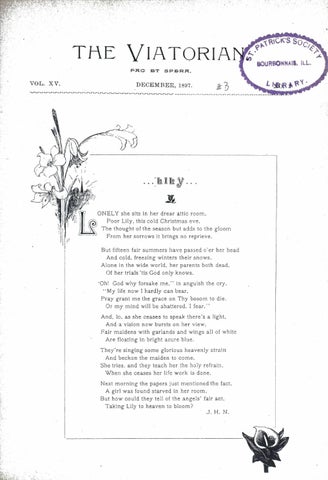
~ ONEL Y she sits in her drear attic room , -. Poor Lily , this cold Christmas eve , The thought of the but adds the gloom From her sorrows It brmgs no repneve.
~
s~aso~
t~
But fifteen fair summers have passed o 'er her head And cold, freezing winters their snows . Alone in the wide world, her parents both dead , Of her trials ' tis God only knows. 'Oh! God why forsake me, " in anguish the cry. " My life now I hardly can bear, Pray grant me the grace on Thy bosom to die . Or my mind will be shattered , 1 fear. ' ' And , lo, as she ceases to speak there 's a light , And a vision now bursts on her view, Fair maidens with garlands and wings all of white Are floating in bright azure blue. They ' re singin~. some glorious heavenly strain And beckon the maiden to come. She tries . and they teach her the holy refrain , When she ceases her life work is done . Next morning the papers just mentioned the fact , A girl was found starved in her room .. But how could they tell of the angels ' fair act , Taking Lily to heaven to bloom? J. H. N .
:
, 42
THE VIATORIAN.
ANDY. !".4-~:;...HE
MOST picturesque spot in the old fashioned village of Asabet, is the lane where the old wooden mill stands, who~e red boards are partially cove red wilh ivy , and whose huge wheel rolls in dress of g reen mo ss. .The mill had been idle for some time when a stranger, an old man named Tom Reagan, came from no one knew wher.e, bought the place and once again tLe huge wheel started to enliven the scene and make glad the hearts of a number of poor people who now could add a few dollars to their scanty savings. About tw:enty people were employed in making bagging, and among others, a bright little boy of about twelve years who was a general favorite with all the village people. His name was Andrew O' Donnell, and he l(ved with his parents who were known as people of great respectability, .... though n.ow sunk in the ve1路y depths of_ poverty. His father had the misfortune to lose his eyesight some years before the old mill was bought by Reagan, and Mrs. O'Donnell found it so hard to keep the wolf. from the door that she was obliged to allow little Andy_to seek work as a chore boy pf old Reagan. He succeeded in getting employment and it was soon noticed by all that the ''old crank," as Reagan was called,_ took kindly to the boy and generally hurled at him fewer anathemas than he was accustomed to distribute. One afternoon, about a week before Christmas, Reagan noticed tears in the eyes of the boy and a worried look on his beautiful, pale face. "What's up 路 now?" sharply asked the old man of the trembling lad. "Please, sir," said Andy in a quivering voice : "Would you let me 路go home early this evening? My mother was very sick this noon when 1 went home for lunch, and-.' 'Tut, tut," broke in Reagan with his eyes flashing angrily, and his arms sawing the air: "You stay right here and mind your p 's and q's or get out for good. I didn't make your mother sick and can ' t affor垄1 to suffer by it. I discharged two boys last week for being too fresh and watch out you don't follow them." And with curses on his lips he turned on his heels and walked away. Poor little Andy wept in silence, and when the whistle blew at six o'ckck, was the first to bound through the door and burry home to his affiicted parents. Half an hour after all the help had left the building and old Reagan was locking up his books, he heard his name called by little Andy in two or three piercing shrieks. He hurried to the door and at first could see nothing wrong, but noticing smoke coming . from the rear of .the building, hurried around to that place and there saw a fire of chips and straw up close to the basement and not far away little Andy lay on the grounu white and still. The old man quickly put out the fire, took the unconscio'us boy in his arms and
a
.. :.<;
'rHE VIATORIAN.
43
enterea the mill, ,where after bathing · the white face with cold water- and rubbing the little hands vigorously was at last rewarded by seeing the lad open his ey·¢s, an~ look wonderingly ahout. At first tb_echild did not realize what baa happened; b1lt after a while st~rte€1 up saying: ' . ''0h! yes, sir, now I remember,'- · oh! qJiick, sir, they. started ·a fire . in the rear of the l'Elill,.. the boys you disch·a t'ged last week~-quick, it will be burned . " After telling the boy that he -had put out the fire and that they were safe, the ol<]_ man heard a story of attempted revenge on the part of the boys he had discharged the previous week. They intended to burn the old mi11, and Andy, who was on his way to the doctor 's, saw an.d protested, and for his interferet'Lce. was str1:1ck on th(' head with a piece oJ wood by one of the boys, and he remembered nothing ~ore. The old man was, .of course, greatly .incensed at the attempt to destroy his property and perhaps life, but was also · greatly touched. by the generous conduct of little Andy. ''And I was so cross tQ him; this afternoon,'' he .said to himself, after he left the little fellow at the door of the physician. '•I must try and make so.m e recompense to the poor boy, and · will see that the mother is well taken care of." He then went off to see the proper authorities for punishing the miscreants, leaving Andy to .go homewitli the physician. T.be following morning Andy was at his post as usual, and to a question put by Reagan, answered that his mother was much better atid that the physician declared she would. be all right in a couple of days . "Andy," said the old man, ''you're a good boy and I am going to increase your wages, for you deserve it. You are the only one in the mill that would. care so much for an o:ld crank as to risk his life as you did. I'm very thankful to you, my boy, and 1 want you to ask your parents .if I may take Christmas dinner with you.'' "0:h! sir,'' exclaime€1 the boy; "I'm sure father and mot_h er would be greatly pleased to have you come, and I'm glad you thought of it. I'll tell them, sir, and I hope you will come.'' When he returned from his lunch that day, Andy brought a neatly worded note from his mother to Reagan saying that she thanked him sincerely for his kindness to her boy and if he would h0nor their bumble home on Christmas day, both she and her husband would be greatly pleased. The old man told the boy he would surely come and on Christmas eve, a wagon stopped at the door of the humble dwelling of the O'Donnells and Andy's mother was sur' pris~d to receive two large boxes which, when opened, displayed to view the largest turkey she had ever seen together with provisions and delicacies enough to serve a meal fit for a prince. Of course it . was known who the donor was, and the little woman spared no pains to prepare a fine meal for her benefactor, so that when. old Reagan appeared at the door on Christmas morning his eyes were enchanted by festoons of evergreen and flowers , and a table whose snowy
THE VIATORIAN.
44
whiteness and neat arrangem~pt of cheap but immaculate service, contrasted vividly with the hotel table at which he daily sat. He found Mr. O'Donnell a fine fihristian gentleman whose great afl:liction had caused his hair to whiten, but had not broken hi.s spirit. 路Mrs. O'Donnell, a sweet, sad-faced little woman, who showed traces of her recent illness, was kind and gentle, and with her husband made it very "pl~asant for the old man. -After awhile in answer to a question as to Andy's age, Mrs. O'"Do:onell told Reagan that the boy was not her son, but that of a poor yo.ung woman she found, dying o~ her doorstep, some twelve years ago when they lived in alarge city. . ''She was hugging the little child close to her freezing breasts,' ' she said, "and the poor creature could nqt stand. We took her into the house and tried to warm her, but ere the doctor could arrive she expired. We buried her decently and kept t.h e child as a Godsend, for I was never blest with one of my own, and indeed, sir, pe bas been an angel to us in our lonely days. We bad the mother's likeness taken after death, sir, and a beautiful woman she was, as you may see for yourself,'' and she banded him a little photograph, which Reagan 路 looked at and suddenly grew pale. He talked very little after that, but kept watching the boy intently, an4 finally, when evening came on, surprised them all by asking if he could come to live with them. His wish was .granted, and the very next day took up his abode in their little cottage, but insisted that Andy should go to school, though he would pay him his wages just the same. Both Mr. and Mrs. O'Donnell protested, but in Vqin. Little Andy went to school and drew his wages. Shortly afterwards the old man took sick and died. and after his death it was found that he had left everything to Andy. A paper was read, also, which surprised all, but e.x plained everything. He saw in the photograph of Andy's mother his own daughter, whom he had discarded for marrying a worthless scamp. His own wife died of grief because of his conduct towards her only child, and be then tried to find his daug_h ter, but in vain. He hoped' God would forgive him for his crime, and would try to make his grandchild happy by leaving him his little alL 路 路They buried him beside his daughter, and there Andy and his new parents often go to say a prayer for the repose of the two tried souls. J. H. N.
.
.
"Like bright metal on a sullen ground, My reformation, glittering o'er my fault, Shall show more goodly and attract more eyes '!'han that which hath no foil to set it off." SluJ,~ - I . Henry IV, a,ct ~. sce11-e ?,
THE VIATORIAN.
45
MY CHRISTMAS 'VISitOR. BOUT seven years ago, owing to ill health, I was advised to go West. I did so, and spent some time in Colorado: Later I moved down to Tcx~s, where I passed my time on my father's ranch. My amusement was chiefly the long rides I took on a spirited horse, my company was limited, and this fact meant a great deal .t o a young man used to social life·, and not long from college. I left home July 10. and had spent all the summer in Colorado, coming to Texas Oct.ober 15. I enjoyed the pleasar..t autumn; and with a return of health I had beco91e more active, and for this reason. found the loss of company still more trying. I was not entirely alone on my ranch-I had two servants, a husband and wife, both Mexicans. These were faithful attendants, but I lacked in . them the company I wished for. Gradually the holidays approached . . I had manifested my desire of going home for Christmas, but my physician advised me to the contrary, saying that ~he radical change of climate might be fatal to my lungs, which were then stronge.r , but not sufficiently so to take any risks. I was reasonable enough · to see the common sense of this. I wrote home to this effect; and while I was told of the loss my presence would be to the family's rejoicing, I was urged to wait till the return of warmer weather in · the North. I was not forgotten though, and following; the letter from home came many gifts. an? a good sum of money, part of which, the letter suggested, I might use in making a trip to Mexico. I was delighted. I could go to Mexico in all safety. In fact, it would pe better to remain there over winter than where I was. It was now December 20. I thought that I would not go across the · border till after the holidays. However, there were some preparations to be made, and I sta.rted for the neare~t town, some twenty-three miles distant. Having finished the . business that brought me there, cashing the welldeveloped check among other duties, I went. to the leading hotel to have dinner before returning. There I met a very prepossessing young man, dressed well and having the appearance and build of an athlete. We bad something in common, for I had now gained in weight and color ; my height, dress, etc., corresponded well with those of the stranger in question. Perhaps this fact led the waiter to seat us at the same table. · He did so at any rate, and with the usual .abandon of young persons, we were soon chatting sociably.
. ''
46
THE VIATORIAN.
I found my acquaintance a good conversationalist, very affable, a~d as I heard him talk I was greatly drawn to him. He did most of the talking, _though he did not assume the air of one who insisted on it as a right. The upshot of our talk and friendly intercourse at dinner was that I invited him to the ranch to spend the holidays. He pleaded an expuse, but I would hear none and he finally consented to go, though with great reluctance. Now, indeed, I was glad that I had put off my trip to Mexico. I would have company, and such an · agreeable frieqd, too. I was not long unfolding my plans to my friend, for I had now come to regard him as such. Christmas was not to be the dull day I ·had thought it would, and though it would Jack the sparkle of home, I felt sure that t~e novelty of playing the part of host to my accomplished visitor would well repay the shortcomings of Christmas on the ranch. I accordingly made more elabor~te preparations for the celebration of the great feast than I had intended, and lest anything should be lackiug in the dinner, which after all must be the telling feature, I procur~d the services of a first-class cook from town. I forgot to mentio:t.. that the name of my new_ found friend was Mr. Chas. F. Sand-Charles Francis Sand, of Philadelphia,_Pa. Mr. Sand pu_t in a stro11g protest against my going to such unnecessary expense and trouble to entertain him; but I yvould hear of no objections. We spent one day in riding about the stock fa_rm, another we spent in town; and a third in hunting. The days passed rapidly and pleasantly in such good company. Finally Christm-a s came. The dinner was a success. I proved my ability as a. host, and if Charlie, as I now grew bold enough to call him, had,on other occasions, been profuse in compliments, his zeal now knew no limits. His admiration of the dinner was simply unbounded. His ability to qualify anything he liked, in terms of praise, beat all I had ever heard of or read about. I enjoyed his compliments more than the dinner. The only regret that he expressed was that we had not the opportunity of going to church. He believed in enjoying the good things of earth, but one ought not forget that there are other and higher duties. I must say that I felt a little twinge of _conscience at this Christian thought, for though I knew that I was legitimately dispensed from attending church, the distance being about twenty-five miles, still the easy way I had passed over the loss, only showed how cold my faith was growing. B~t Charlie had other good things to say of the dinner, and my conscience wa~ soon right again. The dinner was good. In spite of the modesty becoming a host I must say that much. We both showed our appreciation by the time we took. We spent nearly the whole afternoon enjoying the delicacies a skillful cook had prepared for us. I had thought of some plans that would help us to pass the week pleasa qtly together. But yha,rlie sa,id no. H,is stay must be brief. '•Of course ,_;,
.
/
TilE VIA TOR.I AN.
iL.
'· -4
/,.·
~~:·_ !;;·
···''"'
•v.. ' t~ .. ~-~J~~·
!7
s.a td h.e, ·' 'I ean;t promise_myself that I shall be so hospitably received a.nd so sumptuously dined everywhere; but you know, my boy, (he was growing m~re and Qiore affectionate) business is busin.ess, and I must be about mine." ''But my dear Charles," I persisted; ''you can easily bring up the loss of a few days, and you know that there will be a falling off in trade after Christmas, so that you can enjoy your short rest without loss." . Charlie, so he told me, wa-, traveling in the interest of one of Philadelphia's large wholesale houses. Having so far maintained a good standing with the firm, and ha.ving, too, some hope of early advancement, he thought it bet· ter to do the work assigned and return speedily to the north . . - I litSSured b,im that I would be the last one to put any obstacle in his way, and much as I hated to be deprived of his company, I saw the force of his reasons for going at once. He determined to go on the following day and I made preparations to accompany him to the rail way station. This being our last evening together, I tried to make it pleasant and wba.·t ' ever I lacked in the attainment of an end so desirable he supplied. Every hour . I spent with him _convinced me of his versatile powers. I voted him ~he m.ost accomplished and gentlemanly of my acquaintances. We planned meetings for the next summer, and when it came twelve o'clock we bad completed plans that meant much to both of us, but to him especially, as be hoped as be said to be able to make tHngs as pleasant for me as I had for him. _We retired with the agreement that we should start at 8 a.m. I passed a pleasant night; slept well and did not awaken until 7 o'clock. It was ti~e to be about, so I dressed hastily, and bearing no noise in Charlie's room, I knocked at his door. ·There was no answer. I rapped again. Still no response. Then I tried the door. It opened easily and I walked in. Charlie was not there. I supposed _he had gone down stairs, and I began to think I was rather. slow, so I hurried down. I asked_for him. No one bad seen him. I began with some anxiety to search the premises. There was no trace of Mr. Sarid anywhere. I went back to his room. A,ll his effects were gone. I went to my sitting room, just off my sleeping apartments. There were signs of disorder there. My desk was not in the good order I was wont to leave it. The bunt then took a serious turn. I missed my watch. My diamond, a present from home for the Christmas, could not be found. Just then Benito, my servant, came up to tell me that our horse was not to be found. . Well, there is no use of prolonging the agony. Mr. Sand was gone-so were my horse, a valuable diamond, a gold watch, and about four hundred dollars in cold cash. I turned all kinds of colors! felt all sorts of passion move me, said things that would not meet the approval of the church or good society. But I was
~~-~
~' l
>J, •
-<
I
''
48
THE VIATORIAN.
very much alive to the fact that I had been buncoed. I "thought myself the easiest farmer that had .e ver been ap:rroached. Sand. ·That name brings up queer memories. Chades Francis S-and And he was from the ci-t y of "Brotherly Love." M.
· JANE~s C~RIST'MAS. HAT shall I do? exclaimed good Mrs. F--. - She always said tbis on returning from the dingy rooms occupied by Jane, tbe seamstress. In her errands o~ m~rcy, she visited many a horne. All the poor knew her. Her beaming countenance reflected the joy she felt for the neighboring poor. But when she returned from a visit to Jane, ·she always looked sad. That evening, as many a time before, her husband said to her: ''Why don't you leave those people to their fate ; they are too proud, and not worth the trouble you take for them." To this her invariable answer carne: ''l can not abandon them; think of their poor children." Jane, ·the seamstres~ , as she was called, was a diligent woman. Up with the dawn, sewing, ·and sewing still, long after all the lights in the little street in which she lived had been extinguished. While her husband worked she had been happy ; but since the poor man was confin~d to bed by a severe illness, poverty had made its appearance, and with it Jane had suddenly changed. A tired and violent expression took the place of the peaceful, contented look which formerly was hers. With the coming of sorrow she also neglected its great comforter, God, and, • sad to say, far from being grateful to those who helped her in her troubles, she entertained but sentiments of distrust toward them, so that a great many charitably inclined bad abandoned her in her sad condition, rebuked by her suspicious and rough ways. Mrs. F - · . was the only one who persevered. By her gentle manners and kind words she strove to touch the heart which others had in vaitJ. besieged with prayers and petitions; God alone did she importune with ardent supplications. It was Christmas eve ; for the last week Jane thought of nothing else. She sewed with feverish haste, with fury, but there seemed a singular contrast between the slow march of the work and the wild activity of the seamstress. ''l shall never be through," thought she, "alas! this Christmas will, I fear, be as sad as the last."
···.'-·
Before going to bed, the childre~ had hung their stockings on the mantelpiece. With firmest -confidence and gravest disputation they marked out the place where Santa Claus would deposit his precious gifts. They had even looked up the chimney when the wind blew, thinking their guest was coming . . "Let us stay up and see him," they had said. · Hardly able to control her tears, the mother .at last carried them to bed. Yes, she would wake them when he came, but they should sleep first. AB was now silent. While working, the mother glanced at her little ones, then at the fireplace, and herneedle ran on more feverishly than ever. At last her work was done. She run.s to the store. It is still time! She can see the bright lights -shining in the window and the clerks busily engaged with numerous customers. She enters out of breath, but hopeful. A gesture stops her; it is too late! The owner indeed is there, but the time to take work is past; to:tnorrow is a feast day; let her wait till the day after. "You would render such a service to me i f - · , " she began. But they a-re busy and heed · her nut. She slowly walks away, Jeans against the door, turns as if to enter again, then, stifling a sob, mechanically walks towards horne. "'Back so _soon'?'' :says her husban;d. HY,es, I'[[l back." She sits down, . unwraps her work, and simply says : "l was too late." At the same moment the Christmas belis j'oyously peal through the midnight air. While listening, the mother's eyes' are fixed on the little stockings hanging before her. They seem to pl~ad with her and she sees the children awake, run to the mantel, put -t heir little hands down to the very bottoms of tqe stockings, and then, unab,Je to believe that the Infant God bas forgotten t·hem, look through the ~inders on ·the hearth as they bad done the preceding year. She sees tp~ turningtowards her. Nothing! Oh! what a day of sorrow it would be . when the . two Jittie heads at the window would see the more fortunate ehildre·n wLtb toys, etc. The poor mother feels this keenly. The bells continue to answer each ·"''ther from all parts of the city. ''0h, God!" she exclaimed, ''and still men say there· is a Providence!" But, there is a knock at the door. A shadow appears ; it is Mrs. F-. She quickly enters, bows to Jane, goes straight to the children smiling in their dreams and kisses them. Then opening her basket she places- toys and c~ndies in tb·e tiny stockings and bowing herself out says sweetly : "l must go for I have little stockings waiting for me at home." Quickly the effect is felt by Jane. Her children are remembered. They · will be happy. The joyful .mother whose soul, so long and severely tried, sbftens under tl:le power of such goodness. Tears flow fast; relief has come. Bitterly she regrets her di5trust of Providence. Joy and repentance come together. There was not a happier mother, or children more pleased, at the villa g e church that eventful Christmas, than was Jane and her two smiling girls.
;~
'•· .
-_,
-, -·:'. ., '
~
..
·;
I~~
TRE VIATORTA
50
··Thus does He who sl3nt angels to gu~rd the treasure· oCBe.t hlehem watch over His little ones at Christmas time-for He wills that joy arid peace shall mark the day when He Himself came as a child to dwell amongst men. R.P.
8NE CHRIStMAS EVE . ....;;:~~,.,HAD
labored earnestly for the com pa~y's welfa-re, as an operator, on one of the great railroads in the west, and my good services had thus far ~t no rec.ogn.itio.p. I had just been , thinking of my years of trying toil, and had almost said that these heartless corporations did not care for a man and would never willingly_ giya hlm.__prorrl.oJJo.n. I had all but said this when I h eard my "call" sounded on the instrumen~. I -answered it promptly. It was a message of personal importance and in substance said that my presence was re.q uired at headquarters. I was instructed to take_ No. 6, which would pass at 4 ~ 30 p. m., and was further told that a substitute had been pro vided and would come from a small station west .of Elton. He would come on No.3, arriving at 1:17 p.m. Elton, the place at whic~ ±was located, was one of the innumerable country stations having a grain elevator, a few houses, and a broad expanse of prairie, as its only sources of attraction. There was little busin8ss done and I was operator, station agent, ticket seller, .b aggageman, and of course, a person of much importance with the simple folk who love to hang arourid a railroad station. I had much spare time and I devoted some of it to reading, this chiefly on matters pertaining to railroad work. I considered myself well informed on my duties, indeed, 1 thought and, perhaps not rashly, that I was well fitted for a far more important place than the one I held. I was cert.a inly a man of moderate views, not a leader, and it was well known among the operators that I was set against unions and strikes. All this flashed before me and I could not for the life of me get any suitable explanation of the messagt: just received. However, l must go to meet the officials. That was clear; and I prepared · for the journey. At 1:17 my successor came. He could give me no news as · he had no reason assigned for his own transfer, although he considered it a promotion. It was Christmas eve, passenger traffic was soi,Rewhat heavier than -usual.
r,:·-~
,._.-,":-.
",. '"·~·-l"-~~'1'~· .f '.l '' '
THE ViATORIAN.
f '·
·-
·t,
:-:"'
• -....
'"· .. i..-"''
51
I spent some time in giving my successor an explanation of business at the of_ fice and with him checked up the ticket account. News came that No. 6 was thirty minutes late, this meant a delay of explanations, and I must confess meant also an increase of my anxiety. I was not a married man, but 1 had ·an a·ged moti:H~r depending upon my heJp and I could ill affurd the loss which enforced idleness would impose. . One can never tell how secure his position is, and while I had nothing to reproach myself with, im agination was only too actively bringing up plausible reasons why I had incurred displeasure at headqu-a rters and was now being brought there to explain some loss the company had suffered and to hear reasons assigned why I could no longer be employed by the corporation. No. 6 finally carne. It was a heavy train, and was making poor time . . !t was forty minutes late. My journey took me to Sidney some thirty-five miles distant, and the schedule time between Sidney and Elton was one hour. I should have been there to meet the general manager before he left his office. I had hoped, too, if I heard no unfavorable news, to return on a later train and spend .Christmas day at home with mother. I wan ted to spend the day with her. Then, too, there would be a visitor there in whom I had more than a passing interest. All this I might have to forego. I was not consoled by these reflections. The more I thought over the situation the more nervous I grew . We had gone about half the distance to Sidney and were ·nearing a crossing at which all trains stopped. Gradually the rumbling sound of stopping was heard; the train slackened speed and finally came to a standstill. I was growing more and more apprehensive, and I wondered, in my impatience, why we delayed, for it was nearly twenty minutes since we came to the crossing and there were no signs of moving forward. I was now sure that I should not · see the manager till morning . .· Th·.is meant a night of _anxiety and pain . It spoke only too plainly of a Christmas day spent from home-no mother's smile and no- well I could not help it, I would write and explain all. Still the train did not move. It was now dark and snow was falling fast. This would bring greater difficulties, for it would be much harder to move the heavy .train, and the rest of our journey was to be made up a heavy grade. I could not rest; I must get off and find out the cause of this delay. I went out and found that the engineer was laboring to repair a break in his en-· gine, and was a little consoled to learn that he had just succeeded in doing so· and was ready to move on. I started to return to mycar. The train was just moving out. In going back I was still intent on my mission and its probable outcome. I thought of ·little else, nor -saw the culvert just in front of me. But I found it, for I was suddenly aware that I stepped into a hole, and down I went, n.ot far, but quite violently. I was dazed. I had sustained some bruises and a
., .
'
'
; 1,
52.
'
THE: VIATORIAN.
spra,i neq ankle. I hastened to extricate myself and tried to catch the moving train. In vain; it. hac1,now cleared the crossing and, w.a s.moving rapidly a.,way. There would be no other train going westtill2: 15 a.m. This was a fine condltion to find my self in I Now truly did the demon of des pair seize me; a. thousand har rowing griefs possessed my soul. Surely disgrace and ruin路 confronted me. The picture of'a weeping mother and a saddened-but she was young and her grief must needs be transient, for ligbt7hearted youth can throw a rosy hue of hope over the most sorrowful event. No, she would not be most affliCted ; mother would suffer most in my ruin and disgrace. What was I to do? I had, it is true, given. notice of .my coming, had notified headquarters of the advent of my successor, had even made report by telegraph of th,e standing of my office, which the new man hadconfirme~l. I seeiLed indeed to have acted properly l!l>Dd iri' the most buSiness -like way. Still, here I was, twenty miles from th.e genera:t office and without the means of getting there, and, worst of all, without any satisfactory explanation of why I was there. and this, too, on CP,ristmas eve. 路 . I knew that farther on there was a depot, at which few trains stopped, but which would, no dou~t, furnish shelter. I limped ove_r the road and found there was a light, a fire, and there, too, I found a human being. Lonely as the situation was, a young woma~ kept the office at night. She saw me looking through the window, for I went there to signal her, when I found the door locked. She came rather reluctantly to the door, and, being informed of my accident, admit~ed me to the waiting room. I explained as best I could what had befallen me. The woman was a stranger to me so I did not tell her any.thing further of myself. I knew from other sources that she had been at this post only three weeks, su I felt sure that she could not know me. I did not care to introquce myself under the circumstances. I goon found that I was not severely hurt, that my ankle was not near so badly sprained as I thought and that a few scratches was the extent of my wounds. But I had lost my train and had only my f~ars for company. The operator's confidence growing to some extent, she returned to her office where I heard her ''call" sounded . She was instructed by the chief dispatcher regarding the movement of a "sp.ecial" that would run through that night. Then I noticed that she called another office. I easily followed all this but was not interested, I had my trouble and was taken by it entirely. My attention was suddenly attracted by hearing the call of my old office. How familiar it sounded! I heard the answer too. Then J followed closely. My successor, I soon learned, had more than a mere friend at this station; that was only too plain. They liked each other very much, though the telegraph and telephone wires are not ideal means for the transmission of the tender sayings of lovers. 路 To their credit they did not prolong this sugared conversation.
..
TBE. VIA TORIAN.
f)3
The lady began to t~ll o·f her visitor and she gave out a strong suspicion that she was not at all impresseq by .me. I was. ~- big red-headed man with a scratch over my eye-that had been explained as an accident-but' my red halr, and the bad temper it implied, lent me no prestige. My clothes were torn; besides I had a wild look, and the . more she saw of .me the more she was -convinced that I was a desper-ate man. I looked it. Besides she had now some seventy-five dollars which had been paid into the office that day for freight ·charg.es. Perhaps I knew this, and indeed my knowledge of it might be the very reason why I was there. She had a revolver, but she knew she never would have the courage to use it. What would she do? All this tim.e, she goes. on, 1 am watching her most c·losely-studying her every movement. But at leas~ George (this was the paragon who had my place) would know what had happened he would know that she was true to her trust· true to the last. She telegraphed itll this. Now here was a mess, indeed L Of course I could explain to her who I was tell her that I knew all that she had 'just said over the wires-could assure her that I was a friend. But then I thought of the morLification that she would s .u ffer. No, I did not want to punish her in an attempt to lessen her apprehension. No, I would wait. Finally I asked her whether there would be a lirain for Sydney before the regular one. She explained that there -was a "special" but she was informed that it would not stop. She had just heard that it was due here at 9 :30 ; it was now 9:05. But she explained that, like all trains, it would stop at the crossing ; perhaps I could board it there. It was easy to see just what this meant. She would know soon whether I was really desirous of going or whether I was simply killing time, till I should have a better chance of killing her and plundering the office. I said I would try to catch that train and she gladly let me out and saw me go down the track. I waited for the train and this time I was more fortunate . As I was known to aU the trainmen of my division I had no trouble to get on the train, though I soo.n learned that I was oQ. the general manager's private car and that that ·officer was on board. The events at the station had so ·amused me that I had forgotten my fears .and I went boldly forward to meet the official, feeling strong, ·Or perhaps desperate enough just then, to hear my fat.e whatever it might be. The gentleman was a mild-mannered, kindly disposed person of middle .age. His smiling f.ace served to reassure me. He greeted me warmly, though he expressed a little surprise that we should meet there. I related briefly my ~xperience of the past few hours, which the manager heard with no small delight, and he laughed very heartily when I told him of the episode at the ,station . Then came his turn. He informed me that 1 had- no cause of alarm, that
THE VIATORIAN.
54
he wanted to tell me that I had been appointed chief train dispatcher, and that henceforth my place would be at Sydney. "But," he added immediatelyt ''you need a little rest after the trials of today, and I shall relieve you fr.om duty till January 2." I thanked him heartily, as inwardly I sent up a grateful prayer to Him whose coming wa::: for peace-and whose great goodness loves to show itself, in the holy Christmas time, by seoding路pearce路to men's 'troubled hearts ~ I was grateful, too, for another reason: An increase of salary, it was more than twice my former one, would enable me to keep two-but then I did not intend to speak of this. One of my first acts in my new position was to procure a nday office" for the young woman I so badly scared wbile waiting for the train at her station. She has only the kindest words now for the "big redheaded man.'' E--.
I
. s prip ' .gs turm oil bus hed , eel~ tial Of music opened , and 1here ca me a blending Of fragran ce, underivecl Jrom eartb, And that soft rustling of in vi sible wings Which angels make on works of love descending ,路 路
">~
~HE
- 1-'J!ordsworth.
·.·... ·~~ · :
.;
•.-
TRE VIATO:RIAN.
Tl\E VIATORIAN . . Publish ed monthly for the s tudents by the Pant a g raph Printing an'd Stationery Co., Bloomtn:gton, :Ul. E.d ited by tlae students of S t. Viatear's Col• lege,:j3ourbonnais Grove , Ill. All correspondence must be addre·s se d : THE VIATORIAN Bourbonnais, Ill. ' Entered at t:ae Bloomington F ostoffice as second class matter. · S~bs cription price , one Ciollar per y ear, payable 1n a d vance. BOARD OF EDITORS.
J . I. GRANGER; P. F. DANIHER. P. W . HANSL. P . D U BE. D. HAYDN. M. J. BRENNAN
The Christmas . holidays begin on Wednesday; December 22, and end Wednesday, January 5, 1898. Students are required to return on this latter day under pain of forfeiting all honors on commencement day. There may be a reason, in particular eases, why students should not return on time . . Of the validity of such reason the authorities are the judge. Do not, then; trust to a flimsy excuse for delaying your departure. ''Stand not on the order of your coming, but come at once." The distance that separates one holiday from another is, as a rule, tedious to · the student. His wistful gaze reach~s to the looked-for day, and it comes · slowly. But a few events thrown in here ana ther e serve to bridge the -c hasm, and lo! tbe .day is here!
~
...
but something real, wherein joy shall come to us while we are seeking and , let us hope, procuring it for others. P~rhaps
these are not the exact feelings of any one, but why should they not be? Why should npt such sentiments fill the breast of every one? Are they not thoroughly Christian, Christi;:tn as the feast itself, which reminds us of the advent of Him, at once the Cre~tor, and through ·redemption, the re, Creator. of all men? Truly the greatest happiness here below comes from the thought of some good done. What can inspire such soul-filling thoughts as the reflection t·bat we have been instrumental in making some one happy, and th~t ; too, · on the day when the world . received the heritage of . peace through the coming of its Savior? No feast day offers so many occa. sion of spreading this all desired and desirable thing called happiness .. How many there are who may be cheered by our kindly words-how many benefitted by some small, but heart given gift. Parents . will have first claims on our remembrance, and gratitude renders their claims irresistable. Then there are brothers and. sisters, who shall not have forgot~en us and whose thoughtfulness can get ample r e ward , only in being themselves remembered .
And I;JOW the beautiful, hallowed Christmas! What a meaning its Christmas time approaches. It will · soon be upon us. Not too soon , for we sound brings. When we shall have have awaited it with eager ness, and exhausted our vocabular y and . the its presence is not to be a mere dream, . mind shall have grown weary in its
56
TRE VIATOltiAN.
thought of suitable expressions to qualify it ; when the imagination shall have felt its fires die out in a vain effort to lend color to a description of the beauties and glorlf>s of this day, then must the heart supply what thought cannot give,. as we feel that the grandeur of this holy time does indeed lie too deep for words.
chanting g lory to this first and est of days.
gr~at
And we who have been gone from the loved · fireside these four long months shall return soon to that hallowed shrine and in the old place meet the ones who give love and light to the Christmas board. Our joy to meet them will not equal theirs at seeing us. We have not longed for the meet'Tis really a season of heroic doing ing as they have, the . expecta~t ones and giving. If di:vinity became human at home. Our wish to be at horne has to save an:d uplift fallen man, w.hy no.t the pure unselfishness of a waiting should .not humanity become divine in mother or sister. But between now the practice of genuine charity .t owards and then: we shall think over the reahis fellow -men? Not in the cold act sons why our meeting should he a de of reaching out a mere gift or toy to lightful one and why we have much gladden a childish soul, nor in the · more to be thankful for than others.. still colder formality of wishing a We shall tbink,too, how we may lend "Merry Christmas"; but in the ex- our little efforts to make some one pression of genuine syrnpat!Iy, for ~appy and succeeding we shall date which so many yearn and whose ab- all future joy from this happy · tin:te sence makes more lives sad and dis- and compare all happiness with that consolate than could poverty, sickness, we felt dur!ng the holiday season of or any mere material loss. 1897-1898. .•
If there be one thing more than an-
other that has endeared Christmas to men, it is this, that it has always been associated with family joy, reunion. Not all the whims and passions and false aspirations of man can rob this holly time of its legacy of joy. Be as inconsistent as we may, thefeeling is born of the day, and every nation , every religion, even men without religion look to it as a time when they can find happiness by making others happy; though they see .not or will not see that there must .needs be something riot of earth that lends en-
BOOK NOTICE.
THE WORST BoY IN ScHooL, by M. J. A. McCaffe r,y, New York, 1897 ; G. W. Dillingham Co. Price 75 cents. It is one of the healthy signs of the times that able writers, seeing the 'poor literature-often·the foulest stuff -put forth for the young, ar~ making heroic . efforts to supply this crying need. · _The book whose title we give above is one of the latest, and one that deserves attention, being s.ure to please not only the young, but even the old boys.
:
.-... ,.~-: ..
o 1n;.:;i
'·\.
~RE
J .;
'•.' '(-'/
VIA'TORlAN.
The story is told in verse, of a very digntfied,);f no·t. a highly artistic ·s ort, and i:J;;· well told. One's ipterest does trot fiagg 1 and while making due allowance for poetic fancy, the two ·-Characters gi·ven prominence in the tale · a:re ::w~ll drawn. The story is foun.ded, we are informed, tm ·an incident ·that really happened, and relates that James Grey, the h~ro, and ''the worst boy in school, n having reached the limit of his,depredations at school, was about to be expelled. He is brought before . the principal. He can say nothing in defense of his conduct and the dread sentence of expulsion is about to b.e pronounced. Suddenly there is a flutter in the · lower end of the room and George Bowne, a small boy , comes· rushing up to tell the mighty- principal: "You can't expel Jim! . Why, Jim saved my life at the risk of his own While the rest of the fellows would all let me drown."
This, of course, needs an explanation w~ich George dramatically gives in telling how "Jim" had saved his life while they were swimming. The part describing this act of heroism is graphically told, and, not wishing to deprive the reader of his pleasure of reading it, we shall simply say that George's story is too rpuch for the principal, and Jim is not expelled. The one who will risk his own life to save a friend's, has good qualities. Jim had his-had many, and the grace extended by the master worked favora bly, so much th.at Jim became the model boy. A year later, George
57
Bowne gets the pr1ze as "the best m his class," but the fullness of joy came when the teacher said: "For good conduct, hard study, observance of rule, This prize to James Grey, the best boy in school.,
The book will make one of the best Christmas gifts for · ,t he young. The story is very interesting: the language choice and idiomatic, ·a,Rd .t he work appears in a most attractive form. M--. MAGAZINES.
' Mu': phy's magazine is a delightful new a.cquaintance and we wish . it the success it deserves. Our students who desire a magazine cheap in· price can do no better with a dime than invest it for Murphy's . . There is an order about the magazine that is of great assistance to those who desire to eom:e at once to the department in which they are in teres ted. '•Cyclists corner" will entertain all wheelmen, while the impressionist' will find a department for himself, treating of things of national importance. There is a woman's corner, and one for the book reviewer, while its "timely stories" contains :teal little gems. "The Beautiful in Nature and Art," by Helen E. Hrew, is an instr·u ction and well illustrated article in the November number. We wish Father McLaughlin would write just a little oftener than be does, for his ''ln Darkest Chinatown" in Donahoe's last number, is as good a cure for the blues as has yet been our lot to meet. Besides being a very in -
,! ;
.r.'. • ,' ' ''• ~
;,•
58
~:A
.
;·.
THE VIATOiU AN.
Among the notice.a ble essays in the structive and thought provoking article, ''The Religion of Don Quixote," Reading Circle Review are the · follow · by Rev. G. Lee, is an article that · ing: ''TheMission of the Lay Cartho1ic /' would grace the pages of the finest by Rev. J. T. O'Reilly, 0.8. A.; "The book printed, . while ''The Season's Christian Education of Children," by Change,'' by Mary F. Nixo~, is truly Bishop McQuaid; ''Oh..a ucer," by Thos. as beautiful as it is short. O'H~gan, M.A., Ph. D., and ''Paint· The features of the Cosmopolitan the ings, or Mural Art of the Roman Catapast month are "Beauty and Charm combs," by Eliza Allen Starr. in India," by Julian Hawthorne; "The Castle of . the Thane .of Cawdor," by Ellen P .. Cunningham, and an interesting story by Julian Gordon, entitled ''Mrs. Clyde." The Rosary magazine, as usual, stands in the front rank of monthlies, and among many fine _articles in the November number are three which we must speci~;~.lly mention. They are: ''Blessed Albert the Great," by Rev. M. M. O'Kane, 0. P.; ·"Adelaide Anne Proctor," by Richard Malcolm Johnson, and "Fr. Ryan," by Louis B. James. The beautiful poem by F. N. New deserves better treatment than it received at the printer's hands. We dislike to see a fine poem beginning at the foot of a page. In the Catholic World of .November Anthony Yorke has a very interesting paper, entitled "Be Ye Cultured." J. Arthur Floyd shows the result of deep research in '•The Churc}l in Great Britain Before the Coming of St. Augustine." · J. J. Morrissey, A.M., M.D., regales us with a fine paper on ''Modern Fiction," and J os. Clark has such a sweet song on ''Pictures of Ireland," that, in dreams, we see the old land again, "A many a time, a many . a tim e."
The Ecclesiastical Review for No-· vembel! treats of tbe "Religion of Shakespeare," and does so. very ably. The paper on "Round Dancing" · is likely to cause some commen4 in society. · The features of the Cf>.ntury are : "~n Imperial Dream," by S. Y. Stevenson; ''The Growth ofGreat Cities,'' by Roger S. Tracy ; "Mozart, " by Edward Grieg, and other articfes by equally well known writers. Z~1cClure's.
has " Impressions of America," by that most polished of all French critics, Ferdinand Brunetiere. Charles A. Dana's ''Men and Events of the Civil War" is refreshing, while able stories are given by such masters as Robfrt Barr, Ella Higginson and Anna A. Rogers. N. ST. CECELIA'S DAY.
. The fine arts must needs find a home in educational · ins_titutions. Everything capable of cultivating and refining man Js sought in such places and an education means simply an appreciation . and knowledge of the •'arts." Cb.ief among thes~ in its world-wide power of educating and . r'e fining, is music.
i,
. i
THE VIATORIAN.
59
The church- -that is the Catholic the execution. The orchestra never church, she of Rome, harmonious in played better, the singers must have the gran(leur of her doctrine al'ld rit- practiced with tb.e birds, so melo.<Uous ual, whose working is the 'splendor of was their song. the exalted urder and truth, born of Miss Rosa Lecour, of Kankakee, God, is of aU institutiol;l.s'the most apt gave us two vocal selections, both tG love and foster the divine ·gift of · beautifully rendered. Mr. and Miss song, which unfolds to man the Campbell, also of Kankakee, charmed heavenly secrets, neither rite nor everyb:o dy with their two exquisite doct.rine will tell. violin and piano duets. , Dr. and Mrs. In her catalogue of saints the C. E : Morel were greatly enjoyed in church can point to those, , who, to a their classic pieces, Mrs , Morel outsublime and heroic love Ggd, joined doing herself in a selection from ''The exalted excellence ~n some art or _sci- Barber of Seville.' : Master A. Hansl ence. Run the gamut of the arts and and Rev. E. L. Rivard, C.S.V., D. D. , find her children first and greatest never so effectively blended their fine among those chosen few who have rid voices as they did on this evening. themselves of corporal baseness, that The quartette, in the selection from the soul might manifest itself in Donizetti's Elixir d' Amore, lent humor painting, sculpture or song. Find in to the program, otherwise gravely tha.t . list, too, a chosen patron who dignified . Mr. J. H. Nawn was very wins us not more by his art than by fine in his role as he is in every one his virtue, andJ the most ethereal and · he assume s. spiritual of thes.e ennobling arts bas But the piece d' resistance was the as its exemplar one ot the fairest of lecture on "Music," by the Rev. C. P. earth's daughters-- the angelic Ce- Foster, of the Sacred Heart church, celia. Joliet, 111. The reverend gentleman November 22, her feast, should be needs no words of commendation to loved ahd ~ept by those in whose those who know him, .and we underheart there is room for harmony; and stand how ineffectual would be any all ; or nearly all, love music- -hence effort of ours to give o:ur readers a the day is man's day, the world's resume c;>f the beautifully e~oquent address of Father Foster. We shall not fea st. We . have always reverenced the attempt it. Suffice to say that in its day and kept it befittingly in this in - every _ part it showed a thorough stitq.ti_on; but the anniversary just knowledge of the subject, was made pass ed will, no doubt, be placed as up in scholarly form and pronounced the mos t memorable of the many we in the classic English of which th e wor thy priest is a master. The fol have celebrated. A charming program was arranged lowing is the complete and cpedttably rendered . E verything on th e lis t was g ood. a nd los t _.not in
of
,,.
.
"
~' '
,; ~··'
,·).'
r
~
"~ , ·
iif:,··'
i~\:~:1·, '-· 1.,~~
·.~ -:
. ,··
.,·· L~
THE VIA-TORIAN.
()0
PROGRAM. PART I.
Overture ......... Fete des Roses, Munkelt College Orchestra. Solo and Quartet fron Elixir d'Amout ..... . . . . . . . . . . . . . . . . . . . . . . . . . . . . . . . Doi:il:ietti Dr. Dulcamara .. .. . .............. .. ...... . Mr. J. H. Nawn. Vocal Solo-"Le Gondolier de Venice" . . ... . . . . . . ·. ...... ..... .. ....... .. ... Schubert Miss Rosella Lecour. Vocal Solo-- Inno-di Preghiera. Iacovacci Rev. E. L. Rivard. Lecture- Music . ......................... . Rev. C. P. Foster. PART II.
Instrumental Duet-Violin ........... . ... . . . . . Miss Campbell Piano ......... . .... ........ Mr. Campbell Vocal Duet-'" ltalia" ............. Branzoli Dr. and Mrs. C. E. Morel. Vocal Duet-·•Invocation Esclava·g e Africain'' .... .. ........ .... .. . .. ..... Gravier Master A. Hans! and Rev. E. S. Rivard . Grand Final Chorus-- "Esclavage Africain" .................. . . . . .. . ...... .. Gravier College Choir.
.
-Mr. and Mrs. F. Fanning, Chicago, visi~ed their son, Llpyd, of th~ mi~ims, not long since. -Rev. J. J. Cregan, C.S.V., has not lost his interest in this institution . He has brought us two new pupils since September. Such disinterested zeal ought not to be forgotten . -Revs. T: J. McDevitt and W . Kearney, Chicago, spent St. Cecelia's day at the college. : -Masters. John Carroll, W. Harris, Lester and Ray Armstrong spent _Thanks~iving at their respective homes . -Mrs. Campion spent a day with son Albert, of the senior department.
-A letter trom Jas. C. Keefe; '94, Kentland, Ind ., informs us that he is employed as bookkeeper for hi.s father, · but that he intends soon to go to Chi- · cago, where he will enter the wholesale store of J. V. FarwRll & Co. From the same source, we learn that Travis PERSONAL. Dailey, '94, is a full fledged doctor. -Rev. J. M. Scanlan, assistant rec- We wish the gentlemen every success. tor of the Cathedral, Chic.a go, incom-We were delighted recently by pany with Mr. J . Kelly, visited the the visit of Rev. Father Hilary, O;;_S. B.'· college last month. Sacred Heart College, Oklahoma, Ind._ -Revs. W. Hackett, Kankakee, Ill., and D. O'Brien, paid their respects to the president during the month. . -· M~s. B. McDevitt, Chicago, and Mrs. M. Cunningham, Memphis, T~nn., visited Willie and James Cunningham, of the j uniurs. -Master James Murphy had the pleasure of a visit from his mother, aunt and sister recently.
T., Rev. J. B. Libert, Macomb, Ill. , who came to the college under the care of the Rev. Hugh O'Gara McShane, Chicago, Ill. The reverend gentlemen were the guests of Rev. Dr. Rivard, C.S.V., and Deari. Beaudoin (luring their stay. -We learn from the Mich-igan Catholic that Rev. Paul H. Williams has been given charge · of Roseville, Mich., with the mission attached
•'}
....i~~.
.. ·.
..
_,.;,
,
.•.
p~
·-, ',,
~
.
THE VIATORIAN.
thereto. We hope our friend will attain the fullest success in his new charge. FOOT BALL. ST. VIATUER's, 36- -YOUNG MEN's
LY-
0. November 7 the Young Men's Lyceum team of Chicago were defeated on the college grounds by a score of 36 to 0. The visitors were as heavy as the college team, but showed a lack of practice arrd team work, while the .contrary must be said of the college eleven; their work was of the snappy order and soon told against the beefy line of the Chicago boys. The game was characterize~ by the usual brilliant playing of the College men behind . the line. Walsh ' Daniher and Moore rarely failed to gam their yards, tearing large holes through every spot in their opponent's line. Quille at quarter passed the ball splendidly, interfered well, and tackled fiercely. Brennock on left end played a brilliant game, making several good runs. The Lyceum team bad several ex-collegeans . on their line, and at times played in great form, holding the College team very well, however, the continual assaults finally .w eakened them and it was easy sailing for St. Viateurs after the first half. Daniher made three touch-downs, Walsh 1, Moore 2, and Brennock 1, from which Walsh kicked four different goals. The line up : CEUM,
,.
:.<
"1'-io..
ST . VLA.. TUERS .
YouNG .MEN 's LYCE U M.
Armstrong .. . .. . .. center ....... . McMahon
Harkins ..... ,, . left guard . . ... (Capt.) Lee
61
Legris . ..... .. . right guard ... . .... Murphy DeForge . . .... rtgh t tackle . .... . Hatchell Kearney ...... . . left tackle ...... . . Daniher Paterson . .. .. ... right end .. . . .. . . . Murray Brennock .. .. . .. . . left end .. . . .. . . . . O'Brien Quille .. . ....... q ua.rter back . . . ... McCabe. Daniher .. ..... left half back ..... . O'Hearn Moore .. .. . ... right half back . . McDonough Walsh (Capt.) ... . full back ... .. . . ... Clancy ST. VIATUERS,
24;
GARFIFLD ATHLETI C
0. As the shades of night were descending on the cvllege gridiron, November 14, eleven mud bespattered and worn out athletes representing the Garfield Athletic Club of Chicago, marched from the field to their dressing rooms telling each other how the score happened to be 24 to 0 against them. The Garfield Athletic club was reinforced by ·five players from the First Regiment team of Chicago, and came determined to win or die trying. They played a magnificent individual game, but did not play together, frequently fumbling the ball on account of not knowing the signals. They were also very poor in their interference, permitting their halfs to run unguarded, making them easy tackles for the college men. J. Shewbridge, the star back of St. Ignatius college in '93, '94, and '95, played left half back for the Garfields, but did not show up as well as expected. Too much praise cannot be given the college team for their magnificent work; they all played star games, tackling hard and well when their opponents had the ball, fre quently getting the Garfields behind · the line, and when the ball was in their possession getting into their in. terference quickly, and ~lways making CLUB,
\
~
>' '
I
62
'
THE VIATORIAN .
over the required dis.tance. Their in- .2 touch-downs, Daniher 2, Moore 1, terference was the 'f inest ever seen on and Walsh 1. Walsh kicked two goals. the . grounds. Time and again they The line up : swept around the Garfield's ends, ST. VIA.TUEHS. G.A.HFII£LD A. CLUB. mowing down the attempting tackles, Armstrong ........ center .. . ..... Trumbull_ and making forty to fifty yards before Harkins . . . ...... left guard ... . ... But,gess being brought to the earth. The Legris . .. ....... tight guard . ... .. ... Swaim Kearney . . ..... right tackle ........ Watson feature of the game was the run of De Forge ~ · . . ... left t ac kle . .... . . . . . Fisher eighty yards by Brennock for the firit Bren nock . .... .. ri ght end ... ... ... Eldridge touch-down. Wit.h the ball in Gar- Patterson ... ... .. left end ... ..... . . . Flynn field's possession on our thirty yard Quille ......... quarter back .... .... Beatty :baniher .. . .. left half back . E. Shrew bridge line, our boys held for down and the Moore . .... right half back. J. Shrewbridge ball went over. It was then that Walsh .. .... .. .. fu 11 back ...... . ... Pierson Brennock went around the end and with the ball tucked snugly under his ST. VIATEUR J UN IORS.' 10; MOMENCE arm ran the en tire length of the field HIGH ScHoot, 20. · and placed the ball behind the posts. Thursday, Nov. 18, the junior team Moore also made several splendid runs, . went to Momence and lined up against often carrying three or four of the what was supposed to be the high Chicago boys with him for ten or fif. school eleven, bu~ which was composed teen yards. of several members of their first team, · Walsh's line rushing was superb; and were defeated in an exciting game nothing could stand his terrific on - by a score of 20 to 10. The CoUege slaughts; he was always cal.l ed upon at team put up a great game considering the third down when a good game was the odds against them, and at the end needed and be never failed to go the of the first half the score stood 10 to distance required : Daniher made sev- 0 in their favor. In the second half, eral fine runs, one a forty yard sprint however, the Momences determined on a long pass. Patterson and De- to win at any cost, intentionally c-ripForge tackled well, and got down tb.e pled a.few of the College's best playfield fast ori punts. Kearney's playing ers, and then resorted to every dirty at tackle was often cheered; be repeat- play imaginable in order to gain their edly smashed the Garfield':s in terfer- yards, holding the tacklers. Tripping, ence and captured the runner before throttling and slugging were freely rraking a gain. The old reliables, the indulged in, (the umpire, of course, center and guards, were as immova- not seeing them). By such means they ble as granite balustrades. When the secured 20 points and the game. It Garfields attempted to pierce them is just such players as the l.Y,Iomences they always lost. Their first three and their foul, dirty playing that attempts convinced them how useless· causes the game to be looked upon it was to go that way, and thEy then with s uch disfavor, and brings it in.to ·changed their tactics. Brennock made disrepute. The playing of Cahill, Car-
.
. :::;..\,~r::;~~·~~l[t.?:··_,·,:~.;. :.
.
'
· ...:r
THE VIATORIAN .'
son, Hansl, St Cerny and Riley was worthy of veterans. 'rhe line-up was: ST. V. MoMENCE. ......... center . ..... . ... . . Moore Cahill Callahan~ .. r. guard .. ...... Clarey, J Tinette .. . ...... . left guard . . . ... .. Swanson Caron ... .. . . . . . left tackle ... . ... . Filmore Weber ... . ..... right ta~kle ... . . . .. Enright Rooney .... . .... right' end .... ... ... Garey Patton .... . ...... left end .. ...... Emerson Hans! ........ quarter back . . . . . Morgan Carson . . ....... r. half-back . .. . Juinbeault St. 9erny .. . .. left half· back ..... . Hardesty Riley . . . . . ... full half-back .... .. .. Cros<>er JuNIORS,
~anasack
ST. VrATEURS, ·.-:~
....
..
0;
NoTRE DAME,
60.
Saturday, November 20, the Notre Dame eleven defeated the college team, on the university grounds at Notre Dame, Ind., by a score of 60 to 0. The college eleven, accompanied by a small crowd of loyal rooters, made the trip to Notre Dame in a special car v'ia I. I. & I. Ry, arriving at the university Saturd_ay noon. After ahearty reception by (he Reverend President Fctther Morrissey, refreshments were served: and then, under competent guide~, the many beautiful ~uildings of the university were visited. At 2:30 p. m. the teams faced each other, and it was evid~nt to all that St. Viateurs were inferior in weight, the Varsity line averaging nearly twenty pounds heavier. For the first five minutes, the college . team offered a spirited resistance to the heavy backs of the Varsity, but after that, __although playing a plucky game, they were unable to stop the runs of Farley, Schilla and Mullens, and at the end of tbe ·first half the score board registered 22 to 0 against mJ. The
63
second half was a repetition of the first. Farley, left end for the Varsity, distinguished himself in this half by making many long runs, often without interference. H!s playing was undoubtedly . the star feature of the game. Mullen, aided by fine interference, also made several runs for thirty and forty yards. When time was calied at the end of the second half, the score stood 60 to 0, and we bad the small end. Our part of the game can be easily told. When St. Viatuers bad the ball they made several good games through Notre Dame's linesandon two occasions had they not unluckily fumbled, would have scored, as they bad the ball near the Varsity's .ten yard line. Walsh played his usual brilliant game, and Kearney earned much applause for his fierce tackling. However, we have no excuse to offer, we were beaten fairly, and in a good clean game. The Varsity simple outclassed usia weight and science. . Although regretting such a large score against us, we are consoled somewhat by the fac,t that a good football team did it. In the evening, the students of the university entertained the visiting party in the Brownson Hall reading ' room, and all reported an enjoyable · time. Speeches were made by Fctther Cavanaugh, of Notre Dctme ; Col. Haynes, and Capt. Mullens, and then a musica1 programme was given. At its conclusion Fctther Ryan of St. Viateurs , thanked the Reverend Fathers and students of the university for their kind reception. The homeward trip was uneventfu1 ; Lhe team arrived
'.- ~·--·
]•:.
""i
; :. ~
-.,
I' •
··-~
:;
~;~:_ .!;:·;~: '
,, '
I'_·,
THE VIA'llORIAN.
64
The first silver meda,l awarded in the classical course was equally- deserved by J. Armstrong, M. Brennan, L Brisvert, E. Graveline,N. Lamarre, D Maher, F. McPherson, P. O'Connor, L. Rivard, J. St. Cerny, V. Stepps, A. Stanel and H . Marcotte. Drawn by E. Graveline. N OT.RE DAME . ST. VIA.TEURS. The second silver medal awarded in Fa.rley .. ........ left end . .. .....• Brennock the classical course was equally deMurray . .... ... left tackle ........ Kearney served by -Art. Caron, C. Donehue, N eizer. . . . ..... left guard .......... Legris A. Goudreau, L. .Kroschowetz, E. Egg em 1 n ...... ; . center._....... Armstrong HennebArry, P. O'Toobe and H. Prost. ~wonk .. .... .. right guard ........ Harkins Drawn by H. Prost. Sche II a ........ right tackle ... ..... De Forge The gold medal awarded in the comMullen, (Capt) .. right end . .... ... Patterson mercial course was equally deserved Waters .. ..... quarter-back .......... Quille by W. Carey, J. Clennon, H. LachaLucin ... . .... ·.right half-back ...... Daniher rite, E. Labeau, R. Nugent and M. E\~nnes~ey ..... left half-back ......... Moore Soran. Drawn by H. Lacharite. Kegler .......... full back ... Walsh , (Capt.) The first silver medal awarded in the commerci.al course was equally deROL.L. OF HONOR. served by H. Bouchard, R. Fay, J. Frechette, C. F . Flannagan, J . FitzThe Con way awarded for highest gerald, J. Hogan, W. North way, F. average in both courses was equally Riley, A. Sanasack, J. Donellan and T. deserved by W. Breault, P. Geraghty Sonichson. Drawn by R. Fay. The second silver medal awarded in and M. Miner. Drawn by M. Miner. the commercial course was equally deThe Guilfoyle medal awarded for the served by E. Carroll, -.C. Meehan, J. _best composition in the rhetoric classes Murphy and W. Vmette. Drawn by was equaUy deserved by M. J. Bren- J. Murphy. nan, D. Hayden, J. 0. Calligan and P. The gold medal awarded for good conauct in the Senior department Geraghty. Drawn by D. Hayden. The Lesage medal awarded for the was equally deserved by J. · Armstrong, M. Brennan, P. Geraghty, highest average in French Literature J. Granger, P. Dufault, W. Granger, went to E. Marcotte. E. Hayden, M. Hayden, L. KroschThe gold medal award-ed in the owitz, P. D,ube, M. Miner and W. classical course was equally deserved Perdue. Dr.lwn by J. Granger. by P. Dufault, D. Hayden, F. MilholThe gold medal awarded for good land, M. Morrissey, C. McCoy, J. conduct in the Junior department was O'Callaghan, M. 0. Toole, T. Perdue equally deserved by W. Breault and L. and W. Riley. Drawn by D. Hayden. Rtvard. Drawn by L. Rivard. at the college Sunday, somewhat bruised and sorA from their hard game, but having nothing but kind words for the faculty ana students of the great U nfversity of Notre Dame. The line up:
Detmer Music House 261 Wabash Ave .. Chicago, Ill.
of everything known in Music and Musical Instruments.
~Sellers
-~~-~~~=Write
for Catalogues.
Every student who intends to go into business should read
Business. Monthly $z.oo a year.
The Office Paper.
-To read Business for a year is a liberal commercial education in itself. Write for sample copy, mentioning this paper. Publication Offices, 13 Astor Place, New York.
, ,.- '
.
-~
,.
i•
. t -·:
...
~
.·r
-A 38
VIA TORIAN A. VS.
-'·The poor little creature that I am."
eggs.
- I have a bean in my knee.
-He was a professional curbstone lifter. Why do you laugh?
-He also has his bodyguard. -I'm a regular dummy, I am!
- After the first comes the next, and after that the other next.
-H you smoke it once you die.
-"Biggest in the city; free turkey all day!" How his eyes twinkled.
- You can't tell when I'm mad. --I ~as once engaged aiready. -Adieu! adieu! my squirrel, adieu! - · You ought to have seen Modjeska act! -Say, fellows, let's bring a kid along. -Is this Chicago? Tucker.
No, it's only
-"He lifts a curbstone a block in length." -Game legs mence.
+ black
eyes =
Mo-
-Why does his face contract when we say ice?
f' -Why don't you get a c·o uple of side boards? -All right, all right, why don't you josh a fellow? -Say, the gravity of your face attracts my band. - I say, fellows, let us wait until the lights light. -Dr. Leibnitz refused to don the Milwaukee miter. '
-Rooting is a hoggish . em ployment, fit for pigs only.
'
;-">'
-~
insignificant
-Such soft a~d mellow notes sound like the moaning of a cow.
-That limburger banquet!
~'
65
-Ra1se tte window a little lowrr.
- Aristocratic tramps.
i<...
·•
'·
--
THE VIATORlAN.
•
J
- ~ .,
-Say, I remember what you told me; let me make all the touch.downs. -You boys don't need to go to the sink for water, ye have springs in your beds. -Professor: How can you decrease the friction of the air upon the body? Student: Polish it. -Student: How do you make an entree? Professor: Why, by going out one door and coming in another. -The brass band is now ready to play for concerts, balls, parties, etc. For further particulars apply to manager. -In the billiard room: First VoiceDa t vos a sera tch! Second VoiceNo, sirr! Sabetti don't vos say so alreatty! -Inquiring philosohper to wizard of the poop-''What do you think of Kent?" "0h !-he's a queer fellow ." -"Please, sir," the ingenious youth . asked of the ·pedestrian on south State street, "conld you point out a firstclass cheap hotel t-J me?"
~
"' .
~f~,l' ~
't,;}~~ ), : '
'
/
~)
~~·-•
'(';~ '\'
~-: ·'·:., 11 1 1
•
'"
•'':
·~·("\:~··
'
~--------------~~
~HE ~
COLLEGE affords excellent facilities for study, and
the acquirement of a thorough know ledge of MODERN LANGUAGE8, , MATHEMATICS, CLASSICS, MPSIC, SCIENCE, PHILOSOPHY, and THEOLOGY.
Most careful attention is paid to the business traini:og of young men, and a thorough practical knowledge of BOOKKEEPING, and COMMERCIAL LAW is imparted by skilled professors. The best authors and most approved system of teaching are adopted in all g!'ades of the College. Students ma.y enter at any time. Term and ·tuition will begin with date of entrance. Terms for board and tuit.ion $200 per annum. Cata!ogues and any desired information will be carefully given on application to the President.
Rev. M. J. MARSil-E. C.S.V., St. Viateur's College, Buuibon11ais,
K~mkakee
C0unty, Ill.
.i
~