THE VIATORIAN. FJ:tC
VOL. XV.
BT
SFSRJ:t.
NO. 2
NOVEMBER, 1897.
') (-
.~·
~~~~~~~~~(fij~~~~~ ~-~
·~
~ ~ ~ ~ ~ ~ ~ ~ ~ ~ ~ ~
·~
~
·:e:ft
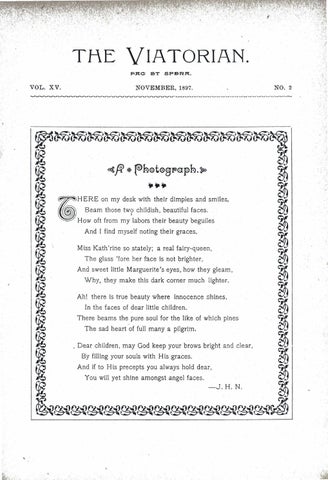
iHERE
* {®l=letegp®ap>fu. ~·
......
on my desk With their dimples and smiles,
Beam those two childish , beautiful faces. 0
.
.
How oft from my labors their beauty beguiles And I find myself noting their graces. Miss Kath 'rine so stately; a real fairy-queen, The glass 'fore her face is not brighter , And sweet little Marguerite ' s eyes, how they gleam , Why, they make this dark corner much lighter. Ah! there is true beauty where innocence shines ,
In the faces of dear little children. There beams the pure soul for the like of which pines The sad heart of full many a pilgrim. . Dear children , may God keep your brows bright and clear, By filling your souls with His ·graces. And if to His precepts you always hold dear, You will yet shine amongst angel faces. - J . H.N .
~ ~ ~ ~ ~ ~ ~ ~ ~ ~ ~ ~ ~ ~ ~
'·
"!•
~~f9J~~~~~~~~~~~~
'
·)~ !
:"''
RICHARD H. "I see some sparkles of a better hope Which elder. days mayhappily bring forth. ',
In reviewing Shakespeare's dramas we are deeply impressed by the varying fortunes, the terrible and sudden contrasts, t.h e passions, ambition, the pompous displ1;1y of power, and finally by the utter degradation that follows the ruin of ma.py, perhaps of all, of his g.r eat creations. Of none is this truer than of Richard II. The character of Richard has been various! y estimated; We are often told that he was cruel, avaricious·· that he was a sensual tyrant, !lis repression of the rebellion · headed by W~t Tyler gave cause on the part of the barons to complain; the conquered rarelyac~ept d·e feat with acclamations of joy. On the other hand, Richard, il1l the fl.usb: .. of victory, may have needlessly used the power of the victor to crush out the rebels rather than. rebellion itself, but he :m.o doubt thought it . well to kill, once fqr all, the ·spirit of an.archy which permeated the nobility, The firmness which he opposed himself t'b lawlessness must ever recommend him to the law 1;1biding, . must .ever · gain the approbation of those who prefer reason to physical force in the solution of existing evils. However, it is a lamentable fact that subsequent acts did riot bear ot1t the high promise of justice and kingly dignity this one act seemed to give credit for. He was rather weak and effeminate, the victim of intriguing favorites . His love of display, his eagerness to . be great and grand, not
by mental superiority, but by m,eans purely extrinsic, were qualities not · likely to win a people, the barons in particular, who were then smarting under defeat. So to give the period the attentio11 it deserves one must needs study the nobility as well as the king, If a prince devoted to pleasure is a scourge to his people, a haughty, overbearing aristocracy is a plague still mere to be dreaded, since instead of one, the number of tyrantsis multiplied, a,n d there are only too rp.any examples of men railing against the abuse of authority, while insanely ambitious ,to pos.sess it, and who, when they did succeed,. made tlie ,;world trer.nble at their abuse of powrr· Shakespeare's chronicle takes in but two ye~rs of the life of Richard. But though brief Js the space, .the all penetrating genius of the author thoroughly sifts the. character of his subject and we know the rp.an well; and though his early ·years. were filled with ,f ailings we can not admire, .Richard's downfall, and the pathetic circumst·a nces which surrounded it, must appeal to oursym. patb:y, and in spite of ourselves we . feel an admiration for the man who can thus ~almly meet de.feat-. who can enter f&lly into his humiliation and ac· cept the inevitable with the fortitude of a martyr. There is an ar.t in the painting of such a character that, like all true art, is irresistible. There is a lesson in it, too, that comes not from the achievemerits of the statesmen or soldier; ev,e n the grandeur achieved by the sublime Shakespeare himself is a trifle . ... -·'
'.
'
-
THE VIATORIAN.
to·
~· ' ; ...
I
'
·J·
,· ..
,,.,
.I
:·;i
~compared tbe s~ccess of a. mali who and martyrs; with the apostles of .. could thus lay down. the, sceptre of Christ and th,e prbphets of God? power-·.throw off the trappings of Who 's hall say that with these he is royalty, and step from regal paths to ' alone? Who shall say that when sorlife's byways,. where the eommonest . rowful he is without consolers, that herdsman . must sneer at a cr.o wnless when joyful he is without partakers of king, no.r the merciless victor reach his joy, that in his desires for informa. out to save a wretch too powerless to tion he is without teachers ~ that in attempt his own salvation.1 · · trials and perplexities he is without Such is the character, the immortal spiritual advisers? No, he is .n ot bard has given 'us in his Richard 'II, alone. If he has · books and learned whose fall prom.p ted him thus to say: how to read them properly, he always h~s good and true friends about him. ''For within the hallowed crown, Is he fatigued with the labors of his That rounds the mortal temples of a king, Keeps death his court; and there the antic ·· vocation? They will refresh him with sits, · , their pleasant conversation. They ScQffi.n,g his state, and grinning at his pomp." will sing to him care-dispelling meloD. H. dies. Has he met with coldness and mdifference in the world? Their welcome is always kind and warm. Has he suffered injury? They will teach ON THE USE OF BOOKS. him how to bear it. Has he himself i What excellent instructors, what been erring from the right way? They sympathizing companions, what honest will faithfully admonish and gently friends, are books I How can a man be reclaim him. Has he been hurt or is solitary when these and nature are he in danger of being hurt, not by the with him and around him? How can rudeness and Ul treatment, but by the . it be said of him that he is without so- flattery and indulgence of the _w orld? ciety, even though no being of flesh Then how happy will it be for him in ap.d blood be near him, when he can hours of re.tire1nent from outer parade sit down in his closet with the best and glare and excitement if he and brightest minds that ever dwelt can call a council around him who will and beamed in residences of clay; with speak plain truths of his humanity the. master-spirits of all time; with the without disguise or equivocation, and SO\llS of the mighty living and the check and sober him without fear on mighty dead, the dead who yet live; their part or offence on his. Has witQ. ancient and . modern law-givers, death taken away some one who was philosophers, and bards; with moralists very dear to his heart and delightful and satirists; with civilians and di- to his eyes?. They will show him the vines; with navigators and travelers; path which the departed soul has with 'the explorers of nature and the travelled and teach him how to pursue professors of art; with patriots, saints, ~he same. Does age come silently on
'··. ·' ,;
.
,..
', ,_;. .)
· ·t
'
·,.
24
i
'
THE VIATORIAN.
him and draw the invisible but lrresistible meshes of its net clo·s er around him, shortening his walks, and entangling and tying up his powers till he is brought in and confined within his own doors? He is there among his old friends who, as they will be more than e~er necessary to his comfort will be more than ever valuable to him, making him forget th:;tt. he is a priso11er and causing him to wear his bonds easily and lightly till the summons is sent for his release. How much better it is for a man t.o secure such friends for his intimates than to neglect all opportunities of cultivating their intimacy, till he finds, as time after time he comes in from the streets and public places and turns and shuts his door, that he enter.s an empty house-so utterly, drearily empty, perhaps, that its vacal1lt gloominess drives him out l;l.gain i'nto the haunts of . dissipation and folly or the highways of excess and crime. How much better it is for him ·to occupy his solitary hb'9-rs in the acquisition of useful knowledge than to dream ·them away in b .ro~en thoughts and idle ·fancies, or doze them off in stupid inanity. How much better it is · to be perpetually filling his mind ·with the well arranged stores of other · minds than .to let ,it lie unfurnished . and unimproved, till d u,st and dampness collect and settle in it and birds 'o f night and ill omen make it their chosen habitation. I do not say that a man ought not to think and meditate as well as read, a:t:ld commune in his . chamber with his own heart as well as with others. He should do both.'
He sbould read, that he may . think with advan.tage, a:pd have mater:ials for thought; and he should think, that he may read with discrimination and profit. His JDeditations will very likely be unconnected and partial and end in prejudiced conclusions if they are not guided, filled up, and corrected by judicious and liberal reading. If be does not wish, therefore, that . his solitary hours should be unprofitable, l.e t him employ them in the ·perusal of good books. Books are n®t only the friends of individual solitude, but also of the .family ci tcle. They eon tribute to bind it together., to fill up deficiencies, to cover up flaws, to make it closer and brighter and firmer .. By engaging the thoughts, improving the taste, and exciting the kindly feelings of the members of the hoHsebold, they render each one more considerate and gentle and more useful . and agreeable t.o the rest. They insensibly introduce mental grace and refinement, and improve manners, wherever they becom~ favorites. Show us a family in which the best and purest authors are loyed and read, .and it matters not what be their r.ank in society or what their daily avocations. I will answer for them that vulgarity and coarseness have· no place at their meetings, and that domestic peace is a dweller among them. Books are indeed promoters apd preservers of harmony. They occupy the time .which might have furnished opportunity for discord; and they often, no doubt, soothe passions and calm excited feelings or give them a beneficial direction. A tender passage of poetry or ~n affecting inci-
., ~·
..
~
'·
1'z i•~
'
'n
.~
~-·;' ·
I.
.-
.
~'.
.
.
I
Tlj[E VIATORIA.N.
dent Or Scene in pros:e _~ay bring_hearts together in cordial amity which from som~ trifling cause are beginning to be estranged, and tune to perfect uni- · . son and sympathy, nerves which have been trem.bling on the verge of open · r~pture.
The domestic services, which books are qualified to perform, are particularly valuable when the business and bust~e of daylight are over and the active interests of life are hushed into slumber under the brooding wings of night. The master of the house comes home from his otlice, counting-room, or work-shop; the children come home from school or placeE\ of employment; the mother's household duties are done ,. -· and they sit down together. What shall theydo with the impending hours to keep them from hanging heavily? We suppose that there are . some families in town and country who find, if there is no place of public am usement to offer its attracts, or nothing particulady interesting to discuss in the events of the day or the character or fortunes of their neighbors, that the long winter evenings are apt to mov~ off rather slowly and wearily. This would not be so if they would call to their assistance one or two of the friends we have been recommending. How much more swiftly and pleasantly, not to say profitably, the hours would then glide away. The darkness rn,ight gather murkily and the storm beat fiercely without, and they who sit within, listening to the arguments, the facts, the fiction, or the minstrelsy of some favorite writer, would scarcely heed or hear the terrors of old night. -
~
...
..r :.
t
:25
It may be that t\ley ·would be brought to such a pHch of satisfaction and contentment as not great!y to envy their acquaintances whom they know to be dancing or dressing for the dance, or perhaps seeing Shakspeare's heroes and heroines, and even ·Shakspeare himself, murdered .at the theater. T.
• :PRAISE AND FLATTERY.
Flattery understood in its full meaning is sought by Rb one. Nor does a man wish to be considered a flatterer. · Flattery ·pure and simple is an in- . · · sult to an intelligent person and .of course is genuine burlesqueing whan practiced on a witless individual. It requires great skill to praise even deservedly and here if any where is it particularly true to say that "t~er~ · is but a step from the sublime to the ridiculous.,·, But most men are quite susceptible of flattery and if they object to ,that you give them it is because the dose was too large; the pill lacked the necessary coating t <Mmake it palatable. Flattery is excessive praise. Praise, however, is .certainly duet~ many for their meritorious works or . for their good intentions. In an effort to e:p.courage good wherever found, we .do the next best thing after the good itself viz. , we try to spread it abroad for the help of others. Due and proper praise is founded on this solid basis, hence is very commendable. Flattery seeks to praise good where it does not exist or, worse still, tries to
..·
·y
.'l
i ~-
. I
TRill VIATORIAN . .
26
J.'
maJre some one's bad deeds appear a condition of things as little desirgood-r--and either end it endeavors to able as it is sad to look upon. An effect from selfi~h motives, which best 'epidemic of this slavish, originality. explains its raison d' etre. killing imitation is known as a "fad," There are indeed many well-meaning and if there be any one thing more people, who in their efforts to praise conspicuously present than another, it sincerely, seem veritable flatterers. is the said "fad." We must know the intentions of men But if there be an abuse of a thing before we attempt to classify them. so worthy as praise. and the abuse ¡ we know, • There are those who so appreciate the exists, and is called flatterygood t~eir neighbors do, that they too, that the desire of being praised, ¡ must needs comment on it, and from proper enough in itself, is greatly at the abundance of their good nature and fault. There are, indeed, some few who well-wishing give full scope to . their . solicit it directly, but of course the admiration, which if we were to judge greater number have hot the naivete from tb e abrupt and crude expression to work thus childishly. Still,. to use of it and the frequency of their at- a slang expression, ''they get there tempts to praise, we would regard just the same." Did you ever notice that he gets them as the most confirmed of flatterers. most photographs, who takes most We might consider flattery as direct pains to display them? And why and indirect. The direct is tha.t which shouldn't he? Does the worthy and is hurled at us by the well-meaning, or tasteful man display pictures because that which sycophants or designing they are a fright? By no means. We men use in order to draw us into conclude that if he likes another's pictheir snares. Of this, enough. The ture he must certainly prefer ours. other s<;>rt is that which accrues to us We do; why should he not? If this be through the imitation of our doings or so, is not this the most delicate appeal sayings, etc. Imitation, we are told, for flattery? Very harmless, you say. is the sincerest form <of flattery, and Very, indeed, but worthy of remark, I think n.o one would question the when one wishes to consider this most saying. attractive subject. Here, again, in this imitation we dis. Thus it comes, that the desire of good, cover two classes, though there may well-intentioned men, to assist and be many others. These are: first, the comfort their fellow-beings leads them ones who, after intelligent study, seek to do so by well-directed praise, which, to imitate the best in a man or his if they forget, they are. promptly reworks, and do this not slavishly, but minded of by the forgotten, owing to by assimilation-by making another's that latent desire of notice so strorig their own, naturally. The others sim- in human nature, perhaps more yearnply paste on these acquirements; they ing in its way than the desire to praise. grow by accretion, not by expansion, So, after all, flatitery, base though it ~
i
THE VIATORIAN.
be, i.s but an abuse ·or exaggeration of what almost every one likes and under I some pretext seeks to gain. R-.
' NIAGARA'S GORGE.
i;.:· t
rp•.
On a chilly November morning I proposed to a few friends that we visit the water's edge in the gorge of the famous Niagara river. This was before the electric rail way (construct.e d in 1895 along the foot of the almost perpendicular bank of the river on the American side) facilitated traveling. Through that rugged, inspiring, and famous, though ' heretofore untried passage, which winds with the water's dashing course, the little band were to attemp1; a scramble. After a brisk walk of about fifteen minutes, during which time we spoke of possible encounters with reptiles, we came to a ravine. This sloping space is formed by a cleft in the bed of rock; a st~ep passage winds its way amid crumbling . stone and . brushwood1to the rushmg water. A short walk brought us to a most interesting scene, the "Devil's Hole." This place has become famous on account of the great massacre which took place there in 1813, when a band of Indians led the New York militia into ambush. Those that were not slain were hurled over this precipice, and their bodies found a resting place below. The disaster gave to the ravine the name of "Bloody Run." After examining all the important points connected with the Devil's Hole,
.
'
'
I
27
we pushed ahead to the rocky shore of the river. The river at this point has lost much of its fury in the rapids, through which the waters have passed a short distance ~bove. The scene was indeed inspiring, for the waters, running the gauntlet of the rapids, · roared with a voice of thunder. Our party now formed in single file, for the way w'a s narrow and obstructed. Sometimes we advanced by jumping from rock to rock, again the headway was made by clinging to the roots of venerable trees and swinging along the steep bank until a suitable place for footing was obtained. At length the rapids were reached, where we rested and enjoyed to satiety the magnificent prospect. Above the rapids the river appeared to sett~e to a steady calmness, as if preparing for a desperate rush; then with renewed vigor it leaped and ·struggled in this furious passage. Passing time interrupted the deep and s.olemn thought awakened by the sight. Filled with the feeling of insignificance :which comes over man when brought face to face with nature's scenes of might and power; we slowly moved along the swiftly running water. After walking for about fifteen . minutes we came to a level bed of rock, and here we agreed to rest, for the journey began to be fatiguing. While resting, our attention was attracted .. by the , towering bluff.on the opposite side of the river. Decked with the various shades of the faded November leaves , it presented a scene of exquisite beauty. As the whirlpool is approached, the keen-eyed sea gulls
·'f
.~
THE VIATORIAN.
2S
·•
'
hover in countless numbers between the walls of the gorge; swinging about in undulating motion, they added va. riety to the splendor of the scene. Now they rise heavenward, again ' they are skimming the crest of th~ waves, whence they snatch an unwary fish, playing in the mysterious pool. Again we proceeded on our travels and having gone about one hu_n dred feet we arrived at the whirlpool where the course of the rushing water. forms an ~rm in the river at right ~ngles. ·· The mind of man can but wonder at the sublimity of this scene. We all sat on the rocks enwrapped in contemplation. It is a scene of awful disorder; confusion reigns supreme. Curr~nts stop short and retur.p. in their cour$e; opposite currents are flowing side. by side; rocks ~ppear in the midcUe of the river, the water heaves high above their crowns; there is seen a circling of water gradually lnarrowing down to the vortex:. We could explain the cause of the mystic sight ·only from supposition, as many thous. ands do, who visit this s·p ot .so favored by nature. One of our companions intending to show the power of the roaring stream, threw a very heavy iog in, and immediately one current caught it and twis,ted ' it several times and then tossed it to the other current which immediately sent it to the bottom where it stayed. Aft~r this .experiment, and ~fter .e.n joying to the utmost the ·enchanting scenes afforded by the beautiful banks, and by . the celebrated rapids and whirlpool: -w·e could not but feel the
l'.j
.
\;;~b;,;;;:"'·' . ' ,, > '
:
· influence of this mighty power, and we felt that we were bettered by coming in to the presence of this s'!blime out-, burst of nature's forces. It is in lonely wanderings through solitary haunts that the mind drinks deep draughts of inspiration and be- _· · comes intensely sensjble of the majesty of nature. Who doubts that our im, agination was kindled into reverie and rapture? What images and ideas of . the grand were breaking upon our . minds? A deep solemnity fE:>ll on our little party as we wended our way home-· · ward. These lofty, soul filling scenes we viewed carried us above our sur·roundings. The imagin~tion glowed .: ;;,.ith more then wonted fervor, our. hearts beat quickly under inspiration of nature's ennobling power, though the force of our impr.essions lay too . deep for words. W. T.W.
.
.
It is a sad w~akness in us, after all, that the thpught of a man's death hal.lows him anew to us·; as if life were not sacred too,-as if it were comparatively a light thing to fail in love and reverence to the' brother who has to climb the whole toilsome steep with us, an:d all our tenderness was due to the one who is spared that hard journey. -George Eliot. Oh! if the world could only stop long enough for one generation of mothei:;s to be made all right, what a millennium could be made in thirty years !-Helen Hunt Jackson.
: i·
: '
·~
.29
The past month saw the departure from life;s conflict of two -of o'llr most talked about men, Cha~les A. Dana, Publisheq. monthly for the stud:.e:m.ts by the editor of the New York Su~, and Pantagraph Printing and Stationery 00., Bloomtngton, Il~. George M. Pul.lman; of palace .mtr · Edited. by. the students of St. Viateur's Col: lege,.B ou.rbonnais G:rove, iH. All cor:resp<;>ndence fame. Th·ese rn'en were represen ta-tive:s must be addr.essed: THE VIAT6RIAN· Bourbonnais, ItL · ' · . of their class. They gained whatever . . Entered' at tlle Bloomington P0stoffice as second class matter. . ~ they possessed by their own efforts, S?bscr1:ptiof1 price, one dollar per year, payable m advance. ·· ·and at the cost of earnest and persevering labor. BOARD OF EDITORS. The former won: a most enviable J. I. GRANGER 1 P. F. DANIHER,. P. W . HA'NsL. P. DUBE. position in journalism, being ~ithout, D. liy\YDN. M . .J, BRENNAN ' doubt the greatest editor that America or perh,aps ·any country, has produced. EDITORIAL. A man of sound judgment and broad scholarship, he was an authority on N ovem her marks the · end of th.e ·. whatever :pertained to the newspaper yeq.r's beauties and the beginning of -and one whose word would be well it!:! d,reariest period. Fittingly the reeeived on. almost any subject. The church sets it apart as a month other won distinction. by his successful wherein to corrimemorate. its de-ad, · efforts to extend luxury to travel, and since it speaks so loudly ·of death, and succeeded to that degree that his name from the decay and decline of nature' is as world-wide as his invention. Mr. would draw us to a consideration of Dana's name will be an inspiration .to our own end. so speedily approaching. · thousands in one field of .m odern literature-because true intellectuality is lt is not a high testimony to man's an ~.ternal inspiration. Mr. Pullman gratitude that disaster should visit only won the distinction tlitat has. ac- . him in order to call him to a sense of crued to · hundreds of our hardes-t h~s duty. Yet how true it is, ar;1d how worked, most severely ,tried and soon-: soon would w·e forget our absent ones, est Jorgotten then-he gained wealth ~ere death not : brought thus vividly and died rich.· · before our minds by nature's phenomena. There is no mistaking the fact that the thou~ht of our own end in.All feast days, whether local' or naspires us to remember and intercede tional, are in a measure epoch-making for our departed friends. What a events. The g r eat feast day of this consolation to know that we can reaily institution, viz. , St. Viateur's Day, do so and that such remembrances and which has just passed, was in every intercession shall be fruitful alike to way a memorable event. The coming · those for whom we pray and to our- of many of the old alumni, and the prom in en t part some -of them took in selves who do the praying.
THE VIATORIAN.
.
I
.' I <,,-'• •'·
\J
. ·· ..,
.
i
'
.,
,.·:·
,
. !
TRE VIATORIAN.
..
the d~y's celebration, were an inspiraHe gave promise of success· in his . tion to younger students, who heard college course, and his death cut short and saw much to interest them. One what would no doubt have been a very likes to see and know those who once useful life. filled the s-ame halls and followed the , We tender our heartfelt sympathy same tasks and the .s ame conditions as to his affiicted family in this sad hour, praying that He · who watches and himself. The games and special features that notes the · sparrow's fall may not be went to make up the day's program insensible to .t he grief of this bereaved were very attractive, and the number · family, but may gl.ve them strength of visitors· was considerably larger than to bear up under the painful ordeal through which they are now .p assing. . it has been for several years. Altogether, it was.a day to be remembered by those ~ho 'Came to visit, as well as by the students, who spent a MAGA:Z:INES. few happy hours in the company of our welcome guests. While looking over the magazines for October, we were asked why it was we never "cut 'em up." Well, in truth we prefer to ignore the magaOBITUARY. zines and articles that are displeasing, On the evening of Thursday, Octo- and feel thaVwe confer a greater benber 21, the feast of St. Viateur, our efit by calling the attention of our patronal saint, when the purple readers to good and healthy articles shadows · were cr:eeping over the earth with which they may pass a pleasant and a day otherwise so happy was hour and profit thereby. It is pleasdrawing to its close, death crossed the ing to our friends, and it certainly is threshold of our college home and more delightful for us than ·to call atclaimed as his victim James Ed ward tention to unwor.thy compositions. McNamara, who had entered college We must sometimes defend truth when it is jeopardized, but as a rule we preonly last September. The cause of his death . was spinal . fer to look over a fault and attend to meningitis, and his illness lasted only the growth of beauty. a few days. No one thought until McClure's for October is full of good late Thursday that his s~ckness would fiction, not the least of which is "Flanassume so serious · a turn. agan and His Shott Filibu~-tering AdJames, or ''Eddie," as he was fa- venture," by Stephen Crane, but it miiiarly called, was a favorite • with will be a long time before the magaall.. Of a niild and jovial disposition, zine will give to its readers a story he took trouble lig~tly and enjoyed that will surpass the "St . . Ives'' of the humor of a situation very thor- .Robert Louis Stevenson. oughly. In Donahoe's .llagazine there is an
.
I
j
~- ~ ·
;·~;l
~~d~>'\';
·...~' ~- :.
' '~,· ·,
' . ':)r:i .~ .. ,
TilE VIATORIAN. ·
31
Seldom has i_t been our lot to take · · article by M. S. McGuirk, on church music and its defects, which mus·t at- in hand a moFe interesting magazine tract the att~nt.ion of all read~rs mu- than 'the Catholic World for October. sically inclined. Many of us learn for Its articles are all of them good, and the fi;bst time, and with sorrow, that its illustrations lll:ost befitting. "Un some of the ch-urch's most sa.c red Pretre Manque" by Fr. Sheehan, is a hymp.s are set to the music of operas gem; "APhaseof Parisian Socialism," that certainly breathe no religio_us intensely interesting, while Lelia Harspirit; Let us hope such evils are not din Buggs', ''The Art of Lying" is far spread. We have been in churches such a fine breezy composition that wbere the ''Tan tum E .r go" was sung we will be ever on the lookout for any,to the music of an opera, but could find thing by that gifted author. no fault, as that p~rticular part of the The Century, as usual, stands in the work was written for a chorus of pilfront rank of instructive periodicals, grims to a holy shrine, and the comand its October number has some poser ,. expressed the idea very well. powerfully interesting papers. Among We h~ve heard,. also, the female others, one by Anna , L. Bicknell, envoice soar -aloft in such sweet .supplititled ''Marie-Antoinette as Dauphcation, that we cannot agree to let the irie," is very instructive as well as male voice monpolize this great priv~ attractive. elege. Oft has the image of a Cecelia The features of the Catholic Reading or ap. Agnes come to our mind when a Circle Review are: "The Development clea~ soprano voice rang out in heavenly strain. The good temptation . of Greek Literature;" "The Mission of would come to join with the saint in the Lay Catholic;" "Constitutional hymns of praise and we left the church Guard of Louis XVI;" "Richard Whiting, the Last Abpott of Glastonfeeling purer and better. bury." There begins this month what Phe Rosary Magazine for October will no doubt prove interesting arid inhas some interesting articles, notably structive contributions. These are one on the ''0athac o St. Colomba " papers on ''English Literature," by The ''0athac" is a ~ranslation of the Thomas O'Hagan, M.A., Ph.D., a Vulgate of St. Jerome by Oolomba. young man anxious to push himself It is called Cathac from ''Oath," a into pub!ic notice; and contributions ''battle," the same having been fought .on ''The Painting or Mur~l Art of the by ancient· Irish clans for the posses- Roman Catacombs," by Miss Eliza sion of the copy. 'T here is also a ' Allen Starr, who needs no introducbeautiful poem by Eleanor C. Don- tion to the public, and whose artistic nelly, and an article by Fr. Azzopardi skill and taste has made her an au0. P., entitled "The Rosary and the thority on all that pertains to art, Holy Land," which is overflowing with ancient or modern. The readers will charity and devotion. certainly have a treat in these studies I
;..· ~·.
L
i
,.i ·
·~1-:~~!~:::)\,!~_:.~:~~·_-.,. .. ' '~.l . ,·~.:~
ij
TilE' VIA'TORIAN.
32
which will, in all probability, run the greater part of the year. Ind~ed, it 111ay be said that this excellent monthly iE; doing more for its readers than most of the pompous, flashy magazines who parade before the public with great blare of trumpets. We heartily' wish . that all our young people had access to the Review. J. H. N . .
ST. VIATEUR'S DAY.
Many prominent clergy from the Chicago and Peoria diocese, together with a large number of former students, assembled at the coHege October 20 and 21, as the guests of the faculty, to celebrate our Batron's feast day, to renew their allegiance to, and to show their love for their alma ma.ter. The guests and many townspeople from . Kankakee, gathered in the ·col. lege hall at eight o'clock to witness the play, Richard II, put on theboards by the College Thespians. The following is the cast o£· characters:
.
J .' H. Nawn Kin.g Richard II, J. St. Cerny · Duke of York, E. j, Logan Dllke of Lancaster, Henry ;Bolingbro. ke, I c. J. Quine Afterwards Henry IV, f Duke of Autnerle, A. L'Ecuyer Duke of Norfolk, P. F. Daniher , Earl of Salisbury, - Joseph Legris Earl of Nortpumberl.and, - H. P. Rainey Henry Percy, .P. W. Hansl Arthur of Gioste'r , - Arthur Hansl Lord Ross, ' Patrick Walsh Lord Willoughby, Philip Walsh Bishop of Carlisle. E. J. Brodmann Sir Pierce of Exton, T. A. Cahill Sit .Stephen Scroop, W. Rooney Sir John Busby, E. Henneberry Servant, D. Hayden
'l·;-
-e·
~ ~i:)iji~rL~>~.>. t<: ~;-~~1~.h ~ , ~ ·i; ~(~~&} r,),::.
..ll¥ · ~. ~;~-.c~-c·~_; \
-4·- :;;;.
•i-·-
~-
• '
MUSIC1
March,
:orchestra, SchlepegreJ~ Norma, Cornet Duet, Bel~ini Si J'etais Roi,. Orc:h estra, Adaim Ciarionet Solo, Le Pres ·Au x Clere, H . .Augarde
Mr. J. Nawn, as Richard II, Mr . Quille, p,s BoHnbroke, and Mr. Rainey·, as Earl of Northumberland, especially distinguished therhsel ves in their very difficult roles, their splendid renditions eliciting much applause from the apprE(cia ti ve audience. . October· 21, the feast day proper, dawned like a beautiful summer morn. The :field day's sports were started early, · and many tine records were made. In the sunshine of the glorious autumn day the spectacle of the various students . striving with a good-natur~d rivalry for supremacy was pleasing to look upon, and there was truly joy · and happiness in the scene . At 9 a. m. th.e bell called all to the chapeL _Solemn high mass was sung by Rev. J. Shannon, of St. Mark's Cllur0h, Peoria, Ill. Rev. Father Foster, of the Sacred Heart Church, Joliet, Ill., was deacon ; Rev. Father Suerth, of St. Paul's Church, Chicago, Ill., sub-deacon, and. Rev. Bergen, C. S. V., ma5ter of ceremonies. The choir, assisted by the orchestra, ren. dered Gounod's Mass in a truly artistic manner. · At the offertory Mr. Nawn and Father Rivard sang "0 'S alutaris," and at the communion Mrs. Bernard McDevitt, jr., of Chicago, sang. After the gospel Rev. F. O'Reilly, of St. Mary's Cathedral, Peoria, Ill., as orator of the day, spoke as follows: •
TRE VIATOR! AN.
memories of her poets, her philosoWe meet at our college home today phers, her statesmen, and her warriors. to honor a name dear to us all and to It calls the marble in to chiseled form recall, by. way of the return of the to perpetuate their names and make patronal feast of this institution, some them as living. Likewise into arch of the memories that cluster 'round and aisle, colonade and cupola, facade our alma mater. There are in the cal- and pediment, spire and vault, the arc hi teet brings the language of emo~ndar of saints, many names better tion, else lost; emotion vague, perhaps, known-names, in truth, whose very mention brings us back to the early but unmistakable, and we feel the beginnings of the nations. These great power of its concretion. Now, as the ones have a place secure; the church individual is more than the raiment, binds them as frontlets upon her brow. the saint, sturdy soldier of the cross, There are Patrick and Boniface and leaves behind him that which is more Clovis and Austin. There they are than name; his is an influence that beand there they will remain forever. comes, an abiding power to woo and As Sir Arthur Helps says of Cardinal win forever. Xi mines, ''They are ,like a city on the Witness the storv of our St. Viateur. margin of deep waters, such as Genoa, The little we know of him makes all the where no receding tide reveals any- more remarkable the fact that out from thing •that is mean, squalid, or unbe- the obscurity of an humble lector in the coming." They have influenced our cathedral of Lyons the fragrance of lives, but influenced them remotely; his life stole, as it were, from the byand so, without apology and with paths that humility showed him bow warmth of heart, we turn to him whose to tread, until now the high ways of name brought glad thoughts to our col- two continents attest the sweetness of lege days, brings them to our succes- the odor. The work of a quiet but posors in the .s chool-room, and was the tent kind done by him grew into his source of inspiration, sending disci- own life till far-off Egypt claimed him, ples to break here, soil whereupon ricb- a.nd whither his remains were laid. Like a stray flower from an upland 1 est harvest came to reward their brave nook unexpectedly filling the air with pioneering. The joy then that comes of the 21st its fragrance, his humble life, a half of October is ample and generous in century, came into the lives of a few its scope. We have marked it one of souls, who yearned to do similar work, the ruby calendar days of · the year, and so, banding themselves together, for it reC'.alls the struggles, and slips as they began, and God bas blessed their wel1, that came in our climbing'up the resolutions. Succeeding, their success bill whereupon was perched a diploma gave them consciousness of greater and a commission to go forth. Our . power and made them yearn for still successors on the benches may like- other lands to conquer, and so what wise find fullest joy in being permitted more natural than that they should to turn aside from their usual occupa- turn wistful eyes to a land where many tions; for the keeping of the day in of their fellow-countrymen bad made special remembrance, is in itself an imperishable names-the land of educationa:l influence. It is in harmony Cartier and Champlain? And then, as with the best instincts of the human westward the star of empire· took its heart not willingly to let perish the way, the memory of the daring of the memory of illustrious names. pioneers of the order in Canada lay The world clings tenaciously to the like a rich heirloom on the yon side of FATHER O'REILLY'S DISCOURSE.
(.
:~
..
·,
·-·-·
··'
.. ~ ·'
THE VIATORI.A:N.
34
the Lawrence. What more natural than that generous souls desired to come along the footprints of early Canadian settlers and finally settle here and reach out for the instruction of the youth of t.h e great ·central west? At that time the possibilities of this most fruitful portion of America was not foreseen, except by hearts whose faith told them what eyes and ears refused as yet to confirm. The beginning here was like most early beginnings, not the Cripple Creek of a night, but i~J, remoteness of success almost a slough of despond. ·Those of us whose memories reach 'back somewhat into the first days of this institution may pick therefrom two names synonomous with the struggles and fears that come of all great undertakings. !irhey have long since been gathered to thei:r · fathers. The one sleeps iQ. your neighboring cemetery, the other rests in Canadian soil; and not mo·r e sweetly run the rippling waters of the great St. Lawrence by his grave than out from it today comes to many of us the harmonious setting of all his life. You anticipate me, and I need but mention Brother Bern.ard and Father Roy. Of those who are still living and consecrating all their thoughts and energ.ies to a fuller de.velopmen t of .the college, reasons of propriety suggest that 1 say nothing. At the return of a day such as this we are made to feel the past, to measur~ the present, to read progress · in the future. We are all strengthened by the thought of what others have done. Grea.t ness consists in doi.ng bravely and well what our surroundings require of us. Those acting otherwise become only dreamers, making void their own lives and encouraging no one. Educators are the rulers of mankind, kings worthy of the highest homage. .T hey have the destinies of our people within their keeping. Doubly
. I,
do they th(m the work when the soul with its longings for happiness is not left to d,warf, to droop, and die. ''l would rather" in the words of an illusM trio us writer, · ' 'be the author of the tritest homily or the boldest poeii), that inculcated that imperishable essence of the soul than the founder of the subtlest school, or the framer of the loftiest verse that robbed my fellowmen of their faith in a spirit that eludes the dissecting knife-in a being that escapes the grave-digger." It will perhaps be not taken as an impertinence by the junior members of this community, if 1 say to them that this day comes with lessons of . renewed consecration to you. Our country is still young and withal that now and then arises to check our enthusiasm at some of the tenQ.encies which forget men and remember money we yet know a boundless future lies before her. Out off by nature's high provision from external enemies, we cannot but feel that the rich yielding of our boundless .prairies are the equally wise dispensation of Providence, that vntold millions will yet dwell here in plenty, and Americ~ become the ripest f:ruit of man's yearning fo:r all the ages. You are then . to become part of this great civilization and in your hands will be given over the keeping of this institution, whose foundation was a struggle but a great faith. The~ pioneers command our emulation the more as they worked their way to success-they were not born above the snow-line. Wh~n a man climbs a mountain his pathway lies first through pleasant meadowE;, later through cserious woods, later through the lonely bare spaces, and last through the cold wastes where the snow touches heaven. The young men who have sought this fair haunt to woo the muses and win the equipment that makes life larger and fuller may like-
,
./'
,.,. ,~'~!:;,;,· ,_.; :,.,·· ;~..~-ob!&a;,4·_.. t;,;;~>,..: ' ,:;.:,'.....-'-'...... . ....,;.;...;.'-'---"~ · . --~. . ;.:. :L' -~- ' :.:..:.:
,
'
.THE VIA'l;'ORIAN.
I
'/ :;
'
wise ' read ill the return of the day the sto.ry of c~nsecrated energy, the OBly pathway along which lies success. We who have been your predecessors come back today to greet you as our friends aud to say that your success will not 011ly honor· this institution but be an occasion pf Joy to us at an times. And as many streams finally converge into a great river, itself emptying into the ocean; and as many roads finally open into a great breathing place in a large · c.ity, and as many so:qnds eaqh in itself elemental finally unite ap.d become a great symphony, so do all these memories today, converge, and fill us with thoug,hts of unmixed joy and as our Saint has thl.].S far, kept watchful eye over us, surel:y" he still will lead us on. At the conclusion of' the mass, the visitors were accorded the freedom of the grounds and college. Many col. lected on the campus to watch the fieLd exercises, while others visited the places fraught with memories of their school days, and recalling their experience as students took great pleasure therein. At 12 m. all .sat down to a banquet in the college refectory. After the last course had been served Rev. Father Marsile arose, and in his usual winning and happy way, extended a most courteous welcome to all the guests; he then called upon Honorable Judge Mahoney, of Chica~o, for a few words. The honorable gentleman, in a very witty speech, which was interrupted several times by the applause of the stud·en~s and visitors, advised the boys to take advantage of the many opportunities offered them, say. ing that though it is a common opinion that all the professions in life were overcrowded, there was still plenty of
,•\ "-<:
1h
'
35
room for first-class men on the" top floor. The judge made himself a great favorite with the students on account of his highly interesting address. At 2 p·. m. the. college battalion gave a dress parade before a very large crowd. The Ford exhibition squad, commanded by Col..T. A. Cahill, executed many fancy and difficult movements with a grace and preCision that drew forth great applause. The juvenile Oolumbran Guards were given a hearty reception, their sword drill was one of the enjoyable fea~ures of the day. After the drills the visitors watched the foot-ball g,a me ·on the campus, and at its conclusion departed for their respective homes. · Thus passed St. Viateur's Day of '97, and all expressed the opmion that in the annuls of the college celebrations none has ever been held more successful or enjoyable. M. P. S.
PERSONAL.
Rev. M. A. Dooling, Clinton, Ill., paid the college a plell,sant visit recently. , ·Mr. F. Donohoe, Conception, Mo., visited his brothe:r; Timothy, of thesenior department, during the month. Rev. T. Dugast, C. S. V., of St. Viateur's church, Irving Park, Chicago, spent a day at the college last month. Mr. W. H. Donovan has our sympathies in the 16ss of his brother, J. P._ Donovan, of New York City, who died at the home of his narents. ..
;'r.:·.
I
36
:•..~
THE VIATORIAN.
Mr. J. O'Dwyre, '97, writes from cago, IlL ; Kishen, Omaha; Mesdames. the Wesleyan at Bloomington, Ill., that Armstrong, Hildreth, Dwye;r) McDevhe is actively engaged in foot-ball; . itt, McCormick, Murphy, Kreuger, etc., and has the scars to prove it. Prost, Chicago, Ill.; Kishen, Omaho, Nebr.; Misses Hudson, Fovey, DaniMr. Henry Hildreth, '97, is nowpurher, Schofield, Quille, of Chicago; stiing a course of law at Yale, and FitzgeraJd and Clune, Indianapolis, enjoys the distinction of being the . Ind. youngest student.ever admitted to the -The faculty and a few visitors were law department of that institution. · We wish our old friend. the greatest ·pleasantly entertained recently by the philosophy class. The features of the success. .\ Rev. J. J. <?'Callaghan has returned · program was a discourse on philosophy to Omaha, N (3b., and assumed charge by. Mr. C. J. Quille, whose presentaof St. Cecilia's parish, a flourishing tion of the su.b ject whether viewed congregation. of that city. We con- oratorically or in a literary way, was • gratulate the young priest' on his pro- very effective. A few strong ready\ moticm and the people qf St. Cecelia's . made objections were thrown at ''Philosophy's" ·stronghold, but they fell on their good fortune. 1 off as harmlessty as though Mr. Quille Miss Liilian Moody spent a few hours were dressed in the new 'bullet-proof a.t the college one day last month, re- cloth. The program was brought to newing old acquaintance. She re- a clqs.e by Father Marsile, who in his turned to Chicago with her brother elegant and eloquent way said some Francis A., who favored us ' with a . ~ery beatttiful things about philosophy .longer ,s tay. while . reviewing the speech on that - - The Rev. J. Marsile, C.S. V., went subject . . It is the intention of Dr. Rivard to to Cli~ton, Ill., last week, where he assis'ted Rev. M.. A ... Dooling in the de .. have one of the "philosophical nights" frequently. We trust that they will votion of the ''Forty Hours." all be as bright as this first one . .~-Among the visitors present on St. - . The "Cecil+ans;" a society com. V1atuer's Day, yve noticed Revs. C. P. posed of th ~ representative musicians Foster, Joliet, Ill.; F. J. McDevitt, J. Suerth, J . McGavick, Chicago; W. of the college have now in preparation Hackett, A. Granger, F. Sixt, F. Pois- a very fine musical program for St. sarrt, ·. Kankakee,. IlL; J. Shannon, F. Cecilia's Day, November 22. It will O'Reilly, P. H. Durkin, Peoria, Ill., consi$t chiefly of li1USical selections, J. Kelly, Gilman, Ill.; P. Parker, both vocal . and instrumental, and by Galva, Ill. ; · R. Paguet, Monroeville, way of emphasis there will be thrown Ind.; Messrs. Mahony, Hildreth, in a ''minstrel show"-one of the good Quille, McNamara, B. ·McDevitt, jr., old type, that grandpa used to patronCondon, Moody, Armstrong, Chi- IZe. Our talent are equally powerfu
. ,I
~~4~;~~·.\Hi,<·:, ..
''" ' ..i;./ ,
.:.·f
interpr~,t~rS
S;fua~espe~Pe
in unfolding the csharms of ''Brudder .Bones.''
3/S
Of
O't''
· -· . What with punching~ bags galore, and all other gy~nastic parapheruaHa, not ·t o speak of the ::esthetic, ' .'slugball,'' now played by aU hands, there is no end to the opporbu,nities qne has. to get strong. In fact, we are likely to be serious! y h.am pered by an over ;produotion of Sarns:o nian timber,' but let the good work go on. anytl:J.ing but dyspep$hi.
-We ar¢ looking forward with great e~pe~tancy to a treat from the · Rev. Q.. P. Foster, of Joliet, Ill., on November 22. Father Foster has promised to come on that date and de"' liver his beautiful and scholarly lecture on ''Dickens." Thoroughly informed on hi$ subject, a charming writer and powerful s~eaker, a discourse on this subject by Father Foster will be a feature of the year and a lesson that will not be easily forgotten. -The foot-ball team has made dates with the Yo~ng Men's Lyceurn of Chicago, and the representative team of St. Ignatius College, and we may expect two very lively games in 'the near future. - · Rev. E. L.; Rivard,C.S. V., D.D~, and Rev. J. F. Ryan, C.S.V., of the faculty, · assisted at -st. Patrick's church, Chicago, on recent Sundays. I
-The annual retreat for the collegiate department was begun October 30, and lasted thre.e days. · The sermons were preached by the priests of the house. At the close of the retreat
an tlile ,s t,u deut bocly approached the sac·r amen ts, a:n;d gave every evidence of the good spirit with which they entered into tne work. BOLL
OF HONOR.
The gold medal. awarded for goop cc>:hdu9t in the Senio~ department was equally deserved by : J. Armstrong, M. Brennan, W. Garey, J. Clennon., J. Q'Callaghan, W. Dopahue, P. Dufault, P. Dube, P. Gera'ghty, J. Granger, W .. Granger, D. Hayden, M. Hayden, E. Henneberry, L. Kroschowitz, A. Lamarre, J. Lacharite, A. Lecuyer,.. J . . · Murphy, W. Miner, M. Morrissey, J. McCoy, W. Northway, and H .. Perdue. Drawn by E. Henneberry . The gold medal a.warded for good co.nduct in the Junior department was equally deserved by: J. Boisvert, W. Brault, H. Marcotte, and L . Hivard. Drawn by L. Rivard. The Guilfoyle medal awarded for best composition in the Rhetoric classes was equally deserved by: M. Brennan, D. Hayden, and P. Geraghty. Drawn by M. Brennan. The Uon way medal awarded for excellence in the classical and commercial courses was equally deserved by: W. Brault, P. Geraghty, M. O'Toole, J. St. Cerny, J. Denault, and M. Miner. Drawn by W. Brault. Th~ gold medal awarded in the classical course wa.s equally deserved by : J; Armstrong, M. Brennan, L. Boisvert, T. Cahill, W. Cunningham, A. Hansl, W. Kreshen, A. Lecuyer, E. Marcotte, F. Milholland, A. Mongeau, D. Maher, C. McCoy, F . McPherson,
'' 38
..
,~ ~
,.
THE ViATORIAN,.
FOOT BALL. J. O'Callaghan, W. Rooney, V. Stepps, P. O'Connor, J. Stefaniteh, amd A. The Provisos of Kankakee were deStamphel. Drawn by F. Milholland. The first silver medal awarded in the feated by the second team of the colclassical course was equally deserved lege October 23 on the college campus by.A. Caron, P. Dufault, E. Graveline, by ·a score of 18 to 0. The game was too D. Hayden, M. Hayden, M. Lamarre, one-sided to be interesting. The team W. Riley, and L. Rivard. Drawn by playing of the co~lege boys w'a s particularly praiseworthy, their backs showed M. Hayden. · The second silver medal awarded in great judgment in their tackling, while the classical course was equally de- the line displayed unusual strength. served by A. Goudreau, T. Carson, R. Daniher at right half . back, Patton at Gahan, H. McGinty; P. O'Toole, and left end, St. Cerny and Carsen behind the line did great work, breaking H. Prost. Drawn by H. Prost. The gold medal awarded in the com- through their opponents interference mercial course was ~qually deserved and often tackling the runners with by W. Carey, W. Deneau, R. Fay, C. much loss. When they had possession Flannagan, A. Lamarre, W. McCor- of the ball it was an easy matter to break through the Proviso's line for a ~ick, R. Nugent, A. Roy, M. So ran, Daniher and A. Sana.sack. Drawn by M. Soran. ten or twenty yard run. The first silver medal awarded in made two touch-downs, Corson one the commercial course was equally de- and Goren one, from which Cahill served by J. L. Armstrong, A. Caron, kicked but one goal. The Kankakees J. Caroll, R. Hildreth, H. Lacharite, were never dangerous, never coming C. Meehan, E. Richard, S. Sullivan, . closer to the . college goal than the and F. Williamson. Drawn by R. forty-five yard line. The way they faced each other: Hildreth. PROVISOS. The second silver medal awa·r ded in ST.VI.A.TEURS JR. Rooney .......... right end .... .... ... Riley the commercia:! course was equally de- Patterson ....... right tackle ....... .. Jones served by H. Bouchard, J. Burke, E. Weber .......... right guard ..... Smolinski ......... center........ .. Brosseau Caroll, A. Changelon, · J. Clennqn, A. Sanosock Cahill. . ......... left guard .. .' ...... Turner Campion, J. Hogan, A. Lambert, J. Coren ........•.. left ta,ckle ........... Brais .........• left end ......... Sullivan Murphy, and J. Patton. Drawn by Patton House ...... , .. quarter back ......... Blaine J. Patton. Corson ......... . 1. h. back ....•.. Davenport Daniher ...... ... r. h. back., ..... .. ... Riley . The Lesage medal, a warded for pro- St. Cerny ....... :-full back ...... ..... South ficiency in French literature, was Umpire, Sammon. Re'f eree, Morice. equally deserved by J. Granger and Linesman, Armstrong. Time, tyventy minute halves. E. Marcotte. Drawn by E. Marcotte.
-It's funny all the relatives we have when there's a .game going onNo joke!
J,.
J·~,;~.;j.{.~~<-.:
·-s.:, ·;; _,., · .. :.:;.:
ST. VtATEUR's vs. KANKAKEE ATHLETICS
October 29 the first team played the Athletics on, the Riverview grounds at .
. . THE VIATORIAN.
39
·'
j_ ~-·
~··
Kankakee befo:re one of the largest crowds ever assembled at a game in that city. The game, unfortunately, was not finished . owing to a dispute over the umpire's decision in the .first half. At the · time of the dispute the score stood 8 to 4 ·i n favor of the Col, lege boys and ,had the. game been finished they would certainly have won . . '1he Kankakees had ~iiotmet-aefeatoe-~ fore this season and when they lined up against St:Viateur's representatives they expected to add anothe.r scalp to their already long string. ' It took, ho-w ever, about two minutes to convince them of their mistake, for in that time by a series of line bucking, and.on a long pass to Daniher, which so completely nonplused the Athletics that they allowelil him to run twenty yards, he made a touch-down. - Walsh · mis_§ed go~J..!.... Score 4 to 0. · /; - Peck kickedtoWarsn;wlio··:r-e·t:;;:rned the ball to center before being downed. The same tactics were again used and in two minutes Daniher went over the line for another touch-down. Walsh again missed goal. · Hickox kicked to .Moore, who returned the ball twenty ·yards before being downed. The ball was quickly worked to the Athletics' fiftee'n yard line·. and another touchdown seemed imminenf, when an un· lucky fumble . allowed .Hickox to take the ball aud sprint down. the fi-e ld for a to'uch-down. He missed goal. Score 8 to 4. It was after the · kickoff that the Athletes. sent up a .c ry .of slugging by the Collegi:ans, .and the umpire, though admitting that he saw no on~ slug, desired to give · the Athletics fifteen
yards. To this Captain Harkins would not agree and after the limit of time the game was declared forfeited-6 to 6. Walsh at full back and Daniher at left· half were easily the stars of the game. The College boys_had a veritable stone wall line and the Athletics failed ut..: terly when they attempted to pierce it. The same teams will meet again . soon and the score then will prove which is the better eleven. The line up: ST. Vr.A.TEUR's. K. :K. K. ATHLETICS. Brennock ... .... right end . . .. .... .. . Dixon Kearney ....... right tackle .......... Smith L~gris ......... tight guard ....... Mcintyre Armstrong ....... center .. .... .. .. Sheppard Harkins ..... ... left guard . ... ...... Morice Deforge ........ left tackle ............ Ives . Brennock . . ..... . left end .. ... . . ... Pierson Quille ......... quarter back ........ Wilbur Daniher . .... .. left half back . .... .... . Peck Moore ...... .. right half back . •.... , Blaine ' Walsh . . . . . . ... full back ...... .... Hick'ox Referee, Rainey. Um.pire, Griffin. Linesman, St. Cerny,
..
:··,
"WHEN .SHORTY'S AT THE BAG.'' There's a joyous shout to greet hilll, Nor does the welcome lag; And all go out to greet him, When Shorty's. at the bag .
...:·
We set the frame within his reach, Nor stop to chew the rag: Have fun? well I should screech! When Shorty's at the bag. There's Walter, Pete, and Thomas too, · Who used to hold the tag, But now the honors all accrue To Shorty at the bag.
-Prof. - - What circ1e marks the nor·t hern Hmit of · the sun's vertical rays. Student--X rays.
..
·.·:·. ;, ,
.,
,.
,·
THE VIATORIAN.
- ·Prof.-What is that he said Mr. S.-? S.-I didn't understand what he said.
.~ . . - .-Yivo. _ ·
-Claude. •'A ;, '
. ;
~
·- .I thin.k.'SO! •r~
'
•
•
-- A drama infour acts.
•
..J.,' ·"·
-· · Your batty. -Egg on toast. -Apple showers. -Get more mush! -A chapter on buttons. · -He .is seeking my friendship. -How about the race, Domine?
. - S·- 's cuspidor is
a peach (cq,n).
-Why wasn't his paper criticised? -0, if I could catch that collar button th'ief. ,
-You should not spell wounded, W-o~o-n-d.
-Rex's paper was in a mutilate9, condition. -Tll never invite you fellows to 5 o'clock cocoa again. - ·I won't say a word this month for '1
fear it will go in the journal. - .· Wanted--A new leg for a delapidated bed, apply on third floor. --K-Do you know who are _the the most celebrated Poles of Chicago? P--Of cour~e I do---barber poles.
Detmer Music House 261 Wabash Ave .. Ch-icago, Ill.
t
~Se-llers
of everything known in Music and Musical Instruments.
=~Write
for Catalogues.
(Scenes domestic). Act I. Modern sciyntist 'in deep · meditation. Act II. (Enter a cheap actor with throat trouble), U-a-ah! Act III. M. S.- .Can't you act like a gentleman? U. A.· What are you talking about? Act IV. M. S.-Alright, go! On October 27 all the -old members of St. Patrick 's Literary and Debating society were called together by the Reverend Moderato.r for the purpose of reorganizing for ihe ensuing scholastic year. The Reverend Moderator .acted as temporary chairman, and opened the meeting by some very impressive an<il appropriate remarks. Following this was the election of officers, the re·s ul t of which was: Moderator, Rev. T. J. McCormick;president, Mr. P. E., Daniher; vice.:president, Mr. P. Hausl; secretary, Mr. D. Hayden; treasurer, Mr. T. A. Cahill; . librarian, Mr. M. J. Brennan; sergeant-at-arm~, Mr. J. St. Cerny. The society has a larg~ membership this year, and everything bespeaks a successful year. Every student who ness should read
in~ends
to go into busi-
-.f' ,,.__ . _
Business. Monthly $2.oo a year..
7 he (>ffice Paper.
To read Business for a year is· a liberal · commercial education in itself. Write for sample copy, mentioning this pa.per. · Publication Offices, 1_3 Astor Place, New Yotk.
'· .li-.
' J~
''"·~;