'·
I~
\.
S
~
,. ·'·' ,
-,....,,,
.. ~
'I
1,,'·'
f ·,
)
E ~ {) .j ~·
''II
v. · &~ 7
/ Jr37:.. lh>~r..,_,(./f ~... v--~.V
T .H E VIA TORIAN. PA:C
VOL. XV. ,
ET
SPEH'i'A:,
OCTOBER, 1897.
J)o\Jn \JQere tQe
(\errim~c
?entiJ' i)
NO. 1.
flo\Ji~?,
Joinin~
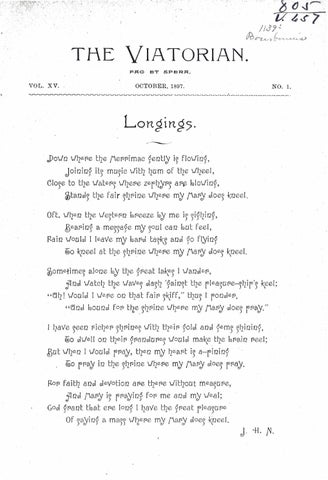
it) mtJ)ic \JitQ Qtlm of tQe \JQeel, Clo)e to tQe \J~,ter) \JQere zefQJ'r) ar~ 61o\Jin?, ~t~r2d) tQe fair )Qrine \JQere mJ' f\~rJ' doe) ~neel. Oft \JQen tQe \Je)tern breeze 6J' me i) )i?Q_in?, ~e~rin? ~ - me))a?e mJ' )otJI can ~tlt feel, ~ain \JotJIGl I leaVe mJ' 6~rc;l ta)~\) ~nc;J · ?o fl,.yin? ®o kpeel at tQe )Qri_ne \JQere mJ' (\arJ' c;lo~
~t2eel.
~ometime) alone 6J' tQe ~re~t ~~~e) I \J~nc;ler,
jlnGl \JatcQ t~e \J~Ve) c;l,a)Q ·~~jn)t tQe flea)tJre-)Qif') "elQl \JotJIGl I \Jere Or2 tQat fair )~iff," tQtl) I ronc;ler, "elr2Gl 60tJt2Gl for
t~e
)Qrine \JQere mJ'
f\~rJ'
c;loe)
~eel;
rr~J'."
'
I !]aVe )een r-icQer )Qrine) \JitQ tQeir ?olc;l anc;l ?em) )Qi12il2?, ®o c;l\Jell 012 tQeir ?ra12GltJr~ \JotJIGl ma~e, tQe 6r~i12 reel ~ · ~t1t \J~e12
. . ~or
~0
I \JotJIGl rraJ', tQet2 mJ' Qe~rt i) a-ri12ii2? rr~J' il2 tQe )Qril2e \JQere mJ' f\rArJ' c;loe) rraJ' .
fa Rf1 a 12Gl c;leVotiol2 are, tQere \./itQotlt
me~)tl re,
jlt2Gl f\~rJ' i) rr~J'il2~ for me a12c;l mJ' \Jesl; Goc;l ?ra 12t t6rAt ere lo12? I QaVe tQe ?rea t flea)tl re Of )1AJ'il2? ~ mrA)) \J~ere mJ' f\~rJ' c;loe~ ~12ee l .
..
.
'
.
'
~....
'\~;· .~.:
·, l )
'-~
'
H
,. '.
' ;'\.,
'·· .\
'
'
THE VrA.TORIA.N.
2
ARISTOTLE. J, H. N .
In studying the history of philosophy we find that its birth occured among the Greeks. True, some vague theories had existed in the far East, but it was not an independent science, being always intimately related to religion either in developing its doctrines or in refuting others as false. The philosophical notions . of the Ea~tern nations were not, however, without some effect; but to Greece belongs the honor of making philosophy the queen of science, and her noble sons vied with one another i'n devotion to this ·fair goddess. Her beauty was enhanced by the virtuous Socrates, made still more brilliant by the poetical Plato, until under the masterly care of Aristotle, she became a form so exalted that it needed but the breath of the ''Angelic Doctor" to make her divine.' It will be of interest to us th(m, as students of philosophy, t.o know something of the great pagan philosopher, this forerunner of St. Thomas, whose name stands as the marble column of the Parthenon, towering far above its re_ clining and shattered contemporaries, which gives a mournful beauty to the once noble Acropolis. Aristotle was born 384 B. 0., in Htagira, a Greek colony in Thrace, overlooking on one side the sea, and on the other groves of oranges and lemons. ,His father, Nichomachus, was the friend and physician of the King of Macedonia, and that Aristotle himself had a love for the natural sciences, as his writings prove, may be
accounted for by this fact. While still quite young he lost his parents. . and in his eighteenth , year came to Athens where for three years he eagerly awaited the arrival of Plato from his Sicilian expedition. For seven teen years he followed the ,instructions of that great man and so surpassed all his companions in keen ness of wit, logic, sarcasm, and general power of intelligence, that his master 1 charmed with the young man, oft referred to, him as ''the intellect of the school." He also compared him to a young colt so needful of restraint yet so unwilling to submit to the rein. After the death of Plato, Aristotle repaired to the court of Herinas, ruler of Al tarnesis, where he resided for three years, after which he went to Mitylene. At the age of ·forty-one he was invited by . Philip, then King of Macedon to undertake the instruction of the crown-prince Alexander who was at the time thirteen years old. · He accepted the charge and was tutor at the court for four years, when his pupil was appointed regent; Aristotle remained, however, three years more in Macedon and the 'e steem in which he was held by Alexander may be known from the statement of that prince, who said that he honored Aristotle no less than his own fa·ther, for ''while one gave him life the other gave that which made life worth having." When Alexander set out for Asia, Aristotle returned to Athens where he founded his school at the L 1yceum, the most splendid gymnasium in the city". Here he collected a large gathering of disciples and walking up and down the
''
•,,
THE VIATORIAN.
I.
'·
'·
.. ..
I
~ ,.
,'
I
'
3
shaded avenues of the groves and gar_ chopping. In this respect some may dens, which added a charm to the think that the spirit of Aristotle still learning of the master, Aristotle dis- lives. Vaughn tell.s us that he was coursed on philosophy with his fol- married, had possibly two wives at the lowers. Beautiful was the sight. in same time, and ce.rtainly a concubine Athens then, with its grand schools, as well, but justly adds that many of theaters, and arenas. There was the the accusations made against him are porticoes, courts, and promenades, do~btful; but we may be sure that his while through the scented valleys with character is not without stain, and their winding paths strolled the bril- that histoHans have been very lenient liant philosopher and his disciples, with him on account of his extraordithus earning for their sch9ol the ap- nary intellect. pellation ''Peripatetic." For twelve However, if he had not the purity years Aristotle taught in this magnif- of life of Socrates or Plato, he stands icent place when after the death of preeminent among all the ancients for Alexander he was accused of impiety the clearness of his reasoning, the by the Macedonian party in Athens. simplicity of his thought, and his They hated Alexander and all . his power of appreciating facts. As a phifriends, and having heard too much of losopher he leads the world, for it has the fate of Socrates to have faith in been said that St. Thomas but gave the justice of a trial, Aristotle fled to the finish of Christianity to the works Uhalcis, saying to his friends that he of the great Stagirite. St. Thomas did not wish to give the Athenians a seldom names Aristotle, but often second opportunity of committing a refers to him as ''The Philosopher." We find that with Plato, ·philosophy crime against philosophy. He died shortly after in the sixty-third year was in form and outlines only the phiof his age; some say that like Socrates losophy of the Greeks set to the di,ahe poisoned himself by drinking acon- logue, filled with myths and poetic ite. In . appearance he w_a s a small, imagery so beautifully associated with slender person, with lisping voice, and the Hellenic character; but in the in dress, a dandy.' IndeAd it is seldom hands of Aristotle it undergoes a great we find such a masterly intellect in change and what was like the philosothe person of one otherwise so insigni- .phy of a particular people now becomes ficant; .for, as Doctor Hampton says, universal. Its poetry turned to sober he has been stigtna tized as parasitical, unimpassioned prose. Thought takes a new turn; in fact gluttonous, effeminate, sordid, ungrateful, impious. He had a sneering the change is radical. Unlike Plato cast of countenance and impertinent who begins witl:l the idea and proceeds loquacity and, indeed, is said to have by deduction or a priori to the facts, of so worri~d Plato that the poor old man experie'nce, Aristotle begins with exliad to change his walking place in the perience and from this standpoint proAcademy, to avoid the ''colt's'·' logic- ceeds by induction or a posteriori to
. ,···· .:·r<·
• 4
THE VIATORIAN.
universal truths. Here we see the mastery over those who went before him, in pre>ceeding so analytically beginning with actual experience and by a deliberate exami~tation of facts, phenomena, circumstances, and possibilities, arise like an impregnable tower to the universal, ultimate truth. It is not strange then, that he should have such a liking for physical science and a tendency to scientific experiment; this tendency led him to found sciences which had received little or no attention before his time, namely logic, empirical psychology, natural history, etc. But, as in a rich city that which is of greatest interest is not so much the road by which rt ':may be reached, but the treasures of art and learning it contains, its monuments and the like, which bespeak its high culture and civilization, so in the study of a great scholar we are not to be entirely absorbed in :finding out what way or method he pursued in acquiring his vast knowledge but we shall be especially occupied in examining the excellence and variety of the knowledge which he has left us as an inheritance. Aristotle has not established any complete division of philosophy, nor indeed has he always followed any one of the parts which he has enumerated. In like .manner we will not follow any set rule in examining his works nor will space permit any elabcrate study of the same. We will, therefore, content ourselves with saying a few words of his treatment of the principle parts of philosophy, leaving fuller and better 'explanation to better hands. The fundamental principle of Aris-
totle's theory of knowledge is that n<?thing is in the intellect that was not first in the sense;, Nihil in intellectu quod prius non fuerit in sensu. This great and most valuable principle destroys all the airy castles of the flighty idealists of the old Platonic schools or of our later day traricendentalists, the German idealists. It is equally fatal to the empiricists and de terminists or materialists for while all of these go to one extreme or the other, the application of Aristotle's theory takes a middle course which secures at once the rights of reason and experience. Beginning with the individual (for what we know through the senses comes through contact with the individual) he proceeds to the universal and thus derives a concept of the universe. .But Aris_~otle emphatically disagrees with his master, who separated the universe from the individual and gave it an objective reality like to that of the particular. The younger philosopher clearly shows that in the individual only·, is radically found the universal and not without; . that in truth it is properly defined as, 41 that which can be predicated of many things and of each individual in particular." Now the logic of this mind is too well kne>wn for me to say any thing of it here, but I wou\d just mention the importance he has given to the syllogism as a means of demonstrating truths. The syllogism differs from the inductive inference in that it draws a particular conclusion from a universal major, wbile induction proceeds ·from particular to universal
/
',
THE VIATOB.IAN.
propositions. The former he shows is a tnore rigorous f0rni of inference, but for us induction is clearer as it is immediately within our reach, proceeding from what is first in our experience. ~owever, the syllogism is a means of proof and without it we can not have proof; and so regarded is divided by Aristotle into three kinds: The Demonstrative, when our conclusion is drawn from true and undisputed premises; the Dialectical, which draws conclusions from merely probable premises, and ~the Eristic, which draws conclusions from premises having only apparent proqability. But "proof drawn from a syllogism must ultimately arrive at the undemonstrable, f.o r should it go on indefinitely we never could have ptoof, so that it must come to prqpositions which are so selfevident that they ad~it no proof. To quote then the philosopher himself, ''Induction enables us to reach general• notions by a process of abstraction, conducts us immediately to concepts of widest universality, and mediately to the first principles which are the result of comparing these concepts while the rational syllogism founded on experience and the first principles of reason leads us to the causes of phenomena and by aiding us to reach the ¡ highest cause ~.( all being lifts us to Philosophy, the queen of the sciences." In his metaphysics Aristotle gives four principles of all being, matter, form, efficient, and final causes. Matter is that which is indeterminate but capaple of being¡ determined. Form is the determining principle, giving matter a character.
5
The efficient or moving cause is that which causes the action or movement of the substance, and the end or final cause is that to which the motion issuing from the efficient cause is directed. This end is al wayb good. With most remarkable clearness Aristotle proceeds, from his explanations of matter, form, and motion, to prove the eternity of the latter, and from this the existence of a primal, immovable motor, namely, God. But alas! here, when he reaches the summit of all, he staggers and falls from his lofty pedestal to a point far beneath his master. In his teaching regarding God he is absolutely much weaker than Plato, for he pictures the Almighty as a goodness separated from the world; motionless, though communicating movement;- a being that would be contaminated by knowing evil, that does nut even know what is going on in the world. His God bas no divine ideas; no benign pro.v idence guides the world, but nature runs its eternal course from the stern law of necessity, while the Highest Good is greedily wrapt up in the contemplation of his own being. I would fain pass from this subject, and glancing into his psychology notice his theory of the soul, which he so elaborately and reasonably explains until he comes to the question of its duration. Here again be sadly falls behind his master, for he not only never proclaims its immortality, but ! rather infers it to be mortal by teaching that the intellect, although immortal, preserves no memory of former events, i. e., it bas no individual consciou~p.eg;s , Even in
'''''''!'· 'co·"1 1''" 1 'i"''~jfCPi' 'u''':J'•f'">''•'I'Jil"j·~.p~
... ''·' ;·~
, ·:' '!'' •. , ' ' '
'.
1'
,
.
'"f)!:!'\"'"
I
THE VIATORIAN.
his '·'Ethics," where it would be of such importance to find the admission of the true theory, he rather says that death is terrible because it is the end 0f aU, neither good, or evil awaiting the dead beyond the grave. In his · • 'Ethics" Aristotle distingutshes be- · tween the rational and irrational soul, the former being reason, t'J.e latter the appetitive faculty. The goods which are objects of desire are classified into morally useful and agreeable goods, as they are desired for their own sake, for that of others' good, or for pleasure. The highest is distinguished from subordinate good as tha-t for which all things are desired, that it may be reached. This he declares to be happiness, which is the highest good,- relative to ma.n. Not, however, mere passive enjoyments, such as brutes enjoy, but happiness in action, intellectual action, and that of a particular kind, namely, wh .i ch springs from virtue. It follows ·that the greatest happiness springs from the. highest virtue, which itself gives rise to the highest kind of pleasure and enjoyment. This calls for the definition of . virtue, which Aristotle says may be known as a habit by which man exercises the proper functions of his nature with ease, promptness, and steadfastness. The most excellent of all the many kinds of virtue is 'j ustice, for in the widest sense it is the practice of all ethical virtues toward our fellowman. This is equivalent t·o the observance of the law. In the attainment of happiness, which is the end of life, man is forced to depend on society, in which he is born. Society is perfected
i,:
flfiiii~
·~.:~ t, •!1>:~.~ ~;Jj;; If'>·•;'_~~ . tl \;:,:~!',<,>#;\'(,) ,1~;·~:::
in the state, and the 'latter is above the individual as the whole is above the part. But here Aristotle draws som~ very queer conclusions. Blinded by the brilliancy with which he bedecks the state, be says: "Liberty of marriage should be restricted by law, children of defective-bodily formation should not be reared, a maximum number of births shou~d be fixed by law; every excess beyond the number should be destroyed .before actual birth." ' It is also worthy of remark that he was ' an advocate of slavery. According to him, the individual who is not gifted with much intelligence seems to be born for subjection, is destined by nature to be a slave, and has absolutely no rights against his master, who may use him as a machine and destroy him if he so choose. In conclusion, we may say, alas for the world had the ''Ethics" of Aristotle been firmly implanted in the souls of its peoples; but leaving aside his ''Ethics," we may truthfully say that the world is brighter and better because of the philosophy of his great mind. His · was the scepter of the golden age of Greek philosophy. Before pis throne the disciples of Plato and Socrates must bow down in mute and humqle submission, while the saints of the church of God, those Christian doctors whose great learning commands from Catholic students something akin to adoration, while they gave to the world the philosophy which not only enlightened this earth but also opened the portals of heaven, have taken many a brilliant gem from the flashing diadem of Aristotle.
''f"l' "' \, }'~1,~ 7:;: .,~~::,'. ;, '• .'· :)~ :>;. '/!'l: ·~. ·~::.~· "~ ·.' .; .·~~~·,\.:!\ :' •' ,• ,~.,. r-·~)'· .!If .,~..,,~,m~·n·"'"1'''' ,"~•'"fl!r~·· 'M ,.,,
1
':~ ~
I
THE VIATORIAN. I
7
I
of enchanting sweetness, overawing power,. and matchless beauty, at the A great·man is one who has a special next he folds those. splendid wings on mission in life, the powers nec.e ssary which he sailed through the azure sky' for the accomplishment of that mission and like a bird· of, evil omen, broods a,n d none of the vices incompatible, over the impure waters of vice and imwith its fulfillment. If this definition morality. This perhaps accounts for be correct, then Victor Hugo is not a the conflicting opinions which different great man. That he had a mission is critics have formed of him as a pros·e probable; that he was endowed by na- writer and poet. In his earlier writings bef0re his ture with rare mental powers is undeniable, but he was wholly wanting in head was turned by the absurd adorathe third essential requisite of true tion of foolish and too unstinted praise of wise men, he gave free range to his greatness. Among all the writers of the present native, in born genius, and produced century, no one has been so highly poems that were full of ptomise for his praised or so universally applauded as maturer years, but this promise was Flattery, like the Victor Hugo. Certainly no poet of never realized. this century united in himself so many burning rays of a noonday sun, withexalted gifts of nature and such puerile ered the budding flower of his genius conceit as the subject of this sketch. and stun ted the growth of his young He was in the language of Lamartine, mind not yet sufficiently developed to ''the child of genius." He possessed bear such a fiery test. Had Hugo, in his a brilliant imagination, remarkable younger days, undergone the ''sweet powers of concentration of thought, uses of adversity'' and been made and a bold, animated style, but side by to feel the necessity of conforming himside with these wonderful gifts were self to the requirements of stern, exactinsane vanity, childish ideas of self ing criticism he might have been one · superiority, and an almost total lack of the world's greatest ,poets, but by of judgment. Thus the great merit constant adulation he came to believe of some of his poems. is counterbalanced that he was above the rules of good by the most. glaring faults and perni- taste and grammar and that his must cious errors in others. needs be the wisest thought most aptly If we read Hugo at his best no praise expressed . Thus he lost the power, will seem extra vag ant and we will as he did not perceive the necessity of rank•him amongst the greatest singers, serious, earnest thought on any subject hut if we examine many of his produc- and advanced with implicit confidence, tions we will be tempted to consi·der the first crude, unsifted impression him as one devoid of reason. There is that came t.o his mind. He measured no evenness in his works. At one mo- the truth, the beauty , and 'the worth ment he soars aloft to the heights of of everything by his own visionary poetic inspiration and sings in strains theories and what did not harmonize VICTOR HUGO.
:;,.~ ~·:··'
''
"' ·
"
8
·u
·
1
'
'
THE VIATORIAN.
with these be rejected as false and men hold sacred was for him a subject wicked. Thus he constituted himself of ridicule. Kings, rulers, statesmen, the sole judge and measure of what ministers of religion, religion itself was best in politics, in literature, and were the objects of his intense. hatr ed, whilst the dregs and offscourings of in morals. Believing himself to be a great · humanity, such as thieves, bandits, statesmen he wrote in ·all seriousness harlots, and gypsies were the constant . to two of the leading governments of themes of his most enthusiastic eulogy. Europe giving them directions as to "Whenever," says Sydney Smith, .''a how they ought to conduct theirpoHti- man meddles with the illustrious feelcal affairs. Yet this same man, so ings of the human mind, he is astonself-confident, so attached to his own ished to find that in all the great opinion, so thoroughly convinced of promptings of their nature, the great the practicability .and value of his mass of mankind always act and think political prlnci ples, resigned the office aright, that they are ready enough to of public trust to which he had been laugh, but that they are quite as ready elected and in which such a splendid to drive away with indignation and opportunity of testing the soundness contempt the light fool who comes with of his theories offered itself, merely the feather of wit to crumble the bulbecause his views were not at once ac- wa.rks of truth and to beat down the cepted by the French parliament. temples -of God. " His intense egotism blinded him to So it has fared with Hugo. The the dangerous tendencies of his radical intense Hugo-olatry of the past has doctrines and prevented him from per- entirely disappeared and a reaction ceiving the truth and solidity of the has set in towards Lamertine for a . arguments urged against them such wri- long time so ungratefully forgotten, ters as Lamertine and Louis V euillot. and Louis Veuillot . who in depth of As a literary artist Hugo is equally thought . soundness of principle and unsound. The mission of art is to giye purity of motive was immeasurably a full harmonious development to th~ Hugo's superior. From time to time good, the true, and the beautiful, and eccentric geniuses, like Hugo, have not to render vice attractive by deck- appeared who set at naught the prining it with the charms of poetic im- ciples of literary taste and artistic agery. Hugo directed all the efforts of propriety, and for a time gain the aphis powerful mind to make wickedness plause and admiration of the masses less repulsive and to exalt the de- but their writings cannot endure. praved and the vile to the rank of vir- When the heat of passion and party tue. This is an offence against art as spirit have cooled . and men begin to well as against morality , and no matter read with calmness and impartiality bow powerful the genius of him who they will inevitably condemn the exattempts it, disgrace and failure are travagance of these radical innovators. sure to follow the attempt. All that He is indeed foolish who ventures
,.
.~' t "t.l.
.
y ~ ' >";-: l ;;· ;.:'· ~ J...
THE VIATORIAN.
to oppose his unsupported opinion to the concurrent opinions and judgments of the world's great master minds. Some few of Hugo's poems will undoubtedly live and be appreciated as long as literature continues to be admired, but the great mass of his writings is mere froth floating on the current' of literature . which will ere long disappear forever. W. B. LONGFELLOW.
What American does not know Henry Wadsworth -Longfellow? Many may not have been acquainted with the r·e_ nowned profes.s or of Harvard college, but Longfellow the poet-who does not know and love and esteem in his heart as le poete des belles ames? Methinks I see him still-venerable in years but young in heart, sitting in that old arm chair given him ~y warm friends, and made from the old chestnut tree, under which the happy black. smith, now also resting from his labors in the quiet churchyard, used "to swing his heavy sledge, with measured beat and slow." I see him sitting and thinking of the days of y.ore, when the ''children's love" that came with the ''grave Alice and laughing Allegra and Edith with golden hair, climb up into my turret o'er the arms and back of my chair." Longfellow loved children; he also loved all mankind. How deeply he felt ''that every human heart is humane." For hitn there was no slave. all men were free. His poems on slavery took rise in his inmost heart. Longfellow was neither a Byron nor
a Shelley. The passion of the forrper nor the high sounding lyric of the latter, may not be found in his poems. Wordsworth excels him, perhaps, in a more genuine co'nceptio·n of nature. ' Swinburne surpasses him in secr~t a~d art is tic arrangement of 1an guage and in the rhythm of his deep and sublime thoughts. Withal, Longfellow ha's acquired a popularity that no other poet ever obtained, not only in America, but in England and wherever English is spoken. And why? Because Longfellow understood the great art of attracting people to himself, by de'scending to their level. His songs always found their echo in the hearts of the;people, because they interpreted in pure and simple language, the wishes, the longings, and the wa~ts of the people. He was the poet of the household, · just as Dickens was its cherished story teller. But there is another reason for this well deserved popularity. Longfellow passed a great part of his life traveling in the Old World. It was not mere cur~osity that prompted him to visit the famous cities a-nd towns of Europe. His love for song may have led him, for a while, to the places where centuries ago the ballad and master singers lived, playing the role of troubadour; but this was not the aim, the object of his traveling; be bad sublimel' aspirations. When Longfellow had spent weeks and months in the chief libraries of a country, he ·crossed its length and breadth; every l'uin he met had an attraction; oftentimes be might be found in some borough, sitting in the
: t·..
I<
.,
'}
.I
,,.·, :' '
I
·,_i
'·
THE VJATORIAN.
10 mid~t
of simple country people, listening to their stories and legends. ·Old songs, old romances, and the manners and customs of the people were thereby painted on his memory. The story of old cathedrals and castles he preferred to learn from the lips of sged men. Longfellow learned the European · languages at their fountain source, and this .g ave him an unrivaled superiority o-v er other English poets as a translator. Indeed, the translations of Longfellow are masterpieces; no other poet has surpassed him in this respect. .• Longfellow did not translate poems for renown; his aim was ~ greater and nobler. Millions of ,. his countrymen, he knew, were emigrants, and every year Europe was sendipg thousands of her children to the New World. These last did not know the Great American. ·He sang for them their national songs, their aspirati~ms, their sufferings. The sweetest remembrances of their native land found an echo in his songs, and his translations gave him an enviable popularity~ The best :poets have always been the best .t eac.h ers of the peopl8. Longfellow was a great teacher. His poems are instructive lessons. How noble his instruction to youth: "Bear, 'mid snow and ice, A banner with the strange device, . Excelsior!" ·
Bear that banner on high, but listen to this wise counsel: "Try not the pass!- * * -xDark lowers the tempest overhead, . Th e roaring torrent is deep and wide! "
To the young and old be proclaims:
or
"Nothing useless is, low ; Each thing in its place is best, And what see:rp.s but idle show Stren~thens and supports the r·e st."
Again he sings : "Let us do our work as well, Both the unseen and the seen; Make the house, where God may dwell, Beautiful, entire, and clean."
Longfellow. was a m.o del teacher of the people; be reached their wants and hearts. He is their cherished poet, for his songs ~re for the people, not for himself. · His, and not his, are the lays He sings, and their fame Is his, and not his, and the praise And the pride of a name. B.
VIRGIL. ''0, coqrteous shade of Mantua, thou whose fame yet liv~s and shall live, long as nature lasts. "-Darnte. •
Publ uis Virgil ius M aro, the prince of Latin poets and the pridP and glory of Roman literature was born of poor and obscure parents at the small village of Andes near Mantua, about the year 70 B.C. The early indications which he gave of rare mental endowments, induced his father to give him the best education that could be procured~ He was accordingly sent to school, first in Milan and afterwards in Naples, where he pursued the study of Greek and Latin literature, mathematics and physics. with great dGigence and success. Here he acquired that fund of knowledge, purity of style, and refined taste which delight and charm us in his poems. lt was not, ~owever, until his genius had been purified in the crucible of
11
THE VIATORIAN.
...
'
I
~
(
.
adversity that he gave to the world any enduring monument to perpetuate his memory. Having lost his property by the distribution of the land around ·Mantua, he came to Rome for the purpose of recovering the small estate which he had inherited from his father. Through the kind intervention of Mcecenas he was successful. Joy and gratitude' enkindled in his mind a 'p oetic ardor which gave birth to the Eclogues. This is a work of great delicacy and a specimen of what was to be expected from a hand that knew so well how to write the graces of nature with · elegance •and purity of style. Mcecenas, who had a great taste for· poetry, was the first to acknowledge Virgil's merit, 'and encouraged him to undertake a new work-the Georgics -of far more importance than . the Eclogues.. In this last work the genius of Virgil is unfolded in all its beauty and magnificence. They are the most finished ppems he has left us. For elegance of diction, purity of style, and beauty of imagery, they are unrivaled in the whole domain of Roman literature. They are luminous gems whose natural brilliancy has been greatly increased by skillful polishing. When the first fire of composing, in which everything pleas.es, was dver, he revised them, not with the indulgent hand of an author and parent, but with the in~xorable severity of a rigid critic. * * * Thus, by his diligence in correcting and polishing his productions, he became the standard of good poetry among the Latins, and set the example of accurate, sweet, and harmonious versification.
After completing his Georgics he began his immortal 1Eneid, which, although it lacks the polish and refinement of the Georgics, is a ml,lch greater poei:n and stamped with the unmistakeable character of genius. '3o great the impatience of Augustus to read this p~em that, even before the work was finished, he wrote Virgil several pressing letters ~ntreating him to send him some part of the 1Eneid. But Virgil always excused himself, saying that if thought his 1Eneid worthy of that honor he would gladly have sent it to Ccesar. How~ver, he was at last prevailed upon to read some selections from it in the presence of the emperor and his sister Octavia. Th3 latter had, a short time before, lost her son, M. Claudius ~Marcellus, a prince.of great merit w:hom Augustus intended for his successor in the empire. Virgil had inserted the praise of th~ young Marcell us in the ,sixth book with so much delicacy and feeling that the rehearsal of the verses drew tears from the eyes of Augustus and Octavia. It is even said that Octavia fainted on hearing tbes~ words-Tu Marcellus eris. She ordered about eighty thousand dollars to be paid to the poet as a mark of her esteem and gratitude. Havving finrshed his 1Eneid, Virgil intended to retire for three ·years in order to revis.e . and polish it. He set out for Greece with this intention but mee;t ing Augustus at Athens be changed his purpose and attended that prince to Italy. He was taken sick on the way home and stopped at Brundusium. Finding his illness increase I
I
'
,
. ,._,(
.'
.,
12
THE VIA:TORlAN:
he ordered the JEneid to be burned, an imperfect work. Fortunately Augustus forbade the execution of this command and even took particular care that nothing shou1d be added to the poem. The exact place which Virgil ocyupies in literature is not clearly defined, but he is unquestionably entitled to rank among the immortals in he temple of fatne. Critics are not agreed whether the palm of excellence belongs to Homer or Virgil among the pagan poets. There is more genius and force of nature in Homer, more art and labor in Virgil; Homer is undoubtedly superior in the grand and sublime, but Virgil tnakes amends for what he wants in these points by the harmony of parts and the exact equality he supports throughout his work. Besides this we must remember that Virgil did not live to give the last touches to his poem which without doubt would have made it much more pe:fect than it is. This great epic became a Roman classic as soon as it was published, and not to be familiar with the JEneid was not to be a literateur. It was placed in the. hands of students and to a large extent replaced the Grecian classics. It raised Roman literature to an equality with that of Greece. What the eloquence of Cicero has done for ennobling, elevating, immortalizing Latin prose, the genius of Virgil路 dia for Latin poetry. These are the two great luminaries in the firmament of Roman literature, whose splendor and brilliancy are the delight and admiration of succeeding ages. To them belongs the glory of having overcome Greek su-
premacy in the field of letters as Roman valor had already triumphed over Greek ascendancy on the field of battle. I cannot better close this brief sketch than by quoting the noble eulogy which the great Dante addresses to his illus ~ trious countryman: -
I
And art thou then that Virgil, that well~ spring From whiGh such copious floods of eloquence Have issued?- Glory and light of all the tuneful train! May it avail me that I long with zeal Have sought thy volume and with love immense Have conned it o'er. My master thou and guide! Thou he from whom 'alone I have derived That style which for its beauty unto fame exalts me.
B. E:EY OF SHERIDAN'S SUCCESS.
Gen. Horace Porter, in his "Campaigning With Grant," in The Century, says, after describing the Battle of Five Forks: Sheridan had that day fought one of the most interesting tactical battles of the war, admirable in conception, brilliant in execution, strikingly dramatic in its incidents and productive of extremely important results. I said to him, ''lt seems to me that you have exposed yourself today in a manner hardly justifiable on the part of a commander of such an important movement." His reply gave what seems to be the trti'e key to his uniform success on the field, ''I have never in my life take~ a command in to bat'tle and had the slightest desire to come out alive unless I woB . ''
~-~· l~·
:;n-~-~;~\~~r:~J:. {~~;!_~
'
.
\
'
.
r·
!~ •:~
Published monthly for the students by the Pantagraph Printing and Stationery Co., Bloomtng.t0n, Ill. Edited by the students of St. Viateur's College,Bourbonnais Grove, Ill. All correspondence must be addressed: THE VIATORIAN, Bourbonnais, Ill. · Entered at the Blooming ton Posto:tnce as second class matter. Subscription price, one dollar per year, payable in advance. BOARD OF EDITORS.
J. I. GRANGER, P. F. DANIHER. P . W . HANSL. P. DUBE. D. H AYDN. M. J. BRENNAN
EDITORIAL. •'
'I
1.-.
'
Our opening has been very encour. aging. There are present about 170 pupils, besides thirty seminarians. This is certainly a sign of a prosperous year-perhaps, too, a sign that this much talked of "prosperity" is really come. That school has now been in session for a month reminds us that vacation is a dream and labor now a fact. Sum' mer's days are gone and the tinge of death creeps over nature's face, a proof that the year's great change is now at hand. We h-ct.d so gradually grown used to life, warmth, and beauty -it had so entered into our notions of th,ings, that decay, decline, and death were the last things we thougl_!t of. Still all these gloomy forebodings of nature's change and transition are as natural as the putting forth of leaf ancl flower in spring. All life, that is, all natural life, is the same, and our experience with nature, who runs the scale of life every
.. , '
~-.
',
~
·'
Jl~
i. I
• I'
THE VIATORIAN.
Tf\E VIATORIAN.
,:!-~h.
...... ,._,
13
year: being born, growing, reaching perfection, and descending through decline to death, is but a miniature of our life as we shall see it when in old age we look back on the few speeding years that mark the term of our earthly existence. Just now, however, the full truth of this may ~ not appear to all of us. Youth is hopeful-ful~ of vigor; has too many things to accomplish to give any consideration to an end seemingly so far off. Besides, life at this period is like the brook in the mountains, too · swiftly impelled and too far from the common receptacle to admit of slower motion, or to show any other than signs of eternal movement. But as the brook nears the plains and widens and deepens by the addition of other currents like itself, so its mad onward motion lessens, until s<;>lemn and stately it approaches the ocean, to be swallowed up in its all-absorbing depths. Age and experience remove youthful delusions, and life's years are few when find that to live . is a serious thing; that there is work as well as play, and that if every cloud pas a silver lining, this bright side is only too often bidden. Hence it would seem that a knowledge, or even a mere intimation that life was to be filled with responsibility, and that al~hough hope should be strong in each heart, nevertheless, we ought to consider well the importance of fitting ourselves for the con test soon
•',) I
-
I
i
•
. '
'·'
to be begun, and which no doubt. we shall wish to see come to a happy close. Now the acquiring of the few facts that the short space of a college career allows, is not the one sole, all-absorbing question that should propose itself to us during these school years. There are more important duties than this knowledge-getting. We must settle with ourselves how we are to use the knowledge we may acquire, otherwise we shall 1a bor under great difficulties and., indeed, remove the greatest motive for study, viz., the end to which we tend-that particular sphere in life we should like to occupy. '
·>,
•,
,,""'
.'
,,
>'f:
'(
\
~
..
THE VIATORIAN.
14 ·
,.
~--_'
I
..
The having of such a purpose will give an impetus to study that could come from no other source. It is the one thing of all others that gives energy to a student's life, which otherwise must be a shiftless existence. Perhaps some thought on this might direct students to consider their future and doing so, to aim higher-:o persist with more than their usual diligence in the pursuit of a worthy ideal in life, which for each one is the vocation for which nature and art fit him; and then by earnest effort and enlightened zeal pursue that end till this worthy ideal shall terminate in ideal worthiness.
surely i~ ever a magazine deserved praise for truth, beauty of utterance, · and for treating the American people to the thought-gems of the world's great minds, that magazine is The Atlantic Monthly. It has never resorted to any tricks of illustration or the like to attract the attention of our best readers. Born of genius, it has imbibed the milk of true worth, and though qn all sides are signs of degeneracy, The Atlantic Monthly continues to · do honor to its illustrious founders. · In the last issue of the magazine tQ.ere are so many fine articles that we could not think of a critical study. ''The French Mastery of Style," by F. Brunetiere, compels admiration as only the work of a master critic could compel it, while Henry D. Sedgwick, _jr., write~ of "Gabriele d' Annunzio" in a most interesting and intelligent manner. We have heard and read much of this young Italian novelist, who has been hailed as the leader of another Italian renaissance, and we are thankful to get such a paper as Mr. Sedgwick's.
The Catholic JVorld for September has some very fine articles, both in prose and poetry. Among others ''Socialism and Catholicism," by Rev. Francis Howard is treated in a ma~ terful way, while :the well-illustrated sketch of Mercy Hospital, Chicago, . Ill., by P. G. Smyth, is both entertaining and instructive.
MAGAZINES.
The Atlantic Monthly celebrates the fortieth year of its existence with the issue of the October number, and
:)___ _
The Century for September is particularly interesting in its many and vari-colored articles, both history, poetry, and fiction. A. M. Mosher
·~-r-:~ ·~·~.• '.--.~ -' ~ ;·
THE VIA TORIAN.
writes charmingly of '~Browning ' s Summers in Brittany." Harry Furnis gives sketches from life of the "Grand Old Man," while John R . Tabb graces a page of the magazine with a poetic gem, ''The River."
·r~
~- 4:~;..-·~-r~:JA~;--~-,- ':~,, -~-~- ~-.J,~t-~:1::·~,-f:;}~--~~--
}
•
'
15
of Master A. Hansl. Possessed of an exceedingly swee't voice, he k:qows bow to use it to the best advantage. He had been heard by most of those present for the first time, and the surprise and delight then expressed will insure him a hearty welcome on every What lover of fiction does not greet future appearance. McClure's Magc;tzine with warmth? In . Mr. P. F. Daniher then read the the September number, R. L. Steven- following address : son's story becomes more and more Right Reverend Bishop: interesting, and we follow the fortune .. It is wi tb sen tim en ts of deep reverof "St. Iv;es" with greater eagerness ence, filial affection, and genuine gladthan ever. Robert Barr has an enterness that we weicome you again to our taining story, while R. Lincoln Stef- college borne. ' fins handles the latest craze, You are the consecrated minister of ''Klondike," in a manner to fairly God's altars, a leader of men, a savior dazzle the eyes. J. H. N. of souls, the special friend and father of youth. Your kindlyv1sits to our alma mater BISHOP DUNNE'S VISIT. are proofs to us of the gr~at interest you take in ,t he work of our education; The Right Rev. E. J. Dunne, D. D., they are so many beautiful seals of Bishop of Dallas, Texas, who was in episcopal approbation set upon the Chicago attending the dedication of manner of education which we receive Holy Angels Church, visited the col- in this institution. For this do we lege September 28, as the guest of heartily thank you. Reverend President. The Right RevWe m9reover especially rejoice in erend Bishop, accompanied by several seeing you and take pride in your presChicago priests, arrived at the college ence among u's, for we are happily reabout noon and after being cordially minded of the crowned years of faithful received by the priests and faculty service you have spent in the great was tendered a sumptuous banquet in and prosperous archdiocese of Chicago where all who have known you have the college refectory. In the afternoon the Bishop was learned to love you. You return given a reception in the college hall among friends and this return is ever the following short program was well a feast of love. rendered: · ''If I were a King," by the May God grant you many years of a orchestra; vocal solo, "Angels Ever life which you have so entirely conseBright and Fair," by Master A. Hansl. crated to the highest good of your felA feature of the reception, and a lowmen. Allow usf Right Reverend most delightful one, was the singing Bishop, once more to assure you of our
I
.. , \
THE VIATORIAN.
16
sincere affection and profoundest esteem. The Right Rev. Bishop replied in a few apt and well-chosen remarks, the substance of which was that he was pleased to be the recipient of so many favors and honors, not in so much as they were offered him individually, but that they showed the devotion and respect that the students of St. Viateur's have for God's h~erarchy of which he had the honor of being a member. Moreover, he exhorted the boys to become giants intellectually and morally as well as physically. He advised them to accept the golden opportunities offered them by the men who had sacrificed their lives for the sake of educating the youth. He then thanked all for the good will · they had shown in their entertainment, and as a befitting finale a grand conge was granted. He left us, and once again this kind benefactor of Catholic youth bid adieu to our alma mater, leaving all imbued with his spirit of benevolence and kindly advice, promising to return at some future d·a te. Among tbe visiting clergy were Revs. H. O'Gara McShane, Chica.go; T. O'Gara, Wilmington, Ill.; R. Dunne, Oak Park, Ill. ; M. O'Sullivan, Lemont, Ill.; F. Billetdoux, Chicago; J. A. Kelly, Gilman, Ill., and J. J. Cregan, Chicago.
.
PERSONAL.
-Mr. James Murphy, '97, last year's colonel, is now at the University of Notre Dame, where he will study the law. -Mr. James O'Dwyer, '97, Merna,
Ill., is following the law course at the Wesleyan College, Bloomington, Ill. -~on.
J. G. Condon, assistant city attorney, Chicago, is billed to speak in Kapkakee, Ill, the second week of this month. --Mr. H. J. Donovan, of New York City, passed this way en routf- to Cincinnati, where he pursues his theological studies this year. -Rev. J. J. O'Callaghan was a visitor this month, coming to see his brother Joseph, who is a member of the senior department. -We learn that Mr. Edward Kromenacker, '97, is pursuing the philosophical studies at · Mil waukee, Wis., this year. -The Rev. Perry Parker, late assistant pastor of Holy Trinity Church, Bloomington, Ill., pas been assigned to Galva, Ill., as the pastor of that place. Our congratulations. -We lately learned of the happy marriage of Mr. Hugh O'Donnell, a member of the Fanny Dave1;1port theatrical company. We congratulate the happy couple and wish them many years of peace and prosperity. ·· -The Hon. Henry E. Murphy, '86, for many years one of Nebraska's rising lawyers, has recently mo.ved to Chicago, and has an office in the Chicago Opera Hou,se. We hope Mr. Murphy will duplicate former successes in .Chicago. -There were some recent changes in the pastors of Peoria Diocese, m which old students will no doubt be
·' .
THE VIATORIAN:.
interested: Rev. F. O'Reilly, late of St. Mark's church, Pe0ria, ·has been transferred to the rectorship of the cathedral; Rev. J. J. · Shannon was transferred from Canton, Ill., to St. Mark's, Peoria, and Rev. Edward Kneiry, of St. Augustine, Ill., succe·e ded Father Shannon at Oan ton. -Old students of '87, will rejoice to learn of the promotion of the Rev. A. J. McGavick to pastorship of St. John's church, Chicago. The appoi.ntment was a most happy one, and we wish Father McGavick the fullest success in his new mission. - The Messrs. Burke, for two years members of the philosophy class, are this year pursuing their theological studies at St. Bernard's seminary, Rochester, N.Y. These young men counted every one in this institution as a friend, and will make lasting frienGs wher~ver th,ey go. We wish them all success in their new home. -Among the recent visitors to the college was Mr. H. A. Grosse '94, now of Cissna Park, Ill., where in partnership with his brother, he is conducting a large grocery store. Mr. Grosse 'has all the requiramentsnecessa~y to the successful business man and his success seems assured . . -Mr. M. J . Ford, '97, and Mr. L. Mullins, '97, are both in St.' Mary's Seminary, Cincinnati, Ohio, when the former begins the study of theology and the latter starts his philosophical course. We wish these young men a very successful year. -Mr. Joseph Lemarre and Rev. B ro. Leclaire C. S. V. , received Minor
17
Orders at the Cathedral of the Holy Name, Chicago, July 3, 1897. These young men have thus taken the first step towards what we are sure, will pe a happy and useful career in the holy priesthood. -Among the young men who left collegiate for the seminarian department this year are the following: Messrs. Joseph Kearney, H. A. Rainey, A. 0. Sullivan and E. Logan. Among the new seminarias are : Messrs. Broadman, Kubiak, Medegan, Ogle, Quinlisk and Shea. -Mr. F. Fitzgerald '91, Indianapolis, Ind., was a visitor at the college the past month. He placed his brother John here, whose success we hope will not be less than his brother. Rev. F. A. Dandurand, assistant pastor of the cathedral, Fort Wayne 1 Indiana, was a recent visitor at the college. Mr. J. J ; Condon, secretary and manager of the Pantagraph Printing and Statione ~y Co., Bloomington, Ill., was among the welcome visitors last month. We were delighted by a recent visit from Rev. J . J. Cregan , formerly prefect of studies here, and now superior of the C_athedral ·s chool for boys, Chicago. Father Cregan'~ visit, though short, wag very enjoyable. Rev. F . O'Reilly, pastor of the Cathedral, Peoria, will preach at the college chapel St. Viateur's Day, and R ev. Ja&. J . Shannon, of St. Mark's, P eoria, will be celebrant of the H igh Mass on the same occasion .
,:·.·9'i,7•.,t\,',
i''
'
,.
'
1
~
•
':.
""'\
.. 1
\ ,
)
'"""'
THE VIATORIAN.
18
BASEBAlfL.
St. Viateur's, 10; .Unions, of Wilmington, 15. On Sunday, September 12, the Shamrocks went down 'before the Wilmingtons in a poorly played game by a score of 15 to 10. For six innings the game was very exciting and was any body's contest. On the Wilming~on's half of the seventh, the college boys were seized with a desire to throw wildly every time any of them had the ball and ~as a result the Unions added eight runs to their score and landed the game, despite the Shamrock's spurt which netted them five runs. The features of the game were the first base playing of Kearney, and the pitching, at times of Legris. The Wilmingtons were powerless before his strategic pitching and had he been able to control the ball, would have easily won. Thirteen of the visitors fanned the air; and thirteen also received free passes to first. Shields for Wilmington played a star game in left field,' pulling down many flies that looKed good for two and three baggers. The score by innings: 1 2 St. Viateur's-1 0 Wilmingtons-0 0
3 4 5 6 2 0 0 0 0 6 3 .1
7 5 8
8 0 2
9 2- 10 1--15
Batteries: Wilmington-. B. Keeley and J. Keeley. St. Viateur's-Legris and Sammon. Kankakee 13.
St Viateur's 3.
I
The Shamrocks crippled hy the absence of several players and composed largely of substitutes were taken into
camp by the Y. M. C. A. of- Kankakee by a score of 13 to 3. The loss of the game may be attributed .to poor support ·given to Legris. .rrhe Kankakee's were unable to solve his curves, making only six hits while fourteen succumbed to his deceptive drops. Besides Legris' pitching, the first base playing of Kearney, the third base playing of Brennock,~ and Marten's batting were the features of the game. Score by innings : ]
2
3
4
5
6
7
8
9
I
St. Viatuer's-0 Kankakee -1
Batteries: and South. and Quille.
1 0 .0 1 0 ·0
1 1 0 1
0 0 0- 3 7 .3 x-13
Kankakee- Mcintyre St. Viateur's-Legris
I
· St. Viateur's, 4.
Y. M.G. A., 9.
The college boys were again defeated by the strong nine representing the Y. M. C. A. of Kankakee. The game for eight innings was the most ' exci ting con test ever played on our grounds. In the . visitors half of the eighth with the score 4' to 2 against them, the Shamrocks made few costly errors and unlucky wild throws which netted the Kankakeeans three runs. In the ninth the visitors made a two- bagger and two singles in quick successjon and these hits aided by a few more er~ rors brought . their s'c ore up to nine. Th~ Shamrocks were unable to do any• thing in their half of the eight and ninth, and in consequence another de. feat was marked against them. McIntyre pitched' · for the _Y. M. C. A's struck out fifteen of the college boys and allowed but one base on balls. Legris made eight of the visitors fan
a
~ ''{""\ .'~" ':\'.!J~:F~\!·7. t
'j ,·
q!·:, ., l.
'
. n+;:''·~··~iJ !;' ' ~
"'!;
19
THE VIATORIAN.
the air, while he permitted three to walk to first. The features ·of the game were the pitching of Mcintyre and Legris, the third base playing of Bender, and Hogan's batting. Score by innings: 1 'if'::. I
,. ~ti' i
~.:
2
3
4
Y.M.C.A. ·-0 1 0 o. St. Via.teur's-0 0 3 0
5 1 0
6 0 1
7
0 0
8 3 0
9 4-9
0-4
Batteries: St. Viateur's-Legris and Sammon. Kankakee-Mcintyre and South.
..} FOOT-BALL.
The prospects for a successful year in foot-ball were never better than at present. Captain Harkins has been giving the men light practice during the warm weather, with a view of getting a line on the good players. A great number of candidates are striving for the several positions on the team, and it is a hard matter at present to give the personnel of this year's team. Games are being arranged with theY. M. 0. A.'s, the Kankakee Athletic Club, and ¥omence elevens, and it is Captain Harkins's intention to avoid being scored against this season and to retain his hold on the championship of the county. A very strong second eleven has been formed among the seniors to give the college f'leven practice and to play the junior teams of surrounding towns. James St. Cerny was elected captain, and is practici~g his men for their first game, October 20, with the Y.M.C.A. Juniors. The fact that this eleven is under the efficient tutorage of Coach Da.niher augurs a victorious and successful season. M. · P. S.
VIATORIANA.
- I am sick. -King Rudolph. - ' 'l am not Diad." - Oh, I don't know. -The Greek Scholar. -My love has left me. -Did you fall in again?
-A- bicycle built for two . -Non Intelligo, 0! Pater. -"Halt! Who goes there?" - I am on the Chicago bridge.
-One hundred and sixty strong. -Say, what doE\s five fingers mean? -Well, I think I have my rep made. -He took all the soup and left me in it. - I hope he gets my permission to smoke. -How about the volunteer fire department? -Long life and success to the poet of the poop. --Those fellows ' must think I am a regular hayseed. -- I'll not tell him he's too good, but I'll tell the other. -Your bird will get used to the change bye and bye. -Are you quite sure we are allowed to go to the convent? -Having won five battles, I am now ready to take all newcomers. How about that, Eddie?
•'
.t l{.. \
I
THE VIATORfAN.
20
- -Rev. E. L. Rivard, C. S. V . D. D., attended the funeral of Mrs. Culbertson, nee Ball, who died ~eptember 28, at her home in Lafll.yette, Ind. The deceased was an estiJI?.able lady, a devoted christian, and her death is a sad blow to her family . We extend our ,heart-. felt sympathies to the afflicted relatives. -The Thespians are preparing Rich. ard II for St. Viateur's day. As all the strong talent of last year returned, we foresee a successful entertainment. The play occurs October 20, the eve of St. Viateur's day. -The ''Picked Squad" .is made up of competent drillers, who are sparing no pains to present their usual fine drill on St. Viateur's day. The squad is in charge of our new colonel, Thos. Cahill, whose excellent record as a captain gives him strong claims to succ~ssful leadership. -The bicycle in which many here were interested, was raffled at Toronto, Canada, August 30, and was won by Mr. Hugh Rodger. -"Things are not what they seem," and very often are very different from what they are said to be. Some of the late arrivals may have to change their views· and may know th.e same persons under several names.
Detme·r Music House 261 Wabash Ave .. Chicago, Ill. ~Sellers
of everything knpwn in Music and Mus,ical Instruments.
-Please don ' t send home for the verses, the course is sufficient. J
-Teacher-What is distance? Pupil-Fifty-siJf miles ·to Chicago. · -Yes, there is quite a change be ~ twe~n my meals this and last year. -Teacher--What · is the difference between space and vacuum? PupilSpace is a hollow place; V~:J,cuurn is a hollow space with the hole pulled out. -It is altogether different with birds; they are so much alik.e that you can't help seeing the difference. However, the voice-tones help one to know his own fowi . . -Speaking about fowls reminds us that Section XY (not 22) of the ''Dingley Bill," will not allow the slaughter of spring chicken. Hence the aforesaid is not ''as young as he used be."
--Comedy in four acts.-Act I. Windy day; young lady in a car, front seat; gentleman rear seat; Act II. Lady's bat blows off; gentleman gets it with much trouble. Act III. Returning the bat receives a smile, a bow, and ''Thank you. " Act IV. (Half-hour later on the ball-field gentleman solil~ oquizing): "0h! What a dream!"
Every student who intends to go into busin ess should read
Business·. Monthly $z.oo a year.
The Office .Paper.
To read Business for a year is a liberal commercial education in itself. Write for sample copy, mentioning this pap er. Publication Oflices, 13 Astor Place, New York.