.
'
THE VIATORIAN. VOL. XIV.
JUNE, 1897.
'
NO. 11
\
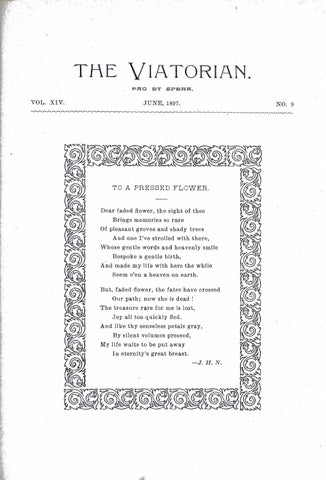
TO A PRESSED FLOWER.
.路
Dear facled flower, the sight of thee Brings memories so rare Of pleasant groves ancl shacly trees At~cl
~ .路 路
one I've strollecl with there,
Whose gentle worqs. ancl heavenly smile Bespoke a gentle birth, Ancl macle my lif13 with hers the while Seem e'en a 4eaven on earth. I
路
. But, faclecl flower, the fates have c.rossecl Our path; nbw she is dead !
~
~;}J4
The treasure r~re for me is lost, Joy. all too quickly fl.ecl._ And like thy senseless gray, By silent volumes pressed, My life waits to be put away In eternity's great breast.
~
pet~ls
-J. H . N.
__
!,,J
166
THE VIATORIAN.
STARVED ROCK. (Continued from May Number.) THE LAST OF THE ILLINOIS-THE FINAL TRAG ED楼.
Most historians believe that the famous tragedy which gave Starved Rock its name was a result of the wars of the con1s piracy of Pan tiac, chief of the 0 ttawa tribe. It is not our purpose to dwell on the. history of this great conspiracy, as the student will find it related by Parkman in a style as charming and interesting as a romance. It is sufficient for us to state here that in 1769 Pontiac went to St. Louis to visit an old friend who was a t.r ader at this post, and while there was murdered by Kineboo, chief of. the Illinois, who was bribed to commit the crime. This murder set the whole country aflame, and was the cause of a general uprising among the different tribes. "The news spread like lightning through the country,'' says Parkman. "The Indians assembled in great numbers, attacked and destroyed all the Peorias, except thirty families, and all the authorities agree that the murder brought on 路successive wars, and the almost total extermination of the Illinois. Gould Pontiac's shade have revisited the scene of his. murder, his savage spirit would have exulted in vengeance which overwhelmed the abettors of the crime. Whole tribes were rooted out to expiate it. Chiefs and sachems, whose veins bad thrilled with his eloquence; . young warriors, whose aspiring hearts had caught the inspiration of his greatness, mustered to revenge his fa~e; and from the north and east, their
united bands descended on the villages of the Illinois. Tradition has but faintly preserved the memory of the event, yet enough remains to tell us that over the grave of Pontiac more blood was poured out in atonement 1ihan flowed from tJ_'ye veins of the slaughtered heroes art the corpse of ' Patroclus; and the remnant of the Illinois who survived the carnage remaint~d forever after . sunk in utter insignificance." The great tribe of the Illinois had been so reduced in number, that they now found sufficient space on the top 路 of Starved Rock, whither they had' ,, gone as a last refuge. Here the few remaining warriors repelled the attacks of the thousands of bloodthirsty Indians below. As the walls of the Rock are perpendicular, ten men could easLy resist the attacks of ten thousand. The enemies below, seeing how futile it was to attempt to take the fort qn the Rock by storm, determined to besiege it on every side. The enemies placed themselves in canoes under the shelving rock and cut the thongs of the besieged whenever they lowered their vessels to draw water from the river below. Many. o~ the women and children, reduced by starvation to mere skeletons; threw themselves over the ledge of the rock, only to be killed by the clubs of the warriors below, or to drown in the river. But the warriors above fought as long as they were able to stand. No quarter was given, nor was it asked. Desperation gave new strength to their weakening limbs. Twelve days sufficedfor the twelve hundred souls I
. '.
r.
, .
THE VIATORIAN.
167
on "t he top of this rock to die of famine ever tb e spot where on ce orl!urred .one and thirst; stil! all were not destroyed. of the greatest contributions to human Elev,e n escaped through the lines in sacrifice ever recorded in history~ darkness and confusion, and taking Under the hollow sky, Stretched on the prairie lon e , the canoes of the enemy, hurried down Center of glory, I , the stream. They knew that their Bl eeding , disd ain to groan, deadly enemies would soon follow But Jfke a battl ~ - c r y them. It was a race for life. They Peal forth my thunder moa n. were without provisions, but to stop Bairn-wah-wah! meant death, and those who ran for Hark to those spirit notes ! life won the race and reached their Ye high heroes divin e, friends many miles down the stream. Hymned from your god-like throats That song of praise is min e! '.Fhey had scarcely landed. when the Mine , whose grave pennon floats shouts of their pursuers were heard O'er the foeman's line. ~n the river. These soon landed and Bairn-wah-wah! fiercely demand ed . their victims, fully -D eath Song nf A~gortquins. determined to take the last drop of After the departure of the many blood from the veins of their hated enemies. This was refused , and they tribes of路 Indians who inhabited this left the place vowing vengeance, but part of our country, the white man carne and settled. they were unable to execute it. Our warriors, now being free, crossed I hear the tread of pioneers Of nations yet to be; the river to the southern part of what The first low wash of waves where soon we now call Illinois and made their Shall roll a human sea. - Whittier. future home with other tribes. But From the shore of the river the culthey never after claimed their name, and from this time ceased to be of the tivated meadow now stretches to the present and were only remembered as north where once stood Kaskaskia, a part of the past. And so perished and its soil is enriched with the dust the Illinois, at one time the most of victors and vanquished. The age of the "plowshare and prunpowerful tribe of aborigines, but tht~ir name is perpetuated in tbe name of ing hook" has dawned upon the place, our state, and -public sentiment has and now the great meadows are occutraveled to the scene of their heroic pied by many farms, but the beauty struggle and has written clear and and handiwork of nature, as saen on large on the walls of this . great fort, the rock and in its surroundings, never has or will be disturbed. Today this ''Starved Rock." As Thermopylae will forever stand battle ground of old is- transformed as 路a monument for the bravery of the into a park and picnic ground, and is ' Spartans, so, too, will this moss-grown known as the most beautiful summer and ivy-clad battle to ,w er, covered resort of the west. The Indian cabins with the dust of its victims, mark for- and wigwams have been replaced by I
'fJ
I
•.
t.l
,I
'Ail )'
168
THE VIATORIAN.
a modern hotel, with several furnished cot·tages for private families. These are supplied with water, gas, electric lights, and, in short, all of the modern improvements, which would have been impossible to the rock's earliest master--Louis the magnificent. N ea:r the hotel is the club house . and dancing parlors, surrounded by an artificial · lake. The summit of the rock is also a scene of gayety, and the sound of . music and merry laughter now fill the air where once there echoed the warwhoop of savages . Today the visitor from the su·m mit of the rock may still see those cliffs, glens, and canyons along the Illinois river, and which make the locality the most interesting and most sublime sight to be seen in the Mississippi valley. To the east and across a deep , chasm from the rock is Lover's Leap, which marks the · deed of an Indian maiden, who, disappointed i-n love, jumped from the cliff into the river below. To the south is a high knoll called Devil's Nose, where the Indians imagined a storm to be the sneezipg of the prince of darkness. Farther away, but still within walking distance, are the famous Bailey's Falls and Deer Park Glen, ar.d many beautiful spots on the Big Vermilion river. These places, too, have been beautifie,d of late years, driveways and paths have been cut through the forest, rope bridges suspended across the ravines, and the owners offer the guests every facility for examining these noted places. Our modern Starved Rock visitors come arrayed in bicycle suits, and in
fact all the habiliments of a picnic, and the· register of the past few years contains the names of thousands of visitors from nearly every state of the Union. As we contemplate the beaUty of this famous summer · resort; as we meditate upon its history and link the present with the pas.t , we cannot help realizing the debt of gratitude which we owe to those men who, aher years of toil and research, have given us the authentic facts .. connected with its history- to such writers as Dr. Francis Parkman, Dr. John Gilmary Shea, and Mrs. Mary H. Catherwood, who, both in history and romance, have created a period of instruction and amusement . for the presentgeneration. He told the red man'!? story; far and wide He searched the unwritten records of his race. -miver Wendell Holmes.
This rock is only one qf the many monumental gems adorning the· zone of Catholicity which encircles the whole of North America. America owes to the church and her apostles an enduring memory, for in them she beholds the pioneers ·who have e.ver guided,. her to the possession of her richest heritage. .
For thee, my country! many are the gifts God gives to thee, And glorious is thine aspe ct, from ~ unset to the sea, And many a cross is in thy midst, and rnany an altar fair; And ,many a place where men may lay ~he . burden that they bear. -Thomas D 'Arcy McGee.
w. J.
B.
.\
j'
I
,·. _f.
THE VIA TORIAN.
169
THE MORAL: INFLUENCE OF
ries the daughter of an impoverished family who are distantly related to some lord. He buys a small estate, After carefully reading the novels tries to blot out the remembrance of and essays of Thackeray one cannot his former occupation, and assumes all help preceiving that there is one great the airs and importance of a landed pu.r pose und.~rlying all his writings: proprietor. He. is always fawning corrections of . abuses and of wrong upon nobles and swallows with the conceptions of life. "Open at ran- utmost complacency the snubs be so dom," says Taine, "his three great often receives. The moral of each of · works-Vanity Fair, The Newcomes, these details is so evident that it canPendennis, every s·c ene sets in relief a u.ot, escape the most superficial reader. moral truth. The author desires that It is as if the author bad said: "My at every page we should form a judg- dear reader, from the follies and ment on vice and virtue. He has humiliations of the Major, learn a lesblamed or approved beforehand and son. Be true to yourself, respect your the dialogues and portraits are to him manhood, do not make yourself mean, only means by which he adds our ap- , miserable, and ridiculous by aping the probation to his approbation and our airs and pretentious o,f a fellow called hlame to his blame. He is giving us a nobleman who is in fact not one a lesson, and beneath the sen tim en ts whit better than yourself." he · describes, as beneath the events 'rhis indirect manner of introducing which he relates, we continually dis- moral considerations does not satisfy cover rules for our conduct." But all the purpose of Thackeray. He frethis is done with so much art that it is quently interrupts his narrative to on.ly after we have learned the lesson make some. striking reflections on the that we become aware of the author's incidents he has been relating. He has intention. He does not, like Dickens, often been severely criticized' for this, seek to excite our pa.ssions, but by his and perhaps viewed from the standpoint masterly delineation of character and of art it is a defect; but for my part I calm reflection he appeals to our judg- find nothing in his novels so delightful ment. as these familiar chats. They are like A brief analysis of a few of his lead- the pleasant talks of a dear friend who ing characters will make this moraliz· kindly and wisely warns us against ing propensity' of Thackeray more certain follies and sins into yvhich we evident. Major Pendennis had form- are in danger of falling. erly, to use the author's expression, How vividly he pictures the base·,'exercised the profession of an apothe- ness of avarice in the character. of cary and surgeon" but his ''secret Mrs. Bute Crawley . . All the words of ambition had always been to be a the character are chosen and weighted g,entleman. 1' Finally he inherits a so as to make the vice odious. Miss considerable sum of money and mar- Crawley, a rich old lady falls ill. Mrs. THACKERAY.
'
'
THE VIATORIA.N.
Bute Ora ~ley, her relative, hastens to save the dear in valid or rather the inShe labo-rs with all her .h eritance. ingenuity to prevent Rawdon Crawley a stupid reckless guardsman, a drunk.ard, and a duelest, but for all that the ·. old lady's favorite nephew, .f rom inheriting her money. Of course, she easily persuades herself that she hates Raw. don only · from a virtuous motive, because he is a vicious, worthless character. To be sure it is only natur'al she expects a liberal share of the ·o ld woman's money, but the fact that R1wdon is a· dangerous rival has nothing to do with her feelings toward ,him . At length the apothecary, Mr. Clump, is sent for. He suggests various remedies, but Mrs. Bute will not listen 'to him. ''I am sure, my dear Mr. Clump," she says, no efforts .of mine have been wanting to restore , our dear in valid, whom the ingratitude of her nephew has laid on the ·bed of sickness. I never shrink · from ·. personal discomfort; I never refuse to sacrifice myself. I would lay down my life for my duty or for any member of my husband's family." The apothecary declared that ''a change, gaiety and fresh air are' necessary for the patient." Mrs. Bute is for an instant throw-n bff her guard and ·as the 'au thor remarks "lets the cat of selfishness out of the bag of secrecy." She will not hear of 'any such thing . ''The sight of her horrible nephew casually in the park · where I am told the wretch <;lri ves : with the brazen partner of his crimes, . would cause h~r such a shock that we
should have to bring her back , to :bed again. She must · not go out, ¥r. , · Clump. She shall not, go out as long as I remain to watch over her. And as for my hearth, what matters it? I give it cheerfully, sir. · I sacrifice it at the altar of my duty. '' Thackeray could not possibly make the avarice and hypocrisy of Mrs. ·Bute and all legacy ~unters more .odious. It fi)ls the reader w.i th hatred and disgust. But Thackeray is .not satisfied with this, he wants to cor rect' these vices in his reader and he invites him to look at home, to . examine himself and see if he is entirely spotless. He at the same time subjects him to a searching inquiry which · will be pretty sure. to make him blush. Thus you may .analyze any of the characters he . has created and you will find that each and every one inculca~es some great moral truth. His great aim being instruction and c'orrection. Whoever goes to him mere~ ly to be amused will certainly be disappointed. .Even his novels require careful reading and concentration. This is perhaps the reason · he has never gained the wide popularity of Dickens or ~cott. The vast majority of novel readers want to be amused rather than instructed and the author ' who most fully satisfies this desire is sure to be the most p'opular. The truth of this assertion may be easily confirmed by glancing at the writings of some of our most successful humorists. Without a semblance of genuine humor or literary merit, merely by their buffon:eries, rude jokes, · and sickly puns, they have gained an
;
.~
.....
,'..... ....,
i''·•'
THE VIA.TORIAN.
extensive popularity, and acquired substantial fortunes. Thackeray is unquestionably a master of style and his writings possess elements of immortality which will keep his name alive when many authors who are now more popular will have been entirely.forgotten. His novels are not so brilliant or fascinating as those of Dickens, but more beneficial and enduring. The two are thus briefly contrasted by a judicious critic: "Dickens is more .ardent, more expansive, wholly given up to rapture, an impassioned painter o~ crude and dazzling pictures, a lyric prose writer, omnipotent in laughter and tear, plunged into fantasticinvention, painful sensibility, vehement buffoonery; and by the boldness of his style, the excess or his emotions, ~he grotesque familiarity of his caricatures, he has displayed all the forces and weaknesses ,of an artist, all the , audacities, aU the successes and all tlie oddities of the imagination." "Thackeray is more contained, better informed and stronger, a lover of moral dessertation, counselor of the · public, · a sort of lay preacher, , less bent on defending the poor, more bent on correcting his readers, has brought to the aid of satire a sustained common sense, a great knowledge of t~-e human heart, consummate cleverness, a treasure of meditated hatred of vice, which he has persecuted with all the weapons of reflection." B. Have the courage to provide an entertainment for your friends within your means, not beyond them .
171
RALPH WALDO EMERSON.
There appeared on the shores of New England at the beginning of this century a writer of rare powers, destined to overturn old methods and to leave a deep impress of a rugged, but .superior abilfty, that man was Ralph Waldo Emerson. Emerson was a born poet, and his love of idealty showed itself in every line he wrote. One finds rhythm in nearly all his prose, though be may also find much· crudeness in his verse . Emerson w~s a great admirer and a close friend of Carlyle, and the ''Oarlyle-Emerson Correspondence" gives us a close view into the private life of the ''Sage of Concord." The theory of Emerson on poetry was that poetry and philosophy should not be separated. Of a didactic inclination this was natural, and all his VPrse and prose have dogmatic tendencies; the message it contains is set forth in a way that compel acceptance or resistance forthwith. Nature was the god of Emerson, and with all his beautiful sayings regarding God, Heaven, the future life, etc., material beauty or at best such beauty as was purely of the mind was all he cared for. "What is excellent, As God lives, is permanent; Hearts are dust, heart's loves remain."
is beautiful in sentiment and setting, but does not rise above this life, "is of the earth earthly." Dogmatic to a degree he hated all forms of religious dogma, as hampering to the mind and as therefore hurtful to the soul's ex-
'. '
l'i!2
THE VIATORIAN.
pansion. This is Emersonian doctrine. out attention to the principles others He had said: "Man thus far, has think so necessary. made ali religions, arid will yet make His poetry is fu ll of that self con- ' new and high er faiths." He had sciousness that marked his other begun life as an exponent of one of works-that is if one can be self-conthese man-mad.e faiths-Unitarianism, scious and poetical at the same time. and had aband oned this profession as Still, Emerson is poetical and occadistasteful. Why? Because no doubt sioual flashes betray the beauty of a he was too consistent and thoughtful tender soul alive to humanity's needs. not to see its utt er inability to meet Thus his own lines describes himself: the requi_rements of man's longings " He spoke, and words more soft than rain and needs, and he went where protesBrought tht1 age of God again; . tanism leads ; to the vagar ies of nature, His action won such reverence sweet As hid a ll measure of the feat." art, culture, etc., but away from God. But in life Emerson was the kinde st Amo ng the choicest of his poems most amiable of men. E1rnest thought- are "The Snow Storm," "The Humble ful, a seeker of knowl edge, he CO:l- Bee," "The Rhodora and Concord versed with all he met., met all he · Hymn." The latt.er w~s sung at the ' ' could and was a source of pleasure to dedicati'on of the battle monument, all his friends as he was easily the April 19, 1836, and of itself would leader of all his associatrs : He was in give the poet a claim to the highest a word superior to his faith and was of poetic talent. indeed all that any man could be, and In 1847 Emerson lectured in the a great deal more than most men are, principal citi es of the Union and the without a definite code of belief and subjects of his lectures were publis hed with merely the natural for a guide. u nder the title of "Representative Emerson acq uir ed distinction as a Men." rrh~se were ''The Uses of . lecturer, prose writer, and poet. His G~ea t Men;" "Plato, or the Philosoterse and forcible prose is the very pher;" "Swedenborg, or the Mystic;" essence of condensation. Every line "Montaigne, or the Skeptic;" is full of thought· a j ewel highly pol- "Shakespeare, or the Poet;" '•N ap.oished, which one may consider by leon, or the Man of the World;" and itself as possessing intrinsic beauty, ''Goethe, or the Writer." Inc:dentally not buoyed up by proximity to other th e subjects of these lectures show th,e gems, nor as getting a beauty from tren d of Em.erson's thoughts · and go its adaptation to structural eomplet- far toward showing the influences ness. We may pick out a.t ple,asure so that bel ped to mold him. In his ''Heroes and Hero Worship," many beautiful epigrams filled ~ith a sage benevolenceand marked with the ·Carlyle had chosen Mahomet, Dante, It stamp of worldly wisdom. A student Luther, Burns and Cromwell. of nature he had all her originality of wo'uld no doubt afford one much procedure and attained beauty with- pleasure to ponder on the rea~ons Jbat
!·
\'
•
j
'I
'· I
•
.,
THE VIATORIAN.
may have led each to make the choice he did of his representative men. Like every New Englander., Emerson received his due measure of pt:aise. Few indeed of the number !hat have gro,wn . to. distinction got any degree of the laudations. accorded the ''Sage .of Concord." But for the most part these were well merited. Emerson was essentially an intellectu:;tl man, one whose work drew him • close to men, but whose philosophy , made him powerless to uplift h umanity. Emerson died at Concord, Mass., April 27, 1882, just one month after Longfellow. Strange as it may seem, men scarcely thought of Emerson, so intent were they on the loss they sustained by Longfellow's death. Any reflection on the works of the two distinguished men will show us how much greater was the' hold of Longfellow upon the people than that of his more philosophic but less tender and sympathetic brother poet. Longfellow spoke from a heart alive to humanity's needs, aware of all its tbrobbings. He was essentially the poet of the people, if not of the scholar-and who shall say that his was not the real mission of the poet. Always tender and sympathetic be was rarely dull; with no interest as to how far fOetry and philosophy should be joined, be in variably reached the heart and won captive his readers of all classes. Not s0 the "8 Stge," who, though always stately, ever ready with a lesson, appealed chiefly to the learned and. but accidentally to the ones ·in humbler walks of life. I
173
The scholar will al ~ays admire Emerson. Longf~llow will be approved by all classes. Both left their lessons; Longfellow 's the better. Emerson.'s may liv:, Longfellow~s shall not die.-M. t
REV. FRANCIS MAHONEY. (FATHER PROUT.)
"Who lov eth hu01or and hath yet to see Lover and Prout and Maclise?" - John BoyLe O'ReiLly.
This charming poet was born in the city of Cork, .on the banks of t':le beau- · tiful River Lee. He commenced his college carrer at a ver·y early age, and cpr;npleted his course with high hoaorE~. After his ordination he was appointed curate to Father Prout, an old priest who resided a short distance from the city. While performing his sacred duties in the quiet country, Fa~ber Mahoney was a contributor to the journals of Cork under the name of the g<?od old pastor, Father Prout, at whose bewilderment the curate chuckled with roguish glee. He also contributed to London magazines, where his articles met a very favorable reception. He felt that the monotony of a curate's life was prejudicial to his thirst for letters, so he abandoned his priestly duties and launched his bark upon the sea of literature. ' London was the desired field, and there his genius · met with a recognL tion it justly merited. Later be found that the polished French capital was a mor~ fitting retreat, than foggy London, so he repaired thither, being then in his fortieth year.
174
THE VIATORIAN.
' "Father Prout" ranks amqugst the first of Erin's bards. He路 was a. genius and a scholar, so that his poems are models of English verse, and shall live 路as long as the tongue of Shakespeare. t~The Bells of Shandon" and ' .' The Groves of Blarney" are of worldwide fame. How smoothly these magic lines flow; what lofty and soul-inspiring thoughts they convey to the human heart: "With deep affection And recollection I often think of Those Shandon bells, Whose sounds so wild would In days of childhood Fling round my cradle Their magic spells."
Such sen tim en ts as are herein expressed cannot but reach the hearts. of of the community at larg.e and bring them back to the sweet days of childhood, resting beneath the shades of the old home as the ''curfew tolled the knell of partiag day." From the delicate strains of "Shandon's Bells" our poet could swell into the animated and the heroic. Of this we have a proof in his dashing poem ''The Song of the Cossack: "Come, arouse thee up, my gallant horse, and bear thy rider on! The comrade thou, and the frie'nd, I trow, of the dweller OQ the Don. Pillage and death have spread their wings, 'tis the hour to hie thee forth, And with thy hoofs an echo wake to the trumpets of the north. Nor gems nor gold do men behold upon thy saddle-tree, But earth affords the wealth of lords for thy master and for thee.
Then, fiercely neigh, my charger gray!~ thy chest is proud and .a mple; . Thy .hoofs sh.a ll prance o'er the fields qf France; and the pride of he:r heroes ~ trample!''
Exquisite are the lines "Mi'chael Angelo's Farewell to Sculpture": "I feel that I ain growin g oldMy l.!tmp bf clay! thy flame, behold! 'Gins to burn low; and I've unrolled My life's eventful volume. The pride of art, the sc11lptured thought, Vain idols that my hand hath wrought~ .To place my trust i'n such were naught But sheer insanity. What can the pencil's power achieve? What can the chisel's triumph give? A name perhaps on earth may live, ; And travel to posterity."
His ''Lines Addressed to the Tiber" are, indeed, beautiful. He gives true expression to the feelings of the ardent young _student wh~, reading the classics, is led in to the belief that ''Good old Father Tiber" is a flood of bright waters rolling through an Eden toward the sea; but our poet pictures him just as he' is, and, indeed, we think, with . talent unsurpassed: "Tiber, my early dream, My boyhood's vision of thy classic stream, Had taught my mind to think That over sands of gold Thy limpid water.s rolled And ever verdant laurels grew upon thy brink. But still, thy proudest boast, Tiber! and wh路at brings honor to thee most, Is, that thy waters roll Fast by the eternal home Of Glory's daughter, Rome, And that thy billows bathe the sacred capitol."
His translation of . "Horace's Odes" into English 路verse is a work of supe-
.:;
.,. . '
'
••• j
"""'
L
'
~
'
'
'rHE VIATORIAN.
rior. merit; and in this we do not hesitate to .place him · a.t ·the right hand of Dryden, who · bas woven into such classic song. the ''Works of Virgil." We quote his transposition of Ode , xxi, "Ad Pubem Romanam": "Worship Di:;Lba, young daughters of Italy! Youth, sing Apollo! both children of' Jove. Honor Latona, their mother, who mightily Triumphed of old i,n the Thunderer's love. Maids.! sing the huntress whose h~unts are the highlands, Who treads in a buskin of silvery sheen, Each forest - crowned sum•mit through Greece and her highlands From dark Enymanthus to Cragus the green."
We must not imagine that because "Father Prout" gave up his curacy in his native land that he became a
castaway . . No, his sacred character he never sullied by worldly dissipa.tions, and his soul was ever aflame with the sublime and the beautiful creatings of a poet of the· first order. In his sixty-third year he died in Paris, where he had spent many years as a chaplain in one of its convents, and after giving to the literary world contributions that shall be numbered amongst the classics of the immortals of our literature. The remainsof ''Father Prout" were conveyed frum Paris to his native land and interred with ceremony under the shadow of Shandon steeple, of whose chimes he had sung in i.r.perishable song. A. H. W.
JUNE. To the Students of 1896- 97: How like a dream has gone the month of May! Whence came the tuneful birds, the blossoms rare, Whose sweetness :filled with music all the day, While raptured minds rose high at scenes so fair?
Those joyous days had left us all too soon If into roses blossoms did not turn. As simple sketch is May; but balmy June, The perfect work , immortal artists learn . And June we offer to th e H eart divine! Behold what love He gives to sinful man! Nor longer can despairing one's repine, :Included now within R edemption's plan. ~e who heart and home so long have shared Must part, mayhap on earth to meet no more : Each goes his way, his pains and cares to bear; We know not what the future hath in store.
And
June is youth, and age is like December. May our age be that of years and not oJ crime. 0 Sacred Heart! thy love may we remember, Nor let us tainted be with vice's slime ! - M.
I
•'"
'
.
•
I
·,_.,)
THE VIATORIAN.
176
Tl-\E VIATORIAN. P u b lished mon t hly for the s tud ent s b y the P a ntagraph Printing and Stationery Co., B ldo m • m gton , Ill. Edi t ed by th e students of St. Viateur's College,Bourbonnais Grove , Ill. All corr esp o n de n ce must be addressed: THE VIA'J:ORTAN, Bou rbon n a is, Ill. , Entered at the B loomington Post office as seyond cl ass mat ter. S u bscription price, one dollar per year, pay able in advance. B OARD OF EDITORS.
J , MURPHY.
J. KEARNEY, J. O'DWYER. J.. GRANGER, A. O ' SULL~VAN. P. HANSL.
E DITOR I AL .
The exer cises of th e twenty-ninth annual com menceme nt will t ake place at the College H all , W ednesday, June 16. The Most R ev. P. A. Feehan, Arch bishop of Chicag o, will preside. We hereby, under due auth orization , extend a cordial welcome to par~nts Qf students and to all our friends to be pr-esent at the closing exercises, promising them, besides a hearty welcome, a good entertainment.
we have' learned to love, and facing the n·e w ordeal of tinding other friends and other ~ornes is an experience that touches the tender chords .of man 's heart, and for a tim e, at least, soften~. the rough er ·'elements of his natur e. B ut, though trying it is a common ex perience, and from the breaking of friend ship 's tie s spring the noblest sentiments that have filled the golden page ~ of literature. It is only in grief that. man 's actions become sublime ; the scourge of sorrow has prompted nobler emotions than I all the pleasures that wealth can give . . The V rAT ORIAN ex tends its best wishes to the Fac ulty and s tudent body for a pleasant vacation . H ON ESTY IS THE BEST POLI Q; Y.
That honesty is the best policy is an axiom which few would venture to dispute. But they wh.o are honest for policy 's sake alone cannot be called honest in the true sense of the word , no more than thos ~ who go to church on Sunday and at other times because Sang the poet, in the ecstacy of his contemplation : "W hat is so ra;re as a it is fa shionable to do so, and give day in June?" It is almost a sou rce large sums of money toward the buildof regret that we who have spent so ing of churches and the support of many months togeth~r shall be de~ied religion f<?r the sake of acquiring popthe privilege of enjoying so few of the ularity and the esteem of their fellow.''rare" June days in each other's com- men-or it may be to obtain custom . pany. However anxious we may be and patronage in business-can be for the end, th~re is always something considered religious men. solemn in the parting-though to few Jews have been known sometimes a cause of lasting sorrow. to build Catholic churches in districts One of · the. ·painful experiences of where there were none already, in life, perhaps of all , the most bitter, is . order to induce Catholics to settle separatio'n. Parting from loved ones, there, and doubtless the money ex· giving up the scenes and companions pended on the building of the church
I·
i
~
.,
THE V IATORIAN .
EL9CUT10NARY CONTEc~. returned to ·them,· after a certain period, with compound intel'est. This The annual contest for the elocution was. religious policy; but it was not medals took place in the college hall religion. There are a great many people who Friday evening, May 29th, before a are fair and hon es t in their dealings very appreciative audience, composed with their fellows because, if they of the faculty, students and townspeowere found out in crooked and dis- ple of Kankakee: The number of contestants was unhone ~t tran sactions, they would be .disg raced in the eyes of the world and usually large, and as each aspirant, and l'uined \in their business. But it laudabLy incited by the hope of winis probable that, if th ey were sure ning the beautiful pri ~e, put f~rth exthat they could be dishonest and cheat traordinary efforts, the exhibition was with impunity and without the fear of ranked as the most interesting and being discovered, they would not hesi- closely contested one of recent years. Eleven minims competed for the tate to do so; and this not unfrequently ' . happens. In th eir public transations McShane med al, while three juniors they will be · above reproach, while and eight seniors contested for the privately they are cheatin g and swind- H aga n medal. Th e individual efforts ling; this is honesty as a policy. The of the young. speakers deserve special man who is truly honest is always so, ment ion, but lack of space forbids any whether it be in pu·blic or in private, lengthy comments. The minims acb ecause he acts on principle. He has quitted them selves very creditably, a conscience, which tells him that ill- . and were loudly applauded for their Their work gotten goods·must be restored; that brilliant recitations. one day duplicit.y shall be unveile d showed fine elocutionary abilities, and and the hope of the hypocrite shall with a little trainiug some at least perish; that the cheat and the swindler will become very proficient in the is mean and contemptible; and that D elsartean art. The juniors and seniors did excepthe honest man is the noblest work of tionally well, their inteFpretations God , With all due regard for this famous would do credit to veterans of the art, saying, we do not th in k it a very safe while their natural expression, corprinciple, since it does not establish rect intonation, and graceful gestures, honesty on the solid basis it should bespoke careful study and diligent rest, if it is to withstand the hard pr p,,c tice .. The success attained by the young shocks it must meet. Honesty for elocutionists reflects great credit on virtue's sake, but not for policy. Mr. Nawn, professor of elocution in -A. o·s. the senior department, Mr. Quille in Never shirk duty for pleasure. Do the juniors, and Mr. ~ermody in the minims. These gentlemen . have layour duty and pleasure will result. I
1
177
' '--'(,'!
178
., •'
, •
THE VIATORIAN.
bored unceasingly to 'p erfect their pu- Boy ;'' Master Jos eph Legris, "Cause pils in this great art, and have been He Didn't Think ;" Master Paul Legris, adequately compensated by the splen~ ''Our Lord's Caress;" Master Daniel ; did e·f forts of their pupils. Maher, "The Hun 's Defeat ;" Master The judges were Rev. J . Laberge, George Methe, '·'One of the Little D. D., and Mr. T. Donovan, the bril- Ones·" Master Ed ward O'Connor, ' ' "N obody 's Child;" Master Patrick liant young city attorney of Kankakee. Their decisions will be made known O'Connor, ''Erin's F lag. " on commencement day, June 16th . J U NIORS. At the conclusion of the programme Master John Denault, ·f, The Dandy Rev. Father Marsile, in a few well Fifth;" Master F . Milholland, " Mona chosen words, introduced Mr. Dono- , Water;" Master R . Munford, "The van, and during his brief talk all were Polish Boy. " captivated by his eloquence. He conSENIORS. gratulated the contestants on the Mr. Thos. Cahill, "Sara; " Mr. ,W. abilities they had shown, acknowledging that it would be a difficult matter J. Corcoran, "Loris Ipinoff's Story ;" for him to choose the winner. He Mr. W. J. Hunt, "Asleep at the also urged them: to take advantage of Switch ;" Mr. A., Lecuyer, "Quarrel the many golden opportunities offered Scene between Brutus and Cassius;" to them, so that they would be fitted Mr. A. McNulty, "Nettman;'' Mr. to fill creditably any position in the Walter Rooney, . "The Strike at the arena of professional life. He ad vised Forge ;" Mr. James St. Cerny, "Las close and practical study of oratory, Cassas Persuading Froi_? Battle;'' Mr. saying that no power can so sway or Gr:attan Whittle, ''Bess." enthuse a multitude. · He also cited many examples of great assemblies THE MAGAZINES. being carried away by the powor of eloquence. In Donahoe's for May, James Clark Several times during his speech, son concludes a · very interesting arand at the conclusion, Mr. Donovan ticle on Cardinal Fesch, the unele of was warmly appla1,1ded by the aud - Napoleon I. We doubt, however, if ience. . the light with which he surrounds The following took part in the pro- that great character would be so gramme. agreeable to the eyes of Dr. Reuben MINIMS. Parsons, who seems to hold, with Master Thos. Conley, ''The Virgin many reliable historians and others, Mary's Knight;" Master Hector Cyr, that the Cardi11al, after Napoleon, is ''The Loss of the Hornet;" Master the one to be most blamed for . the Richard Gahan, "Another Cain;" so-called divorce of the Corsican ad- · Master Louis .Hurd, ' 'The Inquiry ;'' venturer. Among other interesting Master Willie Krueger, ''The Match- articles , one on the ''Irish Cottage
. I
'.
,.
·,
... T.HE VIA TORIAN. . I /'
·Industries.''' is firl"ely illustrated and is wort&y: of much notice. · The Centur y was so full of fine articles that we were loath to ·leave it it aside. ''Bicycling Through the Dolomites" makes us long for the trip, and our excitement is high while ''Campaignibg "with Grant, " and our deepest inte-rest awakened in living again the· ~'Days of Jeanne d 'Arc;" and throug'li all r:.1ns the fragt:ance of a beautiful little poem by Alice Brown , named ''A Benedictine Garden. ' '
McClure's ' Magazine is certainly a delight for lovers of fiction, and the May number is particularly so. ''St. Ives ," by RJbert Louis Stevenson, is growing · more and more . interesting, as do all the stories that have cqme from the pen of that brilliant English writer. _Kipling's story, "Captains Courageous, '' ends in this number, and Carl Schurz gives a masterly · paper on " .Grover Cleveland's Second Administration. " Chauncey M. Depew takes time to give us a nicely-written article in Munsey 's on the ''United States Su,p reme Court," and :ijall Caine continues telling his dismal story, ''The Christian. '' We fail to see how any one is going to be benefitted in any way by reading such wierd and dismal tales. The Rev. P. J . O'Callaghan, C. S. P., devotes a lengthy a.rticle to a study of " Puritan New Engl~nd" in the May number of the Catholic R eading Circle Review. ''Social Life in Colonial Days," History of the Persecutions, xi, " and ' 'The Essays of Mrs. Mey-
nell," are atnon g the other notew-orthy papers. In the ' 'Teacher's Council" we find ' fdhristian vs. Pagan Education," and " The 'Know-All' and 'SeekAll' Teacher." The Reading Circle Union is especially good this month. It contains the pl,ans in full for both the Madison and -the Plattsburg Summer Schools.
PERSONAL.
-Cards from Francis Moran, '89, announce that he graduated as a ·dentist last month. In a letter to Fr. Marsile, Dr. Moran tells of his start in business in Clev~land, 0. We wish the young doctor great success. -William G, Caran, '90, was one of the large class of graduates of Rush Medical College this year. Dr. Caran in tends to prac tice his profession in Chicago, where he will no doubt meey with the success his merits call for. · -We were delighted ~ith a visit from our ex-colonel, Francis A. Moody '93. Frank is one of the stalwarts, a young man .of excellent habits, .successful in business . and all that is implied in the word gentleman. He is always a welcome guest here. -Mr. Thoma.s Legris '95, celebrated · his twenty-first birthday May 22, on which uccasion his many friends at the college took the liberty of giving him a surprise party. They were well entertained and felt that they had added another link to the chain of friendship. Ad m ultos annos.
.. '
THE VIATORIAN.
-Two members of our faculty as~ sisted at the retreat of the Young Ladies' Sodality, in Holy Na~e Cathedral parish in Chicago, the past month. Dr. Laberge opened the retreat Sunday, May 23, speaking on the '; N ecessity of a Retreat.'' Dr. Rivard preached on Wednesday, May 26, on . '' D'evotion to the Blessed Virgin." Both.had large audiences, which they entertained as these accomplibhed ' scholars know how. -Mr. Andrew ·M. Lyons '96, Arcola, Ill., was one of the guests of the month. Andrew looks very well and is succeeding admirably in a position of trust in the Arcola, Ill.,. State Bank. We congratulate that institution on having so faithful a servant as Mr. Lyons. -The following item will be of in . terest to many of the old students who remember Mr. Paul Wilstach '89, and who ~ill no doubt be pleased to learn of his recent s,uccess: "The management of the Columbia Theater beg to · announce the opening of the summer season of light comedy May 17, with the first production on any stage of Mr. Paul Wilstach's three-act comedy, "A First Offense," by the following ladies and gentlemen of the stock company : Mr. Al. Lipman, Mr; Henry Bergman; Mr. Ja01es O'Barrows, Mr. Alfred Hickman, Mr. William J .efferso~, Mr. Geoffry Stein, Mr. Frank Beamish, Miss Katherine Grey, Miss Grace May Lamkin and Mie·s Pearl Evelynne . -We were delighted to hear that Mr. Edward Harley '95, now at St. ·,o~:r
John's Seminary, Brooklyn, N.Y., is to receive minor orders June 1~. We congratulate our worthy friend and hope that his health will not fail during the remainder of his course.
BASE BALL.
Joliet Standards, 5. · St. Viateurs' College, 7. Sunday, May 9th, the base ball season opened very a'u spiciously here. The weather was ideal, · the crowd large, the game exciting, and the result a victory for our boys over the stronO'est team in Will county, by a · n score of 7 to 5. The' visitors. were the Joliet Standards (the champion indoor base b:1ll team of Illinois,) and ~ere ~ith a few exceptions the same team that defeated us two years ago . The Shamrocks were, as the Kanka. kee city papers expressed it, "in their best form and ·played a stronger individual, and more scientific game than any team representing St. Viateurs for many years." Legris showed up exceedingly well, and al.lo'wed the .Stone City lads only seven singles. He kept . their drives well scattered, ·only two coming in the same inning. He made eleven shatter the atmosphere around home plate. Had it not been for a few unfortunate wild throws by Sanimon, the Joliets would have returned home with nine goose eggs. The other features of the game were the second base · playing and batting of Smith, of the college tel'!om, the shortstop work of Corcoran, and the first base playing of Kearney. '
;'
'.
THE VIATORIAN.
Illinois Cycling Club,· 11. St. Viateu rs, 3. May 16th the Illinois Cycling Club, of Chicago, met our team on the college campus and defeated them by a score of 11 to 3. The game was well played throughout and demonstrated that our team is as fast in their fielding as any of
18 1
the semi ~ professional clubs in ·the state, but it also showed lack of team work and batting qualities. In several instances with men 8n bases when a sacriijce would have scored a runner, hard hits were tr~ed for, and resulted as usual, in flies to the outfield. The visitors had· "the mighty ' Murphy" on the slab, and his scientific pitching won the day. He was very effective with men on bases, frequently striking out two batters when hits meant runs. Ten of the Shamrocks succumbed to his deceptive curves. His support was of the professional 'o rder. 1 · O'Dwyer twirled for the Shamrocks and in all but the fifth inning kept the heavy hitting Cyclers guessing. The features of the game were the pitching of Murphy, the third base playing of Todd for the Cyclers, and Martin's batting for the Shamrocks. An account or the slaughter: The Cyclers were retired in one-two-three order in the first and second. In the third hits by Donovan and Todd scored one run. The fourth was a repetition of the third, bits by Ebert and Ortman sending a runner in. Then came the awful fifth. The merry plunk, plunk, of the ball as it collided with the Chicago boy's bats caused sorrow in the camp of the college rooters, and brought forth shouts of applause from our Kankakee friends (?) When three men were finally retired the score board. showed one inning productive of nine runs. O'Dwyer then settled down and not a · man reached second base during the next four innings. Our · run getting is told in a few words.
•
I
f ' \.'
,, ,,
~"'
/
-v
THE VIATORIAN.
.'
In the first , singles by Corcoran, Smith of '''88 , " was in .t he box for the WHand Martin ;~· sent one runn er acr'o ss mingtons, but the hot reception he l'ethe plate. Although the Shamrocks cei ved caused blm to retire in. the ~ixth ·. had men on bases in every inuing they inning. Keeley, who succeeded him, w:ere not able to score again until the fared but little better from the college sixth, when Smith's two bagger and boys. The batteries were: St . . Viateurs- - O'Dwyer and Sammon. WilMartin 's sing~e scored our second run. In the seventh O'Dwyer made a single mington--Darcy, B. Keeley, and J. and was sacrificed home. This ended K eeley. Score by innings : 12 3 4 5 6 7 8 9 our run getting, although many chances for scores were had in the Wilmington --0 o o o 2 o 2 3 1- - 8 , eighth and ninth, had the Shamrocks St. Viateurs--2 1 1 0 1 0 4 3 2-14 All-Chicago, 6. bunched their hits. St. Viateurs, 7. The Illinois Cycling Club have a tearp which has beaten every amateur M:;ty 23d the All-Chicago team was team in Chicago and the surrou::::;,ding defeated by the Shamrocks in a closely towns, and although we were defeat- · contested game, by a score of 7 to 6. · ed, we are consoled by the fact that a The Chicago Chronicle in speaking good team did the work. Our mana- of the All- Cbicagos said : '~It is the ger is trying to arrange another game. strongest team ever organized on the with them, and we expect, if not a vic- N 6rth Side." The players are all ex " tory, at least a closer score, and a bet·- members of .the ~~Whitings," the ter game on our part. champions of the Chicago City league Score by inningf:. : in 1893 and 189i. They played a very 1 2 3 ·4 5 6 7 8 9 fast fielding game, but were unable to Ill. Oy'gCl'b--0 o 1 1 9 o o o 0-11 solve the shoots ot, ''Cyclone" Legris. St. Viateurs--1 0 0 0 0 1 1 0 0-- 3 Twelve of them struck out, and only Batteries : Ill. Cycling Club-- Mur- four hits were ·allowed to their slug-, phy and 'Donovan. . St. Viateurs--'- gers. Had it riot been for Legris' O'.Dwyer and Sammon. wildness (he gave nine men bases on · balls), the All-Chicagos' score would._ Wilmington Unions, 8. be represented by a cipher. · Rollison St. Viateurs, 14 . Thursday, May 20th, the Shamrocks for the visitors was hit hard,· a.nd on-' went to Wilmington; Ills., to cross ly good support kept the score from bats with the city team, and were vic- running in to the dout;>le number,s. The features of the game were E. torious by a score of 1. 4 to 8. The features of the game were O'Dwyer's Legris' third-base playing, Denault's pitching, be striking out ten of Wil- ba.tting and L. Legris' pitching. A large crowd of Kankakee people mington's heavy hitters; Corcoran's work at short, Rainey's second base were on hand to see us defeated, but were agreeably su;rprised at the work playing, and the batting of Denault. Darcey, pitcher for the Shamrocks of our teami and for once were forced
.
I
THE VIATORIAN.
to lay aside their prejudice and ac-· knowledge the Shamrocks winners a wellplayedi,, hard fought and clean game.
in
IN DETAIL.
The first two men for the AllObicagos disturbed the air in front 0f Sammon, and returned to their bench, the third went out on a fly; no runs. ~li the sec·0 nd, three bases on balls, a 'M!~ and a sacrifice, scored three rutq.s1for the All-Chicagos. The third a;,1f(l fourth saw no man of the visitors reach first base. In the fifth, hits by Nichols and Horland, two bases on balls and an error added thre~ more to Chicago's score. After that they were unable to score, although in the ninth they gave the college boys a scare, and two errors gave Daly Hollis places on the first and second bag with no out, and the strong batters following, affairs looked dark. Longtin hit a grounder to third and Daly was out. Smith placed one in the same spot and Hollis was retired. Then Legris lost control of the ball and gave the next two men bases, filling the sacks. Adams, the hardhitting catcher, was next up, and had received two strikes when a quick throw to third caught Longtin and retired the side amid the great cheering of the college boys. For the Shamrocks, Martin and Sammon got singles in the first but were unable to score. In the second hits by Denault and Kearney, a base on balls by Ed. Legris, and two sacrifices, scored three runs. The third, fourth, fifth and sixth were blank for the !3ollegians. In the seventh, L. Legris made a hit and was sacrificed home. In their part of the eighth, with the score 6 to 4 in favor of tbe All-Chicagos, the Shamrocks bunched their hits beautifully, and tied the score. A single by Denault and two-baggers by Ed and L . Legris in quick succession furnished the means to do
183
the trick. In the ninf with the score a tie, the excitement was in· tense. Corcoran, the first man up, smashed out a single. Martin followed ~ith a hit to left. Sammon popped a httle fly to short and was out. Rainey then hit a liner to Mehole on third ~ and as it was too hot to handle it sped towards the left field fence. Before it could be returned Corcoran bad s'ud across the plate with the winning run and the suspense was over. Then the students became enthusiastic and made the air resound with joyous songs and college yells. The score: I
.
•
'
1 2 3 4 5 6 7 8 9 All-Chicago --0 3 0 0 3 0 0 0 0-6 St. Viateurs --0 3 0 0 0 0 1 2 1--7 Batteries -- All-Chicago, Rollison and Adams; St. Viateurs, Legris and Sammon. VIA TORIAN A.
-Chol1ie. ---Rooters. -· Suckers.
-J olly-ets. -Dirty Dick. -Nit! Nit! Nit! -Bob and Haley. -''I'm ze reporter." -Louis the mascot. -After the game was over. -"0! Joe here's. your mule." -How sad that Junior's wink.
-Say, now, don't I know you? -''Isn't his brother a tricky guy." -Down on your knees you serpent! -We used to go to school together. -We would like some milk, Mister. - I have made arrangements there.
···.,
~
..... 1
THE VIATORIAN.
18!
-They called me rubber-neck, and- I want milk. Wait till I load my gun. -I'm a detective on the 3d police force. -·-I slept before that terrible brokedown. -The game in Wilmin¥ton was an umpire. -''Say, miss, didn't I go to school " ,with you?" -. One small man + . 14 eggs=indigestion. -That farmer was a regular advertisement. --Wasn'tthereagreat Change-along the road? .,...-Say, is it an fence posts? --Jack~on
~ere
between the
saw his lost brother un-
der a tree. --What's the score? that much?
8 to 4.
Is it
-Gentlemen: I'll get 100 in grammar, I am. --The wind blew the axle away and the horses ran. --I ·noticed that prairie chicken walked like a bird. -During the rain everybody wanted shelter at the (mas) cot. -You are all requested to stop at Richie for refreshments.
Detmer Music House 261 Wabash Ave .. Chicago, Ill. ~Sellers
of everything known in Music and Musical Instruments.
~===Write
for Catalogues.
- Why is it that . all the girls in Kankakee are talking of R? ---Those fellows are crazy. I'll be hanged if I look like a. cholly. \
- I tell you its downright 'nonsense, this thiog of asking for milk. - -Do you know what? They gave us their umbrellas when it was rai~ing. - I f the cows are lying down it
wont rain, they said it wouldn't anyhow. --Talk about your eyes, why a man said he saw beautiful shamrocks grow in the dust. · -The days are Bot counted this year-well there are hardly any l~ft -see, home. · --Our esteemed contemporary and schoolmate, Mr. Krowschiowitz, is now reporter for the Bradley Leader. --There is no excuse for it, it · should, it must be done, the " big man" should lay low--the umpire. -Vignette has at last awakened to the ·fact that sleeping is a poor way of · having fun, especially when he goes to Wilmington. -The examinations for the medaJs to be given at the end of the scholastic yea-r are now over and smiles of joy .. and feelings of contentm~nt can be easily noticed on the faces and perceived in the general appearance ')f those who have worked with a wiL Every student who intends to go into business should read · ·
Business. Monthly $z.oo a year.
The Office Paper: ·
To read Business for a year is a liberal commercial education in ·itself. Write for sample copy, mentioning this paper. Publication Ofdces , 13 Astor Place, New York.