'
.
~-'*
.
l" '•'""r.#
•
THE VIATORIAN. V.OL. XIV.
MAY, 1897 .
NO.8
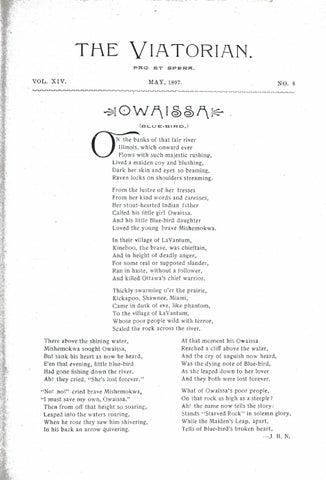
(BLUE-BIR D .)
Illinois, which onward ever Flows with such ·majestic rushing, Lived a maiden coy and blushing, Dark her skin and eyes so beaming, Raven locks on shoulders streaming. I
From the lustre of her tresses From her kind words and caresses, Her stout-hearted lntlian father Called his little girl Owaissa. And his little Blue-bird daughter Loved the young brave Mishemokwa. In their village of LaVantum, Kineboo, the brave, was chieftain, And in height of deadly anger, For some real or supposed slander, Ran in haste, without a f011ower, And killed Ottawa's chief warrior. Thickly swarming o'er the prairie, Kickapoo, Shawnee, Miami, Came in dusk of eve, like phantom, To the village of LaVantum, Whose poor people wild with terror, Scaled the rock across the river. There above the shining water, Mishemokwa sought Owaissa, But sank his heart as now he heard, E'en that evening, little Blue-bird Had gone fishing down the river. Ah! ' they cried, "She's lost forever." ''No! no!" cried brave Mishemokwa, "I must save my own, Owaissa." Then from off that height so soaring, Leaped into the waters roaring. When he rose they saw him shivering, In his back an arrow quivering.
At that moment his Owaissa Reached a cliff above the water, And the cry of anguish now heard, Was the dying note of Blue-bird, As she leaped down to her lover And they ~oth were lost forever. What of Owaissa's poor peop le , On that rock as high as a steeple? Ah! the name now tells the story: Stands "Starved Rock" in solemn glory, While the Maiden's Leap, apart, Tells of Blue-bird's broken heart. - J . H. N.
.. ,
THE VIATORIAN.
146
BT ARVED ROCK.
Han air of classic sa.nctity to its seclusion," then we shall briefly review ''Here by this stream in da,ys of old its history, Jearn the origin of its Tpe red men lived who He in mold; name and give a description of the The leaves that once their history knew, Their crumbling pages hide from view.'1 Rock . as seen at the present· day. Every nati<m looks with pride upon This natural curiosity, once a part the many sites which mark, the events , of the bluff wh..ich bounds the Illinois in her history, to the numerous plOnU- valley on the south, is situated but a ment,S which commemorate the deeds few tniles west of the picturesque city of her heroes and she preserves with of Ottawa. Its perpendicular sides the greatest , care the documents and shaped by floods ot many years, rise · relics which increase her fame or add to the height of : one hundred and twentyfive feet above the l-e vel of the to her glory. Illinois river. It is circular in form "Some rusted swords appear in dust; and its summit contains nearly an One, bending forward, says, The arms belonged to heroes gone; acre of land, while its sides are coverWe never hear their praise in song.'' ed with vines and ferns, wild flowers ' And if we are so eager to learn the and cedars, while below history of the places which · mark the ' "The river calmly flows." material progress of our country why should we not be more anxious to outThis great citadel which is as imline the numerous landmarks of the pregnable as Gibral ter stands apart church, to study their · history and if like some great fortress of ancient possi,b le to visit them. We · shall not times and its summit can only be attempt to rewrite the history of the reached from the rear where the floods many memorable localities which sur~ of ages have piled up the ' sands round us in this part of Illinois, ·but ag'a inst its base. When we have shall merely make a short_ review of ascended the ~ock our eyes rest upqn the facts connected with a spot whose a picture of nat,u re in all her grandeur. historic prestige is only equalled by ''1 have -stood upon Starved Rock _ its fame as the most noted ·landmark and gazed for hours .upon the beauti- · of the great west. Few places of . ful landscape spread out before _me," historic note - will be found of more said the late Justice Sidney Breese. peculi:ar ii:l t-e res t, scarcely any more ''The undulating plains rich in their picturesque in landscape, and certain- verdure; tlle rounded hills beyond clad ly nonemore unique i,n position than in their. forest livery; and the . gentle Starved Rock. We have but to men- river, pursuing its_ noiseless way to tion the name to enlist our attention; the Miss.i ssippi and the Gulf, all in to stuP,y its history to increase our harmonious association, mak~ up a picture qver which the eye delights to interest. Let us first take a glance at the linger; and when to these are added Rock with its surrounding "~Vhich give the recollections of the heroic advenI
THE VIA'I'O.RIAN.
147
'· ... I
148
THE VIATQRIAN.
turers who first occupied it, that here the banner of · France so many years floated freely in the winds; that here was civilization ~bile all around was barbaric darkness. -the most intense and varied emotions cannot fail to be awakened." As the observer stands upon 'this great pile he l~)Qks down upon the valley of ·the Illinois in all its beauty and freshness; its green fields of vivid green, dotted here and there with clumps of trees, he sees the pomp of the groves which are divided by deep ravines, the ,brooks and waterfalls reflecting the quivering foliage which surrounds them. The tops of the trees on either side of these ravines . unite and their interlaced foliage fohns a green canopy over the deep canyons below so that the sunlight as seen through thes~ leaves looks like myriads of stars set in a firmament of green. As we look eastward we . follow the cou~se of . the river, which is divided here and there by large islands covered with gigantic trees, and in the d.istance the stream looks like silver ribbons stretched on . a · bed of. emerald. Be}lind another fortress kno'wn as Buffalo Rock we see the picturesque city of Ottawa with the crosses of her many church spires glistening in the' sunlight, and the smoke from her busy factories, a:; it rises in clouds shuts out the view beyond the city. To the north sits Utica under tbe brow of the distant bluff, with her immense potte.r ie.s and cement mills; to the west the eye lingers on the placid stream as it steals through groves of trees decked with tender and graceful foli-
~ge,
and in the far traiUs·los t ···.
distan~e the silvery ···
"Where glea.ming fields o.f haze Meet the voyager's gaze.''
To the north and west are seen the · twin cities, , LaSalle and Peru, with their 'immense zinc factories which are the largest in the world. Betwe€\n these cities and the river may be seen the green slopes of vel vet turf relieved · here and there wi tb. cl urn ps of evergreen trees. The bluff on which r:ests the twin cities is connected with the one on the south bank of the river by the famous .Illinois Central Railroad bridge which spans the river-. · " 'Like a triumphal arch Erected o'er its march To, the sea.?'
And we gaze with.admi~ation upon the reflection of this. immense arch on the cle~r bosom of that stream named after the memorable tribe of Indians-Illinois. . "No wind stirs its waves, But the sptri.ts of the braves Hov'ring o'er, Whose antiquated graves Its still water laves On ·the shore."
'
As the eyes . linger upon this bound~ _less panorama of nature, the stillness, the desertion, and the obscurity of · this rock fort naturally increase our · interest, and we ask ours~lves what Jkole did this isolated cliff play in the ~reat historieal drama of past centuries. The early history of this celebrated spot is the history of the Indian tribes · in America, and this cliff stands today as a memorial of those tribes who were
1
1
I
'
~
·,
._
.' ''
i
'
I
THE VIATORIAN. . .
driven from their 'native abodes, and as a monument over the graves of their fathers. These unfortunate aborigihes of AI?erica have been wronged in many ways by their white brothers who found it much easier to kill than to civilize them. They have been despoiled of their rightful possessions
.
H9
bows are snapped, our fires a;re nearly extinguished-a little l-onger and · the white man will cease to persecute us, for we shall cease to exist," The only · way to civilize the Indian is to christianize and educate him. This is what the Jesuits did. Their band of Indian · missionaries were the select men of a
j
PATHWAY TO TOP OF STARVED ROCK.
and their characters are what they are, because the 'white men have made them thus; and these poor exiles of the forest have been murdered not alone because they were guilty of any crime, but rather because of their ignoranLle. "We are driven back," said an old Indian chief, "until we can retreat no farther-our hatchets ·are broken, our I
society which had a first claim upon the most fervent souls. Search the records of the whoie human race and where will you · find a story of purer lives, of sterner martyrdoms or more zealous apostleship? What a vivid picture of the loftiest virtues to be found in the world, do we see in the lives and the deaths of these great
.'
150;
THE VIATORIAN.
martyrs! What praise is too extravagant; what · language too sacred to apply to this noble band! "Nowhere,'' says Parkman, ''can be found more that is sublime even to eyes blinded by the glare of human greatness, than in the biographies of these martyrs of the American wilder" ness.'' They were especially great for their "heroic self-devotion, energy of . purpose, purity of motive and holiness of design." They suffered and eudured all things; yea, they even met death for Christ's sake and his Church. "They were a glorious company of apostles; They were a noble band of martyrs.".
The principal missionaries who visited Starved Rock and the whole of the Illinois Valley, were Fathers Marquette, Joliet, La Salle, Hennepin, Gabriel, and Zenobe. We shall content ourselves for the present with · a brie~ sketch of the lftbors of Marquette and LaSalle as th'eir missions were more directly connected i ith the history of our subject. The former was one of the most interesting as well as the most conspicuous figures of northwestern discovery. No man of his day had a more complete mastery of the Indian lan g uages, and this joined to the many characteristics of a zealous priest, fitted him more particularly fo: the distinguished part which he took in the noble mission of his order. He was both teacher and preacher. His was "A fiery soul, which, working out its way, Fretted the puny body to decay, And o'er informed the tenement of clay."
Inspired with the love for the ::;oul of
man as well as his ·g reat ·devotion to God, need we wonder then, when in 1675 Mar-quette, Joliet, and five oarsmen , and two ·Indian interpreter-s forced their way down the Mississippi and up the Illinois river. · They stopped at the Indian towp. called LaVantum situated not far from the· present site of Ottawa. Never before · had th~ waters of the · Illinois reflected the face of a white man and it is no 'wonder the Indians were surprised on seelng the visitors, for they believed the new arrivals had been sent from other worlds by the Great Manitou and for evil purp~ses. The preaching of Father Marquette, · · however, soo~ cha~ged . their minds and Chassagoac, the head chief was one of the first to be converted. Many others followed his example and now instead of the god of battle, the Indians worshipped. Him who first brought peace . on earth to men of good will. Here on the open prairie and just across the river from Starved Roc~, the amiable Marqu~tte, the last of this band of Jesuit martyrs,, established a mission which be called the ''Immaculate Conception of . the Blessed Virgin, " and here he went from cabin to cabin instructing the inmates. Then as Dr. Shea tells us, "when all were sufficiently aware of the doctrines of the cross to follow his discours_e . he convoked a ge9eral meeting on the beautiful prairie. There before their wondering eyes he raised his altar, and they beheld him offer the holy sacl'ifice of the mass, on the very day when, over
.....
...
I~
.. THm VIA'tdltrA.N. 1
sixteen centuries before, the God he preached had instituted it in the upper room i11 Jerl!lsalem. Thus on Maundy Thursday, April 11, 1675, was po~session taken of Illinois in the name of Catholicity-of Jesus and of Mary." And so it was at this first mass in the Mississippi valley, where the true religion was first preached to the Indian and here began the instruction of the many willing Kaskaskias who gathered around this glorious apostle of Christ. The place as we have said was called La Vantum by the Indians, but this name was changed to Kaskaskia by Joliet, hence confusion often arises when reference is made to another place in Illinois which bears the same name. But our reverend apos;tle was not destined to remain long at this m1sswn. He was stricken by a dangerous disease and was taken by his companions up the Illinois river then into the Kankakee, after traveling several days they landed among fri~nds in Michigan, where our zealous missionary expired. Ah, weary priest! with pale hands On thy throbbing brow of pain.
- Whittier. He was a man of comely form, Polished and brave, well learned and kind.
- Puritan Poet.
Scarcely had the last words of this 路glorious apostle- ' 'Mater dei, memento mei" died away on the winds of Michigan when a catholic nobleman, Robert Cavalier de la Salle now advanced to complete the work which his pre de-
cess or had begun.
151
LaSalle arrived at Ka~kaskia ~Starved Rock) in 1679,and in a short time afterwards built a fort which he named St. Louis. He discovered nothing except the Ohio river and he was simply ,a follower in the paths marked out by his predecessoT, Father Marquette. His idea, however, was the founding of _a permanent colony at Starved Rock, and to establish a new route to.France via the Mississippi anq the Gulf instead of via Canada. The fort at the Rock was in tended to to be a bulwark against enemies, as well as a storehouse for furs of all western 'tribes. He proved incapable of carrying out these projects, and as he returned from the Gulf he was stricken with a dangerous illness, and at once sent Tonty, his faithful friend and companion, back to the fort. Both men met again and repaired to the Rock where they established a colony, and six thousand Indians of the Illinois tribe returned to this their favorite Qwelling place. These attempts of La Salle, like the preceding ones, were not crowned with much success, and he was murdered while traveling through Texas. Several missionaries followed in the footsteps of Father Marquette, planting the cross of Christ and building chapels among the Indians. In 1699 Father Marest caused the mission at Starved Rock to be removed to the new Kaskaskia (the Kaskaskia of our own time, the first capitol of the State of Illinois) on the Mississippi river. The cause of this removal was due to the decay of the fort at th~ Rock as a a military and commercial -point, and
..
152
THE ViATORIA.N.
site 'was on. the banks of the sa'm e majestic stream that flowed through th.e ir native Limerick. In this delightOh, the generations old, ful haunt the future poet and novelist Over whom no church-bells tolled, Christless, lifting up blind eyes, first drank in the inspirations-- that To the silence of the skies. afterwards flowed in sweet melodious The bells of the Roman mission strains from his gifted pen. That calls from their turrets twain, Young Gerald's poetic soul was not To the boatman on the river, only influenced by the. enchanting To the hunter on the plain. scenery along the sweet banks of the -Whittier. Shannon, but also by his virt'!lous (To be continued.) mother's training, a lady of ability, and very refined literary taste. At the age of twenty, fired by the GERALD GRIFFIN. praiseworthy inspirations to win laurels in the literary world, he set out for the "Large路 was his bounty and his sole sincere great Engl'ish metropolis. Here he Heav'n did a recompense as largely send labored with indomitable courage to He gave to Mis'ry all he had, a tear. He gajned from Heav'n ('twas all he get his plays brought before the wished) a fri.e nd."- Gray. public, but the depraved taste of the The subject of our sketch is one of community could not appreciate his the ornaments of English literature in classical dramas . When he saw his ill success in the Ireland. The "Insula Sanctorum et . Doctorum" has done a fair share in be- drama he turned_his pen to the writing stowing honor and lustre upon the of sketches and essays for some of the tongue of its adoption. She has given foremost magazines of the day. The to the world orators, whom ''Byron" change was apparently a happy one; has not hesitated to rank with Demos- for it brought the young literateur thenes, and poets that have kept rank rapidly into the foremost ranks of the prose writers of the age. Who has with the first' of England's singers. Looking up 路 into that . resplendent not .heard or read ''The Collegians," firmament of Ireland's modern litera- "Tales of the Munster Festivals," ture we are impressed by th~ lustre ''The Invasion, n etc.? In this sketch we intend to consider and brightness of one particular star, the poetical merit of Gerald Griffin Gerald Griffin. He was born ninety-four years ago and let the author of ''The Collegians" in , the historical city of .Limerick, await future consideration. whose 'walls are washed by the silvery In his early路 boyhood he rnanifiested tide of the princely Shannon. About an inclination for poetry. There is ftn seven years after Gerald's birth the old saying familiar, indeed, to every family moved to their new country schoo~ boy: "Tell me what you read seat, known as Fairy Lawn. This and r will tell you ~h.at you are." also to the desire of a closer union among the 路 catholic tribes of Indians.
~~
I
.
i
'
'
' THE VIATORIAN.
Gerald Griffin . was an ·enthusiastic reader of th~ poets alild his favorites were Golasm1th and Moore. If there be an.y truth in the above adage we cannot but arrive at very favorable conclusions regarding his character and literary tastes. Before setting · out for London he ·.., suffered, a severe shock in the immigration of his parents to America. Here is how his brother tells his feelings on this gloomy occasion: "It was the first misfortune that touched · his young and sensitive spirit. He felt it with all the heavine~s of a deep affliction." 'Though tried at a very early stage of his life in the furnace of adversity, still the trial was produDtive of good, for it tinged his lofty thoughts with M:nder sentiment 'a nd the sweetest : pathos :- 1 ' 'That home is desolate! our quiet hearth Is ruinous and cold-and many a sight And. many a .sound are met of vulgar mirth , Where once your gentle laughter cheer'd '· th.e night. ' His with your country. The calm light Of social peace for her is quenched tooRude discord blots her scenes of old delight, Her gentle virttles scared away_:_like you · Remember her when in this tale you meet The story of a struggling right-of ties Fast bound and swiftly rent- of joy--:-of painLegend'3 which by the cottage fire sound sweet; Nor let the bard that wakes those memori es (In faint bnt fond essay) be unremembered t:P.en."
153
shady groves and among. the ruined abbeys and monasteries for which his . b1ome, ,around Fairy Lawn, has held an honorable place in the annals of Irish history, had ever and always a feeling that no power on earth could eradicate. In these melodious strains' . ' he complied with the request of one of his sisters, who wrote to him from ' . America, for words to the air of a once popular ballad in Ireland : . "There is music in each wind that blows Within our native valley breathing; There is beauty in each flower that grows Around our n.a tive, woodland wreathing. The memory of the brightest j_oys 1 In childhood's happy morn that found us, Is dearer than the richest toys, The present vainly sheds around us ."
Gerald's great heart was. as genuinely Celtic .and patriotic as his soul was chaste and sincere. He was not a frantic and unbridled wooer of the Muse; he .was · always filled with a deeply religious spirit, and calmly and sweetly and beautifully the ideas conceived in his rich imagination we·r e woven into exquisite ·verse by his in · genious pen. He prudently guided his genius in the wholesome path of virtue. Never was Gerald's pen dipped in Venus's fountain. He found matter enough in the good and the beautiful to weave into strains . of richest melody. In his poem ''Lines Addressed to ~ Seagull," seen off the cliffs of Moher, in the county of Clare, we have an unobstructed view into his beautiful soul : I
The impressions made on his youth- 1 "White bird of the tempest: Oh, beautiful ful heart, wandering about -the dething, lightful valleys and along the banks With the bosom of snow and the motion• of the ever flowing stream the cool, less wing :
in
I
THE VIA TORIAN. Now sweeping the billow, now floating on high, . , Now bathing thy plumes in the light of the sky: · ' Now poising o'er ocean thy deli.cate form Now breasting the surge with the bosom so warm Now darting aloft, with a heavenly scorn, N0w shooting along, like a ray of · the morn: 1 Now lost in the folds of the cloud curtainrd done Now fto :-tting abroad like a flake of the foam: N .)w t'iiP,ntly poised o'er the war of the ma.in, Lik 0 tlle spirit of Charity, brooding o'er pain Now g lid:ng with pinions all si lently furl'd Like an angel descending to comfort 't he world!
He loved peace as the greatest :a;nd best gift that can be bestowed upon this world, an~ war as the direst catamity that can cross the· thresholo of nations: War! War! Horrid war! Fly our lovely plain Guides fleet and far Thy fiery car, And never come again And never Never come again! Peace! Peace! smiling pea~e! Bless our lovely plain. Guide swiftly here Thy mild career And never go again · And never Never go again.
I
In the above there is an exhibition of a soul that hungered and thirsted not after the terrestrial enjoyments, but the delights of the world to come. His love for the ''Angelic Virtue" was that of a St. Aloysius. How beautiful the simile! The "white bird of the tempest" that ever breasts the snow capped waves of the deep blue sea, preserves from her birth till her death pure and unsullied her ''bosom of ~now, "with which her Almighty Maker has been pleased, to robe her. Though thrown friendless upon the stormy and · dangerous sea of London life, at an age when .t he passions of youth are strongest, and his soul panting after the fountain of fame, . Griffin was ever the innocent highsouled being that sat at his noble mother's knee ·to' hear her read the charming lines of "T?e Traveller," and ''Deserted Village.." ·
Gerald always, even when his name was a household word in the British Isles, and when he moved in the best society of London and Dublin, fondly turned with childlike simplicity and . love to the dear scenes amidst which the bright years of his boyhood were wont to move : "'Tis, it i~ the Shannon's stream Brightly glancing, brightly glancing See, oh, see the ruddy beam Upon its waters dancing; Thus return'd from travel vain, Years of exile, y.e ars of pain, To .see old Shannon's face again, Oh, the bli<ss entranc,ing! . Hail our own majestic stream, . Flowing ever, flowing ever, Silent in the 1llOrning beam, Our own beloved river." .
.
It seems that nearly every poetic
gem that came from Griffin's pen was prompted by the happenings of his daily life. ·when he received word from a relative of his that she intended
·,.;
I
.T RE VLATQ'RIAN.
to give her life to . the·. service of God in . the ranks of the Sisterhood, he pen Bed t.ha.t beautiful poem which has .found its Wfl>Y into our school 'books, '~The Si~ter of Charity": "She felt in b,er s;pirit the summons of grace, That called her to live for the suffering race; . And, heedless of pleasure, of comfort of home, . Rose quickly like Mary and answered, "I eome." She put from her person the trap'pings of pride, · And passed from her home with the joy of a bride; Nor wept . at the threshold as onward she moved, For her heart was on fire in the cause it approved." He seems to have ever in his mind the innocent pleasures of his young days, enjoyed in the. bosom of his fond parents and loving brothers ,and sisters in their pleasant. home at Fairy Lawn. _ Often, indeed, he bade the muse inspire him that he might sing those loved days in sweetest verse: "Old times! old times! the gay old times, When I was young and free, And heard the merry Ea_ster chimes Under the sally tree. My Sunday palm beside me placedMy cross upon .my hand, A heart at rest within my breast, And sunshine on the land. Old times! old times!" Though often battling against disappointments, he fought like a Turnus for the laurels he so ardently sought when he set out for London. Such an abhorrence did he have for the word ''failure" that in one of his letters to
\
\
\
· his sister he starts. at the word._, ''That ·horrid word failure, No!--death first.'' · No, failure was not to be th,e reward of a soul that gave expression to those . mighty words. . He won di~ tinguished honors, his name was printed in letters of gold on ,t he walls of fame, 'but Gerald was not · puffed up; he was ever ca1m and slmp l.e as a dove. In the zenith of his glory and renown he sat down to muse on the words ''one thing is necessary," , and with a sweet smile on his lips addressed ''Life," and then retired to join the sacred battalion' of the Chris - · tian Brothers where he enjoyed to the full .that peace the pleasures of this . cold world cannot give: "Life, what a cheat. a.rt thou! On yoqthful fancy &tealing, A prodigal in promise now; . A miser ih fulfillipg." Thus we close our sketch of Gerald Griffin the poet, who has contributed not only poems of exquisite beauty and great depth of thought, but . also models of prose that have raised him to the first r _a nks of those who have enriched our language and raised our literature to a standard we ar~ justly proud of. A. H. W.
Keep in the midst of life. Don't isolate yourself. Be among men, and among things, and among troubles, and amongst difficulties and obstacles. · You remember Goethe's words: "Talent developes itself .i n soli tude; character in the stream of life.·. Henry Drummond.
I
j
156
•
.,
I
T RE VI ATORIAN.
TI-\E
VIATORIAN .
Pub lish ed m onthly for the 's tudents by th e P a ntagraph Printing a nd S t ation ery Co., Bloomm g t on , Ill. E dited by the s tude nts of S t. Via t eur's College, Bourbonnais Grove, Ill. All corresponden ce mu s t b e addressed: T HE VIATO RIAN, Bou rbonn a is, Ill. . Ente r ed at t he Bloomington Post offtce as second c1ass matte r . · · Subscrip tion pr ice, one dolla r per year, p ay;lb le in ·a d van ce. · BOA RD OF EDITORS.
J . MURPHY . J . KEARNE Y, J. O ' DWYER. J . GRANGER, A. O 'SULL!VAN. P. HANSL.
EDITORIAL.
How swiftly , pass the days th·at make up the college year. Those that filled up the present year have left pleasant memories behind, but how swiftly does the tide of time flow on. W.e are now in the time of the harvest so to speak, examinations are in order and then the awarding of the prizes which f;)hall be settied by them . There w·m be only two examinations this · year, instead · of three as formerly. This will be then one less effort, but a corresponding increase of work . in. order td co'v er the ground gone over during the scho lastic year. The first examination takes place the , 'first week ·of · this month. The second and final one begins about June 8. Students have . just as much . time then. as inter.venes between these two dates to make up for some 'of the lost time. We hope that those who look for distinction do not rely on · t~eir ability to "make up" for lost time. Very few can, and most of the few who do succeed have no scrup'les about
the means . they use. B etter to fail manfully than to win by fra ud . . GENTLEN E S S.
Gentleness is a virtue most befitting to every christian , but it is especially becoming and essential to tpose who have the control and direction of youth. It commands r espect and ··obedience when harshness and passion only exasperate . It wins and .per suades when every other ·a rgument fails . It disarms .t he fierce and softens the most obstinate ; while har shness only confirms what it would subdue; and of an indifferent person, creates an enemy. Nothing is so objectionable and intolerable as a haughty and over- · bearing manner. To the man who is gentle and patient, on the other hand, the world is generally dispos ed to attribute every other virtue. · The higher endowments of the mind, )ike a lofty mountain, we admire at a distance, because we do not see the rugged parts so Clearly . Whereas we love and admire gentle manners the closer we come in contact with them. The man who possesses tbis quality succeeds almost without effort, and is envied by none. If he should have an·y misfortunes, he will also ·have many sympathizers. ''The world i ~self will pr.aise I?-im then; 'twill ,even 'take him by the hand and set him on his feet again." And whatever his failings may be th~y will be readily for given. The influences of gentleness are two fold . From what has already been sai.d its external influences ·are apparent. · Its influence for peace and
/
... ,,
THE VIA'l'OltrAN.
tranquility is ce~tain and powerful like a ray of sunshine lighting up the da-r:k reC'esses of mind, 0. 8.
157
rational; for as long as men are men, there will be, there must be war . . O'D; PHYSICAL CULTURE.
W'AR.
Nearly all writers today advocate peace. Glorious indeed is the end they wish to attain, but insurmountable tLe difficulties to be overcome. Undoubtedly, there are but few who desire the terrible loss of life, the certain demoralization of men, the {rightful , destruction of property; the numerous famines and pestilences, the separation of .loving friends, and other evils innumerable which war makes inevitable. Though it is known that war excites patriotism, . gives new national vigor, and many other benefits, nevertheless there are none of us who do not in our hearts cry for peace. It should be so, for peace alone will advance civiliz~tion. It seems that the efforts of the .advocates of peace are unavailing. Today the Cuban and the Spaniard have met in deadly conflict. The Greeks and the Turks are also battling; the one the noble defender; the other tbe rapacious invader. But though such unwelcome scenes loom up before us, the present is a peaceful era and will so continue. We should not forget that in human life, things are such that they i~evitably lead to strife. In heaven only shall shall perfect peace be found. There is but one in路s tance of universal peaceduring the life of Christ. All we can hope for then is the greater perfection of man's animal nature 1ihrou路g h his
It has often been r.e marked that the revival of athletic sports and out-ofdoor 路r ecreations is one of the most hopeful signs of the 路day. Our American universities a.r e awakening to the fact that college athletics, when properly controlled and directed, may be made to minister powerfully to the improvem~nt of both the mental and moral faculties; and in consequence we find physical culture firmly established in nearly all our leading educational institutions. The prevailing opinion some years ago was that a student's whole time while at college should be given to study alone, but happily this false idea has long since been eliminated and as a result, the schools of America today are supplying the country with young men . far better able to cope with the ''ups and downs" of life; men better fitted to use their knowledge to advantage, than were their predecessors of old. . Moreover daily observation teaches us that activity of themind depends to a great extent upon the condition of the body; . hence i.f the latter be weak and sickly the former generally looses its natural force and energy, and becomes stagnant and unprogressive. How many young men, before entering college, are strong aad healthy, and after many ye~rs of hard study, with but little, if any, exercise, find themselves , broken down in health,, in truth physi-
,
;158
THE VIATORIAN.
cal wrecks, a burden to themselves, as well as to those around them. Then, but unfortunately too late, do they realize the amount of, truth contained in the words of the poet Dryden"The wise for cure on exercise depend, God never made his work for men to mend.'
J. M. BOOKS AND ·PERIODICALS.
Messages and Papers of the Presidents, 1789-1897. Co.l<piled by Hon. James D. Richardson, M. C., of Tennessee. Washington, D. C., Government Printing Office, ~896. Two volumes of the above, containing -the state papers of eight Presidents, fTom Washington's first term to the end of Jackson's administration, have been kindly sent us by the compiler. The advent . of such useful books is to be hailed with 'delight, as many of these state papers are of great historical value, and the question& they consider are treated with great learning. In a . very modest prefatory note, the compiler says of the documents here collected and published: ''The messages of the several Presidents of the .United States are among the most interesting, instruc.t ive and vatuable oontributions to the . public literature of our Republic. They inspire to the highest and most exalted degree the patriodc fervor and love of country in the hearts of 'the people." .·This wurk has no doubt entailed much labor on its worthy compiler, hut it is ~vidently a work of love and will be a lasting memorial to his
\
patriotism, The mechanical work of the books is far superior to that generally issued from the congressional pre~s. The edition is limited to 6, 000 copies. Volume III of the above work is issued uniformily with, Volumes I and II, carries the work , forward to the end of President Van J;3·uren's administration. This volume contains among other noteworthy papers, those relating to the controversy over the United States Bank during Jaokson's second term . We are in receipt of two text-books recently published by the American Book Company. They are '•The Mastery of Books"' .or ''Hints on Reading and the Use ~f Libraries," by Henry Lyman Koopman, A.M., Librari-an of Brown University; and "Elements of Algebra," by .William J. Milur, Ph. D. LL.D: , President of Nt-w York State Norma.l College, Albany~ N.Y. The aim of ••The Mastery of Books'' is to guide the s_tuden t in his selection of books, to imbue him with a love for them, and to point out the most rational course to pursue in their use. A glance at the "Table of Contents" will give a more definite ideas of its·aim. Why and How much to Read; What to Read, How . to Read; Refe'r ence Books and Catalogues; Periodicals; Memory and Note Taking; Language Study; The Place of the Library in Education; Reading Courses; Classified List of Books; Books on the Subject of Reading. The style is racy and fluent, being enlivened by a number of happily chosen anecdotes which cannot fail to
.,
•
I
'
i
\ .-
'
·THE VIATORIAN.
bring home ' to the re~der the truth to be exposed. ·
15
THE MAGAZINES.
•
The features of the Rosary for April We -have one objection to offer, . are ''Details of the , martyrdom of St. 'howe-ver, and tn:;tt ' is concerning the Peter o.f Verona," ''Alexander Pope," list of books. No t~sk is of a more by R. Malcolm J obnston; ''The Rosary delicate nature ~han the recommending and the Holy E-uchurist-, ~, by J. M. L. of books,__ fo~ almost invariably works Monsabre, 0. P ; . ''The Dolors -of of an inrerior character are listed to Mary;'' The Hidden Life," . by Miss the ut~ter exclusion of superior ones. Caroline D. Swan, is very beautiful, The stu~·_ent when given a definite as it is of ·a very encouraging· nature, course of re,q,ding will naturally corifi_n e being a collection of verse on religious himself exclusively to that cou.rse and t.~pics which the worthy author gath~ by ~o doing he renounces to a great ered from the secular press, where inextent his own individuality. deed one might look last to find them. Reverend J. L. O'Neil, O.P., exThe first quarter's issue of the presses precisely our opinion in his Records of the American Catholic His ·. his • 'Why, When, How, and What we torical Society, begins the eighth volOught to Read." He says, ''Do not ume of that laudable periodical. The become a slave· to rules, a mere sei ve present number contains many enterfor filtering otber . men's th~ugbts. taining incidents of catho1ic history, HavE! your own likes and dislikes, and in particular the chapter on . the 'Hisdo not be afraid to express them, , for tory of Commodore John Barry.' There 'What is one man's meat is anot'ber are added also many pictures of histormh.n's poison." ical personages and places. Prof. Milur's "Elements of Algebra" The Cosmopolitan for April begins is all that its title implies. Its strongest point is that it, presents the what will no doubt prove to be a very subject in such a manner as to awaken interesting discussion on educational in the student a deep interest from matters. Judging from the standiQg the beginning qf the course. '•T wo of those who are to take part · it will causes," says the author, ''have con- certainly be good in theory whatever spired to make the study of algebra practical results may flow from the uninteresting--one, the unattractive debate. The q ues·tion as propounded method of presenting the subject; the is "Does modern College education 'o ther, the difficulty of the example educate in the broadest and most and complexity of the problems p~e liberal sense of the term?" The scheme sented to the pupils for solution." was proposed by the editor who met At a single perusal one can readily those he has asked to discuss the quesobserve that the au thor bas kept this . tion and with them formulated a plan fact in view for the entire work, being on which lines the question will be elementary, aims at enlisting and argued. It will no doubt ,create great 1 holding the interes t of the beginner. interest especially amcng educators. '
I
\
I,
,I -j.,
<'f
1 "'t.:L
'I''{'
160
THE VIATORIA_;N.
The Catholic Reading Circle Review, h.a s for its leading papers,- a sketch of Rev. Noah, of the Christian Brothers; "Poetty: Its Characteristics and Mission; " ''Electricity from Carbon;" "Some Thoughts on Teaching ;" '•Educational Thoughts;" 1 'How the Home Can Help the School." With these are 'the usual fine studies in his tory, literature, and soci,a l ~opics.
The Century devotes considerable attention to Grant, who is the hero of this year as Napoleon was the on.e of two years <jtgo. Besides the serial by Gen. Horace Porter, we find ''Gen. Sherman's Opinion of Grant;" "Gen. G·rant ·~t the Bonanza Mines;" ., 'Grant's Most Famous Dispatch ;" and "A Veto by Grant." With these there is ·.a sketch 'with illustrations of the tomb of Grant dedir:lated with great ceremony in New York last month. "Old Georgetown-A Social Panarama;" "A New American Sculptor;" _"Newly Discovered Portraits of Jeanne D'Arc" -form other features of note. "Dominant Forces in Western Life" opens the April number of the- Atlantic · Monthly. In this the writer tra~es ma.inly the trend 'of immigration and the sources from which' the principal states w~re settled : ''Mark Twain as an Interpreter of . American Character," is a rather lengthy acknowledgment that the well known writer possesses neither art, taste, nor skill as a writer; that his .humor is of a very questionable sort, and that while Mark really succeeded in giving us some description of real Western life and of the humor that pervaded it, '
'
neither was of more than passi n g~ worth and were done with when we had once read them. '''The Nominating system," as most lamentations on public calamities, follows and points , · out the evils of political systems without proposing the r emedy for their betterment. In 'sBry ant's Contribution to Literature, " we are told that his fame will rest chiefly on the merits of HThanatopsis, " and "To . a Waterfowl." These are a few of the principal papers in ·the stately and prosaic representative of cultured Boston. I
EXCHANGES.
One of our latest and most welcome exchanges is The College Athlete. . It is a worthy eJFponent of college and school athletics, for it treats "' in a masterly and. pleasing style all that pertains to that field, and numbers among its patrons many of the leading colleges and universities . of this country ~ Its pages are . enlivened by . copious illustrations of various college ~earns . and their representative athletes, and this feature alone bid_s fair to insure it the popularity it so richly deserves: The April number of the Niagara Rainbow of Loretta Academy, Niagara Falls, Ontario, is unquestionably the banner number of those we have thus far received. It contains two exquisite engravings illustrating 'the gloom of the Lenten Season followed by the joy of Easter. On the one hand the dead body of our Lord in the arms of his sorrowing mother IS
11;,+--!
.
'j
THE VIA'.I'ORIAN.
portrayed and on the other the glpdous figure of the angel at the Sepulchre ·greeting the. holy women who came in sear ch of the body of their Risen Lord. From a literary .point of v.iew the R ainbow ranks creditably with our best exchanges. : The Holy Ghost College Bulletin for April contains three very commendable articles. They are ''Studies in Shakespeare,'' ' 'Edmund Spencer," anq "The Study of Metaphysics." Beauty of style, careful study and skill in arrangement are plainly shown by the authors.
PERSONAL. ·
-The . Rev. M. J . Ma.rsile, C. S. V., attended the exercises of the dedica: .tion of St. Vincent's Church, Chicago, the first Sunday of this month. -Captain O' Mahoney, of the Des . plaines street station, one of the old and faithful police officers of Chicago, was a recent visitOr at the college. .
.
-Among the new students recently enrolled are Masters McNaugh ten of Chicago, and Leo O'Shaughnessy, of Alabama. -The Rev. Hugh O'Gara McShane, the accomplished pastor of Annuncia_tion, Chicago, paid his respects to the faculty during the past month. , . ~. -Sheldon Peck, D.D.S. , a former pupil of the college, is now practicing his profession in Chicago. His office .is .in the ,Marshall F.ield building, •. Room 907, where be w1ll be pleased to meet his friends.
161
-The Rev. Jos13ph Kelly, of Gibson City, Ill., was a recent visitor. Father Kelly is engaged with Father Len1iz, of Bement, Ill., in giving missions to non-catholics. One of the visitors of the month was the Rev. ·. J. B .. Souaya, a Basilian monk, formerly of Beirut, Syria, now of Chicago, where he att.e nds the spiritual needs of the people of his own country. -The Revs. J. F. Kelly and R. Flynn, of Gilman, Ill., were among the welcome guests last month. - ·Messrs. Prost and Kaufmann visited the son of the latter, on a recent Sunday. -Messrs Bennett and Mullen, of Chica g o, visited relatives ~t the Oollege . - Mr. B. A. Dupuis, '94, Detroit, Mich. , made Father. Ryan -a pleasant visit. Bert, though a busy man, looks well and enjoys life. -Mr. Jules Rivard, '90, was ma·r . ried to Miss Georgiana Gareau, at Notre Dame church, Chicago, Wednesday, May 5. The ceremony was per- . formed by Rev. E. L . Rivard, C.S. V., D. D., his brother. THE VIA TORIAN extends its best wishes to the young couple in their happy entrance into married life. -Rev. J. J. Cregan, C. S. V., for the past ten years a member of the Faculty, and for nearly all that time prefect of the Commercial Course, was called by his superior to Chicago, the first of May, where he will take charge of the Holy N arne School. Before
, .; '
• 162
THE VIATORIAN.
leaving, the students of the College r'nore deceptive curves, and has in him presented him with an address, in the ,making of a great twirler. which they embodied the many kind J. Kearney; the pride of the ~'fans, n things they felt towards · him, an:d also will take care the initial bag, he needs extended their heartfelt thanks for his no introduction to our readers as his many acts of kindness and zealous ef- playing last sea.s on was ~l ways one of forts in their behalf. We, too, join in the features of the game. offering him our kindest wishes for his At second will be seEm . a new ·face, success in his new work and hope that W. Smith, for a number of years the the pleasant memories he leaves be- star of the Alleghany College team has bind may be reminded by many returns ·been assigned to this position. He to his old home. ·handles grounders, and throwS, like a professional, while his batting will be a continued source of sorrow for asBASE BALL. piring twirlers. . H. P. 'RaineY. will play third, h~ is The prospects for a successful season very clever on ground balls. H_is in the National game here are excep- . throwi'ng is excellent, and heis a very tionally bright. heavy hitter. · At short will again be After two months indoor practice :found the only Corcoran, whose brilthe representative team has .been .liant stops and lightning throws of selected, and it is easily conceded to last season made him the idol of all. be the best that has fought under the He heads the batting list and is a very college standards for several years. sure hitter. The outer garden is well Rev. J. F. Ryan has been elected provided for. C. J. Quille will play manager, and is completing a schedule in left, he is the surest fielder on the that promises abundance of sport and team. J. Patterson will be in center glory. and D. Denault in right. · These lat·. M. P. Sammon will be found again ter show up splendidly in pra~tice, at the receiving end of the battery. and are good hitters and throwers. The . pitching 'department will be The team has secured new suits, gray taken care of by L. Legris and J. with maroon trimmings and they pre·O'Dwyer, , and their practices justify sent a very nobby appearance. The us in saying that they will decrease diamond has been ·graded and is now the batting averages of many of our one of the finest in the state. The heavy hitting opponents. Legris's following schedule has been arranged pitching is of the cyclone order, his and our manager is at present in cor· speed is terrific and this, ·coupled with re·spondence with several Chicago his many curves will prove a stumbling teams: block to many batters. ,· May 9-at college- Joliet Standards. May ·12· at Wilming.to.n - . WilmingO'Dwyer, our clever south-paw, while not as speedy .as Legris, has ton.
·y~;l-' ·>r-·~' .~~4Ho'lti:I.\IJI·,<,..·· ~ ''it*·~~-~·~"·'~·,
cO•
''#''' ·-t.·· ··~, ., "i<)!'i'9~,,1o.~,"f, {;;r......=i~.·"'+'
-\.,<
-'\~
, I
·May 19--at college--Manteno·. : ·, ·- W&nted badlyandguickly, a masMay 22~-at· Kankakee· Kankake.e. cot. M:ay 30-,at college:. IlLinois Cycling . -· Iri America, niggers dress in street Club of Chicago.-S. cars. · -Won' t that stuff spoil your teeth. brush. ·
VIA TORIAN A.
-Diary . .
- Say, Jim, I want you to stick · to the point.
-Smiles. - · 'Flurting.
--He told me explicitly not to allo\;V o~ permit it.
-My .Uncle. -Squat- head. .-· Tut! There's Hut.
Shorty is an absurdity; f(>r he is Change Ion g .
· -This is my sister.
- I t took three cyclones to blow . an
,angry whiff.
-Mutton and chuckle.
-· Get a delivery · wagon to express your thoughts.
·-Repeat it over again. -· Small but important.
- I'll be hanged if I can keep ..still
-Li Hung Chang (elonge.)
while I'm talking.
-What a glorious banquet.
--If you are sho.rt of shorty you are
-Man to climb the hickory stairs.
shorter than K.
- . I am the Jack in the French com-
-5 and 6 are 11 , and 8 is 14, don't you know that?
~dy .
-Rumor has it that Mac. is afflicted -Well, sure enough, its tomorrow · with heart disease. now. -Well, Duffy is going home- a · -That is-when wanted for Sat- . spree is coming back. urday. Who
- -The monotonous sound of . the riverlet and brooklets.
-Say, put me between the end and t he last.
- " I f your eyes are sore, don ' t be
looking out the winde."
-After this, say, gents- call me i:iaygur.
-''You see its dis way, if you read , one novel you know detn atl." ·
-"Now, will you be good. " said it?
- · ''Supposing I'd run for Senator" -0! look at the flock of wheel- . -"Nobody would vote for you." ba:rrows. ·- O! 0! My' gray shoes! (gracious) - · hit hi! hi!
-There . ' was a tremendou·s earthquake step, but .the pig crowed.
• 164
THE VIATORIAN.
-Where are you coming from? I've just corrie back.
-Cahill's . nightly songs 'can . be found . in the baby's dictionary, and only there, free of charge, because so charming. (?)
.-Where was you? Up on the roof practicing my speech. -Our spring . poets material in ''lonAly Joe."
-The echo of the born bardment of · the Turkish Tin ·Fort was heard . here recently and reproduced by the phonograph of St. J's corridor.
have good
- · Visit dudng _ leisur~ ho-u rs the famous Irish museum-near the Van.
--There are wonders iQ. this world . History has immortalized heroines and heroes, but it has yet to make im_ mortal our heroic dummy maker.
. --"You better keep away from me, or I' 11 take some of the conceit out of you."
-"How, · judges, do you want to
-Scientists there are who would like to have those wonderful relics recently on exhibition, for they might find that ''missing link'' in somebody's head.
destroy the essence of the constitution?" . -The world should admire the ingenuity of the man who made Ireland fit in Bourbonnais.
--Some claim that crookedness is' tl::e principle cbaracteris tic of the alderman. Some one please · inforin us if this applies to the corporeal part of the animal.
· .·-· They tell me I'm under the Bis. hop. No. (?) And I fainted when I .beheld that deadly wall.
.
- I f it happens I'll put you in- the
study-hall-' but I'll have · compassion on my pet, because---
-The latest form of government· known to mankind comes from the genius of a certain civilian. It is called ''Picayuneism." Motto is "Yo.u must raise from above; lock not at all, and be content after it is ate."
--·' 'We have decided to . frown ' " says the nightly conart, "since our sweet smiles were ridiculed." - ·"On G-rand Boulevard in Chicago and elsewhere people know an elephant can't sometimes kill a mouse."
-. ''0, Maggie, M,aggie! Take the cow out of the kitchen!" The cow was driven out. -''I have .been a horse-doctor for four years in Craw-ville, Ind. ; but me vocation is to be a human doctor."
-Our "little genius" bas become famous because of his recent production of the celebrated "Hinky-Dink Step."
Every student who intends to go into business should read .. '
·D etmer Music· House
,\
Basi-ness.
261 · Wabash Ave •. Chicago, Ill.
_flo~thly $2.00
~Sellers
of everything known in _. Music aJ;J,d Musical Instruments.
-~-=----=-Write
·
for Catalogues. · I
a, year.
The Office Paper.
'Ho read Business for a year is a liberal commercial education in itself. Write fQr sample copy, mentioning this P::tper. · ' ub!ication Offices, 13 Astor Place, New York. ,. .
't
--.