TH.E VIATORlAN. F'~C
VOL .. XIV.
:ST
SP:SR~ .
MARCH, 1897.
NO.6
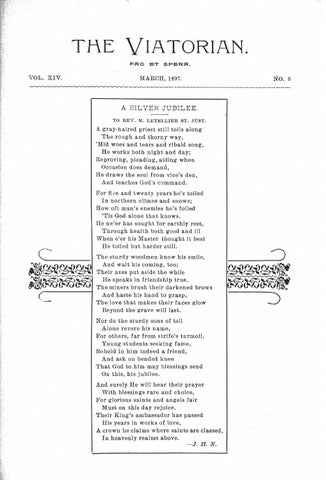
A SILVER JUBILEE . TO REV. M. LETELLIER ST. JUST.
A gray-hai.red priest still toils along The rough and thorny路 way, 'Mid woes and tears and ribald song, He ,w orks both night and day; Reproving, pleading, aiding when Occasion does demand, He draws the soul from vice's den, And teaches God's command.
c--
~~~
~
(Ffj(Ffj (fffj
c_
For fi :e and twenty years he's toiled In northern climes and snows; How oft man's enemies he's foiled 'Tis God alone that knows. He ne'er has sought for earthly rest, Through health both good and ill When e'er his Master thought it best He toiled but harder still. The sturdy woodmen know his smile, And wait his coming, too; Their axes put aside the while He speaks in friendship true. The miners brush their darkened brows And haste his hand to grasp, The love that ma,kes their faces glow Beyond the grave will last.
~~~. (Ffj(Ffj(Ffj ~
_)
Nor do the sturdy sons of toil Al~ne revere his name, For others, far from strife's turmoil, Young students seeking fame, Behold in him indeed a friend, And ask on bended knee T'hat God to him may blessings send On this, his jubilee. And surely He will hear their prayer With blessings rare and choice, For glorious saints and angels fair Must on this day rejoice. Their King's ambas路s ador has passed His years in works of love, A crown he claims where saints are classed, In heavenly realms above. - J.H.N.
-
106
THE VIATORIAN.
THE VISrON OF SIR LAUNF AL.
The poet Lowell felt when he had completed this work that he had done something worthy of note, and so expressed himself to a friend. This judgment was worthy of the mind that conceived the work and all trusty critics unite in confirming the impression of the author. This poem is not, of course, original' in its entirety, being founded on a legend that had long done service. But the story lost nothing in Lowell's handling and received many lovely touches it had not from other hands. The Vision of Sir · Launfal appeared in 1848, more than ten years before Tennyson had sent out his first installment of the ''Idyls of the King." There is little room for comparison in these two works, . the one epic in its form and conduct, the other a mere incident, but Arthurian, like the "Idyls" in hero and reference. Sir Launfal was to go in search of the Holy Grail, . which was, so the legend ran, the cup used , by the Savior when He first gave His body and blood to His apostles at the last eupper. It was conditional to the search, that he who would be successful, must be pure in mind and heart: vainly would others seek. So Sir Launfal made a vow to go in search of the Holy Grail, ar.d his going and returning form the two incidents which LoweJl has woven into a poem of exquisite lovliness. In the prelude to the first part, the scen.e opens amidst the effulgence of the early summer, when man must, if
ever, b~ struck with the beauty and goodness of God, who thus loads the earth with grandeur and warms men's hearts to noble deeds, as does the sun the earth to make it productive. So, too, the season was typical of the one who would go on the holy search-for he must possess youth and beauty. The strength of manhood must be in him, ana all beholders must be charmed by his presence and take hope of fruitful finding, from his power and enthusiasm. And here the poet strikes the keynote in famous line: ''And what is
~o
rare as a day in June."
Then, truly, the au'tihor draws a beautiful picture of thy life and beauty everywhere seen. He makes us feel that it is a time to inspire lofty action and a season wherein to plan for a successful harvest: • 'Whether we look, or whether we listen, We hear life murmur, or see it glisten; Every clod feels a stir of might, An instinct within it that reaches and towers, And, groping blindly above it for light, Climbs to a soul in grass and flowers."
·Propitious time indeed when Sir Launfal rides Jorth proudly from his castle to go on his holy mission, for: "'Tis as easy now for the heart to be true As for grass to be green and skies to be blue."
But the feeling of superiority bred in Launfal by imperious ancestors, made him overrate himself, and in turn made him despise Christ's poor. His dreams were limitless as his search which would bring him into all climes, for he knew not just where h1s quest would end.
•
THE' VIATORIAN.
As he came to the gate of his castle there met him a leper who sought an alms, to whom, in loathing, he cast some gold. But as no real charity went with the gift, it .was spurned by the. leper, who said: "That is no true alms which the hand can hold; He gives nothing but worthless gold Who gives from a sense of duty; But he who gives but a slender r.nite, And giv:es to that which is out of sight,
*
*
*
*
*
. The hand can not clasp the whole of his alms, The heart outstretches his eager palms, For a god goes with it and makes it store To the soul that was starving in darkness before."
Sir Launfal meets here his first rebuke, but passes proudly on to fill the object of his vow. The scene is changed. Chill December takes the place of summer. And if we not only enjoyed but really felt the pleasures of June in the description of the ·first part, we no less feel the chill and desolation, that "Carried a shiver everywhere From the unleafed boughs and pastures bare."
These preludes are the crystallizing of a mood and they impress the reader as would the very scenes themselves. We have nothing superior in American poetry, to the beautiful, soulful, and artistic work of 'these introductory stanzas of the two parts of Sir Launfal. If June be lifeful and hopeful, December is the ·season of gloom and sadn e- ss. It is symbolic of age-happy time if life's work be crowned with ever so 1ittle success.
107
And now comes homeward Sir Launfal, an aged, worn, and disappointed man. He has failed completely and wandered the world ·Over in fruitless search of the Holy Grail. Arrived at his castle gate, he again meets the leper who once more seeks an alms. Not now, as in days gone by, does Sir Launfal look with contempt on the leper. Suffering has softened his heart and true charity, not mere gold, he gives to the beggar. For said / the now man of faith: - - " I behold in thee An i.rnage of him who died on the tree.
*
*
*
*
Mild Mary's Son, acknowledge me; Behold through Him, I give to thee!"
But immediately the leper is transformed ·and appears as the Savior, who having heard Sir Launfal's story of a lffe's failure, comforts that broken knight thus : "Lo it is I, be not afraid! In many climes without avail, Thou hast spent thy life for the Holy Grail; Behold it is here-this cup which thou Didst fill at the stream for me but now; This crust is my body broken for thee.
*
*
*
*
Who gives himself with his alms feeds threeHimself, his hungry neighbor, and me."
In the application of the parable the poet lacks what comes from a delicate and enlightened faith. His interpretation is a purely natural one, and as such fails to · bring out the exalted grandeur of the fine lesson he had begun. He inculcates charity, but ignores one of the most divi:~e gifts of God to man, viz.; the giving of Himself to be our food and drink,
108
THE VIATORIAN.
prose and poetry such a charm, and such a high position in the world of letters. Davis was a 路 graduate of Trinity college, Dublin. We are told that during his probation within those ancient walLs he was a hard worker, retiring in disposition, not a mere pounder of text- books, for he read extensively, but without selection. He completed his course creditably, in deed, but without any distinguished honors. When he undertook the praiseworthy task of devoting his talents to the service of his country, the world beheld .in him a man of superior intellectual 'endowments. The autumn of 1842 witnessed him an active factor in the establishment THOMAS O:SBORNE DAVIS. of a new journal, The Natio~, its object being to promote the cause of "A nation's greatness lies in men, not acres; One mastpr mind is worth a million hands." nationality by all the helps which - John BoyLe O'ReiLLy. literary and political genius could Just eighty-three years ago there bring to its assistance. Thomas Davis was born in the charming little town and his allies fo-und that their staff of Mallow, situated on the picturesque was complete enough in every departbanks of the lovely Blackwater, County ment save the poetical. After some Cork, Ireland, one who had receive,:l a deliberation, Davis and his copartners due share of genius, the illustrious resolved to occupy the poet's chair Thomas Osborne Davis, Ireland's own themselves, which, indeed, they did, true and untainted patriot, poet, es- and with such success that they not sayist, and scholar. The young Davis. only astonished themselves, but the grew up imbibing a deep and passion- comp:lU.n ity at large. ate love for his dear native land, with In 1844 Davis contributed his greather lovely valleys and majestic hills, est portion and his m9s t worthy poems her melodious woods and shady groves, to the liter ary world. But, unfortunher noble rivers and crystal streams, ately, his glorious powers were early and the very skies above. extinguished in the slumbers of death It is this love, pure and undefiled, after a shor~ illness in his mother's that had its fountain head in nature home in Dublin, September 16, 1845, and nature's God, that gives to Davis's at the early age of thirty-one.
in that he makes the doings of real charity, even. though it be of a high order, a partaking of the divine , sacrament, as if it were not rather the real participation in that heavenly banquet that gave men the fire of true charity and showed the world how small are the works of man, how li~tle he can do, when guided by purely natural light and motives. Still this ''vision of Sir Launfal" is a superb creation-"a thing of beauty." It will repay earnest reading, and one appreciating its beauties will surely say that its aut~wr was no less a poet in conceiving it than a prophet in predicting that it would live. M.
THE VIATOiUAN.
He won for himself great distinction as a poet. in three short years, . and what he has left to posterity is but a . faint glimmer of his real greatness. Unquestionably Davis was as true a son of song as ever struck the chords of Erin's harp. His music came from the heart, and magic-like, steals its way into the heart, where it rings in sweetest strains of all that is heroic and beautiful. Truly, he sang of Ireland, and for Ireland alone, and this may be readily seen in his po.em, "My Land:" "She is a rich and rare land; Oh! she's a fresh and fair land; She is a dear and rare land, This native land of mine."
Is there not a real love of motherland exhaling from these lines 't How truly the poetic soul is reflected in eve.r y verse, and how the Celtic blood courses warmer and wa-rmer with patriotism fired anew by the mere bum of these. Was there ever uttered anything more patriotic·than this: "I'd fr 1eely die to save her And think my lot divine."
What enthusiasm marks these verses in this glorious outburst, "A Nation Once Again:" "So, as I grew from boy to man, I bent me to its bidding, My spirit of each selfish plan And cruel passion ridding; For this I hoped some day to aidOh! could such hope be vain? When my dear country should be made A na~ion once again."
What noble, lofty, and genuinely patriotic sentiments.
10\)
"National poetry," says this dearly cherished poet in one of his ess-ays, ''is the very flowering of the soul, . the greatest evidence of its health, the greatest excellence of its beauty. Its melody is balm to the senses." Yes, verily yes, it is the "very flowering of the soul," for in his song or baHad, "0h for a Steed," the health and beauty of his own great soul, pregnant · with genuinely national song, bursts forth in strains that loudly speak the delicate sensitiveness of his humane heart not; alone the wro:!1gs, those cruel, unnatural wrongs, under which his own loved land groans, but also any country smitten unjustly by the rod of tyranny: ''Oh for a steed, a rushing steed, and dear Poland gathered around To smite her circle of savage foes, and smash them upon the ground. Nor hold my hand While on the land A foreigner foe wall found."
*
*
*
*
Oh for a steed, a rushing steed, on the Courragh of Kildare, And Irish squadrons ready to do as they are ready to dare A hundred yards And Holland's guards Drawn up to engage me there.
We quote from his •essays: "This country of ours is no sand bank, thrown up by some recent caprice of earth. I tis an ancient land, .honored in the archives of civilization, traceable into antiquity by its piety, its valor and its sufferings. Every great European race has sent its stream to the river of Irish mind. Long wars, vast organizations, subtile codes; beaco.n crime£, boding virtues and self-mighty men were hers.
110
THE VIATORIAN.
If We lived influenced by wind, and
sun, and treP., not by the passion and deeds .of the Past, we are a thriftless a.n d hopeless people.'' The songs of Davis that smack of history are, unquestionably, the offspring of a soul not directly aroused by ''wind, and sun, and tree," but by passions and deeds of the Past, as .is portrayed in the following extracts from two of his most powerful and passionate historical songs, ''The Sack of Baltimore;" !itnd "Fontenoy." Baltimore is a small seaport in South Munster, a castle of the O'Driscolls, and after its ruin colonized by the English. On the 20th of June, 1631, the crew of two Algerine galleys landed in the dead of the night,sacked the town, took into slavery all who were not too old or tf:Jo young, or too fierce for their purpose: "Then flung the youth his naked hand against the shearing sword, Then sprung the mother on the brand with which her son was gored, Then sunk the grandsire on the floor, his grandbabes clutching wild, Then fled the maiden, moaning faint, and nestled with the child. But see, yon pirate strangled lies, and crushed with sp.lashing heel, While o'er 路him in an Irish hand there swoops his Syrian steel. Though virtue sink and courage fail, and misers yield their store, There's one hearth well avenged, in the sack of Raltimore."
In his dashing, high spirited ''Fontenoy, '' Davis pours out a volley of fiery thoughts in perfect blending and harmony with his theme. Sometimes be grows mighty, and thunders like
the roar of !lrtillery, full of that majesty and heroic splendor characteristic of the old masters that sang of the warrior. Does not this stanza start out in all the dignity of rhetorical grace, and flow on to the end in the same majestic grandeur of like 路 passages in the "lEneid" and "Illiad :" ' ~
''Like lions leaping at the fold when mad with. hunger's pang, Right up against the English line the Irish exile sprang. Bright was their steel, 'tis bloody now, their guns are filled with gore, Through shattered ranks and severed files and trampled flags they tore; .The English strove with desperate strength, paused, rallied, staggered, fled, The green hillside is matted close with dying and with dead. Across the plain and far away passed on that hideous wrack, While cavalier and fantassin dash in upon the track. On Fontenoy, on F.ontenoy, like eagles in the sun, With bloody plumes the Irish stand-the field is fought and won!
Truly, -T homas Osborne Davis was an illustrious figure in that brillian_t group of patriotic Irishmen that_ flashed in the firmament of Ireland's literature; and the genius of these proud sons of ''lnnisfail" is, and forever shall be, indelibly marked on the hearts of their countrymen, and their immortal contributions to literature shall be an adornment to the "Green Isle" as long as she keeps fresh and pure her faith, and the glorious treasures her noble sons and virtuous 路 daughters have bequeathed to her libraries. A. H. W.
TBE VIAT0RlAN.
MARK ANTONY (IN JULIUS ClESAR.)
Where is the one who has 路 fought with "C resar" in Gaul, who has aided him in building his famous ''pontoon bridge" and has never had a desire to read, or more, to see a production of Shakespeare's ''Julius Cresar." This drama is perhaps the author's best known work. Dealing as it does with a part of history, which even when written in an unadorned, prosaic style, cannot fail to attract the atteation of the youngest student of history, but when retouched by the master-hand of the greatest of modern poets it never fails to arouse the deepest attention . This play is not without its brilliant lights. Brutus and Cassius may be favo r ably compared with Shakespea-re's greatest creations, and the "quarrel" scene between these two men is truly one of the finest examples we have of dramatic art. But there is in ''Julius Cresar" a 路character of which I ~ould speak, one which for me has always had a fasci~ nation. I refer to the eloquent Mark Antony. Although not to be compared to Hamlet, Macbeth, Richard III., or Brutus, he may nevertheless be regarded by serious and conscientious critics as a creation worthy of a路 great artist. A character most true to nature, and which, considered in its . p r oper sphere, Shakespeare himself has never surpassed if ever equalled. Antony's life seems to have been one of love and devotion; love for Rome and
lil
an unfailing devotion to Oresar, whose word to him was law . . "I shall remember: When Cresar says Do this, it is p erform 'd."
If one will but connect Antony's
two truly gre~t speeches over Cresar's路 body, the one before the assassins, the other before the populace, be will find portrayed a character which is indeed worthy of study. Entering the forum in haste, he is amazed at the sight before him and over the corse of his friend gives vent to his amazement. Then in the fullness of his sorrow cries out: "Who else must be let blood, who else is rank, If I myself, there is no hour so fit As Cresar's death's hour. Nor no instrument of half that worth As those your swords made rich With the most noble blood of all this world."
It seems strange that after talking
thus he should address the conspira-. tors as "the choice and master spirits of this age"
and shake hands with each in turn, thus to all appearances making his peace with them; but we see his purpose in the following : "And I am suitor, that I may Produce his body to the market place ; And in the pulpit, as becomes a friend, Speak in the order of his funeral."
Notice his conduct when left alone with Cresar's body; at first esteem, reverence, love dominates. "Oh pardon me, thou bleeding piece of earth, That I am meek and gentle with these butchers! Thou art the ruins of the noblest man That ever lived in the tide of time.'
112
TEtE VIATOR.EAN.
But as a volcano seemingly extinct, suddenly 路gushes from the earth, s-o Antony pours forth with uncontrol\able vehemence, those feelings which he has so long subdued. ''Woe. to the hand that shed this costly blood. * * * * * * A curse shall light upon the limbs of men; Domestic fury and fierce civil strife Shall cumber an parts of Italy."
We have seen how Antony gained permission to address the people, and we all know how he moved and quieted the mob at will! How he broke the '2arrier of Brutus's eloquence wliich stood between the populace and vengeance! How be turned the people from a love of Brutus to a most intense hatred . See with what craftiness he informs the mob, of CCBsar's will, and how he makes them eager to hear it though not appearing to do so. ''I must not read it; it is not meet, You know how C::esar loved you . You are not wood, you are not stones, But men; and, .being men , hearing The will of C::esar, it will inflame you, It will make you mad."
And w;he1;1 the fury of the mob breaks forth, see how he seemingly attempts to quiet them, yet withal spurs them on:
Throughout we see Antony seeking but justice. 路 In his address to the people he seemed to have but one purpose, justice for CCBsar. In every way conceivable he attacked Brutus for his part in the conspiracy, .and seemed to incite the mob more against this man, whom he thought to be the leader, than any other. He may have been rash in his judgment of Brutus, but this we can excuse, for it was his love for CCBsa.r that made him hasty; and we find him not slower in forgiving Brutus on finding the true cause for his part in the conspiracy. Of him Antony said: "This was the noblest Roman of them all 芦 * * Nature might stand up and say To all the world, This was a man.''
The character of Mark An tony is indeed one to be admired and worthy of careful study, for it portrays a man who feared naught, who did what he thought was right for justice's sake. A man steadfast in his devotion to his friends. A true and honorable protector of his country's rights. c. J. Q. -Fear not till Birnam wood Do come to Dunsinane. "- Macbeth.
The spectacle of a ''moving wood," which the witches had foretold, was the last straw needed to break the camel's back in Macbeth's case. Still 路 we were treated recently to the sight Though when ,t hey have started on of large trees being bodily moved and the rampage, his true purpose becomes trans plan ted at a considerable distance from their. former abode. We have a evident from these few words: man who does such things with great "Mischief, thou art afoot, Take t.h ou what course thou wilt." agility. "Good friends, sweet friends! Let me not stir you up to such a flood of mutiny That they have done this deed are honorable.
THE VIATORIAN.
NECESSITY OF READING.
113
They are the God appointed teachers of the world, for great men are gifts Knowledge is derived chiefly from of God sent on earth tomake truth two sources:: personal observation and and righteous prevail over falsehood intercourse with those who are better and sin. and wiser than ourselves. Our sphere In reading the sublime productions of observation is · so limited ·in its of these master spirits we are unconOur range and so circumscribed, especially sciously purified and ennobled . .in youth, that but few are able to draw souls, like clay, in the hands of a potfrom this source any valuable knowl- ter are moulded into forms of truth edge. and beauty of which we before had no Nature lies before us If, then, we would learn to think conception. noble thoughts and elevate our souls stripped of all its grossness and clothed into a purer . atmosphere of intellec- with such lofty grandeur that we tual life we must commune with the must needs be drawn to worship its Almighty Maker. Their words are wise and good. We must sit at the feet of soiLe sage like flames of fire consuming all that is and learn wisdom from his lips. base within us and fitting us for the But where find this sage, this ora- higher and more nob:e duties of life. cle, able and willing to teach us the No one can be great and noble who wisdom we seek? Are any of our does not in some manner enjoy the friends or acquaintances abl~ to per- company of the great and · noble. form this service for us? Yes, the Hence some mistaking the semblance wisest sages, truest friends, and those of nobility for nobility itself court the who would be our most intimate ac- society of those who are decked with quaintances are patiently entreating the empty trappings of outward pomp. us to listen to their teaching. They spend their lives in fawning upon Good books, . ''containing the hived those who have nothing to give and Base' wisdom of ages," are ever at our dis- perhaps even despise them. posal. Behind the two boards that spirits these, incapable of seeing t!,lat bind them we can speak to the wisest all true greatness lies within. / Earnestness of purpose, purity of men that ever lived. ''They will talk to ,us," says Ruskin, ''in the best intention, faith, hope, and love, these words they can choose, · and of the · are what constitute the truly great man, whatever be his condition of life things nearest their hearts." or accident of birth. Every great Minds illuminated by the light of genius and surpassing in keenness the author possesses these in an eminent glance of an eagle's eye have felt in degree. Philosophers and poets, saints and their looks the living, burning thoughts of their souls. These are the inex- sages, would: gladly take us by the haustible mines from which the golden hand and lead us through the pleasant ore of knowledge must be drawn. fields of knowledge; and shall we
114
THE VIA TORIAN.
ignore such company to follow the common herd? How few there are who love the society of the illustrious dead, and how fewer still is the number of those who try to fit themselves for fellowship in this society of earth's greatest sons. There are hundreds who devour a certain class of novels by the thousand, and fancy themselves intelligent readers and highly cultured persons, but they can not in the best sense of the word be said to read at all. If reading is to be of any benefit to the mind it must be accompanied by some mental effort. In fact, novel reading as a rule does not call into play the higher faculties of the mind. It is thus described by W. D. Howells, who is himself one of the foremost novelists of the present day: <~It may be safely assumed that most of the novel reading, which people fancy is an intellectual pastime, is the e mptiest dis sipation, hardly more related to thought or the wholesome exen.:ist:¡ of the mental faculties than opiu tn ea,tin g; in either case, the brain is dr ug ged and left weaker and crazier by the debauch. If this may be called the negative result of the fiction habit, the positive injury which most novels work is by no means so easily to be measured in the case of young men, whose character 'they help so much to form or deform." Reading, when rightly understood, is i~ no sense a mere pastime. To be serviceable it must be a mental discipline. All the faculties of the mind must be brought to bear on the subject • we are reading. If it degenerates into
a mere amusement it ceases to be beneficial and may become endlessly harm ful. Ruskin lays down the true rule for reading when he says: "First of all I tell you earnestly and authoritatively, (I know I am right in this) you must get into the habit of looking intensely at words and as suring yourself of their meaning syllable by syllable, nay, letter by letter. You might read all the books in the British museum (if you could live long enough) and remain an utterly illiterate, uneducated person; but if you read ten pages of a good book letter by letter-that is to say, with real accuracy-you are forevermore in some measure an educated person.'' Reading after this manner is something more than a means of passing a few pleasant hours . It will do for the mind what outdoor exercise does for the body-give it strength and suppleness. The multiplicity of books seems to render a choice extremely difficult, but in reality it is not so. The number of good books is comparatively small and whoever reads with a purpose will soon learn to know and love them.
B. We are but children,-God is great! In face of death we could not live, Were there no castles in the clouds, No earthly hopes that hearts elate, No daily joys His dear hands give, No flowers to hide the somber shrouds. -Maurice Francis Egan.
Love that doth count its gift is a weak prop Whereon to stay a weary human heart . -EUza Calvert HaU.
THE VIATORlAN.
TI-\E VIATORIAN . Published monthly for the stud ents by the Pantagraph Printing and Stationery Co., Bloomm g t o n, Ill. Edited by the s tudents of St. Viateur's College,Bourbonnais Grove , Ill. All correspondence must be addressed : THE VI.A.TORIAN , Bourbonnai r;; , Ill. . . . · • Entered at the Bloomington Postoffice as s.e cond class matter . Subscription pric e, one dollar per year, payable in advance. · BOARD OF EDITORS.
J. MURPHY. J. KEARNEY, J. O'DWYER. . . J . G RANGER, A. O'SULLIVAN. P. H.A.NSL.
EDITORIAL..
The stormy month -of· March has some pleasant features. It ·is the time between the chill wintry days and the all-delightful ones of spring. Marking the passing of the dullest season in college life, it speaks of the bright, · hopeful days so near. One of the happiest memories this month brings, one hallowed by time and filled with recollections of many happy days now gone, is the occur.ence of a great day that comes within its limit-St. Patrick 's Day, the patronal feast of Ireland-a feast on which our college societies have always put forth their best efforts to do the occasion honor and on which they have invariably succeeded. A day on which we celebrate a great national and religious event, the conversion of a whole race to the true religion, is one worthy of perpetual r~membrance . And when all the memories are still fresh and the old faith still lives warm in loyal hearts there comes with the recurring years a greater veneration for him whose
115
honor we proclaim and a profounder respect for the remarkable nation whose fortune it was to have such an illustrious Apostle and who have been so true to his holy teaching.
We have a further reason for making the day one of joy, in that then we meet our friends and with them renew old acquaintance and perhaps recall the former times when together we celebrated this day. at home or wh en other and very dear friends were with us, whose kind words we miss and whom we shall henceforth know only in memory.
This year the Thespians will endeavor to entertain their visitors in the excellent way they do such things. They have adapted several scenes from Tennyson 's great drama Beck et with some additions from the play of the same name by Aubrey Devere . The choice is an excellent one and the rehearsals promise results in keeping with the high order of the drama. There will be a farce to conclude the evenings entertainment, entitled the 'Great Umbrella Case," in which all our comedians will take par t. Our friends are cordially invited and may expect a good evenings enjoyment. The play will · be given Tuesday evening March 16.
Each suffering is a new flower added to the crown which is prepared for us in eternity.-St. Liguori.
116
THE VIAT<)RIAN.
SILVER JUBILEE OF REV. M. LETELLIER ST. JUST.
Wednesday, February 24, was a day of great joy and festivity for the students and faculty of the 路c ollege. The occasion was the celebration in honor of a memorable event in the life of one of the college's benefactors, the twentyfifth anniversary of Rev. M. Letellier's elevation to the holy priesthood. Father Letellier was born August 14, 1832, at St. Thomas of Montmagny, Canada. He studied classics at St. Ann's College, Quebec, and completed his course at Laval University. He joined the community of St. Viatuers in 1862, .and spent six years teaching in many of their leading Canadian colleges. Feeling called to missionary work, he became affiliated with the Diocese of Chicago, and finished his theological course in the Seminary of St. Sulpice, Montreal. He was ordained in 1872, at the Cathedral of Chicago, by Rt. Rev. Bishop Foley, anC. immediately assigned to the parish of St. Anne, Ill. Here be built a magnificent church, and zealously attended the spiritual needs of bis 路fiock. Owing to the scarcity of French priests in the Diocese of Marquette, he, at the solicitation of the bishop, joined that diocese. He was installed as pastor at Muskegon, Mich., where be laboted four years, leaving (when transferred to Alpena), a beautiful church as the result of bi.s zeal. From Alpena be was sent to Menominee, Mich., where again he raised a grand temple to God's worship. Being stationed, respectively, at Ispeining, Nodeau, Lake
Linden, Calumet, and Iron Mountain, his present location, be left ev,ery ~ where monuments of his devotion to his sacred ministry, and be endeared himself to all by his faithfulness, kindness, and unstinted generosity. The Reverend Father, accompanied by forty priests from Michigan, Wisconsin,, and Illinois, arrived at the college Tuesday evening, February 23, and was entertained by a four. act drama, en titled ''The Children of Clodimir, " written by Rev. M. J. Marsile, C. S. V. Wednesday morning at 9:30 the Rev. Jubilarian sang solemn high mass in the college chapel, where, by a happy coincidence twenty-five years before, be bad offered up his first mass. The officers of the mass were: Rev. P. Boudoin, C. S. V., deacon; Rev. Father Fournier, C. S. V., of Irving Park, Ill., sub -deacon; and Rev. Brother Bergin, of the college, master of ceremonies. After the gospel, our president ascended the altar and preached a very beautiful and most appropriate sermon. He referred feeHngly to the many places where Father Letellier had labored in the sacred ministry, not to win success, or wealth, but from sim- 路 pie duty and loving kindness; to the many noble edifices that he bad erected for the worship of his Master, and which stand as glorious monuments of his great devotedness; to the many souls, which he bas regenerated at the sacred fount 1 fed at the holy table with the bread of life, united in the bonds of wedlock at the altar, and strengthened by the spiritual food, their passage from earth to the other . world, saying that all these in spirit
TRE VIATORI·AN. . .
unite with us their praises ·of such glorious actions, and on this memorable day assist us to crown a life so nobly spent in the vineyard of the Lord, and that they join us in praying that so faithful a laborer may be spared for many years to perform those priceless deeds, which are the jewels of history. · The music during mass was rendered by the college choir, assisted by the orchestra. At the offertory Mrs. C. F; Morel sang ''0 Cor Amoris" in a manner that betokened a great artist. After mass the Jubilarian and visiting priests repaired to the college hall where they reviewed the battalion drill of the cadets, and the fancy gun and sword drills by the Ford Exhibition Squad .and the Columbian Guards. At the conclusion of the drill, Mr. H . P. Rainey stepped forward and on behalf of the students and faculty read the following AD:PRE S S.
Reverend and Dear Father: · Be it ourprivilege on this a'".lspicious day to rejoice with you and unite our young voices with those of thousands who aH gladly hail this opportunity of wishing you joy and of telling you hearty thanks. With tfiem let us be allowed to pray that you may long be spared to those ~ho are the grateful recipients of the blessings that fall daily from your consecrated hands. Reared as we are here beneath the salutary influence of devoted religious, we are, even though young, already deeply sensible to the. affection and kindly light of the priesthood in whose gen tie beam the young may learn to
117
walk to manhood's greater duties and manhood be lead to that higher perfection of human life in which consists the glory both of the citizen and of the saint. Knowing, therefore, as we do the excellence of the priesthood's ministry among rneq, we respectfully beg to lay at . your feet, Reverend Father, the homage of our sincere esteem and respec.t . · Every man writes his own history in his deeds; along the path which he has pursued are strewn the monuments of his works, great and little. How beautifully, as with old imperial magnificence, you have adorned the path which you havetravelled; the churches and schools and especially the spiritual edifices the conversions with which you have enriched St. Anne, Momence, Muskegon, Alpena, Menominee, Nadeau, Ishpeming, Lake Linden, Iron Mountain, and Calumet form. triumphal arches that mark the road by which you have mounted to that Spiritual Capitol the perfection of the Christian eternal priesthood. Blessed indeed be the Ambassador of Christ 1 Blessed be the Apostle, whose zeal for the propagation of the world saving gospel has not only inspired him the generosity to leave country, horne, and . friends, but the consecration of a lifetime of most .indefatigable labors! Alike the rich z.nd the poor, the great and the lowly, the denizens of prosperous cities, and the humble laborers of backwood lumbering camps have acclaimed your corning amongst them; for all men bless the feet of those who preach peace and love and who administer comfort to universal
118
.THE V!ATORIAN.
human sorrow. And absorbed in gave a brief resume of his pastora. all these tasks you have not forgotten work in the arch-diocese of Chicago, our college, and we are among the many enumerating the hardships and almost who today proudly and gratefully point insurmountable difficulties which a out the gifts of your generosity. quarter of a century ago had to be enLet us be allowed then on this epoch- dured by the priest. He thanked the marking day of your eventful life to Reverend 1 Fathers of the college for place upon your deserving brow the their grand celebration in his honor, wreath of youth's admiration and love and the visiting priests for the honors for what is great and good in the deeds and favors which they bestowed on of men. him, and which he would always treasBe pleased to accept from us these ure as souvenirs of the great event of flowers whose beauty and perfume, his life, saying that he would hang in tho_u gh short lived, are a fair emblem the halls of memory a picture of what of the beauty and sweet fragrance of had transpired on this occasion. Knowvirtues which you have sown and culti- ing that the recollection of it would vated in the thousands of souls com- make pleasant any and all of his ardu-: mitted to your zealous care. ous duties, until his Divine Master Again receive the assurance of our wo'u ld be pleased to call upon him to most respectfu llo-ve, together with the give an account of his stewardship. The next place of assembly was in ~xpression of our hearty good wishes for a long and happy continuation of _the banquet ball, where abundance of your beautifully consecrated life. delicacies awaited their coming. The hall was tastefully arranged, potted A beautiful pillow of flowers, with plants stood upon the tables, and in ''XXV" in raised letters, -and two tbe south -end of the hall hung a magnificent bouquets were then pre- picture of the Rev. Jubila:dan, beaupen ted to the Jubilarian. _Very Rev tifully arranged with banners in],ather Bourion, V. G., representing scribed 1872-1897. During the feast Rt. Rev. Bishop Vertin, then arose the visitors were delighted by the and referred to his past frien9.ly rela- sweet sounds ,of the college orchestra, tions with Father Letellier and to the led by Bro. Desjardin. The menu kind feelings of his Bishop towards card was a novel and ingenious one, him, and _i-n fa few well chosen words the dishes of the different courses behe concluded by presep.ting Father Le- ing dedicated to one of Father Leteltellier with a beautiful surplice and lier's many missions. After the last stole, a gift of his former congregation course Rev. Father Marsile, as tcastof Menominee, Mich. Father Letel - master, introduced Rev. P. Boudoin, lier, visibly affected, responded by wh_o responded to the toast, "Our Revthanking the students for their milL erend Guest." Father Boudoin's retary entertainment and congratulating calling of early reminiscences, was them on their proficiency. H e t hen very interesting and a source of much
THE VIATORIAN.
pleasure to the .guests. ''The Bishop o! .M arquette" was the next toast, and Very Rev. Father Borion, of Menominee, Mich., responded, speaking highly of the bishop's goodness and kindness. Rev. P. C. Conway, of St. Mary's CQ.urch, Chicago, Ill., responded to the toast, "Our Archbishop." Father Con~ay modestly asserted that he considered himself incompetent for so difficult a..;t;~.sk as the one assigned to him, saying that. any words that he could utter would be but a feeble tribute to the great arch- bishop of the Western metropolis, whose abilities and qualifications commanded the respect not only of the American hierarchy, but of the Universal Church, and whose mild, yet firm way of ruling bas endeared him to all his priests a.nd people, and justly earned for him the title of "Faithful Shepherd." The Reverend Father's speech was greeted with great and prolonged applause. After the banquet the priests assembled in the music room, where they were entertained by some pleasing songs and original poetry composed for the occasion by Rev. Father Valaint, of Green Bay, Wis. In the evening most of the priests departep for their homes, and only a sweet memory of 路 the day's celebration remained to fill the void caused by their absence. THE YIATORIAN extends its hearty congratulations to Rev. Father Letellier, and joins with them the wish that he may be long spared for the sacred ministry, and that his holy life may be :raught with all the blessings of God. AD MULTOS ANNOS.
119
Among the many priests who participated were: Tbe Very Rev. Fathers Fourrier, of Irving Park; Boudoin, of Eourbonnais; Borion, of Menominee, and Rev. Fathers Valiant, of Green Bay, Wis. ; Kelly, of Gilman, Ill.; Labrie, of Momence, Ill.; Berard, of St. Anne, Ill.; Chouinard, of Manteno, Ill.; Mainville, of St. Joseph, Ill. ; Crosson, of Crawfordsville, Ind. ; Dandurand, of Lafayette, Ind.; Bordeau, of St. George, Ill.; Granger, Sixt, and Poissant, of Kankakee, Ill.; McDevitt, O'Callagaban, Oulinet, Lesage, Lamontagne, Bourassa, Bergeron, Vizina, Simard, Kearney, Gilmas, and 路 Conway, all of Chicago, Ill.; Boucher, Fond duLac, Wis. M.P. S.
BOOKS AND PERIODICALS.
''THE AMBASSADOR OF CHRIST.'' It may be truly said of the distinguished author of the above work that ''he touches notb_ing be does not adorn." In his latest work, ''The Ambassador of Christ," Cardinal Gibbons路,~as maintained the excellence of his folrmer work. Graceful in style, thorough in treatment, practical in its methods, it is a book fuli of genuine spirituality, with 'that touch of modernity that makes it peculiarly a book for our own day. Of course the principles of spirituality are and will ever be the same. But old fashioned methods in style and handling are apt to make a too practical people think that the sentiments of the book are as much out 路of place as the style. The author has succeeded admirably in re-
120
THE VIATORIAN .
moving this impression, and without lish Grammar," by W. M. Baskerville any concessions. Logical in its plan, and J. A. Sewell. This is a complete complete in its treatment, it is filled text-book, orderly in arrangement"t with the soundest maxims, supported concise and lucid in style, thoroughly by the most forcible reasons, and ex- practical, and its principles are pressed in a manner that leaves no founded on the real basis of grammar doubt of the writer's own sincerity -good literature. The main objects and conviction. This latest work is it has in view are "to cultivate mental the third of the cardinal's efforts to skill and power, and to induce the reach the public and to impart to it student to prosecute further stqdies Copious quotations some of the rich fund of knowledge in this field." within his possession. In a former from standard authors are given, in work, ''The Faith of Our Fathers," order to explain more clearly to the Cardinal Gibbons addressed himself to student the facts of the language. It those outside the church, and sought is a work which should be in the with all the powers of graceful pre- library of every teacher. In this scisentatisn and dignified pieading to put ence, especially, a teacher should be- 路 before the ''lost sheep of the house of come familiar with several authors, IsraelP a knowledge of the saving faith otherwise his mind will naturally narthat was still e!tant, still preserved row, and he will become poorly qualiin its primitive simplicity and purity. fied to teach this branch. In speaking In his second book, ''Our Christian of English grammar, we suppose Heritage," the author sought 路 those another text-book has been put on the already in the church, and tried to market because another one .is needed, impress upon them the worth of the but there appears to be more need of institution to which they belonged and an elementary text-book than an adthe need there was of serving it well. vanced grammar. There is no comIn ''The Ambassador of Christ" there mon school branch more important, is an effort to speak to the higher and in no other branch do we find orders, and here is as successful as in pupils more injured than improved. his other books. This latest effort is ''Of making English grammars there a logical result of the foi'mer works of is no end," and too many of these the cardinal, and they will make a contain nothing more than mer.e techworthy collection, reflecting honor on nical terms, abstruse thoughts, and their distinguished author, and will at principles which can only be mastered the same time be a high tribute from . by mature minds. It is no wonder a zealous prelate to Catholic literature. that many pupils cultivate a distaste John Murphy & Co., Bal tii:nore, Md., for this subject, for to them many 1896. Cloth, $1. definitions are too often meaningless, and so seldom are they applied that From the American Book Company, they do .not teach anything. The pupil Chicago, we have received ''An Eng- very frequently fails to see the end to .路
'·
THE VIATORIAN.
be gained .by much of this study, and owing to the senseless way in which it is taught there is no end. If the English language were taught more and grammar less, the pupil would be able to see the practical use of the study, and would want to study English, as well as any other branch. In short·, · if "more attention were given to the cut of the ga.r men t and less to the color of the buttons," we might see better result~ in the study of English grammar, for that which was memorized would be made a-part of the student's daiiy thought and practice.
121
In the Forum for February the Hon. David B. Hill treats the subject of the "Future of the· Dem:cratic Organization" in ::j, lucid and most entertaining manner. It is a brief resume of the history of this great political party, and in recalling . Bryan's assertion that ''the best of pr:ophets of the future is the past," he foretells the union of the party and its victory in the last contest of the nineteenth century. ''Economy of Time in Teaching," by Dr. J . M. Rice, is of special interest to teachers, and contains many suggestions which ought to be ''Practical Rhetoric" by J. D. Quack- put in practice by those instructors enbos. who fritter away their time upon The fact that another text-book has trifling matters, without making real been written by Mr. Quackenbos is a progress. Other papers of general sufficient sign of its worth, for his interest are: ''The Pre~ent and books have been considered standard Future of Cuba," ''The Results of authority for a generation or more. Cardinal Satolli's Mission," by Dr. The edition before us is very compre- McGlynn; ''The Cure f':'r a Vicious hensive and is written in that same Monetary System," by Senator Peffer, clear, pure, classic style of expression and ''The Criminal in the Open," by which have become the characteristics Josiah F lynt. of the text books of this author. It is The Rosary Magazine for February intended to meet the demands of all classes in high school, academies, and is up to its usual high standard. Probcolleges, and is divided in to six parts, bably the most interesting article is a namely: (1) The res thetic bas is . of character .sketch of ''Gerald Griffin rhetorical principles, (2) literary in- as a Christian Brother." It briefly vention, (3)literarystyle, (4)figurative describes the life of this famous poet, speech, (5) funct·i ons ·and technic of novelist and teacher, and gives us a standard prose forms, (6) practical beautiful pen picture of the sanctity, forms. ·T he book will be found clear, spirit of penance and purity of life of simple, and very philosophical in the this renowned religious. ''The story treatment of different subjects and of a Convert" by Madeline V . Dahlcannot fail to arouse _an interest and gren is concluded in this numb<>r. give life to the class which uses it. The very Rev. J . M. L . Monsabre, 0. P., New Yor k, Chicago, and Cincinnati, contributes the ••Rosary and the Holy Eucharist," and William Giles Dix, American Book Co., 1896.
12:2;
THE VIATORIAN.
"The President and the Rights of Christendom." A sketch of John Dryden is admirably give.a by Richard Malcolm Johnston. Two sonnets are also deserving of special mention "Acceptance" by Caroline D. Swan and "The Fourth Joyful Mystery" by Elizabeth B. S.Fp.ith.
Donahoe's Magazine for February is an excellent number. The frontispiece, ·'The Vacant Chair," is extremely pathetic, and at a glance enlists the sympathy of the reader. "Presidential Administrations of the Past," ' by Theodore F. Benton, is replete with historical information, and will be especially interesting to a student of history. ''Ireland's Past and Future," by Thomas A. Emmett, M.D. The subject is handled in a very lucid and interesting style, and manifests a rare degree of research. "The Sacred Heart· Order," by Virginia T. Peacock, contains an account of the founding and progress of this order, which today is recognized as animportant educational factor in America. Among other interesting and instructive articles might be mentioned "Ballad Poetry of Ireland," by Rev. Wm. DoL lard; ''The Cuban Outlook," by Carlos De La Isla; ''People in Print," and '•Restricted Immigration," from the pen of Edward O'Donnell. The short stories are also very well done.
-Now that spring has come we can hear the morning bird sing: "Out with your light, up wid ye now; Its time to be out-cross your brow."
EXCHANGES.
One of our most welcome exchanges is TAe St. James Journal. Not only do we esteem it for it::; literary merit, but for that charming feminine spirit which it breathes in every page. Even if the names of the fair scribes were not appended, the reader could readily guess the authorship. We are never disappointed on taking up the Ave Maria. Its short stories, poems, sketches, and miscellaneous papers are inestimable. Indeed, a single glance at the list of distinguished contributors is sufficient to convince the reader of its worth . The St. John's University Record, of Collegeville, Minn., is worthy of commendation. The copy before us contains three excellent articles, namely, •'Culture and Education," "Religious Liberty," and "The Book: of Nature." Subtlety of thought, exhaustive study, and beauty of style are. plainly evinced by the authors.
The Adelphian presents a very neat and tasty •appearance. The college colors (two bars of brown and gold), stamped diagonally across the cover, are quite unique in design. The only fault we note in its literary department is its scarcity of articles. The February number of the Abbey Student . contains three poems especially worthy of mention. These are: ''The Lily and ·the Maid " ''Simeon " ' ' and "A Day in Spring." Their imagery, musical rhythm, and touching devotional tone, notably of the first two, justify us in styling them exquisite.
THE VIATORIAN.
We are pleas.e d to add The Lake Breeze to our exchange Jist. Its list o,f al'ticles and aeat appearance commend it very favorably to its readers.
The Acquinus, published by the pupils of St. John's Cathedral School, Milwaukee, Wis., is a new visitor and a w~lc0me one. It is certainly a credit to the sch0ol it .represents. - 路 Joy fills the heart of the average boy at the 'a pproach of - the fine days. Base ball, bicycling, and all the favorite outdoor sports will be revived, and with them will come a return of that joy that makes college life pleasant. -The debate on the ''Cuban Question," for whioh so much preparation had been made, and which was anxiously awaited by those who hoped to b~ .- present when it took place, was unexpectedly postponed by the sickness of one of the principal speakers. We had hoped to see this great dispute settled Once for all, but here is an liDlooked for catastrophe and an in, definite wait. Poor Cuba! -The story of the wayward 'junior who hied himself and his toothache(?) over against Kankakee~ and mistook the railroad depot for tooth-factory, and then thought a _ride on the trai~ would give him surcease of pain, is an old, a very old yarn. But the junior is a permanent institution, and when he goes, if go he must, we shall lose the ftm a study of his naive excuses now gives us. -He has the history of the world.
123
PERSONALS.
-Revs. H. 0. Gara McShane, of the Annunciation Church Chicago,and J. Dunne, of Oak Park, Ill., were entertained for a short time by Fath?r Marsile on Washington's birthday. - 路 Rev. P. H. Williams '93, assistant at the Church of the Holy Rosary, Detroit, Mich., made a pleasant call February 27. -Rev. E. L. Rivard, C. S. V., b. D., was in Chicago, the 28th ult., assisting the V. Rev. Superior at Irving Park. -Rev. M. J. Marsile, C.S. V., lent his help at a mission given in Clifton, Ill., under the auspices of the Passionist Fathers. -Rev. P. Dugast, C.S.V., is a,t present en_gaged in Lake Linden, Mich., doing missionary work in that region. -Mr. Daniel Cahill '87, accompanied by Mr. J. Quinn, of Chicago, were welcome visitors at the college. Dan is in business in the city and shows every sign of a prosperous man. -Mr. John Carroll, one of the long established business r.rien of Chicago, visited his son John at the college the 21st ult. -Mr. J. Barrett, a prominent board of trade man, spent Washington's birthday with his son and nephew of the junior department. -Mr. and Mrs. Southard of Chicago, spent the afternoon of a recent Sunday in company with their little son, of the minims.
THE V IA TORIAN.
124
-Mr. and Miss Williams, of Kankakee, accompanied by Mrs. Stevenson, sister- in-law of Vice-President Steven~on, were recent visitors at the college. -Rev. Bro. Hawkins, whose health has not been the best for some time, has found it necessary to take a rest and has been relieved from duty for the present. He will spend some time in Chicago for treatment. -路 Mr. Jos. Kearney, of the seniors, has been laid up for some time and finally decided to go home where he will rest for some time. VIATORIAN A.
--The 5th of the Greek Doctors. -''Abe~"
''George," and ''Patrick. ''
-He don't know the run of the cards. -Patriotism blended with Christia.nity. - ' 'T" is going to run for police magistrate. -What's the matte.fi there, will you get up? -Why don't you put it in the papers? -Say, O'S--, when is the 17th of Ireland? - I f a girl took you, it would be to
-Shoot.
raise you?
""""Joliet.
-He had a dispensation for the other banns.
-Jump. -Haley.
- I f it ra~ns any limity of time there
-Blackey e.
will be a flood. .~{,:
-1800 B. C.
-Nit!
Nit!
-The Dutch. -Bob and me. -Walnut grove. -A game of cards. - -We came from the pen. -This is a cordovan shoe. -You are a high low man. -He is a two-year-old lion. -Three out of ten as usual. -It's surprisin' how they come. --Take them two and hide them. -The city of the ''Standards (?)."
- I can't fit in my room, 'cause I can't stay there. -That Crawfordsville catch this mouse.
cat can't
-Did you ever see a. mountain topple over on a mouse? --Sweet pleasure, gratitude, and remembrance tell the tale. 路 -What can't you avoid when trying . to spit on the floor? D's slipper. -We have a little, ambitious pugilist, but he should not meet those -kins. -Things have been one-side<!,llltely. A feather got on the scales and the big weight became. a patient.
.I