THE VIATORIAN. VOL. XIV.
JANUARY, 1897.
NO. 4;
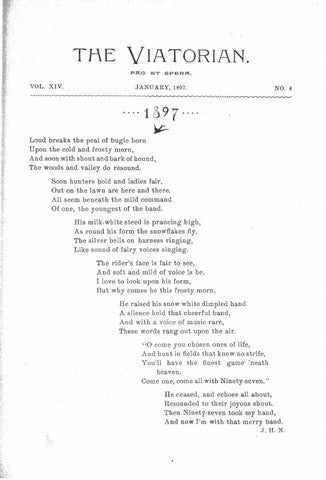
.... Loud breaks the peal of bugle horn Upon the cold and frosty morn, And soon with shout and bark of hound, The woods and valley do resound. Soon hunters bold and ladies fair, Out on the lawn are here and there. All seem beneath the mild command Of one, the youngest of the band. His milk-white steed is prancing high, As round his form the snow~akes fly. The silver bells on harness ringing, Like sound of fairy voices singing. The rider's face is fair to see, And soft and mild of voice is he. I love to look upon his form, But why comes he this frosty morn. He raised his snow white dimpled hand A silence held that cheerful band, And with a voice of music rare, These words rang out upon the air. ''0 come you chosen ones of life, And hunt in fields that know no strife, You'll have the finest game 'neath heaven. Come one, come all with Ninety-seven."
,,
'ffl-,
He ceased, and echoes all about, Resounded to their joyous shout. Then Ninety-seven took my hand, And now I'm with that merry band. J. H . N.
THE VIATORIAN.
66
LIFE.
How beautiful is life in all its manifestations! No piece of art is so delicately adjusted and regulated. There are none of its manifold needs which are not supplied in a manner that is wonderful to behold. Not even the tiniest fibre is without its corresponding usefulness, nor o_ne drop of blood which has not its function to fulfill. No wonder, then, that philosophers have stood in wo:o.derment at it; that poets haye sung its praises. Yet, for some , it is as much a puzzle today as it was in the ages of Zoroaster, Confuc~us, and Plato. Had it not been for Christian philosophy, we also would have even unto th}s day, wandered about in labyrinth of opinion, which mislead, . :.rather than helped to throw light upon this most wonderful of God's creations. It was reserved for Christian philosophy to remove the obstacles from our path of progress, and enlightenment, giving us a correct knowledge and understanding of this most admirable work, which we call life. It is only when we look at life through the medium of this clear philosopy, that we are capable of truly appreciating it. Life is indeed beautiful. We see it on every side. Behold, how the sweet daughters of nature, the flowers, open the portals of their respective germ-seeds, and in a little while are seen peeping vvistfully up through the resisting soil. A few days more, and those fresh buds burst forth into fragrant flowers, and blossoms of the rarest beauty.
Again, the little acorn nourished where it has fallen , begins to bud in the springtime and soon becomes a lofty and elegant tree. What marvel there is in this? The little bird, a naked, ugly thing at first, gradually clothes itself in its feathery surplice and soon flies about among the trees, filling the air with strains of music, both sweet and melodious. If there is anything beautiful in appearance, anything delightful in the voice of nature, anything excellent in music, surely a share of it belongs to those charming songsters of the forest, to whom an all wise Creator has given a yet higher life than that of the _ flowers, a life which so delights man and so beautifies the world. But do not all these beauties dwindle into insignificance when compared to the life in man? For, is not the human soul the most beautiful thing in existence? Is man not made unto the image and likeness of his Creator? Man does not merely vegetate as the grass of the fields or fee l as do the brutes that serve him, but he thin.Ks, reasons, and reflects; believes, hopes, and loves. He rises far beyond the utmost sphere explored by the boldest eagles, and soars upon the wings of contemplation to the very throne of his Maker. Such is the beauty and excellence of life, of which we would entertain ourselves today. Let us then see, first, what 路 life is, secondly what is its origin, and , thirdly, its various powers and degrees. What is 路life? In answering this question, we must not claim too much . We must not pretend to know what life is in itself, for we do not . know; nor do
THE VIATORIAN.
we know what matter is in itself. But we do know something concerning it. As we know much about the properties of matter, so also we know many of the laws of life. Several philosophers and biologists have given us definitions of life, but their definitions are not entirely satisfactory. Some tell us it is ''The sum of the functions which resist death"; others say that, ''Life is the sum of the phenomena peculiar to organized beings," and ''a center of intussusceptive, assimiLative force capable of reproduction," while still another gives us this, that life is "The continuous adjustment of internal relations to external relations. " These men defi ne life, but their definitions merely sum up the phenomena of vegetative or sensitive life, and thus exclude intellective life. Renee we must look for a definition which will lead us to a clearer perception and a more correct knowledge of what life is. What, th路e n, is life? Life is that perfection of a being by which it can move itself, continually perfect itself through immanent action; it is, in a word, self-motion, or inward action. This definition extends to all kinds of life. You notice in it the word mov~. This word is commonly understood in a wide sense as equivah:~nt to all forms of change or alte:ation. It includes the energies of sentiency and intellectual cognition as well as local motion. What is principally insisted on is essentially the immanent character of the oper&.tions of beings. The action, be it understood, proceeds from an internal principle; it does not pass 'into some
67
exterior or foreign subject, but perfects the agent. It would be well to note here, that the effects of non-living agents are all transitive. Now that we know what life is, where must we seek its origin? Either life has its origin ip. mere matter or it comes from God. There is no other alternative. But it cannot nor could it ever have sprung from brute matter; for if we e-xamine living and nonliving bodies, this fact will become quite clear. Is there not a great and unmistakable difference between them? Living bodies are organized: They are composed of diverse parts adapted to different functions. Even the most inferior organisms differ from inorganic matter, because we find by experience that their minutest cells are capable of executing a variety of functions. Then how much more must the more perfect organisms differ from such matter? The constitution of living bodies is most complicated. Is it thus with non-living bodies? Inanimate matter presents itself in simple compounds. Living bodies exist for a certain time, when they disolve and perish. Moreover, they attain only a certain magnitude which they cannot exceed. but where is there a non-living body whose size is limited thus? Again, living bodies sp~ing from a germ, which has first been elaborated by another of the same species. They are not evolved through the mere aggregation of matter, but through true nutrition and a successive transition through their various states. Nor are they increased by the addition of e~ternal matter, as
68
THE VIATORIAN.
is the case with non-living bodies; b:ut particular concrete objects, and its by the intussusception and transforma- corresponding power of sensitive appe~ tion of food through immanent action. tition. Then we have the intellective Living bodies are endowed with a sense power, which apprehends universal, which enables them to avoid harmful abstract, spiritual, or reflex objects . things and to seek useful things. Who and the will which desires these objects ever saw brute matter do these things? known as good. Lastly, we have the Hence the absurdity of certain thepries power of locomotion . We know that of over-zealous philosophers. A thing they are such, because we recognize cannot give another that which it bas them through their effects a posteriori and distinguish them through their . not i tS'elf. From the latter, which are We cannot then admit either spon- acts. taneous or equivocal generation, be- specified by formally divers objects, cause there would be an effect without we are certain of the difference bea proportionate cause, which is ridicu_ tween these various vital powers. lous; and because it perverts the no- Now all these various powers are comtion of a species. A species is an bined in the three degrees of life, the essence. But an essence is immutable. vegetative, the sensitive, and the If, then, living species cannot pass intellective. We know that there are from one into another, how much more only three, because there are as many impossible for inert species to leap gradations of .life as there are degrees over the unbridgeable chasm that sepa- of independence from brute matter. rates them from living species. There Such independence exists as regards is no way out, we must disagree with plants, animals, and man. Life is in those erring philosophers, and conclude plants independent, because it is not that life cannot spring from inorganic subject to the laws of matter, and matter, an idea which is repugnant because the elements which plants and which reflects on both the wisdom take are impeded by life from following and the power of the Creator. ''Life," their sole physical and chemical law. as the famous Harvey says, ''ever But the tree depends on rna tter in as springs from life," and if we could . much as it takes and uses its qualities. trace it to its remotest source we will Sensitive life does not need brute matfind that life has its origin in God., ter for exarcising the sensitive funcwho is the plentitude of all life. tions. What then does it need? Only In looking closely at the wonderful the material images and impressions of creation which we call life, we find in brute matter. Yet it needs materlal it a beautiful variety of gradations and organs and in so far depends on matpowers. Let us first examine these ter. Now, there is the third and higher vital powers. There is the vegetative, grade of life, the intellective. Does it which busies in building the parts of need matter and its material images in its subject to be perfected; the sensi- itself? If not, what? Only immatetive cognition, which apprehends rial and spiritual images.
THE VIATORIAN.
';.· .
Neither does it -need material organs, becau~e matter can not act upon a spirit, nor upon its faculties. Moreover, the soul can wish and understand, even though separated from the body. Hence it does not depend on matter. Therefore there are only the three grades of life mentioned. Let us dwell a little longer on those grades of life. Let us glance first at the plant. It is alive, because it grows; it has become from a mere germ, a beautiful object. It flutters _in the breeze and appears to look at the clear, blue sky overhead, but it has no eyes to behold the surrounding beauty; no ears to hear the merry sounds; no tongue to beg mercy from the woodsman; sense it has not; the odors exist in vain for it, because it c-annot smell, neither can it taste. Look a : the animal. It, to~, is alive and grows; but it can see the surrounding pastures and brooks that cheer it; even music charms and tames it; it can run an.d walk; it enjoys, like man, physical pleasure; but it cannot think; it k"nows not whether actions are right . or wrong; it·hopes not; it believes not; it understands not universal things. It is not thus with man, for his life is the life of the soul; he thinks; he understands; he loves. Faith comforts and strengthens him; hope encour- ages and spurs him on to greater and nobler efforts; imagination delights him; desire is his. This is the highest and most beautiful life, a life akin to that of God and his angels. How beautiful then is life. How beautiful and wonderful its various powers and degrees. What an
69
''impassaqle· chasm" between non-living and living bodies! · Never could it . have sprung from mere brute matter. Shall we believe those wily philosophers who would ignore an allwise Creator, and would have us believe in the dark mysteries of their materiali~m? If mystery there must . be in our philosophical speculations on life, is it not much more rational and comforting to accept these mysteries as imposed upon us by the all-luminous Divine mind, than to accept them from the freezing self-conceit of guessing and groping phiiosophers? N ature herself leads us to this conclusion. If the heavens proclaim the glory of God, much more eloquently do all the manifestations of life point to an allwise Providence, who has mingled unity with variety to beautify t4is world of ours. How admirable then,. is not the wisdom of nature's God~ J. O'D., '98 .. . A WAVE OF GREAT CHARACTERS.
"..(\·
~ ~~ )...1
Mr. Gladstone's eighty-seventh birthday, December 29, recalls the fact that for some reason there seems to have been a veritable wave of great men precipitated upon the world in the year of 1809. Perhaps the world needed them just at that time, and may be better able to care for itself now. So the world today has only one Gladstone, only one Bismarck, and he in forced retirement, and no Wellington or Napoleon at all, or no living poet or novelist of what we might call the very first rank.
70
THE VIATORIAN.
Hannibal Hamilin is also o:p.e of ~he But let this be as it may, of men who have lived and done grea-t work for hu- crop of distinguished men that nature manity in the nineteenth century, a showered upon America in 1809. B~:;n. surprising number first saw the light jamin Pierce, the great mathematician of day A. D. 1809. We find, this to be of Harvard; Albert 路Pike, the southern true in all fields of achievement, but poet and soldier; Raphael Semmes, the we notice it more particularly in the Confederate admiral, were also born fields of literature, science, and states- that memorable year. In 1809, in a quiet corner of Virmanship. It is a fact worthy of notice that ginia, there cam~ upon this planet of Charles Darwin and Abraham Lincoln ours a man who was to revolutionize were born on the same day, February methods of a'g riculture as effectually, 12, 1809. Moreover, the lives ofthese perhaps, though with no noise and two great men were lives of suffering, heralding, as Darwin revolutionized nearly approaching martyrdom. Dar- theories in the development of life. win, on account of his health, seldom His name was Cyrus McCormick, who enjoyed a day of peace or physical ease. was practically the inventor of the first Yet his dogma of transformism caused device to substitute machine for hand a revolution in the vast tield of human labor in farming thought. Lincoln's life was nothing His reaper and mower was the less than a veritable pilgrimage of pioneer of those giant steam plows and mental suffering and silent pain, that and threshing machines that now make the average man shrinks back appalled harvesting more of a pleasure than a and would refuse to drink his cup even drudgery. McCormick it was who made for the honor of being, after Washing- it possible for America to supply bread ton, the rriost illustrious American in to the world. His machines went to history. Europe, to India, to Egypt, and to the There appears to be a popular be- great Pampas of South America. lief that Lincoln and Jefferson Davis Mark Lemon, too, the humorist, wer~ born in the same year. This is un- . philosopher, and true friend of str1lgtrue, for Davis was born in June, 1808. gling literary genius, was born in 1809. Another name, another life full of He is better known as the editor of the pain and sadness, we find in Edgar Al- London Punch from its first appearance lan Poe, who was also born in that till his death in 1870. weird year, 1809. T. S. Arthur, the novelist, Henry An American poet whose life was a Giles, essayist and author of ''Human very happy one, came to us as one of Life in Shakespeare," Park Benjamin, the world's sunbeams in.l809- 0liver journalist and poet, and Addison Wendell Holmes. He was always Alexander, the great magazine writer, young, and his lyrical facility is were also born in this memorable year greater than that of any other Ameri- of 1809. This wave of great men .. extended can writer.
TRE VIATORIAN.
over the Old World as well as the new. The French statesman, Jules Favre, and the German statesman, Count Beust, were also bo_rn in this year. Mendelssohn, that gr~at German musician and composer, may also be added to the list. There was also born in this eventful year one of the greatest men of the century, a poet, who may well be called ''the greatest artist in words who has ever worked in the plastic English language-an artist who, having the divine gift of uttering poetry, both in essen:ials and attributes, yet, with constant and noble dissatisfaction, refines these attributes to their highest point." I refer to Lord Tennyson, one of the greatest English poets. His poetry is musical and full of thought, feeling, purity , and from every point of view is truly artistic. His music is modern, and w bile not so classical as that of Byron, is appreciated at once. Tennyson portrays _woman as the center of all purity, and for this alone he should be a favorite poet. He was influenced by the Greek poet Theocrite and his "Idyls of the King" are founded upon the pastoral poetry of this writer. The spirit of his poetry is truly Catholic, because he has taken many of his legends from Catholic sources. Byron, the most eloquent and strongest of all modern poets, had a great influence over Tennyson, and yet how different are they. -Byron so stormy, full cof thunder, darkness, lightning-Tennyson like the moonlight, clear, soft, mellow. Tennyson believed in God, in heaven,
71
and it is sad to think that such a master mind did not embrace God's religion. To use his own words, "All his mind is clouded with a doubt." His belief is briefly told in his own lines: "Behold we know not anything; I can but trust that good shall fall, At last,-tar off,-at last, to all, And every winter change to spring. ' 'So runs my dream; but what am I? An infant crying in the night, An infant crying for the light, And with no language but a cry.''
If the world today is not saturated
with "Zolaism" and "Dodoism" or French immorality in general, it is because of the purity, the gentleness, the sublimity, and the great influence of Tennyson's poetry. One is the artist of filth and everything vile while the other is the artist of the true, the beautiful, and the good. But while I am writing about the great men who first saw the light of day in 1809, the thought comes to me, were there no great women born this same year? Yes, there is one woman writer whose career began with that of Tennyson, one who ranks among the great English poets, one possessed of great thoughts, lofty ideas, deep emotion, and whose very soul is portrayed in her verse. I refer to Ellzabeth Barrett Browning. She was t-ruly ''a poet who stood in the white light of the beauty which we call poetry." While her style is oftentimes rugged, unfinished, and at times lacks rhythm, while many of her rhymes are defective, her technique faulty, she is, nevertheless, an artist.
72
THE VIATORIAN.
Her thoughts were as fire and her words were as fire. " Owing to ill health and loss of relatives, her life was tinged with sadness, hence a strain of sadness pervades her poetry. She says, ''Poetry has been as serious a thing to me as life itself; and life has been a very serious thing. I never mistook pleasure for the final cause of poetry, nor lsisure for the hour of the poet. " Mrs. Browning's love for children comes straight from the heart, and at once enlists our sincere sympathy. . She says: "Do you hear the children weeping, 0 my brothers, Ere the sorrow comes with years? They are leaning their young heads against their mothers, And that cannot stop their tears. The young lambs are bleating in the mead-
ows, The young birds are chirping in their nest, The young fauns are playing with the shadows . The young flowers are blowing toward the westBut the young, young children, 0 my brothers, They are weeping bitterly! They are weeping in the playtime of the others, In the country of the free!"
Let us hope that the corning century will contribute as great and as illustrious characters as the crop of 1809 and may the great poets in literature be Americans. We 路 lead the world today in inventions, may we also lead in literature. W. J. B.
TENNYSON'S PRINCESS.
This beautiful work of the master appeared in 1847, and met with a rather cqld reception in England. Before its appearance Tennyson had confined himself to shorter efforts, and had perhaps not yet given evidence of his power for lengthened work. In this, however, he was entirely successful, though the critics have been al- . ways divided in their estimate of this poem. It is highly poetic in its conception -professing to be a medley-whose scenes are a mixture of the old and modern England. Everything about the scene suggests modernity-but the poet managed to throw in a great deal of the antique, giving as Stedman says : ''A show of medireval pomp and movement, obs'e rved through an atmosphere of latter-day thought and emotion. " Adverse criticism was based on its seeming want of congruity. But in the hands of a poet like Tennyson this gave greater scope for his genius, since he was confined to no definite time or place, and roamed the world of fancy, free. Free from the real, he lived inan ide :ll sphere, and if ideality be denied the poet wherein shall he differ from the maker of prose. '~The Princess" is composed of a pr:>logue and epilogue, between which are seven cantos developing the charming stories that make up the tale the po~t 1s to tell. The prologue and epilogue are gems that are rarely equaled in our poetry . . In the former we are introduced to the
THE VIATORIAN.
merry group gathered to celebrate the summer vacation on Sir Walter Vivian's lawn. There are seven young men just returned from college路 among them the young Walter, son of the elder Vivian. There a:re many beautiful young ladies, first of whom is Sir Walter's dau.;;.hter, Lilia, a sprightly, earnest young woman. While the party is on the lawn, one of the youths, poetically inclined wanders through the house with the young Walter. They stop long at the library, and there. the youth comes across a book wherein are told the daring deeds of a famous woman of old. She was a paragon of bravery, who ''Sallying thro' the gate Had beat her foes with slaughter from her walls."
The poet is charmed. He goes out to meet the guests, and brings the book with him. Together they discuss路 this wonderful 路 woman whose charms and power the book amply st~tes: "0 miracle of woman, said the book; 0 noble heart who being strait besieged By this wild king to force her to his wfsh, Nor bent, not broke, nor shunned, a soldier's death ."
Here the story starts, for in the discussion which naturally follows, some man asks whether there are any such women now? And the impetuous Lilia answers: "There are thousands now Such women, bnt convention beats them down."
After further talk it is agreed that the young men shall each tell a story. They do so wherein there is developed what made up their conversation.
73
Briefly, the story is that a certain prince was betrothed to .a princess of a kingdom near by, and when the time for marriage had come, the prince sent word to the king, , of his wish to have the promise kept. But the old king sent word back that he was sorry, but that be could not路compel the princess to do a thing she was averse to, for she was opposed to marrying. She had set herself the task of ''Raising the fallen woman's divinity On an equal pedestal with man."
This was a breach of faith, and the stain must be wiped out in blood, so the prince's father said. The young prince was for other means. He stole quietly away ~:P. search of his promised bride, met. her father and hears a repetition of his excuses, and that the princess was so intent on her mission that she had left his court and bad started a school for young women, for men to enter which was death. The young prince, however, in company with two friends, goes to this wonderful school, and disguising themselves as women, manage to enter .and become enrolled as students. But they are soon discovered, a council is called to consider their case, but, womanlike, divide where there is question of punishing so severely men whom they cannot help admiring, and whose crime must be taken as quite flattering to themselves. But to consider the story in the order of the cantos. The first tells of the princess' disregard of the betrothal existing between herself and the prince, and, further,
74
THE VIATORIAN.
rescued by the prince. The in truders were speedily thrown from the university. "That he will send a hundred thousand men In the fifth canto both parties, that And bring her in a whirlwind." is the armies of the two kings, meet The second canto brings the young in battle, and the strength of poems friends to the university, where they here rises to the grandeur of the are detected. The description of this scenes therein described. remarkable schools and its grounds is The sixth is no doubt the finAst of one of the exceedingly beautiful parts all, mingled as it is with scenes most of the poem. touching and pathetic. The third canto shows us how the The seventh brings the happy terpseudo-damsels pursue their studies, mination. The Princess finds that mere for though discovered by one of the books . or separation from men does party, they have not yet been reported not fill up the ideals of woman. The to the Princess Ida. In their study of university is turned into a hospital geology they ride out into the beautiand the morbid life into one of active ful country about them, and we see help and sympathy for suffering huthe disguised prince and Princess Ida manity. go together. They speak of the be- 路 The epilogue brings us back to the trothal. He says that a refusal on lawn and the interesting young peoher part to keep her promise will be ple there. We glide so easily back we the death of the prince. She answers scarce notice the transition. thus: At the start it was agreed that the "Poor boy," she said, "can he not read? men should tell the stories, and that Quoit, tennis, ball-no games nor deals in at the end of each the women should that sing. So at the end of each canto we Which men delight in, martial exercise? To nurse a blind ideal like a girl, find some of the sweetest lyrics in our Methinks he seems no better than a girl." language. The fourth can to brings things to a ''Few will deny," says Stedman, desperate turn. After the party "that taken together, the five melohad spent considerable time in their dies, 'As through the land,' 'Sweet researches, they stop to rest and and low,' 'The splendor falls on castle lunch. At the close the Princess Ida walls,' 'Home they brought her warcalls for a song, desiring to hear one rior dead,' and 'Ask me no more,' of the new-comers. Cyril agrees to that these constitute the finest group sing, but the good quality of the wine of songs produced in our century; and and the abundance he took of it throws the third, known as the 'Bilfgle Song,' him off his guard. He breaks forth 路 seems to many the most perfect Engin a strong tenor voice. The princess lish lyric since the time of Shaksstops him hastily, breaks away from peare. '' the party, falls into the river and is The whole is intended to illustrate she refuses all overtures, though her prospective father-in-law threatens
TRE VIATQ:RIAN.
wom·a n's struggles, and this makes up a definite purpose in the poem. Altogether, it is a poem that will appeal to all lovers of the romantic, since it so skillfully works out amid
·• ;.
t
75
scenes so enchanting a tale of olden valor to give pr:ominence to one of the latest, but strongest, of modern tendencies, viz., the so-called woman's rights. M.
-4----+-
WfeeGI ~oft, flatteriu~ fi~eOU) eVe-ry moru, Jc-aUeriu?, fre-e- auG! '!i<>le, t!ve- ~oiGleu ?raiu ~flat all m~y f~re ali\e- ~uGl uoue c-omrlait2. »et tfley e-VaGle me ~uGl my ~litterir2~ coru !H'\~11) to tfle- ue~re-r. e ~imiGI ~uGI forloru, @1] fe-\) )e-e-m fri~flteueGI auG! aloof rem~ir2, IJlfr~iGI ~f me- ar2Gl of t!ve loVe--)eut r~iu, Wu famine-, of tfleir ovu refa)al !voru. ~JuG! ve, oa P)elVe~, ~o fla r2~ry of ~flY ?race, I !vle))e-Gl. J!orGI, li~e tfle)e-~ from rare- mi)tra)t; Wnc-re~)e oar loVe!@ mu eVe-ry c-ramlv auG! cra)t li<>l a) lvefloiGl tfle )flit2iu? of ~Q;; f~c-e, ~flat ve may eat ~uGI liVe, from reril fre-e-;-. Je-~, Gl rav a) c-lo~er, --clo)e-r y~t! to ~fle-e-. CAROLINE
D.
SwAN,
in Sacred .HeltTt Review.
T II E VIATORIAN.
76
.THE VIA TORIAN. Publish ed m onthly f or the students b y th e P a ntagraph P r inting and Stationery Co., B loomm gt on , Ill. Edited b y the stude nts of St. Via t eu r's College,Bourb onn ais Grov e , Ill. All corresponden ce mus t b e addressed : THE VIATORIAN, Bourbonn ais, Ill. Entered a t th e Blo6m in g t on P ostoffice a s second cl ass matter. Su bscription price, one doll a r per y ear, payable in advan ce. BOARD OF EDITORS.
J . MURPHY. J . K EARNEY, J. O'DWYER. J . GRANGER, A . O'Sulliv an. P . HANSL.
A Happy New Year to all, es pecially to the readers of the VIA TORIAN!
Why do we never tire of this old formula, which now we have heard for a score of_ years at this same season, and from old and new friends and relatives? Why? Not only does this familiar expression not fatigue us, but as a favorite strain that has once charmed the ear, it ever awakens within us a vivid sense of some great good of which our souls have had some perception through the tears of this mortal existence. Why do we love to hear these words, ''A . Happy New Year?"
Happiness, like a fair vision of some very great good, of the highest good, looms up before the mind of men, who, being intellectual, rational, are capable of appreciating that object as the end, the only end which can fill the capabilities of their being. To that end does all rational nature spontaneously gravitate. Anything that would im-
pede this rational and natural tendency to happiness is a dreaded obstacle. Nature rebels against it, arms itself to fight it and conquer it as an on ward stream cuts its way through rocks and leaps over chasms to seek the sea. On the contrary , whatever frien dly hand points the way to that loved goal, whatever voice whispers us Godspeed to our cherished destiny, is a welcome help, an added light which, inasmuch as it emphasizes the reality of the desired obj ect, is a new, a pleasant incentive, urging the soul on the pursuit and conquest of happiness. HencP. it is that we shrink from the ill-wiH of fellow -men, that we dread the menaces and curses of enemies, and that we delight in the goodwill that others bear us and in all sincere expressions of friendship and affection. We cannot in mere words more thoroughly express our esteem and love of fellow-man than by wishing him happiness, for in that one word is contained all that the heart can desire, all that can perfect it and rest it ana delight it when the heart once completely possesses this object.
A Happy New Year. What means another year? Wpy is it a good thing to have our friends wish us, and to wish to our friends? A new year, as the new born child of inexhaustible eternity, fresh and fair as childhood, and full of promise and hope, is indeed a very precious thing. Why so precious? Why has this new world been such an inestimable boon to millions of human beings? Because of its unique oppor-
THE VIATORIAN.
tunities. So with the new year. It will afford everyone new chances to r·e trieve his losses, and to create new gains in every field of endeavor, wherein are reaped the fruits that nourish and perfect physical and spiritual life. The year will be happy inasmuch as we shall avail ourselves of the opportunities it will afford us to cultivate the talents confided to us, to cull the fair flowers of virtue which ever grace and perfect all human life. A Happy New Year to all.
At this season when we celebrate the day on which the heavens opened, and the angel voices proclaimed peace to men of good will, and heralded the advent of the Prince .of Peace, it is especially fitting that men should take up the heavenly strain and wish one another peace and happiness.
BOOKS AND PERIODICALS.
The December number of McClure's Magazine is indeed a Christmas number, and, as usual, full of interest and beauty. It contains a beautiful frontispiece, "Grant at Twenty-one," which is now published for the first time. Also, an unpublished portrait of Washington, painted at Valley Forge by Charles Willson Peale. '•The Farthest North," is a very interesting and instructive article on Dr. Nansen's adventures and achievements in trying to reach the north pole. It is also well illustrated with very fine portraits of the adventurers. In art,
77
it contains many pictures which are reproductions of masterpieces. The "Madonna and Child," and "Bethlehem," may be stamped with the seal of true art. There arn many Christmas poems. "The First Christmastide" is a beautiful poem, by Harriet Prescott Spofford, which is appropriately illustrated in the reproductions of the famous frescoes in . St. Peter's, Rome, painted by Melozzoda Farli. The principal stories are, ''How Dr. Davidson Kept His Last Christmas" (which has caused considerable critici::;m), and "Bread Upon the Waters." They are well illustrated, and the magazine as a whole is equally edifying and entertaining. The December Ecclesiastical Review contains a very timely article entitled ''American Catholic Juvenile FictionWhat We Can Supply." If we notice the names of those who have expressed their views on this subject, we shall find the list includes the principal Catholic writers of the day. Among them might be mentioned Prof. Maurice Francis Egan, Eleanor C. Donnelly. Father Finn, S. J., Ella Lorraine Dorsey, Dr. John Talbot Smith, Mary Catherine Crowley, Henry Coyle, and several others. All seem to be very positive that there exists a great need for books written . es·pecially for Catholic boys and girls. There is no denying- the fact that our children are readers of fiction and that a very large number of men and women have devoted their entire time to supply this increasing demand for juvenile literature. All the arguments are strongly
78
'l'HE VIA'l'ORIAN.
in favor of presenting Catholic doctrine and Catholic practices in such a way as will enlist the heartfelt sympathy of our youth, and at the same time increase the faith of the little reader.
''Hymns of the Holy Innocence" and "The Pastor's Care of the Children'' are also interesting as well as very instructive. There is also a list of the best books in English written for the young, and compiled by a member of the religious order of the Holy Child Jesus. While the list is not complete, it is at the same time very valuable f:Jr reference. The Rosary Magazine contains many appropriate articles for a Christmas number. In art it reproduces "Our Lady of the Rosary," after Murillo, and "The Nativity," after Fra Angelico. The number is also replete with several charming poems on the ''Feast of the Nativity," and among them we might especially notice, "The Little Christ Child," ''The Pilgrim's Christmas, "The Christ Child," a.nd "Mary, the Morning Star." There are also three well written sonnets-"The Nativity," ''The Birth of Christ," "The Lamb of God.'' "Our Lady's Rosary" is by Very Rev. Thomas Esser, O.P., S.T.M. It is a very clear and vigorous exposition of the Rosary, its history and advantages, and a forcib le reply to the many censures which have been heaped upon this exquisite devotion. "Some Patricks of the Revolution," by Thomas Hamilton Murray, is a clear exposition of what assistance the Irish gave the colonies in the war of the Revolution. Among other ar-
ticles particular mention might be made of ''What the Stars Saw on Christmas Eve," by Grace V. Christmas; ''An East Side Christmas," by Rev. B. J. Reilly, of New York; "The Rosary and the Holy Euchar-ist," by Very Rev. J. M. Z. Monsabre, O.P., and "The Story of a Convert, " by Madeline Vinton Dahlgren. In Donahoe's Magazine we also find the pervading sentiment to' be one of a festival season. Many other topics have a special significance for the year which we are now about to bury. In "Election Ethics Past and Present," the writer compares the different methods used in past generations with those of our own day. ''Irish Race Convention," by Rev. Denis O'Callaghan, gives us a fine pen picture of the purpose of the late assembly, as well as the more prominent members of the convention. ''Christmas in Florida," is a well written sketch of Florida Catholics, both white and colored. "Utterances of Campaign Leaders," is a resume of the opinions of the great political leaders' in the recent campaign. The result of this remarkable contest is well portrayed by Henry N. Cary, in his article, "An Election Night in a Newspaper Office." The most beautiful engravings are the frontispiece, "The Nun's Christmas Morning," and ''St. Anthony and the Christ-child." There are also many other exquisite engravings of architecture and works of art. ''People in Print," by William Hopkins, contains portraits and short sketches of Rt. Rev. John J. Keane, D.D., Rev. Thomas Conaty, D.D., Rev. D. J.
THE VIATORIAN.
Riordan, and Very Rev. Joseph F. Mooney, V.G., of New York, as well as many other noted personages. The Christmas number of the Catholic World is also out in true holiday attire. "New England and the Formation of America," by Rev. P. O'Callaghan, gives a complete history of the progres"s, and the great influence of the church in New England. There is also a timely article on ''The Great Assassin and the Christians of Armenia," from the pen of George McDermot, C. S. P. An illustrated article entitled, ''The Schaffiertanz and Metzgersprung in Munich,'' by Alguien and another by Eliza Allen Starr. "Where Southern Lilies are trained." ''A Village Cynic·, " by Walter Lecky, is an interesting tale, and so is, ·'The Laying of Ghosts," by Henry Austin Adams, M.A. ''Labor Statistics in Russian Factories," contains many things of interest to the laboring classes. The verse is also qp to the usual standard of the magazine, and its principal poems are: '•Chris tmas in the Pines," "A Ballad of Tyrone,'' ''The Love that Overcometh," "The Immaculate Conception," and '•Holy Brittany." (Illustrated.)
EXCHANGES.
Of the Christmas numbers of our exchanges the most noteworthy is that of the New Wor-ld. Its striking feature is its holiday garb. On the cover is a beautiful picture illustrative of the glorious nativity of our Lord. The central figure is the infant Jesus
79
shedding His divine light upon the world and surrounded by choirs of angels chanting the "tidings of great joy" to the wondering shepherds helow. It is indeed an illustrated poem. The Pittsburg Catholic, though, perhaps, not so pretentious as to its outward appearance, contains many excellent articles appropriate for Christma~ which are illustrated by a number of exquisite engravings. Many of these are reproductivns of the great masterpieces of Christian art. "The Nativity," The Flight into Egypt," "The Good Shepherd," Bodenghausen's ''Madonna" '•Christ's Farewell to His Mother," and '•Our Lady of the Rosary" are particularly worthy of note. One of the most welcome of our literary visitors is the Musical Recm·d. Of all our exchanges this one is, perhaps, the most unique, for, as its name indicates, it is devoted exclusively to the musical world as are all its fellows to the college world. '11 he charm of its articles lies in the devotedness to the art of music which pervades them throughout, and there is not that tiresome array of technicalities which one would naturally expect in a journal of this kind, but, on the contrary, it is enlivened with spicy observations and soul-stirring eulogiums on music and its great masters. Surely he who reads the Musical Record cannot help being favorably impressed and becoming a more ardent admirer of the beauties of music. Besides the many literary treats which always characterize St. Mary's
80
THE VIA TORIAN.
Chimes, there is in the December number an article en ti tied "Personally Conducted,'' which is quite unique. The object is, through the medium of pen pictures, to conduct the readers of The Chimes throughout the entire academy and point out to them the many beautiful features of St. Mary's. To each member of the senior class is allotted a certain department of the academy, and the charming cordiality and ingeniousness of the fair guides is irresistible. In The Mountaineer, of Mount St. Mary's College, there is a detailed account of its "Alumni Reunion and Banquet." To read the toasts of the alumni of Mount St. Mary's is to realize how kindred are men's affections for their alma mater, for their spirit of love and devotion to the Old Mountain strikes a sympathetic chord in the heart of every loyal collegian. The circle of our exchange acquaint ances is steadily increasing, the latest arrival being The Holy Ghost Bulletin. A cursory glance at its pages will suffice to show that it meets the requirements of a standard college journal. . In the Niagara Index for December 1, 18~l>, we ate pleased to notice the continuance of ''The Humorous in Shakspeare." Broadness of view, exhaustive study, and, above all, a deep and penetrating insight into all that is humorous, is plainly e\'inced by the author. We heartily approve of this method of specializing in the study of Shakspeare, for his was a genius so varied thai it were folly, to say the
least, to attempt anything more general.
PERSONAL.
-William Fay '96, formerly of St. Louis, Mo., is now in New York City. A letter received from him lately gives a glowing account of his success there. - Rev. T. J. McDevitt, Chicago, spent a few days at the college last month, and acted as judge at the public debate. -Mr. C. O'Reiley '96, writes an interesting letter from Baltimore. Charlie thinks it makes quite a difference to have no Christmas vacation. -Mr. A. Granger, '95, who is now studying law in Chicago, spent the Christmas holidays at Bourbonnais. Armand is reading law with Condon & Condon, the latter being our ex-colonel J as. G. Condon '91. -Rev. A. Mainville, pastor at Papineau, Ill., was 路 one of the many visitors during the month. -Rev. Chas. Boucher, pastor of the French church, Fond du lac, Wis. , spent a few days in this region and was for a time the guest of Rev. M. J. Marsile, C.S. V. -Rev. E. L. Rivard, C.S.V., D.D. and Rev. Bro. Mainville were recently the guests of the latter's brother, at Papineau, Ill. , -路Rev. Bro, Desjardin; C. S. V., and Mr. Phillip Dube, assisted at an entertainment given in aid of St Francis church, Manteno, Ill., December 22.
THE VIATORIAN.
路-Rev. J .. M. - Marsile, O.S. V., assisted at St. James church, Chicago, on Christmas dlty. -The Misses Kelly and Flynn, of Gilman 1. IlL, were welcome visitors at the college during the month. - Rev. Bro. O'Mahoney, of the Holy Name school, is, we are glad to learn, entirely recovered from his late illness.
,
SOCIETY NOTES.* Of all the societies of the college the
German is the most enthusiastic. The members are becoming quite proficient in the German language. President King has given each one a pamphlet, containing German jokes and stories. By this means he has been enabled to make things very interesting, and, of course, the inevitable consequence is, that the members learn many new words, etc. The sodety meets twice 路 a week, and _at each meeting, are held conversations and debates in German. We hope it willli ve longer than former ones and that good results will arise. One passing outside the meeting room, during meetip.g hours, would readily conclude that it would hardly ever die. On November 1, the French society was reorganized with the Rev. M. J. Marsile, C. S. V., as Moderator. Good work has been done since. November 8, the society met for the second time and the following program was carried *Owing to lack of space we have been unable to print these heretofore. -EDs.
81
out to perfection. A declamation by Mr. Edgar Legris and a selection by Master N azaire Lamarre. The event of the evening was a debate, resolved, ''That the Gold Standard Should be J?reserved." Mr. P. Dube upheld the affirmative, whilst Mr. Joseph Granger successfully maintained that we should have "free silver." At the next meeting which was on the 15th of November, Mr. Goudreau gave a recitation followed by a debate, resolved, "That Our Standing Army Ought to be increased." Mr. William Granger upheld the affirmative and Mr. Raymond the negative. The judges decided in favor of the latter: Several excellent programs are being pre_pared for the coming year, and it is to be hoped that thev,_, will urove as successful and . beneficial as former ones. ST. PATRICK'S SOCIETY.
On October 28, all the old members <?f St. Patrick's Society were called together by the. reverend moderator for the purpose of reorganizing for the ensuing scholastic year. The reverend moderator acted as temporary chairman, and opened the meeting by some very impressive and appropriate remarks. Following this was the election of officers, the result of which was: Moderator, Rev. T. J. McCormick; president, Mr. J. L . O'Dwyer; vice president, Mr. Joseph Kearney ; treasurer, Mr. H. Hildreth ; librarian, Mr. D. Hayden; sergeant-at-arms, Mr. P. Hansl: secretary, Mr. Luke Mullens. The new members admitted were, Messrs. Brennan, Daniher, Cahil, Cor-
82
THE VIA TORIAN.
coran, Whittle, Dube, Maher, Denault, ring and parrying among the members, O'Toole, and Rainey. There being no it was finally agreed that it was proper other business, a program was made to celebrate for obvious reasons. So up which was carried out successfully the president was authorized to ap on November 4. It consisted of a de- point a committee of three to make out bate, "Resolved that the gold standard a program and see to other minor . is necessary to our prosperity." The details . He did so, and a few days affirmative was taken by Mr. J. afterwards tbe committee reported at O'Dwyer, and he received the unani- a special meeting. Their pr og r am mous decision of the judges, though being satisfactory, they were t old by the negative was ably defended by Mr. the reverend moderator to go to work H. Hildreth. earnestly in order that we might mak e At the next meeting, held November it successful. This advice was followed . 11, Mr. Hildreth read a well written The 12th of December was a Jay of joy and humorous paper on the evils of for the members, for it told th em their our Ltrge cities, which was hotly society was one of duration , it having handled afterwards by the members. now reached the twenty-fourth anni- 路 Following this a debate, "Resolved, versazoy of its existence. Owing to cirThat the campaign just closed was one cumstances, the program was not of demoralization." Mr. Kromenacker, carried out until the 15th. At halfwho defended the negative side prove'i past seven Tuesda.y evenin g all the too much for his opponent, Mr. Hansl. students, professors, and priests assem November 24, an interesting and bled in the recreation hall to witness exciting debate took place. It was the efforts of the young men belonging whether there should be enacted a law to the society. When all were seated, prohibiting the employment of children the curtain was raised, and immeunder sixteen. Messrs. Kearney and diately there burst forth the harmoLogan thought there shou ld be, but nious strains of the musicians. The event of the ev.ening around their opponents, Messrs. Mullins and Murphy proved it unnecessary. The which everything centered wa.s the contestants, especially those on the debate on football. The question was, negative, received well merited ap- "Does intercollegiate football promote plause. Mr. Logan's speech was quite the interests of colleges?" Messrs. pathetic. Messrs. J. O'Dwyer and Murphy and Mullins maintained that Hildreth assisted the negative gentle- it does, while Hildreth and Logan men in five-minute speeches, whilst held the opposite view. From the Messrs. Daniher and Hansl did like- 路 beginning the debaters held the attenwise for the affirmative. tion of their audience. Before the debate the members disNot once during the entire debate cussed the question whether they did they permit it to relax. There would celebrate as usual the society's was a strong array of facts, statistics, coming anniversary. After much spar- references, and strong arguments, be-
' .~
~路"
THE VIATORIAN.
83
sides much wit and humor. Both sides 路kee. After partaking of some refreshused their weapons to good purpose. ments all returned to the college. Laughter and applause filled the hall After prayers the members went to frequently. Upon the conclusion of the society hall, to which place Fr. the debate the judges gave their de- McCormick was escorted by Fr. cision, which was two to one for the Ryan. Little did the moderator susaffirmative. When the program was pect what was in store for him, and finished, the Rev. Father Marsile arose after a .few pleasing ejaculations he sat and thanked the society for their beau- down, when President O'Dwyer read tiful entertainment. He said that to him an address of affection, dur' St. Patrick's Society was a noble and ing which he said that the society lasting one, and that its members de- presented him with the price of serve much credit, as also he who a bicycle, a thing so ardently wished, trained them. After some very noble though unsought. When the address and eloquent expressions concerning . was completed the reverend father St. Patrick and Ireland, he again arose and made a splendid response, congratulated and thanked the society. which touched the hearts of the memFollowing him, the reverend moder- bers. He said that he appreciated ator, Father McCormick, in a few well very much the motives which urged chosen words, thanked all those who this little gift, and he would continue helped the society in making the pro- to do all in his power for their welfare. Thus closed a most joyous day, a gram a good one, and in carrying it out so successfully. Everyooe seemed day which the members of St. Patmuch pleased, and many were the rick 's Society will lqng cherish andreeulogies lavished on this little, ener- member. We hope the society will getic society. The program in full continue its good work, and be a credit to St. Viateur's College. J. O'D. was as follows : Musical selection .. ... Piano and string trio Address ......... . .... President J. O'Dwyer Re citation ..... .. .... . . . .... . .. P. Daniher Song ...... Messr s Nawn , Quille, and Burke De bate (as above) .. . .. Affi rmative, Murphy and Mullins ; negati ve, Hil dr eth and Logan S ong . ...... T . Cahill , Mullins, and Denault Piano solo .. . . . .... . .............. P . DuM Address . . . . .... Vice-pr esident J . Ke arn ey M usical select ion ..... P iano and st r in g trio
NEW YEAR'S RESOLUTIONS.
I shall not talk of football .-J. H. I shall not play billiards. - J. J. C. We shall not agree to stop smoking. -L. and M. I shall stop my cod-liver-oil. -E. S. I shall never tap another barrel of On the following day the member s, accom panied by the reverend moder- apples.-R. I shall have my hair cut closely.-M. ator, went to K . K. K. to enjoy th emI shall see that my alarm clock is selves as bes t they could. Th ey spent 路 the af t er noon vis iting the asylums and wound regular ly. - T. C. I shall eat no mor e pickles. - D. H. an d seein g the other sights of Kanka-
THE VIATORIAN.
I shall not talk about the weather. - M. I shall use no more big words.-K. . T shall henceforth be as the rest of m·e n.-K. We shall quit chewing tobacco.-· All-Hands. I shall attend no more political meetings.-H.
-Ah! by gosh. -Why is a cow? -What's the lesson? -''Golly but we had fun." -Is that a cup or krout jar? -There's icicles on the moon. -How old is she, big or little? - . Don't hit Dicky with a stone.
VIATORIANA.
-It was on a bright moonlit day -Look at that 45, year, old kio.
-It
-''Why not encourage football?"
-Has
-~His
-Corne
-What did the eminent physician say?
-What?
--Well , old man; what's the matter now?
-18 97.
- Vacat ion.
-Say Mr. M-, that thing will kill you yet.
-Good-bye. -All aboard.
-Gosh l gosh! has not this a classical ring?
-A cigarette.
·- Oh! I'm so happy.
My beart aches, 0! 0! 0! Om! Get to work you.
- · How time does fly. -Hark!
kindnessis of an inferiorkind.
Its only a kiss.
- .Golly, its the 5th again. -Ma, must I say farewell? -Get on, quick, little blue soldier. -0, Johnny, look! What? The College. - Had you a sad or pleasant "vac"? Well, yes.
-Who said they passed the gate receipts around? -''The coffee tasted like ginger ale on a windy day." - · Ask Bro. T. why he didn't turn on Mr. K's . light? -"By gosh! I wouldn't have such an animal in my room."
I must cry,
-He died de horse behind de cart, and you know how well dot goes.
-Pa, give me $5 and carry my satchel please.
-Its rumored that the grand old classical tongue sounds well when given. a feminine articulation.
-J feel so sad that but--