THE VIATORIAN. F.A:C
VOL. XIV.
ET
SPERA:.
NOVEMBER, 1896.
NO.2
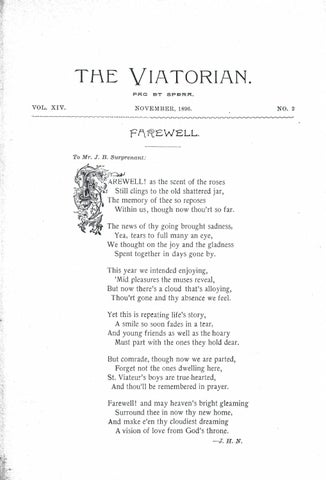
Ff\~ÂŁWÂŁLL. To Mr. J. B. Surprenant:
AREWELL! as the scent of the roses Still clings to the old shattered jar, The memory of thee so reposes Within us, though now thou'rt so far. The news of thy going brought sadness, Yea, tears to full many an eye, We thought on the joy and the gladness Spent together in days gone by. This year we intended enjoying, 'Mid pleasures the muses reveal, But now there's a cloud that's alloying, Thou'rt gone and thy absence we feel. Yet this is repeating life's story, A smile so soon fades in a tear, And young friends as well as the hoary Must part with the ones they hold dear. But comrade, though now we are parted, Forget not the ones dwelling here, St. Viateur's boys are true-hearted, And thou'll be remembered in prayer. Farewell! and may heaven's bright gleaming Surround thee in now thy new home, And make e'en thy cloudiest dreaming A vision of love from God's thron.e. -J.H.N.
I
22
TtlE VIATORIAN. AUTUMNAL. MUSINGS.
To the reflecting mind, there is a striking analogy between the different divisions of human life and those of the seasons. Spring is, in many respects, emblematical of the tender age of childhood; summer, of youthful vigor, beauty, and activity; autumn represents that period of age and gradual decline which precedes the winter of death and decay. It is in autumn we harvest and gather in the products of the seeds which were sown in the spring, and which were developed and matured during summer. We see on all sides indications that the year is growing old. The gay and festive attire which natu!'e assumed in the spring, and displayed so ostentatiously du-ring •summer, now looks faded and tattered. The flowers which were so pleasing on account of the variety and richness ·of their colors and sweetness of smell, are beginning to lose both their beauty and their fragrance; the pallor of death is upon them-they will soon lie prostrate on the bosom of their .m other earth. The fields which were lately teeming with golden corn, undulated by the warm breath of surnmor, are now almost bare. Their produce is gathered into the granary of the farmer, whence it will find its way in to the markets of the towns and cities of the country, where it will ultimately be distributed in the shape of food for both man and beast. The green of the meadows is turning brown; the forest trees, which were drooping with luscious fruit, have
been relieved of their burdens. The . forests, which during the warm days of summer resound~d with the songs of the birds and the humming of the bees, are now silent, save when disturbed by the moaning of the wind or the rustling of falling leaves-their rich and verdant foliage is turning into sere and yellow leaves, scattered about by the rude winds, fading and falling fast. The days, though bright and clear, are growing shorter and the nights longer. We no longer groan and sweat under the sweltering heat of a ' few months ago. The sun has spent its youthful fire; its rays are less ardent, but more agreeable. In a few weeks more the ·blithe and cheerful Indian summer will bid us farewell, giving place to the cold and muffied form of winter approaching in the' distance. The swallows have taken passage for warmer climes, and those human swallows who have been cooling themselves and seeking repose away on the hillsides or by the seashore have returned into winter ·q uarters. A great transformation is silently passing before our eyes. All nature is silently resigning the honor of its form to winter's stormy blast-soon it will be a dreary, cheerless waste. To him who is bent with the weight of years, there is something peculiarly interesting and truly congenial in the contemplation of autumn amid the tranquilities of the country. There is an air of chastened serenity diffused over the face of nature at this season, and when he views the surrounding
THE VIATORI.AN.
路 landscape withering under his eye, it reminds him of the roses and beauty of health which glowed on his own features during the midsummer of life, and which are now almost faded and gone. The ardor and enthusiasm of his earlier years have left him-he begins to feel the chill of advancing age; but if hA has not spent the summer of life in thoughtless extravagance and feverish enjoyments, the taper of life, though wasting to its close, will burn with the same mild, uniform, and genial luster with which the sun cheers and invigorates us in the month of October. Autumn teaches us, also, that at the heart and root of everything that exists there is the germ of decay and death, that all earthly glory is shortlived, vain, and frail, and as 路 fleeting and transitory as the leaves and flowers before the autumn gales . Yet
.~路
For him who with a fervent heart goes forth Under the bright and glorious sky, and looks On duties well performed and days well spent, For him the wind, av, and the yellow leaves, Shall have a voice and give him eloquent teaching . He shall so bear the solemn hymn that Death Has lifted up for all, that he shall go To his long resting place without a tear." A. L . O'S.
A man who has that sympathy which leads him to remember the lowest and the poorest, the afflicted and the sorrowful, has in himself an influence which will overrule pride, selfishness, and all passions.
23
WILLIAM MORRIS.
In the death of William Morris, England lost one of her noted charactersa man as rarely gifted as he was peculiar in the use of his diversified talents. . Born in 1834, he sprang from the common people and all his sympathies went out to them. His father was a merchant in good circumstances and saw that his children received a good education. William, the eldest son was sent to school at Marlborough and later to Oxford. He early manifested a love of art and spent much time at painting, but he soon found that he had mistaken taste for talent and gave up painting as a profession. But his love of the beautiful never left him. Indeed his whole life was one of complete devotion to the beautiful to which he gave expression with pen and pencil. "That thing which I understand by r eal art, " he said, ''is the expression by man of his pleasure in labor." His great effort was to spread a love of the beautiful among the lowly in the hope that an appr eciation of the beauty might bring alleviation from suffering and make happy the grc ~路 ; number of toilers to whom joy s eldv n comes and with whom it stays so shortly. He had a deep abiding sympathy for the poor. All his thou gh t s were for them. His religion was humanitarianism that has no high er hopes with which to inspire man-no greater cure for his dis eases than the cold balm of worldly eonsolation . Morris was what one might call a tradesman, his business that of a deco-
24
THE VIATORIAN.
rator. He designed furniture and wall never did they assume the pleasing paper ; besides he studied wood carv- appearance that Morris gave them. ing, engraving, and modeling-he was Flowing on with ease and grace they also a poet. In all these employments sparkle with a clearness that shows one central thought moved him; how how closely the author was drawn to he might best give new forms to them and how fully they took up his beauty, which ever like a guiding mind. spirit drew him on. He preached But there is a depres sing strain it, wrote of it in prose and verse- running through this work that is not in a word, tried to make others love it consoling to those of us who feed on as he did himself. hope. The thought that we are to His first book of poems was The de- die and that this is the end of all things and of all hope is not refreshfense of Guenevere and Other Poems, which appeared in 1858. This work, ing. . If Morris could propose to th e whiie betraying the student, lacked poor struggling masses of the great that flavor of fields and running brooks metropolis no sentiment more inspiramid which the poet gets his best in- ing than this: spirations. It gave promise, however, 路 "A long life gone, and nothing more they of good things, and this was realized know, in the Life and Death of Jason, a Why they should live to have desire and foil, work gleaming with light, and in which And toil, that, overcome, brings yet more the effort is sustained and around toil, which there p1ay all the spirits of the Than that day of their vanished youth, world of fancy. It is narrative in when first form in seven teen books carried sweetly They saw death clear, and deemed all life accurst and strongly forward from first to last. By that cold, overshadowing threat-the Morris was a lover of the romantic in end," literature, and he sought it not only in the classic Greek, but in the tales he has done little to inculcate a love of of the North. He is original rather the great beauty-truth, and above in method than . invention, but his all , the great one that the God-man touch was artistic and the romance spent years in toil and contradiction and fable of old received new life and not to prove that we should never die, but to convince men that beyond the form from his skillful touch. His greatest work is the ''Earthly grave there is hope and cessation of Paradise" and it is a great work in- grief, that death is not an ending but deed. Taking all the universe for its a beginning of that complete life to field it drew without stint from which even the lowliest of men feel Grecian, Roman, and North land lore that they are destined. William Morris, though a man of and fah le. The stories were not new; they han wealtl;l and culture, was by sympathy gone the rounds of centuries, but a socialist. It is passing strange that
THE V1ATORIAN.
a man of .his qualification should be so. But if we consider well his deep sympathy for the poor, and the shocks his warm heart must 路 have felt at the trials that are theirs and then stop to see that he sought a remedy for all this by methods tbat do not satisfy, we can understand his theory, which of all theories is the most impractical. The moment we forget man's destiny, or lose sight of the fact that suffering is inveitable in this life, that moment we prepare ourselves to launch forth any wild and destructive theory of bettering men and the world-and we take from man the hopes . that alone can save him from himself or prepare him by suffering for the glorious rest beyond. M.
KING HENRY VIII.
In Shakespeare's historical plays the author is compelled to confine himself more路 to facts, paying closer attention both to the manners and customs of the times, while the characters are drawn, with much truth and accuracy, from actual life. These plays cannot properly be called tragedies or comedies, but dramatic compositions exposing the people and manners of the times of which he wrote. Hence the absence of his imaginative powers, so extensive in his tragedies and other plays. Among Shakespeare's historical plays there is one which is not only a work of art but also of more than passing interest to all students of his tory, namely, King Henry VIII.
25
This play is distinctiy, and very properly, called a play of characters rather than of action. In it are chronicled a few of the principal incidents in the history of the reign of the English "Blue Bear9.," and it portrays such eminent personages as Cardinal Wolsey, King Henry, Queen Katherine, and others .of lesser note, as Buckingham and Cromwell, in a manner that is likely to give one an intimate knowledge of these remarkable characters and their doings. The play may be truly .s aid to be a history of the rise and fall of that "Great child of honor, Cardinal Wolsey."
If this, then, was Shakespeare's object, bo depict the fortunes of this great
personage, with what skill has he not unfolded them-chaining our attention from the very first and keeping our interest awakened throughout. How he arouses us to a pitch of indignation when that proud and ambitious Churchman let fall the heavy bolt of his wrath . on noble Buckingham, and our feelings can scarcely be subdued when we see him opposing the virtuous and queenly Katherine "Like the lily, That once was mistress of the field and flourishep.,"
in a point touching her honor as well as her life. Yet Wolsey plays on our sympathy and it must indeed be a hardened heart that would not soften with pity, when we behold him who had been fashioned to so much honor bending neath the weight of his great sorrow :
2.6
THE VIATORIAN .
"Nay, then farewell! 路 I've touched the highest point in a ll my greatness And from the full meridian of my glory I haste how to my setting; I shall fall Like a bright exhalation in"the evening, And no man see me more."
And who could help shedding a tear with the noble-minded Katherine, in her great trials on being approached by the scheming cardinal as she says; ''Have I lived this long (let me spea.k myself, Since virtue finds no friends,) a wife, a true one? A woman (I dare say witho ut vain glory) Never yet branded with suspicion? Have I with a ll my full affections Still met the king? lov'd him next heaven? obeyed him? Been out of fon dnes$, superstitiou s to him? Almost forgot my prayers to content him? And am I thus rewarded?-No friends, no hope; no kindred to weep for me, Almost no grave allow'd me."
When examining thecharacterof that odious tyrant, King Henry, we find that the author endeavors to paint it as pleasing as possible. Th.e sentiments that Shakespeare makes hi m express when he says: "Prove but our marriage lawf ul, by my life, And kingly dignity, we are contented To wear our mortal state t o come, with her Katherine our queen, before the primest creature That's paragoned o' the world,"
we find very different from the character of Henry, as handed do-;yn to us by hi:story. The first four acts of this play are so written as to ever keep our interest awakened, but in the fifth act, we are
disappointed for the incidents developed in this part pertain only to the minor characters, and we can without any hesitation say it is the weakest part of the play. I doubt if Shakespeare in writing it, had any other purpose in view, than that of paying compliments to his ''Good Queen Bess.''
This play, though the least Shakesperian of all that bear the great author's name, will always awaken interest in all lovers of good literature, abounding as it does in eloquent expressions and over-flowing with beautiful thoughts. C. J. Q.
MY LAST DAY AT HOME.
There are few words more likely to fill our minds with happy recollections than the expression ''my borne." Home means more to some than to others; but it influences every one, I think, to some extent. That men think less kindly of the paternal abode must be attributed to the fact that they have never been separated from it; for its influence pursues man in all his wanderings, and its charms increase with the running years. Home is dear to most of us inasmuch as it is the place of our childhood days; days of innocence with no thought of ills to come. To people that can visit home and kindred, .a nd all dear to them in a few days, there is not the charm, as for those who can visit home but once or twice a year. Nor is it so prized as by
THE VIATORIAN.
those who can visit home only once in two or three years. And what feelings must then overwhelm those who never, perhaps, may set eyes upon the scenes and kinsfolks foremost in their hearts! One in this position may be excused, should pathos for the moment lead him to overdraw the picture concerning horrie, for he appreciates it beyond description of tongue or pen. In the home of my boyhood I spent some of the happiest years I ever hope to spend, so dear to me that ''to remember is but to lament." In such a place I was certainly happy and contented, with not a cloud to darken the rays of happiness that lighted my path. I went to bed at night pleased with what the day afforded me, and arose again with a hope that its close would be as agreeable as the preceeding day. . But the sqnshine that had lighted my path was now tinging an approaching cloud; the hour for my departure was drawing near. It was certainly a trying mon;:tent when I had to depart from all that was dear to me. The streamlet on whose banks I had loitered a thousand times, though always pleasing, never looked so beautiful as now, when I was about to leave it perhaps forever . The little wood I had so often made speak with a verse or two, seemed by its rustling leaves, to bid me a final farewell. The crows which I had pitied on winter evenings, when they fl e w in long battalions to take shelter from the wintry blasts, among the naked trees, seemed now to pity me in re-
27
turn. The gard~n which I tended and the flowers I so often watered seemed each to say "farewell!" I woke on the morning of my departure, as the grey dawn crept through the little window that lighted my room, to find a dear mother at my bedside. She reminded me of the many times she made with care that bed which she said was to be never more used by one dearer to her than life, and assured me that her hands would never again be laid on it, so great was her emotion at my parting. I arose at an hour earlier that morning than was my custom and hurriedly dressed myself. I came down to the room where my father, mother, brothers, and sisters awaited my presence, that we all might have breakfa$t together perhaps for the last time. I can never forget the train of thoughts that filled my mind; happy recollections of the past crowding out a very indistinct view of the future . I was leaving home and dear ones, breaking the bonds of unity that bound us so closely together, that when one rejoiced all rejoiced, and when one mourne<i all were sad. And as the hour approached the time seemed 路 to speed faster th a n it ever did before; but I took advantage of what yet remained to me, precious moments, whose value till then I had not known! I stood at the door and surveyed the scene that lay before me, especially the garden I loved so well, and which presented such a beautiful appearance . But my view was soon dimmed by the tears that filled my eyes, and I turned from the door only to confront my
T1IE V!ATORtAN.
Lord Erskine's mother, a virtuous and well educated woman, early laid the foundation of his greatness, helping him in the studies that her means would not allow her son to pursue in college. He seems to have been a pet of fortune. Being a favorite of all he was a~mitted to the best society and this is what gave him those extraordinary conversational advantages which were so helpful to his success ''Mid pleasures and palaces though I may . in after life. For a man possessed of so small an education, his success roam, Be it ever so bumble, there is no place like seems almost miraculous. But what home.'' he had not in knowledge he made up M . J. B. for in his boldness and freedom of manner and speech. His chief talents were application and self-reliance, and these THOMAS ERSKINE. he used with such effect that he beThomas Erskine, the son <;>f Earl came the most eloquent orator of his Buchan, and one of England's greatest age. forensic orators, was decended from a Through the influence of Lord nob le though impoverished family. Mansfield, who was a friend of the The future Lord Erski.ne was born in Erskines, Thomas, at the age of fourthe humblest of circumstances and first teen, received a commission in the saw light in the topmost fiat of a large English navy. For several years he tenement house in Edinburgh on the sailed with his ship. After four years lOth of January, 1750. his ship returned to England and the Early in life he manifested that crew were paid off, and he found himjovial good nature and quickness of self without any employment. About intellect which afterwards character- this time his father died, leaving him ized the man. His school life was scarcely any income. At last be joined spent at the high school of Edinburgh the army, and at the age of twenty he and the University of St. Andrew; at seemed to cap the very climax of his the latter he remained but one year. misfortunes by marrying a lady as In these places he acquired a thorough impoverished as himself. But fortune knowledge of the English language, favored him still. Marriage repressed but his education in the classics was extravagance and showed him that be exceedingly limited. What Jonson had responsibilities and duties. His said of Shakespeare may be said of regiment being stationed at Minorca Erskine: "He knew little Latin and he there, for two years, pursued a sysless Greek," tem of studies in the English classics. 路 mother, who drew me aside and with a steady gaze, as if she endeavored to imprint my image on her tender, loving heart, sobbed a last farewell. Such are the memories of my home beyond the broad Atlantic, memories that are an incentive to a higher and nobler plane of life; memories that forced 路 from an American Consul in Egypt the lines of that inspiring and old, yet ever new song:
THE VIATORIAN.
.. f
29
He committed the whole of Milton to ment. On his first speech at that place his friends relied greatly, but me~ory and could carry on conversations on numerous subjects in phrases their hopes were not realized. He borrowed of Shakespeare. It was here was not suited to parliamentary dethat he acquired his strong and forcible bate, and his maiden speech was a style, his rich imagry and fluency of {ailure. Still, after a few years, he diction. Having obtained a furlough became eminent among the speakers of six months, he went to London and of that house. obtained his old place in society. BosThomas Erskine was one of the few men who have .inscribed their names well pays him this high compliment by saying that he dined with ''a young on the pages of fame .entirely through officer in the regimentals of the Scots their own efforts. In his profession Royals, who talked with a vivacity, he is unexcelled. He could control a fluency, and precision which attracted jury as no other man was able; he particular attention." could move a judge as he willed. When At the age of twenty-eight, he became he accepted a case he threw himself a lawyer and scored his first success into it with all the ardor of his nature in a most startlin g manner. A Cap- -he sifted every piece of evidence so tain Baillie, lieu tenant-governor of flnely that he left no loop-hole for his Greenwich hospi tal,discovered numer- opponent. He was at once cautious ous abuses in the management of that and bold; he would defy a judge as institution, and accused Lord Sand- soon as a common person. Some have wich, the first lord of the Admiralty, said his genius was the cause of his of complicity in the matter. He was power over a jury. It was not. His then prosecuted on a charge of libel self-reliance and caution, with his clear and his case was in a very precarious logic, made him famous. And lastly, condition when Erskine accidently be- he was kind to a rival, never jealous came one of the defendant's counsel. of those who were eminent in his pro• While dining with a friend he hap- fession. At the age of 56, he was made lord pened to speak in favor of Captain Baillie (not knowing that that person chancellor, but while thus employed was present). The cap tain was pleased he did not add much honor to his name, and inquired about Erskine. F ~ nding and after occupying that position for that he was a young lawyer without thirteen months, he resigned. The demuch practice, he gave him a retainer cline of his life is a sad tale. He befor his case. His speech at the trial came as impoverished as his father. attracted universal attention and his He could not return to the practice of fortune was made. Then his famous law, as that was against the custom, speeches in favor of Lords Gordon, and at the age of 73 he died while on Keppel, and Stockdale rapidly fol- a visit to Scotland. Erskine's delivery added much to lowed. In 1783 he took his seat in parlia- the effect of his oratory, also his form
THE VIATORlAN.
30
produced great results. Being very ' graceful and having a beautiful voice, ~.. .. it is said that a jury could not keep ,. "- their eyes from him. His style was acquired from studying the two great English authors, Shakespeare and Milton. It was pure and strong, with a g reat variety of words. His life is a striking example of the adversity of h'. ,man life. For a time he was at the very zenith of honor and glory, and then he declined until at last he disappeared below the horizon. P .. H.
PERSONAL.
-Mr. F . Westney, '88, was recently married to Miss Beaudry. The ceremony was performed by Rev. A. Granger, of Kankakee, Ill., in the church of Notre Dame de Chicago. We congratulate the young couple,. and wish them many happy years of wedded life. -Mr. Andrew Lyons, '96, is at present holding a responsible position in t lie State Bank at Arcola, Ill. Andy has the industry and honesty that will bring him success, and his many friends will watch his progress with great pleasure. -Mr. A . Anderson, of Chicago, spent a recent Sunday at the college. He was accompanied by his son Harvey, now grown almost to manhood. They enjoyed a pleasant afternoon in the company of friends. -Masters E . Carroll and C. Flanagan accompanied Father McCormick
to their home, Flanagan, Ill., where they enjoyed three pleasant day~ in the company of their relatives. -Rev. J . J. Cregan, C. S. V., spent the last of October ministering to the spiritual needs of the people of Pilot, Ill. -Mr. John Surprenant, who spent the past six years at the college and who is that time made many friends, has, at the desire of his bislwp, entered the Grand Seminary in Montreal, Can. We wish him success in his new home. -We were pained to learn of the severe illness of Mr. John P. Maguire, '94, who has spent the past two years at St. Mary's, Baltimore, where he had made a fine record for himself. His sickness will prevent further study this year.
-He kicked my lamp over coming back into the car. -. R - - is a good grammarian, but he's an awful 'rithmeticker. -. You don't need to think you are an artist, because you draw flies. -He caught me by the neck, and I thought he was twisting my head forwards. -Get that note, pupil. Do-o-o-o! That's not low enough. Then put it on the ground. -G--. Say, Doc, is there poison in our teeth? Doc. -Why, now, do you think we are all rattlesnakes?
路'r
! /
TilE VIATORIAN.
TRE VIATORIAN. Published monthly for the students by the Pantagraph Printing and Stationery Co., Bloomtngton , Ill. Edited by the students of St. Viateur's College ,Bourbonnais Grove, Ill. All corres pondence mus t be addressed: THE VIATORIAN, Bourbonnais , Ill. Entered at the Bloomington Postoffl.ce as second class matter. Subscription price, one dollar per year, payable in advance. BOARD OF EDITORS.
J. 'MURPHY. J . KEARNEY, J. O'DWYER. J. GRANGER, A. O'.Sullivan. P. HANSL.
EDITORIAL.
Fast fading are the all glorious October frescoes; wind, rain, and frost, like vandal genii of nature, have ruthlessly effaced the bright crimson and golden hues of the autumn scene. For a while the lawns and woods and parks were strewn with the silent and restful fallen leaves, as with a fleece of gold; it was as if the departing glories of the vegetal kingdom had been lying in state. But soon the cold and hollow and howling north wind sounded the last toll and the poor leaves were driven to their graves to the dirge of their own last rustle. Along with these vanishing splendors have passed the ~rst triumphs of the class year and the last victories of the field days; and encased in all these, too, the gay scenes of St. Viateur's day, dramatic scenes, military scenes, religious scenes, sporting scenes, have passed away. Memory loves to preserve them thus framed as dear rnomentos of happy days. 路)(-
But the young* *and ardent spirit lives not, as the old, upon the contem-
31
plation of what has been; it delights more in the achievements of the pres: ent moment and in the prospect of the future. Girded with strength and hope, it seeks to do great things now, and to push onward to great ends to be obtained on the morrow. If October has been garlanded in the wreaths of eloquence and song, and in the trophies of the classroom and the campus, November is at hand with its own battles to be fought and its own victories to be won. The real live youth rests not on the laurels of yesterday, but made stronger by the very exercise, he issues forth splendidly agile and hopeful for the new conquests today.
*
Thus the feast* *of All Saints is a busy day for the catholic youth; as the soldier loves to see the arms with which great heroes have won battles, and delights in placing fair wreaths upon their ' monuments on festal days -thus honoring his own calling-so the young Catholic leaves not All Saint's Day pass without piously reflecting upon the virtues and honoring the glories of his predecessors in the fields of the church militant. Youth is naturally hero-worshiping,_and the young man whose hero is a saint, already gives fair promise that he will become the most precious citizen and the most admirable Christian. Nor does he forget those nearer ones, friends, parents, relatives, benefactors whom death has snatched from him. He does not ignore that it is a sacred duty of filial piety, of a filial piety which is tender and enlightened, to cover with the flower wreaths of
THE VIATORIAN.
prayer and gratitude the fresh graves side of our nature. It is a feast for the of those who, having made the world ear which, as the eye, is essentially an better for having lived in it, are now apprehensive.and a discerning faculty, gone to meet the Just Judge. Of these and can by exercise learn to appreduties November reminds him, and, in 路 ciate what is beautiful in the soul-liftthe on ward march and ceaseless exer- ing art of music. tion of his activity, this ambitious ** * This year's November it has another youth stops and reverently kneels by the cold and quiet tombs of his de- day, the long -looked for day on which parted ones, laying, as it were, at their the young citizen casts his first vote feet the homage of his loving gratitude for the chief magistrate of the natiori. and at the feet of God the tribute of Although politics is not a specialty of the student, yet nothing that is Amerhis prayer. ican should fail to interest him; and if * * * Finally, Thanksgiving's festal scenes there is anything that is more distincentwined in fairest colors of patriot- tively and preciously American than ism and religion already appear another, it is the exercise of the right through the white veil of winter's first to elect those who rule over the destifallen snows. Feast of young and old, nies of the nation. of every American who is thoughtful of the great blessing of being an AmerEXCHANGES. ican. The student especially welcomes this feast and celebrates it with proper -In a late issue of Notre Darne Schoenthusiasm, gives thanks to God who lastic there is an article entitled, ''Sunvouchsafes to our country that pro. shine, Firelight, and Moonbeams," found peace which makes possible the written by a member of the class of pursuits of knowledge in which all stu- '97, and the masterly way in which he treats his subject would almost lead dents are engaged. the reader to conclude that he is a rel* * * Were we to scan the en tire length ative of his namesake, the great chamof the month we would find it all pion of silver. It is not an abstruse, strewn with eventful dates. Already scientific dissertation. From the openwe can bear the distant echoes, like ing lines, which state the scientist's winged heralds of music-the heavenly theory of light in general, one would descended muse-announcing that St. naturaHy expect this, but the writer Cecilia's day is near. Ever welcome soon finis~es, an_d then launches in to and happy feast which rocks our souls the poetic strain, which cannot fail to in waves of harmony and praise! Other charm the reader. First be speaks of feasts call forth the latent strength of sunshine and shadow, and how they ''play upon the JEolian harp of human our souls-our ability to speak well, act well, pray well, or play well; this feelings," the . former bring joy and feast especially developes the aesthetic gladness, the la.t ter gloom and sorrow.
'l'HE VIATOR拢AN. Twilight, the gentle blending of light and shade, calls forth the poetry of our nature, for its sweet serenity and air of rest appeals to our inmost soul. Firelight, though artificiai, is another source of real sentiment, and ''the man who cannot watch and interpret . the mystic tracings of its flames is greatly to be pitied, for be has lost . I the power <?f youth and the sweet sensibility of the soul." Lastly, there is the moon, the queen of the night. Who has not felt the gentle, softening influence of its peaceful rays? No man, be he ever so prosaic, can help bei,ng moved by its shimmering rays and lifted. up in spirit to the very Deity Himself, the author of all beauty. In marked contrast to the above is another article, entitled "Nutting Parties," which,. though it is intended to amuse, is, on the contrary, very tedidious, and a decided disparagement to the high Literary character of the Scholastic. We cannot help admiring, however, the good intentions of its author,' but would suggest that he cultivate a higher ideal of the humorous, and incidentally a better路 consideration for the patience of his readers. The Holy Cross Purple surpasses anything in the line of journalism which we have thus far seen. It is a magazine of literature rather than a mere college journal. The masterly paper, ''What Oxford Owes to Catholicity," is deserving of special mention. The author proves that in Oxford, as elsewhere, higher edu\l)!ation is in no manner indebted to Protestantism, and that the most glorious days of this university were her days of faith.
St. Mary's Dial is quite up 路to the standard of last year. Its tone is decidedly literary, and shows the taste and good judgment which has always characteriz~td its editors. It is always a. pleasure to read St.
Mary's Chimes, for it is a journal published entirely by the students, and is one of the most interesting exchanges on our table. The paper on ''George William Curtis" exhibits a mastery of the subject of journalism, including its early history. The verse is also of a very high order. , Santa Maria is the exponent of St. J Mary's Parochial School, Freeport. It is a very neat journal, and is agreeall 1 bly varied with prose and verse. Con- 路; ducted by very young students, it ,~{ shows that they have already attained fy great ease with the pen, and is worthy of emulation by other parochiay schools. ..._/ . There is absolutely nothing readable in the Cloverleaf, a little sheet devoted to the welfare of the Kentucky University. As contributions are solicited from the students it is to be hoped that at least a few will sharpen their pencils and make their contributions something more than a mere society local. ST. VIATEUR'S THE
~ DAY.
PLAY.
The rendition of ''Henry VIII," on the eve of our Patron's feast, while difficul t,--as are all plays of the Shakesperian order,-was beyond expectations. Setting aside the fact that
...
.,
..
·.,.r
/
TRE VIATORIAN.
not many theaters of the average city success, for one of its elevated charac_ can stage, in a becoming manner, the · ter. It carried us back to those days quaint dramas of the master-dramat- of ''merrie England," under ' 'Harry ist, William Shakespeare, one must the Eighth," and his "goodly companot, for other reasons, stint praise in nie" of courtiers, brusque and chivalreferring to the creditable interpreta- rous to extreme, yet withal, interesttion of each role, by the students of ing to us who are safe from the joy of our Collegiate Department, under the his patronage or the misfortune of his experienced supervision of Mr. Nawn. frown. In general, then, should the Thespians THE CAST OF CHARACTERS . be commended for their devotion to Cardinal Wolsey . .. ... ... . . . .. . J. H. Nawn King Henry ... . . . . . ... .. . . . . ... . H. Rainey their art. Cardinal Campeiu~ t J Granger . f ······· ···· · Entering into details, it is but just Lord Sands Duke of Buckingham ....... . .. E. J. Logan to accord due appreciation to the efforts Norfolk ..... . ..... . .. . .. . ..... Thos. Cahill of the gentleman who took the part of Suffolk ........ .. . . ......... Jas. St. Cerny Lord Chamberlain .. . ........... G. Whittle King Henry, namely, Mr. H. Rainey. Lord Surrey .... . .. ..... ....... P. Daniber His voice, gesture, and general de- Gardiner ..... . ... . .. . . . . . . ... Jas. Murphy Cromwell.. .. . . . .. . ........ . . . ... P. Hansel meanor well fitted him for the title role. Prince of Arragon . .. ..... . .. ... . . C. Quille Mr. Quille, in the part of Prince of Katherine . .. . .... . .... .. ..... R. MumfordJ Arragon, produced a very good THE DAY. impression, evidently sympathizing The exercises began at 9:30 ~. m. with the character which he so well by a solemn high mass. Rev. Fr. interpreted. Mr. N awn's Cardinal Perry, of Ravenswood, was Celebrant; Wolsey was up to his usual style of Rev. J. J. O'Callaghan, of Chicago, acting. Mr. Logan proved a success- Deacon; Rev. H. P, Durkin, of Peoria, ful Duke of Buckingham. Success, also, Sub-deacon, and Mr. M. Dermody, of was with Messrs. Cahill, St. Cerny, the college, Master of Ceremonies. and Whittle in their parts. Cromwell Rev. Dr. Rivard preached the sermon, and Gardiner, as played by Messrs. portraying in beautiful language the Hansl and J. Murphy, were no excep- many noble characte·r istics and selftion to the generally good acting, nor sacrificing acts in the life of St. Viawere the efforts of Messrs. Mumford teur, and recommending them to the and Granger, the former as Katherine students as virtues worthy of emulaand the latter in a double role, Cardi- tion. After mass the visitors congregated nal Campeius and Lord Sands. Such plays as these, we are sure, on the campus and w~tched the various will benefit not only the actors but the struggles for supremacy among our athletes. spectators as well. At 12:30 p. m. the bell called all to The intervals between the acts were made interesting by the excellent the refectory, where an elaborate spread had been prepared. For the work of the orchestra. All in all, the play was a decided next hour during the demolition of
THE
V~ATORIAN.
the sumptuous delicacies the banquet hall resounded with boyish laughter and 路general good cheer reigned supreme. When the last course had been served, Father Marsile, arose, an.d, af'ter extending a cordial weito the many guests, spoke feelingly on the character of our feast day. At 2:00 p~m. the college battalion gave an entertaining drill in the large recreation hall, and were followed by the Columbian Guards and the Ford Exhibition Squad in exhibition drills. In the evening an impromptu program was gotten up, containing some notable specialities. After two hours of continuous enjoyment the students retired to the dormitories, fatigued in body, but with images and precious thoughts of the day's pleasures so firmly impressed on their memory that years of separation will not efface. Thus ended St. Viateur's Day, '96. Among the many visitors were Rev. Letellier, of Iron Mountain, Michigan; Rev. Eis, of Crystal Falls; Michigan; Revs. Fathers O'Dwyer, of Merna, Illinois; Griffy,of Cullom, Illinois; Labrie, of Momence, Illinois; Durkin, of Peoria, Illinois; Kelly, of Gilman, Illinois; Callaghan, of Chicago; Perry, of Ravenswood, Illinois; Granger and Po is san t, of Kankakee; Lesage, of Brighton Park, and Dustault, of Manitoba. Messrs Halton, Sayre, Moody, Bowman, Baker, Murphy, Powers, Knisely, Hildreth, and Mattei, of Chicago; Ruel,of St. George; F iarm, of Kankakee, and Haley ::-..nd son, of J aliet, Illinois; Mesdames Halton Pfaff, O'Toole, and Hildreth; of Chicago.
35 FIELD SPORTS.
The annual field day sports were an unusual success. The weather was ideal, the entries many, and the competition very great-a combination of circumstances which make any contest exciting. Each 'student put forth his best efforts in the various contests, in order to capture some of the many beautiful and costly prizes given by Father Ryan. A large crowd of yisitors were present on the campus, and were liberal in their applause for the successful competitors. The judges were Father Ryan and Mr. Sammon. The fo llowing are the winners: High kick, won by J. Denault. Hop, step, and jump, won by F. Milholland. Throwing base ball, won by W. Kane. Batting base ball, won by H. Bouchard. Throwing weight, won by H. Bouchard. Hand ball game, won by P. O'Toole, W. Kane, and F. Milholland. . Tennis doubles, won by Bouchard and Milhollaud. Tug of war, won by the Olympics,. P. Canovan, captain. 路 Standing jump, wou by O'Dwyer, 8 feet. High kick, won by O'Dwyer, 7 feet, 10 inches. Running bases, won by 路 o'Dwyer, 1572' t<econds. Three-legged race, won by Denault and Legris. 100 yards dash, won by O'Dwyer, 11~ seconds. Throwing weight, won by L. Legris, 38 feet. Tug of war, won by L. Legris. JUNIOR DEPARTMENT,
100 yards dash, won by H. Bouchard, 14 seconds. Mile race, won by J. Harris, 6 minutes. Running bases, won by H. Bouchard, 18 seconds. Three-legged race, won by Bou~hard and Milholland. Standing broad jump, won by Bol!lchard. Running broad jump, won by F. Milholland. High jump, won by H. Bouchard.
THE VIATORIAN.
36
,
~'
,:,
'
.
In the senior department, O'Dwyer and Legris carried off many prizes, ¡ while in the juniors, H. Bouchard, by five successive victories, won a handsome gold medal, pres en ted by the prefect of discipline. A summary of the events in each department: Hand ball, best two in three, won by Kearney, Legris, and Dube. Mile race, won by D. Denault. Bat of ba.ll, won by M. Soran . Throwing ball, won by L. Legris. High jump, won by J. O'Dwyer, 5 feet, 6 inches. Running jump, won by J. O'Dwyer, 16 feet, 9 inches.
SPORTING NEWS. SHAMROCKS VS.
CHICAGOS.
Sunday, October 1L Anson's .Colts (the Chicago National League Team), played an exhibition game with the college team and were victorious by a score of 12 to 4. The reputation of the visiting team attracted about 800 people to the grounds. The Shamrocks had strengthened their nine for the occasion, and made a very creditable showing against the professionals from the ''Windy City." Gregory, of the Buffalo Ball Club, officiated in the box and did fine work; only allowing the heavy league hitters six hits, while he made four succumb to his curves. (Among the number being Dahlen who stands fifth among the batsmen of the National League.) Girard, of Manteno, covered second base for the Shamrocks, and his unfortunate errors were largely responsible for the score being in the double numbers. Smith, of Kankakee, played center field and did fairly well.
Corcoran at. short fairly out-did himself, Ms splendid stops of hot grounders and his speedy and accurate throwing evoked great applause, even from the visitors, who pronounced him one of the best amateur players they bad met while on their barn-storming trip. Denault, on third, made some nice stops of hard hit balls, but was a little erratic i~ throwing. For Chicago, it is unnecessary to say all played ball. During their practice, Bill Lange, the champion fielder of the league, gave the people an excellent exhibition of fielding, pulling down skyscrapers, while running at full speed, and also other sensational catches. The game in detail: The Shamrocks were first at bat. Corcoran flew out to McCormick. Girard struck out. Sammon flew out. No score. For Chicago, Everitt struck out, affording great amusement for the bleacheri tes who yelled l us til y for Gregory. Dahlen made a two base hit and scored a moment later on a wild throw to catch him napping. Lange went out from Coreoran to Kearney, and O'Connor from Denault to Kearney, one run. Legris was retired on a grounder to McCormick. Smith struck out. Denault made a single to left. Quille drew a base on balls, advancing him to s~cond, be scored on Kearney's single to right. Gregory struck out, ending the inning; one run. Truby made a hit. Terry went out. Corcoran to Kearney. Truby tried to make third on the play but was nipped by Kearney's splendid throw.
•
THE VLATORIAN.
~)
•J
I
McCormick made a hit; Donahoe two runs. Denault flew out to Dahlen; ended the inning by a grounder to · Quille went out; Truby to Griffith, Gregory; no runs. Corcoran made a and Kearney was retired on a grounder_ hit and was doubled on Girard's to McCormick; Griffith got a life on grounder to Dahlen; Sammon made Smith's muff of a ·fly; Everett hit to a hit; was advanced to second on Le- Quille, who muffed after a hard run; gris's single to .right, and scored a mo- Dahlen struck ou't; Lange hit to Giment later on Smith's single to left. rard, and everybody was safe. Smith was caught napping on first, O'Connor also hit to Girard, and and ended the inning. Result, one again the ball went in to deep center run. In Chtcago's half Griffith went undisturbed, Griffith and Everitt scorout from Denault to Kearney, Everitt ing on the hit. Truby hit a fly to from Corcoran to Kearney and Dah- Legris and was out, and Ferry died on len on a fly to Quille; no runs. · In the a foul fly to Sammon. Two runs. fourth Quill e struck out; Kearney Gregory drew a base on balls, Corm1de a hit and was doubled on Greg- coran hit to center, Girard singled or to ory's fly to McCormick; no runs. right, and Sammon duplicated the feat Lange, the first man up in Chicago's into right field, Gregory in the meanhalf of the fourth, made a hit, but was time having been caught napping by caught between first and second soon Donahue's quick throw to McCormick. after, the entire nine contributing to Corcoran scored on Sammon's hit, Samthe put-out. O'Connor made a two- mon and Girard both being left on secbase hit into left; Truby got four bad ond and third. ones and walked to first; Terry scored In Chicago's half, Lange flew out, O'Connor with a two-bagger; McCor- O'Connor struck out, and Truby was mick struck out, and Donohue ended put out on a grounder to Kearney. In the eighth, Legris made a single, the inning with a grounder to Corcoran; one run. In the fifth, Corcoran and scored on Smith's two-bagger ; got h~s base on balls; Girard struck Denault flew out, Quille went out out; Sammon made a two-base hit into (O'Connor to Griffith), and Kearney right; T. Legris flew out to Truby, who flew out to McCormick. One run. In this particular inning our second made a grandstand-catch and threw to Dahlen; Smith flew out to Dahlen; no baseman completely lost his bearing, runs. Everett hit to Corcoran who makin g six errors on easy chances and fumbled; Dahlen flew out to Legris; letting the .leaguers trot unmolested Lange got a base on balls; Connors around his garden and across the plate. hit to Denault, who let the ball get But why recall such saddening scenes; away, Everitt scoring. Truby again it will suffice to say that six runs were got a pass to first, filling the bases; marked up for Chicago before they McCormick hit to Girard, who fielded were retired. In their last innings the Gregory miserably, allowing Lange to score; Shamrocks we.Le blanked. Donohue died on a fly to Legris; score, struck out, Corcoran got a hit but was
.... '"' '.
:·
THE VIATORIAN.
38
......
doubled up a moment later on Girard's grounder to Dahlen, and the much talked of contest was ovP-r. AHR
CHICAGO.
------ --
Everitt, 1. f .. .. Dahlen, s. s .. . . Lange, c. f .... O'Connor, p .. . . Truby, 2d b .... Terry, r. f. .... M'C'rmick, 3d b Donahue, c . ... Griffith, 1st b ..
'~-
HPOA
- - -- -
5
2
5
2
1 1
0
0
0
4
5
1
0 0
0
4
0 0 0
5
0
0
5
2
5
0
4
1 2 2 1
1 1 1 1 0
5 10
3 2 0
12
6
27
Hi
4
4 4
0
3
~
0 5
0
-- -- -- -- -SHAMROCKS.
-- -- -- -
Corcoran, s. s .. Girard, 2d b ... Sammon, c .... . Legris, r. f .... Smith, c. f ..... Denault, 3d b . . Quille, 1. f. .... . Kearney, 1st b. Gregory, p .. . .
-
5
1
5
0
4
1 1 0
4 4
1 L
4 4 4
0 0
4
0
--
-6 3
3 2 3 3 2 ' 1
2
4
0
0
0
2 0
13 1
2
-
0 0 5
-
E
3
2 1
0
0
- -
1
0 0 0 0
- 1
-1
8 2
0 1 2 1 0 0
--
4 16 24 22 17 Two base-hits-Everitt, Dahlen, O'Connor, Sammon. Double plays-Dahlen to Truby to Griffith. Base on balls-By Gregory, 3; by O'Connor. 2. Passed balls-Donahue, 1; Sammon, 1. Time of game, 1:45. Umpire-Rainey.
FOOT BALL. KANKAKEE ATHLETIC CLUB VS, COLLEGE BOYS.
Thursday, October 29, the newly organized foot- ball team of the Kankakee Athletic Club met our representatives on the college gridiron and were W()rsted in a lively con test 22 to 0. The Kankakee team averages ·J.80 pounds, and are very much heavier than the college team, but they were no match for the strategic playing of the college eleven, es.pecially of the men behind the line, who skirted around Kankakee's ends, and bored holes through their line as if it were
made of tissue paper. The game was played in the rain, and consequently the ball was as slippery as the proverbial greased pig, making it very dangerous to attempt any crisscross, or other tricky plays. For the college team, O'Dwyer and Moore put up a star game, gaining the required ground at every attempt. Kennedy and Denault did good work on the ends, and many a gain was spoiled by the fierce and splendid tackling. Our line was impregnable, and withstood the wicked attacks of the Kankakee backs withoutwavering in the least. In Legris and Harkins the ttlam has two as good guards as can be found in any of our state universities. Corcoran and Devane frequently broke through the line and downed the Kankakee runners before they could get started. For Kankakee Deselm, at right halfback, played the best game, he made a few good runs, but was not helped to any extent by the other members of his team. Kankakee was never very dangerous, the nearest point they got to their goal being the fifteen- yard line. The game in detail. St. Viateurs won the toss, taking the south goal, and letting Kankakee kick off. Devane carried the ball from the twenty-yard line back to the center of the field. Moore, O'Dwyer, and Sammon carried it to the five-yard line by end plays, when Kankakee received the ball on an off-side play, not gaining the required number of yards the ball went to tbe College on downs. Kan-
•
TH~ VIATORIAN.
kakee center was then bucked and Sammon wa,s pushed over the line for a touch-down. O'~wyer failed to kick goal. Score, 4 to 0; time, 7:00. Legris carried the kick-off back to the twenty-five-yard line. Moore, under splendid interference, again brought it to five-yard line. O'bwyer was sent around right end for a touch·down again failing at goal. Score, 8 to 0; time, 10:00. Corcoran brought the ball back to the fifteen-yard line. Sammon went around left end for a big gain and ' Moore circled the right for another touch-down. O'Dwyer kicked goal. Score, 14 to 0; time, 15 minutes. After an intermission of 10 minutes, the second half commenced. O'Dwyer kicked off to Matthieu, who was downed in his tracks. End runs by Deselm brought the ball to their fifteen-yard line. The College team then took a brace and secured the ball on downs. Then with splendid interference O'Dwyer made a beautiful run to our .• twenty yard line where he was downed by Matthew, a criss-cross from Sammon to Moore completely bewildered the Kankakeeans, and four more were added to our score. O'Dwyer failed on goal. Score 18 to 0. Time 12:00. Matthew kicked to Corcoran, who was downed after a run of five yards. Denault dodged the Kankakee backs for a good gain. O'Dwyer ap.d Moore brought the ball to our five yard line, and Moore was again pushed over the line. No goal. Score 22 to 0. As only two minutes of play re_ mained the ball was not kicked off. This was the first game of the Col-.
.
.
39
lege teani and their work was very favorably commented upon by many ex-college men from .Kankakee who were on the grounds. Our manager has arranged for games with Momence High School and. other elevens from the surrounding towns, and our first year in foot-ball may see many scalps dangling at our belts. The game was devoid of all slugging or unnecessary roughness, and everybody was pleased at the outcome: The line up : KANKAKEE ''A" CLUB.
ST. VIATEUR'S.
Brosseau ....... Left tackle ....... Corcoran Waugh .......... Left end ........ Kennedy Bonfield ........ Left guard .......... Legris Schneider ........ Center ....... Armstrong Turner ........ Right guard ....... Harkins Wheeler ......... Right end ...... , .Denault Green ........ , . Right tackle ....... Devane Lillie .......... Quarter-back .....• Daniher Deselm ....... Right half-back .... Sammon Hollenbeck .... Left half-back . . .. ... Moore Matthieu ........ Full-back ....... O'Dwyer Time of play-Two fifteen minute halfs. Touch-downs~ O'Dwyer, l; Sammon, 1; Moore, 3. Goals -O'Dwyer, 1. UmpireDeselm; Linesman, Kenoga. M.P. S.
-The Ford exhibition squad gave a pretty exhibition of fancy drilling at the armory in K. K. K. one night a few weeks ago. They returned with the.applause of the spectators and the hearts of a few~ .:!'' ·\ -The Columbian Guards were the · center of attraction in Kankakee the other evening .. An interesting exhibition of fancy sword drilling was the .. focus at which all the rays were directed.
•
THE VIATORIAN.
40
VIA TORIAN A.
- I like those leg of mutton sleeves.
-Hut.
-What are the ends of the college called? Answer-Shorty and Kearney.
-Left-face.
-You must have bee.n sleeping since yesterday, Pat, you look so well.
-Pumpkins. -I'll go home.
-He'll murder me in the morning if you don't wake me up before he gets down.
-Center rush. -· Burned alive. -Cheap crowd.
-(Looking at his feet) I have a better understanding than you. Mine are more to· the point.
-There's a peach. -Oh!
Those samples.
-Do I look some tough? -My hind puncture was tired. - I never did hear such a smell. -How about that ice cream D.? - I go up in the coop every day. -Look at dem C. 0. D hair cuts. - I thought his eyes would eat me. -What was car fare coming back? - .It came-was enjoyed-is gone.(?) -''He was left hermetic::1lly alone." -We saw the danger head-light again. -He was waiving his arms frantantically. - The twenty-fifth anniversity of the Chicago fire. - Can't you tell me who the G. B. shovelers are? G. M. PHELPS,
F. S. TINSLAR,
M.D. , D .D .S.
D.D.S.
-Take one hour from our recreation · time and add one half hour to our period of unconsciousness and you have the past, St. Viateur's Day change. -The representative foot-ball team of the college has been organized under the captainship of M. Sammon. The team practices three times a day, and from present appearances,, we think they will become as famous on the "gridiron" ·as on the ''diamond." Several games are already in sight. --The pipe was hit--sad the results. When senses were restored the prefect, with a twinkle in his eye, said: A little bird told me you were smoking up in the ''Coop Barber Shop." (Earnestly) Pshaw !the next time I go up there I'll· open the window and look for that little bird what squealed on me.
The ~ankakee
Electtric !tight Co.
DRS. PHELPS & TINSLAR
J. B. REED, Superintendent.
DENTISTS.
Rtre and Ineandeseent liighting
179 Court Street,
KANKAKEE, ILL .
KANKAKEE, ILL.