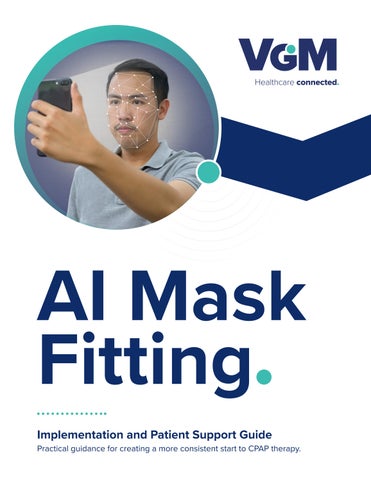
AI Mask Fitting Implementation and Patient Support Guide
Practical guidance for creating a more consistent start to CPAP therapy.
2
Table of
Contents.
Operations 01
Introduction
02
The Role of AI Mask Fitting in the CPAP Therapy Journey
03
What is AI Mask Fitting?
04
Where AI Mask Fitting Fits in the Patient Journey After Diagnosis
05
Preparing Patients for Success
06
Common Patient Barriers & Recommended Responses
07
Discussing Recommendations with Patients
08
Refit Guidance
09
Workflow Implementation Checklist
10
Measuring Success
11
Educational Content Library: Tools & Resources
12
Sample Pilot and Validation Plan Outline
13
Connect AI Mask Fitting to the Broader Therapy Journey
14
Build a More Connected Sleep Therapy Workflow
Financial Excellence 15
Core Use Cases: Where AI Mask Fitting Creates Value
16
Summary of Value
17
Takeaway
18
AI Mask Fitting Four-Pillar Success Framework
totalsleepservices.com
4
01 Operations
Introduction. Successful CPAP therapy begins long before equipment is delivered. One of the earliest and most important decisions in the patient journey is mask selection. AI Mask Fitting helps providers begin that process with data-informed recommendations that can support more informed mask discussions, smoother onboarding, and a better patient experience.
Purpose of This Guide This guide helps provider teams: • Introduce AI Mask Fitting clearly to patients • Improve scan completion rates • Reduce avoidable fitting barriers • Create consistent onboarding workflows • Prepare patients for success before therapy begins • Discuss recommendations confidently • Manage refits and follow-up conversations effectively • Measure adoption and workflow performance over time
totalsleepservices.com
02 Operations
The Role of AI Mask Fitting in the CPAP Therapy Journey. AI Mask Fitting supports one important step within a broader therapy success strategy.
01
Diagnosis
02
03
AI Mask Fitting and mask selection
Therapy initiation
05
04
Ongoing adherence
Early adherence support
07
06
Resupply
Long-term therapy success
6
Why It Matters Every mask exchange, refit, or comfort issue creates additional work for providers and can create frustration for patients. Starting with a more informed recommendation can help support: • Better first-mask discussions • Reduced trial-and-error • Faster onboarding • Greater patient confidence • More consistent workflows • Improved adherence • Stronger resupply outcomes • Better overall patient experience
totalsleepservices.com
03 Operations
What is AI Mask Fitting? AI Mask Fitting helps providers identify CPAP mask options that may be appropriate based on information gathered during the fitting experience. Rather than relying exclusively on manual sizing or trial-and-error approaches, providers can use AI-informed recommendations as part of the mask selection process.
Important Expectations Remember: AI Mask Fitting is designed to support provider decision-making but does not replace provider expertise. AI Mask Fitting recommendations are a starting point and should always be considered alongside: • Clinical judgment • Patient preferences, feedback, and comfort • Therapy goals • Inventory availability • Provider expertise This approach balances technology with personalized patient care.
8
04 Operations
Where AI Mask Fitting Fits in the Patient Journey After Diagnosis. AI Mask Fitting can be incorporated after referral and before final mask selection or equipment fulfillment, depending on your organization’s workflow.
A typical process may include: Step 1: Introduce the Experience
Step 4: Complete the Scan
Confirm that the patient is ready for the fitting experience. Explain:
Support patients who encounter technical or environmental barriers.
• What the patient will do
Step 5: Review Recommendations
• Why the experience is being completed • How the recommendation will be used • What happens next Step 2: Provide Access Provide the patient with access to the fitting experience. Step 3: Prepare the Patient Ensure the patient understands the environmental and device requirements.
Evaluate recommendations alongside clinical and operational considerations. Step 6: Discuss Options Review recommendations with patients and answer questions. Step 7: Finalize Selection Apply provider judgment and document the final mask selection. Step 8: Follow Up Monitor comfort, satisfaction, and early therapy experience.
05 Operations
Preparing Patients for Success. Introducing the Experience Confidence Starts Before Therapy Begins Many patients feel uncertain when beginning CPAP therapy. A wellmanaged mask-fitting experience can help reduce anxiety, improve expectations, and support productive conversations with the care team. Key Messaging Priorities Lead with: •
Comfort
•
Confidence
•
Ease of use
•
Better conversations about mask options
•
Reduced uncertainty
Suggested Patient Introduction Scripts Option 1 “You have been invited to complete a brief mask-fitting experience. You will answer a few questions and use a camera-enabled device to complete a facial scan. The information will help your care team identify mask options to discuss with you. As your provider, we will review the recommendation with your comfort, preferences, therapy needs, and available options in mind.” Option 2 “Finding the right CPAP mask can be challenging. AI Mask Fitting helps your provider identify mask options that align with your facial features and therapy needs, helping you begin therapy with greater confidence and comfort.”
totalsleepservices.com
10
Before the scan, ask patients to:
Patient Environment Setup Checklist
; Use the approved compatible device and browser
; Background
Patient Pre-Scan Checklist
; Confirm that the camera can be accessed ; Choose a well-lit location ; Follow the on-screen positioning instructions ; Remove glasses or other accessories when instructed
; Lighting ; Camera positioning ; Device readiness • Phone/device type • Camera quality • Basic troubleshooting ; Internet connectivity
; Keep the device steady
; Accessory removal (including glasses)
; Complete the experience where they have a stable connection
; Hold still and follow position guidance
; Contact the provider if they cannot complete the scan
Why Scan Quality Matters Better scans support: ; Better recommendations ; Better provider conversations ; Better therapy starts Encourage patients to take the time necessary to follow instructions carefully and complete the experience in an appropriate environment.
totalsleepservices.com
06 Operations
Common Patient Barriers & Recommended Responses.
Technology Anxiety or Lack of Confidence
information needed to review mask options with you.”
Check: Confirm that the patient received the correct link and understands what the experience involves.
Escalate when: A repeat attempt using the recommended setup is unsuccessful.
Say: “The experience will guide you step by step. If you have difficulty completing any step, contact us, and we’ll help determine the best next option.” Escalate when: The patient cannot access or move through the experience after standard troubleshooting.
Lighting, Positioning, or Environmental Challenges Check: Review the approved lighting conditions, camera visibility, distance, and device positioning requirements. Say: “Let’s review your camera position and lighting before trying again. Following the onscreen guidance helps collect the
Privacy or Data Concerns Say: “That’s an important question. Let me provide the approved information regarding what information is collected, how it is used, and where you can review the privacy policy.” Escalate when: Questions extend beyond available privacy guidance or require additional review.
Patient Questions the Recommendation Say: “The recommendation is a starting point for our discussion. We’ll also consider your comfort, preferences, therapy needs, prior experience, and available mask options before making a final decision.”
12
07 Operations
Discussing Recommendations with Patients. When reviewing a recommendation:
•
Explain why the recommendation is being considered
•
Discuss comfort preferences
•
Review previous mask experiences
•
Consider therapy needs
•
Review formulary or inventory considerations
•
Present appropriate alternatives when needed
•
Document final decisions and overrides
Suggested language: “The fitting experience helps narrow the options. We’ll review those options together and determine which mask best aligns with your needs, preferences, and therapy goals.”
totalsleepservices.com
08 Operations
Refit Guidance. No recommendation process eliminates every refit. Remind your patients that they may require additional support because of: • Comfort concerns
• Inventory limitations
• Therapy leaks
• Clinical considerations
• Patient preference
• Provider judgment
Reinforce Expectations Even when the initial recommendation is appropriate, patients may need: • Additional education
• Alternative mask options
• Comfort adjustments
• Continued coaching and follow-up
The goal is long-term therapy success, not simply delivering a recommendation. Education, troubleshooting, patient engagement, and ongoing provider support all contribute to successful outcomes.
Follow-Up Best Practices Establish a consistent follow-up process that includes: • Early outreach after setup
• Refit escalation procedures
• Comfort assessments
• Reinforcement of provider support resources
• Leak and adjustment discussions • Documentation standards
14
09 Operations
Workflow Implementation Checklist. Before launch, confirm: Patient Eligibility
Support
; Which patients will receive AI Mask Fitting
; Troubleshooting expectations ; Technical support pathways
; Which workflows will use AI Mask Fitting
; Alternative workflows when necessary
Team Responsibilities
Measurement
; Who sends invitations ; Who monitors completion ; Who contacts non-completers ; Who reviews recommendations Documentation ; Override procedures ; Escalation procedures ; Follow-up requirements
; Which metrics will be tracked ; How reporting will occur ; Who owns performance review
10 Operations
Measuring Success. Organizations should establish baseline performance before evaluating outcomes.
Recommended measurement categories include: Adoption Metrics
Operational Metrics
; Invitation activity
; Staff interactions
; Scan completion activity
; Workflow efficiency measures
; Time to completion
; Refit activity trends
Recommendation Metrics
Use results to improve:
; Recommendation acceptance
; Follow-up processes
; Override frequency
; Adoption strategies
; Override reasons
; Patient education
Patient Experience Metrics
; Workflow design
; Satisfaction feedback
; Staff coaching
; Early adjustment requests ; Early mask changes
totalsleepservices.com
16
11 Operations
Educational Content Library: Tools & Resources.
Organizations may consider supplementing implementation with education focused on:
CPAP Therapy Success (Clinical) Audience: Sleep clinics, respiratory therapists, clinical leadership, referral sources
Operational Excellence (Provider) Audience: DME managers, branch managers, clinical operations teams
Core Message: The right mask at the beginning of therapy improves the likelihood of successful CPAP adoption.
Core Message: AI Mask Fitting standardizes mask selection while reducing manual workflow burden.
Educational Topics:
•
Virtual vs. in-clinic workflows
•
Best practices for patient intake
•
Completing a recommendation and dispensing a mask
•
Managing refits
•
Understanding scan confidence
•
Why mask fit matters
•
Common reasons patients struggle with CPAP
•
Mask leaks and comfort issues
•
Understanding refit drivers
•
First-fit success and adherence
•
When a mask refit is necessary
•
How AI assists clinical decision making
•
Improving CPAP adherence through better mask selection
Educational Topics:
• Tracking conversion, completion, and refit metrics •
Virtual setup best practices
•
How to reduce refit rates
•
Branch adoption playbooks
•
Workflow optimization
Financial Outcomes (Executive)
30-Second Patient Explanation Finding the right CPAP mask can be challenging. Instead of relying on trial-and-error, AI Mask Fitting helps your provider identify mask options that are likely to work best for your facial features and therapy needs. The goal is to help you start therapy with greater confidence, comfort, and convenience.
Audience: DME owners, CFOs, executive leadership Core Message: Better first-mask selection reduces revenue leakage and improves operational scalability. Educational Topics: •
Cost of mask returns
•
Cost of refits
•
Inventory shrinkage
•
Labor optimization
• Throughput expansion •
CPAP adherence economics
•
Resupply revenue protection
• The hidden cost of manual mask fitting •
Inventory shrinkage explained
•
ROI of AI Mask Fitting
•
Virtual setup economics
For patients: We help find a CPAP mask that is more likely to fit comfortably before therapy begins. 15-Second Patient Explanation
Before Setup •
What to expect during your mask scan
•
Why your provider sent you this link
After Setup •
Getting started with CPAP
•
Common mask adjustments
•
What to do if your mask doesn’t feel right
Adherence • Tips for your first 30 days •
Understanding air leaks
•
Improving comfort with CPAP
Your provider has invited you to complete a quick maskfitting experience. Using your smartphone or camera-enabled device, you’ll answer a few questions and complete a brief facial scan. The system helps your provider select a CPAP mask that may fit you comfortably and effectively from the start.
totalsleepservices.com
18
12 Operations
Sample Pilot and Validation Plan Outline. Pilot Objectives Validate: • Patient understanding • Provider adoption • Workflow efficiency • Message effectiveness
Feedback Collection • Patient surveys • RT interviews • Operational reviews • KPI analysis
• Outcome measurement processes
• Workflow observation
Key Pilot Metrics
• Refined educational materials
• Scan completion rate • Recommendation acceptance rate • First-fit success rate • Refit rate • Return rate • Patient satisfaction • Staff satisfaction • Time saved per setup
Rollout Readiness Criteria • Validated messaging • Established success benchmarks • Implementation toolkit for broader deployment
13 Operations
Connect AI Mask Fitting to the Broader Therapy Journey. AI Mask Fitting helps providers prepare patients for therapy, improve maskselection conversations, and establish more consistent onboarding workflows. But mask selection is only one component of successful sleep therapy.
Providers must also support: ; Setup ; Education ; Early adherence
; Ongoing engagement ; Resupply ; Recovery and retention efforts
Combined with the support available through VGM Total Sleep Services, providers can strengthen key touchpoints throughout the sleep therapy journey, from setup through ongoing patient support.
totalsleepservices.com
20
14 Operations
Build a More Connected Sleep Therapy Workflow. Book a demo to see how AI Mask Fitting can fit within your current workflow and support patient onboarding, education, and therapy initiation. https://www.totalsleepservices.com/contact-us
totalsleepservices.com
15 Financial Excellence
Core Use Cases: Where AI Mask Fitting Creates Value. Where does AI-driven mask fitting provide the most immediate value: virtual patient setups or in-clinic patient setups? Based on AI Mask Fitting customer discussions and current industry adoption trends, virtual patient setups provide the most immediate and measurable economic value, while in-clinic setups provide the easiest clinical adoption path.
Value Hierarchy 1. Virtual setups (highest immediate ROI) 2. Hybrid setups (virtual-first with clinician assistance) 3. Traditional in-clinic setups (solid efficiency gains but lower financial impact)
Virtual Patient Setup Why Virtual Setups Create the Largest Immediate Value The workflow is designed to occur before fulfillment and before the patient receives equipment, optimizing mask selection earlier in the process.
For most DMEs, virtual workflows immediately eliminate several expensive activities: 1. Labor cost: Traditional setups often require clinician time dedicated to mask sizing and selection. Instead of: • Scheduling a fitting appointment • Rooming the patient • Having a respiratory therapist (RT), respiratory therapy assistant (RTA), or assistive technology professional (ATP) perform manual sizing • Trying multiple masks and cushions
the virtual workflow enables patients to complete the scan remotely in minutes. Every avoided in-person fitting frees up clinician time for highervalue activities. 2. Faster Time-to-Setup: Virtual mask selection can happen: • Immediately after referral • During benefits verification and/or appointment scheduling (if in-clinic setup) • Before the machine ships This shortens the revenue cycle and helps patients start therapy sooner. Industry sources note that virtual CPAP onboarding is increasingly being used to streamline operations and reduce setup delays.
4. Lower Inventory Shrinkage This is a major financial driver. When manual fittings occur remotely without objective sizing: • More fit packs are sent • More cushions are exchanged • More masks are written off A consistent AI Mask Fitting recommendation reduces these costs by improving first-mask success rates. Industry AI fitting platforms consistently position reduced refits as a primary economic outcome.
Assisted Virtual Setup • Virtual-first workflow with provider support. • Hybrid model balancing automation and human engagement.
In-Clinic AI Mask Fitting
3. Larger Geographic Reach In-clinic AI Mask Fitting delivers The moment AI Mask Fitting works remotely, a DME can serve: excellent value, but the economics look different. It is typically • Rural patients optimization value rather than • Mobility-limited patients transformational value. • Patients outside traditional Optimization Value: Optimization branch footprints value comes from refining and improving existing processes, This creates incremental revenue systems, and operations without rather than merely improving an changing the underlying business existing process. model or structure. It’s about
totalsleepservices.com
making the current system run more efficiently, predictably, and cost-effectively, aggregating marginal gains. Transformational Value: Transformational value comes from fundamental changes to how the organization operates, delivers value, and creates it. It redefines core processes, business models, and even the organization’s identity.
Primary Value Drivers Faster clinician workflow: Eliminating reliance solely on clinician experience and using a scan process to score dozens of masks objectively results in: • Less trial-and-error • More standardized fitting • Quicker appointments Improved consistency: Reduced fitting variability between clinicians and branch locations creates: • Standardized recommendations • Repeatable processes • Easier staff training and onboarding Better patient confidence: Patients often appreciate seeing an objective recommendation rather than simply being handed multiple masks to try. It works for all audiences.
Smaller Independent DME: Your RT no longer has to spend 20–30 minutes manually fitting masks. Patients can complete the process before they ever walk through the door. That means: • Labor savings • Faster setups • Reduced refits Regional or National Providers: AI Mask Fitting allows you to scale a consistent maskselection process across every branch without hiring additional respiratory therapists. That means: • Standardization • Workforce scalability • Virtual patient onboarding • Geographic expansion C-Suite: Virtual AI Mask Fitting removes cost and creates new revenue capacity. In-clinic AI Mask Fitting primarily removes cost. For most DME operators, revenue growth plus labor reduction generates a much stronger ROI story than labor reduction alone.
24
16 Financial Excellence
Summary of Value. For AI Mask Fitting, virtual patient setup is generally the strongest initial value proposition because it simultaneously: • Reduces clinician labor • Accelerates patient onboarding • Decreases mask refits • Expands geographic reach • Lowers inventory write-offs • Scales without adding staff In-clinic AI Mask Fitting is still valuable, but it is best positioned as an operational efficiency improvement, whereas virtual AI Mask Fitting is a business model and margin expansion strategy.
totalsleepservices.com
ROI of Virtual vs. In-Clinic AI Mask Fitting Metric
Virtual AI Mask Fitting
In-Clinic AI Mask Fitting
Highest
Moderate-High
Labor Savings
Setup Throughput
Geographic Expansion
Reduced Refits
Inventory Savings
Staff Scalability
Patient Convenience
Total Economic Impact
Typical ROI Ranking Virtual AI Fitting: 3x–10x+ ROI potential
In-Clinic AI Fitting: 1.5x–4x ROI potential
These ranges are illustrative business-model estimates, not values sourced from the referenced materials.
26
Why Virtual Usually Produces Greater ROI Our organization's AI Mask Fitting discussions describe a workflow that occurs before fulfillment, allowing mask selection to happen early in the patient journey rather than relying on traditional manual fitting. The economic benefit comes from five areas simultaneously: 1. Labor Reduction Traditional setups often require clinician time dedicated to mask sizing and selection.
This is often the largest hidden source of ROI.
A virtual workflow enables patients to complete the assessment remotely while the system performs recommendation and documentation activities. Industry solutions position remote mask selection and fitting as a streamlined workflow that can be completed using patient-submitted information and biometric image.
Unlike in-clinic AI Mask Fitting, virtual fitting can expand service territory.
2. Increased Capacity Without Additional Staff Virtual CPAP onboarding emerged largely because traditional in-person processes are labor-intensive and difficult to scale. Industry commentary specifically notes growing interest in virtual setups due to workforce constraints and operational efficiency needs. A CFO question becomes: "How many additional patients can we onboard before hiring another RT?"
totalsleepservices.com
3. New Revenue Capacity
A provider can support: •
Rural patients
•
Mobility-limited patients
•
After-hours workflows
•
Centralized intake models
The ability to reach additional patients creates revenue opportunities beyond simple cost reduction. 4. Faster Time-to-Revenue There is typically a gap between referral, insurance verification, and final setup. AI Mask Fitting can occur earlier in that timeline. Earlier completion of mask selection can help accelerate the broader onboarding process.
5. Reduced Refits and Write-Offs Industry AI Mask Fitting platforms consistently emphasize reducing trial-anderror mask selection and lowering refitting activity. Reducing even a small percentage of: •
mask exchanges
•
cushion replacements
•
fit packs
•
reshipments
creates substantial margin improvement at scale.
ROI for: Respiratory Therapy Manager: Reduce fitting time while improving fitting consistency. Branch Manager: Increase monthly setup capacity without increasing staffing. CFO/Owner: Virtual AI Mask Fitting simultaneously lowers labor cost, reduces refits, improves inventory utilization, and enables more patient starts with the same workforce.
National DME Executive: The highest ROI comes from standardizing mask selection across the enterprise while centralizing patient onboarding through a virtual workflow.
28
17
Financial Excellence
Takeaway. In-Clinic AI Mask Fitting = Efficiency Optimization ROI • Faster fittings
• Reduced refits
• Consistent recommendations Virtual AI Mask Fitting = Enterprise Growth ROI • Everything above
• Plus faster patient onboarding
• Plus workforce scalability
• Plus higher setup capacity
• Plus geographic expansion That is why virtual AI Mask Fitting is usually the stronger economic story and the larger long-term financial opportunity.
Key ROI Differences: Virtual AI Mask Fitting = Growth + Efficiency Financial Benefits • Reduces clinician labor associated with mask fitting and setup workflows. • Increases patient onboarding capacity without adding RT headcount. • Enables centralized and remote setup operations. • Expands service reach beyond physical branch locations.
• Reduces refits, exchanges, and inventory waste through more consistent mask selection. Industry AI Mask Fitting solutions emphasize reducing trial-anderror mask selection and refitting activity. • Accelerates setup completion by allowing mask selection before fulfillment.
CFO Takeaway Creates both cost savings and revenue expansion opportunities.
In-Clinic AI Mask Fitting = Efficiency Optimization Financial Benefits individual clinician experience by using objective mask recommendations.
• Shortens fitting appointments. • Improves clinician productivity. • Standardizes fitting quality across locations and staff. • Reduces dependence on
• Lowers refit and exchange rates versus traditional manual fitting approaches.
CFO Takeaway Primarily produces operating cost savings and workflow efficiencies. CFO Comparison
Metric
Virtual AI Fitting
In-Clinic AI Fitting
Labor Reduction
High
Moderate
Staffing Scalability
High
Low
Geographic Expansion
High
None
Setup Capacity Growth
High
Moderate
Refit Reduction
High
High
Inventory Optimization
High
High
Revenue Growth Potential
High
Low
Operational Efficiency
High
High
30
Executive Sound Bite In-clinic AI Mask Fitting helps us do the same work more efficiently. Virtual AI Mask Fitting helps us do more work with the same staff.
Board-Level Summary In-Clinic AI = Cost Optimization Strategy
Virtual AI = Margin Expansion Strategy
• Faster fittings
• Everything above
• More consistent outcomes
• Plus workforce scalability
• Reduced operational waste
• Plus greater patient reach • Plus increased setup volume • Plus potential revenue growth
Bottom Line: For most DME/HME providers, the larger financial opportunity comes from virtual AI Mask Fitting because it combines operational savings with the ability to increase patient throughput and coverage without proportional increases in staffing.
totalsleepservices.com
18 Financial Excellence
AI Mask Fitting Four-Pillar Success Framework. Conversion rate, completion rate, refit rate, and patient experience are ultimately more meaningful than raw recommendation accuracy alone.
1. Clinical Outcomes
Supporting metrics:
Patient Adherence
• 30-day adherence rate
A successful first mask fit should increase the likelihood that a patient remains on therapy.
• 60-day adherence rate • 90-day adherence rate
Poor initial mask selection is associated with mask switching and lower adherence outcomes, while optimizing mask selection is recognized as an important factor supporting CPAP therapy success.
• Days to first therapy abandonment
The goal is to help patients start therapy successfully, remain engaged, and achieve positive treatment outcomes over time. Primary KPI: 90-day adherence rate. Number of patients meeting payer adherence requirements divided by total number of AI Mask Fitting patients.
• Average nightly usage hours
• Percentage of patients requiring adherence intervention Executive target: Improve 90day CPAP adherence by 8-10% compared to the customer’s baseline population.
2. Operational Outcomes Refit Reduction Reasons for refits can be discomfort, leaks, inventory availability, patient preference, and clinician preference.
32
Primary KPI: 30-day refit rate. Number of patients requiring a mask change within 30 days divided by total number of AI Mask fitting patients. Supporting metrics: • Patient discomfort • Leak issues • Skin irritation • Patient preference • Clinician override • MD scripted • Patient questionnaire answers • Inventory/formulary limitations Executive target: Reduce refits by 50-75%+ versus the customer’s pre-AI Mask Fitting baseline.
3. Financial Outcomes
• Shipping cost per exchange • Non-resellable inventory write-offs • Inventory shrinkage percentage CFO Metric (Avoided return cost): (Baseline Return Rate minus AI Return Rate) divided by Average Return Cost Executive target: Demonstrate measurable reduction in mask exchanges, return processing, and inventory write-offs.
4. Productivity Outcomes Clinician Time Savings Primary KPI: Clinician minutes saved per setup. Traditional fitting time minus AI Mask Fitting workflow time. Supporting metrics: • Average fitting duration
Returns and Exchanges
• RT touches per patient
Returns, exchanges, and writeoffs are a major source of margin erosion.
• Total labor hours saved
Primary KPI: Masks exchanged divided by masks dispensed. Supporting metrics: • 30-day return rate • Cost per return
totalsleepservices.com
• Patients managed per RT/FTE • Setup throughput per branch CFO Metric (Labor Savings): Hours saved times fully-loaded RT labor rate. Executive target: Reduce fitting labor by 50–75% while increasing setup capacity.
5. North Star Metric First-Fit Success Rate Patients who: • Receive an AI Mask Fitting recommendation • Are dispensed that recommended mask
• Do not require a refit within 30 days • Remain active on therapy at 90 days ÷ Total AI-fitted patients = Success Rate
Board-Level Success Statement AI Mask Fitting is successful when it increases 90-day CPAP adherence by 8-10%, reduces 30-day mask refits and exchanges by 50-75+%, and enables clinicians to onboard more patients in less time without sacrificing patient outcomes.
totalsleepservices.com