The Dallas Community How many unhoused Veterans live in the Dallas metro area? An estimated 289 military Veterans are experiencing homelessness in the Dallas and Collin County area, according to the annual Point-In-Time count.
How is VCP different from other Veteran organizations? We serve all Veterans, regardless of age, ability, discharge status, or VA-eligibility. VCP offers comprehensive, holistic wraparound services to address the root cause of homelessness. With a low Veteran to case manager ratio of 10:1, the individualized approach provides a strong emphasis on community integration.
Is VCP part of the VA? VCP is not affiliated with the VA; however we have a “partner, not compete” mentality and work hard to build relationships with other programs and organizations also committed to meeting the needs of Veterans.
How will VCP impact the surrounding neighborhood? VCP's campus will not only provide critical housing resources but will: •
Beautify an unused area, increasing property values of surrounding homes and businesses
•
Provide ongoing opportunities for community volunteerism
•
Strengthen Dallas's social services sector
•
Become a source of civic pride
•
Improve the safety of the surrounding neighborhood
DALLAS
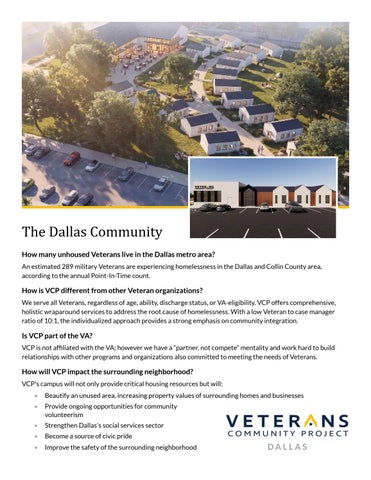
The Dallas Village How are the homes constructed? Located at 4515 S. Lancaster Rd.—directly across from the Dallas VA Medical Center—this innovative Village will offer both visibility and access for those who served. The homes are stick-built and comply with current building codes (ICC IBC-2021) and built on concrete foundations and connect to city utilities. Approximately 70% of the construction will be performed by community volunteers.
How many homes will be built? The Dallas campus will include 50 homes, featuring eight family homes, two ADA homes, and 40 individual homes. Single homes are 240 sq. ft; family homes are 320 sq. ft. and sleep up to 5 individuals.
“I can’t say how much I’m thankful. This is gonna change my life.”
Do the homes have their own kitchens and bathrooms?
Bruce U.S. Navy Veteran
Yes. Each home has a fully functional kitchen and bath. VCP is intentional about building communities that are mindful of homeless and military post-traumatic stress; creating a sense of privacy and safety is key.
Do the residents own their home? What do they pay? The Veterans do not own their home; however, the furniture and household items become their personal property and go with the Veteran when they are ready to transition to permanent housing. Veterans do not pay rent or utilities while living in VCP Village; their investment in the program is their investment in themselves.
Veteran Support Services Can VCP serve Veterans who do not qualify for VA benefits? Yes. VCP supports all individuals who took an oath to serve this country. Many Veterans have been historically excluded from VA services because of discharge status, type, or length of service. VCP remains dedicated to serving all Veterans, regardless of VA qualifications for benefits.
What does homelessness mean to VCP? Veterans Community Project acknowledges the need to serve a more expansive audience beyond those classified as street homeless by the government. This includes providing support to those living with others or residing in vehicles.
How do Veterans get into the program? Veterans are identified through referrals from community partners or VCP's outreach efforts. Veterans are assessed and prioritized for housing based on their vulnerability and need.
Do you keep a waiting list? No. We have found this often leads to Veterans turning down other forms of housing and remaining homeless while waiting for a vacancy at VCP. Circumstances can change quickly, and those who are in crisis today may have stabilized by the time there is a vacancy.
What support services are available to Village residents? VCP maintains a 10:1 Veteran to case manager ratio which allows more time to be spent with each Veteran. The Village offers sanctuary and the emotional space needed for each Veteran and VCP’s specially-trained team to thoroughly address the underlying causes of his or her homelessness. With the support of their case managers and battle buddies, Veterans work to achieve incremental, lasting results in the areas of health and wellness, income stability, education and training, fiscal understanding, and the development of a personal support network. Once the Veteran’s individual goals are met, VCP assists him or her in securing a permanent housing solution and transitioning to a new life.
How long can a Veteran live in VCP Village? Veterans work closely with their case manager to set incremental goals that result in permanent housing readiness. While the program moves at the Veteran's pace, the average length of stay is 14-16 months.
How do you address a participant who is not progressing in the program? Case managers work with each Veteran to understand why they are not making progress, address the identified issues, and design a plan to move forward. If they do not progress, staff and leadership will decide on next steps.
How does VCP address substance abuse? VCP follows a harm-reduction model, and it is relative to each Veteran and their case manager what that program looks like.
Is VCP housing available to non-Veterans? VCP houses Veterans and their families exclusively.
Are pets allowed? Yes. Pets have a necessary and needed role in the recovery of many homeless Veterans. Homelessness is a process that leads to isolation. Oftentimes pets are the first form of support for these individuals.
"VCP of Dallas will be a visible reminder that this community values its Veterans and is willing to invest in them." Bryan Meyer CEO and Co-founder
Funding and Timeline DALLAS
How is VCP funded? The organization is largely privately funded; government funding is only accepted if it does not limit who we serve or how we administer our program.
What types of volunteer opportunities are available? VCP offers a variety of volunteer opportunities throughout construction and once the Village is complete. Individuals and groups can register online at vcp.org to receive notifications of upcoming events or needs.
When will the Village be complete? VCP's construction schedule is directly tied to our fundraising efforts. The capital campaign is organized into five phases: •
Infrastructure
•
First half of homes
•
First half of Village Center
•
Second half of homes
•
Second half of Village Center
Construction begins as funding for each phase is complete.
For more information please contact Janice Bell Development Director jbell@vcp.org 816-599-6503 ext. 1114
“I never would have gone to college if it weren't for the support I received here. I will never be homeless again.”
Veterans Community Project National Headquarters 8900 Troost Ave Kansas City, MO 64131
vcp.org
Chris VCP Alumni © 2026 Veterans Community Project. All Rights Reserved.
DAL_OPS_MKT_0826