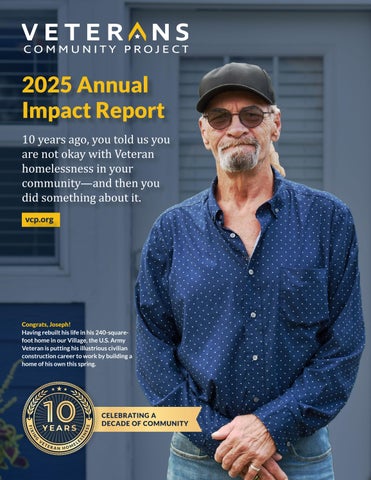
2025 Annual Impact Report 10 years ago, you told us you are not okay with Veteran homelessness in your community—and then you did something about it. vcp.org
Congrats, Joseph! Having rebuilt his life in his 240-squarefoot home in our Village, the U.S. Army Veteran is putting his illustrious civilian construction career to work by building a home of his own this spring.
CELEBRATING A DECADE OF COMMUNITY
Joann
Kyle
Glenn
Jesus
Fatih
Kendrick
Chris
Brenten
Angela
Leo
Gary
Tracy Will
Your belief in this mission has changed Veterans’ lives Celebrating 10 years of community—a word from our Co-Founders Ten years ago, a group of us stood on an overgrown patch of land frustrated by a system that wasn’t working. The status quo said Veteran homelessness was complicated. It said progress required endless studies, committees, and patience. It said Veterans should move through crowded shelters, navigate disconnected services, wait years for permanent housing, and possibly leave their pets behind to get help. We refused to accept that. So, we asked a disruptive question: If the rules don’t apply, what’s possible? That question gave us permission to imagine what’s possible beyond red tape. We began exploring the idea of building not just housing, but a program rooted in stability and dignity that could truly change Veterans’ lives. The concept of tiny homes emerged because of their practicality: a door that locks, a bed that’s yours, a space to begin again. When paired with comprehensive wraparound services, we knew those tiny homes had the potential to become the foundation of a model designed to support the whole person and create lasting success. Then reality hit: how do you take a big idea, and an empty field in Kansas City with no infrastructure, and turn it into a community of tiny homes serving Veterans with wraparound support? It felt impossible, but then you stepped in. Donations poured in and local contractors stepped up to donate their time, equipment, and belief to make our first Village possible. In that moment, we learned the most important lesson from the past decade: Because of you, we are not alone and neither are the Veterans we serve.
Because of your support over the past decade, VCP has served 8,018 Veterans at all our locations.
What began as a bold challenge to the status quo in Kansas City has grown into one of the nation’s fastest growing, fully integrated homeless services system. Because of you, VCP has expanded to six locations serving Veterans in seven states. We have housed 269 Veterans in 240 square feet of dignity and helped thousands more Veterans in crisis avoid homelessness altogether. Your investment in this mission fuels the human connection at the heart of our work, sustaining wraparound case management and the integrated support system that truly changes lives. Together, we have built proof that when a community refuses to accept broken systems, real change follows. So now, looking toward the decades to come, we return to that same bold question: What’s possible next? Together, we can fix Veteran homelessness. Thank you for being a part of this mission. We can’t do this without you. Sincerely, VCP’s Co-Founders: Bryan Meyer, U.S. Marine Corps Veteran Brandonn Mixon, U.S. Army Veteran Vincent Morales, U.S. Army Veteran Mark Solomon, U.S. Navy Reservist
2025 Annual Impact Report. A Decade of Impact. | 3
Where are they now? See the Veterans whose lives transformed because of you. Your support has helped hundreds of Veterans transition out of homelessness, regain stability, and move into sustainable permanent housing. Through our alumni program, former residents of Veterans Community Project (VCP) Villages remain part of the community you helped build. Take a look at their stories to see the impact you made possible.
U.S. Army Veteran Joseph built mansions across the country in his thriving residential construction career that followed his military service. But after health and other personal circumstances thrust his life into a spiral, it was a 240-square-foot tiny home in our Village that helped him get back on his feet. He recently moved out of his tiny home and, fittingly, is now building a house of his own, atop a hill, overlooking a lake. “I came here to get my life back and that’s what I did.”
Scan the QR code to watch Joseph’s story.
U.S. Air Force Veteran Joann served from 1976 to 1983 as a mechanic on the flight line, pioneering as one of the first women to hold the role at her station. But the transition to civilian life brought challenges finding work that matched her experience. In recent years, she found herself unsafe, unhappy, and on the brink of homelessness. In that moment, a family member connected her to Veterans Community Project. Today, Joann says the tiny red home gave her space to breathe, helped her focus on her mental health, and to think clearly about her future. “I am happier than I have ever been in my life.” 4 | 2025 Annual Impact Report. A Decade of Impact.
U.S. Army Veteran Deion
U.S. Navy Veteran Tim
volunteered his time and talent by giving his fellow Veteran neighbors haircuts while living in our Village. Today, he is living in a place of his own and running his own barbershop— and believe us, he has a lot more than the old high-and-tight in his repertoire.
gained full custody of his daughter thanks to stability of his tiny home in our Village. Although he had put in the work to rebuild his life after challenges following military service, living in a group situation without a permanent address stood as a barrier. That all changed at VCP and today, he said, “I am just so very happy to have her in my life.”
U.S. Marine Corps Veteran Chris once held the sign above on the side of the road asking for help. Today, he holds the keys to a home of his own. His time in our Village helped him take care of his mental health, find sustainable employment, and, ultimately, paved a path for him to become a homeowner last year.
“These Veterans are the reason why we started this work. Your generosity is why their stories of transformation are possible. Thank you for believing in our mission a decade ago, for standing with Veterans in the decade that followed, and for your continued support in the decades ahead.” Vincent “Vinnie” Morales Co-Founder & U.S. Army Veteran
2025 Annual Impact Report. A Decade of Impact. | 5
You do more than thank Veterans for their service.
8,018
You tell them “Welcome home.”
VETERANS
at-risk and in-crisis received assistance through
Veteran homelessness is a complex problem, both deeply personal and fundamentally systemic. And what you are doing is investing in a proven model with an 85% success rate at getting Veterans transitioned from homelessness to permanent housing. Last year, your investment helped us welcome more Veterans than ever into tiny homes in our Villages and, importantly, helped more Veterans than ever before move out and into sustainable permanent housing.
VCP
since we began a decade ago.
Thank you for your support and unwavering belief in this mission. Here’s a look at what you made possible for Veterans in 2025.
1,727 at-risk and in-crisis Veterans received assistance through VCP in 2025
322 Average number of days a Veteran lives in a VCP Village
60
99,042
Number of new Veterans welcomed
Number of nights Veterans have slept
home into one of our four operating VCP
in their own tiny home instead of on the
Villages across the country in 2025
street since 2018
Gender
Race
•
1,443 male (83.5%)
•
744 black (43%)
•
272 female (15.7%)
•
721 white (41.7%)
•
6 prefer not to say (<1%)
•
109 prefer not to say (6.3%)
•
63 other (3.6%)
•
4 other (<1%)
•
•
2 transgender (<1%)
41 American Indian/Alaska Native (2.3%)
•
40 more than one race (2.3%)
•
8 Native Hawaiian or Pacific Islander (<1%)
•
1 Asian (<1%)
6 | 2025 Annual Impact Report. A Decade of Impact.
You stop Veterans from falling through the cracks. With your help, VCP has helped thousands of Veterans at the times when they needed it most. In addition to our signature tiny home residential program, your support helps our outreach services teams intervene in critical situations before Veterans reach the point of homelessness.
“Behind every data point on this page is a Veteran who came to VCP in a moment of crisis. You are the reason why we were able to open the door and help. Thank you.” Brandonn Mixon Co-Founder & U.S. Army Veteran
246
7,348
Veterans screened for suicide
Life-changing services provided to
prevention via the Staff Sergeant
Veterans through our Veteran Services
Parker Gordon Fox Grant Program
teams at sites nationwide
5,408
1,321
Pantry boxes, hygiene kits, and snack
New coats, boots, and other articles of
bags distributed to Veterans and
clothing distributed
their families
5,000
$588
Visits by Veterans to a VCP Outreach
Average amount of emergency funds
Center to receive support
shared with a Veteran in crisis
Ethnicity
Age
•
991 Non-Hispanic/Latino (57.3%)
•
13 age 18-24 (<1%)
•
123 age 25-34 (7.1%)
•
665 prefer not to say (38.5%)
•
274 age 35-44 (15.8%)
•
71 Hispanic/Latino (4.1%)
•
237 age 45-54 (13.7%)
•
473 age 55-64 (27.3%)
•
595 age 65+ (34.4%)
•
12 prefer not to say (<1%)
2025 Annual Impact Report. A Decade of Impact. | 7
A completed Village in Longmont Our second national location features 26 tiny homes arrived, he carried little more than a bag of books and the weight of PTSD. Within the stability of his tiny home—and with support from VCP’s services—Patrick connected with healthcare, joined a mentorship program, and earned information technology certificates.
U.S. Army Veteran Patrick stands proudly outside of his home in the Village at VCP of Longmont.
Today, living in his own apartment and planning to pursue a bachelor’s degree in philosophy, Patrick reflects on the journey simply: “You have value,” he said to the next Veteran who will step into his former home. “Don’t be afraid to ask for help.”
Under the Colorado sunset and in the shadow of the Rocky Mountains, Veterans Community Project of Longmont celebrated the completion of its 26-home Village in June—marking a major milestone for the community and the Veterans it serves. The Village includes 22 individual 240-square-foot homes and four 320-square-foot family units. Here, Veterans typically live about a year while working one-on-one with an on-site case manager through VCP’s proprietary H.O.M.E.S. Index framework, preparing for permanent housing and long-term stability. One of four operating locations across the country, VCP of Longmont is uniquely situated as the country’s first transitional housing community built within a new residential development. The Village was made possible through collaboration with HMS Development, the City of Longmont, dedicated volunteers, and philanthropic partners like the Morgridge Family Foundation—all working together to weave Veterans into the fabric of a thriving neighborhood. “Thank you to each and every person who has helped us get to this point,” said Executive Director Jennifer Seybold. “Your belief, generosity, and commitment give the dignity of home to our Veterans.” That impact is reflected in Veterans like Patrick, a U.S. Army Veteran who recently rang the move-out bell after completing his time in the Village. When he first 8 | 2025 Annual Impact Report. A Decade of Impact.
Each home features a door the Veteran can lock behind them— a simple but powerful symbol of privacy and dignity.
“What started as a group of combat Veterans helping in Kansas City has grown into a national model. The need for these services is vast, yet the resolve behind this mission is stronger. Our vision is to continue expanding, ensuring that Veterans nationwide receive the specialized support and dignity provided by VCP.” Mark Solomon Co-Founder & U.S. Navy Reservist
New opportunities for Veteran stability and housing in Kansas City VCP of Kansas City broke new ground in 2025 with help from longtime partner Veterans United In June, surrounded by jackhammers and community partners, Veterans Community Project broke ground on our Veterans Navigation Campus in Kansas City—a bold step forward in preventing Veteran homelessness and addressing the suicide crisis facing those who served.
Representatives from the Veterans United Home Loans present a donation to VCP of Kansas City to help develop the Veterans Navigation Campus.
The new campus, located across from our national headquarters and adjacent to our flagship Village of 49 tiny homes, will bring mental health providers, benefits specialists, job training partners, and other experts together under one roof. By improving access to care, it will increase the number of local Veterans we serve each year by roughly 20%, ensuring more men and women walk through our doors and hear the words: “You’re not alone.” Standing at the podium, VCP Co-Founder and CEO Bryan Meyer reflected on a letter from a mother whose son lost his battle with mental health. “I do not want another letter,” he said. “I want to do better. I want to help more people.” Helping make that vision possible is Veterans United Foundation, one of VCP’s earliest supporters. In 2016, when our Village was still a single prototype surrounded by brush, Veterans United Home Loans and Veterans United Foundation saw the vision, stepping forward with a $50,000 gift that helped launch our infrastructure. Since then, the Foundation has contributed more than $1.6 million across our sites nationwide. At the groundbreaking, Veterans United Home Loans surprised the crowd with an additional $139,520 gift—proof that when compassion and action come together, lives are changed.
“I remember back in 2016 sitting in my car across from our first property—just overgrown weeds, at that time—when our first corporate partner Veterans United told me they would be making a $50,000 investment to bring our bold vision to life. That is when I knew this was real and backed by the community.” Bryan Meyer Co-Founder & U.S. Marine Corps Veteran
2025 Annual Impact Report. A Decade of Impact. | 9
Sliding into home with new partners from Major League Baseball The Arizona Diamondbacks and Milwaukee Brewers stepped up to the plate for Veterans In two cities known for their love of baseball, new big league partners helped us round the bases toward fixing Veteran homelessness. In October, just hours before the Milwaukee Brewers took the field for Game 1 of the National League Championship Series, Brewers Community Foundation Executive Director Cecelia Gore stood on a different mound of dirt—our future Village site in Milwaukee. The Foundation committed $250,000 to support the construction of 40 transitional tiny homes for Veterans experiencing homelessness. Cecelia Gore from the Milwaukee Brewers speaks to the crowd.
Representatives from the Arizona Diamondbacks and Sanderson Ford share their donation to VCP of Glendale.
Holding a blue-and-yellow umbrella signed by legendary broadcaster and U.S. Army Veteran Bob Uecker, Gore honored his legacy of service. As hundreds of community members looked on, we broke ground on what will become the 40-home Village and on-site Village Center, where Veterans will work with case managers using our H.O.M.E.S. Index framework. With strong support and momentum building, Milwaukee is stepping up in a big way for Veterans. In February, under the desert sun, the Arizona Diamondbacks did the same for Veterans in Glendale. At the groundbreaking for our 50-unit Village, Diamondbacks SVP Debbie Castaldo and World Series champion Luis Gonzalez announced a $250,000 contribution in partnership with Sanderson Ford. “For my 17 years with the Diamondbacks, this property has been on my route home,” Castaldo said. “When we saw what it could become, we said, ‘We’re with you every step of the way.’”
Debbie Castaldo from the Arizona Diamondbacks speaks to the crowd.
10 | 2025 Annual Impact Report. A Decade of Impact.
From Milwaukee to Glendale, baseball partners are helping turn vacant land into foundations of dignity, stability, and community. Together, we’re sliding into home—with safe housing, wraparound support, and a future where no Veteran has to face homelessness alone.
VCP of St. Louis kicks off work on second phase of tiny homes In August, we moved one step closer to housing more Veterans in St. Louis.
Volunteers work together to raise the wall of a tiny home in St. Louis.
With your support, in 2025 we began construction on 16 more tiny homes at Veterans Community Project of St. Louis. The expansion will give more area Veterans access to our proven model and builds on the transformative impact already happening every day in the Village. Like earlier this summer, for example, when we had the privilege of welcoming home a U.S. Marine Corps Veteran and Purple Heart recipient who had previously experienced more than a decade of homelessness.
He was one of the 188 Veterans identified by the VA and HUD as experiencing homelessness in the St. Louis region—but not anymore, thanks to your generosity. And that, in itself, is how the VCP program works. It starts with 240 square feet of dignity, grows with the 1:1 help of our case managers, and sustains with the lifelong support of a community of people like you who care
VCP of Sioux Falls opens doors and welcomes new executive director Veterans Community Project of Sioux Falls entered a new chapter last year as its 25 tiny homes near completion and more Veteran residents moved in ahead of winter. The site also welcomed U.S. Army Veteran Jim Linn as Executive Director in December. A South Dakota native, Jim brings 35 years of service in the South Dakota Army National Guard and decades of civilian leadership experience. He succeeds retiring leader John Holter and is focused on growing community partnerships, strengthening local support, and ensuring longterm sustainability. Sioux Falls Executive Director, Jim Linn, stands outside the Village community center.
“I want to be back on mission,” Jim said, “helping fix Veteran homelessness through action, accountability, and community.”
2025 Annual Impact Report. A Decade of Impact. | 11
Take a look inside our H.O.M.E.S. Index, the proven model transforming Veteran’s lives When Veterans move into a 240-square-foot transitional tiny home at Veterans Community Project, something powerful shifts. As U.S. Army Veteran and Co-Founder Vinnie Morales explains, life on the streets often centers on survival—
U.S. Army Veteran Amaan has cultivated a community garden during his residency in the Village.
“Where am I going to put my stuff today?” In the Village, that question becomes, “What am I going to do today?” That change in mindset is guided by the H.O.M.E.S. Index, a 25-point self-assessment each resident completes upon move-in. The tool helps identify strengths, barriers, and priorities, shaping personalized goals alongside an onsite case manager. Over an average 322-day, rent-free stay, Veterans retake the assessment monthly to measure progress and adjust their action plan. Focused on five foundational life domains, the H.O.M.E.S. Index provides structure, accountability, and clarity. It is a cornerstone of Veterans Community Project’s model—and central to our 85% positive transition rate into long-term housing stability. U.S. Army Veteran Craig and his dog Sophie enjoy the on-site dog park in Kansas City, generously donated by community partners.
“The problem of Veteran homelessness is complex. But these are all human beings. Each with their own unique needs and their own personal stories. And, importantly, each with an infinite capacity to change.” Marqueia Watson National Director of Veteran Support Services
12 | 2025 Annual Impact Report. A Decade of Impact.
When a Veteran begins their journey with Veterans Community Project, they begin working one-on-one with a dedicated case manager to identify the challenges standing between them and permanent housing. Together, they focus on one, two, or sometimes all five pillars outlined in the H.O.M.E.S. Index—creating a personalized plan that addresses immediate needs while building long-term stability. Through consistent guidance, accountability, and trust, Veterans remove barriers, regain confidence, and move forward. This relationship-driven approach is the foundation a key ingredient in helping Veterans get back on their feet—and it’s made possible by your support, turning individualized care into lasting change.
H
E
Health and wellness
Earnings and income stability
This is where we evaluate a Veteran’s physical, mental, and
Here we focus on employment and long-
emotional well-being. It measures access to medical care, daily functioning, healthy habits, and self-care practices. The goal is to strengthen overall wellness, ensuring Veterans can sustain achieve lasting stability, manage stress, and build a healthy foundation necessary for long-term housing success.
term financial security. We evaluate whether income is steady, sufficient to meet basic needs, and capable of growth. It also evaluates satisfaction with earnings and overall financial confidence, helping Veterans build reliable income streams that support independent living.
O Opportunities for education and training Here we assess clarity of goals, access to education or training programs, and confidence in learning new skills. This pillar measures whether Veterans are actively building qualifications tied to future opportunities. The focus is on empowering personal growth, increasing employability, and creating pathways toward meaningful, sustainable careers.
M
S Support network Here we measure connection and belonging. We evaluate whether Veterans have trusted individuals, emotional support, community involvement, and access to new support systems when needed. Strong relationships reduce isolation, improve resilience, and play a critical role in maintaining stability beyond the Village.
Money management This section evaluates financial literacy and daily money habits. It measures budgeting, tracking income and expenses, bill payment, decision-making confidence, and emergency savings. By strengthening financial discipline and planning skills, Veterans gain control over their resources and reduce the risk of future housing instability.
The H.O.M.E.S. Index delivers an 85% positive transition rate to permanent housing. 2025 Annual Impact Report. A Decade of Impact. | 13
A Veteran still answering the call to serve How U.S. Navy Veteran Doug serves his fellow Veterans—every week, without fail.
On Tuesdays, Doug fills up his gas tank and makes the drive to Veterans Community Project. It takes more than a few gallons to get there and back home, but he looks forward to it all week. A Vietnam Veteran who served in the United States Navy from 1969 to 1973, Doug volunteers out of a deep sense of duty and a family tradition of service. U.S. Navy Veteran Doug shows up every week in Kansas City to help his brothers and sisters who, like him, took the oath to serve.
On the USS Midway, Doug served alongside shipmates who took pride in their work and care of one another. Like many Veterans of his era, however, his homecoming was marked by indifference rather than gratitude. In one of his first civilian job interviews, a hiring manager noted his Vietnam service and told him, “We’ll consider your application, anyway.” Doug walked out. For decades, he carried the bitterness of feeling left behind. That changed the first time he stepped foot in the Village three years ago to help serve Thanksgiving dinner. Listening to residents share their stories, Doug saw something different at VCP: Veterans treated not as paperwork or discharge status, but as brothers and sisters who once took an oath to serve. Since then, he has watched lives transform. He has seen a man living under a bridge and contemplating suicide find stability in a tiny home. He has embraced a woman who arrived angry at the world and left with a plan for her future. Each Tuesday, he witnesses hope restored where broken systems once failed. Besides his time, Doug also chooses to give financially every month as a member of Honor Corps. At 76 years old and living on a fixed income, he contributes $50 each month and plans to increase it to $75. “I feel it in my wallet,” he says, “but I know my money is going to a good cause—one that I see every Tuesday.” Volunteers like Doug remind us that fixing Veteran homelessness is not just a mission. It’s a commitment we share, week after week.
“I know my money is going to a good cause, I see it every Tuesday.” Doug, Kansas City Volunteer
14 | 2025 Annual Impact Report. A Decade of Impact.
“When we started this mission 10 years ago, we knew the community would rally around our Veterans, and they did. Every hour volunteered, every act of support, has helped change lives.” Vincent “Vinnie” Morales Co-Founder & U.S. Army Veteran
The power of our volunteers who are making a lasting impact for Veterans
2,227
92
Volunteers who supported VCP in 2025
Volunteers with over 100 hours of service since our founding in 2016
18,159
$631,777
Hours of volunteer service in 2025
Value to VCP in dollars in 2025 2025 Annual Impact Report. A Decade of Impact. | 15
What one cyclist discovered riding nearly 4,000 miles for Veterans Over 82 days and 3,996 miles, 27-year-old South Dakotan Gage Matzen pedaled across the United States to support Veterans.
Gage volunteers to help Veterans in Sioux Falls.
He had a simple goal: raise $5,000 to help fix Veteran homelessness through Veterans Community Project. He finished in Seattle with saltwater at his feet, $14,000 raised, and 115 donors who believed in the mission—nearly tripling his original goal. Gage began his journey in Yorktown, Virginia, riding through the Appalachians, across the Great Plains, over the Rockies, and past Yellowstone before reaching the Pacific Northwest. Averaging 50 miles per day, he approached the ride like the engineering job he had left behind for a career sabbatical: disciplined, focused, and fueled by breakfast burritos and the kindness of strangers.
Gage helps frame a tiny home in Sioux Falls.
At a gas station along the way, a man struck up a conversation about his mission. Minutes later, he handed Gage $50. “People really do have a desire to be nice to their neighbors,” Gage reflected. That belief was shaped in part by hardship. In 2022, Gage was hit head-on by a drunk driver and suffered severe injuries to his ankle and foot—injuries that nearly led to amputation. When doctors advised him to avoid high-impact sports, cycling became his outlet. Around the same time, he began volunteering at VCP of Sioux Falls, helping frame tiny homes and hearing firsthand from Veterans rebuilding their lives. “It just struck home,” he said. “Hearing their stories solidified why I wanted to help.” Supporters like Gage have raised more than $450,000 this year by turning personal passion into purpose—proving that together, we can create lasting impact for the Veterans we serve.
Gage finished his ride across the U.S. in Seattle
“Supporters like Gage are why Community is our middle name at VCP. Their caring and creativity brings critical funding and awareness to this mission.” Brandonn Mixon Co-Founder & U.S. Army Veteran
16 | 2025 Annual Impact Report. A Decade of Impact.
Partnering with the VA to reach Veterans in crisis SSG Parker Gordon Fox Program update This suicide prevention grant program is saving lives by helping Veterans get support early—when prevention matters most. By strengthening screening protocols and deepening collaboration with community partners and local agencies, Veterans at risk are identified sooner, connected to critical resources, and supported before challenges escalate into crisis. At Veterans Community Project, the Staff Sergeant Parker Gordon Fox Suicide Prevention Grant Program strengthens our ability to act quickly and collaboratively. Through improved screening and strong relationships with healthcare providers, service organizations, and community partners, at-risk Veterans are connected to the care, resources, and human support they need—reducing isolation, preventing suicide, and ensuring no Veteran has to face hardship alone.
Case managers work one-on-one with Veterans in need.
Veterans impacted by this grant in 2025:
246 Veterans screened through VCP’s SSG Fox Suicide Prevention Grant Program
23 Veterans connected with essential agencies, services, and community partners to provide lifesaving support to help prevent Veteran suicide.
Your donation can go twice as far Your generosity already changes lives—and now it can go even further through an employer match. Did you know that many employers offer matching gift programs that match Scan the code to learn more about doubling your donation with an employer match.
charitable donations made by their employees—sometimes dollar for dollar or more. That means when you give, your company may give too, doubling the impact of your support for Veterans experiencing homelessness. A quick check with your employer could unlock additional support for Veterans. Scan the code to learn more or visit vcp.org/double-your-donation 2025 Annual Impact Report. A Decade of Impact. | 17
Our next 10 years: Serving more Veterans and building a scalable, sustainable system to fix Veteran homelessness Veterans Community Project was founded on a bold belief: fixing Veteran homelessness requires more than good intentions and scattered programs. It requires a system. Homelessness persists across the United States not because services don’t exist, but because they operate in isolation. Even within a single city, programs are fragmented across data systems, funding streams, and eligibility requirements, with no shared backbone to ensure consistency, efficiency, or scale.
To date, our approach has helped 8,018 Veterans reclaim stability.
VCP is built differently. We are not simply building tiny homes. We are building the nation’s largest truly integrated homeless services system—a nationally scalable, centrally supported, locally delivered framework designed specifically to fix Veteran homelessness.
We centralize key functions, invest deeply in our people, and apply proven business principles so local teams can focus on what matters most: serving Veterans with dignity every day. As we look ahead to our next 10 years, we want to serve even more Veterans and help them get back on their feet. We are building this together. And we cannot scale this system, or serve the next 10,000+ Veterans, without you. You are ensuring no Veteran is left without a place to call home
U.S. Air Force Veteran Rev was an aspiring writer who found himself sleeping in a library before getting connected to VCP. But inside his tiny home in our Village, he rediscovered his passion for writing. With newfound stability and the tools to get to work, he completed his first published novel while living in our Village. And when he moved out into permanent housing last year, he left a message for the next Veteran to step inside: “Be serious about your business here and be patient. Trust the staff to help you; it’s worth it. 18 | 2025 Annual Impact Report. A Decade of Impact.
We are who we serve Our team of leaders is committed to Veterans Community Project’s core values, working daily with innovation, integrity, and collaboration to serve Veterans with dignity and adapt to their evolving needs.
National Board of Directors Robert “Bob” Reymond Board Chair President—Oil, Gas & Chemical (Retired), Burns & McDonnell B. Caleb Jackson Board Financial Committee Chair David Kemper Woods Veterans Foundation, Executive Director Mark Solomon Co-Founder, Veterans Community Project Commander, U.S. Navy Reserves & REALTOR®, Real Broker, LLC Jason Thomas Fiduciary Trust International Managing Director Gerri Woods Rohadfox Corporation Chief Operating Officer
Leadership team Ben Hendershot Executive Director, National Expansion Jason Kander Executive Advisor
Executive team Bryan Meyer Co-Founder and CEO Angela Gum Chief Financial Officer Vanessa Van Goethem-Piela Chief Operating Officer
Scan to view VCP’s most recent financial statements on our website.
Victoria Stempleman National Director of Brand & Marketing Marqueia Watson National Director of Veteran Support Services Hanna Schultz National Director of Accounting
Sara Loar National Director of People Experiences
Chris Admire Executive Director, Kansas City, MO
Brandonn Mixon Co-Founder & Chief Project Officer
Jim Linn Executive Director, Sioux Falls, SD
Vincent Morales Co-Founder & National Partnership Strategist
Jennifer Seybold Executive Director, Longmont, CO
Liz Mueller National Director of Philanthropy
Rebecca Tallman Executive Director, St. Louis, MO 2025 Annual Impact Report. A Decade of Impact. | 19
Headquartered in Kansas City, Missouri with locations nationwide serving Veterans in seven states.
How you can stay involved with VCP VCP is is truly the community’s project. Each year, thousands of volunteers help build tiny houses, organize donation drives, host fundraisers, or find other creative ways to serve those who raised their hand to serve us. You are a community of action-minded and compassionate life-changers.
Join Honor Corps
Donate goods
Raise funds
Enlist to volunteer
vcp.org/honor-corps
vcp.org/donate-goods
vcp.org/host-an-event
vcp.org/volunteer
OUR MISSION Veterans housing Veterans, armed with the strength and support of the community. © 2026 Veterans Community Project. All Rights Reserved. ORG_OPS_MKT_0226
JOIN THE MISSION vcp.org | 816-599-6503