www.verveandyou.com
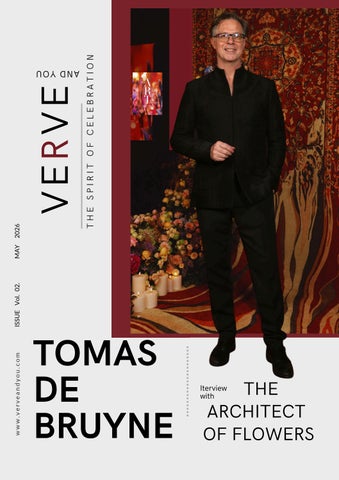
TOMAS DE BRUYNE
Iterview with
THE ARCHITECT OF FLOWERS
ISSUE Vol. 02.
MAY
VERVE THE SPIRIT OF CELEBRATION
2026
AND YOU
EDITOR’S NOTE
My conversation with Tomas De Bruyne took place during a moment of visible recognition in his career — international stages, awards, the release of a new book, and the broader acknowledgment of an influence that has been shaping the industry for decades. Yet what remained with me afterward was not the visibility surrounding the work, but the unusual precision with which he observes the world around him. To speak with Tomas is not simply to discuss flowers, aesthetics, or events. Behind the visual language is a disciplined way of thinking shaped through repetition, experimentation, restraint, and sustained observation. What emerges very quickly is that his work cannot be reduced to decoration, nor even to floral artistry alone. It is rooted in perception.
What stayed with me most was his commitment to remaining mentally engaged with his own evolution. Not as a performance around creativity, but as an ongoing discipline grounded in observation, reassessment, refinement, and the willingness to continue questioning instinct even after decades of success.
Tomas pays attention in a way that has become increasingly rare within creative industries shaped by speed, visibility, and constant production. He studies reactions carefully. He notices proportion instinctively. He speaks about emotion without becoming sentimental about it. Even our conversation about color moved away from trend forecasting and into memory, psychology, and human association.
This issue of VERVE and YOU is interested in examining the inner architecture behind creative practices that sustain both international relevance and personal authorship over time. Not through repetition alone, but through continued curiosity, discernment, and the discipline of remaining fully attentive to one’s own evolution.
Several moments throughout the interview revealed how analytical his thinking truly is beneath the intuitive surface often associated with design. We spoke about pattern recognition, creative repetition, educational limitations within the industry, client interpretation, sensory response, and the distinction between constructing an image and constructing emotional resonance. None of these ideas appeared rehearsed or intellectualized. They came from lived practice accumulated across decades of international experience.
www.verveandyou.com
This conversation is not intended as a retrospective of achievement. It is an invitation to spend time inside a creative philosophy shaped by perception, discipline, curiosity, and the ongoing responsibility of remaining awake to one’s own work.
Cecilia Lukaszewsky Editor in Chief, VERVE and YOU
VERVE & YOU
I N C O N V E R S AT I O N
WITH
TOMAS DE BRUYNE
PERCEPTION DISCIPLINE AND ‘THE ARCHITECT’ O F F LO R A L DESIGN
Cecilia: Do you remember the first moment in your life when flowers stopped being decoration and became something meaningful? Tomas: That came gradually. At first, flowers are beautiful objects. But when you begin to really observe them, you understand that they have character. They have movement, fragility, strength, rhythm, even a kind of personality. At that moment, flowers stop being decoration. They become a language. They begin to teach you how to work, how to respect nature, and how to create from what the flower already wants to express.
Cecilia: Before becoming a designer, what kind of child were you? Tomas: I was already a creative child. I was always making things, building things, playing with LEGO, working with paper, searching with my hands. I think creativity was present before I understood what design was. For me, creativity is not dependent on one material. The material is only the vehicle. What matters is how you look, how you connect, how you transform what is in front of you into something meaningful.
Cecilia: Creative lives often begin with curiosity. What fascinated you most about the world when you were young? Tomas: I was fascinated by how things were made and why things looked the way they did. I liked to understand structure, proportion, and the logic behind beauty. Even as a child, I was not only looking at the outside of things. I wanted to know how they worked. That curiosity became very important later, because design is not only about making something beautiful. It is about understanding the reason behind what you create.
“Observation is the beginning of design .” —Tomas De Bruyne
Q
Cecilia: After decades of working with nature’s most delicate material, what have flowers taught you about human nature?
Tomas: Flowers teach you to respect character. Every flower has its own way of standing, opening, moving, and aging. You cannot force all flowers to behave the same way. It is the same with people. Each person has a different energy, history, rhythm, and sensitivity. Flowers teach patience, respect, timing, and humility. They also teach that beauty is temporary, and that this temporary quality is part of its emotional power.
Cecilia: When you approach a new project, what is the first decision that quietly determines everything that follows? Tomas: The first decision is always understanding the essence of the project. Before flowers, before color, before form, I try to understand the energy of the client, the space, the intention, and the emotional atmosphere we want to create. Most people think design begins with visuals. For me, it begins with listening and perception. Once you truly understand the emotional direction, many later decisions become much clearer.
&
A
Cecilia: Flowers are ephemeral. They bloom, they fade, they disappear. How has working with such fleeting beauty shaped your understanding of time? Tomas: Working with flowers teaches you acceptance. Beauty does not become less valuable because it disappears. In many ways, it becomes more valuable because it is temporary. Flowers teach presence. They remind us that moments matter precisely because they cannot be repeated forever. In the event world, we create experiences that may last only hours, but emotionally they can remain in memory for decades.
Cecilia: Many young designers believe creativity is about adding more. At your level of mastery, how important is the ability to remove? Tomas: Removing is extremely important. Maturity in design often comes from knowing what is unnecessary. When designers are younger, they sometimes try to prove creativity through excess. But strong design usually comes from clarity. Sometimes removing one element creates more power than adding ten more. Restraint is not limitation. Restraint creates focus.
Cecilia: In great design, every element appears effortless, yet the process behind it is often highly disciplined. What does discipline mean in your creative process?
Tomas: Discipline is essential because creativity without structure easily becomes chaos. People often see only the final emotion of the work, but behind that emotion there is preparation, observation, repetition, timing, logistics, problem-solving, and constant refinement. For me, discipline is also mental. It is the ability to stay focused on the integrity of the concept without becoming distracted by noise, trends, or pressure. True freedom in creativity actually comes from discipline.
Cecilia: When people describe you today as a “master florist,” do you recognize yourself in that title?
Tomas: I understand the title, and I respect it, but I do not think about myself in that way every day. The moment you believe too much in a title, you can stop learning. For me, mastery is not a fixed position. It is a discipline. It means continuing to observe, to question, to refine, and to stay open. I prefer to remain a student of the flower, of design, and of life.
Cecilia: What is the biggest misunderstanding people have about floral design as a profession?
Tomas: Many people still underestimate the complexity behind it. They see beauty, but they do not always see the technical knowledge, logistics, leadership, psychology, engineering, timing, and physical endurance involved. Floral design exists between art and execution. You need sensitivity, but you also need precision and problem-solving. Especially at a large international level, it becomes an extremely demanding discipline.
Cecilia: In your experience, what separates a beautiful arrangement from a memorable one? Tomas: A beautiful arrangement can impress the eye. A memorable one creates emotional resonance. People may forget exact flowers or colors, but they remember how something made them feel. Memorable design has identity. It has atmosphere, rhythm, tension, and emotional intelligence behind it. It feels intentional rather than decorative.
Cecilia: A floral installation is not simply visual — it changes how people feel in a space. When you design, what emotional experience do you hope guests will leave with?
The Emotional Memory is more Important than the Photograph” TOMAS DE BRUYNE
Cecilia: Is there a flower you return to again and again — not because it is fashionable, but because it speaks to you personally?
Tomas: I hope people feel something genuine. Not only admiration, but emotional connection. A successful installation changes the atmosphere of a space. It can create calm, wonder, intimacy, energy, reflection, or even silence. I want people to feel transported for a moment outside of their normal rhythm. The emotional memory is more important than the photograph.
Tomas: I do not become attached only to one flower because my relationship with flowers changes continuously. Different flowers speak differently depending on the season, the project, and even the moment in life.
Tomas: Yes. It usually happens when the guests enter the space and the design begins interacting with human emotion.
But I am always attracted to flowers with character — flowers that are not trying to be perfect. I like movement, asymmetry, tension, vulnerability. Sometimes a flower becomes interesting precisely because of its imperfections.
A design is incomplete until people move through it, react to it, experience it. Sometimes there is a moment when the light, the music, the flowers, the people, and the atmosphere suddenly align. Then the installation becomes alive beyond the physical construction itself.
Cecilia: Is there a moment during an event when you step back and realize the design has truly come alive?
Cecilia: The event industry today moves very quickly — trends, social media, constant visual stimulation. Do you think the pace of the industry allows enough space for true creativity?
Tomas: The speed of the industry can become dangerous because people consume images very quickly and sometimes reproduce ideas without enough reflection. True creativity requires observation, silence, research, curiosity, and time. If everything becomes only reaction and visibility, originality becomes weaker. At the same time, every generation faces its own pressures. The challenge today is protecting depth inside an environment that constantly demands speed.
Cecilia: Many emerging designers look to figures like you for inspiration. What is one lesson you believe the next generation must understand if they want longevity in this field? Tomas: They must understand that longevity is not built only on talent. It is built on discipline, emotional intelligence, relationships, adaptability, and continuous learning. You cannot survive decades in this industry by chasing trends alone. You need to develop your own language, your own philosophy, and your own way of seeing the world. Most importantly, never stop being curious. The moment curiosity disappears, growth stops as well.
Page 14
“A flower already knows what it wants to become.” —Tomas De Bruyne
Cecilia: Are there disciplines outside floral design that influence your work — architecture, music, painting, philosophy?
Tomas: Absolutely. Flowers are only one medium. Design itself is connected to many disciplines. Architecture influences structure, proportion, rhythm, and spatial awareness. Philosophy influences the way you think and observe the world. Psychology is also very important because design is deeply connected to human emotion and perception. I am interested in patterns — how people behave, how energy moves, how harmony and tension exist together. Creativity does not come only from flowers. It comes from curiosity about life itself. The more you understand outside disciplines, the richer your creative language becomes.
Cecilia: Creativity seems to have been present in you from the very beginning. When boredom appears, creativity follows. Was that always the case for you?
Tomas: Yes, I think creativity was always present very naturally. Even as a child, I was constantly making things, observing things, rearranging things. Curiosity was always stronger than boredom. For me, creativity is not only artistic expression. It is also a way of thinking and perceiving the world. When I become intellectually or emotionally unstimulated, the mind automatically starts searching for new connections, new ideas, new possibilities. I think many creative people experience that. Creativity becomes a response to observation, curiosity, and sometimes even restlessness.
Cecilia: What part of yourself have you protected most carefully throughout your career?
Tomas: Probably my inner freedom and my way of seeing. In creative industries, there is constant pressure — trends, visibility, expectations, and commercial demands. If you are not careful, you can slowly lose your own voice inside all that noise. I have always tried to protect the part of myself that remains curious, observant, reflective, and emotionally connected to the work itself, not only to the external success around it. Because in the end, once you lose authenticity in your perception, the work also loses depth.
Cecilia:
What question do you wish people would ask you — but rarely do?
Tomas: That is a very deep question. Nobody has asked me that before. I need time to think about that question. It deserves a real answer — not a superficial one.
Tomas: I wish more people would ask me: “What has beauty revealed to you about human consciousness?” Because the longer I work in design, the more I realize that beauty is not something we simply see. It is something we recognize. A truly meaningful space does more than impress the eye. It alters perception. It slows time. It changes the emotional atmosphere within a human being. That is what fascinates me. Not flowers. Not luxury. Not scale. But the invisible dialogue between environment and consciousness. Over the years, I began to understand that people rarely remember the exact objects you placed in a room. What they remember is who they became inside the experience. Design, at its highest level, is therefore not decoration. It is emotional architecture. A silent language capable of shaping presence, memory, intimacy, awe, and even human connection itself. And perhaps that is why beauty matters so deeply to humanity. Because in a fragmented and overstimulated world, beauty has the power to return people to coherence, even if only for a moment. Not through explanation, but through resonance. I think that is the deeper responsibility of a designer; not simply to create things people consume, but to create moments that quietly restore something human within them.
“Creativity becomes a response to observation, curiosity, and sometimes even restlessness” — Tomas De Bruyne
Some parts of this conversation require more time, distance, and reflection than this edition can responsibly contain. Several moments during our exchange moved beyond the visible language of design and into more complex territories: perception, discipline, identity, personal evolution, and the emotional realities that often accompany a life shaped through decades of continuous authorship. For now, I have chosen not to fully open those chapters. I also had the opportunity to witness Tomas De Bruyne in London during the launch of his book and a moment of international recognition among his peers. Seen in parallel with this conversation, those public moments carried a different weight entirely. What becomes visible on stage is only a fragment of the intellectual and personal architecture that exists behind it. This will not be the final conversation. A future chapter will return to the book, the thinking surrounding it, and several more personal reflections that deserve their own space, context, and editorial distance.
@verveandyou
www.verveandyou.com
T H E N EX T
CHAPTER
Tomas De Bruyne and his latest work: www.theartofdesign.be
TOMAS DE BRUYNE