
Welcome to Mental Performance Mastery for Baseball a system designed to help you train the most important part of your game: the six inches between your ears. Baseball is a game of failure, adjustments, pressure, and long seasons. The difference between average and elite is rarely physical talent alone. It’s the ability to reset after a strikeout, stay composed after a bad inning, compete freely under the lights, and show up with confidence every single pitch. That’s what this course is about.
This program is not about hype, motivation, or “just think positive.” It’s about training the 10 essential mental game of baseball skills the same way you train your swing, your delivery, or your glove work.
Consistency. Confidence. Focus. Self-Control. Mental Toughness. Response to Adversity. Leadership. These are not personality traits they are trainable skills. Through the 10 Pillars of Mental Performance Mastery for Baseball, you’ll develop a repeatable system you can use in the box, on the mound, in the dugout, and in the biggest moments of your career
If you commit to doing the work not just reading it, but applying it you will separate yourself from the competition and gain a significant edge. The same edge that Major League Players and the top college programs and high schools have been coming to me for, for over 25 years.
You will learn how to stay in control of yourself so you can control your performance when adversity hits. You will compete with a controlled aggression and relaxed intensity instead of emotional swings.
You will build a mindset that travels with you through your journey in the game, including slumps, position changes, high pressure games, and professional baseball opportunities.
This is your blueprint for becoming a more consistent, confident, and complete baseball player.
Let’s get to work.
Brian Cain, MPM
Your Baseball Mental Performance Coach
Baseball is not a one-day event.
It’s a long season, a daily grind, and a game that demands consistent mental execution across practices, bullpens, cage work, travel days, and games.
To get the most out of your Baseball Mental Mastery (BAMM) program, we recommend using both components of the program together:
● The program specific training manual
● The online training platform, which includes videos, audios, and additional baseball-specific resources
The training manual gives you structure.
The online content brings the concepts to life through examples, demonstrations, and application.
When used together, this program becomes the most comprehensive “how-to” mental performance training system in baseball today.
Here’s how to run it like a pro.Step 1: Total Immersion Your Mental Game Spring Training
Start by watching the online videos and reading the corresponding section of the manual from start to finish.
We recommend approaching your first run through this program like mental spring training.
Over a 10–14 day period, work through the entire system:
● One pillar per day
● One focused training block
● No overthinking—just consistent reps
The chapters are intentionally organized in a consistent format so you can:
● Keep it simple and learn faster
● Reduce mental clutter
● Focus on execution, not confusion
Think of this phase as learning the fundamentals of the mental game—just like early season work in the cage or catch play bullpens start.
After you’ve completed the full program once, it’s time to slow it down and go deeper
Now, re-read one chapter per week, with a sharper focus and greater intention.
For each pillar:
1. Re-watch the corresponding online videos
2. Read the chapter in full
3. Reflect on how it shows up in your current role (starter, reliever, everyday player, bench role, leader, young guy, veteran)
This phase mirrors what great baseball players do:
● Fewer swings
● Higher quality reps
● More awareness and intent
This is where real growth happens.
Knowledge doesn’t win games.
Execution does.
As you work through this program, apply what you’re learning immediately:
● In practice, In bullpens, In the on-deck circle
● After an error, After a strikeout
● Between pitches and between innings
Then—teach it.
Share key concepts with:
● A teammate in the dugout
● Your catcher or pitcher
● Your middle infield partner
● A younger player looking for guidance
If you can teach it, you truly own it.
Great baseball cultures are player-led, and this is how that leadership develops.
Your BAMM manual should become:
● A constant reference
● A reset tool
● A reminder of who you are and how you compete
Keep it in your bag. Keep it in your locker. Keep it in your room on the road.
Mental performance is not something you train once it’s something you maintain
It's a lifestyle, not an event. Consistency is everything.
Every chapter in this program follows the same structure so you can move quickly from Theory -> Practice -> Mastery.
The goal is simple:
● Give you enough what and why to build confidence
● Keep it simple enough to apply immediately into practice
● Avoid overthinking and mental clutter
Each chapter is packed with:
● Baseball-specific examples
● Tools you can use immediately
● Drills that fit into your daily routine
Here’s how each chapter is laid out.
Each pillar begins with a clear definition of the mental skill being trained
You’ll learn:
● What the skill actually is (not just what people say it is)
● Why it matters specifically in baseball
● How it shows up during games, practices, slumps, and pressure moments
We’ll also cover what happens when this skill is not trained because in baseball, gaps in the mental game always get exposed.
Baseball is full of outdated beliefs like:
● “Just be tougher”
● “You can't think and play at the same time”
● “Confidence, you either have it or you don't”
● “Mental skills are for players who are struggling”
In this section, we break down the most common myths and mistakes baseball players make when trying to improve their mental game and why those approaches fail. Clarity creates confidence.
This is the heart of the program. Here, you’ll learn exactly what each pillar looks like:
● On a game day, during practice, In the cage, on the mound, in the dugout, after a win/loss, under pressure
You’ll be given clear drills and strategies you can plug directly into your daily baseball routine—no fluff, no guesswork
This is where mental performance stops being theoretical and starts becoming competitive advantage.
No single program can ever cover everything.
At the end of each chapter, we provide recommended resources books, tools, and materials that can help you continue sharpening that specific mental skill
Use them as:
● Off-season development tools, in-season reinforcement, long-term growth resources
This is not a one-time read This is a system you return to:
● Each season, Each new role, Each new level you go up, Each new challenge
Approach this program the same way elite baseball players approach their craft:
● Intentional, Consistent, Disciplined, Patient
Train the mental game the same way you train the physical game and watch what happens to your confidence, consistency, and competitive edge Now let’s get to work
Brian Cain, MPM is widely regarded as the World’s foremost authority on Baseball Mental Mastery and Baseball Mental Performance Coaching.
He is the creator of The 10 Pillars of Mental Performance Mastery System, The Mental Performance Mastery (MPM) Coaching Certification Course, a #1 International Best-Selling Author and the World's most highly sought after Speaker and Mental Performance Coach in Baseball.
His client list includes coaches, athletes, and teams at the Olympic level, in Major League Baseball, the NFL, NBA, NHL, UFC and on The PGA and LPGA Tour. His resume boasts a list of hall of fame athletes including 4 MLB Cy-Young Award winners, World Series Champions, a MLB Batting Champion, over 1,500 MLB Draft Picks, a Heisman Trophy Winner, 8 UFC World Champions, World Series and Super Bowl Champions and Olympic Gold Medalists.
Highly sought after for his educational, empowering and energizing approach, Brian provides a system that will help you close the gap from where you are to where you want to be by implementing the same mental performance strategies as the world class players he coaches.
Brian practices what he teaches on a daily basis.
Please take a moment to connect with Brian Cain on the following social media platforms
Twitter = @BrianCainPeak
Instagram = @BrianCainPeak
Facebook = @BrianCainPeak
LinkedIn = @BrianCainPeak
The Mental Performance Daily Podcast
The Mental Performance Mastery Podcast
Contact Brian Cain
You can pick up his #1 Best-Selling Inspirational Fiction Books The 10 Pillars of Mental Performance Mastery and The One Percent Intention on Amazon.
(The Mental Toughness Skill Set for Elite Baseball Players)
Baseball demands a unique kind of mental toughness.
It’s a game of daily failure, constant evaluation, role uncertainty, long seasons, and short memories. The players who last—and the players who rise—are not just physically talented. They are mentally trained.
The following 10 mental skills make up the Mental Performance Mastery skill set for baseball When trained together, they allow you to compete with confidence, consistency, and composure—pitch to pitch, at-bat to at-bat, game to game, season to season.
These skills don’t just transfer to better baseball performance.
They also create success after baseball, when structure, pressure, and accountability still matter.
Below is an overview of each pillar and how it directly impacts your performance on the field, in the dugout, and over the course of a long season.
Baseball will expose mindset gaps faster than any sport. Without an elite mindset, doubt creeps in after:
● An 0-for-4 night
● A blown save
● A bad inning
● A dropped ball
● A tough role change
Players without this skill start to believe:
● “I’m not mentally tough enough.”
● “I don’t have it today.”
● “I always struggle in these moments.”
As you develop an elite baseball mindset, you learn to see:
● Slumps as feedback, not identity
● Failure as part of mastery, not a verdict
● Pressure as a privilege, not a threat
You stop letting one pitch, one at-bat, or one game define you—and that changes everything.
Baseball tests motivation every single day.
Early work. Long bus rides. Cold nights. Limited playing time. Playing more games than any other sport. Rehab. Bullpens when no one’s watching.
When adversity hits—as it always does—the level of commitment you’ve trained determines whether you:
● Stay engaged or check out
● Compete or go through the motions
● Respond or make excuses
Motivation in baseball isn’t about hype. It’s about showing up when you don’t feel like it and doing the small things that separate dependable players from replaceable ones.
Baseball punishes distraction. One lapse of focus can mean:
● A hanging pitch
● A bad read on a ball
● A missed sign
● A mental error
Great players don’t avoid mistakes—they recover from them faster. This pillar trains you to:
● Lock in pitch to pitch
● Reset after failure
● Control your inner dialogue and self-talk
● Stay present instead of replaying the past or worrying about the future
When trained, focus and awareness allow you to slow the game down, even when everything around you speeds up.
Baseball is emotional—but elite performance requires self-control. Umpire calls. Fans. Parents. Coaches. Opponents. Your own expectations.
When self-control isn’t trained, emotions start calling the shots.
This pillar develops your ability to:
● Reset after a bad inning or at-bat
● Make smart decisions under pressure
● Stay composed when things don’t go your way
● Respond instead of react
Disciplined players don’t suppress emotion—they channel it.
One of the biggest mental battles in baseball is obsessing over outcomes:
● Stats
● Batting Average
● ERA
● Playing time
● Results
● What the future holds...
This pillar teaches you to anchor to what you control:
● Your preparation and process
● Your approach
● Your routines
● Your effort and intent
Players who master process over outcome stay consistent, even when results fluctuate—which they always will in baseball.
Elite baseball players prepare mentally before the moment arrives.
Mental imagery trains you to:
● See successful at-bats before stepping in
● Rehearse executing pitches under pressure
● Calm your nervous system before competition
● Build confidence without needing constant external validation
This is advanced preparation—and most of your competition doesn’t train it.
Baseball rewards players who are consistent off the field Routines create stability in an unstable game.
This pillar teaches you how to:
● Build pre-game, in-game, and post-game routines
● Develop habits that support confidence and recovery
● Avoid letting emotions dictate preparation
High performers don’t wing it. They run systems.
Baseball seasons drain energy if you don’t manage your time. Late nights. Travel. School. Work. Recovery.
This pillar helps you:
● Reduce decision fatigue
● Protect mental and physical energy
● Show up prepared instead of rushed
Organized players don’t waste energy—they invest it where it matters most.
Baseball teams don’t win because of speeches. They win because players lead:
● In the dugout, in the clubhouse, during adversity, when no coaches are watching
This pillar trains you to:
● Lead by example, hold standards, communicate effectively, raise the level of those around you
Great teams are player led—not coach fed, and leadership is a trainable skill.
Championship baseball programs have something in common:
● Intentional core principles, standards, accountability, trust, ownership, response to adversity
Culture shows up:
● After errors, during slumps, In how teammates treat each other, in how the team competes when things aren’t going well
This pillar teaches you how to:
● Build an intentional culture and Contribute to team culture
● Protect standards when pressure rises. Culture isn’t what you say—it’s what you tolerate.
The 10 Pillars of Mental Performance Mastery for Baseball are trainable skills—not personality traits.
When you train them intentionally, they create:
● Consistency under pressure
● Confidence during adversity
● Composure in big moments
● Longevity in the game
Train the mental game like you train the physical game—and separate yourself.
Before we start training, we need a clear snapshot of where you are right now with the mental side of your game.
Just like you would test:
● Exit velocity
● Pitch velocity
● Strength numbers
● Mobility
We are going to assess your current mental performance skill set. This is not about judgment. This is not about labels. This is about awareness.
Here’s how to do it:
In your workbook, rate yourself on each of the 10 mental skills below using a 1–10 scale:
● 1 = completely untrained
● 10 = world-class, elite, consistent
● No 7s (because everyone defaults to a 7 and it tells us nothing)
Be honest. This is for you, not for anyone else unless you choose to share it with your MPM Coach.
#1 Elite Mindset
(How you respond to failure, slumps, adversity, and pressure)
#2 Motivation & Commitment
(Your ability to stay engaged through the daily grind, long seasons, and adversity)
#3 Focus & Awareness
(Pitch-to-pitch focus, presence in the box, awareness in the field)
#4 Self-Control & Discipline
(Emotional control after bad calls, errors, strikeouts, or rough innings)
#5 Process Over Outcome
(Your ability to stay locked into approach, not stats or results)
#6 Mental Imagery & Meditation
(How well you mentally prepare before games and slow the game down)
#7 Routines & Habits of Excellence
(Pre-game, in-game, post-game, and daily preparation routines)
#8 Time Management & Organization
(Energy management during the season, travel, school/work, recovery)
#9 Leadership
(Your impact on teammates in the dugout, clubhouse, and during adversity)
#10 The Right Culture
(How you contribute to standards, accountability, and team environment)
● You already have a solid mental foundation or
● You’re starting close to square one
Know this:
This program meets you exactly where you are
You can hire your own personal baseball MPM coach just like a hitting coach to help you take the next step, not overwhelm you
Now that you’ve established your starting point, get ready—because you’re about to make serious progress.
At the end of going through this program, you’ll revisit this same assessment. Most players are shocked by:
● How much more confident they feel
● How much faster they reset after failure
● How much calmer they are under pressure
● How much more prepared they feel going into games
That’s what mental training does when it’s done right.
In baseball, the best team doesn’t always win. The team that plays the best wins. Talent is everywhere. Consistency is rare.
This training gives you the best chance to:
● Compete with confidence
● Stay steady through slumps
● Execute under pressure
● Play your best when it matters most
And here’s something most players don’t realize yet:
What you learn in this program won’t just help you play better baseball—it will help you win in life after baseball. Learning how to hit a breaking ball or throw a slider helps you on the field.
Learning how to:
● Control emotions
● Stay disciplined
● Lead others
● Focus on what you control …helps you forever.
I’ve seen these 10 skills show up year after year in:
● Professional baseball
● College programs
● Business
● Leadership
● Life after sport
Our mission is simple:
To educate, empower, and energize you so that whether baseball is your career or not, this training sets you up to win.
My life is dedicated to mental performance mastery
I’ve:
● Read the books
● Interviewed the top players and coaches
● Attended the coaching clinics
● Worked inside clubhouses, dugouts, and locker rooms
● Been with the top players when they won—and when they got cut, benched, or struggled
I know:
● How top players think
● What routines they run
● Where they struggle
● What actually works in real game competition
This is not motivational-speaker fluff This is not academic theory from people who’ve never been in the dugout. We live in the grind for over 25 years with players and coaches. We’ve lost. We’ve won. We’ve been punched in the gut. Now you get the benefit of that experience.
Follow this simple game plan:
● Read the text and watch the videos in each lesson
● Keep up with you workbook for notes, reflections, and daily entries
● Stay consistent with your success checklist
● Listen to The Mental Performance Daily Podcast
I know you’re busy That’s baseball. That's no excuse. That’s why this program is designed so you can:
● Get value by just reading or watching
● Get maximum results by doing both
This program only works if you work it You must:
● Do the drills
● Apply the skills
● Commit to training the mental side of your game just like you do the physical side.
If you’re doing this just because a coach told you to, you’re missing the point—and you’ll miss the results. But if you’re tired of:
● Being inconsistent
● Letting one bad play spiral
● Falling short of your potential
● Not competing with the confidence you should …and you’re ready to break through, then you’re in the right place. Let’s get started.
In this fundamental concepts section I will teach you some of the most essential, basic and powerful mental performance strategies for baseball that you can start implementing immediately. Start here as the best players I have ever worked with are brilliant at the basics. They are relentless with fundamental execution under stress and that's where we are going.
By now, I hope you realize this: You will NOT develop mental toughness for baseball by just reading pages or watching videos. No one ever became a better hitter by watching swing videos alone. No one ever became a better pitcher by just talking about mechanics. Baseball mental mastery works the same way You must DO the drills, apply what you’re learning, and run it inside your daily baseball routine—in practice, in bullpens, in the cage, in the dugout, and in games. If you don’t apply what you’re learning every day, you are no better off than the player in the next locker who has never heard of this program. Knowledge is not power.Knowledge is potential power. The power comes from action. From doing a little, a lot—not a lot, a little. One rep per day beats the go hard to does it once a month for 10x as long on that day.
We're Not Going Through This Program, We GROWING Through It!
If you want more out of baseball, you must become more as a competitor. That means:
● Better responses after failure
● Better focus pitch to pitch
● Better emotional control
● Better preparation and process
And there is a process that guarantees growth when followed with intent. Just like physical development, mental development follows three non-negotiable stress
(Your Mental Spring Training)
I call this a TILE Total Immersion Learning Experience.
This is your initial pass through the program:
● Working with your MPMC or MPMTC
● Reading the material
● Watching the videos
● Building awareness
Think of this like spring training for your mental game But here’s the warning: If you finish a module, a call, or a session and don’t immediately move to Step #2, you’re leaving results on the table. Awareness alone does not change performance.
(Where Baseball Players Separate Themselves From The Competition) This is where the real growth happens. I call this SR — Spaced Repetition. In baseball terms, this is:
● Not just taking swings, but working on something every swing
● Reviewing video and getting visual feedback
● Repeating quality reps
Spaced repetition in this program looks like:
● Watching the videos, reading the text, taking notes in your journal
● Talking through it with a teammate or coach, tracking behaviors on your success checklist
Reviewing your journal before practice. Re-reading a page on a travel day Listening to MPD Podcast on the way to the field. That’s spaced repetition. The Ideal Baseball Plan:
● One pillar per week for 10 weeks
● Then review one page per day, every day, as part of your routine
This kind of relentless consistency:
● Changes how you think, how you respond, how you compete.
And yes—when you run this the right way, it closes the gap between where you are and where you want to be.
(No One Gets There Alone) Baseball is a team sport for a reason. Accountability accelerates growth. Talk with your accountability partners or coach about:
● What you’re learning
● What you’re implementing
● How it’s showing up in practice and games
You already know this from baseball. If you tell yourself you’re going to lift at 5:30 a.m. alone. That snooze button becomes very tempting. But if a teammate is waiting on you? You’re there. Because it’s easier to quit on yourself than it is to quit on your teammates. The same principle applies here. The bigger your goals in baseball:
● The more accountability you need
● The more people in your corner
● The more structure you must build
If you want to go fast, go alone. If you want to go far, bring a team. And when it gets hard—because it will—we’ll be there. That’s when real competitors are made.
Right now, your job is simple:
1. Understand the 3 Steps to Maximum Growth
2. Start listening to the Mental Performance Daily (MPD) Podcast as part of your spaced repetition
3. Check it off in your success checklist and give yourself credit for doing the work
That small win matters. If you want more out of baseball, you must be intentional about becoming more. You now know how growth works But knowing isn’t the same as doing. Be a doer, not a knower. Below is a Mental Performance Daily Podcast where I break down the 3 Steps to Maximum Growth and how elite baseball players use them to separate themselves over the course of a season. Let’s get after it.
Let me ask you a question… If there was a book that all of the top college coaches I have worked with had their teams read every other year over winter break, would you read it? Well, if not.... let me give you the cliff notes. RIGHT NOW, do you want a check for three million dollars or do you want one penny that doubles every day for a month? Think about it fast.
Journal your answer below: $3,000,000 OR. $0.01 DOUBLED DAILY FOR A MONTH. Did you pick $3,000,000? Most players do. Most players want the instant gratification of the three million dollars. They want the quick fix with the microwave mindset that many athletes have today. They want everything now. They want it quick and they want it easy. They live in a digital world where you can get everything fast… However… baseball development is still ANALOG… It takes time to grow, to develop, to achieve greatness.
You see, great things MAY come to those who wait… but those things will be the things left behind by those who hustle, who work and who get after it on a daily basis. So you’re going to need to hustle with a fast pace and at the same time be patient. You’re going to need to develop a patient sense of urgency while you work your process and wait for the results. Instant Results or Daily 1% Growth
Most baseball players choose the instant result. They want:
● The quick stat jump
● The early offer
● The instant promotion
● The overnight breakthrough
They want the microwave mindset. And I get it. We live in a digital world where:
● Highlights go viral instantly
● Rankings update weekly
● Offers and attention feel immediate
But here’s the reality: Baseball development is still ANALOG. It takes time. It takes reps. It takes patience. It takes consistency. Great players aren’t built overnight they’re built daily. You’re going to need to move with urgency and patience at the same time. A patient sense of urgency.
You’ve heard the story of the tortoise and the hare.
The hare explodes early, gets ahead fast, relies on talent, gets distracted, and burns out. The tortoise moves slowly, stays consistent, keeps showing up,and eventually wins… But, here’s what most athletes miss: There’s a third competitor in that race. We call them The Dominator. The Dominator starts fast and stays consistent, trains with urgency, competes with patience, and executes daily routines relentlessly.
In baseball terms:
● Takes quality swings every day
● Runs the same pre-game routine regardless of results
● Competes pitch-to-pitch
● Never panics during a slump
Fast + Consistent = Dominant. That’s who this program is designed to help you become.
Now let’s bring this back to baseball growth. Get out your phone. Open your calculator. Type in 0.01 That’s one rep. One routine. One focused at-bat. One bullpen with intent. Now hit ×2 = Day 1: .01 Day 2: .02 Day 3: .04 Day 4: .08 Day 5: .16 Nothing flashy yet. By Day 15, you’re only at $327.68 In baseball terms, this is the player after:
● Two years of high school
● Two years of college
● Early minor league seasons
You’re looking around thinking:
“They’re bigger, throw harder, getting the starts, already have offers.”
This is where most players quit the process. They compare instead of compete. Comparison is a deadly game in baseball and you will never win it. Your only job is to:
● Stay in your lane
● Stick to your routine
● Execute your success checklist
Keep going. Day 20. Day 25. Still doesn’t look like much. But on Day 29, something wild happens. That penny is now worth $2.5 million On Day 30, you pass everyone who chose the instant payout. On Day 31, that one penny doubled daily is worth over $10 million. That’s the Compound Effect.
This is the power of: daily routines, habits of excellence, mental discipline, and process over outcome. This is why we make such a big deal about:
● Your Success Checklist
● Tracking behaviors, not just results
● Doing a little, every single day
Your success checklist is how you:
● Put the compound effect to work
● Stay focused during slumps
● Avoid emotional roller coasters
● Build confidence that lasts
Excellence in small things is excellence in all things. How you take BP is how you take at-bats. How you prepare is how you compete, How you practice is how you perform.
Don’t look at:
● The draft, the scholarship, the promotion, the end goal.
And get overwhelmed. Just take the next step. Sir Edmund Hillary didn’t accidentally end up on Mount Everest. He had a plan. He worked backward. He trusted the process. Great baseball players do the same thing.
Elite players always have something to go to when things get hard:
● Their self-talk, routines, mindset, ability to act differently than they feel
They don’t wait to “feel good” to do the work. They do the work, and the feeling follows.
The past is over The future isn’t here yet. Today is the only pitch you can control. Start putting the Compound Effect to work: one routine, one checklist item, one rep, and one day at a time.
Below are some episodes of The Mental Performance Daily Podcast where I break down The Compound Effect and how elite baseball players use it to separate themselves over the course of a season and a career. Stay consistent. Trust the process. Dominate the long game.
In baseball, the players who improve the most are the ones who do the small things consistently.
Remember this principle:
We grow best by doing a little a lot, not a lot a little.
Just like hitting, pitching, fielding, and strength training, your mental game needs daily reps too.
By this point in your Baseball Mental Mastery journey, your Personal Success Routine should include listening to the Brian Cain Mental Performance Daily Podcast as part of your daily routine.
That means 7 days a week.
Why?
Because the Mental Performance Daily is your 2–3 minute mental rep every day.
Think of it as a daily mental batting practice for your mindset — a quick check-up from the neck-up that helps you stay focused, confident, and prepared.
Just like taking BP every day sharpens your swing, these short episodes sharpen your focus, confidence, routines, and mindset.
The power comes from spaced repetition and consistency.
Little reminders.
Every day Over time.
That’s how championship mindsets are built.
You can follow The Mental Performance Daily Podcast on:
• Apple Podcasts
• Spotify
Once you follow the show, please take a moment to leave us a review. It helps more players, coaches, and competitors discover the mental game.
Thank you in advance.
One of the most powerful tools you can use to develop your mental game in baseball is a performance journal. Before you begin working through the lessons in this program, make sure you have a dedicated journal or notebook where you can do your baseball journal in addition to your training manual. It’s a place where you will: Set your intention before practice or games. Capture lessons learned from training and competition. Reflect on what went well and what you want to improve. Over time, this journal becomes a record of your growth as a player and competitor. Any basic notebook or composition book will work. It doesn’t need to be fancy just something you bring with you consistently. The key is not the notebook. The key is the daily habit of reflection and intention. Throughout this program we will continue to show you how to use your performance journal, but the basic structure looks like this.
Before practice, training, or a game, take a few minutes to set your mindset for the day. Write down: Date & Location: (Where you are training or playing) 3 Keys to Keep It Simple: The three simple things that will help you perform your best today 3 Affirmations: Positive statements that reinforce confidence and belief. One Word Focus: A single word that represents how you want to compete today (example: Attack, Smooth, Compete, Present, Aggressive). These all stay the same, they take commitment and time.
After practice or games, take a few minutes to reflect and learn from the day. Write down: 3 Wins What went well today? 3 Gratitudes: What are you thankful for about today’s experience? Start –Stop – Continue: Start: What should you start doing? Stop: What should you stop doing? Continue: What worked well that you should keep doing? Anything Baseball Specific From Today This could include: Adjustments you made, Something a coach said, A lesson from an at-bat, inning, or play, or something you want to work on tomorrow. These can change daily or can remain similar. Many elite baseball players use performance journaling as part of their routine. Watch examples of major league players talking about their journal process in the dashboard and learn how how journaling helps these athletes improve their mindset and performance.
One of the most powerful drills I have given athletes in the last 20 years of coaching mental performance is called the Success Checklist. This is a process-over-outcome tool designed to make sure you leave no stone unturned and no deed undone in your preparation for performance. In baseball, it’s easy to become obsessed with outcomes: Batting average, ERA, Draft status, Making the lineup, Winning championships, But elite players understand something different. Success in baseball is built through daily execution. Not someday. Today. And the Success Checklist helps you stay locked in on the daily behaviors that lead to success, instead of just thinking about the results you want in the future.
Many athletes struggle with consistency and assume they simply lack discipline. But in most cases, discipline isn’t the problem. The real problem is a lack of clarity around the process. When players focus only on the big picture making the team, getting drafted, winning a championship it becomes easy to feel overwhelmed or distracted. The Success Checklist fixes that. Instead of focusing on the distant outcome, you focus on executing the daily behaviors that lead to elite performance.
Your Success Checklist is a simple daily list of the most important behaviors you must execute each day to improve as a baseball player. The goal is to: Get clear on what matters most, Remove the noise and distractions, Focus on the daily actions that move you forward, Your only job each day is simple: Execute the checklist. If you consistently check off the behaviors that matter most, the outcomes will take care of themselves.
When you focus on a small number of high-impact daily tasks, two powerful things happen:
1. You remove the feeling of overwhelm.
2. You create clear, measurable progress every day.
That’s how elite baseball players build confidence. Not from hoping. From doing the work daily.
Every player’s checklist will be slightly different, because each player has different needs. But the structure stays the same. Your checklist should focus on the behaviors that have the biggest impact on your performance and development.
For example, a player’s checklist might include things like:
• Listen to the Mental Performance Daily Podcast
• Complete visualization reps
• Review the game plan for pitchers you’ll face
• Do your mobility and recovery routine
• Complete skill work with intention
• Write in your performance journal
The key is to keep the list simple and focused.
Your goal is not perfection. Your goal is consistency. Aim to complete your Success Checklist at least 80% of the time. At the end of each week: Review your Success Checklist, Reflect in your performance journal, Ask yourself what worked and what needs adjustment, Attack the next week with focus. If you fall below 80% consistency, don’t beat yourself up. Instead, ask: What needs to change so I can execute this better next week?
This exact strategy was fundamental in the career development of MLB Cy Young Award winner Corbin Burnes. Burnes focused on executing a daily process, not obsessing about results And over time, that relentless commitment to the process led to elite performance.
One tool that can help you stay accountable is the HabitShare app.
HabitShare allows you to: Track your daily checklist, Build streaks of consistency, Share your habits with a teammate or accountability partner, and this makes it easier to stay committed to the process.
As you move through this program—especially if you’re doing it as part of a baseball team—one concept we will return to over and over again is called The 4 Stages of Buy-In. Every player goes through these stages. You. Your teammates. Your accountability partners. Even Major League players. The key isn’t whether you go through them. The key is recognizing which stage you’re in right now so you don’t get stuck there.
Baseball players are creatures of habit. So when you’re introduced to new ideas, drills, or mental training tools like the ones in this program, the natural reaction is often: “I don’t need that.” “That’s not for me.” This is normal. Most players initially believe that talent, mechanics, and physical training are enough. But as you move through your baseball career, you start to realize something important: At higher levels of baseball, the mental game separates players.
In Stage #2, you begin to notice something interesting. Many elite athletes who win consistently are using mental performance tools like:
• Visualization
• Journaling
• Breathing and focus routines
• Process goals
• Mental rehearsal
You start to realize that there is a huge mental component to elite performance. But you may still think:
“That might work for them… but I’m not sure it works for me.”
You’re making progress. But don’t stop here.
This is the turning point. Stage #3 is where players begin separating themselves. Instead of debating whether the training works, you decide to test it for yourself. You start to:
• Try the drills, Invest 5–10 minutes per day in mental training, Watch the videos, read the lessons, Write in your performance journal, talk with your accountability partner, you don’t have to overhaul your life, you simply reallocate your time. Hall of Fame basketball coach Tom Izzo once gave me advice that applies perfectly to baseball: Most athletes spend 2–3 hours per day on phones, video games, or social media. Cut just one hour of that time and invest it in growth:
• 30 minutes into your sport
• 30 minutes into personal development, planning, and mindset
Your success will take off. You already have enough time. The question is: Where are you investing it? Ask yourself honestly: Do you want to be great at baseball…or great at scrolling, gaming, and wasting time? Players who commit to 5–10 minutes per day of mental training eventually say the same thing.
Once you move through Stage #3 and begin applying what you learn, you eventually reach Stage #4. This is when players look back and say:
“I can’t believe I ever did it any other way.”
You realize that the mental game:
• Improves your confidence, helps you respond to failure, strengthens your focus, makes your preparation intentional. Little by little, these small habits create massive growth.
As DJ Hillier, MPM says: “Little by little, a little becomes a lot.” And as Lyndsay Fry, MPM reminds us: “Dripping water hollows out a stone.”
In your performance journal, answer the following questions:
1. Describe a time in your life when you went through the four stages of buy-in.
2. Which stage do you feel you are currently in regarding mental performance training?
3. What would it take for you to fully commit to Stage #3 — I’ll Try It?
Georges St-Pierre, a 13-time UFC World Champion, experienced the Four Stages of Buy-In when we first worked together before his fight at UFC 74 vs. Josh Koscheck.
After his unanimous decision victory, he said:
“Brian Cain, my sport psychologist, taught me to see loss as a learning opportunity and come back stronger. I used to think someone who used sport psychology was crazy or weak. Now I realize you need it to compete at the highest level.”
That’s the transformation that happens when athletes move through the four stages of buy-in.
MLB outfielder Jake Fraley once explained the Four Stages of Buy-In perfectly in an on-field interview:
“I didn’t think I needed help.”
“I saw fighters and other athletes using it.”
“I started doing the drills.”
“Best investment I’ve ever made.”
That’s the path.
In your performance journal, write down the Four Stages of Buy-In and circle which stage you are currently in. Your goal during this program is simple: Move to Stage #3 — I’ll Try It. Because once you do, Stage #4 is waiting.
An Elite Mindset in baseball is the commitment to show up every day with the intention to improve, compete, and respond the right way regardless of the circumstances.
Baseball is a game built on failure—great hitters fail 7 out of 10 times—so elite players learn to control what they can control: their attitude, effort, preparation, and response to adversity.
Instead of getting caught up in outcomes like batting average, ERA, or playing time, athletes with an elite mindset focus on the process
They stay present pitch-to-pitch, trust their preparation, and compete with confidence knowing that consistent execution of the right habits leads to long-term success.
Players with an elite mindset also understand that growth happens through challenges, not comfort. They embrace difficult practices, learn from mistakes, and use setbacks as fuel to improve rather than excuses to quit.
Whether it’s responding to a strikeout, bouncing back after a bad outing on the mound, or staying ready when they’re not in the lineup, elite competitors maintain belief in themselves and their work.
Over time, this mindset builds resilience, consistency, and leadership—qualities that separate good players from great ones and allow athletes to perform at their best when the game is on the line.
In this Pillar we will cover what the skill of Elite Mindset is, what the common myths and mistakes are that players and coaches make in baseball and the drills you can do to develop an elite mindset.
Baseball will expose your mindset faster than almost any sport.
Without an elite mindset, you’ll constantly battle doubt:
After an 0-for-4 night. After a blown save. After getting benched. After making an error. After a rough bullpen or bad outing. You’ll start telling yourself things like: “Maybe I’m just not mentally tough.” “I guess this is just who I am.” “Other guys are built differently.” Those thoughts quietly cap your potential. But when you begin developing an elite baseball mindset, setbacks stop feeling like verdicts and start becoming information Slumps become feedback Failure becomes part of the process, not proof that you don’t belong. That shift alone changes everything. When you train your mindset the same way you train your swing, delivery, or glove work, you begin to break through the mental barriers that have been holding you back. And you start to play free, confident, and aggressive when it matters most.
Your mindset determines how you:
See yourself as a player. Interpret success and failure. Respond to adversity. View pressure, expectations, and opportunity
In baseball, two players can experience the exact same situation:
Same role. Same game. Same mistake. Yet respond completely differently. One player slams his helmet and spirals. The other adjusts, refocuses, and attacks the next pitch. One player sees a slump as the end of the road. Another sees it as a bend in the road. That difference is mindset. And the best part? Mindset is trainable. Players who sabotage themselves when things are finally going well can learn to stay locked in and composed. Players who dominate practice but tighten up under the lights can learn to compete freely in games Players who rush, press, and fight the game can learn to trust their preparation. That’s what mental performance training is about.
Perspective is everything in baseball. One bad at-bat can mean: “I suck.” Or it can mean: “I chased a pitch. Adjust and move on.”
One bad inning can mean: “I can’t pitch under pressure.” Or it can mean: “Execution slipped. Slow the game down.” Your perspective creates your reality. You can be the strongest, fastest, most talented player on the roster but if your mindset is off, those tools stay in the cage, bullpen, or weight room when the lights come on. This is why so many players say: “I can do it in practice, but it doesn’t show up in games.” That’s not a physical problem. That’s a mental performance gap. Once you train your mindset, the answer becomes obvious — just like seeing something that was always there but you never noticed before.
Take a look at the FedEx logo. You’ve probably seen this logo thousands of times But have you ever noticed the arrow hidden between the E and the X? Once you see it, you can’t unsee it. The arrow was always there you just weren’t aware of it. Mental performance training works the same way. Athletes have always known there is a mental component to their sport. Now you are learning instead of a weakness.

The foundation of mental performance training is understanding this: Your mindset is not fixed.
Players who: Crack under pressure. Struggle with consistency Get stuck in slumps. Lose confidence quickly…are not broken. They are simply mentally untrained. With the right training, athletes can change how they think, respond, and compete. Research shows athletes tend to operate from one of two mindsets.
“I’m either talented or I’m not.” “Some guys just have it.” “I guess I’m not built for this level.” “It’s genetics.”
“It’s the coach.” “It’s the system.”
This mindset leads to:
● Fear of failure
● Avoiding challenges
● Getting discouraged easily
● Blaming circumstances instead of improving
“I can get better ” “This is information.” “What’s the adjustment?” “Stay in the process.” “Keep stacking reps.”
Elite players understand: Talent is a starting point, not the ceiling. Confidence is built, not discovered. Effort, feedback, and adjustment create success. Beliefs create behaviors. Behaviors create results.
Baseball is full of things you cannot control:
Playing time, Lineups, Umpires, Opponents, Weather, Bad bounces.
Without the right mindset, players: blame coaches, blame circumstances, blame genetics, look for shortcuts, and progress stops.
But when you train an elite mindset, you: take ownership of your energy, control your response, stay committed when things get hard, stay aggressive instead of tentative.
Elite players don’t ask: “How did I do?”
They ask: “What’s the adjustment?” That shift from results to process is everything.
Players with a fixed mindset see failure as proof they aren’t good enough. They get discouraged. They disengage. They spiral. Players with an elite mindset see setbacks as: Feedback. Learning opportunities. Setups for a comeback Adversity becomes fuel, not friction. This matters enormously in baseball, where: Failure is constant. Confidence is fragile. Consistency is rare. Helping you develop an elite mindset is the first and most important step toward building mental toughness.
It allows you to:
● Stay committed to the process, stay resilient through adversity
● Perform under pressure, reach your true potential
Elite mindset training is not motivational talk. It is skill development. When you combine: Education. Awareness. Drills. Daily application. …your mindset becomes a competitive advantage instead of a liability. This pillar is the foundation for everything that follows. Train it. Respect it. Build it. Because in baseball, your mindset will be tested every single day. And the players who rise are the ones who trained for it.
When it comes to mindset in baseball, there are a handful of common myths and mistakes that quietly keep players stuck, inconsistent, or frustrated—often without them even realizing it. Let’s clear them up.
#1: “An elite mindset is developed just by working harder than everyone else.”
In baseball, hard work is the entry fee
Early work. Extra swings. Bullpens. Lifting. Film. That’s assumed. But here’s the problem: working hard at the wrong things, or with the wrong intent, focus, can take you further away from your goal.
I see this all the time:
● Players grinding in the cage but pressing in games
● Pitchers throwing more bullpens but spiraling after one bad inning
● Athletes outworking teammates but underperforming when the lights come on
Hard work without mental direction leads to:
● Overthinking, tightness, playing not to lose
● Fighting the game instead of trusting it
Elite mindset isn’t about more effort It’s about better perspective, better focus, and better responses before you ever step between the lines.
#2: “Mindset just develops naturally with age, experience, and time.”
Yes—experience matters in baseball. But relying on time alone to fix mindset issues is like hoping your swing cleans itself up without feedback or reps.
Many players assume:
● “I’ll grow out of it.”
● “It’ll click eventually ”
● “Once I get older/more confident/more reps, it’ll change.”
That’s not how it works. Without intentional mental training, players often just:
● Repeat the same mistakes
● Reinforce bad habits
● Get better physically but stay the same mentally
The good news? When mindset is trained on purpose, you can:
● Speed up development
● Shorten learning curves
● Handle pressure sooner
● Compete with maturity beyond your years
Elite mindset doesn’t magically arrive. It’s built. It's trainable.
Myth #3: “I don’t have time to train my mindset, I already have too much on my plate.”
This is one of the most common excuses in baseball. School. Practice. Games. Lifting. Travel. Recovery And here’s the hard truth: This is an excuse used by average players who get average results. Elite players don’t add more to their plate—they prioritize better. If your plate is full: Knock some things off it. Five to ten minutes a day of mental training:
● Improves focus
● Increases confidence
● Reduces emotional swings
● Makes everything else more efficient
Mindset training doesn’t steal time—it creates it by eliminating wasted energy, overthinking, and emotional spirals. You can’t afford not to train the mental side of your game.
An elite mindset is not: motivation quotes, tough-guy talk, ignoring emotions, pretending pressure doesn’t exist.
It is a trainable skill set that allows you to:
● Reset pitch to pitch. Respond instead of react. Stay aggressive through failure. Compete freely under pressure
Every player who reaches their potential eventually learns this truth: Your physical tools get you noticed. Your mindset determines how far you go. Avoid these myths. Train intentionally. And turn your mindset into a weapon instead of a liability. Below is a Mental Performance Daily Podcast where I break down the most common Elite Mindset Myths and Mistakes in Baseball and how to eliminate them so you can compete with confidence and consistency.
To simplify and summarize, the essential skills needed to unlock an elite mindset are Body Language, Focus, and Self-Talk (BFS). Your body language, focus, and self-talk work together to create your mental state, which ultimately shapes your mindset and your performance. When these three areas are working together in the right direction, confidence grows. When they begin drifting in the wrong direction, confidence quickly disappears. The BFS strategy helps athletes become aware of what their body language, focus, and self-talk look like when they are performing at their best—and when they are struggling. Why is awareness important? Because what you are aware of, you can change. What you are not aware of, you cannot control. Many athletes don’t realize they are slipping mentally until they are already in a slump or spiraling during a game. But if you learn to recognize the early warning signs in your BFS—your posture, your thoughts, or your focus—you can correct it before the moment gets away from you. With practice, this awareness allows you to consciously choose an elite mindset, even in moments where you previously would have tightened up, lost confidence, or given in to frustration. Today, complete the BFS worksheet to begin identifying what your body language, focus, and self-talk look like when you are performing at your best versus when you are struggling. This process will help you recognize your green lights (best performance states) and your yellow and red lights (when things start slipping). Once you recognize the shift, you can reset your BFS and get back into a confident mental state. This simple skill can dramatically improve your consistency and confidence in baseball. Be as detailed as possible in describing what happens in each category.
One of the most common questions athletes ask me is: “How do I develop more confidence?” My answer often surprises them. Confidence is a choice. Confidence is something you do, not something you wait to feel. You choose confidence through your Body Language, Focus, and Self-Talk. It becomes much easier to choose confidence when you know you have prepared well. When you execute your daily success checklist, put in the work, and commit to improvement, confidence becomes a natural byproduct. The harder and smarter you work, the easier it becomes to compete with confidence. However, some athletes still struggle because they believe confidence is a feeling. But here’s the truth: You will not always feel confident. The key is to behave confidently anyway. This is what I call ABC — Always Behave Confidently. When you act confidently with your BFS, your feelings will eventually follow
Take a moment to reflect on where your confidence currently comes from. Write down the areas that give you confidence as a player There are no right or wrong answers. However, pay attention to whether the things you list are inside your control or outside your control. Players who build confidence from controllable factors—preparation, work ethic, routines, and habits—develop much more stable confidence than those who rely on outcomes.
A sense of progress is crucial for building confidence. One of the biggest challenges athletes face today is that they rarely take time to recognize their progress before moving on to the next goal. Just when you accomplish something, you immediately focus on the next challenge. But confidence grows when you acknowledge how far you have already come. Throughout your life you have accumulated thousands of wins, many of which you probably never stopped to appreciate. Learning to ride a bike. Making your first travel team. Making varsity Winning a big game. Learning a new skill. Reading a book that helped you grow These moments build the foundation of confidence. But if you never pause to recognize them, you lose the opportunity to strengthen your belief in yourself. That’s why we create a Confidence Resume. To increase your confidence, write down the accomplishments and experiences that have helped shape you over the past decade. Examples include: Athletic Achievements, books you have read, camps, clinics, seminars, or learning experiences, mentors, coaches, or people in your corner, and personal Accomplishments As you build this list, you’ll begin to realize something powerful: You’ve already accomplished more than you often give yourself credit for. And recognizing those wins strengthens your confidence moving forward.
Jake Arrieta, the 2015 National League Cy Young Award winner, started working with me while he was pitching at TCU. At that time, he wrote three letters underneath the brim of his hat: ACE It stood for Acting Changes Everything. Even when he became the best pitcher in baseball, he still kept that reminder. Because elite athletes understand an important truth: Confidence comes from how you act, not how you feel.
If you want to compete with confidence, you must understand where confidence comes from. Confidence is a mental state that you choose, and that choice is made through your BFS.
Stand tall. Move with purpose. Carry yourself like a confident athlete. Your posture and presence send powerful signals to both your mind and your opponents.
Focus on what you want to do, not what you want to avoid. Focus on the present moment Focus on what you can control, not what you cannot control.
Self-talk is the voice inside your head. You are constantly talking to yourself as an athlete, whether you realize it or not. That voice can either build confidence or destroy it. Your goal is to become the best coach you have ever played for. Be intentional about what you say to yourself. Often the best self-talk is neutral thinking. Instead of extreme positivity or negativity, stay centered with statements like: Next pitch. Stay in the moment. What’s the adjustment?
Sometimes the best strategy is simple: Act like the most confident athlete you have ever seen. Play the role of the most confident competitor on the field. Play the role of the hardest worker, the best teammate, and the toughest competitor Act as if it is impossible to fail. Over time, the role you play becomes the player you are.
The lesson is simple: Confidence is not something you wait for. Confidence is something you choose. You choose it with your Body Language. You choose it with your Focus. You choose it with your Self-Talk. Lock in your BFS, and confidence will follow.
UFC world champion Georges St-Pierre (GSP) on the HBO show Undeniable with Joe Buck talks about how he beat himself by not walking to the cage with the right BFS when he lost to Matt Hughes the first time they fought. He didn’t walk to the cage with big body language, and he let his feelings of self-doubt take over in the moment instead of acting differently from how he felt and acting as if it were impossible to fail. He didn’t feel confident and he did not act confidently He let his feelings take over and it cost him the fight. I see this TOO OFTEN. Let’s not let that happen to you.
At the time of that first fight with Matt Hughes, Georges and I had not started working together yet and GSP had NOTHING TO GO TO in order to turn his mindset and mental state around, and it cost him. Don’t let NOT HAVING SOMETHING TO GO TO cost you a title; you may only get one shot.
St-Pierre: I was not mentally ready to fight him [Hughes]. When I fought him the first time, I was seeing him more as a monument, as a god, as an unbeatable human being, more than a normal human being that is just breathing and sleeping/eating like me. So I was overestimating him.
Buck: You were in awe? You were in awe of the guy you were fighting? That’s got to be death for any fighter?
St-Pierre: Yeah, I lost that fight before it even started. If you see that stare-down in the beginning when they put us together, I couldn’t even look at him in the eyes. I looked up to the ceiling and I’m like “Man, I’m going to get killed” I knew it. I went in the fight to not lose instead of going in there to win. I was doing very well until the last second of the first round and I got caught in a basic submission called an arm bar. I had to give up.
After working with a mental performance coach, Brian Cain, I learned that how you walk to the Octagon is critical. I started to practice it. Now, in the rematch, as I’m walking to the Octagon and they put on the music, I was prepared. I went into acting mode. I learned that in philosophy, James-Lange Theory, that your mind can dictate your body that if you act a certain way, your body's feelings will follow. The opposite works too. James-Lange says your body can also dictate your mind.
So, for example, I’m terrified of losing, of being humiliated and all that. If I am nervous but fake it and pretend as I’m walking to the Octagon that it’s impossible for me to fail, that I’m the best in the world and I’m not afraid and I’m going to win no matter what, and I’m walking big, what happens is my physique is telling my mind how to think. I’m faking it and as I’m faking it, as I’m getting close to the Octagon, I’m starting to believe it and I have a transformation into a more confident state than when I left the locker room.
What a great lesson you can learn from a great person and great athlete in Georges St-Pierre! What he is teaching you is that when you lock in your BFS you’re going to compete with more confidence.
GSP had to learn the hard way about the importance of BFS. You want to learn from his experience so that you may avoid the pain of beating yourself and losing because you are not mentally prepared. CONFIDENCE... It's a choice.
There is a simple equation that every elite baseball player must understand—and more importantly, live.
Event + Response = Outcome
Baseball is a game of constant events: A strikeout. A bad hop. A missed call. A hanging pitch. A hard out. A role change. A lineup decision. You don’t control most of those events. But you always control your response. And your response ultimately determines the outcome—of the inning, the game, the series, and eventually your career.
In baseball, there are many things outside of your control: You don’t control umpires. You don’t control playing time. You don’t control the bounce of the ball. You don’t control your opponents. You don’t control results in a small sample size. What you do control—100% of the time—is your response. That response shows up in: Your body language. Your focus. Your self-talk. Your emotional control. Once you realize you control half of the equation, you realize you have tremendous influence over how things play out.
Imagine the same event happening to two different players.
Event: You strike out with runners on base.
Player A Response: Slams helmet. Negative self-talk. Carries frustration into the field
Outcome: Spirals mentally Loses presence. Hurts the team.
Player B Response: Takes a deep breath. Neutral self-talk: “Next pitch.” Locks back into the game
Outcome:
Stays aggressive. Makes a play in the field. Helps the team win. Same event. Completely different outcome. That’s Event + Response = Outcome in baseball.
The word responsibility literally means: The ability to respond. Mental Performance Mastery teaches you how to: Accept the event (no denial, no drama). Pause before reacting. Choose a response aligned with your goals. That pause—the small space between the event and your reaction—is where elite players separate themselves. Most players react. Elite players respond.
Untrained players: React emotionally, rush, get tight, lose awareness
Trained players: Pause, breathe, release and refocus, execute the next pitch or play
That pause is often the difference between: Composure and chaos. Confidence and collapse. Consistency and streakiness
Learning to control that pause allows you to: Stay calm under pressure, compete pitch-to-pitch, respond instead of unravel
Event + Response = Outcome is one of the foundational principles of elite mindset training because every baseball player faces uncontrollable events. This applies at every level of the game: Youth baseball, high school, college, Professional baseball. No one is immune. The players who advance simply become better at choosing productive responses.
Use this simple weekly process.
During the week, write down baseball-specific events that challenged you:
Bad at-bats, Errors, Bad outings, Playing time frustration, Tough coaching feedback
In your journal, ask: How did I respond? Did my response help or hurt my goals?
If your response wasn’t productive, ask: What response would better support my goals?
What would the best version of me do in that moment?
When a similar event happens again:
Pause. Breathe. Choose the response that keeps you competitive
Before each week or series, ask yourself:
What events might challenge me? How will I respond when they happen? That’s proactive mental training.
This concept only works if you: Write it down. Track it. Talk about it
You should: Journal your Event + Response = Outcome experiences. Share them with an accountability partner. Discuss them with your coach or mentor. Awareness without accountability fades. Awareness with accountability sticks.
Dr Ken Ravizza—one of the pioneers of mental performance in baseball—often said his favorite word was responsibility. No matter what happened, good or bad, his response was often: “Beautiful.” Not because the event was good—but because it created an opportunity to respond well. Years later, Navy SEAL Jocko Willink popularized the same idea with a single word: “Good.” Different words. Same mindset.
You go 0-for-4 → Event You give up a home run → Event You get benched → Event You win a big game → Event You lose a big game → Event You’re in a slump → Event None of those define you. Your response does. And the responses you choose repeatedly eventually become your identity as a competitor.
Event + Response = Outcome is: Simple to understand. Difficult to master. Worth training every day. It's a concept you can grasp in 30 seconds and spend 30 years mastering. Train your response. Own the pause. Control what you can. Below is a Mental Performance Daily Podcast where I break down Event + Response = Outcome for Baseball and how elite players use it to stay composed, confident, and consistent over the course of a long season.
Signs of Success is one of the simplest and most effective mental training drills you can use. The concept is simple. Place visual reminders around your environment that reinforce the mindset you want to develop as a baseball player These can be placed: In your room, inside your locker, in your baseball bag, Inside your journal, on your mirror, in the dugout or locker room. Think of it as advertising to yourself the mindset you want to have. Just like companies advertise products to influence what people buy, you are placing reminders that influence how you think, compete, and respond during games.
These signs might include phrases like:
Next pitch.
Stay present.
Compete.
Control the controllables.
Aggressive and confident.
Breathe and reset.
When you see these reminders regularly, they begin to shape your focus, self-talk, and behavior during competition. Over time, these messages become automatic parts of your mindset.
Create a page in your performance journal—I recommend using the back page—and title it: Signs of Success. On that page, write the key mindsets, phrases, and reminders that represent the type of competitor you want to be. This page becomes a quick mental reset tool that you can review before practices, games, or whenever you need to refocus. Simple. Effective. Powerful.
A+S+GOYA=R
Ability + Strategy + Get Off Your Anatomy = Results
There is a simple formula for improvement that every baseball player should understand:
Ability + Strategy + Get Off Your Anatomy = Results
First, understand this: You already have ability. Most players believe they are missing something—that they need more talent, better genetics, or some special advantage. But in most cases, athletes are not lacking ability. They are simply blocking their ability. And the way you unblock your ability is by applying the right strategy. In this program, strategy means doing the right mental performance drills that help you develop the mindset, focus, and habits required for elite performance. The strategies inside this program are the same mental performance tools I use when coaching some of the best athletes in the world, including professional baseball players. But there is one final ingredient that determines whether those strategies actually work. GOYA. Get Off Your Anatomy. In other words, you have to do the work. Watching videos alone won’t improve your mindset. Reading about mental performance won’t change your results. Improvement happens when you apply the drills, complete the exercises, and practice the mental skills consistently. When you combine: Your Ability, the Right Strategy, and the Discipline to Take Action You will improve your results. That’s the formula.
You already have the ability.
This program gives you the strategies.
Now your job is to apply them consistently. When you do that, your results will improve.
One of the fastest ways to build confidence and eliminate excuses is to adopt a simple mindset built around three powerful words: Compared to what? No matter how difficult a challenge feels in baseball—a slump, a tough outing, an error in a big moment, or losing playing time—asking yourself “Compared to what?” helps reset your perspective. Because the truth is: Other athletes have overcome what you are facing. Other competitors have endured what you are going through. Many have overcome challenges that were far more difficult. When you ask “Compared to what?”, excuses disappear and perspective returns. Instead of feeling sorry for yourself or getting stuck in frustration, you remind yourself that adversity is part of the journey—and that you are capable of pushing through it. This mindset builds resilience, toughness, and gratitude, all of which are essential for long-term success in baseball.
One powerful exercise to strengthen the Compared To What mindset is creating a Perspective Poster. A Perspective Poster is a collection of images and reminders that reinforce two critical elite mindsets: 1. Compared To What? 2. An Attitude Of Gratitude. Your poster should include images that inspire and motivate you.
You might include:
● Athletes who inspire you, family who support you, who you edicate your performance to
● Moments in your life that remind you what it takes to succeed
● Quotes or words that fire you up
● These reminders help you keep the right perspective when baseball gets difficult.
● It’s important to understand that a Perspective Poster is different from a vision board.
● A vision board focuses on future goals and outcomes.
● A perspective poster focuses on mindset and gratitude in the present moment.
It reminds you that no matter what challenge you face on the field, you still have an opportunity to compete, improve, and grow.
When adversity hits during a game or season, come back to the mindset of Compared To What. Take a breath. Reset your perspective. Then focus on taking the next step. Lock in your Body Language. Focus on what you want to do, not what you want to avoid. Use confident and aggressive self-talk. Perspective allows you to stay composed and confident even when the game gets hard. And in baseball, that mindset can make all the difference. As you create your perspective poster (and we’ll share a couple examples with you here), you can take the confidence that you too can survive and thrive in the face of any adversity (on or off the diamond). Just focus on taking the next step. Then the next one. Be big with your Body Language, lock in your Focus on what you want, not what you’re trying to avoid, and have that positive/aggressive/attacking self-talk.
“Toughness is trained. You have to callus your mind just like you callus your hands. When you have calluses on your hands, it’s because you have done the work. The same goes for your mind. You must do the work to callus your mind and become mentally tough.”
Brian Cain
Mental toughness isn’t something you are born with. It’s something you develop through training, discipline, and repeated exposure to adversity. Just like your hands develop calluses from hard work in the weight room or batting cage, your mind develops calluses through challenge, pressure, and persistence. Over the years I’ve had the privilege of working with members of the U.S. Military Special Operations community, including Navy SEAL warriors. In conversations with them, I learned about their combat mindset, which closely parallels what we teach athletes as an elite mindset. Many former athletes I’ve worked with have gone on to serve in special operations. They often call before and after intense physical tests to talk about the mental strategies they used to stay composed and resilient. The principles they use to succeed under extreme pressure apply directly to baseball. Below are ten elite mindset principles inspired by the Navy SEAL community that can help you build unbreakable mental toughness.
During competition and training, always project confidence. Your body language should communicate strength, belief, and readiness to compete. Stand tall. Move with purpose. Carry yourself like a confident competitor This doesn’t mean you ignore emotions or become robotic. There is a time and place to reflect, process emotions, and be vulnerable—but not in the middle of competition. When you step onto the field, flip the switch. Lock in. Compete. Confidence in your body language sends signals not only to opponents, but also to your own mind.
Self-pity is one of the fastest ways to drain your energy and confidence. Feeling sorry for yourself shifts you from being an energy giver to an energy taker. You cannot control everything that happens in baseball. But you always control your response. Your attitude is a decision. Your perspective is a choice. Elite competitors refuse to waste energy feeling sorry for themselves. They choose to respond with ownership and resilience.
One of the most powerful tools you have in difficult moments is breathing. When adversity strikes—after a strikeout, an error, or a tough inning—take a deep breath and slow the moment down. Deep breathing helps oxygenate your brain and reset your focus. You see this across sports: Golfers breathe before a shot. Basketball players breathe at the free-throw line. Pitchers breathe before delivering the next pitch. Breathing helps you stay patient, present, and in control.
One of the mottos of the Navy SEALs is: “The only easy day was yesterday.” Pursuing excellence means embracing increasing challenges. As you improve, expectations grow. Responsibilities increase. Pressure rises. That’s a good thing. Great accomplishments never happen inside your comfort zone.
The more you win, the more expectations will be placed on you. Pressure increases when success grows. But pressure should not be feared. Pressure is a privilege. Pressure means people believe in you. Elite athletes learn to view pressure as fuel, not fear Winning becomes a mindset and lifestyle, not just a scoreboard result.
Excellence is not a destination. It is a continuous pursuit. Once you believe you have “arrived,” growth stops. Elite performers constantly reset the standard for themselves. New England Patriots coach Bill Belichick once said after winning a Super Bowl: “We’re already six weeks behind next season.” That mindset reflects a truth about elite performance: There is no finish line to improvement.
In competition, athletes rarely outperform their preparation. You don’t magically rise to the occasion. You sink to the level of your training and habits. Your physical preparation matters. Your mental preparation matters just as much. Elite competitors build habits and routines that prepare them for pressure long before the moment arrives.
If there is time left, there is still opportunity As legendary coach Vince Lombardi once said: “We never lost a game—we just ran out of time on occasion.” Elite competitors keep fighting until the very end. Whether there is one out left, one pitch left, or one inning left, they stay locked in and refuse to quit.
Adversity can either break you or strengthen you. Pressure turns coal into diamonds. Steel becomes strong only after being forged in fire. Elite competitors learn to embrace adversity instead of avoiding it. They understand that the hardest moments often become the most powerful growth opportunities.
Former Navy SEAL commander Jocko Willink teaches a powerful mindset with a single word: GOOD. Things don’t go your way? Good. You didn’t get the result you wanted? Good. You faced a tough challenge? Good. Because every obstacle creates an opportunity to learn, improve, and grow stronger. Instead of becoming frustrated, elite competitors become curious and motivated. N They see adversity as part of the process.
Where in your baseball career could you apply the mindset of GOOD right now? Where can you shift your perspective from frustration to opportunity? That shift can help you return to a focused, confident, and productive mindset.
Throughout this program, you have learned about two powerful reflection tools:
Start Stop Continue (SSC)
Well Better How (WBH)
These reflection strategies help you press pause and evaluate your performance, allowing you to make adjustments and improve moving forward. In baseball, improvement doesn’t just come from more reps. It comes from learning from the reps you take.
Reflection helps you identify:
What is working
What needs to change
What adjustments will help you improve
When you intentionally reflect on your performance, you give yourself the opportunity to course correct and get better faster.
At the end of each training day or game, use the Start Stop Continue process in your performance journal. Ask yourself:
Start: What should I start doing that would help my performance?
Stop: What habits or behaviors are hurting my performance that I need to stop?
Continue: What am I doing well that I should keep doing?
This simple reflection keeps your mindset focused on growth and improvement.
Once per week—often on Sunday or Monday—take a little more time to reflect using the Well Better How process. This allows you to step back and evaluate the entire week.
Ask yourself:
Well: What went well this week?
Better: What could I have done better?
How: How will I improve this next week?
This weekly reflection gives you a chance to identify patterns, make adjustments, and stay intentional about your development.
Have you been keeping up with your SSC and WBH reflections? Every time you complete one of these reflections, you are strengthening your elite mindset. It’s like lifting weights for your mental game.
The more consistently you reflect, the more awareness you build—and the faster you improve.
Below is a Mental Performance Daily Podcast where I discuss the Start Stop Continue and Well Better How reflection process and how athletes can use it to accelerate their development.
In baseball, confidence is built through recognized progress.
One of the biggest dangers for baseball players—especially in today’s fast-moving, results-driven world—is that you rarely stop long enough to acknowledge how far you’ve come before you’re immediately challenged to improve again.
You fix your swing? Now you need to face better pitching. You earn playing time? Now expectations rise. You move up a level? Now the game speeds up.
If you never take time to give yourself credit for what you’ve already developed, you begin to feel like you’re always behind—when in reality, you’re progressing. And progress is the goal. The standard is simple: Be a better baseball player today than you were yesterday Be a better competitor tomorrow than you are today But that only works if you recognize progress while it’s happening.
Throughout your baseball career, you’ve accumulated thousands of wins:
Skills learned
Adjustments made
Levels advanced
Challenges overcome
Most of those wins probably went unnoticed.
You didn’t celebrate the first time: You made a team, earned varsity, learned to hit a breaking ball, trusted your mechanics under pressure or handled failure better than before
Why?
Because in baseball, the next challenge shows up immediately.
You can’t live on top of the mountain—but it does matter to look back at the climb and let that body of work fuel your confidence. When you never acknowledge what you’ve accomplished: Confidence becomes fragile. Self-belief weakens. You begin to feel stuck even when you’re improving. And that directly affects performance.
The Confidence Resume is designed to remind you of a powerful truth:
You are not starting from zero. You’ve earned your spot. You’ve developed real skills. This exercise forces you to consciously recall: The work you’ve put in. The obstacles you’ve overcome. The growth you’ve earned. Confidence grows when progress is recognized.
In your journal, write down accomplishments and experiences from the past 5–10 years that genuinely build your confidence as a baseball player and as a person. Be detailed. Small wins count.
Examples:
● Teams made
● Levels advanced
● Roles earned
● Game-winning plays
● Slumps overcome
● Comebacks from injury
● Improvements in stats, mechanics, or consistency
● Examples:
● Books read
● Podcasts listened to
● Mental skills learned
● Growth in baseball IQ
● Leadership lessons
Examples:
● Camps attended
● Private lessons
● Strength programs
● Mental performance training
● Coaches who invested in you
Examples:
● Coaches who believe in you
● Teammates who push you
● Family members who support you
● Mentors you can lean on
● You don’t get through baseball alone.
Examples:
● Discipline
● Consistency
● Time management
● Resilience
● Leadership development
● Balancing baseball with school, work, and life
● These accomplishments matter more than you think.
Confidence in baseball rarely comes from one hot week or one big game.
It comes from: Accumulated evidence. Earned belief. Repeated proof that you can handle hard things. When you review your Confidence Resume, you begin to compete from a place of: Trust, ownership, stability. Instead of waiting for confidence to show up, you bring it with you.
Revisit it during slumps. Review it before big games. Read it when doubt creeps in. Add to it as you continue to grow. This isn’t arrogance. This is earned confidence.
You are not behind. You are building. Confidence grows when you recognize progress—not when you wait for perfection.
If you want to continue developing your elite mindset, the following books and podcasts are excellent resources used by athletes, coaches, and high performers across many sports.
These materials will help reinforce the concepts you are learning in this program and give you additional tools for building mental toughness, focus, discipline, and confidence.
The Daily Dominator Brian Cain
Spartan Up! Joe De Sena
Mindset Carol Dweck
Mind Gym — Gary Mack
The 80/20 Principle Richard Koch
Heads-Up Baseball Ken Ravizza & Tom Hanson
The Mental Game of Baseball Harvey Dorfman
Coaching The Mental Game — Harvey Dorfman
If You Want To Win Tomorrow, Read This Book Tonight Dr. Rob Gilbert
The Power Of Habit Charles Duhigg
One Word Jon Gordon
These resources are not required for this course, but if you are serious about developing an elite mindset and becoming mentally tougher, they are well worth your time.
Remember:
The best players are always learning, always growing, and always working to sharpen their mental edge.
Motivation and commitment in baseball are about showing up every day ready to do the work required to improve, regardless of how you feel or what the results have been. The players who succeed over time are not always the most talented—they are the ones who stay committed to the process when things get hard. Baseball seasons are long, filled with slumps, setbacks, travel, fatigue, and moments when motivation naturally fades.
Elite competitors understand that motivation comes and goes, but commitment remains constant. They show up to practice with purpose, prepare with intention, and continue stacking productive days because they are connected to something bigger than just the results of today’s game.
Players who develop strong motivation and commitment learn to anchor themselves to their purpose and their standards. They know why they play, what they stand for as competitors, and what kind of teammate they want to be. When adversity hits—whether it’s a tough stretch at the plate, a rough outing on the mound, or reduced playing time—they lean on their commitment instead of their emotions.
They trust their routines, stay disciplined in their preparation, and keep moving forward one day at a time. Over time, this level of commitment creates consistency, builds confidence, and separates players who simply participate in baseball from those who truly pursue mastery
In this Pillar we will cover what the skill of Motivation and Commitment is, what the common myths and mistakes are that players and coaches make in baseball and the drills you can do to develop this skills
No one reaches big goals or maximizes their potential without high levels of motivation and commitment. In baseball—and in life—adversity is guaranteed. Slumps happen. Playing time fluctuates. Injuries, fatigue, and frustration are part of the journey. When those challenges show up, the level of motivation and commitment you have will largely determine whether you push through and keep going or give up. By developing the skill of motivation and commitment, you build the grit needed to stay disciplined and keep doing the work—even when it gets hard and even when you don’t feel like it. Becoming elite in baseball—or achieving any meaningful goal—requires a tremendous amount of hard work. There is no shortcut around that reality The good news is that motivation and commitment can be trained and developed, just like any other skill. Motivation and commitment work together to prepare you for the ups and downs you will face while pursuing your goals. Motivation is the spark that gets you started. It’s the push that helps you take the first step toward improvement. For many athletes, getting started is the hardest part. Often it’s not the work that stops people—it’s the start that stops them. Without clear goals and a strong reason why those goals matter, it becomes difficult to generate the energy needed to begin. Commitment, however, is what keeps you going. Commitment means having the discipline and mental toughness to do the things necessary to reach your goals—even when you don’t feel like doing them. Remember this principle: If your reason why is strong enough, you will always find a way how. Below is a Mental Performance Daily Podcast where Brian explains the skill of motivation and commitment in greater detail.
Every athlete experiences both good days and bad days. Some days you’ll feel energized and motivated to train, practice, and improve. Other days you won’t. In addition to that, there will always be factors outside of your control that create challenges on the path to your goals—injuries, setbacks, stress, relationships, and unexpected obstacles. Adversity is part of every meaningful pursuit. When adversity shows up—and it always does—the strength of your motivation and commitment will determine whether you push forward or pull back. Athletes who develop the skill of motivation and commitment learn how to stay disciplined even when the moment feels difficult. They understand an important truth:
Motivation often comes after movement begins. You don’t wait to feel motivated before taking action. You take action first, and motivation follows. Elite competitors recommit to their commitments every day. They show up. They do the work. They keep moving forward—one day at a time.
The baseball players we work with come to us with very different levels of motivation and commitment. Some players have strong awareness of their habits, their routines, and what drives them to improve. Others believe they are motivated, but their daily actions don’t match the goals they say they want to achieve. Over time, we’ve seen several common myths and mistakes that baseball players make when it comes to motivation and commitment. Understanding these mistakes will help you stay focused on what actually leads to improvement on the field.
One of the biggest misconceptions in baseball is that motivation shows up before the work begins. Many players believe they will feel motivated before lifting, before hitting, before throwing their bullpen, or before doing their mental training. In reality, motivation usually shows up after you start working.The truth is that action creates motivation, not the other way around. A player who starts taking swings in the cage often finds their energy increase after the first round. A pitcher who begins a bullpen often feels more locked in after the first few throws. A player who starts watching film often becomes more focused as they study opposing pitchers or hitters. This is what I call the Physics of Productivity, which mirrors Newton’s First Law of Motion: Objects in motion tend to stay in motion. The hardest part of most baseball development work is simply getting started. Getting to the weight room. Stepping into the cage. Opening your performance journal. Starting your recovery routine. Once you begin, momentum takes over. This is where commitment becomes critical. When your schedule, routines, and accountability are in place, you don’t rely on motivation—you rely on your habits. And once the work starts, motivation often follows.
Many baseball players believe that writing down goals is enough to create success.
You might write things like: “I want to hit .350.” “I want to start varsity.” “I want to earn a scholarship.” “I want to get drafted.” Writing goals down is valuable because it clarifies what you want. But goals by themselves don’t produce results. Results come from the daily work behind the goal. Hitting goals require: Daily swings. Pitch recognition work. Strength training. Film study Consistent routines. Pitching goals require: Bullpens. Command training. Recovery work. Scouting preparation. Mental training. Goals are important—but they must be paired with a specific process and daily accountability. The players who improve the most are not the ones who simply write goals down. They are the players who build systems and routines that move them closer to those goals every day.
In baseball, you will often hear people say:
“Just go out there and do your best.”
While that sounds encouraging, it can actually lower performance.
“Do your best” is vague. It doesn’t give athletes a clear standard to execute.
Elite players don’t step into the batter’s box thinking, “I’ll just do my best.”
They focus on specific actions and processes, such as:
Seeing the ball early
Hunting a pitch zone
Controlling their breathing
Staying locked in pitch-to-pitch
Research from psychologists Edwin Locke and Gary Latham has shown through more than 1,000 studies that specific and challenging goals consistently lead to better performance than vague goals like “do your best.”
When goals are specific, athletes increase:
Effort
Focus
Commitment
Persistence
Elite baseball players compete with clear standards, not vague intentions.
Visualization is an extremely powerful tool in baseball, and we will go deeper into it in Pillar #6. However, many players misunderstand how visualization works. Most athletes imagine the highlight moments: The walk-off hit. The strikeout with the bases loaded. The championship celebration. But they don’t visualize the work and adversity required to get there. There is a big difference between believing you will succeed and believing success will come easily. Elite baseball players are realistic optimists. They believe they can succeed—but they also prepare for the challenges they will face.
They visualize:
Adjusting after a strikeout
Resetting after an error
Competing through a slump
Executing the next pitch after giving up a hit
They mentally rehearse both success and adversity so they are ready for whatever happens during the game. Players who only imagine the outcome often struggle when adversity shows up. Elite competitors visualize the process, the pressure, and the response.
Motivation and commitment in baseball are not built through inspiration alone.
They are built through daily action and discipline.
Take the first swing.
Throw the first pitch.
Do the first rep.
Once you start moving, momentum builds.
And the players who consistently show up, do the work, and stay committed to the process are the ones who eventually separate themselves from the competition.
Below is a Mental Performance Daily Podcast where I discuss common myths and mistakes surrounding motivation and commitment.
One of the biggest reasons baseball players lose motivation and commitment is because they fail to see how their long-term baseball goals connect to what they must do today.
Most athletes dream about big outcomes:
Winning the last game of the year
Starting on varsity
Earning a college scholarship
Getting drafted
Playing in the big leagues
Those are great goals. But when players only focus on the end result, the gap between where they are today and where they want to be can feel overwhelming. That’s where many athletes lose motivation.sdThe key is learning how to break big goals down into small, controllable steps that connect “someday” to today. We call this process reverse engineering your success.
The first step is identifying your telescope goals. Telescope goals are your long-term baseball goals. They allow you to look into the future and see where you want your baseball career to go.
Examples of telescope goals might include:
Make the varsity team. Become an everyday starter Earn All-Conference honors. Play college baseball. Get drafted and play professional baseball. You can set telescope goals for different time horizons such as:
90 days
6 months
1 year
5 years
These goals give your training and preparation direction. But telescope goals alone won’t get you there.
Once your telescope goals are clear, the next step is to reverse engineer them into microscope goals. Microscope goals are the daily baseball behaviors and routines that move you toward those long-term goals. Microscope goals focus on what you can control today. Examples of microscope goals for a baseball player might include:
Getting extra swings in the cage
Completing your strength program
Watching film on opposing pitchers or hitters
Doing your recovery work
Practicing your pre-pitch routine
Completing your performance journal
Executing your pre-game routine
Microscope goals are about process and preparation.
These small daily actions create the foundation for long-term success.
The best baseball players I’ve ever worked with had incredible clarity on both their telescope goals and their microscope goals. They worked backwards from the big goal until they reached what they needed to do in the next 24 hours. Let’s take a typical example. A college baseball player might say: “My goal is to get drafted.”
Now we reverse engineer it.
Get Drafted (June) ↓
Have a great season (Feb–June) ↓
Have a great month ↓
Have a great week ↓
Play a great game ↓
Have quality at-bats ↓
Compete one pitch at a time ↓
Trust my routine and approach ↓
BASEBALL MENTAL MASTERY (BAMM)
Have a detailed 24-hour preparation plan
Now the player knows exactly what to focus on today. That’s why we emphasize the Success Checklist so heavily. You must reverse engineer your long-term baseball goals all the way back to today’s actions.
Remember: Today + Today + Today = Your Season / Your Season + Your Seasons = Your Career
Reverse engineering helps you build momentum through small wins. Instead of focusing on a huge goal like getting drafted or winning a championship, you focus on the next step.
Ask yourself:
What is my next best decision? What is my next immediate task? What is the next baseball action I need to execute? Maybe it’s finishing this lesson. Maybe it’s completing your strength workout. Maybe it’s taking focused swings in the cage. Maybe it’s watching film of the pitcher you’re facing tomorrow Excellence in small things leads to excellence in big things.
Elite baseball players begin with the end in mind. If you want to have a great baseball career, it starts with great seasons. Great seasons come from great months. Great months come from great weeks. Great weeks come from dominating the day. And dominating the day starts with having a plan. Before you go to bed tonight, plan tomorrow. When your feet hit the ground in the morning, you already know exactly what you need to attack. That’s how elite baseball players prepare.
Success in baseball works a lot like a chain of dominos. When the first domino falls, it creates a chain reaction. Small actions lead to momentum. Momentum leads to confidence. Confidence leads to performance. Performance leads to results. Your microscope goals are the first domino. They are small. They are controllable. And they are something you can do today.
Ask yourself: What is the next domino for my baseball development? Maybe it’s: Taking 100 focused swings. Throwing a bullpen. Watching 15 minutes of film. Completing your recovery routine. Writing in your performance journal. The next domino is always small. But when you keep knocking down small dominos, they eventually lead to massive results.
Set your Telescope Goals for your baseball career. Then reverse engineer them into Microscope Goals you can execute today. Ask yourself: What can I do in the next 24 hours that moves me closer to my baseball goals? Then plan tomorrow tonight and attack the day with purpose. Because in baseball—and in life— Inch by inch it’s a cinch. Yard by yard it’s hard.
Of the three primary learning styles—visual, auditory, and kinesthetic—research shows that most athletes are visual learners. In my experience as a mental performance coach, this has consistently proven true with baseball players. Through years of coaching and using tools like the VAK Learning Styles Test with athletes, I’ve found that many players process information best when they can see what they are working toward. Vision boards are a powerful strategy for visual learners because they create a clear visual representation of the baseball player you want to become, the goals you want to achieve, and the mindset you want to bring to the field every day Remember, everything happens twice: first in your mind and then in reality. Without a clear vision of the player you want to become and the career you want to build, it becomes much harder to maintain the focus, motivation, and commitment needed to succeed in baseball.
A vision board is essentially a visual goal-setting exercise that helps you create clarity around what you want from your baseball career and how you want to show up as a competitor, teammate, and leader. When players share their vision boards with teammates or coaches, it can also help others better understand what drives them and how they can support each other in reaching their goals. Personally, I love using vision boards when starting with a new athlete or team because it helps me quickly understand what motivates them and what they truly want to accomplish in baseball. That insight allows me to support them in a way that is customized to both the individual player and the team environment. Vision boards are highly effective for individual athletes, but they can also serve as a powerful team-building exercise. When teammates share their vision boards, it creates deeper connection, understanding, and accountability within the team.
Your vision board should include images, words, and quotes that inspire you and represent the baseball player you want to become.
Examples might include:
● Stadiums you want to play in
● Players who inspire you
● Championships you want to win
● College programs you want to play for
● Professional teams you dream of joining
● Words that represent your mindset (toughness, discipline, relentless, compete)
● Reminders of the habits required to reach your potential
In the BAMM program, we encourage players to include both Telescope Goals and Microscope Goals on their vision board. Telescope Goals represent where you want your baseball career to go.
Examples might include:
● Make the varsity team
● Earn a college scholarship
● Become an All-Conference player
● Win a championship
● Play professional baseball
Microscope Goals represent the daily habits required to get there.
Examples might include:
● Extra swings in the cage
● Strength training
● Recovery and mobility work
● Film study
● Journaling and reflection
● Competing one pitch at a time
Your telescope goals give you direction, while your microscope goals keep you focused on the daily process.
Once you create your vision board, place it somewhere you will see it every day. One of the most effective places is the lock screen on your phone so that every time you pick up your phone you are reminded of what you are working toward. That screen is valuable real estate. You can tell a lot about someone’s goals and motivations by what they choose to put there. Be intentional about what you place in that space. Use it to advertise to yourself the goals, standards, and mindset you are committed to pursuing. Seeing that vision multiple times a day keeps your goals at the forefront of your mind and reinforces your motivation and commitment.
Your vision board should also serve as a daily checkpoint. It should cause you to ask yourself one important question: “Is what I am doing today moving me closer to the baseball player I want to become?” That visual reminder increases awareness and helps you stay aligned with your goals. It allows you to check in on your progress and refocus whenever distractions or adversity appear. When used consistently, a vision board becomes much more than just pictures on a page. It becomes a daily reminder of your purpose, your standards, and the future you are working to create. Having a clear visual representation of what you want to accomplish—and who you want to become—helps increase awareness, focus, motivation, and commitment. ⚾ Click Here to View 8x10 Vision Board Examples Click Here to View iPhone Size (1170x2535) Vision Board Examples
Most baseball players spend a lot of time thinking about what they should do to improve. They create training plans, write down goals, and build routines. But one of the most powerful ways to increase motivation, commitment, and discipline is actually deciding what you will NOT do. This is what we call The No List. Elite baseball players understand that success is not only about what you add to your routine—it’s also about what you eliminate. Distractions, bad habits, and low standards quietly steal time, focus, and energy away from your development as a player. The No List helps you identify the behaviors, habits, and distractions that interfere with becoming the baseball player you want to be.
Great players protect their time, energy, and attention. They understand that every yes to something unproductive is a no to their goals. If your goal is to become an elite baseball player, you must learn to say no to things that compete with your preparation, recovery, and development.
That might include saying no to:
• Staying up too late
• Skipping workouts
• Negative teammates or influences
• Poor nutrition habits
• Complaining about things you can’t control
• Social media distractions before games
• Blaming umpires, coaches, or teammates
Elite competitors eliminate the habits that pull them away from the standards they want to live by.
Motivation comes and goes. Some days you feel fired up to train, compete, and improve. Other days you don’t. Commitment is what keeps you consistent. When you create a No List, you are making a commitment to eliminate the behaviors that weaken your discipline. This builds clarity around your standards as a player Instead of constantly asking yourself what you should be doing, you remove the behaviors that sabotage your progress. The No List protects your microscope goals—the daily habits that move you closer to your telescope goals
Every player’s No List will be different, but here are some examples to help you get started.
A baseball player’s No List might include:
● No negative body language after a bad at-bat
● No complaining about umpires or calls
● No skipping recovery work
● No showing up late to practice or workouts
● No social media distractions before games
● No quitting on a drill or rep
● No blaming teammates for mistakes
Your No List should reflect the habits and behaviors that hold you back from performing at your best.
Take a page in your performance journal and write the heading:
Then answer these questions: What habits hurt my performance? What behaviors pull me away from my goals? What distractions steal my focus or preparation time? What standards do elite players follow that I sometimes ignore? Write down 5–10 things you are committed to eliminating from your baseball routine.
The best players I’ve worked with are incredibly clear about their standards. They know what they will do. And they know what they refuse to do. The No List gives you clarity, discipline, and accountability. It helps you protect your preparation and stay committed to becoming the best version of yourself as a baseball player.
Motivation might get you started. Commitment keeps you going. And sometimes the fastest way to improve your commitment is deciding what you are no longer willing to tolerate from yourself
Create your No List Live by it And watch how your focus, discipline, and performance begin to improve
Developing motivation and commitment as a baseball player requires more than just talent. It requires learning how elite performers think, how they approach adversity, and how they stay disciplined over long seasons and challenging careers.
The following books provide powerful insights into goal setting, discipline, mental toughness, and the habits required to perform at a high level. Many of these lessons apply directly to baseball players who are working to stay motivated through slumps, setbacks, competition for playing time, and the daily grind of improvement.
Studying the mindset of high performers—both inside and outside of sports—can help you develop the mental tools needed to stay committed to your goals and your process.
The Secret by The Secret – Rhonda Byrne. Explores the power of belief and visualization in shaping outcomes and reinforcing the importance of clarity around your goals.
The Psychology Of Achievement by Brian Tracy A classic book on goal setting, personal discipline, and building the habits required to achieve long-term success.
Succeed by Heidi Grant-Halvorson. Breaks down the science of motivation and explains how goal-setting strategies influence performance and persistence.
How Champions Think by Bob Rotella. One of the most respected mental performance books in sports, sharing lessons on confidence, focus, and resilience that translate directly to baseball.
Go Long! by Jerry Rice. The story of one of the hardest-working athletes in sports history and the discipline and commitment that fueled his legendary career.
Win Or Learn by John Kavanagh. A powerful mindset approach built around the philosophy that you either win or you learn—never lose.
Reading books like these can help you strengthen your mental approach to baseball and reinforce the habits and mindset needed to succeed. As you read or listen to these resources, ask yourself: What lessons apply to my baseball career? How can I apply these ideas to my daily preparation and routines? What habits can I adopt that will help me stay committed to my goals?
Learning from great thinkers, coaches, and athletes can help you build the motivation, discipline, and resilience needed to compete at your best over the long run.
Focus and Awareness in baseball are about training your mind to stay locked in on what matters most in the present moment. Baseball is a game filled with distractions—crowds, pressure situations, previous at-bats, mistakes in the field, and thoughts about outcomes like stats, playing time, or winning and losing.
Elite players understand that their best performances happen when their attention is focused on the current pitch, the current play, and the specific task in front of them. Instead of letting their minds drift to the past or the future, they train themselves to stay where their feet are and focus on the process that gives them the best chance to succeed. Players with strong focus and awareness recognize that attention is a skill that can be trained.
They become aware of where their mind goes under pressure and develop routines that help them reset quickly when distractions appear. Whether it’s stepping back out of the batter’s box after a swing and miss, taking a breath on the mound after giving up a hit, or resetting between pitches in the field, elite competitors constantly bring their attention back to what they can control. Over time, this ability to refocus quickly allows them to stay composed, compete pitch-to-pitch, and perform consistently throughout the ups and downs of a long baseball season.
Distractions, negative self-talk, and letting mistakes carry over to the next pitch are some of the fastest ways to derail performance in baseball. Great players do not succeed because they avoid challenges, adversity, or failure. In fact, baseball guarantees those things. What separates elite competitors is that they develop the skill set to handle those moments and stay focused on what matters most. Focus and awareness are critical components of that skill set. With training and practice, you can develop a highly trained level of present-moment focus and self-awareness that allows you to block out distractions, manage pressure, and stay locked into the task at hand. This ability is what allows players to compete pitch-to-pitch, play-to-play, and inning-to-inning while performing at their best when the game is on the line.
To become more resilient to distractions, make better decisions under pressure, and stay calm during the ups and downs of baseball, you must train the skills of focus and awareness. Focus is your ability to lock in on the task directly in front of you.
In baseball, that might mean: Executing the next pitch on the mound. Locking into the pitcher before an at-bat. Tracking the ball into your glove on defense. Staying present during a big moment in the game
Awareness is your ability to recognize when your mind starts drifting away from the task and bring it back to where it belongs. In baseball, distractions happen constantly. You strike out and start thinking about the last at-bat. You make an error and start worrying about what your coach thinks. You give up a hit and begin thinking about the inning getting away from you. Focus is your ability to stay on the present moment. Awareness is your ability to notice when you drift away from it and bring yourself back.
Think of it this way: A hitter steps into the box ready to compete.
But after fouling off two pitches, his mind starts thinking: “Don’t strike out again.” “Coach is going to be mad.” “I’ve already had a bad game.”
Focus is the ability to stay locked in on the next pitch. Awareness is recognizing when those thoughts appear and resetting your attention back to the task: see the ball and compete. No player can stay perfectly focused all the time. That’s why awareness is such a powerful skill. It allows you to catch yourself when your mind drifts and quickly reset.
Players who struggle with focus and awareness often:
Let one bad at-bat affect the rest of the game
Carry mistakes into the next pitch or play
Get distracted by umpires, opponents, or outside noise
Allow negative self-talk to control their mindset
Focus on things outside their control such as playing time, stats, or coaches’ decisions. These players tend to perform well in practice but struggle to bring that same level of performance into games when pressure increases. Their focus and energy fluctuate depending on how things are going.
Players who develop strong focus and awareness skills:
Show up to practice and games mentally ready to compete. Take ownership of their energy and body language. Stay locked in pitch-to-pitch regardless of the score or situation. Recognize when negative thoughts appear and reset quickly. Focus on what they can control instead of what they cannot. These players are able to bring a consistent level of intensity, presence, and composure to their preparation and performance. They don’t eliminate distractions. They simply get better at managing them.
In baseball, perfect doesn’t exist. Even the best players in the world fail regularly. Great hitters fail seven out of ten times. Great pitchers give up hits. Great defenders make errors. Because failure is built into the game, players who lack focus and awareness often allow one mistake to turn into several. One strikeout turns into a bad inning on defense. One error turns into frustration and loss of confidence. One bad outing turns into doubt. But elite players understand something important: Mistakes are part of the game. Losing focus after the mistake is what causes bigger problems. Focus and awareness allow players to reset quickly and stay competitive regardless of what just happened.
Baseball seasons are long.
Distractions are everywhere:
Crowds, Parents, Social media, Stats, Scouts, Playing time, Umpires, Pressure situations
Adversity is also guaranteed:
Slumps, Tough outings, Errors, Bad calls, Injuries, Competition for playing time. These challenges are not surprises. They are part of the game. Elite players do not succeed because they avoid adversity. They succeed because they develop the mental skills needed to handle it. When you train your focus and awareness, you build the ability to stay present, reset quickly, and continue competing no matter what happens.
Focus and awareness are trainable skills. Just like strength, speed, or mechanics, they improve with practice.
When you consistently train these skills, you develop the ability to:
Stay present during pressure moments. Recognize distractions before they derail performance. Refocus quickly after mistakes. Compete one pitch at a time. Over time, this training allows you to bring your best focus and awareness into the moments that matter most. And in baseball, those moments happen every single pitch. Below is a Mental Performance Daily Podcast where I discuss what the skill of Focus and Awareness is.
There are several common myths and misunderstandings surrounding focus and awareness that we hear from baseball players and coaches all the time. Understanding these myths is important because believing them can limit your ability to develop the focus needed to perform at your best on the field. Below are some of the most common myths and mistakes surrounding focus and awareness in baseball.
Many players believe focus is something you are simply born with. You either “have it” or you don’t. That is not true. Focus is a trainable skill, just like hitting mechanics, pitching command, or defensive footwork. Through intentional mental training drills—such as breathing routines, concentration exercises, and pitch-to-pitch reset routines—you can strengthen your ability to lock in on the present moment and stay focused longer Just like physical skills improve through repetition, mental skills improve through training.
Another common myth in baseball is that you need to completely forget about mistakes.
You’ve probably heard phrases like:
“Just forget about it.” “Erase it from your mind.”
The reality is that you can’t erase mistakes, and you shouldn’t try to. Mistakes are part of baseball. Instead of trying to forget them, elite players acknowledge them, learn from them, and then refocus on the next pitch or play. They accept adversity as part of the game and use those moments as opportunities to grow and improve. The goal is not to eliminate mistakes. The goal is to prevent mistakes from controlling your focus moving forward.
This is one of the most damaging myths in sports. Many players—and even some coaches—believe that if someone struggles with focus it means they are mentally weak. In reality, most athletes simply have never been taught how to train their focus. Focus works like leadership or confidence. You get the level of focus you train. If you find yourself getting distracted during games, losing focus after mistakes, or struggling to stay present during practice, the solution is not labeling yourself as someone who “can’t focus.” The solution is developing a mental training plan that strengthens your focus and awareness.
When players struggle in big moments, it is often labeled as a lack of mental toughness. But in many cases, the real issue is not toughness—it’s focus and awareness. When pressure increases, players without strong focus skills tend to shift their attention to things that hurt performance, such as:
The outcome of the game. What others might think. Fear of making mistakes. Past failures.
Elite players train their focus so they can bring their attention back to what matters most:
The next pitch. The next play. Their routine and preparation
Pressure doesn’t expose weakness—it exposes what you have trained. When you train your focus and awareness consistently, you build the ability to stay composed and execute under pressure. Below is a Mental Performance Daily Podcast where I discuss the Myths and Mistakes surrounding Focus and Awareness.
One of the most effective ways to improve your focus and awareness in baseball is to simplify what you are thinking about when you compete. That is exactly what The 3 Keys to Keep It Simple drill is designed to do. Baseball is a complex game, and it’s easy for players to overthink mechanics, outcomes, and expectations. When your mind becomes cluttered with too many thoughts, your focus drifts away from the simple actions that allow you to perform at your best. The 3 Keys to Keep It Simple drill helps you narrow your attention down to the three most important things you need to focus on in that moment. By writing down your three keys before practice, a game, or even an individual at-bat, bullpen, or defensive inning, you create clarity around what matters most and eliminate unnecessary mental noise.
For example, a hitter’s three keys might be:
See the ball early, Stay balanced through the swing, Compete one pitch at a time
A pitcher’s three keys might be:
Attack the strike zone, Trust my fastball, Execute one pitch at a time
A defender’s three keys might be:
Stay low and ready, Anticipate the ball, Finish every throw
These keys are not meant to be complicated mechanical instructions. They are simple reminders that help you stay present and focused on execution. When your focus drifts during a game—and it will—your awareness allows you to recognize that drift and return to your three keys. This drill helps players stay grounded in the moment, compete with clarity, and focus on the actions that give them the best chance to succeed. We recommend writing your 3 Keys to Keep It Simple in your performance journal before practices and games so they stay top of mind throughout the day. The more consistently you practice this drill, the easier it becomes to lock into what matters most when the game speeds up. Below are videos with New York Yankees hitting coach and lifetime .300+ hitter Sean Casey, along with Cincinnati Reds outfielder Jake Fraley and Kansas City Royals players Nick Loftin and Bobby Witt Jr., and Chicago Cubs Catcher Carson Kelly where they discuss how elite players use The 3 Keys to Keep It Simple to stay focused and compete at the highest level.
Here is a Mental Performance Daily Podcast where I discuss the 3 keys to keep it simple.
Concentration grids are one of the simplest and most effective drills for building focus and awareness. They are widely used in mental performance training because they help athletes practice staying locked into the present moment while completing a task that requires attention and discipline. To use this drill as a focus training strategy, complete a concentration grid 4–5 days per week. You can do this at home, before practice, during recovery periods in workouts, or as part of your daily mental performance routine. Many athletes laminate a concentration grid, place it on a clipboard, and use a dry erase marker to complete it between sets in the weight room or during water breaks. You can also use the digital version available at:
BrianCain.com/cgrid
When first learning the drill, practice completing the grid in a quiet environment so you can become comfortable with the routine and develop awareness of your focus. Once you are able to complete the grid in five minutes or less, begin adding distractions such as music, background noise, or television. This helps simulate the same types of distractions you experience during baseball games—crowds, teammates talking, pressure situations, and internal thoughts. Many athletes report that concentration grids help them become more aware of when their mind drifts away from the present moment. They begin to notice when they start thinking about the past (a mistake or bad at-bat) or the future (what might happen next) instead of staying locked in on the task directly in front of them. The grids also help players recognize when they are trying too hard, allowing them to take a breath, relax, and return to an optimal level of focus. It’s important to track your time each time you complete a grid so you can measure your progress. Just like any other skill in baseball, improvement comes from measurement and repetition.
Players are often told things like: “Block out the crowd.” “Forget about the mistake.” “Don’t think about it.”
The problem is that focus doesn’t work that way. When you try to block something out, your brain actually pays more attention to it. Instead of trying to eliminate distractions, elite players simply become more focused on what they want to do You don’t block out the crowd. You lock in on the pitch You don’t try to erase the mistake. You lock in on the next play Your focus determines your future. The goal is always the same: focus more intensely on the task you want to execute.
Concentration grids are powerful because they train the same mental skill required during competition. Just like a baseball player competes one pitch at a time, concentration grids train you to focus one number at a time. You start at 00 and work sequentially through the grid until you reach 99, maintaining present-moment focus throughout the entire exercise. This trains your brain to stay locked into the moment instead of drifting into distractions.
I first learned about concentration grids from legendary mental performance coach Harvey Dorfman, who worked with many Major League Baseball players. One of those players was Roy Halladay, a Cy Young Award–winning pitcher who used concentration grids as part of his pregame routine to sharpen his focus before taking the mound. Another pitcher who used this drill extensively was Jamie Moyer, who pitched for 25 seasons in Major League Baseball. In his book Just Tell Me I Can't, Moyer talks about how concentration grids were a staple of his mental preparation routine. Both pitchers worked with Dorfman and made focus training a consistent part of their preparation.
Right now, take a moment to complete your first concentration grid and record how long it takes you.
Visit: BrianCain.com/cgrid
Track your time and write it in your journal. This becomes your baseline measurement. From there, work to improve your speed and consistency over time. Add this drill to your Success Checklist and consider making it part of your morning or evening routine The more consistently you train your focus, the easier it becomes to stay locked in during games. And remember: Just like baseball is played one pitch at a time, concentration grids train your mind to stay present one number at a time. Here is a link to a Mental Performance Daily where I discuss Concentration Grids.
Another powerful mindset elite athletes use to develop present-moment focus is the concept of simply focusing on the next 200 feet in front of you. Imagine you were driving across the country from Burlington, Vermont, to Paradise Valley, Arizona, and you started the drive at midnight in complete darkness. Could you make the trip? Of course you could. What would help you get there? Your headlights.
But here’s the key question:
How far do your headlights actually let you see? Not all the way to your destination. Not all the way to Arizona. They only allow you to see the next 200 feet of road in front of you. Yet that’s all you need. You simply keep driving. The headlights illuminate the next 200 feet… and then the next 200 feet… and then the next 200 feet. Eventually, after enough of those small stretches of road, you arrive at your destination.
Baseball works the exact same way Players often get overwhelmed when they think too far ahead.
think about:
The outcome of the game. Their stats. Making the starting lineup. Getting recruited. Getting drafted. The pressure of a big moment. Those are telescope goals—important, but far away. Elite players stay focused on their microscope goals. They focus on the next pitch. The next at-bat. The next play in the field. The next bullpen pitch. The next rep in practice. Just like driving at night, you don’t need to see the entire journey. You only need to see the next 200 feet.
The players who perform the best under pressure are the ones who stay focused on what is directly in front of them right now They don’t worry about the last mistake. They don’t worry about the next inning. They simply lock in on the next opportunity Pitchers focus on executing the next pitch Hitters focus on competing one pitch at a time Fielders focus on the next play That is how elite competitors stay composed and consistent throughout long games and long seasons.
As you continue your development as a baseball player, remember this:
You don’t need to see your entire career right now. You don’t need to have everything figured out. All you need to do is focus on the next 200 feet. The next workout. The next practice. The next at-bat. The next pitch. The next rep. The next decision. Those small, focused steps eventually lead to the bigger goals you want to achieve.
In your journal, take a moment to answer this question:
What is the next 200 feet for you right now? What is the next small step you can take today that moves you closer to the player you want to become? Write it down. Then go execute it. One step at a time. One pitch at a time. One day at a time. That’s how great baseball careers are built. ⚾
Check out this commercial from Toyota and you will see what I mean about headlights and 200 feet and a present-moment focus.
Here is a Mental Performance Daily Podcast where I discuss The Next 200 Feet.
Signal Light Awareness is a powerful drill for helping baseball players recognize when their mindset and behavior are moving in the wrong direction so they can reset and regain control. Think of your mindset like a traffic signal. Sometimes you are in a green light, where you are calm, focused, and in control of yourself. Sometimes you enter a yellow light, where you begin to lose focus, feel frustration, or allow distractions to creep in. And sometimes you reach a red light, where you have completely lost control of your focus, emotions, or body language. The key to elite performance is not avoiding yellow and red lights. That’s impossible. The key is recognizing when you enter those states and having the awareness and routine to get yourself back to green lights as quickly as possible.
The goal is simple: Spend as much time as possible in green lights and shorten the time you spend in yellow and red lights.
Green lights represent moments where you are in control of yourself. Your body language is confident. Your focus is on the next pitch or play. Your self-talk is positive and productive. Your energy is steady and competitive.
Examples of green-light moments: Competing pitch-to-pitch. Staying locked in after a mistake. Supporting teammates. Trusting your preparation and routine. This is where players perform at their best.
Yellow lights are warning signs that you are starting to lose control. Examples include:
Frustration after a strikeout. Negative self-talk after giving up a hit. Getting distracted by umpires or opponents. Letting an error affect the next play. Yellow lights are not failures. They are signals that you need to pause, reset, and refocus.
Red lights occur when you have lost control of yourself
Examples might include: Slamming your helmet after an at-bat
Arguing with umpires. Showing poor body language. Letting one mistake turn into multiple mistakes. Losing focus on the game. These moments hurt both your performance and your team. Elite players learn to recognize the warning signs early so they can reset before reaching this point.
There are five major indicators that help players recognize when they are entering yellow or red lights.
Slumped shoulders. Slow movement. Negative facial expressions. Lack of energy. Your body language often reveals your mindset before you even realize it.
Thinking about the last mistake. Worrying about results or stats. Getting distracted by outside factors. Your attention has shifted away from the present moment.
Negative thoughts like:
“I can’t believe I missed that pitch.”
“I always mess this up.”
“Coach is going to be mad.”
Negative self-talk is one of the clearest signals that you are entering a yellow light.
Tight muscles. Shallow breathing. Increased tension. Feeling rushed
Your body often reacts before your mind fully recognizes what is happening.
Certain situations naturally challenge focus and control, such as:
Big moments in games. Slumps. Bad calls from umpires. Errors or mistakes. Pressure situations. Recognizing these triggers helps you prepare your response ahead of time.
One of the most important principles in mental performance is this:
Performance change always begins with awareness. If you cannot recognize when you are entering a yellow or red light, you cannot change your response. But when you develop awareness, you can catch yourself early and reset.
That reset might include:
Taking a deep breath. Stepping out of the batter’s box. Walking behind the mound. your routine
Refocusing on the next pitch. This is called your release routine, and it helps you return to a green-light mindset.
Every player enters yellow and red lights at times. Even elite athletes lose their composure occasionally. The difference is that elite players recognize it faster and recover quicker.
Remember:
You cannot avoid yellow and red lights. But you do get to choose how long you stay there.
Another way players lose control is by falling into one of three common traps.
You simply hope things work out.
“I hope I get a hit.” “I hope I don’t mess this up.” Hope is not a strategy.
You try to force success by simply trying harder You swing harder You throw harder You tense up and push. Trying harder without control often hurts performance.
You start playing not to make mistakes. You try to be perfect.
But perfection is impossible in baseball. The goal is not perfection. The goal is presence
Legendary baseball sport psychologist Ken Ravizza often taught athletes the importance of “going green.” When you recognize that you’ve entered a yellow or red light, the goal is simple: Reset and get back to green. Green lights mean you are: Present. In control of yourself. Focused on the next pitch. Competing with confidence
At the end of each week, ask yourself:
Did I encounter any yellow or red light situations this week? What caused those moments? Was it fatigue, frustration, pressure, or distraction? What can I do differently next time to stay in green lights? Write your answers in your journal and discuss them with your accountability partner or coach.
As you advance to higher levels of baseball, the talent gap between players becomes smaller Everyone can hit. Everyone can throw Everyone can field. What separates players is their ability to stay composed, focused, and in control of themselves under pressure. That ability begins with Signal Light Awareness. Because before you can control your performance, you must first learn to control yourself.
"After my loss to Matt Serra I was carrying this mental brick. I was still holding onto the loss. Once I started working with Brian Cain, he made me see this loss as a learning opportunity and helped me to see it as the best thing that ever happened to me for what it taught me. I came back stronger. If I never met Brian Cain, I don’t know if I would have had the same response to the loss as I did." Georges St-Pierre
We share a lot of our experience in working with Ultimate Fighting Championship (UFC) champion Georges St-Pierre (GSP) in this program because in his sport, mixed martial arts, he may be the greatest of all time.
However, he would be the first to tell you that without mental performance mastery coaching, he very well may not have gotten to the level he did as a 13x UFC World Champion and one of the most recognizable athletes on the planet.
He is still to this day the most disciplined, hardest working and most professional of professional athletes that we have ever met.
Let me tell you a story about GSP and how learning to recognize his signal lights had a massive positive impact on his career
It was August 25, 2007. GSP, the former 170lb UFC World Champion, stepped into the Octagon for the first time since losing his world championship and gold strap as an 11-1 favorite over Matt Serra at UFC 69 on April 7, 2007. (He got knocked out at 3:25 of the first round.)
Besides being his first fight since the biggest upset in MMA history at the time, it was against the guy who was then ranked #1 in the world in his weight class (behind Serra) — a wrestler named Josh Koscheck who was 9-1 in his last 10 fights and riding a five-fight win streak.
That night at the Mandalay Bay Events Center in Las Vegas, Nevada, in front of a sold-out crowd of 11,000+, GPS put together one of the most dominant performances of his career up to that point.
Here's an interview I did with GSP in his hotel room the day after the fight, less than 24 hours after he had his hand raised from winning that fight. In this interview with GSP we talk about a lot of what we've covered in this program so far and a lot about him recognizing his signal lights.
You’re going to hear him say how green lights are things that he can control, yellow lights are things that he has influence over but can’t control, and red lights are things that he can’t control at all.
Understand that the way you influence what you want but can’t directly control (such as winning) is by focusing on what you can control and executing on what you can control: preparation, attitude, effort, execution, performance.
You’re also going to hear him talk about body language and “faking it till you make it.”
He talks about going into the fight having nervous energy, which in the past had put him into a yellow or red light. BASEBALL MENTAL MASTERY (BAMM)
He mentions having something to go to and developing some tools, to act as if it weren't possible to fail and to carry himself with big body language, which helped him to get into a green light by the time he got to the Octagon.
Here is a transcription of that interview so you can read along:
Cain: Talk about the mental state that you were in when we met after the Serra fight.
St-Pierre: Well, I was going the wrong way. I was very weak mentally. I had a lot of issues (with putting my focus on things that were out of my control and didn’t matter in my preparation for the fight). Before we met I thought a guy who got mental performance coaching was crazy or weak. It was for somebody who didn’t believe in himself. I realized that I was wrong. I think every athlete at a certain level needs mental performance coaching if they want to be great.
Cain: As you become an elite-level athlete and you go higher and higher up in levels of competition, the physical skills equal themselves out. Everyone has physical skills. What becomes important is the ability to perform consistently and in order to perform consistently physically, you have to have a consistent approach mentally. Georges, talk about some of the things that we did as part of your mental performance training program for the last two months in your preparation for UFC 74 that you feel really helped your performance last night in your win over Koscheck.
St-Pierre: Well, you had me visualize a lot of the scenarios in the fight and also before the fight. The weigh-in, walking to the Octagon before my fight, even the after-the-fight interview and the whole process of getting to Vegas, cutting weight and all the interactions with the fans and media. We also talked a lot about the process of using the locker room and shower as a [routine] phone booth to transition like Clark Kent into Superman [and help me transition from a person into a fighter].
Having these routines and processes and visualizing day after day made me feel that the night, that of the fight, it was like I had been there before; it wasn’t the first time I was fighting him. I was more confident, comfortable and prepared than any fight I had ever had before.
I think 99.9% of athletes spend too much time working on their physical attributes and they don’t work on their mental performance. But what they forgot and what Brian Cain made me realize is what controls or moves our bodies and emotions is the brain. What’s important is not only the visualization, but you have to have a good attitude, a good routine and good habits going into your sporting event, no matter what sport you do. I think it’s probably the number one, the most important thing you have to train, the mental game.
Cain: We talked about training the mental game is a process just like training physically, that It’s not just one conversation and you are fixed. It’s a process and work.
St-Pierre: Yes, it's training. Even myself, I did very well in my fight yesterday but still I have a lot of room to improve.
Cain: One of the things we try to do is develop an awareness to win. In Georges’ case, it was he needed to become aware that he was carrying a mental brick of the loss to Matt Serra. He was still holding onto that loss and carrying that was negatively affecting him, not only in his fight game but it was something that you were losing sleep over, and it was affecting him in all other aspects of his life. BASEBALL
(BAMM)
Once Georges became aware of the negative and depressing effects of living in the past and carrying that brick, we gave him a strategy to use to let it go and get back to the present, back to green lights so he could perform at his best mentally by focusing on what he could control and by focusing on what was in the present moment.
St-Pierre: I am better than I have been but I have a lot of room for improvement. I’m training my mental game right now and it’s just going to get better and better
Cain: One of the keys of your training was listening to the audios I’d make for you (like the videos in this program) so that you could hear about the techniques and strategies we were using on a consistent basis. You’d listen to these audios as you drove to various training sessions and would get reps at them in the car just like you got reps in the gym.
St-Pierre: I listened to them when I was driving in my car because I drive a lot. I train in different places — Montreal, New York, and Albuquerque. So when I go by plane, when I fly, I’d listen. When I’m in Montreal driving around, I’d listen to them all the time. As you say, do a little a lot.
Cain: And through that constant repetition, just like you would train your wrestling skills, or your jiujitsu skills, it’s the same thing with mental game. What we tried to do was make it as easy for you to train mentally as possible. Instead of listening to satellite radio when you drove, you worked on the mental game.
St-Pierre: Absolutely. There’s only so much time in a day. You have to maximize your time if you want to be the best you can be.
Cain: Georges, thank you for doing this interview I appreciate it.
St-Pierre: Thank you very much, Brian Cain. This is just the beginning. You helped me a lot and gave me something that I never had before [mental performance training] and it’s a plus and it’s another tool to my game. Thank you very much.
Check out Georges’ book The Way of The Fight to learn more about his mindset, routines, habits and the commitment to process and mental performance training that helped him become one of the greatest fighters of all time.
Here is a Mental Performance Daily Podcast where I discuss Signal Light Awareness.
The following books and resources are excellent tools to help you continue developing your skills of focus, awareness, and present-moment performance. Each of these resources reinforces the mental habits and training strategies that elite baseball players use to stay locked in during competition.
This book shares the story of one of the longest and most successful pitching careers in Major League Baseball history Moyer pitched for 25 seasons and credits much of his success to mastering the mental side of the game. His commitment to focus, preparation, and routines—including the use of concentration grids—demonstrates how mental performance training can extend and elevate a career.
Coaching the Mental Game by Harvey Dorfman
Harvey Dorfman was one of the pioneers of mental performance coaching in baseball and worked with countless Major League players and teams. This book is a classic resource on how the mental side of the game impacts focus, confidence, and consistency on the field.
This book explains how small, consistent actions performed daily can create massive results over time. The same principle applies to mental training—small improvements in focus and awareness practiced consistently lead to significant gains in performance.
This book explores the power of deep, distraction-free focus. The principles in this book translate directly to athletics, where the ability to concentrate intensely on the present moment can dramatically improve performance and productivity.
Concentration Grids - Brian Cain
Concentration grids are one of the most effective drills for training present-moment focus. By practicing this exercise consistently, athletes strengthen their ability to stay locked in on the task directly in front of them—just like competing one pitch at a time in baseball.
These resources will help you continue developing the mental skills needed to stay focused, aware, and in control of yourself so you can consistently perform at your best when it matters most.
Self-Control and Discipline in baseball are about managing your thoughts, emotions, and behaviors so you can consistently perform at your best. Baseball is an emotional game filled with failure, pressure, and unpredictable moments—strikeouts, errors, bad calls, tough innings on the mound, and stretches where things simply aren’t going your way.
Elite players understand that while they cannot control everything that happens during a game, they can always control their response. Instead of reacting emotionally, losing composure, or letting frustration carry over to the next pitch or play, disciplined players stay in control of themselves and focus on executing the next opportunity Players with strong self-control and discipline develop routines and habits that allow them to respond instead of react.
They learn how to slow the game down, take a breath, reset their focus, and commit to the next pitch or play regardless of what just happened. Whether it’s stepping out of the batter’s box after a swing and miss, regrouping after giving up a hit on the mound, or bouncing back from an error in the field, elite competitors quickly regain control of their mindset and body language. Over time, this discipline builds consistency, trust in their process, and the ability to compete with confidence no matter what the game throws at them.
Elite performance in baseball requires consistent hard work, preparation, and dedication. There is no shortcut around that reality. At the same time, the pressures of competition can be demanding—mentally, physically, and emotionally. Baseball players constantly face situations that test their ability to stay composed: striking out with runners on base, giving up a big hit on the mound, making an error in the field, hearing criticism from coaches or fans, or dealing with the pressure of expectations. When you intentionally train the skills of self-control and discipline, you develop the ability to stay in control of yourself regardless of the circumstances. As these skills strengthen, you will notice that you are better able to:
Refocus after mistakes or difficult moments during games. Stay composed when facing pressure or adversity Make better decisions under challenging circumstances. Stick to the routines and habits required for long-term success. Instead of reacting emotionally to the ups and downs of the game, disciplined players stay locked into their preparation and compete with consistency.
Most athletes already understand that self-control and discipline are important. Where many players go wrong is believing these traits are something you either have or don’t have—as if they are qualities you are simply born with. That belief reflects a fixed mindset. The truth is that self-control and discipline are trainable skills that improve with intentional practice. When you train these skills, you develop the ability to:
Recognize when you are in control of yourself (green lights) and when you are starting to lose control (yellow or red lights). Use a release routine to reset your mindset and return to the present moment. Delay short-term comfort in order to pursue long-term goals. This ability to delay gratification is one of the defining characteristics of elite performers. Disciplined athletes consistently choose what they want most over what they want right now.
When players begin developing stronger self-control and discipline, it shows up in several ways on the field. They are able to reset quickly after a mistake instead of letting frustration carry over to the next pitch or play. They can evaluate challenging situations more calmly and make better decisions instead of reacting emotionally. They embrace both success and failure as part of the development process. Instead of letting a bad at-bat ruin the rest of the game, they step back in the box focused on the next opportunity. Instead of allowing a bad inning on the mound to spiral out of control, they reset their breathing, refocus their attention, and compete pitch-to-pitch. Over time, this discipline builds confidence because players begin to trust their ability to respond effectively to whatever the game throws at them. This belief in their ability to handle adversity is known as self-efficacy, and it is one of the most powerful drivers of long-term performance.
A large percentage of athletic performance is influenced by mental factors that many players and coaches do not intentionally train. Physical talent and technical skills are important, but they only take you so far if you cannot consistently make decisions that align with your goals. You can have a great strength program, but if you skip workouts when you don’t feel motivated, your results will suffer. You can have great mechanics, but if frustration and negative emotions take over during games, your performance will still decline. We have seen many athletes with incredible physical talent fall short of their potential simply because they lacked the discipline to stay consistent with their preparation and mindset. When players develop the skills of self-control and discipline, those limitations begin to disappear Instead of being overwhelmed by pressure, they become better equipped to handle it. Instead of reacting emotionally to mistakes, they respond with composure and focus. Instead of losing motivation when things get difficult, they stay committed to the process.
Developing self-control and discipline gives you something incredibly valuable as a baseball player:
Staying power. The ability to keep showing up. The ability to stay committed during slumps. The ability to keep working when progress feels slow. These qualities separate players who burn out from those who build long, successful careers. By training the strategies and drills in this pillar—along with the other pillars of Mental Performance Mastery—you will develop the discipline needed to stay committed to your goals and perform at your best when it matters most. Here is a Mental Performance Daily Podcast where I discuss what the skill of Self-Control and Discipline is.
There are several common myths and misunderstandings surrounding self-control and discipline that many athletes and coaches believe. These misconceptions can make it harder for players to develop the habits and routines needed to perform at their best. Below are some of the most common myths and mistakes surrounding self-control and discipline in baseball.
Some players believe that having strong discipline means they can never relax, have fun, or enjoy life outside of baseball. They picture discipline as an extreme lifestyle where every decision is rigid and controlled. The reality is much different. Discipline is about making better choices most of the time, not eliminating enjoyment from your life. Elite athletes understand how to balance their commitment to improvement with time to relax, connect with friends and family, and enjoy the journey For example, discipline doesn’t mean you can never take a day off, enjoy a meal with teammates, or spend time away from the field. It simply means that your daily habits, preparation, and routines align with your long-term goals as a player.
Another common myth is that some athletes “work better” when they are disorganized or unstructured. Players sometimes say they don’t like routines or structure because it feels restrictive. But when you look closely at the most successful athletes in the world, you will notice something very different. Elite performers rely on systems, routines, and structure to stay consistent. They have clear preparation routines, consistent practice habits, and structured schedules that allow them to focus their energy on improvement and performance. What some people call being “OCD” is often simply a commitment to consistency. And in baseball, consistency wins.
Some athletes believe that when they slip up—miss a workout, break a routine, or have a bad performance—they should punish themselves. They might respond by overtraining, criticizing themselves harshly, or trying to “make up for it” with extreme effort. This approach rarely leads to long-term improvement. The key to building discipline is consistency over intensity Instead of beating yourself up for a mistake, recognize it, learn from it, and get back on track as quickly as possible. One bad decision does not ruin progress. Letting that one mistake spiral into many more decisions that don’t align with your goals is what causes problems.
Many people believe that self-control alone is what allows elite athletes to stay disciplined. In reality, discipline is much easier when you design your environment and routines to support your goals. For example: If you want to improve your recovery, prioritize sleep and create a consistent nighttime routine. If you want to stay consistent with workouts, schedule them into your daily routine. If you want to improve your nutrition, plan meals ahead of time. The goal is not to rely on self-control in difficult moments. The goal is to create habits, routines, and environments that make the right decision easier to make. Preparation and structure reduce the number of situations where self-control is required.
When preparation, routines, and discipline work together, you dramatically increase your chances of achieving your goals and performing at your best.
Here is a Mental Performance Daily Podcast where I discuss the common myths and mistakes surrounding Self-Control and Discipline.
One of the simplest and most powerful drills you can use to develop self-control and discipline is making your bed every day. It may seem like a small habit, but elite performers understand that success is built through consistent execution of small disciplines. Making your bed is a daily opportunity to practice doing what needs to be done—even when you may not feel like doing it. This drill reinforces three important performance habits.
Acting differently than how you feel Some mornings you will feel motivated and ready to attack the day. Other mornings you may feel tired, rushed, or distracted. Discipline means doing the right thing regardless of how you feel. Making your bed is a simple daily reminder that your actions are guided by your standards, not your mood.
Paying attention to detail. Baseball is a game of details—footwork, timing, preparation, and routines. The small details matter. Taking the time to make your bed properly reinforces the mindset of doing things the right way, even when the task seems small.
Starting the day with a win. When you make your bed, you begin the day by completing a task successfully. That small win creates momentum and reinforces the habit of executing your routines with purpose and discipline. Elite athletes understand that winning habits off the field often translate into better performance on the field. We recommend adding
“Make Your Bed” to your daily Success Checklist as one of your non-negotiable habits. Below you will find videos from William H. McRaven, a former U.S. Navy SEAL commander, explaining why Navy SEALs make their beds every morning as part of their discipline and preparation. You will also see an article discussing how Corbin Burnes, the 2021 Cy Young Award winner, uses this same habit as part of his daily routine. Small disciplines repeated daily build the mindset required for elite performance. Start your day with a win.
ESPN article about why MLB 2021 Cy Young Winner Corbin Burnes makes his bed.
One of the most important disciplines an athlete can develop is learning to focus on what they can control and letting go of everything they cannot. Great athletes understand that energy, focus, and attention are limited resources. Where you choose to place them determines the quality of your performance.
Championship coaches often talk about staying inside the circle of control. This means focusing your time, energy, and attention on the things you can directly influence instead of being distracted by things outside of your control.
For example, during the 2010 championship season at Auburn, head coach Gene Chizik talked often with quarterback Cam Newton about tightening his circle of focus. As Newton became the center of national attention—media coverage, Heisman Trophy talk, NFL draft speculation—Chizik reminded him to stay locked in on what mattered most: daily preparation and performance
Athletes face the same challenge in baseball. There are always things happening around you that can distract you from the present moment. The key to discipline is learning to focus your attention on the things you can control.
As a baseball player, there are two circles that affect your performance.
The circle of what you can control: Your attitude. Your effort. Your preparation. Your routines. Your focus. Your body language. Your response to adversity And then there is the circle of what you cannot control Umpire calls. Weather Playing time decisions. Opponent performance. Fan reactions. Media or social media. Game outcomes. Winning a game is ultimately outside your control. But you can strongly influence the outcome by executing the things that are inside your control.
My mentor, the legendary baseball sport psychologist Ken Ravizza, built much of his mental performance philosophy around two simple rules.
You must be in control of yourself before you can control your performance.
You have very little control over what happens around you, but you have total control over how you respond to it.
These two principles form the foundation of self-control and discipline in sports.
Elite athletes train themselves to respond to situations instead of reacting emotionally to them.
Take a moment in your journal and create two lists.
List #1 – Things I Can Control
Examples might include: Preparation. Effort in practice. Attitude. Body language. Focus between pitches. How I respond to mistakes. My routines
List #2 – Things I Cannot Control
Examples might include: Umpire calls. Opponent performance. Coach decisions. Weather Game outcomes. Scouts watching. Crowd noise. Once you create your lists, ask yourself an important question: What percentage of my time, energy, and focus goes toward things I can control versus things I cannot control? Many athletes realize that a large percentage of their mental energy is spent worrying about things outside their control. When that happens, it’s like competing with one arm tied behind your back. But when you shift your focus back to controllable actions—your preparation, effort, and response—you dramatically improve both your performance and your confidence.
Most athletes experience anxiety when they become obsessed with the future. Most athletes experience frustration or regret when they become stuck in the past. Elite performers stay locked into the present moment They focus on executing the things they can control right now You will never focus on controllables 100% of the time. Distractions are part of the game. But if you can keep your attention on controllables 75–80% of the time, you will dramatically improve your performance and mindset.
In your journal:
Write down your list of controllables and non-controllables.
Then add your controllables to your Success Checklist so you can track them daily.
Remember:
Success doesn’t come from obsessing over outcomes.
Success comes from relentlessly executing the things you can control.
When you commit to controlling what you can control, you put yourself on the fast track to becoming the most disciplined and consistent version of yourself as a baseball player.
Click here to listen to what Tom Brady said when asked the million dollar question.
Here is a Mental Performance Daily podcast where I discuss Ken Ravizza's Two Rules.
Then check out this short about being in control of yourself.
An essential skill for developing self-control and discipline is learning how to recognize when you are off track and having a simple process that helps you quickly get back into a productive mindset. In baseball, mistakes, pressure, and adversity are part of the game. Even the best players in the world fail often. The difference between average players and elite competitors is not whether they experience adversity—it’s how quickly they recover from it.
This is where the Recognize, Release, Refocus routine becomes powerful. This strategy builds off the concept of signal lights that we discussed in the Focus and Awareness pillar. Your body language, focus, and self-talk act as indicators of whether you are in a green light (in control), yellow light (losing control), or red light (out of control) state. The goal of this routine is simple: recognize when you are slipping into a yellow or red light and immediately shift yourself back into a green-light mindset where you can perform at your best.
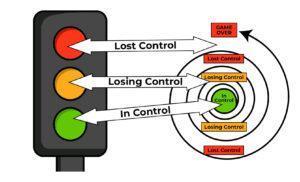
You cannot change what you are not aware of.
The first step toward maintaining discipline under pressure is recognizing when your mindset or behavior is starting to drift away from where it needs to be. A simple way to evaluate your state is through the BFS check:
Green light: strong posture, relaxed shoulders, confident movements.
Yellow/Red light: slumped shoulders, tight body language, frustrated gestures.
Green light: present moment, locked into the next pitch or play Yellow/Red light: stuck in the past (mistakes) or worrying about the future (outcomes).
Green light: confident and constructive. “You’ve got this.” “Next pitch.”
Yellow/Red light: negative or critical. “I can’t believe I did that.” “I always mess this up.” Your body language, focus, and self-talk act like a temperature gauge for your mental state. When you notice them slipping toward yellow or red lights, it’s time to activate your release routine.
Once you recognize a yellow or red light, the next step is to release the negative energy and reset your mindset. A powerful release routine includes three components.
Do something physical to trigger the reset. For baseball players this could include: Tapping the bat on your spikes. Brushing dirt off your batting gloves. Stepping off the mound and adjusting the rosin bag. Clapping your hands or resetting your stance The key is having a consistent physical action that signals to your brain that you are letting the previous moment go. Journal your physical release action.
Take a slow, deep breath while focusing on a specific visual cue. This focal point might be: A spot on the outfield wall. The barrel of your bat. The pitcher’s glove. A mark on the mound. The purpose of the breath and focal point is to bring your mind back to the present moment. Journal your focal point.
Your final step in the release routine is a verbal cue This might be: “Release.” “Next pitch.” “Reset.” “So what.” This verbal trigger signals to your brain that the previous moment is over and it’s time to move forward. Journal your verbal trigger word.
Once you have released the previous moment, you must refocus your attention on what you want to do next. Take another deep breath and bring your attention to a Target, Image, or Feeling (TIF).
Examples might include: Seeing yourself driving the ball into the gap. Visualizing the pitch hitting the catcher’s glove. Feeling the rhythm of your swing. Locking in on executing the next pitch. This final step resets your focus and brings you back into a green-light performance state.
This process only takes a few seconds, but it can completely change how you respond to adversity.
You can use it: After a strikeout. After giving up a hit or walk. After making an error When frustration starts creeping in. Anytime you feel yourself slipping into a yellow or red light. Elite players recover quickly because they practice this reset process consistently. Recognize. Release. Refocus.
Another powerful mental strategy for building discipline is learning how to flush mistakes quickly. Think of every mistake, bad decision, or frustrating moment as a mental brick. If every mistake you made created a physical brick that you had to carry around, eventually those bricks would become so heavy that they would slow you down and limit your performance. The same thing happens mentally when athletes hold onto mistakes. The solution is simple. Learn from it. Then flush it. Reflect briefly on what happened and what you can learn from it. Then mentally flush the mistake and move forward. Many teams even make this concept visual. For example, University of Vermont hockey coach Kevin Sneddon once kept a small foam toilet in the locker room so players could literally “flush” bad games and move on. The lesson is clear: Reflect. Learn. Flush it. Move forward.
No matter what just happened, you always control what you do next. You may have struck out. You may have thrown a bad pitch. You may have made a mistake. But the next moment always presents a new opportunity. The key question becomes: What is the next best decision I can make right now? Elite athletes focus on stacking one good decision after another. Reflect. Flush it. Make the next best decision. Remember the formula:
You may not control every event in baseball, but you always control your response. Mastering that response is what allows elite competitors to maintain self-control, discipline, and consistent performance.
Please watch NFL Wide Receiver Coutland Sutton talk about his release.
The following books and resources provide powerful insights into building the habits, mindset, and discipline required to perform at an elite level. Each explores different aspects of delayed gratification, personal responsibility, consistent routines, and the daily standards that separate good performers from great ones.
The Marshmallow Test by Walter Mischel. This classic book explores the science of delayed gratification and self-control. Mischel’s research shows how the ability to resist short-term temptation in order to achieve long-term goals is a key predictor of success in many areas of life. For athletes, learning to delay gratification—choosing preparation, training, and discipline over comfort—builds the foundation for elite performance.
Extreme Ownership by Jocko Willink and Leif Babin. Written by former Navy SEAL leaders, this book teaches the principle of taking full responsibility for your actions, decisions, and results. Elite performers understand that blaming circumstances, teammates, or coaches only limits growth. Ownership builds discipline, accountability, and leadership.
Make Your Bed by William H. McRaven. Based on Admiral McRaven’s famous commencement speech, this book explains how small daily disciplines create momentum for larger success. Simple habits—like making your bed—reinforce the mindset of doing things the right way even when no one is watching.
Outliers by Malcolm Gladwell. Gladwell explores the idea that elite performers are built through consistent practice, opportunity, and discipline over time. The book highlights the importance of focused repetition and sustained effort in the pursuit of mastery.
Peak
by
Anders Ericsson
Ericsson’s research on deliberate practice explains how world-class performers develop elite skills. The book demonstrates that greatness is not accidental—it is the result of intentional practice, feedback, and disciplined training over time.
Above the Line by Urban Meyer. Legendary college football coach Urban Meyer explains how elite teams maintain discipline and accountability through the concept of operating “above the line.” Athletes learn to take ownership of their actions, respond the right way to adversity, and stay focused on the behaviors that drive success.
Derek Jeter on Rules, Routines, and Discipline. One of the defining characteristics of legendary baseball players is their commitment to consistent routines and standards. In interviews and leadership discussions, Derek Jeter often speaks about the importance of structure, preparation, and disciplined habits as the foundation for long-term success. Together, these resources reinforce a simple but powerful truth: Elite performance is rarely about one big moment—it is about the discipline to consistently do the small things right every single day.
Process Over Outcome in baseball is about focusing on the actions that lead to success instead of becoming obsessed with results. Baseball is a results-driven game where players are constantly judged by statistics—batting average, ERA, wins, losses, RBIs, and playing time. But elite players understand that results are often outside of their direct control in the short term. You can hit a line drive right at someone. You can make a perfect pitch and still give up a hit. You can execute a great at-bat and still end up with an out. Instead of getting frustrated by results they cannot fully control, elite competitors focus on the process that gives them the best chance to succeed. They focus on having a quality approach at the plate, executing their routine on the mound, preparing the right way before games, and competing one pitch at a time. Players who embrace a process-over-outcome mindset measure success by how well they execute their controllables.
They evaluate their performance by questions like: Did I stick to my approach? Did I compete pitch-to-pitch? Did I stay committed to my routine? Did I prepare the right way?
Over time, focusing on the process leads to better consistency, greater confidence, and improved performance. When players commit to winning the process every day, the outcomes have a way of taking care of themselves.
As a baseball player, one of the biggest challenges you will face is finding the energy and discipline to do the daily work required to improve—even on days when you don’t feel motivated. The season is long, the grind is real, and the results don’t always show up immediately. Players who learn to embrace process over outcome develop the ability to focus on what they can control every day instead of getting distracted by results, statistics, or expectations. By developing the skill of process over outcome, you redirect your attention toward the actions that actually drive performance—your preparation, routines, habits, and work ethic. This mindset helps you stay focused on daily improvement, control what is within your inner locus of control, and build the consistency required for long-term success in baseball.
One of the battles athletes fight every day is getting themselves to complete the small, sometimes mundane tasks necessary to improve—even when they don’t feel like it. Training, preparation, routines, and recovery are not always exciting, but they are essential to reaching your potential. The skill of process over outcome is the ability to stay focused on the journey without becoming distracted by the destination. In baseball, the process includes the daily actions that help you improve as a player: Your practice habits. Your pregame routines. Your focus between pitches. Your training and recovery. Your preparation and film study. Your commitment to fundamentals.
The outcome is the result you ultimately want: Winning games. Getting hits. Lowering your ERA. Making the starting lineup. Earning a scholarship or playing professionally. While outcomes are important, they are not directly controllable What you can control is the process that leads to those outcomes. Elite players understand that results are simply a byproduct of consistently executing the right process.
Baseball is a game built on failure and patience. Even the best hitters in the world fail most of the time. A player who hits .300 still makes an out 7 out of 10 at-bats. If players focus only on results, they can easily become frustrated or lose confidence. Players who commit to the process take a different approach. Instead of obsessing over outcomes, they focus on executing the controllable elements of performance: Winning the next pitch. Sticking to their routine. Executing their approach. Competing with great body language and focus. When players stay committed to their process, improvement happens naturally over time.
Many athletes want results immediately They want the scholarship, the championship, or the professional opportunity right away. But the players who reach those goals are usually the ones who fall in love with the daily work required to get there.
They understand that: Small actions repeated consistently create big results. Process-driven players focus on becoming the type of person who executes their routines every day, regardless of how motivated they feel. For example, if your goal is to become a great hitter, your process might include: Daily swing work. Consistent batting practice routines. Studying pitchers and scouting reports. Working on pitch recognition. Maintaining strong pre-pitch routines. Over time, that process produces the results you want.
One of the most important principles in performance is this: Your process determines your product. In other words, your daily habits and routines ultimately determine your results. Instead of asking, “What results do I want?” elite athletes ask a different question: “What process do I need to follow to become the player I want to be?” When you commit to the process, you always win—because every day you are improving. Don’t tell someone what you want to achieve. Show them your daily process, and they will be able to predict what you will achieve. Commit to the process. Trust the process. Execute the process. And over time, the outcomes will take care of themselves.
There are several common myths and misunderstandings that athletes and coaches have when it comes to process over outcome. These misconceptions often lead players to focus on the wrong things, which can increase pressure, create frustration, and ultimately slow down development and performance. Understanding these myths helps athletes stay focused on the habits and behaviors that actually lead to success.
One of the most common mistakes athletes and coaches make is believing that the more they focus on winning, the more likely they are to win. In reality, the opposite is usually true. When players focus too much on outcomes—winning games, getting hits, earning scholarships, or putting up big statistics—they often become overwhelmed by the size of the goal. The destination can feel so far away that it actually reduces motivation and focus. Even worse, an outcome-based mindset shifts attention away from the small daily actions that actually produce results. In baseball, winning games and achieving big goals are the result of consistently executing the right process: Quality preparation. Strong routines. Focused practice. Great effort and attitude. Executing one pitch at a time. Teams with tremendous talent often fall short of their potential not because they lack ability, but because they spend too much time thinking about where they want to go instead of focusing on what they need to do today to get there.
Some athletes believe that focusing on the process means they are not competitive or not committed to winning. In reality, many of the greatest coaches in sports history built their success around a process-driven philosophy
Nick Saban calls his approach “The Process.”
Skip Bertman, legendary LSU baseball coach, called it “The System.”
John Wooden, the greatest college basketball coach of all time, simply called it “Success.”
These legendary coaches understood that championship teams are built through disciplined execution of daily habits, not by constantly talking about the scoreboard. A famous example from Wooden illustrates this perfectly. At the first practice of every season, Wooden would teach his players how to properly put on their socks and shoes so they could avoid blisters. His reasoning was simple: blisters could cause players to miss practice or perform poorly during training. That attention to detail—starting with socks and shoes—is a perfect example of process over outcome thinking. Elite competitors absolutely care about winning. They just understand that winning is a byproduct of executing the process.
Another common belief is that focusing on the process makes training feel boring or repetitive. In reality, the opposite is true. When athletes become immersed in the process, they experience less stress, less anxiety, and more enjoyment because they are focused on the task directly in front of them instead of worrying about distant outcomes.
Instead of trying to climb the entire mountain in one leap, process-driven athletes simply focus on taking the next step. In baseball, this mindset allows players to compete one pitch at a time, one inning at a time, and one game at a time. Over time, this approach builds confidence because improvement becomes measurable and consistent. The more athletes commit to the process, the more they begin to enjoy the daily work of training, practicing, and competing.
Elite athletes care deeply about outcomes. But they understand that outcomes are produced through consistent commitment to the process. Focus on the process. Execute the daily habits. Control what you can control. Do that consistently, and the outcomes will take care of themselves. Check out this Mental Performance Daily Podcast below to learn more about process over outcome myths and mistakes.
One of the foundational principles of a Process Over Outcome mindset is learning to relentlessly focus on what you can control while letting go of everything you cannot. Because this concept is so important to elite performance, we intentionally revisit it throughout this program. In fact, if there were only one drill you could take from this entire training program, this might be the most important: Get absolute clarity on controlling what you can control.
Elite athletes understand that their time, energy, and attention are limited resources. The more of those resources you invest in things outside your control, the less you have available for the actions that actually improve performance. Peak performers train themselves to direct their focus only toward the controllable aspects of performance.
In baseball, there are many factors that influence results but remain outside your control.
Examples include: Umpire calls. Fans and crowd noise. Media attention or social media. Opponent performance. Playing time decisions. Weather and field conditions. Game schedules and travel. Statistics such as batting average or ERA. Coach decisions. Scouts and recruiting opinions. Parents or outside expectations. The final outcome of a game. Many athletes spend enormous amounts of mental energy worrying about these factors. When that happens, they are essentially competing while distracted.
The reality is simple: If you focus on what you cannot control, you are setting yourself up to beat yourself.
While there are many things you cannot control, there are also powerful elements of performance that are always within your control. These controllables form the foundation of a process-driven mindset.
You can control: Your APE. Attitude. Appearance (body language). Positive self-talk. Present-moment focus. Process and preparation. Performance (how you compete). Perspective (how you interpret situations). Effort. Energy Emotions. These are the behaviors and actions that directly influence your ability to perform at a high level.. Elite baseball players commit to executing these controllables consistently, regardless of circumstances.
When athletes learn to control the controllables, several powerful things happen: Stress decreases because they are no longer worried about things outside their influence. Focus improves because their attention is directed toward the next pitch, play, or decision. Confidence increases because they know they are doing everything within their control to prepare and compete.
The ultimate goal is simple: Execute the controllables and allow the outcomes to take care of themselves. Success in baseball—and in life—is largely determined by how consistently you control the controllable elements of performance.
In your journal, create two columns.
List the behaviors and actions that are completely within your control when preparing for and competing in baseball.
List the external factors that influence the game but remain outside your control.
Now look carefully at your list. If you spend most of your focus on the second column, you are wasting valuable energy. If you consistently focus on the first column, you are giving yourself the best chance for success. Remember: Control the controllables. Let go of everything else. Commit to the process. Here is a Mental Performance Daily Podcast where I discuss controlling what you can control.
One of the most powerful tools for reinforcing a process-over-outcome mindset is your Success Checklist. A Success Checklist is a daily list of the controllable actions, habits, and behaviors that help you become the best version of yourself as a baseball player. Instead of measuring success only by outcomes like wins, statistics, or playing time, the Success Checklist allows you to measure success by how consistently you execute the process. Elite athletes understand that if they consistently execute their daily habits—preparation, routines, effort, and focus—the results will take care of themselves. The Success Checklist helps ensure that your attention stays locked in on the actions that actually drive improvement and performance. Your checklist might include things like completing your training, following your routines, maintaining positive body language, controlling your effort and energy, completing your mental performance training, or executing your preparation before games and practices. Each day you can review the checklist and evaluate how well you executed the process. Over time, this creates accountability, builds discipline, and reinforces the habits that lead to elite performance. If you haven’t already done so, recommit to your Success Checklist and make it part of your daily routine.
Another important part of the Process Over Outcome mindset is setting process-based goals during competition. Many athletes become overly focused on results during games—hits, wins, statistics, or outcomes. When that happens, their focus often drifts away from the actions that actually create success. Process-based goals help you stay locked in on the controllable elements of performance during the game. For example, in baseball some strong process-based goals might include: Throwing first-pitch strikes as a pitcher Winning the free-base battle (limiting walks, steals, passed balls, wild pitches, balls thrown to the wrong base and errors). Executing pitches with conviction. Winning the quality at-bat battle as a hitter Controlling your body language and energy between pitches. Executing your pre-pitch routine consistently. In other sports, process-based goals might look like: Football – Winning the turnover margin. Lacrosse –Winning the ground ball battle. Basketball – Winning the rebound battle. These goals focus on execution and controllables, not just outcomes.
In your journal, write down 3–5 process-based goals that will help you compete at your best during games. Ask yourself: What are the specific actions I can control during competition that give my team the best chance to win? When you focus on executing those actions consistently, you stay committed to the process—and that’s when performance and results begin to follow. Your Success Checklist and your process-based in-game goals work together to keep your focus where it belongs: on the daily habits and actions that lead to elite performance. Here is a Mental Performance Daily Podcast where I discuss the Success Checklist.
One of the best ways for hitters to stay committed to a process over outcome mindset is by focusing on Quality At-Bats (QABs) instead of results. Too many hitters judge their performance only by outcomes such as hits, batting average, or RBIs. The problem with that approach is that even perfectly executed at-bats sometimes result in outs. In baseball, a hitter can do everything right—have a great approach, hit the ball hard, and execute their plan—and still get out. Quality At-Bats shift the focus away from results and back onto the process of competing well in the batter’s box. When hitters focus on winning the pitch, controlling their approach, and executing their plan, they give themselves the best chance to succeed over time.
A Quality At-Bat is an at-bat where the hitter executes the right process and competes in a way that helps the team and gives themselves the best chance for success. Different teams define Quality At-Bats slightly differently, but some common examples include: Seeing six or more pitches. Hitting the ball hard regardless of the result. Advancing a runner or executing a productive out. Driving in a runner with less than two outs. Working a walk or hit-by-pitch. Battling back after being behind in the count. Executing a sacrifice bunt or situational play. These types of at-bats demonstrate strong focus, discipline, and commitment to the team approach.
Quality At-Bats help hitters stay focused on execution instead of results. When players measure success only by hits, they often become frustrated when things don’t go their way. That frustration can lead to pressing, expanding the strike zone, and trying too hard to force results. However, when hitters focus on producing Quality At-Bats, their mindset shifts toward:
Winning each pitch. Staying disciplined with their approach. Battling through tough counts. Helping the team move runners and create scoring opportunities. Over time, hitters who consistently produce Quality At-Bats naturally see their results improve because they are consistently executing a strong process.
The best hitters in baseball focus on winning one pitch at a time. Instead of worrying about the result of the at-bat, they stay locked into their approach and compete on every pitch. This mindset keeps them present, focused, and confident. Even if the at-bat ends in an out, a hitter can walk back to the dugout knowing they executed the right process. And when players consistently win the process battle, the results eventually follow.
In your journal, write down what Quality At-Bats mean to you as a hitter Consider questions such as: What does a great at-bat look like for me? What approach helps me compete best at the plate? What actions show that I am committed to the process? By defining and tracking your Quality At-Bats, you train yourself to measure success by how well you compete, not just by the final result. Commit to producing Quality At-Bats. Win the pitch. Win the moment. Trust the process.
One of the best ways for pitchers to stay committed to a process-over-outcome mindset is by tracking and evaluating their pitch execution instead of focusing only on results such as ERA, hits allowed, or runs given up. Pitching is a position where outcomes can often be misleading. A pitcher can execute a pitch exactly where it was intended and still give up a hit. On the other hand, a poorly executed pitch may result in an out because the hitter misses it or hits it directly at a defender. Because of this, elite pitchers focus on execution rather than outcome. The Pitcher’s Execution Journal is a tool that helps reinforce that mindset.
The Pitcher’s Execution Journal is a simple system for tracking how well you execute your pitches during games, bullpens, and practice sessions. Instead of evaluating performance solely by results, you evaluate each pitch based on whether you executed the pitch according to your plan. For example, before each pitch you have an intention: The pitch type. The pitch location. The situation and approach. After the pitch is thrown, you simply evaluate one thing: Did I execute the pitch or not? This allows pitchers to measure performance based on execution percentage, which is a far more accurate reflection of performance than results alone.
Pitchers who focus only on outcomes can easily become frustrated or discouraged. You may throw a perfect pitch on the outside corner and still give up a bloop single. If you judge that pitch only by the outcome, you may think you failed—even though you executed exactly what you intended. However, pitchers who evaluate themselves by execution understand that they won the pitch because they threw it exactly where they intended. When pitchers consistently focus on execution, several powerful things happen: They stay present and focused on the next pitch. They avoid emotional reactions to outcomes they cannot control. They build confidence by recognizing successful execution. They develop a consistent and repeatable process. Over time, strong execution naturally leads to better results.
After games, bullpens, or practice sessions, take a few minutes to reflect and record key information in your Pitcher’s Execution Journal. You might track things such as: Pitch type and location execution. First-pitch strike percentage. Pitch execution percentage. Situational execution (two-strike pitches, runner-on-base situations). What worked well during the outing. What adjustments you want to make next time. This process allows pitchers to step back, evaluate performance objectively, and make improvements without becoming emotionally attached to outcomes.
Elite pitchers compete with a very simple mindset: Execute the pitch. Then move on to the next one. They focus on: Executing their pitch plan. Staying committed to their routines. Competing one pitch at a time. Making adjustments when necessary. The Pitcher’s Execution Journal reinforces this mindset by helping pitchers measure what truly matters—their ability to execute the process.
After your next bullpen, practice, or game, spend a few minutes completing your Pitcher’s Execution Journal. Ask yourself: What was my pitch execution percentage today? What pitches did I execute well? Where did I miss and why? What adjustments will help me improve next time? When you consistently evaluate performance through the lens of execution, you stay committed to the process—and over time, the results will follow ⚾ Listen to this podcast where I read The Execution Chapter from Harvey Dorfman's ABCS of Pitching.
Read this great article on Texas Rangers pitcher Jack Leiter talking about his mindset of execution
The following books and resources provide powerful insights into developing a process-driven mindset. They reinforce the importance of daily habits, discipline, leadership, and focusing on the small actions that ultimately produce elite performance.
How Good Do You Want to Be? by Nick Saban. One of the greatest coaches in college football history, Nick Saban built his championship programs around what he calls “The Process.” This book explains how focusing on preparation, discipline, and daily execution—rather than outcomes—creates consistent high performance.
Skip: The Man and the System by Bruce Hunter This book dives into the leadership philosophy of legendary LSU baseball coach Skip Bertman and the powerful system he built to transform LSU into one of the greatest college baseball programs of all time. Bertman’s “System” emphasizes preparation, accountability, and attention to detail.
Winning the Big One by Skip Bertman. In this book, Bertman shares the mindset and strategies that helped LSU win multiple College World Series championships. His approach reinforces the power of focusing on preparation, routines, and execution rather than becoming distracted by the outcome.
Eleven Rings by Phil Jackson. Phil Jackson, one of the most successful coaches in NBA history, shares the leadership and mental performance principles that helped him win eleven championships. His philosophy emphasizes mindfulness, team culture, and focusing on the process of daily improvement.
Legacy by James Kerr. This book explores the culture and leadership philosophy of the New Zealand All Blacks rugby team, one of the most dominant teams in sports history. The lessons emphasize discipline, humility, standards, and focusing on the daily behaviors that sustain elite performance.
Life Is Yours to Win by Augie Garrido. Hall of Fame college baseball coach Augie Garrido shares the lessons and philosophy that helped him win five College World Series titles. His teachings emphasize mindset, discipline, preparation, and commitment to the daily process of improvement.
The Compound Effect by Darren Hardy. This book demonstrates how small, consistent actions compound over time to create massive results. It reinforces the idea that success is rarely about one big moment, but rather about consistently executing small disciplines every day.
The Slight Edge by Jeff Olson. Olson explains how simple actions done consistently over long periods of time create extraordinary results The philosophy aligns perfectly with a process-driven mindset: small habits repeated daily lead to long-term success.
Together, these resources reinforce a powerful truth about elite performance: Championships, awards, and achievements are outcomes. They are the natural result of consistently committing to the process every single day.
Meditation, imagery, and mindfulness in baseball are about training your mind to stay calm, clear, and focused so you can perform at your best under pressure. Baseball is a game that challenges your concentration constantly—long innings in the field, tough at-bats, pressure situations, and the mental grind of a long season.
Elite players learn how to quiet their minds, control their breathing, and stay present so they can compete one pitch at a time. Instead of letting their thoughts race to the past or the future, they train their minds to stay focused on the moment in front of them. Players who practice meditation, imagery, and mindfulness develop the ability to slow the game down and see the situation clearly They visualize successful execution—seeing the pitch, making solid contact, executing the perfect pitch, or making a great defensive play
They use breathing and mindfulness to reset between pitches, calm their nerves in big moments, and maintain awareness of where their attention is. Whether it’s taking a deep breath before stepping into the batter’s box, visualizing the pitch they want to throw, or resetting their focus between innings, elite competitors use these mental skills to stay composed and ready for the next opportunity. Over time, these practices strengthen concentration, build confidence, and help players perform with clarity and control when the game is on the line
Whether athletes realize it or not, the mental images they create and carry with them—both positive and negative—have a direct impact on their confidence, focus, and performance. In baseball, players are constantly visualizing something. They may picture themselves striking out, missing a pitch, or making an error, or they may see themselves executing a great swing, throwing a perfect pitch, or making a big play in a pressure moment. The images you consistently create in your mind shape the way you prepare, the way you compete, and ultimately the way you perform.
By developing the skills of mental imagery and meditation, athletes gain a powerful competitive advantage. These tools help players stay calm under pressure, remain locked into the present moment, and mentally rehearse successful performance before it happens in real life. When used consistently, mental imagery strengthens confidence, improves preparation, and allows athletes to mentally experience success before stepping onto the field.
Mental imagery, often called visualization or mental rehearsal, is the process of creating mental experiences that closely resemble actual physical performance. When athletes visualize correctly, they mentally rehearse the exact actions they want to perform during competition. They can see the pitcher delivering a pitch, feel the rhythm of their swing, or picture themselves fielding a ground ball cleanly and making a strong throw to first base. This process is similar to reading a vivid story where you imagine the scene in your mind. The difference is that with mental imagery, you are the one creating the story and seeing yourself perform successfully. When treated as a skill to develop—not just a random exercise—mental imagery becomes a powerful form of preparation. Athletes can mentally rehearse situations they will face in competition, strengthening their confidence and improving their ability to execute when the moment arrives. Mental imagery can help athletes: Increase the quality of their preparation. Build confidence before competition. Accelerate skill development. Mentally rehearse difficult situations before they happen. Strengthen belief in their ability to succeed. Elite athletes often describe visualization as watching themselves perform successfully in a movie inside their mind.
While mental imagery focuses on rehearsing performance, meditation helps athletes develop the ability to quiet their mind and remain present. Baseball is a game filled with distractions—crowd noise, mistakes, pressure situations, expectations, and internal self-talk. Meditation helps athletes train their ability to calm their thoughts and return their focus to the present moment.
Through meditation, athletes learn to: Slow down their breathing. Relax their body and mind. Let go of distracting thoughts. Refocus their attention on the present task. This ability to control attention and manage stress becomes extremely valuable during competition, especially in high-pressure situations. When practiced consistently, meditation allows athletes to stay composed, make better decisions, and perform with greater clarity.
Just like strength training builds physical muscles, meditation and mental imagery train the mental muscles required for elite performance.
These skills help athletes: Stay calm under pressure. Focus on the present moment. Respond logically instead of emotionally. Mentally rehearse successful performance. Manage the ups and downs of competition. Over time, athletes who train these skills develop the ability to switch off stress and switch into performance mode more quickly and consistently. Mental imagery and meditation are powerful tools that many athletes overlook—but those who train them consistently gain an advantage that most of their competition doesn’t even realize exists. By strengthening these mental skills, you improve not only how you prepare, but how you compete when it matters most.
Here is a Mental Performance Daily Podcast where I discuss what the skill of Meditation and Mental Imagery is.
There are several common myths and misunderstandings around mental imagery and meditation that often prevent athletes from fully benefiting from these powerful tools. When athletes understand what these practices actually are—and how they work—they can begin to use them as a consistent part of their mental performance training. Below are some of the most common myths and mistakes we see athletes make when it comes to mental imagery and meditation.
Many athletes believe they already practice mental imagery because they occasionally picture themselves succeeding in competition. For example, a baseball player might close their eyes for a few seconds and imagine hitting a home run or striking someone out. However, daydreaming about success is very different from structured mental imagery training. Effective mental imagery involves intentionally visualizing specific situations, rehearsing the exact process you want to execute, and mentally preparing for both success and adversity When practiced consistently as part of a mental performance routine, imagery becomes a powerful form of preparation that strengthens confidence and performance.
One of the most common excuses athletes give for not practicing meditation or visualization is that their schedule is too busy. The reality is that mental training does not require large amounts of time to be effective. Even a few minutes of focused breathing or visualization can produce meaningful benefits. Many highly successful professionals and elite athletes make meditation a daily habit despite demanding schedules. If you can spend one or two minutes focusing on your breathing or mentally rehearsing your performance, that is far better than doing nothing at all.
Some athletes believe meditation or visualization is difficult or requires a special talent. In reality, these skills are simple and learnable. Meditation can be as straightforward as focusing on your breathing for a few minutes and gently bringing your attention back when your mind wanders. Visualization simply involves picturing yourself performing a skill or competing in a situation in your mind. Like any other skill in performance, these techniques improve with practice and repetition
Many people believe meditation requires years of practice before it produces benefits. While long-term practice certainly deepens the benefits, athletes often notice improvements very quickly. Many people experience immediate effects such as: Reduced stress. Greater mental clarity. Improved focus. A calmer mindset. Even a few days of consistent practice can help athletes feel more present and relaxed during competition.
Meditation is sometimes misunderstood as a religious practice. In reality, meditation is simply a mental training tool that helps quiet the mind and improve focus and awareness. People from all backgrounds—including athletes, business leaders, and performers—use meditation to improve concentration, reduce stress, and enhance performance. Meditation does not require any specific spiritual beliefs. It is simply a method for training attention and developing greater mental control.
Some athletes believe that visualization should only involve perfect performance. In reality, effective imagery includes both success and adversity. In baseball, things rarely go perfectly. Hitters strike out. Pitchers give up hits. Fielders make errors. When athletes visualize competition, it is helpful to mentally rehearse realistic situations—including challenges and adversity—and practice responding to them with confidence and composure. This prepares the mind for what competition actually looks like.
Visualization is not a crystal ball predicting exactly how a performance will unfold. Instead, it is a form of mental practice. Just like physical practice prepares your body for competition, mental imagery prepares your mind for the demands of performance. Visualization helps your brain understand the situations you may face, strengthens your confidence, and improves your ability to respond effectively when those situations occur.
Mental imagery and meditation are skills, just like hitting, pitching, or fielding. When practiced consistently, they help athletes: Improve focus and present-moment awareness. Build confidence through mental rehearsal. Stay calm under pressure. Prepare for the realities of competition. The more consistently you practice these skills, the more powerful they become as part of your mental performance training. Here is a Mental Performance Daily Podcast where I discuss common Myths and Mistakes surrounding Meditation and Mental Imagery.
Meditation is a practice where you focus your mind on a specific object, thought, or activity in order to create a clear, calm, and controlled mental state For baseball players, meditation is one of the best ways to train the ability to slow the game down, control emotions, and stay locked into the next pitch Baseball is a game filled with pressure, distractions, and long stretches of waiting between moments of action.
The ability to calm your mind, control your breathing, and reset your focus between pitches, innings, or at-bats is a huge competitive advantage. When working with baseball players, the goal is to keep meditation simple and repeatable so it can easily become part of your daily routine. One of the easiest and most effective breathing drills you can use is called the 6-2-8 Meditation. This meditation only takes 2–5 minutes per day and should be tracked on your Success Checklist as part of your daily mental performance training. The key is consistency Just like taking swings, throwing bullpens, or lifting weights, your mental skills improve with daily practice.
The breathing pattern is simple: Inhale for 6 seconds. Hold for 2 seconds. Exhale for 8 seconds This controlled breathing helps your body relax and trains your mind to slow down and stay present.
You can use this breathing technique:
Before games. Before stepping into the batter’s box. On the mound before a big pitch. In the dugout between innings. During your morning or evening routine. Over time, this breathing pattern becomes a mental reset button you can use during competition.
While performing the breathing pattern, imagine a scoreboard or game clock in your mind.
Picture the numbers changing as you count through each breath.
You might imagine: The scoreboard at your home field. The clock on the outfield wall. A digital scoreboard counting your breaths. This visual cue helps keep your mind focused while you breathe.
Start by sitting comfortably and closing your eyes. Imagine a scoreboard in your mind. Now begin your breathing.
Breath 1 - Inhale: 2… 3… 4… 5… 6
Hold: 2 / Exhale: 2… 3… 4… 5… 6… 7… 8
Breath 2 - Inhale: 2… 3… 4… 5… 6
Hold: 2 / Exhale: 2… 3… 4… 5… 6… 7… 8
Breath 3 - Inhale: 2… 3… 4… 5… 6
Hold: 2 / Exhale: 2… 3… 4… 5… 6… 7… 8
Breath 4 - Inhale: 2… 3… 4… 5… 6
Hold: 2 / Exhale: 2… 3… 4… 5… 6… 7… 8
Breath 5 - Inhale: 2… 3… 4… 5… 6
Hold: 2 / Exhale: 2… 3… 4… 5… 6… 7… 8. Now open your eyes. You’ve completed your meditation.
During this exercise your mind might wander. You might start thinking about practice, school, your last game, or something else. That’s completely normal. When it happens, simply notice it and bring your focus back to the next number or breath That moment—when you bring your mind back—is exactly how you train your ability to refocus during a game Just like a hitter resets after a swing and miss or a pitcher resets after giving up a hit.
Start with five breaths and work your way up to ten breaths without losing focus
Many baseball players add this to their: Morning routine. Pre-game routine. Between-inning reset. Post-practice recovery. Remember one of the most important principles in mental performance: You must be in control of yourself before you can control your performance. Meditation helps you build that control.
Many elite athletes use breathing and meditation to control pressure situations. When the game speeds up, great players slow themselves down by focusing on their breathing. Instead of getting caught up in the crowd, the moment, or the outcome, they focus on the one thing they can control: Their breath. Meditation strengthens three critical skills every baseball player needs: Focus. Awareness. Self-Control. By practicing the 6-2-8 Meditation daily, you are training your mind the same way you train your body—so when the game is on the line, you can stay calm, confident, and locked in on the next pitch. ⚾ Here is a Mental Performance Daily Podcast where I discuss the 6-2-8 Meditation.
Guided mental imagery is one of the best ways for baseball players to begin training visualization while minimizing distractions and eliminating the common question many athletes have when starting: “Am I doing this right?” Mental imagery is simply seeing and feeling yourself perform in the movie theater of your mind before it actually happens on the field. Baseball is a game of preparation. The players who consistently perform at the highest level often have already seen the moment before it happens. They have mentally rehearsed stepping into the batter’s box, executing pitches, making plays in the field, and competing with confidence. To help athletes train visualization in a simple and structured way, we use the BALL Mental Imagery Process.
The BALL Mental Imagery Process is a four-step visualization routine designed to help baseball players relax, build confidence, and mentally rehearse successful performance.
B – Breathing (Relaxation), A – Affirmation (Confidence Conditioning), L – Looking Back (Mental Recall of Past Success), L – Looking Forward (Mental Rehearsal of Future Performance)
Each step takes a few minutes and helps prepare your mind and body for competition.
The first step is to slow down your breathing and relax your body. Baseball requires calmness under pressure. Whether you’re stepping into the batter’s box with two outs or standing on the mound with runners on base, your ability to stay calm and controlled is critical. Begin by sitting comfortably and focusing on your breathing. Inhale slowly through your nose. Exhale slowly through your mouth. As you breathe, allow your body to relax from the ground up. Imagine the tension leaving your body the same way a pitcher releases a pitch from his hand. Relax your feet. Relax your legs. Relax your torso. Relax your shoulders and arms. Relax your neck and face. With each breath, feel yourself becoming calmer, more centered, and more focused.
The next step is confidence conditioning through positive self-talk. The way you talk to yourself directly impacts your performance. Elite baseball players learn to replace negative thoughts with confident, empowering self-talk. Silently repeat the following statements to yourself with confidence and belief. I control what I can control. I control what I can control. I control what I can control. I trust my preparation and compete one pitch at a time. I trust my preparation and compete one pitch at a time. I trust my preparation and compete one pitch at a time. I play with strong body language and confident energy. I play with strong body language and confident energy. I play with strong body language and confident energy.
These affirmations help program your mind to stay focused on the process and compete with confidence.
Now begin to mentally replay your past baseball success Imagine watching a highlight reel of your best moments on the field.
See yourself: Squaring up a fastball and driving it into the gap. Delivering a big pitch with runners on base. Turning a double play. Tracking down a fly ball in the outfield. Executing a perfect bunt. Delivering a clutch hit. See it clearly. Hear the sounds of the game. Feel the confidence and energy in your body. Experience those moments as if they are happening right now.
Play that highlight video in your mind as we count down.
10…, 9…, 8…, 7…, 6…, 5…, 4…, 3…, 2…, 1…
Your brain does not fully distinguish between vivid mental rehearsal and real experience, which is why recalling success builds confidence.
Now shift your focus forward to your next practice, game, or competition. See yourself stepping onto the field. Feel the confidence that comes from preparation. Visualize yourself performing at your best. See yourself: Stepping into the batter’s box with confidence. Tracking the ball clearly out of the pitcher’s hand. Delivering a quality at-bat. Executing your pitches with conviction. Making strong, accurate throws. Competing one pitch at a time. Focus on body language, breathing, and presence Play this performance like a highlight video of your upcoming game.
Take one deep breath in through your nose. Exhale slowly through your mouth. Wiggle your fingers. Wiggle your toes. Slowly open your eyes and bring yourself back to the room. You are now mentally prepared to compete.
Many elite baseball players incorporate mental imagery into their daily routine. Some athletes visualize before games. Some do it before practice. Some do it before bed at night. The exact timing is less important than doing it consistently. Mental imagery is simply another form of preparation. Just like hitting in the cage or throwing bullpens, it prepares your mind for performance. Remember: Mental imagery is not magic. It’s preparation. You still have to put in the work physically. But when you combine mental rehearsal with physical preparation, you begin to feel like you’ve already been in the moment before it happens. And when the moment arrives on the field, you’ll compete with more confidence, calmness, and control. Below are some pre-precorded BALL Imagery audios for you and a Mental Performance Daily Podcast where I discuss The BALL Mental Imagery Process.
One of the most powerful truths in performance is this:
Everything happens twice — first in your mind, then in reality. Before a great at-bat, a perfectly executed pitch, or a big defensive play happens on the field, elite athletes have often already seen it happen in their mind. That’s why one of the most powerful ways to build confidence and improve performance is through shadow work, mental imagery, and mental reps. Shadow work allows you to practice your process without physically performing the skill, which helps strengthen your confidence, timing, focus, and preparation.
Mental reps are exactly what they sound like. They are game-like repetitions performed in your mind Just like taking swings in the cage or throwing bullpen pitches helps you develop physically, mental reps allow you to practice your performance mentally The great players don’t just take physical reps. They take mental reps constantly.
One of the best examples of shadow work comes from former MLB All-Star Evan Longoria. Even when Longoria wasn’t in the lineup, he would still prepare as if he were playing. He would: Put on his batting gloves. Grab a bat. Stand in the dugout where he could clearly see the pitcher. Go through a mental at-bat pitch by pitch. As each pitch was thrown in the game, Longoria would imagine himself in the batter’s box. If the hitter fouled off a pitch, Longoria would step out of the imaginary box, adjust his gloves, reset his breath, and step back in—just like he would during a real at-bat. He was practicing his routine, timing, and focus even though he wasn’t physically hitting. That is elite mental preparation
During a mental at-bat, you imagine yourself stepping into the box as if you were the hitter in the game. You go pitch by pitch You track the pitch. You visualize what you would do with it. For example: Pitch 1: Fastball outside you see yourself take it for a strike or drive it to the opposite field. Pitch 2: Breaking ball you see the spin, recognize it, and stay disciplined. Pitch 3: Fastball middle you imagine squaring it up and driving it into the gap. You are rehearsing the same focus and decision-making process you will use when it’s your turn to hit.
Mental reps improve performance because they train several important parts of your process. When you perform shadow work, you are practicing:
1. Body Language: You train yourself to stand tall, confident, and composed.
2. Tempo: You rehearse the rhythm and pace of your routine.
3. Visualization: You see the pitch, the swing, and the result in your mind.
4. Breathing: You practice controlling your breathing as part of your pre-pitch routine.
5. Resetting After Each Pitch: You practice releasing the last pitch and preparing for the next one. These are the exact same mental skills elite players use during games.
Hitters can practice shadow work in several places: In the dugout during games. In the on-deck circle. During batting practice. At home while visualizing.
During shadow work, imagine: Seeing the pitcher clearly. Tracking the ball out of the hand. Loading your swing on time. Making quality contact. Executing your approach. The goal is to mentally rehearse quality at-bats
Pitchers can also use shadow work to mentally rehearse their performance.
Imagine: Standing on the mound. Getting the sign from the catcher. Taking a deep breath. Delivering the pitch with conviction. Executing your pitch location
You can visualize: Executing first-pitch strikes. Getting ahead in counts. Finishing hitters. Escaping tough situations. By mentally rehearsing these situations, you prepare your mind to handle them when they occur in a real game.
Shadow work is also a great way to practice your routine.
During mental reps you can rehearse: Your breathing between pitches. Your body language. Your reset routine. Your approach. The more you practice your routine mentally, the more automatic it becomes during games.
Elite athletes across sports use mental reps as part of their preparation. They prepare as if their opportunity could come at any moment. That mindset builds confidence. When your name is called, you feel ready because you have already rehearsed the moment in your mind.
Just like physical training, mental training should be tracked. Be sure to track shadow work and mental imagery on your Success Checklist. Even a few minutes each day can dramatically improve your confidence, focus, and preparation.
Below are some real world, elite athlete examples of Mental Reps. Click here to ook at this thread for some real world examples of elite athletes doing shadow work My favorite form of mental imagery done on the field or inside your sporting arena is what we call mental reps or shadow reps. Evan Longoria was one of the first professional athletes I remember talking about how when he’s not in the lineup he puts on his batting gloves, grabs his bat, and goes through a mental at-bat in the dugout, pitch for pitch, with the guy in the game.
Schaap: Even when he’s not in the lineup, Longoria follows a mental routine. He’ll slide on his batting gloves and imagine himself at bat. When he is playing, rituals help him relax and focus.
Ravizza: Let’s say, for example, here comes his pitch and he fouls it off. He will step out of the box to undo his gloves, release that pitch, grips the gloves back on, steps in the box, and he’s back.
The video above is one of the best looks at mental performance training that has ever been produced. In this clip you will see Longoria taking a mental at-bat during a game where he was not in the lineup. I also posted a clip of a player at TCU, one of the top college baseball programs in the country, taking a mental at-bat during a game vs. Wichita State. You will see he has his batting gloves and helmet on, he’s standing in the dugout in the area where he can see the pitcher’s mound with an unobstructed view, and he’s going through the process, taking mental reps. He is mentally going pitch by pitch, working his routine and getting his timing off the pitcher. After the pitch, he will close his eyes and get the mental image of him taking that pitch he just saw and doing with the pitch what he wants.
Perhaps you have also seen the video of one of the greatest quarterbacks in NFL history, Drew Brees of the New Orleans Saints, on the sideline during a game vs. the Carolina Panthers, going through his process as if he were in the game. Brees is not playing in the game but is on the sideline getting game-like mental reps on each snap. You can see that here in this thread. He has an earpiece in (I’d imagine listening to the play call), he claps his hands to break the huddle and then puts his eyes on the safeties just like he would if he were playing quarterback in the game. He is going one play at a time and going through the play in his mind. We call this mental reps.
Matt Cassel became the New England Patriots' starting quarterback after Week #1 of the 2008 season, after then-reigning NFL MVP Tom Brady suffered a season-ending knee injury. In February 2009 the Patriots used their franchise tag on Cassel, extending him a one-year contract worth over $14 million, the largest one-year contract for an offensive player in NFL history. Later that offseason, in July 2009, the Patriots made a trade that sent Cassel to the Kansas City Chiefs, who signed him to a six-year $62.7 million contract.
In 2010 Cassel led the Chiefs to their first AFC West divisional championship in seven years, earning a Pro Bowl selection in the process. What’s most impressive about Cassel is he’s the only guy in the history of the NFL who did not start a college football game at quarterback but started a game at QB in the NFL. Cassel was a University of Southern California Trojan and when there he backed up two Heisman Trophy winners in Carson Palmer (2002) and Matt Leinart (2004).
In a Sport Illustrated article, Cassel talks about how he would wear his helmet on the sideline during games, would hear the play call or see the play being signaled in from the sideline, and then he would call it out loud on the sideline as if he were in the huddle. That’s a super-high level of mental reps. When you work to get mental reps at an elite level, some of your teammates are going to look at you like, What are you doing, man? You’re not in the play Well, Cassel knew he was going to play at some point and he prepared as if that point would always be the next play
Free Solo star Alex Honnold would do detailed mental imagery training before climbing El Capitan with NO ROPES. Very much like Honnold, you don't want to just visualize the physical aspects of your performance; you should also try to simulate the sound, the energy, the emotion of the performance so you can make it as real and game-like as possible.
Shadow work is not a replacement for physical practice. It is a multiplier of preparation. The players who separate themselves from the competition are often the ones who prepare at the highest level—physically and mentally Use shadow work consistently and you will begin to feel like you’ve already been in the moment before it happens And when the moment comes, you will be ready to compete. Here is a Mental Performance Daily Podcast where I discuss Shadow Work.
Below are some recommended books, resources, and tools that can help you deepen your understanding and practice of mental imagery, meditation, and mental performance training Many of these resources have been used by elite athletes, coaches, and mental performance professionals across baseball and other sports.
These resources will help you strengthen your ability to visualize performance, develop focus, control your breathing, and stay mentally locked into the present moment during competition.
The Mental ABC’s of Pitching by Harvey Dorfman
One of the most influential books ever written on the mental game of baseball. Dorfman worked with numerous Major League pitchers and helped pioneer mental performance training in baseball. This book is especially valuable for pitchers looking to develop mental toughness, confidence, and focus on the mound.
Hockey Tough by Saul Miller
Although written for hockey players, the lessons in this book apply to any competitive athlete. It covers confidence, pressure management, and mental preparation strategies that translate well to baseball.
Mind Gym by Gary Mack
A classic mental training book used by many professional athletes. It introduces practical techniques for visualization, confidence building, and controlling pressure during competition.
The Way of the SEAL by Mark Divine
This book blends mental toughness, visualization, breathing techniques, and elite mindset training used by Navy SEALs and high performers.
Baseball’s 6th Tool by John Curtis
Focused specifically on the mental side of baseball, this book explores how mental training becomes the “sixth tool” that separates good players from elite performers.
Alan Jaeger
A baseball-specific mental training guide that teaches athletes how to stay present, manage distractions, and compete with confidence.
Wim Hof Method
A breathing and cold exposure training system that has gained popularity among athletes for improving stress tolerance, recovery, and mental control. Many athletes use elements of the method to strengthen breathing and focus under pressure.
Mental imagery and meditation are skills that improve with consistent daily practice. Just like hitting, pitching, or fielding, the mental side of baseball improves when you train it regularly.
Use the tools in this program along with these resources to build a routine that helps you: Visualize success. Stay calm under pressure. Control your breathing. Compete one pitch at a time. The players who separate themselves at the highest levels are often the ones who commit to training both the body and the mind.
Brian Cain's Mental Imagery Youtube Playlist
Brian Cain's Meditation YouTube Playlist
Routines and habits in baseball are about creating consistent behaviors that prepare you to perform at your best every day. Baseball seasons are long, and success in this game is built through daily preparation—practice, workouts, recovery, film study, and game routines. Elite players don’t leave their performance to chance.
They build routines that help them prepare physically and mentally so that when the game begins, they are ready to compete. Instead of relying on motivation or emotion, they rely on habits that guide their preparation and focus. Players with strong routines and habits understand that consistency off the field creates consistency on the field.
They develop pre-game routines that help them get mentally locked in, between-pitch routines that help them reset and stay focused, and post-game routines that allow them to reflect and learn from their performance. Whether it’s following a structured warm-up, taking a deep breath between pitches, stepping out of the batter’s box to reset after a swing and miss, or journaling after games, these habits create stability in a game full of ups and downs. Over time, strong routines reduce distractions, increase confidence, and allow players to stay focused on executing their process one pitch at a time.
After nearly two decades of working with some of the best coaches and athletes in the world, one thing becomes very clear: A huge percentage of elite performance happens outside of the game itself. In baseball, a player’s success is not determined only by talent, mechanics, or physical tools. A large part of performance comes from what a player does before practice, between games, and in the daily habits that prepare them to compete. The players who consistently perform at the highest level understand the power of routine and habit. They build structure into their day so they are consistently preparing themselves to perform at their best. The athletes who struggle the most are often the ones who allow their feelings to dictate their behavior. If they feel motivated, they work hard. If they don’t feel motivated, they drift away from the habits that lead to success. Elite baseball players do the opposite. They rely on routine, not emotion.
Baseball is a game built on consistency The season is long. There are daily practices, travel, games, recovery days, and countless opportunities for distractions. To succeed in this environment, players must develop routines and habits that allow them to prepare the same way every day. Many athletes want big results quickly. They want to hit better immediately, throw harder immediately, or become a starting player overnight. But the truth is that the players who reach their potential are the ones who commit to the long game. Anyone can have a good week. Some players can even put together a good season. What separates elite players is the ability to string together great habits season after season.
When you intentionally train the skill of routines and habits of excellence, you begin to build the structure needed to perform consistently.
This includes learning how to: Identify Limiting Habits
Many baseball players develop habits that hold them back without realizing it.
For example: Poor sleep habits. Skipping recovery work. Negative self-talk after mistakes. Inconsistent preparation before games. By becoming aware of these habits, you can begin replacing them with habits that support your goals.
Build Empowering Habits: Elite baseball players build habits that improve their performance.
Examples include: Daily visualization or mental imagery. Consistent hitting routines. Recovery work after games. Tracking their Success Checklist. Reviewing performance and learning from each game. These habits compound over time and lead to consistent improvement.
Rely on Routine Instead of Motivation: Motivation comes and goes. Routine stays. The best players don’t rely on feeling motivated to prepare. They rely on their routine.
For example, elite baseball players often have routines for: Pre-practice preparation. Batting practice. Pre-game preparation. Between-pitch routines. Post-game reflection.
These routines simplify decision making and allow the athlete to focus on competing one pitch at a time
One of the most powerful uses of routine in baseball is during the game itself. Elite players rely on routines to stay locked in.
Examples include:
Hitters: Stepping out of the box after each pitch. Adjusting batting gloves. Taking a breath. Resetting focus before the next pitch
Pitchers: Walking behind the mound. Taking a breath. Getting the sign from the catcher. Executing the next pitch
These routines help players reset their mind, control their emotions, and stay present in the moment
A large percentage of baseball performance happens outside the lines of the field The work done in the cage. The preparation done before games. The recovery work after games. The mental training that develops focus and confidence. Players who build strong routines gain a massive advantage because they consistently prepare at a high level. You can have the best training program, strength program, and hitting instruction available. But without the structure provided by strong routines and habits, it becomes extremely difficult to execute consistently enough to reach your full potential.
Elite baseball players understand that success is not accidental. It is built through daily habits and consistent routines. They create structure in their day so they can prepare, perform, recover, and improve. Players who build routines and habits of excellence gain a powerful advantage because they simplify their decisions, reduce distractions, and stay focused on what matters most. By intentionally developing strong routines and habits, you give yourself the opportunity to compete at your highest level and perform consistently when it matters most. ⚾ Here is a Mental Performance Daily Podcast where I discuss what the skill of Routines and Habits of Excellence is.
As baseball players begin building routines and habits that support elite performance, they often run into misconceptions that can slow down their development. Many players believe routines will limit them, make them too rigid, or take the fun out of the game. In reality, the opposite is true. The best players in baseball rely heavily on routines because routines help them prepare consistently, stay focused, and perform their best when the game is on the line. Below are some of the most common myths and mistakes baseball players make when it comes to routines and habits of excellence.
Some baseball players think routines will make them robotic or take away their ability to play freely and instinctively. In reality, routines do the exact opposite. Routines create structure that allows you to free your mind during competition When you know exactly how you prepare before games, how you reset between pitches, and how you recover after games, you no longer waste mental energy making small decisions. Your preparation becomes automatic, allowing you to focus on competing one pitch at a time. That’s why elite hitters often have a consistent routine when stepping into the batter’s box, and elite pitchers follow the same process before every pitch. Routines create freedom through preparation.
Many athletes believe that if they struggle with routines or habits, they simply need to be mentally tougher. While discipline and willpower are helpful, they are not the most effective way to build consistent habits. The key is understanding how habits are formed and designing routines that make the right behaviors easy and automatic.For example, a baseball player who struggles with consistency might create habits like: Reviewing their Success Checklist each day. Doing visualization before games. Completing their post-practice recovery routine These routines reduce the need for constant willpower and make preparation more automatic.
Some players believe they can’t build a strong routine because they are not naturally morning people. The truth is that most successful athletes aren’t born with perfect routines—they build them intentionally. Having a morning routine doesn’t mean you have to wake up extremely early. It simply means creating a short window of time each day where you intentionally prepare your mind and body for the day ahead.
For example, a simple baseball morning routine might include: A short meditation or breathing exercise. Reviewing your goals or Success Checklist. Visualizing your performance for the day Even a 10–15 minute routine can have a powerful impact on your focus and preparation.
While consistent sleep and wake times can help performance, what matters most is what you do when you wake up, not exactly what time you wake up. A focused 10–15 minute morning routine can be far more effective than a long routine done inconsistently. For baseball players with early practices, travel, games, and changing schedules, flexibility is important. The goal is to develop routines that help you start your day with intention and preparation, regardless of the exact time.
Some players think routines only work if every day looks exactly the same. But baseball players know that schedules constantly change. Some days include: Early workouts. Travel days. Night games. Doubleheaders. Off days. Strong routines allow for flexibility. Some elements of your routine may stay consistent—like breathing exercises, visualization, or reviewing your goals—while other parts may adjust depending on the day The key is maintaining the habits that support your preparation, even when schedules change.
Baseball players often have unpredictable schedules, especially during the season. Practices, games, travel, school, and recovery all compete for your time. However, even the busiest athletes can build simple routines into their day. For example: A short visualization session before practice. A consistent between-pitch routine during games. A short post-game reflection in your journal. These small routines help create consistency within an unpredictable schedule.
Many athletes believe they cannot stick to routines. But the truth is everyone already has routines Some routines help performance, and some hurt it. For example, a player might have the routine of: Checking their phone first thing in the morning. Thinking about mistakes from the last game. Rushing through preparation before practice. Those are routines—they just aren’t intentional ones. The goal is not to completely rebuild your life overnight. Instead, start by improving one habit at a time. Add one small routine that supports your success. Over time, those small changes build a powerful system that supports consistent performance.
Elite baseball players understand that routines and habits are not limitations. They are tools that create consistency, preparation, and confidence. By building intentional routines into your day, you simplify your decisions, reduce distractions, and give yourself the best chance to perform at your highest level. In BAMM, we focus on developing routines that help you: Prepare before competition. Reset during competition. Reflect and improve after competition. Because the players who build strong routines are the ones who consistently show up ready to compete. Here is a Mental Performance Daily Podcast where I discuss common myths and mistakes surrounding Routines and Habits of Excellence.
One of the most important mental skills a baseball player can develop is the ability to shift focus between different roles in life. As a student-athlete, you are constantly transitioning between being a student, teammate, athlete, son or daughter, and friend. If you don’t have a system for transitioning between these roles, your focus can become scattered and your performance can suffer The Hourglass Approach is a simple strategy designed to help you mentally and physically transition into baseball mode so that when it is time to practice or play, you are fully locked in on competing.
The hourglass represents the process of narrowing your focus Just like sand flows through the center of an hourglass and becomes more concentrated, your focus should narrow as you transition from the rest of your day into baseball.
During the school day your focus is wide: classes, homework, friends, social media, family, daily responsibilities. But when it’s time for baseball, your focus needs to narrow down to one thing: competing one pitch at a time. The Hourglass helps you intentionally make that transition.
Many baseball players go straight from the classroom to the field without mentally shifting gears.
Their mind is still thinking about: A test they just took. Homework they forgot to turn in. Something that happened with friends. Something happening on their phone. When this happens, they show up to practice physically present but mentally distracted. The Hourglass helps you intentionally switch from student mode to baseball mode.
One way to think about this transition is the Clark Kent to Superman analogy. Clark Kent represents your student identity. Superman represents your competitor identity. When you arrive at the field or locker room, your routine should signal that you are transitioning into athlete mode. For example, when you change into your baseball uniform or training gear, you are making the shift from: Clark Kent → Student to Superman → Competitor. This physical action signals to your brain that it’s time to change your mindset and energy.
Every player should develop a short routine that helps them transition into baseball mode.
Your Hourglass routine might include: Changing into your baseball gear Listening to music that gets you focused. Reviewing your goals for practice. Doing a short breathing exercise. Visualizing your first at-bat or first pitch. Reviewing your three keys to keep it simple. The purpose of this routine is to funnel your focus into baseball.
As you move through your Hourglass routine, your focus should gradually narrow Instead of thinking about everything happening in your life, your attention becomes centered on: Your preparation. Your routines. Your approach. The next pitch. By the time you step onto the field, your mind should be focused on competing one pitch at a time.
The Hourglass works because it gives your brain a clear signal that it is time to compete. Without this transition, many athletes carry outside distractions into their performance. With the Hourglass routine, you train your mind to shift gears and bring the energy and focus needed to perform. Elite athletes across all sports use transition routines to prepare themselves mentally for competition.
Great baseball players don’t just show up and hope they feel ready. They use routines to prepare their mind before they compete The Hourglass helps you intentionally shift from the distractions of the day into the focused mindset of a competitor When you step on the field, you want to be fully present, fully prepared, and ready to compete one pitch at a time. ⚾ For example, when you change your clothes in the locker room, you’re changing from Clark Kent “student/super nerd” into Superman or “super athlete.” You’re changing your mindset and your energy from student into athlete. Be sure to check out the extra video below today’s video showing how the Yale University Football team uses this exact analogy to transition from Clark Kent “student” into Superman “athlete.” Also check out this quote from Georges St-Pierre. He found this analogy and the pre-fight/pre-training routine to be super beneficial in helping him to lock in his focus and bring the energy and mindset he needed to be where his feet were:
"I think it’s necessary, if you want to be successful in business, sports or any area of your life, to have two personalities: one like Clark Kent and the other like Superman." Georges St-Pierre
Please also check out this Hourglass worksheet.
Here is a Mental Performance Daily Podcast where I discuss The Hourglass.
One of the most important mental skills a baseball player can develop is the ability to flip the switch between different parts of life. As a student-athlete, you are constantly moving between roles. During the day you might be focused on school, friends, family, or other responsibilities. But when it is time for baseball, you need the ability to shift your mindset and energy into competitor mode Elite athletes don’t leave this transition to chance. They have a routine that helps them flip the switch.
Flipping the switch means having a process that allows you to intentionally shift your focus from one role to another.
For example: Student → Baseball Player… Practice → Competition… Pitch → Next Pitch… Game → Recovery Mode
Instead of carrying distractions from one part of life into another, you use routines to reset your focus and energy This helps you stay fully present and compete at your highest level.
Many athletes use physical actions as a signal to change their mindset. For example, Kobe Bryant was known for retightening his shoes before pregame introductions. That small action was his reminder to lock in with the “Mamba Mentality.” Baseball players can use similar cues.
Examples might include: Lacing up your cleats. Putting on your baseball cap. Walking onto the field. Stepping across the foul line. Putting on your batting gloves. These actions act as a signal to your brain that it is time to lock in and compete.
Some teams create symbolic routines to help players make this transition. For example, the 2018 National Champion Florida State Softball team used a gate at their facility as their transition point. When players walked through the gate, they were moving from student mode into athlete mode They would meet together, form a circle, and commit to being fully present for practice. You can create your own version of this transition.
For example: When you put on your cleats, you might say to yourself:
“It’s time to compete.” That small routine helps you shift your mindset and focus.
While we often talk about flipping the switch like turning a light on and off, in reality it works more like a dimmer switch. You gradually turn your focus on as you move through your Hourglass routine before practice or a game. You warm up physically. You begin narrowing your focus mentally. By the time practice or the game starts, you are fully locked in. After practice or the game, you reverse the process. You cool down, recover, and transition back to the other roles in your life.
In baseball, flipping the switch also happens between pitches. Every pitch is its own moment. The best players have a routine that helps them reset after each pitch so they can compete one pitch at a time. For example, a hitter might: Step out of the box. Adjust their batting gloves. Take a breath, • Reset their focus. Step back in ready for the next pitch A pitcher might:, • Walk behind the mound, take a breath, get the sign, and commit to the next pitch. These routines allow players to release the last pitch and lock in on the next one
Baseball is a game of failure and constant adjustment. You might strike out, give up a hit, or make an error. If you carry the previous play into the next moment, your performance will suffer. Flipping the switch allows you to reset and compete in the present moment. That’s how elite players stay mentally tough and consistent throughout a long game and a long season.
To train this skill, you should develop routines for: Morning and evening routines that prepare you for the day and help you recover at night. Pre-practice routines that help you transition into baseball mode. Between-pitch routines that help you stay present during competition. Post-game routines that help you reflect and recover. These routines create the structure that allows you to compete one pitch at a time.
The best baseball players don’t just rely on talent. They develop systems that help them control their focus and energy Flipping the switch allows you to move between the different parts of your life while staying fully present wherever you are. When it’s time for baseball, you flip the switch and compete. When the game is over, you flip it back and move forward. That’s how elite athletes stay balanced, focused, and ready to perform when it matters most.
"I use my shoes to symbolize my transition from student to athlete, which helps me to be in the moment. When my street shoes are on, I am on a mission to be the best student I can be. When my athletic shoes (spikes) are on, it is time to lock in and bring the juice with my teammates."- Courtland Sutton, Former SMU Wide Receiver, 2018 NFL First Round Pick, 2019 NFL Pro Bowl Denver Broncos
If you want to become an elite baseball player, you must understand something very important: Success in baseball is not built on motivation. It is built on habits. The best players in the world don’t rely on feeling motivated to prepare, train, and compete. They build systems and habits that allow them to perform consistently regardless of how they feel. When you learn how habits actually work, you gain the ability to intentionally build the habits that make you better and eliminate the habits that hold you back. Three powerful concepts will help you do that: Triggers. Habit Loops. B = MAP. Let’s break each of these down in a baseball-specific way.
A habit loop is the process your brain follows to create automatic behavior. Every habit follows this pattern: Trigger → Behavior → Reward. When this loop repeats enough times, the behavior becomes automatic.
Trigger: You step into the on-deck circle. Behavior: You begin your breathing routine and visualization. Reward: You feel calm, focused, and ready to compete. Over time, that routine becomes automatic and helps you perform at your best. This is why elite hitters, pitchers, and fielders all develop consistent routines. They are intentionally building positive habit loops.
A trigger is the cue that starts a habit. Triggers are powerful because they tell your brain: “It’s time to perform this behavior.” Great baseball players design triggers that automatically activate their routines.
Putting on your cleats: Trigger to begin your pregame focus routine. Walking to the batter’s box: Trigger to take a deep breath and lock in your focus The pitcher receiving the ball back from the catcher: Trigger to start your pitching routine Hearing the crack of the bat on defense: Trigger to move into ready position When triggers are consistent, your preparation becomes automatic.
The B=MAP model, developed by behavior scientist BJ Fogg, explains how habits are formed. Behavior happens when three things come together: B = MAP. Behavior = Motivation + Ability + Prompt.
Motivation is your desire to do something. For example: Wanting to become a college baseball player or professional athlete creates motivation. But motivation alone is unreliable. You won’t always feel motivated after a bad game, tough practice, or long school day. That’s why habits matter.
Ability means the behavior must be simple enough to do consistently If something is too difficult or complicated, it will be hard to turn into a habit. For example: Instead of saying: “I’m going to meditate for 30 minutes every morning.” Start with something simple like: Five 6-2-8 breaths. Simple habits become consistent habits.
The Prompt (Trigger) is the cue that reminds you to perform the habit. Without a prompt, behavior rarely happens. Example: Prompt: Walking onto the field Behavior: Taking a deep breath and locking in your focus. The field becomes the trigger for your mindset.
To build a powerful habit, combine these three elements. Example: Habit: Pre-pitch breathing routine. Motivation. You want to stay calm and focused on the mound. Ability The routine is simple: one deep breath. Prompt. The catcher throws the ball back to you. Now the habit loop becomes: Ball returned → Breath → Focus. Eventually, this becomes automatic.
Just like you can build habits, you can also break habits. To break a habit, remove or change the trigger. Example: If you have a bad habit of checking social media before games: Remove the trigger. Leave your phone in your locker. Put it in airplane mode. Give it to a teammate. Without the trigger, the habit becomes easier to eliminate.
The ultimate goal of routines and habits is to make excellence automatic. You don’t want to rely on: feeling confident, feeling motivated, or feeling focused. Instead, you want your preparation and routines to automatically put you in the right mindset. The best baseball players in the world don’t leave their mindset to chance. They design habits that create consistency.
In your journal, answer the following:
1. What triggers can you use to activate your routines during games?
Examples: Walking into the batter’s box. Catching the ball on the mound. Stepping into the field
2. What positive habits do you want to build as a baseball player?
Examples: Deep breath before every pitch. Reset routine after every at-bat. Positive body language after mistakes
3. What bad habits do you need to eliminate?
Examples: Negative self-talk. Slumped body language. Losing focus after mistakes
Elite baseball players are not just talented. They are masters of their habits. The more intentional you become about your triggers, routines, and habit loops, the more consistent your performance will become. Remember: Champions don’t wait to feel ready. They build habits that make them ready
One of the most powerful ways baseball players build consistency in their performance is by starting and ending each day with intentional routines If you want to perform consistently on the field, you must first become consistent off the field That’s why we talk about bookending your day with an AM routine and a PM routine These routines give you dedicated time to: Prepare for success. Build positive habits. Reflect on performance. Make adjustments for improvement. Over time, these daily routines help build the habits and mindset required for Baseball Mental Mastery
Baseball seasons are long. You will experience ups and downs throughout the year—great games, tough losses, slumps, injuries, and adversity. Players who perform consistently are the ones who build daily habits that support their development, regardless of how they feel or how the last game went. Morning and evening routines help you: Stay focused on your development. Maintain a positive mindset. Reflect on your performance. Continue improving day after day. These routines become the foundation for long term success.
Your AM routine helps you start the day with intention and focus. This is your opportunity to mentally prepare for the day ahead and set the tone for how you will show up as a student, teammate, and competitor Your morning routine might include: 6-2-8 meditation to calm your mind and build focus. Reviewing your Success Checklist. Listening to a Mental Performance Daily Podcast. Visualizing your performance for practice or the next game. Setting your Three Keys to Keep It Simple. Even a 10–15 minute morning routine can dramatically improve your mindset and preparation.
Your PM routine is your opportunity to reflect on the day and continue learning. Great baseball players constantly evaluate their performance and look for ways to improve. During your evening routine, you might: Review your Success Checklist. Reflect on what went well during the day. Identify areas where you can improve. Visualize tomorrow’s practice or game. Prepare your gear, food, and schedule for the next day. This reflection process helps you turn every day into a learning opportunity
The easiest way to build AM and PM routines is through a strategy called habit stacking Habit stacking means attaching a new habit to something you already do consistently For example: When your alarm goes off → Do 5 minutes of 6-2-8 meditation. When you pour your morning drink → Review your Success Checklist. When you brush your teeth at night → Reflect on your performance that day. Using existing habits as triggers makes it easier to build new routines.
One of the biggest mistakes athletes make when building routines is trying to change everything at once. Instead, start with one small habit. Once that habit becomes automatic, add another one. Over time, you will build a routine that supports your performance and development. Remember: Slow and steady wins the race. But fast and steady wins the championship.
Example: Alarm goes off → 5 minutes of 6-2-8 breathing. While eating breakfast → Review Success Checklist. Before leaving for school or practice → Visualize your next performance. This entire routine can take 10–15 minutes, but it prepares your mind for the day.
Example: 30 minutes before bed → Prepare gear and meals for the next day. While brushing teeth → Review Success Checklist. Before sleep → Visualize tomorrow’s practice or game. These small habits help reinforce your commitment to improvement.
Morning and evening routines work because they give you time to focus on the things you can control Throughout the day, you will face stress and distractions from school, social life, travel, and competition. But the beginning and end of the day are times when you have the most control over your environment. Using those times intentionally helps build daily habits of excellence.
If you want to become a consistent performer on the baseball field, you must first become consistent in your daily habits. AM and PM routines help you bookend your day with preparation and reflection. Over time, these small habits compound into major improvements in your mindset, preparation, and performance. The players who dominate the mental side of baseball are the ones who commit to winning the day—every day.
What follows are some example morning and evening routines to provide a visual of what this could look like in practice with clients or athletes. Bookending your day for success with an a.m. and a p.m. routine is one of the best, easiest and fastest ways to bring consistency to your life and performance as a result of creating daily habits of excellence. Bookend your days in such a way that you will be assured to get your most important mental game work in and do what you believe is most important for your success. Here is a Mental Performance Daily podcast where I discuss AM and PM Routines.
Baseball Specific Routines: Pre-Batter, Pre-Pitch and the Red–Yellow–Light
One of the defining characteristics of elite baseball players is their ability to stay present and compete one pitch at a time Baseball is a sport of failure, adversity and constant adjustments. You might strike out, give up a hit, miss a ground ball, or walk a hitter. What separates great players from average players is not whether mistakes happen—it’s how quickly they reset and get ready for the next pitch. That is why routines are so important. Routines allow you to stay present, manage emotions, and consistently execute your process regardless of what just happened. Three of the most important baseball routines you can develop are: Pre-Batter Routine. Pre-Pitch Routine.
Red–Yellow–Light Release
Your pre-batter routine is the routine you perform before facing a hitter or stepping into the batter’s box. The purpose of this routine is to help you: Slow the game down, lock in your focus, commit to your approach, and control your breathing and body language. This routine should be consistent every time
1. Step behind the mound.
2. Take one slow deep breath.
3. Visualize executing your next pitch.
4. Commit to the pitch and location.
5. Step on the mound ready to compete.
This routine allows pitchers to start every hitter with clarity, confidence and focus.
1. Adjust batting gloves.
2. Take a breath and slow the game down.
3. Remind yourself of your approach (example: see it deep and drive it gap-to-gap).
4. Step into the box with confident body language.
Your routine prepares your mind to attack the at-bat with intention.
The pre-pitch routine is the routine you perform before every single pitch. This is one of the most important habits you can develop as a baseball player because baseball is played pitch to pitch. A consistent pre-pitch routine helps you: Stay present, control your breathing, lock in your focus, and execute your plan.
1. Receive the ball from the catcher
2. Take a deep breath.
3. Focus on the target.
4. Visualize the pitch.
5. Attack the strike zone with conviction.
The best pitchers repeat this process every pitch so their focus never drifts.
1. Step out of the box briefly.
2. Take a breath.
3. Focus on your approach.
4. Step back into the box ready to compete.
Many elite hitters will look at the barrel of their bat or the foul pole as a visual reset to bring their mind back to the present moment.
1. As the pitcher comes set, take a small hop or step.
2. Get into an athletic ready position.
3. Tell yourself: “Ball. Ball. Ball.”
4. Anticipate the play.
This routine prepares fielders to react quickly when the ball is hit.
Even with great routines, mistakes will happen. You will strike out. You will walk a hitter You will make an error You will give up a home run. The key is how quickly you release the last play and move on to the next one. This is where the Red–Yellow–Light Release comes in.
When something negative happens, the first step is recognizing your reaction. Red means: Stop and recognize the emotion. You might feel: frustration, anger, or disappointment… These emotions are normal. The key is not staying stuck there.
Yellow means: Slow down and release the last play. Common release techniques include: Taking a deep breath. Stepping off the mound or out of the box. Adjusting batting gloves or hat. Looking at the foul pole or scoreboard. This is your signal to your brain that the last play is over.
Green means: Focus on the next pitch. Ask yourself: “What is the next best decision?” Your job is to return your focus to: The pitch you want to throw. The approach for the next pitch. The next defensive play. Elite competitors are great at moving on quickly.
Baseball is played over hundreds of pitches, games, and moments. You cannot control every result, but you can control your routines. Your routines allow you to: Compete one pitch at a time. Control your emotions. Stay present. Execute your process. Over time, these habits become automatic. And when the pressure is highest, you will fall back on the routines you have practiced every day.
Write down the routines you want to use in your game. Your Pre-Batter Routine: What will you do before each at-bat or before facing a hitter? Your Pre-Pitch Routine: What will you do before every pitch to lock in your focus? Your Red–Yellow–Light Release: How will you release mistakes and reset your focus?
Baseball is a game played one pitch at a time. The players who dominate mentally are the ones who build routines that keep them present, focused and ready to compete. Your routines are your system. Trust your routine. Compete in the moment.
To become an elite baseball player, you must understand that performance is built on daily habits and routines. The players who perform consistently at the highest levels—college, professional, and championship teams—are not simply more talented. They are more consistent in their preparation, habits, recovery, and routines. The following books and resources will help you better understand how habits are formed, how routines create consistency, and how you can design a lifestyle that supports elite performance on and off the baseball field.
The Power of Habit — by Charles Duhigg
This book explains how habits are created through cue → routine → reward loops. Understanding habit loops will help you build routines that improve your preparation, practice habits, and game-day performance.
Atomic Habits — by James Clear
One of the most practical books ever written on habit formation. Clear explains how small daily improvements compound over time, a concept that applies perfectly to baseball development. His concept of “1% better every day” mirrors the mindset of elite athletes who focus on continuous improvement.
The Miracle Morning — by Hal Elrod
This book focuses on the power of starting your day intentionally Many elite performers use morning routines that include meditation, visualization, reading, journaling, and planning to set the tone for the day
Make Your Bed by William
H. McRaven
Written by a U.S. Navy SEAL Admiral, this book highlights how small disciplines lead to big success.
The message is simple: start your day with a win. Small habits—like making your bed—build the discipline required for excellence.
Power Sleep — by James B. Maas
Sleep is one of the most overlooked aspects of athletic performance. This book explains how sleep impacts recovery, focus, reaction time, and decision-making—all critical components of baseball performance.
Sleep for Success! — by James B. Maas
This book focuses specifically on how sleep improves athletic performance It provides strategies to optimize sleep for training, recovery, and competition.
Heads-Up Baseball — by Ken Ravizza
One of the most important mental performance books ever written for baseball players. Ravizza explains how routines, breathing, and mental preparation allow players to stay present and compete one pitch at a time. Many professional players consider this book essential reading for mastering the mental side of baseball.
On Writing — by Stephen King
While this book is about writing, it is actually a masterclass in daily discipline and consistency Stephen King discusses the power of showing up every day and doing the work—exactly the same mindset required to become a great baseball player.
How to Be a No-Limit Person — by Wayne
W. Dyer
This book explores how your beliefs and mindset shape your potential. It encourages athletes to remove mental limitations and pursue excellence with confidence and intention.
Elite baseball players do not rely on motivation. They rely on systems, routines, and habits. These books will help you better understand how habits work so you can intentionally design a daily routine that supports your development as a player, teammate, and competitor. Remember: Your habits determine your performance. Stack great habits long enough, and excellence becomes automatic.
Time Management and Organization in baseball are about learning how to structure your days so you can consistently prepare, train, and recover at a high level. Baseball players juggle a lot—practices, games, workouts, travel, school, film study, recovery, and personal responsibilities. Without strong time management and organization, it becomes easy to feel overwhelmed or fall behind on the habits that drive improvement.
Elite players understand that how they manage their time off the field directly impacts how they perform on the field. Instead of drifting through their days, they plan their preparation and prioritize the activities that move their development forward. Players who excel in time management and organization take ownership of their schedules and their responsibilities. They plan their days, prepare their equipment, organize their routines, and create structure around their training and recovery.
They know when they are lifting, when they are hitting, when they are studying film, and when they are resting so that nothing important gets left to chance. Whether it’s arriving early to the field, planning tomorrow the night before, or maintaining a consistent routine throughout the season, organized players eliminate unnecessary stress and distractions. Over time, strong time management creates discipline, reduces chaos, and allows athletes to focus their energy on competing at their best when the game begins.
One of the biggest separators between average baseball players and elite performers is how they manage their time and structure their day. The best players don’t just train harder—they organize their lives better. When your day is structured and organized, you conserve your most valuable resources: Energy. Focus. Self-discipline. Those resources are what allow you to show up to practice, workouts, and games ready to perform at your best. If you waste those resources throughout the day on distractions and unnecessary decisions, you will arrive at practice mentally tired, unfocused, and unprepared. Great players protect their energy so they can invest it where it matters most—their development as a baseball player.
Time management and organization is the ability to prioritize your time, manage distractions, and structure your day so you can focus on what matters most.
For baseball players, that means organizing your day so you can maximize: School or academic responsibilities. Training and development. Recovery and sleep. Mental performance work. Practice and competition. When your day is organized, you eliminate unnecessary stress and create more space for focused preparation and improvement.
Think about your energy and focus like a bank account. Every decision you make throughout the day is like a withdrawal from that account.
Examples of withdrawals include: Deciding what to eat. Checking social media constantly Multitasking between homework, texts, and video games. Procrastinating on school work. Jumping between distractions. The more withdrawals you make, the less energy and focus you have left. By the time practice or a game arrives, many athletes are already mentally exhausted.
When you create structure in your day, you automate decisions, which saves energy. Every automated habit becomes a deposit in your energy bank account.
Examples of automation include: Having a consistent morning routine. Preparing your meals the night before. Packing your baseball bag ahead of time. Scheduling study time. Planning your workouts. These systems reduce decision-making so you can save your energy for what matters most: Competing and improving as a baseball player.
Many athletes struggle with something called decision fatigue Decision fatigue happens when you make so many decisions throughout the day that your brain becomes mentally exhausted.
When this happens, your ability to: Focus. Stay disciplined. Control emotions. Making good decisions starts to decline.
This is why many players struggle with: Poor nutrition choices late at night. Lack of focus at practice. Negative body language after mistakes. Difficulty sticking to routines. They’ve already used up their mental energy earlier in the day Elite players protect their mental energy by organizing their day and eliminating unnecessary decisions.
Baseball is a sport that requires consistent preparation and focus over long seasons
Players who lack organization often struggle with: Balancing school and baseball. Staying disciplined with training. Maintaining recovery and sleep habits. Staying mentally focused during games
Players who master time management, however, are able to: Prioritize their development. Show up prepared every day Maintain strong routines. Perform consistently under pressure. When your day is structured, your performance becomes more consistent.
Elite players often organize their day around their most important priorities. A structured baseball player’s day might look something like this:
Morning: Wake up and complete the morning routine. Review Success Checklist. School and academics.
Afternoon: Strength training or individual skill work. Practice with team. Evening: Homework or study time. Recovery work (stretching, mobility, ice bath, etc.). Review performance and prepare for tomorrow… When your day is structured like this, you eliminate unnecessary decisions and distractions.
One of the biggest challenges for athletes today is managing digital distractions. Phones, social media, video games, and constant notifications can destroy focus and productivity Elite players protect their time by limiting distractions during important parts of their day Examples include: Turning off notifications during schoolwork. Keeping phones out of the locker room before games. Setting time limits on social media. Prioritizing sleep over late-night screen time. Protecting your focus is one of the most powerful performance advantages you can develop.
At first, time management and organization may seem restrictive. But the truth is the opposite.
Structure creates freedom. When your life is organized: You feel less stress. You make fewer decisions. You conserve more energy. You perform with greater focus. This allows you to direct your attention toward the most important things in your life—becoming the best baseball player you can be.
Most athletes move through their day reacting to whatever happens. Elite baseball players take control of their day through organization and structure. They plan their time. They eliminate distractions. They automate their habits. By doing this, they preserve their energy and focus for the moments that matter most. Remember: How you manage your day will determine how you perform on the field. Here is a Mental Performance Daily Podcast where I discuss what the skill of Time Management and Organization is.
Time management and organization are critical skills for baseball players who want to reach their full potential. Balancing school, training, recovery, practice, and competition requires structure and discipline. Players who learn how to manage their time effectively are able to show up every day with more energy, focus, and preparation. However, many athletes struggle with time management because of common myths and mistakes. Understanding these will help you build better systems and routines that support your development as a baseball player.
Some players believe that having a structured schedule will make them feel boxed in or robotic. In reality, the most productive athletes and performers in the world structure their time intentionally Every player has the same number of hours in a day. The difference between players who reach the next level and those who don’t often comes down to how they use those hours. Elite players understand something simple: If you win the day consistently, you win the season. Having structure doesn’t eliminate freedom—it actually creates it. When your day is organized, you eliminate wasted time and distractions so you can focus on what matters most: getting better at baseball.
Many athletes think success is simply about putting in more hours. But the reality is that how you spend your time matters more than how much time you spend. Being busy is not the same as being productive. For example, a player might spend hours at the field but not actually improve because they lack focus or a clear plan. Elite players focus on productive work, not just activity Examples of productive baseball work include: Quality swings during batting practice. Focused bullpen sessions. Intentional defensive work. Strength training with purpose. Mental performance training. Remember: Don’t confuse activity with accomplishment. The goal is not to spend more time—it’s to get the most value out of the time you have.
One of the biggest mistakes athletes make is trying to do too many things at once. Overcommitting can lead to: Stress. Lack of focus. Poor preparation. Burnout. Baseball players must learn to prioritize.
Your most important priorities should include: Academics. Baseball development. Strength and conditioning. Recovery and sleep. Mental training. When you focus on the most important areas, you improve faster and maintain better balance. Trying to do everything usually leads to doing nothing well.
There is no single time management system that works for everyone. Every baseball player has different responsibilities, schedules, and goals.
For example: A high school player balancing school and travel baseball will have different demands than. A college player managing classes, lifts, practices, and games. The key is finding a system that works for your life and schedule. Your goal should be to create simple systems that help you: Stay organized. Reduce distractions. Prioritize development. Maintain consistency. Time management should be personalized, not copied exactly from someone else.
Many athletes believe they need to completely overhaul their life to become more organized. This approach usually fails because it’s too overwhelming. Instead, focus on small improvements Start with one simple change, such as: Preparing your baseball bag the night before. Creating a short morning routine. Scheduling time for homework and recovery. Turning off your phone during study time. These small adjustments compound over time. Even gaining 20–30 minutes of focused time each day can make a huge difference in your development. Remember: Progress, not perfection, is the goal.
Baseball success is built on consistent preparation and discipline over time.
Players who manage their time effectively are able to: Train with purpose. Stay focused during practice and games. Maintain strong habits. Continue improving day after day. The players who rise to the top are often the ones who learn to win the day Master your time, and you will give yourself the best opportunity to master your performance. Here is a Mental Performance Daily Podcast where I discuss common Myths and Mistakes surrounding Time Management and Organization.
One of the biggest competitive advantages a baseball player can create has nothing to do with talent. It has to do with how they use their time. Every player in the world—your teammates, your opponents, and the best players in Major League Baseball—gets the exact same amount of time every day 86,400 seconds. 24 hours. 168 hours in a week. What separates elite players is not the time they have, but how they use it. Players who learn to organize their time and plan their days are able to show up to practice and games with more energy, focus, and preparation. That’s where the Plan Tomorrow Tonight and 168 Time Blocking strategy comes in.
One of the simplest and most powerful habits you can develop is planning tomorrow before you go to bed tonight. Instead of waking up and reacting to whatever happens during the day, you start the day with a clear plan. Planning tomorrow tonight helps you: Reduce stress. Eliminate wasted time. Stay focused on your priorities. Prepare mentally for the next day. For baseball players, this means knowing ahead of time: When you will train. When you will study. When you will recover. When you will complete your mental training. When your head hits the pillow at night, you should already know how you plan to attack the next day.
There are 168 hours in every week Elite performers understand that success comes from intentionally planning how those hours are used. Many professional athletes and top coaches reverse engineer their schedules around their biggest competitions. They start with the big goal—like a championship game or important start—and work backward to create a preparation plan. For baseball players, this might look like planning: Training sessions. Strength workouts. Bullpens. Hitting work. Recovery sessions. Film study. Mental performance training. School and academic responsibilities. When you plan your week, you create structure that helps you stay consistent.
Time blocking simply means dividing your day into blocks of time dedicated to specific tasks. This helps eliminate distractions and allows you to focus fully on one thing at a time.
For example, a baseball player’s day might include blocks for:
Morning: School or classes.
Afternoon: Strength training. Practice or skill development. Evening: Homework. Recovery work. Mental performance training.
Instead of randomly bouncing between tasks, you have a clear plan for how your time will be used.
Here is an example of what a structured day might look like for a student-athlete.
6:30 AM – Wake up
6:30–6:45 – Morning routine (6-2-8 breathing, review success checklist)
7:00–2:30 – School
3:30–5:30 – Baseball practice
6:00–7:00 – Strength training or skill development
7:00–8:30 – Dinner and homework
8:30–9:00 – Recovery (stretching, foam rolling)
9:00–9:15 – Review success checklist and visualize tomorrow’s performance
10:00 – Lights out
This structure helps ensure that the most important priorities—school, baseball, and recovery—are consistently addressed.
Many athletes search for competitive advantages in things like: Better facilities. Better equipment. Better coaching. But one of the biggest advantages available to any player is how they manage their time. If you become elite at: Sleep. Nutrition. Training. Recovery. With mental preparation you will gain an edge over players who are less organized. This is what we call being brilliant at the basics.
Never underestimate the power of one day One great workout. One focused practice. One hour of extra preparation. One intentional day stacked on top of another leads to: Better weeks. Better months. Better seasons. Better careers. As the great boxer Muhammad Ali once said: “Don’t count the days. Make the days count.”
Before going to bed tonight, write out your plan for tomorrow. Ask yourself: What time will I wake up? When will I train? When will I complete my schoolwork? When will I recover? When will I do my mental training? Remember: If you don’t know what your ideal day looks like, you can’t create one. Be intentional with your time, and you will maximize your potential as a baseball player. Plan tomorrow tonight—and then go attack the day. Here is a Mental Performance Daily Podcast where I discuss Planning Tomorrow Tonight.
Developing elite time management and organization skills will help you become a more disciplined, focused, and productive baseball player The following books and resources provide powerful frameworks for prioritization, productivity, and personal effectiveness. These resources will help you better understand how to manage your time, eliminate distractions, and focus on what matters most—your development as a baseball player. The Progress Principle by Teresa Amabile This book teaches the power of small wins. Research shows that making consistent progress in meaningful work is one of the biggest drivers of motivation and performance.
For baseball players, this concept is critical. Improvement rarely happens in giant leaps—it happens through daily progress in small areas, such as: Improving bat path. Executing pitches. Better defensive footwork. Strength and conditioning gains. Stack enough small wins and they become big results.
One of the most influential productivity systems ever created. The GTD method teaches you to capture all your tasks and commitments in a trusted system so your mind can stay clear and focused. For baseball players, this means: Writing down your goals. Planning your training schedule. Organizing school and baseball responsibilities. When your mind isn’t cluttered with things you’re trying to remember, you can focus on competing one pitch at a time.
This book challenges traditional ideas about productivity and emphasizes working smarter instead of simply working more. For baseball players, the lesson is simple: Don’t confuse being busy with getting better. Focus on the training, routines, and habits that produce the greatest results.
Lakein
A classic book on prioritization and productivity Lakein emphasizes identifying what matters most and directing your energy toward those priorities. For baseball players, your top priorities should include: Academics. Baseball development. Strength and conditioning. Recovery and sleep. Mental performance training. Learning to prioritize these areas will dramatically improve your performance and development.
This book teaches the importance of focusing on the one task that matters most. Instead of trying to do everything, elite performers ask:
“What is the ONE thing I can do today that will move me closer to my goals?”
For baseball players, that might be: Improving swing mechanics. Increasing velocity. Becoming a better defender. Improving your mental game. Focus creates progress.
Stephen Covey
One of the most influential personal development books of all time. Covey teaches principles like: Being proactive. Beginning with the end in mind. Putting first things first. These habits help individuals align their actions with their goals and values. For baseball players, this means living like a professional before you become one.
Vaden
This book introduces the concept of intentional procrastination, which means eliminating low-value tasks so you can focus on what truly matters. In baseball terms: Not everything deserves your time and attention. Focus your time on activities that actually improve your performance.
Time management is one of the greatest competitive advantages available to baseball players. Every player in the world has the same amount of time each day. The difference between average players and elite performers is how they use that time. These resources will help you build systems and habits that allow you to: Train with purpose. Stay organized. Eliminate distractions. Improve consistently
Remember: Great baseball players don’t just manage their time—they master it.
Leadership in baseball is about influencing your teammates through your attitude, effort, and the standards you choose to live by every day. Every team needs players who are willing to lead—not just with their words, but with their actions. Baseball is a team sport built on trust, accountability, and shared responsibility.
Elite players understand that leadership is not about titles or seniority. It’s about showing up every day with the mindset of doing your job, supporting your teammates, and raising the standard for everyone around you. Players who lead effectively focus on the controllables that impact the team environment.
They bring positive energy to the dugout, compete hard regardless of the score, support teammates during tough moments, and hold themselves accountable to the same standards they expect from others. Whether it’s picking up a teammate after an error, staying engaged when they’re not in the lineup, or setting the tone in practice with their work ethic, great leaders influence the culture of the team in powerful ways. Over time, leadership builds trust, strengthens team chemistry, and helps teams stay connected and resilient throughout the ups and downs of a long baseball season.
Baseball is an individual game played within a team environment Every pitch, swing, and play is performed by an individual—but championships are won by teams that play together, trust each other, and hold each other accountable. That’s why leadership is such an important skill for baseball players. The best teams are not coach-led teams. They are player-led teams. Teams that rely only on coaches for leadership often fall short. The teams that reach their full potential are the ones where players step up, take ownership, and lead each other. And one of those leaders can—and should—be YOU.
Leadership is the ability to influence others in a positive direction so that the entire team can perform at its highest level. In baseball, leadership is built on two essential foundations:
1. Building Trust
2. Getting Results
If you cannot build trust, your teammates will not follow you. If you cannot produce results, your leadership will not carry credibility. Great baseball leaders do both.
Trust is the foundation of leadership on every great baseball team. When teammates trust each other, they play with more confidence, communicate better, and support each other during adversity. Over decades of working with elite athletes and teams, we have identified six key elements that build trust We call them the 6 C’s of Trust
Great leaders build genuine relationships with their teammates.
In baseball, connection often grows through: Shared practices. Tough losses. Big wins. Long road trips. Offseason training. The deeper the connection between teammates, the stronger the team becomes.
Character means doing the right thing—even when no one is watching. Great baseball leaders live by principles, not preferences. They show: Integrity. Work ethic. Accountability. Respect for teammates and coaches. When teammates trust your character, they trust your leadership.
Competence is your ability to perform your role at a high level.
Leaders earn credibility by: Preparing well. Executing consistently. Helping teammates improve. When you work hard and perform well, teammates are more likely to respect and listen to you.
Great leaders show up the same way every day. Their energy, effort, and attitude do not change based on: Whether they got a hit yesterday. Whether they struck out. Whether the team won or lost. Consistency builds reliability—and reliability builds trust.
Leadership requires clear communication. Great baseball leaders know when to: Encourage teammates. Speak up when standards drop. Listen to others. Provide feedback. Communication also means being a great listener, not just a great talker
Leadership requires courage. Sometimes leadership means: Holding teammates accountable. Speaking up when something needs to change. Doing the hard work others avoid. Courageous leaders help teams grow and improve.
Trust alone is not enough. Leadership also requires the ability to produce results. In baseball, results come from two key leadership behaviors:
Great leaders simplify the mission. They help teammates stay focused on what matters most. Remember the KISS principle: Keep It Super Simple.
In baseball, that might mean reminding teammates to focus on: One pitch at a time. Quality at-bats. Executing the next pitch. Winning the routine plays. When the game gets chaotic, great leaders simplify the focus.
Leadership also means holding yourself and your teammates accountable. Accountability means making sure people: Do what they say they will do. Show up prepared. Compete with maximum effort. The best teams hold each other to high standards. Not because they want to criticize—but because they want to win together.
Before you can lead others, you must first learn to lead yourself
Self-leadership means: Showing up prepared every day. Controlling your attitude and effort. Being disciplined in your routines. Handling adversity the right way. When you lead yourself well, others will naturally begin to follow your example.
Baseball seasons are long. There will be: Slumps. Tough losses. Adversity. Pressure situations. During those moments, leadership matters most. Teams with strong leadership stay focused, positive, and resilient. Teams without leadership often fall apart when things get difficult.
Great baseball teams are player-led teams. Leadership is not about being the loudest person in the dugout.
It’s about: Building trust. Setting the standard. Leading by example. Helping teammates perform at their best. When players commit to developing leadership skills, the entire team improves. Remember: Championship teams are built on leadership—and that leadership starts with you. Here is a Mental Performance Daily Podcast where I discuss what the skill of Leadership is.
Leadership is one of the most misunderstood skills in sports. Many baseball players believe leadership only belongs to team captains, seniors, or the most vocal players in the dugout. In reality, leadership is a skill that any player can develop, regardless of age, position, or personality. In the Baseball Mental Mastery (BAMM) system, leadership is built on two simple foundations: Building trust. Getting results However, many athletes struggle with leadership because they believe myths that limit their growth as leaders. Let’s address some of the most common myths and mistakes.
This is one of the most common misconceptions in sports. While some individuals may naturally show leadership tendencies, the vast majority of great leaders are developed through experience, learning, and intentional growth.
Leadership is a skill that improves through: Practice. Feedback. Adversity Self-reflection. Many of the best leaders in baseball developed their leadership skills through years of competition, failures, and learning how to help their teammates succeed. Just like hitting or pitching, leadership is a skill that can be trained.
Leadership can be studied for a lifetime, but at its core it is actually very simple. In BAMM, we simplify leadership down to two main responsibilities: Build trust and get results.
Trust is built through the 6 C’s of Leadership: Connection. Character. Competence. Consistency. Communication. Courage
When you focus on developing these qualities as a baseball player, leadership becomes much easier to understand and practice.
Great leaders do not have all the answers. Instead, they have a clear vision and direction. The best baseball leaders are lifelong learners. They constantly look for ways to improve themselves and help their teammates improve as well.
Great leaders ask questions such as: What can we do better today? How can I help my teammates improve? What can I learn from this situation? Leadership is not about pretending to know everything—it’s about being committed to learning and growing.
No leader is perfect. In fact, leaders often appear to make more mistakes, because they are willing to take responsibility and make decisions. What separates great leaders from average ones is how they respond to mistakes. Great leaders: Admit their mistakes. Learn from them. Take responsibility. Move forward with confidence. Owning mistakes builds trust and credibility with teammates.
Leadership is not about bossing people around. Great leaders inspire others through their actions. They know when to: Lead from the front. Support from the back. Encourage teammates. Hold teammates accountable. Leadership is something that is caught more than taught. When you show discipline, effort, and preparation every day, teammates begin to follow your example.
Some people believe leaders must be loud, outgoing, or charismatic. That’s not true. Many great leaders are actually quiet individuals who earn respect through: Hard work. Consistency Integrity Preparation. Charisma can help, but it is not required What matters most is your ability to live the 6 C’s of leadership every day.
One of the biggest mistakes in baseball teams is assuming that leadership automatically comes with seniority. Just because someone is older or has been on the team longer does not automatically make them a leader. Leadership is earned through: Trust. Work ethic. Accountability. Performance. Some of the most impactful leaders on teams are underclassmen who lead through their effort, attitude, and preparation.
Reading about leadership is helpful, but leadership is not learned in books alone. Leadership is learned through action and experience. You develop leadership by: Communicating with teammates. Holding yourself accountable. Helping others improve. Handling adversity with maturity Like any skill, leadership improves through practice and repetition.
Leadership is not about titles, popularity, or personality It is about your ability to build trust and help your team perform at its best In baseball, leadership is often demonstrated through simple actions: Showing up prepared. Competing with great effort. Supporting teammates. Holding the standard high. When players commit to developing leadership skills, teams become stronger, cultures improve, and performance rises. Remember: Great teams are not coach-led. Great teams are player-led. And leadership starts with you. BASEBALL MENTAL MASTERY (BAMM)
In baseball, leadership is not just for captains, seniors, or the most vocal players in the clubhouse. Leadership is influence and impact. If anyone on your team is counting on you for anything — your preparation, your attitude, your effort, your communication, or your example you are a leader. Every great baseball team is player-led, not coach-fed. Coaches set the direction, but players build the culture. And the foundation of leadership is trust. Without trust, leadership cannot exist.
Imagine Fire, Water, and Trust are hiking together in the mountains near the Grand Canyon in Arizona. They take a wrong turn and suddenly realize they are lost. Night falls and it becomes so dark they can’t see two feet in front of them. To avoid getting separated, they make a plan. Fire says: “If we get separated, look for the smoke tomorrow and you’ll find me.” Water says: “Look for the green grass, the trees, and the sound of animals. That’s where I’ll be.” Trust places her hands on their shoulders and says: “You’d better not lose me. Because if you lose me… you’ll never get me back.” That’s how trust works. Once it’s lost, it’s incredibly difficult to regain. In baseball, trust is everything. Coaches trust you to prepare. Teammates trust you to do your job. Pitchers trust the defense behind them. Hitters trust teammates to pass the baton. When trust exists, teams play free, confident, and connected. When trust is broken, teams become divided. That’s why leadership starts with building trust.
One of the best leadership lessons I ever heard came from legendary football coach Mack Brown When asked what he wished he knew earlier in his career, he said three things: Stick to your core principles. Have fun and bring great energy. Sail the right ships.
When asked what he meant by that, he said: “Invest in relationships and leadership before you win championships.” In other words: RELATIONSHIPS → LEADERSHIP → CHAMPIONSHIPS Championship teams are built on trust and relationships long before the first pitch of the season.
Leadership is not about a title. Leadership is your ability to influence and impact others in a positive way. If any of the following are true, you are a leader: Your teammates count on you. Your coaches count on you. Your parents count on you. Your accountability partners count on you. You count on yourself. Leadership is everywhere. The question is: Will your leadership have a positive impact or a negative one? To build positive leadership, you must develop the 6 C’s of Leadership.
The 6 C’s are the building blocks of trust and leadership in baseball.
1. CONNECTION: Connection is the bond you build with your teammates. Teams that win championships develop strong connections inside the clubhouse. Great leaders connect with everyone, not just their position group or closest friends.
2. CHARACTER: Character means living by principles instead of preferences. They do things right. Leaders choose what’s right over what’s popular.
3. COMPETENCE: Competence means you can perform and help others improve. When you demonstrate competence, teammates begin to trust your voice. Competence builds credibility.
4. CONISTENCY: Consistency means teammates know what version of you they will get every day. Are you the same competitor when you have success and face adversity? When players are inconsistent emotionally, teammates don’t know what to expect. Great leaders show up the same person every day.
5. COMMUNICATION: Communication is the ability to listen and speak when needed. You’re able to lead by example and vocalize the standard by encouraging teammates and have constant communication. Great leaders know when to speak and when to listen.
6. COURAGE: Courage is the ability to do what needs to be done even when it’s uncomfortable. Leadership requires courage. Courage is not the absence of fear. Courage is acting the right way despite fear.
The strongest teams in baseball are built on trust and leadership from within. When players develop the 6 C’s: Trust grows. Culture improves. Teams become connected. Performance rises. Leadership is not about making everything about yourself. Leadership is about walking into a room and saying: “There you are.” Not: “Here I am.” Put WE over ME, serve your teammates, and develop the leadership skills that will impact not only your baseball career — but the rest of your life.
In your journal today, rate yourself 1–10 in each of the 6 C’s (Connection, Character, Competence, Consistency, Communication, Courage) Then write down one action you can take this week to improve each area using the Start – Stop – Continue method. Leadership begins with self-leadership first. Here is a Mental Performance Daily Podcast where I discuss the 6 C's Of Leadership.
Great leaders in baseball don’t become great by accident. They become great through intentional reflection, honest self-assessment, and consistent improvement. One of the most powerful leadership tools you can use is the Start, Stop, Continue framework. This simple exercise helps you evaluate your leadership behaviors and make small adjustments that lead to big improvements over time. In baseball, leadership is built one behavior at a time
Leadership on a baseball team is not about giving speeches in the locker room. Leadership is about daily behaviors such as: Showing up prepared. Competing with energy. Supporting teammates. Communicating clearly. Handling adversity with maturity. The Start, Stop, Continue strategy helps you identify the behaviors that are helping your team and the ones that may be hurting it. This drill allows you to build a personal leadership development plan.
Start by selecting one of the Six C’s of Leadership to evaluate. Choose the area where you believe you can grow the most right now.
Ask yourself: “What is one leadership behavior I should START doing that would help my team?” Examples in baseball might include: Start encouraging teammates more in the dugout. Start arriving early to practice to prepare and lead warmups. Start communicating more with teammates during games. Start helping younger players learn routines. Start bringing more positive energy to practice. Starting a new behavior can create immediate positive influence on your team.
Next ask yourself: “What is one behavior I need to STOP doing because it hurts my leadership?”
Examples might include: Stop complaining about umpires or coaches. Stop showing negative body language after mistakes. Stop blaming teammates for errors. Sometimes the fastest way to improve leadership is simply eliminating behaviors that damage trust.
Step 4: Continue
Finally ask: “What is something I’m already doing well that I should CONTINUE doing?” Examples could include: Continue showing great work ethic in practice. Continue picking teammates up after mistakes. Continue preparing well for games. Leadership growth is not only about fixing weaknesses. It’s also about doubling down on strengths.
Leadership Focus: Communication
START: I will start communicating more with my teammates between innings and help keep energy up in the dugout.
STOP: I will stop showing frustration after strikeouts or errors.
CONTINUE: I will continue preparing early before games and leading by example in practice.
Leadership development works best when it becomes a weekly habit.
Each week:
1. Choose one of the 6 C’s of Leadership
2. Write a Start, Stop, Continue plan
3. Discuss it with your accountability partner or teammate
4. Focus on improving those behaviors throughout the week
This process will help you become a more intentional leader.
Championship baseball teams are not built on talent alone. They are built on players who take responsibility for leadership. When you intentionally work on your leadership behaviors, you help create: Better trust. Better culture. Better communication. Better performance. Leadership is not about being perfect. Leadership is about getting better every day and helping your teammates do the same. Start building your leadership game plan today. Here is a Mental Performance Daily Podcast where I discuss the Start Stop Continue Behaviors.
Great baseball players eventually realize that leadership is one of the most important skills they can develop not only for their team, but for their future in life. The best leaders in baseball understand how to build trust, influence others, and elevate the performance of the entire team. The following books and resources will help you develop the mindset, habits, and leadership behaviors necessary to become a player-led leader on your team.
This book breaks leadership down into a practical system that helps athletes understand when and how to lead. The Leadership Clock teaches that leadership isn’t just one style it changes depending on the situation. Sometimes a leader must challenge teammates, sometimes they must encourage, and sometimes they must simply listen.
Key lessons for baseball players: Understanding situational leadership. Learning how to influence teammates. Holding teammates accountable in the right way. Developing emotional intelligence as a leader. This book provides a simple framework that athletes can immediately apply inside the dugout, clubhouse, and practice environment.
One of the best books on building a championship culture. Urban Meyer explains how elite teams operate with what he calls Above The Line behavior, which includes: Accountability. Discipline. Focus. Leadership. Below The Line behavior includes blaming others, making excuses, and denying responsibility. For baseball players, this book reinforces the importance of owning your role and taking responsibility for your performance and attitude. Championship teams are built by players who choose Above The Line behavior every day.
This short and powerful book explains that leadership develops in stages. Maxwell describes five levels of leadership:
1. Position – People follow because they have to.
2. Permission – People follow because they want to.
3. Production – People follow because you produce results.
4. People Development – You help others grow
5. Pinnacle – You create leaders.
For baseball players, this book emphasizes that leadership is earned through trust and performance, not titles or seniority.
to Great - Jim Collins
This classic leadership book explains why some organizations and teams go from good to great while others stay average. One of the most important leadership concepts in the book is Level 5 Leadership, which combines: Extreme humility. Relentless determination. Many of the greatest athletes and coaches display this same leadership style. In baseball, great leaders focus on the team’s success over their own ego.
One of the most influential leadership books ever written. Covey teaches principles that apply directly to baseball leadership:
1. Be proactive
2. Begin with the end in mind
3. Put first things first
4. Think win-win
5. Seek first to understand, then be understood
6. Synergize
7. Sharpen the saw
For athletes, this book reinforces the importance of self-leadership before team leadership.
This book focuses on how successful individuals must continue evolving their behaviors to reach higher levels of success. Many talented athletes struggle because certain habits that helped them succeed earlier become limitations later. This book teaches players how to: Recognize behaviors that limit leadership growth. Develop greater self-awareness. Improve relationships with teammates. Leadership requires constant growth and adaptation.
This book focuses on building leadership based on values and principles instead of emotions or preferences. Great baseball leaders operate from principles such as: Integrity Discipline. Accountability Service to the team. When leaders are grounded in principles, teammates trust them because their behavior is consistent and reliable.
Leadership is one of the most valuable skills you can develop during your baseball career. The lessons you learn about leadership in baseball will carry with you long after your playing days are over. Great teams are built by players who: Build trust. Serve their teammates. Hold the standard high. Put WE over ME. Commit to developing your leadership skills, and you will not only become a better baseball player you will become someone others want to follow.
Culture in baseball is the shared standard of how a team prepares, competes, and treats one another every day. Every program has a culture—whether it is intentional or not. It is built through the habits, attitudes, and expectations that players and coaches bring to the field. Elite teams understand that culture is not created through speeches or slogans.
It is created through consistent actions, daily standards, and the way teammates hold each other accountable. Players who contribute to a strong culture understand that their behavior impacts the entire team. They compete with energy, respect the game, support their teammates, and take pride in doing things the right way
They understand that culture shows up in the small things—how players run on and off the field, how they respond after mistakes, how they treat umpires and opponents, and how they prepare when nobody is watching. When players take ownership of their standards and commit to something bigger than themselves, the team environment becomes stronger.
Over time, a strong culture creates trust, accountability, and unity—allowing teams to handle adversity, stay connected through challenges, and perform at a high level throughout the season.
After working with championship teams across baseball and other sports, one thing becomes very clear: The best teams are different. They compete differently. They prepare differently. They respond to adversity differently. What separates great teams from average teams is not just talent, strategy, or coaching. It’s culture.
Championship baseball teams operate inside a culture that defines: How players treat each other. How they respond to failure. How they prepare every day. How they compete when things get difficult. As a baseball player, you are not just a participant in culture. You are a creator of culture. Every action you take contributes to the environment of your team.
The skill of building the right culture is your ability to intentionally create an environment where you and your teammates can perform at your best. Culture can be defined as: Beliefs → Behaviors
→ Results. Your team’s beliefs drive behaviors. Your behaviors produce your results. If a team believes in preparation, accountability, and competition, those beliefs show up in their daily actions. And those actions produce winning results. But if a team believes in shortcuts, excuses, and entitlement, those beliefs will show up as poor behaviors and poor results.
In baseball, culture is not something that only exists during games. Culture shows up every day in the small moments: How players show up to practice. How teammates treat each other in the dugout. How players respond after errors or strikeouts. How players compete in practice drills. How players support teammates during adversity. Winning cultures are built on daily standards. Championship teams hold themselves to a higher standard of: Preparation. Effort. Accountability Respect. Team-first mentality
Leadership and culture are inseparable. Leaders shape culture. Every player contributes to culture through their behavior The strongest baseball cultures are built by players who consistently demonstrate leadership through: Building trust. Holding teammates accountable. Competing with great energy. Serving the team before themselves. When players lead themselves first, they begin to influence the culture of the entire team.
Many teams spend most of their time focusing on strategy. They want better plays, better drills, and better training programs. Those things matter. But strategy alone is not enough. You can have the best game plan in the world, but if players do not consistently execute the behaviors required to win, the strategy will fail. Great teams combine: Great strategy + Great culture. When the two are aligned, teams move from good to great.
As an athlete working through the BAMM program, the culture you experience is heavily influenced by the people around you. Your culture includes: The teammates you surround yourself with. The standards you accept. The energy you bring daily. The habits you build together. The people you spend the most time with will influence your mindset, habits, and performance.. This means your culture is not just about your team it is also about your personal environment.
Here is an important reality to understand: Your current culture is perfectly designed to produce your current results. If you love your results keep doing what you’re doing. If you know your results could be better, the first place to look is not always talent or strategy. The first place to look is culture. Ask yourself: What behaviors are accepted on this team? What standards do we hold each other to? Do we compete every day? Do we hold each other accountable? Culture determines the ceiling of performance.
Players who contribute to a winning culture consistently demonstrate the following behaviors: Compete hard every pitch. Support teammates through adversity. Take responsibility for mistakes. Maintain positive body language. Bring great energy to practice and games. Hold teammates accountable to team standards. These behaviors build a culture where players trust each other and compete at the highest level.
Championship baseball teams are not built overnight. They are built through daily behaviors that reinforce the right culture. Every day you step onto the field you have a choice: Add to the culture or subtract from it. Choose to: Build trust. Raise the standard. Compete with great energy Put WE over ME. Because when the culture is right, everything else becomes easier Culture drives performance. Here is a Mental Performance Daily Podcast where I discuss what the skill of The Right Culture is.
Culture is one of the most powerful forces in sports It shapes how teams prepare, how they compete, and how they respond when adversity hits. But culture is also one of the most misunderstood concepts in athletics. Many teams believe they have a strong culture simply because they talk about it, put words on a wall, or hear coaches talk about it. The truth is: Culture is not what you say. Culture is what you consistently do. Below are some of the most common myths and mistakes baseball teams make when trying to build the right culture.
Some teams believe culture is something the coaches create and the players follow. But the best baseball programs operate differently. Championship cultures are built through collaboration between coaches and players. Players must have a voice in the culture Why? Because people rarely buy into something they were not involved in creating. When players help shape team standards and expectations, they take ownership of them This creates stronger buy-in and accountability within the team Coaches still lead the process, but the best cultures are player-led and coach-supported.
One of the biggest mistakes teams make is believing that hanging a poster with their mission, vision, and core values means they have a strong culture. Many schools, teams, and organizations display words like: Discipline. Accountability. Teamwork. Excellence. But if those words are not lived every day, they become meaningless. A mission statement means nothing if players: Don’t know what it says. Don’t believe in it. Don’t practice it. Culture must be visible in daily behavior, not just written on a wall.
Many teams believe the hardest part of building culture is defining it. In reality, that’s the easy part. The hard part is living the culture every day. Building a strong baseball culture requires: Consistent reinforcement. Daily accountability. Continuous teaching of team standards. Culture must be reinforced through spaced repetition. That means players and coaches constantly: Talk about it. Demonstrate it. Reward it. Correct behaviors that violate it. Culture is not something you establish once. It’s something you build and protect every single day.
The right culture in baseball shows up in the small moments. It shows up in: How players compete during practice. How teammates respond after errors. The energy in the dugout. The way players support struggling teammates. The way players prepare for games. Culture becomes the standard that everyone on the team lives by.
Great baseball cultures are not built by accident. They are built intentionally through: Leadership. Accountability. Daily behaviors. Shared standards. The strongest teams understand that culture is not just something coaches talk about. It’s something players protect. Every day you step into the dugout or onto the field, you are either: Building the culture or Breaking the culture. Choose to build one that helps your team compete, grow, and win together. Here is a Mental Performance Daily Podcast where I discuss common Myths and Mistakes surrounding The Right Culture.
If you want to play in a championship culture, the first step is creating your own personal culture. In baseball, culture does not start with the team. It starts with the individual player. Before you can contribute to a strong team culture, you must first answer three important questions: Who am I? What do I stand for? What behaviors define the way I compete and live? This is where the Personal MVP Process comes in. MVP stands for: Mission – Vision – Principles Your MVP becomes the foundation for the culture you create for yourself and the culture you help build with your teammates.
Many athletes say they want to play at a high level. But very few take the time to clearly define who they are and how they want to compete. When you establish your MVP, you create clarity around: What motivates you. What standards you live by What type of teammate you want to be. What type of competitor you want to become. Your MVP acts as a compass that guides your decisions and behaviors throughout your baseball career.
Before you can build a winning culture, you must define the Mission, Vision, and Principles that guide your actions.
Mission: Your mission defines why you do what you do. Your mission answers the question: “What am I committed to doing every day?” Examples for baseball players: Compete with discipline and energy every day. Become the best teammate and competitor I can be. Maximize my ability through preparation and effort. Your mission should be clear, simple, and meaningful.
Vision: Your vision represents the future you want to create. It answers the question: “Where am I going?” Examples: Play college baseball. Become a professional player. Be a leader who helps his team win championships. Your vision should be big enough to inspire you and give your daily work purpose.
Core Principles: Your core principles are the standards that guide your behavior. They answer the question: “How will I operate?” Examples of baseball core principles might include: Discipline. Accountability Toughness. Preparation. Team-first mindset. Your core principles become the rules you live by.
Choosing core principles is not enough. You must clearly define what they mean. Without clear definitions, different people will interpret the same word differently. For example, many teams say their culture is “family.” But that word can mean different things. Some people think family means supporting each other no matter what. Others think it means holding each other accountable to a high standard. That’s why it’s important to define exactly what each principle means in behavior.
Culture is not built on words. Culture is built on behaviors. To make your MVP powerful, you must define the behaviors that align with your principles. A helpful way to do this is through the concept of:
Behaviors that align with your culture. Examples in baseball: Hustling on and off the field. Supporting teammates in the dugout. Maintaining positive body language. Preparing before practice and games. Taking responsibility for mistakes
Behaviors that violate your culture. Examples: Complaining about umpires or coaches. Showing poor body language. Blaming teammates. Taking plays off. Being unprepared. The goal is to maximize above-the-line behaviors and eliminate below-the-line behaviors.
Now it’s time for honest self-evaluation. Ask yourself: Are my daily behaviors aligned with my mission, vision, and principles? You can evaluate this using a simple scale: 1 = Never. 2 = Sometimes. 3 = Always. Rate how consistently you demonstrate the behaviors that align with your MVP This step creates awareness, which is the first step toward improvement.
Once you complete your assessment, build a growth plan using the Start – Stop – Continue framework. Identify: Start: One behavior you need to start doing. Stop: One behavior you need to eliminate. Continue: One behavior you are already doing well. Focus on the one behavior that will make the biggest impact on your development. This follows the 80/20 principle focusing on the small changes that create the biggest improvements.
Growth requires repetition. Each week, review your MVP and ask: Am I living my mission? Am I moving closer to my vision? Am I demonstrating my core principles? Discuss your progress with an accountability partner or teammate and update your growth plan. This process helps you continually improve your behaviors and strengthen your personal culture.
Athletes who commit to the MVP process often experience: Less stress: Because they know exactly what they stand for. Greater purpose: Because their daily work connects to a bigger vision. Better focus: Because their behaviors are aligned with their goals. Stronger discipline: Because their principles guide their decisions. More meaning in their daily work: Because they understand why they do what they do.
The strongest team cultures are built by players who take ownership of their personal culture. When each player commits to living their MVP, the team culture becomes stronger And when the culture becomes stronger, performance rises. Remember: Championship cultures are built one player at a time.
Championship teams don’t just happen. They are built intentionally through a shared vision, clear standards, and daily behaviors that everyone on the team commits to living. In the BAMM system, we call this The Team MVP Process. MVP stands for: Mission – Vision – Principles The Team MVP Process is designed to help your team get aligned around why you play, where you are going, and how you will operate together. When teams are aligned around their MVP, they develop a powerful culture that drives performance.
Talent alone does not create championship teams. Every year, extremely talented teams underperform because they lack alignment. Players may all want to win, but they often have different expectations, priorities, and standards. The Team MVP Process creates alignment by clearly defining: What the team stands for What the team is trying to accomplish. How players will treat each other What behaviors will be expected daily When everyone understands and commits to the same standards, the team becomes stronger, more connected, and more competitive.
The mission explains why your team exists and what you are committed to doing every day. A good mission statement should be: Clear. Simple. Meaningful. Action-oriented Examples of team missions might include: Compete with discipline, toughness, and energy every day. Develop great players and even better teammates. Maximize our potential through preparation, accountability, and effort. Your mission becomes the daily purpose that drives your team.
The vision describes the future your team is working to create. It answers the question: “Where are we going?” Vision goals could include: Winning a league championship. Reaching the state tournament. Becoming the most competitive and connected team in the program. The vision should inspire players and give meaning to the work they do every day. Your vision is the destination.
Core principles are the standards that guide behavior within the team. These principles define how players will show up every day. Examples of team principles could include: Accountability. Discipline Competing one pitch at a time. Positive energy. Team-first mindset. These principles become the rules your culture operates by.
Words alone do not create culture. Behaviors create culture. Each principle must be connected to specific behaviors so players understand what it looks like to live the culture. For example: Principle: Accountability Above-the-line behaviors might include: Showing up early to practice. Owning mistakes. Preparing for games. Below-the-line behaviors might include: Making excuses. Blaming teammates. Being unprepared. The clearer the behaviors, the easier it is for players to live the culture.
Once the MVP is established, teams must evaluate how well they are living it. A simple way to do this is by asking: Are our daily behaviors aligned with our mission, vision, and principles? Teams can rate themselves using a scale such as: 1 = Rarely 2 = Sometimes 3 = Consistently This creates awareness and helps teams identify where they need to improve.
After evaluating the team’s behaviors, the next step is creating a growth plan. Use the Start – Stop – Continue framework. Start: What is one behavior the team needs to start doing? Stop: What is one behavior that is hurting the culture that must stop? Continue: What is one behavior that is already working and should continue? This keeps the culture active and evolving rather than static.
When teams commit to the Team MVP Process, several powerful things happen: Players gain a stronger sense of purpose. Teams develop greater focus and intensity. Standards become clear and consistent. Accountability becomes shared among players. The result is a culture that supports performance and growth.
Great baseball teams do not leave culture to chance. They define it. They teach it. They reinforce it every day. The Team MVP Process helps your team answer three powerful questions: Why do we play? Where are we going? How will we get there together? When every player commits to the answers, the team becomes stronger than any individual talent. Because championship teams are built on shared standards, shared purpose, and shared commitment.
Championship baseball cultures are not built only by what teams do well They are also built by what teams refuse to tolerate. Every great program draws a line in the sand against behaviors that destroy trust, accountability, and performance. In the BAMM system, we call these behaviors Culture Killers. Culture killers quietly destroy teams from the inside. If they are allowed to spread, they damage: Trust. Accountability. Coachability. Team chemistry. Performance. Great teams recognize these behaviors early and eliminate them immediately.
Drawing a line in the sand means making a decision about the type of competitor and teammate you will be. It means saying: “This behavior stops here.” The line separates the old version of you from the new version of you. When you step across that line, you commit to a higher standard. And like a frog that can only jump forward, you do not go backward. But this is not something you do once. Elite competitors draw that line every single day. Why? Because high performance environments are “What have you done for me lately?” environments. You must prove yourself to yourself every day.
One of the most dangerous culture killers is BCD. This concept comes from championship football coach Urban Meyer in his book Above the Line. BCD stands for: Blaming. Complaining. Defensive behavior. Championship teams eliminate BCD.
Blaming: Blaming is the act of transferring responsibility to someone else. Examples in baseball: Blaming teammates for losses. Blaming umpires for strike calls. Blaming coaches for playing time. Blaming conditions or circumstances. Blaming prevents growth because it removes personal accountability. Elite baseball players take ownership. They ask: “What can I do better?”
Complaining: Complaining puts you on the path of the victim instead of the path of the victor. Complaining might sound like: “The umpire is terrible.” “The coach doesn’t like me.” “The field conditions are bad.” “This drill is pointless.” Complaining drains energy from the team. Championship players focus on solutions and adjustments, not excuses.
Defensive Behavior: Defensiveness shows up when players resist feedback or coaching. Examples include: Arguing with coaches. Making excuses after mistakes. Refusing to accept constructive criticism. Defensive players become uncoachable. And uncoachable players never reach their potential. Every elite athlete in the world has a coach. Being coachable means you view feedback as an opportunity to improve.
We Over Me: Another major culture killer is a “Me Over We” mentality. When players focus only on themselves, teams break apart. Championship cultures operate with a We Over Me mindset. Instead of asking: “What can I get?” Great teammates ask: “What can I give?” Legendary quarterback Tim Tebow used to walk into the coaching office and ask: “Who can we build up today?” That’s leadership. Be the player who lifts others up not the player who needs to be lifted.
Another culture killer is negative energy. Teams are filled with two types of people: Energy Givers (Fountains). Energy Suckers (Drains) Energy suckers: Complain. Show poor body language. Spread negativity. Pull teammates down. Energy givers: Encourage teammates. Compete with intensity. Bring positive focus. Lift the energy of the group. Championship cultures are filled with energy givers.
Being an energy giver does not mean being loud or over-the-top. It means bringing presence, intensity, and focus to everything you do. Bringing the juice looks like: Positive body language. Competitive intensity Focus during practice. Encouraging teammates. Playing with passion. Another way to think about it: Ducks quack. Eagles soar. Don’t quack. Soar.
Championship players attack every day with purpose. They wake up with a plan and execute with discipline. They focus on: Preparation. Energy. Accountability. Competing one moment at a time. This mindset is called Dominating the Day. When you dominate the day, you stop reacting to life and start attacking it.
To build the right culture for your team and your life, commit to the following: NO BCD. No blaming. No complaining. No defensive behavior. Commit to: We over Me. Being an energy giver. Bringing the juice every day. Draw the line in the sand. Step over it. And prove to yourself every day that you are committed to becoming the best competitor and teammate you can be. Because the strongest cultures are built by players who choose greatness one day at a time.
One of the simplest ways to improve team culture and performance is through energy and connection. Energy is contagious. The question every player must ask is: Is my energy worth catching… or avoiding? Championship baseball teams understand that energy is not random. It is created intentionally. One of the easiest and most effective ways to build energy and connection with your teammates is through positive physical contact — high fives, fist bumps, glove taps, and dugout celebrations. Welcome to the High Five Zone.
Research from the University of California, Berkeley studied how often NBA players made physical contact with their teammates during games. Researchers coded every: High five. Fist bump. Chest bump. Hug. Positive physical touch. The results were fascinating. The teams that had the most positive physical contact early in the season were also the teams that performed the best throughout the season. Two of the most “touch-connected” teams in the study were: The Boston Celtics. The Los Angeles Lakers. Both teams were among the best in the league that season. At the bottom of the list were teams with fewer positive interactions and their performance reflected it. Even when researchers adjusted for team talent, the pattern remained: Teams that connect more tend to perform better. You must read this ESPN article about this concept.
Baseball is a long season with a lot of ups and downs. There are strikeouts, errors, bad innings, and tough losses. Positive physical contact helps teams: Stay connected. Maintain energy Support teammates. Keep players externally focused. High fives and positive contact keep players out of their own head and focused on the team. They reinforce the idea that: We are in this together.
The High Five Zone is a system used by many successful teams to intentionally create energy. One example comes from championship high school baseball coach Alan McDougal at Colleyville Heritage High School in Texas. He created a physical High Five Zone inside the locker room using black tape on the floor in the shape of an octagon. Inside the octagon was the number 5. Whenever a player stepped inside the octagon, teammates would run over and give him a high five. This simple system was created: Positive energy Team connection. Fun and enthusiasm. A culture of encouragement. The same strategy has been used by major college programs to create energy before practices and games.
Every team has two types of people: Energy Givers (Fountains). Energy Suckers (Drains). Energy suckers: Complain. Show negative body language. Spread frustration. Energy givers: Encourage teammates. Celebrate success. Support teammates after mistakes. Bring enthusiasm to the team. High fives are a simple way to become an energy giver.
Being an energy giver doesn’t mean being loud or over-the-top. It simply means bringing: Positive body language. Focus. Competitive energy. Encouragement for teammates. Energy shows up in simple ways:. High five after a good play. Fist bump after a strikeout. Encouragement after an error. Dugout energy after a big hit. These moments build the culture of the team.
As a baseball player, challenge yourself to intentionally create more positive connections with teammates. Examples include: High fives in the dugout after hits or great plays. Fist bumps between innings. Celebrating teammates after good at-bats. Positive contact in the weight room. Encouraging teammates during practice. These small behaviors build strong team chemistry. And strong chemistry leads to better performance.
Some people ask: “Are you a morning person?” The answer for elite competitors is simple: YES. Morning person. Evening person. Game-time person. All-the-time person. Your energy is a choice. Your attitude is a decision. And high fives are free. They cost you nothing but can change the entire energy of a team.
The best baseball teams are filled with players who: Encourage each other Celebrate success. Pick teammates up after failure. Bring energy every day As a BAMM athlete, make it your mission to become an energy giver. Create your own High Five Zone. Bring the juice. And help your team build a culture where energy, connection, and performance rise together. Here is a Mental Performance Daily Podcast where I discuss The High Five Zone.
Championship baseball cultures are not created by accident. They are built intentionally through leadership, standards, and daily behaviors. The following books are some of the most powerful resources available for understanding how elite teams build winning cultures. Each one provides lessons that can help you become a better teammate, leader, and competitor.
Above the Line — Urban Meyer. This book explains the concept of Above the Line vs. Below the Line behavior, which is a foundation of championship cultures. For baseball players, this book reinforces the importance of taking ownership of your actions and maintaining high standards regardless of circumstances.
Coaching for Character Through Sport — Bruce Brown. This book focuses on developing character and leadership through sports. Baseball players who develop strong character become leaders who elevate the entire team culture.
Legacy — James Kerr. One of the best books ever written on team culture. It explores the culture of the New Zealand All Blacks rugby team, one of the most successful sports organizations in history. The book demonstrates how powerful standards and humility create long-term success.
Win Forever — Pete Carroll. Written by championship football coach Pete Carroll, this book explains how to build a culture that has elite behaviors at the forefront. Carroll describes how creating a positive and competitive environment allows athletes to perform at their best.
The Culture Code — Dan Coyle. This book explores the science behind why some groups become high-performing teams. These principles apply directly to team sports and help players understand how connection and trust lead to elite performance.
The Winner’s Manual — Jim Tressel. Written by former national championship football coach Jim Tressel, this book provides practical lessons on leadership, discipline, and building a winning team environment. The book shows that bringing these great principles directly to baseball teams will help build a championship culture.
Heads-Up Baseball — Ken Ravizza. One of the most influential books in baseball mental performance. Written by legendary sport psychologist Ken Ravizza, this book teaches players how to develop the mindset and routines necessary to compete consistently
The best baseball players understand that culture is not something created by coaches alone Culture is created by every player on the team, every day. When players commit to: Strong leadership. High standards Positive energy Accountability They create the type of culture where teams perform at their best. Invest time learning from the leaders and teams who have built championship cultures and apply those lessons to your own baseball career
Completing the Baseball Mental Mastery (BAMM) program is not the finish line—it’s the starting point for how you choose to compete moving forward. The goal of this program was never just to learn concepts. The goal was to develop awareness, routines, and mental skills that allow you to make better decisions in the moments that matter most. In baseball, your career is built one pitch, one play, and one decision at a time.
The best players in the world are not perfect—they simply make the next best decision more consistently than everyone else. After a strikeout… what’s your next best decision? After giving up a hit… what’s your next best decision? After making an error what’s your next best decision? After a great play what’s your next best decision? Elite players understand that success in baseball is not about controlling outcomes—it’s about controlling the decisions that lead to those outcomes. Your next best decision might be:
Take a breath and reset your focus Commit to your routin. Use positive and productive self-talk. Lock back in on the next pitch. Support a teammate. Prepare with purpose. Compete with great body language. The question that separates elite competitors from average ones is simple: “What is the next best decision I can make right now?” When you consistently ask and answer that question, you stay in the present moment and keep moving forward. Baseball rewards players who can quickly reset, stay focused, and respond the right way regardless of what just happened. Your career will be filled with adversity, challenges, and pressure—but those moments don’t define you. Your decisions do.
Moving forward, commit to making the next best decision in every moment: Next pitch. Next play. Next inning. Next game. Next opportunity. If you keep stacking the next best decision over and over again, you will build the habits, confidence, and consistency needed to perform at your best when it matters most. The BAMM program gave you the tools.
Now your job is simple:
Use them.
This assessment helps you evaluate the growth you’ve made in your mental performance training. Just like the Pre-Training Assessment, rate yourself on a scale of 1–10 for each statement. 1 = Not at all like me - 5 = Sometimes like me - 10 = Always like me / Elite level. Be honest. This is about your development, not perfection.
1. I believe in my ability to succeed even when facing adversity.
2. I stay confident even after mistakes or bad games.
3. I focus on solutions instead of dwelling on problems.
Score: / 30
4. I bring high effort and focus to practices and games consistently.
5. I stay committed to my development even when things are difficult.
6. I push myself to improve every day
Score: / 30
7. I am able to stay present and focused one pitch at a time. 8. I quickly reset my focus after mistakes or distractions. 9. I control my attention during games and practices.
Score: / 30
10. I manage my emotions effectively during competition. 11. I maintain positive body language regardless of outcomes. 12. I consistently execute my routines and preparation habits.
Score: / 30
13. I focus on executing my process rather than worrying about results. 14. I evaluate my performance based on effort, preparation, and execution. 15. I stay committed to my approach regardless of outcomes.
Score: / 30
16. I use visualization or mental rehearsal to prepare for performance.
17. I use breathing or mindfulness techniques to stay calm and focused.
18. I mentally rehearse successful performances.
Score: / 30
19. I follow consistent routines before games, between pitches, and after games.
20. I have strong daily habits that support my performance.
21. I rely on routines to help me stay focused and confident.
Score: / 30
22. I plan my days to balance school, training, recovery, and life responsibilities.
23. I manage distractions and focus on what matters most.
24. I prepare in advance so I am ready for practices and games.
Score: / 30
25. I demonstrate behaviors that build trust with my teammates.
26. I support and encourage teammates during competition.
27. I hold myself and others accountable to team standards.
Score: / 30
28.I contribute positive energy to my team environment.
29.I avoid culture killers like blaming, complaining, or getting defensive.
30.I help build a “We Over Me” team culture.
Score: / 30
Add up your scores from all 10 pillars. Maximum Score = 300 - Total Score: / 300
You consistently demonstrate the habits and mindset of elite competitors.
You have strong mental skills but still have areas to refine.
You have solid foundations but need continued practice.
Your mental game has significant room to develop.
1. Which 3 pillars improved the most since your pre-assessment?
2. Which 2 pillars still need the most improvement?
3. What is one habit you will commit to improving over the next 30 days?
4. What is one leadership behavior you will bring to your team immediately?
Mental performance is not something you finish. It’s something you practice every day. The best baseball players continue training their mindset just like they train their swing, their fielding, and their arm. Your mental game is now part of your competitive advantage.