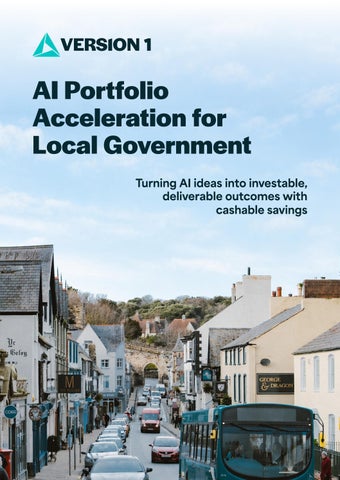

AI Portfolio Acceleration for Local Government
4-5
The Challenge Facing Councils
6-7
Our Opportunity
8-9
Our Commitment
10-13
Our Structured 12 Week Co-Creation Approach
14-15
Why this Works for Local Government 16-19
Why Version 1
Introduction
Most councils we speak to are not short of AI ideas. They have lists of them.
What they lack is a clear, honest answer to a harder question: which of these ideas is actually worth pursuing, in what order, and how do we build the business case to back them?
That is where most AI programmes stall. Not for lack of ambition, but because moving from a list of possibilities to a portfolio of investable priorities takes structured work that most councils do not have dedicated capacity to do.

This document sets out how Version 1 helps councils do exactly that through a practical, 12-week co-creation programme that replaces uncertainty with evidence, and replaces long idea lists with a clear, sequenced plan.
The Challenge Facing Councils
Across local government, AI idea pipelines are growing. Service teams see opportunity in automating administrative tasks, improving case triage, enhancing citizen self-service, supporting frontline decision-making, and extracting insight from unstructured data.
The result, in many councils, is a long backlog of use case ideas, captured in workshops, innovation programmes, and digital strategies — with no agreed method for moving them forward.
Three structural challenges consistently emerge:
01
02
TOO MANY IDEAS, TOO LITTLE CLARITY
Use cases are often described in ten words or fewer. That’s enough to signal a problem — not enough to understand:
Feasibility
Data readiness
Complexity
True business value
Organisational readiness
UNCLEAR PRIORITISATION
Which ideas: Are genuinely AI? Are better suited to automation or process redesign?
Already overlap with in-flight programmes?
Have stakeholder backing and data available?
Will deliver the greatest impact relative to effort?
Without structured assessment, prioritisation becomes subjective and politically influenced.

DELIVERY BOTTLENECKS
Even when strong ideas exist:
Business cases are underdeveloped
Governance questions are unresolved
Technical dependencies are unclear
Frontline buy-in is inconsistent
As a result, many AI initiatives stall at the idea stage — or pilots fail to convert into production.
The Opportunity
Local councils can use AI to narrow budget gaps and raise citizen outcomes by shifting work from labour intensive “handle every contact” models to prevent, predict, and automate at scale, especially in highvolume, rules based, and text heavy processes.
Evidence from council deployments shows measurable impact in four places:
01
Contact centre “AI front doors” that deflect routine enquiries and reduce waiting times (for example, 56% deflection and halved waiting times in one UK council deployment)
02
Frontline productivity tools that reduce documentation time in adult social care (50–60% average reduction reported in a pilot)
03
Planning and housing workflows where AI collapses information gathering from hours to seconds
04
Predictive prevention that targets support earlier (for example, a council’s homelessness risk alerts associated with materially better outcomes and a quantified cost benefit estimate in internal analysis
AI helps bridge budget gaps by converting scarce staff capacity into higher value work: automation reduces unit costs (and backlogs) in repetitive tasks (letters, form processing, triage, call wrap), while conversational AI deflects routine demand to 24/7 selfservice without removing human channels. Predictive analytics improves demand management by spotting risk earlier (e.g., likely homelessness, missed payments, deterioration of assets), enabling targeted, lower cost interventions before crises become expensive statutory duties. Revenue protection and fraud reduction can be strengthened by risk scoring and anomaly detection that prioritise investigative effort, provided false positives are measured and human review gates remain in place.

_ deflection and halved waiting times in one UK council deployment 50-60% _ average reduction reported in a pilot)



Our Commitment
We help councils invest their effort in exactly the right places.
Not every use case should progress. Not every opportunity is right for AI. Not every AI opportunity is right to build now.
Our role is to create structured clarity — before a single line of code is written.

Our Structured 12-Week
Co-Creation Approach
We deliver a phased AI Portfolio Acceleration engagement designed specifically for councils with large AI idea pipelines. It moves from longlist, to prioritised shortlist, to scoped initiatives, to a production-ready roadmap.
WEEK 1-2: CLARIFY AND CURATE
Kick-Off & Governance Alignment
We align sponsors and stakeholders on:
Objectives and success criteria
Scope boundaries
Governance model
Stakeholder engagement approach
Decision gates
Output: Programme charter and governance model.
Use Case Sifting Workshop
We facilitate structured review of all identified use cases, categorising them as: In Scope
Out of Scope (including in-flight programmes)
Requires Further Investigation
Each decision is documented to prevent duplication and future rework.
Output: Curated longlist and documented exclusion log.
AI Inspiration & Idea Generation (Optional)
If use cases have not yet been identified, we run short AI inspiration sessions to demystify AI, challenge common myths, and help staff recognise practical opportunities in their day-to-day work.
Following this, we deploy a simple AI use-case crowdsourcing tool that allows staff across the organisation to submit ideas in a quick, structured, and accessible way. This rapidly builds a broad pipeline of potential use cases to feed into the sifting and prioritisation process.
Output: Expanded long list of AI opportunities sourced from across the organisation.

WEEK 3–4:
DATA-DRIVEN PRIORITISATION
Structured Crowd-Sourcing (Validation, Not Ideation)
We gather deeper insight from idea owners and frontline staff to:
Validate impact and frequency
Surface operational pain points
Identify engagement signals
Assess perceived feasibility
This is lightweight (typically 5-minute structured input) and designed to maintain momentum.
Value vs Complexity Mapping
We synthesise insights and in dependently assess each use case across:
Value potential
Technical complexity
Data readiness
Integration dependencies
Governance risk
Organisational readiness
Use cases are mapped on a transparent Value vs Complexity matrix.
Output: Revalidated, ranked portfolio with identified synergies and reusable components.
At this stage, some use cases may move directly into existing automation or delivery teams.
WEEK
3–6:
FOCUSED IDEATION
From Ideas to Investable Initiatives
Once a prioritised shortlist is agreed, we move into structured validation. We run cross-functional ideation sessions on the highest-priority use cases.
These sessions:
Explore solution approaches
Identify reusable technical components
Surface constraints and dependencies
Test commercial, operational and technical viability
Outputs per use case:
Concept sketch
Early feasibility signals
Indicative effort estimate
Rough value hypothesis
This ensures only viable candidates progress further.
Executive Alignment (REACH Framework)
AI transformation fails without leadership alignment. We conduct director-level envisioning sessions using our REACH framework:
Readiness
Engagement
Ambition
Capability
Horizon
This ensures:
Strategic alignment
Clear ownership
Realistic expectations
Visible executive sponsorship
Our Structured 12-Week Co-Creation Approach
WEEK 6-11:
TWO DELIVERY TRACKS
Depending on complexity, use cases progress through one of two structured routes:
Track A: Co-Creation Discovery (Complex AI)
For higher-complexity use cases involving:
Human judgement
Bespoke design
Complex integration
We run structured Discovery sprints to:
Deeply understand the business challenge
Define KPIs and measurable success criteria
Map user journeys
Assess data and integration readiness
Develop high-level solution architecture
Produce a paper business case
Output: Comprehensive Discovery Report
+ Proof of Concept brief. Only validated, investable use cases proceed.
Track B: Hyper-Automation Sessions (Quick Wins)
For lower-complexity automation opportunities, we run hands-on half-day sessions that:
Design the workflow
Build and test a working prototype
Demonstrate tangible value immediately
Output: Live working prototype + scale/ refine/pivot recommendation.
This generates visible early success stories and builds organisational confidence.

WEEK 12: PRODUCTION READINESS & LONG-TERM IMPACT
Portfolio Report & Production Roadmap
At the end of the 12-week programme, we consolidate all findings into a structured AI Portfolio Report.
This includes:
Validated business cases
ROI summaries
Production-readiness assessment
Governance recommendations
Sequenced delivery roadmap
Scale / refine / defer decisions for every assessed use case
This provides councils with:
Clear investment decisions
Executive-level clarity
Risk-managed production plan
Delivery sequencing aligned to capacity
Defined ownership and accountability


AI Delivery Capability Uplift
Alongside prioritisation, Version 1 can provide dedicated AI delivery capacity to implement the selected use cases.
We form hybrid squads that combine your service and digital experts with our AI architects, engineers and data specialists. This ensures solutions are grounded in operational reality while accelerating delivery.
Our approach is collaborative by design — pairing your teams with our AI experts so knowledge is transferred throughout. As we deliver tangible outcomes, we also upskill your staff in AI best practice, governance and solution design.
The result: measurable impact today, and stronger in-house AI capability for tomorrow to reduce dependency on external consultancy.
Why this Works for Local Government
Our approach is designed around the realities of councils:
Limited delivery capacity
Cross-directorate complexity
Governance scrutiny
Data quality variability
Political sensitivity
Change resistance
We mitigate common risks by:
Introducing formal stage gates
Requiring business case validation before build
Addressing data and governance early
Demonstrating quick wins
Actively managing stakeholder engagement
Identifying reusable foundations to avoid fragmentation
The Outcome for Your Council




Why Version 1

Starting the Conversation
Many councils we speak to are in the same position: a long list of AI ideas and genuine uncertainty about where to begin.
We would welcome an exploratory conversation to review your current AI pipeline, assess your maturity and readiness, and identify where structured acceleration would create the greatest impact.
This is not about generating more ideas. It is about turning the right ideas into measurable outcomes that deliver the cashable savings your council needs.
To book a discovery call, please get in touch with Gregory.Alexander@ version1.com or complete the Talk to Us form.

Gregory Alexander Business Development Director

About Version 1
ISG has recognised Version 1 as a global leader in AI strategy, consulting, development and deployment for two consecutive years — based on independent auditing of our methodology and outcomes, including the fact that 62% of our AI PoCs progress to production (double the industry average).
We are also among a small number of organisations certified to ISO 42001 (AI Management System standard), reinforcing our commitment to Responsible AI, governance and transparency.
Version 1 is a trusted AI and automation delivery partner across local
of our AI PoCs progress to production
government, including Lincolnshire County Council, delivering end-toend AI transformation from discovery through to measurable production impact.