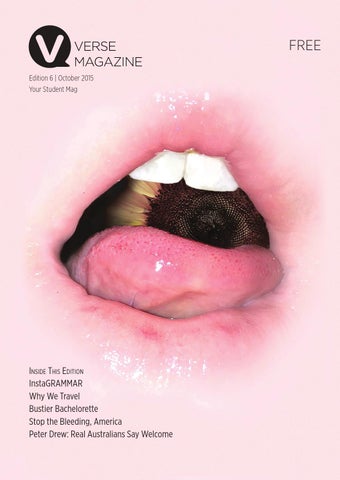
FREE Edition 6 | October 2015 Your Student Mag
InsIde ThIs edITIon InstaGRAMMAR Why We Travel Bustier Bachelorette Stop the Bleeding, America Peter Drew: Real Australians Say Welcome
versemag.com.au Another way to procrastinate.
Exclusive online content, articles, reviews, galleries & flick through past issues!
Edition 6 | October 2015
contact@versemag.com.au www.versemag.com.au Head Editor Jacinta Mazzarolo Editor Holly Byrne Communications Editor Kaitlin Kavanagh Graphic Designer Storm Warman Contributors Madeleine Dunne, Piper Denholm, George Booth, Claire Gordon, Holly Byrne, Bianca Lovino, Morgan Burley, Jordan Leović, Brittany Evins, Simon Delaine, Alyssia Tennant, Angela Skujins, Joseph Haxan, Zhi Yi Cham, Heather McGinn, Alex Graham, Jacinta Mazzarolo, Eliza Oatway, Thomas Luke, Madison Alana, Lachlan Gardiner, Lewis Fuller, Keith Odendaal. Cover OdeToPlants, FilmCover, 2015, Joseph Haxan. Printer Newstyle Design & Production Consultants Tom Wilson, Georgie Smith The views expressed in this magazine are not necessarily representative of the views of USASA or the editors. Artwork, image production & generation (unless otherwise stated) by Storm Warman.
instagram.com/versemagazine facebook.com/Versemagadelaide @versemag_adl Verse Magazine is brought to you by
Edition 6 2015
1
Letter from the Editor Jacinta Mazzarolo | Head Editor
Now, there is one subject matter that, above all else, continually pops up in our inbox for publication edition after edition. It’s travel. And it has infiltrated every part of our university lives. I think we’ve reached peak saturation though. Scrolling down your newsfeed or waiting in line at Aroma is like navigating a minefield of backpacking and Sail Croatia cruise stories. It leaves you wondering, is everybody jumping on planes and (excruciatingly) hash tagging #wanderlust every chance they get, but me? Somehow though, these experiences that turn into the articles we receive always turn out to be some of the most fun and compelling to read. So why do we keep coming back to this topic? In this edition, Simon explores this phenomenon in Why We Travel, plus Madeleine discovers the value of travelling for your patriotism in What it Means to be Australian. But if like me, you are still freezing your butt off in Adelaide, you can stick to living vicariously through these Verse articles (and your instagram feed, of course). Also, last edition, we also got ourselves a new (and very welcome) member of the team! Kaitlin Kavanagh is the communications editor and is manning all our social media too. Have a flick through the channels (Facebook – Verse Magazine Adelaide; Instagram – @versemagazine; Twitter – @versemag_adl) and tell us your thoughts about the mag. Or, you know, just let us know how your day has been… Happy reading!
2
Edition 6 2015
Contents Edition 6 | October 2015
02 Letter from the Editor 04 What it Means to be Australian 06 Love to Hate 10 The Shitbox Rally 13 Support LIVE Music 14
Peter Drew: Real Australians Say Welcome
18 Bustier Bachelorette 20 Stop the Bleeding, America 22 Be Above It 26 Colour Me Happy 28 Why We Travel 32 The Brookman Attic 35 InstaGRAMMAR 36 In[ter]view: Alex Dunkin 40 #USASAsocial: Band Comp 43 Events Calendar 44 Imag[in]e: Joseph Haxan 51 Vagina 52 Vox 55 It was Time to Leave the Glade 56 Reviews: Film / Burgers / Video Games
Edition 6 2015
3
What it Means to be Australian Words â–ś Madeleine Dunne
Madeleine Dunne found that moving to another country made her appreciate just how much she loves Australia. Here she gives us an insight into the quirks that make us such bloody great people. Before moving to the Netherlands on exchange, I think the longest I’d spent without speaking face-to-face with a fellow Australian was around 2 weeks. However, at this point in time, it’s been approximately 5 months. And it’s bloody bizarre. A bad thing? No, not at all. It’s actually somewhat refreshing to be immersed in other cultures and nationalities, whilst rather lacking in my own. I have absolutely no complaints about being the token Aussie on campus; however, it has really made me think: what does it mean to be Australian? Funny accent aside, we have a number of qualities that make us stand out from the international crowd as coming from the Land Down Under. Here’s what being an Aussie abroad has made me realise about our ochre nation: To be Australian is to be friendly to absolutely everybody. Love someone or hate them we’ll always greet them with a smile, ask them how they’re doing, and probably even buy them a beer. This results in a lot of feigned friendships, but hey, at least we’re keeping people happy. To be Australian is to say yes. Yes to new mates, yes to Vegemite chocolate, yes to working hard (but playing harder). Sometimes I wonder if we’re simply too lazy to say no. Yes to spontaneous holidays, yes to helping strangers in the street, and yes to spending our last $10 at happy hour. Which leads me to my next realisation… To be Australian is to drink. A lot. It’s an integral part of our culture to not only drink at every given opportunity, but to drink in excess. If your weekend doesn’t involve a beer bong, it’s hardly a weekend at all. This isn’t so much of a problem when you’re actually in Australia; however, when surrounded by conservative foreigners you quickly realise that the fact you just downed 5 beers in 5 minutes is kinda bloody ridiculous. To be Australian is to be a sports nut. Watch it, play it, use it as an excuse to drink, whatever – you love it. Aussie, Aussie, Aussie? Oi Oi Oi!
To be Australian is to live for the moment. This isn’t necessarily a good thing; we act without thinking of consequence, and are often self-destructive in the process. But on the flipside, we seize the day. Australians aren’t afraid to ditch work to spend an afternoon in the sunshine, or skip studying to hang out with an old friend. We live to find pleasure in the small things.
If your weekend doesn’t involve a beer bong, it’s hardly a weekend at all. To be Australian is to be open-minded. You wanna swim in shark infested territory? Sure! You’re feeding me a poached rabbit’s a-hole? I’ll eat it! You’re from New Zealand? Let’s party. Carpe-freaking-diem. To be Australian is to be proud. Really, really proud. We adore the land we come from, and aren’t ashamed to tell anybody who’ll listen. We often bitch and moan about wanting to leave the lucky country, yet once we step foot off Australian soil we can only sing its praises. Our eyes light up when we describe our sunburnt country, our land of sweeping plains; we think of ice-cold beers in the blazing sun, Triple J on lazy summer days and giant schnitties at our local pub. We remember our favourite café and its cute barista, smiling at strangers in the street and knowing you’ll bump into at least one person you know whenever you pop down to the shops. We remember the absolute beauty of our great land, and we remember that there’s no place in the world we’d rather call home. It’s been an odd few months without that quirky Aussie twang in my ear, and I’ll be perfectly honest – I can’t wait to hear it again. Being the only Australian for all these months has been a blast, but there’s abso-bloody-lutely no doubt about it: I still call Australia home.
Edition 6 2015
5
Love to Hate Words ▶ Piper Denholm | Image ▶ ‘Fireless’, Madison Alana
A simple trip to the beach can become a minefield of insecurities and pain as Piper Denholm explains. She bravely opens up about her struggles with body image that also imprisons so many people everyday. Body image. Two words no one takes lightly. These two words have dictated my life; the way I think, feel and even act. I can remember the first time that I noticed my body wasn’t like the others. In year four, all the girls in my class were wearing white crop tops under their school shirts. For the time, it was cool and it was what I wanted to do. As I went to soccer training one day, I can clearly remember two girls not wearing any shirts and simply just wearing these crop tops and their shorts. I later realised I couldn’t. No one told me I couldn’t. I told myself. I was nine. I was worrying about my body at such a young age when this shouldn’t have even been a problem for me. As I’ve matured, so has my body. Hips and breasts the norm for a growing a girl. I later discovered the whole love your curves campaigns. These campaigns are brilliant, they help girls of every size to learn to love their body and accept their differences. But for me this wasn’t enough. Why would I love my body when others around me couldn’t? This is what I want to discuss. I am currently travelling around Europe and for our past two stays we have been staying at places with beaches and pools. Growing up in the Australian sun and being a natural redhead, I packed my long sleeve rashie with a full piece bathing suit and a pair of bikinis to wear when we will be swimming on daytrips. There hasn’t been a time in my life that I’ve thought of going without a rashie. So I haven’t. Every day this week I’ve been swimming, I’ve been out in full force, rashie and bikinis.
As I lay on the beach in Nice, I noticed something different. The women, men, teenagers and children were wearing bikinis, boardies, speedos – whatever you like to call them – with all their pride. There was no covering up. No full piece bathers, kaftans or rashies. Women of age in tiny bikinis, beer gutted men in speedos, and just about every man and their dog in comfortable bathers. No matter their body size, these people wore whatever the hell they wanted. It wasn’t a matter of who was going to see them or judge them. It was being proud with who they were and what they saw.
Every single one of my girlfriends could tell you at least three things they would change about their body. We have been taught to dislike our bodies. Australia is very different. If I was to head to the beach in my bikinis without a top, not only would there be judgment because I don’t have the slimmest figure or the flattest stomach but I would also be sexualised. I don’t know why this doesn’t happen as often in Europe and I don’t know why it seems to just be Australia. But what is wrong with us? Why can’t girls and boys go out without a top to the beach, go running, or visit the local pool in what they want to wear? Nothing is to please someone else. It shouldn’t be to please someone else until they
Edition 6 2015
7
have pleased themselves. It is confidence. It is learning to love your body from a young age. Learning to accept it and be comfortable in it. Why is it okay in one country and not the other? As I haven’t been able to love my body, does that mean I haven’t been able to love others? As I’ve grown up, I’ve always reminded myself to forget what anyone else thinks. If you want to wear an outfit that doesn’t match, go for it, because at the end of the day the only people caring are those who judge. Living in this Australian mindset, I’ve learnt to judge. I’ve learned to judge other’s physical appearances without even knowing. Not out of hate but because of my generation. This is what we are dealing with!
Women of age in tiny bikinis, beer gutted men in speedos and just every man and their dog in comfortable bathers. Every single one of my girlfriends could tell you at least three things they would change about their body. We have been taught to dislike our bodies. Disliking them to the point where people even struggle to look at themselves. When mental illnesses occur and where damage is caused. I have friends who in my eyes have beautiful figures, ones that I would only ever dream of having but when we speak, they would like to be thinner. They too have people they know whose bodies are beautiful, and they want to look like them. We need to stop comparing ourselves. It isn’t fair on anyone. I don’t enjoy that this is the way I think and I want it to stop so that one day my children, no matter what they look like can wear what they want. I hope they can be proud of their bodies and I can see that in them.
8
Edition 6 2015
Is it the fault of the previous generation? Is the fault of the influence of social media platforms? I don’t know. I don’t even know whether generations before me experienced this as well. When my Mum was my age, did she feel like this? Was this what her and her friends experienced? I hate this. I envy the girls that I see walking around the pool with bodies like me not having a care in the world, when I wouldn’t dare take off my rashie. I envy that I wasn’t taught to love my body, and that still to this day I am learning to. I envy it all. This is something that needs to be changed. As much as companies like Dove or modeling agencies use girls of every size to promote their products, it doesn’t change anything. This is society. This is what I as a child knew, as a teenager experienced, and now as an adult am still dealing with. And I shouldn’t have too. So for the time being, I will still be in my rashie. Maybe before I leave Rome I might be able to just be in my bikini, but I don’t know.
Want to join the 2016 Verse Mag Team? Looking to gain experience in journalism, publishing, graphic design, management, marketing or communications? Studying at UniSA in 2016? Super pumped about magazines and creating something awesome? Apply to be a part of the team responsible for putting together each 2016 edition of Verse! There are four positions available for enthusiastic and driven students: - Head Editor - Editor - Communications Editor - Graphic Designer Find out more about each position and how to apply at www.USASA.sa.edu/VerseRecuit Applications can be emailed to USASA.Marketing@unisa.edu.au Applications close November 9! (Jacinta and Holly above are the 2015 Head Editor and Editor of Verse!)
The Shitbox Rally Words ▶ George Booth | Photos ▶ Lachlan Gardiner
10
Edition 6 2015
Over the last half a decade, James Freeman’s unique fundraiser has been battling cancer one shitbox at a time, as George Booth has discovered. The Shitbox Rally is the Cancer Council’s largest independent fundraiser, with this year’s rally raising $1.4 million for the organisation, according to rally coordinators. Two hundred cars, each worth less than $1000, set out in the event’s sixth year on a 3600-kilometre journey. They travelled from Canberra to Townsville across some of Australia’s most arduous roads, all in the name of cancer research. Over the last five years, the event has raised over $4.4 million for the Cancer Council, which contributes to ground-breaking research for improved diagnosis and treatment of cancer. Each year, the Cancer Council invites researchers from across Australia to make funding appeals for cancer research. The Council aims to provide support for people recently diagnosed with cancer, which the organisation said would reduce the impact of cancer now, and for future generations. Shitbox Rally founder and rally director James Freeman said he always believed the event “had potential”, it was just a matter of “launching and building” the rally in a way only he could. Freeman said he is “extremely pleased” with the funds raised over the last five years in which the rally has been operating, and said this year’s funds are a “magnificent effort” by all. Freeman also said he believes the rally appeals to a large number of people because in addition to raising money for cancer research, it also exposes participants to unique opportunities and experiences.
“You can go off and see different parts of Australia in a safe and controlled environment,” he said. “It is fantastic to see the [Australian] community get behind it.” However, although Freeman admits he has a “love affair” with the rally, he said it comes with extreme pain, conceiving the idea for the rally after losing both his parents to cancer within a year of each other. “The rally comes with enormous heartache after the death of mum and dad,” he said. During the course of the rally, Freeman said participants stop off at regional communities to offer assistance and “help out” around the community.
In addition to raising money for cancer research, it also exposes participants to unique opportunities and experiences. “The rally not only benefits cancer research, but also benefits regional communities as well,” he said. The money raised contributes to the research of a wide range of cancers and a portion of the funds raised are invested into a project that is creating “cutting edge” new treatments for brain cancer patients, which, if successful, could shrink their tumour.
Edition 6 2015
11
The Cancer Council has invested in a grant of $345,617 into breast cancer research, which is looking to stunt the growth of some breast cancers and permanently stop growth of the most “fatal form” of breast cancer, the organisation has said. Future participants of next year’s rally can expect to travel along a different stretch of outback road, as each year James Freeman picks out a different route of outback for rally-goers to travel through.
The 2016 Shitbox Rally is expected to finish in Hobart, Tasmania. In a surprising twist, Freeman confirmed the rally will undertake an event first – a section in which participants will “travel by sea” to reach their destination in Hobart.
12
Edition 6 2015
Support LIVE Music Words ▶ Claire Gordon
Live music is a favourite pastime for music lovers and socialites alike, but Claire Gordon fears the music scene in Adelaide is in danger of dying out. international, national and local bands that have played – and still play – in Adelaide. If we want more bands to come here, we need to support all forms of live music in Adelaide. Many small music venues in Adelaide have sadly closed their doors over the last few years because there is so little support for live music venues. The sad truth is that the less demand there is for local live music, the less likely international bands will grace Adelaide with their presence. At the end of the day, if they won’t make money from it, why would they? To see your favourite band play live on stage is an incredible experience. The thrill of watching band members come on stage, the buzzing atmosphere, the cheering crowd, the high you have throughout the show, and after. So why is it that Adelaide has a reputation for not being particularly great for live music? Unfortunately, in Adelaide, live music is dying out. I recently attended a live gig at The Gov for a band I had seen a few years ago at The Metro in Sydney, where it was a sell-out gig. Yet, in Adelaide, it was an entirely different situation. The Gov is a great music venue and the band was internationally famous. They had sold millions of records and the price of a ticket was not much more than some dinner out. Despite this, the venue was only half full. I hear these same words time after time: “No good bands ever come to Adelaide”, “There is nowhere for decent music in Adelaide”. But, you see the thing is, unless you support live music – it doesn’t exist. Live music touring is where the not so incredibly famous make their money. With most people now illegally downloading music, unless a band can make a profit playing gigs, they don’t make money. There are so many
They had sold millions of records and the price of a ticket was not much more than some dinner out. Despite this, the venue was only half full. The atmosphere when you see your favourite band play live is truly incomparable to any other experience. But, we should also support the not so famous: the young man on the guitar being drowned out by the locals at the pub, the older man busking during fringe doing what he loves most. Drag yourself down the Grace Emily on a Monday night and hear a variety of great musicians. Who knows, you may even find a new favourite band! There are many venues across Adelaide, that still provide amazing live music, but they need your support to keep this going. Remember that most of these musicians up on stage are there to earn a living; their blood, sweat and tears have gone into their music and it has been made for you to hear and enjoy. Support live music, and it will bring Adelaide alive.
Edition 6 2015
13
Peter Drew: Real Australians Say Welcome Words ▶ Holly Byrne
The man behind those ‘Real Australians Say Welcome’ posters plastered across the country talks to Holly Byrne about his work, future projects, and incredibly inspiring campaigns. Do you know the second verse of the National Australian Anthem? Adelaide street artist Peter Drew does. At some point mid-2014, when Drew completed his ‘Bound for South Australia’ project (a project that included poster parodies of Australia’s ‘stop the boats’ policies plastered all over London’s east) he decided he wanted to do something more. “I realised I wanted to do something about it, something more direct with a little more punch,” Drew said. Under current policies, anyone who arrives in Australia without prior permission is held in immigration detention before being transferred to a third country where their claims for asylum and protection will be processed. Inspired by the often forgotten second verse of the national anthem, ‘With courage let us all combine’, the Glasgow School of Art graduate designed a simple, yet poignant poster to voice his concern. “That line basically admits it takes courage to look at people who seem different and be welcoming to them,” he told The Guardian in May. “That’s a very unusual and special thing to have in a national anthem; it’s a seed for multiculturalism.” Drew soon raised $8000 for the ‘Real Australian’s Say Welcome’ campaign and travelled the country leaving 1000 of the posters in his wake with an outpour of support through social media.
14
Edition 6 2015
“I think some of the best places are really remote places in the Northern Territory, places people wouldn’t expect to find them, where it’s going surprise people,” he said. Along the way, Drew discovered the posters were reaching an unforeseen demographic. “The best response has been asylum seekers getting in touch and saying thanks. That was really unexpected and at that point I realised there was another audience, an audience of people who felt alienated by the policies, and welcomed by the posters.”
An audience of people who felt alienated by the policies, and welcomed by the posters. And while some have been ripped down or defaced, Drew doesn’t take it personally. He says, “There are people that are angry about it, but I think they are pretty scared and they’re embarrassed by their own point of view.” But he didn’t stop there. Drew’s newest project, ‘C’mon, Aussie, C’mon’, a joint effort with fellow artist and screen printer Jake Holmes, is tackling the issue of marriage equality.
Edition 6 2015
15
“Jake is a good mate, I’ve known him for a really long time and this is obviously something close to his heart,” Drew said.
“We though about it for a while because obviously it’s a big commitment but he was really great, he jumped straight in to it.”
Holmes grew up with an openly gay uncle, and when he was 13 his mother came out.
So far, Drew thinks ‘C’mon Aussie C’mon’ has received a better reception than his previous project. “It’s something most Australians feel pretty passionate about, and that’s really what bemuses me. It’s really just the Prime Minister putting God before the people, and worse, it’s his own idea of God.” Although there will be no cross-country travels for this poster, the duo believe that there is a willingness of people to really get behind it as they print and dispatch the posters.
While Holmes was the mastermind behind the poster design, it was Drew who approached him with the idea of the campaign. “He designed this poster and I just asked if he’d be interested in doing this project together,” he said.
16
Edition 6 2015
“We’re going to post them out to community groups like Australian Marriage Equality, or any organisation or business that’s willing to display the posters publicly,” Drew said.
A Celebration of Relaxation massages, henna tattoos, baby animal petting zoo meditation & mindfulness sessions icecream & calming drinks
All provided free by USASA Magill: Wednesday 21 Octo ber | Mawson Lakes: Thursday 22 October City Wes t: Tuesday 27 Octo ber | City East: Wednesday 28 October 11am-3pm
Bu
a B r stie
te t e r o l e h c
There’s no denying that a new trend in Australian TV has emerged in the form of The Bachelor franchise. Bianca Iovino breaks down what is so addicting (or vomit-inducing) about the show. You’d be ignorant if you said you hadn’t picked up on the nauseating pattern TV network brainwashers loyally abide by with television dribble such as The Bachelor(ette). It begins with the advertisements that commence what seems to be 24 months before the show
18
Edition 6 2015
actually premiers to ‘build hype’ – like it’s some new, fundamentally complex programme that requires 15 dramatic seconds of introduction I will never get back. “I’m just a normal (insert appropriate age that indicates fun, but also responsibility and preparation for ‘the one’) year-old guy who is ready for love,” the frighteningly
golden, muscular man smiles at the interviewer off camera. A montage of things he does with his spare time cut (much like his jawline) in between mouth-watering smoulders; highlighting a successful career, passion for children and enjoyment of the “great outdoors”. Cue the pre-recorded surf footage to conveniently show the audience his 36-pack. Putting the cherry on top of this Stud-Muffin Sundae – which he probably wouldn’t eat anyway because you don’t get abs like those from eating sundaes. Yeah okay, he’s hot – whatever. Never mind the fact that this guy only has roughly 12 minutes to wine-and-dine 1,025 women, without the incentive of a hand job, isn’t unrealistic enough – the variety of females picked for him to court are hardly diverse. You’d think a dating show would invite an assortment of ladies onto the programme to preserve at least an ounce of authenticity. Sadly, no. “Hi, I’m Jessica. My hobbies include jogging 106 kilometres a day, and willingly drinking spirulina.” These women are extraordinary. It’s outrageous. Like Mister Bachelor, the ridiculously stunning specimens floating around the palace the sponsors generously allow them to reside in, are beacons of health. Their beauty is evident in their glowing skin, glossy hair and impossibly slender physiques. Reading between the lines, the producers pair women with aesthetically similar characteristics to the guy crowned The One out of a sea of audition tapes.
or boys on the slightly chunky side or who have been blessed with acne or glasses or a wheelchair. As a lass of the double digit dress sizes, I have to admit I don’t feel great when I watch these programmes. Although my worth is equal to those women on the telly, your brain starts to pull the figurative rug out from underneath your self-esteem when you’re reminded that they are whom society deem desirable.
I’m just a normal (insert appropriate age that indicates fun, but also responsibility and preparation for ‘the one’) year-old guy who is ready for love. I’d love to see a woman with a curvy waistline and stretchmarks have a man like Mister-Abs down on one knee in front of her, on air for the entire world to see. Now, I’m not skinny-shaming, but it would be a twist on a recycled story that I can guarantee would gain views and give a big fuck you to social norms and stereotypes. But I forget, that’s not “good TV” and people don’t want to watch a fat girl happy because fat isn’t attractive and toned tanned boys are for the supermodels. The real killer though is a perpetually sad dilemma. I can slaughter this “television dribble” all I like, but I will still regrettably watch next week’s episode.
In reality, it’s bullshit and challenges the already sketchy façade that this show produces legitimate and durable love. Similarly, it’s equally bullshit in the respect that these programmes promote the idea that skinny folk with artificially whitened teeth are allowed to find love, but people of all other categories deserve bugger all. It conjured a lovely fantasy in my head of a show that has an alternative fellow with an array of gorgeous girls and/
Edition 6 2015
19
Stop the Bleeding, America Words ▶ Morgan Burley
Just after Morgan Burley wrote this article, news of another US shooting – on camera this time – hit the headlines. Here, she addresses the prolificacy of guns in America in comparison to Australia. As of August 9, there have been 224 shooting incidents in the United States of America just this year – 224 incidences where a human being has opened fire on another human being. That is 282 killed and 851 wounded – in just eight months – keeping in mind that this doesn’t include those killed by police. I’ll just let those numbers sink in for you.
20
Edition 6 2015
Of course we have all heard of the mass shootings occurring in America, in particular one that broke all our hearts, the Sandy Hook Elementary School Shooting that happened in 2012. But I bet you a million dollars that you can’t name all of those other shootings. Not long ago, I was watching a documentary called Bowling for Columbine by Michael Moore.
The documentary was incredibly informative and eye opening to the situations occurring daily in the United States – particularly after the Columbine High School Massacre that killed 12 students and 1 teacher in 1999.
Walmart and have no one ask for any information? In America, guns are sold like Vegemite is sold over here.
That is 282 killed and 851 wounded – in just eight months – keeping in mind that this doesn’t include those killed by police. Michael Moore explores why it is that America has such large causalities as the result of guns, and looks into the gun frenzy that is spanning through generations across the country. There are two scenes in particular that I found fascinating. One was detailing that at a certain bank, when you opened a specific account with them, you got a free gun. A bank was literally giving guns to people. Amazing. The other scene was a short animated piece about the history of the United States, and it really made a lot of sense. Basically, it speaks about the fragility of the pilgrims and how they feared for their lives, so they needed guns to protect themselves. I know how it sounds… but take a look at the video and make up your own conclusive opinion. You can find it on YouTube under, Brief History of the United States, Bowling For Columbine.
Since the Columbine Massacre in 1999, American’s have been progressing towards stricter laws on guns. However the National Rifle Association (NRA) has shut down any attempts by the government, preaching that it is in their constitution to own a gun. Many in the association have said that it is an issue, but they believe the solution is more guns. Unbelievable. Many around the world are begging for America to change their laws to stop the slaughtering of innocent people. My question is why is this still going on after every tragedy America has seen? Why doesn’t the US Government do something to spare the lives of their citizens? Why do they let people walk into an elementary school and open fire on five-year-olds? I’m not saying Australia is perfect, but at least we sorted our gun laws out decades ago. Please America, stop the killings and ban the guns!
Since 1996, when Martin Bryant opened fire at Port Arthur in Tasmania, Australia has not had a single mass shooting. This is due to the legislation that was brought in by the Howard Government shortly after the tragedy. The shooting led to the Government taking action against our gun laws, and from then on, automatic and semiautomatic guns were banned. There are now strict rules in place on owning a gun, and it is not only incredibly difficult to purchase a gun under these rules, but to keep one. You have to abide the rules on how and where it is kept, and how and where it is used. In America however, there are very few laws about guns. Mainly just that it is a human right to own one. Did you know that you can purchase a gun from a corner shop, with little questions asked? That you can buy ammo at
Edition 6 2015
21
Be Above It
Words ▶ Jordan Leović
Would you rather take a high paying job and forfeit your happiness, or live on a minimum wage and wake up each day excited for work? Jordan Leović reminds us why we should be searching for a job we love. We’re constantly being asked (and asking ourselves), “What do you want to do as a career?” Some are fortunate enough to have known the answer to this question ever since they can remember, while others are asked this while trying not to projectile vomit. We’ve probably all heard the old saying, “Find a job you love and you’ll never work a day in your life” from our parents, from our teachers or maybe from a creepy uncle who’s had a few too many by the end of the family Christmas party. Or perhaps that’s just me. But is it really so important to be above intrusive social factors that stand in our way of pursuing careers which we love? Prestige is one of these factors that create a mental barrier between us and the jobs we find fulfilling. We define prestige as the level of respect by which one is regarded by others; in other words, a lingering relic of the days when social status meant everything. It’s often a driving force in people our age to enter highly respected fields of work such as medicine, law or business. However, a respected job is not necessarily what we personally believe is a fulfilling job, or one that we love. To quote doctor of philosophy, Paul Graham, “Prestige is like a powerful magnet that warps even your beliefs about what you enjoy. It causes you to work not on what you like, but what you’d like to like.” The idea of a respected occupation is simply an opinion. There is no chart with which we can measure how respected one should be based on one’s employment. An example of this false paradigm is that of a respected investment banker whose fraud may have driven thousands into poverty.
For leaving the ball and chain of prestige in the rear-view mirror, we are rewarded with hundreds of choices. Steve Jobs, for example, dropped out of his unfulfilling course at prestigious Reed College before attending calligraphy classes, of which he was simply interested. Years later, he used his typography knowledge in designing the first Macintosh; a job, which not only made him a little money, but one he also loved doing. He was above it. With prestige comes the idea of success. In our modern Western society, success often means earning bundles of money – and to a certain extent, money does play a part in being successful. Money implies a measure of independence and it allows us to have more choice in what we do, such as travelling. But for a long time, this perception of success has just been a projected image that we mustn’t allow to be the driving force in our future career pathways. Success doesn’t have to revolve around money. We all know that money can’t bring eternal happiness, proven by Australia’s list of professions that accrue the highest suicide rates in which finance workers, dentists, veterinarians and physicians (which are all high paying professions) made the top 5. Television, marketing and advertisements each act as prisms through which we see a recycled portrayal of success; having two cars, wearing a suit to work, and living in a two-story house. I don’t mean to say that one shouldn’t aim to have any of these things, but as modern philosopher Alain de Botton has also said, “We should make sure that we own our ideas of success and that we’re truly the authors of our own ambitions.” Many people who perceive success in this way are lacking in perhaps more important areas of life. A man I knew whose net worth was a cool $25 million never showed affection to his children or his wife and by the time the bell finally tolled for him, it was too late. He apologised to his middle-aged children for his neglect while on his deathbed. His whole life, he allowed himself to be overcome by his hunger for success.
what she saw as successful. She didn’t follow her parents’ desires to join the family business; she was above it. So my point, exactly, is that we should reassess the old spectacles through which we’ve been told to view our future career pathways. We shouldn’t settle on the education system’s career advice, but merely take it into account. Although it is important to work hard during university in order to prepare ourselves to make a living, it is more important that source of income doesn’t chew us up from the inside, poisoning us in stressful ways.
Be above anything that tells you that success is a suit and tie, a mansion or a brand new Porsche. Whether we enjoyed school or not, we basically had to engage with it, but we certainly don’t have to commit to employment that we don’t enjoy. My main message is this; don’t allow your education to mislead you into regarding work as an onerous duty. As for other’s views of success, simply be above the advertisements, be above the television, and be above anything that tells you that success is a suit and tie, a mansion or a brand new Porsche. So take your strange uncle’s slurred advice to do what you love and be above what society considers prestigious or successful. Ultimately, we will only punish ourselves in careers that we hate and work is not a punishment for living. Life is too short to worry about the regurgitated opinions of other people, which is why we must make the most of ‘work’ by loving it. If you wish to be an astronaut, a musician, a garbage collector, a writer, or a lumberjack, so be it. The question I now ask you is, will you trade away years of your life for a job that kills you, or will you search for a job that brings you to life?
Now let me tell you about a woman on the opposite end of the scale. With the little money that her Greek migrant parents had given her, she decided to wander the world as a musician, discovering that cultural experience was
Edition 6 2015
23
Priestess of ROLO, 2015, Lewis Fuller.
Indica Blues, Pen, 2015, Lewis Fuller.
Colour Me Happy! Words ▶ Brittany Evins
Colouring isn’t just for children anymore. Brittany Evins explores this new trend and why it may be worth dusting off your old Bananas in Pyjamas book from that back shelf. because plastic was so last season; Marble laptop and phone cases, because it’s a tough choice between style and protection. However, our next contender has been around since before the 1800s – and most certainly one of your best friends as a child – Colouring Books! Yes, they are back. Although they’re not the kind you are thinking of, featuring simple fairy gardens or Teenage Mutant Ninja Turtles, with a few lines here and there. These colouring books have been created to challenge adults by taking colouring to the next level, with intricate and detailed patterns. Stemming from the US, Adelaide has followed suit with hundreds of adult colouring books selling out over the city. So, if you think colouring books are just for children, you have to think again!
Do you find yourself doodling in the margin of your page? Whether you are watching a lecture, taking notes in class, or just find there is nothing better to do? You’re probably thinking to yourself: ‘I guess this is just what study has come to. I’ll finish that assignment in a week or two, I mean it’s not due for ages, doodling is much more important for now!’ Well, that’s where colouring books come in. Over the past few months, us Adelaidians have been gradually exposed to another trend, although it has some big shoes to fill: The Nike shoe trend, making it acceptable to wear ‘sneans’ in public; Voss Water,
26
Edition 6 2015
In fact colouring can help to calm the mind, lower anxiety, stabilise moods and serve as a sleeping aid. They’re a great way to take some time to get away from the computer or study for an hour or so, helping with creativity and calming the mind. Colouring books are also goal orientated and even though they aren’t particularly challenging, they provide a visually appealing sense of completion. Next time you’re waiting for your computer to load, start scribbling on the inner page margin of your books, or simply had enough of checking your Instagram feed, take sometime out for yourself, grab some pencils and get colouring. You won’t regret it.
(Go for it!)
Edition 6 2015
27
28
Edition 6 2015
Why We Travel Words ▶ Simon Delaine
Humanity and curiosity (and university magazines…) have always gone hand in hand with travelling, so this time, Simon Delaine has taken a very thoughtful and philosophical approach on the act. I’ve heard how picturesque Mount Cook in New Zealand’s South Island can be – the locals’ funny accents and the spectacular walking trails. I’ve heard of the vast landscapes of Mongolia and the people whose lives are so uncomplicated and generous of spirit they don’t hesitate to help a stranded traveller. I’ve heard that, despite living well under the poverty line, the children of Johannesburg in South Africa are so friendly and full of life. And I’ve heard from friends of friends how ridiculously cold-beyond-comprehension the Canadian winter can get.
probably going to have an existential crisis. Maybe the ‘don’t think, just do’ mantra should take place here. But I’m curious. Compared to other animals, the human race is very suited to the act of travelling. We have long limbs for walking, opposable thumbs along with the coordination to use them, and a big brain for not only inventing and creating means of transport but also as a way of thinking imaginatively.
When the snow melted, he did a bit of mountain biking and fell in love with that as well. Now he’s hooked, skiing in the winter and mountain biking in the summer – still there a year and a half later. There are so many different experiences to be had and ways to live a life in this world. It is exciting, confusing and terrifying. Yet, I have never travelled. Not internationally, anyway. So why do I want to? What is the pulling force, and where is this weird desire to go somewhere wildly different coming from? Why do we feel the need to travel? It seems silly to want to hop on a plane and fly somewhere else just for the sake of being in a different location. I’ve had a strong desire to travel for a long time. What I want to know is where it is coming from. Is it because I’m unhappy with where I currently live? Probably not. Or maybe it’s because I want to try and live somewhere else to find out the place where I’m most happy. Perhaps. If I think about this too much I’m
Developmental and evolutionary geneticist, Jim Noonan, said to National Geographic Magazine that if you boil it down, the two key attributes that make us great explorers are our limbs and our brains. Our long childhood also gives us a chance to take risks and explore while still being able to rely on our parents when needed. During this time we ‘get a feel’ for the act of exploring and we discover how rewarding and fun it can be. Curiosity is probably the largest factor in making someone want to travel. In fact, curiosity is probably the largest factor in making us do anything outside of our ordinary routine. In the past, explorers and scientists would have travelled to discover new and useful facts.
Edition 6 2015
29
For example, they wanted to find out what the temperature was at the South Pole, what species of plants grow in Alaska during the summer and what languages are spoken in the Middle East. Like Captain James Cook being appointed by the Royal Society and becoming one of the first Europeans to discover Australia. They travelled to discover what was beyond the Pacific.
become more specific. If our interest persists we find we become fascinated with very small and peculiar things. For example, in Humboldt’s case, his curiosity grew to the point where he was fascinated in seeing a fly at such a high altitude while climbing a mountain. Allowing our curiosity to expand will lead us to finding something out more things about the world, creating a desire to travel to more places.
This certainly is still the case; there are plans for humans to go to Mars in 2026. But much more is known about the world than before, so the reason many people travel nowadays is not to make revolutionary discoveries about the world. Instead, the reasons are much more personal. Alain de Botton says he wants his travel discoveries to enliven him. He wants them to be ‘life-enhancing’.
Allowing our curiosity to expand will lead us to finding something out more things about the world, creating a desire to travel to more places.
De Botton speaks about curiosity in his book, ‘The Art of Travel’. He says that guidebooks force tourists to think certain in ways and that travel is much more rewarding if we follow our own interests. He mentions a time he was in Madrid at a popular tourist site and there were crowds of tourists ‘stopping to take photographs and listen to guides’. He continues, ‘And I wondered, with mounting anxiety, what I was to do here, what was I to think.’ This resonated with me and made me reflect on the way I react to other peoples travel stories. When people tell me and show pictures of the Eiffel Tower or Leaning Tower of Pisa, I merely smile and nod because I have little interest in architecture. However, when people talk to me about how they went to see the Le Mans 24-hour motor race, my ears prick up and I ask many questions because that is what I am interested in. De Botton also spoke about Humboldt, a traveller from the 1800s who wrote about his time spent in San Fernando, Madrid. The area was known - in guidebooks - for its churches and architecture. But Humboldt was especially passionate about botany, and he said the thing he found most interesting in San Fernando was the Pirijao plant, a tree over sixty feet tall and covered with thorns. De Botton also talks about something I like to call the evolution of curiosity. As children we ask large, blunt questions like, ‘how does nature work?’ As we get older, our curiosity grows to encompass more of the world and at the same time, the questions we ask gradually
30
Edition 6 2015
Much like curiosity, our desire to learn also influences our decision to travel. As well as a desire to learn Spanish, a friend of mine who spent eight months living in and travelling around South America says one reason he went was to learn what he wanted to do with the next stage of his life. As young people we are rarely certain about what we want to do next in our life. Getting a fresh outlook by travelling to a place that is foreign to us can be priceless. De Botton speaks about the word ‘exotic’. He says that we may react to even the smallest elements of a foreign country. For example, De Botton said he liked the way the buildings in Amsterdam were ‘modest’, comparing them to the more ostentatious doorways in London that he said looked more like classical temples. He says that we may love small, foreign elements such as an unpretentious doorway, not just because it is new, but also because it relates more closely to our identity than anything back home. Another friend of mine originally just wanted a break from university, so in December of 2013 he headed off to Whistler, Canada, with the plan of returning home in March. He had done a bit of skiing in Australia so he was interested in skiing in Canada as well. He fell in love with it, pushed back his return flights home, and decided to stay at least until the end of the snow season. When the snow melted, he did a bit of mountain biking and fell
in love with that as well. Now he’s hooked, skiing in the winter and mountain biking in the summer – still there a year and a half later. Passion, especially when coupled with the invention of the Internet, is undoubtedly a major factor in the reason some people travel. If someone gets hooked on something such as climbing, in many instances they will research the activity online and they discover other places where they can climb, ski, kayak, mountain bike, drive cars, take pictures of birds, or whatever it is they like doing. I’m envious of those friends of mine who have already spent extended periods of time overseas. Through allowing themselves to follow their passions and satisfy their curiosity, they have turned into some of the most well-rounded and approachable people I know.
Travel is simply a way of following our passion, and a method of finding out more about what interests us and that is what excites me. In terms of the so-called ‘travel bug’, I think the initial desire to travel is different. What I have at the moment is an itch. But I feel I cannot go much longer without scratching it with the filthy hands of travel.
I hope that, at least in part, answers the question of why we travel. I’m certain there are many other reasons, but I think curiosity will always play a significant role in our decision to travel. It seems, in many cases, travel can help to fill those gaps in the mind when we have recurring thoughts such as, ‘I wonder what that’s like’.
Edition 6 2015
31
The Attic Words ▶ Alyssia Tennant
Cobwebs started to spin themselves between beams. Faster and faster, until in front of us, glistening from the light behind it, was a gigantic web. Old buildings had always fascinated me. So, when I was offered to tour the attic of Brookman Hall at City East, I jumped at the opportunity. There’s a lot of history in the building, and being the vintage lover that I am, I was excited at the possibility of seeing what it had to offer. Plus it was usually off-limits and – as I’d soon find out – for good reason. Before I go into details, a bit of background is in order. The building didn’t become a part of UniSA until 1991. Before then, back in the very early years of the 1900s, it was home to the South Australian School of Mines and Industries. At that time, secondary education was mostly accessible to a privileged few. On the day of the tour, I spoke to a couple of people on campus before going up to the attic. One of the cleaner’s eyes widened as I told her that I’d be having a look around. “You can’t be serious,” she said. “I won’t go into details, but it’s haunted up there. You wouldn’t catch me going up there.” I played along, but I guess I just don’t really believe in that kind of thing.
difference apart from the smell of old wood and metal. The photographer that was with us took some photos, but we all knew there wasn’t a whole lot to actually photograph. Writing covered a lot of the walls; names, accompanied by dates. “The students here used to come up here as a reward at the end of year,” the tour guide told us. “They’d kick back and write their names as a kind of tradition.” As we got closer to an old, wooden door, faint glowing lights began to appear around it. We couldn’t really explain them, but there wasn’t any point in getting scared over nothing. “Maybe you should take a photo,” I suggested to the photographer. The second he raised the lens to the lights, the attic fell into darkness. In front of us, the door creaked open and let in some light. Cobwebs started to spin themselves between beams. Faster and faster, until in front of us, glistening from the light behind it, was a gigantic web. Not wanting to face the dark, we could only move forwards. We swatted away the cobwebs and went into the room.
After what seemed like an eternity of walking up stairs (stairs and I don’t really get along), I reached the attic. I was with a small group of people who, like me, didn’t really see any sense in getting scared over something that probably wasn’t real anyway.
It was mostly empty. Inside, there was only a chair, a table, and a staircase. Brown watermarks stretched across the walls in large patterns, and the metallic smell seemed to have gotten way stronger.
It wasn’t that impressive, honestly. Once you’ve seen an attic, you’ve seen them all – there wasn’t really much
We looked around. There had been names scrawled almost everywhere in the attic so it wasn’t that strange
32
Edition 6 2015
to see another, except something about this one made it stand out… This one was written, clear as day, in the middle of the ceiling. ‘Peter, Sept 1961, the first time I’m here and the last,’ it said. I tried to shake off the feeling that maybe the cleaner was right about this place.
began to pour out of his eye sockets, towards us faster and faster as more followed. We pushed past him and flung the door open, into the dark. What else could we do but run? As we got back, the cleaner waited downstairs. “I told you not to go up there,” she said.
I noticed a loose board, with a piece of paper sticking out so slightly that we could have completely missed it
She told us the dates were the dates students had gone up there, never to be heard from again.
Dear friends,
The man now walks around City East at night, leaving behind him a trail of spiders to watch and wait for his prey: students. Some people say it never happened, but we know better. If you had seen the look in his eyes moments before his flesh tore and rot, you probably would never set foot on campus again.
Father says I bring shame upon our family. I suspect he’s right. The boys here, they’re so much stronger than I am… They’re made of better stuff. Today shall be the first time I come here, and the last. I must confess what I’ve done.
The rest was torn away. The door suddenly closed. Behind us, the tour guide stood next to the door, smiling. “You know,” he began, “I’ve never had people come up so willingly. The boys at end of year used to come up here with hopes of relaxing but I soon showed them. How dare they succeed while I was never able… You walked in so willingly, so keen to get a story.” And then there was a noise, a massive screeching sound. His flesh began to deteriorate as he cried out. Spiders
I swore to myself never ever to return to the attic, but every now and then, I see a spider and it sends shivers down my spine. I never found out exactly what happened in ’61, but I couldn’t bring myself to if I tried.
If you’re feeling brave, check out: #StrangeUniSA www.strangehappeningsunisa.tumblr.com insta: @strangehappenings_unisa
Edition 6 2015
33
InstaGRAMMAR Words ▶ Angela Skujins
Struggling with punctuation on your Instagram account? Angela Skujins shares some sweet and simple advice on cleaning up those Insta-captions. Instagram is the platform. A bifocal view into the lives of friends, idols, and publications – Instagram lets you sightsee while also showing off your own goods. It’s also a goddamn, hot box, littered with grammatical faux pas by people who should know better. InstaGRAMMAR is the guide to keeping you sounding coherent, but also the furthest thing from an illiterate idiot. Want to sound authentic while avoiding the pretentious blogger that can’t tell the difference between a clause or comma splice, persona? Let’s hit these simple rules. Finished. The full stop is your best friend. Using full stops will keep your captions short, succinct and spicy. When you’re finished with an idea, pop one on the end (and don’t be afraid to use them) rather than a comma. You don’t want to splice it because it’ll make you look stupid.
Think: when you’re at the end of you’re thought just conclude it, don’t dress it up or space it out. It’s like the annoying friend that introduces you to someone different, but won’t let the futile efforts of conversation up. Can we just finish it? Keep it simple. You don’t want to sound like a wanker on the gram; however, if you do, use uncomfortable language outside your regular vernacular. Or even better, use uncomfortable buzzwords next to each other, so they interrupt the grace of your sentence while making you sound like an over-embellished, self-titled ‘wordsmith’. ‘Dysfunctional exterior plant arrangements? How very soothing. (As was the utterly wonderful and completely stable company)’
Spliced and diced.
‘The most lucid kind of perspective for yesterday’s sunset’
‘Melbourne cityscapes are a bit of a treat, especially accompanies by superb wine, nibbles, and even better friends’
These equal the captions from a 16-year-old Instagrammer’s picture of a café with hanging plants, and a sunset view from a place.
‘Have fun bungee jumping today @barty12156 babbyyy, love and miss you like crazy xoxoxo’
Anyone with Wi-Fi can find exotic synonyms, but the real trick is sounding authentic while being smartly simple with word choice. Don’t be afraid of the little guys and killing your darlings. It’s only instagram, after all.
Apart from both these captions sounding like they’d come from a bio with ‘wanderlust’ next to your choice of lipstick emoji, they’ve both got comma splices. A comma splice is the unnecessary, lingering punctuation mark that we see so, so frequently on the gram. It’s the easiest rule to clean up, because a splice can be replaced by a full stop or altered language.
This article isn’t meant to tell you what to do because your account is your own public display case. If you want to impress with grace and show off your knowledge of the rules, stick to these tips. Less is more in the world of Instagram, and the less is all about simplicity. InstaGRAMMAR simplicity.
Edition 6 2015
35
In[ter]view Verse Mag’s Regular Graduate Interview
Alex Dunkin is currently a PhD student at UniSA and has accomplished an amazing feat; publishing his own book, ‘Coming Out Catholic’. The novel follows the story of a private Catholic school student coming to terms with his sexuality. Alex sat down with Morgan Burley to discuss his accomplishment. Words ▶ Morgan Burley So tell us, how did the idea for ‘Coming Out Catholic’ begin? It started off from journalism. One of the university assignments was to write a 450 piece on whatever topic you wanted, and I became interested in how male homosexuality was depicted in the bible. So I just started to explore it from there. After the assignment, I decided to explore it further and it developed into a character, which became a novel, which has now been released. What were the processes in writing and publishing this book? When writing the book, I had to trouble scheduling in times to do it, so in the end I used NaNoWriMo (National Novel Writing Month) and used their deadlines as deadlines for myself. Prior to that I planned out all the different chapters and the sections. I pulled quotes out of the bible and started researching the correct use of certain sections. The publishing process took four years, from when I started writing to being published. I had two rejections for it, each time they sent back really good comments and details about how I could improve it, which is very unusual for rejections. I thought I was onto something, so I kept polishing it off, I re-wrote one of the chapters and then submitted it to Prizm Books, who picked it up May 2014.
36
Edition 6 2015
How similar do you think you are with the main character? I think we are similar in quite a few ways. A lot of the story is quite fictional, but there are bits that relate back to my own life. I didn’t go to a catholic primary school growing up; well I did for one year, but it was all country schools. Though I was always confused about my own sexuality, and who I was, and trying to make that work in a small community like Bordertown where I grew up.
For struggling writers, it is a given that you will be rejected. It happens to everyone, many, many times over, but don’t stop. What are your thoughts on the marriage equality debate that is spanning the nation currently? It’s going to happen. There is public support for it, and I’ve already married my husband. It’s happening in Australia already, so they can’t stop it forever. It’s fun watching the extreme right wing do everything possible to screw up other people’s lives.
What would be your advice for aspiring writers, but also to those that are struggling to come to terms with who they truly are? For struggling writers, it is a given that you will be rejected. It happens to everyone, many, many times over, but don’t stop. Just keep submitting, find someone new, and take on board all the information you can. It is important to celebrate every step of the way. So if you finish writing a chapter, stop and celebrate in whatever means you celebrate. If you submit to a publisher, definitely celebrate. If they give you feedback or even acknowledge that you’ve submitted – celebrate. All the small milestones count in your big goal, so celebrate. For those coming to terms with who they are sexually, know that you’re identity is yours. No one else can decide it or work it out for you. Don’t rush, and know that you’re allowed to not be confident about it and to make mistakes on the way.
For all those that disagree on marriage equality, it’s fine for them to keep those views, but they have no right to force that upon anyone else. They’re ideas and arguments are getting very thin, as they can no longer use religion, or their own personal beliefs or ‘protecting the children’. There are different parts of law to ‘protect’ those, so they have no more excuses. This is just marriage between two
people, and it’s also important to keep in mind that it is marriage equality, more so than same sex marriage, so that way transgender, or those that don’t identify with any gender, are still part of the marriage act. This interview was originally published on UniSA’s own student journalism website, On The Record. www.ontherecord-unisa.com.au
Edition 6 2015
37
“Brighter the Light, the Darker the Shadow” (Narrative Series) No.6 of 10, 2015, Keith Odendaal.
#USASASocial
In late August, the Worldsend Hotel’s beer garden was chockablock full of eager concert goers, drinks, and the sweet sounds of the best bands UniSA had to offer at the National Campus Band Comp Heats. The Coconut Kids and Burning Bridges won over the judges at the heat nights!
40
Edition 6 2015
Edition 6 2015
41
42
Edition 6 2015
October Party!
What the heck is there to do around here? These things. 5th: Labor Day: Public Holiday! Woo! 6th: SP5 Teaching Break Ends 7th: VERSE MAG PARTY!!!! 7th: Summer Music Series: Music on campus
Join us to celebrate Verse Mag editions #5 AND #6! Readers, contributors and editors are invited come together, have a drink, look at some art and listen to some tunes. Visit our facebook for more details! Spooked! Spookman Hall (aka Brookman Hall) will once again be hosting the freakiest night of the year. Expect the unexpected as you make your way through the haunted halls and creepy classrooms. $10 tickets are available from USASA.sa.edu.au and at USASA campus counters!
14th: Summer Music Series: Music on campus
21st: Summer Music Series: Music on Campus
28th: Summer Music Series: Music on campus 30th: UniSA Halloween Party! If you’d like to organise an event, consider joining or starting a club! Visit USASA.sa.edu.au/clubs
Edition 6 2015
43
The art of Joseph Haxan
Imag[in]e Verse Mag’s Regular Art & Design feature
Joseph Haxan sees the world in a very unusual but significant way. Currently studying visual arts, Joseph specialises in both photographic and cinematographic manipulation. Having completed four major film works, his pieces can often be recognised by a warped science fiction aesthetic. Can you tell us a few things about your methods and how you work? My method is much like many other photographers I suppose. I go out on location, usually seeking marshlands or a forest. I like to be alone when I work, which is why I never shoot in the studio, and seldom with a model either. Something has always drawn me away from the crowd to the respite of the trees. I guess what is unusual about my practice is that I try to find the most inhospitable areas I can realistically access. What inspires your work? I never take pictures of anything that doesn’t fill me with awe, and often the only way to get the picture that blows me away is to get myself to somewhere few others could be bothered reaching. I think most people have this idea of the natural world as a happy place, somewhere warm and sunny. I just can’t see it like that. What industry experience do you have, or would like to pursue? I have very little; I am entirely self taught. I discovered Photoshop and After Effects about four years ago and, like most people, was totally overwhelmed. Fortunately, the internet was my greatest ally as a digital artist; I became transfixed with getting better and better in a technical sense. I had the ideas in my head but couldn’t realise them on my computer. That’s what drove me, and to this day I see work by others and think, “Wow, I could never do that” and then I say, “Yes I can and I will. I just have to find the right tutorial”. As for future plans, my ambition is to work as a cinematographer. Who are your favourite illustrators or artists? My unrivalled favourite artist is Lars Von Trier. I saw his Trilogy of Depression and thought “I can’t think of anything I would rather do than work, making things this beautiful” Other favourites are Roman Polanski, Stanley Kubrick and Jonathan Glazer. You can check out more work by Joseph at www.josephhaxan.wix.com/josephhaxan If you’d like to feature your artwork in the next issue of Verse Mag send some samples to contact@versemag.com.au
44
Edition 6 2015
Astaroth, 2015, Joseph Haxan.
Edition 6 2015
45
Placenta, 2015, Joseph Haxan
46
Edition 6 2015
Portrait of a Night Moth, 2015, Joseph Haxan
Edition 6 2015
47
Top: Blood, 2015, Joseph Haxan Bottom: Sludge, 2015, Joseph Haxan
48
Edition 6 2015
The Self Immolating Plant, 2015, Joseph Haxan
Edition 6 2015
49
Top: First meeting with Goliath, 2015, Joseph Haxan Bottom: Maiden in her Bower, 2015, Joseph Haxan
50
Edition 6 2015
Vagina Words ▶ Heather McGinn I trust my vagina She tells the truth My heart is hurt And hides away My gut is greedy And gives in My mind is a minefield And makes a mess But my vagina She is wise She’s survived horrors She’s fought for freedom She has a mohawk She’s a punk With pink lips And she is tiny But mighty, nevertheless She’s a bullshit detector Of the highest calibre She’s mine She is me And she lives for integrity And for pleasure unbound
Edition 6 2015
51
VO X Verse Mag’s Student Voice Box
At this year’s Open Day, Verse cornered the nervous, unsuspecting prospective students that were bumbling around campus and asked them: “Do you think university is still the best way to get into your chosen career?” Take a look to see if you agree and made the right choice.
“Definitely. It’s not only the best way in terms of education but also socially, because after year 12 the best way to get into a career is to live beyond school.” – Elizabeth
“I think so – it gives you a lot of options career-wise, you get to meet a lot of people and it’s a bigger range than what you could get from going straight out into the work force.” – Tianna
“I think it is. Despite what people say about places like TAFE being more hands-on, uni can give you the same experience, plus you get a degree to go with it.” – Alicia
“Definitely, even if you don’t follow the career path that you study here it still helps that you have a degree.” – Emma
“Personally yes, but if you want to pursue something that doesn’t involve further study then no.” – Jaymi
“It depends what career you’re going for. Because the level of experience you gain from university is going to outweigh anything else you’re going to get.”– Ashleigh
52
Edition 6 2015
“This is the most direct route and it’s a secure option for getting into a job.” – Samantha
“Yeah, I think so. I don’t really see any other pathways.” – Jack
“Definitely because you don’t have these pathways to get into certain careers otherwise.”– Skye
“It depends on certain people. Certain businesses it’s all about the experience. I feel like it’s a good experience but when it comes to apprenticeships and internships and that kind of thing they’re also great experiences as well.” – Nicole
“Definitely, instead of just sitting there wondering oh my god what am I going to do, they always have that option. University helps them not to do nothing and gives them the passion they want to go through their lives.” – Brock
“I think it depends on what you’re doing. If you’re really into something that is offered somewhere else, then it would make sense to go there, but you might do that and then go onto university after to go further.” – Georgia
Edition 6 2015
53
Want to save some money on your textbooks for 2015? Looking to sell textbooks from previous years? USASA can help!
Visit USASA.sa.edu.au/Books or your USASA Campus Counter for more info.
It was Time to Leave the Glade Words â–ś Zhi Yi Cham
It was time to leave the glade.
The ache was not in the graze of rough concrete,
Who would have thought that
scarring
there was an end,
my naked feet.
a great metal gate?
It was in my knowing of the fact, that,
The wind bellowed,
I only need
angry and menacing,
imagine away the gate
rocking the steel,
to return to the glade.
refusing the seal.
And there I was, stuck, outside, on a cement-paved street, caved in by bricks; still not far enough away to not hear the howling of the wind from beyond, beckoning me home, back into my heart.
Movie Reviews Words ▶ Alex Graham, Holly Byrne, Jacinta Mazzarolo
Navigating the new releases on Netflix or at the cinema can certainly be a daunting task. So how do you separate the great ones from the… not-so-great ones? Grab a bucketload of popcorn, get comfy, and keep reading on for the lowdown on some of this year’s new movies. Fantastic Four (2015)
Directed by Josh Trank Given the talent involved, it’s really quite a shame this is the end result. Unfortunately this reboot of the Fantastic Four franchise, directed by Josh Trank (Chronicle), reeks of studio interference consistent with rumours of a troubled production. What begins as a unique science fiction take on the classic superhero team origins, Fantastic Four is let down by a tonally inconsistent, cheesy and poorly written 3rd act filled with distractingly bad special effects. Character motivations are schizophrenic and actors Miles Teller, Kate Mara and Jamie Bell are wasted in this mess of a movie. Mission Impossible: Rogue Nation (2015)
Directed by Christopher McQuarrie Tom Cruise returns with manic glee to this fifth outing of the Mission Impossible franchise. Under investigation by the CIA, Ethan Hunt (Cruise) and the Impossible Missions Force must take on shady organisation, The Syndicate. Opening at breakneck speed with an astonishing action sequence on a plane, Rogue Nation never lets up until it gets bogged down with minor plot convolutions and an unclear villain motivation. Great to see Simon Pegg and Jeremy Renner return to the fun though.
56
Edition 6 2015
Whiplash (2015)
Directed by Damien Chazelle Before Miles Teller donned that superhero suit, he actually proved himself to be a talented, dedicated actor in maybe the most intense and engrossing movie about drumming ever. Whiplash follows college student, Andrew Neiman’s, descent into a manic obsession with becoming a successful jazz drummer. The film is dark, bloody, and devastating all at the same time. J.K. Simmons is truly chilling as the vile conductor and certainly deserved the Academy award he received for the role. Although it has been criticised for not portraying jazz accurately, as a case study for drive and ambition – Whiplash is an exhilarating ride.
Trainwreck (2015)
Directed by Judd Apatow This tale of a badass, bed-hopping woman who meets a doctor is a refreshing twist on the sickly rom-coms we are all too familiar with – just like the lemon wedge after a tequila shot. Although the film is slightly shadowed by Apatow’s signature lengthiness, Amy Schumer plays the tragic, hot-mess so well it’s almost concerning. Her own sharp wit and take-the-piss attitude is well portrayed, especially through her character’s ‘daddy issues’ and sarcastic personality. Conforming to the traditional rom-com formula, monogamy ultimately triumphs. Although it isn’t quite everything we had hoped for, it’s a bag of laughs.
Edition 6 2015
57
Burger Reviews Words ▶ Eliza Oatway
You know that burger place you keep passing and meaning to try? Well, Eliza’s here to give guidance on whether you should actually stop the car next time. Here in Adelaide we are definitely spoilt for choice when it comes to burger joints… Fancy Burger (Kensington Park)
402 Magill Road, Kensington Park The cool and industrial feel of Fancy Burger instantly gives a welcoming vibe, and the SA owned and operated bar, does not disappoint. The menu offers something to cater for all appetites whether you’re feeling beef, chicken, lamb, steak or even veggie. The burgers are big and packed full with flavour, sure to hit that lunchtime hunger. Flash your student ID card and you’ll also receive a sweet discount off your meal. Great burgers and a discount what more could you want? Best Burger: Chicken Delight Grill’d (Norwood)
13a The Parade & George Street, Norwood An all time fave, Grill’d pleases all kinds of appetites with their extensive menu to choose from. It almost makes it too difficult to only pick one. The always popular Grill’d does not disappoint on taste but does however get a little messy. It is a comfy dining experience with a buzzing atmosphere extending from The Parade. It’s great for date nights as long as you don’t mind sauce dripping down your face and hands. So on that note maybe stay clear until you secure a second date! Best Burger: Baa Baa Burger
58
Edition 6 2015
Burgastronomy
19 O’Connell Street, North Adelaide If you’re looking for a quick burger fix, Burgastronomy will deliver. It is a small bar with only a select few burgers to choose from but what it doesn’t have in size, it makes up for in quality. This funky place is situated on the busy O’Connell Street with a constant revolving door of customers looking to ease their burger cravings. The burgers are a comfortable size (ones you can actually fit in your mouth) and full of flavour. The simple menu will please the fussiest of eaters and accommodate those after a veggie burger too. Best Burger: Signature
Burger Theory
8-10 Union Street, Adelaide Starting out as a food truck, Burger Theory has found itself a permanent residence on Union Street, just off of Rundle Street, catering for your burger needs. The American burger bar theme has an easy and laidback vibe ideal for a visit in between uni classes. The service is quick and the taste is delicious. The burgers are reasonably priced and there are plenty of options to add chips, soft drinks, juices, milkshakes and beers to your order. Make sure you try their signature ‘Truck Sauce’ too; it has a tasty tangy flavour to go perfectly with your side of chips. Best Burger: Pearl’s Cheeseburger
Edition 6 2015
59
Video Game Reviews Words ▶ Thomas Luke
Uni’s back, and with it comes the need to procrastinate. But which games are best for filling time you should really be spending on assignments? Thomas has you covered with some new releases and indie gems. Magic: Origins
Wizards A new free to play take on Magic: The Gathering, Magic: Origins finally captures a lot of what makes the cardboard game fun without forcing you to break the bank. If you can get past an infuriatingly condescending tutorial which holds your hand through every detail, Magic: Origins does many things right. It’s more than playable without dropping any money. While the limited pool of cards is a downer for veterans of the game, by the same token Magic: Origins isn’t overwhelming for newcomers who want to try out a game that is still a lot of fun.
Grow Home
Ubisoft An ‘indie’ game developed in-house by publisher Ubisoft, Grow Home brings a lot of unique charm to the platforming genre. Featuring interesting stylised graphics and an adorable robot protagonist, at its best, the game captures a fantastic sense of venturing out and exploring the world. However, Grow Home’s clunky control system and awkward animations, while charming to begin with, quickly becomes grating. It distracts from the game and ultimately makes for a frustrating experience that fails to live up to the beauty of the world you explore.
60
Edition 6 2015
Austin and Austin
The Fall
Over the Moon AI are bound by their rules, but all too often in sci-fi, those rules end up failing, allowing robots to go rogue and find loopholes. The Fall puts you in the shoes of one of those robots, as you’re given seemingly impossible tasks and forced to find ways to bend the rules without breaking them. It’s a fun, if short, little puzzler, filled with great writing, eerie backdrops and robots that border on human in emotion. While some of the puzzles can be a bit esoteric, the unique premise of The Fall means it remains interesting throughout.
They Breathe
The Working Parts Horror and suspense are hard to do right. All too often, something which starts with an interesting premise turns into nothing more than cheap jump scares. It takes something special to maintain that aura of fear, to keep me on the edge of my seat. They Breathe manages it the entire way through. A short game about a frog descending to the depths of his pond, the eerie soundtrack and disconcerting art means the game stays freaky the entire way through. It’s weird, but it’s also horror done right.
Edition 6 2015
61
Your student magazine. Submissions open now! contact@versemag.com.au
INSERT AD
ART | JOURNALISM | DESIGN
Last chance to contribute! October 12 is the final submission deadline for 2015! Contribute and earn a nifty new line to put on your resume for next year Submit to contact@versemag.com.au
VERSE PARTY! Celebrate editions #5 & #6 October 7th, 6.30pm At the Howling Owl! Drinks. Nibbles. Mingle.
64
Edition 6 2015
JOIN UNISA SPORT AND BECOME A PART OF TEAM UNISA
Go #TeamUniSA unisasport.edu.au /unisasport /unisasport
Participate in campus sports programs including Sports Fix and Fitness Fix offering free exercise classes such as Pilates and yoga as well as social sporting competitions on campus. Join Team UniSA in one of the many community events including the City to Bay and Bay to City fun runs and much more. GET INVOLVED NOW!
CRICOS PROVIDER NO 00121B
UniSA Sport is your gateway to all sport and recreation at the University of South Australia. Join one of the many sports clubs, from soccer, tennis, hockey, basketball, karate, judo, rock climbing and many more. Compete at one of the national or state intervarsity competitions and represent Team UniSA.