Green Mountain Habitat for Humanity is practiced at building affordable homes throughout northern Vermont. Now it’s getting ready to tackle the design and construction of its first affordable neighborhood.
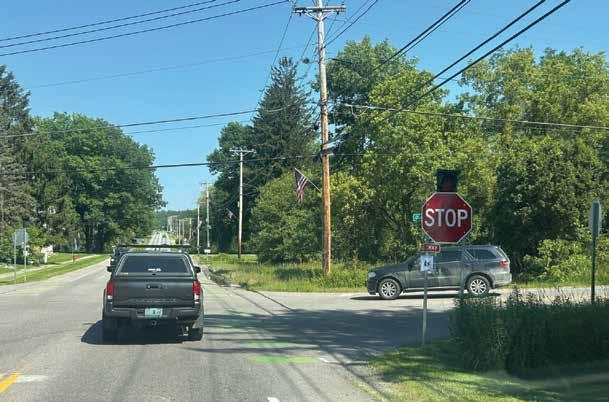
The Williston-headquartered nonprofit in February purchased the 12-acre property on the southeast corner of Williston Village’s main intersection the four-way stop where Oak Hill and North Williston roads meet Route 2.
There, across from such Village landmarks as Williston Federated Church and the Korner Kwik Stop, it plans to bring together volunteers and first-time homeowners to develop a multi-home community.
The first phase will focus on single story homes designed for aging in place, according to Chief Executive Officer Brett Johnson. It’s too early to pinpoint how many homes will be built in total. The organization, which dates back to the 1980s, has never built on a parcel of
this size.
The property has one vacant home on it that will be taken down.
“It came on the market and we said ‘this is a really interesting opportunity for us … to be really
thoughtful about how we can build a community of affordable homes that fits into Williston and serves the Williston community,’” Johnson said. “There is a lot of potential there.”
The new neighborhood will
be called Oak Hill Crossing. Green Mountain Habitat for Humanity serves first-time homebuyers with incomes under 80 percent of the area median income, as determined by the U.S. Department of Housing and
Urban Development. The homebuyers typically join volunteers in helping with construction. The homes built in the first phase of Oak Hill Crossing will be single-level homes for under $200,000.
“We’re going to be making sure we have housing that an older resident can purchase and grow old in,” said Johnson. Johnson became CEO in January following the retirement of the organization’s longtime leader, David Mullin.
Mullin saw the organization through mergers with Habitat for Humanity outlets in Swanton and Lamoille County and the opening of Habitat ReStore, where people donate household items to be sold at a discount to help fund homebuilding efforts.
“A lot of where Green Mountain Habitat for Humanity is, is because of the efforts that (Mullin) put in,” Johnson said. “It was an incremental, organic growth with a vision.”
Johnson is a Hinesburg native and current resident. He brings a background in construction as well as international economic and community development. He has worked in Washington D.C. and the countries of Botswana and North
Williston town tax rate increase set
On Tuesday, Williston’s selectboard approved a fiscal year 2027 municipal tax rate of 41.23 cents per $100 of assessed value, a 5.8% increase over the current year. For a median assessed home in Williston ($300,000) the increase in municipal property taxes is about $69 per year or $5.75 per month. The tax rate is determined by the amount of revenue the town must raise to fund the budget passed at Town Meeting Day in March. It includes the half cent approved by voters for the environmental reserve fund.
The rate adjustment is lower than expected due to a greater increase than anticipated in the value of the town’s grand list, the assessed value of taxable property within the town.
The grand list value increased by $35.5 million, up 1.65%, to reach $2.185 billion.
Tax bills are required to be printed and distributed by July 15.
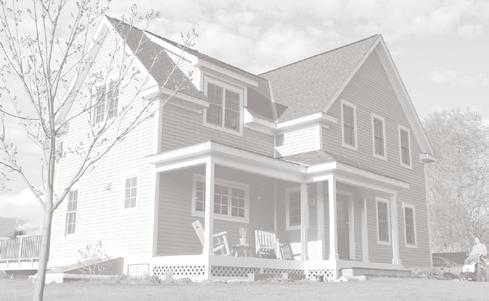
Green Mountain Habitat for Humanity is designing an affordable home community on 12 acres it bought in February at the intersection of Oak Hill, North Williston and Williston roads.
The Town of Williston will continue flushing hydrants in July. Some may experience low
at times.
FRIDAY, JULY 3
Deb Beckett Memorial 5K Run/Walk. Registration opens at 7:30 a.m. Village Community Park.
Ice Cream Social and Town Band Concert. 6:30 p.m. Village Green.
Library Book Sale. 4-6 p.m. Williston Central School.
SATURDAY, JULY 4
Library Book Sale. 9 a.m.-1 p.m. Williston Central School
Williston Historical Society Open House. 9-10 a.m. & 11:30 a.m.-12:30 p.m. Stovepipe Corner Schoolhouse on the Village Green
Old Brick Church Open House. 9 a.m.-12 p.m.
Parade, Activities and Fireworks. Parade begins at 10 a.m. Activities on the Green at 11 a.m. Fireworks at 9:20 p.m.
Fire Department Open House. 11:30 a.m.-1 p.m. Williston Fire Station
TUESDAY, JULY 7
Road Safety in Our Town Meeting. 5:30-7 p.m. Isham
Family Farm
Selectboard meeting.
7 p.m. Town Hall. Agenda at town. williston.vt.us.
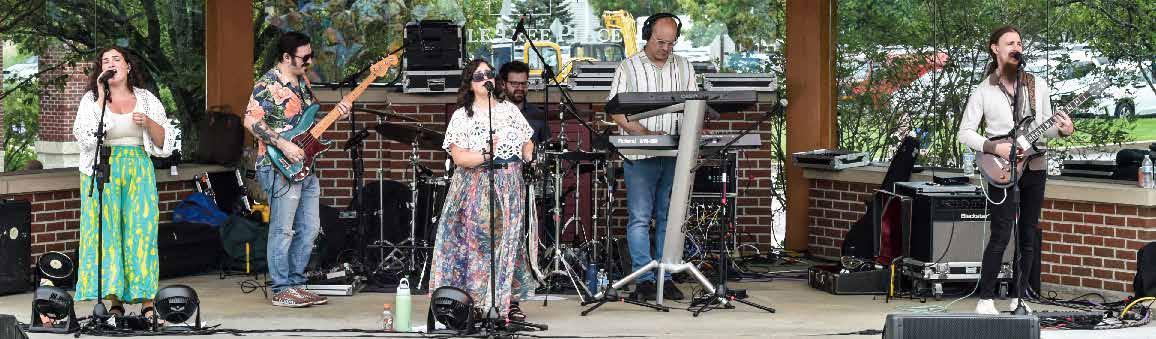
The songs of summer start
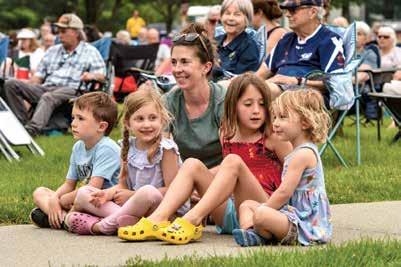
Fleetwood Mac tribute band “Little Lies,” above, kicks off the Thursday Night Concert Series at Maple Tree Place on June 25. Left, older fans sing along while, right, a new generation of listeners is introduced to the tunes.
Habitat
Macedonia. He said his work dried up last year when the fed eral government dismantled the U.S. Agency for International Development (USAID).
Less than four months into his tenure at Habitat, a stor age room fire shut down the
organization’s Williston ReStore outlet on Route 2A. The fire was contained to one room, but smoke damage was pervasive.
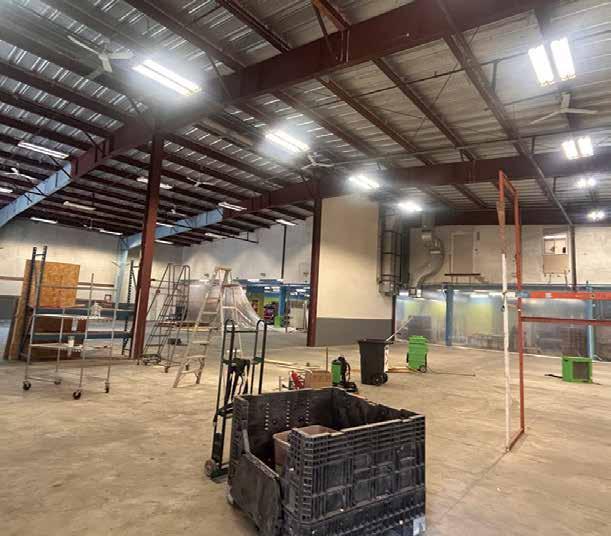
“I was in there mid-fire and you couldn’t see anything. There in the final stages of being fully cleaned. A grand re-opening is planned for later this summer on date to be determined.
Habitat has continued to accept donations for the store, filling out the former Walgreens across the parking lot from the organization’s administrative offices at Cornerstone Drive.
“We have a lot of great donors that haven’t forgot about us,” Senesac said.
The re-opened ReStore will be updated with what Senesac calls a “mission wall.” It will explain Habitat’s homebuilding efforts, helping people buying discounted items understand the connection between the store and the nonprofit’s primary mission. The wall will showcase progress on homes under construction and eligibility information for potential
“A lot of folks, I think, don’t necessarily know the linkage between ReStore and Green Mountain Habitat,” said Johnson.
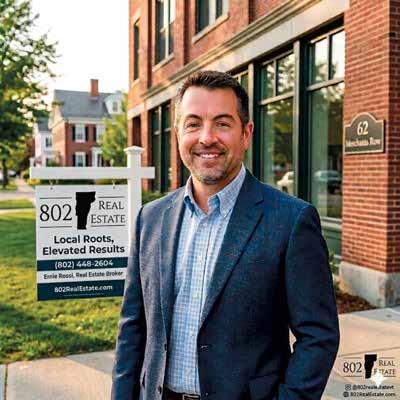
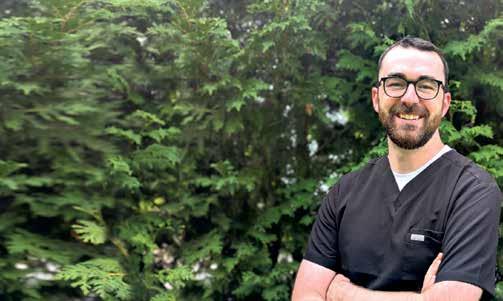
The ReStore on Route 2A in Williston, above, is being cleaned after an April fire shut it down. A summer grand re-opening celebration is planned. Brett Johnson, right, started as CEO of Green Mountain Habitat for Humanity in January. OBSERVER PHOTO BY JASON STARR
B PARTY
RICKS
he part y pops up on a different block of the Marketplace. Think patio dining, ng in the street, cold drinks, good friends, and warm summer nights.
Free to attend. All are welcome. ome hungry, come thirst y, come happy, and come ready to part y!
Ursa & The Major Key - Halvorson’s - Top Bloc
Red Hot Juba - Ken’s Pizza and Pub - Leahy B
Fly-By Ride - Church Street Tavern - Opera
Barbacoa - Gaku Ramen - City Hall Block
Green Kettle Band - Halvorson's - Top Block
Ali T - Ken's Pizza and Pub - Leahy Block
Serving our community since 1985
willistonobserver.com
P.O. Box 1401, Williston, VT 05495 802-489-5499
ADVERTISING
Adam Geffken, Account Manager
adam@willistonobserver.com 802-338-1655
Rick Cote, Associate Publisher rick@willistonobserver.com 802-373-2136
EDITOR
Jason Starr editor@willistonobserver.com
PRODUCTION & DESIGN
Jan Kenney jan@willistonobserver.com
PUBLISHER
Susan T. Cote susan@willistonobserver.com
BILLING INQUIRIES
Michael McCaffrey office@willistonobserver.com
ADVERTISING SPACE DEADLINE
Friday at 5 p.m. for the next Thursday issue adam@willistonobserver.com 802-338-1655
CLASSIFIED ADS
Deadline is Friday 5 p.m. There is a fee for business, real estate, help wanted and legal ads. Free classifieds must be 25 words or fewer and are printed on a space available basis.
SUBMISSIONS & LETTERS
Deadline is Monday noon for Thursday issue. News/story tips are welcomed. Letters to the Editor should be 300 words or fewer and include your name, address and a daytime phone number so that we can verify the letter’s author.
The Williston Observer reserves the right to edit or refuse submissions or advertising. Opinions expressed in the paper are those of the writer and do not necessarily reflect the opinion of the paper.
A publication of Twin Ponds Publishing LLC
Member:
Burlington
Patriotism is not a dirty word
BY SHAWN TESTER
A few months ago, rummaging through some old memorabilia, I came across a large bronze commemorative medallion my grandfather gave me during our nation’s bicentennial celebration in 1976. I was only 5 years old at the time, but I still remember the exuberance and pride that seemed to fill every corner of our community — flags waving from front porches, parades winding through town, and fireworks lighting up the summer sky.
Even our little town of Kirby joined in the celebration. There was a parade and community events at Brookside School, our one-room schoolhouse. For a young boy, it was all tremendously exciting, made even more memorable when Gov. Tom Salmon arrived by helicopter to take part in the festivities.
The school happened to sit next to my grandfather’s cornfield. In early July, the corn was knee-high and growing well. Unfortunately, the helicopter pilot decided that the cornfield looked like the perfect landing spot. You can imagine what the rotor wash did to those rows of corn. Watching my grandfather express his displeasure to the governor and his pilot left a lasting impression on my young mind.
My grandfather was a true patriot. The son of poor Irish immigrants, he embodied the American dream. He never made it beyond
Two hundred and fifty years after its founding, the American story is unfinished. That is not a weakness — it is the source of our enduring strength.
the eighth grade because he was needed on the family farm. At 16, he purchased his first truck and began hauling milk for local farmers. Over time, he built a successful transportation business and a thriving farm. In an era when opportunity seemed boundless, even a poor Irish Catholic kid with no high school diploma could envision a better future through hard work and determination.
What stands out most in my memory, however, is that his pride in America was not unique. It was widely shared. Patriotism was not viewed through a partisan lens. It was simply a common thread woven throughout civic life.
The 1970s were not an easy period for the United States. In many respects, the problems were similar to those we face now. Inflation was high. The nation was grappling with the aftermath of military failure. The previous decade had been
marked by political violence and social unrest. Watergate had shaken public confidence in government and public institutions.
And yet Americans celebrated.
We had recently put a man on the moon. The U.S. remained a global leader. The baby boom generation was entering its prime. Families gathered for cookouts. Neighbors flew flags. Communities came together to celebrate the remarkable experiment that is American democracy.
As we approach our nation’s 250th anniversary, the mood feels different.
What I see today is less pride and more fatigue. Whether it stems from our contentious political climate, the sense that the economy no longer works for ordinary people, the relentless 24-hour news cycle or the divisive influence of social media, I cannot say with certainty. Most likely, it is some combination of all these factors.
Yet despite these challenges, I believe we still have much to celebrate.
The great American experiment continues. Opportunities still exist for those willing to seek them. The U.S. is still among the world’s most influential nations and has one of its strongest economies. Millions around the globe still dream of calling America home.
Consider what we have accomplished over the last 50 years. Advances in medicine have
extended and improved countless lives. Innovations in technology have transformed how we work, communicate and learn. American universities, businesses, entrepreneurs and researchers continue to drive progress that benefits not only our own citizens but much of the world.
None of this means we should ignore our shortcomings. Patriotism is not blind allegiance, nor does it require us to overlook our faults. In fact, one of America’s greatest strengths has always been its capacity for self-correction. We debate. We argue. We stumble. But over time, we adapt, improve and move forward.
That is something worth celebrating.
So this Fourth of July, I will proudly fly my flag. I will gather with family and friends for a cookout. I will find a place to watch fireworks and reflect on the generations who built, defended and improved this nation before us.
Two hundred and fifty years after its founding, the American story is unfinished. That is not a weakness — it is the source of our enduring strength. And if history is any guide, I am confident that this remarkable nation will continue to flourish for generations to come.
Shawn Tester is the chief executive officer of Northeastern Vermont Regional Hospital.
LETTERS TO THE EDITOR
In
support of Lyons and Grossman
Folks, this is it! Election time and it’s time to choose our representatives in the Senate.
I was an elected local official in South Burlington for a good long time — fourteen years — long enough to know most of the people on this list through and through, including Ginny Lyons who has always earned my vote.
I respect anyone willing to serve and know personally the sacrifices that they make. Elected officials have a key position and authoritative voice — that we give to them — for them to use and make policy on our behalf.
When you make your choice in this primary, if you vote D, think about what is most important to you. Is it community and community building? Is it the community provided through our public schools? Is it healthcare over profits? Is it secure housing that people can afford, also the bedrock of our communities, as are our small businesses? Is it our green and blue infrastructure — our natural areas, streams, and lake — that will sustain us well into the future so that our communities can thrive?
If your answer is yes to all those things, I urge you to vote for Joanna Grossman. She has the heart, the
mind, and the guts to fight for us, our values, ideas, and enterprise. She actively listens, always seeking to learn from us and others how to accomplish these goals most effectively, responsibly, sustainably. She is in this for the future generations of Vermonters, our children and grandchildren, whose well-being depends on what we do now.
Vote! Don’t sit this one out or vote for the status quo. Vote for what you know most matters to us now and tomorrow. Vote Ginny and Joanna for State Senate - Chittenden Southeast.
Meaghan Emery South Burlington
Public responsible for participation
In response to his letter (A responsible path for rec projects, June 25), I agree with Mr. Martel that public input is a valuable and necessary tool. That being said, if David feels we need more, it would be good of him to offer solutions instead of just complaints.
To be sure, voluntary public surveys are an imperfect tool. Unfortunately, unless we hire someone to start knocking on every door in Williston to gather opinions, they’re the best tool we have. The most recent survey for the library
project revision was advertised online in several places. They’ve also had physical copies available at Williston Central Park and at the library itself. What other steps do people realistically want the town to take?
All that town officials can do is try to make decisions with the information available. If we the voters decide we dislike their decisions? We can vote against them, as many did in May.
Voting, of course, also relies on public participation – something we can’t force. It’s the responsibility of voters to stay engaged even when they’re busy. And yes, it can be frustrating to watch major decisions happen and see how many people sat out the vote. There are several votes, especially at the national level, that haunt me when I think about how they could have gone differently.
That doesn’t make the results any less valid. Contrary to David’s sentiment, “public silence” in a democracy is very much public permission. People refusing to engage until it’s too late is not the fault of our representatives. It would be good of Mr. Martel to remember that, especially given the patience those same officials have shown in the face of his many objections.
Stew Shearer Williston
Vermont game stores build a community beyond the table
BY JACKSON BARTELS Community News Service
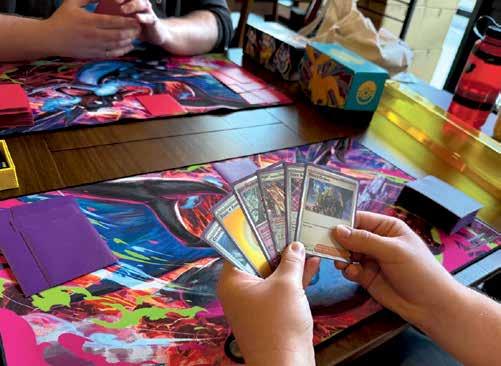
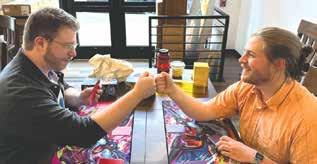
In the corner of the downtown Quarterstaff Games store, Ben Drape and Zach Roussel carefully laid out their play mats and shuffled their decks of Pokémon cards. After the final cut of the cards, the so-called Pokémon trainers exchanged a fist bump — a simple ritual signaling the start of their battle.
Around them, the store buzzed with activity and conversations. Fellow trainers — a Pokémon term for players — traded cards, sketched the Japanese characters and tested their skills on the Pokémon Champions video game.
The gathering, a part of Quarterstaff’s new weekly Pokémon Club, brought together fans of all ages to play, trade and build a community within and beyond the game.
“As a kid, I didn’t have a place like this. This is a reason why I am a huge fan of doing these events,” said CJ Burwinkel, a Pokémon “Professor,” or brand ambassador, who helped develop Burlington’s Pokémon
scene and attended the event. “Being able to provide not only for like-minded adults, but also kids, is really important.”
For many players, stores like Quarterstaff have become third spaces, welcoming places outside of work or home where friendships form around geek culture. The spaces allow the gamers to be themselves — even as they assume new identities in the games they play.
At their core, tabletop card games like Pokémon are strategy card games where players attempt to defeat their opponents. Role-playing games, or RPGs, such as Dungeons & Dragons, are narrative-driven games where players create characters and collectively shape an unfolding story. A “Dungeon Master,” for instance, acts as a narrator and referee, shaping the world and story surrounding the characters while establishing rules.
For Ross Johnston, who is queer and has epilepsy, playing D&D at their local library as a child provided an outlet where they could express themselves.
As Johnston got older, they sought out game stores as a space to connect with others. Through D&D, Johnston got the chance to role-play gay characters, which helped them find self-acceptance, they said.
Zach Roussel displays his hand in a Pokémon game as he prepares to battle Ben Drape at Quarterstaff Games in Burlington.
PHOTO BY JACKSON BARTELS
see GAMES page 9
Games
Johnston now works at Quarterstaff Games, which they said is a gathering spot for the queer community.
“There’s a Venn diagram there that nearly perfectly overlaps. The gays love D&D,” Johnston said. “You are getting to explore yourself and share these experiences with other people. Tabletop games are such a solid locus for that.”
Quarterstaff, which is also home to Earth Prime Comics, opened on the Church Street Marketplace in 1989 and is one of Vermont’s oldest game stores. It holds weekly events ranging from Pokémon Club Wednesdays to Star Wars Legion Thursdays.
In May, Quarterstaff relocated to the new Burlington Square development on Bank Street. Beyond having additional room, the new location is handicap accessible, eliminating a challenge posed by the stairs at the old location.
“We were turning away whole swaths of the community,” Johnston said. “We were unable to get certain certifications to run certain kinds of events. So that feels so important to us to be able to reach more of our community.”
Old Town Café & Comics in Williston has become another goto spot for gamers. As customers step through the door, they are greeted by rows of comic books on the right and shelves filled with novels, manga and graphic novels
to the left.
Nestled between them is the café’s bakery case, featuring menu items like the “Star Lord” breakfast sandwich and Oreo donuts.
Ben and Kelsey Perry bought the comic book business from its previous owner, Rory Malone, in 2024, operating under the name Champion Comics & Coffee. When the Perrys acquired the café side the following year, they renamed it to its current moniker.
Beyond its daily comic and café offerings, Old Town hosts monthly events such as Free Comic Book Day and release events for new Magic: The Gathering sets.
Last Saturday, Old Town hosted its second Free RPG Day, an annual national event where stores offer new and exclusive game content.
“The only goal is to just get people to meet other people and maybe try something that they haven’t,” Ben Perry said. “Even if you’ve never played a game before in your life, there will be something there for you and someone there who can teach you.”
Perry sees the shop as more than just a retail space, believing it serves as a community hub where people can connect through their shared interest in gaming.
“If you’re in this space, you are always going to be welcomed,” he said.
Via Community News Service, a University of Vermont journalism internship
Ross Johnston, right, poses at the former Quarterstaff location on the Church Street Marketplace.
PHOTO COURTESY OF ROSS JOHNSTON
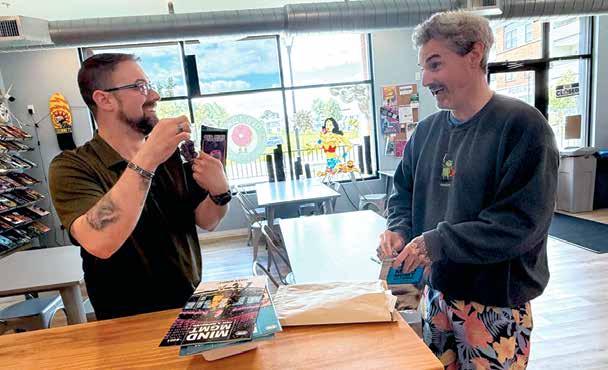
Old Town Café & Comics co-owner Ben Perry, above, stands with customer Brian Barrows as he opens game dice. Ben Drape and Zach Roussel, below, share a fist bump before their game.
PHOTOS BY JACKSON BARTELS
Learn
spot cyanobacteria blooms this summer
bacteria can grow in lakes and ponds as water warms, posing health risks
As you get ready to swim and play in Vermont’s lakes and ponds this summer, state health and environmental officials are offering tips on how to check the water for cyanobacteria blooms that can harm your health.
Cyanobacteria – sometimes called blue-green algae – are microorganisms that live in natural waters. Under certain conditions, these bacteria can collect into a bloom that can lead to skin rashes, diarrhea, sore throat, stomach problems and more serious issues.
WHAT A CYANOBACTERIA BLOOM LOOKS LIKE
Cyanobacteria blooms: Become visible as a layer on top of the water or shoreline.
Are usually green or blue-green and can make the water look like pea soup or spilled paint – but they can be other colors and consistencies too.
Do not have leaves.
WHAT TO DO IF YOU THINK YOU’VE SPOTTED A CYANOBACTERIA BLOOM
Avoid contact with the water. If you come in contact with it, rinse off thoroughly as soon as possible.
Talk with your health care provider if you experience symptoms or are concerned about possible exposure.
Do not let pets or livestock swim in or drink the water as they are at higher risk for serious illness.
“Cyanobacteria blooms can produce harmful toxins, so if you see a bloom, it’s best to stay out of the water,” said Bridget O’Brien, an environmental health scientist at the Health Department. “Exposure to water during a bloom is especially dangerous for kids, pets and other animals that might accidentally swallow it.”
People can report possible blooms to a beach manager, local
Town Health Officer and on the state’s cyanobacteria tracker. Because not all locations can be monitored and the tracker’s online map does not show real-time conditions at your favorite swimming area, it’s important to know how to spot a bloom in the water.
“Reports about bloom conditions submitted by volunteers and the public have been invaluable for understanding where blooms occur in the region, which can allow us to target monitoring efforts and remediation measures,” said Peter Isles, an aquatic biologist with the Department of Environmental Conservation.
The Health Department and the Department of Environmental Conservation work closely with the Lake Champlain Committee, which trains volunteers around the state to monitor Lake Champlain and other bodies of water for cyanobacteria blooms. Email lcc@lakechamplaincommittee. org to get involved.
Cyanobacteria particles are easily seen throughout water. They may resemble tiny hairs, pinheads or globs. The water is discolored and cloudy and there are visibly more particles near the surface or along the shoreline.
PHOTO COURTESY OF VERMONT DEPARTMENT OF HEALTH
Vermont to receive payback for inflated egg prices
U.S. Department of Justice found several large egg producers may have colluded to inflate
BY THEO WELLS-SPACKMAN VTDigger
Vermont will receive 915,000 eggs and $56,000 in settlement payments after an investigation indicated several large egg producers may have colluded to inflate prices between 2022 and 2025, officials said Tuesday. The eggs will go to the Vermont Foodbank.
The settlement stems from a 15-month investigation led by the U.S. Department of Justice and the New York attorney general’s office into a group of American egg producers.
Based on the findings, federal lawyers and attorneys general in 17 states filed a civil lawsuit Monday against giants Cal-Maine Foods, Versova/Centrum and Hickman’s Egg Ranch for “unlawful coordinated manipulation of egg prices.” Vermont will claim a small slice of the full settlements for the case, which are set to total 53 million eggs and $3.3 million nationwide.
“While consumers struggled to afford rising costs of basic groceries, the largest egg producers in the country were colluding to artificially inflate prices,” said Vermont Attorney General Charity Clark in a statement Tuesday. “They rigged the system and took money out of Vermonters’ pockets.”
Lauren Jandl, Clark’s chief of staff, said the financial impacts of these allegedly inflated prices on Vermonters are difficult to estimate. Egg prices soared to historic heights
in 2022 and again in 2025, with industry leaders citing bird flu as a primary cost driver.
“They’re looking for a villain,” Cal-Maine CEO Sherman Miller told the Wall Street Journal in its coverage of the issue last year. “We don’t control the power to lower egg prices.”
But according to Clark, Miller’s company and the other named producers had secretly communicated with each other to inflate industry pricing benchmarks. In 2022, the complaint reads, a Hickman’s Egg Ranch executive emailed counterparts urging “strong bids, early and often” in the market with the result of driving up costs. Frequent instances of such behavior over the course of years are laid out as evidence in Monday’s lawsuit.
In a statement Monday, CalMaine Foods strenuously disagreed.
“The Company denies all wrongdoing and violations of law and continues to believe that such claims are baseless,” read the statement. The communications cited in the lawsuit, the producer added, “did not impact egg prices in any market.”
Carrie Stahler, who leads government affairs at the Vermont Foodbank, said the organization was “really thrilled” with the outcome of the suit. Eggs are always in demand in the state’s charitable food system, she said, but lately higher prices have coincided with a substantial decrease in egg donations.
“It has been hard to keep eggs on
the shelf in quantities that are needed,” Stahler said.
The egg portion of Vermont’s settlement will arrive in three or four truckloads, she estimated, over several months. It’s a large amount, Stahler said, but not overwhelming given the state’s food assistance infrastructure and level of demand.
The Vermont Foodbank generally pays between $1 and $2 per dozen eggs, Stahler said, meaning the deliveries could be worth about $150,000.
To have settlements paid out in goods rather than money is not typical, Jandl said in an email Tuesday, but it’s not without precedent. Highprofile examples include opioid settlements in which states could choose to receive pharmaceutical products in lieu of cash, she said.
Stahler said the arrangement was “an important way to equitably
redistribute this product to people who were really strongly impacted” by the high prices. The fact that egg price hikes might have been artificially exaggerated is “especially egregious and frustrating,” she said.
The settlement comes against a backdrop of rising concern for the state’s food assistance network. Inflationary pressures continue to hit Vermonters hard at the grocery store, Stahler said, and cuts
to federal health care and food assistance programs have put more vulnerable households in jeopardy.
“This is an important step,” Stahler said, but “we know that demand is going to continue to increase, unfortunately, even with a windfall like this.”
Theo Wells-Spackman is a Report for America corps member who reports for VTDigger.
Celebrating America’s 250th birthday in the garden
BY AMY SIMONE Special to the Observer
As we prepare to celebrate 250 years since our nation’s founding, it seems like an opportune time to take a retrospective look into what gardening was like in America in 1776.
Long before the days of grocery stores and industrialized farming, early Americans planted gardens to provide their families and livestock with food and medicine. Garden plots were compact and efficient. Flowers, herbs and vegetables were interplanted to make the best use of every inch. Succession planting kept a steady supply of fresh vegetables available.
Tidy colonial kitchen gardens, located in a sunny location outside the kitchen door with a well nearby, were planted strategically throughout the growing season. Peas were the first seeds to go in in the spring and vined up on tripods or stick fences. The supports were repurposed for the pole beans later in the season. Both the peas and beans enriched the soil with nitrogen, benefiting future crops.
Root vegetables such as onions, carrots, beets, horseradish, parsnip, skirrets (resembling a skinny parsnip), turnips
and radishes were tucked into spaces between the peas and beans. Leeks were grown for both culinary and medicinal purposes, but garlic was only grown for
its medicinal benefits, not for cooking.
Salad greens, at the time called sallet herbs, included edible green leaves such as lettuces, dandelions, mustard, chives, spinach, mint, chard, cabbage, pea shoots and nasturtium. These offered a welcome variety after a winter of dining on root vegetables.
Parsley was grown to be eaten, as well as for its stellar medicinal properties.
and tinctures. Everything from roses, anise hyssop, chamomile, comfrey, lavender, lemon balm, lemon verbena, marjoram, bee balm, mints, calendula, feverfew, clove pinks, Sweet William, violets and primroses supplied the household with the ingredients to remedy many conditions.
Beyond the fenced-in kitchen garden, you would find fruit and nut trees, and berry bushes. Apples and pears were grown for cider. Chestnuts were roasted or made into flour, and walnuts were eaten raw, turned into oil or used in baking.
Further from the home, no matter the size of the plot of land, were the fields where the spreading crops were grown. Cucumbers, squash, pumpkins, gourds, rye, barley, corn and additional turnips that were grown as feed for livestock would be found here.
Corn was an important crop, with kernels that were dried and ground into cornmeal, to be used as an ingredient in hasty pudding and johnny cakes. Hardy rye was grown to use as flour when wheat crops failed. Beer-making and livestock depended on barley production.
Interestingly, potatoes and their nightshade relative, the tomato, were not found in the colonial gardens at this time.
We are a nation with a rich history of gardening, and American gardeners still have the enviable joy of being able to grow their own flowers, herbs, fruits, nuts, berries and vegetables.
Happy birthday America!
Flowering plants were essential elements of the kitchen garden, doing dual duty by offering both beautiful flowers as well as ingredients for medicinal teas
Amy Simone is a UVM Extension Master Gardener volunteer from South Burlington, Vermont.
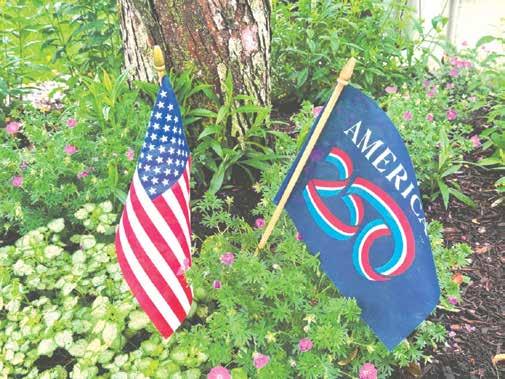
American flags brighten a garden in celebration of the United States’ 250th anniversary.
PHOTO BY AMY SIMONE
Dorothy Alling Memorial Library hours:
• Monday and Wednesday: 9 a.m.-7 p.m.
• Tuesday, Thursday, Friday: 9 a.m.-6 p.m.
• Saturday: 10 a.m.- 3 p.m. Visit www.damlvt.org to apply for a library card and register for programs. Need help? Call 878-4918 or email daml@ damlvt.org.
Please note the Library is closed on July 4th in observance of Independence Day. Visit the Book Sale or see us in the parade!
YOUTH PROGRAMS
Children 4th grade and younger must be supervised by someone over 16 years of age.
STORYTIME
Tuesdays, July 7 & 14. Drop in for stories, songs, and fun. Outdoors weather permitting.
MUSIC & PLAYTIME
Thursday, July 9, 10:3011:30 a.m. Enjoy music with Gerry, followed by playtime! Outdoors weather permitting.
LEGO TIME
Thursday, July 9, 3-4 p.m.
Build something exciting with our LEGO collection.
SATURDAY STORYTIME
Saturday, July 11, 10:30-11 a.m. Start your weekend off with Cindy’s Storytime!
BABY TIME
Wednesday, July 15, 10:30-11 a.m. Suggested ages 0-18 months. Drop in for gentle bonding and social activities with your little one!
MULTI-AGE PROGRAMS
SUMMER READING CHALLENGE: UNEARTH A STORY
June 13 - August 9. All ages, Williston and St. George residents only. Register for the Summer Reading Challenge at https:// damlvt.beanstack.com/.
Earn rewards and raffle tickets by tracking your reading this summer, and help us reach our community goal of 10,000 hours!
VERY MERRY THEATRE: MOANA JR.
Thursday, July 16, 12-1:30 p.m. Join us on the Town Green for Very Merry Theatre’s performance of Moana Jr.! (Rain location: Old Brick Church.)
ADULT PROGRAMS
For online programs or to join a book club, email daml@damlvt.org.
SEATED TAI CHI WITH ADINA (ONLINE)
Every Thursday, 1-2 p.m. Quiet your mind and reduce stress with this gentle exercise from the comfort of your own home.
ADULT MEDITATION (ONLINE)
Fridays, July 3 &10, 1212:30 p.m. Join our guided meditation to relax and re-center.
MAH JONGG
Fridays, July 3 & 10, 1-3 p.m. Drop in to play this popular tile game.
TECH TUTOR*
Tuesday, July 7, 1-4 p.m. Call for an hour appointment for help with your tech.
ADULT CRAFTERNOON: BEADED PLANT STAKES*
Tuesday, July 7, 2-3 p.m. Dress up a potted plant with some sparkle. Register online.
CURRENT EVENTS
Wednesday, July 8, 10:30 a.m.-12:00 p.m. Come chat
with community members on your topic of interest.
LIFE STORIES (ONLINE)*
Wednesday, July 8, 2-3:30 p.m. Join us for some reminiscing.
GREEN MOUNTAIN CHAMBER MUSIC
Friday, July 10, 1-2 p.m. Enjoy this interactive exploration of the string quartet literature via lecture & live performance by GMCMF students.
FRENCH CONVERSATION
Saturday, July 11, 10:4511:45 a.m. Join native French speaker in an informal conversation group. All abilities welcome.
BOOK CLUB BUFFET
Tuesday, July 14, 12:30–1:30 p.m. The Many Lives of Mama Love by Lara Love Hardin follows a real life soccer mom with an addiction. Email us for the Zoom link .
COOK THE BOOK
Wednesday, July 15, 12-1 p.m.
Library Project Survey
Fill out the Library Project Survey and make your voice heard – go to WillistonLibraryProject.org by July 4th.
Library Trustees are evaluating options for reducing the cost and scope of the proposed library project. This survey is intended to help identify which project components residents value most and what overall project cost the community would support. You can also fill out a paper survey at the library.
Celebrate our nation’s 250th birthday month with a recipe from 50 pies, 50 states by Stacey Mei Yan Fong and Culinary Bingo. Sign up at the library.
CRAFTER-EVENING: VEGETABLE AND FRUIT PRINT TOTE BAGS*
Wednesday, July 15, 6:30 p.m. Register online. We have canvas tote bags supplies to make amazing designs – yes, you do need another tote bag!
If you would like to have your establishment included in this section please call Adam at 802-338-1655 or email Adam@WillistonObserver.com
Burlington’s Champlain Parkway, a project 60 years in the making, opens to the public
The new roadway spent decades marred by legal battles and other delays
BY SHAUN ROBINSON VTDigger
After more than six decades of starts and stops, legal fights and revisions to plans already revised, the final segment of Burlington’s Champlain Parkway opened to the public Monday, bringing online a major new car and bicycle connection through the city’s South End.
The project now links Interstate 189 to Lakeside Avenue along a route that circumvents the southern end of Pine Street and its adjoining neighborhoods. The segment that opened Monday runs from the interstate to Home Avenue. A portion from Home Avenue to Lakeside Avenue, which also features bike and pedestrian paths, opened in 2024.
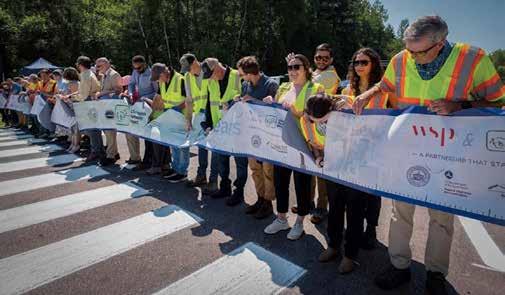
That it took so many years to finish the project was a major focus — and source of more than a few jokes — at a formal opening ceremony Monday morning. City officials blasted music from the 1960s throughout the event, including The Beatles’ “Ticket to Ride” just after they cut a 61-foot ribbon across the roadway.
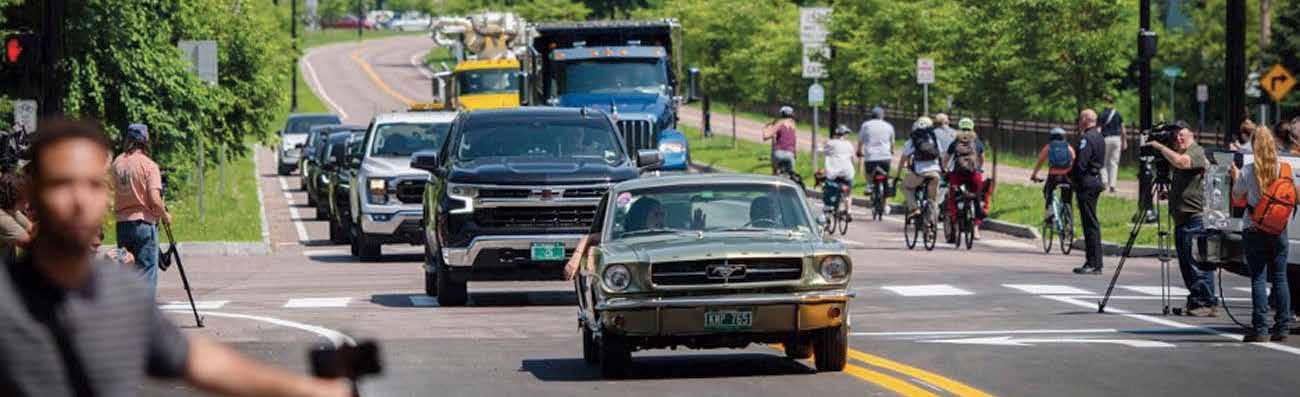
A 1965 Ford Mustang, produced the same year the project was conceived, led a procession of city, state and federal officials up the road as the event concluded.
The project will cost about $85 million in total, mostly funded by the federal government through a cost-sharing agreement with the state and city as is typical for major infrastructure projects. In addition to the new road itself, the project includes new water and sewer infrastructure
aimed at reducing runoff into nearby Lake Champlain.
“Given this project is older than many of us standing here, I must remark what a long, strange trip this has been,” Chapin Spencer, Burlington’s director of public works, told
the city than was originally envisioned.
Exactly how big the project would be and where it would run was the subject of decades of legal fights. It cleared a key hurdle in May 2023 when a federal judge granted summary judgement to the feder-
the crowd. But the city has “proven that we can do hard things together,” he added, “and this is an amazing win.”
The version of the project that opened Monday is far from what was envisioned 61 years ago, when officials proposed a fourlane, high-speed extension of I-189 along the city’s waterfront, known as the “Southern Connector.” That plan was later scrapped and, in more recent years, downsized to a two-lane road with a 25-mph speed limit that officials say is much friendlier to those who walk or bike and will result in a lower volume of car traffic being shepherded into
al, state and city governments over a challenge from a group of local residents called Friends of Pine Street.
Parts of that lawsuit centered on arguments that the parkway would disproportionately impact the Maple and King street neighborhoods, which surround where traffic from the new roadway funnels into downtown along a reconstructed portion of Pine Street.
A separate but related project to direct traffic around the Maple and King neighborhoods, called the Railyard Enterprise Project, is underway, but officials are still in the process of securing the rights to
build on their planned route, Spencer said at Monday’s event. He said the public works department expects to have an update for the city council on the project in the next month or two.
City officials touted Monday how the Champlain Parkway, for its part, will reduce congestion on Shelburne Road and around much of the South End. They’ll be monitoring traffic data over the next few years to see whether or not that goal is achieved. The project will also provide a direct link between the interstate and an area in the South End where plans are in place for hundreds of new apartments.
Burlington Mayor Emma MulvaneyStanak said that means the project’s completion “isn’t the finish line.”
“It’s the infrastructure that will support the next generation of Burlington’s growth,” she said, adding it “will help us build more housing, improve mobility, strengthen our neighborhoods and reduce environmental impacts while creating a city where people have real choices (for) how they live and how they get around.”
U.S. Sen. Peter Welch., D-Vt., who was also on hand to cut the ribbon, said the project’s protracted timeline is a case study in the need to speed up how long major construction projects take to build in the U.S. He said federal officials need to find a way to expedite project reviews while balancing the need to scrutinize potential environmental impacts.
“Sixty-one years is a little long,” Welch said, drawing laughs from the crowd. “Why don’t we, in the federal government, make certain that we take responsibility — so projects are not stuck and stalled.”
Dignitaries cut a 61-foot ribbon during the opening ceremony for the Champlain Parkway in was held in Burlington on Monday, June 29, 2026, 61 years after it was first proposed.
PHOTO BY GLENN RUSSELL/VTDIGGER
Burlington Mayor Emma-Mulvaney-Stanak waves from the passenger seat of a 1965 Ford Mustang driven by Dan Nolin of Georgia during the opening ceremony for the Champlain Parkway in Burlington on Monday, June 29, 2026. Nolin’s Mustang was built in the year the road was conceived of 61 years ago.
PHOTO BY GLENN RUSSELL/VTDIGGER
Worsening tick activity may be new normal, state officials say
Experts attribute the growth of tick-related illnesses to climate change and more frequent tick-human contact.
BY INDI ROSE Community News Service
Grab your long socks, because this summer is shaping up to be the highest activity tick season the country has seen in nearly a decade, experts say.
This spring, weekly emergency room visits for tick bites in most parts of the U.S. reached their highest rates since 2017, according to the CDC. In Vermont, ER and urgent care visits have exceeded the 2017-2025 average nearly every week so far this year, but haven’t yet reached historic maximums, Vermont Department of Health data shows.
Experts attribute the growth of tick-related illnesses, such as Lyme disease, to climate change and more frequent tick-human contact.
Patti Casey, the manager of the Vermont Agency of Agriculture’s Vector Surveillance Program, which monitors tick and mosquito populations, said that this season represents a new normal for Vermont.
“I don’t think we’re going back,” Casey said.
“There are people really desperately trying to figure them out and better control them, but I think that ticks and their diseases are going to outpace the research,” she added.
Vermont has more than a dozen different species of tick, including the blacklegged tick, which is known to carry pathogens that cause Lyme disease. Also called the deer tick, the species is responsible for nearly all cases of tick-bite illnesses reported to the state, data shows.
The American dog tick, meanwhile, can carry bacteria that causes Rocky Mountain spotted fever, a potentially fatal but extremely rare disease in the region.
Casey’s team collects ticks by dragging cloths across swaths of land, aiming to identify tick and
mosquito-borne diseases in the environment before they infect humans and livestock.
So far, Casey reported that American dog ticks are the most prevalent species caught in her sweeps. But the team has also found blacklegged ticks in eight towns for the first time. They include Barton, Braintree, Bridgewater, Canaan, Dover, Franklin, Orange and Readsboro.
Casey said the ticks likely already inhabited the areas but now exist in greater numbers.
The sightings in Barton and Canaan, in the Northeast Kingdom, indicate that blacklegged ticks have developed the ability to spread farther as tem-
“There are people really desperately trying to figure them out and better control them, but I think that ticks and their diseases are going to outpace the research.”
Patti Casey Manager VT Agency of Agriculture Vector Surveillance Program
peratures warm, Casey said.
According to a 2018 report by the Vermont Department of Health, changes in seasonal patterns and temperature are factors in the surge in tick activity.
Mature ticks can survive in temperatures as low as 23 degrees below freezing for short periods of time by remaining dormant. But when there are warm bursts and fewer cold months of the year, ticks are more likely to be searching for food.
“If you’re a tick out looking for
a meal, one warm day matters,” Casey said.
Beyond changes in weather patterns, opportunities for human-tick encounters have also increased. Research shows that the COVID-19 pandemic prompted more people to spend time outdoors, while a rise in pet ownership brought more dogs into tick habitat.
As Vermonters spend more time on trails, in forests and in their backyards, the chances of encountering ticks — and the diseases they carry — have risen alongside the growing tick population.
Additionally, ticks have been shown to prefer lounging on invasive plants, which are an active threat to Vermont forests.
Dr. Peter Hyson, an infectious disease physician at the University of Vermont Medical Center, is concerned about Rocky Mountain spotted fever, a bacterial infection that can be transmitted from dog and other tick bites. The infection is especially dangerous for people with weakened immune systems, and can be fatal. Its symptoms include high fever, rashes, muscle pain, possible seizures and more.
Researchers have no indication that the bacteria which causes Rocky Mountain spotted fever is currently present in Vermont tick populations, but cases have been detected in the region. The disease was reported in Quebec last year and has been recorded in other New England states, though it’s unclear where those patients contracted it.
As the climate changes, Hyson worries that cases could start emerging in Vermont.
“The health of the environment really is inextricable from the health of the human population,” Hyson said. “People should be aware of the impact of our actions on the environment and that those actions have blowback.”
In the meantime, public health
workers are working on solutions to the tick problem, including developing vaccines.
In the 1990s, the Lyme vaccine LYMErix was shown to be effective in preventing the disease. But some patients reported side effects after receiving the vaccine, most commonly arthritic symptoms. The FDA investigated and found no evidence that LYMErix caused arthritis, but media coverage and a class action lawsuit dulled the product’s reputation. The manufacturer pulled the vaccine from the market in 2002.
More than 20 years later, clinical trials of new vaccines are under way. The new vaccine recently completed the last phase of human trials. The University of Vermont is a site for a portion of these trials, according to Hyson.
But until a vaccine is developed, the best chance of avoiding tick-borne illnesses is to take preventative measures: frequent tick checks and protective clothing.
For Lyme disease to be transmitted, an infected blacklegged tick typically must remain attached for more than 24 hours, making prompt removal an important prevention tool. Even when a tick carries a disease-causing pathogen, a bite does not necessarily result in infection.
Despite the worsening conditions, Casey said people shouldn’t be afraid of spending time outside.
“There are things you can do to keep yourself safe,” she said.
Community News Service, is a University of Vermont journalism internship program.
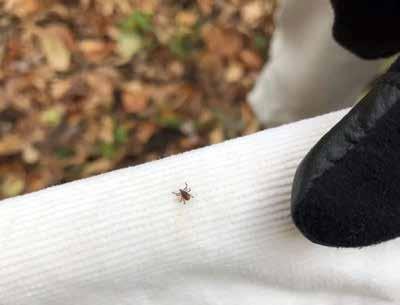
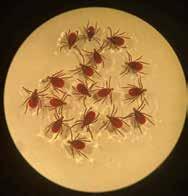
A tick caught in a sweep, above. Blacklegged adult female ticks, left, as seen under the microscope.
COURTESY PHOTOS BY ELIZA DONCASTER/ VT AGENCY OF AGRICULTURE
Margaret Mary (Sandoz) Aman
Margaret Mary (Sandoz) Aman died unexpectedly and far too soon on June 11, 2026. She was the anchor of her family, a person of steadfast conviction and curiosity, and a friend to all. She will be missed dearly.
Marge was born in Omaha, Nebraska on Oct. 17, 1949, to Paul and Elizabeth Sandoz. She graduated from Mercy High School and the College of Saint Mary. After college, she embarked on a career that began in medical record administration and finished in career advising at Champlain College in Burlington, Vermont.
Marge was a voracious reader and a skilled gardener. She loved lunches with friends, volunteering at the Dorothy Alling Memorial Library, Nebraska Cornhusker football, and long road trips with her husband, Dennis. Her greatest joy was her family, particularly watching her grandsons grow into young men.
Marge is survived by her husband (Dennis), her son (David) and his fiance, (Kate Whalen), her daughter (Laura Greene) and Laura’s husband (Jason Greene) and their children (Owen and Andrew), Marge’s siblings (Mary Koziel, Tom Sandoz, and Fr. Robert Sandoz), and her sister-in-law (Jan Sandoz). She was predeceased by her daughter (Christine), her brother (John), and her sister (Susan).
A memorial service for Margaret was held on June 25, 2026, at the Chapel of the Sacred Heart of Jesus (at the Mater Christi School in Burlington).
In lieu of flowers, please consider supporting the Dorothy Alling Memorial Library (damlvt.org) or the Mater Christi
School (mcschool.org/donate).
Arrangements have been entrusted to the care of Ready Funeral Cremation Service. To send online condolences to the family please visit www. readyfuneral.com.
April Drolette
April Drolette (Sabourin), 80, of Williston, VT, and a longtime resident of Milton, passed away peacefully on June 20, 2026, surrounded by the love of her family. Born in Windsor, April lived a life defined by faith, family, friendship, and unconditional love. She was the beloved wife of Donald Drolette, and together they shared 60 years of marriage filled with devotion, laughter, partnership, and countless cherished memories.
For more than 50 years, April worked as a hairdresser, a career perfectly suited to her warm and social nature. Blessed with what family and friends affectionately called “the gift of gab,” she could strike up a conversation with anyone and often did. Many of her clients became lifelong friends, and anyone who knew April knew there was a good chance she had a pair of scissors nearby, always ready to give someone a quick trim or haircut. For April, hairdressing was never just about hair—it was about people, connection, and friendship.
While she took pride in her work, the true center of April’s life was her family and her Catholic faith. Her faith guided her daily life and shaped the way she cared for others—with kindness, compassion, and unwavering love. It was reflected not only in what she believed, but in how she lived.
April found happiness in the
OBITUARIES
simple things that made life beautiful. She loved spending time in her gardens, tending her flowers, and enjoying the beauty of every season. In her younger years, she loved dancing with Don. Their special song, Anne Murray’s “Could I Have This Dance,” remained a lasting reminder of the love story they shared throughout their lives.
As a mother, April was her children’s biggest supporter. No matter the activity, event, or milestone, she was there. Whether cheering from the sidelines, keeping score, running the clock at a field hockey game, or simply offering encouragement, her family knew they could always count on her love and support.
Nothing brought April greater joy than being Nana. Her grandchildren, Jacob and Lola, were among the greatest blessings of her life. She treasured every moment spent with them and took immense pride in all they accomplished. Whether attending their events, celebrating their successes, or simply spending time together, she made them feel deeply loved. The memories they shared and the love she gave so freely will remain in their hearts forever.
April also cherished her many friendships. She was blessed with a close circle of lifelong friends who shared in life’s joys and challenges through the years. Loyal, caring, and dependable, she was the kind of friend who was always there when needed.
She was predeceased by her parents, Leo and June Sabourin.
She leaves behind her beloved husband, Donald Drolette; her daughters, Wendy Drolette and her lifetime partner, Chris Walker; Dori Fredette and her husband, Tom Wojeck; and Melanie Racette and her husband, Eric Racette; her grandchildren, Jacob Fredette and his fiancée, Emma Longe, and Lola Racette; and her great-grandchildren, Kayleigh and Carson. She is also survived by her sisters, Bernadette Sheppard and her husband, Ron; MayEllen Munger and her husband, Reg Matot; and Marsha Sabourin; her brothers, David Sabourin and his wife, Diane; and Rodney Sabourin and his wife, Marge; along with many nieces, nephews, extended family members, and dear friends.
April’s greatest gift was the love she gave to others. She will
be remembered for her unwavering faith, her generous heart, her loyalty to family and friends, and her ability to make everyone feel welcome. Though she will be deeply missed, the love she shared and the example she set will continue to live on in all who were fortunate enough to know her.
Her family finds comfort in knowing that the faith that guided her throughout her life now carries her home to eternal peace.
The family would like to extend their heartfelt gratitude to the staff of McClure Miller Respite House for the loving, thoughtful, and dignified care they provided to April. Their compassion, kindness, and support brought comfort not only to her, but to her entire family during a difficult time, and for that we will be forever grateful.
A Mass of Christian Burial was celebrated on June 26, at St. Ann’s Church, Milton, with burial following in St. Ann’s Cemetery.
Henry E. Iby
Henry E. Iby passed away peacefully at home in Vergennes, Vt. on June 6, 2026, at the age of 92.
Henry was born in Burlington, the son of Hobert and Lena (Steeves) Iby. In Nov., 1954 he married Lorraine (Bundy) and together they raised seven children at his family home in Williston.
The greatest joy of his life was farming and he worked for several years doing just that on the Mahan farm in Williston. He also maintained his own mini farm. Being on one of his tractors was where he spent his summers.
Henry is survived by his children and their spouses Deanna
(Timothy) Heath, Susan LaBerge, Sheryl (Paul) Latreille, Lorraine M. Iby, Wendy Iby, Hope (John) Hatch, and Henry H. (Robin) Iby. Also surviving are several grandchildren, great grandchildren, great-great grandchildren, nieces and nephews. Besides his parents, Henry was predeceased by Lorraine (Bundy), his loving wife of 71 years, sister Shirley Iby, grandson Jason Johnson and great grandchildren Amanda (Smart) Charbonneau, Michaela Smart, and Mark Johnson-Dion.
The family held a Celebration of Life for Henry and Lorraine on June 28, 2026 at the Eagles Club, South Burlington with a private, joint burial ceremony at the Deer View Cemetery.
Diana Marie (Welch) Owen
Diana Marie (Welch) Owen, 74, passed away on June 1, 2026, at the UVMMC in Burlington surrounded by her loving family.
She was born in Oakland, California on Nov. 5, 1951, daughter of the late John and Julia (Hussing) Welch. Diana’s father was in the navy so she was well traveled and lived in many parts of the U.S. She spent three years in Yokohama, Japan (where she graduated high school and met her ex-husband), and then moved to Vermont to start a family.
Fun fact: Diana attended the first Super Bowl in 1967 with her family in Los Angeles, CA, Green Bay vs. Kansas City.
Diana was known for her signature deviled eggs and cheesecake, her impeccable smile and laugh, love for animals, and her ability to out talk anyone she met. She was a stay-at-home mom, worked for 911 emergency dispatch, and in the housekeeping department at an inn.
Her favorite role was being a grandparent and she loved spending time with and spoiling her grandkids and grandanimals. She will forever be known for her gentle soul, kindness and humor; even at the end of her life.
Diana is survived by her two sons Jesse Owen, Jason Owen and wife Sarah, her daughter Krystal Fuller and husband Josh, the father of her children Clifford Owen, five grandchildren Austin Owen, Madeline Owen, Eloise Owen, Joise Fuller and Fletcher Fuller, two great grandchildren Ava Owen and Sawyer Owen, several nieces and nephews whom she loved dearly, a cousin, an aunt, granddog Cosmo, and grandcat Toes.
Diana is also predeceased by her brother John Welch, sister Debra Peavler, and three dogs: Snowball, Sugar and Bear.
A service was held in the family lot in Deer View Cemetery in Williston. A Celebration of Life was held at the Catamount Country Club in Williston, VT June 18.
In lieu of flowers, memorial contributions in Diana’s memory may be made to the Humane Society of Chittenden County, https://www.hsccvt.org. Please visit www.awrfh.com to share your memories and condolences.
Andrew ‘Andy’Parker
Andrew Parker, also known as Andy, 86, of Williston, passed away on June 1, 2026 at UVM Medical Center.
Andy was born on Feb. 5, 1940, in Eden Mills, VT, the son of Henry and Eva (Pepin) Parker. He attended Johnson High School in Johnson, VT,
and Saint Phillips College in San Antonio, Texas, 1974. Andy served in the Vermont Army National Guard, 43rd Division in Morrisville, VT from 1957-1960 and the 26th Yankee Division in Springfield, MA from 19601964. For the majority of his life, Andy worked in the construction field and was a welder.
Andy, along with his wife Beverly Granger, operated a Bingo in Essex Junction, known as Backyard Bingo, for 24 years. During these years, Andy came in contact with hundreds of people and many remained lifetime friends. Some of the happiest years for Andy were knowing that the time and work he was donating to Backyard Bingo were going to a good cause. Some of the nonprofit organizations were: Kids On The BlockVermont, Discovery Museum of Essex, which later merged with ECHO (Lake Champlain Basin Science Center), Burlington Lions Club for the Blind Association, Frontier Animal Society of VT, Cathedral Square Corporation, Boy Scout Troop 601, and the Franklin County Animal Rescue.
During his younger years, when Andy wasn’t working or donating his time, he enjoyed fishing, deer hunting, and cooking. He also enjoyed working with his dad in the wood industry.
Andy was predeceased by two daughters, Renee Parker in 1977, Rhea Parker in 2009; his parents, Henry and Eva Parker of Eden Mills; his brothers, Dale of Florida, Jess of Texas, Robert of Tennessee, and Arthur of Vermont.
He is survived by a daughter, Ronda Parker of Vermont; two grandchildren, Kayla Kizer (her daughter Star), and Kyle Kizer all of Vermont; his sister Bonnie St. Onge of Pennsylvania; his longtime best friend and wife of 35 years, Beverly Granger of Williston, VT, and two little buddies, Cricket, a Yorkie, and Abby, his cat. Andy was also predeceased by his buddy Daisy Mae, a 12 year old Yorkie.
A graveside service will be held sometime in September. Arrangements are in care of LaVigne Funeral & Cremation Service, Winooski. To send condolences to his family, please visit www.vtfuneralhomes.com.
OBITUARIES
Paul Peter Stender
Paul Peter Stender passed away, surrounded by his loving family, at the UVM Health McClure Miller Respite House in Colchester, Vt. on June 19, 2026, after a nearly fiveyear long battle against health complications, at the age of 77.
Paul was born in Lebanon, NH, on Sept.16, 1949, the second son of three to David Flint Stender, Sr. and Mary Helen (Safko) Stender.
Paul grew up in Chelsea with his two brothers David, Jr. and Lee. He spent his days working on the farm of George Edwards, a very close friend of the family, enjoying summer days with his friends at the family camp in Tunbridge, later known affectionally as “Pine Tree Cabin” — due to the massive pine tree that grew next to the structure that his father, David, and his uncles Paul and Robert, built in 1958 — and exploring the nearly 116 acres of the family homestead in the hills of Chelsea with his brothers, amongst the copious blackberry bushes, apple and pear trees, juniper bushes, stone ledges, sugar maples and pines. Paul attended Marian High School in Barre and after graduating in the summer of 1967, he enlisted in the United States Navy in the fall.
Over the course of the next six years, Paul served as an Electronics Technician, Nuclear, Third Class, with the naval construction battalions, known as the Seabees, aboard the USS W. S. SIMS, DE-1059, a U.S. Navy Knox-class frigate which served in the Atlantic Fleet. He was recognized with the National Defense Service Medal and Navy Good Conduct Medal.
During his deployment, he made port at the Roosevelt Roads Naval Station in Ceiba, Puerto Rico, where he met Mary Louise Rosa, the love
of his life, and married on May 15, 1971. After his honorable discharge from the U.S. Navy in the fall of 1973, he and his bride moved from the naval base in Jacksonville, Florida, back to his home state of Vermont where he started his career as an electrical engineer with General Electric in Burlington (later to be acquired by General Dynamics) and continued his service to his country by signing up with the Vermont Air National Guard, achieving the rank of Technical Sergeant, supporting the 158th Fighter Wing – the Green Mountain Boys – and their squadron, at the time, of F-4D Phantom IIs, and later their replacement squadron of F-16 Fighting Falcons.
After settling in Williston, Paul and Mary started their family with the birth of their son, Craig, in June of 1976, and adding to it with the birth of their daughter, Michelle, in October of 1978. Paul remained at General Dynamics as an electrical/ quality engineer, working on various defense and aerospace platforms and programs, such as the Aegis Illuminator Director, the turrets of the AH-1 Cobra, the M61A1 Vulcan, the GAU-19/A (GECAL 50), the XM2001 Crusader, the Advanced Gun System for the U.S. Navy, and many others, over the course his 30 year long career, until his retirement in 2009.
Paul was a dedicated family man, always there to assist and be there with his family for anything and stand by them, no matter what. He never missed a single sports event his children participated in,
from t-ball to collegiate basketball, sometimes even volunteering to be a cheerleader, coach, referee or umpire.
Paul was a builder and tinkerer, who loved to work on renovation projects, sometimes spanning years. The first television he had in his home in Williston, was one that he built himself from scratch.
He was a dedicated employee and co-worker who took great pride in the work he did, the programs he supported, and the teams of people he worked with. He was a great friend, a trusted neighbor, and a kind stranger who would stop what he was doing to assist anyone he saw in need. He loved history, Star Trek, cats and eagles, CCR and Three Dog Night, Al’s French Fries, and was an avid NASCAR and Boston Bruins fan.
Paul is survived by his wife Mary, his son Craig and daughter-inlaw Hannah, and their son Cameron; his daughter Michelle; his brother David, Jr., sister-in-law Jane, niece Janette, and nephew David III; his brother Lee, sister-in-law Debbie, niece Jackie, nephews Justin and Jason. Paul is predeceased by his father David and mother Mary, and his cherished pet cats Silk, Satin, and Cuervo.
A Celebration of Life and Memorial will be held a future date this fall, around what would have been Paul’s 78th birthday, at a date and venue to be determined. A graveside service was held July 2, 2026 in the family lot in Hunt Cemetery in Tunbridge.
By Jim Miller
Dear Savvy Senior, I just turned 58 and heart disease runs in my family. My cholesterol has been creeping up, and I’ve been hearing about a scan that can show your actual heart risk. Is that something I should look into?
—Heart Worried
Dear Worried, You’re smart to be thinking about this now. For years, cholesterol numbers have been the main way to estimate heart disease risk. But there’s another tool gaining attention that can offer a more direct look: a coronary artery calcium scan, or CAC scan.
This quick, noninvasive test looks for actual plaque buildup in your heart’s arteries, not just the risk of developing it.
Here’s why that matters. High cholesterol suggests you might develop heart disease someday. But calcium in your arteries means some disease is already present. The higher your calcium score, the greater your risk of a future heart attack or stroke. That makes this test especially useful for people like you with a family history and
Should You Get a Heart Calcium Scan?
borderline numbers.
HOW IT WORKS
A CAC scan is a specialized CT scan that takes about 10 minutes and doesn’t require needles or dyes. You simply lie on a table while the scanner takes images of your heart. It uses a small amount of radiation, similar to a mammogram.
The result is a calcium score that reflects how much plaque is in your arteries:
A score of zero means no detectable plaque.
A score from 1 to 100 indicates mild plaque.
A score from 100 to 299 suggests moderate buildup.
A score of 300 or higher points to more serious disease.
This number gives you and your doctor something concrete to work with. Instead of guessing about your risk, you can make more confident decisions about whether to start a statin or focus on lifestyle changes alone.
WHO NEEDS IT
Not everyone needs a CAC scan. It’s most helpful for adults over 40 who have some risk factors, like high cholesterol, high blood pressure, or a family history of heart disease, but aren’t clearly high or low risk.
If your risk level is uncertain or you’re hesitant about taking a statin, the scan can help break the tie. It can also be a strong
wake-up call. Many people who see plaque on their scan are more motivated to take medication, improve their diet, lose weight, and stay active.
GETTING ONE
CAC scans are widely available at hospitals and imaging centers that offer CT services. You’ll usually need a doctor’s order, but some centers offer self-pay screenings you can schedule yourself.
The scan typically costs about $75 to $200 out of pocket and usually isn’t something you need to repeat very often. Results are often available quickly, sometimes within a day or two.
A couple of caveats: A score of zero doesn’t mean you have no risk, and the test isn’t meant for diagnosing symptoms like chest pain. It’s just one piece of the puzzle and should be considered along with your overall health picture.
Given your age, family history, and slightly elevated cholesterol, a CAC scan could be a very useful next step. It’s worth having a conversation with your doctor to see if it makes sense for you.
Send your questions or comments to questions@ savvysenior.org, or to Savvy Senior, P.O. Box 5443, Norman, OK 73070.
OBITUARIES
Lisa Tarracciano
Lisa Marie (Geffken) Tarracciano, 65 of Williston passed away at the University of Vermont Medical Center in Burlington May 1, 2026 surrounded by her loving family following a brief battle with cancer.
Lisa was born on July 28, 1960 in Kingston, NY, the daughter of Hans Herman Geffken and Phyllis Jean (Privett) Geffken. Lisa moved to Williston at a young age and remained in the area her entire life. Lisa was a 1978 graduate of Champlain Valley Union High School and earned an Associate’s Degree in Law Enforcement from Champlain College.
Lisa married her husband Daniel Tarracciano on March 1, 2003 in Williston and resided there ever since.
Lisa enjoyed the simpler things in life. She loved her pet cats, took pleasure in reading, watching TV, feeding and identifying the bountiful birds at her well stocked feeders and feeding the chipmunks and other lucky critters who came to her on her porch where she oversaw it all. She also loved hosting family gatherings and being amongst those she most loved and cherished.
Lisa is survived by her husband Daniel; children Robert, Lawrence and Angela; sisters Cheryl (Peterson) Langlois and her husband Tom and Carol Peterson; brother Brian Peterson and his wife Lori;, grandchildren Sterling and Wade; and many nieces and nephews who will miss her dearly. She also leaves behind her cherished cats Biscuit, Toast and Tory.
Lisa was predeceased by her parents.
The family would like to express their gratitude and thanks to those who provided such passionate care at UVMMC during her final days.
A graveside remembrance will be held in East Cemetery in Williston on July 11, 2026 at 10 a.m.
The family invites you to share your memories and condolences by visiting www.awrfh.com.
Funeral arrangements are with A.W. Rich Funeral home.
In print and online: we’re your neighbors, committed to keeping you informed on what’s going on in Williston.
TODAY’S HISTORY:
• In 1839, a group of 53 Mende captives revolted and took control of the slave ship Amistad.
• In 1881, lawyer Charles Guiteau shot President James Garfield, who died from his wounds 10 weeks later. In 1964, President Lyndon B. Johnson signed the Civil Rights Act of 1964, outlawing major forms of discrimination.
• In 2002, Steve Fossett completed the first nonstop solo hot air balloon flight around the world.
TODAY’S FACT:
• The first zeppelin airship, which made its debut flight over Lake Constance, Germany, on this day in 1900, was 420 feet long and powered by a 16-horsepower engine.
SOLUTION FOUND ON PAGE 24
Summer Safety Tips
Lots of people look forward to summer, but it can be a dangerous season. Experts say that between May and August, more kids are injured or die from accidents than at any other time during the year. This week, The Mini Page is sharing some safety tips to help keep everyone safe this summer.
Swimming safety
While a lot of kids look forward to summer and spending time at the pool, lake or ocean, it’s important to be careful. Experts say more drowning deaths occur in the summer than at any other time of year.
Tips: Walk around a pool (don’t run); don’t go swimming alone; make sure if you dive that you’re diving in areas that are clearly marked for it; never swim under a diving board; and always make sure an adult is near and watching when you’re swimming.
Sun safety
With the warmer weather during the summer, people often spend more time outside, but again, it’s important to be safe.
Experts recommend applying sunblock 30 minutes before you go outside. The higher the sun protection factor (SPF), the more your skin will be protected from the sun.
Tips: Wear hats; apply sunblock; drink lots of water; take breaks; and wear sunglasses to protect your eyes.
Poison plants safety
Some plants cause itchy rashes for 1 out of every 2 Americans. Poison ivy and poison oak are vines or low shrubs with leaves growing in groups of three. Plants can have greenish-white berries.
Poison sumac is a short tree with pairs of leaves of seven to 12 leaflets. It has grayish berries, which it drops. Harmless sumacs have red berries.
Tips: Be cautious about which plants you touch outside. If you think you have touched one of these plants, wash with soap and water right away. Your clothes should be washed, too.
Fireworks safety
Fireworks are pretty to look at but can be dangerous. They should be handled only by adults.
Did you know sparklers can burn as hot as 2,000 degrees and can easily set clothes on fire and even melt some types of metal? According to experts, sparklers are responsible for 1,400 eye injuries per year.
Fireworks that don’t go off should be soaked in water.
Tips: Read all fireworks’ directions with an adult before using them; keep a bucket of water nearby for emergencies; and never point fireworks at anyone.
Words that remind us of summer safety are hidden in this puzzle. Some words are hidden backward or diagonally, and some letters are used twice. See if you can find:
Next Week: Whales
Tips for adults
• Make sure that all fence gates and doors will latch securely.
• Before children use their bikes, skateboards or Rollerblades this summer, make sure they have helmets that properly fit and have straps that fasten for safety. Check to make sure brakes are working correctly. Go over bike safety precautions with children to make sure they understand.
• Check that play equipment is in good working order, including bolts and hooks on play sets.
• Lock up grills, gasoline containers, lighters and matches.
• Never leave children alone in or near water. Kids can drown in just a few seconds in as little as 1 inch of water.
• Don’t let kids dive or jump into water that is less than 9 feet deep. Also, remind children not to jump into the water toward other people.
• Learn CPR.
• Keep emergency service numbers in your phone.
• If visiting the ocean, be aware of underwater currents and waves. Don’t allow children to dive face-first into waves.
Mini Jokes
Summer: What is a ghost’s favorite summer food?
Sandy: I scream!
Sabrina: Shell phones!
Sam: What do mermaids use to call their friends?
Mini Fact: Staying safe is an important part about enjoying summer.
Founded by Betty Debnam
27, 2026
photo by anjanettew
photo by Chan Kam Meng Poison ivy
Poison oak Poison sumac
photo by Clappstar
Try ’n’ Find
Words that remind us of summer safety are hidden in this puzzle. Some words are hidden backward or diagonally, and some letters are used twice. See if you can find:
BIKE, DIVE, FIREWORKS, GRILL, HATS, INJURY, IVY, LAKE, OAK, PLANTS, POOL, PROTECTION, SAFETY, SPARKLERS, SUMAC, SUMMER, SUNBLOCK, SWIM, WATER.
Mini Spy Classics
Mini Jokes
Summer: What is a ghost’s favorite summer food?
Sandy: I scream!
Sam: What do mermaids use to call their friends?
Sabrina: Shell phones!
Eco Note
A new artificial intelligence technique is allowing scientists to map ocean currents in unprecedented detail by analyzing temperature patterns from weather satellites, according to research led by the Scripps Institution of Oceanography. The method, called GOFLOW, tracks subtle shifts in ocean surface temperatures to reveal small, fast-moving currents that were previously difficult to observe. Researchers say the new discovery could improve climate models, weather forecasting and the understanding of marine ecosystems.
For later:
Look in your local newspaper for stories and schedules of fun events happening in your area this summer.
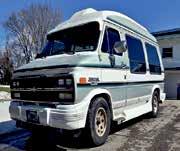
An Adventure for Sale!
Runs great/drives well. 207,417 miles. Very clean underneath.
TRANSMISSION IS MISSING 3RD AND 4TH. Needs rockers under plastics and passenger-side window and wing mirror. No middle seats.
$1,100/ Bill of sale only. More photos/info/contact
https://www.facebook.com/ share/18D9qXQUwT/
LEGAL
TOWN OF WILLISTON Selectboard
Notice of Public Hearing Tuesday, July 21, 2026 7:05 PM
The Williston Selectboard will hold a public hearing to receive comment on proposed changes to the existing Williston Unified Development Bylaw. The public hearing will take place on Tuesday, July 21, 2026, at 7:05 PM in the Beckett/McGuire Meeting Room at Williston Town Hall located at 7900 Williston Road, Williston, Vermont with remote participation available on
CLASSIFIED
Zoom:
Zoom Webinar Meeting ID: 825 5369 4829
Go to www.zoom.us/join or call
1-646-558-8656
The amendments are summarized as follows:
Citation corrections and errors or omissions
In Chapter 14 Off-Street Parking and Loading. Clarify provision for the use of structured parking and solar canopy to increase number of permitted off-street parking spaces
BAIT continued from page 2
Development Manager, Planning & Zoning
Lead development review, serve as Zoning Administrator, oversee DRB permitting and compliance. Bachelor’s degree + 2 years’ experience required. Salary range $67,000$78,000 DOE with excellent benefits package.
Town Engineer, DPW
Lead infrastructure design, construction management, capital planning for wastewater, stormwater, streets, and paths. Civil engineering degree + 6 years’ experience required. Salary range $102,000 - $112,000 DOE with excellent benefits package.
at www.colchestervt.gov.
15.3 Neighborhood Parks. Proposed bylaw amendments clarify the language about requirements for neighborhood parks.
Setbacks (multiple chapters)-setbacks and average setbacks throughout all zoning districts to be merged into a table and clarified. Add flexibility for properties with 2 front yards.
In 4.5.2 –Certificate of Appropriateness -S igns are exempt from COA
In 6.2.8, 6.2.9 –Preapplication actions – amendments to preapplication procedures.
6.5.3.3 –Notifications – amendments to written notification requirements
7.1.6.2 Guarantees for Public and Private Improvements – require surety at 110% of all improvements, public or private.
11.3.6 –Affordable Housing Income Limits - allows flexibility for affordable home income
mammals. It is most often seen in raccoons, skunks, foxes, and bats, but unvaccinated pets and livestock can also get rabies. The virus is spread through the bite of an infected animal or contact with its
saliva. If left untreated, rabies is almost always fatal in humans and animals. However, treatment with the rabies vaccine is nearly 100 percent effective when given soon after
So far this year, 23 animals in Vermont have tested positive for rabies, and 14 of
According to wildlife officials, rabid animals often show a change in their normal behavior, but you cannot tell whether an animal has rabies simply by looking at it. People should not touch or pick up wild animals or strays – even baby animals.
continued
from
Shelburne display lead dors from creemees.
SHELBURNE
other zoning districts to lands within any other zoning district that allows residential uses.
If adopted, the amendments to the Bylaw will go into effect 21 days after adoption unless a petition is filed for a
popular vote to repeal the amendments within 20 days of the adoption vote as provided for in 24 V.S.A. §4442.
The above is a summary. A complete copy of the proposed amendments are available for review during regular business hours at the Town Hall and or online at https://town.williston. vt.us by navigating to ‘Public Records and Documents,’ then ‘Legal Notices.’ Members of the public can contact the Williston Planning Department at (802) 878-6704, or at planning@willistonvt. org with any questions. classified
LEGAL RFP
TOWN OF ST. GEORGE REQUEST FOR PROPOSALS
Willow Brook Lane Ditching & Road Crown Project
The Town of St. George is accepting sealed bids for ditching improvements and road crown restoration on Willow Brook Lane (TH #4). This project is funded through the Vermont Better Roads Grant Program (VTrans Grant BR1469, FY2027 Category B). Work includes ditch reshaping, stone and grass lining, road crown restoration, shoulder gravel placement, and culvert cleaning across approximately 656
linear feet.
Sealed bids must be received by Monday, July 13, 2026 at 4:00 PM at the Town Office, 21 Barber Road, St. George, VT 05495. Email bids are also accepted at townclerk@stgeorgevt. com. A pre-bid site visit is strongly recommended.
The complete bid package, including specifications, bid form, and design plan information, is available on the Town website, at the Town Office, or by contacting Lisa Laramee, Town Clerk & Administrator, at townclerk@ stgeorgevt.com.
The Town of St. George reserves the right to accept or reject any and all bids.
Natural Gas Safety
Keep Your Gas Meter Clear
Your gas meter should be kept clear of mulch and topsoil, as this material can cause corrosion.
• Do not plant trees and shrubs near the gas meter. They can block access to the meter set as they mature.
• If making home improvements such as decking or air conditioning and heat pumps, maintain 3-ft of clearance from the meter and regulator.
• If your meter is next to a driveway or trash dumpster, it should be protected from damage by a bollard. Contact VGS for additional information.
VGS crews may also inspect or paint meters as part of routine maintenance to help keep your service safe.
Know the Signs of a Gas Leak
Smell
A sulfur or “rotten egg” odor.
Sight
White mist, fog, bubbles in standing water, blowing dust, or dead vegetation.
Sound
Hissing, whistling, or roaring.
Suspect a Leak?
Leave the area immediately.
• Call 911 or VGS at 800-639-8081 with the location as you can’t assume someone else will report it.
Avoid phones, switches, or anything that could create a spark.