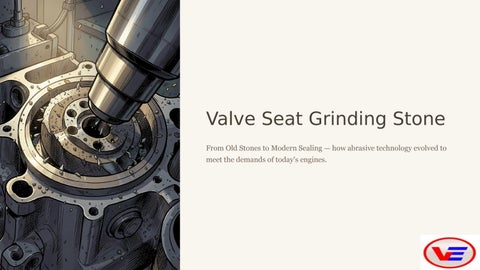
Valve Seat Grinding Stone From Old Stones to Modern Sealing — how abrasive technology evolved to meet the demands of today's engines.
Why the Stone Matters A valve seat is not just a surface — it must perform four critical functions simultaneously:
Support Anchor the valve under combustion pressure
Seal Prevent compression loss and gas leakage
Cool Transfer heat away from the valve head
Resist Withstand wear and recession over time
If the seat doesn't seal, compression drops and engine performance suffers immediately.
Then: Two Abrasives Were Enough When valve seats were commonly made from cast iron or hardened steel, the grinding process was straightforward. Shops relied on a simple twoconcept system:
Roughing Stone Aggressive material removal to restore seat geometry
Finishing Stone Smoother cut to achieve final sealing surface That simplicity worked — until engine manufacturers began specifying specialized seat alloys that demanded far more from abrasive chemistry.
Now: Seat Materials Became Highly Specific
Modern valve seats use advanced alloys, powdered metals, and super-hard composites engineered to prolong sealing against the valve head under extreme conditions. This shift forced a fundamental change: shops could no longer rely on stone shape alone — they needed matching abrasive chemistry to cut effectively without loading up or glazing.
The Core Choice: Six Abrasive Formulas Each formula is engineered to control how the abrasive breaks down and keeps cutting — rather than loading up and glazing over.
General Purpose
Stellite
Broad-use formula for standard seat materials
Hard cobalt-chrome alloys, high wear resistance
Nickel Chrome
Cool Blue
Severe-duty seats, heavy diesels & compressors
Copper-beryllium seats, high-performance apps
Finishing
Ruby
Final surface refinement and sealing quality
Aftermarket replacement for older B&D specs
Stellite: Built for Hard Wear Surfaces
Stellite is a premium cobalt-chromium alloy designed for the most demanding valve seat applications.
Composition
Application
Key Benefit
75–90% cobalt, 10–25% chromium, plus minor alloying metals
Hard, durable valves and seats where longevity is critical
Abrasive continually removes material without immediate load-up
Nickel Chrome & Cool Blue: Extreme-Duty Matches Nickel Chrome
Cool Blue
Targets 42–50 Rockwell
Formulated for copper-
hardness range. Ideal for severe-
beryllium valve seats in high-
duty seats in air compressors and
performance applications.
heavy-duty diesel engines where
Manages heat and material
standard abrasives fail.
compatibility for racing and performance builds.
Ruby (Red) The best aftermarket replacement for older Black & Decker generalpurpose specifications from the late 1960s through early 1980s.
Dressing the Stone: Make the Diamond Do Its Job Expose
Maintain
Reveal fresh abrasive with sharp diamond point
Clean threads and arms to prevent dust
Traverse Slow for finish, fast for aggressive cut Proper dressing is the difference between grinding and merely rubbing. A flat, dull diamond point can smooth the bond surface and eliminate real cutting action. Traverse speed directly controls aggressiveness — slow for finishing, fast for material removal. Always keep diamond-holder threads and dressing arms clean to ensure consistent results.
Stone Holders & Setup: Concentric, Stable, Controlled
Tooling quality and setup precision are recurring drivers of sealing problems — and ultimately, misfires and leaks.
Concentric Holders
Bounce Springs
Runout Control
Must fit the valve guide pilot precisely on the OD — no play, no runout
Start rotation before contact, control touchdown, and lift off to reduce chatter and lines
Tooling wear and concentricity errors are the leading cause of uneven seat contact
The Winning Formula Lasting engine performance comes from three things working in harmony:
Right Stone
Right Dressing
Match abrasive formula to seat
Use a sharp diamond and correct
material — General Purpose,
traverse speed so the bond stays
Stellite, Nickel Chrome, Cool Blue,
functional and cuts cleanly
Finishing, or Ruby
Right Contact Correct holders, pilots, and vibration control achieve an evenly contacting seat for lasting performance