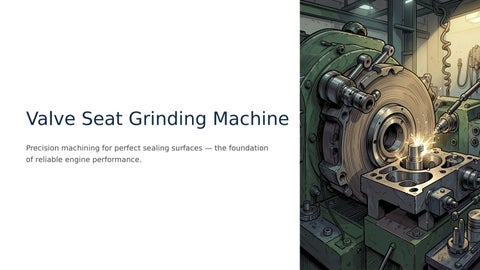
Valve Seat Grinding Machine Precision machining for perfect sealing surfaces — the foundation of reliable engine performance.
Why Valve Seats Matter Sealing Integrity
Heat Transfer
A properly ground valve
The seat interface transfers
seat ensures a gas-tight seal
heat from the valve head
between valve and seat,
into the cylinder head. Poor
preventing compression loss
contact accelerates thermal
and combustion leakage.
fatigue and failure.
Valve Life Correct seat geometry reduces wear, prevents valve recession, and extends service intervals significantly.
How Valve Seat Grinding Works
Dress Wheel
Grind
True the wheel to the specified angle.
Advance wheel into seat with controlled feed.
Setup Clamp head and align pilot in guide.
Inspect Verify angle, width and finish with gauges.
The grinding wheel is dressed to the specified angle, then fed axially into the seat bore while the head is held rigid. Pilot-guided alignment ensures concentricity with the valve guide.
Key Machine Components Spindle & Motor High-RPM spindle (3,000–10,000 rpm) with minimal runout for consistent surface finish.
Grinding Wheel CBN or diamond wheels for cast iron and aluminum heads; dressed to precise seat angles (30°, 45°, 60°).
Pilot System Interchangeable pilots match valve guide diameters, ensuring seat concentricity within 0.001 in.
Feed Mechanism Manual or power-fed slide with fine depth control for material removal and seat width adjustment.
Types of Valve Seat Grinders
Benchtop Manual
Floor-Standing Power Feed
CNC / Programmable
Compact units for small shops. Operator-
Motorized feed with adjustable speed.
Automated angle control, multi-
controlled feed; ideal for occasional
Standard in professional rebuild shops
angle seat profiles, and digital
for high-volume production work.
readouts. Used in OEM and high-
reconditioning and motorcycle engines.
performance applications.
Seat Geometry & Specifications
Multi-Angle Seats Modern engines use 3-angle or 5-angle seat profiles to optimize airflow and sealing. Each angle is ground in sequence with dedicated wheels. • • • •
Seat angle: 45° (most common) or 30° Seat width: 1.0–1.8 mm intake, 1.5–2.2 mm exhaust Concentricity: ≤ 0.025 mm TIR relative to guide Surface finish: Ra 0.4–0.8 µm for sealing
Setup & Alignment Procedure 01
02
03
Clean & Inspect
Select Pilot
Mount Head
Remove carbon deposits. Check
Match pilot diameter to guide size.
Secure cylinder head on work table.
valve guides for wear — replace or
Confirm fit with no perceptible play.
Verify no movement under light pressure.
ream before grinding. 04
05
Dress Wheel
Grind & Verify
True the grinding wheel to the correct angle using a
Make light passes (0.05 mm max). Check seat width and
diamond dresser before each job.
concentricity after each pass.
Common Defects & Causes Chatter Marks
Off-Center Seat
Loose spindle
Worn valve guide or
bearings, worn pilots,
incorrect pilot fit
or excessive feed rate.
causing runout.
Burned Surface
Incorrect Width
Dull wheel, insufficient
Wrong wheel angle or
coolant, or too-heavy cut.
improper depth setting.
Critical Rule: Never grind a seat in a worn valve guide. Always inspect and recondition guides first — the pilot references the guide, so any wear transfers directly to seat runout.
Maintenance & Wheel Care Daily Inspection
Wheel Dressing
Check spindle runout, pilot wear, and wheel
Dress CBN/diamond wheels every 50–100 seats. Use a
condition before each shift. Replace damaged
silicon carbide or diamond dresser to restore geometry.
wheels immediately.
Lubrication
Calibration
Grease spindle bearings per manufacturer schedule.
Verify angle plates and feed depth gauges
Use way oil on slides. Keep coolant lines clear.
quarterly. Use a precision sine plate or optical comparator for angle checks.
Key Takeaways Guide First, Seat Second Valve guide condition directly determines seat concentricity. Never skip guide inspection.
Sharp Wheels, Light Cuts A well-dressed wheel with light passes produces better finish and avoids thermal damage.
Measure Every Time Verify seat angle, width, and runout after grinding — don't rely on machine settings alone.
Match the Spec Follow OEM seat geometry and width specs exactly. Multi-angle seats require sequential grinding in the correct order.