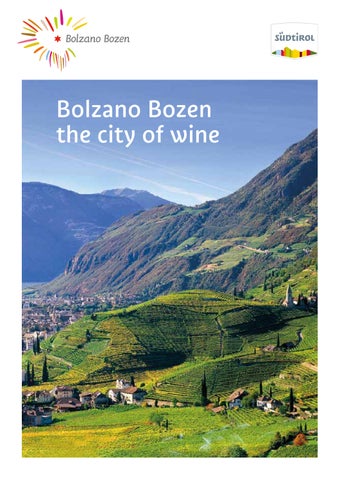
Bolzano Bozen the city of wine
DEAR VISITORS,
Bolzano constantly scores among the top cities with the best quality of life in the Bel Paese and is among three of the greenest in Italy. Yet another little-known achievement are its two indigenous vineyards which have brought it fame over the course of the centuries: the Schiava and the Lagrein. Proof of this are its 28 wineries. These predominantly family-run, innovative businesses are the proud ambassadors of one of the city’s most important symbols: wine! Bolzano has been a trade hub between Italy and Europe for centuries. The capital of South Tyrol is a modern city with plenty of cultural events and is the heart of local viticulture, which has made South Tyrolean wine famous all over the globe.
Eins ist sicher: Wir fördern, was Bozen ausmacht.
Questo è sicuro: Sosteniamo la nostra città.
Für uns als lokal verwurzelte Bank ist es eine Selbstverständlichkeit, sich für die Stadt und alles was sie bewegt, zu engagieren. Viel Vergnügen!
L’impegno della nostra banca è a favore della città di Bolzano. Apprezziamo la sua parte dinamica e creativa e ne promuoviamo le attività. Buon divertimento!
www.raiffeisenkasse.it www.cassarurale.it
Read on to find out more or rediscover this side of Bolzano, nestled in a basin surrounded by the Dolomites. Its position and geology contributed to carve out an exclusive niche in this sector. South Tyrolean wine is as old as time itself: official documents, stories, and anecdotes mention it and are backed by wooden casks found in 2002 in Bressanone/Brixen, which were used by Rhaetian vine dressers a good 2,500 years ago. Art found in a villa in San Paolo/Appiano, St.Pauls/Eppan from the fourth century AD depicting the practice of viticulture is testament to the Roman’s wine-growing tradition in South Tyrol. Castel Forte/Trostburg is above Ponte Gardena/ Waidbruck (Valle Isarco/Eisacktal) and boasts the largest wine press in South Tyrol, and the Pfannenstielhof (Bolzano) is mentioned in 1561 for its farmstead and wine press. The grapes behind one of the region’s most important wines are grown in Bolzano: indeed, the centre of the Lagrein’s vineyards is in the old neighbourhood of Gries. Over the course of the centuries, the ‘Muri Gries’ Benedictine monks contributed to spreading both wine processing techniques as well as good wine itself with their pilgrimages and their writing.
The home of S. Maddalena is a hill in the Rencio/ Rentsch area bordering Valle Isarco. It includes vineyards growing around Bolzano, where the Schiava varietal basks in the warmth of the sun, waiting to be turned into S. Maddalena wine. To the north of Bolzano lie the hills with the oldest vineyards. These are among the warmest and most exposed to direct sunlight in all South Tyrol and traditionally yield S. Maddalena. Its varietal is grown across 200 hectares representing 4% of the entire wine-growing area in South Tyrol. A traditional pergola system is used to grow the grapes: these are vertical rods supporting a horizontal arched structured with dangling wires which support the vines. The sumptuous pergolas and the steep hills make this landscape one to behold and characterise the S. Maddalena’s traditional vineyards. The brochure also includes the new ‘Bolzano, the city of wine’ map featuring the 28 wineries and their vineyards. The map lists new routes to discover Bolzano on foot, by bus, or by bike. These are eight simple, family-friendly routes. The 28 wineries are open for (guided) tours and wine tastings. Experience Bolzano in all its beauty and learn about it from the tales of families who have been growing on this land for generations and have evolved with the city. These families have faced famines and wars, yet preserved and even enhanced the land which yields the wines behind our prestigious city’s fame for centuries. A toast to you: we hope you make the most of the city!
Tourism Board I-39100 Bolzano, Via Alto Adige 60 T +39 0471 307 000 info@bolzano-bozen.it www.bolzano-bozen.it
4
5
LAGREIN SANTA MADDALENA ROUTES
8 10 13
BOLZANO’S WINERIES
6
1
Kellerei Bozen - Cantina Bolzano
2
Reyter
21
3
Muri-Gries
22
20
4 Schmid Oberrautner
23
5
24
Strekker
6 Egger-Ramer
25
7
Thurnhof
26
8
Rottensteiner
27
9 R. Malojer - Gummerhof
28
10 Heinrichshof
29
11 Nusserhof
30
12 Messnerhof
31
13 Pranzegg
32
14 Eberlehof
33
15 Kandlerhof
34
16 Plonerhof
35
17 Trogerhof
36
18 Obermoser
37
19 Fliederhof
38
20 Untermoserhof
39
21 Glögglhof
40
22 Pfannenstielhof
41
23 Zundlhof
42
24 Griesbauer
43
25 Larcherhof
44
26 Loacker
45
27 Waldgries
46
28 Mayr-Unterganzner
47
7
LAGREIN When you think of South Tyrol and red wine you automatically think of the Lagrein. The local grape varietal from Bolzano is genetically related to the Teroldego and Marzemino, growing nearby on very different calcareous soils. Bolzano’s Lagrein is quite unique, and its composition is influenced by volcanic rocks rich in quartz and featuring metamorphic elements. The soil on which its varietal has been growing for centuries defines its typical features: it is a full-bodied wine with bold colours and its tannins are influenced by the warm and sunny climate of Bolzano’s basin. These grapes ripen quite late and traditional pergolas, used to reduce insolation, are slowly being replaced by espaliers. A versatile wine, it can be used to make elegant Italian rosés, such as the Lagrein Kretzer, as well as full-bodied and well-balanced reds such as the Lagrein. The Lagrein was first officially mentioned more than six centuries ago. Since then, this varietal has perfectly adapted to the local micro-climate. The most famous Lagrein is produced in Gries, on one of the vaster sides of the Talvera river. Research and centuries-old passion contribute to the growth of vineyards and wineries, as the city wants to do them justice and enhance its precious heritage. You reap what you sow: the wine has been well received and awarded all over the world. Bolzano’s pride and joy, it rounds off our Mittleuropean soul and fully expresses our identity. The Abbazia di Muri-Gries and its centuries-old vineyards
HISTORY The Lagrein’s geographical provenance is still unclear. Lagara was a colony in Magna Graecia famous for its wines’ quality. Its name is reminiscent of the ‘Lagarina’ valley. This vine is a genetic offspring of the Pinot Noir. One hypothesis is that it first sprung near Rovereto, and this would explain its link to its ‘sibling’, the Marzemino. Lagrein is quoted for the first time in 1097 in an edict legislating the grape harvest falling under the exclusive remit of the Gries monastery’s monks. In 1370, an edict by Emperor Charles IV banned its consumption among military troops: it was considered too strong and replaced by a lighter wine. This may very well be the explanation behind the creation of the Lagrein Kretzer, a rose, while the Lagrein, a red, was reserved for nobles only - leading to popular upheavals. CLIMATE AND SOIL Lagrein thrives on sandy, volcanic soils, alluvial sands with deep aquifers and high temperatures.
8
It seems Bolzano was made for this wine, as the city ticks all the boxes and is one of the hottest in Italy during summer. The temperatures and sandy soil (which are drenched by flash storms) enhance these hot, permeable, and well-aired terrains: the hallmarks of high-quality viticulture. The Benedictine monks of the Muri-Gries convent praised South Tyrolean wine for being the best in the world back in the 17th century. Three centuries before, Emperor Charles IV claimed it was the ‘pesten Poczner’ (Bolzano’s best wine). CHARACTERISTICS A full-bodied, well-balanced, and fruity label, the Lagrein is a grippy wine; however, this trait is tempered in the Lagrein Gries Riserva by lengthy ageing in wooden casks. Its alcoholic proof is approx. 13 - 13.5%, and the varietal can be turned into a Lagrein (red) or a Lagrein Kretzer (rose). In the past, the latter was more widespread than the red. It boasts an elegant and delicate profile with an intense after-aroma.
The South Tyrolean Lagrein has very specific traits: a bold ruby-red, a heady and spicy bouquet with hints of wild berries, cocoa, pepper, sweet spices, and autumn leaves. A typical mountain wine, this flamboyant red is grippy and lingers on the palate as well as being smooth and mouth-filling.
polished tannins, and on the palate develops a lingering, lively, smooth and slightly savoury finish. The liquorice and pepper notes are rounded off by a hint of fruit.
GOES WELL WITH... Typical South Tyrolean dishes, namely meat and specifically game. Wash down the cuisine’s intense flavours with this bold ruby-red wine - a match made in heaven. Its organoleptic properties make it the perfect pairing for meat as well as hearty food and elaborate spicy recipes. Perfect for washing down roast beef, duck breast, dishes with barbecue sauce, ‘Knödel’ (dumplings), lasagnas, roast lamb and pork, and spare ribs. Uncorked at lunch or dinner, it is also an excellent idea for starters. A complex wine, it stands out for its bold ruby-red colour and thoroughly refreshing taste. When poured, its bouquet fills the room. It features
9
S. MADDALENA S. Maddalena is Bolzano’s local DOC red wine. The grapes have been grown since the Middle Ages on the rolling hills of the Maddalena, north-east of Bolzano’s old city centre in the Rencio area. S. Maddalena is produced using Schiava varietals, sometimes with a drop of Lagrein, yielding refreshing and elegant wines. Simple and uncompromising, just like its winegrowers. An unassuming ambassador of Bolzano’s viticulture, it is known all over the world.
The Santa Maddalena vineyards seen from the Colle
HISTORY ‘Wines from Botzen’ have always been praised, all the way back to official documents found in Medieval monasteries and the residences of nobility in southern Germany who owned most of the city’s vineyards. The vineyards gradually gained more independence but, despite the change in circumstances, the Santa Maddalena wines were still considered valuable wines from ‘southern Tyrol’. After a crisis overlapping the Great World Wars and the separation of South Tyrol from Austria, Santa Maddalena resumed production and consumers responded with a clear increase in sales. The ‘Schutzkonsortium St.Magdalener’ consortium was established in 1923 to protect this typical Bolzano product. Young winegrowers have contributed to its new image and improved its quality without ever forgetting its origins. All wines produced with Schiava grapes from Bolzano can boast the name Santa Maddalena. However, the ‘Classico’ S. Maddalena is reserved for vineyards in the triangle outlined by the Talvera/Talfer river, the Isarco/Eisack River, and the Tondo mountain. The steep hills to the east of Bolzano boast among some of the oldest and sunniest vineyards in South Tyrol. The Santa Maddalena Consortium established a quality seal for the grapes grown across 200 hectares, equivalent to
10
only 4% of the entire wine-growing area in South Tyrol. Pergolas are still the preferred traditional wine-growing method. They are often located on steep terraces exposed to the sun and supported by stone walls. The landscape is testament to the heroic feat which growers face to take care of and harvest the grapes. One of the most evocative pictures of the province are its pergolas: whatever the season, they add a touch of romantic nostalgia and flow across the landscape. The lion’s share (90%) of producers are small family businesses which produce and sell S. Maddalena wines. They dedicate their life to growing grapes and welcome guests with open arms to their winery to sample their products. Their aim is to preserve their traditions and identity as well as focusing on research and development to make their wines suitable for contemporary tastes. A good 2,000,000 bottles are produced every year. SOIL S. Maddalena is grown at higher altitudes and its vineyards are ideally placed on compact soil featuring debris deposited on the terraces carved out by glaciers during the last Ice Age. The Schiava grows up on the hills in Bolzano’s Rencio area, on sandy and gravelly soil, deposited tens of thousands of years ago during interglacial periods by
rivers which flowed across the valleys. The soil is the result of the decomposition of quartz-porphyry and the ancient metamorphic rocks. The grapes thrive in the valley along the Isarco riverbed on recent alluvial sediments. This hardy and flexible vine adds a different touch to any terrain it happens to grow on.
roasts. Its freshness also makes it ideal for fish and light dishes. When friends visit, this is the wine you want to toast to everyone’s health. Pour in a Borgogna glass to fully appreciate its bouquet. Simple and traditional: the go-to choice for all Bolzanini/Bozner.
CLIMATE The S. Maddalena Schiava thrives on Bolzano’s typical climate: the basin has hot summers, plenty of sunshine, and is windy. With 300 days of sunshine a year, these are the ideal conditions for winegrowing in South Tyrol. The hot and dry summer days alternated with breezy nights and the relatively dry winters guarantee a well-balanced, sweet and acidic profile typical of this elegant red wine.
QUALITY SEAL When purchasing a S. Maddalena wine, the quality seal and code are placed on every bottle to guarantee its provenance. This brochure lists the 28 wineries on the 8 routes across Bolzano. They have made the city wellknown all over the world for its passion and dedication to viticulture.
ORGANOLEPTIC CHARACTERISTICS Colour: ruby-red to garnet, brick red as it ages; Fragrance: heady, a touch of violets and almonds, getting stronger as it ages; Taste: full-bodied and full-flavoured with a light aroma and smooth almond notes. Served with: typical Bolzano, South Tyrolean, and Mediterranean dishes. A light wine to drink with friends, served with a platter of Speck and cheese as well as for dinner with soup, canederli, and
11
ROUTES A
THE LAGREIN PAR EXCELLENCE - GRIES SAN MAURIZIO/MORITZING
Explore the Gries and Fago neighbourhoods and the Lungo Talvera promenade on your bike. Discover the Lagrein’s traditional vineyards just off the Talvera river. Start from San Maurizio
and Gries and head to the vineyards in the old city centre. The route consists mostly of cycle paths and calm roads.
Wineries:
Highlights: Muri Gries Benedictine Abbey, the City Museum, South Tyrol Museum of Archaeology, Permanent exhibition within the Monument to Victory, Sant’Antonio castle Route: by bike Length: 11.5 km Elevation gain: 100 m Duration (no breaks): 1 h
1 2 3 4 6 8
B
Cantina Bolzano Reyter Muri-Gries Schmid Oberrautner Egger-Ramer Rottensteiner
THE LAGREIN AND S. MADDALENA/ST. MAGDALENER
Take a stroll along the Sant’Osvaldo path and Lungo Talvera promenade, built at the end of the 19th century. The walk boasts countless scenic outposts over the old city centre and its
vineyards. Explore the valley and the Lagrein’s vineyards and traipse up the hills of the S. Maddalena Classico.
Wineries:
Highlights: Sant’Antonio castle and Santa
9 R. Malojer - Gummerhof 12 Messnerhof 14 Eberlehof 15 Kandlerhof 16 Plonerhof 17 Trogerhof 19 Fliederhof
12
D2 D3 D4 D4 D4 C5
D5 C5 D6 D6 D6 D6 D7
Maddalena church Route: on foot Length: 7.1 km Elevation gain: 270 m Duration (no breaks): 2.5 h
13
C
E
OVERLOOKING THE CITY OF WINE
The route mostly follows the Guntschna path historical route which was built at the end of the 19th century. Start from the Rottensteiner winery and continue on path no. 5 coasting the Fago brook. The climb will take you towards the route proper. Shortly before reaching Castel Guntschna next to a cross, hop off path no. 5
and walk by a pedestrian crossing on the road to S. Genesio/Jenesien, cross it and descend to the Gries church on the historical part of the walk. You can either stick to the serpentine route or take the steep mule track on the cobblestone path of Via Cologna/Glanigerweg, signposted as path no. 9.
Wineries:
3 4 5 8
Muri-Gries Schmid Oberrautner Strekker Rottensteiner
D2 D4 C4 C5
THE VINEYARDS ALONG THE ISARCO RIVER CYCLE PATHS
The route is made of predominantly flat bike paths. It coasts long stretches of the Isarco river, connects the Aslago/Haslach and Piani/Bozner Boden neighbourhood to then continue coasting
the S. Maddalena Classico vineyards until the village of Cardano/Kardaun. A brief detour is possible mid-route: a demanding climb towards the Colle/Kohlern with 100 m elevation gain.
Wineries:
Route: by bike Length: 8 km Elevation gain: 130 m Duration (no breaks): 1 h
7 Thurnhof 11 Nusserhof 22 Pfannenstielhof 28 Mayr-Unterganzner 13 Pranzegg (option for hikers)
F5 E6 E7 E8 E6
Highlights: Gries church an Muri Gries
Benedictine Abbey Route: on foot Length: 4.5 km Elevation gain: 170 m Duration: 1.5 h
D
F
THE S. MADDALENA CLASSICO
This route is set among rolling hills, the landscape shaped in the past by glaciers and the Rivellone brook. The route is a succession of steep countryside paths, cutting through Schiava and S. Maddalena Classico pergola
vineyards. A warren of steep streets and paths bordered by stone walls, this network has been connecting the vineyards and the historical wineries of S. Maddalena for centuries.
Wineries:
Highlights: S. Maddalena church and S. Loren-
14 Eberlehof 15 Kandlerhof 16 Plonerhof 17 Trogerhof 18 Tenuta Obermoser 19 Fliederhof 20 Untermoserhof 21 Glögglhof 23 Zundlhof 24 Griesbauer
14
D6 D6 D6 D6 D7 D7 D7 D7 D7 D7
zo/Hl. Laurentius church Route: on foot Length: 3.5 km Elevation gain: 170 m Duration: 1 h
THE TALVERA’S WINERIES
A walk to the north of Bolzano’s old city centre along the Lungo Talvera promenade. Boasting a generous view over the Lagrein vineyards, ancient castles and Medieval churches, the walk stretches all the way to the entrance of Val Sarentino. From S. Antonio castle, climb up
the hill (‘collina di S. Pietro’) and prepare for a final burst of energy during the last, steep stretch, which will be rewarded by a wonderful view! The top of the hill also serves as a small outdoor museum consisting of varied, typical South Tyrolean fences.
Wineries:
Highlights: Mareccio/Maretsch castle and S. An-
6 Egger-Ramer 8 Rottensteiner 9 R. Malojer - Gummerhof 10 Heinrichshof 12 Messnerhof
D4 C5 D5 C5 C5
tonio castle Route: on foot Length: 6.5 km Elevation gain: 100 m Duration: 1.5 h
15
G
THE VALLE ISARCO VINEYARDS - LESS DEMANDING ROUTE
At the foot of the Santa Giustina hills lies the Rencio and the S. Maddalena Classico vineyards. From here, follow signposted path 5A. Walk along old countryside paths which connect the old farmsteads and vineyards in the
lower part of Valle Isarco. Before reaching the Ebner farmstead, a detour awaits. The circuit descends to the starting point which will lead you back to the alleys seen before.
Wineries:
Route: on foot Length: 7.2 km Elevation gain: 310 m Duration: 2 h
25 Larcherhof
E7
H
A LONG WALK IN VALLE ISARCO - DEMANDING ROUTE
Stick to route G, beyond the Ebner farmstead, and continue on path 5A. Climb up the side of the valley, cutting across forests and vineyards growing on these ancient terraces formed by glaciers, as though they had simply been left hanging from the dark, rocky, volcanic cliffs. Once you have reached Laste Alte/Oberplatten, take path 31 to the west. This path follows the valley’s side and coasts vineyards, orchards, forests, and rocky walls. Upon reaching the crossroads, descend on the asphalt road of Costa di Sopra/Oberlaitach until you merge with
the road from Signato heading back to Bolzano. Walk past the Costa di Sopra vineyards featuring breathtaking views over the city and the S. Maddalena hills. To the east, the Dolomites - specifically the Catinaccio/Rosengarten - offer another stunning view. Just before S. Giustina, the asphalt road joins path 5 which will take you past the Loacker winery. The establishment has built an elevated structure boasting a beautiful view. Path 5 continues its descent until the starting point in the Rencio.
Wineries:
Route: on foot Length: 13.2 km Elevation gain: 650 m Duration: 4 h
25 Larcherhof 26 Loacker 27 Ansitz Waldgries
E7 D8 D7
Crossing path 31A Costa di Sopra Unterinnerhof Baumannhof Lun
Ebnerhof
16
17
18
19
bo RE de
4 Rosenheim
5 Salzburg 3
d ns
ee
Bregenz northern Europe main routes4connecting rectly on the Brenner Axis. It is easily airplane.
8 8 5 Innsbruck 3
a
a
di
ga
rd
Development: GIR I Geo Identity Research, Bolzano 3 Bergamo 5 5 Treviso 3 Editor: Cristina Ferretti go
Map: GIR I Geo Identity Research, Bolzano Venezia Development and descriptions: GIR I Geo Identity 3 Research, Bolzano 5 5 Verona 3 Translated from the Italian by: Benjamin Thornton Barclay 0 km la
Milano
4 Villach
88
o–Bolzano or Verona–Bozen. Travel to 4 Vaduz uroCity trains. Special offers from Vipiteno/ o Bolzano. www.bahn.de, www.oebb.at 3/12/15 07:37 Spittal an 4 Sterzing Brunico/ o, Venice, Innsbruck and Munich Airport 4 Chur der Drau 4 4 Bruneck Merano/ 4 h Tyrol. Sit back and relax on the “SüdtiLienz Meran 4 Bressanone/ 4 Zernez gamo, Verona and Milan Malpensa. The 4 Brixen s 4 ite chgerman and italian cities. no with many dolom Silandro/ 4 Cortina d’Ampezzo w.suedtirolbus.it, www.flixbus.it 5 Bolzano/ Schlanders 3 uth Tyrol by car. Drive to Bolzano on Bozen y or on the main road via Val Venosta– –Bolzano. IMPORTANT: Since May 2014 i tre of Bolzano Bozen is subject to a video 4 Trento 4 Udine no follow the directions to the parking Publisher: ng indications so as to avoid Tourism any fine.Board Bolzano Bozen
50
Photographs, credits, and acknowledgements: Cristina Ferretti Carlo Ferretti Remo Nardini Archivio Storico della Città di Bolzano zen / Tourism Board for the Protection of St. Magdalener Straße 60, I-39100 Consortium Bolzano Bozen +39 0471 980 300 Consortium of Alto Adige Wines w.bolzano-bozen.itSüdtiroler Weinstrasse Strada del Vino Our thanks go to the wineries for sending us their pictures. We thank all 28 of the listed Bolzano wineries for their collaboration. Layout: Friesenecker & Pancheri, Bolzano Print: Tezzele by Esperia Year: 2020 All rights reserved
03/12/15 07:37
eehauser,
CONSORTIUM FOR THE PROTECTION OF ST. MAGDALENER – BOLZANO
ST. MAGDALENER the c lassic from bolzano
www.magdalener.com