\
Christmas, Bolzano style Plugging in to Expea Bolzano takes the stage
ER
Natale, come una volta? Sandra Bonzi: tra due mondi Bolzano va in scena
I NT
Alle Jahre wieder? Unter Strom: Expea Bühne frei für Bozen
W
APPIANO / EPPAN LAIVES / LEIFERS RENON / RITTEN SAN GENESIO / JENESIEN VAL D’EGA / EGGENTAL
I NV E R N O
NR. 4 | 2026 /
with
R
BOLZANO BOZEN MAGAZINE
W IN TE
bm
/
Die Fernberatung der Sparkasse. La consulenza a distanza di Sparkasse. Mit unserem neuen Service ist Ihr/e Berater/in stets an Ihrer Seite. Con il nostro nuovo servizio, il tuo consulente ti è vicino ovunque ti trovi. Werbemitteilung zur Verkaufsförderung. Für die wirtschaftlichen und vertraglichen Bedingungen lesen Sie die Informationsblätter, verfügbar in den Filialen der Südtiroler Sparkasse und auf www.sparkasse.it Messaggio pubblicitario con finalità promozionale. Per le condizioni contrattuali ed economiche consultare i fogli informativi disponibili sul sito sparkasse.it e presso le filiali della Cassa di Risparmio di Bolzano.
DE
IT
800 378 378 | info@sparkasse.it
18.©
V
NO
/
IN
ER
EDITORIAL
\
W I NT E R
NR. 4 | 2026
/
W I NT
ER
Cara lettrice, caro lettore,
ogni anno gli stessi riti? Il Natale vive di questo e del fatto che, nonostante tutto, qualcosa cambia. A Bolzano andiamo oltre il Mercatino di Natale, le luci e i rituali: entriamo nei forni e nelle chiese, attraversiamo le piazze e incontriamo antiche tradizioni reinterpretate. Ma in città si muove anche altro. Nella centrale idroelettrica di Cardano, con Expea l’energia diventa un esperimento. Esploriamo la scena teatrale bolzanina e parliamo con uno dei suoi nuovi protagonisti, Andrea Cerri. La scrittrice Sandra Bonzi racconta invece le due città della sua vita: Bolzano e Milano. Questo numero ci porta anche oltre la città. A Laives incontriamo chi costruisce presepi. A San Genesio ripercorriamo 75 anni di storia del turismo, mentre Appiano si prepara all’Avvento. Sul Renon ci chiediamo che cosa renda davvero “premium” un sentiero e in Val d’Ega guardiamo dietro le quinte di un inverno in cui la neve non arriva più soltanto dal cielo. Un numero invernale, dunque, dedicato a ciò che ritorna e a ciò che sta appena cominciando. Perché la tradizione diventa interessante quando non la si confonde con l’immobilità. Desideriamo inoltre ringraziare la nostra caporedattrice Anita Rossi per il contributo dato alla rivista in questi anni. Con questo numero conclude la sua collaborazione con bm Bolzano Bozen Magazine. Buona lettura!
Liebe Leserinnen und Leser,
Alle Jahre wieder? Weihnachten lebt von Wiederholungen und davon, dass sich trotzdem etwas verändert. In Bozen schauen wir deshalb hinter Weihnachtsmarkt, Lichter und Rituale: in Backstuben und Kirchen, auf Plätze und zu Menschen, die Traditionen weitertragen oder neu interpretieren. Auch sonst bewegt sich einiges in der Stadt. Im Wasserkraftwerk Kardaun wird mit Expea Energie zum Experiment. Wir schauen auf die Bozner Theaterszene und sprechen mit ihrem neuen Protagonisten Andrea Cerri. Die Schriftstellerin Sandra Bonzi erzählt von den zwei Städten ihres Lebens: Bozen und Mailand. Auch über die Stadtgrenzen hinaus führt dieses Heft. In Leifers begegnen wir Menschen, die Krippen bauen. In Jenesien verfolgen wir 75 Jahre Tourismusgeschichte, in Eppan macht man sich für den Advent bereit. Am Ritten fragen wir, was einen Wanderweg eigentlich „premium“ macht, und im Eggental schauen wir hinter die Kulissen eines Winters, in dem Schnee längst nicht mehr nur vom Himmel fällt. Ein Winterheft also über Dinge, die wiederkehren, und andere, die gerade erst beginnen. Denn Tradition ist dann am interessantesten, wenn man sie nicht mit Stillstand verwechselt. Unser Dank gilt außerdem unserer Chefredakteurin Anita Rossi für ihren Beitrag zum Magazin in den vergangenen Jahren. Mit dieser Ausgabe beendet sie ihre Tätigkeit bei bm Bolzano Bozen Magazine.
Dear readers,
They may seem like the same customs every year, but these are what make Christmas, Christmas! Yet despite it all, things keep evolving. In Bolzano, we look beyond the Christmas Market, the lights and familiar rituals, into bakeries and churches. There is plenty of change elsewhere in the city, too. At the Kardaun hydroelectric plant, Expea turns energy into an experiment. We explore Bolzano’s theatre scene and talk to our newest theatre director, Andrea Cerri. Writer Sandra Bonzi, meanwhile, tells us about the two cities in her life: Bolzano and Milan. In this issue, we take you beyond the city. In Laives, we meet people who build nativity scenes. In Jenesien, we trace 75 years of tourism; while in Eppan, we show you the preparations for Advent. On the Ritten, we ask what makes a “premium” hiking trail; and in the Eggental valley, we go behind the scenes of winter where snow no longer only falls from the sky. So this is a winter issue: about things that return and others that are only just beginning. Because tradition is at its most interesting when it isn’t standing still. We’d also like to thank our editor-in-chief, Anita Rossi, for her contributions to the magazine over the past years. With this issue, she concludes her work with bm Bolzano Bozen Magazine. We wish her all the very best for what lies ahead. Enjoy the read! Roberta Agosti & Massimo Baratto Direttrice e Presidente dell’Azienda di Soggiorno e Turismo di Bolzano Direktorin und Präsident des Verkehrsamts der Stadt Bozen Director and President of the Bolzano Tourism Board
INDEX 03/ EDITORIAL
BRESSANONE BRIXEN MERANO MERAN
06/ GOOD NEWS
SAN GENESIO JENESIEN APPIANO EPPAN
BOLZANO BOZEN LAIVES
30/ PHOTOSTORY Denkmäler: Was bleibt Cosa resta What remains
36/ PORTRAIT
Sandra Bonzi e i gialli Only mystery can reveal the truth Im Krimi zeigt sich, wer wir sind
3.©
12
42/ INNOVATION
Expea: Power to the people Unter Strom Sotto tensione
50/ THEATRE
58/ TRADITIONS
Eppan: Handgemachtes mit Adresse Fatto a mano, con un indirizzo Handmade and authentically local
4
INSIDE OUTSIDE
Teatro Stabile: Mescolare i pubblici Publikum mischen Shaking things up
25
8.©
Gnadenkapelle mit irdischer Madonna Natale visto da Maria Through Mary’s eyes
COVERSTORY
25/ INSIDE OUTSIDE
VAL D’EGA EGGENTAL
LEIFERS
1 2 / COVERSTORY
Natale a Bolzano: Cambiare per restare Verändern, um zu bleiben Ever changing never changing
RENON RITTEN
INNOVATION
64/ OUTDOOR
Renon: Camminatori recidivi Wir brauchen Ersttäter Wanted: first time hikers
8.©
42
72/ TECHNOLOGY
Eggental: Unsichtbare weiße Kunst L’arte invisibile della neve The invisible art of snow
78/ CRAFTS
Laives: Costruire il Natale Weihnachten bauen Constructing Christmas
84/ TOURISM
Jenesien: Sommerfrische im Wandel La villeggiatura che cambia A resort in transformation
50
19.©
THEATRE
91/ BOLZANO/BOZEN EVENTS
93/ EGGENTAL/VAL D’EGA EVENTS
94/ RITTEN/RENON EVENTS
97/ LAIVES/LEIFERS EVENTS
NTE R
/
NO
R
5
W I NT E
98/ IMPRESSUM
WI
ER
OUTDOOR
EVENTS
/
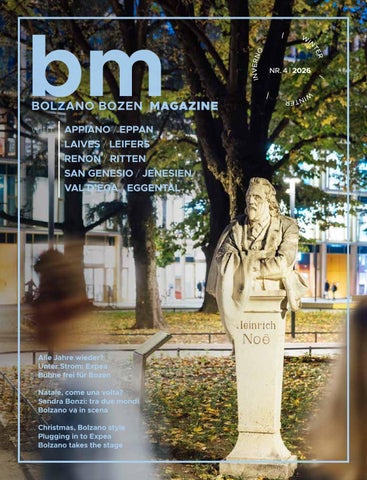
Heinrich Noë (1835–1896) helped put Bolzano on the tourist map. In 1899, the Munich travel writer was given a monument opposite the railway station. Ever since, he has welcomed travellers to the city he once helped them discover.
96/ JENESIEN/SAN GENESIO
I NV
On our cover: The travel writer at the station
EVENTS
\
*
64
95/ EPPAN/APPIANO
GOOD NEWS Studiare il turismo dove il turismo accade. In Alto Adige è un motore economico fondamentale, ma anche un settore alle prese con questioni sempre più complesse: mobilità, cambiamento climatico, digitalizzazione, carenza di personale, pressione sui territori e necessità di trovare un equilibrio tra attrattività e qualità della vita. È in questo contesto che, dall’anno accademico 2027/28, la Libera Università di Bolzano propone un Master in Tourism Marketing and Policy, un percorso biennale interamente in lingua inglese.
23.©
RIPENSARE IL TURISMO
Il carattere internazionale del corso si riflette non solo nella lingua d’insegnamento, ma anche nelle possibilità di studio all’estero. Alla teoria si affianca un tirocinio obbligatorio, che permette di confrontarsi direttamente con imprese e organizzazioni del settore. Peculiare è anche l’offerta di laboratori, che integra la teoria con analisi e applicazioni nel nostro territorio. Il corso combina marketing e policy per una sfida duplice: comprendere e orientare la domanda turistica, creando valore duraturo per imprese, destinazioni e comunità. Il corso integra la conoscenza dei mercati e dei comportamenti dei turisti con la capacità di governare gli impatti economici, sociali e territoriali del turismo, contribuendo a costruire destinazioni competitive e sostenibili, da vivere oltre che da visitare. La didattica comprende quindi il marketing e la gestione delle destinazioni, la comprensione approfondita delle esperienze turistiche, ma anche le nuove tecnologie, l’analisi dei dati e l’intelligenza artificiale. Come possono Big Data e strumenti digitali aiutare a comprendere e gestire i flussi turistici? Come si crea valore per i visitatori preservando al contempo l’identità di una destinazione? E dopo la laurea? Le competenze acquisite aprono opportunità professionali nel marketing e management delle imprese turistiche, nella promozione e governance delle destinazioni, nella valorizzazione del patrimonio culturale e territoriale e nell’analisi dei mercati e delle politiche per il turismo. I laureati potranno operare in imprese turistiche e dell’ospitalità, DMO ed enti di promozione, istituzioni pubbliche e culturali, organizzazioni internazionali, società 6
di consulenza, centri di ricerca, start-up e realtà innovative del settore. Profili che diventano tanto più interessanti quanto più il turismo è chiamato a ripensare sé stesso. Più che imparare a vendere una destinazione, insomma, qui si studia come governarne il futuro. E l’Alto Adige, e nello specifico Bolzano, nel cuore di una delle regioni turistiche più conosciute delle Alpi, è un laboratorio difficilmente replicabile altrove. Per l’ammissione all’anno accademico 2027/2028 è richiesto un livello B2 di inglese. Informazioni, requisiti e scadenze saranno presto disponibili sul sito della Libera Università di Bolzano www.unibz.it/en - Per ulteriori dettagli contattare tourism@unibz.it
100 YEARS OF FLIGHT senschaftsvermittlerin Gabriella Greison. Diskutiert wurden KI und Nachhaltigkeit, Arbeitsrechte, Unternehmensgründung und die Arbeitswelt der Zukunft. Den vorläufigen Abschluss bildete die Good Job Fair in der Messe Bozen. www.connecting-bz.it
DA LAIVES AL MONDO
WI
/
R
NO
W I NT E
7
ER
www.laives-leifers.it
NTE R
/
Wie wollen wir morgen arbeiten – und wie finden junge Menschen und Unternehmen überhaupt zueinander? Mit Connecting BZ machte die Stadt Bozen im November daraus ein dreitägiges Stadtprojekt. Es brachte unter dem Motto Talente, Unterneh” men und Zukunft“ Schüler:innen und Studierende mit Unternehmen, Gewerkschaften, Wissenschaft und Wirtschaftsverbänden zusammen. Zu Gast waren unter anderem Innovationsforscher Giulio Buciuni, die Münchner Strategieprofessorin Isabell M. Welpe und die italienische Kernphysikerin und Wis-
I NV
BOZEN ALS ZUKUNFTSLABOR
Ci sono storie che nascono lontano e poi tornano a casa. È successo con Maura Delpero, regista cresciuta a Laives, che con il suo cinema ha portato il nome della città ben oltre i confini dell’Alto Adige. A lei Laives ha conferito l’Anello d’onore, la massima onorificenza cittadina, in una cerimonia al Teatro di San Giacomo. Un riconoscimento che non celebra soltanto una carriera internazionale, ma anche il legame con il luogo in cui tutto è iniziato. Il suo nome ha fatto il giro del mondo grazie a Vermiglio, il film che ha conquistato il Leone d’argento alla Mostra del Cinema di Venezia; è entrato nella shortlist dei 15 titoli internazionali in corsa per gli Oscar e ha ottenuto una nomination ai Golden Globes 2025. Dietro questi traguardi c’è uno sguardo personale, capace di trasformare storie intime in cinema universale. E forse è proprio questo il significato più bello dell’Anello d’onore: celebrare un talento che affonda le sue radici a Laives e che oggi, attraverso il cinema, parla a un pubblico internazionale.
\
Bolzano Airport celebrates its centenary. Opened in autumn 1926, it began as a military and training airfield and was considered a strategically important target during the Second World War. For decades, commercial aviation was limited due to its short runway and the narrow Alpine valley. Civil use gradually expanded after the war, with scheduled flights to Rome starting in the 1990s. After a referendum 2016 saw public funding withdrawn, a group of local entrepreneurs led by Josef Gostner took over the airport in 2019. This new ownership also gave rise to SkyAlps, the first airline financed entirely with South Tyrolean capital. Today, Bolzano connects the region with cities across Europe, and it remains an important base for air rescue and emergency operations. From military airfield to Alpine city airport: 100 years of aviation history, shaped by geography, politics and changing ideas of mobility.
GOOD NEWS 70 JAHRE AUF KUFEN
di Bolzano. Le iscrizioni sono già aperte; il limite è di 400 partecipanti per tappa. Cinquant’anni in sella, tra sport e scoperta del territorio. www.girodolomiti.com
Was 1957 begann, gehört längst zum Jenesier Winter: Am 31. Jänner 2027 feiert das traditionelle Haflinger-Schlittenrennen sein 70-jähriges Bestehen. Anfangs lieferten sich die Gespanne ein Langstreckenrennen, vom Nordeingang Jenesiens bis zum Nordeingang von Meran. Und das Rennen lockte nicht nur Einheimische an, sondern weckte laut Dorfchronik auch das Interesse auswärtiger Haflingerfreund:innen. Heute findet es auf dem Salten statt: Beim Schlittenrennen traben die Haflinger vor dem Schlitten über die präparierte Schneebahn. Noch rasanter wird es beim Skijöring, wenn ein Haflinger mit Reiter:in eine Person auf Skiern hinter sich herzieht. Der spektakuläre Wettkampf erzählt auch ein Stück Dorfgeschichte. Als der Haflinger ab den 1950er-Jahren durch die Mechanisierung seine Rolle als Arbeitspferd zunehmend verlor, gewann er als Freizeit- und Sportpferd an Bedeutung. Der 1946 wiedergegründete Pferdezuchtverein Jenesien begleitete diesen Wandel – und hält mit dem Schlittenrennen bis heute eine lebendige Tradition in Bewegung.
IL NATALE È DEI BIMBI
www.jenesien.net
IN GIRO DA 50 ANNI Nel 2027 il Giro delle Dolomiti festeggia la 50ª edizione e torna alla formula originaria: cinque tappe in cinque giorni, dal 19 al 23 luglio, per un totale di 540 chilometri e circa 14.000 metri di dislivello. Dal Passo delle Erbe alla Marmolada, da Cortina all’Alpe di Siusi a Passo Stelvio, cicliste e ciclisti amatoriali affronteranno alcuni dei passi più spettacolari delle Dolomiti. Partenza e arrivo saranno prevalentemente alla Fiera 8
Dal 5 all'8 dicembre, il Mercatino di Natale di San Michele dedica un intero fine settimana ai bambini con KidsXmas. I più piccoli potranno incontrare la famosa scimmietta Bobby, preparare biscotti, realizzare addobbi natalizi e assistere a uno spettacolo di burattini della “Spielwelt”. In programma ci
sono anche attività a contatto con gli animali, come il trekking con lama e alpaca e i giri in pony. A completare il programma, uno spettacolo di fuoco. Sarà in funzione anche la giostra: venerdì dalle 16 alle 18, sabato e domenica dalle 10 alle 12 e dalle 14 alle 18. La giostra resterà aperta per tutto il periodo dell’Avvento, oltre che l’8 e il 24 dicembre. Domenica 6 dicembre, a partire dalle 14.30, San Nicolò sfilerà per le vie di San Michele. “KidsXmas offre alle famiglie l’occasione di trascorrere insieme momenti speciali e permette ai bambini di vivere l’attesa del Natale stimolando tutti i sensi”, afferma Evelyn Falser, presidente dell’Associazione Turistica di Appiano. www.eppan.com/it
ADVENT AUF SCHIENEN Und das durchaus wörtlich: Das Rittner Christbahnl verteilt den Advent auf Oberbozen und den idyllischen Park des Hotel Bemelmans Post in Klobenstein. Verbunden werden die zwei Schauplätze von der Rittner Bahn. Das Christbahnl selbst bietet kleine Stände mit Handwerk, regionaler Küche und Musik, Lama-Spaziergänge und Kutschenfahrten. Kinder erleben Weihnachtsgeschichten, den Nikolaus und Zauberer. Der Gastronomiestand in Oberbozen bleibt auch abends geöffnet und ist längst Treffpunkt für Einheimische. Geöffnet 27.11.2026-3.1.2027, jeweils Fr 14-18 bis 18.12, Sa/So bis 4.1. von 10-18 Uhr; zusätzlich 7./8., 23., 26.–28.12., 10–18 Uhr. Gastronomie Klobenstein bis 18 Uhr, Gastronomie Oberbozen bis 24 Uhr.
CIAO BELLO Che cosa significa essere uomini nell’Italia di oggi? Nel nuovo libro illustrato “Ciao bello. Mascolinità in cambiamento”, la giornalista altoatesina Barbara Bachmann e la fotografa Franziska Gilli esplorano un’identità sospesa tra vecchi privilegi, stereotipi e nuove fragilità. Reportage, interviste e fotografie le portano dall’Alto Adige alla Sicilia: da una festa dedicata alla virilità agli incontri di un training antiviolenza, fino a uomini che sperimentano nuovi modi di essere padri. Un viaggio interessante perché il cambiamento dei ruoli di genere non riguarda solo le donne. Un possibile regalo di Natale – per i mammoni, certo, ma non solo per loro. Edition Raetia, 224 pagine, 25 euro. www.raetia.com
SOUTH TYROLEAN DIALECT
Gatsch, gatschig In South Tyrolean dialect, ‘gatsch’ or ‘gatschig’ are the words for the slush that remains once the fresh snow’s gentle crispiness begins to fade. It’s a word you may hear in Bolzano and it’s one that sounds exactly how that feels underfoot – overly soft, heavy and verging on NTE R unpleasantly wet: gatsch! WI /
/
NO
R
ER
W I NT E
9 \
I NV
11.©
www.ritten.com
GOOD NEWS 10 E 75
LEAVE ONLY TRACKS
Due compleanni, due capitoli della storia del turismo in Val d’Ega: Carezza Dolomites compie 75 anni, il rifugio Oberholz ne compie 10. Settantacinque anni fa, con la seggiovia Paolina, iniziava la storia dell’area sciistica ai piedi del Catinaccio. La monoposto di allora impiegava circa 20 minuti per raggiungere la stazione a monte; altri impianti seguirono negli anni successivi. La stagione 2026/27 parte venerdì 4 dicembre; il momento clou dei festeggiamenti sarà il 12 dicembre dalle ore 15 al Rifugio Paolina, con musica, specialità gastronomiche e l’enrosadira invernale, il tramonto con le pareti rocciose delle Alpi dolomitiche tinte di rosa. Per l’occasione nasce anche il Carezza Club, dedicato a fan e ospiti affezionati. L’obiettivo guarda però avanti: continuare a sviluppare e garantire la qualità dell’offerta invernale. Dieci anni compie invece l’Oberholz di Obereggen, rifugio a 2.096 metri diventato anche un piccolo set musicale: qui hanno girato videoclip Benji & Fede e i Pinguini Tattici Nucleari. Per l’anniversario uno chef stellato firmerà un piatto speciale, in menu per tutta la stagione. Inaugurato nel 2016, l’Oberholz unisce architettura contemporanea, legno, grandi vetrate sul Latemar e riscaldamento geotermico. Tra i due anniversari ci sono 65 anni – e un bel pezzo di storia delle Dolomiti.
14.©
www.valdega.com/it
Snow may cover the landscape, but it does not make nature less vulnerable. South Tyrol’s seven natural parks protect habitats where wildlife needs peace and space, particularly in winter. Drones are banned: their noise can disturb animals and trigger stressful escape responses. Motorised vehicles are also prohibited, as are fires, littering and unnecessary noise. Plants, minerals and fossils should stay where they belong. Protected areas give nature something increasingly rare: space to remain wild and largely undisturbed. The principle behind the rules is simple: protected areas are not outdoor playgrounds, but our shared natural heritage. The natural parks closest to Bolzano are Schlern-Rosengarten/Sciliar-Catinaccio and Trudner Horn/Monte Corno. Enjoy them, photograph them, walk or ski through them – and leave as little trace as possible. https://nature-parks.province.bz.it/en/home
MUSIK AUF DEM WALTHERPLATZ Der Waltherplatz war nicht immer nur städtisches Wohnzimmer und Bühne für Christkindlmarkt und Stadtfeste. Seit dem späten 19. Jahrhundert gehörten Platzkonzerte zum Bozner Alltag. 1899 erhielt der Waltherplatz sogar einen eigenen Musikpavillon, in dem regelmäßig Kapellen aufspielten. Die Konzerte waren gesellschaftlicher Treffpunkt und zugleich Teil 10
re la biodiversità e collegare gli habitat urbani. Questi spazi trattengono inoltre l’acqua piovana e proteggono gli edifici dal caldo. E riservano sorprese: in Alto Adige vivono circa 500 specie di api selvatiche, alcune persino blu.
3.©
4.©
des touristischen Angebots. Der Pavillon wurde 1938 im Zuge der faschistischen Umgestaltung des Platzes abgetragen. Mit ihm wurde auch das WaltherDenkmal entfernt; es kehrte erst 1981 auf den Platz zurück. Die Stadt plant ab 2027 eine grundlegende Sanierung des Waltherplatzes, insbesondere Pflasterung und Abdichtung der Anfang der 1980er-Jahre errichteten Tiefgarage. Die Musik ist bis heute geblieben: Der Waltherplatz wird regelmäßig zur Freiluftbühne – eine Tradition mit überraschend langer Geschichte.
QUIZ
St Nicholas – Christianity & Tradition
a) Bolzano’s St Nicholas parade, inspired by a medieval tradition from Bari. b) Merchants from Bari, who brought the St Nicholas tradition to Bolzano. c) The same saint is celebrated in both places, whose remains are kept in Bari. I NTE R
Solution on pageW98 /
/
NO ER
R
11
W I NT E
I NV
E lo fa nel cuore di Bolzano. Chi ha detto che la biodiversità si trova solo sui prati alpini o nei parchi naturali? Anche i piccoli spazi urbani possono diventare habitat preziosi. Lo dimostra il tetto verde di Eurac Research in centro città, realizzato nella scorsa primavera con piante autoctone resistenti a sole, vento, siccità e al freddo invernale. È parte del progetto GRACE, che studia come i tetti verdi possano favori-
\
LA NATURA PRENDE QUOTA
What connects an Alpine Advent tradition to southern Italy?
COVERSTORY
CAMBIARE PER RESTARE VERÄNDERN, UM ZU BLEIBEN p. 19
EVER CHANGING NEVER CHANGING p. 21
12
W I NT E
R
13
\
NO
/
/
ER
NTE R
WI
I NV
3.©
3.©
/U
IT
n albero che arriva in piazza, biscotti che escono dal forno, un Mercatino che compie 35 anni. A Bolzano l’Avvento vive di tradizioni che sembrano immutabili. Ma, a guardarle da vicino, continuano a cambiare. A dicembre Bolzano cambia ritmo. Non del tutto: gli autobus continuano a passare, i negozi aprono, chi lavora attraversa il centro con tutt’altra urgenza rispetto a chi è arrivato per trascorrervi qualche giorno. Ma 14
sopra questa città quotidiana se ne posa un’altra. Le giornate si accorciano, si accendono le luci e piazze e strade assumono per qualche settimana un aspetto diverso. Il centro più visibile di questa trasformazione è piazza Walther. A pochi passi dal campanile gotico del Duomo stanno le casette del Mercatino, il presepe e il grande albero illuminato. Ma l’Avvento si allarga oltre la piazza, entra nelle vie e nei quartieri – e anche in luoghi molto più piccoli. Perché, prima di essere un’offerta turistica, il Natale è fatto di gesti che ritornano: si
3.©
3.©
WI
NTE R
/
/
NO ER
R
15
W I NT E
Anche gli addobbi raccontano questa trasformazione. Prima di palline e fili luminosi, sull’albero trovavano posto frutta, noci, dolci e altri elementi commestibili; più tardi arrivarono candele e decorazioni prodotte appositamente per il Natale. Nel corso dell’Ottocento l’albero esce progressivamente dagli ambienti privati e borghesi ed entra anche negli spazi pubblici. Immagini, cartoline, pubblicità e infine la cultura di massa contribuiscono a trasformarlo in uno dei simboli globali del Natale. Un rito familiare diventa così anche un
A Bolzano l’albero più visibile è quello di piazza Walther. Quello del 2026 arriva da Novale Basso/Niederried in Val d’Isarco, nel comune di Campo di Trens: un abete rosso alto circa 20 metri e vecchio di circa 45 anni, cresciuto su un terreno demaniale della Provincia. Il 5 novembre è stato abbattuto dal personale forestale, sollevato con una gru, caricato e trasportato fino a Bolzano. Un viaggio che richiede sopralluoghi, ditte specializzate, documenti di sicurezza e persino possibili brevi interruzioni sulla strada comunale tra Novale Basso e Stilves. Tre settimane dopo, il 26 novembre, l’accensione dell’albero in piazza Walther segnerà l’apertura ufficiale del 35° Mercatino di Natale. Ma non tutte le tradizioni natalizie hanno bisogno di un trasporto speciale, di una gru e di braccia forti. Alcune stanno su una teglia.
I NV
Un grande abete in mezzo alla città È difficile immaginare oggi il Natale senza un albero. Eppure, l’abete addobbato non c’è sempre stato. L’uso di piante sempreverdi nel cuore dell’inverno è molto più antico del Natale cristiano: ciò che resta verde mentre il resto della vegetazione sembra fermarsi diventa simbolo di vita e continuità. Prima che diventasse protagonista dei nostri salotti, l’albero sempreverde era già un simbolo legato al ciclo delle stagioni e al passaggio tra buio e luce. Non sorprende quindi che abbia assunto un significato particolare proprio attorno al solstizio d’inverno. L’albero natalizio come lo conosciamo oggi nasce invece da una lunga stratificazione di usanze e significati, sviluppatasi soprattutto nell’Europa centrale e poi diffusasi altrove.
segno collettivo, capace di occupare il centro di una piazza. Il suo significato cambia insieme alla società: da oggetto carico di riferimenti religiosi e familiari a elemento decorativo, immagine commerciale e, oggi, anche oggetto su cui interrogarsi in termini di provenienza e sostenibilità. E forse è proprio questa capacità di cambiare senza perdere la propria riconoscibilità a spiegare la sua resistenza.
\
addobba, si cucina, si tirano fuori vecchie ricette. E si porta in piazza un albero.
17.© 3.©
Il Natale dietro un vetro Fuori, in via della Roggia, si fa sentire il freddo di dicembre; dentro, la farina si attacca alle mani e ai piani di lavoro. Profuma di impasto caldo, burro e qualcosa di dolce appena uscito dal forno. Dietro la grande vetrata si pesa, si impasta, si forma – al punto che, a chi passa lì vicino, viene quasi spontaneo rallentare e sbirciare. L’Avvento a Bolzano non si svolge soltanto tra luminarie e bancarelle. Qui viene infornato. Il PAN.ATELIER del Panificio Franziskaner misura appena 44 metri quadrati. Nel 2009 il panificio aveva trasferito i laboratori e la pasticceria a Cardano; dieci anni dopo una piccola parte della produzione è tornata nel centro storico. Dal 2019, il laboratorio a vista di via della Roggia riporta una piccola parte del mestiere nel centro storico, davanti agli occhi dei passanti. A raccontarlo è Judith Pfitscher, che dal 2014 guida il panificio di famiglia insieme al fratello Jürgen. Sono la seconda generazione: fu il padre Heinrich a rilevare nel 1974 un forno da tempo chiuso, documentato nello stesso luogo già nel 1776. Oggi l’azienda conta circa 70 collaboratrici e collaboratori e otto punti vendita a Bolzano, mentre la produzione principale avviene a Cardano. I compiti tra i due fratelli sono divisi: Jürgen segue produzione e logistica, Judith i punti vendita e l’amministrazione. Nel PAN.ATELIER lavorano tre fornai e pasticceri. Il pane esce dal forno tutti i giorni – anche nel pomeriggio, una delle ragioni per cui il laboratorio è apprezzato dalla clientela abituale. Durante l’Avvento al pane si aggiungono biscotti speziati, i Lebkuchen, strudel e diversi biscotti natalizi preparati secondo antiche ricette; qualche volta persino il Bozner Zelten. E proprio qui, dove il mestiere viene mostrato in una forma aggiornata ai gusti contemporanei, il Natale sembra resistere particolarmente bene al cambiamento. “Il periodo natalizio resta il momento più tradizionale di tutto l’anno. Negli ultimi decenni sono cambiate pochissimo sia la domanda sia, di conseguenza, la nostra offerta”, racconta Pfitscher. Anche la grande vetrina viene addobbata per Natale. Ma l’attrazione principale rimane ciò che succede dietro il vetro. Chi passa si ferma a osservare le mani al lavoro; soprattutto i bambini, racconta Pfitscher, spesso non vogliono più staccarsi dalla vetrina. “È diventata un richiamo, quasi una calamita. I nostri fornai lavorano molto spesso sotto i flash delle fotocamere dei cellulari.” Il PAN.ATELIER finisce così per trasformare un lavoro normalmente nascosto in una piccola scena urbana. Si vede il pane in lavorazione prima che diventi prodot16
to sul banco, il biscotto prima che finisca nella confezione. E a Natale, paradossalmente, ciò che attira gli smartphone non è qualcosa di nuovo, ma gesti, forme e ricette che si ripetono da generazioni. www.franziskanerbaeckerei.it Dall’altra parte del vetro, intanto, la città continua a muoversi. E a pochi minuti a piedi c’è la manifestazione che più di ogni altra ha trasformato l’Avvento bolzanino anche in un appuntamento turistico.
3.©
casette insieme agli ospiti. “È diventato anche un appuntamento sociale per chi vive a Bolzano.” Eppure, casette di legno, luci, vin brûlé e musica natalizia sono ormai un format replicato ovunque. Che cosa impedisce a Bolzano di diventare intercambiabile? Chi organizza indica innanzitutto il luogo: piazza Walther, nel cuore della città, con il Duomo sullo sfondo e la stazione a pochi minuti a piedi. E parla soprattutto di una tradizione che non è soltanto scenografia: decorazioni e prodotti che entrano anche nelle case locali, biscotti che continuano a essere preparati nelle famiglie. “Non è una tradizione messa in scena, ma qualcosa che viene vissuto.” La geografia del Mercatino, intanto, si è allargata. Il centro resta piazza Walther, ma l’Avvento coinvolge viale Stazione, piazza Parrocchia, piazza Duomo, via Isarco, piazza della Mostra e nei weekend fino al 20 dicembre anche piazza Mazzini. Artigianato, gastronomia e vino si affiancano a un programma musicale diffuso nel centro storico; dal 26 novembre al 23 dicembre, inoltre, torna in piazza del Grano il Mercatino della Solidarietà, mentre il 6 dicembre arrivano San Nicolò e i Krampus. Anche il modo di muoversi sta cambiando. “Sono diminuiti gli autobus turistici, mentre molti ospiti continuano ad arrivare a Bolzano in auto”, si osserva in Azienda di Soggiorno. Per chi pernotta, però, l’auto spesso resta nel garage dell’albergo: grazie alla Bolzano Bozen Card, inclusa da molte strutture ricettive, si può utilizzare gratuitamente il trasporto pubblico. Treni e autobus permettono così di spostarsi in città e di raggiungere anche altri mercatini dell’Alto Adige. “La carta è un grande punto di forza”, sottolinea il neopresidente Massimo Baratto.
ar
WI
NTE R
/
/
NO ER
R
17
W I NT E
\
I NV
Trentacinque anni di Mercatino Quando il Mercatino di Natale di Bolzano nacque, nel 1991, era il primo del suo genere in Italia. Oggi i mercatini natalizi sono ovunque. In 35 anni non sono cambiate soltanto le dimensioni di quello bolzanino, ma anche il suo rapporto con la città. All’inizio, raccontano all’Azienda di Soggiorno e Turismo di Bolzano che organizza il mercatino da oltre 15 anni, non mancavano scetticismo e opposizione. Oggi anche gruppi musicali locali chiedono spontaneamente di potersi esibire e bolzanine e bolzanini frequentano le
La sfida, dopo 35 anni, sembra quasi un paradosso: cambiare senza perdere ciò per cui le persone ritornano. “Dobbiamo cercare ogni anno di migliorare e proporre qualcosa di nuovo, rimanendo autentici”. E racconta di due ospiti milanesi che tornano da 25 anni e trascorrono ormai un’intera settimana tra i mercatini. Cercano anche loro qualcosa di nuovo. Ma tornano per ritrovare qualcosa che già conoscono.
3.©
MERCATINO DI NATALE 2026/27 35ª EDIZIONE Inaugurazione: 26 novembre 2026, ore 17, piazza Walther Durata: 27 novembre 2026 – 6 gennaio 2027 Chiuso: 25 dicembre Le casette di artigianato e articolo da regalo sono aperte tutti i giorni dalle 10 alle 19. Il 24 dicembre fino alle 15; il 31 dicembre fino alle 18; il 1° gennaio dalle 11 alle 19. Gli stand gastronomici hanno orari più lunghi: prima di Natale fino alle 22/22.30 a seconda del giorno, dal 26 dicembre fino alle 21. 120 espositori/casette – circa 50 artigiane e artigiani – 16 stand gastronomici. Dove: Piazza Walther, piazza Parrocchia, piazza Duomo, via Isarco, viale Stazione, piazza della Mostra. Programma di animazione per i bambini (italiano e tedesco) al Parco Berloffa con cantastorie, burattini, letture, magia, laboratori manuali e laboratorio di biscotti. Lu-ve 15-17; sa-do e festivi 11-13 / 14-16 /16.30-18.30. Mercatino della Solidarietà in piazza del Grano dal 26 novembre al 23 dicembre. Natale nei quartieri in piazza Mazzini venerdì, sabato e domenica dal 27 novembre al 20 dicembre.
“AVVENTO IN MUSICA“, LA COLONNA SONORA DEL MERCATINO Ogni sabato dalle 14 alle 16.45 e la domenica alle 11 piazza Walther ospita le bande musicali bolzanine con musica tradizionale. Ulteriori concerti in piazza Walther, nelle chiese dei Domenicani e del Sacro Cuore e, in particolare, dal lunedì al venerdì dalle 17 alle 18 dalle finestre e dai balconi dei palazzi bolzanini: del Municipio, de Il Torchio in via Museo, di Thaler e del Museo dell’Orologio in piazza Erbe e di Palazzo Mercantile (lato Portici) il giovedì dalle 16 alle 17. Il sabato, la domenica e i festivi si terranno concerti dalle 14 alle 16.45 in piazza Walther, nel Parco Berloffa, sulla scalinata di via Argentieri, sulla terrazza sopra l’Infopoint in piazza del Grano, dalla finestra de Il Torchio in via Museo e in piazza Mazzini (dalle 17 alle 18 anche di venerdì fino al 20 dicembre).
TRE NOTTI NELL’AVVENTO Dal 26 novembre al 6 gennaio l’Azienda di Soggiorno propone con diverse strutture ricettive il pacchetto “Magie d’Avvento alla 35ª edizione del Mercatino di Natale di Bolzano”. Comprende tre pernottamenti con colazione, la partecipazione gratuita a una visita guidata del programma settimanale in italiano o tedesco, la tazzina del Mercatino, un assaggio di biscotti natalizi in camera e l’ingresso gratuito al Museo Mercantile e a Castel Roncolo. I prezzi variano a seconda della struttura. www.mercatinodinatalebz.it www.bolzano-bozen.it
18
(vedi Bolzano Bozen Card)
3.©
Im PAN.ATELIER der Franziskaner Bäckerei, einer nur 44 Quadratmeter großen Schaubackstube in der Altstadt, wird vor den Augen der Passant:innen geknetet, geformt und gebacken. Die Geschichte des Familienbetriebs Pfitscher führt zu einem bereits 1776 an dieser Stelle dokumentierten Backofen zurück. Seit 2019 ist ein kleiner Teil der Produktion wieder mitten in der Stadt zu sehen. Im Advent kommen zum täglichen Brot WI
NTE R
/
/
NO
R
19
W I NT E
Im Dezember verändert Bozen seinen Rhythmus. Auf dem Waltherplatz vor dem Dom stehen die Holzhütten des Christkindlmarkts, die Krippe und der große beleuchtete Weihnachtsbaum. Für Gäste aus dem deutschen Sprachraum oder Nordeuropa ist das ein vertrautes Bild: Weihnachtsmärkte und Christbäume haben dort eine wesentlich längere Geschichte. In Bozen hingegen ist der Christkindlmarkt eine vergleichsweise junge Tradition. 1991 fand er erstmals statt – als erster Weihnachtsmarkt seiner Art in Italien. Heuer erlebt er seine 35. Ausgabe.
ER
35. DOCH ADVENT IN DER STADT BESTEHT NICHT NUR AUS HOLZBUDEN UND GLÜHWEIN: ZWISCHEN EINEM BAUM, DER AUF DEN WALTHERPLATZ REIST, UND WEIHNACHTSGEBÄCK AUS DER BACKSTUBE VERÄNDERN SICH ALTE RITUALE UND BLEIBEN GERADE DADURCH LEBENDIG.
I NV
UM ZU BLEIBEN DER BOZNER CHRISTKINDLMARKT WIRD
Der Weihnachtsbaum erzählt eine andere Geschichte. Der geschmückte Tannenbaum verbreitete sich vor allem von Mitteleuropa aus und wanderte im Laufe des 19. Jahrhunderts aus den privaten Stuben zunehmend in den öffentlichen Raum. Der Baum, der 2026 den Waltherplatz schmückt, kommt aus Niederried im Eisacktal: eine rund 20 Meter hohe und etwa 45 Jahre alte Fichte. Am 5. November wurde sie gefällt und nach Bozen transportiert. Ab dem 26. November leuchtet sie über dem Christkindlmarkt. Nicht alle Traditionen brauchen einen Kran und einen Sondertransport. Manche passen auf ein Backblech.
\
/VERÄNDERN,
DE
3.©
der Franziskanerbäckerei Lebkuchen, Strudel, Weihnachtskekse und gelegentlich sogar Bozner Zelten. Die Weihnachtszeit ist nach wie vor die traditionells” te Zeit im ganzen Jahr“, erzählt Judith Pfitscher. Sie führt gemeinsam mit ihrem Bruder Jürgen den Betrieb mit rund 70 Mitarbeiter:innen. Hinter der großen Glasscheibe werden alte Handgriffe und Rezepte zur kleinen Bühne in der Stadt. Vor allem Kinder bleiben stehen und schauen gebannt. Stärker verändert hat der Christkindlmarkt den Bozner Advent. Als er 1991 ins Leben gerufen wurde, gab es auch Skepsis und Widerstand. Heute sei er auch für die Menschen in Bozen selbst zu einem gesellschaftlichen Treffpunkt geworden, sagt Massimo Baratto, der neue Präsident des Verkehrsamts der Stadt Bozen. Mittelpunkt bleibt der Waltherplatz, doch der Advent hat sich längst auf weitere Plätze und Straßen ausgedehnt – mit Handwerk, Gastronomie, Musik und Angeboten für Familien. In einem Europa, in dem sich Holzhütten, Lichter und Glühwein immer ähnlicher werden, stellt sich die Frage, wie ein Weihnachtsmarkt unverwechselbar bleibt. Für Baratto liegt die Antwort in der Verbindung mit dem Ort: im Dom, in der Altstadt und in Traditionen, die nicht nur für Gäste inszeniert, sondern auch zu Hause gelebt werden. Es ist keine ” inszenierte Tradition, sondern etwas, das tatsächlich in unseren Familien gelebt und weitergegeben wird.“ 20
CHRISTKINDLMARKT BOZEN 2026/27 35. Ausgabe Eröffnung: 26. November 2026, 17 Uhr, Waltherplatz Dauer: 27. November 2026 bis 6. Januar 2027 Geschlossen: 25. Dezember Handwerks- und Geschenkstände: täglich 10–19 Uhr; am 24. Dezember bis 15 Uhr, am 31. Dezember bis 18 Uhr, am 1. Januar von 11–19 Uhr. 120 Marktstände, darunter rund 50 Kunsthandwerker, sowie 16 Gastronomiestände. Wo: Waltherplatz, Pfarrplatz, Domplatz und Eisackstraße, Bahnhofsallee, Musterplatz, Mazziniplatz. Solidaritätsmarkt: Kornplatz, 26. November bis 23. Dezember.
3.©
3.©
/EVER CHANGING
EN
NEVER CHANGING THIS YEAR MARKS THE 35TH ANNIVERSARY decorating fir trees at Christmas spreading mainly
However, not all our traditions require a crane and special transport: some even fit onto a baking tray! At the Franziskaner Bakery’s PAN.ATELIER, a show bakery measuring just 44 m2 in the historical centre, dough is kneaded, shaped and baked right before the eyes of passers-by. The site has long links to the past, with the Pfitscher family bakery documented to have had an oven here since 1776. In 2019, smallscale production began again here, as a working WI
NTE R
/
/
NO ER
R
21
W I NT E
I NV
The rhythm of Bolzano sees a change in December. Piazza Walther, opposite the cathedral, fills with the wooden huts of the Christmas market, the largerthan-life nativity scene and the enormous, illuminated Christmas tree. For visitors from German-speaking countries or Northern Europe, this is a familiar sight, as Christmas markets and Christmas trees have a much longer history there. But the Christmas market in Bolzano is a comparatively recent tradition, beginning in 1991. It was the first of its kind in Italy and this year marks its 35th birthday. The Christmas tree tradition dates back further, with
from Central Europe. Over the course of the 19th century, these displays moved increasingly from private living rooms to public spaces. This year’s tree comes from Niederried in the Eisack Valley. It’s a 20-metre tall spruce that’s around 45 years old. It was felled on 5 November and transported to Bolzano. From 26 November, it will tower brightly over the Christmas market.
\
OF BOLZANO’S CHRISTMAS MARKET. BUT THERE’S MORE TO ADVENT THAN MARKET STALLS AND MULLED WINE. FROM THE CHRISTMAS TREE THAT’S THE PRIDE OF PIAZZA WALTHER AND THE TRADITIONAL CHRISTMAS BISCUITS FROM THE BAKERY, OLD RITUALS ARE CHANGING – AND THIS IS PRECISELY WHAT KEEPS THEM ALIVE.
WENN NASCHEN ZUR WISSENSCHAFT WIRD Knusprig, cremig, schokoladig – bei Waffeln haben alle ihre Vorlieben. Aber warum eigentlich? Im Gastrolab der Freien Universität Bozen gehen Forschende dieser Frage auf den Grund. Dafür lassen sie Menschen Waffeln verkosten, manche sogar mit Helm.
P.R.
Zwölf Waffelvarianten stehen zur Auswahl. Sie unterscheiden sich in Form, Füllung und Konsistenz. Welche schmeckt am besten? Und warum lässt uns die eine Waffel dahinschmelzen, während uns eine andere völlig kaltlässt? Was nach einer gemütlichen Kaffeepause klingt, dient in Wirklichkeit der Wissenschaft. 22
Schauplatz ist das Gastrolab, das neue Labor für sensorische Analyse der Freien Universität Bozen im NOI Techpark. Für das Forschungsprojekt WAFERMAP haben hier 70 Freiwillige im Alter von 18 bis 98 Jahren die verschiedenen Sorten verkostet. Mit dabei war auch der 98-jährige Valdemiro, der bewies, dass man für die Wissenschaft und eine gute Waffel nie zu alt ist. Die Aufgabe ist ganz einfach: hinsetzen, Waffeln kosten und auf einem Fragebogen bewerten. Doch die Forschenden wollen mehr wissen als nur, welche Sorte am besten ankommt. Sie möchten wissen, wie die knusprige Hülle, die cremige Füllung und das Zusammenspiel verschiedener Aromen unser Geschmackserlebnis beeinflussen und was in unserem Gehirn passiert, wenn wir in eine Waffel beißen. Um das herauszufinden, greifen sie auch zu ungewöhnlichen Hilfsmitteln. Einige Testpersonen tragen während der Verkostung einen Helm mit Elektroden.
Was ein wenig nach Science-Fiction aussieht, hat einen ganz praktischen Zweck: Sensoren, die auf der Kopfhaut aufliegen, messen die elektrische Aktivität des Gehirns – ganz ohne Eingriff in den Körper. Andere Geräte verfolgen die Blickbewegungen oder erfassen Veränderungen im Gesichtsausdruck. So können die Forschenden die subjektiven Geschmackseindrücke der Testpersonen mit ihren spontanen körperlichen Reaktionen vergleichen. Bei WAFERMAP arbeitet die Freie Universität Bozen mit Dr. Taste zusammen, einem im NOI Techpark gegründeten Start-up. Neben den Verkostungen werden auch Konsistenz und Zusammensetzung der Waffeln analysiert. Ziel des Start-ups ist es, sensorische Daten, Verhaltensdaten und Produkteigenschaften zu verknüpfen und daraus Modelle zu entwickeln, mit denen sich die Präferenzen von Konsumentinnen und Konsumenten vorhersagen lassen – wertvolle Erkenntnisse für die Entwicklung neuer Produkte. So wird aus einer kleinen Nascherei eine wissenschaftliche Fragestellung. Die Auseinandersetzung mit Lebensmitteln und ihrer Wahrnehmung spielt im Bachelorstudiengang Lebensmittelwissenschaften, Önologie und Gastronomie der unibz eine wichtige Rolle. Unter der Leitung von Prof. Emanuele Boselli lernen Studierende, Lebensmittel aus unterschiedlichen Perspektiven zu betrachten: von ihrer Zusammensetzung über ihre sensorischen Eigenschaften bis hin zur Frage, warum wir bestimmte Produkte anderen vorziehen. Denn ob uns etwas schmeckt, hängt von weit mehr ab als nur vom Aroma: Neben Struktur und Konsistenz eines Lebensmittels prägen auch persönliche Erfahrungen, Erinnerungen und Erwartungen unser Geschmackserlebnis. Weitere Informationen zu den Studiengängen der Fakultät für Agrar-, Umwelt- und Lebensmittelwissenschaften gibt es auf der Website der Freien Universität Bozen: www.unibz.it
WI
NTE R
/
/
NO
R
ER
W I NT E
23 \
I NV
17.©
3.©
BOLZANO CHRISTMAS MARKET 2026/27 35th Year Opening: 26 November 2026, 5 pm, Piazza Walther Dates: 27 November 2026 to 6 January 2027 Closed: 25 December
display bakery right in the heart of the city. During Advent, the Franziskaner Bakery expands beyond its range of bread, to include strudel, Christmas biscuits, gingerbread and occasionally, even Bolzano Zelten. “The Christmas season remains the most traditional time of the year,” says Judith Pfitscher who, along with her brother Jürgen, runs the business with its seventy or so staff. Behind the large glass window of PAN.ATELIER, time-honoured techniques and recipes take centre stage in the city, with especially children stopping to peer in, spellbound. There’s no question that the Christmas market has had an impact on Bolzano’s Advent celebrations. When it was launched in 1991, there was scepticism and even resistance. But as Massimo Baratto, the new president of the Bolzano Tourist Board tells us: thirty-five years on, it’s become a social event, even for Bolzano locals. Although Piazza Walther is still the focal point, Advent celebrations have long since spilled over into the city’s other squares and streets, to feature more and more 24
Opening Times Craft & gift stalls: daily 10 am–7 pm; on 24 December until 3 pm, on 31 December until 6 pm, on 1 January from 11 am–7 pm. 120 market stalls, including around 50 craftspeople, as well as 16 food stalls. Where: Piazza Walther, Piazza Parrocchia, Piazza Duomo, Via Isarco, Viale Stazione, Piazza della Mostra, Piazza Mazzini. Solidarity Market: Piazza del Grano, 26 November to 23 December. crafts, food and drink, music, and activities for families. The question for Massimo Baratto, in a Europe where wooden huts, lights and mulled wine are becoming increasingly similar, is how our Christmas market retains its distinctive character. He sees the answer lying in the connection to the place itself, with its cathedral, the historical centre and the traditions that are not merely staged for visitors. “These are not invented traditions, they’re something that is genuinely lived out and passed on within our families.”
INSIDE OUTSIDE
EINE IRDISCHE MADONNA Eine barocke Kapelle, errichtet um eine romanische Marienfigur, erzählt die Geschichte Jesu auf erstaunlich menschliche Weise.
WI
NTE R
/
/
NO ER
R
\
I NV
8.©
W I NT E
25
8.©
/S
DE
ie ist klein, alt und alles andere als triumphal. Maria sitzt auf einem Thron, tut dabei aber etwas sehr Irdisches: Sie stillt ihr Kind. Die romanische Maria lactans in der Gnadenkapelle des Bozner Doms stammt aus dem frühen 13. Jahrhundert. Seit Jahrhunderten tragen die Bozner:innen ihre Hoffnungen, Ängste und Bitten zu ihr. Der Legende nach fand ein Fuhrmann die Figur in einem sumpfigen Gelände genau dort, wo heute der Dom steht. Aus dieser Maria im Moos soll ein Ort der Verehrung und Wallfahrt entstanden sein. Viel später, im 18. Jahrhundert, wurde um die kleine Figur eine barocke Kapelle gebaut – fast wie eine Bühne, die ihr den gebührenden Ehrenplatz verschaffen sollte. Wer die Gnadenkapelle heute betritt, entdeckt eine Welt voller Menschlichkeit, bevölkert von Leuten, die geradewegs aus den Straßen des damaligen Bozen gekommen sein könnten.
8.©
Der Weg dorthin führt hinter den Hochaltar, in den Umgang des gotischen Chors. Bis in die erste Hälfte des 18. Jahrhunderts endete hier der Dom. Zwischen 1743 und 1745 wurde der kleine barocke Raum mit polygonalem Grundriss und Kuppel angebaut. Ein paar Schritte nur und die Architektursprache wechselt. Die Ausgestaltung folgte einige Jahrzehnte später. 1771 bemalte Carl Henrici Kuppel und Wände mit Szenen aus dem Leben Marias. Der aus Schlesien stammende und in Bozen ansässig gewordene Maler hatte Lehr- und Wanderjahre zwischen Venedig und Verona hinter sich. Doch hier, erklärt der Kunsthistoriker und Kurator Giovanni Novello, weicht die akademische Disziplin dem, was Henrici besonders gut kann: Geschichten erzählen. Wer hier eintrat, sollte ” sich in dem wiederfinden können, was er sah. Selbst die heiligsten Figuren haben ganz gewöhnliche Ge-
sichtsausdrücke und Haltungen. Maria ist keine entrückte Gestalt: Sie ist ein Kind, wächst heran, heiratet und wird Mutter. Sie ist zuallererst eine Frau.“ Der Blick sucht die Kuppeldecke. Die erste Szene zeigt Maria, wie sie als Mädchen die Stufen zum Tempel hinaufsteigt. Dann folgt die Vermählung Mariens: Josef, alt und gebeugt, hält den blühenden Stab aus der apokryphen Überlieferung und steckt Maria mit einer erstaunlich handfesten Geste den Ring an den Finger. Es folgen Verkündigung, Geburt Christi, Anbetung der Hirten und Anbetung der Könige. Eine heilige Geschichte, erzählt mit Sinn für Inszenierung und alltägliche Details. Bei der Anbetung der Hirten kommt Henricis Erzähllust besonders zur Geltung. Die Figuren bewegen sich vor erfundenen Architekturen, und selbst der Esel scheint seinen Kommentar abgeben zu wollen. Man muss sich nur seine Ohren und ” seinen Ausdruck ansehen“, amüsiert sich Novello. Er ” scheint sich zu fragen: Was ist denn hier los? Die Szene ist lebendig, voller Bewegung, fast wie eine neapolitanische Weihnachtskrippe.“ Doch hinter der scheinbaren Leichtigkeit verteilt Henrici Zeichen, die alles andere als zufällig sind. Ein als Gabe mitgebrachtes Lamm hat gefesselte Beine und nimmt damit das Opfer Christi vorweg. Ein Hirte entzündet eine Kerze in einer Laterne: ein kleines, irdisches Licht. Das Licht des Kindes hingegen erhellt die Szene von innen. Alltag und Göttliches finden im selben Fresko nebeneinander Platz. Auch am Altar liegen Geburt und Tod ungewöhnlich nahe beieinander. Auf der Altarmensa ruht das Jesuskind in einer großen Muschel, die wie eine Wiege wirkt. Daneben aber liegen Nägel, und der schlafende Körper hat eine Starre, die an einen Toten erinnert. Eine Prolepse, erklärt Novello: Das Bild nimmt vorweg, was geschehen wird. Das Kind ist eben erst geboren, doch in seiner Geschichte ist die Passion bereits angelegt. Im Mittelpunkt aber bleibt sie: die kleine stillende Madonna (im Bild auf S. 29). 1771 wurde die mittelalterliche Figur in eine barocke Inszenierung aus Strahlen, Wolken, Engeln und Sternen eingebettet. Unter ihren Füßen erscheint die Mondsichel. Maria selbst ist nicht die Quelle des Lichts, erklärt Novello: Wie der Mond empfängt sie es und gibt es weiter. Sie vermittelt zwischen den Bittenden und Gott. Hier ist Maria Frau, ” Mutter, und sie stillt. Sie ist eine sehr menschliche Ge-
Novello vor dem Eingang zur Gnadenkapelle.
26
Pfarrplatz 27. Täglich 8–18 Uhr. Keine Besuche während der Gottesdienste.
(ar) WI
NTE R
/
/
R
NO
W I NT E
27
ER
Die Fresken wären beinahe verschwunden. Ende des 19. Jahrhunderts wurden sie übertüncht und kamen erst bei den Wiederaufbauarbeiten am Dom zwischen 1945 und 1959 wieder zum Vorschein. Die Farben haben einen Teil ihrer ursprünglichen Leuchtkraft verloren, doch Henricis rasche Malweise ist noch deutlich
GNADENKAPELLE IM BOZNER DOM
I NV
Selbst in den Inschriften der Kapelle findet sich dieser Gedanke wieder. Am Eingang steht eine marianische Anrufung, die Bernhard von Clairvaux zugeschrieben wird: Respice stellam, voca Mariam – schau auf den Stern, rufe Maria an. Ein Stern weist Reisenden den Weg; Maria gibt in christlicher Lesart Orientierung. Eine weitere Inschrift verbirgt eine Jahreszahl: Bestimmte Buchstaben ergeben, als römische Zahlen gelesen und addiert, 1771. Ein Chronogramm, ein kleines barockes Rätsel.
zu erkennen. Auf dem rauen Putz entsteht eine Oberfläche von besonderer Lebendigkeit. Vielleicht ist es gerade diese Unvollkommenheit, die die Gnadenkapelle so anders macht als den übrigen Dom. Sie erzählt nicht von einem entrückten Glauben. Das Heilige wird hier nicht vom Alltag getrennt. Es gehört dazu.
\
stalt. Vielleicht kamen auch deshalb so viele Menschen hierher, um eine Gnade zu erbitten: Sie konnten sich ihr nahe fühlen.“
8.©
28
THROUGH MARY’S EYES
NATALE VISTO DA MARIA
A surprisingly human Christmas story
Affreschi barocchi e una Madonna romanica raccontano una storia sorprendentemente umana.
Diminutive, more than 800 years old and anything but triumphant: Mary sits on a throne, breastfeeding her child. The Romanesque Madonna lactans, venerated by the people of Bolzano for centuries, became the centrepiece of the baroque Chapel of Grace, built within Bolzano Cathedral in 1743–45. In 1771, Carl Henrici decorated it with scenes from Mary’s life and his sacred figures remain strikingly human. Mary grows up and becomes a mother, Joseph slips the ring onto her finger, women bring gifts to the Christ Child, and even the donkey seems curious about what is happening. Everyday details carry deeper meanings: a bound lamb foreshadows Christ’s sacrifice, while the light emanating from the Child illuminates the Adoration of the Shepherds. At the centre remains Mary herself – woman, mother and mediator between the human and the divine.
È piccola, ha più di 800 anni ed è tutt’altro che trionfale: Maria siede in trono e allatta suo figlio. Attorno alla Maria lactans, venerata da secoli dai bolzanini, tra il 1743 e il 1745 venne costruita la barocca Cappella delle Grazie nel Duomo di Bolzano. Nel 1771 Carl Henrici la decorò con scene della vita di Maria, popolate da figure sacre sorprendentemente umane: Maria cresce e diventa madre, Giuseppe le infila l’anello al dito, alcune donne portano doni a Gesù Bambino e persino l’asino sembra osservare curioso ciò che accade. Dietro i dettagli quotidiani si nasconde una fitta trama di simboli. Un agnello con le zampe legate anticipa la morte di Cristo, mentre la luce emanata dal Bambino illumina dall’interno l’Adorazione dei pastori. Al centro, però, resta Maria: donna, madre e mediatrice tra l’umano e il divino.
Chapel of Grace, Bolzano Cathedral no. 27 Piazza della Parrocchia. Open daily 8am–6pm.
Cappella delle Grazie nel Duomo di Bolzano Piazza della Parrocchia 27. Tutti i giorni 8–18.
No visits during Mass.
Non sono consentite visite durante le Messe.
NO
R
29
W I NT E
ER
/
/
I NV
\
WI
NTE R
8.©
8.©
30
8.©
PHOTOSTORY
WAS BLEIBT In Stein gemeißelt, auf Tafeln geschrieben, als Denkmal errichtet oder als Stolperstein. Die Erinnerung hat viele Formen. Auch Bozen trägt Spuren von Menschen und Ereignissen, die nicht vergessen werden sollen. Sechs Orte des Gedenkens – und sechs Arten, Vergangenheit sichtbar zu machen. Zum Auftakt die Gedenkstätte der vom Naziregime Deportierten in der Pacinottistraße. Nicht nur am 27. Jänner einen Besuch wert.
COSA RESTA Incisa nella pietra, scritta su una targa, eretta a monumento o affidata a una pietra d’inciampo. La memoria ha molte forme. Anche Bolzano conserva tracce di persone ed eventi da non dimenticare. Sei luoghi della memoria, sei modi di rendere visibile il passato. Si parte dal memoriale delle persone deportate dal regime nazista in via Pacinotti. Da visitare non solo il 27 gennaio.
WHAT REMAINS Carved in stone, written on plaques, built as monuments or marked by Stolpersteine. Memory takes many forms. Bolzano, too, bears traces of people and events that should not be forgotten. Six places of remembrance, six ways of making the past visible. We begin with the memorial to those deported by the Nazi regime in Via Pacinotti. Worth visiting not only on 27 January.
WI
NTE R
/
/
NO
R
ER
W I NT E
31 \
I NV
8.©
Von Tausenden Menschen, die im Bozner NS-Lager 1944-45 gefangen waren, blieben lange vor allem Zahlen. Am erhaltenen Stück Lagermauer in der Reschenstraße 80 bekommen sie ihre Namen zurück. Delle migliaia di persone rinchiuse nel Lager nazista di Bolzano nel 1944-45, per molto tempo sono rimasti soprattutto numeri. Sul tratto di muro conservato in via Resia 80 ritrovano i loro nomi. Of the thousands of people imprisoned in Bolzano’s Nazi transit camp in 1944–45, for a long time little remained but numbers. On the surviving section of the camp wall at 80 Via Resia, they are given back their names. 32
8.©
Europa als Antwort auf Krieg: Seit 2005 rahmt eine Europakarte das Cortenstahl-Denkmal am Hadrianplatz. Das Relief von Claudio Trevi erinnert an die Gefallenen der Befreiung vom Nationalsozialismus. L’Europa come risposta alla guerra: dal 2005 una mappa del continente incornicia il monumento in acciaio Corten di piazza Adriano. Il rilievo di Claudio Trevi ricorda i caduti per la Liberazione dal nazifascismo. Europe as an answer to war: since 2005, a map of the continent has framed the Corten steel monument in Piazza Adriano. Claudio Trevi’s relief commemorates those who died in the struggle for liberation from Nazi Fascism. WI
NTE R
/
/
NO
R
ER
W I NT E
33 \
I NV
8.©
Giacomo Matteotti, sozialistischer Abgeordneter und entschiedener Gegner Mussolinis, wurde 1924 von Faschisten ermordet. Seit 1976 erinnert das Denkmal am gleichnamigen Platz an ihn. Giacomo Matteotti, deputato socialista e fermo oppositore di Mussolini, fu assassinato dai fascisti nel 1924. Dal 1976 lo ricorda il monumento nella piazza che porta il suo nome. Giacomo Matteotti, a socialist member of parliament and staunch opponent of Mussolini, was murdered by Fascists in 1924. Since 1976, a monument in the square that bears his name has commemorated him.
34
8.©
Endlich kommen auch Frauen im Gedenkkult zum Zug: Gocce“ erinnert im Petrarcapark an fünf Frauen. ” Rechts Mariasilvia Spolato, Mathematikerin und Italiens erste offen lesbische Frau. Zuletzt lebte sie in Bozen auf der Straße. Finalmente anche le donne trovano spazio nella cultura della memoria: “Gocce” ne ricorda cinque nel parco Petrarca. A destra Mariasilvia Spolato, matematica e prima donna italiana dichiaratamente lesbica. Trascorse gli ultimi anni vivendo per strada a Bolzano. At last, women too are finding a place in the culture of remembrance: “Gocce” commemorates five of them in Petrarca Park. On the right is Mariasilvia Spolato, a mathematician and the first woman in Italy to live openly as a lesbian. She spent her final years homeless in Bolzano. WI
NTE R
/
/
NO
R
ER
W I NT E
35 \
I NV
PORTRAIT
@Marina Alessi
IL GIALLO FA VENIRE FUORI CHI SIAMO
36
Bolzano è casa, Milano è diventata vita. La scrittrice Sandra Bonzi parla di radici, donne curiose, giornalismo che cambia e del luogo perfetto per un delitto bolzanino.
/D
IT
WI
NTE R
/
/
W I NT E R
37
NO
Quando torna a Bolzano, che cosa riconosce ancora come suo e che cosa, invece, le sembra appartenere alla vita di un’altra? Per me tornare a Bolzano e in Alto Adige è proprio una sensazione fisica. Quando arrivo in treno cambia il panorama e sento immediatamente che quella è casa. È strano, perché ormai vivo a Milano da tantissimi anni: ci sono arrivata a 19 anni e quest’anno ne compio 62. Sono più gli anni milanesi di quelli bolzanini. Eppure, le radici sono forti e potenti. Con tutto ciò che ne consegue: con le persone e i luoghi a cui vogliamo più bene riusciamo anche a essere più duri, più esigenti. Io amo profondamente Bolzano, la sento dentro, ma quando torno mi accorgo anche di essere diventata altro.
Il giornalismo è molto presente nei suoi romanzi e lei ne racconta con ironia anche le trasformazioni: redazioni ridotte, social, tecnologia, conflitti generazionali. Quanto c’è di vissuto? È un tema che mi accompagna fin dal primo romanzo. Io non ho mai fatto il giornalismo di cronaca e d’inchiesta che fa Elena Donati: ho sempre collaborato con i giornali dall’esterno, facendo soprattutto interviste o pezzi ironici. Però il mercato dei giornali è cambiato, le redazioni si sono ristrette, gli investimenti si sono ridotti. Nel primo romanzo Elena viene caldamente invitata all’uscita: è quello che è successo in tantissime redazioni italiane. Uso l’ironia e la satira anche per mettere a confronto le generazioni. Non mi piace il concetto di “rottamazione”. Certo, a un certo punto bisogna anche lasciare spazio: ho figli di 30 e 28 anni e ne sono molto consapevole. Ma credo più nella collaborazione finché è possibile, perché possiamo imparare molto gli uni dagli altri.
ER
Giornalista, autrice e sceneggiatrice, classe 1964, ha attraversato mondi molto diversi, dalla carta stampata alla televisione, dal cinema alla comunicazione – prima di approdare alla narrativa. Nel 2022 ha dato vita a Elena Donati, giornalista-detective ironica, curiosa e poco incline a comportarsi come ci si aspetterebbe da una donna della sua età. Una parola per non morire è il quarto romanzo della serie. Nella vita Bonzi è sposata con l’attore Claudio Bisio e ha due figli.
Anche crescere a Bolzano ha significato qualcosa di diverso? Quando avevo figli piccoli mi è mancata molto l’autonomia che possono avere i bambini a Bolzano. Alle elementari andavo a scuola da sola, a piedi, con le amiche. I miei figli a Milano non hanno potuto fare questa esperienza: hanno cominciato alle medie, cinque anni dopo e con tutti i timori dei genitori. D’altra parte, a Milano ho trovato molte cose che mi corrispondono. Sono un po’ a cavallo tra due mondi.
I NV
SANDRA BONZI
Che cosa si è portata dietro di molto bolzanino? Sicuramente il rispetto delle regole. I miei amici milanesi mi prendono ancora in giro per alcuni parcheggi azzardati che non riesco a fare. Rispetto agli standard bolzanini sono un disastro, ma so che per altri standard non è affatto così. Credo però che da questa terra mi venga anche la curiosità verso il mondo e verso l’altro. È una terra dell’incontro con l’altro, più o meno riuscito, dal mio punto di vista. E poi ci sono cose molto concrete: alcuni cibi, la passione per le escursioni in montagna, la bicicletta considerata un mezzo di trasporto. A Milano mi è sempre mancato soprattutto il verde, il contatto con la natura.
\
a tempo a cavallo tra due mondi: Bolzano, dove è cresciuta, e Milano, dove è arrivata per studiare e ha trascorso ormai la parte più lunga della sua vita. Eppure, dice, “le radici sono forti e potenti”. Si riconoscono nella passione per la montagna e la bicicletta, un certo attaccamento alle regole, ma anche nella curiosità verso ciò che è diverso da sé. Una curiosità che attraversa anche i suoi romanzi: nelle donne che non smettono di muoversi e interessarsi al mondo, nel giornalismo alle prese con cambiamenti radicali, nei rapporti tra generazioni. E nel giallo, che per Bonzi non è solo questione di delitti: è il modo migliore per mettere i personaggi in situazioni estreme e vedere chi sono davvero.
E ora è arrivata anche l’intelligenza artificiale. Nel terzo romanzo comincio ad accennare anche a quella. Non voglio assolutamente negarne l’utilità: è uno strumento molto interessante e può essere un grande acceleratore nel lavoro. Ma è un tema che va affrontato e gestito. Nel romanzo lo faccio a modo mio, anche in maniera surreale. Nei suoi libri le donne sono spesso più attive, curiose e imprevedibili; gli uomini sembrano avere una certa inclinazione per divani, orti e vite tranquille. È solo un gioco letterario? No, è qualcosa che osservo. Credo fermamente nella bellezza dell’incontro con chi è diverso da noi, quindi anche nell’incontro tra uomini e donne. Ma quello che vedo intorno a me, soprattutto dopo una certa età, è che le donne sono più intraprendenti. Vedo donne anziane, ottantenni che vanno a teatro, al cinema, ai concerti. Basta guardare anche i dati sulla lettura
38
dei libri. Non sto dicendo che siamo migliori. Dico che vedo una maggiore curiosità verso il mondo. Perché ha scelto proprio il giallo? Mi permette di osservare i comportamenti delle persone in situazioni non normali. È lì che, secondo me, viene fuori chi sei. Il primo romanzo nasce proprio dai personaggi. Elena attraversa un momento di grandi cambiamenti: la figlia che va via di casa, il lavoro che le sta scappando sotto i piedi, la menopausa, i genitori anziani che si separano e un rapporto un po’ sonnolento con il marito. Elena ed Ettore sono una coppia che si è scelta e amata, questo non viene messo in discussione. Ma che cosa succede dopo trent’anni insieme, due figli, i lavori, la quotidianità? A un certo punto inseriamo dei risponditori automatici: non ascoltiamo più davvero l’altro perché pensiamo di sapere già cosa dirà. Mi sono chiesta come rimettere un po’ di pepe nella vita
8.©
8.©
Nella storica libreria bolzanina Cappelli: Sandra Bonzi affida a Elena Donati, giornalista e investigatrice suo malgrado, delitti, ironia e uno sguardo poco indulgente sul presente.
8.©
Il suo ultimo romanzo è il terzo di una serie.
ar
WI
NTE R
/
/
R
NO
W I NT E
39
ER
Se dovesse ambientare un giallo a Bolzano, dove farebbe trovare il cadavere? Alla passeggiata del Guncina. È una passeggiata che conosco molto bene: sono andata a scuola lì vicino e quindi è un luogo della mia infanzia. La adoro, la tro-
Lei è arrivata alla narrativa dopo molti anni di giornalismo e scrittura. Quando ha capito che il romanzo poteva diventare una nuova strada? La prima esperienza con un libro l’avevo fatta insieme a Claudio, con Doppio misto, ed era stato molto divertente. Ma scrivere un romanzo, pur essendo sempre stata abituata a scrivere, richiede un tempo diverso. Il Covid, nel suo orrore, quel tempo me l’ha concesso. Durante il lockdown ho cominciato a scrivere il primo romanzo. In realtà scrivere mi è sempre piaciuto, fin dalle elementari. Ho ancora un quadernino in cui il mio maestro Bassi mi aveva scritto: “Da grande dovrai fare la scrittrice”.
I NV
A casa siete in due a scrivere: lei e Claudio Bisio. Chi è il lettore più spietato dell’altro? Io. Purtroppo, non riesco a mentire. Claudio è più diplomatico: prima di farmi un commento negativo ne fa uno positivo, riesce a essere più costruttivo. Io invece, caratterialmente, vedo subito ciò che manca. Non riesco a dire: “Bellissimo, ma…”. Vado direttamente al “ma”.
vo splendida. E poi ci sono diversi angoli, la vecchia mulattiera… sì, potrebbe succedere lì.
\
di quei due, come costringerli a guardarsi e ascoltarsi di nuovo. E ho pensato: gli piazzo sotto il naso due trolley con un cadavere fatto a pezzi. Non dico che nella vita si debba arrivare a tanto…
8.©
/ONLY MYSTERY CAN
EN
REVEAL THE TRUTH IF BOLZANO IS HOME FOR WRITER AND
JOURNALIST SANDRA BONZI, MILAN HAS BECOME HER LIFE. SHE TALKS TO US ABOUT ROOTS, CURIOSITY, THE GENERATIONS AND WHAT STORIES REVEAL ABOUT PEOPLE. “I immediately feel this is home!”, Sandra Bonzi tells us. That’s the sense she has when she sees the landscape becoming more familiar on the train journey back to Bolzano. This is despite having moved to Milan as a nineteen-year-old and having mostly lived there ever since! “Roots are strong and powerful,” she says. She maintains an affectionate, though not uncritical relationship with Bolzano: it is precisely with the places we’re most attached to that we can be most demanding with. Journalist, author and screenwriter, Sandra worked in print media, television, cinema and communications before turning to fiction. Born in Bolzano in 1964, she says it instilled a respect for rules, a passion for the mountains and cycling, but also a curiosity about the dissimilar. Milan, on the other hand, continues to give her a life that she feels is just as much her own, reflecting that “I sort of straddle two worlds!” Journalism continues as another constant in her life, but now more through her fiction. In her novels, she takes an ironic look at shrinking newsrooms, technology, social media and intergenerational relationships. Regarding the latter, she recognises the need to make way for the next generation but doesn’t like the idea of ruthlessly culling the old guard. Instead, she sees a value in collaboration across generations and the exchange of experiences. Even artificial intelligence, she says, can be ‘a great catalyst for work’, provided it is approached and managed with awareness. Another of her recurring themes is curiosity - particularly in women. She notices how many women continue to go to the theatre and the cinema, read, travel and take an interest in the world, well into their later years. This, for her, isn’t a question or statement about a sense of superiority, “I’m saying that I see greater curiosity about the world” she observes simply. Her turn to fiction came during the COVID lockdown, which gave her the time needed to tackle a novel. 40
Crime became the genre of choice, because it allows her to take people out of their everyday lives and “That’s where, in my view, your true self comes to the fore.” More than anything, murders and investigations become lenses through which relationships, age, changes and contradictions can be seen. At home, she shares the writing with her husband, the actor Claudio Bisio. When asked who’s the more critical reader, she replies “Me. Unfortunately, I can’t lie!” He’s more diplomatic; she tends to get straight to the ‘yes, but…’. When asked if one day she were to set a crime novel in Bolzano, she tells us she’s already chosen the scene of the crime: the Guncina promenade, one of the landmarks of her childhood. It’s a place she loves dearly, and so perhaps for that very reason, it’s perfect place to discover a dead body.
schen, die einem besonders nahestehen, gehe man oft strenger ins Gericht. Bonzi, Jahrgang 1964, ist Journalistin, Autorin und Drehbuchautorin. Sie hat für Printmedien, Fernsehen, Film und Kommunikation gearbeitet, bevor sie zur Literatur kam. Inzwischen hat sie eine Serie von vier Kriminalromanen rund um die Journalistin und Hobbydetektivin Elena Donati geschrieben. Aus Bozen mitgenommen habe sie den Respekt vor Regeln, die Leidenschaft für Berge und Fahrrad, aber auch die Neugier auf das Andere. Mailand wiederum ist zu einem ebenso wichtigen Teil ihres Lebens geworden. Ich stehe ein bisschen zwischen zwei Welten.“ ” Auch der Journalismus begleitet sie weiter. In ihren Romanen beobachtet sie mit Ironie schrumpfende Redaktionen, Technologie, soziale Medien und das Verhältnis zwischen den Generationen. Mit der Idee, Ältere irgendwann einfach auszusortieren“, kann sie ” wenig anfangen. Jüngeren Platz zu machen sei wichtig, ebenso aber die Zusammenarbeit und der Austausch von Erfahrungen. Auch künstliche Intelligenz könne ein großer Beschleuniger bei der Arbeit“ sein ” – sofern man bewusst mit ihr umgehe. Ein Thema, das immer wieder auftaucht, ist Neugier, insbesondere jene von Frauen. Bonzi beobachtet, dass viele Frauen auch im höheren Alter ins Theater und Kino gehen, lesen, reisen und sich für die Welt interessieren. Eine Frage der Überlegenheit sei das nicht: Ich ” sehe einfach eine größere Neugier auf die Welt.“
WI
N
/
/
NO
R
41
W I NT E
Wenn Sandra Bonzi mit dem Zug nach Bozen kommt, genügt der Wechsel der Landschaft: Ich spüre sofort, ” dass das Zuhause ist.“ Dabei lebt sie seit ihrem 19. Lebensjahr in Mailand und hat dort längst den größeren Teil ihres Lebens verbracht. Wurzeln sind stark und ” mächtig“, sagt sie. Ihr Verhältnis zu Bozen ist liebevoll, aber nicht unkritisch: Gerade mit den Orten und Men-
ER
MITTELPUNKT GEWORDEN. DIE JOURNALISTIN UND SCHRIFTSTELLERIN SANDRA BONZI ÜBER STARKE WURZELN, NEUGIER, GENERATIONEN. UND DARÜBER, WAS GESCHICHTEN ÜBER MENSCHEN VERRATEN.
I NV
WER WIR SIND BOZEN IST HEIMAT, MAILAND ZUM LEBENS-
\
/IM KRIMI ZEIGT SICH,
DE
Zum Romanschreiben kam Bonzi während des Lockdowns, als sie erstmals die nötige Zeit dafür fand. Für den Krimi entschied sie sich, weil das Genre Menschen aus ihrem normalen Alltag herauskatapultiert: Da ” zeigt sich meiner Meinung nach, wer du bist.“ Verbrechen und Ermittlungen sind für sie damit vor allem ein Mittel, um Beziehungen, Alter, Veränderungen und Widersprüche zu erkunden. Zu Hause teilt sie das Schreiben mit ihrem Mann, dem Schauspieler Claudio Bisio. Wer von beiden liest kritischer? Ich. Leider kann ” ich nicht lügen.“ Er sei diplomatischer, sie komme dagegen meist direkt zum Aber“. ” Und wenn sie eines Tages einen Krimi in Bozen spielen ließe? Den Tatort hat sie bereits gewählt: die Guntschnapromenade, einen Ort ihrer Kindheit, den sie bis heute liebt. Und vielleicht gerade deshalb der perfekte Platz für eine Leiche. TE R
INNOVATION
POWER TO THE PEOPLE From this December, you’re warmly invited to explore the world of energy on an interactive journey of discovery at the new Expea Energy Experience Centre in Kardaun.
42
8.©
/O
EN
n the northern side of Bolzano, near the Kardaun hydroelectric power station, the new Expea Energy Experience Centre, aims to make energy something it rarely is in everyday life: visible, tangible and a physical experience. You’ll get a hands-on understanding of what generating electricity means: by turning handles, setting water in motion and becoming part of an artificial world that reacts to those movements. Expea is a combination of Experience – Energy – Alperia. The centre provides a mix of hands-on experimentation and immersive technology, all in a place that has been generating electricity for almost a century. So rather than being a traditional museum of technology, it’s instead an invitation to discover for yourself what happens when water, movement and power interact. The project has come to fruition because over the years Alperia received countless enquiries from schools and other organisations wishing to visit the hydroelectric power station. “We wanted to create a place where we could respond to this need together and tell the story of energy,” says Stefan Stabler, Head of Communications and Marketing at Alperia (see p. 45). As such, Expea is aimed at young people as well as adults, locals and visitors alike. To house Expea, a dedicated building has been constructed right next to the power station. It’s deliberately low-rise, with part of the new centre located underground, so as not to upstage the historic power station. “The real star is actually the old building,” says Stabler. Inside, the focus is initially on something that surrounds us every day, yet remains surprisingly difficult to visualise. Fundamental questions are addressed, such as what exactly electrical voltage and current are, or even what electrical power means. To do this, the nine hands-on stations make these essential concepts easy to understand: not via long explanatory texts or an infinite number of computer screens, but by letting visitors try things out for themselves. This is very much a strategic decision, arrived at only after the Expea project team had visited museums in Amsterdam, Hamburg, Berlin and Switzerland, amongst other places. Stabler explains initially, they had the idea was that everything had to be as digital as possible. However, visiting these other museums, the project team realised the opposite was true since, as he succinctly summarises, “Nobody presses buttons and nobody actually reads anymore!” Stabler found the opposite to be true: as soon as people can try something out for themselves – turn a handle or set something in motion – it captures the interest: and WI
NTE R
/
/
NO
R
ER
W I NT E
43 \
I NV
EXPEA Situated directly on the Eisack Valley Cycle Route this is by no means only true for children! So instead of swiping or clicking through screens, here visitors are engaged through interacting with exhibits and trying processes out. Immersed in generating energy Yet the digital is not entirely abandoned, but Expea uses it only where the technology enables something that would be almost impossible to convey otherwise. At its heart is an immersive 4D room. Anyone entering this circular space doesn’t simply watch a projection passively, they become part of it. Occupants generate energy with their own bodies, with the mirrored environment also reacting to their movement to transform the landscapes, lighting and atmosphere on the walls and ceiling. Complementing this, there’s an educational space where visitors are encouraged to playfully explore the content. Then there’s the real power station next door, although the new visitor centre and the power station operate independently of each other. Expea has its own entrance, so visitors can enter the experience centre without entering the sensitive operational area of the power station. However, by booking beforehand, vis44
Buses from Bolzano: 8/180/181/182/185 Open Day on Saturday, 12 December 2026 Regular opening hours (from January 2027, after the festive season) Opening hours: Thu–Fri 9 am–4 pm, Sat 10 am–5 pm Price: €8.00, concessions €5.00 Information: +39 0471 986090 Tickets and bookings: www.expea.it
itors wishing to find out more can move on from the new visitor centre to see the place that has used the Eisack river to generate electricity for almost a hundred years. A film tells its story and in the machine hall, hydropower can be experienced directly; through its sheer scale and the vibrations and noise it produces. Outside, the monumental pressure pipes are on view.
8.©
KARDAUN A historical power station of mammoth proportions The Kardaun hydroelectric power station was the largest of its kind in Europe when it began operation on 15 September 1929. Involved in planning the project were key architects of the day, including Turin-based Eugenio Mollino, as well as Clemens Holzmeister and Luis Trenker. Construction work began in 1926 and for the time, the scale of the construction site was colossal, with up to 5,000 people working on the project between Klausen and Bolzano.
WI
NTE R
/
NO ER
R
45
W I NT E
ar/pb
Type: Run-of-river power station Catchment area: 3,350 km² Maximum discharge: 90 m³/s Maximum output: 165 MW Average annual generation: 620 GWh
/
Underlying all this is a deep commitment to helping people understand energy in today’s world. As concern increasingly turns to energy transition, topics often include terms like terawatt-hours, grids, storage capacity and security of supply, yet these often seem abstract in daily life. In Kardaun, the aim is to show how energy is first and foremost something very concrete; through water, movement, power and light.
Key figures
I NV
The power station and beyond Although the power station remains first and foremost a place for generating electricity, Expea shows how the site’s role is also changing, by opening it up to the outside world. In addition to the visitor centre and power station tours, an events venue seating up to 150 people – with a view of the machine hall and Karneid Castle – is being created in the historic building, to include a rooftop terrace. Alperia is planning collaborations with external partners for operations and outreach, with educational and research institution partnerships also under discussion.
Almost a century later, Kardaun remains one of South Tyrol’s major hydroelectric power stations. The run-of-river power station relies on water from the Eisack. Collected at Waidbruck, it’s then channelled through a 15-kilometre-long tunnel to the water reservoir above Kardaun. From there, it flows down approximately 165 metres through five pressure pipes to the power station. There, five Francis turbines drive the generators; after which, the water returns to the Eisack.
\
A guided tour is required to visit the power station (min. 10, max. 25 people), as day-to-day operations must remain separate from the flow of visitors.
Plans had existed since 1907, when the Munich-based construction firm Sager & Wörner first submitted a project. Following the First World War and Italy’s annexation of South Tyrol, the idea was revived, with the concession awarded to SIDI, the Società Idroelettrica dell’Isarco (The Eisack Hydroelectric Company). The power it generated was in high demand well outside the province, supplying the industrial areas of Lombardy as well. According to Alperia, the power station covered around seven per cent of Italy’s electricity requirements at the time of its inauguration.
8.©
/UNTER STROM
DE
DAS NEUE ENERGIE-ERLEBNISZENTRUM
EXPEA IN KARDAUN MACHT AB DEZEMBER SICHTBAR UND GREIFBAR, WAS IM ALLTAG MEIST ABSTRAKT BLEIBT: ENERGIE.
Eine Kurbel drehen, Wasser in Bewegung setzen, ausprobieren, was elektrische Spannung bedeutet. Im neuen Expea beim Wasserkraftwerk Kardaun nördlich von Bozen sollen Besucher:innen Energie nicht nur erklärt bekommen, sondern selbst erfahren.
Entstanden ist Expea auch als Antwort auf die vielen Anfragen von Schulen und anderen Einrichtungen, das benachbarte Wasserkraftwerk zu besichtigen. Dieses ging 1929 in Betrieb und war damals das größte Wasserkraftwerk Europas. Heute zählt es mit einer maximalen Leistung von 165 Megawatt und einer mittleren Jahresproduktion von 620 Gigawattstunden weiterhin zu den großen Anlagen Südtirols. Das Wasser des Eisacks wird bei Waidbruck gefasst, durch einen 15 Kilometer langen Stollen geleitet und stürzt über fünf Druckrohrleitungen rund 165 Meter zum Krafthaus. Das Kraftwerk kann nach Voranmeldung weiterhin im Rahmen von Führungen besichtigt werden. Expea hingegen ist unabhängig davon zugänglich. Im historischen Kraftwerksgebäude entsteht zudem ein Veranstaltungsbereich mit bis zu 150 Sitzplätzen und Blick auf die Maschinenhalle. So öffnet sich ein Standort, der weiterhin in erster Linie Strom produziert, stärker nach außen. Und aus Begriffen wie Wasserkraft, Spannung und Leistung werden in Kardaun konkrete Erfahrungen: Wasser, Bewegung, Kraft und Licht. 46
8.©
Expea steht für Experience – Energy – Alperia. In einem eigens errichteten Gebäude verbinden sich Experimente und immersive Technologie mit einem Ort, an dem seit fast hundert Jahren Strom produziert wird. Neun Experimentierstationen vermitteln Grundbegriffe wie Spannung, Stromstärke und Leistung – möglichst ohne lange Texte und Bildschirme. Stattdessen heißt es anfassen, drehen und ausprobieren. Herzstück ist ein immersiver 4D-Raum. Die verspiegelte Umgebung reagiert auf die Bewegungen der Besucher:innen: Der eigene Körper erzeugt Energie, die sich über Wände und Decke ausbreitet und Landschaften, Licht und Atmosphäre verändert. Ein Vermittlungsraum ergänzt das Angebot.
EXPEA Direkt am Eisacktaler Fahrradweg Bus ab Bozen: Linien 8, 180, 181, 182 und 185 Tag der offenen Tür: Samstag, 12. Dezember 2026 Regulärer Publikumsbetrieb: ab Jänner 2027 nach den Feiertagen Öffnungszeiten: Do–Fr 9–16 Uhr, Sa 10–17 Uhr Eintritt: 8 Euro, ermäßigt 5 Euro Info: +39 0471 986090 Tickets und Vormerkungen: www.expea.it
WI
NTE R
/
/
NO ER
R
47
W I NT E
\
I NV
Via Galvani Straße 29, Bolzano Sud / Bozen Süd
1.©
/SOTTO TENSIONE
IT
I
L NUOVO CENTRO ESPERIENZIALE DELL’ENERGIA EXPEA DI CARDANO RENDE VISIBILE E TANGIBILE CIÒ CHE NELLA VITA QUOTIDIANA RIMANE PERLOPIÙ ASTRATTO: L’ENERGIA. Girare una manovella, mettere in movimento l’acqua, sperimentare che cosa significa tensione elettrica. Nel nuovo Expea, accanto alla centrale idroelettrica di Cardano, a nord di Bolzano, l’energia non viene soltanto spiegata: può essere sperimentata in prima persona. Expea sta per Experience – Energy – Alperia. In un edificio costruito appositamente, esperimenti e tecnologie immersive incontrano un luogo in cui si produce elettricità da quasi un secolo. Nove stazioni interattive spiegano concetti di base come tensione, intensità di corrente e potenza, evitando per quanto possibile lunghi testi e schermi. Qui si tocca, si gira, si prova. Il cuore del centro è uno spazio immersivo 4D. L’ambiente rivestito di superfici specchianti reagisce ai movimenti di chi lo attraversa: il corpo stesso genera energia, che si propaga sulle pareti e sul soffitto, modificando paesaggi, luce e atmosfera. L’offerta è completata da uno spazio dedicato alle attività didattiche. Expea nasce anche come risposta alle numerose richieste di scuole e altre istituzioni interessate a visitare la vicina centrale idroelettrica. Entrata in funzione nel 1929, all’epoca era la più grande centrale idroelettrica d’Europa. Oggi, con una potenza massima di 165 megawatt e una produzione media annua di 620 gigawattora, rimane uno dei grandi impianti dell’Alto Adige. L’acqua dell’Isarco viene captata a Ponte Gardena, convogliata attraverso una galleria di 15 chilometri e scende poi per circa 165 metri attraverso cinque condotte forzate fino alla centrale. La centrale può continuare a essere visitata, previa prenotazione, nell’ambito di visite guidate. Expea, invece, è accessibile indipendentemente dall’impianto produttivo. Nell’edificio storico della centrale nasce inoltre uno spazio per eventi con fino a 150 posti a sedere e vista sulla sala macchine. Un luogo che continua innanzitutto a produrre energia si apre così maggiormente al pubblico. E concetti come energia idroelettrica, tensione e potenza diventano esperienze concrete: acqua, movimento, forza e luce. 48
EXPEA Direttamente lungo la ciclabile della Valle Isarco Autobus da Bolzano: linee 8, 180, 181, 182 e 185 Giornata delle porte aperte: sabato 12 dicembre 2026 Apertura regolare al pubblico: da gennaio 2027, dopo le festività Orari: gio–ven ore 9–16, sab ore 10–17 Ingresso: 8 euro, ridotto 5 euro Info: +39 0471 986090 Biglietti e prenotazioni: www.expea.it
KOMM RAUF UND KOMM RUNTER
SS PA
FREIE FAHRT MIT DER BOZEN CARD AUF‘S RITTNER HORN*
SALI DI QUOTA, RESPIRA ENERGIA VIAGGIO LIBERO CON LA BOLZANO CARD SUL CORNO DEL RENON*
ano
lz Bo
n oze
Foto: Alex Filz
l tirioge ST d ü S oAd GUE Alt
d
Car
B
LEVEL UP, COOL DOWN
Fragen Sie Ihren Gastgeber nach der Bozen Card. Chiedete la Bolzano Card al vostro alloggio. Ask your host about the Bolzano Bozen Card.
FREE RIDE TO THE RITTNER HORN WITH THE BOLZANO BOZEN CARD*
Der Sonnengipfel. La cima del sole. The sunny peak. * Eine Berg- und Talfahrt pro Tag mit der Bergbahn Rittner Horn (zu Betriebszeiten). Una salita e discesa al giorno con la cabinovia del Corno del Renon (durante gli orari di servizio). One return trip per day with the cable car Rittner Horn (during operating hours).
8.©
THEATRE
MESCOLARE I PUBBLICI Andrea Cerri, nuovo direttore del Teatro Stabile di Bolzano, vuole aprire porte: tra istituzioni, linguaggi e pubblici diversi. E immagina un teatro che rischi un po’ di più.
50
Lei vive a Bolzano dalla fine di marzo. Che città ha trovato dal punto di vista culturale? Una città molto ricca, con un’offerta culturale di alta qualità e anche un tessuto associativo vivace. Penso WI
NTE R
/
/
Raccoglie un’eredità importante: 76 anni di storia e uno Stabile che negli ultimi anni ha funzionato bene. È più difficile cambiare qualcosa che funziona? Sì, si sente la responsabilità di raccogliere un’eredità così importante e anche l’aspettativa di portare avanti un’istituzione che ha lavorato bene. Ma credo sia positivo, per tutto il sistema teatrale italiano, che dopo un certo numero di anni ci sia un ricambio: delle linee culturali e artistiche, dell’organizzazione e anche generazionale. Rispetto alla media dei direttori degli altri Teatri Stabili italiani sono il più giovane, e questo mi dà una responsabilità ulteriore. Anche perché Bolzano, nella sua storia, ha spesso affidato la direzione a persone giovani.
W I NT E R
51
NO
a stagione 2026/27 porta già il suo nome, ma non ancora interamente la sua firma: è nata durante il passaggio di consegne con Walter Zambaldi, che ha guidato lo Stabile dal 2015 al 2026. Per capire davvero quale sarà l’impronta di Cerri bisogna quindi guardare un po’ più avanti.
ER
/L
IT
Bolzano ama molto definirsi ponte tra nord e sud, città di confine, mitteleuropea. Non rischia di diventare un cliché? Certo, se rimane una linea programmatica vuota. L’idea di essere un ponte verso l’Europa ha senso soltanto se si concretizza in progetti artistici veri e in collaborazioni. Sul territorio esistono già realtà con forti relazioni internazionali: Transart, l’Orchestra Haydn, Bolzano Danza, Vereinigte Bühnen Bozen. Collaborare con loro significa anche proiettarsi verso l’esterno. Stiamo inoltre lavorando, ancora in una fase embrionale, a un progetto con il Théâtre National de Strasbourg. E intorno alla Giornata dell’Europa del 9 maggio organizzeremo a Bolzano un piccolo festival dedicato a Europa e giovani, coinvolgendo artiste e artisti europei under 35 e ragazze e ragazzi del territorio. Ci interessa capire come le nuove generazioni immaginano il futuro dell’Europa, non soltanto politicamente, ma anche dal punto di vista dell’identità.
I NV
Classe 1985, arriva a Bolzano da La Spezia con un’idea di teatro che va ben oltre il palcoscenico. Laureato in Relazioni internazionali, ha alle spalle anche studi in management dell’innovazione e un dottorato in Storia economica. Nei suoi vent’anni di attività ha diretto teatri e festival, prodotto spettacoli, lavorato con giovani artisti e portato progetti teatrali anche nelle scuole e nelle carceri. Nel 2006 ha fondato l’associazione Scarti, cresciuta negli anni fino a diventare un importante centro di produzione teatrale. Nel 2024 ha ricevuto il Premio Ivo Chiesa – Futuro del Teatro, uno dei riconoscimenti italiani dedicati a chi sta contribuendo a rinnovare la scena teatrale. Scelto tra venti candidature, dall’aprile 2026 Cerri è il nuovo direttore del Teatro Stabile di Bolzano.
\
ANDREA CERRI
Proviamo a guardare avanti di cinque anni. Quale vorrebbe che fosse, allora, l’impronta di Andrea Cerri sullo Stabile? Vorrei che lo Stabile diventasse ancora di più un punto di riferimento nazionale per una nuova generazione di artiste e artisti. Ci sono molti talenti che hanno bisogno dei mezzi per esprimersi: come istituzioni dobbiamo metterli nelle condizioni di lavorare al meglio e rischiare un po’ di più. Vorrei anche sfidare gradualmente il pubblico con spettacoli, temi e linguaggi meno comodi e rassicuranti, capaci di smuovere qualcosa nelle coscienze individuali e collettive. Quando il teatro funziona, chi esce dalla sala porta con sé qualcosa che prima non aveva. Non credo che il teatro possa cambiare il mondo politicamente, ma può agire sulla crescita culturale e civile di una comunità. Un teatro pubblico non può limitarsi all’intrattenimento. E infine vorrei uno Stabile più internazionale. Bolzano, per la sua posizione geografica, può costruire collaborazioni e coproduzioni europee, soprattutto con altri territori di confine e realtà nelle quali convivono comunità linguistiche e culturali diverse.
8.©
8.©
QUANDO IL GIOCO SI FA PURO
8.©
La stagione 2026/27 del Teatro Stabile di Bolzano propone 12 spettacoli nella Sala Grande del Teatro Comunale. Novità: ogni titolo resta in scena cinque giorni, da mercoledì a domenica, con una serata in più rispetto alle stagioni precedenti. Una scelta che comporta un maggiore impegno organizzativo ed economico e che, spiega Cerri, punta sulla crescita del pubblico registrata negli ultimi anni. Il mercoledì diventa inoltre il giorno del debutto bolzanino di ogni spettacolo. Orari: mercoledì e giovedì ore 20; venerdì e sabato ore 19; domenica ore 16.
www.teatro-bolzano.it
per esempio al Teatro La Ribalta di Antonio Viganò, un’eccellenza anche a livello nazionale, con cui stiamo già collaborando, ma anche alle altre compagnie e alle artiste e agli artisti presenti sul territorio (vedi p. 54). Una criticità forse c’è: servirebbe un maggiore coordinamento delle attività e anche della comunicazione. Bolzano offre moltissimo, ma a volte ci si perde, le iniziative si sovrappongono o vengono comunicate poco. 52
Guardando proprio all’ecosistema teatrale, a Bolzano convivono sei realtà teatrali. Sono mondi che si incontrano abbastanza? Ci sono ancora un po’ di compartimenti stagni, anche tra i diversi pubblici. Io vorrei provare a mischiarli e a scambiarceli. Non sono mai stato geloso del mio pubblico: la cultura funziona diversamente dagli altri beni. Più se ne fruisce, più cresce la domanda di cultura. La varietà e anche la quantità dell’offerta sono quindi positive.
8.©
Serve però generosità da parte delle singole realtà: non chiudersi nel proprio orticello, pur mantenendo ciascuna la propria identità e specificità. Nei miei primi mesi ho incontrato praticamente tutte le realtà teatrali della città per capire dove possano esserci punti d’incontro concreti. Mi piacerebbe che si percepisse davvero un ecosistema: ognuno ha una funzione diversa, ma queste funzioni sono collegate. Con diverse realtà stiamo già ragionando su collaborazioni per la prossima stagione e per il futuro.
Vorrei succedesse anche con spettacoli internazionali sovratitolati: la lingua può rappresentare una sfida in più, ma anche l’occasione per scoprire artiste e artisti, linguaggi ed emozioni nuove. Quando un evento teatrale funziona lo si percepisce nella sala: c’è una corrispondenza tra ciò che accade sul palco e ciò che accade in platea. Nelle vecchie recensioni non si diceva che uno spettacolo “aveva avuto successo”, ma che “aveva incontrato il pubblico”. È una definizione che mi piace molto.
Che cosa dovrebbe succedere una sera al Teatro Comunale perché lei pensi: ecco perché è stata una buona decisione venire a Bolzano? Che il pubblico riconosca la qualità e la necessità di uno spettacolo anche quando non c’è un grande nome. Magari davanti a un lavoro che usa linguaggi meno abituali o più difficili e che sulla carta non dà alcuna sicurezza di successo.
Una specie di pelle d’oca collettiva. Esatto. ar WI
NTE R
/
/
NO
R
ER
W I NT E
53 \
I NV
L’ECOSISTEMA TEATRALE DI BOLZANO Piccolo atlante di sei diversi modi di fare teatro TEATRO STABILE DI BOLZANO
TEATRO CRISTALLO
Tipologia: teatro pubblico di produzione in lingua ita-
Tipologia: teatro e centro culturale di quartiere, gestito da un’associazione senza fini di lucro Sede: via Dalmazia 30 Fondazione: il primo Cinema Teatro Cristallo nasce nel 1954; l’attuale associazione nel 2003, il teatro rinnovato riapre nel 2005 Direttrice: Gaia Carroli Particolarità: Nato nel quartiere Europa-Novacella, mantiene una forte vocazione sociale e territoriale. Alla programmazione di prosa affianca danza, musica, incontri, attività per giovani, formazione e residenze artistiche. L’edificio appartiene alla parrocchia Regina Pacis: curiosamente, nel 1954 il teatro fu costruito prima della chiesa e inizialmente servì anche come luogo di culto.
liana, riconosciuto dal Ministero della Cultura come TRIC – Teatro di Rilevante Interesse Culturale. Sede: Teatro Comunale, piazza Verdi 40 Fondazione: 1950 Direttore: Andrea Cerri, dall’aprile 2026 Particolarità: È il secondo Teatro Stabile nato in Italia dopo il Piccolo Teatro di Milano. Produce spettacoli propri, ospita compagnie e porta le proprie produzioni in tournée; opera non soltanto a Bolzano ma sull’intero territorio provinciale.
www.teatro-bolzano.it
VEREINIGTE BÜHNEN BOZEN (VBB) Tipologia: teatro professionale di produzione in lingua tedesca Sede: Teatro Comunale, piazza Verdi 40 Fondazione: 1992 Direttore artistico: Rudolf Frey, dalla stagione 2023/24 Particolarità: Nasce dall’unione di quattro realtà teatrali bolzanine – Südtiroler Ensembletheater, Initiative, Kleinkunstbühne e Bozner Talferbühne – con l’obiettivo di creare un teatro professionale stabile di lingua tedesca. Oggi produce teatro di prosa e musicale, prime rappresentazioni e progetti interdisciplinari, con una particolare attenzione ad artiste e artisti altoatesini e a temi legati al territorio. www.theater-bozen.it
www.teatrocristallo.it
TEATRO LA RIBALTA / KUNST DER VIELFALT Tipologia: compagnia professionale e cooperativa sociale di teatro inclusivo Sede: T.RAUM, via Alessandro Volta 1/b Fondazione: 2013 Direttore artistico: Antonio Viganò Particolarità: Una compagnia professionale in cui lavorano insieme attrici e attori con e senza disabilità. Il punto non è il teatro “terapeutico”, ma la produzione artistica professionale: gli spettacoli affrontano diversità, marginalità, memoria e diritti e sono stati rappresentati anche fuori dall’Italia. Il T.RAUM è insieme spazio di lavoro, prove, produzione e spettacolo.
www.teatrolaribalta.it
CARAMBOLAGE Tipologia: piccolo teatro indipendente, con programmazione bilingue e internazionale Sede: via Argentieri 19 Fondazione: 1996 Direzione: Martin Bampi e Maria Dietl Particolarità: Nato dalla scena bolzanina della Kleinkunst, occupa un caratteristico spazio a volta nel centro storico. La programmazione mescola teatro, cabaret, musica e letture, alternando artiste e artisti locali e internazionali e produzioni proprie. Dal 2003 organizza il concorso europeo di teatro d’arte varia Niederstätter surPrize. www.carambolage.org 54
THEATER IM HOF Tipologia: piccolo teatro professionale specializzato nel teatro per l’infanzia e la gioventù Sede: piazza delle Erbe 37 Fondazione: 1989 Direttrice artistica: Beate Sauer Particolarità: Una sala di appena circa 75 posti nascosta in un cortile nel cuore del centro storico. Propone teatro contemporaneo per bambine, bambini e adolescenti, spettacoli per famiglie e scuole e ospita compagnie soprattutto dall’area germanofona. Il progetto nasce come teatro itinerante nelle scuole altoatesine e dal 1999 dispone della propria sede all’Obstplatz.
www.theaterimhof.it
8.©
/PUBLIKUM MISCHEN
DE
A
NDREA CERRI, NEUER DIREKTOR DES TEATRO STABILE DI BOLZANO, WILL TÜREN ÖFFNEN: ZWISCHEN INSTITUTIONEN, AUSDRUCKSFORMEN UND UNTERSCHIEDLICHEM PUBLIKUM. UND ER STELLT SICH EIN THEATER VOR, DAS ETWAS MEHR WAGT.
THEATER IN BOZEN Teatro Stabile di Bolzano – Öffentliches italienischsprachiges Produktionstheater, gegründet 1950 und geleitet von Andrea Cerri. Es ist das zweitälteste Teatro Stabile Italiens und im gesamten Land Südtirol tätig. Vereinigte Bühnen Bozen (VBB) – Professionelles deutschsprachiges Produktionstheater unter der künstlerischen Leitung von Rudolf Frey. Schauspiel, Musiktheater und interdisziplinäre Projekte. Carambolage – Unabhängiges Kleinkunsttheater in der Altstadt mit zweisprachigem und internationalem Programm zwischen Theater, Kabarett, Musik und Lesungen. Teatro Cristallo – Theater und Kulturzentrum im Stadtviertel Europa-Neustift mit starkem sozialem Schwerpunkt: Schauspiel, Tanz, Musik, Weiterbildung für junge Menschen. Teatro La Ribalta / Kunst der Vielfalt Professionelles inklusives Theaterensemble, in dem Schauspieler mit und ohne Behinderung zusammenarbeiten. Theater im Hof – Professionelles Kleintheater NTE R in der Altstadt, spezialisiert auf zeitgenössisches WI Theater für Kinder und Jugendliche. /
/
NO ER
R
55
W I NT E
\
I NV
Andrea Cerri, Jahrgang 1985, kommt aus La Spezia nach Bozen und bringt zwanzig Jahre Erfahrung mit Theater, Festivals und Produktionen mit. Er hat mit jungen Künstler:innen gearbeitet und Theaterprojekte auch in Schulen und Gefängnisse gebracht. Seit 2006 baute er den Verein Scarti zu einem bedeutenden Produktionszentrum aus. Seit April 2026 leitet er das Teatro Stabile di Bolzano. Cerri übernimmt eine Institution mit 76 Jahren Geschichte und blickt vor allem nach vorn. Das Stabile soll zu einem Bezugspunkt für eine neue Generation von Künstler:innen werden und auch im Programm mehr wagen. Ich möchte das Publikum schrittweise ” mit weniger bequemen Stücken, Themen und Ausdrucksformen herausfordern.“ Ein öffentliches Theater, so Cerri, dürfe sich nicht auf Unterhaltung beschränken. Bozen erlebt er als kulturell reiche Stadt, deren Institutionen und Publika sich aber nicht immer begegnen. Ich möchte versuchen, das Publikum zu mischen und ” untereinander auszutauschen.“ Vielfalt im Kulturangebot ist für Cerri keine Konkurrenz: Je mehr Kultur Menschen erleben, desto größer werde die Nachfrage danach. Dafür brauche es Zusammenarbeit und Großzügigkeit, ohne die unterschiedlichen Identitäten aufzugeben. Auch Bozens Grenzlage kann zur Stärke werden, wenn sie nicht nur Schlagwort bleibt. Cerri setzt auf europäische Kooperationen und mehr Austausch zwischen den Kulturinstitutionen vor Ort. Zugleich will er das Stabile stärker für internationale Produktionen und Künstler öffnen. Die Saison 2026/27 entstand noch im Übergang mit seinem Vorgänger Walter Zambaldi. Im Großen Haus stehen zwölf Stücke auf dem Programm. Neu ist, dass jede Produktion fünf Tage lang gezeigt wird, von Mittwoch bis Sonntag – einen Abend länger als bisher. Cerri wünscht sich ein Publikum, das auch Stücken ohne große Namen und mit weniger vertrauten Ausdrucksformen folgt. Früher, erzählt er, habe man nicht gesagt, eine Aufführung sei erfolgreich gewesen, sondern sie sei dem Publikum begegnet“. Ge” nau diese Vorstellung von Theater interessiert ihn.
8.©
/SHAKING THINGS UP
EN
A
S THE NEW DIRECTOR OF BOLZANO’S TEATRO STABILE PUBLIC THEATRE, ANDREA CERRI WANTS TO OPEN DOORS: BETWEEN INSTITUTIONS, ARTISTIC LANGUAGES AND DIFFERENT AUDIENCES. HIS VISION? A THEATRE PREPARED TO TAKE RISKS. Andrea Cerri took over as the director of the Teatro Stabile di Bolzano theatre in April 2026. Arriving from La Spezia, he brings with him twenty years’ experience in theatres, festivals and production, working with young artists and bringing theatre into schools and prisons. His time since 2006 at the Scarti cultural association has seen him develop it into a major production centre. He assumes his role in an institution with 76 years of history. However, he has no intention of looking backwards, aiming instead to make the Stabile a point of reference for a new generation of artists and for it to become more daring in its programming. “I’d like to gradually challenge the audience with performances, themes and styles that are less comfortable or reassuring.” For him, a public-facing theatre shouldn’t limit itself to mere entertainment. Andrea tells us the city strikes him as culturally rich, but one with different social scenes and audiences, which don’t always intersect. “I’d like to try mixing up and interchanging the audiences a little.” For Andrea, the greater variety on offer isn’t a source of competition, but rather: the more people engage with culture, the more demand for culture grows. For this to happen, a spirit of collaboration and generosity are essential, but one that also acknowledges the city’s various identities. His ambition is to increase exchanges between the region’s cultural institutions, to encourage European collaborations and to bring international performances and artists the Stabile. Even Bolzano’s border location has the potential of becoming a rich resource, provided it goes beyond trite slogans. He’s also passionate about nurturing a willingness in audiences to attend performances that don’t feature big names and that engage with less familiar forms of expression. This, he says, is part of the artistic values of theatre in the past: where productions were not judged on box-office “success”, but rather on how well they had connected with the audience. This is the kind of theatre he would like to bring back to Bolzano. The 2026/27 season took shape during the handover from the Stabile’s previous director, Walter Zambaldi. 56
It features 12 performances in the Sala Grande, with the season’s novelty being that production runs will last five days – from Wednesday to Sunday – allowing an extra evening compared to previous seasons.
THEATRE IN BOLZANO Teatro Stabile di Bolzano A public theatre producing plays in Italian, founded in 1950. It is the second Teatro Stabile to be established in Italy and operates throughout the province. Director: Andrea Cerri. Vereinigte Bühnen Bozen (VBB) A professional theatre company producing plays in German, directed by Rudolf Frey. It presents drama, musicals and interdisciplinary projects. Carambolage A small independent theatre in the historic centre offering a bilingual and international programme of plays, cabaret, music and readings. Teatro Cristallo A theatre and cultural centre in the EuropaNovacella district, with a strong social focus: drama, dance, music, training and activities for young people. Teatro La Ribalta / Kunst der Vielfalt A professional inclusive theatre company where actors with and without disabilities work together. Theater im Hof A small professional theatre in the historic centre specialising in contemporary theatre for children and teenagers.
Discover wine … Unnachahmliche Vielfalteingefangen an einem besonderenOrt, von Menschen voller Leidenschaft. Weine aus Bozen. L’ inimitabile molteplicità racchiusa in un luogo straordinario, vinificati da persone animate da grande passione. Vini di Bolzano. An inimitable diversity encapsulated in one special place. Made by people driven by passion. Wines from Bolzano.
visit.kellereibozen.com Ihr Weinerlebnis buchen! Prenota la tua Wine Experience! Book your wine experience!
WI
NTE R
/
/
ER
NO
57
R
\
I NV
www.kellereibozen.com Bozen / Bolzano-Gries, Moritzinger Weg 36 Via San Maurizio
W I NT E
Wineshop Vinarius Mo - Sa / Lu - Sa: ore 9.30 - 18.30 Uhr
TRADITIONS
HANDGEMACHTES MIT ADRESSE Wer wissen will, woher die Geschenke kommen, wird beim Christkindlmarkt in Eppan fündig: An den vier Adventwochenenden wechseln sich rund 25 Aussteller:innen ab. Mit dabei Kunsthandwerker von SelberGMOCHT mit Handgemachtem aus der Region. 58
7.©
/A
DE
uf den Marktständen am Rathausplatz in St. Michael hat in der Vorweihnachtszeit jedes Geschenk eine Herkunft und ein Gesicht. Wer eine Ledergeldtasche, eine Keramikschale, ein Glas Honig oder ein Spielzeug kauft, trifft hinter der Theke die Menschen, die das Produkt entworfen, gefertigt oder verarbeitet haben. Der Eppaner Christkindlmarkt setzt auf eine überschaubare Zahl von Holzhütten. Die meisten Aussteller:innen gehören zur Plattform SelberGMOCHT, lokale Produzent:innen aus Eppan kommen dazu. Insgesamt werden zwischen 27. November und 24. Dezember 25 verschiedene Aussteller:innen erwartet. An jedem Marktwochenende präsentieren sieben bis acht SelberGMOCHT-Mitglieder ihre Produkte. Einige kommen an mehreren Wochenenden, andere nur an einem. So verändert sich das Angebot im Lauf der vier Adventswochenenden. Bunt und vielfältig Besucher:innen finden auf dem kleinen Markt Schmuck, Keramik und Holzarbeiten, Taschen, Hausschuhe, Kinderkleidung und Spielzeug aus Südtirol. Dazu kommen Lebensmittel von Direktvermarkter:innen: Honig und Marmeladen, Säfte, Nudeln, Speck, Käse oder Schokolade. Auch an diesem Wochenende werden unterschiedliche Materialien, Arbeitsweisen und Preisklassen kombiniert. Vom Onlineshop auf den Rathausplatz Die Idee zu SelberGMOCHT entstand einige Jahre vor dem ersten Markt, der mittlerweile acht Jahre zurückliegt. Thomas Grüner, Inhaber der Werbeagentur DigitalWorld in Lana, wollte Südtiroler Produzent:innen zunächst online sichtbar machen. Viele kleine Betriebekonnten sich keinen eigenen professionellen Onlineshop samt Bewerbung leisten. Eine gemeinsame Plattform sollte den Einstieg erleichtern. So ging SelberGMOCHT am 5. Dezember 2017 mit rund 50 Mitgliedern auf www.selbergmocht.it online. Bereits 2018 kam der erste Markt dazu. Aus dem digitalen Schaufenster wurde damit auch ein reales, das stetig wuchs. Im heurigen Jahr organisierte SelberGMOCHT zehn Märkte in verschiedenen Orten Südtirols und wirkt zusätzlich beim Eppaner Christkindlmarkt mit. Die Plattform zählt inzwischen 300 Mitglieder. Das Angebot reicht von Kleidung, Schmuck und Kinderartikeln über Kunsthandwerk und Möbel bis zu Lebensmitteln und Pflegeprodukten. bm hat bei Thomas Grüner nachgefragt. WI
NTE R
/
/
NO
R
ER
W I NT E
59 \
I NV
7.©
Woran erkennen Besucher:innen einen Markt von SelberGMOCHT? Bei uns stammen alle Produkte aus Südtirol. Sollten wir mitbekommen, dass jemand zugekaufte Ware oder importierte Kunststoffartikel anbietet, ist das nichts für unseren Markt. Solche Anbieter werden ausgeschlossen. Unsere Besucher:innen schätzen es, dass sie wissen, woher die Dinge kommen. Viele sind überrascht, wie breit das Angebot in Südtirol ist. Auf den Märkten treffen kleine Anbieter und Kunsthandwerker ebenso auf Direktvermarkter und mittelgroße Betriebe. Gemeinsam ist ihnen eine klare Adresse in Südtirol. Nach welchen Kriterien entscheiden Sie, wer bei SelberGMOCHT aufgenommen wird? Nicht jedes Produkt, das bei uns eingereicht wird, kommt automatisch auf die Onlineplattform. Neue Interessent:innen schicken uns Bilder und Informationen. Eine vierköpfige Arbeitsgruppe prüft, ob sie zu unseren Kriterien passen. Wichtig ist neben der Herkunft die Eigenständigkeit. Wer nur etwas nachahmt, was es bereits häufig gibt, wird nicht aufgenommen. Das sehen wir etwa beim Schmuck, für den regelmäßig neue Anfragen eintreffen. Eine weitere Variante eines bekannten Designs reicht nicht; gefragt ist ein 60
eigener Stil, eine besondere Verarbeitung oder Idee. SelberGMOCHT bedeutet aber nicht zwingend, dass jeder Arbeitsschritt von Hand ausgeführt werden muss. Auch größere Südtiroler Betriebe können aufgenommen werden, wenn sie ihre Produkte selbst entwickeln und in Südtirol herstellen. Warum verzichten Sie auf Provisionen aus den Verkäufen? SelberGMOCHT fordert keine Provision auf die Verkäufe. Die Hersteller:innen stellen ihre Rechnungen selbst, auch der Kontakt zu den Kund:innen bleibt bei ihnen. Je nach Verkaufspreis ihrer einzelnen Produkte zahlen die Mitglieder für den Onlineshop jährlich maximal 295 Euro, vielfach liegt die Summe darunter. Verkäufe lassen sich dadurch nicht immer der Plattform zuordnen: Manche Kund:innen entdecken ein Produkt online, besuchen später den Betrieb und kaufen dort. Andere lernen Hersteller:innen auf einem Markt kennen und bestellen irgendwann über die Webseite. Unser Ziel ist es, kleinen und mittleren Betrieben Sichtbarkeit zu geben und den direkten Kontakt zu Kund:innen zu ermöglichen. Wir erreichen Zufriedenheitswerte von rund 95 Prozent. Mit SelberGMOCHT reich zu werden, war nie mein Anliegen.
12.©
EPPAN ADVENT Christkindlmarkt mit Aussteller:innen von SelberGMOCHT Rathausplatz im Dorfzentrum von St. Michael, Eppan 27. November bis 24. Dezember 2026 1. Wochenende 27.-29. November Fr 14 bis 19 Uhr, Sa/So 10-19 Uhr 4.-8. Dezember mit KidsXmas Fr 14 bis 19 Uhr, Sa/So und Di 10-19 Uhr 3. Wochenende 11.-13. Dezember Fr 14 bis 19 Uhr, Sa/So 10-19 Uhr
Heiligabend 24. Dezember Do 10-13 Uhr
Herbst einen großen Markt organisiert. Beim Christkindlmarkt bleibt mehr Zeit, Produkte anzuschauen, nach Materialien zu fragen und mit den Hersteller:innen ins Gespräch zu kommen. Dabei lassen sich mitunter auch Betriebe aus dem eigenen Dorf entdecken. Da einige Aussteller:innen nur an einem Wochenende teilnehmen, sieht der Markt bei einem zweiten Besuch wieder anders aus. Was dort unter Lichterketten leuchtet, passt oft in ein Marmeladeglas, manchmal ans Ohr oder Handgelenk und meistens unter den Weihnachtsbaum. ml WI
NTE R
/
NO
R
ER
W I NT E
61 I NV
www.selbergmocht.it www.eppan.com
/
Klein genug für Gespräche Dass SelberGMOCHT in Eppan auch im Advent präsent ist, war nicht selbstverständlich. Anfragen für zusätzliche Weihnachtsmärkte gibt es aus mehreren Südtiroler Gemeinden. Zunächst wollte Thomas Grüner die Produzent:innen nicht mit weiteren Terminen belasten, da viele in den Wochen vor Weihnachten bereits ausgelastet sind. Doch mit Eppan bestand eine gewachsene Zusammenarbeit. Die Gemeinde ist die einzige in Südtirol, in der SelberGMOCHT sowohl im Frühjahr als auch im
4. Wochenende 18.-20. Dezember Fr 14 bis 19 Uhr, Sa/So 10-19 Uhr
\
Was macht den Christkindlmarkt in Eppan für SelberGMOCHT besonders? Der Markt ist kleiner als unsere anderen großen Märkte, auf denen 60, 90 oder mehr Stände zu finden sind. Das nimmt Tempo heraus. Die Besuchenden können genauer schauen und kommen leicht mit den Hersteller:innen ins Gespräch. Gleichzeitig organisiert Eppan ein Rahmenprogramm. Der Tourismusverein stellt den Platz und die Holzhütten zur Verfügung, wir kümmern uns um die Anmeldungen und die Einteilung unserer Aussteller:innen. Dass zusätzlich auch Eppaner Produzent:innen teilnehmen, haben wir gemeinsam entschieden. Das verstärkt den Lokalbezug.
7.©
/FATTO A MANO,
IT
CON UN INDIRIZZO
AL MERCATINO DI NATALE DI APPIANO
I VISITATORI POSSONO SCOPRIRE LA VARIETÀ DELLE PRODUZIONI LOCALI. NELLA PIAZZA DEL MUNICIPIO DI SAN MICHELE, NEI QUATTRO FINE SETTIMANA DELL’AVVENTO, SI ALTERNANO 25 ESPOSITORI CON CREAZIONI E SPECIALITÀ DEL TERRITORIO.
Dietro ogni prodotto c’è una persona. Chi acquista un portafoglio in pelle, una ciotola in ceramica, un vasetto di miele o un giocattolo può conoscere direttamente chi lo ha ideato e realizzato. Dal 27 novembre al 24 dicembre, ogni fine settimana sette o otto soci di SelberGMOCHT presentano le proprie creazioni. Alcuni partecipano più volte, altri soltanto in un fine settimana, rendendo l’offerta diversa di settimana in settimana. L’assortimento spazia dai gioielli alle ceramiche, dalle lavorazioni in legno all’abbigliamento per bambini, dai giocattoli ai prodotti alimentari come miele, marmellate, speck, formaggi e cioccolato. Il secondo fine settimana, dedicato al tema KidsXmas, mette al centro abbigliamento e giocattoli per i più piccoli. Agli espositori di SelberGMOCHT si aggiungono produttori locali di Appiano. Dallo shop online alla piazza del Municipio L’idea di SelberGMOCHT nasce da Thomas Grüner dell’agenzia pubblicitaria DigitalWorld di Lana. Molte piccole imprese non disponevano delle risorse necessarie per aprire un proprio negozio online e promuoverlo in modo efficace. Per aiutarle a entrare nel mondo digitale è stata quindi creata una piattaforma comune. Il 5 dicembre 2017 il sito www.selbergmocht.it è andato online con circa 50 membri. L’anno successivo è stato organizzato il primo mercato. Oggi la piattaforma conta circa 300 aderenti e organizza mercati in tutto l’Alto Adige. L’ammissione alla piattaforma non è automatica. Un gruppo di lavoro composto da quattro persone verifica la provenienza, la qualità e l’originalità delle proposte. I prodotti devono essere sviluppati e realizzati in Alto Adige. Non sono ammessi articoli acquistati da terzi o prodotti importati. Più che l’esecuzione interamente manuale di ogni fase produttiva, contano l’originalità e la provenienza altoatesina. SelberGMOCHT non trattiene alcuna commissione 62
sulle vendite. I produttori fatturano direttamente alla clientela e mantengono con essa il contatto. C’è chi scopre un prodotto online e lo acquista successivamente dal produttore e chi, dopo aver incontrato gli artigiani al mercato, decide di ordinare attraverso il negozio online. L’obiettivo è dare visibilità alle piccole e medie imprese e favorire il contatto diretto con la clientela. Rispetto ad altri mercati SelberGMOCHT, il Mercatino di Natale di Appiano si distingue per le sue dimensioni più contenute. C’è quindi più tempo per osservare i prodotti e parlare con chi li realizza. È possibile toccare con mano i prodotti, conoscerne i materiali e scoprire il percorso che trasforma un’idea in un oggetto concreto.
Informazioni www.selbergmocht.it www.eppan.com/it
7.©
WI
NTE R
/
R
63
W I NT E
Information www.selbergmocht.it www.eppan.com/en
/
At the Eppan Advent market, behind every product is a person. Buying a leather wallet, a ceramic bowl, a jar of honey or a toy here means meeting the one who designed and made it in person. Every weekend from 27 November to 24 December, seven or
NO
A WORLD OF FINE LOCAL SPECIALITIES AWAITS YOUR DISCOVERY. OVER THE FOUR WEEKENDS OF ADVENT, SANKT MICHAEL’S TOWN SQUARE HOSTS 25 STALLHOLDERS SHOWCASING THE BEST OF LOCAL HANDICRAFTS AND PRODUCE.
ER
AUTHENTICALLY LOCAL AT THE EPPAN CHRISTMAS MARKET,
SelberGMOCHT’s aim is to raise the profile of small to medium-sized enterprises and to encourage customer contact. No commission on sales is taken and producers maintain customer relationships and invoice customers directly. Some discover a product online and subsequently buy it from the producer; whilst others, having met the craftspeople at the market, decide to place an order via the online shop. Compared to other SelberGMOCHT markets, the best thing about the Eppan Christmas Market is its small size and intimacy. This allows more time to examine the products and chat with the people who make them. You can handle the products, learn about the materials used and discover the process that transforms an idea into something you’ll only find here.
I NV
/HANDMADE AND
EN
From the online shop to the town square The idea for SelberGMOCHT came from Thomas Grüner of the DigitalWorld advertising agency in Lana. Many small businesses lacked the resources needed to set up and promote their own online shop effectively. So to help them enter the online world, a shared platform was created. On 5 December 2017, their website – www.selbergmocht.it – went live, with around 50 members. The following year, they organised their first market. Today, the platform has around 300 members and holds markets throughout South Tyrol. Requests to join must go through a verification process. A working group with four members assess the provenance, quality and originality of the proposals. Products must be developed and manufactured in South Tyrol and items purchased from third parties or imported are not permitted. What counts most is originality and South Tyrolean origins, rather than every stage of production being carried out entirely by hand.
\
12.©
eight members of the SelberGMOCHT association will be showcasing their creations. Some take part several times, others just for one weekend, meaning the range offered varies each week. The selection is varied, ranging from jewellery to ceramics, from woodwork to children’s clothing, from toys to food products – such as local honey, jam, chocolate, cheeses and speck. The second weekend is dedicated to the theme ‘KidsXmas’, focusing on clothing and toys for little ones. The SelberGMOCHT stallholders are joined by local producers from Eppan.
OUTDOOR
CAMMINATORI RECIDIVI Che cosa rende “premium” un sentiero? Sul Corno del Renon il geografo Klaus Erber ha nuovamente assegnato il sigillo di qualità. E indica sorprendenti effetti collaterali del camminare. 64
19.©
/ “C
IT
i servono Ersttäter”, sorride Klaus Erber. In tedesco il termine indica chi commette qualcosa per la prima volta e suona, a dire il vero, piuttosto sospetto. Erber però parla di persone che scoprono per la prima volta un territorio a piedi. Passo dopo passo. “Chi vive la natura in questo modo impara a conoscerne la varietà, ad apprezzarla e, prima o poi, anche a proteggerla.” Erber è geografo, si è occupato di tutela della natura all’Università di Marburgo e 22 anni fa è passato dalla teoria alla pratica. Da allora certifica sentieri per il Deutsches Wanderinstitut, l’Istituto tedesco dell’escursionismo. Di recente è tornato anche sul Corno del Renon. Il Premium-Panorama-Tour ha ottenuto la prima certificazione già nel 2012 e da allora deve sottoporsi a un nuovo esame ogni tre anni. Questa volta il percorso invernale ha raggiunto 88 punti su un massimo di 104. Potrà fregiarsi del marchio “Premium-Wanderweg” fino a febbraio 2029. Anche la variante estiva, più lunga, Südtiroler Himmelstour Cieloronda, è certificata fino ad agosto 2028. Perché il panorama fa guadagnare punti e l’asfalto li fa perdere “In pratica, sottoponiamo i sentieri escursionistici a una sorta di revisione tecnica”, dice Erber. Solo che qui non si controllano freni ed emissioni. Quanto è largo un sentiero, come si sviluppa, su che cosa si cammina: asfalto, ghiaia, prato, pietre? Lungo il percorso ci sono corsi d’acqua, rocce o una vegetazione interessante? Aree di sosta, punti di ristoro, segnaletica comprensibile? E che cosa si vede? Dietro a tutto questo c’è più della semplice idea di qualche persona esperta su come dovrebbe essere un bel sentiero. Il catalogo dei criteri viene costantemente aggiornato sulla base di un monitoring dell’escursionismo: una serie di sondaggi rileva che cosa cercano le persone quando camminano e come cambiano le loro esigenze. Attualmente il Deutsches Wanderinstitut valuta i sentieri premium in base a 34 criteri; per ogni chilometro vengono rilevate fino a 230 caratteristiche. Negli ultimi anni una motivazione ha acquistato nettamente importanza. Secondo Erber, circa il 95 per cento delle persone intervistate indica ormai come obiettivo principale il desiderio di “vivere la natura”, molto più della salute o della riduzione dello stress. E non si cerca uno scenario qualsiasi e intercambiabile, ma ciò che rende particolare un territorio. Paesaggio e gastronomia locale hanno un ruolo centrale. Si può misurare un panorama? Resta una domanda: fino a che punto un istituto può valutare oggettivamente se un sentiero è bello? WI
NTE R
/
/
NO
R
ER
W I NT E
65 \
I NV
19.©
Erber ribatte che la bellezza non viene certo giudicata a casaccio. Nel caso del panorama, per esempio, contano l’ampiezza e la profondità della vista, il rilievo e lo scenario paesaggistico. Una visuale che supera i dieci chilometri fa guadagnare punti. Lo stesso vale per un percorso vario, fondi naturali o la presenza di corsi d’acqua. L’istituto rende pubblici i criteri e definisce anche soglie minime e criteri di esclusione. Inoltre, a effettuare una nuova certificazione non è automaticamente la stessa persona. L’alternanza serve a relativizzare lo sguardo individuale. La soggettività, naturalmente, non può essere eliminata del tutto. Ma viene inserita in una griglia che permette di fare confronti. Sul Corno del Renon c’è soprattutto un criterio che gioca a favore del percorso: il panorama. “Non conosco un altro sentiero che viva così tanto della vista”, dice Erber. “Per tutto il tempo ho davanti un panorama pazzesco, che continua ad aprirsi a destra e a sinistra.” Lo sguardo spazia infatti dall’Ortles e dalle Alpi Venoste, a ovest alle Alpi dello Stubai e della Zillertal 66
a nord, fino alle Dolomiti a est; verso sud compaiono Presanella, Adamello e Brenta. Punti panoramici come il Tavolo Rotondo e il Dolomitoskop aiutano anche a dare un nome ai profili delle montagne. Perché, osserva Erber durante i suoi sopralluoghi, sono sempre meno le persone capaci di leggere una carta topografica. Premium significa anche: riuscire ad arrivarci Il Renon non raccoglie punti soltanto in quota. Conta anche come si arriva al sentiero. Da Bolzano si sale a Soprabolzano in funivia, si prosegue con lo storico trenino fino a Collalbo e infine in autobus fino alla stazione a valle della cabinovia del Corno del Renon. Per Erber, già il viaggio verso il sentiero fa parte dell’esperienza. Una buona accessibilità con i mezzi pubblici viene valutata positivamente. Naturalmente questo sigillo di qualità è anche uno strumento di marketing, ammette Erber, ma a suo avviso uno strumento sensato. Ogni tre anni si torna a controllare perché i sentieri cambiano: la segnaletica scolorisce, la vegetazione cresce, le infrastrutture
19.©
CHI C’È DIETRO IL SIGILLO? Il Deutsches Wanderinstitut, con sede a Marburgo, sviluppa e assegna certificazioni di qualità per sentieri escursionistici. Il marchio “PremiumWanderweg” si basa su un catalogo di criteri che dal 1999 viene costantemente aggiornato anche attraverso sondaggi tra escursioniste ed escursionisti. Attualmente in Europa sono certificati oltre 650 sentieri premium, soprattutto in Germania, ma anche in Danimarca, Francia, Lussemburgo, Paesi Bassi, Austria e Svizzera. Per chi cerca idee per la prossima escursione: sul sito dell’istituto tutti i percorsi certificati sono raccolti in una mappa – una buona fonte d’ispirazione per camminare attraverso l’Europa. www.wanderinstitut.de
invecchiano. La procedura comprende quindi anche una consulenza su possibili miglioramenti.
animali. “Spesso camminare è la chiave per avvicinarsi alla tutela della natura.”
E la neve? In inverno entra in gioco un ulteriore fattore di incertezza: la neve. I sentieri premium invernali vengono certificati espressamente in condizioni invernali. Neve fresca e preparazione del tracciato possono infatti modificarne continuamente le caratteristiche. Sul Corno del Renon il percorso viene battuto e preparato. Rimane comunque un itinerario di montagna, non una passeggiata al parco. Erber osserva anche un’altra tendenza: sempre più persone apprezzano sentieri ben segnalati e informazioni comprensibili proprio perché permettono di lasciare per una volta lo smartphone in tasca. “I sentieri premium consentono di ritagliarsi del tempo offline.” Nel 2026, quasi un lusso. E qui si torna a chi scopre un territorio camminando. Chi esplora lentamente un paesaggio, sostiene l’ex ricercatore nel campo della tutela della natura, sviluppa più facilmente sensibilità per habitat, piante e
Un giro attorno al Corno Il Premium-Panorama-Tour parte dalla stazione a monte della cabinovia e arriva alla Cima Lago Nero, a circa 2.070 metri. Seguendo il sentiero panoramico si passa per il Tavolo Rotondo e il Dolomitoskop fino al Corno di Sotto, quindi, si prosegue accanto al rifugio Feltuner Hütte fino al Corno del Renon. Da qui si scende nuovamente attraverso gli alpeggi e il Corno di Sotto fino alla Cima Lago Nero. Il percorso invernale è lungo 7,2 chilometri, supera 355 metri di dislivello ed è classificato di media difficoltà; il tempo di percorrenza indicato è di poco meno di tre ore. Lungo il tragitto si trovano diversi punti di ristoro. Per le famiglie è possibile scegliere il piccolo anello panoramico, percorribile in circa un’ora. Stagione invernale prevista: 12 dicembre 2026 – 14 marzo 2027. WI
/
/
NO
R
ER
W I NT E
67 \
I NV
ar
NTE R
/WIR BRAUCHEN
DE
ERSTTÄTER WAS MACHT EINEN WANDERWEG ”PRE-
MIUM“? AM RITTNER HORN HAT DER GEOGRAF KLAUS ERBER WIEDER SEIN SIEGEL VERGEBEN UND ERKLÄRT, WARUM WANDERN WEIT MEHR IST ALS TOURISMUS. Wenn Klaus Erber provokativ Ersttäter“ nennt, meint ” er Menschen, die eine Landschaft zum ersten Mal zu Fuß erkunden. Wer Natur so erlebt, lernt ihre Vielfalt ” kennen, schätzen und irgendwann auch schützen.“ Der Geograf beschäftigt sich seit Jahrzehnten mit Naturschutz und Wanderwegen und zertifiziert für das Deutsche Wanderinstitut sogenannte Premiumwege. Am Rittner Horn hat er erneut die Premium-Panorama-Tour geprüft. Der Winterwanderweg erreicht 88 von maximal 104 Punkten und darf bis Februar 2029 das Siegel Premium-Wanderweg“ tragen. Auch die ” längere Sommervariante Südtiroler Himmelstour ” Cieloronda“ ist bis August 2028 zertifiziert. Wir sind so etwas wie der TÜV für Wanderwege“, ” sagt Erber. Bewertet werden derzeit 34 Kriterien: Wegführung und Untergrund ebenso wie Landschaft, Vegetation, Wasser, Rastplätze, Einkehrmöglichkeiten, Beschilderung und Aussicht. Pro Kilometer werden bis zu 230 Merkmale erfasst. Die Kriterien werden anhand von Befragungen laufend weiterentwickelt. Rund 95 Prozent der Befragten nennen mittlerweile das Naturerlebnis als wichtiges Wandermotiv. Auch Aussicht lässt sich zumindest teilweise vermessen: Weite, Blicktiefe, Relief und Fernsicht bringen Punkte. Davon gibt es am Rittner Horn reichlich. Ich kenne keinen anderen Weg, der so von Aussicht ” lebt“, sagt Erber. Das Panorama reicht vom Ortler über die Ötztaler, Stubaier und Zillertaler Alpen bis zu den Dolomiten und zur Brenta-Gruppe. Zum Wandererlebnis gehört auch die Anreise. Eine gute öffentliche Erreichbarkeit wird positiv bewertet. Das Rittner Horn punktet hier mit der Verbindung von Bozen über Seilbahn, Schmalspurbahn und Bus bis zur Talstation der Bergbahn. Im Winter wird zusätzlich unter winterlichen Bedingungen geprüft. Die Wege verändern sich durch Schneefall und Präparierung; am Rittner Horn wird die Route gewalzt. Gut markierte Wege hätten heute noch einen weiteren Reiz, beobachtet Erber: Sie ermöglichen es, das Smartphone einmal stecken zu lassen. Premium-Wege ermöglichen eine Offline-Zeit.“ ” Und dann sind da wieder die Ersttäter“. Wer Land” 68
EINMAL RUND UMS HORN Die Premium-Panorama-Tour startet an der Bergstation Schwarzseespitze auf rund 2.070 Metern und führt über den Panoramaweg, Unterhorn und Rittner Horn zurück zum Ausgangspunkt. Der präparierte Winterwanderweg ist 7,2 Kilometer lang, überwindet 355 Höhenmeter und gilt als mittelschwer. Gehzeit: knapp drei Stunden. Einkehrmöglichkeiten liegen direkt an der Strecke. Für Familien gibt es eine etwa einstündige kleine Panoramarunde. Geplante Wintersaison: 12. Dezember 2026 bis 14. März 2027 www.wanderinstitut.de
schaft langsam und zu Fuß erkundet, entwickelt nach Erbers Überzeugung eher ein Gespür für Lebensräume, Pflanzen und Tiere: Wandern ist oft der Schlüssel ” hin zu mehr Naturschutz.“
20.©
The Premium Panorama Tour starts at the Schwarzseespitze mountain station (at around 2,070 m) and follows the Panoramaweg trail, via the Unterhorn and the Rittner Horn, back to the starting point. The maintained winter walking trail is 7.2 kilometres long, climbing 355 metres in altitude and classified as moderately difficult. Walking time: just under three hours. Refreshment stops are located along the route. For families, there is a short panoramic loop taking about an hour. Planned winter season: 12 December 2026 to 14 March 2027 WI /
W I NT E R
69
NO
www.wanderinstitut.de/en/
NTE R /
When Klaus Erber talks about “first-timers”, he means people exploring a landscape on foot for the very first time. ‘Those who experience nature in this way come to know and appreciate its diversity, and eventually to protect it too.’ The geographer has been working on nature conservation and hiking trails for decades, certifying ‘premium trails’ on behalf of Deutsche Wanderinstitut – the German Hiking Institute. On the Rittner Horn, he has once again assessed the Premium Panorama Trail. The winter hiking trail scored 88 out of a maximum of 104 points, meaning it’s authorised to bear the ‘Premium Hiking Trail’ seal until February 2029. The longer summer route, the ‘South Tyrolean Sky Trail Cieloronda’, is also certified until August 2028. Klaus’ assessments are based on thirty-four criteria, including the trail and its surface conditions, as well as the surrounding landscape, vegetation, water,
A ROUTE AROUND THE RITTNER HORN
ER
GEOGRAPHER KLAUS ERBER HAS ONCE AGAIN GIVEN HIS SEAL OF APPROVAL TO THE RITTNER HORN. HE EXPLAINS WHY HIKING IS FAR MORE THAN JUST TOURISM.
I NV
HIKERS WHAT MAKES A ‘PREMIUM’ HIKING TRAIL?
\
/WANTED: FIRST TIME
EN
rest and refreshment areas, signposting and viewing points. Up to 230 features are recorded per kilometre and the criteria are continually refined based on survey responses. Around 95 per cent of respondents now cite the experience of nature as a key motivation for hiking. Even the views can be measured, at least to some extent, with breadth, depth of view, relief and visibility all earning points. “I don’t know of any other trail offering such spectacular views!”, Klaus tells us, regarding the Ritter Horn. The panorama stretches from the Ortler, through to the Ötztal, Stubai and Zillertal Alps, to the Dolomites and the Brenta. Part of the hiking experience is getting to the trail, with good public transport links being viewed favourably. The Rittner Horn scores highly here, thanks to the connection from Bolzano via cable car, narrow-gauge railway and bus to the mountain railway valley station. In winter, the trails are also assessed under wintry conditions. The paths change due to snowfall and maintenance, and routes on the Rittner Horn are maintained attentively. Well-marked trails have an added appeal these days, observes Erber, as they allow you to leave your smartphone behind for a change, adding “Premium trails allow for some offline time.” And so back to ‘first-timers’. Erber is convinced that those who explore the countryside slowly and on foot are more likely to develop an appreciation for habitats, plants and animals, telling us, “Hiking is often the key to greater nature conservation.”
P.R. Weihnachtsmarkt im Palais Campofranco: Ein besonderer Ort im Herzen von Bozen Nur wenige Schritte vom Bozner Christkindlmarkt entfernt wartet ein besonderer Ort zum Entdecken und Genießen: das historische Palais Campofranco. Direkt am Waltherplatz öffnet sich ein festlich geschmückter Innenhof, der mit seiner einzigartigen Atmosphäre zum Verweilen einlädt. Über 300 leuchtend rote Kugeln schmücken den mächtigen Ginkgobaum in der Mitte des Innenhofs, der einer Überlieferung nach ein Geschenk von Kaiserin Sissi war. Daneben sorgt Sally, die imposante Giraffe, als moderne Kunstinstallation für einen überraschenden Blickfang. Wenn abends faszinierende Lichtprojektionen die historische Fassade zum Leben erwecken, entfaltet der Innenhof seinen ganz besonderen Weihnachtszauber. An den liebevoll gestalteten Marktständen gibt es regionale Produkte, kulinarische Spezialitäten und originelle Geschenkideen zu entdecken. Für die kleinen Besucher ist das Ponyreiten ein besonderes Highlight. Vor allem aber ist das Palais der perfekte Ort, um dem Trubel des Christkindlmarktes für eine Weile zu entfliehen. Gemütlich Platz nehmen, sich aufwärmen und Südtiroler Spezialitäten in den Restaurants und Lokalen genießen. Dazu ein Glas Glühwein oder ein Aperitif, umgeben von Lichterglanz und festlicher Stimmung. Wer Bozen im Advent besucht, sollte deshalb unbedingt auch einen Abstecher ins Palais Campofranco einplanen. Ein Ort, an dem Geschichte, Kunst, Tradition und Genuss aufeinandertreffen und der Stadtbummel zu einem besonderen Erlebnis wird.
©Meta restaurant
27. November 2026 – 6. Jänner 2027
©IDM Südtirol-Alto Adige/Patrick Schwienbacher
nario ricco di storia. Al calar della sera, suggestive proiezioni luminose animano la facciata storica del palazzo, rendendo l’atmosfera ancora più magica. Tra le casette natalizie del cortile si possono scoprire prodotti locali, specialità gastronomiche e tante idee regalo. Per i più piccoli, poi, c’è una sorpresa speciale: la possibilità di fare un giro sui pony, per vivere la magia del Natale anche in famiglia. Ma Palais Campofranco è soprattutto il posto ideale per concedersi una pausa dal viavai dei mercatini. Sedersi comodamente, riscaldarsi e assaporare le specialità altoatesine nei ristoranti e nei locali del palazzo, magari davanti a un buon vin brulé o a un aperitivo, circondati dalle luci e dai profumi del Natale. Un luogo dove storia, arte, tradizioni e buona cucina si incontrano, regalando un’esperienza speciale nel cuore della città.
Palais Campofranco: A Special Place in the Heart of Bolzano © Images by Michael - Retusche
27 November 2026 – 6 January 2027
Palais Campofranco: un angolo speciale nel cuore di Bolzano Dal 27 novembre 2026 al 6 gennaio 2027 A pochi passi dal Mercatino di Natale di Bolzano, c’è un luogo che merita una visita: lo storico Palais Campofranco. Direttamente su Piazza Walther, il palazzo si apre su un suggestivo cortile interno, che durante l’Avvento si veste a festa e invita a concedersi una piacevole sosta. A illuminare il cortile sono oltre 300 sfere rosse che decorano il maestoso ginkgo, un albero che, secondo la tradizione, è stato donato dall’imperatrice Sissi. Poco distante, Sally, un’imponente giraffa, aggiunge un tocco originale e contemporaneo a questo sce-
Just a few steps from Bolzano’s Christmas Market, a special place awaits, inviting visitors to explore and indulge: the historic Palais Campofranco. Right on Piazza Walther, its beautifully decorated courtyard offers a unique atmosphere and a welcoming place to linger. More than 300 glowing red baubles adorn the magnificent ginkgo tree, which, according to tradition, was a gift from Empress Elisabeth of Austria, better known as Sissi. Nearby, Sally, an impressive giraffe sculpture, adds an unexpected touch of contemporary art. As evening falls, captivating light projections bring the historic façade to life, transforming the courtyard into a truly magical setting. Charming market stalls offer regional products, local delicacies and original gift ideas. Younger visitors can look forward to a special treat: pony rides. Above all, Palais Campofranco is the perfect place to escape the hustle and bustle of the Christmas Market for a while. Settle in, warm up and savour South Tyrolean specialities at one of the restaurants or cafés. Enjoy a glass of mulled wine or an aperitif, surrounded by twinkling lights and a festive atmosphere. A place where history, art, tradition and culinary delights come together, turning a stroll through the city into a memorable experience.
TECHNOLOGY
UNSICHTBARE WEISSE KUNST Die perfekten Pisten am Morgen sind Ergebnis präziser Arbeit. In den Skigebieten Carezza und Latemar geht es längst um mehr als nur um Schneeproduktion.
72
25.©
/F
DE
rühmorgens sieht eine frisch präparierte Skipiste unberührt aus. Gleichmäßige Rillen ziehen sich über den Hang, keine Buckel, keine Eisplatten, kein zusammengeschobener Schnee. Wenige Stunden später sind Hunderte Skifahrer:innen darübergefahren. Und am Abend beginnt die Arbeit von vorn. Für Menschen, die sie bearbeiten, ist die Skipiste eine Wissenschaft: ein Mix aus Erfahrung, Wetterdaten, Technik und Gefühl für Schnee. Im Eggental hat sich darin über Jahrzehnte einiges an Wissen angesammelt. Carezza Dolomites und Latemar Dolomites mit Obereggen legen besonderen Wert auf Pistenqualität; sie wurden beide dafür mehrfach von Fachportalen ausgezeichnet. Schnee ist nicht gleich Schnee Technische Beschneiung begann im Eggental schon in den 1980er-Jahren. Georg Eisath, später Mitgründer von TechnoAlpin und prägende Figur in Carezza, gehörte zu den Pionieren dieser Entwicklung. Inzwischen hat sich aus den frühen Schneekanonen“ ein hoch automati” siertes System entwickelt. Im Gebiet Latemar Dolomites stehen rund 300 Schneeerzeuger zur Verfügung. Fünf große Speicherbecken sammeln Regenwasser, das für die Beschneiung genutzt wird. Ein Großteil des Saisonbedarfs kann innerhalb weniger geeigneter Kältetage produziert werden. In Carezza wurde gemeinsam mit TechnoAlpin ein Schneemanagement entwickelt, das berechnet, wie viel Schnee an welcher Stelle tatsächlich gebraucht wird. Während an einem Abschnitt ein Meter notwendig sein kann, reichen anderswo 30 Zentimeter. Doch mit dem Produzieren ist die Arbeit erst halb getan. Schneeerzeuger liefern keine fertige Skipiste. Sie produzieren zunächst Schneehaufen. Erst Pistengeräte verteilen, verdichten und bearbeiten den Schnee. Die Nacht gehört den Pisten Und die beginnt lange vor der Nacht. Michael Mair, Pistenchef in Obereggen, schaut bereits im Oktober auf die Wetterprognosen. Zeichnet sich ein Kältefenster ab, wird geplant. Während der Beschneiung arbeiten die Teams nachts im Turnus; Mair kontrolliert etwa alle zwei Stunden Wind, Schneequalität und Anlagen. Präpariert wird dagegen jeden Abend. Rund eine halbe Stunde nach Pistenschluss rücken die Pistengeräte aus, und zwar auf jeder Piste, jede Nacht. Frischer Naturschnee verhält sich WI
NTE R
/
/
NO
R
ER
W I NT E
73 \
I NV
6.©
anders als kompakter technischer Schnee, feuchter Schnee anders als trockener, eine stark befahrene Talabfahrt anders als ein wenig frequentierter Hang. Viel davon ist Erfahrung. Seit rund acht Jahren macht Mair diese Arbeit. Woran erkennt er, dass am Morgen alles gelungen ist? Seine Antwort fällt erfreulich unspektakulär aus: Wenn wir in die Gesichter der zu” friedenen Skifahrer:innen blicken.“ Zwei Berge, zwei Bedingungen Carezza und Latemar liegen nur wenige Kilometer voneinander entfernt – identisch sind ihre Bedingungen deshalb noch lange nicht. Carezza etwa gilt als sonnenexponiert – was zunächst nach höherem Schneebedarf klingt. Doch das Gelände spielt dem Skigebiet in die Hände, erklärt Florian Eisath: Viele Pisten verlaufen über im Sommer gemähte Almwiesen. Deren ebener Untergrund braucht weniger Schnee als steiniges oder unregelmäßiges Gelände. Bei uns reicht auf vielen Pisten eine Schneedecke ” von 30 bis 40 Zentimetern“, sagt Eisath. Gerade darin steckt ein Teil des Know-hows: nicht möglichst viel Schnee zu produzieren, sondern zur richtigen Zeit die richtige Menge am richtigen Ort zu 74
haben. Naturschnee ist fürs Winterbild willkommen, für Pistencrews bedeutet er dagegen oft zusätzliche Arbeit. Und wenn die Winter wärmer werden? Technischer Schnee macht Skigebiete weniger abhängig von einzelnen Schneefällen, unabhängig vom Wetter macht er sie nicht. Entscheidend ist dabei nicht allein die Lufttemperatur, sondern die sogenannte Feuchtkugeltemperatur, in die auch die Luftfeuchtigkeit einfließt. Ideal sind Werte ab -7 °C. Gleichzeitig haben sich die Erwartungen verschoben. Unser Wachstumsmarkt liegt im Dezember“, be” merkt Florian Eisath. Die Gäste wollten bereits zu Saisonbeginn möglichst alle Pisten geöffnet vorfinden. Kurze Kältefenster müssten deshalb optimal genutzt werden; moderne Anlagen produzieren in kürzerer Zeit größere Schneemengen. Carezza plant auch eine Erweiterung des bestehenden Wasserspeichers. Das Projekt ist im Genehmigungsverfahren, Baubeginn könnte laut Eisath 2027 sein. Auch in Obereggen entscheidet das Kältefenster. Auf ” Risiko gehen, auf den letzten Moment abwarten“, beschreibt Mair die Gratwanderung vor Saisonbeginn.
6.©
WINTER IM HERZEN VON DOLOMITI SUPERSKI Gleich zwei Skigebiete liegen im Eggental: Latemar Dolomites verbindet Obereggen mit Pampeago und Predazzo und bietet 50 Pistenkilometer. Mit dem Skipass Val di Fiemme/Obereggen stehen insgesamt 120 Kilometer zur Verfügung. In Obereggen sind dienstags und freitags von 19 bis 22 Uhr Pisten, Rodelbahn und Nightpark beleuchtet. Carezza Dolomites erstreckt sich zwischen Welschnofen, Karerpass und Rosengarten: 40 Pistenkilometer und 13 Aufstiegsanlagen, dazu Snowpark, zwei Rodelbahnen und Winterwanderwege. Carezza gehört zur Skizone Val di Fassa / Carezza. Beide Gebiete sind Teil von Dolomiti Superski mit insgesamt rund 1.200 Pistenkilometern. www.eggental.com www.carezza.it www.latemar.it
Der perfekte Morgen Am Ende entscheidet sich all diese Technik an etwas erstaunlich Analogem: an zwei Skikanten auf Schnee. Vielleicht ist die beste Piste gerade jene, über die sich niemand Gedanken macht. Man fährt los, die Kanten greifen, der Untergrund hält – und alles fühlt sich selbstverständlich an. ar
WI
NTE R
/
/
NO ER
R
75
W I NT E
I NV
Mit der Schneeproduktion rückt auch die Ressource Wasser in den Blick. Eisath betont dabei den Kreislaufgedanken: Das für technischen Schnee eingesetzte Wasser sei – abgesehen von Verdunstungsverlusten – nicht verbraucht, sondern geliehen“: Mit ” der Schneeschmelze gelange es wieder in den natürlichen Wasserkreislauf. Auch in Obereggen wird Wasser für die Beschneiung in Speicherbecken vorgehalten. Produziert wird bevorzugt nachts, wenn Temperaturen niedriger und Verdunstungsverluste geringer sind. Die Schneezu-
kunft dürfte deshalb nicht allein von leistungsfähigeren Schneeerzeugern abhängen. Ebenso wichtig wird Präzision: Wasser, Energie und Schnee möglichst genau dort einzusetzen, wo sie gebraucht werden, Verluste zu vermeiden und vorhandenen Schnee möglichst lange zu erhalten.
\
Vier oder fünf gute Nächte innerhalb einer Woche könnten bereits viel bewirken. Wann die Kältephasen kommen, variiere jedoch. Auf die Frage, was sich durch den Klimawandel verändert habe, bleibt Mair deshalb vorsichtig: Acht Jahre Berufserfahrung seien für solche Aussagen schlicht zu kurz – da müsste ” man nach 40 Jahren schauen“.
/ L’ARTE INVISIBILE
IT
DELLA NEVE PISTE PERFETTE AL MATTINO SONO IL RI-
SULTATO DI UN LAVORO PRECISO. A CAREZZA E NEL COMPRENSORIO DEL LATEMAR DA TEMPO NON SI TRATTA PIÙ SOLTANTO DI PRODURRE NEVE, MA DI LAVORARLA. Al mattino presto la pista è segnata da righe regolari; poche ore dopo vi sono passate centinaia di persone. La sera il lavoro ricomincia. Per chi prepara le piste, il risultato dipende da esperienza, dati meteorologici, tecnologia e conoscenza della neve. L’innevamento tecnico in Val d’Ega risale agli anni Ottanta. Oggi gli impianti sono altamente automatizzati. Nel comprensorio Latemar Dolomites sono disponibili circa 300 generatori di neve e cinque grandi bacini raccolgono l’acqua destinata all’innevamento. A Carezza un sistema di gestione sviluppato con TechnoAlpin calcola invece quanta neve serve nei diversi punti: in alcuni ne occorre un metro, altrove bastano 30 centimetri. Ma produrre neve è solo l’inizio. I generatori formano cumuli che i battipista devono distribuire, compattare e lavorare. Non solo a Obereggen i mezzi entrano in azione ogni sera, circa mezz’ora dopo la chiusura. Il responsabile delle piste Michael Mair e la sua squadra devono adattarsi continuamente: la neve naturale si comporta diversamente da quella tecnica, quella umida da quella asciutta, una pista molto frequentata da una meno battuta. Anche il terreno conta. A Carezza molte piste attraversano prati alpini falciati in estate: sul fondo regolare, spiega Florian Eisath, spesso bastano 30–40 centimetri di neve. L’obiettivo non è quindi produrne il più possibile a inizio stagione o nelle notti fredde, ma averne la quantità giusta, nel posto giusto e al momento giusto. Con inverni più caldi, questa precisione diventa ancora più importante. Per produrre neve contano temperatura e umidità dell’aria; l’ideale è una temperatura di bulbo umido intorno ai meno sette gradi o inferiore. Le finestre di freddo vanno sfruttate al meglio: secondo Mair, quattro o cinque buone notti possono già fare molto. Cresce così anche l’attenzione per acqua ed energia. L’acqua accumulata nei bacini e trasformata in neve ritorna, salvo le perdite per evaporazione, nel ciclo naturale con lo scioglimento primaverile. Il futuro dell’in76
INVERNO NEL CUORE DI DOLOMITI SUPERSKI Latemar Dolomites collega Obereggen, Pampeago e Predazzo con 50 chilometri di piste. Lo skipass Val di Fiemme/Obereggen ne comprende complessivamente 120. A Obereggen, il martedì e il venerdì dalle 19 alle 22, sono illuminati piste, pista da slittino e Nightpark. Carezza Dolomites, tra Nova Levante, Passo di Costalunga e Catinaccio, offre 40 chilometri di piste, 13 impianti di risalita, snowpark, due piste da slittino e sentieri invernali. Entrambi i comprensori fanno parte di Dolomiti Superski, con circa 1.200 chilometri di piste. www.valdega.com www.carezza.it www.latemar.it
nevamento dipenderà quindi non solo da impianti più efficienti, ma soprattutto dalla capacità di utilizzare le risorse con sempre maggiore precisione.
25.©
Latemar Dolomites links Obereggen, Pampeago and Predazzo, with 50 km of slopes. The Val di Fiemme/Obereggen ski pass covers a total of 120 km. In Obereggen, on Tuesdays and Fridays, the slopes, toboggan run and Nightpark are floodlit from 7 pm to 10 pm. Karersee Dolomites, between Nova Levante, Passo di Costalunga and the Rosengarten, offers 40 km of slopes, 13 ski lifts, a snow park, two toboggan runs and winter walking trails. Both ski areas are part of Dolomiti Superski, which boasts around 1,200 km of slopes. WI
/
NO
R
77
W I NT E
www.eggental.com www.carezza.it www.latemar.it
NTE R /
Early in the morning before the skiers arrive, the slopes are marked by neat, regular lines – ready for the hundreds of visitors ready for enjoyment. Then in the evening, the work begins again. For those who prepare the slopes, the results depend on experience, weather data, technology and an understanding of the snow. Snow has been made artificially in the Eggental valley since the 1980s. Today, the systems are highly automated. In the Latemar Dolomites ski area, there are around 300 snow guns which draw on five large reservoirs that collect the water needed for snowmaking. In Karersee, a system developed by TechnoAlpin calculates how much snow is needed for each area. In some places this can be a metre, whereas in others, 30 cm is sufficient. But producing snow is only the start. The snow-making machines create drifts that the snow groomers must then distribute, compact and shape – so it’s not
WINTER IN THE HEART OF DOLOMITI SUPERSKI
ER
THE RESULT OF METICULOUS WORK. IN KARERSEE AND THE LATEMAR SKI AREA, THIS HAS LONG BEEN ABOUT MORE THAN JUST MAKING SNOW – IT’S ABOUT WORKING IT.
I NV
SNOW PERFECT SLOPES IN THE MORNING ARE
\
/THE INVISIBLE ART OF
EN
just the machines that spring into action half an hour after the slopes close, every evening in Obereggen! Slope manager Michael Mair and his team have to adapt constantly, since different types of snow “behave” differently: depending on whether it’s natural or artificial, wet or dry, or on a heavily used slope as opposed to quiet one. Florian Eisath explains the terrain also matters. For example, many slopes in Karersee cross alpine meadows that are mown in summer, with the effect that only 30–40 cm of snow is often enough. This results in having the right amount, in the right place and at the right time, rather than making as much as possible at the start of the season or on cold nights. With warmer winters, this precision becomes even more important. Air temperature and humidity are key factors in snow production, with an ideal wetbulb temperature of around minus seven degrees Celsius or lower. Cold spells must be exploited to the full, and according to Michael Mair, four or five good nights can really make a difference. The increasing awareness of water and energy usage is also a factor. Apart from losses due to evaporation, the water stored in reservoirs and converted into snow returns to the natural cycle as it melts in spring. Nevertheless, the future of snowmaking depends not only on more efficient systems, but on the use of resources with ever-greater precision.
9.©
CRAFTS
COSTRUIRE IL NATALE Il presepe come microartigianato accessibile a tutti: a Laives mani esperte e principianti costruiscono piccoli mondi e tramandano tecniche, storie e tradizioni.
78
/P
IT
rima del cutter, della colla e dei colori viene una storia, quella della Natività. Il viaggio verso Betlemme, la ricerca di un alloggio, l’annuncio ai pastori, l’arrivo dei Magi, la fuga in Egitto. “Prima di iniziare a tagliare e incollare bisogna sapere che cosa vogliamo rappresentare”, dice Massimo Gigliotti degli Amici del Presepe di Laives. Il presepe può assomigliare al modellismo, ma nasce dai racconti degli evangelisti Luca e Matteo e dal desiderio di dare loro forma. Poi comincia il lavoro delle mani. Si misura, si taglia, si incide, si colora. Costruire un presepe significa costruire un paesaggio in miniatura. In Bassa Atesina questa manualità affonda in una tradizione alpina: un tempo si utilizzava ciò che si trovava attorno al maso – legno, cortecce, sassi, muschio. In inverno il lavoro nei campi rallentava e rimaneva più tempo per il presepe. C’era chi costruiva e chi vestiva le statuine con ritagli di stoffa. Ancora oggi, racconta il maestro presepista Gigliotti, si trovano in Alto Adige antiche figure con abiti tirolesi. Un presepe può nascere in due fine settimana oppure richiedere centinaia di ore. Nel 2023 anche le bambine e i bambini della scuola elementare di Laives hanno costruito con gli Amici dei Presepi una grande scenografia con case quasi a dimensione della loro altezza. E nell’ultimo corso base alcune persone non avevano mai impugnato una taglierina. È così che una tradizione diventa artigianato vivo: quando un sapere passa da una mano all’altra. Da dove si comincia, se non si è mai costruito un presepe? Prima bisogna capire che cosa si vuole realizzare e dove verrà collocato. Poi scegliere lo stile: orientale, legato ai luoghi biblici, oppure popolare, come quello tirolese. Infine, servono le figure: dalla loro misura dipendono tutte le proporzioni del presepe. Quindi il lavoro più difficile non è necessariamente quello manuale? Paradossalmente la parte più difficile è proprio il progetto. Si può dedicare tantissimo tempo a incidere il legno, mettere le scandole sul tetto o colorare una parete, ma se il progetto nel suo insieme non funziona, tutto quel lavoro serve a poco. Io passo molto tempo a fare schizzi, cercare fotografie, qualche volta preparo prima un modellino di cartone per controllare le proporzioni. Non tutto il lavoro si WI
NTE R
/
/
NO
R
ER
W I NT E
79 \
I NV
9.©
vede. Il presepista lo è tutto l’anno: durante una camminata fotografo magari una malga o uno scorcio che un giorno finirà in un presepe. Quanto lavoro può esserci dietro un presepe? Per una baita tirolese completa, con il paesaggio attorno, una persona esperta può impiegare circa 80 ore. Nei nostri corsi per lavori più complessi arriviamo facilmente a 100 ore. Con i diorami si entra in un altro mondo: ci sono maestri che lavorano un anno o anche due alla stessa opera. Che cosa rende tanto complesso un diorama? Si guarda da un unico punto, il boccascena, quindi prospettiva e profondità devono funzionare perfettamente. Anche il colore cambia con la distanza: una montagna lontana non è semplicemente una monta80
gna più piccola, cambia tonalità. È la cosiddetta prospettiva aerea, già studiata da Leonardo da Vinci. Oggi utilizzate ancora i materiali tradizionali? Sì, continuiamo a raccogliere legno, corteccia e altri materiali naturali. Ma oggi usiamo molto anche il polistirene, che arriva dall’edilizia. È leggerissimo, si taglia, si incide e si colora facilmente. Si possono realizzare muri, pietre, porte, praticamente qualsiasi cosa. Se viene lavorato e dipinto bene, a volte è difficile distinguere una porta fatta in polistirene da una fatta in legno. Quindi davvero chiunque può imparare? Sì. Aiuta saper lavorare il legno o dipingere, ma non servono competenze particolari. Servono curiosità, passione e pazienza. Il resto si impara.
9.©
PRESEPI IN MOSTRA Dal 28 novembre 2026 al 6 gennaio 2027 il Sentiero dei presepi porta le opere degli Amici dei Presepi nelle vetrine di Laives. Circa 20 presepi saranno distribuiti soprattutto lungo via Kennedy, via Pietralba e nelle vie del centro. Una mappa permette di seguirne il percorso. Dal 5 all’8 dicembre la sala espositiva di via Pietralba n. 29 ospita inoltre la tradizionale mostra, a ingresso libero.
9.©
Apertura: 10-12 e 14-18. Nella chiesa parrocchiale sarà inoltre allestito il presepe monumentale realizzato dall’associazione: 2,30 × 1,30 metri, circa 1.500 ore di lavoro, statue vestite e pecore intagliate a mano. È progettato per poter essere trasformato in futuro anche in presepe pasquale. www.laives-leifers.it
WI
NTE R
/
NO ER
R
81
W I NT E
\
I NV
ar
www.krippenfreunde.bz
/
Chi porta avanti oggi questa tradizione? C’è ricambio generazionale? È un tasto dolente. L’età media è piuttosto alta. Per questo lavoriamo con le scuole e apriamo i corsi anche a chi non è socio. Ultimamente abbiamo coinvolto alcune persone sui vent’anni e diverse sui quaranta. E ai corsi partecipano soprattutto donne: nell’ultimo erano cinque su sette. Poi, andando avanti nella formazione, la situazione spesso cambia.
Amici del Presepe di Laives Nati nel 2012, contano oggi circa 40 persone associate provenienti da tutta la Bassa Atesina. Il gruppo fa parte dell’associazione provinciale Krippenfreunde Südtirols – Amici del Presepe, fondata nel 1979 e con oltre 1.100 iscritti. Organizza corsi e attività con le scuole; la formazione provinciale arriva fino al percorso pluriennale per diventare maestro/a presepista.
/WEIHNACHTEN BAUEN
DE
KRIPPENBAU ALS HANDWERK FÜR ALLE:
IN LEIFERS ERSCHAFFEN GEÜBTE UND ANFÄNGER KLEINE WELTEN UND GEBEN TECHNIKEN, GESCHICHTEN UND TRADITIONEN WEITER. Vor Cutter, Klebstoff und Farbe kommt eine Geschichte: die Weihnachtsgeschichte. Bevor man mit ” Schneiden und Kleben beginnt, muss man wissen, was man darstellen will“, sagt Massimo Gigliotti von den Krippenfreunden Leifers. Erst dann beginnt die Arbeit mit den Händen: messen, schneiden, ritzen, bemalen. Eine Krippe zu bauen heißt, eine Landschaft im Kleinformat zu schaffen. Im Südtiroler Unterland hat dieses Handwerk eine lange alpine Tradition. Früher verwendete man, was rund um den Hof zu finden war: Holz, Rinde, Steine und Moos. Naturmaterialien werden bis heute gesammelt, inzwischen kommt aber auch Styrodur aus dem Baubereich zum Einsatz. Das leichte Material lässt sich gut schneiden, bearbeiten und bemalen. Noch vor dem handwerklichen Können steht allerdings die Planung. Wo soll die Krippe stehen, welchen Stil soll sie haben, welche Figuren werden verwendet? Von deren Größe hängen alle Proportionen ab. Gigliotti zeichnet Skizzen, sammelt Fotos und baut bei komplexeren Projekten zunächst Modelle aus Karton. Für eine Tiroler Hütte samt Landschaft kann eine erfahrene Person rund 80 Stunden benötigen, bei aufwendigeren Arbeiten sind es schnell mehr als hundert. Besondere Vorkenntnisse braucht es für den Einstieg nicht. Neugier, Leidenschaft und Geduld – den Rest ” kann man lernen“, sagt Gigliotti. Genau dieses Wissen weiterzugeben, ist eine der Aufgaben der Krippenfreunde. Der 2012 gegründete Verein zählt heute rund 40 Mitglieder aus dem gesamten Unterland. Weil der Altersdurchschnitt relativ hoch ist, bietet er Kurse auch für Nichtmitglieder an und arbeitet mit Schulen zusammen. 2023 bauten etwa Leiferer Grundschulkinder eine große Krippenlandschaft mit Häusern, die fast so hoch waren wie sie selbst. So bleibt eine Tradition lebendig: wenn Techniken und Ideen von einer Hand zur nächsten weitergegeben werden. 82
KRIPPEN IN LEIFERS Vom 28. November 2026 bis 6. Jänner 2027 führt der Krippenweg zu rund 20 Krippen in Leiferer Schaufenstern, vor allem entlang der Kennedy- und Weißensteinerstraße sowie in den Straßen des Zentrums. Vom 5. bis 8. Dezember findet im Ausstellungssaal in der Weißensteinerstraße 29 außerdem die traditionelle Krippenausstellung statt. Eintritt frei, geöffnet von 10–12 und 14–18 Uhr. In der Pfarrkirche wird die Monumentalkrippe des Vereins aufgebaut: 2,30 × 1,30 Meter groß, mit rund 1.500 Arbeitsstunden, bekleideten Figuren und handgeschnitzten Schafen. www.laives-leifers.it www.krippenfreunde.bz
9.©
NOT TO BE MISSED From 28 November 2026 to 6 January 2027, the ‘Sentiero dei presepi’ (Nativity Scene Trail) will feature around 20 nativity scenes in shop windows around Laives – mainly along Via Kennedy, Via Pietralba and the streets in the town centre. From 5 to 8 December, the Monumental Nativity – with free admission – will also take place in the exhibition hall at Via Pietralba 29. Opening hours: 10.00 am –12.00 pm & 2.00 pm–6.00 pm. The association’s monumental nativity scene will also be on display in the parish church: measuring 2.3 × 1.3 metres, it represents around 1,500 hours of work and features clothed figures and hand-carved sheep. www.laives-leifers.it www.krippenfreunde.bz
/CONSTRUCTING
EN
This is how a tradition stays alive: when skills and ideas are passed from one pair of hands to another. WI
NTE R
/
/
NO
R
83
W I NT E
In the Bassa Atesina area, this craftsmanship is rooted in Alpine tradition. In days gone by, materials from around the farmstead were used, such as wood, bark, stones and moss. These natural materials are still used today, with the addition of polystyrene, as it’s light and easy to carve and paint. The design aspects are as important as the crafting skills needed. This includes decisions, such as where
ER
“Before we start cutting and gluing, we need to know what we want to depict,” explains Massimo Gigliotti of the Amici del Presepe in Laives. Creating a nativity scene means creating a miniature landscape, but it’s only after deciding the story they want to tell can the tools come out and their hands begin measuring, cutting, carving, colouring.
Massimo tells us no special skills are needed to get started, “You need curiosity, passion and patience. The rest you can pick up,” he says. Passing on this knowledge is one of the challenges facing the association, which was founded in 2012 and now has 40 odd members from across the Bassa Atesina area. The average age remains quite high, so the Amici del Presepe organise courses open to non-members. They also have projects with schools: for example, in 2023 the children at the Laives primary school built a large nativity scene with houses almost as tall as they were!
I NV
COME AN ANNUAL WORKSHOP ON MICRO-CRAFTSMANSHIP ACCESSIBLE TO ALL. EXPERIENCED CRAFTSPEOPLE AND BEGINNERS CREATE MINIATURE WORLDS, ALL THE WHILE PASSING ON SKILLS, STORIES AND TRADITIONS.
\
CHRISTMAS THE LAIVES NATIVITY SCENE HAS BE-
to place the nativity scene, choosing the style and the figures, or the dimensions on which the proportions depend. Massimo prepares sketches, collects photographs and, for the more complex pieces, even builds cardboard models. A typical Tyrolean mountain hut with its surrounding landscape can take around eighty hours of work, with more elaborate pieces needing easily in excess of a hundred hours.
21.©
TOURISM
SOMMERFRISCHE IM WANDEL Seit 75 Jahren prägt der Tourismusverein die Entwicklung Jenesiens mit. Eine Geschichte von Sommerfrische und Skipisten, Seilbahn und Haflingern und der Frage, wie viel Tourismus ein Dorf braucht.
84
/W
DE
er heute von Bozen nach Jenesien hinauffährt, braucht dafür keine große Reiseplanung. Auch vor hundert Jahren war die Nähe zur Stadt ein Vorteil, nur dauerte die Anreise wesentlich länger.
WI
NTE R
/
/
NO
R
ER
W I NT E
85 I NV
Für Bürgermeister Paul Romen war die Seilbahn damals eine neue Lebensader“ für das kleine, zu” vor vor allem über Saumwege erreichbare Bauerndorf. Sie war ausschlaggebend dafür, dass sich ” der Tourismus überhaupt entwickeln konnte.“ An die 1960er- und 70er-Jahre erinnert er sich noch persönlich: Am Wochenende bildeten sich lange Warteschlangen, für die Rückfahrt nach Bozen wurden Platzkarten ausgegeben. Von der Bergstation brachten Pferdewagen die Gäste weiter zu den Ausgangspunkten ihrer Wanderungen, später übernahmen Autos diese Aufgabe.
Bänke, Blumen und eine Riviera Am 19. Januar 1951 trafen sich 16 Jenesier im Gasthof Jenesien und gründeten den Pro-Loco Ver” schönerungsverein“. Der Name war wörtlich zu nehmen. Laut Statut sollte der Verein Verständ” nis und Sinn für die Verschönerung von Jenesien“ wecken, das äußere Ansehen verbessern und den Aufenthalt angenehmer gestalten. Die Aufgaben waren handfest: Der Dorfzugang wurde gepflastert, Wege verbessert, Bänke und Wegweiser aufgestellt, Blumen gepflanzt. Bereits im ersten Winter veranstaltete der Verein Rodel- und Skirennen. Tourismusförderung bedeutete damals vor allem, das Dorf herauszuputzen und Infrastruktur zu schaffen. 1955 folgte der nächste Schritt: 5.000 Ortsprospekte wurden gedruckt, besonders Gäste aus Deutschland und Bayern sollten kommen. Das Werbeversprechen klingt aus heutiger Sicht exotisch: Jenesien punktete mit Staub- und ” Lärmfreiheit“ und vermarktete sich als Riviera der ” Dolomiten“.
\
Als Bozen näher rückte Vor allem Bozner:innen suchten in den heißen Sommermonaten Erholung auf den Bauernhöfen des Tschögglbergs. Anders als etwa am Ritten entstanden in Jenesien kaum eigene Sommerhäuser. Man wohnte bei den Menschen vor Ort. Einen entscheidenden Schub brachte 1937 die Jenesier Seilbahn, die zweite Seilbahnverbindung im Raum Bozen nach Kohlern. Nun wurde das Dorf auch für Tagesgäste leicht erreichbar. Gewandert wurde ohnehin: Jenesien war Ausgangspunkt für Touren zum Salten, zum Tschaufen oder zu den Möltner Kaser-Wiesen. Und im Winter lockten die Skiwiese am Lintermoos und später präparierte Loipen.
21.©
Ein Dorf rüstet auf In den folgenden Jahrzehnten wurde aus Fremdenverkehr zunehmend ein Wirtschaftsfaktor und aus dem Verschönerungsverein eine Institution, die bei der Entwicklung des Dorfes mitredete. 1966 wurde er zum Verkehrsverein, 1993 schließlich zum Tourismusverein. Neue Wanderwege wurden angelegt, ab 1972 Blumenwettbewerbe veranstaltet, 1974 eine Rodelbahn präpariert, 1975 ein Loipengerät angeschafft und 1978 das heutige Freischwimmbad eröffnet. Besonders deutlich wird die neue Rolle beim Verkehr. Die Tourismustreibenden forderten eine zeitgemäße Straßenverbindung nach Bozen. Als sich die Realisierung hinzog, beteiligten sich Mitglieder des Verkehrsvereins laut Dorfchronik sogar an einem Protestmarsch durch die Bozner Innenstadt. Tourismuspolitik war damit längst auch Infrastrukturpolitik. Gleichzeitig professionalisierte sich die Arbeit. 1975 wurde im ehemaligen Dazio-Büro“ das erste Ver” einsbüro eingerichtet, zwei Jahre später folgte das Tourismusbüro im Raiffeisenhaus. Aus ehrenamtlicher Verschönerungsarbeit wurde nach und nach professionelles Destinationsmanagement. Kooperationen mit Bozen, Sarntal, Mölten und Ritten entstanden; später wurden auch Landwirtschaft, Handel und Handwerk stärker eingebunden. Pferde statt Riviera Auch die Bilder, mit denen Jenesien für sich warb, änderten sich. Eine besondere Rolle bekam das Haflingerpferd. Der langjährige Tourismuspräsident Max Wenter forcierte seine Aufnahme in die Fremdenverkehrswerbung; Reiterhöfe, Ausritte und Kutschenfahrten wurden Teil des Angebots. Dazu kam der Salten mit seinen Lärchenwiesen – eine Landschaft, die sich wesentlich besser mit dem zunehmenden Interesse an Natur- und Wanderurlaub verbinden ließ als die etwas großspurige Riviera der Dolomiten“. ” Seit den 1990er-Jahren rückte der sanfte Wandertourismus stärker in den Mittelpunkt. Gleichzeitig wuchs der Tourismus. Die Statistiken zeigen bei allen Schwankungen einen deutlichen Trend: Die Zahl der Übernachtungen hat sich seit Anfang der 1990er-Jahre vervielfacht, auch die Zahl der Gästebetten ist insbesondere in jüngerer Vergangenheit gestiegen. Heute zählt der Tourismusverein mehr als 100 Mitglieder aus Tourismus, Dienstleistung, Handel und Handwerk, auch Privatpersonen und Familien. Was Jenesien heute von anderen Urlaubsorten unterscheidet, sieht Tourismusvereinspräsidentin Ulrika
86
Pechlaner gerade im Verzicht auf Spektakuläres und in der Suche nach dem Ursprünglichen: Der Salten, ” die Ruhe, die Lärchenwiesen und der Weitblick auf die Dolomiten – das ist für mich typisch Jenesien.“ Dazu kämen gemütliche Wanderungen mit wenig Höhenunterschied, Radfahren und Ausritte mit den Haflingern. Dass gerade auch Familien und jüngere Paare diese Ruhe suchten, beobachte sie zunehmend: Es geht ” darum, aus der ganzen Hektik auszusteigen.“ Zum touristischen Profil gehört für Pechlaner aber auch die Vielfalt innerhalb der Gemeinde: von den höheren Lagen rund um den Salten mit Schnee im Winter bis zu den wärmeren Fraktionen Glaning und Afing. Dazu kommen die Artenvielfalt und eine Landwirtschaft, die von Milchwirtschaft bis Obst-, Weinund Gemüseanbau reicht.
21.©
www.jenesien.net
WI
NTE R
/
NO ER
R
87
W I NT E
I NV
ar
\
21.©
21.©
21.©
der Verein auf Alternativen zum Auto mit einem Wanderbus nach Glaning und Nobls. Und dann ist da wieder die Seilbahn. Fast 90 Jahre nachdem sie Jenesien erstmals enger mit Bozen verbunden und den Tourismus entscheidend vorangebracht hat, soll 2028 die neue Bahn fertiggestellt werden. Romen sieht sie diesmal nicht in erster Linie als touristischen Impuls. Entscheidend sei die Le” bensqualität für die Einheimischen“: ein dichterer Takt und eine attraktive Verbindung für Pendler:innen und Schüler:innen ebenso wie für Gäste. Nachhaltige Mo” bilität, Erreichbarkeit – aber den größten Wert legen wir darauf, die Lebensqualität für alle in Jenesien zu erhöhen.“
/
Wachsen – aber wie? Damit stellt sich 75 Jahre nach der Vereinsgründung eine andere Frage als 1951. Damals ging es darum, Gäste nach Jenesien zu holen. Heute geht es zunehmend darum, wie Tourismus gestaltet werden soll. Qualität und Nachhaltigkeit sind zu Leitbegriffen geworden, die Zusammenarbeit mit der Landwirtschaft soll weiter verstärkt werden. 2025 wurde der Tschögglberg als nachhaltige Destination nach den Kriterien des Global Sustainable Tourism Council zertifiziert. Für Pechlaner geht es darum, den Tourismus im Einklang mit dem Ort und seinen Besonderheiten weiterzuentwickeln. Wir möchten, dass sich die Gäste über das ganze ” Jahr hinweg bei uns wohlfühlen“, sagt sie. Gerade im Frühling sieht sie noch Möglichkeiten, mehr Gäste für Jenesien zu begeistern. Auch bei der Mobilität setzt
21.©
/LA VILLEGGIATURA
IT
CHE CAMBIA DA 75 ANNI L’ASSOCIAZIONE TURISTICA
ACCOMPAGNA LO SVILUPPO DI SAN GENESIO. UNA STORIA DI VILLEGGIATURA E PISTE DA SCI, FUNIVIA E CAVALLI HAFLINGER.
21.©
Già un secolo fa erano soprattutto i bolzanini a trascorrere l’estate nei masi del Monzoccolo. Una svolta arrivò nel 1937 con la funivia di San Genesio, la seconda nell’area di Bolzano dopo Collalbo. Il paese divenne più facilmente raggiungibile, anche per le escursioni in giornata. Il sindaco Paul Romen ricorda gli anni Sessanta e Settanta, quando nei fine settimana si formavano lunghe code e dalla stazione a monte le carrozze trainate da cavalli portavano gli ospiti verso le mete delle loro escursioni. Il 19 gennaio 1951, 16 abitanti fondarono la “Pro-Loco Verschönerungsverein”. Il nome era un programma: si sistemavano sentieri, si collocavano panchine e segnavia, si piantavano fiori e già il primo inverno furono organizzate gare di slittino e sci. Presto arrivò anche la promozione turistica. Nel 1955 l’associazione fece stampare 5.000 dépliant e pubblicizzò San Genesio come “Riviera delle Dolomiti”, elogiandone l’assenza di polvere e rumore. Con la crescita del turismo cambiò anche l’associazione: nel 1966 divenne Verkehrsverein, nel 1993 Associazione Turistica. Dall’impegno volontario per abbellire il paese si passò a una gestione professionale della destinazione, sempre più attenta anche a infrastrutture e mobilità. Nel frattempo cambiò anche l’immagine di San Genesio. Alla “Riviera” subentrarono gli Haflinger, il Salto e i prati di larici. Dagli anni Novanta escursionismo e natura hanno assunto un ruolo centrale. Oggi l’Associazione Turistica conta oltre 100 soci. La presidente Ulrika Pechlaner vede la forza di San Genesio proprio in ciò che non è spettacolare: il Salto, la tranquillità, i lariceti e la vista sulle Dolomiti. A questi si aggiungono escursioni, bicicletta e passeggiate a cavallo.
A 75 anni dalla fondazione, l’obiettivo non è più attirare il maggior numero possibile di ospiti. Pechlaner vede margini di sviluppo soprattutto in una migliore distribuzione dei pernottamenti durante l’anno, anziché in un’ulteriore crescita. Nel 2025 il Monzoccolo ha ottenuto la certificazione di destinazione sostenibile secondo i criteri del Global Sustainable Tourism Council. Anche la mobilità torna al centro, con un bus escursionistico per Cologna e Montoppio. Nel 2028 dovrebbe essere completata la nuova funivia per Bolzano. Per Romen, questa volta, la priorità non è il turismo, ma la qualità di vita della popolazione: un collegamento efficiente per pendolari e studenti, oltre che per gli ospiti. www.jenesien.net
88
21.©
village became more easily accessible, especially for day trippers. Mayor Paul Romen recalls the 1960s and 70s, when long queues would form at the weekend and horse-drawn carriages would take guests from the mountain station to their destinations. On 19 January 1951, 16 Jenesien residents founded the ‘Pro-Loco Verschönerungsverein’ (the Pro-Loco Beautification Society). The name said it all: paths were improved, benches and signposts were erected, flowers were planted, and tobogganing and skiing races were organised starting that winter. Then the advertising campaigns began. In 1955, Pro-Loco had 5,000 local brochures printed, promoting Jenesien as the ‘Riviera of the Dolomites’, highlighting its ‘dustand noise-free’ environment. As tourism grew, so too did the Pro-Loco: becoming the Tourist Board in 1966, then the Tourism Association in 1993. What began as voluntary beautification work developed into professional destination management organisation, which increasingly focused on infrastructure and transport. The image Jenesien presents of itself to the outside world has also changed. The ‘Riviera’ has been replaced by Haflinger horses, Salten and larch meadows and since the 1990s, hiking and nature tourism have taken centre stage. Today, the tourism association has more than 100 members. President Ulrika Pechlaner sees Jenesien’s strength in its “unspectacular” aspects: in the Salten, the tranquillity, the larch meadows and the views of the Dolomites. Added to this are hiking, cycling and horse-riding on Haflinger horses.
WI
www.jenesien.net/en
NTE R
/
/
W I NT E R
89
NO
People – particularly from Bolzano – have been drawn to the farms on the Tschögglberg in summer for a century. A decisive boost came in 1937 with the first cable car linking Jenesien to the Bolzano area. The
Mobility is also back in the spotlight with a hiking bus to Glaning and Nobls. The new cable car to Bolzano is due for completion in 2028. For the mayor, tourism, tourism is not the top priority this time, but rather the quality of life for the local population: an attractive link for commuters and schoolchildren as well as for visitors.
ER
HAS HELPED SHAPE THE DEVELOPMENT OF JENESIEN. A STORY OF SUMMER RESORTS AND SKI SLOPES, CABLE CARS AND HAFLINGER HORSES.
I NV
TRANSFORMATION FOR 75 YEARS, THE TOURIST ASSOCIATION
Seventy-five years after the Pro-Loco was founded, the primary focus is no longer on attracting as many visitors as possible. Ulrika is looking for development primarily in a more even distribution of overnight stays throughout the year, rather than in further growth. In 2025, the Tschögglberg was certified as a sustainable destination by the Global Sustainable Tourism Council.
\
/A SUMMER RESORT IN
EN
RAMM :ELL: ZE E Institutional partners
In collaboration with
Design Due Studio
TIME:LINE 17 Oct 2026
14 Mar 2027
MUSEION Museum of Modern and Contemporary Art Bolzano Bozen Piazza P. Siena Platz 1 (BZ)
90
instagram @museion_bz
MUSEION
museion.it /rammellzee
3.©
29a.©
EVENTS BOLZANO/BOZEN VISITE GUIDATE STADTFÜHRUNGEN GUIDED TOURS L’Azienda di Soggiorno e Turismo di Bolzano propone un ricco programma di visite guidate della città e dei suoi dintorni, alla scoperta delle principali attrazioni storico-artistiche. Il programma è disponibile presso l’Ufficio Informazioni. Auf Entdeckung gehen: Das Verkehrsamt Bozen bietet ein dichtes Programm an geführten Rundgängen zu den wichtigsten kunsthistorischen Schätzen der Stadt Bozen. Das Programm-Heft ist im Informationsbüro erhältlich. The Tourism Board of Bolzano Bozen organizes a rich programme of guided walking tours of the historic town. INFO: Azienda di Soggiorno e Turismo Verkehrsamt Bozen - Tourism Board, via Alto Adige / Südtiroler Straße 60 Piazza del Grano / Kornplatz 11 T. +39 0471 307 000
www.bolzano-bozen.it
PROGRAMMI SPETTACOLI TEATRALI E CONCERTI THEATER- UND KONZERTPROGRAMME THEATRE PERFORMANCES & CONCERTS
www.konzertverein.org www.kulturinstitut.org www.theater-bozen.it www.teatrocomunale.bolzano.it www.teatrocristallo.it www.carambolage.org www.teatro-bolzano.it www.haydn.it
WI
NTE R
/
/
NO
R
ER
W I NT E
91 \
I NV
26.©
www.theaterimhof.it
Scannen Sie den QR-Code, um in unserem Online-Veranstaltungskalender mit allen Aktualisierungen zu stöbern. Consulta il nostro calendario degli eventi con tutti gli aggiornamenti scansionando questo codice. View our events calendar with all updates by scanning this code.
92
3.©
3.©
www.bolzano-bozen.it
3.©
3.©
3.© 3.©
EVENTS BOLZANO/BOZEN
28.© 6.©
3.© 28.©
EVENTS EGGENTAL / VAL D’EGA Scannen Sie den QR-Code, um in unserem Online-Veranstaltungskalender mit allen Aktualisierungen zu stöbern. Consulta il nostro calendario degli eventi con tutti gli aggiornamenti scansionando questo codice. View our events calendar with all updates by scanning this code.
28.©
28.©
eggental.com
WI
NTE R
/
/
NO
R
ER
W I NT E
93 \
I NV
20.©
30.©
29.© 30.©
EVENTS RITTEN/RENON Scannen Sie den QR-Code, um in unserem Online-Veranstaltungskalender mit allen Aktualisierungen zu stöbern. Consulta il nostro calendario degli eventi con tutti gli aggiornamenti scansionando questo codice. View our events calendar with all updates by scanning this code.
94
29.©
31.©
www.ritten.com
12.©
7.©
7.© 7.©
EVENTS EPPAN/APPIANO Scannen Sie den QR-Code, um in unserem Online-Veranstaltungskalender mit allen Aktualisierungen zu stöbern. Consulta il nostro calendario degli eventi con tutti gli aggiornamenti scansionando questo codice. View our events calendar with all updates by scanning this code.
7.©
7.©
www.eppan.com
WI
NTE R
/
/
NO
R
ER
W I NT E
95 \
I NV
22.© 21.©
22.© 32.©
EVENTS JENESIEN/SAN GENESIO Scannen Sie den QR-Code, um in unserem Online-Veranstaltungskalender mit allen Aktualisierungen zu stöbern. Consulta il nostro calendario degli eventi con tutti gli aggiornamenti scansionando questo codice. View our events calendar with all updates by scanning this code.
96
22.©
22.©
www.jenesien.net
33.© 34.©
28.©
Scannen Sie den QR-Code, um in unserem Online-Veranstaltungskalender mit allen Aktualisierungen zu stöbern. Consulta il nostro calendario degli eventi con tutti gli aggiornamenti scansionando questo codice. View our events calendar with all updates by scanning this code.
28.©
www.laives-leifers.it
/
NO ER
R
97
W I NT E
I NV
35.©
NTE R /
28.©
WI
\
28.©
EVENTS LEIFERS/LAIVES
37.©
bm
Das nächste bm Heft erscheint als Frühlingsausgabe Mitte März 2027. Darin begleiten wir Bozen auf dem Weg zur Nachhaltigkeitszertifizierung als Tourismusdestination und schauen uns an, welche Schritte dafür bereits gesetzt wurden. Wir fragen auch, wie neue Ladesäulen Mobilität und Energieversorgung verändern. Und richten den Blick aufs Grün: Was wächst und blüht in der Stadt – in den Beeten und in den Köpfen? Il prossimo numero di bm, l’edizione primaverile 2027, uscirà a metà marzo. Seguiremo Bolzano nel suo percorso verso la certificazione di sostenibilità come destinazione turistica, per capire quali passi sono già stati compiuti. Ci chiederemo anche come le nuove colonnine di ricarica stiano cambiando mobilità e approvvigionamento energetico. E guarderemo al verde: che cosa cresce e fiorisce in città, nelle aiuole e nelle teste? The next issue of bm will be the spring edition, out in mid-March 2027. In it, we’ll be following Bolzano on its journey towards becoming a certified sustainable tourist destination and looking at the steps that have already been taken towards this goal. We’ll also be exploring how new charging points are transforming mobility and energy supply. And we’ll be turning our attention to the city’s greenery, seeing what’s growing and blooming– in our flowerbeds and our imaginations.
QUIZ: Solution from page 11 c) On 6 December, St Nicholas traditionally makes his way through Bolzano, handing out sweets to children. The bishop in red and white may look perfectly at home against a backdrop of snow-covered mountains, but his story reaches much further south. St Nicholas was Bishop of Myra, in present-day Turkey. After his death, his remains were taken to Bari in 1087, where they are still kept in the Basilica di San Nicola. The saint celebrated in Tyrol is therefore the very same San Nicola who became the patron saint of Bolzano and of the southern Italian city – one figure linking Alpine and Mediterranean traditions. In Bolzano, the connection comes alive every December. St Nicholas arrives in the city centre in the afternoon, before the considerably wilder Krampus take over the streets in the evening. A small Advent reminder that traditions rarely stop at borders. 98
Bolzano Bozen Magazine Registrazione al Tribunale di Bolzano Registereintragung Landesgericht Bozen Nr. 11/99 - 19.7.1999 Edition: 8.000 bm4/2026 Online-Magazine: www.bolzano-bozen.it facebook: @visitbolzanobozen instagram: @bolzanobozen Editor Azienda di Soggiorno Bolzano Verkehrsamt Bozen Tourist Board Bolzano via Alto Adige 60 – 39100 Bolzano Südtiroler Straße 60 – 39100 Bozen Tel. +39 0471 307000 info@bolzano-bozen.it www.bolzano-bozen.it Managing Editor Massimo Baratto Director Anita Rossi Editorial staff Anita Rossi (ar), Maria Lobis (ml), Roberta Agosti, Elena Cortese, Martina Spinell, Giovanni Novello, Monika Hellrigl, Doris Wieser, Martina Gamper, Evi Innerhofer, Verena Gamper, Lisa Jaitner, Jasmin Pichler, Marilena Rieder Layout & art design ma.ma promotion Marion Maier, Valentina Cincelli Translation Peter Brannick (pb) Print Tezzele by Esperia Cover foto Thomas Rötting Foto Credits
1.© Aleksandr Gorlo/pexels.com; 2.© AlexFilz; 3.© Daniele Fiorentino; 4.© Eurac Research; 5.© Foto privat; 6.© Gabriel_Eisath; 7.© LIVE-STYLE Agency - Daniel Mair; 8.© Manuela Tessaro; 9.© Massimo Gigliotti; 10.© Mauro Mancassola; 11.© Messner Architects, Tourismusverein Ritten; 12.© Nadin Carli; 13.© Othmar Seehauser; 14.© Ph.Mads Mogensen; 15.© RolfRuppenthal; 16.© Thomas Grüner- Foto privat.; 17.© Thomas Rötting / Sylvia Pollex; 18.© Rötting; 19.© Tourismusgenossenschaft Ritten-Armin Huber; 20.© Tourismusgenossenschaft Ritten-Sophie Pichler; 21.© Tourismusverein Jenesien; 22.© TV Jenesien-Guggenberg Michael; 23.© Unibz; 24.© Flughafen Bozen; 25.© wisthaler.com; 26.© Seehauser; 27. © Alexandra Näckler; 28.© Thomas Monsorno; 29.© Tourismusverein Ritten-Marco Corriero; 30.© Tourismusverein Ritten Tiberio Sorvillo; 31.© Tourismusverein Ritten-Alfred Tschager; 32.© Tschögglberger Olmteifl; 33.© Tourismusverein Leifers; 34.© Selena Chinnici; 35.© Gruppo Carnevalesco Pineta ODV; 36.© Gruppo Carnevalesco Pineta ODV; 37.© Tiberio Sorvillo.
W I NT E
R
NO
/
/
ER
NTE R
\
WI
I NV
NA NSIOE QR A C S C ODI IL C
DALLA MONTAGNA DIRETTAMENTE A CASA VOSTRA! PIRCHER ONLINE SHOP
www.pircher.it