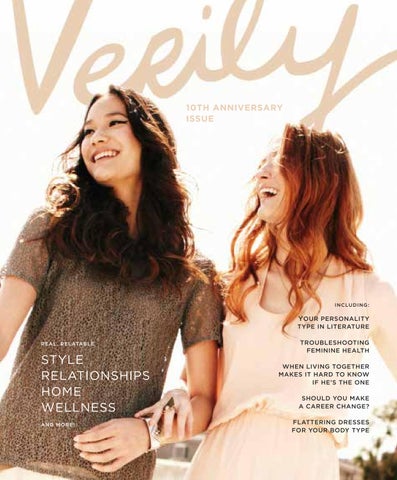
10TH ANNIVERSARY ISSUE
I NCLUD I NG:
Y OUR PERSONALITY
TYPE IN LITERATURE REA L, RELATA BL E
STYLE RELATIONSHIPS HOME WELLNESS A N D MORE!
TROUBLESHOOTING FEMININE HEALTH WHEN LIVING TOGETHER MAKES IT HARD TO KNOW IF HE’S THE ONE SHOULD YOU MAKE A CAREER CHANGE? FLATTERING DRESSES FOR YOUR BODY TYPE
CONTENTS
BACK BY POPULAR DEMAND
VERILY MAGAZINE Verily is returning to its roots—as a print publication! Many of our readers told us they prefer the more intimate magazine format, and we aim to please. Verily quarterly will begin publication in the spring of 2023. Make your advance order today and ensure that your subscription starts with our inaugural issue! WHAT CAN YOU EXPECT?
LESS OF WHO YOU SHOULD BE Features relevant to your life. Verily’s No-Photoshop style shoots. Meaningful advice on relationships, careers, education, and family. Home design and beauty tips. Healthy recipes; delicious libations. Curated news and incisive cultural coverage. And much more. You’ll love our exclusive content tailored for the thoughtful woman. Every uplifting issue of Verily Magazine will empower you to be
MORE OF WHO YOU ARE. Reserve your subscription today. Sign up for our free newsletter to keep you posted on exciting news as we get closer to our launch date. Don’t wait. Go to members.verilymag.com to place your subscription order and join our print community. You won’t want to miss our next ten years!
1
V E RI LY MAGAZI NE • 1 0 t h A N NIVE RSARY ISS U E
EDITOR’S NOTE
EDITOR’S NOTE Thank you for joining me in celebrating Verily’s 10th anniversary!
Ten years after our first print issue dropped, we are thrilled to once again connect with you in print. Amid a constantly changing world of media, many have expressed a hope to once again hold a copy of Verily in their hands. It makes sense. We want to be a place where you can read helpful, thought-provoking articles, in a form that invites a human conversation more than a web comment, reflection rather than divided attention, and stability in the face of the unpredictable world of social media and tech. In great part due to your persistence in asking for it, Verily is once again returning to print. Yes! Coming to a mailbox near you in 2023 is the new quarterly Verily Magazine. Spread the word, and, if you haven’t already, secure your subscription at Members.VerilyMag.com. While you’re at it, grab some gift subscriptions for your friends and loved ones. I know it’s not as free as the web, but your subscription is paying for something valuable that can’t be found on the web. And we truly couldn’t do this without you. We also couldn’t have done it without so many people who have brought Verily this far, who I am grateful to feature in these pages. To celebrate this exciting new chapter on our 10th anniversary, we have produced this special stand-alone issue featuring some of our best articles and features from the past decade. Many of these articles, photos, and illustrations have, up to this point, lived only online. I think you’ll agree with me that the printed page unlocks something new and beautiful about them! I look forward to hearing what you think. As always, don’t hesitate to drop us a line at ohhello@verilymag.com. Truly, I can’t wait to hear what you think and to embark on this journey with you. TOP : SE A N CH RI STOP H E R; B OT TOM : N E W IM AG E P H OTOG RA P H Y
Verily Yours,
M A RY R OSE SO MARRI BA
You know what ten years looks like? Ten years ago, this first photo was taken, when I was about ten weeks pregnant with my daughter Inez.
E DI TO R IN C H IE F
Here is Inez today. That’s how old Verily is! VER I LY MAGAZI NE • 10 t h A N N IV E RSA RY ISS UE
1
MASTHEAD
LESS OF WHO YOU SHOULD BE, MORE OF WHO YOU ARE.
10TH ANNIVERSARY SPECIAL ISSUE EDITOR IN CHIEF
Mary Rose Somarriba ART DIRECTOR
Haruka Sakaguchi ART CONSULTANT
Katherine Rybak Torres PROJECT MANAGER
Tiffany Owens ONLINE EDITORS
Emily Lehman Gabriella Patti ASSOCIATE EDITORS
Margaret Brady Lindsay Schlegel SOCIAL MEDIA EDITOR
Gabrielle Sanford COFOUNDERS
Kara Bach Janet Sahm Easter CONTACT
ohhello@verilymag.com Cover photo by Trever Hoehne
2
V ERI LY MAGAZI NE • 1 0 t h ANNIVE RSARY ISS U E
TABLE OF CONTENTS STYLE & BEAUTY
Thrifting Tips from Style Bloggers 4 DIY: Sea Salt Hair Spray / Pregnancy Style Must-Haves 5 5 Easy Red Lipstick Looks for Every Occasion 6 The Most Flattering Dresses for Your Body Type 8 Hair Tutorial: “Poetry in Motion” Elegant Updo 10 Makeup Tutorial: Purple Shadow 11 The Best Sunglasses for Your Face Shape 12 Best of Verily Photoshoots 64 RELATIONSHIPS
Helpful Things to Know About Yourself Before You Fall in Love 14 What My Italian Family Taught Me About Community 15 Single and 30: How I Stopped Waiting for a Ring and Started Living a Great Life 17 My Dad Forever Changed the Way I Approach Relationships with Men 19 Protecting Your Heart from the Formulaic Workplace Affair 21 Is He Chivalrous—or Controlling? 23 Helpful Things to Say to a Friend with an Eating Disorder 24 When Moving In Together Makes It Harder to Know if He’s the One 26 What Netflix’s Too Hot to Handle Can Teach Us About Sex and Intimacy 27 Real Women Share How They Knew They Had Met Their Future Husbands 29 CULTURE
Tend and Befriend: How Female Friendship Helps with Healing 31 “Country Girl” Rissi Palmer Reflects on her Stereotype-Breaking Hit Song 34 Accepting Fertility as a Part of Women’s Health 35 Americans Need to Come Up with Our Own Form of Hygge 39 Can Making Dinner Daily Cure Millennial Burnout? 41 Your Literary Heroine Based on Your Myers-Briggs Type 44 HEALTH & LIFESTYLE
From Mocktails to Cocktails 46 Easy Ways to Spice Up Your Everyday Cooking 47 Gluten-Free Food Swaps That Don’t Sacrifice Flavor 49 Food Origami: Potstickers Three Ways & DIY Dumplings 50 Should You Make a Career Change? 52 Crochet Your Way to a Boost in Self-Confidence 53 Common Reproductive Disorders That Are Major Blind Spots in Women’s Health 56 Seeing the Kindness in Expressing Our Needs 59 Simple Styling Tips to Make Your Bedroom a Clutter-Free Safe Haven (and Keep It That Way) 60 Let’s Exercise Because We Love Our Bodies, Not Because We Hate Them 63
VER I LY MAGAZI NE • 10 t h A N N IV E RSA RY ISS UE
3
STYLE & BEAUTY
THRIFTING LIKE A STYLE BLOGGER BY JA N E T SA HM E ASTE R
ANNA LIESEMEYER IN HONOR OF DESIGN
For many women, the idea of popping into a vintage store and coming out with an amazing, low-cost find is amazing. But once we arrive, the thrill of the hunt is often exchanged with panic, and the possibility of surfacing with a wearable treasure in hands seems more like a miracle than simply an art. And yet, we all have that friend who possesses the “magic eye” for seeing the possibility in a seemingly abysmal crate of old scarves. How does she do it? In an effort to demystify the “eye” for thrift, we tapped the experts—talented, relatable fashion stylists and bloggers—who’ve picked up a few tips over the years and keep these tricks up their sleeves for thrifty shopping. It seems patience and having a plan are two telltale themes to remember!
ALEX EVJEN
BRYNN WATKINS
AVE STYLES
BEING ELLIOTT
1. DON’T GIVE UP TOO QUICKLY.
1. HAVE A PLAN BEFORE YOU GO.
You may come across 10 unappealing items and write off the whole rack, but if you keep at it, you are bound to find the gem in the sea. Believe there is something grand awaiting you, and chances are you will find something spectacular!
Even for a stylist (and one who loves to shop), thrifting can be overwhelming because nothing is organized by color or year. At best, you will find clothing racks sorted by type, such as dresses, skirts, or tops. When I decide to venture out, I usually have something very specific in mind, which can make the process much more enjoyable, even thrilling! It’s also helpful to have your shopping list, because before you go you can ask the store owner if they have the specific items you’re looking for.
2. THINK OUTSIDE OF CONTEXT.
It is easy to get stuck inside those thrift store walls and have difficulty visualizing how the pieces can work to your benefit. If you take a moment to think through the different ways you can wear a piece with what you already have in your closet, you are more likely to see it in a new light. That oversized sweater just might work perfectly with the distressed skinny jeans you recently bought. 3. CHECK ALL THE SIZE RACKS.
With as much traffic as thrift stores receive, often times sizes are mixed up on the racks. I have found some great pieces in the wrong size sections! So take a little time to scan the bigger or smaller sizes as well.
2. BRING CASH.
Too many times I have made the mistake of stopping by a thrift shop on a whim, finding something I love, and not being able to purchase it because the store is cash only. I’ve even had to go as far as leave the store, find an ATM, and then come back because I didn’t want someone to take the item. Paying in cash also helps with price negotiations, because you can honestly say, “All I have is ___.” Store owners are often willing to sell for less than the marked price just because they need room for more inventory. 3. AVOID THE WEEKENDS.
Everyone goes thrifting on the weekends, and in most instances the store is picked over by the time you get there. Many shops replenish their stores on Wednesdays and Thursdays, when the traffic is slower. If you go on those days, you won’t have to worry about enough elbow room, and you can get first pick of what is available. 4
V E R I LY MAGAZI NE • 1 0 t h A N NIVE RSARY ISS U E
1. KNOW WHAT YOU WANT BEFORE YOU GO.
Knowing what you’re looking for makes all the difference. Look at Pinterest and page through magazines you love to get a sense of what clothing items or accessories you are looking for. Print those pictures and take them with you as your “wish list” references. 2. BEELINE TO DRESSES AND SHOES.
Dresses are a fun, one-stop-shop—they’re a whole outfit in themselves, so go for them first. Shoes are also an overlooked hot spot at the thrift shop. Be sure to hit these areas first to get a guaranteed bang for your buck. Check out those labels for quality brands and sturdy items. 3. SMALL-TOWN THRIFT IS THE BEST.
If you ever find yourself in a small town, look for a thrift store. I have found that trendy items are more readily available in small towns because the store is less picked over. And usually more reasonably priced than in the city!
Janet Sahm Easter, a cofounder and former style editor of Verily Magazine, is the founder of EverThrift. This article was originally published on October 13, 2014, at VerilyMag.com. Photo Credit: Dina Kantor.
STYLE & BEAUTY
GLOW IN STYLE
DIY
Even with a small budget and a few great basics, maternity style can be just as fun with the baby bump as it is without. Remember to buy your respective size in maternity to ensure that the sleeves and length fit well—meaning that, if you were a size 8 or 10 before pregnancy, chances are that size is still best. Personalize and add interest to your favorite finds with accessories like scarves, layered necklaces, cuff bracelets, and cocktail rings.
SEA-SALT HAIR SPRAY
CASUAL
Tousled, textured, wavy-like-you-just-don’t-care hair is always in. One of the key ingredients to creating the beachy style is with the magic of “sea-salt spray,” a texturizing spray that makes your hair look and feel as if you’ve been hanging out on the sandy ocean shoreline all day. Store-bought salt sprays, such as the legendary Bumble and Bumble Surf Spray, get the job done but can create quite the dent in your wallet. Professional makeup artist and hairstylist Jen Navaro with Jump Management gave us the secret to create your very own salt spray right at home. Here’s what you’ll need.
SUPPLIES
STEPS
2 tablespoons sea salt 1 cup water 1 tablespoon water-based hair gel 1/2 teaspoon leave-in conditioner 1/2 teaspoon argan oil (optional, for those with drier hair textures) 1 to 2 drops of essential oil of choice for fragrance (optional, but lavender, peppermint, and wild orange are my favorites if you want to give it a try!) Pot and stove top (or microwavable bowl or cup) Spray bottle that can hold more than a cup of water Utensil for stirring Measuring spoons
1. Heat the cup of water in a pot or bowl until just before boiling, and remove from heat. 2. Stir in the salt first until completely dissolved. 3. Add the rest of the ingredients to the mixture (hair gel, leave-in conditioner, argan oil, essential oil), and stir until all ingredients are completely combined. 4. Allow to cool to room temperature, and then pour into a spray bottle. 5. Give your sea-salt spray a good shake.
Basics like a striped shirt layered under a cardigan and blazer complement each other, and can stand alone as well. Pair them with slim leg jeans and wedge booties for a look that is comfortable and stylish without overdoing it.
THE LONGSLEEVE TEE BY HATCH
Face the elements in style! Try a parka or anorak for more casual days, and the cape or toggle coat for dressy occasions.
HOW TO APPLY
DRESS
Have a few dresses handy for the upcoming holiday season and long-awaited date night. Solid colors and patterns in varying shades of the same color create clean lines along the curves of the body.
Salt spray can be applied to wet or dry hair. It’s important to note that you don’t want to spray your hair at the roots, but rather from two inches away from the roots all the way to the ends. Be sure to always shake up your spray before using, and two to three spritzes on each side of your head is a great start. Then, work your hair with your hands, scrunching and twisting to give it a little bend and texture. Add more salt spray—one to two sprays to each side at a time— and repeat scrunching until you reach your desired level of beachy texture. Using a blow-dryer to help speed up the hair-scrunching process is a great idea if you need to scrunch and go!
“Get Carefree Summer Waves with This DIY Sea Salt Hair Spray,” by Janet Sahm Easter, was published on May 29, 2015. Photo Credit: The Denizen Co.
WATER FALL PAR KA COAT BY ASOS DESI GN
COATS
MAMA KNOT-DETAI L SATI N DR ESS BY H&M
Nicole Caruso, a former beauty editor of Verily, is author of Worthy of Wearing. This is excerpted from an article published on October 3, 2016 at VerilyMag.com.
VER I LY MAGAZI NE • 10 t h A N N IV E RSA RY ISS UE
5
FIVE EASY RED LIPSTICK LOOKS TO KEEP YOU LOOKING CLASSY WHATEVER THE OCCASION
ILLUSTRATIONS BY E RICA S H ARP
STYLE & BEAUTY
02. BURGUNDY RED
Who knew one simple makeup item could be so versatile—and so powerful? BY L IL LIA N FA LLO N
Red lipstick is our go-to look for a night out, but if you find yourself reaching for the same color every time you get ready, it might be time for a few new options. Red comes in a variety of tones and intensities that are suitable for all kinds of occasions; all you need is the right eye shadow to complement it. If you’re ready to switch up your makeup routine, look no further than our five red lipstick looks below. Lillian Fallon, a former style and beauty editor of Verily, is the creator of T heology of Style. This article was originally published on March 16, 2016, at VerilyMag.com.
01. ORANGE RED
You might be balking at the idea of wearing bright orange lipstick, but don’t worry—this bold look is best paired with simple eye makeup for an overall fresh and modern look. If you’re nervous about the intensity of the orange, try a peachier hue. To balance out the bright lip color, apply a subtle black liner on your top lids close to your lash lines. Top off with mascara, and pencil in your brows a little bit to frame your face. A light application of peach blush will complement your lipstick and keep you looking lively. Wear out on the town or for your everyday errands—this look is both casual and dressy with its fresh yet bold appeal.
6
V ERI LY MAGAZI NE • 1 0 t h ANNIVE RSARY ISS U E
This moody hue has become increasingly popular, but many women are intimidated by its darkness and aren’t sure how to wear it without looking like a vampire. When rocking deep burgundy, you want to avoid equally bold eye makeup. So put aside your black eyeliner, and pick up your gold eye shadows to create a soft, glowing look. Use a variety of gold tones, from dark golds to light golds to create some dimension on your eyelids. Apply the darkest gold to your creases as well as lightly along your lash lines to create the illusion of eyeliner without the intensity. Lastly, gently apply some dark gold shadow along your bottom lash lines to create a sophisticated and moody look. Wear this look when going out to concerts, bars, or any Friday-night excursion.
STYLE & BEAUTY
03. CRIMSON RED
Now this is the classic red lipstick look we all know and love. Nothing really makes a crimson red lip pop like a retro cat eye. Put on your boldest bright red lipstick without reservation—this look is all about being fearlessly ladylike. If you want to make an impression, create an intense flick on your liquid cat eye. This is a versatile look, perfect for any fancy occasion such as a dinner date, that looks equally at ease with a more casual outfit for drinks with girlfriends.
04. FUCHSIA RED
We all have a bit of girlie girl in us. The 13-year-old versions of ourselves would be squealing over this look, but don’t worry, this youthfully feminine tone is just as appropriate in your twenties and thirties. The goal of this look is to be fresh and dewy, so slowly step away from dark eye shadows and black eyeliner. Keep your face glowing with highlighter on your cheeks and brow bones. To make your eyes appear brighter, apply a champagne tone to your lids but concentrate it in the inner corners, and lightly blend into the lower lash lines. A few coats of mascara will enhance the open-eyed look. Perfect for most occasions, this look can be worn when going out on weeknights or meeting up for a first date.
05. ROSE RED
If you’re not into bold or colorful red lipstick looks, this is the red lip rendition for you. A matte dusty rose has all the sophistication of a bright red lip but makes a more subtle statement. Wear this when meeting up for a coffee date, going to work, or even heading to an upscale cocktail party. To complement the warm hues of your lip, create a warm brown eyeshadow look with neutral tan in the center of your eyelids and dark brown along your creases and top and bottom lash lines. To pick up on the rose lip color, lightly apply a bit of your rose-tone blush to the tops of your eyelid creases. Apply black liner and mascara as you usually would, and then apply a couple swipes of rose blush to your cheeks.
VER I LY MAGAZI NE • 10 t h A N N IV E RSA RY ISS UE
7
ILLUSTRATIONS BY MARTA S P E ND OWS KA
STYLE & BEAUTY
THE MOST FLATTERING DRESSES FOR YOUR BODY TYPE Learn to tell your trapezes from your sheaths, and discover the best styles for your shape. BY JA N E T SA HM E ASTER
Fashion commentary on blogs and in magazines is full of jargon. When it comes to describing clothes, much of it can seem like mumbo jumbo. What’s the difference between a shift and a sheath dress, a-line and trapeze, shirt-waist, drop-waist, and empire? We’re here to decode some of the terminology surrounding dress silhouettes, plus what works best for your body. This article by Janet Sahm Easter was originally published on October 13, 2014, at VerilyMag.com.
SHEATH & SHIFT This is the trickiest distinction, as both are simple, uncomplicated dresses that fall straight down from your shoulders. I only recently learned that the difference between the two is that a shift dress is less fitted than a sheath dress. Who knew? A sheath dress is form-fitting and shaped by darts. (Darts are a V-shaped tuck used to help shape the fabric of a garment to the contours of the body, most commonly seen over the bust area.) Sheath dresses look best on those with hourglass shapes or heart shapes, as the slightly more form-fitting silhouette highlights your proportions. A shift dress simply falls straight down from your shoulders, meaning it’s a bit more flow-y over your hips and waist. Shift dresses look best on those with a column or straight, boxy shape, who can more easily pull off a looser fit without looking like they’re drowning.
A-LINE & TRAPEZE A-line is the holy grail for every body shape. A-line skirts or dresses are fitted at your natural waist and gradually widen toward the hem to create a triangular shape that fans out slightly. This flattering shape pulls double duty: it draws the eyes to the waist for pear (larger on bottom) and heart shapes (larger on top), which de-emphasizes the hips and adds the appearance of curves for those with boyish or boxy body types. A trapeze dress has a triangular shape as well, but instead of starting at your waist, the silhouette begins at your shoulders and flairs out over your form. It has an easy, breezy, almost tent-like look and feel. This silhouette is best for long, lean, and somewhat boxy body shapes as you won’t drown in all the fabric and shapelessness, but rather the dress will hang and flow beautifully.
8
V E RI LY MAGAZI NE • 1 0 t h A N NIVE RSARY ISS U E
STYLE & BEAUTY
EMPIRE & WRAP An empire dress has a high waistline located just under the bustline, and the rest of the dress flows out. Empire-waist dresses look best on those with pear shapes, as it marks the smallest point of your figure and distracts from everything else. For those with boxy, straight shapes, an empire silhouette adds more curves. A wrap dress is another universal winner for every woman. It has a front closure formed by wrapping one side across the other, and knotting the attached ties that wrap around the back at the waist or fastening buttons. This forms a V-shaped neckline and hugs a woman’s curves. Perfect for hourglass, heart, pear, and boxy shapes!
DROP WAIST & SHIRT WAIST For a drop waist dress, think 1920s, Gatsby-era dress. The silhouette has a low, horizontal waistline that usually falls near the level of the upper hips. The result is a lengthening of the torso—which makes this dress style one of the hardest to pull off. But, for those with a boxy or boyish shape, this was made for you! The column-like top will fall straight over your form, and the low waistline won’t tug or pull at your hips. A shirt waist dress is a tailored dress styled like a shirt with yoke and buttons to the waist. (A yoke is a shaped piece in a garment, usually fitted across the upper chest and/or back, from which the rest of the garment may hang). A shirt waist tends to have an A-line bottom with a collar and button-down top and belt to cinch the waist. Because it has an A-line silhouette, shirt wait suits all body types. It highlights your form and tends to give structure where needed. A structured top provides balance for those with an heart shape, and the A-line nature of the skirt helps balance the bottom of those with pear shapes.
VER I LY MAGAZI NE • 10 t h A N N IV E RSA RY ISS UE
9
STYLE & BEAUTY
P HOTO BY THE WEAV E R H OUS E
GET THE “POETRY IN MOTION” LOOK WITH THIS ELEGANT UPDO TUTORIAL BY JANE T SAH M E AST E R
We’re happily reminiscing over the featured fashion spread in our very first print issue: “Poetry in Motion,” inspired by the secret life of Emily Dickinson. On a misty, cold April morning in 2013, we scampered about with the amazing women of the Weaver House on their rustic Pacific Northwest farm, reveling and getting lost in the ethereal, imaginary storyline. And it seems you couldn’t get enough of the dreaminess as well! Last fall, we posted a #TBT image to model Meredith Adelaide’s gorgeous, windswept updo from the shoot. From the request of you, dear readers, we’re bringing you a step-by-step tutorial on how to create the look for yourself, with the help of none other than the beautiful Meredith Adelaide herself, who joined us almost two years later. Yay for reunions! This article by Janet Sahm Easter was originally published on January 9, 2015, at VerilyMag.com.
WATCH THE VIDEO TUTORIAL AT VERILYMAG. COM
01. Use a comb to part hair at your
natural part.
02. Tease and then comb back the crown.
03. Section a piece of hair on the right side of your head, just above the ear. Roll hair away from your face and toward the back of the head.
04. Secure with pins along the roll, pinning downward into the roll.
05. Roll the remaining hair into a loose bun.
06. Secure with pins, pinning all
07. Gently pull out a few loose
08. Fluff the crown to add volume.
09. Voila! You’re finished.
tendrils around the face.
10
V ER I LY MAGAZI NE • 1 0 t h ANNIVE RSARY ISS U E
around the bun.
STYLE & BEAUTY
STEP 2. EYES
Purple eyeshadow has strong roots in the makeup junky community, but beginners are usually intimidated by this bold look. But lets give it a shot! Step out of your comfort zone to try plums and violets, these shades complement almost every complexion from fair to deep tones. Aveda Petal Essence Eye Color Trio in Violet Bloom is a versatile palette to start with. Fairer tones can use the champagne shade as a base. After applying the base, gently push the medium purple over it for the desired hue. Deeper tones can start with the medium purple as the base and layer the darker purple over it for a dense shade of plum that will make the eyes pop. Use a clean brush to blend so the color looks even. Line the eyes with a bright blue pencil on the upper and lower lash line, keeping the line thin and as close to the lashes as possible. Nyx Cosmetics Slim Eye Pencil in Satin Blue is a sky-blue liner that is as bright as it is budget- friendly! Add a few coats of your favorite black mascara, and the eyes are complete.
Start with a clean, moisturized face to apply your desired coverage. Brianna’s skin looked fresh and youthful with a slight dewiness. We recommend Urban Decay Stay Naked Weightless Liquid Foundation for its lightweight texture, wide range of shades, and fluid texture that evens the skin without looking heavy.
STEP 3. CHEEKS
Keeping with the blue undertones, a mauve blush adds a subtle flush of warmth and dimension to the center of your face. Glossier Cloud Paint in Haze is a blue-pink shade that complements the purple shadow and ties the look together.
P HOTO BY SAR A KER ENS
STEP 1. FOUNDATION
GET THE LOOK: PURPLE SHADOW BY NI COL E C ARU S O
The Style Mixology feature in our August–September 2013 issue introduced us to the magic of mixing prints to create truly inspirational outfits. But our love for this spread doesn’t stop there. Makeup artist Alexis Ansell created a fresh and colorful look on our model Brianna Michelle, with purple shadow, electric blue liner, and a mauve blush—and now we’re ready to try this at home!
STEP 4. LIPS
Paired with bold eyes, it’s best to keep the lips toned down. A simple plum-toned gloss like Smashbox Gloss Angeles Lip Gloss in Celeb Sighting will look good on everyone. For those with lots of natural pigment in the lips, this gloss will brighten your natural color and add a creamy sheen. For those with a more neutral natural lip color, this shade infuses a berry glow that is oh-so-feminine.
This article by Nicole Caruso was originally published on August 16, 2013.
VER I LY MAGAZI NE • 10 t h A N N IV E RSA RY ISS UE
11
STYLE & BEAUTY
THE BEST SUNGLASSES FOR YOUR FACE SHAPE Find out which shades suit you best.
SQUARE If you have a square face shape, then you know a thing or two about a chiseled bone structure. With a strong jawline that is slightly wider than your forehead, finding flattering frames is all about counteracting the angularity of your face shape. This means round frames! The circular frame will soften the squareness of your face. And lucky for you, round frames are on-trend this year, giving you plenty of options. A pair of tortoiseshell frames are smart-looking, with just the right amount of trendy. Or have a little fun with some other unique styles of round shades.
1
2
3
4
BY L I LLIA N FA LLO N
The spring sunshine is finally here to stay, and as we look forward to the coming summer months, appropriate eyewear is a must. To keep your eyes stylin’ and, most importantly, protected from the UV rays, don’t settle for just any pair at your local kiosk. Find a pair of sunglasses that is especially flattering to your unique face shape with our guide below.
1. Warby Parker, $145 / 2. Classic Specs, $89 / 3. Madewell, $60 / 4. Classic Specs, $89
This article by Lillian Fallon was originally published on April 28, 2016, at VerilyMag.com.
ROUND
IL LUSTR ATI ONS BY ER I CA SHAR P
A round face shape means that the width of your jaw is equal to the width of your forehead. You also have fuller cheeks, which is why you want to find frames that are angular, in order to contrast against the overall roundness of your features. A pair of square frames will create the illusion of a more defined bone structure. Classic wayfarers are the perfect style for you, with their squared off bottom. We’re digging two-toned frames right now, but you can never go wrong with a classic finish.
1
2
3
4
1. Warby Parker, $145 / 2. Warby Parker, $95 / 3. Ray-Ban, $163 / 4. Classic Specs, $89
1
2
3
4
1. Free People, $20 / 2. Quay, $60 / 3. Classic Specs, $89 / 4. Classic Specs, $89
12
V ER ILY MAGAZI NE • 1 0 t h A NNIVE RSARY ISS U E
OBLONG If you have an oblong face, your features are narrow. This means that your forehead, cheeks, and jawline are almost the same width but appear to be narrower and longer than the other face shapes. Typically, an oval face has a width–length ratio of 1 to 1.5; anything longer than 1.5 puts the face shape into the category of oblong. You don’t want to wear frames that enhance narrowness; rather, you want to find a pair of frames that create the illusion of width. This means finding rectangular frames that are wider than your face on the sides.
STYLE & BEAUTY
DIAMOND & PEAR A diamond face shape is when widest part of your face is right around your cheekbones and eyes but your forehead and chin are more narrow. To flatter the diamond face shape, you want to find frames that draw attention upward. Pear-shaped faces have a similar goal: since the narrowest part of the face is at the forehead and then widest in the cheeks and jaw, you want to avoid adding more width to the lower half of the face. A cat-eye frame is ideal because the frame turns upward, creating the illusion of more forehead width. Cat-eye lenses are wider at the top and narrower at the bottom, so they do not add more volume to your cheek bones. 1
2
3
4 1. Privé Revaux, $40 / 2. EyeBuyDirect, $39 / 3. Warby Parker, $145 / 4. Classic Specs, $89
HEART The heart face shape is the widest at the forehead and then tapers off into a narrow jawline. To find frames that flatter the heart face, you want to find bottom-heavy frames to create the illusion of wider cheeks to balance out the width of your forehead. This means aviator styles or other frames that draw attention downward. The lenses should come down toward your cheeks, but they should not be so high that they cover your eyebrows.
1
2
3
4
1. Warby Parker, $95 / 2. Nordstrom, $65 / 3. Warby Parker, $145 / 4. Ray-Ban, $140
OVAL An oval face is slightly longer than it is wide, typically with a narrower forehead and jaw. Oval-shaped ladies are quite lucky because they have a universal canvas to work from. For an oval-shaped face, almost any style of sunglasses will work. We suggest having fun with quirkier styles of frames in varieties of color. Thick oversize square frames, circular frames, aviators—try them all!
1
2
3
4
1. Privé Revaux, $40 / 2. EyeBuyDirect, $45 / 3. Warby Parker, $145 / 4. J. Crew, $30
VER I LY MAGAZI NE • 10 t h A N N IV E RSA RY ISS UE
13
R E L AT I O N S H I P S
HELPFUL THINGS TO KNOW ABOUT YOURSELF BEFORE YOU FALL IN LOVE BY TAY LO R DAVIE S
While I am unquestionably and staunchly in the “pro-dating-apps” camp, I’ve been feeling a little down on them lately. This fall I’m taking a beat and trying an IRL approach to meeting guys, which is how I came to be on a FaceTime call with Becky from Three Day Rule, a matchmaking company. I had never put my romantic life in someone else’s hands before, let alone spoken to a professional about it. Over the course of thirty minutes, we spoke about my preferences, my dealbreakers, my past, and my goals for the future. It sounds so simple, I know, but I had never really taken the time to outline those things in relation to love. Have you? Whether you’re single and searching like me or considering going all in with a new guy, I highly recommend taking some time (with a pen and paper, perhaps) to answer these questions for yourself. The answers will create a filter through which you can view your relationships and romantic paramours to gain perspective and clarity on the things you want and the things you need. WHAT ARE YOUR HOBBIES, AND HOW DO YOU LIKE TO SPEND YOUR FREE TIME?
This question is kind of a layup, but I think it serves as a good starting point because it is (or should be) easy. Making a list of the things you like to do is the first step for envisioning a future with someone else. Will your Pilates practice be part of your “me time”? Is it important for your partner to enjoy trying new restaurants and taking spontaneous weekend trips upstate? Make a list of your favorite activities, or maybe outline your idea of the perfect Saturday to get you started. WHAT’S YOUR DATING HISTORY?
I’ll be honest with you, when the matchmaker asked me this, I faltered. My relationship
14
V E R I LY MAGAZI NE • 1 0 t h A NNIVE RSARY ISS U E
istory is a point of anxiety for me, and it h could be for you, too. But keeping your past bottled up and locked away won’t help you going into your next relationship. It’s important to acknowledge and live with your story. Practice summarizing your romantic past in a brief but honest way. Whether discussing your dating history makes you feel insecure, sad, angry or cringey, the more you talk about it, the less hold it will have on your present and future. WHAT QUALITIES ARE YOU LOOKING FOR IN A MAN?
Seems like another no-brainer, right? But once you get past the basic characteristics most of us are hoping to find (kind, intelligent, emotionally available), you’ll discover that coming up with specific qualities that are actually important to you can be very revealing. Do you need a guy who’s funny or just someone who can make you laugh? Is stability more important to you than spontaneity? These qualities aren’t as important as your dealbreakers (we’ll get to those later), but making a list of these “nice-to-haves,” as one matchmaker called them, will get your brain buzzing so that when you encounter them, you’ll take notice. ARE YOU SPIRITUAL? IS RELIGION IMPORTANT TO YOU? HOW ABOUT POLITICS?
Unless you’ve been socializing under a rock, you’ve no doubt encountered some kind of political conversation on a date recently. Unless it’s important to one or both of you, religion often doesn’t come up as frequently, but it will play a role in your relationship at some point, so why not get your bearings now? Affirm your beliefs and your passion points so that when they inevitably come up in conversations down the line, you’re clear
and sure-footed on where you stand and what kind of common ground you desire in a relationship. DO YOU HAVE ANY DEAL BREAKERS?
When Becky first asked me this, my thought was “No, not really!” because I’m 31 and maybe nothing should be off the table at this point. However, you can’t let the feeling of scarcity creep in as you get older (or after a bad breakup). If anything, you should be more sure of what you don’t want than you have ever been in your life. It might sound counterintuitive to shrink your pool of possible dates, but it will dramatically decrease the amount of energy you spend on relationships that won’t work. And really, who has time to waste at any age? WHAT ARE YOUR LONG-TERM GOALS? MARRIAGE? KIDS? MOVING?
Personally, I don’t think you have to have a concrete, unwavering stance on marriage and children until the issue presents itself to you. But before you get into another relationship, it’s important to be honest with yourself about where you stand, so you can be honest with your future boyfriend. Life happens, and it can change our goals from the inside out. But aligning with your partner on the long-term future is a huge part of making a relationship work. So be open to what your mind and your heart are telling you, and when you feel confident in your desires and your goals, keep them top of mind.
Taylor Davies is a freelance writer and stylist living and working in New York City. This article was published on September 25, 2017, at VerilyMag.com.
P HOTO BY V ICKI GRA F TON P H OTOGRA P H Y
WHAT MY ITALIAN FAMILY TAUGHT ME ABOUT COMMUNITY THAT OUR WORLD COULD USE MORE OF RIGHT NOW When my grandmother died, I was forced to rethink how I could keep our traditions alive. BY GAB RI E L L A PAT T I
In December my grandmother died after a long battle with Alzheimer’s. I’m a fourth-generation Italian American, and my grandmother was the epicenter of our world. At her funeral, I pondered how our family would fare without its
matriarch; I began to fear that, without her, we might lose the togetherness that is so central to an Italian family’s lifeblood. I was overcome by an urgency to hold onto the lessons that she and my grandfather, who is now slowly fading
from dementia and Parkinson’s, had passed on. I didn’t want us to forget the stories of where we started, the stories that held us all together. Being Italian makes you nostalgic for things you never knew. I grew up
VER I LY MAGAZI NE • 10 t h A N N IV E RSA RY ISS UE
15
R E L AT I O N S H I P S
hearing stories about how my greatgrandmother lived in the kitchen day and night, cooking for her people; about her five sisters—one of whom raised them all, and one of whom tried to nosedive into an open grave to express her grief when a family member died. (We aren’t known for our subtlety.) I heard stories about my great-grandfather’s opera records, and my grandfather’s constant need to be rescued from shenanigans by his cousins. My family’s stories have always filled me with a warmth and familiarity that is tangible. There’s something about the sense of famiglia I inherited that I think our world could use more of today. We take care of each other; we encourage each other; we nourish each other, and not just literally. But doing this takes effort, as I realized when my grandmother passed. Our family traditions won’t just happen if we don’t pass them on; the stories won’t last if we don’t tell them. In recent years, I have witnessed for myself what many sociologists have been saying for years, that there is increased fragmentation in American society. Political and social divides have grown wider, and we’ve seen an influx of families that are broken or hurting. Marc Dunkelman, author of The Vanishing Neighbor: The Transformation of American Community, said that community has been replaced with a strong sense of individuality. Once upon a time, being part of a community meant being aware of the needs of those around you, and playing an active role in their lives. Now it means leaving those around you in peace and avoiding involvement, in the name of “not interfering.” Contrary to this, the tight-knit Italian lifestyle has actually been proven to improve communities from all number of backgrounds. Consider the Roseto Effect—a phenomenon discovered by researchers in an Italian-American community in Pennsylvania. Research conducted between 1955 and 1965 showed that members of this community had lower mortality rates and were less likely to have heart disease than did Americans on average. What was surprising about this was that the people in this community consumed a highcarb Italian diet, drank wine without restraint, and smoked unfiltered cigars. The researchers concluded that it was the strong sense of community that kept morale up and stress low, leading to an overall healthier community. 16
V ER ILY MAGAZI NE • 1 0 t h A NNIVE RSARY ISS U E
I know I saw this same effect in my Italian brood. Just listening to my family’s stories offered deep-rooted lessons on the value of togetherness. Take, for instance, the memories of my grandfather growing up during The Great Depression, on a block where every home was owned by one of his aunts and uncles—they were dirt poor, but my grandpa says he didn’t notice because they never went without. One uncle was a butcher and made sure that
When I went off to college, I ate many of my meals alone or while watching Netflix. However, each time I returned home, I was reminded how the communal aspects of meals nourished my soul. The passing of bread and the loud conversations that can truly last hours never felt like wasted time. everyone always had fresh meat; another did plaster work, and could guarantee that your house would always look clean and fresh; my great-grandfather was a barber and gave everyone their first and last haircuts. You had a rip, an aunt would sew it; you didn’t like what mama was making for dinner? No problem, go next door and see what they are eating there. I’ve become convinced that the meal culture itself is enough to heal the world, and I don’t mean we all have to become pasta eaters. If you have ever been to Italy, you know that the food is an art, but what you didn’t know is that behind every
meal is a nonna in the kitchen unselfishly devoting herself to the stove to make course after course for a multitude of guests. Many of our family events revolve around the meal. We don’t just sit and eat, we savor, but more important than the food that brings us together are the people who we spend hours talking to over wine until the dessert comes out and coffee is served. When I went off to college, I ate many of my meals alone or while watching Netflix. However, each time I returned home, I was reminded how the communal aspects of meals nourished my soul. The passing of bread and the loud conversations that can truly last hours never felt like wasted time. I learned perhaps my most valuable lesson on family at my grandmother’s funeral. Of course we did our fair share of crying, but we spent much of the funeral weekend in each others’ company, eating meals together and laughing as we told stories. We grieved together in a way unlike any funeral I had attended. And although no one threw themselves into the grave this time, this funeral was undeniably striking—we saw third and fourth generations continuing the traditions of storytelling and meals to cure all ailments. Seeing the world increasingly suffer isolation and the breakdown of human relationships, I have become all the more determined to ensure that this tradition continues. If it means I have to act like my nonna, so be it. I will feed everyone, and tell the stories, and kiss cheeks. I will pass on my family’s stories to everyone who will hear, and make them nostalgic, too, for something they’ve never known. Because I’m convinced we can all take advantage of the Roseto Effect in our lives. We just have to continue to place a higher value on our human relationships than we place on almost anything else. Whether it’s your biological family or friends who always have your back, everyone needs la famiglia. Gabriella Patti, an associate editor of Verily Magazine, is a journalist and entrepreneur based in Ann Arbor, Michigan. This article was originally published on July 27, 2017, at VerilyMag.com.
R E L AT I O N S H I P S
SINGLE AND 30: HOW I STOPPED WAITING FOR A RING AND STARTED LIVING A GREAT LIFE ATE L IE R D OR É / TR UN K A RCH IV E
Life doesn’t begin when you get married. BY KARA B AC H
Not again! I thought to myself as I pawed through my massive “purse.” My fingers continued to aimlessly scrape the bottom of my bag as I faced the reality that—with my keys left at the office and none of my roommates answering my forlorn text messages—I was stranded on the streets of New York City.
VER I LY MAGAZI NE • 10 t h A N N IV E RSA RY ISS UE
17
R E L AT I O N S H I P S
In my mind I was left with two choices: Take 90 minutes to go back to the office for my keys, or treat myself to dinner at the restaurant I was dying to try down the street. The siren call of a good meal won. OK, maybe a nice dinner wasn’t my only other option. But I can’t help but feel a little proud that the idea even crossed my mind. I wasn’t always so comfortable dining alone. There was a time, not so long ago, that the idea of marching into a hip restaurant and asking for a table for one would have made me uncomfortable at the very least or, quite possibly, terribly depressed about my single status. Shouldn’t I have someone to go with me by this point? Despite the well-worn joke among friends that I would definitely not be married before 30, I admit I hoped the jokes would be wrong. It’s not that I was sitting around waiting for a man—I’ve traveled extensively and started a business, after all!—but I did, and still do, want to get married. I wasn’t one to dream about my wedding, but I had fantasized about married life since I was a teenager. Making a home together, cooking dinner, yelling at the kids, waking up with someone. And the other things you do when you’re married—taking romantic vacations in exotic places, having a partner to indulge in fancy overpriced dinners for date night, maybe buying a house. It all seemed pretty great. So I used to nod along in agreement as my single friends bemoaned all the married-life perks we miss out on in our nearly-30-and-still-single state. Fresh out of college, at the ripe age of 23, I distinctly remember having a conversation with a coworker about his girlfriend who had just turned 29. We were all giving him a hard time, because hey, you know, she’s going to want you to put a ring on it before she turns 30, bro! (I mean, duh, we all know it’s the age we turn into pumpkins if we’re still single. AmIright?) I guess it’s no surprise that, as I crept from my mid-20s to my late 20s, I was getting a bit anxious. I had already cycled through many roommates who had moved out upon their happy nuptials, and the summers of weddings every other weekend had morphed into summers of baby showers and birthing stories. I wanted to move into the next phase of my life. And then came the turning point in my sad single-person narrative. As I sat drying my tears after a breakup,
18
V ER I LY MAGAZI NE • 1 0 t h ANNIVE RSARY ISS U E
I had an epiphany of sorts (very Bridget Jones, I know). I realized I wasn’t mad at my ex for breaking up with me, per se. But I couldn’t help but resent him for robbing me of my chance to move on from the terrible purgatory of waiting to get married. I looked around my apartment and suddenly saw it for what it was: a waiting
It’s not that I was sitting around waiting for a man—I’ve traveled extensively and started a business, after all!—but I did, and still do, want to get married. I wasn’t one to dream about my wedding, but I had fantasized about married life since I was a teenager. Making a home together, cooking dinner, yelling at the kids, waking up with someone. room. It was filled with the cast-offs of my now-married roommates, the cheap placeholder items that would be replaced by wedding registries full of high-end items. The too-large couch, the Ikea bookcase, the chintzy TV stand, mismatched pots and pans, assorted bedding. I was simply holding on for my turn to put aside the shabbiness of single waiting and emerge into what I saw as the bright, shiny world of beginning my “real”
life. Married life. It might sound silly, but that moment of realization was incredibly freeing. Why did I need to have a husband to decorate my apartment? Why did nice things come only in the form of a wedding gift? So I did what I should have done a long time ago: I shed the mantle of shabby single life and swapped it for a brand-new one that was brimming with life and—if I may say so—style. After banishing the castaway furniture and the depressing dishware, I began the work (and joy) of redecorating. It wasn’t even an expensive undertaking—I scoured Craigslist and West Elm sales and eventually fell in love with a set of plates at Ikea, of all places. But I loved it. Finally, I was happy to come home at night and curl up in my corner chair. I loved having friends over for drinks in a space that I was proud of and serving meals, even just for me, on those new dishes. It’s been a slow transformation, but I started extending my “Why wait?” mantra to other areas of my life. I had been longing for a beach vacation in a secluded bungalow—one of many honeymoon daydreams over the years— so when I came across a 50–percent off sale in Belize, I booked it. Alone. It was the most rejuvenated I had felt after a vacation in years. I’ve tried to do some gardening (miserable fail) and hosting dinner parties (much more successful). I’ve worked on my spiritual life and taken a couple of coding classes. It’s been great to develop my sense of self for me now, no matter what my life might bring. That’s a lesson that I think will serve me well no matter what state of life I find myself in—single, married, or otherwise. Back at the restaurant down the street, as I eagerly waited for my waiter to bring the first course, I knew that I would enjoy my meal unspoiled by the bitter taste of a life on hold. So yes, I’m proud of my fancy restaurant dinner for one. It was delicious. Maybe one day I’ll get to share that little spot with someone else. But for now, it’s pretty damn great on my own. Kara Bach is the cofounder of Verily Magazine. This article was published on July 9, 2015, at VerilyMag.com.
P H OTO BY V L A D IM IR TSA RKOV
MY DAD FOREVER CHANGED THE WAY I APPROACH RELATIONSHIPS WITH MEN A father’s love can be truly transformational. BY S OP H I E C AL DE COT T
Do you remember the first time you ever wondered if you were beautiful? The first time you consciously reflected on your appearance? Do you remember the first time you felt hungry for admiration and affirmation? I can’t say for sure that I remember the very first time, but I do remember a
moment very early on in my life that had a huge impact; I must have understood on some deep level how important that moment was, because it’s imprinted on my memory so clearly. I was around five years old, in my parents’ bedroom; I don’t remember what exactly I said, but I do remember the gray and blue paisley
sheets that were on my parents’ bed, and I remember the earnest, tender look in my dad’s eyes as he answered me, the gentle and serious tone of his voice as he spoke, and the way that it all made me feel. “You are so beautiful, Sophie. You know, you look a lot like your mother, who is the most beautiful woman in the
VER I LY MAGAZI NE • 10 t h A N N IV E RSA RY ISS UE
19
R E L AT I O N S H I P S
world to me.” That was it. Those simple words, spoken with such conviction and love at that formative moment in my life, helped me to put aside any childish angst I may have started to feel about my physical appearance. That moment mattered because it gave me the great gift of a childhood throughout which I barely gave my appearance a second thought. Insecurity started to creep in only during my teen years, and even then it was never as bad as the insecurity many of my peers experienced. My dad made me feel loved and valued for who I was in a holistic sense, and showed me that I was so much more than the sum of my physical parts. It was more than a passing “You’re so pretty,” dished out a little too readily to young girls (which can actually have the opposite effect of what we intend, making them think that being pretty is what matters most). It was the solemn way he said it, in the context of a relationship where he took an interest in everything I was experiencing and thinking; I instinctively knew he loved me for my whole self. He showed me what it meant to be seen with the eyes of love. But beyond protecting me from body image issues, my dad’s love gave me an even greater gift: Being secure in his love profoundly changed my interactions with boys and men as a teenager and young adult. What little girl or woman doesn’t desire to be thought of as beautiful, especially by the opposite sex? The security that my dad gave me meant that I didn’t feel like I had to go out and seek validation from guys before I was ready for romantic relationships. I’m not alone in my experience; there’s a lot of research that shows how a father can impact his daughter’s relationship with her own self-worth and therefore with other men. “Daughters who perceive that their fathers care a lot about them, who feel connected to their fathers, have significantly fewer suicide attempts and fewer instances of body dissatisfaction, depression, and low self-esteem,” writes Dr. Meg Meeker in her book Strong Fathers, Strong Daughters. They’re also less likely to drop out of college and more likely to wait longer before engaging in sexual activity and have lower rates of teen pregnancy. Neither I nor my two sisters dated much as teenagers. I watched the girls at high school go from boyfriend to boyfriend,
20
V E R ILY MAGAZI NE • 1 0 t h A NNIVE RSARY ISS U E
as if they were looking for some kind of golden ticket from the guys they interacted with, but for my sisters and me, dating just never held much appeal— we’d have to meet someone very special to make it more interesting. As Meeker writes, “One of the best things fathers can do is raise their
My dad made me feel loved and valued for who I was in a holistic sense, and showed me that I was so much more than the sum of my physical parts. It was more than a passing “You’re so pretty,” dished out a little too readily to young girls (which can actually have the opposite effect of what we intend, making them think that being pretty is what matters most). daughters’ expectations of life. That will directly affect how your daughter talks, how she dresses, how well she does in school, even what sports or musical instruments she chooses to play.” Our relationship with our dad gave my sisters and me high expectations for what to expect from the men in our lives. Later on, when we were emotionally ready for romantic relationships, we
started dating more; when I did, I was so grateful for that gift of self-worth, which protected me from using men I dated as crutches. Similarly, my deep friendship and closeness with my father helped me to develop strong and rewarding friendships with men, including the man that I ended up marrying. When I was 16 years old, I went on a special father–daughter trip to Ireland. As a family we prioritized meals and regular vacations together, and I had been on several wonderful mother–daughter trips as a kid and young teenager that were very special and formative in their own right. But this trip with Dad was special; my dad, who died from cancer three years ago, was rather an introvert and not much of a talker, so spending the better part of a week with him all to myself was exciting. We rented a car and drove around the Southwest coast of Ireland; we talked as the mood struck us, listened to Van Morrison on the CD player, and marveled together at the lush green landscape we were passing through. We stopped for sandwiches on the beach for lunch, explored the little coastal towns, and usually ended up finding a local pub to eat in each evening, before making our way to the next bed-and-breakfast on our route. That trip made me feel so special; it was something just the two of us shared, an adventure he had planned just for me. To know that he had sought out my company, thought so carefully about my tastes and interests, and conspired with my mother to help make one of my biggest dreams at the time (swimming with a dolphin in the wild) come true made me feel so very loved, valued, and seen. In the words of Dr. Meeker to a father about his daughter, “You are her introduction to love; you are love itself.” The heartbreak of losing someone you love never truly leaves you; there isn’t a day that goes by, three years later, that I don’t still have to battle the instinct to send Dad an email, or to fight back tears when I wish I could hear his voice or see his face. But even though my father can’t be with me now, his love throughout those formative years is a gift that has transformed me forever and still guides me in my relationship with my husband today. Sophie Caldecott, a former editor and special projects manager for Verily, is a writer living the slow life with her family on the edge of the moor in the South-West of England. This article was published on June 14, 2017.
R E L AT I O N S H I P S
Have you ever had the feeling that a relationship with a coworker has crossed some invisible line? It might not be physical at all, but maybe your relationship has reached a level of emotional intimacy that could constitute infidelity if either of you are married. Maybe you’re having an emotional affair. Not many women would admit it, but many more women today are admitting to affairs than they were nearly three decades ago. In her 2017 book State of Affairs: Rethinking Infidelity, Esther Perel notes that since 1990, the rate of married women who report they’ve been unfaithful has increased by 40 percent, while the rate among men has remained the same. And according to decades of research by acclaimed infidelity researcher Dr. Shirley Glass, most of today’s affairs are starting in workplaces, simply because that’s where people are most likely to spend a significant amount of time around others of the opposite sex. “Good people in good marriages—men and women who say they’re happily married—are unwittingly crossing the line between platonic friendship and romantic love,” Glass wrote in her 2003 book Not Just Friends. “We are right to be wary when we hear our partners assert, ‘I’m telling you, we’re just friends.’” The truth is that most people don’t intend to leave their spouse. Once reality hits and they see the enormity of their mistake and what they could lose, they can choose to work on their marriage. But before you arrive at that enormous mistake, there are ways to prevent yourself from even entering the danger zone. Here are some signs to watch out for to determine whether you’re falling into an emotional affair with a coworker.
WORKPLACE AFFAIRS ARE ON THE RISE: PROTECT YOUR HEART AND YOUR RELATIONSHIPS
BY A N ITA CHLI PALA
P H OTO BY WO ODN OTE P H OTO GRA PH Y
Knowing the classic recipe that creates emotional affairs will help you avoid falling into a trap.
BREAKING DOWN BOUNDARIES AND I NCREASING INTIMACY
You spend more quality time with your coworker than with your spouse. Not only do you jokingly call this man your “work husband,” but the quality of your time is better with him than with your spouse. While you and your husband may mostly talk about logistics, you use the time with your coworker to get to know him more intimately. You text outside of work about personal matters. You share about the day, check in about events in each other’s lives, and share intimate details. You care more about your appearance in case you run into him. Where before it took you five minutes to get ready for
VER I LY MAGAZI NE • 10 t h A N N IV E RSA RY ISS UE
21
R E L AT I O N S H I P S
work, now you take care to look your best. You find yourself more frequently breaking off from group lunches to have lunch together. Over time, this may turn into getting drinks and then dinners. Or after a work happy hour, everybody else leaves, but you two linger over drinks. HIDING THE RISK FROM YOURSELF AND OTHERS
You’ve stopped talking about your coworker to your spouse—or can’t shut up about him. You downplay the threat. You tell yourself that he’s a friend and that you would never cheat, so there’s nothing wrong with what you’re doing. There’s sexual tension that isn’t acted upon. You still kid yourself into thinking that you haven’t done anything wrong because you haven’t actually had sex or physical contact. That kiss doesn’t count, either, because it was “just a kiss.” You keep your coworker a secret. If he was just a friend, you would be able to talk openly about him to your husband. Secrecy fuels passion, so not telling anyone about him only makes him more desirable and your interactions more exhilarating. INCREASING COMPARISON
You unfairly compare your spouse to your coworker. You think your husband isn’t as understanding and supportive as your coworker. You think your coworker is smarter, funnier, better at listening, and so on. You begin to more frequently bash your spouse to your coworker. You find yourself increasingly finding fault with your spouse and share these faults with your coworker. You doubt your love for your spouse. If you are able to feel so strongly for someone else, that means you can’t possibly truly love your spouse, right? No. Attractions are normal, and just because you find someone desirable— as a lover or a partner—doesn’t mean your feelings for your current spouse are invalid. Also, in scenarios like this, you’re in the attachment phase of love with your spouse, while you have lust and infatuation with your coworker. UH OH. NOW WHAT DO I DO?
If you found yourself nodding your head to most of the above signs, you’re in an emotional affair. If you have a few of them, you may be on the cusp of one. So what can you do to extricate yourself from this? • Tell your coworker it’s time to cool it. If you end things without an explanation, it might make them pursue you more. Be clear and concise that things have gone
22
V E R I LY MAGAZI NE • 1 0 t h ANNIVE RSARY ISS U E
too far and that you are committed to your marriage. Keep communication to work-related matters. Sharing about personal matters, especially to someone who conveys understanding, can build intimacy. • Avoid being alone with your coworker. Don’t have lunch or drinks alone, don’t deliberately seek him out in his office, and avoid any late-night meetings, even if deadlines are looming. Especially avoid drinking alone with him. Ask yourself, “Would I say or do this in front of my spouse?” If you imagine your spouse standing next to you as you interact with your coworker, would you still say or do what you want to do? If not, then don’t do it.
You keep your coworker a secret. If he was just a friend, you would be able to talk openly about him to your husband. Secrecy fuels passion, so not telling anyone about him only makes him more desirable and your interactions more exhilarating.
• Ask yourself if you’re conflict-avoidant. People who cheat have a tendency to avoid conflict with their spouse. This is significant, because you risk not being as satisfied in any relationship because you don’t speak up for what you need. Also, you may be unfairly comparing and blaming your spouse for your unhappiness, when really you may not have made clear to him what’s important to you and given him the opportunity to address your concerns.
• Ask yourself what you’re missing from your marriage, and/or who you get to be in this relationship with your coworker. Sometimes people miss things from their marriage and haven’t put in the effort to keep those things alive. Sometimes a new interest or relationship awakens something long dead in them or something they’ve been denying. • Reinvest in your marriage. Devote the amount of quality time with your spouse that you shared with your coworker. Put in the energy and the effort, but make sure it’s quality—spending time talking about logistics doesn’t count. Do the things you used to do when you first dated. Talk about each other’s needs and how you can meet them. Renegotiate your marriage and your roles if necessary. Also, remember that no person is without problems or differences. In a workplace affair, you see only the best in your coworker. Imagine your life with bills, chores, and shuffling children back and forth between two (maybe four) houses. Most relationships that start as affairs don’t withstand the dose of reality once they try a “real” relationship. Single women should remember that workplace infidelity can happen just as easily when it’s the man who’s married. In those cases, he may tell you his marriage is on the rocks, but keep in mind all we just discussed above. Each piece of advice can be inverted to reflect the attention he should be putting to his marriage instead of fostering an emotional affair with you. Remember also, if he’s already showing unfaithful behavior, there’s reason to believe he might not be fully truthful or fair when he disses his wife to you. If you find yourself in a situation like this, remember it’s not a unique meet-cute of star-crossed coworkers; it’s an automated concoction of feelings that develop like clockwork under the conditions described above. Educate yourself so you can identify problematic behaviors as they’re starting, so you can avoid falling into a trap. Because when something based on secrets and easy lunches out starts replacing your relationship based on commitment and long-haul sacrifice, it’s not a fair comparison. An emotionalaffair-based relationship often feels too good to be true precisely because it is. Anita Chlipala, a Licensed Marriage and Family Therapist in Chicago, is author of First Comes Us: The Busy Couple’s Guide to Lasting Love and founder of Relationship Reality 312. This article was originally published on October 24, 2018, at VerilyMag.com.
R E L AT I O N S H I P N O T E W O R T H Y
P H OTO BY L ISA WA RN IN GE R
IS HE CHIVALROUS—OR CONTROLLING? BY MARI A WAL L E Y
Chivalry. Some women love it but can’t find it; other women do find it, but then find it insulting. Some men despise it as a “double standard”; other men believe it embodies their very upbringing—a standard to show women that they care. Another, more sinister reality about chivalry? For some, it’s really more of a manipulation tactic to serve the “gentleman’s” interests, rather than a courteous act of service. Yes, modern dating can be confusing, but a man who formulaically leverages chivalry as a way to hide selfish or chauvinistic intentions isn’t doing anything original or new. Just pick up an old book—you’ll find endless examples of false chivalry across the ages (Mr. Willoughby anyone?). But since real life isn’t as easy to read as books, and because we would like to give the well-intentioned guys the benefit of the doubt, this quandary still befuddles all of us. So we’ve mapped out how you can tell if a gesture of chivalry is more about him than you and more about manipulation than fostering mutual respect between the sexes. Here are the clues: He’s more concerned about “his rules” than your preferences. You offer to pay your half, and he looks at you like you slapped him in the face; you don’t take his hand as he helps you into the taxi, he responds with offense. Sure, these reactions may be slight or subtle, but there is a meaningful difference between a guy graciously saying “Ah, thank you, but I’ve got it—my treat,” or “Do you want any help?” and a man who demands and then responds to refusal with a chilling look or emotional withdrawal. If his chivalrous offer doesn’t feel like you have much of a choice, or if you feel like you will be punished if you don’t accept, it’s a sign
that his chivalry isn’t authentic but just a way to go through the motions and get to what he wants. He is overly flattering. “Nothing in this world is harder than speaking the truth, nothing is easier than flattery,” Fyodor Dostoevsky’s sexual-prowling character Svidrigailov tells us in Crime in Punishment. While few things in the world feel better than true compliments, few things are worse than false ones. How to tell? If he’s laying the compliments on thick, and they just seem generic, it might be a time take a step back and consider how authentic his intentions really are—and what they really mean. He’s transactional about his “good deeds.” Is he calculating his alleged acts of service? Does he seem to be keeping tabs on how much he’s doing “right”? Does he boast about it later? If he believes that he’s entitled to “get some” just because he bought you dinner—and proceeds to explain his expectations, or even disappointment at not getting what he wanted—this isn’t only a sign of a man who doesn’t quite understand how chivalry works, this is a man who doesn’t understand how basic human interaction works. His politeness is directed only at you. If he opens the door, but not for the old man behind you, or if he says kind words, but proceeds to act condescending toward the bartender, don’t think for one second that you’ll always be above his condescension. Men who are single-minded in their politeness aren’t the kind of men who are acting authentically chivalrous; it means that
they’re single-minded in getting what they want, and only what they want. He gets rough when you don’t play your part. This is the ultimate sign of false chivalry. Matchmaker Bonnie Winston shared with me that she had a female client who found a man who insisted on walking next to the curb for “her safety.” “If she forgot and walked on the wrong side he’d yell at her,” explains Winston. “They broke up because one night on their way to dinner he put his hands on her and pushed her away from the curb, and she fell.” So much for safety and chivalry. This action was about control and aggression. Remember, chivalry isn’t just a set of actions that men use to get something. As Bret McKay of The Art of Manliness told Verily: “Chivalry is not about either the inferiority or the lofty superiority of women. Instead, it can foster mutual respect and remind us of our underlying biological differences and the complementary nature of the sexes. These little social gestures add some texture to a social life that often feels bland and homogenized.” As McKay points out, true chivalry is one of the few remnants of courtship we have left, often the big differentiator between a date and a nebulous “hangout.” Ultimately, real chivalry boils down to this one question: do you feel honored and appreciated, or do you feel pressured and pulled? It might take one or two dates to really know your answer, but when you do, you’ll know in your gut. Maria Walley, a former relationships editor at Verily, lives in Cincinnati with her family. This article was published on September 27, 2017, at VerilyMag.com.
VER I LY MAGAZI NE • 10 t h A N N IV E RSA RY ISS UE
23
P H OTO BY CA M E RON WH ITM A N
WHEN YOUR FRIEND HAS AN EATING DISORDER What to say is just as important as what not to say. BY MAGGI E GE TZ
Eating disorders are serious mental illnesses that affect 30 million Americans at some point during their lives. In addition, many men and women never receive a clinical diagnosis but still struggle with body dissatisfaction and disordered attitudes and behaviors related to eating. With National Eating Disorder Awareness Month upon us, I’ve been reflecting on my own recovery. For the past seven years, I’ve been in recovery from anorexia nervosa. The more open and honest I’ve been in my journey, the more freedom I’ve experienced. Being open has also enabled me to connect with people who are struggling and previously felt alone in it. As I’ve gotten healthy, I’ve noticed that our country is obsessed with what we eat and how we look. Think of how many times you’ve seen a blog post about eating clean. How many times you’ve seen the hashtags #fitspo and #goals on Facebook and Instagram. How many times you’ve seen a headline about some celebrity’s pregnancy weight. We are bombarded with this information from multiple platforms on a daily basis, and the prevalence of eating disorders has continued to rise. I have previously written about what not to say to someone who has an eating disorder. But in response, many of you
24
V ER ILY MAGAZI NE • 1 0 t h ANNIVE RSARY ISS U E
asked what you should say to someone with an eating disorder, and rightfully so. Learning how to speak around a friend who you know struggles or has struggled with an eating disorder or body image is a process. Every person is different; their stories are unique. So while what I write in this article has been helpful and encouraging to me in my recovery, please remember that your friend’s individual needs may differ. Talking to a friend whom you suspect has an eating disorder—but has not admitted that to you—is incredibly difficult. Regardless of what she—or he, as one in four individuals with eating disorders is male—is experiencing, approach them with love and care. If your friend is struggling, and you want to talk to her, I would suggest keeping a few things in mind: BE INTENTIONAL.
Set aside time for a private, distraction-free discussion. Frame the conversation by stating that you are concerned and are bringing this up to her because you truly care. Assure her that you love her no matter what. ASK QUESTIONS.
Start by asking if she is struggling, rather than placing blame or judgment. She will feel better knowing that you gave her a chance to speak and didn’t
automatically assume she has an eating disorder. BE SPECIFIC.
It is best to tell her specific examples of why you are concerned, according to the National Eating Disorders Association. Gently let her know of behaviors you’ve witnessed that raise a red flag. Start your sentences with “I” rather than “you.” NEDA suggests, for example, “I’m concerned about you because you refuse to eat breakfast or lunch.” Or, “It makes me afraid to hear you vomiting.” KNOW THAT IT’S NOT AS SIMPLE AS WHAT TO EAT.
An eating disorder is about so much more than food. Saying that she should simply eat more, quit binging and purging, or avoid overexercising is oversimplifying recovery and will make her feel more isolated. The root of an eating disorder varies but often stems from overwhelming desires for control, approval, and perfectionism. Keep that in mind when talking to your friend. If your friend has already told you that she has an eating disorder (a huge step in any recovery), you will be able to have conversations that look a bit different from those with a friend whose eating disorder is still secret. Here are a few of the things that have been helpful to me in my own recovery.
R E L AT I O N S H I P S
6 HELPFUL THINGS TO SAY TO A FRIEND WITH AN EATING DISORDER “I LOVE YOU, AND I DON’T THINK OF YOU ANY DIFFERENTLY.”
This is perhaps the most important statement you can make. Assure her that she is worthy and loved and that nothing she says or does will change that. “HOW ARE YOU DOING?”
Give her a call to catch up. Ask how she has been doing not just with food but with all aspects of her life. As with any other friend you have, she needs commitment and consistency to keep the friendship alive. “WE ALL HAVE OUR STRUGGLES. IN FACT, I STRUGGLE WITH X.”
Even if you don’t wrestle with an eating disorder, chances are that you have some sort of struggle of your own. Opening up to her fosters trust and will help her be fully honest with you in her recovery. “YOU ARE MORE THAN YOUR WEIGHT / FITNESS ROUTINE / THE FOOD ON YOUR PLATE.”
Talk about her character, not her physical appearance. We so often resort to looks— from body shape to hairstyles to clothing—when starting a conversation with someone. Compliment your friend on her intelligence, her kindness, and her courage. She is already hyperfocused on her body, so even if you think telling her “You look healthy!” or “You are beautiful!” is helpful, keep the focus on her internal values instead. Remind her how brave she is for choosing recovery and healing. “WOULD YOU LIKE TO COME OVER FOR DINNER ON FRIDAY?”
Friends who cook for me and invite me to dinner are such a gift. Someone who is in recovery will need lots of support around her, particularly during mealtime. Help her make food fun again by enjoying meals together. “HOW CAN I BEST BE A FRIEND TO YOU DURING THIS TIME?”
This gives her the opportunity to tell you how you can best serve her. If she is in recovery, she can tell you what she needs from you, and she will so appreciate that you asked.
Please know, if your friend is harming herself, it is absolutely appropriate to suggest she seek professional help. ANAD (the National Association of Anorexia Nervosa and Associated Disorders) offers a free guide on how to talk to someone and intervene if necessary. Psychology Today is also an excellent resource for finding specialized therapists, psychiatrists,
support groups, and treatment centers. You can tell her you read this article and want to help however you can. Every day counts in recovery—the sooner she can address the problem, the greater the likelihood she will fully recover. If she rejects help, then I would continue to let her know that you’re there for her. Ultimately, she has to be
ready to recover on her own. No matter how much you want that as her friend, recovery has to come from within her on her own time.
Maggie Getz, a former managing editor of Verily, is a writer and editor living in Colorado with her husband and two children. This article was originally published on February 4, 2016, at VerilyMag.com.
VER I LY MAGAZI NE • 10 t h A N N IV E RSA RY ISS UE
25
R E L AT I O N S H I P N O T E W O R T H Y
WHEN MOVING IN TOGETHER SABOTAGES LONG-TERM COMMITMENT BY GAL E NA RH OADE S
Today, most couples live together before marriage—more than 75 percent. Many people will live with different partners during their twenties and thirties, too. While it’s common, it doesn’t mean the trend is good. In fact, those who live together before they have decided and planned on marriage report less happy marriages later on and are more likely to divorce. It’s true that there may be some benefits of living together. You may discover some of the faults your partner has or learn ways that you are incompatible. But the risk for many is that you may stay with this person because of inertia even if he or she doesn’t ultimately pass your test. My colleagues at the University of Denver and I call this phenomenon “sliding versus deciding.” Living together may make it harder to know if you’ve found “the one,” for a number of reasons. Living together makes it harder to break up. This sounds obvious, but we don’t think about it when we sign a new lease together. My research with more than 1,200 people in their twenties and thirties shows that moving in together increases your chances of staying together, but it doesn’t increase how committed or interested you feel. It increases the number of constraints in a relationship—things that may make you stuck or make it hard to disentangle—like pooling finances, adopting a pet, co-mingling kitchenware, or buying furniture together. But there isn’t a corresponding increase in how much you want to marry your partner. For most couples, living together increases discord. Research shows that living together is associated with more conflict than either dating or being married. The reason for this is that while living together, couples deal with the same issues dating couples commonly face (time spent together, friends, jealousy, commitment) as well as issues common to married couples (household contributions, money, in-laws, raising children). These married-couple issues are easier to deal with when there is already a long-term commitment to the future—as there is in marriage. Living together defies the typical evolution of couple issues and may make it seem like there is more conflict in a relationship than there would be otherwise.
P H OTO BY ST UDI O F IRM A
Living together may instill a breakup mentality that can hurt later marriage.
26
V ER I LY MAGAZI NE • 1 0 t h A NNIVE RSARY ISS U E
Often, partners move in together with ideas about how they will split up furniture, books, finances, and pets in the event of a breakup. This mentality can make it harder to fully commit later on, because it becomes habit to think about what the end of the relationship will be like. Early research in this field has shown that living together made marriage seem less attractive. Making a decision to marry and spend a lifetime with someone means giving up these plans for “what if.” But when “what if” is engrained from the beginning of living together, it may be more difficult to change that thinking, even after marrying. Galena Rhoades, Ph.D., is a Research Professor in the Psychology Department at the University of Denver. This is excerpted from an article that was published on September 24, 2018, at VerilyMag.com
R E L AT I O N S H I P S
IL LUSTRAT ION BY C ATE PA RR
If you’re like me and haven’t been able to fill the reality-TV-shaped hole in your life created by Love Is Blind, you may have seen the banner ads full of bright colors and tiny swimsuits promoting Netflix’s newest original reality show Too Hot to Handle. The premise is simple. Put a handful of men and women who say they can’t get enough of sex in a Mexican resort for a month, then break the news that they’ll have to build meaningful relationships without sex, or even kissing. The big prize? A $100,000 pot—but that number decreases with every “infraction” the contestants commit. I’m not going to lie, I’m a sucker for reality TV, especially shows I can half pay attention to. Although I was initially a little put off by the language, innuendos, and contestant behavior, I was surprised to find that, past the flashy and scantily clad marketing, the question of the show was intriguing: can these “sexy singles” create meaningful bonds that surpass physical attraction?
WHAT NETFLIX’S TOO HOT TO HANDLE CAN TEACH US ABOUT SEX AND INTIMACY An unexpected lesson on the link between physical affection and emotional connection BY VIC TO R IA RABUSE
Building a foundation I set low expectations early in the show, probably from the moment one woman admitted she doesn’t know where Australia is. The series is rated TV-MA, and for good reason. The contestants are in skimpy swimwear for most of the show, and between the cleavage views and the objectifying conversations between the contestants about each other and sex, there are a lot of scenes that are essentially soft porn. As the show starts, the men and women complain—how will they go this long without any sexual release, not even masturbation? Even when the contestants understand that their physical urges won’t be satiated, their conversations still largely center around what they want to do sexually with each other. After the first couple kisses, which loses the group $3,000, the stakes become real. The contestants begin talking as a group and having discussions about what they’re facing. Some are angry about the risky actions their castmates have taken. Others become defiant, saying they’ll do whatever they need to do to fulfill their sexual “needs,” regardless of the consequences. There are a few early pitfalls, especially when the producers introduce additional cast members, but for the most part, a team
VER I LY MAGAZI NE • 10 t h A N N IV E RSA RY ISS UE
27
R E L AT I O N S H I P S
mindset emerges: don’t be stupid and don’t lose everyone money. I noticed the dynamic shifting when some of the men begin having conversations with their male castmates about pursuing some of the women. “I don’t want to break the bro code” isn’t the most eloquent way of putting it, but, by not seeking sexual gratification, the men recognize that relationships are beginning to form, and they don’t want to step on their friends’ toes as they pursue certain women. The mentality starts to trend toward “I don’t want to hurt another person by screwing around.” Personal growth It’s not all sun, sand, and self-control, though. Throughout the season, the men and women are pulled aside, either by gender or all together, for self-improvement workshops. It was fascinating to watch the men, who wrote down their biggest fears and insecurities and shared them one-on-one with their male castmates. Many of them even cried. The show sends a clear message— personal growth is necessary in order to grow romantic relationships. Men and women need to be vulnerable, taking a step back from physical intimacy in order to grow together. After their workshops, the contestants feel empowered, reaching out to the people they’re building relationships with and sharing more-intimate details—such as one of the women revealing she’s a mother who misses her toddler-aged son. As relationships among contestants start to form, many of the men and women start to recognize how sex too early in previous relationships prevented them from forming deeper emotional connections. Some contestants were even able to discover what past hurts had created the trust issues that put the physical over the emotional in romantic relationships. The singles begin to express their frustration in one-on-one camera interviews: “Why can’t my castmates keep it in their pants? It really isn’t that difficult.” This is a far cry from the show’s introductions to the cast, where many contestants brag about how many people they sleep with every week. When the two notorious rule-breakers are granted a night in a private suite, they have sex, and lose the group $20,000. The woman, Francesca, tells
28
V ER ILY MAGAZI NE • 1 0 t h A NNIVE RSARY ISS U E
the group, “We’re closer than ever.” In the male conversation, another contestant remarks, “Physical interaction makes people closer.” They’re not wrong. We know that dopamine is released during sex, as well as oxytocin, which bonds partners. Although these singles have been having casual sex their whole lives, they begin to realize what it’s like to be invested in the person they’re attracted to—the butterflies, the desire to spend time together, and maybe even love. This point is driven home when the rules of the game change midway through the season. Each contestant is given a
The show sends a clear message— personal growth is necessary in order to grow romantic relationships. Men and women need to be vulnerable, taking a step back from physical intimacy in order to grow together. watch to wear through the rest of their time on the island. The watch lights up for a limited time when show moderators see contestants form deeper emotional connections, giving the contestants a green light to exchange a kiss. The giddy contestants experience for themselves how much more meaningful physical affection is when it’s connected to an emotional connection. So, who wins? Because it’s reality TV, the season ends, of course, with a twist. While the castmates speculate about who will win the money, it’s revealed that everyone will be splitting
the pot, as they’ve all grown significantly. The camera cuts to a sequence of the various cast members expressing their gratitude for the experience. “I’m going to share what I’ve learned with all my friends,” one proclaims. “Thank you for teaching me how to treat a woman,” one of the men says. Previously, these contestants couldn’t be bothered to understand the link between sex and intimacy. Now, even though they’ve lived with restrictions for only a month, they’ve tackled many of the roadblocks that stand between sex as self-indulgence and sex as gift of self. Unsurprisingly, getting real with their partners—expressing fears, doubts, and vulnerabilities—was one of the practices that brought contestants closest. The same applies in real life, not just on the TV screen. Sex with a foundational relationship leads to greater intimacy, a stronger bond, and, unsurprisingly, greater physical attraction and satisfaction. The show markets itself with sun-kissed, sexy singles, but the lesson is clear—sex isn’t just for fun. It has a real effect on both parties, emotionally and physically. While I don’t know that I’d recommend Too Hot to Handle as your next reality TV fix (definitely avoid pressing “play” in front of your grandmother or kids!), I was pleasantly surprised that the show’s message trended toward selfcontrol and maturity, especially in an age when sex has less to do with intimacy than with impulse. There were some surprisingly feel-good moments— and, of course, some highly quotable moments as well. “What’s the number for 911?” one contestant asks. Fumbling through the show together, the contestants manage to put out the fires of desire for the shared goal of self-respect. Victoria Rabuse works in corporate communications and is pursuing a master’s degree in creative writing at Northwestern University. This article originally published on May 5, 2020, at VerilyMag.com.
I LLUSTR ATI ON BY R EMI LLA TY
R E L AT I O N S H I P S
If you’re sick of hearing “When you know, you know,” this list is for you. BY MONI C A GAB RI E L MARS H AL L
Wedding season is upon us, and many of us will soon be standing by a friend’s side as she says “I do” to the man of her dreams—or rather, the man she met two years ago through a friend of a friend. Most of us know that finding a husband is not as easy as recognizing the man who has stepped out of our fantasy and come to life, but—ever watchful for the elusive Mr. Right—we can’t help but wonder, “How do you know?” The answer we most often receive sounds, quite frankly, like some kind of
Jedi mumbo jumbo: “When you know, you know.” When you know, you know? Okay, Yoda. And may the force be with you, too. “When you know, you know” seems to imply that recognizing your future husband happens at a subconscious level—that certainty sweeps over us like an invisible wave. But more than anything, “just knowing” is really not a proper answer to those of us hoping to one day confidently say “yes” to a lifetime with a flawed and (possibly) alarmingly hairy
human being. Knowing that you have met the man you can spend the rest of your life with is complex, which is why you frequently get that cop-out answer—but it’s not totally subliminal either. I have found that if you look beyond the clichéd memes about love and press your married friends for an answer about how they knew, you will begin to see a pattern. I asked twenty-five married women; their answers were clarifying. Yes, many of them began with “I just knew” or “It’s hard to explain,” but then they did explain.
VER I LY MAGAZI NE • 10 t h A N N IV E RSA RY ISS UE
29
R E L AT I O N S H I P S
Their stories—all different in detail and tone—carried many of the same themes. Here are six of the most common responses from women about how they knew they had met their future husbands. “HE’S MY BEST FRIEND.”
Only one woman I spoke with mentioned goosebumps and butterflies as a deciding factor, but every woman I questioned referred to her future husband as her best friend or insinuated as much. “I knew he was the right man for me because he was truly my best friend,” one woman told me. “We had fun together, and I knew he would walk through fire for me.” Another woman said, “I had never met anyone else that I liked equally in any and every situation.” Some women even explained that despite arguments, they still liked each other the most. As one woman put it, “Even when we argued, he was still the one I wanted to hang out with (after the argument, not during).” I mean, it makes sense—if you are going to spend the rest of your life with someone, just plain liking them a lot is a pretty important thing. “I FELT LIKE I COULD BE MYSELF AROUND HIM.”
More than liking his company above anyone else’s, all of the women I spoke to explained that their future husbands made them feel free to be completely themselves and accepted for who they are. “I didn’t feel like I had to impress him or try to be someone he would love,” one woman explained. Another woman put it this way: “My husband was the first and only guy I showed my true self. There was no pretense or air, and he still liked me.” As I followed this theme throughout my interviews with these women, I was reminded of a quote from the new Cinderella movie: “This is perhaps the greatest risk any of us will ever take—to be seen as we truly are.” What a joy it would be to meet a man who sees you for who you are and loves you for it. Likewise, discovering that you can love a man whom you know and understand— even with all his flaws—is a gift to be cherished as well. “I ADMIRED HIM.”
This was a constant theme throughout the love stories I heard. Each woman recognized qualities in her future husband that inspired her. One woman explained the sentiment particularly well:
30
V E R ILY MAGAZI NE • 1 0 t h ANNIVE RSARY ISS U E
“The qualities I saw in my husband made me want to hold on to him. I absolutely admired him—for his intellect, for his manner, for his deep sense of self, and for his thoughtfulness and introspection.” One woman told me how her husband’s selflessness and desire to serve were attributes that sold her on him. Everyone is looking for different qualities in a man, but the overwhelming opinion seems to be that you know you are with the man you should marry when you admire him. What I can deduce from all of these stories, however, is that this means more than just acknowledging that your man is a really good guy. Hopefully you will meet many men within your lifetime who possess qualities you admire, but the man you marry should be someone whose particular set of admirable characteristics not only draws you to him but also makes you feel that you can learn from him and grow in those areas as well. “I TRUSTED HIM.”
Many of the women I spoke with listed trust in who their future husband is at his core as a reason to say “I do.” For several women, this was exhibited in his steadfast love and care. One woman said, “I knew my husband was ‘the one’ because he was so utterly consistent and sure about me. His steadiness in pursuing me brought about a great peace, and I felt free to really love.” Another woman explained, “I knew he would always try to do the right thing, and I could trust him.” All relationships have their ups and downs, but as you go along, watch to see if your man cares for you consistently. You see, none of the women I spoke to said that their future husbands respected them “most of the time” or tried to do the right thing “sometimes.” The unanimous agreement was that a man who always seeks to treat you with care and do the right thing is the man to keep around. “WE SHARED THE SAME VALUES.”
I wasn’t surprised by this one, but nearly every woman I asked mentioned it. Some brushed it off as obvious, as I might have. One woman added “similar values and interests and the same wants in life” among her reasons for marrying her husband. Another woman told me it was important that she and her husband “had a common understanding of what was important and what marriage meant.” While shared values may be a clear indicator for some, this may not be as
apparent to those who are still “finding themselves” or have not thought about how vast ideological differences can challenge a marriage. If you are looking for someone to say “I do” to every day for the rest of your life, consider what you want from life and how you want to live. If you find a man who shares your aspirations and wants something similar from his life, you have certainly found someone special. “I WANTED TO BE WITH HIM . . . ”
I know this may seem like a no-brainer, but believe it or not, the desire to be with a person and to choose him above all others was a pretty compelling reason from every woman I spoke to. One woman explained, “He was the one that I wanted to make it work with. He had faults I could live with and qualities that I did not want to live without.” Another woman recalls thinking on her second date with her husband, “I want to love this man for the rest of my life.” Another friend explained candidly, “We wanted to be with each other, even if those things that annoyed us about each other never changed. And they haven’t!” The man you are dating may not be the most perfect man on earth, and there may very well be another man out there with whom you are equally compatible. This idea may seem wildly unromantic to you, but many of the women I spoke with relished that they chose this man (for good reasons they could list, none of which included fate). They weren’t worried that there might be someone more perfect or more their ideal out there—they wanted this guy, flaws and strengths together. One woman put it well: “I knew he wasn’t perfect, but he was perfect for me.” Monica Gabriel Marshall is a former relationships editor and editor in chief for Verily Magazine. This article was originally published on April 17, 2015 at VerilyMag.com.
P H OTO BY TRE V E R H OE H N E
TEND AND BEFRIEND: HOW FEMALE FRIENDSHIP HELPS WITH HEALING In times of trouble, there’s a comfort that only our female friends can offer. BY MARGARE T B RADY
The therapist drew a cross on the whiteboard. “This quadrant represents all the individual things you do by yourself, and next to it represents your personal connections with your community,” she explained, gesturing to the upper left of the diagram. “Below shows the connection you have one-on-one with your partner, and over here are your activities in the community, as a couple.” “Okay,” I thought. “Why is she showing me this?” “Our goal is to have development in all four quadrants,” she continued. Oh. The key words were “personal” and “community.” I had the other boxes on the chart checked off. But, as we talked further, it was clear I did not have this personal community she spoke of. And by that phrase, she meant “friends.” I felt a little indignant. First of all, I did have friends. Hundreds of them on Facebook, to be exact. Plus, I’m shy, and I’ve always reserved the right to act that way. Also, did she know that real adult life bears no resemblance to an episode of Parks and Recreation? My pals from high school and college had all moved away or disappeared into the mist of new husbands and families. I did not have enough spare energy to reassemble an A-team of loving sidekicks. It became clear, however, that now was the time to try. Along the way, I’ve learned how much wisdom there was packed into that little diagram. Especially for women, it’s always the right time to find and nurture your tribe. Because we need each other. In fact, it turns out that down at the level of our hearts and blood and bones, women are uniquely keyed for friendship.
known as the love or bonding hormone—the same chemical cocktail that helps moms bond with their newborns. The result: in a crisis, women turn to their girlfriends to give and receive support. They focus on protecting their kids, and each other—the “tend” part of the equation. The more dire the circumstances, the deeper their networks grow. Studies show that this profoundly different feature in women’s social relationships occurs across different cultures. This tendency has even been studied in different species. Researchers have found that male rats are stressed by crowded conditions; meanwhile, females get calmer when more of their comrades are around them. Not that I wish to compare myself in any way to a rodent. Peris Kibera, of Westlake, Ohio, experienced “tend and befriend” firsthand when she became a single mother after a divorce. With no family nearby, she confronted the task of forging a path for herself and her child, now almost six years old. But she wasn’t alone: she’d made a friend. “Teresa Hooper is one of the loveliest girlfriends I’m blessed with,” she said. “She’s provided me all sorts of support and is one of the biggest cheerleaders for me and my son. From attending his Taekwondo class to gifting me her jewelry. She’s everything a woman could ever ask for in a friend. . . . I’ve gotten to know more of her family members and have even become close with one of her stepdaughters! More than a girlfriend, she’s a great role model to me.” Peris and Teresa discovered each other as next-door neighbors and created a supportive bond that nurtures and enriches them both. This is the genius of female friendship: it’s a survival strategy that is born in the heart. A FRIEND IN NEED
BUILT FOR BONDING
You’ve probably heard of “fight or flight.” That’s the theory that when faced with a threat, the human body unconsciously prepares to either flee from it or destroy it. Women, though, have an additional significant behavior pattern in times of trouble: “Tend and befriend.” In a 2000 study, UCLA researchers coined this phrase and tied it to the rush of oxytocin the brain produces when we encounter stressful situations. Oxytocin is also popularly
In the richest friendships between women, there is an intimacy that differs from, and in some ways surpasses, that of other relationships. The English word “confidant” ultimately derives from the Latin verb fidere, which means “to trust.” To have a confidant is to trust another person with your hardest truths, at moments of your greatest vulnerability; to trust that she’ll rejoice in your victories and that she won’t trample your spirit when it’s broken, frightened, or ashamed.
VER I LY MAGAZI NE • 10 t h A N N IV E RSA RY ISS UE
31
C U LT U R E
Why does turning to a girlfriend at these moments feel so different from turning to my husband or my sister? Aristotle said having a friend is like having “a second self.” Perhaps in the best of friends, we can sense that their heartbeats match our own, that they are women who share our sense of humor, what we value, and how we struggle. Then, a connection can form that’s unmuddled by the drama of romantic tension or the baggage of family history. We can trust these women the way we trust ourselves. In 2019, there’s no greater example of the powerful role trust plays in women’s friendships than the Me Too movement. Often, a victim of sexual violence shares her experience first not with her parents or siblings or even her therapist but with her girlfriends. Adele Chapline Smith, executive director of Dinah’s Voice, a survivor-focused organization tackling sexual-violence issues on college campuses, knows this dynamic firsthand. “I think there’s a much greater fear of rejection when it comes to families,” she says. “We don’t want to come forward to them only for our own flesh and blood to think we’re lying or making it up.” Research bears this out, too. In one particularly dramatic study published in the journal Criminal Justice and Behavior, Dr. Bonnie Fisher of the University of Cincinnati along with her co-authors found that college women who disclosed their experiences of sexual assault told friends more than 87 percent of the time. In contrast, only 10 percent told a family member. Between 2 and 4 percent disclosed what happened to the police or campus authorities, and 1 percent told a counselor. The dismaying possibility is that if a woman doesn’t have supportive girlfriends she can talk to about what happened, her journey through survivorship may be extraordinarily lonely. “Friendship can be a definite catalyst for healing,” Smith says. “When you know you aren’t alone, when you know there are people in your corner who won’t judge you, just love and support you, then the process becomes a little less scary, whether it’s talking to a doctor about medication or finding a therapist or joining a support group. “Even if your support network doesn’t personally have experience with assault, they have experience with you—they can be someone for you to lean on during the darkest of moments.” Because friends are on the front lines of this devastating struggle, many organizations have embraced peer-to-peer or bystander training to help students keep their friends safe and support survivors if they come forward to them. “I’m not sure where I would be today without the friendships that guided me along the way,” adds Smith. “But I don’t think I’d be where I am now.” IDENTIFYING TRUE FRIENDS
There’s the matter of making friends, and then there’s the matter of keeping the good ones. It’s a key issue because the frenemy—that phenomenon that launched a thousand passive-aggressive Facebook posts—can actually harm your health. To keep things official, most scientists refer to these as “ambivalent relationships.” This
32
V E R I LY MAGAZI NE • 1 0 t h A NNIVE RSARY ISS U E
person in your life isn’t mean—to your face. She drifts between supportive and undermining. Your relationship seems to be based mostly on competition, and the jealous vibes are plenty green. You notice that, when she says “I’m so happy for you,” her face turns the color of everyone’s favorite Muppet frog. In one study published in 2003, scholar Julianne Holt-Lunstad found that research subjects actually experienced higher blood pressure when dealing with frenemies than with people they straightforwardly didn’t like. After all, an unkind coworker or annoying classmate can be avoided; their disapproval can be chalked up to not being able to please the whole world. But an ambivalent relationship isn’t easily discarded or discounted, and since you never know whether to expect the behavior of an ally or of a foe, it can cause more stress than that of a plain old adversary. It’s not surprising, therefore, that other research shows that the presence of frenemies in a person’s life also influences rates of depression, workplace absenteeism, and health problems. Saddest of all is that frenemies are often friendships that take a turn. They are relationships gradually poisoned by resentment and envy and topped with a layer of conflict avoidance. It’s the last stage in the life cycle of a friendship: you aren’t really good for each other anymore, but you’re too sad and angry to admit it. How to avoid the uniquely life-draining experience of losing a friend to frenemy-ship? Assertiveness could be the cure. Our culture trains us that it is not “nice” to be honest when other people bother us or hurt us. But are backhanded compliments or hate-following someone on Instagram any “nicer”? Bitterness is the seemingly inevitable result of stuffing down serious friendship friction. Rather than trying to be “nice,” I’ve decided I’m better served by pursuing kindness. And the very core of kindness is sharing your true heart with the people you care about. If I start sensing a rivalry with a friend, I could tell her I love her and I don’t want a contest. If I feel myself “going Kermit,” I could counter that temptation with sincerity about my envious feelings, owning them at the same time I share them. Taking responsibility for how you perceive things is one way to make it less scary to be assertive and to bring a conflict out into the open, where a joint effort can be made to neutralize it. All this calls for lots of maturity, perhaps more than I currently have in the tank. But since frenemies can wreak so much havoc, whether on health or happiness, these skills are worth practicing. THE CARE AND FEEDING OF FRIENDSHIP
About those hundreds of Facebook friends: it’s not that they don’t count. Not exactly. In her book You’re the Only One I Can Tell: Inside the Language of Women’s Friendships, Deborah Tannen, a linguistics professor at Georgetown, addresses how women’s social interactions on Facebook do replicate, in many ways, the rhythm of in-person friendship: telling jokes, sharing photos, or making plans. But she also describes
how social media has allowed us to experience both “more, and less” communication with our friends. One woman Tannen spoke to, Karen, explains that digital communication is “a bit like Christmas letters. It can keep friends informed of major developments in your life, but it doesn’t allow for exploring and sharing the feelings and nuances that go with those major developments. Or the recounting of day-to-day details that make up a life, certainly not regularly, day after day.” To get the most out of the health and wellbeing boost that friendship offers, we need face time, not FaceTime. In fact, researchers have found that the more time we spend being “social” on social media, the more isolated we feel. So how did I take my therapist’s advice and find friends I could hang out with in real life? There’s no lack of advice out there. The original in the genre, How to Win Friends and Influence People, by Dale Carnegie, was clearly written for an audience of men, and unpleasantly positions friendship as an exercise in capitalism. Today, most material is aimed at women and focuses on making authentic connections more naturally. There are friendship coaches (for real!) and seminars. I (like millions of others) have an underused login on Meetup.com. However, for lack of any other sound strategy, I simply started telling people I was looking. This was less hideously awkward than it sounds, even for a self-conscious introvert like myself. It turns out that the conundrum of finding real community is common enough, that people are fairly tolerant when you say you need help finding like-minded new friends. In my case, an acquaintance from Toledo took the time to help me solve my problem. She introduced me to a woman closer to home who not only befriended me but brought me into her own wider circle of awesome allies. To say that this Lady Friend Matchmaker transformed my world would be an understatement. I didn’t know what I was missing as I orbited tightly around my husband and family like a particularly pasty moon. I’ve thanked her, of course, but I’ve always felt I should do more. How to properly express gratitude for lighting the way to a place I can belong? There’s no way. Perhaps that’s one of the greatest contributions we can each make to form a culture that’s more lovely than coarse: to cultivate the gift of being able to bring women together. Even though I don’t think that’s my main calling, I want to make room for it within my personal mission. I want to keep an eye out for women who are lost and lonely and be courageous enough to connect them with women who will know how to welcome them in. I used to rely on myself, or on my significant other, or even on the kindness of strangers à la Tennessee Williams. I’ve learned, that’s not enough: I’m never happier as a person, or especially as a woman, than when I can rely on the life-changing love of friends.
Margaret Brady, an associate editor of Verily Magazine, is a graduate of the E. W. Scripps School of Journalism at Ohio University. She writes from the Cleveland area. This article was published on June 11, 2019, at VerilyMag.com.
C U LT U R E
THE IMPORTANCE OF PROXIMITY IN COMMUNITY: LEARNING TO LOVE MY (LITERAL) NEIGHBOR BY TIF FA N Y OW E N S
Community is in demand these days. Brands, political movements, religious groups, even coffee shops offer community as part of their identities. While these communities are based on shared interests, preferences, and beliefs, a community of proximity is based on one simple fact: I live close to you. Community of proximity is the kind of community we see exemplified in muchloved TV shows like Seinfeld. Jerry and Kramer are literal neighbors; Elaine pops by unannounced. Even if we haven’t experienced it firsthand, we have an idea of what it must have been like to know and trust one’s neighbors, to feel that they could be called upon to assist in ordinary life, to feel seen and known in one’s neighborhood. Community of proximity is one of the highest-value types of community one can build because it reduces uncertainty and makes our world feel safer. Yet, it’s the hardest form of community to build. Today, our friend groups and “communities” are more likely to be based on shared interest, class, lifestyle, and shared contexts like work and church. Knowing one’s neighbors, let alone including them in our circles, is increasingly rare. . . .
P H OTO BY M ON ICA BOURGE AU
Building this community of proximity takes courage because we don’t know who we will run into. But this is exactly the gift of proximate community. It’s precisely because we can’t control who’s included in our community that we are challenged to grow in a certain kind of love. Tiffany Owens is a project manager for Verily. In her spare time, she reads and writes about urban design. A New Yorker at heart, she currently lives in Texas. This is excerpted from an article that was published on October 14, 2021.
A LADY WITHOUT A FACE: A TRAFFICKING SURVIVOR SHARES A RENEWED VIEW OF WOMANHOOD
P HOTO BY RIC H A RD SH AY
BY GAB RI E L L E SANFORD
Brenda’s epiphany is contagious. . . . She invites readers on a path not only to learn about her hardships and the struggle of trafficked women and girls in Chicago and across our nation, but to look in the mirror and realize we can overcome our struggles as the impactful women we are. For readers of every walk of life, Brenda’s voice jumps from the pages to beg us to remember our true identities and who we were created to become. The result is a war cry for every woman, whether she is juggling children, struggling to climb the corporate ladder amid sexism, working multiple jobs just to pay bills, or facing an abusive situation. “You’ve got to find that source inside of you,” Brenda urged me, her yearning tangible. “And you know what I’m talking about—all women have it. And once we find it, we’re dangerous. Once we find that, oh, baby, it’s over. It’s over then,” she laughed. And again, under her soft humor, I could hear the steel strength of a woman who fought hard to learn this—to realize her capabilities, reconnect with her powerful identity, and reach deep down to pull up the lost woman within herself. Gabrielle Sanford, a social media editor for Verily, is a writer living outside of the Washington, D.C. area. This is excerpted from an article published on February 23, 2022, reviewing the book Leaving Breezy Street by Brenda M yers-Powell.
VER I LY MAGAZI NE • 10 t h A N N IV E RSA RY ISS UE
33
C U LT U R E
‘COUNTRY GIRL’ RISSI PALMER ON FINDING FREEDOM IN AUTHENTICITY EX CL
US
Verily and spoke with me by phone. Some voices have a power to uplift and heal, and we think you’ll agree, Rissi’s is one of them. IVE
What was it like writing “Country Girl” all those years ago? The main thing was obviously, at the time, I was one of very few Black women doing country music. And I wanted to address it. . . . I felt like, “Let’s just go ahead and talk about it,” and then it’s comfortable to talk about it, because I have addressed it. . . .We decided to go the route of expressing how [country] is more a state of mind—how you feel, the way you do things. That was the idea behind the song. And I sat down with my writers Sarah Major and Shannon Sanders, and we wrote the lyrics. What kind of feedback do you remember getting from listeners when “Country Girl” was released?
The singer reflects on her stereotype-breaking hit song on its fifteenth anniversary.
People who loved it, loved it. It spoke to a lot of people. I remember getting letters from people saying, “I’ve always considered myself a country girl” and “I’m Black, and this makes me feel very empowered and confident in my country background, too.” I still get feedback. It resonates with people.
BY M ARY R OSE SO MA R R IBA
Do you think, in some ways, there’s a “country girl” every woman can tap into? I think that’s where we all come from—we come from the land—it’s very natural to feel that! We’re on borrowed land and borrowed time. And so I think we all can connect to it. In a world with so many confining stereotypes for women, what would you say to women trying to tap into their authentic selves? I can say that in my life, the times where I have just been myself, unapologetically—meaning, I didn’t try to change to fit into the situation, I didn’t try to downplay parts of myself, but the moments where I was being 100 percent me—are the moments where I’ve been most successful. It’s the part of me that I can sustain, because I can always be me. I don’t have to go on a diet, change my hair, change my clothes, change the way I talk—I’m just being me. And those are the times I’ve been most comfortable, the most free, and the most successful. I think that’s true for everyone, and not necessarily in an entertainment way, but in life. Anytime you’re just being yourself, and you tap into what it is that is your unique purpose, your unique self—those are the moments when you find you’re happy, you’re free, you’re not holding back, and you’re not second-guessing yourself—you’re just being yourself. Any thoughts on the impact of “Country Girl” on your career, as you approach its fifteenth anniversary? The song means more to me than I could have known. It’s a song I wrote when I was 24 years old; I’m almost 40 now. And so it may not be exactly the same way I’d say it now, just being older and probably a better writer, but I think the sentiment still holds true. I didn’t realize how prophetic “Country Girl” was going to be for my entire career. It kind of defines everything I do now, especially the work I do with my radio show [Color Me Country on Apple Music]. I’m talking to any and everybody from all these different walks of life, and the one thing we have in common is this love for country music. The song set the tone for the way the rest of my career went, and has gone, and is continuing to go. I’ve allowed myself to be a voice for people who feel they don’t necessarily fit all the qualifications of being “country,” and what that looks like. The song has kind of taken on a lot of different meanings at different points in my life. As a final note, can you share a word on how music affects your life?
Rissi Palmer broke records in 2007 when she became the first Black female country singer in decades to rock the Billboard charts. Her hit song, “Country Girl,” took the world by storm, expressing a message of being true to yourself and not worrying about the stereotypical boxes people may put you in. Fifteen years later, Rissi recorded an acoustic version exclusively for
34
V ER I LY MAGAZI NE • 1 0 t h ANNIVE RSARY ISS U E
On a regular basis, music saved my life. In literal and figurative ways, music got me through. I share it with my children; now it’s a family thing. In times of social unrest and social injustice, even today—whenever I think about these things, I think about a song that fits the moment. And if we don’t have a song, then I want to write it. That’s why in moments of adversity, we see things that deserve attention, and among those things I think we need to keep the arts in mind. Mary Rose Somarriba is editor in chief of Verily Magazine. This article was first published on April 16, 2021, at VerilyMag.com, where you can watch the acoustic version of “Country Girl” that Rissi Palmer recorded exclusively for Verily. Photo credit: Chris Charles.
C U LT U R E
I L LUSTR ATI ON BY CAT E PA RR
ACCEPTING FERTILITY AS A PART OF WOMEN’S HEALTH When researchers exclude menstruating, pregnant, and breastfeeding women from trials, women become second-class patients.
The lack of clinical drug testing on pregnant women has gotten more press than usual lately, owing to the recent Covid-19 vaccine trials. But did you know that all women of reproductive age have been historically under-sampled in clinical trials? The inclusion/exclusion criteria for the recent Pfizer and Moderna Covid-19 vaccine clinical trials had specific exclusions for women
BY GRAC E E MI LY STARK
of reproductive age: the researchers tested on neither pregnant nor breastfeeding women (going so far as to require proof of a negative pregnancy test) and required a commitment from all premenopausal women to use birth control. But the exclusion of fertile and pregnant women from participating in drug trials should
concern us. The vast majority of women will be pregnant someday, and a woman’s other health conditions do not simply vanish because she becomes pregnant, and neither (in most cases) does her need for treatment. Yet, while it is estimated that over half of pregnant women take prescription drugs, and that 64 to 90 percent of pregnant women take some sort of
VER I LY MAGAZI NE • 10 t h A N N IV E RSA RY ISS UE
35
C U LT U R E
pharmaceutical drugs during pregnancy (both over-the-the-counter and prescription), there is a dearth of clinical evidence to prove the safety of using most of these drugs during pregnancy. The birth-control commitment is a common requirement of women in experimental drug and vaccine trials and was not unique to the Covid-vaccine trials. As in most other trials, the requirement was likely instituted for two reasons, one of which might be less obvious than the other. THE REASONS BEHIND THE EXCLUSION OF FERTILE WOMEN IN DRUG TRIALS
The first, more obvious reason for requiring birth-control use in study participants is in order to prevent pregnancy. Due to concerns for drugs that might affect an unborn child, testing on pregnant women is ethically fraught (with good reason), although not impossible (more on this later). The second, less obvious reason is that because hormonal birth control overrides a woman’s natural cycle, replacing her natural, monthly hormonal fluctuations of progesterone and estrogen with a constant low-dose of synthetic hormones. Now why, you might wonder, would researchers want to do that? The reason for the underrepresentation of women in clinical trials for drugs and vaccines stems largely from women’s procreative potential. Women’s menstrual cycles—and the hormonal fluctuations responsible for them— make women far more complicated than men, in terms of how experimental pharmaceuticals will react with women’s monthly changing body chemistry. The “leveling out” effect of birth control prevents a woman’s body from experiencing her monthly cycle, stopping her from ovulating and menstruating. (That’s right, even if you have a monthly bleed on hormonal birth control, it’s not menstruation.) And, without the monthly rise and fall of estrogen and progesterone, women (and their immune systems) become “easier” to study, because there are fewer changing variables. They become more like men, in a sense. Women’s menstrual cycles and immune systems are more intimately intertwined than many people realize. In fact, this interconnection of menstrual cycles and immune systems is borne out very clearly in things like the greater prevalence of autoimmune disorders in women. Researchers have long known that women’s cycles tend to “interfere” with trials neatly designed around bodies and immune systems that are (like men’s) not subject to monthly hormonal fluctuations. The bodies of women on hormonal birth control are not subject to the cyclical phases of the natural cycle of fertility or to the ebb and flow of estrogen and progesterone across that cycle. To thoughtfully study women— acknowledging that their cycles can affect results, and designing studies accordingly—is
36
V E R I LY MAGAZI NE • 1 0 t h ANNIVE RSARY ISS U E
logistically and financially more difficult than testing on men or women on birth control. For the two reasons described above, women have historically not been studied en masse in clinical trials. This includes even drugs intended to treat diseases that disproportionately affect women. It’s also the reason why so many health issues that disproportionately affect women (like autoimmune diseases), or only affect women (like obstetric and gynecological conditions), or affect women in different ways than men (like heart attacks) are either “orphans” in the drug research landscape or go unrecognized and undiagnosed by many
While it may make studies cheaper and less logistically complicated, the practice of excluding fertile, menstruating women suggests that women are not people deserving of equal health information. doctors. Disturbingly, the lack of significant testing on women in clinical trials is also why an estimated 80 percent of drugs that are eventually taken off the market are removed because of adverse side effects in women. Only very recently have things begun to change meaningfully in this regard—that is, only in the last few decades. And yet, even though inclusion of women in clinical trials is slowly becoming more equitable, the inclusion of fertile, pregnant, or breastfeeding women continues to lag far behind. And because this includes a fair proportion of what women currently are or will someday be, the exclusion of such women from clinical research continues to prove extremely problematic. ETHICAL ISSUES
That isn’t to say that there aren’t legitimate concerns with how experimental pharmaceuticals will affect a pregnancy, should one occur, as with whether experimental compounds can pass through breast milk, and
with how they would affect a nursing child. It is right and good that we should exercise caution when considering how e xperimenting on mothers could affect the health and well-being of their babies, in the womb or outside it. The legacy of thalidomide, a sleep aid that caused limb abnormalities in babies born in the 1960s, has left its mark, and has made drug and vaccine testing on pregnant women all but a nonstarter. And while drugs taken while pregnant pose birth-defect risks and are not a small issue, swinging the pendulum toward the opposite extreme of complete exclusion of pregnant women is also highly problematic. Now researchers are fearful of the ethical and legal implications of testing not only on known pregnant women but also on fertile women who could potentially become pregnant, to the point of requiring hormonal disruption (via prescribed contraceptives) from study participants. Also problematic is how many pregnant and breastfeeding women require treatment through pharmaceuticals for various conditions but must make these health-care choices without the benefit of clinical data. The dawn of the Covid-19 pandemic brought this issue to the fore. A study published in the American Journal of Obstetrics and Gynecology found that pregnant women were “70 percent more likely to have been infected with the Covid-19 coronavirus,” and the CDC states that pregnant women are at increased risk for severe COVID-19 illness and death compared with nonpregnant women of reproductive age. These women also experience increased risk of preterm delivery and pregnancy loss. Given these sobering facts, you might be wondering, what is the CDC’s recommendation for COVID vaccination in pregnancy. “People who are pregnant and part of a group recommended to receive the Covid-19 vaccine may choose to be vaccinated,” says the CDC. The World Health Organization (WHO) first stated that it did not recommend the vaccine for pregnant women, before reversing course to say it may be beneficial and is up to the woman and her doctor. On the WHO webpage for the Pfizer-BioNTech vaccine, it states that “WHO does not recommend the vaccination of pregnant women at this time,” while on its webpage discussing the similar Moderna vaccine, the WHO states, “Nevertheless, based on what we know about this kind of vaccine, we don’t have any specific reason to believe there will be specific risks that would outweigh the benefits of vaccination for pregnant women.” So what is a pregnant mom who desires safety from Covid-19 to do when faced with this lack of definitive, evidence-based recommendations on available vaccines from the most influential public-health authorities in the world? Interestingly, many pregnant health-care workers in particular have chosen
C U LT U R E
to get the vaccine, despite the lack of testing on pregnant women. They have shared their stories on social media and in the news, and some have faced backlash for getting vaccinated while pregnant. According to Dr. Anthony Fauci, director of the National Institute of Allergy and Infectious Diseases, about 20,000 pregnant women have been vaccinated for Covid-19 with no “red flags” so far. And in early March, the CDC released information from its V-Safe vaccine-user survey, noting that 250 pregnant doctors and teachers who received the vaccine have given birth since, with no demonstrated risks of miscarriage, pregnancy complications such as preeclampsia, or birth defects. Still, the American College of Obstetricians and Gynecologists (ACOG), the Society of Maternal-Fetal Medicine, and the CDC remind women that, given the limited information available, pregnant women may in good conscience choose to receive the vaccine and, that women in good conscience may choose not to—it is up to each woman. What all this means is that pregnant women are still being tested on, in a sense. It is just not within a controlled, clinical research environment, where these women and their babies could be closely monitored (and quickly treated) for any potentially dangerous effects. Women all over the world are losing out on vital information, and making decisions based on inferences rather than on data specific to them. That is why Pfizer-BioNTech recently started enrolling pregnant women in Covid-vaccine clinical trials, an announcement that was met with applause by members of ACOG and other professional health-care organizations. The situation surrounding Covid-19 and its vaccines illustrates the need for greater inclusion of women who are pregnant or breastfeeding in drug and vaccine testing done in an ethical manner, taking into consideration that two patients are being studied in such instances. Animal studies can
offer imperfect, but important insight into the effects of experimental vaccines and drugs on reproduction. Where animal studies have limitations, testing on donated human tissues and lab-grown cell cultures may help complete the picture, but it is crucial that these tissues and cell cultures be ethically obtained. As with any new drug or vaccine, the potential benefits must outweigh the risks; the benefits of testing an experimental drug or vaccine on pregnant women must be carefully weighed against any of the potential risks both to women and to their unborn children, with the realization that not every drug or vaccine will necessarily pose a benefit proportionate to the risk to justify experimentation in this complex patient group. Yet another consideration is compensation for participation in clinical trials. It can be justified under some circumstances but must not be so substantial as to be coercive of struggling mothers looking to make ends meet any way they can. The additional requirements and nuanced ethical considerations needed to test on pregnant women are no doubt more costly and take more time than choosing to ignore this complex group entirely—but they must be considered. WOMEN ON BIRTH CONTROL REPRESENT MANY WOMEN—BUT NOT ALL WOMEN
Most would agree that asking women to avoid pregnancy during drug or vaccine trials has some grounding in ethical concerns over the effects of an experimental drug on an unborn child (although researchers should be informed that hormonal contraceptives are by no means the only effective way for women to avoid pregnancy). However, requiring hormonal birth control for the purpose of eliminating the variable of women’s cycles— while it may make trials and studies cheaper and less logistically complicated—is almost entirely without ethical merit. In fact, the
justification for leaving out fertile, naturally cycling women, because they make things more “complicated,” suggests that ovulating, menstruating women are not people deserving of equal health information. For women, our fertility and our immune systems are uniquely interconnected; after all, in order for the human race to continue, female bodies have to accommodate a select group of foreign materials. From sperm to embryos to fully formed babies, female immune systems have to be able to selectively “ignore” certain foreign items, rather than going on the attack. While this is a crucial feature of the female immune system, it is often treated as a bug. And because of this perception of our cycles (linked as they are to our immune systems) as overly complicated variables that pharmaceutical companies have long ignored, women are too often left without good information on how drugs and vaccines will affect women who experience natural cycles of menstruation and ovulation. The exclusion of women who menstruate and ovulate naturally, breastfeed, and are pregnant represents a wide gap in the representation of many women. In particular, the required contraception commitment in the Covid-19 trials is another glaring example of how birth control is used to make women more like society’s normative body—which is to say, the male body. The unspoken message here is that women’s natural bodies are not invited to experience the same benefits of science as are others. Bodies that do not have a monthly cycle and cannot become impregnated are easier for science to study, easier to rely on in the workplace, and so on, with the result that bodies that menstruate, ovulate, and carry life are often left by the wayside, left to fend for themselves. Grace Emily Stark is editor of Natural Womanhood and a Ramsey Institute Fellow at the Center for Bioethics & Culture. She completed a Robert Novak Journalism Fellowship on the side effects of hormonal birth control. This article was originally published on March 16, 2021.
VER I LY MAGAZI NE • 10 t h A N N IV E RSA RY ISS UE
37
C U LT U R E
WHEN EMERGENCY CONTRACEPTION IS COMMONPLACE, ARE WE LOSING INTROSPECTION? BY M A D E L IN E F RY SC HULTZ
During my senior year of college, I slumped down in the car while my boyfriend walked into the pharmacy to buy Plan B. I was horrified by the idea that I might see someone I knew, and when he suggested the morning-after pill, I didn’t know whether to say “yes” or “no.” So I agreed, and every second I sank lower and lower in my seat in case someone walked by. Somewhere underneath my embarrassment, I wasn’t happy with the decisions I was making, including this one. But I didn’t feel like I could do anything about it. . . . In my case, it was easy for my boyfriend to recommend Plan B—it would get him off the hook, and I would be the only one experiencing the physical and emotional consequences. . . . Both my partner at the time and I saw Plan B as a Band-Aid. Its availability didn’t make us more thoughtful in our decision-making; in fact, quite the opposite. It allowed me to remain ignorant of my fertility system, so I was less intentional in my actions and more passive. . . . I’m incredibly lucky today to have a husband with whom I speak frequently about my health, my menstrual cycle, and anything else I need to confide, big or small. If more women learned to understand their own bodies, perhaps we could focus less on this patchwork solution and more on listening—not to others’ opinions, but to our bodies.
OUR STORIES MATTER: WHY WE LOVE HUMANS OF NEW YORK BY C HR I STIN E E M B A
38
V E R ILY MAGAZI NE • 1 0 t h ANNIVE RSARY ISS U E
Street photography, the visual cousin of the human-interest story and grittier friend of the fashion editorial, has taken the web by storm. But what is it that makes it so appealing? . . . While “traditional” street photography evokes the unpredictability of being captured on film, sites like The Sartorialist tend to walk a fine line between relatable and out of reach—often tending toward the latter. Most street-style photographers claim that their blogs are meant to be inspirational, a celebration of self-expression and personal style. But of late, the barriers to entering the street-style canon are rather high—and rather deadening. . . . Moving away from the original focus on the individual, advertising and product placement have begun to intrude into the
once freewheeling world of street-style photography, reinforcing existing power structures and narrowing the boundaries of beauty. Still, the most compelling street photography is arguably not fashion-based at all. “[Street] photographers speak to the profoundly democratic impulse to acknowledge that we all have a place,” writer Alex Kotlowitz states in an article about Vivian Maier, “—that our stories matter.” Maier was a nanny and closet street photographer in midcentury Chicago. Her more than 150,000 photos of urban life in midcentury America were discovered posthumously in 2007 and are now the focus of documentary and gallery exhibitions around the world. Today’s most talked-about photographer on the “street beat” is Brandon Stanton, who in 2010 founded the hugely popular website Humans of New York. . . . Many of Stanton’s admirers—established critics and intrigued web visitors alike—note with amazement that his photographs expose the humanity of his subjects, as though to do so is something all too rare in daily life. . . . We all want to be seen, but more importantly we want to know that we matter. As the philosopher Roger Scruton noted, “the judgment of beauty demands an act of attention.” In an increasingly disconnected society—one in which people are more likely to look at their phone than at a stranger—confronting a viewer with an aestheticized image of the commonplace can draw us back into one another’s company. Christine Emba, author of Rethinking Sex, is an opinion columnist and editor for the Washington Post. This is excerpted from an article published on September 17, 2014, at VerilyMag.com.
PH OTO BY BRA N D ON STA N TON
Madeline Fry Schultz is a writer and editor living in Washington, D.C. with her husband, son, and pup. This is excerpted from an article that was published on December 1, 2020.
I LLUSTRATION BY BE CCA STA DTL A N D E R
AMERICANS NEED TO COME UP WITH OUR OWN FORM OF HYGGE Why the pursuit of happiness eludes many Americans BY MARY ROS E S OMARRI B A
Our culture seems to be on a never-ending search for happiness. Surveys show women reporting happiness levels at an all-time low, and advertisements continue to vie for filling the happy gap if we just buy this product, try this lifestyle, make this change. It also shows in the books we’re buying. Comfortably sitting on the bestseller list right now is a book by Meik Wiking, CEO of the Happiness Research Institute in Copenhagen. The Little Book of Hygge offers insights into the “Danish secrets to happy living,” and we Americans are eating it up. Another book, The Power of Meaning: Crafting a Life That Matters, may explain why. “Research shows that being fixated on happiness can actually make people feel lonely and unhappy,” author Emily Esfahani
Smith said in an interview for Scientific American. She continues: “The happiness frenzy distracts people from what really matters, which is leading a meaningful life. Human beings have a need for meaning. We’re creatures that seek meaning, make meaning, and yearn for meaning. The question is—how can we lead a meaningful life? The route to meaning lies in connecting and contributing to something bigger than yourself—and not in gratifying yourself and focusing on what you, yourself, need and want, as the happiness industry encourages us to do.” If the Danish have figured out the better approach to happy living, it would seem that Americans need to come up with our own form of hygge. Fourteen years ago, I experienced
a moment where the two concepts collided— hygge and the fruitless American search for happiness—and I haven’t forgotten it. On a transatlantic choir trip with a roommate in college, we made a stop in the Netherlands. We found ourselves in such a small town that we saw quaint farms and spacious fields with chickens from the bus window. There were no hotels large enough to hold all of us on the trip, so we were divided up into villagers’ houses. As our hostess showed my roommate and me our rooms, a surreal sense of peace overtook me. Candlelight and simply designed rooms with twin-size beds provided a space to think. In the morning, we came down to a breakfast table I’ll never forget. H ardboiled eggs were sitting in egg holders with
VER I LY MAGAZI NE • 10 t h A N N IV E RSA RY ISS UE
39
C U LT U R E
little egg-size sweaters keeping them warm; a teapot was sitting on the table on a stand that had a tea light candle underneath (so that’s why they call them tea lights!), and the bread was freshly baked. I took a picture of the table and still have it. I wanted to hold on to the moment, and never before or since then have I experienced anything like it. After reading The Little Book of Hygge, I realize that what I experienced in that overnight stay was gezelligheid, the Netherlands’ variant on the Danish hygge. As Meik puts it, “the concept is important in both cultures, and candles, fireplaces, and Christmas are core elements in hygge and gezelligheid.” I learned that a circular lamp in my bedroom on that stay was a Klint lampshade, one of the iconic Danish lamps. I learned that the hot tea on our breakfast table combined two top elements of hygge—candles and hot drinks. Coziness abounded, and with it, warmth of the soul. Contrary to being products to fill a happiness gap, these items were only instruments. They were not consumed as an end in themselves; they were setting the stage for the quiet and calm and reflection that Esfahani Smith would say is the real producer of happiness. Capturing this, Esfahani Smith starts her book with one of her favorite quotes by Virginia Woolf: “What is the meaning of life? That was all—a simple question; one that tended to close in on one with years. The great revelation had never come. The great revelation perhaps never did come. Instead there were daily little miracles, illuminations, matches struck unexpectedly in the dark; here was one.” If there’s one caption I could put on my photo from the Netherlands that morning, it’s “Here is one.” Call it hygge or gezelligheid—what I experienced in the Netherlands was a respite from the busyness and overload that is life as an American in your twenties . . . and we didn’t even have smartphones back then. What’s the next best thing, what’s everyone doing tonight, what’s another social escape I can partake in to seek, if not happiness, a good time? Rather than providing answers to meaning, everything was (perhaps unintentionally) covering up the questions; everything was a distraction from true reflection. As it turns out, I was not alone. Esfahani Smith says, “Research shows that there are millions of people who are unsure of what makes their lives meaningful—and that rates of suicide, depression, anxiety, loneliness, and drug addiction have been rising for decades. Because so many of us are struggling to understand our ‘why,’ I think we’re turning to false substitutes for meaning—like technology and the pursuit of happiness—to fill our existential vacuum, or what Louis C. K. once called ‘the forever empty’ feeling that lurks inside us and rears its head from time to time.” That Louis C. K. skit Esfahani Smith mentions speaks to American culture’s current rush to our smartphones to fill our empty moments. In so doing, the comedian once told Conan
40
V E R I LY MAGAZI NE • 1 0 t h A NNIVE RSARY ISS U E
O’Brien, we lose the “ability to just be yourself . . . to just sit there. Pretty much 100 percent of people driving are texting. . . . People are willing to risk taking a life—and ruining their own—because they don’t want to feel alone for a second.” Yet at the end of the day, we still feel overwhelmingly alone. What we’re denying ourselves in these filled moments is reflection. “Leading a meaningful life requires being reflective, being present and aware of others, and being of service to others,” Esfahani Smith says. “And I don’t see how we can do those things when we’re walking around with headphones on, lost in our own little worlds, and constantly checking our phones for updates or filling our minds with dribs and drabs of meaningless stimuli.” According to data compiled by MediaKix, we will spend more hours and years of our lives watching screens than in actual human interaction. If we look at the numbers of how Americans report using our time—spending an average of thirty-five minutes on Facebook each day, fifteen minutes on Instagram, and so on—we’re bound to spend five years and four months of our lifetime on social media alone. Maybe that doesn’t seem like a lot, until you consider that it’s more than the time we spend over our entire lifetime on showering and eating combined. Adding in the amount of time people watch TV or stream video, we will on average spend thirteen years watching stories that aren’t ours onscreen, vastly outweighing the four years and eight months we’re spending on eating and drinking or socializing, writing the stories of our own lives. No wonder many Americans today are looking for a social-media-detox kick. Take a look at current newsstands, and you’ll see a whole new genre of publication that’s aimed toward adding more calm and quiet into our days. With names such as Happinez and Breathe, these magazines are filled with pages of personal goal-setting, coloring book drawings, and other features that speak to readers’ hunger for slowing down and reevaluating their lives. I, too, have felt a need for escape from the constant feeling of restlessness that comes with the busyness and hyper-connectedness of a heavy screen-time diet. For me, adding meaning to my life came in the form of muchneeded self-care in the face of mental frazzle. I became all too aware of the despair of the never-ending to-do list and also of the fact that I’d check off everything related to work and kids’ obligations and never get to the things related to my health, relationships, and well-being. It was taking a toll, and I ultimately learned that self-care is not selfish but actually greatly aids us in our work and personal goals by giving us greater mental bandwidth. My cup was empty, and I needed to fill it. It started with a trickle; I confided in a girlfriend, and she recommended The Five-Minute Journal as one avenue for making moments every day to recollect what I’m grateful for and jot down my hopes. Another friend gave me The
52 Lists Project, another journal-type book for spending more mental bandwidth and time on gratitude and creative thoughts. I found a place down the street that plays live big-band music every Monday night. After one visit my cup overflowed with nostalgia and endorphins; I started penciling it in for every other week. I began filling quiet moments of nerves with cups of tea instead of clicking on the iPhone; I lit a candle more, read spirituals, and journaled. I set up lunch dates with girlfriends and started sitting down more intentionally with my husband for conversations on topics other than work or home. These were all little things, and, it turns out, just like the elements of hygge, it was the little things that make the biggest difference. If my life is like a meal, these habits have transformed my life in the way spices transform the mundane into a memorable dish. They provide more moments for meaningful inspiration. Concepts such as hygge may speak to those in northern Europe and beyond, but at the end of the day, how we cultivate more moments of illumination and miracles in our day can be as unique as the person living them. For Americans, these may take the form of some of our own traditions; Ben Franklin’s clubs for selfimprovement that have been recently revived by the 92nd Street Y and the Hoover Institution come to mind. It can come in the form of listening to quintessentially American big-band music or supporting the arts; it can come in the form of a book club or outdoor camping in our numerous national parks. We have the seeds for happiness in America; it’s just up to us to till the soil in our lives. We may have more stacked against us with the social-media and advertising cultures in full force, but we’ve faced and overcome worse struggles. It’s up to us to find a way to add more moments of meaning to our lives, more hours and more days of togetherness and reflection and quiet. Then we’d be more likely to have lives that reflected meaningful narratives about us. The alternative is an endless confetti of meaningless info collected over years—or worse, addictions to media that consume us. Rather than let the moments of our lives slip through the unforgiving threshold of an hourglass on activities that don’t fulfill us, we can start today by taking one moment for reflection, and tomorrow, another. As the great American poet Emily Dickinson once said, “if you take care of the small things, the big things take care of themselves. You can gain more control over your life by paying closer attention to the little things.” Here’s to this worthier pursuit. Mary Rose Somarriba is editor in chief of Verily Magazine. This article was originally published on March 2, 2017, at VerilyMag.com.
P H OTO BY M IKE CH A RD
CAN MAKING DINNER DAILY CURE MILLENNIAL BURNOUT? Imagine a daily routine becoming a restorative form of self-care. BY ME G T. MC DONNE L L
Picture this recent scene from a typical day in my life. The rumbling in my stomach reminded me it was the dinner hour, but my end-of-day fatigue told me making a meal was too much effort. I was already getting home late from work, and the to-do list I left on my desk for the next day was longer than the one I had accomplished that day. My brain hadn’t come down from work mode. I was anxious, irritable, and hungry for food that was quick, easy, and filling. It’s a scenario you probably can relate to. If you’re a parent, you can add kids to the equation, and the fact that the hour of dinner prep is often when they start to unravel into emotional fits for no apparent cause. Indeed, the daily dinner hour can be a bit rough for us all sometimes. When we were children, and sometimes even when we were college students, dinner was just given to us at the end of a hard day’s work (thanks, Mom and Dad and university cafeterias!). Now we’re adults, and if we want a good meal for dinner we’ll have to make it ourselves. This is our daily life now. But thankfully, unlike previous generations, we live in an era that is aiming to optimize our daily lives—to make things simpler, as a way to mitigate the stresses of tasks such as dinner, cleaning, and home life. From mealand grocery-delivery services to precut fresh produce in grocery stores to Door Dash, there is certainly a movement to make the dinner hour quick, simple, and yet still healthy. The optimization of the dinner hour is well-intentioned and many times very helpful—as when
you need to get to the grocery store but the kids’ nap and school pick-up schedules are out of sync (thank you, InstaCart!); or when you’ve been getting home late every night this week, and you just need a hot meal, stat (thank you, UberEats!). But for all the optimizing we have at our fingertips, we’re not feeling less fatigued in our daily lives. Millennials have been dubbed the “burnout generation” by author Anne Helen Petersen in a BuzzFeed News article that went viral. Last year, the World Health Organization updated their diagnostic criteria to include burnout (not as a medical condition but as a phenomenon), an indication that it’s a rising concern. Indeed, research, social commentary, and even for-profit ventures are searching for ways to mitigate the rise of burnout. While optimizing services like meal-planning kits and food-delivery apps seem ideal, outsourcing dinner may be, it turns out, a misplaced solution for our daily lives. In fact, it may be making burnout more difficult to overcome. ACTIVATING THE REWARD SYSTEM OF OUR BRAIN—WITH HANDS-ON WORK
The cause of burnout is often mistakenly thought to be too much work, but according to Alexandra Michel, writing for Observer, a publication of the Association for Psychological Science, “burnout results when the balance of deadlines, demands, working hours, and other stressors outstrips rewards, recognition, and relaxation.”
Petersen paints a picture of this in her viral piece: “The feeling of accomplishment that follows an exhausting task—passing the final! Finishing the massive work project!—never comes.” She quotes Josh Cohen, a psychoanalyst specializing in burnout; he says, “The exhaustion experienced in burnout combines an intense yearning for this state of completion with the tormenting sense that it cannot be attained, that there is always some demand or anxiety or distraction which can’t be silenced.” What’s interesting about this assessment of burnout is that many times in our lives we complete things—we do pass the final, the work project is finished—but we don’t feel the reward of completing. Why? Because there’s still more to be done—either at school or at home. But also perhaps because there is little tangible to grasp in our work to trigger that sense of victory in a job well done. Many of us complete our work with computers, pressing buttons and letting the magic of technology do the rest. Yet, as neuroscience research indicates, work that is completed with our hands actually changes our brain. Kelly Lambert, a neuroscientist at the University of Richmond, explains to CBS Sunday Morning: “In the sense that when we move and when we engage in activities, we change the neurochemistry of our brain in ways that a drug can change the neurochemistry of our brain.” The CBS report continues: “She says our brains have evolved to reward us for getting a grip on the world.
VER I LY MAGAZI NE • 10 t h A N N IV E RSA RY ISS UE
41
C U LT U R E
“Which is why, Lambert said, in the 19th century doctors used to prescribe knitting to women who were overwrought with anxiety, ‘because they sensed that it calmed them down some. And it sounds, Oh, that’s simplistic. But when you think about, OK, repetitive movement is increasing certain neurochemicals. And then if you produce something—a hat or a scarf—there’s the reward.’” I’m sure you can see where this is headed: through the process of making dinner—cutting vegetables and meat, stirring a pot, using our hands—we engage in repetitive movements that change our brain chemistry, and we also create a reward—our meal. MAKING THE ROUTINE INTO A RITUAL—AND WHY THAT MATTERS
But simply knowing that making dinner is going to help us feel better doesn’t always make starting the process easier. When we’re tired and overwhelmed, our brain has to do a bit more work to motivate us to do what actually nourishes us. Verily writer Rebecca Corgan summarizes this well: “If I am always choosing my present self’s satisfaction over my future self’s happiness, I’m always going to feel rushed and frustrated. My present self has to be generous to make this work.” This mindset shift can be made easier if the process of making dinner is something you look forward to. In fact, many would argue that viewing the dinner hour as a ritual in the day, instead of a routine, can turn daily cooking into a form of self-care. “The difference between a routine and a ritual is the attitude behind the action,” explains Anne-Laure Le Cunff, a writer and neuroscience student at King’s College. “Rituals are viewed as more meaningful practices which have a real sense of purpose.” “While routine aims to make the chaos of everyday life more containable and controllable, ritual aims to imbue the mundane with an element of the magical,” writes Maria Popova, author of the Brain Pickings newsletter and blog. “The structure of routine comforts us, and the specialness of ritual vitalizes us.”
P H OTO BY M I KE CH A R D
PUBLICATIONS AND COMPANIES THAT ARE HELPING US CHANGE THE RHYTHM OF OUR LIVES
42
There appears to be a growing interest in reclaiming dinner and other basic daily tasks into more meaningful moments during our days, instead of accepting them as tasks that just feel like more work. Take the recent start-up venture Pattern Brands, for example, which raised $14 million in seed funding to create and sell products with the aim to revitalize daily tasks like cooking and cleaning among Millennials. The first brand they launched is Equal Parts, which sells pots, pans, knives, and other kitchen supplies as well as a cooking coach via text. Their company originated in lofty hopes for
V ER ILY MAGAZI NE • 1 0 t h ANNIVE RSARY ISS U E
cultural—and personal—change. Cofounders Emmett Shine and Nick Ling were running the successful ad agency Gin Lane which, as Anne Helen Petersen points out, “branded [our] millennial life.” As they were launching brands including Sweet Green, Everlane, and Warby Parker into the consumer market, Shine and Ling were burning out. And as they sought to overcome their burnout, they discovered that it was things like cooking that helped them find peace again. Petersen reports: “This wasn’t cooking to save money, or to eat healthier, or through a meal-planning service like Blue Apron. It was cooking even when it was ugly, or when it went wrong. It was cooking just to cook. It felt like an antidote, or at the very least, a form of resistance to the feeling that everything you do in your life should be optimized, or monetized, or packaged for social media.” The more they cooked and cleaned their homes, and started to develop rhythms of rest in their lives, the more they realized they needed to pivot their focus not just in their lives but in their work, too. The price of products from Equal Parts may be too high for some. But that hasn’t stopped them from gaining a large following at their Pattern Brands and Equal Parts Instagram accounts, which offer a quieter presence than most. They don’t post every day; neither their staff nor outside influencers do Instagram takeovers in the Stories feature. Instead, they post softly painted visuals that promote their products and brands, but also encourage more enjoyment in daily life—with posts on how to cultivate more intention in your daily life and relationships, how to make time for more leisure, and why leisure, intention, and things such as disconnecting from technology matter. We’re not selling products,” they explained on the podcast Future Commerce. “We’re selling a way to use your time.” Of course, they are a business, and selling products is the central way they’re hoping to sell that mindset shift. But they’re onto something when they acknowledge that encouraging lifestyle change through an online presence is a worthy endeavor, too. Some online publications seem to be tapping into community as a way to inspire Millennials to cook more. In April 2019, Well+Good, a publication that, according to their About page, is “known for its impeccable reporting and trend-spotting on the healthy living beat,” launched an online community called Cook With Us. Hosted in a Facebook group with more than 4,000 users, the community shares recipes, meal-prep ideas, and anything else related to food and cooking. And in September 2019, The Kitchn, a publication by AT Media (who also manages Apartment Therapy), announced a 20-day free cooking school. Delivered in the form of videos, the nearly monthlong course was also
ccompanied by a Facebook group for users a to discuss what they were learning and how trying out their new skills was going for them. Of course, like most change, individual hopes for our goals are often loftier than what’s realistic, and sign-ups and sales are different from engagement and lifestyle change. For example, I signed up for The Kitchn’s e-course, hoping to pick up a few tips to improve my own culinary skills. I had every intention of giving 10-15 minutes a day to the course. Yet, I opened approximately 3 of the 20 plus emails—not out of lack of interest, but merely because it was a busy few weeks. But it’s not cliché to say here: it’s the thought that counts—I still have the emails saved, for when I do have time to peruse them. The fact that I’m desiring to grow in my home-cooking skills is helping me to stave off burnout in my life. FINDING THE RHYTHM THAT WORKS FOR YOU
A few years ago I was in the thick of recovering from an autoimmune disease and burnout. As I was healing, eating healthy food was no longer just a suggestion—it was a doctor-prescribed treatment. My budget being what it is, cooking regularly was my best option for fulfilling the doctor’s orders. My mind went through daily mental gymnastics as I resisted what I felt like was “the work” of making dinner. But as I learned a few new recipes and discovered how nice it was to tune out my workday while I tuned into a podcast, I started to look forward to the dinner hour. Sitting down to a meal I’ve made gives me the satisfaction of completion I’m craving—not to mention a delicious plate of food— making it easier to remember I will conquer whatever I’m facing in the following day. For me, making dinner nearly daily has become a source of regular enjoyment and restoration. Trying a new recipe or culinary skill has become a way to challenge myself in a different way—where the stakes aren’t as high as they are at work or in my personal life, though they still matter, because time spent in the dinner hour nourishes my body, mind, and soul. Making dinner daily helped cure my burnout—and it could for you, too. “It’s not saying you have to do it five nights a week,” Nick Ling told Petersen. “It’s more like, how can we help this become the rhythm of your life?” Whether you need community, new kitchen products, or trusted recipe and podcast curation to get started; whether you already cook everyday, or you order takeout more than you care to admit—there’s a growing group of Millennials who believe that cultivating more enjoyment of this ordinary routine might be just the sort of self-care we’re needing. Meg T. McDonnell, former editor in chief of Verily, writes from Virginia. This article was originally published on January 28, 2020, at VerilyMag.com.
LIFESTYLE
TRAVEL SPOTS FOR THE LITERATURE LOVER Burying your nose in a good book is the perfect way to relax and unwind. But when you’re in need of more than a mental vacation, literary landmarks in the U.S. will get your imagination going and help you feel like you’ve stepped into one of your favorite great American novels.
CONCORD, MASSACHUSETTS — LOUISA MAY ALCOTT
“It was a comfortable old room, though the carpet was faded and the furniture very plain; for a good picture or two hung on the walls, books filled the recesses, chrysanthemums and Christmas roses bloomed in the windows, and a pleasant atmosphere of home peace pervaded it.” —Louisa May Alcott, Little Women No literary tour of America would be complete without a visit to Orchard House in Concord, Massachusetts, the home where Louisa May Alcott spent a lot of her childhood and where she wrote and set her beloved novel, Little Women. According to the owners of the museum, approximately 80 percent of the furnishings in the house were owned by the Alcott family, which means that a walk through Orchard House is like stepping back in time and into the pages of Little Women’s cozy March family home.
MONROEVILLE, ALABAMA — HARPER LEE
Maycomb, the setting for Harper Lee’s classic novel To Kill a Mockingbird, may be fictional, but a visit to Monroeville, Alabama, is the next best thing a Lee fan can get. Take a tour of the restored courthouse that Lee reportedly visited as a child. Imagine Atticus Finch pacing the floor while making his powerful speech about racial justice. Lee grew up just a few blocks away from the old courthouse, and the museum has exhibits about her and her childhood friend (and fellow literary giant) Truman Capote.
SAVANNAH, GEORGIA — FLANNERY O’CONNOR
Flannery O’Connor’s beautiful childhood home has been carefully restored to its state in the Depression era, to give visitors a more authentic sense of what her early life was like. At her Georgian-style house-museum, fans of this great Southern writer can explore the garden while imagining a five-year-old O’Connor teaching a chicken to walk backward (which apparently happened in that very spot).
DE SMET, SOUTH DAKOTA — LAURA INGALLS WILDER Photo: Courtesy of Ingalls Homestead
If you, like me, grew up on the Little House books, this one is sure to excite you; the Ingalls Homestead in South Dakota is a fully immersive experience where you can ride in a horse-drawn covered wagon, make a corncob doll, visit the old schoolhouse, and discover what life was like for children like Laura in the 1880s. You can even opt to camp out under the stars in a bunkhouse cabin, covered wagon, or tent on the open prairie if you want to live out your childhood fantasy of pretending you’re an Ingalls for a night. Top off your trip with a guided tour through the two homes where the Ingalls family lived in De Smet with the Laura Ingalls Wilder Memorial Society.
This is excerpted from “10 Vacations in the U.S. That Should Be on Every Literature Lover’s Bucket List,” by Sophie Caldecott, which was published on February 23, 2017.
VER I LY MAGAZI NE • 10 t h A N N IV E RSA RY ISS UE
43
C U LT U R E
YOUR LITERARY HEROINE BASED ON YOUR MYERSBRIGGS TYPE What’s your personality type? BY M A RY C LA IR E L AGR O UE
ENTP
ELIZABETH BENNET ENTER P R I SI N G OUTSP OKEN CHALLENGI N G R ESOUR CEFU L
Austen’s most famous heroine, known for her “lively, playful disposition,” Elizabeth Bennet of Pride and Prejudice savors spirited repartee. Her intellect reveals itself through her canny reasoning and dazzling wit. She’s a clever conversationalist who speaks her mind with refreshing candor. She’s also a capable debater, and she respects those who reciprocate her verbal jousting. Elizabeth doesn’t heed tradition; she’s unconventional in the best way. INTP
INFP
PORTIA
ANNE SHIRLEY
I NDEP ENDENT
COMPASSI ON ATE
THEOR ETI CAL
OR I GI NAL
ANALY TI CAL
CR EATI VE
R ESERVED
EMPATHETI C
We admire literary heroines for their virtues as much as for what we learn from their mistakes. In this way, fiction can teach us about ourselves. The Myers-Briggs Type Indicator provides similar insight. More specifically, this system of typology illuminates the strengths and weaknesses of sixteen wonderfully unique personality types. It’s always a good time to revisit your personality type (although we shouldn’t hide behind our four-letter label to excuse our flaws). So for inspiration—and just for fun—we decided to match the sixteen possible Myers-Briggs types with sixteen beloved literary heroines. Certainly, real personality types are multifaceted, and fictional character descriptions may only skim the surface. But read on, and you may be surprised how aspects of these personalities capture both the gifts and the flaws of some of our favorite leading ladies.
Shakespeare crafted a captivating portrayal of the INTP through Portia in The Merchant of Venice. Portia’s insight and delightful wit drive the plot of the play. Exceptionally logical, Portia is keen to analyze situations and spot discrepancies. Portia values open-mindedness, which she no doubt possesses. Her lighthearted, enthusiastic side shines around those who know her best. From her playful quips to her original, even unconventional ideas, Portia captures the creative, clever spirit of the INTP.
In her 1900s novel, Lucy Maud Montgomery paints Anne of Green Gables as a young woman who embodies creativity, altruism, and starry-eyed resolve. Anne knows how to make the best of any situation, drawing on her rich imagination to overcome challenges. Purpose-driven and ambitious like the INFP, Anne hopes to better the world around her. She’s also quick to lend her hand to others. Ever the romantic, Anne sets her sights on creating a poetic, meaningful life.
INFJ
ENFJ
ENTJ
INTJ
FRANCIE NOLAN
ANNA KARENINA
EMMA WOODHOUSE
KATNISS EVERDEEN
COM M I T T E D
LOYAL
LOGI CAL
CREAT I V E
VE RB AL
STR ATEGI C
VI SI ONARY
DET E RM I N E D
E NE RG E T IC
FAI R
OR I GI NAL
I D EA L I ST I C
CO NG E NIAL
STR AI GHTFORWAR D
GLOBAL
In Betty Smith’s 1943 novel A Tree Grows in Brooklyn, we meet Francie Nolan as the quiet observer who watches the world unfold from the fire escape of her home. The story soon reveals the depths of imagination, emotion, and intuition behind her unassuming demeanor. Yet, drawn to ideals such as truth and beauty, Francie finds meaning in even mundane situations. She not only imagines what could be by setting lofty goals, but she also has the grit to pursue them.
44
Anna Karenina of Tolstoy’s classic by the same name has a magnetic charm and confidence that commands a room. Anna lets her heart guide her, refusing to compromise her principles. Genuine and gregarious, Anna easily connects with people. She pours herself into her relationships, defining her life in terms of her love and devotion to others. Even so, she cannot be truly content when she does not live up to her ideals—she’s an idealist, after all.
V E R I LY MAGAZI NE • 1 0 t h ANNIVE RSARY ISS U E
Jane Austen describes Emma as “quick and decided in her ways”; this heroine not only craves a good challenge but also trusts that she will pull off her schemes with flying colors. Emma sees possibilities and orchestrates plans with ease. She craves good company and delights in conversations that stimulate her mind—namely, banter (or debates) with those whose intelligence matches hers. Yet, she’s an attentive friend who wants to help her loved ones thrive.
I NDEP ENDEN T
From Suzanne Collins’ trilogy The Hunger Games comes Katniss Everdeen, a model of resourceful independence. She’s analytical, decisive, and highly competent even under pressure. Katniss trusts her capabilities—and she has good reason to. She’s astute in her observations, objective, and mindful of the big picture. Though Katniss keeps her feelings hidden, her compassion for others speaks through her actions. Katniss questions social conventions that seem unsound.
ENFP
ISTP
ISFJ
NATASHA ROSTOVA
NANCY DREW
MEG MARCH
C REAT IV E
LO G ICAL
DETAI LED
V E RSAT IL E
RE ALIST IC
TR ADI TI ONAL
P E RC E P T I V E
ADVE NT U RO U S
SERVI CE-MI NDED
I M AG I N AT IV E
S E LF-DE T E RMINE D
DEVOTED
Natasha Rostova of Leo Tolstoy’s War and Peace radiates joy and charisma. Like a classic ENFP, she delights in life and its infinite possibilities, leaping at opportunities with gusto. For better or worse, she’s not one to look before she leaps. She brings spontaneity and infectious optimism wherever she goes, and she goes wherever her heart leads her.
Nancy Drew is an iconic sleuth who captures elements of a classic ISTP. Gutsy and independent, Nancy not only keeps calm through a crisis; she also shines at those times. Nancy faces the most formidable challenges with optimism. After all, challenges are a chance to put her strengths to the test—such as her knack for logic and hands-on problem solving.
Meg March of Louisa May Alcott’s Little Women is known for her unshakable loyalty and caring nature. She’s sensible and sometimes serious, yet she’s also imaginative. Meg prizes tradition, security, and harmony. She has a strong sense of responsibility, especially toward her loved ones. Meg is very practical in her resolve to do good, believing that “the homeliest tasks get beautified if loving hands do them.
ESFP
ESTP
ESFJ
AMY MARCH
SCARLETT O’HARA
ISTJ
ELINOR DASHWOOD
MARGARET HALE
ACT IVIT Y-O RIE NT E D
THOR OUGH
FACTUA L
VE RSAT ILE
R ESP ONSI BLE
P R ACTICA L
COO P E R AT IV E
PRAG MAT IC
DETAI LED
OR GA N IZ E D
TO L E R ANT
O U TG O ING
TR ADI TI ONAL
STEAD FAST
E N T HU S IAST IC F RI E N DLY
Not surprisingly, Alcott’s n ovel Little Women captures the complex interaction of different personalities, and we have another on this list. Amy March depicts the lively, engaging qualities of the ESFP to perfection. Her playfulness and spontaneity remain with her as she matures. Amy’s compassionate heart and sincere concern for others blossom with age. Amy has an eye for aesthetics, appreciating beauty and stylish things. She embraces new experiences, as per her curious nature.
Margaret Mitchell’s literary heroine of Gone with the Wind, Scarlett O’Hara broke the mold. Scarlett’s presence commands attention. Known for her charm, energy, and sociability, Scarlett relishes the present moment. With spirited initiative, she tries her hand at new ventures, and she makes decisions based on logic and practicality. She’s perceptive in her assessment of people as well. Tenacious and defiant like no other, Scarlett is as fiercely original as the ESTP type.
In Elizabeth Gaskell’s 1855 novel North and South, Margaret Hale embodies the friendliness and pragmatism of the ESFJ. Margaret brings order wherever she goes and finds ways to be of service. She’s remarkably loyal, and her sense of duty drives her. She strives to remain on good terms with everyone and writhes at conflict. By the same token, she doesn’t shy away from speaking out against injustice. Margaret expresses her emotions with candor. Uplifting others comes naturally to her.
In another Austen favorite, Elinor Dashwood is dependable, composed, and—in a word—sensible. Elinor’s affection of and devotion to her loved ones runs deep. Although her feelings are strong, she governs them well and c ounsels even her mother with sound advice, “a strength of understanding, and a coolness of judgment.” Elinor values honesty and integrity and is mindful of rules and social conventions. Her actions are consistent with her principles.
ESTJ
ISFP
HERMIONE GRANGER
KRISTIN LAVRANSDATTER
Mary Claire Lagroue is a commerce editor at Food & Wine. This article originally published on February 8, 2017, at VerilyMag.com. Illustrations of Portia, Meg March, and Hermione by Sam Kerr.
LO G ICAL
CAR I NG
SYST E MAT IC
ADAP TABLE
O RG ANIZ E D
GENTLE
CO NS CIE NT IO U S
HAR MONI OUS
When J. K. Rowling wrote the character of Hermione in her popular Harry Potter series, she described a true ESTJ who lives by the book—often literally. Hermione honors tradition, structure, and established rules. Organization comes so naturally to her that she even dictates tasks to others. She leads with fairness and objectivity, and her good character and work ethic set her apart. By the same token, she’s an incredibly steadfast friend.
Sigrid Undset’s protagonist Kristin Lavransdatter, from her novel series of the same name, displays gentle sensitivity and an unshakable will. Behind her reserved demeanor, Kristin is intensely passionate. She treats everyone with kind understanding, including those who would otherwise be rejected by society. Kristin often takes a service-oriented approach to caring for others, and she thrives in handson situations.
VER I LY MAGAZI NE • 10 t h A N N IV E RSA RY ISS UE
45
LIFESTYLE
EASY ENTERTAINING: FROM MOCKTAILS TO COCKTAILS BY KR I Z IA LIQ UID O
I LLUSTR ATION BY M A RTA S P E N D OWS KA
P HOTO BY J I LL CHEN
When planning brunches and parties in the past, I spent most of my time carefully choosing the menu and the perfect vino to go with it. It wasn’t until I became pregnant when I realized all the times I’d overlooked my guests who don’t imbibe, handing them a boring cup of juice or a can of soda without a second thought. The truth is I probably could have planned better to make delicious drinks for them too. After sampling several surprisingly tasty and sophisticated mocktails on my recent travels, I was inspired to set up a mocktail bar at my next get-together. It’s fun for everyone attending, including children and others who won’t be drinking. And for those who prefer a kick? The simple addition of two spirits should satisfy. Lynnette Marrero, leading female mixologist and CEO of the cocktail-catering and event-planning company Drinks at 6, captures the essence of summer with these two fresh, bold, and bright mocktails that leave as much impact as they do in full-on cocktail form. Both drinks feature crisp, clean teas that make them the perfect antidotes to any hot day, keeping you and your guests calm and collected no matter how tropical the temperature. Take the load off playing bartender by displaying these recipes beside the ingredients, and stock your bar with other mocktail goodies like cubes of frozen watermelon, blueberries, mint leaves, and slices of lemon and lime. Encourage guests to get creative with their own beverage, and let the entertaining begin!
BLUEBERRY BLISS
3/4 oz sugar-cane simple syrup 3/4 oz lemon juice 2 oz blueberry tea, brewed twice as strong as indicated in directions 1 1/2 oz Perrier lime sparkling water
P H OTO BY CA M E RON WH ITM A N
Place all ingredients except Perrier into a shaker with 2 ice cubes. Shake and strain into a rocks glass filled with crushed ice. Top with Perrier lime sparkling water. Garnish with a lemon and lime wheel. Take this drink from mocktail to cocktail: Reduce tea to 1 1/2 oz. Add 1 1/2 oz gin. Strain into a highball glass with crushed ice. Top with 1 1/2 oz Perrier lime sparkling water.
Krizia Liquido is a former health & lifestyle editor at Verily Magazine. Find her current projects on Instagram at Liquido.co. This article was originally published on April 18, 2014, at VerilyMag.com. Today you can find Lynnette Marrero teaching mixology on Masterclass.
46
V ER I LY MAGAZI NE • 1 0 t h ANNIVE RSARY ISS U E
WATERMELON SPARKLE
3/4 oz agave nectar 1 oz pink-grapefruit juice 3/4 oz lemon juice 2 oz watermelon mint tea, brewed twice as strong as indicated in directions (The Republic of Tea and Teavana both offer premium blends) 2 oz Perrier pink-grapefruit sparkling water Place all ingredients except Perrier into a shaker. Shake and strain into an ice-filled highball glass. Top with Perrier pink-grapefruit sparkling water. Garnish with a mint sprig. Take this drink from mocktail to cocktail: Reduce tea to 1 1/2 oz and pink-grapefruit juice to 3/4 oz. Add 1 1/2 oz blanco tequila. Top with 1 1/2 oz Perrier pink-grapefruit sparkling water.
P H OTO BY A N D RE Y PAV LOV
EASY WAYS TO SPICE UP YOUR EVERYDAY COOKING Little changes make a big difference. BY RE B E CC A CORGAN
Come rent week, it’s typical for haute cuisine to give way to ramen and potatoes. Whether you need to crunch the budget or you just don’t have time to create creative culinary masterpieces, it can often be easier (and cheaper) for you to rely on simple comfort food. There’s no need to let your taste buds suffer, however! As it turns out, there are easy tricks you can incorporate into everyday cooking to transform bland food into gourmet dishes—or, at least, tastier and more interesting treats. Let’s talk through a few tips to level-up our weekly
menus, no matter what we’re working with.
Put salad dressing on everything Google the “Magic Grid of Salad Dressings” at CupofJo.com. This chart can help you mine your refrigerator and pantry to make innovative and truly delicious salad dressings! If you’re in the mood to improvise, you can also simply remember this golden ratio: three parts oil, one part acid. Make up a big batch of any dressing at the beginning of the week.
VER I LY MAGAZI NE • 10 t h A N N IV E RSA RY ISS UE
47
LIFESTYLE
Use it to transform any dish you make from tired to incredibly tasty. (Pro tip: any of these dressings can be marketed as “sauces” whenever they’re going on anything other than a salad.)
Get inspired by world cuisine Just about every culture the world over has centuries of varied, exciting, and potentially new-to-you flavors and dishes that have made it to modernity for good reason: they tend to be practical and delicious. See if you can challenge yourself to think outside your favorite food groups to try something with a smoky sweet heat (harissa! berbere! garam masala!) or something sour, tangy, and spicy (fermented foods! Chinese Five Spice! za’atar!). If you’re not sure how to use fish sauce, anchovies, or soy sauce in your everyday cooking, you’re not alone. The answer is to research and experiment. If you’re anything like me, you probably have a sample size of baharat or fenugreek—or some other spice or herb you purchased to use a quarter teaspoon of in that one recipe you made one time three years ago—sitting in the back of your cupboard that you don’t know how to use. Go smell it. Dab a finger in and taste it, and see if any complementary flavors come to mind. Look up a great spice resource that might give you some ideas for how to use it. Then, just shake some on your ramen or your chicken. What’s the worst that can happen? (Also, add a touch of fish sauce the next time you make onion soup. Just trust me on this one.)
Raise a cup to elevated-at-home beverages This one’s a simple one: if you have nice wine glasses or fun mugs from memorable vacations, pour your water or iced coffee or orange juice in those. Anything sipped from a beautiful container automatically becomes special. Furthermore, a pinch of salt and baking spice (or cocoa) sprinkled over stale or otherwise un-awesome coffee grounds before brewing takes out the bitterness, transforming a lackluster cup into a great one. If simple water seems boring, use frozen berries as ice cubes, splash in a bit of grapefruit juice, or add some apple cider vinegar in there for an edge. Iced tea is also cheap: grab a few bags of peppermint tea, steep in a pitcher, chill, and keep in your fridge for an instant pick-me-up that goes with any meal.
Don’t forget garlic, your secret weapon Garlic is extremely versatile. It adds a depth of flavor to many different types of tastes. Use more of it than you think you need in everything that isn’t pancakes. Powdered garlic is fine, and an easy way to sprinkle just a touch on your mac and cheese. A roasted bulb of garlic is cheaper, however, and it’s also ridiculously decadent. Bacon and roasted red peppers—which, yes, you can roast at home—are similar flavor powerhouses to have on hand.
Read cookbooks for fun There’s something about the aspirational ingredients, beautiful photography, and conversational tone of many cookbooks that actually makes them perfect books to browse before bed. (I like to think of them as picture books for the culinarily inclined.) Making a habit of paging through a cookbook every once in a while will teach you a lot—and simply make you more aware of your experimental options next time
48
V ER I LY MAGAZI NE • 1 0 t h A NNIVE RSARY ISS U E
you’re ready to whip something up. Good recent examples for this are Samin Nosrat’s Salt, Fat, Acid, Heat, and Alison Roman’s Dining In.
Invest in fresh Toward the end of the month, you might be looking at your food budget and wondering where you can save. Now’s the time to head to the bulk bins and stalk the produce section! Pound for pound, piece for piece, fresh ingredients in season are great for taste and value. For example, onions, garlic, parsley, and cilantro usually cost less than a dollar per unit. When you get home, you can make an herb salad with anything you have on hand. Drizzle heavily with this week’s dressing, and you’re good to go.
Store your food properly This is a common low-food-waste tip. It’s also vital for squeezing as much value as your can out of your grocery budget. There’s more than one reason to take the time to store food well, though! Keeping your cut veggies and fruit crisp in their own containers, making sure that food with sharp flavors and aromas stay insulated and even storing your herbs like bouquets to keep them fresh: these are all tips that will keep your food tasting its best for the longest amounts of time.
Season your butter and oil If you take the time to blend your butter with garlic and tomatoes, or throw a few sprigs of rosemary and peppercorns in your olive oil, these fats will take on flavors that will make your dishes pop. As a result, you won’t have to use as much: the infused flavors will pack incredible taste into tinier amounts. This means that your pantry basics will last longer— and your food will taste divine. For a similar concept, consider blended salts. Using just a few extra ingredients, you can take regular kosher or sea salt and make a custom blend for yourself! Pour some in a mason jar, and you have a gift to share.
Finally, keep your acids at hand Whether it’s a teaspoon of apple-cider vinegar, a drizzle of hot sauce, or a fresh squeeze of citrus, a bright note of tart, sweet, or bitter acid can cut through fat and salt to make a dish out of this world. Limes and lemons also look gorgeous simply displayed on your dining table or kitchen counter, but bottles of pre-squeezed juice from the market can work just as well. Ultimately, give yourself permission to experiment in the kitchen, and you’ll find that the cooking process is fun, rewarding, and delicious. More than that, challenge yourself to emphasize ingredients that have been stuck in pantry or fridge limbo for a while, or to recreate favorite takeout dishes yourself. Make notes about what worked for you and your family, as well as what doesn’t! You may find that you’re in love with cuisines you would never have otherwise tried. Worst comes to worst, next time you find yourself staring at a mostly empty refrigerator, you’ll grin. You’ll grab that can of chickpeas and last bit of feta. You’ll be able to make yourself a dinner worthy of kings—and you’ll feel amazing for being able to pull full-fledged dishes seemingly out of thin air. Rebecca Corgan is a writer living in Cincinnati. This article was originally published on September 14, 2020, at VerilyMag.com.
LIFESTYLE
2. CINNAMON ROLLS
SIX GLUTENFREE FOOD SWAPS THAT DON’T SACRIFICE FLAVOR “No gluten” doesn’t have to mean “no fun.”
Before I went gluten-free, our next-door neighbor brought us homemade cinnamon rolls, along with her family recipe. They were so good that I couldn’t stomach the thought of a gluten-free alternative. But I found a way to incorporate the same flavors without most of the sugar and, of course, without the gluten. This “cinnamon roll” alternative involves making oatmeal (my favorite is Bob’s Red Mill) and topping it with almond butter, a scoop of cinnamon, and a healthy drizzle of maple syrup. This concoction tastes so much like cinnamon rolls that I don’t even miss my neighbor’s buttery, made-from-scratch dough. Well, almost. 3. SANDWICHES
It’s no secret that gluten-free bread leaves much to be desired, and frankly, many gluten-free eaters agree that it is not a fair swap. What I’ve done instead of turning to the disappointing (and often overpriced) gluten-free bread options is to improvise with other items in my fridge. For instance, I sandwich my favorite turkey, cheese, and Dijon mustard between sliced apples or cucumbers. These “sandwiches” taste fantastic—the perfect blend of sweetness and salt—and to me, they are really just an excuse to eat copious amounts of cheese. 4. PASTA
BY A LE XA N D R A DAV I S
A few years ago, I turned to a gluten-free lifestyle for sundry health-related reasons. Cooking and eating gluten-free was initially a steep learning curve for a woman who subsisted largely on comforting carb-based foods, but I’ve come to embrace this new lifestyle. Of course, the continued improvement in the quality and availability of GF products doesn’t hurt. But more significantly, my new menu requirements have encouraged me to open my mind to new ways of cooking and enjoying food. I’ve become creative with my use of spices and natural flavors, finding new ways to make food taste great without relying on staples such as pasta and bread. In the process, I’ve learned that cooking gluten-free does not require sacrificing flavor—or fun. But at the end of the day, there are some things that I know I can never replace, like my mom’s lasagna, the traditional Italian sweet bread my family enjoys during the holidays, and New York pizza, to name a few. It can be frustrating to watch other people share and enjoy the staples I used to love. For that reason, I’ve learned that it is important to develop a repertoire of easy, delicious swaps that I can pull out on those days I crave my favorite carb-heavy comfort foods. Over time, I’ve learned to turn to recipes that are almost as good as their alternatives, finding ways to enjoy food for what it is rather than what I wish it was. Here are six gluten-free alternatives to classic comfort foods. 1. PANCAKES
One of my favorite ways to start a winter weekend is by making pumpkin, banana, or chocolate-chip pancakes. Ditching gluten meant this was a no-go, but reluctant to walk away from one of my favorite weekend rituals, I looked for alternatives. Enter two-ingredient pancakes. Like me, my husband was raised on Bisquick and Log Cabin, so needless to say, he was initially skeptical of breakfast foods that don’t involve flour. I am proud to report that he is a full convert. Our two-ingredient pancakes taste fantastic, are full of protein, and are sustaining and energizing rather than heavy and sugary like traditional pancakes. To make them, combine four eggs and two bananas in a blender. Heat olive or coconut oil in a skillet. Pour in the batter in small, round droplets. Cook the pancakes for about one minute on each side (continuing to add oil to the skillet, as needed, so the pancakes don’t stick). Stack and serve with butter, maple syrup, or fruit. Alexandra Davis is a writer, lawyer, and mother living in Raleigh, North Carolina. This article was originally published on February 1, 2019, at VerilyMag.com.
My extended family is Italian, and pasta has always been a central part of all our family dinners. Thankfully, there are pasta products—like pasta made from chickpeas or rice flour—that taste great. But there are other ways to get creative with pasta dishes by using two substitutes: spiralized beets and spaghetti squash. Spiralized beets are among my favorite vegetables because they are so colorful, flavorful, and visually beautiful—plating spiralized beets for company makes me feel like an award-winning chef (which I decidedly am not). My favorite way to prepare them is to sauté them in olive oil, then toss them with balsamic vinegar, roasted sweet potatoes, kale, and goat cheese. Spaghetti squash is another highly versatile pasta alternative. To prepare it, slice the squash in half lengthwise, scoop out the seeds, rub each half with olive oil, and place face-down on a cookie sheet. Bake at 400 degrees for about 40 minutes. Scoop the squash out of its skins and add your favorite marinara or pesto, or mix with black beans, cheddar cheese, and diced bell peppers. 5. PIE
One fall, my mom made a gluten-free “pie” that involved wrapping cinnamon-and-sugar coated apple slices in rice paper. These mini desserts were so easy to make and made the house smell delicious while baking. And because the rice paper was so thin and light, I felt completely justified eating three or four servings. To make these pies, peel and slice a few large apples and coat them in cinnamon and a pinch of brown sugar. Soak sheets of rice paper in water until they are pliable. Wrap the apples in the rice paper like a burrito. Brush with melted butter or olive oil and bake at 400 degrees for about ten minutes or until they are crispy. 6. COOKIES
My new lifestyle doesn’t stop me from baking—or eating—during the holiday season. Take my mom’s gluten-free banana oatmeal cookies— the recipe could not be easier, and the cookies taste just like chocolate chip banana bread. To make the cookies, mash three or four ripe bananas with a cup of gluten-free whole oats, a few handfuls of chocolate chips, and a teaspoon of cinnamon. Scoop onto a cookie sheet and bake at 375 degrees for about ten minutes. Learning to change the way we prepare, eat, and serve food can be an adjustment. But rather than viewing it as a burden or a deprivation, we can use dietary restrictions to expand our horizons, teaching ourselves how to fill our plates with new and different types of foods.
VER I LY MAGAZI NE • 10 t h A N N IV E RSA RY ISS UE
49
STYLE & BEAUTY
FOOD ORIGAMI: POTSTICKERS THREE WAYS & DIY DUMPLINGS BY CY NT HI A | TWO R E D B OWLS
POTSTICKERS, THREE WAYS This recipe makes about 24 to 32 dumplings, depending on the size. I used a 3.5-inch biscuit cutter for the dumpling rounds and ended up with twenty-four dumplings. Note that each of the filling recipes will make enough to accompany one batch of dough, so feel free to double or triple the dough recipe as needed. If you run out of dough, don’t worry. Just pop the filling in the fridge while you whip up another batch.
PH OTO G RA P HY BY CY N T H IA C H E N MC T E RNAN
50
V ER I LY MAGAZI NE • 1 0 t h A NNIVE RSARY ISS U E
I can still remember the first time I ever had a guotie—translated literally “potstick,” or, you guessed it, “potsticker”—in a Shanghai breakfast house as a child. My household tended toward wonton soup and boiled dumplings, so my first experience crunching into a fried potsticker, stuffed with a juicy pork filling and irresistibly crisp on the bottom, was love at first bite. Though a tad time-consuming, potstickers are gloriously easy to make at home. The dumpling dough is elegant simplicity at its best: just boiling water, flour, and a generous shake of salt. And the filling is customizable any way you like, from my favorite pork filling to delicate seafood to tofu and vegetables. With a group of friends, you’ll have an army of dumplings folded in no time—and if you’d like to save time in the future, make a huge batch at once and freeze them, uncooked, for later. The recipe I prefer is one that’s more northern Chinese. Dumplings are popular almost everywhere in China, but the ones in the southern regions tend to be thinner-skinned, more similar to Japanese gyoza, whereas dumplings from Beijing and the northern parts of China are chewier and doughier, a hearty counterpart. If you’re partial to a more delicate dumpling, feel free to use storebought gyoza or wonton wrappers, or just roll the dough out thinner to a more pasta-like thickness.
DUMPLING DOUGH
2 cups all-purpose flour, plus more for dusting 1/2 tsp salt 3/4 cup boiling water (in drier conditions, you may need 1–2 Tbsp more) 1. For the dough, whisk together the flour and salt in a large bowl. Bring the water to a boil, then remove from heat. To be safe, let the water calm for a few seconds, then pour it in a slow, trickling stream into the bowl of flour, stirring with a wooden spoon as you go. 2. When all the water has been added, the flour mixture should be somewhat pebbly with many little lumps, and it won’t resemble a dough yet. Use your hands to bring the mixture together into one mass. If the dough refuses to hold together, trickle a tablespoon or two more of water over the dough and knead again. 3. When the dough comes together into one mass, turn it out onto a floured surface and knead for about 2 minutes, or until the ball is elastic and the surface is nearly smooth. Place the dough into a sealed container or plastic bag and let sit at room temperature for at least 15 minutes and up to 2 hours. In a closed container, the moisture will evenly distribute, allowing the dough to relax to a consistency that’s easy to work with and roll out. While the dough is resting, make your desired filling (recipes below). 4. When you’re ready to fold the dumplings, remove the dough from its bag or container. At this point, you can do one of two things—either pinch off a tablespoon of dough and roll each ball out one at a time, filling and folding the dumplings one by one, or roll out the dough all at once in larger portions and use a cookie-cutter to cut out rounds. If following the latter (as shown in photos), divide the dough into four even pieces, then place all but one piece back into the sealed container to keep it soft while you work. 5. Roll the first piece out to about 1/8-inch thick, then use a biscuit-cutter to cut however many rounds you can out of the dough. I manage about four. After cutting, gather up the remaining dough scraps into a ball and replace it in the sealed container to allow it to soften back up. Rolling it too much at once will make the dough tough to work with, but you can certainly reuse those scraps. 6. Flour each round liberally (or risk learning a hard lesson like I did, when every round sticks together and you have to do it all over again), and lay them out on a parchment-lined baking sheet. Cover the rounds with a towel while you roll out the rest. 7. Repeat steps 6 and 7 with the remaining three pieces of dough, then repeat the same steps with the leftover scraps of dough as many times as needed. I got about 4 rounds from each fourth of the dough, then about 2 to 3 from each of the remaining scrap balls.
LIFESTYLE
FOR A PORK OR VEGETABLE FILLING
FOR A TOFU AND VEGETABLE FILLING
1/2 lb (8 oz) ground pork (ground chicken or turkey would also work well here) 1 1/2 cup shredded napa cabbage, regular cabbage, or other leafy vegetable (I have used Brussels sprouts to great effect; kale and darker vegetables would work fantastically, too.) 1/2 tsp salt if using napa cabbage 1/2 Tbsp sugar (optional) 1 to 1 1/2 Tbsp soy sauce 1/2 Tbsp sesame oil 1/2 Tbsp Shaoxing rice wine 1/2 Tbsp grated ginger 1 stalk green onion, minced 1-2 garlic cloves, minced 1 Tbsp cornstarch
1 1/2 cup shredded napa cabbage or other leafy vegetable 1/2 tsp salt if using napa cabbage 6 oz firm tofu (not silken) 2 oz mushrooms, diced (I used 2 large shiitake mushrooms) 1 to 1/2 Tbsp soy sauce 1/2 Tbsp sesame oil 1/2 tsp grated ginger 1 stalk green onion, minced 1/2 tsp finely minced garlic 1 Tbsp cornstarch
FOR A SEAFOOD FILLING
1/2 lb (8 oz) shrimp, peeled, deveined, and diced into small pieces 1/4 cup garlic (Chinese) chives, regular chives, or green onions, chopped fine 1 to 1 1/2 Tbsp soy sauce 1/2 Tbsp sesame oil 1/2 Tbsp Shaoxing rice wine 1/2 tsp grated ginger 1-2 garlic cloves, minced 1 Tbsp cornstarch 1. For each of the fillings, the steps are simple. If using napa cabbage, you’ll need to sprinkle salt over the rinsed cabbage and let it sit for 10 to 15 minutes, or until the cabbage wilts and releases water. (Otherwise, the water is released while cooking and can result in soggy dumplings.) Squeeze and drain the cabbage well, then mix all the ingredients together in a large bowl. 2. If you’re using a vegetable with less water content, skip step one and just mix all the ingredients together. 3. Optionally, let the filling sit for about 30 minutes in the fridge to allow the flavors to marry.
TO MAKE THE DUMPLINGS
1 batch dumpling dough, cut into rounds 1 batch desired filling 1 Tbsp vegetable oil 2–3 Tbsp water A large saucepan or wok with lid 1. Lay out the rounds and the filling. Place about a tablespoon of dough into a round, then gently fold in half. Pleat one side of the fold (as shown above) if desired, or simply seal however you like. Place the finished dumpling on a tray and cover with a towel while you fold the rest. 2. When you’re ready to cook, heat oil in a large wok or saucepan over medium heat until a drop of water sizzles when it hits the pan. Place the dumplings in a single layer in the wok, leaving a little space between each. (If they touch, they’ll stick together.) Let sizzle, taking care not to burn, until the bottoms are golden brown and crisp, about 2 to 5 minutes. I like to leave the heat a little lower and let the dumplings cook more slowly, since it doesn’t matter if they take a bit longer to brown up, but it’s disappointing if they burn! 3. Once browned to your liking, pour 2 to 3 tablespoons of water into the pan and quickly cover, turning the heat to low. Let steam for 5–10 minutes or until dumplings are cooked through and water has evaporated. Feel free to remove one, leaving the rest covered, and test for doneness. (Note: Some recipes call for boiling the dumplings first, then panfrying—I prefer this method since it uses only one pan, but do what is comfortable for you.) 4. Serve with your favorite dumpling dipping sauce. I usually use a base of 2–3 Tbsp black (Chinese) vinegar and 2 Tbsp chili-garlic paste, often with a touch of sugar, soy sauce, and sesame oil. Cynthia Chen McTernan is creator of Two Red Bowls (tworedbowls.com) and author of A Common Table: 80 Recipes and Stories from My Shared Cultures. This article was originally published on July 10, 2014, at VerilyMag.com.
VER I LY MAGAZI NE • 10 t h A N N IV E RSA RY ISS UE
51
FOUR QUESTIONS THAT WILL HELP YOU FIGURE OUT IF YOU SHOULD MAKE A CAREER CHANGE Don’t be afraid of the honest answers. BY K RI Z I A L I QU I DO
There are few things more consuming in our adult lives than navigating our careers. At a time when possibilities seem endless and we’re constantly being told to lean in (and then, sometimes not), how can we tell when we’ve embarked on a good path toward our calling? To help demystify the daunting process of career delineation, we spoke with Mike Rosenberg, PhD, assistant professor of strategic management at IESE Business School. Professor Rosenberg regularly advises MBA and executive MBA students on long-term strategy and scenario planning. He told me there are four essential questions to ask yourself when deciding on whether it’s time to consider a career change. 1. DO I HAVE A PLAN THAT ALIGNS WITH MY TRUE SELF?
One thing is for sure: If you don’t have a plan, you won’t fully know where you’re heading. Prof. Rosenberg advises, “Have some basis of a plan. The career that’s best for you depends on what you want out of life. Do you want to make a lot of money? Then take that junior-associate position, finish medical or law school, and practice those professions. But also realize that the I’m-gonna-do-this-now-and-be-happylater plan doesn’t work.” At the business school Rosenberg regularly gives career advice to women, starting with the question, “What do you want to do?” One woman said, “I just want to be happy. I want to get married. I want to have kids.” Whatever your goal is, do that. Accept the support your family can give you, don’t be uptight or inflexible, and be realistic about what truly makes you happy. “There are many women who disappear from the labor force to care for their families and return to do amazing work,” Rosenberg says. “I’m not saying it’s easy, just that it’s possible. Some women who have their children young say they have more energy to care for them. Eventually when you’re in your 40s, and your last child enters school . . . you’ll still be young and healthy enough to get into a career.” On the flip side, he notes, “there are women who spend their early 20s and 30s building their careers, and if they want a family, motherhood hits them like a ton of bricks. Some women stay at home and do part-time work to stay sane. I can’t say which is the better plan.” It’s different for every woman. Know which is a good plan for you and plan accordingly. If your career can’t allow you to become your authentic self, it’s impossible to perform and contribute at your best. Being authentic means you can think, act, and innovate in ways that come most naturally to you. 2. DOES MY CURRENT ROLE LEAVE ROOM FOR GROWTH?
Rosenberg quotes Spanish poet Antonio Machado, saying, “You make the road by walking on it. If the path is not enjoyable, what’s the point of reaching the destination?” The problem, as Rosenberg sees it, “is some people set on a path and they don’t get to their destination—then five
52
V E R I LY MAGAZI NE • 1 0 t h ANNIVE RSARY ISS U E
or ten years have passed and nothing has happened.” Have the bare bones of a career plan, then list viable action items you can take within your role—like volunteering for new projects, stretching yourself to do more, and seeking mentorship from experts in your desired field—things that will allow you to explore your skills and interests without having to leave the path you’re on. As Rosenberg wisely notes, “there’s a big difference between making a life and making a living.” If solutions like these aren’t in sight, it’s time to move on or risk walking away with a resume that doesn’t reflect enough success stories to advance your career. 3. DO I FEEL SUFFICIENTLY REWARDED?
“If you do what is important to you, something you love, some people may not get it, but someone will. If you can help run a business, take creative hours, write, teach, make, manage, and you like doing all this—do it! But also think long term: Do you want to work really hard at something you really don’t like, to pay someone else to take care of your children? Ask yourself, “Am I learning a lot? Am I enjoying it? Does this feel like an investment in my career?” Remember that rewards are not only emotional but also qualitative and quantitative, appearing in various forms such as flexible hours, salary, benefits, professional development, mentorship, promotions, and so on. If you don’t feel rewarded for your work, move on to something that will. 4. IS MY WORKPLACE CULTURE TRUSTWORTHY?
Having a workplace culture that is trustworthy directly impacts your ability to perform and advance in your career. Rosenberg notes, “If your current career doesn’t understand your values, whether for your family or desire for work/life balance, you probably don’t want to be working for them anyway. For certain career paths, you will need to be responsible for recognizing whether the schedule or freedom you want may not be viable for your long-term goals (such as investment bankers with long hours, management consultants who travel a majority of the time, and so on).” If you can’t trust your employers to deliver on their promises now or in the future, or you feel that your rights are not being respected, this is a red flag that your organization may not deserve your talent and contributions. ASK YOURSELF THESE QUESTIONS and don’t be afraid of the answers. Because, after all, the decision to stay or go on your career path is one that has to come from within. This article by Krizia Liquido was originally published on March 13, 2014, at VerilyMag.com.
CROCHET YOUR WAY TO A BOOST IN SELF-CONFIDENCE This small-business owner believes crafting is about a whole lot more than a tangible finished product. BY L I NDSAY S C H L E GE L
Hobbies serve a host of purposes—a means of unwinding at the end of the day, a way to connect and build community, a stress reducer during lockdown, and often the creation of handmade items for ourselves or loved ones. Justine Tiu, cofounder of The Woobles, learn-to-crochet kits for beginners, believes in the power of hobbies like crochet to touch something even deeper in us, that is, to boost our self-confidence. In creating The Woobles, her mission was to “spread the joy and confidence that comes from learning something new.” She says, “I’ve experienced first-hand how learning something new, even something
ompletely outside of the realm of what you typically spend your time c on, sparks a self-confidence that spills into other parts of your life.” Tiu and her husband had a whole bundle of new skills to learn as they launched their business. Her positive perspective on what they learned on the journey is something we can all take to heart. Tiu’s story is an encouraging picture of the myriad benefits of selfcare, tactile work, and being not only willing but excited to try something new. In this interview, she breathes life into the time-tested conviction that “there’s joy in the process of learning, not just in the outcome.”
VER I LY MAGAZI NE • 10 t h A N N IV E RSA RY ISS UE
53
LIFESTYLE
Q: Did you always dream of starting a business, or did The Woobles come about because you were in a certain place and time in your life? I never thought I’d start a business. I just knew I wanted to create products that helped people, which is why for a long time, my dream was actually to be a great User Experience (UX) Designer. I was fortunate enough to achieve that dream—I spent seven years at Google as a UX Designer, where I led design for products that helped teachers and students, like Google Classroom. The Woobles started off as just a side hobby. I’m a maker at heart and I love all things crafty, so I designed a few crochet patterns for stuffed animals. I started selling kits because people would “aaaaw” at the finished Woobles, but then say they could never make it themselves. Challenge accepted. After getting more and more messages from people thanking me for creating these kits and unlocking the awesome hobby known as crochet, I decided to pursue The Woobles as a proper business venture.
Q: What challenges did the pandemic bring to launching a business and what did you learn from your experience? The Woobles, as a business that focuses on how to teach crochet at scale, is all about figuring out how to do things when you can’t interact with someone in person. It seems only fitting then that we launched during pandemic times. To be honest, because I’m a first-time business owner, the extra challenges that the pandemic brought are lumped in my mind as just another one of the challenges of launching a small business. You always need to be scrappy, think of workarounds and fallbacks in case plan A or B falls through, and make the most of what you’ve got. For example, we’ve been forced to use technology in ways that we probably wouldn’t have thought about if we were able to do certain activities in person—like private group workshops. Pre-pandemic times, I would’ve piloted these workshops in-person. But because that’s not an option, we figured out what setup we needed to successfully teach crochet live online. Another example of how Covid has affected our business is how we run user research. We regularly watch people learn to crochet with our kits. We’d have access to a more diverse group of people in terms of tech savviness, if we could do those user studies in-person. But because of Covid, we do them over Zoom and only watch people who can stream everything we need to see in order to have a successful study. On the flip side, this means we have access to an overall more diverse group of people learning crochet for the first time.
Q: On your website, you write, “It’s about proving to yourself that you can always learn something new. Changing how you see yourself and your potential to grow. And building the confidence that you can take on whatever comes your way.” Can you tell me more about why that message is important to you? What power do you see in it? This message is super important to me because I’ve experienced firsthand how learning a new skill can really boost your self-confidence. When I first started managing people at Google, I had a tough time. It had been five years since I last picked up a major new skill, and I forgot what it felt like to be inexperienced on the job while trying to meet the expectations around you. I felt like I was disappointing my team for not being that great, seasoned manager they’d much rather have. My self-confidence was at an all-time low, to the point that I found myself thinking for the first time in my life that I’d never get better at this. One thing I did to get out of my funk was tackle crafting projects each weekend. I started off with small projects, like putting together copper pipe plant stands and crocheting chair socks. It started off as just something to take my mind off of work. But as my apartment slowly filled with handmade wood tables, Japanese pottery, and crochet baskets, I realized
54
V ER I LY MAGAZI NE • 1 0 t h A NNIVE RSARY ISS U E
that these crafting projects were key to restoring my self-confidence. They reminded me that I still had it in myself to figure out something new and follow through with it. That it’s okay not to be perfect and that in fact, that’s what makes it interesting.
Q: What else can you tell us about The Woobles? Even though we make kits that teach complete beginners how to crochet, we actually don’t think of ourselves as a crochet kit company. We think of ourselves as an education company. We spend the bulk of our time on improving the learning experience. With my background as a UX Designer for educational products, we apply learning science and user experience design principles to create an easy first-timer experience. We do this for more than just the physical products—each kit comes with an online learning experience that’s been just as thoughtfully researched and designed. Also fun fact: we’re a (newly minted!) wife-and-husband team. Adrian and I are college sweethearts, who went to Duke University, studied engineering, and did jobs in big tech and finance (he was a Wall Street trader; his last job was a director at Deutsche Bank). The Woobles is very different from what we used to do as day jobs. Lindsay Schlegel is author of Don’t Forget to Say Thank You: And Other Parenting Lessons That Brought Me Closer to God. She runs, knits, and reads in her native New Jersey, where she lives with her husband and their five children. This article originally published on February 11, 2022, at VerilyMag.com.
LIFESTYLE NOTEWORTHY
PAINLESS WAYS TO ORGANIZE YOUR FINANCES BASED ON YOUR MONEY PERSONALITY BY KR I Z IA LIQ UID O
Managing money seems like it should be easy and feel like second nature, but for many of us, it feels like an endless chore that we never manage to master. But what if good financial management weren’t about managing spreadsheets and instead more about understanding what makes you tick? We asked personal finance experts to share their tips on pain-free ways to organize our money based on the five money personalities. Here are their suggestions for getting your money under control, in a way that’s right for you. 01. I’m a saver. I wait for deals and never pay full price. How do I refrain from becoming a penny-pincher? Warren Hogarth, CEO and co-founder of personal finance app Empower: Rather than budgeting, set a minimum spending target each month. For example, next month I will spend at least $100 going out to eat. At the end of the month, give what you don’t spend to your favorite charity or cause, or use it to treat yourself or your loved ones to nonessentials. Empower provides detailed pie charts showing if you’ve hit your minimum spend target for a particular category like “Eating Out.” Plus, it will automatically categorize your expenses, so you
don’t need to worry about guiltily flagging your spending one by one. 02. I’m a spender. I enjoy treating others and myself. How do I avoid overspending while still enjoying life? Meg Cerney, CPA and business strategist: As a former corporate CPA and now a small business owner, I work with clients on thought coaching, aligning money spending with values, and business strategy for bootstrap entrepreneurs. The best tool for organizing your money based on your money personality is to align your spending with your core values. When we practice adopting thoughts like, “I’m not going to buy that $8 latte because it’s going toward starting my business or to charity,” it helps us stay in line with what we truly want to experience or acquire in life (money is the primary way to obtain these, after all). Dissect your historical relationship with money. If you’ve grown up thinking earning $1,000 is no different in level of effort as making $10,000 (i.e., you have an attitude of plenitude), you are more likely to be a spender. All of our past experiences with money affect our attitude towards it today, and ultimately how we typically spend. But dollar bills don’t grow on trees. Work with a financial wellness consultant or life coach to uncover your values and financial goals for the year and hold you accountable to them. 03. I’m a risk taker. I’m excited by new opportunities and tend to make money decisions on my own. How do I keep my impulses in check? Sisters Katie & Kelly McMenamin of Pixies Did It: Simple Organizing Strategies for Every Personality: We work with clients to make their lives easier whether organizing their time, possessions, or papers. Clients who are big picture risk takers are never going to have an easy time saving receipts or itemizing expenses for business or tax purposes. Well-meaning financial advice that risk takers should write what each expense is for on each bill or receipt and keep them in separate monthly folders will never work for them. One of our mottos is: Keep it simple. Store records for expenses in a Ziploc bag or desktop
folder for any given year, and see a certified financial planner. Risk takers may not be their accountant or CFP’s favorite client, but they’ll be held accountable for impulsive spending and responsibly figuring out financial decisions best suited for their spontaneous money personality. 04. I’m a security seeker. I research all my options until I find the best one. How do I combat my indecisiveness and anxiety about not having enough? Brett Graff, The Home Economist, nationally syndicated financial expert: Two things you need to do: First, contemplate your desired outcome, and second, take a tiny, itsy bitsy step toward it. Want to save for a home down payment? Think about your dream home, and do an online search for realistic options. Then open a savings account for this goal alone. This doesn’t mean you have to buy a house, but at least you’ll have started somewhere. Change your mind from being stuck to being motivated by envisioning the end result and taking the simplest, easiest first step. The next steps will feel easier than the last. 05. I’m a flyer. I take care of all my present needs, but I don’t think about money much otherwise. How do I get my finances in order so I don’t have to? Hogarth: You’d rather not juggle different due dates, forms, websites, passwords, and PINs. So put your financial processes on autopilot as much as you can. The Empower app sends you notifications when you have a bill coming up, if a payment hasn’t gone through, or if you have extra cash that could be earning interest. You’ll even be able to open a high-interest savings account or pay down debt in the palm of your hand. For big tax events, use affordable services such as TurboTax to file your returns. Start a retirement plan through a financial advisor such as Vanguard, in which you can automate payments. Whatever your money personality, there are tools and services out there to suit your needs and help you reach your financial goals. It’s up to you to use them. This article was published on May 10, 2017, at VerilyMag.com.
VER I LY MAGAZI NE • 10 t h A N N IV E RSA RY ISS UE
55
P H OTO BY LUCAS OTTON E
COMMON REPRODUCTIVE DISORDERS THAT ARE MAJOR BLIND SPOTS IN WOMEN’S HEALTH For endometriosis and PCOS, some paths to healing are more effective than others. BY AMANDA DE JE S U S
Imagine having access to a pill that could solve every problem that is burdening you at this moment. As unrealistic as it sounds, that is exactly what mainstream medicine claims to possess when a girl or woman of reproductive age walks through the door with any complaint. From acne to depression to cramps, birth control is a one-size-fits-all approach to all of women’s problems. However, as many of us have learned by trying on “one size fits all” articles of clothing, what is advertised does not always hold true. Each woman is uniquely made, and to assume that there is one product
56
V ER ILY MAGAZI NE • 1 0 t h ANNIVE RSARY ISS U E
of any sort that can fit all of our beautiful differences is comical, to say the least. While it would be a relief for doctors and patients alike if there were an easy fix to stubborn reproductive-health disorders, their complexity requires a more intensive approach. Endometriosis and polycystic ovarian syndrome (PCOS) are two of the most common reproductive disorders that plague women today. In fact, both disorders are known to affect at least 10 percent of women of reproductive age and are leading causes of
infertility. Despite the number of us who are suffering with these disorders, for decades, mainstream medicine has been satisfied with prescribing synthetic hormones to mask symptoms, rather than attempting to identify and resolve the root of the problem. But I speak from personal experience when I say it can be detrimental to the health of women when we attempt to quiet our bodies as they scream for help. Further, the birth-control approach too often results in a significant delay in diagnosis and a possible worsening of the disease.
WELLNESS
WHAT IS ENDOMETRIOSIS?
Endometriosis is a disease in which tissue that is similar to the lining of the uterus grows in areas outside of the uterus. This abnormal tissue growth can lead to cysts, scar tissue, adhesions, and inflammation within the body. While this disease has been known to occasionally show no symptoms at all, a common symptom of endometriosis is pain throughout the menstrual cycle. This pain is commonly reported during menses (periods), ovulation, sex, urination, or bowel movements. Other symptoms may include heavy periods, irregular spotting, bloating, and nausea. For some women, the common denominator of endometriosis symptoms is that they tend to be cyclical (occurring around the same time every menstrual cycle). It is important to note that this is not an exhaustive list of symptoms and that the intensity and prevalence of symptoms does not necessarily correlate with the progression of the disease. WHAT IS PCOS?
Polycystic ovarian syndrome, known as PCOS, is a disorder in which unreleased eggs within the ovaries cause multiple cysts to form on the ovaries. PCOS often results in an imbalance of hormones; women with PCOS typically have elevated levels of the androgens testosterone and androstenedione. Some of the symptoms of PCOS include irregular cycles, insulin resistance, increased hair growth, acne, weight gain, fatigue, and depression and anxiety. HOW ARE PCOS AND ENDOMETRIOSIS TYPICALLY DIAGNOSED?
The symptoms of both endometriosis and PCOS mimic many other disorders and diseases, and the ambiguity of these symptoms makes diagnosing a difficult task for many physicians. Further, neither disorder is diagnosable through a simple test. PCOS is often able to be diagnosed only after ruling out a number of other possible diagnoses. Endometriosis is able to be diagnosed only through surgery by a highly skilled gynecologist who can recognize the disease in all of its forms. Unfortunately, there is often a significant gap between the onset of symptoms and the time it takes to receive a diagnosis of endometriosis or PCOS. For those with endometriosis, a study revealed that the median time from first symptoms to diagnosis is 9 years. For those with PCOS, it often takes more than two years and multiple doctors to diagnose. While diagnosis for PCOS may seem to be happening at a better rate, studies show that 50 to 75 percent of women with PCOS remain undiagnosed. HOW ARE THEY TYPICALLY TREATED?
The exact causes of these devastating diseases are still unknown, and a cure for either disorder has yet to be found. Fortunately, treatments are
available both to alleviate symptoms as well as to treat the underlying source of symptoms. Because of the ambiguous nature of the disorders and the invasive nature of surgical treatments, many physicians opt for the former of the two options. For some women, symptoms of PCOS and endometriosis are able to be treated using diet changes partnered with moderate exercise and sufficient sleep. Physicians are also able to recommend certain vitamins and supplements that have been shown to reduce symptoms. Therapy and other mindfulness exercises may be helpful in attending to symptoms of anxiety and depression that may result from these disorders. To treat PCOS and endometriosis, in addition to painkillers, the most prescribed treatment is some form of artificial hormones in the form of hormonal birth control. A handful of women will notice a reduction—and occasionally an elimination—of their symptoms from using artificial hormones. Nonetheless, synthetic forms of hormones frequently bring with them a plethora of their own problematic side effects. In addition, while synthetic hormones in contraceptives may occasionally suppress the progression of the disease, they have not been shown to have any impact in reversing damage already done. DOCTORS WEIGH IN: ARE FORMS OF BIRTH CONTROL EFFECTIVE TREATMENTS?
While it is very common for gynecologists to prescribe birth control, this is not a cure and does not eliminate endometriosis lesions. Dr. Robert Albee, the founder of the Center for Endometriosis Care says, “Drug therapy that can destroy endometriosis has yet to be discovered.” He goes on to explain that if the disease is not fully removed, patients may still have to face symptoms from the disease that is still present in the woman’s body. Dr. Ken Sinervo, current director of the Center for Endometriosis Care, agrees, stating, “Counseling patients to undergo a lengthy protocol of suppression serves only to further delay the diagnosis and definitive treatment.” Further, he says, “Data indicate that little difference exists in effectiveness of the various analogs, all of which last only while the patient is undergoing treatment and most of which have negative side effects.” That is to say that the prescribing of birth control to treat endometriosis only delays the inevitable need for further treatment once a woman stops taking the drug. In regard to PCOS, Dr. Jolene Brighten, an expert on post-birth control syndrome, has similar views. In fact, she argues that not taking into account the role that insulin resistance plays in PCOS makes “a quick fix with birth control without regard for the root cause of the condition downright dangerous.” She also alludes to the fact that, although those with PCOS are often prescribed birth control to regulate their cycles, they are at higher risk
of their periods not returning once they stop taking the pill. “In my clinical practice,” Dr. Brighten writes, “I’ve helped many women who have reported regular periods before going on the pill, only to find irregular or absent periods once they discontinue it.” Overall, there is still much research that needs to be done on these disorders. Unfortunately, because mainstream medicine is settling for birth control as an optimal treatment, it is often assumed that there is no urgency in the need for research. As a result, little funding is provided for this research to be done. Dr. Jeff Arrington, an OB-GYN specializing in minimally invasive gynecologic surgery (MIGS) expresses his frustration with this fact: “More time and money is spent on researching hormones and medications that may help control only the symptoms than there is on understanding the actual disease and looking at tools for better surgical identification of margins, or even medications or therapies that may actually one day help the body truly get rid of endometriosis.” As a result, Arrington explains, “delay of diagnosis with prolonged suffering and progression of destructive disease is far too rampant,” owing to the focus on hormonal suppression. IS THERE A BETTER WAY TO TREAT PCOS AND ENDOMETRIOSIS?
The current standard of treatment for endometriosis, and the only way to diagnose and treat the root of the disease, is by having surgery. Laparoscopic excision surgery to remove all endometriosis lesions in their entirety results in a significantly reduced risk of disease recurrence and an increased likelihood of reduced symptoms. Unfortunately, it is common for surgeons who have not been properly trained to attempt to treat the endometriosis with laparoscopic ablation surgery. During this procedure, the physician burns off the top layer of the disease, leaving a majority of the disease behind. This has been shown to result in an increased likelihood of “recurrence” (although it is not truly recurring, it is ongoing, since the disease was never fully removed) as well as an increased likelihood of scar tissue formation. This scar tissue can be both painful and harmful to a woman’s fertility. Dr. Monique Ruberu, a board-certified OBGYN who stopped prescribing birth control and became certified in Natural Procreative Technology (NaProTechnology), shared in a Natural Womanhood interview that the doctor you choose for treatment can make a big difference in your endometriosis healing. For surgery, Ruberu says, “you want to go with a NaPro-trained surgeon, because that individual will go in and actually look for the endometriosis and remove it, not just burn it. Because when you burn it, it will come back; but if you remove it, then you have a much better chance of resolution.” For PCOS, physicians often recommend diet and exercise changes as well as progesterone-
VER I LY MAGAZI NE • 10 t h A N N IV E RSA RY ISS UE
57
WELLNESS
identical supplements as a first line of defense. For some, by supplementing bioidentical progesterone (not artificial synthetic progestin) during certain phases of the cycle, women are able to begin ovulating and experience a reduction in symptoms. When these treatments do not work, it is sometimes recommended that a laparoscopic ovarian wedge resection be performed. This surgery removes a portion of the ovary in order to establish normal hormone levels and allow for ovulation to occur. For such a surgery, the importance of a highly trained surgeon, such as one trained in NaProTechnology, cannot be overstated. Just as is the case with endometriosis surgery, scar-tissue formation has the potential to cause more problems if not properly prevented. Another procedure, laparoscopic ovarian drilling, occurs when a surgeon creates holes throughout the ovary in an attempt to get the same results as an ovarian wedge resection. Some think this procedure is less effective than an ovarian wedge resection because of a higher likelihood of scar tissue and adhesion formation. HOW FERTILITY AWARENESS METHODS CAN HELP WITH PCOS AND ENDOMETRIOSIS
Fertility Awareness–Based Methods (FABM) teach a way of charting a woman’s menstrual cycle by monitoring certain biological signs that can provide more information about her health. These methods see the menstrual cycle as a “fifth vital sign” because of the amount of information that it provides about a woman’s health. There are a number of different modern and evidence-based methods that follow this model, and each is unique in the signs that they choose to focus on. Cervical mucus, basal body temperature, and hormone levels are examples of biological signs measured in these methods. Choosing a method can be overwhelming for some, but resources are available to make this process easier. Ultimately, the method that you will best use is the best method for you. What’s more, every method includes their own set of educators who will be able to support you as you learn the language of your body. Charting your cycle with these methods allows you to have a better understanding of the correlation between certain symptoms and different phases of your cycle. This knowledge is incredibly empowering and gives you the tools needed to better advocate for yourself to your doctors. HOW DO I FIND THE RIGHT DOCTOR TO TREAT ENDOMETRIOSIS AND PCOS?
Restorative Reproductive Medicine (RRM) is a new approach to women’s health that focuses on monitoring and supporting a woman’s reproductive and gynecological health. Physicians who follow this model are continually working to better understand women’s bodies and find the root of problematic symptoms in order to treat them and allow the body to function at a more optimal level.
58
V E R ILY MAGAZI NE • 1 0 t h A NNIVE RSARY ISS U E
In relation to endometriosis and PCOS, RRM doctors have an advantage when it comes to treatment options. The reason for this is that they are trained to understand Fertility Awareness–Based Methods of charting and to use a woman’s chart to inform their treatment plan. For example, physicians may have women test their hormones during certain phases of the cycle in order to more effectively evaluate hormone production. In response to this, hormone supplements that are identical to those naturally produced in the body can be prescribed at the exact time of the cycle that they are needed. NaProTechnology is a women’s health science that is a form of restorative reproductive
There is still much work that needs to be done when it comes to diagnosing and treating stubborn reproductive health disorders. It is time we stop settling for bandaid treatment options, and demand the care that we deserve. medicine. NaPro-trained physicians are taught specific surgical techniques that are effective in preventing scar tissue and adhesions, which is a particularly important skill to have when it comes to surgery for endometriosis and PCOS. For those having difficulty managing their disorder with lifestyle changes (and even for those who are having success), considering surgery or other natural treatments from a NaPro-trained physician could be particularly beneficial. HOW DO I ADVOCATE FOR MY HEALTH?
So, now that you have all of this information, what’s next? As you can probably tell, there is still much work that needs to be done when it comes to recognizing, diagnosing, and treating stubborn reproductive health disorders. The need for more research is huge and essential to having a better understanding of these disorders and working toward a cure. It is time we stop settling for band-aid treatment options and demand the care that we deserve.
This process starts with open and honest conversations about our bodies. From a young age, many girls are taught to be ashamed of their periods. Most don’t know anything about their menstrual cycle outside of the monthly bleeding and its accompanying symptoms. Let’s all vow to work toward normalizing these conversations so that girls and women are not left believing that their suffering is normal or “just part of being a woman.” Also, by encouraging girls to begin charting with their first period, we will equip them with the tools they need to advocate for their health should any reproductive issues or abnormalities arise throughout their lives. Once we have a better understanding of our body’s language and what it is trying to tell us, we will have more control over our treatment. Whether you decide to find a doctor who is well versed in FABM or not, it is important that you are able to play an active role in your care. It is never acceptable for a physician to belittle you, and if you believe that you are experiencing medical gaslighting, you should find a different doctor. Don’t be afraid to ask your physician questions. It can be especially helpful to ask about certain connections you have made between symptoms and your cycle. Your FABM educator can be a great resource for helping you to prepare for your doctor’s appointments, and if you don’t have near you a doctor specializing in restorative reproductive medicine doctor near you, many RRM and NaPro-trained doctors will give consultation advice for you to know what labs, tests, and treatments to request of your local doctor to help you get the answers and care you need. While the work required to educate and advocate for yourself may seem overwhelming, you are not alone. There is a team of people able and willing to help you every step of the way. The fight for better care for women is one that is worth it, and we all have the ability to take a step in the direction of positive change.
Amanda De Jesus, a contributing writer for Natural Womanhood, is in the process of becoming a FertilityCare practitioner in northwest Indiana. After years of debilitating side effects from artificial hormones used to mask her endometriosis pain, Amanda found solace in Fertility Awareness–Based Methods used to treat the root of her suffering and has become passionate about equipping women and teens with tools to understand their own bodies and advocate for their health. This article was originally published on April 7, 2021, at VerilyMag.com.
WELLNESS
SEEING THE KINDNESS IN EXPRESSING OUR NEEDS Communicating our needs by asking for help doesn’t benefit just us—it’s an act of kindness that benefits our relationships by preventing resentment.
PH OTO BY WI L L H UG H ES H A D DA D
BY K E L L I E B . MOORE
I’m always eager to help other people. But expressing my needs and asking for help myself? That’s a different story. And I’m not alone in that. As Margaret Brady writes for Verily, we often struggle to ask for help because there’s an element of shame involved. We’re afraid of being needy, or of being perceived as such. We don’t want people to worry about us or to feel our pain. Citing Brené Brown, Brady also describes the element of blame: we want to believe that bad things happen to “those people,” not to us, and creating some kind of blame helps create distance between us and them—and also makes us reluctant to identify as people who need help. “The truth is, there are only two questions to ask to determine if you qualify for assistance,” Brady writes. “Are you a human being? And do you have a problem you can’t solve on your own? Congratulations: you are worthy. You deserve help.” My struggle with asking for help usually involves wanting my husband to take the kids so I can get some work done. He’s always happy to help: “Just tell me what you need,” he’s said time and again. And yet, time and again, I’ve tried to push through on my own. But then I read something that completely changed my perspective, and it moved me to communicate more needs and ask for help more confidently. In The Kindness Challenge, author Shaunti Felhahn digs deep into the power of kindness in our lives. She highlights the different ways in which we are unkind to each other (more than we realize), as well as specific ways we can show kindness—including some unexpected ways. One of the acts of kindness she mentions is this: “Tell the other person what you need.” At first, I was confused. How could communicating my needs benefit someone else? Shouldn’t I be putting them and their needs first? Yes, the needs of others are important. But as Feldhahn explains, expressing our own
needs is a key part of keeping a relationship, whether at home or at work, healthy. As Feldhahn explains, we often think we “shouldn’t have to” communicate needs that are obvious to us, and we get frustrated when the other person doesn’t live up to our unspoken expectations. (In my case, “I shouldn’t have to ask for that time—he should just see that I need it!”) “If you’re frustrated,” she writes, “it’s very possible that you are not sharing what you need.” CONSIDER THESE SCENARIOS: 1. You’re overwhelmed already, and your boss
adds another task. Doesn’t she see that you’re drowning here?! The reality is, she probably won’t know you’re struggling unless you tell her. 2. Someone you supervise always falls short on a particular task. Don’t they know it’s supposed to be done this way, not that way? Unless you’ve spelled it out for them, they may not know what you’re really expecting. 3. A colleague is consistently behind on meeting their deadlines, which then puts you in a rush. “I shouldn’t have to remind them,” you think to yourself. But they may not realize the extent to which they are inconveniencing you.
The way out of this frustration, Feldhahn writes, is simple: “As a step of generosity, say something you feel you ‘shouldn’t have to’ say and see what transpires. It may sound odd that telling someone what you’re expecting is an act of generosity, but if it keeps the other person from experiencing your disappointment, it certainly is.” I recently put this idea to the test. I usually work early in the morning, before my kids get up. One morning, my almost-two-year-old son woke up just as I was getting started. I set him up with his hot cocoa (his morning beverage of choice) and some toys, and turned on a TV show in the background. But, still tired from waking up over an hour before his preferred time, he was in no mood for independent play.
Then, my three-year-old woke up. Frustration grew as I tried to manage my work and tend to the kids simultaneously. And then I thought of my husband, sleeping in the other room: “Must be nice to be asleep right now! Meanwhile, I’m trying to take care of one of our kids AND do my job.” But then I caught myself: deep sleeper that he is, he had no way of knowing what was going on. I remembered Feldhahn’s advice, and decided to give it a try. I woke him up and told him what I needed: some help. He got time with the kids before leaving for the office, I got my work done, and we were both spared the discomfort of me holding a grudge against him for a situation he didn’t know about. Thinking about asking for help as an act of kindness has taken away those old hesitations of mine. It’s empowering to reframe expressing our needs in this way: by expressing a need, we’re not being a burden, but rather, preventing disappointment and a rift in the relationship, whether that’s with a family member, a friend, or a colleague. We’re also building a foundation of honest communication and trust.
“Ask for help, not because you’re weak, but because you want to remain strong.” — L E S B ROWN
Kellie B. Moore, a former editor of Verily Yours, is a writer and editor living in Midvale, Utah. This article was first published on September 25, 2020, as an installment of Verily Work, which subscribers can access as a part of the Verily Yours Collection.
VER I LY MAGAZI NE • 10 t h A N N IV E RSA RY ISS UE
59
HOME
FIVE SIMPLE STYLING TIPS TO MAKE YOUR BEDROOM A CLUTTER-FREE SAFE HAVEN (AND KEEP IT THAT WAY) For every problem area in your sleeping space, these designers have a stylish solution. 1. CLEAR THE CLOTHES BY KR IZIA L IQ UID O
Warmer weather means we’re either lounging outside, preferably near water, or finding respite from the heat by lying low indoors. Coming home to a bedroom that is light, airy, and fresh can be such a relief. But if yours is a hot mess, you’re in for a rude awakening. Princeton University researchers found that visual clutter negatively impacts our ability to focus and process information and increases irritability. Is that really how you want to spend your summer? Whether you’re disorganized or a perfectionist who still hasn’t figured out how to keep clutter at bay, designer Shannon Tate of Shannon Tate Interiors, has simple solutions that you can implement today. Tate believes that our homes and lives are inextricably connected and that design is a powerful medium for transformation. So transform your space with her five simple tips to create a curated, clutter-free safe haven. This article by Krizia Liquido was originally published on May 18, 2017, at VerilyMag.com. Shannon Tate was with Homepolish at the time this article was published. Today she can be found at ShannonTateInteriors.com.
60
V ER ILY MAGAZI NE • 1 0 t h ANNIVE RSARY ISS U E
We all wish we had a laundry genie . . . a genie for many things actually, but laundry is just one of those things you have to have a place to throw at the end of the day. Get yourself a reliable hamper that is beautiful to look at and not so big that it can store laundry for a month. A medium size will force you to do laundry more frequently. Because we all know there is nothing more annoying than folding a pile of laundry the size of a mountain; a small hill is much more approachable.
2. GO AS PAPERLESS AS POSSIBLE.
Random bits of paper everywhere (e.g., cards from friends, post-it notes, bills, etc.) is a problem that most people have. It’s important to create a habit of regularly going through and trashing the ones you don’t need. Invest in a basic paper shredder so that throwing away things like bills with account numbers is a no brainer and won’t cause any reason for pause. Call your companies and ask to go paperless— it’s easy and green. If you must hang onto some with extra sentimental value, keep only enough to store in a shoebox and transform the rest into digital photographs or files.
LIFESTYLE
HOME
3. GIVE YOUR WORKSPACE ROOM TO BREATHE.
Having a workspace in the bedroom can create an unrelaxed energy because it reminds you of work when you should be settling into sleep. Desks tend to get messy unless you’re one of those magic people that can be paperless (please teach me your ways). If you’re still a paper user and mad note taker, it’s important to have places to store all of those things at the end of the day. Find a desk that is sleek and elegant and makes the mess disappear at the end of the day, yet still stay organized. Store magazines and mail in a stylish letter tray. It’s also always nice to have some fresh flowers in the bedroom, so this is a great place to have a small vase or potted plant.
4. MARIE KONDO YOUR ODDS AND ENDS.
Have a space for everything (and we mean everything). For knickknacks (paper clips, thumbtacks, random change that has suddenly found its way on every surface), keep out beautiful little dishes to stash them in. Choose something that may not seem like it’s meant for your bedroom but is pretty and the perfect little size. Avoid something too big because that will just encourage pile growth. You want to have reason to regularly flush them of unneeded bits and bobs.
5. KEEP A SMART AND TIDY SIDE TABLE.
Get the lamp off the side table to create a less cluttered surface, and exchange it for a plug-in wall sconce. This will clear a functional space for you to hold a book and/or your phone in a tidy stack at the end of the night. The side table is another place to keep an eye-catching trinket dish for jewelry, a watch, barrette or other small accessories at the end of the night.
P HOTO GRA P H Y BY A L I H A RP E R
VER I LY MAGAZI NE • 10 t h A N N IV E RSA RY ISS UE
61
TIPS TO HELP YOU START A RUNNING OR WALKING ROUTINE BY K RI Z I A L I QU I DO
When you think about getting into running, do you imagine yourself pounding the pavement seven days a week, working your way up from 1- to 10- to 20-milers and finally signing up for that marathon on your bucket list? (Or is that very thought the reason why you haven’t started?) News flash: It’s not that easy, but it is probably easier to start than you’d think. Personally, I’ve had an up-and-down relationship with running. I began long-distance running in sixth grade and carried the habit with me through college. By the time I was 21, I’d run a couple of marathons and more half-marathons than I could keep track of. A few months later, I moved from the Bay Area to bustling New York, with a busy schedule leaving just enough white space for one 6-mile run on Sundays. Over time, my body grew even more unaccustomed to running. At one point, I could barely manage three miles on a treadmill. Fast forward four years later when I moved to Spain with my husband, pregnant with our first child. I tried to keep fit by going on 2-mile jogs, which turned out to be more like 2-mile speed walks. I had read so many forums and running articles about women who were able to continue their same running routines throughout their pregnancies—alongside photos of their taut muscles and cute baby bumps. I thought, “I can do that too!” So I planned on hitting the pavement every morning, running through the hills of Barcelona, enjoying the view with my bun in the oven. But try as I might, my body and pregnancy just weren’t cut out for the fitness goals I’d set for myself. I felt pretty bummed. This humbled me and reminded me of the importance of setting realistic goals. As Jessica Lawrence, executive director of New York Tech Meetup (who happens to have been profiled in Verily’s teaser issue) recently wrote, The problem with [my unrealistic] expectations . . . was that there was no way for me to actually meet them. I would attempt something, inevitably fall short, feel disappointed in myself, and then give up (or sometimes not even try in the first place). We think that the point of setting high expectations it to push ourselves to do our best: we thrive on stories of people accomplishing the unreasonable and then push ourselves to get to that unreasonable place immediately. But the truth is that there are a very few people who accomplish what seem like unreasonable feats from the very beginning. She hit the nail on the head. How often do we set expectations for ourselves that are just out of our reach? How often do we fail to give ourselves an opportunity to sit down and reevaluate, turning unreasonable expectations into attainable actions? I’m a runner at heart. I can recognize a healthy training plan when I see one, and I understand the incredible resilience of the human body. But losing so much momentum made me doubt my abilities. I knew that if I ever wanted to get back into a running routine, I’d have to start from the beginning. Whether you’re a beginner who wants to experience the endorphins and vitality of the “runner’s high” or an expert looking to get back into
62
V ER I LY MAGAZI NE • 1 0 t h A NNIVE RSARY ISS U E
your groove, here are some tips to get your running routine from zero to hero—in reasonable time. Start slow. Beginning your routine slowly will allow you to finish strong. This rule applies to speed and scheduling. Start by jogging or speed walking 1 mile in 10-15 minutes twice a week, for two weeks. Every two weeks, increase your distance by half a mile and your time by 5-10 minutes. By weeks three and four, you should be able to jog 1.5 miles in 15-20 minutes. Stick to it and by weeks nine and ten, you should be able to complete a 5k (about 3 miles) in 30 minutes—all just by getting yourself out there twice a week! Run-walk-run. Employing a run-walk-run method is a form of interval training (that is, high-intensity workouts interspersed with low-intensity periods). Jeff Galloway, running coach and former U.S. Olympian, recommends that you “start with jogging 1-2 minutes and walking 2-3 minutes. As your training level increases you can adjust your run-walk ratio to running 5 minutes and walking 1 minute on your long runs.” It quickens recovery time and improves speed and cardiovascular fitness by giving you conscious control over your workout and delivering all the values of running while avoiding injuries and burnout. Keep it conversational. If you’re running with a friend, try to maintain a conversation during each workout session. Galloway explains, “This means that you should be exerting yourself at a low enough level that you could talk. It’s okay to take deep breaths between sentences, but you don’t want to huff and puff between every word.” This method helps control your breathing, reducing your body temperature to a sustainable level. If you prefer to exercise alone, talk to yourself! Mantras like, “I can do this! Just two more laps to go. I feel good. I’m doing something positive for my body,” will transform your attitude and help you come out with the best running or walking experience that you choose for yourself. Evaluate and adjust. You know your body best. Like any strong relationship, exercise is a long-term commitment. A couple weeks into your fitness program, reflect on how it complements your lifestyle goals. If you feel aches and pains, back off and consult a specialist—you don’t want to risk your health or injuries. If you find that a biweekly routine isn’t challenging enough, consider cross-fit training between running days. Participating in workouts that are easier on your calves and knees—like swimming, cycling, or yoga— improves overall cardiovascular health and strength. Make it fun. Whether it’s listening to your favorite playlist, working out with a friend or a group, or picking a new place to explore each week, getting creative with your routine is something to look forward to and helps increase motivation. Don’t be surprised if you find yourself wanting to keep going! This article by Krizia Liquido was originally published on April 7, 2014, at VerilyMag.com.
P H OTO BY TRE V E R H OE H N E
LET’S EXERCISE BECAUSE WE LOVE OUR BODIES, NOT BECAUSE WE HATE THEM Your body deserves so much more. BY H ANNAH MORRI S ON S H U LTZ
What if we started talking about fitness and exercise more positively? I’m an indoor-cycling instructor and dabble in other group exercise classes. I love teaching. It’s something I fell into as a temporary gig, but I’ve ended up enjoying it a great deal. When I teach, I’m aware that what I say can stay with the participants— in the same way that other instructors’ words stay with me. I’m intentional about giving positive feedback and encouraging the people who work out with me. I instruct them in the proper form so that they can gain endurance and strength. I push them to go faster, harder, and longer so that they can be proud of their increased fitness level. You know what I don’t do? I don’t encourage them to lose their belly. I don’t tell them to banish fat. These aren’t the ultimate goals of exercise. But that’s the language we’re constantly confronted with in the fitness world. As someone who usually has fun trying new activities and visiting new gyms, I’m frustrated by gym lingo. So much of it is negative, and so much of it is about hating yourself. I exercise because I love myself and love seeing what I can push my body to do. Hearing other people—especially women—talk about their bodies in a negative fashion is heartbreaking. So I wonder: Would people be more successful in achieving their fitness goals, happier with their progress, and more likely to sustain an active lifestyle if we framed exercise in more positive terms? An article from Time magazine commenting on the new term “skinny fat” noted that being skinny doesn’t equal being healthy. People may have a poor diet and never exercise but look like they’re in perfect shape. Others may have eating disorders that keep them thin, even as their bodies are shutting down. Neither of these are healthy ways of living, but we often discuss being skinny and being healthy as if they’re interchangeable. Exercise, for those of us blessed with the privilege, should be a healthy part of life. In fact, I like to say that no one can afford not to exercise. But fat talk and body shaming don’t encourage healthier choices. According to
a recent New York Times article, such language does the opposite—it makes women less likely to take care of their bodies. Too often we’re warned: “No pain, no gain.” We’re pushed to “work that butt off.” We’re told to “think about how hot you’ll look in those jeans.” And of course, there are those incessant reminders that “swimsuit season is coming up.” But just like the unattainable images of beauty that Hollywood tells us to hold as ideal, exercising to “earn our beach body” isn’t a realistic goal. It’s not specific. It’s not measurable. And it doesn’t actually have anything to do with health. The messages put forth by ads at the gym, by fitness instructors, and by mainstream media promote an unhealthy obsession with body appearance and limited attention to much else. The overwhelming focus on the visual aspects of women’s bodies often means that we don’t pay enough attention to our worth as individuals. My body looks nothing like what I see on the cover of Cosmo or Shape, and it never will. But I love my body the way it is because for me, the purpose of exercise isn’t to make my figure pleasing for other people to look at. My legs have carried me through two marathons, seven half marathons, and a few triathlons to boot. It will continue powering me through whatever I decide to do next. My arms and core aren’t skinny or even all that solid. But they allow me to move, to be independent, and to carry just about anything I need. I’m proud that most days I’m able to appreciate my body not for what it can do but for what it is. It hurts and worries me that we are so often told—and so ready to believe—that we aren’t good enough. Our bodies are beautiful and don’t need to be “fixed.” Let’s quit the negative talk, and turn the fitness conversation to celebrate the amazing abilities of our bodies instead. Hannah Morrison Shultz is a writer and group exercise instructor. This article was originally published on May 12, 2015, at VerilyMag.com.
VER I LY MAGAZI NE • 10 t h A N N IV E RSA RY ISS UE
63
STYLE
BEST OF VERILY STYLE SHOOTS Reflecting on the past 10 years, looking ahead to the next BY V E RILY M AG A ZIN E
At Verily, one of the most delightful aspects of our commitment to creating authentic and relatable media for women is producing original photoshoots. While you’ll find no Photoshopping of women’s bodies or faces here, you’re sure to find gorgeous and aspirational looks, capturing both the joys of dressing up and the dignity of our models. Here are some of our favorite moments from the past ten years of Verily’s print and web style photography.
64
V ER I LY MAGAZI NE • 1 0 t h ANNIVE RSARY ISS U E
B E S T O F V E R I LY S H O O T S
STYLE
TURNING, TURNING In 2012, Chloe Hallinan (left) and Dominique Sharpe are photographed by Trever Hoehne for the feature shoot “Pretty Pretty Pastels” in Verily’s first issue.
VER I LY MAGAZI NE • 10 t h A N N IV E RSA RY ISS UE
65
STYLE
B E S T O F V E R I LY S H O O T S
“‘We’re going to hike up in silence,’ said our guide. ‘Take this time to look around you and to think.’ As I followed the person in front of me up a long, winding mountain path, thoughts started to occur to me that I had been pushing away for a while. Questions about the world, memories about my experiences this year, and imaginings about the days and months ahead came clamoring into my mind as if they had just been waiting for the right moment. I finally had time to turn my attention to my own mind—and wow, it needed it. . . . How long had those thoughts been waiting to surface?” — E MI LY L E H MAN “The Lost Art of Solitude,” VerilyMag.com, June 20, 2019.
THROUGH THE VALLEY Ashley Rogers and Jesse J ohnson are photographed by Lisa Warninger in Verily’s November/ December 2012 issue.
66
V ER I LY MAGAZI NE • 1 0 t h A NNIVE RSARY ISS U E
B E S T O F V E R I LY S H O O T S
STYLE
CONCRETE JUNGLE
“Life includes stumbling blocks for everyone, including fashion CEOs and media tycoons. Failures will come your way, whether it’s finishing a project on time, missing out on a great job, or bombing the latest DIY project. But as Conan O’Brien reminded students in his 2011 Commencement speech, ‘the beauty is that through disappointment you can gain clarity, and with clarity comes conviction and true originality.’ So, approach each bump in the road with the question, ‘what can I learn from this?’ It may be just a speed bump before you are well on your way.” — ASHLEY CROUCH
Brianna Michelle is photographed by Sara Kerens for the “Style Mixology” feature in Verily’s August/September 2012 issue.
“New Years’ Resolutions for the Millennial,” VerilyMag.com, December 27, 2013.
VER I LY MAGAZI NE • 10 t h A N N IV E RSA RY ISS UE
67
B E S T O F V E R I LY S H O O T S
“Uncertainty is a heavy burden, it’s true, but as E.L. Doctorow observed (of writing, but surely applicable more broadly), ‘You can only see as far as your headlights, but you can make the whole trip that way.’ Just as my little boy rarely thinks farther ahead in the future than the next hour or two, I only needed to proceed one day at a time—one task at a time, even. . . Hope isn’t some kind of escapism, living and dreaming in the future. It’s fuel for the present. It’s easier to bear this season’s difficulties when you know they won’t last forever—which, in turn, makes its joys that much sweeter. Even now, I still remind myself: these are the days. Just as my three-year-old can get the thrill of his life from seeing the UPS truck outside our house or a helicopter pass overhead, without any thought to what he’ll be doing in an hour, let alone in six months, so can I find real joys—big and small—amid uncertainty.” — L AU RA LOK E R “Looking Ahead by Looking Back: Hope in Uncertainty,” VerilyMag.com, December 17, 2020.
SMELL THE SEA AND FEEL THE SKY Erin Skipley is photographed by Mike Chard for the style feature “Fading Summer” in Verily’s August/September 2012 issue.
68
V ER ILY MAGAZI NE • 1 0 t h ANNIVE RSARY ISS U E
STYLE
STAY COOL Clockwise from top left: Model Tiana is photographed by Kat Harris. Writer Jodi is photographed by Della Bass. Naomi Davis of the Love Taza blog is photographed by Janelle Jones. Concert pianist Vivian Choi is photographed in a Verily x UNIQLO shoot.
VER I LY MAGAZI NE • 10 t h A N N IV E RSA RY ISS UE
69
LOOKING BACK
AS READ IN VERILY OVER THE PAST 10 YEARS
“I think there are a lot of things we assume we have to do as women, in terms of modifications of our body, clothing, makeup or plastic surgery, which is becoming more commonplace especially for younger women. A lot of what I hear is, ‘Well, if it makes me feel better I should do it.’ But while that may be legitimate, I think we have to think about what our notion of feeling good is based on. And we need to look at all the things that are often presented from the lens of what men think women should look like.” — M AY IM B IA LIK (M AY 14, 2017)
“I think that there’s such a desire, especially from women, to make everything linear: If I do X, Y, and Z, this is the reward, and if I don’t, this is the punishment. But life pretty much never works that way. . . . Some days you’re up, some days you’re down, and that’s just a fact of life and gravity; you can’t do anything about that. You have to look at your life and your career with a much longer vision. The most successful people have to be resilient because otherwise, the first time you hit a road bump you’re just going to fall apart.”
“You are not a failure for not having a thigh gap. More to the point: You are most likely not supposed to have a thigh gap. Exercise and diet industries target women in ways that convince us we can and should be engaged in a constant battle with what is, in large part, a biological reality. . . . You will be much more successful if you simply make healthy changes in your lifestyle that make you feel better and that you enjoy.” — ME GH AN MU RP H Y (JA N UA RY 2 2 , 2 01 6)
— SARAH KU NST (AP RI L 1 3, 2 01 6 )
“About three days [after 9/11], Jim said, ‘I have to go to the comedy club and do a spot.’ And I thought, are you kidding me? This is not the time. But Jim said, ‘This is the time to do it.’ When I saw people flocking to the comedy clubs, I realized we need that moment of community and communication with other people. Because we all share those joys of life together alongside the tragedy, it allows us to lift them up in despair.” — J EA N N IE G A F F IGA N (AUGUST 10, 2016)
70
V E R I LY MAGAZI NE • 1 0 t h ANNIVE RSARY ISS U E
“I need to learn how to say ‘no’ more— that’s one of the biggest lessons for me. My ultimate desire is to build a thriving business that I love but not leave my life in a whirlwind in the process. Everyone I have ever admired was successful but often exhausted. I’m determined to be successful without being worn out. They don’t have to be one and the same, and I need to be levelheaded for myself, for my relationships, and for my team.” — H I L ARY RU S H FOR D (J U N E 1 0, 2 01 4 )
LOOKING BACK
“Human rights have always been very important to me, but I think a lot of times we feel like a problem is so big that we can’t possibly be a part of the solution. Over the past several years of being immersed in the fashion industry, I’ve seen how many of the large-scale mainstream retailers do not take this into account when making major material and production decisions. I felt like I needed to at least do something small to counteract the process.” —JE SSIE ARTI GUE ( APRI L 26, 2017)
‘Instead of resolving to achieve work–life balance, it’s better to ask this question: What do I want to do more of with my nonworking time? People want to exercise more. They want to read more. They want to get together with friends. They want to volunteer. This is what people are talking about when they say they want to be ‘balanced.’ We presume that making space for these enjoyable activities requires working less, but the truth is that there are plenty of people with challenging jobs who exercise, read, and have meaningful relationships with their friends, family, and community. Instead, making space for these things requires being better stewards of time. It means resolving to spend nonworking time on higher-value things, rather than easy things, such as turning on the TV. The best way to do that is to be a bit more strategic about the 168 hours you have each week.”
“I definitely have very much appreciated my life as a competitive athlete, which has facilitated an understanding of setting a goal and how to work toward that goal and be disciplined. And I think today our society encourages competitiveness by way of social media and our constant connectedness to other peoples’ highlight reels. So I’ve tried to spend the last couple years not being in a competitive mindset all the time. I’ve prioritized inner peace, not seeing where you fall in the pecking order. I think finding the difference between competitiveness and striving after one’s own personal goal is hugely important in our culture.”
“I think that the way we talk about odesty today has become a bit of a m parody, centering as it does around what others think. Look at that girl from Virginia who was just kicked out of prom because of her short dress, told that she might cause others to have ‘impure thoughts.’ We’ve really lost sight of the main point here. Modesty isn’t something that women do for men; it’s about having a deeper sense of yourself. To me, the real harm of being preened to be a sex object for strangers from age five is not with the male strangers. The real harm is that which is done to the girls’ sense of self—never having that opportunity to develop herself personally, with the constant emphasis on looking ‘hot.’ That’s the real tragedy here, and that’s why I was motivated to try to paint a picture of a compelling alternative.” —WE NDY S H A LIT ( M AY 2 1 , 2 01 4 )
— ME RY L DAV I S (AU GU ST 5 , 2 01 9 )
“For artists like me that live in this digital world, it is very easy to get caught up in likes, clicks, and views, and to feel as though that is what determines your worth. I think at the end of the day we have to step back and remember why we’re doing this—to make great art, and not be too swayed by the numbers.” — K I NA GRAN N IS ( A PR IL 2 2 , 2 01 4 )
—L AUR A VANDERKAM (JUNE 13, 2016)
VER I LY MAGAZI NE • 10 t h A N N IV E RSA RY ISS UE
71
WHEN THOR’S MOM SAYS YOUR TAGLINE Avengers: Endgame, the final installment of the Marvel Cinematic Universe’s Avenger series was full of moments ranging from exciting to tear-jerking, offering closure to some of our favorite characters. But one moment that stood out to me was Thor’s conversation with his mother, Frigga. An overweight, drunk, and bereft Thor is discovered by his mother, Frigga. She can tell he must be from the future and says the future hasn’t been kind to him. That’s when the big, Viking god breaks down and cries, confiding in his mom that he feels like a failure. With that, Frigga offers a piece of sage wisdom: “Everyone fails at who they’re supposed to be, Thor. A measure of a person, of a hero, is how well they succeed at being who they are.” Is it just me, or did Frigga just deliver the Verily tagline, “Less of who you should be, more of who you are”? We should not measure ourselves by who we’re “supposed to be” but by how well we succeed at being who we are. Yes! This—a thousand times over! The “should” in the Verily tagline refers to the same idea Frigga is getting at here—what others think you’re supposed to be or should be, which might be very different than who you truly are at your best. The Verily team came up with this tagline from its earliest days because in women’s media there’s so much “you should look like this” and “you should do that,” not to mention very forced product placement and agenda pushing. Women already get this so much from the world around us, that we don’t need more pressure coming from our own supposedly women-centered magazines and websites. And yet so much of women’s media still seems to trade on women’s insecurities, suggesting we’re not good enough unless we conform to a narrow level of fitness, outgoing-ness, sexiness, career-drivenness, and the list goes on. We need more reminders not to worry about what others think we’re supposed to do and more encouragement to get in touch with our truest selves. We are constantly surrounded by so many expectations, pressures, and unrealistic standards. It can feel nearly impossible to succeed, and even the strongest and most stable among us (e.g., superheroes) struggle. In striving for perfection we will constantly be let down because perfection is, in most cases, elusive and doesn’t guarantee happiness. By striving to do our best and giving ourselves the grace to get back up when something disappointing or unplanned occurs, we give ourselves room to be human and truly ourselves. At the end of Endgame, Thor passes along his mother’s advice to his female warrior companion, Valkyrie. It’s not how well we live up to who we’re supposed to be, it’s how well we live up to who we are. The Marvel writers may not have realized they were drawing right from our tagline, but for many women following Verily and looking for a refreshing outlook amid a depressing media landscape, it’s some mighty familiar and timeless advice. —GABRI ELLA PAT T I “When Thor’s Mom Says Your Tagline . . .” was published on May 29, 2019, at VerilyMag.com.
72
V ER I LY MAGAZI NE • 1 0 t h ANNIVE RSARY ISS U E
SUBSCRIBE TO RECEIVE VERILY MAGAZINE QUARTERLY IN THE NEW YEAR MEMBERS.VERILYMAG.COM
LESS OF WHO YOU SHOULD BE, MORE OF WHO YOU ARE.
74
V E R I LY MAGAZI NE • 1 0 t h A NNIVE RSARY ISS U E