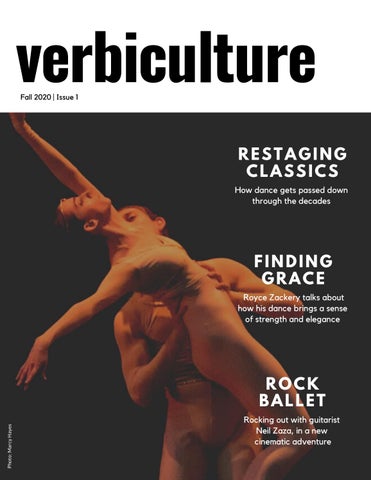
verbiculture Fall 2020 | Issue 1
RESTAGING CLASSICS How dance gets passed down through the decades
FINDING GRACE Royce Zackery talks about how his dance brings a sense of strength and elegance
Photo: Marcy Hayes
ROCK BALLET Rocking out with guitarist Neil Zaza, in a new cinematic adventure
inside verbiculture 06 02 12 12 08 09 09
10 02 03 06 08 09 09
The Director's Note Finding Grace How does dance gets passed down? Returning in a New Capacity Guest Dancer The Feast
10 12 14 15
10 Q's with Richard Dickinson Rock Ballet Metal Head + Choreographer Paving the way
For more content and exclusive videos, visit www.verbballets.org
DIRECTOR'S NOTE Now that the world is well into the pandemic, we are relieved to communicate that we are all well and working hard here at Verb Ballets. Although the spring of the 2019-20 season pushed us to test our resilience, we pivoted operations and researched and learned about new ways of presenting what we do. With the help of The Cleveland Clinic, we have been able to be back together in-studio; taking class, rehearsing and performing together with masks and safety protocols in place. It is a strange new norm, but I am grateful for the opportunity to continue to provide work for our dancers during this uncertain period. Since the start of the pandemic, we have produced three private livestream performances as a part of our newly created ACCESS/Verb series. This platform has given us the opportunity to broaden our audience in new ways. It has been a costly transition, investing in both equipment and technology. However, we are committed in our dedication to promote dance as a source of inspiration. This season, we work to be flexible and creative. As the Governor starts to allow the reopening of theatres with physical distancing, we will Re-Imagine, Re-Conceive and Re-Deliver as we continue to pursue our mission. Stay tuned for some very exciting collaborations
Photo: Kolman Rosenberg
and projects to be announced soon!
Dr. Margaret Carlson Producing Artistic Director
Diane y Acteon (2020) Dancers: Benjamin Shepard, Lieneke Matte
verbiculture | Fall 2020
2
Photo: Barb Cerrito
FINDING GRACE IN LETTING GO Howard University professor and choreographer, Royce Zackery talks about how dance brought a sense of the strength and elegance
Grace (2016) Dancers: Micahel Escovedo, Megan Buckley, Christina Lindhout, Nichloas Rose, Omar Humphrey, Lieneke Matte
Phone Interview by Victor Lucas of
loss there was a sense of elegance
and modern training in order to
Cleveland Concert Dance
and grace that my mother always
execute the movement in a 3
Reprint from March 23, 2017
had.
dimensional manner.
CC: We’ve seen Verb rehearsing
CC: And that was your inspiration
CC: How did you get this job setting
your dance, Grace. Is the
for Grace?
Grace on Verb?
choreography a music
RZ: Yes, my mother’s elegance, the
RZ: I run the dance division at
visualization?
elegance of women. As I listened to
Howard University and Howard has
RZ: I can’t tell you how many times I
the music for Grace I wanted to hear
been affiliated with the International
listened to the music for Grace. I
everything, all the layers, all the
Association of Blacks in Dance since
listened all day, day after day. But I
nuances.
the beginning of time. Every year, no
had something else in mind when I
matter what city the IABD holds its
selected the music and
CC: So, Grace is something of a
conference and festival in, Howard
choreographed Grace. You see,
music visualization, but you also
sends volunteers to set up the
when I was growing up there was a
intend it to have an emotional
classrooms and organize the
lot of unfortunate illness and death in
component.
students as they come in.In order to
my family and it was my mother who
RZ: Yes, exactly.
promote the value of ballet, I
nursed my father back to health and
choreographed a work en pointe for
took care of my grandparents until
CC: On the Verb
the IABD conference in Cleveland
they both passed away. Then my
dancers Grace looks very balletic,
last January. As you know, that’s
sister passed away in her sleep, it
but in your mind is Grace a modern
when Verb performed at IABD and
was totally unexpected. My mother
dance or a ballet?
so that’s how I met Margaret Carlson
and father found her in the morning.
RZ: I look at Grace as a very
(Producing Artistic Director of Verb)
But even in the midst of that terrible
contemporary dance, and the
and got the opportunity to
dancers need a balance of ballet
set Grace on Verb.
3
verbiculture | Fall 2020
CC: We noticed your long time involvement with American Ballet Theater’s Project Plié. That rang a bell for us because when we talked with Virginia Johnson, Artistic Director of Dance Theatre of Harlem, she cited Project Plie as an important training program for AfricanAmericans in ballet. Tell our readers about Project Plié. RZ: I do liaison and recruitment for Project Plié, which introduces minority students to the study of classical ballet. It gives them a place to go where they can learn respect for themselves and others even if they never become professional dancers.RZ cont.: Actually, I came up through a program much like Project Plié when I was growing up in Atlanta, Georgia, the Danseur Development Project, a project of Ballethnic Dance Company. CC: We were going to ask how you got your start in ballet. RZ: Yes, they gave me my start. At the 20-year reunion of Ballethnic’s DDP, 3 or 4 of my classmates had
it’s about making the body the most wonderful it can be within the aesthetic of the art form Royce Zackery
gone on to careers in dance but all of them had distinguished themselves academically and professionally as doctors, lawyers, doing big things and giving back to the community. CC: Please share your perspective on African Americans in ballet with our readers. RZ: I’m not usually one to speak after Virginia Johnson, but ballet is a difficult culture to fit into, period. And it derives from a European art form, which makes it all the more difficult for people of color to fit the mold. But athletic, skillful, talented, intellectually-inclined, and classically
trained African-American dancers
Ever since I was very young my
have been around for a long time and
mother and father said to me, “No
will continue to be around for
Matter What, If You Want It, Go Get
eternity. Virginia Johnson said it best.
It!” So, like so many before me I was
“A lot about Ballet is about erasing
told time and time again that I
the individual and making you fit into
couldn’t, so that’s why I did.
a unified whole… but it’s not about erasing who you are.” I’m in complete agreement with her, being that it’s about making the body the most wonderful it can be within the esthetic of the art form from the tip top of your head all the way down
Don't miss Grace October 9th at 7:00pm EST Livestream Performance Get tickets now!
through the tips of your toes. verbiculture | Fall 2020
4
FEATURE
5
verbiculture | Fall 2020
E X P L O R E
C L A S S I C
W O R K S
HOW DOES DANCE GET PASSED DOWN? The company will remount Heinz Poll’s Adagio for Two Dancers with permission of Jane Startzman. The ballet was choreographed in 1973 for Ohio Ballet. Jane Startzman has over 50 years of experience in the field of professional dance, including work as a principal dancer, arts administrator, executive assistant to Heinz Poll, the Artistic Director of Ohio Ballet, as well as company/tour manager. Jane is currently director and cofounder of the Heinz Poll Summer Dance Festival. What does it mean to be a régisseur? As a regisseur, to me, besides being responsible for setting the steps of a piece, I am responsible for being a good steward for the work. This means that I, as the regisseur, must know the intent of the piece - every gesture, step and I must be able to guide the phrasing as the choreographer intended, and make sure that it is reproduced as such. As a régisseur, what do you look for when you give permission for a piece to be performed? I look for a company that will ensure that the piece continues to be reproduced as I set it, and that will continue a relationship with me, if I own the license, or with someone else who is qualified to reproduce the work, so that it is checked periodically and stays true to intent. I then look for dancers that can do the work technically and bring the correct artistic interpretation to the piece. How many pieces where granted to you? Photos: Kolman Rosenberg
I own the license for 5 of Heinz Poll's works.
Rehearsal for Adagio for Two Dancers (2019) In Photos: Richard Dickinson, MFA, Ashley Forché, Hunter Hoffman, Kelly Korfhage, Benjamin Shepard, Jane Startzman, Kate Webb
verbiculture | Fall 2020
6
Dancers: Marc Ozanich and Beverly Samsas of Ohio Ballet Photo: Ott Gangl
What do you feel is the biggest responsibility to Poll's work?
feel and movement of an original costume made from a
To reproduce his work successfully, one has to make sure
fabric that doesn't exist anymore .
that the intent is correct and clear. His work requires crystal clear technique, often very fast and complex,
What do you want to most impart about Heinz Poll's work?
whether balletic or contemporary in nature. Any partnering
The work of Heinz Poll is very difficult technically and
is extremely difficult and dancing a Heinz Poll piece
artistically. The steps are at times very complex, and at
requires a need for a dancer who can take a great deal of
others very simple and straight forward, but always layered
space with every step and phrase. A Heinz Poll work always
with artistic intent, and organically musical. It doesn't do his
looks as if the stage is too small for the dancers and the
pieces justice to simply do the steps with technical brilliance.
dance. In some cases over the years, there have also been
Heinz' work is full of musical nuance, and he always
slightly different versions of roles depending on the dancer.
encouraged dancers to dance "big" - using a great deal of
What was right for one, he might tweak a bit for another in
plie, space, and musical phrasing. Danced successfully, Heinz
order to convey the intent in the way he wanted. If I am
Poll's style utilized a great deal of moving from the back and
certain of his original intent, there might be an instance
core, so that it never looked as if the arms were moving
when a slight variance in steps, or nuance can be
independently from the body. It produced a style that
appropriate and still be correct. Costuming is also an area
blended the precision of classical technique with an impetus
where some deviation may occur, because we have
for movement always coming from the center of the body -
different materials nowadays, so it is important to know
more contemporary and less restrained than classical ballet.
what current materials can be used to reproduce the same
Photo: Steven Hale Ambiguous Drives (2014) Antwon Duncan-Milczewski, Erin Conway Lewis
RETURNING IN A NEW CAPACITY
Former Verb Ballets dancer, now educator, returns to serve on the board Antwon Duncan-Milczewski Since leaving Verb Ballets, Mr. Duncan has become one of the Career Tech Performing Arts teachers at McKinley High School in Canton, and is working hard to help build the program from the ground up. On Friday nights, he can be seen at football games coaching the McKinley Dancing Divas, and is also the choreographer for the school’s musicals and select pieces for the show choir. He
I want to see the organization continue to challenge itself to stay relevant yet authentic.
is a Cleveland native where he is no stranger to the stage, having performed with concert dance companies such as Ohio Ballet, Cleveland Contemporary Dance Theater, and Verb Ballets. Musical Theater is one of his greatest passions and some of his favorite roles include Larry in A Chorus Line at Porthouse Theater and Plato in Cats at Carousel Dinner Theater. Mr. Duncan is a University of Akron alumni where he received his BA in dance. Since leaving the stage, he has spent the majority of time teaching, working at various local studios. Mr. Duncan recently completed his masters degree in Curriculum and Teaching from BGSU. In the little free time he has, he enjoys watching his son grow and experience the world, travel when COVID doesn’t inhibit that, and play competitive volleyball.
verbiculture | Fall 2020
8
S P E C I A L
G U E S T S
GUEST DANCER Verb Ballets welcomes Robert Carter as a special guest dancer for the fall. He has been an American primo donna ballet dancer for Les Ballets Trockadero de Monte Carlo for over 25 years . As a lead dancer and its most senior member, Carter is the public face of the all-male dance troupe. Carter was born and was raised in Charleston, South Carolina. He started dancing at age eight, and first saw the Trocks at age ten, which inspired him to dance like them, en pointe, around age 12. He trained at the Ivey Ballet School and the Joffrey Ballet School. He has performed with a number of dance groups, including the Florence Civic Ballet, Bay Ballet Theater, and the Dance Theater of Harlem.
THE FEAST: A BALLET Congratulations to dancers Christina Lindhout and Kelly Korfhage for their new choreographic work “FEAST, a ballet.� Their team for the project, called the Creative Destruction Collective, was awarded a Satellite Fund grant administered by SPACES and supported by the Andy Warhol Foundation for the Visual Arts. In addition, the choreographers for the project also received an Akron Soul Train Award. The Creative Destruction team is in the process of filming a ballet that illustrates the interconnectivity of environmental degradation, trade, economic theories and wealth distribution. The team includes dancers Kelly Korfhage and Christina Lindhout, Law Professor Dr. Dalindyebo Shabalala, Sustainability Journalist Marc Lefkowitz and Artist Corrie Slawson. Creative Destruction is a shorthand economics term for free market with the movement of six dancers to music will convey the complex narratives of six commodities. The project will premiere in November online and is also presented by Curated Storefront in downtown Akron. For details follow on Instagram @feast_ballet.
9
verbiculture | Fall 2020
Photo: Liz Cooper
Capitalism. A combination of sculptural and store-bought objects
10
QUESTIONS WITH RICHARD DICKINSON, MFA Associate Artistic Director of Verb Ballets shares his inspiration for his newest piece
What inspired your new piece? The music drew me in. How did you get started? Fear. I listened to the music until inspiration hit. Then went from there. What is the most rewarding thing about creating a new work? It gets you thinking on a different plane. All options are available to you and it’s the choices you make that either make or break the piece. How would you describe your choreographic style? Eclectic. I try to be able to choreograph anything. Biggest challenge/opportunities during COVID-19? Everything is different. I feel constrained and unable to focus on the work. There are too many obstacles. But in the end that may not be a bad thing. What are you looking forward to this season? Taking off my mask. What book are you currently read? Caste. The origins of our Discontent Your favorite mantra? Um mane pad me hum. If you weren't a choreographer or dancer, you would be? A marketing designer Best advice you got as a dancer? Always have a child like mind. Be open minded.
Don't miss the premiere online! October 9th at 7:00pm EST Get tickets now! verbiculture | Fall 2020
10
ROCK IS AN ATTITUDE, A SWAGGER & AN IDEAOLOGY Photo: Salvatore Marando
NEIL ZAZA
Photos: Kolman Rosenberg
CLASSICAL MUSIC REIM AGINED TH ROU GH TH E FURY OF
ROCK BALLET
Neil Zaza is a world renowned instrumental guitarist who has become known for his technical accuracy and adaptation of classical works by Bach and Mozart into his own blend of neo-classical, melodic, guitar instrumentals. We sat down with him to see how rock and ballet come together in his mind. What is rock to you?
What excites you about presenting this project as a
Rock is an attitude, a swagger and an ideology. It’s
movie given the pandemic
about doing something individualistic and with a
I think that we can explore various feelings,
vision that stays true to who you are and not to
movements as well as locations in these pieces really
those around you. It’s about following your own
takes the collaboration up a level from a standard
calling even if it means ruffling feathers. It’s about
stage presentation. We are able to offer so much
doing things on your own terms.
more artistic vision to the viewer. Plus, with close shots and unique angles, the attendee gets a
Last year was the first time you had worked with a
perspective they would never have a chance to.
ballet company. What did you notice about how dancers work vs musicians? The intensity! The dancers were way more focused in rehearsals than musicians. Dancers I would offer, have a more driven work ethic. Dance are there to WORK! Musicians are mixing getting the songs done, socializing, etc.
verbiculture | Fall 2020
12
Photos: Kolman Rosenberg
METAL HEAD + CHOREOGRAPHER Antonio Morillo is a first-generation Cuban American born in Florida. He joined Verb Ballets in 2016 and has choreographed five works for Verb Ballets including a work selected by the Martha Graham company that premiered in NYC on the Next@Graham series in 2017. He has passionately choreographed for the new dancerock film collaboration, Carnival Macabre. We sat down with him to see how he approached this new challenge.
What was your inspiration behind that name Carnival Macabre? The idea behind the piece is that this band of dancers, alongside Neil Zaza, are dead members of a carnival. Some mystical power brings them to life for just one day. How is choreographing for film different than stage? Choreographing for film allows for greater control over how and what the viewer is seeing. It also allows for multiple takes, so that moments can be perfected for the final product. These are the two differences that stood out the most for me. How does the rock music influence your choreography? I am a huge metal head. I have always listened to, and have been inspired by, rock and metal music. I listened Neil’s music A LOT. I allowed the rock music to inspire qualities and dynamics I wanted to draw out in my movement. I would then focus on creating phrasework based on those qualities. What was the best thing you learned from going through this project? I learned a lot about how choreographing for film and stage differ greatly. A lot of collaboration as well as troubleshooting on the fly went into this project. I have learned that it’s especially important to be flexible with your ideas. What do you look forward to doing more of this season? I am looking forward to more performance opportunities, hopefully, and more exploration of dance for film.
Don't miss Carnival Macabre with Neil Zaza October 30th at 7:00pm EST - Get tickets now! 13
verbiculture | Fall 2020
S P E C I A L
T H A N K S
PAVING THE WAY FOR CLEVELAND’S BEST DANCE COMPANY We extend our deepest thanks to David M. Dusek for his stewardship as President of Verb Ballets over these
We’re still strong because because of the dedication and love from these amazing talented people.
past years. During his tenure, he guided the organization through its capital campaign that enabled us to move into a new home and strengthened the Cuba partnership into a true international collaboration. Thank you for your tireless service and you ongoing support! As your tenure as President ends, we are so glad that you have undertaken a new role within the organization as Chair of the Diversity, Equity and Inclusion Committee.
Photo: Bill Naiman
Thank you to all our wonderful generous supporters.
verbiculture | Fall 2020
14
Rococo Variations (2020) Dancers: Emily Dietz & Antonio Morillo
Photo: Jackie Sajewski
DON'T MISS
October 9, 2020 at 7:00pm EST
October 30, 2020 at 7:00pm EST
NeoClassical Lines
Carnival Macabre with Neil Zaza
ACCESS/Verb private livestream
Cinematic dance-rock experience
Tickets $25 and on sale now!