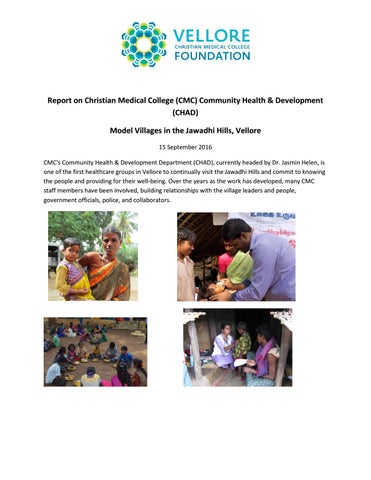
Report on Christian Medical College (CMC) Community Health & Development (CHAD) Model Villages in the Jawadhi Hills, Vellore 15 September 2016 CMC's Community Health & Development Department (CHAD), currently headed by Dr. Jasmin Helen, is one of the first healthcare groups in Vellore to continually visit the Jawadhi Hills and commit to knowing the people and providing for their well-being. Over the years as the work has developed, many CMC staff members have been involved, building relationships with the village leaders and people, government officials, police, and collaborators.
Background information on Jawadhi Jawadhi Hills is a small hill range 80 km long and 40 wide, that runs across the Vellore and Thiruvanamallai districts. The region is designated as a forest reserve. Most of the Jawadhi Hills villages in the Vellore District are remote and can be accessed only by trekking, motorcycle and, in some areas, by a fourwheel drive vehicle. Included among CHAD’s priorities is the health and well-being of the 80,000 tribal people living in the Jawadhi Hills. CHAD serves approximately 40,000 of these people with mobile clinics, community organizing, capacitybuilding of traditional leaders, self-help groups, life skills and vocational training for youth, and support of formal education.
• • • • •
95% illiterate high infant and maternal mortality rate poor immunization coverage large numbers of deliveries in unsafe environments high rates of infectious and non-communicable diseases and disabilities • high prevalence of alcoholism • no running water or toilet in typical homes
Most people are small-scale subsistence farmers or land laborers. Children are sent to work in the fields, even in distant states. For several months in a year people working as contract laborers often migrate en masse, sometimes called distress migration, leading to substance abuse and sexually transmitted diseases from the plains. Child marriage is common here, with girls as young as 14 forced into marriages by their parents.
Culturally, the tribal people distrust people from the plains due to frequent confrontations with forest guards and the police over smuggling of sandalwood and red sanders wood. They seek health care only when very sick, leading to higher morbidity and a lower life expectancy. MODEL VILLAGES CHAD, under the supervision of Dept. Head Dr. Jasmin Helen, with program direction from Dr. Anu Rose and partnership support from Dr. Gagandeep Kang, is approximately one year into a Model Village Project, designed to make a comprehensive intervention in (up to) four tribal villages in Jawadhi. Objectives of Model Village • • •
•
Provide access to health care, clean water, means for personal hygiene and sanitation; Prevent distress migration from rural to urban areas that undermines the potential for development in the home villages; Contribute towards social empowerment by engaging all sectors of the community in the task of village development; Make the model village(s) a “hub” that could inspire positive development in other Jawadhi villages and attract resources for this development.
Strategy to Achieve Objectives Demonstrate the health and social benefits of simultaneously introducing: • • • • • •
clean drinking water household toilets sound waste disposal systems educational support healthcare family and community programs for economic and social benefits
The synchronized presentation of programs such as these has been shown to create lasting change and have significant implications for communities of people whose lives are interrelated.
The Model Village Team Dr. Anu Rose, working closely with CMC researcher Dr. Gagandeep Kang and other CHAD colleagues, set fundamental health goals for the project in a Community Health context that includes social, economic and cultural support. The underlying conditions in much of rural India, that either directly or indirectly lead to many health problems, are the absence of toilets and the lack of clean drinking water. Dr. Kang, a preeminent researcher in the prevention and treatment of diarrheal diseases, brought in her strong partners from the NGO Gramalaya (http://gramalaya.in/index.php ) to advise on the planning, construction and transition to toilet use. CMC's primary partner in Jawadhi is the Don Bosco Fathers' longstanding Tribal Development Society that includes a residential school for boys and many community development programs. CMC’s Veerapanoor Clinic serving the Hills was built with support from the Fathers. The Model Villages concept makes the most of the very strong relationships between Don Bosco, CMC and residents.
I. Koiloor Village The first village selected to be a Model Village was Koiloor: it has about 100 households, has a progressive Ooran (leader) and good community ties. There was almost unanimous interest in building toilets for homes. The Gramalaya team held several sessions with residents to prepare/train them in facilitating change, evaluating soil, waste disposal, building options, etc. Community meetings were organized by CMC and Don Bosco to allow for discussion and agreement on goals and parameters of the project.
Goals Set by the Residents of Koiloor One of the essential requirements for sustainable success is the residents’ full “ownership” of the ideas that will drive change. CMC, Don Bosco and Gramalaya each have important roles, but none is dictating what should or should not be altered in the village. Most important decisions are discussed and resolved in community meetings facilitated by CMC or Don Bosco, but truly driven by the people themselves (including children). Residents of Koiloor discussed and agreed upon these social determinants of health in early community meetings: • • • • • •
end to open defecation (residents were not forced to get toilets but almost 100% did) clean drinking water from a dependable source adequate general water supply (non-drinking), schools, a balwadi (preschool), evening study program, shared value placed on education program for the elderly/disabled dependable access to quality health care especially seeking good nutrition, immunizations, good pregnancy outcomes, less alcoholism
• • • •
dependable year-round employment recreational facilities for youth access to roads/transportation/ commercial centers system for garbage disposal
Actions Taken by the Residents of Koiloor •
• • • • •
“Working Group” of residents to steer projects/trouble shoot o 14 people from the village, including 5 women, volunteered o Will follow-up on any necessary water pipelines needed o Will make sure room for Sky Hydrant (drinking water resource) is tiled/painted/modified as needed o Will secure other items as needed (e.g. submersible pump to desilt clean water) Residents & Mr. Kumar (Ooran) identified where construction would occur around each house getting a bathroom; village residents are providing labor with guidance from Gramalaya. Fines and peer pressure will be used to gain full cooperation using toilets, waste bins, etc. Residents will support each other in ensuring that CHAD services are utilized so that babies are born safely and immunized, people with chronic illnesses have good control, etc. Residents will take collective responsibility for children getting to school, staying throughout the day, having adequate playtime Residents will have access to job training to develop income-producing skills (farming millet, making smokeless choolas [stoves], growing mushrooms, etc.)
Next Steps in the Model Village program: 1. Installation of the sky-hydrant in the village for provision of potable water 2. Create Balwadi and program for seniors 3. CMC to provide garbage bins; homes will start compost piles and solid waste will go in bins; each street will organize shared responsibility of emptying bins. 4. Children’s parliament for the village 5. Posting of CHAD mobile clinic schedule CMC and Don Bosco will be monitoring key indicators for improvements in health, educational outcomes, and social issues. Data will be collected in Koiloor (first Model Village) throughout 2017 to demonstrate impact and fine tune model for additional Villages.