THE VEHICLE
SUMMER 2026
RECYCLER
The Vehicle Recyclers’ Association • The Industry’s Voice •
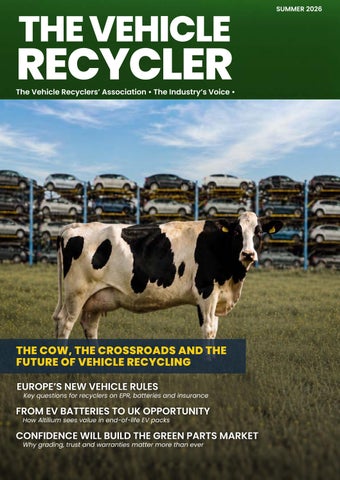
THE COW, THE CROSSROADS AND THE FUTURE OF VEHICLE RECYCLING EUROPE’S NEW VEHICLE RULES
Key questions for recyclers on EPR, batteries and insurance
FROM EV BATTERIES TO UK OPPORTUNITY How Altilium sees value in end-of-life EV packs
CONFIDENCE WILL BUILD THE GREEN PARTS MARKET Why grading, trust and warranties matter more than ever
THE VEHICLE RECYCLER
1
London & Home Counties largest salvage operator Over 1,000 vehicles auctioned weekly 100,000s of quality graded recycled parts Next day nationwide delivery Responsible and fully compliant vehicle recycling solutions Best practice, best value, and always best in class!
TOTTERNHOE
info@asm-autos.co.uk
BEDS
AYLESBURY
+44 (0)1844 393 464
BUCKS
2
THAME OXON
KINGS LANGLEY HERTS
THE VEHICLE RECYCLER
www.asm-autos.co.uk
Chairman’s Welcome As we move into the third quarter, momentum is building within the Vehicle Recyclers’ Association. The VRA team is modernising the Association, strengthening governance and working to deliver greater value to every member. The past twelve months have been challenging. Following my appointment as Acting Chairman, and subsequently as Chairman, we experienced the unexpected resignation of our Secretary, Andy Latham Chas Ambrose, in September. Chas VRA Chairman completed great work for the association; however, the disagreement that led to his resignation remains unresolved and, as legal restrictions apply, I am unable to comment further. What I can say is that these events diverted time and resources away from some of the improvements we had planned. However, they also reinforced the importance of building a stronger, more resilient Association with robust governance and a clearer strategic direction. Despite these challenges, your Management Committee has continued to meet regularly, virtually and in person. Our most recent face-to-face meeting marked an important milestone, with several significant decisions taken that will improve the way the Association operates and position the VRA for the future. One of those changes has been the creation of a streamlined Executive Committee, comprising the Chairman, President, Treasurers and a small number of experienced industry leaders. Working alongside the wider Management Committee, this group is focused on improving decision-making, accelerating progress and ensuring the Association remains responsive to the needs of its members. The VRA exists to represent, support and strengthen the UK vehicle recycling industry. Your membership plays a vital role in enabling that work and provides access to a wide range of benefits, including: • A strong, unified voice for the vehicle recycling industry. • Access to trusted suppliers, partners and specialists. • Networking, learning and best-practice sharing. • Regular industry, technical and legislative updates. • Vehicle Recycling magazine and member publications. Perhaps most importantly, your membership strengthens the collective influence of our industry. While we compete commercially as individual businesses, we are far stronger when we speak with one voice on the issues that affect us all. Looking ahead, I am genuinely excited about what the coming months will bring. A number of new initiatives are beginning to take shape, and we look forward to sharing more details with you soon. This edition of Vehicle Recycling offers a glimpse of some of the opportunities and challenges facing our sector. Recent events have forced the committee to take a step back, look with fresh eyes at key issues, and try to reset. The centrepiece of this issue is an extended article challenging us to unite and set a path for the VRA. However unlikely it sounds, I found the parallels between vehicle recycling today and the evolution of the dairy industry in the 70s very thought-provoking. The questions raised are important, and I hope you will all help us answer them. Finally, I would like to thank every member for your continued support, engagement and confidence in the Association. Our commitment is simple: to build a stronger, more influential VRA that delivers value well beyond the cost of membership and helps every member business thrive.
THE VEHICLE
RECYCLER
Vehicle Recyclers’ Association (VRA) Magazine
PRESIDENT
Terry Charlton
CHAIRMAN Andy Latham
TREASURERS Rob Austin Savo Vavan
MEMBERS Michael Hill Tom Harvey
COMMITTEE MEMBERS Rob Austin Jason Bishop Terry Charlton Ian Dronsfield Paul French Rolson Fry Tom Harvey
Michael Hil Dave Horsnell Andy Latham Tony Patsides Savo Vavan Chris Wylie
CONSULTANT Adrian Pierce
MORE INFORMATION
Additional images (Shutterstock/Envato Elements) licenced by ARW-GROUP LTD or supplied by VRA committee members
CONTACT DETAILS PO BOX 8660 Ilkeston, Derby DE7 0GP tel: 0330 400 5380 info@v-r-a.uk editor@v-r-a.uk www.vrauk.org
Produced by ARW-GROUP LTD on behalf of Vehicle Recyclers’ Association (VRA)
LEGAL DISCLAIMER The articles and information contained in this magazine are provided for general information and guidance only. They are not intended to be, and should not be relied upon as, authoritative statements of the law. The views expressed in the vehicle recycler are those of the individual authors and do not necessarily reflect the views of the Vehicle Recyclers’ Association or its members. All material published in this magazine is protected by copyright. Anyone wishing to reproduce any article or other content must first obtain permission from the Vehicle Recyclers’ Association. © Vehicle Recyclers’ Association 2026
Thank you for being part of that journey.
THE VEHICLE RECYCLER
3
NEWS
TABLE OF
CONTENTS INDUSTRY NEWS
50
06 - 15
Industry News Round-Up
16 19
Going the Distance Jason Bishop reflects on endurance, teamwork and fundraising for Ben.
Global Car Recycling Day How GCRD can strengthen industry engagement and awareness.
65
22
FEATURES
20 22 26 28 32
Professional Vehicle Recycling and Dismantling Why stronger standards, training and leadership matter for modern recyclers.
Turning End-of-Life EV Packs into UK Opportunity How Altilium is turning end-of-life EV batteries into UK opportunity.
Inside the ATF Professional Conference 2026 Highlights from the conference.
The Number Nobody Knows Why true vehicle-level margins reveal the sector’s hidden commercial opportunity.
Reassessing Shock Absorber and Airbag Reuse
What RPS 195’s withdrawal means for depollution, storage and compliance.
4
THE VEHICLE RECYCLER
40 36
EGARA Spring Meeting European recyclers prepare for EPR, traceability and tougher ELV regulation.
38
A Different Kind of Dismantling
40
Busy Times in Metals Recycling
43
In the Yard: Robert Austin
What vehicle recyclers can learn from controlled aircraft dismantling practices.
16
BMRA examines steel strategy, digital tracking and key policy changes.
Robert Austin discusses industry change, online sales and yard life.
43
88
NEWS
FEATURES
44 50
44
56 60 65
88 91 96
Member Spotlight: Vehicle Recycling in the Blood
80
Yard visits, shared learning and global relationships.
The Cow, the Crossroads and the Future of Vehicle Recycling
Lessons from dairy farming for collaboration, standards and future growth.
FORS in Focus
Poland’s recycling association prepares for Europe’s new ELV regulatory era.
DEFRA, POPs and the Challenge Facing Vehicle Recycling Why POPs traceability threatens circularity and compliance.
60
28
The Road That Built a Global Recycling Community
98
74 Keeping Depollution Equipment Working
Practical maintenance keeps depollution equipment safe and productive.
ARA 2026: Connect Globally, Grow Strategically A preview of Atlanta’s education, networking and opportunities.
Don’t Cut Corners on EV Training
Why certified EV training must precede high-voltage handling.
Cyber Insurance for Vehicle Recyclers How cyber insurance protects systems, data and trust.
Vehicle Regulation: Key Questions for the Recycling Sector Key questions on EPR, batteries, insurance and regulation.
68
Auto Recyclers ARA Road Trip 2026
70
Preparing for the Customer of the Future
74
Route details for the 2026 ARA road trip.
How transparency, traceability and collaboration shape future customers.
Recycled Parts: Confidence Will Build the Market
How grading, warranties and trust grow parts demand.
80 86
Member Spotlight: Vehicle Recycling in the Blood Tom Dyos shares his family’s vehicle recycling journey.
Silverlake Motorsport: Driving Performance Through The Circular Economy How recycled parts prove their value in motorsport.
THE VEHICLE RECYCLER
5
NEWS
INDUSTRY ELV Recycling Needs Greater Supply Chain Cooperation EY Director Mark Main says the UK end-of-life vehicle sector needs coordinated infrastructure instead of fragmented pilots. Speaking at Auto Recycling Intelligence 2026, Main said electrification is reshaping vehicle ownership and recycling, but uncertainty around residual values, battery
NEWS
technology, regulation and volumes is restricting investment. He highlighted vehicle leakage, limited dismantling scale, slow parts triage, inconsistent recycled material quality and poor traceability. Main said progress depends on collaboration, aggregated volumes, shared commercial objectives and bankable agreements. Vehicle and battery passports could improve data confidence. Without certainty, investors may remain cautious and materials could continue to be processed overseas.
Council Greenlights Rules for a More CIRCULAR AUTOMOTIVE SECTOR New EU vehicle circularity rules will require manufacturers to design vehicles for reuse, recycling and recovery, while introducing recycled plastic targets and stronger producer responsibility. For ATFs, the key change is tighter control of end-of-life vehicles and used vehicle exports. The regulation will apply across the vehicle lifecycle, from design and production to authorised end-of-life treatment to support greater material recovery. Six years after it enters into force, at least 15% of plastic used in new vehicles must be recycled, rising to 25% after 10 years. At least 20% of that recycled plastic must come from end-of-life vehicles.
6
THE VEHICLE RECYCLER
Producers will become responsible for vehicle takeback and treatment. Vehicles classified as waste must be processed by authorised treatment facilities and cannot be exported or resold as used vehicles. The export of non-roadworthy vehicles will also be banned. The rules will begin applying two years after entry into force across the automotive sector in all member states.
Setting the Standard for GREEN PARTS SINCE DAY ONE As demand for green parts grows, quality, traceability and consistency are increasingly important. Phil DeGroot, Director of The Green Parts Specialists, explains why rigorous standards have shaped the business from the outset.
Quality has always been central to The Green Parts Specialists. Long before assurance became an industry talking point, the business had introduced robust inspection, testing and grading processes to ensure customers could buy reused OEM parts with confidence. With more than 70 years’ experience and the backing of Copart, the company combines industry knowledge with the scale and infrastructure needed to supply provenanced green parts across the UK. Most parts are covered by a 365-day warranty, while Grade A body panels require no more than one hour of repair. The business was also the first to achieve certification under the Vehicle Recyclers’ Association Certification Scheme in August 2020. Rather than requiring changes to practices, certification recognised standards
already embedded throughout the operation. DeGroot says accurate grading, honest descriptions and thorough preparation help reduce returns, prevent workshop delays and make procurement easier. They also give customers confidence that reused parts can support repairs carried out in line with BS 10125. For The Green Parts Specialists, sustainability and quality are inseparable. Every reused component must deliver environmental benefits and dependable performance, helping customers reduce waste without compromising repair standards, efficiency or confidence. The company says its principles remain unchanged: do the job properly, maintain standards and put customers first.
INDUSTRY EXPORTING VEHICLES AND PARTS: GETTING IT RIGHT FIRST TIME Environment Agency Senior Technical Officer James Durling says vehicle and parts exports support reuse, but operators must demonstrate that each shipment is classified, prepared and documented. Exporters must prove that vehicles and parts are products for reuse, not waste, to avoid delays, rejected loads or enforcement action. Correct classification, depollution, clean, labelled parts, secure transport and documentation are essential. With the EU Waste Shipment Regulation in force, operators must get the basics right before vehicles or parts leave the UK. Exports can support reuse, extend vehicle life and provide affordable parts overseas. However, loads are being stopped because items are poorly classified, incompletely depolluted or badly presented. To be exported as products, vehicles and parts must have a reuse destination, be functional and match their description. Vehicles linked to a Certificate of Destruction, carrying loose waste or requiring substantial repairs are likely treated as waste. Depollution is important. Oils, fuels, coolants and hazardous components must be removed unless required for reuse. Engines containing oil, attached filters or mixed materials can cause a shipment to
NEWS
JAMES DURLING be delayed, rejected or returned. Parts must be clean, packaged, labelled, safe to handle and ready for reuse without significant dismantling, cleaning or treatment. Minor testing or repair may be acceptable, but further processing may change their legal classification. Where material is waste, operators must follow the correct controls. These may include an Annex VII document or notification procedures, alongside packaging, labelling, contracts and destination requirements. Documentation must travel with the load. Differences between UK and EU rules are likely to increase complexity, so exporters should check requirements for both jurisdictions. Digital Waste Tracking will improve visibility of waste movements and help identify misdescription. The message is straightforward: classify correctly, depollute thoroughly and prove that exported items are ready for reuse. Getting it right protects businesses, reduces disruption and supports a circular economy.
NEWS
LKQ SYNETIQ Launches A+ Grade for Recycled OE Panels LKQ SYNETIQ has introduced A+, a highest-spec grading standard designed to give professional bodyshops greater consistency, quality and confidence when sourcing recycled OE body panels. Available exclusively through LKQ Bodyshop and LKQ SYNETIQ, A+ panels are corrosion-free, fully stripped and inspected through a multi-stage process. OEM paintwork must measure under 130µ, while checks identify signs of previous repairs.
The company says the standard sits above VRA grading guidance and is intended to improve repair planning, reduce workshop time and make recycled panel selection more predictable. Justin Elliot, Sales Director at LKQ SYNETIQ, said A+ responds to bodyshops’ priorities around quality, availability and consistency. Recycled OE panels can also help reduce repair costs and carbon impact. A+ upgrades are available at 50% off during the launch period.
COPART PROMOTES JANE POCOCK TO PRESIDENT Jane Pocock became President of Copart on 1 August 2026, following more than seven years leading the company’s UK and Ireland operations through significant growth and expansion. Pocock joined Copart in January 2019 as Managing Director of Copart UK. Under her leadership, the business increased capacity, strengthened its operational footprint and improved customer journeys for insurers, policyholders, commercial sellers and members.
Copart said her promotion reflects confidence in the technology, service quality, customer focus and people-led culture developed across the UK and Ireland business. Jay Adair, Executive Chairman and incoming Chief Executive Officer, praised Pocock’s results and leadership. Pocock said she looks forward to supporting Copart’s global teams, strengthening products and services, and delivering exceptional customer experiences worldwide.
THE VEHICLE RECYCLER
7
NEWS
INDUSTRY
NEWS
ELVES Becomes Founding Member of New ELV Forum ELVES has become a founding member of the ELV Forum, a group strengthening collaboration between end-of-life vehicle compliance schemes and supporting implementation of the forthcoming ELV Regulation. The association brings together compliance organisations to coordinate policy, share expertise and improve communication with the European Commission. ELVES Operations Manager Lee-Jane Eastwood said the
forum’s knowledge could improve regulation effectiveness and processing across Europe. The regulation will extend producer responsibility, introduce recycled-content requirements and broaden its scope to include trucks, buses, trailers and certain L-category vehicles. Recycling targets of 95% per member state will remain unchanged.
SCRAPCO RED LODGE INVESTS IN DEPOLLUTION EQUIPMENT
Scrapco Red Lodge is preparing for rising ELV and EV volumes by investing in depollution, fluid recovery and battery-handling equipment. The upgrade will help the ATF increase throughput, improve safety and compliance, recover reusable materials and
together with an EV and hybrid battery table and winch. These additions make high-voltage battery removal safer and more efficient as electric and hybrid vehicles become a larger part of the waste stream.
prepare for electric and hybrid vehicles.
Scrapco Red Lodge, said the additional depollution rigs would reduce pressure on the team and speed up the process from depollution through to dismantling.
Ben, Head of ELV at
Ireland, supported by ELVES, has met ELV recycling targets every year since the scheme began in 2018.
MICHAEL WOODS APPOINTED AS OPERATIONS DIRECTOR Charles Trent has appointed Michael Woods as Operations Director to strengthen safety, quality and efficiency across its vehicle recycling operations. With almost 30 years’ experience in the RAF, Airbus and BAE Systems, he will oversee vehicle processing and develop the company’s people, systems and future capabilities. Woods brings extensive experience in engineering, manufacturing leadership and continuous improvement. His career began as a Weapons Technician in the Royal Air Force before nearly 18 years with Airbus in senior operational roles. He later joined BAE Systems, helping establish a new manufacturing facility and embed robust safety, quality and production systems.
8
THE VEHICLE RECYCLER
Michael Woods
At Charles Trent, Woods will oversee vehicle reception, dismantling, quality assurance, warehousing and distribution. His priorities include improving operational flow, strengthening performance measures and developing leaders. CEO Marc Trent said the appointment will support investment in people, technology and facilities during its centenary year.
The South East business processes 1,000 end-of-life vehicles each month and plans to at least double that figure. To support this growth, Scrapco has expanded its Green Car Depollution systems with four All-In-One fluid recovery units and XL Vehicle Preparation Side Tips. The new equipment will accelerate fuel and fluid extraction, support engine removal and improve the handling of ELVs and light commercial vehicles. It will also allow contaminated fuel to be separated from reusable fuel, recovering value while reducing environmental risk. Scrapco has introduced the All Inclus-EV system,
Owner Terry Hunn said the company expects a significant rise in electric and hybrid ELVs over the next five to seven years and wants the right systems in place ahead of that shift. The investment supports Scrapco’s plans to grow contractual work, raise processing capacity and operate more safely, cleanly and efficiently. Green Car Depollution said the installation reflects a long-term partnership focused on growth and future vehicle-processing demands across the operation.
INDUSTRY
NEWS
NEWS
ALTILIUM RAISES $1 MILLION FOLLOWING RETAIL INVESTMENT ROUND Altilium has raised $1 million from more than 750 retail investors to accelerate UK battery recycling and strengthen domestic critical mineral supply chains. The funding follows an £18.5 million APC Drive35 grant supporting ACT3, Altilium’s commercial-scale refinery for recovering lithium, nickel, cobalt and graphite from end-of-life EV batteries. Located in Plymouth, ACT3 will process up to 24,000 EV batteries annually, producing battery materials for future manufacturing.
Altilium says the investment reflects growing support for battery recycling, supply-chain resilience and the circular economy, while helping reduce reliance on imported materials, support the UK’s transition to electric vehicles and create skilled jobs across the emerging domestic battery industry.
Introducing Copart’s EV Battery Health Report Copart’s EV Battery Health Report gives buyers independent insight into condition of electric and plug-in hybrid vehicles before bidding. Developed with Aviloo, it provides battery health, voltage performance and fault information, helping reduce uncertainty and support auction results for sellers. As EV and hybrid volumes rise across the UK car parc, buyers increasingly want reassurance about battery condition, particularly while values remain volatile. Available for selected vehicles in Copart’s online auctions, the report can be purchased and downloaded directly from the Lot page. It includes an overall battery health score, information on voltage
performance and details of faults identified during testing. Because the assessment is independently verified, buyers gain better understanding of the vehicle and greater confidence when deciding how much to bid. That added transparency can benefit sellers by encouraging stronger auction activity and potentially improving returns. Copart says the report will support a more informed, trusted and confident used EV marketplace as electric and plug-in hybrid vehicle numbers continue to grow, supporting more transparent decisions throughout the auction process.
JLR CO-DEVELOPS CIRCULAR CONCEPT VEHICLE JLR has unveiled Cornerstone, a concept demonstrator developed with more than 40 suppliers to advance circular design, reduce carbon and improve repairability and recyclability across future vehicles.
Engineering and industrial teams worked with suppliers to create 49 sustainable components using recycled, bio-based and lower-impact materials. The project saved more than one tonne of CO2e and increased recycled content by almost 140kg. Testing these solutions on a real bodyshell helps JLR identify routes into production vehicles across current and future vehicle programmes. Technologies planned for future models include lower-emission steel, recycled door glass and seat foam, FlexAir seat technology and redesigned headlamps. Cornerstone has also delivered industry firsts, including 100% closed-loop recycled door glass with a 36% CO2e reduction, de-bondable electronics enabling headlamp repair and recycling, and speakers using magnets containing 95% recycled material.
Paul Francis, Senior Manager Circularity at JLR, said the project demonstrates the value of early collaboration and shared supply-chain goals while maintaining performance and quality. Former Circular Economy Minister Mary Creagh said the project showed how industry innovation could be supported by stable policy and long-term investment. Developments from JLR’s Circularity Lab will continue to feed into Cornerstone as new solutions emerge. JLR has also joined the Global Impact Coalition’s Automotive Plastics Circularity Project, which aims to recover difficult-to-recycle plastics from end-of-life vehicles for reuse as high-quality material in new vehicles. JLR says the work will support resource security, industrial decarbonisation and stronger supply-chain resilience.
THE VEHICLE RECYCLER
9
NEWS
INDUSTRY
NEWS
Green Parts Gain Ground
Ageas UK is increasing green parts use across its repair network, with adoption approaching 40% of qualifying repairs. Rob Budd, Motor Repair Network Lead, says further growth will depend on stronger inventory visibility, closer dismantler collaboration and careful planning for the shift to electric vehicles. Ageas has promoted green parts and repair-first practices across its Solution Centre network for six years. By the end of 2025, almost 36% of qualifying repairs included a green part, rising to more than 38% in early 2026.
remains a challenge. Greater cooperation between dismantlers and wider use of shared inventory systems could improve availability, reduce total losses and help insurers meet sustainability targets.
The programme began with Hills Salvage and The Green Parts Specialists, supported by repairers, Cornerstone Technologies and the Ageas network team. Budd says the collaborative approach helped limit resistance, while customers responded positively.
Electric vehicles bring further uncertainty, including developing repair methods, limited parts availability and unclear salvage values. Batteries also replace traditionally valuable drivetrains, changing recycling economics.
As demand grows, supply
This investment should support stronger availability as demand from repairers and insurers continues. Budd believes recyclers are already responding by investing in green-parts supply chains, adapting their strategies and preparing for a more circular automotive market.
Digital Waste Tracking Moves Into Public Beta Defra’s digital waste tracking service is in public beta, giving ATFs time to prepare before mandatory use begins in October 2026. Operators should review data processes, speak to software providers and train staff to produce digital records. The service will replace fragmented paper systems with consistent waste data. For vehicle recyclers, this should improve traceability of depollution outputs, hazardous materials, recovered components and downstream movements. Defra is taking an API-first approach, meaning operators are expected
Redcorn’s Next Phase: Consolidation, Data and Expansion Redcorn is consolidating operations, using sales data more effectively and preparing for expansion. By bringing processing and storage together, investing in people, machinery and vehicles, and refining online parts decisions, the business is improving efficiency while adapting to increasingly complex vehicles. Manager Mike Stokes says moving from Tottenham to
10 THE VEHICLE RECYCLER
Purfleet has given Redcorn better road links, larger sites and more room to grow. Locating processing and storage close together has also reduced transport costs, parts damage and delays in listing stock for sale. After more than two years of online trading, Redcorn is combining customer demand, staff knowledge and previous sales data to decide which vehicles to dismantle and which parts
are most likely to sell. The company is also adapting to the rising number of electronic modules in newer vehicles and building repeat business through service and reputation. Redcorn is now exploring expansion in the Milton Keynes and Northampton area to extend its collection reach and support future growth.
to comply through yard management or waste software. A spreadsheet route will be available while providers complete integration. ATFs should confirm whether their systems will connect to the government service, identify who is responsible for data entry and check records are accurate and consistent. Poor internal processes are likely to become visible. The system should help regulators distinguish compliant operators from illegal sites and support a level playing field. Businesses preparing early should face less disruption when digital waste tracking becomes compulsory.
DES
IGN
|
MAN
UFA CTU
RE
|
INST ALLA TION
|
SUP
POR T
LEVEL UP YOUR SITE OPERATION WITH ROBUST & COST-EFFECTIVE CAR RACKING
RACKING SYSTEMS
3 ACCESS SELECTIVE STOCK 3 MAXIMISE STORAGE CAPACITY 3 ENHANCE ON-SITE H&S
GET IN TOUCH VRA-Wickens-Half-Page.indd 1
16/10/2025 13:07
THE VEHICLE RECYCLER 11
NEWS
INDUSTRY
NEWS
EV Battery Storage Case Study
fire suppression, helping reduce thermal runaway risk and improve space efficiency.
Wickens Engineering’s Batt-Rack gives ATFs a safer, scalable way to store lithium-ion EV batteries. The system combines racking with heat, smoke and gas detection and automated
As EV volumes rise, damaged and end-of-life batteries create storage challenges. Thermal runaway can cause intense fires, toxic gases and repeated re-ignition, making conventional containment difficult. Many operators rely on modified shipping containers or warehouse storage. These approaches can limit access, waste space, and provide
Closing the Gap: Why Catalyst Pricing Must Change Catalytic converters remain valuable to vehicle recyclers, but Dafydd Dylan of F.J. Church argues that outdated pricing models no longer meet suppliers’ needs. Clearer values, faster payment and data-led accuracy are essential. Traditional catalyst trading has relied on wide margins, opaque pricing and toll-refining settlements. While suppliers may be promised higher returns, payments can take months and remain exposed to changing platinum group metal prices.
F.J. Church says its approach is based on refining-adjacent spot buying, using a database built from decades of laboratory-tested converter content. This allows converters to be valued accurately and purchased immediately, without waiting for assay results or exposing suppliers to market volatility.
Dylan argues that toll refining does not create extra value; it often transfers market risk back to the supplier while protecting the buyer’s margin. In a sector already facing squeezed vehicle-processing returns, that uncertainty can damage cash flow.
As pricing technology improves, the gap between spot buying and refining returns is likely to narrow. Dylan believes success will depend on transparency, immediate value, accurate data and consistent execution rather than delayed promises.
12 THE VEHICLE RECYCLER
passive containment rather than active monitoring and intervention. Batt-Rack offers a more controlled alternative. Its modular layout supports growing battery volumes, while detection can identify warning signs of failure. When abnormal conditions are detected, suppression systems can respond to help control heat escalation and slow cell-to-cell propagation. The system can support safer indoor storage, improved operational resilience, efficient
handling and stronger confidence among regulators, insurers and fire authorities. With no UK regulation dedicated solely to EV battery storage, operators must manage requirements across health and safety, fire safety and hazardous materials legislation. Wickens Engineering says engineered systems such as Batt-Rack can help establish a more consistent standard for battery risk management. It also makes expansion easier as battery volumes increase.
The Green Parts Specialists Supports Vehicle Recycling Research The Green Parts Specialists is supporting Coventry University research into faster, cost-effective vehicle dismantling and metal recovery. By supplying 20 end-of-life vehicles, the company is helping researchers test methods that could improve efficiency, material purity and recovery value. The project is being carried out with Coventry University’s Institute for Advanced Manufacturing and Engineering and SUSTAIN Steel. Researchers are assessing extraction techniques, processes and tools to identify which approaches deliver the strongest results for speed, cost and material quality. Maintaining high-purity metals is increasingly important as manufacturers face
recycled-content targets and pressure to build circular supply chains. The Green Parts Specialists says the findings could benefit its operations and the wider recycling sector by identifying better ways to recover valuable materials from end-of-life vehicles. The project demonstrates how industry experience and academic research can combine to address practical challenges and support innovation across the automotive recycling supply chain.
INDUSTRY
NEWS
NEWS
EV Readiness Check for Vehicle Recyclers
Salvage Wire has launched a free EV Readiness Assessment to help authorised treatment facilities identify gaps in training, equipment, procedures and battery management as electric and hybrid vehicle volumes rise.
Ward Expands with Four New Sites Ward has expanded its metal recycling and waste management network with new sites in Nottingham, Castleford, Barnsley and Huddersfield. The move takes the family-owned business to 12 UK locations, adds more than 100 employees and increases its capacity to process and export scrap metal worldwide. The expansion strengthens Ward’s national footprint alongside existing operations in Chesterfield, Swadlincote and York, its Authorised Treatment Facility in Ilkeston and its metal export operation at Cardiff port. Commercial Director Thomas Ward said the acquisitions represent a major opportunity as the metal recycling industry undergoes significant change. He added that the new recruits bring a broad range of experience and skills to support the company’s growth.
Ward processes more than one million tonnes of ferrous and non-ferrous scrap metal each year. Material is exported to markets including Turkey, India, Pakistan, Bangladesh and China. The company plans to continue expanding its supplier network, increasing the volume of metal processed across its sites and improving service for customers. The investment also supports its ambition to recycle more material throughout the UK. The Nottingham, Barnsley and Castleford locations are already fully operational, while the Huddersfield site is expected to open in the coming months, completing the latest phase of Ward’s national expansion programme, further strengthening its collection and processing capabilities across Britain and supporting further sustainable growth.
The tool reviews six areas: management responsibility, staff competence, vehicle identification, facilities and equipment, battery handling and emergency planning. Recyclers receive guidance on their capability and steps needed to improve safety, compliance and readiness.
Founder Andy Latham said electric vehicles represent an opportunity for the sector, but only where businesses prepare. He warned that high-voltage safety is only part of the challenge, with damaged battery assessment, storage, transport and clear end-of-life routes also requiring robust processes. Drawing on Salvage Wire’s training, consultancy and site-assessment experience, the tool helps recyclers assess whether team members would know what to do if an EV arrived on site and identify improvements before volumes increase further.
More Than 10,000 Drivers Penalised for Unroadworthy Vehicles RAC analysis of DVLA data shows 10,054 drivers received penalty points in 2025 for unroadworthy vehicles, with defective tyres accounting for most offences. Although the total fell from 2024, risks remain.
The RAC warned the true scale is likely greater because the data only includes drivers stopped and penalised. Nearly 10 million MOT tests fail annually, suggesting more unsafe vehicles may remain in use.
The RAC found 6,670 endorsements were issued for defective tyres, while 3,384 involved steering, brakes and other mechanical faults. Drivers can receive three penalty points and fines of up to £2,500 per defective tyre.
Motorists are urged to maintain tyres, brakes and regular MOT compliance. Regular inspections can prevent avoidable defects, improve safety and reduce the risk of costly penalties.
Scotland recorded the highest total, with 1,244 endorsements, followed by London with 1,182. Yorkshire and the Humber, the West Midlands and South East England also recorded high numbers across the country.
THE VEHICLE RECYCLER 13
NEWS
INDUSTRY
NEWS
TOYOTA EXPANDS EV DISMANTLING CAPABILITY
Toyota’s Circular Factory has strengthened its EV dismantling capability through site-based, IMI-certified training delivered by ELEVATE. As more electric end-of-life vehicles enter recycling, high-voltage competence and safe battery removal are becoming essential.
EVOLVE STRENGTHENS IRISH CIRCULARITY NETWORK EVOLVE Ireland has added Condrons to its national green parts and salvage network, improving parts availability, repair efficiency and confidence in reused OEM components. Based in Tullamore, Co. Offaly, Condrons is a long-established supplier of green parts with a strong national reputation. Its location, distribution capability and recycling expertise will support faster fulfilment and adoption of circular repair solutions. EVOLVE is a technology-led green parts and salvage platform connecting insurers, repairers and fleets with recovery services and VRA-graded recycled parts through its EVOLVE OS system. The business operates six sites, a 70-vehicle fleet and partnerships with insurers and fleets. The addition combines EVOLVE’s technology and infrastructure with a trusted Irish automotive recycling brand. Customers
14 THE VEHICLE RECYCLER
should benefit from access to quality-assured OEM parts, quicker repair cycles, reduced downtime and lower costs. The move also supports Ireland’s circular automotive economy by keeping usable components in service and reducing the carbon, energy and raw materials needed to manufacture replacements.
Training took place at Toyota’s Circular Factory in Burnaston, where ELVs are treated as a source of materials. Toyota says production will increasingly depend on recycled content supplied by ATFs, including plastics recovered from dismantled vehicles. ELEVATE trained the Toyota team on site, using the
facility’s tools and equipment to demonstrate safe battery disconnection and removal. This practical approach helped staff become familiar with daily procedures. Circular Factory Manager Craig Marston said the training has given the team confidence and IMI certification, while supporting Toyota’s practice of sharing s uccessful methods across other facilities. ELEVATE said EV training is essential as volumes rise. Businesses investing in skills, equipment and compliant processes will be better placed to handle demand safely and efficiently across the sector.
Battery Testing Partnership Targets Used EV Market
Richard Brennan, CEO of EVOLVE, said the development brings together businesses with heritage and a shared commitment to practical sustainability. He added that the partnership would extend circular repair solutions across Ireland.
Recell.store and ClearWatt have partnered to introduce independent EV battery health testing for salvage yards, dismantlers and end-of-life vehicle operators. The service aims to improve valuation, transparency and buyer confidence across the UK’s used battery market.
EVOLVE said the integration marks another step towards a connected, transparent system in which vehicles and parts retain value for longer, while insurers and repairers gain a dependable national supply network for everyday repair requirements.
Using ClearWatt’s EV Flash Test, businesses can quickly and more accurately assess battery condition at recovery. The technology connects to the vehicle through an OBD device and app, capturing diagnostic signals and producing an independent battery health report.
The results can help determine whether a battery is suitable for repair, reuse, second-life applications or recycling. Data will also support transactions through recell. store, giving buyers and remanufacturers clearer information before purchase. The partnership will begin with a pilot involving industry partners. Recell. store says better testing should increase confidence and value, while ClearWatt wants battery health reports to become a standard part of receiving and selling used EV batteries across the UK industry.
INDUSTRY Why Carbon Literacy Matters Carbon Literacy helps automotive businesses turn climate awareness into action. Copart UK says its Platinum Carbon Literate Organisation status supports Plan-Net-Zero by giving more than 2,000 teammates the knowledge to cut emissions, reduce waste and make sustainability part of everyday decisions. The training helps employees understand how their actions affect emissions and identify ways to improve efficiency and support sustainable operations. Copart says Carbon
NEWS
Literacy builds awareness, not simply course completion. Better-informed teams can make decisions that strengthen environmental performance and contribute to net-zero goals. For automotive businesses, benefits include reputation, customer trust and better preparation for environmental expectations. Copart will maintain Platinum status through continued training, leadership and advocacy, while encouraging automotive organisations to support a lower-carbon industry.
OPERATION TARGETS WASTE CRIME IN CUMBRIA The Environment Agency has led a two-day operation across Cumbria targeting unlawful waste transport and compliance at permitted sites. Vehicle checks at Todhills in Carlisle, carried out with Cumberland Council and the Driver and Vehicle Standards Agency, examined whether carriers held licences and paperwork. Several suspected breaches were identified and investigations are under way.
NEWS
Environment Agency officers also joined the Joint Unit for Waste Crime and the Scottish Environment Protection Agency to inspect three sites in Carlisle and Barrow-in-Furness. The visits assessed compliance with permit conditions, with follow-up action expected where necessary. The operation forms part of the Environment Agency’s 10 Point Plan to strengthen prevention, improve detection and deliver more consistent enforcement against waste crime. Waste Team Leader Aaron Wood said operations help disrupt illegal activity, gather intelligence and protect communities through stronger coordinated enforcement.
AIRBAG RECALL RISKS FOR VEHICLE RECYCLERS Recalled and defective airbags pose serious safety and compliance risks for recyclers, particularly involving Takata inflators. Airbag Disposal UK says ATFs need identification, compliant storage and specialist disposal rather than resale or deployment.
Ben Clarke, of Airbag Disposal UK says the company treated 3.2 million airbags between January 2022 and December 2025, averaging 810,000 each year. Working with major vehicle manufacturers, it supplies UN-approved storage, manages collections, records each unit and processes the waste at its Environment Agency-approved facility, with nothing sent to landfill. Takata inflators are particularly dangerous because their chemical propellant can degrade over time, causing excessive force when deployed and potentially turning metal components into lethal projectiles. Clarke warns that manual or plug-in deployment equipment may not provide adequate protection. Heat and humidity can accelerate degradation, although older inflators remain hazardous regardless of
where vehicles have previously been operated or stored. Incoming airbags are recorded, segregated, dismantled, rendered inert and recycled. The business is also trialling automated processing technology designed to improve safety, speed and cost efficiency. Clarke believes the UK should introduce a clearer manufacturer-funded takeback system. Under this model, recyclers would identify recalled airbags, pass them to a specialist processor and receive an agreed fee, with disposal costs recovered from the manufacturer. For ATFs, the immediate priorities are clear: identify recalled or suspect airbags, store them compliantly and use a specialist disposal route. These components should never be treated as a routine depollution task within any recycling operation.
THE VEHICLE RECYCLER 15
K E E P IT MOVIN G
Going the Distance 107km (66.5 miles) Around the Isle of Wight for Ben
Jason Bishop, VRA Committee member and Environment Manager at Copart / GPS, recently took on the Isle of Wight Ultra Challenge in support of Ben, the automotive industry charity. Covering 107km of demanding coastal terrain alongside his daughter, Jason reflects on the resilience, teamwork, and support that carried them through, and on why the cause made every mile matter. When I set out on the Isle of Wight Ultra Challenge, I knew it would test my endurance. What I didn’t fully grasp was just how much it would also test my resilience, mindset, and reliance on others. Covering 107km around the island is no small feat; rolling coastal paths, relentless elevation, and the sheer mental weight of the distance make it an experience that stays with you long after the finish line. This wasn’t just a personal challenge. It was part of something bigger: supporting Ben, the automotive industry charity that provides life-changing help to those who need it most. That purpose carried us forward through every tough mile. When your legs begin to fail, and the finish feels impossibly far away, having a reason beyond yourself makes all the difference. What made this journey even more special was sharing it with my daughter. Taking on such a demanding challenge side by side brought a unique sense of motivation and pride. In the toughest moments, we encouraged each other, dug deep together, and kept moving forward as a team. Crossing the finish line wasn’t just an achievement; it was a shared experience we’ll carry with us forever. In total, it took us 18 hours and 40 minutes to complete the challenge, including rest stops along the way. Out of 572 participants who took on the full 107 km continuous distance, 416 made it to the finish line. We were proud to place 150th and 151st, an outcome that reflects not just determination, but the incredible support behind us. The Ultra Challenge team brilliantly organised the event itself. From the checkpoints to the volunteers, every detail was handled with care and professionalism. Their support on the ground created an environment where participants could push themselves safely and confidently, something that cannot be understated in an event of this scale. But no one completes a challenge like this alone. Behind every step was a network of support that made it possible. To everyone who sponsored me, your
16 THE VEHICLE RECYCLER
Jason Bishop
KEEP IT MOVING
generosity didn’t just contribute to a great cause; it provided a constant reminder of why we were out there. To those who offered encouragement, whether in person, through messages, or simply by following the journey, your words lifted us more than you know. And to those who trained alongside us or helped us prepare, you played a vital role in getting us to that start line, ready to take it on. A special thank you must also go to the Ben team. Their work within the automotive industry is vital, providing support, guidance, and care to individuals and families who need it most. They are a cornerstone of the industry’s community, ensuring that no one faces challenges alone. Being able to take on this challenge in support of such an organisation made every step even more meaningful. There were moments during the challenge where stopping felt like the only option. But reflecting on the support we had received, and the people this effort was ultimately for, kept us moving forward. That’s the power of community, and that’s exactly what Ben stands for. Completing the Isle of Wight Ultra Challenge is something I’m incredibly proud of, but it’s also something I share with my daughter and everyone who supported us along the way. This achievement belongs to all of us.
Jason and his daughter Briony
There is still time to donate via the QR code below and support this incredible cause. I would also encourage anyone in the automotive industry to take a moment to look into what Ben can offer, whether for yourself, a friend, or a colleague, now or in the future. The support they provide can make a real difference when it’s needed most. So, a big thank you. For the donations, the encouragement, the time, and the belief. Without that support, this simply wouldn’t have been possible. And if this experience has shown us anything, it’s that when people come together behind a meaningful cause, even 107km feels achievable.
Donations can still be made at: Jason Bishop is fundraising for Ben Support For Life: Thank you for reading, and thank you for your support. #DoItForBen #CopartCares #UltraChallenge
THE VEHICLE RECYCLER 17
Recycled OE Body Panels
Improved quality, improved availability. The new standard in recycled OE panels.
Introducing LKQ SYNETIQ’s new A+ Grade.
Our A+ grade is exclusively available to professional bodyshops, delivering a higher-quality, more consistent panel solution. Designed for bodyshops that demand the highest standards, A+ combines our highest-spec recycled OE body panels with enhanced quality, consistency and reliability for faster, more efficient repairs.
Every A+ panel is: Corrosion-free.
Substrate is in sound condition.
OEM paintwork; <130µ.
Fully stripped all components removed.
The highest quality recycled OE panels in green parts.
Exclusive to professional bodyshops.
Email: mgp@lkqsynetiq.co.uk Phone: 01452 833333 18 THE VEHICLE RECYCLER
G l ob al C ar Rec y c l i ng D a y
Global Car Recycling Day The 20th June was Global Car Recycling Day. It may have passed you by, like National Chocolate Eclair Day on the 22nd… But when a day has literally been created to support and help future-proof our own industry, shouldn’t we all be more driven to help fly the Global Car Recycling Day flag?! CarTakeBack started Global Car Recycling Day in 2023 and has been clear from the start - that they want the campaign to be adopted by organisations and the public as their own, and for it to become a global movement. While many countries have incomparable recycling industries (if at all), car manufacturing and sales is undoubtedly worldwide, so any successful circular economy, from vehicle design to end of life, has to be considered from a global perspective. With this huge potential world-wide audience it’s easy to fall back on the perspective ‘nothing we do would make a difference’, but this is one campaign where anything you are currently doing will help… You just need to share it. As Global Car Recycling Day states simply but clearly: “If we are to maintain the world’s most popular form of travel and protect our environment, Global Car Recycling Day needs to generate conversations in homes, businesses and governments, about how important responsible car recycling is.” It is essential that we, as an industry, engage with the public on this issue. It might not feel important that your
compliant ATF takes part here in the UK, where there are numerous regulated car recycling services for the public to choose from. But while we have a progressive industry, it doesn’t mean that the public is aware of how important it is to choose your business. Not only do we all need to take responsibility for sharing the message, but doing your bit can actually help your business. Shouting about what are you doing to ensure cars are recycled responsibly and how easy it is to use your service, is a serendipitous sales pitch. So, while
you are advertising your competitive pricing and service, don’t be shy to explain what you are doing well and why being an ATF makes you the right choice for the environment and the future of the car industry. If you are prepared to go further, take a look at the Global Car Recycling Day educational resources and share them with local schools and clubs. Over the years, campaigns to reduce plastic bags, stop smoking or drive safely, have always been much more successful by engaging with youth (maybe due to guilt-induced parents) and initiating
that early understanding of how actions impact their future world. Responsible car recycling could not be a bigger issue for youngsters today, whether they have a passion for protecting the environment or they are a budding car designer, sustainability in the car industry is a virtuous campaign to get behind and this is an effective way to pass on the message without having to start school trips to your yard. 20th June may be Global Car Recycling Day’s key date for your calendar and public support on that date is of course important, but the real way to drive this campaign and truly help the industry globally, is to consider the key part you play all year round… While your main priority will of course always be to improve productivity and profitability within compliance, to do your bit, simply look for the opportunities where you can educate your customers and your community. Shout about your environmental credentials and any work your ATF does to enable circular economy within the car industry. Making sure the public is informed and driving demand for compliance can only be of benefit and ultimately drive the same demand across the world. Scan the QR code to find out more about the Global Car Recycling Day Resources.
THE VEHICLE RECYCLER 19
“
P R OFE S S IO NA L S T AN DARDS
PROFESSIONAL
VEHICLE
The effectiveness of a country’s vehucle recycling sector directly impacts environmental protection, public safety, resource efficiency, and economic development.
RECYCLING & DISMANTLING
“
A Critical Pillar for Safety, Sustainability, and the Circular Economy As nations accelerate toward sustainable mobility and electrification, one critical area remains under-recognised in policy and infrastructure planning: professional vehicle recycling and dismantling.
For governments and international organisations, raising professional standards in this sector is no longer optional; it is essential.
End-of-life vehicles (ELVs) are not simply waste streams; they are complex, high-risk assets requiring skilled handling, regulatory oversight, and technical competence.
The global vehicle parc is undergoing rapid transformation, driven by electrification, advanced materials, and digital technologies. Modern vehicles now incorporate:
The Evolving Risk Landscape of Modern Vehicles
The effectiveness of a country’s vehicle recycling sector directly impacts environmental protection, public safety, resource efficiency, and economic development.
• High-voltage lithium-ion battery systems • Advanced driver assistance systems (ADAS) • Lightweight composites and mixed materials
Why Professional Standards Must Be a Policy Priority
under-qualified operations increase the likelihood of serious incidents with wider societal impact.
1
Protecting Public and Worker Safety
Vehicle dismantling is inherently hazardous, and the introduction of high-voltage systems has substantially elevated these risks. Vehicle dismantlers and recyclers must ensure that: • Technicians are trained to recognised competency standards • Safe systems of work are defined and enforced • Facilities are equipped to manage emerging risks, particularly from electric vehicles • Supervisors and managers possess the leadership skills necessary to embed safe working cultures Without intervention, unregulated or
20 THE VEHICLE RECYCLER
2
Safeguarding the Environment
ELVs contain a wide range of hazardous substances, including fuels, oils, refrigerants, and battery chemistries. Professional dismantling operations are essential to: Prevent soil and groundwater contamination Ensure safe handling and storage of hazardous components Maximise recycling and material recovery rates Support national and international environmental targets Inadequate standards can undermine environmental policy goals and create long-term ecological liabilities.
• Integrated electronic architectures These advancements significantly increase the technical complexity and risk profile of ELVs Without properly trained operators and structured dismantling processes, these vehicles pose serious hazards, including: • Electric shock and arc flash incidents • Thermal runaway and battery fires • Hazardous material exposure • Environmental contamination This shift demands a corresponding evolution in skills, regulation, operational standards, and leadership capability.
3
Enabling the Circular Economy
Vehicle recycling is a cornerstone of the circular economy, recovering valuable materials such as: Steel, aluminium, and copper Rare earth elements Reusable vehicle components However, effective recovery depends on structured dismantling processes, technical competence, and skilled decision-making. High professional standards enable: Increased reuse of parts Improved material segregation Greater economic value extraction from ELVs This contributes directly to resource security and reduced reliance on primary raw materials.
PR OF E SSI ONA L ST A N D AR D S
4
Supporting the Transition to Electric Vehicles
The global shift toward electric mobility introduces new end-of-life challenges, particularly around high-voltage batteries. Vehicle dismantlers and recyclers must consider: Safe battery removal, storage, and transport Battery diagnostics for reuse or second-life applications Fire risk management and emergency response planning Development of compliant recycling infrastructure Without a professionally trained workforce and clear standards, the sustainability benefits of electric vehicles risk being compromised at end of life.
5 Strengthening Industry Capability and Investment A well-regulated, professional vehicle recycling sector: Attracts domestic and international investment Encourages innovation and technology adoption Builds trust with manufacturers, insurers, and the public However, capability does not develop in isolation. It requires access to specialist technical training, leadership development, internationally aligned standards, and knowledge transfer. Across multiple regions, governments and industry bodies are increasingly engaging with organisations such as Salvage Wire and Charg-Ed Technical Training to support the development of competency frameworks, particularly for high-voltage vehicle systems, battery risk management, and safe dismantling practices. Alongside technical capability, there is also growing recognition of the importance of operational leadership. Programmes such as Driven Leadership Training help organisations strengthen safety culture, improve decision-making, enhance communication, and build resilient leadership teams capable of leading businesses through rapid technological change. This combination of technical competence and effective leadership demonstrates how public-private collaboration can accelerate the safe and sustainable development of emerging sectors.
A Call to Action for Policymakers and International Bodies To ensure the safe and sustainable management of end-of-life vehicles, governments and international organisations should prioritise: Establishing minimum professional standards for vehicle dismantling operations Mandating accredited training for high-risk activities, particularly high-voltage systems Strengthening regulatory frameworks and enforcement mechanisms Supporting infrastructure development for EV battery handling and recycling Encouraging industry collaboration and knowledge sharing Promoting leadership and organisational development alongside technical competency Critically, policymakers should recognise that skills development and leadership capability are foundational requirements, not optional enhancements.
Find out more about Salvage Wire, Charg-Ed and Driven Leadership
The Role of Training and Competency Frameworks Central to raising standards is the development and implementation of structured training and certification pathways. Competency-based frameworks should: • Align with international best practices • Address both conventional and high-voltage vehicle systems • Include risk management and safety leadership • Provide clear progression routes for technicians, supervisors, and leaders In practice, successful programmes are those that combine technical depth with real-world application and leadership development, ensuring that learning translates directly into safer, more efficient, and more resilient operations. International experience shows that where structured training has been implemented, often with input from specialist organisations such as Salvage Wire, Charg-Ed, and Driven Leadership, there is measurable improvement in safety performance, operational consistency, workforce confidence, and regulatory compliance. Professional vehicle recycling and dismantling is a strategic sector at the intersection of safety, environment, technology, and resource efficiency. As vehicles become more advanced, the risks associated with their end-of-life management increase. Without high professional standards, these risks extend beyond individual businesses, impacting communities, ecosystems, and national policy goals. Encouragingly, there is growing recognition that collaboration between governments, industry, and specialist organisations such as Salvage Wire, Charg-Ed, and Driven Leadership can deliver the technical capability, safety culture, and leadership needed to meet these challenges. The message for policymakers is clear: Investing in professional standards, technical training, and leadership development is essential to delivering safe, sustainable mobility for the future.
THE VEHICLE RECYCLER 21
B A T T E RY RE C Y C LING
Battery Value Chain:
Turning End-of-Life EV Packs into UK Opportunity Altilium’s ACT2 pilot plant in Plymouth - scaling up the EcoCathode™ process
With over two million EVs now on the UK’s roads and adoption continuing to accelerate, the vehicle dismantling industry is adapting to a rapidly emerging business model, with new technical, safety and commercial challenges, particularly in handling end-of-life EV batteries.
KEY FORECAST
20,000
tonnes by 2028
over 110,000 tonnes by 2035
for engines and transmissions as a revenue source, the reality has been more complicated. Instead, many are finding that while EV batteries may represent the most valuable component on the vehicle, they are often the hardest to monetise. However, with increasing volumes of batteries reaching end of life and growing investment in recycling infrastructure, the economics of end-of-life EV processing are set to change significantly over the next decade.
of cathode metals
According to forecasts by the Advanced Propulsion Centre, the total volume of battery materials available for recycling in the UK will reach just over 20,000 tonnes by 2028, growing to over 110,000 tonnes by 2035. This represents a challenge for dismantlers and recyclers, but also an opportunity to create new revenue streams and a circular battery supply chain that keeps valuable critical materials in the UK.
Altilium’s EcoCathode™ process can recover over 95% of cathode metals from end-of-life EV batteries.
Building the infrastructure
Total volume of battery materials available for recycling in the UK. - Advanced Propulsion Centre
RECOVERY EXCELLENCE
OVER 95%
Creating a circular battery supply chain that keeps valuable critical materials in the UK. While many businesses initially assumed these batteries would become a valuable replacement
22 THE VEHICLE RECYCLER
While the UK has some capacity for dismantling and shredding EV batteries, it currently lacks commercial facilities to process the resulting black mass to recover and refine the valuable cathode and anode materials into battery grade products. As a result, most black mass produced in the UK is exported to Asia for processing, leading to the loss of critical minerals, value and jobs. But Altilium is seeking to change that.
At Altilium’s ACT2 pilot plant in Plymouth, the only facility of its kind in the UK, the company is busy scaling up its proprietary EcoCathdode™ process, which can recover over 95% of cathode metals from end-of-life EV batteries. Currently, the operation has capacity to process the equivalent of one EV battery per day, allowing Altilium to validate its technology and deliver recycled materials for qualification with automotive customers. Importantly, the pilot plant is paving the way for the next phase of scale-up, at Altilium’s first commercial recycling and refining facility, also in Plymouth. Backed by £18.5 million of UK Government funding through the DRIVE35 Scale-Up Fund, the ACT 3 facility represents a step change in capacity. Once fully operational, the plant will process approximately 24,000 EV batteries annually. Construction is expected to begin this summer, with commissioning targeted for the end of 2027. For dismantlers, ACT 3 represents a significant milestone because it creates a large-scale domestic destination for the growing volume of battery waste expected over the coming years. By processing this waste to produce valuable battery intermediates, such as nickel mixed hydroxide precipitate (MHP) and lithium, Altilium is creating a domestic supply chain that reduces dependence on imported raw materials and enables more of the value associated with battery recycling to remain in the UK.
BA T T E R Y RE C YC L I N G
20,000
EV batteries in the UK Some industry estimates suggest there could already be as many as 20,000 EV batteries sitting in UK salvage yards
Chemical processing of black mass at Altilium’s ACT2 pilot plant in Plymouth
Creating a market for used EV batteries In addition to building recycling infrastructure to process black mass in the UK, Altilium is supporting the wider end-of-life marketplace through its online platform, recell. store. Some industry estimates suggest there could already be as many as 20,000 EV batteries sitting in UK salvage yards and dismantling facilities, often occupying valuable storage space while operators struggle to determine their condition, value and ultimate destination. But not every end-of-life EV battery will need to be recycled straight away. The highest-value route will often remain reuse, where batteries can be repaired or redeployed. Beyond that, opportunities are emerging for repurposing in energy storage markets.
This diversification creates a broader and potentially more resilient business model for dismantlers than the traditional reliance on used parts and scrap metal alone. But the challenge is identifying the right pathway for each battery and finding a buyer willing to pay an appropriate price. This is where recell.store aims to play an important role. The online marketplace has been developed specifically to connect battery owners with buyers, recyclers, repairers and remanufacturers. By creating a dedicated platform for second-life EV batteries, recell.store aims to introduce greater transparency and liquidity into a market that has traditionally been difficult to navigate. Since its launch, the platform has built an extensive network of
Battery cells produced using Altilium’s recycled materials
over 100 industry partners Since its launch, recell.store has built an extensive network of relationships with over 100 industry partners relationships with over 100 industry partners, including OEMs, salvage yards and insurance companies, and is now piloting a new battery testing programme with EV battery testing and analytics company ClearWatt to provide buyers with reliable battery health data at the point of sale. By ensuring batteries find the most appropriate next use, recell.store supports the principles of the circular economy while maximising value recovery for owners. It also gives Altilium visibility of the current end-of-life feedstock sitting in salvage yards across the country, which is invaluable as the company looks to establish supply chain relationships for its ACT3 facility.
Black mass storage container at Altilium’s site in Plymouth
THE VEHICLE RECYCLER 23
B A T T E RY RE C Y C LING
Mega-scale recycling Together, this combination of proven processing technology and reliable feedstock supply provides the foundation for ACT4, Altilium’s planned flagship recycling and battery materials complex in Teesside. At full scale, ACT4 is expected to process up to 150,000 EV batteries per year, making it one of the largest battery recycling facilities in Europe. Beyond simply recovering metals, the site will manufacture cathode active materials (CAM) and precursor cathode active materials (pCAM), creating a direct link between end-of-life batteries and the UK’s growing gigafactory sector. This distinction is important. Many recycling operations stop at the recovery of black mass or intermediate materials. ACT4 is designed to move further up the value chain by producing battery materials that can be directly reused in new battery manufacturing. Once fully operational, the facility could
supply more than 20% of the UK’s projected CAM demand, helping to establish a genuinely circular domestic battery supply chain. The development of ACT3, ACT4 and recell.store, in addition to the expansion of existing battery dismantling and shredding facilities, signals the emergence of a complete ecosystem, one capable of supporting batteries through reuse, remanufacture, second-life applications and, ultimately, recycling. In practical terms, this means the battery packs currently sitting in salvage yards may soon have access to a far more sophisticated network of buyers, processors and refiners than exists today. As the estimated 20,000-plus batteries already held within UK salvage inventories begin to flow through these channels, dismantlers could find themselves playing a central role in supplying the feedstock that underpins the UK’s future battery materials industry.
up to
150,000 EV batteries per year
more than
20%
of the UK’s projected CAM demand
The Altilium team
Scan the QR code Find out more
Altilium’s ACT3 commercial facility in Plymouth
24 THE VEHICLE RECYCLER
Discover how Altilium is building the UK’s circular battery value chain from dismantling to new battery materials
THE VEHICLE RECYCLER 25
CO N FERENCE REVI E W
Inside the ATF Professional Vehicle Recycling Conference 2026 British Motor Museum, Gaydon | 11 June A capacity crowd gathered at the British Motor Museum in Gaydon on 11 June for the ATF Professional Vehicle Recycling Conference, and for the first time in the event’s history it included a government minister. Sponsored by gold sponsor LKQ SYNETIQ alongside B-Parts, Connected Energy, Dismantly, eBay, OHRA, Salvage Wire, Solera Hollander, SUEZ, Wickens Engineering and WILMA, the day’s line-up ranged from artificial intelligence to battery economics to the China question, giving VRA members plenty to take back to the yard.
Michael Hill, COO of LKQ SYNETIQ, set the collaborative tone for the morning, sharing three truths: that the industry is more important than ever, that it faces its greatest challenges, and that those challenges can only be met together. He identified five shared battles: EVs, data and digitisation, regulation, illegal operators, and trust, and argued no single business can solve them alone. Conrad Caine of Machines Like Me delivered the morning’s most energising session, opening by claiming that around 60% of the work in a typical recycling operation is
“
automatable today. Using the Spinning Jenny as his historical parallel, he challenged operators to treat AI as a tool for transformation rather than a threat, warning memorably that “the frog doesn’t make his own pond dry”; the disruption, if it comes, will come from outside the sector. Mark Main of EY Parthenon followed with a forensic look at EV end-of-life economics: his Total Cost of Ownership framework showed that 60–75% of EV operating costs are often hidden from traditional analyses, and his “Today versus To Scale” model set out how far UK infrastructure, data standards and battery-handling capability still need to travel. Battery economics ran through much of the rest of the programme. Hans Eric Melin of CES Research & Consulting, known in the industry as “The Bishop”, argued that value retention is the precondition for circularity. With used EV battery pack prices down two-thirds since 2020 and European pre-processing capacity running at just 45% utilisation, he made the case for urgent attention to second-life economics, revealing that the average
Think globally, since the pressures reshaping the sector are now international rather than domestic; and don’t lose the sector’s DNA.
26 THE VEHICLE RECYCLER
“
Opening proceedings, ATF Professional Director, Haydn Davies welcomed the sold-out room back to the conference’s 2022 “golden age” thesis and argued that the conversation has fundamentally shifted since then. Digitisation and the circular economy are no longer emerging ideas, he said, but live operational challenges, and with an international speaker line-up on the agenda, his message was clear: the industry must think globally, because the forces reshaping it certainly are.
C ONF E RE NC E R E V I E W
GLOBAL PRESSURES, PRACTICAL QUESTIONS 15-year-old EV on UK roads has been cycled fewer than 700 times against a designed life of up to 2,000, far more valuable an asset than residual values suggest. Alan Colledge of SUEZ’s Lithium Battery Recycling Solutions backed that with a dose of operational reality, including real footage of a battery entering thermal runaway at his own facility. With an estimated 860,000 tonnes of EV battery weight on UK roads from passenger cars alone, and a new 22,000-tonne facility opening at Wellingborough this September, his message to ATFs was direct: “Things that are a cost at the moment could become a valuable commodity. But I need the volume to get there.” Andrew Marsh, technical director of AutoBody Bible, rounded off the morning with what he called a provocation. Now in the seventh year of European automotive “deconstruction,” he argued that Chinese manufacturers, with 55 million units of production capacity against actual output of around 25 million, have little incentive to build locally, and warned that Ro-Ro shipping could return UK salvage to China, as it already has in Brazil. Leon van der Merwe, Vice President for Circular Economy and Energy Business at Toyota Motor Europe, gave one of the day’s most talkedabout sessions. “I am a commercial person; I wake up every morning figuring out how to make more money,” he told the room, before setting out Toyota’s Burnaston Circular Factory and the striking plastics maths behind it: new EU legislation means Toyota needs feedstock from 250,000 dismantled vehicles to build a million cars a year in Europe. His message to ATFs was direct: Toyota wants to buy from the industry, not replace it. “Never more than 20% of the material should I produce myself.”
producer responsibility consultation due this autumn. On waste crime, the issue that drew the strongest reaction from the floor, she confirmed an extra £45m for the Environment Agency over three years, digital waste tracking, and the removal of three of the most abused permit exemptions outright, including depolluted ELVs for parts and scrap metal recovery. “My risk appetite is high,” she told delegates. “When they say we could get sued or get a legal challenge, I say, studs up, let’s go in.” Hugues Delval, CEO of Autocirc, brought a European growth story to illustrate what scale can look like: founded less than six years ago, Autocirc now runs 70 companies across seven countries on revenues of roughly £275 million, its insurance-led model already delivering 500,000 repaired vehicles a year using reused parts. Asked if Autocirc would be coming to the UK, he said: “No concrete plan yet. But I would say soon.” Paul Sell of Trend Tracker closed the formal programme with a data-rich look at the UK repair market, rising write-offs, an ageing car parc, falling collision frequency, and sub-£15,000 Chinese EVs all reshaping the aftermarket. Green parts operators are well placed, he argued, but only if
their pricing is embedded in the data platforms now making repair-versus-write-off decisions algorithmically: “If you’re not in the system, the decision happens without you.” The day closed with a fireside chat with Vince Edivan and Shannon Nordstrom of the Automotive Recyclers Association of America, fresh from touring yards in the UK. Their account of ARA’s advocacy operation, 80 meetings on Capitol Hill in a single day, and a landmark Colorado EPR win requiring OEMs to take back negative-value EV batteries, offered a direct model for the UK sector’s own engagement with Parliament. Shannon’s line on why cooperation works stuck: “A rising tide lifts all ships.” Haydn Davies closed with two points for VRA members to carry forward: think globally, since the pressures reshaping the sector are now international rather than domestic; and don’t lose the sector’s DNA, the professionalism, practical knowledge and commercial instinct that built it in the first place. With a minister now on record backing legitimate operators, and manufacturers openly courting the independent sector for feedstock, next year’s conference has a high bar to clear.
Minister Mary Creagh CBE MP, Parliamentary Under-Secretary of State at Defra, then delivered what delegates called one of the most encouraging policy appearances the sector has seen. She set out the government’s Circular Economy Growth Plan, projected to deliver a 0.8% GDP uplift by 2035, a new cross-government Metals Circularity Group, and a four-nations battery
THE VEHICLE RECYCLER 27
I N SI GHT
THE NUMBER NOBODY KNOWS: WHY THE VEHICLE RECYCLING INDUSTRY’S MOST EXCITING OPPORTUNITY IS HIDING INSIDE ITS OWN COST STACK
Part One: Why the Old Scorecard No Longer Works BY SIMON BASTIN-MITCHELL — 20+ YEARS IN UK VEHICLE RECYCLING Billy Beane is sitting across from his chief scout, surrounded by men who have spent their careers watching players, trusting their eyes, and backing their judgement. Nobody in that room is lazy. Nobody is stupid. They are experienced professionals doing what experienced professionals have always done: measuring performance the way the industry taught them. The problem is the measurement itself. Beane doesn’t challenge their commitment. He challenges the scorecard. The numbers everyone in baseball had accepted for decades, the ones that felt like common sense because nobody had ever seriously questioned them, were measuring the wrong things. Value was hiding in plain sight. It just needed someone willing to look at the numbers differently to find it. I thought about that scene recently while reviewing the economics of a vehicle recycling operation. Not because the business was struggling, it wasn’t. On the surface, it looked like most well-run ATFs do. Vehicles moving, scrap going out, parts selling, the team working hard. The scorecard looked fine. Until we looked at the right scorecard. Most operators know what they paid for a vehicle. Very few know what it actually made them. Fewer still know why. And here is the important thing: that gap is not a sign of failure. It is a sign of opportunity. In an industry that has built genuine resilience over decades, the businesses that close this gap first are not just protecting margin. They are creating it.
28 THE VEHICLE RECYCLER
A SECTOR WITH EVERY REASON TO BE CONFIDENT The UK vehicle recycling industry is in a stronger position than its current volume figures might suggest, and understanding why matters for anyone looking at this sector seriously. ELV volumes have not recovered to pre-COVID levels. The reasons are well documented, but their combined effect is less often understood as a coherent story. Pandemic-era disruption to OEM production lines, raw material shortages compounding through global supply chains, and the economic consequences of the Russian invasion of Ukraine all contributed to a sustained period in which fewer new vehicles entered the market. The downstream effect was straightforward: fewer new vehicles means fewer vehicles reaching end of life. The average age at which a vehicle is scrapped, which sat at around twelve to thirteen years before 2020, has shifted to fifteen to sixteen years. Owners are holding on longer because the cost and availability of replacement vehicles have made it the rational decision. For operators, this has created a market with lower volume but higher individual vehicle value. The assets coming through the gate are worth more. Parts demand for older vehicles has strengthened as the vehicles on the road age in parallel. The inventory an ATF holds today carries more inherent value per unit than it did five years ago. The near-term outlook is instructive. As OEM supply
I N S I GH T
chains normalise and new vehicle production recovers, the pipeline of future ELVs is being rebuilt. The operators who use this period of constrained volume to sharpen their commercial disciplines, to understand precisely what each vehicle returns across every processing route, will be disproportionately positioned to capture the upside when that pipeline flows. The opportunity is not just in the vehicles arriving today. It is in being operationally ready for those coming. The scale of the opportunity is not theoretical. The UK vehicle recycling market is valued at approximately £1.6 billion, with independent ATFs, the overwhelming majority of the sector, still largely fragmented and owner-operated. The consolidation signal is already visible: in June 2025, Nasdaq-listed LKQ “THE ASSETS COMING Corporation announced a strategic joint venture with THROUGH THE GATE SYNETIQ to combine ARE WORTH MORE. distribution scale with PARTS DEMAND FOR dismantling expertise across OLDER VEHICLES HAS the UK. When publicly traded American STRENGTHENED AS corporations move THE VEHICLES ON THE deliberately into a sector, the investment thesis has already ROAD AGE IN been written. The question for PARALLEL.” every independent operator is which side of that consolidation they intend to be on. For investors and acquirers, the question is not whether vehicle recycling has a future. The structural case is clear, and the tailwinds are real. The question is which businesses within the sector have developed the commercial literacy to demonstrate their worth and to grow deliberately when conditions allow. The answer comes down to a single number. The true margin per vehicle. And the businesses that know it, really know it, not as a category average but as a vehicle-level reality, are the ones that will define the next decade of this sector.
THE OPPORTUNITY HIDING IN THE COST STACK The clearest way to understand where the opportunity lies is to start with the simplest processing route, not the most complex. When a vehicle can be resold back to the road, sourced, prepped, photographed, listed, and sold as a driveable vehicle, the margin calculation is relatively clean. One purchase. One set of preparation costs. One sale. The cost stack is visible, the return is measurable, and the commercial decision-making is straightforward. Most experienced operators understand this route well, and when a vehicle qualifies for it, the economics tend to speak clearly. Parts dismantling is a different proposition, and a far larger opportunity. Consider a mid-range family car, fourteen years old, purchased ahead of insurance write-off. At today’s average vehicle age of fifteen to sixteen years, this vehicle is typical of what many ATFs are processing right now. An older vehicle brings greater parts value; demand for components serving an ageing fleet is structurally stronger than it was when vehicles were scrapped, and younger, newer parts were more readily available. But it also brings greater processing complexity. Corrosion, wear, non-original components, seized fixings, the hours required to dismantle an older vehicle properly are not the same as those required for a younger one, and the margin calculation needs to reflect that reality. Take a popular make, reasonable age, acquired for £700. The figures that follow are illustrative, drawn from the kinds of vehicles that pass through a well-run ATF operation in any given week, but the commercial principle they reveal is consistent regardless of the specific numbers. By the time that vehicle is fully realised, the revenue picture is encouraging. Perhaps £1,400 in parts sales across twenty-eight components, a scrap return of £180,
THE VEHICLE RECYCLER 29
I N SI GHT
and a catalytic converter worth £120. Just over £1,700 in total revenue. Against a £700 purchase price, that looks like a £1,000 return. A good vehicle. Filed accordingly. But here is where the opportunity begins. REVENUE IS NOT MARGIN That £1,000 is not a margin. It is revenue minus purchase price. Those are completely different numbers, and the distance between them is where the real commercial story lives, and where the real improvement opportunity sits. Unlike the resale route, where the cost stack is contained and largely visible, parts dismantling multiplies the commercial complexity with every component removed from the vehicle. Twenty-eight parts do not mean one cost calculation. It means twenty-eight simultaneous margin questions, and answering them properly is precisely where forward-thinking operations are beginning to pull away from the field. The recovery cost of that vehicle is rarely allocated back to it individually. The fuel, the driver time, and the run logistics are absorbed into operational overhead across the week’s recoveries. The dismantling labour follows the same path. The hours a skilled technician spent removing, inspecting, cleaning, and cataloguing twenty-eight components dissolve into a payroll figure. The stocking cost, every part photographed, described, and managed as an individual listing, appears as warehouse overhead rather than as a cost against the part that generated it. When a part sells, the packaging materials cost something. The postage costs something. The platform fee takes its percentage. If the customer returns the part, the handling, inspection, restocking, and refund processing costs something too. And throughout that entire journey, from the moment the vehicle arrived to the moment the last part was dispatched, someone handled the administration, answered the queries, and resolved the disputes. That time has a cost. None of it is currently sitting against the vehicle that generated it. Work through those figures honestly on a fourteen-year-old family car with a strong parts yield, and the return that looked like £1,000 tells a more nuanced
30 THE VEHICLE RECYCLER
story. Sometimes better than expected. Sometimes more challenged than assumed. But always more useful than the headline figure because the operations that understand their true vehicle-level economics are not just managing margin better. They are making smarter buying decisions, processing more efficiently, and building a commercial case that stands up to scrutiny from any direction. This is not a problem to be embarrassed about. It is an industry-wide structural gap, one that the best businesses are actively closing, and one that the arrival of better-connected systems and AI-assisted analysis is making significantly more addressable than it was even three years ago. In Part Two, in the next issue, we will look at the three areas where the opportunity most consistently appears, processing time, dwell time, and returns data, and why the operators turning these into commercial intelligence are beginning to pull ahead. Simon Bastin-Mitchell has spent more than twenty years working across the commercial and operational functions of the UK vehicle recycling industry. Scan the code to connect
Quality green parts, ready when you are When a car’s on the ramp, you need the right part, fast. We help garages and bodyshops repair vehicles quickly, without the cost of buying new.
Why garages trust The Green Parts Specialists Next-day delivery Order by 1pm, delivered tomorrow
Strong part availability
You’re covered for all major makes and models
OEM quality, lower price Helping you quote competitively and protect margins
Warranty included
Cover for up to 12 months on mechanical parts
Quality checked
Carefully sourced, inspected and ready to fit
A smarter way to repair
An unmatched stock of responsibly sourced provenanced OEM parts, backed by the expertise of a team that knows parts inside out.
01695 551960 green-parts.co.uk
THE VEHICLE RECYCLER 31
R EG ULA T O RY UP DATE
REASSESSING THE FUTURE OF SHOCK ABSORBER AND AIRBAG REUSE What Does This Mean for Operators? The withdrawal of Regulatory Position Statement 195 marks an important change for Authorised Treatment Facilities, bringing new requirements for the removal of shock absorbers and airbags from end-of-life vehicles. The VRA looks at why the Environment Agency has taken this decision, what the transition period means for operators, and how businesses can prepare while continuing to support safe, responsible component reuse. The Environment Agency has announced the withdrawal of Regulatory Position Statement (RPS) 195, bringing to an end a regulatory approach that has supported the reuse of shock absorbers and airbags for more than a decade. When it was introduced, RPS 195 recognised the value of component reuse by allowing depolluted end-of-life vehicles to remain in storage with shock absorbers and airbags still fitted while suitable reuse opportunities were explored. The intention was to encourage the recovery of reusable parts, reduce unnecessary waste, and support the circular economy within the automotive sector. However, the vehicle recycling industry has changed significantly over the last ten years. Advances in vehicle technology, increasingly complex safety systems, higher environmental expectations, and greater regulatory oversight have all contributed to a review of whether the RPS continued to achieve its original objectives.
Why Has RPS 195 Been Withdrawn? It is important to remember that RPS 195 was never intended to allow shock absorbers and airbags to remain in vehicles indefinitely before crushing or shredding. Its purpose was simply to provide flexibility in the timing of their removal while vehicles were being stored for potential parts recovery. According to the Environment Agency, the decision to withdraw the RPS follows evidence of widespread non-compliance. During inspections, officers identified vehicles progressing to crushing and shredding operations with airbags and shock absorbers still installed. This has created operational, environmental and safety concerns throughout the downstream recycling process. In particular, undeployed pyrotechnic airbags present a significant hazard to baling and shredding operations, while the presence of shock absorbers can also affect processing equipment and recovered materials. As a result, regulators concluded that the flexibility provided by RPS 195 was increasingly being misused rather than supporting legitimate reuse activities.
32 THE VEHICLE RECYCLER
The RPS panel approved the withdrawal of RPS 195 on 9 July 2026. Existing (‘legacy’) vehicles already operating under the RPS can continue to be managed under its provisions during the transition period, with the RPS due to be fully withdrawn nine months after the decision, allowing operators time to adapt their procedures and train staff. Once the transition period has ended, operators will only be permitted to store vehicles that have been fully depolluted, including the removal of both shock absorbers and airbags, on hardstanding or other impermeable surfaces. For vehicles currently held under the previous arrangements, businesses will need to undertake a second depollution process before those vehicles are sent for crushing or shredding. This additional stage should ensure that all shock absorbers and pyrotechnic airbags have been removed and managed appropriately. The Environment Agency has indicated that future inspections will place greater emphasis on this process. Operators should therefore expect inspectors to seek evidence that: legacy vehicles have undergone a second depollution process before destruction; airbags and shock absorbers have been removed and managed correctly; and appropriate records are maintained to demon strate compliance.
Looking Ahead Although the withdrawal of RPS 195 represents a change in operating practice for many Authorised Treatment Facilities (ATFs), it also provides an opportunity to strengthen compliance and improve consistency across the industry. Businesses should use the transition period to review their depollution procedures, update site documentation where necessary, ensure staff understand the revised requirements, and maintain clear records of all depollution activities. While component reuse remains an important part of the circular economy, the Environment Agency’s decision reinforces the need to balance reuse opportunities with the safe, compliant and environmentally responsible treatment of end-of-life vehicles.
WHY DRONSFIELDS? 50 + YEARS MERCEDES SPECIALISM
THOUSANDS OF VEHICLES IN STOCK
NATIONWIDE & WORLDWIDE SUPPLY
From complete engines and gearboxes to body panels, electronics and commercial components, our scale and expertise set us apart
Large On-Site Stock Holding
Dedicated Trade Accounts
ISO 9001 Certified
TRADE ENQUIRIES
01706 883910 www.dronsfields.com
Established 1976 Fleet & Insurance Disposal Specialists THE VEHICLE RECYCLER 33 the vehicle recycler 61
34 THE VEHICLE RECYCLER
Vehicle Racking Solutions CarRax by Prodek is a vehicle racking system developed for the car recycling and salvage industry. By combining heavy-duty
hot-rolled steel and robust ground anchoring, CarRax supports the storage of up to 5 vehicles per side.
www.pro-dek.co.uk enquiries@pro-dek.co.uk | 0114 244 0100
THE VEHICLE RECYCLER 35
E UR OP E A N INDUS TRY U PDATE
EGARA Spring Meeting:
Europe’s Recyclers Prepare for a New ELV Era The EGARA Spring Meeting in Aarhus highlighted how Europe’s ELV sector is preparing for major vehicle circularity regulation. Key priorities include stronger EPR, digital traceability, increased parts reuse, critical raw material recovery and coordinated action against illegal ELV routes, with collaboration between governments, associations and recyclers essential. Tom Hayward, committee member of the Vehicle Recyclers’ Association, attended the EGARA Spring Meeting in Aarhus, Denmark. The meeting brought together representatives from across Europe’s end-of-life vehicle sector, including vehicle recyclers, national associations, industry experts and circular economy leaders. A central topic was the future European regulation on vehicle circularity, which is expected to mark a major shift in how end-of-life vehicles are managed across Europe. Key challenges discussed included: • Strengthening Extended Producer Responsibility (EPR), supported by clear control and traceability • Improving digital tracking of vehicles, components and materials across the recycling chain • Increasing parts reuse and material recovery, including critical raw materials • Tackling illegal routes and poor management of end-of-life vehicles Introducing this new framework will be a significant challenge for the sector. It will require public administrations across EU Member
36 THE VEHICLE RECYCLER
States to develop and oversee practical systems for EPR, control, traceability and funding. These systems will be essential if Europe is to meet the circularity goals set by the European Union. It is also important to recognise the work already being carried out by governments and national administrations. Their involvement and collaboration will be vital as the sector moves through this transition, and working closely with EGARA and the wider recycling sector will help ensure these measures are applied in a practical, effective and consistent way. Industry associations play an important role in bringing the sector together. By sharing knowledge, representing members’ views and working across borders, associations can help develop solutions that reflect the realities of vehicle recycling on the ground. Strong collaboration between national associations will be essential to make future regulations workable and to deliver real benefits for the circular economy. The years ahead will be crucial in building a more sustainable,
“
The years ahead will be crucial in building a more sustainable, transparent and efficient European model for managing end-of-life vehicles.
“
Aarhus, Denmark | 12–14 June 2026
transparent and efficient European model for managing end-of-life vehicles. The VRA will continue to share knowledge, support collaboration and work with partners across Europe to help turn these challenges into opportunities for the circular economy.
Thank you to the four businesses who took to the stage to share their work in plastic recycling and finding creative alternative uses for ELV parts. The passion and ingenuity in this industry never fails to inspire; it’s a reminder of just how much innovation is driving the way we think about end-of-life vehicles. A special thank you to Adam Pade and the Danish association DAG (Dansk Autogenbrug) for their excellent organisation, warm hospitality and the significant effort that made the meeting both productive and valuable for everyone involved.
I N TER VI EW
CAR SPARES Come down to our busy breaker yard and find the high quality green car parts you need at surprisingly low prices. You're free to explore by yourself or, if you need a hand, our friendly staff can help.
METAL RECYCLING Top prices paid for your scrap metal, scrap cars and MOT failures. We also supply high quality scrap metal at great prices.
LOO HIRE Our selection of units are readily available for rental, conveniently located at our 7 depots across the UK. Serving all your outdoor event and construction needs.
WET WASTE A1 is a UK leader in wet waste. With our integrated services, busy fleet of specialist vehicles and outstanding customer service, we're ready to help you manage your waste better.
TRANSPORT A1 Transport specialises in transporting site accommodation in and around the UK. From HIAB services up to 85' and 360-degree front loader capabilities.
0118 989 4652 THE VEHICLE RECYCLER 37
V E H I C LE RE C Y C LIN G PERSPECTIVE
A Different Kind of Dismantling Katie Morrison, Director of What Waste Code, reflects on what vehicle ] recyclers could learn from the highly controlled dismantling of a Boeing 747. With new European circularity rules set to demand greater traceability, recycled content and design for disassembly, she considers whether automotive dismantling could ever adopt the same detailed, asset-focused approach. I spent a day on the airfield at an aircraft decommissioning facility recently, and it really made me think. Watching a Boeing 747 being taken apart was nothing like the automotive world we know. The engineers were breaking it, absolutely, but in a way that felt almost like they were reverse‑building the aircraft. Every panel, every harness, every piece came off in a controlled sequence, each carefully logged and added to a digital record. Eventually, the aircraft frame still met the shears. But everything leading up to that moment was documented, traceable, and treated as a high‑value component, as if it were brand new. Standing there, I found myself wondering whether anything like this level of detail could ever translate to the world of automotive vehicles and what it would take if it did. If aviation can treat an aircraft as a catalogue of recoverable assets, it raises the question: can the automotive industry do the same?
“
“
What It Could Mean for the Sector If these rules progress as expected, recyclers may see changes in: How parts are documented What OEMs expect from recovered materials How yards organise dismantling sequences The level of traceability required for certain components
38 THE VEHICLE RECYCLER
The Regulatory Direction of Travel The European Union’s new circularity regulation is pushing the automotive sector toward far more structured recovery and documentation. It’s a significant policy shift that will influence how vehicles are designed, dismantled, and reported on. The core requirements include:
15% 25%
Recycled content quotas: New vehicles must contain 15% recycled plastic within six years, rising to 25% within ten. 20% of that must come from ELVs, creating a mandatory closed loop. Design for disassembly: OEMs must design vehicles so components can be removed more easily. Digital Product Passports: Full material traceability from manufacture through to final treatment.
KATIE MORRISON Director What Waste Code
The Practical Realities Whenever I speak to operators, the questions tend to be practical ones: What would this mean day‑to‑day? What would it cost? Would it even be possible at yard level? A few realities stand out: Digital systems: Costs of setting up the system, maintaining it and staff training. Operational change: Moving from fast, volume‑based dismantling to more detailed recovery is a cultural and logistical shift. Some industries report higher material value when adopting more structured recovery, but the transition itself is not small.
It’s a move toward higher and clearer data and more accountable recovery processes, similar to what I saw at the airfield. Whether this becomes an opportunity, a challenge, or a bit of both will depend heavily on how the regulation is implemented and how the UK chooses to align with it. Watching that aircraft being taken apart made me curious. If aviation can treat an aircraft as a catalogue of recoverable assets, it raises the question: can the automotive industry do the same?
YOUR VIEW MATTERS If the automotive industry ever had to work to that level of detail, what do you think would be the biggest hurdle on a yard floor? Scan to find out more
WWW.MOTORGREEN.CO.UK MOTORGREEN_GROUP 0115 949 7007
RECYCLED PARTS TRUSTED QUALITY! The smart choice for vehicle recycling & quality used parts!
Motor Green is one of the UK's leading vehicle dismantlers and recycled parts suppliers, with hundreds of vehicles being dismantled and thousands of quality used parts in stock, ready for immediate dispatch.
WHY CHOOSE MOTORGREEN? Large stock of recycled vehicle parts Trusted supplier to the motor trade Professional dismantling operation Fast dispatch from UK stock Competitive pricing
BROWSE OUR LATEST STOCK TODAY! THE VEHICLE RECYCLER 39
M E T A LS
Busy times in metals recycling At the British Metals Recycling Association (BMRA), we often hear members ask, “I don’t undertake that activity, so why does it affect my business?” It is a fair and reasonable question, and one that highlights the importance of understanding the metals recycling “pyramid” within which most recyclers and ATFs operate. You may not shred, export, bale, shear or strip cable. However, many businesses sell material into the wider supply chain to companies that do. As a result, changes that affect downstream operators, whether regulatory, commercial or policy-driven, will inevitably filter through the market and impact others in the chain over time. This interconnectedness is precisely why the BMRA’s engagement with the UK Government’s Steel Strategy has been so important. The Strategy has implications not only for steelmakers, but for every part of the scrap supply chain. We therefore welcomed its publication in March and our involvement in ensuring that the practical realities of the metals recycling sector were fully understood and reflected.
UK Steel Strategy For the first time in decades, the UK has a genuinely long-term industrial strategy that looks beyond short-term interventions and recognises scrap metal as a vital secondary raw material within the UK’s industrial future. While the Strategy understandably focuses on domestic steel production, it is encouraging to see explicit recognition of the essential role played by recycled metal and the businesses that collect, process, and trade it. The transition towards Electric Arc Furnace (EAF) steelmaking places scrap at the heart of decarbonisation. However, this shift must be matched by policies that reflect the realities of global, competitive scrap markets. BMRA’s CEO, James Kelly, represented the sector on the Government’s Steel Council throughout the development of this Strategy. Over the past 15
40 THE VEHICLE RECYCLER
months, this has provided an important platform to ensure the scrap supply chain’s voice has been heard at the highest levels. The outcome reflects the value of sustained engagement and evidence-based advocacy on behalf of BMRA members. The anticipated increase in demand for high-quality scrap, potentially rising seven- to eight-fold, presents both opportunity and risk. Increased demand supports long-term investment in collection, processing and quality improvement. However, with around 80% of UK scrap currently exported, it also underlines the importance of maintaining access to global markets that underpin the sector’s viability. In this context, the decision not to impose scrap export restrictions is welcome. It demonstrates an understanding that open markets
“
This Strategy confirms that the metals recycling sector is no longer peripheral, but integral to the UK’s industrial and net-zero ambitions.
“
an update from the BMRA
are essential to competitiveness and investment. Similarly, the commitment to establish a cross-government working group on scrap supply is a positive step, provided it recognises that securing supply depends on enabling a well-functioning market, not material retention alone. This Strategy confirms that the metals recycling sector is no longer peripheral, but integral to the UK’s industrial and net-zero ambitions. That recognition must now be matched by policies that enable the sector to deliver sustainable growth and long-term resilience.
M ETAL S
Digital Waste Tracking More recent news is the confirmed date for the switch to Digital Waste Tracking (DWT) for all metal recyclers and ATFs. DWT is a UK‑wide government system that will replace paper‑based Waste Transfer Notes and consignment documentation with a single digital record of waste movements. It is said that paper systems are easy to falsify and difficult to audit, costing the UK economy around £1 billion per year in waste crime. DWT will create a near real‑time, auditable trail showing what waste is handled, where it goes, and who is responsible at each stage. According to the Environment Agency (EA), it is hoped that this new system will: reduce waste crime, including misdescription, illegal dumping, and rogue operators; improve regulatory oversight through better quality, consistent data level the playing field for compliant operators support the circular economy by improving visibility of material flows ATFs are classified as permitted waste-receiving sites and are among the first operators required to comply.
ATFs will need to: Digitally record all waste received, including End-of-Life Vehicle (ELV) related waste streams Validate waste descriptions and codes on receipt Maintain digital records instead of paper notes
Key dates for the mandatory DWT rollout are October 2026 in England, Wales, and Northern Ireland, and January 2027 in Scotland. Failure to comply once mandatory may result in enforcement action.
EA’s Deputy Director to keynote BMRA Conference 2026 The Environment Agency’s Deputy Director, Waste and Resources Regulation, Chris Deed, will make the keynote address at the upcoming BMRA Conference 2026.
The BMRA Conference 2026 will take place on Thursday 10 September at the British Motor Museum, Gaydon, Warwickshire. The conference will explore the issues most relevant to BMRA member businesses -from day-to-day operations to the major challenges and opportunities on the horizon. Whether your interests are technical, legislative, regulatory, or environmental, the conference will provide valuable insights into the matters shaping our industry.
Mr Deed, who met with BMRA on a recent site visit, will discuss how the industry and the EA can work together to enable a more proportionate, risk-based regulatory framework. The BMRA will announce more speakers over the coming months as issues affecting the industry arise.
Scan the QR code to visit the British Metals Recycling Association website THE VEHICLE RECYCLER 41
VULTURE RECYCLING EQUIPMENT Make More Profit. Designed by Dismantlers, FOR Dismantlers.
Segregate high-value items (engines, alloy, wire) HEAVILY SUBSIDISED FINANCE on Develon machines Vulture 25 Kit: Special grab & hold down legs Fast removal & tidy wire recovery Fits bladed machines in hours Available on modified DEVELON DX235LCR-7
CALL TO DISCUSS: 01387 272904 See the Vulture 25 in action at vulturerecyclingequipment.com
Euroroute Ltd, Dumfries, DG1 1NA
42 THE VEHICLE RECYCLER
sales@vulturerecyclingequipment.com
I N TH E YAR D
IN THE YARD
The People Behind Vehicle Recycling: Get to Know the Person Behind the Business
Name: Robert Austin Company: Autospares & Salvage Town/City: Raunds, Northamptonshire Role: Where do you start with this one? Director, Car Buyer, Marketing, IT, Parts sales, Salvage sales, Scrap sales, First aider, Coffee and Toilet Roll buyer! Occasional mopper. On a serious note, I am a director of Autospares & Salvage, overseeing the day-to-day operations. Years in vehicle recycling: Every school holiday (and I mean EVERY one) from age 13, then full time from 1999. Started as a Saturday boy at Raunds, then around 14 moved to our site at junction 13 of the M1, Aspley Guise. My first job was a perimeter walk, finding and repairing holes where intruders had cut the wire fence. It was a great old-school site, with stacked cars and salvage sold at the front. I took parts off for customers and garages. Brilliant fun until my toolkit was stolen during tea break! My fault for not bringing it in like I was told. Off-the-yard hobby: Massive YouTube watcher, loving Mat Armstrong and salvage rebuilds. Love sports and the gym. I play rugby for Rushden and Higham, but only occasionally now (I’m in the old farts category). I bought my first E-mountain bike during COVID. Had great fun at the Forest of Dean with Jason Cross, Darren Combellack and Jason Bishop. Mountain biking gives me inner peace like nothing else. Padel is a new obsession that I’m rubbish at, but it’s a great laugh. Huge Northampton Saints fan, so I watch whenever I can. We’ve been blessed with finals and two premiership titles. Tea or coffee: Coffee over tea, but I can take or leave either. I drink a lot of water, which is good, I suppose. Favourite band/artist: I love many artists and genres: classic hip hop, metal, and raves lol. Growing up, Paul
Weller; today, Sam Fender is class. My Spotify loops around anything from the 80s; the best generation for music, right? Guilty-pleasure song: Careless Whisper, hands down the greatest song ever written. Comfort watch (film/TV): Only Fools and Horses never lets me down. I’ve seen every episode a thousand times, but it still makes me laugh. Film-wise, The Wolf of Wall Street; hilarious. Go-to meal (or takeaway): I often have this conversation with people and ask, “What would your final meal be… your death row meal?” Mine, without hesitation, would be faggots, mash, and mushy peas! If you know you know! Favourite holiday destination: I’ve heard of holidays; what are they again lol. Thailand was incredible: beautiful, relaxed and worth the travel. Closer to home, anywhere in the Greek islands; I’ve never been to a bad place. Most underrated part to sell: I don’t know about underrated, but most cars have an Achilles heel; find that part and remove as many as possible. Best bit of kit in the yard: Got to be the baler! You certainly know when one goes down, so yes, the baler. Best thing about the job: The people
Robert Austin
you meet and the places it takes you. I’ve made good friends in this industry and enjoy seeing them at events. I’ve attended three ARA conferences and Andy and Terry’s yard tours. On my first trip, I saw knockout facilities, but Nordstrom’s in Sioux Falls, South Dakota, was and remains the best. Those visits gave me the drive to push my business along. If you’re thinking about going, book it, pack it……. Worst thing about the job: There are good days and bad days. Just keep looking forward! How has the industry changed in the last five years: Mergers and acquisitions have changed the industry in ways nobody thought possible. The adoption of parts for repair is probably the most positive development. Online selling is now a far bigger percentage of sales. Five years ago, ours were 60/40 in favour of telephone sales; now 80% is online. Dream car (owned or wish-list): I like BMWs, especially the X5; I’ve had a couple and loved them. I currently have a 430d xDrive. I’m not massively into cars; I appreciate a supercar but don’t dream of them. That said, an RS6 would sit nicely on my drive. I would however dream of a specialised S-works Turbo Levo E mountain bike, they cost between £12,500 - £14,000
THE VEHICLE RECYCLER 43
A R A RO A D TRIP
A ROLLING INTERNATIONAL EXCHANGE BEFORE THE ARA CONVENTION. a
lorid Cocoa, F
Minesota For most industries, conferences begin with airport transfers, hotel check-ins, and a name badge handed across a registration desk. But for a growing number of vehicle recyclers from around the world, the journey to the annual Automotive Recyclers Association Convention starts long before the opening keynote. It begins on the open road. What started in 2015 as a small idea among a handful of UK recyclers has become one of the most distinctive
44 THE VEHICLE RECYCLER
1
networking and learning experiences in the international automotive recycling sector. Organised through the combined efforts of Terry Charlton and Andy Latham, the “Recyclers Road Trip” has evolved into a rolling international exchange programme, one that has now visited 55 businesses across 16 US states while bringing together recyclers from every corner of the globe. Over the years, participants have travelled from the United Kingdom, Ireland, Australia, New Zealand, Poland, Argentina, Brazil, Italy, Estonia and many other countries to take part. Despite the different languages, business cultures, and markets represented, the road trip creates a rare environment where dismantlers, recyclers, and industry leaders can connect in a genuinely meaningful way.
South
ern Ca
liforni
a
The concept itself is deliberately simple. A few days before the ARA Convention begins, participants gather in a chosen starting city and embark on a multi-day road trip through a region of the United States. Along the route, the group visits some of the country’s leading vehicle recycling facilities, learning directly from operators about dismantling processes, inventory systems, logistics, parts sales, environmental standards, and business strategy. What makes the experience special is its informality. This is not a corporate tour with scripted presentations and strict schedules. It is an opportunity to walk yards, ask difficult questions, share honest experiences, and see how others solve the same operational challenges faced across the industry worldwide.
re
The journey starts he
Minnesota
The learning is immense. Participants gain first-hand exposure to the scale and sophistication of the US automotive recycling market. For many overseas recyclers, seeing the operational flow of major American facilities, from vehicle intake and dismantling through to warehousing and distribution, provides ideas and inspiration that can be adapted back home. Yet the road trip is about far more than facilities and equipment. Some of the most valuable moments happen after the yard visits are over. Evenings are spent around restaurant tables sharing local food, regional stories, and industry experiences. There have been memorable first-time encounters with lobster dinners on the East Coast, Texas barbecue debates, Midwest hospitality, and California sunsets. Friendships that began on the road have developed into long-term business relationships, collaborative projects, and international partnerships. One of the most remarkable moments came during a previous trip when three participants finalised a business merger that had been months in the making. After countless discussions and legal preparations, the final agreement was sealed not in a boardroom, but with a handshake in a car park during the road trip. The merger was officially announced later that day, a fitting example of the trust and relationships that these journeys help create.
“
Iowa
Spencer, Iowa
These journeys help build the trust and relationships that can turn conversations into long-term business partnerships.
Mississippi
“
Since the inaugural trip through Virginia and North Carolina in 2015, the itinerary has expanded dramatically. Each year has offered a completely different perspective on the US recycling landscape.
2
California THE VEHICLE RECYCLER 45
..
The journey continues.
“
That openess has played a major role in strengthening international cooperation within the automotive recycling industry.
“
2016 The 2016 route through Massachusetts, Connecticut, and Pennsylvania showcased long-established family businesses with deep regional roots. Texas followed in 2017, delivering a larger-than-life experience that included visits to major operators such as Copart, LKQ, Pick-n-Pull, and even the DFW Toy Museum.
2018 Florida featured prominently in both 2018 and 2022, where participants explored highly efficient dismantling operations. In 2019, the journey crossed Minnesota, South Dakota, and Iowa, highlighting some of the most respected names in automotive recycling.
2023 The post-pandemic trips brought renewed energy. In 2023, the group toured Illinois and Missouri, visiting eight different businesses over several days. Then came the ambitious 2024 journey through California and Nevada, which included visits to specialist and high-end recyclers dealing with European, electric and exotic vehicles.
2025 The 2025 route through Alabama, Florida, and Mississippi continued the tradition, with stops at progressive recycling operations focused on innovation, customer service, and expanding regional markets.
2016
Massachusetts, Connecticut, and Pennsylvania 2018 & 2022
Florida 2023
Illinois & Missouri
2017
Texas 2019
Minnesota, South Dakota & Iowa
2024
California & Nevada
2025
EVERY YEAR Across all these journeys, one thing has remained consistent: the willingness of US recyclers to open their doors and share knowledge. That openness has played a major role in strengthening international cooperation within the automotive recycling industry.
Alabama, Florida & Mississippi
46 THE VEHICLE RECYCLER
3
The journey continues
...
Nevada
For many participants, the road trip becomes the highlight of the entire convention experience. The relaxed environment allows conversations to happen naturally and relationships to develop quickly. Newcomers often arrive not knowing anyone and leave with a global network of industry contacts and friends. In an industry undergoing rapid transformation, driven by electrification, changing vehicle technologies, sustainability targets, and evolving consumer expectations, that international collaboration has never been more important. The road trip has become more than a pre-convention tour; it is now a mobile think tank where ideas, challenges, and solutions are shared openly among professionals who genuinely want to improve the industry together. The next chapter begins in October 2026. The upcoming road trip will start in Charlotte on Sunday 11 October before heading south towards Atlanta for the ARA Convention, which begins on Thursday 15 October. Along the route, participants will once again visit leading recycling facilities, experience regional culture, and continue building the relationships that have become the hallmark of the event. Eleven years on from that first modest journey, the Recyclers Road Trip has proven that sometimes the best industry conversations do not happen in conference halls at all. They happen in cars, in salvage yards, over shared meals, and somewhere along the highways connecting the global recycling community.
4
Alabama
California
Florida
Illinois
California
Missouri
THE JOURNEY CONTINUES ... START: CHARLOTTE SUNDAY 11 OCTOBER 2026 FINISH: ATLANTA ARA CONVENTION BEGINS THURSDAY 15 OCTOBER
THE VEHICLE RECYCLER 47
ATF PROFESSIONAL
VEHICLE RECYCLING AWARDS 2026
Celebrating excellence across the vehicle recycling industry
26 November 2026 Coventry Building Society Arena Recognising the people, businesses and innovations driving the sector forward Find out more at atfpro.co.uk 48 THE VEHICLE RECYCLER
Share Your Voice with the UK Vehicle Recycling Industry
Have news, insights or an opinion to share?
THE VEHICLE RECYCLER wants to hear from you. The VRA magazine is the voice of the UK vehicle recycling sector. We invite VRA members to contribute: Industry news Business updates New technology or equipment Environmental initiatives
Expert opinions Case studies Regulatory insights
Got something to say? Submit your story or article idea:
editor@v-r-a.uk
Stay Compliant. Remove Oil. Reduce Disposal Costs. Vehicle recycling facilities must prevent oil contamination in water systems
Surface oil contamination increases disposal costs
THE VEHICLE
RECYCLER
The magazine for the UK’s vehicle recycling industry.
KEEP UP TO DATE FROM THE OFFICE The International Roundtable on Auto Recycling (IRT) hosts regular webinars covering global developments in vehicle recycling
• Easily removes oil from interceptors • Prevents contamination of water systems • Reduces hazardous waste disposal costs • Reliable continuous operation
Model 4 Oil Grabber®
From the world leader in oil skimming technology reg Scan t iste r a he cod nd e dat keep to up e
to
01179 616679 www.abanaki.co.uk THE VEHICLE RECYCLER 49
I N D U S TRY FUTURE S
From field to future: lessons from the past to build a stronger, more sustainable vehicle recycling industry.
The Cow, the Crossroads and the Future of Vehicle Recycling What dairy farming’s past can teach today’s dismantlers about collective action, and thoughts on illegal activity, parts standards and profitability. By Adrian Pierce, Consultant, Vehicle Recyclers’ Association
50 THE VEHICLE RECYCLER
come together to make its case more effectively. Compete as businesses, yes, but campaign as an industry.
“
Yours is an industry aligned with the future.
“
D
ismantling in the 2020s and dairy farming in the 1970s don’t immediately connect, but sometimes the experience of other sectors can have real relevance, and looking at the past can help us see the future. In this article, I will argue that your industry is at a fork in the road. A combination of the new Directive, commercial conditions and your own businesses’ maturity makes 2026 a critical year. I hope that the hard work and good intention of all involved in the running of this association will be clear. I hope that you will see how much thought is being given to supporting your interests. I also hope that the coming weeks will see you all engaging actively in a debate over the two key issues that impact modern dismantlers’ profits: unequal competition from illegal operations and aggressive charging by businesses offering access to customers. In my view, there is also a third critical item: for the sector to
You’re justifiably proud of the progress you’ve made in the last 23 years. The ELV Directive, introduced in the UK in 2003, changed the landscape for dismantlers. It also signalled changes in attitudes to our environment. As awareness of environmental issues has grown, recycling of materials has become a part of everyone’s day-to-day life. Reusing parts from unrepairable cars to keep others on the road, or repairing them after accidents, is a perfect example of how to make environmental responsibility commercial and
economic. Retail customers understand this more than ever, and OEM parts prices encourage them to seek what we now call green parts. Yours is an industry aligned with the future. The Vehicle Recyclers’ Association (VRA) itself is much older than the directive. It has existed since 1943, and members of the association and its committee are justifiably proud of this 83-year heritage. The changes to the industry imposed in 2003 were arguably the most substantial the UK’s dismantlers had ever seen. For the association, the departure of a key figure in 2025 was perhaps equally significant. Some great work had been done since 2019, but more was needed. Modernisation of the association was already being debated, and I had been contracted by the “old” VRA to help update and improve it. The direction of travel was certainly up for debate, but the need for change was clear.
I ND UST R Y FU TU R ES
WHAT WE’VE BEEN UP TO In the last 12 months, we’ve worked to better understand where the future of a new VRA fits in an industry that stands at a crossroads. Volunteer organisations such as the VRA rely upon the goodwill of members to provide funding, and that of unpaid committee members to provide direction. Our members are businesspeople, working to achieve value for their businesses and their customers every day. An association of businesses must have a clear understanding of what it is for and where it is going, set by its members. In trying to understand what that should be, I’ve had some enjoyable and some very challenging conversations with members, stakeholders and former contributors of all sorts. Sometimes being an outsider, rather than a longstanding member or a sector subject expert, can give a new perspective on old problems. Having spent some years on the committee, I know that to represent such a varied and dynamic sector requires the VRA to be a broad church. No one interest can override any other. You are fiercely competitive, yet very tribal. Your leading players run enormously successful scale operations, and every new startup in the sector seeks to emulate them.
AT A GLANCE Listening to members across every sector of the industry Addressing the tough issues head-on Building a stronger, more inclusive VRA for the future
In my conversations, it has been easy to see the common ground. You all drive for process efficiency, you value expertise, and you constantly seek better, more cost-effective routes to market. Fierce competition for retail business puts pressure on margins, and those who give you access to customers are aggressively commercial; it seems that for these online “agents”, customer satisfaction is key, vendor satisfaction… not so much.
Practical industry experience is helping shape the VRA’s next chapter. The elephant, or perhaps as many as a few hundred elephants in the room, are always those businesses for whom the ELV Directive does not seem to apply. Those shadowy figures you refer to as “illegals”. Whilst I cannot find firm documented evidence, many tell me that as many as 4 in 10 end-of-life vehicles may “leak” out of the system in the UK. Adding illegally dismantled cars to illegally obtained ones produces a very big number indeed, at least according to some. As for enforcement of the Directive, there is little love for the “ATF Police”! I’ve spoken with the regulators asking if we can start our conversation from scratch. I asked if they could tell us what we could do to make their job easier. This was initially on a very informal basis, but they seemed keen to listen and have welcomed the association talking with them. They have shown courtesy and professionalism and left me with an open invitation to bring your concerns to the table in an evidence-based, industry representative format. The VRA now plans to do that and is putting together the resource to gather all the information and opinion needed to argue our case once more. You may well be reading this thinking that we have done this a million times already. Well, until we drive a change, we have certainly done it one time too few. Businesses represented on the committee, along with some who
aren’t, have been generous with their time and helped share their understanding of the different character and approaches taken in the sector. They have told me how they see the association. We are meeting with a group of them in the coming weeks for more detailed discussions. Andy is happy to hear from members at any time, and many of the committee are well known to you. I hope this article encourages more discussion. We haven’t just been talking. We have also made changes to the structure of the Association and the way it is run. We still have some legal work to do, but we have acted to ensure that the association is set up to run for as long as its members want it. We no longer have any full-time employees, but the committee are giving much more time for free and recently pledged even more time and support in the future. We are currently looking at ways to widen the appeal of membership and improve value, because we need more members if we are to claim to represent the majority. We are determined to find ways to make membership of the VRA automatic for all legitimate ATFs. Publishing deadlines for the magazine mean that many of these changes will come into effect between issues, but for now I want to invite anyone reading this to join in the debate about the future by reading the rest of this article and answering the challenge it offers you at the end.
THE VEHICLE RECYCLER 51
I N D U S TRY FUTURE S
ELVs and the WORLD WIDE WEB spend is online, with a similar figure spent on food in-store, meaning that we now spend as much on non-food purchases online as we do on our weekly shopping at the supermarket! Total online retail spend is around £125 billion. What might surprise you is that online B2B purchases are said to be 3 to 5 times that. The future of ATF retail sales must inevitably be based on internet platforms, but developing an industry B2B offer might have as big an impact as the new directive or EVs in our sector. To get a debate going about the future, I think it best we start in the past.
ELV legislation is approximately the same age as domestic use of the internet in the UK. In 2000, little more than 25% of UK homes had access to the web; by 2005 it was over 50%. The development of online businesses such as eBay and Amazon predates widespread internet use in the UK by a few years. Our industry in its current form was born around the same time as the internet and has grown up alongside it. The internet is our new High Street and 50 years on, online sales are key in retailing; around 28% of retail
SO WHY IS THERE A COW ON THE COVER OF THIS MAGAZINE?
28% £125
billion
3 to 5 times
of all retail spend in the UK is now online
total online retail spend in the UK estimated value of online B2B purchases
Milk once reached customers directly, before supermarkets dominated the market. TH
RECE VEHIC YCL LE ER
The
Vehic
le Re
cycle
rs’
Asso
cia
tion
• Th
e Ind
ustry
’s Vo
ice
SUMM
ER 20
26
•
THE FUTUCOW RE , THE OF VEH CROSS ICLE RO PE quest ’S NE REC ADS ion A s for W VE YC rec HI LIN ND TH ycl EV G ers CLE Altiliu BA E RU on
EURO Key
FROM How
CO
NFID Wh y gra
EPR m see TT ERIES , ba LES s val tteries ue and in endTO UK insura -of W -life OPPO nce st an ILL BU EV packs RT d wa UN ILD rra ITY ntie TH s ma E GR tter EEN mo re tha PA n eve RTS MAR r
ENCE
din
g, tru
KET
A journey back to the 1970s helps explain why a dairy cow on the cover makes perfect sense. For some of you, the 1970s are part of history. TV shows on UK Gold and cars you only see on Bangers and Cash. The heatwave in ’76, Mark Three Ford Cortinas, platform shoes and flares. Before the internet and Prime Minister Margaret Thatcher, but after flower power and the idealism of the 60s. Unions, strikes and discontent captured the headlines. Inflation was the hot topic, not peace. When it hit 25%, everyone felt the pinch. The 1970s were turbulent, troubled and at times quite bleak. Some think that the basic character of our nation changed during those ten years. Our weekly shopping habits certainly changed and “self-service” became the norm. Most of the shopping you do now, taking items from shelves to buy them, is self-service. In the 50s and 60s, like “traditional” butchers’ and bakers’ shops today, you went in and asked for things and people passed them to you. You were served.
52 THE VEHICLE RECYCLER
If you wanted petrol, you pulled onto a garage forecourt and a man came out and asked you how much petrol you wanted. He then put it in your car for you and put your money in his till. In the village I grew up in, the man who put the petrol in my dad’s car was called Derek. He usually climbed out from under one of our neighbours’ cars in his workshop when he heard us pull up. He’d turn the radio down in the workshop and wipe his hands on an actual oily rag. He never had orange gloves on, and his fingernails were always black. He usually pinched his fag out before dispensing petrol but sometimes balanced it on the ramp in the workshop. It’s probably Derek’s fault that I still like servicing my own cars…. Perhaps even more strange to a millennial now, and strangely relevant to our industry today, is 1970s milk. Milk arrived at your door in the early
hours of the morning delivered by a milkman, often driving an electric truck. Imagine a battery-powered golf cart, not a Tesla Cybertruck. His truck was stacked full of plastic crates, each crate full of glass bottles, each full of milk. He’d put the milk on your step and be on his way. In case of criticism, I know the phrase milkman is gender specific, but in the 70s the “milk person” had not yet been invented! With inflation raging, prices soaring and every penny counting, self-service was the way forward for shopping. Supermarkets put goods on shelves, and you picked up what you needed, paying on the way out: less staff, more choice, lower prices, higher sales, more profits. By 1970, many more people owned cars and refrigerators, than in the 50s and 60s, so they could travel to shop once a week. “The Big Shop” was born.
I ND UST R Y FU TU R ES
MARKET CONSOLIDATION AND UK AGRIBUSINESSES Doorstep delivery became a familiar service that would gradually disappear. In general terms, this might be seen as a good thing; certainly as a retail customer, it was. Supermarkets battled to win market share with the Kryptonite of retail, the loss leader. You can fight in the retail space in many ways, but if price comparison is how people choose, or how your competitors advertise, then selling a couple of low-cost items at a loss so you win a £100 sale makes sense. At least it does to the retailer and the customer. What’s important is that the loss leaders are only a small part of what you do. Loss leaders must also be things that everyone needs. Loss leading fresh salmon or artichokes isn’t going to do it. Milk, on the other hand, is ideal. Through the 70s and 80s, milk became very cheap indeed, as the rapidly growing supermarkets battled it out and milk people became a thing of the past. If you have a fridge, you don’t need milk every day, and you were now going to the supermarket anyway. And what of the farmers? Well, in the 70s the farmers saw a big upside to these developments. They could sell almost all of their milk almost all of the time. Sure, said the farmers, the supermarkets wanted a discount, but they were providing access to so many customers. Sure, said the farmers, it was a pretty big discount, but they’re buying all my production, and I don’t need to advertise. Sure, it looks a bit like I’m putting all my eggs in one basket (should that be milk in one tanker?), but people will always need milk so the supermarkets will always need farmers. Sure, they are asking for a better price every year, but they’re in a competitive marketplace.
Well, the farmers were starting to see things slightly differently. The supermarkets were still competing with each other, and consumers were still expecting impossibly low prices. However, and this was the bit that was puzzling to the farmers, this now seemed to have become the farmers’ problem! Some of the farmers, particularly the bigger ones, had seen the way things were going quite early. They started buying up small farms. The small farms were for sale because, if your margins are very small, your sales usually need to be very big to make any money. But as the big farms got even bigger, they realised that they could only really make money if they were super efficient. The equipment you needed to be super efficient was expensive, which meant they had to borrow money to buy it. This made their margins thinner again. The farmers began to suspect that the supermarkets might not really care about dairy farmers at all and had only been thinking about their own profits!
WHAT CAN WE LEARN FROM THIS? SHOULD WE BUY COWS? History is a great teacher, so they say. The dairy farmers of the 1970’s saw an opportunity to find a route to market which, if they gave up margin in sale, still grew their volumes from local markets to a national footing. This account of milk sales is a parable, not a history lesson, but fifty years later, should vehicle recyclers really be thinking about dairy farmers in the 70s? Well, perhaps you should, yes. As an industry, we rely upon distress purchases. Cars break or crash and that’s inevitable, but these events cannot really be forecast. Finding the cars with the parts that people
need isn’t easy. Finding the consumer that needs what we do have either means spreading our net very wide or holding stock for so long we are selling parts with long white beards! In our efforts to find cost-effective routes to market for our green parts, we cannot rely upon local demand. So, like the farmers of the 70s, we pay some of our profits to other businesses to find us customers. National sales platforms, be they general retail platforms or built for purpose, are essential. Sure, say the ATFs, it’s a big fee, but we can sell lots of parts…….
“
We can’t reinvent the product, but we can add value through quality, consistency and standards that meet commercial customers’ needs.
“
By the 80s, home delivery of milk, whilst still happening, was very much the exception. Local “dairies” were largely gone and milk people were all doing something else with their time, which for most of them meant a lie-in every day! The supermarkets were booming, building out-of-town superstores and expanding their ranges to compete not just with milk people but with bakers and butchers and washing machine sellers and phone providers and travel agents and banks. But what of the farmers?
As for the farmers, a few decades ahead of ATFs, and now “UK agribusinesses”, size is all. There’s no going back. High-value, low-volume agriculture is workable and high-value, low-volume food does exist, but it’s specialist and largely sold through the same channels but at a higher price. It’s also bought by choice, by affluent customers, not by need. Delivered milk is currently 3% of total milk sales. Beer and bread have fared a little better, but everyone lives near a building that used to be a pub. It’s hard to imagine a world where we are selling car parts like microbrewery beers or craft bakeries. Locally grown organic Fiesta Mk7 door mirror? Maybe not.
We can’t reinvent the product, but perhaps we can add value to it. By guaranteeing quality and consistency, we might convince a smaller group of less price-conscious customers that our product is more suited to their needs. A quality-assured product that meets stringent standards and can be supplied to commercial customers in competition with OEM parts is hardly a new idea, I know. But perhaps there’s a new way of looking at it.
Supermarkets transformed how Britain bought milk.
THE VEHICLE RECYCLER 53
I N D U S TRY FUTURE S
B
ack to milk for a moment. Where a chat with a dairy farmer, or indeed his dad, might really focus our minds around the ratio of eggs to baskets. Whilst the supermarkets were and still are all competing businesses, it’s easy to see them as a single entity. In our industry, we might say that our choices of access to customers nationally, or even beyond, are quite limited. Over recent years, a number of efforts have been made to offer new ways to get our product out there. The problem is that anyone trying to develop a route to market for the UK’s ATFs means playing catch-up with massive corporate businesses. The established players have a very high profile, massive marketing budgets and overwhelming presence. Whether big or small, they are businesses and there to make a profit, even if that only means covering a wage bill and costs. Like any good business, they charge what the market will stand. The bigger they are, the more that is. Temu are currently squaring up against the biggest of all; their strategy to break in? Yes, it’s loss leader promotions and shortened supply chains connecting manufacturers much more directly to consumers. As ATFs, the last thing you need is to cut your selling prices to win customers through a different portal; lower fees taken from lower prices simply get us back where we started, so a Temu for ELVs, winning business by being cheapest, helps no one. Consider this, though; online platforms are built on price matching, so we are already heavily relying on routes to market that drive prices to the lowest point. The guy who needs the mirror doesn’t know who, or even what, you are. Of course, retail customers are price-led. When the customer is a business, though, they are led by
Collaboration and digital tools are helping automotive businesses meet evolving quality, compliance and customer expectations. price, but controlled by compliance and influenced by carbon savings. Their Mk7 wing needn’t be organic, but it must be of appropriate quality. Most important to them is that it must not be taken from a car that was recently stolen from a supermarket car park! We have one big advantage over dairy farmers, because unlicensed cows were never a big problem in the fields of the UK. We can prove, emphatically, that we obtain our parts legitimately and process our waste legally and responsibly. So we can, if we choose, differentiate ourselves and add value to our offer by coming together and co-operating to ensure that all parts sold by VRA members can be identified as “legal” in terms of both sourcing and processing. That’s certification, but it is not standardisation, and perhaps we have lost sight of the difference. Let’s look at things differently then. Online sellers want to bring consumers to their sites by offering the lowest-priced goods. But they need goods to sell, and most consumers know that diamond earrings at £5 a pair aren’t real diamonds. Ask yourself, though, how many understand what a legitimate ATF does and why that’s important to
COLLABORATION: ADDING VALUE TOGETHER
THE EVOLVING MARKETPLACE
Working collectively through the VRA, ATFs can prove parts are legally sourced, responsibly processed and suitable for reuse. Certification builds trust, while grading adds value, strengthens repairer confidence and helps compliant recyclers stand apart from illegal operators in the marketplace.
Online platforms have widened access to customers, but lowest-price-first competition continues to squeeze margins. Commercial buyers also value compliance, quality and carbon savings, creating an opportunity for ATFs to compete through certified, consistent products rather than price alone in future.
54 THE VEHICLE RECYCLER
them? The platforms on which they buy their products strive to increase the number of items on offer and leave it to the consumer to decide if it’s diamond or glass. As an Association of licensed ATFs, do we think that we can rely upon others to make that difference clear? Do we think that we are in partnership with those businesses or that, remembering those dairy farmers of the 70s, we should consider the future with a more cynical eye? The original VRA certification pilot, which was funded by the VRA working with a major retail platform, gave us the first step towards a value-added product. It was a good first step, but is it time now to consider what comes next? In the most basic sense, let’s say that certification proves that a legally obtained part has been legally removed. Standardisation would say much more: what quality or grade a part is and help someone decide if it suits them. Could we say that certification proves legality but that “grading” is another debate? This fights unfair competition head-on; by comparison, grading is a sideshow. Not really. If we want to sell our product for best prices, offering it for sale through a lowest-price-first search return won’t help, but that’s the retail landscape now. However, the vehicle repair industry needs our help to allow them to acquire our product. We don’t need help to find them; they already know where we are. But we do need to give them a product that is certified fit for their purpose; that adds value for them and margin for us. We need to find out what they want and how much of it they can use. We can then decide if adding cost to our processes will profit our businesses. I’ll come back to this point later, but first, more milk.
I ND UST R Y FU TU R ES
PARTS STANDARDS AND DEFINITIONS
The dairy farmers did find a way to fight back. It took time and effort, but starting in Denmark and Sweden, they formed a business that worked co-operatively. Arla Foods was founded to unite dairy farmers in negotiating better prices for their produce. Any surplus generated in reselling their member’ businesses’ produce is fed back to the members. Last year they generated over £15 billion of revenue. That’s big, even by modern US corporate standards. It’s not Amazon, but it’s comparable to, say, eBay. By working collectively, the Arla members were able to negotiate better prices because they hold more of the supply. Yes, the supermarkets want very cheap milk. But they all need milk. Arla don’t use placards; they use collective bargaining.
As a member, you will shortly be asked by email if you want to join in a conversation about certification. Should all VRA members offer certified parts? In that context, what does certification mean? What does VRA certification mean to those of you who already subscribe, and why don’t more of you enrol? If it’s good value, why aren’t we all doing it? If it isn’t, what should we do about it? Can standardisation and grading open up more lucrative markets for some of our members or even all of them? More radically, should certification of products be a condition of membership or an option? Critically, what should it cost? Why don’t we all trade together?
AND THE FUTURE…. It’s ironic that in an article that refers to the 70s I find myself talking about the need for better representation of a group’s interests. Trade Union-led strikes were a plague in the 70s. The VRA today, though, might take a moment to look at a slightly shortened version of the definition of a “union”. An association that works to secure improvements in pay through collective bargaining. [Trade unions] act as a unified voice, enabling members to negotiate more effectively than they could individually. They also advocate for the enforcement of laws and regulations that protect members’ interests. How close is that to the purpose of your association? Even the staunchest union supporter wouldn’t say the unions did a good job in the 70s, but we can also see that collective bargaining helped farmers in the end. I’m not saying that we need to stand with placards outside the Environment Agency offices, but we do need to do something different to impact enforcement. Your association definitely needs to be a unified voice for the industry, and everyone I speak to seems to agree. Whether we do enough to hear your voices is a tougher question. Clearly enforcement and standardisation/ certification are the key topics, but what can the VRA do to have more impact?
The VRA is an association of your businesses. Large, small, long-standing or brand new, we urgently need to understand what your position is on certification. The larger companies in our sector are already talking to us about the future, and what they want from us, but we aim to represent an industry, not any one part of it. Membership of our association can become a hallmark for parts’ legitimacy and quality. Certification to a basic standard can give retail customers reassurance. It seems logical that developing a more sophisticated and multi-tiered B2B quality system could add value to our products far greater than the cost of achieving it. Ultimately though, all of these questions can only be answered by you, our members.
WE HAVE OPTIONS As an association, we are moving towards the future with many changes already made and more to come. Perhaps our key issue will always be the level of waste crime in our sector. Poor enforcement of legislation can impact our profits hugely. A fresh approach with regulators has already offered us an opportunity to become more involved in what they do. It is possible that we may bring about better enforcement, and this new version of our association will certainly try. But that relies upon others. Standardisation and harmonisation of our parts is up to us; it’s in our
hands. Our committee is working to reconstitute the association to focus clearly on our two priorities: campaigning for improved enforcement and increasing opportunities for members to sell parts. To some, having a universally recognised standard that is entirely independent and flexible enough to accommodate all ATFs should be THE priority for a trade association. For others, enforcement sits above it.
“
Standardisation and harmonisation of our parts is up to us; it’s in our hands. Our committee is working to reconstitute the association to focus on two priorities: campaigning for improved enforcement and increasing opportunities for members to sell parts.
“
THE FARMERS FIGHT BACK
Whichever you see as being number one, we are committed to updating and expanding the VRA’s parts standards and re-engaging with the regulators using our own audited data and appropriate evidence. We are working on this now. I’m not asking you to paint a placard and take to the streets, but I am asking you to make the most of the association that you, the members, pay for. Whatever your views, share them; if you speak with one voice you are much more likely to be heard. The association is going to spend the next three months finding out what you have to say. So, if you want to be part of the debate on parts standards, email us at info@v-r-a.uk, and we will make you part of our upcoming Certification and Standardisation Workshop. Everyone who signs up will get an invite to attend in person or via the web, and we will set a date and venue to suit as many people as possible. If you want to tell us your views on enforcement, existing legislation, or the next generation ELV Directive, email us at info@v-r-a.uk, and we will be in touch in due course. And on behalf of the volunteer committee and its Chairman, thanks for your support.
THE VEHICLE RECYCLER 55
G L OBA L A S S O C IA T I ON S
FORS
in Focus:
Poland’s Vehicle Recycling Voice From early industry collaboration to international influence, FORS has played a central role in shaping Poland’s vehicle recycling sector for more than 25 years. From Forum to Association The FORS Association was officially registered in 1998, but its roots date back to two years of earlier activity within the so-called FORUM for the Exchange of Experiences. The Forum was established at the initiative of Professor Cezary Lichodziejewski of the Industrial Institute of Automation and Measurements (PIAP) as a platform for dialogue between the administration, scrap metal entrepreneurs, car manufacturers, and government institutions. The goal was to prepare Poland for the implementation of EU standards for vehicle recycling. During its two years of operation, FORS organised a series of meetings with representatives of government, business, and academia, and three international scientific and technical projects on car recycling were implemented.
56 THE VEHICLE RECYCLER
The Automotive Recyclers Forum Association FORS is Poland’s largest and oldest nationwide industry association for vehicle dismantlers and recyclers. Founded in 1998, it has a primary mandate to advance sustainable automotive recycling, minimise the environmental impact of End-of-Life Vehicles (ELVs), and optimise the reuse of automotive parts and circular materials.
Preparing Poland for ELV Regulation The impetus for the emergence of a group of entrepreneurs specialising in vehicle dismantling was Fiat-Poland’s 1996 promotional campaign, “Clean Air – Safe Roads.” At that time, a significant discount was offered on the purchase of a new Fiat, provided the old car was scrapped. Fiat designated over 100 collection points, which gave rise to the establishment of the first professional recycling companies. A legislative breakthrough took effect on January 1, 1998: the last vehicle owner to deregister a vehicle had to deliver the car to an authorised scrapyard designated by the voivode. The scrapyard had to meet certain environmental and technical requirements, and its owners were also required to have no criminal record. As a result, recycling mechanisms were operational in Poland even before the adoption of Directive 2000/53/EC. On May 20, 1998, 93 FORUM participants signed the founding act of the FORS Association. Professor Cezary Lichodziejewski became its first president, and the association’s headquarters was located at the Industrial Institute of Automation and Measurements in Warsaw, where it remains to this day.
F O RS MI LES T O NES
1996 Fiat-Poland launches “Clean Air - Safe Roads” campaign, offering discounts on new cars when old vehicles are scrapped, leading to over 100 collection points and the birth of professional recyclers.
1 JANUARY 1998 Legislation comes into effect: vehicle owners must deliver cars to authorised scrapyards meeting strict environmental and technical standards.
20 May 1998 93 FORUM participants sign the founding act of the FORS Association.
G LOBA L A SSOC I ATI O N S
Building Links Across Europe and Beyond Another significant step was a study tour organised by FORS through Northern Europe: Germany, the Netherlands, Denmark, and Sweden. The two-week journey, attended by 43 people, led to lasting relationships and cooperation among dismantling companies. In 1999, FORS strengthened its foreign contacts and became a member of the European Vehicle Recyclers Association (EGARA). For over 25 years, FORS has actively participated in EGARA meetings, representing Polish vehicle recyclers internationally. Through EGARA, FORS collaborates with equivalent national recycling associations in 15 European countries to address pan-European issues such as component VAT, EV battery dismantling, and cross-border trade in vehicles and parts. FORS is also very proud of being an Automotive Recyclers Association (ARA) member since 2016. ARA is one of the greatest car recycling associations, protecting the industry for over 80 years and with great people on board. “We are very proud of having friends there,” said Mr Małyszko.
EGARA network
15 European countries working together
“
We are very proud of having friends there. - Mr Małyszko
Shaping Policy and Supporting Members After Poland’s accession to the European Union on May 1, 2004, FORS actively participated in implementing Directive 2000/53/EC. The legislative work was coordinated by a large group of association members, most often represented by then-vice president Adam Małyszko. On January 20, 2005, the Polish Parliament passed the End-of-Life Vehicle Recycling Act. It introduced a dismantling subsidy of PLN 500 per ton of accepted vehicles and changed the term “scrap yards” to “end-of-life vehicle dismantling stations.” Although the system operated for 10 years, it eventually revealed shortcomings that led to its reform.
FOR S AR A m em b er s ince 2016
2005 also brought changes to the board. Following the resignation of Professor Cezary Lichodziejewski and the short term of Professor Jerzy Osiński, FORS members decided to hand over the reins to practitioners. Adam Małyszko, who has held this position voluntarily for 21 years now, became president. It is also important to mention the names of people who have supported FORS over all these years: Jerzy Izdebski, Agnieszka Misiejuk, Tomasz Pawlik, Dariusz Stawiarski and Marta Witkowska. The current FORS board consists of eight people, and the term lasts three years.
These days, the FORS Association operates as a unified voice for ATFs, recycling plants, and individual industry professionals. Its core activities cover national and international policy and ELV legislation, knowledge promotion through training and conferences, and industry support and integration. FORS provides expert opinions on national and European environmental and waste management laws, lobbies against the “grey market” of illegal vehicle dismantling, and guides members on upcoming European Union regulatory transitions. The association helps businesses adapt to mandatory technological systems and promotes modern organisational, technical, and economic models for eco-friendly vehicle treatment. It acts as an educational hub, providing direct legal, environmental, and technical consulting to its members.
THE VEHICLE RECYCLER 57
G L OBA L A S S O C IA T I ON S
Conferences, Collaboration and the Road Ahead
FORS regularly holds industry meetings, seminars, and high-level training courses across Poland to improve compliance. The association actively lobbies the Polish Ministry of Climate and Environment and parliamentary deregulation committees to align environmental enforcement with business realities. The association organised study tours for its members to Japan, the USA, the UK, Brazil, Sweden, Italy, the Netherlands, Romania, the Czech Republic, Slovakia, Hungary, and Lithuania. FORS also initiated a series of online meetings during the 2020 pandemic to stay in touch with industry professionals. The association has organised six international vehicle recycling conferences, bringing together car recyclers, automotive manufacturers, EU policymakers, battery recycling innovators, and other industry experts from all over the world to attend the only industry events dedicated to ELVs of this scale in Eastern Europe. The VII International Conference is scheduled to be held in Poland on 13-14 May 2027.
Founded 1998 EGARA member since 1999 ARA member since 2016 Six international conferences 25+ years of industry leadership
“
The only ELV-focused events of this scale in Eastern Europe.
NE XT UP:
VII INTERNATIONAL CONFERENCE 1 3 - 14 MAY 2027 58 THE VEHICLE RECYCLER
“
FORS BY THE NUMBERS
Scan the code to find out more about the Automotive Recyclers Forum Association FORS
The VII International Conference is scheduled to be held in Poland.
FORS POLISH FORUM OF CAR RECYCLERS
ELV DEPOLLUTION & DISMANTLING EQUIPMENT FASTER • STONGER • SMARTER
Eq u ip m e nt Depollution & Dismantling Systems Vehicle Lifts, Stands, Tippers Balers Tyre Recycling Machines Cat Cutters Aircon Recovery Equipment Industrial Forklift Brooms Fuel Management Systems Fuel Storage Tanks
Se rv ic e Lift/Ramp Inspections Fluid Storage Tank Inspections Depollution Equipment Servicing Compressor Servicing On-site F Gas Assessments Depollution Equipment Training LPG Recovery Training Cat Cutter / Airbag Training
EV/ Hy br i d Re c y c l i n g EV Depollution Systems Two Post Lifts Battery Fire Blankets Dismantling Tools Battery Winches / Lifting Tables
01684 298084 www.greencardepollution.com info@greencardepollution.com
THE VEHICLE RECYCLER 59
P OL I C Y & RE G ULA TION
DEFRA, POPs
and the Challengee Facing the Vehicle Recycling Sector T
he issue of Persistent Organic Pollutants (POPs) is once again emerging as a discussion point within the recycling and End-of-Life Vehicle (ELV) sectors, following renewed engagement with the VRA from the UK Department for Environment, Food & Rural Affairs (DEFRA). While POPs were once considered primarily a Northern European Persistent Organic Pollutants are chemicals concern linked to flame identified under the Stockholm Convention retardants in plastics, the because they are environmentally persistent, conversation is now broadening toxic, capable of bioaccumulation, and able to as governments and regulators travel long distances in the environment. DEFRA’s examine how circular economy recent briefing identifies several substances now targets can coexist with under consideration, including: increasingly strict chemical restrictions. Dechlorane Plus (DP)
WHAT ARE POPs?
DEFRA has recently begun early engagement with trade associations and industry stakeholders regarding new Low POPs Concentration Limits (LPCLs), sometimes referred to as “waste limits.” These discussions are linked to chemicals recently listed under the Stockholm Convention and could have important implications for automotive recycling, plastics recovery, shredder residue treatment, and recycled content targets. At present, however, there remains significant uncertainty throughout the industry about where POPs exist within vehicles, how they can be identified, and who should ultimately be responsible for managing them.
Medium-Chain Chlorinated Paraffins (MCCPs)
UV-328
Long-Chain Perfluoro Carboxylic Acids (LC-PFCAs) Many of these substances were historically used as flame retardants, plasticisers, UV stabilisers, or performance additives in plastics, rubbers, textiles, adhesives and electronic components. DEFRA specifically references potential occurrence within vehicle plastics, wire coatings, circuit boards, gaskets, seals and cabling.
The VRA’s concern is not necessarily that these substances exist, but rather that nobody appears to know precisely where they exist. 60 THE VEHICLE RECYCLER
POL I CY & RE GU L ATI O N
A LEGACY PROBLEM WITH LIMITED TRACEABILITY One of the greatest frustrations for the recycling sector is the lack of historical information available from vehicle manufacturers. OEMs are expected to provide information through systems such as IDIS (International Dismantling Information System), yet POP-containing components are not identified, marked or traceable. In many cases, manufacturers themselves state they have little or no knowledge of what their suppliers incorporated into vehicle components more than 20 or 25 years ago. This creates a major practical problem. The ELV industry is now being asked to recover increasing levels of recycled content from vehicles, while simultaneously being expected to identify and remove potentially hazardous substances hidden within those same materials. Yet the very companies that originally designed and manufactured the vehicles often cannot confirm which parts contain POPs. Historically, much of the discussion around POPs focused on brominated flame retardants used in upholstery plastics and interior materials. Industry understanding is that these materials were phased out many years ago, possibly concentrated within certain Japanese vehicle manufacturers more than two decades ago. However, this has never been fully confirmed, documented or standardised across the industry. As a result, recyclers are left operating in an information vacuum.
DEFRA’S POSITION Importantly, DEFRA’s current engagement remains exploratory rather than regulatory. The briefing clearly states that no specific LPCL values are currently being proposed. Instead, DEFRA says it wants to better understand: Where these substances may occur
How waste materials move through the recycling chain
Operational challenges faced by industry
Capacity and practical considerations
The briefing also confirms that if waste exceeds future LPCL thresholds, it could no longer be recycled and would instead require destruction or irreversible transformation, typically through high-temperature incineration. That potential outcome is where VRA concern begins to intensify.
THE VEHICLE RECYCLER 61
P OL I C Y & RE G ULA TION
“
The VRA’s response highlights the issue: ATFs do not test for POPs and have no practical visibility of chemical content.
“
A PRACTICAL REALITY FOR ATFS Authorised Treatment Facilities (ATFs) are the starting point of the ELV recycling chain, but they are not chemical laboratories. The VRA’s response to DEFRA on behalf of the sector highlights the core issue clearly: ATFs do not test for POPs and have no practical visibility of chemical content within materials. Once depollution is completed, vehicles are processed as mixed material streams and passed downstream to shredders and post-shredder separation facilities. Identifying tiny quantities of historic flame retardants or chemical additives within complex mixed plastics is effectively impossible at dismantler level. The problem becomes even more difficult when considering that many plastics already contain recycled content from previous manufacturing cycles. If trace levels of historic POPs exist somewhere within recycled polymer streams below regulatory thresholds, the VRA question whether this genuinely creates an environmental risk significant enough to justify excluding the material from circular reuse. Industry stakeholders increasingly argue that regulators are creating contradictory objectives:
THE ROLE OF SHREDDER AND ASR Most experts within the ELV sector believe that, if POP separation becomes necessary, responsibility would realistically sit further downstream within post-shredder separation systems rather than at ATF level. Automotive Shredder Residue (ASR) already represents one of the most complex waste streams in the recycling industry. Separating mixed plastics by polymer type alone remains technically challenging and commercially marginal in many cases. Attempting to additionally identify POP-containing fractions would significantly increase complexity and cost. Some parallels are already being drawn with Waste Electrical and Electronic Equipment (WEEE) processing, where advanced sorting technologies are used to separate brominated plastics. However, these systems require major investment and are only economically viable at scale. Much shredder residue already goes to energy recovery rather than closed-loop recycling. Therefore, the immediate impact may not necessarily be a dramatic change in treatment routes, but rather: Increased compliance costs
Governments demand higher recycled content
Reduced outlet flexibility
Manufacturers promote circular economy targets
Greater pressure on incineration capacity
Recycling operators are pushed to recover more materials
Additional administrative burdens
Yet increasingly strict chemical restrictions make recovery harder and more expensive This tension sits at the heart of the current POPs debate.
62 THE VEHICLE RECYCLER
Potential liabilities throughout the supply chain If dismantlers themselves were expected to identify and segregate suspect plastics manually, the economics would become unworkable for many operators.
POL I CY & RE GU L ATI O N
Circular Economy Versus Chemical Compliance
An Issue Still Searching for Clarity
The broader concern is philosophical as much as technical.
Despite growing regulatory attention, many within the industry still do not view POPs as the dominant issue currently facing ELVs. The sector remains more immediately focused on battery management, electric vehicles, recycled content obligations, and treatment infrastructure.
Europe and the UK are aggressively pursuing circular economy policies that require higher percentages of recycled content within vehicles and manufactured products. Simultaneously, chemical legislation is becoming increasingly restrictive. The result is a growing fear that recycling systems are being designed into contradiction. Industry stakeholders question how recycled content targets can realistically be achieved if legacy substances hidden within decades-old materials render entire streams unsuitable for reuse.
Nevertheless, POPs represent a potentially significant future challenge precisely because so little is definitively known. Where are these substances? Which vehicles contain them? Which manufacturers used them?
This concern is especially relevant because POPs may exist in extremely small concentrations within recycled plastics without any practical method of identification. Current legislation generally prohibits the deliberate dilution of POP-containing materials to below acceptable limits.
At present, there are few clear answers.
However, the VRA argues that if historic trace contamination is unknowingly present within recycled streams below regulatory thresholds, the actual environmental harm may be negligible compared to the environmental benefits of material recovery.
What is clear, however, is that any future regulation must recognise the operational realities of the recycling chain. Responsibility cannot simply be pushed onto dismantlers without providing the tools, data, funding or technologies required to comply.
These are precisely the kinds of practical questions now emerging across the industry.
The ELV industry has consistently demonstrated its willingness to support circular economy objectives. But achieving true circularity requires regulations that are technically achievable, commercially realistic, and proportionate to actual environmental risk.
A European Issue with UK Implications The European Union is also moving ahead with updated ELV and recycled content regulations expected to be finalised in 2026. Discussions include mandatory recycled plastic targets, removal obligations for certain materials, and questions around financial compensation for recovering low-value plastics.
At what concentrations? Can they even be identified economically?
Without that balance, the industry risks entering a cycle where recycling is encouraged politically while simultaneously being restricted operationally.
For the VRA, the concern is that POPs restrictions could further undermine already fragile economics surrounding plastics recovery. If operators are required to remove increasing volumes of low-value material while simultaneously facing tighter contamination rules, substantial investment support or producer responsibility funding may become necessary. Without that support, there is a genuine risk that recycling costs will rise faster than material value.
Achieving true circularity requires regulations that are technically achievable, commercially realistic, and proportionate to actual environmental reisk. THE VEHICLE RECYCLER 63
Vehicle Recycling & Salvage Solutions for the Motor Trade Supporting insurers, fleets, bodyshops and repairers with compliant ELV processing and high-quality recycled parts
Established in 1975 WHY AUTOSPARES AUTOSALVAGE? Fully compliant ELV vehicle recycling Nationwide collection & processing Tested, quality recycled vehicle parts Trusted partner to insurers & fleets Environmentally responsible operators 64 THE VEHICLE RECYCLER
www.autospares-salvage.com
E LV D I R EC TI VE
Vehicle Regulation: Key Questions for the Recycling Sector By Henk Jan Nix Secretary of the European Group of Automotive Recycling Associations (EGARA) As the European vehicle recycling sector prepares for the final publication of the new Vehicle Regulation, I believe our attention must now turn from the wording of the text to its practical impact. For authorised treatment facilities, the key questions will be how the Regulation is interpreted, how responsibilities are divided, and how quickly new obligations and rights will become reality. In this article, I will focus on several issues that are likely to be important for our sector: Extended Producer Responsibility, EV batteries, insurance, total-loss vehicles and recycling targets. While the Regulation may soon be final, many of the most important discussions for the industry are only just beginning. The new Vehicle Regulation text was adopted on 18th June. Publication is expected later in the summer. From that moment on, Member States have 2 years to adapt national legislation to this new Regulation and to fulfil all new obligations. For vehicle recyclers, however, publication of the final text will not be the end of the discussion. In many ways, it will mark the beginning of a new phase. The sector will need clarity on what the Regulation means
in practice, how responsibilities will be divided, and how quickly new obligations and rights will take effect.
Key questions for authorised treatment facilities and the wider ELV chain include: What will Extended Producer Responsibility mean in practice? Which mandatory but unprofitable activities will be compensated? Where does the Battery Regulation take over from the Vehicle Regulation? Who is responsible for the safe transport, storage and treatment of electric end-of-life vehicles? How will ATFs secure appropriate liability insurance? Who is ultimately responsible for achieving the 95% reuse and recycling target?
EXTENDED PRODUCER RESPONSIBILITY One of the most important elements is Extended Producer Responsibility, or EPR. In principle, EPR should mean that mandatory activities which are not economically viable are compensated. In the latest version of the text, spare parts are mentioned alongside components. From the dismantler’s perspective, this initially raised concerns. However, the intention appears to be that compensation will be assessed by waste stream, comparing costs and revenues. This would mean that compensation is not intended to cover a situation in which an ATF as a whole is no longer profitable. The practical effect of the compensation system will only become clear once it is implemented. What is important is that parts reuse should not negatively affect compensation for unprofitable material separation activities carried out by ATFs.
INSURABILITY OF ATFS Another major issue in many countries is the difficulty ATFs face in obtaining liability insurance. In some cases, insurance is refused by the
THE VEHICLE RECYCLER 65
E L V D IRE C TIVE
same companies that sell, allocate or auction end-of-life vehicles, including electric end-of-life vehicles, to ATFs. If OEMs are required to establish a proper collection and treatment network, then the insurability of ATFs may need to be considered part of EPR. This is an important point. ATFs deliver sustainable and circular services. It is difficult to accept that companies presenting themselves as “green” can exclude such essential circular activities from insurance cover.
BATTERIES AND THE BOUNDARY BETWEEN REGULATIONS Electric end-of-life vehicles and hybrid ELVs contain large lithium-ion batteries. The technical challenges are significant, but the legal framework is also complex. There is a risk that responsibility for the costs of battery removal, storage and collection could be disputed between different parties, leaving the ATF caught in the middle. The basic principle should be clear. If the battery is still in the end-of-life vehicle, the Vehicle Regulation applies. The Vehicle Regulation requires the battery to be removed, stored correctly and collected. Once the battery has been removed from the vehicle, the Battery Regulation applies. From that point, EPR under the Battery Regulation should ensure that the costs of storage and collection are compensated by the battery producer.
TOTAL-LOSS ELECTRIC VEHICLES Accident-damaged electric vehicles raise further questions. If an electric vehicle is declared a total loss and becomes an electric end-of-life vehicle, it should go to an ATF. But
who is responsible for transporting it there? If an ATF buys the vehicle at auction, is the ATF then responsible for the condition of the battery, even if it has not inspected the vehicle or received a State of Health document? What happens if an incident occurs during transport or storage? Where an electric end-of-life vehicle is assigned and transported directly to an ATF, responsibility would appear to rest with the last owner, which may often be the insurance company. In other cases, the issue is likely to depend on how the collection network is organised and how EPR is applied. This will not be solved with a single simple answer. OEMs, producer responsibility organisations, insurers, transport companies, ATFs, authorities and emergency services may all have a role and a view. With so many stakeholders involved, practical solutions will require careful discussion.
THE 95% RECYCLING TARGET Some readers may interpret the text as making ATFs responsible for achieving the 95% reuse and recycling target. That would be too narrow a reading. Achieving 95% is a chain responsibility. It starts with OEMs, who must design and produce vehicles that are recyclable in the first place. It also involves dismantlers, shredders and other operators in the
66 THE VEHICLE RECYCLER
treatment chain. It is worth noting that the text sometimes uses the term ATF in a broader way, including shredders. The responsibility should therefore not be placed on dismantlers alone.
DIFFERENT PERSPECTIVES, FURTHER DEBATE These examples show how the same legal text can be read differently depending on the reader’s position in the chain. The Regulation may be relatively readable, but it remains a legal text. Ultimately, it will need to be interpreted from the perspective of lawyers, the European Commission and, where necessary, the courts. Only time, practical implementation and possibly legal cases will show how the Regulation is received by the different stakeholders. EGARA will continue to follow the issue closely and will inform its members as questions and challenges arise.
Visit EGARA
THE VEHICLE RECYCLER 67
R EC YC LE RS RO A D TRIP 2026
Auto Recyclers
ARA
Road Trip
2026!
We’re hitting the road in North America! Join us for an
This is your chance to: See firsthand how top U.S. recyclers run their operations Explore vehicle storage, dismantling, parts sales & distribution Learn about the systems and standards driving the U.S. market Connect with fellow recyclers from the UK, Europe, and the U.S.
unforgettable journey visiting some of the very best automotive recycling operations as we make our way to Atlanta, Georgia, for the 2026 ARA Convention.
Auto Recyclers ARA Road Trip 2026 Provisional Itinerary*
Note: Road trip itinerary is not complete, and changes may be made.
SUNDAY 11 OCTOBER Arrive Charlotte NC Holiday Inn Express and Suites, 680 Tinsley Way, Rock Hill SC 29730
MONDAY 12 OCTOBER Whether you’re looking to innovate, expand your network, or simply be inspired, this road trip is for you.
Depart 09.00 to: • Matlock’s Used Auto Parts, 2681 Heart Dr, Claremont, NC 26810 •
J & T Auto Parts, 241 Major Conley Rd, Marion, NC 28752
• Revolution Auto Parts, 9001 Stitt St, Monroe, NC 28110 • Holiday Inn Express and Suites, Greenville, S Piedmont, 3004 Hwy 153, Piedmont, SC 29673
TUESDAY 13 OCTOBER Depart 09.00 to: • Adams Scrap Recycling, 419 Old Easley Hwy, Greenville, SC 29611 • Lance Used Auto Parts, 5545 New Franklin Church Road, Canon, GA 30520 • Weaver Parts (an entity of Road Tested Parts), 774 GA-320, Carnesville, GA 30521 • Holiday Inn Express and Suites, 520 John B Wilson Ct, Lawrenceville, GA 30045
WEDNESDAY 14 OCTOBER Depart 09.00 to: • Lance Used Auto Parts, 375 Maltbie St, Lawrenceville, GA 30046 ...
68 THE VEHICLE RECYCLER
R E CY CL E R S R OA D T R I P 2026
TRAVEL ARRANGEMENTS – FLIGHTS & TRANSPORT Booking flights into the USA is straightforward, with many options available. Atlanta is an airport hub, and many carriers fly direct. Charlotte can be easily accessed using internal flights Please note: All travel to, from, and within the USA is the sole responsibility of each participant. The organisers will not be arranging flights or internal transport.
TRAVEL DOCUMENTS All participants must hold a valid passport and ensure they have the appropriate documentation to enter the United States For up-to-date travel advice and visa information, please scan the QR code to visit the Visit the USA website.
WEDNESDAY 14 OCTOBER continued... Depart 09.00 to: • S&W Used Auto Parts, 6770 Chapman Road, Lithonia, GA 30058 •
Gray & White Auto Parts (AESOP Auto Parts), 733 Cross Plains Hulett Rd, Carrollton, GA 30116
THURSDAY 15 TO SATURDAY 17 OCTOBER Driving Connections, Fueling Growth the 83rd ARA Convention
The ARA Convention is the premier event in our industry, packed with new products, cutting-edge services, powerful educational sessions, and unmatched networking opportunities. Scan the QR code for more details and registration.
SUNDAY 18 OCTOBER Depart For Home (or elsewhere)
IMPORTANT INFORMATION FOR RECYCLERS JOINING THE ARA ROAD TRIP 2026 Participants will be responsible for organising the following:
Flights & Travel Insurance
All participants must arrange their own international flights and ensure they have comprehensive travel insurance in place.
ARA Convention Registration
Delegates are required to register directly for the ARA Convention 2026: “Driving Connections, Fueling Growth”. Limited places available — register your interest now!
FOR MORE DETAILS AND TO BOOK Contact Terry Charlton terry@charltonautoparts.co.uk 07836 738560 or Andy Latham andy@salvagewire.com 07710 877411
Accommodation
Attendees must book their own hotel rooms for both the Road Trip and the Convention.
Vehicle Hire
We encourage delegates to coordinate and share rental vehicles where possible to reduce costs and improve networking opportunities during the road trip.
Itinerary
Please note: the proposed itinerary is subject to change at any time.
THE VEHICLE RECYCLER 69
I N D U S TRY INS IGHT
PREPARING FOR THE CUSTOMER OF THE FUTURE Neil Joslin, Director Silverlake Automotive Recycling
The automotive recycling sector has never stood still for long. Over the past decade, recyclers have adapted to new vehicle technology, digital marketplaces, supply chain disruptions, changing consumer expectations and tighter environmental regulation. Now, the revisions to the End-of-Life Vehicles (ELV) Regulation mark another major turning point, and one that will shape the future of the industry on both sides of the Channel. While the UK has left the EU, the reality is that the automotive supply chain remains deeply interconnected. Vehicles, materials and manufacturing networks still move across European and UK markets, and so do standards. For automotive recyclers, the question is not whether European policy will influence the sector in the UK, but how quickly they are prepared to adapt their business to tap into the circa 35 million cars on UK roads. At Silverlake Automotive Recycling, we believe this shift should not be viewed simply as a compliance challenge, but as an opportunity to build a more transparent, trusted and customer-focused industry.
The Industry Is Moving Beyond Weight-based Recycling Policymakers and manufacturers are placing increasing emphasis on circularity, traceability and material quality.
70 THE VEHICLE RECYCLER
Historically, the ELV sector has focused heavily on recovery rates by weight. But modern vehicles are changing. As electrification increases and lightweight materials become more common, vehicles contain less recoverable steel and significantly more aluminium and polymer content. This changes the economics of recycling. Automotive-grade plastics, once treated as relatively low-value waste streams, are becoming strategically important materials within the circular supply chain. Emerging legislation will require manufacturers to demonstrate recycled content in new vehicles,
including material sourced from ELVs. The implication for recyclers is significant: value will increasingly depend on how effectively materials are identified, separated and preserved before shredding. Once plastics are mixed into shredder residue, both quality and value decline rapidly. The future will therefore demand cleaner dismantling processes, stronger material segregation and greater technical understanding at vehicle treatment stage. It will also need data to evidence performance and identify opportunity.
“The future will therefore demand cleaner dismantling processes, stronger material segregation and greater technical understanding at vehicle treatment stage.” THE INDUSTRY IS MOVING BEYOND WEIGHT-BASED RECYCLING
I ND UST RY I N S I GH T
WHAT THE FUTURE CUSTOMER WILL EXPECT TRANSPARENCY What The Future Customer Will Expect At the same time, customer expectations are changing rapidly. Tomorrow’s customer, whether a vehicle owner, insurer, repairer, fleet operator, vehicle manufacturer or materials supply chain, will expect far more than simply a competitively priced recycled part. This is now also about improving the recycling of components and materials, as required by the new regulations. Future customers will expect transparency, traceability and confidence across all elements. Buyers increasingly want to know where products come from, how they were processed and what environmental impact they carry. As vehicles become more technologically advanced, particularly with EVs and driver assistance systems, reassurance around testing, provenance and compliance will become even more important. Recycled parts are no longer viewed purely as a budget alternative; they are becoming a conscious sustainability decision. This shift creates a major opportunity for professional recyclers. Reuse remains one of the most effective forms of sustainability within the automotive sector. Every quality recycled part returned to the market reduces demand for virgin raw materials. It means that parts already in the UK don’t need to be sourced from abroad, extending the useful life of valuable components. The challenge for the industry is not proving its environmental value. It is demonstrating that value clearly, consistently and professionally.
Data and Traceability Will Become Essential One of the most transformative aspects of the revised ELV framework is the growing emphasis on digitalisation. Vehicle passports,
TRACEABILITY
CONFIDENCE
digital traceability systems and enhanced material reporting are likely to become standard across Europe. Commercially, those expectations will inevitably influence the UK market too. For automotive recyclers, that means investing in systems capable of providing reliable and accessible information about the parts and materials they handle. Customers may increasingly expect visibility around source vehicles, mileage, testing status, recycled content or carbon savings associated with reused components. Vehicle manufacturers and materials processors will also seek greater visibility within ELV material flows as raw material security becomes more strategically important. The businesses that thrive will be those able to combine operational capability with strong data management and customer transparency. This is a potential differentiator for ATFs. Vehicle manufacturers will need to collaborate more closely with ATFs than ever before, in order to maximise the value derived from existing vehicle stock. At Silverlake Automotive Recycling, we see this as positive for the sector. Greater transparency should strengthen confidence in professional operators who invest in standards, processes and customer experience.
Preparing For EV Transition The rise of EVs will accelerate many of these changes. Although end-of-life EV volumes remain relatively modest today, that picture will change rapidly over the next decade as first-generation vehicles reach the dismantling stage.
and more lightweight materials, such as plastic and aluminium. In addition, EVs typically contain three to four times more copper wiring than combustion engine vehicles, together with rare earth metals. Traditional resale categories will gradually reduce, while demand for reused batteries, inverters, power electronics and high-voltage components is likely to grow. At the same time, safe handling, testing and storage requirements become far more technically demanding. Preparing for that future requires investment in infrastructure, training and specialist expertise now and on an ongoing basis. The sector has already demonstrated its ability to adapt to changing vehicle technology, but EVs will increase the importance of skilled labour and technical competence. Material identification, contamination prevention, and battery handling all require a higher level of operational discipline, combined with a professional down-the-line supply chain, to maximise value.
EVs introduce both opportunity and complexity. At Silverlake, we expect that as manufacturers look to extend EV battery performance, batteries will become heavier. To counter this, manufacturers will use fewer traditional materials, such as steel,
THE VEHICLE RECYCLER 71
I N D U S TRY INS IGHT
COLLABORATION WILL MATTER MORE THAN EVER A more strategic, integrated and data-driven sector
Collaboration Will Matter More Than Ever As regulation tightens and supply chains become more integrated, collaboration between automotive recyclers, manufacturers, insurers, repairers and policymakers will become increasingly important. Trade bodies such as the Vehicle Recyclers’ Association and the British Vehicle Salvage Federation will continue to play a critical role in ensuring recyclers have a strong voice within those discussions. There is likely to be greater cooperation between ATFs and downstream processors, particularly around polymer recovery and material aggregation. Smaller operators may increasingly benefit from coordinated approaches that improve scale, strengthen negotiating power and create more consistent supply streams. At the same time, regulatory
oversight is likely to increase. Digital traceability and improved monitoring systems will make ongoing compliance easier to measure and enforce. This may create additional pressure for the sector, but it should also help raise standards and improve confidence in professional operators.
A Sector Becoming More Strategic Perhaps the most important shift underway is how the automotive recycling sector is perceived. For many years, the industry has delivered significant environmental benefits without always being recognised as a strategic part of the automotive supply chain. That is changing. As manufacturers focus more heavily on circularity and material security, automotive recyclers are becoming increasingly important to the future of vehicle production itself. Whilst
this has not always been the case, manufacturers are becoming more engaged with ATFs and seeing the value of the professional service provided. Those yet to move in this direction will ultimately be forced to by the incoming regulation. This is not a sector in decline. It is a sector evolving into a more sophisticated, data-driven and integrated part of the automotive economy. The businesses that adapt early by investing in people, systems, traceability, and customer trust will help shape the future of automotive recycling. At Silverlake Automotive Recycling, we believe the revised ELV framework presents a genuine opportunity for the industry to demonstrate its long-term value. The transition will bring challenges, but it also offers the chance to strengthen standards, improve transparency and secure the sector’s role at the centre of a truly circular automotive economy.
CIRCA
EVs CONTAIN
INVEST IN
35 MILLION
THREE TO FOUR TIMES
PEOPLE • SYSTEMS • TRACEABILITY
CARS ON UK ROADS
MORE COPPER WIRING
AND CUSTOMER TRUST
At Silverlake Automotive Recycling, we believe the revised ELV framework presents a genuine opportunity for the industry to demonstrate its long-term value. The transition will bring challenges, but it also offers the chance to strengthen standards, improve transparency and secure the sector’s role at the centre of a truly circular automotive economy. 72 THE VEHICLE RECYCLER
Today's End-of-Life Batteries. . Tomorrow's Battery Materials. is building the UK’s first circular battery materials platform to recycle EV batteries and recover critical battery materials here in the UK.
Join our online marketplace recell.store and become part of a growing network connecting vehicle dismantlers, insurers, OEMs, recyclers and battery specialists.
Together we're building the UK's circular battery economy.
THE VEHICLE RECYCLER 73
R E C YC LE D PA RTS
RECYCLED PARTS Confidence Will Build the Market, but Poor Commercial Design Could Break It By Wayne Mason-Drust, Accident Express
The increased use of recycled vehicle parts should be one of the most positive developments in the accident repair and vehicle recycling sectors. Handled properly, it can reduce waste, support environmental claims, improve parts availability, help manage claim costs and give more vehicles a realistic chance of being repaired rather than written off. It should create benefits for insurers, repairers, ATFs, consumers, and the wider environment. But there is an important risk that needs to be discussed openly. The commercial model around recycled parts is changing. As insurers place greater focus on their use, the industry needs to ensure the model is built on confidence, quality, and shared value, not simply on pressure, margin erosion, or short-term claims savings. If the process is designed badly, the industry could damage the very market it is trying to build.
Confidence is the real currency For recycled parts to become a normal and trusted part of accident repair, repairers need confidence in them.
Confidence is built transaction by transaction
That confidence does not come from a slogan, a target, or a spreadsheet. It comes from repeated positive transactions.
Accurate descriptions and grading
A repairer needs to know that the part ordered is accurately described, correctly graded, fit for purpose, available when promised, commercially viable to use and supported by a clear returns and warranty process.
Viable handling margins
When that happens, confidence builds. When it does not, friction enters the system very quickly. A poor-quality part, an inaccurate description, late delivery, hidden damage, unclear warranty position, or awkward return process can easily turn what looked like a cost-saving decision into a cycle-time problem, a customer satisfaction issue, and a commercial loss for the repairer. That is where the industry needs to be careful. Confidence is cumulative, but it is also fragile. It can take years to build and only a few poor experiences to lose.
74 THE VEHICLE RECYCLER
Clear photos and conditions reporting
Simple returns and warranty process
RE CY CLE D P AR TS
COMMERCIAL RISK & REWARD
fully support recycled parts simply because they reduce the headline cost of the claim. They will support them when the process is reliable, fair and commercially sustainable.
Margin protection matters Repairer margin is not a side issue. It is central to the successful adoption of recycled parts.
Repairers carry the operational risk From the outside, using a recycled part may appear to be a simple commercial decision. If the part is cheaper than a new one, surely everyone benefits. In practice, it is not that simple. The repairer carries a significant part of the operational risk. They are responsible for the repair process, fitment, finish, customer updates, vehicle downtime, rework risk, and the final quality of the job. If a recycled bumper, wing, door, lamp, or tailgate arrives with more damage than expected, the repairer must deal with the consequence. If the part needs additional preparation, that affects labour. If the part does not fit correctly, that affects cycle time. If it must be returned, the repairer is left to manage the delay, the explanation, and customer expectations. That does not mean recycled parts are a problem. Far from it. It means the commercial model must recognise the realities of their use. If the financial benefit sits mainly with the insurer, while the operational risk sits mainly with the repairer, adoption will suffer. Repairers will not
If recycled parts are used as a mechanism to reduce claim cost but the repairer’s margin is eroded, the model becomes difficult to support. Repairers are already operating under pressure from labour shortages, energy costs, increases in paint and materials, equipment investment, compliance requirements, vehicle complexity, and cycle-time expectations. A recycled parts process that adds more administration, more uncertainty, and less margin will not feel like progress. For uptake to be positive, repairers need a fair commercial position. That may include appropriate handling margins, preparation allowances, clear supplement routes, agreed quality standards and recognition that using recycled parts can involve more judgement and management than simply ordering a new part
“
“
If the financial benefit sits mainly with the insurer, while the operational risk sits mainly with the repairer, adoption will suffer.
through a manufacturer supply chain. If the system removes margin, increases friction and transfers risk, repairers will naturally become cautious.
That would be a missed opportunity for everyone.
Quality grading must be trusted For ATFs and recycled parts suppliers, quality grading is critical. A recycled part is not just a part. It is a promise. The description, grading, photographs, and supporting information all create an expectation for the repairer. If that expectation is met, trust grows. If it is missed, trust declines. The difference between a clean, accurately graded recycled part and a poorly graded one is significant. One can help keep a repair moving. The other can cause delays, rework, and disputes. This is why high-quality grading, proper image standards, clear descriptions of damage, sensible categorisation, and honest condition reporting are essential. The more professional and consistent this becomes, the easier it is for repairers to build recycled parts into their normal workflow. ATFs have a major opportunity here. The sector can position itself not just as a salvage route, but as a professional parts supply chain that supports safe, sustainable, and commercially sensible repair. But that requires consistency. If quality grading slips, the whole market feels it.
THE VEHICLE RECYCLER 75
R E C YC LE D PA RTS
THE MARKET MUST MATURE Language should help build confidence The industry has widely adopted the term “green parts”. The intention behind the phrase is understandable. It reflects the environmental benefit of reusing parts that might otherwise be lost to the salvage or recycling chain. However, as the market matures, the language may need to mature as well. “Green parts” is a positive phrase, but it can be broad. It suggests environmental benefit, but it does not always explain what the part is, where it came from, how it has been graded or how it fits into recognised repair and estimating terminology. The repair industry already uses familiar part descriptions such as OE, OES, and non-OE. It may therefore be worth asking whether clearer terminology could help repairers, insurers, ATFs and consumers better understand the status of a professionally recovered original equipment part. For example, a phrase such as “original equipment recycled” may describe the principle more accurately than the broader term “green parts”.
Could language help? OE
Original equipment part
OES
Original equipment supplier route
Professionally recovered original OER? equipment recycled part
It would not suggest that a recycled part is the same as a new OE part. It would simply recognise that the part began life as original equipment, has been recovered from a donor vehicle, inspected, graded, catalogued, and supplied back into the repair process.
rather than declared uneconomical.
The naming itself is not the main issue. The real issue is confidence. Repairers need to know what they are fitting. Insurers need to know what they are authorising. ATFs need clear standards to supply against. Consumers need reassurance that a reused part is not automatically a compromise.
More “how do we design a process where everybody has a reason to support the outcome?”
Better language may be one small part of professionalising the category. But the language will only work if the underlying process is strong.
Carrot and stick are the wrong approach The use of recycled parts should not become another area of tension between insurers and repairers. If commercial relationships are used simply to force behaviour, reduce cost or penalise non-use, the result may be short-term compliance but long-term resistance. That is not the right foundation for a market that depends on trust. The better approach is genuine multi-party benefit. Insurers should benefit from controlled claim cost and improved sustainability outcomes. Repairers should benefit from fair margin, reliable supply, and reduced repair friction.
Could language help?
ATFs should benefit from professionalised demand for recycled parts, higher stock value, and stronger relationships with the repair sector.
Recycled parts should never be presented as a downgrade. The message must be transparent, safe and professionally explained.
Consumers should benefit from safe, transparent, sustainable repairs and, where appropriate, a greater chance that their vehicle will be repaired
76 THE VEHICLE RECYCLER
That is the model the industry should be aiming for. Not “use recycled parts because we say so”.
The consumer must not be forgotten There is another important point. The consumer needs confidence too. For many vehicle owners, the phrase “recycled part” or “green part” can still be misunderstood. Some may hear it as second-hand, inferior or a compromise. That perception can only be changed if the industry is clear about safety, suitability, provenance, and warranty. Recycled parts should never be presented as a downgrade. They should be positioned properly: a sustainable, professionally sourced, quality-graded alternative where appropriate. That distinction matters. There will always be parts where safety, calibration, structural integrity, or manufacturer repair methods make new parts the correct route. But there are also many non-safety-related parts where recycled alternatives can make complete sense. The consumer conversation needs to be honest, not hidden. If recycled parts are used well, they can help prevent unnecessary total losses, reduce waste, lower repair costs, and support a more circular automotive economy. But if they are used solely as a claims-cost lever, consumer trust could be damaged.
WORDS MUST MATCH THE PROCESS.
Clear language only works when grading, provenance and suitability are reliable.
RE CY CLE D P AR TS
BUILD THE RIGHT MODEL Six foundations before scaling harder Accurate grading
Reliable supply
Clear warranty and returns
Protected repairer margin
Transparent insurer approval routes
Clear consumer explanation
The risk of moving too fast The industry wants progress, and rightly so. But the pace of adoption has to be matched by the strength of the infrastructure. Before recycled parts are pushed harder into the repair process, the foundations need to be strong. Accurate grading must be consistent. Supply must be reliable. Warranty and returns must be clear. Repairer margin must be protected. Insurer approval routes must be transparent. Consumers must understand what is being used and why. Quality standards must be applied in a way that repairers, ATFs and insurers can all rely on. Without those foundations, the industry risks adopting a recycled-parts model that looks good in principle but frustrates in practice.
part of the repair supply chain. Repairers are not simply fitting whatever is supplied. They are managing the practical, technical and customer-facing reality of the repair. Insurers are not just paying claims. They are influencing market behaviour through the commercial models they create. That means the model has to be balanced. If one party saves money while another carries the risk, the system will not hold. But if the model protects quality, margin, trust, and accountability, recycled parts can become one of the strongest bridges among repair, recycling, and sustainability.
Final thought Recycled parts should not become a race to the lowest-cost claim. When done properly, they can support repair over replacement, reduce environmental impact, strengthen the
4
PARTIES NEED A REASON TO SUPPORT THE OUTCOME role of professional ATFs, and help repairers deliver more sustainable outcomes for customers. But success will depend on the commercial model. If recycled parts are introduced under pressure, margin erosion and poor-quality grading could quickly erode confidence. If they are introduced through genuine shared value, professional standards and fair reward for each party, the market can grow in a way that benefits everyone. The industry may also need to think carefully about the language it uses. “Green parts” has helped create a positive direction of travel, but future confidence may require clearer descriptions that reflect origin, quality, grading and suitability. Whether the industry continues with the current terminology or develops something more precise, the important point is that the words must be supported by a reliable process. The opportunity is there. The industry now needs to make sure it builds the right model around it.
That would be damaging for repairers and ATFs alike.
A shared opportunity The recycled parts opportunity is real. It should not be reduced to a simple discussion about cheaper parts. This is about the future relationship between accident repair, vehicle recycling, insurer claims strategy and consumer outcomes.
NOT A RACE TO THE LOWEST-COST CLAIM. The strongest model protects quality, margin, trust and accountability, creating shared value for insurers, repairers, ATFs and consumers,
ATFs are no longer just at the end of the vehicle journey. They are becoming an increasingly important
THE VEHICLE RECYCLER 77
78 THE VEHICLE RECYCLER
MIDLANDS VEHICLE RECYCLING AND PARTS STORE • Over 20 years of experience • More than 200 cars in stock • Professional Vehicle recycling • Nationwide Vehicle collection • Authorised Treatment Facility • Online parts store • Sell your vehicle to us!
THE VEHICLE RECYCLER 79 autosolutions2k.co.uk
M E MBE R S P O T LIGHT
Vehicle Recycling
in the Blood From salvage yards in the Gulf to pickup trucks in the Welsh Marches, Tom Dyos has spent a lifetime finding his way back to the industry that shaped him and proving that the next generation can carry a legacy forward on its own terms.
A Legacy Worth Inheriting Some people stumble into vehicle recycling. Others are born into it. Tom Dyos, who runs Parts4Pickups and the Nissan-specialist yard Nisspec in Welshpool, is firmly in the second camp, though it took a clairvoyant, three months in Thailand, and a falling-out on a building site to get him to own it fully. His father, John, was running Sunbury Salvage and Auto Base back in the 1970s and ’80s, two operations that, by all accounts, were ahead of their time. When the early ’90s recession forced their closure, John didn’t so much leave the industry as relocate it. A stint on the Isle of Man, helping establish a parts import operation, was followed by a move to Kuwait in the aftermath of the Gulf War, where he worked as a consultant salvaging vehicles and military hardware from the desert. Tom was about eight years old. “I remember the deserts,” he says. “There were tanks, blown-up buildings, shells. It was just a normal thing to see a tank on the side of the road.” His mother, understandably, was less enthusiastic. But for an eight-year-old with a taste for adventure, Kuwait was something close to paradise, with shark fishing, swimming pools, and a school where the British boy with blonde hair became something of a novelty among the children of oil families.
80 THE VEHICLE RECYCLER
The adventure continued in Florida, where John took on a role with a large breaker’s yard. He had previously been flying to America regularly to study how the US industry operated, bringing best practice back to his UK businesses. Tom’s memories of Florida are of bikes, canals, catching lizards, and the kind of sun-drenched childhood that stays with a person.
“
“I remember the deserts. There were tanks, blown-up buildings and shells; seeing a tank beside the road simply felt normal.”
RS
Y YEA L R A E E TH
ily m a fam o r f s t o Snapsh the globe. d e n n a sp
hat
story t
ME MBE R SP O TL I GH T
The Long Way Back The family eventually returned to England, settling in Ellesmere. John worked for others for a while, managing yards, rebuilding his knowledge of the domestic market, before finding a site in Welshpool in the late 1990s. He bought it from a man called Bob Lowe, entirely in cash, having sold the family home to fund it. There was no business to acquire, just a site with potential and the challenge of starting from nothing.
“It was my playground”
Tom was 13. He was in the yard from the beginning, driving cars, dismantling vehicles, learning the trade whether he chose to or not. “It was my playground,” he says. But he was also, by his own frank admission, a rebellious teenager: unsettled by years of moving, frustrated with authority, and inclined to find trouble. “My dad and I didn’t see eye to eye. We were always coming to blows.” He left school in Year 10, went to work on building sites, learned bricklaying, and threw himself into hard physical graft. For a while, it suited him. The shift came in Thailand. Tom had been training in Muay Thai, and at 20, he went to Phuket for three months to train properly. Somewhere between the early-morning runs and watching labourers work in the heat, something changed. “I looked at the builders and thought: I don’t want to be doing this when I’m in my 50s and 60s. I knew from early on that I was going to be in business. The building trade just wasn’t the business I wanted.” He came home at 21 with no clear plan. In what he tells, with a laugh, as one of the more unlikely turning points in any business story, it was a clairvoyant, a friend of his mother’s, who suggested he call his father. “She said, ‘It’ll be different this time. I know it’s going to be different. Just try it.’” He did. It was.
THE VEHICLE RECYCLER 81
M E MBE R S P O T LIGHT
The eBay Effect The timing was significant. eBay had just emerged as a serious marketplace, and John’s yard, which he had narrowed to a Nissan specialist yard around that time, had no online presence whatsoever. Tom threw himself at the opportunity. “Dad asked, ‘Can you do eBay?’ I said, ‘Yeah, I’ll try it.’” Parts started listing, orders started coming in, and the business very nearly doubled. “I was stripping vehicles, listing everything, picking vehicles up from around the country. It just went mental.” The yard, which had been John’s, his wife’s, and a loyal, long-serving employee called Mark, started taking on staff. The business had found its engine. But Tom’s ambition was already outgrowing the site. Together with his friend Dave Bradley, a butcher at the time, and now a familiar face in the industry through his work with Richard Martin and SYNETIQ, he identified a new niche: VW Golfs. They began breaking them down in a corner of the Welshpool yard, listing parts online, and within months, the orders were overwhelming them. When a yard in Doncaster came up for lease, the connection made by well-known industry figure Terry Charlton, a long-standing contact of John’s, led the pair to drive up to view it. The landlord, Richard Martin, arrived by helicopter. The Doncaster venture ultimately didn’t work. Stock was hard to source in volume, overheads were punishing “Dad asked, for a two-person operation, and Tom ‘Can you do had a young son at home in eBay?’ I said, Welshpool. Dave suggested the obvious solution: Tom should go back, ‘Yeah, I’ll try it.” set up something that fit his life, and do it with pickup trucks.
82 82 THE VEHICLE RECYCLER
To make a request, simply call the PartLine number 0898.66.29.66 stating that you are a motor trader, or for further information about how the service works, you can phone the enquiry line on 0898.66.29.67.
Taking the Wheel Parts4Pickups was born. The model, specialist focus, online-first, tight stock control, and quality photography were the same formula that had worked with the Golfs. Applied to Ford Rangers and the growing pickup market, it worked again. The business grew steadily, with Tom sourcing vehicles from across the country and running a lean, efficient operation. When his father eventually stepped back and left Nisspec in the hands of a manager, the business began to drift. Processes went stale, the wrong stock came in, and parts piled up unsold. By around 2022–2023, Tom stepped back in. He made hard decisions quickly: seven staff became two. “I needed a clean slate,” he says simply. “They were too set in their ways. The industry wasn’t the same as it used to be. We had to move with it.”
Still in the Industry John Dyos is 81. He is on the phone with Tom most days, working through whatever project Tom has given him. Right now, that includes helping plan a new end-of-life vehicle yard about three miles from the current site, a general operation, filling a gap in the local area. Tom is in early discussions with potential partners and expects it to be trading within the next twelve months. The relationship that once produced friction has long since found its rhythm. “He’s been a massive influence,” Tom says of his father. “Even though we didn’t see eye to eye, he had a lot of stories, a lot of experience. He always wanted to be one step ahead; he used to fly to America to copy what they were doing over there and bring it back. I try to keep that spirit with us.”
ME MBE R SP O TL I GH T
He rebuilt from the bottom up, bringing over a trusted member of the Parts4Pickups team to instil the same disciplines: buy the right vehicles, strip only the parts that sell, photograph well, price to the market, and move quickly. Today, six staff run a tight, focused operation, processing high-specification Nissans and Infiniti models, sourced mainly through Copart and SYNETIQ. The management philosophy is deliberately different from anything that came before. “I’m coaching them to make their own decisions,” Tom says. “There’s a consequence to every action. They’re learning to self-manage.” A brief team meeting two or three times a week replaces top-down directives. The question isn’t ‘do what I say’ but ‘where are your problems, and how do we solve them?’ The result, he says, is a team that is more capable and more committed than anything he’s had before.
“
“He’s been a massive influence,” Tom says of his father. “Even though we didn’t see eye to eye, he had a lot of stories, a lot of experience. He always wanted to be one step ahead; he used to fly to America to copy what they were doing over there and bring it back. I try to keep that spirit with us.”
BUILT TO MO VE FORWAR To
D
m Dyos sh ows that must ada vehicle re pt quickly c , specialise yclers and empo intelligen wer their tly teams to competiti remain ve.
Tom’s view on where the industry is heading is clear-eyed. Those who adapt will thrive; those who don’t will fall away. He has seen it in his own yard: good people, loyal people, who simply couldn’t move at the speed the modern market demands. The willingness to make those calls and to rebuild properly afterwards is what separates the businesses that grow from those that merely survive. For all the twists along the way, the desert salvage, the building sites, the failed Doncaster yard, the eBay gamble, the boardroom clear-out, there is a straight line running through it. Vehicle recycling found Tom Dyos young. It just took him a while to stop running from it and start building on it.
THE VEHICLE RECYCLER 83
84 THE VEHICLE RECYCLER
THE VEHICLE RECYCLER 85
SILVERLAKE MOTORSPORT: M OT O RS PO RT
DRIVING PERFORMANCE THROUGH THE CIRCULAR ECONOMY At Silverlake Automotive Recycling, motorsport sponsorship is about far more than having a logo on a race car. Every championship, partnership and race weekend is an opportunity to demonstrate that recycled vehicle parts can deliver outstanding performance while helping reduce costs, cut carbon emissions and support a more sustainable future for the automotive industry.
Aaron Chalk leads the Pack in the Silverlake DS3 Cup at Donington Park
As one of the UK’s leading automotive recyclers, Silverlake has spent almost 80 years proving that professionally reclaimed vehicle parts provide exceptional quality, reliability and value. That same philosophy is now helping grassroots motorsport embrace the circular economy without compromising competitiveness. Silverlake proudly sponsors both the BRSCC Citroën C1 Endurance Championship, the BRSCC Citroën DS3 Cup and the BRSCC Production Cup: competitive series built around affordable, production-based cars. Designed to make circuit racing accessible to drivers and teams of all experience levels, these championships perfectly reflect Silverlake’s own commitment to making vehicle ownership, maintenance and repair more affordable for businesses and motorists alike. The company also sponsors individual race teams including Paul Sawyer in the Mini Clubsport Championship and Team BRIT, the world’s only all-disabled competitive motor racing team. Team BRIT is breaking down barriers in motorsport by enabling injured military veterans and drivers with physical disabilities
86 THE VEHICLE RECYCLER
to compete on equal terms against able-bodied competitors using innovative hand-control technology. Their determination, resilience and focus on inclusion closely align with Silverlake’s own values of innovation, opportunity and community. These partnerships are about much more than sponsorship. They provide a platform to educate teams about the practical benefits of recycled parts and demonstrate that reclaimed components can perform reliably in one of the toughest environments imaginable. A practical demonstration of this message is the Silverlake Safety Car used at BRSCC meetings: a BMW 116 salvage car restored to peak performance with recycled parts. Every recycled component used on a race car represents one less new part needing to be manufactured, reducing the carbon emissions associated with extracting raw materials, production and transport. It also extends the life of perfectly serviceable vehicle parts, supporting the circular economy while helping teams manage increasingly challenging budgets. The same principles benefit Silverlake’s customers every day. By
supplying quality recycled parts to garages, bodyshops, businesses and private motorists, the company helps keep vehicles on the road safely and cost-effectively while reducing waste and protecting the environment. One of the highlights of Silverlake’s motorsport programme this season was the prestigious BRSCC/Silverlake 24 Hour Endurance Race at Silverstone. Fielding three cars, including two Citroën C1s and a DS3, Silverlake assembled an impressive line-up featuring experienced endurance racers, British Rallycross champions Ollie and Patrick O’Donovan, Silverlake’s Managing Director Allen Prebble and an inspiring all-female team competing in one of the C1 entries. The Silverlake Safety car in action during the BRSCC Meeting at Silverstone - A Salvage car!
MOT O R S P O R T
The weekend perfectly illustrated the unpredictable nature of endurance racing. After a rain-soaked start, the Silverlake DS3 established a commanding lead and looked set to secure overall victory, only for a late engine problem after 18 hours to halt its charge. Refusing to give up, the team completed an engine change and fought back to finish on the class podium; a remarkable achievement after such a significant setback. Meanwhile, both Silverlake C1s delivered consistently competitive performances throughout the 24-hour contest, running with the class front-runners before securing top-five finishes against teams featuring professional GT and British Touring Car Championship drivers. Among the stand out stories of the weekend was Silverlake’s all-female driver line-up; they are Brea Anglis (17), Freya Belk (19), Lexie Belk (18) and Brianne Davis (19). Bringing together four talented young racers from successful careers in karting, GT, Ginetta and national championship competition, the team tackled their first 24-hour endurance race with maturity, professionalism and exceptional teamwork. Their performance demonstrated not only impressive driving ability but also Silverlake’s commitment to supporting greater diversity and opportunity within British motorsport. Success has continued beyond Silverstone. Silverlake-supported driver Alex Keens has enjoyed another outstanding season in MINI competition, producing race wins, podium finishes and even setting a new lap record while defending his championship lead. One race meeting provided a perfect example of why Silverlake believes
The Start of the Silverlake BRSCC 24 Hour race at Silverstone
so strongly in recycled parts. After sustaining damage during an earlier race, the team was able to repair the MINI quickly using replacement components supplied by Silverlake, allowing the car to return to the circuit and continue fighting for valuable championship points. It demonstrated exactly what happens every day at Silverlake’s Southampton headquarters, quality recycled parts helping to minimise downtime, reduce costs and keep vehicles performing at their best. Whether supporting endurance racing, sprint championships or inclusive motorsport initiatives, Silverlake’s objective remains the same: proving that sustainability and performance work hand in hand. The lessons learned on the racetrack directly reflect the company’s wider mission. If professionally reclaimed components can withstand the demands of 24-hour endurance racing and close championship competition, motorists and repairers can have complete confidence using them to maintain everyday vehicles. Every race weekend showcases the financial, environmental and practical advantages of automotive recycling.
Dan Duell and Theo Longman do battle in the Silverlake DS3 Cup, Both supplied with Silverlake parts!
“
Motorsport is one of the toughest proving grounds there is. If recycled parts can perform reliably under the pressures of endurance racing and championship competition, they can certainly perform on Britain’s roads. That’s why we’re so passionate about supporting accessible motorsport. It allows us to demonstrate the quality and reliability of recycled parts while encouraging teams, businesses and motorists alike to embrace more sustainable vehicle repair. Every recycled part fitted is a small step towards a stronger circular economy, and together those small steps make a significant difference.
“
Alex Keens leads the pack in the Silverlake Motorsport Sponsored Mini at the BTCC Meeting Snetterton
Allen Prebble Managing Director Silverlake Automotive Recycling
THE VEHICLE RECYCLER 87
E Q UIPME NT & O P ERATION S
KEEPING DEPOLLUTION EQUIPMENT
SERVICE • SAFETY • SUPPORT
WORKING WHEN IT MATTERS
Reliable depollution equipment is central to any compliant vehicle recycling operation. Whether a site processes a small number of end-of-life vehicles or runs a high-throughput dismantling facility, equipment needs to be safe, efficient and properly maintained.
BUILT FOR BUSY ATFS
For authorised treatment facilities, the challenge is not only having the right system in place, but keeping that system working day to day. Breakdowns, worn parts, missed inspections or outdated equipment can quickly affect productivity, compliance and site safety. KEEP YOUR SYSTEM MOVING Green Car Depollution supports vehicle recycling and depollution businesses across the UK with servicing, maintenance, spare parts and operational advice for a wide range of ELV equipment. The aim is to help operators get the most from their existing systems while identifying where upgrades or replacements may be needed.
Service, Maintenance and Compliance Support A well-maintained depollution system should help operators safely and efficiently remove fluids, fuels, and key hazardous components. Regular servicing can reduce downtime, extend equipment life and help ensure that systems continue to meet the practical demands of a busy yard. Support can include breakdown assistance for depollution equipment, replacement spare parts, inspections and servicing for vehicle lifts, compressors, and storage tanks, as well as operator training and compliance guidance. For many recyclers, the most important requirement is practical support from people who understand how depollution systems are used in real working environments. Equipment needs to be robust, easy to operate and suitable for the vehicles being processed, including conventional petrol and diesel vehicles as well as electric and hybrid models.
88 THE VEHICLE RECYCLER
EV & HYBRID READY
STARTER KIT
A Practical Entry Point for Lower-Volume Sites
Equipment for Modern Vehicle Recycling As the vehicle parc changes, dismantlers must consider a wider range of equipment requirements. Alongside fluid and fuel drainage systems, many sites now need tools and processes to support hybrid and electric vehicle dismantling, airbag deployment, air-conditioning recovery, catalytic converter removal, and tyre processing. Equipment options available to operators include ELV depollution and fluid drainage systems, EV and hybrid dismantling solutions, vehicle lifts, stands and vehicle tippers, balers, catalytic converter cutters, air conditioning equipment, F-gas training, airbag detonation equipment, tyre rim separators and yard-support equipment such as forklift sweeper brushes. The right mix will depend on site layout, vehicle volumes, staffing, available storage, compliance requirements, and the types of vehicles handled.
Green Car Depollution has also introduced a Depollution Starter Kit aimed at new vehicle recycling businesses, lower-volume dismantlers or operators specialising in particular vehicle types. The kit is intended to provide a practical foundation for compliant depollution. It includes mobile extraction and drainage equipment for petrol, diesel, coolant, oil, and brake fluid, with an optional air-conditioning recovery machine available where required. The package includes mobile suction extractors for petrol, diesel, coolant and brake fluid; an oil suction and gravity drainer/extractor with adjustable funnel and discharge hose; and a floor oil drainer. For operators reviewing their current setup, planning an upgrade, or preparing to expand their dismantling activity, the key is to choose equipment that supports safe working, efficient processing, and long-term compliance, rather than simply adding capacity.
THE VEHICLE RECYCLER 89
g r o u p
C
S E V I T TOMO
U A F O YERS
U B T S I ECIAL
SP
AL T E M RAP
• WIRING LOOM • S&A’S • ALLOY WHEELS • ENGINES • IRONY ALUMINIUM • COLLECTION SERVICE AVAILABLE • SAME DAY PAYMENTS • FAMILY RUN BUSINESS EST FOR 40 YEARS
WWW.AUTOSAVEGROUP.CO.UK JAKE@AUTOSAVEGROUP.CO.UK
JAKE PACKUN 0161 696 5223 jake@autosaveltd.co.uk
ck New sto arriving y regularl
4X4 SPECIALISTS. NOT GENERALISTS. Trusted dismantlers of Land Rover & premium 4x4 vehicles for over 55 years 55+
VRA
55+ Years Experience
VRA Member
Quality Tested Parts
UK-Based Dismantler
A Trusted Partner to the Trade Specialist dismantlers of Land Rover, Range Rover and premium 4x4 vehicles. Quality tested used parts, regular incoming stock and fast turnaround for the UK trade. LOOKING FOR QUALITY 4X4 PARTS?
01223 832 656 www.charltonautoparts.co.uk
90 THE VEHICLE RECYCLER
Gravel Pit Hill, Thriplow, Cambridge, SG8 7HZ
A R A CON VEN TI O N ARA 83rd Annual Convention & Exposition October 14-17, 2026 | Atlanta, Georgia
Connect Globally. Grow Strategically. ARA 83rd Annual Convention & Exposition Each year, the Automotive Recyclers Association hosts its Annual Convention & Exposition, bringing together automotive recycling professionals from across the globe. This year, industry leaders, innovators, and decision-makers will gather in Atlanta, Georgia, for ARA’s 83rd Annual Convention, taking place October 14–17, 2026. For international attendees, it is a valuable opportunity to build relationships, discover new ideas, and gain practical strategies from one of the industry’s most established global events.
83
ATL
Years of industry-leading education
Major international airline hub
83 Years of Industry-Leading Education! ARA has assembled a dynamic lineup of speakers and topics, featuring new voices, practical insights, and an expanded number of sessions. “We’re focused on listening to attendee and exhibitor feedback,” said Natalie Miller, Chair of ARA’s Annual Convention Educational Programming Committee. “Time is valuable, and we do our best to build a program that makes the most of everyone’s time away from their businesses and families.” For attendees travelling from outside the US, the program is designed to deliver meaningful takeaways, strong peer exchange, and ideas that can be adapted across different markets and business models. Throughout Friday and Saturday, automotive recyclers and industry experts will share insights on the topics members have been asking for most. Sessions will cover key metrics for self-service facilities, visual AI and damage codes, transitioning family businesses, sales coaching, compensation structures, building culture, and more. Whether you are looking to benchmark your operation, explore new technology, or bring home ideas to strengthen performance in your local market, the
education program offers practical value for businesses worldwide. The popular Tech Talks have become a core part of ARA’s lineup and will continue this year, giving even more attendees the chance to benefit from these focused sessions. Designed to spotlight new tools and smarter ways to use the tools you already have, Tech Talks offer a valuable opportunity to step away from the trade show floor and connect in a quieter, more conversational setting. Attendees can also look forward to the Exhibit Hall, the largest in the industry, with dedicated trade show hours and valuable opportunities to connect face-to-face with vendors and peers from across the market. The Cobb Galleria Centre in Atlanta can accommodate large equipment, which is always a major draw. Explore what’s new from leading companies, watch demonstrations of innovative products and software, and return home with fresh ideas, new technologies, and new contacts that can support your business growth internationally.
“We are looking forward to Atlanta. As a major international airline hub and a vibrant metropolitan destination, we expect a strong turnout. We’ve worked hard to keep costs reasonable, with nightly rates of $234, while still delivering a memorable attendee experience. We also refreshed our sponsorship options, adjusted the schedule based on last year’s feedback to include more educational sessions, and wrapped things up a little earlier on Saturday evening with a reception so attendees are free to make dinner plans as they choose.” VINCE EDIVAN, ARA EXECUTIVE DIRECTOR
THE VEHICLE RECYCLER 91
A R A CO NV E NT IO N International Attendee Feature Networking | Education | Partnerships
Networking Opportunities Abound. Build relationships. Exchange ideas. Return home stronger. Start your day at our daily Prayer Meetings. This group gathers to share prayer needs, and attendees leave with a strong sense of camaraderie and togetherness that has long been a hallmark of ARA’s annual event.
Time spent with peers exchanging ideas and sharing insights is one of the most valuable reasons to attend the ARA Convention & Exposition each year. For international attendees, the event offers a unique chance to connect with recyclers, suppliers, and solution providers from the United States and beyond, opening the door to new partnerships, broader market perspective, and lasting professional relationships. For those arriving on Thursday, be sure to stop by one of ARA’s volunteer committee meetings. These meetings are open to the public and offer a great chance to see what your volunteer leaders are working on behind the scenes for you and your business. If you are interested in joining a committee, this is an excellent opportunity to explore where your interests might fit. Meeting locations and details will be available in the Convention mobile app and Program Guide.
The Ladies of Automotive Recycling Association (LARA) continues to grow. This hallmark event draws women representing all facets of ARA membership and the industry. We encourage all women attendees, exhibitors, and family members to join us for the LARA Wine & Cheese social before the Friday night Awards Dinner. It’s a wonderful opportunity to reconnect with friends and make new connections.
Friday night’s Networking Dinner is open to all, and we encourage you to come as you are. Based on attendee feedback over the last few years, we’ve made this popular event more relaxed and fun, and the growing attendance shows we’re moving in the right direction. Enjoy a live DJ, celebrate the 2026 STAR Award winners as they are recognised, and get ready to bid on several exciting experiences auctioned off to benefit the Automotive Recycling Training Institute (ARTI). ARTI is the industry’s only not-for-profit organisation dedicated to meeting its education and training needs. Closing out this year’s event will be a departing reception, your chance to relax, share a few last-minute insights with colleagues, and make any final connections before heading home. We look forward to welcoming attendees from around the world to Atlanta for an energising, business-building experience.
Global takeaway: The Convention & Exposition gives international attendees access to peer exchange, supplier relationships, broader marker perspective and practical business-building ideas.
92 THE VEHICLE RECYCLER
A R A CON VEN TI O N Booking & Keynote Details ARA 83rd Annual Convention
Keynote Speaker.
Hotel Information.
Susan Frew | Opening Keynote
Atlanta, Georgia
This year’s host hotel is the Renaissance Cobb Galleria, and ARA has secured a dedicated room block rate of $234, plus taxes and fees. Located adjacent to the Cobb Galleria Centre, where the Exhibit Hall will take place, the Renaissance will also host all educational sessions and meetings unless otherwise noted. Self-parking is available for $35 per day, and valet parking is available for $45 per day. For the Booking link, scan the QR code below. “We are looking forward to welcoming Susan Frew as our Opening Keynote this year,” said Natalie Miller. “Susan has been on our radar for some time because she is both an AI innovator and an entrepreneur, and we believe our attendees will gain a great deal from hearing her speak.” Susan’s professional journey began in the fast-paced tech industry of New York City, where she built her career at a Fortune 20 company. Her leadership skills later led her to serve as General Manager for AT&T Wireless in two Caribbean countries, where she oversaw international operations and drove growth strategies in competitive markets. Transitioning from corporate leadership to entrepreneurship, Susan founded Sunshine Home Services, a plumbing and heating company in Colorado. Under her leadership, the company achieved 535% growth, earned a place on the Inc. 5000 list, and was recognised as one of Inc.’s Best Places to Work. “Susan’s experience scaling a small business is something I think will resonate with many of our members,” added Edivan. Susan is an expert in applying AI to solve real-world business challenges. She has implemented AI-driven strategies in her own company, delivering significant cost savings and operational efficiencies. Her keynote presentation will offer actionable ideas for using AI to drive growth and innovation.
If you prefer to call the hotel to reserve your room, be sure to mention the Automotive Recyclers Association Annual Meeting to receive the group rate. To help reduce last-minute cancellations and the liability they create for ARA, all reservations will require a one-night non-refundable deposit. Call +1 770-953-4500. The ARA room block will close on September 21, 2026.
SCAN TO BOOK YOUR ROOM. Use the QR code for the ARA room block. book.passkey.com/e/ 51262040
October 14 - 17, 2026 Atlanta, Georgia | Room block closes September 21, 2026
THE VEHICLE RECYCLER 93
94 THE VEHICLE RECYCLER
Vehicle Recyclers' Association
Life going off track? We’ve got your back. We are automotive. We are your charity. We are here for you. Supporting you through life’s twists and turns. Contact our free & confidential helpline. 08081 311 333
vrauk.org
Reach the UK Vehicle Recycling Sector Advertise in THE VEHICLE RECYCLER and connect with a focused B2B audience across the industry.
Why advertise with us? Targeted industry readership Strong sector credibility Ideal for products, services and solutions
supportservices@ben.org.uk ben.org.uk
Promote your business editor@v-r-a.uk
Auto Recycling World Providing news and information for the auto recycling community
www.autorecyclingworld.com THE VEHICLE RECYCLER 95
E V T RA INING
DON’T CUT CORNERS ON EV TRAINING Professional training gives ATFs a repeatable, practical process before battery removal.
Follow-up feature: from battery collection to safe vehicle processing In the last issue, we discussed the increasing pressure on ATFs that are struggling to secure timely battery collections, particularly when vehicle manufacturers are unable to provide direct support. We introduced you to specialist provider ELEVATE, which VRA has been working with to facilitate access to a nationwide EV battery collection service for members. This service is already having a huge impact on operations for businesses, which can now rely on a trusted provider with technical expertise, regulatory awareness, and established downstream recycling routes, reducing operational risk and administrative burden for ATFs. We are proud to keep members informed about business enhancing services such as this, but we do need to apologise for giving you information in reverse, as before an EV battery is collected for recycling, the vehicle it’s been in has to be collected, and the battery has to be removed safely, which leads us to yet another pressure on ATFs: processing a rapidly increasing number of EVs, with little or no support from VMs or the government.
NO SHORTCUTS Online advice is not a training plan. Every EV brings different risks. Safe removal starts before the lift. Professional training protects your team. Good process keeps sites moving.
96 THE VEHICLE RECYCLER
PROCESS FIRST. COLLECT SECOND. Before an EV battery is collected, the vehicle must be made safe. 1
Receive and identify the vehicle
4 Make the vehicle safe before work
2
Assess battery condition and risk
5 Remove and store the battery correctly
3
Use correct PPE, tools and plant
6 Prepare it for compliant collection
Safe handling before collection is now a core operational requirement.
The influx of EVs in the industry has hit some businesses far harder and faster than expected, and the predicted numbers continue to rise. While you may feel powerless to manage this transition, the reality is that you are only looking after these batteries for a relatively short amount of time. By taking control of that process and ensuring you maintain high standards when processing all vehicles, you can remain efficient and profitable while keeping your workforce informed and safe.
The key to success here is making sure you don’t look for a quick fix. Seeking online advice or asking a contact who’s ‘done a few before’ is not the way to effectively future-proof your business. VRA’s advice is to invest in professional training to ensure the collection of vehicles and the removal of batteries are done safely, for your employees, your facilities, and, of course, the environment.
E V T R AI N I N G
Certified, ATF-specific EV training As a relatively new service area of the car recycling industry, you need to be aware of consultancy services without certifications and marketing strategies designed to scare ATFs into training that is simply inadequate.
hundreds of ATF delegates across the country in safely handling EVs at the end of their life, including on behalf of the British Metals Recyclers Association, for whom ELEVATE is the official EV training partner.
ELEVATE offers the only IMI-accredited training programmes developed specifically for ATFs in the UK, and it is an expert in end-of-life electric and hybrid vehicles and their batteries. The ELEVATE team has years of experience consulting with, advising and supporting vehicle manufacturers, trade associations and even the UK government. Most importantly, they have trained
With this impressive array of credentials, you may be concerned that ELEVATE will only be available for large-scale training programmes, but the company prides itself on being truly bespoke. Whether you have a team of two or twenty, your needs are theoretical or practical, ELEVATE is happy to cater for your specific needs.
A bigger industry responsibility Taking in the bigger picture, making sure you and your business are equipped to handle EVs effectively not only protects your staff and future-proofs your business, but it also means you are contributing to the wider success of the car industry. It’s essential we all do our bit to work towards a successful circular economy, and being a positive part of handling EVs and their batteries plays a significant role in that movement.
MD Ken Byng had this to say: “Our ELEVATE Training Academy specialises in courses for anyone working on end-of-life electric and hybrid vehicles. We are proud to provide engaging and informative training, delivered by industry experts who are fully electrically qualified to 11,000V level, vehicle manufacturer-trained, and Institute for the Motor Industry (IMI) certified. Delegates learn about the various types of EVs and hybrids, the critical safety procedures to follow, and the correct tools, plant and equipment needed to make them safe. We impart the latest information relating to all aspects of handling electric and hybrid vehicles at their end of life, from receipt of vehicles, through to safe storage and collection of the batteries once removed. Our courses ensure any team is left with the skills to feel confident safely handling these vehicles and will enable your ATF to operate efficiently and safely however the industry evolves.”
Training Academy IMI-accredited programmes Qualified to 11,000V level Theory and practical options
Find out more about ELEVATE Training Academy THE VEHICLE RECYCLER 97
I N SURA NC E
Cyber insurance for your vehicle recycling business Protect your systems, online sales channels and customer trust by Steve Walker, Client Director, Howden Insurance
As a vehicle recycling business, you deal with a lot of sensitive information every day. Customer details, payment data, supplier records and the know-how that keeps your yard running. That information matters. To you and to the people who trust you with it.
Cyber-ready yard
Cyber-crime is on the rise across every sector. Recyclers are no exception.
Digital threats can become yard-wide downtime
1
Your data has value and your services keep vehicles and parts moving.
3
If you sell parts online, the risk goes up another level. Platforms like eBay open the door to wider trade, but they also attract fraud, account takeovers and scams. If your account is compromised, you could face unauthorised listings, lost income and damage to your reputation. Cyber insurance can support the recovery of compromised accounts, protect your online sales channels and help cover the knock-on costs*.
One cyber-attack can stop operations in their tracks, harm hard-earned trust and lead to costly downtime with very little warning.
2
Cyber insurance gives you a safety net when things go wrong*. It can help cover the costs linked to ransomware, data breaches, lost income and getting systems back up and running*. You also get access to expert response teams who step in straight away*. They help contain the issue, recover systems and support you through legal or regulatory steps*, taking pressure off your team when it counts.
4
With cyber insurance in place, you’re backing up your systems, your online storefronts and your customer trust. It shows you take risk seriously and helps keep your business moving, whether sales happen in the yard or online.
Want to talk it through? Get in touch with Steve Walker to see how cyber insurance could work for your recycling business. Steve Walker - Client Director - Howden Insurance 07875 132176 *Important information *Cover, services and support available under cyber insurance vary by insurer and policy. All cover is subject to terms, conditions, exclusions and limits. Not all cyber incidents or costs will be covered, and response times and support services are not guaranteed.
98 THE VEHICLE RECYCLER
Exclusive insurance for VRA members Exclusive insurance cover: Better policies, fairer premiums, experienced brokers
Why choose Howden? • Over 20-year partnership with the VRA
• We take the time to understand your business, securing the right cover for you • Receive the exceptional, personal service that you deserve • The cover we provide is specifically designed for VRA members
Arrange a site visit with Steve Walker on 01384 398 346 To learn more, visit howdenbroking.com/vehicle-metal-recycling
Howden UK Brokers Limited is authorised and regulated by the Financial Conduct Authority No. 307663. Registered in England and Wales under company registration number 02831010. Registered Office: One Creechurch Place, London, EC3A 5AF. Calls may be monitored and recorded for quality assurance purposes. HUBL-CC-COM-349-1224-b
THE VEHICLE RECYCLER 99
REDEFINING AUTOMOTIVE RECYCLING Your go to source for sustainable motoring. 100,000s of quality graded parts recycled. Genuine OEM Parts
VRA Credited ATF
Fast nationwide delivery
S A V E UP TO 70%
100 THE VEHICLE RECYCLER www.silverlake.co.uk
• parts@silverlakeautoparts.co.uk • 023 8022 9999