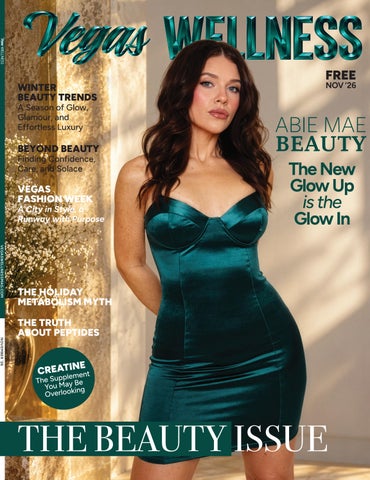
WELLNESS
WINTER BEAUTY TRENDS
A Season of Glow, Glamour, and Effortless Luxury
BEYOND BEAUTY Finding Confidence, Care, and Solace
VEGAS FASHION WEEK
A City in Style, a Runway with Purpose
FREE
NOV ’26
ABIE MAE BEAUTY The New Glow Up is the Glow In
VEGASWELLNESSMAG.COM
THE HOLIDAY METABOLISM MYTH
NOVEMBER '26
THE TRUTH ABOUT PEPTIDES
E CREATleIN ment
p The Sup ay Be You M ing Overlook
THE BEAUTY ISSUE
SKIN
|
WELLNESS
|
REJUVENATION
Ho l i da y GLOW SERIES INVEST IN YOUR RADIANCE
MICRONEEDLING SERIES 3 TREATMENTS
Stimulate collagen, improve texture and reveal smoother, firmer, more radiant skin.
GLO2FACIAL + RF SERIES 3 TREATMENTS
Oxygenate, exfoliate, and tighten for an instant glow with long-term results.
585
$
($675 VALUE)
$
720 ($825 VALUE)
CHOOSE YOUR GLOW
@exhaalwellnessspa @Exhaalwellnessspa
exhaal.com
E X H A A L W E LL N ES S S PA 4280 BLUE DIAMOND RD, STE 101B LAS VEGAS, NV 89139
(702) 531-3223
CONTENTS
Vegas Wellness Magazine
NOVEMBER 2026
WHAT'S INSIDE 8 Abie Mae Beauty WELLNESS
12 Winter Beauty Trends FREE
NOV ’26
WINTER BEAUTY TRENDS
A Season of Glow, Glamour, and Effortless Luxury
ABIE MAE BEAUTY
BEYOND BEAUTY Finding Confidence, Care, and Solace
The New Glow Up is the Glow In
VEGAS FASHION WEEK
A City in Style, a Runway with Purpose VEGASWELLNESSMAG.COM NOVEMBER '26
36
16 Holiday Metabolism Myth 18 Vegas Fashion Week 20 The Gift of Becoming Whole
THE HOLIDAY METABOLISM MYTH
22 The Truth About Peptides
THE TRUTH ABOUT PEPTIDES
24 Biohacking with JohnXD
EATINE
CR lement The Supp y Be You Ma g Overlookin
THE BEAUTY ISSUE
26 Thanksgiving Sides
ON THE COVER
30 Fall Into a New Vibe
Abie Mae
Founder of ABIE MAE BEAUTY and Peptide Mondays Cover Photo Michelle McAdams @LotusValentineVisuals
18
14 Beyond Beauty
Cover Design Pink Kitty Creative @pinkkittycreative
28 Rest is Part of the Work 32 Your Hormones Deserve More Than Another Prescription
34 Creatine 36 Disconnected 38 It's Part of Your Body, So Why Are We Ignoring It?
40 Give Thanks to Your Skeleton 42 Wisdom of Eating with Winter 44 Cultivating Cultures of Connection 46 JP's Brasserie & Sports Den
14
47 Trauma Remembers 48 Plant Magic & Medicine 5
PUBLISHER Bill Shehan
EDITOR
Stephanie Shehan // stephanie@vegaswellnessmag.com // 702 622 8001
ASSISTANT EDITOR Jennifer Walker // jennifer@vegaswellnessmag.com // 775 375 0415
CONTRIBUTING WRITERS Alethea Shelton Andrea Caple Anna Ketron Cusano Cheri Alberts Dr. Amanda Jordan Dr. Tim Patel Glenn J. White Jaden Rae Janelle Ardizzone
John Wetzel Katie Peede Krystian Bastidas Pravina Narayan Sarah Schwefel Steven Dee Kish Tiffany Marie Tsikki Thau
BIOHACKING CONTRIBUTOR John Wetzel (JohnXD) // Biohacking Las Vegas
COVER ART Victoria Hart // Pink Kitty Creative
ADVERTISING SALES Stephanie Shehan // stephanie@vegaswellnessmag.com // 702 622 8001 Jennifer Walker // jennifer@vegaswellnessmag.com // 775 375 0415
COPY EDITOR Effie Armstrong - info@vegaswellnessmag.com
web
vegaswellnessmag.com
@vegaswellness @vegaswellnessmag
@vegaswellness Vegas Wellness Magazine is a lifestyle publication featuring content about wellness, plant medicine, and general wellbeing. All content within our publications and on our website is for educational and entertainment purposes only and should not be considered personalized legal or medical advice. Both the printed publication and the website are intended for those over the age of 21. Vegas Wellness Magazine assumes no responsibility for the advertisements within this publication. We strive to ensure the accuracy of the information published. Vegas Wellness Magazine cannot be held responsible for any consequences which arise due to error or omissions. Reproduction in whole or in part is strictly prohibited. All rights reserved.
By Abie Mae
ABIE MAE BEAUTY The New Glow Up is the Glow In
How rebuilding my own confidence inspired a business dedicated to helping women find theirs. Before there was ABIE MAE BEAUTY, there was a mother in a small apartment, cleaning makeup brushes before sunrise and wondering how she was going to make everything work. That mother was me. I was rebuilding my life with my son, Jack, navigating financial pressure, the end of a relationship, and the responsibility of creating a more secure future for us. I worked long hours, sometimes leaving before he woke up and coming home after he was asleep. Those days were exhausting. They also gave me a clear sense of what I wanted to build: a business where I could practice the artistry I loved, support my family, and create opportunities for other women. I didn’t have every answer. I had a vision and a reason to keep going. Looking back, I can see that my pain became my purpose.
Learning to Feel Seen
Beauty has always been part of my life. My mother was a makeup artist who raised four children, and she introduced me to both the creativity and the hard work behind the profession. From her, I learned to keep practicing, keep learning, and take pride in what I created. But being surrounded by beauty didn’t always mean I felt beautiful myself. There were times when makeup helped me feel more comfortable being seen. Getting ready gave me a moment to reconnect with myself, especially when other parts of my life felt uncertain. That experience shaped how I wanted to work with women. I understood that someone sitting in my chair might be preparing for much more than a photograph or a party. She might be celebrating a milestone, stepping into a new chapter, or finally doing something for herself after spending months caring for everyone else. I wanted her to feel welcome before the first brush ever touched her face.
Bringing the Glam, and the Good Energy
ABIE MAE BEAUTY began with hands-on work: sourcing models, organizing shoots, taking photographs, and developing a single lip gloss. Little by little, those efforts grew into a company and a team. The idea behind our mobile service was simple. Women already have enough to coordinate. We could make getting ready easier by bringing professional hair and makeup directly to them. Today, that might mean joining a bride and her family on a wedding morning, help-
"My pain became my purpose."
ing a client prepare for a red carpet, or getting a group of friends ready for a night out in Las Vegas. We arrive with our kits, our skills, and our personalities.
soften skin and leaves dry skin feeling smoother and more supple. For me, its appeal is the simplicity of that step: taking a little time to care for your skin before reaching for your makeup.
I like to think of us as the party before the party. There is music, conversation, laughter, and often a moment when someone who felt nervous at the beginning starts to relax and enjoy herself.
Beauty should be something you can enjoy and understand. You deserve to feel capable in front of your own mirror.
We want our clients to feel comfortable telling us what they love, what they’re unsure about, and what will help them feel most like themselves. Some want a soft, natural look. Others are ready for full glam. Both deserve the same attention and care.
Your Mobile Beauty Besties
Building this company has also meant building a team I’m proud of. I imagined a place where talented artists, including mothers like me, could do work they loved and feel supported in their craft. That remains close to my heart. Our Mobile Beauty Besties bring their individual artistry to each appointment, along with a shared commitment to listening, preparation, and making clients feel cared for. I know how much trust it takes to invite someone into an important day. A wedding morning cannot be repeated. A milestone birthday happens once. The way we make someone feel becomes part of that memory. My favorite moment is still the mirror reveal. Sometimes a client becomes quiet. Sometimes she tears up. Sometimes the entire room starts cheering. I never get tired of seeing that smile.
Confidence You Can Take Home
I also want women to leave with something they can use after the appointment: a technique they understand, a product they enjoy, or the confidence to try a look on their own. That is the thinking behind my beauty product line. Makeup can feel overwhelming when you have a drawer full of products and no idea where to begin. I want to make it approachable. A useful tip about placement, blending, or preparing your skin can make your everyday routine feel easier. One of my top sellers is prickly pear seed oil. It naturally contains fatty acids, including linoleic acid, and forms of vitamin E. As an emollient, it helps
Feeling Beautiful from Within
My own transformation helped shape what beauty means to me. I lost 119 pounds, and peptides played a part in my journey. Today, I feel more energetic, youthful, and confident in my own skin. That experience was deeply personal. It changed the way I saw myself and helped me understand how much our feelings about our bodies can affect our confidence. I know how emotional it can be to experience thinning hair, loose skin, or changes that come with age. Women deserve to feel beautiful through those changes, with opportunities to care for themselves and celebrate who they are today. For me, real beauty starts with how I feel within. Hair and makeup add another layer of expression and confidence, a chance to elevate that feeling and have fun with it. That is what I want to bring to the women we serve: a welcoming place to feel seen, enjoy being cared for, and discover a look they love.
Curiosity Keeps Me Growing
My curiosity about science also inspired Peptide Mondays, a separate company offering peptides for laboratory research. Building this business has given me another opportunity to keep learning and exploring my entrepreneurial interests. For questions about our research product catalog, visit www.peptidemondays.com or contact our team.
Making Room for Yourself
My transformation has involved motherhood, rebuilding, learning to lead, and becoming more confident in the decisions I make for my life. There is still plenty to figure out. But I look at the work we do, the artists beside me, and the women who trust us, and I feel proud of how far we’ve come. I also
think about the woman cleaning brushes in that small apartment. She needed encouragement. She needed opportunities. And she needed to believe that the life she imagined was worth working toward. That memory stays with me when another woman sits in our chair. You never know everything someone is carrying. You can listen. You can make her feel welcome. You can give her a moment of care and help her celebrate herself exactly where she is. Beautiful hair and makeup can be part of that moment. The confidence she carries away belongs to her. That is what the glow within means to me: feeling worthy of attention, comfortable being seen, and ready to take the next step in your own story. If you’re ready for your own glow up, let this be your sign to start putting yourself first. Not sure where to begin with your hair, makeup, or beauty routine? Call or text me at 702.808.0886. We’ll find your look, make getting ready easy, and have some fun along the way. Your Mobile Beauty Besties have you covered!
ABIE MAE BEAUTY Book: www.abiemaebeauty.com Call/text: 702.808.0886 Instagram: @abiemaebeauty Peptide Mondays Website: www.peptidemondays.com Call/text: 702.401.8090 Instagram: @peptidemondays For laboratory research purposes only.
Photography Michelle McAdams @LotusValentineVisuals
Vegas Wellness Magazine
Trends Beauty Winter >>> A Season of Glow, Glamour & Effortless Luxury
From radiant skin and rich seasonal colors to glossy hair and indulgent self-care rituals, winter 2026–2027 is all about embracing beauty that feels natural, sophisticated, and effortlessly glamorous.
For those who prefer a more understated approach, rosy-brown lip liners, creamy nude lipsticks, and tinted balms provide a softer alternative.
As temperatures drop and the desert air turns cooler, winter brings the perfect opportunity to refresh our beauty routines and embrace a new season of self-care. In Las Vegas, where dry air, fluctuating temperatures, and indoor heating can leave skin feeling dehydrated, winter beauty is about much more than switching lipstick shades. It's about protecting the skin, restoring moisture, and finding products that deliver both luxury and nourishment.
The biggest change is texture. Comfortable, moisturizing lip formulas are taking priority over products that leave lips feeling dry or tight. A nourishing lip treatment before bed can also help combat the effects of winter air, making it easier to wear statement colors without emphasizing dryness.
This winter, beauty is moving toward a sophisticated balance of skincare, wellness, and individuality. From luminous complexions and rich seasonal colors to glossy hair and simplified beauty routines, the upcoming season is shaping up to be one of effortless glamour and intentional self-care.
Hydrated, Radiant Skin Takes Center Stage
The overly matte, heavily powdered complexion is giving way to a softer, more luminous finish. Winter beauty is embracing skin that looks healthy, hydrated, and naturally radiant. Rather than covering every imperfection with layers of foundation, the focus is shifting toward lightweight complexion products, creamy blushes, illuminating serums, and moisturizing primers. The goal isn't to look shiny. It's to create a fresh, polished glow that appears effortless. For local residents, achieving that glow begins with hydration. Hyaluronic acid serums, ceramide-rich moisturizers, and gentle cleansers can help maintain the skin's protective barrier during the colder months. One important reminder: sunscreen remains essential even in winter. Nevada's sunshine doesn't take a seasonal vacation, and daily UV protection is one of the most effective ways to prevent premature skin aging.
Bold Lips Make a Comeback
Winter is the perfect excuse to put away the barely-there summer glosses and embrace something a little more dramatic. Deep berry, burgundy, wine, chocolate, and classic red lips are poised to complement the season's rich fashion palette. These shades offer an instant touch of sophistication, whether paired with a minimal daytime look or full evening glamour.
12
Soft Glam Gets a Winter Upgrade
While dramatic makeup will always have a place, winter's approach to glamour is becoming more refined. Think softly blended smoky eyes, warm bronze shadows, subtle metallic accents, and beautifully defined lashes. Instead of sharp, heavily sculpted makeup, the emphasis is on enhancing natural features. Champagne, taupe, espresso, copper, and muted plum are particularly versatile for winter. A touch of shimmer on the eyelids can elevate a daytime look, while a deeper shadow along the lash line adds evening drama. Cream blush in rose, mauve, or berry tones brings warmth back to winter complexions, creating a healthy flush without the need for heavy contouring.
The result is beauty that feels sophisticated, wearable, and just glamorous enough for a night out.
Winter Hair: Healthy, Glossy & Effortlessly Polished
Hair trends are also embracing a more natural sense of luxury. Rich brunettes, warm caramel highlights, copper tones, and glossy dark shades are expected to remain popular choices as the weather cools. Rather than dramatic transformations, many are opting for subtle color enhancements that create dimension and shine. Healthy-looking hair is becoming just as important as the cut or color itself. Hydrating masks, lightweight oils, scalp treatments, and heatprotectant products are winter essentials, particularly in dry climates where hair can become brittle and prone to static. Sleek ponytails, soft waves, polished bobs, and relaxed blowouts offer versatile styling options that transition easily from everyday activities to holiday celebrations. The message is simple: beautiful hair begins with healthy hair.
Luxurious Body Care Becomes a Daily Ritual
Winter self-care isn't stopping at the face. Body care is becoming an increasingly important part of the beauty conversation, with everything from cleansing to moisturizing becoming an opportunity for relaxation and restoration. Rich body butters, exfoliating scrubs, nourishing bath oils, and deeply moisturizing lotions are ideal additions to a winter routine. Ingredients such as shea butter, squalane, glycerin, and ceramides can help keep skin feeling soft and comfortable when colder temperatures and indoor heating take their toll. The emerging philosophy is that body care should feel less like another task and more like a moment of indulgence.
Nails Embrace Moody Colors and Minimalist Luxury
Winter nail trends are moving in two equally appealing directions: bold seasonal colors and understated elegance. Deep burgundy, espresso brown, midnight blue, forest green, and plum bring a dramatic edge to manicures, while milky pinks, soft taupes, and sheer neutrals offer a timeless alternative. Chrome finishes, delicate metallic accents, and glossy topcoats add just enough personality without overwhelming the overall look. Shorter, neatly shaped nails are also an attractive option for those who prefer practical, low-maintenance beauty. And as with skincare, nail health matters. Regular cuticle oil, moisturizing hand cream, and gentle nail-care practices can help keep hands looking their best throughout the winter.
Beauty Meets Wellness: The Rise of Intentional Self-Care
Perhaps the most meaningful direction in winter beauty is the growing connection between appearance and overall well-being. Consumers are increasingly recognizing that beauty isn't simply about the products sitting on their bathroom counters. Sleep, nutrition, stress management, hydration, and daily habits all influence how we look and feel. This broader approach has created more interest in at-home spa rituals, facial massage, aromatherapy, restorative baths, and mindful skincare routines. The emphasis is shifting away from complicated, expensive routines and toward choosing products and practices that genuinely support individual needs. Sometimes the most effective beauty ritual is also the simplest: a nourishing skincare routine, a relaxing evening, and a good night's sleep.
A New Definition of Winter Beauty
This winter, beauty is less about following every trend and more about creating a routine that feels authentic, effective, and enjoyable. Whether that means experimenting with a dramatic berry lip, investing in a richer moisturizer, embracing a new hair color, or simply making more time for self-care, the season offers countless ways to refresh your look. For beauty enthusiasts, the combination of desert-friendly hydration, sophisticated glamour, and luxurious self-care makes winter an especially exciting time to explore new products and techniques. And while trends will always come and go, one thing remains timeless: the most beautiful look is one that makes you feel comfortable, confident, and completely yourself.
HORMONE THERAPY FOR MEN AND WOMEN
WEIGHT LOSS MEDICALLY SUPERVISED
PRIMARY CARE ROUTINE WELLNESS VISITS
Shanna McManus, APRN, is a board-certified family nurse practitioner who specializes in primary care, hormone replacement, and medically supervised weight loss. She is certified through the American Association of Nurse Practitioners (AANP) and the North American Menopause Society (NAMS.
(702) 551-1199
2213 N. Green Valley Pkwy, Ste 101 Henderson, NV 89014
info@vitalishealthnv.com
INSURANCE ACCEPTED
vitalishealthnv.com
>>>
By Stephanie Shehan
BEYOND BEAUTY Finding Confidence, Care, and Solace How Air Force veteran and nurse practitioner Christina “Doc Tinz” Pangan is redefining the connection between wellness, aesthetics, and self-care in Las Vegas.
In a city known for beauty, luxury, and an always-on lifestyle, finding time to prioritize personal wellness can sometimes feel like a luxury of its own. But for Christina “Doc Tinz” Pangan, founder of Solace Wellness IV & Aesthetics, taking care of yourself should never be an afterthought.
At Solace, conversations about aesthetic goals often include discussions about hydration, nutrition, stress, sleep, and lifestyle habits. Rather than encouraging dramatic transformations, Pangan focuses on enhancing the features that make each person unique.
A board-certified Family Nurse Practitioner, U.S. Air Force veteran, wife, mother, and Doctor of Nursing Practice graduate, Pangan has spent more than a decade caring for others. Now, she's channeling that experience into a boutique wellness and aesthetics practice that combines personalized medical care, beauty treatments, and a refreshing philosophy: feeling your best matters just as much as looking your best.
As an aesthetic injector, she particularly enjoys helping clients achieve subtle, natural-looking results through treatments such as wrinkle relaxers, lip enhancement, and facial balancing with dermal fillers. Many of her clients arrive with a similar request: They want to look refreshed without appearing noticeably different. "The goal isn't to look like somebody else," she explains. "It's to feel like the best version of themselves." It's a philosophy that challenges the idea that beauty requires perfection or that aging is something to be feared.
From Military Service to a Mission of Wellness
Pangan's journey into entrepreneurship began long before Solace opened its doors. Since becoming a nurse in 2014, she has worked in oncology, medical-surgical nursing, wound care, and advanced practice. Her years in the U.S. Air Force further shaped her dedication to service, leadership, discipline, and resilience. Throughout her healthcare career, much of her work centered on helping patients navigate illness, recovery, and some of life's most challenging moments. Eventually, she envisioned creating a different kind of healthcare experience—one focused not only on treating illness but also on supporting wellness, confidence, and personal well-being. "The inspiration behind Solace came from wanting to create something different," Pangan explains. "I wanted to build a space that also focused on wellness, confidence, and helping people prioritize themselves." The name itself reflects that mission. Solace means comfort, a feeling Pangan hopes every client experiences from the moment they arrive. Today, Solace Wellness IV & Aesthetics offers a range of services, including IV hydration and vitamin therapy, NAD+ infusions, vitamin injections, medical weight management, wrinkle relaxers, dermal fillers, platelet-rich plasma (PRP) treatments, and red light therapy. For Pangan, however, the business is about far more than its treatment menu. It's about creating an environment where clients feel heard, respected, and empowered to make informed decisions about their health and appearance.
Where Beauty Meets Wellness
As beauty and wellness continue to intersect, more people are looking beyond traditional cosmetic treatments and considering how lifestyle, nutrition, hydration, and overall health contribute to their appearance. Pangan embraces this broader perspective while maintaining a grounded, medically informed approach. "I've always believed that beauty isn't just about how you look. It's also about how you feel," she says.
A Thoughtful Approach to IV Therapy
IV hydration and vitamin infusions have become increasingly visible in the wellness industry, particularly in cities like Las Vegas, where desert temperatures, demanding work schedules, tourism, and active lifestyles can make hydration and self-care frequent concerns. At Solace, clients inquire about IV therapy for a variety of reasons, including hydration concerns, fatigue, frequent travel, and an interest in wellness treatments. IV therapy delivers fluids and, when appropriate, vitamins or other nutrients directly into the bloodstream. While this bypasses the digestive system, Pangan is careful to explain that IV delivery does not automatically make vitamins more beneficial than nutrients obtained through food or oral supplements. She emphasizes that these treatments are not necessary for everyone and that scientific evidence supporting routine vitamin infusions in otherwise healthy individuals remains limited. "IV therapy is not a cure-all," she explains, emphasizing the importance of evaluating each person's individual medical needs. Solace offers hydrationfocused infusions, a Beauty IV, and infusions containing ingredients such as vitamin C and glutathione. However, Pangan is transparent about the distinction between popular wellness claims and scientifically established benefits. Routine vitamin infusions have not been proven to reverse skin aging or consistently improve skin appearance in healthy individuals. For clients interested in maintaining healthy skin, she points to the fundamentals that have long supported overall wellness: balanced nutrition, adequate hydration, quality sleep, sun protection, and consistency. Her philosophy is refreshingly straightforward. Wellness should be rooted in education and realistic expectations rather than exaggerated promises.
Personalized Care in a Fast-Paced City
Southern Nevada presents its own unique wellness challenges. Between long hospitality shifts, late nights, desert heat, frequent travel, and busy family schedules, maintaining consistent healthy habits can be difficult.
Pangan frequently hears concerns about fatigue, stress, hydration, and recovery. But rather than immediately recommending a treatment, she believes in understanding what may be contributing to those concerns. Fatigue, for example, may be related to inadequate sleep, stress, nutritional deficiencies, or underlying medical conditions requiring further evaluation. That individualized approach is central to the Solace experience. Unlike larger, high-volume wellness businesses, Solace operates as an intentionally small boutique practice. Pangan sees this as an advantage, allowing her to spend time getting to know clients, discussing their concerns, and developing personalized treatment plans. "We're intentionally small, and I see that as a strength," she says. For first-time IV therapy clients, the process begins with a consultation that includes reviewing medical history, medications, allergies, existing health conditions, and personal goals. Depending on individual circumstances, additional evaluation or laboratory testing may be recommended before proceeding. Safety, informed consent, and realistic expectations remain priorities. Pangan is also quick to acknowledge that IV treatments carry potential risks, including infection, allergic reactions, vein irritation, and fluid overload. Sometimes, she says, the most appropriate recommendation is to skip the infusion altogether. "My focus isn't on selling the most treatments. It's on building long-term relationships and earning trust." That commitment to education and transparency reflects the values she developed throughout her nursing and military careers.
Building Something Bigger Than Beauty
Although Solace began with a focus on IV therapy and aesthetics, Pangan's long-term vision extends well beyond its current offerings. She hopes to develop Solace into a comprehensive wellness and aesthetics boutique, incorporating additional aesthetic technologies, advanced skin treatments, and expanded wellness programs while continuing to prioritize medical evidence and client safety. She is also exploring corporate wellness opportunities and partnerships throughout the Las Vegas community. Eventually, she envisions a larger location, an expanded team, and the opportunity to serve more people without losing the personalized approach that defines her business. Her entrepreneurial journey has come with its share of challenges. Balancing family life, completing her doctorate, and building a business
has required determination and a willingness to step outside her comfort zone. Yet those experiences have reinforced her belief in continuous growth. "Sometimes you have to believe in a vision before anyone else can see it," she reflects. For Pangan, success isn't measured solely by business expansion or the number of treatments performed. It's measured by the relationships she builds and the confidence clients gain through feeling supported and informed.
Aging Beautifully, on Your Own Terms
Perhaps the most compelling part of Pangan's approach to beauty is her perspective on aging. At 40, she sees growing older not as something to resist but as an opportunity to embrace the wisdom, growth, and confidence that come with each stage of life. "Stop viewing aging as something you have to fight," she advises. "Aging is a privilege." She encourages women to invest in their health, protect their skin, remain active, and explore aesthetic treatments if they personally choose to, but never because they feel pressured to meet someone else's standard of beauty. For women balancing careers, motherhood, caregiving, and countless other responsibilities, her message is especially meaningful: Making time for yourself is not selfish. True confidence, she believes, isn't about achieving flawless skin or erasing every wrinkle. It's about being comfortable with who you are and appreciating the person you're becoming. At its heart, Solace Wellness IV & Aesthetics represents that belief, a place where clinical knowledge, personalized care, and beauty come together without losing sight of what matters most. "Solace was created with the belief that everyone deserves a moment to prioritize themselves," Pangan shares. "Whether you're seeking wellness support, exploring aesthetic treatments, or simply wanting to feel more confident, my hope is that you leave our space feeling heard, cared for, and empowered." Solace Wellness IV & Aesthetics is located at 900 S Pavilion Center Dr, Suite 180, Las Vegas, NV 89144. For more information, visit solacewellnessiv. com.
>>> THE HOLIDAY METABOLISM MYTH What Actually Matters By: Amanda Jordan, MD How to enjoy the season while protecting the habits that support long-term health Every November, familiar warnings make their annual appearance: don't arrive at Thanksgiving hungry, skip the rolls, avoid the dessert table, and find a way to burn off dinner before breakfast the next morning. By December, holiday eating has somehow become a six-week test of willpower. Consider a familiar scenario: A 52-year-old professional exercises regularly, eats reasonably well, and has spent the year trying to improve their health. Then the calendar fills with travel, late dinners, office parties, and family obligations. Workouts disappear. Bedtime shifts later. Meals become unpredictable. By New Year's Day, they feel sluggish and assume the stuffing was to blame. The stuffing makes an easy suspect. But our physiology is considerably more interesting than that.
The holiday weight-gain story is exaggerated
The oft-repeated claim that the average American gains five to ten pounds over the holidays doesn't hold up particularly well. In a study published in the New England Journal of Medicine, researchers followed 195 adults and found an average gain of about 0.8 pounds during the holiday period. Individual results varied widely, and this was a relatively small study, not a prediction for everyone. The more important finding was that the modest gain tended to persist rather than disappear in the spring. Small changes, repeated year after year, can eventually matter. It's also worth remembering that the scale doesn't distinguish fat from water. A large, salty, carbohydrate-rich meal can temporarily increase water retention and stored glycogen, the form of carbohydrate kept in muscles and liver. A higher number the morning after Thanksgiving does not mean every ounce represents new body fat. None of this makes dietary choices irrelevant. It means that treating one celebratory meal as a metabolic emergency misses the bigger picture. The other meals, nights, and days deserve far more attention.
What does a healthy metabolism actually do?
Metabolism is often described as the rate at which we burn calories, as if the goal were to keep an internal furnace roaring. In reality, it’s the collection of processes that turn food into usable energy, store what we don't need right away, and keep blood glucose and other fuels within healthy ranges. One useful concept is metabolic flexibility: the ability to shift between using carbohydrates and fats as conditions change. Related, though broader, is metabolic health, which includes blood sugar regulation, blood pressure, blood lipids, and body composition. Neither is captured by a single reading on the bathroom scale.
Insulin is central to this process. After a meal, it helps move glucose from the bloodstream into tissues, particularly muscle. When cells become less responsive to insulin, the body may need to produce more to manage the same amount of glucose. Over time, insulin resistance can contribute to prediabetes, type 2 diabetes, and cardiovascular risk. That process is influenced by more than dessert. Muscle mass, physical activity, sleep, overall nutrition, genetics, and certain medications all matter. The holidays remind us that these factors interact. The good news is that the habits that support them are simple and easy to adopt.
Six ways to support your metabolism through the holidays 1. Stop saving all your calories for dinner Skipping meals to "make room" for a feast sounds logical on paper. In practice, arriving ravenous can make it harder to recognize fullness or enjoy food deliberately. For some people, a light breakfast works beautifully; for others, a substantial lunch prevents an afternoon raid on the appetizer tray. There is no universal meal schedule. Aim for a normal meal with protein, produce, and fiber earlier in the day. Eggs with vegetables, Greek yogurt with berries, or lentil soup are some good options. Then show up ready to eat, not ready to negotiate with a platter of cheese. Resist the urge to punish yourself by fasting the next morning. Resume your usual eating pattern when you're hungry. Consistency is more useful than compensation. 2. Give protein and fiber a place on the plate Holiday food can be delicious and nutritionally useful at the same time. Turkey supplies protein. Brussels sprouts, green beans, squash, and beans contribute fiber and micronutrients. Potatoes provide carbohydrates that active muscles can use. Even the much-maligned carbohydrate has an important job. Protein helps preserve muscle, particularly as we age, while fiber supports digestive health and helps moderate the glucose response to meals. A practical approach is to serve a satisfying portion of protein, add colorful vegetables, and leave room for the seasonal dishes you love. You can put together a balanced meal without making dinner feel like a math assignment. Eat slowly enough to notice when you're comfortably satisfied. 3. Take the post-dinner walk If there's one holiday tradition worth adding, it's a post-meal walk. Working muscles use glucose for energy, and muscle contractions help bring glucose into cells. Movement soon after eating can reduce the rise in blood sugar following a meal. A 2023 systematic review in Sports Medicine found that exercise after eating, including walking, lowered short-term post-meal glucose more than exercising before the meal or remaining inactive. The trials were
small, and this doesn't mean a stroll erases the effects of overeating. It does make the intervention simple and easy to put into practice. Try ten to twenty minutes at a comfortable pace. Walk the dog, tour the neighborhood lights, or recruit relatives who would otherwise fall asleep watching football. You don't need a fitness tracker to make this count. 4. Don't let your muscles take the entire season off Skeletal muscle is one of the body's largest destinations for glucose after meals and an important reserve for healthy aging. Maintaining strength supports mobility, function, and metabolic regulation well beyond the holiday season. A packed calendar is not a reason to abandon strength training altogether. Two sessions per week can provide a useful foundation. You can do squats to a chair, wall push-ups, resistance-band rows, and dumbbell exercises in a hotel room or at home. Choose movements appropriate to your ability and health status. If your usual routine is four sessions, two may be enough to preserve momentum during a busy stretch. Think maintenance, not personal records. January will still be there when the relatives leave. 5. Guard your sleep more carefully than your dessert Late parties, travel, extra alcohol, and disrupted routines can quietly chip away at sleep. That matters because sleep affects appetite regulation, daytime energy, and the way our bodies respond to insulin. In a randomized study published in Diabetes Care in 2024, six weeks of modest sleep restriction reduced insulin sensitivity in women, even without meaningful changes in body fat. One late night isn’t disastrous, but regularly cutting sleep short does carry metabolic consequences. Most adults should aim for seven to nine hours per night. During the holidays, protect a reasonably consistent wake time, make your bedroom cool and dark, and be selective about the events worth a late bedtime. Alcohol may make you drowsy initially, but it can also fragment sleep later in the night. Good sleep isn’t a glamorous holiday tip, but it may be among the most valuable. 6. Pay attention to the ordinary days Thanksgiving itself is one meal. The larger challenge is how quickly a season of celebrations becomes a season without structure. A restaurant dinner turns into several days of takeout. Travel interrupts exercise. Cookies become breakfast because they're on the counter and convenient. Rather than creating food rules for special occasions, keep a few routines on regular days: a protein-rich breakfast or lunch, fruit and vegetables within reach, walking breaks, and scheduled movement. If you drink alcohol, consider choosing the occasions that matter most and alternating with water. You don't need to decline every invitation. You do need habits that don't vanish every time someone opens a bottle of wine or brings cookies to the office. The aim is an enjoyable holiday season built around a generally healthy pattern.
When the issue is bigger than the holidays
If abdominal weight gain, high blood pressure, elevated triglycerides, or rising glucose have been developing over several years, blaming
December may delay a more useful conversation. Insulin resistance and cardiometabolic risk often develop gradually, sometimes before someone feels unwell. A thoughtful assessment starts with medical history, blood pressure, and appropriate laboratory testing, including cholesterol measurements and screening for prediabetes or diabetes. For most adults, diabetes screening should begin by age 35, with timing thereafter guided by results and individual risk. More testing isn't automatically better; the value lies in choosing measurements that guide decisions. Persistent fatigue or unexplained weight changes may also deserve evaluation for sleep disorders, medication effects, thyroid disease, or other conditions. A holiday reset is no substitute for investigating an ongoing health concern.
Enjoy the meal. Protect the pattern.
The purpose of good metabolic health is not to make you exceptionally skilled at refusing dessert. It's to help you stay strong, energetic, and capable of doing what matters over the coming decades. Have the Thanksgiving dinner. Enjoy a favorite family recipe. Take a walk afterward, get some sleep, and return to the routines that serve you well. There is room for both celebration and prevention. Longevity is built over years, not decided by what you put on your plate one Thursday in November. Dr. Amanda Jordan is double board-certified in emergency medicine and anti-aging and regenerative medicine (ABAARM), and runs Limitless Longevity and Functional Medicine, a nationwide telehealth practice built on root-cause, precision care. Visit dramandajordan.com to schedule a complimentary discovery call.
Vegas Wellness Magazine
>>>
A CITY IN STYLE, A RUNWAY WITH PURPOSE
Vegas Fashion Week® Returns for Four Days of Fashion and Creativity
Las Vegas is known for its entertainment, world-class dining and vibrant nightlife, but its growing fashion community is also making its mark. From emerging designers and local creatives to runway shows and unique fashion experiences, the city is creating new opportunities for fashion talent to connect, collaborate and showcase their work. Returning Nov. 12-15, Vegas Fashion Week® 2026 is bringing four days of runway shows, fashion presentations and special events to some of Las Vegas' most recognizable destinations. Now in its second year, the citywide celebration aims to spotlight emerging talent, support the local fashion industry and bring the community together through creativity and design. Presented by the Las Vegas Fashion Council, Nevada's only nonprofit dedicated exclusively to advancing the state's fashion industry, the event is part of a larger mission to provide education, mentorship, scholarships and professional opportunities for local designers and creatives. Through its year-round initiatives, the organization works to strengthen Nevada's fashion community and help emerging talent build lasting careers in the industry. This year's celebration will take place across four venues, offering a different fashion experience each day, with live entertainment accompanying every show. The festivities begin Thursday, Nov. 12, with a kickoff event at AREA15 from 5:30 to 8:30 p.m., followed by a runway showcase at The Shops at Crystals on Friday, Nov. 13, from 1 p.m. to 3 p.m. On Saturday, Nov. 14, the runway moves to Keep Memory Alive Event Center from 5:30 to 8:30 p.m., before concluding Sunday, Nov. 15, with a finale at The Mayfair Supper Club at Bellagio from 11 a.m. to 2 p.m. Ahead of the four-day celebration, Vegas Fashion Week® will host a special Mannequin Art Auction Kickoff reception on Saturday, Nov. 7 at Slonina ArtSpace, showcasing 20 one-of-akind mannequins transformed by local artists. The creations will be featured in a charitable auction, bringing together fashion, art and philanthropy while highlighting the creativity of Las Vegas' artistic community. Led by Las Vegas Fashion Council founder and executive director Carrie Carter-Cooper, Vegas Fashion Week® continues to build on its inaugural year, working toward establishing Las Vegas as a destination for fashion while celebrating the creativity and talent already thriving within the community. Whether you're a fashion enthusiast, an aspiring designer or simply looking for a unique experience in Las Vegas, Vegas Fashion Week® offers more than a front row seat to the runway. It's an opportunity to celebrate local creativity, support emerging talent and be part of a growing community that's helping shape the future of fashion in Southern Nevada. For event details, tickets and more information, visit VegasFashionWeek.com and follow @officalvegasfashionweek and @lvfc_nv on Instagram.
18
10% OFF
Open Every Day 10am-10pm
FIRST SERVICE Must mention this ad Expires 11/30/26
Follow Us
Walk-Ins Welcome
@1NEVADANAILSANDSPAINC
Beauty that Feels as Good as it Looks Starting at
Starting at
Starting at
$35
$50
$45
Nails
Esthetics & Waxing
Head Spa
Facials Exfoliation Waxing Complete Skin Care
Scalp Health Detoxification Hair Restoration Deep Relaxation
Book Now Gel-X Acrylic Manicures Pedicures
(702) 898-7008
booking.gocheckin.net/v2/18321
3280 E. TROPICANA LAS VEGAS NV 89121
Vegas Wellness Magazine
>>> THE GIFT OF BECOMING WHOLE On Gratitude, Curiosity, and Learning to Listen to the Body that Has Carried You this Far By Janelle Ardizzone | Co-Founder, Desert Moon Hyperbarics and Wellness There's a morning every November when Las Vegas finally exhales. The air turns crisp before sunrise, the mountains sharpen against a clear sky, and after months of triple-digit heat, stepping outside feels like a gift instead of an endurance test. It's a natural season for gratitude. We count the people we love, the chances we've been given, the moments that shaped us. But how often do we stop to thank the one thing that has carried us through every one of those seasons? Our bodies. They adapt, repair, and communicate with us constantly, working around the clock to keep us in balance. In a city that never sleeps, they keep working even when we don't. And somewhere between careers, kids, aging parents, and the endless list of everyday obligations, many of us stop listening. We push through exhaustion. We call poor sleep “normal”. We shrug off shifts in energy, mood, metabolism, or how long it takes to bounce back, and file them under "getting older." But what if gratitude for our bodies meant more than appreciating what they've done? What if it meant getting genuinely curious about what they need? Now in my 40s, I often wish I'd asked more questions in my 30s. Not because we can prevent every illness or control every change, because we can't, but because awareness gives us the chance to make better-informed choices about the decades ahead. Sometimes that awareness begins not with what we add, but with what we let go.
Start by Subtracting
When we decide to get healthier, our instinct is to add: another supplement, another treatment, another routine. Rarely do we look first at the environment we live in every day. Environmental wellness is one of the most overlooked pieces of whole-person health. We encounter a steady stream of substances through our food, water, air, household products, and workplaces. Certain chemicals found in some plastics, personal care products, and pesticides can interfere with hormone signaling. Other exposures, such as lead, contaminated water, and persistent indoor mold, can pose real risks depending on the substance, the amount, and how long we're exposed. Awareness, though, doesn't have to become fear. Small, reasonable choices add up: not heating food in plastic containers, reaching for glass or stainless steel when it's practical, improving ventilation, and paying closer attention to what we bring into our homes. Desert living adds its own considerations. Our homes stay sealed and air-conditioned for much of the year, so filters and fresh air matter. And when a monsoon storm or a slow plumbing leak leaves water behind, addressing it quickly helps keep mold from taking hold. When heavy metal exposure is suspected, the answer is proper medical evaluation and targeted testing. Removing the source is essential, and medically significant poisoning requires professional care.
20
In my work, I often talk about addressing the upstream causes first. Our bodies are always working to repair themselves, and in my experience, many people see meaningful change simply by removing the exposures and stressors that keep getting in the way, before adding anything new. It also helps to remember that the body has an extraordinary built-in system for this work. The liver transforms many substances for elimination, the kidneys filter the blood, the digestive tract carries waste out, and the lungs release carbon dioxide with every breath. That's where meaningful detoxification begins: reducing preventable exposures and supporting the body's natural pathways with good nutrition, hydration, fiber, movement, and the right guidance, rather than chasing extreme cleanses or quick-fix products.
Heat, Sweat, and the Art of Recovery
If anyone understands heat, it's Las Vegans. But there's a difference between surviving a July afternoon and choosing heat intentionally, as a ritual of rest and renewal. Sauna bathing has deep roots in many cultures, and modern research continues to explore its effects on circulation, blood pressure, and cardiovascular health. In a sauna, heart rate climbs, blood vessels respond to the warmth, and we sweat to cool ourselves down. Infrared sauna, in particular, is one of the tools I recommend most often. At home, I use the Relax Far Infrared Sauna four to five days a week, and I love it. It makes me sweat in a way no other sauna I've tried ever has. Your head stays outside, which keeps it cooler and more comfortable, and your hands are free, so you can read or even work during a session. For me, the real gift is that it's convenient, easy to build into my routine, and genuinely effective. A home sauna isn't the only path, either. Las Vegas has wonderful spots offering sauna and contrast therapy for people who would rather go somewhere, and I'm always happy to share my favorite local referrals with anyone who reaches out. Wherever you choose, start with shorter sessions and build up gradually. As a Certified Toxicity & Detox Specialist through Dr. Dan Pompa's Health Centers of the Future program, I also see sauna as one supportive piece of a broader detox approach. In my own routine, I pair it with binders as part of my cellular detox work, and it has become one of the most valuable tools I have. Researchers have measured certain heavy metals in sweat, and many practitioners in functional and regenerative medicine use saunas alongside binders and other strategies when working with clients on heavy metal or mold-related concerns. The science on how much sweating contributes compared with the liver and kidneys is still developing, which is exactly why this work belongs with a qualified practitioner rather than a do-it-yourself protocol. That's also why I never recommend that anyone go it alone. I work closely with trusted practitioners in functional and regenerative medicine and refer to them often. I encourage everyone to partner with a medical professional who understands both medicine and the body as a whole, someone who can help identify what's really going on, monitor how you respond,
and make sure the approach fits your health history. Hydration matters, especially in our dry climate, and so do sensible session lengths. Anyone with significant heart concerns, low blood pressure, or a condition that affects heat tolerance should talk with a physician before starting. For me, the bigger lesson goes beyond the sauna itself. Our bodies need real opportunities to recover, not just constant demands to perform. Which raises a deeper question: how well do we actually understand what our own bodies need?
Become a Student of Your Own Biology
One of the most empowering shifts we can make is moving from reacting to symptoms to getting curious about what's influencing our health. Working alongside physicians and practitioners, I've learned a great deal about hormones, nutrition, heart health, and genetics. My own journey has included comprehensive bloodwork, hormone assessments, and genomic testing. I've explored specialized options like DUTCH hormone testing and functional wellness panels. Some sparked genuinely useful questions. Others taught me how important it is to separate findings that are clinically meaningful from those that are still exploratory. More information doesn't automatically mean better health. What matters is knowing which information is reliable, and what to do with it. Consider a few examples. For someone with persistent fatigue, a healthcare professional might look at sleep, thyroid function, anemia, or other possible causes. For a woman navigating perimenopause, her symptoms, age, menstrual patterns, and medical history often offer more useful guidance than routine hormone panels. And for someone with a family history of heart disease, knowing their blood pressure, cholesterol, blood sugar, and personal risk factors can be especially valuable.
The Stories We Inherit
My interest in preventive health is deeply personal, and it began long before I ever opened a wellness center. I grew up alongside my brother, Joshua, just 18 months older than me. He had cystic fibrosis, and I was with him until his last breath. He was my first spark, the reason I started asking how the body works and how we might care for it better. The questions didn't stop there. Both of my grandmothers died of massive heart attacks, just two days apart, one of them at only 64. My grandfather developed early-onset Alzheimer's before he turned 60. My great-grandmother lived with diabetes. Every family carries its own history. Mine simply made me curious and determined to understand how we can do better. Some conditions are written into our genes from the start. Many others are shaped over a lifetime by a mix of genetics, habits, environment, and medical care. That's why knowing your family history and taking preventive care seriously even when you feel fine can be so powerful. It's also why I think so intentionally about my own heart health, brain health, and metabolic health, and the choices I can make today. My curiosity has also grown through walking beside my husband as he navigates severe vasculitis, a serious autoimmune condition. Together, we've spent years working with physicians, reading research, reviewing medical information, and searching for a clearer picture of his health. Exploring his genomic information opened conversations about individual biological pathways, nutrition, and emerging areas of cellular health research. Along the way, we learned an important distinction: some genetic findings have established clinical uses, while many supplement-related interpretations remain preliminary. We hold both truths while continuing to ask questions. We certainly haven't found every answer. But the experience reinforced something I believe with my whole heart: every person deserves thoughtful, individualized care, and understanding our health is an ongoing journey, not a single destination.
Five Gifts to Give Your Body This November 1.Ask the question at Thanksgiving dinner. Family gatherings are the perfect time to learn your family's health history: heart disease, diabetes, dementia, and the ages they appeared. Write it down and bring it to your next appointment.
2.Swap one plastic habit.
Reheat leftovers in glass or ceramic instead of plastic containers.
3.Give your home a breath of fresh air.
Check your HVAC filter, open the windows on a cool morning, and fix any lingering leaks from monsoon season.
4.Book the appointment you've been putting off.
An annual physical with blood pressure, cholesterol, and blood sugar checks is one of the simplest preventive tools we have.
5.Schedule recovery like it matters.
Ten quiet minutes of breathwork, a sunset walk at Red Rock, or an earlier bedtime all count.
Nourishing Our Cells, One Meal at a Time
Advanced testing and medical innovation have their place, but we should never underestimate the power of everyday choices. Nutrition remains one of the most practical ways to support our health. In our home, we've grown more intentional about nutrient-dense meals, fresh ingredients, and knowing where our food comes from. We grow broccoli sprouts on the kitchen counter, cook with fresh eggs, and have fallen happily down the rabbit hole of homemade sourdough. These small rituals remind me that wellness doesn't have to be expensive or complicated. Broccoli sprouts have become a particular fascination. They contain glucoraphanin, a compound that converts into sulforaphane when the plant is chopped or chewed. Sulforaphane has drawn scientific interest for how it activates the body's own protective and antioxidant pathways, and early human studies have explored its role in inflammation and in processing environmental substances. Much remains to be learned, and sulforaphane is not an established treatment for vasculitis or any other serious autoimmune condition. The bigger takeaway for all of us is simpler: cruciferous vegetables, colorful plants, fiber-rich foods, quality protein, and healthy fats all contribute to a nourishing way of eating. Variety on the plate also supports a healthy gut microbiome, which interacts with digestion, metabolism, and immune function.
A Different Kind of Gratitude
This November, as we gather around Thanksgiving tables across the valley, perhaps gratitude can become more than a reflection on what we've been given. Perhaps it can become a commitment to better understand the bodies that carry us, the minds that guide us, and the experiences that have shaped us. Janelle Ardizzone is the co-founder of Desert Moon Hyperbarics and Wellness, home of the "Thrive Under Pressure™" philosophy, and a Certified Toxicity & Detox Specialist through Health Centers of the Future. Desert Moon works alongside physicians and healthcare professionals to offer medical-grade hyperbaric oxygen therapy together with nervous system, brain health, metabolic, and recovery support. Connect with Janelle at www.desertmoonwellness.com, on Instagram @desertmoonwellnesslv, or by calling 702-901-9812. You can also find Desert Moon Wellness on Facebook, LinkedIn, and YouTube. Article condensed for space.To read it in its entirety, visit vegaswellnessmag.com.
Vegas Wellness Magazine
THE TRUTH ABOUT
>>> PEPTIDES
The final layer, not the first By Tiffany Marie, CNP, CPIS | Founder, TM Wellness
Here in Vegas, I get asked about peptides more than almost anything else. They are everywhere right now, in every conversation, on every feed, promising to be the answer. And I understand the appeal completely. So let me close this series by telling you the honest truth about them, even though the honest truth is not the thing that sells. First, what a peptide actually is. Peptides are signals. They are messengers your body already makes on its own, tiny instructions that tell your cells what to do. That is the part that gets lost in all the hype. We are not talking about some foreign miracle. We are talking about a language your body already speaks. And that is exactly why they belong at the end of the story, not the beginning. A signal is only as good as the body receiving it. Peptides work best when they are speaking to a body that is well nourished, well rested, and well supported. Send a powerful signal into a body running on a cracked foundation, and one of two things happens. Either your body cannot fully act on the message, or you are paying a premium price for a signal it was capable of producing on its own all along. This is the part where I will say the thing most people in my field will not. Do not spend thousands of dollars on peptides before you know what your body actually needs. I have told clients, more than once, to hold their money and wait. To build the foundation first. To let us see what the body does on its own once it finally has what it was missing. Sometimes the very thing they were about to pay a fortune to chase begins to resolve on its own. That conversation costs me a sale. I have never once regretted it. There is a whole machine built around convincing you otherwise. The marketing is loud, the promises are big, and the pressure to start now, before you miss out, is relentless. I understand how easy it is to get swept up in it, especially in a city like this one, where the newest and the most is always the loudest thing in the room. But loud is not the same as right. And the most advanced tool in the world is useless in a body that was never given what it needed first. None of this means peptides have no place. Used with intention, on a strong foundation, at the right moment, they can be a beautiful final layer of optimization. But that is what they are. A layer. The last one. Not the floor you stand on, but the polish you add once the floor is solid. When that moment comes, it is targeted, it is purposeful, and it is built on ground that can actually hold it. By then, something has changed for my clients. They are not chasing anymore. They are not throwing money at a problem they never fully understood, hoping something sticks. They know their body. They know what it runs on and what it responds to. So when we do reach for something advanced, it is a precise, confident choice, not a desperate
22
one. That is the difference between optimizing from strength and grasping from fear. One lasts. The other just empties your wallet. I say all of this as someone certified and trained specifically in this work, not as someone afraid of it. That is exactly why I can be honest about it. I am not against peptides. I am against selling them to a body that is not ready, and I am against watching women spend money they did not need to spend chasing a shortcut that was never going to hold. Knowing when not to reach for a tool is its own kind of expertise. And that, right there, is the whole philosophy I set out to share with you across these five months. Go beneath the surface, because normal is not the same as well. Test with intention, so you are building on truth. Lay a real foundation, because it is the thing everyone skips and the thing everything depends on. Build a plan you can actually live inside, because freedom was never the enemy of health. And only then, only when you are truly rooted, reach for the advanced. Foundation first. Freedom inside the plan. Optimization last. That is not a marketing line. It is the order that actually works, and it is the order I will walk with every person who trusts me with their body. If you have followed along through this whole series, quietly nodding, feeling seen for maybe the first time in a long time, then I want you to hear the same thing I told you in the very beginning. You are not crazy. You have simply been unheard. And you do not have to keep guessing. There is a way to do this that is honest, personal, and built entirely around you. Let's get you rooted. Resilient. And fully, freely alive. Tiffany Marie is the founder of TM Wellness. Find her at www. tiffanymariedavis.com and on Instagram at @tiffanymarie_davis and @ tm_wellness_.
What If Your Best Health Is Still Ahead of You? Precision Functional Medicine for Men & Women Who Want to Perform, Age, and Live Better.
Most people don’t suddenly wake up unwell. Energy dips. Sleep becomes fragmented. Hormones shift. Focus isn’t as sharp. Recovery slows. Your metabolism feels different. These aren’t “just aging.” They’re signals—biological data points your body uses to tell you something has changed.
My job is to decode those signals. As a physician specializing in functional and longevity medicine, I take a systems-based, root-cause approach to optimize your whole health—hormones, metabolism, inflammation, brain function, gut health, and longevity pathways. Whether you’re navigating perimenopause, andropause, persistent fatigue, weight changes, poor sleep, or simply want sharper cognition and stronger performance, your plan is personalized and evidence-driven.
No guesswork. No one-size-fits-all protocols. Just optimized health from the inside out.
Care Includes:
Comprehensive functional lab testing Hormone evaluation & optimization Nutrition and metabolic rebalancing Gut–immune axis analysis Sleep, stress, and recovery protocols Precision supplements & lifestyle medicine Fully virtual, physician-led care
dramandajordan.com
Dr. Amanda Jordan, MD Ready to Optimize Your Health? Book your complimentary discovery call today.
Vegas Wellness Magazine
>>>
Biohacking with JohnXD
Welcome to November. I'm glad to be past the brutal heat of summer and back into our get-out-andabout weather. It's the perfect time to get outside, and a good time to take a fresh look at your routine. As you've read in my previous articles, I'm always trying to learn more and find new things to complement my regimen. My other quest is efficiency. Most of us have limited resources, especially time, and focusing on your health can get time-consuming between all the modalities, supplements and recovery techniques. Supplements are a big part of my routine, so I'm always looking for ways to streamline them. In August, I worked with B3 Sciences at the American Naturopathic Medical Association (ANMA) convention at the Westgate. Events like this matter because of the connections, and there's always something new to learn. That's where I met Dr. Richard Drucker, founder of Drucker Labs and national president of the ANMA. We connected instantly. In one conversation I could see his passion for his work and his "why." It turns out his why was saving his own life. He tells the whole story in his book, Carbon Cure. At 27, Dr. Drucker was facing what he calls a possible death sentence. Through the 1990s and into the 2000s, chronic pancreatitis and a cascade of immune and digestive problems left him at about 118 pounds, in constant pain, and living on IV nutrition through a port in his chest after more than five months without solid food. He saw dozens of doctors and tried every treatment they offered, until a specialist told him to start getting his affairs in order. With nothing left to lose, he started asking a different question: what was his body missing? That question led him to soil science and to the carbon-based organic complexes that hold minerals in nature. He gathered more than 160 soil samples from nine countries and, by his own account, worked out his first extraction process in his bathtub. Within days of drinking his own formula, he says, his sleep deepened and his digestion calmed, and over the following weeks his mind began to clear. That bathtub formula became the starting point for everything Drucker Labs makes today, and he still drinks it.
Why minerals matter
Mineral deficiencies are far more common than most of us realize. National survey data show that nearly half of Americans don't get enough magnesium, even counting supplements, and many ailments can be traced, at least in part, to gaps like these.
24
biohackinglasvegas.com
Here's something most people don't know: the form a mineral comes in matters as much as the amount. In food, minerals typically come bound to carbon-based organic molecules. Many inexpensive supplements use inorganic forms, like magnesium oxide or zinc oxide, that the body absorbs poorly. That's why practitioners often reach for forms like magnesium glycinate or zinc gluconate instead. Dr. Drucker's approach is to bind minerals and nutrients to a plant-derived, carbon-rich fulvic complex and deliver them as a liquid, closer to the way they occur in nature.
My experience so far
I grabbed a couple of cases at the show because I wanted to try the products myself and share them with my members. I started with intraMAX and intraMIN and used them to cut back on most of the other supplements I was taking. I kept the essentials the liquids don't cover in meaningful amounts: magnesium, creatine, NAD and omega-3s. So far I've felt great, and I'm looking forward to seeing how it plays out over the next few months. If you try something like this yourself, get baseline bloodwork first so you can see what actually changes. In late September, Dr. Drucker gave me two and a half hours of his time on a Zoom call, and I'm incredibly thankful for it. He's a naturopathic doctor who never stops studying nutrition and minerals, and he's on a truly noble mission. He told me he has recently figured out how to carbon-bond powders, starting with NAD, which is apparently the hardest one, and he walked me through the early lab testing. I believe his work has the potential to change the supplement world, and I'm proud to now call him a friend.
Less is more
I look at biohacking as a way to be efficient and get results. It really comes down to what each person is willing to do and how much work they want to put in. Sometimes less is more. That's why BioStacking (multiple modalities at once), B3 BFR bands, OsteoStrong and molecular hydrogen are all part of my routine. Now my foundation supplements are as simple as a 1 oz shot of each once a day, instead of handfuls of capsules throughout the day. As always, thank you for reading. I hope these articles help you navigate the ever-changing world of biohacking and longevity. See you in December! I use Drucker Labs products and sell them through my center, and on biohackinglasveges.com.
Vegas Valley Growers North LLC RC007, RP005 For use only by adults 21 years of age and older. Keep out of reach of children.
Vegas Wellness Magazine
THANKSGIVING SIDES
>>> That Love You Back
Delicious twists on holiday favorites that nourish your body without sacrificing the flavors you love. Thanksgiving is a time for loved ones, being grateful, and, of course, the foods we look forward to year after year. Creamy mashed potatoes, savory stuffing, sweet potato casserole, and all the familiar sides that make the holiday feel like home. But what if a few simple recipe swaps could make those favorites even better for you? Think cinnamon-roasted sweet potatoes, crispy balsamic Brussels sprouts, fresh green beans with garlic and almonds, and homemade cranberry-orange sauce. These dishes deliver the comforting flavors of Thanksgiving while bringing more fiber, vitamins, minerals, and nourishing ingredients to your plate. Welcome to the idea of foods that love you back. Eating well does not mean giving up the dishes you love or turning Thanksgiving into a list of rules. Sometimes, it's as simple as choosing whole grains instead of refined grains, letting vegetables shine, using herbs and spices to build flavor, or allowing naturally sweet ingredients to do more of the work. These little changes can make a meaningful difference in the nutritional variety of your meal, all while keeping the flavors and traditions that make Thanksgiving special. After all, that's what wellness is really all about: finding new delicious ways to nourish your body while still enjoying every bite. Let's dive into six recipes that can transform your dinner table this Thanksgiving.
3 Thanksgiving Favorites With a Nourishing Twist Balsamic Roasted Brussels Sprouts
Crispy, caramelized, and absolutely delicious. Brussels sprouts become wonderfully sweet and golden when roasted, and a drizzle of balsamic vinegar adds the perfect tangy finish. Garlic brings savory depth, while optional pecans or pomegranate seeds add festive color and texture. These little green vegetables are rich in fiber, vitamin C, and vitamin K, making them a delicious way to bring more nutrients to your holiday table. What you'll need: 1 pound Brussels sprouts, trimmed and halved 1–2 tablespoons olive oil 1 tablespoon balsamic vinegar 2 cloves garlic, minced Black pepper to taste Optional: a small handful of chopped pecans and pomegranate seeds How to make them: Preheat your oven to 425°F. Toss the Brussels sprouts with olive oil, garlic, and black pepper. Spread them on a baking sheet in a single layer and roast for approximately 20–30 minutes, turning halfway through, until the edges are golden and crisp. Drizzle with balsamic vinegar just before serving. For a festive finishing touch, sprinkle with pomegranate seeds or chopped pecans.
Cinnamon Sweet Potatoes
Naturally sweet, warmly spiced, and wonderfully comforting. Instead of relying on a heavy layer of brown sugar or marshmallows, this version lets sweet potatoes shine. Cinnamon and nutmeg bring warmth, while roast-
26
By: Sarah Schwefel
ing creates tender centers and beautifully caramelized edges. Sweet potatoes provide fiber, potassium, and beta-carotene, which the body converts into vitamin A. They're proof that a comforting holiday side can be both delicious and nourishing. What you'll need: 3 medium sweet potatoes 1–2 teaspoons olive oil ½ teaspoon cinnamon A pinch of nutmeg 1–2 teaspoons maple syrup Optional: chopped pecans for topping How to make them: Preheat your oven to 400°F. Peel the sweet potatoes if desired, then cut them into evenly sized cubes. Toss with olive oil, maple syrup, cinnamon, and nutmeg. Spread on a baking sheet and roast for approximately 25–35 minutes, until tender and lightly caramelized. Add pecans for a satisfying crunch.
Garlic Green Beans With Toasted Almonds
Fresh, vibrant, and easy to make. Give traditional green beans a fresh twist with fragrant garlic, bright lemon, and crunchy toasted almonds. This simple combination adds freshness to a holiday plate. Green beans contribute fiber and vitamins, while almonds provide vitamin E and healthy fats. What you'll need: 1 pound fresh green beans, trimmed 2 cloves garlic, minced 1 tablespoon olive oil 2 tablespoons sliced almonds Lemon zest or a squeeze of fresh lemon juice Black pepper to taste How to make them: Steam or blanch the green beans until crisp-tender. Meanwhile, warm the olive oil in a skillet and gently sauté the garlic until fragrant. Add the green beans and toss until coated and heated through. In a separate dry skillet, toast the almonds for a few minutes, watching carefully so they don't burn. Sprinkle them over the green beans, finish with lemon zest, and serve warm. You don't have to change your entire holiday menu to make room for more nourishing choices. Start with a few simple swaps that bring extra flavor and variety to your favorite dishes. For example: Choose whole grains to add more fiber to stuffing than refined white bread. Celebrate vegetables by roasting them and adding fresh herbs, citrus, and spices that transform simple vegetables into standout sides. Let natural sweetness shine. Cinnamon, roasted sweet potatoes, and fresh fruit can deliver plenty of flavor without relying entirely on added sugar. Build flavor with herbs and spices. Garlic, sage, thyme, lemon, and black pepper can make dishes taste wonderful while helping you use less salt. The goal is not about perfection. It's about finding delicious ways to bring more nourishment to your plate while keeping the foods and traditions you look forward to every year.
50% OFF
REIKI
with code VEGAS WELLNESS
HOLISTIC HEALING Services Offered:
Haircuts Color Services Styling Repair & Condition Extensions Perm & Curl Services
Follow Us
IG: modesalonvegas
Experience
the Difference
SPECIAL ALL RETAIL PRODUCTS BUY 3 GET 1 FREE!
BOOK NOW
Reiki Therapist Holistic Medicine Sound Baths & More!
(702) 488-3726 7693 W. Post Road Las Vegas, NV 89113
EllysElements.com
702-566-8000 6365 Simmons Street North Las Vegas, NV 89031
Weekly Group Sessions Available
modesalonvegas.com
BOOK VIA WEBSITE!
>>> REST IS PART OF THE WORK WHAT YOUR BODY IS DOING AFTER YOUR WORKOUT A Monthly Column on Modern Longevity & Performance You finished your workout. You worked hard, challenged your muscles, and maybe even broke a sweat. You are done, right? Not exactly. You may have finished exercising, but your body has not finished the workout. Think about it. During exercise, you ask your muscles to do something difficult. You use energy; you give your body a reason to become stronger. But your body does not become stronger simply because you complete the workout. Your body needs time to respond. And that is where recovery comes in. After a workout, your body is busy restoring energy, repairing and rebuilding muscle, and getting ready for the next challenge. All while you are doing other things: eating dinner, watching television, spending time with your family, stretching, and, of course, sleeping. Your workout may last only 20 minutes, but your body continues working on it for hours afterward. The workout creates the challenge. Recovery allows your body to respond. Now, here is where many of us get it wrong. We tend to believe that more exercise always means better results. If three workouts are good, five must be better. If we are exhausted afterward, we must have done something right. And if we wake up sore the next morning, that must mean it was a great workout. Not necessarily. Feeling sore does not automatically mean you had a better workout. And not feeling sore does not mean your workout did nothing. Your body does not measure progress by how exhausted you are. Imagine finishing a challenging workout and thinking you need to do the same thing again tomorrow to keep improving. Sometimes the better choice is to let your body catch up with what you already asked it to do. That does not mean doing nothing. Take a walk. Ride your bicycle. Play with your children or grandchildren. Keep moving. You can stay
active without challenging the same muscles intensely every day. And give your body something to work with. Protein helps provide the building materials your muscles need. Sleep gives your body an important opportunity to recover. Neither has to be complicated, but both deserve attention. As we get older, that balance between challenge and recovery becomes something worth paying closer attention to. We often feel productive when we are moving, exercising, or working hard. Rest can feel like time we should be using for something else. But resting does not mean you are wasting your time. Your body needs that time too, and it is part of the process that helps make the exercise worthwhile. Rest is not doing nothing. Sometimes rest is part of the work. So next time you finish a workout, remember that your part may be over for the day. Your body still has work to do. Give it the chance to finish. At BODY20, we believe strength is one of the foundations of a longer, healthier life. We would love the opportunity to help you build yours.
Vegas Wellness Magazine
>>>
Fall Into a New Vibe A Season of Change, Gratitude, and New Beginnings
Sometimes in life, we have to fall in order to rise into something even more beautiful. There is something magical about fall. The air begins to shift, the leaves change colors, the days become shorter, and nature reminds us that change is not only inevitable, but beautiful. I have always believed that life moves in seasons, just like nature. We experience seasons of growth, seasons of uncertainty, seasons of happiness, and sometimes seasons when everything seems to be falling apart. But here is the beauty of it all: Just because something is falling doesn’t mean your life is falling apart. Sometimes, things are simply falling into place. As we step into fall, I want to invite you to fall into a NEW VIBE! A new mindset. A new frequency. A new appreciation for life. A fresh perspective on what is possible. After all, who says we have to wait until January 1st to begin again?
The Beauty of Falling
Have you ever stopped to watch the leaves falling from the trees? They don’t fight the wind. They don’t desperately hold on to the branches. They simply surrender to the natural rhythm of change. And isn’t that a beautiful lesson for all of us? Sometimes we hold on so tightly to situations, relationships, expectations, disappointments, or even old versions of ourselves that we forget how freeing it can be to simply let go. The trees don’t fear losing their leaves because nature knows that another season of growth will eventually arrive. What if we could trust our own seasons in the same way? Maybe the relationship that didn’t work out was making room for a healthier connection. Maybe the opportunity that disappeared was redirecting you toward something more aligned with who you are becoming. Maybe the challenges you experienced this year were teaching you just how strong, resilient, and extraordinary you really are. Not every fall feels beautiful while we’re experiencing it. Some falls hurt. Some bring tears, uncertainty, and fear. But falling is not failing. Sometimes falling is simply life inviting us to rise differently. And remember, even when the leaves fall, the roots remain strong.
Change of Season, Change of Luck, Change of Energy!
I love the idea that a change of season can symbolize a change of luck. Not because the calendar magically changes our circumstances, but because we have the power to change the energy we bring into our lives. What if you decided that this fall would mark the beginning of something wonderful? What if instead of focusing on everything that hasn’t worked out, you began celebrating everything that still can? We often wait for something extraordinary to happen before we allow ourselves to feel happy. We wait for the perfect relationship, the financial breakthrough, the dream career, the ideal body, or the moment when everything finally makes sense. But life is happening right now! Happiness doesn’t have to wait for everything to be perfect. Your new beginning can start with something as simple as waking up tomorrow morning and deciding, “Today, I choose a different perspective.” That’s where the shift begins.
30
Gratitude for the Little Things We Forget Are Big Things
As a meditation and stress management expert for over 30 years, I have witnessed how powerful the simplest changes in awareness can be. One of my favorite practices is gratitude. And I’m not just talking about being grateful for the big achievements, vacations, celebrations, or exciting milestones. I’m talking about the little things we so easily take for granted. The first sip of warm coffee on a cool morning. The comfort of your favorite blanket. A beautiful sunset. The sound of laughter. A phone call from someone you love. The ability to take a deep breath. A peaceful moment when nobody needs anything from you. Even the privilege of waking up to another day filled with possibilities. How often do we rush through these moments without recognizing their beauty? We become so focused on what is missing that we overlook everything already present. This fall, I challenge you to slow down enough to notice. Watch the leaves dance in the wind. Feel the cooler air against your skin. Enjoy the beautiful colors surrounding you. Take a walk without rushing to your next destination. Life is not only about reaching the next milestone. It’s about experiencing the journey along the way. Sometimes the greatest abundance in life is found in the smallest moments.
Before the New Year, Become a New You
As we approach the final months of the year, I want you to ask yourself something: Who do I want to become before this year ends? Notice that I didn’t ask what you want to accomplish. I asked who you want to become. Because transformation begins within. Perhaps you want to become more patient, more confident, more forgiving, or more courageous. Maybe you want to take better care of your body, create healthier boundaries, reconnect with loved ones, or finally pursue something you’ve been putting off. Whatever it is, don’t wait for the New Year to permit yourself. Start now. Imagine entering January already feeling lighter, stronger, happier, and more aligned with yourself. Wouldn’t that be wonderful? Tsikki Thau is an internationally acclaimed stress management expert and manifestation coach. Celebrated Author of Attract It All: The Real Secret to Manifestation. Creator of the S.N.A.P. method and Vibe-Up technology, Tsikki blends science with energy psychology to help clients overcome obstacles. Visit her at TsikkiThau.com. Follow on Instagram @TsikkiThauOfficial.
Jennifer Walker Professional ghostwriting services by published author, ghostwriter and copy editor.
KRYSTIAN BASTIDAS
ALCHEMIST | ARCHITECT | ARTIST
Have a Story to Tell? +773-391-2965
LET’S TALK!
thejennzenn@gmail.com
NOVELS ARTICLES SPEECHES WHITE PAPERS WEB CONTENT GRANT WRITING AUTOBIOGRAPHIES
Integrating wellness, joy, presence, meaningful connection, and authentic expression.
SPECIALTIES Speaking & Facilitation Integrated Wellness Consulting Embodied Leadership Experiential Architecture Creative Expression Culture and Community Events & Retreats
WORK WITH ME KrysBastidas.com Krystian.Bastidas@gmail.com
WHO I SERVE Events & Festivals Conferences & Meetings Wellness Programs Retreats & Workshops Creative Collaborations Events & Retreats
>>>
YOUR HORMONES DESERVE MORE THAN ANOTHER PRESCRIPTION By: Shawn Needham
A Rogue Pharmacist talks about feeling better and asking why
Feeling lousy deserves an explanation
I’m Shawn Needham, the Rogue Pharmacist who doesn’t believe in drugs to treat long-term disease.
Maybe you’re a guy who used to enjoy working out, and now you’re struggling to get through it. Your interest in sex has dropped. You figure you’re just not 25 anymore.
Yes, I own a pharmacy. People hear that and wonder how those two things go together. Fair question.
Well, neither am I. What does that tell us about what’s actually going on?
What bothers me is how quickly we accept that getting older means feeling worse and taking more medication. You’re exhausted after work. You aren’t sleeping well. Before long, you’re taking something for each problem without understanding why it started. Before we add another prescription, can we figure out what changed? Hormones belong in that conversation, for men and women. That doesn’t mean every symptom is a hormone problem. It means we shouldn’t dismiss the possibility because you’ve had another birthday.
Hormones affect more than your sex life
You might think about testosterone or menopause when you hear “hormones.” Your thyroid and insulin matter, too. Your thyroid helps regulate how your body uses energy. Insulin helps move glucose from your blood into cells. If your blood sugar is creeping up, we ought to talk about what could help change that. With insulin resistance, your cells aren’t responding well to insulin. Changes to how you eat and how active you are can help. Medication may be needed, but taking it doesn’t mean there’s nothing else you can do. An underactive thyroid is different. Your body may need hormone replacement because it isn’t making enough. That can mean ongoing treatment. Questioning long-term drug use doesn’t mean ignoring something your body needs. Don’t stop medication or insulin because you read an article. Some people need insulin to stay alive. Make changes with your healthcare team.
Low testosterone could be worth evaluating. So could a sleep problem or medication side effect. Testosterone deficiency requires symptoms and consistently low levels, usually confirmed with two separate early morning blood tests. Being tired isn’t enough reason to put you on testosterone. For women, night sweats might be waking you up, or sex might have become painful. “It happens at your age” doesn’t help you get through tomorrow. Hormone treatment can help some women, depending on their symptoms and health history. Then there’s the answer people get after testing: “Your labs are normal.” Ask what was tested. If the results don’t explain how you feel, what do we look at next? Anemia can leave you exhausted, too. We need to consider other explanations rather than deciding everything must be hormones.
Ask before you start
If someone recommends hormone treatment, ask questions: • What are we trying to improve? • Why do you recommend this treatment for me? • When do we check whether it’s helping? • What side effects should I call you about? You deserve answers you understand. The word “bioidentical” doesn’t settle those questions. It describes a hormone’s molecular structure. It doesn’t tell you whether that prescription is appropriate for you. You have a part in this, too. Exercise should be a non-negotiable. Start where you are, even if that means a short walk. A hormone prescription doesn’t decide what you eat or how much you drink. And if symptoms are making those changes harder, address them. Someone waking up drenched four times a night needs help figuring out why they can’t sleep. At your next appointment, bring: • A specific example of what’s changed and when it started. • A list of medications and supplements, including anything you buy without a prescription. I’m proud to be the Rogue Pharmacist. I’ll keep asking why you need that next prescription and whether there’s something we’ve missed. Getting older doesn’t mean we’re done trying to help you feel better. Shawn Needham, R.Ph., is the Rogue Pharmacist, a compounding pharmacist at Moses Lake Professional Pharmacy, author of Sickened, and host of the Health Solutions podcast.
Wellness is
TRAVEL
Your Journey. Your Style. The Wildflower Way. Tracy Kuhn
Travel Advisor
Personalized Planning Expert Guidance Exclusive Perks & VIP Amenities Save Time, Eliminate Stress Support Before, During & After Travel Most Services Complimentary
Travel Easy. Bloom Wildly. Wellness Events • Weddings • Baby/Honeymoons Cruises • Yachts • Milestone Trips • Family Vacations All-Inclusive Resorts • Luxury Experiences Business Trips • Weekend Escapes • Solo/Group Travel Condos-Villas-VRBOs • Excursions • Tours • Transportation
www.wildflowertraveltk.com
(605) 929-6666
Vegas Wellness Magazine
>>> CREATINE
By Dr. Tim Patel, MD
The Supplement You May Be Overlooking
One of the most studied supplements in sports nutrition is not just for athletes. Here is what it may mean for strength, performance, and staying well. A patient once asked me a question that gets to the heart of a much bigger conversation: ‘I’m exercising. I’m trying to eat well. Why does it seem harder to get stronger?’ It is a fair question. Sometimes the answer involves how we train, how much protein we eat, sleep, hormones, or a medical issue worth investigating. But it also opens the door to something many people have dismissed because they associate it with bodybuilders: creatine. If you picture an enormous tub of powder in a weight room, you are not alone. Yet creatine is one of the best-studied supplements in sports nutrition. Its most convincing benefits have little to do with looking like a bodybuilder. They have to do with helping muscles perform demanding work, and getting more out of the strength training many of us should be doing anyway.
What creatine does
Creatine is not a steroid, hormone, or stimulant. Your body makes it, and you get some from meat and fish. Most of it is stored in skeletal muscle, where it helps rapidly regenerate ATP, the energy currency your cells use. When you lift a weight, accelerate on a tennis court, climb a steep stretch of trail, or repeat a challenging movement, your muscles need energy quickly. Creatine helps replenish that immediate energy supply. Supplementation gradually increases muscle creatine stores; it does not deliver a caffeine-like jolt. The practical effect can be surprisingly ordinary: perhaps an extra repetition or a little more work across a training session. Repeated over time, that may contribute to better gains in strength. It is not dramatic on day one. That is part of why the science is more interesting than the marketing.
Muscle matters well beyond the gym
We measure blood pressure, cholesterol, glucose, and body weight. We should pay more attention to strength, too. Muscle helps us move, use glucose, and tolerate the physical demands of everyday life. It matters when we are training for an event, carrying luggage, hiking, or simply wanting to feel solid and capable in our bodies.
Muscle is not vanity. Muscle is reserve
Muscle and strength can change with inactivity, inconsistent training, illness, inadequate nutrition, and aging. Hormonal transitions can add another layer. But a change in body composition or energy does not automatically mean you need a supplement or that creatine will fix it. It means the whole picture deserves attention.
What the research supports
Creatine monohydrate has decades of research behind it. The strongest evidence is for improving repeated, short-duration, high-intensity exercise performance. When paired with resistance training, it can also provide modest additional improvements in strength and lean mass compared with training alone. A qualification is important: some early gains in measured lean mass are water held within muscle, not newly built muscle tissue. And studies do
34
not show that creatine reliably eliminates soreness or speeds recovery after every workout. Creatine is a supporting tool, not the main event. Progressive resistance training, adequate protein and calories, sleep, and consistency do most of the heavy lifting. If you are not training, do not expect a daily scoop of powder to transform your body.
And the brain?
This is where headlines have moved faster than certainty. The brain uses creatine in its energy metabolism, and researchers are studying possible effects on memory, attention, and performance during sleep deprivation. Some findings are encouraging; others are inconsistent. We do not yet have strong enough evidence to promise clearer thinking, prevent dementia, or treat everyday brain fog. For now, consider cognitive effects an interesting research question, not the main reason to take creatine.
Is it safe?
For generally healthy adults, creatine monohydrate at standard doses has a reassuring safety record. Research has not shown kidney damage from recommended use in healthy people, but that should not be generalized to everyone. Creatine can raise blood creatinine, a marker commonly used to estimate kidney function, without necessarily indicating kidney injury. That is one reason not to interpret a single laboratory number in isolation. Tell your clinician if you take it, especially before kidney-related testing. If you have kidney disease, reduced kidney function, significant medical conditions, or take medications that affect the kidneys, get individualized advice first. Safety data is insufficient during pregnancy and breastfeeding.
How to use it without making it complicated
• Buy plain creatine monohydrate. It is the best-studied form; fancy blends have not consistently shown better results. Look for a reputable product with independent quality testing. • Take 5 grams daily. For most healthy adults choosing to supplement, this is the usual maintenance range. A loading phase is not necessary. Taking it regularly over several weeks raises muscle stores gradually. • Choose a time you will remember. Mix it into water, coffee, or a smoothie. Timing matters less than consistency. More is not automatically better. • Pair it with training. If you want a meaningful return, follow a progressive strength program that suits your abilities and health. Give yourself time to assess whether it is helping; do not judge it by how you feel after one serving. I am interested in creatine because it brings us back to a practical question: what do you want your body to be able to do? Lift more confidently? Enjoy a long hike? Feel stronger during your workday? Keep playing the sports you love? There is no single powder that delivers those things. But there are well-studied tools that can support good habits, and creatine is one of them. It deserves neither the hype nor the dismissal it often gets. The goal isn't simply to live longer. It's to remain capable of living well for as long as possible. Dr. Tim Patel, MD, is the founder of My HealthMatrix and host of The Quality Of Life Lab Podcast
>>>
DISCONNECTED
Photos By Photos by Mikhail Edu
The Hidden Cost of Remote Life and the Rise in Demand for Hands-On Careers
When did “staying home” become synonymous with living well? For years, doing everything from the comfort of our homes sounded like the ultimate lifestyle upgrade. Roll out of bed, open a laptop, and suddenly your workspace, classroom, and home all exist within the same space. Yeah, it’s convenient, but we’re discovering a major wellness flaw in the stayat-home existence: People still need other people. At two local career and trade schools, Las Vegas College (LVC) and Advanced Training Institute (ATI), students experience a very different kind of education. They learn alongside instructors and classmates, train in hands-on environments, and prepare for careers that often require something online learning simply can't replicate: real-world skills and real human interaction.
The Isolation Problem Is Real
A major 2026 study published in Science analyzed more than 588,000 American workers and found that remote work increased time spent alone and worsened multiple measures of mental well-being. Researchers estimated that the rise in remote work may explain roughly one-third of the increase in isolation and mental distress between the pre-pandemic period and 2022–2024. The study focused on work, not education. But the question applies to both: How much of our lives do we really want to spend alone staring at pixels?
Meanwhile, America Needs Hands-On Workers
While millions of Americans are spending more of their lives behind screens, the country is facing another problem: a major shortage of people trained to work with their hands. The U.S. needs to fill roughly 1.7 million skilled-trade openings every year through 2035, yet training programs are producing only about 55 qualified workers for every 100 positions needed. In Southern Nevada, students are already training for many of these real-world careers. In a growing city like Las Vegas, hands-on education can help prepare students for careers in healthcare, automotive services, and essential trades, offering a practical path toward financial stability and personally rewarding work. At Las Vegas College and Advanced Training Institute, select career-focused programs allow students to train for a new career in months, not years, without spending four years in a traditional classroom. Students gain practical experience, build relationships with instructors and classmates, and develop skills that directly serve the communities they call home. For someone feeling stuck in an unfulfilling job or isolated behind a computer screen, a career change. At Las Vegas College and Advanced Training Institute, select career-focused programs allow students to train for a new career in months, not years, without spending four years in a traditional classroom. LVC prepares students for careers in nursing, Medical Assistant, Laboratory
Assistant/EKG Technician/Phlebotomist, and cardiovascular sonography. ATI trains students in Automotive Technology, Electrician, HVAC/CR Technologies, Personal Fitness Trainer, and Massage Therapy/Reflexology. Many of these jobs simply cannot exist entirely behind a screen. A nurse cares for real patients. A phlebotomist has a real person on the other side of the needle. An HVAC technician has to physically show up when an air conditioner dies during a 115-degree Vegas summer.
Rethinking What Balance Looks Like
Inside LVC and ATI, learning isn't just a passive screen-time activity. Students troubleshoot problems together, ask questions in real time, learn alongside instructors, and build the communication skills they'll eventually need with patients, customers, and coworkers. Remote work and online education aren't going away, nor should they. Flexibility matters. Wellness isn't just about making life more convenient; it's also about having a reason to get out into the real world.
BROOKLYN BOWL LAS VEGAS
NOV 1
NOV 6
NOV 7
NOV 12
> UB40 < RIVAL SONS BABY SMOOVE LIVE! WITH
THE BLUE STONES THE VELVETEERS
UNDEROATH AUGUST BURNS RED • ATREYU • AS CITIES BURN
NOV 28
DEC 4
DEC 6
DEC 10
DEC 11
>>> GWAR <<< . .
DEC 13
NOV 15
BUZZCOCKS MODERN ENGLISH • GRADE 2
DEC 18
NOV 22
THE AMITY AFFLICTION BLESSTHEFALL • ORTHODOX • BURIED IN SPRING
DEC 26
NOV 14
RYTHM PRESENTS
MIDNIGHT
MAC SABBATH
NAILED SHUT
HOOEY PRESENTS
CROSS CANADIAN RAGWEED WITH SHELBY STONE
BABY BASH • LIL ROB • NB RIDAZ AMANDA PEREZ • BIG GEMINI
WYATT FLORES
WITH LOS HERMANOS MENDOZA
STATE CHAMPS CARTEL • TAYLOR ACORN • LIKE ROSES
NOV 13
PUNCHIS PUNCHIS: BANDA RAVE
HOOEY PRESENTS
TURNPIKE TROUBADOURS
WITH
RED SHAHAN
VIOLENT FEMMES
TRIPPIE REDD RED EYE GIN
>>> MERRY JERRY CHRISTMAS <<<
GET TICKETS & VIP UPGRADES >
>>> It's Part of Your Body, So Why Are We Ignoring It? The Case for Breast Massage and the Spurgeon Method
By: Jenn Ty
Let me ask you something. When you come in for a massage - whether it's for your neck, your shoulders, your back, or your whole body - do you ever think about your chest? I mean, really think about it? For most people, the answer is no. And honestly, I understand why. There's a lot of noise around this topic. But here's the truth I want to share with you today: your breast tissue is part of your body. It connects to your shoulders, your upper back, your neck, your lymphatic system, and your overall wellbeing. And just like every other part of you, it deserves care.
For those who have undergone breast reconstruction, breast massage plays an equally important role. Implants or tissue flaps placed during reconstruction can develop areas of thickened, hardened tissue - a condition known as capsular contracture. Gentle, consistent massage work helps to keep the tissue supple, encourages healthy integration, and reduces the risk of complications. This is not optional aftercare - it is an essential part of recovery.
Breast massage, when performed by a trained and ethical practitioner using a recognised clinical method like the Spurgeon Method, is not a luxury, and it is certainly not something to be embarrassed about. It is a legitimate, important, and often deeply necessary form of therapeutic bodywork. Today I want to talk about why, and who it can help.
Whether from surgery, radiation, injury, or simply years of tension held in the chest and shoulders, the breast tissue and surrounding structures can become restricted, dense, and less mobile than they should be. And pliability - the ability of tissue to move freely, stretch, and respond - is absolutely key to healthy breast function.
Scar Tissue, Pliability, and Why Soft Tissue Health Matters
Let's Talk About the Stigma - and Why We Need to Move Past It
Healthy, pliable tissue allows for good circulation. Blood flows in, delivering oxygen and nutrients. Blood flows out, carrying waste products away. The lymphatic system, which has a particularly dense network of nodes in and around the breast and armpit, can do its job properly, filtering fluid and supporting immune function. When the tissue is tight, thickened, or restricted, all of these processes are compromised. You may not feel it immediately, but over time, poor tissue pliability contributes to discomfort, heaviness, limited shoulder movement, and chronic tension in the upper body.
When we avoid treating breast tissue, we are leaving a significant portion of the upper body completely unaddressed. The breast sits over the pectoralis muscles, connects into the axilla (armpit), feeds into the lymphatic drainage network, and is intimately linked with the movement and health of the shoulders and neck. Avoiding it because of discomfort or cultural conditioning is like giving someone a back massage and stopping at the waist. It simply isn't the whole picture.
This is why the Spurgeon Method focuses not just on the breast tissue itself, but on the whole landscape of the upper torso, the chest wall, the pectorals, the axilla, the intercostal spaces between the ribs, and the connections up into the neck and shoulders. It is genuinely whole-body work, because the breast does not exist in isolation. It is woven into the fabric of your entire upper body.
One of the biggest barriers to breast massage being widely accepted and accessed is the stigma attached to it. Because the breast is a sexualised part of the body in our culture, many people and even some practitioners feel uncomfortable treating it therapeutically. I get it. But here's what I know after years of working with bodies: the body doesn't know about stigma. It just knows function, tension, restriction, and pain.
The Spurgeon Method approaches breast massage with the clinical care, professionalism, and clear ethical boundaries that this work deserves. It is structured, intentional, and focused entirely on the health and comfort of the person on the table. Nothing more, nothing less.
Breast Cancer, Surgery, and Radiation - When Massage Becomes Essential
For anyone who has been through breast cancer treatment, this conversation takes on a whole new level of importance. Surgery, whether a lumpectomy, mastectomy, or reconstruction, creates scar tissue, disrupts the local lymphatic drainage, and can cause profound changes in the surrounding soft tissue. Radiation therapy adds another layer, often causing the tissue to become fibrotic, thickened, and less pliable over time. The effects don't stay in one place. I see it all the time - people who have finished treatment and are declared cancer-free, but who carry a persistent tightness from their chest up through their shoulder, into their neck, and sometimes down their arm. This is the body's compensation pattern at work. The tissue has been through trauma, and everything connected to it has had to adapt. Without hands-on therapeutic work to address those changes, those patterns can become permanent - and limiting.
Don't Forget Your Back - The Benefits Go Further Than You Think
Here's something that surprises a lot of people: breast massage doesn't just benefit the front of your body. The soft tissue across your mid and upper back is directly affected by what is happening on the front side of your chest. Think about it, everything is connected. The muscles of your chest wall, your pectorals, and the tissue around your ribs all have a counterpart relationship with the muscles running along your spine, between your shoulder blades, and across your upper back. When the front of the body is tight, restricted, or carrying the weight of scar tissue and tension, it pulls. It rounds the shoulders forward, compresses the chest, and places a constant strain on the muscles of the upper and mid back that are working overtime to compensate. I see this pattern constantly in clinics - people who come in with relentless upper back pain and tightness between the shoulder blades, and when we trace it back, a significant part of the problem is originating from restriction in the chest and breast tissue at the front. Addressing the breast tissue and chest wall as part of a complete upper body treatment allows the back muscles to finally release their grip - because the pull from the front has been relieved. The results can be remarkable. It's a reminder, once again, that the body doesn't work in isolated parts.
It works as one continuous, intelligent system.
Working With Your Medical Team - and the Importance of Proper Consent
This is something I feel strongly about, and I want to be very clear. If you are seeking breast massage as part of your recovery from breast cancer, reconstruction surgery, or any treatment overseen by a medical specialist - your oncologist, your plastic surgeon, your breast care nurse then that referral needs to come from them. They need to be part of this process. As your therapist, I want to be working in collaboration with your medical team, not in isolation from it. That is how we get the best outcomes for you, and that is how this work is done safely and responsibly. When breast massage is recommended as part of a medically supervised treatment plan, whether post-mastectomy, post-reconstruction, or during oncology recovery, the referral from your specialist serves as the framework within which we work. Your care team and I are on the same page, moving in the same direction, with your health as the shared goal. However, if you are seeking breast massage for therapeutic reasons outside of a medical or surgical context for general soft tissue health, lymphatic support, chronic chest tension, or overall wellbeing - that is absolutely something we can explore. In this case, a separate, specific consent form will be completed before any treatment begins. This is not a formality. It is a meaningful part of the process - an opportunity for you to ask questions, understand exactly what the treatment involves, confirm your comfort, and ensure that your boundaries and wishes are clearly documented and respected at every step. Whether your path to this work comes through a medical referral or a
personal decision to invest in your whole-body health, you deserve to feel safe, informed, and completely in control of your own care. That is always the standard here.
This Is for Everyone Who Needs It
I want to be clear about something: breast massage is not just for women. Men can develop gynecomastia, scar tissue from chest surgeries, or simply carry enormous tension in the pectoral and chest area that benefits enormously from this kind of work. The principles are the same-tissue health, circulation, lymphatic flow, pliability-regardless of gender. If you have been through breast surgery of any kind, if you carry chronic tension across your chest and shoulders, if you've had radiation treatment, if you are in recovery from breast cancer, or if you simply want to take a more complete approach to caring for your body- this work is for you. You deserve to have your whole body treated. Not just the parts that feel comfortable to talk about. Your body is whole. Your care should be too. Therapie LV 6819 West Tropicana, Suite 200 Las Vegas, NV 89103 702-202-1400 www.therapielv.com Flow Massage Therapy 2490 Paseo Verde Parkway, Suite 100-R42 Henderson, NV 89074 917-592-3395 www.flowmassage.info
>>>
GIVE THANKS TO YOUR SKELETON (It's Been Holding You Up All Year)
This Thanksgiving, while you're counting blessings somewhere between the turkey and the pie, add one you've probably never thought about: your skeleton. It has carried you through every hike, every marathon walk from a parking garage, and every case of water you hauled up the stairs. And it has never once gotten a thank-you note. Here's what most people don't know. Your bones aren't scaffolding. They're alive. Every day they break down old tissue and build new tissue, and they decide how much to build based on one simple question: How much load are you putting on me? Answer "not much" for long enough, and your bones take the hint. Most of us hit peak bone mass around age 30. After that, if we don't give our skeleton a reason to stay strong, it quietly starts downsizing. No alarm bells. No warning lights. Just a slow fade you can't see or feel.
Why "Just Walk More" Isn't Enough
You've heard the advice: do weight-bearing exercise. Walk, jog, take the stairs. That's great for your heart and your mood. But your bones are tougher customers. A brisk walk puts roughly your own body weight through your skeleton, and your bones have seen that a million times. To them, it's background noise. To get bone to sit up and pay attention, you need forces well beyond everyday life, several times your body weight. The catch? Getting that kind of load from a barbell means heavy weights, perfect technique, and a real risk of getting hurt. That's exactly what someone worried about their bones doesn't need. Enter OsteoStrong.
Heavy Load, Zero Barbells
At OsteoStrong, you work on specially designed equipment that puts you in your strongest, most stable position and then lets you push as hard as you can. No weights to drop. No jumping. No momentum. You're in control of every pound, and the machines measure your force so you can watch
Advertisement
your numbers climb week after week. (Fair warning: it gets competitive. Mostly with yourself.) Because you're pushing from such a stable position, people routinely produce forces several times their body weight. Your bones get the "time to build" message loud and clear, and you never have to go near a squat rack. The best part? A session takes about 10 minutes, once a week. You can do it in your street clothes. No sweat, no locker room, no excuses. You'll spend longer deciding between pumpkin and pecan.
The Bonus Round: Muscle and Balance
Here's the fun surprise. You come in for your bones, and you leave with a lot more. When you push at your max, your muscles get in on the action too. Members tell us they notice it in everyday life: carrying all the groceries in one trip, getting up off the floor after playing with the grandkids, swinging a carry-on into the overhead bin at Harry Reid without a grunt. And balance tends to come along for the ride. Stronger legs, a stronger core, and more confidence in your own body add up to steadier footing. That matters more than people realize, because a fall is often the moment weak bones finally announce themselves. Strong bones and good balance make a pretty great team.
Every Age Has a Reason
In your 20s and 30s, you're still building. Banking bone now is like contributing to a retirement account: the earlier you start, the more you have when you need it. In your 40s and 50s, the slow fade begins, especially for women heading into menopause. This is the perfect time to get ahead of it instead of playing catch-up. In your 60s and beyond, good news: bone keeps listening at any age. The equipment lets everyone work at their own level, safely, and the progress can be genuinely surprising. If you're an athlete at any age, stronger bones and more force mean more durability. More time playing, less time sidelined.
Give Your Bones Something to Be Thankful For
Your skeleton has been quietly holding you up for decades. This November, return the favor. Come try a session at OsteoStrong Las Vegas in Gramercy Commons, 5752 S. Fort Apache Rd, Suite 145. Give us a call at 702-551-9412, and we'll show you what your bones are capable of. Ten minutes a week. Zero barbells. A whole lot to be thankful for.
Vegas Wellness Magazine
>>>
THE WISDOM OF EATING WITH WINTER
An Ayurvedic Journey Into Hemanta Ritu and the Nature of Nourishment
In our previous article, we followed the changing season from Varsha Ritu into Sharad Ritu and explored how the body responds to the weather around it. We considered why a meal that feels comforting in one season may seem entirely wrong in another. Now autumn is giving way to winter, bringing us to another chapter in Ayurveda’s understanding of our relationship with nature. Have you noticed that colder mornings change what you want for breakfast? Perhaps a warm bowl of oats appeals more than the fruit you enjoyed in summer. Even holding a cup of tea feels different when the air has a chill. These familiar pleasures tell us something about how readily the body responds to its surroundings. Outside, trees are releasing their leaves and the earth appears to be resting. Yet beneath that stillness, roots remain alive and the work of preservation continues. Our bodies are entering a season with a similar invitation: to nourish what sustains us. This is Hemanta Ritu, the early winter season. Classical Ayurveda describes it as a time when physical strength and digestive capacity may become greater. After Sharad’s emphasis on calming accumulated heat, Hemanta turns our attention toward warmth and the cultivation of strength.
The Journey From Sharad Into Hemanta
Sharad Ritu is traditionally associated with an increase in Pitta, particularly when the rains have passed but the sun retains its intensity. Cooling foods and moderation with heating spices can be helpful during that period. As the air grows colder, however, our approach may need to change. The classical physicians observed that external colds seemed to concentrate warmth within the body. They described this as a strengthening of Agni, our digestive fire, during early winter. It is an intriguing idea: although the world around us slows down, digestion may feel more capable of receiving nourishing meals. This does not mean everyone suddenly develops strong digestion. Someone recovering from illness or living with digestive discomfort may need gentler food even when the weather is cold. The Constitution and present conditions still matter. The seasonal teaching offers a direction, while the individual determines how it should be followed.
A Stronger Fire Needs Proper Nourishment
The Charaka Samhita, one of Ayurveda’s foundational medical texts, describes Hemanta as a season of increased strength and digestive capacity. It also cautions that strong Agni requires adequate food. In the classical explanation, insufficient nourishment at this time may disturb the body’s tissues and aggravate Vata. Consider a cold morning that begins with coffee and no breakfast. You work through your hunger, rush through the day and eventually eat whatever is convenient. On another morning, a freshly cooked breakfast satisfies your hunger and leaves you comfortably nourished until lunch. The difference may be felt well beyond the table. Winter is a useful time to question dietary habits that have become automatic. Eating less is not always the answer, especially when appetite has increased and the body is asking to be fed. The aim is to respect hunger without confusing nourishment with overeating. Try noticing your appetite this week. Does hunger arrive earlier on cold mornings? After breakfast,
42
By Pravina Narayan Founder of Seva Holistic
do you feel pleasantly satisfied or still searching for something? These ordinary observations can tell you more about your seasonal needs than a rigid winter menu.
What Belongs on the Winter Table?
Hemanta traditionally favors meals that are warm and satisfying, with enough richness to support the body through colder weather. Sweetness has a particular meaning in Ayurveda. It includes the naturally nourishing qualities of grains and root vegetables, not merely sugar added to food. Classical guidance also recognizes the sour and salty tastes during this season, used with care. A little lemon in a stew or a well-seasoned broth can make winter food more inviting without overwhelming its natural flavors. A sweet potato slowly roasted until tender, or butternut squash warmed with ghee and cumin, brings a welcome sweetness to the winter table. A pot of vegetable stew offers warmth that lingers after the meal is finished. Rice or well-cooked lentils can accompany seasonal vegetables, while oats with stewed fruit make an inviting beginning to the day. Sesame seeds, dates and soaked almonds also appear in traditional nourishing preparations. And what about animal protein? Classical Ayurveda has never been exclusively vegetarian. Its medical literature describes animal foods and broths for particular needs. A chicken soup simmered with carrots and ginger, tender lamb prepared with warming spices, or baked fish with cooked greens may suit someone who includes these foods in their diet. The choice still depends on digestion and individual needs. The manner of preparation matters. A carefully cooked meal eaten while seated and unhurried may feel quite different from food swallowed between errands. Seasonal nourishment includes allowing ourselves time to enjoy it.
The Difference Between Eating and Being Nourished
A full stomach is not necessarily a well-nourished body. A person may eat generously yet struggle with digestion; another may follow a carefully controlled diet but feel persistently hungry. This brings us back to Agni, which we explored earlier in the series. In Ayurvedic thought, nourishment depends on the body's capacity to transform what it receives. Hemanta also introduces a beautiful opportunity to revisit Ojas, the refined essence associated in classical Ayurveda with well-nourished tissues and enduring vitality. Ojas is not a laboratory measurement or something produced by one remarkable herb. It describes a traditional understanding of deeper reserves that develop through consistent nourishment and healthy living. You may recognize the difference between feeling briefly stimulated and feeling genuinely restored. It is possible to move through the day on momentum while carrying a sense of exhaustion underneath. More restorative periods tend to leave us better able to meet ordinary responsibilities without feeling emptied by them. Perhaps winter offers a useful question: Is the way you are living replenishing what you spend? Food belongs in that conversation, but so do rest and the rhythm of our days.
Winter Care Beyond the Kitchen
There is a particular relief in returning indoors after a cold walk. Your shoulders may still feel tense and your hands may take time to regain
their warmth. A bath suddenly sounds especially inviting. There is nothing complicated about wanting warmth when you have been cold, yet the traditional Hemanta regimen gives this instinct a place in seasonal care. One such practice is Abhyanga, or oil massage. Sesame oil is traditionally valued for its warming qualities, particularly when dryness and Vata are prominent. A few minutes of gentle massage over the feet and legs before bathing may be enough to make the practice enjoyable. Oil choice should reflect the condition of the skin and the person using it. Movement matters too. Cooler weather may make walking and yoga more comfortable than they were in summer. The classical texts regard Hemanta as a season of relatively greater strength, but exercise should still suit your capacity. The intention is to maintain vitality without leaving yourself exhausted.
Your Winter May Look Different
Ayurveda’s seasonal descriptions arose within the climates of the Indian subcontinent. Applying them elsewhere requires attention to the place where you live. Consider Las Vegas: winter afternoons may be bright and sunny while mornings are cold, and the desert air can become exceptionally dry. That is not the same experience as winter in a damp coastal town. Someone in a dry climate may welcome moist, warm foods and oil massage. In a damp climate, a lighter warming meal might feel better. And someone who still experiences the heat of Sharad may not want an abundance of pungent spices simply because the calendar says winter. Look at the weather outside your own window, then consider how your body responds. Has your skin become drier? Has your appetite changed? Do certain meals now bring more comfort? Ritucharya becomes meaningful when its teachings meet lived experience.
A Small Practice for the Week Ahead
Choose one meal each day and give it your full attention. Notice your hunger beforehand and the way you feel afterward, without deciding immediately whether the food was good or bad. Then look at your evenings. Are you giving yourself time to settle before sleep, or carrying the pace of the day directly into bed? You need not change everything at once. A more satisfying breakfast or a few quieter minutes before bedtime may be a sensible beginning. Seasonal wisdom grows from paying attention, then making adjustments that fit your life.
The Wisdom of Gathering Strength
Hemanta reminds us that caring for health sometimes means giving the body more of what genuinely sustains it. As the natural world gathers its resources for winter, we can consider whether our own habits allow enough nourishment and recovery. This is the thread running through our series. Prakruti helps us recognize our natural constitution, while Vikruti describes our present condition. Agni explains the importance of transformation, and Ritucharya brings these ideas into relationship with the seasons. Together, they invite a more attentive way of living. In next month’s article, we will follow Hemanta Ritu into Shishira Ritu, the late winter season. As cold becomes more established, we will explore the traditional understanding of Kapha’s accumulation and why the foods and practices that serve us now may need to shift as spring approaches. Until then, I leave you with this: the next time you sit down to a warm meal on a cold day, notice how it feels to be cared for by something so simple. Ask whether the way you are living offers that same care. Winter gives us a chance to replenish our strength before we find ourselves running on empty. For those interested in understanding their constitution and adapting their diet and daily rhythms to the seasons, personalized Ayurvedic diet and lifestyle consultations are available through Seva Holistic Intuitive Wellness.To begin that conversation, contact pravina@vaidyaayurveda.com.
From the Winter Kitchen
Warm Spiced Pear and Cardamom Oats This recipe celebrates the gentle sweetness of winter fruit. Pears soften in ghee, cardamom fills the kitchen with fragrance, and a little ginger brings warmth without overwhelming the fruit. It is a simple breakfast worth sitting down to enjoy. Serves: 2 Preparation and cooking: Approximately 20 minutes Ingredients 1 cup rolled oats 2½ cups water, milk, or unsweetened plant-based milk 2 ripe pears, cored and diced 2 Medjool dates, pitted and chopped 1 tablespoon ghee ½ teaspoon ground cardamom ¼ teaspoon ground ginger ¼ teaspoon cinnamon 1 tablespoon sesame seeds A small pinch of mineral salt Optional: chopped soaked almonds or walnuts Preparation Warm the ghee in a saucepan over medium-low heat. Add the pears and cook for three to four minutes, until they soften. Stir in the cardamom, ginger and cinnamon and let the spices become fragrant. Add the oats and dates, followed by the liquid and a pinch of salt. Simmer gently for six to eight minutes, stirring occasionally, until creamy. Add a little more liquid if needed. Toast the sesame seeds separately in a dry pan, then scatter them over the oats with the optional nuts. Making the Recipe Your Own For someone troubled by cold and dryness, a creamier bowl with a little more ghee may be welcome if suitable. If acidity or excess heat is present, use less ginger and cinnamon. The pears and dates provide sweetness without needing added sugar. After breakfast, notice how you feel. Are you comfortably satisfied? Does the meal digest with ease? That small moment of attention is part of learning what nourishment means for you.
>>> Cultivating Cultures of Connection
By Krystian Bastidas
Connection has become one of the defining conversations of our time. We talk about the importance of community, belonging, and meaningful relationships for our well-being, yet we seem increasingly lonely. We create events, groups, and communities, yet many of us still feel disconnected.
When we move beyond the need to compete, impress, or seek validation, we make room for a different quality of connection. One rooted in appreciation, generosity, and the understanding that each of us brings something uniquely valuable to the world.
So what does true connection feel like? Is it the comfort of being understood? The freedom to express ourselves authentically? The experience of being seen, valued, and accepted for who we are? Or perhaps it’s something deeper- a sense of participating in something larger than ourselves.
Belonging becomes more than being welcomed into a space. It becomes knowing there is room for our individuality, our contributions, and our fullest expression.
While we often think about connection in terms of what we hope to find in others, I've come to believe that the quality of our relationships has just as much to do with what we're willing to bring to them. We want to be understood, but are we willing to understand? We want to feel accepted, but can we extend that same acceptance to others? We long for relationships where we can be fully ourselves, but are we willing to let down the walls that keep others from truly knowing us? These questions invite us to consider connection not simply as something we experience, but as something we actively co-create.
The Courage to Be Seen
One of the greatest gifts we can offer another person is the opportunity to be fully themselves in our presence. Yet creating that openness often begins with our willingness to be seen. So much of how we relate to others is shaped by the ways we've learned to protect ourselves. We compare, judge, make assumptions, seek approval, or present the versions of ourselves we believe will be most accepted. Sometimes these habits are so deeply ingrained that we barely recognize them. And while our defenses may serve a purpose, they can also become barriers to the connection we desire. Authenticity invites us to loosen our attachment to how we're perceived. Vulnerability asks us to share something real, even when we cannot control how it will be received. Curiosity encourages us to meet others without needing their perspectives to mirror our own. True connection doesn't require us to agree on everything. It asks us to recognize the humanity in one another, especially where our experiences differ. There is something beautiful about approaching another person with a genuine desire to understand their world rather than searching for confirmation of our own.
Becoming the Invitation
We live in cultures where comparison can easily become second nature. We measure our accomplishments, appearances, opportunities, and progress against those around us, often without realizing how this influences our relationships. But another person's brilliance does not diminish our own. There is freedom in learning to celebrate someone's gifts without measuring them against ours. To recognize their creativity, encourage their ambitions, appreciate their individuality, and invite them to express themselves fully. What if we became the people who helped others recognize what was beautiful and valuable within them? What if our relationships inspired us to grow, not because we needed to prove ourselves, but because we were surrounded by people who genuinely wanted to see us flourish?
Care as a Way of Being
At the heart of meaningful connection, I believe, is care. Not simply care as a feeling or a kind gesture, but care as an active orientation toward the well-being of others. It lives in our willingness to listen when someone needs to be heard. To show up when it isn't convenient. To consider perspectives beyond our own. To offer encouragement without expecting anything in return. To take responsibility when our actions affect someone else. Care asks us to move beyond our immediate interests and recognize that the quality of our relationships depends on the quality of our participation. This doesn't mean abandoning our needs or boundaries. Healthy relationships make room for honesty, discernment, individuality, and mutual responsibility. Nor does connection require the absence of disagreement. Some of our deepest relationships are strengthened through navigating differences with humility, compassion, and a commitment to understanding. We can care deeply about one another while holding different beliefs and seeing the world through different lenses. Perhaps one of the most generous things we can offer is the willingness to remain curious about another person's experience, even when it challenges our own.
The Culture We Create
This understanding of connection expands beyond individual relationships into the cultures and environments we collectively create. Culture lives in the ways we welcome someone new, celebrate another person's success, respond to mistakes, navigate conflict, and support others through difficult times. It is shaped by what we encourage, tolerate, and value, and how consistently our actions reflect those values. Imagine communities where curiosity is more natural than judgment. Where individuality is celebrated rather than compared. Where people are encouraged to contribute their gifts, supported through challenges, and held accountable with compassion. These cultures are not created through good intentions alone. They are cultivated through the repeated practice of care. And perhaps that's where our greatest opportunity lies. As we consider the world we want to inhabit, we can begin by asking what kind of presence we want to bring into the lives of others. How might we become more generous with our encouragement, more open in our curiosity, more courageous in our vulnerability, and more intentional in the ways we care? Cultivating cultures of connection means creating environments where people feel a genuine sense of belonging, where individuality is celebrated, care is the central practice, and we actively encourage and support one another.
>>>
Photos By Midnight Creative
JP’s Brasserie & Sports Den A New Neighborhood Dining and Sports Viewing Destination Brings European Flair to Las Vegas comfort food with a seasonal menu designed for sharing, featuring dishes prepared from scratch and desserts made fresh in-house. Guests can enjoy dishes such as cheesy garlic-herb butter sourdough pull-apart bread, traditional Siberian dumplings known as pelmeni, steak frites, and seasonal fish of the day. Complementing the menu is a beverage program featuring European beers like Chimay and Duvel, local drafts from Las Vegas Brewing Company, Neon Desert Brewing and Beer Zombies, and creative cocktails like the Red Zone, a cherry-infused Cognac and rye Old-Fashioned, and the Root Refresher, made with tequila, beet and carrot juices, lime and agave. For sports fans, the restaurant will showcase major football and hockey games, fight nights and other premier sporting events, creating a lively atmosphere without sacrificing the quality of the dining experience. Guests can also enjoy a daily "Golden Hour" from 2 to 6 p.m., featuring a limited menu that's perfect for an afternoon bite or early evening gathering.
Whether you're planning a night out with friends, looking for a new dinner spot, or hoping to catch the big game without the typical sports bar atmosphere, finding a restaurant that offers great food, drinks, and a welcoming environment can make all the difference. JP’s Brasserie & Sports Den is bringing a fresh approach to neighborhood dining in Las Vegas, combining chef-driven cuisine, handcrafted cocktails and live sports with the warmth and charm of a European-inspired brasserie. Designed to be just as much a destination for dinner and conversation as it is for game day, the new restaurant offers a comfortable setting where guests can gather, unwind, and enjoy a great meal. Located at 5781 W. Sahara Ave., JP’s puts a creative spin on classic
The concept comes from local restaurateur Gina Paul, who also opened Liam’s Den & Bubble Bar at the Grand Canal Shoppes at The Venetian Resort Las Vegas last year. With JP’s, Paul continues her focus on creating inviting hospitality experiences that bring people together over food, drinks and conversation. Whether you're looking for a new neighborhood favorite, after-work cocktails, a relaxed date-night destination, or a place to gather with friends for the next big game, JP’s Brasserie & Sports Den offers a welcoming alternative to the traditional sports bar. For more information, menus, and reservations, visit JPsBrasserie.com.
>>>
TRAUMA REMEMBERS Joy Needs Reminders
A Thanksgiving Reflection We all want to make positive memories during the holidays, but the sad truth is that not all memories are treated or created equally by the mind. Some memories fade like old photographs left in the sun. Other memories stay sharp, as if they happened yesterday. Yet over the years, when the dust settles, the strange part is that the painful ones usually stay clear and present, while the good ones often need reminders. Often, good memories need pictures to jog the mind. We can have dozens of photo albums full of positive memories, yet they don't stick in our minds. However, our first breakup or a traumatic event sticks like glue in our memories. Take childhood, for example. Do we really remember the trip to Disneyland when we were in first grade? Maybe we remember one ride: the teacups, or Splash Mountain, or the way the castle looked from far away. Our parents might have bought a twoday park hopper and spent a lot of money to make it magical for us. They probably planned it for weeks and remember it better than we do. However, when asked about it, we barely remember it. We have to listen to family stories to fill in the blanks. We can have the best intentions of making great memories this holiday season, but we must remember that the brain is not designed to be a scrapbook. It's designed to be a guard dog. It remembers what hurt us, so it can try to protect us from it happening again. This is why people who struggle with mental health often find it so hard to heal from old wounds. When the good memories fade, and the painful ones stay vivid, the world starts to feel like it's made mostly of threats. Joy becomes something you have to chase, while fear feels like something that lives with you. When you can't remember the good with the same clarity as the bad, you start to believe the bad is the truth and the good was just an exception. In a nutshell, it can quietly ruin the way we experience life. Sadly, the mind doesn't always know the difference between real danger and remembered danger. For some of us, our survival wiring gets rewired, which leads to continuous dread. I know that well. In my adolescence, even when something good was happening, part of me was already waiting for the ending.
By Steven Dee Kish
Over time, many of us start living from our worst memories. We don't remember the laughs; we remember the betrayal. We don't remember the years of effort; we remember the one moment everything fell apart. This shows up everywhere, especially during the holidays. Lines are drawn in the sand, and demands are made to protect us from future negative memories. Eventually, we stop talking. When there's no open dialogue, old wounds and bitterness get passed back and forth, tainting any positive memories from the past. How do we fix it? We must not forget that everyone makes mistakes. We must remember that at some point in our own lives, we will need someone else to look past our worst moment and see us as more than that. That's what the holidays are about: a chance. Not a chance to fix everything— that's impossible—but a chance to let new memories compete with the old ones and try to find healing. Healing isn't deleting the bad memories; it's teaching the mind to finally keep the good ones at the forefront. That doesn't happen by accident. It happens by practice. It happens by choosing to be present. It happens by learning to bookmark the good moments instead of letting them slip by unnoticed. A hard lesson I learned is that trauma doesn't need reminders, but joy does. That's where something like Thanksgiving matters. It isn't just a holiday. It's a pause. It's a chance to sit in the present instead of the past. It's an opportunity to notice who is still here, what is still good, what is still being built, and what is missed. Taking a pause won't erase our pain; it should remind us that our story is still being written and we are the authors. As the authors of our story, we can start making memories that last by actually being in them. We can stop letting the worst moments of our lives be the only ones with permanent residency in our minds. The past will always be part of us, but it doesn't have to be the only place we live. This holiday season is a chance to practice remembering differently. Trauma remembers automatically; joy requires attention. If we want better memories to last, we have to start treating the good moments as something worth keeping.
Vegas Wellness Magazine
>>>
PLANT MAGIC & MEDICINE NICOTINE, BEYOND THE STIGMA
DISCLAIMER This article is for educational purposes only. Nicotine is addictive and can be toxic, particularly to children. Nicotine products are not established treatments for cognitive decline, inflammation, viral illness or neurological disease. Consult a qualified healthcare professional before considering nicotine use.
By: Katie Peede, Hippie Soul Healing
Separating nicotine from cigarette smoke, however, does not automatically make nicotine harmless. Nicotine can cause dependence and may increase heart rate and blood pressure. It can also produce unpleasant effects such as nausea, dizziness, and other symptoms, particularly depending on the dose and method of exposure. Understanding that nicotine is different from cigarette smoke does not mean dismissing its very real risks.
WANT TO EXPLORE THE RESEARCH?
Dr. Bryan Ardis, a retired chiropractor and natural-health commentator, has been discussing nicotine’s potential applications beyond smoking cessation. In an episode of the Myers Detox Podcast with Wendy Myers, he explores theories involving nicotine, brain health, inflammation, and chronic illness.
A Plant Compound Worth a Closer Look
When you hear the word nicotine, what’s the first thing that comes to mind? Cigarettes, addiction, or lung cancer? Most of us have spent our entire lives associating nicotine with smoking, but what if there’s more to this plant compound than we’ve been taught? Nicotine is a naturally occurring alkaloid found primarily in tobacco plants, with tiny amounts also present in foods such as tomatoes, potatoes, and eggplant. Scientists have been studying nicotine for reasons that have nothing to do with smoking, including its effects on the brain, cognition and certain biological processes.
WHAT DOES NICOTINE ACTUALLY DO?
Nicotine interacts with receptors in the brain called nicotinic acetylcholine receptors. These receptors play important roles in attention, learning, memory, and communication between nerve cells. Because of these interactions, researchers have investigated nicotine’s potential effects on several areas of human health. Some controlled studies have found short-term improvements in focus and attention following nicotine administration. Researchers have also explored its effects on memory and cognitive function, although the results remain mixed. Laboratory research suggests nicotine may influence certain inflammatory signaling pathways, while its potential role in neurological conditions such as Alzheimer’s and Parkinson’s disease continues to be investigated. At this point, however, nicotine has not been established as a treatment for these conditions. One analysis of 31 publications involving 978 participants found that nicotine patches improved attention in healthy nonsmoking adults but did not demonstrate a statistically significant memory improvement. It’s interesting research, but it also leaves plenty of questions unanswered.
NICOTINE IS NOT THE SAME AS CIGARETTE SMOKE
One important distinction in this conversation is the difference between nicotine itself and cigarette smoke. Burning tobacco produces thousands of chemicals, including many of the substances responsible for smoking-related cancers and lung disease. Nicotine itself is not considered the primary cause of those smoking-related cancers.
48
Some of Ardis’s conclusions go considerably further than what clinical research has demonstrated, including claims involving the treatment of viral illnesses and neurological diseases. For that reason, I encourage readers to listen with curiosity while also looking at the studies being discussed and distinguishing between intriguing or emerging research and treatments that have actually been demonstrated to be safe and effective in clinical settings. Those interested in hearing the discussion can find Dr. Bryan Ardis featured on Episode 607 of the Myers Detox Podcast or explore his work through The Dr. Ardis Show website. KEEP ASKING QUESTIONS One of my favorite things about studying plants is discovering just how much there still is to learn. Nicotine is a perfect example of a substance with a complicated history, real biological activity, and many unanswered scientific questions. There is room to explore emerging research without ignoring the risks, and there is room to question long-held assumptions without replacing them with new assumptions that haven’t yet been proven. Sometimes, asking better questions is exactly where learning begins. DM me @hippiesoulhealing to learn more!
Crafted with Wellness for our community.
GREAT DEALS OPEN 24/7 MEDICAL & REC DELIVERY G R E A T
O P E N
D E A L S
2 4 / 7
M E D I C A L
&
R E C
D E L I V E R Y
WOMAN OWNED CANNABIS ESTABLISHMENT 702-802-3757
4626 W Charleston Blvd Las Vegas, NV
silversagewellnesslv FOR USE BY ADULTS 21 AND OLDER
sswlv.com PLEASE CONSUME RESPONSIBLY
Wellness delivered! Free delivery with $40 Minimum D049 C042 P022 T074
KEEP OUT OF REACH OF CHILDREN
DON'T MIND IF I DO Shop Your Season, Your Way
SHOP NOW LOCALS ONLY 30% OFF Keep out of reach of children. For use only by adults 21 years of age and older. Curaleaf DO30.