WELLNESS CENTER Neuropathy and Pain Centers of Las Vegas helps patients manage chronic pain and improve their quality of life through compassionate, personalized care. Led by pain management specialist Robert Odell, MD, PhD. Our clinic offers advanced, evidence-based treatments, including non-steroid epidural options and innovative therapies like electric cell signaling with the RST-Sanexas neoGEN® device, designed to support healing and long-term relief.
PAIN MANAGEMENT
Effective Treatments for Persistent Pain and Neuropathy
MASSAGE Medical and Therapeutic
ACCU-SPINA
Spinal Decompression for Pain Reduction
IV THERAPY
Energy, Hydration, and Immune Support
NVPAINRELIEF.COM PHYSICIAN DIRECTED TREATMENT
702-257-7246
MOST INSURANCES ACCEPTED
8084 W. Sahara Ave, Ste B, Las Vegas, NV 89117
Everyone Needs a HealthMatrix Your personalized Health, Performance, Recovery and Longevity Optimization Center Vegas' first fully integrated Human Optimization Ecosystem
More Energy More Strength More Lean More Immunity More Focus More Resilience More Connection More Intimacy More Joy MORE LIFE
Our Blueprint for More Life
ME DICI NE
MOVEMENT
MOR E LI FE MEDICAL BIOHACKING
MATRIX
Our Outcomes-driven model: Medicine: Longevity, preventive, functional & lifestyle care. Hormones, peptides, long-term
Medicine x Movement x Medical Biohacking x Matrix = More Life
weight management. Movement: AI-powered strength training. Faster results in only 2 × 22 min/week. Medical Biohacking: Light, oxygen, cold, heat, altitude training, PEMF, nervous system, compression, sound frequency vibration. Matrix Community: Supportive. Curated. Connected.
Scan to redeem 1 Complimentary Wellness Service
My.healthmatrix.com 888-699-2065
No artificial artificial ingredients. ingredients. No No refined refined carbohydrates. carbohydrates. No No seed seed oils. oils. No No preservatives. preservatives. No No cutting corners.
Mention VEGASWELLNESS for 20% off your next dine-in or takeout order
3747 S Las Vegas Blvd. 3rd floor Overlook *free parking with validation Green Diamond Cannabis Establishment ID No. RP045
CONTENTS
Vegas Wellness Magazine
AUGUST 2026
WHAT'S INSIDE 8 That 70's Sanctuary 10 Is it the Heat, or Something More? 12 What Your Labs are Not Telling You 14 Liquid Zen 16 Morning Rituals Before Your Phone 18 Back to School, Back to Balance 19 Turning Tragedy Into Prevention 20 Nothing is Really Yours
22
22 Screen Time's Antidote 24 The Secret Life of Your Metabolism ON THE COVER
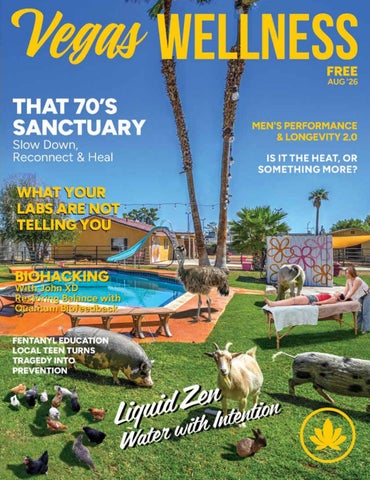
That 70's Sanctuary Tayla Hart & Jenifer Freer Cover Photo Provided by That 70's Sanctuary Cover Design: Pink Kitty Creative
26 When the Desert Heat Invites You Inward
28 Biohacking with JohnXD 30 Understanding TMJ 32 Creating from the Heart
14
34 Men's Performance & Longevity 2.0 36 How Wellness is Changing Nightlife 37 QUEX Quantum Feedback 40 Viruddha Anna 42 Some Relationships Don't Make It 43 Travel with Confidence
19
44 Nail Talk with Cari Woodward 46 Spotlight on RSVP Las Vegas 48 Plant Magic & Medicine
5
10% OFF
Open Every Day 10am-10pm
FIRST SERVICE Must mention this ad Expires 8/31/26
Follow Us
Walk-Ins Welcome
@1NEVADANAILSANDSPAINC
Beauty that Feels as Good as it Looks Starting at
Starting at
Starting at
$35
$50
$45
Nails
Esthetics & Waxing
Head Spa
Facials Exfoliation Waxing Complete Skin Care
Scalp Health Detoxification Hair Restoration Deep Relaxation
Book Now Gel-X Acrylic Manicures Pedicures
(702) 898-7008
booking.gocheckin.net/v2/18321
3280 E. TROPICANA LAS VEGAS NV 89121
KRYSTIAN BASTIDAS ALCHEMIST | ARCHITECT | ARTIST
PUBLISHER
Integrating wellness, joy, presence, authentic connection, and radical aliveness.
Bill Shehan
EDITOR
Stephanie Shehan // stephanie@vegaswellnessmag.com // 702 622 8001
Specialties Speaking & Facilitation
ASSISTANT EDITOR Jennifer Walker // jennifer@vegaswellnessmag.com // 775 375 0415
Integrated Wellness Consulting
CONTRIBUTING WRITERS
Embodied Leadership Experiential Architecture
Alethea Shelton Andrea Caple Anna Ketron Cusano Cheri Alberts Dr. Amanda Jordan Dr. Tim Patel Glenn J. White Jaden Rae Janelle Ardizzone
John Wetzel Katie Peede Krystian Bastidas Pravina Narayan Saba Tesfay Sarah Schwefel Steven Dee Kish Tiffany Marie Tsikki Thau
BIOHACKING CONTRIBUTOR John Wetzel (JohnXD) // Biohacking Las Vegas
COVER ART
Creative Expression Culture and Community Events & Retreats
Who i serve Events, Festivals, & Conferences Wellness Programs Retreats & Workshops Creative Collaborations
Work With Me
Victoria Hart // Pink Kitty Creative
ADVERTISING SALES Stephanie Shehan // stephanie@vegaswellnessmag.com // 702 622 8001 Jennifer Walker // jennifer@vegaswellnessmag.com // 775 375 0415
COPY EDITOR Effie Armstrong - info@vegaswellnessmag.com
web
vegaswellnessmag.com
@vegaswellness @vegaswellnessmag
@vegaswellness Vegas Wellness Magazine is a lifestyle publication featuring content about wellness, plant medicine, and general wellbeing. All content within our publications and on our website is for educational and entertainment purposes only and should not be considered personalized legal or medical advice. Both the printed publication and the website are intended for those over the age of 21. Vegas Wellness Magazine assumes no responsibility for the advertisements within this publication. We strive to ensure the accuracy of the information published. Vegas Wellness Magazine cannot be held responsible for any consequences which arise due to error or omissions. Reproduction in whole or in part is strictly prohibited. All rights reserved.
KrysBastidas.com
SLOW DOWN, RECONNECT, AND HEAL In the middle of Las Vegas, tucked behind a charming retro-inspired salon, is a place where cows greet visitors, rescued pigs bask in the sunshine, and an emu might wander by to say hello. It isn't a petting zoo or a working farm; it's That 70's Sanctuary, a nonprofit dedicated to giving rescued animals a second chance while offering the community a place to slow down, reconnect, and heal. Founded by longtime hairstylist Tayla Hart, That 70's Sanctuary grew from an unexpected realization: the same animals that brought comfort to her clients were quietly transforming lives. "I wanted a space where my clients and people from the community could connect with animals," Hart says. "After working professionally with exotic animals for 15 years and living on such a large property, I knew I had to open up my home to save animals as they had saved me." Today, That 70's Sanctuary is a registered 501(c)(3) nonprofit and home to rescued pigs, miniature Zebu cows, birds, an emu, and other animals that have found permanent refuge on the property. Many have been surrendered after owners realized they could no longer care for them. Others simply needed a safe place to live out the rest of their lives.
From Retro Salon to Community Sanctuary
The story begins eight years ago, when Hart and her mother both purchased homes built in the 1950s and 1970s. Inspired by her mother's vintage décor, turquoise, pink, and iconic starburst accents, Hart embraced the nostalgic style of her own 1970s home. "I love the '70s," Hart says with a smile. "It's before my time, but such a vibe. As a child, I spent time with my grandma at her antique store and auction house. I wanted to create a space where people felt welcome. Something as cozy as your grandma's house, but with a little twist." After 25 years behind the chair, Hart decided to leave the traditional salon environment and create something more personal, That 70’s Salon & Sanctuary. Her fully licensed, appointment-only salon became a place where clients could escape the demands of everyday life. But it wasn't long before two very special family members began stealing the spotlight. "My clients loved visiting with my pigs, Petunia and Pudding," she recalls. "I got to see their faces light up every time they saw them. It reminded me how much people love to connect with animals." That simple observation planted the seed for something much bigger.
More Than Animal Rescue
Hart had spent years working with exotic animals, witnessing firsthand the extraordinary bond between people and animals. She partnered with local
rescues to provide lifelong homes for animals in need, particularly older animals that might otherwise struggle to find placement. "I wanted to create a safe space for older animals to come and retire and enjoy the later years of their lives," she says. Many of the sanctuary's pigs arrived after being purchased as tiny piglets, only to outgrow their owners' expectations. "People think they're going to stay 20 to 40 pounds," Hart laughs. "I'm here to say I don't have one under 200 pounds." Every animal at the sanctuary has a story. More importantly, every animal has a future.
The Healing Power of Animals
While the sanctuary's mission begins with animal rescue, its impact extends far beyond the fences. Hart believes animals have an incredible ability to help people reconnect with themselves. "Animals help us heal because they help us feel safe enough to be ourselves," she says. "They don't care about who you pretend to be. They remind us what it feels like to exist without constantly proving our worth." She has watched visitors arrive carrying stress, anxiety, grief, or emotional exhaustion, only to leave noticeably lighter. "I've watched people soften around animals in minutes when they couldn't soften around other people for years," she explains. "Animals don't heal us because they fix us; they remind us of parts of ourselves we've forgotten." It's a philosophy that perfectly aligns with today's broader definition of wellness. Healing isn't always found in a doctor's office or fitness studio. Sometimes it happens while feeding a rescued pig, petting a miniature cow, or simply sitting quietly beside an animal that asks nothing from you except your presence.
Wellness Through Connection
To expand that mission, Hart recently joined forces with longtime friend Jenifer Freer, a Las Vegas native, certified yoga instructor, Reiki practitioner, meditation teacher, and former professional animal caretaker. Together, they are transforming the sanctuary into a wellness destination where animals become part of the healing experience. "Jen knows firsthand how animals can mirror our emotions, guide us back to presence, and support profound emotional healing," Hart says. Today, the sanctuary hosts yoga classes, Reiki sessions, meditation, art workshops, game nights, and community gatherings that encourage people to unplug and reconnect with nature, with animals, and with one another.
By Stephanie Shehan One recent yoga participant arrived with significant physical discomfort. "When the session was done," Hart recalls, "she told us all of her pain was gone. Whether it's healing your body or your mind, it's a space that's held for everyone." Visitors often describe the experience as stepping into another world. "Some people feel like they've been transported back to childhood," Hart says. "Some people become incredibly present in the moment. Everyone experiences the space differently."
Building Community One Animal at a Time
For Hart, creating the sanctuary has always been about more than saving animals. Growing up in Las Vegas, she wanted to build something that strengthened the community she has always called home and create a legacy for her daughter, Lola, who now helps care for the sanctuary and its residents. "It's been amazing to watch the sanctuary bring people together," Hart says. "At one of our yoga events, I watched my sister, my daughter, and her mother-in-law spending time together. There were neighbors, friends, sisters, stepmothers and daughters. Some people came for the animals. Some came to heal. Some simply wanted to connect with other people." In a city that can sometimes feel fast-paced and disconnected, Hart hopes visitors discover something increasingly rare: belonging. "I want people coming into this space to feel connected," she says. "To touch grass. To be kissed by a cow. To feel part of a community. It's a little slice of paradise in the middle of it all."
Looking Ahead
As a nonprofit, That 70's Sanctuary continues to grow through donations, class registrations, volunteers, and community partnerships. One of its next major goals is building a walk-in aviary for rescued lovebirds and parakeets, along with additional shade structures to improve the animals' quality of life. Supporting the sanctuary can be as simple as attending a yoga class, participating in an art workshop, volunteering, donating, or following along on social media to learn about upcoming events, including one of the sanctuary's most popular celebrations: a birthday party for miniature cows Zee and Coco. After all, who wouldn't want to celebrate a cow's birthday? When asked what she hopes every guest experiences before leaving, Hart doesn't hesitate. In a world that often feels rushed and disconnected, That 70's Sanctuary offers something beautifully simple: a reminder that healing sometimes begins with slowing down, opening your heart, and sharing a quiet moment with an animal that finally found its forever home. To learn more, volunteer, donate, or register for classes: Visit That70sSanctuary.com or follow @that70ssalonandsanctuary on Instagram and TikTok. Yoga, Reiki, and meditation sessions with Jenifer Freer: Book through the sanctuary or follow and DM @jenifer.freer on Instagram.
>>> Is It the Heat, or Something More? Why Summer Feels Harder in Midlife By: Amanda Jordan, MD Every summer in Las Vegas is a challenge. By August, the heat has stopped feeling like weather and started feeling like a full-body stress test: Fatigue that will not lift. Headaches that seem to come from nowhere. Sleep that falls apart even with the air conditioning working overtime. Palpitations, swollen ankles, brain fog, and a level of exhaustion that feels wildly disproportionate to a short walk across the parking lot. It’s easy to blame all of it on the heat. And to be fair, Las Vegas summers are brutal. But if you’re in your 40s, 50s, or beyond, heat is not acting on the same body you had ten or twenty years ago. Hormonal shifts, metabolic changes, medications, and hydration status all change how well you tolerate extreme heat. Several of these factors can be working against you at the same time, which is why the same 110-degree afternoon that barely registered a decade ago can now leave you flattened for the rest of the day. The heat may not be the whole problem. It may simply be exposing what your body can no longer compensate for as easily.
Why Heat Feels Different Now
That is one reason hot flashes and night sweats may feel more intense during summer. The environmental heat is real, and the internal thermostat is already more reactive. Heat doesn’t cause menopause symptoms. It amplifies a system that is already more sensitive. A hot flash in a cool bedroom is disruptive. A hot flash at 2 a.m. in a bedroom that never fully cools down can lead to repeated awakenings and a long, foggy day afterward. Men may not experience the same vasomotor changes, but midlife shifts still matter. Reduced muscle mass, increased abdominal fat, sleep apnea, lower fitness, metabolic dysfunction, and declining testosterone can all reduce energy and exercise capacity. For both men and women, the result can be the same: your body has to work harder to do what once felt routine.
Sleep Is the First Casualty
Heat and poor sleep feed each other.
Your body is constantly working to keep its internal temperature within a very narrow range. When you get too hot, blood vessels near the skin dilate, sweat production increases, and your heart works harder to move heat toward the body's surface.
A warm bedroom, night sweats, or repeated awakenings can leave you under-recovered before the day even begins. The next day, poor sleep increases hunger and cravings, worsens insulin sensitivity, reduces exercise capacity, and makes physical effort feel harder.
That system requires fluid, circulation, and cardiovascular effort. How well you tolerate the heat depends on how efficiently your body runs this system, and that efficiency depends on your cardiovascular fitness, hydration status, sleep, medications, hormones, and how acclimated you are to the heat.
You may rely on more caffeine to get through the afternoon, skip your workout because you are exhausted, and then struggle through another night of poor sleep.
Las Vegas has one advantage over humid climates: sweat evaporates quickly. But that can also be misleading. You may not feel drenched in sweat, even while losing a meaningful amount of fluid. Add direct sunlight, hot pavement, parked cars, and temperatures well above 100 degrees, and your body is doing a lot more work than you may realize. A quick errand, a walk with the dog, or an outdoor workout may look minor on paper. Physiologically, it can be a much bigger demand. Midlife often comes with less margin for error. Poor sleep, reduced fitness, insulin resistance, higher body fat, cardiovascular disease, or simply spending most of the day in air conditioning can all make the heat feel harder. That does not mean aging automatically makes you summerintolerant. It means your usual routine might need to change.
Hormones Are Part of the Picture
For women in perimenopause and menopause, hormonal changes add another layer. As estrogen fluctuates and declines, the brain’s temperature-control system becomes more sensitive to small changes in body temperature. The comfortable temperature range becomes narrower, which makes flushing and sweating easier to trigger.
Heat disrupts sleep, poor sleep worsens your ability to handle the heat, and the cycle repeats every night through the summer.
Hydration Without the Hype
Most people do not need to spend the entire summer chasing electrolytes. For normal daily activity, regular meals and adequate water are usually enough. But if you are exercising outdoors, working in the heat, or sweating heavily for several hours, water alone may not replace everything you’re losing. Sweat contains both water and sodium. The longer and more intense the exposure, the more those losses matter. That still does not mean everyone needs a high-sodium electrolyte drink. Someone with kidney disease, heart failure, hypertension, or certain medications needs a very different strategy from a healthy person completing a long outdoor workout. Start with the basics. Drink before you are significantly depleted. Bring water with you instead of assuming you will find it later. Replace fluids gradually rather than trying to catch up all at once. Alcohol deserves particular caution. It can increase fluid loss, disrupt sleep, and make it easier to underestimate how much the heat is affecting you.
Moderate caffeine does not automatically dehydrate most regular coffee drinkers, but large amounts can worsen palpitations, headaches, anxiety, and sleep disruption. In other words, it can intensify several of the symptoms you may already be blaming on the weather.
Adjust the Workout, Not the Goal
You definitely don’t need to give up exercise for three months, but you may need to stop pretending that an outdoor workout in August should feel the same as it does in March. Move workouts indoors or to the coolest part of the morning. Shorten the session. Reduce the intensity. Pay attention to how hard the effort feels rather than focusing only on pace, distance, or calories. The same running pace or hiking route takes more of a toll on your body in extreme heat. Wear breathable clothing and hydrate before, during, and after activity. People who exercise regularly in warm conditions may gradually adapt, but acclimatization is not permission to ignore heat warnings. It should happen through controlled exposure, not by pushing through dangerous temperatures. Avoid stacking risks. An intense outdoor workout after poor sleep, alcohol, and inadequate hydration is not a test of discipline. It’s a predictable setup for feeling terrible.
When It’s Not Just the Heat
This is where good judgment matters. Fatigue, headache, dizziness, palpitations, swelling, poor sleep, muscle cramps, and reduced exercise tolerance can all occur during extreme heat. They can also be caused by anemia, thyroid dysfunction, blood sugar abnormalities, arrhythmias, sleep apnea, cardiovascular disease, or medication side effects. Certain medications make heat harder to tolerate. Diuretics increase fluid loss. Some blood pressure medications affect circulation. Antihistamines and other medications can reduce sweating. Certain antidepressants and stimulants may affect temperature regulation, thirst, heart rate, or heat perception. Do not stop any medication on your own. Review your risks with your physician and plan accordingly. Pay attention to when symptoms occur. Do they improve after you cool down and rest? Do they continue inside? Are they showing up during cooler weather? Are they new, persistent, or getting worse? Heat exposure can uncover an underlying medical problem without being the actual cause of the problem. Confusion, collapse, fainting, seizure, chest pain, severe shortness of
breath, persistent vomiting, or new neurologic symptoms should never be managed with a fan and a glass of water. These symptoms require emergent medical attention.
Build a Smarter Summer Strategy
A better approach to a Las Vegas summer isn’t complicated. Prepare before the hottest part of the day. Review your medications, plan outdoor activity carefully, and do not begin exercise already dehydrated or sleep-deprived. Monitor how your body is responding. Notice changes in heart rate, energy, headaches, sleep, and exercise tolerance instead of dismissing them because “it’s just hot.” Adjust when needed. Move indoors. Shorten the workout. Prioritize cooling. Replace fluids based on your actual activity and sweat loss. Evaluate symptoms that are persistent, severe, new, or out of proportion to the situation. Extreme heat has a way of revealing where your body has less reserve than it used to - whether that’s sleep, fitness, hydration, hormones, cardiovascular health, or metabolism. A Las Vegas summer is not something you need to prove you can endure. It’s a predictable physiologic challenge. Understanding why your body responds differently now and adjusting before symptoms escalate is far more useful than waiting until October to wonder why this year felt so much harder than the last. Dr. Amanda Jordan is a Las Vegas-based board-certified physician practicing functional and longevity medicine. Through her telehealth practice, she provides physician-led evaluation and personalized care for adults experiencing midlife hormone, metabolic, and energy-related changes. For more information, visit www. dramandajordan.com.
Vegas Wellness Magazine
>>>
WHAT YOUR LABS ARE NOT TELLING YOU
“Normal” is Not the Same as Well By Tiffany Marie, CNP, CPIS | Founder, TM Wellness
If you have ever sat in an office, exhausted and desperate for answers, only to be told that everything looks normal, you already know the particular heartbreak of that word: “normal”. Your bloodwork is fine. Your numbers are in range. And yet you do not feel fine. You feel like a stranger in your own body. You are not crazy; you have simply been unheard. Today I want to show you one of the biggest reasons why. Let me say something clearly. Standard labs matter. I respect them, and they can flag the things that need urgent attention. I will never tell you to skip them. But I want you to understand what they are, and just as importantly, what they are not. A standard lab is a screenshot. It captures one single moment in time, on one particular morning, in one particular week of your life. It is a still photograph of a body that is actually a moving picture. Your hormones are not a fixed number. They rise and fall across the day and across the month, in a rhythm as individual as you are. A single frame cannot show you that rhythm. A screenshot cannot show you a story. There is a second problem, and it is a big one. The “normal” range on your lab report is built from a population average. It is a wide net cast across thousands of people, many of whom are not thriving either. Landing inside that range does not mean your body is where it needs to be. It means you are somewhere in the crowd. But you did not come to me to be average; you came to feel like yourself again. Think of the woman whose morning labs look flawless, yet who crashes every single afternoon at three o'clock, lies awake at two in the morning, and cannot understand why. Her screenshot is perfect. Her days are not. The number on the page and the life she is living are telling two completely different stories, and only one of them is true to her. A single snapshot will never explain the pattern she lives inside every day. So when the screenshot says fine, and your life says otherwise, we do not stop. We go deeper. This is where functional testing changes everything. Instead of one frame, we look at patterns. With saliva hormone testing, we can track how your key hormones change throughout your day, including the cortisol rhythm that shapes so much of your energy, sleep, and capacity to handle stress. Instead of guessing, we get to see. And then there is the gut, which is so often the root beneath the root. Through comprehensive stool testing, we can look at how well you are digesting, how well you are absorbing the nutrients you work so hard to eat, the balance of the bacteria living inside you, and the signs of inflammation a blood panel may never mention. So much of what shows up as fatigue, mood swings, skin issues, and hormone chaos begins here, quietly, in a place a standard lab does not think to look.
12
This is where the real deficiencies finally reveal themselves. Not in a reference range built for the average person, but in your patterns. Now, here is where I have to be honest with you, because honesty is the whole point of this column. Functional testing is powerful, but it is not a fishing expedition. I do not run every panel that exists to pad an invoice or to impress you with a thick stack of results. We test with intention, guided by your story, your symptoms, and what your body is actually telling us. The goal is answers, not a bigger bill and more confusion. If a test will not change your plan, you do not need it. Because that is what all of this is for. Not data for the sake of data. Not a label to collect. A clear, honest picture of what your body actually needs, so that every step after this one is built on truth instead of a guess. I want you to feel the shift in that. For so long you may have been handed a piece of paper and a shrug, and told the problem was in your head. Functional testing lets me hand you something very different: proof that your instincts about your own body were right all along. There is nothing more powerful than a woman who finally has the evidence to trust herself again. And once we can finally see clearly, the real work begins. Not with a shelf of supplements. Not with the newest protocol. With something far less glamorous and far more powerful. Next time, I will show you exactly what your body runs on, and why the foundation is the one thing almost everyone skips. You are not crazy, you never were. You have simply been reading a screenshot and calling it the whole story. Let's turn the page. Tiffany Marie is the founder of TM Wellness. Find her at www. tiffanymariedavis.com and on Instagram at @tiffanymarie_davis and @ tm_wellness_.
What If Your Best Health Is Still Ahead of You? Precision Functional Medicine for Men & Women Who Want to Perform, Age, and Live Better.
Most people don’t suddenly wake up unwell. Energy dips. Sleep becomes fragmented. Hormones shift. Focus isn’t as sharp. Recovery slows. Your metabolism feels different. These aren’t “just aging.” They’re signals—biological data points your body uses to tell you something has changed.
My job is to decode those signals. As a physician specializing in functional and longevity medicine, I take a systems-based, root-cause approach to optimize your whole health—hormones, metabolism, inflammation, brain function, gut health, and longevity pathways. Whether you’re navigating perimenopause, andropause, persistent fatigue, weight changes, poor sleep, or simply want sharper cognition and stronger performance, your plan is personalized and evidence-driven.
No guesswork. No one-size-fits-all protocols. Just optimized health from the inside out.
Care Includes:
Comprehensive functional lab testing Hormone evaluation & optimization Nutrition and metabolic rebalancing Gut–immune axis analysis Sleep, stress, and recovery protocols Precision supplements & lifestyle medicine Fully virtual, physician-led care
Dr. Amanda Jordan, MD Ready to Optimize Your Health? Book your complimentary discovery call today.
dramandajordan.com
Wellness is
TRAVEL
Your Journey. Your Style. The Wildflower Way. Tracy Kuhn
Travel Advisor
Personalized Planning Expert Guidance Exclusive Perks & VIP Amenities Save Time, Eliminate Stress Support Before, During & After Travel Most Services Complimentary
Travel Easy. Bloom Wildly. Wellness Events • Weddings • Baby/Honeymoons Cruises • Yachts • Milestone Trips • Family Vacations All-Inclusive Resorts • Luxury Experiences Business Trips • Weekend Escapes • Solo/Group Travel Condos-Villas-VRBOs • Excursions • Tours • Transportation
www.wildflowertraveltk.com
(605) 929-6666
Vegas Wellness Magazine
>>>
Liquid Zen
More Than Water, A New Perspective on Hydration By: Janelle Ardizzone In today’s wellness world, conversations about nutrition, sleep, movement, and stress have become commonplace. But one essential piece of health is beginning to receive renewed attention: the quality of the water we drink. For Cory, founder of Liquid Zen, hydration isn’t simply about drinking more water; it’s being intentional with what you’re putting into your body. “I wanted to create the best water we as Americans could purchase,” Cory shared. “Not just another bottled water company, but something that started with a truly exceptional source.” Ironically, the inspiration for Liquid Zen came from seeing another popular canned water brand. “I loved the idea of aluminum instead of plastic,” he explained. “But I wanted to create something that represented life, intention, and wellness rather than fear or shock value.” That vision led him and his co-founder Rana Prasad on a year-long journey to develop Liquid Zen, sourcing spring water from Palomar Mountain in Southern California. According to Cory, the spring’s naturally balanced mineral profile and taste became the foundation of the brand.
Water with Intention
Liquid Zen’s tagline, “Water, Tuned,” reflects what Cory believes makes the company unique. Rather than simply packaging spring water, the company uses a patented process involving cymatics, using sound vibrations during production, which Cory says is designed to structure the water while exposing it to music tuned to 528 Hz, a frequency often associated with harmony and restoration. For Cory, this process is about creating a product with purpose. “We’re not just putting water in a can,” he said. “We’re creating an experience built around intention.” As someone who works daily with clients using light, frequency, oxygen, and nervous system therapies, I found it fascinating to hear how closely his philosophy aligns with a growing movement toward viewing wellness as more than isolated interventions. Whether
14
through mindfulness, sleep, nutrition, or hydration, many practitioners are exploring how everyday choices influence overall well-being.
Why the Source Matters
Cory believes consumers are becoming increasingly interested in where their water comes from. “We’ve become much more conscious about the food we eat and the products we put on our skin,” he said. “I think water is the next frontier.” He emphasized the importance of naturally occurring minerals and the quality of the water source, noting that Liquid Zen is bottled in aluminum rather than plastic to reduce exposure to plastic while offering a more sustainable package. For Cory, hydration is about supporting the body with water that remains close to its natural state.
Looking Ahead
As wellness continues to evolve, Cory believes education around hydration will become just as important as conversations surrounding nutrition and fitness. “My hope,” he said, “is that when someone opens their first can of Liquid Zen, they’re experiencing more than just water. They’re experiencing something that was created with intention.” Whether someone is drawn to Liquid Zen because of its mountain spring source, its aluminum packaging, or its philosophy surrounding mindfulness and hydration, the company reflects a growing trend in the wellness industry: people are becoming more curious about not just how much water they drink, but where it comes from and how it fits into their overall health journey. Sometimes wellness begins with the simplest habits. And perhaps one of the most foundational is simply paying closer attention to the water we choose every day.
BROOKLYN BOWL LAS VEGAS
AUG 1
AUG 7
AUG 8
WITH
RED EYE GIN FURDLE DURT EMO NIGHT BROOKLYN
HOUSE OF HEAVY CHRIS TRAVIS
SEP 19
STARBOMB
EPIC RAP BATTLES OF HISTORY SEP 20
GET THE LED OUT
A CELEBRATION OF “THE MIGHTY ZEP”
SEP 22
THE MIDNIGHT
AUG 9 WATERBOYZ PRESENTS
SEP 24
< NATURAL VIBRATIONS >FKELANDY RANSKIIZ
AUG 15
DEVILDRIVER UPON A BURNING BODY . OV SULFUR
SEP 25
AUG 15
STABBING WESTWARD ACUMEN NATION . 16 VOLT
SEP 26
SEP 11
SEP 18
WITH
ARTEMAS HENRY MORRIS RAVYN LENAE LEXA GATES
WITH
THROUGH THE ROOTS
SEP 29
THE FRONT BOTTOMS WITH
ISAIAH RASHAD ALEMEDA PRESIDENT
TOADIES GET TICKETS & VIP UPGRADES > WITH
OCT 2
WITH
CENOBIA SHOWING TEETH
WITH
> LO CAL H < O L I V E V OX
Vegas Wellness Magazine
>>> Why the First Minutes of Your Day Matter
MORNING RITUALS BEFORE YOUR PHONE
For many people, the day begins the same way. Before our feet even touch the floor, we reach for our phones. We check emails, scroll through social media, skim the headlines, or respond to messages that arrived overnight. It has become such a routine that we rarely stop to ask whether it is actually helping us start the day well. While technology has made it easier than ever to stay connected, wellness experts increasingly suggest that the first few minutes after waking are worth protecting. Creating a morning ritual before looking at your phone can help you begin the day with greater clarity, lower stress, and a stronger sense of purpose. The goal is not to eliminate technology. Instead, it is about choosing to wake up to your own thoughts before waking up to everyone else's.
Why Your Brain Is Different After Waking
The moments immediately after waking are a unique transition between sleep and full alertness. During this time, your brain gradually shifts into a more active state while your body adjusts to the day ahead. Because your mind is still settling into wakefulness, it can also be more sensitive to outside influences. The information you consume first, whether it's an urgent work email, a stressful news story, or a social media post, can quickly shape your mood and mindset for the rest of the morning. When the first thing you encounter is a flood of notifications, your attention is immediately pulled outward. Rather than deciding how you want to begin your day, you're reacting to whatever happens to appear on your screen. A simple morning ritual creates space for you to ease into the day on your own terms.
Your Phone Is Designed to Capture Your Attention
There is nothing inherently wrong with smartphones. They help us communicate, navigate, learn, and stay informed. However, many of the apps we use every day are intentionally designed to keep our attention for as long as possible. Notifications, endless scrolling, personalized content, and unpredictable rewards encourage us to keep checking our screens. What starts as a glance at the weather can easily turn into twenty minutes of scrolling through emails, news, and social media. Beginning your day with these constant interruptions can make your mind feel scattered before you've even had breakfast. By delaying phone use, even for just 15 to 30 minutes, you allow yourself to build focus before distractions take over.
A Calm Morning Can Set the Tone
Morning rituals do not need to be complicated or lengthy. In fact, the most effective
16
routines are often simple enough to practice consistently. Starting your day with a few intentional activities signals to your brain that there is no immediate emergency. This can help reduce feelings of rushing from the moment you wake up. Many people find that a consistent morning routine helps them: • Feel less overwhelmed • Improve concentration throughout the day • Make more thoughtful decisions • Experience greater emotional balance • Feel more present during daily activities While everyone's experience is different, even small changes can have a noticeable impact over time.
What Makes a Good Morning Ritual?
The best morning ritual is one you genuinely enjoy and can realistically maintain. Some people enjoy quiet reflection, while others prefer gentle movement or creative activities. The purpose is not to create a perfect routine but to create intentional space before outside demands begin. Some ideas include: • Drinking a glass of water before reaching for your phone to help rehydrate after sleep. • Opening the curtains and spending a few moments in natural sunlight, which helps support your body's natural sleep-wake cycle. • Stretching for five to ten minutes to loosen muscles and improve circulation. • Practicing deep breathing or meditation to help calm the nervous system. • Writing in a journal by recording thoughts, goals, or things you're grateful for. • Reading a few pages of a book instead of immediately consuming digital content. • Enjoying a cup of coffee or tea without multitasking. Even combining two or three of these habits can create a meaningful morning ritual.
The Difference Between Reacting and Intending Imagine two different mornings:
In the first, your alarm goes off. You immediately open your phone and discover work emails, breaking news, unpaid bills, and several social media notifications. Before getting out of bed, your mind is already juggling dozens of concerns.
By: Sarah Schwefel
In the second, you wake up, drink water, stretch for a few minutes, sit quietly while enjoying your coffee, and think about your priorities for the day. Twenty minutes later, you check your phone with a calmer, more focused mindset. The difference is not that one morning eliminates stress. Life will still present challenges. The difference is that you're choosing when to engage with those challenges, instead of letting them dictate your emotional state from the very beginning, and that small shift can make the rest of the day feel more manageable.
Consistency Matters More Than Perfection
One common mistake people make is trying to build an elaborate morning routine that requires an hour or more. While that works for some, it is not necessary. A meaningful ritual can take as little as ten minutes. For example: • Spend one minute taking several slow, deep breaths. • Drink a glass of water. • Stretch for five minutes. • Write down three priorities for the day. • Then check your phone. That's it. Consistency is far more valuable than complexity. A short routine practiced every day often provides greater long-term benefits than an ambitious routine that only lasts a week.
50% OFF
REIKI
Permit Yourself to Disconnect Briefly
Many people worry that delaying phone use means they'll miss something important. In reality, most notifications can wait a few extra minutes. Unless your job requires immediate responses or you're expecting an emergency call, giving yourself a brief period away from your screen is unlikely to create serious problems. Instead, it creates an opportunity to reconnect with yourself before reconnecting with the rest of the world. That boundary can be especially valuable in today's always-connected culture, where it often feels like we're expected to be available every moment of the day.
Building a Ritual That Lasts
with code VEGAS WELLNESS
HOLISTIC HEALING
If you'd like to establish a morning ritual, start small. Instead of aiming for a complete lifestyle overhaul, simply commit to avoiding your phone for the first 15 minutes after waking. During that time, choose one activity that helps you feel grounded.
Reiki Therapist Holistic Medicine Sound Baths & More!
As the habit becomes more natural, you can gradually add other practices that support your physical and mental well-being. Remember, the purpose is not to create the "perfect" morning. It's to create a beginning that leaves you feeling calmer, more intentional, and better prepared for whatever the day brings. Your phone will still be there when you're ready. The question is whether you want your day to begin with notifications or with yourself.
(702) 488-3726 7693 W. Post Road Las Vegas, NV 89113
EllysElements.com
Weekly Group Sessions Available
BOOK VIA WEBSITE!
Vegas Wellness Magazine
>>>
BACK-TO-SCHOOL, BACK TO BALANCE
How Busy Moms Can Calm Their Nervous System, Activate the Vagus Nerve, and Thrive This School Year By Dr. Michele Binkowski, DC, CMUA, CIME
As the backpacks come out and the school bells ring, moms everywhere shift into high gear. Between early mornings, school dropoffs, sports practices, homework, meal planning, and work responsibilities, it's easy to feel like you're constantly running on empty. The problem isn't just a busy schedule, it's what chronic stress does to your body. When your nervous system stays stuck in "fight or flight" mode, your body produces more stress hormones like cortisol and adrenaline. Over time, this can lead to fatigue, muscle tension, headaches, poor sleep, digestive issues, anxiety, and persistent aches and pains. Fortunately, your body has a built-in reset button: the vagus nerve.
What Is the Vagus Nerve?
The vagus nerve is the longest cranial nerve in the body and serves as the primary communication highway between your brain and many of your vital organs. It plays a major role in regulating your heart rate, breathing, digestion, immune system, and emotional well-being. When your vagus nerve is functioning well, it activates your parasympathetic nervous system, often called the "rest, digest, and recover" system. This allows your body to heal, recharge, and better manage everyday stress.
7 Simple Ways to Stimulate Your Vagus Nerve
You don't need hours of free time to improve your nervous system health. Small habits practiced consistently can make a big difference. 1. Practice Slow Belly Breathing Spend just five minutes inhaling through your nose for four seconds and exhaling slowly for six to eight seconds. Longer exhalations encourage your body to relax. 2. Hum or Sing Your Favorite Song The muscles involved in humming and singing stimulate branches of the vagus nerve. Even a few minutes during your morning commute can be beneficial. 3. Get Your Spine Checked Your nervous system travels through your spine. Joint restrictions, muscle tension, and poor posture may contribute to discomfort and interfere with optimal movement and function. Maintaining healthy spinal mobility can support overall wellness and help you feel your best. 4. Move Every Day Walking, stretching, yoga, and strength training all support healthy nervous system regulation. Movement doesn't have to be intense, it simply needs to be consistent.
18
5. Prioritize Quality Sleep Aim for seven to nine hours whenever possible. A well-rested nervous system is far more resilient to daily stressors. 6. Practice Gratitude Taking just a minute each day to reflect on three things you're thankful for can help shift your brain away from chronic stress. 7. Laugh More Often Watch a funny video, spend time with friends, or enjoy your children's silly moments. Genuine laughter naturally helps reduce stress hormones.
Why Moms Need Self-Preservation, Not Self-Sacrifice
Many moms believe taking care of themselves is selfish. In reality, it's one of the greatest gifts you can give your family. You cannot continuously pour from an empty cup.
When your nervous system is regulated, you're more patient, sleep better, recover faster, think more clearly, and have more energy for the people who matter most. Self-care isn't a luxury, it's a necessity.
Create Your Five-Minute Reset Routine
Try this simple daily routine: • 1 minute of deep belly breathing • 1 minute of gentle neck and shoulder stretches • 1 minute of gratitude 1 minute of walking outside • 1 minute of intentional silence Five minutes may not seem like much, but practiced every day, these small habits help train your nervous system to recover more efficiently from life's daily demands.
A Healthier School Year Starts With You
This school year, challenge yourself to make your health just as important as your family's schedule. When you prioritize your nervous system, you're investing in your energy, your resilience, and your ability to show up for those you love. Remember, balance isn't about doing everything perfectly. It's about creating moments each day where your body feels safe enough to rest, recover, and heal. Because when Mom feels her best, the whole family benefits. Dr. Michelle Binkowski is the owner of Back In Action Chiropractic in Las Vegas, where she specializes in sports chiropractic, injury recovery, rehabilitation, and optimizing nervous system function. Her mission is to help patients move better, recover faster, and return to doing what they love through personalized, evidence-informed mind-body care.
>>>
Turning Tragedy Into Prevention
How One Las Vegas Teen Is Working to Protect the Next Generation from Fentanyl
National Fentanyl Prevention and Awareness Day is observed each year on Aug. 21, and the conversation surrounding counterfeit pills and illicit fentanyl has never been more important. While awareness continues to grow nationwide, one Las Vegas teenager is proving that education can be one of the most powerful tools in preventing future tragedies. At just 15 years old, Levi Schaner founded Fent Prevent, a Las Vegas-based nonprofit organization dedicated to educating young people and families about the dangers of counterfeit pills and illicit fentanyl through prevention, awareness, and community outreach. What makes the organization's mission especially meaningful is that it was born from personal loss. After losing his cousin, Eli Weinstock, to a counterfeit fentanyl pill, Levi decided to turn his grief into action. Rather than allowing Eli's story to end in tragedy, he launched Fent Prevent with one goal in mind: helping ensure other families never have to experience the same heartbreak by giving young people the knowledge they need before it's too late. Since its launch in January 2026, Fent Prevent has already made a meaningful impact throughout Southern Nevada, partnering with schools, local government agencies and nonprofit organizations including PACT Coalition, the City of Henderson, St. Jude’s Ranch for Children, Boys Town Nevada, The Wellness Box, Shine A Light and The Center LV, to expand youth education and awareness. Through age-appropriate school presentations, family workshops and community outreach, the nonprofit equips students and parents with practical, life-saving resources to help them make informed decisions. In addition to educating families on the dangers of counterfeit pills and overdose prevention, Fent Prevent distributes overdose response kits containing naloxone, the life-saving nasal spray medication that can reverse an opioid overdose, along with other essential safety resources. By providing families with the knowledge and tools to have honest conversations before the school year begins, the organization aims to help young people recognize risks, make safer choices, and potentially save lives. Levi strongly believes that educating young people before they're ever exposed to these dangers can save lives. Rather than relying on fear, Fent Prevent focuses on providing clear, factual information that empowers youth to understand the risks surrounding counterfeit pills and illicit fentanyl and gives parents the confidence to continue those conversations at home. Unlike previous generations, today's young people face a growing threat from counterfeit pills designed to look like legitimate prescription medications. Many contain fentanyl without the user's knowledge, making even a single pill potentially deadly. Fent Prevent's message is simple but powerful: knowledge saves lives, and informed choices begin with honest conversations. By meeting young people where they are, in schools, community centers, and neighborhood events, Fent Prevent is helping create a culture where awareness, preparedness, and open communication become the norm. The nonprofit has already distributed educational materials and overdose response kits to hundreds of students and families throughout Southern Nevada, ensuring life-saving information reaches those who need it most. As National Fentanyl Prevention and Awareness Day serves as an opportunity to remember lives lost and renew efforts to protect future generations, Fent Prevent stands as a powerful reminder that one person's decision to act can create lasting change. Through education, compassion, and community partnership, Levi Schaner is transforming personal tragedy into a movement that is helping families across Southern Nevada become better informed, better prepared, and ultimately, safer. To learn more about Fent Prevent, request an educational presentation or support its mission, visit fentprevent.com or follow @fentprevent on social media.
Photos: Tonya Harvey
Vegas Wellness Magazine
>>>
NOTHING IS REALLY YOURS Why the things we cherish aren't always the things we're meant to keep. and thanking us for hanging onto our Someday Archive, but strangely enough, can’t remember the last time our current-self thanked our pastself for holding onto anything. The tricky thing about someday is that it rarely seems like a burden. It arrives disguised as possibility. It feels optimistic, responsible, even practical. We think, “Isn't planning a good thing?” But the danger in “someday” comes when our plans for the future begin to take up space that belongs to the present.
From Collector to Connector
My relationship with material items began to change when I realized I had misunderstood my role. Most of the items I’d collected existed before me and would likely exist long after me. I was never meant to be their final destination, but a temporary stop on their way to a new story. With my love for vintage goods and an eye for overlooked treasures, becoming a reseller felt less like a career choice and more like a natural progression.
My name is Andrea, and I am a pack rat. Not the kind whose house is featured on reality TV. My paths are clear, my countertops are mostly visible, and I've never had to excavate my couch. But if you’ve ever wondered why someone would come home from a thrift store with a 1940s brass candlestick they absolutely do not need (among other things), you've found your person. At the time, I thought I was rescuing pieces of history. Every time I found a beautiful vintage dress, an antique frame, or an overlooked collectible, I felt responsible for saving it, even if it didn’t fit into my life. Even if I never intended to use it. Because what would become of it if I didn't take it home? Would it end up in a landfill? Or destroyed? What if no one recognized its value? What if it was never loved again? Unbeknownst to me, I’d become an accidental archivist, confusing preservation with possession. And before I knew it, my home had become a museum. A monument to sentimental stockpiling. It took me years to realize that while my collection may have looked unusual, the thinking behind it wasn't. We all hold onto things for reasons that have very little to do with the things themselves.
The Someday Archive
My version of accumulation is a more vintage-flavored version of something many of us do. Most people have what I call a “Someday Archive”. The jeans we hold onto for when we lose weight. The craft supplies we swear we’ll use when life slows down. The books we'll read when we have more time. The garage furniture we'll find the perfect room for. Someday.
20
We don't always keep things because we love them now. Sometimes we keep them because they represent a version of ourselves we hope to become. We picture a better, more successful future-self looking back
What surprised me most was not the joy of finding beautiful things. I already knew I loved that. It was the joy of watching those things leave my hands and find their way to people who loved them even more. Uniting vintage wedding dresses with brides searching for something truly unique. Pairing well-loved treasures with creatives who could restore them and give them new life. Sending a long-sought-after piece to someone who’d spent years searching for the final addition to their collection. Connecting with nostalgic customers who saw the same magic in vintage that I always had. I learned that I didn’t have to keep something forever to ensure it lived on, and that realization changed the way I viewed possessions entirely. The longer I remained the conduit between beautiful things and their next chapter, the more I came to accept impermanence as the natural state of ownership. And eventually, it clicked: we don't truly own anything forever. We arrive in this world with nothing, and we leave it the same way. Everything in between- our homes, our cars, our favorite coffee mug, the sweater we've worn for twenty years- is simply entrusted to us for a season. A few things may stay with us for a lifetime. Most things don't. Either way, none of them were ever meant to be ours forever. Maybe it's the millennial in me, the one who practically lived at Blockbuster, but I've started thinking of everything we own as a rental. We may pay for it, care for it, even love it for decades, but eventually, every object continues its journey without us. I'm certainly not suggesting we consume more or toss things out carelessly. Quite the opposite. The goal isn't less ownership. It's more intentional ownership. For me, intentional ownership means curating a life, rather than accumulating one. I want the things in my home to be chosen with intention, used with gratitude, and kept because they enrich my life, not because I'm afraid to let them go. And ironically, this mindset has made me consume less. I think harder before bringing something home, care better for what I already own, and pass things along when they've fulfilled their purpose in my life. It's a philosophy rooted not in disposal,
but in stewardship.
By Andrea Caple
Tips for Intentional Ownership
Sometimes, it can be difficult to tell the difference between something that’s enriching our lives now and something that’s simply waiting for a life we may never live. The question isn't whether an item is useful, valuable, or beautiful. The question is whether it has a place in our current chapter. Some someday-items are seeds. Some are fossils. The value is in knowing the difference. Here are some questions to ask yourself about the items you currently own. 1. Would I choose this today? If you saw this item in a store or thrift shop today, would you still be excited to bring it home? 2. Am I using it, or am I protecting the possibility of using it? There’s a difference between owning a sewing machine because you sew and owning one because you hope to become someone who sews. 3. Does this support the life I have, or the life I keep postponing? 4. Am I keeping this because it brings joy, or because letting it go feels like reluctantly admitting something? Intentional ownership doesn't stop with what we already have. It also shapes what we choose to bring into our lives. Here are a few ways to practice moving forward.
1. Pause before you purchase.
Be honest about whether an item truly belongs in your current chapter.
2. Buy the best you can, less often.
Thoughtfully chosen, well-made items tend to be loved longer, repaired more often, and discarded less frequently.
3. When something no longer fits your life, help it find its next chapter. Gift it. Donate it. Sell it. Consign it. Pass it along to someone who will use and appreciate it. The goal isn't simply to get rid of things. It's to keep them in circulation.
4. Curate your home the way you curate your relationships.
Surround yourself with what supports, inspires, and reflects the life you're actually living, not just the one you've imagined. The funny thing is, I thought letting go would mean losing something. Instead, it’s made me appreciate what I have while it's here. Because the goal was never to collect everything worth saving. It was simply to recognize what’s worth keeping. Andrea is a Vegas-based writer whose work explores themes like emotional wellness, neurodivergence, self-reclamation, and modern burnout. She also runs a small clothing business where she curates and restores vintage items with an emphasis on sustainability and reuse, and consigns with clients who are ready to part with their own once-loved items. When she's not writing, she can be found reading, thrifting, buying more plants than she has room for, or upcycling forgotten relics into something worth keeping. Got a question, comment, or good thrift store recommendation? Drop her a line at threadspellvintage@gmail.com.
>>> SCREEN TIME'S ANTIDOTE
Photos By: Axis Productions
20 Minutes in Total Darkness Might Be the Reset You Need medium guides participants through an experience that blurs belief and perception. FLIGHT transforms a shipping container into the cabin of a commercial airplane, where two versions of reality unfold simultaneously, leaving guests questioning which journey is real. PLACEBO takes place inside a clinical setting, where participants lie in bunk beds and drift into a shared dream that explores the powerful connection between expectation, consciousness, and the mind. What makes DARKFIELD particularly compelling is that no two people experience it the same way. Without visual cues to guide the story, the imagination naturally fills in the gaps, creating intensely personal moments that often become the most memorable part of the experience.
Las Vegas is known for pushing the boundaries of entertainment, but one of its newest attractions proves you don't need dazzling lights or massive screens to create an unforgettable experience. Now open at AREA15 for a limited six-month engagement, DARKFIELD invites guests to step into complete darkness, where the mind becomes the main attraction. Presented by Realscape Productions, DARKFIELD has captivated audiences around the world with immersive experiences that rely not on visual spectacle, but on sound, psychology and imagination. Housed inside custom-built shipping containers just outside AREA15's main complex, the attraction features three internationally acclaimed experiences: SÉANCE, FLIGHT and PLACEBO, each offering a completely different journey into the unknown.
Beyond the immersive storytelling, DARKFIELD offers something increasingly rare in today’s world of constant stimulation. Complete darkness encourages guests to tune out visual distractions and become more aware of sound, breath, and perception. While the experiences are designed as immersive entertainment rather than meditation, many guests leave reflecting on just how much the brain shapes everyday reality. The attraction has earned international acclaim, appearing at renowned festivals including SXSW, Tribeca Festival and the Venice Film Festival, while welcoming more than 750,000 guests worldwide. Its Las Vegas debut further expands AREA15's growing collection of innovative attractions that challenge traditional entertainment and encourage visitors to experience something entirely unexpected.
Unlike virtual reality or traditional immersive exhibits, DARKFIELD begins with authentic physical environments that guests can see before the lights disappear. Once immersed in total darkness, 360-degree binaural audio, recorded using a technique that replicates how humans naturally hear by creating the sensation of sounds moving around the listener, convinces the brain that what you're hearing and feeling is happening all around you.
DARKFIELD is now open daily, with each experience running approximately 20 minutes. Guests can choose to experience one, two, or all three mindbending journeys during their visit. Tickets start at $20, with bundled pricing available for multiple experiences. Sessions run daily from 4 p.m. to 10:30 p.m., with experiences beginning approximately every 20 minutes. The attraction is recommended for guests ages 13 and older, and select Spanish-language sessions are offered throughout the week.
SÉANCE puts visitors inside a Victorian séance room, where an unseen
For tickets and additional information, visit darkfield.live/las-vegas.
(702) 277-8193 OPTIMIZE YOUR HEALTH WITH
HYDROGEN WATER RIGHT AT HOME!
HYDROGEN WATER BENEFITS
Increased Energy Reduced Inflammation Joint Pain Relief Elevated Mood & Increased Mental Clarity Boosted Immunity
YOUR BODY is 60% Water Upgrading your water is the easiest, most impactful healthy foundation you can make. Drinking high quality water is just as important as choosing healthy food, getting enough sleep, and exercising.
HYDRATIONSTATIONLV
By investing in a state-of-the art water ionizer, that creates alkaline and hydrogen-rich water, right in your home is the best investment you can make in your health and for your family.
WWW.HYDRATIONSTATIONLV.COM
>>> THE SECRET LIFE OF YOUR METABOLISM Why It Does Far More Than Burn Calories
Do you know what helps your heartbeat 24 hours a day, seven days a week, without ever taking a break? Your heart is an incredible pump, but every pump needs power. Your metabolism is the power. Without that power, not one heartbeat, not one breath, not one thought, not one step. If you asked ten people what metabolism is, most would probably answer, "It burns calories." They're not wrong, but that is only part of the story. The truth is that your metabolism has been quietly taking care of you since before you were born. It has been working every second of every day of your life. It never asks for a day off, it never complains, it simply keeps showing up.
More Than Burning Calories
As you read these words, your heart is beating, your lungs are breathing, your brain is processing information, your body is repairing itself, and your metabolism is quietly making it all possible. Most people only think about their metabolism when they step on the scale. But your metabolism is much more than a calorie burning machine.
work. Your body is repairing, rebuilding, and adapting so you are better prepared the next time you challenge it. Your workout may last only 20 minutes. Your metabolism continues working on it for hours afterward. Even while you sleep, it never clocks out. It continues repairing, rebuilding, restoring, and preparing your body for tomorrow.
Why It Matters
A healthy metabolism does much more than help you maintain a healthy weight. It supports your energy, your brain, your muscles, your immune system, and your body's ability to heal. In many ways, your metabolism influences not only how long you live, but how well you live.
Where Muscle Fits In
Muscle is one of the most metabolically active tissues in your body.
Simply put, metabolism is the process your body uses to convert food into energy. That energy powers everything your body does, from breathing and thinking to walking, healing, and sleeping. Without it, nothing works.
As we age, we naturally lose muscle if we do not actively work to maintain it. When we lose muscle, we also lose part of our body's ability to use energy efficiently. That is one of the many reasons strength training becomes increasingly important as we get older. It is not about building the biggest muscles. It is about preserving the strength, energy, and independence that allow us to continue enjoying life.
Your Body Is Working Around the Clock
The Bottom Line
Most of the calories your body burns each day are not burned during exercise. Most are used simply to keep you alive. Have you ever wondered why your muscles feel sore after a challenging workout and then stronger a few days later? That is your metabolism at
Your metabolism has a secret life, most of us hardly notice it. We do not thank it or think about it. Yet it has been faithfully taking care of us every second of every day since we were born. It powers every heartbeat, every breath, every thought, every movement and yes, every recovery. The better you understand it the better you will understand how to take care of yourself. Because a healthy metabolism is not just about losing weight, it is about having the energy to live the life you want. Perhaps the biggest secret about your metabolism is not how many calories it burns, but how faithfully it has been taking care of you your entire life. Next Month: Can you really improve your metabolism? We will separate fact from fiction and explore what science says actually works. At BODY20, we believe strength is one of the foundations of a longer, healthier life. We did love the opportunity to help you build yours.
Vegas Wellness Magazine
>>>
When the Desert Heat Invites You Inward
There is something about a Nevada summer that humbles you. The heat is relentless. It slows you down. It asks you to stay inside when every part of you wants to be outside living life. Yet I’ve come to realize that perhaps that’s exactly the invitation. While the desert outside becomes almost unbearable, another journey begins, the one within. I’ve learned that the hottest days often become my deepest moments of reflection. The walls of my home become a sanctuary where I can no longer distract myself from what is quietly asking for my attention. The stillness becomes a mirror. Looking deeply within is one of the bravest things a person can do. It sounds simple, yet many of us spend years avoiding ourselves. We stay busy. We fill every quiet moment. We keep moving because slowing down means we might finally meet the parts of ourselves that have been patiently waiting to be seen.
Your Reflection Score
Fear. Old wounds. Disappointment. Grief. The younger version of ourselves who simply wanted to feel safe, loved, and enough.
Mostly “Sometimes” You’re awakening to deeper self-awareness. This season is inviting you to pause a little more, breathe a little deeper, and trust yourself a little more.
Reflection isn’t about judging what you find. It’s about witnessing it with compassion. I’ve discovered that courage isn’t the absence of fear. Courage is choosing to sit with it. When uncomfortable emotions arise, I no longer rush to push them away. I breathe. I allow myself to feel vulnerable. I soften my nervous system with slow, intentional breaths. I offer forgiveness to myself, to others, and even to the situations that shaped me.
Mostly “Often” You are developing a beautiful relationship with yourself. Keep honoring your inner world; it will continue to guide your outer one.
Mostly “Rarely” There is no judgment here, only an invitation. Reflection is a practice, not a destination. Start with five quiet minutes each day, one deep breath at a time. You may discover that everything you’ve been searching for has been patiently waiting within you.
The more I sit with myself, the less power fear has over me.
So, grab a glass of ice-cold water, find your favorite chair, turn the air conditioning down a degree (or two!), and spend a little time with the most important person you’ll ever know…you.
Eventually, what once felt painful begins to transform into wisdom. What once felt heavy becomes lighter. And slowly, appreciation begins to replace resistance.
Who knows? By the time the temperatures finally cool down outside, you may discover that you’ve already created a little more peace, courage, and confidence on the inside.
I appreciate the woman I’ve become, not because life has been perfect, but because I’ve dared to meet every version of myself along the way. You can do the same.
And if all else fails, remember this: every Nevada summer eventually comes to an end, and so do the seasons of our lives. The beautiful part is that every season leaves us wiser than the one before.
As the summer heat keeps us indoors, perhaps it’s not keeping us from life at all. Perhaps it’s gently guiding us toward the one relationship we’ll have forever, the relationship with ourselves.
Until the cool breeze arrives, keep breathing deeply, keep reflecting gently, and keep becoming the incredible person you were always meant to be. “Stay cool…inside and out”
Maybe this season isn’t asking you to escape the heat. Maybe it’s asking you to discover the peace that’s been waiting inside you all along.
Tsikki Thau is an internationally acclaimed stress management expert and manifestation coach with more than 30 years of experience transforming lives worldwide. Celebrated Author of Attract It All: The Real Secret to Manifestation. Creator of the S.N.A.P. method and Vibe-Up technology, Tsikki blends science with energy psychology to help clients overcome obstacles. Visit her at TsikkiThau.com. Follow on Instagram @TsikkiThauOfficial.
Reflection Quiz: How Ready Are You to Look Within? Answer each question with: Often Sometimes Rarely
26
1. When uncomfortable emotions arise, do I allow myself to feel them instead of immediately distracting myself? 2. Do I spend at least ten quiet minutes each day without my phone, television, or outside noise? 3. Am I willing to forgive myself for mistakes I’ve been carrying? 4. Can I identify one fear that is quietly influencing my decisions? 5. Do I speak to myself with the same kindness I offer someone I love? 6. Am I open to believing that my greatest growth can come from disco fort? 7. At the end of each day, can I find at least three things I genuinely apprec ate about myself or my life?
YOUR ONLINE HEALTH SOLUTION At Ameduri Health Services, we believe that all people are entitled to quality, affordable health care. Our telehealth platform allows us to provide services, without you having to leave your home.
Offering
VETERAN SUPPORT
Mental Health Medication Management 100% Telehealth, with Extended Hours Affordable, High Quality, Healthcare Thorough, Unrushed Appointments Nominal Fee for Uninsured Patients
Primary Care and Mental Health Services
AHS is committed to supporting Veterans in their pursuit of VA disability benefits. We offer comprehensive psychiatric evaluations that include a nexus letter and any needed disability benefits questionnaires (DBQ). This vital document connects a Veteran’s mental health condition to their military service. Our nexus letters are compatible with the new 2025 VA guidelines for mental health disabilities.
Shelley E. Ameduri, MSN, APRN, FNP-C, PMHNP-BC
Shelley Ameduri is a dual certified family & psychiatric mental health nurse practitioner with over 20 years of experience in health care and a passion to improve the lives of those around her.
(702) 551-0950
MEDICARE PLANS HEALTH INSURANCE PERSONALIZED SERVICE
MEDICARE & HEALTH INSURANCE for individuals, families, and small business owners
Ready to Stop Overpaying?
CALL NOW
insurancesolutionspartners.com
Tammy Martin
Charise Tolls
tammymartin398@gmail.com (801) 690-5251
charise@isbyaspire.com (619) 368-9071
ahslasvegas.com
Vegas Wellness Magazine
>>>
Biohacking with JohnXD biohackinglasvegas.com
We’re fully into summer, and the wellness scene in Las Vegas is heating up. Biohacking Las Vegas continues to grow with a clear mission: connecting this city to the world of wellness and performance optimization. I’m constantly meeting people who introduce me to new modalities and technologies. I love exploring them because I’m always looking for better ways to optimize health and performance. While cold plunges and saunas get plenty of attention, I’m especially drawn to lesserknown tools with real potential. That’s exactly why Quantum Biofeedback immediately caught my attention.
What is Quantum Biofeedback?
QUEX Quantum Biofeedback is a gentle, science-based technology that helps the body calm down, reset, and restore balance. It’s not medication, it’s not invasive, and it doesn’t require talking through your emotions. Instead, it’s a quiet, relaxing session that trains your nervous system to better regulate itself. Nervous system regulation has become a major topic in biohacking, and for good reason. Like many of you, I spend too much time in fight-or-flight mode. In that state, the body struggles to repair itself and often becomes more inflamed. That’s why I’m always open to effective tools that help shift us into rest-and-digest. I met Dr. Amber Black through a fellow biohacker. She came by to learn about OsteoStrong and Biohacking Las Vegas, and when she described her work with Quantum Biofeedback, I was instantly intrigued. She explained how it can support people dealing with past trauma, PTSD, autism, and many other challenges. As someone always searching for
28
natural solutions, I saw this as a promising tool that could complement or even reduce the need for certain supplements. Of course, I had to experience it myself before recommending it. Amber graciously ran a session on me. The process was simple and comfortable. I sat back in a recliner while she placed soft straps on my wrists and ankles. These were connected to her device, which ran through a laptop. As the program ran, she was able to identify areas that needed attention. I didn’t feel any electrical sensations during the session, just deep relaxation. Amber asked occasional questions to fine-tune the settings. A little over an hour later, the session was complete. Here’s where it got interesting: I felt genuinely rebooted. My mind was clear, and I had a noticeable surge of clean energy, which is wild for me, being a naturally high-energy person. I’ve since booked more sessions and introduced Amber to many others in the community who are looking for solutions. Sometimes the body just needs a cellular-level cleanup. As we continue down this biohacking journey, I believe frequencybased technologies like this will play an increasingly important role in optimization and healing. What was once ancient medicine is becoming tomorrow’s science-backed standard. Supporting the nervous system is foundational to health, and Quantum Biofeedback offers a powerful, noninvasive way to do exactly that. If you’d like to learn more, Amber has written a detailed article in this issue explaining the many ways Quantum Biofeedback can help. JohnXD, a former Navy submariner turned biohacking enthusiast, has made it his mission to unlock human potential and help people through innovative health strategies. Owner of Osteostrong Las Vegas and founder of Biohacking Las Vegas, John shares insights on fitness and longevity. JohnXD's diverse background, from serving in the Navy to being a professional photographer and magazine owner, to his dreams of building a biohacking empire, showcases his dedication to improving lives.
Vegas Valley Growers North LLC RC007, RP005 For use only by adults 21 years of age and older. Keep out of reach of children.
>>>
UNDERSTANDING TMJ
What It Is, What Causes It, and How Massage Can Help
What Is TMJ?
If you've ever woken up with a sore jaw, noticed a clicking sound when you open your mouth, or felt a dull ache radiating from your jaw up into your temples, you may have experienced TMJ. But what exactly is it? TMJ stands for the temporomandibular joint. In plain English, that's your jaw joint, the hinge that connects your lower jaw (mandible) to the side of your skull (temporal bone), just in front of your ear. You actually have two of them, one on each side of your face, and they work together every time you chew, talk, yawn, or laugh. When people say they "have TMJ," they usually mean they are experiencing TMJ dysfunction or TMD (temporomandibular disorder). This is a condition where the joint, the surrounding muscles, or both are not functioning as they should. The result can be anything from mild discomfort to significant pain that affects daily life. Common signs that your TMJ may be out of balance include jaw pain or tenderness, a clicking or popping sound when you open or close your mouth, difficulty fully opening your mouth, headaches, especially around the temples, earaches or a feeling of fullness in the ears, and neck and shoulder tightness. Because the jaw connects to so many surrounding structures, TMJ dysfunction can create a surprising ripple effect of discomfort throughout the head, neck, and upper body.
What Causes TMJ Dysfunction?
TMJ dysfunction is rarely caused by one single thing. More often, it develops from a combination of factors that build up over time. Understanding the root causes is the first step toward real, lasting relief. Stress and tension are among the most common culprits. When we are stressed, many of us unconsciously clench our jaws or grind our teeth, particularly at night while we sleep. This constant squeezing puts enormous pressure on the jaw joint and the surrounding muscles, causing them to become overworked, tight, and inflamed. Over time, this chronic tension is like running a car engine on full throttle without ever letting it idle; eventually, something gives. Poor posture is another major factor that often gets overlooked. When we sit hunched over a screen with our head pushed forward, the alignment of our entire spine shifts. This forward head position changes the way the jaw sits and moves, placing uneven strain on the joint. In today's world of desk work and screen time, this is increasingly common. Injury or trauma to the jaw, such as a knock to the face, a car accident, or even a lengthy dental procedure that requires holding the mouth open for a long time, can also trigger TMJ dysfunction. The joint becomes irritated, and the surrounding muscles go into a protective guarding pattern, which often outlasts the original injury. Bite misalignment, missing teeth, or ill-fitting dental work can alter how the upper and lower teeth meet, creating uneven forces across the jaw joint with every bite. Additionally, habits like chewing on one side only, biting nails, or resting the chin on the hand all contribute to imbalance in the muscles and joint over time.
By: Jenn Ty
and dysfunctional muscles. The jaw is surrounded by a network of powerful muscles, the masseter (which you can feel bulging when you clench), the temporalis (the fanshaped muscle running along the side of your skull), the pterygoids (deep muscles inside the jaw), and the muscles of the neck and upper back, all of which influence how the jaw functions. When any of these muscles are chronically tight or holding tension, the whole system is thrown off. Massage works by releasing that tension directly. Skilled therapeutic massage to the jaw area physically softens the muscular tissue, increases blood flow to the area, and encourages the nervous system to shift out of its protective, guarded state. This is not just about feeling relaxed in the moment; regular work on these muscles actually retrains them to hold less tension as a baseline. Over a course of treatment, many clients find that the clicking reduces, the pain diminishes, and their range of jaw movement improves significantly. Intraoral massage, where the therapist works gently inside the mouth to reach the deeper pterygoid muscles, is particularly powerful for stubborn TMJ dysfunction. These internal muscles are impossible to reach from the outside, yet they play a huge role in how the jaw opens and closes. Releasing them can create profound and rapid relief. Beyond the jaw itself, addressing the neck, shoulders, and base of the skull is equally important. Tension in these areas directly feeds into jaw dysfunction, and no amount of jaw work will hold if the contributing postural and muscular patterns in the surrounding areas are left unaddressed. A wholebody approach ensures lasting results rather than temporary relief. With consistent, targeted massage therapy, typically a course of weekly or fortnightly sessions, many people find that their TMJ symptoms do not just improve, but resolve entirely. The key is addressing both the joint area and the broader muscular and postural patterns that led to dysfunction in the first place. Massage does not merely mask the pain; it removes the underlying cause. Your jaw deserves the same care as the rest of your body. Massage therapy offers a gentle, effective, and lasting path to relief. Jenn Ty is a licensed massage therapist, myofascial release specialist, and the owner of Flow Massage Therapy. For more information, or to book a consultation, call (917) 592-3395 or visit flowmassage.info.
The Flow Massage Therapy Team
How Massage Can Help Manage and Eradicate TMJ
Here is where things get genuinely exciting. While many conventional approaches to TMJ focus on managing symptoms, mouth guards, anti-inflammatory medications, or, in severe cases, surgery, therapeutic massage goes to the heart of what is actually driving the problem: tight, overworked,
Sasha
Natasha
Angela
Services Offered:
Haircuts Color Services Styling Repair & Condition Extensions Perm & Curl Services
Follow Us
IG: modesalonvegas
Experience
the Difference
SPECIAL ALL RETAIL PRODUCTS BUY 3 GET 1 FREE!
BOOK NOW 702-566-8000 6365 Simmons Street North Las Vegas, NV 89031 modesalonvegas.com
>>> Creating from the Heart Lessons I Learned From Producing a Wellness Festival
By Krystian Bastidas
I had the privilege and honor of co-founding and co-producing the Radiance Wellness and Music Festival in Las Vegas two years in a row, which was my favorite creative project that I have brought to life during my career in events and hospitality. It was special because it was birthed from a true love of wellness, ceremony, and joyful expression. The world of wellness changed my life, and I cherished the community I found while on my journey. I had dreamed for years of building something like this festival to bring people together in communion, connection, and celebration. Birthing something meaningful into the world is truly a labor of love. This endeavor stretched me in every way imaginable and was one of the biggest growth opportunities of my life. There was blood, sweat, and many tears along the way, but I also learned how to surrender and trust the process that was unfolding through our heartfelt desire to serve the community. The co-collaboration that brought the festival together was nothing short of magical. Creating something new with an entire community of people who share a vision of a world of well-being was an extraordinary experience. It was like the frequency of the creation was magnetizing the perfect components. We were introduced to incredible vendors, the coolest and most aligned sponsors, the perfect speakers, and the most amazing local facilitators. It felt like fun and flow. I am eternally grateful to every person who participated for their devotion to the dream. People were excited about the Radiance Festival because we all desire connection. Throughout planning this festival, I had the opportunity to explore what is required to foster community. One of the most important lessons I learned is how important it is to show up in full integrity, accountability, and responsibility. I learned how important clear communication is and how prioritizing human relationships creates harmony within the whole. The most important lesson I learned is that joy is the essential element that creates magic. There is nothing like walking into a room full of people dancing with huge smiles on their faces to remind you of what is most sacred in this life. I have had people tell me that they moved to Vegas because of the Radiance Festival. That they met their best friends. That they heard something that completely transformed their lives for the better. This festival came to life because of love. Because as embodied humans we collectively have a primal urge within us to laugh and cry and dance and play. We have a deep desire to witness and be witnessed in a community that says “all of you are welcome here.” We want to celebrate our shared humanity and show up in our unique individuality.
Beyond the classes, the music, and the lineup, I saw something deeper emerge from the Radiance Festival. It was a manifestation of the beauty that arises when we open our hearts, expand our minds, and move our bodies. I saw that wellness was more than just being healthy; it is a crucial foundation for embracing our humanity. Creating a wellness festival taught me what it looks like to become a vessel for creation to move through me. It taught me grace, compassion, and resilience. It taught me how to surrender to a greater vision and how to flow with precision through heart-centered alignment. It taught me that relationships are the absolute most important dimension of wellness and that it requires showing up with intention to nurture those connections. It showed me that being of service to others is the greatest and most fulfilling work I will ever do. I did not fully understand it at the time, but Radiance was revealing the deeper thread that had been weaving through my entire career. I wasn’t simply producing an event. I was learning how to create environments that help people feel more present, connected, expressed, and alive. That understanding continues to shape the work I do today. I am still exploring how our experiences, communities, and cultures can become places where people return to themselves and to one another. I believe we are learning how to participate in a more integrated way of living- one that allows us to show up in the fullness of who we are while remaining deeply connected to the whole. The future I imagine is deeply collaborative, but it asks for a different kind of collaboration. It asks us to become rooted in our own values, connected to our own gifts, and responsible for the energy we bring into the spaces we share. From that place, collaboration becomes an act of mutual expansion. Each person is able to bring the fullness of their unique expression while creating space for the brilliance of others. We become sovereign and interdependent: whole within ourselves and capable of creating something together that none of us could have created alone. Radiance taught me that wellness is not only something we practice individually; it is something we bring into our relationships. It is something we can design into our organizations, our communities, and the ways we gather. When we create from love, nurture our relationships, and leave room for joy, we create the conditions for something more beautiful than we could ever imagine.
Vegas Wellness Magazine
>>>
MEN'S PERFORMANCE AND LONGEVITY 2.0
At some point after 30, most men have a quiet moment of panic. Your belt is on a new notch. Your sleep is trash after two drinks. Work still demands “beast mode,” but your body feels like it’s buffering. You are not broken. You are not weak. You are running a 2026 life on a 1996 health operating system. The good news: we now know how to build something better, especially for men who want to perform hard, love their lives, and still be able to sprint, lift, and think clearly in their 60s and beyond. This isn’t about becoming a biohacking robot or living forever. It’s about not losing yourself before you are done living.
The Quiet Crash After 30
Biology does not care whether you have a business to run, kids to raise, or a tee time to make. From about age 30, testosterone declines roughly 1% per year on average, with free testosterone often dropping even faster. Muscle mass erodes. Visceral fat creeps in. Sleep gets lighter. Recovery slows. On the outside, it looks like: • “I am lifting and eating ‘okay,’ but I'm getting softer every year.” • “I used to bounce back from late nights. Now I pay for two days.” • “My drive is there mentally, but my body doesn’t match.” If you’re in your 30s, 40s, or 50-plus and feel this, you’re not imagining it. This is the standard male aging curve, if you let it run on autopilot.
“Normal” Care Isn’t Enough
Most men go to a routine checkup, get told their labs are “normal,” and walk out with no plan. “Normal” simply means “you look like the average man your age.” The average man your age is sleep-deprived, over-stressed, under-muscled, and over-exposed to alcohol and ultra-processed food. Here’s what traditional care often misses for men:
Strength as a Biomarker
Just 60–120 minutes of weekly strength training is linked to lower all-cause mortality and reduced risk of cardiovascular and neurological disease. Yet very few primary care visits ask how much weight you are lifting.
The Hormone–Brain–Muscle Loop
Lower testosterone and rising SHBG with age are associated with declines in muscle, mood, motivation, and sometimes cognition. But you will rarely get a nuanced conversation about “normal” versus “optimal” for you.
Sleep and Alcohol as Age Accelerators
Even a single drink measurably reduces the restorative quality of sleep, especially in younger people. Heavy drinking patterns are linked with shorter life expectancy and markers of accelerated cellular aging. Yet “how much are you really drinking?” is often a checkbox rather than a real assessment.
34
By Dr. Tim Patel, MD
You deserve better than a pat on the back and “come back next year.”
A Men’s Health Operating System
Think of your health like the operating system on your phone. If you only patch bugs when it crashes, everything runs slower, drains faster, and eventually dies early. If you update proactively, the same hardware suddenly does more with less effort. A modern Men’s Health Operating System has four layers:
Inputs – What you do to yourself
• Movement: lifting, cardio, mobility. • Fuel: what, when, and how you eat. • Load: work stress, emotional stress, relationship stress. • Substances: alcohol, nicotine, other drugs.
Sensors – How We Listen to Your Body
• Wearables: heart rate variability, sleep stages, recovery scores. • Labs: hormones, lipids, inflammatory markers, metabolic markers. • Body metrics: body fat, visceral fat, strength tests, VO2.
Algorithms – How We Make Decisions
This is where a real longevity practice lives. We take your data and ask: Is your muscle adequate for your age and goals? Is your hormonal profile supporting your brain and body, or dragging it down? Is your sleep and recovery matching your stress and training volume? Adjustments might mean changing training blocks, dialing in protein and macros, strategically using hormone optimization, or addressing alcohol and stress in a grown-up, compassionate way.
Outputs – What Your Life Actually Feels Like
Energy that doesn’t crash at 3 p.m. The ability to pick up your kids or grandkids without thinking about you back. A sex life that feels alive, not like a memory. Lab numbers that predict a longer, sharper life, not just an absence of disease. When these layers talk to each other, men stop “trying harder” and start making fewer, smarter moves that actually work.
Strength: your most underrated longevity drug
If there was a pill that lowered all-cause mortality risk by around 10–20%, reduced cardiovascular and cancer risk, made you more insulin sensitive, and improved mood and confidence… you’d pay a fortune for it and probably keep it locked in a safe. Strength training does that. Large studies suggest that around 60–120 minutes of resistance training per week, a couple of focused sessions, is a sweet spot for longevity, especially when you combine it with regular aerobic work. For men over 30, that means: • Lifting heavy enough that the last reps demand your attention. • Training patterns you actually need in real life: pushing, pulling, hinging, squatting, carrying. • Protecting joints and connective tissue through intelligent programming rather than ego lifting. You don’t have to be a gym bro. You do have to be stronger than the life
you’re asking your body to carry.
Hormones: Infrastructure, Not Shortcuts
Testosterone and its cousins are not magic, and they are not the enemy. Hormones are part of the basic support system that helps you feel like yourself as a man: your usual energy, mood, drive, and strength. Research shows that average testosterone peaks in your 20s and declines steadily after 30, with free testosterone often dropping faster due to rising SHBG. In some men, that decline is quiet. In others, it shows up as loss of morning erections, decreased muscle and increased fat, low drive, irritability, or flat mood, and brain fog and lower resilience to stress. A responsible longevity approach doesn’t start with a syringe. It starts with sleep, nutrition, and training optimization, a deep dive into your labs, symptoms, and goals, and a discussion of risks, benefits, and alternatives. For some men, properly managed hormone optimization becomes one more tool in a system that already includes strength, cardio, recovery, and mental health. When done right, it’s not about chasing numbers. It is about restoring the internal environment where your best self can show back up.
Hormones Work as a Team
Testosterone is only one part of the scaffolding. Thyroid, cortisol, insulin, and growth hormone all shape how you build muscle, handle stress, burn fuel, and recover from hard days and hard training. When any of those are far out of range- low thyroid, chronically high cortisol, poor insulin sensitivity- it doesn’t just change your labs. It changes how your whole system feels. You can lift, clean up your diet, even add peptides or other therapies, and still feel like you’re pushing a dull, heavy engine. Peptides are a good example. They can be powerful tools for metabolism, recovery, and cellular repair. But they ride on top of your hormone environment. When foundational hormone pathways are out of range, peptide therapies often show reduced efficacy or atypical effects, and outcomes improve only after those core imbalances are addressed. That’s why serious longevity work looks at the whole hormone network, not just one number on one lab.
Sleep, Alcohol, and the Lies We Tell Ourselves
If you’re a local, this part might sting. We are sold the idea that a couple of drinks helps us “relax” and sleep. In reality, even low to moderate alcohol intake measurably reduces your body’s ability to repair itself during the first half of the night. Recovery can drop by nearly 10% with low intake and almost 40% with high intake. On a cellular level, heavy drinking is linked with shorter lifespan, more cardiovascular events, and signs of accelerated biological aging. Binge and heavy users, especially men, are more likely to report poor sleep. You do not have to be sober to live longer. But if you are serious about longevity, you must be honest. How often am I using alcohol to self-medicate stress or loneliness? How much better could my sleep, mood, and training feel with fewer nights lost to “just a few drinks”? A good health operating system makes this visible through data, labs, and how you actually feel so you can make adult decisions, not guilt-driven ones.
Mental Fitness and the Loneliness Problem
For a lot of men, the real wear-and-tear isn’t just happening in their arteries or hormones. It’s happening between their ears and in the space between them and other people.
On paper, you can be “doing well”- career, income, family- and still feel like you are carrying everything alone. You become the guy everyone leans on, but you have nowhere to lean. You don’t explode. You just quietly go numb, or irritable, or exhausted in a way that sleep alone doesn’t fix. That is not a character flaw. It’s a load-management problem and a connection problem. Your nervous system was never designed to process the pressure of modern life in isolation. Real mental fitness is not just meditation apps and grit; it’s having a place where you can say what is actually going on without being judged or diagnosed in the first sentence. That’s the gap that wellness centers like My HealthMatrix are designed to fill. Spaces where people can train, recover, and also sit in a room with others and say, “Here’s what I am really dealing with,” and hear “me too” instead of “tough it out.” It’s not therapy, and it’s not a bar. It’s community as infrastructure: regular conversations, shared effort, and people who actually notice when you start to drift, and support you when needed. A stronger body with an isolated, overloaded mind is still a fragile system. A better plan will always include real connection, somewhere in your week where you are more than your job, more than your lab numbers, and more than the role you play for everyone else.
Where you Go From Here
If you are a man over 30, here are three moves you can make in the next 30 days: Get a real baseline. Seek out a longevity-focused assessment that includes hormones, metabolic markers, inflammation, advanced lipids, and body composition, not just a basic panel. And, commit to 90 minutes of lifting a week: two to three strength sessions, 30–45 minutes each, focused on major muscle groups and progressive overload. Run a true sleep and alcohol experiment. For two weeks, track your sleep and recovery with a wearable. Then do two more weeks with a drastic alcohol reduction or a pause. Watch what happens to your energy, mood, and performance. Add one real place you belong. Longevity is not just a solo project under a barbell. Over the next month, choose one concrete way to put yourself back in a circle: a men’s group, a social club, a recurring class, a training crew, or any space where you see the same faces every week and people notice when you drift, and support you when needed. You don’t need to become a monk, and you don’t need to surrender to the “dad bod” as your destiny. You need a system that sees you, respects how hard you are pushing in life, and gives your body a fair shot at keeping up. In the end, a health operating system is just this: paying better attention to what your body is telling you, and making kinder, smarter choices before it has to shout.
How Wellness Culture
>>> is Changing Nightlife
By Dustin Drai, President of Drai’s Management Group
For years, wellness and nightlife were treated like complete opposites. You were either a person who lived for morning routines, clean eating, and selfcare, or you were someone who loved late nights, crowded dance floors, and heavy bottle service. You simply couldn't be both.
demanding total transparency. Whether it is hotel booking fees, airline tickets, or booking a table at a club, people want to know exactly what they are getting before the night even begins. They want fewer financial surprises and more upfront value.
From where I sit, that dividing line is completely disappearing.
That expectation is exactly what inspired us to adapt. We recently introduced Las Vegas’ very first all-inclusive VIP after-hours package at Drai’s After Hours. By offering a flat, all-inclusive entry that includes a set open bar experience, we took the stress out of the equation. Guests know exactly what they are paying upfront. That means they spend zero time worrying about a surprise bill at the end of the night and 100% of their time actually enjoying the music and the people they are with. To me, that is what modern luxury is all about: simplifying the experience.
I have spent my entire career in the nightlife industry. One of the most interesting trends I have noticed recently isn’t that people are suddenly staying home. They aren’t. What has changed is how they choose to spend their nights out and what they expect from us when they walk through our doors.
The Rise of Intentional Nightlife
Today’s guests are far more intentional about their time, their health, and their money. According to Gallup, the percentage of U.S. adults who drink alcohol has steadily declined over the past two decades, with younger generations actively choosing more mindful drinking habits. But that does not mean they have stopped celebrating. It just means they are making highly conscious choices about how they do it. There is a major misconception that a focus on wellness means a boring social life. In reality, people still crave live music, incredible social energy, and unforgettable nights out with their friends. Human connection is a massive part of our overall mental and emotional well-being. That hasn't changed. What has changed is that quality is quickly replacing quantity. Guests are no longer interested in buying the biggest, most expensive bottle of alcohol just because they feel like they are supposed to. They care about whether the night feels genuinely memorable and worth the investment from beginning to end.
Transparency as the New Luxury
One of the most fascinating shifts we are seeing is that consumers are
Redefining the Night Out
This cultural shift is influencing hospitality in ways that go far beyond the bar. Today, taking care of a guest means offering options. We are seeing a massive surge in demand for premium, high-quality nonalcoholic cocktails, lighter food menus, and personalized service that feels curated rather than transactional. People want to wake up the next morning feeling refreshed and happy that they went out, not like they overdid it. The future of hospitality is not about having less nightlife. It is about having better nightlife. The venues that will thrive over the next decade will not be the ones that rely on flashy gimmicks or expensive spectacles. They will be the ones that realize today’s guests are looking for balance. They still want to dance, celebrate, and have a wild time, but they want to do it on their own terms, with authenticity and real value. Nightlife is not disappearing. It is just growing up, and it's a change that is incredibly positive for our entire industry. Dustin Drai is president of Drai’s Management Group, overseeing one of the most recognized brands in nightlife, hospitality and entertainment. With more than a decade of experience spanning operations, marketing, artist relations and talent booking, Drai has played a key role in the continued evolution of the Drai’s brand. Since becoming president in 2023, he has led the Drai’s expansion efforts and new concept development, including the launch of Drai’s Supper Club New York in 2025 and the debut of Drai’s Comedy Club. Beyond nightlife, Drai is committed to philanthropy and community involvement. In 2017, he founded Drai’s Cares, the Drai’s charitable initiative, which supports organizations including Communities In Schools and Three Square Food Bank throughout Southern Nevada.
QUEX Quantum Biofeedback
>>> To Feel Calm, Focused, and in Control By: Dr. Amber Lynne Black PhD IMD Life can be stressful, confusing, and overwhelming, especially if you’re dealing with autism, PTSD, or the intense pressure that comes with being a first responder or a veteran. Sometimes your mind and body react before you even understand what’s happening. Your heart races, your muscles tighten, your thoughts speed up, or you shut down completely. QUEX quantum biofeedback is a gentle, science‑based technology designed to help your body learn how to calm down, reset, and feel more balanced. It’s not medication, not a painful treatment, and not a therapy session where you have to talk about your feelings. Instead, it’s a quiet, relaxing experience that teaches your nervous system how to regulate itself.
What Is QUEX Quantum Biofeedback?
QUEX is a high‑tech biofeedback device that reads tiny electrical signals in your body - things like heart rate, muscle tension, brainwave patterns, and stress responses. You don’t feel anything during the session. Soft straps or sensors are placed on your wrists, ankles, or forehead, and the device simply listens to what your body is doing. Then, the QUEX sends gentle electromagnetic signals back to your body to help it relax and rebalance. It’s like giving your nervous system a calm reminder: “You’re safe. You can breathe. You can settle.” Think of it as a wellness mirror, it shows what’s happening inside your body and helps guide it back to a calmer, more comfortable state.
Autism Support
Autistic teens and adults often deal with sensory overload, emotional overwhelm, and difficulty regulating stress. QUEX biofeedback creates a quiet, predictable environment that helps the nervous system settle. It calms sensory overload so loud noises, bright lights, or busy environments feel less overwhelming. QUEX Quantum Biofeedback helps with emotional regulation, making big feelings easier to manage. It also supports focus and attention, especially during schoolwork or tasks that require concentration, and makes transitions smoother, reducing stress when routines change. Many autistic teens say they feel “lighter,” “calmer,” or “more in control” after sessions.
Support for Veterans and Those With PTSD
PTSD can keep the nervous system stuck in fight‑or‑flight mode, even when the danger is long gone. Veterans and trauma survivors often experience hypervigilance, sleep problems, irritability, and physical tension. QUEX Biofeedback helps by: • Reducing hypervigilance and calming the body’s alarm system • Lowering anxiety and helping the mind settle • Improving sleep, especially when racing thoughts make it hard to rest • Easing muscle tension and chronic pain commonly linked to stress • Helping the body “stand down” from constant alertness • Supporting emotional stability, making triggers easier to manage It doesn’t force you to talk about trauma. It simply helps your body learn how to relax again.
Help for First Responders
Police officers, firefighters, EMTs, dispatchers, and other first responders
live in high‑stress environments. Their bodies often stay in survival mode long after their shift ends. QUEX Biofeedback supports first responders by lowering stress levels after long shifts, helping the body recover from adrenaline spikes, improving focus and clarity, supporting emotional balance, reducing irritability and overwhelm, and helping with sleep, which is often disrupted by shift work or trauma exposure. Many first responders say sessions help them feel “reset, clear, and more like themselves.”
What a Session Feels Like
A QUEX session is calm and simple: You sit or lie down comfortably and sensors are placed gently on your skin. You relax while the device reads your stress patterns. You can close your eyes, listen to music, or just breathe. Most people feel peaceful, grounded, and refreshed afterward. There are no needles, no pain, no medication, and no side effects.
QUEX for Teens
QUEX Biofeedback works really well for teens. Many appreciate it because it feels modern and tech‑based, it’s relaxing and doesn’t require talking, it helps with school stress, anxiety, focus, and sleep, and it feels like watching your own “body stats” in real time. It gives them a sense of control over their emotions and reactions.
A Simple Way to Feel Better
Whether you’re autistic, living with PTSD, serving as a first responder, or a veteran trying to find balance again, QUEX quantum biofeedback offers a gentle, supportive way to help your body feel safe, calm, and regulated. It doesn’t replace therapy or medical care, but it can make everything else easier by helping your nervous system work the way it’s meant to. Dr. Amber Lynne Black PhD IMD, is a trauma‑informed wellness practitioner who specializes in helping people feel calmer, more balanced, and more in control of their lives. She has dedicated her career to supporting veterans, first responders, those with PTSD and individuals on the autism spectrum through gentle, science‑based mind‑body methods like quantum biofeedback. She is the Founder of Amber Lynne Black Foundation. To learn more about her, visit www.amberlynneblack.com.
>>>
THE ULTIMATE UNDER-THE-RADAR BIOHACK
Advertisement
OsteoStrong and the Foundation of Peak Performance
In the high-octane world of wellness—where biohackers chase every edge with red light, peptides, saunas, and data-driven training—one critical element often stays hidden in plain sight: your skeletal system. OsteoStrong isn’t the flashiest protocol on the block. There are no dramatic sweat sessions or complex routines. Yet for athletes, longevity enthusiasts, and high performers, it may be the most foundational biohack available, and one that quietly amplifies everything else you do. The core principle is elegantly simple yet powerful: muscles cannot sustainably outperform the bones that support them. Your skeleton isn’t just scaffolding; it’s a living, adaptive organ that dictates the upper limits of strength, power, balance, and resilience. When bones lack density and robustness, the nervous system dials back muscle activation through neural inhibition to prevent injury. Build stronger bones, and you remove that ceiling—unlocking greater force production, faster recovery, and superior performance both in the gym and in daily life. OsteoStrong delivers this through osteogenic loading, a science-backed method using patented Spectrum robotic devices. In four brief, precisely positioned movements—targeting upper body, lower body, core, and postural triggers—users apply controlled, high axial compression forces to the skeleton. These sessions emulate the bone-building impact of activities like gymnastics or heavy landing forces, but without the risk of joint stress. The magic threshold? Research indicates roughly 4.2 multiples of body weight are needed to trigger new bone growth in critical areas like the hip. Conventional lifting often falls short at 1.2–1.5x, while OsteoStrong users routinely and safely achieve 5–12x or more. A typical session lasts just 10–15 minutes, once per week. No soreness follows. You wear regular clothes, receive real-time force feedback from a coach, and walk out with measurable progress. This efficiency makes it ideal for busy Vegas professionals, athletes training in the desert heat, or anyone stacking optimization protocols.
Beyond Bone Density: Performance Across Domains Stronger bones ripple outward. They support thicker tendons and
ligaments, improved biomechanics, better posture, and enhanced balance—reducing injury risk and fall potential as we age. Members frequently report reduced joint and back pain, noticeable strength gains, and improved daily vitality. For athletes, this translates to breaking through plateaus in explosive movements, lifting heavier with confidence, and recovering more effectively from intense training blocks. Bones also function as an endocrine organ, influencing metabolism, inflammation, and overall vitality. By countering age-related decline in bone and muscle (sarcopenia and osteopenia), OsteoStrong becomes a proactive tool for “performance aging”—staying capable, mobile, and powerful deeper into life. In a city like Las Vegas, where active lifestyles mix with demanding schedules, this foundational upgrade pays dividends in both athletic output and everyday resilience. The science draws from Wolff’s Law—bones adapt to the loads placed upon them—and modern studies on osteogenic thresholds. Clinical observations and user data highlight improvements in bone mineral density, bone strength indices, functional measures like gait and balance, and even secondary benefits such as better metabolic markers. While individual results vary and it complements—not replaces—other training and nutrition, the once-weekly minimal effective dose stands out in a world of time-starved optimizers.
Local Access in Las Vegas
Las Vegas hosts an OsteoStrong center, located at Ft. Apache and Russell Road, making this accessible for locals. Many integrate sessions with red light therapy, Biocharger, and Hydromassage, for a complete performance stack. Whether you’re a competitive athlete, biohacker tracking HRV and DEXA scans, or simply someone refusing to slow down, the invitation is the same: strengthen the foundation first. In an era obsessed with novelty, OsteoStrong reminds us that true optimization starts with the basics done exceptionally well. Your muscles, joints, metabolism, and future self will thank you. Stronger bones don’t just support your body—they elevate your entire game. Ready to experience it? Book a complimentary Osteostrong today, and see your growth triggers measured in real time. In just minutes a week, you could unlock the silent limiter holding back your full potential.
Vegas Wellness Magazine
>>> Viruddha Anna
THE AYURVEDIC WISDOM OF FOOD COMPATIBILITY
When Food Must Be Understood in Relationship
In our previous article, we explored Prakruti and Vikruti, the Ayurvedic understanding of the nature we arrive with and the condition shaped by life over time. This perspective brings forward a simple but important truth: every body has its own rhythm, tendencies, and way of responding to food, climate, stress, sleep, habit, and season. From here, Ayurvedic medicine brings that same discernment to food. If each person digests, responds, and uniquely restores balance, then nourishment cannot be understood by ingredients alone. A meal does not enter an empty system. It enters a living body with its own constitution, digestive strength, emotional state, seasonal influences, and current imbalances. The Ayurvedic view therefore looks beyond what food is being eaten and considers who is eating it, how it was prepared, when it is being taken, what it is combined with, and whether the body is prepared to receive it. A food may be wholesome in one setting and difficult in another. A meal may appear healthy by its ingredients, yet still leave the body feeling heavy, dull, unsettled, or incomplete in digestion. This is where the Ayurvedic concept of Viruddha Anna begins. Often translated as incompatible foods. Viruddha suggests opposition, contradiction, or disharmony, while Anna refers to food or nourishment. Together, they describe foods, combinations, preparations, quantities, timings, or eating habits that interfere with the body’s ability to digest and transform nourishment properly. The ancient physicians observed that food could not be judged by reputation alone. What mattered was not simply whether a food was considered good, but whether it worked in harmony with the body receiving it. Instead of asking only whether a food is healthy, this tradition invites a more personal question: is this meal harmonious for me today? That small shift opens the door to a more discerning relationship with nourishment.
The Body Receives More Than Ingredients
Modern nutrition often teaches us to look at food by separating it into parts. We examine protein, fats, carbohydrates, calories, vitamins, minerals, fiber, and antioxidants. These measurements can be useful, but they do not tell the whole story. The body does not receive food as numbers on a label. It receives food as an experience. Think about a meal you have eaten while calm, hungry, and present. Now think of the same meal eaten late at night, rushed, distracted, or during a stressful day. The ingredients may be identical, but the body’s ability to receive them is not the same. Ayurvedic physicians paid close attention to this difference because they understood that digestion is influenced by more than food alone. A meal enters into a relationship with your Agni, the digestive fire, while also being shaped by your season of life, emotional state, constitution, current imbalance, and the climate around you. A warm, gently spiced meal may feel nourishing in one season, while a cold, heavy, complicated meal may feel burdensome when digestion is already weak. Classical Ayurveda did not define Viruddha Anna only as foods that should not be eaten together. Charaka described Viruddha Ahara as a diet, food habit, or combination that interrupts the metabolism of tissue, inhibits the proper formation of tissue, or carries qualities that oppose the nature of the body’s tissues. This gives the concept much more depth than a warn-
40
By Pravina Narayan Founder of Seva Holistic
ing about food pairings. A meal may become incompatible because the foods are wrong in combination. They have been prepared or processed in a way that changes their nature, because they are consumed in the wrong quantity, or because they are taken at an unsuitable time of day or season. In this way, Viruddha Anna becomes a complete teaching on context. The ancient physicians were not only asking what was eaten. They were asking whether the food, the preparation, the timing, the dose, the season, and the body receiving it were working together or against one another. Modern technology and biochemistry may help us describe some of these mechanisms in contemporary language, but the classical Ayurvedic tradition has already preserved the deeper observation: nourishment depends upon compatibility.
The Eighteen Pathways of Incompatibility
Ayurvedic literature describes eighteen types of Viruddha Ahara, each revealing a different way food may become unsuitable when it is taken out of harmony with place, time, digestion, constitution, preparation, quantity, or circumstance. These categories show that incompatibility is not limited to what sits beside what on the plate. It also includes the condition of the person, the season outside, the strength of Agni, the quality of the food, and the manner in which the meal is received. 1. Desha Viruddha — incompatibility of place. Food may become unsuitable when it contradicts the region or environment, such as taking very dry foods in already dry regions or overly unctuous foods in marshy areas. 2. Kala Viruddha — incompatibility of season or time. Food may disturb balance when it opposes the qualities of the season or time of day, such as eating cold, dry foods during winter. 3. Agni Viruddha — incompatibility with digestive fire. Food should match one’s digestive strength. Heavy foods can burden weak digestion, while overly light or drying foods may disturb a person with sharp digestion. 4. Matra Viruddha — incompatibility of quantity. Even wholesome foods may become unsuitable when taken in the wrong proportion, with equal quantities of honey and ghee traditionally given as an example. 5. Satmya Viruddha — incompatibility with habituation. Food may be difficult when it conflicts with what the body is accustomed to, such as suddenly taking cold, sweet foods when one is habituated to pungent, heating foods. 6. Dosha Viruddha — incompatibility with constitution or imbalance. Food may aggravate the doshas when its qualities intensify an existing tendency, such as very heating foods for a person with elevated Pitta. 7. Sanskara Viruddha — incompatibility of preparation. Certain foods may become unsuitable when processed or prepared in a way that alters their nature, with heated honey often cited as a classic example. 8. Veerya Viruddha — incompatibility of potency. Foods with opposing energetic effects may be difficult when taken together, such as the traditional example of fish with milk. 9. Koshtha Viruddha — incompatibility with bowel nature. Food should suit the nature of one’s digestive tract, as heavy or excessive foods may disturb a person with a delicate or easily moved bowel. 10. Avastha Viruddha — incompatibility with state of health. Food may
become unsuitable when it opposes the body’s current condition, such as heavy meals during fever or Vata-aggravating foods after exertion. 11. Krama Viruddha — incompatibility of sequence. Digestion may be disturbed when food is taken out of proper order, such as eating before elimination, eating without appetite, or eating after hunger has become excessive. 12. Parihar Viruddha — incompatibility with restriction. Food may be unsuitable when taken against dietary guidance, especially after certain foods or during a specific condition being addressed. 13. Upachar Viruddha — incompatibility with treatment: Food may oppose the intended effect of a therapy, such as taking cold substances after consuming ghee. 14. Paak Viruddha — incompatibility of cooking. Improperly cooked food, whether undercooked, overcooked, burned, or poorly prepared, may alter how the body receives and digests it. 15. Samyoga Viruddha — incompatibility of combination. Certain foods may become unsuitable when combined, with sour substances and milk traditionally given as an example. 16. Hriday Viruddha — incompatibility of taste or acceptance. Food that is unpleasant, unpalatable, or rejected by one’s natural inclination may disturb digestion because the senses and mind participate in receiving nourishment. 17. Sampad Viruddha — incompatibility of quality. Food that is immature, overripe, stale, spoiled, or putrefied carries a disturbed quality that affects how it nourishes the body. 18. Vidhi Viruddha — incompatibility with rules of eating. Food may become unsuitable when eaten without proper conduct, attention, environment, or respect for the natural rhythm of the meal. Taken together, these eighteen forms reveal the depth of Ayurvedic nutrition. The teaching is not meant to make eating complicated. It is meant to make eating conscious. Food becomes compatible when it is appropriate to the person, the season, the preparation, the quantity, the digestive strength, and the moment in which it is received.
The Hidden Qualities of Food
Classical Ayurveda describes food through Rasa, the immediate taste; Virya, the heating or cooling potency; Vipaka, the post-digestive effect; and Prabhava, a unique action that may not be explained by the other qualities alone. This is why two foods may taste pleasing together yet still challenge digestion. The tongue may enjoy a combination that Agni has difficulty interpreting. Traditional examples of Viruddha Anna include milk with fish, sour fruits with milk, heated honey, equal quantities of honey and ghee, curd at night, and certain foods taken in the wrong sequence or season. These examples are useful, but they are not the heart of the teaching. They are doorways into a more refined way of seeing. The deeper wisdom is that food has character. When foods are brought together, their qualities interact. Some combinations cooperate, while others create conflict. Some meals ask very little of the body, while others require more strength, heat, time, and resilience than the body may have available.
You may already know this from your own experience. Some meals leave you feeling settled and clear, while others make the body feel crowded inside. Some foods seem perfectly fine one day and unsuitable another. These observations feel random; they are part of the body’s language.
Agni, Ama, and the Work of Digestion
To understand why food compatibility matters, we have to return to Agni. Agni is often described as digestive fire, but it is more than the ability to break down food. It is the body’s intelligence of transformation. Through Agni, food becomes energy, tissue, strength, clarity, immunity, and repair. Without Agni, even the most beautiful food cannot complete its journey. Every meal is a meeting between the outer world and the inner world. Grain from the field, fruit from the tree, herbs from the earth, water from the sky, and spices warmed by the sun all enter the body and must be transformed into something living. Food was not truly nourishing simply because it was pure or nutrient-rich. It became nourishing only when the body could receive it, digest it, and carry its essence into the tissues. When foods are incompatible, overly complex, poorly timed, or unsuited to the person eating them, Agni may become burdened. The result is not always dramatic. More often, the body gives subtle signs. You may feel heavy after eating, sleepy in a dull way, bloated, coated on the tongue, congested, mentally cloudy, or aware that the meal is lingering longer than it should. Ayurveda calls the residue of incomplete digestion Ama. Ama is often translated as toxins, but that word does not fully capture its meaning. Ama is what remains when transformation is unfinished. It is the heaviness of food that has not been properly digested, the residue of habits the body struggles to process, and even the dullness that can follow experiences we have not fully assimilated. Viruddha Anna begins with food, but it teaches a wider lesson: not everything that enters us is easily transformed.
Viruddha Anna in Modern Life
The modern plate is often more complicated than the meals known to the ancient world. We combine foods from different climates, seasons, cultures, processing methods, and nutritional philosophies in ways that would have once been rare. A single smoothie may contain frozen fruit, yogurt, protein powder, nut butter, seeds, greens, ice, sweeteners, powders, and supplements. On paper, each ingredient may appear beneficial. In the body, the combination may be asking digestion to conduct too many conversations at once. The Ayurvedic response is not fear, but inquiry. How does this meal feel after you eat it? Does it leave warmth, steadiness, and ease, or does it leave heaviness, gas, congestion, fatigue, or restlessness? Are you eating with true hunger, or are you eating because the clock, habit, or emotion has asked you to? Is the meal warm enough for your digestion? Is it simple enough for your current state? Does it belong to the season you are living in? These questions are not meant to create perfectionism. They are meant to restore intimacy between you and your own body. Many people eat foods that are praised as healthy and still feel unwell. Ayurvedic medicine would look at the whole picture: constitution, current imbalance, season, digestive fire, preparation, combination, quantity, and timing. It would ask what the body has been trying to say. Read this article in its entirety online at vegaswellnessmag.com
>>>
Some Relationships Don't Make it Past Recess By Steven Dee Kish
Back-to-school season has a strange way of waking up old memories. We think about the people we were: fresh-faced teens learning how to drive, first romances followed by first heartbreaks, a time when our parents’ authority shaped our days. As we get farther from our school years, we take inventory of the people who once mattered so much. Where are they now? What happened? Did we outgrow each other, or finally grow into ourselves? Relationships fade for many reasons, but some do not just fade; they become estranged. Not every relationship ends with a fight. Some end because they were built for a version of us that no longer exists. That does not make them meaningless; it makes them seasonal. We will have many chapters in our lives; we are not the same person in our 20s as we are in our 40s. With each relationship and season that passes, we learn from our mistakes, and everyone eventually finds their own path in life. Sometimes those paths split, and not every relationship makes it to the next chapter, including our parents and our children. That realization is painful. Estrangement does not only happen between friends. It occurs in families too, often in more complicated ways. As children, our parents are authority figures. They provide food, shelter, structure, and rules, and that role makes sense when we are young. Over time, something is supposed to shift. As the child becomes an adult, the relationship is meant to evolve from a position of authority to one of mutual respect. Not every parent is comfortable with that change. In our 20s, we are supposed to find ourselves and take control of our own lives, but some parents struggle to let go. They confuse love with authority and care with obedience. Instead of seeing their child as a grown person with a voice, they demand loyalty based on what they provide. The unspoken message becomes: You owe me your loyalty because I provided for you. There is a fine line between guidance and making demands. Once a child
is out of the house, the relationship should become a collaboration, not a demand. Yet this does not always happen. Often, it turns into a power struggle. This is how estrangement is born- not from a lack of love, but from a refusal to let a relationship grow. Whether it is a best friend from high school or a parent, when we are not allowed to grow into who we are becoming, that is where the relationship begins to crumble. There is another layer to estranged relationships that is harder to admit: unresolved trauma leaks into the environments and relationships we create. It shapes how we parent, how we communicate, how we treat our partners, and how safe we feel in the lives we build. I had to face this in my own life. Looking back at my choices in my 20s, I have had to be brutally honest with myself and ask whether I was ready to be a parent at all. Not because I did not care, but because I was carrying trauma I had never dealt with. No one taught me how to get help. No one modeled what healing looked like. There is no handbook, nor do I think anyone is truly ready to be a parent; it is something you learn along the way. However, when we do not heal, trauma ends up driving the bus, and trauma is a terrible driver. It crashes into everything and leaves people hurt. Relationships are needed and wanted in life. Human interaction is essential for thriving and being our best selves. There is not one person who will always agree with us; in fact, the best relationships are often the ones where someone can show us the other side of the coin, and we respect it and grow from it. Yet some relationships do not survive growth. Some people do not survive honesty. Some relationships end because they lack transparency and would rather be right than stay connected. Others cannot get past a disagreement, and forgiveness remains foreign to them. That does not mean the effort in those relationships was wasted. It means the truth finally had a voice, and they chose estrangement instead. Back-to-school season reminds us that life is built in chapters. Some people belong to earlier ones. Some stay, and some leave. Some relationships end not because they failed, but because they reached the capacity for which the relationship was built to hold. For the sake of our own mental health, we must learn that outgrowing a relationship does not mean you didn’t love. It means one of the people, or in some cases both of the people, decided the effort to keep the relationship wasn’t worth it, and that’s okay. Because if there is a time when your paths cross again, you pick up right where you left off, with no hatred in our hearts, without bitterness, without resentment, and without needing the past to be rewritten.
>>> Travel with Confidence 7 Smart Tips for Older Adults on the Go By Dr. Lambert Wu, Chief Medical Officer with UnitedHealthcare
Summer and fall are peak travel seasons for many older adults – whether that means soaking up the sunshine, visiting loved ones, or finding a cooler place to unwind. With a little preparation, your trip can be just as smooth as it is enjoyable. The key is thinking ahead in a few simple ways so you can focus less on logistics and more on the experience.
1. Start with a quick health check-in
Before you go, connect with your health care provider – especially if your trip involves long travel days, more physical activity or a time zone change. It’s a simple step that can help you plan, adjust anything needed and avoid surprises while you’re away.
2. Pack smart – and keep essentials close
If you are flying, medications should always go in your carry-on bag, in their original containers, with a few extra days’ supply in case plans change. It’s also helpful to keep a short list of medications, health conditions, and emergency contacts with you regardless of your mode of travel. This can make a big difference if you need care while away from home.
3. Know your coverage and have a backup plan
Take a few minutes to understand what your health plan covers when you’re out of town – and consider travel insurance for added peace of mind. Sharing your itinerary and key details with a trusted friend or family member is another easy way to help stay protected.
4. Keep moving and stay hydrated
Long flights, road trips, or train rides can mean more sitting than usual. Make it a point to stand, stretch, or walk when you can. And drink water regularly; travel can be more dehydrating than you think, especially on planes.
5. Build in time to rest
It can be tempting to jam-pack your schedule, but leaving room to recharge helps prevent fatigue and keeps your trip enjoyable from start to finish. A little flexibility can go a long way if your energy level shifts day to day.
6. Choose safety and comfort over convenience
Where you stay and how you get around matters. Well-lit areas, walkable spaces and accommodations that meet your needs can help reduce stress and lower the risk of falls or injury.
7. Listen to your body and adjust as needed
New climates, different foods and changes in routine can all affect how you feel. Pay attention to your energy, sleep and hydration, and don’t hesitate to slow down or tweak your plans along the way. Bottom line: Travel doesn’t have to be complicated to be rewarding. A little preparation can help you stay healthy, safe and confident – so you can fully enjoy the journey, wherever it takes you. This information is for educational purposes only and is not a substitute for the advice of a doctor. Consult your doctor before beginning an exercise program or making changes to your lifestyle or health care routine.
>>> CARI WOODWARD Nail Talk with
Beautiful nails are about more than color and design; they're a reflection of self-care, confidence, and personal style. For Cari Woodward, owner of Nails By Cari, every appointment is an opportunity to help her clients feel their best while creating a relaxing, personalized experience. With a passion for artistry, attention to detail, and a commitment to healthy nail care, Cari has built a loyal following by combining creativity with exceptional customer service. We sat down with her to learn more about her journey, what inspires her work, the latest trends in nail care, and why helping clients leave feeling confident is the most rewarding part of what she does. VEGAS WELLNESS MAGAZINE: Tell us a little about yourself, your background, and what led you to do nails.
also really love the serenity of the salon and spa environment. VWM: How do you see nail care fitting into a person's overall wellness routine? Do you believe self-care services like nail care are important for mental health and stress relief? CW: In my suite, nail care and wellness go hand-in-hand. (Pun intended!) The need for good hand and foot care is very underrated when you think about the fact that our hands earn our living and take care of our loved ones, and our feet support us and carry us everywhere we go. No different than hair or clothing, when we are clean and look attractive, we feel better about ourselves mentally. Aside from the aesthetic benefits, the relaxation is also a big part of it. I took an intensive 18-month spiritual life coaching certification course in 2017 with the intention of serving my clients more compassionately. I provide a space with no sensory overload. The only screen in my room plays a variety of beaches and nature scenes. I sometimes have nostalgic music playing softly in the background. I also have a giant impressionist art painting of a tree that my clients can zone out on while I’m working on them. My room is deliberately private, quiet, and void of distraction so that people can unplug and escape from their responsibilities and obligations for a couple of hours and relax. Not only do my clients leave looking beautiful, but also feeling refreshed and relaxed.
CARI WOODWARD: I’m from northern Indiana, a small town called South Bend, the home of Notre Dame University. I always say I was born a manicurist; it just took me 19 years to figure it out. During my stressful second year of college, I developed psoriasis of the fingernails. I began going to a manicurist, hoping she could teach me how to make my nails look better. During this time of my life, I was struggling with major depression. One day, after coming home from getting a manicure, the thought occurred to me that I could do a better job painting my own nails than this manicurist did. I thought, ‘If I can do my nails better than a professional can, maybe I could do other people's nails as well?’ This was my epiphany moment. I grabbed the phone book and called Vogue School of Beauty Culture in Mishawaka, Indiana, to ask if I could attend beauty school to specialize only in nails. I was enrolled two weeks later. Beauty school saved my life. The beauty industry gave me purpose, passion, confidence, and direction. After graduating from beauty school, I met a hairstylist who became my best friend. She helped me get a job at an Aveda concept salon where I was trained to do spa-style hand treatments and pedicures and create artificial nails that looked as natural as possible. I aligned well with Aveda’s botanical plant-based products and earthy lifestyle. Within five years, I also became a part-time product educator for OPI. As my professional life was thriving, my personal life was a disaster. In 1999, I escaped from abusive relationships and ran away to Las Vegas to make a fresh start working for exciting places like The Rock Spa at the Hard Rock Hotel and downtown Beauty Bar.
Nail care doesn’t have to be an expensive luxury. Natural nail care is surprisingly affordable as it requires less commitment to salon visits because the client does the maintenance at home. Artificial nails require the commitment of frequent salon visits because I do all the work for you. I have options for almost everyone in relation to their budget and commitment level.
VWM: What do you enjoy most about being a nail technician?
Our hair and nails are both made of the same type of keratin cells. Imagine washing your hair more than once a day and never using conditioner. That is essentially what we are doing to our fingernails. Every time we wash our hands, we are drying out our nails and cuticles. That moisture must be replenished daily if we want to have healthy nails. Massaging in the oil is healthy for circulation, too.
CW: There are so many things I enjoy about being a nail technician! My love language is “acts of service.“ I love the feeling when someone comes to me with a nail-related concern, question, or problem and I can give them the help and guidance they need. It is such an incredible blessing to be able to connect with people every day, both personally and professionally. I
VWM: What are some common nail health issues you see, and what causes them? CW: The nail health issues I most frequently see are damage to the nail plate from improper removal of artificial nail products and permanent damage from random toenail injuries. I have advanced professional products that can remedy both of these issues. Aside from that, I just see a lot of neglected hands and feet, ragged cuticles, and foot calluses that have been ignored. It is my joy to help clients with all of these things. VWM: What are your top tips for keeping natural nails healthy and strong between appointments? CW: The number one remedy I prescribe to every client is daily usage of a high-quality plant-based cuticle oil. My favorite is Famous Names Dadi' Oil. A high-quality cuticle oil's main ingredients should be any combination of organic avocado, jojoba, almond, or olive oils.
Specializing in Builder Gel nails and elevated spa-style nail services
VWM: What trends are you seeing in cleaner, healthier nail products? CW: “Clean” is the buzzword for all things health-related these days. In recent years, I've noticed a clean trend from many of the professional product companies, but a lot of it is just superficial packaging. A slightly more underground trend I've noticed is the huge explosion of K-beauty products into the market. I've learned that the South Koreans really do have the edge on quality skin care that delivers results. Several years ago, I was struggling to find an organic pedicure product line that aligned better with my standards. I finally found a K-beauty company whose headquarters are based in the USA, which makes ordering convenient. I immediately incorporated their line of clean, organic, essential oil-infused aromatherapy products into my salon menu.
LICENSED NAIL TECH & CERTIFIED CHRISTIAN LIFE C OAC H
Private, salon suite n e a r G r e e n Va l l e y R a n c h By appointment only Te x t : 7 0 2 -2 7 5 - 0 3 7 9
VWM: What nail trends are you loving this year, and which classic styles never go out of fashion? CW: A nail trend this year that I’m loving is called the “clean girl summer” look, which is soft light neutrals like OPI's Funny Bunny and Baby Take A Vow. Again. This soft, light, natural look can also be incorporated into a French manicure, which has never gone out of style. I’ve been noticing more clients giving up their long acrylics for lower-maintenance services like lightweight builder gel and natural nail manicures. VWM: What nail services do you specialize in? CW: With this recent clean and natural trend, I happen to be in the right place at the right time because spa-style natural nail services and structured builder gel nail overlays are my specialty. I have created my own signature hand treatment service that I call The Hand Facial. It’s a 15-minute treatment that can be added on to any service. The Hand Facial hydrates the skin, giving it a more youthful appearance, and the effects can last for days. I also offer a calming CBD-infused pedicure service that is extremely popular. VWM: If someone wants beautiful nails with minimal maintenance, what do you recommend? CW: It is possible to have healthy nails with minimal maintenance with the help of a manicurist who specializes in natural nail care. I have a three-product regimen that I recommend to my clients for maintaining their nails at home. First, I have them come in for a manicure so I can assess the health of their nails and cuticles. Then, I teach them how to use these 3 specialty products at home. It is my goal to empower my clients with knowledge about nail care. From there, they come back to see me once a month for my expert “Russian manicure-inspired” cuticle care and to enjoy either a quick clean up or an elevated spa-style hand treatment. VWM: Anything you would like to add? CW: Catering to the needs of individuals who prefer more conservative nail styles and health-focused treatments is my niche. I'm proud to be considered a bit different in my industry. Thank you for the opportunity to connect with your readers and for all you do for the Vegas wellness community! Nails by Cari By Appointment Only Text: 702-275-0379
@carivegas
@nailsbycarivegas Enjoy having your nails done with an experienced, professional nail technician that will get to know you and tailor services to your specific needs and preferences.
CBD PEDICURES
Want to make your phone RING with QUALIFIED LEADS?
$500 OFF
your next purchase
Your EXPERT in Local LEAD Generation!
LAS VEGAS
Call 702.430.9089 today to learn more!
tim@rsvplasvegas.com • www.RSVPlasvegas.com
>>> RSVP Las Vegas Spotlight on
In today's fast-paced digital world, it's easy to assume that online advertising is the only way to reach new customers. Yet one Las Vegas entrepreneur is proving that a well-designed piece of direct mail can still deliver remarkable results, and often with a return on investment that's hard to match. Tim Knifton, owner of RSVP Las Vegas, has built his business around a simple philosophy: put the right message in front of the right people at the right time. By helping businesses connect directly with prospective customers, RSVP Las Vegas has become a trusted marketing partner for companies throughout Southern Nevada and beyond. For Knifton, entrepreneurship has always been fueled by service, determination, and a willingness to take calculated risks. Before entering the marketing industry, he proudly served in both the United States Marine Corps and the Air National Guard as an Intelligence Analyst. That military background instilled discipline, strategic thinking, and a results-oriented mindset that continues to influence how he approaches business today. Outside of work, Knifton enjoys smoking cigars, perfecting brisket recipes on the smoker, and brewing his own craft beer, interests that reflect his appreciation for craftsmanship, patience, and bringing people together. After his military service, Knifton launched a successful computer services company. While growing that business, he experienced a breakthrough that would ultimately change the direction of his career. "I mailed a postcard for my computer service company and got a very large contract a week later," he recalls. That single marketing campaign opened his eyes to the incredible power of direct mail. Recognizing that other business owners could benefit from the same strategy, Knifton sold his computer business and founded RSVP Las Vegas with the goal of helping companies generate measurable growth through targeted direct marketing. Today, RSVP Las Vegas specializes in direct response marketing campaigns that connect businesses with highly qualified customers. Rather than relying on broad advertising that reaches everyone, the company focuses on delivering offers directly to households most likely to become paying clients. Their services include saturation mail campaigns that reach every home along selected postal routes, targeted campaigns for new movers throughout the Las Vegas Valley, and highly refined mailing lists that target affluent homeowners. In many cases, businesses can reach qualified households for as little as five cents per home. What separates RSVP Las Vegas from many traditional marketing companies is its emphasis on measurable results. Direct marketing encourages consumers to take immediate action, whether that's calling a business, redeeming a coupon, visiting a store, or scheduling an appointment online. Because responses can be tracked, business owners gain valuable insight into the effectiveness of each campaign while generating qualified leads. The results speak for themselves.
Knifton shares that local dispensary, Wallflower gained hundreds of new customers in just 60 days through a targeted direct mail campaign. Another local home services company generated millions in sales over six months using RSVP's marketing strategies. These aren't isolated success stories; they're examples of what can happen when businesses consistently reach the right audience with compelling offers. Although some business owners think of direct mail as an outdated marketing tactic, Knifton believes the opposite is true. "About 90 percent of businesses use direct marketing," he explains. "That includes Fortune 500 companies as well as small business owners looking to build awareness and attract new customers." Businesses across virtually every industry benefit from direct mail campaigns. Restaurants, retailers, automotive businesses, HVAC companies, plumbers, roofing contractors, remodelers, flooring specialists, home builders, entertainment venues, and countless other service providers regularly use direct marketing to stay top-of-mind with consumers and generate new business. While RSVP Las Vegas has become a recognized name throughout Southern Nevada, the company's reach extends far beyond the Las Vegas Valley. Businesses can launch direct mail campaigns nationwide, targeting virtually any residential or business mailing address across the United States. For companies looking to stand out in an increasingly competitive marketplace, Knifton believes combining strategic targeting with compelling offers remains one of the most effective ways to drive customer acquisition. His mission remains the same today as it was when he first launched RSVP Las Vegas: helping business owners achieve meaningful growth by connecting them with the customers who need their products and services most. Whether serving local entrepreneurs or national brands, Knifton continues to demonstrate that sometimes the most effective marketing isn't the loudest; it's simply the message that arrives in the right mailbox at exactly the right time. For more information about RSVP Las Vegas or to discuss a customized direct marketing campaign, contact Tim Knifton by calling or texting 725-2706239.
Crafted with Wellness for our community.
GREAT DEALS OPEN 24/7 MEDICAL & REC DELIVERY G R E A T
O P E N
D E A L S
2 4 / 7
M E D I C A L
&
R E C
D E L I V E R Y
WOMAN OWNED CANNABIS ESTABLISHMENT 702-802-3757
4626 W Charleston Blvd Las Vegas, NV
silversagewellnesslv FOR USE BY ADULTS 21 AND OLDER
sswlv.com PLEASE CONSUME RESPONSIBLY
Wellness delivered! Free delivery with $40 Minimum D049 C042 P022 T074
KEEP OUT OF REACH OF CHILDREN
Vegas Wellness Magazine
>>>
PLANT MAGIC & MEDICINE Inflammation & Pain
DISCLAIMER Herbal remedies are not a substitute for medical care. Consult a qualified healthcare professional before beginning any herbal protocol, especially if pregnant, breastfeeding, or taking medication.
The Body’s Signal, Not the Enemy
Pain is often treated as something to silence. A headache? Take something. Joint pain? Numb it. Inflammation? Suppress it. But inflammation is not the problem, it’s the body communicating. It’s a signal that something is off, overwhelmed, or under-supported. And when we only quiet the symptom without addressing the cause, the body simply speaks louder.
What Is Inflammation?
Inflammation is the body’s natural response to injury, toxins, stress, or imbalance. In the short term, it’s protective. But when it becomes chronic, it can lead to: • Joint pain and stiffness • Digestive issues • Skin conditions • Fatigue and brain fog • Hormone imbalance Chronic inflammation is often rooted in: • Poor diet and processed foods • Gut dysfunction • Toxin overload • Chronic stress • Unresolved infections The goal is not to eliminate inflammation completely but to support the body so it no longer needs to stay in that state.
Herbs That Soothe & Restore
These herbs help calm inflammation while supporting the root cause: • Turmeric – Powerful anti-inflammatory; supports joints and digestion • Ginger – Reduces inflammation and improves circulation • Boswellia – Supports joint health and reduces chronic inflammation • Chamomile – Soothes internal inflammation, especially in the gut • Nettle Leaf – Helps regulate inflammatory response • White Willow Bark – Traditional plant-based pain support These herbs work with the body not against it.
48
By: Katie Peede, Hippie Soul Healing
Anti-Inflammatory Tea Ingredients: 1 tsp turmeric root (or powder) 1 tsp ginger root 1 tsp chamomile 1 tsp nettle leaf Directions: Simmer turmeric and ginger in water for 10–15 minutes. Remove from heat, add chamomile and nettle, and steep for another 10 minutes. Strain and enjoy. How to Use: Drink daily to support inflammation response and overall comfort.
Inflammation Support Tincture Ingredients: Equal parts turmeric, ginger, boswellia, and nettle 100 proof alcohol Glass jar Directions: Fill the jar halfway with herbs and cover with alcohol. Store in a cool, dark place for 4–6 weeks, shaking occasionally- strain and bottle. How to Use: Take 1–2 dropperfuls daily to support inflammation balance and joint health.
Beyond Herbs
To reduce inflammation at the root: • Support gut health and digestion • Reduce processed foods and seed oils • Manage stress and support the nervous system • Stay hydrated with mineral-rich fluids • Move the body regularly Inflammation decreases when the body feels supported, not attacked. DM me @hippiesoulhealing to learn more!
Jennifer Walker Professional ghostwriting services by published author, ghostwriter and copy editor.
Have a Story to Tell? +773-391-2965
LET’S TALK!
thejennzenn@gmail.com
NOVELS ARTICLES SPEECHES WHITE PAPERS WEB CONTENT GRANT WRITING AUTOBIOGRAPHIES
HONOR LASH & BROW LAS VEGAS EYELASH EXTENSIONS
+ BROW MICROBLADING & LAMINATION
NEW CLIENT SPECIAL CLASSIC SET
$129
LINDA ZAZUETA
(702) 358-4777 www.honorlash.com