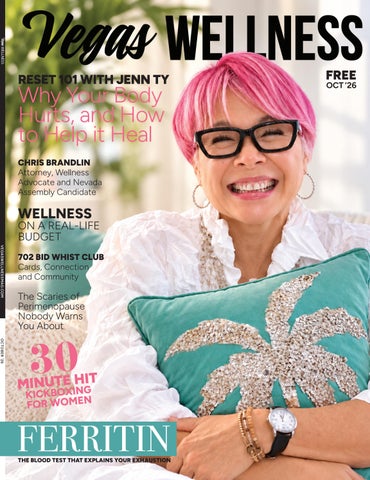
WELLNESS
RESET 101 WITH JENN TY
Why Your Body Hurts, and How to Help it Heal CHRIS BRANDLIN Attorney, Wellness Advocate and Nevada Assembly Candidate
WELLNESS
ON A REAL-LIFE BUDGET VEGASWELLNESSMAG.COM
702 BID WHIST CLUB Cards, Connection and Community
The Scaries of Perimenopause Nobody Warns You About
OCTOBER '26
HIT MINUTOEXIN G KICKB FOR WOMEN
FREE
OCT ’26
*Limit One Special Per Guest - Mention Vegas Wellness
CONTENTS
Vegas Wellness Magazine
OCTOBER 2026
WHAT'S INSIDE 8 Reset 101 10 The Blood Test That Explains Your Exhaustion
12 You Were Never Meant to Be a Prisoner
14 30 Minutes to Stronger 16 The Scaries of Perimenopause 18 From the Courtroom to Carson City
18
20 Biohacking with JohnXD 22 Wellness on a Real-Life Budget 24 Nail Hustle TV ON THE COVER
Jenn Ty Founder of Flow Massage Therapy and Reset 101
Cover Design: Pink Kitty Creative
26 Menopause Changes Your Body 28 When the Struggle is Real 30 Luxury Real Estate 32 Doing Everything Right, But Still Feeling Off?
14
34 Young Adults & Mental Health 36 More Than a Card Game 40 The Seasonal Shift Into Fall 44 Sovereignty, Service & Stewardship 43 Coming Back 44 The Ghost Stories
30
45 Will the Real Expert Please Stand Up?
48 Plant Magic & Medicine 5
PUBLISHER Bill Shehan
EDITOR
Stephanie Shehan // stephanie@vegaswellnessmag.com // 702 622 8001
ASSISTANT EDITOR Jennifer Walker // jennifer@vegaswellnessmag.com // 775 375 0415
CONTRIBUTING WRITERS Alethea Shelton Andrea Caple Anna Ketron Cusano Cheri Alberts Dr. Amanda Jordan Dr. Tim Patel Glenn J. White Jaden Rae Janelle Ardizzone
John Wetzel Katie Peede Krystian Bastidas Pravina Narayan Saba Tesfay Sarah Schwefel Steven Dee Kish Tiffany Marie Tsikki Thau
BIOHACKING CONTRIBUTOR John Wetzel (JohnXD) // Biohacking Las Vegas
COVER ART Victoria Hart // Pink Kitty Creative
ADVERTISING SALES Stephanie Shehan // stephanie@vegaswellnessmag.com // 702 622 8001 Jennifer Walker // jennifer@vegaswellnessmag.com // 775 375 0415
COPY EDITOR Effie Armstrong - info@vegaswellnessmag.com
web
vegaswellnessmag.com
@vegaswellness @vegaswellnessmag
@vegaswellness Vegas Wellness Magazine is a lifestyle publication featuring content about wellness, plant medicine, and general wellbeing. All content within our publications and on our website is for educational and entertainment purposes only and should not be considered personalized legal or medical advice. Both the printed publication and the website are intended for those over the age of 21. Vegas Wellness Magazine assumes no responsibility for the advertisements within this publication. We strive to ensure the accuracy of the information published. Vegas Wellness Magazine cannot be held responsible for any consequences which arise due to error or omissions. Reproduction in whole or in part is strictly prohibited. All rights reserved.
By Jenn Ty, Founder, Flow Massage Therapy
Why Your Body Hurts, and How to Help It Heal Pain is one of the most confusing and frustrating experiences a person can have, especially when your medical tests come back normal, your scans show nothing unusual, and yet your body continues to hurt. If this sounds familiar, you are not alone, and more importantly, you are not imagining it. The answer to why your body hurts is often not found in a single test result or isolated diagnosis. It lives in the accumulated story of how your body has moved, compensated, and adapted over the course of your entire life. This is the foundation of RESET 101- a whole-body program developed by Jenn Ty, founder of Flow Massage Therapy, after decades of hands-on work with clients ranging from children with neurological challenges to active adults well into their nineties. RESET 101 is not about adding more exercises to your routine or pushing through discomfort. It is about going back to the fundamentals, the true definition of what it means to be well, and giving your body the tools it needs to heal itself from the inside out.
Pain Doesn't Always Begin Where You Feel It
When fascia is healthy, it is fluid, flexible, and largely invisible, as healthy systems tend to be. But when it is subjected to injury, prolonged stress, poor posture, emotional trauma, or simple inactivity, it tightens, thickens, and adheres to surrounding structures. These fascial restrictions do not show up on X-rays or MRIs, which is precisely why so many people are told that everything looks normal when their body still doesn't feel right. Addressing the fascia is central to the RESET 101 approach, and it is one of the key reasons the program produces results that conventional treatment has not been able to achieve.
How Trauma, Accidents, and Years of Habit Shape the Body
The body remembers everything. A car accident at twenty-five. Years of sitting at a desk with your head pushed forward toward a screen. Carrying a baby on one hip. The grief that made you round your shoulders inward for a year. Emotional and physical experiences alike leave their imprint on the body's tissues, and over time these imprints accumulate into the patterns that define how you move, breathe, and feel daily.
One of the most important things to understand about pain is that the place where you feel it is often not the place where the problem originated. A persistent ache in the knee may trace back to tightness in the hip. Chronic neck tension may be rooted in how you breathe, how you sit, or a shoulder injury you had years ago. The body is not a collection of separate parts; it is one deeply interconnected system, and it is extraordinarily good at compensating when something isn't working properly.
This is not about blame; it is about awareness. Once you understand that your current pain or limitation is the result of a long and logical process of adaptation, you can begin to approach healing in a way that is compassionate, informed, and genuinely effective. RESET 101 creates space for this understanding, combining movement re-education, breathing work, postural retraining, and hands-on fascial techniques to gently unwind the layers of compensation the body has built up over time.
The trouble is that compensation, while clever in the short term, creates new patterns of strain over time. Your body quietly reorganizes itself around a weakness or restriction, shifting load onto structures that were never designed to carry it. Eventually, those structures reach their limit, and that is when pain appears, often in a location that seems to have nothing to do with the original problem. RESET 101 is designed to trace these patterns back to their source and address them there, rather than simply treating the symptoms at the surface.
At its heart, RESET 101 is returning to the fundamentals of good health, not the complicated version sold to us through fitness trends and supplement stacks. The simple, foundational truth that a healthy body is one that can move freely, breathe fully, stand upright without effort, and respond to life without chronic pain or restriction. These are not luxury outcomes reserved for elite athletes. They are the birthright of every human body, and they are recoverable at any age.
The Hidden Role of Fascia
To understand why so many people experience pain that defies conventional explanation, it helps to understand fascia. This connective tissue surrounds and weaves through every muscle, bone, nerve, and organ in your body. Fascia is continuous and body-wide, forming a living three-dimensional web that gives your body its shape and transmits movement and force throughout your entire structure.
Back to Fundamentals: What Good Health Actually Means
The five phases of RESET 101- Awareness, Foundation, Retraining, Integration, and Maintenance- guide participants through a progressive journey of rediscovering what their body is capable of. It begins not with doing more, but with noticing more: becoming curious about how you breathe, how you hold tension, how you walk, and what your posture communicates about the state of your nervous system. From that foundation of awareness, real and lasting change becomes possible.
A Fresh Perspective, and Practical Tools You Can Use Today
Whether you are managing chronic discomfort, recovering from injury, or simply committed to staying active and independent as you age, RESET 101 offers something genuinely different. It treats you as a whole person, not a collection of symptoms, and it equips you with simple, practical habits that support your body's natural capacity to heal and function well. Sometimes the most profound change begins not with a new treatment or a harder workout, but with understanding your body differently. When you know why it hurts, you can finally begin to help it heal. For more information about the RESET 101 program or, if you would like Jenn to speak at your gathering please contact Jenn Ty at 917592-3395 or via email at jenn@flowmassage. info.
>>> THE BLOOD TEST THAT EXPLAINS YOUR EXHAUSTION
and Why Nobody Ordered It By: Amanda Jordan, MD
A 42-year-old woman came to see me for unexplained exhaustion and hair loss. She had already been told her workup was normal. Her thyroid test was normal. Her CBC was normal. We investigated further and ordered iron studies. Her ferritin was 10 ng/ml. That result changed the conversation.
What is Ferritin?
Iron’s best-known job is helping hemoglobin carry oxygen in red blood cells from your lungs to the rest of your body. It’s also part of myoglobin, which stores oxygen in your muscles. Mitochondria, your cellular powerhouses, need iron to turn food into cellular energy, or ATP. Iron converts thyroid hormone into its active form, and it’s required to make serotonin and dopamine, the neurotransmitters behind concentration, mood, and sleep. That’s a lot of jobs for one mineral! Ferritin is the protein that stores iron inside your cells. Think of hemoglobin as iron already at work and ferritin as the supply waiting on the shelf. The National Institutes of Health describes iron deficiency as a progression: stored iron (ferritin) falls first, and changes in red blood cells and hemoglobin can follow later. Your body protects hemoglobin above all else, so you can have severely depleted iron stores alongside a completely normal hemoglobin. That gap matters, because a complete blood count, or CBC, doesn’t measure ferritin. A CBC tells us about hemoglobin; it says nothing about how much iron you have in storage.
What Does Deficiency Feel Like?
Low ferritin can cause these symptoms even when hemoglobin levels are normal: • Fatigue • Hair shedding • Restless legs (an uncomfortable urge to move your legs, especially at night) • Brain fog and trouble concentrating • Low mood or irritability • Decreased exercise tolerance • Headache • Pica (craving non-food items such as ice) Fatigue is the most common symptom, and it comes from reduced mitochondrial energy production and diminished thyroid hormone conversion. Hair follicles are metabolically active, so they’re among the first tissues affected when iron stores are depleted. Restless legs at night have one of the strongest associations with low ferritin in the
medical literature. Brain fog, irritability, and low mood follow reduced dopamine and serotonin production. Exercise tolerance drops too, since working muscles depend on iron for oxygen delivery. None of these symptoms are unique to low ferritin, and each can have other explanations. The overlap gets especially tricky in midlife, when hormonal changes, thyroid conditions, stress, illness, and other factors may all be contributing.
Why Stores Run Low
Menstrual blood loss is the most common cause in women of reproductive age. Heavy periods, fibroids, and adenomyosis can drain iron month after month, faster than most diets can replace it. Pregnancy raises iron requirements, and so do endurance training and rapid growth during adolescence. Restrictive diets, especially vegan and vegetarian, can be low in absorbable iron unless intake is deliberate. Non-heme iron from plant sources isn’t absorbed as readily as heme iron from meat, poultry, and fish. Vitamin C improves absorption of plant-based iron; polyphenols, tannins (coffee and tea), phytates (whole grains, legumes), oxalates, and calcium all inhibit it. Absorption can also be impaired by gastrointestinal conditions: celiac disease, bariatric surgery, H. pylori infection, inflammatory bowel disease, and long-term use of acid-reducing medications. Gastrointestinal blood loss also warrants consideration, especially when iron deficiency is unexplained in men or postmenopausal women. If the cause is still uncertain after an initial assessment, the patient should be referred to gastroenterology for endoscopy and colonoscopy, even if they have no symptoms.
“Normal” is Not the Same as Optimal
The LabCorp reference range for ferritin is wide: anything between 15 and 150 ng/ml gets labeled normal. A reference range describes where the middle 95% of the population sits, so results count as abnormal only in the top or bottom 2.5%. That assumes the reference population was healthy. A 2024 Lancet Haematology paper traced where this reference range came from. In many of the studies behind it, researchers didn’t exclude people at risk for iron deficiency from the “healthy” group. A less-than-healthy population set the “normal” range. New patients are then compared to that
range and labeled “normal,” even though the literature shows symptoms develop below 50 ng/ml. A cutoff of 15 ng/ml catches only late deficiency: essentially depleted bone marrow iron stores (decidedly NOT healthy). In my practice, I aim for a ferritin approaching 80 ng/ml as the goal for an optimal iron reserve, especially in patients with fatigue, hair shedding, or mitochondrial dysfunction.
Repleting Your Stores
The right approach depends on your symptoms, your ferritin level, and why your stores were depleted in the first place. Food is the foundation. Heme iron comes from meat, poultry, and seafood. Plant (nonheme) sources include lentils, beans, tofu, pumpkin seeds, and iron-fortified grains. Pairing iron with vitamin C can double absorption: a meal of lentils with bell peppers, for example. A vegetarian diet can support healthy iron levels; it just takes more deliberate attention to iron-rich foods and meal pairing. Coffee, tea, calcium supplements, dairy, and thyroid medication all reduce absorption, so separate them from your iron-rich meal by a couple of hours. The NIH recommends 18 mg of iron per day for women aged 19 to 50, and 8 mg per day for men and adults over 50. When ferritin is very low, food alone may not be enough, particularly for women losing blood every month to heavy periods. Oral iron supplementation is usually the next step. Most people tolerate ferrous bisglycinate well. I recommend taking it first thing in the morning on an empty stomach with vitamin C to increase absorption and, as with dietary iron, spaced away from co ee, tea, and calcium. I also recommend every-other-day dosing. Daily supplementation triggers a hormone called hepcidin that temporarily blocks iron absorption; spacing doses out avoids that and leads to better absorption over time. Repletion takes patience. Expect three to six months of consistent supplementation before stores start to improve. If ferritin isn’t moving in the right direction, the underlying cause deserves further investigation. For patients who don’t respond to oral iron despite consistent use, or who can’t tolerate it, an iron infusion is sometimes the most appropriate next step. Rebuilding iron stores takes time. It also requires more than watching a number rise. The reason the iron became depleted must be addressed, whether that’s heavy menstrual bleeding, inadequate intake, impaired absorption, pregnancy, blood donation, or another source of blood loss. Otherwise, ferritin may fall again as soon as supplementation stops. Ferritin won’t explain every case of fatigue, hair loss, brain fog, or restless legs. But it is a useful and commonly overlooked part of the evaluation. A routine blood count tells us whether iron deficiency has begun to affect red blood cells. Ferritin tells us what remains in reserve. If you continue to have symptoms despite “normal” routine bloodwork, the most useful question is not, “Were my labs normal?” It is, “Did anyone check my ferritin?” I’m strong to the finish ‘cause I eats me spinach! – Popeye Dr. Amanda Jordan is double board-certified in emergency medicine and anti-aging and regenerative medicine (ABAARM), and runs Limitless Longevity and Functional Medicine, a nationwide telehealth practice built on root-cause, precision care. Visit dramandajordan.com to schedule a complimentary discovery call.
HORMONE THERAPY FOR MEN AND WOMEN
WEIGHT LOSS MEDICALLY SUPERVISED
PRIMARY CARE ROUTINE WELLNESS VISITS
Shanna McManus, APRN, is a board-certified family nurse practitioner who specializes in primary care, hormone replacement, and medically supervised weight loss. She is certified through the American Association of Nurse Practitioners (AANP) and the North American Menopause Society (NAMS.
(702) 551-1199
2213 N. Green Valley Pkwy, Ste 101 Henderson, NV 89014
info@vitalishealthnv.com
INSURANCE ACCEPTED
vitalishealthnv.com
Vegas Wellness Magazine
>>>
YOU WERE NEVER MEANT TO BE A PRISONER Why real healing has to fit a real life By Tiffany Marie, CNP, CPIS | Founder, TM Wellness
I want you to picture something. A woman at her own child's birthday party, staring at a slice of cake like it is a threat. Everyone around her is laughing. She is doing math. She is afraid. Not of the cake, but of what she believes it will undo. I have met her a hundred times. Maybe you have been her. And I want to tell you something I believe with my whole heart. That is not health. That is a prison with better marketing. So much of this industry runs on rules. Rigid, all-or-nothing protocols that treat your life like a problem to be managed instead of a life to be lived. Eat only this. Never touch that. Follow the plan perfectly, or you have failed. And when a real, beautiful, unpredictable life inevitably gets in the way, you are left feeling like the failure, when the truth is the plan was never built for a human being in the first place. And I want you to notice what that kind of plan actually does to a person. It does not just fail to work. It teaches you to distrust yourself. Every slip becomes proof that you are the problem, that you have no discipline, that you will never get there. You start the diet on Monday, white-knuckle it, break by Thursday, and spend the weekend ashamed. Then you do it all again. That cycle is not a lack of willpower. It is the predictable result of a plan designed to be impossible. I build the opposite. And this is the one thing I will not compromise on. Your plan has to move with your real life. Your family. Your travel. Your celebrations. Your faith. The dinner out, the vacation, the holiday table, the spontaneous yes. If a plan cannot survive contact with your actual life, it is not a good plan, no matter how impressive it looks on paper. Because here is the simple, unglamorous truth about results. Consistency beats perfection every single time. A good plan you can actually keep will always outperform a perfect plan you abandon in three weeks out of exhaustion and shame. The magic was never in the rigidity. It was in the rhythm you could sustain. This is also why I would rather tell you the honest thing than the impressive thing. It would be easy to hand you a dramatic, locked-down protocol that makes me look brilliant and makes you miserable. I am not interested in that. I am interested in building you something quietly sustainable, something that still works on a Tuesday when everything is falling apart, and also works at the celebration you have been looking forward to for months. I think about this as a wife and a mama, too. I do not want a version of health that pulls me out of my own life, that has me declining the dinner, skipping the celebration, missing the moment because it did not fit the protocol. My faith, my family, and my table matter too much for that. I refuse to build for the women I serve anything I would not want to live
12
inside myself. Freedom is not the reward you earn at the finish line of some perfect protocol. In my work, freedom is built into the plan from day one. It is a feature, not a prize. Once your foundation is strong, your body becomes resilient enough to bend without breaking. You can live, fully and freely, and still be well. Those two things were never supposed to be enemies. Let me show you what freedom actually looks like, because it is quieter than you might think. It is ordering what you want at dinner without a spreadsheet running in your head. It is being fully present at the party instead of anxious in the corner. It is going on vacation and coming home steady, not spiraling. It is trusting that one meal, one weekend, one imperfect week will never undo a body that is genuinely well. That is not the absence of a plan. That is the reward of a good one. The prison was never the price of healing. It was just the story you were sold. So we have gone deep. We have looked beneath the surface, built the foundation, and built it in a way you can actually live inside. And only now, standing on solid ground, are we finally ready to talk about the thing almost everyone wants to talk about first. The thing I get asked about more than anything else, especially here in Vegas. Next time, in the final piece of this series, I will tell you the truth about peptides, and why they come last. You were never meant to be a prisoner to your plan. You were meant to be free inside of it. Tiffany Marie is the founder of TM Wellness. Find her at www. tiffanymariedavis.com and on Instagram at @tiffanymarie_davis and @ tm_wellness_.
What If Your Best Health Is Still Ahead of You? Precision Functional Medicine for Men & Women Who Want to Perform, Age, and Live Better.
Most people don’t suddenly wake up unwell. Energy dips. Sleep becomes fragmented. Hormones shift. Focus isn’t as sharp. Recovery slows. Your metabolism feels different. These aren’t “just aging.” They’re signals—biological data points your body uses to tell you something has changed.
My job is to decode those signals. As a physician specializing in functional and longevity medicine, I take a systems-based, root-cause approach to optimize your whole health—hormones, metabolism, inflammation, brain function, gut health, and longevity pathways. Whether you’re navigating perimenopause, andropause, persistent fatigue, weight changes, poor sleep, or simply want sharper cognition and stronger performance, your plan is personalized and evidence-driven.
No guesswork. No one-size-fits-all protocols. Just optimized health from the inside out.
Care Includes:
Comprehensive functional lab testing Hormone evaluation & optimization Nutrition and metabolic rebalancing Gut–immune axis analysis Sleep, stress, and recovery protocols Precision supplements & lifestyle medicine Fully virtual, physician-led care
dramandajordan.com
Dr. Amanda Jordan, MD Ready to Optimize Your Health? Book your complimentary discovery call today.
Vegas Wellness Magazine
>>>
30 Minutes to Stronger
Inside the women-only kickboxing workout helping local women build strength, confidence and community
For many women, finding time to work out isn’t necessarily about motivation. It’s about life. Careers, children, appointments, relationships and endless responsibilities can make fitting a traditional gym routine into the day feel nearly impossible. Kerry Passmore understands that reality firsthand. After spending many years in corporate America, raising a family and trying to maintain her own commitment to fitness, she knew exactly what it felt like to squeeze exercise into whatever small window of time remained. Then she discovered 30 Minute Hit. “When I turned 50, I was like, okay, what am I doing with the rest of my life?” Passmore recalls. After decades in the corporate world, she found herself drawn toward work that would allow her to coach, mentor, motivate and inspire others. Fitness had also always been an important part of her life. When a career coach introduced her to the 30 Minute Hit franchise, something clicked immediately. “Where has this been my entire life?” she remembers thinking. Today, Passmore has brought that concept to Las Vegas, a women-only kickboxing circuit built around one particularly attractive promise: a complete full body workout in just 30 minutes. No Class Times. No Sparring. No Intimidation. Walk into 30 Minute Hit and you won’t find rows of treadmills or people waiting for the next scheduled class to begin. Instead, the workout revolves around a 13-station circuit, with participants spending two minutes at each station. The circuit combines kickboxing technique, cardio intervals, resistance and bodyweight exercises designed to work the entire body. A certified trainer is always on the floor to help with technique, form, modifications and, when necessary, a little extra motivation. And when those 30 minutes are over, you’re done. “There are a million ways to do the circuit,” Passmore says. “You always start the same way, you always end the same way, but what you’re doing in the middle is always different.” That means someone completely new to fitness can work alongside a seasoned athlete without needing to perform at the same level. According to Passmore, the Las Vegas location has welcomed everyone from women who have never thrown a punch to experienced MMA athletes. There’s also no sparring. For women who hear “kickboxing” and immediately picture getting punched, Passmore is quick to clarify: you’re hitting bags, not other people. The intensity is yours to control.
14
By Stephanie Shehan
A Space Created Specifically for Women
One of the most distinctive aspects of 30 Minute Hit is also one of the simplest: it’s women only. That changes the atmosphere. Passmore describes it as a place where women can concentrate on themselves without some of the distractions or intimidation they may experience in a traditional gym. The flexibility was another major reason she fell in love with the concept. Rather than planning life around scheduled classes, members can arrive whenever the studio is open, get into the circuit and be finished approximately half an hour later. For working women, moms and anyone whose schedule changes from one day to the next, that can make the difference between intending to exercise and actually doing it. The studio even includes a space for children, complete with toys, puzzles and activities. Because of the open layout, moms and children can still see each other during the workout. Sometimes the kids even become trainers. “Mommy, hit harder! Mommy, go faster!” Passmore laughs, describing the encouragement she hears from children watching their mothers. For Passmore, there is something bigger happening in those moments. Children are seeing their mothers prioritize their own health, and learning early that taking time to care for yourself is normal.
More Than Cardio
Thirty minutes may sound short, but the circuit is designed to make those minutes count. Kickboxing provides resistance as members punch and kick the bags, while intervals elevate and lower the heart rate throughout the workout. Bodyweight exercises add another strength component, and supplemental CalHIT workouts incorporate calisthenics movements such as burpees, lunges and other exercises. Passmore says members often notice changes in muscle tone and strength in addition to cardiovascular improvements. “I think we underestimate the power of our own bodies to create resistance,” she says. For women entering their 40s, 50s and beyond, strength can become an increasingly important part of the wellness conversation. Passmore, 52, says many of the women who come through the studio are navigating menopause and thinking differently about maintaining muscle, strength and overall health as they age. Others arrive after significant weight loss and are ready to focus on rebuilding strength and muscle. The common denominator is that they can begin where they are. “We’ve had people that can’t yet get on the floor,” Passmore says. “We’ve had people coming back from wrist
surgeries, hand surgeries, knee surgeries. We can modify the workout for each individual.”
Sometimes You Just Need to Hit Something
The physical transformation is only part of what Passmore sees happening inside the studio. There’s also the mental release. Women carry stress, often a lot of it. And while hitting a bag may not be the first wellness practice that comes to mind, Passmore says members frequently tell her they arrived after a difficult day specifically because they knew the workout would make them feel better. “You’re working every single part of your body, and not only physically, but mentally as well,” she says. She has watched new members begin exercising consistently and report feeling more energetic, mentally clearer and less stressed after only a handful of workouts. There is something satisfying about putting on a pair of gloves, turning up the music and spending half an hour punching and kicking without worrying about emails, deadlines or everything waiting at home. For those 30 minutes, the focus is entirely on you.
Building Confidence One Workout at a Time
The changes Passmore sees aren’t always measured on a scale. One of the studio’s earliest members initially made one thing very clear: no photos. “She was like, ‘Do not take any pictures of me. Don’t put me on social media,’” Passmore recalls. Months later, after losing weight and gaining confidence, the same woman changed her mind. “You can start using my pictures,” she told Passmore. For Passmore, that transformation captures much of what she hopes women find at 30 Minute Hit. It isn’t simply about becoming smaller. It’s about becoming stronger, and recognizing that strength in yourself. That philosophy extends to beginners who may be nervous simply walking through the door. Trainers spend time learning about each woman, her goals, her experience and what might make her uncomfortable. Someone experienced in kickboxing can be challenged immediately, while a complete beginner can move slowly through the fundamentals. “I want every woman that walks through here to know that they are truly seen for who they are and what they’re going through in their life at that moment in time,” Passmore says.
The Power of Showing Up
physical fitness became an important part of her own mental and physical wellbeing. “Physical fitness has honestly, when I figured it out, when I learned about it, when I understood it, been one of the key things that has kept me alive and sane,” she says. That history gives deeper meaning to the environment she is trying to create today, a place where a woman can walk through the door at whatever stage of life she is in and feel welcome.
Giving Back in October
For 30 Minute Hit, building strength goes beyond what happens inside the gym. October is the organization’s community fundraising month, when 30 Minute Hit locations throughout the U.S. and Canada host special events designed to give back to their local communities. At the Las Vegas studio, Passmore is planning a month of activities that will bring members together outside of their regular workouts, including a movie night, a potential food drive, special promotions and fundraising efforts benefiting a local nonprofit. The studio also plans to host a special day when members can bring their spouses or significant others to experience the 30-minute circuit for themselves. For Passmore, the month is about more than raising money, it’s another opportunity to strengthen the connections among members and create a network of women supporting one another while making a positive impact right here in Las Vegas.
Start Where You Are
Ask Passmore what she would change about the way women think about their bodies, and her answer has very little to do with kickboxing. “They’re perfect where they are.” Women, she believes, can become so critical of themselves that their own negative self-talk prevents them from ever starting. Instead of trying to overhaul everything overnight, Passmore encourages women to do something small. Come once a week. Walk for 10 minutes. Move your body. Then build from there.
Accountability is another piece of the equation. If a member suddenly stops coming, the team notices. Passmore and her trainers check in, not to shame anyone, but to remind members of the goals they discussed when they started. Sometimes that message is exactly what someone needs. Members have even thanked the team for continuing to reach out after they disappeared for a couple of weeks. One jokingly described the followup as “annoying in a good way.” It’s a small detail, but one that separates being a member of a community from simply having another monthly gym charge on your credit card.
“We kind of have this all-or-nothing mentality, like, ‘I’ve got to be all in or all out.’ And that’s not it,” she says. Small changes become habits. Habits become progress. And eventually, you look back and realize something that once felt impossible has become part of your life. Perhaps that’s the biggest lesson inside 30 Minute Hit. Wellness doesn’t have to require hours at the gym or a perfectly planned schedule. Strength doesn’t have to look the same on every woman. And you don’t have to wait until you reach some imaginary version of yourself before deciding that your health deserves your attention.
The Mission Is Personal
“You are perfect where you’re at,” Passmore says. “If you wouldn’t say it to a stranger or a friend, don’t say it to yourself.” And if you happen to discover that throwing a few punches along the way feels pretty good? Even better.
Passmore’s passion for wellness comes from a much deeper place than simply enjoying exercise. As a young girl, she struggled with her weight. She also experienced abuse, depression and a suicide attempt in her teen years. Those experiences shaped the way she sees the women who walk through her doors today. “People see me and they’re like, ‘Oh, you’ve never understood what it’s like to be overweight. You don’t understand what it’s like to go through tough times.’ And that couldn’t be farther from the truth.” Eventually,
30 Minute Hit is located at 7290 W. Azure Dr, #140, Las Vegas NV 89130. For more information or to schedule a free intro class, scan the QR code in their ad or call (702) 331-1143.
Vegas Wellness Magazine
>>> The Scaries of Perimenopause Nobody Warns You About What if You're Not Falling Apart? What if You're Reorganizing? By: Janelle Ardizzone, Mother of Four • Wellness Founder • Certified Doula • Former Personal Trainer II turn 48 this October. And nobody really warned me about the scaries of perimenopause. I'm not just talking about hot flashes or changing cycles, the things we're taught to expect. I'm talking about not recognizing your own reactions. The snapping. The rage. The exhaustion. The brain fog. The overwhelm. The changing tolerance for stress. Feeling wildly creative and capable one day and wondering why something simple feels impossible the next. And maybe one of the scariest parts is this: You can be in it before you even know you're in it. I certainly was. If you've found yourself wondering why your patience, focus, energy, recovery or tolerance for stress suddenly feel different, this story may feel familiar.
I Thought I Knew My Body
Wellness has been an anchor in my life since I was a teenager. I studied kinesiology and nutrition, worked as a personal trainer, and never stopped being fascinated by food, movement, the mind-body connection and our capacity to heal. In 2016 following my 5th miscarriage I went through a complete foundational wellness overhaul. There wasn't a room filled with biohacking technology. It was nourishing food, movement, sleep, sunlight, hydration, meditation, regulating my nervous system, managing stress, tending to my thoughts and relationships, creating a healthier environment, and a faith that was growing right alongside me. It changed my life. In 2017 at 38, after our daughter Makena Moon was born, I experienced what it felt like to move through a major physi-
16
ological transition with preparation, awareness and support. Her birth was beautiful. We prepared intentionally for pregnancy, birth and postpartum. I supported my body and created an environment that allowed me to thrive. In many ways, that chapter also planted the seeds for what would eventually become Desert Moon Wellness. I learned something then that I still believe deeply today: The conditions we create around the body matter. Years later, my body entered another transition. This time, I didn't know how to prepare.
Then Everything Got Shaken
Cory and I opened Desert Moon Wellness in July 2022. Within months, life became incredibly difficult. By early 2023, our new business was struggling, important relationships had fractured, and decisions I made during an extraordinarily stressful period had consequences. At the same time, Cory became seriously ill and was ultimately diagnosed with GPA and ANCA-associated vasculitis. Before we fully understood what was happening, we leaned heavily into the functional and cellular wellness world we knew, surrounded by an incredible community across the country trying to help. But Cory continued to decline, and eventually conventional medical intervention became necessary. Once his immediate condition was being medically addressed, we returned to our foundations while continuing to work alongside his medical care. That experience taught me something I carry with me today. It doesn't have to be wellness or medicine. Sometimes wisdom is recognizing which tool belongs in which moment. Meanwhile, I
was trying to support my husband, protect our family, keep our new business alive and show up for everyone who depended on me. And I still didn't know I was in perimenopause. My energy changed. My stress tolerance changed. My emotions could arrive faster. My brain felt different. Traits I've always recognized in myself, like my fast brain, creativity, sensitivity, intensity and what I affectionately call my ADHD or "neurospicy" side, felt amplified. Sometimes it's brilliant. Sometimes it's forty tabs open at once. And because I didn't understand what was happening, I wasn't asking: What does my body need from me right now? I was asking: Why doesn't what used to work for me work the same way anymore? And sometimes telling myself: I should know better. Today, I have so much more compassion for that woman. Because information isn't the same thing as regulation. You can know so much about wellness and still struggle to access those tools when your nervous system is overwhelmed. Perimenopause didn't cause Cory's illness. It didn't cause our business challenges. And I won't blame every decision or relationship that didn't work out on hormones. But perimenopause was part of the body I was living in while I was trying to survive all of it. Knowing that now gives me context. And context creates compassion.
I Needed a Clearer Channel
For the past several years, I've been going back to the beginning. Not to become the woman I used to be. To hear the woman I am now. I think of it as creating a clearer channel between my body and my ability to actually hear what it's telling me. When I'm exhausted, stressed, overstimulated and dysregulated, that channel gets noisy. Everything feels urgent. Everything feels louder. And it becomes much harder to distinguish between what my body needs and what my stress is demanding. So I return to my foundation. Sleep. Nutrition. Movement. Sunlight. Hydration. Prayer. Connection. Boundaries. Nervous system regulation. And, recovery. Not perfection. Capacity. And when appropriate for me, I layer technology on top. That's an important distinction, especially coming from someone who owns a wellness center filled with technology. Technology isn't my foundation. Technology supports my foundation. I'm fortunate to have access to tools like hyperbaric oxygen therapy, PEMF, photobiomodulation and BrainTap. But the question I ask has changed. Instead of constantly asking, What else can I do? I ask: What does my body need from me today? Sometimes that's technology. Sometimes it's lifting weights or yoga. Sometimes it's nourishing food, sunlight or prayer. Sometimes it's talking with a healthcare professional. Sometimes it's being with people I love. And sometimes the most optimized thing I can possibly do is less.
Maybe I'm Not Falling Apart
This is where perimenopause has started becoming unexpectedly beautiful to me. My brain is changing. My body is changing. My priorities are changing. Things I once tolerated don't always feel tolerable anymore. Things that worked before don't necessarily work the same way now. At first, that felt destabilizing. Now I'm becoming curious. Maybe I'm not falling apart. Maybe I'm reorganizing. Perimenopause has shaken parts of my foundation to the core. But I've experienced transformation before.
We love the image of the butterfly because we see the beautiful part, the wings. We don't talk nearly enough about what happens before them. Transformation can be messy. It can expose what no longer serves us. It can challenge structures we thought were permanent. It can ask us to rebuild. That doesn't mean suffering is required for transformation. It means that when life does shake us, we have a choice in how we meet the shaking. And I'm beginning to see perimenopause as another butterfly moment in my life.
Support Changes the Way We Transform
Life will shake us. Bodies change. Children grow. Relationships evolve. Careers shift. Hormones fluctuate. We age. We can't control all of it. But support changes how we move through change. When we understand what's happening in our bodies, tend to our foundations, support our nervous systems, seek appropriate medical care when needed, use technology intentionally and surround ourselves with people and practices that create capacity, we can move through transition differently. We don't have to spend the entire time fighting ourselves. We don't have to resist every change. But we don't have to disappear into it either. We can participate in our own rebuilding. And if you love a woman moving through this season, understanding that something may be changing for her can create more compassion on both sides. She may be trying to understand a body and brain that suddenly feel different to her too. Sometimes being supported and understood is part of the medicine.
At 48, I'm Ready
Ten years ago, postpartum introduced me to a version of myself I hadn't met yet. I prepared for her. I supported her. And she thrived. That woman helped plant the seeds for Desert Moon and eventually contributed to work I'm incredibly proud of, including the BrainTap meditation series that has now come full circle in this season of my life. Now another version of me is emerging. This transition caught me by surprise and collided with some of the hardest years our family has experienced. Some things broke. Some things were rebuilt. Some things I'm still rebuilding. And I have compassion for all of it now. This October, I'm not afraid of turning 48. I'm excited. I don't want to fight my changing body or force myself back into the woman I was at 38. I'm grateful for her. She built the foundation I'm standing on today. Now I want a clear enough channel to hear the woman I'm becoming. Enough regulation to recognize what she's asking for. Enough wisdom to know which tools belong in which moments. Enough compassion to give myself grace when I don't get it right. And enough curiosity to see where this transformation takes me next. Maybe, thriving through perimenopause isn't about getting back to who we were before everything got shaken up. Maybe, it's about creating the conditions for who we're becoming to emerge.
>>>
By Stephanie Shehan
From the Courtroom to Carson City Attorney, wellness advocate and Nevada Assembly candidate Chris Brandlin believes healthier communities begin long before someone walks into a doctor’s office. For Chris Brandlin, the road from attorney to wellness advocate to political candidate wasn’t a carefully mapped career trajectory. It was shaped by a personal health crisis that fundamentally changed the way he viewed medicine, nutrition and, eventually, public policy. Today, Brandlin is an attorney, public health researcher and longtime fitness and nutrition advocate who is running as the Republican candidate for Nevada State Assembly District 42. His opponent in the November 3 general election is Democratic incumbent Tracy Brown-May. Ask Brandlin what connects law, fitness, nutrition, public health and politics, and his answer comes back to one idea: using what he has learned through his own experiences to change the system for others. “When I see what happened to me and what’s happening to others, that’s where I can use my legal background to make changes,” he says.
When Health Became Personal
Brandlin’s interest in wellness predates his political ambitions. A former personal trainer and natural bodybuilder, he spent years immersed in fitness and nutrition. But his perspective became far more personal after a serious illness led to medications which caused gastrointestinal problems, multiple surgeries and complications that, according to Brandlin, left him searching for alternatives. He describes that period as a turning point. After surgery and recurring infections, Brandlin says he eventually decided to explore fasting, elimination diets and other nutritional approaches. He ultimately adopted a largely carnivore diet, which he credits as an important part of his own recovery. His experience should not be interpreted as a medical recommendation for others, particularly his use of prolonged fasting or a highly restrictive diet, but it explains why Brandlin has become so outspoken about nutrition, lifestyle and patient choice. For him, the experience raised a larger question: Why, he wondered, wasn’t lifestyle receiving more attention alongside conventional medicine? “I’ve seen most of the improvements to actual health when just doing a really healthy lifestyle and diet,” Brandlin says. His philosophy today centers heavily on what he describes as prevention before prescription. That does not mean Brandlin believes conventional medicine has no place. During our conversation, he repeatedly acknowledged the importance of physicians, hospitals, emergency care and pharmaceuticals when medically necessary. His criticism is directed more toward what he sees as an overreliance on medication without enough attention to nutrition, exercise and lifestyle. He would like to see physicians receive greater education in
those areas and patients given more information about their options.
Turning Experience Into Education
Brandlin’s personal health journey eventually pushed him back into the classroom. Already an attorney, he pursued a PhD in Public Policy and Administration with a public-health emphasis at Walden University. His dissertation focused on ethical issues surrounding vaccine mandates, a subject that had become important to him during the COVID-19 era. His background also includes formal education in dietetics, and he holds the Dietetic Technician, Registered (DTR) credential. He also brings years of experience in fitness as a former fitness trainer and former all-natural bodybuilding champion as he was Mr. Los Angeles Natural bodybuilding champion in 2010 during law school. That combination of law, public policy, nutrition and firsthand experience as a patient, now shapes much of his political platform. Brandlin says he became particularly motivated to enter politics after publicly opposing COVID-era vaccine mandates. His objections centered primarily on medical choice and the ethics of requiring employees to receive a vaccine as a condition of employment. Whatever voters may think about those policies, the experience was pivotal for Brandlin. Rather than simply continuing to criticize government policy from outside the system, he decided he wanted a role in creating it.
Wellness as Public Policy
Health rarely receives the same attention in political campaigns as taxes, housing, education or public safety. Brandlin would like to change that. His campaign emphasizes public health, health freedom, education and public safety. He argues that states can encourage healthier behavior without requiring it. One idea he discussed is creating financial incentives for people who actively participate in wellness programs, fitness programs or preventive health initiatives. “You shouldn’t make it a requirement,” he says. “But I think you should reward people that take care of their health.” That could mean exploring insurance incentives tied to participation in certain wellness activities or preventive care. Brandlin stresses that he views the concept as a reward rather than a punishment for those who do not participate. He would also like to see greater recognition of wellness centers and nontraditional health services, while still recognizing the role of conventional healthcare. For Brandlin, the two worlds do not necessarily need to compete. “If I break my arm, or I get in a serious accident, you bet I’m going to a doctor,” he says while discussing Nevada’s medical system
and provider shortages. His larger argument is that healthcare should have room for both acute medical treatment and strategies designed to improve long-term health.
Starting With Nevada’s Kids
Some of Brandlin’s strongest opinions involve children. He wants Nevada to take another look at school nutrition, physical education and the amount of time children spend being physically active. Brandlin says his experience in dietetics exposed him to institutional school food and left him concerned about heavily processed meals and long ingredient lists. He would like schools to emphasize simpler, nutrientdense foods while increasing opportunities for physical activity. “I think we need to revisit the school lunch programs,” he says. He also believes physical education has become too limited and would like to see movement become a bigger part of the school day. Underlying those proposals is Brandlin’s belief that public health cannot focus exclusively on treating adults after chronic health problems develop. If Nevada wants to improve its long-term health outcomes, he argues, prevention needs to begin much earlier. “Those are our future leaders,” Brandlin says of Nevada’s children. “That’s the future of Nevada.”
The Wellness Practices He Uses Himself
Brandlin doesn’t simply talk about wellness. His own routine could fill an entire wellness retreat itinerary. Depending on the day, it can include intermittent fasting, exercise, sauna, cold exposure, red light therapy and hyperbaric oxygen therapy. He remains committed to an animal-based diet that he says works for his individual health circumstances. He is also interested in regenerative medicine and emerging therapies, although he acknowledges that areas such as peptide therapy need additional research and quality control. During our conversation, he expressed concern about unregulated products purchased online and said greater oversight is needed. His enthusiasm for modalities such as hyperbaric oxygen therapy is partly rooted in personal experience. Brandlin says he used the therapy while dealing with difficult-to-heal skin lesions following his surgeries and believes it played an important role in his recovery. Again, Brandlin’s experience is personal and does not establish that the same therapies or dietary approaches are appropriate for everyone. But it helps explain the intensity behind his wellness advocacy. He isn’t discussing health as an abstract campaign issue. He sees it through the lens of someone who says he spent years trying to regain his own.
Bringing Wellness Into the Political Conversation
Brandlin is calling for greater transparency around the relationship between pharmaceutical companies, research and politics. During our interview, he said he does not believe political candidates should accept pharmaceutical-industry money directly or indirectly and argued that patients deserve clearer disclosure about medication risks and side effects. Among the policies he says he would pursue is legislation targeting cultivated, or “lab-grown,” meat in Nevada. He also wants to explore
policies that encourage wellness participation and examine barriers that may make it more difficult for healthcare professionals licensed elsewhere to practice in Nevada. These positions are likely to generate debate, particularly in areas where nutrition science, emerging technology, healthcare regulation and individual freedom intersect. Brandlin appears comfortable with that. His political identity has grown directly out of his willingness to challenge systems he believes are not producing better health outcomes. At the center of it all is a deceptively simple question: What if public policy focused more attention on helping people become healthier in the first place?
A Healthier Nevada
Five years from now, Brandlin says he would like to see measurable improvements in Nevada’s health outcomes, with childhood health being a particularly important benchmark. But perhaps his broader goal is cultural. He wants wellness to become part of the conversation in Carson City, not an afterthought relegated to doctors’ offices, gyms and wellness centers, but something considered when lawmakers discuss schools, healthcare, insurance and community resources. Brandlin also wants more wellness professionals themselves to become involved in government and civic life. “Health is so neglected in all government,” he says. His own path is certainly unconventional: personal trainer, natural bodybuilder, dietetics professional, attorney, patient, public-health researcher, wellness advocate and now political candidate. Yet to Brandlin, those chapters are not separate at all. They tell one story. A health crisis changed the way he looked at medicine. That experience changed the way he looked at public policy. And public policy ultimately changed the direction of his career. Now, as he campaigns for a seat in the Nevada Legislature, Brandlin is attempting to bring those worlds together, law, wellness and politics, with a belief that improving the health of Nevada begins not only with how we treat illness, but with how seriously we value health before illness begins. For more information and to support his campaign, visit chrisbrandlin.com.
Vegas Wellness Magazine
>>>
Biohacking with JohnXD biohackinglasvegas.com
Biohacking at any age: Bruce and Robert’s story Welcome to October, when the weather in Las Vegas truly begins to shift. This is a special month for me; my number turns 52, and I want to celebrate the truth that age is simply a number. Rather than focus on myself, I’d like to honor two people who have been powerful inspirations. Both believed in me enough to trust me with their biohacking journeys. I am forever grateful to these gentlemen because they prove my point: age is just a number. First is my friend Bruce. He had seen Vegas Wellness with me on the cover and mentioned me to his friend Mike, who was already interested in biohacking and wellness. Mike reached out on Instagram and asked to visit my OsteoStrong center. On April 19, 2025, he and Bruce came in. I put Bruce through a session, as I have with hundreds of others. He was open to trying it and signed up. Meanwhile, something stood out immediately: he felt like a father figure, brother, and best friend all in one. I could see his genuine desire to learn and improve his health. I invited him to my biohacking meetings, where he quickly became a regular and is now a platform member. A few months ago, he purchased B3 BFR bands and uses them consistently with his vibration plate. I’m watching my friend’s life change. He is in better health than when we met last year. This is what it’s all about: the number goes up, but health does not have to decline. Bruce has become a wonderful representative for biohacking. He remains open to suggestions, does his research, and puts what he learns into practice. It’s inspiring to see someone who understands
20
that health is our most valuable asset. He has become family, not just a member of the center. I look forward to continuing to support his progress. A true biohacker story. Next is my friend Robert. He was introduced to me by his daughter Michelle, an OsteoStrong member who wanted her dad to try the training. On April 26, 2025, Robert walked into the center, and I was immediately impressed by how he moved. When I saw “1935” on his paperwork, I assumed it was a typo for 1953. Robert was 89 at the time, and I was blown away by how strong and vibrant he looked. I wanted to know his secrets. They weren’t secrets at all: clean eating, spirituality, no pharmaceuticals, and consistent movement. He never sat still or made excuses. He simply kept his body moving so he could do more. Over the past year-plus, our conversations have continually inspired me and given me hope. Robert is now a regular at the biohacking meetings. Recently, he added B3 BFR bands to his routine. After only a couple of weeks, he already feels the difference in his strength and mental clarity. Once again, I’m watching a friend grow stronger and feel better. As of August, his number is 91, and he is proving the point emphatically: getting older does not mean getting weaker. A few weeks ago he attended a camping retreat and outperformed people in their 60s. Watching the videos filled me with happiness and pride to play a small part in his journey. As my own number prepares to climb again at the end of the month, I am deeply thankful for everything I’ve learned that helps both me and my friends feel better as the years advance. I believe everything happens for a reason and at the right time. I met Bruce and Robert exactly when I was meant to. I love them both for the inspiration they continue to give me. I have come a long way in my effort to help this community and educate people about biohacking, yet I keep saying the same thing: I’m just getting started. I will always be grateful to everyone who supports this mission. Thank you all, and Happy 52 to me!
Vegas Valley Growers North LLC RC007, RP005 For use only by adults 21 years of age and older. Keep out of reach of children.
Vegas Wellness Magazine
WELLNESS >>>
By: Sarah Schwefel
On a Real-Life Budget
Somewhere along the way, wellness became expensive. A quick scroll through social media can make it seem like feeling your best requires a refrigerator full of organic foods, a $150 gym membership, expensive supplements, weekly massages, boutique fitness classes, and a cabinet filled with products promising to transform your life. However, wellness was never supposed to be a luxury. At its heart, wellness is about taking care of yourself: your body, your mind, your relationships, your environment, and your ability to enjoy your life. And many of the things that support those areas cost little or nothing. In fact, some of the most meaningful wellness habits are remarkably simple.
Start With What You Already Have
Before buying anything new, take inventory of what you already have. That might mean looking through your pantry before grocery shopping, using the walking shoes already in your closet, taking advantage of a nearby park, or turning your home into a peaceful place to unwind.
Nourish Yourself Without Breaking the Bank
Eating well does not have to mean buying the most expensive items in the grocery store, and in this economy, most people cannot right now. Incorporate budget-friendly foods that are also incredibly versatile and nutritious, such as beans, lentils, eggs, oats, rice, potatoes, frozen vegetables, canned fish, seasonal produce, and whole grains. Frozen fruits and vegetables can also be especially helpful, as they're convenient, have a long shelf life, and can make it easier to keep nutritious options available without worrying about fresh produce going bad. Another money-saving strategy is to cook once and use your leftovers creatively. Roasted chicken might become dinner one night, chicken salad the next day, and soup later in the week. A pot of beans can become tacos, bowls, or a side dish. And leftover vegetables can find their way into eggs, pasta, rice, or soup. Think of your grocery budget as an opportunity to get creative rather than a limitation. And remember, healthy eating does not have to be perfect. A balanced pattern of eating over time matters much more than having every meal look perfect.
Move Your Body for Free
You do not need a gym membership or expensive equipment to move. Walking is one of the simplest ways to add physical activity to your day, and it's free. Put on comfortable shoes and walk around your neighborhood, visit a park, take the stairs when practical, or dance around your living room while cleaning. You can also use your own body for strength exercises such as squats, wall push-ups, lunges, and gentle mobility movements. Movement can help support cardiovascular health, muscle and bone strength, balance, mobility, and mood. It can also simply give you a break from sitting and staring at a screen. And if you're starting from a place of being inactive, start small. Five to ten minutes count. Consistency is more important than turning every workout into an event.
Don't Underestimate the Power of Sleep
One of the most overlooked wellness tools is also completely free: sleep. Sleep plays an important role in physical health, emotional well-being,
22
attention, memory, and daily functioning. Yet it's often the first thing we sacrifice when life gets busy. You don't need an expensive mattress topper or a high-tech sleep tracker to begin improving your sleep habits. Try creating a simple nighttime routine. Dim the lights, put your phone away for a while before bed, keep your bedroom comfortable and quiet, and give yourself time to transition from the demands of the day into rest.
Hydration Does Not Need to Be Fancy
You do not need a trendy water bottle or an expensive electrolyte powder to pay attention to hydration. For many people, plain water is an excellent place to start. Try keeping a reusable bottle or glass nearby so water is easy to reach. Drink throughout the day and pay attention to your body's signals, including thirst and urine color. Your hydration needs can vary depending on factors such as activity, climate, diet, and health conditions, so there is not one magic number that applies to everyone. Wellness and hydration do not require making hydration complicated.
Go Outside
Nature is one of the most affordable wellness resources available. Try sitting outside with your morning coffee, taking a walk through your neighborhood, watching the sunset, reading a book on the patio, or visiting a local park. You don't have to travel somewhere exotic to benefit from spending time outdoors. Time in nature can provide an opportunity to move, decompress, get away from screens, and simply pay attention to your surroundings. Sometimes wellness looks less like a perfectly curated morning routine and more like sitting in the sunshine for ten quiet minutes.
Create Small Self-Care Rituals
Self-care does not have to mean booking a spa day. It can be washing your face before bed, taking a warm shower, stretching while watching television, making your favorite cup of tea, listening to music, journaling, calling someone you love, or giving yourself twenty uninterrupted minutes to read. The key is intentionality. Ask yourself: what actually makes me feel cared for? Maybe it's having a clean bedroom, turning your phone off for an hour, cooking something you enjoy, or maybe it's finally taking the afternoon to rest without feeling guilty. Self-care is not about escaping your responsibilities forever. It's about recognizing that you are also one of the people you are responsible for caring for.
Wellness Does Not Have to Look Impressive
Perhaps the biggest wellness myth of all is that wellness has to be impressive. It doesn't. Your wellness routine doesn't need to look like anyone else's. It needs to fit your circumstances, your priorities, your body, and your budget. So, before you spend money trying to become a “healthier” version of yourself, look around. You may already have more wellness resources than you realize. For instance, it may be a kitchen, a pair of walking shoes, or a glass of water. Or, maybe a little sunlight, a good night's sleep, a few minutes of quiet, or a conversation with someone who makes you laugh. None of those things are glamorous, and none of them need a discount code, but together, they can become something much more valuable: a sustainable way of taking care of yourself without spending a fortune.
50% OFF
REIKI
with code VEGAS WELLNESS
HOLISTIC HEALING Reiki Therapist Holistic Medicine Sound Baths & More!
(702) 488-3726 7693 W. Post Road Las Vegas, NV 89113
EllysElements.com
Weekly Group Sessions Available
BOOK VIA WEBSITE!
Vegas Wellness Magazine
>>>
Nail Hustle TV Brings Reality Competition, Creativity and Nail Culture to Las Vegas
A collaboration with Nevada Nails & Spa is putting talented nail technicians, and the clients who trust them, on camera for a new reality competition celebrating skill, personality and the hustle behind the beauty industry. Las Vegas knows how to put on a show. Now, the city’s nail industry is getting its turn in the spotlight. Nail Hustle TV, in collaboration with Nevada Nails & Spa, is bringing together nail artistry, reality television and competition in a new concept designed to showcase the people, personalities and incredible talent behind the nail table. Built around the message of “real people, real nails, real stories,” Nail Hustle TV goes beyond simply showing off beautiful manicures. The project is creating a platform where licensed nail technicians can demonstrate their skills, clients can become part of the experience, and viewers can see just how much creativity, technique and determination go into an industry that continues to evolve. And in true Las Vegas fashion, there’s plenty of competition involved. The competition invites licensed nail technicians ages 18 and older to put their talent, personality and passion on display. Men and women are welcome to compete, with an emphasis on finding artists who are creative, competitive and ready to stand out. The promotional campaign describes the opportunity simply: “Compete. Create. Stand Out.”
Nevada Nails & Spa Joins the Hustle
The collaboration with Nevada Nails & Spa gives the project a distinctly local connection. Located at 3280 E. Tropicana Avenue in Las Vegas, Nevada Nails & Spa has built its business around beauty and nail services, making the salon a natural partner for a project centered on elevating nail professionals and celebrating their craft. For the salon, Nail Hustle TV represents something bigger than a traditional beauty collaboration. It creates an opportunity to help spotlight the local nail community while introducing audiences to the artistry that takes place inside salons every day. For Nail Hustle TV, partnering with an established Las Vegas salon also puts the concept in the environment where the real work happens. Rather than separating reality television from reality, the collaboration brings the cameras directly into nail culture.
Nail Technicians Are Artists, and Entrepreneurs
The nail industry has changed dramatically. A nail technician today may also be an artist, content creator, marketer, entrepreneur and personal brand. Social media has helped transform nail art into a highly visual form of self-expression. Clients arrive with inspiration photos and increasingly ambitious requests, while talented technicians develop signature styles that can attract followers and customers far beyond their immediate neighborhoods. But social media usually shows us the end result. Nail Hustle TV has the potential to show audiences what happens before that perfect final photo. There are creative decisions to make, technical challenges to overcome and clients to satisfy, all while working under the added pressure of competition and cameras. The show's emphasis on skill, creativity and hustle recognizes that successful nail professionals need more than artistic ability. Building a career requires consistency, customer service, business sense and the confidence to distinguish yourself in a crowded beauty market.
24
For competitors, the show offers something valuable beyond winning: exposure. Nail Hustle TV is promoting the competition as an opportunity for participants to make connections, build their brands and potentially take their careers to another level.
The Client Becomes Part of the Story
One of the more interesting elements of Nail Hustle TV is its decision to bring clients into the experience. Customers aren't simply models for the finished nails. They're part of the show. Participants can sit in the chair, get their nails done, support competing technicians and experience the energy of a reality competition firsthand. That matters because nail culture has always been about more than nails. The salon chair can become a place of conversation, connection and even self-care. Regular clients often develop long-standing relationships with their nail technicians. Birthdays, relationships, careers, celebrations and life's challenges can all become topics of conversation across the nail table. By incorporating customers into the show, Nail Hustle TV has an opportunity to capture those personalities and stories alongside the competition.
Beauty, Opportunity and Community
There is also a larger message behind the glitz. Nail Hustle TV's promotional materials repeatedly emphasize beauty, talent, opportunity and community. That combination could be particularly meaningful in Las Vegas, a city filled with beauty professionals and independent entrepreneurs working to establish themselves. A reality competition provides entertainment, but it can also provide visibility. For a talented nail technician trying to grow a clientele or build a recognizable brand, being seen can make a difference. The show gives competitors a chance to demonstrate what they can do rather than simply tell people about it. It also gives audiences a better appreciation for the technical and artistic ability required to create the nail designs they see every day.
A Competition That Feels Right at Home in Las Vegas
There may be no better city for Nail Hustle TV. Las Vegas is built around big personalities, creativity, transformation and the willingness to take a chance on yourself. Those same qualities run throughout the beauty industry. Nail art, in particular, isn't afraid to be bold. From understated luxury to elaborate designs covered in crystals and dimensional artwork, nails have become another way for people to express who they are, or who they feel like becoming that day. Nail Hustle TV is taking that creativity off the social media feed and putting it in front of the camera. Through its collaboration with Nevada Nails & Spa, the project isn't simply asking, “Who can create the best nails?” It's also introducing viewers to the people creating them, the clients wearing them and the ambition behind an industry built by individuals who have learned how to turn creativity into a career. Behind every flawless set is an artist. Behind every artist is a story. And behind many of those stories is exactly what the show's name promises: Hustle.
10% OFF
Open Every Day 10am-10pm
FIRST SERVICE Must mention this ad Expires 10/31/26
Follow Us
Walk-Ins Welcome
@1NEVADANAILSANDSPAINC
Beauty that Feels as Good as it Looks Starting at
Starting at
Starting at
$35
$50
$45
Nails
Esthetics & Waxing
Head Spa
Facials Exfoliation Waxing Complete Skin Care
Scalp Health Detoxification Hair Restoration Deep Relaxation
Book Now Gel-X Acrylic Manicures Pedicures
(702) 898-7008
booking.gocheckin.net/v2/18321
3280 E. TROPICANA LAS VEGAS NV 89121
>>> MENOPAUSE CHANGES YOUR BODY. IT DOESN'T TAKE AWAY YOUR ABILITY TO MAKE IT STRONGER. A Monthly Column on Modern Longevity & Performance
When we talk about menopause, we usually talk about hormones, hot flashes, sleep, mood, weight changes, and less energy- all for good reason, because they help explain many of the changes you may be experiencing.
the same time. And that is where things get interesting.
But there is something else happening that I think we need to talk about more: our muscles.
We all have busy lives. Work, family, travel, appointments, responsibilities, and a lot more. And somehow we are also supposed to find the time to exercise, eat well, sleep enough, and take care of ourselves. It is not always easy.
As women go through menopause, their bodies change. Hormones are changing at the same time the natural aging process continues, and maintaining muscle and strength becomes more important than ever.
EMS allows you to challenge much of your body at the same time. You are still exercising. Your muscles are still doing the work. You are simply making better use of the time you have.
Why? Because muscle is not just about how your body looks; it is about what your body can do.
And this is not just an idea. EMS has been studied in older adults and specifically in postmenopausal women, with research showing improvements in muscle strength and physical performance. At BODY20, we use that efficiency to deliver a full-body, strength-focused workout in about 20 minutes.
Getting up from the floor. Carrying your suitcase through the airport. Taking the stairs. Picking up your grandchild. Going for a hike. Playing a sport or even carrying the groceries. Doing the things you have always enjoyed doing. That is what strength gives you. And losing it usually does not happen overnight. It happens little by little. Sometimes so slowly that you do not even notice it until one day you realize: I cannot do those things as easily anymore. I do not have the strength I used to have. But here is the good news: Menopause changes your body. It does not take away your ability to make it stronger. Your muscles can still respond. They can still adapt. And yes, they can still get stronger. But just like we have talked about in this column before, you have to give them a reason. You have to challenge them. Walking is great. Staying active is important. Keep doing both. But if the goal is strength, at some point your muscles need resistance. They need to be asked to do something harder than what they are already used to doing. That is what strength training does. So, What Does EMS Have to Do With Menopause? EMS stands for electrical muscle stimulation. During an EMS workout, electrical impulses help activate your muscles while you exercise. Instead of spending a workout moving from one exercise or machine to another to challenge different areas of your body, EMS allows multiple major muscle groups to be challenged at
Twenty minutes is not magic. It is simply an efficient way to challenge your muscles. And maybe that is one of the most important parts of this conversation. The best exercise program in the world will not do much for you if you cannot make it part of your life. You need something you can actually do and keep doing. Strength is not built in one workout. It is built by coming back. Challenge your muscles. Give them what they need. Let them recover. Then challenge them again. Little by little, your body responds. And the goal is not really the 20-minute workout. The goal is everything you want to be able to do outside of those 20 minutes. Travel, move, play, work, stay independent, stay capable, and stay strong. Menopause changes your body, but it does not have to take away your strength. You still have the power to make your body stronger. At BODY20, we believe strength is one of the foundations of a longer, healthier life. We would love the opportunity to help you build yours.
Vegas Wellness Magazine
>>> Learning to Rise Again
WHEN THE STRUGGLE IS REAL
Sometimes, the struggle is real. And sometimes, it doesn’t politely knock on one door of your life at a time- it feels like it kicks down every door at once. Your finances may feel uncertain. A relationship may suddenly change. Your body may demand your attention. Emotionally, you may feel exhausted. Mentally, you’re trying to hold everything together while wondering, How did I get here? And even for someone who believes deeply in positivity, manifestation, meditation, energy, and the power of the mind, there are moments when life simply hurts. I believe we need to talk about those moments, too. Because being positive doesn’t mean pretending the storm isn’t happening. Sometimes strength is simply standing in the rain and reminding yourself that storms move.
Life Moves in Waves
One thing I have learned is that nothing in life remains the same. Life has a frequency. It has movement and waves. We expand. We contract. We celebrate. We grieve. We gain. We lose. We fall in love. We experience disappointment. We feel incredibly powerful, and then there are days when getting through the day itself feels like an accomplishment. But here’s the beautiful part: The wave keeps moving. When you’re at the bottom of a wave, your mind can convince you that this is your new reality. It isn’t. A difficult chapter is not the entire book. When everything feels clouded, we tend to look at our lives through the lens of that particular moment. Suddenly, we forget every obstacle we’ve already survived. We forget the person we have become. We forget our strength because we’re too busy feeling our pain. That’s when I remind myself: I’ve been down before. And I rose before. Maybe not overnight. Maybe not exactly the way I expected. But I rose, and you will too.
Don’t Try to Fix Your Entire Life Today
When several areas of your life feel out of control, your instinct may be to fix everything immediately. Stop. You don’t have to solve your finances, your relationship, your health, your future, and your emotional state before dinner. Come back to right now. Ask yourself: What is one thing I can do today that moves me forward? Maybe it’s making the phone call you’ve been avoiding. Maybe it’s taking a walk. Maybe it’s asking for help. Maybe it’s sitting quietly for five minutes and breathing. Maybe it’s finally saying no. Maybe it’s forgiving yourself. Maybe it’s simply getting out of bed, taking a shower, and deciding that today you’re going to try again. Don’t underestimate the power of one small action. Small actions create movement. Movement changes energy. And when your energy begins to shift, your perspective often begins to shift with it.
Look Up
When life knocks us down, we naturally look down. We look at what went wrong. What we lost. Who disappointed us. What we should have done differently. But eventually, we have to look up. Looking up doesn’t mean denying reality. It means refusing to make your current circumstances your permanent identity.
28
You can be struggling financially without defining yourself as a failure. You can experience heartbreak without deciding you’re unlovable. You can go through a difficult physical season without losing appreciation for your body. You can feel emotionally exhausted without believing you’ve lost your strength. You are experiencing something; you are not becoming it. There is an enormous difference.
My Five-Minute Rise Again Reset
When life feels overwhelming, try this simple practice: • Place your feet on the ground and take several slow breaths. Drop your shoulders. Allow yourself to acknowledge exactly how you feel without judging it. Then say: This is where I am. It is not where I will always be. • Think of one thing you’re grateful for, even if it feels tiny. Then ask yourself: What can I control today? Choose one action. Not ten. One. Do it. And when you’ve done it, acknowledge yourself. “I moved forward today.” That counts. Tomorrow, you do it again. This is how we begin rebuilding, not always through giant breakthroughs, but through tiny acts of courage repeated until we recognize ourselves again.
You Have Already Survived So Much
If you’re reading this while you’re in the middle of your own storm, I want you to remember something. Look at your history. There were moments you once thought you couldn’t survive. And yet… Here you are. You’ve experienced disappointment and kept loving. You’ve experienced fear and kept moving. You’ve experienced uncertainty and somehow found another day. Give yourself credit for that. We spend so much time measuring success by what we’ve accumulated that we forget to measure the mountains we’ve climbed. Sometimes success is money in the bank. Sometimes success is getting back up. Sometimes success is choosing yourself. Sometimes success is saying, “I don’t know how I’m going to get through this, but I’m going to keep going.” That is strength.
The Storm Is Not Your Forever
I don’t believe we’re supposed to love every chapter of our lives. Some chapters are messy. Some are painful. Some make absolutely no sense while we’re living them. But don’t confuse a chapter with the ending. Life moves. Energy moves. Circumstances move. You will move, too. So when everything feels like it’s collapsing around you, don’t demand that you immediately become fearless. Just don’t give up. Breathe. Look up. Take one step. Then another. Allow yourself to believe that something can change even before you know how it will change. You’ve been down before. You’ve risen before. And somewhere underneath the exhaustion, disappointment, and fear is still the person who survived every difficult day that came before this one. The struggle may be real. But so is your strength. And this storm? It doesn’t get to write the ending. You do. Tsikki Thau is an internationally acclaimed stress management expert and manifestation coach. Celebrated Author of Attract It All: The Real Secret to Manifestation. Creator of the S.N.A.P. method and Vibe-Up technology, Tsikki blends science with energy psychology to help clients overcome obstacles. Visit her at TsikkiThau.com. Follow on Instagram @TsikkiThauOfficial.
KRYSTIAN BASTIDAS
ALCHEMIST | ARCHITECT | ARTIST Integrating wellness, joy, presence, meaningful connection, and authentic expression.
SPECIALTIES Speaking & Facilitation Integrated Wellness Consulting Embodied Leadership Experiential Architecture Creative Expression Culture and Community Events & Retreats
WORK WITH ME KrysBastidas.com Krystian.Bastidas@gmail.com
WHO I SERVE Events & Festivals Conferences & Meetings Wellness Programs Retreats & Workshops Creative Collaborations Events & Retreats
>>> LUXURY REAL ESTATE Putting Wellness at the Center of the Home
For years, luxury homes were defined by square footage, high-end finishes, and impressive entertaining spaces. But today’s buyers are increasingly looking beyond how a home looks and asking a different question: How does it make them feel? Wellness amenities and biophilic design have become priorities in luxury real estate, with buyers seeking homes that support healthier routines, encourage relaxation, and create a stronger connection to the outdoors. “We’re seeing buyers place much more value on how a home supports their day-to-day well-being,” said Ben Harris, Luxury Real Estate Advisor at Las Vegas Sotheby’s International Realty. “Privacy and security are still top of mind, but wellness has become a major part of the conversation. Buyers want homes where they can work, exercise, recover and recharge without having to leave.” That shift is showing up in everything from dedicated wellness rooms and private gyms to infrared saunas, cold plunges, steam showers, and spa-inspired bathrooms — and, increasingly, circadian lighting and air-quality monitoring integrated into a home’s core systems. For busy professionals with demanding schedules, having those amenities at home makes it easier to incorporate wellness into everyday life. But wellness-focused design isn’t limited to dedicated amenities. Biophilic design, which incorporates elements of nature into the built environment, is also becoming increasingly prominent in luxury homes. Expansive windows, indoor greenery, organic materials, courtyards, and seamless indoor-outdoor spaces all help create a greater connection to nature. In Las Vegas, the approach is most closely associated with Blue Heron, the design-led firm founded in 2004, whose trademarked Vegas Modern™ architecture has centered on biophilic principles since its first homes. “We’re seeing this demand reflected in many of the luxury residences we represent, particularly Blue Heron’s Vegas Modern™ homes in communities like MacDonald Highlands and Ascaya, which helped bring biophilic living to the forefront of this market,” said Natalia Harris, Luxury Real Estate Advisor at Las Vegas Sotheby’s International Realty. “Buyers are drawn to natural
light, greenery and indoor-outdoor spaces because they create an environment people genuinely enjoy spending time in.” Research into biophilic environments has associated exposure to nature and natural elements with reduced stress, improved cognitive performance, and greater well-being, making these features about more than aesthetics.
The Harris Team
While wellness amenities may be most visible at the highest end of the market, the same principles can translate to homes at virtually any price point. Homeowners can introduce more natural light, add plants and greenery, incorporate natural materials, create a dedicated area for exercise or meditation, or make an outdoor space more comfortable and usable. Even small bathroom upgrades, such as improved lighting, a rainfall showerhead or a dedicated area for your night routine, can borrow from the same principles shaping spa-inspired bathrooms in luxury homes. “You don’t need a multimillion-dollar home to think about wellness in your space,” said Ben. “Start with how you actually live and what would make your daily routine better. Sometimes the most impactful changes are the simplest ones.” The growing focus on wellness also reflects a broader change in what buyers consider valuable. Bigger isn’t automatically better. Instead, buyers are looking for thoughtful spaces that serve a purpose and make everyday life more comfortable. As design concepts established in luxury new construction continue to influence the broader housing and design markets, features centered around natural light, organic elements, and personal well-being may become increasingly common across price points. “Trends will come and go,” said Natalia. “But people are always going to value a home that makes them feel good.” In that sense, the latest luxury real estate trend may ultimately be one of the most accessible: designing a home around not just how it looks, but how well it supports the people living in it.
Wellness is
TRAVEL
Your Journey. Your Style. The Wildflower Way. Tracy Kuhn
Travel Advisor
Personalized Planning Expert Guidance Exclusive Perks & VIP Amenities Save Time, Eliminate Stress Support Before, During & After Travel Most Services Complimentary
Travel Easy. Bloom Wildly. Wellness Events • Weddings • Baby/Honeymoons Cruises • Yachts • Milestone Trips • Family Vacations All-Inclusive Resorts • Luxury Experiences Business Trips • Weekend Escapes • Solo/Group Travel Condos-Villas-VRBOs • Excursions • Tours • Transportation
www.wildflowertraveltk.com
(605) 929-6666
Rituals - Body & Face - Massage - Wellness Events At the Death Valley Wellness Sanctuary, our plan is to create extraordinary spa experiences found nowhere else on earth. Nestled in the heart of Death Valley, we weave the power of the desert with an unwavering devotion to the well-being of our guests. Here, in the hottest place on earth, we invite you to embrace a space of renewal and peace . Also Offering Corporate Wellness Retreats 328 Greenland Blvd, Death Valley, CA 92328
sanctuaryatdv.com
(775) 977-2202
Vegas Wellness Magazine
>>>
DOING EVERYTHING RIGHT, BUT STILL FEELING OFF?
Why are so many successful adults tired, frustrated, and not feeling like themselves, and what to do next?
clothes you used to wear because it no longer feels easy.
There is a conversation I have often with people who, from the outside, appear to be doing well. They are building careers, raising families, and taking care of employees, parents, clients, and friends. They may exercise a few times a week, eat reasonably well, take supplements, and make a sincere effort to stay healthy.
At first, these may feel like small adjustments. Over time, they can become a smaller life. One of the most important things we can do as we get older is protect our capacity: the ability to move, carry, think, travel, work, play, recover, and remain independent. That capacity is supported by a few basics that are not glamorous, but they are powerful: muscle and strength, cardiovascular fitness, metabolic health, quality sleep, mobility, recovery, and meaningful connection with other people.
But then they say something like this: “I do not feel sick. I just do not feel like myself.” They are tired more often than they used to be. They notice that weight has become harder to manage, especially around the middle. They are exercising but do not feel stronger. They wake up tired. They do not recover from a hard week as quickly. Their patience is shorter, their focus is not as sharp, and the activities that once made them feel energized now require more effort. Often, they are frustrated because they feel as though they are doing everything right. The truth is, they are usually doing many things right. The problem is not laziness, a lack of discipline, or a personal failure. More often, it is that they are trying to take care of their health in disconnected pieces. A workout here. A healthier meal there. Some bloodwork once a year. A new supplement. A promise to start sleeping better after the next big project, trip, school event, or busy season. None of those things are bad. In fact, most are good. But health does not always improve because we add more good things to an already busy life. Sometimes the most important step is to understand what is actually getting in the way.
When Effort is Not the Issue
No supplement can replace all of that. No single workout can replace all of that. And no annual physical, while important, can fully show how well someone is functioning in daily life.
Start With a Clearer Picture
If you feel as though you are trying but not getting results, do not respond by blaming yourself. Start by getting clearer. A useful health conversation should look beyond a number on the scale. It should consider your personal and family history, medications, sleep, stress, nutrition, body composition, strength, mobility, activity level, and appropriate medical testing. The purpose is not to turn your life into a full-time health project. Most people do not need more complexity. They need fewer guesses. Sometimes the biggest improvement comes from identifying one overlooked issue: untreated sleep apnea, a training plan that is too intense or not challenging enough, loss of muscle, poorly controlled blood sugar, chronic pain, medication side effects, depression or anxiety, or a schedule that makes recovery nearly impossible.
A Simple Place to Begin
Many people assume that if they feel tired, less fit, or less resilient, the answer is simply to push harder. They sign up for a more intense workout. They cut more foods out of their diet. They buy a new tracker. They begin another supplement routine. They try to force themselves back into the version of their body they had ten or twenty years ago.
You do not need to overhaul your life by Monday. For the next few weeks, begin with a few honest questions: Am I getting stronger, or am I slowly getting weaker? Can I walk briskly, climb stairs, and carry what I need without excessive fatigue? Do I usually wake up restored? Am I maintaining a healthy routine or repeatedly starting over? What changed in the last year that I have been too busy to address?
But the body changes. Responsibilities change. Sleep changes. Stress changes. What worked at 30 may not work at 45, 55, or 65. That does not mean decline is inevitable. It does mean that your health plan may need to become more personal.
Then choose one meaningful action. Schedule the appointment you have postponed. Sleep more, start a basic strength routine. Walk regularly with a friend. Get a more complete assessment rather than guessing from one number or one symptom.
In medicine, it is tempting to look for one answer- a laboratory value or a hormone level, medication, or diagnosis. Those things matter. But real life is usually more complicated. A person can have reasonably good routine bloodwork and still feel depleted. They can be exercising and still be losing muscle. They can be at a “normal” weight and have poor sleep, low fitness, pain, high stress, or early metabolic changes that are quietly affecting how they feel every day.
For adults, regular physical activity matters: public-health guidance recommends at least 150 minutes of moderate activity per week, along with muscle-strengthening activity on at least two days weekly. But the best plan is the one that fits your body, your starting point, and your real life.
This is why I encourage people not to dismiss the feeling that something has changed. You know your body. If you have less energy, less strength, less confidence in movement, or less enthusiasm for life than you once did, that is worth paying attention to. The quiet changes that add up The most meaningful health changes are often not dramatic. They happen gradually. You stop taking the stairs because your knees hurt. You avoid getting down on the floor because getting back up is uncomfortable. You choose not to go on the hike, join the game, take the trip, or wear the
32
By Dr. Tim Patel, MD
You Are Not Too Late
Many people wait to take their health seriously until there is a diagnosis, injury, or frightening wake-up call. You do not have to wait for that. You do not need perfection or a punishing routine. You do not need to become someone who thinks about health all day. You simply need to take seriously the signs that your body may be asking for more attention. Feeling better is not always about doing more. Sometimes it begins with pausing long enough to understand what you need, getting the right support, and taking one clear step forward. Your health is not separate from the life you want to live. It is what makes that life possible.
>>>
College Students and Young Adults Face Ongoing Mental Health Challenges By Dr. Deepak Rajpoot, Medical Director, Behavioral Health, UnitedHealthcare of Nevada
Mental health challenges among young people remain persistently high, and many students and families are still trying to understand how best to respond.
much as how often. Prioritizing meaningful, two-way conversations that emphasize listening, empathy, and understanding can make a meaningful difference.
UnitedHealthcare’s fourth annual Young Adult and College Student Behavioral Health Report found that more than 6 in 10 (62%) college students and young adults not enrolled in college ages 18–28 reported experiencing a mental or behavioral health concern in the past year — consistent with elevated levels over the past four years.
Encourage Balanced Use of AI:
Among college students, concerns are rising. UnitedHealthcare’s survey found nearly 70% said they have experienced concerns such as anxiety/ stress or depression, reaching the highest levels in four years. 11% of young adults surveyed also reported suicidal ideation and intent. At the same time, many parents may not fully recognize what students are going through, pointing to an opportunity for more awareness, communication, and support. During National Suicide Prevention Month, it’s a meaningful time to focus on practical ways to support young adults and students. Whether you’re a parent, caregiver, educator, or navigating these challenges yourself, here are three ways to help support mental well-being:
Start with Open, Honest Conversations:
Frequency doesn’t always lead to understanding. Survey findings uncover that while 39% of parents of college students believed their child felt understood after conversations, only 28% of students agreed, and 26% said they felt misunderstood. Meanwhile, young adults not enrolled in college report speaking with parents less often, yet their perceptions of mental health challenges were more closely aligned with their parents. Together, these findings suggest that how we communicate matters as
Digital tools are playing a growing role in how young adults and students manage their mental health. Nearly one-third (31%) of respondents reported using AI-based platforms to explore symptoms or find coping strategies, and 26% of those users said they’ve turned to these tools for companionship, reassurance, or emotional support. While these resources can be helpful, they are most effective when used alongside guidance from qualified health care professionals.
Help Build Awareness of Trusted Resources:
Many young adults are unsure where to turn for help, which can be particularly true when they or their families are navigating mental health concerns for the first time. At the local level, community organizations, nonprofits, and state-based services can provide accessible, often low- or no-cost support, from crisis lines to counseling and peer programs. Raising awareness of these options can make it easier to take the first step. Health plans can also play a role in helping individuals understand and access available mental health support. For example, some insurers provide digital self-care tools, coaching, and 24/7 support lines for in-the-moment assistance, as well as in-person and virtual care options.
Seek Professional Help When Necessary
If feelings of stress, anxiety, or depression start to feel overwhelming, reach out to your primary care physician (PCP). If you don’t have a PCP, establish a relationship with one. Your PCP will provide valuable insights and care, and referrals if needed. Getting the right support can guide you toward a more balanced and fulfilling life. If you or someone you know is struggling or in crisis, you can also call or text the 988 Suicide and Crisis Lifeline for 24-hour, confidential support. Supporting mental health is a year-round priority. By improving communication, increasing awareness, and helping young adults connect to care, we can better support their mental well-being when it matters most. Deepak Rajpoot, MD, is a board-certified psychiatrist and Chief Medical Officer for HPN Medicaid who is proud to have called Las Vegas his community for the better part of three years. His career combines direct psychiatric care with leadership dedicated to improving access to mental health services. He previously served as a Medical Director at Molina Healthcare and held senior medical leadership roles at New Directions Behavioral Health, supporting Blue Cross Blue Shield health plans. His clinical experience includes providing inpatient and residential psychiatric care to children and adolescents at Heartland Hospital in Nevada, Missouri. As the proud father of three wonderful children ranging in age from 10 to 15, Dr. Rajpoot brings both a personal and professional commitment to children’s mental health. His work with young people in psychiatric hospital settings continues to inspire his passion for helping children and families receive compassionate, timely care. He has particular interests in autism, eating disorders, and the effects of childhood internet use on emotional well-being and development. He is committed to supporting a healthier future for children and families in the Las Vegas community.
BROOKLYN BOWL LAS VEGAS
OCT 2
> TOADIES <
WITH
>> LOCAL H << O L I V E V OX
OCT 17
OCT 3
EMO NIGHT BROOKLYN HALLOWEEN EDITION
OCT 23
OCT 4
ROGER CLYNE &
OCT 24
OCT 5
SNARKY PUPPY VARIJASHREE VENUGOPAL
OCT 29
WITH
DINOSAUR JR. STEF CHURA ESDEEKID RICO ACE
OCT 30
WITH
OCT 31
WITH
THE PEACEMAKERS TED SABLAY WITH
OCT 9
OCT 10
OCT 15
OCT 16
STEEL PULSE EASY STAR ALL-STARS RED EYE GIN WITH
SCHOOLBOY Q THE IRON MAIDENS CRASH MIDNIGHT WITH
CLUB 90'S PRESENTS
RYTHM PRESENTS
CLUB 90'S PRESENTS
THRILLERWEEN MICHAEL JACKSON NIGHT
CHIEF KEEF Y2K HALLOWEEN
LENNY PEARCE TODDLER RAVE WORLD TOUR
NOV 1
NOV 6
> UB40 < RIVAL SONS
GET TICKETS & VIP UPGRADES >
WITH
THE BLUE STONES THE VELVETEERS
More Than a Card Game
How Stephanie Pegues and the 702 Bid Whist Club are keeping a beloved tradition alive while turning cards, connection and community into opportunities for the next generation. Walk into a gathering of the 702 Bid Whist Club and you’ll find plenty of cards on the tables. But spend a little time with Stephanie Pegues and it quickly becomes apparent that the game is only part of the story. There is laughter, competition, and friendship. People checking in on one another. Players who have traveled from other cities and states. There are longtime friendships and new ones being formed. And behind it all is a growing effort to turn a shared love of Bid Whist into something that reaches far beyond the card table. “We’re just a big family,” Pegues says. For Pegues and the 702 Bid Whist Club, that word, family, comes up again and again. The Las Vegas group plays regularly throughout the year and hosts its major tournament each October, welcoming players from around the country to Las Vegas. But the organization has also become connected to a larger mission involving scholarships, community support and the nonprofit Divas on the Move. It’s an example of wellness that has nothing to do with supplements, workouts or diets. Sometimes wellness looks like simply having somewhere to belong.
A Game With Generations Behind It
To someone seeing Bid Whist for the first time, it may look like four people simply playing cards. But for generations of players, the table represents something much bigger: family, competition, community and tradition. Bid Whist is a four-player partnership game built around bidding and winning tricks, traditionally called “books.” Its roots trace back to classic Whist, a centuries-old card game that eventually inspired numerous bidding and trick-taking games. Over time, Bid Whist developed its own identity and became especially popular within African American communities. Played by two teams of two, the game requires much more than knowing the rules. Skilled players remember which cards have been played, recognize patterns, calculate risk and read the signals of their partner. Strategy, memory, instinct and teamwork all come into play. But Bid Whist’s significance extends beyond competition. In many Black families and communities, it has long been part of cookouts, family reunions, social clubs and late-night kitchen-table games. Learning to play was often passed from one generation to the next. The game’s history in Black America is also connected through community traditions and oral histories to African American railroad workers, including Pullman porters, who traveled across the country carrying news, stories and cultural traditions between communities.Whether played around a kitchen table or at a modern
tournament, Bid Whist has endured because people continued to pass it down. It is more than a card game, it is a tradition built around strategy, partnership and knowing how to play the hand you are dealt.
Bringing Bid Whist to Las Vegas
Pegues' own connection to cards goes back years. Like many people, she remembers card games simply being part of growing up, whether it was Tonk, Spades or another game being played around the table. Eventually, that tradition became something much bigger. The 702 Bid Whist Club was established over 20 years ago, here in Las Vegas by Pegues and her late husband, Herman. Today, the local club includes roughly 25 players who gather to play every Thursday, except around holidays. While Las Vegas has its own club, Bid Whist's reach is national. Players travel from city to city and state to state to participate in tournaments, creating a network of friendships that extends far beyond Nevada. “We adore each other across the nation,” Pegues says. It is one of the things that surprised me most when learning about the Bid Whist community. These aren't simply people meeting occasionally to play cards. They travel together, compete together and show up for one another when life gets difficult. When Herman passed away in September 2022, Pegues saw exactly how deep those relationships had become. “Everybody showed up,” she recalls. Club members celebrate milestones together. They support one another through loss. And when someone needs them, they are there.
Turning Loss Into Opportunity
Herman's passing also inspired another important chapter in the club's story. Education had been especially important to him, and following his passing, the HPJ Memorial Scholarship Fund was established in his honor. The scholarship supports graduating seniors entering college as first-time freshmen, and Pegues and her team are now working to grow the fund so they can provide even more meaningful financial support to students. The effort connects with Divas on the Move, which began in 2016, focused on serving women and children through health and wellness. Interestingly, Divas on the Move began much more simply. About a decade ago, Pegues started a private group for women to share their weight loss journeys and various walking challenges. That simple wellness challenge evolved. “It was just a bunch of women in a group that posted how many steps we got in a day,” Pegues recalls. From there, she says, “that evolved into a sisterhood, and then into a family.” And in 2022, Peques established the group as a nonprofit, Divas on the Move Community Development Corporation with the purpose of providing educational and charitable projects, programs and ser-
vices while providing avenues for economic empowerment to underserved women, youth and families. Today, proceeds connected with the Bid Whist tournament, raffles and other fundraising efforts help support the nonprofit and scholarship initiative. The organization continues to enhance their fundraising techniques by soliciting sponsorships, continuing raffle sales and hosting their first Fun Run, 5k/10k race next year.
The Wellness of Being Together
Perhaps one of the most interesting things about the 702 Bid Whist Club is something that isn't measured by a scorecard. It's the social connection. At a time when so much of life happens through screens, Pegues believes there is tremendous value in giving people a reason to leave the house and spend time together in person. “I'm into the actual social gatherings,” she says. That sense of connection is especially meaningful for people who may live alone or don't otherwise have a strong social network. The club is looking toward the future as well. Pegues knows that preserving Bid Whist means teaching another generation how to play. “As we age out, we need our kids, and grandkids to step in,” she says. To help make that happen, the group is beginning monthly training sessions designed to introduce new players to the game. Pegues also sees those sessions as an opportunity for people who may simply need somewhere to go and people to connect with. “We have a lot of people that are here alone,” she says. “They need an outing.” That may be one of the most compelling arguments for keeping traditions like Bid Whist alive. Yes, players are learning a card game. But they're also sitting across a table from another human being. They're talking, laughing, thinking, competing, and most importantly, belonging.
That's why the 702 Bid Whist Club is looking for new players. It's why Pegues wants younger generations to learn the game. It's why the organization is pursuing sponsors and expanding its scholarship fund. And it's why a Facebook walking group that began with women posting their daily steps could eventually become part of something touching students, families, businesses and card players from across the country. For more information, or to get involved with the 702 Bid Whist Club, please call (702) 807-9192 or email 702bidwhistclub@gmail.com. Donations to the organization are accpeted via CashApp at: $DivasOTMoveCDC.
A Las Vegas Home for the Game
The 702 Bid Whist Club's regular games are held at Mariposa Cocina & Cocktails on South Decatur Boulevard, which provides space for the group. In return, club members make a point of supporting the establishment by ordering food and drinks when they gather. It's another small example of the philosophy Pegues brings to the organization: community supporting community. “It works,” she says. “It's beneficial.”
Las Vegas Takes the Table This October
The club's biggest gathering of the year happens during the fourth weekend of October, when the 702 Bid Whist Club hosts its annual Las Vegas tournament. This year's tournament will be held at the Rio Hotel & Casino, bringing players from around the country to Las Vegas for several days of cards, competition and camaraderie. Pegues describes the larger gathering as essentially a four-day affair. Unlike a casual neighborhood card game, players compete for prizes and medals, and the event has developed into a destination for members of the wider Bid Whist community. The 2026 player roster is already set and preregistration has closed, so readers discovering the tournament through this article won't be able to enter this year's competition. But Pegues hopes increased awareness will encourage people to get involved with the club, support its scholarship efforts, become sponsors and, perhaps most importantly, put next year's tournament on their calendars. Because the tournament returns on the same weekend each October, the organization sees an opportunity to continue building Las Vegas into an annual gathering place for Bid Whist players nationwide. And really, what better city for it?
Keeping the Tradition Moving Forward
For Pegues, growth isn't simply about creating a larger tournament. It's about protecting something worth keeping. The cards provide the reason to gather, but the relationships are what keep people coming back.
About Divas on the Move – Pretty Girls Rock Founded by Stephanie Pegues, Divas on the Move – Pretty Girls Rock began as a way to challenge women to walk more and has grown into a supportive sisterhood of women from across the country. Members encourage one another to live healthier, more active lives while providing accountability, friendship and support through both life’s successes and challenges. The group works toward a goal of 125 miles of exercise each month, through walking, biking, swimming or other activities, while staying connected through regular posts and encouragement. More than a fitness group, Divas on the Move has become a community where women can be themselves, celebrate progress, share struggles and motivate one another to keep going. In addition to Divas on the Move, Pegues facilitates a second social group at the pool. They meet twice a week for water aerobics and then take to the streets for cardio 2-3 times a week. This group has also evolved into much more than just exercise. They have become a family that meets for birthdays, anniversaries, and special occasions. Teamwork makes the dream work, and these Divas keep moving together.
>>>
Advertisement
THE SKELETON IN YOUR CLOSET WANTS A WORKOUT
Every October, skeletons come out to play. They dangle from porches, grin from grocery store aisles, and rattle around haunted houses all over the valley. But here’s a Halloween secret more unsettling than any jump scare: the skeleton inside you is changing right now, and for most adults it’s quietly losing ground.
gym routines are great for your heart and muscles but often don’t load bone intensely enough to send that “build more” message. Research on osteogenic (bone-building) loading has looked at forces at multiples of a person’s body weight, well beyond what most of us would ever safely lift with a barbell.
That’s not meant to frighten you. It’s meant to give you a reason to do something about it, because bone responds better to the right kind of attention than almost any other tissue in your body.
So how do you get that kind of load without getting hurt?
Your Bones Are Alive (Really)
The plastic skeleton in the Halloween aisle gives bone a bad reputation. It looks dry, rigid, and finished. Real bone is living tissue with its own blood supply, nerves, and a full-time demolition-and-construction crew. Cells called osteoclasts break down old bone while osteoblasts build new bone, and over roughly a decade you remodel your entire skeleton. Through childhood and early adulthood, construction outpaces demolition. Most people reach peak bone mass around age 30. After that, the balance slowly tips the other way, and for women it can tip sharply in the years around menopause. The Bone Health & Osteoporosis Foundation estimates that about 10 million Americans have osteoporosis and another 44 million have low bone density. Roughly one in two women and up to one in four men over 50 will break a bone because of it. Those are scarier numbers than anything in a horror movie. Yet they don’t have to be your numbers.
Bone Builds Where It’s Asked To
In the 1960s, researcher Harold Frost described what’s now called the mechanostat: bone adjusts its strength to the loads it regularly handles. When force on a bone crosses a certain threshold, the body reads that as a signal to reinforce. When force stays below it, the body sees no reason to invest and lets bone thin out. The catch is that the threshold is high. Walking, light weights, and most
The OsteoStrong Approach
That’s the question OsteoStrong was built to answer. Instead of moving heavy weights through a full range of motion, members work on specialized equipment in positions where the body is naturally strongest, near full extension, like the top of a push or the end of a leg press. In those positions you can safely produce far more force than usual. There are no weights to drop and no stacks to load. You push, the machine resists, and you control the intensity. Every effort is measured and recorded, so you can see your force output change week to week. A session covers four Growth Trigger stations for the upper body, lower body, core, and posture, and members finish on a vibration plate. The whole thing takes a few minutes, once a week, in regular clothes. No locker room, no sweat-soaked commute home. The studio also offers recovery and wellness modalities including HydroMassage, Red Light Therapy, and BioCharger. Members come for different reasons. Some have received a low bone density result and want to take action. Some are active adults thinking about the decades ahead and staying independent. Others are athletes looking for strength and durability that holds up under hard training. The mechanism is the same for everyone: give bone a reason to adapt.
Treat Your Skeleton This October
Bone health isn’t only about the machine. Protein, calcium, vitamin D, regular movement, and balance training all play a role, and if you have a known bone condition, keep your doctor in the loop. But the loading signal is the piece most people are missing, and it’s the one that’s easiest to overlook because you can’t see or feel your bones changing until something breaks. This Halloween, while the plastic skeletons hang on the porch, give the real one something to do. OsteoStrong Las Vegas 5752 S. Fort Apache Rd, Suite 145, Las Vegas, NV 89148 702-551-9412 · osteostronglv.com Tuesday & Wednesday 9–2 · Thursday 9–5 · Saturday 9–2
Vegas Wellness Magazine
>>>
THE SEASONAL SHIFT INTO FALL
Varsha Ritu, Sharad Ritu, and the Art of Returning to Balance
When the Season Begins to Speak
In our previous article, we explored Agni, the inner fire that allows food to become tissue, experience to become understanding, and daily life to become wisdom. We considered that nourishment is not created simply by what we consume, but by what the body is able to receive, transform, and use. That understanding naturally brings us to the rhythm of the seasons, because Agni does not live apart from nature. It responds to the world around us. As the year begins to turn toward fall, something subtle changes. The light softens. The air feels different against the skin. Appetite may shift. Sleep may change. The body may begin asking for warmth, regularity, and food that feels more grounding. Even before the calendar announces a new season, the senses often know that a transition has begun. Ayurveda has always paid close attention to these transitions. It does not view the body as separate from the climate, the soil, the air, the moisture, or the movement of the year. The same forces that shape the outer world also shape the inner one. When the season changes, the body must adjust its own rhythm in response. This seasonal intelligence is known as Ritucharya, the Ayurvedic practice of living in harmony with the rhythms of the year. Each season carries particular qualities, and those qualities influence digestion, energy, mood, sleep, skin, appetite, and the balance of the doshas. The more carefully we observe these changes, the more gracefully we can support the body through them. As we move toward fall, this transition can be understood through Varsha Ritu and Sharad Ritu.
Understanding Varsha Ritu and Sharad Ritu
In the classical Ayurvedic calendar, Varsha Ritu is the rainy season. It is associated with dampness, cloudiness, instability, and a weakening of digestive fire. In many regions, this season follows the heat of summer, when the body has already been softened and somewhat depleted by heat. Then the arrival of rain, humidity, and heaviness can further disturb digestion and allow Vata to become aggravated. Even if you do not live in a monsoon climate, the principle still matters. The deeper Ayurvedic lesson is to read the qualities of the season rather than follow dates without thought. If your environment becomes damp, humid, heavy, unsettled, stormy, or inconsistent, you are experiencing the kinds of qualities associated with Varsha. If digestion feels unpredictable, appetite fluctuates, bloating increases, or the body feels more sensitive to food, the season may be influencing Agni. Sharad Ritu, often understood as autumn, follows this rainy period. It brings clearer skies, sharper light, and a different kind of heat. The damp heaviness begins to lift, but the accumulated heat of the previous months may rise to the surface. In Ayurvedic thought, this is a time when Pitta can become more noticeable. The body may express this through heat, acidity, irritability, skin sensitivity, inflammation, loose stools, sharp hunger, or a feeling of being easily overheated.
40
By Pravina Narayan Founder of Seva Holistic
This makes the transition into fall more nuanced than simply “cool weather is coming.” The early part of fall often carries the residue of summer heat, while the later part begins to introduce dryness, wind, and change. Depending on where you live, you may feel more of one quality than another. In some climates, autumn is crisp and dry. In others, it remains hot during the day and cool at night. In still others, it arrives through rain, humidity, and sudden shifts. Ayurveda would not give every person the same seasonal instruction. It would look at the qualities present in the environment and the qualities arising within the body. What is the season doing where you live? What is your body doing in response? Is your digestion steady or unsettled? Are you feeling heated, dry, heavy, restless, clear, depleted, or sharp? These questions are the beginning of seasonal wisdom.
Why Seasonal Transitions Matter
Transitions are powerful because the body is moving from one set of conditions into another. During these times, balance can be easier to disturb. A person may notice changes in appetite, elimination, sleep, skin, mood, or energy before they understand why. What felt supportive a month ago may suddenly feel too heavy, too cold, too spicy, too dry, or too stimulating. During Varsha Ritu, Agni is often considered more vulnerable. Dampness, irregular weather, and accumulated seasonal fatigue can make digestion feel less reliable. Foods that are too cold, raw, heavy, oily, or difficult to digest may linger. The body often benefits from warmth, gentle spices, cooked foods, and regular mealtimes. During Sharad Ritu, the focus begins to shift. As the clouds clear and the heat becomes more apparent, Pitta may need calming. This does not mean extinguishing Agni. It means tending the fire so it remains steady rather than sharp. The body may benefit from foods that are cooling without being cold, light without being depleting, and cleansing without being harsh. The art is in the balance.
Food as Seasonal Support
Seasonal eating in Ayurveda is not about following rules for the sake of tradition. It is about choosing foods that help the body meet the moment it is living in. As the body moves through the influence of Varsha into Sharad, warm, freshly prepared meals often become especially supportive. During the Varsha influence, when digestion may feel damp, sluggish, or unpredictable, food can be simple, cooked, and gently spiced. Ginger, cumin, black pepper, ajwain, and hing may be used carefully when there is bloating or heaviness. The goal is not to make food aggressively spicy, but to help Agni remember its rhythm. As Sharad becomes more pronounced, especially when heat, acidity, skin sensitivity, or irritability appear, food may need to become more cooling and Pitta-soothing. This is where coriander, fennel, cilantro, coconut, ripe pears, pomegranate, bitter greens, soft squashes, asparagus, and gentle sweet tastes may become useful. Very sour, salty, fried, fermented, and
overly spicy foods may aggravate heat during this time, especially for those who already carry strong Pitta. Ayurveda often gives preference to plant-based foods because they can be lighter, adaptable, and deeply supportive when prepared with awareness. Gentle grains such as basmati rice, red rice, oats, or quinoa may be paired with cooked vegetables, seasonal soups, stews, soft porridges, roasted squash, cooked greens, and small amounts of ghee. These foods offer warmth and nourishment without asking the body to work too hard. At the same time, classical Ayurveda recognized that nourishment must be personalized. For those who eat animal protein, the season may call for preparations that are warm, simple, well-cooked, and easy to digest. A light chicken and vegetable soup with cumin and coriander, gently spiced bone broth, soft-cooked white fish with fennel and cilantro, or tender meat prepared slowly with digestive spices and served with cooked vegetables may be more appropriate than cold, dry, fried, or heavily processed foods. The emphasis is not on restriction. It is a relationship. Food should support the person, their Agni, and the season they are moving through.
A Simple Seasonal Plate
A fall-supportive Ayurvedic meal does not need to be complicated. It may be roasted squash with ghee and cumin, cooked greens with coriander and fennel, a soft seasonal soup, a warm bowl of rice with stewed vegetables, or a lightly spiced grain porridge. For someone needing more substance, it may be red rice with well-cooked lentils, a vegetable stew with soaked beans, soft-cooked white fish with fennel and cilantro, or a light chicken soup with carrots, zucchini, cumin, and coriander. The principle is to choose food that feels warm, digestible, seasonal, and appropriate to the person eating it. If digestion feels weak, the meal may lean toward ginger, cumin, ajwain, and black pepper. If heat is present, it may lean toward coriander, fennel, cilantro, and a smaller amount of warming spice. Cooked apples or pears with cinnamon and cardamom can be a gentle morning food when the air begins to cool. A simple soup with squash, carrots, zucchini, fennel, coriander, and turmeric can support the body when digestion needs warmth but not heaviness. Pomegranate seeds, fresh cilantro, or a small squeeze of lime may bring brightness to food, though those with acidity should notice how sour tastes affect them. This is the kind of eating that feels less like a diet and more like listening.
Rhythm, Routine, and Self-Care for the Fall Transition
Food is only one part of seasonal balance. The body also responds to routine, sleep, movement, and the way we enter the day. During seasonal transition, rhythm becomes medicine. Waking and sleeping at consistent times, eating meals at regular intervals, and creating a slower evening routine can help the nervous system adjust. When the outer world is changing, the body often benefits from inner steadiness. Warm oil massage, or Abhyanga, can be especially supportive as the air becomes cooler or drier. Sesame oil may be grounding when Vata qualities are present, while coconut or sunflower oil may be more appropriate if heat or Pitta is still strong. The practice does not need to be elaborate. Even a few minutes of warm oil on the feet, belly, or joints before bathing can remind the body that it is being cared for. Movement should also reflect the season. If the body feels heavy or sluggish, gentle movement can help awaken circulation and digestion. If the body feels overheated or depleted, slower practices, walking, stretching, breathwork, or restorative yoga may be more appropriate. The goal is not to force the body into performance, but to help it return to rhythm.
Listening to the Season You Are In
One of the mistakes we can make with seasonal living is assuming the season should look the same everywhere. Ayurveda was never meant to be practiced without observation. Varsha and Sharad describe patterns of nature, but those patterns may express differently depending on your climate. If you live somewhere humid, the transition may feel damp and heavy. If you live somewhere hot and dry, the fall may carry more Pitta and Vata at the same time. If you live in the desert, the days may remain warm while the nights cool quickly, asking the body to adapt to contrast. If you live in a colder region, the body may begin asking for grounding foods sooner. This is why seasonal wisdom must be personal. You do not need to force the body into a seasonal plan simply because the calendar has changed. Instead, you can learn to read the qualities around you.
The Art of Seasonal Transition
The movement from Varsha Ritu into Sharad Ritu teaches that balance is not static. What supports the body in one season may need to soften, cool, warm, or ground as the qualities around us change. To live seasonally is not to follow a rigid script. It is to stay in relationship with the body as the year moves. Simpler meals, earlier nights, steadier routines, warmer foods, and calmer evenings may become the quiet medicine that helps fall become an invitation back to rhythm before the deeper cold arrives. For those who would like to understand their own constitution, digestion, seasonal patterns, and daily rhythms more personally, I offer Ayurvedic diet and lifestyle consultations rooted in this same thoughtful approach. You are welcome to reach out to me at pravina@vaidyaayurveda.com to begin that conversation in a way that feels personal, practical, and aligned with your life.
Seasonal Recipe
Golden Fall Mung Dal with Fennel, Coriander, and Soft Squash This recipe is simple, warm, and gentle enough for seasonal transition. It supports Agni without overwhelming Pitta. Ingredients 1 cup split yellow mung dal, rinsed well ½ cup basmati rice, rinsed well 1-2 cups peeled & cubed butternut squash or kabocha squash 1 small zucchini, chopped 1 tablespoon ghee 1 teaspoon cumin seeds 1 teaspoon coriander powder ½ teaspoon fennel seeds or fennel powder ½ teaspoon turmeric ¼ teaspoon fresh grated ginger, optional Pinch of black pepper, optional 6 to 7 cups water, depending on desired consistency Mineral salt to taste Fresh cilantro for garnish Preparation Warm the ghee in a pot and add the cumin seeds, fennel, coriander, turmeric, and ginger if using. Let the spices open gently without burning. Add the rinsed mung dal and rice, then stir until they are coated with the spices. Add the squash, zucchini, and water, then simmer until the dal and rice become soft and the squash begins to melt into the broth. When finished, add salt to taste and garnish with fresh cilantro. For a lighter meal, make it soupier. For a more grounding meal, let it thicken into a soft kitchari-like texture.
>>> Sovereignty, Service & Stewardship Contemplations on self-trust, inner authority, and liberation.
Let’s talk about freedom. Earlier this year, I attended a Sovereignty conference in Texas, and it opened my eyes to what it truly means to live a liberated life. There are so many angles to approach the topic of sovereignty, but to me, sovereignty is the practice of belonging to yourself. It is the ability to remain connected to who we are, what we value, and what feels true, even as the world around us offers endless opinions about who we should be. It is about developing enough inner stability that our choices are not constantly being dictated by external forces. It is endlessly fascinating to observe the programs and patterns that govern our lives. We seek safety in the known and familiar. We strive to be accepted and validated by the world around us. It is an evolutionary and delightfully human instinct to do everything we can to survive and belong. But somewhere along the journey of seeking approval, we learned to stop listening to our internal voice. Sovereignty is honesty. Living honestly and in integrity requires courage. It asks us to notice where we are performing, where we are seeking approval, where fear is dictating our decisions, and where we are abandoning our inner knowing. This is why sovereignty matters so deeply in the conversation around wellness. Wellness can bring us back into relationship with ourselves, but it can also become another place where we outsource our authority. We are constantly being told what to eat, how to move, what supplements to take, and which version of ourselves we should be working toward. There is nothing inherently wrong with guidance. My own life has been profoundly shaped by teachers, facilitators, therapists, spiritual traditions, friends, books, and practices. Wisdom is meant to be shared, and we need each other. But there is a difference between receiving guidance and surrendering our authority. The work is to become intimate enough with ourselves that we can discern what resonates and make choices rooted in our values and guided by our intuition. There is a profound difference between following the rules and learning how to listen to what we actually need to feel alive. This is where self-trust becomes essential. Self-trust does not mean believing that every thought, feeling, or impulse is absolute truth, or assuming that we always know best. It is trusting that we are capable of listening, questioning, discerning, changing our minds, and finding our way back to ourselves. That kind of trust is built slowly. We build it when we stop overriding the voice inside, honor the quiet knowing in the body, and allow ourselves to make choices without needing everyone around us to understand or approve of them. For years, I confused sovereignty with control, with doing everything “right.” I thought that if I could become disciplined enough, healthy enough, selfaware enough, and intentional enough, I would be okay. Eventually I understood that sovereignty is not the ability to control what happens around us.
By Krystian Bastidas
It is the ability to remain connected to ourselves in the midst of uncertainty. That is what makes sovereignty a practice of presence. It is creating enough safety within ourselves to stay present with what is true, even when the answer is uncomfortable or unclear. It is being willing to question what we have been taught, change direction when something no longer aligns, and move without perfect certainty. There will always be voices competing for our attention. Experts, algorithms, wellness trends, family systems, cultural expectations, spiritual teachings, and social media all offer ideas about how we should live. But nobody can fully know the lived experience of your body. No teacher can determine your values and beliefs. No algorithm can decide what makes your life meaningful. Other people can offer insight and reflection, but eventually we have to participate in the decision by using the sacred power of choice. That participation is where sovereignty becomes responsibility. Sovereignty asks us to become accountable for the way our choices ripple out into the world around us. It is not a path toward radical independence, but toward a more conscious way of being. Humans are relational by nature. We need care, collaboration, intimacy, challenge, reflection, and community. The goal is to develop the ability to remain rooted in who we are while participating fully in our relationships, our work, and our communities. In my opinion, sovereignty is one of the most exciting aspects of the wellness journey. Eventually, wellness becomes less about fixing ourselves and more about knowing ourselves. Understanding our values and desires. Listening to what our body actually needs to feel vital, strong, and nourished. Making choices from our heart rather than inherited fears, programs, and compulsions. The liberation that we are craving is the freedom to live in deeper alignment. And the more freedom we cultivate within our lives, the more we begin to recognize that our liberation does not exist in isolation. Freedom does not end with us. Sovereignty is a privilege. There are people in the world who do not have access to freedom, safety, resources, bodily autonomy, or choice. If we have the privilege to explore what it means to live as sovereign beings, I believe that freedom carries responsibility. The more fully we belong to ourselves, the less we need other people to abandon themselves in order to belong. We can create relationships where honesty is welcomed, communities where individuality is not sacrificed for belonging, and environments where others have permission to live in their fullest expression. This is where sovereignty becomes stewardship. Sovereignty opens up our capacity to live more honestly, love more deeply, create more courageously, and participate more intentionally in building the world we want to inhabit. When we know ourselves, trust ourselves, and live in deeper alignment, our liberation becomes an offering, expressed through the way we love, create, lead, serve, and contribute to the liberation of others.
No artificial artificial ingredients. ingredients. No No refined refined carbohydrates. carbohydrates. No No seed seed oils. oils. No No preservatives. preservatives. No No cutting corners.
Mention VEGASWELLNESS for 20% off your next dine-in or takeout order
3747 S Las Vegas Blvd. 3rd floor Overlook *free parking with validation
>>> COMING BACK
By Alethea Shelton
When Wellness Becomes Another Thing to Accomplish
I’ve been deep in the 3D lately: paperwork, numbers, decisions, responsibilities, deadlines. A whole lot of very human things that need attention. And somewhere in the middle of all of it, I realized something kind of funny, considering what I do for a living: I had started treating wellness like another thing on my to-do list. Meditate. Move my body. Drink enough water. Get outside. Stretch. Regulate my nervous system. Get enough sleep. Eat well. Take the supplements. Do the practices. All good things, of course. But when did taking care of ourselves become so much work? I’ve spent more than 26 years working with bodies. I’m a massage therapist, yoga teacher, and longtime student of the many ways our physical bodies hold our experiences. One thing I’ve learned is that we humans are remarkably good at turning almost anything into something we need to accomplish, even relaxation. I see it on the massage table all the time. I pick up someone’s arm, and they immediately try to help me hold it. “Let me have it,” I’ll say. They laugh and try again, and sometimes they genuinely cannot stop helping. Their body has become so accustomed to participating, anticipating, and controlling that simply allowing someone else to hold the weight of their arm feels foreign. People apologize for being tight. They apologize when they can’t relax. They ask me what they should be doing differently. Sometimes I want to say: Nothing. For the next hour, there is absolutely nothing you need to accomplish. We have access to more wellness information than ever before. We track our sleep, our steps, our heart rate, and our recovery. We have morning routines and evening routines. We journal, meditate, cold plunge, stretch, supplement, and do breathwork our way toward becoming the healthiest versions of ourselves. And again, none of these things are bad. I love practices. I teach practices. But there is a subtle line we can cross where taking care of ourselves becomes another way to evaluate ourselves. Did I meditate today? Did I work out enough? Why am I still stressed? Why am I not more regulated? Why am I still tired? Why haven’t I healed this yet? Suddenly, wellness has become another place where we can fall behind. Even the language of “nervous system regulation,” which I deeply appreciate, can become another standard we hold ourselves to. We start believing we should be calm all the time. But a healthy nervous system isn’t one that never becomes activated. We are supposed to respond to life. Excitement activates us. Stress activates us. Performing, parenting, working, falling in love, taking risks, navigating conflict, and doing difficult things can all activate us.
The goal isn’t to remain perfectly peaceful while life happens around us. The goal is to develop the ability to move through those states and eventually find our way home again. There’s a difference between caring for your body and constantly trying to improve it. That distinction has become increasingly important to me. What if your body isn’t another project? What if you don’t need to optimize every part of yourself? What if sometimes you are tired because you’ve done a lot? What if sometimes you feel overwhelmed because life is overwhelming? What if every uncomfortable feeling doesn’t immediately require a technique? There are absolutely times when intentional practices are helpful. Breathwork can shift our state. Movement can change our energy. Meditation can create space between our thoughts. Massage can help us reconnect with parts of ourselves we’ve stopped feeling. But sometimes regulation happens without calling it regulation. It happens when you sit outside and feel the evening air change, when you pet an animal, or when you laugh so hard with someone you love that you forget what you were worried about. It happens when you walk without counting your steps, listen to music without trying to make it a healing experience, say no to something you don’t actually want to do, or lie on the floor for five minutes because, for whatever reason, the floor feels good. Maybe we don’t always need another practice. Maybe sometimes we need permission to stop practicing. Recently, after spending far too much time inside my own head handling all of those very human responsibilities, I had one of those moments. Nothing extraordinary happened. I simply felt myself come back into my body, back into the present moment, back into the awareness that this life is much bigger than whatever problem happens to be occupying my mind today. And I remembered something I teach all the time but occasionally forget myself: We can know something and still need to remember it again. That is part of being human. You can teach yoga and still forget to breathe. You can practice meditation and still get overwhelmed. You can spend decades helping other people reconnect with their bodies and still occasionally disconnect from your own. None of that means the practices aren’t working. It means we’re alive. So, if your wellness routine has started feeling suspiciously like another job, maybe you don’t need a better routine. Maybe today you don’t need to track, measure, fix, or optimize anything. Take a breath because breathing feels good. Move because your body wants to move. Rest because you are tired. Go outside because the sky is beautiful. And allow at least one moment of your day to exist without asking what you’re getting out of it.
>>>
THE GHOST STORIES Our Minds Refuse to Stop Telling
If you do not believe in ghosts, this October, when you see jack-o’-lanterns on the steps of people’s houses, I hope you stop and think about the ghosts of your past that still haunt you today. The ones that live in our day-to-day memory. The ones that carry old wounds and old heartache. The ones we rarely talk about, even though we feel them every day. Those ghosts do not jump out and scare us. They whisper and tell stories. They plant self-doubt and create self-sabotage. In the worst case, they try to possess our choices. Sometimes ghosts arrive when a smell, a song, or a familiar place reminds us of something we thought we had buried. We like to believe the past stays behind us, but ghosts have a way of bringing it forward and taking up residence in our minds. When we talk about being haunted by the past, we usually mean two things that look similar but feel very different: regret and remorse. Regret is about loss. It is about the road not taken, the version of life that never happened, and the quiet suspicion that maybe we chose wrong. It is the ache of wondering what could have been. Remorse is heavier. It is about guilt. It is about the moments we wish we had acted differently, spoken sooner, protected someone better, or been braver when it mattered. Both can haunt us, and both can keep us awake at night. Sometimes regret and remorse dance together in our minds, blurring into one tangled story of pain that is hard to name and even harder to escape. That is the problem with our personal ghosts. We cannot see them, but we feel them. When we refuse to name regret and remorse, they do not disappear...they hide. Eventually, they weave themselves into our daily lives and try to make decisions for us. Our ghosts start showing us what to remember, what to replay, and what to fear, and when we feel them and get a shiver up our spine, we often try to ignore it and move forward, but that does not make them go away. The only way to make them go away is to heal. Healing is not about forgetting. It is about learning to live with uncomfortable emotions without letting them run the show. When painful feelings go unnamed and unacknowledged, they become ghosts, and like any ghost, they do their best work in the dark. That is how we end up not healing, but negotiating with old pain. Ghosts love to tell stories. They have favorites, and they know which ones scare us the most. There is the ghost story of depression, which repeats itself until it sounds like the truth. It tells us we will never succeed, that life is always against us, and that hope is for other people...not us. It points out every person who ever hurt us and turns the idea of love, or even self-respect, into something that feels unreachable. It whispers these stories, hoping we become stuck and depressed.
By Steven Dee Kish
Then there is the ghost story of regret. This one rewrites the past and leaves out important details. It shows us only the bad choices and convinces us that one different decision would have fixed everything. It attacks our confidence and reminds us of every time we were unsure, every time we hesitated, every time we got it wrong. The ghost story of remorse is cruel in a different way. Its main theme is punishment. It tells us we should have known better, that being human is not an excuse, and that we deserve to keep paying for what we did or failed to do. There is no personal growth or redemption in their story, and we can never learn our lesson. In this story, we are given life without the possibility of parole. All of these stories are rooted in hindsight, and they share one message: nothing will get better. Over time, we start believing them. Then we turn our minds into a haunted house, carefully avoiding certain rooms, hoping not to stir anything up. Still, the ghosts find ways to make themselves heard. They replay the cruel things people once said about us. They show us the petty arguments that cost us friendships. They resurrect family blowups that fractured relationships and insist that forgiveness does not apply here. So, to avoid more pain, we start avoiding people. We think it will help, but we find ourselves arguing with them in our heads every day, saying all the things we wish we had said when it mattered. Our minds become a graveyard of unresolved relationships. We withdraw and isolate. Slowly, our mental health becomes more fragile. That is not because we are weak; it is because we are letting ghosts run the house. I have my own ghosts. One of them is the version of me that never got to exist. Sometimes I wonder who I would be if things with my parents had gone differently. In my imagination, that version of me always seems calmer, more confident, more at ease. However, I am also a realist, and ghosts hate realists. I know pain exists on every path; it just takes a different shape. So I ask myself the questions the ghost stories leave out. The life that never happened feels safer because it never had the chance to prove how dangerous it could be. Our minds are very good at building alternate histories and very bad at telling us the full truth about them. If I live too long in those imagined versions of my life, I stop showing up for the one I actually have. The ghost of who I might have been starts stealing time from who I still can be. Some ghosts never leave, but they do get quieter when we stop letting them tell the story. If the past is where our ghosts live, then the real work is learning not to be ruled by them. The moment we choose to face what haunts us is the moment the ghosts lose their favorite place to hide, and our haunted house finally becomes our dream house.
>>>
Will the Real Expert Please Stand Up?
Navigating the World of Coaches, Trainers, and Influencers By Glenn J. White
Then vs. Now
When I was in high school in the late 90s, I was one of the weakest boys in my class. I hated this feeling. When I got to college, I found the weight room, and the rest is history. My quest to get stronger and build muscle improved my confidence and ultimately my health. It also made me a student of the human body, which eventually led to my work as a personal trainer and massage therapist. For years, the only source of information was a few books and fitness magazines. There was no social media or scientific literature, nor were personal trainers and gyms prevalent like they are today. Looking back, I had no idea what I was doing because good information was limited. Today, access to information has exploded, while clarity has plummeted, causing many people to feel overwhelmed and confused.
Pity the Fool
When I used to flip through fitness magazines, I would see full-page ads with massive bodybuilders promoting supplements such as amino acid pills or creatine. To a naive beginner, this gave the impression I needed these supplements to get similar results. Of course, these supplements have some value, but they won’t noticeably change your body. Later, I learned this was not much different than Michael Jordan endorsing Gatorade. Today, the deception is far worse than what was in those old fitness magazines. If a picture is worth a thousand words, then a video is worth a million words. Often, someone will place in a local bodybuilding show, open an Instagram account, edit their photos with good lighting, and instantly label themselves a “coach.” Some may even use cosmetic or chemical enhancements to sell workout programs to unsuspecting followers. Then, they will take workout videos, giving the impression that they hold the secret to your dream body and all you need to do is give them your hard-earned money. This is no different than a guy who takes pictures in front of a rented Ferrari in order to sell you a get-rich-quick scheme. To demonstrate how easy it is to deceive an audience, I once took two shirtless pictures of myself in front of my bathroom mirror back-to-back. At first, I relaxed my belly to look bloated and fat. In the second, I flexed my abs
and used some editing to look more defined. If lighting and editing can fake a 6-month transformation in five minutes, imagine what full editing suites can do.
The Real Deal
If your car needs repair, but you know nothing about cars, how would you know if you are getting ripped off? Similarly, if you don’t know anything about fitness, how do you know what to look for in a coach? A legitimate expert anchors their approach in exercise science, human physiology, and common sense. Unfortunately, even those with genuine credentials are prone to leverage dogmatic stances to solidify their brand. Online health influencers are also often paid by powerful food and pharmaceutical corporations to shape the information you receive. Away from the digital world, there is also the reality of your local commercial gym. For decades, I’ve watched far too many trainers casually take their clients to whatever machine is available and do nothing but count their reps while checking their phone. This isn’t coaching - it’s babysitting. Instead, any good trainer should be able to give you their independent opinion. They should also be able to clearly explain why you are doing a specific movement, and how to do it safely and effectively. When evaluating a coach, trainer, or content creator, look for these green flags: • Principles Over Novelty: Good training relies on fundamental movement patterns - pushes, pulls, hinges, and squats. Creative movements might get attention, but they are rarely done by the trainer in their own workouts. • Biomechanics Over Trends: Real exercise selection targets muscles based on leverage, angles, and active ranges of motion. If a trainer can’t explain the line of pull or why it suits your joint structure, they are just parroting something they saw online. • Mechanical Tension and Intensity: Progress does not come from being exhausted and drenched in sweat. Rather, it comes from learning to contract your muscles to produce force, so you get stronger. It also comes from taking working sets close to muscular failure - not leaving five more reps in the tank. • Individualization: A real expert customizes programming around an individual’s anatomical structure, training age, recovery capacity, and limitations, rather than handing out a copy-and-paste template. There are always ways to modify an exercise.
Filter the Noise
Fitness isn’t magic, nor is it secretive. It is applied physics, biology, and consistent execution over time. The fundamental principles that built strong, healthy bodies in the past are the same principles that work today. Before you take advice from someone, ask yourself a few basic questions: • Do they look fit and practice what they preach? • Are they teaching mechanisms or selling shortcuts? • Can they explain the reason behind their methods? • Do they get sustainable results with the general population, or do they only showcase those with elite genetics and cosmetic enhancements? For more articles like this, follow Glenn on Substack - @Metabolic Education.
Jennifer Walker Professional ghostwriting services by published author, ghostwriter and copy editor.
Have a Story to Tell? +773-391-2965
LET’S TALK!
thejennzenn@gmail.com
NOVELS ARTICLES SPEECHES WHITE PAPERS WEB CONTENT GRANT WRITING AUTOBIOGRAPHIES
Services Offered:
Haircuts Color Services Styling Repair & Condition Extensions Perm & Curl Services
Follow Us
IG: modesalonvegas
Experience
the Difference
SPECIAL ALL RETAIL PRODUCTS BUY 3 GET 1 FREE!
BOOK NOW 702-566-8000 6365 Simmons Street North Las Vegas, NV 89031 modesalonvegas.com
Vegas Wellness Magazine
>>>
PLANT MAGIC & MEDICINE The Mushroom for Brain & Nerve Health
DISCLAIMER This article is for educational purposes only and is not intended to diagnose, treat, cure or prevent disease. Lion's Mane supplements are not a substitute for medical care. Consult a qualified healthcare professional before beginning any supplement, particularly if pregnant, breastfeeding, taking medication, managing a medical condition, or if you have a known mushroom allergy.
By: Katie Peede, Hippie Soul Healing
MAKE YOUR OWN LION'S MANE CAPSULES If you don't love the earthy flavor of mushroom powder, capsules are one of the simplest ways to use it. What You Will Need: • Lion's Mane mushroom powder • Empty capsules • Small bowl • Spoon or small scoop • Capsule-filling tray, optional
LION'S MANE If you're new to medicinal mushrooms, Lion's Mane is a great place to start. You may have seen it popping up in mushroom coffees, powders and supplements, but Lion's Mane isn't new. This unique mushroom has a long history as both food and traditional medicine in East Asia. You can't mistake it when you see it. Instead of the traditional cap and stem, Lion's Mane grows in beautiful white clusters of long, shaggy strands. But it's not the appearance that has everyone talking. It's the connection to the brain and nervous system.
THE BRAIN MUSHROOM
Lion's Mane, or Hericium erinaceus, contains compounds called hericenones and erinacines. Researchers are interested in these compounds because laboratory and animal research suggests they may influence pathways involving nerve growth factor (NGF) — a protein involved in the growth and maintenance of certain nerve cells. That's where Lion's Mane gets its reputation as the "brain mushroom." Today, people commonly use Lion's Mane to support: • Memory • Focus and concentration • Mental clarity • Brain and nervous system health • Mood and stress support YOU CAN ACTUALLY EAT IT Something else I love about Lion's Mane? It's food! Fresh Lion's Mane can be cooked just like other edible mushrooms. Its texture is sometimes compared to seafood, and people sauté it, make Lion's Mane "steaks," or shred it into recipes. You can also find it as powders, capsules, extracts and tinctures. And if you already have Lion's Mane powder, making your own capsules is incredibly simple.
48
Directions: Make sure everything you're working with is completely clean and dry. Place your Lion's Mane powder in a small bowl. Fill each empty capsule with the powder, either individually or using a capsule-filling tray if you're making a larger batch. Close the capsules securely and store them in an airtight container away from heat, light and moisture. CHOOSING A GOOD LION'S MANE When shopping for Lion's Mane, don't let all the labels overwhelm you. A few things can help you choose a quality product. Look for Lion's Mane (Hericium erinaceus) clearly listed on the label and a company that tells you exactly what you're getting. For powders and extracts, look for: • Clearly identified Lion's Mane • Fruiting body clearly identified • Beta-glucan content listed or tested when available • Minimal added ingredients or fillers • Third-party testing for identity and contaminants If you're making your own capsules, choose a reputable Lion's Mane powder with a simple ingredient list rather than a flavored drink mix or mushroom blend. Simple is good. You want Lion's Mane to actually be the star of the bag. DM me @hippiesoulhealing to learn more!
Crafted with Wellness for our community.
GREAT DEALS OPEN 24/7 MEDICAL & REC DELIVERY G R E A T
O P E N
D E A L S
2 4 / 7
M E D I C A L
&
R E C
D E L I V E R Y
WOMAN OWNED CANNABIS ESTABLISHMENT 702-802-3757
4626 W Charleston Blvd Las Vegas, NV
silversagewellnesslv FOR USE BY ADULTS 21 AND OLDER
sswlv.com PLEASE CONSUME RESPONSIBLY
Wellness delivered! Free delivery with $40 Minimum D049 C042 P022 T074
KEEP OUT OF REACH OF CHILDREN
Fall faves are here.
LOCALS ONLY
30% OFF Purchases for NV locals at Curaleaf with valid local NV ID Valid with local NV ID. Not stackable with other offers. Discount subject to change, see store for details
SCAN HERE TO SHOP
Keep out of reach of children. For use only by adults 21 years of age and older. Curaleaf D011