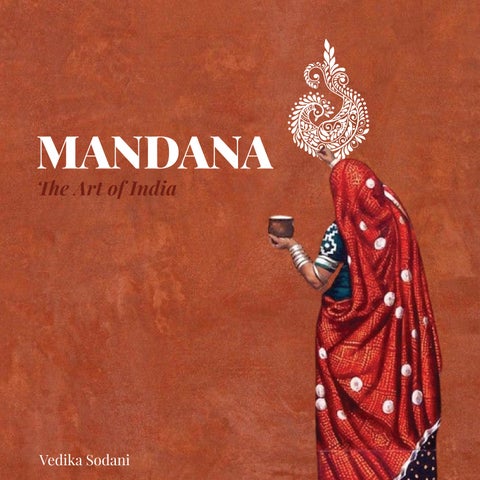
MANDANA
The Art of India
Vedika Sodani
Vedika Sodani
Common motifs and their meaning.
1 Symbolism behind the mandana motifs.
4 Introduction
5
2 Traditional Material used in mandnas.
7 Traditional Material used in mandnas.
6
3 Mandana Art in different mediums. Mandana in Hindu rituals & ceremonies. Role of women in preserving mandana.
8
The Mandana Art is the visual folk art of the state of Rajasthan and is regarded as one of the oldest surviving tribal art forms of India. Mandana paintings are wall and floor paintings of Rajasthan and Madhya Pradesh, India.Though the Mandana designs are famously referred to as the ‘Meena Paintings’, this Indian folk art has also spread to other states, especially Madhya Pradesh , and is practiced by other communities like the Bhils and Shrimali Brahmans.Mandana are drawn to protect home and hearth, welcome gods into the house and as a mark of celebrations on festive occasions. The art is practised on floors and walls, and the practice is often passed from mother to daughter.
The term is derived from the Sanskrit word "Mand," meaning beauty. Mandana as a whole is believed to bring blessings, prosperity, and protection to the home.
It is seen as a way to invite positive energies and ward off negative influences.The creation of Mandana is often a communal activity, strengthening bonds within the community.
Near the entrance, footprints of both feet are together, but on the threshold, one foot moves ahead of the other.
The Mandana motif of Lakshmi’s chariot is made at the place of Lakshmi Puja on Amavasya or the no-moon night of Diwali.
The Devi Jot is also part of this motif. This elements symbolizes the divine light, the inner spiritual illumination that guides one toward knowledge and wisdom.
It consists of 16 boxes, and in each lit divas or earthen lamps are kept. Women decorate the border with a four-petalled lotus flower, surrounded by curves of different types on-moon night of Diwali.
Women decorate the border with a fourpetalled lotus flower, surrounded by curves of different types. The lotus is a sacred symbol in Hinduism, representing purity,creation and spiritual enlightenment.
Itbrings auspiciousnesstothe homeand drives away negative influences, especially during special festivals like Diwali.
Treshold mandana Mandanaare
drawnto protect home and hearth, welcome gods intothe houseandasa markof celebration on festive occasions.
You can find Threshold Mandana inside the main entrance of the house. Its purpose is to invoke gods and goddesses.
7 lamps (diyas) are placed on the petals and a pot with water is placed at the centre.
Six and four ,eight-petaled lotuses are also constantly drawn, in fact, it is perhaps the most commonly drawn motif of Mandana art itself.
“Phoolon ka chowk”, the mandana resembles a flower in full-bloom. it explains its significance as a ritualistic art made by unmarried women to call upon a husband.
Not only is this Mandana unique, but it is also believed to bring good luck and abundance to the family. Once the Mandana is complete, food or rice is placed on it, along with two coconuts and the coconuts are considered to be an auspicious symbol and are believed to represent abundance, prosperity, and good fortune.
It has a powerful place in wedding and religious ceremonies, where it is used to bless the couple and the family.
The Mangal Kalash is a symbol of abundance, peace, and immortality which can be seen in this Mandana.
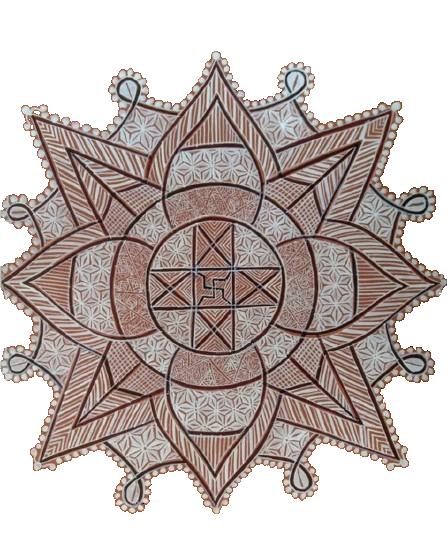
This intricate artwork is a heartfelt tribute to the divine, showcasing the artist's mastery of Mandana artistry and spiritual devotion.
This mandana is a sacred and artistic backdrop for a momentous occasion in a pregnant woman's life. During this celebration, the expectant mother is seated upon a 'baajotth,' a small and intricately decorated chair, which is thoughtfully placed upon this mesmerising Mandana creation.
This Mandana is believed to have special powers that can ward off evil spirits and ensure a safe and healthy delivery for the mother and baby. Once the Mandana is complete, the pregnant woman sits on it while a small pooja or ritual is performed.
This is a great example of one such Mandana that is considered to bring good luck and protection during the childbirth is made when a woman is eight months pregnant.
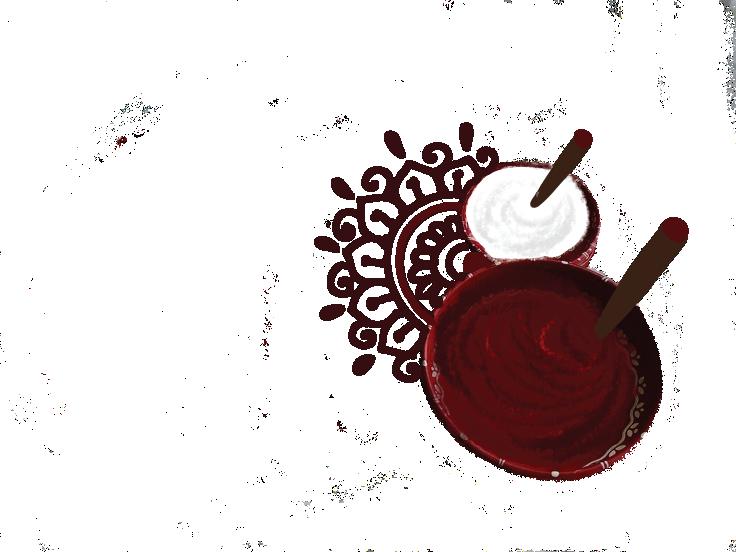
The materials used by the women to make a Mandana painting are all sourced from nature. The color scheme remains predominantly Geru mitti i.e. red and Khadiya or Khariya mitti.
The women artists of the Tribal art consider white to be a color of purity, while red on the other hand depicts fertility. Mandana designs are put down on the floor using the Index finger and thumb. While white is made by the use of chalk, lime, or white clay. The Red color is obtained by mixing cow dung, yellow mud, or Peeli Mitti and Geru or Himrich.
The ground is prepared with cow dung mixed with rati, a local clay, and red ochre.Tools employed are a piece of cotton, a tuft of hair, or a rudimentary brush made out of a date stick.
Mandana art, traditionally a vibrant adornment for walls and floors, has undergone a captivating transformatio
n. Artists are increasingly transferring the intricate patterns and symbolic motifs of this ancient art form onto canvas.
Traditional mandalas are often created using pen, ink, watercolor, or acrylics on paper or canvas. This medium allows for detailed, intricate designs that can be as vibrant or subtle as desired.
Religious and cultural symbols continue to be incorporated, adding depth and meaning to the paintings.
Digital : I n thedig i tal realm , m a ndalas a r e createdusing g r a p h i c derawtfosngise ekil A d o b e rotartsullI ro pohsotohP . lootlatigiD s a l l o w for precise cont r o l o ver shapesandcolor s , makingit eas i e r t o tnemirepxe tiw h s yrtemmy .snrettapdna
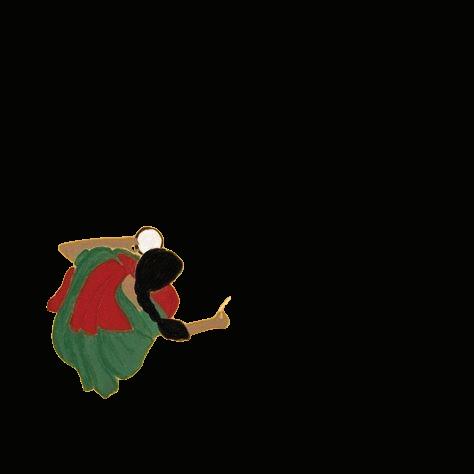
Rangoli, also knownasKolamin South I n d,ai si mrofralupopa fo anadnam tra . sevlovnitI gnitaerc snrettapetacirtni a n d designs ontheground using colour . . deroloc dwop e r s, r ice, flowerpetals, or other naturalmaterial s a r e esu d ot ekam
Yantras are geometricdiagrams usedin Hindu worshi p and demtati.noi rtnaynwonk-llewtsomehT si irS tnay.ar . Yantras are geometricdiagrams usedin Hindu worshi p and demtati.noi rtnaynwonk-llewtsomehT si irS tnay.ar . yantras are geometricdiagrams usedin Hindu worshi pand demtati.noi rtnaynwonk-llewtsomehT si irS tnay.ar . Yantras are geometricdiagrams usedin Hindu worshi p and demtatinoi rtnaynwonk-llewtsomehT si irS tnay.ar . Yantras are geometricdiagrams usedin Hind u worshi pand
.noi sirtnaynwonk-llewtsomehT irS tnay.ar .
ge.
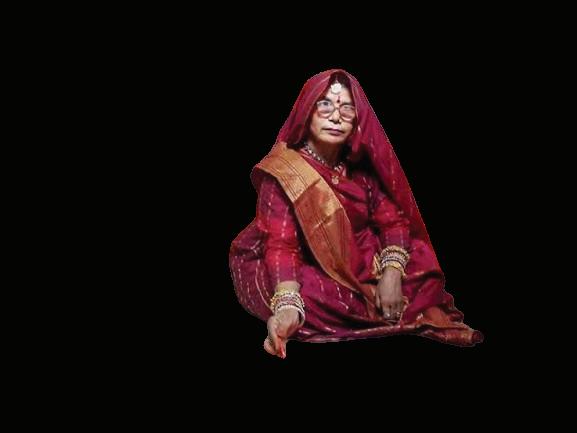
Koshilaya Devi, a 68-year-old artist from Rajasthan’s Baran city has been working hard to preserve and conserve the traditional white chalk on red background Mandana drawings.Koshilya Devi has till now painted over 100 designs in the Mandana style on hardboard using oil paints.
Mandana art, deeply rooted in Indian tradition, is experiencing a revival as part of a broader movement to preserve and cel ebrate indigenous crafts. This revival is often spearheaded by cultural organizations, artisans, and local communities who seek to maintain their heritage amidst rapid modernization. Efforts include documenting traditional techniques, organizing festivals, and conducting workshops that educate younger generations and raise awareness about the art form's cultural significance.Modern artists and designers have embraced Mandana art by incorporating its patterns into contemporary mediums and products.