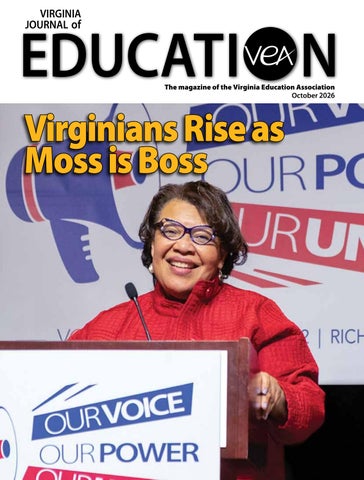
VIRGINIA JOURNAL of
EDUCATI N The magazine of the Virginia Education Association October 2026
Virginians Rise as Moss is Boss
Editor Kate O’Grady VEA President Carol Bauer VEA Vice President Dr. Jessica Jones VEA Executive Director Dr. Earl Wiman Communications Director Kevin J. Rogers Graphic Designer Lisa Sale Editorial Assistant/Advertising Representative Samantha Granados
COVER STORY
8
Contributors Sofia Barbieri Carla Davis Rob Hammel Bruce Ingram
CONTENTS
Virginians Rise as Moss is Boss
UPFRONT
Vol. 119, No.1
4-7 This month: Data Center Tax Breaks, Tips from Secrets, Banned Books week, and Mental Health Matters.
Copyright © 2026 by the Virginia Education Association The Virginia Journal of Education (ISSN 0270-837X) is published six times a year (October, November, December, February, April and June) by the Virginia Education Association, 8001 Franklin Farms Drive, Suite 200, Richmond, VA 23229.
FEATURES
12 Succeeding in the Lunch Line One ASL Interpreter shares the importance of language acquisition and the dedication it takes to support one student.
Non-member annual subscription rate: $10 ($15 outside the U.S. and Canada). Rights to reproduce any article or portion thereof may be granted upon request to the editor. Periodicals postage paid in Richmond, VA.
14 Not With Our Money, Not in Our Name Virginia workers call for an end to VRS war investments.
Postmaster: Send address changes to Virginia Journal of Education, 8001 Franklin Farms Drive, Suite 200, Richmond, VA 23229.
16 Student Leaders, Global Perspectives Stone Bridge High School’s Global Conference and Multicultural Festival Elevates learning through leadership.
Article proposals, comments or questions may be sent to the editor at tallen@veanea.org or Tom Allen, 8001 Franklin Farms Drive, Suite 200 Richmond VA 23229 800-552-9554.
DEPARTMENTS
Member: State Education Association Communicators
19 Membership Matters Ten minute meetings, summer wrap-up, Transform Your Organizing Conversations, and 2026 Legislative Priorities. 24 Insight on Instruction Local election information, 1% sales tax. 30 First Person Bruce Ingram shares his take on tackling controversial subjects in the classroom. Cover photo Lisa Sale; photo above, Moss photographed after winning the nomination, with Vice President Noel Candelaria (left), and Secretary-Treasurer Robert Varela Rodriguez.
Patrick Barry James Graves
VEA Vision: A great public school for every child in the Commonwealth of Virginia.
“Hi, I’m from your alumni association.”
VEA Mission: The mission of the Virginia Education Association is to unite our members and local communities across the Commonwealth in fulfilling the promise of a high quality public education that successfully prepares every single student to realize his or her full potential. We believe this can be accomplished by advocating for students, education professionals, and support professionals.
UP FRONT
Data Center Tax Breaks Cost Public School Investment
4
VIRGINIA JOURNAL OF EDUCATION | OCTOBER 2026
https://vea.link/GJFreport, and the Full JLARC report here: https://vea.link/JLARC-data.l Sources: Cline, Nathaniel and Heckt, Shannon. (2026, July 6th) “How Virginia Became the World’s Data Center Capital and How It’s Going.” Virginia Mercury. https://virginiamercury. com/2026/07/06/how-virginia-became-the-worlds-datacenter-capital-and-how-its-going/
multi-trillion-dollar companies to buy all their computers, equipment, and maintenance without ever paying taxes on them causes Virginians to miss out on $1.9 billion in revenue per year. And these policies have real world implications, as Good Jobs First, a national policy center that promotes government and corporate accountability, estimates data center tax breaks cost Virginian public schools approximately $267 million a year. Unless changes are made, that figure will only increase in the coming years. Additionally, in this year’s state budget, major compromises were made to preserve these tax breaks for wealthy companies. In an earlier Senate proposal, $29 million was generated from taxing data centers and would have been slated for investment in public schools through a program called the At-Risk Add-On. This program could have funded additional staff, smaller groups for intervention, attendance supports, wraparound services, and other evidenced based strategies to help our most at risk students. VEA President Carol Bauer summed up the impacts of these compromises by stating, “Tax policy is education policy. If Virginia wants strong public schools, competitive educator pay, and real support for students in high-poverty communities, lawmakers must choose a budget that asks everyone, including large corporations, to pay their fair share.” But the conversation isn’t over, and folks in northern
Photo by iStock
Depending on where you live in the Commonwealth, you may or may not be aware that Virginia holds the title for the nation’s largest concentration of data centers. Northern Virginia specifically is the largest data center market in the world, hosting 13% of all reported global data center capacity and 25% of capacity in the Americas, according to a Joint Legislative Audit and Review Commission (JLARC) report on the subject. This is nothing new for northern Virginia, as the proximity to open land, strong fiber optics network, and long-standing statewide tax incentives led to data center investment as far back as the heyday of AOL’s prominence in the 1990s (Virginia Mercury). However, as AI rapidly expands the missed revenue from these tax breaks also balloons, leaving public schools neglected. While data centers purport to contribute about 74,000 jobs and $5.5 billion in labor income, most of these jobs are temporary (JLARC). Once these giant warehouses are constructed, they can employ as few as 50 full-time employees, half of which are contract workers. Despite the temporary nature of these employment opportunities, all this growth and large-scale investment would still mean huge local revenue, and thus deeper coffers for public schools, except for a retail sales and use tax exemption for large-scale data centers that has been in place since 2010. These incentives are meant to attract business to the area, however, allowing
Virginia especially are beginning to push back. We can still ask our legislators to end data center tax exemptions. These breaks are set to expire in 2035, but because of the long-term investment data centers require, decisions around future tax exemptions are happening now, and your legislators should know that public schools should not be forgotten. You can read the full Good Jobs First Report here:
VIRGINIA JOURNAL OF EDUCATION | OCTOBER 2026
5
UP FRONT
Tips From Secrets of A Successful Organizer
“Your workplace may feel like a disorganized mess. But the truth is, you’re not starting from zero... Are there carpools, for instance? Family ties? A rumor mill?....People are social creatures who form bonds anywhere we go. But it’s especially true in a workplace, where we’re under pressure and relying on each other to get things done… So your next task is to find and build on the organization that’s already there. First, you’ll need to map out the many existing networks, and then you’ll begin to knit them together into your union network.” l
— Secrets of A Successful Organizer page 66-7.
This annual celebration, held October 4-11th and sponsored by the American Library Association and Banned Books Week Coalition began in 1982 in response to a surge in the number of book challenges across the nation. Forty years later the fight continues as we persist against attempts to censor which material hits the shelves. Data compiled by the American Library Association shows that 2025 was only 5 titles short of beating the record year of title challenges in 2023. In total, 4,235 unique titles were challenged, almost all of which (92%) were initiated by pressure groups, not individual parents. You can find out more about Read Banned Books week at: https://www.ala.org/bbooks.l
Meme art Olivia Geho; illustration by iStock
6
Read Banned Books Week theme is “Let Books Be. Protect the Freedom to Read.”
VIRGINIA JOURNAL OF EDUCATION | OCTOBER 2026
COVER STORY
by Kate O’Grady
T
he strength of a union is never found in one person. The power of a union, almost definitionally, requires a shedding of oneself in order to wear equally the dreams and identities of all union members. But even in this meld, or perhaps because of it, giants of the organization emerge and leave a legacy that feels like we’ve all made it. Princess Moss, from the small town of Bumpass, Virginia, embodies this collective achievement through the individual. She brings people together like she so often does with her right
8
and left hand in the shape of a heart. She simultaneously feels like she could be any member, while possessing the unmatched fidelity and determination of a leader. As she begins her term as NEA President, we look back at her Virginian influences, her VEA Presidency, and how our shared values will shape her time as NEA President. Princess Moss is the daughter of two bus drivers who deeply valued education, so her understanding of what it takes to live as an ESP occurred long before
VIRGINIA JOURNAL OF EDUCATION | OCTOBER 2026
she, as a music teacher, led classrooms in song. As a child Moss had to forgo participation in marching band due to logistical and transportation challenges, an issue that is all too common for rural students and too-frequently navigated by public-school employees in less densely populated parts of our state. Princess Moss joined VEA while studying education at Mary Washington University (UMW), showing an early understanding of the critical role VEA plays in educators’ lives. Moss’s sister, Hazel Moss Putty, was one of the first
sion. That meant that I had to look beyond the doors of my music classroom back in Louisa County. I owe that much and so much more to the children I taught and the ones who will follow them.” Her service as Louisa Education Association President, followed by an election to VEA Vice President is Moss’s way of fulfilling
job you have, do it well.” Because of this approach, Moss’s vice-presidency naturally evolved into two VEA presidential terms from 2005 to 2008. Traditionally, the Virginia Journal of Education would interview a close friend of the incumbent President before they took office, so as Moss was set to begin her VEA Presidency in 2004, the late Martha Wood,
…She knows how to relate to all kinds of people and make them feel comfortable and included in whatever work needs to be done. Everyone’s effort is valued, and Princess always finds a way to bring even the shyest people into the group and make them feel a part of the activity. I also learned that Princess is very well organized and plans carefully with an eye to the future and the intended results and effects of a project. She thinks creatively when it comes to difficult tasks…
this duty of care to those students. Moss’s steady progression can best be understood through advice she provided to other ambitious VEA members during her back-to-school Tour in late August of this year: “My own experience is that often the universe does not allow you to move to the bigger things until you have proven yourself on the task that maybe nobody else wants to do, and you take it and you do it well, and you do it with fidelity.” This in-the-weeds caretaking is the hallmark of Moss’s stewardship and has led her to succeed in her roles. She continues, “…whatever
VEA veteran leader and then VEA-retired President, was interviewed about Moss and their relationship: …She knows how to relate to all kinds of people and make them feel comfortable and included in whatever work needs to be done. Everyone’s effort is valued, and Princess always finds a way to bring even the shyest people into the group and make them feel a part of the activity. I also learned that Princess is very well organized and plans carefully with an eye to the future and the intended results and effects of a project. She thinks creatively when it comes to difficult tasks…
VIRGINIA JOURNAL OF EDUCATION | OCTOBER 2026
9
Photo by Lisa Sale
Virginians Rise as Moss is Boss
African Americans to attend Mary Washington University, and Princess followed her to Fredericksburg. Moss, at then-Governor Tim Kaine’s appointment, would go on to serve on the UMW Board of Visitors from 20072011. In this role, she helped the University stay mission-driven through setting institutional policies, approving changes to the curriculum, and setting faculty salaries and tuition fees. This commitment to the institutions in her life is reflective of Moss’s staunch loyalty. Mikayla Young, an SVEA member from Norfolk stated “We’re just rooting for her. I’m also an aspiring educator, and seeing her do it, while also being from Virginia, is inspiring.” Moss earned a master’s degree in Elementary and Secondary Administration and Supervision from The University of Virginia, to place a leadership cap on her academic studies. Lisa Sale, a staff in the Communications and Public Affairs Department, remembers Moss from her early days of membership saying, “At the time we had a program where members would receive different SWAG items when they reached certain benchmarks of enrolling new members. I remember this member, Princess Moss, constantly calling me because she had reached the next prize and thinking to myself, ‘Who is this Princess Moss person?’” Sale, and the rest of Virginia, would soon find out that Moss’s ability to pass thresholds and hit milestones would impact the course of the union. Moss began her career as an elementary school music teacher in Louisa County in 1983 and quickly got involved in her Louisa County local. Looking back on her early teaching days, Moss wrote in 2005, “I wanted to make a difference for my profes-
Moss playing piano with her students in Louisa County. The exact year of the picture is unknown but first appeared in the Virginia Journal of Education in 2004. Not only has Moss’s warm personality remained consistent throughout her career, but her commitment to non-partisanship is also a throughline of her Virginian service and a current pillar of her NEA presidency. With Moss at the reins, VEA secured a historic investment of $1.5 billion of new money for public education, which Moss credits to the hard work of a coalition of public sector groups who were intent on prioritizing public education over preservation of political battle lines. According to Moss, this group’s dedication to holding politicians, regardless of their party affiliation, to their so-proclaimed commitment to children and public education, enabled them to be effective. In a 2005 bulletin to VEA members, Moss discussed what it took to earn those funds: “We worked at the state level to secure the appropriation. We joined coalitions. We crowded community forums. We wrote letters
10
to the editor. We lobbied legislators. We held legislators accountable. We made history.” Today, Moss holds tight to that lesson, reinforcing, “That is one area I’m hyper-focused on because none of the parties are stepping up to support public education like we need them to. One lesson that I am taking from my time in Virginia, and have already used in my time as NEA President, is being issue driven and party-blind. We are going to focus on the issues that are important to our members, and we don’t align ourselves with party politics. We are the authority. We are the political authority.” Throughout her tenure as VEA President, Moss consistently urged members and locals to take ownership of their union, while also knowing they had state-level support. When celebrating their achieved historic investment in public education, Moss reminded locals that while VEA did its part, they also had a role to play: “In my thinking, part of a state association’s responsi-
VIRGINIA JOURNAL OF EDUCATION | OCTOBER 2026
bility is to help local associations develop into strong associations that, along life’s way, acquire the skills to effectively confront life’s situations.” For Moss, her task at VEA was providing a sense of unity, where all members felt represented by their union regardless of their zip code, party affiliation, race, or gender. Moss’s advocacy for equal access has been long standing, as she mentions in 2007: “We must achieve competitive salaries and benefits for our teachers, quality working conditions in all schools, and equity and access for all children regardless of their circumstances.” Moss is not hesitant to acknowledge that enacting our vision of a quality education to all students across the Commonwealth requires investment from both elected officials and from ourselves. As a member, as VEA President, and continuing into her NEA Presidency, Moss understands that
relying on a certain political party is not a shortcut to receiving the funds needed for great public schools; only a strong union of members amplifying their voices together will realize that goal. Moss has personally experienced relying on the support and mentorship of her union to achieve her goals. Barbara Wilson, a VEA-retired member who comes from the same small town as Princess, is part of the behind-the-scenes group that exemplifies the earned trust, organization, and dedication of others required to carry out the details of a successful national campaign. Wilson, like many in Louisa County, entrusted Moss with both of her children’s musical education, despite Moss sending both home with recorders. The shared history between Moss and many members in her hometown has carried them through fundraisers, campaign events, birthday celebrations, and Moss’s relationship-oriented rise to NEA presidency. When asked about Moss’s new position Wilson said, “She will bring a calm, rather than a storm, and that calm will bring about positive change. She’s so thoughtful; when she says something she means it… and she’s backed it up.” Before being elected as NEA President, Moss held two terms on the NEA Executive Committee, with her focus shown through her participation on the Elementary and Secondary Education Advisory (ESEA) Committee and the Dropout Prevention Advisory Committee. In these roles, Moss deployed her strategic storytelling skills to ensure that the experiences of students, locals, and community members stayed at the heart of every decision. Rosina Simmons,
Alexandria Education Association member and District H President reflects, “Her leadership is deeply personal. Princess understands that every individual has a unique story, and she takes the time to provide individualized attention that leaves a lasting impression. People walk away from conversations with her feeling heard, respected, and encouraged—a testament to her compassionate leadership style.” Moss also served as NEA secretary-treasurer, where she was able to acquire a deep understanding of the organization before her election to NEA Vice Presidency in 2020. Her Vice Presidency coincided with the coronavirus pandemic and the Black Lives Matter movement. Moss, composed, helped to steer the organization through the uncharted waters of a global pandemic, as schools across the country debated and then implemented virtual and at-home learning in diverse and often unequal landscapes. Moss’s experiences as VEA President had prepared her for becoming a leading voice for racial and social justice. In particular, Moss presided over the 40-year commemoration of the merger of the historically black Virginia Teachers Association (VTA) and the exclusionary white VEA. Previously, many had brushed over VEA’s resistance to integration, which it refused to do until under threat of censorship or removal by NEA in 1966. However during Moss’s merger celebration, she was able to shed light on the black experience and celebrate the merger in its full complexity: “Looking back upon those days, I can only imagine the emotion and the trauma that had to be experienced by these associa-
tion leaders…the white teachers... were throwing off the prejudices of centuries to bring the black educators into their organization.. and the black teachers were giving up an organization that had been their home for 80 years.” Moss and the VEA Executive Committee commemorated the merger with a plaque at the VEA HQ in Richmond, which reads “Two dreams – one vision.” They also commemorated the headquarters of the VTA in Petersburg. Moss, in all of her roles, has consistently advised others to pursue equality and inclusion through legislative action, voting in school board and local elections, and working with legal departments for protections in the court of law. Additionally, Moss has always been a fierce advocate for utilizing collective action in the pursuit of a great public education system, as is the unions’ fundamental power. Moss’s election from state to national presidency, while extraordinary, is not unprecedented for Virginia. In 1983, Mary Hatwood Futrell preceded Moss in this achievement. Futrell shone as a beacon of possibility for members looking to see themselves represented in the union. Of Futrell’s influence, Moss says, “We talk about kids needing a role model to signal that they can do this. Well, Mary was my role model. I got to see her chair the National Education Association Representative Assembly, and I was so inspired. She was a force.” The same year that Moss became a music teacher, People magazine called Mary Hatwood Futrell “one of the most powerful black women in America.” Beblon Parks, of VEA-Retired and previous VEA employee who worked with both Mary Hatwood Futrell and Princess Moss, recalled Futrell and Moss as both “embodying sisterly and motherly comfort,” as well as “showing you that they have the strength to say and do whatever is necessary to
VIRGINIA JOURNAL OF EDUCATION | OCTOBER 2026
11
Photo page 10 from archives
COVER STORY
FEATURE STORY
FEATURE STORY
ensure that the wellbeing of students and education employees received proper services.” Parks continues, “Mary Hatwood Futrell would say, ‘Teachers are not tall children,’ and she made a point to ensure that teachers were not dismissed when they presented themselves before school boards, city council, or whatever legislative body it might have been.” Although Futrell’s Presidency was over 40 years ago, the challenges to public school employees and unions are not dissimilar to what Moss will face in her role today. In 1983, then President Reagan spoke at the American Federation of Teachers (AFT) convention and said that NEA’s curriculum plans for students, which included conflict resolution and multiculturalism units, constituted “brainwashing.” Futrell told The New York Times, “Teachers are easy prey. We’re easy people to blame. If we should be blamed for anything, though, it should be for not standing up to protest against all the burdens that society puts
12
on us.” In a 2005 Virginian-Pilot op-ed Moss, like Futrell, emphasized that expectations of educators were unreasonable, stating: “As a teacher in Louisa County and VEA President, I can assure you that teaching has its non-monetary rewards. And if we didn’t have to eat, put roofs over the heads of our families, and send our own children to college, those non-monetary rewards might be all that we need.” Decades after Mary Hatwood Futrell led the way, Moss will continue to lead the fight against vouchers, for the celebration of LGBTQIA+ students and employees, and for historically accurate American history and civil rights curriculum, amongst other foreseeable and unpredictable battles at the state and federal level. Moss’s vision for her time as NEA President necessitates a unified mental shift, as she sees the NEA moving from reactive to generative. “We have been on defense for too long. We have been defending funding, defending rights, defending the very existence of public education,” Moss said in a speech to
VIRGINIA JOURNAL OF EDUCATION | OCTOBER 2026
Kate O’Grady, is editor of the Virginia Journal of Education.
Succeeding in the Lunch Line How one intervention requires a team effort by Rob Hammel
I
went with hummus and carrots. The snacks at the last meeting had not gone over well. No one ate gluten or sugar so the donuts were a bust. I made the hummus myself the night before and cut the carrots that morning. I was pretty nervous. This was my third year as an American Sign Language Interpreter in a public school. I had called together a group of teachers and aides who provided services to one of our deaf students, Katie (not her real name). We had maybe 15 minutes to meet before our students arrived. The other educators in that room had many more decades of experience than me, and I was determined to tackle our students’ behavior issues. A meeting like this even occurring was a small miracle. For most of human history, the hearing saw the Deaf as uneducable. Although some cities, like Paris and Philadelphia, had documented groups of Deaf people using signed languages, the vast majority of Deaf people grew up isolated and unable to communicate anything beyond a simple gesture. I had worked long enough in special education to know that could still happen today, if a child fell through the cracks. I would not let Katie grow up without language. I wiped my sweaty palms on my chinos and started the meeting. At the time Katie was 6. She had a cochlear implant but it did not provide her access to speech. When a child is born with a significant hearing loss, the medical profession
often tells parents that they have a wondrous operation which will grant hearing to their children: cochlear implants. These implants and all the gear that will come after the surgery is usually fully covered by the parents’ insurance plans or through federal
wanted their child to use the devices to hear and speak, to encourage this, their doctors told them to never use signed languages in the home. Although we tell hearing parents to sign with their hearing children, doctors often tell parents of deaf children that learning a
disability benefits. Doctors usually fail to tell parents that it takes years of therapy to learn to use the cochlear implant devices. For some people, the surgery will give them the ability to hear and understand speech. For others, that will never happen. Katie fell into the second category. Her implants allowed her to hear environmental sounds like the fire alarm but that was about it. Because she mostly perceived loud, annoying sounds with her cochlears, Katie hated to wear them. Katie’s parents desperately
signed language will delay the acquisition of speech. There is no basis in research or evidence for this claim. This is a pattern that many people working in Deaf Education will recognize. Because Katie had not had any communication in the home that she could understand for the first 6 years of her life, she experienced Language Deprivation. Arriving at school without a functional language presented a host of problems surrounding Katie’s education. The one we had met to discuss at that meeting was her trouble with the
VIRGINIA JOURNAL OF EDUCATION | OCTOBER 2026
13
Photo page 12 by Lisa Sale; illustration page 13 by iStock
Princess Moss reads to students in Virginia during Read Across America week, in 2020. Photo by Lisa Sale.
delegates on July 4th, “We must go on the offense.” This approach will require NEA to both fend off aggressive attacks by the Trump administration, while also articulating and pushing a specific vision for how to improve the quality of public schools around the country and expanding the benefits and safeguards of public-school educators. During her back-toschool tour, Moss pondered, “Why fight for what was, when what was wasn’t supporting educators or the students that we serve? Why not build and fight for what we know we should have in public education?” Moss’s commitment to remaining apolitical remains her source of power through this renaissance. Prioritizing public education in public discourse can become the laser focus when party politics are removed from the equation. Moss warns, “But we have to remember that our detractors always want us in the defense mode, fighting back. We’re going to have to do some defense, but we have to start building.” Throughout her career Moss has been able to see a path where one previously did not exist. As one of the first African Americans to attend Mary Washington University, as a member who had a Uniserv Director see something in her, as a student whose teacher encouraged her – she learned creativity when world building. Moss again, “We have to have hope. And what gives me hope is…the educators. That despite all of the stuff, they show up. They show up for their kids. I just believe that if they are given permission to fight for their kids, in the way that our country needs them to, that they’re going to show up for that too. And that’s what we’re working towards. That’s the movement!” Princess Moss has the platform and responsibility to lead us to our union’s full potential, but she would agree, it is our duty to ensure we all get there together.l
lunch line. At this point in her life, Katie used physical touch to communicate limited ideas to those around her. She grabbed what she wanted and pushed kids out of her way when she needed to. She had no concept of manners or even how to request something. She could barely walk in a line with other students. All of this made the cafeteria a daily nightmare. As her interpreter, I had to help Katie communicate with the nutrition team and her peers. Deaf people communicate visually, but Katie had never learned to pay visual attention to the people
around her. However, she knew that when she made eye contact with me, I would try and communicate something which she would have to work to understand and maybe respond. This made it very hard to get and keep her attention. An Instructional Assistant would physically guide Katie through the lunch line and keep her from elbowing or getting into conflict with another student. The cafeteria staff would often guess what she wanted on her tray and then the Instructional Assistant would give Katie’s student ID number for payment. We would all try to keep Katie calm, because violence was the only tool she had to express anger or frustration. All while a full class of Katie’s peers effortlessly selected their food and gave their own student numbers to
14
the cashier. Between bites of hummus covered carrots, we went over Katie’s behavior and their antecedents. We decided to focus on her interactions with her peers. Katie’s lack of communication skills isolated her from the other kids in the class. Katie’s classroom teacher pointed out that she could not participate in classroom activities like shared reading and games because she did not make connections with other students. Katie’s Teacher for the Deaf illuminated the developmental problems our student was up against and gave us examples of how she had worked with similar kids over the years. The Instructional Assistant let us know about Katie’s social aspirations; how she watched the other kids but did not know how to play with them. I reported on how much communication I had seen from her this year. We thought we could capitalize on Katie’s interest in the other girls in her class to teach her some rudimentary signs for requests and good manners. With a little grease on the social wheels, Katie might make some progress in communication. Our team developed a list of skills we wanted to see from Katie: pointing for what she wanted, signing “EXCUSE-ME” to move around people, and maintaining eye contact while communicating. The classroom teacher suggested that we make some social plays part of our morning meetings. I teamed up with a second interpreter and our Instructional Assistant to “write” these short plays with some first-grade girls in Katie’s class. There wasn’t much plot. The point was for Katie to watch her peers sign EXCUSE-ME and communicate with their hands and eyes. We spent hours on these little plays over weeks of morning meetings. Finally, Katie started to make some progress. The first day she signed EXCUSE-ME
VIRGINIA JOURNAL OF EDUCATION | OCTOBER 2026
instead of pushing past her friend, our whole team celebrated like we had won the Super Bowl. It took our team of five professionals over a month to teach one Deaf child to walk through the cafeteria line. Just 150 years ago, most Americans would probably say that a deaf child did not deserve the use of that much manpower and time. Those of us in education know the value of that time and effort. Katie will use those skills, skills that hearing children take for granted, for the rest of her life. The time we spent teaching her to order food laid the groundwork for her to become a social being. Katie would not have the friends she has today if five adults did not make the effort to stage short plays describing basic manners and social cues. Does it make financial sense to devote this much time to Katie? Will the “free market” see the value in our little plays? Could a charter school accept a student like Katie and endow her with an educational team like this? No. There is no balance sheet that will put us in the black while we teach children with disabilities. The point of educating children like Katie, all children in fact, is not to get a financial return on the taxes we pay into our schools. The point is to create citizens who work in concert with their neighbors: the highest ideals of public education.l Rob Hammel is the president of the Chesterfield Education Association. He has worked in deaf education since 2011 as an instructional assistant, interpreter and ASL teacher. Rob holds a master’s degree in Special Education with a concentration in Deaf Education from Radford University. He has been a VEA member for seven years.
Not With Our Money, Not In Our Name: Virginia Workers Call for an End to VRS War Investments by Sofia Barbieri
A
s public employees, we dedicate our lives to care, learning, and service. Yet the retirement funds we contribute through the Virginia Retirement Service (VRS) are being invested in death and destruction abroad. A coalition of Virginia residents, workers, and organizations, including Palestinian Youth Movement DMV (PYM DMV), NOVA Democratic Socialists of America (NOVA DSA), Party for Socialism and Liberation Virginia (PSL VA), Virginia Coalition for Human Rights, and Virginia for Palestine, is demanding that VRS divests from weapons manufacturers and shipping companies that are complicit in the ongoing genocide of the Palestinian people. The VRS manages over $80 billion in assets and administers pension plans for more than 803,000 public employees across 830 employers statewide, including teachers, school staff, and other public workers. According to campaign organizers, VRS has invested roughly $300 million of these funds in companies such as Lockheed Martin, Boeing, RTX, and Maersk. “Our goal is for VRS to revise their policy so that they will not only divest, but also never again invest in companies that manufacture or ship weapons or weapons components,” stated Raneem Abutin, an organizer with Palestinian Youth Movement DMV. Abutin explained that while VRS meetings are technically public, they
do not allow for public comment and make it nearly impossible for employees to see where their retirement money is going. “Why is the VRS hiding its investments? We demand more accountability and transparency from those managing our pensions.” Educators across the country have been speaking out in solidarity with Palestine. On July 5, 2025, members of the National Education Association (NEA) voted to end ties with the Anti-Defamation League (ADL), a right-wing organization that promotes the Zionist narrative under the guise of anti-hate work. Though the NEA executive board later overturned the motion, longtime organizers saw it as a historic step forward. Teachers who have been organizing for Palestine for decades, including Educators for Palestine, saw the motion as a win. “People just felt like there was a change in people’s minds,” said Judy Greenspan, a veteran educator and Jewish anti-Zionist activist who introduced the measure. “They felt like all of their work that they’d been doing for years to talk to people about supporting Palestine and the importance and the differentiation between antisemitism and support for Palestine really paid off.” Educators have taken similar steps in our capital city of Richmond. On March 11, 2024, the Richmond Educators Association (REA) followed in the footsteps of the NEA and
FEATURE STORY passed a motion to join the National Labor Network for a Ceasefire. This network consists of a growing list of unions across the country, including the American Postal Workers Union (APWU), Association of Flight Attendants (AFA-CWA), International Union of Painters and Allied Trades (IUPAT), National Nurses United (NNU), and United Auto Workers (UAW), United Electrical Workers (UE), all calling for a permanent ceasefire and an end to complicity in genocide. Abutin urges educators to keep
this momentum. To get involved, educators and community members can endorse the divestment campaign, sign the petition on VRSDivest. org, and join the telegram channel to stay up to date with campaign developments and volunteer opportunities. “Virginia has a responsibility to its citizens and to its employees, but they are moving without any form of consent from the people of Virginia. Through our demands, we are making them hear from Virginians directly, and we are saying we will not be complicit in genocide.”l Sofia Barbieri is a middle school English Teacher in Richmond City Public Schools, and a Richmond Education Association member since 2025. She has a bachelor’s degree in English from Virginia Commonwealth University, and currently serves on REA’s Board of Directors.
VIRGINIA JOURNAL OF EDUCATION | OCTOBER 2026
15
Photo and illustration by iStock
FEATURE STORY
FEATURE STORY
STUDENT LEADERS, GLOBAL PERSPECTIVES Stone Bridge High School’s Global Conference and Multicultural Festival Elevate Learning Through Leadership by Carla Davis
A MODEL WORTH LIFTING UP
ples that remain central to Virginia’s public education mission.
For Virginia educators, Stone Bridge High School’s Global Conference and Multicultural Festival offers a replicable model of student‑centered, inclu-
A WEEKLONG IMMERSION IN GLOBAL LEARNING AND LEADERSHIP
school community participate in shared academic experiences, field studies, workshops, and collaborative discussions grounded in real‑world application. Conference programming intentionally bridges classroom
sive education. When educators are trusted as professionals and students are empowered as leaders, learning becomes deeper, more authentic, and more enduring. As the Stone Bridge community gathered, the Multicultural Festival stood as a testament to educator leadership, student voice, and global learning—princi-
Stone Bridge High School’s biennial Global Conference Week, themed “AI and Technology in Our Changing World,” offers students a sustained, student‑centered exploration of global citizenship that extends far beyond a single event. Over five days, exchange students, Global Ambassadors, and the wider Stone Bridge
instruction with experiential learning. From classroom shadowing and advisory conversations to site visits at the Smithsonian’s Steven F. Udvar‑Hazy Center and the U.S. Capitol, students are encouraged to examine how technology, culture, and ethics intersect in an increasingly interconnected global landscape.
16
VIRGINIA JOURNAL OF EDUCATION | OCTOBER 2026
At the heart of Global Conference Week is the Stone Bridge Multicultural Festival, which serves as the culminating and unifying learning experience. Throughout the week, students research cultural histories, develop digital media projects, create exhibits, rehearse performances, and participate in workshops focused on media literacy, financial literacy, and global responsibility. The festival brings this learning into a shared public space. Students lead cultural exhibits, screen student‑produced heritage films, and perform through music, dance, and fashion. This year’s theme, “Global Connections and Belonging,” reflected the conference’s core purpose: making student learning visible while strengthening com-
transform classrooms and hallways into spaces of inquiry, dialogue, and shared learning.
munity through shared understanding. Far more than a celebration, the festival represents a yearlong effort driven by students who take on authentic leadership roles as researchers, planners, cultural ambassadors, and presenters. With educator guidance, students
London deepened his focus on global citizenship, science and technology policy, and international cooperation. Today, Dr. Banks continues his public‑interest work at MITRE, a not‑for‑profit research and development organization supporting U.S. and global policy missions. “Having a keynote speaker with
THE POWER OF A KEYNOTE IN GLOBAL CITIZENSHIP EDUCATION A defining feature of the 2026 Multicultural Festival is its keynote address by Dr. Jared Banks, whose professional journey reflects the principles of global citizenship Stone Bridge educators seek to cultivate. Dr. Banks began his academic career pursuing a PhD in African Studies at the University of Wisconsin–Madison. A Fulbright experience in Mozambique redirected his path toward public service, leading him to the Presidential Management Fellows Program and the U.S. Foreign Service. His work in Afghanistan, Geneva, and
Stone Bridge High School students and community members celebrate traditions during the Multicultural Festival. Far right, students tour Washington D.C. as part of understanding a global landscape.
VIRGINIA JOURNAL OF EDUCATION | OCTOBER 2026
17
MEMBERSHIP MATTERS
FEATURE STORY
MOTIVATING STUDENT AND FAMILY PARTICIPATION This year’s Multicultural Festival also featured a performance by Step Afrika!, internationally recognized as the leading authority on the art form of stepping. Through rhythm, movement, and storytelling rooted in African and African American traditions, Step Afrika! transforms performance into an immersive educational experience. For students, the performance reinforces lessons in teamwork, discipline, and collective responsibility— skills mirrored in their own leadership roles throughout the festival. Step Afrika!’s emphasis on audience engagement creates an inclusive atmosphere that invites families and community members into the learning process. Engaging families across a diverse school community requires intentional planning. Teachers embed festival participation into coursework, while students act as cultural connectors— encouraging families to attend, share artifacts, or participate as audience members. “When families understand that their traditions and stories are treated as valuable knowledge, participation becomes empowering rather than intimidating,” Davis explained. LEARNING THAT LIVES BEYOND THE EVENT The Multicultural Festival includes stu-
18
dent‑led exhibits, performances, interactive workshops, and a cultural fashion show, offering multiple avenues for leadership and expression. These experiences strengthen classroom learning across social studies, world languages, fine arts, and global studies while reinforcing collaboration, communication, and civic awareness. Stone Bridge High School students pose for a photo outside “Some stuof the Capitol as part of their Washington D.C. visit. dents lead through performance, others through research or conversation,” critical role in encouraging parRizley said. “What matters is that every ticipation among peers who may student has a voice and a meaningful feel uncertain about sharing their role. Student leadership is the heartbackgrounds publicly. Through beat of this event.” peer mentoring and collaborative At the foundation of the Multiplanning, students help cultivate cultural Festival is a simple principle: an environment where all identities students learn most deeply when they and cultures are respected and lead. From early planning meetings to valued.l final performances, students assume Many thanks to both the Loudoun responsibility for researching cultural Education Foundation (LEF) and Delta histories, designing exhibits, coordinatKappa Gamma International Educaing logistics, and welcoming the school tors Foundation (DKGIEF), who were community. funders of the Global Conference and Students aren’t just participating Multicultural Festival. in this festival—they are shaping it. Carla Davis is a Social Studies teacher When students are trusted to reprefor Loudoun County Public Schools, sent cultures, tell stories, and organize and has been Global Ambassadors events, they develop confidence and club sponsor for six years. She is a leadership skills that extend far beyond Loudoun Education Association one evening. member and VEA member since 2016. Student leaders also play a
VIRGINIA JOURNAL OF EDUCATION | OCTOBER 2026
MEETING BEST PRACTICES Once per month, you should hold a ten minute meeting in your worksite where you share the most important information, have members take action, and hear building-level (NOT individual) concerns. Intentionally Short. Ten minutes sounds like basically no time at all, and it is really short on purpose! Ten minutes is a small enough amount of time that most people will be willing to commit to coming. That means you have to keep the meeting to ten minutes. DO NOT GO OVER TIME! You lose people’s trust when you do that. Ask someone to be timekeeper so you don’t go over. Schedule. Try to get the most participation possible. That means you should keep the date and time consistent (e.g. 8am on the first Tuesday every month) so that it becomes routine. You may need to hold one morning and one afternoon meeting to get as many people as possible. This is totally fine! List of Members. Do yourself a favor and put out a list of all members’ names and contact information (your UD can give this to you). Have people check themselves in on the paper and double check their contact information. If they are not on the list, they need to join (or fix a membership record issue)! Follow up with members who miss the meeting and invite potential members so they know what the union is about. Keep it Simple. You DO NOT need a PowerPoint for a ten minute meeting. Don’t overcomplicate things. If you have a specific chart or document to share, you can put it up on a screen or simply make copies and hand it out. Keep things simple so that you are able to continue to do this work even as union action heats up. Invitation for more involvement. You do not need to make a plan to solve the issue in 10 minutes. You need to make everyone aware of the issue and then invite them to spend more time making a plan. SAMPLE AGENDA FOR YOUR FIRST 10-MINUTE MEETING 1. Welcome everyone and do brief (just name) introductions. 2. Share the most widely felt issues you and your worksite rep team identified based on your one-on-one conversations. 3. Take a vote to determine the top priority issue. 4. Tell everyone you will be holding a ten minute meeting every month and give them the information for the next meeting (date, time, location). 5. Ask everyone to commit to bringing one more person for the next meeting. If you have time, get them to give a specific name and write that down. (Hint: whoever follows through should be on your list of new leaders!) 6. Thank everyone for joining. If anyone has a specific thing they’d like to discuss about the issues, they can stay behind. Otherwise, you’re done. Assessment Questions 1. How many people came? 2. Did everyone stay the whole ten minutes? 3. Did you stick to just ten minutes, or did you go over? 4. Did you learn anything new from your colleagues?
VIRGINIA JOURNAL OF EDUCATION | OCTOBER 2026
19
Content by Olivia Geho; illustration by iStock
lived experience in diplomacy and global problem‑solving gives students a real‑world framework for what global citizenship looks like in action,” said Heidi Rizley, Stone Bridge High School English teacher and festival organizer.
MEMBERSHIP MATTERS
Summer Trainings Lay the Groundwork for a Strong, Organized Union
O
ver the summer, members from across the Commonwealth gathered in Richmond for a jam-packed week of Leadership Training and Summer Organizing Institute. These trainings served separate but complementary missions, immersing members in the nuts and bolts of leading a local during Leadership Training, and instruction on winning strategies to elevate their organizing during the Summer Organizing Institute. Attendees left fired up about the work of the union and had concrete steps to kick off the school year. During Leadership Training, local presidents, vice presidents, treasurers, secretaries, ESP Directors, and USAC Chairs all came together for three days of intensive practice specifically designed to support building strong local associations. Not only was leadership trained on the minutia of navigating governing documents, financial management, and membership reconciliations, but they also learned how to lead with a social justice lens. Tracks were also offered for learning about Collective Bargaining in Virginia and creating a Year-Round Organizing plan tailored specifically to individual locals. Also invaluable was time local leaders got to spend together comparing practices, sharing visions, and feeling state-wide solidarity. Summer Organizing was, as always, open to any member interested in increasing their capacity to build the union that public school employees deserve. To provide targeted and effective training, members were first given an assessment to match them with the most appropriate track, either building member power, worksite power, or local-level power. “Summer Organizing Institute has so many different sessions that helped to build worksite power,” Albemarle Education Association member, Claire Neill reported. “This summer, I learned a lot about building power within my local to help members and potential members to build better conditions for everyone. And that’s what we need in order to do what’s right and best for the kids in our lives.” There were also sessions on Communications and Campaigns, Data Security, Knowing Your Rights, and What’s Next in Government Relations. The knowledge members gained will lead us all to a stronger, more effective union. “Being a bus driver for 29 years, Summer Organizing makes me feel like I’m really a part of education. We’re a part
20
VIRGINIA JOURNAL OF EDUCATION | OCTOBER 2026
of helping our students grow, and helping our community grow, and keeping everyone together.” said Lamar Lewis “My favorite sessions are the breakout sessions when you can have conversations, and you hear stories that are similar to yours. Sometimes you feel like you are by yourself and feel like ‘nobody goes through what I do.’ And it helps knowing that there is someone that understands what you’re going through.”l
Membership Grows at New Employee Orientations Beginning in August, new public-school employees across the Commonwealth attended orientations before kicking off their first school year. The VEA, local association members, Uniserv Directors, and organizers set up tables, banners, and baskets of SWAG to welcome them into the union from the very start. Remember YOU are the union, and bringing new members into the fold makes us stronger!l
This July members came together in Richmond to attended either Leadership Training, Summer Organizing Institute, or both. Sessions were held on building power, learning organizing strategies, and more! The feelings of solidarity and empowerment will be brought back to transform your workplaces.
VIRGINIA JOURNAL OF EDUCATION | OCTOBER 2026
21
MEMBERSHIP MATTERS
KUD
PRESIDENT’S MESSAGE
— Carol Bauer
22
VIRGINIA JOURNAL OF EDUCATION | OCTOBER 2026
in them. We must treat each member, potential member, local, and student as precious and powerful. We must all believe that there is room for everyone, that each individual is capable of creating a positive impact, and that sometimes these impacts can reverberate across the nation. What Princess Moss’s Presidency reminds us is that every single member has the chance to improve a worksite, push for much needed support, or even chart the course for the largest union in the country. In every student, and in every interaction, lies the possibility to really make a difference. We all know the weight of our jobs. We know that the future is being molded by our coworkers and us, in our workplaces. So, we must act on the open-endedness of this belief. We must work together on the individual, building, local, and state level. There are states, politicians, and individuals who don’t believe that Virginia could lead in labor and in public education, and we must remind them that it is no accident that Princess Moss is the second VEA President to be elected to NEA Presidency. We can neither afford to underestimate what is possible on the state level, nor let disunity become establishment positions in locals, school buildings, or from individuals. Virginia is no stranger to presidents and it’s possible that the third NEA President from Virginia is all of us.l
Allison Ramirez, a U.S. History teacher and Albemarle member, was awarded the C-SPAN Teacher Fellowship Award. She plans to use the fellowship to develop resources using graphic memoirs to help students “explore civil liberties, government power and public discourse through accessible civic literacy”. Mollie Safran, a U.S. history teacher and a Loudoun Education Association member, was awarded the George Washington’s Mount Vernon 2026 History Teacher of the Year honor. Safran received a cash award and a fully funded field trip to Mount Vernon for the students. Janet Costello, a social studies teacher and Newport News member, was awarded the James Madison Graduate Fellowship for the Commonwealth of Virginia. The goal of this fellowship is to enhance educators’ knowledge of the Constitution. Costello hopes to complete a master’s degree in teaching American government, and obtain the requirements needed to teach dual enrollment government. Rachel Levi and Klio Stroubakis, both of the Winchester Educations Association were awarded grants from the Winchester Education Foundation, which focuses on raising funds for Winchester Public Schools in honor of Judge John Handley. Levi is a data coordinator and was awarded an educator grant, while Stroubakis received a Mindy Loy “Back to Teach” grant, which promotes local teacher retention. Have you received an award, fellowship, or grant that deserves some praise? Please send any notices, with a brief description, to the editor at: kogrady@veanea.org.l
VIRGINIA JOURNAL OF EDUCATION | OCTOBER 2026
23
Infograhic by Olivia Geho
Historic Awards Granted to Members Across the Commonwealth
Lesson From Princess As I reflect on the lessons we can learn from seeing one of our own, Princess Moss, elected to NEA President, I continue to return to the sentiment that “no matter where you come from, you can make a difference in the union.” However, I want to really break this thought down and be clear that I say this only to reinforce the greatness of public schools and the power that each of us holds. Because there could be an insult hidden in the first half of that idea. “No matter where you came from” implies that your hometown is so far removed from power centers, intellectual institutions, or resources that you’d have to negate or drastically overcome your environment to succeed. Whether you are a rural member or an employee in the inner-city, this naming of some very real obstacles can feel like a reinforcement of them; additionally, it may feel like a slight to your neighbors, coworkers, students, or family, all of whom live and grow in your hometown. The reality is that there are enormous challenges to working in public school today and that everyone and anyone can make a big difference in our schools and union. Public schools were created to give every student across the country access to a quality education— no matter their parents’ income level, their proximity to halls of power, their race, religion, or sexual identity. So, when I say, “No matter where you come from, you can make a difference,” it means I believe in the public schools across our state, and I believe in every single member working
S
2026
LEGISLATIVE REPORT CARD VEA’s Legislative Priorities
Does your Legislature Make the Grade? Interested in seeing how your representative voted on each of VEA’s Legislative Priorities? Go to: vea. link/2026-Report to see the full breakdown of their votes, as well as their overall score. Extra credit was awarded for exceptional leadership in advancing VEA’s legislative priorities. And remember, whether you liked the way they voted or not, it’s important that they hear from you! Positive feedback for standing with public schools can always reinforce the importance of our priorities, and when they don’t vote to support the hard work we do everyday, it is critical they are reminded of the value
of public schools and their employees.
Not sure who your representatives are? Find out at vea.link/ find-your-rep.
24
From the 2026 General Assembly Session Student centered funding. Includes HB92/SB90 to better align state funding with student needs by strengthening support for students in poverty and creating a dedicated special education add-on. Both bills were continued to the 2027 Session in the Senate Finance and Appropriations Committee (SFAC). Educator workforce. Includes votes on legislation to strengthen Virginia’s educator workforce through improved data collection and workforce planning. HB1437 requires annual reporting on educator and support staff vacancies and exits, including reasons for employee departures, with data disaggregated by race, helping identify workforce trends and turnover patterns. Also includes SB450, establishing a stakeholder work group to review alternative licensure pathways and improve educator preparation, retention, and workforce stability. Scale NBCT awards. Includes Senate Education and Health committee vote on SB217 that would have scaled the state supplement for National Board Certification Incentive Awards and covered fees for educators seeking certification to encourage high-quality professional development. Bill was continued in SFAC. Continuing contract protections. Includes HB125/SB117, affirming that teachers who have earned continuing contract status remain employed from year to year unless they choose to resign or are separated for cause Employee due process. Includes legislation strengthening procedural protections for school employees, including access to the grievance process before dismissal (HB116/SB824) and notice and an opportunity for a hearing before extended suspensions (HB849). Employee voice and rights. Includes votes on legislation guaranteeing educational leave for union officers (HB139) and extending the application of key labor and employment protections to public employees (HB670). The labor protections bill was narrowed during the legislative process and must be reenacted in 2027 before taking effect. Collective bargaining rights. Includes HB1263/SB378, landmark legislation that would have guaranteed collective bargaining rights for public employees statewide, including educators and education support professionals, while establishing a fair process for employee representation and contract negotiations over wages, hours, and working conditions. The bill passed the General Assembly but was ultimately vetoed by Governor Spanberger. Indoor air quality. Includes HB1345, which would have expanded school indoor air quality inspections, including testing for radon, mold, air contaminants, and other environmental hazards that can affect the health of students and school employees. The bill was continued in the Senate Education and Health committee. SOL reform. Includes HB299/SB200, which reduce the high-stakes nature of state testing by eliminating the requirement that SOL scores count toward final grades and providing teachers with better access to released assessments and sample test questions for instructional planning. The provisions requiring the release of SOL tests and sample questions must be reenactment in 2027 before taking effect. Honest history. Includes HB614, a first step toward strengthening inclusive history instruction by requiring a review of Virginia’s history and social science standards and identification of areas needing improvement.
VIRGINIA JOURNAL OF EDUCATION | OCTOBER 2026
INSIGHT ON INSTRUCTION
Your Annual Retirement Checkup Is Here The school year is underway, and you’re likely balancing lesson plans, meetings, extracurricular activities and responsibilities at home. With so much competing for your attention, retirement planning can easily move to the bottom of the list. The Virginia Retirement System makes it easier to check in on your progress with the Member Benefit Profile, available in your myVRS account at myVRS.varetire.org. Your MBP provides a snapshot of your retirement readiness as of June 30, showing whether you’re on track to meet your retirement goals and whether you should consider saving more. Along with your total service credit, member contribution account balance and retirement benefit estimates, it highlights future income projections, potential savings gaps and other benefits you may be eligible for, such as life insurance. To access your MBP, log in to myVRS, select My History, then choose Annual Statements.
include increasing contributions to a supplemental retirement savings plan or, for Hybrid Retirement Plan members, increasing voluntary contributions to take advantage of the employer match. Even small increases made today can have a meaningful impact over time. 3. Your Next Steps Your MBP is a starting point for planning. The profile includes links to tools in myVRS that can help you build a more complete picture of your retirement future. Use the Benefit Estimator to compare different retirement dates and benefit payout options. The Retirement Planner allows you to evaluate additional income sources and expenses to better understand your retirement readiness. While you’re logged in to myVRS, check your contact information and beneficiary designations to ensure they’re up to date. Make reviewing your MBP part of your annual financial checkup. A few minutes today can help you make informed decisions and stay on track toward your retirement goals.l
THREE THINGS TO REVIEW 1. Your Target Income in Retirement One of the most valuable sections of the MBP is Your Target Income in Retirement. It compares your projected retirement income with 80% of your current salary, a common benchmark used when planning for retirement. Your VRS benefit is an important part of your retirement income, but not the only source. The MBP helps show how your VRS benefit fits alongside other retirement resources, including Social Security and personal savings. 2. Potential Savings Gaps If your projected income falls short of your target, your MBP can help you identify the gap and consider ways to address it. Depending on your situation, options may
NEW! More Time to Spread Out Dues Payments! Thinking ahead to retirement? Becoming a VEA-Retired Pre-Retired Subscriber is now easier to fit into your budget. You can complete your subscription all at once or spread your dues across every remaining month of the VEA fiscal year. Subscribe by October 25th and you can spread your dues over up to 11 monthly installments. The earlier you subscribe, the more months you’ll have to spread out the cost. Visit vea.link/joinretired. All dues must be completed within the same fiscal year, which runs September 1 through August 31.
VIRGINIA JOURNAL OF EDUCATION | OCTOBER 2026
Photos by iStock
MEMBERSHIP MATTERS
25
INSIGHT ON INSTRUCTION
Notice of Spring District Elections
Check Your License Status!
Elections for the following District positions on the VEA State Board of Directors will be held in the spring 2027. Individuals elected to the VEA Board of Directors will also be elected as delegates to the VEA Convention and the NEA Representative Assembly for the duration of their term. Petitions will be available to district members no later than January. These districts are:
Do you know when your provisional or professional teaching license will expire? It is not the responsibility of the Virginia Department of Education (VDOE) to notify you when it is up for renewal—it’s your responsibility to monitor that. However, the VDOE does provide online services to help you know your status. To find out when your license expires, or to access other information on renewals, fees, replacements and applications, visit the Teacher Licensure section of the VDOE website at www.doe.virginia.gov/ teaching-learning-assessment/teaching-in-virginia/licensure.l
District
Local
Role(s)
Term Dates
A
Bristol, Buchanan, Dickenson, Lee, Norton, Russell, Scott, Tazewell, Washington, Wise
District Director
August 1, 2027 to July 31, 2029
C
Alleghany Highlands, Botetourt, Craig, Franklin County, Roanoke Co, Roanoke, Salem
District Director
August 1, 2027 to July 31, 2029
D
Augusta, Bath, Buena Vista, Clarke, Frederick, Harrisonburg, Highland, Page, Rockbridge-Lexington, Rockingham, Shenandoah, Staunton, Warren, Waynesboro, Winchester
District Director
August 1, 2027 to July 31, 2029
E
Fairfax
District Director
August 1, 2027 to July 31, 2029
F
Prince William
District Director
August 1, 2027 to July 31, 2029
I
Amherst, Bedford, Campbell, Charlotte Danville, Halifax, Henry, Lynchburg, Martinsville, Patrick, Pittsylvania
District Director
August 1, 2027 to July 31, 2029
J
Albemarle, Amelia, Buckingham, Charlottesville, Cumberland, Fluvanna, Goochland, Greene, Louisa, Madison, Nelson, Orange, Powhatan, Prince Edward
District Director
August 1, 2027 to July 31, 2029
M
Maggie l. Walker Richmond city
District Director
August 1, 2027 to July 31, 2029
N
Chesapeake, Portsmouth, Suffolk
District Director
August 1, 2027 to July 31, 2029
Q
Culpeper, Fauquier, Fredericksburg, Rappahannock, Spotsylvania, Stafford
District Director
August 1, 2027 to July 31, 2029
Know What’s on Your Ballot This November! From congressional and local races to constitutional amendments to school construction referenda in communities across Virginia, there’s a lot for voters to consider this November. Visit TheVirginiaVoterGuide.com to find your personalized ballot, learn more about the candidates running in your area, and identify those who best support Virginia’s public schools and students. Early voting is underway, so get informed, make a plan to vote early, and make your voice heard!l
Educators weigh in on a 1% sales tax dedicated to school construction and major renovation, on the ballot this November: “Our educators do extraordinary work, but they cannot fix the leaky roofs, outdated infrastructure or buildings that have reached the end of their useful lives.” — Patrick Barry, Norfolk Public School teacher and Vice President of the Education Association of Norfolk
“We have kicked this can down the road so many years, and it’s time to go ahead and say, ‘Okay, enough is enough. We have to do something. We’re going to depend on our community, our city, our parents, our students, our teachers and staff to help. So I believe this is a good way of doing that.” l — Dr. James Graves, President of the Newport News Education Association
Delegate elections will be conducted by local association leadership. According to the Labor-Management Reporting and Disclosure Act (LMRDA), all election details must be published in either the December or February issue of the Journal in order to comply with the requisite 15-day minimum notice period. Election details must be provided to the VEA Department of Communications by the third Monday in October for publication in the December issue of the Journal and by the second Monday in December for publication in the February issue of the Journal. Any local affiliate that misses these submission deadlines shall be solely responsible for a first-class election notice mailing to all eligible voters. If you have any questions or concerns, please email: vea.elections@veanea.org Be sure to take part in the democratic processes of your union!l
26
VIRGINIA JOURNAL OF EDUCATION | OCTOBER 2026
Photo illustrations by iStock
Election notifications will also be posted on the VEA website on January 5, 2027, and by January 11th, all members in these districts will be emailed a Notice of Elections announcing the election of board members. Elections for NEA director will be held in the spring for a three-year term (2027–2030). Petitions are available upon request. Elections will be held for delegates to the following events: • VEA Convention – March 18-20th, 2027 in Spotsylvania, Virginia • NEA Representative Assembly – July 30-July 4th in Indianapolis, Indiana
“...and for those just tuning in,
could you repeat that?”
VIRGINIA JOURNAL OF EDUCATION | OCTOBER 2026
27
The annual VEA Summit on Educators of Color fosters a collaborative, supportive environment that empowers everyone in school communities to work together to advance racial and social justice in our schools.
FIRST PERSON: NARRATIVES FROM THE CLASSROOM
Teacher Bruce Ingram interacting with his Creative Writing class at Lord Botetourt.
Controversial Subjects — Bruce Ingram
Photo by Bruce Ingram
T
30
his past January, now retired Roanoke Times columnist Dan Casey visited my Lord Botetourt High School Creative Writing class as part of our speaker series. Many of my students want to write professionally, and in the past year, three of them have placed stories in a state magazine and on a paying website. Thus, I’ve had novelists, short story writers, poets, song writers, and freelancers share their successes and failures. Casey eloquently spoke about the benefits of local newspapers investigating corruption and injustices. One of the highpoints of his presentation was the columnist telling how his efforts and research freed two men who had been accused of homicide. The presentation took a turn when one of the students brought up the then recent death of Minnesota’s Renee Good. In these contentious times, any discussion of current events has the possibility to erupt in heated debates and calls from parents. As would be expected, my Creative Writing students offered a number of views of what happened that winter day in the Gopher State, largely dependent on where their news sources originated from. Which engendered another topic of discussion. What news sources can one trust or are all news sources biased? Casey said one way of telling whether a source was reliable is if they accurately portrayed the basics of what happened. For example, one student said she had heard that Good had been following or perhaps harassing ICE personnel all day. The newspaperman said to verify if that statement were true or false, we would have to learn what time Good was killed. After some quick research, my students reported that the woman was shot just after 9:30, not long after she had dropped off her six-year-old daughter at school.
VIRGINIA JOURNAL OF EDUCATION | OCTOBER 2026
This revelation, of course, initiated an entire new line of discussion and more debate among my young people. Of great importance to me, however, was the fact that the students politely contested with each other. No individual’s views were labeled as “stupid” or “ridiculous,” and no ad hominem type attacks took place. The next day, I felt compelled to review what had taken place. First, I praised the students for their tolerance of beliefs and conclusions different from their own. I also told them that many adults I’ve encountered could take lessons from them. I was also aware that the students were curious about how I felt about the incident. So, I explained that the reason I had not - and would not give my opinion - was that doing so would suppress their comfort in expressing their views. Indeed, some students might understandably have become hesitant to elucidate their feelings if they were different from their teacher’s. Truly, the last thing I would have wanted to occur I told them. To emphasize that point, I used several examples from when I was an elementary, high school, and recent college graduate, which spanned the years from 1962 to 1975. During that time period, I explained, Americans were constantly embroiled in heated arguments with each other. And the teachers in my various schools were too willing to tell me what to believe, which I deeply resented. For example, in my segregated, public elementary school in Salem, we were taught how beneficial slavery was to African Americans, and how happy and content they were. Later, my sixth-grade teacher informed us of the evils of having a Catholic president in John Kennedy as he would be more obedient to the pope than the Constitution. Another canard was that when Roanoke area schools were finally about to be desegregated in 1965 – a full 11 years after Brown versus Board of Education – black students would “act up” in our classes. Next, I told my Creative Writing students that those 13 years were perhaps the most contentious ones of the 20th century with such earth-shattering events as the Cuban Missile Crisis, the assassinations of John and Robert Kennedy and Martin Luther King, the Civil Rights Act, Vietnam War, Watts Riots, Watergate, and a host of other tragedies and uproars that had Americans at each other’s proverbial throats. Unfortunately, we are living in similarly contentious times today. Finally, I once again thanked my students for their maturity, and expressed the hope that we could continue to talk and listen to each other. I guess that’s what we teachers can do to make our classrooms a sanctuary from all the worldly madness swirling about us.l
Teachers’ Lounge Makeover! Win a $10,000 Teachers’ Lounge Makeover* Enter September 7, 2026– October 6, 2026
m o c . a v r e h c a e t a k than
Art Contest
Winners receive a $200 gift card and $2,500 in supplies for their schools** Enter October 19, 2026– November 23, 2026
Bruce Ingram (bruceingramoutdoors@gmail.com), a member of the Botetourt Education Association and a veteran educator, teaches English and Creative Writing at Lord Botetourt High School. He’s also the author of more than 2,700 magazine/web articles and 11 books.
Odds of winning depend on the total number of entries received. *Two schools will each win a makeover valued at $10,000. Drawing on October 7, 2026. **Three Art Contest winners will be selected by a Blue Ribbon panel. See thankateacherva.com for official rules.
A publication of the Virginia Education Association 8001 Franklin Farms Drive, Suite 200, Richmond VA 23229 veanea.org
vea4Kids
SAVE THE DATE!