VIRGINIA JOURNAL of
EDUCATI N The magazine of the Virginia Education Association November 2026
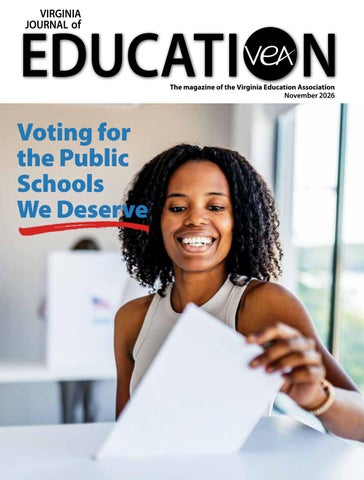
Voting for the Public Schools We Deserve
Editor Kate O’Grady VEA President Carol Bauer VEA Vice President Dr. Jessica M. Jones VEA Executive Director Dr. Earl Wiman Interim Communications Director Tom Allen Graphic Designer Lisa Sale Editorial Assistant/Advertising Representative Samantha Granados
COVER STORY
Contributors
8
Annwyn Long Janet Costello Bruce Ingram
Voting for the Public Schools We Deserve
Vol. 118, No.2
CONTENTS
Copyright © 2026 by the Virginia Education Association The Virginia Journal of Education (ISSN 0270-837X) is published six times a year (October, November, December, February, April and June) by the Virginia Education Association, 8001 Franklin Farms Drive, Suite 200, Richmond, VA 23229.
UPFRONT 4-7 This month: Letters to the Editor, childhood vaccine schedules, trusted relationships.
Non-member annual subscription rate: $10 ($15 outside the U.S. and Canada). Rights to reproduce any article or portion thereof may be granted upon request to the editor. Periodicals postage paid in Richmond, VA.
FEATURES 16 Stretching Beyond in Math How one educator’s quest to improve math sense turned in to so much more.
Postmaster: Send address changes to Virginia Journal of Education, 8001 Franklin Farms Drive, Suite 200, Richmond, VA 23229.
18 James Madison Fellowship Bring Opportunities to Newport News School A government and politics teacher prioritizes political engagement, offers rigorous coursework.
Article proposals, comments or questions may be sent to the editor at kogrady@veanea.org or Kate O’Grady, 8001 Franklin Farms Drive, Suite 200 Richmond VA 23229 800-552-9554. Member: State Education Association Communicators
DEPARTMENTS
VEA Vision: A great public school for every child in the Commonwealth of Virginia.
20 Membership Matters New staff, district election information, tips for parent conferences, and more. 27 Insight on Instruction Tips for Parent Conferences. 30 First Person Listening sympathetically to lessen anxiety. Cover image by iStock; photo above by Lisa Sale
“I think she’s like tech support.”
VEA Mission: The mission of the Virginia Education Association is to unite our members and local communities across the Commonwealth in fulfilling the promise of a high quality public education that successfully prepares every single student to realize their full potential. We believe this can be accomplished by advocating for students, education professionals, and support professionals.
UP FRONT
Letters to the Editor
“Education must remain a powerful promise that students can see themselves in, and the essential work of NEA members plays a key role in making sure all students are seen and valued…Together, we can create a student learning experience grounded in dignity, equality, and the infinite potential of all learners.”l — Remarks from Leon Smith, the National Teacher of the Year, at NEA’s 2026 Representative Assembly “We forget we matter to one another. The simplest thing we can do is acknowledge when we come into each other’s spaces… The kids know I care and am happy to see them and they wave back, which I need some days, too. What we put out there matters.”l — Ric Calhoun, NEA Educational Support Professional of the Year (2026)
“Maybe if we underpaid politicians and overpaid teachers, there would be smarter people and less stupid laws.”l — Morgan Freeman
4
VIRGINIA JOURNAL OF EDUCATION | NOVEMBER 2026
Have you ever read something in the Journal that you felt warranted a response? Perhaps there was a story you disagreed with, or a membership update that missed your local! Maybe you read an article and shouted out ‘YES!’ but now would like someone besides your cat to hear your excitement. We’re beginning a new “Letters to the Editor” section so that you can have a place to react, agree or disagree, and guide the shape of YOUR union magazine. The Journal can be a tool for discourse and engagement, but this will only work with your participation, so please, share with us as we create it together. Email your letters to letters@veanea.org, but please keep feedback to around 200 words, reference exact titles and/or issues you are responding to, and keep things friendly. Please also include your name and local, as anonymous letters won’t be printed. Letters may be edited for length and clarity, and not every letter will be printed. In solidarity, Kate O’Grady, editorl
Virginia AVERAGE TEACHER STARTING SALARY
AVERAGE TEACHER SALARY
$50,448
$69,254
#15*
TEACHER PAY GAP
68¢ Compared to other college - educated professionals with similar experience
PER STUDENT SPENDING
$17,674 #21*
A Licensed Nurse in Every School “Virginia should make sure there is a full-time, licensed nurse in every one of its schools. The commonwealth is close: More than 90% of Virginia schools have a licensed nurse on staff. As good as that statistic is, the lack of a nurse on site means that 8%-9% of schools face a serious deficiency in the health care of their students. That’s a gap that should be filled, for the good of students, their families and communities, and of the other professionals who work at the school. Commonwealth officials must also support ongoing efforts to attract more people to nursing careers, and to help them pay for education and licensing. They will need to get the word out about the importance of nurses in public schools and work to help school systems pay school nurses competitive salaries. There are many strong arguments for requiring a licensed, fulltime nurse in every Virginia school.”l — Excerpts from an October 12th editorial in the Virginian-Pilot
#26* MINIMUM LIVING WAGE
$63,390 AVERAGE K-12 ESP EARNINGS
$36,448 #21*
* in the nation Source: NEA Report on Educator Pay in America. Updated August 2026.
Trusted Relationships Open Doors on Student Rigor A recent report from two justice-focused organizations revealed the impact on students of having a trusting relationship with an adult. Equal Opportunity Schools, a nonprofit focused on improving access to advanced coursework particularly for students from underserved communities, and the Center for Trust and Transformation, which focuses on building resilient relationships, relied on data from over 1.8 million student records to draw their conclusions. K-12 Dive reported on their findings, which revealed that students who have a trusted adult at school, be they a teacher, counselor, coach, office staff, or custodian, were 10-20% more likely to take advanced coursework and have a slightly higher GPA on average. While these relationships can have social, emotional, and academic benefits for students, more can be done to leverage the impact of these connections. AJ Gutierrez, CEO of Equal Opportunity Schools, says that more exploration is needed to understand how to turn these relationships into opportunities for students, “We still have more to learn about how schools can do that consistently and at scale,” Gutierrez said, “with so many schools confronting disengagement and chronic absenteeism, understanding that connection has never been more important.” Trust-building can be complicated, but with intentionality it can open doors to rigorous educational experiences for the student. You can read the full article from K-12 Dive here: vea.link/trustin.l
VIRGINIA JOURNAL OF EDUCATION | NOVEMBER 2026
5
Photos page 5 by iStock
Advice From the Best of Us
UP FRONT
Public Sector Solidarity “The fight back against various forms of school privatization is important, but we need to realize that there is no saving public education if the public sector as a whole goes down. It’s not possible. There will be no public education sector island in the middle of a private sector ocean. To the extent that public school advocates are not engaged in the fight to defend the entire public sector, they will lose. That’s the critical thing.”l — Bill Fletcher Jr. in an excerpt from “Organizing in Defense of the Public Sector,” from the book Teacher Unions and Social Justice: Organizing for the Schools and Communities Our Students Deserve.
To create a nation of diverse and enthusiastic readers, NEA recommends an elementary, middle grade, and young adult book, with a common theme, every month. This month’s theme is Find Your Strength, which encourages students to discover what fuels their power. Additionally, this month, in celebration of American Indian/Alaska Native Heritage Month, each book is from the perspective of an American Indian. Head over to NEA’s website for additional teaching resources, and to see the full Read Across America calendar. https://vea.link/ReadAcrossAmerical
101 That’s the total number of schools in Virginia within a mile of a data center, or one that’s under construction.
Source: The 74, Samantha Kane, Matthew Kraft and Christopher Cleveland, Brown University, using data Business Insider’s “True Cost of Data Centers” project and the National Center for Education Statistics.
6
VIRGINIA JOURNAL OF EDUCATION | NOVEMBER 2026
Childhood Vaccine Schedule Changes Risk Community Health This August, with the release of an executive order changing childhood vaccination recommendations, the Trump Administration has again confused and misled families who seek guidance on what’s best for their kids. This federal guidance, called the “Gold Standard Childhood Vaccine Recommendations,” reduces the number of vaccines given to children from 17 down to 11, while also separating the measles, mumps, and rubella vaccines into three different shots. There is currently no precedent, or even scientific ability anywhere in the world, to separate out the measles, mumps, and rubella vaccines, which when combined is commonly known as the MMR shot. The administration falsely claims that the U.S. is a global outlier who over-vaccinates our children, which is easily disproven, as most other countries also encourage somewhere between 16 or 17 vaccines. If parents are looking for guidance on how to keep their children safe, they should turn to the American Academy of Pediatrics (AAP), whose response to the schedule changes was to reassert the importance and safety of childhood vaccines and share their recommended vaccine schedule. This schedule, which is linked below, includes more vaccines than the reduced CDC recommendations. Additionally, the National Association of School Nurses, whose members experience childhood illnesses firsthand, also released a statement which touted vaccine effectiveness in reducing absenteeism and promoting student and staff health, which results in safe school environments. We know that not only do students fail when dangerous, and possibly deadly, diseases spread through schools, but unsafe public schools are the dangerous working conditions of public school employees. To address this issue, the NEA created a Vaccination Resource Center chock full of information, best communication practices, and public health resources to ensure parents and community members are making informed vaccine decisions. While the Trump Administration may try to dress up their misinformation by labeling it the “Gold Standard,” most experts agree, their recommendations are nothing but fool’s gold. You can find the NEA Vaccine Resource Center here: www.nea. org/advocating-for-change/vax-to-school The American Academy of Pediatrics Vaccine Schedule can be found here: https://vea.link/AAPrec l
“Eyes on your own paper!”
Veterans Day: A Chance to Salute Those Who Served Veterans Day is Wednesday, November 11th and calls us to honor all who completed active duty in the Armed Forces, Public Health Service, or the National Oceanic and Atmospheric Administration. According to the most recent data (2022) from the National Center for Education Statistics, approximately 2.8% of teachers in the region are military veterans. The U.S. Department of Veterans Affairs shared a Veterans Day Teacher’s Guide, which provides sample lessons, student activities, and even instructions on hold to fold the flag. You can access the guide in it’s entirety here: https://vea.link/ VeteransDay.l
VIRGINIA JOURNAL OF EDUCATION | NOVEMBER 2026 7
Illustrations and photos by iStock
Read Across America
VOTING FOR THE PUBLIC SCHOOLS WE DESERVE
How your votes and collective action will determine the future of the collective bargaining bill and Virginian public schools. by Kate O’Grady
N
ovember thankfully presents us with cooler weather and an opportunity to have a say in the future. But much like the school year that is well on its way, the groundwork for a successful November was laid months in advance and will continue to require hard work after our votes are cast. And while we don’t know the outcomes of the elections yet, we must do everything in our power to achieve the schools a democratic society deserves. The future of public schools —their funding, our working conditions, and the experience of students— is deeply impacted by our actions. Most critical is securing the fair and comprehensive collective bargaining bill we were promised. But first, let’s look at who and what is on the ballot and review VEAs endorsements and our legislative agenda. What and Who is on the Ballot It is all too easy for the same old politicians, to side with big businesses, billionaires, and special interest groups, meanwhile forgetting that their constituents are working people who want to build a life in the Commonwealth. When politicians underfund our schools and then blame us for not reaching ever-moving goal posts, we have elected poorly. We need to have elected officials who respect us and listen to our input. To that end, included below is the list of school board candidates who have earned VEA’s endorsement. In the future, more educators should run for office, so that public school decisions are made for us and by us. Many educators work in schools that are neglected in ways politicians cannot even imagine; the buildings
are fire hazards or crumbling, are mold ridden, or too hot. In order to generate the additional funding needed to address these capital projects, a one percent sales and use tax has been added to the ballot in certain cities and counties and could be added to more localities in the future. Also on the ballot are three constitutional amendments, all of which VEA has endorsed a yes vote on for their support of the freedom and democracy that go hand-inhand with the common good of public schools. Whether or not you’ve cast your vote, it’s important to know exactly what is being discussed and how we can ensure we’re working towards the public schools we, and the students, deserve. VEA Fund and Local Association PAC Recommended Candidates Over 159 school board candidates are running in Virginia this year. In particular, Virginia Beach and Chesterfield County are home to highly competitive school board races that will not only shape public education but decide the future of collective bargaining in their locality. Just a few local PAC-recommended candidates include: •
James “Chris” Lewis for Virginia Beach School Board, District 2
•
Dr. Alveta J. Green for Virginia Beach School Board, District 4
•
Natalie Bray for Virginia Beach School Board, District 8
•
Suzanne F. Berman for Virginia Beach School Board, District 9
•
Dr. Betty J. Spencer for Virginia Beach School Board, District 10
•
Special Election Alert: Christina Romers Brady for Chesterfield County School Board, Clover Hill District
VEA is also proud to see longtime VEA member and 36-year educator Freda L. Curtis running for the seat in Petersburg School Board Ward 3. Freda brings a passion for student success and years of experience advocating for quality public education. There are many more seats up next year, and beyond. Rather than voting next year for the people who we believe will best listen and respond to our voice, we need to take power in our own hands and run for these school board seats ourselves. No one knows what public schools, their employees, and students need to succeed like folks who have years of actual public school experience. To support these efforts, NEA has launched a program called Education Votes, which engages members and allies in securing candidacies for office. The See Educators Run training, hosted through Education Votes, arms members with everything one
Interested in running for office in 2027? Interested in running for office in 2027? Apply for the See Educators Run training or learn more at: https://vea.link/EducatorsRun
VIRGINIA JOURNAL OF EDUCATION | NOVEMBER 2025
9
Illustrations by iStock
COVER STORY
COVER STORY would need to know about mounting a successful campaign, including fundraising and communicating with voters. Running for office can feel intimidating, but if public school employees don’t step up to ensure our agendas are implemented, we will continue to fight with politicians who are less experienced in what it takes to prepare a child to reach their full potential. And who knows, you might be surprised at how impactfully you articulate your ideas when skills are sharpened with NEAbacked training and support. Simply running for office sends a message that education decisions need to be made by educators, and we start to pull the needle toward respect for our profession and the insights that come with the experiences of the job. 1 Percent Sales and Use Tax Referenda for School Construction Each year, the state provides a set dollar amount to localities for school operations like programs and staffing, but much harder to secure are funds for larger ticket items like school facilities construction and repair, which are usually funded through slow-moving grant programs. Many educators have experience with crumbling, outdated buildings that at worst are health hazards, or simply are not a fresh environment for generating new ideas and modern education practices. In 2021 the Virginia Department of Education’s Needs & Conditions study documented a multi-billion-dollar backlog of school facility needs, a number that has only increased in the years that followed. This 1 percent sales tax is a creative way to tackle this expensive and hazardous issue and empowers localities to
10
state and local sales tax rate but decide on the state of their public could add up to hundreds of millions schools. Additionally, this tax will not in project funds for the state in the apply to most regular spending; for first year. See the box below for the example, groceries, essential hygiene full list of the 47 localities which have products, gas, prescription medicathe proposal on their ballot or have tions, vehicle purchases, home heatalready implemented the tax. If your ing fuel, and labor are all unaffected locality isn’t posing the question on by the tax. Retail purchases such as the ballot this year, reach out to your clothing, electronics, and restaurant elected officials to advocate for it’s meals would be taxed if a proposal addition. to see where your locality was adopted. Based on national stands on the issue next year. spending data, the cost of this tax to See map on page 12 to see where the average family of four would be your locality stands on the issue. roughly $13 a month. Although evUnlike many tax provisions, eryone’s dollar is not stretching as far these changes aren’t forever because as it used to with high inflation and costly groceries and gas, $13 a List of Sales Tax month to adReferendum Localities dress neglected Cities Counties school buildings Radford Augusta is a good deal. Covington Alleghany Further, everyMartinsville Giles one takes part Buena Vista Pulaski Lexington Wythe in these taxes, Waynesboro Smyth including visitors, Staunton Grayson commuters, and Charlottesville Floyd out-of-locality Winchester Franklin shoppers, so if Fairfax City Nelson Frederick Richmond you live in an area Emporia Rappahannock reliant on tourism Newport News Madison or shopping, your Norfolk Stafford schools could see Portsmouth Greene a major facelift. Orange Albemarle Existing Cities/Counties Localities across *These localities had already Fluvana the Commonbeen given authority to levy Powhatan wealth have the this tax prior to the recent Chesterfield option to ask General Assembly session Amelia voters to approve Prince Edward when it was extended to all Nottoway localities across VA an additional Sussex local sales tax of Patrick Greensville up to 1 percent to Henry Essex help fund school King and Queen Pittsylvania Danville Middlesex construction and Halifax New Kent major renovation Matthews Charlotte projects. This York Mecklenburg means adding Gloucester Isle of Wight one cent per dolNorthampton lar to the existing
VIRGINIA JOURNAL OF EDUCATION | NOVEMBER 2026
there is a sunset clause which ends the additional tax, typically in 20 years, or when any bonds are paid off, whichever comes first. This ensures that this tax goes only to the improvement of school buildings and ends when this long-neglected issue has been addressed. Investment in our school buildings is desperately needed, and if this ballot measure passes in your locality, it will have tangible results in the quality and safety of your workplace. Virginians for Modern Schools is a statewide coalition of school boards, supervisors, superintendents and other stakeholders who are advocating for adoption of this sales tax. You can learn more about the 1 percent sales tax on their website: www.virginiansformodernschools.org. VEA Endorses Voting Yes on All Three Proposed Constitutional Amendments This year there are three proposed constitutional Amendments on the ballot, all of which VEA has endorsed. The first addresses freedom to make personal decisions around prenatal care, childbirth, and abortion while also protecting doctors, nurses and patients for these decisions. The second ballot question removes the current constitutional ban on same-sex marriage and affirms that two adults may marry “regardless of sex, gender, or race.” The third proposal asks whether voters would like to restore voting rights to individuals previously incarcerated for felony convictions. This last amendment fine-tunes the language of those prohibited from voting from “mentally incompetent” to “persons who have been found to lack the capacity to understand the act of voting.”
Vouchers Year after year vouchers are repackaged and sold as the solution to the challenges public schools face. Yet time and time again, research shows that they in fact do not address diverse access to high-quality schools, supports for students with disabilities, or support parental school choice. Vouchers do nothing more than drain the already shallow pool of public schools’ funds and erode a public sector good in favor of privatization. Vouchers also harm rural communities, as only 34 percent of rural families live within 5 miles of a private school, yet they would still carry the tax burden supporting vouchers. Said another way: all of the cost, with none of the benefits. This year, a narrowly passed section in the “Big Beautiful Bill” allows for individual donations to private scholarship organizations to be rewarded with a matched tax credit up to $1,700 (or $3,400 for joint filers). So rather than those tax dollars funding the public schools that educate over 88 percent of Virginia’s K-12 students, they would be diverted to individuals funding privatized, often religious, schools. Where there was once a cap on how much of these public funds could be rerouted, there is no longer a limit on how much could be diverted. Estimates from the NEA put the approximate loss to public schools at $25 billion. Further, because in Virginia, public school funding is based on enrollment, if even just a few students leave, the funding drops while the costs, like staffing and electricity, for the rest of the schools remain the same. Loss of enrollment can snowball into major impacts to public schools, which could translate into annual losses of $222 million to $956 million. But Governor Abigail Spanberger can opt Virginia out of
the program and protect Virginians. Opting out would also align with what Virginia voters have repeatedly shown they want. Since 1970, Virginian voters have rejected every single attempt to create or expand private school vouchers via ballot ref-
erendum, however, it is unclear yet if Governor Spanberger wants to align herself with the will of her constituents or if she is pro-privatization, backing Betsy DeVos and the Trump administration. VEA members must make sure that their legislators and the governor know their position on this issue. It is not enough protection to assume that the historic public opinion will be heeded, and our loud, collective voice needs to be clear: vouchers have no place in Virginia. 2027 Legislative Session and the Collective Bargaining for All Bill Despite not winning the collective bargaining law we were promised, our last legislative session in 2026 was the most successful we’ve had in years thanks to the hard work and advocacy of VEA members. This year, we need to build on that momentum, and we’ve set some aggressive goals. On page 10, you can see on the wins from 2026, which laid the groundwork for the 2027 legislative session agenda, found on the following page. The 2027 session begins on January 13th and most likely will last for 45 days. During this time, VEA is leading roughly 50
VIRGINIA JOURNAL OF EDUCATION | NOVEMBER 2025
11
COVER STORY
12
and her constituents. Not only does collective bargaining allow workers a seat at the table, to discuss as equals the work that we have dedicated our lives to, it also improves teacher retention and the learning environment of the students we serve. Where collectively bargained contracts have been implemented
VIRGINIA JOURNAL OF EDUCATION | NOVEMBER 2026
2026
Legislative Wins! Because of union advocacy, teachers and public school staff will receive a 4% salary adjustment for the upcoming year, and another 4% the following year—double the initial 2% proposal! 4% instead of 2% means the average Virginian teacher will earn about $4,400 more over the next two years!l
13 VEA Priorities Signed into Law, Including: •
Giving support staff basic due process before dismissal
•
Clarifying continuing contract protections for educators
•
Strengthening wage protections for school employees
•
Requiring fair notice and an opportunity to be heard before suspension
•
Supporting unpaid leave for certain union officers
•
Requiring better data on why public school employees leave their jobs
•
Reviewing alternative licensure pathways to better support new educators
VEA Won Major Investments for Public Schools Including… •
Nearly $160 million more for special education to better support students with disabilities and the educators and staff who serve them
•
$3 million for teacher preparation scholarships to help reduce the financial barriers for future educators
•
$1.25 million to modernize Virginia’s school funding formula, moving us closer to a fairer system for every school division
•
A new provision in Virginia’s state budget that gives all localities an opportunity to vote for an additional local sales tax of up to 1% to help fund school construction and major renovation project This year 47 localities will have this question on their ballot
VEA Stopped harmful bills that would have… •
Diverted public school funding to private and homeschool settings
•
Targeted transgender students and weakened safe, inclusive schools
•
Reduced state revenue needed for public education and other services
•
Lowered safeguards for outside groups seeking access to students during the school day
&
workers deserve first access to the rights and benefits of a seat at the table is a way to divide us and runs the risk of leaving those waiting for their turn to face unfair working conditions with no end in sight. The second priority relates to protecting the neutrality of the Public Employee Relations Board (PERB), which is a decision-making agency that settles Where Virginia localities have or are seeking 1% sales-tax authority disputes between Several Virginia localities will ask voters in November whether to authorize an additional 1% sales tax, two parties. In relawhile nine localities already have the authority. tion to the collective Seeking Authority Not Seeking Authority Authorized bargaining bill, PERB would settle disputes between an employer, the labor union, and/or an employee. The PERB establishes regulations such as the procedure that must be followed for union certification, as well what constitutes as unfair labor practices. Ensuring that the collective bargainSource: Virginia Department of Elections (as of Aug. 26, 2026) l Get the data l Created with Datawrapper ing bill does not degrade into simple PERB regulations protects workers rights at the local level, pay has increased democracy. from politicalization and the whims and workers have received better Governor Spanberger’s veto of of the Governor, who decides who benefits, while also receiving more the collective bargaining legislation sits on the PERB. Thirdly, workers respect for the work that they do. that was the culmination of years need recourse if they are illegally VEA, working with the Labor of collaboration between labor fired for exercising their labor rights. Coalition, has come up with four unions, coalition partners, and If employers are not made to finanpriorities that must be included stakeholders from across the Comcially compensate fired workers, in any collective bargaining bill. It monwealth was a major defeat-one there is no penalty for participating is important that we know these that cannot stand. After publicly in union-busting. Lastly, some critics priorities and the details of the and privately committing to pass argue that the General Assembly bill inside and out. As the defendthe bill and provide a seat at the tais overstepping its powers and ers and promoters of this bill, we ble to public sector workers, Spandisempowering the schools boards’ cannot allow politicians to mislead berger exercised her veto power constitutional responsibility to us or guide legislation in a direction when the General Assembly did not supervise how schools are run by which does not benefit those imaccept her changes, which gutted laying the ground rules for deciding pacted. The first priority states that the powers of the collective action binding arbitration between school all public sector workers receive the in the bill. It is critical that VEA push boards and unions. This claim is right to collectively bargain their the Governor to honor the promises false, as nearly 50 years ago the contract in one move, not with she made on the campaign trail Virginia Supreme Court page 28 staggered start dates. Picking which and fulfill her promises to workers bills which promote and protect public schools and public school employees. We’re also supporting or opposing hundreds more as we simultaneously advance our goals and defend against attacks on our collective bargaining rights, attacks on funding via vouchers, and other freedoms of expression and
2027
Legislative Agenda VEA WILL INITIATE LEGISLATION AND BUDGET ITEMS TO: •
•
•
•
Strengthen and protect fair labor practices and the right of public employees to organize and collectively bargain. Modernize Virginia’s school funding formula and fully implement the recommendations of the Joint Subcommittee on Elementary and Secondary Education Funding. Strengthen support for National Board Certification and professional growth opportunities for educators. Provide funding to ensure teacher salaries are at or above the national average and school employees earn a living wage.
•
Secure protected planning time for all public school teachers.
•
Guarantee all public school employees a duty-free lunch period.
•
Ensure public employees have clear, consistent, and enforceable work- place protections against discrimina- tion.
•
Ensure school employees receive timely compensation for their work.
•
Strengthen retirement security for school employees.
•
Protect schools and child care facilities from the impacts of nearby data center development.
•
Improve indoor air quality in schools.
•
Provide free school meals to all public school students.
•
Modernize retirement policies to recognize eligible supplemental compensation.
•
&
•
VEA SUPPORTS LEGISLATION AND BUDGET ITEMS THAT:
privacy, preserving educator professional judgement, and supporting AI literacy for students and educators.
•
Increase state revenue to more adequately support school systems.
•
More adequately fund and support special education services and expand the flexibility of state support.
VEA OPPOSES LEGISLATION AND BUDGET ITEMS THAT:
•
Increase the fairness and effort of funding for schools with a high share of students living in households experiencing poverty.
•
Address evolving facets of school safety concerns for staff and students.
•
Supports development, mentorship, and retention policies for alternatively licensed educators.
•
Strengthen employee benefits for school personnel.
•
Increase funding for mechanisms to support school construction and modernization.
•
Reduce and mitigate child poverty, including through policies that strengthen affordable housing access, food security, comprehensive health coverage, targeted refundable tax credits, childcare and early childhood education, Temporary Assistance for Needy Families (TANF) programs, and public transportation.
•
Support the unique needs and challenges in Virginia’s small and rural school divisions.
•
Reform Standards of Learning (SOL) assessments to both reduce the total testing time for students annually and better capture student learning/growth.
•
Require that the full versions of Spring SOL tests be publicly released statewide at the same time test results are reported in the Fall, increasing transparency for educators, students, and families.
•
Modernize state laws affecting school employees to strengthen fairness, due process, and workplace protections.
•
Repeal Virginia’s ban on public sector strikes, restoring public employees’ ability to advocate collectively for improved working conditions and educational outcomes. Ensure public school provides a safe, inclusive environment where LGBTQ+ students are free from discrimination, harassment, and bullying— so that all students can focus on learning. Promote the responsible, transparent, and ethical use of artificial intelligence in public education, while protecting student
•
Undermine public-sector labor rights, including collective bargaining rights.
•
Threaten public school funding or provide public dollars to unaccountable private and religious schools.
•
Transfer the authority for granting charter schools or similar nontraditional public schools away from the local school board.
•
Undermine or reduce the health or retirement benefits of school personnel.
•
Allow for the arming of school personnel with firearms or repeal/ alter any law, rule, or regulation designating school property as a gun-free zone.
•
Expose school staff to counterproductive and unreasonable liabilities that limit their autonomy, rights, or safety.
•
Seek to repeal or restrict the rights and well-being of marginalized groups.
•
Disenfranchise Virginia residents from democratic and civic engagement with state government.
•
Supplant any re-benchmarking costs for required technical updates and the supplanting of state lottery proceeds being supplanted within the education budget for general fund uses.
We’ll Keep You Informed Keep up to date with all the latest legislative news impacting VA schools at https://vea.link/LegReports
COLLECTIVE BARGAINING FOR ALL: BILL PRIORITIES During the 2026 legislative session, the General Assembly (GA) passed a robust collective bargaining bill that would have given workers meaningful labor rights. Governor Abigail Spanberger vetoed that bill after both the House and the Senate rejected her amendments (which were more of a complete re-write). This year, we need to convince Spanberger to pass a strong collective bargaining bill that reflects these 4 priorities:
1. UNIFORM EFFECTIVE DATE FOR ALL VA’S PUBLIC SECTOR WORKERS All of Virginia’s public sector workers deserve labor rights, and they deserve them now. • •
•
Labor rights are human rights. Workers’ ability to join and form a union is foundational to improving affordability and promoting human dignity. No worker is a second class citizen. We would never ask local government workers to go without safety or health protections while state government workers have protections. The same is true of the right to form and join a labor union for the purpose of collective bargaining. Every day, Virginia’s public sector workers face issues on the job that could be addressed through collective action. Workers can’t wait for politicians to take action.
3. NO SOVEREIGN IMMUNITY Workers deserve backpay if they are illegally fired for exercising their labor rights. •
Giving employers sovereign immunity will excuse them from the obligation to pay monetary damages when they break the collective bargaining law. This allows employers to escape all liability for their unlawful conduct. Union-busting will come with zero penalties. Back pay is often the only viable remedy for an employer’s illegal action. Are workers really fired for organizing? Yes! This has already happened to workers in Richmond.
• •
4. YES, BINDING ARBITRATION
2. PUBLIC EMPLOYEE RELATIONS BOARD (PERB) PERB regulations must be limited in scope so that the PERB remains neutral and workers have durable statutory rights. • •
•
•
Regulations aren’t meant to replace law. This would be an infringement upon the authority of the General Assembly. Bargaining must be indepentent from party politics because it is about giving workers the opportunity to sit down with their employers to solve issues in the workplace. The PERB must not be tasked with developing regulations that will undermine its neutrality because the PERB’s neutrality ensures collective bargaining happens in good faith. With only regulatory language, a PERB appointed by a governor who doesn’t support public sector bargaining could upend or cancel it.
Contractual labor disputes must be ultimately resolved through binding arbitration. • •
• •
Collective bargaining has already been ruled outside of the scope of school board supervisory authority. There are numerous examples of state statutes that show the GA is empowered to pass laws regarding supervision of schools. The bargaining bill would fall into this category. The VA Supreme Court decision Parham is irrelevant because it is about the Board of Education, not the GA. Why does binding arbitration matter? Because it is the only way we can ensure our contracts are followed and the employer doesn’t have ultimate authority over the collective bargaining process.
VIRGINIA JOURNAL OF EDUCATION | NOVEMBER 2026
&
15
FEATURE STORY
STRETCHING BEYOND IN MATH by Annwyn Long
16
VIRGINIA JOURNAL OF EDUCATION | NOVEMBER 2026
I school, with minimal classroom changes and maximum impact. After developing and introducing these games, I was thrilled to see a marked improvement in my students’ number sense. Monthly Professional Learning Community (PLC) meetings, which are held to review and analyze data for each grade level, identify areas of strength and weakness, and determine areas for improvement and growth, confirmed my class’s progress through data analysis. Having their findings confirm my progress gave credibility to my experiences. Excited by the results, I shared my findings with my school’s math team. My colleagues eagerly implemented the games in their classrooms, leading to a schoolwide increase in number sense proficiency. The measurable outcomes spoke for themselves as approximately every student showed growth in achieving number-bond goals on county-wide performance assessment and 80% exceeded the county’s target. Encouraged by my school’s math team, I nervously presented my work at the Richmond Regional Math Conference. I was overwhelmed by the positive response. This experience gave me the confidence to partner with my school’s Title I math teacher and present again at the Virginia Math Conference. With each presentation, I not only shared my ideas but also learned from other educators, refining my approach to teaching math. I realized that playing with numbers, talking about numbers, and implementing number talks in the classroom were incredibly important. These classroom “number talks” allowed the students to use what they were
learning about number sense and manipulate the numbers by looking at different ways of accessing them. This classroom strategy, along with the number sense games, improved the students’ mental math skills and numerical reasoning. It was exciting that as a presenter I, too, was learning many new ideas and growing in my knowledge of math teaching. Then, COVID hit. Overnight, I had to reimagine everything I had built. Determined to keep my students engaged, I transitioned my classroom games into an online format, adapting my teaching to a virtual world. During this time, I also wrote an article for Virginia Mathematics Magazine titled “Reimagining COVID”, which outlined how we could continue meaningful math instruction despite the challenges. The acronym I created, COVID, reflected my new teaching philosophy: •
Caring for children and the community
•
Original lessons
•
Vivacious teaching
•
Independent in-home learning
•
Daring to change the system for continued learning
To my surprise, this article opened a new door, and I was invited to present at the National Conference of Teachers of Mathematics (NCTM) Conference in New Orleans. My school fully supported me, recognizing the importance of building a strong number-sense foundation in early education. I began to realize just how much I had grown. I was no longer just creating games; I was designing structured lesson plans that incorporated social-emotional learning, small group instruction, and strategic number sense development.
In preparation for presenting at the NCTM in New Orleans, I began to understand that great in-depth planning is needed to encourage learning across grade levels. I was able to enhance the planning of the First-grade team by encouraging more specified work on small groups and game time that supported number sense acquisition. I realized the enormous importance of having a solid planning format that all teachers can access. So, for the months before presenting, I was keying into the importance of social and emotional learning during game time as well as documenting the learning gained from detailed lesson plans. Walking into the conference in New Orleans, I felt out of place among college professors and renowned math educators. But when I started speaking, my nerves melted away. I was sharing real classroom experiences highlighting what worked, and what didn’t, and how young learners could develop number sense in a way that was meaningful and lasting. To my amazement, my ideas resonated with educators from all over the country. I wasn’t just presenting but I was learning, growing, and becoming part of a larger conversation about math education. It was an honor and a highlight of my teaching career to both give to other teachers and to also bring back and share the knowledge that I had gained from this invaluable experience.l
Annwyn Long is an Elementary Classroom Teacher and has been a VEA member since 2005.
VIRGINIA JOURNAL OF EDUCATION | NOVEMBER 2026
17
Illustration by iStock
S
tanding in front of a room full of educators at the National Conference of Teachers of Mathematics (NCTM) in New Orleans, 2022, I felt excitement and disbelief. How did I get here? Just a few years ago, I was a first-grade teacher struggling with “number sense“ instruction (number sense is the ability to understand, interpret, and work flexibly with numbers, including skills like estimation, comparison, and recognizing numerical relationships), searching for ways to engage my students. I never imagined that my quest to improve math understanding in my classroom would lead me to present at regional, state, and national conferences, or even become a published author. Presenting at the NCTM was a momentous and life-changing experience. It marked the culmination of my realization that understanding numbers is a crucial steppingstone to lifelong mathematical success. My journey started with frustration. I sensed apathy in my classroom regarding number sense. Disappointed by my students’ data, I searched for a way to teach number sense that would excite both Kindergarten and first-grade learners. I had to do something different. Determined to make math meaningful, I researched how other countries approached number sense, focusing on Australian and British studies. I also explored my county’s curriculum for teaching and assessing number sense. Through this research, I designed games that aligned with Virginia Standards of Learning and my county’s math framework. My goal was to create a method that was easy-to-implement in a Title
FEATURE STORY
by Janet Costello
The author photographed in her Newport News classroom in celebration of her being granted the James Madison Memorial Fellowship.
I
f you told me a year ago that I had been awarded the James Madison Fellowship, I probably would have laughed. Previously, I had only heard soft mumbles about the program during Professional Developments, but I was formally introduced to it while attending the National Council for Social Studies Conference in Washington DC last December. The James Madison Foundation was established by Congress in 1986 and is focused on improving the education of the Constitution. Once selected, those awarded are given the title of Fellow and a $24,000 scholarship to the university of their choice. Fellows can pursue a degree in Master’s of Arts, Master’s of Arts in Teaching, or Master’s in Education, but must choose a focus on the Constitution. Fellows must also attend the Summer Institute at Georgetown
18
University, where they will earn some of the required Constitutional course work. My goal as a James Madison Fellowship is to obtain my Master’s Degree in Teaching American Government and gain the necessary components to teach Dual Enrollment Government in Newport News Public Schools. Gaining that certification which will allow my students to earn college credit would be an amazing opportunity, because it is one I can share. Allowing my students Dual Enrollment opportunities bridges the gap between high school and college by giving them access to college classes without the cost associated with them. Teaching in a Title 1 district holds unique struggles, so providing college accreditation that is not dependent on a test score is one way to easily open a door. Many
VIRGINIA JOURNAL OF EDUCATION | NOVEMBER 2026
of my student’s parents did not go to college, so a dual enrollment course could be the first time that the kids could picture themselves engaging in higher education. There are a multitude of reasons why higher education was not one the table for their parents, perhaps because of the exorbitant cost, household needs, or lack of academic confidence. My certification cannot solve all of the barriers, but by allowing me to offer college classes without the cost, I will be able to provide some financial relief for my students while also preparing them for the academic rigor of the collegiate level. It has been an amazing opportunity to teach Government for over ten years in the district of which I am a product. When I attended and graduated from Newport News Public Schools, I was a very different person.
completing voter registration will empower them to participate in elections. My district is a minority-majority, which amplifies the importance of my students being informed of their rights, and ensuring their voice is heard. To really drive home the importance of registering to vote, I hold a voter registration day in September where a local sorority group (Delta Sigma Theta - Denbigh Chapter) comes to our school and helps to register my students. This past school year was particularly exciting because my newly registered students had the opportunity to participate in a referendum that took place just several months later. We spent time in class researching and discussing exactly what the referendum entailed and over 100 of my students participated in the special election. For me, the best part was my students showing up to class after voting, excited to show me their voting pictures and discuss the results. The referendum happened to be A group of the author’s Social Studies National Honor Society on their trip to Washington, D. C. a closely won measure, which added to the excitement. I even had one student share that they it up for anything. I am extremely stayed up all night checking the passionate about teaching young results. Sparking the excitement people about our government, its and engagement of students at functionalities, and how they can all levels of political involvement participate at all levels. I believe is the ultimate reward for me. I in the importance of showing the am forever grateful that the James younger generations how our govMadison Fellowship will afford ernment is supposed to operate. me new opportunities, but more In my class, we read the articles than anything, I’m excited to bring of the Constitution, study landeverything I learn back into the mark Supreme Court Cases, and stay informed on current events. classroom.l I have two non-negotiables in my classroom; the first is every student Janet Costello is a Government and will know their personal rights and Politics teacher for Newport News liberties, and secondly- they will Public Schools and has been a NNEA be registered to vote. Hopefully member since 2019. ples House Museum, the African American History Museum, and the Supreme Court. The visit to the Supreme Court is always a highlight of the trip, as we attend a lecture inside the courtroom and a personal Q&A session with Judge Dow, who serves as the legal counsel for Chief Justice Roberts. My students are always fascinated by the scope of his job as well as the rigorous education and career necessary to obtain his position. Teaching government and politics in today’s climate can be extremely difficult, but I wouldn’t give
VIRGINIA JOURNAL OF EDUCATION | NOVEMBER 2026
19
Photos by Molly Hunter with Newport News Public Schools
James Madison Fellowship Brings Opportunities to Newport News School
Some might have even said that I was difficult, defiant, or possiblyproblematic. But my experience with those labels helped shape me into the teacher that I am today, for the better. One of my proudest accomplishments as a teacher has been the growth of the Social Studies National Honor Society at Woodside High School, which I have been the proud sponsor of since 2021. The Society accepts members through an application process that includes teacher recommendations, meeting certain grade expectations, and essay completion. Over the years, the Society has grown so much; swelling in our largest year to 72 students, but averaging about 50 students a year. Mostly this group is comprised of juniors and seniors who have excelled in their Social Studies classes and show a passion for the content. As we have grown, we developed relationships with inspiring people in Richmond and Washington DC and now have annual trips to each city. In Richmond, Delegate Shelly Simonds, a Newport News legislative representative, always hosts our group and dedicates time to talk to the students about issues going on in our state legislature. She also addresses any concerns they raise and answers their questions thoughtfully. This ongoing relationship has even led to internship opportunities for some of the National Honor Society students. Last year, we also toured the Executive Mansion and were introduced on the House floor. Our second trip of the year takes us to Washington D.C. to witness the work of our nation’s capital. We have toured the White House, the Capitol Buildings, the Library of Congress, the Peo-
MEMBERSHIP MATTERS
VEA Welcomes New Staffers Joshua Kadel is the new Staff Attorney in the Office of Legal Advocacy. Joshua has previous experience litigating employment discrimination matters in federal court and has also previously worked with the Federal Public Defender’s Office, as well as clerked for a United States Magistrate Judge. He brings strong experience in employment and civil rights law, litigation, legal research, and advising clients on complex legal matters. We are excited to have him join the OLA team and support VEA’s work on behalf of educators across the Commonwealth. Liz Nigro is the new Senior Policy Analyst in the Department of Government Relations and Research. Liz brings a strong background in public education, education policy research, legislative advocacy, policy analysis, and coalition-building. She began her career as a public-school teacher in Washington, D.C., and has her PhD from the University of Virginia. We are looking forward to seeing her passion for public education and social justice put to work! Nicholas (Nick) Mrozowski is VEA’s new UniServ Manager. Nick brings extensive experience in labor relations, organizing, leadership development, and member advocacy. Throughout his career, he has worked closely with educators and union leaders to strengthen local associations, build member engagement, and advance collective bargaining efforts. In this new role, Nick will lead and support our UniServ program while partnering with staff and local leaders across the Commonwealth to strengthen VEA’s work on behalf of members. Michael (Mike) Carvella is the new Organizing Specialist for Hampton Roads. Mike brings to this role more than 25 years of experience as an educator, union leader, organizer, and trainer. Most recently, he served as the National Organizer for Educators for Strong Schools, where
20
VIRGINIA JOURNAL OF EDUCATION | NOVEMBER 2026
he worked with NEA state and local affiliates to build organizing capacity, develop leaders, and engage educators in advocacy efforts. Mike has also held leadership roles with the National Education Association, the Tennessee Education Association, and the Oak Ridge Education Association, including serving as local association president. Mike will be a valuable assets as we continue to grow our presence and strengthen member power in Hampton Roads. Jude Martini is one of two new UniServ Directors in Loudoun. Jude studied at the Cornell University School of Industrial and Labor Relations along with completed coursework toward a Juris Doctor degree at George Mason University Antonin Scalia Law School. His experience includes running collective bargaining and conflict resolution workshops, training emerging leaders, and supporting labor organizing efforts. Alicia Walz is one of two new UniServ Directors in Loudoun. Alicia served as a Uniserv Director Intern through the NEA Organizing Fellowship Academy, working with local associations in Maryland and supported contract negotiations for both certified and ESP units. She has also served as a building representative and association board member and has experience in due process hearing, legislative advocacy and coalitions building, as well as strong organizing principles. Amy Morin is VEA’s new Uniserv Director for Fairfax. Amy brings seven years of union leadership and activism experience, including serving as a local president and working as UniServ staff through the NEA NOFA program. She has experience in collective bargaining, member representation, grievance handling, organizing, and leadership development.l
Notice of Spring District Elections Participating in elections matters whether you’re voting for President, Mayor, or VEA Board Member! If you are a member in one of the districts below, you will be receiving communication in the coming months to ensure your voice is heard when choosing who will represent you on the VEA Board of Directors. Elections for the following District positions on VEA State Board of Directors will be held in the spring 2027. Individuals elected to the VEA Board of Directors will also be elected as delegates to the VEA Convention and the NEA Representative Assembly for the duration of their term. Petitions will be available to district members no later than January. These districts are:
District Local
Role (s)
Term Dates
A
Bristol, Buchanan, Dickenson, Lee, Norton, Russell, Scott, Tazewell, Washington, Wise
District Director
8-1-2027 to 7- 31-2029
C
Alleghany Highlands, Botetourt, Craig, Franklin County, Roanoke Co, Roanoke, Salem
District Director
8-1-2027 to 7- 31-2029
D
Augusta, Bath, Buena Vista, Clarke, Frederick, Harrisonburg, Highland, Page, Rockbridge-Lexington, Rockingham, Shenandoah, Staunton, Warren, Waynesboro, Winchester
District Director
8-1-2027 to 7- 31-2029
E
Fairfax
District Director
8-1-2027 to 7- 31-2029
F
Prince William
District Director
8- 1-2027 to 7- 31- 2029
I
Amherst, Bedford, Campbell, Charlotte, Danville, Halifax, Henry, Lynchburg, Martinsville, Patrick, Pittsylvania
District Director
8- 1,-2027 to 7- 31- 2029
J
Albemarle, Amelia, Buckingham, Charlottesville,Cumberland, Fluvanna, Goochland, Greene, Louisa, Madison, Nelson, Orange, Powhatan, Prince Edward
District Director
8-1-2027 to 7- 31-2029
M
Maggie L. Walker, Richmond City
District Director
8- 1-2027 to 7-31-2029
N
Chesapeake, Portsmouth, Suffolk
District Director
8-1-2027 to 7-1-2029
Q
Culpeper, Fauquier, Fredericksburg, Rappahannock, Spotsylvania, Stafford
District Director
8-1-2027 to 7- 31-2029
Election notifications will also be posted on the VEA website on January 5, 2026, and by January 10th, all members in these districts will be emailed a Notice of Elections announcing the election of board members. Elections for NEA director will be held in the spring for a three-year term (2027–2030). Petitions are available upon request. Elections will be held for delegates to the following events: • VEA Convention – March 18–20, 2027 in Spotsylvania, Virginia • NEA Representative Assembly – July 1-July 4th in Indianapolis, Indiana Delegate elections will be conducted by local association leadership. According to the Labor Management and Reporting and Disclosure Act (LMRDA) election notifications for the NEA RA delegate elections must be mailed to members, including elections for local officers that serve as delegates. The VEA Journal is mailed to all members, and the election notifications on page 26 are noted for members. Elections for the NEA delegates to the 2027 RA in Indianapolis July1-4 will be conducted by local associations via electronic voting. Nominations for NEA delegates are due in early January. Voting is after nominations have been submitted. If the number of delegates is lower than the number allocated for the local, the delegates will be considered elected by acclamation. Please contact your local president to find out more about serving as a delegate. If you have any questions or concerns, please email: vea.elections@veanea.org. Be sure to take part in the democratic processes of your union!l
VIRGINIA JOURNAL OF EDUCATION | NOVEMBER 2026
21
VEA vs. VPE
We’re a union, not a non-profit insurance provider
1
As a union, we believe in building collective power to advocate for public school employees. That means higher wages, better benefits, access to bathrooms, true duty-free lunches and planning time, and much more. Our working conditions are our students’ learning conditions. When school employees are treated with diginity and respect, our students will succeed.
We have real political clout
2 3 4
At the local and state level, VEA works to fully fund our schools, increase pay, and improve working conditions for all of Virginia’s educators. In 2021, we preserved educators’ right to continuing contracts upon completion of three years of service, secured state funding to raise the pay of teachers and state-supported school staff positions each year over the next two school years, and defended the rights of educators to collectively bargain for better wages, benefits, and working conditions.
We provide protection and support VEA members are covered by the Educators Employment Liability policy and by a network of local staff and attorneys who protect you in your job. We are there when problems or disagreements occur, looking for resolutions and providing support both inside the court and out.
Classroom Resources VEA and NEA provide you with teaching and learning growth opportunities including micro-credentials, NBCT support, workshops, and grants to support your innovative ideas.
Saving You Money
5
VEA and NEA use the buying power of 3+ million members to negotiate savings, on things like AT&T phone plans, Costco membership, Office Depot/Office Max discounts, hotels, airfare, car rentals, cruises, theme park and concert tickets, and auto, home and life insurance. NEA also offers personal finance and retirement advice. Our Attorney Referral Program provides free consultations and reduced-cost for other personal legal issues, such as home purchase, wills, estates, and domestic issues.
Real Support for Schools
&
6
VEA is a powerful advocate for Virginia students and educators. Through our collective action VEA sucessfully defends public school employees against harmful, anti-public education agendas and proactively works to protect public education in Virginia. We work hand in hand with parent groups and other stakeholders to hold schools accountable to the students they serve and work to defeat attempts by extreme groups to divert public school funding to privitatization schemes, like school vouchers and tax credits.
Join VEA Here!
Virginia Professional Educators (VPE) is proudly non-union. In other words, they’re proudly opposed to giving educators a voice in their working conditions.
VPE say that they stay out of politics. They’re right. They do nothing.
VPE provides a liabilty policy and a toll-free number to someone, somewhere.
VPE offers no comparable support.
VPE is too small to secure these types of savings for its members.
VPE and its parent group, AAE, support school vouchers and tuition tax credits.
KUD
PRESIDENT’S MESSAGE
Congrats to our NEA Foundation Winners: Alynn Parham and Michael Palermo
Union activism is not a spectator sport — Carol Bauer Casting our ballots during this year’s election cycle could feel like a singular, isolated act, but I am reminded that everyone has a part to play in making a difference. As a union, the goal is that we are united with one another, marching towards our vision of a great public school for every child in the Commonwealth. In reality, successful unity in action requires an incredible amount of decisiveness from unique individuals. Although some of our closest friends and most kindred spirits are people we’ve met in our union work and educational careers, VEA is not a clique or an echo chamber. Our union is not a social club of like-minded individuals who enjoy a hobby together. When I look around, I am amazed at the different talents, perspectives, resources, and skills my union siblings possess. Perhaps you are the person who is eager to lead the 10-minute meeting at your workplace, but unless you are paired with someone who takes incredible notes, you may just feel like you’re spinning your wheels. The person in your local who is an expert at Robert’s Rules may not be your best friend, but they play a critical part in ensuring the health of our union. Additionally, our union roles should be dynamic rather than fixed. Today, your coworker may only feel comfortable contributing paper plates to our gathering- and we need those
S
plates-but through relationship-building, that commitment can flourish into deeper action, so when needed, some real bravery can emerge. When I am worn down, my union siblings rise to the occasion. When I can’t see a solution, someone else shows up with a clipboard. All our talents combined push the needle and only through all of us working together do we begin to see success, like our many wins this past legislative session. All of us are needed to keep that momentum going at the polls and during the 2027 legislative session. As a diverse and dedicated union, we are an unstoppable force. If you are feeling comfortable in your worksite or local, I invite you to reach outside of your friend group and invite in someone new. Their contribution, and yours, play a big part in achieving strong public schools. Lastly, it will take all of our talents to build the Lobby Day turn-out we need for important conversations about prioritizing public education. We need to not only elect pro-union and pro-public education candidates, but they need to know we will hold them accountable! But just like a fire is built with kindling, air, wood and a flame— we are all needed to carry the torch for public schools.l
Congratulations to Alynn Parham, one of 43 educators nationwide who received the NEA Foundation’s 2027 Travelers Insurance Awards for Teaching Excellence. This award recognizes educators from around the country who shine in their school, communities, and in their own learning. VEA is proud to celebrate Alynn’s dedication to educators and students. Michael Palermo received the NEA Foundation’s 2026-27 Global Learning Fellowship, which is a yearlong program designed to enhance member educators’ global competencies in daily classroom instruction, as well as advocate for global competency in their school, districts, and larger community. Palermo will finish up the fellowship with a ten-day summer field study in Peru, after which he will join a community of fellowship alumni dedicated to supporting growth and leadership in global education. Congratulations to all Regional Teachers of the Year for 2027, including April Insley, York EA member and Elementary Library Media Specialist; Amy Readron, Spotsylvania EA member and English Language Learner Teacher; Cynthia Peck, Fluvanna EA member and Elementary Reading Specialist; Jonathan Marye, Mongomery EA member and French Teacher; Hunter Trivette, Smythe EA member and Elementary Physical Education Teacher.l
VIRGINIA JOURNAL OF EDUCATION | NOVEMBER 2026
23
Content page 22 by Olivia Geho
6 Ways VEA Represents You Better
MEMBERSHIP MATTERS
Life has a way of delivering surprise expenses: a car repair, a medical bill, a leaky roof. Having an emergency fund set aside for those moments means you won’t have to rely on credit cards or loans when the unexpected happens. You don’t have to build it overnight. As a Virginia Retirement System member, you have access to myVRS Financial Wellness resources to help you start with small savings, stay steady and increase over time. Take these three steps to set up an emergency fund: 1. Set a Realistic Goal Not sure how much you can set aside? Use the budget tool in myVRS Financial Wellness to track your income and expenses: 1. Log in through your myVRS account at myVRS.varetire.org. 2. Select Financial Wellness. 3. Find the budget tool under “Topics,” then “Tools.” Discover how small changes in spending can free up money for savings. Setting aside just $25 per paycheck can create a meaningful fund over the course of a year. If you have more room in your budget, consider working toward three to six months of essential expenses as your eventual target. 2. Make Saving Automatic Once you know how much you want to save, make it automatic. Most banks and credit unions let you schedule recurring transfers from checking to savings. You may also be able to divide your direct deposit, so part of your paycheck goes straight to a savings account. Consider a high-yield savings account where you can accrue interest.
Your emergency fund should be easy to access when you need it but separate from your everyday spending money. Keeping it in a dedicated savings account can help you protect it for real emergencies and avoid dipping into it for routine purchases. Try saving a percentage of your paycheck rather than a fixed dollar amount, so your contributions grow with your income. 3. Use Windfalls to Boost Your Fund A bonus, cash gift or tax refund can give your emergency fund a helpful lift. If you receive extra money, consider setting aside a portion before it blends into your regular spending. Even saving part of a refund can help you make noticeable progress toward your goal. Think of your emergency fund as a cushion for financial surprises. Use it for urgent repairs, unexpected medical bills or temporary income loss. If you need to tap into it, that’s OK — just restart your savings plan and build it back up over time.ll
READY TO TAKE THE NEXT STEP? Log in to myVRS Financial Wellness to explore resources that can help you build and manage your emergency fund, including a short course on how to get started, personalized action plans, calculators and other tools.l
24
VIRGINIA JOURNAL OF EDUCATION | NOVEMBER 2026
Resources for Members with Vulnerable Immigration Status
Statement of Ownership
In order to protect our members from targeting by the Trump Administration, NEA has partnered with Path 2 Papers (P2P), a Cornell Law School initiative, to offer VEA members free, confidential, prioritized, and individualized consultations regarding their legalization options. P2P emphasizes employment-based visas and strategies as a safe-guard, particularly for members who have a Temporary Protected Status (TPS) or received Deferred Action for Childhood Arrivals (DACA). Members can sign up at the link below and should note their NEA membership in order to receive free, confidential, and prioritized services. Additionally, the NEA Office of General Counsel created a toolkit chock full of supports for our members with vulnerable immigration statuses (also linked below). Our public schools and union wouldn’t be the same without our immigrant members, and we’ll do everything we can to ensure their safety. Path 2 Papers: https://vea.link/path2papers NEA toolkit: https://vea.link/NEAtoolkitl
“Requiring [drug] testing does not advance the goal of safe schools. Instead, it “raises questions about cost, privacy, effectiveness, and the message we send to dedicated professionals… A policy that sounds tough is not necessarily a policy that makes students safer.” — VEA President Carol Bauer supporting the Spotsylvania School Board voting ‘no’ again on pre-employment drug testing. Photo by iStock
Start Your Emergency Fund in 3 Steps
VIRGINIA JOURNAL OF EDUCATION | NOVEMBER 2026
25
MEMBERSHIP MATTERS
Do you know a VEA-Retired member whose service deserves recognition? VEA-Retired is seeking nominations for the 2027 Martha Wood Distinguished Service Award, which recognizes retired members who have made significant contributions to the Association, public education, and the welfare of public educators since retirement. Nominations may be submitted by any VEA member, active or retired. The selected recipient will be honored at the 2027 VEA Delegate Assembly and will become Virginia’s nominee for the NEA Distinguished Service Award. Know someone who should be recognized? Nominate them! Nominations are due Wednesday, January 6, 2027. For nomination materials or questions, contact vearetired@veanea.org.ll
• Notice of nominations and request for confirmations will be sent to members 12/17/2026, where confirmations will be due by 01/08/2027. • If the number of nominations/confirmations are less than or equal to the allotted number of delegates, the board approves by acclamation on 01/13/2027. • If the number of nominations/confirmations are over the number of allotted delegates, elections are to take place from 01/13/2027 - 01/20/2027. Virgina Beach EA: NEA RA delegate elections will be held at the end of February. Norfolk EA: Will mail election notices to members. Locals may submit additional information for the next issue of the Journal by the first Monday in December for publication in the February Issue using the link https:// vea.link/eeQ . Any local that misses submission deadlines is solely responsible for an election notice mailing to all eligible voters at least 15 days before the election to meet LMRDA requirements.ll
26
VIRGINIA JOURNAL OF EDUCATION | NOVEMBER 2026
Join GR&R’s Virtual Pre-Legislative Workshops VEA’s Office of Government Relations and Research will host three virtual Pre-Legislative Workshops: These one-hour workshops will provide members/local leaders with important information and resources as we prepare for the 2027 Virginia General Assembly Session. Your participation and input are important as VEA prepares for the year ahead!l
“Now, who can tell me how to find the circumference of a crop circle?”
Tips for Parent Conferences Prepare by bringing notes, referrals, IEP/504 accommodations, testing data, your seating chart, graded work, communication logs, etc. Start with shared goals for the meeting and set expectations (e.g., no yelling or talking over each other.) During the meeting: • Take notes • Set an example by sticking to the expectations you set at the beginning (e.g., stay calm and do not interrupt). • Actively listen by restating the parent’s concerns and seek to understand the issues. Make sure the parent feels heard. • Use facts and data, not personal opinions. • If you made errors, acknowledge those and accept accountability. You can offer explanations for mistakes you made, but do not make excuses. End the meeting with next steps, solutions, or an action plan. If a conference becomes abusive, stop the meeting and re-schedule for a time when an administrator can be present.l
VIRGINIA JOURNAL OF EDUCATION | NOVEMBER 2026
Photos and illustrations by iStock
The following local election notifications are noted for members: Chesterfield EA: NEA delegate elections will be held on February 17th. Elections for local officers will be held on April 21st. Members in good standing can cast their paper ballots at the Chesterfield Office at 10301 Memory Lane, Suite 101Chesterfield, VA 23832 between 6 p.m.-7:30 p.m. Fairfax EA: Delegate nominations open 11/30/2026 and will close 12/13/2026.
Nominations Open for the 2027 Martha Wood Distinguished Service Award
&
Local Election Announcement
INSIGHT ON INSTRUCTION
27
COVER STORY
ruled that collective bargaining is not part of school boards’ constitutional responsibility. The General Assembly, in fact, wrote the definition for school board authority and power, and if they decide that collective bargaining, alternative dispute resolution, and impartiality ensure a high quality education, then they are within their rights to codify that into law. Without ensuring a neutral third party to settle disputes between parties, the school board would have the final say in all contract negotiations and disagreements, which, especially without the legal ability to strike, would not function as a meeting of equals deciding together what is best for public schools. While all of this can feel in the weeds, educators must master this information, so it cannot be used against us. As teachers become subject matter experts on the lessons they prepare for students, or an ESP knows the best intervention for a child, we as workers must know the best way for us to have a say in our workplace. For a more detailed explainer on the issue, see page 15.
28
Actions and Solutions There’s much to be upset about, but educators don’t throw temper tantrums, they organize. The Trump Administration is pitting us against each other. Our prices are increasing, folks are struggling financially, and their agenda’s making us sicker, less democratic, and less safe to practice our profession. But we choose solutions over division. This November, educators must elect leaders who represent public school employees, and VEA members must be brave enough to hold them accountable. Calling the Governors office to continue to push for the collective bargainig bill we were promised, and we deserve, will help to keep the pressure up. Thanking our legislators who have been supporters of collective bargaining and urging them to continue to fight will also reinforce the goals that we have as an organization. And, showing up in force on Lobby Day, January 18th, will send the unmistakable message that VEA members are the political authority when it comes to public schools. We were promised a collective bargaining bill that would not only protect and empower us, but would allow us to spend more time doing what we are passionate about: educating children. Precious time is wasted while we are forced to fight in order to secure the right to be included in decisions about us. Continuing the fight can feel deflating, as so much
VIRGINIA JOURNAL OF EDUCATION | NOVEMBER 2026
time and effort has already been expended. So many of us are spending our own money in the classrooms, while watching our dollars go shorter distances at home. We are often expected to work outside of our contracted hours to meet the enormous tidal wave of responsibilities. We feel the importance of the work that we do, and caring for children can feel like an impossible task to place boundaries around. But we can use this exhaustion, burnout, and anger to build the conditions that will solve those problems. With a strong Collective Bargaining for All Bill, we will enact meaningful changes that ensure we will approach the national average on teacher pay, ensure respect and pay increases for ESPs, improve the safety of our workplaces, and so much more. Accountability is needed from politicians across the state and on both sides of the aisle. In order for our representatives to give us the respect and funding educators deserve, Lobby Day needs to be a sea of educators so thick, there is no question as to who will put our public schools back on track. Even though educators are overworked and underpaid, exhausted and stretched too thin, this push is how we will make a difference in our circumstances. On the other side of this struggle is a world we all know is possible. A world where school buildings are safe, where time is valued, the profession is respected, and students thrive. It will not come easily, but as educators, we know this better world is worth the effort.l Kate O’Grady is the editor of the Virginia Journal of Education.
FIRST PERSON: NARRATIVES FROM THE CLASSROOM
Lend a Sympathetic Ear — Bruce Ingram
A
Illustration by iStock
“
30
lmost every day when I wake up and go into the bathroom right across from my bedroom, I try my hardest to avoid the mirror. No matter the day of the week or the weather or whatever mood I am feeling at the current moment, I just can’t force myself to even glance at the reflective item made of silica sand and limestone. I have terrible acne that covers both my face and my back that, no matter how hard I try to scrub or wash my body after school, will not go away. The scraping of my hairbrush hitting the base of my scalp is all I need to make sure I’m still alive and breathing, so what would the mirror prove? Would it scream at me that I’m not the “perfect teenage girl?” Would it shame me for how disgusting and ugly I feel inside and out? Would it laugh and gawk at my overweight figure, my face flooded with acne, and my crooked, uneven body? Or would it just stare back at me with a hint of pity?” As an English and Creative Writing teacher at Lord Botetourt H.S, I sometimes give writing assignments where students can write on any topic of their choice. The above comes from the beginning of a student’s paper. As soon as I finished reading it, my first thoughts were how could I alleviate – or at least lessen - her pain. This is, in part, what I emailed back to her. “I am so sorry that you feel that way. A major reason why I make fun of my high school math failures (I had to go to summer school twice), my high school dating failures (a grand total of four dates, all with different girls, none of them would go out with me again), my horrible loneliness
VIRGINIA JOURNAL OF EDUCATION | NOVEMBER 2026
and misery as a teenager (and by the way I also had acne on my back and face) is that I don’t want you all to feel that if life is tough now, it won’t ever become better. I never received any sports or academic awards in high school, never earned an invitation to the National Honor Society, never went to a prom or dance, had a GPA average of 2.1 in college, and once again had to go to summer school to graduate on time. And a major reason why I talk about my wonderful life with my wife is that even a lower class person like me (a teacher at this school once told me that all I was, “was poor white trash with education,” and by the way, he was accurate and was not saying that to be hurtful) is that my life turned out really, really unbelievably well, and it all started the night Elaine and I became engaged. You also will have a wonderful life. It just takes time.” Her email response was succinct “Thank you...I really needed to hear that from you.” Upon further reflection, I asked Jenna Drumheller, head school counselor at LBHS, how teachers of any subject could help students feel better about themselves? “In guidance, we deal with these type comments a lot, and it’s not just from girls, either, but also from boys,” Jenna told me. “Teens feel events deeply, as a large part of their worlds now is high school. We adults often experience the same type of negative emotions, but many of us have been able to develop coping skills, whereas many teens haven’t. So, what we teachers need to do is validate a teen’s feelings, meet them where they are emotionally, and then help them to cope. I think you did the right thing by sharing your high school struggles and failures. I’ve done the same thing with my students.” For example, Drumheller said she shares how in high school, she endured acute social anxiety, wasn’t popular with boys, didn’t have many friends, and felt she was unworthy of even having a good friend. “I made good grades, but that’s not enough many times for high schoolers,” she continued. “Students often feel that all eyes are constantly upon them. And that they’re often being judged.” The solution? “Teachers in any subject can give a ‘Tell Me About Yourself’ assignment, where young people are encouraged to write about their hopes and fears. Teachers can also have regular “check-ins” with their students when they talk privately to each young person during some written assignment.” Drumheller concludes that these small acts can build bonds and lessen anxiety.l
Bruce Ingram (bruceingramoutdoors@gmail.com), a member of the Botetourt Education Association and a veteran educator, teaches English and Creative Writing at Lord Botetourt High School. He’s also the author of more than 2,700 magazine/web articles and 11 books.
A publication of the Virginia Education Association 8001 Franklin Farms Drive, Suite 200, Richmond VA 23229 veanea.org
vea4Kids
Register Today! Please scan the QR code to complete your registration.