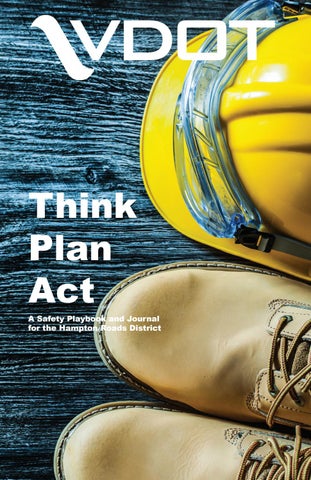
Think Plan Act
A Safety Playbook and Journal for the Hampton Roads District
Safety is priority one at VDOT. Before performing any work at VDOT, remember these three key words – Think, Plan, Act.
Virginia Department of Transportation “Safety First – One Team”
Safety Mission Statement The Virginia Department of Transportation (VDOT) is dedicated to instilling a world class safety culture for its most valuable asset, our workforce. We are committed to creating the right safety culture by instilling and reinforcing strong safety expectations and appropriate behavior 24/7. Our “Safety First – One Team” approach is multi-faceted and extends beyond the normal work day for our workers. VDOT employees are expected to routinely demonstrate safety behaviors and advocate and practice safety in everyday work activities. VDOT’s safety culture comprises shared beliefs, shared practices and shared attitudes that shape the overall behavior of the organization. Our culture exemplifies safety first at all times.
Philosophy of Safety • All accidents and injuries can be prevented. • Working safely is a condition of employment. • Occupational safety and health is the responsibility of every VDOT worker and is reflected in each Employee Work Profile. • All workplace hazards can be safeguarded. • Training workers to work safely is essential and is the responsibility of management/supervision. • Preventing accidents and workforce injuries makes good business sense. • All workers are empowered to stop work when faced with unsafe situations. • All levels of management, from the commissioner of the Department of Transportation to first-line supervisors, are responsible for the safety and health of the entire VDOT workforce, and are accountable for preventing injuries and occupational illnesses.
Be the Master of Your Safety
Conduct Your Own Personal Safety Check Am I covered? What PPE is appropriate for my task? • • • • • •
Head Protection: Hard Hat Eye Protection: Safety Eyewear Face Protection: Face Shield Hearing Protection: Ear Plugs Respiratory Protection: Dust Mask, Respirators Extremity Protection: Gloves, Heat Resistant Covering, Work Boots, Cold Weather Clothing • Visibility: Reflective Vests, Reflective Pants • Fall Protection: Harness, Anchor Points • Other Necessary Equipment: Ferry Operations, Special Situations
Backing Safety Tips Vehicle backing incidents and crashes are completely preventable. Yet, thousands of backing injuries and incidents occur each year in the U.S.
• Treat every location as new even if you visit it routinely. • Get to know your vehicle’s blind spots. A medium-sized truck’s blind spots can extend up to 16 feet in front and 160 feet behind the vehicle. • Plan in advance to avoid unnecessary backing situations. Choose easy-exit areas and park with ample room on all sides of the vehicle. • Use a spotter when backing up a vehicle. Driver and spotter should use district approved hand signals instead of verbal communication. • Do a walk-around vehicle before backing up even if you expect to have a spotter. • Know your vehicle clearances. When walking around the vehicle, look up for tree limbs, power lines, and low ceilings such as in tunnels. • Ensure mirrors are properly adjusted before backing. • Ensure all other pedestrians or worksite personnel are positioned a safe distance from the vehicle and its path. • STOP IMMEDIATELY if you lose sight of your spotter. • Perform backing maneuvers slowly. • No amount of forward-driving experience can help a driver with backing up. Practice in safe surroundings until you become familiar with the way the vehicle backs up.
Suggested Spotting Signals for Backing • Ensure spotters and drivers agree on hand signals before starting to back up. • Spotters should always maintain visual contact with the driver while the vehicle is backing. • Drivers should stop backing immediately if they lose sight of the spotter, or if the spotter becomes distracted. • The driver remains fully responsible for the movement of the vehicle, and should exit the vehicle for a first-hand view when needed. Back Up Straight (Palms facing direction of travel)
*Driver should not make any movement until spotter is actively signaling and is making eye contact with driver.
Move Forward (Palms facing direction of travel)
Showing Distance Remaining to Stopping Point
Backing, Turn Right
Backing, Turn Left
(Fingers pointed in direction of travel) Source: US Dept of Labor, Occupational Safety and Health Administration https://www.osha.gov/doc/topics/backover/spotter.html
Full Stop
Slow Down
Safety Reporting Process Reference Incident Reporting All vehicle and equipment events MUST be reported.
HOW: Visit InsideVDOT’s Look for this button on the Hampton Roads District District Safety Page. Safety Page. The “Incident Reporting” button provides access to on-line and print versions of forms.
Incidents are equipment events that do not meet the criteria of a crash. Incidents include operational damage, damaged equipment and not otherwise classified.
Crash Reporting All vehicle and equipment events MUST be reported.
HOW: Visit InsideVDOT’s Look for this button on the Hampton Roads District District Safety Page. Safety Page. The “Crash Reporting” button provides access to online and print versions of forms.
A crash is an event where an operated motor vehicle collides with another vehicle, pedestrian, animal, road debris, or other stationary obstruction, such as a tree or utility pole.
Personal Injury Reporting Managers and Supervisors must report all personal injuries immediately.
HOW: Call the Customer Service Center 1-866-VDOTRPT (1-866-836-8778)
Look for this button on the District Safety Page for additional documents and instructions.
An injury or illness is an abnormal condition or disorder. Injuries include cases such as a cut, fracture, sprain, or amputation. Illnesses include both acute (i.e. poisoning) and chronic illnesses (i.e. skin disease, respiratory disorder).
If you are ever unsure of the reporting policy or procedures, want to clarify appropriate actions following an incident, or have general questions, contact: Howard Canada District Safety Manager 757-956-3175 Office 757-685-0027 Cell howard.canada@vdot.virginia.gov
Rodney Higgs District Safety Manager 757-681-2576 Cell rodney.higgs@vdot.virginia.gov
Drug Testing Involving Equipment Was Citation Issued to CMV Driver?
VDOT Must Perform Drug Test
Yes
Yes
No
Yes
Bodily injury with immediate medical treatment away from the scene.
Yes
Yes
No
No
Disability damage to any motor vehicle requiring tow from scene.
Yes
Yes
No
No
Fatality Occurred
STOP and ASK YOURSELF… Have I consulted the Job Hazard Analysis for the current task before proceeding? What is the most hazardous part of today’s work and what will I do to control these hazards? What do I need to ensure this job is completed incident and injury free? Are my co-workers and worksite partners aware and ready for the work we are about to complete? Am I physically prepared and mentally focused for the task ahead? Where is the nearest emergency equipment located in the case of an incident or injury? First Aid Kit, Fire Extinguisher, AED/CPR Machine, Eye Wash Station, OSHA Safety Data Sheets & Hazardous Material Response, etc. Is my gut instinct telling me I need to check or investigate anything else before I begin the task?
Safety Briefing Ideas
Looking for a topic to address in your safety minute? Here is a list of possible areas to consider: • AED - How to Use • AED - Where AED’s Are Located • Aerial Working Platforms • Back-over Prevention • Bears & Local Wildlife • Blind Spots • Bridge Safety • Brush Cutting Safety • Cell Phone Usage at Worksite • Chainsaw Safety • Chemical Safety • Cold Injuries Prevention • Confined Spaces • Crane Safety • Distracted Driving • Drug and Alcohol Abuse • Electrical Safety • Emergency Preparedness • Ergonomics • Fall Prevention - Slips, Trips and Falls • Fatigue • Fireworks Safety • First Aid • Flooding • GHS (Global Harmonized System for Classification and Labeling of Chemicals) • Hazard Communication Chemical Safety with GHS • Hazardous Materials Markings, Labeling and Placard Guide • Heat Illness Prevention • Hot Weather Safety • Insects - Bees and Wasps • Insects - Spiders • Insects - Ticks and Mosquitoes
• June is National Safety Month • Ladders • Lift - Aerial, Bucket and Scissors Lifts • Lightning Safety While Working Outdoors • Logging Safety • Mold Exposure • Nail Gun Safety • National Drug and Alcohol Facts Week • NIOSH Pocket Guide for Chemical Hazards • Overhangs • Overhead Obstacles, Trees, Power Lines • Personal Fall Arrest System • Personal Wellness • Pinch Points • Poison Ivy and Harmful Plants • Roadside Safely • Scaffolds • Snakes • Sprains and Strains • Storms - Thunder, Lightning • Telecommunication Tower (Fall Prevention) • Tools - Hand and Power • Traffic & Motorist Awareness • Tree Cutting Safety • Vehicle Safety • Wind Chill Chart • Winter - Extreme Cold Guide Visit the District’s Safety page for additional ideas, or contact a Safety Manager for suggestions.
Safety Suggestions Make a Difference Do you have an idea to improve the safety of a VDOT task? Is there a process that could be more efficient? Our district knows great ideas come from all levels within VDOT. That’s why we champion programs to capture and implement staff-driven suggestions to improve operations and employee health. Specifically, VDOT’s Safety Excellence Award Program encourages employees to identify and communicate opportunities that reduce the number of injuries, illnesses, and crashes in our district. Submissions can be in the form of: Safety ideas, for both the field and the office environments Homemade videos inspiring or reinforcing safe behavior around the district, or • Ideas for staff training reinforcing the foundation and culture of our district’s safety initiatives. • •
Great ideas not only earn you recognition, but also help the district lead the commonwealth in safety, and ultimately improve safety for your colleagues and future VDOT employees through continual innovation. Learn more and submit your improvement idea by visiting the Safety Excellence Awards button on the Safety, Security and Emergency Management area of InsideVDOT online.
VDOT is committed to ensuring that everyone makes it home safe today, because every reason is important.
e lay Tim
P
WHAT’S YOUR REASON TO WORK SAFELY TODAY?
“Me” Time
School Tim
Tape your favorite photo here!
e
“Safety is part of everything we do and means that we all make it home at the end of the day to be with our families.” - Chris Hall, Executive Operations
WHAT’S YOUR REASON TO WORK SAFELY TODAY?
WHAT’S YOUR REASON TO WORK SAFELY TODAY? “I’m working to protect my mental health and my body from harm. As someone who has experienced a traumatic injury on the job, I know that the mental aspects of the injury will be with you long after the physical ones have healed.”
- Trey Kea,
Structure & Bridge
WHAT’S YOUR REASON TO WORK SAFELY TODAY?
“I can’t wait to get home to my two favorite ladies in the world.” - Frederick Shipp, Windsor AHQ
“We work to keep each other safe.”
- Capron Bridge Crew
WHAT’S YOUR REASON TO WORK SAFELY TODAY?
Safety Fact: Nationally, the top three leading causes of work-related injuries -- overexertion and bodily reaction, slips, trips and falls, and contact with objects and equipment – account for more than 84% of all nonfatal injuries involving days away from work.
THINK: How many slip, trip or fall potential hazards can you identify in your area right now?
Plan: Take a moment before you start to mentally run through the entire scope of the task, from setup to cleanup, considering the possible risks and what you will do to reduce them.
ACT: Think back to the last safety reminder you encountered. Can you remember the topic well enough to share tips with a colleague now? If not, think about what you can do to better retain the info next time.
Safety is priority one at VDOT. Before performing any work at VDOT, remember these three key words – Think, Plan, Act.
THINK Take time before you start to consider the task from start to finish.
PLAN a course of action that maximizes safety for you, your colleagues and your equipment.
ACT in a responsible and safe manner, putting your plan to work.
Our Hampton Roads District Engineer Christopher Hall believes we all have the responsibility to stop unsafe conditions. Here is your permission slip to do so:
In Hampton Roads Safety is our #1 Priority
This journal belongs to: