Wednesday, September 2, 2026 @commonwealthtimes @theCT
VOL. 73, NO. 3 SEPTEMBER 2, 2026 THE INDEPENDENT PRESS OF VIRGINIA COMMONWEALTH UNIVERSITY
COMMONWEALTHTIMES.ORG
2025 ACP NEWSPAPER PACEMAKER WINNER
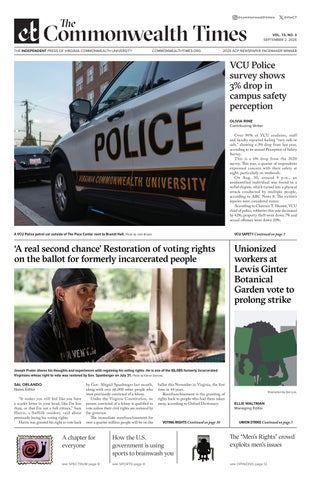
VCU Police survey shows 3% drop in campus safety perception OLIVIA RINE Contributing Writer Over 90% of VCU students, staff and faculty reported feeling “very safe or safe,” showing a 3% drop from last year, according to its annual Perception of Safety Survey. This is a 6% drop from the 2020 survey. This year, a quarter of respondents expressed concern with their safety at night, particularly on weekends. On Aug. 30, around 9 p.m., an unidentified individual was found in a verbal dispute, which turned into a physical attack conducted by multiple people, according to ABC News 8. The victim’s injuries were considered minor. According to Clarence T. Hunter, VCU chief of police, robberies this year decreased by 42%, property theft went down 7% and sexual offenses went down 20%. A VCU Police patrol car outside of The Pace Center next to Brandt Hall. Photo by John Brown.
VCU SAFETY Continued on page 3
‘A real second chance’ Restoration of voting rights on the ballot for formerly incarcerated people
Unionized workers at Lewis Ginter Botanical Garden vote to prolong strike
Joseph Prater shares his thoughts and experiences with regaining his voting rights. He is one of the 66,085 formerly incarcerated Virginians whose right to vote was restored by Gov. Spanberger on July 31. Photo by Kieran Stevens. SAL ORLANDO News Editor “It makes you still feel like you have a scarlet letter in your head, like I’m less than, or that I’m not a full citizen,” Sam Harris, a Suffolk resident, said about previously losing his voting rights. Harris was granted his right to vote back
by Gov. Abigail Spanberger last month, along with over 66,000 other people who were previously convicted of a felony. Under the Virginia Constitution, no person convicted of a felony is qualified to vote unless their civil rights are restored by the governor. The immediate reenfranchisement for over a quarter million people will be on the
ballot this November in Virginia, the first time in 44 years. Reenfranchisement is the granting of rights back to people who had them taken away, according to Oxford Dictionary.
VOTING RIGHTS Continued on page 10
Illustration by Zoe Luis.
ELLIE WALTMAN Managing Editor UNION STRIKE Continued on page 3
A chapter for everyone
ow the U.S. H government is using sports to brainwash you
The “Men’s Rights” crowd exploits men’s issues
see SPECTRUM page 8
see SPORTS page 4
see OPINIONS page 12
2
The Commonwealth Times
News
Stories of the week
national: A Grand Canyon flash flood took the lives of two people, and one still missing. international: Iranian state media aired a three minute video claiming Donald Trump’s youngest son, Barron Trump, is being “fully monitored.” The video was titled “Where to Kill Barron Trump.”
Construction on West Grace Street for a new VCU dorm building expected to address growing student housing demands. Photo by Catt Brito.
Code refresh reshapes Richmond as VCU students struggle to find housing MADELEINE BIONDI Contributing Writer MADDY THURBER Contributing Writer Richmond’s new proposed zoning code could expand development opportunities and reshape how much housing is available to VCU students in Richmond’s competitive market. The city released the third and final draft of the zoning code on Aug. 17 which includes community insight from the Richmond Civic League meeting on July 21. Replacing a 50 year old zoning code, the overhaul alters lot restrictions, increases density along rapid transit lines and restricts non-conforming structures in efforts to expand housing. The code also imposes a complete ban on data center construction within the city. Lot changes will increase both the number and type of structures allowed per lot, providing opportunity for an accessory dwelling unit in addition to a primary home. Plans promote more compact lots by decreasing setbacks, which determine how far a building must be placed from a property line or street. Changes in zoning aim to protect green space in addition to concentrating construction near transportation hubs to improve walkability. Development restrictions limit structure size and height in aim to promote better uniformity. “The updated comprehensive plan covers future growth in the next 30 years of housing, transportation and urban life,” said Benjamin Teresa, associate professor of urban and regional planning. Richmond’s population has grown over 18% in the last 30 years, according to the
Federal Reserve Bank of St. Louis. According to a Richmond Realtors survey, of the 22% of Richmond residents who were familiar with the zoning overhaul, 59% expressed support. Zoning code concerns included setback changes, overcrowding lots and damage to historical integrity, with a notable critic being the Fan District Association. “You’ll notice when walking around the Fan and then walking into a suburban neighborhood, there’s a huge difference in the space between homes and how far the building is from the street,” Teresa said. Earlier this year, VCU began building a new dorm on West Grace Street with 985 new beds to address growing demands for student housing on Feb. 26, according to the VCU housing master plan. VCU faced first-year housing challenges after an increase in freshman class size, with over 4,500 admissions the previous two years. Last year marked the second largest class size in university history. Second-year craft and material studies student Tala Christensen said housing costs, distance from classes and gaps in leases made securing on-campus housing difficult within the current lottery system. Twenty seven percent of VCU students live on campus, with the other 73% opting to commute or compete in the fifth most competitive housing market in the country. “I originally wanted West Grace South because they don’t have year round housing so it’s cheaper, but by the time I tried to get housing West Grace North was the only one available,” Christensen said. VCU Residential Life and Housing stated that it has been able to offer housing for all students waitlisted in previous years, however, it cannot guarantee housing. Off-campus students contend with large
real estate companies in a city where rent has risen 1.9% year-over-year, while the average city rent faces decline. Third-year sociology student Rosalie Harr said large companies are the root cause of her difficulties finding off-campus “There are so many apartments I’ve toured and I’m like ‘they’re asking way too much for this place and it’s way too small,’” Harr said. “I compare it to my friends who
go to other schools and they’re getting so much bigger places for so much cheaper.” Richmond’s population has grown over 18% in the last 30 years, according to the Federal Reserve Bank of St. Louis. The L. Douglas Wilder School of Government and Public Affairs will host the Gulak Lecture on Nov. 10 to discuss zoning code plans.
Construction on West Grace Street for a new VCU dorm building expected to address growing student housing demands. Photos by Catt Brito.
Wednesday, September 2, 2026
3
News
A VCU Police patrol car outside of The Pace Center next to Brandt Hall. Photo by John Brown. VCU POLICE SURVEY Story continued from front page This year’s perception of safety survey dropped three points based on what people consider crime to be at VCU, Hunter said. “I have come to learn that in law enforcement, we battle two different things,” Hunter said. “One is perception of crime and one is actual crime.” Accord ing to t he pol l, 57% of respondents were concerned about pedestrian safety. Hunter and VCU’s police department have acted on resident concerns by
changing the timing of lights and left-turn hardening structures in cooperation with Richmond city.The Richmond Department of Transportation will also install 700 quick-build improvements targeting intersections identified as statistically dangerous for pedestrians this fall and next, according to a previous report from the Commonwealth Times. Hunter said that pedestrian safety is a collaborative effort and encouraged VCU community members to practice safety measures such as avoiding phone use while crossing intersections. Chanel Smith, a first-year business major, said VCU’s police department
has done a helpful job informing the community about dangerous circumstances. Smith said he believes pedestrian concerns and circumstances are bound to happen. “I think just going to a city college, you have to get used to all of the traffic and commotion that goes on,” Smith said. Colton Locklair, a first-year English major, said that living in close proximity to the city of Richmond will increase crimerelated incidents. “My perception of safety on campus has not been altered, because most people go into VCU fully knowing it is very close to the center of Richmond,” Locklair said.
Locklair said that VCU could better prepare students to understand their proximity to crime in the area. He suggested they brief students at orientation. Siya Brahmbhatt, a first-year psychology major, said her concern for her safety has increased. “My perception of VCU safety has declined a bit, only because now that I am in the area, there are more alerts and safety issues that I’m actively seeing and being in proximity of,” Brahmbhatt said.
Unionized workers at Lewis Ginter Botanical Garden vote to prolong strike Union workers at Lew is Ginter Botanical Garden voted to go on an Unfair Labor Practice strike on Tuesday, Sept. 1 after 80% of union members voted in favor. The strike vote comes after “two one-day strikes, a call for a boycott and increased public support as workers hold their ground for meaningful wage increases from the Garden,” LGBG Workers United stated in an Instagram post. The union has raised $11,569 for their strike fund since the union’s GoFundMe creation on July 30. A petition supporting
fair wages for the workers at LGBG has collected 1,153 signatures. Workers said that they want a first contract that makes LGBG a sustainable career rather than a job that the employees cannot afford to keep. The union remains ready to reach a fair agreement as they wait for a fair proposal from LGBG, according to the post. Workers at the garden announced they rejected their employer’s “last, best and final offer” on Aug. 12 after nearly two years of unionizing for increased wages
and benefits, according to a previous report from the Commonwealth Times. T he workers voted to join t he International Association of Machinists and Aerospace Workers Union in Nov. 2024 with 65% voting in favor of union representation. They began bargaining for their first contract on Feb. 6, 2025, according to the IAM Union website. The IAM Union filed an Unfair Labor Practice charge with the National Labor Relations Board on April 30. after alleging that the Garden had failed to bargain in
ELLIE WALTMAN Managing Editor
good faith and pushed regressive wage proposals, the website stated. The average wage for bargaining unit workers has remained at $17.52 per hour, which is “far below” the $25-perhour living wage for the Richmond area. Workers say that wages remain the central unresolved issue, according to the website. LGBG Workers United will begin their strike outside the front gates of Lewis Ginter Botanical Garden on Wednesday, Sept. 2. This is a developing story. For further information visit the CT’s website.
Illustration by Zoë Luis.
4
The Commonwealth Times
Sports
Stat of the week
VCU field hockey’s 1-0 victory over KSU was VCU athletics first victory of the season.
How the U.S. government is GAME RESULTS using sports to brainwash you 8/27/26
VCU WSOC - AT UNC DRAW 1-1
8/28/26 VCU FH - AT NU LOST 2-0
VCU VB - AT FGCU LOST 3-1
VCU MSOC - AT #20 UNC LOST 1-0
8/29 VCU VB - AT FSU LOST 3-1
8/30 VCU WSOC - AT #2 DUKE LOST 6-0
VCU FH - AT KSU WON 1-0
Illustration by Natalie Avrit.
BEN MARTINDALE Sports Editor Sportswashing, a term first coined in 2015, describes how governments use sports and celebrity athletes to manipulate public opinion. Some governments use sport as a red herring, a means of diverting scrutiny from real issues. Others use it as a means to inspire the masses and encourage nationalist fervor. In 1936, Germany hosted the Summer Olympic Games. Adolf Hitler and the Nazi regime used the games to distract the world from reports of human rights violations and Jewish discrimination that were beginning to circulate at the time. The Nazis would begin their systemic murder of the Jewish people in 1941. In 2014, Vladimir Putin hoped to use the Sochi Olympic Games as a means of promoting Russian excellence and in doing so, further his own personal strongman image. To ensure Russian success, the state facilitated what would become the largest doping scandal in sports history. The scheme, which enabled athletes to utilize banned steroids, implicated over 1,000 Russian athletes and was facilitated by the Russian Anti-Doping Agency (RUSADA) and high ranking government officials, according to NPR. In 2016, Saudi Arabia unveiled Vision 2030, a program designed to diversify the Saudi economy beyond oil reserves and rehabilitate the country’s image as a desirable place to live and travel. Sports have been a pillar in their investment strategies, using massive sums of money to attract international superstars like Cristiano Rinaldo, Neymar and Tyson Fury to compete in the Middle East. T h i s i nv e s t ment s t r ate g y a l s o serves to divert public attention from a repressive Saudi government, which functions as an autocratic regime and has numerous credible reports of human
rights v iolations, according to the U.S. State Department and Human Rights Watch. This summer, the U.S. hosted the 2026 FIFA World Cup. The event smashed viewership records both nationally and internationally, and the final between Spain and Argentina became the most watched soccer game in U.S. history, according to Yahoo Sports. The Trump administration also hosted UFC Freedom 250, Patriot Games and Freedom 250 Grand Prix as a means of celebrating 250 years of American independence. Each event garnered mass media attention and viewership. UFC Freedom 250 brought in the largest viewership, attracting over 34 mil lion v iewers worldwide, making it one of the most watched UFC cards of all time, according to the UFC. For lovers of combat sports, the card was a dream. Seven fights, seven finishes all via knockout or technical knockout. The main event, a lightweight title fight featuring American brawler Justin Gaethje and then undefeated Spanish champion Ilia Topuria, was a back and forth battle that saw Gaethje, a plus 400 underdog, upset Topuria and win his first undisputed title. As a fight fan, UFC Freedom 250 delivered in every way. The fights were incredible, the production quality was the best I have ever seen from the UFC. Gaethje and Topuria put on a surefire fight of the year contender and one of the best title fights in recent memory. As a veteran, seeing medal of honor recipients walk the fighters to the cage each fight felt like a genuine way to honor true American heroes. I was happy when the camera panned to the crowd, where over 1,000 active-duty soldiers cheered on the spectacle. They deserve to enjoy themselves. However as an American citizen, I was deeply troubled because this was not a celebration of America, nor a
means of honoring its heroes. Those were simply happy by products of far more insidious reality. The real purpose of this summer’s sporting events was twofold. The first objective was simple, to inspire national pride among a citizenry that is becoming increasingly less patriotic. On that front, the Trump administration saw mixed results. Each Freedom 250 event reported high viewership and product sales. The summer news cycle was dominated by sporting event after sporting event and when an American won, we collectively cheered. That being said, President Donald Trump’s approval ratings have remained stagnant in recent months, sitting at a dismal 34%, according to a Pew Research Center poll conducted in mid-July. The second objective is to distract you from the fact that American democracy is currently in grave jeopardy. No president in U.S. history has shown such blatant contempt for rule of law and presidential norms as Trump. In a properly f unct ioning U.S. democracy, when the president wants to enact legislation, he works with members of Congress to create a bill. The bill must then pass a vote in both the House of Representatives and the Senate. Only then can the president sign off on the bill, making it a law. Despite controlling both houses of Congress, Trump has frequently elected to forgo passing legislation in his second term, and has instead turned his focus to the executive order. Executive orders are written directives issued by the president that instruct the federal government on how to operate. Executive orders are not official legislation and do not require congressional approval, according to the American Bar Association. Trump often uses executive orders to test t he l imits of president ia l power, and has issued more than any
president in recent history, according to the Federal Register. Earlier this year, Tr ump issued Executive Order 14399 which, among other provisions, enables the United States Postal Service to ensure that all mail-in ballots are correctly marked and packaged. The order has been sued by 23 states and the District of Columbia and is still working its way through the judicial system, according to Fulcrum. Many will argue that USPS inspecting mail-in ballots makes sense, they are the postal service after all, why would we not want them to verify? On the surface, this logic is sound, but it completely ignores the fact that states, not federal agencies, are tasked with running elections, according to Article 1, Section 4, Clause 1 of the U.S. Constitution. The only other governing body that has authority over elections is congress. It is in these, often subtle acts, that governments rig elections. It is rarely as blatant as armed men at polling stations, but just because there is no tangible physical threat, it does not mean our democracy is safe. Since winning the 2016 presidential election, Trump has routinely claimed that U.S. elections are fraudulent, despite providing no evidence to substantiate widespread voter fraud. There is every reason to believe he will make the same claim after the midterm elections later this year. Standing up to a strongman leader is very difficult. To do so requires an educated and engaged citizenry. Most importantly, standing up to a strongman leader means showing up to vote, and doing so in a fashion that makes the results indisputable. I enjoy sports as much as the next person, but we cannot bury our heads in the proverbial sand. Sports do not mirror reality, they provide an escape from it. We cannot sit back and enjoy the show, American democracy rests in our hands, it is on us to ensure that it endures.
Wednesday, September 2, 2026 5
Sports
VCU women’s volleyball vs Florida State University. Image courtesy of VCU athletics.
SCOUTING REPORT: Women’s volleyball players to look out for at invitational DEVYNN ALSTON Staff Writer The VCU Invitational will give the Rams an early-season test against familiar opponents. The invitational runs from Sept. 4-5 at Siegel Center and features VCU, East Tennessee State University, the University of Virginia and the College of William & Mary. VCU will face ETSU and UVA, opponents that the Rams have seen recently. UVA and William & Mary last met in 2024, while ETSU and William & Mary have not faced each other since 2014.
VCU
Lannah Price, a second-year outside hitter, will look to carry over her preseason momentum into the VCU Invitational.
Price, who primarily contributed on the defensive side of the ball last season, showed an expanded offensive presence during VCU’s exhibition match against Christopher Newport University. Against ETSU and Virginia, Price will look to build on that performance and become a more consistent contributor on both sides of the net. Last season she recorded 76 digs and 14 kills across 54 sets.
ETSU
Makayla Bays, a third-year outside hitter, enters the invitational as one of ETSU’s primar y offensive weapons. Bays was selected to the Preseason AllConference Team, recording 443 kills, 45 aces, 281 digs, and 33 total blocks last season. Her production on both sides of the net makes her a player VCU will have to account for at all times.
With Bays entering her third season, ETSU will look to her experience and production to lead the Buccaneers through the early-season invitational.
defensive presence at the net. She will look to bring that same defensive intensity to the invitational.
UVA
Reagan Ennist, a second-year outside hitter, looks to build off her first season with the Cavaliers. The 6-foot-3 2025 ACC A l l-Freshman Team member recorded 383 kills and 141 digs last season. Her combination of size and production will make her a difficult matchup for VCU.
WILLIAM & MARY
Katherine Arnason, a fourth-year opposite, enters the invitational after ranking second on her team in blocks last season. Arnason recorded a careerhigh nine blocks when William & Mary played Davidson, showcasing her
VCU second-year middle blocker, Sarah Dibbs-Frantz. Image courtesy of VCU athletics.
Young VCU Cross Country Teams Chase Fall Improvement and Success BENNEY KOCH Staff Writer VCU women and men’s cross country teams will make their 2026 season debuts Sept. 5 at the Spider Alumni Open, returning to the same course that will host the Atlantic 10 Championships later this fall. Last season, the team’s primary focus was development. First-year Jonathan Hess had a strong start to his collegiate career as his performances set him apart among VCU’s top performing runners. Last year Hess earned A-10 Rookie of the Week honors twice and finished at the podium three times as a rookie across five meets. Hess was also able to finish fourth at the South Region Showdown with an 8K personal best of 24:39.9 at the A-10 Championships. He led the Rams finishing 49th overall with a time of 25:11.4. Redshirt fifth-years Julian Lawson and Nahim Abdallah also recorded personal bests at the South Region Showdown. The two were important depth pieces for the team and served as mentors for the rest of the young roster. Lawson and Abdallah have since graduated, leaving VCU with some new
faces heading into the fall. First-year Ethan Havran joins the Rams, along with secondyear transfer Jayden Curry, who comes to VCU from LIU. Last season, the women’s team finished last at the A-10 Championships and are looking to make improvements. However the results do not tell the entire story of last year’s team. Ten of the 14 runners on the roster were freshmen. Now with a year of experience and development, we can expect to see an improvement in the upcoming season. A bright spot for the Rams’ was their first place finish at the VSU Cross Country Challenge on Oct. 10. Fourthyear Ava Miller led the way individually and finished third. Also, Miller later ran a season-best 6K time of 22:51.4 at the A-10 Championships. Miller and Jayanna Carroll graduated following the season, leaving another spot for a new group of runners to step in. Four freshmen will join the women’s team this fall: Abigail Flores from Grassfield High School in Chesapeake, Hannah Hawkins from Yorktown High School in Arlington, Paige Scannell from Taranaki Secondary in New Plymouth, New Zealand and Simone Wilt from
John T. Hoggard High School in Wilmington, North Carolina. Both teams will continue under head coach Jon Riley and Director of Cross Country Austin Savage. The Rams will also have a familiar setting waiting for them at the end of the season. The A-10 Championships will be held Oct. 31 at Pole Green Park in nearby Mechanicsville, the same course where VCU will open its season. With a year of development behind the women’s team and a young men's
team looking to replace two graduates, both squads will get their first chance to show what they have Sept. 5 at the Spider Alumni Open.
2019 Spider Invitational. Photo courtesy of VCU Athletics.
6
The Commonwealth Times
VCU's Cary Street Gym. CT file Photo by Jon Mirador.
Cary Street Gym prepares for overcrowding as MCV gym undergoes renovations
TYRESE PERKINS Assistant Sports Editor In recent years, g ym culture has exploded in popularity across the U.S.A record high 81 million Americans have gym or fitness club memberships, according to the Health and Fitness Association. Cary Street Gym, the only gym on the Monroe Park campus, is owned by VCU and operated by Recreation and Wellbeing, also known as RecWell. The location has been a beloved training ground for VCU students since it was first converted into a gym in the late 1970s. In 2007, the gym underwent major renovations to keep up with the ever growing student body. “Cary Street Gym is awesome,” said Kyrie Curry, a fourth-year at VCU. “Cary St. is a beginner, intermediate, expert friendly g ym. If you’re just starting or doing it for 10 years, it’s an awesome place to be.” Training partners fourth-year Olivia McGowan and third-year Keilani Procopio have been training at Cary Street Gym for years. They echoed Curry’s appreciation
for the community feel at Cary St., but warned against training during peak hours due to overcrowding. “When it gets crowded, you’re really fighting for the machines,” Procopio said. Fourth-year Lynice Grimsby said that she enjoyed training at Cary St., but recommended people avoid the gym after 4 p.m. due to crowds. She said that while she’d still recommend the gym to friends, you may have to wait for machines or change your workout, depending on the time of day you train. The staff at Cary Street Gym recognized that overcrowding was an issue during peak hours, but approached the issue from a different perspective. “We’re very fortunate to have the facilities we have and I think students are very appreciative of it,” said Meredith Hawkins, director of VCU RecWell. “I think at certain times of day we can’t keep up with the demand, so about the 3 to 9 range, we’re very crowded.” Hawkins also said that facilities like basketball courts and outdoor fields were
severely lacking compared to similarly sized peer institutions. She explained that, because of VCU’s location in Richmond, it was hard to find the space to put additional facilities, but also acknowledged that VCU has bigger needs. “We recognize the university needs a new student commons, and there’s other academic buildings that would probably take priority,” Hawkins said. “We’re fortunate enough to have the facilities we have. I would love to, down the road, maybe explore something, maybe in collaboration with another unit, but right now we’re working with what we have to the best of our ability.” Syd Cope, a manager at Cary Street Gym and third-year VCU student, said that crowds sometimes lead to altercations between gym-goers, especially on the basketball court and that it’s the job of the staff to handle these situations. The altercations are never anything the staff cannot handle, Cope said. Anthony Martelino, coordinator for facilit y operations at Car y St.,
Third year VCU student Caleb Stone rests with a basketball after playing a pickup game at the Cary Street Gym. Photo by William Spencer.
acknowledged constraints VCU faced, namely being located in a city, but believes with compromise and a willingness to be flexible, Cary St. still provides everything a gymgoer might need. In December, the MCV Campus Recreational Center will temporarily close as it moves locations and undergoes renovation, according to VCU. The rec center is scheduled to reopen in summer 2027. Until the MCV rec center reopens, Cary Street Gym will serve as the lone gym for both the Monroe Park and MCV campus. Despite the overcrowding problems they already face, the Cary St. staff is confident they will be ready to meet any additional demand. “We are ready to welcome more people,” Martelino said. “If our professional students on the MCV campus want to continue working out, we’ve always been posing that Cary St. is ready to handle your needs as well.”
Wednesday, September 2, 2026 7
RECAP: VCU athletics on the road
Sports
TYRESE PERKINS Assistant Sports Editor
8/27 – Women’s Soccer vs University of North Carolina
VCU women’s soccer battled to a 1-1 draw on the road against UNC.. Shiori Shintaku scored her first goal as a Ram, assisted by Jazmin Jackson. Goalkeeper Mia Pongratz recorded eight saves in her season debut, combining with Cameryn Nunn for 10 total team saves.
on the road against No. 20 University of North Carolina. Kimarly Scott led the Rams' attack with three shots on goal, while Goalkeeper Manuel Monteiro held off the Tar Heels' aggressive playstyle, recording six saves throughout the game.
68th minute off a centering pass from Julia Spohr to break the Rams’ scoreless streak. The Rams’ recorded 11 total shots, including four on goal, and made six total saves throughout the game. To view all upcoming VCU games visit
8/29 – Volleyball vs Florida https://vcuathletics.com/calendar, until our next VCU sports recap. State University VCU Volleyball lost in a 3-1 match on
8/28 – Field Hockey vs the road against Florida State University. Northwestern University Letizia Galli led the Rams’ with eight VCU Field Hockey lost its 2026 season opener to Northwestern University in a 2-0 match. The Rams’ were unable to score any goals. Goalkeeper Emma Clements made three saves throughout the match to help alongside the Rams’ defense.
kills and five blocks, while multiple Rams’ seven kills to the scoresheet. Setter Cansin Sendir anchored the offense with a 33 assist, 10 dig double-double.
8/28 – Volleyball vs Florida Golf Coast University
VCU Women's Soccer lost a road match against No. 2 Duke University in a 6-0 match. Alexis Cox, Jazmin Jackson and Jensyn Lins recorded the Rams’ three shots on goal. Goalkeeper Mia Pongratz recorded eight saves in the first half, combining with Cameryn Nunn for 12 total saves throughout the game.
VCU Volleyball lost its 2026 season opener in a 3-1 match on the road at Florida Gulf Coast University. Nina Boledovicova led the attack with nine kills, three aces, and two blocks. Setter Cansin Sendir recorded a double-double with 30 assists and 10 digs. Sarah Dibbs-Frantz and freshman Molly McCall chipped in seven kills apiece.
8/30 – Women’s soccer vs Duke University
8/30 – Field Hockey vs Kent State University
VCU Field Hockey earned a hard-
8/28 – Men’s Soccer vs fought 1-0 overtime victory on the road University of North Carolina against Kent State University. Carley VCU Men's Soccer lost in a 1-0 match
VCU women's soccer at Duke. Image courtesy of VCU athletics.
Deaver netted the game-winner in the
VCU third-year middle blocker, Letizia Galli vs Florida Golf Coast University. Image courtesy of VCU athletics.
ADVERTISEMENT
VCU third-year midfielder, Shiori Shintaku vs University of North Carolina. Image courtesy of VCU athletics.
8
The Commonwealth Times
Spectrum
On Sept. 2, 2016
VCU participated in College Colors Day, encouraging students, alumni and fans to wear black and gold around Richmond.
A chapter for everyone ELLE COTA Spectrum Editor Richmond Public Library is a place for more than just book borrowing. Throughout the year, its programs give adults, seniors and families opportunities to learn, create and connect at no cost. In an age of instant messages, Hannah Kilgore, an adult services senior librarian at Richmond Public Library, opens the room for something slower: handwritten letters. Kilgore has hosted many events, including snail mail, a quarterly program where participants can write letters to friends and family or sign up for a pen pal. The program typically draws four or five people, many of them younger adults wanting to reclaim their time and space. Kilgore became interested in the program after her own experiences with pen pals, including a long-distance friend she has exchanged physical mail with over the years. Handwritten correspondence offers a different experience from digital communication because it requires people to slow down and be more intentional about what they say, Kilgore said. “I think something like sending letters or physical media is something that can preserve sort of regionalism, in a way, and then you’re sharing a piece of your home with someone else,” Kilgore said. The library gives people a space to try activities they may not have the resources
or opportunity to pursue at home, Kilgore said. Richmond’s strong DIY culture makes the city a natural f it for that kind of programming, according to Kilgore. Michael McBean, arts associate at Richmond Public Library, spends half his time organizing concerts, art exhibits and film screenings. Starting this winter, the library plans to shift from monthly exhibits to seasonal ones while continuing to hold openings on First Fridays, an event in Richmond’s Arts District. “I like sort of bringing that DIY space into something that might from the outside be seen as a cultural institution,” McBean said. The library remains committed to showcasing community artists while giving artists more time in the gallery spaces, McBean said. Most concerts are held in the library’s 1930s foyer, where natural stone creates reverb and large windows fill the space with light. W h i le t he c onc e r t s e r ie s h a s traditionally focused on classical music, McBean expanded it to include jazz, punk and experimental performances. The library partners with independent film groups such as Nowhere Cinema and Hard Light Cinema to screen films that audiences may not otherwise see in larger theaters. “It’s been cool to use the library space
to help bridge that gap between the sort of desire for indie films and the lack of output from the bigger screening houses,” McBean said. While many of McBean’s programs are designed for adults, he said the concerts and art exhibits are generally open to all ages. “I think being a hub for people to come in and A, just hang out, but B, get exposed to something that’s culturally enriching, is really important,” McBean said. McBean said seeing people return to programs has become one of the most rewarding parts of his work. Upcoming arts programming include a Sept. 5 Nowhere Cinemas screening of “My Entire High School Sinking into the Sea” by Richmond artist and director Dash Shaw and a Sept. 26 concert by Aaron Demas and Dylan Burritt, whose performances incorporate found and homemade electronics. Danny Howard, a senior librarian at Richmond Public Library, specializing in technology and innovation, works with patrons in the computer lab and makerspace, helping with computer skills and 3D printing. She also organizes crafts, book clubs and social programs. “We try to create that kind of safe space but also still keep people engaged, feeling like they’re learning something new,” Howard said. Howard said programming allows the library to learn more about the community
Illustration by Sophie Dellinger.
it serves. Attendance, demographics and patron feedback can help staff determine what programs to offer, when to hold them and which locations might work best. One of Howard’s favorite programs was an AI and dating panel she organized around Valentine’s Day. The event brought together community members, professors and technology professionals to discuss artificial intelligence’s growing role in romantic and platonic relationships. “There’s something about that human connection that just really adds to, at least now I’m just being selfish, my day,” Howard said. “It makes work fun.” Howard will host several upcoming programs including an apple-ranking event on Sept. 9, where participants will learn about the history of apples in Virginia and taste and rate different varieties. Howard plans to offer another watercolor program in November.
A club building more than models; VCU’s Gunpla Builders WREN HODGSON Contributing Writer Virginia Commonwealth University has more than 500 student clubs and organizations, but some have gained less traction than others. Gunpla Builders of VCU is a studentrun club focused on building Gundam plastic models, a Japanese science fiction media franchise, with around 98 members. Members meet week ly to assemble, customize and discuss their favorite mecha kits. The club meets every Thursday at 5 p.m. in Harris Hall, room 2129. The club meets weekly, but also hosts multiple club-wide events throughout the semester. Sri Challuri, treasurer of Gunpla Builders of VCU, has been a member of the club since his first semester. “All of our hobbytown trips are really fun because it’s that moment where newcomers, they kind of see the wider kind of designs Gundam has,” Challuri said. Challuri, who is from Northern Virginia, was pleasantly surprised to have a community of people who share the same interests. Meetings are casual and welcoming to those of all skill levels, Challuri said. Members get the chance to enjoy showing people that their passion is appreciated and continue to encourage them. Ian Tombleson, president of Gunpla Builders of VCU, has been a fan of Gundam since he was a child and joined
A group photo of the Gunpla Builders of VCU members at SOVO fair. Courtesy photo by Muntaha Jafri, club member. the club as soon as he heard about it. “We will generally push to them what the club is about, but we also like to encourage them to share their passion and hobby,” Tombleson said. “At the end of the day we just want to hang out and listen to what other people have to say and the passion they have.” Muntaha Jafri, outreach manager of
Gunpla Builders of VCU, joined after coming to one of the club’s meetings to fix one of her figures. She ended up staying after making friends and feeling welcomed by the community. “It was really nice to see everyone come together to help you get into the hobby or just help you with whatever you need,” Jafri said.
The Gunpla Builders at VCU has a highly friendly and supportive community making it easy for everyone to come together, according to other club members. More insight on Gunpla Builders at VCU can be found on their Instagram, @ gunplavcu or emailing gunplabuildersvcu@ gmail.com.
Wednesday, September 2, 2026
Spectrum
Rodney the Ram in attendance at the Saxbys grand opening on Aug. 15. Photo by Burke Loftus.
New leadership opportunities on campus at Saxby’s student led cafe ZAHRAA HADI Contributing Writer The line stretched outside Snead Hall, Virginia Commonwealth Universit y S c ho ol of Bu si ne s s , a s s t udent s gathered to celebrate the opening of Sa xbys, a new cafe. However, this was more than a place to grab coffee. Saxbys held its grand opening on Aug. 25 from 10 a.m. to 1 p.m., featuring balloons, speeches, free meal samples and merchandise. At the center of the celebration was a student: Saxby’s first VCU student CEO, Sean Campbell, who cut a
ceremonial ribbon to officially open the cafe. The cafe is designed to give students more than just an ordinary job. Through Saxbys, students can take on leadership roles and gain hands-on experience running a business, from operations, to marketing, to finance while still in school. The program ref lects the school ’s emphasis on transformative leadership, s a id Br y a n Brow n , de a n of t he School of Business. St udents can take on meaningful responsibilities while learning to lead ethically and suppor t t he people a round t hem. “When we think about leadership,
we don’t just think about any form of leadership,” Brown said. “We talk about transformative leadership, where we want to create and encourage leaders to be ethical and to care about others.” T h e i r e m p h a s i s o n s t u d e nt s disting uishes VCU ’s Sa xbys from other coffee shops, accord ing to Abigail White, Saxby’s vice president of ma rketing. She sa id they a re fo c u s e d on com mu n it y g row t h . “Every coffee shop is different,” White said. “What really sets us apart is our student centered community.” Sa xbys will have more than 30
employees, with leadership positions structured as semester-long internships, according to White. The cafe is still determining its staffing needs, so more students will have the opportunity to apply for positions in future semesters. Bia nca Q u ispe, a VCU hea lt h services major, attended the ceremony, despite rarely visiting the business hall. “I definitely think students are going to come by more often now,” Quispe said. The menu consists of coffees, lattes, teas, smoothies, energy drinks, protein shakes, pastries, wraps, sandwiches and muffins, along with a secret seasonal menu.
BAND SPOTLIGHT: Certified Donkey Brains The beauty in ‘stealing each others bandmates’
MAEVE BAUER Executive Editor Every other Wednesday an eclectic mix of local musicians gather to give the people of Ripple Ray’s, a restaurant and bar in Carytown, a taste of Certified Donkey Brains. The mixed-genre rock band is made up of Matt Weiser, Walker Caskie, Nate Rice, Travis Full, Brian Holloman and Lynne Holloman. For those who are fans of FX’s 18 season long show, “It’s Always Sunny in Philadelphia,” the name might invoke memories of the season 10 episode “Reynolds vs. Reynolds: The Cereal Defense.” In which, Frank Reynolds, with the assistance of Charlie Day, proves to the rest of “the gang,” that by the power of the Commonwealth of Pennsylvania, Frank Reynolds is declared, “To not have Donkey Brains.” W hile Weiser and Cask ie were brainstorming ideas for a name, Weiser came up with Certified Donkey Brains. As most musicians do, they double checked online to see if anyone else had the name. Instead, he rediscovered the “It’s Always Sunny in Philadelphia,” scene and decided that it was a match. Weiser even commissioned the artist who made the Donkey Brain certificate in the show and printed out copies for their show on Aug. 26. The members of Certified Donkey Brains have their own separate projects that they began working on prior to the formation of the group, Weiser said. He
Guitarist, Nate Rice, for Certified Donkey Brains plays at Ripple Ray's. Photo by Chiara Wells. and Caskie created the band after a spot at Ripple Ray’s opened up and neither of their bands had the availability to take it. Instead, they made a new one, forming back in February of this year. First acquiring the talents of Brian and Lynne, with Rice and Full joining on a little later. Rice previously played with the band on a few occasions after he got off work and eventually started playing with them full time. “He would show up at 10:00 and join us for the last hour for the first time,” Weiser
said. “He was a last-set-kind-of guy, now he’s a full timer.” Weiser and Rice joked back and forth about how Rice got a promotion within the group. “He’s a little bit closer to the front of the stage now,” Weiser said. Full’s story is similar, after joining the band for a few shows at Ripple Ray’s, he became a permanent fixture in the crew. Staying true to the band’s Instagram bio, “Certified Donkey Brains is when local bands stop pretending they’re not stealing
each other’s bandmates.” “The first time Matt and Walker and I sat down and played, it just felt like we’ve been playing together for a very long time,” Brian said. “ I think part of that is because we’ve been watching each other play, you know, cause we all go out and see each other and stuff. So, it just felt pretty natural.” Certified Donkey Brains all specialize in different facets of rock and roll. Weiser said he’s from an instrumental jam band — Greasy Bastards, Caskie’s band— Soundwave Supply Co. — is described to play more funky, reggae music, as well as his solo music. Brian and Lynne’s band is more psychedelic with the very fitting name, Lucid Dose. Rice’s band, Mobius Strip, is speed funk, which he says is on the heavier side. Each member enjoys the carefree creative outlet that the Certified Donkey Brains provides them, saying it gives them inspiration to bring back home. “I think the coolest thing about it, every time you get a chance to play with different players, get more unique chances and opportunities just to discover new avenues and music that you wouldn’t have if we were all just focused on our one project, you know, that's all we'd be looking at, it’s all we'd be thinking about,” Weiser said. If you want to see Certified Donkey Brains live, you can catch their next performance at Ripple Rays on Sept. 9 or every alternating Wednesday after that. For more information check out their Instagram or Facebook.
10
The Commonwealth Times
RVA Spotlight
Features
Kick off Hispanic Heritage Month early at the September Makers Market! Come out to celebrate community, culture and local shopping at the Virginia Museum of History & Culture at no cost! Festivities kick off Friday, Sept. 4, from 5 to 8 p.m. and continue on Saturday, Sept. 5, from 10 a.m. to 3 p.m.
Joseph Prater shares his thoughts and experiences with regaining his voting rights. He is one of the 66,085 formerly incarcerated Virginians whose right to vote was restored by Gov. Spanberger on July 31. Photo by Kieran Stevens. A REAL SECOND CHANCE Continued from front page Harris ref lected on not voting in the 1993 gubernatorial election and former Gov. George Allen signing a bill abolishing parole. “That was in the '90s, and imagine me going to prison in 99, 2000 and being affected by something that the government came in and did,” Harris said. Harris mentioned he regretted not voting prior to his incarceration, and would vote if he was ever given the opportunity. Harris was grateful for his pardon by former Gov. Glenn Youngkin, but felt it was contradictory that he was not also reenfranchised. Youngkin restored the rights of 9,563 people in his time as governor. King v. Youngkin was a class action lawsuit f iled by the American Civil Liberties Union of Virginia against the state for stripping the voting rights of every Virginian with a felony conviction. The decision reenfranchised Virginians whose voting rights were taken away for felony convictions that were common law felonies in 1870. “When you are denied things or saying you can’t do anything, it makes people see you in the worst light,” Harris said. Harris is the co-founder of Reentry and Recovery Alliance, a nonprofit organization dedicated to providing reentry-focused support, according to their website. Sergio Hayes, a Newport News resident, said reenfranchising people empowers them and the current law is a relic of a “very ugly” past. He regained his voting rights last year. “I had to jump through 1,000 hoops to get my rights restored,” Hayes said. “Others who went through the same thing as me, they had to jump through 1,000 hoops. Wouldn’t it be great when someone is released, they have one less thing to worry about?” Hayes believes that the process of restoring formerly incarcerated people’s
right to vote should be easier. “When I went to register [to vote] at City Hall here in Newport News, I walked out of there after I registered, the city jail was right there,” Hayes said. “I saw the razor wire, I saw the inmates that were being loaded into the transport van. I’m like, ‘That used to be me, but now this is me.’” Charlene Newsome, a Newport News resident, was granted her right to vote back in 2014, and believes it is important for people who return home from being incarcerated and be able to have a voice in their communities. “When I got my rights restored, I screamed,” Newsome said. “I will never forget them [her daughters] coming to say ‘What’s wrong, what’s wrong,’ and I’m like ‘No, what’s right, what’s right.’” Newsome said many people are not educated on having their rights restored upon reentry, or that their rights were even taken from them. Joseph Prater, a Richmond resident, regained his voting rights back from Spanberger last month, to will vote for the first time this November. Prater said that he is going to gather others who gained their right to vote on Election Day, and celebrate their ability to vote. “There’s stuff you can’t do in prison because that’s the prison environment, so when you come home, you expect it to be a clean slate,” Prater said. “I went and did my time. I’m supposed to be rehabilitated, did all the programs they asked me to do. When I come home, I should be given a real second chance.” Prater said that he and other people in incarceration watched more news than he had previously and understood a lot about political candidates and their platforms. “When you come home and can’t speak on those candidates, it makes you feel bad,” Prater said. Quadaire Patterson, a Richmond resident, said that not allowing people to vote makes no sense to him. His voting rights were restored last month.
“If you go to tribal nations, even when they incarcerate their people, they still allow them to vote,” Patterson said. “I think that this mechanism [removing the rights of convicted felons] has been employed and exacerbated by white supremacy.” Patterson said that until he entered prison, he had no idea how many Black people were disproportionately incarcerated. “The system convicts who they want, so now we’re starting to press in play disenfranchising people like a machine,” Patterson said. Patterson noted that the over 66,000 people who Spanberger restored voting rights to greater than the population of 82% of the counties in Virginia. “Getting my rights restored was just another step, because now I have to try to get these people who also just got their rights restored to go vote,” Patterson said. Patterson runs Brilliance Behind Bars, a nonprofit organization that works with current and formerly incarcerated people to have their voting rights restored. Legislative Journey to the Ballot Sen. Mamie Locke, D-Hampton, had continuously introduced the constitutional amendment in the Senate for years. She said that late Sen. Yvonne Miller was the one to get the “ball rolling.” Locke said although constitutional amendments can only be introduced on odd years, she introduced the amendment each year to keep it on people’s radar. For a constitutional amendment to make the ballot in Virginia, it must pass through the General Assembly in two successive legislative sessions. In 2019, the amendment passed through the House and Senate, but did not pass the House in the following year. “Many of the questions that were being raised were things like, ‘Why can’t it just be nonviolent felons?’ ‘Why can’t individuals pay their fines and fees first or serve out their probationary term before their rights are restored?’” Locke said. Locke believes it is important for people
to know that this amendment would ensure that anyone in Virginia 18 years or older has the constitutional right to vote, and that right can not be abridged by law. “This is the last vestige of Jim Crow that has stayed in the constitution,” Locke said. “It was deliberately put in there in 1902 to ensure certain categories of people could not vote.” Sheba Williams, founder of Nolef Turns, said that prior to July 31, there was uncertainty around who would be eligible to have their rights restored. She said that in the Youngkin administration, it was almost “non-existent.” Nolef Turns is a nonprofit organization with the mission of reducing recidivism by supporting and advocating with people in court and justice involvement, according to their website. Recidivism is the committing of a crime after being released from incarceration, according to Merriam-Webster Dictionary. “There’s been inconsistency across the board with administrations around the restoration of rights process, and we never know what we’re going to get,” Williams said. “It’s not necessarily that it’s a difficult process, it’s inconsistent and unknown from administration to administration.” Williams said Virginia is an outlier in the nation, being the only state that relies on the sitting governor to make a decision about each individual restoration of rights case. The same amendment has been submitted every year in the Virginia General Assembly, according to Williams. A similar bill passed both chambers of the legislature in 2022, but was voted down by a House Privileges and Elections Subcommittee, according to Ballotpedia. “A lot of people think the worst of the worst when they hear a person committed a crime because it has been driven into people’s heads,” Williams said. Williams said that there are several factors for why a person may become a felon that are not necessarily their fault, including plea deals, wrongful incarceration, poverty
Wednesday, September 2, 2026
11
Features
or mental health issues. “The idea of felony disenfranchisement came from the 3/5ths compromise, where you’re saying people convicted of crimes are not morally whole people,” Williams said. “You’re saying that they’re not able to make conscious decisions about how they’re governed because they were convicted of crimes.” Charles Kehoe, an adjunct criminal justice Professor, said that many people who are released from prison but are on probation can not vote until they complete their term. “There’s a correlation that states that show that they have restored inmates’ voting rights or felons’ voting rights, that those people have a better recidivism,” Kehoe said. Kehoe said that if people do not get their voting rights restored, they may feel disenfranchised from the community, as opposed to people who were reenfranchised, who could feel like an “investment” in the community.
David Coogan, associate professor of English and founder and co-director of Open Minds, noted the correlation between slavery disenfranchising of people and the state disenfranchising people with felonies. “Virginia was one of the holdouts, just kept the old way of thinking of continuing to disenfranchise people because they went through prison/slavery,” Coogan said. Open Minds is a collaboration between the Richmond City Sheriff ’s Office and Virginia Commonwealth University, offering dual enrollment courses in English, Gender, Sexuality and Women’s Studies and Religious Studies to people in Richmond City Jail. “A lot of people that I met through my writing classes at Richmond City Jail were incarcerated at a time where Obama was running for president,” Coogan said. “Most of the men that I met at the jail were Black men, who were not allowed to vote for the first Black president. That was huge psychologically.”
Quadaire Patterson discusses the work he does to support and advocate for incarcerated individuals. He is one of the 66,085 formerly incarcerated Virginians whose right to vote was restored by Gov Spanberger on July 31. Photo by Kieran Stevens.
Richmond’s physical media keeps the past in reach ELLE COTA Spectrum Editor While streaming services have made movies and music more accessible than ever, Richmond’s physical-media stores offer something a digital library cannot: a tangible connection to movies and music that can be displayed and collected. Cody Denzler, owner of Monster Video and Cut and Run Vintage, designed Monster Video’s store to resemble a traditional video rental shop, with shelves primarily devoted to VHS tapes. The store also carries DVDs, Blu-rays, Betamax tapes and LaserDiscs. After hosting a VHS themed popup at Shop Two Three, a collaboration with Studio Two Three, last September, he decided to turn the concept into a permanent business. “A lot of it is just stuff I’ve collected for years,” Denzler said. Although the store currently operates as a retail business, Denzler plans to eventually offer rentals. The store’s inventory pricing is based on supply and demand, taking in consideration how common or rare a title is. Physical movies offer something that streaming cannot, from artwork and packaging to the permanence of owning a copy, according to Denzler.
“It was a whole part in addition to not only the movie itself on film, but actually how it’s packaged and sold, which when you look at streaming, you just don’t really get that,” Denzler said. Denzler does not view physical and digital media as mutually exclusive. He still uses streaming services and believes there is value in maintaining a healthy balance between the two. Monster Video is located at 207 N. Third St. Denzler keeps his Instagram regularly updated at @monstervideorva to announce new titles, VCRs and other items. Wax Moon offers another version of physical-media, carrying records, CDs, cassettes, VHS tapes, DVDs, Blu-rays and LaserDiscs. Located at 3007 W. Clay St. Graham Kirk, an employee, has been collecting CDs, DVDs and other forms of media long before working at Wax Moon. Much of the store’s inventory comes from customers, but also works with distributors and searches other stores for unusual finds. The store is particularly known for niche genres, including unusual subgenres of metal, electronic music and soundtracks including breakbeats, drums and bass and downtempo music, according to Kirk. Vinyl records offer an especially large canvas for artwork compared with CDs, while formats such as VHS can become
Monster Video is Richmond’s newest physical media store, opening their doors earlier this year. They primarily sell VHS tapes, but also offer Betamax, DVDs, Blu-rays, and several retro video games. Photo by William Spencer.
Plan 9 is Richmond’s most iconic small businesses and physical media stores, and features branded merchandise alongside thousands of records and analog technical equipment. Photo by William Spencer. part of a room’s visual collection, according to Kirk. “I think a big part of it is just the action of being able to hold it and just look at it,” Kirk said. Kirk began collecting CDs as a child, eventually expanding into DVDs and inexpensive horror movies. One of his favorite discoveries is the album “Ride with Death” by Speedwolf, which he originally noticed because of its artwork. Discovering music and movies is part of what makes collecting physical media worthwhile, Kirk said. A random album or movie can become a favorite simply because it happened to catch someone’s attention on a shelf. In the same realm of genres, Bobby Egger, owner of Vinyl Conflict Records, has watched Vinyl Conflict Records grow from its punk, metal and hardcore roots into a much broader collection. Music has the ability to change the mood and atmosphere of a moment, either heard on its own or part of a movie, according to Egger. Vinyl Conflict opened in 2008 as an alternative to Plan 9, an indie record store in Richmond. Egger took over the store in 2012, and oversaw its move downtown to 300 E. Grace St. in 2022. “We went from being only specialized in that to having one of the biggest selections probably on the East Coast, if not, the U.S.,” according to Egger. One of the largest used collections Egger has purchased contained about 6,000 pieces. The store now carries classic rock, jazz,
hip-hop, reggae, world music, techno, R&B and other genres while maintaining its focus on heavier music. “I’m always looking for things that are just kind of like a little different, or styles of music that I like that I think aren’t either represented on the shelf or something I need to restock,” Egger said. Vinyl Conf lict’s inventor y comes from customers, independent artists, record labels and distributors, while its relationships with local bands provide another way for musicians to sell their work, Egger said. “When you’re coming in here and supporting us, we’re turning around and giving that money to dozens of independent, hundred of independent artists,” Egger said. Egger also sees collecting as an opportunity to explore music beyond familiar favorites. There are still records and other pieces of media Egger wants to find, particularly more obscure and difficult to find material. As listeners become more familiar with music, people’s standards and perspectives change, Egger said. “Get something that you maybe wanted to get into,” Egger said. “Do and challenge yourself a little bit.” Egger emphasized that collecting physical media does not have to be expensive. Before buying $20 or $30 records, get a $1 album to check out the music. The point of collecting is ultimately to engage with the music rather than simply own it, according to Egger.
12
The Commonwealth Times
Opinions
Quote of the week
“The function of art is to do more than tell it like it is-it’s to imagine what is possible.” — bell hooks
The ‘men’s rights’ crowd exploits men’s issues
Illustration by Ivy Saunders.
SHINY CHANDRAVEL Assistant Opinions Editor Andrew Tate is facing 42 criminal charges including rape, human trafficking and possession and distribution of child pornography. Andrew Tate also has 10.8 million followers on X, formerly known as Twitter. When I was 16, Andrew Tate, social media personality and former professional kickboxer, became the third most globally Googled person of 2023. When scrolling through TikToks of baking recipes and dance tutorials, I occasionally stumbled on his videos. One video featured him stating, “I’m a realist and when you’re a realist, you’re sexist. There’s no way you can be rooted in reality and not be sexist.” In another video, he stated, “The masculine perspective is you have to understand that life is war. It’s a war for the female you want. … It’s a war for the car you want. It’s a war for the money you want. It’s a war for status. It’s a war, masculine life is war.” In similar viral videos, Tate perpetuated the ideology that women belong to men, women bare responsibility for being raped and encouraged sexual slavery. At first when witnessing these jarring
videos, I honestly did not think too much of it. I had learned from a young age that the internet disproportionately spotlights extremist views. It was not until weeks later that I realized how pervasive it had become. In the midst of Instagram doomscrolling, I came across a long list of mutuals that had been liking, reposting and following Tate’s content. That was when I felt the deep pit in my stomach form. How could my classmates — boys I had grown up beside, people I had worked on projects and shared classes with — resonate with Tate’s violent and pejorative messaging? Tate is just one of many provocateurs, from Andrew Wilson to Myron Gaines, within the popularly coined “manosphere.” “Louis Therou x: Inside the Manosphere”, a documentary exploring this subculture, exposed these “influencers” as grifters, many of whom exploit their derogatory talking points for profit. For example, in a Miami court filing, legal representatives for Tate and his brother, Tristan Tate, explained that the two deliberately play into the facade that they are wealthier than they are. They rent supercars and yachts to generate online attention because at the end of the day, their “alpha-male” image is just a business
model to uphold. But why are so many of my seemingly normal, well-adjusted male classmates and peers falling for these grifts and violent hate speech? What could these influencers be providing that they cannot find elsewhere? Theroux’s documentary sheds light on the possible answer. Theroux interviewed a follower of the manosphere who shared that he had experienced homelessness and lost his brother to suicide. Despite these traumatic experiences, he claimed that he does not believe in depression because of the coping mechanisms he adopted from his intake of hyper-masculine content. This individual is just one example of the kind of men the manosphere preys on: people in their lowest, most vulnerable states. People who are struggling. That is the type of grift these men run — they identify their audience’s struggles, take advantage of people in need and make them feel as though they need the “alpha male” product they are selling to solve their problems. There are very real and serious issues men face surrounding loneliness, mental health, suicide, social isolation and the pressures of traditional masculinity. Dismissing these issues will only push impressionable young boys further into the manosphere’s grasp. These issues deserve attention, resources and advocacy. By dismantling harmful cultural standards that teach men to suppress vulnerability, I think we will be closer to achieving that. However, just because people within the manosphere or organizations such as the men’s rights movement are able to name these issues does not mean they are actively solving them. Instead, their “solutions” often make these issues worse. An isolated young man is not given the tools to build meaningful friendships.
Instead, he is told women are at fault for his loneliness. A middle-school boy struggling with insecurity is not taught how to develop confidence. He is instructed that becoming dominant will earn him respect. A man experiencing depression is not encouraged to seek help. He is told that he needs to become tougher and that his feelings are signs of weakness. T h is is what ma kes t hese socalled “activists” and their rhetoric so compelling. They offer simple solutions to truly complicated problems. Instead of confronting the difficult truth and laying the groundwork necessary for building community, seeking mental health support or learning how to communicate, young men are given a much easier answer: you are suffering because society has failed men and women are responsible. This rhetoric is dangerous. It encourages physical and emotional violence toward the women in these men’s lives, while also perpetuating the very culture that initiated many of men’s issues in the first place. Young men are learning to find solace in pinning their problems on women, from their mothers to their wives, girlfriends and exes. They take legitimate struggles and turn them into evidence that women are the enemy. It is pertinent that we create spaces for the next generation of boys to talk about loneliness without shame, seek help without being called weak and develop confidence without dominating others. We need to train young boys and adolescents to not rely on and expect women to solve their problems, but exchange their resentment for honest conversation. The “men’s rights” crowd exists to grift, cheat and manipulate generations of young boys in their formative years. If we want to win them back, we can’t just tell them they are wrong — we need to offer them something better.
Trans youth shouldn’t have to wait TORI BAKER Contributing Writer
First things first: this is not a tirade about passing or people who choose not to take hormone replacement therapy or just didn’t find out early that they were trans. I do not have malice towards those who transitioned later than me. Self discover y happens at varied rates and I find the concept of endlessly circling the drain about “trutrans” to be insufferable and worse, often bigoted. This is a conversation about attitude. I was a trans kid. I transitioned socially at 14 and medically at 15 and it changed my life, as taking cross-sex hormones tends to do for anyone. Taking HRT as a minor gave me an option that I still have not reckoned with on a personal level. I can choose to go stealth and never think about being someone’s “trans friend” ever again. However, I have not taken that option because I believe it is more important to be politically active and by presenting as trans, I am given more opportunities to help other trans people.
Illustration by Abbos Soliev.
But I have the option. This is an option I would not have had if I had waited three years. I would have had to sit and watch my body be made masculine, unable to do anything about it,
watching my peers go through puberties that did not fundamentally hurt them to the point of psychological anguish. This is not a hypothetical. In most discussions of trans youth I hear, I am
the hypothetical, the extreme option juxtaposed against the sensible reality of waiting until 18. I meet what feels like a baffling number of trans classmates at VCU who say, “Oh, my parents are supportive, but they wanted me to wait until I was 18 to start medically transitioning” and it kills me. It kills me that this act, which is already traumatizing enough to go through, is treated as ideologically neutral. Dysphoria is one thing when it is a passive layer over your life. It is another when you know what it is. I hate this overwhelming subconscious acceptance amongst VCU’s students and teachers that it is fine to make a kid who knows wait. I hate when I hear a teacher whose classes I enjoy say that a child could not have possibly figured themselves out that early. I do not want this to be an acceptable loss. I do not want this reality that gave me a feeling of peace in my own bones to be something brushed off as an edge case. I want it to be standard. I want it to be something so average that people do not have to think about it.
Wednesday, September 2, 2026
13
Opinions
The “Love Island USA” fandom has repopularized digital blackface MARITZA BAPTISTE Staff Writer This past summer, many of us tuned in to the reality television series “Love Island USA.” In this show, contestants are taken to a villa in Fiji to hopefully find love and win the $100,000 cash prize. The show not only draws fans in with its heightened drama, but draws a second following on social media with viewers and non-viewers reposting clips, sharing memes and posting opinion commentary on the dynamics between contestants. “Love Island USA” has grown far beyond just a summertime reality TV spectacle — its cultural relevance and unique perspective on modern dating make it a case study on our generation in all of its provocative and problematic glory. The most recent season of “Love Island USA” was the first to feature a cast of all Black female finalists. This season’s representation meant a lot for the show’s Black fanbase and that support was shown through the cultivation of fan accounts and fandom spaces, mainly on the platform X, formerly known as Twitter. Fan accounts would feature a profile picture with the face of their favored contestant and the owner(s) would post content featuring said Islander. These accounts built communities around Black female contestants and created communal
spaces where fans could feel safe posting and reacting amongst their peers. This seemingly beautiful display of collectivity fell as soon as it was revealed that the owners of these accounts were predominantly white or non-Black. Dig ita l black face is not a new convention. Blackface originates from minstrel shows where stereotypes of Black people were exaggerated as satire. According to the National Museum of African American History & Culture, “By distorting the features and culture of African Americans[...]white Americans were able to codify whiteness across class and geopolitical lines as its antithesis.” Most recently, we have seen minstrelsy reflected in the halloween costume that the major retailer Target had for sale. This comes after Target’s decision last year to roll back DEI initiatives which resulted in major boycotts and a significant decrease in their stock price. Digital blackface however, does not necessarily involve someone physically altering their appearance or claiming to be Black, but it is still the online appropriation and performance of an identity that is not their own. What is particularly harmful to Black fans of “Love Island USA” is how our community, our voices and our likenesses are constantly used as satire, even when it is our pain being put on display. Particularly,
Illustration by Nicole DiSalvo.
Islanders like Melanie Moreno, Aniya Harvey and KC Chandler’s reactions in often painful or humiliating situations were heavily circulated online as ‘ jokes.’ When these ‘ jokes’ are delivered via an account with a Black profile photo, we fall victim to modern-day minstrelsy. Stereotypes work by reducing an individual down to a single, recognizable characteristic. Digital blackface operates similarly. We should be allowed to be funny without being caricatures. We should be allowed to be emotional without becoming reaction images.
We should be afforded representation without then becoming the costume for your online persona, whether that costuming is intentional or not. Loving Black culture and laughing at our jokes does not make you Black. A profile picture and a well-cultivated online space does not make you understand Black history or our community. The unspoken reality of being Black means white ‘appreciation’ always comes with appropriation. We are never the vessels for our own stories.
Beautiful people can be pretty ugly too
Illustration by Diane Tornel.
MOLLY CHRISTIANSON Staff Writer You can be ugly and pretty, but you cannot be ugly and kind. My brother said something the other night that really stuck with me: “I don't think people can look ugly, I think they act ugly.” This made me realize just how many assumptions I make when it comes to someone I deem pretty. I tend to automatically assume a pretty person is ugly. I do not mean ugly in a physical sense, but in a personality way. It does not matter if someone is the prettiest person alive; if they are two-sided, purposefully rude and a generally cruel individual, they are ugly. It did not occur to me how much I did this until I was put in a situation where I had to get to know people I had already made assumptions about. To some extent, I think we all do this. We see someone, make a quick judgment about them and then convince ourselves that our first impression is probably right. I had to come to terms with how strong that judgment could be when I joined a sorority. When entering recruitment for Greek
life here at VCU, I was scared to meet with the two houses that I felt had the “prettiest” girls. I assumed they would be the stereotypical mean movie sorority girls, simply because I held the belief that pretty people are usually mean. One of those houses ended up being on my top two list because of the warmth and kindness I felt while spending time with those girls. It made me realize that I had judged them before they even had the chance to talk to me. I had created an entire personality for them based solely on how they looked. These f irst impressions can be so detrimental to our day to day lives. Deciding if someone is nice based on how they look is a weird concept on so many levels. Looking at someone and putting them into a box is a common thing – we all do it. However, keeping them in that box and not giving them a chance to show you who they are is not OK. I have nearly missed out on so many amazing friendships because I was nervous to let them show me who they really are. I do not know if this nervousness stemmed from concepts I saw in movies growing up or if it is something I made up in my head,
but I honestly hate it. I hate when people assume things about me, so the fact that I did that to others annoys me to no end. So, how did I fix it? I first acknowledged that I was putting people into a box when I first saw them, then I made an effort to take them out. Now, I challenge whatever box I have built for them by actually acknowledging what they do and say, not just how they look. This is not a fool proof method. Some boxes take more of a conscious effort for me to deconstruct. This is the case when it comes to people I assume have pretty privilege. This assumption is definitely media induced in part, but this privilege is a reality in many people’s lives. Growing up, I remember feeling so excluded from the girls in my class because I did not look like them. Whatever beauty standard our class had set was far from how I looked. I was always the one taking group photos — never in them. I do not say this for pity but rather to prove a point. The pretty girls do not know how that feels and I am glad they don’t.
It is not fun to know that you are not included because others think you will “ruin” the photo. However, that feeling gave me an awareness of others that the girls in the photo who benefit from pretty privilege may never have. This is part of the reason I tend to put pretty people in the “mean” box. The prettiest people I knew when I was younger also happened to be kind of mean to me. It is a little ironic that I assume the pretty people of the world are mean, as this is the exact opposite of what the halo effect is. The halo effect is a phenomenon where we associate positive qualities with people we find attractive. If someone is goodlooking, we may automatically assume that they are nicer, more confident, more intelligent or more trustworthy. We are conditioned to put people in boxes and unlearning it is harder than you may think. Over time we have convinced ourselves that someone’s appearance can draw us a picture of who they are. Physical beauty is just the first thing we notice about someone, but it should not determine how we see and treat them.
14
The Commonwealth Times
Comics
THE CT STAFF EXECUTIVE EDITOR Maeve Bauer editor@commonwealthtimes.org MANAGING EDITOR Ellie Waltman managing@commonwealthtimes.org COPY EDITOR Skye Hathaway copy@commonwealthtimes.org NEWS EDITOR Sal Orlando news@commonwealthtimes.org ASSISTANT NEWS EDITOR Kayla Muñecas asstnews@commonwealthtimes.org SPORTS EDITOR Ben Martindale sports@commonwealthtimes.org ASSISTANT SPORTS EDITOR Tyrese Perkins asstsports@commonwealthtimes.org SPECTRUM EDITOR Elle Cota spectrum@commonwealthtimes.org ASSISTANT SPECTRUM EDITOR Rachel Nicholas asstspectrum@commonwealthtimes.org OPINIONS & HUMOR EDITOR Kylie Grunsfeld opinions@commonwealthtimes.org ASSISTANT OPINIONS EDITOR Shiny Chandravel asstopinions@commonwealthtimes.org PHOTO EDITOR Burke Loftus photo@commonwealthtimes.org ILLUSTRATIONS EDITOR Zoë Luis illustrations@commonwealthtimes.org MULTIMEDIA EDITOR Ashley Davis multimedia@commonwealthtimes.org ASSISTANT MULTIMEDIA EDITOR Abriana Ridgley asstmultimedia@commonwealthtimes.org AUDIENCE EDITOR Naveen Griscom social@commonwealthtimes.org
STAFF CONTRIBUTORS WRITERS Benney Koch Devynn Alston Molly Christianson Maritza Baptiste
PRODUCERS Sophie Tran Madi Weser ILLUSTRATORS Abbos Soliev
VCU STUDENT MEDIA CENTER GRAPHIC DESIGNERS designerssmc@vcu.edu Jackson Bechtold Drake Leskowyak William Love El Race Michael Wynne DIRECTOR OF STUDENT MEDIA Jessica Clary claryj@vcu.edu ASSISTANT DIRECTOR FOR CREATIVE MEDIA Mark Jeffries mjeffries@vcu.edu
ABOUT THE CT The Commonwealth Times is the free, award-winning, independent student newspaper at VCU, first published in 1969. The CT staff maintain all editorial and operations discretion. There is absolutely no prior review by the public, university or VCU Student Media Center administration or staff. The Executive Editor writes and manages the operations budget. The CT strives for accuracy. If you believe we have made an error, please email Andrew Kerley.
ADD YOUR VOICE The CT welcomes graduate and undergraduate students to contribute across its seven writing and visual teams. Contributors can apply to become paid staff members.
COPYRIGHT All content © 1969-2026 The Commonwealth Times. No part of The Commonwealth Times may be reproduced in any form without written permission from the publisher. All rights reserved.
Wednesday, September 2, 2026
Puzzles AS PER USUAL
Los Angeles Times Crossword Puzzle AS PER USUAL
Lo s A n g e l e s Ti me s Sunda y C ro s s w o rd P u z z l e
By Zhouqin Burnikel
ACROSS 58 [Not my error] 75 Think piece? 4 Like a bad 1 Draw of a dim sum 59 None of the above 77 “This Is Us” director breakup cart 60 Smiles brightly Ken 5 Sir __ Guinness 6 Space balls? 61 Square up 79 Trade show 6 Anxiety-reducing 10 “Sesame Street” 62 Pascal of “The Last 81 Edited Spoiled by Patti Varol feature of some By Zhouqin Burnikel basics of Us” 83 Elaborately tests 14 Zipper alternative 64 Folk instrument embroidered 7 Double-check, in a ACROSS 58 [Notrefined my error] 75 Think piece? 19 Mushroom with a 69 Gracefully falsehoods? way 4 Like a bad 1 cap Draw of a dim sum 59 None 77 “This Is Us” director breakup pitted 71 Clearasil rivalof the above 86 “Buck-a-shuck” 8 Garment once 60 Smiles brightly Ken 5 aSir __ Guinness73 Gotham 20 Home cart of the Nazca City hero delicacy called corselet6 Space balls? 88 “Tropic 61 Square up a 79 Trade show 6 Anxiety-reducing76 Power Lines source for Thunder” gorge 10 “Sesame Street” actor 62drive Pascal of “The Last 81Nick Spoiled 21 Coachella aesthetic warp in “Star 9 Opticalfeature effects of some basics 83 Elaborately 22 Fit to eat, to Trek” of Us” 89 Gooey lump causedtests by ice 14 Zipper alternative90 Sock end 64 Folk instrument embroidered Muslims online 7 Double-check, in78a Offline, crystals 19 Mushroom 69 from Gracefully 23 Bonus for never with a91 Dining falsehoods? 80 “Away work” refined hall offerings 10 Help inway a burglary pitted cap 71 Clearasil rival giving up? 86 “Buck-a-shuck” letters 94 Swahili for “lion” 8 Garment 11 Girl who lost heronce 26 __ 20 acidHome of the Nazca 73 Gotham need City hero delicacy 96 Washington Spirit sheep called a corselet-82 Casting 27 Part ofLines a play 84 Promotional 76 Power source for a player MorganThunder”12 Morallygorge 88 “Tropic pure 28 Fusses over, withaesthetic 21 Coachella samplewarp drive in “Star 99 Molluskactor oftenNick pan13 Vegan milk option 9 Optical effects “on”22 Fit to eat, to seared Trek” 14 Deep carpet 89 Gooey lump caused by ice 85 Lyft alternative 29 Some Muslims contract 87 “You that right!” 101 Green light for a 78got Offline, online 15 Tells allcrystals 90 Sock end negotiators 90 Take a spin, lunar 23 Bonus for never 16 Dress 80for“Away from work” 91expedition? Dining hall offerings 10 shape Help in a burglary 30 Nursery arrival 105 Baton giving up? 94 Rouge Swahilisch. for “lion” 17 Trousers 11 Girl who lost her perhapsletters 33 Win26the__heart 92 Come short need 106 Hip-hop’s Salt-N-__Spirit 18 Wade clumsily acid of 82 up Casting 96 Washington sheep 35 Flight 93 Tater and loads zags pure 27 board Part ofstats a play 109 Loads player 84 Promotional Morgan 24 Zigs12orMorally 37 Quick 95 Hog with tusks 110 Mean 25 Color 28 meeting? Fusses over, with sample 99 Mollusk often pan13 similar Vegantomilk option 38 Actor Simu 97 Strike 111 Gave the oncesalmon “on” 85 down, Lyft alternative seared 14 Deep carpet 39 Big29 spender? biblically over Some contract 87 “You got that right!” 101 Green light for a29 Org. 15 Tells all 42 Recliner part 112 Virtual lunar persona negotiators 90 Takefor forone a spin, expedition?30 Yawn-inducing 16 Dress shape 98 Corundum, 31 Light can be 44 Ibiza, ejemplo 100 Hackathon lipstick 30 por Nursery arrival 114 Nonglossy perhaps 105 Baton Rouge sch. 17asTrousers 32 Special offersclumsily at a 45 Like participant option 33draft Winbeer the heart of 92 Come up short 106 Hip-hop’s Salt-N-__ 18 Wade 47 Totally stokedboard stats 116 Blissful spots and loads body 35 Flight 93 refuse Tater 109 Loads 24shop? Zigs or zags 102 Pulpy 34 Nintendo virtual 48 UFO size 37engineers Quick meeting?118 Starbucks 95 cover Hog with tusks 110 Mean 25 Color similar to103 Molar personae 50 Blue-roofed 104 Enter cracks 119 People who pack 38 Actor Simu 97 via Strike down, 111 Gave the oncesalmon 36 Bit of moisture breakfast 106 Coversbiblically a lot of picnic lunches? 39 Bigchain spender? over 29 Org. stickler 53 Symbol of ground? out persona 39 Intellectual 30 Yawn-inducing 42 Recliner part 124 Fizzled 98 Corundum, for one 112 Virtual 40 Secular resistance occasion 125 Slushy treat 31 Light as can be107 Special 44 Ibiza, por ejemplo 100 Hackathon 114 Nonglossy lipstick 41 Great 56 Tick 108 a bamboo India.__ 32 Plains Special offers at a Bear inparticipant 45away Like draft beer 126 Singer option people body shop? 58 Device that might forest 47 Totally stoked 127 Vibe 102 Pulpy refuse 116 Blissful spots buzz a night 128 Great of of fire size 43 Settle 34 elsewhere, Nintendo virtual111 Lauder 48during UFO engineers 103 Molar cover 118 balls Starbucks out? cosmetics personae 50 Blue-roofed 129 Fuse 104 Enter via cracks 119 together People who pack casually formoisture chile 113 Lends 61 Kitchenbreakfast cover-ups hand a lot of 36 Bit of chain130 Give conditionally 106 aCovers picnic lunches? 46 Gathering lovers? 63 Just 115 Pranked with 131 Canary feed out 39 Intellectual stickler 53slightly Symbol of ground? 124 Fizzled 49 Nokcha or sencha 65 Disc golf obstacle Charmin 40 Secular resistance 107 Special occasion 125 Slushy treat fade: haircut 66 Blueprint DOWN Great Plains 117 D.C. 56 Tickdeet away 108ballplayers Bear in a bamboo 126 Singer India.__ 51 __ 41 with shaved 67 Spearheaded 119 “That’s forest the guy!” violin peoplesides 58 Device that might 1 Electric 127 Vibe 52 Sculling tool 68 Actor Sheridan 120 Minecraft blockof hookup 43 Settle elsewhere, buzz during a night 128 Great balls of fire 111 Lauder 70 Causeout? for a 121 Lowestcosmetics sudoku 2 Orange sushitogether 54 Noisy migratory casually 129 Fuse blessing 46 Gathering for chile number 61 Kitchen cover-ups topping 113 Lends a hand 130 Give conditionally birds 55 Curvedlovers? 72 Key63below 122 Casting need with 3 Hockey great feed Just ~slightly 115 Pranked 131 Canary 57 Mil.49 mind gameor sencha 74 Legal 123 Soon-to-be alums Nokcha 65 addendum? Disc golf obstacle Bobby Charmin 51 __ fade: haircut 66 Blueprint deet 117 D.C. ballplayers DOWN with shaved sides 67 Spearheaded 119 “That’s the guy!” 1 Electric violin 52 Sculling tool 68 Actor Sheridan 120 Minecraft block hookup 54 Noisy migratory 70 Cause for a 121 Lowest sudoku 2 Orange sushi birds blessing number topping 55 Curved 72 Key below ~ 122 Casting need 3 Hockey great 57 Mil. mind game 74 Legal addendum? 123 Soon-to-be alums Bobby
Edited by Patti Varol GENERATION X by Yijing Chen
Los Angeles Times Sunday Crossword Puzzle Edited by Patti Varol
Level
Sudoku By The Mepham Group DIFFICULTY LEVEL 1
2
3
Level
4
Complete the grid so each row, column, and 3-by-3 box (in bold borders) contains every digit, 1 to 9. For strategies on how to solve Sudoku, visit sudoku.org.uk
9/2/26
1
2
3
4
Complete the grid so each row, column and 3-by-3 box (in bold borders) contains every digit, 1 to 9. For strategies on how to solve Sudoku, please visit sudoku.org.uk
Contact AdvertiseSMC@VCU.edu
3
4
Solution to Tuesday’s puzzle
2026 The Mepham Group. Distributed by © 20269/2/26 The Mepham Group. © Distributed by Tribune Content Agency. All rights reserved. Tribune Content Agency. All rights reserved.
YOUR AD HERE
2
Complete the grid so each row, column and 3-by-3 box (in bold borders) contains every digit, 1 to 9. For strategies on how to solve Sudoku, please visit sudoku.org.uk
Solution to Tuesday’s puzzle
Sponsored by
1
T:10" S:9.5"
16
The Commonwealth Times
ADVERTISEMENT
T:16"
S:15.5"