Wednesday, October 28, 2026 @commonwealthtimes @theCT1
VOL. 73, NO. 11 OCTOBER 28, 2026 THE INDEPENDENT PRESS OF VIRGINIA COMMONWEALTH UNIVERSITY
COMMONWEALTHTIMES.ORG
2025 ACP NEWSPAPER PACEMAKER WINNER
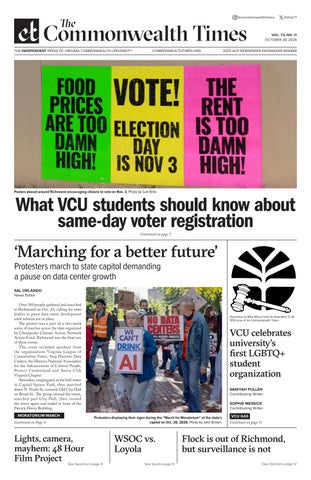
Posters placed around Richmond encouraging citizens to vote on Nov. 3. Photo by Catt Brito
What VCU students should know about same-day voter registration Continued on page 3
‘Marching for a better future’ Protesters march to state capitol demanding a pause on data center growth SAL ORLANDO News Editor Over 300 people gathered and marched in Richmond on Oct. 24, calling for state leaders to pause data center development until reforms are in place. The protest was a part of a two-week series of marches across the state organized by Chesapeake Climate Action Network Action Fund. Richmond was the final one of these events. The event included speakers from the organizations Virginia League of Conservation Voters, Stop Hanover Data Centers, the Henrico National Association for the Advancement of Colored People, Protect Cumberland and Sierra Club Virginia Chapter. Attendees congregated at the bell tower in Capital Square Park, then marched down N. Ninth St., towards Old City Hall on Broad St.. The group crossed the street, marched past City Hall, then crossed the street again and ended in front of the Patrick Henry Building. MORATORIUM MARCH Continued on Page 4
Illustration by Mike Wilson from the November 12-18, 1976 Issue of the Commonwealth Times.
VCU celebrates university’s first LGBTQ+ student organization SANIYAH PULLEN Contributing Writer SOPHIE MESSICK Contributing Writer Protesters displaying their signs during the “March for Moratorium” at the state’s capitol on Oct. 26, 2026. Photo by John Brown.
Lights, camera, mayhem: 48 Hour Film Project See Spectrum page 8
WSOC vs. Loyola See Sports page 6
VCU GAS Continued on page 11
Flock is out of Richmond, but surveillance is not See Opinions page 12
B:10.25" T:10"
2
The Commonwealth Times
S:9.5" ADVERTISEMENT
T:16"
S:15.5"
Wednesday, October 28, 2026
News
3
Stories of the week
NATIONAL: The U.S. Centers for Disease Control and Prevention reported more than 4,580 measles cases in 2026. This is more than double the number in 2025. INTERNATIONAL: A local cease-fire in Oleshky, Ukraine took effect on Oct. 27 to allow aid delivery and evacuation in the city.
Posters placed around Richmond encouraging citizens to vote on Nov. 3.. Photo by Catt Brito
What VCU students should know about same-day voter registration DEBORAH AGUILERA Contributing Writer Virginia voters can register to vote and cast a ballot on the same day, giving eligible residents an opportunity to participate in elections even if they missed the regular registration deadline. Kelsey Jones, VCU Votes’ faculty advisor, stated in an email same-day registration allows eligible students to update their registration using their VCU address, even after the regular deadline. Students who register on the same day must generally cast a provisional ballot. Provisional ballots are an alternative to turning voters away, according to the Virginia Department of Elections. They are reviewed by a local electoral board, beginning the day after elections. Provisional ballots are also issued if a voter’s name is not in the pollbook, the pollbook indicates the person has already
voted, or if the General Registrar cannot con!rm the voter is registered to vote. VCU Votes, a student organization focused on voter engagement, works to educate students about registration requirements and voting opportunities. Jones stated that Virginia’s same-day registration policy took effect beginning with the 2022 general election after the General Assembly passed legislation allowing eligible voters to register through Election Day. She stated the policy gives students another opportunity to participate while balancing school and other responsibilities. In preparation for the 2026 midterm elections, VCU Votes has expanded its efforts to reach students through classroom visits and social media, according to Conner McNulty, the organization’s policy coordinator. The group initially visited introductory political science classes before expanding to other departments through recommendations from professors and students. During these
visits, board members explain how to register to vote in Virginia, request a mail-in ballot, !nd polling locations and identify acceptable forms of voter ID. The presentations are aimed at !rst- and second-year students, many of whom may be voting in a federal election or in Virginia for the !rst time. The organization has also partnered with campus groups, including NAACP, Black Minds Matter and Active Minds, to reach students interested in different issues a nd commun it ies. T h rough social media, VCU Votes has shared information about polling locations, candidates and common misconceptions about the voting process. In written responses about the organization’s outreach, McNulty explained that its goal is to make sure students have access to reliable election information. “VCU Votes’ job is to ensure all students have accurate information on polling locations, deadlines and candidate
information, no matter their ideology or background,” McNulty wrote. VCU Votes is working to address some of the misconceptions that can discourage students from participating in elections. Deshara Butler, VCU Votes’ internal and external partnership coordinator, said one of the biggest misconceptions she has encountered is the belief that students’ votes do not make a difference. In written responses about her experience with the organization, Butler explained that this mindset can discourage civic engagement beyond college. Through student-led events, campus partnerships and social media, VCU Votes aims to make election information accessible and the voting process less intimidating. Butler emphasized that students should feel comfortable asking questions and seeking accurate, nonpartisan information. “Voting shouldn’t be a scary process to navigate,” Butler wrote.
4
The Commonwealth Times
News
Collage by Michael Wynne.
Surge in gun related alerts around campus causes student concerns MADELEINE BIONDI Staff Writer VCU has experienced a spike in gunrelated alerts this semester, resulting in students seeking answers from Richmond’s gun violence prevention programs, which continue to increase their response. Since the beginning of October, VCU Alerts have warned of six gun-related incidents on and around campus, including W. Grace St., Floyd Avenue and Monroe Park. Despite the increase in weapon-related alerts from VCU, murder rates in Richmond are down 24% and non-fatal shootings are down 15% compared to 2025, according to the RPD quarterly crime brie!ng. However, accidental shootings are at an all time high this year, totaling 33 in comparison to last year’s 24, according to the brie!ng. Former mayor Levar Stoney declared gun violence a public health crisis and announced efforts toward a public health
response by the City of Richmond, VCU and the Richmond City Health District in 2021, according to a press release. Mayor Danny Avula then created the Office of Gun Violence Prevention in 2026 to address the violence’s root cause by coordinating the city’s agencies and community, according to its website. One of the office’s first actions was assigning community ambassadors to identify gun-violence hotspots such as Stadium Sports Bar and the Fallout club, according to ABC8. VCU’s School of Public Health also launched its Center for Gun Violence Research in September, focusing on biopsychosocial risk, intervention, technology and implementation, according to its website. One of the center’s three main functions is to inform local agencies, such as the police, on prevention approaches and programs. Richmond Police Chief Rick Edwards said about 80% of the city’s gun violence could be attributed to escalated arguments
with low impulse control, according to VPM. Both VCU and Richmond police departments respond to service calls and gunshot detectors due to their shared jurisdiction, Jake Burns, public relations officer at the VCU Police Department, said. “VCU Police routinely increases highvisibility patrols following incidents, meaning officers physically positioned in strategic areas, as a deterrent,” Burns said. “Individuals are much less likely to commit crime when a police officer is nearby” Resolution to gun violence incidents are determined through investigative means, once a suspect has been apprehended or when a false alarm is con!rmed, Burns said. “Due to the size and expertise of Richmond Police’s investigative component, RPD typically leads all investigations involving shootings, and VCU Police provide support,” Burns said. Joaquin Lao, a third-year forensic science student, said that VCU Alerts are
reliable and make him feel safer, but he desires more information on the resolutions to these incidents. “It’s like, ‘Yeah, there was a shooting the other day, were you there?’ and I’m like ‘Oh, nah,’” Lao said. “It’s never the full discussion.” First-year biolog y student Zahra Samedi said she expected some gunrelated violence where VCU intersected with the city, but was shocked when the violence reached campus and her peers seemed unfazed. “The students never talk about the shootings,” Samedi said.“They’re so calm about it!” Samedi said she avoids well-known crime hotspots in the city, but did not expect to fear on-campus spots. After being near the armed subject incident in Monroe Park on Oct. 13, Samedi said she began avoiding the area, particularly at night.
Protesters displaying their signs during the “March for Moratorium” at the state’s capitol on Oct. 26. Photo by John Brown. MORATORIUM MARCH Sarah A hmed, a member of the Virginia League of Conservation Voters, said the f ight against data centers is happening in neighborhoods and communities across Virginia. “ W hile our electricit y bills creep higher and higher, while our wells run dry, and while families and pets live with a constant industrial hum in their ears, the richest corporations in history are cashing in and we are bearing the cost,” Ahmed said. Ahmed said that state leaders sided with corporate wealth over public health by not disrupting data center development. She said she believes no more data centers should be built in Virginia until there are regulations ensuring clean energy standards, protecting water supplies, lowering consumer energy costs and respecting Virginians’ quality of life.
“This is not some arbitrary talking point being said by some environmentalists,” Ahmed said. “This is what the people of Virginia who elected you [state leaders] are demanding.” Je n n i fe r C or p u s , c o -f o u n d e r o f Stop Vi rg i n ia D at a C enter s , sa id d ata center s need power f rom g a s plants, resulting in transmission lines on residential land. Corpus said the proposed NextEra and Dominion Energy merger would change who controls the citizens power grid. Although Attorney General Jay Jones and Lt. Gov. Ghazala Hashmi opposed the merger and the State Corporation Commission recommended denia l, Gov. Spanberger was the Virginian politician to take Next-Era money for her inauguration. “This week, she [Spanberger] told regulators, reject this merger, unless companies meet her terms,” Corpus said.
“She didn’t say no to the Next-Era merger, she named her price.” Corpus called for Spanberger to reject the merger. Steve Herring, a member of Protect Cumberland, said Dominion Energy was approved by the Cumberland County Board of Supervisors to build the second largest national gas plant in the county. “Dominion is trying right now to figure out how to rebuild their entire electric grid just to serve data centers, not to serve people,” Herring said. Herring said Dominion is not up to the !ght against residents, and that is why the company had to !nd a “corporate daddy in NextEra.” Monica Hutchinson, president of the Henrico NAACP, said historically, whenever industrial infrastructure is fast tracked, it is not placed in communities with “political clout,” but in black and brown communities.
“We are not anti-technology, we are not anti-progress, but we are unconditionally pro-community and pro-accountability.” Hutchinson said. Hutchinson demanded four protections: t ra nspa rent commu n it y oversight, env i ron menta l just ice , rate payer protection and righting past wrongs. Hutchinson said she understands that technology can be an equalizing force, but only with strong guardrails and accountability measures. Tim Cywinski, member of the Sierra Club Virginia chapter, said community members are not just asking for a moratorium, but for the %oor of public policy to have justice. “You’re [protesters] not just marching against data centers, you’re marching for a better future, one that works for all of us,” Cywinski said. “That is what’s at stake, and that is what all of you deserve. That is what we’re going to !ght for from today to the end of [the general assembly] session.”
Wednesday, October 28, 2026
5
News
Protesters displaying a banner during the “March for Moratorium” at the state’s capitol on Oct. 26.
Protesters displaying their signs during the “March for Moratorium” at the state’s capitol on Oct. 26.
Photo by John Brown.
A protester displaying a sign during the “March for Moratorium” at the state’s capitol on Oct. 26. Photo by John Brown.
Photo by John Brown.
Jennifer Corpus from the Stop Hanover Data Centers organization speaking during the “March for Moratorium” at the state’s capitol on Oct. 26. Photo by John Brown.
ADVERTISEMENT
SEE YOU AT THE
POLLS Voters, make your voice heard!
Politicians pay attention to the groups that turn out. When VCU students show up at the polls, local, state, and national leaders have to listen to what matters to us. Make your voice heard. Cast your ballot. See you at the polls, VCU!
Follow us on Instragram!
Register to Vote!
Find your Polling Location!
6
The Commonwealth Times
Stat of the week
Sports
Fourth-year goalkeeper Mia Pongratz posted her second shoutout of the season vs Loyola University Chicago on Sunday.
GAME RESULTS 10/21/26 VCU GOLF - AT BANK OF TENNESSEE INTERCOLLEGIATE 1ST PLACE / 13 TEAMS
10/22/26 VCU WSOC - AT RICHMOND LOST 2-0
10/23/26 VCU FH - VS SJU LOST 1-0 OT (SO)
VCU WVB - AT DUQ LOST 3-0
10/24/26 Illustration by William Love.
VCU women’s soccer snaps losing streak in scoreless draw against Loyola Chicago in home finale BENNEY KOCH Staff Writer VCU women’s soccer tied 0-0 against Loyola University Chicago and snapped their six-game losing streak on Sunday at the VCU Athletic Village in the Rams’ final home game of the season. The Rams battled Loyola Chicago through a back-and-forth contest, with both teams finding opportunities in the midf ield but struggling to turn their attacking runs into goals. Fourth-year goalkeeper Mia Pongratz helped preserve the draw with four saves, posting her second shutout of the season. The performance brought her career total to 119 saves, moving her into 10th place in VCU women’s soccer program history. “It just means a lot to me that I was able to give a lot back to a program that’s
given so much to me these past four years,” Pongratz said. “I’m very, very proud to do it with this team too.” Loyola Chicago tested Pongratz early, forcing a save in the fourth minute. The Ramblers outshot VCU 8-5 in the first half, but the Rams held firm defensively to enter the break scoreless. VCU found more success in creating opportunities after halftime, putting three shots on goal in the final 10 minutes. However, fourth-year Loyola Chicago goalkeeper Allison Deardorff kept the Rams off the scoreboard with four secondhalf saves. The match all came down to the dramatic 90th minute when Loyola Chicago was awarded a penalty kick following a video review. The Ramblers attempt sailed wide, allowing VCU to stave off a loss in their home finale.
VCU head coach Laryn Hutchinson said the team’s defensive adjustments played an important role in the result. VCU switched to a 5-4-1 formation to counter Loyola Chicago’s speed on the wings, a change Hutchinson said worked well for the Rams and one that will continue to be worked on in the upcoming offseason. “It did work today for us,” Hutchinson said. “It’s definitely something to look forward to for the future.” As the season approaches its conclusion, Pongratz said the team has emphasized enjoy ing their remaining moments together, particularly for the senior class. “Don’t take any moment for granted because it really just goes by in a flash,” Pongratz said. The Rams will close out their season on the road against Dayton at 7 p.m. Saturday, Oct. 31.
VCU first-year defender/midfielder Reese Paciorek vs Loyola University Chicago.
Fourth-year goalkeeper Mia Pongratz following her shutout performance vs Loyola Chicago.
VCU fourth-year goalkeeper Mia Pongratz defends goal against Richmond second-year forward/midfielder Jess Moylan.
Image courtesy of VCU Athletics.
Image courtesy of VCU Athletics.
Image courtesy of VCU Athletics.
VCU WVB - AT DUQ LOST 3-0
10/25/26 VCU MSOC - AT DUQ LOST 3-0
10/26/26 VCU WSOC - VS LUC DRAW 0-0
Illustration by William Love.
Wednesday, October 28, 2026
7
Sports
VCU field hockey falls in penalty shootout DREW CLEMENTS Staff Writer After 75 minutes of scoreless field hockey, VCU lost to St. Joseph’s University in penalties Friday at Cary St. Field, dropping their record to 8-8 on the season. Throughout the first quarter, both teams exchanged shot attempts, although each side struggled to create open opportunities. Third-year goalkeeper Emma Clements set the tone for the game, fighting off early pressure from St. Joe’s. Clements’ performance for the Rams stood out, making several diving blocks and kick-saves throughout the game to keep the score knotted. VCU head coach Stacey Bean applauded the performance in goal. “I thought our penalty corner defense was outstanding today, led by Emma in
goal there,” Bean said. “But we’ve gotta find a way to put a little bit of pressure on the opponent and earn a corner ourselves.” The game was even throughout the first half and into the second, even after VCU second-year Emily Foerster was forced out for 10 minutes with a yellow card. After four quarters with no goals, the game went into overtime. St. Joe’s was aggressive and earned multiple penalty corners, but neither team managed to break the tie. Third-year Cameron Butler said the Rams stayed resilient and powered through the game. “There were some rough plays, we had someone out with a card for a while, we just played through it all, every last second, all the way through shootouts,” Butler said. After the final overtime whistle, the crowd gathered on one end of the field for the penalty shootout, and St. Joe’s scored
their opening opportunity. VCU’s first shot was blocked, and St. Joe’s answered with a second goal. VCU failed to convert their second opportunity, and after St. Joe’s scored their third, VCU was blocked once again, securing St. Joe’s the victory. Bean highlighted the defensive effort put forth by the Rams. “They’re a very good team, and we just kinda played ‘bend but don’t break’ defense,” Bean said. “We really stuck together as a team and took our defensive responsibilities to heart.” The Rams will play their final regular season matchup on Friday, Oct. 30 at Richmond. VCU field hockey celebrates during their Oct. 9 matchup against Lock Haven.
Image courtesy of VCU Athletics.
Rams lose crosstown battle to Richmond in 2-0 shutout TYRESE PERKINS Assistant Sports Editor The VCU women’s soccer team fell 2-0 to crosstown rival the University of Richmond Spiders on Thursday, as an impressive defensive performance by the Spiders was too much for the Rams to overcome. Despite an aggressive second-half effort and multiple well-placed shots on goal, the Rams were unable to find the back of the net. The match got off to a fast-paced, physical start with both teams battling for early possession. Richmond opened up the scoring in the 15th minute when third-year midfielder Paige West placed a right-footed shot into the bottom center of the net. VCU looked for an immediate response, but fouls and stoppages disrupted the Rams’ momentum. VCU fourth-year goalkeeper Mia Pongratz delivered a big
moment in the 44th minute, diving to save a low strike from Richmond’s thirdyear Sophia Jurado and keep VCU within striking distance heading into halftime. To start the second half, the Rams made adjustments and quickly picked up their momentum. Third-year forward Kate Weyer nearly leveled the match off a 47th-minute corner kick, launching a shot toward the top right corner that required a high-handed save from Richmond secondyear goalkeeper Isabel Seifert. To sta r t the ha l f, substit utions provided an energetic spark for the Rams, particularly through second-year forward Isabelle Franklin. Franklin consistently pressured the Spiders’ back line, testing Richmond second-year goalkeeper Isabel Seifert with a shot on goal attempt in the 49th minute and another just minutes later. “I think it was just finding the pockets in between their line of defense, especially in between the center backs,” Franklin
said. “That's why I was able to get the slip balls and make runs that way.” In the 57th minute, Richmond secondyear forward Emma Newman picked up space near the top of the box and curled a right-footed strike into the top right corner, making it 2-0. Unfazed by the two-goal deficit, the Rams still pushed forward in a relentless attempt to mount a comeback. Fourth-year forward Ishpreen Marwah spearheaded the attack after the second goal, forcing backto-back saves from Richmond's thirdyear goalkeeper Veronica Rrapi in the 58th minute. Defensively, first-year defender Taleah James and the Rams defended heavy pressure from the Spiders, despite the 2-0 deficit. “I think we were well prepared for their long balls, we always had each other's back with the coverage,” James said. “We adjusted very well, and we communicated
well with the switches, so it helped us out a lot.” James added that the team focused on staying positive when Richmond scored. “We just uplifted each other, we tried to keep our heads held high, and we encouraged each other to keep pushing forward,” James said. “Despite mistakes, we let it go and we keep going.” Franklin created one final drive in the 85th minute with a strike aimed toward the left post, but Rrapi batted the ball away to secure the 2-0 win for the Spiders. Following the game, VCU head coach Lauryn Hutchinson harped on the fundamentals. “I think the biggest thing is our principle-based things,” Hutchinson said. “So challenging for air balls, if we don't win the first ball, winning the second, or are we trying to win the third, the fourth, the fifth, the sixth, the seventh.”
VCU fourth-year midfielder Vivian Vendt battles for the ball against Richmond fourth-year defender Gwen Howell. Image courtesy of VCU Athletics.
8
The Commonwealth Times
Spectrum Lights, camera, mayhem: 48 Hour Film Project
Behind the scenes of ‘Maternal Instinct,’ a short film made during the 2026 Richmond 48 Hour Project. SANIYAH PULLEN Contributing Writer Every fall, the 48 Hour Film Project in Richmond hosts a horror film project — with a twist — local filmmakers only have 48 hours to plan, write, shoot and edit their original short films. The Richmond 48HFP began on Oct. 9 at 7 p.m. and ended on Oct. 11 at 7:30 p.m. The recruitment process takes place 10 weeks before the films’ creation. 48HFP hosts events during that time to connect possible participants and audition actors to form full teams, including a “how-to” event that provides information on the project and its process. The films come with the requirement of specif ic elements involved in the film: a designated character, a prop and a line of dialogue. Lisa Giles, cit y producer of the Richmond 48 Hour Film Project and VCU alumna, has worked with students in Virginia for over 20 years. Giles said that 48HFP gives students
the opportunity to learn about themselves as filmmakers. “It’s the best way to put your creativity to the test, to see how you respond under pressure, being in this environment where things are going to go wrong and you have a deadline to meet,” Giles said. Giles said that seeing participants form relationships through the event has been one of her favorite parts of producing the project for the last decade. “I’ve seen people go from strangers to business partners, successfully creating content on their own,” Giles said. “The community is so tight-knit, and everyone is so supportive.” Natalie Auandee, a third-year cinema student, worked as camera operator for the film “Maternal Instinct.” The film received five nominations and two awards. “It’s two sides of the same coin,” Auandee said. “It can really benefit you to have limitations, but it can also hurt you creatively. Overall I think what people did with the requirements was so creative.” “Maternal Instinct” followed a young
A hauntingly good look SILOE BROWN Contributing Writer
In the fall, the world of special effects makeup takes center stage in Richmond, where artists can show off technical skills in true Halloween spirit. SFX is an art form that uses makeup and prosthetics to create convincing tricks of the eye. It is prevalent in show business, using makeup, props and moving elements to better immerse viewers in a film, music video or magazine imagery.
Red Vein Army Founded by Ryan Sligh, Red Vein Army is an artist collective in Richmond that has haunted the community for the past 15 years. Sligh and his team work to make their productions as memorable as they are terrifying. He said his love for creating began as a child building haunted houses in his parents’ basement, but he did not pursue SFX as a career until 2011 when he received his first opportunity. Sligh’s first haunt was Scares That
A photo op display at Red Vein Haunted House for ‘lambs’ that survived the slaughter.
Photo by Abriana Ridgley.
On This Day
The Statue of Liberty, designed by French sculptor Frédéric Auguste Bartholdi, was officially dedicated by President Grover Cleveland in New York Harbor on Oct. 28, 1886. woman trying to escape the household of a controlling and psychotic mother. The film won the awards “Best Use of Genre” and “Best Practical Effects.” “Maternal Instinct” was Auandee’s first 48HFP. She expected a stressful event, but had a much calmer experience due to the crew meshing. Ben Phan, a third-year cinema student, has participated in the 48HFP for the past two years. This year, he worked as director of photography on the film “Bleeding Me Dry.” “In my experience, I’ve noticed that a lot of students struggle with motions of stagnation,” Phan said. “The 48 gives us the opportunity to practice decision-making skills that are so inherent to filmmaking.” Phan said he enjoys spending time with the actors, including running through their lines and developing relationships with them. The completed projects premiered on Oct. 17 and were voted on for awards after the screening. The films were eligible for judge awards in categories such as directing, editing and writing. Audiences also had the opportunity to vote on their favorite film for the audience awards. All award-nominated films were screened at the following event on Oct. 25,
with the award ceremony taking place after the screening. At the nomination event, films and filmmakers received recognition for their projects, with 16 films showing after receiving award nominations. Mitch Sutfin, Best Actor Award winner for the film “Occupied,” has participated in seven 48HFP. “Occupied” is a comedy horror film, following t wo characters and their experience with an enthusiastic YouTuber. “It was the smoothest it’s ever gone for our team,” Sutfin said. “We were done shooting in pretty much 12 hours, it was a leisurely walk across the finish line instead of a full blown sprint.” “Comeuppance,” one of the f ilms submitted for the project, ended the ceremony with six awards. The film, which features puppets and sculptures as its characters,received the opportunity to compete in the 48HFP’s national competition. Lindsey West and Christopher Gehrke, co-directors of “Comeuppance,” said the film was the puppet movie of their dreams. “I was proud of the product, hoped other people would like it, and they did,” West said. “I went into it with no expectations and came out of it super happy.”
Behind the scenes of ‘Maternal Instinct,’ a short film made during the 2026 Richmond 48 Hour Project. Photos courtesy of Natalie Auandee. Care in Williamsburg, a nonprofit charity organization that raises money to help children in need. It assists with the living and medical expenses of burn survivors and breast cancer patients by hosting events and auctions centered around horror. Sligh said the experience solidified his passion to create the Red Vein Army in Richmond. “I’ve had failures, but I’ve been able to talk to mentors and get the best advice and keep pushing forward,” Sligh said. Red Vein Army occupies Hanover Vegetable Farm, creating different haunted Halloween themes each season, according to a previous report by the CT. Turning a love of gore into art Rem Linton is a makeup ar tist specializing in visuals for short films, music videos and photoshoots. For the past five years, Linton has created looks for the Halloween Haunt at Kings Dominion. “I didn’t really know anything about special effects other than face painting,” Linton said. “They taught me everything I know.” Linton’s skills have now expanded to more complicated forms, like airbrushing, to create realistic-looking wounds. “I really like dark fantasy and I love anything gore,” Linton said. “We always like to say that the best compliment is, ‘Wow, that looks disgusting.’”
Sev Gedra is the lead fabricator and department head of specialty fabrications for New Project, a fabrication and design f irm in Brooklyn, New York. Gedra, based in R ichmond, splits her time between the two cities. Gedra studied studio art and art history at the University of Maryland, but her career in SFX began in the haunted house business, where she learned the basics through trial and error alongside YouTube tutorials and hours of dedication. Gedra blends her knowledge of art and practical effects to create elaborate costumes and props as well as makeup. “There is an interdisciplinary nature of SFX that is so fascinating to me,” Gedra said. “When you start to incorporate puppetry and components that move, there’s this whole other layer of creating an illusion.” Gedra’s work history spans across industries, from Sephora to metal shops, where she honed various skills including sculpture, foam fabrication and molding. The field of SFX can be di$cult to break into and find a niche for artists beginning to develop their craft, Gedra said. Breaking into the SFX industry and finding a niche can be challenging for emerging artists, Gedra said. She said leaning on a community can make all the difference while developing a craft.
Wednesday, October 28, 2026
9
Ready, set, go! Ram Racing participates in Formula Socie! of Automotive Engineers FAKEHA NAEEM Contributing writer Ram Racing is an off icial multidisciplinary Formula Society of Automotive Engineers student-led team at VCU with 25 to 30 team members. The program began in 2010 after a group of engineering students heard about the Formula SAE competition, according to Ronin Harper, vice president of Ram Racing and a fourth-year mechanical engineering student. Harper had a previous interest in racing, and joined the club after seeing its Instagram post. “We want to grow as an organization and show off VCU engineering capability,” Harper said. “We look forward to having our racing car VCU-04 compete with schools like VT and UVA. I think that would be our dream.” The idea of creating Formula 1 race cars was initiated by Formula SAE in the ’80s when automotive engineering was a growing field. According to Joe Franzen, president of Ram Racing and fourth-year mechanical and nuclear engineering student, Formula SAE were the leaders who created the automotive industry standards to add student interest. “I learnt about the club through SOVO fair and engineering student organization fair,” Franzen said. “Joining this club has helped me understand engineering challenges that our competition poses and hone my engineering skills.” Ram Racing built its first competition car, named VCU-01, in 2017 and pa r ticipated in the Formu la SA E competition in Nebraska that same year.
The club later debuted its new car called VCU-02 in 2019. While the first two builds were gaspowered, the VCU-03, which competed in the Formula SAE competition in spring 2026 at Michigan International Speedway, was the first electric race car built by VCU. Currently, Ram Racing is building its new car, VCU-04, in hopes of competing in 2028 at the Formula SAE competition, where 120 teams are expected to attend. The club receives funding to go to the Formula SAE competition from alumni, the dean, the Department of Engineering and sponsorships from local shops and companies, such as DuPont. Ram Racing recruits new members before seniors graduate to give the new members proper training and skills needed for the team afloat. Farhan Nahin, an engineering management graduate student, said the program offers students real-world experience that may not be available in classrooms. “It is well recognized and having that kind of FS experience on our resume shows that we have worked with multi-faceted teams and are able to meet deadlines,” Nahin said. Nahin said it was one of his most valuable experiences, offering connections and exposure to build his career. “There is a sense of fulfillment when you see the car being built,” Nahin said. “I joined the club in 2022 and it was a fulfilling journey to see the car being built again almost after 10 years and how the momentum continues to grow.” More information about future events of Ram Racing can be found on their Instagram @ramracingvcu.
A knight out in Monroe Park WILDER RODRIGUEZ Contributing Writer Knights and squires head into battle as arrows buzz overhead and swords clash. This is not a scene from a history book or a medieval blockbuster, but rather one in Monroe Park, amongst Richmond’s bustling city and its towering buildings. Instead of steel swords and iron-tipped arrows, these knights and squires are armed with the finest foam in all the realm. Cambria Battlegames is a Live Action Role Play ing communit y based in Richmond headed by a dedicated group of VCU alums. They host practices each Thursday at 5 p.m. at Monroe Park. Buck Helmke, also known as Sir Stone Wyndhaven, is a part of the core leadership group who founded Cambria Battlegames. Helmke said that the group began in 2006 when he and his roommates were still students at VCU. While on a camping
trip, Helmke’s roommates unexpectedly discovered LAR Ping and excitedly reintroduced it to him. The early days consisted of small practices in Monroe with only members of the household, Helmke said. “Our best recruitment is literally just sitting here in the park fighting and people will walk up and ask,” Helmke said. “We’ll teach anybody to fight.” Helmke said that the communit y attends larger events featuring a variety of scenarios including capture the flag and king of the hill. Armageddon, an event hosted by the Belegarth Medieval Combat Society, a national organization for foam fighting sports, took place in June, Helmke said. The event follows the Belegarth rule sets and has been hosted annually since 2001. Helmke said that Armageddon boasts various tournaments including one-on-one combat and seven-on-seven fights.
Members of Cambria Battlegames battling during a meeting in Monroe Park on Oct. 22.
Photo by John Brown.
The VCU Ram Racing team at the International Formula SAE competition in Michigan in June of 2026. Photos courtesy of VCU Ram Racing. “You can just join the field and have 500 people fighting at once,” Helmke said. Now a software developer, Helmke said the LARPing community shaped his career trajectory. “Back when I was a college student it was a great way of teaching myself to engage with the public,” Helmke said. “If I can do it in silly clothes, I can do it in a suit and tie.” Ella Brant, also known as Ella of Monroe, is a fourth-year English student who discovered the group during her first year after walking past one of Cambria's weekly practices. Since starting, she has formed new connections and some of her closest friends. “I discovered it just like many of our newest generations do, freshman year just walking around campus,” Brant said. Brant said that the community is highly diverse, made up of many younger VCU students, alums and locals. “I think there’s some kind of stigmatization,” Brant said. “Over time, I’ve def initely seen people become more accepting of this as nerd-culture.” Brant said that her personal weapon was around $80 to $100 to make. However, this is on the upper end of the price range. To make it easier for newcomers to join in the action, Cambria Battlegames provides loaner weapons, she said. Many of the regulars in the community use LARPing as a more entertaining means to stay active. “A good place to get some exercise… going out once a week and hitting people with a giant stick,” Brant said. Adrian Dickenson is an infrequent attendee to Cambria’s practices. She does not have a specific character within the LARPing world.
A member of Cambria Battleground demonstrating how a shield works during a meeting in Monroe Park on Oct. 22. Photo by John Brown.
“It's the sort of thing you earn the more of the battles you go to outside of these practices,” Dickenson said. The experienced core keeps the new groups organized and moving forward, Dickenson said. Dickenson sa id t he communit y perceived in the wider public can receive looks, but it does not discourage her and other members from continuing to enjoy LARPing. More information about the larger national Belegarth community can be found at the website https://www.belegarth.com. A calendar of local events is on the website https:// www.kingdom-of-gwynedd.com/events/.
10
The Commonwealth Times
Features
RVA Spotlight
March through downtown with the All Saints Theatre Company at its 21st annual Halloween parade, starting at Monroe Park and traveling through Oregon Hill. Meet the company across from the Altria at 6 p.m. in your most creative costume and prepare to head off at 7 p.m. After the parade, gather in the park for a concert to dance the night away.
The art of being understood Close up of Momentary Awe, Copper. Photo by De Smaw. ELLE COTA Spectrum Editor A textbook can explain the body, but it cannot contain every experience of living in one. Through color, texture and form, artists communicate what words alone often cannot. “Embodied Knowledge,” a juried exhibition at VCU Health Sciences Library, brings together work that explores the perspectives of disabled artists’ work reflecting experiences of illness, disability, healthcare and survival. The title “Embodied Knowledge,” reflects the understanding people develop through navigating healthcare, including the trial and error involved in finding care teams that listen to and understand them. Xavier McDaniel, a senior painting and printmaking student and arts and social programming director for VCU’s Disability Advocacy and Accessibility Caucus, curated the exhibition. “It’s important to highlight that disabled is an umbrella term and that there are many people out there who don’t consider themselves disabled,” McDaniel said. “I always include, ‘Are you neurodivergent? Do you have a chronic condition? Chronic illness?’ Like all of those things fit within this term of being disabled.” The open call attracted 44 artists from the Richmond community, each having the opportunity to submit three pieces. The final exhibition features 19 works. McDaniel said he wanted the space to encourage people’s engagement with what the artists are communicating. He wanted to avoid tokenism by emphasizing what disabled artists communicate through their work, rather than including them solely because of their identities. “Not only should they be seen, they should be heard and valued,” McDaniel said. McDaniel said he acknowledges the importance of books, artist biographies and writing by disabled people, but that viewing artwork offers a different experience because viewers can sit with it, return to it and continue thinking about it. McDaniel initially expected the exhibition to include more sad artwork, but said he was surprised by how celebratory many of the submissions were. He said that seeing the range of work changed his perspective and made him wonder how encountering the work might affect people who are not disabled or do not work in the arts. McDaniel offered f lexible artwork drop-off arrangements, framing assistance and help with installation to make the submission and exhibition process more accessible for artists. He made sure to bring together different identities, experiences and artistic backgrounds for the juroring process.
Each juror anonymously reviewed the pieces and only one work per artist was allowed to avoid one artist receiving multiple rankings at the expense of other artists. The exhibition included Best in Show, second place, third place and honorable mention awards. Community organizations including SCR AP RVA, Visual Arts Center of R ichmond and Galler y5 donated prizes. McDaniel said he wants to continue reducing the stigma surrounding disabled people and create more opportunities for disabled artists to show their work with fewer barriers to participation. Madaline Gardner, a recent graduate of the painting and printmaking MFA program, co-curated the “Embodied Knowledge” exhibition. She helped design and install the exhibition and suggested the addition of juried prizes for participating artists. “My research changed the way I make art through my perspective as a neurodivergent person, as I introduced tactile aspects to my work to accommodate for those with different sensory needs,” Gardner said. “There is a wide range of how disability is expressed in art, as artists seek to convey their relationship with the world around them and share a glimpse into their lives, they need assistance to give their art a place to be experienced.” Gardner said that although disabled people face limitations related to their bodies and minds and a lack of systemic care, their experiences can offer valuable perspectives to others. “Art is unique because it is a form of communication that engages the senses,” Gardner said. “It reaches across barriers to form connections.” Gardner said she hopes “Embodied Knowledge” will help participating artists build relationships and expand their professional development opportunities in the future. Sue Moss, VCU Health Sciences Library engagement coordinator, said the exhibition aligned with the library’s goal of creating opportunities for the community. “At HSL, where knowledge is often associated with research and clinical expertise, disabled artists remind us that lived experiences and creative expression are also valuable sources of insight,” Moss said. Moss said that recognizing disabled artists as knowledge contributors is important because their work offers more than representation. “Their work does not simply illustrate existing knowledge,” Moss said. “It can question established perspectives, reveal overlooked experiences and enrich how we approach healthcare, education and research.” Moss said she hopes visitors leave the
gallery with a deeper appreciation for the diverse ways people experience and navigate the world, particularly in relation to disability. She said the artwork can encourage students and faculty to discuss accessibility, representation and person-centered care. Participating artists Lois Park, a fourth-year painting and printmaking student, took art classes growing up, but did not begin taking their artistic practice more seriously until after starting college. Park’s art piece “Ennui,” examines how capitalism and the commodification of people and objects can diminish empathy and respect for others. They said they believe society’s emphasis on efficiency can come at the expense of meaningful human connection. The exhibited piece is part of a larger body of work they are developing around those ideas. The piece took approximately 10 to 15 hours. Although Park had a strong conceptual foundation for the work, they did not know exactly how those ideas would translate visually. “The visual results and also the ways that my work diverges from the theory that I started from were both kind of surprising, but also really cool to see,” Park said. Park wants viewers to spend time with their paintings and consider the meaning. “My priority is less concerned with people understanding what the work is supposed to mean immediately,” Park said. Words can struggle to capture complex emotions or feelings that cannot be defined by a single phrase, Park said. “A feeling or an atmosphere, those are things that I think visual art is better suited to describing, which I think they are often the more important things to describe sometimes,” Park said. Eva McMullen, a fifth-year student double-majoring in English and painting and printmaking, had been creative from a young age, enjoying projects and drawing. Their multimedia piece, titled “In the Belly of the Afternoon,” uses screen print, collograph, tracing paper, dried herbs and artist board. The idea developed from McMullen’s experience with Type 1 diabetes and becoming more conscious of their sleeping patterns. The art work ref lects McMullen’s desire to honor rest rather than treat it as something that needs to be justified. McMullen estimated that physically creating the piece took a week, although the concept developed over a longer period. Viewers can have an immediate emotional response to a piece without necessarily knowing how to describe it, McMullen said. “I feel like when I’m looking at a piece of work, there is a gut feeling that I get
initially and I’m not always sure how to articulate,” McMullen said. “I think sometimes you can really feel the artist’s presence within the piece.” McMullen said visual art can evoke memories, feelings and conclusions in less direct ways, allowing viewers to develop their own relationships with the work. Cori Anderson, a fourth-year painting and printmaking student, did not spend much time drawing or making art growing up, but decided to pursue an art degree after discovering a passion for painting. Anderson’s piece “Rat Race,” explores the anxiety and uncertainty that can accompany graduation. The painting grew out of conversations with family members about their future and the expectation that they should have pursued a different career. “I don’t function in the way where I could go and work for the government, be an accountant for like 40 years and that just be my life,” Anderson said. “I tried to do that and it didn’t really work out for me.” Anderson created “Rat Race” in three days, spending an estimated 20 to 30 hours on the painting. Before “Rat Race,” Anderson recently completed a painting they were particularly proud of and worried they would struggle to produce another piece at the same level. They said they had to remind themselves that the painting might not look right during the process, but would eventually come together. In “Rat Race,” the rats and gridlocked traff ic represent the pressures and frustrations associated with modern life. Anderson also incorporated electricity transmission towers, which they viewed as symbols of the underlying infrastructure supporting capitalist systems. Although the towers are a familiar part of the landscape, Anderson said people often overlook their importance in maintaining the systems that structure everyday life. “I was making a parallel there that I knew was a reach but I was like, ‘Maybe people would get it, maybe not,’” Anderson said. “Embodied Knowledge” will remain on display at the VCU Health Sciences Library until February 2027. In addition to the Embodied Exhibition, there is a “Soft Armor” exhibition open call underway and expected to close in November, with jurying scheduled for December. The exhibition is planned to open Jan. 22, 2027. “Soft Armor” will be a disabilitycentered exhibition at The Anderson. The theme differs from “Embodied Knowledge”: instead of focusing primarily on experiences within healthcare, it explores the forms of armor and the tools people use to get through life while living with disabilities.
Wednesday, October 28, 2026
11
Features
VCU celebrates universi!’s first LGBTQ+ student organization SANIYAH PULLEN Contributing Writer
SOPHIE MESSICK Contributing Writer
50 years ago, the Gay Alliance of Students at VCU won a court appeal that would force VCU to recognize them as a registered student organization, according to a previous report by the CT. On Oct. 16, a marker was unveiled, honoring the GAS student founders and their fight for expression. The organization was intended to create a “unified support community for men and women of all sexual orientations, serve as an informative resource to the university and surrounding community and assist the university in creating a positive institutional image,” according to the VCU Scholars Compass. The organization submitted their application to the VCU Office of the Dean of Student Life on Sept. 5, 1974. The application was referred to Richard Wilson, the Vice President of Student Affairs, and then the Board of Visitors. GAS was denied registration in a vote of 7-2 by the BOV. “Existence of GAS as a recognized campus organization would tend to attract other homosexuals to the University,” according to the VCU Scholars Compass. Josh Leidy, director of a ff init y engagement & philanthropy,at VCU’s off ice of Development and A lumni Relations said now, VCU students are able to see diverse representation of the queer community and the institution is trying to keep up with that. “There’s a lot of outside pressure being put on higher education to stifle LGBTQ initiatives, and I think VCU is trying to do its best to support LGBTQ initiatives,” Leidy said. Leidy said the VCU has a responsibility to tell history and preserve it, even if it does not paint it in a positive light.
On April 9, 1975, a local attorney, John M. McCarthy, filed a lawsuit on behalf of GAS. McCarthy argued that VCU’s refusal violated the students’ First and Fourteenth Amendment Rights. VCU’s assistant attorney general defended their denial with four reasons. “GAS would increase opportunity for homosexual contact; the existence of GAS as a registered organization would encourage some students to join the organization who otherwise might not join; being involved in GAS could be socially and psychologically harmful to individuals; and GAS would tend to attract more homosexuals to VCU,” according to the VCU Scholars Compass. District Court Judge D. Dortch Warriner upheld VCU’s decision and decided GAS was entitled to some student organization benefits, such as access to VCU facilities, advertising, and being listed in the student directory, but denied other benefits including staff advising and funding. Walter Foery, GAS spokesperson and GAS student advisor Stephen Lenton issued a press release in September of 1975, stating that the GAS would appeal the court’s decision. “When I joined the group, and learned that the University had denied recognition, I was incredulous,” Foery said. “I thought, ‘That’s crazy, how can they do that?’ It seemed so open and shut to me.” On Oct. 28, 1976, the U.S. Court of Appeals for the Fourth Circuit ruled in favor of GAS. The court determined that VCU’s refusal to register GAS as a student organization violated the students’ First and Fourteenth Amendments. The decision made by the court became
Illustration by Mike Wilson from the November 12-18, 1976 Issue of the Commonwealth Times.
legal precedent that is used by many LGBTQ+ student organizations across the United States. “The older I’ve gotten, the bigger deal I realized it was,” Foery said. “We changed the laws in five different states by winning that court case, and that's a pretty big deal.” Forey said he hopes the marker for GAS does not get defaced and lots of people get to see it. Bill Sachau, a 1980 VCU alumnus, said prior to coming to VCU, he was happy to see there was a Gay Student Alliance (previously known as the Gay Alliance of Students.) “It [GSA] helped me to make friends and get the support I needed being a new student on campus and in the city, so making those connections in the gay community was very helpful,” Sachau said.
Walter Foery, a former member of GAS and speaker at the marker unveiling, cutting the ribbon off of the GAS marker. Photo by Sal Orlando.
Today, VCU has multiple queer student organizations and resources, including The Rainbow Group, Queer Action, Queer Arts Collective, and LGBTQ+ informed counseling services. Adrien Young, an interdisciplinary studies major, currently runs the Queer Arts Collective at VCU. “The community is important, especially for people who come from areas where being queer isn’t celebrated or known, they’re allowed to find their group and have people who become a found family,” Young said. Young said what GAS did was a statement on their right to exist as a whole and be acknowledged as a part of the broader VCU community.
12
The Commonwealth Times
Opinions This is America: Speak another language SHINY CHANDRAVEL Assistant Opinions & Humor Editor In Tamil, there is no word for goodbye. Instead, we say, “poitu varen,” which directly translates to “I’m going and I’m coming back.” Growing up, it was the phrase I heard every time my dad would leave for work. It was what my relatives would say before I entered the airport after a long-awaited trip to visit them in India. It was the last thing I heard my grandfather say before he passed away. “Poitu varen” is a constant reminder that goodbyes can be tender, farewells do not need to be permanent and that you ought to promise your loved ones to always come back. It is a challenge to be born and raised in the United States and still feel deeply connected to your family’s culture. However, understanding, speaking, hearing and even reading my mother tongue has remained a uniquely powerful way for me to connect with my heritage, transcending political borders. My bilingualism shapes the way I experience the world around me. According to Ethnologue, the U.S. remains one of the top five countries with the largest number of spoken languages as of 2024. We are home to a vast variety of dialects, speech patterns and sign languages carried by indigenous peoples and immigrants of all kinds. Nevertheless, in a country this rich in
language, the structure of our language education pales in comparison to that of other nations. According to The American Council on the Teaching of Foreign Languages, only about one in five K-12 students and one in 12 university students are in a world language class. This is drastically deficient compared to the 92% of European students studying a second language. Consequently, only 10% of American adults can speak a foreign language f luently, as reported by the American Academy of Arts & Sciences, as opposed to 65% of Europeans. According to UNESCO, 31 African countries have adopted multilingual education structures. Likewise, India has implemented the Three-Language For mu la , simu lta neously teac h ing English, Hindi and the respective regional language. According to the Pew Research Center, over 20 European countries have made studying a foreign language mandatory, typically starting between ages six and nine. In comparison, the U.S. lacks any nationwide language education mandates. Education policies are left up to the states, leaving participation in secondary language programs inconsistent, with participation percentages as high as 51% in New Jersey and as low as 9% in states like New Mexico, Arizona and Arkansas, according to the Pew Research Center.
Flock is out of Richmond, but surveillance is not REED BALDWIN Contributing Writer About six months ago, I wrote an article in The Commonwealth Times about Flock cameras in Richmond. At the time, my primary concern and purpose for writing it was pretty simple: I do not like being tracked and recorded, and nor do many others. According to the Institute for Justice, there are several national cases of law enforcement misusing ALPR technology. ALPRs, or Automated License Plate Readers, are controversial surveillance dev ices t hat record l icense plates and allow law enforcement to search national databases for a vehicle’s recent activity. From Braselton, Georgia, to Sedgwick, Kansas, to Johnson County, Texas, officers have been proving that communities’ concerns over privacy and surveillance are warranted. Communities across the country have seen a rise in this kind of surveillance technology (and misuse of it) since the beginning of the COVID-19 pandemic. Mass surveillance is a serious problem — there is no question about it. Recent events, however, have shifted my focus to something I consider far more concerning. Earlier this month, after several months of public pressure, Richmond Mayor
Danny Avula announced that the city will not be renewing its contract with Flock Safety according to ABC News. Big win, right? Danny also mentioned that the current contract will continue through June 2027, he is not ruling out a contract with another ALPR company and that Flock’s “benefits outweigh the risks.” In other words, the cameras are not going anywhere anytime soon. A likely candidate to replace Flock Safety in June is Axon, a company that the city is already conducting business with. Like Flock, Axon provides security cameras that use artificial intelligence to locate vehicles, identify firearms, and map crime scenes. According to WTVR Richmond News, The Richmond Police Department has partnered with Axon on their Connect Richmond initiative, o$ering up to $7,500 in reimbursements to business owners and residents that install their FususCORE device. This small addition to security systems adds the camera’s location and owner information to a city database, where owners will then be contacted to provide their footage if a crime is to occur. Richmond Police Chief Rick Edwards has consistently defended the city’s growing surveillance, attributing this year’s decrease in murders to Flock Safety. According to Edwards, crimes are being prevented and solved, and our privacy is a small price to pay.
Quote of the week
“The world was to me a secret which I desired to divine.” — Mary Shelley, Frankenstein Since English is largely considered the global lingua franca, many English speakers find foreign language education to be merely superfluous. However, our poor investment in language education only puts Americans at a loss. We lose out on the cognitive benefits that language learning offers at a young age. We lose out on professional opportunities, including careers in international a$airs and diplomacy. Our ability to travel with ease and be thoughtful global citizens is hindered. Most importantly, we lose out on a deeper understanding of the people around us: the neighbors, classmates and coworkers whose languages, histories and experiences make America the multicultural home it is. Our secondary language programs — or lack thereof — are a ref lection of the broader cultural moment. Our stubbornness about being monolingual in an increasingly globalized world parallels a distinctly American expectation: others ought to adjust for our English-speaking world, while we do little to embrace theirs. Backlash against multilingualism in the U.S. heightens with anti-immigration discourse. In 2024 at the Conservative Political Action Conference, President Donald Trump attributed increased immigration to having to hear “languages that nobody in this country has ever heard of.” In a viral interview hosted by the New York Post, Vice President J.D. Vance stated, “I don't know these people. They don’t speak the same language that I do,” referring to neighbors from di$erent cultures. The necessity of a common language cannot be understated. A common language is vital in promoting communication,
unity and economic freedom for each citizen. However, statements like these made by Trump and Vance have little to do with promoting proficiency and literacy in English. Instead, they present multilingualism as a t h reat to A mer ica n cu lt u re, fearmongering the public into thinking that they will wake up to an America in which speaking English is no longer welcome — a country in which English speakers are treated the way they treat speakers of foreign languages today. The infrastructure of language education in the U.S. lags behind other countries, but it will only remain that way if we as citizens refuse to value it. VCU o$ers courses in Arabic, Chinese, French, German, Italian, Russian and Spanish. Free apps and courses are available online and often at local public libraries. Yet, perhaps the best tutors are even closer than you think: your friends. Let your Spanish-speaking friends teach you how to sing along to Spanish songs. Let your Arabic-speaking friends teach you to pronounce their favorite foods and treats. Let your Hindi-speaking friends show you the best Bollywood movies to watch. And let your Tamil friends teach you how to “go and come back.” Learning new languages is more than learning new words. It is the active decision to invest in and embrace the people around you — to perceive the world the way others di$erent from you do. We ask ourselves as Americans why it seems we can never get on the same page — perhaps we just need to learn to understand each other, language and all.
Crime, however, is not being prevented. According to ABC News, crimes like burglary, domestic assault, and property crime have all increased, while murders and non-deadly shootings have decreased in Richmond. Attributing any of these trends to one policy or product is dangerous. It is true that murders are being solved, but murders in Richmond have been solved long before Flock. In 2018, five years before Flock, the Washington Post reported that Richmond was the leading major city in percentage of murders solved. What we are seeing in Richmond is what communities across the country are seeing: a lack of accountability from our elected officials. This has unfortunately become a trend for Avula in his short time in off ice. Preventing homicides is not a simple task.
Attributing a dip in violence to a surveillance system is lazy policing and governance. Law enforcement officers around the country have shown us that, in many instances, this technology is more of a danger to us than anything it can prevent. It is the mayor’s job to hear and consider all perspectives, law enforcement o%cers included, but it is also the mayor’s job to think critically and creatively. While mass surveillance may make policing easier, it has proven to be easily abused and marginally useful in keeping people safe. We have now put millions of dollars into this technology. Our schools are underf unded. Rent is higher than ever. Funding people’s needs should be prioritized over recording them.
Illustration by Diane Tornel.
Wednesday, October 28, 2026
Do not eat the meat MARCUS BEAVERS Contributing writer
In February 2026, President Donald Trump authorized an additional 80,000 metric tons (around 176 million pounds) of Argentine lean beef trimmings to enter the United States on a duty-free import quota. The White House’s February proclamation claimed that its aim is to bolster beef supplies and deflate prices for American consumers. In August, around 29,628 pounds of Argentine beef was recalled after entering the U.S. without the required import reinspection. According to Food Safety News, the meat was produced in May 2026. No illnesses or contamination had been conf irmed. How does such an error happen, and why is it up to us to find out about these failures through recall announcements? According to the U.S.D.A., Congress eliminated mandatory country-of-origin labeling requirements for beef and pork in 2015. While imported meat will continue to have separate labeling requirements, grocer y retailers are genera l ly not obliged to reveal where cattle were raised or slaughtered. In January 2026, stricter voluntary “Product of USA” labeling standards took e$ect. According to the U.S. Department of Agriculture Food Safety and Inspection Service, qualifying meat must originate from animals born, raised, slaughtered and processed domestically. In addition, shopping locally is not a solution for everyone. Americans should not have to restructure the systems built to feel confident about their groceries. According to a 2024 report by the USDA Economic Research Service, four major meat packing companies accounted for around 85% of steer and heifer purchases in 2019: Tyson Foods, JBS
Foods, Cargill Inc. and the National Beef Packing Company. The USDA also discovered evidence of weakened competition, including decreased cattle prices and widening gaps between cattle prices and wholesale beef prices. Four companies dominating that amount of the market should concern any consumer. While consumers may see dozens of brands in the grocery stores, the various packaging does not assure different manufacturers. Private label products can a lso come from the same suppliers as branded products. If the companies behind our food are becoming more and more consolidated, what exactly are we choosing between? Corporate investments are also stepping into alternative food production. According to the filed 2026 U.S. Securities and Exchange Commission announcement, Israeli-based company Steakholder Foods has expanded distribution of Perfecta, its plant-based meat brand, associated with the company’s 3D-printing food technology. Pe r fe c t a u s e s pro c e s s e d pl a nt ingredients, including seed oils and binding agents that can lead to cholesterol and liver issues. While its nutritional effects depend on its formulation and a person’s overall diet, consumers will want to know about their ingredients and how it is manufactured. According to the SEC ownership filing, hedge fund Armistice Capital previously held an investment in Steakholder Foods. Armistice also invested in pharmaceutical company Madrigal Pharmaceuticals, which makes Rezdiffra, a medication used to treat liver disease. These links do not prove that Perfecta causes disease or that investors are intentionally benef iting from people becoming ill, but they do show the relationship between the investment por tfol ios covering both the food
technology and medicine industries. How much inf luence do we want financial investors to have over industries that are responsible for feeding and treating us? The concentration of America’s food industry goes beyond the meatpacking industry. Corporate ownership can impact pricing strategies, product availability, supply chains, competition and business operations. These decisions affect what will make it to the grocery stores before consumers even start shopping. The influence of the beef industry does not stop t here. Ever y t ime cat t le have been sold w it h in t he U. S., the producers generally contribute a dollar per animal to a federally authorized industry prog ra m. Based on t he U.S.D. A . Cattlemen's Beef Board statement, the Beef Checko$ finances advertising, promotion, consumer education, and research. In other words, the cattle producers are obligated to contribute to the national marketing system for promoting the industry. While the federal law forbids the use of the Checkoff funds for lobbying or inf luencing the government policies, it also raises the question of the mandatory industry financing and who determines how the donated money should be spent. How much influence should an industry have over what messages consumers have to hear about their own products? Consumers also face the barriers of not knowing what goes on in agricultural facilities. Several states have laws that are commonly referred to as the “ag-gag” laws, which limit certain unauthorized recording, access and investigations at
Your chicken is not 3D printed YOUSTINA AZIZ Contributing writer Imagine walking into a grocery store or sitting down at a nice restaurant. Imagine that as you are picking out your chicken or cutting into your steak, you get a visceral image of a dingy factory where all of your produce is being 3D printed. You might be taken aback, but across TikTok, Facebook and various other social media platforms, people are raising alarms about 3D-printed meat, claiming that conventional chicken is being replaced with cheaper, artificially manufactured alternatives unbeknownst to consumers. It is an unsettling idea.
Illustration by Abbos Soliev.
Nobody wants to feel like they have lost control over what they eat. However, before we panic about what is on our dinner plates, we need to ask a simple question: Is any of this actually happening? Ever y few years, a rumor comes out about some sort of food product, typically discussing how it was made or processed. In November 2025, The Campbell’s Company fired an executive after he was recorded making controversial comments about the company’s products. Specifically, he made references to how the chicken was “bioengineered” and even included a reference to a 3-D printer, according to ABC news. Though his statements did not prove the existence of 3D-printed Campbell’s
chicken, they sparked outrage across social media, raising questions about the ingredients in processed foods. The latest controversy began when TikTok user Fraser Morse posted a video claiming that the chicken he purchased from Aldi was 3D printed. The video led to various creators speculating about how grocery stores were selling 3D-printed meat without telling customers. Some people went even further, claiming and arguing that 3D-printed meat is supposedly FDA approved, and that there are no laws stating they had to be designated as such. Thus, stores can sell it without a label designating the meat as artificially manufactured. Suddenly, an oddly textured chicken breast became evidence of a much bigger conspiracy. Here is the problem: meat is not always perfect. There could be various reasons behind something looking “o$.” A piece of chicken looking strange is not the same thing as it being 3D printed. A video can make us suspicious, but suspicion alone does not prove anything. To be fair, 3D-printed food is not imaginary. On Sept. 3, 2026, Israeli food technology company Steakholder Foods announced the U.S. retail launch of its Perfecta brand, featuring 3D printed, plant-based alternatives to chicken, steak and fish. Another Israeli company, Redefined Meat, also develops plantbased meat alternatives and has discussed expanding into new markets. These companies are real, and their technology deserves attention. However,
13
Opinions
agricultural operations. Supporters hold that these laws protect private property, workers and businesses from trespassing and deception, while critics claim it limits whistleblowers and access to investigating animal welfare and food safety. Some provisions have been ruled illegal by the federal courts onFirst Amendment grounds. The impacts go beyond animal welfare; when it is difficult to obtain information on food production, consumers have to depend more on corporate disclosure and federal inspections. If a business is responsible for the production of something millions of people consume, how much of its operations should stay under wraps from public scrutiny? Federal regulators can enforce the safety standards in place, however, corporate lobbying, regulatory decision-making and market concentration will continue to be scrutinized. The existence of these connections does not prove illicit behavior by default. Yet, it will be consumers who have every reason to be questioning if a system that is based on financial rewards will continue to place the interests of the public above their own profits. Food is not a luxury. It is a necessity to survive. Americans should not have to investigate corporate ownership, decipher misleading labels, and wait upon recall announcements for the knowledge of what they eat on their plates. We are not going to be just consuming their products, but financing their fortunes.
Illustration by Jaz Chalmers.
their existence does not prove that Aldi is secretly selling their products under the g uise of conventional chicken. There is a huge difference between a company openly introducing a new food product and a grocery store allegedly deceiving its customers. The FDA labeling is a bit more complicated because the FDA requires labels to indicate that food is 3D printed if it is made with cultured animal cells, but not if it is made with other cells. Perfecta products are made with plant cells, meaning they do not carry any labels that would indicate them being 3D printed. People should also consider the cost of making 3D-printed foods when they evaluate these claims. Why would grocery stores secretly replace conventional chicken with an alternative that can be expensive to produce? Developing and manufacturing 3D-printed alternative proteins requires specialized technology, and producing them at scale presents challenges, according to Nature Communications. Perfecta has been introduced as a premium plant-based product, not as a cheaper replacement for conventional chicken, according to Forbes. Cost does not automatically disprove the rumor, but it gives us another reason to question the claim instead of accepting it without evidence. The consumers of these products deserve transparency about the food they purchase, including whether a product is artificially manufactured or not. At the same time, people deserve better than fear disguised as facts, especially in a time when they cannot feel certain about anything else.
14
The Commonwealth Times
Comics
THE CT STAFF EXECUTIVE EDITOR Maeve Bauer editor@commonwealthtimes.org MANAGING EDITOR Ellie Waltman managing@commonwealthtimes.org COPY EDITOR Skye Hathaway copy@commonwealthtimes.org NEWS EDITOR Sal Orlando news@commonwealthtimes.org ASSISTANT NEWS EDITOR Kayla Muñecas asstnews@commonwealthtimes.org SPORTS EDITOR Ben Martindale sports@commonwealthtimes.org ASSISTANT SPORTS EDITOR Tyrese Perkins asstsports@commonwealthtimes.org SPECTRUM EDITOR Elle Cota spectrum@commonwealthtimes.org ASSISTANT SPECTRUM EDITOR Rachel Nicholas asstspectrum@commonwealthtimes.org OPINIONS & HUMOR EDITOR Kylie Grunsfeld opinions@commonwealthtimes.org ASSISTANT OPINIONS & HUMOR EDITOR Shiny Chandravel asstopinions @commonwealthtimes.org MULTIMEDIA EDITOR Ashley Davis multimedia@commonwealthtimes.org ASSISTANT MULTIMEDIA EDITOR Abriana Ridgley asstmultimedia@commonwealthtimes.org PHOTO EDITOR Burke Loftus photo@commonwealthtimes.org ILLUSTRATIONS EDITOR Zoe Luis illustrations@commonwealthtimes.org AUDIENCE EDITOR Naveen Griscom social@commonwealthtimes.org
STAFF CONTRIBUTORS WRITERS Devynn Alston Maritza Baptiste Madeleine Biondi Molly Christianson Drew Clements Benney Koch Olivia Rine Maddy Thurber
ILLUSTRATORS Abbos Soliev PHOTOGRAPHERS John Brown Catt Brito PRODUCERS Sophie Tran
VCU STUDENT MEDIA CENTER GRAPHIC DESIGNERS Jackson Bechtold El Race Michael Wynne William Love Drake Leskowyak designerssmc@vcu.edu DIRECTOR OF STUDENT MEDIA Jessica Clary claryj@vcu.edu ASSISTANT DIRECTOR FOR CREATIVE MEDIA Mark Jefferies mjefferies@vcu.edu
ABOUT THE CT The Commonwealth Times is the free, award-winning, independent student newspaper at VCU, first published in 1969. The CT staff maintain all editorial and operations discretion. There is absolutely no prior review by the public, university, or VCU Student Media Center administration or staff. The Executive Editor writes and manages the operations budget. The CT strives for accuracy. If you believe we have made an error, please email Maeve Bauer.
ADD YOUR VOICE The CT welcomes graduate and undergraduate students to contribute across its seven writing and visual teams. Contributors can apply to become paid staff members.
COPYRIGHT COPYRIGHT All content © 1969-2026 The Commonwealth Times. No Part of The Commonwealth Times may be reproduced in any form without written permission from the publisher. All rights reserved.
Wednesday, October 28, 2026
Puzzles Los Angeles Times Crossword Puzzle EASING DOES IT
EASING DOES IT by PAM AWICK CLAWITTER
Los Angeles Times Sunday Crossword Puzzle
Edited by Patti Varol By Pam Amick Klawitter ACROSS 1 Muted hue 7 “I’m off!” 12 Signs fraudulently 18 Queen of mystery 19 Like a major artery 20 “South Pacific” song 21 Light fare after a breakup? 23 Line judges? 24 Ramen mushroom 25 Caffeine-rich nut 27 Sleeveless tops 28 General vibe 32 Way out 36 Archaic possessive 37 __ penguin 40 Tree on the Lebanese flag 41 Curved paths 43 Haberdashery clip 44 Deal that generates interest 46 __ as a pin 48 Large med. facilities 51 Like the first little pig? 54 Save from ruin 56 Hit that clears the bases 57 Blokes 60 Enter traffic 61 Brazilian icon known as “The King of Football” 64 “Unstoppable” singer 65 Visual 67 Longtime language columnist William 68 Bird: Pref. 69 Best time of year to visit a pawn shop? 72 Afternoon refresher 73 Pan coating 75 Fancy pitchers 76 Genetic letters 77 Some NCOs 78 Oscar winner Tatum 79 Play thing 80 Will, given a chance 82 Chemical variant
84 Golf club that’s almost too heavy to swing? 90 Like butter ready for whipping 91 Baby sheep 94 Dec. 25 95 Charcuterie slice 96 “Not That Fancy” writer McEntire 98 “Tiny Alice” playwright 100 Snippets of time 101 CBS forensic franchise 103 Over the moon 107 Part of a classroom lineup 108 76-Across strand shape 110 Unflappable 111 Drug cops 114 Put to work 116 One who makes relocating even harder than it already is? 123 Broadway honor 124 Paperless event notices 125 Over-the-top 126 Partake (in) 127 Barber’s tool 128 “You’ll love doing this!” DOWN 1 Friskiness 2 Huntsville’s st. 3 Camera choice, initially 4 Vietnamese celebration 5 Source of some lake-effect snow 6 Swann who won four Super Bowls with the Steelers 7 Sega hedgehog 8 Bullpen stat 9 Short “... need I go on?”
10 Went on and on and on 11 One who didn’t get a seat 12 Rage 13 “Last Week Tonight” host John 14 Formal ceremony 15 Task for a haunted house after Halloween? 16 Habitat for humanity 17 Actress Spacek 19 Satisfies one’s curiosity, in a way 20 Boyfriend 22 One on the move 26 Legends 28 Team whose mascot’s head is a baseball 29 Skip over 30 Abbr. on old phones 31 Primary event 33 Smoothie berry 34 Teller’s partner in magic 35 Bye line 38 Flirty growl 39 “Only the Lonely” singer 42 Staff symbol 44 Player coached by JJ Redick 45 Resource in Minecraft and Catan 47 Core muscles 49 Toddler, slangily 50 Brews 52 Like a large-scale tale or fail 53 Tumbler 55 Somali supermodel 58 Get old 59 Numbs, as pain 61 Local lingo 62 “Despite that ... ” 63 Youngest sibling’s lot? 65 Likely to err 66 Ballpark fig.
67 Scoundrel 69 Graphic start 70 __ Jima 71 Hidden hiccup 74 Hot drink with foam art 77 Ready for the laundry 79 Shell game pellet 80 The Marlins, on scoreboards 81 Zurich transport 83 Scheme 85 Chopped down 86 Jean Grey’s cohort 87 Wind indicator 88 911 responders: Abbr. 89 Board game played on a map 92 Bueno’s opposite 93 Late __ 97 Olympic sport since 1904 99 Luxury watchmaker bought by Citizen in 2008 100 “Jeopardy!” creator Griffin 101 Laundry slide 102 __ Hall University 104 Included, in a way 105 Baltimore’s __ Harbor 106 Bugs or badgers 109 “Heated Rivalry” role for Connor Storrie 112 Big Four bank name 113 Bank opening 115 “The Batman” actress Kravitz 117 To wit, for short 118 Skater Midori 119 Word in many California place names 120 DOJ division 121 “We’ll settle this later” letters 122 __ sequitur
By The Mepham Group
1
2
3
1
2
3
4
Complete the grid so each row, column and 3-by-3 box (in bold borders) contains every digit, 1 to 9. For strategies on how to solve Sudoku, please visit sudoku.org.uk
4
ADVERTISEMENT
Complete the grid so each row, column, and 3-by-3 box (in bold borders) contains every digit, 1 to 9. For strategies on how to solve Sudoku, visit sudoku.org.uk
10/28/26
ADVERTISEMENT
Level
Sudoku DIFFICULTY LEVEL
Edited by Patti Varol
Solution to Tuesday’s puzzle
2026 The Mepham Group. Distributed by Tribune Content Agency. All rights reserved.
Sponsored by
YOUR AD HERE Contact AdvertiseSMC@VCU.edu
15
16
The Commonwealth Times
ADVERTISEMENT