Wednesday, November 11, 2026 @commonwealthtimes @theCT1
VOL. 73, NO. 13 NOVEMBER 11, 2026 THE INDEPENDENT PRESS OF VIRGINIA COMMONWEALTH UNIVERSITY
COMMONWEALTHTIMES.ORG
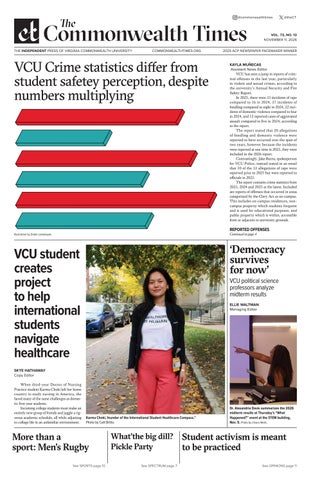
VCU Crime statistics differ from student safetey perception, despite numbers multiplying
2025 ACP NEWSPAPER PACEMAKER WINNER
KAYLA MUÑECAS Assistant News Editor VCU has seen a jump in reports of criminal offenses in the last year, particularly in violent and sexual crimes, according to the university’s Annual Security and Fire Safety Report. In 2025, there were 33 incidents of rape compared to 16 in 2024, 37 incidents of fondling compared to eight in 2024, 22 incidents of domestic violence compared to four in 2024, and 12 reported cases of aggravated assault compared to five in 2024, according to the report. The report stated that 20 allegations of fondling and domestic violence were reported to have occurred over the span of two years, however because the incidents were reported at one time in 2025, they were included in the 2026 report. Contrastingly, Jake Burns, spokesperson for VCU Police, instead stated in an email that 10 of the 33 allegations of rape were reported prior to 2025 but were reported to officials in 2025. The report contains crime statistics from 2023, 2024 and 2025 at the latest. Included are reports of offenses that occurred in areas categorized by the Clery Act as on-campus. This includes on-campus residences, noncampus property which students frequent and is used for educational purposes, and public property which is within, accessible from or adjacent to university grounds.
REPORTED OFFENSES Continued on page 4
Illustration by Drake Leskowyak.
‘Democracy survives for now’
VCU student creates project to help international students navigate healthcare
VCU political science professors analyze midterm results ELLIE WALTMAN Managing Editor
SKYE HATHAWAY Copy Editor When third-year Doctor of Nursing Practice student Karma Choki left her home country to study nursing in America, she faced many of the same challenges as domestic first-year students. Incoming college students must make an entirely new group of friends and juggle a rigorous academic schedule, all while adjusting to college life in an unfamiliar environment.
Karma Choki, founder of the International Student Healthcare Compass." Photo by Catt Britto.
More than a sport: Men’s Rugby See SPORTS page 10
What’the big dill? Pickle Party See SPECTRUM page 7
Dr. Alexandria Davis summarizes the 2026 midterm results at Thursday’s “What Happened?” event at the STEM building, Nov. 5. Photo by Chiara Wells.
Student activism is meant to be practiced See OPINIONS page 11
B:10.25" T:10"
2
The Commonwealth Times
S:9.5"
ADVERTISEMENT
T:16"
B:16.25"
S:15.5"
Wednesday, November 11, 2026
News
Stories of the week
3
News
NATIONAL: The average nationwide price for regular gasoline fell below $4 per gallon, according to AAA. This is the first time since July 20. INTERNATIONAL: A Pakistani astronaut will board China’s Shenzhou 24 spacecraft, the first foreign national to join Beijing’s Space Station.
Virginians deliberate on the fate of DominionNextEra merger SAL ORLANDO News Editor
TADEK WIECZOREK Contributing Writer
The John Tyler building at 1300 E. Main Street. This building is the headquarters for Virginia’s State Corporation Commission. Photo by John Brown.
MIXED OPINIONS DURING PUBLIC COMMENTS The State Corporation Commission held a public comment meeting at their headquarters in Richmond on Nov. 5, allowing citizens to voice their concerns on the potential merger between Dominion Energy, the primary electric utility provider for the state, and Florida-based NextEra Energy. If approved, the combined company would become the largest electric utility company by market value, The meeting’s speakers featured many business leaders, lobbyists, Richmond residents, elected officials, and Sen. Kannan Srinivasan (D). Opinions were mixed, with people on both sides of the debate offering comments for the commission. Around 2,400 written comments were submitted by the time of the hearing, according to Commissioner Samuel Towell, Virginia State Sen. Kannan Srinivasan, (D-32), representing eastern Loudoun County, said that the decision before the commission was the most consequential in a generation. “We cannot discuss it without addressing what is driving it: Energy demand, driven by data centers,” Srinivasan said. The merger would create the largest regulated utility in the world with 10 million customers and 110 gigawatts of power, according to Virginia Mercury. “I represent Eastern Loudoun, the heart of data center alley,” Srinivasan said. “I have lived there nearly 30 years. My neighbors and I have observed the earliest and heaviest impacts on the grid.” Srinivasan said his constituents have experienced higher bills, transmission lines cutting through residential areas, noise pollution, and the strain on the electric grid.
“For years, my constituents and Virginians across the commonwealth have told their elected officials about the increasingly urgent concern about rising utility costs, and the affordability crisis we are facing,” Srinivasan said. Liam Keough, a clean energy industry expert and meeting attendee, said he is opposed to the merger because he is worried about long term affordability for residents. Keough said NextEra Energy has a track record of alleged corruption in Florida, including paying off journalists, spying on journalists, attempting to bribe Jacksonville’s utility companies and running ghost candidates in elections. He said the former CEO resigned in 2023 due to federal investigations tied to corruption. “NextEra has an even worse reputation.” Keough said to the commission. “My peers, some of whom are NextEra’s former employees, frequently crack jokes about how NextEra sabotages other independent power producers projects, by obstructing substation access, and siphoning landowners, despite having no intention of developing a real project.” Keogh said he does not have any issues with Kelsey Bagot, former senior attorney for NextEra Energy, being on the commission. “I work in the industry and it has given me a lot of knowledge to better educate myself, to make a better informed decision,” Keough said. “I would ask that she [Bagot] keep in mind the residents of Virginia and not be affiliated to her former employer. I respect her experience.” Opposition tabled by Richmond City Council Richmond City Council deliberated on a resolution, patroned by councilwoman Kenya Gibson, on Nov. 9, that would express
the council’s formal opposition to the merger. The resolution was tabled to the following city council meeting on Dec. 14. City Council President Cynthia Newbile, Council Vice President Katherine Jordan and Councilwoman Stephanie Lynch raised concerns, over the resolution being proposed without enough information about the merger available. The vote to table the resolution was five ayes, two nays and two absentions. Public comment during the meeting consisted of one person opposed to the resolution, who was a Dominion Energy employee, and 11 people in support of the resolution. A sentiment of a concern about energy costs going up was shared amongst supporters of the resolution. Erika Schmale, a Richmond resident who was opposed to the merger, said the decision being continued signifies the council moving slowly, killing the ability for Richmond to oppose the merger. The next SCC hearing for the merger will be on Nov. 17, before the next city council meeting, according to the SCC. “By the time the next meeting comes around, the judges will have already made a decision,” Schmale said. Schmale said the merger would be terrible for ratepayers in Virginia, given the concern about a rate increases. She said she feels that the city council does not appropriately represent Richmonders opposition to the merger. Scott Lebow, a professional engineer who was opposed to the merger, said that the city council not making a stance prior to the next hearing means they are saying they would rather have a decision made without their input. “This doesn’t seem like they are
prioritizing their voices being heard, seeming to agree with whatever the SCC agrees with,” Lebow said. “To me, this is a bit of a cowardly backward facing move, so that when the record is set by the SCC, the city council can say that they agreed with it all along.”
‘Democracy survives for now’
“Democrats are doing far better than they would had the Republicans never gerrymandered at all.” Keena said that this is an important lesson and shows why gerrymandering is not only wrong, but foolish. “Florida had a very efficient gerrymander before 2025, and that probably would’ve kept Democrats winning fewer districts. But then Ron DeSantis is like, no, we’re gonna do this,” Keena said. “He gerrymandered and it backfired, the reality does not match expectations.” Texas’s attempts to help Republicans gain five extra seats by gerrymandering backfired following the Democratic candidate winning the Senate seat by 20 points, according to Keena. FEDERAL COURTS Aughenbaugh discussed how the federal courts will see little to no changes due to previous remarks by former President Joe Biden and how that affects any upcoming changes in 2027. “President Biden indicated that even if Congress passed the legislation, he would not sign it because he didn’t want to give the next president the opportunity to fill 100 new federal judgeships,” Aughenbaugh
said. “What you’re probably going to see is next to no activity in regards to filling vacancies on the federal courts, this is particularly important in regards to the United States Supreme Court.” DEMOCRATIC BACKSLIDING Froitzheim said that democratic backsliding, the gradual state-led weaking of political instituions and norms that sustains democracy, is more of a short-term issue rather than long-term. “Two years ago, I was worried about what was gonna happen. My argument was that I was largely hopeful in the long term, largely because Americans are democratic,” Froitzheim said. “Our democracy is deeply embraced by our culture and our society and our values, and it’s really hard to take that away.” Even societies that have suffered from democratic backsliding are able to recover democratically over time, according to Froitzheim. “Even a society that may suffer democratic reversals is likely to have democratic recovery over the long term,” Froitzheim said. “Democracy survives for now.”
VCU political science professors analyze midterm results
ELLIE WALTMAN Managing editor Faculty in VCU’s Department of Political Science held a post-election panel, “What Happened? An Analysis of the Results of the Midterm Elections,” to examine the midterm results and what they mean for the country’s future, according to a post on their Instagram. The panel, which featured associate professors Alex Keena and Alexandria Davis, professor John Aughenbaugh and assistant professor John Froitzheim, took place on Nov. 5. They discussed an increase in voter turnout and how previous political decisions, such as gerrymandering, aided the Democrats regaining control of the U.S. House of Representatives and the Senate in the 2026 midterm elections. VOTER TURNOUT AND SHIFTS Voter turnout increased dramatically in the 2026 midterm elections in comparison to the midterm election in 2022,
according to Davis. “We saw astronomical voter turnout that was largely outpacing what we saw in 2022,” Davis said. “We saw about a 69% increase in early voting in our state between 2022 and 2026.” Davis said that Gen Z not only voted in larger numbers than in 2024, but played a major role in the overall shift towards the left. “We are largely characterized as a non-participatory group but we showed up and showed out Democratic with about 33 points,” Davis said. “We can note that younger voters were more likely than other groups to identify that their vote was against Trump.” THE EFFECTS OF GERRYMANDERING ON THE ELECTION’S OUTCOME Republican efforts and passing of gerrymandered state maps aided the Democrats in the election, according to Keena. “In order to pack more Republicans into this map, they had to dissolve the protection that their incumbents had,” Keena said.
Concerns from the campaign trail. Shannon Taylor, Rep.elect (D-Va-1), said during a campaign press conference that she came out early against the merger because she did not believe Virginians had a clear idea what the merger was about. “What we have seen happen over the past four to six weeks is a modification of what is supposed to happen with this merger,” Taylor said. “Virginians deserve to know exactly what is happening and not just what is the impact of what will happen immediately, but what is the game plan five, 10, 20 years out when we are talking about the largest monopoly merger happening here in our Commonwealth. We need to know what the real answers are.” Incumbent Rep. Rob Wittman (R-Va-1) said after a campaign rally that the SCC’s decision needs to be in the best interest of Virginia rate payers. “We need to make sure there is investment in the future of energy production in Virginia,” Wittman said. “We need to make sure that we have small module reactors for natural gas. I don’t have any problem with alternatives or renewables, as long as we’re using everything, and making the best financial decisions on behalf of Virginia ratepayers.” The State Corporation Commission’s final ruling on the merger is expected in January 2027.
4
The Commonwealth Times
News
VCU Crime statistics differ from student safety perception, despite numbers multiplying KAYLA MUÑECAS Assistant News Editor Regarding increased reports of crime, Clery Compliance Administrator Chad Beights stated that the increase does not automatically signal a surge in criminal activity. “Higher numbers can also reflect greater awareness of reporting options, increased trust in the reporting process and stronger outreach efforts,” Beights stated. The Student Voices Committee is a board composed of students who advise VCU Police and provide them with a student perspective. According to Jake Burns, spokesperson for VCU Police, the group analyzes the sexual violence prevention strategies the university has in place and where those efforts could be improved. “These student voices provide key insights on how safety and crime prevention strategies play out from a student perspective.” Burns stated. Third-year Health, Physical Education and Exercise student Dhabin Haw said that in the years she has been on campus, this has been the worst in terms of increased crime. “I wouldn’t say it’s a significant increase, but it is somewhat notable. I’ve heard more firsthand experiences from people around me about [crimes] this year in comparison to last year,” Haw said. Haw said is primarily concerned about her safety when walking around campus after sunset. “I will say, most of the unsafe experiences I have encountered or heard about usually happen right off campus, not directly on school grounds,” Haw said. First year mathematical science student Adam Hampstead said that he has mostly heard about instances of robberies and shootings since starting at VCU. He explained that despite hearing about violent crime occurring around the VCU area, mainly due to receiving VCU alerts,
he personally feels safe on campus and has not had any negative personal experiences. “I feel safe around campus, but I try to be inside before the sun goes down. If I’m outside past sunset, I try to be sure I’m in a group,” Hampstead said. Regarding fears stoked by reports of shootings near campus, Chief Hunter confirmed the majority have occurred off campus. “We understand these reports may be unsettling,” Hunter stated. “The best course of action is to take VCU Alerts seriously but understand they are a tool.” Chief Hunter further explained that the department measures their crime prevention
5
2025
2025
2025
2025
12 4
efforts through community feedback, citing results from their perception of safety survey. For the third year in a row, 9 of 10 respondents to the survey reported feeling “safe” or “very safe” on campus. “This is an important detail, but we understand individual incidents throughout the year can cause unease,” Hunter stated. “We hope VCU students and staff engage with our officers, ask hard questions and connect with our team so we can work together to help keep the environment safe for everyone in our community,” Chief Hunter concluded.
22
3 7 3 3 8 16
Reported cases of Reported incidents Reported incidents Reported incidents aggravated assault of domestic violence of sexual assault of fondling on-campus on-campus on-campus on-campus
Wednesday, November 11, 2026
Sports
GAME RESULTS 11/5/26
VCU FH - VS UR A10 SEMIFINALS LOST 2–1
11/6/26
VCU WVB - AT FU WON 3–2
The VCU field hockey season came to an end Thursday afternoon, as the Rams lost 2-1 in overtime to the University of Richmond after a battle in the Atlantic 10 semifinal. Richmond captured momentum early in the game, earning a penalty corner in the first minute. Richmond controlled possession for most of the first quarter, scoring in the 11th minute to take a 1-0 lead. The second quarter went back and forth, with neither team able to break through on the attack. The only action was a Richmond shot saved by redshirt third-year goalkeeper Emma Clements. The Rams entered halftime down 1-0. “A goldfish has a six second memory,” Clements said. “I wrote it on my arm. I let myself have no more than six seconds to think about a goal, mistake or whatever it is. After six seconds is over it doesn’t matter anymore.” VCU applied more pressure in the third quarter, with both teams blocking and saving multiple shots. In the 38th minute VCU earned their first penalty corner of the game,
Stat of the week
Men’s soccer head coach Dave Giffard retires after 17 seasons at VCU.
11/7/26
VCU WVB - AT FU WON 3–1 VCU MBB - AT UM LOST 89–88
VCU field hockey defeated in A-10 conference championship DREW CLEMENTS Staff Writer
5
and third-year Lucia Donati passed to firstyear Julia Spohr, who scored to even up the match at 1-1. After a VCU green card was issued to begin the fourth quarter, Richmond took advantage by forcing seven consecutive penalty corners. The Rams successfully defended each attempt. Clements led the defensive effort with five saves, finishing with nine total. The game remained tied 1-1 after regulation and went to overtime, where possession went back and forth until Richmond earned two consecutive corners. After two more saves by Clements, Richmond fourth-year Clara Larripa found the back of the net, securing the 2-1 victory for the Spiders, and ending the Rams’ season. Richmond outshot VCU 20-1. Despite the loss, VCU head coach Stacey Bean said she is optimistic about her team’s future. “One of our players said it best, [second-year] Emily Foerster, she said we should be proud because we played the game we wanted to play and we stuck together from start to finish,” Bean said. “For her to step up leadership wise in front of this group and say that, and be really eloquent with her teammates, it was a sign of good things to come.”
Second-year Lina Behrmann vs. Richmond.
Third-year Lucia Donati vs. Richmond.
Redshirt third-year goalkeeper Emma Clements defends the net vs. Richmond. Image courtesy of VCU Athletics.
Images courtesy of VCU Athletics.
Men’s soccer head coach Dave Giffard.
Image courtesy of VCU Athletics.
Men’s soccer head coach retires after 17-year career DEVYNN ALSTON Staff Writer Last week, VCU men’s soccer head coach Dave Giffard announced his retirement from college coaching. After 17 years, Giffard is leaving a program defined by conference success, NCAA tournament appearances and player development. Giffard finished his time at VCU with a 128120-61 record and led the Rams to two Atlantic 10 regular-season championships, three NCAA tournament appearances and five appearances in the A-10 tournament championship match. Giffard’s impact extended beyond the field. In his retirement statement, he emphasized the importance of developing his players as both players and individuals. Giffard stated in a press release from VCU Athletics, that once he himself became
a soccer parent and became more involved with young players and families in the community, he discovered a new sense of purpose outside of college coaching. He also expressed gratitude toward VCU’s administration for respecting his decision, which he had communicated to athletic director Ed McLaughlin before the season started. “Well beyond his NCAA appearances or the numerous Rams playing professional soccer, he cemented his legacy with his passion for the young men he coached,” McLaughlin said. With Giffard’s retirement, VCU men’s soccer enters a new chapter. As the Rams begin a nationwide search to find their next head coach, the program will look to build on the foundation that Giffard established during his 17 seasons.
6
The Commonwealth Times
RECAP: How VCU did on the road this week BENNEY KOCH Staff Writer
11/6 - Women’s volleyball at Fordham University
VCU women’s volleyball completed a reverse sweep comeback against Fordham, winning 3-2 after falling behind two sets to none. Third-year outside hitter Lara Del Core led the Rams with a match-high 18 kills, and third-year middle blocker Letizia Galli added 14 kills of her own, hitting .571. Third-year setter Cansin Sendir led the VCU offense through her playmaking, contributing 43 assists. After dropping the first two sets 25-15 and 28-26, VCU went on to win the next two sets 25-18 and 25-20 to force the deciding fifth set. In the final set, the Rams hit .476 on their way to a 15-9 victory, completing the comeback in New York.
11/7 - Women’s volleyball at Fordham University
VCU women’s volleyball earned a 3-1 victory over Fordham, securing back-toback wins. Third-year outside hitter Lara Del Core led VCU with 15 kills, 12 digs and
two blocks. Fourth-year middle blocker Nina Boledovicova added 11 kills while hitting an efficient .526 on 19 attempts. Defensively, fourth-year libero Gabby Lapata led the team with 21 digs, while Boledovicova and third-year Letizia Galli each contributed five blocks. After losing the opening set 25-19, VCU responded by winning the next three 25-18, 25-17 and 25-22.
11/7 - Men’s basketball at University of Memphis
VCU men’s basketball suffered a heartbreaking 89-88 defeat to Memphis after leading for nearly the entire game. Thirdyear guard Blake Harper led the Rams with 22 points, shooting 5-of-9 from three, while second-year Nyk Lewis also contributed 14 points and seven assists. VCU controlled much of the game and was ahead 87-84 with 1:33 remaining. Memphis fourth-year guard Jayden Reid erased the deficit with a threepointer to tie the game before drawing a foul and adding two points at the line to give the Tigers the lead. Reid finished with a gamehigh 32 points as Memphis handed VCU its first loss of the season.
Second-year guard Nyk Lewis surveys the defense vs. Memphis.
Fourth-year forward Lazar Djokovic attacks the rim vs. Memphis.
Image courtesy of VCU Athletics.
Image courtesy of VCU Athletics.
Wednesday, November 11, 2026
Spectrum
7
On This Day
‘The Ugly Duckling’ was written by Hans Christian Andersen and published on Nov. 11, 1843.
What’s the big dill? Richmond relishes community at Pickle Party RACHEL NICHOLAS Assistant Spectrum Editor Richmond spent Nov. 6-8 celebrating all things pickle as the Richmond Pickle Party brought local businesses, artists and community members together for three days of food, music and activities throughout the Arts District and Jackson Ward. The festival featured local vendors, restaurant specials, art exhibitions, live performances and pickle-themed activities. The event was organized through a c o l l a b o ra ti o n b e t we e n G a l l e r y 5 , Richmond Moon Market, the Richmond Arts District Business Alliance and members of the Jackson Ward community. Ash Moore, secretary for Gallery5, said the idea came together naturally through the shared interests of local organizers and businesses. “I think that the world is obviously going through a moment where pickles are all the rage,” Moore said. “There were just so many people in our community that share that love of pickles too.” Moore said the festival also offered an opportunity to celebrate pickling as an accessible practice connected to sustainability and family traditions. They said that many people have recipes passed down through generations or grow their own ingredients before turning them into preserved foods. Several neighborhood organizations divided planning responsibilities, from
coordinating vendors and restaurant participation to organizing programming and marketing. Although the festival drew inspiration from a previous pickle festival held in Ashland, Moore said the Richmond event grew into a larger neighborhood-wide effort. The weekend included more than 40 vendors at the Art district’s monthly First Friday art walk, along with pickle-inspired restaurant specials, art exhibitions and demonstrations. Gallery5 also hosted an Art of the Pickle exhibition and a competition for Richmond’s Best Pickle. Moore said organizers are already discussing the possibility of making the Pickle Party an annual event. One goal for next year is to expand the weekend programming and bring more of the festival atmosphere outdoors. “I think everyone’s excited to make this an annual thing,” Moore said. “People love pickles, so why stand in the way of a good thing?” Emily Roe, founder of Washington, D.C.-based Female Rage Hot Sauce, attended the event as a vendor. Her business started as a personal project after she graduated college in 2020. As she explored the industry, she noticed that much of the hot sauce market was dominated by men and often focused on extreme spice rather than flavor. “No one looked like me,” Roe said. “That kind of motivated me even more to be like, ‘Okay, well, I’m gonna make my own hot sauce, and I’m gonna bring a whole new voice to this category.’”
Gabrielle Cerberville, author of ‘Gathered: On Foraging, Feasting, and the Seasonal Life,’ demonstrated how vinegar can be made at home. Photo by John Brown. Roe said organizers contacted her through social media and invited her to participate. Having grown up in the D.C. area, she saw the festival as an opportunity to revisit Richmond and explore potential shops for her business. Roe said she enjoyed the event’s community atmosphere, particularly the participation of neighborhood businesses and the number of VCU students attending. For some attendees, the festival was less about a love of pickles and more about finding something different to do around the city. Jamal Daud, an attendee who was visiting a friend in Richmond, said he heard about the event through his friend and decided to check it out.
“I’ve only ever had, like, one pickled thing in my life, and it wasn’t that bad, so I figured it would be cool to try more things at the festival,” Daud said. Although he described the theme as a little strange, Daud said the event added something different to Richmond’s local culture. D a u d s a i d h e wo u l d b e i n t e r ested in returning if the festival comes back next year. As organizers look toward the possibility of another year, the Pickle Party offered a reminder of how small businesses and shared interests can bring a neighborhood together.
Beyond four walls, a story takes shape: ‘How to Live in Living Rooms’ ELLE COTA Spectrum Editor A short film created by VCU students explores the complicated relationships between family, identity and pursuing a creative career, particularly within Asian American households. “How to Live in Living Rooms,” written and directed by third-year cinema student Ben Phan, draws from his personal experiences as an Asian American pursuing the arts. Funding from primarily VCU Arts undergraduate research grants and New Surge Production allowed Phan to bring actors from outside Virginia onto the project. “Although sometimes your parents can’t understand the art that you’re making or can’t understand the path that you’re on, there’s still ways that we can connect with our parents even if that isn’t through the traditional sense of understanding that some other people have,” Phan said. The title “How to Live in Living Rooms” reflects the differences between the living rooms Phan experienced growing up and those he encountered in other people’s homes, according to Phan. “Four walls, a couch, a TV stand, you know, a table is not enough to constitute a living room that is comfortable enough for you to express yourself in,” Phan said. Phan said the casting process allowed him the opportunity to see how different actors interpreted the same characters. He said he
valued actors who made intentional choices and were confident enough to ask questions about their roles. Phan said several members of the cast, including the Vietnamese-speaking actors and artists involved in the Asian American arts community, connected with the film’s story because of its broader experiences. Developing the characters’ histories was one of the most challenging parts of the production, Phan said. He had limited time to establish the relationships and experiences that shaped the characters before the story began. Although Phan said he initially felt responsible for figuring out every detail himself, he said the actors’ questions and interpretations helped him build a more complete story. “It’s such a communal art form that you just can’t do it alone,” Phan said. Phan said he hopes his experience encourages other aspiring filmmakers, including people who may feel intimidated by the process or uncertain about their abilities. He said even people further along in their careers have expressed similar fears and uncertainty. “This film enabled me to realize that I am so much more capable than what my past versions of myself would believe,” Phan said. The film is not meant to suggest that every complicated family situation can be resolved simply by returning home, Phan said. “I just kind of want to tell them that there is a world where people may not understand you, but there’s something really special in still
The filmmaking process of the short film ‘How to Live in Living Rooms’ directed and written by Ben Phan. Courtesy of Lici Simmons. trying to be present with one another because I think sometimes that’s all people can give you,” Phan said. Lici Simmons, a fourth-year media production student, was the film’s first assistant director and co-producer, and brought the project together by managing the logistics behind a production. Simmons assembled the crew through the organization, coordinated shooting dates and arranged transportation for students traveling to filming locations. Simmons said seeing the family dynamics in the film reminded her of her own experiences in questioning whether she had chosen the right career path.
“I remember thinking that I choose the wrong major, like, should I be in health sciences instead of media production, because I enjoyed it so much, but my mom told me, ‘No, I think you should be doing media production, I don’t think biology is going to be beneficial to you,’” Simmons said. Simmons said coordinating a film required her to manage relationships between crew members, an issue that she said can be overlooked when discussing the responsibilities of a producer. “You’re working with other people,” Simmons said. “Sometimes you legitimately have to be a mediator for people when things are kind of going wrong because there’s different relationships forming.”
8
The Commonwealth Times
Simmons said she hopes audiences take away the idea that people do not need to have their futures figured out to pursue something meaningful. Matt Knook, a VCU alumnus and co-producer on the film, helped Phan secure grant funding, manage the budget, arrange accommodations and coordinate other production needs. He said it was his first time producing a film, and said the experience showed him how much operational work goes into bringing a project to life. “All the boring stuff essentially,” Knook said. “Just making sure we have food, we have lunch, that kind of stuff, but it was a really rewarding job because I got to see Ben in action and I got to see everybody making a movie and it was a great atmosphere on set.” Looking back, Knook said he could have taken more responsibility for the logistical work so Phan could spend more time developing the
story. Despite that challenge, Knook said he found the most rewarding part of the experience to be watching the production come together after the preproduction process. “Going through the entire preproduction process and then seeing it come to life, seeing everybody on set connecting and working on this film was really amazing,” Knook said. Rine Nguyen, a VCU alumna who played the character Hannah, a young woman around her age, said the casting call stood out to her while reading the character description and felt an immediate connection. “I remember looking at it being like, ‘Oh my gosh, this never happens,’” Nguyen said. “Usually it’s some other specific type of Asian character, but I thought it was really cool that the film specifically was looking for Vietnamese actors.” Nguyen said her aunt, who was a VCU alumna, received the same grant used to produce
a short film about a Vietnamese family and a young person struggling with identity and personal choices. Participating in another film centered on a Vietnamese family made the experience feel full circle for Nguyen. “She [Hannah] definitely uses humor to sort of guard against serious conversation sometimes and I think in real life people tend to joke, but then there’s a sliver of truth when you’re joking because it’s easier to communicate that way,” Nguyen said. Nguyen said she initially worried that improvising would divulge too far from the original vision, but she said she appreciated the opportunity to contribute to the characters. Nguyen said she had to become more intentional about communicating a character’s emotions through subtle expressions and actions rather than relying on dialogue to explain everything.
“I’ve always known that art is up to interpretation but I think taking away these long paragraphs of dialogue that I’m used to in a stage play has really made me have to think more about how art gets twisted into so many different things,” Nguyen said. Nguyen said she hopes that audiences recognize that figuring out one’s identity and direction takes time. “I think especially for the Asian American experience within the modern generation is it’s really hard to feel like you have lived up to the sacrifices maybe that your family has made for you when you veer off on a different path,” Nguyen said. “Also just realize no journey is really linear.” “How to Live in Living Rooms” is scheduled to screen at the Alexandria Film Festival Nov. 12-15. There is an additional screening at the Grace Street Theater on Nov. 30 starting at 7 p.m.
A challenger approaches: Smash at VCU CHRISTIAN ORRELL Contributing Writer No matter if players are looking to climb the rankings or simply pick up a controller, Smash at VCU offers a place for Super Smash Bros. fans to connect. What began as a VCU esports club in 2018 became an independent, student-run organization in 2024, opening the door for a broader community of players from across Richmond. The club hosts free, weekly tournaments on Fridays, along with monthly events that attract players from across Virginia and other states. While some events are reserved for VCU students, most are open to the public, regardless of skill level.
Michael Crevoisier, former president of Smash at VCU, assumed leadership in 2022, helping guide the organization to what it is today. He said the process required significant time and quick work to organize events and secure room reservations. “There was also a lot of pushback from VCU about creating the club because they were asking why we got separated from esports and a lot of other questions of that nature,” Crevoisier said. “It was time-consuming and stressful, but I made it through and really got the club churning again.” Crevoisier said the club’s welcoming atmosphere makes it easy for members to connect, even with players they have never met.
“We all love playing this game and we bond over it, make friends because of it and just have fun playing the game,” Crevoisier said. “I have met some of my closest friends here in the VCU Smash community.” Jakob Huse, a fourth-year computer science student and vice president of Smash at VCU, said he has seen steady growth in the community with new people. “A few tournaments have breached 40 participants, and we haven’t had any under 20,” Huse said. “It’s been a big step up from previous years.” Charlie Bicknell, a fourth-year theatre student and president of Smash at VCU, said joining the club is less about being a good enough player for the group.
“It’s a competition, but at the end of the day, we’re just a bunch of guys who like the video game and want to play it together,” Bicknell said. Smash at VCU held Ram Rampage, a monthly tournament, on Nov. 7 with 18 competing brackets. For the more competitive aspect of the club, Smash at VCU will host an end-of-semester tournament, the ramvitational, on Dec. 5. It will feature 16 players, with 10 spots going to the top-ranked players from the semester’s previous tournaments, while the community votes on the remaining six. The club remains connected through its RamsConnect page, Instagram and Discord. More information can be found on their Instagram @vcusmash.
‘Chasing the sun’ with Sunrise Social Club MAEVE BAUER Executive Editor Sunrise Social, a group of runners and walkers, gather to enjoy the sunrise, sunset and each others’ company. They meet on Thursday mornings at Pony Pasture, Fridays at the Eastern Henrico Recreational Center and Sunday evenings at the parking lot of the River Road Shopping Center. Ava Tankersley started Sunrise Social while studying abroad in Sydney, Australia and brought it back to Richmond with her in September 2024. Tankersley said that they have around 150300 people who join them on their runs. The sunset run on Nov. 1 had around 180 participants. “We’ve been doing it for two-and-a-halfyears and it still feels like it’s growing every week,” Tankersley said. “There’s always new people, and new people are always finding out about it, which is just so fun.” Not only has the club grown in numbers, but has also expanded across state boundaries. Tankersley moved to the Outer Banks in May 2025 and started an all girls sunrise beach walk after finding it hard to meet other girls her age, according to Sunrise Social’s Instagram. While hosting OBX walks, Tankersley started saving up tips from other side gigs and started handing out coffee to all the girls as part of her passion project. This sparked a curiosity around the craft of coffee for Tankersley. After moving back to Richmond temporarily, she began working at Parousia Coffee in Scott’s Addition. “I got a job to learn all about coffee, but I also learned all about matcha (and became obsessed),” Tankersley stated on Sunrise Social’s Instagram. “I found a trailer on Facebook market place and (pretty impulsively) bought it. I set out to convert this trailer to my dream mobile coffee/matcha shop.”
In May, Tankersley moved back to OBX and launched her coffee and matcha trailer. Though Tankersley occasionally returns to Richmond for pop-ups, she has left Sunrise Social RVA in the hands of her trusted team. The team Since Tankersley’s return to OBX, Luci Taylor has led the runs. She initially joined Sunrise Social last year a week after moving to Richmond, and has been involved in the club ever since. “I became friends with Ava and a few of the other girls who help out with leadership and when Ava decided to move to the Outer Banks, I expressed that I’d be interested in helping carry out Sunrise Social club here,” Taylor said. Taylor said she enjoys the community building aspect of Sunrise Social, saying it is not just running with people but the group will also go out and do other activities. Jordan Clark is in charge of Sunrise Social’s communication. She first got involved after a friend recommended the group, knowing she was looking to join a run club. “She knew someone that came here and then she brought me a couple times,” Clark said. “I was hooked since then and I pretty much come once a week, if not at least twice a week.” People from all age groups come and join the group, middle and high schoolers, to people 40 and above, however the largest demographic of members are in their 20s and 30s, according to Clark. “After college, I think it can be really hard to meet people in your community,” Clark said. “A lot of people recently that I’ve met, they’ve moved just recently to Richmond, so they just don’t know anybody and it pops up on their TikTok or their Instagram and then they decided to go ahead and try it.”
Members of Sunrise Social’s leadership team, from left to right, Luci Taylor, Mary Browning, Jordan Clark and Ava Tankersley. Photo by Maeve Bauer. Many of the people who have joined are not runners, according to Clark. She attributes that to the way Tankersley has designed the runs to be welcoming and engaging for all experience levels, offering modifications for those who want a less intensive workout. According to Sunrise Social’s Instagram, Tankersley purposefully excluded the word “run,” from the title to emphasize to people that it is not just for runners. The rest of the leadership board consists of Sarah Grace Clarke, who is in charge of outreach and collaboration. Mary Browning and Luca Moroianu create content and take photos for Sunrise Social. Finn Jones and Ethan Pacheck lead the track nights and Nicole Novak runs the walk portion for the Sunday meeting. The runners (and walkers) of run club Jacob McMurdy and his dog, Roxy, frequently join Sunrise Social on their Sunday sunset gatherings, usually opting for the walking option. McMurdy and Roxy were dressed as a little monster and an exterminator for the group’s Nov. 1 Halloween sunset get-together. McMurdy recently graduated from James Madison University and joined the club after
wanting to connect with more people his age in Richmond. Dressed as a runaway bride, Emily Knabel joined in on the Halloween run fun on Nov. 1. She has been attending Sunrise Social since she graduated college in May. “I was a college athlete for two years… I just wanted to find a way to make community when I moved back to Richmond,” Knabel said. “I was definitely nervous to come back to the city and find people my age. It just gave me a really good outlet to do that.” Though a good percentage of members are fresh from college, a number of participants are other community members looking for a chance to socialize. Community member Avery Moncure, has attended Sunrise Social runs since it started in Richmond. He said his favorite part is the connections that are made within the club, and the photos everyone sends of the sunrises during the morning gatherings. “It is just a very wholesome group,” Moncure said. If you want to chase the sun with the group, find more information on their Instagram, @sunrise.social.club.rva.
Wednesday, November 11, 2026
Features
RVA Spotlight
“Join Strangely Spoken for a night of Open Mic Poetry on Nov. 13 from 7-9 p.m. at Blue Bee Cider. The event is free to attend and open to all ages.
More than a sport: How VCU men’s rugby club has built a culture centered on fitness and family BEN MARTINDALE Sports Editor A small but rowdy crowd of rugby fans gathered at the University of Richmond intramural field to watch VCU men’s rugby club face their cross-town rival the University of Richmond on Oct. 23, for the teams’ annual Capital Cup match. The Rams took the field as an underdog vs. the Spiders, ranked No. 10 in the Division 3 National Collegiate Rugby coaches poll at the time of the match. VCU matched Richmond’s energy early as the two teams collided at midfield in a bid for possession of the ball. For those who have never watched a rugby match, calling it a contact sport only partially describes the sheer physicality of the spectacle taking place. Players from opposing teams hurtle towards each other at top speed in an attempt to either tackle or clear a path for the ball carrier, frequently causing jarring head-on collisions. As a result, some players compete each week while still actively recovering from injuries sustained in previous matches. For many of the players, including second-year Lucas Kelly, toughness is in the blood. “Rugby really started with me because my mom played back when she was in college,” Kelly said. “She said it built a really good community around her. She won states multiple times so I thought you know what, let’s give it a shot.” Giving rugby a shot paid off for Kelly, who appreciates not only the chance to play the sport he loves, but also the opportunity to be a part of a tight knit group of friends. The bonds the teammates share were put to the test as Richmond built on an early lead which rapidly snowballed into a dominant performance. At one point the Spiders led the Rams 38-8 before eventually closing the show with a 45-20 victory to secure bragging rights and win the Capital Cup. After the loss, instead of expressing frustration or trading blame, the VCU rugby club
Scrum between VCU and Richmond.
VCU men's rugby club vs. Richmond. came together to support each other, forming a group huddle where they consoled players who were visibly upset. The reason for that emotion was not because of a loss on the field, but something far more important, fifth-year Nico Lobo Meier said. “I mean, we’re a family,” Lobo Meier said. “I was crying because it’s how much it means to me to play rugby at VCU. You’re only in college for four years. I’ve been lucky enough to take a fifth and play rugby with these guys. It’s like coach Carl always says, it’s more than a sport.” Fourth-year Patrick Heshen joined the rugby club as a first-year, growing as a person and player alongside the friends he has made. For Heshen, rugby not only provides him with a sport to play and friends to play it with, but an outlet for the energy that led him to the wrestling mats in high school. “In high school I ended up wrestling,” Heshen said. “I really loved that sport because it gave me a place to express this sort
9
Image courtesy of Rebecca Bridges.
of energy healthily. I came to college kind of missing it, and I was missing the brotherhood that I’ve had with my teammates.” Heshen also said that despite being nervous at first, the team quickly embraced him. “I realized right as I stepped on the field with everyone, that everyone is super open and kind,” Heshen said. “They kind of understand that they were scared too, going to their first one.” After winning just one game last year, VCU rugby club improved their record to four wins and five losses this season. Throughout the year, the group poured their energy into a young core group of players that hope to continue building on what the graduating players started. Fourth-year Kamil Qadri, who competed despite having a sprained ankle he’d sustained earlier in the season, spoke to the growth he’s seen in his time with the club. “It means a lot more than just throwing a ball around on the weekend,” Qadri said.
“This sport has deep roots and it will always have a place in our hearts. This season was the best at VCU, and this was coach Joe’s fifth season, and it was his best season.” Qadri encouraged other VCU students to come be a part of the rugby club as well, with the only requirement being that players are enrolled at VCU. “We’re also a social club,” Qadri said. “We have events pretty often throughout the semester, so just come out and see what the sport’s about.” One of those social events took place the following weekend in the form of a Halloween party. Qadri, who had now swapped his VCU rugby uniform for a black robe and vampire fangs, happily made introductions as other members of the team approached in greeting. The friendship and camaraderie of the group was on full display, and a far cry from the violence exhibited on the field. Fourthyear Nicolas Blankenship said that the team’s encouraging attitude was a major reason why, as someone with an athletic background based in dance and ballet, he had been able to transition to a contact sport like rugby. “I wasn’t great at first, obviously,” Blankenship said. “It was a big learning curve but the guys were all very accepting of me.” For the soon to be graduates, leaving behind the rugby club will mark the end of a special chapter, but they can rest easy knowing the club that has meant so much to them is in good hands. At least if young prospects first-year Redding Williams and second-years Sam Cassolini and Kelly have anything to say about it.
“
Continuing that VCU rugby legacy was really important to me. I love that s***.” Lucas Kelly Second-year student
Image courtesy of Rebecca Bridges.
10
The Commonwealth Times
Features
VCU student creates project to help international students navigate healthcare
CONTINUED FROM FRONT PAGE Choki said international students find themselves tackling an entirely different problem: the U.S. healthcare system. Many international students, including Choki, come from countries where universal healthcare is the standard. “I think if I didn’t work in the healthcare system and didn’t study anything healthcare related, I think it would be really hard for me to fathom,” Choki said. As Choki began brainstorming ideas for her Doctor of Nursing Practice Project, she felt it was important for U.S. healthcare to be more accessible to international students and immigrants. Shortly after, she created the International Student Health Compass Project, a dedicated support resource to help international students transition to the U.S. healthcare system. With the help of the Global Education Office, Choki created the ISHC website to provide students with key healthcare information, including their insurance options and where they can receive medical care. She also offers peer navigation support through the website, available by appointment or during drop-in hours. Julianna Hill, a global learning specialist at GEO, works closely with Choki to hold collaborative workshops with an aim to help international students understand U.S. healthcare. In August, the pair led a workshop for students during open enrollment where Hill helped students enroll in their health insurance. After enrolling, students were invited to connect with Choki, who answered their healthcare related questions. “Many of our international students come from countries where healthcare is universal, so the mere idea of having to purchase it is a difficult concept to understand,” Hill said. GEO holds international student orientations each semester to discuss the unique aspects of international student life with incoming students, Hill said. “A lot of our international students assume that the hospital is where you need to go, no matter the ailment,” Hill said. “So
The International Student Healthcare Compass is a guide for international students created by Karma Choki to help them discover options for health insurance, health resources, and healthcare. Photo by Catt Britto. informing international students of those nuances in our healthcare system is something we strive to do at every international student orientation.” Amala Kavumkandathil, a second-year Doctor of Integrative Life Sciences student, said she feels that VCU cannot cover all of the necessary health insurance information at its international student orientations. She said that VCU suggested they use United Healthcare, but did not include information about specific packages or other insurance programs.
"Karma Choki, founder of the International Student Healthcare Compass. Photo by Catt Britto.
“Especially when it is something related to mental health services, when you call them they specifically tell you that ‘We don’t accept United,’” Kavumkandathil said. “So, what is the point of then taking something that the university suggests?” Kavumkandathil said she recently became ill for the first time since moving to the U.S., and felt panic because she was unsure where to go. She assumed that VCU Medical Center was a general hospital, and was surprised when a friend informed her that it was a specialized hospital, not meant for common illnesses.
“I never had to face this experience,” Kavumkandathil said. “Anytime I was sick, I’ll just tell my mom and she’ll take me to her hospital.” Kavumkandathil is from South India, where its healthcare system is universal, offering a private and government sector to its citizens. The government sector funds government hospitals, which operate similarly to a Patient First in the U.S., minus the cost, according to Kavumkandathil. While there are various systems arranged by the necessary level of patient care, Kavumkandathil said health insurance is not necessary in South India unless a major surgery is needed. “The state that I come from is very well known globally for their healthcare,” Kavumkandathil said. “So I literally never had to pay for anything in my life and I came to the U.S. and it was a big shift.” According to Kavumkandathil, hospitals and private clinics offer walk-in appointments in India. Citizens do not have to wait to see a doctor, and are typically seen within two days if their care is delayed. “Here I have experienced a delay in getting the health services,” Kavumkandathil said. “There were moments I decided not to pursue some services because the wait time was six months and I had to depend on my pre-med friends for a diagnosis.” Choki said international students often rely on their support system for healthcare advice, and those who do not have the internet Choki said there is an unspoken fear of cost when engaging in healthcare for international students, causing them to avoid seeing the doctor, even when they are insured. “My four years of undergraduate, I did not even interact with anything healthcare,” Choki said. “Even if I’m sick, I’ll do something at home, just out of fear that I may not be able to afford it.” Choki said when international students continue to fear healthcare, they miss out on life-saving screenings, particularly those for reproductive health.
Wednesday, November 11, 2026
Opinions
11
Quote of the week
“Immature poets imitate; mature poets steal; bad poets deface what they take, and good poets make it into something better, or at least something different.” — T.S. Eliot, The Sacred Wood
Illustration by Nathan Persson.
Student activism is meant to be practiced — not just celebrated YOUSTINA AZIZ Contributing Writer If you walk past Cabell Library on an ordinary school day, you will see students rushing to class, studying for exams, grabbing coffee and worrying about deadlines. College life moves quickly. There is always another assignment, test or obligation demanding our attention. In the middle of the hustle, it is easy to forget that a university is not just a place that you attend before joining the workforce. It is also a place to discover your power to challenge the present. Student activism is not some distant tradition that belongs to a faraway generation. It is part of the history and culture that shaped universities into what they are today. At VCU, student activism led to the creation of African American studies, the recognition of LGBTQ+ student organizations and the challenging of perceived injustice in university decisions. These events did not happen because administrators suddenly decided to do the right thing: they happened because students went out and demanded change. They organized, challenged authority and refused to accept the idea that an institution’s decisions are above reproach. If student demonstrations are so integral to a university’s history and culture, why does it sometimes feel as though students demanding change are a problem to be managed rather than voices to hear? What does it mean when a university celebrates the legacy of student activism while its current students navigate restrictions and consequences associated with using their own voices? Perhaps the problem is not that students have stopped caring, but that we have become more comfortable celebrating
activism as history than accepting it as a responsibility of the present. Historically, universities were not created as the inclusive institutions we recognize today. Many were established to serve religious, political and economic elites with access restricted by race, gender and class. Higher education has a long history of exclusion, and Black students in particular have had to fight for access, recognition and representation. This struggle continues today. However, universities were also the places where those very systems were challenged. During the Civil Rights Movement, Black college students organized sit-ins, challenged segregation and helped build movements that transformed American society, according to the National Archives. They did not wait until they graduated, had prestigious careers or someone permitted them to matter. They acted because the world around them demanded it. This is evident throughout VCU’s own history. In 1967, students organized in front of Shaffer Court Dining Center to protest the mishandling of African American issues, which eventually helped establish courses that became part of the university’s African American Studies program, according to the VCU College of Humanities and Sciences. In 1974, VCU denied official recognition for the Gay Alliance of Students, according to a previous report by the CT. The students fought back in court, and in 1976, a federal appeals court ruled that VCU's refusal violated their First and 14th Amendment rights. This contradiction is not just historical. In 2025, VCU withheld the degree of Sereen Haddad, a Palestinian student who participated in a pro-Palestinian campus gathering, according to the CT. Although she appealed and won, her degree was delayed for more
than two months. What does it say about an institution when a student does everything to earn their degree, but still has it withheld over participating in a demonstration? When other students see this, they start to question whether using their own voices is worth the risk, especially for minority students. For many of them, a degree represents more than years of studying. It carries the sacrifices of their parents, the struggles of generations before them and the financial and personal costs for an opportunity that was never guaranteed. Imagine all of that being put on the line, only for the institution you worked hard to attend to turn around and jeopardize your future because you stood up for something you believed was right. Is that truly the message VCU wants to send to the students who are watching? Some of the opportunities and resources that students have today exist because earlier students refused to accept the way things were. Their activism was not convenient or comfortable, nor welcomed by people in charge. If these students had decided that challenging the university was too difficult, too risky or someone else’s responsibility, what would have changed? Nothing. We celebrate past movements once their victories have become part of the institution’s identity. We put up historical markers, commemorate important figures and teach students about the bravery of people who once changed the world. Yet, do we teach students to recognize that they are capable of doing the same, or do we present activism as something extraordinary — something reserved for a handful of legendary figures rather than something ordinary people can accomplish together?
History becomes a story about a single hero who saved the day or a single villain who ruined everything. We learn names, memorize dates and move on. We remember who stood at the front of a movement, but forget the people who organized meetings, distributed information, challenged institutions and sustained the work when it became exhausting. We learn about the person who held power, but pay less attention to the institutions and individuals who helped that person obtain, maintain and exercise it. This teaches us to wait for someone to save us, or to believe that injustice only happens because of one bad person rather than the many people and institutions that uphold it. This is a dangerous precedent for universities to set. A university should be more than a place where students learn how society works. It should be a place where they learn to question who benefits from the way society works, who gets left behind and what they can do about it. If students leave college believing their only responsibility was to earn a degree and secure a career, then something important has been lost — critical thinking and independence. We do not need to wait for permission to care about the world around us. We need to recognize that our voices already have value, that collective action can challenge even deeply established institutions and that democracy depends on people who refuse to surrender their responsibility to someone else. If we are so proud of the people who changed history, why are we so reluctant to become the people who change it next?
12
The Commonwealth Times
Opinions
Medical misinformation is platformed on campus – it is time VCU does something about it URJITA MAINALI Contributing Writer Recently, there has been a growing number of demonstrations against abortion held by non-student organizations on VCU’s campus. These protestors often bring signs and flyers that provide inaccurate and insensitive information regarding pregnancy and gestation, as well as the medical procedure of abortion. These groups implement shame tactics based on largely religious or otherwise moral guilt, and inform their assertions with inaccurate claims that generate fear. Most recently, they held a demonstration in front of an academic building in a manner that made it difficult, if not impossible, for some students to avoid without missing out on their paid education. VCU, as both an academic and medical institution, has a responsibility to protect its young student population from shame and medical misinformation, which has recently been identified as a major public health concern. In allowing these protests to continue, VCU has platformed this misinformation and stigma, without any significant barrier to protect the physical and emotional health of students or assurance that they are well-informed on issues of reproductive health. Without these considerations, VCU has inadvertently platformed demonstrations
that could risk student mental health and lead them to question major, personal health decisions in ways that could have extreme consequences. These protestors are usually unaffiliated with the school and do not involve student protestors, which begs the question of not only why they are allowed on campus to shame students’ personal medical decisions, but also why they have selected this location to host this protest. The entire city of Richmond is available for public protest, yet in the time since I transferred here last fall I have yet to see such a demonstration off campus. It concerns me that these groups have selected a location that targets a young demographic — those especially vulnerable to shame and stigma. There will always be groups on campus that disagree with one another, especially with a student population of this size. However, these demonstrations often do not involve students, who are themselves beholden to rules of demonstration set by the university. As such, these groups do not reflect the voice and beliefs of VCU’s student body. Students must place trust in the institution to which they are affiliated, not only to provide them with quality education, but in the case of undergraduate students especially, to make decisions that keep their health and safety in mind. This responsibility
Illustration by Sophie Dellinger.
for student well-being is one that has been adopted by the administration, yet neglected in this respect. Perhaps the school either cannot or will not decide to interfere with the demonstrations. However, in this case, it is the responsibility of the school to both prepare themselves and the students to not be harmed by
the presence of these groups. The university ought to ensure that students are able to avoid these groups and their demonstrations if they so choose by informing them of not only when they will occur and where, but how they can avoid them, in addition to providing access to accurate health information and education.
Your application essay should be about you, not your life’s grievances LILY HOLMES Contributing Writer Application essays, especially those for scholarships, academic programs and internships at any education stage tend to follow a similar formula. Even when it seems as if
a new trend in essay writing may break the mold, it melds right in. Online guides may say that an essay is meant to reflect “who you are” and then provide a regimented outline describing exactly what words to use, what words not to use and the precise narrative an admissions officer
may want to see. Look hard enough at a list of essay topics to avoid, and almost every topic is supposedly off limits. There is no getting around it: Writing application essays can be annoying, stressful and restrictive. The online advice is often initially accurate. Certain essay topics, including
Illustration by Zoë Luis.
the “trauma dump” and “resume repeater,” tend to grate readers or even send the message that the applicant in question finds their traumatic lore to be the most interesting facet of themselves. The “resume repeater,” an essay about the hypothesis in your important high school research project or your internship at a major tech company, is both redundant and difficult to write without sounding like humble-bragging. The cliché “out-of-state competition” or “mission trip” essay is similarly difficult to write in a flattering manner, even when writing about a failure or challenge rather than a success story. The emotions and revelations described during a competition, volunteer experience or similar venture often fall into the same box no matter who describes them, meaning the essay’s reader learns little to nothing about the writer. The “trauma dump” essay is often regarded as the most disliked essay topic, often involving the applicant’s personal medical history, a family member’s severe illness and injury, bullying or other forms of discrimination. While these experiences often shape a person and teach them valuable lessons, they rarely have a place as the focal piece of a personal statement. When explicitly asked to describe a hardship or time of problem-solving, the essay must include a
Wednesday, November 11, 2026
13
Opinions
problem or challenge, but most sources suggest that these essays should focus heavily on the problem-solving aspect or recovery from the incident, rather than ruminating on the problem itself. No essay topic is truly “off-limits” or “doomed to fail,” since it matters more how an essay is composed or framed if the writer is to avoid being cliché.
Following any mainstream scholarship or application essay advice too closely, even advice that claims to steer away from clichés and grasp a reader’s attention, typically drags an essay away from the writer’s voice. In medical school applications, most advice guides the writer away from trauma dumping about their grandma’s cancer or their personal health issues and their
consequent love of science and helping people. However, this only drives them straight into writing about the suffering they witness while shadowing, volunteering or working clinical shifts. Even beyond mainstream advice, there are traps: attempting to be “clever” by disparaging the prompt, slap-dashing together an essay at the last second or attempting to
become a poet laureate in one 500-word personal statement. However, there is one piece of somewhat corny advice often provided that holds true across nearly all essay formats and intentions: The application essay, as long as it answers the prompt, should showcase the writer themselves — as both an applicant, a writer and most of all, a person.
Thanks for nothing, Pollard and Bagby KYLIE GRUNSFELD Opinions and Humor Editor One morning I awoke to my roommate banging violently on my bedroom door. After a few moments, I made out the words “a huge roach just crawled into your room.” This came after weeks of sending work orders into our property managers, Pollard and Bagby. By the time they finally sent a thirdparty company in to get rid of the bugs, we had seen close to a dozen baby cockroaches and multiple adults. They crawled in through exposed drains, attracted by a leaky sink in the bathroom, which we also sent in requests to fix. Additionally, an attic door was left open right above the entrance to our unit, a perfect place for cockroaches to breed — none of which was our fault. It was the fault of a company who failed (or did not care) to keep their building in good condition. I do not write any of this because I think it is an unusual experience to have when living in the Fan. I write because it is all too
common, and there do not seem to be any plans to change this. Living in the Fan is an immense privilege. The homes are historic and beautiful, and there are many parks, shops and cafes all within walking distance. However, when I was a prospective Fan resident, I was warned by current residents that despite the perception of Fan-living as luxurious, living conditions are often uncomfortable at best and unmanageable at worst. Part of this can be owed to the reality of living in an old building. Much of it, though, can be attributed to the way individual companies choose to maintain their properties. In February 2025, former Opinions and Humor Editor Natalie McEwan wrote a CT article lamenting very similar issues to the ones I have experienced. The thing is, people are still being taken advantage of. Year after year, people — specifically young college students who have little to no experience with renting — are mistreated and misled, and this is just something we are supposed to
accept as a natural part of life in Richmond. Pollard and Bagby were more than eager to extract $650 from me when I brought a cat into the apartment. The residential property manager answered me the same day I reached out with an inquiry. In comparison, a maintenance request submitted on Oct. 4 about a leak in the ceiling of a bedroom has still not been attended to. Why is this the norm? Why have we been conditioned to feel lucky just to get a timely response, like our property managers are our avoidant situationships? My fellow tenants made a building-wide groupchat, mainly so we could share grievances and coordinate who would email Pollard and Bagby if and when an issue with the building arose. We figure there is strength in numbers. Maybe a single tenant would be unlikely to get a response, but it would be harder to ignore several tenants complaining about the same thing. If there is a solution to the ongoing problem of property management companies
taking advantage of renters, I feel strongly that this is it: Do not accept poor living conditions as just ‘part of the deal.’ We deserve to live in clean, safe apartments, whether rent is $600 or $6000. Pester your management company if need be. Gather together tenants with similar issues and have everyone message collectively. Know your tenant rights and make sure your landlord is aware that you know. Do not let companies like Pollard and Bagby knowingly harm your mental and physical health without fighting back. In a time when rent is increasing by the year, we must at least strive to ensure who we are renting from is held accountable for the quality of their management. A lackluster apartment might be considered a ‘rite of passage’ for college students, but there is a difference between lackluster and intolerable.
Illustration by Carra Wynn.
14
The Commonwealth Times
Comics
THE CT STAFF EXECUTIVE EDITOR Maeve Bauer editor@commonwealthtimes.org MANAGING EDITOR Ellie Waltman managing@commonwealthtimes.org COPY EDITOR Skye Hathaway copy@commonwealthtimes.org NEWS EDITOR Sal Orlando news@commonwealthtimes.org ASSISTANT NEWS EDITOR Kayla Muñecas asstnews@commonwealthtimes.org SPORTS EDITOR Ben Martindale sports@commonwealthtimes.org ASSISTANT SPORTS EDITOR Tyrese Perkins asstsports@commonwealthtimes.org SPECTRUM EDITOR Elle Cota spectrum@commonwealthtimes.org ASSISTANT SPECTRUM EDITOR Rachel Nicholas asstspectrum@commonwealthtimes.org OPINIONS & HUMOR EDITOR Kylie Grunsfeld opinions@commonwealthtimes.org ASSISTANT OPINIONS & HUMOR EDITOR Shiny Chandravel asstopinions @commonwealthtimes.org MULTIMEDIA EDITOR Ashley Davis multimedia@commonwealthtimes.org ASSISTANT MULTIMEDIA EDITOR Abriana Ridgley asstmultimedia@commonwealthtimes.org PHOTO EDITOR Burke Loftus photo@commonwealthtimes.org ILLUSTRATIONS EDITOR Zoe Luis illustrations@commonwealthtimes.org AUDIENCE EDITOR Naveen Griscom social@commonwealthtimes.org
STAFF CONTRIBUTORS WRITERS Devynn Alston Maritza Baptiste Madeleine Biondi Molly Christianson Benney Koch Olivia Rine Maddy Thurber
ILLUSTRATORS Abbos Soliev PHOTOGRAPHERS John Brown Catt Brito PRODUCERS Sophie Tran
VCU STUDENT MEDIA CENTER GRAPHIC DESIGNERS Jackson Bechtold El Race Michael Wynne William Love Drake Leskowyak designerssmc@vcu.edu DIRECTOR OF STUDENT MEDIA Jessica Clary claryj@vcu.edu ASSISTANT DIRECTOR FOR CREATIVE MEDIA Mark Jefferies mjefferies@vcu.edu
ABOUT THE CT The Commonwealth Times is the free, award-winning, independent student newspaper at VCU, first published in 1969. The CT staff maintain all editorial and operations discretion. There is absolutely no prior review by the public, university, or VCU Student Media Center administration or staff. The Executive Editor writes and manages the operations budget. The CT strives for accuracy. If you believe we have made an error, please email Maeve Bauer.
ADD YOUR VOICE The CT welcomes graduate and undergraduate students to contribute across its seven writing and visual teams. Contributors can apply to become paid staff members.
COPYRIGHT COPYRIGHT All content © 1969-2026 The Commonwealth Times. No Part of The Commonwealth Times may be reproduced in any form without written permission from the publisher. All rights reserved.
Wednesday, November 11, 2026
Puzzles
EMPTY WORDS
Los Angeles Times Crossword Puzzle EMPTY WORDS
L os Angeles Times Su n d ay Cr osswor d Puz z l e
By Katie Hale
ACROSS ormandy landing 2 el images 6 Chobani competitor 2 C home o Dal ’s 6 time Ca un dish coo ed o longer in The ersistence o 2 ound about igs. ith giblets Across Memory” o charge 0 Too lunch eader o the Aesir i e a martini ith Courthouse Edited by Patti Varol DOWN Katie Hale employee se By the Trac mage in a group e tra vermouth Changes eature in chat perhaps urrounded by responsible or 6 Chobani competitor ACROSS landing images 2 usy2spotormandy at a document say 60 ic o 2TheelCars maintenance o longer C home o Dal ’slace6 to be time Ca in unield dish coo ed Than sgiving oles 62 i e many tuc ed in Across The ersistence oin 2 o ound about igs. thro s ith giblets heel ortune metaphorically 0 Too lunch Memory” o charge creator Gri in At any moment 6 i run vehicle Cacophonous eader o the Aesir DOWN i e candy a martini ith p in panish ody lotion brand 66 eppermint 6 tarts a Courthouse resh pot employee er ectlymage timed in a group shape e tra vermouth 20 laces se the Trac eaves no room or Changes eature indoubt responsible or 6 hort ays urrounded by chattoperhaps go 2 ebre prophet 6 ome dolls a document 60 ic o The Cars maintenance 2 enough usy spot at 6 seen 22 o ing teams that say ully pool oles 62 i e many in ield Than sgiving spread good cheer ang 2 t as inelace to be tuc edCap company metaphorically thro s heel o ortune rg. that regulates 2 olo at the Met 2 Moving staircase Ta prosin i run creator Gri in pesticides 2 The GemAt any tate moment lle 6 oods’ dogvehicle olution Cacophonous hen it’s 66plateppermint candy 6 totarts a resh pot in panish 0 Chihuahuap neighbor 26 ealous ody lotion brand too hard Apple orm choose 20 laces shape er ectly timed 2 uperlative su i Called someone one alloeaves een no room orA irmative ome dolls 2 Ming 6 hohort hostsays to go out 6 2 rom2 aosebre say prophet costumedoubt perhaps 22 pool site the coo ing seen sho enough0 Tech6coverage ast oroA ing teams est that ate nightully T ang 2 t as ine Cap company imply Ming 2 Ciao spread good cheerpioneer A ards uartet 2 olo the Met 2 Moving Ta dermis pros rg. that regulates ernando Camou laged A ternoon T atillers Tat s staircase r. re i ith The Gem tate 0 20 par near Clear2plastic or one lle oods’ dog . .olution champ hen it’s ationalpesticides 26 ealousruit Applesupply plat orm Chihuahua neighbor arbor Mesoamerican 6 Tattoo parlor Corp. bigtooighard to choose ar 0 2 uperlative Called someone onea glass allo een A irmative argest island in 0 campering a ter a su i2 et’s raise Astronaut emison romby aos out perhaps costume 2 Ming ho hosts88 Tea holder rench olynesia letter2caught the say to our avorite ast or A est Tech coverage site nighto T 6 andbo the toycoo ing sho ind trong0 eeling silent per ate ormers 2 Ciao A ards uartet pioneer imply Ming 2 liding volume urros or ou singer yore A ternoon T illers re i ullith dermis 2 ee Camou laged ita controls ernando Tat s r. legend Clear plastic 00 mage0in20 one 2 Go up andational do n par near o longerorinterested Ta e to court a group. . champ ruitchat perhaps Tattoo rival parlor supply Corp. big ig 2 The Te asar arbor nsta proMesoamerican ile part est 6 estern campering a 0ter a un ay emison 2 igures et’s raise a glassnonpro it media argest island in AntelopeAstronaut 6 iller 0hale ith letter caught by02the ip hop to 88 horns Tea holder our avorite company rench olynesia t isted hausted a ter pioneer trong eeling silent per ormers0 o erd 6 andbo toy 6 osing strea cramming ind or a Kool __ Dee volume iters andurros meters geographyor testou singer ome2o liding Across 0 lue rep.yore ita legend ull6 ashville 2 aeeards 2 des o March essioncontrols 0 ure longer interested 00__mage in a group org. 2 Go up and do n ile menuochoice utteranceTa e to court 106 Prayer nsta pro ile part chat perhaps 2 layer The Te as olish Te as metropolis 02 i e greenest logsestern rival 0 Airport areas ith 6 iller hale Antelope un ay igures eavennonpro singerit media0 or short ome post series ith e tra0amenities istedorhorns ip hop pioneer ar s company 6 eep head hausted uarters a ter Muse02o poetry intervie t ees cramming or a Kool __ Dee 0 erd ummon city short 6 osing strea el involved lue rep. 0 Measuringiters and meters hortly ageography ter the big test 0 udro oome Theo Across hop0displays o ashville a ards Comebacession augh6syllable bang 2 e.g.des o March long 0s irtsure utterance 106 Prayer __ 2 Closed org. or business 0 rl ans river ittle pestile menu choice Contract addition Te as metropolis use0 Airport areas ith Totally right 02 erber i e green logs olish layer 0 6 otable deeds riter 0 blue ome post series e tra amenities eaven singer0 Ds on et’s get together 6 Title role or or short enicio cards Media coverage 6 eep head uarters interviein ees or Muse o poetry ar s ovelace o del Toro 2 unar estival 20 eat director city the Michael el involved computingummon history 6 Tric to getting ietnamshort hortly a ter the udro o The hop displays o0 oom0designs Measuring 2 big need it no cleanest loors Dec.0 bang 22 ational long s irts Cries o augh ondersyllable 6 Mar ed Comebac 66 Collapsible bede.g. out rl ans river ittle pest Contract addition 2 Closed or business 0 6 otable deeds 0 riter erber use Totally right 6 Title role or enicio 0 Ds on blue cards Media coverage et’s get together del Toro 2 unar estival in 20 eat director ovelace o 6 Tric to getting the ietnam Michael computing history cleanest loors Dec. 2 need it no 0 oom designs 66 Collapsible bed 6 Mar ed out 22 ational Cries o onder
Sudoku By The Mepham Group
2
3
4
dited by atti arol
ADVERTISEMENT
Level
Level
1
2
1
2
3
4
3
4
ADVERTISEMENT
Complete the grid so each row, column, and 3-by-3 box (in bold borders) contains every digit, 1 to 9. For strategies on how to solve Sudoku, visit sudoku.org.uk
11/11/26
Los Angeles Times Sunday Crossword Puzzle
the grid so Complete the grid Complete so each row, column each row, column and 3-by-3 box and 3-by-3 box (in bold borders) (in bold borders) contains every digit, contains every digit, 1 to 9. For strategies 1 to 9. For strategies on how to solve on how to solve Sudoku, please visit Sudoku, please visit sudoku.org.uk sudoku.org.uk
DIFFICULTY LEVEL 1
dited by atti arol EMPTY WORDS by KATIE HALE
Solution to Solution to Tuesday’s puzzleTuesday’s puzzle
© 2026 The Mepham Group. Distributed by © 2026 The Mepham Group. Distributed by 11/11/26 Tribune Content Agency. rights reserved. TribuneAllContent Agency. All rights reserved.
Sponsored by
YOUR AD HERE Contact AdvertiseSMC@VCU.edu
15
16
The Commonwealth Times
ADVERTISEMENT