

Students grapple with Climate change, urban greenery make Richmond tough city for allergies
tree coverage and global climate change contribute to its allergenic status.
Across VCU campus and Richmond, pollen is coating cars, windows, walkways and the nostrils of students — as Richmond was recently ranked in the top 20 most challenging places in America to live in with a pollen allergy. The city’s
The Asthma and Allergy Foundation of America released a report this year classifying Richmond as the 14th harshest place for people with pollen allergies. The report claims climate change may be a reason for pollen spikes across the nation.
“Richmond is at a climatic intersection
between north and south, and for that reason we have a number of different tree species that are contributing to the pollen count,” said VCU ecology professor Chris Gough. “The pollen count is particularly high at this time of the year because we have a number of different flowering plants.”
Last year, the AAFA ranked the city
Women’s basketball ushers in new era with Chelsea Banbury
DREW THOMPSON Sports Editor
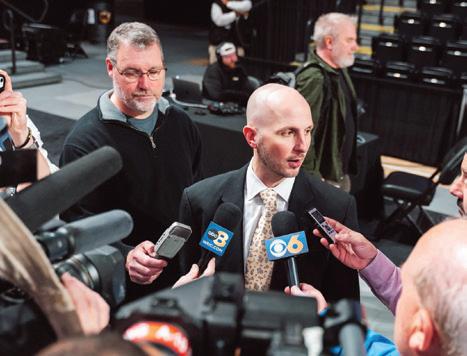
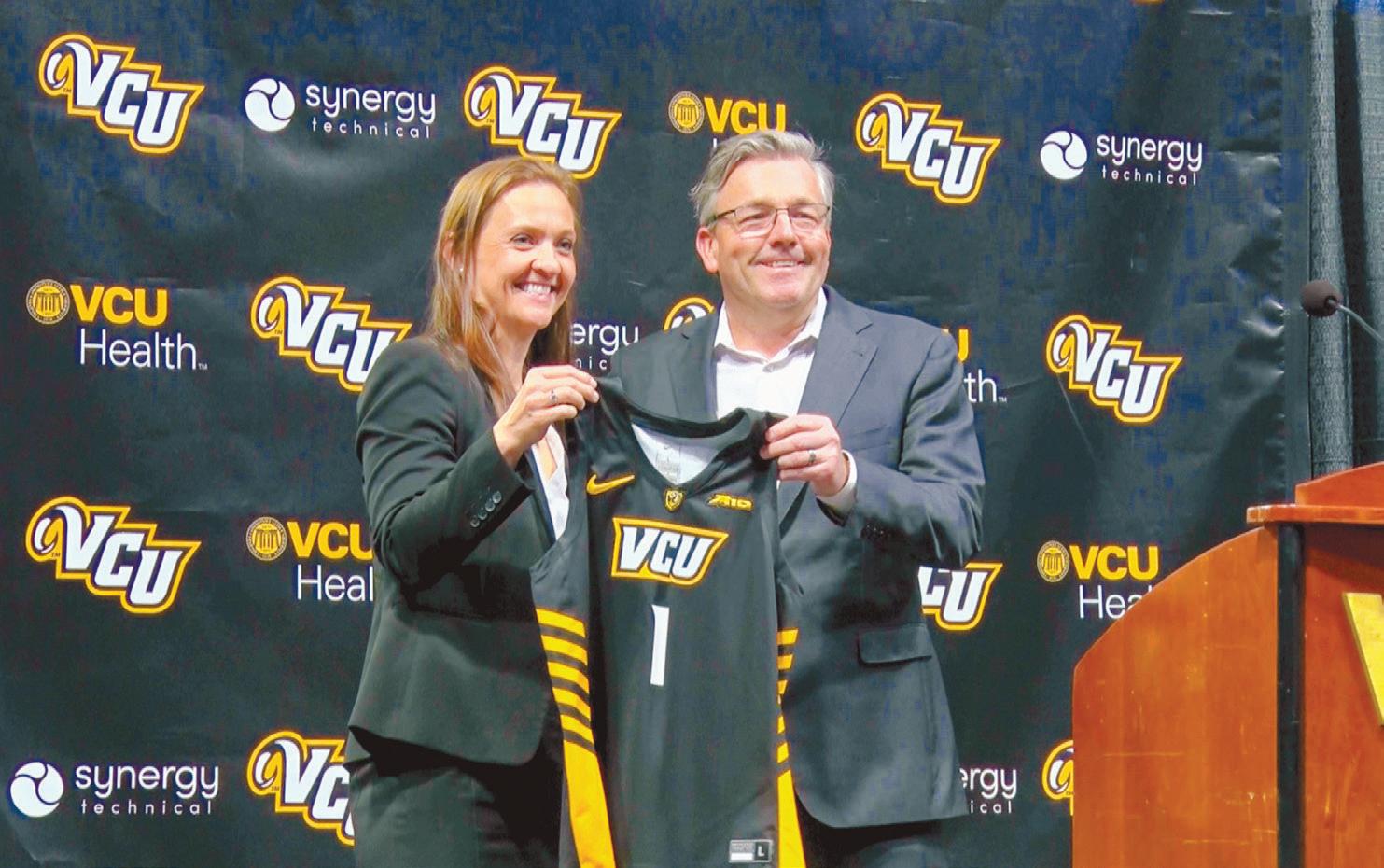
VCU women’s basketball unveiled Chelsea Banbury as its 14th head coach on March 31.
Banbury coached at High Point University for the past seven seasons, winning four regular season conference championships, three conference tournaments and three NCAA Tournament appearances.
Three of those four regular season titles came in the last three years, as well as back-to-back conference tournament championships. Banbury finished last season at 27-6, her fourth 20-win season in seven years.
Banbury opened her introductory press conference by first thanking the community.
“You guys have a great group of people that welcomed us with open arms,” Banbury said. “They’ve made it feel like home from the beginning. So I do appreciate that and I want to thank all of you.”
Banbury then followed by promising to develop and challenge the current student
Athletics Director
athletes, asking that they “fall in love” with the process.
Banbury detailed her game plan on both ends of the court for the upcoming season. Offensively, the plan is to push the pace and rely on spacing and efficiency while utilizing screens and motions to create advantages.
“We’re going to attack the basket and we are going to shoot a lot,” Banbury said.
“We will utilize the three point line.”
as the eighth most challenging city in the country to live in with a pollen allergy.
Gough said the only solution that can alleviate the pollen in the Richmond area is eliminating tree canopy, which he does not think is a good idea.
“Eliminating tree canopy has its downsides, because it would increase the temperatures in the city, particularly during the warmer months,” Gough said. “It would reduce cooling associated with the evaporation of water from plants in the city.”
Richmond lost 2% of tree coverage over the past five years, bringing the city to 43.8% tree coverage, according to the Washington Post. That is still larger than the DMV metropolitan area’s 39.7% coverage or the Virginia Beach/Norfolk area’s 31.5% coverage. New York City’s metropolitan area has 27.5% coverage.
Richmond has higher urban heat problems in areas that were redlined in the 1950s, per a previous report by The CT.
“Climate change results in the pollen coming sooner,” Gough said. “We know that warm temperatures enhance the rate at which plants flower and when they produce flowers, they’re generating pollen, so that’s one effect of climate change. The second is that warmer temperatures can stimulate growth and, part of that growth results in an increase in pollen count.”
Continued on next page
FEATURES
William Thomas researches solutions to health inequities, including his own disease
SAPPHIRA MOHAMMED Copy Editor
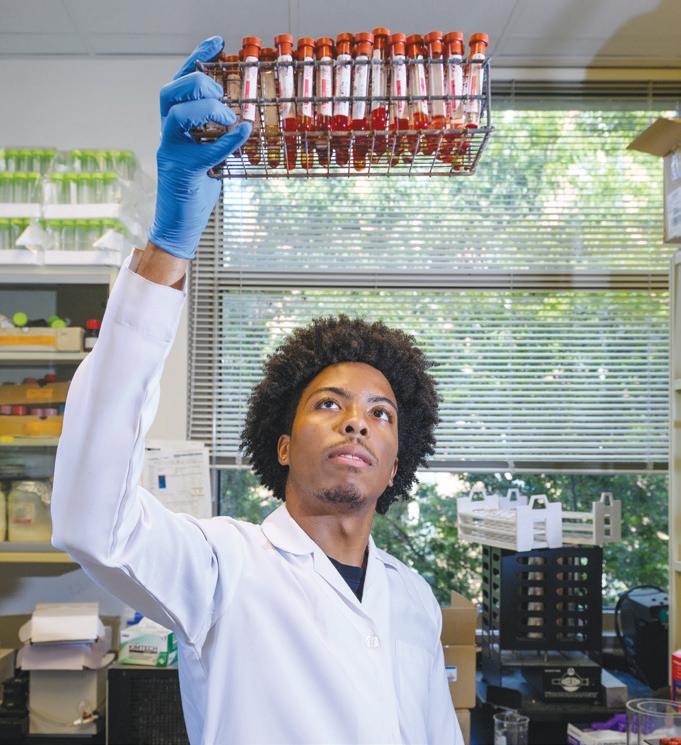
Fourth-year biology student William Thomas has been conducting research at VCU on curing sickle cell disease, the very same disease he has lived with his entire life.
Continued on page 5 Continued on page 10

SAL ORLANDO Assistant News Editor
VCU
Ed McLaughlin swears in Chelsea Banbury as the 14th head coach of the women's basketball program. Photo by Ben Rekosh.
William Thomas examines samples in a lab. Photo courtesy of Jonathan Haff/VCU News.
WBB COACH
WILLIAM THOMAS
POLLEN
A pile of oak tree catkins, the part of the flower that stores and releases pollen into the air, cover the grounds of Monroe Park.
Photo by Burke Loftus.
Stories of the week
national: After flying by the moon, Artemis II is preparing for their journey back to Earth, as the four astronauts are among the longest spaceflight in human history.
international: President Donald Trump announced his agreement to a two week ceasefire with Iran, on the condition the nation opens up the Strait of Hormuz.
Spanberger to decide on bill preventing partisanship on boards of visitors
SKYE HATHAWAY
Contributing Writer
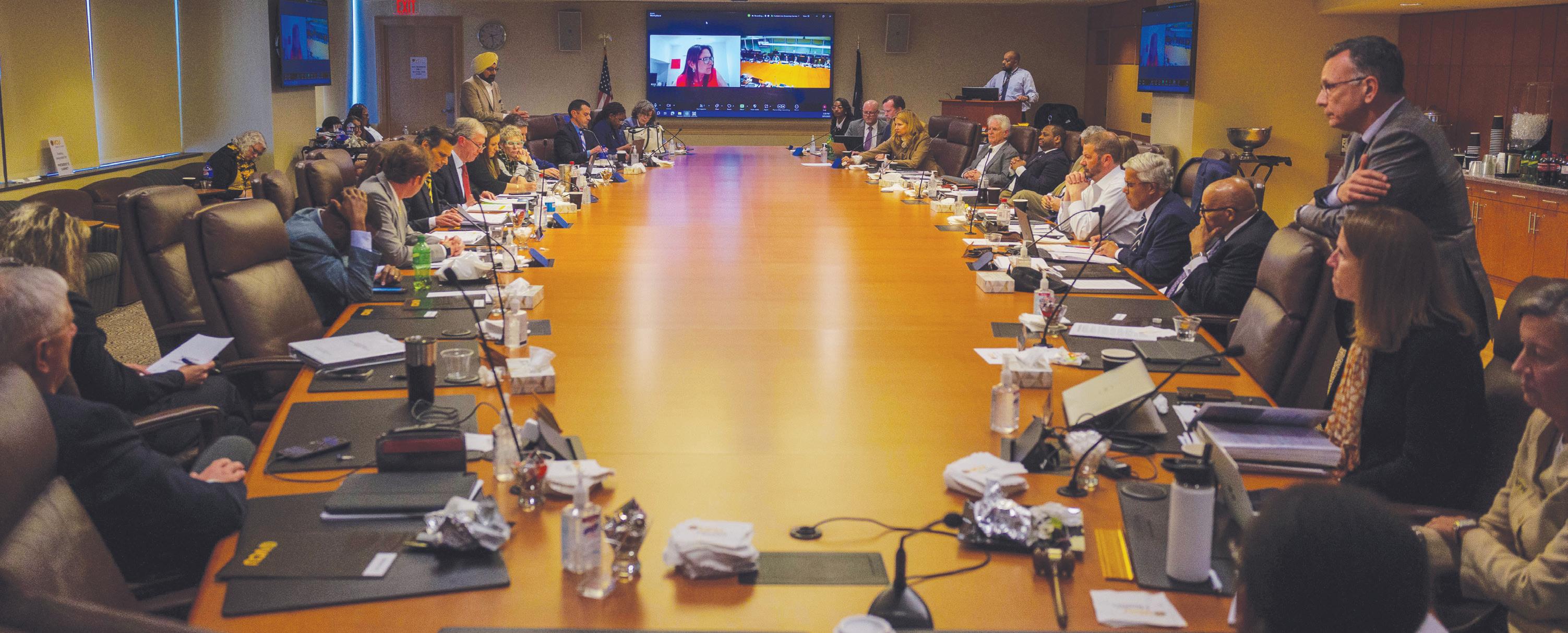
The Virginia General Assembly passed a bill that would reform how university boards of visitors operate with the goal of making them less partisan. It is awaiting a signature from Gov. Abigail Spanberger, who called for the changes upon entering office.
Under the legislation, board members’ terms would increase from four to six years. Members would be required to wait two years after their six-year term before being reappointed. The measure would prevent any one governor from fully packing the boards with their appointees.
Boards of visitors consist of 16 members. After the governor appoints members, they are confirmed by the General Assembly. The boards hold the power to budget, hire and fire presidents, shape university policy and approve course curricula.
The governor currently gets to appoint four board members each year, meaning the boards consist entirely of the governor’s appointees by the end of their term.
The bill would also require the General Assembly to confirm or reject the governor’s appointees as soon as “practicable.” Currently, the General Assembly confirms or rejects appointees within the first 30 days of the following session — meaning there are often months-long gaps between appointments and confirmation.
PROPOSAL WOULD NOT GIVE VOTING RIGHTS TO STUDENTS, FACULTY, STAFF
Continued from front page
Gough said the rising temperatures only affects the flowering of plants to a point, but if it gets too warm too quickly, it will be detrimental to plant growth.
The City of Richmond introduced the RVAgreen 2050 Plan in 2023 to reduce greenhouse gas emissions 45% by 2030, and achieve a net zero by 2050. Its five pathways to achieve the goal are through transitioning buildings and energy to become climate neutral, creating an “equitable and resilient” Richmond,
A number of reforms were proposed this year, but only the bill by Del. Lily Franklin, D-Montgomery, passed and will be considered by Spanberger.
Some of the proposals would have required boards of visitors to have student, faculty and staff representatives with voting powers.
Those provisions were not included in Franklin’s bill. However the passed proposal would give students, faculty and staff one nonvoting, advisory role each.
Each staff and faculty representative would serve a year long term and must be elected by their university’s faculty senate and staff senate respectively, or an equivalent body. The student representative must be nominated by their university’s student government. The board would decide the term of the student.
NEW
LANGUAGE WOULD CLARIFY ROLES OF BOARDS, PREVENT PARTISANSHIP
If signed, new language would be added to state laws that would clarify the duties of boards of visitors.
Governing boards would be required to create a shared government involving student, faculty and staff advisory members — as well as establish rules on how that shared governance will operate, according to Franklin.
Boards would have to include advisory members in conversations about program and funding cuts, as well as changes to
investing in natural resources, transitioning to clean mobility and fostering sustainable waste reduction.
Third-year computer science student Ben Barnett said his allergies feel worse when he is in Richmond, as opposed to his hometown in southern Virginia. Though in either location he does not feel limited in what he can do or where he can go.
“My car is just covered in yellow. Even in the parking deck, it still gets yellow,” Barnett said.
First-year cinema student Aiden Schwartz said he developed asthma from
tenure policies, according to Franklin.
The bill includes language permitting boards from adopting policies that prevent free expression and academic freedom — including firing faculty for their views.
Board members would be obligated to excuse themselves from participating in decisions in which they could not vote objectively due to their views.
“Students, faculty and staff will have a stronger voice with what they want out of their universities,” Franklin said.
STUDENT GROUPS SUPPORT REFORMS, BUT WANT MORE REPRESENTATION
Members of VCU’s Student Government Association have pushed to increase student representation on the board of visitors. Their president-elect Natalie Bowen is hopeful the changes will lead to consideration of student well-being and rights.
SGA members often feel that student concerns and solutions are not taken into consideration by the university, Bowen said.
“If masses bring enough attention to something and keep pushing for their voices to be heard, eventually, the university or government will bend a little bit,” Bowen said. “That’s really all that we can hope for in times like these, so definitely keep pushing for more representation, because it’s what we deserve.”
The VCU chapter of the NAACP has been advocating for reforms since the VCU Board of Visitors voted to cancel the
the pollen, and recently got an inhaler to help him deal with his allergy.
Another first year cinema student, Gideon Bradner, said his allergies hit him in a surprising manner, and it felt like it was his “last day on earth.”
“The pollen in Richmond kicked my allergies into overdrive, and made up for like three years of not taking allergy medicine,” Bradner said.
As a commuter who lives in a forested area, Bradner is firmly opposed to removing trees in order to alleviate the pollen problem.
implementation of a “racial literacy” core curriculum requirement in 2024.
The requirement — which covered topics such as systemic racism, gender studies and workplace inequality — was in development by students and faculty for years before getting cancelled.
Their ideal reform would grant students actual voting power, rather than advisory roles or only being able to speak at meetings, said chapter vice president Jordan Hill.
The VCU Board of Visitors currently has student and faculty representatives who do not have voting powers.
“They tend to, especially the board of visitors, forget the main priority and the actual foundation for its resources is the students,” Hill said.
Many VCU students and staff are unaware of the board, and that they can attend their public meetings, according to political action chair Abdul Muhammad. He believes putting board activities in the public eye would increase their accessibility.
The chapter will continue to focus on educating students and staff about the board and encourage them to attend meetings, said chapter president Ashley Brown.
“When we go, sometimes they even run out of seats, because they don’t expect that many people to show up as students,” Brown said.
Spanberger has until April 13 to sign, amend or veto the bill. The General Assembly will reconvene on April 23, giving them the opportunity to vote on any proposed changes.
The Children’s Hospital of Richmond at VCU opened a pollen counting station last year, with the hopes of gathering data that will help those who suffer from allergies.
To beat the pollen, VCU Health recommends staying indoors, leaving windows closed, using air conditioners and replacing their filters. Use a high-quality mask while going outdoors, shower and wash your hair before bed each night.
The VCU Board of Visitors is the university’s highest governing body. The board is made up of sixteen members appointed by the governor of Virginia. File photo by Kieran Stevens.
POLLEN
Avula pushes for affordable housing in city budget as costs rise
HECIEL NIEVES BONILLA News Editor
Richmond is putting a policy and planning focus on housing expansion and affordability through budget items and its ongoing Code Refresh project, as people continue to face high costs and a nationally high eviction rate.
The changes come as Richmond becomes an attractive city nationally for college students and graduates seeking housing, according to realtor.com.
MAYOR’S PROPOSAL INCLUDES GRANT PROGRAMS, FUNDING CHANGES
The points listed in the mayor’s housing plan promise to establish predictable funding for affordable housing construction, redevelop public housing, fight displacement and continue with updating the zoning code.
The predictable funding will largely come in the form of real estate tax revenue put towards the Affordable Housing Trust Fund. That funding stream was already approved by the city council in February and is expected to bring in over $10 million this year with more millions as the city grows. The fund was previously funded irregularly, but has already led to affordable units built.
An additional $1.8 million will go towards Affordable Housing Performance grants, which will be offered to developers that ensure the inclusion of affordable homes at various price levels in their builds.
A budget plan press release from March 3 also lists “$700,000 for Right to Counsel services, $1 million for Family Crisis Funds, $1 million for eviction diversion programs to help tenants stay in their homes and $7.4 million in tax relief for older adults and residents with disabilities” among the proposed budget items.
The code refresh redefines what kinds of buildings the city allows developers to build, and in which areas, for the first time since the 1970s — largely to allow for taller and denser construction.
Mayor Danny Avula’s spokesperson
Mira Signer stated that while the city’s housing initiatives do not target one single demographic, students could directly benefit from efforts that target Richmond’s renting population in particular.
Signer highlighted the effect the zoning update would have on increasing the supply of “duplexes, triplexes, and small apartment buildings” in the city, including “mixed-use development to expand lower-cost rental options near transit, jobs and campuses.”
“We are excited that students are paying close attention to housing issues in the City and are excited to create a future with more homes for more students, and more ways for students to stay in this amazing city,” Signer stated.
City councilmember Katherine Jordan represents the city’s second district, which includes Monroe Park and many college students and young professionals.
Jordan hopes the final budget includes enough funding for the city’s Planning Department, which would support the zoning update and new initiatives such as the Rental Inspection Program. She has said VCU should also step up in terms of student housing as the city works to increase supply, according to a previous report by The CT.
“Housing affordability is one of if not the top issue for residents in the Second District in every budget cycle, and it is once again a major priority of mine as I consider the FY27 budget,” Jordan stated.
BROADER HOUSING CONTEXT SIGNALS WIDEREACHING COST PROBLEM
“Affordable housing” is defined by the federal government as that which costs no more than 30% of a household’s gross income. Federal financing and other support programs are often directed at those making less than the “area median income,” which was $113,500 for households in 2025-26 according to The Richmonder.
Programs exist to support both renters and those seeking to buy a home. While public housing exists in the city, the “affordable housing” label applies to a broad range of homes and programs, including homebuying.
The city’s median home sale price was $351,889 as of Jan. 31 and higher in the surrounding counties, according to Zillow. A household should make $70,000 to $90,000 to consider buying a home at that price according to the finance company SoFi — higher than the city’s median household income of $63,600 in 2025 according to the US Census.
The median asking rent in Richmond for listings rose to $1,509 by January, bucking the national trend of slight decreases in rent prices, according to realtor.com.
These discrepancies signify that the city’s targeted support programs exist in the context of broader increasing unaffordability for many demographics in the area.
Several regional organizations seek to alleviate the situation and support homeseekers. One of the largest is the Better Housing Coalition, a regional nonprofit that helps build housing for both rental and purchase in the area, among other aims.
Its CEO Greta Harris wrote in a letter to The CT that the Housing Trust Fund’s proposed annual funding stream is a positive development that creates a “more supportive environment” for organizations like the BHC.
“That said, there is still work to be done,” Harris stated. “It is critical that these plans ensure equitable access so that all residents, not just select populations, benefit from these investments. As policies are implemented, the details will matter. We have to be mindful that added complexity or unintended barriers do not slow projects or limit the ability to build housing that is truly affordable.”
Woody Rogers, the policy director at the regional housing policy advocacy org Partnership for Housing Affordability, stated that the policy changes will be a boon to private developers who would need the money to make building affordable housing financially viable.
“Code Refresh not only has the potential to allow more housing to be built in critical growth centers and corridors but also could facilitate the introduction of modest increases in density to neighborhoods across the city to create greater housing diversity,” Rogers said.
Efforts from different parties to change or increase housing in the city have not gone without opposition or controversy.
Last year, the Richmond Redevelopment and Housing Authority and the Mayor’s office began a public spat over its proposed redevelopment of Gilpin Court, the city’s oldest public housing project.
The demands from residents to ensure its redevelopment retains a one-for-one replacement of its units, resident oversight and a tenant bill of rights are ongoing, according to Axios.
Several neighborhood residents associations have opposed or asked to slow down the rezoning process, according to The Richmonder. Complaints from oftenolder residents ranging from its potential effects on neighborhood character to outsized influence of developers on the process have led to a revised current plan that makes fewer density increase changes.
Rogers stated the need for affordable housing in the region currently surpasses what current providers can serve, but that the zoning change is a good step to addressing housing affordability challenges, including as it expands the ability to build more housing beyond just certain neighborhoods like Manchester and Scott’s Addition.
“Allowing a greater diversity of housing types will present more choices to residents looking to live in neighborhoods throughout the city, and encourage more equitable access to schools, jobs, and other amenities,” Rogers stated. “Increasing the supply of housing has shown to stem rising housing costs at the city level, as has been shown in many studies across the country.”
Rogers added that the rezoning process has seen fewer voices from renters and young people than those of homeowners, in particular those in Richmond’s wealthiest neighbourhoods.
Rogers encourages young people to talk with council members on the matter and stay engaged with the process as young people are increasingly unable to purchase in the area and the average age of a homebuyer in the state grows.
HICCUPS WITH GILPIN COURT, CODE REFRESH
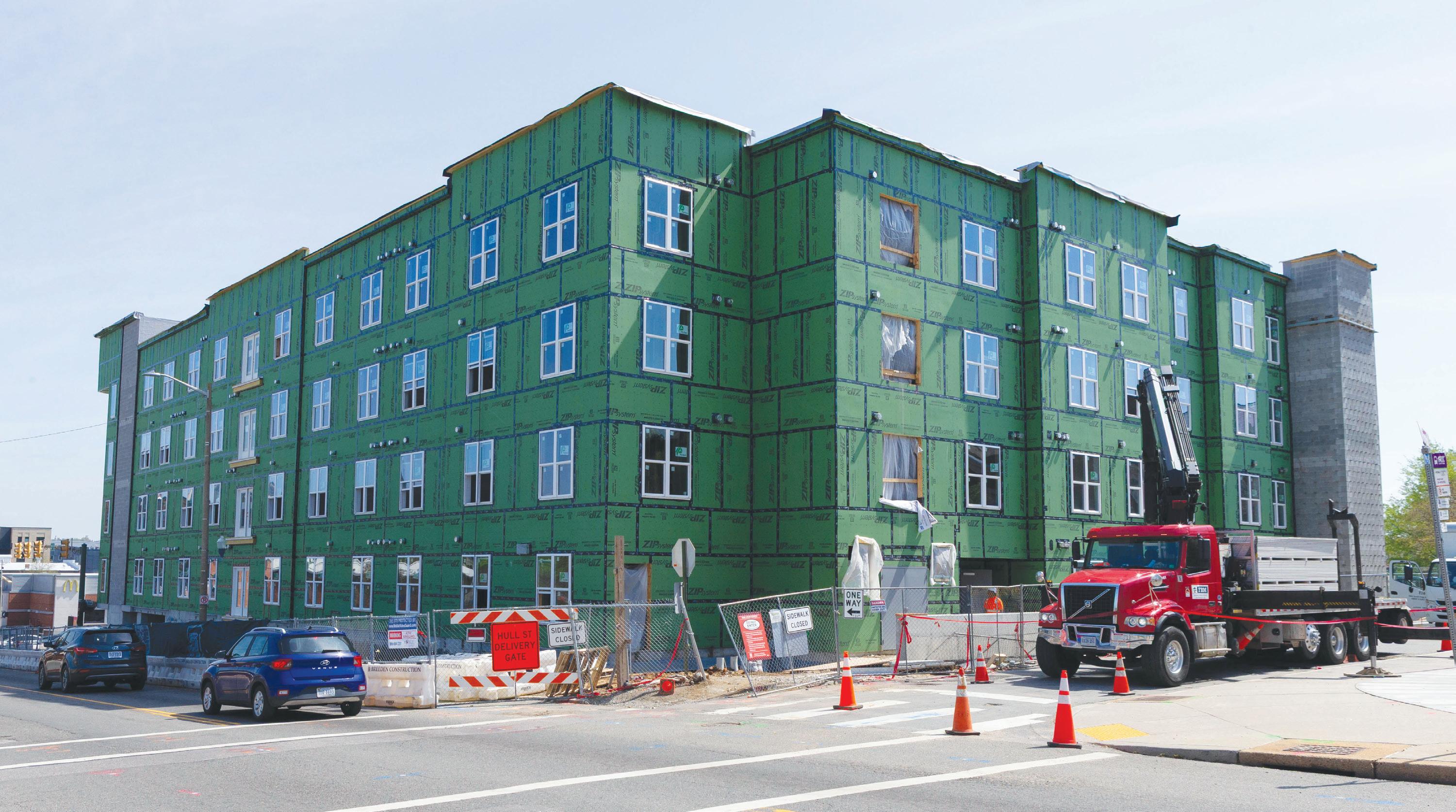
The under-construction ‘The View at Belle Isle’ apartment complex at 812 Hull St. — one of multiple developments being supported by affordable housing grants from the City of Richmond. Photo by John Brown.
What’s the deal with the redistricting campaigns in Virginia?
BRYER HAYWOOD Staff Writer
The campaign for mid-decade redistricting in Richmond has resulted in a tumultuous election cycle, featuring misleading mailers — with millions of dollars from outside Virginia being poured into promoting, or decrying, the Democratic proposal.
If passed on April 21, the referendum would amend the state’s constitution and give the General Assembly the authority to redraw Virginia’s congressional districts to favor Democrats by up to a 10-1 margin ahead of the 2026 midterm elections.
The current law that allows the Virginia Redistricting Commission to redraw the districts once every decade would remain in effect, regardless if the referendum passes.
The special election has presented some challenges for the Richmond registrar’s office. David Levine, director of Elections and General Registrar for the City of Richmond, explained that the proposed amendment included $5 million to be distributed to every locality in the state for election management.
The City of Richmond requested additional funding but has not received it. The June primary elections in Virginia had to be moved to August to accommodate for the special election, and defended the pace of preparations in the city, according to Levine.
“It’s a marathon, not a sprint,” Levine said.
The political advertising surrounding the referendum campaign has been wrought with controversy.
Several Virginians reported receiving misleading mailers encouraging them to vote “no,” one of which used Jim Crow imagery to encourage Black people to vote against the amendment.
The mailer was distributed by the Justice for Democracy Political Action Committee (PAC), led by former Republican Del. A.C. Cordoza. A key donor to that group is
billionaire and Trump ally Peter Thiel, who made a $2.5 million contribution to the PAC via his organization, Per Aspera Policy Inc., according to the State Board of Elections.
Other misleading mailers included images of former President Barack Obama and Gov. Abigail Spanberger encouraging voters to oppose the referendum. Obama has made his support for the “yes” vote clear. He appeared in an advertisement supporting redistricting.
Out-of-state money has played a large role in the referendum campaign on both sides, but by far the largest sum has come through the pro-redistricting PAC, Virginians for Fair Elections.
Of the whopping $49.2 million in contributions so far, $29.3 million has been from House Majority Forward — a group associated with Democratic leadership in the U.S. House.
Virginians for Fair Maps, the similarly named group advocating for the “no” vote, has received $9 million, according to VPM, and is now releasing TV ads.
VCU political science professor Alexandra Reckendorf said she is not surprised at the way the campaign has progressed so far, but she is disappointed in the ways politicians have misinformed voters.
“These ads are legal because they do use actual quotes from President Obama and Gov. Spanberger, but they enter an ethically grey area because they do so in a way that completely skewers the context of the current redistricting amendment,” Reckendorf stated.
Reckendorf explained the tactic of misattributing information to one party when it should be attributed to another is known as “black propaganda.”
“If Virginians pass the ballot measure, Democrats in the state will likely have a disproportionately high degree of representation after the upcoming midterm elections, while Republicans will have the opposite,” Reckendorf said, noting the result would mirror Republican gerrymanders of

Virginia in the past.
Reckendorf believes a “no” victory that leaves the maps as they are is not necessarily fairer, as it would maintain disproportionately high Republican representation on the national level thanks to redistricting efforts in other states. That national environment would then pass policies that still impact Virginians, even if other states facilitated them.
“In that sense, voting against the ballot measure doesn’t preserve fairness and representation unless you’re only defining it on the state level,” Reckendorf said.
Republican state Sen. Glen Sturtevant, R-Colonial Heights, similarly called for congressional Republicans to get involved in the “no” side at a recent “Stop the Gerrymander” rally in Midlothian on March 29.
“Look, we voted by two thirds as Virginians just 5 years ago that we’re not going to do gerrymandering anymore, and then the first chance they get when they
have a trifecta is to come back and try to do gerrymandering,” Sturtevant said.
Sturtevant is pleased with early-vote turnout for the Republican side, which he believes independents and some Democrats are in tune with.
“This is an opportunity for the grassroots of Virginia to come together and say we’re not going to put up with this outside-of-Virginia money trying to come in and change our districts, try to have everybody represented by somebody in Fairfax, which is basically how they have redrawn the maps in a smokefilled room,” Sturtevant said.
U.S. House Minority Leader Hakeem Jeffries, D-New York, said in February the national Democratic party is willing to do “whatever it takes” in Virginia to ensure the measure goes through, according to Reuters. He is one of several national Democrats that have involved themselves in the campaign.
Tadek Wieczorek and Heciel Nieves Bonilla contributed to this story.
Virginians have until April 21 to vote — here’s how, and why
ANDREW KERLEY Executive Editor
The people of Virginia will decide if the commonwealth should enact mid-decade redistricting on April 21. The ballot reads:
“Question: Should the Constitution of Virginia be amended to allow the General Assembly to temporarily adopt new congressional districts to restore fairness in the upcoming elections, while ensuring Virginia’s standard redistricting process resumes for all future redistricting after the 2030 census?”
BUT WHAT DOES THAT MEAN?
In the United States, Congress decides how many representatives each state gets by their populations. Virginia has 11 of them, and therefore 11 corresponding districts. But it is up to states to decide how the lines for those districts are drawn.
In Virginia, district lines are re-drawn once per decade. The maps are created to reflect different regions of the state and their communities. For example, Richmond and Petersburg share Virginia’s 4th Congressional District, currently held by Democratic Rep. Jennifer McClellan.
Virginia has put an independent, bipartisan commission in charge of that since 2020. To keep things fair, it has an equal number of Democrats and Republicans as members.
The ballot question asks if Virginia should temporarily disregard the commission so the
WHY IN THE MIDDLE OF APRIL?
Because last summer President Donald Trump asked lawmakers in Texas to redraw their state’s districts in a way that would give an advantage to Republicans. They were successful, and other Republican-leaning states have followed, changing their maps for the 2026 midterms.
The process is called “gerrymandering”: when lawmakers deliberately redraw districts to favor their own parties. For example, about 56% of Texans voted for Trump in 2024, but under the state’s redrawn lines, Republicans could win nearly three quarters of its Congressional districts this November.
In response, lawmakers in California gerrymandered their districts to better favor Democrats — seeking to even the odds ahead of the November election.
Virginia is just the latest Democraticleaning state to participate in the national redistricting-off. Both parties are racing to give themselves the best possible odds of winning a majority in Congress.
Long story short, Republicans are gerrymandering their states and Democrats called a last-minute referendum to gerrymander back. That is why Virginians are voting in the middle of April.
Virginia lawmakers’ proposed map would make 10 of Virginia’s 11 districts more easily winnable by Democrats.
SpecialElection
HOW TO VOTE IN RICHMOND
The deadline to pre-register to vote and cast a regular ballot is April 14. Virginians can still vote after that point through same-day registration.
Early voting began on March 6 and will continue until April 18. After that point, voters will have to wait until election day on April 21.
Voters will need to bring one acceptable form of ID, either a Virginia driver’s license, state ID, passport or one of multiple other forms. Student IDs are accepted. Voters can also bring a utility bill, bank statement, government check or paycheck with their name and address.
Richmonders can vote early at three locations: The Richmond City Registrar (2134 W. Laburnum Ave.), City Hall
(900 E. Broad St.) or the Hickory Hill Community Center (3000 E. Belt Blvd.). All of Richmond’s early voting locations are reachable from Monroe Park through GRTC buses. Routes can be found at ridegrtc.com/maps-and-schedules/. For students living on MCV Campus, City Hall is just a short walk away.
All three early voting sites are open Monday-Friday from 8:30 a.m. to 5 p.m.
More voting locations will open up on April 21 — they can be found at elections. virginia.gov. The polls will be open from 6 a.m. to 7 p.m.
HOW TO VOTE FROM HOME
Students who are registered to vote in other counties (or those who do not want to commute to vote in person) can vote by mail. Applications to vote by mail can be submitted at vote.elections.virginia.gov/ voterinformation. In Richmond, requests can be sent by fax (804-646-7848) or email (absentee@rva.gov).
An array of mailers, sent to homes in Richmond, regarding Virginia’s redistricting referendum. Photo by Andrew Kerley.
General Assembly, currently controlled by Democrats, can redraw district lines ahead of the 2026 midterm elections.
Sports
Stat of the week
VCU lacrosse’s 19-6 win over Duquesne University secured its winningest season in program history, with nine wins overall and five wins in the Atlantic 10 with three regular season games to play.
Martelli aims to retain core players prior to transfer portal
JENNY ALLEN Staff Writer

GAME RESULTS
APRIL 3
WTEN AT THE UNIVERSITY OF DELAWARE LOST 2-4
BSB AT THE UNIVERSITY OF RHODE ISLAND LOST 1-5
APRIL 4
LAX VS. DUQUESNE UNIVERSITY WON 19-6
BSB AT THE UNIVERSITY OF RHODE ISLAND LOST 2-4
BSB AT THE UNIVERSITY OF RHODE ISLAND LOST 5-7
VCU men’s basketball’s standards have increased as they earned a share of the Atlantic 10 regular season title and the conference tournament championship for its second straight season.
VCU secured its spot at the NCAA Tournament, where it faced off against No. 6 University of North Carolina.
The Rams won a thrilling 19-point comeback before eventually losing to No. 3 University of Illinois in the round of 32.
Despite the Rams’ loss in the second round, the astonishing upset against UNC left VCU ready to use the offseason to its advantage.
However, with the rise of the transfer portal, VCU’s team roster remains in question.
Head coach Phil Martelli Jr. believes that one of the most crucial aspects of college basketball is player consistency.
Backing his belief, Martelli has agreed to a contract extension through the 2031-32 season, demonstrating his commitment and gratitude towards VCU.
“VCU is built to compete at the highest level and we have to continue to push that forward,” Martelli said in a post-game press conference. “I talk a lot about the people that came before us and what they’ve done to build this legacy, but it’s really now it’s the people that are in charge and all of us.”
After Martelli’s extension, multiple key players announced their intentions to stay with VCU for the 2026-27 season.
First-year guard and A-10 Rookie of the Year Nyk Lewis was the first to express his intention to return to VCU for his sophomore year. He emphasized the impact Martelli and VCU had on his decision.
“Very thankful for everything VCU has done to help develop me as a man on and off the court,” Lewis said in an Instagram
post. “Thankful for the fans and the community for unforgettable memories and experiences, it’s time to build on last year.”
Following Lewis’ announcement, secondyear guard Brandon Jennings, thirdyear forwards Michael Belle and Lazar Djokovic, third-year guard Tyrell Ward and first-year guard Jordan Tillery all announced their intent to stay.
However, breakout second-year guard Terrence Hill Jr. announced he will enter the portal with a return to VCU “remaining open.” Alongside him were redshirt fourthyear forward Christian Fermin, third-year forward Keyshawn Mitchell and redshirt third-year forward Obinnaya Okafor.
In 2025, the NCAA men’s basketball transfer portal entries hit a record high for the fourth consecutive year, according to Front Office Sports.
Recent adjustments to the transfer portal’s rules have ultimately simplified the process for players seeking other opportunities, according to Yahoo Sports.
The transfer window now opens the day after the national championship game and stays open for 15 days. By altering the transfer window to correlate with the end of the NCAA Tournament, the unpredictability leading into the new season is high.
With the portal’s recent changes and VCU’s success, the Rams’ offseason could be full of rapid changes, forcing the team to make quick adjustments before the upcoming season.
Mid-major teams — like VCU — often find themselves facing off against the transfer portal rather than working with it.
Despite the predicted departure of some players, the early announcements highlight the loyalty and devotion towards VCU and its basketball program.
“With all the tournaments and the big shots and the wins and all that, we’re just trying to add to that legacy,” Martelli said during the UNC post game press conference. “We’re not trying to create anything new. We’re just trying to build on what’s been built upon and just keep adding stories to that legacy.”
Continued from front page
The same intensity applies defensively. Banbury plans to employ a relentless manto-man defense that forces opponents to be uncomfortable and inefficient.
“Our identity is going to be built on effort, discipline, and the ‘we over me’ mentality,” Banbury said. “When people watch us, I want them to see a team that competes every single possession, and a team that loves competing together.”
Banbury understands that culture cannot be built overnight, but she asked fans, alumni and the Richmond community to stand with her.
Our identity is going to be built on effort, discipline, and the ‘we over me’ mentality.
When people watch us, I want them to see a team that competes every single possession, and a team that loves competing together.”
Chelsea Banbury, new head coach
“We’re going to give you a team that you can be proud of. One that represents VCU with passion and grit,” Banbury said. “I promise you this — we will show up every single day ready to work, ready to compete and ready to grow.”
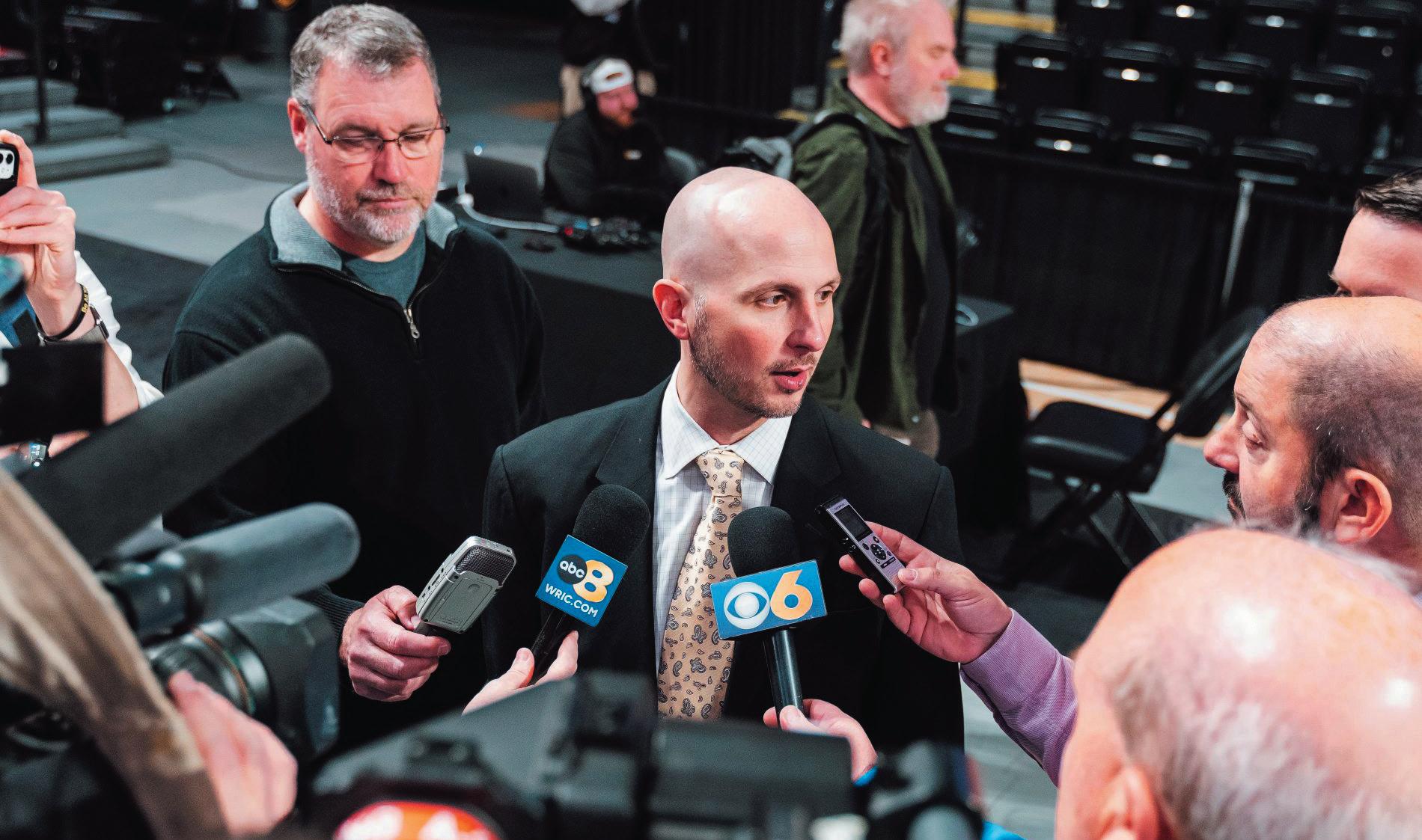
VCU head coach Phil Martelli Jr. CT file photo by Arrick Wilson.
WBB COACH
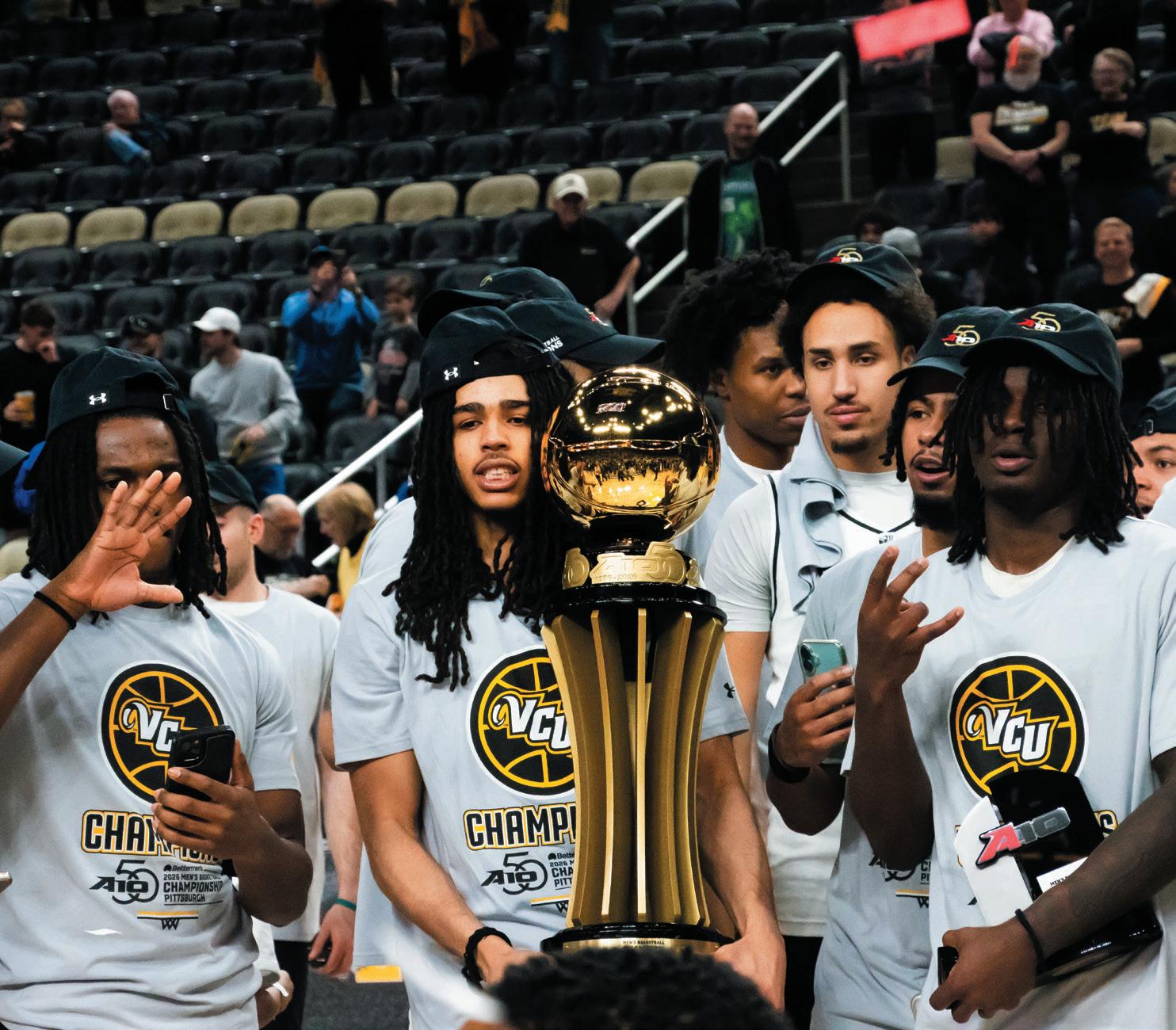
Second-year guard Brandon Jennings holds the Atlantic 10 trophy. Photo by Alexis Washington.
Is NIL Ruining March Madness?
HAYDEN BRAUN Staff Writer
March Madness is supposed to be pure, unfiltered chaos where any school has a chance, no matter how big the opponent is.
The idea that a small program like Siena University can go toe-to-toe with a blue blood like Duke University is what makes the tournament so special. But with the turnout of last year’s and this year’s tournaments, that unpredictability feels like it’s fading.
Fans don’t want to see all top seeds battling it out in the Final Four like in recent tournaments. They want Cinderella stories, buzzer-beaters and the chaos that made March Madness what it is.
Name, Image and Likeness (NIL) is the legal right of college athletes to profit off their fame. It was introduced in 2021 and since then college sports have changed as we know it — and so has March Madness.
One of the last true Cinderella runs came in 2022, when Saint Peter’s University shocked the country. Saint Peter’s became the first team in tournament history to reach the Elite Eight as a No. 15 seed, defeating powerhouse programs like the University of Kentucky and Purdue University along the way.
Runs like that are what make the NCAA
Tournament special. The unpredictability, the underdogs, the belief that any team no matter who they are can win any game as long as they make the dance.
That’s what draws fans in every March, but today’s era of NIL deals and the transfer portal has made those moments fewer and farther to come by.
That reality is already starting to show. VCU just earned its first NCAA tournament win in nearly a decade. But while trying to build on that success, the Rams are being faced with the downside of the NIL system — breakout star secondyear guard Terrence Hill Jr. entered the transfer portal shortly after the tournament.

Star players at smaller programs are no longer staying — they’re leaving for bigger schools with more money and exposure, creating a growing gap between power conferences and mid-majors.

restrictions, players can transfer multiple times with immediate eligibility, which has only widened the gap between power programs and mid-majors.
One possible solution would be tightening transfer rules, requiring players to stay at a school longer before entering the transfer portal or limiting the number of times they can transfer without penalty.
In fact, efforts to bring more structure to the system are already emerging at the national level. A recent executive order signed by President Donald Trump aims to limit athletes to one transfer without penalty, regulate NIL collectives and enforce stricter eligibility guidelines, according to the White House.
March Madness has always just been about making it to the dance and as long as you were in, you could win. It was anyone's turn to take on the glory — that a smaller program can upset a historic program and make history on a random night in March.
But if the current system continues to prioritize money and name value over continuity, those moments will become a thing of the past.
Yes, NIL is a good thing and has given athletes opportunities they never had before, but it also created a system where smaller programs struggle to keep their best talent. With the current system and few
NIL has changed college athletics as we once knew it. Now it’s time for the NCAA to make it a more stable system. The chaos of college basketball was always meant for March not for NIL and the transfer portal.
Lacrosse victory secures winningest season in program history


BEN MARTINDALE
CORRECTION: The original version of this story made an error. It reported that the VCU lacrosse head coach's name was Nina Flores, when in actuality it is Nicole Flores. This story has been updated with the correct information. The CT regrets the mistake.
VCU won 19-6 against Duquesne University following the tough loss to Elon University earlier in the week. The Rams took control as soon as the game began, led by third-year attacker Sam Palmer who scored to get VCU on the board first less than one minute into the game.
VCU graduate student attacker Molly O’Keefe was next to get in on the action, scoring just over a minute later to extend the VCU lead to two.
The Rams used swarming defense to force Dukes mistakes and capitalized offensively, running up a 6-0 lead halfway through the first quarter.
VCU’s O’Keefe was electric early, posting a hat trick in the first quarter alone. At the end of the quarter the Rams sat on the winning end of a lopsided 9-0 lead.
VCU’s lead swelled to 11 to begin the second quarter thanks to goals from midfielders second-year Annika Bennett and first-year Maya Gipson.
The Rams continued to make plays offensively and defensively and by the eight-minute mark of the second quarter, extending their lead to 13.
A goal from fourth-year attacker Chloe Holmes with just under two minutes remaining in the second quarter marked the lone goal of the half for Duquesne, who went into halftime down 15-1.
Both teams went scoreless the first six minutes of the second half until Duquesne scored first to cut the lead to thirteen.
Duquesne scored again four minutes later, showing that despite the deficit it planned on competing until the final whistle.
Less than a minute later, fourth-year midfielder Kiley Kozak scored VCU’s first goal of the second half and increased the Rams lead to 16-3.
Duquesne started the final quarter with a quick goal, cutting the deficit to twelve.
The Rams responded a few minutes later with Bennett scoring her third goal of the day, increasing the VCU lead to 17-4. The two teams traded goals through the rest of the fourth quarter with VCU remaining firmly in control. In the end, the Rams won in dominant fashion 19-6.
“It’s really nice when you have people who want it as much or more as the coaching staff does,” VCU head coach Nicole Flores said. “I think that’s a huge indicator of success. It's player led, it’s player run, and they know why they’re doing what they’re doing. They’re not little robots being told what to do all the time.”
VCU’s victory against Duquesne marks its fifth win in six games and ushers in the winningest season in VCU lacrosse history. The Rams have just three games left on their schedule and look to remain hot entering the Atlantic 10 conference tournament at the end of the month.
Illustration by Zoë Luis.
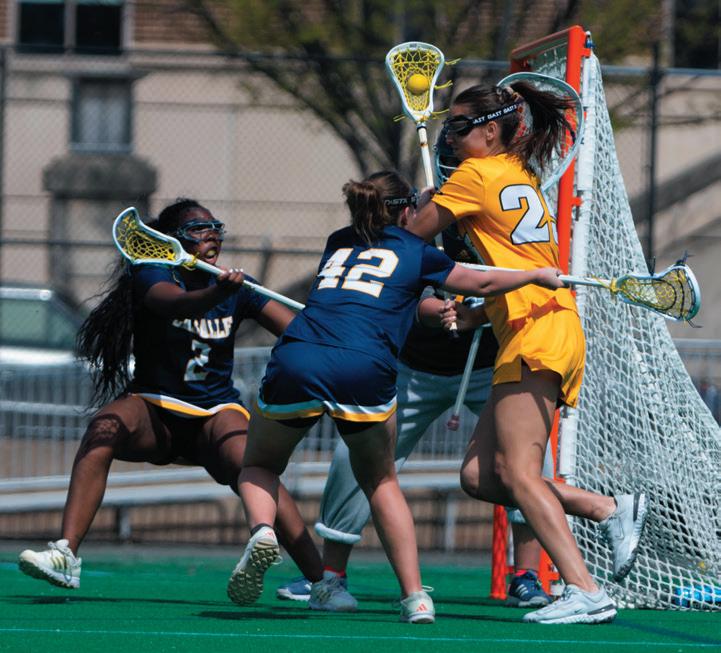
VCU second-year attacker Katie Unzicker runs down field. Photo by John Brown.
VCU second-year midfielder Maggie Ohle catches the ball (second-year attacker Kenson Epperly also present).
Photo by John Brown.
PRESS BOX
Spectrum
On This Day
On this day, April 8, 1820, the
and
For the girls raised in the south
CORA PERKINS
Assistant Spectrum Editor
A new group exhibition, “Black Queer GRITS: (Girls Raised In The South) is on view at ART 180’s Atlas Gallery until April 17.
The exhibition, created by and for Black, queer, feminine-presenting people, originally began as a dissertation project by Chandler Golden, a doctoral candidate in the VCU counseling psychology program.
“I wanted my dissertation to examine the lived experiences of SBQ [Southern, Black, queer] femmes using a method called photovoice,” Golden said. “Photovoice has people take photos that represent their experiences in hopes that it can impact their community.”
It was during the eight-week period of working on her project that Golden, and nine other SBQ femmes alongside her, decided to create an exhibition from the project.
“We picked ART 180 as our primary gallery of interest because of their reputation in the community, the fact that they were located in a historically Black neighborhood, and had a variety of Black femmes on their staff,” Golden said. “All those things were very important to us because we wanted to know that where the photos were potentially shown would mirror our own commitments.”
Golden has many hopes for what the exhibition will accomplish in the Richmond community.
“First, more than anything I hope that this exhibition will somehow help Black, queer femmes [and folx broadly] to feel valued and to know that they do have community,” Golden said. “I’m hoping at
the reception people can mix and mingle and leave with new connections or deepen existing ones because we’re navigating very difficult times and I think the best way we can get through it is together, with a community.”
Attendees of “Black Queer GRITS” can expect to see the Polaroids from Golden’s original project, as well as work from SBQ femmes in the community who celebrate southern, Black, queer life, according to Golden.
Everyone is an expert in their own experience, and Black, queer women exist at a unique intersection of identities, according to Isabella Salcedo, a sewist whose work will be featured.
“I love that the ‘Black Queer GRITS’ project privileges Black, queer women because it allows for all of this collective knowledge to exist in the same room for a few hours, to learn from each other and to engage with each person’s unique perspective on the world,” Salcedo said.
Salcedo is showing her piece “Camellia,” a baby quilt inspired by familial heirlooms. To her, it is a physical manifestation of love passed on from generation to generation.
“Putting in the significant effort to make something that is beautiful, longlasting and useful has allowed me to understand love as a verb, an action one can take,” Salcedo said.
Black, queer women are a vital part of the fabric of every single group, especially the queer community, yet they are often excluded and shown little consideration, said Shannon Wright, a mixed-media artist whose work is included in the showcase.
“So to have an art exhibition that explicitly celebrates the magnitude of
Black, queer women is a wonderful sight to see,” Wright said. “I’m a strong believer in giving people their flowers and, to me, Black, queer women deserve that and so much more.”
Wright’s artwork
“Outer Blue,” a mixedmedia piece, explores the complicated, and almost alien, feeling a lot of Black women feel in terms of their own gender, according to Wright.
“The color palette was very intentional and calls reference to the color ‘haint blue’ most commonly used in the


South,” Wright said. “I wanted to bridge color, gender and my deep love for the otherworldly together into a single piece.
‘Outer Blue’ depicts my backand-forth desire to fit into the mold of what it means to be a Black woman, yet feeling like a strange entity in my own body: stretched thin, fragmented and billowing.” Wright thinks the exhibition will be a great way for Black, queer women to come together and continue to grow and flourish.
“I think it will bring important conversations to the art scene and serve as a way for people to wake up and pay attention to the voices and artists who have forever existed and will continue to exist,” Wright said.
“Black Queer GRITS” is on view at ART 180’s Atlas Gallery until April 17. The gallery is located at 114 W. Marshall St. More information is available at art180.org.
LELIA CONTEE
Contributing Writer
The third annual All About Palestine event invited Richmonders to experience Palestinian culture through joy, community and resistance at the Greater Richmond Convention Center on April 4.
Inspired by Mahmoud Darwish’s poem “On this land,” this year’s theme centered on resilience and appreciating the beauty, power and steadfastness of Palestinian culture. The event featured Palestinian art and literature, authentic cuisine, vendors and educational booths.
Two panels were on the schedule — during the first, “Health Under Occupation: Mind, Body and Resilience,” panelists discussed the mental and physical toll of resisting genocide, and the resilience that sustains communities from Washington, D.C. to Gaza.

In the second panel — “Culture as Resistance,” panelists discussed how culture sustains Palestinian identity, memory and belonging across generations.
“We hope that it gets people excited about learning more about our culture, the history and the deep roots that we have to our indigenous land because we're the indigenous people of the Levant,” said Fairouz Foty, co-founder of Malikat Al Dabke.
Malikat Al Dabke, or Queens of Dabke, is the first all-women’s dabke troupe that specializes in Palestinian, Lebanese and Iraqi dance styles in the Washington region, according to their website.
Dabke is a traditional Levantine folk dance popular in Levant regions, such as Palestine, Lebanon, Jordan, Iraq and Syria. Foty uses dabke to assert their long-standing rich culture, combat Arabic women stereotypes and resist Zionist erasure and appropriation, according to Foty.
“Even though our mission was always to preserve Palestinian and Levant culture, Iraqi culture, Arab SWANA culture and everything, it really took on more of a focus on the genocide starting in October,” Foty said.
Malikat Al Dabke performed two pieces. The a song called “Folklore,” which blends folkloric dabke songs of the Levant with “Folklore” choreography. The second song was a traditional Palestinian mijwiz, an Arabic instrument, that reflects traditional Palestinian movements, where the dabke steps come in at the end of the verse, according to Sonia Abdulbaki from Malikat Al Dabke.
“There’s just something about dabke that gets you moving immediately,” Foty said. “It’s been a symbol of resistance since the Israeli occupation of Palestine and the rest of Lebanon, Syria, Egypt, the rest of the Arab world as well.”
Jinan Deena, a Palestinian-American chef and activist, spoke in the “Culture as Resistance” panel. Deena is the founder of Bayti, a Palestinian cuisine pop-up located in Washington, D.C.
Bayti centers on traditional Palestinian food, while educating people about its history and connection to Palestine.
“I want people to humanize Palestinians beyond what they see in the media because for so long we’ve either been seen as victims or perpetrators of violence,” Deena said. “People don’t know that we have such a beautiful culture, especially with food because our food is how we’re tied to our land.”
From homegrown figs to freshly
green almonds, those ingredients are crucial to the survival of the Palestinian spirit, Deena said.
Third All About Palestine brings rich culture, conversation ‘Black Queer GRITS’ exhibition opens in Richmond
Deena also uplifts Palestinian and pro-Palestinian restaurants, while calling out Israeli restaurants that appropriate Palestinian and Arabic food, and the harm he said it causes through ethnic cleansing and erasure.
“Since the so-called ceasefire in October of last year I feel like things have kind of quieted down,” Deena said. “I just want people to continue to fight until full liberation and then we know that the fight is connected to our fight here at home.”
and

famous Greek sculpture, “Venus de Milo”, was found on the island of Milo by a farmer who was walking his land. It was been on display at the Louvre since 1821
considered one of the most famous pieces of Classical art.
Ceramics
fashion on display at All About Palestine.
Photos by Landon G. Walker (left)
Shannon Wright's work ‘Outer Blue,’ (left) and Isabella Salcedo and her work ‘Camellia’ (above). Photos courtesy of the artists.

Students advocate for disability accessibility, awareness through art, prom event
FAKEHA NAEEM
Contributing Writer
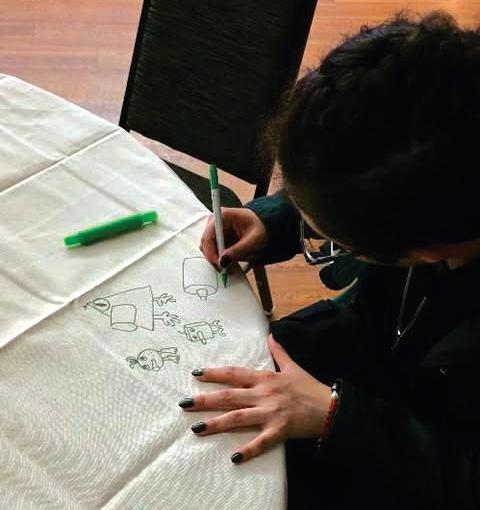
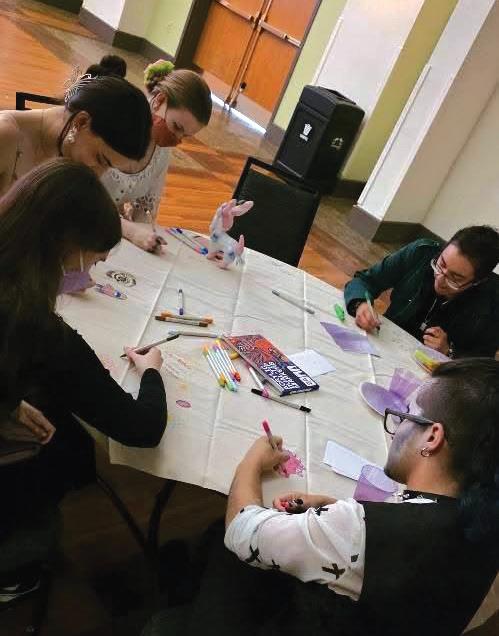
VCU’s first Disability Advocacy Week occurred from March 30 to April 4 and saw students collaborate with organizations on and off campus with the goal of raising awareness for students with disabilities and the challenges they face every day.
The VCU Student Government’s Disability Advocacy and Accessibility Caucus put on a week’s slate of printing, socializing and film viewing that culminated in a “Disability Prom” in the Commons Ballroom.
Fourth-year student Xavier McDaniel designed two disability focused tote bags in collaboration with Studio Two Three, along with t-shirts and posters for those who participated in the event.
“I went through archives with protest and disability signs and imagery, pulling out phrases such as ‘To Exist is to Resist’ and ‘Accessibility benefits everyone,’” McDaniel said.
March 31 saw the launch of an exhibition at the Cabell Library where the works of 20 disabled artists at VCU were featured — ranging from sculpture, craft, paper, video and digital media.
“VCUarts is so big, specifically pulling off the Uncommon brand, we do push our diversity in the art brand but we do not talk about disabled artists so my idea was to talk about all the uncommon,” McDaniel said. “I wanted to highlight that. I didn’t see any spaces for artists with disabilities who are students, faculty
Turning ‘what
ifs’
into second chances
RVA
Missed Connections recouples lost links
RACHEL
NICHOLAS Staff Writer
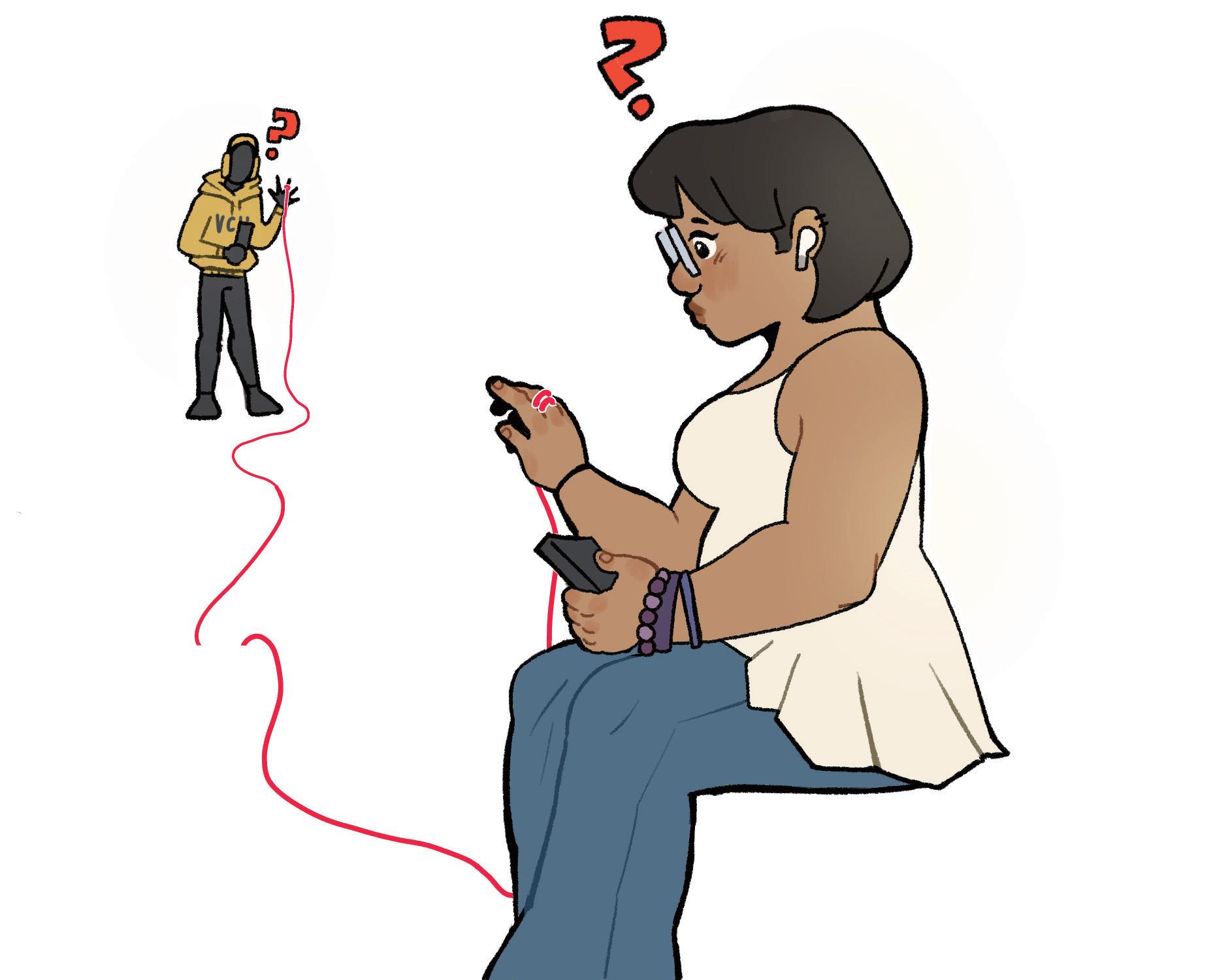
What started as a niche corner of Craigslist has found new life on Instagram where RVA Missed Connections is turning brief, everyday encounters into something more lasting.
The account shares anonymous submissions from Richmonders hoping to reconnect with strangers they crossed paths with. Whether it was a quick glance at a coffee shop or a conversation that ended too soon, no submission is too small.
Jenna Bowen was inspired to create the page based on a book she had read by Brian Francis called “Missed Connections: A Memoir in Letters Never Sent,” a book that explores missed opportunities for love through personal ads.
“It’s really interesting, in the 90s he was in his twenties and in the closet,” said Bowen. “So he posts a missed a connection ad in a newspaper hoping to find love and later reconnects with the letters he received 30 years later.”
Bowen said the novel made her reflect on
the idea of missed chances and whether people regret not taking them.
“I read it and thought to myself, ‘Would I want to regret missing my chance at love?’ and I imagined I couldn’t be the only one,” Bowen said.
While the account has begun to carve out a space in Richmond’s online community, its reach is still growing. With just over a thousand followers, Bowen said it has not yet had the scale needed to consistently reconnect people.
“Honestly, I’m not sure,” Bowen said when asked if the page has successfully connected people so far. “I feel it has too small of a following right now.”
Still, moments of visibility, such as when the local Instagram account @ cringemond_va referenced one of her posts, have brought short bursts of attention. Even so, Bowen noted that submissions can
and staff.”
Graduate students, Rachel Dixon and Kay Robertson, contributed their work for the disabled artist spotlight at Cabell Library.
Dixon showed off two photo works, “Softness and Steel” and “Sculptural Support.” Photography was an integral part of her childhood and a way to give her disability visibility.
“I wanted my pieces to express the evolution of my relationship with my AFO [Ankle Foot Orthotics],” Dixon said. “I hope viewers understand that disability is not one - dimensional, and to see the beauty, the work and the presence of disabled people in academic spaces.”
Robertson used videography to talk about navigating chronic pain — having gone through intense flares while creating her piece.
The work is a “record of survival and a reminder that moving forward, even imperfectly, is its own form of strength,” Robertson stated.
Fourth-year student Bria Devinney, president of the Association of Students with Disabilities and Chronic Conditions, was behind the idea of ending the week of events with an accessible prom that would include accommodating areas for attendees.
“I noticed that other universities had formal events, but I, in my senior year, have never been to one,” Devinney said.
The Disability Advocacy and Accessibility Caucus was created by third-year student and SGA senator Shady Habib. He came up with the idea
be inconsistent, much like the original Craigslist missed connections page, where standout posts are “far and few between.”
Despite its current size, however, Bowen believes the concept has strong potential, especially in a city like Richmond where everyday encounters can feel meaningful.
“I feel like everyone’s had that ‘I saw my soulmate at the airport’ experience,” Bowen said. “So it can easily pertain to everyday passings in our little community we call Richmond.”
For Bowen, the appeal of RVA Missed Connections is not just about romance—it is
after attending his first SAEO meeting, where he met and heard struggles from his disabled peers — particularly for issues on campus.
“People are unaware of a broad spectrum of disabilities that exists,” Habib said. “There are physical, nonphysical, visible and non-visible disabilities that people are unaware of. Those with visible disabilities struggle with discrimination and exclusion, whereas those with invisible disability, like mine, deal with more structural problems on campus and their disabilities are either minimized or not considered significant.”
The caucus has become a voice on campus for creating awareness, accommodations and equitable spaces for students with specific needs. They have advocated for extended transportation times for RamSafe services.
Next on the docket for them is creating structural changes and improving sidewalk safety.
“There is an assumption that people with disabilities are not capable, also unconscious bias that when people are advocating for accessibility, it’s like they want an edge rather than building equity,” Habib said. “It may come across to others as unnecessary, while it may be a significant change for those who have disabilities.”
In the future, the caucus wants to see more panels and talks about diversity, as well as mentorship programs. They hope to make Disability Advocacy Week a yearly event.
about creating a low-pressure space where people can take a second chance.
“I’d like to continue to curate a space where people have a safe space to reach out and hope for a mutual feeling,” she said. While large-scale success stories may still be rare, Bowen has experienced a version of a missed connection story herself. After meeting someone at a bar and failing to exchange numbers, she later tracked them down through mutual connections and decided to take the leap.
“I ended up reaching out and shooting my shot,” Bowen said. “We dated for about a year after that.”
For now, RVA Missed Connections is still finding its footing. With a growing audience and a familiar sense of “what if,” the page taps into something a lot of people in Richmond can relate to - life’s missed moments and second chances.
Attendees and their drawings at ASDCC’s Disability Prom at VCU Student Commons on April 4. Photo courtesy of ASDCC.
Illustration by Hanna Perez.


RVA Spotlight
We’ve got competition! Brian’s Books — a Church Hill used book, magazine and collectible store — is launching “Short Stop,” a free community newspaper, this weekend. Brian himself gathered all the submissions in person, in the store, which is where you can find a copy Friday-Sunday.

William Thomas researches solutions to health inequities, including his own disease
Safo has been working on treating sickle cell for over 30 years. He said Thomas was a hard worker as a research student and impressed him in their first few meetings.
Thomas has had his eyes set on becoming a doctor since he was a kid. Fascinated by his own doctors, Thomas wanted to learn more about how his body worked when going to appointments for his sickle cell.
Now, Thomas is in the business of figuring out how all bodies handle sickle cells in order to cure himself and other minorities who are disproportionately affected by the chronic illness.
Sickle cell disease is a condition that causes red blood cells to become rigid and deform into a crescent, or sickle shape, according to the CDC. Sickled cells die early and often become lodged in small blood vessels, restricting blood flow, which can lead to serious health problems such as pneumonia, heart disease and strokes.
Thomas was diagnosed with the illness at birth, but only reckoned with what that meant when his high school science teacher taught his class about the disease. At that point Thomas began falling in love with the subject. However, his interest in research came during his freshman year in college after he was hospitalized for sickle cell complications.
“That’s when I was like ‘okay, this is something that I need to address, because I don’t want to be put in this position anymore,’” Thomas said.
During his junior year, Thomas worked in medicinal chemistry professor Martin Safo’s lab, which focuses on developing promising molecules that target hemoglobin for treating sickle cell, according to VCU.
“When I have people interested in my lab, I sit them down, talk to them on what I’m doing, my expectation and then I ask them, ‘Do you have any questions?’ [Thomas] really had done his homework and [was] able to articulate several questions concerning the research I’m doing, especially with sickle cell disease,” Safo said. “So I was very, very much impressed. I mean right from the beginning.”
During Thomas’ time in Safo’s lab, he worked on stabilizing a potential affordable drug for sickle cell that would help prevent the sickling of red blood cells. Safo’s lab has successfully finished all of their studies of the drug and will be going into clinical studies in the near future, with the help of Thomas’s research, Safo said.
There is a drug on the current market called Hydroxyurea that is known to reduce sickling of the red blood cells — however, the medication can either be ineffective for some patients, according to Thomas. It can cause severe side effects on others such as leg wounds, blood in urine or breathing problems.
Genetic cures are being explored, such as bone marrow transplants or gene therapy, but are expensive. Bone marrow transplants can cost over $1 million, and gene therapy can cost over $3 million.
Sickle cell disproportionately affects Black people — more than 90% of patients are Black. One of 365 Black babies born in the United States are diagnosed with the illness, and one in 13 are born with the sickle cell trait, according to the CDC.
3-9% of sickle cell patients are Hispanic
or Latino, and one of every 16,300 Hispanic American babies are diagnosed with sickle cell disease.
While the estimate of total sickle cell patients in America in 2010 was about 100,000, there is no approximate number of patients known in the country today, nor in the state of Virginia, which Thomas said he believes correlates with race.
“It’s underfunded because it affects Black people,” Thomas said.
Disproportionally, Black people do not receive the same level of care — even outside sickle cell cases, according to Thomas. Black mothers especially face significant disparities in health care settings.
“That’s because we don’t have people in the health care fields that look like us and that know the things that we go through on a daily basis,” Thomas said.
Thomas is a member of Black Men in Medicine at VCU, a club founded in 2013 which works to band Black men from all parts of the medicine field together to work together in breaking down barriers, according to their vice president Jaja Malcolm O’Neil.
“It’s important [to have representation] because not only does it help show an accurate representation of our population, but also for helping to build that relationship with patients, that’s really important,” O’Neil said. “Having someone who looks like you or knows your background or can understand where you’re coming from is really important when helping patients and making them feel comfortable.”
Thomas is also a board member of VCU’s Pre-Health, Related Interests, & Mentoring Experiences, or P.R.I.M.E.
Its mission is to help pre-health students with finding resources, according to their president Oniya Smith.
“[Thomas] is great. He’s an amazing member. He’s a part of the outreach team right now, so he does great with tabling, resources and just getting the word out to other schools as well as other organizations about VCU P.R.I.M.E’s mission and our events,” Smith said.
Thomas said that being in P.R.I.M.E has also helped him improve his communication skills and prepared him for his future in health care after college.
“I want to uplift people and I want to offer support where it’s needed as well,” Thomas said. “It’s always important to give back, and that’s something that I highlight a lot in my life, cause I’ve had people that give to me a lot.”
After graduating this May, Thomas plans to take some gap years before going to medical school where he will focus on researching lymphocytes, or immune cells that can fight off cancers like lymphoma, in a research lab at Washington University in his hometown of St. Louis, Missouri. His overall goal in research is to improve approaches to gene therapy so it can be made more widely available to patients.
“When you don’t have people that look like you that face those same problems, it creates a sort of mistrust in the health care system, or amplifies what’s already there,” Thomas said. “So I really think it is important to have someone that knows the experience or gravity of what you’re going through because that, in my opinion, that makes it so that person is able to advocate for you more.”
WILLIAM THOMAS
William Thomas examines samples in a lab. Thomas has researched sickle cell disease — a condition he has lived with his entire life. Photo courtesy of Jonathan Haff/VCU News.
Story continued from front page

Sunny days in Monroe Park
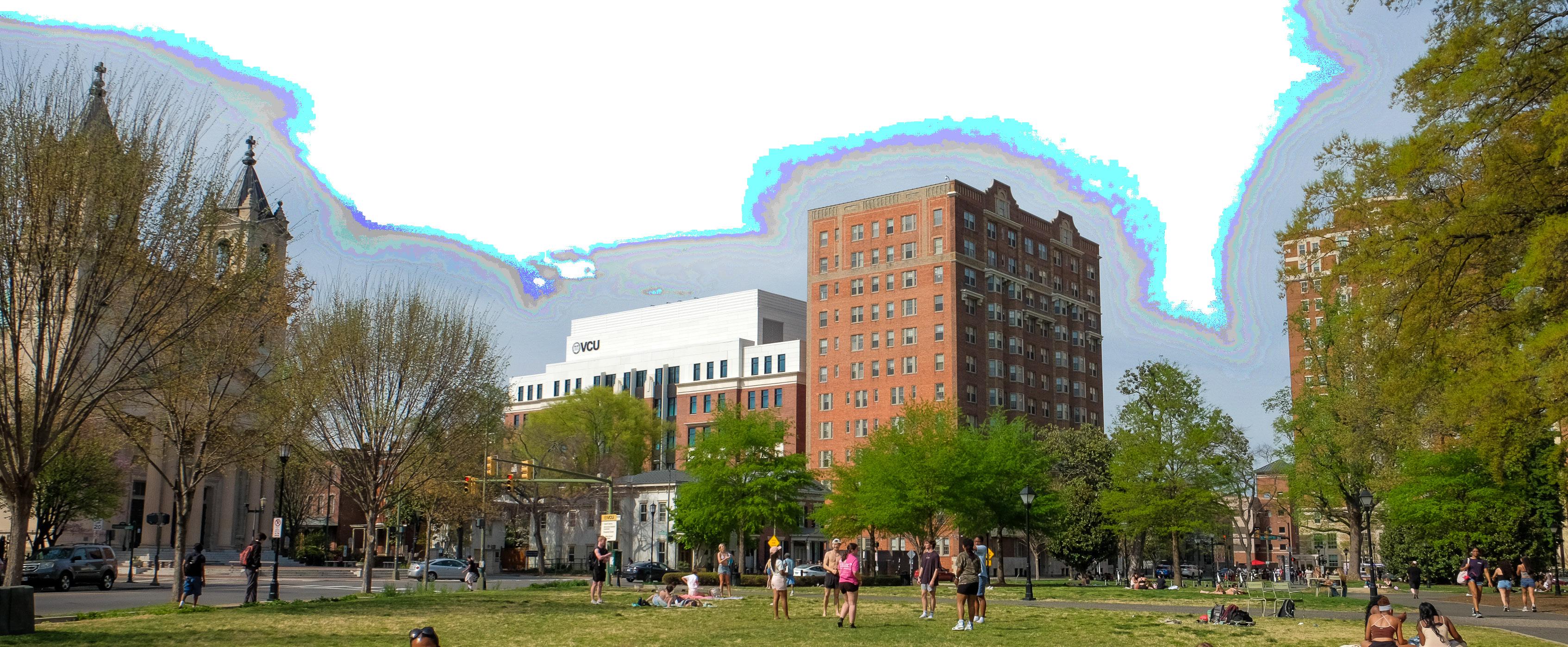
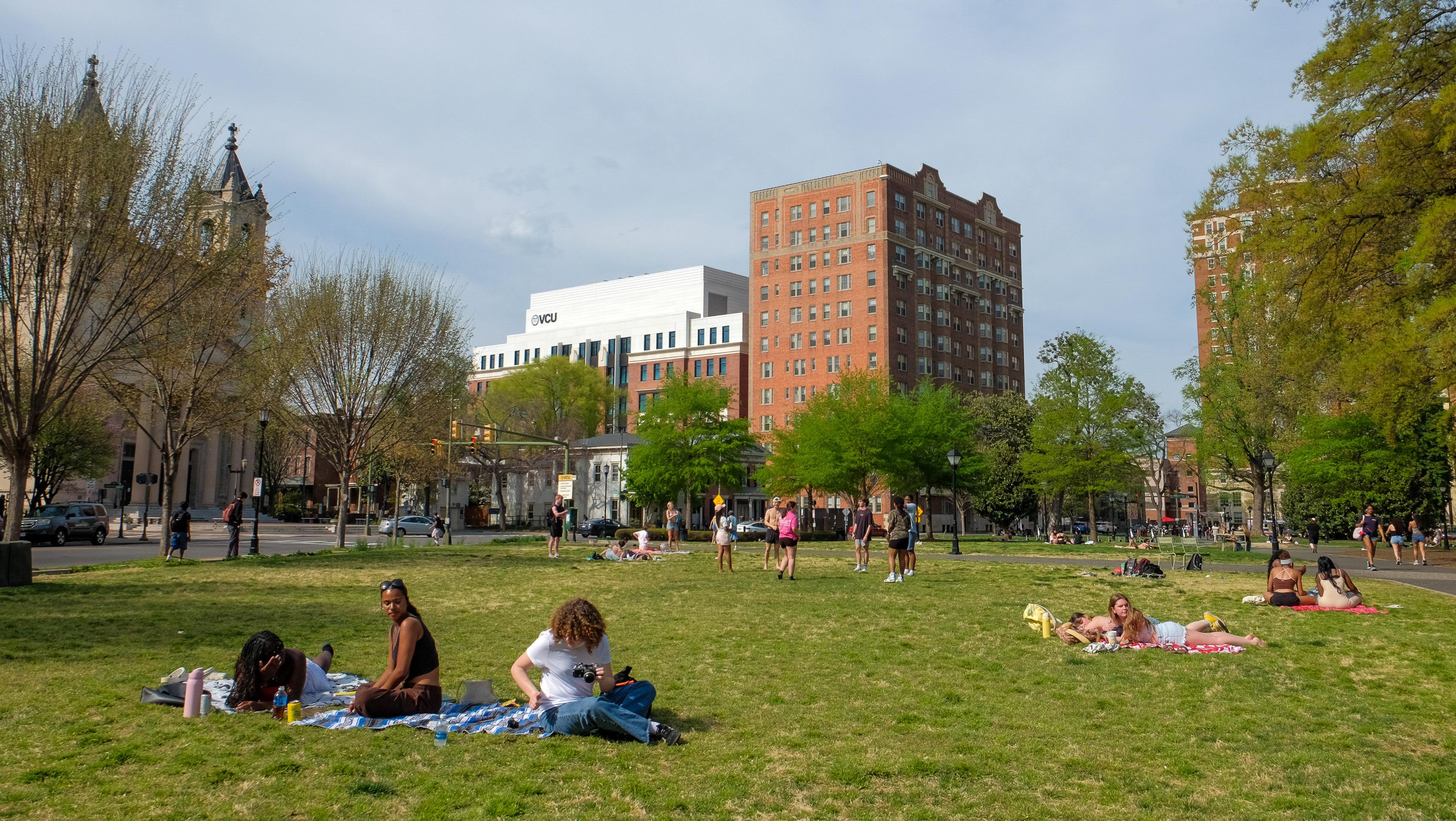
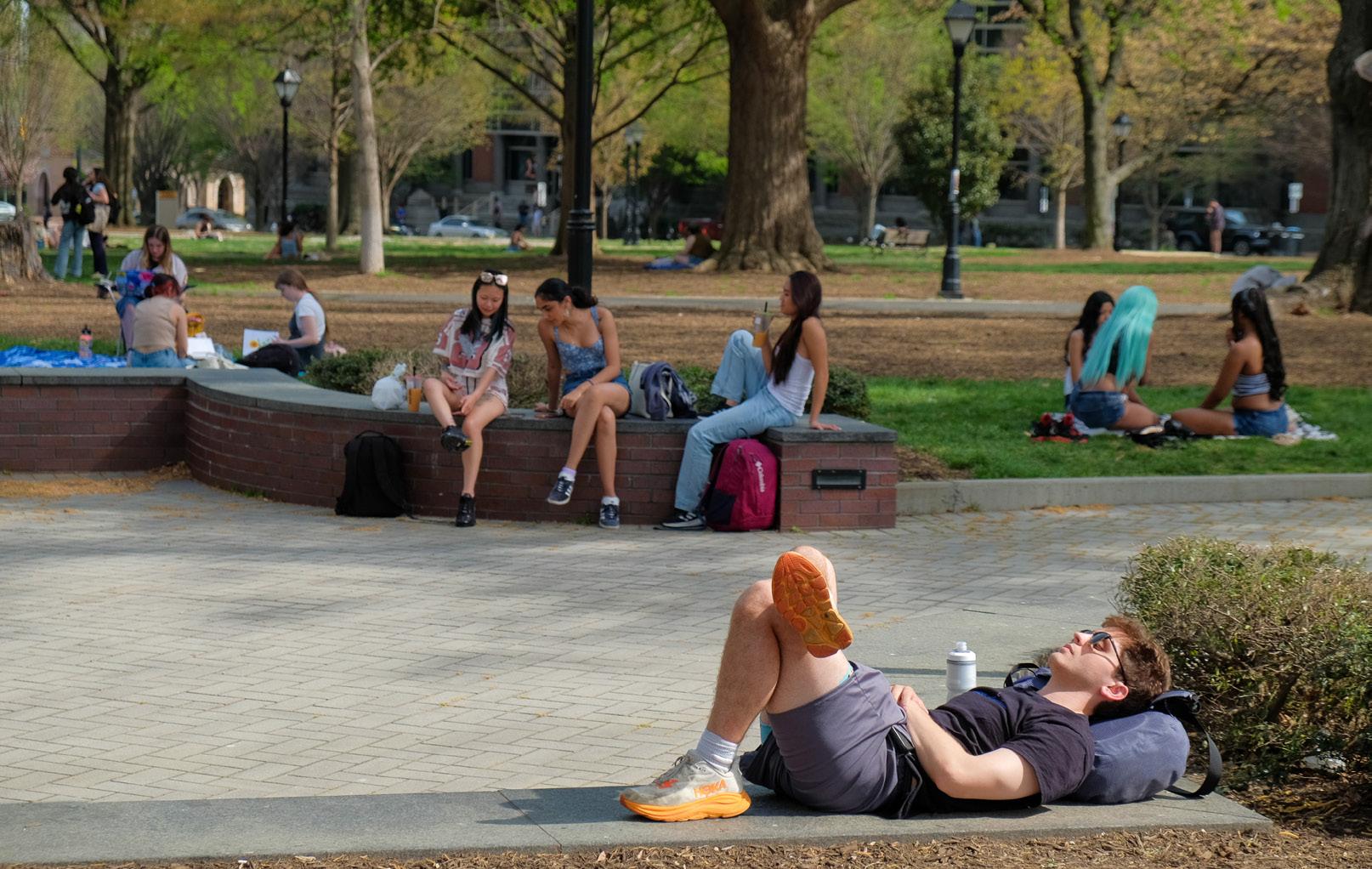
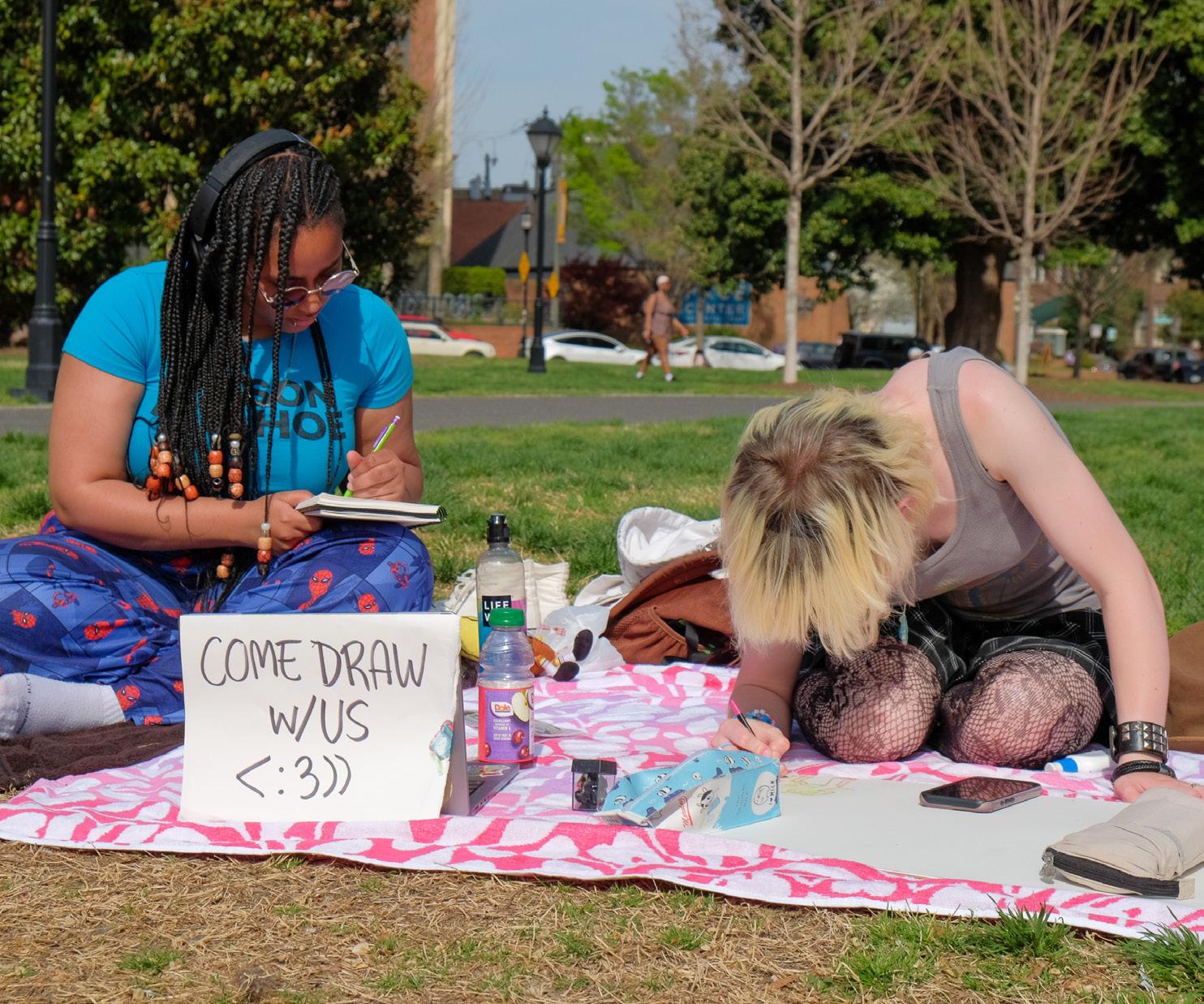
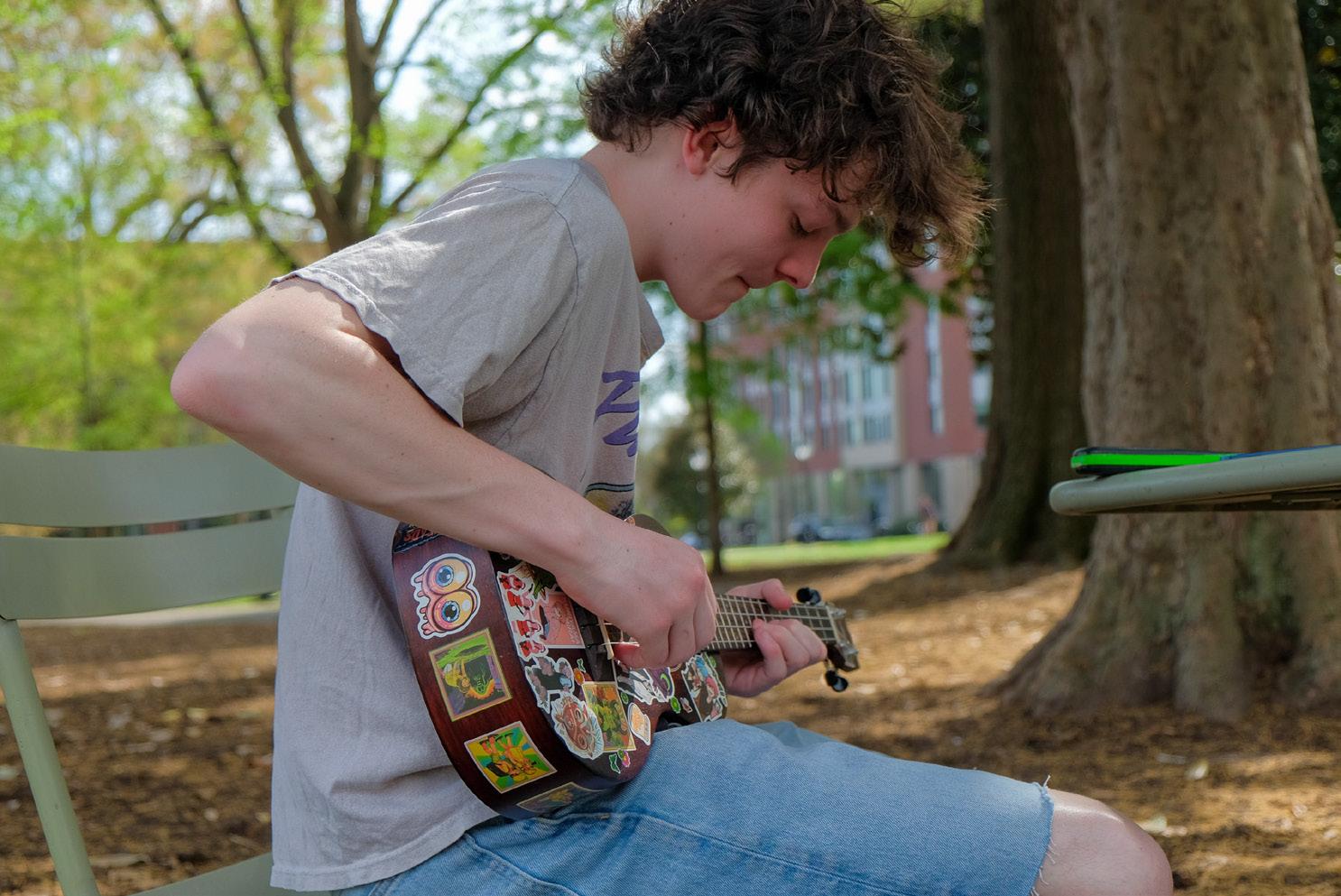

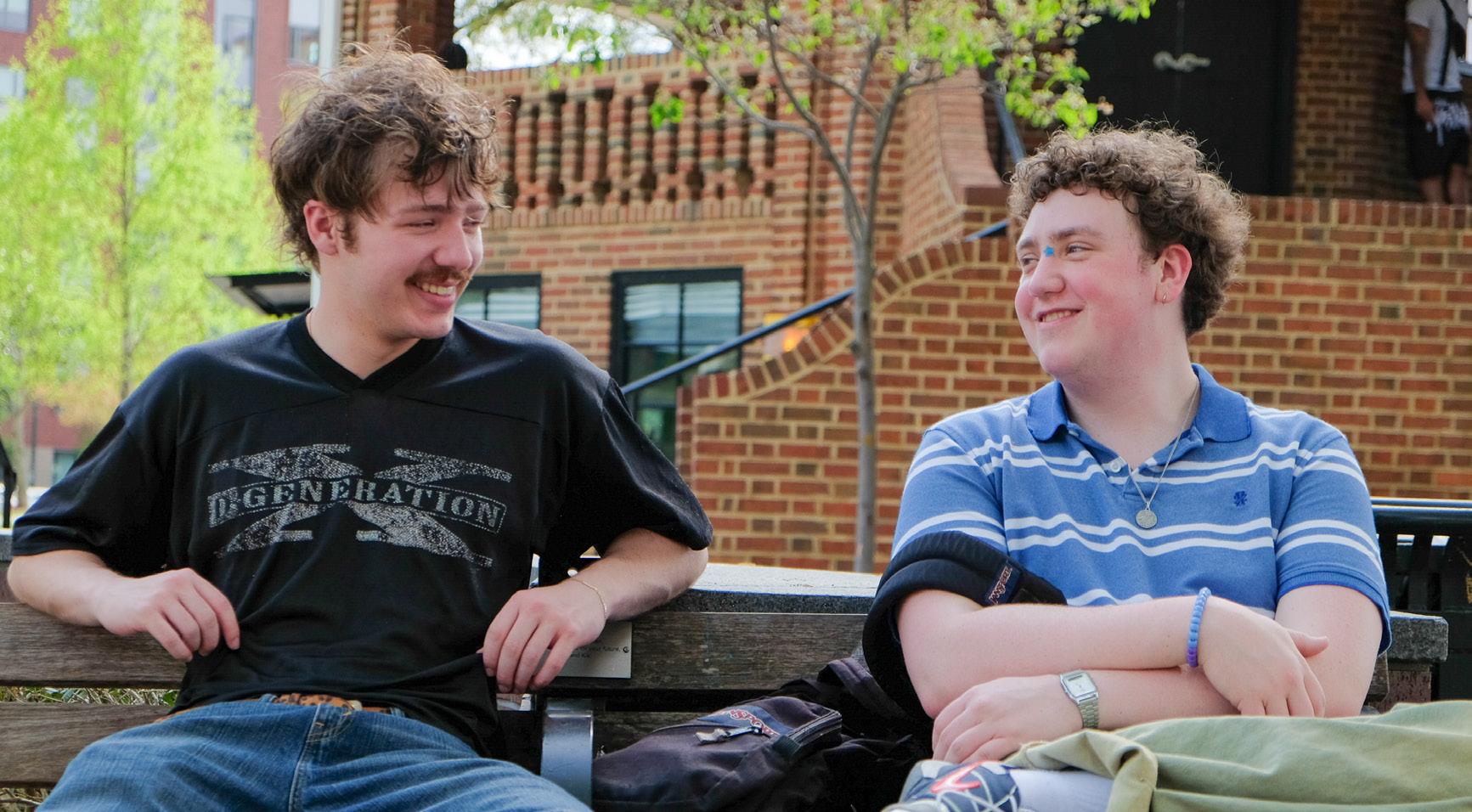
Students gather in Monroe Park, sharing music, art and conversation (and a furry friend) during a sunny afternoon on April 1.
Photos by Burke Loftus. Collage by Zach Montgomery.
Opinions
Quote of the week “You are your best thing.” —

Always be better than your friend’s boyfriend
SHINY CHANDRAVEL
Assistant Opinions Editor
Van Gogh had the French night skyline. Beethoven had a scandalous love affair. Michelangelo had Italian poetry. Yet none can compare to the constancy of my greatest muse, the inspiration of my best work — my friend’s mediocre boyfriend. Everyone’s got one — a friend whose boyfriend can find a new way to unimpress you every day. His interests are lackluster. He’s unable to hold a conversation unless your friend is holding his hand. He’s incapable of putting his plate back in the sink. And his idea of a date is sitting in his car and getting your friend the tacky pre-arranged flowers from the nearest gas station.
But worst of all, as much as you grate your teeth when he’s around, your friend will be three months into the relationship and already planning wedding centerpieces. And as long as they are together, you remain a victim to hearing about it.
Our culture encourages romantic
relationships as the pinnacle of love. For many, pressures from family, community, friends or even social media make college out to be a ticking timer for students to find their future partner. However, expectations often don’t reflect reality.
Only 28% of married graduates attended the same college as their spouse, according to USA Today. Yet because of that pressure to be part of that 28%, people settle.
Before long, you’re left watching your friend believe that their soulmate is the guy they met at a frat party freshman year.
But when I’ve found myself in these situations, the mediocre boyfriend emerges as surprisingly useful — a subtle checklist of the kind of person I want to be.
He doesn’t know your coffee order? I have it memorized.
He doesn’t remember your birthday? I’ve already planned the party.
He leaves your messages on read? We’ll call for hours.
It’s more than just the small gestures.
My friend once mentioned how her

boyfriend changed her tire — soon after, we set time aside to learn how to change one ourselves. Another friend got her boyfriend to parallel park her car, so later we practiced together in a parking lot. And when another wanted help with calculus homework, we watched a sickening number of videos on integrals together.
Each time, the goal remains the same — to build skills in each other so that we can become self-sufficient, not waiting for anyone else to swoop in. It’s easy to accept less from others if you feel like you have to depend on them.
Somewhere within my petty ambition to outdo his parallel parking skills, I realized that the mediocre boyfriend isn’t just a nuisance, but a living reminder of our ability to define what the “bare minimum” amounts to.
One of my closest friends checks and changes my oil regularly. Another close friend helped me get my first credit card. Another friend taught me how to reverse park, code programs and how to set up a brokerage account.
And because of these friends — the ones who have invested effort into me without any need for a romantic title — I have never mistaken average for exceptional. My friends raise my bar every day.
Why beg someone for the bare minimum when you are surrounded by people who exceed it with ease?
We have the ability to redefine what kindness, generosity, intention and love looks like to the people around us. That’s the responsibility we ought to carry for one another. Not to compete with a mediocre boyfriend (let’s be honest — there’s no competition), but to keep showing up in ways that make it impossible for our friends to confuse real effort as a rare occurrence. We might not be able to remedy our friends’ questionable taste in partners, but we can extinguish their need to settle at all.
The goal isn’t to force their partners to do better, but to make anything less than better so unfamiliar that it’s unacceptable.
So outdo your friend’s boyfriend. Because frankly, the bar is in hell.
The American dream is a fallacy — human connection is the answer
KYLIE GRUNSFELD Staff Columnist
In America we are encouraged to work toward a six-figure salary, marriage, a few kids and a nice house in a suburban neighborhood — all protected by a white picket fence to keep our family in and others out.
This country is built to isolate us as we age and we are not taught how to cope with that loneliness. Instead, we are taught how to earn, spend and save money. But it is on the individual to develop a support system, and nothing — not our work or school schedules, nor our cities’ infrastructures — are created with this in mind.
For example — our culture considers a car an extremely aspirational asset. People save up for years to purchase one; some even give their vehicles more attention than their children. But since the invention and popularization of cars, there’s been a decline in walkable cities and, consequentially, an increase in isolation.
If everything we needed was constructed within a reasonable distance — the grocery store, work, school — we could abandon cars and walk to our destinations. This one lifestyle change would open thousands of new doors for fostering connections with those around us. But when profit is the
Toni Morrison, ‘Beloved’
Illustration by Julia Kellum.
Illustration by Sophie Dellinger. Story
ultimate goal, what incentive is there to make this a reality?
By now the traditional idea of the American dream is widely regarded as a fallacy. It tells us that we should want success, power and money, even if it makes us lonely, selfish and dissatisfied.
So what should we aspire to in its place?
The answer is always community.
If growing Americans were taught that human connection is the key to happiness, I guarantee that we, as a country, would look a lot different. Our mindsets would not be so individualistic. Our instincts would no longer be to think of the disadvantages in helping others — the time we might lose, the inconvenience. Instead, helping our neighbors would simply be another way to feel close to the people around us.
Somewhere along the line, maximizing productivity to maximize profit became the typical way to spend a lifetime. Putting hard work into building strong relationships has fallen on the average American’s list of priorities — time itself has become a commodity. Time spent accompanying a friend to a doctor’s appointment is seen, by many, as time wasted.
But part of community building is giving precious minutes to others, even if you may not see an immediate benefit. Even if you
receive nothing tangible in return.
When you consider the world’s happiest countries — Finland, Denmark, Iceland, Sweden, Costa Rica and the Netherlands, for example — a pattern emerges. Their people do not see work and gaining riches as the most important part of life. There is more of an emphasis on slowness, connection to nature and, of course, affordable health care.
Decentering money-related success opens up your life to real, non-material joys. As individuals, we ought to consider whether the path we see for ourselves is aligned with what we actually want or what our culture has conditioned us to want.
Having enough income to live on is crucial, but are we seeking riches for the sake of living comfortably or are we trying to satiate an unending hunger? Is it so we can support ourselves or so we can achieve status and power?
I do not dream of living in a mansion with too many rooms for me to reasonably occupy. I do not dream of fancy vacations or a brand new car or a bag full of Apple products — I dream of people to share my life with.
Unfortunately, living in America forces people to get creative in order to reach these humbler dreams. Third spaces are

Richmond is tracking all of us. We should be more concerned.
REED BALDWIN Contributing Writer
I like feeling safe — we all do. Safety allows us to have fun, relax and enjoy the world around us. Safety fills a void where uncertainty and anxiety would otherwise be present.
I also like privacy. I enjoy those secluded, personal moments with friends, family or on my own — moments where we can be our truest selves without the worry of embarrassment or unwanted attention. Privacy allows us a space to retreat and escape the world’s perception.
So, we all like privacy and safety. But would you sacrifice one for the other? Would you give up your privacy to protect your safety? Would you risk your safety to maintain your privacy?
But most importantly, do you trust your local government to make that decision for you?
If you live in Richmond, or any of the thousands of other cities across the country, then they already have.
Over the past year, the city of Richmond has received significant backlash for its ongoing contract — and its recent renewal of that contract — with Flock Safety.

sparse, jobs are all-consuming and many people are just too tired to be social when the work day is over. But as long as we collectively understand the importance of prioritizing community, I have hope that love will prevail.
The Atlanta-based security company offers several products, including gunshot detectors, automated license plate readers, or ALPRs, security cameras and “first responder” drones.
Flock maintains that data is protected and is only accessible to law enforcement. However, security researchers and antisurveillance activists have found several Flock networks left completely unencrypted.
While access to public security cameras may not seem like a terrible breach of privacy, Flock’s products are much more than simple security cameras. Flock’s ALPRs use an AI program to track and record all vehicle movement while taking note of license plates, car color, bumper stickers and any other distinguishing features.
With the press of a button, our local law enforcement — as well as anyone able to access the Flock network — can see every time your car has passed one of these cameras.
Beyond the risk of public access, surveillance systems like Flock have been repeatedly abused by law enforcement officers.
Just last year, a police chief in Braselton, Georgia was arrested for using Flock cameras to “stalk and harass private
citizens.” Two years earlier, a police chief in Sedgwick, Kansas resigned after using Flock to stalk and follow an ex-girlfriend, tracking her vehicle location over 200 times.
A year before that, another Kansas police lieutenant was charged with using Flock to stalk his estranged wife. In 2025, the Johnson County Sheriff’s Office in Texas searched over 83,000 cameras nationally to find a woman who fled the state after receiving an abortion.
So while there are very real concerns about unauthorized access to Flock’s camera footage, it is clear that “authorized” access should be just as concerning.
There are currently 99 fixed Flock ALPRs in use throughout Richmond, according to the city’s website. RPD also has a small number — currently two, soon to be four — of mobile ALPR devices attached to trailers “intermittently deployed for traffic-related issues and to locations with heightened crime concerns.” A map of these cameras can be found at deflock.org.
Over 100 AI-powered cameras are currently in use within a few miles of you. Does that make you feel safer? For many Richmond residents, the answer is no.
The Block Flock campaign is a local initiative pressuring the city to end its current contract with Flock. Led by the Richmond branch of the Democratic Socialists of America, there have been an increasing number of rallies and protests over the past year.
Aurora Britt, an organizer with the Block Flock campaign, added a lot of clarity on the local concerns about surveillance.
“A lot of the city doesn’t know anything about the cameras, but everyone we’ve spoken to is against them in one way or another,” Britt said. “The City of Richmond decided to fund and massively expand surveillance throughout the city. It is unsecure and makes us all less safe.”
There are always outliers, but the general consensus is this — the people of Richmond are against mass surveillance. This isn’t paranoia or an admission of guilt. This isn’t even valuing privacy over safety. This is a community response to government overreach.
Last summer, the Bureau of Alcohol, Tobacco, Firearms and Explosives (ATF) accessed Richmond’s Flock cameras to assist with immigration enforcement. This led to
the termination of the bureau’s access to the network, but provided a clear example of the potential dangers of Flock.
In January, the Virginia State Crime Commission released a report after sending ALPR surveys to agencies across the state. The report stated that “based on the responses to the Crime Commission’s 2025 Law Enforcement ALPR Use Survey, some Virginia law enforcement agencies are not using ALPR in accordance with the new statute.”
The statute referenced is a new set of standards put out by the General Assembly in July. They allow ALPR footage to be saved for just 21 days and prohibit sharing data with out-of-state or federal agencies.
The fact that law enforcement is treating these standards as suggestions should be concerning for all of us.
For Britt and other local residents, the issue lies not only in surveillance, but consent. Richmond residents were not asked about these security measures. They were not consulted when over $1 million was reportedly spent on these systems.
This is another instance of Richmond being reactive instead of proactive on issues such as crime, food insecurity and a growing housing crisis. Residents are not just asking for an end to mass surveillance, they are asking for those resources to be redirected to proactive solutions.
For many of us in the VCU community, Richmond is just that: VCU. There are beautiful views, great restaurants, live shows and anything else you could possibly be looking for, all within walking distance from campus. It’s easy to get stuck in the bubble. The concerns of the rest of the city can feel like another world.
Wherever you fall in the debate on safety versus privacy, we can all agree that communities should have the right to decide for themselves how to balance the two. If that sentiment resonates, let it usher your first step out of the bubble. Getting connected with the Block Flock campaign is not just voicing your opinion — it’s standing with your neighbors.
We have the right to feel safe in our communities. We have the right to privacy in our communities. Flock cameras have proven to be a threat to both. Flock out of Richmond now.
Illustration by Zoë Luis.
Illustration by Sophie Dellinger.
Last week a letter from Ericka Kopp incorrectly referred to her as an independent candidate for congress. Kopp is actually a Democratic candidate. The digital version of the story has been updated with the correct information.


MAKE SOME NOISE
By Zhouqin Burnikel
Los Angeles Times Crossword Puzzle
MAKE SOME NOISE
By Zhouqin Burnikel
Edited by Patti Varol
Los Angeles Times Sunday Crossword Puzzle
Edited by Patti Varol
Edited by Patti Varol
VOTE YES BY APRIL 21 ST IN THE SPECIAL ELECTION

Should the Constitution of Virginia be amended to allow the General Assembly to temporarily adopt new congressional districts to restore fairness in the upcoming elections, while ensuring Virginia’s standard redistricting process resumes for all future redistricting af ter the 2030 census?