On a tennis court in Richmond, athletes gather with heavy bags of gear to clash with their blades. Donning great masks and thick gloves, fencers tap their swords before engaging with one another in quick combat. In an instant, one fighter strikes another, and they ready themselves to go at it again.
It looks like something out of a historical or fantasy film, but for Zach Showalter, it is the result of nearly a decade of disciplined training.
SWORDFIGHTER Continued on page 11
New initiatives, growing funds point to changing campus identity
HECIEL
NIEVES BONILLA News Editor
ANDREW KERLEY Executive Editor
VCU is aiming to “not just be a national, but an international hub for research and innovation,” according to P. Srirama Rao, the university’s vice president for research and innovation.
In his annual State of the Research address, Rao outlined a lofty goal for the university — to reach $1 billion in sponsored research funding. The announcement comes amid an academic year packed with new grants for interdisciplinary studies, new and reworked minors and , and consolidated programs.
As VCU has put more money into research and shifted its branding accordingly, some students and faculty have pointed to the campus possibly shifting away from its identity as a hub for the arts and humanities.
VCU is ranked No. 46 nationally in research spending among public research universities by the National Science Foundation — yet it is ranked No. 72 in public schools overall by U.S. News & World Report.
VCU’s research spending, and status as an R1, “very high research activity” university, is exceptionally high for a school of its prestige.
RESEARCH Continued on page 4
Furries shook their tails and waved their paws at second Fur Fair
CORA PERKINS
Assistant Spectrum Editor
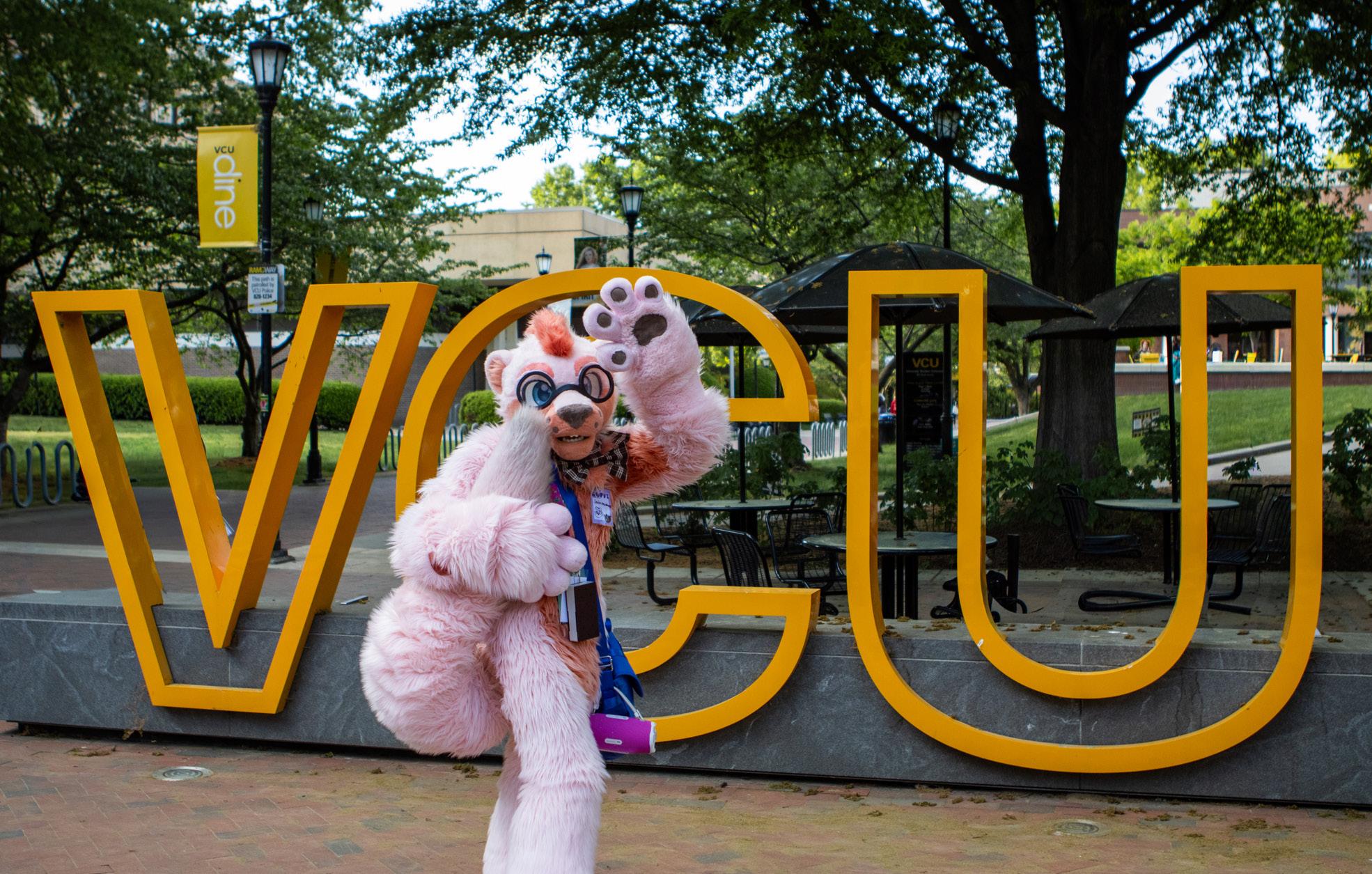
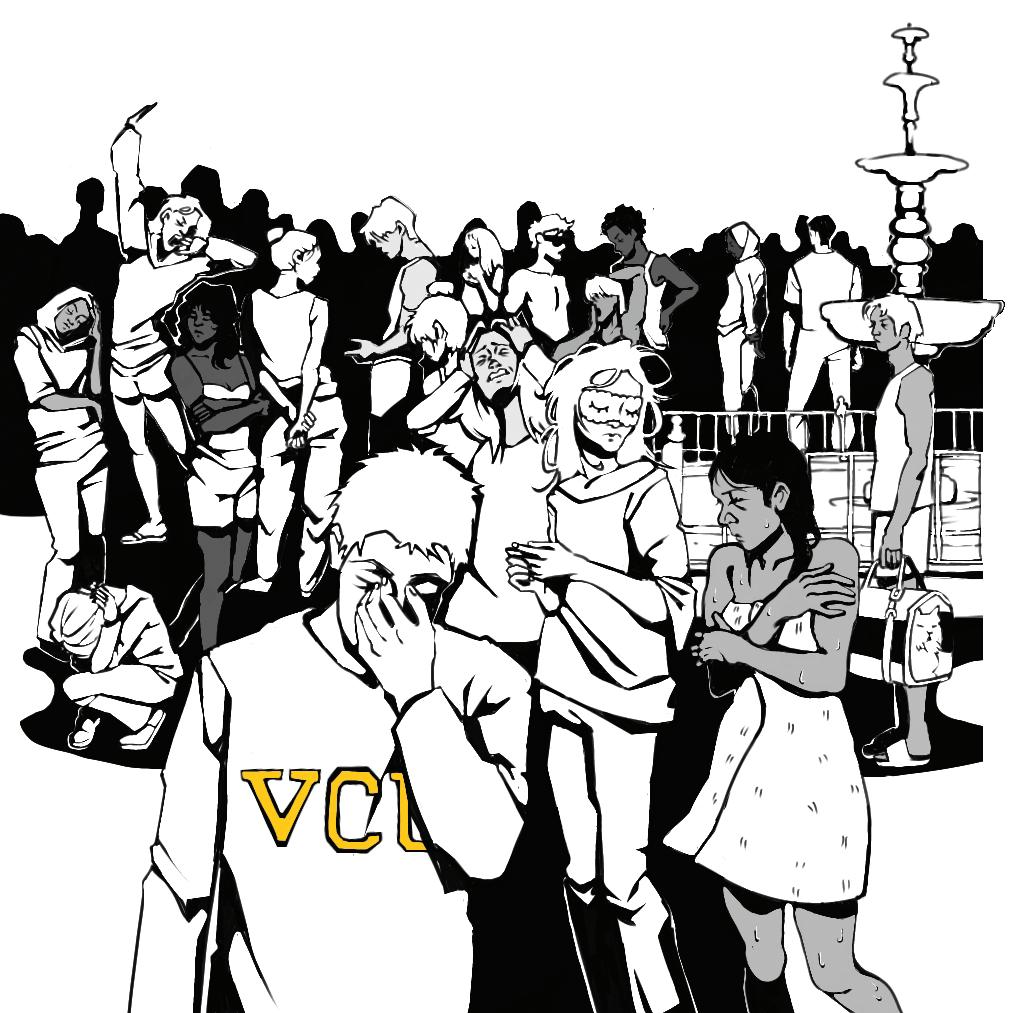
Velociraptors, multicolored cats and new blends of creatures roamed the halls of VCU’s Commons last Saturday at the Anthro Society’s annual Richmond Fur Fair, or RUFF. The event offered panels, a photobooth, an artist alley and a place for
Fur Fair attendees herding
furries, new and old, to meet and connect.
Planning for RUFF started long before the announcement of the event, according to Dev Partangal, President of the Anthro Society. From figuring out the logistics throughout the last year and a half, to cutting out over 900 badges for the fair while watching My Little Pony, the society had been working hard to make it the best fest yet.
“Most of the planning, like a lot of the bulk of it, took place starting in December, but it took a lot,” Partangal said. “It was a lot of working with The Commons, we had to work with them really, really closely to manage security because that was probably our biggest concern.”
FURRIES Continued on page 8
Richmond
together in Ram Horns Plaza. Photo by Cameron Powell.
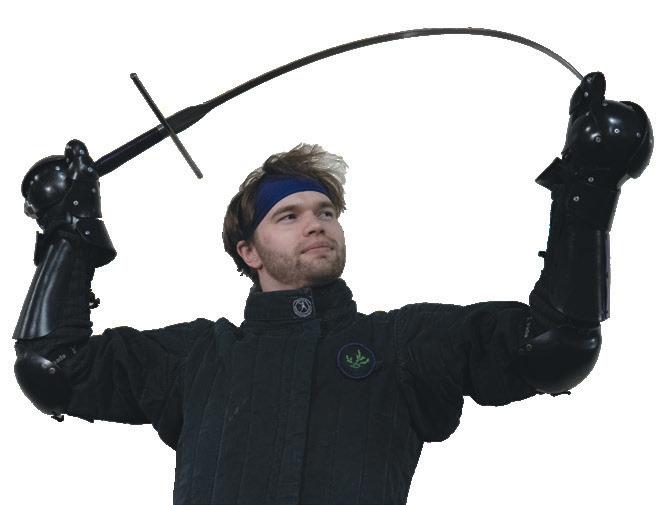
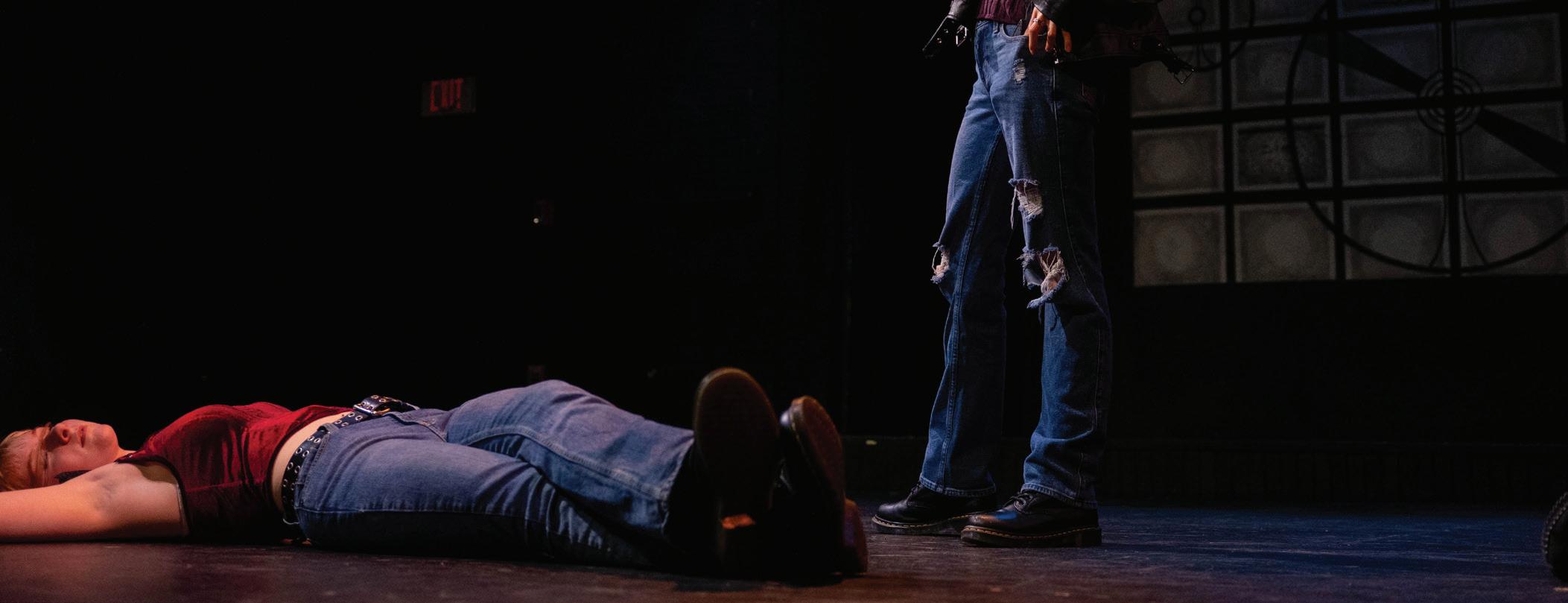
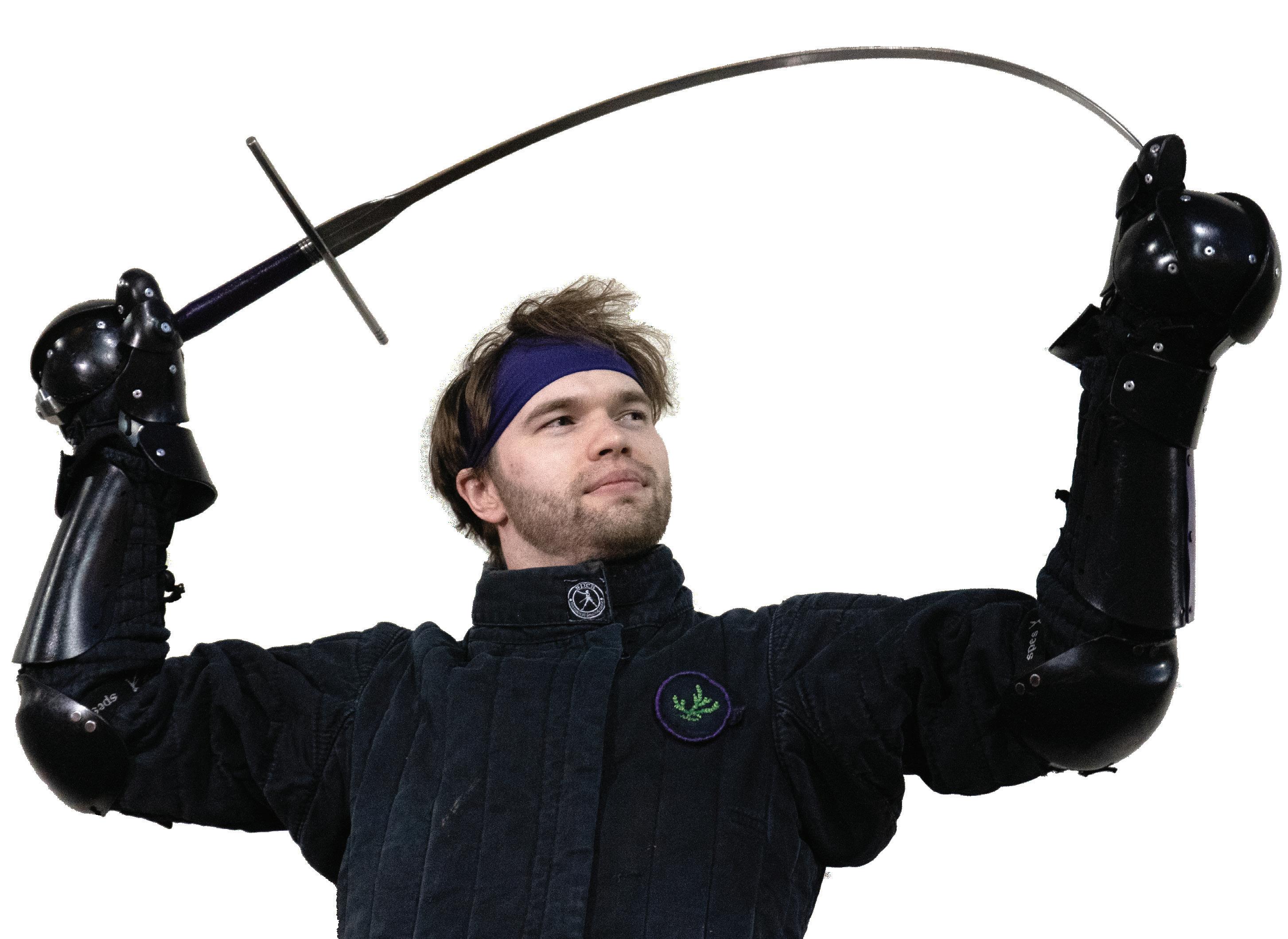
Top 10 longsword fighter Zachary Showalter. Photo by Landon G Walker.
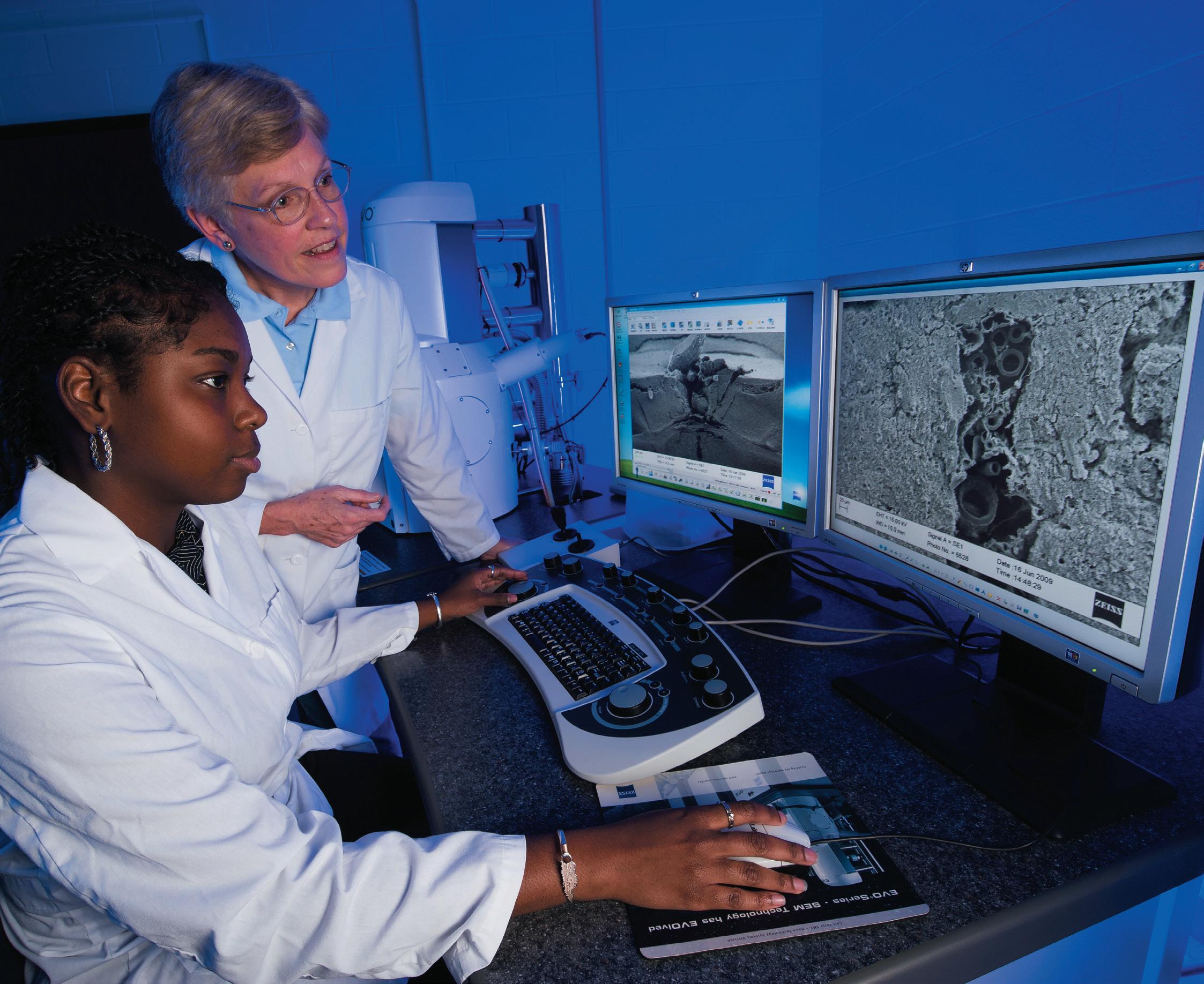
Researchers gather by a computer in a neuroscience lab at VCU. Photo courtesy of VCU News.
VOTE YES BY APRIL 21 ST IN THE SPECIAL ELECTION
Should the Constitution of Virginia be amended to allow the General Assembly to temporarily adopt new congressional districts to restore fairness in the upcoming elections, while ensuring Virginia’s standard redistricting process resumes for all future redistricting af ter the 2030 census?
Stories of the week
national: Virginia Gov. Abigail Spanberger signed the national popular vote bill into law. If states representing a majority of electoral votes pass the legislation, the president would be decided by popular vote.
international: The United States and Iran have one week left on the two-week ceasefire deal. Parties have yet to come to a deal to end war, but expressed beliefs a deal is still possible.
Former General Motors CEO will be VCU commencement speaker
ANDREW KERLEY Executive Editor
Rick Wagoner, the former CEO and chairman of General Motors, will be the keynote speaker at VCU’s Spring 2026 Commencement ceremony.
Spring commencement is one of VCU’s largest events of the year. The Spring 2026 ceremony will celebrate thousands of graduates at the Greater Richmond Convention Center on May 9.
Past keynote speakers include Kickstarter CEO Everette Taylor, former VCU basketball star and NFL player Mo AlieCox and former Gov. Glenn Youngkin. Around 100 students walked out of Youngkin’s 2024 keynote speech in protest, according to a previous report by The CT.
Wagoner was raised in the Richmond area and graduated from J.R. Tucker High School. He spent 32 years at automotive manufacturing giant General Motors, and was the youngest CEO in company history, according to VCU.
Wagoner resigned from General Motors in 2009 at the request of the Obama administration, according to Politico. It was during the automotive industry crisis
VCU alum lives on with lunar crater named in her honor
MOLLY MANNING Managing Editor
Before the Artemis II crew splashed down off the California coast Friday, they took the time to honor the life and legacy of NASA Commander Reid Wiseman’s wife, Carroll — a nurse, mother and VCU alum who died of cancer in 2020.
The group aboard Artemis II was the first to visit the moon since Apollo 17 in 1972. NASA astronauts Reid Wiseman, Victor Glover and Christina Koch, with Jeremy Hansen of the Canadian Space Agency orbited the moon last week in order to “verify modern human capabilities in deep space and pave the way for long-term exploration and science on the lunar surface,” according to the Kennedy Space Center.
The group was the first to see the far side of the moon, and broke the record for the farthest distance from Earth traveled by humans, according to NPR. They spotted several craters that remained unnamed.
The first proposed crater name was Integrity, the name of the spacecraft — the second was Caroll, for Commander Wiseman’s late wife.
A new, bright spot on the moon’s boundary between near and far sides will forever be known as “Carroll” after Hansen requested the naming ahead of the Apollo 8’s Monday fly-around, according to the Associated Press.
“A number of years ago, we started this journey in our close-knit astronaut family, and we lost a loved one … her name was
the
from
The crew will officially submit a request of the two proposed names to the International Astronomical Union later this week; a representative promised a decision in about a month.
Carroll was 46 when she passed after battling cancer for five years. After graduating from James Madison University and VCU, the Virginia Beach native worked as a pediatric nurse practitioner and a school nurse in Maryland and Texas.
Carroll’s crater is visible from Earth during certain lunar transits.
and the Great Recession.
General Motors lost billions of dollars under Wagoner. His resignation was a condition for the company to receive massive bailouts from the government. He left the company with over $10 million in benefits.
Since stepping down, Wagoner has become the leader of investment management company Invesco. He has held roles at a number of investment, auto and tech companies.
Wagoner served on the VCU Board of Visitors from 2013-2020. He and his wife have been major drivers for donations at the university — helping to raise over $2 billion between the Make It Real and Unlocking Potential campaigns.
The Wagoners have supported schools and programs across VCU’s Monroe Park and MCV campuses, including creating the Wagoner Family Endowed Scholarship in the School of Business.
VCU’s university-wide commencement will be held at 10 a.m. on May 9 at the Greater Richmond Convention Center. The event will be livestreamed at www.vcu.edu.
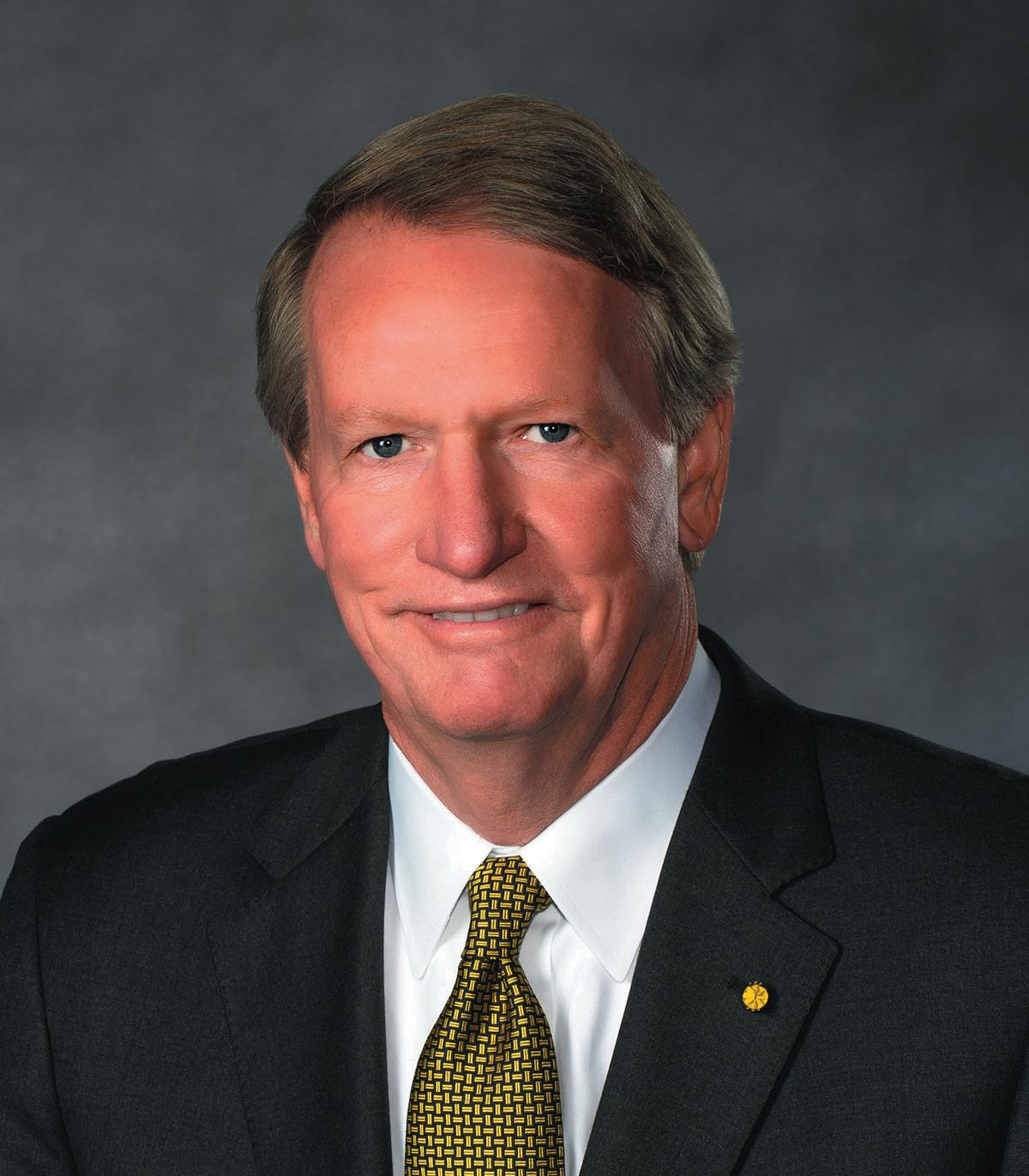
Rick Wagoner. Photo courtesy of VCU News.
Carroll,
spouse of Reid, the mother of Katie and Ellie,” Hansen said in a NASA video
inside the spacecraft.
Screenshots via Google Moon. Photo collage by Quinn Lysek.
Continued from front page
VCU has a guaranteed admission policy for students with a high school GPA of 3.5 or above, per a previous report by The CT. The school is inching toward hitting 30,000 total students.
For comparison, James Madison University has 21,112 students and is an R2 university, or a “high research activity” university; The University of Virginia — considered by many to be the commonwealth’s most prestigious place of learning — has 26,685 students and is an R1 university.
Rao pointed out that VCU’s research enterprise has continued to grow, including a 10% increase in federal funding in 2025, despite broader federal research funding cuts.
The university previously ended Diversity, Equity and Inclusion programs and changed gender-affirming care policies in its hospitals to avoid funding cuts by the Trump administration, according to previous reports by The CT.
VCU’s Office of the Provost announced in March a request for proposals for “convergence grants,” — through which faculty can pitch their ideas for cooperation with other departments on research for up to $10,000 of funding.
The provost’s office will accept proposals until April 30.
The research funding must lie within five themes where departments could collaborate — AI, mental health, health outcomes, sustainability and neuroscience.
The themes are meant to “unite traditionally siloed academic disciplines,” according to Tim Luckritz Marquis, the assistant director of the grants. He stated he has seen “great enthusiasm” from faculty for the program, which is run through the existing VCU Convergence umbrella.
Cognitive neuroscience is already built upon cross-departmental work according to neurosurgery department chair David Limbrick, who believes the convergence collaboration can help nurture a world-class neuroscience program at VCU.
“Believe it or not, there are hundreds of VCU faculty with interests and expertise spanning the many fields and subfields within neuroscience, from developmental neurobiology to cognitive neuroscience to brain injury, and anywhere in between,” Limbrick stated.
Limbrick noted the “commitment to collaboration” in the design of the convergence grants is evident in its requirement that proposals feature “at least 3 VCU faculty from at least two different schools or colleges, with preference given to applications that involve >1 [more than one] VCU campus.”
The convergence grant program builds off of VCU’s emphasis on interdisciplinary collaboration — such as the Center for Human Simulation and Patient Safety,through which standardized patients use their theatre backgrounds to help medical students practice their clinical and communication skills.
VCU President Michael Rao emphasized the same things in his state of the university speech, in which he touted VCU and VCU Health’s combined $18.5 billion economic impact on Virginia.
VCU ADAPTS TO THE AI AGE
On Feb. 20, VCU Convergence ran an “AI Accelerator Workshop” in the Commons that brought panelists to discuss the confluence of the new set of technologies with business, data, education and health care.
For Limbrick, the conversation is not new — he pointed out that neuroscience was an early adopter of AI technologies, and that his department routinely uses “AIbased technology” to, for example, assist with MRI sequencing and robotics for a precise neurosurgical treatment.
His own lab is currently using AI to research “otherwise undetectable patterns,” employing it in genomics, imaging and other fields to develop distinct categories and treatments for Chiari malformation, a rare disease in which brain tissue extends into the spinal canal.
AI is also a focal point in VCU’s push to encourage interdisciplinary work among students. The university introduced a minor in ‘Practical AI’ in fall 2024 which includes classes in mass communications, mathematics, anthropology, philosophy and computer science.
That minor was joined by an ‘AI studies in humanities and sciences’ minor in 2025, which also includes AIfocused classes taught by professors of several disciplines.
Interdisciplinary Studies associate director Mariah Crilley told VCU News upon the launching of the Practical AI minor and its twin program in immersive reality studies that “every student, regardless of technological skill, has a right and responsibility to learn about AI.”
UNREST AMONG DEPARTMENTS
As VCU has bolstered its economic and academic presence further and further, numerous departments in the arts and humanities have complained about their fields getting snubbed.
During a February lecture at the Institute for Contemporary Art, sculpture and extended media professor Lily Cox-Richard led a discussion decrying faculty firings, layoffs and policy changes, according to a previous report by The CT.
It came after VCU’s decision not to renew the contract of the school’s only fulltime woodworking professor in the fine arts program — sounding alarms across VCUarts about more niche fields disappearing.
VCU’s academic repositioning has seen a number of departments be combined or reworked to fit new academic and monetary goals.
Underlining the campus-wide changes — the VCU United Campus Workers chapter has been campaigning against increased administrative control and what they see as a breakdown in shared governance between students, faculty and staff.
Their complaints include low pay for graduate students and dwindling faculty in departments like Focused Inquiry.
The union spent the Spring 2026 semester campaigning at the General Assembly for their collective bargaining rights before being snubbed from legislation.
A number of bills impacting VCU — from employee bargaining rights to board of visitors reforms — have moved through the legislature and been subsequently amended by Gov. Abigail Spanberger. Whether they pass, and in what state they do, remains to be seen.
Richmond’s elections office is voicing concerns over government support for its running of recent and upcoming Virginia elections.
The electoral office has been making strenuous efforts to overcome challenges including the last two special elections and three upcoming elections left for the year.
David Levine, director of Elections and General Register for the City of Richmond, said at a March City Council meeting budget constraints have been an emerging issue during the last two special elections.
The Richmond election office’s struggles with budgeting include the wake of the 2024 presidential primary. Levine stated that only roughly 40% of what the state had reimbursed for that election had kicked in — while 57% expenses were at the local level.
“My focus is on keeping the process consistent, reliable, secure and accessible, so that outcomes reflect the will of the voters and all voters can feel confident in
how elections are run locally,” Levine said.
As of the last special election, Levine noted that a projected total of over $250,000 was left unbudgeted for, highlighting the unforeseen financial burden of elections.
The majority of funding for the electoral office comes from the local government, as the exact budget can vary.
Levine stated that the percentage for early voter turnout was currently 2.6% in Richmond — lower than the rates in the surrounding counties.
With the upcoming special election in April, the registrar’s office has been seeing a high voter turnout — that has been expected to be pricey. The state offered a $5 million allocation for the special election to be distributed among all localities, but Levine cast doubt on that being enough support.
“We have this April special election where again we’re seeing pretty high turnout, but we expect significant costs and that of course was not budgeted for elections,” Levine said. “But if we use the presidential primaries of the past as any
indication, we know that the likelihood of that going to cover a lot of those expenses is questionable at best.”
The June primary elections in Virginia have now been further pushed than usual to August, according to a previous report by The CT.
Elections officers work to ensure the accuracy and transparency of elections processes. Richmond Election Office spokesperson Nicole Hicks noted that elections follow a ‘structured’ process guided by state law, which includes equipment testing, officer training and established procedures.
“While recent elections have presented a high level of activity, our office plans extensively to manage these demands, including staffing, training and coordination with partners to ensure elections are conducted smoothly and securely,” Hicks said.
Despite the high voter strain on the local processes, Hicks encouraged students to participate.
“We encourage students to make a plan
to vote early, verify their registration details and take advantage of available resources to understand their voting options,” Hicks said.
To further support themselves with the density of recent elections, the electoral office emphasized having a close collaboration between staff, the Electoral Board and both the state and local partners — along with additional support if required for certain departments, such as staffing, training, voter outreach and overall coordination.
Richard Meagher, a political science professor at Randolph-Macon University and host of the “RVA’s Got Issues” podcast, tied the election office’s recent concerns to the large sums of out-of-state money coming into this race in particular.
“The amount of money, especially from interests and individuals outside the commonwealth, is intensifying voter interest in the current referendum — that’s a good problem to have in a democracy — we like participation,” Meagher said. “But more voters means more ballots and, therefore, more staff time to process.”
A photo of Richmond's Office of Elections building, located on West Laburnum Avenue. Photo by Burke Loftus.
RVA communities raise cancer risk concerns as Trump softens regulations
SAL ORLANDO Assistant News Editor
The Trump administration recently reshaped federal standards on carcinogenic pollutants, adding greater risk to the Richmond area — which is designated by Propublica as a hotspot for elevated cancer risks from ethylene oxide.
Richmond has two medical sterilization facilities that use ethylene oxide within six miles of each other, making the city vulnerable to higher cancer risks, according to VPM. Sterilization Services of Virginia, in Eastern Henrico County, was identified as a major contributor to elevated cancer risks in the area by the Union of Concerned Scientists.
The facility is less than 10 miles away from Central Virginia Health Network/ Bon Secours Mercy Health, another sterilization facility.
Ethylene oxide is a colorless gas used to sterilize medical equipment and is carcinogenic to humans, according to the EPA. Humans who are exposed to EtO have increased risks of lymphoma and leukemia.
Virginia Interfaith Power & Light is a nonprofit organization with the mission of bringing together communities of faith to advance climate and environmental justice, according to their website. WIPL communications manager Connor Eppley said the locations “form a Venn diagram” over VCU.
“It’s not just out in Eastern Henrico, though they’re getting the brunt of it, but this is also exposing VCU students,” Eppley said.
Eppley explained that the previous rule was a response to an EPA study that identified EtO as 60 times more carcinogenic than previously thought in a recent study.
“They moved to put rules in place to use existing technology that would limit emissions from these medical sterilization facilities and other facilities that use EtO,” Eppley said.
The Biden administration strengthened the regulations on federal standards for EtO pollution from sterilization facilities in 2024. The restrictions reduced EtO emissions by over 90% and reduced cancer risk by 92%, according to the Southern Environmental Law Center.
The Trump administration gave certain
facilities emitting EtO — including
period beyond the original deadlines, according to the president’s proclamation.
Eppley said that the VIPL wants to ensure that facilities emitting EtO are required to use existing technology that limits the chemical’s exposure and emissions.
“The Trump administration had given facilities around the country waivers of the EPA for up to two years, and that’s when we [the VIPL] got brought on, and we started getting involved with it,” Eppley said. “Our ask right now is for these facilities to use the already existing technology that limits EtO exposure and emissions, because it’s already out there.”
president acted outside of the authority that was granted to him.”
Land said that based on records, technology to comply with the 2024 rule is accessible to EtO emitting facilities, and there has been no evidence showing difficulty installing them.
“That was the premise of the presidential exemptions, that vendors aren’t available or that it’ll cause shutdowns of these facilities — but we just haven’t seen evidence or proof or facts that substantiate those claims,” Land said.
Sterilization Services of Virginia is in the Varina District of Henrico, which is a predominantly Black and Hispanic area, according to the VCU Urban and regional studies and planning associate professor Damian Pitt related the situation to the dual concepts of environmental injustice and environmental
“Environmental injustice is the phenomenon that higher levels of pollution exposure correlate with lower levels of various socioeconomic characteristics like income, education, home ownership and things of that nature,” Damian Pitt said. “Environmental racism is tying it specifically to race, saying that higher levels of exclusion, pollution exposure correlate with higher Black and Brown populations.”
Pitt said that he thinks the Trump administration is trying to reduce the regulatory burden on industries to promote economic development, while Biden was trying to adopt strict standards to prioritize public health and environmental protection.
Pitt believes the city of Richmond can use its zoning authorities to restrict where certain EtO facilities are located. He added that the Virginia Department of Environmental Quality, which issues permits for sterilization facilities, can decide how stringent their approach in issuance will be.
Demetria Dixon, a Varina resident said when the couple first moved to Varina, Ted episodes with his asthma and breathing from ethylene oxide, but when he left for work he would be fine.
“This ethylene oxide is really scary with the surgical apparatuses because for one, I have a defibrillator that’s in my body and I know that it’s been sterilized with that, ethylene oxide. I’m super concerned now,” Demetria said.
Demetria and Ted Dixon bought a house in Varina to be their “end of life home.” Ted said that with everything going on in the world, he does not feel there is anywhere to “pack up and move to.”
“I don’t think many people can afford to buy another piece of property right now, another house.
We’re not gonna be homeless because of this,” Ted said.
Eppley said several facilities are already using technology to limit EtO exposure, and the EPA has not provided a reason why facilities cannot use the technology.
VIPL partnered with the SELC to file a federal lawsuit against the EPA, fighting the Trump administration’s use of presidential exemptions.
“We brought a lawsuit, basically saying that the presidential exemptions from the 2024 rule were done outside of the statutory authority granted to the president to exempt facilities under the Clean Air Act,” said SELC Associate Attorney Marissa Land. “This is an ultra vires claim that the
BRYER HAYWOOD Staff Writer
Virginians will vote this November on amending the state constitution to protect same-sex marriage rights against any future, federal-level threats — and polling indicates they will likely vote “yes.”
Gov. Abigail Spanberger signed a bill in February to put the question of same-sex marriage on the November ballot — one of four referendums Virginians will vote on this year.
Same-sex marriage is protected on the national level by the United States Supreme Court’s landmark decision over the 2015 Obergefell v. Hodges case.
If the Supreme Court were to ever overturn their decision, Virginia would revert to a 2006 ban on same-sex marriage written into its constitution, according to
a previous report by The CT. The court declined to revisit their past ruling earlier this year.
The ballot question Virginians will vote on this November asks to remove that ban and replace it with codified legalization for same-sex marriage. Under the proposal, the right to marry would be fundamental regardless of couples’ sex, gender or race.
Over 57% of Virginians voted in 2006 to ban same-sex marriage, but support for LGBTQ+ people has dramatically grown in the last two decades.
According to recent research by the Public Religion Research Institute, 68% of Virginians support the idea of same-sex marriage, and 75% support nondiscrimination protections — which would be more than enough votes to finally ratify the amendments.
Pitt said Democratic administrations typically support efforts to lower the amount of allowed air pollution, while Republican administrations tend to increase the amount of allowed air pollution.
“What the Trump administration is not doing now in terms of increasing the amount of allowed air pollution is not unexpected given the past trends that I mentioned,” Pitt said. “But the degree to which they are doing so, and the kind of aggressive rate at which they are trying to change these regulations to allow more air pollution, is a bit beyond what we’ve seen in past Republican administrations.”
Varina resident Ben Yakubov said he’s always known Varina as “a place where issues like this are not always handled with the best care.” Another Varina resident, Savannah Davis, said she was not previously aware she lived in an increased cancer risk area and was disappointed, but unsurprised.
Virginia on track for codified same-sex marriage
The research also says 14% of residents in Virginia identify as LGBTQ+, the highest proportion of any state in the South, where many states still have same-sex marriage bans written into their laws.
“Historically, queer people have been marginalized legislatively in numerous ways,” said gender, sexuality and women’s studies associate professor Eli Coston.
Coston mentioned how police officers used to raid gay bars and force people out of them, and said that there has been a lack of legal protections for LGBTQ+ recently.
“I think the referendum makes a lot of sense, we have a constitutional amendment on the books that bans same-sex marriage even though same-sex marriage is legal at the federal level,” Coston said.
Following the Dobbs v. Jackson decision by SCOTUS in 2022, which overturned
the right to abortion access, state legislatures have grappled with protecting civil rights in the face of federal protections being stripped away.
Advocacy groups in Virginia have led the charge in protecting reproductive health care access in the last bastion of the South, per a previous report from the CT. Virginians will vote on three ballot questions in November. The other two would protect abortion rights and restore voting rights to formerly incarcerated people.
Some Republican states are preparing to redraw their district lines on the chance the Supreme Court repeals section two of the 1965 Voting Rights Act, which prohibits voting practices or procedures that discriminate on the basis of race, color or membership.
“I wasn’t aware [of EtO emissions in Varina] nor aware of this facility [Sterilization Services of Virginia], but I just looked up how far it is from my house and it is exactly three miles away. It’s unnerving,” Davis said. Andrew Kerley
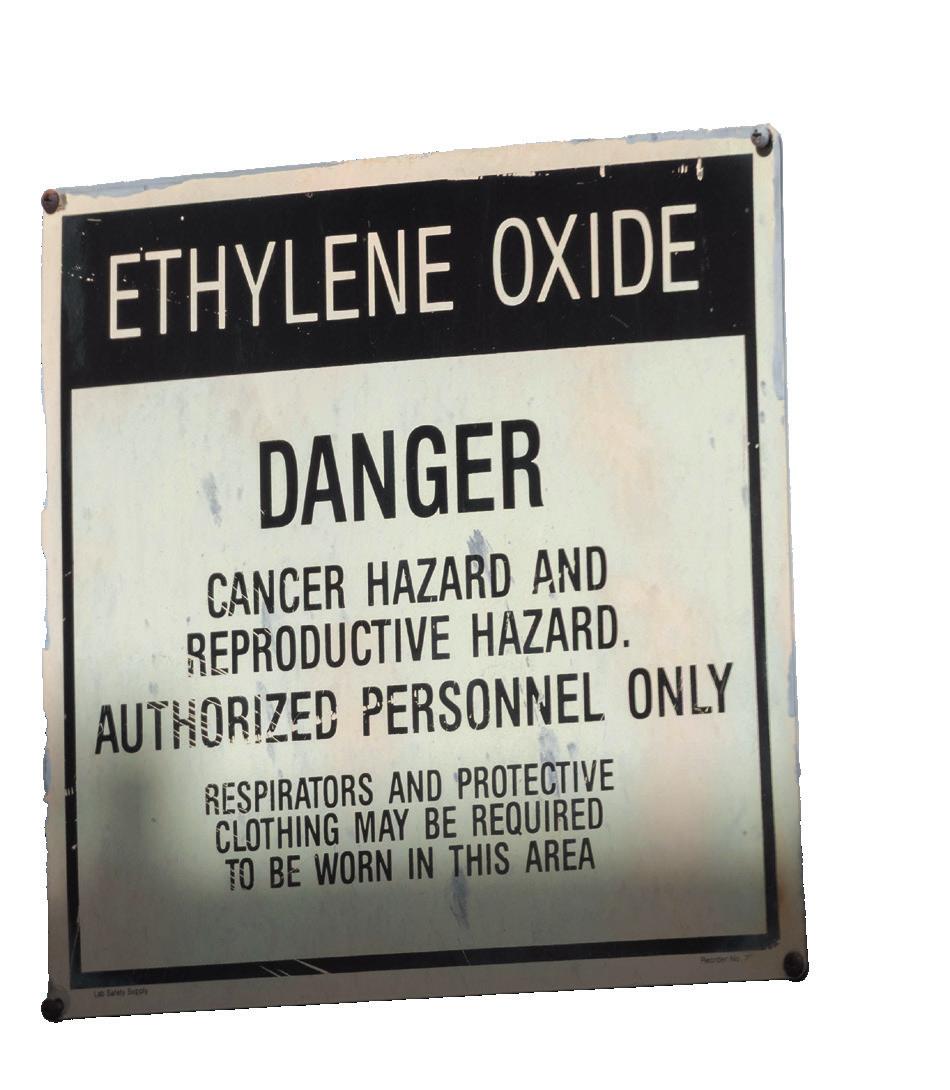
Signs warning personnel entering an area with Ethylene Oxide, the cancercausing chemical used to sterilize medical equipment at the Sterilization Services of Virginia building.
Photos by John Brown. Collage by Quinn Lysek.
Pride flag. Photo by Andrew Kerley.
Sports
Stat of the week
VCU fourth-year pitcher Patrick Steitz had a career game, pitching eight scoreless innings and notching eight strikeouts in the 13-1 win over Fordham University.
What women’s basketball fans can expect from Banbury
JENNY ALLEN Staff Writer
O’Boyle was dismissed from her position midway through the season. VCU former assistant coach Kirk Crawford filled
O’Boyle who held an overall win percentage of 53% during her VCU tenure.
Prior to O’Boyle’s dismissal, the Rams
also more efficient, with an effective field goal percentage of 50% compared to VCU’s 43%. Additionally, the Rams committed four more turnovers per game.
While the pace was the same, the better shot attempts made High Point’s scoring more explosive. HPU scored an average of 72.6 points per game compared to VCU’s 58.3.
Defense is where the real difference between the two coaches lie. Banbury promised to bring a relentless and disciplined defense, and her previous season at HPU emulate that.
High Point sat in the 95th percentile in defensive rating and was consistently one of the top teams in the nation in terms of not fouling, opponent field goal percentage and
While the Panthers did not get a noticeable amount of steals or blocks per game, the disciplined defense consistently shut down opposing teams and made
Comparatively to VCU under O’Boyle last season, the Rams sat in the lower half for nearly every defensive stat, with some being in the lower fifth percentile
VCU committed more fouls at a higher rate, allowed more assists and allowed more high percentage shots from opponents. This directly led to the Rams allowing 66 points per game while the Panthers kept
VCU baseball pummels No. 9 Virginia 6-2
HAYDEN BRAUN Staff Writer
VCU baseball put together one of its most complete performances of the season Tuesday night, defeating the No. 9-ranked University of Virginia 6-2 to secure its first win in the rivalry since 2022.
The Cavaliers struck immediately — third-year outfielder AJ Gracia opened the game with a leadoff home run in the top of the first to give the Cavaliers a 1-0 lead. However, VCU responded quickly, chipping away slowly before breaking the game open late.
The Rams tied it in the second inning when third-year infielder/outfielder Trent Adelman delivered an RBI single to score third-year infielder Nate Kirkpatrick. Adelman later added another key hit in the sixth, finishing with multiple hits and RBI’s.
“It all just started by my teammates. They set me up well,” Adelman said. “Not trying to do too much, just staying calm.”
VCU took control in the third inning after loading the bases with no outs. A wild pitch brought in the go-ahead run, and a sacrifice groundout from graduate
student catcher Teige Lethert extended the lead to 3-1.
While the offense began to find rhythm, the pitching staff delivered in high-pressure moments. Virginia totaled 11 hits but left 14 runners on base, including two separate bases-loaded situations.
“They were really critical,” VCU head coach Sean Thompson said. “I was proud of our pitchers staying tough and having to make those pitches. We had some really big defensive plays, and the double plays were massive.”
The Rams added another crucial run in the fifth when third-year outfielder Michael Petite launched a solo home run to left field with a 111 mph exit velocity. It’s Petite’s 11th Homerun of the season, according to VCU Athletics.
Petite entered the game batting .265 with a .997 OPS.
“We’ve been really strong with trying to be on time for the fastball,” Petite said. “He either threw a cutter or slider that went over the middle, and yeah, I let it ride.”
That momentum carried into the sixth inning, where VCU delivered the decisive blow. The Rams strung together five consecutive hits, highlighted by an
double from Adelman and an RBI
from fifth-year utility player Dante DeFranco, extending the lead to 6-1.
“The sixth inning really came down to toughness,” Thompson said. “Guys stayed within their approach and didn’t give in.”
Virginia added its final run in the eighth on an RBI single, but the Rams bullpen closed the door in the ninth to seal the win.
Despite the early deficit, Thompson said he did not need to say anything after the leadoff home run.
“I just said I can’t believe it happened again,” Thompson said. “But I was proud of how our pitcher stayed tough
Under Banbury, fans can likely expect a much more disciplined defense that will look for high percentage shots early and often into the shot clock. The team is not one that will sit around and wait for an opportunity to come to them, instead taking action and controlling the in that moment.”
This win serves as a statement for a VCU team that has shown steady improvement. Thompson stated it’s also a measuring stick against one of the top programs in the country.
“They’re kind of the gold standard of baseball in the state of Virginia,” Thompson said.
For the Rams, the result was less about the opponent and more about execution.
“Big name opponent, but it doesn't really matter. We've been there so many times that we just try to stay on us,” Adelman said.
RBI
single
VCU third-year outfielder Michael Petite swings at the ball. Photo by John Brown.
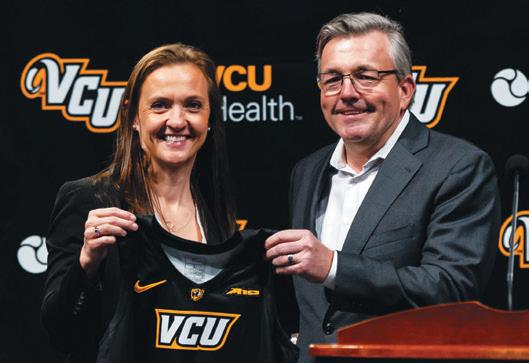
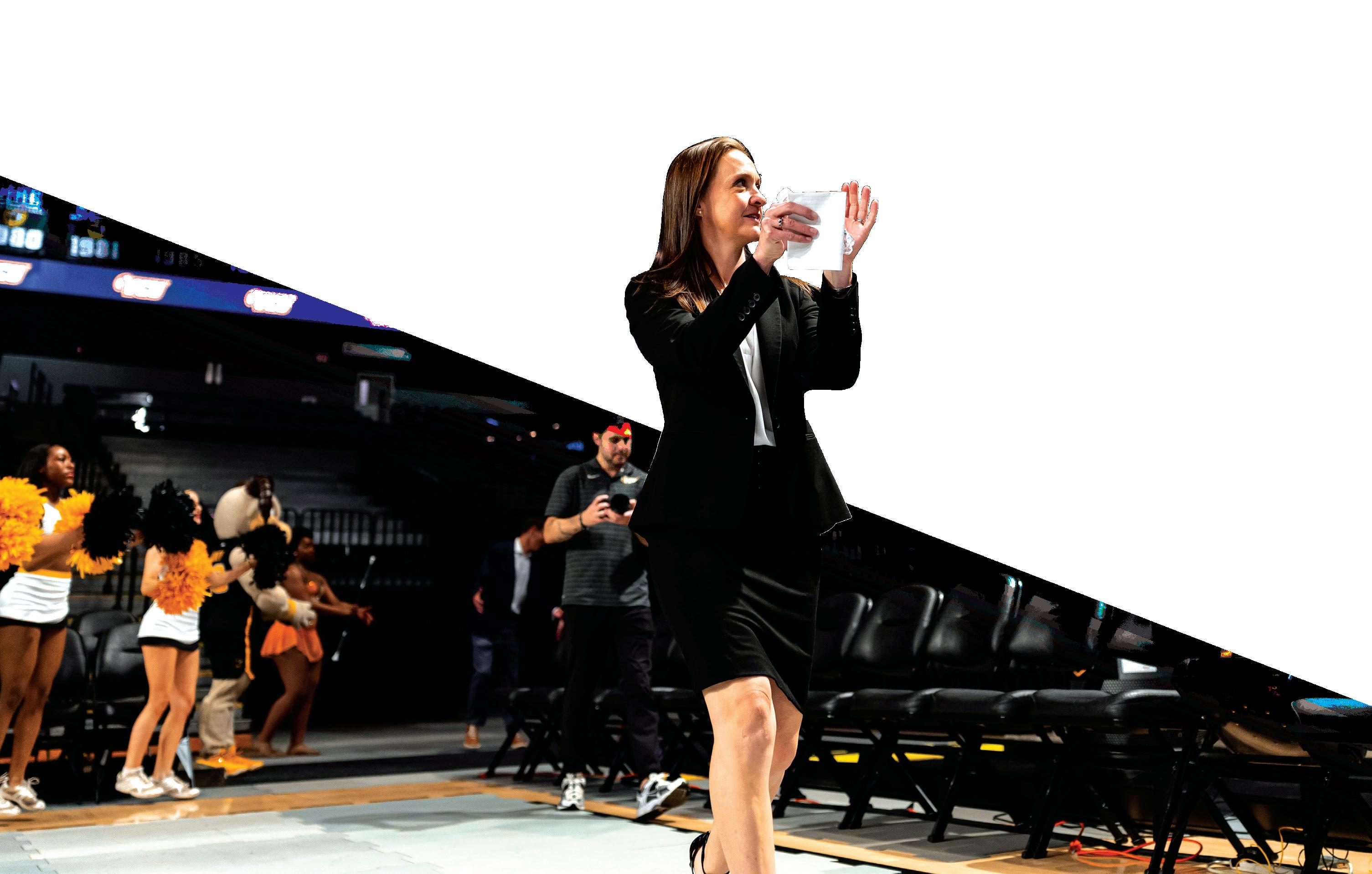
New VCU women's basketball head coach Chelsea Banbury. Photo courtesy of VCU Athletics.
Men’s tennis flames out against No. 60 Liberty
DREW THOMPSON
Sports Editor
VCU men’s tennis failed to capitalize against nationally ranked No. 60 Liberty University on April 9, losing 6-1.
Liberty opened the day with a 6-2 win in the first doubles match over VCU first-year Patrik Petera and second-year Leon Zaorski.
VCU brought it back even after secondyears Erwann Bouchet and Gevorg Mnatsakanyan won their set 6-3. However, a 6-4 Liberty win on the second court secured the doubles point for the Flames.
The Rams brought the fight to the singles matches, however the results stayed the same as they failed to capitalize.
VCU second-year Mats Bredschneijder lost in two sets after sending the first set to extras. A similar story followed fourth-year Alfred Almasi, who took the first set to extras before losing in the second, shooting Liberty out to an early 3-0 lead.
Bouchet breathed some much needed life back into a faltering VCU side after a hard-fought three set victory. Bouchet went down 4-6 in the first, before dominating the next two sets 6-2 and 6-1, giving VCU its first point.
The Rams attempted to carry that momentum into the closing matches, but came up short each time. Zaorski lost in two sets on court six despite some
competitive back-and-forth on the second set which guaranteed Liberty’s victory as the score sat at 4-1.
The final two matches both went three sets, with the Rams losing both. Mnatsakanyan won his first set 7-5 before losing the next two 1-6 and 4-6. Secondyear Nicolo Consonni finished the Rams’ day with a similar effort, winning the first set 6-1 before losing 6(3)-7(7) and 5-7.
Despite the tough loss, head coach Dimi Kutrovsky focused on the positive takeaways from the matchup.
“We’re putting ourselves in good positions,” Kutrovsky said. “[We] just gotta sprint over the finish line and close those matches out and we will be in a different place.”
Bouchet was the Rams’ difference maker in this game as he has been for much of the season. His singles win improved his win total to nine on the season, and he featured alongside Mnatsakanyan for VCU’s sole doubles win.
The loss takes VCU’s overall record to 6-12, although it still sits undefeated in the Atlantic 10 at 2-0.
VCU lost its next game at No. 56 Old Dominion University 1-4, marking its third straight loss. The Rams sole point came from doubles play, before the Monarchs swept in singles.
VCU will play its next match against Duquesne University on Thursday, April 16 at 11 a.m. at home.
Do VCU students actually care about men’s basketball?
BRYER HAYWOOD
Staff Writer
BEN MARTINDALE Staff
Writer
DREW THOMPSON
Sports Editor
VCU men’s basketball garnered national attention for its historic performance in this year’s March Madness. Their comeback against the University of North Carolina was the largest in first round NCAA Tournament history.
Men’s basketball is undeniably the premier attraction for VCU Athletics, and it receives the funding to back it up. VCU Athletics Director Ed McLaughlin promised to devote $4-5 million to pay men’s basketball players last year.
With the success of the team this past season, that number is only slated to increase. The team is also already revered by the Richmond community, with home games averaging a sell out of 7,614 people. Even for away games, thousands of people show up to support the Rams.
Official statistics from VCU Athletics show that 14,178 Rams fans went to the second round game against the University of Illinois. Though the Rams ultimately lost that game by 21 points, the fervor for the team has not diminished.
However, while the community travels in droves to support the Rams, the student section tends to remain the emptiest come the opening whistle.
VCU is home to over 29,000 students, but the overall student population tends to not know, or not care about the athletics on campus.
A majority of the sports receive little attention from fans and students alike,
and the men’s basketball team tends to draw more attention only because of its national recognition.
For some students, like thirdyear business management major Emeka Guthrie, there are simply more important things to focus on than attend basketball games.
“The reason I don’t care for basketball that much is because other things require that attention too,” Guthrie said.
Guthrie is a transfer student and added that she wishes the university put more attention on other aspects of the school rather than just the basketball program.
This sentiment is echoed by other students, like second-year psychology major Ryan McLellan.
McLellan noted that he does not engage in sports and has not noticed anything about basketball culture at VCU. He added that he thinks greater emphasis should be placed on other sports programs or activities in general.
“I don’t think I’ve heard anything about VCU sports programs aside from basketball,” McLellan said.
However, there is a disconnect in the student base on the importance of the men’s basketball program.
Zane Tripp, a third-year communications major, called the program “incredibly important” to VCU’s school spirit. Tripp said he feels like there has been a noticeable culture shift on campus since the NCAA Tournament.
“After we saw them win against UNC, there was [sic] a lot of people extremely happy, especially on social media,” Tripp said. “The fact that I saw my school on my “For You” page, it made me happy.”
This disconnect extends past just the student base, as the rest of Richmond also finds themselves wrapped up in it.
During a February Board of Visitors
meeting, Clifton Peay, chair of the Intercollegiate Athletics Committee, spoke about Richmond not having a “real sports culture.”
Greg Burton, Director of Communication and Engagement at the Center for Sport Leadership, said
the opposite, calling the sports culture “strong,” “vibrant” and still evolving. It is increasingly harder to bridge the gap between people who care and do not care about sports. The March Madness win — while bringing national attention — does little to clear the disconnect.
Photos by John Brown. Collage by Raya Freeborn.
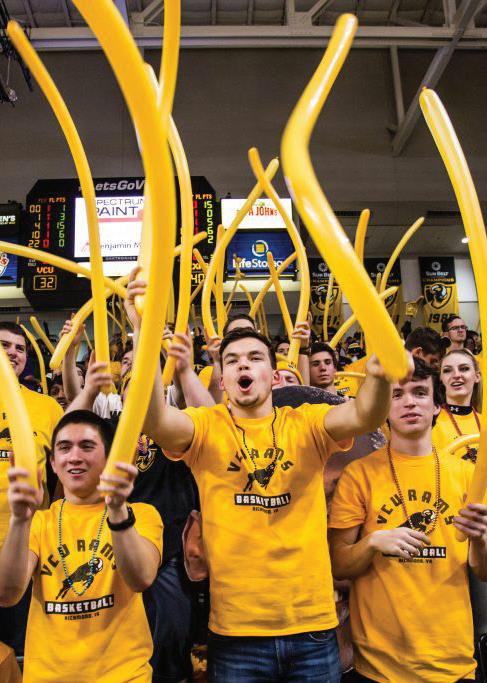
Men’s basketball fans cheer in the student section at the Stuart C. Siegel Center during the 2018-19 season. CT file photo.
On This Day
On this day, April 15, Americans must file their taxes, so if you haven’t done so…
VCU’s Doomsday to put on ‘Buffy the Vampire Slayer’ musical
MAEVE BAUER Spectrum Editor
Buffy, Spike, Willow and the other residents of Sunnyvale will gather on stage at Richard Newdick Theatre in Shafer Street Playhouse from April 17-19.
Doomsday VCU, a theater company on campus will be putting on “Once More, With Feeling,” a production of the musical episode of “Buffy, the Vampire Slayer.”
The musical is taken from the season six episode of the same name, when the demon Sweet puts the town of Sunnyvale under a musical curse.
“Buffy, the Vampire Slayer,” is a beacon of late 1990s and early 2000s fashion. When creating the costumes for the show Ian Lambert, first-year cinema major and the show’s costume designer, pulled
inspiration from the original episode, as well as the series as a whole.
“A lot of like that 90s, early 2000s fashion has been super popular recently. Which is very helpful in terms of finding those types of pieces out in the wild, like thrift stores,” Lambert said. “That’s been very helpful, that our fashion interest lines up with everybody else right now.”
Buffy has been one of Lambert’s favorite characters to style — having fun with the vampire slayer’s bolder outfits and red leather pants in which she is known for. They also enjoy styling Spike, the moodyvampire-turned-love-interest.
Doomsday’s mission is to create more musical opportunities for students. Despite the small budget they have to work with, the cast, crew and board of Doomsday does everything they can to
Furries shook their tails and waved their paws at second
FURRIES
Story continued from front page
RUFF is Richmond’s first furry-centered convention, according to Partangal. Other furry events are over an hour away, mainly in Virginia Beach or NoVA.
“So that’s how we I we came up with the idea idea for RUFF, because there just wasn’t any sort of free space in Richmond, which didn’t make a lot of sense to us because it is Richmond, it’s such a vibrant, diverse community and there's tons of furries here, so it just made sense,” Partangal said.
It was important to those in the society for the event to be free, according to Partangal.
“We just want to bring people together and have people have this sense of community, because our main motivation behind making it free is we think that subcultures should be accessible to everyone because furry conventions are inherently a very big expense,” Partangal said. “Most furry conventions their passes cost $70, $80, and it’s not accessible to everyone, so a lot of people can only experience furry community through online methods.”
The event brought furries near and far to the Richmond area, some attendees being VCU students and others coming from across the country.
“Someone came from Las Vegas, they told us during the opening event, there’s so much support,” Partangal said. “It’s been
Fur Fair
so overwhelming and amazing and I just really it makes me feel really really happy.”
One thing that Partangal wants to really reiterate is that anyone can be a furry.
“So you do not need a fursuit to be a furry and you don’t need a fursona,” Partangal said. “You don’t need anything, there’s no requirements to be a furry.”
The artist alley seemed to be one of the most popular aspects of the fest. A line of different creatures and characters was consistently out the door, leading into a room full of different colored booths. Decorated with pins, stickers, prints, crochet animals and keychains, the booths held many different artists, both long-time furries and those just dipping their toes into the community.
Kassandra Londoño was one of these artists, involved in the community for around nine years, it was not until recently that Londoño started using the term furry to describe herself.
“I can’t say that I’ve been super active in VCU’s furry community, but from what I’ve seen it’s very accepting and kind,” Londoño said. “The anthro club hosts a lot of cool events, some of which I’ve taken part in, and in general is pretty chill overall, there’s a lot more furries than I would have expected.”
Richmond is a diverse place with people from many different walks of life, so it’s important for there to be a place or event here to meet new people who may be interested in becoming a furry, according to Londoño.
put on a spectacular show.
This early 2000s musical dreamscape will be brought to life by Max Montalvo, a thirdyear theatre student. He has been imagining putting on the show since last year. Montalvo said his cast and crew has described it as “ambitious, but going extremely well.”
Montalvo grew up watching “Buffy” with his mom. He saw Coalition Theater do a stage reading of the episode and brought it to Doomsday to bring his vision to life. Montalvo felt like this story was important to share with college students. The original episode takes place as the characters are transitioning from college to full-blown adulthood.
“I have always appreciated the truthfulness to ‘teenagrisms’ there is and watching high schoolers grow up all the way into adults,” Montalvo said. “So most of these people [the
characters] are adults by now, or they’re in college transitioning to adults, which is what a lot of my cast is. It’s kind of helping put a realness to what their feeling and what they’re able to bring to the stage.”
Doomsday has done a plethora of outof-the-ordinary productions. Within the last year they have put on “The Nightman Cometh,” the unofficial “It’s Always Sunny In Philadelphia,” musical, in which Montalvo acted as stage manager.
“I think that there’s thousands of things that we all want to do and both Doomsday and all the other student orgs are helping make a lot of things happen throughout the semesters,” Montalvo said.
This year they have also done “Tick, Tick … Boom!” and “36 Questions,” the first full stage adaptation of the musical podcast of the same name. Caleb Hamiltion, the President of Doomsday, said that the board of directors tries to bring the director's visions to life.
Hamilton delved into the work that goes into putting on these shows, and the wild goose chase he went through to make “Once More, With Feeling,” possible.
“I was calling and emailing with people from New York, Detroit, Irvine. I was going all over the country to talk to people through emails and phone calls,” Hamilton said. “I will never forget this one. It was a trio of women, they were in Detroit have a queer theater where they put this on. I emailed them and I went ‘how’d you do this?’ and they went ‘you don’t want to talk to us — you want to email this person,’ and I was given the email info@buffymusical.com.”
“Once More, With Feeling,” will be playing throughout the weekend at Shafer St. Playhouse. It will be showing at 7:30 p.m. Friday night and 2 p.m. on Saturday and Sunday.
“I think that having a con here in Richmond that shows just how many people are supportive and likeminded helps to normalize unconventional hobbies,” Londoño said. “Plus, it helps to support a variety of artists in the area.”
In addition to the panels, meetups and trivia, RUFF had a furry rave to close out the event. With twinkling beats and flashing colors and lights, the rave had attendees shaking their tails and waving their paws.
One of the DJs was Maeve Hickey, also known as Shartchan. The furry community shows out for raves, according to Hickey.
“Furry raves are next level, everyone is always so PLUR and friendly,” Hickey said. “Furry music is super cute and I think they are just magical.”
Attendees didn’t have to register for RUFF to be at the rave, according to Hickey.
“RUFF rave was so insanely successful this year,” Hickey said. “So even if people couldn’t get a ticket to the event, they could still come out and dance with us.”
Beth Jones, an attendee from Smithfield, only recently purchased a fursuit, but has been a furry for about a year and a half. Jones commissioned an artist to bring their fursona, Kibby, to life.
“So my fursona is a cat/shark,” Jones said. “I just really like sharks and I have a black cat, so I was like ‘that would be the cutest combination ever.’”
The event allowed Jones to connect with others interested in similar things.
Story continues on next page
One of the many RUFF attendees posing in front of the VCU sign near the Student Commons. Photo by Cameron Powell.
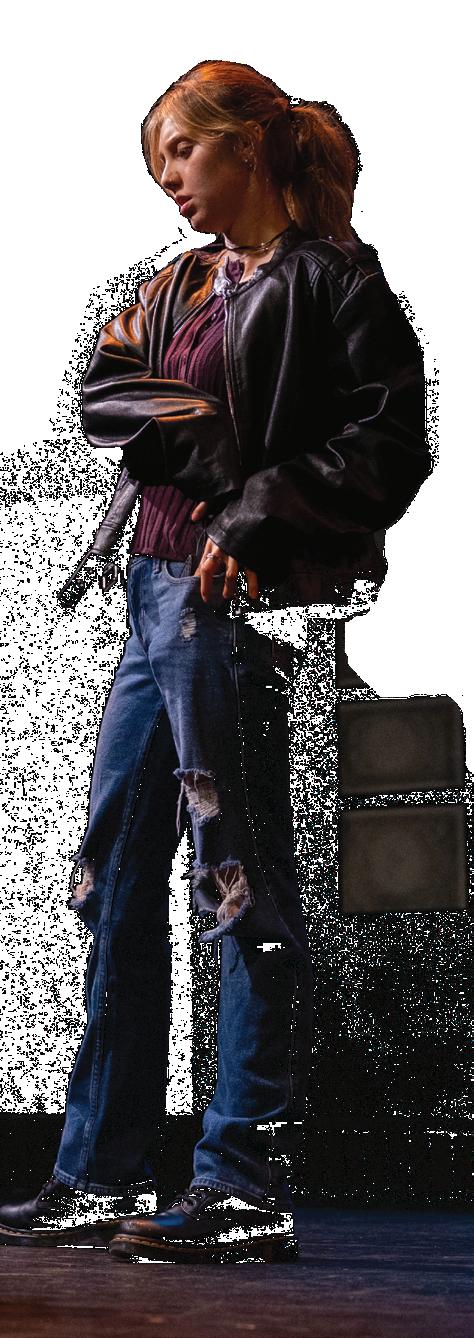
Ellison Yuhas (left) and Catherine Cabral (right) stun in Doomsday Theatre’s production of ‘Buffy the Vampire Slayer.’
Photo by Kieran Stevens.
“Everyone’s nice, everyone complimenting each other’s personas and it makes me comfortable because a lot of spaces don’t accept furries, they see them as weird and everything,” Jones said. “And that’s not true at all, it’s great to have a community where everyone’s good to each other.”
to Amanda Easterling, treasurer of the Anthro Society.
to be themselves, according to Easterling.
The convention gave space for people, like Jones, to hang out with friends and learn about the community, according
“A lot of our attendees, our families who don’t know what furries are or maybe their kids are interested in what a furry is, but they don’t want to spend an exuberant amount of [money] to go to one,” Easterling said.
Furries are often misunderstood, and the event creates a space for the community
“Yes we’re weird, yes we’re cringe, but nobody can tell us who we are but ourselves,” Easterling said. “I feel like recent years, though a lot of the misconceptions have been starting to die down, which is great for everyone since there’s a lot of craft and art when it comes to furries.”
Richmond chooses new Poet Laureate at annual festival
LELIA CONTEE
Contributing Writer
From page to stage, the Visual Arts Center of Richmond hosted its fourth annual Richmond Poetry Fest on Friday and Saturday.
The Visual Arts Center of Richmond, or VisArts, is a nonprofit organization that helps adults and children explore creativity and make art.
The festival featured a Parallel Listening series that blends live music and literary readings, “Book Club Breakfast,” the Young Voices of RVA, “Drag Queen Story Hour” and community poetry readings and performances, with American Sign Language interpretation provided.
“If people come to the poetry fest not being familiar with poetry they’ll realize how much they actually are familiar with poetry,” poet Joanna S. Lee said.
Lee was elected as Richmond’s second Poet Laureate in 2024, as a part of the city’s Poet Laureate Program that was launched in 2020.
The program highlights local artists and uses poetry to support the Richmond community.
Lee said a poet laureate mean being “a voice for the city,” where she engaged in readings, mayoral events and spoke with diverse audiences, including those not typically involved in Richmond’s art scene. Lee’s current project aims to collaborate with parks and departments to integrate poetry with the trails being built in the Richmond region.
Stories and songbooks; Richmond Library to hold spring concert series
RACHEL NICHOLAS Staff Writer
At the crossroads of storytelling and sound, the main branch of the Richmond Public Library transformed its space into something more than shelves and study tables this spring for its monthly concert series.
As part of a three-part concert series dedicated to bringing free, genre-spanning art to the community, the library will host the next performance this month on April 18 from 2-4 p.m..
Headlining the event is Mia Zabelka, a composer and violinist whose work pushes far beyond conventional boundaries.
Described as “acoustic experiments,” her performances blend playing techniques — what she calls “sonic body impulses” — and electronics to reveal the hidden vibrations of matter.
Zabelka’s work reflects the very spirit of the series — an exploration of art that challenges, connects and resonates across disciplines.
“It’s really been a joy to see how the scene has grown,” Lee said. “People really do need to use their voices and they’re starting to realize it.”
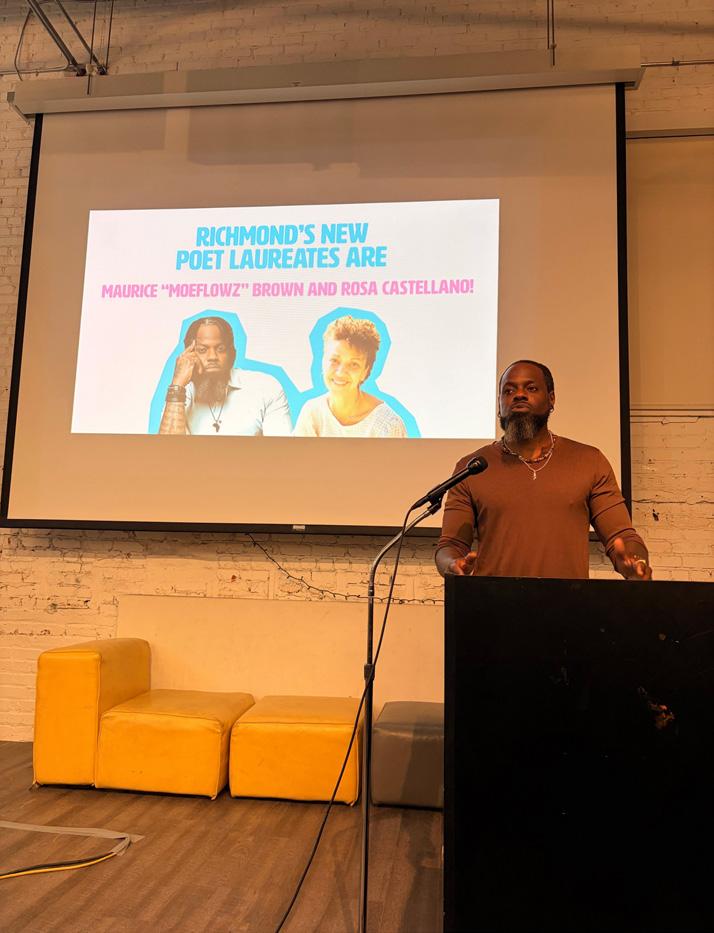
Mayor Danny Avula announced the new Poet Laureates from 2026 to 2028 — Maurice “moeflowz” Brown and Rosa Castellano.
“Really, this is the kind of thing that lets people see what’s possible as a poet and as a writer in your community,” said poet Remica Bingham-Risher.
Bingham-Risher, an award-winning author, performed her newest work, “Room Swept Home,” at the festival. It is a book of poems that explores the lives of her two grandmothers in Petersburg, whose experiences spanned from slavery to the Vietnam War.
Poetry is best heard aloud than read on the page because it allows for dialogue and performance Bingham-Risher said.
“We’re trying to really help people understand that the way that you read poems certainly has bearing on the way that people understand and are drawn to your poems, whether they’re in a book or not,” Bingham-Risher said.
For organizer Michael McBean, that spirit is intentional. The series is designed to reflect the full range of Richmond’s DIY music scene and make room for experimentation.
“We try to book concerts that are representative of the Richmond DIY scene,” McBean said. “We’re mainly just trying to represent all the corners of that scene and get people out.”
Since stepping into his role last year, McBean has also made it a priority to expand the series beyond its traditional classical and jazz roots — while still honoring the longtime audience that has supported it.
“That was a priority — to bring in acts
The evolution of poetry is reflected in the merge between its written and spoken forms, according to Bingham-Risher.
Poetry can connect people in ways that expands their understanding of poetry and other communities, drag queen Michelle Livigne said.
“Love, inspiration and smiles on their faces, I think that can connect us,” Livigne said.
Livigne was featured in “Drag Queen Story Hour”, a family-friendly event where she read poetry and storybooks, such as “The Giving Tree,” to children, and exchanged a few jokes.
Livigne said she accepted the opportunity because she felt inspired to connect with people and create memorable moments. She hopes “Drag Queen Story Hour” can foster more openness by changing people’s views, outlooks and positions on various topics.
“As you experience a ‘Drag Queen Story Hour’, you might just treat a person that isn’t like you just differently than you would, maybe, normally treat,” Livigne said. “You treat them kindly or do something nice.”
that might be considered more on the experimental side,” McBean said. “I don’t think we’ve ever quite had an artist like this, but the hope is to make this more of a normal thing going forward.”
Zabelka’s performance grew out of connections with local musician Tommy Birchett and a network of experimental artists. When he learned they would be passing through Richmond.
Birchett further worked alongside McBean to help plan and organize the event, citing musician Walter Wright as the leading “mastermind behind the operation.”
Wright is a one half of the experimental art duo ELKA BONG, a participating act on Zabelka’s tour.
Together with ELKA BONG, whose work focuses on “texture, space, silence and sonic micro-events,” the performance promises to transform the library into a dynamic sonic landscape, according to Wright.
The next library concert series will be May 23 with flutist Deborah Saidel. Information can be found on the Richmond Public Library website,
Violinist and composer Liz Meredith at Richmond Public Library’s winter series on Dec. 13, 2025. Photo courtesy of Richmond Public Library. Illustrations by Devin Smith.
Maurice “Moeflowz” Brown, accepting his role as one of Richmond’s new poet laureates. Photo courtesy of the Visual Arts Center of Richmond.
RUFF attendees put their paws in the air, celebrating together. Photo by Cameron Powell.
Every week, a dozen or so students get up at the crack of dawn and haul themselves into vans for a sleepy drive to beyond campus boundaries.
The students are taking VCU’s avian ecology and conservation course, or as most of them put it — “birding class.”
In the class — and the corresponding VCU Avian Ecology Lab — students open their eyes and ears in order to spot and study the winged wonders of Virginia. Through their tranquil expeditions they learn quite a bit about birds, and perhaps a little bit about themselves.
BEYOND CAMPUS BOUNDARIES
On a Friday in early March, the birding class drove far from campus to the Harrison Lake National Fish Hatchery — a prime spot with clear views and tall trees, inviting their subjects of study.
Riding in their vans — promptly named Vanessa, Van-Halen or Vincent Van Gogh by students — they chirped about all of the modern fixings young people use to share their bird passion. There is eBird, the definitive app for recording and sharing one’s sightings — as well as Birdle, a daily guessing game akin to Wordle.
Unloading at the hatchery, associate professor Lesley Bulluck could hardly get a word in before a student pointed out a juvenile bald eagle far off in the distance.
“Where!?” Bulluck whisper-shouted, turning and spreading her arms with the enthusiasm of a true, Ph.D holding bird nerd.
Bulluck knows her students want to get jobs in environmental conservation. She started teaching avian ecology so they could learn how to collect data that will go toward protecting declining populations.
“Students want to get involved in any kind of field research they can, they’re eager for it,” Bulluck said.
Between the research and data analysis, students cannot help but use the time away from their nests to get excited about every little thing they see.
“Look at the hooded mergansers! Do you guys see the hooded mergansers?” one student said. “Look you guys, the robins are taking a bath in the puddle!” another said.
Some students were attracted to the other critters at the hatchery. Frog croaks underscored the natural orchestra. Fish swam within their ponds — tempting the group
“This is not the fish class,” Bulluck lightheartedly clarified, prompting students to get back on assignment.
The class sees up to 80-90 different species of birds throughout any given semester — 100 if they take an extra trip to the coast. That single Friday they saw 40, a record for the year.
Bulluck’s idea of a quiz grade is asking students to listen to bird calls and, with no other information, jot down the species names on their notepads.
Plenty of birds have catchy calls to remember them by. For example, the common Killdeer are creatively named after their call that sounds like “kill deer! Kill deer!”
Halfway through the quiz, Bulluck waited for another call to appear — gracing students with an “extra credit bird,” and a high five if they got it right.
That is the science — or arguably art — of birding. Students venture out to do it throughout the whole spring semester — even in January when Belle Isle was frozen over.
Third-year environmental studies student Cree Taylor decided to take avian ecology after being involved with a campus window bird collision survey — an initiative that examines if big buildings are safe for the aerial creatures.
“I did that for two years and I saw a lot of dead ones,” Taylor said. “I wanted to see actual living ones for once.”
Taylor does not mind waking up at 6 a.m. for classes of dynamic, community-oriented learning. In fact, she loves how whimsical it makes her feel.
“I think birding is a fun way to be more present,” Taylor said. “I feel like a little kid and I’m just out here.”
THE WONDER OF WARBLERS
The Avian Ecology Lab primarily studies two species: the prothonotary warbler and golden- winged warbler.
Prothonotary warblers are easy to study because they readily nest in boxes, according to Bulluck.
There has been a long term study on the species in the James River since the 1980s. They migrate to Columbia and Panama during the winter and come back to the same exact boxes in Virginia every year.
The prothonotary warbler population is relatively stable, but they have been experiencing long-term decline over the years. With over 30 years of data, students can draw deeper conclusions about how climate change affects the species.
By catching and banding the birds, students gain hands-on experience and skills with long-term data sets that are useful in all fields of ecology.
“We can ask questions that aren’t possible with other species,” Bulluck said.
Blake Lamb, a Ph.D. student studying under Bulluck, researches the imperiled golden-winged warbler. The species does not nest in boxes, but in the Appalachian Mountains. Students have to find them by tracking their behaviors and following them.
Lamb conducts fieldwork at Highland and Bath counties during the summer. The lab works with private landowners as golden-winged warblers require an early successional habitat to nest — meaning young ecosystems.
If forests are allowed to grow and become mature, the nesting habitat for goldenwinged warblers disappears.
Farmlands can serve as early successional habitats where the warblers can nest. The level of cows grazing across the land is used as a variable in students’ studies as they try to assess what makes a good area for nesting.
SCIENCE IS MAGICAL
Bulluck wants to open up new avenues for students to experience and learn from the environment. Learning how to identify birds — or any species — opens up the world, and exposing people to a new way of being outside can calm the soul.
To Bulluck, science is a paradox. It relies on numbers and data collection to answer questions, which is the opposite of magical — yet somehow it is.
“When you actually find that relationship, or uncover that unexpected relationship, it does feel pretty magical,” Bulluck said. “Like, ‘we figured this out,’ not that we’re reducing it to something not important, but that we are better understanding the wonders of the natural world.”
Bulluck can recount plenty of magical moments with her students. They recently watched a merlin falcon “tear apart” a songbird.
Last year on a cold, quiet morning, the class struggled to find birds. With a half hour left in the lab, a great horned owl landed on a tree in front of them and started calling. It was a rare sight as the species is nocturnal.
“That felt really special,” Bulluck said.
On another occasion, the class took a trip to South Carolina with the Outdoor Adventure Program. They got up before daylight and walked to the beach as the sun was rising — spotting skimmers, gulls and other shore birds
“We were all just taking it in, and almost speechless with the beauty,” Bulluck said.
BIRDING FOR ALL
For Lamb, he found his love for wildlife as a child. He was obsessed with turtles —
and would make his parents pull their car over so he could pick them off the road.
His passion for animals has carried him through a number of schools and degrees — but he said avian ecology has been the most fun class he has ever taken.
“It’s always cool to see young people excited about nature,” Lamb said. “It gives me a lot of hope for the future.”
Lamb hopes students retain their passion for birds — and nature in general — and take it into their careers, as well as spread it to non-environmental studies majors.
One student, Jasmine Cuellar, took the class last semester and is still present on their expeditions as their van driver — as well as a “great birding resource,” according to one student.
“I’ve always liked little creatures anyways, but I think birds specifically really spoke to me, because it’s really truly amazing the kind of challenges they face all the time,” Cuellar said.
For Cuellar, birding brings about both a fun game and a meditative experience. On one hand it is like “Pokémon” — trying “find ‘em all” and seeing new species. On the other hand, Birding teaches people to be patient, to listen more and react less.
“I want to share this feeling with other people,” Cuellar said.
On some days the birds show out in droves. On others, they do not show up at all, and that is ok, Cuellar said. People should not be disappointed, as the chance is just part of life. Things do not always work out how we want them to.
Now, Cuellar has co-founded Birders at VCU, a club for people of all experience levels. They recently held their first bird walk to Hollywood Cemetery, and are planning for more down the line.
Cuellar wanted to build a space for those who might feel intimidated by the idea of joining another birding group. She likes to get new people excited about birding, which she never gets tired of herself.
On top of regular birding trips, the club is planning film screenings, nature journaling, trivia nights, visits from educational speakers, professional development opportunities, resume workshops — among other events.
The club just became an official chapter of the National Audubon Society, a centuryold nonprofit dedicated to the conservation of birds and their habitats. Through the organization they could connect with other chapters and acquire funding for binoculars, field guides and, of course, snacks.
Those who want to spread their wings can become a birder by checking out the club’s Instagram: @birdersatvcu.
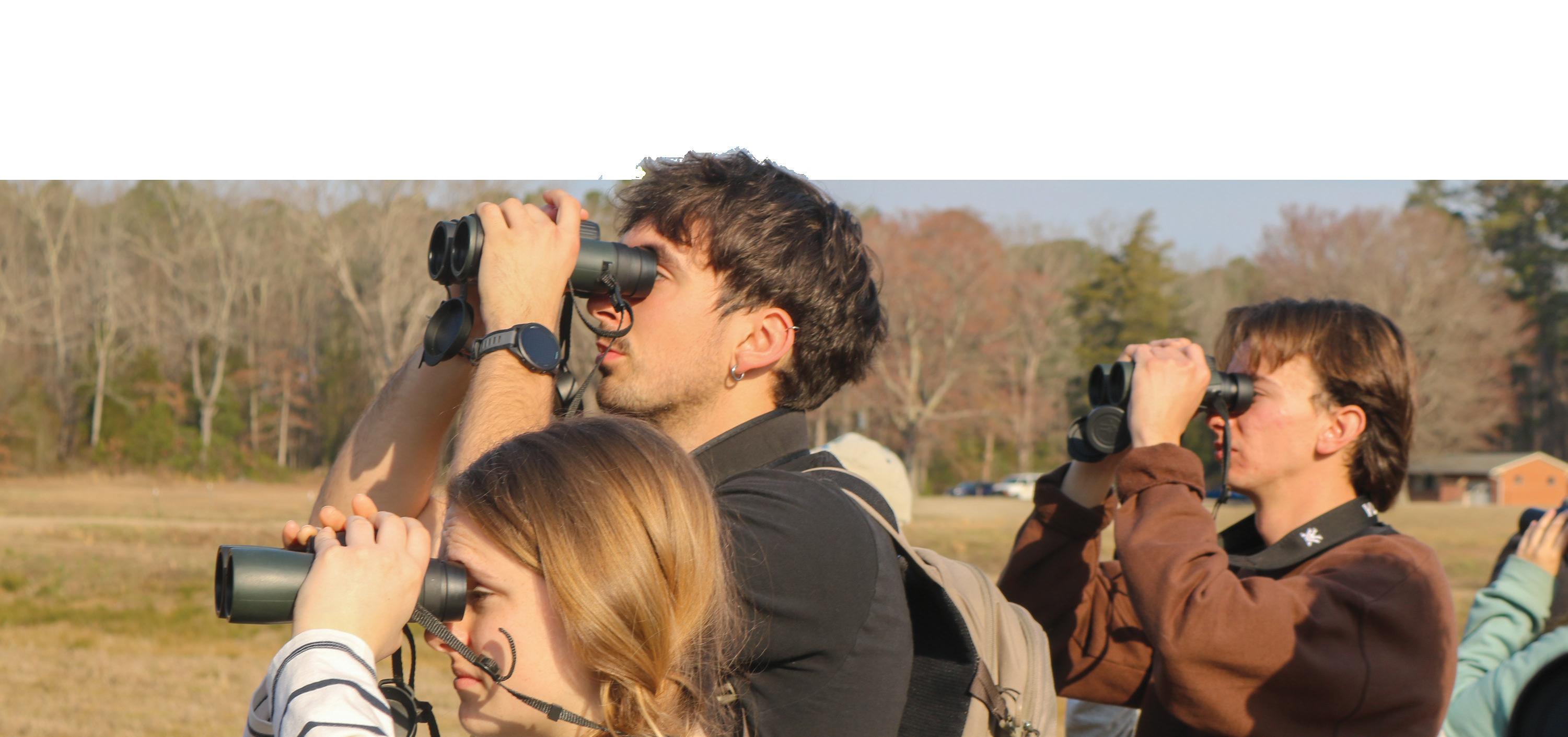
Students spot birds in the trees through their binoculars on an expedition for VCU's avian ecology course.. Photo by Andrew Kerley.
Richmond swordfighter ranks among world’s best Zachary Showalter helps grow local HEMA community
Continued from front page
Showalter, founder of the Scuffletown Fetterfechters, is currently ranked No. 10 in the world at longsword in Historical European Martial Arts, or HEMA.
What began as curiosity after watching an online video has grown into a competitive career and a central role in shaping Richmond’s expanding HEMA scene.
“I thought it was the coolest thing,” Showalter said. “I was like, I have to do this.”
HEMA is a martial art practiced through historical European fighting systems. Athletes read centuries-old manuals to adapt them into a modern, historically researched sport where they can compete against one another.
While HEMA is sometimes mistaken for LARPing — live action role playing — or Olympic fencing, the historical aspect and study balances it between the two and differentiates itself from them both.
For Showalter, that balance is part of the appeal, but competition is what drives him.
“I’m serious about competing,” Showalter said. “I love the challenge of it.”
Showalter has been competing consistently since getting into HEMA in 2016 — gaining experience in tournaments across the East Coast and the rest of the country.
Recently, he achieved a long-time goal of rising to be the 10th best longsword competitor in the world — a reflection of his years of refinement and moments of failure that reshaped his approach and allowed him to improve.
“I had one action that was so successful,
I knew no one would be able to stop it,” Showalter said. “I visited a club in New York, and had a match with one of their coaches who would block it every single time. I left from that very humbled.”
The process of adjusting, learning and humility defines Showalter and the Scuffletown Fetterfechters’ training to this day. Even when reaching new heights in his career, he continues to emphasize within himself and those he trains how important it is to stay adaptable.
Showalter’s influence extends beyond competition and training. Through the Scuffletown Fetterfechters, Showalter has helped foster a collaborative and inclusive environment within Richmond’s HEMA community.
“It should be for everybody,” Showalter said. “It doesn’t matter if you just want to learn about fencing, if you like the historical aspect of it, or if you’re looking for community.”
HEMA At VCU
Showalter and the Fetterfechters’ notion of accessibility and inclusivity is echoed at VCU, where the student-run HEMA club introduces new practitioners to the sport each year.
Brodie Persson, president of the VCU HEMA club, first discovered the organization as a freshman and quickly became invested.
“Going into college, I wanted to have some sort of physical activity and make more friends,” Persson said. “After talking with the president at the time, I was fully
invested in wanting to show up. Every lesson, I loved it even more and more.”
VCU’s HEMA club focuses on offering beginner-friendly instruction, and teaching the fundamentals like footwork and how to position and control strikes before members begin sparring.
For Persson and the VCU HEMA club, safety is their number one priority, especially because of the physical nature of the sport.
“The biggest thing is understanding the risk level,” Persson said. “VCU has a safety officer, we gear the rule set towards a safe environment, and we make sure that we have the highest level kit requirement possible.”
That approach is especially important for events like Lambpoint 2026, a local tournament that took place on April 11 designed for newer competitors. Unlike larger regional competitions, Lambpoint limited participation to those with minimal tournament experience, creating a lowpressure environment.
“We want to ensure a very safe firsttournament experience,” Persson said. “It’s a high contact sport and that can be intimidating. So Lambpoint is geared towards getting your foot in the door.”
CREATING A LARGER COMMUNITY
Beyond the university, Richmond’s HEMA network includes multiple clubs with overlapping membership, creating a tightly connected but diverse community.
Bizhan Khodabandeh, a VCU professor
and coach within the VCU club, described the scene as one where practitioners often train across organizations, sometimes multiple times a week.
Khodabandeh approaches HEMA primarily through its historical lens, viewing it as a way to engage directly with the past.
“The history side of things is really exciting because it's a window to the past,” Khodabandeh said. “The plus side is that we get to participate in that history by swinging swords around and experiencing it in real time.”
The part sport and part historical practice aspect of HEMA continues to shape it and allows it to evolve. While some practitioners prioritize competition, others focus on research or community-building, and many — like Showalter — navigate all three.
HEMA grows every year, and in turn so does its visibility. Larger tournaments in places like Maryland, Philadelphia and California draw competitors from across the country, while local events like Lambpoint help sustain Richmond and VCU’s HEMA communities’ development. For Showalter, that growth is both exciting and motivating.
“There’s never been a better time to get into HEMA,” Showalter said. “Watching the work that [Persson] and everybody at the VCU HEMA club has been putting in keeps me sharp, because they’re gonna be right on my heels. It’s very motivating.”
Even at No. 10 in the world, the work continues.
“I’ve got to stay on my game,” Showalter said. “There’s always some way to improve.”
Richmond native Zachary Showalter, who is the No. 10 HEMA swordfighter in the world. Photo by Landon G. Walker.
Opinions
False alarms in dorms may be doing more harm than good
KYLIE GRUNSFELD Staff Columnist
The CT reported last semester that fire alarms went off 91 times across all student dorms during the 2024-2025 academic year. Of all of those instances, very few were due to actual emergencies.
The extensive amount of non-emergent alarms is an ongoing issue and a big turn-off from student housing for many prospective residents. I remember when I first researched on-campus living options, I found dozens of reviews warning me against living in halls like Gladding Residence Center and Cary & Belvidere. After living in these locations, I can’t say I would recommend them either.
As an on-campus resident, I am growing increasingly frustrated with every new alarm that goes off. I know I am not alone in this. The bright, flashing lights and eardrum-bursting sound is disrupting our sleep and activating our fight-or-flight.
VCU says “failure to evacuate or follow proper procedures could result in disciplinary action” in their follow-up
emails regarding triggered alarms, but it’s unclear what those actions actually are. I have spoken with many residents who no longer evacuate during fire alarms, yet they have not yet received any form of discipline.
There are numerous factors that lead to residents staying in the building during an alarm: freezing weather, rain, late nights, early mornings, not wanting to climb up several flights of stairs — and a lack of concern that they need to acknowledge the situation in the first place.
It is hard to believe VCU would be able to pinpoint every single resident who chooses not to follow procedure.
While it may be a lot of work to round up each individual who stays inside, there is ample potential for VCU to develop a more consistent method of reprimanding the residents who cause evacuations in the first place — those who pull alarms as a joke, those who refuse go outside to smoke or vape.
VCU Residential Life and Housing did not respond to multiple requests for comment regarding these issues. Something needs to be done to break
the pattern of avoidable evacuations, or I fear the apathy towards proper evacuation will only get worse and put on-campus residents in danger.
When so many false alarms happen one after another, why should any resident believe that the next one will be a real emergency? What incentive do they have to leave their building when no concrete punishments are handed out?
There is always a chance of a real fire that spreads uncontrollably, trapping unevacuated residents inside — endangering
students who have not had any reason to think they would be unsafe.
We are lucky to have the fire department so close to campus, but there is no telling what kind of tragedy could eventually strike.
I implore VCU to develop a better system of ensuring the safety of its residents. They need to have more transparency when it comes to the consequences of illegally pulling an alarm, or setting it off with vapes or cigarettes — otherwise carelessness may cause us to suffer a fate much worse than having to stand outside in the cold at 3 a.m.
Academic elitism is doing nothing to stop conservative lies
EMILY MCFARLAND
Contributing Writer
VCU labels its students as “UNcommon” — different and better than our peers. Our college education grants us a degree, but more importantly, assurance that our superiority complex is grounded in reality.
Within the masters in social work program, I have heard that same elitist perspective being used to dehumanize those swayed by conservative rhetoric.
These future social workers decry “I could never work with a Trump supporter!” They giggle when a conservative is harmed by the policies their president instated. They point at research and ask how anyone could be so ignorant to disregard it.
Yes, the conservative coal miner with a bootstrap mentality and half a working lung is the pinnacle of societal evil. And yes, it is totally moral for future social workers to hypothetically deny service to ne’er-do-wells like him.
There seems to be a tendency to villainize those who do not trust science’s holy truth, framing them as simply stupid. We find it difficult to grant people the benefit of the doubt, to consider that they might just be less privileged people and equally capable of change as you and I.
In actuality, academic elitism is just a consequence of improper distribution of education and information.
But this notion is not new — it’s at least 500 years old.
In 1517, famous agitator Martin Luther utilized the recently-invented printing press to publish cheap, inflammatory pamphlets criticizing the Catholic church, a reaction to the institution’s exclusive and elitist practices.
Luther’s words quickly became gospel, not because the man himself was particularly enlightened — or moral — but because his advocacy prioritized accessibility. His story stands as evidence that elitism only survives when we refuse to decentralize knowledge.
The printing press allowed for a media revolution — information became readily accessible to anyone who could read it. The only comparable revolution is that which we are currently living in, sparked by the internet and social media.
Like Luther, anyone these days can disseminate their ideas upon the masses; all they need is a computer. Mirroring how the first publishing companies preferred printing inflammatory works, social media algorithms promote sensationalist content, regardless of its truth value.
Conservative populism is inescapable. Social media has blurred the line between “influencer” and “politician.” It’s hard to distinguish between them when we see our congressmen and cabinet members — as well as the president and vice president themselves — appearing on Joe Rogan’s podcast.
Conservative pundits have mastered the act of using social media to appeal to the common man. This has made it easy to peddle their ideals about vaccines, immigration, equality and economics.
These ideals do not have to be rooted in truth, but in accessibility.
Countless researchers have proven many conservative talking points as blatantly false: vaccines do not cause autism, climate change is real, America is not an equitable society and so on. How is it then that conservatives are successfully seeding mistrust in science and academia?
As much as academia would like to distinguish itself from 16th century Catholicism, universities are intrinsically elitist and exclusionary. Just as the Catholic church only printed expensive literature, modern research is often paywalled. Just as the Catholic church only wrote in Latin,
It took nearly 200 years of gruesome wars between Catholics and Protestants before concrete knowledge became accessible to the common people. I hope my generation of researchers can learn from this bloody history — it shouldn’t take centuries of conflict to realize that we should be working with the masses, not alienating them from knowledge.
Quote of the week
“Be yourself; everyone else is already taken.”
— Oscar Wilde
Illustration by Zoe Otto.
Illustration by Zoë Luis.
EMMA CONROY
Contributing Writer
Rage against the m e, buy media physical nmi g strea achin
You don’t own a single song on your phone. Not one.
That precious playlist you’ve spent years curating? Rented.
Your “Spotify Wrapped,” telling you who you are based on what you listened to? That’s not actualization — that’s a corporation selling your listening habits back to you as identity.
You’ve spent thousands on streaming subscriptions and you own nothing. Your music library could evaporate tomorrow.
We are all responsible for this. We traded ownership for convenience and called it progress.
Streaming didn’t just change how we consume music — it stole music from us. It sanitized it, commodified it, optimized it for skip rates and playlist placement. Devaluation of art is just the start.
But in a studio on VCU’s campus, a small group of college radio DJs are staging a quiet rebellion. WVCW, VCU’s internetonly radio station, is one of the last places where students still spin physical media like vinyl records and CDs.
Every week, these DJs make a choice about how to broadcast. Some, like Eric Wiggins, stream from the catalog VCU has provided with digital uploads. Others, like Alexis and Lana Waters, refuse to play anything that isn’t physical media. The format war isn’t theoretical here; it’s happening in real time, one show at a time.
It’s Wednesday afternoon just before 5 p.m., and Eric Wiggins is about to go live. He’s a first-year graduate student studying statistics. It is his fourth week hosting “Barking At the Wall,” a talk radio show where he interviews people. Today, the tables are turned; I came on the show and interviewed him.
“It’s not that I never identified with WVCW in undergrad, I just didn’t have time,” Wiggins said, “But when I saw the opportunity to be a live host, I jumped at it. Childhood dream.”
He listened to the “Steve Harvey Morning Show” growing up. He was even interviewed as a kid, and was told he had a great voice for radio — a dream was born.
He’s ready to defend a position that would get him booed out of most college radio stations — streaming is good, actually.
He cites the affordability that streaming offers, especially when compared to physical media; $20 for a CD versus $20 a month for unlimited access.
“You’re telling me that’s bad?” Wiggins asked.
He’s not wrong — and that’s what makes this hard. Streaming democratized music in ways physical media never could. A kid in rural Virginia with no record store for 50 miles has the same access as someone in New York City. A first-generation college student who can’t afford a $30 vinyl has virtually every album ever recorded in their pocket for the same price or less.
So why does it feel like a scam?
You don’t own those songs. You never did. You are renting accessibility.
It’s not freedom. It’s tenant farming for culture.
Wiggins argues that the streaming algorithm that suggests songs to him based on his listening history has helped him discover all sorts of music. He says he found “After Hours” by Kehlani, one of his new favorite songs, through that algorithm.
But was the suggestion because of genuine musical compatibility, or was it because the label paid for playlist placement? Or because the sound profile matched the “safe, digestible, skip-proof content” that keeps listeners engaged and Spotify’s quarterly numbers healthy?
The algorithm isn’t a music critic; it’s a retention tool. And it works because we let it. We’ve been trained to want the next thing before the current thing is over — the autoplay queue, the skip button, the endless scroll. Instant gratification isn’t a side effect of streaming; it’s the whole business model. Music that doesn’t hook you in 15 seconds doesn’t get discovered. It gets buried. Music, art, becomes a product. And the great commodification begins.
In contrast to Wiggins, Lana Waters and her twin sister Alexis host Greatest Hits on Saturdays from 3-4 p.m. Their show runs exclusively with records from their own vinyl collection.
“We always knew we wanted to be involved at WVCW,” Lana and Alexis said.
Their passion began when they came to VCU as freshman in 2023, when they pitched and got approved for a vinylonly show.
The sisters grew up on classic rock from their dad, ‘90s/2000s pop from their mom, and their catalogue reflects that; but it doesn’t stop there. They love rock operas and concept albums: Queen’s “A Night at the Opera” or “Velvet Goldmines’” soundtrack, specifically on vinyl.
“The algorithm sucks,” Lana quips, “Our friends are our algorithm.”
The cost? Less than $5, the sisters say, if you’re willing to dig. It just takes time to flip through crates instead of grabbing the brand new shiny one.
“Just try it,” Lana says about vinyl. “Dedicate time and care about the music.”
But even the sisters aren’t immune to the streaming bug — Alexis says that’s how she found local Richmond band Deathcat, a group she probably wouldn’t have found on her own.
Today Lana’s on the mic, Alexis on the tables. Alexis drops the needle at Lana’s cue. My Chemical Romance’s acoustic intro to “Romance” opens the show.
They have a set script and a theme each week. This week was “Unplugged: Acoustic Songs,” all from their collection. They work in tandem to create jokes and fill the air with anecdotes. Throughout their show you can hear a low hum on air. It’s a reminder that there are people here making decisions with intention behind them.
Dropping a needle on a record is the opposite of instant gratification. You have
to find the record, clean it, cue it and then wait. That friction isn’t a bug — it’s the point. It’s what makes listening a choice rather than a reflex.
Eric Wiggins — and people who share his perspective — aren’t the enemy. Wiggins is just a guy who wanted to be a radio DJ and didn’t think too much about where his music comes from, and neither is anyone else who uses streaming.
The enemy is the system that convinced all of us that renting access is the same as ownership, that the algorithm knows us better than we know ourselves and that convenience is worth sacrificing control.
When you don’t own your culture, someone else controls it.
That someone is often optimizing for profit, not art. For retention metrics, not revelation. For quarterly earnings, not the kind of transcendent musical experience that makes you pull over on the highway because you need to hear that guitar solo one more time.
Buy a record this week. Something with weight to it, literal and otherwise. Take it home. Put it on. Don’t skip anything. Sit with the songs that don’t grab you immediately, the ones the algorithm would have buried, the ones that take three listens to open up. That discomfort is the point. That’s what it feels like to let art work on you instead of the other way around.
Alexis drops the needle. Lana cues the mic. In a cramped studio on VCU’s campus, My Chemical Romance plays to whoever is listening — not because an algorithm decided it was safe, but because two people decided it mattered.