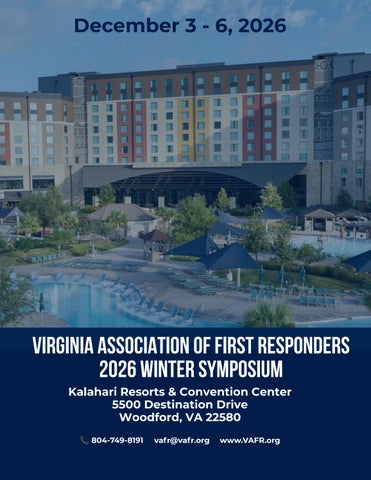
December 3 - 6, 2026
VIrGINIA ASSOCIATION OF FIRST RESPONDERS 2026 WINTER SYMPOSIUM Kalahari Resorts & Convention Center 5500 Destination Drive Woodford, VA 22580
ð 804-749-8191 vafr@vafr.org www.VAFR.org
Dear Symposium Attendee: I would like to welcome you to the first annual Virginia Association of First Responders Winter Symposium, December 3–6, 2026! This is a special first for all of us. We are gathering at Kalahari Resorts & Conventions in Spotsylvania County just weeks after they open their doors in Virginia. A brand-new setting for a brand-new VAFR tradition seems like a fitting way to close the year—and an exciting place to begin what we hope will become an annual gathering of first responders, colleagues, and families. Over these four days, you will have opportunities to sharpen your skills, learn from experienced instructors, and connect with people who understand the work we do. Our program spans practical training and challenging conversations, from pediatric care and trauma to incident command, wellness, and supporting families in crisis. I hope each of you leave with something you can put to use the next time your community calls. I also hope you make time to enjoy being together. As first responders we spend much of the year showing up for others. This weekend is a chance to reconnect with old friends, meet new ones, and share some well-earned time with family. Our thanks go to the instructors who are sharing their knowledge, the volunteers and staff who brought this event together, and our sponsors—especially Virginia Credit Union—for helping make this first Winter Symposium possible. Thank you for being part of the beginning. Enjoy the training, enjoy Kalahari, and help us make this a weekend we will remember long after we head home. Respectfully,
Kevin Dillard, Chair - Winter First Responser Symposium
Special Thanks to our Symposium Committee: Kevin Dillar, Chair Wesley Melson Lara Traylor Tanya Ison Veronica Reddinger
MADE POSSIBLE BY 2026 VAFR WINTER SYMPOSIUM PRESENTING SPONSOR
HOSPITALITY SPONSORS
CLASSROOM SPONSORS
CURRICULUM SPONSORS
THANK YOU FOR STANDING WITH VIRGINIA’S FIRST RESPONDERS. Your partnership helps make education, connection, and professional development possible across Virginia.
VAFR WINTER SYMPOSIUM
TRAIN. CONNECT. LEAD. PRESENTED WITH THE SUPPORT OF VIRGINIA CREDIT UNION
DECEMBER
3-6
Scan the QR code for hotel booking information.
KALAHARI RESORT Spotsylvania, Virginia
Get ready to splash, laugh, and celebrate under the sun! Join us this December for a 4-day Virginia First Responder Winter Symposium at the brand-new Kalahari Resorts & Convention Center in Spotsylvania. Training, networking, family fun, and unforgettable memories! Training schedule and registration coming in early September.
MAKE THIS YOUR WINTER TRAINING DESTINATION. DETAILS & REGISTRATION HTTPS://WWW.VAFR.ORG/WINTER-SYMPOSIUM/
GET TO KNOW THE RESORT
KALAHARI VIRGINIA
The 2026 VAFR Winter Symposium is headed to Virginia’s brand-new Kalahari Resorts & Conventions in Spotsylvania.
OPENING NOV. 12, 2026 Just weeks before our Symposium
MAKE A WEEKEND OF IT.
Special VAFR room reservations are open now. Training schedule and Symposium registration are coming soon.
VAFR.ORG/WINTER-SYMPOSIUM
www.kalahariresorts.com
PRESENTED WITH THE SUPPORT OF VIRGINIA CREDIT UNION
STAY WHERE IT ALL
HAPPENS Comfortable rooms. Easy access. Everything you need, steps away.
RESERVE TODAY! RESERVE YOUR ROOM your booking link here
ROOM RATE
$179 nightly
ROOMS AVAILABLE
12/02/26 12/06/26
LOCATION & DETAILS Kalahari Resorts 5500 Destination Drive Woodford, VA 22580 Complimentary parking On-site dining Additional guest services
TWO SCHOLARSHIPS ONE PURPOSE Supporting VAFR members as they train, connect, and lead. Applications due November 1, 2026 Applications are available at www.vafr.org/winter-symposium/. Completed applications should be submitted by email to vafr@vafr.org.
01
James P. “Mac” McGuire Memorial Youth Scholarship
$2,000 MAXIMUM
For deserving VAFR members age 22 and younger. Provides up to $2,000 toward attendance at the VAFR Winter Symposium or other VAFR training.
02
Teresa Thisted Memorial Scholarship
$2,000 MAXIMUM
For deserving VAFR members age 23 and older. Provides up to $2,000 toward attendance at the VAFR Winter Symposium or other VAFR training. SPONSORED BY: FOREST VIEW VOLUNTEER RESCUE SQUAD In Memory Of: James P. “Mac” McGuire Teresa Thisted
EL IGIBL E EX PENSES Eligible expenses include lodging, and registration fees. Recipients must submit receipts in accordance with current VAFR policies. To apply, visit www.vafr.org/winter-symposium/
Thursday, December 3 Time
Course
Track
8:00 AM - 5:00 PM
CPR Instructor
EMS
8:00 AM - 4:00 PM
First 30 Minutes: Incident Command / Unified Command
EMS
8:00 AM - 12:00 PM
From Scene to Specialty Care: Recognition and Management of Pediatric Stroke, Trauma, and Other Surgical Emergencies Through Definitive Care
EMS
8:00 AM - 10:00 AM
How Chesapeake Fire Department Rebuilt Pediatric Dosing at the Point of Care
EMS
8:00 AM - 12:00 PM
Pediatric Emergency Care Coordinator Workshop
EMS
10:30 AM - 12:00 PM
Cancer Prevention Strategies for EMS and Fire Personnel: Reducing Exposure, Improving Wellness, and Strengthening Volunteer Readiness
Fire/EMS
1:00 PM - 2:30 PM
EMS Documentation: Writing Patient Care Reports That Stand Up in Court
EMS
1:00 PM - 5:00 PM
Pediatric Triage
EMS
1:00 PM - 2:30 PM
SAND: Caring for Our Special Kids
EMS
3:00 PM - 5:00 PM
EMT-A Legal Review & Mock Trial
EMS
3:00 PM - 5:00 PM
Pediatric Fear Factor
EMS
Time
Course
Track
8:00 AM - 5:00 PM
Advanced Burn Life Support (ABLS)
EMS
8:00 AM - 5:00 PM
BLS Provider - CPR
General
8:00 AM - 10:00 AM
Little People, Big Medicine: High Tech Kids for EMS
EMS
8:00 AM - continues Saturday
NAEMT Prehospital Trauma Life Support (PHTLS)
EMS
8:00 AM - 5:00 PM
Public Safety Chaplaincy: Resilience, Crisis & Family Support
Chaplaincy
10:00 AM - 12:00 PM
Little Lives, Big Responsibilities: Child Restraint in Emergency Vehicles
EMS
Time
Course
Track
Continues - 5:00 PM
NAEMT Prehospital Trauma Life Support (PHTLS)
EMS
8:00 AM - 5:00 PM
Drone Responder – Basic
EMS
8:00 AM - 5:00 PM
Tactical Emergency Casualty Care (TECC) Provider Course for Law Enforcement
Law Enforcement
8:00 AM - 5:00 PM
Youth Rescue Camp
Youth
Time
Course
Track
8:00 AM - 5:00 PM
Break Bad News
General
8:00 AM - 5:00 PM
NAEMT Geriatric Education for Emergency Medical Services (GEMS).
EMS
8:00 AM - 3:00 PM
Newborn Resuscitation Course (NRC)
EMS
8:00 AM - 5:00 PM
Tactical Emergency Casualty Care (TECC) Provider Course for Fire/EMS
EMS
Friday, December 4
Saturday, December 5
Sunday, December 6
Course Descriptions by Date Thursday, December 3, 2026 CPR Instructor 8:00 AM - 5:00 PM • EMS • Capacity: 16
Instructors: Ken Williams, Garrett Lewis The American Heart Association (AHA) CPR Instructor Course prepares qualified healthcare professionals to teach AHA CPR and Basic Life Support courses. Participants learn effective instructional techniques, course administration, skills evaluation, and how to deliver AHA curriculum in accordance with current guidelines and standards.
First 30 Minutes: Incident Command / Unified Command 8:00 AM - 4:00 PM • EMS • Capacity: 50
Instructors: John Delaney, Joel Sauer, Edward Jappell The First 30 Minutes: Incident Command / Unified Command training is a multi-disciplinary training program focused on providing command-level skills to frontline law enforcement, Fire/EMS, and emergency communications supervisors, as well as personnel who may act in those positions during an Active Violence Incident (AVI). The training leverages high-threat events to demonstrate best-practice approaches for coordinated operations among the response disciplines, focusing specifically on the first 30 minutes of an event. This training may be used by local jurisdictions as a prerequisite for more advanced command competency training. Target Audience: Frontline law enforcement, Fire/EMS, and emergency communications supervisors, as well as personnel who may serve in those roles during an Active Violence Incident.
From Scene to Specialty Care: Recognition and Management of Pediatric Stroke, Trauma, and Other Surgical Emergencies Through Definitive Care 8:00 AM - 12:00 PM • EMS • Capacity: 50
Instructors: Ewa Way, Stacie Stevens, Lauren Cobert, Tina Kirshenbaum, Nicole Laurin This session focuses on the recognition, assessment, and management of pediatric stroke, trauma, and other time-sensitive surgical emergencies. Participants will explore key considerations from initial prehospital care through transport, hospital evaluation, and definitive specialty treatment.
How Chesapeake Fire Department Rebuilt Pediatric Dosing at the Point of Care 8:00 AM - 10:00 AM • EMS • Capacity: 50
Instructor: Bryan Soriano Over the past twenty years, Chesapeake Fire Department's approach to pediatric emergencies has shifted fundamentally — from a "load and go" model, where critically ill or injured children were rapidly transported with minimal on-scene intervention, to a "stay and play" model that emphasizes delivering definitive care at the point of first contact. This session traces that evolution using our own department's on-scene time data, comparing historical benchmarks to current performance, to show how field-based, definitive pediatric care has changed both practice and outcomes over two decades. Central to that shift has been our adoption of the Handtevy App. I'll walk through real examples of how it supports providers with rapid weight estimation, medication dosing, and treatment guidance at the bedside, and share how it has measurably improved provider confidence and decision-making speed — allowing crews to deliver higher-quality pediatric care on scene, without waiting for the emergency department. The session will close with a hands-on component, giving participants the chance to practice live weight estimation and dosing workflows themselves.
Pediatric Emergency Care Coordinator Workshop 8:00 AM - 12:00 PM • EMS • Capacity: 50
Instructor: Michael Garnett The Pediatric Emergency Care Coordinator (PECC) Workshop, presented in collaboration with the Virginia Office of EMS EMS for Children (EMSC) Program, prepares EMS providers to serve as pediatric champions within their agencies. Participants will learn the role of the PECC and how to strengthen pediatric readiness through training, policies, equipment planning, quality improvement, and the development of a comprehensive pediatric care program.
Cancer Prevention Strategies for EMS and Fire Personnel: Reducing Exposure, Improving Wellness, and Strengthening Volunteer Readiness 10:30 AM - 12:00 PM • Fire • Capacity: 50
Instructor: Jamie Little Cancer is one of the most significant occupational risks facing both fire and EMS personnel, and EMS responders experience unique and often overlooked exposure pathways. This session provides a practical, operations-focused approach to reducing risk for volunteer and career responders. Participants will learn effective on-scene and post-incident decontamination practices, turnout gear and uniform cleaning strategies, and station hygiene methods that limit cross-contamination. Special emphasis is placed on EMS-specific exposures such as contaminated patient environments, diesel exhaust during staging, cot and equipment surfaces, and uniform contamination that travels into stations and personal vehicles. The session also addresses the increased exposure burden and outlines actions volunteers can take to protect themselves and their departments. The program concludes with nutrition, exercise, and sleep strategies that support cancer prevention for shift workers and responders with irregular schedules. Attendees will leave with simple, repeatable habits that reduce cumulative risk. Objectives: Identify exposure pathways common to EMS and fire operations; apply effective on-scene and post-incident decontamination practices; improve gear cleaning and station hygiene routines; understand how volunteer staffing shortages increase exposure burden; incorporate diet, exercise, and sleep strategies that support cancer prevention; implement simple, repeatable habits that reduce cumulative risk.
EMS Documentation: Writing Patient Care Reports That Stand Up in Court 1:00 PM - 2:30 PM • EMS • Capacity: 50
Instructor: Jonathan Lopez Patient Care Reports (PCRs) are among the most important legal documents an EMS provider will ever complete. Every narrative has the potential to be reviewed by medical directors, state investigators, insurance companies, attorneys, judges, and juries. This interactive course teaches providers how to create clear, objective, and legally defensible documentation that accurately reflects patient care while reducing legal exposure. Participants will learn how documentation is analyzed during litigation, common mistakes that weaken credibility, and best practices for writing narratives that withstand courtroom scrutiny. Through real PCR examples and guided writing exercises, attendees will identify documentation deficiencies and practice drafting accurate, complete, and defensible patient care narratives.
Pediatric Triage 1:00 PM - 5:00 PM • General • Capacity: 50
Instructor: Michael Garnett
This course provides responders with a practical approach to rapidly assessing and prioritizing pediatric patients during mass-casualty incidents. Participants will review age-appropriate assessment considerations, recognize critical findings, and apply pediatric triage principles to make timely treatment and transport decisions.
SAND: Caring for Our Special Kids 1:00 PM - 2:30 PM • EMS • Capacity: 50
Instructor: Garrett Shields It's no secret that most EMS providers feel uneasy handling pediatric calls. When a child with communication issues who is sick or injured is added, it creates a recipe for stressed-out providers and crews. To make it even more challenging, the National EMS Education Standards allocate only a small percentage of requirements for pediatric patients and those with special needs. This session will explore the needs of the pediatric population with special requirements, including Autism, non-verbal, and Deaf patients, and how to better assess and care for them. The session will conclude with basic sign language instruction to help attendees communicate more effectively with deaf and non-verbal patients. Learning Objectives: Identify characteristics indicative of special needs or disabilities and communication issues in children; use different assessments and treatment strategies for pediatric patients with special needs; improve communication skills with deaf and non-verbal patients by learning basic sign language phrases.
EMT-A Legal Review & Mock Trial 3:00 PM - 5:00 PM • EMS • Capacity: 50
Instructor: Jonathan Lopez This interactive legal review is designed specifically for EMTs and examines the legal responsibilities that accompany patient care. Participants will review standards of care, scope of practice, negligence, civil liability, documentation, and courtroom testimony while learning how routine clinical decisions are evaluated during litigation. The course culminates in a live mock trial based on an EMS patient encounter. Participants will observe how a Patient Care Report becomes evidence, how EMS providers are questioned under direct and cross-examination, and how documentation can either strengthen or undermine a provider's credibility. The mock trial demonstrates how accurate assessments, clinical decision-making, and well-written narratives can be the deciding factors in the outcome of a case.
Pediatric Fear Factor 3:00 PM - 5:00 PM • EMS • Capacity: 50
Instructor: Garrett Shields As EMS providers, we are trained to handle the most critical emergencies, from chest pain to cardiac arrest. However, nothing induces more fear and anxiety than a pediatric call. This session covers how to approach pediatric calls in the same way we respond to adult calls, helping providers get into the right mindset when dealing with children and shifting how we think. Common fears, myths, and misconceptions about pediatric care in EMS will be discussed so that fear won't be a factor. Learning Objectives: Plan a pre-arrival discussion for every pediatric response; differentiate between ideal weight and actual weight and when to use each for dosing or equipment; manage a pediatric cardiac arrest using the pit crew method.
Friday, December 4, 2026 Advanced Burn Life Support (ABLS) 8:00 AM - 5:00 PM • EMS
Instructor: Liz Bowers ABLS is designed to prepare First Responders to care for acute burn patients within the first 24 hours post-injury. Topics include inhalation injury, staging burn wounds, calculating TBSA, burn shock and resuscitation, pediatrics, electrical injuries and chemical burns.
BLS Provider - CPR 8:00 AM - 5:00 PM • General • Capacity: 16
Instructors: Ken Williams, Garrett Lewis The American Heart Association (AHA) Basic Life Support (BLS) course prepares healthcare professionals to recognize and respond to cardiac arrest and other life-threatening emergencies. Participants learn high-quality CPR for adults, children, and infants, use of an AED, relief of choking, and effective team-based resuscitation.
Little People, Big Medicine: High Tech Kids for EMS 8:00 AM - 10:00 AM • EMS • Capacity: 50
Instructor: Jennifer Farmer Pediatric calls can be stressful! What happens when the patient also has a tracheostomy, g-tube, home vent, and a VP shunt? More and more medically complex children are being cared for at home and could be your next patient. Come learn more about prehospital care of the medically complex pediatric patient, transport considerations, and put your hands on actual equipment you may see in a patient's home.
NAEMT Prehospital Trauma Life Support (PHTLS) Friday 8:00 AM - Saturday 5:00 PM • EMS • Capacity: 24
Instructors: Amy Cantwell, Travis Karicofe, Eric Haas, Lance Lopez NAEMT Prehospital Trauma Life Support (PHTLS) provides prehospital healthcare professionals with the knowledge and skills needed to rapidly assess and manage trauma patients. The course emphasizes critical thinking, recognition and treatment of lifethreatening injuries, and evidence-based trauma care through classroom instruction, hands-on skills, and realistic patient scenarios.
Public Safety Chaplaincy: Resilience, Crisis & Family Support 8:00 AM - 5:00 PM • Chaplaincy • Capacity: 40
Instructors: Robin BeMiller, Christopher Jett This course prepares chaplains, peer supporters, and public safety professionals to provide compassionate, culturally informed support to first responders and their families. Topics include public safety culture and resiliency, psychological first aid, peer and family support, occupational trauma, pregnancy and infant loss, death notifications across different age groups, and supporting individuals with dementia or neurodiversity, with an emphasis on practical communication, trauma-informed care, family resilience, and connecting individuals with appropriate resources.
Little Lives, Big Responsibilities: Child Restraint in Emergency Vehicles 10:00 AM - 12:00 PM • EMS • Capacity: 50
Instructor: Jennifer Farmer Did you know 4 out of 5 car seats are installed incorrectly? Motor vehicle injuries are one of the leading causes of death in children and ambulances are no exception. Come learn the basics of car seats, tips to help educate families, and appropriate restraint guidelines for emergency vehicles to ensure safe transport of your smallest patients. Learning Objectives: Verbalize a basic knowledge of car seats and Virginia's car seat law; describe the distinct features of an ambulance that place children, families, and providers at risk and identify best seating locations; identify various car seat devices available for use in an ambulance and practice installation of these devices on a stretcher.
Saturday, December 5, 2026 Drone Responder – Basic 8:00 AM - 5:00 PM • EMS • Capacity: 12
Instructor: Tarry Pribble Drone Responder – Basic is an 8-hour class designed to introduce First Responders to the world of unmanned aerial vehicles (UAVs) and their integration into the first responder universe. The class covers UAV basics, FAA interactions, Part 107 fundamentals, aerodynamics, flight principles, drone team composition and environment, and hands-on flight skills. The intent of this course is to ultimately produce pilots who can competently use drones in the capacity of a First Responder. Emphasis is placed on the pilot ultimately performing Search and Rescue, and mapping during critical operations. This class is suitable for beginner pilots. Eligibility: No prerequisite; 18 years old; all other VAFR eligibility requirements apply.
Tactical Emergency Casualty Care (TECC) Provider Course for Law Enforcement 8:00 AM - 5:00 PM • Law Enforcement • Capacity: 25
Instructor: Geoff Shapiro Tactical Emergency Casualty Care (TECC) provides best-practice, evidence-based medical guidelines for the provision of care during high-threat incidents. This course prepares law enforcement personnel to recognize how medical priorities and interventions differ during high-threat situations involving casualties and reinforces basic life-saving TECC skills that may be applied in officer-down self-help and buddy-aid situations, as well as when providing point-of-wounding care to others. The course is organized around the three phases of TECC care: Direct Threat Care, Indirect Threat Care, and Evacuation Care. Participants learn which interventions are appropriate during each phase and practice critical skills including casualty movement, tourniquet application, pressure bandaging and wound packing, management of chest injuries, and integration of these skills during practical scenarios. Target Audience: Law enforcement personnel, including officers, deputies, investigators, detectives, troopers, and agents.
Youth Rescue Camp 8:00 AM - 5:00 PM • Youth • Capacity: 50
Instructors: Caleb Mason, Wesley Melson, Veronica Reddinger Youth Rescue Camp provides youth ages 8–16 with an exciting, hands-on introduction to fire, EMS, and rescue operations. Through ageappropriate activities and demonstrations, participants will explore emergency services, learn basic lifesaving and safety skills, and experience the teamwork, leadership, and dedication involved in serving their community.
Sunday, December 6, 2026 Breaking Bad News 8:00 AM - 5:00 PM • General
Instructors: Ken Williams, Adam Alford, Garrett Lewis, Susan Haynes NAEMT Breaking Bad News prepares EMS professionals to communicate difficult or life-changing information to patients and families with compassion, clarity, and professionalism. The course provides practical strategies for navigating emotionally challenging conversations while supporting patients, families, and providers during critical moments.
NAEMT Geriatric Education for Emergency Medical Services (GEMS). 8:00 AM - 5:00 PM • EMS • Capacity: 24
Instructors: Amy Cantwell, Travis Karicofe NAEMT Geriatric Education for EMS (GEMS) provides EMS professionals with the knowledge and skills needed to effectively assess and manage older adults in the prehospital setting. The course addresses age-related changes, common medical and traumatic emergencies, medication considerations, communication challenges, and strategies for providing safe, compassionate, patient-centered care.
Newborn Resuscitation Course (NRC) 8:00 AM - 3:00 PM • EMS • Capacity: 24
Instructor: Dusty Lynn Though some studies suggest that 3%–8% of newborns receive respiratory support during the first few minutes of life, only 0.1%– 0.3% will require advanced cardiopulmonary interventions at birth. The NRC is an in-person class on newborn resuscitation taught by experienced health care providers who have had both newborn resuscitation and EMS experience, and is totally focused on newborn resuscitations that may occur outside of the hospital setting. The course will also offer some hands on practice of special field delivery considerations.
Tactical Emergency Casualty Care (TECC) Provider Course for Fire/EMS 8:00 AM - 5:00 PM • EMS • Capacity: 25
Instructor: Geoff Shapiro This course examines and addresses the unique and challenging requirements of administering point-of-wounding medical care by Fire/Rescue/EMS personnel to patients during a high-threat incident. Fire/Rescue/EMS providers will learn to distinguish between life-saving and secondary interventions and determine when they should be applied based on the prevailing threat to responders and patients, consistent with current TECC guidelines. The course is organized around the three phases of TECC care: Direct Threat Care, Indirect Threat Care, and Evacuation Care. Participants learn which interventions are appropriate during each phase and practice critical skills including casualty movement, tourniquet application, pressure bandaging and wound packing, management of chest injuries, and integration of these skills during practical scenarios. Target Audience: Fire/EMS personnel, including BLS and ALS providers.
Bonus Key Note Evening Sessions Building the Next-Generation Volunteer EMS Agency: Leadership Lessons Learned and a Toolkit for Implementation Friday, December 4th - 7:00 PM – 8:30 PM • EMS • Capacity: 50
Instructor: Jacob Parcell, Fredericksburg Rescue Squad This session explores practical strategies for building a strong, sustainable volunteer EMS agency in today’s changing environment. Drawing on real-world leadership lessons, participants will examine approaches to recruitment and retention, member engagement, organizational culture, training, accountability, succession planning, and developing future leaders. Attendees will leave with practical tools and actionable ideas they can adapt and implement within their own agencies to strengthen operations, support their members, and prepare their organization for the future.
Scholarship Success: Applications & Essays Saturday, December 5th - 7:00 PM – 8:30 PM • EMS • Capacity: 50
Instructor: Veronica Reddinger Learn how to create a scholarship application that stands out. This session walks participants through the application process, from understanding requirements and organizing information to writing a clear, compelling essay. Attendees will learn practical tips for highlighting their experiences, accomplishments, goals, and personal story while avoiding common mistakes that can weaken an application.
Behind the Scenes: Emergency Response at Kalahari Thursday, December 3rd - 7:00 PM – 8:30 PM • EMS • Capacity: 20
Instructor: Kalahari Resort Staff Go behind the scenes at Kalahari Resorts & Conventions for a unique look at emergency response in a large water park and resort environment. Designed specifically for VAFR members, this guided experience will explore how Kalahari staff prepare for, coordinate, and respond to incidents throughout the water park and resort. Participants will gain insight into operational challenges, response considerations, communication, access, and working with public safety partners in a complex, highoccupancy facility.
Instructor Directory Instructor information is drawn from the symposium speaker roster. Bios have been lightly formatted for catalog readability.
Adam Alford Interim Director • VCU - Center for Trauma and Critical Care Education
Jonathan "Adam" Alford has 30 years of continued EMS certification in Virginia. His many roles include rural volunteer EMS, critical care interfacility transport, high-volume urban EMS, and in-hospital.
Robin BeMiller Chaplain • Stafford County Fire and Rescue
Robin BeMiller serves as a Chaplain for First Responders in Stafford County, Virginia, offering spiritual care, resilience support, and trauma-informed guidance to law enforcement, fire, and emergency service professionals. Robin also serves as a member of the Stafford County Fire/Rescue Peer Support Team.
Liz Bowers Registered Nurse • VCU/Evans-Haynes Burn Center
Liz hails from California where she worked as an EMT and Paramedic before transitioning to nursing. She brings bedside burn nursing and home hospice nursing experience.
Amy Cantwell Trauma Education & Outreach Specialist • Mary Washington Healthcare
Amy Cantwell is a 35-year veteran of the EMS Community. She graduated from the University of Mary Washington with a BS in Biology, originally planning to then apply to Medical School; however, after obtaining her EMT Certification and volunteering at the local Rescue Squad throughout her college years, Amy pivoted to a career in EMS and has never regretted that decision!
Lauren Cobert Nurse Practitioner • Children's Hospital of Richmond at VCU
Lauren Cobert, MSN, BS, CPNP-AC, Children's Trauma/Surgery Lead Nurse Practitioner, Children's Hospital of Richmond at VCU
John Delaney Preparedness Education and Training Manager • Northern Virginia Emergency Response Systems
John Delaney is the Preparedness Education and Training Manager for the Northern Virginia Emergency Response System (NVERS). He has thirty-three years in the fire service, including assignments to hazardous materials and technical rescue teams.
Jennifer Farmer Registered Nurse/Paramedic • Virginia Commonwealth University (VCU)
Jennifer Farmer is a dedicated pediatric healthcare leader, registered nurse, paramedic, and advocate for children with more than 23 years of nursing experience and 12 years of service in Emergency Medical Services (EMS). She currently serves as the Director of Nursing for the Pediatric Long-Term Care Unit at Children's Hospital of Richmond, where she leads efforts to provide high-quality, compassionate care for children with complex medical needs.
Michael Garnett Deputy Chief • Pulaski County Emergency Services
Michael Garnett is a regionally recognized EMS leader, paramedic, and educator with more than 30 years of experience in emergency medical services and EMS education. He currently serves as Assistant Chief of EMS and EMS Training Director for Pulaski County Public Safety, where he also functions as the agency’s Rescue Task Force (RTF) Coordinator and Prehospital Pediatric Emergency Care Coordinator (PECC).
Edward Jappell Lieutenant • Loudoun County Sheriff's Office
Lieutenant Edward Jappell began his career with the Loudoun County Sheriff’s Office in 2006, spending much of his early tenure as a night-shift patrol deputy responding to a wide range of calls for service. In two decades of service, he advanced through the ranks from patrol deputy to sergeant and now serves as a lieutenant in the Criminal Investigations Division (CID).
Christopher Jett Battalion Chief • Stafford County Fire and Rescue
Christopher is a 36-year student of the fire and EMS service who recently retired as a Battalion Chief with the Stafford County Fire and Rescue Department. During his time, he served in Operations, Logistics and Training as well as leading the UAS and Peer Support Teams.
Travis Karicofe EMS Officer/Paramedic • Augusta County Fire and EMS
Travis Karicofe is a public safety professional with more than 30 years of experience spanning fire, EMS, critical care transport, emergency management, and law enforcement. He holds the prestigious Chief Fire Officer (CFO) and Chief EMS Officer (CEMSO) designations through the Center for Public Safety Excellence (CPSE) and is a graduate of the National Fire Academy’s Executive Fire Officer Program.
Tina Kirshenbaum Registered Nurse • Children's Hospital of Richmond at VCU
Tina Kirshenbaum, MS, RN, CPN, Children's Surgery Program Manager, Children's Hospital of Richmond at VCU
Nicole Laurin Registered Nurse • Children's Hospital of Richmond at VCU
Nicole Laurin, MS, RN, CPEN, Children's Trauma Program Manager, Children's Hospital of Richmond at VCU
Garrett Lewis AHA Training Center Faculty • VCU - Center for Trauma and Critical Care Education
Garret is an experienced healthcare educator, instructor, and clinical preceptor specializing in emergency medicine, resuscitation, and military trauma training. He is a part of the faculty team with the Center for Trauma and Critical Care Education (CTCCE) within the Department of Surgery at Virginia Commonwealth University (VCU) in Richmond, Virginia
Jamie Little Protect Manager • MEIKO
Biography forthcoming.
Jonathan Lopez Esquire • EMS
Jonathan Lopez is the founder of Lopez Legal Services and serves as the Supervisor for MB Solutions in Virginia Beach. He is a graduate of Regent University School of Law.
Dusty Lynn Registered Nurse • University of Virginia Hospital
Dusty Lynn is a highly respected nurse, paramedic, and pediatric educator with more than four decades of experience caring for critically ill and injured children. Known for her warm, approachable teaching style and clinical expertise, she delivers engaging, practical education that inspires excellence in pediatric and neonatal care.
Caleb Mason Training Captain • Mattaponi Volunteer Rescue Squad
Caleb Mason is an EMT and Training Captain with Mattaponi Rescue Squad. He serves as a Virginia Education Coordinator and CPR Instructor, with a focus on preparing EMS providers through practical, hands-on education.
Wesley Melson Communications Officer • Virginia Association of First Responders
Wesley Melson is a nationally registered paramedic and experienced public safety educator with more than 25 years of service in EMS, fire, emergency communications, and leadership. He is a Virginia Education Coordinator and currently serves as Training Coordinator for the Fredericksburg Rescue Squad.
Tarry Pribble Virginia Association of First Responders
Tarry Pribble began service in the volunteer fire service in 1980, and in volunteer EMS in 1981. He has served as an instructor for VAFR for over 30 years in various courses.
Veronica Reddinger High School English Teacher • Colonial Beach Public Schools
Veronica Reddinger is a dedicated educator with 28 years of experience teaching English with Colonial Beach Public Schools. She earned her bachelor’s degree in Education from Geneva College and has spent her career helping students strengthen their communication, writing, and critical-thinking skills.
Joel Sauer Captain • Loudoun County Fire and Rescue
Joel Sauer is a Captain and Paramedic with Loudoun County Fire and Rescue. He holds his Nationally Registered Paramedic Certification (NRP) and is a Certified Flight Paramedic (FP-C) and Certified Tactical Paramedic (TP-C) through the International Board of Specialty Certifications.
Geoff Shapiro Operational Medicine Training Director • George Washington University School of Medicine
Geoff Shapiro is the EMS & Operational Medicine Training Director for the George Washington University School of Medicine and Health Sciences Emergency Health Services Program, as well as a co-founder and Co-Chair of the Committee for Tactical Emergency Casualty Care. He has been involved in EMS since 1990, and for more than 20 years has been a program manager and lead emergency medicine instructor at a premier federal law enforcement agency training center located in the U.S.
Garrett Shields Firefighter/Paramedic • Fairfax County Fire and Rescue
EMS Technician Garret Shields, Firefighter/NRP/FP-C/VA-EC, Handtevy Program Manager, Fairfax County Fire & Rescue Department, Fire Station 419-A Shift
Bryan Soriano Paramedic • Chesapeake Fire Department
Lieutenant Bryan Soriano is a Field Medical Officer with the Chesapeake Fire Department (CFD), where he has served since 2001. He is CFD's first Pediatric Emergency Care Coordinator (PECC), a role he has held since December 2020, and also serves as the department's Infection Control Officer, providing clinical oversight for roughly 550 ALS and BLS providers.
Stacie Stevens Registered Nurse • VCU Health
Stacie Stevens, PhD, FNP, RN, Stroke Program Director, VCU Health
Ewa Way Medical Doctor • Children's Hospital of Richmond at VCU
Ewa M Way, MD, Assistant Clinical Professor, Program Director of Child Neurology, Children’s Hospital of Richmond at VCU
Ken Williams Program Director • VCU - Center for Trauma and Critical Care Education
Ken has been the VCU Health Paramedic Program Director since 2009. Ken has successfully implemented training programs at satellite sites around Virginia and has created and taught EMS curriculum Internationally.
Jacob Parcell Chief • Fredericksburg Rescue Squad
Eric Haas Captain • Fredericksburg Rescue Squad/F.B.I.
Eric Haas began his EMS career in the early 2000s, working in both volunteer and career departments around Fredericksburg. He now teaches full-time for the FBI’s School of Operational Medicine, training medical providers globally. Eric also returned to his roots and is the operations captain for Fredericksburg Rescue Squad, where he loves to mentor the next generation of local providers.
Lance Lopez Paramedic/Education Coordinator • Fredericksburg Rescue Squad/Rocky Mountain Resuscitation
Lance Lopez is a Nationally Registered Paramedic, Virginia EMS Education Coordinator, and retired U.S. Navy Hospital Corpsman with more than 20 years of experience in military medicine, EMS, tactical medicine, and healthcare education. During his Navy career, he spent 12 years supporting Marine Corps infantry units and deployed to Iraq and Afghanistan. Lance is a Tactical Paramedic-Certified provider, volunteer paramedic with the Fredericksburg Rescue Squad, and Owner and Director of Training for Rocky Mountain Resuscitation, LLC, where he develops and delivers EMS, public safety, and tactical medicine education.
Susan Haynes, MSW, ME.d VCU Health
Having been employed by the VCU Department of Surgery since 1990, Susan has spent the past 23 years in surgical education. Surgical simulation is her passion and she enjoys implementing new curriculum and hosting simulation activities. She has especially enjoyed partnering with the surgeons and other medical professionals in developing communication skills and training for breaking bad news. As a member of the ACS AEI Consortium, Susan has served on the Patient Education Committee and currently serves on the Administration and Management Committee. When not at work, Susan enjoys serving in ministry at her church and recently completed the Practical Ministry Certificate Program through Malone University Schedule subject to change. Please refer to the official symposium registration and event materials for the most current course availability and room assignments.
Virginia First Responder Winter Symposium www.vafr.org