IN THIS ISSUE 2 GUEST EDITORIAL
9 VAM
Corporatization reshapes autonomy in vascular surgery
SVS recognizes leaders in community vascular practice
6 PAD
Loss of autonomy leaves physicians searching for joy
Frailty raises amputation, mortality risk after revascularization
THE OFFICIAL NEWSPAPER OF SEPTEMBER 2026 Volume 22 Number 7
12 Commentary
www.vascularspecialistonline.com
PAD
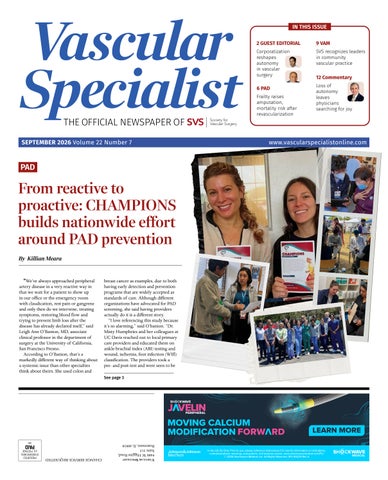
From reactive to proactive: CHAMPIONS builds nationwide effort around PAD prevention By Killian Meara
“We’ve always approached peripheral artery disease in a very reactive way in that we wait for a patient to show up in our office or the emergency room with claudication, rest pain or gangrene and only then do we intervene, treating symptoms, restoring blood flow and trying to prevent limb loss after the disease has already declared itself,” said Leigh Ann O’Banion, MD, associate clinical professor in the department of surgery at the University of California, San Francisco Fresno. According to O’Banion, that’s a markedly different way of thinking about a systemic issue than other specialties think about theirs. She used colon and
breast cancer as examples, due to both having early detection and prevention programs that are widely accepted as standards of care. Although different organizations have advocated for PAD screening, she said having providers actually do it is a different story. “I love referencing this study because it’s so alarming,” said O’banion. “Dr. Misty Humphries and her colleagues at UC Davis reached out to local primary care providers and educated them on ankle-brachial index (ABI) testing and wound, ischemia, foot infection (WIfI) classification. The providers took a pre- and post-test and were seen to be See page 3
MOVING CALCIUM MODIFICATION
LEARN MORE
In the US: Rx Only. Prior to use, please reference Instructions For Use for information on indications, contraindications, warnings, precautions, and adverse events. www.shockwavemedical.com/IFU © 2026 Shockwave Medical, Inc. All Rights Reserved. SPL 83225 Rev A
Vascular Specialist 9400 W. Higgins Road, Suite 315 Rosemont, IL 60018
IM
PAID
CHANGE SERVICE REQUESTED
PRESORTED STANDARD MAIL U.S. POSTAGE
2
Vascular Specialist | September 2 0 2 6
Medical Editor Malachi Sheahan III, MD Associate Medical Editors Bernadette Aulivola, MD | O. William Brown, MD | Elliot L. Chaikof, MD, PhD | Carlo Dall’Olmo, MD | Alan M. Dietzek MD, RPVI, FACS | John F. Eidt, MD | Robert Fitridge, MD | Dennis R. Gable, MD | Linda Harris, MD | Krishna Jain, MD | Larry Kraiss, MD | Joann Lohr, MD | James McKinsey, MD | Joseph Mills, MD | Erica L. Mitchell, MD, MEd, FACS | Leila Mureebe, MD | Frank Pomposelli, MD | David Rigberg, MD | Clifford Sales, MD | Bhagwan Satiani, MD | Larry Scher, MD | Marc Schermerhorn, MD | Murray L. Shames, MD | Niten Singh, MD | Frank J. Veith, MD | Robert Eugene Zierler, MD Resident/Fellow Editor Saranya Sundaram, MD Executive Director SVS Kenneth M. Slaw, PhD Senior Director for Public Affairs and Advocacy Megan Marcinko, MPS Managing Editor Killian Meara kmeara@vascularsociety.org Assistant Editor Maria Gifford Design Madison Spadafino Advertising Nicole Schmitz nschmitz@vascularsociety.org Letters to the editor vascularspecialist@vascularsociety.org
Published by the Society for Vascular Surgery
Vascular Specialist is the official newspaper of the Society for Vascular Surgery and provides the vascular specialist with timely and relevant news and commentary about clinical developments and about the impact of healthcare policy. The ideas and opinions expressed in Vascular Specialist do not necessarily reflect those of the Society. The Society for Vascular Surgery will not assume responsibility for damages, loss, or claims of any kind arising from or related to the information contained in this publication, including any claims related to the products, drugs, or services, or the quality or endorsement of advertised products or services, mentioned herein. | The Society for Vascular Surgery headquarters is located at 9400 W. Higgins Road, Suite 315, Rosemont, IL 60018. | POSTMASTER: Send changes of address (with old mailing label) to Vascular Specialist, Subscription Services, 9400 W. Higgins Road, Suite 315, Rosemont, IL 60018. | RECIPIENT: To change your address, e-mail vascularspecialist@ vascularsociety.org | For missing issue claims, e-mail vascularspecialist@vascularsociety.org | Vascular Specialist (ISSN 1558-0148) is published by the Society for Vascular Surgery. | Printed by Ironmark | ©Copyright 2025 by the Society for Vascular Surgery
Follow Vascular Specialist on socials vascularspecialist vascular-specialist-online vascularonline
GUEST EDITORIAL and teaching; multiple studies have warned of the disappearing Assembly line surgeons: research surgeon-scientist. Vascular surgeons have never worked for free, but they previously defined themselves based on their accomplishments in the OR, the lab and the classroom. Money followed but was not the driving Corporatization of force for most. The organizational prioritization on the bottom line alters professional incentivization and the focus of who we are. medicine and its impact This loss of identity is contributing to burnout. AMA data identified a physician burnout rate of around 42% nationally; a 2018 SVS survey found 41% of vascular surgeons presented with symptoms of burnout on vascular surgery and 8% had considered suicide in the previous 12 months. Study after
By Samuel Money, MD and Justin Barr, MD, PhD
“Why do you want to be a doctor?” That is a question that tortures medical school applicants every year. While responses vary, no one answers, “Because I want to be a cog in a giant health care machine.” And yet, that is exactly what awaits the next generation of physicians and surgeons. This loss of autonomy has fundamentally reshaped medicine generally and vascular surgery specifically. Once our own bosses, we have settled for middle management. Once focused on a combination of patient care, profit, research and education, the current employment structure prioritizes RVU maximization above all else. Older surgeons have lived this transition with chagrin and consternation. Younger surgeons, increasingly raised in the inherent shift work associated with mandatory duty hours, enter this environment perhaps unaware of what they missed but fully realizing the destination differs from their dream. How did we get here and what can we do about it? The corporatization of medicine is well documented. As of 2024, only 35% of physicians owned even a share of their own practice, a fall from over 50% in 2012. Those remaining in private practice are disproportionately older; only 25% of physicians under 40 were practice owners. The percentage of doctors who worked in a practice owned by a hospital, hospital system, or health system climbed from 5.6% in 2012 to over 80% today. Over three-fourths of hospital beds in the country are controlled by large chains or health care systems. Vascular surgeons are hardly immune from this movement. A 2013 study showed that around 24% of vascular surgeons were employed by a hospital. More recent, albeit less robust data, from 2021 suggested that number had increased to over 70% and those remaining in private practice tend to be older, suggesting this trend will only compound in the coming years. Private equity investment often maintains the illusion of physician ownership for legal purposes but usually results in a similar employee model through their management system. This corporatization has taken a significant toll on physicians and vascular surgeons, who have transitioned — willingly or not — from autonomous practitioners to employees. The sociological commoditization of physicians has enormous implications. It fundamentally reshaped the doctor-patient relationship from a sacrosanct bond to a more commercially focused, transactional partnership exacerbated by an increasing shift work model and mindset. The evolving language embodies this devolution, with physicians now “providers” or “practitioners” whilst patients become “health care consumers.” In partially losing their identity as doctors, they transform into revenue generating units for a hospital system. Implanting aortic grafts is vastly more complicated (and remunerative) than implanting brake pads on a Ford assembly line, but the structure and culture around the work increasingly overlap. Watercooler gripes in both workplaces center around PTO, benefits, reimbursements and struggles with upper management. When doctors are judged on transactional performance metrics, it prioritizes the economics over the clinical care. This trend exists not just in private practice. Academic institutions continue to elevate productivity — as defined by RVU generation — over their other core missions of
study show doctors continuing to derive deep meaning in their clinical care but increasingly frustrated with the bureaucracy, paperwork and organizational subservience. Vascular surgeons often jokingly refer to themselves as white-coat plumbers, repairing leaking pipes and opening clogged ones. Yet in a key distinction, a 2024 survey showed over 90% of plumbers were satisfied with their jobs. Vascular surgeons should be so lucky. Market incentives ensure that the corporatization of medicine and of vascular surgery is not reversing anytime in the near future, so what can we do to combat the loss of autonomy? Unionization is one option. Historically utilized by laborers to create a fair negotiating platform, unionization has traditionally been an anathema to professionals such as physicians. But in an era when most physicians owned their own practice, against whom were they negotiating? No need existed. As doctors become one of an organization’s thousands of employees paid a set salary to execute a specific set of responsibilities, then unionization made more sense. Between 2014 and 2019, the proportion of unionized physicians grew 26%. Doctors at Kaiser Health are unionized, as are 400 PCPs at Allina Health in Minneapolis, along with the anesthesiologists at Cedars-Sinai; those at Banner Health in Arizona and other large health care systems are actively exploring this option. Of course, many house staff now also belong to unions. Like it or not, this trend will continue. Unionization as a concept still rankles many clinicians; an alternative might be trade groups, not so different from the medieval surgery guilds whence our profession originated. Guilds engaged multiple skill levels, from the novice through master, according each a commensurate degree of responsibility, both to patients and to the organization itself. Unlike unions, they permit the inclusion of supervisors such as division chiefs as well as private practice surgeons. Focusing on the nuance of the craft and the art of the work itself (e.g. the screen actors guild), guilds could highlight and promote the best of vascular surgery. Assuming a less adversarial posture than unions, said guilds would focus on clinical outcomes and professional satisfaction rather than wages. It seems unlikely any national guild could effectively represent disparate local interests, making a series of local organizations the most realistic option. “The good old days weren’t always good / and tomorrow ain’t as bad as it seems,” croons Billy Joel in one of his ballads. Medicine and vascular surgery have never been perfect. Moreover, much of the future is tremendously exciting: the next generation of doctors are smarter, more diverse and arrive with greater research experience than any who preceded it. Technological innovations, increasingly married to artificial intelligence, will continue to reimagine and reshape our field. Yet some things don’t change, like surgical pathology. A hole in the artery in 2026 differs little from a hole in 1026 from a hole in 3026. And while tomorrow’s doctors may be better equipped than ever to fix that leak, vascular surgeons ought to be more than glorified plumbers, even if that is how corporate medicine currently treats us. SAMUEL MONEY is emeritus professor of surgery at the Mayo Clinic College of Medicine and professor of surgery at Xavier-Ochsner School of Medicine. JUSTIN BARR is a staff surgeon at Ochsner Health in New Orleans, Louisiana.
3
VS www.vascularspecialistonline.com
FROM THE COVER: From reactive to proactive: CHAMPIONS builds nationwide effort around PAD prevention continued from page 1 educatable. The providers were then asked to us when they need us.” if they were going to start screening patients Another key aspect of CHAMPIONS is providing the in their office. They said no, not for lack of next generation of vascular surgeons with hands-on knowledge, but lack of resources and reimbursement.” training in underserved communities, said O’Banion. “If That disconnect between knowledge and implementation we don’t educate them about it while they’re in training, was what led O’Banion to create the Comprehensive then they go out into the community and they just want to Heart and Multidisciplinary Limb Preservation Outreach practice in a big metropolitan city,” she said. “Or they want Network, also known as CHAMPIONS. The initiative to be in some other specialty because they’ve never heard aims to identify PAD risk and disease earlier and connect about vascular surgery.” individuals with education and evidence-based risk-factor CHAMPIONS, at its core, is meant to shift modification to prevent disease progression. “CHAMPIONS, at its core, is meant to shift the the mindset into a proactive way of thinking mindset into a proactive way of thinking about PAD and about PAD and intercept the patient before intercept the patient before advanced disease is present,” said O’Banion, “so that we decrease the number of advanced disease is present.” patients we’re seeing with advanced tissue loss where revascularization is no longer an option.” LEIGH ANN O’BANION, MD CHAMPIONS offers onsite screening, consultation and education at social events in the community, such as fairs, festivals and food drives. During the events, medical Humphries, an associate professor of surgery at University providers, students and volunteers screen participants of California, Davis, said this was critical because most for cardiovascular and vascular risk factors, provide medical students don’t know what vascular surgery is. individualized education and results, connect underserved “There’s a survey that polls what students want to do when patients with primary care and refer patients to specialists. they go into medical school and when they graduate,” she O’Banion said the data gathered from CHAMPIONS so said. “Only 1% of residents who go into vascular surgery far has shown that the incidence of diagnosing PAD at the knew they wanted to go into it when they applied to medical events is around 8%, which is similar with the PAD incidence school. Most didn’t know anything about it. They had no clue across the United States and about 50% of those screened what it was when they applied to medical school.” are qualified as at risk. Recent data from the screenings also Matthew Corriere, MD, professor of surgery at the demonstrated that despite similar guideline-based PAD risk Ohio State University Wexner Medical Center, became classification, females had more than fourfold higher odds of involved with CHAMPIONS because it aligns with his PAD detection compared with males. research of making PAD treatment more patient-centered. Samantha Minc, MD, associate professor of surgery at He said his students are always eager to participate in the Duke University School of Medicine, said that the events screenings so they can have a positive impact on patient have also been great for developing relationships with key care in the community. community partners. “We only have one federally qualified “Everybody wants in on this and it’s easy to make a health center in Durham and these folks are often resource project happen when it’s like that,” said Corriere. “We have strapped,” she said. “We show up and do a screening next several residents and fellows at Ohio State participating to them and offer to do the blood pressure so that the one because they heard about it and want to be involved. doctor that showed up can talk to the patients. It starts to There’s a different kind of energy when community build roads and gives us a face in the community. I think partnering is involved. It gives people a sense of purpose that’s really important to make people comfortable to come and a mission and impact. That’s great because, as vascular
“
surgeons, we often see people with very late stage disease. This puts not only our practice, but our mindset as well, further upstream. The opportunities for prevention and education is a refreshing thing to be able to pull off.” Due to the success of CHAMPIONS, O’Banion partnered with Isabel Bjork, the CEO of the Foundation to Advance Vascular Cures, who she met through doing research on vascular deserts. CHAMPIONS has now been fully incorporated into the foundation, which is giving it the chance to expand into a nationwide effort. “What’s interesting about CHAMPIONS is it’s really gotten people excited about PAD prevention,” said Bjork. “I think part of that is the community-based aspect. Part of it is the sense that we’re getting there early on in the conversation and raising awareness. There’s a sense among the medical students, volunteers and supervising clinicians that we’re able to expand the knowledge base in ways that are going to make a real difference. I’m extremely excited about CHAMPIONS. It’s very big. It’s very ambitious. It’s hard to run but it’s a passion project. I’m so relieved that we’ve found an area of excitement that’s galvanizing people.” CHAMPIONS now has nine sites across the country and to ensure that actionable research comes from the work, the foundation and participating sites gained Institutional Review Board approval. O’Banion said they are currently working on implementing more in diverse areas. She hopes adding more partners to the program allows data collection to ramp up so that they can continue to do important work and understand the patient population better. However, she said institutional funding that recognizes programs like CHAMPIONS will be critical moving forward. “I am looking forward to one day having a map that’s going to tell us exactly where we need to go to focus our efforts,” said O’Banion. “I think CHAMPIONS is going to give us the granular data to really understand who these people are and how we get to them. I envision a day where you can screen a person at a CHAMPIONS event and that data gets put into an electronic health record. The longterm vision is showing government institutions across the United States what a valuable thing a program like CHAMPIONS is so that this care can be afforded to all.”
PAD
Study supports routine vein mapping before CLTI revascularization By Killian Meara Many patients with chronic limb-threatening ischemia (CLTI) have suitable great saphenous vein (GSV) for bypass surgery, according to research published in the Journal of Vascular Surgery. The findings highlight the importance of routine vein mapping before revascularization. The study was designed to address an ongoing question that has emerged following the BEST-CLI trial. While that study demonstrated that patients with adequate single-segment GSV achieved better outcomes with bypass surgery than endovascular intervention, some clinicians have questioned how often suitable vein is still available in contemporary practice. “One of the criticisms of the BEST-CLI trial was that a lot of patients nowadays don’t have good vein,” said Jeffrey Siracuse, MD, senior author on the study. “A lot of people who are endovascular-first for everybody just say the vein isn’t good, so they don’t even check as much anymore before they do an intervention.” To better understand current vein availability, investigators conducted a single-center review of 223 patients with CLTI who underwent vein mapping before either open or endovascular intervention. The team evaluated GSV diameter
using thresholds of at least 2.5 mm and 3 mm throughout the thigh and the entire leg, assessing both ipsilateral and contralateral veins. The study found that adequate vein remained available in a substantial proportion of patients, particularly when evaluating the thigh alone. Siracuse noted that while a fulllength vein is ideal, many bypass procedures do not require the entire GSV because surgeons can use more distal inflow vessels, including the popliteal artery. “Even looking at the thigh alone, you can usually conserve a usable vein,” he said. “The vein quality was better than what a lot of people thought was out there.” Siracuse, professor of surgery and radiology at Boston University’s Chobanian and Avedisian School of Medicine, said the findings should encourage surgeons to perform vein mapping routinely before deciding on a revascularization strategy instead of assuming bypass is not an option. “I think surgeons shouldn’t preemptively assume that a patient lacks adequate GSV,” he said. “Patients should have widespread vein mapping.” He added that vein mapping ideally should be performed before diagnostic angiography. Knowing whether suitable conduit is available beforehand allows surgeons to tailor treatment plans based on both anatomy and conduit availability. In some cases, he said an
angiogram may remain purely diagnostic while plans are made for bypass surgery rather than proceeding directly with an endovascular intervention. “If you know whether they have a vein ahead of time, you can determine whether you’re going to stop with a diagnostic angiogram and proceed with a bypass or do an endovascular intervention at that time,” said Siracuse. Although the study focused on conduit availability, Siracuse said it also raises important questions for future research. One area is understanding how preoperative ultrasound findings correlate with what surgeons ultimately encounter in the operating room, as vein quality can occasionally differ from preoperative imaging. Siracuse also said the long-term implications of the growing use of GSV ablation needs to be better understood. As more patients undergo procedures that eliminate or damage the vein earlier in life, he said surgeons may have fewer autogenous conduit options later. “With widespread vein ablations and destruction of great saphenous veins, we need to understand the long-term impact on patients who may later need that vein in the future for peripheral arterial interventions or coronary bypass grafts,” said Siracuse.
4
Vascular Specialist | September 2 0 2 6
ADVERTORIAL | SPONSORED BY SHOCKWAVE
Moving limb preservation forward with Shockwave Javelin Peripheral Intravascular Lithotripsy By Sung Yup (Pablo) Kim, MD and Akila Pai, MD
C
hronic limb-threatening ischemia (CLTI) represents the most advanced stage of peripheral artery disease (PAD) and carries a significant risk of major amputation if left untreated. Calcified tibial lesions remain among the most technically challenging targets for endovascular intervention, as conventional angioplasty balloons frequently fail to track through or adequately dilate these rigid segments. Intravascular lithotripsy (IVL) has emerged as a safe and effective tool¹,² for modifying vascular calcium and enabling vessel preparation where traditional methods fall short. This case illustrates the role of the ShockwaveTM Javelin Peripheral IVL catheter in achieving limb salvage in a patient with severe tibial calcification and multiple high-risk comorbidities.
Case report
Patient presentation A 77 year-old male presented with newonset right lower extremity rest pain and ischemic ulcers of the right foot (image 1), consistent with CLTI. His medical history was notable for coronary artery disease status post coronary artery bypass grafting, hypertension, hyperlipidemia, non-insulin-dependent diabetes mellitus with poor glycemic control (hemoglobin A1c of 9.6) and bilateral carotid artery stenosis. He had a long-standing history of PAD and had previously undergone a left below-knee amputation, after which he remained ambulatory with a prosthetic limb. On examination, the patient was well-appearing, alert and oriented. Femoral pulses were palpable bilaterally, but pedal pulses in the right lower extremity were absent. Laboratory studies were unremarkable, with a white blood
Image 1. Right foot with ischemic ulcers
cell count of 7.0 and a creatinine of 1.18. Noninvasive vascular studies confirmed severe tibial disease. Diagnostic angiography Diagnostic angiography revealed singlevessel runoff into the foot with an occluded peroneal artery and an incomplete plantar arch from the posterior tibial artery (image 2 & 3). The anterior tibial artery demonstrated severe, heavily calcified disease along its course, representing the primary target for intervention given the limited outflow options. Interventional procedure Arterial access was obtained via a contralateral femoral approach using an up-and-over technique with placement of a destination sheath. The lesion was crossed using a 0.014-inch guidewire supported by a crossing catheter. In the proximal anterior tibial artery, a twoImage 4. Shockwave Javelin in use millimeter plain old balloon angioplasty was performed, with vessel sizing guided by intravascular ultrasound (IVUS). However, in the distal anterior tibial artery, the operator encountered significant difficulty tracking any treatment balloon through the calcified segment. At this point, the Shockwave Javelin catheter was introduced (image 4.) with gentle forward pressure, successfully traversing the lesion and delivering lithotripsy energy to modify the circumferential calcium. Following IVL, post-dilation was completed using a 1.5-millimeter plain old balloon angioplasty catheter. IVUS imaging performed before and after the procedure (image 5. & 6.) confirmed effective calcium modification, with improved luminal gain and vessel compliance in the treated segments.
Image 2 & 3. One vessel run-off into the foot with occluded peroneal and incomplete plantar arch from the PT
5
VS www.vascularspecialistonline.com
ADVERTORIAL | SPONSORED BY SHOCKWAVE
“Utilization of Shockwave Javelin in severely calcified distal tibial artery disease can lead to safe and effective calcium modification which may help avoid the risk of major amputation.”
Image 5. Pre Shockwave Javelin IVUS
Outcome The completion angiogram demonstrated a satisfactory result with restored inline flow to the foot. On follow-up, the patient’s ischemic wounds showed progressive healing, and he remained ambulatory, successfully preserving his right lower extremity and maintaining functional independence. Given that this patient had already undergone a contralateral below-knee amputation, limb salvage of the remaining extremity was of critical importance for his quality of life and mobility.
Discussion This case highlights several important teaching points for the interventional community. First, severely calcified tibial vessels can render conventional balloon angioplasty ineffective due to the inability to track devices through rigid and occlusive arterial segments. Shockwave Javelin delivered on the novel Forward IVL Platform offers a mechanism to modify intimal and medial calcium beyond the catheter tip, thereby improving vessel compliance, enabling further interventional treatment and achieving the goal of revascularization3. Second, IVUS imaging played a dual role
Image 6. Post Shockwave Javelin IVUS
in this case, both for appropriate vessel sizing in the proximal segment and for confirming the effectiveness of calcium modification after lithotripsy. Finally, this case underscores the clinical value of Shockwave Javelin in the tibial territory for patients with CLTI, particularly when the stakes of limb loss are magnified by a contralateral amputation and multiple systemic comorbidities. Utilization of Shockwave Javelin in severely calcified distal tibial artery disease can lead to safe and effective calcium modification which may help avoid the risk of major amputation. Image 7. Completion Angiogram
References: 1.Corl JD, Clair D, Mwipatayi P, et al. FORWARD PAD IDE/Feasibility Studies: PrimaryEndpoint Analysis of a Novel Non-Balloon-Based Peripheral IVL Catheter. JACC: Cardiovascular Interventions. Published online November 4, 2024. doi:10.101jcin.2024.10.035. 2. Corl J. First Clinical Use of a Novel Forward-Shifted Peripheral Intravascular Lithotripsy System: Primary Outcomes of the Forward IDE and Feasability Studies. VIVA. Las Vegas, NV; 2024. 3. Holden A, Sayfo S, Siah M, et al. Device design and applications of the novel JAVELIN peripheral intravascular lithotripsy catheter. JVS-CIT. 2026; 12(4). doi: 10.1016/j.jvscit.2026.102315
Sung Yup Kim is a paid consultant of Shockwave Medical. The views expressed are those of the authors and not necessarily those of Shockwave Medical. Shockwave Javelin Peripheral IVL Catheter Safety Information
In the United States: Rx only. Indications for Use — The Shockwave Medical IVL System with the Javelin Peripheral IVL Catheter is intended for lithotripsy- enabled modification and crossing of calcified lesions in the peripheral vasculature, including the iliac, femoral, ilio-femoral, popliteal, and infra-popliteal arteries, prior to final treatment. Not for use in coronary, carotid, or cerebral vasculature. Additionally, not for use in pulmonary vasculature in the U.S. and New Zealand. Contraindications — Do not use if unable to pass 0.014″ (0.36 mm) guidewire across the treatment site-Not intended for treatment of in-stent restenosis or in coronary, carotid, cerebral or pulmonary arteries. Warnings — Only to be used by physicians who are familiar with interventional vascular procedures—Physicians must be trained prior to use of the device— Use the generator in accordance with recommended settings as stated in the Operator’s Manual. Precautions — Avoid applying acoustic pressure pulses while IVL window is not filled with sterile saline—Appropriate anticoagulant therapy should be administered by the physician— Decision regarding use of distal protection should be made based on physician assessment of treatment lesion morphology. Adverse effects — Possible adverse effects consistent with standard angioplasty include-Access site complications -Allergy to contrast or blood thinner- Arterial bypass surgery—Bleeding complications— Death— Fracture of guidewire or device—Hypertension/Hypotension— Infection/sepsis—Placement of a stent—renal failure— Shock/pulmonary edema—target vessel stenosis or occlusion— Vascular complications. Risks unique to the device and its use— Allergy to catheter material(s)— Device malfunction or failure. Prior to use, please reference the Instructions for Use for more information on indications, contraindications, warnings, precautions and adverse events. www.shockwavemedical.com/IFU © Shockwave Medical, Inc. All Rights Reserved. SPL 83146 Rev. A.
6
Vascular Specialist | September 2 0 2 6
PAD
Poverty plays growing role in major amputation risk By Maria Gifford Major lower extremity amputations were once heavily concentrated in a narrow band of under-resourced, safetynet hospitals. A three-decade national study now shows that burden has spread well beyond those settings and that poverty is a more powerful predictor of limb loss today than it was a generation ago. The findings, published in the Journal of Vascular Surgery, draw on nearly 2.8 million inpatient admissions from the National Inpatient Sample between 1993 and 2021. Researchers identified clear inflection points around 2010 for below-knee amputations (BKA) and 2012 for aboveknee amputations (AKA), after which both incidence and the distribution of risk changed markedly across hospital types and patient income groups. “Our study builds on prior work that was among the first to identify alarming inflections toward increasing amputation incidence,” said lead author Sherene E. Sharath, PhD, MPH, associate professor of surgery at SUNY Downstate Health Sciences University. “The primary objective was to investigate potential drivers of these trends from a social and systems perspective, specifically whether rising amputation incidence was associated with patient-level socioeconomic factors and hospital resources, represented by hospital Medicaid burden.” Across the full study period, 348,036
major amputations were recorded — roughly 57% BKA and 43% AKA. Nearly 79% of all major amputations by 2021 were performed at hospitals with moderate to high Medicaid burden. From a patient socioeconomic standpoint, approximately 42% of both BKA and AKA procedures occurred among patients in the lowest income quartile, with another roughly 26% in the secondlowest quartile. Patients undergoing amputation at higher Medicaid burden hospitals were also notably younger than those treated at lower-burden facilities. The pre- and post-inflection findings told two distinct stories. Before the inflection points, amputation risk increased in a fairly linear fashion as a hospital’s Medicaid proportion rose. After the inflection, that pattern shifted in a way that raised concern about how broadly the burden had spread. “In the pre-inflection periods, risk of amputation increased progressively as the proportion of Medicaid patients at a hospital rose,” said Sharath. “After the inflection, amputation risks started converging, affecting hospitals serving
PAD
Frailty raises amputation, mortality risk after PAD revascularization
By Maria Gifford
Vascular surgeons know that frailty complicates recovery after lower-extremity revascularization. A new study puts precise numbers on exactly how much it costs patients, even after adjusting for age and comorbidities. The findings, published in the Journal of Vascular Surgery, come from a retrospective analysis of 11,436 adults who underwent an index lower extremity revascularization for peripheral artery disease (PAD) between 2016 and 2024 across the University of Pittsburgh Medical Center’s (UPMC) multihospital system. Researchers identified frailty using the Risk Analysis Index adapted to standard diagnosis codes already present in a patient’s chart and 17% of the cohort met the threshold. Patients were then tracked for hospital-free days (HFDs) over the 90 days after surgery — a measure that treats emergency department visits like hospital stays and assigns zero
moderate to high proportions of Medicaid patients, indicating that more resource-constrained hospitals were experiencing disproportionately higher amputation risk. In terms of patient income, the protective effect of higher income widened after the inflection, meaning that economic advantages became even more strongly associated with lower amputation risk over time.” The pattern is consistent for both amputation types and points to something more systemic than a shift in surgical case mix or referral patterns. “Risk that was previously concentrated in a relatively small number of extreme, highly disadvantaged settings has shifted to a broader pattern that spans more hospital systems and communities,” said Sharath. “This diffusion reflects increasing pressure on resource-constrained hospitals and a clearer, more pronounced link between personal economic hardship and limb loss than before.” The racial disparity dimension of the findings also persisted across both time periods. Black patients carried the highest amputation risk both before and after the inflection points for BKA and AKA,
additional days to any patient who died during that window. “After multivariable adjustment, in the 90 days following revascularization, frail patients had fewer HFDs than those without frailty,” said lead author Stuthi Iyer, MPH. Katherine Reitz, MD, senior author of the study, said the finding reflects a basic reality of caring for older patients with PAD. “When frail patients undergo PAD revascularization, their physiologic reserve to rebound after surgery is low,” she said. “HFDs equate to a patient’s time alive and out of the hospital, which is something easy for both patients and providers to understand and prioritize.” Frail patients in the cohort were significantly older (76 years versus 67 years) and more likely to have diabetes, coronary artery disease and chronic lung disease. Their HFDs were lower even before adjustment, a median of 83 days compared with 86 days. The breadth of the measure is intentional, Iyer said. “The data point contains a large amount of information that single outcomes, like time to death, can’t capture alone,” said Reitz. However, examined individually, the outcomes told a more complicated story. “Our secondary outcomes revealed that frailty was associated with a 44% higher risk of major amputation and a 69% higher risk of mortality, but a 22% lower risk of major reintervention — a pattern that held after multivariable modeling,” said Iyer. Reitz said the lower reintervention rate reflects a familiar calculus in vascular clinics. “These results highlight that patients and their providers understand repeated revascularization attempts are high risk for frail patients,” she said. “As we know from clinical practice, an amputation can be a safer outcome for frail patients.”
underscoring that the diffusion of risk does not erase longstanding inequities. For the field, the implications push beyond individual clinical decision-making. Sharath said the findings point to a need for structural changes at the hospital and policy levels that parallel any advances in limb-salvage care. “Improving amputation outcomes will require more than better individual care, advanced treatments, or treatment algorithms,” said Sharath. “It also demands attention to the systems within which care is delivered and to patient circumstances that extend beyond hospital walls. As risk spreads, strengthening capacity in resource-constrained hospitals and reducing economic and access barriers become central to lowering amputation risk and incidence.” The study’s conclusions point toward community- and policy-level engagement as the necessary next step. The authors note that future interventions will need to reach the community stakeholders and policymakers whose decisions shape the conditions in which amputation risk takes hold. “The key takeaway is that who you are and where you receive care matter increasingly for whether you lose a limb,” said Sharath. “Reducing amputation incidence will hinge on how well we strengthen vulnerable hospitals and support vulnerable patients, not just on improving clinical treatments.”
The authors note that a four-day gap may sound modest against a 90-day window. “The four-day difference in HFDs between frail and non-frail patients may not seem drastically different, but it’s both statistically and clinically meaningful,” said Iyer. “The median length of stay for hospitalized PAD patients was found to be four days, indicating one saved hospitalization.” Reitz said the finding carries a broader lesson: These conversations should happen before surgery, not after a complication. “The more important implication is that patients and providers should have shared decision-making regarding the physiologic stress of reintervention versus the likelihood of ambulating with a prosthesis,” she said. The study calls for further attention to preoperative communication and planning for frail PAD patients. “For those who decide to pursue surgery, future work in understanding and exploring prehabilitation may provide an avenue for risk reduction,” said Reitz. Multimodal prehabilitation — pairing supervised exercise with nutrition counseling and smoking cessation — has improved functional capacity and quality-of-life scores in PAD patients and abbreviated three-week versions have reduced complications in patients with chronic limb-threatening ischemia who cannot tolerate longer programs, the authors noted. “It would be valuable and practical to conduct future trials on rapid, multimodal prehabilitation among PAD patients and HFDs provide an excellent data point to inform these future studies,” said Iyer. “Revascularization of frail patients is resource intensive and such patients should expect increased reliance on the healthcare system following their intervention for PAD.”
Nothing beats Zilver® PTX®. Real-world REALDES study shows lower rate of instent occlusions with Zilver PTX than Eluvia®.1 There is no difference in primary patency or CD-TLR between Zilver PTX and Eluvia, despite the fact that longer lesions were treated in the Zilver PTX arm. Lower rate of in-stent occlusions for Zilver PTX
57.7% Eluvia
29.2%
Mean lesion length p=0.029
Primary patency* p=0.74
Zilver PTX 96 limbs (86 patients)
Eluvia 104 limbs (98 patients)
185.7 ± 92 mm
160.0 ± 98.5 mm
70.0%
65.2%
Zilver PTX
In-stent occlusions (Tosaka class III2) p=0.041
Freedom from CD-TLR p=0.27
79.4%
76.3%
* Primary patency defined as a peak systolic velocity ratio of ≤2.4, without clinically driven target lesion revascularization (CD-TLR) or stenosis ≤50% based on angiographic findings. Eluvia is a registered trademark of Boston Scientific Scimed, Inc. 1. Shibata T, Iba Y, Shingaki M, et al. Comparative analysis of three year results of two paclitaxel related stents for the management of femoropopliteal disease in a real world setting. Eur J Vasc Endovasc Surg. 2025:S1078-5884(25)00238-2. doi: 10.1016/j. ejvs.2025.03.010. Online ahead of print. 2. Tosaka A, Soga Y, Iida O, et al. Classification and clinical impact of restenosis after femoropopliteal stenting. J Am Coll Cardiol. 2012;59(1):16–23.
READ MORE. See the 3-year REALDES results.
© COOK 12/2025 PI-WF449200-C-EN-F
8
Vascular Specialist | September 2 0 2 6
PAD
VQI analysis highlights impact of PAD on dialysis access outcomes Peripheral artery disease (PAD) is a strong predictor of poor outcomes after hemodialysis access creation, according to a recent study led by Mahmoud Malas, MD, using data from the Vascular Quality Initiative (VQI). Vascular Specialist spoke with Malas about the study’s findings and what they mean for preoperative planning, risk stratification and postoperative surveillance in dialysis access patients.
Can you provide an overview of the study and its primary objective?
Mahmoud Malas, MD: This is an interesting study because the prior literature looked at patients with PAD getting bypass or stent or another procedure to revascularize their limb to see if dialysis affects the outcome. This is the first time it was done in reverse. We looked at patients getting dialysis and we wanted to see how PAD affects the outcome. Specifically, we looked at the impact of peripheral arterial occlusive disease on outcomes of dialysis access surgery, with a focus on the upper extremity. This is not a coincidence because PAD is very prevalent among patients with end-stage renal disease undergoing dialysis. Depending on the literature you look at, anywhere between 17% to 48% of patients on dialysis have PAD. This particular relationship, the effect of PAD on dialysis, has not been studied before and is not very well characterized. We focused on arteriovenous fistula and graft. We wanted to see how PAD affects access function, loss of patency and complications that can happen after the procedure, such as mortality, length of stay, bleeding and thrombosis postop and steal syndrome. We compared outcomes between patients who have PAD and those who don’t. We also compared different stages of PAD and how it impacts outcomes of dialysis access.
What were the most important results from the study?
Malas: The very interesting finding was that the severity of PAD was associated with progressively worse outcomes after upper extremity hemodialysis access creation. We had a very large cohort and that’s the beauty of the VQI. There were 78,600 dialysis access procedures included. Of those, 33% did not have PAD and 61% had asymptomatic PAD. A small percentage, 3%, were claudicants and 4% had critical limb threatening ischemia (CLTI). We found that patients with PAD had the lowest rate of diabetes and were less likely to be on preventive medication like aspirin or a statin. The patients with claudication tended to be older, White, have a history of smoking and have higher rates comorbidity, like coronary artery
disease and congestive heart failure. For asymptomatic PAD patients, they were more likely to be female. Patients with CLTI were the youngest group, but they had the highest rate of diabetes. We used a regression model to try our best to adjust for these cofounders. After adjusting for all the different variables, the 30-day mortality increased progressively as PAD severity progressed. Asymptomatic PAD patients had a 55% increased risk in the odds of mortality 30 days post-op. Claudicants had almost double the odds and patients with CLTI had a three-fold increased risk. The second thing we looked at is the length of hospital stay. We found patients with asymptomatic PAD and CLTI had an increased length of stay. Claudicants and CLTI were both independently associated with increased risk of steal syndrome. Additionally, all PAD stages were associated with loss of primary patency at six months. Unfortunately, the VQI doesn’t have a lot of long term data and it’s hard to follow up on patients with dialysis. But at six months, we found that there was five-fold increase in the risk of losing the patency of the fistula.
How should PAD status be incorporated into preoperative risk stratification and dialysis access planning?
Malas: That’s a very important question because our findings have several implications for clinical decision making. First, recognizing that the patient has PAD, even if they’re asymptomatic, should prompt us to individualize access planning. Second, a comprehensive, preoperative vascular assessment is crucial. That includes evaluation of material inflow, vessel diameter and physiologic reserve. When there’s significant inflow disease or significant PAD involved, the inflow needs to be corrected before dialysis access creation. Third, we need to optimize medical therapy for these patients. Finally, the post-operative surveillance should be closer in patients with PAD. This allows early detection of stenosis or ischemic complications like steal syndrome. If we find a stenosis early on, we can intervene on it before the patient loses the access completely. We teach in vascular surgery that anytime you evaluate a patient for access, you need to feel their pulse, you need to make sure they have good radial flow, you need to look at the Allen test and make sure there’s perfusion through the deep and superficial palmar arch. The reality, unfortunately, is that it doesn’t happen every single time. Even if you feel one of the pulses are missing, not necessarily every patient gets evaluated further after that. One of the cool things about vascular surgery is that we run vascular labs and we do physiologic studies. Part of my
protocol for vascular lab study is that any patient who’s getting dialysis should get a preoperative evaluation. That should not only include the diameter of the veins, but looking at the brachial artery, the radial artery, the ulnar artery, the diameter and the flow. If we found it on a physical exam, the study can be confirmatory. We also look at the subclavian artery to see if there’s inflow disease. The interesting part is, even if the patient is asymptomatic, that can affect the outcome. So, how do you identify these patients? You can see them in a physical exam and see they have gangrene on their toe or they can tell you that they can’t walk to the mailbox without having pain but a lot of these patients don’t even know they have PAD. We need to be more diligent in identifying PAD because even if they’re asymptomatic, the outcome is going to be different.
If you could give one key takeaway from this study, what would it be?
Malas: The key takeaway is that PAD, even in asymptomatic form, is a strong predictor of poor outcomes following dialysis access creation. As disease severity progresses, the risk of 30-day mortality,
prolonged length of stay and loss of patency significantly increase. Identifying PAD before surgery can help guide risk assessment and procedure planning. The data also support closer follow-up after surgery, which can improve outcomes for these patients.
What future research would you like to see to build upon these findings?
Malas: We have a few limitations that point to areas for future research. For instance, our PAD classification relied on clinical documentation rather than objective measurement. We did not have ankle brachial indexes (ABI) evaluated. Further study should incorporate that data because we can precisely make the diagnosis of PAD and we can quantify it based on how severe the arterial disease is. We didn’t have data on prior intervention or revascularization. That could also influence both PAD classification and outcomes. The biggest limitation is the six month follow up. We need longer follow up studies to look at the longterm durability. We also like only looked at primary patency and not functional patency. Further study needs to be done to look at that.
Support Learning Beyond the Classroom and Operating Room VESAP6 is built exclusively for vascular surgery, providing trainees with focused, relevant content that reinforces essential knowledge and clinical decision-making skills. Why Make VESAP Part of Your Program?
✔ Enhance trainee engagement and accountability ✔ Reinforce core vascular surgery knowledge ✔ Support board examination preparation ✔ Promote evidence-based clinical decision-making
Learn more about VESAP6
9
VS www.vascularspecialistonline.com
VAM
SVS recognizes leaders in community vascular practice at VAM 2026 By Maria Gifford Each year the Society for Vascular Surgery (SVS) honors a member with the Excellence in Community Practice Award, recognizing outstanding leadership shown by a practicing vascular surgeon within their community. The honor recognizes sustained contributions to patients, exemplary professional practice and community leadership. This year the SVS named two recipients. Dipankar Mukherjee, MD and Robert Tahara, MD, received the award at VAM 2026 during the Section on Ambulatory Vascular Care (SAVC) session on June 12. The awards were presented by Anil Hingorani, MD, immediate past chair of the SAVC and Geetha Jeyabalan, MD, the section’s current chair. Hingorani, an assistant professor at Mount Sinai Medical Center and SUNY Downstate in Brooklyn who practices at the Vascular Institute of New York, said the two winners reflect decades of dedication to the field. “These two winners have demonstrated their commitment for decades to vascular surgery by bringing new innovative technologies, techniques and tools to their respective communities,” said Hingorani. “They have consistently demonstrated exemplary professional practice and leadership and are shining beacons for vascular surgeons dedicated to their patients.” Jeyabalan, who leads MedStar Health Vein Centers in
Annapolis, Maryland, explained what sets award recipients apart from their peers. “The Excellence in Community Practice Award is meant to highlight individual vascular surgeons who have gone above and beyond their daily work to provide leadership and service to their local communities,” said Jeyabalan. “In addition to practicing vascular surgery, they are surgeons who advocate for their local patient population and implement programs or services that help advance their community’s health and collaborate with local organizations to do so.” Mukherjee’s record spans 32 years in Northern Virginia, including the past decade as chief of vascular surgery at Inova Fairfax Hospital in Falls Church. He has introduced advanced treatment options for abdominal and thoracic aortic aneurysms and built a reputation for strong outcomes performing carotid endarterectomy under regional block. Mukherjee has contributed a significant number of patients to the CREST-2 trial, authored numerous publications and lectured
“
These two winners have demonstrated their commitment for decades to vascular surgery by bringing new innovative technologies, techniques and tools to their respective communities.” ANIL HINGORANI, MD
nationally on preventing harm in patients with claudication. “Dr. Mukherjee has spent four decades dedicated to providing excellent care to his northern Virginia community through educational programs and cutting-edge vascular surgery,” said Jeyabalan. “He has blended teaching residents in the setting of a community program, and his interest in delivering high-quality outcomes in the full spectrum of vascular care has remained consistent throughout his career.” Tahara’s career in rural Pennsylvania has also made its mark in vascular care. From 2002 to 2023, Tahara served as the only fulltime vascular surgeon across a roughly 90mile radius, serving dozens of small communities with a combined service area of nearly 100,000 people. Before he arrived, patients traveled to Pittsburgh or Erie, Pennsylvania, or Buffalo, New York, for vascular care — trips that can take up to three and a half hours by car one way. Tahara held active surgical privileges at Bradford Regional Medical Center from 2002 to 2023 and has practiced at Meadville Medical Center since 2018, bringing clinical innovations to both facilities despite their modest rural size, while staying active in research, leadership and national advocacy for the specialty. “Dr. Tahara is a tireless advocate for the independent private practice model in an outpatient setting for vascular surgeons,” said Jeyabalan. “He brings the latest technical advancements to his local rural community and innovates new techniques to expand the field as a whole. He continues advocating for the vascular surgery specialty on the national level through multiple leadership roles in SVS and beyond.” The award nominations of these two surgeons drew wide support from colleagues across the specialty. “Both of these recipients had multiple SVS peers write letters of support on their behalf with glowing commentary,” said Jeyabalan.
PROVIDING PATIENT CARE FOR OVER 30 YEARS RookeProducts.com | 800•535•5865
Helping Limbs Heal
How Do You PROTECT Your BKA Patients WHEN They Fall?
BKA PROTECTOR
SCAN FOR A FREE CLINICAL SAMPLE
The Rooke BKA Protector is a rigid removable device with ample, soft padding all around to protect your patient from possible dehiscence when they fall. (AKA size also available)
RookeProducts.com • 800•535•5865 • sales@ rookeproducts.com BKA_Halfpg_Print_Mar2026.indd 1
3/12/26 10:47 AM
10
Vascular Specialist | September 2 0 2 6
OBITUARY
Bruce Perler, influential academic surgeon and champion of vascular surgery, dies Compiled by Malachi Sheahan III, MD and James Black III, MD Former President of the Society for Vascular Surgery (SVS) Bruce Alan Perler, MD, MBA, died July 23 of complications of pancreas cancer at home with his family. Born and raised in New Bedford, Massachusetts, Dr. Perler was the first person in his family to attend college. Dr. Perler always credited his parents, who instilled in him the values of hard work, honesty and loyalty. Dr. Perler joined the faculty of the Johns Hopkins University School of Medicine in 1982 and was named the inaugural recipient of the Julius H. Jacobson II, MD, Endowed Chair in Vascular Surgery in 2002. Dr. Perler trained generations of surgeons. His humble demeanor, prodigious skill and evident mastery are cherished by all the Halsted residents who knew him and live on as his legacy in American surgery. Dr. Perler completed his general surgery and vascular training at Massachusetts General Hospital and obtained an MBA from Johns Hopkins, earning the Outstanding Student Award at graduation. He was internationally recognized for his clinical expertise in carotid arterial disease, having delivered nearly 400 lectures nationally and internationally. His hundreds of publications, research and chapters have been cited over 12,000 times. Dr. Perler served as Senior Editor of the Journal of Vascular Surgery and as President of the Chesapeake Vascular Society, the Eastern Vascular Society, the Southern Association for Vascular Surgery and the SVS. He co-edited Rutherford’s Vascular Surgery and Endovascular Therapy. Dr. Perler served as an Associate Executive Director and later as the Vice President of the American Board of Surgery. In 2025, he received the SVS Lifetime Achievement Award. Dr. Perler is survived by his wife Patti and his daughter Rachel. His son Mason passed away in 2024.
Remembrances of Bruce Perler
I first met Bruce over thirty years ago. We both were without our spouses and “each other’s dates.” What I didn’t know was that Bruce would become my best friend and my brother. I can’t express enough how his dedication to education and advancing the future of vascular surgery inspired me. I will forever miss him. He was a part of my family and I am a part of his. That will never change. Bruce, I’ll see you again my brother. Bruce frequently interacted with my younger son Joseph and they found a common love for Duke basketball. That is reflected by a plaque sent to Bruce from Duke basketball head coach, Mike Krzyzewski, which read “Always Lead with Your Heart.” Bruce was deeply committed to his patients where his concern for them did not end once the procedure was completed but followed by a lifelong friendship. Bruce was naturally quiet and introverted; however, he was a very accomplished orator. Perhaps the best speaker I have known since the days of John Bergan. One of my recent memories is attending the presentation of his portrait at Johns Hopkins in April 2026. My last memory of Bruce was at his daughter’s wedding, just two weeks prior to him passing away. In summary, I lost a best friend and brother, surgeon scientist, academician, educator and vascular legend. Bruce may you rest in peace forever. -Ali AbuRahma, MD
Bruce’s service to the Vascular Surgery Board was selfless, steady and invaluable. Many of the structures, policies and solutions that we now take for granted exist because Bruce quietly ensured they did. To this day, when a new problem surfaces, the explanation is usually the same: “Dr. Perler always handled this.” The longer I serve, the more I appreciate his efforts. Bruce didn’t just solve problems; he prevented countless others from ever reaching the rest of us. That is the kind of leadership that is easy to overlook in the moment and impossible to replace once it is gone. -Malachi Sheahan III, MD
To say Bruce Perler was the consummate academic surgeon would be a vast underestimate of his skill, influence and leadership. I had the privilege to be in a front row seat to see the dedication and work habits of Bruce in my 30 years at Hopkins, initially as a resident and eventually as his first hire in our vascular division. His ability to focus on an idea, whether in the sphere of vascular surgery or leadership, was phenomenal. He was naturally inquisitive and immensely productive, but not boastful. Indeed, Bruce never pushed his opinion or view — he didn’t have to — the fact his ideas were always rooted in fairness and insightful reflection on the data surrounding the question at hand compelled agreement. Then, add to this his oratorial prowess, and that is how Bruce Perler moved entire rooms and auditoriums. -James H. Black, III, MD Over four decades, I came to deeply admire Bruce as a devoted family man, loyal friend, exceptional surgeon and intelligent person with a unique sense of humor. Bruce was an outstanding debater, and like many others, I was apprehensive about debating him. My only consolation was knowing that he was a true gentleman who expressed his views clearly without ever offending or demeaning anyone. Bruce consistently supported my efforts to inspire younger generations of vascular surgeons to become more scientifically active and to strengthen scientific collaboration with our South American colleagues. We greatly enjoyed traveling together and discussing the future of our specialty. I will never forget you, my friend, and I will continue to miss you dearly. Rest in peace. -Enrico Ascher, MD I joined the Vascular Surgery Board 10 years ago during a period of significant upheaval. Vascular surgery was transitioning to become a component board, ostensibly on equal footing with general surgery. At the time, Bruce was serving as Associate Executive Director of the American Board of Surgery. I knew very little about Bruce personally, other than I found him moderately terrifying. Bruce was a relentless advocate for our specialty. He defended our interests with skill and determination. Much of this work occurred behind the scenes, far from the spotlight and largely unnoticed by those who benefited most from it.
It is with profound sadness that I learned of the passing of my dear friend. Our relationship spanned nearly four decades, rooted in a shared commitment to advancing the specialty and strengthening the SVS. Together, we served as editors of the Journal of Vascular Surgery and Rutherford’s Vascular Surgery and Endovascular Therapy. Bruce was the ideal editorial partner. He was exceptionally intelligent, fair-minded, eloquent, loyal and insightful. His dry humor, known to his many friends, made all projects we undertook fun and enjoyable. Bruce was a cherished friend whose wisdom, generosity and companionship enriched my life for more than four decades. I will miss him deeply. May his memory be eternal. -Anton N. Sidawy, MD, MPH Dr. Perler was a highly respected surgeon and orator. His address at VAM in 2016 inspired me to become a better physician and surgeon. His high standards still follow me. No one was surprised by the strength he showed when faced with incredible adversity regarding his health. And he was just as passionate about triumph when it came to his Duke basketball. Of course, I also need to give him proper respect for his ability to cut up the dance floor. But the triumph he held most closely was his family. Please join me in celebrating his life and accomplishments. -Kristine Orion, MD Dr. Perler was far more than a distinguished vascular surgeon to me; he was my mentor, partner and friend. I honestly cannot remember when I stopped being a little afraid of him and realized that somewhere along the way we had become friends. He had a tremendous impact on my career, offering advice, encouragement and opportunities that helped me grow. Bruce modeled the qualities of a thoughtful surgeon, generous mentor and steadfast colleague. I especially valued our conversations, whether he was sharing his perspectives on the SVS, the American Board of Surgery, or the personalities and politics that shaped our field. I also learned from hearing him reflect on his own life — losing his father, the challenges of a demanding surgical career and how much his family meant to him. Dr. Perler’s resilience was extraordinary. He completed a carotid endarterectomy despite suffering a heart attack during the operation and years later faced pancreatic cancer with that same determination. I will always be grateful for everything he taught me, the relationship we developed and the many conversations I will deeply miss. -Ying Wei Lum, MD, MPH
11
VS www.vascularspecialistonline.com
PAD
SVS Foundation grant fuels barbershop -based PAD screening in Philadelphia
By Maria Gifford
A single Philadelphia zip code once carried one of the highest rates of non-traumatic limb amputation in the country. Three years into a screening program built around an unlikely setting — the neighborhood barbershop — that number has fallen sharply and the nurse practitioner behind the work says the results prove that “meeting patients where they are” can change outcomes. In recognition of National Peripheral Artery Disease (PAD) Awareness Month and Vascular Nurses Week (Sept. 6-12), the Society for Vascular Surgery (SVS) and the SVS Foundation are spotlighting Neva White, DNP, executive director of the Frazier Family Coalition for Stroke Education and Prevention in Philadelphia and her Vascular Care for the Underserved (VC4U) grant-winning project. White received the grant last year, funded by the success of the 2025 September Step Challenge. The project, known as the Frazier Family Coalition Barbershop Initiative, was launched two years before it received VC4U funding. It grew out of conversations with the coalition’s vascular surgeon partners, who flagged that the stroke center’s home zip code, 19132, had the highest rate of non-traumatic limb amputations in the state. “We started doing ankle brachial index [ABI] screening here at the center,” said White. “One of our staff members suggested we take it out into the community. He made some connections and partnerships with local barbershops and it has really been an amazing journey.” Since then, teams have offered free ABI testing in barbershops and beauty salons to screen for PAD, with striking
COURSE DIRECTORS Joseph V. Lombardi, MD, MBA, FACS EVP, Chief Physician Executive AtlantiCare Health System Chair, The Heart and Vascular Institute Atlantic City, NJ
Joseph J. Ricotta MD, MS, FACS
National Medical Director, Vascular Surgery and Endovascular Therapy Tenet Healthcare Corporation Professor of Surgery, Charles E. Schmidt College of Medicine Program Director, Vascular Surgery Fellowship Florida Atlantic University, Boca Raton, FL
results. Non-traumatic limb amputations in the zip code climbed from 27 in 2023 to 32 in 2024, then dropped to 18 in 2025 — a decline of nearly 44% in a single year. Neighboring zip codes have improved too, though less sharply. White stops short of claiming direct causation but believes the screening and awareness efforts are contributing to the trend. The initiative has also become a training ground for future clinicians. Medical students from three area schools and nursing students from two others now join the barbershop visits, learning to perform ABI testing alongside podiatrists, nurse practitioners and community health workers. “The nursing and medical students are working together in a capacity where they’re actually learning culturally competent care when they go into the barbershops,” said White. “They’re hearing firsthand from community members their issues, concerns and struggles, where they have certain needs and certain barriers to care. We’re hoping this is something they carry into their future practices.” The work has also revealed gaps in public understanding of vascular risk — particularly around the links between PAD and diabetes, high blood pressure and smoking — and has surfaced questions about provider trust that shape whether patients act on the health information they receive. White’s project now carries a personal call to action tied to this year’s virtual Walk for Your Vascular Health, taking place the weekend of Sept. 26-27. “Thank you to the SVS Foundation for this opportunity and funding,” said White. “The community really needs it and we’re excited about expanding our work.”
For years, the Vascular Health Step Challenge brought the vascular community together to move for vascular health, raising awareness of PAD while inspiring thousands of miles of activity. This year, the SVS Foundation is evolving the Step Challenge into Walk for Your Vascular Health — a simpler, more inclusive experience designed to bring more patients, families, practices and communities into the movement. The SVS Foundation is also hosting two in-person walks this September, complementing the national virtual event and giving vascular teams a chance to gather locally around movement and awareness. Tampa General Hospital’s Heart and Vascular Institute will host its first Walk for Your Vascular Health event on Tuesday, Sept. 22, at 7:30 a.m. and Hartford HealthCare will bring the walk to the Riverfront 5K on Saturday, Sept. 26. For more information on the September 26-27 event, visit https://vascular.org/your-vascularhealth/stories-resources/news/walkyour-vascular-health.
NEVA WHITE, DNP
AORTIC SUMMIT 2026 October 15-17, 2026 | Hilton Aruba
Join us October 15–17, 2026, as the key opinion leaders in Aortic Surgery convene in Aruba to present and discuss the latest advances in open and endovascular techniques.
PROGRAM HIGHLIGHTS INCLUDE: • AAA Repair • Aortic Dissection • Aortic Emergencies • Aortic Occlusive Disease Provided by:
• Fenestrated Branch Endografts • Graft Infections • New Endovascular and Thoracoabdominal Repair • And more!
aorticsummit.com
12
Vascular Specialist | September 2 0 2 6
COMMENT&ANALYSIS change in the control of health care: Joyless toil in the Radical Loss of the Essence “The Existence of health care is to make people better and world of medicine: relieve suffering. Regretfully, How to escape health care’s Essence has
By Arthur E. Palamara, MD, FACS
A RECENT ARTICLE IN VASCULAR SPECIALIST, “Reclaiming Joy and Meaning in Vascular Practice,” prompted a reflection on how the pleasure of our profession was stolen from us. Regretfully, forces beyond our control have robbed us of the gratification of being a doctor. Individuals, far removed from the treatment of the sick, dictate our conduct and with it, force us into joyless toil. That is the current reality of our Existence. All of which begets the question: Who allowed a gatekeeper/insurance clerk to obstruct a valid physician’s order? Their using the specious justification of “protecting the patient” and wrapping themselves in the protective shield of ERISA, individuals with far less education and experience now obligate us to ask them for permission? No wonder we have lost the icing on the cake.
The Existence and Essence test: The widening chasm between the two
The Existence and the Essence of a thing should be similar. Thomas Aquinas was a philosopher, theologian and priest who lived in the 13th century. He explored the concept of abstract thinking and was one of the founders of the philosophical school called Scholasticism. His philosophy assumes that everything can be defined by two principles: the Essence and the Existence. Both concepts are distinct. In other terms, “what a thing is,” is Existence. Its Essence, “activities of being,” is its nature. For example, think of a horse. You likely visualize a four-legged creature with a flowing mane. Then think about its Essence: a plow horse, a thoroughbred, a pony and one understands how their actions, personalities and qualities define them quite differently. Perhaps cats are a better example. Their Existence is a fuzzy, four-legged mammal with a tail; their Essence can best be described as — maybe — vain and arrogant. When we apply this essence/existence test to health care we soon see how the two concepts painfully diverge. And how painful that has become for physicians This essay is not about philosophy, although the reader should be aware that our founding fathers were all trained scholars, well-versed in the philosophers of their day. They were all familiar with Aristotle, Jean Jacques Rousseau, John Locke and Thomas Hobbes, to name a few. Today, philosophy suffers dwindling popularity in college probably because it doesn’t pay well, which now seems to be the sole criteria for obtaining an education. Conversely, health care does pay well and therein lies the problem. The Existence of health care is to make people better and relieve suffering. Regretfully, health care’s Essence has morphed from patient-focused to one of profitability and along with it, a tolerance for the deterioration of care. Being unable to do anything about this conflict results in moral discontent and loss of joy.
Over 20 years ago the surgical leadership at our hospital was lectured by the Sullivan Surgical Consulting group. They accurately predicted the future, stating that the then current goal of health care (to provide excellent patient care) would change. While there may be many objectives, an organization can only have a single goal. For health care, this goal would change to profitability. Although warning us to protect patients and ourselves, they recognized that this change was inevitable and impossible to stop. Their crystal ball proved to be 100% accurate. Consider a 68-year-old hypertensive female, whose saccular aneurysm was followed over the course of several years. The time had arrived for its repair. Obtaining insurance approval was a nightmare largely because of a change in my status. The authorization was given to my previous tax identification number, which the hospital refused to accept. The primary doctor agreed to make the change. At 5:30 AM the next morning, the patient came to the hospital but was refused admission. After a few frustrating phone calls and texts, the operation went along smoothly, albeit after a 2-hour delay. It is unlikely that I will ever receive payment. There is something wrong with a system that consumes more time to obtain an authorization than to perform the operation. We have clearly lost control of our profession when insurance companies’ computers are programmed to initially deny 90% of authorizations and then approve 65 % on appeal.
A noble experiment
On October 1, 2025, I went back into solo private practice, my sixth practice reincarnation since 1979. Having been on virtually every insurance company roster over the years, I found that it is now much more difficult to join their panels. Integrity and reputation bear little value. Criteria for empanelment is a physician willing to accept reimbursement below the Medicare Allowable. To them, all doctors (and hospitals) are interchangeable. Successful outcomes are not part of their algorithm. To them doctors are a commodity and sick patients are an intrusion that interferes with their profitability. After six months back in solo practice, it is fair to say that medical practice is completely dominated by insurance companies.
morphed from patientfocused to one of profitability and along with it, a tolerance for the deterioration of care.” ARTHUR E. PALAMARA, MD, FACS
My “bare bones” practice consists of a sub-leased office, a medical assistant working 30 hours a week, a part-time nurse and a practice management consultant. Overhead costs $10,000 per month. After six months, we have collected $40,876 with stacks of denials for reasons that confound intelligence. This is despite over 250 operations per year and more than 1000 annual hospital visits. There is no shortage of work. Having left a large surgical practice in 1982, I struck out on my own. With three children and a mortgage, I supported my family going to seven hospitals, inserting CVP lines, Swan-Ganz catheters, Quinton catheters and
Walk for Your Vascular Health
Walk 60 Minutes, Anywhere, Sept. 26-27
On September 26-27, join the Society for Vascular Surgery (SVS) and SVS Foundation for the Virtual Walk for Your Vascular Health Weekend. Walk for yourself, the people you love, your patients and your community, and help raise awareness of PAD along the way. Brought to you by:
Register Now
13
VS www.vascularspecialistonline.com
COMMENT&ANALYSIS seeing nursing home patients with stasis ulcers. This was enough to sustain a family. Reimbursements were very generous in that era. Today, a new physician entering private practice, burdened with $250,000 in student debt, wound not succeed. Doors would be closed to them. Insurance companies are very unsympathetic, reimbursements are unsustainable and the medical world very hostile. There is little wonder that new attendings are obliged to find employment and become subject to the dictates of their employer. Once employed, they are financially locked in for life with little hope for independence or autonomy.
Changing medical practice: Team based care vs. physician gratification
Many years ago, at the beginning of MRIs, I was asked to consult on a full-term patient with right lower quadrant pain from a right iliac artery aneurysm, based on the interpretation of an MRI. Thinking it to be somewhat strange and since she was otherwise healthy, I told them to carry on with the delivery. She delivered a beautiful baby girl. Her post-partum course was unremarkable until the third day. As she was preparing to leave, the mother sustained a syncopal episode, abdominal pain and severe hypotension. She went directly to the operating room, with the assumption that the right iliac artery aneurysm had ruptured. The abdomen and groins were prepped and I entered the right retroperitoneum finding a pristine iliac artery with a distending abdominal cavity. The incision was extended cephalad and the peritoneum entered with a gush of blood. Remembering my trauma training, I packed off the four quadrants and found blood gushing
from a necrotic right uterine cornu. The right ovary and fallopian tube were likewise necrotic I was impressed at the size of the recently gravid uterus and how much it could bleed. By then, the obstetricians had arrived but had little to offer. After excising everything that looked dead, I controlled the uterus with a Satinsky clamp and sandwiched the cornu between two strips of Teflon felt with a running 3-0 Prolene, mirroring a cardiac ventricular aneurysmorraphy. It worked. She made an uneventful recovery. Some years later, I went to church with my wife (since it was Easter). Towards the end of mass, I felt someone tap me on the back. Turning around I saw a young woman with twinkling eyes and a whimsical smile standing next to a beautiful little girl, perhaps five years old. I failed to recognize either of them. The woman said simply: “I would like to introduce you to a little girl whose mother’s life you saved.” This overwhelming experience certainly justified the years of study and sacrifice. Current corporate policies, a team-approach to practice and physician avoidance of personal patient interaction, make such extraordinary professional gratification rare, if not impossible. There is little wonder that the Essence of patient care has changed. New doctors are quite
accustomed to being told how much time they are permitted to spend with and when to discharge a patient. Much care is relegated to mid-levels. This homogenization of medical practice has produced an impersonal Walmart culture with little regard for the physician and even less for the patient. Empathy, that is listening to a patient and placing value on their perception, is a vanishing commodity.
Replacing the loss of the Essence in health care
Our present system is a vast, over-whelming complexity of hospitals, insurance companies, pharmaceutical companies, computer systems, device manufacturers, accountants, governmental agencies and regulators. Doctors and nurses are found somewhere down the list. Each entity complements themselves as being unique and essential. The forgotten Essence of what we do is to make patients better. A recent article in JAMA (Bridging vs Filling in the US Health Care Quality – Beyond the Chasm) put it best: “The cumulative challenge to US medicine is tragic but potentially liberating for physicians and other health care professionals who seek to serve, not merely survive. Radical defense can lead to radical reform, demonstrating loyalty to patients, proving trustworthiness and upholding shared professional ideals.” One hopes our medical associations are reading their own publications.
14
Vascular Specialist | September 2 0 2 6
COMMENT&ANALYSIS THE OUTPATIENT
The changing ambulatory surgery center marketplace By Bhagwan Satiani, MD A major transformation is underway in the migration of outpatient services and the ownership of ambulatory surgery centers (ASCs). Outpatient care has become a large part of the United States health care system. Patient services and procedures are being increasingly rendered in physician offices, hospital outpatient departments (HOPDs) and ASCs. The number of Medicare-certified ASCs in the US now exceeds 6500. Their revenue has been climbing and the ASC market is anticipated to grow from $84 billion in 2020 to $131 billion by 2031. Our review suggests that ASCs, in general, offer safe, convenient and efficient lower-cost care. Lower cost is the major reason payers and patients prefer ASCs. In a recent study, HOPD Medicare reimbursement was 1.2 to 8.6 times higher for the same service than that performed in an ASC or physician office and 1.1 to 13.4 times higher for commercial insurance. Patient satisfaction is higher than in
HOPDs because of easier scheduling, shorter wait times, convenient locations and lower cost sharing. The quality of care in ASCs is generally equal to or better than that in HOPDs. Surgeons prefer greater professional autonomy, predictable scheduling, efficiencies and in many cases, the ability to invest in ASCs. With continued downward reimbursement for clinical services, the ability to share technical fees affords a crucial financial buffer for surgeons. In 2013, two-thirds of ASCs were owned by independent physicians. That appears to have now decreased to 52%, although almost 90% of physicians have some equity in an ASC. Reasons are multifactorial, but a significant reason is that hospitals had been content to receive facility fees in their HOPDs, which are considered part of the hospital, whereas ASCs did not. Some important changes are worth watching. First, CMS’s second of three-year phaseout of Medicare’s inpatient-only procedure list ending in 2028 began shifting inpatient procedures to outpatient facilities. Some higher-acuity procedures have already shifted to ASCs and more are likely to follow. Second, this shift is projected to result in significant growth of 15% to 46% in outpatient volumes for specialties such as orthopedics, spine, vascular surgery and cardiology by 2028. At the same time, the growth of inpatient volumes in hospitals is stagnating.
Finally, the specter of site-neutral payments (SNPs) (equal reimbursement for the same services at ASCs and HOPDs) may become a reality. There is fierce lobbying against it in Congress. Since facility reimbursement for services in HOPDs contributed significantly to the compensation of hospital-employed physicians, hospitals have been forced to re-evaluate their strategy and invest more in ASCs. For these reasons, hospitals now have sole ownership or, more likely, a joint venture (JV) with physicians in ASCs in increasing numbers. Hospitals offer organizational and policy skills, established supply chains, human resources and staffing models. Rising costs, workforce shortages and reimbursement cuts all pose challenges for ASCs. Several states have recently either enacted or proposed legislation and regulations to impose an additional tax and stricter oversight with more reporting and financial disclosure for ASC operators, a change from a previously relatively light regulatory environment. The good news is that although a few vascular services have already moved to ASCs, more are likely to migrate, given the continuing depletion of the inpatient list. Furthermore, even though Congress has failed to act on broader SNP policies, it did move forward with payments for some outpatient drug administration and imaging services. To succeed in a competitive environment,
Hot Topics Session Proposal Submissions Have a timely topic to share? Submit your lecture idea for consideration in a focused SVS session.
Check out our website to learn more about how you can be part of VAM27. Submit Hot Topics Sept. 16 - Oct. 14 at 3 p.m. CT
ASC owners will have to closely observe consumer choices, payer incentives and incorporate advanced technologies. Costs per service or procedure rather than revenue are more important. While some cardiology procedures, such as electrophysiologic ablation, have been approved for ASCs, costs may warrant monitoring. This is also true for peripheral vascular interventions, where costs can escalate with the use of multiple catheters, devices and probes. The trend is continued growth in joint ownership of ASCs and collaboration between hospitals and physicians. Mergers and acquisitions are also happening in ASCs. Physicians are similarly building their own access points. Whether or not these steps are successful remains to be seen. Given the shift of patient care and services to the outpatient area, medical education programs may also gradually shift towards outpatient facilities. ASC ownership has its rewards but comes with many challenges. A joint venture or partnership with any entity will require a broad understanding of the local market and thorough knowledge of the valuation process. My thanks to coauthors, Anil Hingorani, Krishna Jain, Jessica Bailey and Todd Zigrang, for the publication listed. The Current State of Ambulatory Surgery Centers and Future Trends. https://www.sciencedirect.com/ science/article/abs/pii/S089050962600467X
15
VS www.vascularspecialistonline.com
CLINICAL&DEVICENEWS
Compiled by Killian Meara
ThinkSono gets FDA 510(k) clearance for AI software to evaluate DVT THE UNITED STATES FOOD AND DRUG Administration (FDA) has provided 510(k) clearance to an AI ultrasound software called ThinkSono Guidance, ThinkSono announced in a release. The software is indicated for adult patients who require a lower extremity compression ultrasound exam for the evaluation of suspected deep vein thrombosis (DVT). ThinkSono Guidance is the first AI-powered ultrasound guidance software cleared by the FDA for the evaluation of suspected DVT and provides real-time guidance to health care professionals who have no ultrasound training. It previously received FDA Breakthrough Device Designation in February 2026. “This technology has the potential to significantly
improve patient outcomes by accelerating DVT assessment and the care that follows,” said Michael Blaivas, MD, MBA, FACEP, FAIUM, chief medical officer of ThinkSono, in the release. “By enabling a much wider range of health care professionals to capture these images, we can reach patients faster and reduce delays to lifesaving treatment.” ThinkSono Guidance uses a mobile app that connects to compatible FDA-cleared handheld ultrasound scanners. It uses an AI algorithm to guide the operator through probe positioning and the recording of venous compression cineloops, so that the anatomical sites are consistently imaged. The FDA clearance is supported by prospective, double-blinded, multicenter clinical trials that compared ThinkSono Guidance exams performed by non-ultrasound-
trained operators against reference-standard specialist duplex ultrasound. Data from the studies showed exams achieved adequate diagnostic image quality in 87.1% of cases, with sensitivity of 92.9% and prioritization specificity of 97.1%. “DVT is common, dangerous and treatable, yet whether a patient gets scanned quickly still depends on where and when they happen to present,” said Fouad Al-Noor, CEO and cofounder of ThinkSono, in the release. “This clearance means a nurse or clinician at the bedside, guided by our software, can capture the images a specialist needs and a qualified clinician can review them remotely within minutes.”
Vesalio peripheral mechanical thrombectomy device get FDA 510(k) clearance The United States Food and Drug Administration (FDA) has provided 510(k) clearance to a next-generation peripheral mechanical thrombectomy device featuring an integrated distal filter called pVasc NET, Vesalio announced in a release. “This FDA clearance represents an important expansion of our peripheral vascular portfolio and brings a differentiated technology to physicians treating thromboembolic disease across challenging anatomy,” said Steve Rybka, CEO of Vesalio, in the release. “We believe pVasc NET will provide physicians with an important new tool for peripheral thrombectomy.” The device builds on Vaslio’s pVasc platform, which is a self-expanding nitinol device delivered through a low-profile delivery catheter and designed for the non-surgical removal of emboli and thrombi from peripheral blood vessels. The new version includes a fine-pore, dual-layer filter in its distal portion that captures and retains clot fragments during retrieval. The filter is incorporated into Vesalio’s Drop Zone architecture, while the system can be used across different clot types. It also includes radiopaque markers for visualization and can be used with aspiration. “Peripheral thrombectomy can be particularly challenging in small or diseased vessels, where maintaining control and preserving available runoff are important considerations,” said Gustavo Prado, PhD, vice president of Development and Regulatory at Vesalio, in the release. “pVasc NET builds on the proven design principles of our Drop Zone platform by incorporating an integrated filter designed to retain clot fragments during retrieval, while maintaining the low-profile delivery system and straightforward workflow physicians value.”
FDA clears Rapid Medical’s steerable guidewire The United States Food and Drug Administration (FDA) has provided clearance for the first steerable 0.035-inch guidewire, Rapid Medical said in a release. Drivewire 35 is designed for quick and precise treatment during stroke and other intravascular procedures. The clearance was announced at the Society of NeuroInterventional Surgery’s Annual Meeting and Fellows Course. “In stroke, every minute matters,” said Jeremy Rempel, MD, of the University of Alberta Hospital in Edmonton, Canada, who performed the first clinical cases with the device, in the release. “Drivewire 35 lets me shape the wire inside the vessel and precisely direct the catheter toward the clot without pushing the wire through it. Its steering and support help me navigate around vessel edges, bypass the ledge effect and potentially reduce the need for additional devices. This can simplify access and save valuable time.” Drivewire 35 is a shapeable wire designed to add active steering to compatible catheters. Physicians can deflect and reshape the wire within the vessel to control the catheter tip and navigate complex anatomy, essentially converting a conventional catheter into a steerable system. The added control can help with vessel selection, navigating difficult anatomy, overcoming the ledge effect and reaching treatment sites with fewer nested devices. “The nearly 5,000 Drivewire 24 cases demonstrate the growing role of steerable access,” said James Romero, president of the Americas at Rapid Medical, in the release. “Drivewire 35 brings that same active control to a larger platform, helping physicians navigate complex anatomy across neurovascular and peripheral vascular procedures.”
GORE® VIABAHN® VBX Balloon Expandable Endoprosthesis Consult Instructions for Use eifu.goremedical.com
INDICATIONS FOR USE IN THE U.S.: The GORE® VIABAHN® VBX Balloon Expandable Endoprosthesis is indicated for the treatment of de novo or restenotic lesions found in iliac arteries with reference vessel diameters ranging from 5 mm–13 mm and lesion lengths up to 110 mm, including lesions at the aortic bifurcation. The GORE® VIABAHN® VBX Balloon Expandable Endoprosthesis is also indicated for use with thoracoabdominal and pararenal branched devices indicated with the GORE® VIABAHN® VBX Balloon Expandable Endoprosthesis as a branch component.* CONTRAINDICATIONS: Do not use the GORE® VIABAHN® VBX Balloon Expandable Endoprosthesis in patients with known hypersensitivity to heparin, including those patients who have had a previous incident of Heparin-Induced Thrombocytopenia (HIT) type II. Refer to Instructions for Use at eifu.goremedical.com for a complete description of all applicable indications, warnings, precautions and contraindications for the markets where this product is available.
* Not applicable to Reduced Profile GORE® VIABAHN® VBX Balloon Expandable Endoprosthesis. (BXB catalogue numbers.) Products listed may not be available in all markets. GORE, VBX, VIABAHN and designs are trademarks of W. L. Gore & Associates. © 2021–2024 W. L. Gore & Associates, Inc. 24PL1134-EN01 SEPTEMBER 2024 Image from © 2026 Rapid Medical™
GORE® VIABAHN® VBX Balloon Expandable Endoprosthesis (VBX Stent Graft)
TRUSTED PERFORMANCE. UNMATCHED VERSATILITY.a The lower-profile VBX Stent Graft provides the versatility you want for the complex demands of iliac occlusive disease.
MOST 6 FR COMPATIBLE configurations among balloon expandable stent grafts1-3
%
100
89.5
technical success4,b
primary patency at 5 years per lesion5
%
See versatility in practice. See case studies. W. L. Gore & Associates, Inc.
Flagstaff, Arizona 86004
goremedical.com
Across indication inclusivity and configuration breadth/capability of balloon expandable covered stents. b Procedural outcomes based on usage of legacy GORE® VIABAHN® VBX Balloon Expandable Endoprosthesis. (BXA catalogue numbers). a
1. GORE® VIABAHN® VBX Balloon Expandable Endoprosthesis [Instructions for Use]. Flagstaff, AZ: W. L. Gore & Associates, Inc; 2023. MD169334. 2. LIFESTREAM® Balloon Expandable Vascular Covered Stent [Instructions for Use]. Tempe, AZ: Bard Peripheral Vascular, Inc; 2019.BAW1345700 Rev. 5 06/19. 3. iCast covered stent system [Instructions for Use]. Merrimack, NH: Atrium Medical Corporation; 2023. AW009603EN Rev 11. 4. Bismuth J, Gray BH, Holden A, Metzger C, Panneton J; VBX FLEX Study Investigators. Pivotal study of a next-generation balloon-expandable stent-graft for treatment of iliac occlusive disease. Journal of Endovascular Therapy 2017;24(5):629-637. 5. Holden A, Takele E, Hill A, et al. Long-term follow-up of subjects with iliac occlusive disease treated with the Viabahn VBX Balloon-Expandable Endoprosthesis. Journal of Endovascular Therapy. In press. Please see accompanying prescribing information in this journal. Products listed may not be available in all markets. © 2025 W. L. Gore & Associates, Inc. All rights reserved. All trademarks referenced are trademarks of either a member of the Gore group of affiliated companies or their respective owners. “Together, improving life” mark and design are trademarks of a Gore company. 25PL1071-EN01 JULY 2025