FREE Take a copy
Laura
Kuenssberg on stories that shape the nation
Michael Morpurgo ‘English language is the greatest gift’
p.9
p.7 No.951 Friday 27th November 2026 varsity.co.uk The Independent Student Newspaper since 1947
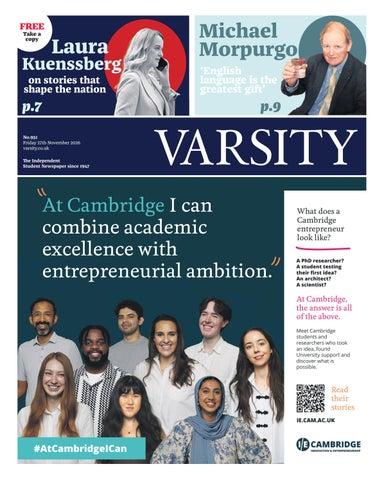
At Cambridge I can combine academic excellence with entrepreneurial ambition.
What does a Cambridge entrepreneur look like? A PhD researcher? A student testing their irst idea? An architect? A scientist?
At Cambridge, the answer is all of the above. Meet Cambridge students and researchers who took an idea, found University support and discover what is possible.
Read their stories IE.CAM.AC.UK
#AtCambridgeICan
Get started with IE Cambridge, the University’s entrepreneurship hub
Empowering Entrepreneurs Supporting entrepreneurship is core to the University’s mission. Cambridge is a hotbed of ideas, innovation and entrepreneurial talent with an extraordinary track record of building companies that make an impact. Whatever your starting point, there’s a wealth of support across the University to help you develop skills, test an idea, meet the right people and take it further.
110+
500+
initiatives supporting entrepreneurship at the University
spinouts and startup companies created out of the University
£42m
78%
invested by the University into early-stage ventures
of Cambridge-founded companies raise Series A funding
Read their stories
#AtCambridgeICan
Sophia Rahman, Co-Founder, Linguist, Lucy Cavendish College
Osarenkhoe Ogbeide, Founder, Engineer, Churchill College
FREE Take a copy
Laura Kuenssberg
Insect-inspired fashion
on stories that shape the nation
p.18-19
p.7 No.951 Friday 27th November 2026 varsity.co.uk The Independent Student Newspaper since 1947
Free Speech Soc accused of hypocrisy
Students push for
arms divestment p.3 p.3 ▴ amika piplapure
Students publish open letter urging Trinity to divest Alessia Fietta and Maebh Carey Senior News Editor and Deputy News Editor Students at Trinity College have published an open letter urging the College to divest from arms companies. The letter is addressed to Sir David Baulcombe, who was appointed as master of the College in June, and was created by the student-led Trinity College Cambridge Responsible Investment Society. At the start of this term, the society released a statement on Instagram, calling on Trinity “to divest from weapons companies in order to avoid con-
tributing to the destruction of homes, schools, universities and lives in Palestine and across the global South”. According to information obtained by Freedom of Information requests, as of 2023, Trinity has invested £61,735 in Elbit Systems, which produces 85% of drones for the Israeli army. The College also holds investments worth approximately £2.5 million in multinational manufacturing company Caterpillar, as well as “significant investments” in companies such as General Electric, Rolls Royce, Barclays, and Toyota. The open letter was first published by the society last Tuesday (17/11), be-
fore being reposted by the Trinity College Students’ Union on Instagram. It read: “As members of Trinity College, we are deeply hurt by the College’s ongoing investments in companies that are contributing to war crimes and illegal occupation.” The letter continued: “It is unconscionable that our institution may be complicit in acts of genocide being perpetrated in Gaza by continuing to invest in companies actively suppliying the weapons and resources being used in the ongoing indiscriminate demolition of Gaza.” Later in the letter, Trinity’s Responsible Investment Society called on the
College to “immediately sever all ties with companies complicit in the ongoing violence in Gaza and the West Bank,” to “use its immense resources” to help support Palestinian students and academics by funding placements and studentships, and to release a statement in response to the conflict in Gaza. It also demanded that Trinity “use its position and influence as the wealthiest College to push the University to adopt similar measures”. Students from the campaign pointed to the divestment progress made by
Continued on page 3 ▶
Bibi Boyce and Maebh Carey Editor-in-Chief and Deputy News Editor A student has alleged that the founders of the Cambridge University Free Speech Society (CUFSS) have falsely portrayed the circumstances under which the society was formed, claiming that one of its founders attempted to restrict their peers’ freedom of speech. The student said that Lavinia Rossetti, co-founder of CUFSS, portrayed the society as being founded after students sought to remove her freedom of speech. However, they claimed that the comments Rossetti received from students were instead individual responses to her controversial, publiclystated comments. CUFSS was launched by a group of students in October, claiming that “Cambridge has a free speech problem” which is “symptomatic of a national one”. In an interview with The Cambridge Tab last week (17/11), Rosetti was asked for “examples of times where particular viewpoints have been suppressed or treated with hostility”. In response, Rosetti referred to “an experience” she had after joining the Cambridge University Society of Women (CUSW), claiming: “a lot of people from my college don’t talk to me any more, purely because I joined that society – not because of anything I said or did – indeed, no one had a conversation with me about it”. CUSW was created by students at the University last October. Membership is restricted to those who meet the definition of “woman” under the Equality Act 2010, in light of the 2025 Supreme Court ruling that the term refers to biological sex at birth. On Rossetti’s “experience” that preceded the founding of CUFSS, the student claimed that Rossetti posted a Facebook comment, which has now been Continued on page 3 ▶
● Michael Morpurgo p.9 ● The Cambridge Night Climbers p.10 ● Double blind date p.20
Friday 27th November 2026
2
Michaelmas, Week 8
Editors’ Note Somehow, without our notice, a whole term has passed, and we find ourselves sending off our last print. There’s an element of relief: we’ll finally have time to see our friends, leave the office, and reacquaint ourselves with our degrees. As ever, though, it’s bittersweet. Varsity is a paper we’re both immensely proud of, and the definitive feature of our university experiences – it’s hard to let it go. That said, we couldn’t have picked a stronger issue to go out on. On page 7, Bibi and Olivia catch Laura Kuenssberg for a quick but jam-packed interview. Insistent on the importance of public opinion and what makes a good interview, hopefully we’ve met her expectations. Turning the page, our Interviews Editor sits down with one of the biggest names in the primary school library: Michael Morpurgo, who emphasises the power of education to bring people together (p.9). Both Morpurgo’s and Kuenssberg’s focus on the collective serves as a call
for unity in this increasingly politicallydivided modern age. The University situates itself in this discourse, after being rejected from the government’s new Defence Universities Alliance (p.4), while a student-published open letter has urged Trinity to commit to arms divestment (p.3). As daylight hours only continue to shrink, keep an eye on the skyline for Cambridge’s elusive night climbers. Imogen Yeo learns all about the risks in this edition’s Features section (p.10). Moving from rooftops to leaf litter, this week’s Fashion shoot (p.18-19) takes a magnifying glass to nature’s smallest trendsetter: the humble insect. From the iridescent moth wing to the ladybug’s polka dot, there’s much to learn from these colourful creepy-crawlies. Over in Lifestyle, Daisy braves her Snapchat memories (at least soldiers get medals) while four intrepid lovebirds take on our latest double blind date (p.20). If you enjoyed the nostalgic reminiscence on children’s literature in Interviews, make sure to turn to
Film & TV for a walk down memory lane as Lily Herbert investigates whether today’s kids are missing out on the magic of 2000s children’s television (p.24). As we see out our time as Editors, we also reflect on all that we’ve accomplished. Amid some (very) late nights, harsh deadlines, and a diet of Redbulls and Scampi Fries, we’ve managed to make some incredible memories – and somehow get a paper out, too. We wish all this and more to our successors, whose faces will grace the inside cover of the next edition in Lent. We know it’s difficult to read a tear-stained paper, but please enjoy this final print – and try not to miss us too much, will you?
Daisy Bates & Bibi Boyce Editors-in-Chief MICHAELMAS 2026
editors Daisy Bates & Bibi Boyce editor@ varsity.co.uk deputy editors Olivia Goodman & Emma Tenzler deputyeditor@varsity.co.uk vulture editors Emma Gower & Daniel Kamaluddin magazine@varsity.co.uk news Alessia Fietta & Neve Wilson (Senior); Maebh Carey, Jacob Smith, Hayley Butler, & Benjamin Pine (Deputy) news@ varsity.co.uk; Skyler Roberts (Investigations) comment Jasper Burnside, Lily O’Sullivan, & Dexter Twycross opinion@varsity.co.uk features Bryony Clarke & Phoebe Leung features@varsity.co.uk interviews Faron Smith & Sam Elgar interviews@varsity.co.uk science Sophie Patel & Yu Tong science@ varsity.co.uk sport Daisy Kaye & Sophe Hardman sport@varsity.co.uk lifestyle Cherie Wong & Ruby Randall lifestyle@varsity.co.uk arts Juliette Berry & Ben Bailey arts@ varsity.co.uk fashion Rachel Jones & Scarlett Prunty fashion@varsity.co.uk fashion shoot co-ordinator Emer Naylor Afram film & tv Daniella Adetoye & Amanda Ljunberg filmandtv@varsity.co.uk music Lauren Quinn & Dylan Ingram music@varsity.co.uk theatre Lucy Farmer & Barney Sayburn theatre@varsity.co.uk photography editors Clio Sze & Gabriella Douglas-Kitsis illustrations editor & cartoonist Rosie Beyfus sub-editors Ell Heeps, Joss HeddleBacon, Sophie Giles, Natasha Simm, Ariela Ohrenstein, & Lucia Taylor subeditor@varsity.co.uk associate editors Charlie Rowan, Ell Heeps, Sophie Ennis, Leo Kang Beevers, Joss Heddle-Bacon, & Ben Lubitsh associate@ varsity.co.uk business manager Mark Curtis business@ varsity.co.uk varsoc president Bibi Boyce president@ varsity.co.uk varsity board Dr Michael Franklin (Chairman), Dr Tim Harris, Michael Derringer, Mark Curtis (Company Secretary), Hugo Gye, Ell Heeps, Daisy Bates, Bibi Boyce (Directors), Lotte Brundle (Guest), & Zoah Hedges-Stocks (Guest) © VARSITY PUBLICATIONS LTD, 2026. All rights reserved. No part of this publication may be reproduced, stored in a retrieval system or transmitted in any form or by any means electronic, mechanical photocopying, recording or otherwise without prior permission of the publisher. Varsity, 1 Trumpington Street, Cambridge CB2 1QA. Telephone 01223 337575. Varsity is published by Varsity Publications Ltd. Varsity Publications also publishes The Mays. Printed at Iliffe Print Cambridge – Winship Road, Milton, Cambridge CB24 6PP on 42.5gsm newsprint. Registered as a newspaper at the Post Office. ISSN 1758-4442
Friday 27th November 2026
3
News
Founding of Free Speech Soc raises questions A student alleged that one founder attempted to restrict their free speech Continued from front page deleted, responding to the Trinity Hall admissions scandal last December. This comment was allegedly the cause for students at her College to distance themselves from her. The post included the statement: “If I had gone to a state school I too would get to complain all day about how the system is rigged against me […] but I’m going to guess that your school experience was far more easy and effortless than mine.” The student had a conversation with Rossetti regarding her engagement with CUSW. Following a dispute between Rossetti and the student about her membership of CUSW, the student was brought into an informal meeting with the senior tutor at Pembroke. In emails between the student and the senior tutor, seen by Varsity, the reason given for the meeting was “the College’s duty to uphold freedom of speech as set out in recent legislation”. The student alleged that Rossetti presented what appeared to be “organised and selectively collated pieces of evidence” to the College about restriction of freedom of speech, after complaining about the incident to her director of studies and, later, senior treasurer of CUFSS, Nick McBride. The student also brought their own evidence regarding the dispute, and it
was determined that the issue would not be pursued further as a formal investigation. The student said that the nature of the meeting and being called in by the senior tutor made the process feel formal, despite it being termed informal by the College. However, they also stated: “I don’t think it was the College acting against me in any way […] it was her [Rossetti] being able to tell College what they needed to hear to launch an investigation.” The student continued: “it […] seems like it’s been marketed as […] ‘my freedom of speech has been stripped’ when really it was [that] people found out things about [Rossetti’s views], [Rossetti] posted things publicly on Facebook and almost everyone in college made an independent decision to not talk to [Rossetti] after that”. The student added that Rossetti’s involvement in CUFSS was “a very easy way to create a community,” and that “it’s really telling that this freedom of speech society has never said anything on […] for example […] how it’s so dangerous to be a journalist in places like Gaza”. They also said the society is helped by colleges trying to “err on the side of caution”. CUFSS positions itself as a society for discursive debate and the free expression of ideas within the law, with
its founders telling The Cambridge Tab last week: “we wanted to create a place where speaker events are more discussion-based, opening up to the audience for an extended period of time ad [sic] having that conversation”. There is crossover in the membership of CUFSS and CUSW, with the societies having two shared committee members. CUSW was also funded by the Free Speech Union’s (FSU) Ian McTaggart Programme in 2025, as CUFSS currently is, and both societies retain a working relationship with the FSU. One committee member of both societies, Ava Foyle, spoke to Varsity about why she got involved in CUFSS. Foyle, who is the CUSW treasurer and CUFSS secretary, said she was raised in a left-wing household, and was keen to “come to a university where everyone is very keen to learn new things”. Foyle stated that she had gone to various debate events for politics societies, including Cambridge University Labour Club and Cambridge University Conservative Association, but did not want to become “a representative” of a single political party. Foyle is a member of Restore Britain, although she said this is in a personal capacity. Both CUFSS and CUSW are nonpartisan and not aligned to a particular party. Foyle is also involved in activism outside of the University, attending a ‘Unite
the Kingdom’ rally this May and volunteering for far-right activist Montgomery Toms, whose organisation Freedom Watch GB set up a stall in Cambridge’s Market Square on 13 November. The organisation’s members invited members of the public to debate Toms, displaying a banner that stated: “Britain needs mass deportation. Prove me wrong.” Varsity understands that Toms came to Cambridge to host the Freedom Watch GB stall following Foyle’s suggestion that they do so, after having been to Oxford and Manchester previously. Foyle told Varsity: “There [was] an obvious gap”. Foyle has participated in at least four debates for Freedom Watch GB, with debate prompts such as “abortion is murder,” and in relation to “transgender identity”. Foyle said that she identifies her views on abortion as “pro-life,” and said on gender: “‘men’ and ‘women’ are […] social ways of expressing biological truths”. On immigration, Foyle added: “Depending on the country that the person’s coming from, it should be to a certain degree more difficult to move to the UK […] Because I don’t think all cultures are equal.” Foyle claimed that members of both CUFSS and CUSW have faced ostracisation: “One of my friends […] was fully rejected and it was on owning a book about transgender identity.” She continues: “another friend […] saw her liking one of the posts on CUSW” and subsequently distanced themselves.
Foyle was also responsible for passing on a story about Caius’ antidiscrimination training at the start of term to The Telegraph. The training came in response to an incident in June, in which a swastika was found carved into a bench in the College’s Old Courts. Foyle reiterated to Varsity: “I thought that was ridiculous […] [the speaker] was talking about the nine characteristics of the Equality Act and then used those to talk about hate speech, hate crimes, but actually hate crimes use five separate characteristics.” Foyle also emphasised: “No matter my political affiliation, this does not represent any common beliefs amongst members of CUSW and CUFSS, otherwise this would contradict our beliefs of free speech and open debate. Both societies are open to and have members from across the political spectrum. “My political activities with Freedom Watch [GB] are also entirely separate from any activities to do with CUSW and CUFSS.” Lavinia Rosetti and Pembroke College were contacted for comment
Students demand that Trinity divest Continued from front page other universities and colleges, including King’s College, as examples for Trinity to follow. In May 2025, King’s became one of the first Oxbridge colleges to commit to divesting from arms companies and firms engaged in “illegal” activities, following sustained student campaigning. The new “responsible investment policy” saw King’s divest from companies involved in “activities generally recognised as illegal or contravening global norms, such as occupation,” and from those producing military and nuclear weapons or key components of such weapons. The open letter went on to claim that “there is precedent to Trinity taking action at times of crisis,” referencing the College’s decision in 2022 to release a statement condemning the Russian invasion of Ukraine, divest from “complicit”
holdings, and establish a £250,000 relief fund for College members affected by the war. Of the open letter, one student involved in the campaign told Varsity: “Trinity should listen to their students and remove investments into arms and occupation, in line with several other colleges and universities, thereby making a step towards meaningful solidarity with the Palestinian people across Britain and its academic institutions.” In February 2024, the International Centre of Justice for Palestinians issued a legal notice warning that Trinity could be liable for “complicity in war crimes” due to the College’s investment portfolio. Several months later, the Middle East Eye reported that Trinity had voted to divest from arms com-
▴ sarah anderson
panies. However, the following November, it was revealed that the College had not cut ties from investment in any arms companies, with Dame Sally Davies, the master at the time, telling the College’s undergraduate (TCSU) and postgraduate (BA Society) students’ unions that Trinity had “no interest in divesting from arms companies”. Davies said that there had been a “consensus” in the College against cutting ties from arms companies. When asked whether the College would introduce a humanitarian response fund for the war in Gaza similar to its response to Ukraine, Davies indicated that she “regretted” the support the College gave to Ukraine,
and the precedent that it set for responses to war and humanitarian crises. In response to Trinity’s investment policy, the TCSU and BA Society published a joint open letter addressed to the College in December 2024. More recently, in June 2025, Trinity reaffirmed its arms investment policy, stalling on undertaking a comprehensive review despite growing calls to divest from its student body and the pro-Palestine encampment present at the time. The College’s Responsible Investment Society, consisting of Trinity undergraduate and postgraduate students, de-
scribes itself as a group “who believe in the importance of ethics with regard to the investments of our college,” with the shared goal of liaising with students, staff, fellows, and leadership to encourage change. The group also campaigned in favour of Trinity’s decision in 2021 to fully divest from fossil fuel companies within the next 10 years, and to aim to achieve net zero carbon emissions before 2050, in line with the Paris Climate Agreement. Trinity College was contacted for comment.
Friday 27th November 2026
4
News
Rent rises revealed: Queens’ increased its rent prices the most of any college Skyler Roberts Investigations Editor Queens’ median rent rose more than any other non-mature Cambridge college admitting undergraduates between 2024-25 and 2025-26, while Pembroke recorded the smallest increase, a Varsity investigation has found. Freedom of Information requests revealed that Queens’ median rent increased by around £49 per week, or 30.1%. The rent rise at Queens’ follows the temporary closure of Owlstone Croft, which the College is currently renovating. Many of these rooms were in the College’s lowest two rent bands. Downing and St John’s had the highest rent increases otherwise, at 8.2% and 8% respectively. Including the rooms in the count, Queens’ rents still rose by 7.7%, the third highest out of the Colleges that responded. Pembroke recorded the smallest increase in median rent at 2.8%, followed by Caius at 3.1%. However, the lowest rise in minimum rent came from Clare College at 1.1%. Most colleges increased their median rents by between 3% and 6%, with an average increase of 4.9%. Robinson, St John’s, Downing, and Queens’ all recorded rises at least two percentage points
above this figure. However, a spokesperson for Robinson noted that rent bands are locked in for students for a minimum of 3 years after joining the College. Selwyn, Clare, and Lucy Cavendish all recorded falls in their maximum rents. King’s declined to provide rent data. However, archived versions of its website suggest that both its minimum and maximum rents increased by 4.5%, just below the average. Varsity previously reported on the average rent rises across the colleges in the period 2021-2025, finding that the steepest rises over this four-year period came from St John’s, Corpus Christi and Trinity. By contrast, most colleges kept rent rises far below inflation. Almost all colleges offered lower rent increases than their annual average over 2020-21 to 2024-25. The increases come as students continue to face pressure due to the cost of living. Selwyn’s bursar noted that the College keeps a small number of rooms at “both the highest and lowest rent codes annually, so that students on all budgets have access to an affordable choice when balloting into second and third and fourth year”. Almost all college responses emphasised the availability of hardship funds for students facing financial difficulties. Some colleges offer a wide range of room prices to accommodate student
Homerton retained the lowest mebudgets. Despite the temporary closure dian rent costs, with a median rent of of Owlstone Croft, Queens’ had the largapproximately £4,700 over a 28-week est difference between its cheapest and contract. most expensive rooms, at £184 per week. Lucy Cavendish’s standard contract The cheapest room was £108 per week, of just under 38 weeks makes it the most whereas the most expensive was £292. expensive, charging a median of around Measuring the middle 50% of avail£7,950, followed closely by Girton’s 38able rooms, the investigation found week contract at £7,800. that Downing, Christ’s, and Jesus had In comparison, Office for National the largest interquartile ranges at £55, Statistics data shows that private rents £54.20, and £53.80 per week respectiverose by 3.2% in the 12 months ly. This may indicate a wider spread of up to October 2025, room prices than at other colleges. which was 1.7% Queens’ interquartile range fell by below the almost half between 2024-25 and 202526 to £36.50, indicating a narrow range of room prices. On the other hand, Newnham has just one rent band, while Downing and Lucy Cavendish narrowed their rent ranges by increasing minimum rents more than maximum rents. Homerton’s bursar said that nine in ten of the College’s undergraduate rooms are charged at the same rate. Most colleges keep accommodation costs down by limiting contract lengths to term time. Of the 25 colleges that responded, 24 provided information on their standard accommodation contracts. 20 of these colleges reported standard contracts of less than 32 weeks, with most of these being 30 ▴ amika piplapure or less.
average college rent increase. It was also lower than the increases recorded by 21 out of 25 colleges who responded to the investigation. However, private rental contracts are not directly comparable, partly because contracts often last longer than college contracts. Fitzwilliam College did not respond to the Freedom of Information request.
Sum Fun Place the digits 1–5 once each in every row and column. All coloured boxes' sums are multiples of one another (e.g., the sums could include 2, 6, 1, 12, 2, 24...). The grey square does not have the smallest sum.
Your career at d-fine We are a European consultancy firm focussed on analytical and quantitative topics and the development of sustainable solutions to bring about positive change for our clients. What does d-fine offer you? - Diversity: Work with clients on topics ranging from financial engineering and machine learning through to climate risk and healthcare - International: Collaborate in project teams staffed across Europe - Education: Acquire new skillsets to broaden your technical and professional repertoire Who do we look for? Master’s or PhD-level graduates in STEM fields
www.d-fine.com
Berlin, Dusseldorf, Frankfurt, Hamburg, London, Milan, Munich, Stockholm, Utrecht, Vienna, Zurich
Friday 27th November 2026
5
News
Cambridge rejected from government’s new Defence Universities Alliance programme Neve Wilson Senior News Editor The University of Cambridge has been rejected from the government’s new Defence Universities Alliance (DUA). According to an FOI obtained by human rights organisation Liberty Investigates as part of its Campus Accountability Mapping Project, Cambridge was just one of 33 universities which applied but was rejected from the programme. Other universities included Imperial College London, the Open University, and the University of Leeds. 35 universities were accepted on the programme, including the universities of Oxford, Durham, Birmingham, and Bristol. The Ministry of Defence originally intended to name 20 founding members. It is not clear why Cambridge was rejected from the alliance. The University also declined to provide a copy of its DUA membership application form on the grounds that “its disclosure would be likely to prejudice the commercial interests of the University”. The University’s response to the FOI also states that this is a qualified exemption that has considered “whether, in all the circumstances of the case, the public interest in maintaining the exemption outweighs the public interest in disclosing the information”.
However, it ultimately concludes that “the University’s ability to engage in future research collaborations to the best of its ability is considered to be a decisive factor in favour of the maintenance of the exemption in this case”. The Defence Universities Alliance was launched in July by the Ministry of Defence (MoD) and Minister for Defence Readiness and Industry, Luke Pollard. The partnership aims to tackle security challenges by linking academia with the defence sector to boost defence-related research and increase graduate recruitment into the defence sector, “including cybersecurity, robotics, AI, aerospace engineering and advanced manufacturing”. The government says that this will “ensure young people leave university ready for work, with a bridge between study and employment”. The initiative is part of a wider £182 million investment to “build defence-related skills and expand opportunities across Britain”. In light of the scheme, Pollard said that “working with universities, students and innovators boosts skills and helps keeps our country safe,” adding that “universities play a key role in innovating and supporting defence, and the DUA helps marshal those efforts”. Campaign group Demilitarise Education launched an open letter in September 2025 calling for universities to sign its treaty, a “practical framework to help universities
end all investments and partnerships cess reopens for its second year in 2027. with the arms trade”. The government also says that it hopes The letter, updated in August, states “to facilitate opportunities for non-memthat the “entanglement” between UK bers to contribute to discussions universities and arms companies is and understand the work of the “made worse by the MoD’s new DeDUA through Universities fence Universities Alliance”, and says UK’s involvement that universities and colleges that have in the alliance going “begun to exclude arms companies forward”. from investments” – such as York and It is not King’s College – set “a precedent for ethical leadership”. King’s College committed to divesting from the arms industry in May 2025. A spokesperson for pure the Cambridge Compipla a k i munist Society said: ▴ am “as students and workers at this University, we have no interest in our research being directed towards developing the means of destruction, nor being funnelled into careers in the military-industrial complex […] if Cambridge attempt to reapply to the DUA in the next round, we will do everything to build a powerful student movement to stop them”. Unsuccessful bidders for DUA can apply again when the application pro-
currently clear whether Cambridge intends to reapply for the DUA next year. The University of Cambridge was contacted for comment.
Get in touch
Take your research questions beyond Cambridge
We’re excited to connect with ambitious and fresh talent ready to make an impact on our team. davincitrading.com
Develop the ideas that shape business and society. Your master's has given you strong foundations. The INSEAD PhD in Management is where you turn them into research with real-world impact.
Why apply Five-year fully funded doctoral programme* Study in Europe and Asia; exchange in the USA with The Wharton School** Close collaboration with world-leading faculty members Graduates placed at leading business schools worldwide Who we are looking for: We welcome curious, analytically minded candidates with a master's in economics, psychology, engineering, mathematics, sociology or a related field, and a genuine interest in an academic career. Eight areas of specialisation on offer: Accounting and Control • Decision Sciences • Entrepreneurship • Finance • Marketing • Organisational Behaviour • Strategy • Technology and Operations Management Key dates: 15 Dec 2026 (preferred) | 04 Jan 2027, 23: 59 CET (last day to apply)
Da Vinci is a propietary trading house made up of some of the sharpest minds and most passionate players in the industry.
6
Friday 27th November 2026
News
King’s outspent all colleges on travel grants in 2025/6 Faron Smith Interviews Editor King’s College spent the most of any Cambridge college on travel grants in the last academic year, an investigation by Varsity can reveal. However, it did not make the largest individual grant to a student, with Lucy Cavendish awarding at least one student £4,000, while Newnham, King’s, and Magdalene all handed out at least £3,000 to individual students. At the other end of the scale, of the colleges which responded to Varsity’s request for information, Homerton gave out the least, failing to award a single travel grant in 2025/26. Robinson came second bottom, giving out £11,335.30 to 24 students. These findings come after a 2024 investigation by Varsity into grants given by colleges for student travel, which found that Trinity had spent the most on travel grants. Travel grants are given to both undergraduate and postgraduate students to support travel either for academic or recreational purposes. While most colleges maintain some form of travel grant system, there are large differences in the generosity of these programmes. For instance, King’s College’s total spending of over £190,000 means that it spent more than the bottom nine colleges combined. These nine colleges, which includes St John’s, the second wealthiest Cambridge college, spent only £176,000 between them last year. A spokesperson for King’s said: “King’s is very fortunate to have received a generous bequest which specifically supports student travel, and in recent years we have been able to use this fund to support students travelling more sustainably where possible.” After King’s, the rest of the top five was rounded out by Queens’, Lucy Cavendish, Newnham, and Pembroke. While these four colleges had ranked in the upper reaches of the previous table in 2024, Lucy Cavendish’s placing marks
a remarkable rise by the College, which had previously ranked 15th. This comes in spite of Lucy Cavendish’s reputation as the poorest of the undergraduate colleges, with its endowment of just £18 million being dwarfed by Trinity which, with an endowment of £2.7 billion, is by far the richest college at either Oxford or Cambridge. Johanna, a student at Lucy Cav, said that thanks to the funding she was able to “spend part of my summer in Tuvalu, undertaking an internship with the Government of Tuvalu”. The student continued: “I had been exploring the geopolitics of climate change in relation to small island states through my academic work for some time, but I never imagined that I would have the opportunity to travel there myself one day.” Some colleges measured their spending on travel grants in different ways to others. Churchill College supplied Varsity with information solely relating to the money granted to undergraduate students, spending a total of £10,300 on 43 students, with the largest individual grant being for £500. Similarly, Trinity, which had topped the travel grant spending table in 2024, spent a comparatively small £66,208.81 in 2025/26. A spokesperson for Trinity described the two FOI inquiries as having “different scopes,” saying that as a result “the figures for the years cited are not directly comparable”. There was also a noticeable difference in the
competitiveness of applications for travel grants. At some colleges, such as Newnham and Pembroke, very few students were refused grants outright, with less than five students being denied funding at both colleges. The two colleges awarded grants to 185 and 178 students respectively. St Catharine’s and Murray Edwards did not refuse grants to any students at all. However, Jesus College refused a far higher proportion of grants, refusing applications from 86 students. Compared to the 43 students to which it awarded money, this makes it the only college which saw more unsuccessful than successful applications. Magdalene and Lucy Cavendish were the second and third most competitive colleges in terms of the proportion of refusals, with the two colleges rejecting 35% and 28% of applications, respectively. Johanna recounted being told informally by a College official that “it was a very competitive application process,
and that a lot of people who applied were not selected”. Across all colleges, the average total spending was £61,625.01, while the average individual grant was £550. Several colleges significantly exceeded this figure. Lucy Cavendish spent the most per student by a significant margin, amounting to an average grant of £1,323.17, well ahead of the £1,107.91 per student spent by Trinity Hall. While King’s may have spent the highest overall sum on travel grants, the comparatively high number of recipients meant that the average student received £785.53 – still the fourth highest average amount. Aside from Homerton, Murray Edwards, Churchill, and Selwyn provided the lowest average amounts to their students. Murray Edwards also handed out the smallest maximum grant, with no student at the college receiving more than £200.
▼ made with flourish
found that, compared with highmeat diets (at least 100g total meat consumed per day), vegan diets were associated with substantially lower negative environmental impacts. For instance, their resulting greenhouse gas emissions and land use were each approximately 25.1% of a high-meat diet, water use was 46.4%, and impacts on biodiversity were 34.3%. This new policy comes after the SU voted to support 100% plant-based catering in 2023, but dropped its campaign in 2025 to focus on more “important” sustainability issues. While the SU vice president leading the plant-based catering campaign had initially wanted to work towards a 50% target, a “compromise” percentage of 75% was reached following discussions with Plant Based Cambridge, according to the Student Council meeting minutes. Despite its proposed environmental and health benefits, some students have expressed concern about the new 75% plant-based target for centralised
Plans for Palestine flag protest Cambridge Artists for Palestine will hold a protest in Cambridge Market Square on Sunday (29/11) to mark the UN’s international day of solidarity with Palestinian people. During the event, the group – which announced the protest on Instagram alongside other activist organisations – says it hopes to “fill Market Square with Palestinian flags”. The protest comes after controversy surrounding a proposal to fly the flag from the Guildhall, the headquarters of Cambridge City Council. Last Thursday (19/11), the City Council’s cabinet rejected the proposal over concerns about community cohesion, planning instead to fly the UN flag. The recommendation will now be put before the rest of the City Council. Listening campaign launched
SU backs introducing 75% vegan uni catering Alessia Fietta Senior News Editor The Cambridge Students’ Union (SU) has passed a motion in support of introducing 75% plant-based catering across the University of Cambridge. The policy motion, which proposes that the SU campaign for the implementation of at least 75% plant-based food across centralised University catering locations, was discussed by the Student Council – the SU’s decision-making body – in a meeting last Monday (16/11). The motion passed with 11 votes in favour – a policy motion must receive a simple majority in order to pass. An SU spokesperson told Varsity: “The Student Council voted in favour of adopting a policy for the SU to campaign for provision of 75% plantbased food across central University catering outlets. This falls in line with our concern with climate change and ecological crises.” The SU cited a 2023 study which
Benjamin Pine delivers news from around Cambridge
university catering. One student told Varsity: “While a brilliant goal, it’s been proven to be unreachable for many colleges, and this [may] rest on its affordability. We need a catering system where health is accessible for everyone”. Another student commented: “I agree that there isn’t much excuse not to go at least vegetarian from an ethical and environmental perspective, but these things have to be decided by the individual with free will”. They suggested that the new policy was “trying to enforce veganism” in a way that was “poorly thought through”. They added: “What does this even mean, 75% of breakfast items have to be vegan as well? But eggs, bacon, sausages… Even if this were a good idea […] this is too undefined to go through”. The 75% target is defined by at least three out of every four items being fully plant-based, with a specific focus on “main meals”. The Student Council acknowledged
that, while the majority of food options across the University are animal products-based, university students are around two times more likely to follow a partial or fully plant-based diet compared to the rest of the general population in the UK. It said that an increased provision of plant-based food would additionally “help provide variety and balance for those that already follow a plant based diet and encourage them to utilise University catering”. The Council resolved to communicate with and lobby the University Catering Service and Estates Department to promote the adoption of the minimum 75% threshold, and to push for a greater proportion of plant-based options if this threshold is reached or demand is high. On the campaign, the SU said: “Progress is currently slow, but we are hopeful for student inclusion in the University’s sustainable food research and following policy which will be announced later this academic year.”
A new group bringing together community representatives from across Cambridge met for the first time on Wednesday (25/11). Cambridge Citizens plans a “listening campaign” over the coming months in which it aims to hear from thousands of people, including faith groups, schools, and charities. The campaign’s cochair, Imogen Nay, who is also a vicar in Cambridge, told the Cambridge Independent: “We are creating spaces where people from different backgrounds can build relationships, listen deeply to one another and act together on the issues that affect their communities.” She added that this represents “a new chapter for civic participation in Cambridge”. AI breast cancer trial starts at Addenbrooke’s A national trial investigating the potential for AI to help detect breast cancer earlier has launched in Cambridge, with women screened at Addenbrooke’s Breast Unit to be the first to take part. Health Secretary Yvette Cooper visited the hospital to mark the start of the trial, which will see an “AI-assisted tool” tested to examine whether it could reduce the involvement of human radiologists in checking breast X-rays for signs of cancers. Cooper said the national trial, which will cost £10 million, could also “potentially deliver life-saving improvements” to breast cancer detection. The research is being led jointly by the University of Cambridge and Cambridge University Hospitals.
Friday 27th November 2026
7
Interviews
Laura
▼ jeff ovens
Kuenssberg
‘The public
is the boss’ “W
hat the public needs from journalism – what it always fundamentally has – is the pursuit of the truth without fear or favour, and people who are relentlessly going after the facts and putting that above all else.” We sit next to Laura Kuenssberg in the Union’s Reading Room, as if we were sitting opposite; otherwise she’d be obscured by a mountain of copies of her new book, Pay Attention. As she whistles through signature after signature, the first female political editor of the BBC continues: “You can probably find just about any story anywhere, but there are always stories that haven’t yet been uncovered. You guys are the future, and you have to get on with that.” After working on and off for two decades in Westminster, Kuenssberg has had a front row seat to the mayhem that now plagues what used to be characteristically boring British politics. With seven prime ministers in just over a decade and voters turning to populist parties (and sometimes even a bin), we ask her what she thinks has changed: “So many things have changed in politics in the time I’ve been doing it […] the explosive rise of social media that’s changed how everyone communicates and how politicians communicate, voters are now willing to shop around […] the rise of smaller parties now becoming big forces – whether they’re mainstream or not is a different question – but that’s really, really changed.” In Pay Attention, Kuenssberg decodes this mayhem, and, according to the dust jacket, “reveals the most urgent truth of all: that it’s time for
politicians who represent the public, to pay more attention to us”.
❝ I don’t have the solutions, but I can try help people understand She reiterates this rhetoric after we enquire about the opening statement of each chapter – a comment from a member of the public. “The public is the boss. I’ve gone to the White House, and I’ve been to a million different press conferences in Downing Street, and I’ve done all sorts of really lucky things […] But my favourite thing is always covering election campaigns and being out and about and talking to the public. I’ve always tried to think: what would I be thinking if I’m sitting on the sofa watching the telly, or what would I be thinking if I’m driving in the car and I hear this radio report?” She goes on to describe how the cost of living crisis has developed into this “perma-crisis […] For more than ten years, people have found it incredibly hard to make ends meet, and that fundamentally has given lots of voters a sense that the contract that if you put your faith in government, it will do the best for you and
your life will improve, that [contract has] really frayed.” ‘Voter disillusionment’ has practically reached buzzword status – in fact, while writing this article, we’ve said it so many times we’re starting to forget what it means. Kuenssberg explains how it’s manifested itself in her day-to-day over the last couple of years: “people who were walking the dog or buying a coffee or whatever would come up to me and say: ‘what the hell has happened?’” These interactions were the driving force for putting pen to paper: “I felt almost a real obligation to say ‘look, I’ve been so lucky to have these experiences, I think I can help people understand it’. I don’t have solutions, but I have got a whole load of testimonies. […] I hope that people will read it and think, ‘you know what, I don’t necessarily feel comfortable with what’s happened in this country that used to be really politically stable, but I can understand how the jigsaw pieces fit together a bit better’.” She tells us of one review she’s particularly proud of: “it’s like a guidebook for the crazy”. A supervisor once told Bibi she writes essays like a journalist, but she didn’t get a chance to ask what gave it away. It became obvious when reading Pay Attention – the punctuation, sentence structure, how information is set out – all hallmarks of a newspaper article. How does writing a 300-page book compare to the typical short-form or orally delivered content that an experienced journalist is so familiar with? “The tyranny of the
blank page was completely terrifying. And as I say, actually, on almost the first page of the book, I swore I was never going to write a book […] publishing people are very persuasive.” But, in writing the book, Kuenssberg is clear that journalism that seeks to establish what is true, rather than simply to offer an opinion, has become especially valuable: “I think it’s more precious than it’s ever been in a contested era.” However, with the rapid change in the modern media landscape, both journalism and politics have had to adapt. Kuenssberg denies that anything has been ‘lost’ but focuses rather on plurality: “Even at the BBC, which is more than 100 years old, I work across lots and lots of different formats. So, on any given weekend, I would do a TV show, I’d write a column that sits on the website, I do two podcasts – I might also put a report on TV or radio. […] There are just many more gears, but there have always been lots of different ways of communicating.” She goes on to call the ‘podcasts versus TV news’ debate as “artificial,” continuing: “one of the really exciting things about what’s happening in the media is this proliferation of formats. You can do a great podcast interview where you might find that a guest is more relaxed. And if they’re more relaxed, they might tell you something they didn’t mean to. But it depends, right? I don’t think it’s a binary debate, and [if you turn it into one], you’re kind of missing the point.” Speaking of missing the point – distinguishing between a politician who cannot answer and one who will not, Kuenssberg says, is rarely straightforward. “I don’t think it’s either/or. I think very often politicians might have part of an answer that they don’t want to give you, and then an answer that doesn’t say very much that they do want to give you.” The interviewer’s task is to “really listen [and] decode” what is being said and respond to what is happening in the moment. It’s a skill she explores in the book, where she sets out the phrases and techniques politicians use to deflect, or “play with spin”. But for Kuenssberg, the point of an interview is not to catch out the person opposite or to win a verbal duel. “A good interview reveals things for the people who are watching, reading or listening,” she says. “I don’t see it as a contest or a tug of war.”
❝ A good interview isn’t a contest or a tug of war During a long day of reporting, Kuenssberg’s essentials are standard: phone, makeup, crisps. (A favourite packet was too hard to choose, although if “push came to shove,” it’d be salt and vinegar.) Another essential, one perhaps more permanent than some Hula Hoops, has been her colleagues, of whom she speaks with unmistakable warmth: “I’ve been fantastically lucky with my colleagues who have kept me sane, pushed me, had amazing ideas, had a lot of fun […] When my skirt fell apart on the day of the President Trump conference, one of my long-term producers managed to get gaffer tape and literally tape up my skirt so my butt wasn’t hanging out in front of Donald Trump. That’s teamwork.” Looking back on her time as the BBC’s first female political editor, Kuenssberg is less interested in the title and more in what changed during her tenure. When
she took the role at 39, she was also the organisation’s youngest political editor. She and several colleagues, she explains, made a concerted effort to encourage and support more women in the role – by the time she left the position in 2022, there were seven female political editors across the industry. “Is it perfect? Is it 50-50? No, absolutely not. But is it a damn sight better than when I started out? 100%.”
❝ Is it perfect? No ... but is it a damn better sight than when I started out? 100% But there was one moment, she tells us, that brought the weight of the job sharply into focus: “when COVID suddenly hit, and I was standing on the roof in Westminster, [saying to] millions of people, watching at home, the Prime Minister is telling you to stay in your house because lots of people might die […] I remember that moment [and] just really feeling the sense of responsibility.” What remained, and still remains, most important to Kuenssberg was the public: giving them accurate and informed answers that reached into the most intimate parts of their lives. We can both vividly recall watching Boris Johnson announce the lockdown on that fateful Friday afternoon, from our respective living rooms in Norwich and Cardiff, struggling to conceptualise what exactly was about to happen to us. At that point, we were yet to even sit our GCSEs – now, our degrees are drawing to a close. We put this to Kuenssberg: “We’re both young women who will soon graduate and try to enter the world of journalism” – here, she cuts Olivia off. “You are going to. You’re not going to try. You are going to.” We continue to ask if she could go back and speak to herself at the very beginning of her career, what would she want her to know? “Worry less and say yes to things that you don’t know if you’ll enjoy. This was all an accident for me. But if you say yes to things, even if you think it might not be in your plan, then they can turn out to be the best thing that has ever happened to you." Still, ever mindful of our allotted time, we found ourselves, hurrying a little as we approached our final few questions. Yet, instinctively, Kuenssberg met our hurried reassurance with an unhurried warmth that put us at immediate ease: “That’s okay, guys. It’s alright […] it’s lovely, I like talking to the future – meeting those people who will overtake me.” It’s a small moment, but it's one that demonstrates something of her instinctive generosity. In a profession so often defined by deadlines and competing demands, there was something quietly remarkable about her willingness to pause and listen. Perhaps that is part of what keeps journalism moving forward: not simply the stories passed between generations, but paying attention and making room for all kinds of voices yet to be heard.
– BIBI BOYCE AND OLIVIA GOODMAN EDITOR-IN-CHIEF AND DEPUTY EDITOR
8
Friday 27th November 2026
News in brief Catz's charity challenges
Trading toys for pizza
Lloyds replaces Itsu
Introducing internships
Catz students are fundraising for Movember to raise awareness of men's mental health. At incremental donation milestones, students have pledged to partake in challenges including ice bucket challenges, running half-marathons, and cycling 150km in a day. Students are also encouraged to look out for their friends, and have been given information on how to provide support. The College’s welfare team say they are hoping to raise £1,000 for issues including men’s mental health. If the College meets their £1,000 goal, an entire staircase has pledged to sleep overnight on their balcony.
The pizza chain Rudy’s is promising to offer free pizza to people who donate toys to one of its branches, including its Cambridge location. Those bringing new, unopened toys worth at least £10 can claim a pizza of their choice under the programme, which will run between 7 and 10 December. Rudy's has run the programme with Cash for Kids since 2024, encouraging more than 10,000 toy donations nationwide. Rudy’s growth and development director Neal Bates said: “It’s such a simple idea, but one that can make a huge difference to children who might otherwise go without.”
Following the closure of Itsu on Sidney Street in September, the former sushi restaurant is set to be turned into a Lloyds Bank. Planning documents submitted to the Greater Cambridge Shared Planning Authority intend for the branch, currently housed further up the street, to take over the vacant shopfront. The application states that the shopfront would be in line with the dimensions of the other retailers on the street, and all renovations would maintain the character of the building. The renovation is also intended to “take up as little space as is necessary” so as to not impact the street more broadly.
A new collaboration between the University and local authorities will create up to 15 internships at the University for local young people who are not currently in education, employment, or training. Cambridgeshire and Peterborough Combined Authority is funding the internships, which will take place during the 20262027 academic year and are “designed to help young people develop practical workplace skills, build confidence and explore potential career pathways”. Internship opportunities include working in the University’s Cambridge Festival team or with the University Catering Service.
Maebh Carey rounds up student news from across the country Newcastle called to change building name due to slavery ties Newcastle University is facing calls to change the name of its oldest building, the 1904 Armstrong Building, after its namesake was revealed to have sold a significant number of arms to the Confederacy in the American Civil War. Armstrong, an industrialist and engineer from the city, was known for his strong involvement with the arms trade at the time. In previous years, the building had a sign attached which declared he may have had ties to the Civil War, but the scale of his involvement was not known at the time. In light of the new information, a professor of American History at Newcastle said: “we should understand that we are saying this person is worthy of having their name remembered and looked up to.”
20% OFF ALL BOOKS FOR HOLDERS OF CAMBRIDGE UNIVERSITY AND CAMCARDS SIMPLY PRESENT YOUR CARD IN STORE WE ALSO STOCK A WIDE RANGE OF CAMBRIDGE RELATED GIFTS AND SOUVENIRS
St Andrews speaks out against EU deal The vice-chancellor of the University of St Andrews, Dame Sally Mapstone, has criticised Britain’s plans for a new deal with the EU, saying reducing tuition fees could have unintended consequences for the higher education industry. The University, which ranked first in the Sunday Times Good University Guide 2027, suggested the cost would be up to £12 million, and may affect the quality of education students can access. St Andrews has one of the highest numbers of EU students studying at its university, comprising about 7% of the cohort. While recognising that the University relies extensively on these students, the vice-chancellor said that the effect of a new deal on universities would be severe “unless we sort out the important financial practicalities” of it.
Illustration by Richard Briggs
ARU announces new cuts
1 Trinity Street, Cambridge CB2 1SZ 01223 333333
bookshop@cambridge.org
Offer can’t be combined with other promotions
Anglia Ruskin University (ARU) has begun a voluntary severance scheme to reduce its labour costs of £150 million by up to 10%. The University says that the cuts are due to difficulties in attracting international students after changes to immigration law, rather than internal financial mismanagement. Dr John Hogan, leader of the University and College Union at ARU, confirmed that the plans had been shared with staff, although financial records had not been provided. ARU insists that it is now taking action to “ensure we can continue to deliver high-quality education and research across all our campuses”.
Friday 27th November 2026
9
Interviews
I
meet Michael Morpurgo amid a bustle of activity in the dining room of the Cambridge Union, just before he is set to speak at the Cambridge Literary Festival. He is running late after a long, late lunch with some friends and his wife, Clare, but appears to be in no rush as he takes a seat and poses for a headshot. He is posed behind a mountain of books waiting to be signed before his talk starts in less than an hour. This pile is comprised of copies of his newest book, Down Burrow Lane: Life and Love on the Farm, the latest in a bibliography of over 150 works. We chat as I set up my microphone – his granddaughter has just started studying at Oxford, despite her father attending Cambridge. He says that, for her, the deciding factor was that Cambridge was a “really long walk from the station,” – surely a familiar sentiment to many students.
❝ It wasn’t just the buildings being knocked down, it was people Michael Morpurgo was born in 1943, as war was ripping apart Europe and the rest of the world. Shortly after his birth, he was evacuated, alongside his older brother, to stay with an uncle who was a vicar in Northumberland. He confesses that he remembers nothing of this time, only “being told about it afterwards”. His uncle’s parish was intended as a place of sanctuary for him and his brother. Despite this, he explains that he does have his own “near-death” experience from the second world war. “Apparently, my mum had put me in the pram in the back of the garage, and this old vicar got his car out, and he didn’t know it, but the bumper of his car hitched onto the pram and started driving off down the road. It was bumped along and bumped along and eventually it overturned!” As wartime experiences go, Morpurgo seems to have escaped lightly. His family’s return to London after the end of the war, however, brought plenty of reminders that many had not been so lucky. Morpurgo remembers: “Walking down the street, you’d see a soldier sitting on the corner with a hat and a dog with one leg, and you began to realise what the war thing had been, so it wasn’t just the buildings being knocked down, it was people.” The war had touched his family as well. At home, a photograph of his uncle, Pieter, sat on the piano. A former actor, he had been killed in the war at just 21. Morpurgo remembers his mother “crying on his birthday and on the 11th November. She was in bits for quite some time each time. Indeed, all her life she really grieved for that brother that she lost.” He also remembers the fun of these years, playing in the ruined houses of London. In spite of or perhaps because of their surroundings, he laughs at the fact that he played “war games,” with the other children. As he grew up, the topic of war remained present in Morpurgo’s life, and he remembers asking himself: “What do you do if a war comes along?” He found the answer in the responses of two of his uncles to the start of the second world war. As he has said, the first, Pieter, had joined the RAF and been killed.
The other uncle, however, was a “pacifist and a socialist,” who initially refused to fight. Instead, he was sent to “work on a farm in Lincolnshire”. After a year, he “married someone from there and had a child”. Things changed, however, on the
▲ TOM DI CICCO
Michael
Morpurgo
morning that he learned that his brother had been killed in service. Realising that he did not want to let “other people defend the freedom of his child,” he joined the Special Forces, and spent three years in France working with the Resistance. As a result of these two inspirations, Morpurgo joined the army when he turned 18. His time as a soldier would not last long, however, before he met his future wife, who pushed him to begin questioning the purpose of this service. Morpurgo’s growing doubts were brought to a head by a particularly unpleasant training drill in December 1962. While sat in a freezing cold trench, Morpurgo was struck by a “vision of Christmas 1914 and the snow and the trenches, [when] the Germans got out of their trenches, met in the middle and they had peace for a night.” It was this “extraordinary night,” that made Morpurgo realise that the only way to reach peace was through education, and he decided from then on to become a teacher. He left the army almost immediately afterwards and attended university in London, starting to teach once he graduated. Here, he made a second discovery – that it was not just teaching that he enjoyed, but specifically “telling stories”. He found that this was the only thing that would “keep children quiet, but [also keep] them involved”. To start with, Morpurgo read other people’s stories, until he began to notice diminishing results, with children “shuffling and looking out the windows”. After some encouragement from his wife, he decided to start telling stories of his own. He admits he had always told lies “brilliantly,” and from that moment he never looked back.
❝ English language is the greatest gift Britain has given to the world At this point, it is clear that the festival organisers are becoming slightly anxious about the amount of books that Morpurgo has to sign before the start of his event. Fortunately, he is happy to “sign as I talk,” and conducts the rest of the interview with a sharpie in hand, while a conveyor belt of books is passed to him. Pushing on, I focus on the importance of education to his worldview. Does he think that the current state of the world shows that we have forgotten the lessons of the past? “People may study [History], which is not the same thing as knowing it and feeling it. I think it’s showed enormously in Brexit.” Here is where Morpurgo’s clear principles find their purest political expres-
ʻThe algorithm absolutely
ʻStudying History is not the
gets us wrongʼ
same thing as feeling it’ sion – he holds a firm belief that “we are, like it or not, Europeans”. This conviction comes from what he believes to be the greatest gift that Britain has given to the world – the English language. He sees this very language as reflecting our European heritage, with its roots being “Scandinavian, German, Dutch, Celtic”. For him, the debate over Brexit was never about trade, but about the need for borders to be “as open as they can be, so that my children would go to university in Strasbourg, if they wish, other people would come over here – even to horrible Cambridge!” But Morpurgo’s international outlook does not end at the Mediterranean. Nearly 20 years ago, he visited Israel and Palestine on a research trip, with his findings eventually making their way into a book, The Kites are Flying. On the trip, he visited what he describes as the “one school in Israel where Arab children and Jewish children go to school together”. These are the kind of institutions that give Morpurgo hope, and he tells me how during his visit, he and the children “made kites together and flew these kites, and they were writing on the kites
messages of peace to the other side”. In this way, he hopes that people might learn that difference is “not something you have to be frightened of,” and he thought the book that came from his visit could help people to learn this.
❝ If they don’t educate each other, there will be no end What has happened since his visit clearly depresses him. In the years since his visit, the “number of schools hasn’t increased at all,” and instead “the enmity has just simply grown, to an extent where they just know that killing is the only way forward. I don’t know if that’ll end. But if they don’t educate each other, there will be no end.” This is not the only current conflict which Morpurgo has had a connection to. He recalls, around a year before
the full-scale invasion of Ukraine, being invited by to speak a a Russian book festival. Over Zoom, he spoke to “about 250 people, sat in an orchard,” and remembers them as the “loveliest people,” who just wanted to talk about books and reading. It is clear that he finds it hard to imagine these same people now becoming “public enemy number one”. These are issues that, for Morpurgo, clearly only education can solve. By understanding other people’s history, perhaps we can understand their national identity, and may even learn that “empires always fall”– a lesson he wishes that Donald Trump heeded. It may seem a long way off now until the day when this kind of cross-cultural education can reap its rewards. But until that day, Michael Morpurgo will continue to do his bit. As I leave him, he is already welcoming his next visitors – two children. “Just in primary school?” He asks. “Don’t say ‘just’!”
– FARON SMITH INTERVIEWS EDITOR
Friday 27th November 2026
10
Features
The Cambridge Night Climbers Imogen Yeo investigates Cambridge’s skyward thrillseekers
M
idnight in Cambridge. The familiar sounds of weaving bikes and bustling tourists have faded, and you are left with a stillness under the stars. The city’s rooftops stretch out in all directions, flaunting a topographical constellation. As you ascend the spire of King’s Chapel, your grip on the cold stone is secure between your fingers. You cast your gaze to the street below; the last few night strollers amble down the promenade. There’s a slight chill in the November air, and the city’s rooftops are alive with a spectrum of lights.
❝ The legend of this secret society is undeniable And just like that, you are transported back to the 1930s, where the infamous first generation of climbers looked down upon this very same view. The words of notorious climber Whipplesnaith in his near-seminal read, The Night Climbers of Cambridge, echo in your mind: “If you slip, you will still have three seconds to live.” The legend of this secret society is undeniable. And it is no wonder that the mythology of a forbidden world of silhouettes and cityscapes has prevailed for so many years. Whether for its low-lying architecture, or the proximity of the buildings (with the exception of the famous ‘Senate House leap’ – a rite of passage for experienced night climbers!), Cambridge has proven to be an idyllic climbing hub, day and night. Speaking to two current night climbers about the realities of their covert lifestyle, they sung the city’s praises, with one describing their moonlight excursions as “deeply personal” and a “safe space” where they could be completely themselves. “The first time I climbed the Bridge of Sighs, I remember lying on top of it and looking at the stars. I felt far away from reality and so peaceful sitting there unjudged,” one told me. Another affirmed this, describing a similar experience of “sitting on the edge of New Museum, watching people walk to and from the club,” and speaking of the “unmatched peace of being in a place no one else can get to”. Alongside a search for serenity, they discussed the adrenaline-fueled captivation of the present generation. “You are constantly asking yourself, ‘am I going to get caught?’,” one told me, “especially after a few close run-ins with security guards!” While ascending 100 feet into the air is bound to cause some nerves, the fear factor is doubled by the thought of ending up face-to-face with a porter, and joining the list of students expelled for this very act. With a Milton-esque charm, they went on to explain their desire for a life of fulfillment: “I strongly believe in pushing the boundaries; ‘better to reign in Hell, than serve in Heaven’.” The high-risk elements of this seemingly extreme pastime are obvious, and
glorified by tales of reckless groups scaling ancient rooftops. But despite common misconceptions, the climbers are all too aware of what’s at stake. “There is a risk of romanticising it and a real danger in it being less enforced. You need to have a conversation with yourself, and be physically and mentally able.” With sufficient self-awareness and years of experience behind you, is the danger outweighed by the sense of profound peace night climbing entails? One climber spoke about how the eccentric hobby does not just offer unique and ethereal cityscape views, but how “being under the stars puts things in perspective. Once you’ve done it, going back to work seems not stressful at all.” The pursuit of a fresh perspective is crucial now more than ever. With the ever-increasing pace of society, dominated by screens, it is all too easy to become swept up in the conformity of modern life. For some students, perhaps the perils of night climbing seem insignificant compared to the threat of blind passivity. One fellow I spoke to shared his thoughts on the intense term-time environment: “Cambridge is so all-consuming when you’re here, and I know all too well the pressure
▲ rosie beyfus
that people put themselves under. Time out is hugely important.” While making it clear that he did not condone such illicit activities, he did stress the importance of a life outside of your degree. Picturing night climbers, he went on to describe how “sitting at the top of a building, looking out over the city, the noise, the lights, watching the people walking past and their worlds, I can imagine it being almost a spiritual experience.”
❝ The climbers are all too aware of what’s at stake Perhaps for Whipplesnaith and his peers, night climbing was simply an adrenaline-fueled frenzy. They scaled buildings “because they wanted to,” and delighted in challenging the traditions and authority of an institution like Cambridge. Despite their clandestine nature, the group has a rich history of public feats, with famous stunts in-
cluding the mysterious appearance of an Austin Seven on the Senate House roof, and later a car hanging from the Bridge of Sighs. But it seems that night climbing culture has shifted over time, from thrilling conquests under the cover of darkness to an invaluable form of escapism. Our conversation continued: “degrees matter now. And people have to deal with the pressures they put themselves under, as well as those the collective consciousness puts each other under.” He noted that Whipplesnaith was “escaping authority, not workload” – a fact which may no longer render true for students today. Reflecting on his own experience as a Cambridge student, he concluded that “our time here as undergrads was fleeting. The work really matters, for sure, but so does everything else. I think that people do realise how special it is here, but I’d love for them every so often to look around.” Therein lies the charm of night climbing today. What once enthralled us with its tales of recklessness and rebellion now embodies an in-
nocent desire for academic release. A peaceful haven atop King’s Chapel – the allure is undeniable. And a fresh perspective on the city may just be a welcome escape from the world the chapel looms over, a world in which too few people ever really look up.
❝ From thrilling conquests to an invaluable form of escapism
Friday 27th November 2026
11
Features
Is Cambridge still a man’s world? Emer Naylor Afram evaluates the past and present condition of Cambridge’s women
I
n the late 1970s, Trinity Hall finally agreed to contribute to the budget of the Cambridge Students’ Union, an occasion Varsity marked with the headline “Tits may pay at last”. This was of course a nod to the college’s affectionate moniker ‘Tit Hall’, but also in reference to its decision to ‘go mixed’ in October 1976. My grandad, who completed his undergrad at Trinity Hall before women were admitted, tells College stories of cricket and rugby on the lawn in Easter, climbing over walls after breaking the curfew, and skipping finals revision to watch the newly released Beatles films. As the age of majority was 21 until 1970, the college had an immense amount of responsibility for their students, and university was seen a continuation of school, a point used against the admission of women.
❝ In 2024, only 26.7% of professors were women This month, as Trinity Hall marks its 50th year of women with posters in plodge and colourful displays of feminist literature in our library, the absence of women from my grandad’s recollections feels jarring. At the same time, it is worth interrogating the idea that Cambridge has moved on from its ‘Old Boys’ past, something particularly contentious across the street in Trinity College, which has the most unequal ratio of male to female students at 66.8% to 32.2%. Whilst the first undergraduate women arrived at Trinity Hall in 1977, integration in the College began the year prior
with the admission of two female fellows, Dr Kareen Thorne and Dr Sandra Raban. When my mother arrived in 1988, entering a system where men still comprised 61% of all undergraduates, she recalls her tutor, Dr Raban, being a guiding figure for the College’s female students. Today, a portrait of these first women fellows hangs in the dining hall, a visual piece of history for all who sit in hall. It’s a portrait Dr Raban admires but wishes she sat up straighter for. Dr Raban describes admitting women undergraduates as “squeezing out perfectly academically adequate men for clever girls”. Indeed, Trinity Hall jumped to the top of the Tompkins Table soon after integration. The existing Trinity Hall fellows, she recalls, were “fundamentally a decent lot,” chaps who could be “big and bossy”, but possessed an “immense amount of goodwill” and were more interested in one’s ability to hold interesting conversation rather than their gender – their one anxiety was the presence of babies when lunching in the SCR. Raban adds that going mixed caused the colleges to “turn in on themselves”, becoming new communities which were more sequestered. As for the outside world’s reaction, Raban laughs and recounts the press trying to sensationalise shared gender sets, disappointed when no story materialised. Addressing Cambridge’s current generation of women, Raban emphasises the importance of confidence, as she credits her positive experience at during a male-dominated moment to her own assertiveness. “Assume you are as good as the next person, rely on your own merits.” She doesn’t think of herself as a supporter of “positive discrimination,” by
which she refers to admissions for factors other than merit alone, but nonetheless acknowledges the structural barriers women still face today and praises the work of various access courses which encourage women to engage in academia. “I remember thinking the battle for women’s equality was over when I was younger. How wrong I was!” Whilst Cambridge’s women are in a better position now, for Raban, the work is not yet done.
❝ Squeezing out perfectly academically adequate men for clever girls Returning to Trinity’s gender imbalance, it is debatable whether Cambridge has completely moved on from the flags at half-mast and black armbands that took over Magdalene when the final bastion of male singularity finally went mixed in 1988, or the 1921 storming of Newnham’s Clough gates by male undergraduates when women were denied full University membership. Known for its sprawling grounds, rich academic history, and focused Mathematicians, Trinity is a place of undeniable prestige, and also where women are “in many regards invisible within both the decorative elements of college history (portraits, statues, busts) as well as more
systemically,” according to Lottie Campbell, Trinity JCR’s Women’s Officer. This leads to a feeling of alienation, she says, as the visual signs of Trinity’s women are confined to “dim corridors”. Whilst famed ‘Trinity Men’ are celebrated loudly in the Great Hall and antechapel. As for why this imbalance still exists, Campbell cites Trinity’s commitment to academic excellence, especially in STEM, which already has a gender attainment gap pre-university and thus places women at a disadvantage before they even apply. Campbell also notes that whilst there are attempts to improve access with initiatives such as ‘Women in Maths’ camps, she believes that “the college has to seriously assess its image and environment if it wants to see any improvement.” An anonymous undergraduate student at Trinity agrees that gender imbalance remains present in everyday college life, noting its effects beyond the academic sphere. “If you grew up having multiple female friendships during your high school years, you will definitely feel like you have to make a stronger effort to actively seek out similar friendships in College.” She feels the admissions disparity also leads to a vicious circle, as it means fewer women may feel motivated to apply. On wider college life, Campbell comments that students are sometimes the only woman on their staircase, which she describes as “isolating” in an already new environment, a situation worsened by the occasional “unsavoury comment” made by other students. As a result, women at Trinity are creating their own spaces. The student points to the Trinity Feminist Society, seeing it as “a space for community and connection” that’s necessary in all colleges but particularly important in environments such as Trinity,
“where women are a numerical minority”. The society is challenging Trinity’s image by creating a space for its members to engage in feminist discourse through debates, informal discussions and speaker events. It remains to be seen whether Trinity will even out in the coming years. As a JCR officer Campbell is hopeful and is already taking steps to make change, conducting research in collaboration with Trinity fellow Dr Carys Brown into the attainment gap which is particularly glaring in first-year examinations and surveying freshers on their academic confidence before and after a year at Trinity. At the same time, she believes change will only be possible if the College administration acknowledges the issue as something they have autonomy over. “Women feel alienated. Women aren’t achieving as highly in their exams. Women aren’t applying to Trinity altogether. This is a problem and a few lazily hung photographs celebrating women on occasion is not the solution but merely just a [tokenistic gesture].”
❝ Trinity College has the most unequal ratio of male to female students at 66.8% to 32.2% As the last two women-only colleges, Murray Edwards and Newnham continue to have lower than average academic performance and in 2024 only 26.7% of professors were women, there’s an argument to be made that Cambridge, institutionally and systemically, is still a man’s world. Over the course of our conversation, Dr Raban asked me perhaps as many questions as I asked her. One about my own experience of being a woman at Cambridge stuck with me, as I realised I didn’t have a definitive answer. Discussing this with friends, we found ourselves unable to decipher if certain behaviours were the result of us being women, if we just accept things as the norm, and if gender is more persuasive than we perceive. Speaking on how colleges operate, how administrations treat women, and how we act in general, Dr Raban concludes that “it is a question of style, maybe the style is changing.” But the scope of this change is still taking form.
▴ clio sze, taken at girton college
Friday 27th November 2026
12
Science
Night at the (science) museum Jessica Edmunds discovers the collections that Jessica Adams and Jahan Syed bring the cityʼs scientific heritage to life
C
▲ amike piplapure
ambridge University is home to a wide variety of science museums that offer valuable resources for students. To help you understand what they are and why they are worth your time, here is a whistle-stop tour of Cambridge’s science museums and the collections that make them worth exploring. Sedgwick Museum of Earth Sciences Starting with ancient natural history, this museum is located on the University’s Downing Site, and it’s dedicated to both the Earth’s minerals and fossils, boasting a huge variety from across millennia and landscapes. Opening in 1904, though containing specimens found decades earlier, the highlights of the museum are its large skeletons, including a plesiosaur, iguanodon, and T-Rex skull, with the somewhat hidden mineral room also a worthwhile visit, according to one student I spoke to. The museum hosts a variety of events throughout the year, including its ‘Bridging Binaries’ tours. Overall, this museum is a must-see for anyone interested in rocks, minerals, and ancient life. The Whipple Museum Moving on to a different kind of history, the Whipple Museum covers the history of scientific developments and can be found on the University’s new Museums Site. Named for Robert Stewart Whipple, who donated his collection of 1000 scientific instruments, the museum opened in 1959 after the collection spent 15 years in storage facilities. The museum focuses on the history of astronomical sciences, with highlights including a Herschel telescope from 1790. It is also home to a large collection of historical globes, showing how beliefs about the structure of the planet have changed throughout history. One prize piece of the overall col-
its staff 's favourite exhibitions, and there is currently a special exhibition on the history of forged artefacts, which includes a quiz where you can have a go at identifying the fakes for yourself. Cambridge Museum of Zoology Also on the University’s New Museums Site, this museum primarily houses the University’s large collection of skeletons and specimens, ranging across the animal kingdom, forming the wide variety of fascinating specimens that students appreciate. It was initially founded in 1865 to house the collections of the Museum of Comparative Anatomy and the Cambridge Philosophical Society.
❝ A calm sanctuary within the bustle of Cambridge life The upper floor primarily deals with invertebrates, birds, and sea creatures. This includes a collection of whale skeletons suspended from the ceiling, and a similar one featured in the connected Whale Cafe, a favourite study spot for many students in the area. The lower floor mainly covers mammals: it is home to its own collection of impressive skeletons, with both an African and Asian elephant and an extinct giant ground sloth. The museum holds many events throughout the year, including its ‘Pride in Nature’ event, which celebrates diversity in the natural world. Indeed, the Museum of Zoology is an excellent destination for animal lovers, and serves as a brilliant way to learn more about the world we live in. Cambridge University Botanic Garden Those looking for a different kind of natural escape might prefer the Botanic Garden. Located 15 minutes from the city centre on foot, this site contains over 8,000 plant species, from tiny mosses to giant red-
woods. Founded on its current site by John Henslow, one of Charles Darwin’s professors at Cambridge, and with its first tree planted in 1846, the garden has a lot of history. It is split into a number of areas, including the systematic beds, each containing all of the plants from an evolutionary family. The exterior gardens house Mediterranean and limestoneadapted plants, and in the interior gardens, tropical and mountainous species can be found. The garden is also home to its own lake, containing aquatic plants and waterfowl; it also boasts its own cafe. The garden provides a variety of self-guided tours, including trails exploring the uses of plants in medicine and as dyes, as well as the fascinating ‘evolution of plants’ trail. The garden has been described by students as a “calm sanctuary within the bustling Cambridge life,” and is a beautiful site with a lot of historic stories to tell. The Polar Museum This museum focuses on the Earth’s poles, with most of its interior dedicated to the Arctic. While much of it follows the early explorers of the Arctic, it also dedicates a significant portion of its interior to the people that inhabit the polar regions of the world, with sections on their art, culture, and technology being a particular highlight among the museum's many offerings. There are also areas focused on the Antarctic, including several penguin taxidermies, along with sections on the politics surrounding both polar regions, and the effects climate change is having on them. This museum presents a past and future view of the polar regions, making it a lesser-known but fascinating site. Exploring Cambridge's science museums is an easily accessible and engaging ways to learn more about the natural world. The best part is that all of the sites listed in this article are free for students – why not consider one for your next day out?
lection is Charles Darwin’s original microscope, which he used to study barnacles and plants. The Whipple hosts tours of
h
▲ ryan te
unpack the latest research out of the University and beyond
RA brownin g ▼ LY
Can we mend a broken heart? Unlike most of the tissue in our body, heart cells (known as cardiomyocytes) lack the ability to regenerate. During a heart attack, lack of oxygen leads to the death of these cardiomyocytes. This means that, even if the patient survives the initial event, in the following years, the loss of functioning cells will lead to a drop in cardiac function, heart failure, and often death. Current treatments for heart failure include interventions to reduce strain on the heart, such as lowering blood pressure or blood volume. The only truly effective ‘cure’ is a heart transplant, which, due to limited supply and the dangers associated with the operation, is not feasible for the vast majority of those who may benefit. However, what if we could stimulate the generation of new cardiomyocytes within failing hearts, replacing the lost tissue ourselves? That is what is being investigated in the lab of Dr Catherine Wilson in the Department of Pharmacology. In a paper published last week in Nature, researchers were able to induce the proliferation of cardiomyocytes in genetically modified mice by stimulating expression of the genes Myc and cyclin-T1 in the cells of interest. These genes were targeted because they contain instructions to build proteins that drive cell division. These initial experiments validated the idea of using Myc and cyclin-T1 to initiate cardiomyocyte regeneration following a heart attack. Following this, they created a modified RNA (modRNA) that, once inside a cell, could be used to make the proteins of interest. Overall, the modRNA was successful in inducing production of the proteins and, most importantly, stimulating the replication of cardiomyocytes. The effect was short-lived, allowing cells to proliferate in a controlled manner. This is important because Myc is often also overexpressed in cancer cells, where it drives cell division. The researchers did not observe any tumour development in these trials but highlighted that more tests would be needed to rule out cancer risk. Overall, this study has confirmed a new therapeutic strategy for treating heart failure and offered a potential mechanism of application in the form of modRNA.
Acute Myeloid Leukaemia traced in blood decades before diagnosis A recent paper by University of Cambridge and University College London (UCL) researchers on acute myeloid leu-
kaemia (AML) has shown how it can be traced back decades before diagnosis through old blood samples. AML is a fast-growing cancer of the blood and bone marrow which is caused by abnormal, immature myeloid cells multiplying rapidly and interfering with the growth of healthy red blood cells, white blood cells, and platelets. AML progresses rapidly and is fatal within weeks or months if left untreated. A complete blood test is used as an initial step in the diagnosis of AML. AML starts developing in the body decades before it is able to be diagnosed, as mutated blood cells gradually accumulate genetic changes. The first traces of this cancer’s drivers can be seen as early as your 20s, but it takes decades before it is finally detected and diagnosed. The researchers involved in the study collected serial blood samples annually for up to a decade to show how precancerous evolutionary dynamics work. In the study, researchers examined 47 women who later developed AML and 46 matched women who remained free of blood cancer. These samples were collected annually from 50,000 women over 11 years through the UK Collaborative Trial of Ovarian Cancer Screening (UKCTOCS). Professor Usha Menon (UCL) stated that “while UKCTOCS was designed to assess ovarian cancer screening […] this resource has provided unprecedented opportunities to study how cancers develop over time and to discover and validate biomarkers for earlier detection.” Through techniques like advanced DNA sequencing and mathematical modeling, the researchers were able to reconstruct when mutations appeared and how quickly the affected cells multiplied. Each cancer-driving mutation in cells accelerated general mutation growth by two or three times in these samples. These expanding populations of genetically related cells are called clones and once established, they grow at a predictable rate, slowing only when they run out of room or a faster-growing clone overtakes them. In the words of Jamie Blundell, professor at Cambridge, “Serial blood samples are a fossil record of the blood’s evolution. They let us go back in time and reconstruct when each mutation arose and how fast it grew.” This research is a milestone in leukemia research and provides a new range of possibilities in preventing the disease before it develops into fatality.
En joy complimentar y personalised debossing in store for a thoughtful f inishing touch. V I S I T US AT 7– 8 ROSE C R E SC E N T, C A M B R I DG E C B2 3L L
Friday 27th November 2026
14
Comment One term down, eight to go – and I’m still performing
Eva McLornan
I
arrived in Cambridge last month full of anticipation for the exciting, fulfilling, and positively hectic Freshers’ Week that I had been promised as an applicant. I saw it as a chance to reinvent myself, to become the most desirable, charismatic, extroverted version of myself. The reality was very different. In fact, I think that Freshers’ Week may have made me into the least desirable version of myself. Sleep-deprived, hungover, and consumed by disappointment, I fell apart. Only now, as Michaelmas draws to a close, can I (still sleep-deprived, still hungover, but more accustomed to it) look back on Freshers’ Week, accept its folly, and happily move on. Only now can I see that so much of the Freshers’ experience is nothing more than an experiment, a test, a performance that rewards the most convincing acts. Allow me to set the scene. It’s Saturday, move-in day. My first lecture is on Thursday. As I make my way home from my first night out, I’m suddenly overcome by the feeling that I’m already running out of time. The week begins to feel rushed, pressured and intense. This perceived rapidity makes me behave in strange, erratic ways. It convinces me to do things I really don’t want to do, to pretend I’m loving the wine at matriculation formal, to consume a volume of it so large that I can no longer remember the majority of the dinner, to serenade passersby with Latin
hymns outside a Tesco Express during challenge night, all in a desperate attempt to ‘fit in’, to prove what an amazing time I was (not) having. On reflection, was it worth it? Of course not. The highlights of my Freshers’ experience only happened once those few days were over, once we put the whole ‘what’s your name, what do you study, where are you from’, charade to bed. Smiling through awkward silences in The Regal on night one, or pretending to enjoy what was essentially a crowd crush at Kiki’s, simply didn’t compare to some of the later moments I enjoyed as a fresher. I found more happiness in spontaneous game nights with my staircase, Halloween bops, weeknight Eagle trips and late-night gyp gossip sessions than I did at any point during that first week. Having come to terms with the briefness of Freshers’ Week, I couldn’t help but notice another flaw in its design: its artificiality. A ‘successful’ Freshers’ Week here isn’t just felt or lived; it has to be proven to others. Much like our successes here at Cambridge, we
❝ We all oscillate between accepting and denying the mould
have to measure, quantify, and perform our happiness through carefully manufactured Instagram stories and collegewon treasure hunt medals. Why do we feel the need to collect tokens of our time as freshers if so many of us admit we don’t enjoy it? Why do so many of us scramble to create the same, uniform Instagram posts, all captioned ‘matriculATE’? (Yuck, by the way). I wonder how much easier connection would be if, instead of dressing up Freshers’ Week, we were more open about what it’s really like to be a fresher. Homesickness, loneliness, crappy essays, hangovers, rejection, flu. This is what Freshers’ Week really involves. Why ignore that? Why work so hard to persuade others we’re happy when there is so much joy in embracing the imperfection and absurdity of it all? I met one of my closest college friends at a Freshers’ club night. I didn’t know her very well then; only after we both dropped the mask and admitted we were having a terrible
time did we really bond. We’ve been inseparable ever since. Cambridge culture expects you to handle what is, quite possibly, the biggest change of your entire life, flawlessly and gracefully. Cambridge will treat any expression of doubt or anxiety as a signal of ingratitude for your place. It will remind you to feel honoured by your overwhelm, because it is what you wanted, what you worked so hard for; it is something others envy. Cambridge will order you to flourish academically and socially from the get-go. It will hand you an impossible mould, demand that you fill it, and be shocked and offended when you (inevitably) fail. At first, an illusory distinction appears between those who choose to accept the mould and those who do not: an illusory choice between conformity and non-conformity. In reality, that choice between authenticity and artificiality is non-existent. We all oscillate between accepting and denying the mould. Like swans that look graceful on the surface but paddle like hell beneath the water, most of us will, at different stages, play both roles, and that’s okay! If Freshers’ Week has taught me anything (aside from the dangers of unlimited free alcohol at college bops), it’s that, as actors under such intense limelight, performance isn’t always insincere; sometimes it’s inevitable; and sometimes it’s about survival.
s fu
ey eb
i
os ▴r
I
n September, reactionary activist Thomas Moffitt (also known as ‘Young Bob’) arrived outside the University of Bristol, bearing a banner that read: “we need to deport millions – change my mind.” Two weeks later, he arrived in York under the same banner; Tuesday, he appeared in our very own Market Square with the same invitation. It does not seem like his mind has been changed. It might be tempting to chalk that up to the students that debated him. Perhaps they weren’t very persuasive. But something tells me his insistence on deporting millions isn’t due to a lack of cogent opposition. I have an unfortunate feeling he never intended to change his mind, and I think that’s true in almost every case where someone stages a ‘debate’ on campus. To a degree, obstinacy is a by-product of the format itself, irrespective of intention. When disputing contentious topics, like the scope of male privilege or the necessity of deporting millions, it’s extremely easy for participants in a public forum to be imprecise and drift into misunderstanding. What exactly do we mean by ‘privilege’, and how many ‘millions’ are we talking about? Without de-
❝ It’s extremely easy for participants in a public forum to be imprecise
fining the parameters, it’s entirely possible to reach separate, valid conclusions. Nobody has changed their mind; they are addressing fundamentally different questions. The absence of sources exacerbates the issue: without the possibility of verification, participants are forced to accept as true whatever their opponent comes up with, and entire debates can be premised on some fiction someone found on Instagram. But the format is not the ultimate problem; with good faith, after all, it’s entirely possible to facilitate meaningful discourse. The problem lies mostly with the organisers. It is not that they host debates – it is that they do so purely with the intention of proving whatever point they allege is in dispute. That can be inferred, in the first instance, from the prompt’s phrasing: “change my mind.” Their opinion is preformed. But even this language is deceptive, implying that their view is not fixed. More telling are the hosts themselves, in their own words. Moffitt, for instance, has described his work with Turning Point UK as “trying to continue Charlie Kirk’s fight” – the fight, that is, to mobilise young people behind reactionary causes. Kirk, arguably the
populariser of this form of campus activism in its modern form, subtitled his book How Conservatives Can WIN the Battle on Campus. It has never been about fostering robust public debate. It is explicitly a persuasion campaign, intended to provoke controversy and generate attention. Irrespective of political creed – it is equally counterproductive when leftist influencers bait members of the public – the practice merely distorts and confuses political discourse. In that light, the format of repeatedly sitting behind a table around the country is particularly insidious. It is an uneven playing field: with the intention of winning, rather than resolving anything, the host can prepare cherry-picked statistics to invalidate common counterarguments, apparently. A student may make a valid point, but faced with evidence seemingly to the contrary, it is very difficult, and deliberately embarrassing, to respond: ‘I think there’s more to this, but I can’t think of a statistic off the top of my head’. The camera demands evidence at hand, however fictitious or decontextualised it is. It is tempting – and certainly I found it very tempting, as I walked past Moffitt’s stall – to engage with outrageous claims.
In some ways it feels like an open goal; in some ways it feels like an obligation, given the mantra that ‘silence is complacency’. I contend that there’s more nuance involved. Total silence may be complacent, but stepping away from what is essentially a social media enterprise is not. To engage is to injure your cause, not advance it. Many fora are better suited to considered, productive discussion than those erected by partisans. I like to think that having experienced the last decade of politics, we can recognise when engagement is productive and when it is futile. To walk past a stall is not to admit defeat, but to leave the opponent floundering, because the provocateur needs you. You can grapple with their propositions much more effectively in an equal setting, with equal preparation, with good faith. We are more than capable, as students and as young people, of moving past the ‘culture war’ that is artificially sustained in scenarios like these. I think it is time to leave it behind as an unfortunate, but passing, episode of history.
CHANGE MY MIND.
Tom Schmoll
Campus debates are disingenuous and counterproductive,
Friday 27th November 2026
15
Comment
Amelia Burns
hen Britons ask me how Cambridge stacks up against California, that place I called home for 18 years, I feel torn between honest answers and easy ones. Weather is a common conversation. Some expect me to mourn my distance from those oncefamiliar, sun-soaked beaches. Perhaps I do, but I’m also comforted by cold English nights, when I can sleep under the blanket without overheating. Others have said American universities, if you can believe it, offer something Cambridge does not. Intercollegiate sports and a liberal arts education have come up, but what surprised me the most was the interest in our schools’ ‘entrepreneurial spirit’. But I’ve seen myself what that type of thinking does to education. In fact, its absence is what drove me here, and it’s how I know we can’t take it for granted. Especially because Cambridge might be changing. For those who look across the pond and see a model to emulate in schools like Stanford, where access to networking clubs and startup funding is as fiercely competitive as our rugby and hockey clubs are preppy, there’s hope yet. Recently, and I mean recently by Cambridge’s ancient standards, vicechancellor Deborah Prentice leaned into the city’s centrality as a tech hub to herald a future of more tech investment, more ‘innovation’, and more ‘growth’. This came just as the UK government pledged £15 million towards a new ‘Cam-
O
bridge Innovation Hub’ which seeks to do just that. Do they dare to suggest the ‘Silicon Fen’ could best the Valley? Well, as it stands, Cambridge has only dipped its toes into the Fen’s murky waters of tech potential, investing only a fraction of its many millions in the companies that encircle it. Stanford’s case, though, is an institutional relationship, and I’m not sure we ought to replicate it. Why is Silicon Valley where it is? Why is Stanford so prestigious? The answer to these two questions is the same: the money! Here’s what I mean. Stanford enjoys its current reputation because it interbred its academics with the entrepreneurialism of the emerging Silicon Valley. First HewlettPackard, then Microsoft, Google, Apple, and now Palantir provide the cash; California provides the overachieving students; and Stanford provides the university knowledge to pump out scores of career-climbing graduates. To be sure, Stanford’ss most noble mission is to ensure that thousands of desks in need of overworked, underpaid interns won’t go empty. Back in my mother’ss day, Stanford students self-segregated into ‘techies’ techies and ‘fuzzies’.. Sound familiar? Even now, you catch whiffs of holier-thanthou STEM students lording it over their humanities peers. The idea that STEM degrees are more valuable because they are more employable (hardly true, but a separate discussion) does little to en-
ne trip to Sidgwick site will tell you that Cambridge students are a miscellany, defying categorisation. There could be no American high school movie montage pointing out each clique: ‘there’s the History toffs, and over there, hippie Philosophers…’ The personality on display in the dull Sidge surroundings commands appreciation. In fact, there’s an Insta page for doing just that – the feed of @sidgefitcheck is a collage of personal eclecticism. Personal style is something to be remarked upon. When we can tap into the digital sphere 24/7 – where taste is endlessly shared and commented on – it feels effortful to be out of the loop. Research suggests that 70% of Generation Z consider themselves followers online, rather than content producers or influencers. A majority consume the creative output of a minority, who’ve won their audience via a potent combination of merit and luck. When content is determined by a minority, nothing stays out of the mainstream for long. The niche and novel are sniffed out so easily by an oversized audience, like their scrolling has made them digital truffle hunters. What this means is that there isn’t really a single mainstream anymore. There’s just an endless expansion of niche subcultures. What’s new grows in popularity until the hype reveals it to be a tired trend: slinking into obscurity, perhaps recycled later. For a precious, fleeting moment, a new aesthetic will be cool – until it’s overdone and loses its individuality. But in this endless cycle, what even is cool? The coining of ‘cool’ as a term of aesthetic approval can likely be traced back to one man: the jazz musician Lester Young. Like most buzzwords, ‘cool’ started out as in-group slang before it
However strong the spirit of STEM superiority is in Cambridge, the Bay has outclassed it
courage the sixth-former on the fence between Physics and Philosophy. But however strong the spirit of STEM superiority is in Cambridge, the Bay has outclassed it. In recent years, 16% of Stanfordians have majored in Computer Science; of the top ten classes in 2025, nine were STEM, and six were related to Computer Science. Some Stanford students feel this way because ‘they can’t imagine a career as a museum curator’. While some chalk this up to ‘being realistic’, this hopelessness about humanities degrees is a problem in both our countries. Ever since we filled our elementary schools’ schools computer labs for our national ‘hour hour of code code’,, II’ve ve watched friends with varied interests put them aside to study a STEM degree.
And always for the same reason: they think it’s more employable. Is this the future we want for Cambridge? Increasing investment in the tech industry could help tackle the University’s deficit. But becoming dependent on tech money, counting on industry sponsors for Computer Science research, leasing more land to tech companies, and hiring out Comp Sci professors as tech consultants, all things Stanford did, would distract the University from its most fundamental principles: education and curiosity. Let’s get one thing straight: students – STEM or otherwise – aren’t to blame. Only institutional decisions, not students’, will keep us on this path. The UK government will continue to set the tone for funding, while the University and its colleges will choose who to admit and which departments to prioritise. No, the problem comes from investing for investment’s sake, building and building until academic hands are tied and our intellectual culture becomes indistinguishable from a business one. The air of STEM superiority which has only just begun to afflict our student culture is its symptom. Immunise against its root causes now, and we’ll prevent its spread; do nothing, and we risk a condition far beyond our control.
▲ lila baltaxe
was co-opted by outsiders, eventually suffering semantic drift. In the context of the American Civil Rights Movement, the term ‘cool’ was part of a set of stylistic gestures meant to protect Black people’s peace while expressing individuality. For instance, Young would wear sunglasses at night and on stage to make himself less approachable – but also to look good. Creating this concept of ‘cool’ was an act of socio-political resistance. But, as the word was incorporated into popular culture, it eventually came to neutralise dissent. Once commodified, ‘cool’ can no longer critique the culture – yet it often claims to. The 1997 Apple ‘Think Different’ campaign did just that: “Here’s to the crazy ones. The misfits. The rebels. The troublemakers.” A lifestyle is being sold: a glamorous technocracy. One that’s different; cool. Cambridge is, in some ways, a sanctuary for good taste. A Cambridge student either has no time to think about ‘taste’ – by which I mean fashion, music,
Nate Tepper
Do we really want Silicon Fen? ❝ W
Notes on ‘Cool’ film, etc – or they treat it as thoughtfully as they do everything else. As I see it: that’s the difference between those who grab a backpack and some weather-suitable jacket before heading to lectures, and those who’ve searched for inspiration, in markets, moodboards, magazines, for their outfit. Take @sidgefitcheck. The joyfully chalant captions express the time and effort students have put into their outfit. The artist behind the account makes no attempt to hide how good taste is a labour of love. That’s against the current on social media. Influencing today runs on a new species of cool: sprezzatura, an effortless kind of being put-together, attractive, and tasteful. It’s what explains the allure of the microinfluencer; the mythical pull of the niche, original, authentic. It’s an aesthetic of having everything without trying. An influencer uencer’s bio will be
▴ rosie beyfus
❝ A Cambridge student either has no time to think about ‘taste’, or they treat it as thoughtfully as they do everything else
something like ‘Finsta is life’ and their story a dinner party held by Vogue. An advanced version of #justwokeuplikethis. It’s often claimed that being a consumer on social media is empowering. Cambridge University’s own Professor Sander van der Linden thus claimed that the UK’s under-16s social media ban only “disempowers young people and takes rights away from them”. He echoes the optimism of Time Magazine’s December 2006 edition – ‘Person of the Year: You’. Its cover pictured a computer with the screen a mirror reflecting the reader. The subheading read, “You control the Information Age. Welcome to your world.” But where’s the power in taking someone else’s taste second-hand? This question gets a lot more pressing when thinking about how political taste is shared on social media, not just aesthetic. Micro-influencing creates an illusion that we’re not being influenced. We consider the nonchalant poster our peer. As if our scrolling is an expression of our agency. Hannah Arendt thought that a prevailing media conversation suppressed our authentic opinions, that it’s inimical to both our aesthetic and political judgements. I think her message for our age is that, to have agency, one must refuse to be influenced. The Sidgwick fashion warriors and their documentation on @sidgefitcheck represent a cross-section of Cambridge student culture which resists influence. In their individuality, Cambridge students are outside of the monotone conversation. Insofar as one disrupts the culture, one is cool. So as long as we remain miscellaneous, we will keep our power, our agency, and our taste.
16
Friday 27th November 2026
The Smoking Area Jolly crossword by Jafar ACROSS 6 Metal can one admitted to university in morning (8) 8 Expert in naysaying returning to be bereft (6) 10 Suppressed in vitro diagnostics (4) 11 Estranged mother embracing me? I sense resistance... (8) 13 Illegally moor ship between India and China, initially, having the same structure (10) 14 Four neighbours cycling, as per republican motto (1,1,1,1) 16 Preserve most of malbec, being distributed for hundred thousand (6) 18 Greek hero receiving second supplication (6) 20 Biblical figure found in thesaurus? (4) 21 Nicolas’ pet suffering of tumour (10) 23 Juliet and Ella awarded degrees in African robes (8) 25 Leave out ‘E’ in book series (4) 27 Is love worthless in this? (6) 28 Do charade again for worker, volatile thing! (8)
DOWN 1 Crown one with father and aunt (6) 2 Hit compromise (3) 3 Flattens disputed hospital between two societies (7) 4 Procrastinates and drools, disgustingly, with leaders of multi cultural Olympic lacrosse society (11) 5 Risk apes running loose at winter party (5-3) 7, 24 Night of celebration in college, with first woman receiving degree (9,3) 9 Wonder Woman admitted to emergency room (3) 12 Music for two swimmers? (4,3,4) 15 Incomplete citation Nadia misspelled everyday (9) 17 Queen of Albania and all countries dressed in silver, sitting on a park bench (8) 19 Small group swindles headless astronomer (7) 22 Affected by acne? Stop being affected – thanks! (6) 24 See 7 26 Change channels from zebras and penguins, initially (3)
Jolly word wheel
Using every letter exactly once, form as many words (4+ letters) as you can. The central letter must be used, etc. There are 165 possible answers
Jolly sudoku
Vulture.
▲ ROSIE BEYFUS
Inside ● Verona Farrell on fashion journalism p.19 ● Snapchat, remember me p.20 ● Bridgemas carols p.23
18 Vulture
friday 27th november 2026
Fashion
Isabeau Botha on fashion’s miniature muses
T
here is an unspoken hierarchy in the way fashion borrows from nature. The tiger has been immortalised in silk, the zebra transposed into swathes of monochromatic variations, and the leopard has become synonymous with untamed glamour. It's not just the best dressed on Sidge who are clad in these kinds of patterns. For decades, fashion collections have all returned to the same familiar creatures, extracting their markings and transforming them into symbols of elegance and luxury. For all fashion’s fascination with the animal kingdom, its attention has been notably selective. But, beyond the recognisable spots and stripes of the savannah exists an altogether stranger, more intriguing visual portfolio found in some of the most unlikely creatures: bugs. Insect patterns offer an almost endless selection of colour, texture, and form, which is what makes this particular corner of the natural world so exciting for fashion. The metallic greens of a jewel beetle have a depth that seems impossible to achieve through conventional pigment, shifting between emerald, bronze, and blue as light glimmers across its shell. Butterfly and moth wings are covered in thousands of microscopic scales made of chitin which manipulate light, creating a complex iridescence. The joy here lies in moving towards the wonderfully unconventional – think, instead of the classic leopard print, of high-shine fabrics like ciré and PVC that catch the light like a scarab shell, sheer layering reminiscent of trans-
lucent wings, intricate mesh, embossed surfaces, shining embellishments and feathered touches. Patterns that would ordinarily require a magnifying glass could become an oversized print across a pair of tights; the metallic finish of a beetle could find its way into glinting silver accents; the intricate markings of a butterfly into delicate embroidery; the fluffy bodice of a moth into the ruffle of a skirt. It is fashion with a little more imagination, and certainly no shortage of personality. The inspiration from our crawling friends doesn’t have to stop at clothing. The shine of the insect world seems almost purpose-built for a bold beauty look: electric blues, startling pinks, and shimmering greens are asking for us to experiment with colour. Try metallic eyeshadow swept across the lids, wacky colour combos, glossy lips, and graphic eyeliner that is a level up from everyday beauty. Jewellery can draw inspiration from the lesser known world of arthropods – the hammered, interlocking discs of a bracelet could mimic their intricate armoured backs. If these critters can teach us anything, it’s that we should be unapologetically playful. Embrace unusual forms, unexpected colours, or makeup that pays attention to the miniature, demanding a second look. Not every outfit needs to be understood by everyone; these creepy-crawlies certainly aren’t. There is definitely something refreshing about taking inspiration from creatures that have not been traditionally considered glamorous. It challenges our understanding of what beauty is in the first place, as well as which creatures are designated as worthy of admiration and protection. These smallest inhabitants of our natural world are far more than decorative curiosities. Insects are essential to our ecosystems, contributing to pollina-
tion, decomposition, and soil health, yet they face increasing risks from habitat loss, pesticides, intensive agriculture, and pollution. Fashion’s relationship with the natural world is of course rife with contradictions. The same industry that looks to nature for endless creative inspiration contributes to pollution, resource wastage, and habitat loss through the extraction of raw materials. But fashion also has the chance to change this relationship, from choosing more responsible materials and lower-impact dyes, to supporting circular rather than fast fashion. And, if runways are like spotlights directing cultural attention, maybe they can also impel society to direct its attention to the smallest building blocks of our ecosystems and prevent their further loss. Some fashion brands have already tapped into creepy-crawly couture. Thom Browne’s Spring/Summer 2027 collection had embroidered ants marching across blazers; Mugler’s Spring/Summer 1997 collection featured kaleidoscopic butterfly wings sprouting out of an evening gown. Nara Smith recently launched her book tour in a satin mini dress bejewelled with iridescent emerald beetles. Perhaps the next great animal print moment might involve the humble bug. Whatever form it takes, the insect world offers an invitation to look beyond the familiar in order to find inspiration in the smallest details. Embrace the clash of colours, the experimental textures, the sparkling makeup. Just remember: the best way to celebrate fashion’s smallest muses is to make sure there’s still a world for them to live in.
Vulture
friday 27th november 2026
19
Fashion
models: mia lomer, dylan hughes, humayra vohra fashion shoot co-ordinator: emer naylor-afram photographer: matt kirkham
Verona Farrell on rock ‘n’ roll fashion journalism Rachel Jones interviews the Vogue Scandanavia columnist and influencer
W
ith a column in the world’s most influential fashion magazine and a series of viral video lists, you might assume that Verona Farrell was a stickler for the rules. In fact, this couldn’t be further from the truth: her online persona revolves around all things rock and roll. Her column for Vogue Scandinavia is no different, in which she documents the outfits of the most iconic strangers she can find on the streets of the world’s cities. I asked her some questions in the hopes of becoming a bit more rock and roll myself... Can you tell me about how you got into fashion journalism? Did you always want to do it? The truth is I never dreamt of working in fashion journalism, or in fashion at all. I’ve always liked working. I had my first job as a receptionist at my dad’s office as a 12 year old (who let me do that?) and kept an eclectic list of jobs throughout my teens and 20s. The first time the thought of what I was going to do after university occurred to me was a few months before I graduated. I wish I was exaggerating but this is the truth. I’m not quite sure what planet I was on at 22. At that point everyone I knew was applying for graduate programs at the big law firms in Dublin. I half-heartedly looked into it but couldn’t picture myself a) working in a high-rise building or b) slaving over documents until midnight. I didn’t have enough discipline to work hard at something I wasn’t totally fascinated by. In the meantime I decided I would either get a job at sea (I had never been ‘at sea’) and train as a skipper, or go to Copenhagen and try out something in fashion. I had just started sewing and was inspired by how stylish the Scandina-
▾ vanessa tryde
vians were, and I was already living in Sweden having gone there on my Erasmus. I chose the latter when I realised that students had free rent during the summer so I could commute over to Denmark everyday for the internship that was, shock horror, unpaid. I got a second job at a local bar and spent the summer frantically running to and from train stations. At the internship I realised how exciting I found the industry. The work itself was miserable, it was mostly spreadsheets and being ignored, but I liked being around the clothes. Since I finally had some work in fashion on my CV, I applied for a job as a ‘community manager’ for a big fashion brand in Stockholm. I exaggerated and smiled my way through the interview process and eventually got it. This was the beginning of it all! What has been one of the highlights of your fashion career so far? Probably the time J-Lo gave me a dirty look. That was thrilling. What is the best part of your job? I like my job because I get to work both creatively and commercially. I get to write about things I care about and tell stories I want to tell – this is the more ‘credible’ aspect of my job. Then there is the thing that I find equally as exciting: marketing. These days I suppose I market myself. I love the freedom of creating content for my channels and creating content that I hope a lot of people will be able to connect with. When it comes to brand collaborations (which is where most of my income comes from), I really do get a kick out of creating ads that people could genuinely enjoy! Do you have any tips for young people wanting to get into fashion journalism? My main tip would be to think seriously about the financial implications of being a fashion jour-
nalist today. It is an exciting world but there is not a lot of money going around. A practical piece of advice, albeit obvious, is to build a social media presence alongside your writing. Having a following is what has allowed me to write. This, I imagine, is very annoying advice for the people that aren’t attention-hungry little monsters like me. The fashion industry loves someone with a personal brand, big or small. On a more positive note, I do think university is a great time to get one going. Make an account about what you wear to your Cambridge lectures. You already have your clickbait! Tell me more about the rock ‘n’ roll ethos that you’ve cultivated online. Where did it come from? Does Gen Z, the ‘clean girl’, ‘sober-curious’ generation, need more rock and roll in their lives?! I’ve always admired carefree people that have a devil-may-care attitude. More than smart people, or creative people, I am fascinated by people who are not consumed with worries or with themselves. I am 50% uptight and 50% carefree, so I like what these people bring out in me. Since I was young, the small actions of these people stood out to me, I suppose because I wanted to embody them. I think my rock and roll series came out of a genuine long-term obsession with this real-life archetype. Perhaps for obvious reasons then, the whole clean girl thing doesn’t do it for me. What is so interesting about being clean? In the end I’d rather end up battered, ratty, foul-mouthed and full of stories. Who is the most rock and roll person you know or have met? I met Alexa Chung for the first time recently and I have to say she was majorly rock and roll.
20 Vulture
friday 27th november 2026
Lifestyle
Snapchat, remember me? Daisy Bates takes a trip down memory lane
L
ast night, I downloaded my memories onto my laptop’s hard drive. It wasn’t particularly complex, just a few clicks at the instruction of a tutorial I’d seen online. They trickled out and spread neatly across five folders, nondescript on my desktop. A precursory scroll through was less Eternal Sunshine and more Eighth Grade. I shut the laptop with a shudder.
❝ I sort of miss being so unabashed When the announcement came last summer that, amid their rollout of premium features, Snapchat would no longer back up the memories of their non-paying users, most people I saw online were unsympathetic. What other platform would let you store hundreds of gigabytes of data for free? There was an attitude of ‘just be glad you had it’ – Apple and Google have offered these services at a monthly fee for years now. I, however, felt aghast… then a little embar-
Elisa
f
beth
assed. Since I first downloaded the app in 2015, my Snapchat memories had accumulated photos and videos in the thousands, from tween selfies puking rainbows to the heyday of my private stories. This continued even after I grew out of the app, when I took to recording and saving videos there in a kind of virtual diary. This kind of self-indulgent nostalgia seems to be something Snapchat encouraged, down to the in-app feature that pulls up memories on their anniversary. Through my Snapchat memories, I can routinely check in with myself at 12, 15, 18 – whichever stage of life I want to return to, it’s there. This might sound gauche or egocentric to some, but I like that perspective. It helps to remind me that this, too, is just a fragment of my life. Through breakups, life changes, and traumatic haircuts, Snapchat has seen me through it all. Yet something about the thought of paying ‘Team Snap’ £4.99 a month to polish these outwardly unimportant videos felt absurd. It’s true that Snapchat memories are, for the most part, deeply unflattering, and most of them should never see the light of day. There is not any world in which I would give someone unfiltered access to my memories; that doesn’t mean I want them gone for good. When I think back, I used to hate the app. My Snap score barely grazed 10k, and I always felt there was something venemous about half-swipes, exclusive private stories, and premium Bitmoji outfits. Most drama at school unfolded with photos of a phone displaying messages from accounts titled things like
and G race m
eet V alerie
can put that in there word for word. Even Grace was like, ‘oh my gosh, she’s gorgeous’. But I kind of knew that Victor wouldn’t be Grace’s type because she has quite… she likes uglylooking guys. She likes men with glasses who look sort of withered. Oh, I see. The Louis Theroux appeal. Did you think you guys made a good first impression? Elisabeth: I was worried that we seemed intimidating, because we immediately sussed that they weren’t in third year. I hope we didn’t give off the impression that we were thinking ‘you guys are really nice but you’re too young for us’, or that they were immature or something. Grace: Good I hope – I bought the first round! Victor: When we both offered to get the first round, Grace was like ‘eff the patriarchy – I’m getting you your drink’. I wasn’t going to complain too much. But I quite quickly felt a little bit out of my depth. I think maybe I got the impression that she was a little bit cooler and more on it than I was. So, how did the pub quiz go? Elisabeth: It was useful because the double date became more of a group activity when we started the quiz. I think we made a good team because we all do different subjects. So everyone chipped in for different things… but the only answer I got correct was about Balamory. Victor: Grace and I got invested to the point where the conversation basically died because we were so focussed on the quiz. Were there any romantic sparks by the end of the night? Victor:: Maybe right at the start I was thinking ▾
y is da
er op co
irst things first – what was your team name? Grace: We decided on ‘the blind leading the blind’. I love that! Did you have any worries going into the date? Elisabeth: I was sure it was going to be someone I knew because the lesbian population in Cambridge is very small, and I do rugby, so I was convinced that I was going to be matched with someone from there. Valerie: I was slightly worried about being awkward, especially because my date was a woman. I’m bi, but I don’t look very bisexual, so I feel like it’s harder for me to meet women, and I don’t date them as much. But it was really helpful having Victor with me. Victor: When the email initially came through, the only bit that showed on preview was “Dear Victor and Valerie, you’ve been matched!” And I was like – no, wait, what? So going into the date, I was just glad it was going to be less awkward than what I had originally feared! Hopefully it met your expectations! What was your first impression of your date? Victor: I thought Grace seemed very confident, she definitely carries herself well. Grace: My first thought was wondering how they were friends, and I was curious about their dynamic. But Victor was super friendly from the get-go. Valerie: When I first saw Elisabeth, I thought she was really pretty, and very sweet once we started talking. Elisabeth: Valerie is absolutely beautiful and you
‘ Yo u n g e r r r ’ and ‘MyBestie’. Mostly, I just didn’t like who I became on there – in a particularly horrifying saga, I once changed the date on my phone until a little cake emoji appeared next to my crush’s name, and noted down his birthday to message him on. When I look back at the things I did and posted in those days, I feel humiliated not only by my performativity, but by the insecurities it exposed. My efforts only made me feel more vulnerable, and platforms like these profit off of our desire to feel seen and wanted. I don’t look too different from the girl in those videos, and though so much of my life has changed, I don’t feel very far from her, either. Just because I’ve gotten better at conforming, it doesn’t mean I’m any less self-conscious. I sort of miss being so unabashed. Braving the folders on my desktop again, I
and V ictor
there could be a spark, but it naturally just became apparent fairly early on that there wouldn’t be. Grace: He was really sweet, but an unfortunate habit of mine is that I tend to go for older men, and match-wise he was a bit young. Valerie: As I said, she’s very pretty, didn’t look at her and think ‘oh, no, she’s not my type’, but while we were talking there was more of a platonic feel to the conversation. Elisabeth: There were definitely moments where I was weighing up if I should give it a go, because she’s stunning, and the vibes were really good. If I had met her maybe at the beginning of second year it would be different, but because this was the first time we met, the age gap was hard to ignore… Did you win the quiz? Grace: I think we came tenth out of 13… Elisabeth: But the end of the quiz had a bonus round where you could get a prize regardless of how you played. It was a random question about how long a river was, so because Victor does Phys NatSci, he got out this piece of paper, and went mental. Victor: The bonus round was about a river in Russia, and when they announced it I was like, ‘holy… I know all these points in Russia!’ I proceed to grab the back of the paper and sketch a visual map of Russia in like, 20 seconds. I probably looked like
▾ daisy cooper
fought the urge to retch as I watched my tween and teen years unfold with agonising clarity. The dog ear filter and that smug dancing hotdog, Starbucks frappe and cringe-worthy attempts at an American accent. There, too, was footage of my mum finishing the London to Brighton; the last photos I took with my grandad; my first time holding my baby nephew. In this unpolished haze emerged the figures of my past – faces I hadn’t seen in years – rendered so natural, caught in hysterical and unflattering lights. These photos won’t appear in scrapbooks; my grandchildren won’t huddle at my feet to see them. They are for my eyes only, and there is something beautiful in that.
for a p
ub qu
iz
c r azy, and I eventually came up with a river that was about two times longer than what it was meant to be. I thought it was going to be my moment of genius. Maybe next time. Did anything particularly awkward or odd happen? Victor: Not during the date itself, but I was pretty stressed beforehand because my mum was visiting that day, so I was having to figure out how to explain to her that I’ve got to leave to do something without revealing what it was… Let’s finish off with our ratings. Three words to describe your date and a rating out of ten, please! Elisabeth: For Valerie: sweet; black-cat-energy; funny. As a single date, seven. As a group hang, an eight. Grace: Victor was engaged, welcoming, and… joyous! The experience was ten out of ten, as a date maybe a seven. Or maybe an eight or nine because it was a very unique experience. Nice range there. Victor: Grace was confident, charismatic, and eccentric. In a good way. I’d rate it a 6.8. Valerie: Kind, fun, passionate. I’d rate it a 6.5 just because there wasn’t that romantic spark. Names have been changed for privacy reasons.
Double blind date
Vulture
friday 27th november 2026
21
Theatre
Love in a cold climate: Heated Rivalry, The Musical Tom Schmoll finds joy in this ostensibly unserious parody
W
hat might Cambridge students have to learn from a musical whose most memorable numbers include ‘Big Ass, Cold Heart’ and ‘Gay Hockey Players With Big Butts’, among other titles too inappropriate for publication? Perhaps it’s a stretch, but since watching the production on Sunday, I’ve been unable to shake the feeling that there was, actually, something profound in it: if not in its portrayal of the ‘bubbling, gushing’ romance between Shane and Ilya, then in its bare-cheeked absurdity. It is very easy, to pretend to be ▼ AMALIE BROWN
interested in something, if only because we feel like we should. That goes for theatre, obviously, but also for university, where we’re told we belong because of the interest we conveyed in our personal statements and interviews. That can be motivating, but also crushing if a subject isn’t naturally appealing. The musical parody strips that expectation away from you. You are not expected to read into Ilya’s enormous buttocks or Shane’s camp enthusiasm. When the show’s impeccably written narrator, Susan, recounts her sorority title of “scissor queen,” there is no invitation to divine some meaningful subtext. The show is entertaining, and it demands no more of you than that you are entertained. It was a chance to be shameless. Far from an opportunity to ‘switch off ’, it was a moment of sincere engagement; it was possible to indulge in the slapstick, to appreciate the performance for its comedic merits, without feeling as though you ought to take it more seriously. That’s not to say the
show was dumb; its portrayal of Heated Rivalry’s stereotyped audience through Susan as narrator perceptively satirised the idiosyncrasies of middle-class, white American life. But it did so on its face, not as an obscure intellectual endeavour. Perhaps other aspects of the show’s humour were less sophisticated. But in its crudeness lay its brilliance. The audience was worn down by the ridicule, and in that moment, once everyone was made to laugh, a perceptible sense of community emerged. The focus was on the stage, true, but everybody was invested together, equalised by the sheer dumbness (ostensibly) of what we were laughing at. It was not something to get, not get, or be afraid to get; you couldn’t help but laugh. As a friend admitted afterwards: “I couldn’t breathe at one point.” I suppose the show’s reception – it received a standing ovation, and every line landed perfectly with the audience – is also evidence of something more meaningful. It’s a reassuring reflection of the times that members of the audience who do not relate directly to Shane and Ilya’s relationship are comfortable enough to find it amusing, even moving. I’m sure the audience’s composition wasn’t entirely representative of the population – I noticed a lot of couples in ‘Boston Raiders’ merch –
but the actors, technicians, and songwriters were ultimately responsible for the infectious atmosphere, as the outrageous was considered with genuine wit. This musical was an invitation to take life less seriously. It was an opportunity to be honest with yourself about your basic humour and enjoyment of pop music: an escape from the trappings of performance. It’s true, of course, that life cannot always be so simple and joyous. But it’s nice to know that there are moments where it can be.
❝ In its crudeness lay its brilliance The production ends its tour soon. And yet, somewhere in the world there will be the very freedom it encapsulated. It does not need to be in the Underbelly Boulevard Soho. Cambridge’s own theatre scene, in its myriad of student-led productions, can and does provide the very same. This is an attitude that anybody can embrace. Thank you, Heated Rivalry: The Unauthorized Musical Parody.
ENTS
STUD
£15
by
WILLIAM SHAKESPEARE STEPHEN UNWIN
Directed by
WED 20 to SAT 23 JAN 2027 00online: JANartstheatre.co.uk to 00 JAN 2026 Book online: artstheatre.co.uk BoxBook Office: 01223 503333 Box Office: 01223 503333
22 Vulture
friday 27th november 2026
▲ IRIS CHAPMAN
Arts
Emma Gower discusses ‘Alex and the Sun’ by Sophie Hannah ‘I just don’t want Alex to think the sun isn’t out’ – Phoebe When clouds crowd overhead, look at the turquoise pool on which a wooden bed rests like a dream capsule. The sun plans to appear at ten, or three, or four, and it is not last year We all trust this year more so each iced coffee glass, each round we play of Spy; the softness of the grass; the blue of hoped-for sky is perfect, and we love. Nor is there room for doubt. All sorted up above. Alex, the sun is out.
I
recently came across this poem in a collection of Hannah’s work after attending a talk she gave at King’s College. Witty and genuine, I wanted nothing more after hearing her speak than to dive into other areas of her work that I hadn’t read. Renowned for her murder mystery novels, I was surprised to discover just how much poetry Hannah had also written. A writer drawn to the tongue-in-cheek and clever wordplay, ‘Alex and the Sun’ is one of Hannah’s more reflective poems. When I first read it, it was the end of Week Four, the heating in my room had developed a mind of its own, and I had somehow contracted Freshers’ flu despite being a third year. It seemed that someone out there knew I needed a reminder the sun would be out again soon. I was taken in by the poem’s simplicity, the gentle warmth in its dedicatory line that doesn’t just come from the mention of the sun. There is something we can all understand about finding the imperfect perfection in everyday things, in “each iced coffee glass” or “the blue of hoped-for sky”. The metaphor of waiting for the sun on a cloudy day is not overworked here; rather, it creates a sense of unity, of understanding that everyone can relate to even if we are not Phoebe or Alex. There is certainty in the poem’s declaration that “the sun plans to appear” and that “it is not last year”. It assures readers that, as long as “we love,” security can be found in the unlikeliest of places. Unlike many modern poets, Hannah does not often experiment with unusual rhythms or subversive forms. She enjoys the process of neat rhymes and uniform stanzaic structure. There was something, she helped us understand, that just felt right to her about it. There is certainly something that just “feels right” about ‘Alex and the Sun’. It is a poem that encourages us, in its own small way, to have faith in our personal growth, to “trust this year more”. As I come to the end of my final Michaelmas at Cambridge, this poem reminds me to find joy in the small things; in my walks to lectures, in a sunset over the Cam, in laughter with my friends. I am reminded that the sun is always out, as long as I know where to look for it.
T
he Women’s Art Collection at Murray Edwards; Heong Gallery at Downing; Anthony Gormley’s sculpture at King’s. Art is at the core of a number of Cambridge colleges, and Robinson has been steadily gaining its footing in the Cambridge art scene, too. In recent years, Robinson’s contributions to Cambridge arts have not been significantly felt beyond its red-brick walls. But just walking past the porters’ lodge, one is confronted with the College’s brazenly artistic conception of modern architecture. Set against the brutalist backdrop of Front Court one can see both Ben Barrell’s Finback, a giant statue of a whale fin emerging from the centre of the court, and John Piper’s Light of the World, the abstract design transformed into the chapel’s stained glass window by Patrick Reyntiens. These innovative pieces speak to the College’s fluid and forward-thinking definition of artistry; an attitude inherent in the conception of the Art Festival in 2024 as a showcase of new work predominantly by Cambridge students. However, before becoming this year’s communications officer on the Art Festival committee, I had no idea how much more the festival consisted of. Starting in Michaelmas, the committee has been running fortnightly art events in the run up to the final exhibition in Lent, opening up new creative and social opportunities for students. These events seek to reflect this year’s theme of ‘perspective’: chosen to invoke the 50th anniversary of Robinson by considering the ways the College itself has changed, as well as the different ways it has been experienced over the past 50 years. We landed on this theme hoping that students would allow it to guide them not only thematically but also literally, integrating unique constructions of visual perspective into their submissions. I was lucky enough to take one of the coveted spaces for the first event of this year, a lino-printing workshop, which offered a new medium or ‘perspective’ for students to express themselves artistically. Here, I interviewed students about the importance of these ‘build-up’ events. Upon arrival, everyone was given a sheet of linoleum and a selection of carving tools. Gabriella Sheward, this year’s vice president, led the workshop. She guided beginners in the ways of lino print-
ing, carving designs into linoleum and printing them using inks. I had always wanted to try lino printing, but found the commitment to buying the materials too costly to ever try. Carving and chatting to the other attendees, I felt so grateful for the opportunity to experiment with a new medium under Gabriella’s experienced eye. Mabel Symes, a third year undergraduate at Robinson and devoted workshop attendee, told me that “the fortnightly workshops are really good for getting people to try out and be inspired by a range of different types of art”. During the two hour session, I was deeply impressed with everyone’s enthusiasm; it was evident that Mabel was not the only one excited to try this new medium. Many students expressed that they had an interest in exploring lino more after the session. Everyone was interested to see the more challenging professional materials used by Gabriella that they could eventually progress to using. But it was evident that interest in lino was not the only thing creating such excitement in Robinson’s Umney Longue that night. This was an inherently collaborative event, hosted alongside Pembroke Art Society, and communitybuilding was clearly a major focus. Hebe Lloyd, a fourth year AMES student at Robinson, said: “I’ve found you meet really cool people from your own college and others who you might not have otherwise! Since taking part in it this year I would definitely say it has become one of my favourite aspects of Robinson, especially because it gives me a place to detach my ▲ BENfrom BAILEY work and just enjoy trying something new.” As Hebe mentioned, the art fest invites students from other colleges to get involved. So far nearly half of this year’s attendees were from outside Robinson, while the festival’s Instagram account has steadily ticked up in followers across Michaelmas, suggesting that while like-minded artistic friendships are being formed, the festival is gaining more momentum towards its climatic exhibition. Martha Marsden, whose art has been exhibited at both the 2025 and 2026 Art Festivals, told me that “the activities run by the committee
enhance the fun ‘festival’ feeling,” but “my favourite part is always going to the exhibition, seeing my work hung, and enjoying the experience with my friends.” Ultimately, it is true that each workshop serves to get everyone excited for the final exhibition, which will be open from 16 to 18 March 2027. This year, the art festival President Gregor Lees Miller is determined for the festival to be better than ever. In his words, the committee is “in constant communication with college and each other to get as much prepared as early as possible, which allows us to be progressively more ambitious. We’re really excited for this year’s exhibition and hope that the systems we’re putting in place can compound for future iterations of the Art Festival”. As Gregor summarises, each year the Art Fest has become more streamlined, and this year we are hoping to build enough stability, trust, and opportunity to institute
❝ These innovative pieces speak to the College’s fluid and forward thinking definition of artistry bigger initiatives for the benefit of Cambridge’s artistic community both this year and in the future. Already, this year’s festival is open for submissions, and will be until 24th February 2027. This year’s entrants are competing for two prizes. One is the £300 Warden’s Prize, being judged by Sir Richard Heaton (warden of Robinson), Dr Ilheanyi Onwuegbucha (Robinson History of Art fellow), Rosalind Polly Blakesley (master of Pembroke and professor of History of Art), and last year’s winner Gabriella Sheward. The other is the £150 People’s Choice Award for a piece chosen by attendees’ votes over the three days. I hope the students invovled will take pride in seeing their work as part of the collection, savouring the events curated ▼OLLIE BR t o AD precede it. Y
Vulture
friday 27th november 2026
23
Music
On the twelfth day of Bridgemas, Vulture gave to me... Lauren Quinn’s guide to Cambridge’s favourite carols for choirs
C
ambridge is now fully embracing the Bridgemas spirit, meaning the carol concert period is upon us. Whether students decide to embrace the early festivities or hold out for December, the carols blasting from every chapel mean that most will be spending lots of time with these festive pieces. Here are 12 carols that, according to a survey across a wide range of Cambridge choirs, will improve your festivities! First place: ‘In the Bleak Midwinter’ This classic's comforting words make it a quintessential piece that can be used throughout the winter season. A true choir favourite, this piece was the number one choice of Jesus, Caius, and Peterhouse – although provoking dissent as to whether Darke or Holst’s settings are better, both allow the listener to melt into comfort. Second place: ‘Hark the Herald’ This favourite of Queens’, Pembroke, and Girton boasts one of the most jubilant descants of any carol, allowing every Soprano singing Willcock’s arrangement to belt out top Gs with joyous freedom, this carol could not be left out of any carol concert. Third place: ‘O Come All Ye Faithful’ Magdalene College’s favourite carol by far, this sonorous and anthemic tune may be too allconsuming to accompany writing an essay, but this really does work to the carol’s advantage. The progressions from the tonic to dominant chords
throughout this piece sweep you up in anticipation of Christmas. ‘Veni, Veni Emmanuel’ Also known as ‘O Come, O Come Emmanuel’, Trinity chose this as their favourite, decidedly defining it as a carol rather than merely an advent hymn. With a melismatic character, this piece lulls the listener into a comfortable festive spirit. ‘Shepherd’s Pipe Carol’ This modern piece was composed by the reigning composer of Christmas comfort, John Rutter, whilst he was studying at Clare College. This isn’t the only reason why Clare eton voted it their favourite – the ddl i m carol’s dancing rhythm ni e l brightens up any ▾ carol lineup. ‘O Holy Night’ A favourite of Sidney and Downing, this carol remains cosy with stretching vowels and an easygoing tune which transitions into the all-consuming
chant of “fall on your knees”. ‘Lo! He Comes with Clouds Descending’ This piece is worthy of any festive playlist, with a refrain in a more approachable key than ‘Hark the Herald’! Chosen by John’s, it will leave you humming along to its tune. ‘God Rest Ye Merry Gentlemen’ A favourite of the carolling tradition, this carol intermingles energetic phrasing with a minor character to produce a haunting yet joyful carol that is favoured by many Cambridge choirs. ‘Once in Royal David’s City’ Tied for first at Selwyn and Downing, one cannot imagine a Christmas carol service without the sweet tones of a soprano singing this carol’s first verse. ‘Coventry Carol’ This carol provides some wider emotional coverage for the festive season due to its minor key. The mesmerising
“lullay lullay” is perfect for an evening listen to counteract the Bridgemas chaos! This was fittingly a favourite of Corpus, as in Medieval times this carol was used in the Corpus Christi plays of Christ’s life.
❝ Carols blasting from every chapel ‘It Came Upon a Midnight Clear’ An honourable mention across Peterhouse, Girton, and Pembroke, this carol epitomises the Christmas spirit. Its lyrics seem self-reflecting as it too is a “glorious song of old”. The setting seems adept to bounce around the acoustics of any chapel like trees murmuring in the “midnight clear”. ‘Carol of the Bells’ With a smattering of votes across college choirs, this carol is fitted to be the jubilant end of any and every carol line-up. With a fun, jolting rhythm and wandering melody, it is synonymous with the Christmas spirit and captures the actual sound of the bells in question. Despite Cambridge largely lacking partridges or pear trees, these choir-certified-carols will hopefully accompany your 12 days of Bridgemas, and many more festive days to come!
J. S. Wilson & Son Bookbinders Ltd Cambridge Established 1830
Thesis Binding Conservation Leather Binding Journal Binding
Tel (01223) 212420 www.jswilsonandson.co.uk
24 Vulture
friday 27th november 2026
Film & TV
Keep up to speed with Cambridge filmmaking Alexandra Sharps sits down with student filmmaker Jonnie Howard
I
met with Jonnie Howard at Robinson College’s Red Brick Cafe before a double screening of Inaate/Se (2016) and Foragers (2022) for our shared Film and Screen Studies MPhil course. Contrary to the content of his feature film Harvey Greenfield is Running Late (2023), he arrived early, and was sitting on one of the low couches in the corner of the cafe when I arrived. Later in our conversation he revealed that this early arrival was atypical for him: “It’s part of why we did make the film, as a kind of get out of jail free card – ‘oh you’re running late,’ well, I did make a film about it! It shouldn’t come as a surprise. But I made sure I was early for this!”
❝ I’m glad I stuck to my gut Harvey Greenfield is Running Late is a comedy that traverses through the worst nightmare of any anxious people-pleaser: scheduling conflicts. Jonnie co-wrote the film with his brother, Ray Howard – they adapted the screenplay from the critically acclaimed one-man Fringe play of the same name, written by Cambridge local Paul Richards. The film was shot on location in Cambridgeshire with a micro-budget, and a cast and crew largely made up of locals. I asked Jonnie about this last aspect: “It was important, but it was also a necessity to use a local cast and crew. The idea was we’re all coming up together – they say that before you can make a
movie, you have to make a movie. It was always the dressed as a bee recites a unique version of Hamidea behind this that it would be our calling card let’s famous soliloquy ('to bee or not to bee'). At [...] There’s not much of an industry in Cambridge times the film is quite morbid and absurd. Yet there so we kind of make our own.” is still a clear sincerity and humor at its heart. JonIn terms of filming locations, Jonnie emphasised nie credited the balance the film strikes to his colthe film’s commitment to showing a side of Camlaboration with his brother: “I see pessimism as bridgeshire experienced by locals – town, rather just well-informed opthan gown: “It was always important from the start timism. That’s my that we don’t really show any university buildings. go-to default It was to show the Cambridge that is seen by those mode, so that live in it. [...] We just didn’t want to show those postcard shots. [...] There’s so much more to the city than King's College Chapel. [...] There are scenes where [Harvey] turns a corner in Cambridge and ends up in Ely; [...] there’s an inbuilt joke in the filmic geography for Cambridge locals.” According to Jonnie, the process of adapting Richards’s play for screen came naturally. He described his experience seeing the play at Edinburgh Fringe Festival in 2019: “I saw how it would work as a film. Him breaking the fourth wall in the theatre, on stage, just translated immediately into talking down the lens. So that felt very comfortable to me: like Ferris Bueller’s Day Off, Annie Hall Hall, and more recently, Fleabag.. It felt like the most natural way to stick to the play and also be true to the character in the play and how he communicates.” Following this, I asked Jonnie about how he approached balancing tone in Harvey Greenfield is Running Late.. There’s a clear existential thread that runs throughout the film: there are references to Kafka, Death makes a personified appearance, and at ▲ JONNIE HOWARD one point a child
I needed him to be the counter-weight to that, to be like ‘come on, cheer up, it’s not all bad’.” On the subject of collaboration he gave a piece of advice for any aspiring screenwriters: “if you want to collaborate in your writing, work with family, because then you can just argue, but you’re still related at the end of the day. [...] if you fall out, you still have to see them at Christmas.” Concluding our conversation, Jonnie made sure to give thanks to the local businesses who made the film possible: The Arts Picturehouse, Scudamore’s Punting Company, University Arms Hotel, and Global Distribution, to name a few. “It was cashing in ten years of favors and using what little connections I’d been able to build, and just having no shame when emailing. [...] We didn’t have any money, so it couldn’t have happened without everyone in those credits saying yes. [...] there are people that are out there who will say yes to things in a conscious, healthy way, unlike Harvey who just says yes to everything.”
The end of a golden age, or just nostalgia? Lily Herbert asks whether children’s TV has lost its magic
C
quite upsetting. I loved the thrill of being allowed to stay up past my bedtime to watch The Clangers or CBeebies Bedtime Stories with my siblings, as long as we promised to go to bed right after. Older interviewees specifically commented on the last shows that CBeebies aired before bed time, with one interviewee saying: “I could never stay awake to the end of 64 Zoo Lane – the way the animals spoke sent me right off.” My friend Maisie, born in 2006 so falling into the ‘older Gen Z’ category, spoke about how the television shows she watched growing up heavily inspired her interests, hobbies, and aspirations. This was something that the younger Gen Z’s didn’t particularly mention. When I was about nine, I genuinely lived for the drama on The Next Step. I
PASK NAH ▲ JO
beebies or Cocomelon? Children’s TV has undeniably changed, but is this something to get upset about? The shift from slow paced, calming programmes to videos so brightly coloured they could give you a migraine has happened within the past 15 years or so. With the proposed closure of CBBC, younger Gen Zs (born after 2010) have had a starkly different experience of children’s media than their older counterparts (born in the late 1990s and early 2000s). But is this a genuine problem, or has children’s TV simply changed, leaving the rest of us to relcutantly accept it? To find out, I have turned to Cambridge students, and their younger siblings. There is something to be said about the power of artistry in older children’s shows. Mellowed colours and slower pacing were common features of programmes broadcast on traditional television, but are perhaps less characteristic of newer offerings. This is often described as a lost art, representing an argument in favour of older children’s television that I find particularly convincing. Maybe I’m just getting caught in nostalgia myself, but I always found myself drifting off to the lullaby-esque speech of In the Night Garden. My friends at Cambridge recounted a similar experience of always having to be carried to bed after watching ‘late night’ CBeebies (late night meaning 6-7pm). Their younger siblings, however, recalled creator-driven, highly saturated programmes which did not make them ‘feel sleepy’. I find this
would clumsily frolic around my room pretending to be a professional dancer. Maisie, however, did actually take her love of The Next Step into professional dance, and carried it on for 15 years. This raises the question: did older TV shows inspire in a way that newer ones may not? A commentary on emerging children’s media would not be complete without the mention of AI. Unsurprisingly, this was a subject of conversation with younger Gen Z. Most recognised the term ‘AI slop’ and by the sounds of it could name all of the Italian brain rot characters (my personal favourite being Chimpanzini Bananini). Although one comment from a friend’s younger brother particularly stood out. He told me: “my mum always sends me AI videos thinking they’re real, I always have to tell her it’s AI AI”.. It made me wonder whether younger Gen Z have developed a form of digital literacy through their exposure to AI-generated children’s content that older Gen Z simply did not experience. This was something my older interviewees did not mention. Perhaps, then, the benefits of children’s television have simply changed with the times. Rather than lulling children to sleep or inspiring new hobbies, newer media might help them develop digital awareness in an increasingly AIsaturated world. Perhaps we are so blinded by our nostalgia that we struggle to recognise what newer children’s television shows have to offer their viewers.
I concluded each conversation with the question of whether the interviewees would allow their children to watch new children’s media, or exclusively the programmes they grew up with. The vast majority said, without hesitation, the programmes of their youth. In all honesty, this wasn’t very surprising after talking about how comforting these programmes were and still are to them. But would this mean the next generation are unable to develop their digital literacy, among other benefits? Are we depriving our future children just because we are reluctant to let go of our favourite shows?
❝ Having to be carried off to bed after ‘late night’ CBeebies It is a genuinely difficult question, and one that deserves more attention than a simple declaration that children’s television was better in the ‘good old days’. For all my affection for the television that accompanied my childhood, I am not convinced that newer children’s media is necessarily worse. Maybe the golden age of children’s television has not ended; instead, it has simply become harder for those of us who grew up in it to recognise.
2 St Mary’s Passage, Cambridge cambridgesatchel.com © University of Cambridge
26 Vulture
Friday 27th November 2026
Vulture
WHAT’S ON? Film & TV
Music
Arts
heatre
29 November
29 November
November - December
25 November – 5 December
Love Actually screening St. John’s Picturehouse, 7pm
Cambridge University Gig Junction, 7pm
‘No Provenance’ exhibition Heong Gallery, Downing College
CUADC/Footlights Panto 2026 ADC Theatre, 7:45pm
Back in Time: Modern Times / The Great Dictator Small JCR, Jesus College, 7:30pm
30 November
27 November
29 November – 2 December
4 December
Cambridge University Symphony Ochestra West Road Concert Hall, 7:30pm
Arcsoc Life drawing Department of Architecture, 7pm
he Odyssey: he Panto Newnham Old Labs, 6:30pm
Gremlins Gordon Cameron Lecture Theatre, Fitzwilliam College, 7pm
1 December
2 – 5 December
3 - 4 December
5 December
Cambridge University Show Choir: And All that Jazz! ADC heatre, 11pm
Restoring Provenance ilm screening Yusuf Hamied heatre, Christ's College, 6:30pm
he B-Team Corpus Playroom, 7pm
6 December
7 December
A Winter Union Folk Music Junction, 7pm
Your Nightmare Before Christmas and Eraserhead Anglia Ruskin, 4pm
6 December he Sixteen: A Ceremony of Carols Safron Waldon, 5pm
3 – 4 December
20 March - 5 December
Cambridge University Show Choir: And All hat Jazz! ADC Theatre, 11pm
'Living Water' exhibition University Library, Monday-Saturday
4 December
12 October – 17 December
Queens4Queers Cabaret Fitzpatrick Hall, 8pm
‘Misery and Beauty’ exhibition Magdalene College, Monday-Saturday
Student Discount Only accepted with a valid student card
Monday to Friday
from
Skin Fade
from
Follow us
£16
£23 ni Dow
Silver
t Stree
Tel: 01223 566663 Online: luisbarbershop.co.uk
Mill
Lane
et re St ton
Contact us
m
g pin um Tr
5a Pembroke Street Cambridge CB2 3QY
Pe
et
Find us
an e lph L Boto
o br
et tre eS
oad ourt R nis C Ten
luisbarbershop2001
re gton St Trumpin
@luisbarbershop1
k
The Devils Q&A with Mark Kermode Arts Picturehouse, 5:30pm
Friday 27th November 2026
27
Sport
‘Passion, energy, competitiveness’
My first job isn’t to be captain of England Netball, it’s to be a defender for England Netball One thing she is grateful for, she says, is that she “has always been a part of teams […] with really strong leaders”. She named Hannah Knights and Sophia Candappa, both ex-Wasps players, as particularly outstanding leaders in her early years, whom she “remember[s] really looking up to”. Another important influence was her predecessor, ex-England captain Serena Guthrie. Guthrie captained when Williams had just joined the England squad and embodied “authentic leadership”. Williams said Guthrie didn’t change who she was when she was captain: “just because you’re given a title or a responsibility, it doesn’t mean you should shift too much in what your characteristics or traits are.” Williams’s own captaincy is focused on energy and standards, making sure she is giving everything she can, constantly. Some of us can only dream of
session […] that doesn’t reflect on my leadership. We’re going to have bad sessions, we’re going to have poor performances, but that doesn’t mean I’m a bad captain.”
❝ Just because you’re given a title or a responsibility, it doesn’t mean you should shift too much in your characteristics Williams also suggests selfprioritisation and humility are often ignored: “Managing the performance side of it alongside the leadership side is probably one of the challenges people don’t actually think about.” She always wants her performance to be t h e thing that
Y
❝
having such constancy, and it is certainly an obvious mark of how persistent and committed she has had to be to reach international level. She wants to be “someone who brings people together and unites people through passion and energy and a competitiveness to win”. This is all straightforward when things are going well, but what about when things start to fall apart? Earlier last week, England Netball announced that one of their centre court players, Alicia Scholes, had ruptured her ACL, an injury that requires long-term recovery. This news broke just days before England’s international test against Jamaica. She joins two other players, Olivia Tchine and Sasha Glasgow, who are also injured ahead of the match. When injuries happen, leadership becomes astronomically more difficult. “Every single [injury] is obviously brutal,” Williams tells me. “All of us took our moment to just be a bit broken”. But after that moment, “it’s so important how you pick each other up and rally around each other to ensure that we stay united as a group […] that’s exactly what she would want as well”. Difficulties like this make leading a team even more challenging. Serena Guthrie, Williams’s first England captain, reminded her that looking after yourself before leading others is essential. With the love for your teammates and intensity that international sport can bring, taking on others’ pain is easy for a captain. Williams tells me that she struggled with this in the past: “Something that I find the toughest is ensuring that I don’t just use all of my energy and time [focusing] on the team,” instead thinking about how she can “show up for the team through my own individual performances”. Williams remembers that Guthrie told her: “If you’re the best player on each day and each training, you’re not going to go far off being a really, really good captain.” Being the best she can be for herself, before helping others, is the key to Williams’s leadership, something that goes far beyond the netball court. I asked the England captain what isn’t spoken about enough when discussing leadership. Two things, she concluded: doubt and self-prioritisation. Overcoming doubt is not an easy process, and it took Williams a while to separate personal doubts from performance dips. Now, she is comfortable knowing she cannot carry the team, but it does not come naturally to her: “If we have a bad training
▲B EN L UML E
F
ran Williams, England Netball captain, leads the national team for the most popular women’s sport in the UK. Three million women play netball every week, and I am a lifelong devotee of this sport. As a (not so little) little girl, I idolised leading sportswomen, especially netballers. Fast forward to Cambridge, when I joined Varsity’s Sport section; there was naturally only one sportsperson I wanted to interview. When the confirmation email came through, I was ecstatic. Needless to say, Fran Williams, and every England netballer, is an idol and a role model for me. But I wanted to find out what that was like from her side. When we sat down to chat, I asked her all about leadership, and what that meant to her. Being a role model for young women, she said, is a “privileged position,” – something she “remind[s] the squad [of] constantly”. “We are very fortunate to be in the position we are as role models,” she says. “Part of it is being yourself, and I think that’s what your fans connect with the most.” She sees having a fan base not only as a personal privilege, but an opportunity for all sportspeople to “lead on […] values and passions that we have”. Williams notes that netball is an increasingly personalised sport, with people connecting with professional players, because of their unique character and their ability to continue to inspire the next generation of players. Having a fan base naturally makes a captain a leader to the fans, but what about her own team? When I asked about her leadership style, Williams very humbly pointed to captains she learnt from – surely a sign of a good leader.
sets her apart as a captain, rather than her title – an admirable attitude in any leader. “My first job isn’t to be captain of England Netball, it’s to be a defender for England Netball. I can’t be a good captain if I’m not effectively doing my job as a defender on the court.” Being a true leader is not easy, and there is no one path to follow. How does Fran Williams do it? By prioritising her own personal performance, empathy for her teammates, and the love for the fans of her sport. And while there are a thousand or more variations on what good leadership looks like, I know that Williams’s style is one I would personally like to see more, both on and off the netball court.
– SOPHIE HARDMAN SPORT EDITOR
ee r
Fran Williams reflects on leading England's Netball team l ss ▴ je Continued from back page ▶ What does training involve? Training is quite varied from year to year and depends on the captain’s discretion. You can do group training if there is a shared team weakness in a specific area, or you can just spend time at the driving range working on your own technique and then practising short game and putting afterwards. There is also the option to have lessons with Ben Kerr at Royal Worlington. Favourite sporting moment? I suppose winning Varsity last year at Royal St Georges, it was probably the highlight of my five years so far in Cambridge, having suffered three quite big Varsity losses already, it was nice to finally beat Oxford, and the way the team pulled together and fought was really great. How has women’s Golf changed and what changes do you want to see in the future? It has changed quite significantly throughout my time, from initially struggling to get a competitive team for Varsity and having to recruit a relatively fresh golfer, to having a small team in second and third year but being able to have reserves, to now having around 16 people, which is really positive. In the future, I’d like to see two ladies’ teams: one competitive team and another as more of an academy set-up, where more ladies could learn how to play golf through going to simulators or the driving range.
▼ DIK NG 28
Friday 27th November 2026
▼ BARNEY BLACKBURN
VARSITY
Sport Women’s Basketball Blues’ end of term triumph Barney Blackburn reports on a cruising Cambridge Women's Blues match against UEA
C
ambridge Women’s Basketball Blues continued their peerless start to the season, serving a 95-18 shellacking to the visiting University of East Anglia Panthers. Marked favourites entering Wednesday evening tip-off, the Blues comprehensively outclassed their opponents, playing a rip-roaring brand of basketball that created simple fast-break buckets for Cambridge to feast on all night.
❝ When playing agaisnt teams like this, it's always possible for us to get shot up Co-captain Faye Parker’s postmatch joy was completely visible: “The goal is always to have fun, and enjoy it. We have a good spread of scoring; everyone on the team scored today, which was quite exciting” Fellow co-captain Selma Vangstein details the key to Cambridge’s mid-week success: “When playing
▾k it nu ge nt
against teams like this, it’s always possible for us to get a shot up. Still, we should look for that extra pass and get the wide open shot. It’s something we’ve been practising, and I think it started to come together in this game.” Parker and Vangstein, both in their second seasons at Cambridge, bring immense experience to the Blues. 6’4” Parker represented GB in the U-20 Women’s European Championship before plying her trade for the Richmond Spiders in Virginia, U.S.A. The level of talent Parker brings to the BUCS Midlands Tier 2 is impossible; against UEA, Parker came up with multiple no-jump blocks, vacuumed up rebounds, and dished out crisp passes to cutting teammates. Directing the team alongside Vangstein, herself a former U-18 international with Norway, gives Cambridge an undeniable swagger. Against UEA, Point Guard Vangstein simply could not be stopped. Her insatiable breakaway pace is what stood out first, with the Norwegian putting her head down and charging through a leaky East Anglian recovery defence for lay-ups or assists. The Norwegian also threw an array of aesthetic assists, some from behind half-court, as Cambridge kept capitalising on the fast-break.
Captain’s Corner Anna Brewster speaks to golf captain Chloe Edmonds
“And then, of course, Oxford […]” added Vangstein. ▴ rosa Before themarshall excitement of Varsity Matches, up next for the Blues is another home fixture, as they welcome familiar foes Nottingham 2s to the University’s Sports Centre. Having already dispatched the East Midlanders twice this year in the league, Cambridge will host the Midlands Conference Cup fixture with confidence.
Magdalene’s Athena Oliver and Beier Chen, a former UCL 1’s Captain, gobbled up points off of Vangstein dimes, making the scoreline increasingly untenable for an outclassed UEA unit. Ending the first quarter, the Blues sat comfortably 24-3 ahead, with it taking over eight minutes for UEA to find their first sweet swish of the evening. Such was Cambridge’s stranglehold on the game that the Panthers jumped up in wild celebration at their first bucket, consigned to the reality of Cambridge’s superiority. In his first season with the university, coach Navid Fatemi-Ghomi spoke with pride about his Cambridge outfit: “We have very good players this season. There is lots of talent; We could go and win the division; We have a good number attend-
ing sessions – I’m happy with the players. They play with very good focus.” Another player who marked herself out as a light Blue star was Pembroke’s Lucy Payne. Incredibly disruptive on defence, Payne caught fire from mid-range, too, finding her spot time and time again. Newcomer Erin Lambe, a first-year geographer, was similarly a defensive menace, corralling rebounds and heating up on offence by the end of the 3rd quarter. With the University Sports Centre’s scoreboard reading 71-16 to start the 4th, the sting gradually departed from the clash, with chatter and camaraderie amongst the teams who had known for a while the game’s foregone conclusion. After three consecutive buckets from Cambridge’s Olga Garcia put an exclamation point on another emphatic Cambridge win, Parker and Vangstein shared their thoughts on the season so far post-game. “It’s been pretty good – we haven’t had our toughest games yet, though,” explained Vangstein. “We’ve already played Loughborough. We played them first, and they’re usually a much better team at the end, because they practice a lot. When we play them again, they’ll be a different team, so that will probably be our toughest fixture,” noted Parker.
What does a typical golf season look like at Cambridge? There are fixtures every weekend, with long drives, early wakeups and the whole day taken up with golf. Sometimes good weather, often bad weather, and fun peopleww. There is training when there isn’t a fixture, and dinners, socials and maybe the odd pub night. We play a range of golf courses, usually the top golf courses in the country, including local cours-
es like [Royal] Worlington, courses in the London-Surrey area such as [St.] George’s Hill and then sometimes we go out to the east coast and play Brancaster [Royal West Norfolk] and Hunstanton. Aims for the season? We have a very strong team this year, and I’m excited to see what we can achieve. My aim is to get more wins under the belt in both singles and foursomes, and to try out dif-
ferent pairings - (pairings in golf are who plays with who). Any pre- or post-match traditions? We have selection for the March Varsity match in February, where we have a long selection dinner at Royal Worlington with speeches from the Men’s, Women’s and Stymies.
❝ Parker came up with multiple nojump blocks, and crisp passes to cutting teammates
❝ I think it started to come together in this game The Blues’ final match of the term will see Cambridge travel up to Nottingham Trent University on 2nd December, with aims to maintain a perfect record in the league and enter the Christmas period as division leaders. Parker’s ambition for the excelling Blues couldn’t be clearer: “We want to be in Division One next year, and we want to beat Oxford. That’s the goal!”
◀ Continued on page 31
At Cambridge I can design a building & a business... When Hanniya Kamran arrived in Cambridge to study architecture during the pandemic, entrepreneurship was not part of the plan.
Today, she has co-founded two ventures, won pitch competitions and secured investment – and now helps other students explore entrepreneurial ideas as Coordinator of King’s E-Lab while completing her Master’s in architecture. Food for thought Hanniya’s irst venture, Go Tiin, began with simply missing afordable, authentic home-cooked food. The idea evolved into a platform connecting home cooks with students looking for meals that feel like home. The moment it clicked A turning point came through Murray Edwards College’s Enterprising Women programme, where Hanniya pitched the concept. The enthusiastic response gave her the conidence to pursue
entrepreneurship. She took part in programmes including She Starts, She Soars and the Trinity College Venture Academy, developing her skills while building her business.
Thinking bigger Hanniya’s second venture, Canopy, tackles a very diferent challenge. Developed through the Cambridge Climate Innovation Challenge, it connects faith-based charitable giving with climate projects around the world. The venture has since secured seed funding and won major recognition. Start here Hanniya’s advice to aspiring founders is to just reach out. “If you have an idea, no matter what stage you’re at in your entrepreneurship journey, there’s something for everyone in Cambridge.” With supportive people and programmes, an idea can become the foundation for something extraordinary.
Murray Edwards College’s Enterprising Women programme was a turning point for Hanniya’s entrepreneurship journey. Image courtesy of Murray Edwards College.
Discover more
#AtCambridgeICan
IE.CAM.AC.UK
#AtCambridgeICan
iecambridge
Take your first step into entrepreneurship Stay up to date on all the latest opportunities in entrepreneurship across the University with IE Cambridge.
GET STARTED At Cambridge
EVENTS At Cambridge
ENTREPRENEURIAL SKILLS SOCIETIES
COMPETITIONS
PROGRAMMES
ACCELERATORS
INVESTMENT Dushanth Seevaratnam, Co-Founder, Bye-Fellow, Churchill College
WORKSPACES
Milena Flankova, Co-Founder, PhD student, Pembroke College