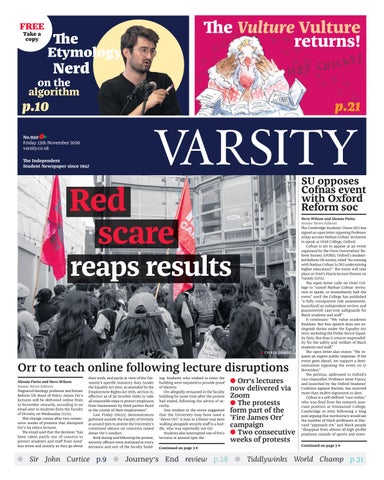
The Vulture Vulture returns!
FREE Take a copy
p.10
p.21
No.950 Friday 13th November 2026 varsity.co.uk The Independent Student Newspaper since 1947
SU opposes Cofnas event with Oxford Reform soc
Red scare reaps results p.3 ▴ chris lorde
Orr to teach online following lecture disruptions Alessia Fietta and Neve Wilson Senior News Editors Disgraced theology professor and former Reform UK Head of Policy James Orr’s lectures will be delivered online from 13 November onwards, according to an email sent to students from the Faculty of Divinity on Wednesday (11/11). This change comes after two consecutive weeks of protests that disrupted Orr’s A9 ethics lectures. The email said that the decision “has been taken partly out of concern to protect students and staff from needless stress and anxiety as they go about
their work, and partly in view of the University’s specific statutory duty (under the Equality Act 2010, as amended by the Employment Rights Act 2025, section 21, effective as of 30 October 2026) to take all reasonable steps to protect employees from harassment by third parties faced in the course of their employment”. Last Friday (06/11), demonstrators gathered outside the Faculty of Divinity at around 2pm to protest the University’s continued silence on concerns raised about Orr’s conduct. Both during and following the protest, security officers were stationed at every entrance and exit of the faculty build-
ing. Students who wished to enter the building were required to provide proof of identity. Orr allegedly remained in the faculty building for some time after the protest had ended, following the advice of security. One student at the scene suggested that the University may have used a “decoy Orr”. A man in a blazer was seen walking alongside security staff in a huddle, who was reportedly not Orr. Students also interrupted one of Orr’s lectures at around 2pm the Continued on page 3 ▶
● Orr’s lectures now delivered via Zoom ● The protests form part of the ‘Fire James Orr’ campaign ● Two consecutive weeks of protests
Neve Wilson and Alessia Fietta Senior News Editors The Cambridge Students’ Union (SU) has signed an open letter opposing Professor Arday accuser Nathan Cofnas’ invitation to speak at Oriel College, Oxford. Cofnas is set to appear at an event organised by the Oxon Universities’ Reform Society (OURS), Oxford’s studentled Reform UK society, titled “An evening with Nathan Cofnas: Is DEI undermining higher education?”. The event will take place at Oriel’s Harris lecture theatre on Tuesdy (17/11). The open letter calls on Oriel College to “cancel Nathan Cofnas’ invitation to speak, or immediately halt the event” until the College has published “a fully transparent risk assessment, launch[ed] an independent review, and guarantee[d] cast-iron safeguards for Black students and staff ”. It continues: “We value academic freedom. But free speech does not extinguish duties under the Equality Act 2010, including the Public Sector Equality Duty. Nor does it remove responsibility for the safety and welfare of Black students and staff.” The open letter also states: “We request an urgent public response. If the event goes ahead, we support a demonstration opposing the event on 17 November.” The petition, addressed to Oxford’s vice-chancellor, Professor Irene Tracey, and launched by the Oxford Students’ Coalition Against Racism, has received more than 29,800 signatures to date. Cofnas is a self-defined “race realist,” who was fired from his research associate position at Emmanuel College, Cambridge in 2024 following a blog post arguing that meritocracy would see the number of black professors at Harvard “approach 0%” and black people “disappear from almost all high-profile positions outside of sports and enterContinued on page 3 ▶
● Sir John Curtice p.9 ● Journey’s End review p.28 ● Tiddlywinks World Champ p.31
Friday 13th November 2026
2
Michaelmas, Week 6
Editors’ Note In typical Varsity fashion, this print came right down to the wire. We can blame our academic calendars, Bibi’s short stint as a mechanic (against the odds, the bicycle is still intact), or just the plain old Week Five blues – it doesn’t matter as it won’t change the fact that we are Bridget-Jones-level frazzled. A bright spot came to us in the form of the Vulture Vulture (p.21), who has defied migration patterns and flown back rather spectacularly in our time of need. Reading and writing these contributions gave us a good laugh in a week that, between student protests and bizarre college break-ins, risks getting rather serious. This print features every extreme of Cambridge student life. With backto-back interviews, we hear from Sir John Curtice on the shifting political landscape and on page 10 the Etymology Nerd (Adam Aleksic) warns us of social media’s powers to distort reality. On the inside back page, Tiddly-
winks champ and Cambridge professor Patrick Barrie regales the joys of ‘flicking’ (p.31). In a perhaps unexpected stint, we welcome an op-ed from the co-founders of Cambridge’s Free Speech Society (p.15), and watch them plead to be taken seriously. We’ll let the readers decide. In Features, an estranged student speaks to his experience of homelessness in Cambridge, and considers what more the University could do to support others in his position (p.12). These kinds of structural barriers are everywhere in an institution in dire need of a sympathetic overhaul. On the next page, one of our Features Editors considers the rise of the Greens in Cambridge, and considers whether their bold policies – popular among students – will actually lead to electoral success. Over in Fashion, we consider how the humble bike has impacted Cambridge’s fashion scene, with rolled up trousers and windswept hair galore. If the Fitz is more your style, turn
over to page 27, or look to Arts for a review of the William Morris exhibit (p.23). If you feel like each week is blurring into one (and into the fog), then make sure to note Film & TV’s watchlist that matches a film to each Cambridge milestone (p.24). Whether you read Varsity for the latest news, theatre reviews (p.28), or just to see our faces on the inside cover, we hope there’s something for everyone in this issue. As for us? We’ll be hibernating for the forseeable. See you in two weeks!
Daisy Bates & Bibi Boyce Editors-in-Chief MICHAELMAS 2026
editors Daisy Bates & Bibi Boyce editor@ varsity.co.uk deputy editors Olivia Goodman & Emma Tenzler deputyeditor@varsity.co.uk vulture editors Emma Gower & Daniel Kamaluddin magazine@varsity.co.uk news Alessia Fietta & Neve Wilson (Senior); Maebh Carey, Jacob Smith, Hayley Butler, & Benjamin Pine (Deputy) news@ varsity.co.uk; Skyler Roberts (Investigations) comment Jasper Burnside, Lily O’Sullivan, & Dexter Twycross opinion@varsity.co.uk features Bryony Clarke & Phoebe Leung features@varsity.co.uk interviews Faron Smith & Sam Elgar interviews@varsity.co.uk science Sophie Patel & Yu Tong science@ varsity.co.uk sport Daisy Kaye & Sophe Hardman sport@varsity.co.uk lifestyle Cherie Wong & Ruby Randall lifestyle@varsity.co.uk arts Juliette Berry & Ben Bailey arts@ varsity.co.uk fashion Rachel Jones & Scarlett Prunty fashion@varsity.co.uk fashion shoot co-ordinator Emer Naylor Afram film & tv Daniella Adetoye & Amanda Ljunberg filmandtv@varsity.co.uk music Lauren Quinn & Dylan Ingram music@varsity.co.uk theatre Lucy Farmer & Barney Sayburn theatre@varsity.co.uk photography editors Clio Sze & Gabriella Douglas-Kitsis illustrations editor & cartoonist Rosie Beyfus sub-editors Ell Heeps, Joss HeddleBacon, Sophie Giles, Natasha Simm, Ariela Ohrenstein, & Lucia Taylor subeditor@varsity.co.uk associate editors Charlie Rowan, Ell Heeps, Sophie Ennis, Leo Kang Beevers, Joss Heddle-Bacon, & Ben Lubitsh associate@ varsity.co.uk business manager Mark Curtis business@ varsity.co.uk varsoc president Bibi Boyce president@ varsity.co.uk varsity board Dr Michael Franklin (Chairman), Dr Tim Harris, Michael Derringer, Mark Curtis (Company Secretary), Hugo Gye, Ell Heeps, Daisy Bates, Bibi Boyce (Directors), Lotte Brundle (Guest), & Zoah Hedges-Stocks (Guest) © VARSITY PUBLICATIONS LTD, 2026. All rights reserved. No part of this publication may be reproduced, stored in a retrieval system or transmitted in any form or by any means electronic, mechanical photocopying, recording or otherwise without prior permission of the publisher. Varsity, 1 Trumpington Street, Cambridge CB2 1QA. Telephone 01223 337575. Varsity is published by Varsity Publications Ltd. Varsity Publications also publishes The Mays. Printed at Iliffe Print Cambridge – Winship Road, Milton, Cambridge CB24 6PP on 42.5gsm newsprint. Registered as a newspaper at the Post Office. ISSN 1758-4442
Friday 13th November 2026
3
News
Orr to stop teaching in Div Fac building The change follows a fortnight of protests outside Orr’s lectures Continued from front page previous Friday (30/10). A student protester in the lecture said: “James Orr, you are responsible for the rise of hatred in this country”. The protests form part of the ‘Fire James Orr’ campaign launched in August by students, including in the Faculty of Divinity, with the support of the Cambridge Communist Society. Orr resigned as Reform UK’s head of policy in September after Channel 4 News and investigative journalism group Verbatim released footage appearing to show him and Farage aide Dan Jukes discussing how to accept £30,000 worth of polling funded by a US-based donor. It has been reported that Orr and his wife have hosted postgraduate students at their home on the outskirts of Cambridge, which his wife has likened to an “alternative Cambridge college” where right-wing Christians can come together. As of 13 November, students taking Orr’s course will be provided with a Zoom link to join lectures, and other members of the University wishing to attend lectures will have to contact the Divinity Faculty Office with their name, status, and reason for wishing to attend the lectures. Access for these students will be at the discretion of the Faculty of Divinity, and “anyone who disrupts these online lectures will have their access to the lectures ended immediately”. The email continued by stating that
“there is no place for bullying, harassment, discrimination, misconduct, or victimisation within our community,” adding: “the safety and wellbeing of the University’s students and staff remain paramount”. Varsity understands that Orr is now also set to hold at least some supervisions on Zoom rather than in-person in the Faculty building. Theology students were sent an email from the head of the Faculty, Richard Rex, titled “Notice correcting misinformation” on Monday (09/11). The email read: “I am writing to correct misinformation that has been put into circulation about alleged Faculty funding from Palantir or Peter Thiel. For absolute clarity, the Faculty of Divinity has never at any time or for any purpose accepted or received any money or gifts from Palantir of Thiel Capital or Peter Thiel.” This notice came after protesters last Friday (06/11) chanted slogans including “James Orr, listen here, you were bought by Palantir”. At the time, a University spokesperson told Varsity: “It is misinformation to claim that the Faculty of Divinity has received funding from Palantir, Thiel Capital or Peter Thiel. The University of Cambridge has never received any gifts from Thiel Capital or Peter Thiel. It has received no donations from Palantir since 2019.” The Fire James Orr student campaign responded to the email in a reel on Instagram, in which a spokesperson said: “Last year, the University management
were caught having meetings with Reform officials, presumably because they were hedging their bets because they thought that Reform were going to get into power”. Last year, Varsity reported that senior University leaders had been holding secret talks with Reform UK figures to prepare for a ‘Trump-style’ overhaul of the sector if the party wins power. The same reel suggested that the University had accepted donations from Peter Thiel, rather than the Faculty itself. Thiel, co-founder of Palantir and conservative political activist, offered £10,000 for use by the Faculty of Divinity to Cambridge in America, a non-profit organisation that supports the University’s work, according to people with knowledge of the donation. This gift was made through the DonorsTrust, which is a donor-advised fund. The University has confirmed that a gift was made to Cambridge in America via DonorsTrust, but said the money was returned because the non-profit fund would not reveal the name of the underlying donor. According to the University’s policy, Cambridge must not accept donations if the identity of the underlying donor is not revealed. Varsity understands that, prior to 2019, the total amount that the University received directly from Palantir amounted to £6,000 over six years to fund student bursaries. Students in the Faculty also received an email from James Carleton Paget,
the director of undergraduate studies, following the protest last Friday (06/11), reminding students that they should ask for permission to record lectures. One student who spoke at the protest criticised the University for “not lift[ing] a finger to investigate [Orr]” following the Channel 4 investigation and concerns about students living in his home. They also claimed that the University’s “unwillingness” to investigate Orr was hypocritical given its stated commitment to safeguarding in other contexts, linking this to the treatment that Jason Arday received prior to his death. An email sent to all theology students last Thursday (05/11) from the head of the Divinity Faculty, Richard Rex, warned that “Estate Security will be monitoring access to the Divinity Faculty building tomorrow,” instructing that all staff and students “should therefore be sure to have their UCAM card with them”. Rex said that a Proctor would be present at Orr’s lecture “to maintain good order and freedom of speech,” before quoting the University’s rules of behaviour, which state that “A student must not: (a) interfere or attempt to interfere in the activities of the University, a College, or any member of the collegiate University in the pursuit of their studies or in the performance of their duties,” and that “A registered student must: (a) comply with instructions issued by any person or body authorised to act on behalf of the University, in the proper discharge of their duties”. The Faculty of Divinity is yet to address
any of the concerns raised about Orr with its students or staff. The University has also not confirmed the nature of any investigation it may conduct into Orr. Rex sent an email to students’ directors of studies about the lecture disruption last week on Monday (02/11). In the email, seen by Varsity, Rex said that he had contacted the Proctors to seek “advice and guidance on how to respond and on what can be done to ensure that our students are able to receive the Faculty teaching that they are entitled to expect”. Rex also said that “the lecturer has provided a report of what happened,” and asked that the academics “share with me […] any reports you receive from your students attending these lectures about what happened there and its effect upon them”. The head of the Faculty added: “The Proctors have acknowledged receipt of my message, and are giving consideration to the situation.” Orr quietly stood down from two of his academic commitments at the University this academic year. These commitments included his roles as the chair of the Faculty of Divinity’s undergraduate exam board, and as convenor of the Philosophy of Religion master’s degree pathway. However, Orr continues to lecture undergraduate papers in ethics.
SU signs open letter opposing Cofnas talk Continued from front page -tainment”. At the time, the University of Cambridge launched a disciplinary investigation into the blog post, which concluded Cofnas’s views, “while seen by many as offensive, did not breach the law and did not contravene university regulations designed to uphold free speech”. Varsity understands that other Cambridge societies, including the Cambridge University African Caribbean Society, have signed the open letter alongside the Cambridge SU
▴ sarah anderson
and national groups such as Black Lives Matter UK. However, the Oxford SU has not signed the open letter. The Cambridge University Amnesty International society has also directed students to the petition. The society told Varsity: “we unequivocally condemn the decision by the Oxford University Reform Society to invite Nathan Cofnas to speak at Oriel College, Oxford. Providing a high-profile platform to views that legitimise racial essentialism is deeply concerning.” The society added: “Academic institutions bear a fundamental responsibility to challenge structural discrimination. While we hold freedom of expression as an essential pillar of university life, human
rights frameworks clarify that it cannot be weaponised to dismiss the psychological and systemic harm caused by the proliferation of racist ideas. As a society committed to the protection of universal human rights and the eradication of discrimination, we assert that universities must be held to the highest standards. We urge Oxford student groups to reject platforms that compromise the dignity and safety of marginalised academic communities.” In July, Cofnas accused former Cambridge professor Jason Arday of plagiarism in a Substack blog post. Later that month, The Telegraph alleged that they had found over 100 passages in Arday’s PhD to be similar to another thesis published by Brunel University of London academic Paula Zwozdiak-Myers six years earlier. In August, following Arday’s death, Cofnas was suspended from his postdoctoral research position at Ghent University in Belgium, pending a “preliminary investigation” launched by the University. Later that month, Cofnas was barred from teaching at Ghent University for three months, although he has been allowed to continue his research position. The signatories of the open letter have warned that the event “risks creating a hostile and exclusionary environment for students, particularly those of ethnic minorities,” and “risks undermining Oriel’s role as a world-class educational institution” in 2026, the year of the 700th
anniversary of the College’s royal charter. In a statement, Oriel College said: “Oriel College is committed to upholding freedom of speech within the law and has a statutory duty to do so. This includes the freedom to express views that many find deeply offensive. We are also committed to promoting inclusion and maintaining an environment that is free from all forms of discrimination and harassment, including racial discrimination. “The college considers events booked by students who are committee members of registered societies according to our code of practice on freedom of speech. When an event is permitted, this does not imply endorsement by the college of the views of its speakers. “When considering booking requests, the college takes seriously the security implications of events and the safety of its members.” In a post on X, the Oxon Universities’ Reform Society (OURS), which registered as a society with the University of Oxford in September, claimed: “Nathan Cofnas and the event organisers have been subjected to a disturbing torrent of online hostility.” OURS said that, given its status as a registered student society at the University of Oxford, constituent colleges “are under a legal obligation to host events like ours”. The society continued: “The Reform Society is committed to hosting Nathan Cofnas, and allowing attendees at the event to engage in respectful dialogue with the same. “We find it strange that the University of Oxford or any of its constituent colleges should receive reputational damage in re-
spect of this event. The decision to host Nathan Cofnas was made solely by the committee of the Reform Society, and responsibility for the event rests exclusively with the same.” An Oxford University spokesperson told Varsity: ”Universities have a legal duty to protect lawful freedom of speech, including views that may be deeply offensive. Allowing an event to proceed does not imply endorsement of the speaker’s views by the University or College. “This event is organised by a registered student society, with Oriel College responsible for the use of its premises and event arrangements under its Code of Practice. “Freedom of speech and the right to challenge ideas are central to university life, alongside our commitment to tackling racism and harassment and supporting members of our community.” The Free Speech Union (FSU) has launched a webpage with an email template to “congratulate” Oriel College’s Provost, Lord Mendoza, for not cancelling the event. The FSU has provided support and funding to the Cambridge University Society of Women (CUSW) and the Cambridge University Free Speech Society, which was founded at the start of the academic year. James Orr, associate professor of Philosophy of Religion at the University of Cambridge and former Reform UK head of policy, also serves on the FSU’s Advisory Council.
Friday 13th November 2026
4
News
the public for limited daytime hours outside of Christmas and the quiet period. The incidents have impacted how College members view the College’s public opening hours, with one student commenting: “People can still break in, but only at certain times”. This sentiment was also expressed by other students. The new security policy has been met with widespread approval from Christ’s students. Many said that they would prefer that the security measures were strengthened to require a card for access to accommodation buildings at all times. Some students are more sanguine than others about the security risks. Melissa, a first-year Music student who lives on the floor where the break-in took place, said she “wasn’t aware it happened,” although she still supported the implementation of new measures. One student reported that some doors to the accommodation buildings are still accessible without a card during night hours. The higher security measures come amid the College’s commitment to provide out-of-term public access to its proposed library. During council meetings surrounding plans for the controversial project,
the College’s representatives emphasised the public benefit of the College’s open status, while maintaining that its facilities and staircases were private spaces. Some students have questioned whether any policies decreasing the College’s daytime public access, such as those in place at King’s, would decrease the risk of security incidents. Students at King’s College told Varsity that tourists can find their way into student-only areas, suggesting that stricter access requirements are not always effective. While there have been no new incidents reported at the College since, Christ’s has warned students about “groups of youths around Cambridge harassing, threatening and intimidating students of the University,” noting that some incidents have occurred in the town centre near the College. Last year, Varsity reported that a group of ski mask-clad young people broke into Gonville & Caius College’s St Michael’s accommodation block. This cames after the porters were called to a similar incident earlier that week, when a group broke into Caius’s central accommodation. The College’s domestic bursar, Karen Ball, sent residents an email acknowl-
edging the concern caused by the breakin, telling students: “Unfortunately, as beautiful as Cambridge is, criminal elements exist in here as they do everywhere and occasionally they make their presence felt.” Following a meeting with the head Porter and the Site Supervisor from the main contractor, Ball explained that some measures had been agreed “to enhance the security of the site,” including the reinstallation of the original iron gates that back onto Market Square. Last month, it was also reported that intruders had been entering
Cambridge colleges to deliver fake forms targeted at freshers. One Homerton student told Varsity that they found a ‘Fresher Week Form’ flyer “halfway under” their door when arriving at College at the start of term, describing their placement under bedroom doors as “unnerving”. The student, who lived in an on-site accommodation building mostly designated for freshers, said it was controlled by keycards, although noting that a scammer could have entered by tailgating a resident.
▴ ryan teh
Florence Reeves News Correspondent Christ’s College has introduced new measures to improve safety following a cluster of security incidents that involved members of the public accessing private areas in the College. The College’s Great Gate is now shut from 8pm until 7am every day, the side gate onto Christ’s Pieces is locked at night, and accommodation entrances require access cards between 6pm and 6am. Students spoke to Varsity about one alleged “break-in” in which a group of people entered the College’s Blyth Building, broke a plate in the communal kitchen, and left a block of Cathedral City cheese and a bottle of pink lemonade on the staircase. The student whose plate was “destroyed” felt uneasy after the incident, describing how the pieces had been meticulously re-arranged on the kitchen counter. Sophie, a first-year English student in the building, said that she could hear the intruders through her headphones, and that she now feels less safe in the building even with the new measures. Like many colleges, Christ’s is open to
Sum Fun Place the digits 1–5 once each in every row and column. All coloured boxes' sums are multiples of one another (e.g., the sums could include 2, 6, 1, 12, 2, 24...). The grey square does not have the smallest sum.
Your career at d-fine We are a European consultancy firm focussed on analytical and quantitative topics and the development of sustainable solutions to bring about positive change for our clients. What does d-fine offer you? - Diversity: Work with clients on topics ranging from financial engineering and machine learning through to climate risk and healthcare - International: Collaborate in project teams staffed across Europe - Education: Acquire new skillsets to broaden your technical and professional repertoire Who do we look for? Master’s or PhD-level graduates in STEM fields
www.d-fine.com
Berlin, Dusseldorf, Frankfurt, Hamburg, London, Milan, Munich, Stockholm, Utrecht, Vienna, Zurich
Friday 13th November 2026
5
News Hayley Butler and Bryony Clarke Deputy News Editor and Features Editor Modern and Medieval Languages (MML) students at the University of Cambridge have been informed that they will no longer be permitted to take note sheets into exams from 2027. Notesheets were introduced last academic year (2025-26) following a return to in-person examinations, allowing students to bring up to two sides of A4 notes into their exams. The MMLL Undergraduate Studies Committee said that notesheets were a “temporary mitigation” last year. A spokesperson told Varsity that the recent review on last year’s use of notesheets “drew on extensive feedback from external and internal examiners”, many of whom are also directors of studies who “spent a lot of time in 202526 assuaging students’ anxieties about the function of the notesheets”. The feedback also “highlighted difficulties standardising the policy to make it workable across the Faculty’s diverse papers,” and raised “related problems concerning fair and effective monitoring of student notesheets by examiners and invigilators”. According to one fourth-year MMLer, students “were only informed of any discussion about recalling notesheets in an optional introductory meeting in Week 1,” with the final announcement
coming halfway through the term. The student added: “For the current fourth-years, there is a general sense of frustration and injustice at having been the perpetual subjects of exam changes and uncertainty since the COVID-19 pandemic”. They noted that the presence of AI makes the “push to transition back to pre-pandemic protocols” understandable, but criticised the Faculty for not honouring the “‘gradual transition’ promised”. Another fourth-year, Owen, questioned the incentive for students to read around their subjects under the new exam format, telling Varsity: “Rather than engage with critical scholarly debates and come up with innovative analyses, students will be encouraged to spend their revision time simply memorising key quotes and basic talking points.” “The new format pushes students towards rote memorisation and surfacelevel analysis – exactly the skills rapidly being replaced by AI,” Owen said. The Faculty of MMLL responded: “our assessment criteria state explicitly that rote learning for exams is not necessary and indeed likely to be counterproductive […]. The exam format remains unchanged and we will continue, as communicated in the message to students, to offer support in study skills and exam technique through the Faculty and colleges.” A second-year MML student raised
concerns that the change would encourage “cramming culture” instead of testing “critical thinking skills,” which they called “outdated and not a good way to measure students’ performance”. The Faculty has pledged to “put on a support session for students preparing for in-person exams,” although one fourth-year student criticised the lack of “any plan to offer mock examinations or standardise handwritten supervision essays in preparation for the wider exam format change”. The MMLer stated: “This decision did not include any general consultation with the student body,” adding that the announcement “also comes just before the election of a new SU MMLL Undergraduate Representative, and a month before the first SSLC [Student Staff Liaison Committee] meeting with Faculty members and the MMLL student representatives, leaving the ‘official’ voice of students entirely excluded from the decision-making process”. Another fourth year echoed these concerns, calling it “absurd that the Faculty made this choice without any kind of student consultation”. Looking back on the switch from take-home to in-person exams in 2025, he added: “when they did put out a consultation in second year they just ignored everyone anyway”. The Faculty of MMLL’s co-chair and chair of the Faculty’s Undergraduate
Take your research questions beyond Cambridge Develop the ideas that shape business and society. Your master's has given you strong foundations. The INSEAD PhD in Management is where you turn them into research with real-world impact.
Why apply Five-year fully funded doctoral programme* Study in Europe and Asia; exchange in the USA with The Wharton School** Close collaboration with world-leading faculty members Graduates placed at leading business schools worldwide Who we are looking for: We welcome curious, analytically minded candidates with a master's in economics, psychology, engineering, mathematics, sociology or a related field, and a genuine interest in an academic career. Eight areas of specialisation on offer: Accounting and Control • Decision Sciences • Entrepreneurship • Finance • Marketing • Organisational Behaviour • Strategy • Technology and Operations Management Key dates: 15 Dec 2026 (preferred) | 04 Jan 2027, 23: 59 CET (last day to apply)
Studies Committee said that one issue concerned the fact that not all papers taken by MML students, some of which were administered by other Faculties, “allowed notesheets at all.” The statement added: “This decision brings the MML Tripos into line with other Triposes (such as English, Classics, and History), where the use of notesheets was either not adopted or has since been phased out in the broader move to return to pre-Pandemic examination arrangements.” A second-year HMLer responded to this stance, saying: “Personally I found the notesheets incredibly reassuring rather than confusing. They made the exam very much about your analysis, rather than simply memorising quotes, which is not what literature should be at all.” This comes after English exams shifted away from notesheets in 2025, while finalists were allowed to take their final exams in line with their previous two years of study. One fourth-year MMLer commented that they felt “a sense of dread” when hearing about the change, adding that it is “stressful enough to have a final year weighted as 100% of our degree, after spending 15 months away from the rigour and routines of Cambridge,” but to return “to an entirely new exam format and then find out that even the minimal mitigating measures in place
for our predecessors have also been cut is quite frankly terrifying”. The student continued: “It makes it seem as though the past three years of the course have not prepared us at all for our final exams. I feel entirely abandoned by the Faculty, and have even had supervisors air their frustrations at the constant exam changes.” Talks within the Faculty around the details of the exam format change are ongoing. The Faculty co-chair and chair of the Faculty’s Undergraduate Studies Committee told Varsity that they “note the frustrations” expressed by students, and invite them “to submit these to the Faculty […] via their College Directors of Studies,” adding that “to date no such grievances have been submitted via these channels.” The Faculty concluded: “we would like to offer final-year students our full reassurance that results last year compared favourably to those of previous years. Indeed, there is no evidence to support the view that students did better in exams to which they were allowed to take notesheets than they did in exams to which they were not.”
6
Friday 13th November 2026
News
Students welcome Part Two of the Arday review ● Set to report in 6 months ● Led by Jason Beer KC ● Follows SU concern over Part One Alessia Fietta and Neve Wilson Senior News Editors The Cambridge University Council – the University’s main policy-making body – has agreed on the terms of reference for Part Two of the independent review established following the death of Professor Jason Arday. The Council appointed Jason Beer KC to chair Part Two of the review, and has confirmed the membership of an independent panel to support Beer’s work. The review consists of two parts. Part One, led by Nazir Afzal OBE – former chief crown prosecutor for North West England and Chancellor of the University of Manchester – is in the process of examining the support, interventions, and protections made available by the University to Arday in the period before his death. The University has stated that this work will report within three months, to ensure recommendations for urgent action may be considered and implemented without delay. Part Two will investigate and report on the University’s institutional policies, procedures, decision-making, and oversight more broadly, and how these operated during Arday’s recruitment, appointment, and subsequent time at Cambridge. The confirmation of Part Two’s terms of reference comes after the University announced that it was launching an independent review following Arday's death on 4 September. On the launch of Part Two of the review, the Cambridge Students’ Union (SU) told Varsity: “At Cambridge SU, we have continued to consult and inform students on the progress of the Independent Reviews. Sabbatical Officers have often had to actively engage members of the University Council and Senior Leadership in order to get communication regarding Part Two, which has significantly affected our ability to communicate openly with students. Sabbatical Officers continue to request direct and proactive engagement of the University’s Senior Leadership in centring student voice as we continue to recognise the lasting impact of the loss of Professor Arday on the staff and student community. “The SU has greatly appreciated the opportunity to work closely with Nazir Afzal, who commissioned Part One of the Review, over the past few months. Throughout this process, Afzal has remained committed to keeping us consistently updated, and has been willing to attend meetings that the SU has facilitated with students and student groups. We are incredibly grateful for Afzal’s commitment to incorporating student perspectives into his work; we wish to note that, without Afzal’s willingness to engage with us, we would have been unable to maintain a line of communication with regards to the progress of the Review.” The SU continued: “We hope Jason Beer KC will follow this example, and
demonstrate a similar commitment to meaningful student involvement in Part Two of the Review. We intend to reach out to him in the coming weeks to hopefully establish a working relationship.” Part One’s terms of reference were agreed on 14 September. Varsity understands that the findings of Part One are due to be published in December, although publication may be delayed until the start of Lent Term in January to ensure that students have the appropriate support in place when they released. According to its terms of reference, Part Two of the review may consider material obtained by and relevant findings from Part One, although it will remain independent in its own analysis and conclusions. The chair for Part Two may also liaise with Afzal in order to share relevant information where appropriate, and ensure that their work is complementary rather than conflicting or overlapping. Beer is a barrister who specialises in public inquiries, inquests, corporate investigations, and public and police law. On Part Two of the review, Beer said: “I have been asked to undertake an independent, thorough and searching examination of the University’s institutional arrangements, and the decisions made, in the case of Arday. That is a weighty responsibility, and one which I approach with an open mind, without preconceptions and with a determination to reach conclusions on the basis of what – and only what – the evidence establishes.” Beer continued: “Part Two will examine some difficult and potentially uncomfortable questions. I will look not simply at what the University’s policies and procedures required, but also at whether they were themselves reasonable; how they operated in practice; who was responsible for making decisions; what information was reasonably available to them; whether relevant concerns were recognised and properly addressed; and whether the University’s various structures and functions worked together effectively – all in the case of professor Arday, and more broadly.” He said that he hoped “those who have relevant knowledge or experience” would contribute to the review, adding: “Their perspectives may be important in understanding not only what happened in Arday’s case, but whether there are wider institutional changes to be made.” The Chair of Part Two also commented: “I recognise that no review can undo the tragedy of Arday’s death. I nevertheless hope that a careful, transparent and independent examination of these matters can contribute to understanding, accountability, the rebuilding of trust and the process of reconciliation.” The Cambridge University Amnesty International society told Varsity: “Cambridge University Amnesty
International welcomes the University Council’s decision to agree to the terms of reference for Part Two of the independent review following the death of Jason Arday. We particularly welcome the appointment of Jason Beer KC to lead this review and the scope of its investigation into the University’s institutional policies and procedures. “However, the significance of this review must extend beyond its findings, it must provide meaningful scrutiny of institutional structures and ensure that the review is translated into action.” Part Two will focus in particular on Arday’s appointment as professor of the Sociology of Education in 2023, and the recruitment and appointment of professors through the board of elector process more generally. Part Two is also set to examine the induction, mentoring, and support made available for Arday and other professorial staff, the University’s response to allegations of research and other misconduct both in the case of Arday and more broadly, and the support provided to academics facing significant public and media scrutiny. This will involve looking at the University’s arrangements for identifying and responding to risks to an individual’s wellbeing, how the University assesses risks to its institutional reputation and to the reputation of affected individuals, and the circumstances under which the University makes public statements concerning a member of staff, as well as how such statements are approved. It will also look into the University’s institutional arrangements for recognising and responding to race equality, disability, neurodiversity, and reasonable adjustments. Professor Deborah Prentice, the University of Cambridge’s vicechancellor, said: “We are very grateful to Jason Beer KC for agreeing to lead Part Two of the Independent Review into the lessons that must be learned following the tragic death of Professor Arday. Jason Beer is an eminent legal expert who will bring vast experience of leading complex reviews and inquiries. We are equally thankful to the distinguished panel of independent experts he has convened to h
▾
an ry
te
assist him in this important task and look forward to receiving their findings and recommendations in due course.” The independent panel supporting Beer includes members with experience in higher education leadership and governance, research integrity, and equality and inclusion. The panel consists of University of Bristol professor of Health and Anthropology and co-chair of the UK Committee on Research Integrity, Rachael Gooberman-Hill, and Oxford professor of Higher Education and former president of the British Sociological Association, Rachel Brooks. It also includes Bertha Ochieng, professor of Integrated Health and Social Care at De Montfort University and Chair of the Black Leaders in Higher Education Network Steering Group, and Margaret Ayers, former chair of Universities Human Resources. Additional panel members may be added upon the request of the chair during the review process. The terms of reference state that neither the University Council, the General Board, the vice-chancellor, nor any other University officer may seek to influence Beer or the panel’s work. The review will not assess the scholarly merit or integrity of Arday’s published work, or make a retrospective academic judgement about his personal suitability for appointment. It will also not examine the conduct of journalists, publications, academics, or other external commentators, although their actions may be relevant to understanding the University’s response to public scrutiny. Part Two is set to report within six months of the publication of the Terms of Reference.
Jacob Smith delivers news from around Cambridge Christmas comes to Cambridge Cambridge’s annual ‘Christmas in Cambridge’ fair is set to open on Parker’s Piece this Friday (13/11). The alpine-themed fair will bring back popular attractions from last year, including an open-air ice rink, curling lanes, a Ferris wheel, and a funfair. There will also be several venues offering festive food and drink at the fair, including a heated tipi and the Alpine Lodge. This is the third year the Christmas in Cambridge fair has taken place on Parker’s Piece. The event replaces the former ‘North Pole’ event that was cancelled after its organisers pulled out in 2022. City’s Catholic church placed on ‘at risk’ register A Roman Catholic church in Cambridge has been added to Historic England’s Heritage at Risk Register due to concerns about its historical fabric and stonework. The Church of Our Lady and the English Martyrs on Hills Road already underwent £1 million worth of repairs to its spire and south aisle in 2025-26. However, investigations have since discovered “long-term deterioration” of the church’s stonework and decorative carvings. The church was completed in 1890 and remains one of England’s largest Roman Catholic churches. Diocesan heritage officer Matthew Champion expressed hope that being on the register would provide “an opportunity to concentrate on what needs to be done to ensure the building’s future”. Cycle route plans face calls for completion A 'Finish the Greenways' campaign group has been set up to pressure the Greater Cambridge Partnership (GCP) to finish building more 'greenways'. The Greater Cambridge Partnership (GCP) has only completed one of 12 planned greenways connecting Cambridge with surrounding areas, with the only fully completed route running from Horningsea, although construction has started on a number of other routes. The GCP says it is completing routes in phases so that “people can start benefiting from completed sections as soon as possible”. Some sections of other greenways have opened to the public, including Adams Road, which is part of the Comberton Greenway.
Friday 13th November 2026
7
News
Academics demand votes on divestment policy Alessia Fietta and Neve Wilson Senior News Editors Members of the University of Cambridge’s Regent House – the University’s main decision-making body – have called for votes to be taken on two Graces, or motions, proposed by the University Council last month in relation to divestment policy. 56 members of the Regent House have signed a request for a vote on a Grace asking the Regent House to “approve the Council’s decision to withhold authorisation of the initiated Grace,” referring to the Grace initiated in March by 155 members that called for the University to divest from companies involved in manufacturing conventional weapons and producing fossil fuels. This is more than double the 25-member threshold required to trigger a ballot. A ballot may be requested when at least 25 members of the Regent House object or propose an amendment to a Grace within ten days of its publication. In June, the University Council withheld authorisation of a Grace calling for divestment from arms and fossil fuel companies, citing legal concerns. At the time, the Council recommended that Regent House approve its decision to reject the Grace and support a “monitoring scheme” for investments instead. The proposed monitoring regime, backed by the Council in April, would
require the the Cambridge University Endowment Trustee Body (CUETB) to receive a report detailing the University’s investments in companies primarily manufacturing weapons if its exposure to such companies exceeded a certain threshold. This would then be followed by discussions with the University of Cambridge Investment Company (UCIM) about reducing this exposure. 50 members have also signed requested a ballot on a separate Grace, which asks that the Regent House “endorse the Council’s approach to the University’s investment in companies that manufacture conventional weapons”. In addition to this request, 46 members have proposed an amendment to the second Grace. The amendment would expand the duties of the CUETB, which was set up in 2022 to manage the Cambridge University Endowment Fund (CUEF). Currently, the CUETB must “report annually to the Regent House on its activities”. The proposed amendment would replace this with a broader obligation “to ensure, so far as is lawful, the Cambridge University Endowment Fund is an environmentally, ethically, and socially responsible investment scheme and oversee its approach to responsible investment”. The amendment would also require the CUETB to “monitor, at least annually, investments in fossil fuels, arms, and other categories included in unitholder
responsible investment policies, and to initiate “discussions on reducing exposure to these categories in due course, where exposure exceeds a materiality threshold (which shall be any exposure in the case of fossil fuels and arms companies)”. The amendment would further require that the CUETB report annually to both the Regent House and Council on its activities. The Regent House is the primary legislative and electoral body of the University, comprising over 7,200 academics and senior staff. The Council is the University’s principal executive and
▾ryan
policy-making body. Professor Jason Scott-Warren, an English professor at Caius and member of the Council who signed the request for a ballot on both Graces, told Varsity: “Rather than concocting spurious legal concerns, the University administration should have explored the possibility of asking the CUETB to run CUEF, as far as possible, as an ethical fund. It is our duty to ensure that we are not investing in future war crimes.” Political Sociology lecturer Thomas Jeffrey Miley also commented:
“The University is in crisis. The handling of the Arday affair was institutionally racist and atrocious. Furthermore, the bullying case exposed a toxic workplace culture experienced by many of Cambridge’s employees and staff.” Miley added: “In recent weeks, the unaccountable, out of touch, administrative elite has tried to render redundant University officers. Now this, the umpteenth iteration of the University trying to wiggle out of a promise to divest from the arms industry.”
teh
Get in touch
THE HIGH-TECH RECRUITMENT EXPERTS
We’re excited to connect with ambitious and fresh talent ready to make an impact on our team.
CAMBRIDGE UK
davincitrading.com
Software • Electronics • Mechanical • Maths & Physics Applied Sciences • Consultancy • Graduate / PhD
Let us do the detective work. From knowing what jobs are out there to advice and guidance through the hiring process, we work with you.
01223 81 33 99 register@ecmselection.co.uk ecmselection.co.uk/university
Da Vinci is a propietary trading house made up of some of the sharpest minds and most passionate players in the industry.
8
Friday 13th November 2026
News in brief A tree-mendous visit
Hosting Hunter
A heartening discovery
On college culture
The Duke of Edinburgh, Prince Edward, visited Clare College last week to celebrate the College's 700th anniversary. The Duke – who graduated from Jesus College with a history degree in 1986 – was taken on a tour of the Clare last Friday (06/11), and also attended a special choral performance at the College’s chapel. Prince Edward also met current students and viewed rare items from the Fellows’ Library, before planting a ceremonial cherry tree in Front Court. Founded in 1326, Clare is the second oldest surviving college at the University.
Hunter Biden will speak at a sold-out King’s College politics event tomorrow (14/11). The “fireside chat” will be moderated by King’s provost and former journalist Gillian Tett. The event is set to cover Biden's “personal and professional experiences, perspectives on American politics and society, and lessons he has drawn from navigating both private challenges and public controversies”. Beyond tax and firearms convictions, Biden was criticised after his then-President father issued him an official pardon in 2024. Event-goers will have the opportunity to ask questions after the talk.
University of Cambridge scientists have developed a treatment which could aid recovery after heart attacks. The method tested on mice uses mRNA to temporarily activate proteins in heart cells, encouraging heart tissue repair which is not normally possible in adults. Associate Pharmacology professor Dr Catherine Wilson said the results could “potentially have a meaningful impact on the quality of life of millions of people around the world.” The treatment will now be tested in larger animals and humans, with the hope of ultimately reducing patient mortality rates.
Trinity Hall released a culture survey to members of the College community on Monday (09/11). The survey is being run by consultancy firm Impact Culture, and responses will be confidential and anonymous. Alongside focus groups and interviews, the survey results will allow the College to produce a report with recommendations early in 2027. An email sent by Trinity Hall to college members states: “This is the first time the whole community has been asked, together, in a structured and confidential way. What you share will shape how the College approaches fairness, belonging, and everyday life here.”
Hayley Butler rounds up student news from across the country University of Lincoln criticised for ‘Big Brother’ lecture filming policy The University of Lincoln has been criticised for making the filming of lectures “standard practice” from this academic year onwards. The Lincoln and Districts Trades Council's chair raised concerns about the possibility of lecturers being “filmed against their will” and drew parallels with a "big brother state constantly following you around, recording you so they can point out when you’ve done something bad”. The University has defended the policy, saying it will ensure “all students have access to the teaching materials and support they need”.
20% OFF ALL BOOKS FOR HOLDERS OF CAMBRIDGE UNIVERSITY AND CAMCARDS SIMPLY PRESENT YOUR CARD IN STORE
Queen’s University Belfast to face ‘difficult decisions’ after rising financial pressures
WE ALSO STOCK A WIDE RANGE OF CAMBRIDGE RELATED GIFTS AND SOUVENIRS
Staff at Queen’s University Belfast (QUB) have been warned of “difficult decisions” ahead when it comes to the University’s finances. Staff pay deals, childcare provision, and gym fees for staff and students are under review, while car-parking charges are also expected to increase. QUB’s vice-chancellor, Ian Greer, said the university had a £12.5 million deficit in the last financial year. A University spokesperson added that it was “facing increasing financial pressures arising from reduced public funding, lower student recruitment income and rising costs”. Greer said that the University still hoped to deliver the pay deals agreed with staff.
Illustration by Richard Briggs
Birmingham student newspaper facing ‘substantial delays’ over legal objections
1 Trinity Street, Cambridge CB2 1SZ 01223 333333
bookshop@cambridge.org
Offer can’t be combined with other promotions
University of Birmingham student newspaper Redbrick says legal objections have made it "difficult" to report on the University, the Guild of Students, and topics such as sexual assault, leading to "substantial delays". Editor-in-Chief Tamara Greatrix said “resistance from The Guild” made reporting “a guessing game, rather than a clean-cut decision based on media law, which undermines our ability to scrutinise those in power”. The Guild said that its current officers maintained a good working relationship with the editors of Redbrick, and said it had a duty to ensure that student group activities complied with the law.
Friday 13th November 2026
9
Interviews ▼ JOHN CURTICE
Sir John Curtice
‘Polls should be taken, but not inhaled!’
I
t is the morning after Professor Sir John Curtice, Britain’s best-loved psephologist, has spoken at the Cambridge Union, and we have just come into his hotel room when we realise that there is a crucial problem – there are only two seats. Ever the gentleman, he half-sits, half-lies on the double bed while the two of us take the chairs. Despite his great range of academic experience, Curtice will inevitably always be best known to the public for his work on TV, having been involved in the BBC’s election night coverage since 1979. How did he first get involved? It turns out to be a very, very long story. “My graduate supervisor [at the University of Oxford] was David Butler, who, together with Robert McKenzie of the LSE, were the two telly dons of that age on the BBC […] We’re now coming to 1978, when an election is kind of beginning to be in the offing, [and] I’m his graduate student. David wanted to have somebody sitting behind him in the studio with a programmable calculator which could be used to calculate the swing if the mainframe computer should fail, […] David basically got me in the studio with a calculator.” However, while Butler may have been responsible for first getting Curtice in the studio, he did not get him his first on-screen appearance. This came thanks to one Michael Steed. “Michael had been doing the Statistical Appendix since 1964, as part of a series of books that started in 1945 which are known as the Nuffield Election Studies. In 1976 [Steed] became the President of the Liberal Party, which is the most senior position of a
non-parliamentarian of the party.” Curtice goes on to describe: “I started working with Michael […] we came up with a whole argument and a proposal about how the Liberals and the SDP might decide who should find which seats [after the two parties allied in 1981]. And this got quite a lot of publicity. My first appearance on Newsnight was to do with that.”
❝ Choosing a new Prime Minister ʻdoesn't automatically change the policy directionʼ By 1981, Curtice had a handful of TV appearances and a web of contacts. It would be one further contact, Clive Payne, who would, eventually, get him on the BBC as a regular analyst. Having worked with Payne previously on several local elections, when the 1983 election came around, “Clive said to the BBC, you know you’ve got your results, and they’re in your computer. If you feed the results in your computer to the university computer in Oxford, we can then put Curtice in front of a computer terminal in the studio […] I then
effectively became part of the team and basically [started] doing every local and European general election ever since.” Becoming a regular part of the BBC’s election night team also meant learning what the job really entailed. “Just get through the night!” is perhaps the simplest way Curtice sums up the demands of election coverage. Behind the familiar television appearances and instant analyses lies a gruelling exercise in preparation, stamina and, above all, the ability to keep thinking clearly when the hours begin to catch up with you. General elections have become particularly demanding, he explains, requiring a full day of work before the overnight results even begin. Curtice is fortunate, he says, in being able to keep going, thanks to “the odd banana and a bit of coffee”. Ultimately, though, it is the intellectual challenge that keeps him going: working out what is happening, explaining what it means and deciding whether the exit poll has got it right. Beyond election night coverage, Curtice’s attention remains closely focused on the political challenges facing the parties. The departure of Starmer may bring Labour some relief, but does it signal a genuine return of confidence in the party? For Curtice, Burnham certainly offers something different: a natural ability to connect with people, an understanding of how to communicate beyond Westminster and, importantly, a sense of direction. As Curtice puts it, he can speak to ordinary people “as an equal – that’s a valuable art”. But whether that makes him the answer to Labour’s wider problems is less
certain. Curtice questions whether Burnahm’s political instincts are matched by a fully developed set of policies. Indeed, his interests in social care, devolution, and electoral reform are “rooted in his experiences in government” and “in Manchester,” but Curtice asks whether these ideas amount to a coherent set of effective policies for the country as it stands today. There is, too, a broader warning. As Curtice observes, choosing a new Prime Minister “doesn’t automatically change the policy challenges”. He points to polling on the public’s perception of the government’s handling of the economy and the NHS, noting that although these have improved, “it’s not yet clear that people’s perceptions of how well the government is handling these major policy challenges have fundamentally changed.” For the Liberal Democrats, on the other hand, the problem is not the lack of parliamentary success, but their apparent absence from the political conversation altogether. Curtice identifies several problems facing the party: a lack of strong leadership, the limited visibility of its MPs, and an inability to connect with the political concerns increasingly preoccupying younger voters. Of Ed Davey, he says: “Davey makes a good splash, but there’s no broad, synoptic vision.” Meanwhile, of the party’s newer MPs, he observes that “they’ve made very little impact.” Their 72 seats at the 2024 General Election were the product of a highly effective, but ultimately limited, strategy. In constituencies where they had finished second to the Conservatives, they “were able to pick up support from tactical voters,” by an electorate determined to get rid of the Tories. For now, they have a sizable parliamentary presence. The question is whether they can turn that into a political identity, or whether they will be left watching other parties break the mould. One of those parties on a self-proclaimed mission to break the mould of British politics is the Green Party of England and Wales, which elected Zack Polanski as its leader just over a year ago. Following this, they saw a significant bounce, but have since fallen significantly in the polls. Does Curtice think this bounce could return to the Greens?
❝ Curtice has been involved in the BBC's Election Night Coverage since 1979 “There was always a bit of a question about whether or not Polanski’s style would clash with that of some of the parliamentarians, […] I’m not quite sure whether they’re quite as left-wing economically as Polanski. And the degree to which he was not focusing on some of the environmental concerns meant you could see the potential for conflict.” All the same, he doesn’t want to count the Greens out of anything just yet: “Part of the problem is that his particular weaknesses were exposed at a time when Starmer was disappearing, and Burnham was arriving. He’s probably tied back to the question of how well this government does, and whether
disenchantment begins to seep in again. If it does, then Polanski might be able to benefit from that.”
❝ Polling methods have changed drastically over the past three decades, from face-to-face quota sampling to online surveys Curtice has one eye on the changing political map beyond Westminster, too. Wales, in particular, presents an intriguing new political equation following Plaid Cymru’s election victory. His attention turns to whether the party can hold on to former Labour voters, particularly as Reform gathers momentum. Curtice ponders: “The interesting question is whether Plaid can maintain or retain that cohort of Labour voters in the context of the revival of Reform?” It is a glimpse of Curtice at work: testing one possibility against another, following the political currents without quite committing to where they might lead. He considers the emergence of this “alternative two-party system,” one that breaks away from the traditional Labour–Conservative duopoly, but is careful not to mistake the current political picture for a settled one: “It’s not an insulated system. It’s one in which political waters will cross over.” In an age of political disillusionment and a growing structural fracture, knowing what the country actually thinks has become ever more important. Against that backdrop, polling occupies an unusual position: it promises a glimpse of public opinion, while remaining open to the very human errors and interpretations that can distort it. “The polling industry has had its difficulties,” Curtice acknowledges, pointing to the 2015 and the 2024 General Elections, when polls exaggerated Labour’s position. Yet, despite these setbacks, he believes the public’s appetite for polling endures. The methods have changed drastically over the past three decades, from face-to-face quota sampling to predominantly online surveys, but he remains convinced there is value in the exercise. His advice is characteristically measured: “Polls should be taken, but not inhaled.” They offer a “guide as to where we are at,” rather than a definitive account of what the entire electorate thinks. It is a useful reminder of what polling can and cannot do. It can tell us something about the direction of political opinion; it cannot, on its own, explain why people feel the way they do, or make them feel any more listened to. For Curtice, maybe, that is precisely the point. Polls are not the verdict. They are the starting point for understanding a country in motion.
OLIVIA GOODMAN & FARON SMITH DEPUTY EDITOR & INTERVIEWS EDITOR
Friday 13th November 2026
10
Interviews
I
met Adam Aleksic, also known as the ‘Etymology Nerd’, on St John’s Street, just before his visit to the Cambridge Union. He’s charming, clad in a cotton sweater, with the highest words-per-minute of anyone I’ve ever met. Within thirty seconds, someone on the street recognises him and says they like his videos. I ask if it happens a lot. He smiles bashfully: “I try to be aware of selection bias. College campuses are my target demographic.” Aleksic has spent the last decade making online content about linguistics, etymology, and language. Though he’s native to the United States, Aleksic’s interest in etymology began here in Cambridge. “It was 2016, my half-sister was getting married […] I went to [Waterstones on Sidney Street] and ended up on the third floor. It was the first time I’d ever seen a linguistics section. This one book really stood out to me, The Etymologicon by Mark Forsythe.” This initial encounter was as a high school sophomore, ten years ago, and he’s only now returned to Cambridge (‘sophomore,’ he explains, literally means ‘wise fool’). “Earlier this afternoon I went back to that Waterstones for the first time – it was an insane full circle moment to see my book next to Mark Forsythe’s. It was a real out-ofbody experience.”
❝ Iʼm worried about the Boomers who don't understand it, way more that about Gen Alpha Aleksic began as a blogger making posts about the etymology behind random words. He tells me that he “did the blog for” himself and, “at the time, there was not that much linguistics content out there.” Then he started making infographics and posting them online: “I kinda had a Reddit influencer arc; it’s so embarrassing!” Aleksic finally settled on TikTok and Instagram, where he now has an audience of over 3 million. Aleksic’s book Algospeak was published last year. It’s about how social media algorithms are changing the way we communicate. He’s full of good examples of algorithms encroaching on real life, like children writing essays “about Hamlet contemplating ‘unaliving’ himself,” or how ‘delve’ – a favoured word of chatbots – has seen an upsurge in usage in the last few years. Aleksic scrupulously avoids broad claims about whether these developments are good or bad. The reason we might feel perturbed by algospeak, he thinks, is because “we don’t like the fact that the algorithm is censoring us, and we project that onto the word itself. But there are middle schoolers who use [unalive] genuinely in a euphemising manner because they’re afraid to talk about suicide and death.” Social media can have revitalising effects on language, too. “There are videos of these kids with a language barrier who both understand ‘67’ […] There’s this global camaraderie.” And though algorithms can have a homogenising effect by creating “bottlenecks” in discourse, the internet also fosters great diversity. “The Swifties and the K-Pop stans and
the incels all speak in completely different dialects, almost unintelligible between each other. It’s kind of beautiful that there’s this variation.” “There’s a way to look at social media that’s not brainrotted. Let me show you something.” Aleksic takes out his phone, opens his notes app, and shows me an image of a dog getting its brain injected with some sort of serum, a 5G cell tower looming ominously in the distance. “It’s literally brainrot, in that the puppy’s brain is being rotted, but it’s also the aesthetic of brainrot. We ironically spread this oversaturated imagery as a critique of the perceived degradation.” Aren’t memes about brainrot themselves brainrotted? “When it’s on that ironic level, I feel like it’s not,” he says. “It’s spreading awareness.” When we use terms like ‘brainrot’ and ‘slop,’ that’s part of getting to “know what’s going on – we’ve built up these mental guardrails against [AI slop].” “Social media is closest to an oral tradition. The written word is detached, objective. When you consume social media, you’re immersed, exactly like when you’re participating in storytelling.” And when it comes to adapting to this new tradition, it’s not children that Aleksic is most concerned about. “This oral medium, compared to the written medium, is one that young kids are actually extremely literate in. I’m worried about the Boomers who don’t understand it, way more than about Gen Alpha.” Aleksic is adamant, however, that “no fundamental aspect of [algospeak] is completely out of the wazoo. We’ve seen the medium distorting how we speak before.” He references Socrates, in Plato’s dialogue Phaedrus, who criticises written words as sophistic and illusory. It’s an old story: “the infrastructure through which ideas travel plays a part in shaping those ideas.” What prompted him to bring his thoughts offline, onto the page? “I was really noticing the algorithm affecting my own language. I couldn’t say certain things, or [I’d] get shadowbanned. I’d feel like I have to say other things to optimise for engagement. To me, it feels really inauthentic. So the most authentic thing to do possibly would be to talk about how I’m being inauthentic, which led into the book.” Another of Aleksic’s favourite topics is using magic realism as a tool to understand the social media ecosystem. “Magic is the idea of manipulating some fundamental feature of the universe to achieve a result. Social media can materially affect our reality: who we date, what we eat, what we wear, what we say. And social media is something that can be manipulated – speaking from experience.”
❝ Social media is something that can be manipulated – speaking from experience Language and magic have a long history together. Aleksic lists examples from Egyptian, Norse and Abrahamic cosmology, and laments how we’ve lost sight of this connection. “We should return to this original conception of language as magic. Hebrew is the sacred language of Judaism, Latin is the sacred language of [Catholicism] – why isn’t English sacred?”
The
Nerd
ʻThe algorithm absolutely gets us wrongʼ Aleksic’s new project is all about how algorithms and artificial intelligence distort our sense of reality. “Algorithms measure what’s trending, they output that, and influencers match the thing that the algorithms tell them is trending.” He cites Goodhart’s Law: “When a metric becomes a target, it ceases to be a good metric. That’s very much how social media operates – the algorithms measure something, and influencers target the metric.” “It’s a cybernetic feedback loop, where you push the thing it was measuring into greater virality than it otherwise would have been.” Cybernetic, he explains, comes from the root kyberne, “which means steersman or oarsmen in Greek. It’s the idea that, if the tide’s going in one direction, you can’t change it, but you can move the rudder a bit.” Is this distortion a problem? He pauses, gives a nervous laugh: “Yes. There are a lot of incentives for people to replicate trends which are not good for humanity.” He recalls how in January of 2025, just after Meta changed their hate speech regulations following Trump’s inauguration, he kept seeing “grotesque” racist videos, with audio tracks of slurs repeating on loop. Aleksic interviewed the creator of one of these videos: “He was a 24-yearold Lithuanian construction worker, who doesn’t even make money off of the account […] He said that the use of the [racial slur] was deliberate, for engagement. It’s the banality of evil: this guy was racist, but he didn’t make
the video out of racist reasons. People are a product of their incentives.” He observes that the Overton Window, the domain of acceptable discourse, of some words has shifted rapidly, like the popularisation of words from the incel community. “I don’t want to say that the suffix “-maxxing” is inherently bad. It’s a contextual thing,” Aleksic says. “But you can get irony poisoned. If you repeat something often enough, you might start to believe in it.”
❝ If I understand what Iʼm doing as magic then I want to be careful how I wield my spells “The window of discourse shifts through a feeling of consensus, simply that something shows up enough times.” And when algorithms control how often an idea gets seen, flaws in the mathematics of the algorithm can have significant cultural effects downstream. These distortions come down to a fundamental point about the limits of measurement, he says, quoting Baudrillard: “the map is not the territory.” Since algorithms
deal only in measurements, this leads to distortions. “Take the For You Page: the premise is that it understands you. But what it really understands is a mathematical representation of you, which is a distortion of who you are.” “The algorithm absolutely gets us wrong,” he says. But the algorithm isn’t just inaccurate: it’s an active player in the construction of our identity. “When you get a video, it’s like a reflection of your psyche, somehow. A friend will make fun of you if an embarrassing video shows up on your For You Page, because it was for you: you’re the one who likes this video. Not only does the content shape you, but the recommendation itself shapes your self-identity.” Has researching and writing about social media made Aleksic a better content creator? “Well, it’s made me more disillusioned with it.” He’s frank, even a bit cynical, about the weirdness of social media. “I try to be authentic about this. It’s a fake little game where you can make the numbers go up if that’s your goal. You can win the algorithm.” The aptly-named Etymology Nerd is aware of the responsibility that this gives him. His goal isn’t to cast judgement, he says, but “to make people more aware of the words they’re using, so they have agency over language.” After all, “if I understand what I’m doing as magic then I want to be careful how I wield my spells.” He can’t resist: “‘spell,’ as in spell a word, and as in magic spell, are related!” SAM ELGAR INTERVIEWS EDITOR
Friday 13th November 2026
12
Features
Cambridge’s hidden Y homeless students ou would never guess that I was homeless. When most people picture homelessness, their minds naturally turn to a stranger visibily struggling on the streets. But the reality for many students like me is that their struggles are hidden in plain sight. Behind closed doors, they may be couch-suring with friends, spending lonely ‘vacations’ in University accommodation, or even moving in between shelters. In my own experience as an estranged student, I have found myself staying at various friends’ homes between terms, from which a myriad of mental and logistical diiculties have followed. Mentally, although I have a support network of friends, I am still left with an overwhelming sense of alienation. With no stable place to call home, I and many others are left feeling unanchored. As the charity Goods for Goods puts it: “he stress of not having a stable home, the fear of what’s to come, and the emotional toll of living in such conditions take a heavy toll on one’s mental well-being.” It is no wonder, then, that many homeless students ind themselves experiencing anxiety, depression, and trauma as a result. Asides from such instability, there are diiculties that further complicate daily life. Where am I going to stay? How do I transport or store my belongings? How am I going to aford necessities? A irst year St Edmund’s student has made experiences hauntingly similar to mine. Glad to have found a friend to stay with out of term, he complains about the diiculties he faced in securing out of term housing prior to this: “I didn’t know where I was going to be […] college was particularly unhelpful and were unwilling to waive rent igures or provide a storage unit.” While many students receive parental support, homeless students are often 'left to their own devices' to ix their situations, and inadequately supported by the University. “I can’t depend on a clear one or two people back home that can do stuf like that for me,” said a irst year student at Queens'. “here’s no scafolding to negotiating life without parents.” A student classed as independent is entitled to a higher rate Cambridge bursary of up to £5,600 a year. But because hidden homeless students often struggle due to of some form of estrangement, the process is complicated. Student Finance England must consider them “permanently and irreconcilably estranged” from their parents, usually for a period of at least 12 months, to justify a higher loan amount. Obtaining this status presents a sizable hurdle, as circumstances are often not so clear cut. Speaking personally, I had not met the 12-month threshold at the time of my application. his meant long meetings with my tutor to make an ‘exceptional’ application, a year on a minimum student loan which did not even cover my rent, and, most importantly, no access to bursaries until my second year. In any
▲ SCOTT COBBOLD
sympathetic towards our situations, feeling truly understood can only really be achieved by knowing you are not the only one with your set of experiences. In this sense, the process of interviewing for this piece has been transformative. It was shocking to realise that beneath the average Cambridge student could be an experience very in line with my own. Looking to the future: “structural barriers would be the irst place I would start,” one student said. As well as better inancial support across the board, it would be useful to address the system itself – for example, the fact that homeless and estranged students are currently grouped under the same category as care leavers. Unsurprisingly, “there are diferent obstacles that I’ve come across that can’t quite be answered under the same category,” a diferent student explained. Another also urged for speciic Universitywide protocols, such as shared storage units or more lenient accommodation contracts, rather than allowing disparities in endowments and approaches to create further inequality between homeless students at diferent colleges. Turning to the student community, many interviewees highlighted the need for more awareness and empathy. “here’s so many hidden things that go on in a person’s life … having a level of tact would be something I would like a lot of people to consider,” one student put it simply. An-
Patrick Skrzypkowski speaks to other
estranged students about their experiences case, the burden is often on the student to jump through hurdles and bear any issues arising themselves. Collegiate support can vary massively. his causes a disparity in the degree to which such students sufer inancially. For example, whilst King’s ofers the Brewer Vacation Grant speciically to cover accommodation for estranged students between terms, Downing provides only a maximum of £500 per term for ‘unforeseen inancial diiculties’, and its published criteria state that accom-
❝ A personal hell modation and storage costs would not ordinarily be supported. As the St Edmund’s student put it: “Cambridge-wide help is notably sparse.” To change this, ensuring access to enough inancial support across all colleges may be the issue to tackle irst. It is not all bleak though, as mental health support seems increasingly ac-
cessible. Societies such as Class Act offer support to homeless and estranged students, and there are the University therapy and college welfare services. Some colleges, like Churchill and Emmanuel, even ofer in-house counsellors. One third year student described how coniding in his College’s welfare team made him “feel very safe”. It is often said – and just as often contested – that the University is a welcoming environment to people of all walks of life. However, a common thread in the discussions I’ve had is that students feel they are not fully understood. “It’s quite a personal hell,” said one irst year student. “I’ve never felt judged for it, I’ve never felt stigma… but I think there is some distance to go before people understand what we face.” Given our unique and highly personal challenges, it is no wonder this is the case. It is even more understandable given that, as a 2016 survey by London Metropolitan University found, homelessness amongst students is often a problem many are too ashamed to admit. “It’s not a thing you can talk about […] it’s not something I would ever want to come up and say ‘this is my experience’,”
one third year student conirmed. herefore, the University can be incredibly isolating for homeless students. I have felt ashamed to talk about my own situation, believing there was no one else going through anything remotely similar. Ironically, I know I’m
❝ There’s no scaffolding to negotiating life without parents not alone in this sentiment. As another student told me, “I know there are people who are similar to me out there, but I couldn’t tell you enough on one hand […] it’s so easy to feel alone when it comes to dealing with these kinds of things because it’s just so alienating.” here is a distinct diference between sympathy and understanding, and although many Cambridge students are
other student urged people to be “more careful and […] more intentional with how they ask home questions”.
❝ Cambridge-wide help is noticeably sparse “Cambridge has been transformational but challenging as an estranged student,” one student told me, relecting a common feeling for many like myself. Being homeless at Cambridge can be incredibly diicult, but it doesn’t have to be. With just “a little bit more care, a little bit more scafolding, and a little bit more support,” the complex, stressful, and testing experience of homelessness could, at least, become less isolating.
Friday 13th November 2026
13
Features
“I
was really feeling disheartened with the climate catastrophe which young people are experiencing […] and with the state of the job market because I was in fourth year […]. I was concerned about the rise of Reform. So I was looking for a home, and I wanted it to be socialist and democratic.” It is half past five at the end of a long work week, and Stella Wilkinson, a recent Cambridge graduate and the Chair of Cambridge Young Greens, is speaking in their personal capacity and sharing their journey to the Greens with me. Initially turning to Your Party, they soon left for the Greens, finding the former “undemocratic” with “higher-up structural issues”.
that doesn’t benefit students” and his decision to approve the Jackdaw gas field in Aberdeen. On a strategic level, she isn’t worried about tactical voting for Labour either, as the Greens had the “highest vote share” in the locals, followed by Labour in second place. Combined with current Labour MP Daniel Zeichner’s history of “tread[ing] the Labour Party line” – Wilkinson thinks his positions on Gaza and trans rights are particularly damning – they’re hopeful about the prospects of sending one of their own to Westminster for the first time in 2029. The Young Greens, however, are not the only youth-oriented Green organisation in Cambridge, and certainly not the one that has become the talk of the town – or rather, University – in recent weeks. While on the up electorally, Wilkinson notes that the town-gown divide persists in political organising, with the Young Greens sitting on the ‘town’ side of the fence. This is the rationale behind the establishment of the University of Cambridge Greens (UCG), which, according to an Instagram statement, positions itself as the home of the Greens on campus. As a student society, the UCG has to navigate a notably different set of chalWilkinson is one of many Cambridge lenges compared to the Young Greens. residents and students who flocked to When asked to describe the University’s the Greens in the past year. According left-wing political societies in one word, to the party’s local branch, membership around 43% of survey respondents use has grown to 2,100 in September of this explicitly negative terms: “disjointed,” year, from 800 members last Septem- “sheltered,” “inactive,” “factional”. Diber. Out of the 15 open seats in vision, both between the societies the council election this and between the societies ba past May, seven and broader student ▾ lila ltaxe were won by the body, is a comGreens; mon complaint. Roughly 36% of respondents are on the other end of the spectrum, however: “ i n v o l v e d ,” “strong,” “vibrant”. When it comes to UCG in particuL a b o u r, lar, the overarching w h i c h theme seems to be gencame first in uine hope that it succeeds, Cambridge in the combined with a healthy dose past three consecutive General Elecof doubt, since not much about them tions, won four. is known yet. Respondents describe it 50% of respondents to a Varsity sur- as “refreshing,” “a blank slate,” “fresh”; vey say they would vote Green if there there are two mentions of “unknown”. were a national election tomorrow, a One puts it simply: “One of the most number that jumps to 57% when asked attractive things about the Green Party about a hypothetical local election. is being the only mainstream party with When explaining their choice, re- a reasonable stance on the genocide in spondents often echo Wilkinson’s Gaza, but the party itself is divided on concerns. “Burnham doesn’t seem to many domestic issues and it is yet to be taking the climate crisis seriously at be seen how this will manifest in UCG.” all.” “[The Greens] are positioned against Keen to gain clarity on the direction Reform and I strongly disagree with Re- that the society is heading, I reached form.” “[They are the ] only party stand- out to members of UCG’s committee ing against genocide and a cohesive about their plans. Will they be a presmove towards socialism. Cambridge is sure group, organising hub, or electoral at no risk of going to Reform so tactical force? What is their relationship to the voting is not necessary.” Left Society and Labour Club, as well as Discussions of Burnham, Labour, and well-established campaigning groups political strategy are especially interest- like Cambridge for Palestine? How ing in Cambridge, as there doesn’t quite do they plan to respond to changing seem to be a 'Burnham Bounce' in the national momentum, having visited traditional Labour stronghold. While London as a group to canvas for Zach acknowledging a decline in national Polanski’s by-election? momentum, Wilkinson thinks Labour The group declined to answer in won’t hold strong in Cambridge because specifics and provided a general stateof its stance on economic and socia is- ment instead. It described their plan “to sues, such as Burnham’s “weak budget promote left-wing politics in the Uni-
❝
Burnham doesn’t seem to be taking the climate crisis seriously at all
versity and across the city, particularly through political education, discussion, and volunteering, often in connection to the Green Party”. UCG then asserts their belief that “the left, here, is not fractured, but productively opinionated and varied” and affirms that they “will not accept attempts to portray a fractured left-wing given that we have been working successfully alongside Amnesty, UCLS [University of Cambridge Left Society] and the campaign against James Orr”. This is followed by a short note on the shared “basic interests” of a “united coalition of left-wing groups”: “reducing inequality, fighting climate change, and increasing quality of life”. With no more concrete details about the society’s specific initiatives and objectives, especially when it comes to addressing Labour and growing its membership, its future is up for interpretation. However, there already appears to be division between the society's leadership and potentially broad student base.
Green-supporting students tend to be drawn to the party’s electoral potential and distinctive stance on specific issues – Gaza, the economy, trans rights – but the society's plans remain vague.
❝ The left societies seem very divided and this alienates average students The group’s refusal to entertain perceptions of factional tendencies also runs contrary to the impression many have of Cambridge’s left-wing political societies. As one survey respondent who considers themselves most “ideologically aligned” with the Greens explained, “often the left societies seem very divided and I think this alienates average students from get-
Looking for an intellectually challenging career option?
Kick start your career as a patent attorney with us What does it involve? Training as a Patent Attorney is a career path that will enable you to combine your understanding of science with legal expertise. You will leave the academic environment yet remain at the cutting edge of science and technology, applying your knowledge and skill in a commercial context. You will help to protect intellectual property assets and grow businesses.
Sound interesting? J A Kemp is a leading irm of UK and European Patent and Trade Mark Attorneys with ofices in London, Oxford, Cambridge, Paris and Munich. Visit our website for more information about training as a Patent Attorney. We are presently looking for someone with the relevant academic background to join us as a trainee patent attorney in our Engineering and IT group in autumn 2027. jakemp.com/careers/trainees
ting involved.” Other students take issue with the nature of student politics itself. One student who identifies as left-wing but feels excluded from the University’s political societies, described the students they had encountered in “explicitly political society spaces” as “less interested in having conversations and making slow but steady and sustainable change” than winning arguments. Perhaps, political spaces at Cambridge need to be made more accessible before mass mobilisation can occur. Ultimately, there is a ‘rise of the Greens’ at Cambridge if we are referring to the party itself. Its politics – a principled stance on Gaza, a commitment to climate action, bold economic policies – are genuinely popular, leading to notable electoral success for the local party chapter. Whether that popularity can be turned into an influential and student-led organising force, however, remains to be seen.
Friday 13th November 2026
14
Comment
What can Cam learn from Serbia’s Student List? ment was able to push the boundaries of what is both imaginable and feasible within the country’s political landscape by taking direct democracy beyond their universities. That is, through organising in a way that embodies their desired society of the future, they effectively combined disruptive direct action with mechanisms of participatory democracy. When, on 1 November 2024, a train station canopy collapsed and killed 16 people in Novi Sad, citizens flocked to the streets in outbursts of sadness and anger. The public promptly linked this tragedy to issues of a much broader nature that the authoritarian regime under recently resigned president Aleksandar Vučić stood for. Symbolic of the widespread dissatisfaction with corrupt government officials, mobbing, and systemic violence, the infrastructural debacle signalled a wakeup call to the nation.
▴ marko risović
Carbon captured:
E
verybody knows the climate is in a bad place. This September, the UN reported that global temperatures will exceed the 1.5°C limit set by the Paris Agreement in 2015. This summer, there were more than 2,700 heat-related deaths in the UK alone. Despite this, the UK government recently approved the Jackdaw gas field and is considering pursuing Rosebank – an oil field – in spite of net-zero targets. Rapid policy and technology interventions are necessary, if we want to limit the effects of global climate change. Put broadly, we are looking at two strategies in engineering for addressing emissions. The first is emissions reduction, where people work to lower the level of carbon emitted into the atmosphere every year. The second climate engineering includes emissions removal and focuses on the artificial manipulation of Earth systems, in order to cool the planet. Both are important, but one is far more urgent than the other. For a long time, scientists have had reason to be sceptical about climate engineering, compared to the known efficacy of reducing emissions. The idea first gained traction in the early 2000s, after Princeton researchers published an article called ‘Stabilization Wedges’. This paper has been cited over 3,000 times since and used in three separate UN reports, modelling climate change’s effects. It argued that technology like carbon capture storage (CCS) has the potential to prevent 90% of fossil carbon
❝ When asked what engineering can do for climate justice, geoengineering cannot be the only thing that comes to mind
In seizing the opportunity to transform outrage into action, the Serbian students stood up and said: ‘no more’. No more severe repression, police brutality, and the abuse of institutional mechanisms. Fed up with misgovernance, they successfully launched their struggle into the realm of electoral politics, insisting: “Serbia or mafia”. Serbian universities have served as the backbone of the student-led movement. Confronted with exclusion from formal decision-making and broadcasting services, students occupied university buildings and transformed them into public arenas where they collectivised power. Particularly, faculty buildings constituted key sites where students and staff exchanged ideas, held blockades and, crucially, organised through plenums. As decision-making assemblies, student plenums enabled all students of the given faculty to propose, deliberate, and vote on issues directly rather than through elected representatives. Plenums served as a core mechanism through which students chose and vetoed MP candidates for their Student List. Strikingly, out of 250 names on it, 160 delegates are academics, their trusted allies. Such an active role of university institutions in reshaping society might be foreign to this readership. For centuries, the University of Cambridge has played an important role in preserving the status quo both in academia and in the wider political realm. Presently, the institution has not fully divested and it helps render Cambridge one of the most unequal towns in the UK. Then, and when it fails in its duty of care to protect Jason Arday from far-right attacks, or when James Orr acts as a senior
❝ To collectivise resistance across the University, novel avenues are needed
adviser to Reform UK, we are collectively not outraged enough. And when a few challenge such trajectories, their dissent is legally suppressed. A case in point is the High Court’s 2025 injunction banning Palestine-related protests across central University sites for four months, and then until July 2026. To collectivise resistance across the University, novel avenues are needed. For instance, widespread plenum-like deliberations could unite students across the fragmented University body, whilst also attempting to bridge intergenerational rifts between undergraduates and postgraduates, as well as students and academics. Instructively, in Serbia, a highly effective move has been the bridging of the gap between institutional democratic mechanisms and grassroots activism. Through the students’ and academics’ combined effort, universities were recaptured from the state and oriented towards public service. A tunnel vision of organising through existing university structures cannot get us all that far in rebuilding things in our collective vision. If we are to affect far reaching change at Cambridge and beyond, a firm commitment to exploring and practicing alternatives is a must. In Serbia, an experiment in student politics turned into a historic electoral force which brought down the regime. The Student List’s victory institutionalised a different vision of politics in which the education sector is knitted into the very fabric of prefigurative democracy. With much labour and limited resources, Serbian students made the seemingly unimaginable practically possible. Now, it is on Cambridge students and allies to follow suit.
Cambridge engineers must focus more on reducing emissions
from power plants from reaching the atmosphere. And yet, despite two decades and over $40 billion of global investment, CCS technology currently stores less than 0.1% of annual CO2 emissions. That’s a very poor return on investment. Outside of theoretical arguments, CCS has very limited evidence demonstrating viability. Other climate engineering solutions also fail to hold water. On top of this, we have strong reason to question the motives behind something like Princeton’s report. How did geo-engineering gain so much traction? Here, investigations from the likes of Drilled and ProPublica, suggest that Princeton was strongly influenced by the fossil lobby. BP was found to have donated $15 million to the researchers, who were developing climate solutions which didn’t phase out fossil fuels. Politicians and bureaucrats also jumped on the idea, as a convenient way of sidestepping their current carbon problems. This likely influenced the findings of the report further, in a way that has hindered the environmental movement for years. All this leads me to ask: why are engineering students at Cambridge so consumed by ‘repairing the climate’, rather than reducing emissions? Much of this is to do with the outsized influence of Cambridge’s Centre for Climate Repair (CCR). This is a research group that focuses on removing emissions and ‘refreezing’ the Arctic, with strong links to the Engineering Faculty. On top of releasing a steady output of
academic papers every year, the organisation runs weekly seminars within the department, has a linked student society, a paid student engagement coordinator, and 21 external collaborators – one of which is Harvard University. Within your first week as an engineering fresher, you’ll have discovered that CCR is the primary place for climate research throughout your studies. This is no-doubt aided by the offer of free Aromi pizza at CCR welcome events. The criticism here is not about the hard work and resources CCR continues to invest. What they do is valuable, and it is amazing to see so much effort devoted by engineers to the climate problem. My worry is that the emphasis placed on CCR within and by the department obscures the more important work to be done regarding emissions reduction. CCR themselves acknowledge the importance of reduction, to an extent. They admit that emissions reduction has to come first, and only afterwards will repair be effective. So why does geoengineering get such a voice? If climate engineering becomes the go-to for students interested in climate action, a huge opportunity is being lost to funnel students into a variety of fields, deploying their technical and innovative skills for a greener future. So what can be done about this? How can we continue to support research in CCR – with the impressive amount of funding it has – whilst also recognising that reduction has to be paramount?
First, the Engineering Department needs to take responsibility for showcasing emissions reduction. While CCR is a separate organisation, there is considerable overlap between researchers in both groups. The Department itself plays host to many of CCR’s events and signposts their initiatives. While a huge amount of impactful research does take place, climate repair has a disproportionately strong influence. Second, the University needs to ensure that students are empowered to use their degrees for positive change. As an academic institution, Cambridge actively shapes students’ future careers – and this comes with a responsibility. In the past, engineering careers fairs have been protested by students for platforming companies complicit in climate destruction and violent industries. When asked what engineering can do for climate justice, geoengineering cannot be the only thing that comes to mind. We need to continue to ask for more. There’s a useful saying in environmental circles, which is potentially relevant here. “If someone is pouring gasoline on a burning building, you don’t respond by pouring water. First, you stop the gasoline.” The culture of Cambridge engineering runs the risk of disregarding the urgency of the climate crisis. There are other options available. Focusing research on emissions reduction, rather than just removal, is both achievable and empirically robust. It’s high time we did so.
Senna Bassi
Tereza Stefanovic
F
ollowing nearly two years of nationwide protests against the authoritarian regime, students took their struggle from the streets to the voting polls in Serbia’s snap parliamentary elections. On 25 October, an electoral list of student-selected University professors, experts, and non-academia allies posed an unprecedented challenge to the Serbian Progressive Party (SNS). In the most decisive institutional contestation of the last 25 years, the Student List claimed historic victory. The student-led move-
Friday 13th November 2026
15
Comment Oliver Crossland
❝ Bringing people from across the political divide to disagree sincerely and in good faith If we let free speech become a weapon in politics, we surrender the very thing that allows politics to exist at all. It belongs to no one side, which is why everyone has both an interest and a duty to protect it. The Symposium, our fortnightly reading and discussion group, is one attempt to do this in the society. But this is downstream of our broader goal: to bring people from across the political divide back into the same room, to disagree sincerely and in good faith, and to defend the shared foundation on which liberal democracy depends.
OP-ED
O
ur committee is so diverse that even Oliver and I don’t agree precisely on the need for CUFSS. I’m not convinced that the Enlightenment values underpinning liberalism rest on truth and should be pursued at all costs. Even that is a debate we ought to have. But we both agree that the University has a free speech problem. Of course, many students believe otherwise. This is because they hold the ‘rightʼ views on everything, in an environment where opposing views are considered not just wrong, but ‘problematicʼ. Speech that questions these views is recategorised as ‘hateʼ, which we are told leads to deaths. You have freedom to speak, with caveats: any speech that falls into the category of being “harmful” – as arbitrated by vocal student ▴ am activists – will be allowed to go ahead al ie only because it took a begrudging br ow change in the law to force universities n to uphold it. Cambridge University Conservative Association (CUCA) was last year pressured to disinvite a speaker for reasons of speech crime, and they acquiesced without a fuss. Best to err on the side of caution when inviting anyone else, lest you have to retract it with a grovelling apology. That CUCA technically could have hosted this event despite fierce opposition is hardly proof that free speech is alive and well at Cambridge.
‘Free speech belongs to no one side’
The CUFSS co-founders argue that their society is necessary
❝ Which other views have not been heard for fear of accusations of platforming hate speech? Many of the topics one must have the correct views on were helpfully listed for us in a video from earlier this week in which one obnoxious student interrupted a philosophy lecture to shout vitriolic abuse at Professor James Orr, proclaiming he was exercising his right to free speech by refusing to allow the lecture to continue. What concerned me most was how many people egged him on with applause, which explains the conviction with which he delivered his diatribe.He doesn’t need to sound it out tentatively; he knows anyone who disagrees would never dare say so. Any student who wants to hear both sides of a debate before expressing an opinion will quickly learn that even merely questioning whether something is true, let alone moral or helpful, marks one out as a nonconformist in a place where conformity is paramount. Some argue that CUFSS’ existence proves there is no free speech problem at Cambridge. To that, I would say that until Cambridge is an institution where every student and academic of any political persuasion, on any topic at all, feels completely free to speak their mind without fearing for their career, their grades, or their social reputation, there is a free speech problem.
Lavinia Rossetti
F
ree speech wasn’t always something I cared about. It seemed more mythical than real. In every society, at every point in history, some things cannot be said, and I thought those who claimed to defend “free speech” were trying to redraw those lines in their own favour. This was my view until fairly recently, and the reasons I changed my mind are the reasons Cambridge needs a Free Speech Society. For most of my first year here, I was preoccupied with something I thought was unrelated. Beyond supervision and the seminar, there seemed to be few places for the searching, openended conversation I wanted to have with my peers. I tried the Union briefly, but couldn’t find what I wanted there. I wanted something closer to the Cambridge Apostles, the 19th-century secret society whose members – the likes of Tennyson, Russell, and Keynes – met to read and discuss ideas and essays with total candour. It may well still exist (in which case I eagerly await my invitation), but in the meantime I decided that, I would try to build what I was looking for. That only took shape when Lavinia came to me with the idea of a Free Speech Society, forcing me to reconsider what I had dismissed. My error lay in understanding it too abstractly when, like any law or right, its meaning lies in the culture from which it emerged. Through the Wars of Religion, the Enlightenment, and the longer turn towards modernity, we learned habits – open-mindedness, tolerance, reason – that let societies as intellectually diverse as ours hold together and share a common civic life despite deep disagreement. What I thought was a local problem was a symptom of a much larger one. We are becoming more divided and intolerant, quicker to reach for violence and outrage than calm deliberation, and the forums that do remain too often reward partisanship over the constructive dialogue we so urgently need.
SINCE 1989
START YOUR CAREER AT IMC We're a global trading firm that keeps markets liquid, built on our own research and technology. Start as a Graduate or Intern and join a live desk from day one, working alongside the traders and engineers who provide essential liquidity to markets.
AMSTERDAM · LONDON · ZUG · AARHUS
TRADING
TECHNOLOGY
Blend maths, market insight and technology to price, quote and act at exactly the right moment.
Build the ultra-low-latency systems and ML platforms that decide who wins.
RESEARCH
Cutting-edge models and agentic AI, already live in the market.
L E A R N FAS T
BUILD A NETWORK
ONE GLOBAL TEAM
Real projects, real ownership, from day one, taught by IMC's own experts.
Your cohort doesn't end with your traineeship. Build a global network from day one.
35+ years, 10 global offices, 70 nationalities, all building up 1 company.
APPLY NOW careers.imc.com
11/09/2026 9:18 am
16
Friday 13th November 2026
Science
Behind the Ray Dolby Centre
▲ LYRA BROWNING
❝ It was the largest philanthropic donation ever made to UK science Among his surviving papers is correspondence with the celebrated King’s conductor David Willcocks, who permitted him to approach Benjamin Britten about recording a forthcoming performance of Britten’s Cantata Academica. Back in Room E5, Dolby listened closely to what he had recorded. Late at night, as the traffic outside subsided and Cambridge grew quieter, he became increasingly conscious of the background hiss produced by magnetic tape, experimenting persistently with different tapes and adjustments to his recorder in an effort to eliminate it–an irritation that foreshadowed the problem on which he would later build his name. Dolby was also a musician himself. When the Newnham College Orchestra needed a clarinettist for Dvořák’s New World Symphony, he took up the instrument again, later joking that joining the orchestra was “strictly
a way to meet the ladies”. His son David later recalled a sociable young Dolby who enjoyed dining at the High Table and holding gatherings in his room, feeling at home at Pembroke despite being one of relatively few Americans in the College. Cambridge also became important to him in a more personal sense. In 1962, while still a Research Fellow at Pembroke, he met his future wife Dagmar Baumert, then attending a summer school at the University. The clarinet he played in his room for Dagmar at Pembroke survives today in the Dolby Collection at the RDC, together with other material including his PhD work. After leaving Cambridge in 1963, Dolby spent two years in India as a United Nations adviser before returning to Britain and founding Dolby Laboratories in London in 1965. Beginning with his system for reducing background noise in recorded sound, the company grew into the international audio and imaging business behind technologies such as Dolby Atmos and Dolby Vision. By the time of Dolby’s death in 2013, aged 80, his name had become a global technological brand, while his will directed part of his fortune towards institutions that had played an important role in his life. His family subsequently brought forward these bequests rather than waiting for them to take effect in later years. In 2015, £35 million was given to Pembroke, followed by a further £16 million funding commitment from the Dolby family. The funding arrived at an opportune moment–after more than 650 years largely confined to its historic site, Pembroke was able to acquire a 200-year lease on the neighbouring Mill Lane site as the University moved out, expanding the College’s physical footprint by around a third and creating what is now Dolby Quarter. Two years later, the estate of Ray Dolby gave £85 million to the University towards the new Cavendish Laboratory. At the time of its announcement, it was the largest philanthropic donation ever made to UK science and made the Dolby family the second-largest donor in the University’s then 808-year history (the first being Bill & Melinda Gates Foundation). The gift funded not only the building that would become the Ray Dolby Centre, but also a new Ray Dolby Research Group and an endowed Ray Dolby Professorship within the Cavendish.
rch
▴ lyra browning
remained at the College as a research fellow until 1963. His attachment to Cambridge, however, extended well beyond the laboratory. In 1960, Dolby lived in Room E5 in the old part of Pembroke, barely fifty yards from the College Chapel. The draughty, oak-panelled room had no bathroom of its own, but Dolby nevertheless described it in a letter as “the most beautiful room in Cambridge”, regarding the lack of a shower as a “small price to pay” for such elegance. It also became the centre of his enthusiasm for recording music. Dolby ran microphone cables from his room to the Chapel, allowing him to record performances there, while the neighbouring Old Library provided opportunities to record chamber music. He ventured further afield too, recording performances at King’s College Chapel.
ro YRA b wning ▼L
’s sea
T
he exterior of the Ray Dolby Centre on the West Cambridge Site is dominated by polished white concrete panels and tall stretches of glass. The peripheral staircase leads upwards across a broad white stone platform, elevated above the surrounding ground. In bright sunlight, its pale stone surface reflects the light with an almost blinding intensity, creating a field of radiating glare. Inside, the building feels unmistakably modern. Two lecture theatres clad in scintillating copper hang over the vast, lightfilled foyer, while broad staircases cut through the open interior linking publicly accessible spaces across each level. Beyond secured gates on each floor lie working spaces, where research and teaching laboratories, workshops and offices accommodate thousands of researchers and students in the Department of Physics. Named in recognition of a generous £85 million donation from the estate of Cambridge alumnus and sound pioneer Ray Dolby, alongside £75 million of support from the UK government through the Engineering and Physical Sciences Research Council (EPSRC), the Ray Dolby Centre stands as a testament to Dolby’s enduring legacy and commitment to scientific innovation. For many walking through its doors, however, the man behind the name may be considerably less familiar. His surname is more likely to be encountered in everyday life: in cinemas, beside a film on Netflix or attached to technology found in phones, televisions and laptops. Ray Milton Dolby was born in Portland, Oregon, in 1933. After graduating from Stanford University with a bachelor’s degree in electrical engineering in 1957, he was selected as a Marshall Scholar that same year. The scholarship, which brought promising American graduates to British universities, was a gesture of gratitude for the Marshall Plan, the American programme that had supported European reconstruction after the Second World War. Dolby joined Pembroke College and began his PhD in the Cavendish Laboratory’s Electron Microscope Group. He published work arising from his Cambridge research less than a year into his doctorate, and in 1960 was elected to a Fellowship (as Draper’s senior research student) at Pembroke. After completing his PhD on ‘Long wavelength X-ray microanalysis’ in 1961 under the supervision of Ellis Cosslet, he
Ro sa
Alex Yang explores the life and work of Ray Dolby
well unpacks th o H Unive e d r late sity lin st re
On the importance of female role models in science Do you remember the first time you decided you wanted to pursue academic excellence? I think all of us in Cambridge have an ‘academic origin story’. For me, my inspiration to study science and excel in my field came from a book on influential female scientists. While reading an account of Rosalind Franklin’s endeavour to image DNA in Rachel Swaby’s Headstrong, I felt inspired to push through and stop at nothing to achieve big things academically (it also helped that Franklin was my namesake). Imagine my shock, however, when I discovered that Franklin was the only female scientist that many of my peers may have heard of. A review released this October highlights that in GCSE curricula, Franklin is the only named female scientist across Biology, Chemistry and Mathematics. This number barely increases at A-Level, where the only named female scientists are Marie Tharp, Inge Lehmann and Rosalind Franklin. The exposure to the research of women is further reduced by the fact that the mention of Franklin is limited to one exam board, and Tharp and Lehmann are only present in OCR geology. This might seem like identity politics, or complaining about the curriculum not being like people like me, but the study highlights the danger associated with removing women from curricula and public conversation. A lack of representation or role models with whom we identify can limit our ambition, as studies highlight that exposure to role models impacts perception and motivation to pursue STEM fields. This problem is amplified when we consider girls from underrepresented backgrounds, who may feel doubly isolated from the legions of male scientists who swarm textbook pages. Women who have the potential to become amazing physicists, chemists or ecologists may never feel encour-
aged because of this oversight in curricula. The study authors highlight this discrepancy and suggest the inclusion of more scientists in curricula. However, their suggestions remain relatively conservative: suggesting one scientist per KS4 science subject. For example, they highlight that Marie Skłodowska-Curie ought to be included in GCSE chemistry, a scientist who is widely recognised for her contributions to radioactive isotopes, and suggest the continued inclusion of Franklin across all exam boards.
Artificial intelligence in vaccine development You may know artificial intelligence from last-minute literature searches, or proofreading an essay you weren’t quite sure about. But did you know that AI might have implications for public health? In recent research, computational approaches are being used by Cambridge scientists to help design new vaccines. A key challenge in vaccine development is the speed at which new strains arise, meaning that we are often racing against the clock, with new vaccines sometimes coming out long after the virus has spread significantly in the population. Researchers highlight the need for anticipatory approaches so we are not outpaced by the rate at which viral antigens – the proteins on the viral surface which our immune systems use to fight off the infection – change. The scientists used a digitally enhanced technique to carry out protein sequencing, creating artificial, broadly reactive antigens for the virus responsible for bird flu. These were then used to create an mRNA-based vaccine. Researchers hope that the protection offered by these vaccines will be stronger in the face of new viral variants. Early tests of these vaccines in rats indicate that they have a stronger strengthening effect on the immune system than the existing vaccines, providing an exciting new pathway for future research into vaccines against viral diseases.
or 3 December 2026 for specific departments to be considered
18
Friday 13th November 2026
The Smoking Area Crossword by Jafar
ACROSS 1 Novice printing error taking over Hamnet’s onset is rejected, previously covered (8) 5 Sanctum excavated from shady tumulus (6) 10 Property of bishop: to forgive sins in cycles (5) 11 Insurgents resume failing to steal money (9) 12 The more dry, the more unusual its reading (10) 14 Cylinder for storing oils gives way (4) 16 Getting first of tickets, learner parked in two-door on double line (7) 17 Reason no longer common? (7) 18 Company staging plays about Greek character (7) 20 Gold abducted by fake alien (7) 22 Uncovered scenic cycling fair (4) 23 Fleece wrung out to rid drop of water’s luminosity (10) 25 If Orator is in chaos, one is detained all the more (1,8) 26 A new note – that is, musical (5) 28 Ship entering swamp for scrap (6) 29 List of characters in bit of theatrics, following Elphaba flying off the handle (8)
DOWN 1 Entering the Big Apple with incomplete Masters is leng (7) 2 Perhaps caught tail end of drought at the other place (3) 3 Picture of Egypt (10) 4 On return, encountered nuisance storm (7) 6 Noise produced by stringed instrument (4) 7 Fear brain surgery (I would, for one) (11) 8 Eoin takes over St Johns by improper connection (7) 9 Hydrocarbon and layer of electron (6) 13 Stab twenty in the back? (6-5) 15 That which draws one’s pants (10) 18 Sting operation taking time to make switch (7) 19 Tom seeking to prey in church housed by old group? (7) 20 Ampule containing coronavirus found in river (7) 21 File extension in unadulterated arrangement of custody (2,5) 24 Dead and resurrected from the rest (2,2) 27 Chuck up part of pen (3)
Word wheel
Using every letter exactly once, form as many words (4+ letters) as you can. The central letter must be used, etc. There are 152 possible answers.
Sudoku
Vulture.
▲ ROSIE BEYFUS
Inside ● The Vulture Vulture tackles the blues p.21 ● The life of a student writer p.22 ● Cambridge’s indie venues p.25
20 Vulture
friday 13th november 2026
Lifestyle
In conversation with Bridge Bagels Ellana Cowan checks out Cambridgeʼs new hole-y grail
E
veryone has an opinion on the Cambridge they took to crafting their recipe: following recifood scene; some call it a foodie wonderland, pes from “bagel bagel evangelists” in the US; locating others a culinary desert. As for a Jewish girl a specific type of yeast; playing with hydration from North London, there’s one flaw in the levels to get the perfect city’s gastronomic landscape: you can’t find a decent chew. Their bagel anywhere. Ever since joining Varsity,, I’ve been end threatening to write an article on Cambridge’s best bagel. However, much like a poorly-made dough, my plans crumbled to pieces, foiled by the city’s meagre offerings. Bridge Bagels are here to fix that. “When I first got here, I was like ‘where’s the bagel spot? There is no bagel spot? Damn.’” Ryan tells me, rolling a ball of dough into a long cigar, before joining the ends to make that well-loved shape. “Like a normal person, I accepted that for several years.” It was this lingering disappointment that led Ryan Walter and Lauren Robarts to start Bridge Bagels. After spending years searching for the authentic New York-style bagels so reminiscent of home, Ryan decided enough was enough. He joined forces with fellow Marylander Lauren, and they started Bridge Bagels with a mission to bring proper New York bagels to Cambridge. Sitting in the home kitchen that currently serves as the enterprise’s production site, I get a look into the process behind creating the magic of a New York bagel. To my left, Lauren and Ryan undertake the first essential step: hand rolling. To my right, Maka, their newest member and current Emma student, oversees the second step: kettle boiling. Spread out on the table in front of me sits the end result: a jigsaw of crates brimming with plump, glossy bagels. The smell is intoxicating. This painstaking method is something the pair refuse to compromise on; they are meticulous with their technique and ruthless about quality. Their sleek product is the result of much trial and error. The duo explain the scientific approach ▲ ajla vandevoort
goal was to create the closest match to New York’s best bagel shops. Yet quality is only one part of their story. Another significant aspect is rekindling their customers’ emotional connection to these American staples. Both Ryan and Lauren’s bagel love affair stretches back to their childhoods in the US. For Lauren, they call to mind memories of weekend pilgrimages with her dad to the local bagel spot. For Ryan, growing up in a Jewish family, bagels were simply a part of life. Later, Saturday runs and bagel brunches became a ritual for him and his partner when they were still living in America. Lauren describes how it’s this sort of flashback that they hope to evoke with Bridge Bagels. I had exactly this experience when tucking into a batch I had collected a week earlier; the nostalgic smell sending me back to family gatherings at my grandparents, where bagels – or beigels as my grandma would say – were always on the menu. Quality and nostalgia are perhaps what keep Bridge Bagels’s customers coming back, with regulars making up 25% of their business. It also explains the endeavour’s rapid growth. Starting this September with limited batches of plain bagels, they have already expanded to include a selection of seasoned bagels, with options for collection, delivery, and, recently, a subscription service. Yet, for Lauren and Ryan, this is only the start. Their immediate goal is to open a shop in Cambridge, which will be a “piece of the community”. The pair stress just how central the communal aspect is to these plans, detailing how the shop will serve as a relaxing, family-friendly, neighbourhood hub. It’s a place where, as Lauren quips, “everyone
Digi-Cambridge window into the life of someone you miss. With the resurgence of digital cameras, moments are caught through a nostalgic lens. While they don’t offer the best quality photographs, they can offer something that feels more authentic. They offer a real image. A little grainy, things smudging together where there is more clarity in the
▾b i
C
ambridge is no stranger to photographs. Whether it’s the cameras of the tourists who saturate the city, or students capturing their morning walk to lectures, this picturesque place leans into the camera. It’s easy to get a stunning shot of the river as you rush across a bridge, of college buildings as the sun ascends, or even of the odd Henry VIII statue which appears around town. Although I might just draw the line at yet another quintessential picture of King’s (unless it’s as the sun is setting… then perhaps just one more). Curating a selection of photos to perfectly represent your term before posting them on your Instagram is a rite of passage. Yet I always find so much joy scrolling back through my memories of the past eight weeks and fondly picking out my favourite moments. Photos of friendship and laughter, of nights in and nights out, dressed up for a formal, or in pyjamas for a game night. Instagram can be a tool of connection. It bridges the gap between friends far from home, despite the hundreds of miles separating you. It acts as a
boyce bi
knows your name”. They also aim to provide the full New York deli experience, complete with filter coffee and lightning-fast service. And for special occasions, the duo plans to host events like Thanksgiving meals and Super Bowl parties. Through firstly their Cambridge shop and, later, shops across the UK, they hope to bring a little bit of America to Britain.
❝ Their end goal was to create the closest match to New York’s best bagel shops As I walk back on a dreary day, clutching the fresh bagel I was kindly gifted, I get my own experience of the US here in Cambridge. In one mouthful, the bagel’s wafer-thin crust snaps, giving way to a mouthful of chewy goodness. The dough’s mild, yeasty flavour marries with the savoury tang of the cream cheese, which oozes out the sides, slightly melted by the warm, oven-fresh bread. I might have been walking along a drizzly Cambridge street, but in my mind I was walking through Brooklyn, tucking into a fresh bagel straight from the local deli. A crumb of New York in Cambridge indeed.
Katie Ballingall reflects on the snapshots that encapsulate Uni
feeling of the moment than in its sharp outlines. Snapping photos on a digicam is a gamble. Swiping through the images the morning after, you might find a perfectly candid moment beautifully captured, or images so blurry they’re indecipherable. Yet in the moment, the focus shifts from taking the perfect shot to documenting the experience. Maybe you’re grinning, laughing, or perhaps you’re completely oblivious to the presence of the camera. Memories of magic and mischief are imprinted in the lens. Arranged on my pinboard is a selection of photos, usually dominated by ones taken the previous term. When I’m typing away at an essay, they offer a promise of the fun Cambridge offers once it is submitted and forgotten. The tales which accompany each one are moments I hold dear. The pastel bunting and sparkly string lights we passed on a walk home; the cookies which merged into one while baking but tasted just as delicious; the snapshot at the formal where no one knows the dress was sewn up in a last-minute fix five minutes earlier. I know I won’t graduate as the same person I was when I
matriculated. When, hopefully, I one day see the images from matriculation and graduation side by side, they will represent two very different versions of myself. We leave Cambridge with the experiences of supervision discussion, better critical thinking, and the ability to perfectly format a footnote – at least in theory. Yet the treasure trove of memories is just as significant, because ultimately, it is the people we will remember the most.
❝ Memories of magic and mischief are imprinted in the lens Photographs capture a moment in time, and our university experiences really are fleeting. In a few short years, photos and videos will be all that remains of our undergraduate life. Whether the picture goes up on your Instagram story or stays tucked away in your camera roll, it preserves something you might otherwise forget. This is how we will remember our degrees: through blurry images of nights out, laughter over the pool table and conversations at formal, dressed to the nines. Take the pictures, capture the moments, but remember to enjoy the experiences, too.
Vulture
friday 13th november 2026
21
Lifestyle
H
ey chicks, your favourite avian aunt has returned and she’s ready to rescue you from all the problems Week Five throws your way. With daylight hours getting shorter (and essays getting longer), we’re all in the need of some serious self-care. If it’s getting rough around the roost, or you’re struggling to feel chirpy, let me take you under my wing and ease the pain.
My flatmate likes to keep raw chicken in the fridge uncovered. I tried to ignore it at first but they won’t get rid of it – should I be worried? Sounds to me like a tasty meal of carrion… but for picky eaters who prefer their food cooked, I can understand why this could be a bit of a concern. As long as it is kept on the bottom shelf of the fridge so that the juices don’t contaminate any other food, you should be safe! If you are still worried however, have a conversation with your flatmate about your concerns. If confrontation isn’t your style, Christmas is coming up and it sounds like tupperware (or a food safety and hygiene course) may be the perfect gift!
I’m at Homerton but my current fling is at Girton, and I find him taking the bus a real ick. Do I call it quits?
❝ If you’re too chicken to cut him off, then you’ve got to start asserting yourself in the nest I’m feeling homesick but worried about falling behind if I go home. What should I do? Don’t be ashamed if the Week Five blues are hitting you – they have a reputation for a reason! Take the time to temporarily migrate home for a weekend – I go every winter. If you’re worried about your work, you can get a start on it during the journey, but don’t stress if you don’t get the chance. I can promise that a couple of days of rest will do nothing but make you more productive in the long run. Yes, your studies are important, but not nearly as important as your wellbeing. Varsity hasn’t built my office yet (hurry up by the way – sitting in a tree with twigs up your bum all November is no condition to leave a dolly bird like me), but you can always write if you need anyone to squawk to!
Seems like someone wanted a laugh when they arranged the accommodation plans… It’s a sticky situation, but don’t let it get to you – fly above it like the chill chick that you are. Obviously it’s unrealistic that you’ll never bump into your ex, so don’t make it your mission to avoid them entirely. It’s much less awkward to accidentally come face to face with them in your pyjamas with a shower cap and face mask on if you’ve already had a conversation when you were looking more presentable. And you can treat this year as a fresh start and form a new sort of relationship with them. You don’t have to be besties, but they’re your nestmate now, so keep the past quarrels in the past – for the sake of you and your staircase.
How do you keep your feathers looking fresh this far into term? Flapping about between the icy Cambridge air and toasty indoor heating will have any chick’s feathers looking more pigeon than peacock. In these tumultuous temperatures it’s more important than ever to prioritise moisturising to avoid chapped talons and sore beaks. Don’t worry, there’s no need to ransack Boots for an overpriced ten-step routine. I personally use regurgitated mouse intestines to keep my feathers smooth and perky, but as general advice, I would suggest investing in a hydrating moisturiser, basic lip balm and a facial serum to look awake and refreshed. Of course, an overnight lip mask (a little birdie told me Laneige does wonders) or a face pack can add an air of luxury to your roost and recuperation, but even the simplest ritual can boost your morning.
The Week Five burnout is real, and I’m exhausted! But I’m also worried about getting FOMO if I stop going out… Whether you’re soaring off your branch at six for rowing or crawling out of bed already late for a 9am, Week Five starts can trap you in fight or flight. Swapping out a couple mid-week club nights for cosier evenings and earlier bedtimes is one way of lowering stress. Taking a pause, however, can be even smaller: carving out ten minutes for a sitdown breakfast, daily stretches, or twittering with a friend over tea are all ways of stopping and smelling the birdseed.
soon both your and their supervision essays will become im-peck-able in their own ways.
❝
Take the time to temporarily migrate home for a weekend My one-night stand still has my thong - I go every winter
He’s clearly obsessed with you, chickadee. Thongs are easy to come by – any Victoria’s Egret or TopFlock will sell a variety – but that doesn’t mean he should get away stork-free. Try emailing My college parents fled the nest and his college or initiating a harassment campaign, now I have to ask a stupid bird for adstarting with a message to his mum. She’ll be imvice…! pressed, and I’m sure it’ll find its way back to you Rude! But seriously hen, college parents are oversoon enough… along with a restraining order. You rated. They might seem older and wiser, but I can wing some you lose some, and a thief is definitely guarantee they’re winging it too. If you haven’t heard not a keeper. from them in a while, don’t assume it’s personal, and definitely don’t make things squawkward by My supervision partner never does confronting them. Give it time, they might just come the reading and always asks for my around. Besides, it’s better to have an absent college notes instead. What do I do? parent than a vindictive one – mine tried to launch Don’t get your feathers in a twist – this one’s a rival advice column. Talk about cuckoo! an easy solve. Simply give them notes that are completely made up, and watch gleefully as chaos HELP! I’ve been deaned for my college unfolds… yeah, that’s probably not a house party ▾ ro great idea. It’s worth having a Fly fast, die young… is what I’d tell you if you sie be chat with them about this, hadn’t been caught. Rock on, chick, but this is Camyf as communication re- bridge; time to make like your LinkedIn and lie, lie, ally is key. A few lie. A little embellishment never hurt anyone. Claim a minutes of hon- wild flock stormed the house while you were out to est chat, and graze, or plead the chick and keep your worm-trap shut. Whatever you do, don’t tell the truth, it’ll only make things worse. Trust me on this one.
us
Cosied up at the bottom of Tompkins Table yet nearly four miles apart, Homerton and Girton really are star-crossed lovers. Even as the crow flies, I don’t fancy that journey. What’s actually wrong with him getting the bus, though? Eco-friendly, inexpensive, sheltered from the weather – would you rather he turned up windswept and out of breath? Like something from a Brönte novel? Actually… sorry. I’m getting distracted. I think if you’re willing to overcome the distance, you can learn to love him in all forms; whether he’s heroically running all the way down the hill, or sitting in that one seat directly behind the driver with his seatbelt on. Safety first!
My ex is in my staircase! How should I navigate this?
I sent my supervisor smut instead of my supervision essay… is there any way back from this? Cluck me – that is well and truly squawkward. To be totally honest, chick, I think it entirely depends on the quality of your writing, and I’ve got faith in your literary prowess. Maybe your supervisor loved it. Besides, I bet it was a great deal more interesting than anything you could have possibly said about John Stuart Mill. Maybe you can harp on about how you’re at liberty to write what you like? The only option is to walk into the next supo, beak held high, and hope they ask for the next chapter – I know I’d want to carrion reading.
My situationship refuses to take off his drinking soc tie, how do I tell him it’s a real turn off ? Do my eyes deceive me? What happened to self-respect? Even though vultures mate for life, I’m never going to judge a bit of casual fun… but drinking soc AND situationship? Those are two birds that need killing with one big stone, like, yesterday. If you’re too chicken to cut him off, then you’ve got to start asserting yourself in the nest. If he loves his silly little club that much, throw up in the bin to recreate that all too familiar scent profile. Toucan play at that game.
22 Vulture
friday 13th november 2026
Arts
Reviewing ʻA Call to Art: William Morris and the Pre-Raphaelitesʼ i en ▼l on let dd mi
Ben Bailey visits the Fitzwilliamʼs new exhibition
Ludovica De Lorenzo talks to Aisling Rogers about being a student writer
D ▲ BEN BAILEY
I
nitially I’m greeted with suspicion when I claim that I’m with the press, though my protestations quickly lead to admittance with a polite smile from the security guard. I then hear him demonstrate the same level of officiousness to the person behind me and I’m put at ease. The exhibition itself greets you with a solemn
❝ A short film in the exhibition details these numerous connections to Cambridge
rooms of the exhibition, I reach for my phone to take a picture of an ornately painted wooden screen. I am simultaneously faced with a generous, though wholly undeserved, review on Vinted as well as a message from my DoS detailing our imminent meeting, which I had been, up until now, unaware of. Not letting this dichotomic bout of notifications distract from my important press duties, I power on to the end of the exhibition, in which there is an effort to present the more radical (and modern) parts of Morris’s artistic outlook. He was an environmentalist, with a radicalising dislike for the ugliness of industry and its impact on nature. A noted socialist, in 1891 he became leader of Hammersmith Socialist Society, whose banner is a physically prominent feature in the latter half of the exhibition. I would argue that he has left a more lasting impact on the preservation of historic buildings, given his co-founding with Philip Webb of the Society for the Protection of Ancient Buildings in 1877, whose work continues today and whose approach helped set the standard approach to building conservation.
n on ▾j d war ho ie
face looking down, surrounded by intricately patterned rugs, curtains, and fabrics in what looks to be a medieval setting. In fact, it was painted in 1858 and is William Morris’s only oil painting on canvas; it depicts the 15th-century tale of Tristram and Iseult from Sir Thomas Malory’s Le Morte d’Arthur. Jane Burden, who was 18 at the time, was the model for the painting. She went on to marry Morris and played a pivotal role in the embroidery and textiles side of Morris & Co. The exhibition makes an effort to highlight the creative work of Jane and the many women in the arts and crafts movement, rather than reducing them to their physical characteristics, as has been the case historically with the focus being on them as muses for the Pre-Raphaelite ‘Stunners’. Though these beautiful, evocative paintings are still present in the exhibition, which presents the work of Dante Gabriel Rossetti and other PreRaphaelite painters alongside Medieval manuscripts to show the diversity of the inspiration for Morris’s work, and his commitment to the act of craft and the making of beautiful things. Though he is most famous for his wallpaper patterns, to which he dedicated much of his working life (he
personally designed almost all of those produced during his lifetime), the exhibition is more interested in telling a wider story of his work, most importantly his relation to Cambridge – far less explored than that with Oxford, his alma mater. In a talk given by Karen Livingstone, who cocurated the exhibition alongside Jan Marsh, we are told that Morris first travelled to the city with Edward Burne-Jones, his long time collaborator and friend from Oxford, in 1855, so that they could see the Round Church. He described the city as “rather a hole of a place”. His opinion likely improved when Morris & Co. (‘the Firm’ as it was rather ominously referred to at the time) received some of their early commissions from Cambridge establishments, with the first being for the ceiling designs and stained glass windows at All Saints’ Church on Jesus Lane. This was followed by more stained glass designs for Peterhouse and Jesus. It is inarguable that the Firm’s most notable work in Cambridge is in Queens’ Old Hall, so much so that the exhibition’s display cases and partitions, coloured in black, green, and red, appear to make a knowing reference to the Old Hall’s exquisitely patterned ceilings and walls, which are painted in the same three colours. It is also a room in which I have had several interesting interactions: I was once witness to its invasion by a hardy pigeon, who took to residing just below the very richly decorated ceiling; I was also taken there by my supervisor, who took us through a maze of rooms to the hall’s balcony, where the ceiling could be inspected more closely – on this visit the pigeon was, sadly, nowhere to be seen. Another, lesser known, connection of the Firm to Cambridge is David Parr House. Located just off Mill Road, the modest house was a personal work by Parr, an employee at a local company which executed many of Morris’s designs. He worked on the house for over 40 years, painting the same decorative patterns that he had spent the day working on, with the result having been incredibly well-preserved by his granddaughter. A short film in the exhibition details these numerous connections to Cambridge and then rather humbly encourages visitors to go out and see the works for themselves, which I felt was a novel approach to curation. Wandering through the long display
uring the hectic second week of term, Aisling Rogers, student writer and second-year English student at Jesus College, is a breath of fresh air. Her enthusiasm and passion for writing are palpable, even from our Zoom call. After meeting her, I wondered about the origin of this passion. “Writing is something I always wanted to do, something I always had in my head,” she explains. “Ever since I was a kid, I was fascinated by the idea of trying to describe things. Writing to me is sharing what I see and experience with people. I am interested in conveying my feelings to others, to connect with them. There is something special about it, almost visual, which I find very similar to writing poetry.” But how does a writer gain the confidence to get their work out there? So many excellent writers will forever keep their work in their drafts. “I had exactly one thing published in my life, which was the short story Sin Feeder,” Aisling tells me. “I remember that when I was contacted by Mulberry Literary to get it published, I was incredibly shocked. I could not believe that someone had read my work and appreciated it.” The publication experience was the right boost for her to keep writing and being creative. Introducing me to her genre and writing preferences, Aisling explains: “I tend to lean towards fantasy. Even when I write about realism, I enjoy supernatural additions.” Considering that fantasy is a broad genre, I wonder if she has any particular inspiration guiding her, “One author I really love who really inspires me is Susanna Clark, in particular her novels Jonathan Strange & Mr Norrell and Piranesi, which are also my favourite books. I love how she creates an incredible, eerie, almost uncanny atmosphere. I would like to reproduce it someday.” Being a student in Cambridge is already an experience that feeds inspiration and creativity. So in which ways does this city inspire writers? “This place is steeped in history. It’s so immersive everywhere I go,” she says, smiling, It’s impossible not to mention how authors wrote about the places students are blessed to see every day. “It’s hard to wrap up your mind around the fact that E.M. Forster wrote a century ago about the places that I see every day, but in a different way to how I’d describe them now,” Aisling adds. Another feature of Cambridge that I speculated may have influenced her writing style is academic writing. Aisling seems to have embraced it. “Shockingly, I think that academic writing has helped me to develop my planning skills. Suddenly, I found it easier to order my thoughts and to structure chapters. Weekly essays were quite helpful with it too because I developed my own discipline and consistency. For prospective novelists and those who just want to explore writing, Aisling has a piece of advice: “The fear of starting kept me from writing for way too long. Just throw yourself through it, get something written, even if it’s just a draft. It does not necessarily have to be excellent at the first attempt!”
Vulture
friday 13th november 2026
L
et me begin with a piece of advice: if you’re ever trapped at a table of architecture students and you feel the conversation growing dull, utter a single magical word to bring the gathering back to life: Cripps. To any Cambridge resident who has ever visited St John’s, Queens', Selwyn, or Magdalene, the name conjures up a brutalist, unmistakably modern entity. To your infrastructurally inclined dinner companions, this catalyst will almost certainly start up a spirited discussion or, more accurately, a heated debate. Any mention of Cripps will dredge up two different yet equally well-argued perspectives: an ode to the unapologetically bold new additions, or a lament bemoaning the eyesores that plague our grand old colleges. The Cripps confabulation, however, is merely a microcosmic exploration of a larger conundrum: Cambridge is old. Obviously. It’s impossible to take a step without being reminded of that fact, especially if you happen to step on one of the tributary apples strewn before Newton’s tree (hazardous, really). Yet, symptoms of modernity appear in pockets across the city. Shiny new labs, revamped student accommodation, the occasional curtain-walled colossus that may well have wandered in from Canary Wharf. Their presence begs the question: should Cambridge’s new buildings attempt to blend into its antiquated fabric, or dare to stand out? If you will allow me to expand the argument even further, perhaps the question is really this: is it more important to be honest or to be sensitive? Yes, we’re still talking about buildings. Honest design seeks clarity in its expression of material,
temporal, and functional qualities. Essentially, it is what it looks like. Rather than concealing structural elements behind decorative facades or borrowing historical motifs to manufacture a sense of age, honest architecture embraces the idea that a building should reflect the time in which it was made, possessing its own identity rather than seeking to imitate some venerable predecessor. This sounds sensible enough. If it’s new, perhaps we should simply let it proclaim its novelty. But buildings do not exist in isolation. They occupy streets, frame courtyards, overlook gardens, and stand beside structures that have been there for centuries. It is not a single element, but a system in contention. Sensitivity, in this context, is an awareness of these relationships: the way a polished facade catches the light against weathered stone, the way a new building alters a historic skyline,
reflected in the project’s environmental approach, promoting gas-free energy systems and climateresilient landscape strategies. Another fascinating filament to unravel is the Judge Business School. A perhaps more rogue example, the colourful 1990s facade actually adapts the framework of the 18th-century Old Addenbrooke’s Hospital. The architect John Outram chose to retain the yellow brick ward facades, but added to them vivid flourishes inspired by Greek and Victorian polychromatism. According to him, the building’s bold adornment sought to mirror the intellectual ambition of its inhabitants. This is all to say: there’s no singular secret to a happy marriage between the old and the new. Each of these projects is distinct in intended purpose and architectural response. Like the many Crippses, both have their proponents and detractors; taste is, after all, subjective, and these edifices certainly look nothing alike. However, their wildly different facades belie a common theme: confidence is key (yes, this is still about buildings!). A successful contemporary structure, then, is one that aims neither to duplicate nor denounce its ancestors, but to assuredly express its own function and time. So, it seems that new buildings in Cambridge can indeed embrace their youth, so long as they are none too smug about it. Of course, it is often difficult to differentiate between a confident statement and a cry for attention, but that judgement is perhaps best left to your dinner companions, with whom you no doubt regret bringing up this particular topic of conversation.
the infinite conversations between then and now. So where does that leave us? The miniscule interstitial space between candid and callous, contextual and copied. I see we have wandered into a realm of troubling abstraction that may put us in danger of losing the thread, so perhaps it would be best, instead, to pick at some of the fresher stitches in our city’s fabric. Travelling along one of our newest seams leads us to Mill Lane, wherein lies the recent extension to Pembroke college, opened in July 2026 and already the recipient of several Royal Institute of British Architects (RIBA) awards. Nobody scrutinising the timber-framed edifices could mistake them for their medieval predecessors, yet they pay homage to the original site through the revitalisation of both materials and structures. The design utilises many of the bricks from the demolished buildings, whilst giving a historic church a new life as a lecture theatre. Changing times are also
▴ jonnie howard
•
•
23
•
•
24 Vulture
Friday 13th November 2026
Film & TV
Checking in on Cambridgeʼs ilm scene
I
recently had the pleasure of attending a showing of 'Cambridge Connections' for the 45th Cambridge Film Festival, which was a collection of short ilms that were tied to the city. Considering I only live here part-time, I felt a lot of (potentially misplaced) local pride for the creative oferings from the community. I laughed, I cried, I occasionally furrowed my brow in confusion before going ‘Ohhhh, of course!’ here is some serious talent in Cambridge, and here are some of my thoughts on these short ilms.
❝
here is serious talent in Cambridge he irst two, Young and Foolish (Isis Cass-Clunie) and Love in hree Acts (Michelle Wing-Yan Siu), were thematically quite similar. Both recount a physical loss, speciically of a parent and grandparent, but Young and Foolish also touches on an emotional distance separated by generation, whereas Love in hree Acts brings up deeply repressed memories of quarantine in 2020, and the pain of physical and geographical distance. Young and Foolish, shot at Cass-Clunie’s family home in Cambridge, depicts a mother attemping to bond with her adult daughter through piano, as losing the grandmother seems to split them apart. Love in hree Acts instead uses photography to relect the passing of time, and an intertwined
physical and geographical distance between family. Our narrator and creator, Siu, recounts the loneliness she felt during quarantine, exacerbated by being an immigrant in East Anglia. We trace the ‘three acts’ of her love, marked by Siu cutting hair. Her family are struck with loss, but still allow their love to lourish and grow for their newborn son. here was also a nice ofering of horror, with Betty (Miles Unsworth) and Everytime I See a Yellow Car (Matt Chandler). Both directors have connections to Cambridge, with Chandler growing up here, attending Cambridge Film Festival screenings regularly, and Unsworth residing here now. he latter ilm was my personal favourite, although it needs to be recognised that the budget was clearly much higher than any other ilms shown. We follow two brothers, Olly and Liam, along a slightly blurry narrative, which we later discover is a retelling of Olly’s experience of sexual assault.
❝
he range of stories being told was so impressive Tying the Knot (Elsie Lean), New Year’s in Kilts (Alessia De Caprio), and Glitch (Peter Harmer, Gavin Dent) were three incredibly charming
I
t is a widely accepted truth that ilm is one of the very few means of teleportation we have discovered so far. Few things immerse us, console us and, dare I say, rebirth us quite like cinema. Whether a ilm transforms us or simply lets us escape, most of us inevitably come to attach certain memories to certain ilms. So, with Michaelmas 2026 rapidly gaining on us, I have put together a list of ilms that I associate with important Cambridge milestones (although, admittedly, a few of these milestones I have yet to experience myself). Week 5 blues: Uncut Gems (2019), dir. Benny and Josh Safdie By week ive, the novelty of university may have worn of, but the reading lists have not, and many students ind themselves stressed out about the seemingly Sisyphean stream of deadlines. My solution? Put on the most nerve-shredding ilm you can ind, and revel in the relief that at least things could be worse. he Safdie brothers’ Uncut Gems is the deinitive 'anxiety movie': two hours of Adam Sandler’s jeweller Howard Ratner careening from one gambling bet to the next as his life implodes around him, shot with every stress-inducing trick in
▲DANIELLA ADETOYE
theirs, your own fellowship may have splintered into separate friendship groups scattered across town, kept busy by diferent degrees and societies. I hope you’ll ind solace in Sam’s reminder that “even darkness must pass”. So keep your eye on Mordor, befriend some ancient trees, and don’t let any Gríma Wormtongue convince you to forgo the lower of your youth in favour of late nights in the library. the book. It is a guaranteed cortisol spike, capturing that breathless sense of everything happening at once – a feeling that may be all too familiar midterm. But the power of schadenfreude is undeniable, and there is something cathartic, even strangely grounding, about watching a man whose week is going far worse than yours. And if, like me, you have a somewhat masochistic ainity for these 'anxiety movies', I can also recommend Emma Seligman’s Shiva Baby (2020), an excruciating and embarrassing afternoon at a funeral reception, or homas Vinterberg’s lawless Festen (he Celebration, 1998), which documents, with punishing clarity, a family’s complete unravelling over the course of one night.
❝ he seemingly
Sisyphean stream of deadlines Halfway hall: he Lord of the Rings: he Two Towers (2002), dir. Peter Jackson Like Frodo, Sam and the rest of the Fellowship, you have reached the midpoint of your journey. Second year can be an in-between space, and, like
May week: he Hangover (2009), dir. Todd Phillips Juvenile? Without Doubt. Bawdy? Assuredly so. Lowestcommon-denominator humour? Without question. I condemn he Hangover on every possible level. And yet I will not blame you if, in the alcohol-heavy haze that perchance hangs about you after a May Ball, you put it on, watch it half-heartedly and feel somewhat soothed by the debauchery unfolding on-screen. It is undeniably comforting to be reminded that a worse hangover always exists. Side note: one of my favourite fun facts about this guilty pleasure is that Todd Phillips went on to direct Joker (2019), and therefore also bears the unfortunate responsibility for the absolute travesty that is Joker: Folie à Deux (2024).
ilms. Tying the Knot is a brief and bittersweet story of queer love and choosing your own family. I particularly enjoyed the symbolism of our main character, Fin, loosening the tie around his neck that his father knotted for him, before going on to reject his father and marry the man he loves. New Year’s in Kilts follows Alessia, who is recreating her mother’s New Year's Eve activities of her youth, jumping from pub to pub. Some are demolished, with only mere remnants of what they used to be, while some are standing strong, and are just as warm and inviting as they were decades before. It is all narrated by Alessia’s mother, and the entire ilm feels like a hug. Glitch is set in Cambridge’s own Junction, and is made by Total Arts, a group supporting artistic hobby and dramatic exploration for young disabled people. he members of Total Arts seem to be falling victim to robotic possession. But not everything is as clear as it seems… Re-Shaping Landscapes (Eva Aymami Rene, Josh Newman), produced by researchers at Anglia Ruskin University, shows us dancers in four diferent landscapes responding to environmental changes and climate concern through the medium of dance. he research project itself was intriguing, although the actual ilmmaking sufered from an overwhelming and distracting auditory experience. Cambridge Connections was a wonderful insight into the creative minds living in and around the city. he range of genre, stylistic choices, and stories being told was so impressive, and it was a pleasure to sit in the cinema with the local community and see what they had to ofer.
Graduation: Sex and the City (1998–2004), created by Darren Star I was deinitely tempted to end with he Graduate (1967), but on second thoughts, I suspect it would be the surest way to induce a crushing quarter-life crisis. Instead, I am breaking my own rules and recommending a TV series, as I believe binge-watching Sex and the City might be the perfect antidote to such a crisis. Watch these four charismatic women quip, bicker and grow, and feel each episode peel back another layer of the cocoon-like post-grad slump until you emerge a beautiful twenty-something butterly, martini in hand. Carrie, Miranda, Charlotte and Samantha ofer a reassuring vista of life after university: fictional proof that the community and dynamism of Cambridge life need not end at graduation. Term time for most Cambridge students whirls by at a breakneck speed, but I hope that if you ever need consolation or celebration in the context of any of the aforementioned milestones, that you give yourself the opportunity to teleport to the worlds of these movies for an hour or two of cinematic catharsis.
Vulture
Mapping indie Cambridge:
friday 13th november 2026
25
Music Elspeth Whiteʼs guide to Cambridgeʼs music venues
O
n my return to Cambridge, I found myself compelled to connect with as many venues as I could this year, in the hope that writing this article might (re) introduce as many people as possible to their unique local spaces, events, and communities. My first stop was The Blue Moon. The walls of this pub and events space are a feast for the eyes: beer mats, polaroids, pride flags, fairy lights, and posters from past events could keep you entertained for hours. I spoke to Sophie Littlechild, the pub’s general manager, who told me she has been working here for 12 years now. On The Blue Moon’s community focus, Sophie said “I think it’s really important that we get to express our human selves.” It’s unsurprising that the pub is a ▾ tom dicicco
is perfect for bluegrass jams, and The Panton Arms, whose weekly Irish folk jam is always a good atmosphere. Just off Mill Road, you will find Hot Numbers on Gwydir Street. By day, you can get one of the best cups of coffee in Cambridge with a wellcurated playlist to match. By night, the stone arches of the former brewery are lit up as the space turns into the perfect stage for live jazz or a vinyl DJ set. Named after a former record store nearby, run by Max Rees, a Cambridge Soul DJ, Hot Numbers has music in its DNA. Simon Fraser, the business’ owner since its establishment in 2011, challenged himself to combine his love of coffee, engineering, and music. Simon told me that although running an independent venue is “not for the faint-hearted”, he enjoys running Hot Numbers today as much as he did all those years ago. On the other side of town, down an unassuming residential street on the way to Grantchester, is the Newnham Croft Social and Sports Club (NCSSC). The venue benefits from amazing acoustics, which make for a great listening experience at their jazz jams every Tuesday, run by Newnham
brilliant queer space in Cambridge: from the regular ‘Now, That’s What I Call Drag’ nights, to socials for the Leatherdykes society, and LGBTQ+ rugby players, to the gender-neutral toilets, The Blue Moon is for everyone. Whether you come in for a speciality beer or a packet of crisps, Sophie says “just keep showing up.” Not far from The Blue Moon is The Tram Depot, a venue repurposed from Cambridge’s 19-century horse-drawn tram network. I met with Alec Guest, the pub’s general manager, whose passions are music and board games (let it be known that The Tram Depot also has an excellent board game collection, as well as a games club, if that’s up your street). The venue’s staple is its jazz nights, from Speakeasy events to the weekly ‘Andy Bowie Jazz Quartet’, but you can hear every genre under the sun here: alt-rock bands, karaoke, funk burlesque, house, and hardstyle – you can even take tango lessons. I was particularly struck by Alec’s enthusiasm for collaboration between venues, which is something he said is necessary for the arts in a cost of living crisis. In the coming weeks, The Tram Depot and The Blue Moon are collaborating in the ‘Indiepop All-dayer’ on the 13th and 14th November; the venue is also hosting the ‘Strawberry Preserve’ event to raise money for the summer’s ‘Strawberry Fair’ festival on 8 November. Alec also pointed me in the direction of The Geldart, another pub and music venue on Ainsworth Street, along with The Six Bells, whose intimate space
Jazz Club. As the Cambridge Jazz Festival approaches, NCSSC is a venue to look out for, hosting some exciting events, including a Steely Dan tribute, ‘Steely Jazz’, on 18 November, which will undoubtedly be a lot of fun. The club’s President, Stefano Pozzi, told me
❝ Hot Numbers has music in its DNA that social and working (wo)men’s clubs are experiencing a strange time. As today’s culture shifts away from this kind of socialising, and as we feel the pressures of the cost of living crisis, social clubs face extinction like other independent venues. Yet spaces like NCSSC are hard at work reaching out to new audiences with a creative array of events – you can look out for samba events, house events, band nights, and more at this versatile space. These venues are changing with the times, expanding their programmes, and becoming safe spaces for communities of all kinds, without losing their well-worn charms. So next time you find yourself wanting a dose of live music, ditch the £20 club ticket and try one of these places out. You may find yourself discovering new genres, people, and maybe even something worth dancing to.
J. S. Wilson & Son Bookbinders Ltd Cambridge Established 1830
Thesis Binding Conservation Leather Binding Journal Binding
Tel (01223) 212420 www.jswilsonandson.co.uk
26 Vulture
friday 13th november 2026
Fashion
A bicycle of her own B
aggy trousers tucked into socks, patterned knitwear, stripey gloves and scarves, colourful crossbody bags: taking just a short walk through Cambridge, you quickly notice that the city’s female cyclists have developed something of their own unofficial dress code. Practical enough for cobblestone streets yet effortlessly stylish, their outfits balance functionality and personal expression. This approach to fashion is far from new: the freedom of what women can wear on a bicycle has been negotiated for well over a century.
❝ Some women find their clothing............ choices are ............ restricted..by......... cycling
Movement, which argued for prioritising comfort and function over appearance and modesty in women’s clothing. Through patented skirts or bloomers, women found ways to cycle on their own terms. The bicycle became a symbol of the ‘New Woman’, associated with independence, education, and political participation. What women wore on their bikes came to mirror what cycling had always represented: a refusal to be bound by traditional expectations. The fashion was always political. More than a century later, practicality still plays a major role in what women wear on their bicycles. In Cambridge, getting dressed often means considering the journey ahead: avoiding clothes that might catch in the chain, preparing for unpredictable weather and choosing footwear that can handle a day spent cycling. 83% of respondents to our student survey on feminine fashion and cycling answered that they cycle 5-7 times a week, with almost all favouring trousers for their cycling outings. So some women find that their clothing choices are restricted by cycling. To understand this better, I spoke with two Cambridge students who are cycling enthusiasts, Bella Ealey and Skyla Rickard. Bella described Cambridge as being “really well set up for cycling”, but explained that she tends to favour trousers because “some-
times [skirts and dresses] get caught up”. Skyla cycles “every day, multiple times a day probably,” mainly to lectures and central Cambridge. For her, too, practicality is her biggest consideration, making jeans an easier choice than longer skirts or dresses. Watching these women and many others move confidently through Cambridge’s streets, dressed for their own routines and destinations, it is difficult not to appreciate how much has changed. There is a striking juxtaposition between the city’s centuries-old college architecture and the modern image of women cycling freely through it, often on their way to the educational opportunities that they were once barred from. Even today, we negotiate what is practical on a bicycle with what is expected of us at our destination, yet there is considerably more freedom in how we make these choices. Both Bella and Skyla spoke about the ease, confidence and independence they get from cycling. Bella and Skyla can often be spotted cycling through Cambridge with either colourful tassels adorning their bicycles, or sporting an essential pair of winter gloves. Survey respondents mentioned ribbons and hairbands to secure loose trousers and skirts, and front baskets for their shopping. Even after just a month of cycling in Cambridge, I have found a new confidence navigating its narrow, cobblestone streets, and perhaps even developed a little cycling style of my own. These small details capture something lovely about modern cycling culture: the opportunity to turn an everyday mode of transport into an extension of personal style. Unlike the women who once carefully modified their clothing to meet the conventions of the day, we can now embrace functionality and individuality with equal importance.
▲ T
M
O
When bicycles gained popularity in the late 19th century, cycling offered women something that was still relatively unfamiliar: the freedom to travel independently. At a time when many women faced strict social supervision and were expected to remain within the domestic sphere, the bicycle opened up opportunities for education, leisure, and greater participation in public life. Unsurprisingly, this newfound independence was not welcomed by society. Victorian expectations of femininity demanded long skirts, heavy petticoats, and restrictive undergarments, w h i c h were easily caught in wheels and pedals, and thus completely incompatible with cycling. Even though such conservative dress posed a danger to women on bikes, the idea of abandoning its ideals of respectability and modesty was far more controversial. The
bicycle began challenging long-established gender roles, and women’s cycling clothing became another controversial debate. Rather than accepting these limitations in dress, women began finding ways around them. In her Bicycle Fashion Files, cycling historian Sheila Hanlon explores the wave of inventive clothing designed to complement the popularity of women’s cycling. Initially, dressmakers experimented with shorter walking skirts and divided skirts, while some manufacturers altered bicycle frames and introduced skirt guards to accommodate conventional dresses. Women dressmakers such as Alice Bygrave and Julia Gill developed and patented convertible cycling skirts, using pulleys, cords, buttons, and loops to gather up fabric while riding and release it down on arrival. These designs allowed women to cycle more freely while still retaining social convention off the bicycle. Others rejected compromise. Building on Amelia Bloomer’s dress reform movement in the 1850s, women attempted to embrace bloomers: loosefitting trousers gathered or cinched at the ankle, often worn with a tailored jacket – think 19th-century capris. Their practical shape allowed greater freedom of movement, but women in these garments faced ridicule and harassment – their appearance challenged conventional ideas of femininity. The style became associated with the Rational Dress
❝
DI
CI CCO
Their outfits balance functionality and personal expression
Vulture
friday 13th november 2026
27
Fashion
Fashion shoot co-ordinator: Emer Naylor-Afram Photogapher: Tom di Cicco Models: Skyla Rickard, Bella Ealey
Putting on the Fitz
Evie Chatten gives us a ‘Fitz-checkʼ of the portraits on display
S
trolling around the Fitzwilliam Museum during a period of essay avoidance, I am struck by how the fashion of a piece can draw the viewer in. I imagine myself in the shoes of the subject, yearning to flounce and flit around in the robe à la francaise of the 18th century. Whether it be the jewelled brightness of the Pre-Raphaelites or the dramatics of the Baroque period, the fashion of portraiture becomes our window into the world as it was once known. But portraits are full of symbols, and a glimpse of bygone aesthetics quickly turns my attention to wider social and historical issues of power, identity and resistance.
❝ Their..painters have imbued their clothes..with..... symbolism Before the invention of the Instagram dump, the wealthy would curate their identity through portraiture, a phenomenon that took off during the Renaissance. Consider one of the Fitz’s most important examples of this: Nicholas Hilliard’s portrait miniature of Elizabeth I. The piece presents an idealised version of the queen. Her gold dress adorned with jewels shows off her wealth, with the pearls representing her purity as the ‘Virgin
Queen’ – a name which indicated her independence and loyalty to her country, while drawing religious comparisons to the Virgin Mary. The circle of ruff extending out from her face alludes to traditional associations between the sun and the monarch. Fashion becomes a form of political propaganda, creating an image of a monarch whose command is just as captivating as her decadent (and savvy) wardrobe. As portraits track the progression of history, power becomes less static, and their fashion can become a means of challenging rule altogether. The current Fitzwilliam exhibition, ‘A A Call to Art: William Morris and the PreRaphaelites’ ▲camille wilson (free to all students by signing up for the Fitz list!) highlights how portraits of women can challenge social stereotypes regarding female passivity, including through their
fashion. Dante Gabriel Rossetti’s Portrait of Elizabeth Siddal is eye-opening in its presentation of female power: her loose, unadorned dress and simply pinned back hair breaks down the stifling, corseted ideals of feminine beauty in the Victorian
period, allowing for the presentation of active intelligence. Siddal is not merely presented as an object for the eye to gaze upon, but as some-
one introspective, with a depth of thought that was deemed impossible for women of the 19th century. As I continue my stroll around the Fitz, I am particularly stirred by John Singer Sargent’s 1889 Portrait of Dorothy Barnard, portraying one of his friend’s daughters pensively staring away from the viewer. Sargent was famous for his society portraits and would often look through his sitters’ wardrobes to pick out the clothes he wanted them to pose in. In this portrait, Dorothy’s ochre jacket immediately catches the eye, radiating fresh energy, optimism and light. The bright pigment contrasts the popular image of the Victorian era defined by Queen Victoria’s heavy mourning clothes and drab black and white photographs. Paired with an untucked white collared blouse, Dorothy’s outfit has an androgynous look and loose fit that captures the naivety and rebellious freedom of childhood. In contrast to the more conservative expectations of contemporary society, the portrait focuses on bohemian expression. Observing these portraits in the Fitz, sitting with their history whilst observing their faces and fashions, I became more aware of the crucial relationship between identity and fashion within art. The faces of these subjects, whether as regal as Elizabeth I or as stoic as Siddal and Barnard, do not disclose much to the viewer (especially if they are now unknown to the modern visitor), but their painters have imbued their clothes with symbolism and covert messaging that our brains are still able to pick up. Even thinking about our modern everyday lives, consider how every mirror selfie or fit check posted on Instagram is designed to tell the viewer something, just with its outfit of the day. Next time you need to find a new means of procrastination, take yourself to the Fitz and investigate the portraiture on display. You might discover that the most interesting thing about a portrait isn’t the person, but their outfit.
28 Vulture
friday 13th november 2026
Theatre
I
knew that watching Journey’s End right before Remembrance Day would be an emotional experience. The power of the script lies in its representations of soldiers who are inevitably perceived – indeed, remembered – as small pawns in war’s larger game. Director Davey Chataway’s naturalistic vision works well here. We find a testimony of opinions from people who are no longer around to say them. The set feels dramaturgically thoughtful, just a few seats scatter about the stage alongside two measly beds. It reflects what Cameron Porteous (the set designer for the 1992 film adaptation) suggests about this story: it exposes men being left as rodents on the ground and subjected to inhumane conditions.
❝ We hear testimonies from people who are no longer around to share them Initially, I felt some difficulty settling into this show. The fanfare music playing before the show, the off slips in the received pronunciation of Osborne (Max Ferrara), and the trickiness of R.C.
Sheriff ’s anti-naturalistic script gave the production a slow start. But after a moment of silence came a monotonous crackling that left the audience on edge. Music would go on to be used interestingly throughout the play, the sounds of shelling reducing back to that eerie crackling quietness. Beautiful naturalistic details were implemented by Chataway, such as Mason clearing up Raleigh’s and Osborne’s cups when they set out towards the battlefield – as if he instinctively knows they might not come back. Whether it be Raleigh’s letter, or the concealment from the British army that impressionable and idealistic young recruitments (like Raleigh) would make up the frontlines of this 'Great War', this is a play concerned with the layering of truth. Despite a slow start, the play developed well through the work of the deeply believable, naturalistic performances of the cast ensemble. Max Ferrara as level-headed Osborne made precise facial expressions which evoked to me the weariness of middle age. He makes a great contribution to the cast for his beautiful, fluid delivery of Osborne’s wry humour. Leo Morad strongly captured Stanhope’s erraticism; his loud harsh line deliveries jolt an audience used to the quiet crackling background noise – although I felt some outbursts teetered on being exaggerated later in the heated discussions between him and Hibbert (Isaac Sallé). Nevertheless, Lucas Farrer made a compelling Raleigh, highlighting him as an ingénue figure with vocal choices that emphasised the horror of witnessing death and destruction for the first time: “It makes me think we’re… we’re all just waiting for something” was
particularly chilling. I think the subtleties the actors bring to their characters, the sheer attention to detail from the design team, and the claustrophobic, uncanny sound and lighting effects evoking the feeling of living in trenches makes the play accessible for a modern audience and invites us to reflect on whether the nature of war truly has changed since. y chataway ave ▾d
The subtle art of stage managing Ryan Belaidi sheds light on the unseen theatre technicians
I
f you’ve ever wandered over to the bar at the interval of a show at the ADC, engrossed in debate about how (un)memorable the past hour of theatre has been, there likely came a point that your small talk was curtailed by the shrill ring of three bar bells, followed by a disembodied voice asking you politely to ‘please make your way to the auditorium as this evening’s performance will resume in five minutes’. You follow the advice, meandering your way back to enjoy the next act. Equally, any actor that has graced the ADC knows the rush of adrenaline spiked by the call to arms of ‘beginners to stage please, beginners to stage’. The voice that calls is a familiar one: the same voice that barks over the loudspeakers during your technical rehearsal to ‘go from line x’ or ‘skip to y’. It belongs to the person sat at the desk just off stage left, often whispering incantations into a headset and pressing a dazzling set of buttons. The
eminent deputy stage anager. The title leaves much to be desired by way of explanation. Productions are a feat achieved not only by their actors; some roles are more visible than others. Lights, sound, set, costume – these are all visible or audible things that provide evidence of their designers. Evidence of the DSM is a step abstracted from that, as their role is to make sure that these things appear in the first place. In any case, as with any techie, seeing the deputy stage manager usually means that something has gone terribly wrong. For one, the ADC’s rules mean that we are confined to our showcalling desk, from which we observe a panel telling us whether the
auditorium is on fire. Following standard practices to the letter, abandoning the desk would indicate that something is burning. Not seeing the DSM, then, is categorically a good thing. Even still, invisible doesn’t mean unimportant. Big shows need coordination. Actors are running on and off stage, pieces of set are being hoisted up to the heavens under the cover of darkness, and the two happening at the same time proves to be dangerous. In the first show I took part in, the fever dream that was Oxbridge Onstage (Lent 2026), a huge metal bar fell to the floor from above the stage. That image, a metaphor for the ‘amateur’ in ‘Amateur Dramatic Club’, pretty much sums up what it means to do theatre in Cambridge. Evidently, an integral part of the role is the safety of those onstage. Theatres are dangerous spaces, not least because they are full of imaginative people who have very strong creative visions and very little time for health and safety law. A pair of eyes making sure that no one runs into anything during a performance is therefore important. ‘DSM’-ing is about more than just ensuring safe practice; there is an artistic side to it too. The deputy stage manager is sometimes referred to as the ‘showcaller’, as they direct tech operators as to when they
should go on their cues. Every time the lights change, it is because someone has whispered ‘LX go’ over the headset milliseconds before. And while the DSM is working from a prompt book – an annotated version of the script which includes every cue – there is certainly an element of discretion, or even creative judgement, exercised when every cue is called. Other techies control
❝ DSM-ing is about more than just ensuring safe practice what you see, what you hear; the DSM controls when you see and hear. And when you see and hear things can be crucial, as timing is everything. A well-timed gag only works if it is well-timed, or else it lands flat on its face. The pacing of a scene can end up dead in the water with late cues which create a jarring lag. And heaven forbid the lights come up too early on a large scene change, shattering the suspension of disbelief carefully crafted up to that point. Shows are dynamic creatures, with no two performances being the same. And someone has to be there to bring it all together.
Find your pathway Who we are Optiver is a leading technology- and researchdriven trading irm where engineers build the systems that power trading across global inancial markets. We’re a team of problem solvers, from mathematicians and physicists to computer scientists and researchers, working together to solve one of the world’s greatest quantitative challenges: global inancial markets.If you think in numbers, spot patterns in data and want to see your ideas shape real-time strategy, this is where theory meets impact.
+
+
2,000
10M
Total full-time employees
Trades executed every day
Nanosecond latency optimisation
+
20
Terabytes
Global colocation sites
of market data processed daily
Find your track Research Our quantitative researchers turn complex data into real-world impact, using maths, markets and machine learning to help us make better trading decisions, fast. From statistical modelling to predictive modelling and strategy design, they identify patterns, test hypotheses and optimise our edge in real time.
Opportunities at every stage Earlier years Five-day programmes offering hands-on challenges and tailored learning.
Technology Technology powers everything we do at Optiver, from low-latency infrastructure and trader tools to algorithms built at scale. Whether improving reliability, solving microsecond-level challenges or contributing to production systems, interns and graduates work on technology with real-world impact
Penultimate years Paid internships combining structured training with real-world experience.
Trading Optiver trades thousands of inancial instruments on exchanges worldwide, using our own capital and at our own risk. As markets constantly change, our traders reine strategies, optimise algorithms and make fast, precise decisions under pressure.
Final years Career programmes and full-time roles combining deep training, early ownership and impact.
30 Vulture
Friday 13th November 2026
Vulture
WHAT’S ON? Film & TV
Music
Arts
heatre
17 November
14 November
November
17-21 November
Pop Cult Eyes Wide Shut screening St. John’s Old Divinity School, 7.30pm
Cambridge University Chamber Choir Traumlicht concert Corpus Christi College Chapel, 7.30pm
‘What Remains’ exhibition he Women’s Art Collection, Murray Edwards
Freshers’ play: She Kills Monsters Corpus Playroom, 7pm
Naked Lunch screening Jesus College JCR, 7.30pm
15 November
19 November
18 November
Josephine Davies and Cambridge University Jazz Orchestra West Road Concert Hall, 7.30pm
Flimsy Works talk Department of Architecture, 5pm
19 November Cufa Film speaker event, Iga Lis Christ’s Yusuf Hamied Theatre, 6.00pm
20 November You Can See Everything premiere Arts Picture House
17 November Andy Sheppard Trio he Howard heatre, 7.30pm
20 November Open Ceilidh Downing Place URC, 8pm
22 November Baskery he Portland Arms, 7pm
Freshers’ musical: Kiss Marry Kill ADC heatre, 11pm
19-22 November
20 November
Julius Caesar Fitzpatrick Hall, 7pm
Arcsoc life drawing Department of Architecture, 7pm
24 November
14 November – 10 January Mixed Winter Exhibition Cambridge Contemporary Art
You’re so Vain You Probably hink his Show is About You Corpus Playroom, 9.30pm
12 October – 17 December
25 November – 5 December
‘Misery and Beauty’ exhibition Magdelene College
CUADC/Footlights Panto 2026 ADC Theatre, 7.45pm
Student Discount Only accepted with a valid student card
Monday to Friday
from
Skin Fade
from
Follow us
£16
£23 ni Dow
Silver
t Stree
Tel: 01223 566663 Online: luisbarbershop.co.uk
Mill
Lane
et re St ton
Contact us
m
g pin um Tr
5a Pembroke Street Cambridge CB2 3QY
Pe
et
Find us
an e lph L Boto
o br
et tre eS
oad ourt R nis C Ten
luisbarbershop2001
re gton St Trumpin
@luisbarbershop1
k
Cambridge Film and Screen Lecture The Black Paradise Robert McCrum Lecture Theatre, 5.30pm
18-21 November
Friday 13th November 2026
31
Sport
❝ The Professor of Chemical Engineering Education, has won 12 tiddlywinks World Singles matches “A long gruelling session,” the match, held here in Cambridge in the Castle Inn Pub for the first time in 25 years, lasted seven hours. Barrie tells me: “I started really well with a 7-0 win. He came back in the next two, got a slight lead, but after five games it was actually neck and neck. I was pleased that I played well in games six and seven – I sort of felt in control because by that stage I thought I was playing better than him. I’d finally gotten into something like my best rhythm. I mean the final match score was fairly close, 26-23, but I think in the last game I had it in control. I was just making sure I got over the line.” Barrie’s opponent, American Dave Lockwood, is known in American ‘flicking circles’ as ‘The Dragon’. Yet, for Barrie: “I know the British players were desperate for me to win because there is rivalry between myself and the top American players […] I don’t have a moniker or nickname. When I’m playing him in a world match, I just see my role as being Saint George.” Not only is tiddlywinks an English game, but it’s more local than you might think: in 1955, the “competitive tournament tiddlywinks started as a result of some Cambridge students who just wanted a sport they could beat Oxford at.” Hindsight is a wonderful thing: if only they knew the last decade of Boat Race results! The University’s Tiddlywinks Club’s
founders were both members of the Department of Chemical Engineering: “it’s a pleasure to see them [still going] even though they’re now 90.”
❝ When I’m playing the American in a world match, I just see my role as being Saint George Despite two years of cycling out to the West Cambridge Site for labs, I mistimed my journey from Free School Lane and arrived to meet Barrie two minutes late. As I peeled my scarf off and let the sweat dry on my forehead, the first question – or statement, rather – that I put to him as we sat down in the department’s café was that upon learning the match lasted seven hours, I realised I had entirely no idea how the game worked beyond flicking a few plastic discs around a table. The original Victorian parlour game did largely consist of just “flicking counters into a central cup,” but the competitive Cambridge spin was the addition of a rule: playing one of your counters, or ‘winks’, on top of an enemy wink means you have captured it and it cannot be played. This introduction of strategy was transformative: “it becomes a lot closer, say, to a game of chess where you’re deciding which move to play, but with the physical difficulty of actually playing the move successfully.” Tactical gameplay necessitating great skill to execute the right shot builds pressure: “[If] you put too much pressure on yourself to win, you don’t necessarily play as well. You’ve got to try to get your nerves right […] A lot of tiddlywinks strategies are about playing easy shots
and persuading the enemy to play hard shots, and then they’ll miss.” I can’t help but draw a comparison with tennis, especially while listening to Barrie speak about opting for a more conservative or a more aggressive gameplay – “in a long match you can change from one mode to the other, and knowing when to change is important”. Although he admits he doesn’t really have any pre-point rituals like Rafa. This year, in Marquee 1 on Parker’s Piece, the tiddlywinks stall was firmly nestled in among the other sports teams – a choice some may find controversial. “Lots of people make jokes about tiddlywinks, particularly the media, and you have to meet them halfway.” I did ask if he had a nutritionist, so perhaps I’m not innocent in this accusation – the answer was no. “One of the attractions of tiddlywinks is that it is something that interesting people tend to play because it is a minority sport. Most of the people who play it will have a sense of humour and will be fun to be around.” I ask if he thinks the name gives it a silly reputation, and that with something more serious, it’d have a status similar to chess. “It’s a mixed blessing. There’s nothing wrong with the name […] in a way we get more publicity because it is a silly name. The World Championship match had an enormous amount of publicity nationally because, well, they jumped onto the eccentric Cambridge Professor angle.” For anyone interested in joining, the Univer-
sity Tiddlywinks Club meets every Wednesday evening in Newnham. “It’s not a game that’s easy to learn on your own because the laws are complex […] so if you’re in a club with experienced people, it’s a lot [easier to learn].”
es sl eer
A
t the start of term, I’m certain you went along to Freshers’ Fair and signed up for various mailing lists. Maybe some societies you’ve managed to stick with, others you just wanted to get a free badge from – hopefully not the Varsity Society stall – and, perhaps, a couple you were just fascinated by (I had a go at bell-ringing on Parker’s Piece last year). It may be too early to call it, but have you joined any that will eventually win you the title of world champion? How about winning it 12 times over? The year is 1984. A first-year Emmanuel Natural Scientist, eager to get involved, signs himself up for various activities, including tiddlywinks. “I didn’t think it would be the only one that I would keep going.” Just as it’s probably too early to predict your own stardom now, it was also too early then to predict that Professor Patrick Barrie, now Emmanuel Fellow and Professor of Chemical Engineering Education, would go on to win 12 tiddlywinks World Singles matches – the most recent of which was just over 3 weeks ago, on 22 October.
▴j Continued from back page ▶
❝ In a way, we get more publicity because of the silly name I was curious about the demographic of the club: “at the moment [it’s] delightfully mixed […] A long time ago, it was played mainly by people who drank a lot, whereas now there are probably more teetotallers at the University Club than people who drink alcohol.” Perhaps then fitting and now ironic, considering that in the 18th century, the word tiddlywink meant an unlicensed drinking establishment. With over 12,000 words in the rulebook and only around 120 people playing in competitive tournaments annually, the curious sport of tiddlywinks need not remain a mystery. I’m now wondering if, when I was a first-year Natural Scientist, I made the wrong decision at that fateful Freshers’ Fair – I could have been on track for world champion by now. I guess I can settle for student journalist.
– BIBI BOYCE EDITOR-IN-CHIEF
What does a typical training session look like? We start off with off the wall warmup – roughly 15 minutes of dynamic stretching and finger boarding. Then, on the wall warmup, starting with easy moves and progressing into harder and harder boulders. After that, sessions will focus on either competition simulation on the new gym boulders, or focused movement on a specific movement style (e.g. slab, or on the tension board). We end with stretching and the cycle home!
What are your top tips for becoming a successful climber? The fastest and most reliable way to get good at climbing is to be diverse with your climbing, and to avoid injury. By climbing lots of different styles, you stay well rounded and allow your finger strength, technique, and physical strength to all progress together. Injuries are particularly brutal for climbing, since fingers (tendons) take a long time to heal. As such, warming up properly and working on your flexibility and mobility are important.
What are your pre-competition rituals? I don’t have any niche ritual, but I do try to be very deliberate with getting into a certain mindset during my warmup. Climbing competitions are often loud and hectic, and for me, my warmup is a time to calm down and get focused for the qualification round.
How did you get into climbing? My mum saw an advertisement for a local climbing gym and took me and my sister to it. I didn’t really like it at first, but got more into it when I started undergrad. I like the social aspect of climbing, as you meet and talk with so many different people at the gym or crag.
◂
re
m y
▴ duncan wood ▲ ZAFAR ANSARI
pr e
st on
▼ DIK NG 32
Friday 13th November 2026
VARSITY
Sport ▴ rosa marshall
Daisy Kaye reports on Cambridgeʼs last-minute victory against RAF U23
O
▾r em y
pr es to n
defence held strong in the corner, warding off a rolling maul in an effort that prevented RAF from running away with the match. Nevertheless, the visitors’ determination by the try line was ultimately rewarded after a pick and drive. They carried a ten-point advantage into the half-time interval, leaving Cambridge with a considerable challenge.
❝ Winger Sam Thompson admitted that the team had felt deflated LX returned with greater intensity after the break, determined to get back into the game. Speaking to Varsity after the match, winger Sam Thompson admitted that the team had felt deflated at half time. However, the captain and
coaching staff gave them a clear plan for the second half. “The support from the sidelines was top tier,” he explained.
❝ Luke Nikitas bought Cambridge back within the opposition with a try in the 72nd minute He continued: “We knew we could rely on our fitness to overcome the bigger RAF players, using our pace to get around them rather than pushing through the middle.” A strong scrum kicked off the second half, followed by good possession, putting RAF under sustained pressure, with LX’s forward play and willingness to keep the ball alive creating opportunities. A series of knock-ons and a stubborn RAF defence prevented Cambridge from immediately converting their pressure into points. However, the team’s sustained efforts
Captain’s Corner
What’s your favourite part about climbing?
Daisy Kaye speaks to climbing captain Ved Kenjale
Why did you decide to become captain, and what are the pros and cons of the role?
The feeling of movement, whether it’s being tight up against the wall or hanging in the air. It’s nice to feel free and be able to move how you want.
I was a team member last year, and I cared about the team’s performance and wanted to implement some new ideas to improve the team. A pro is knowing eve-
▼MARCELL HUNYADI
n a foggy 1 November at Grange Road, Cambridge University Rugby Union Football Club LX (CURUFC LX) mounted a late comeback to defeat Royal Air Force Under-23 Rugby Football Club (RAF U23 RFC) 22-20, recovering from a ten-point half-time deficit to snatch the win with a penalty in the final minute. Having trailed 17-7 at the break, Cambridge gradually found their way back into the contest through improved attacking play and a determined defensive effort. A late penalty under the posts eventually secured the victory. The opening exchanges belonged to the visitors. RAF established an early foothold, with their strong defence frustrating Cambridge’s attempts to break through. A try inside the opening ten minutes put RAF 5-0 ahead, and they continued to dominate the opening exchanges, extending their lead to 12-0 within the first quarter. LX were not fazed by this early surge, however, and gradually began to make their presence felt. Their first breakthrough came through Owen Branthwaite, whose excellent run at fullback following a loose RAF kick secured LX’s first try. Despite this platform, RAF remained dangerous in possession. Cambridge’s
were rewarded at the 60-minute mark, when Max Satchel powered over the line for a well-deserved try. The successful conversion that followed made it 17-14, leaving just three points between the sides and transforming the atmosphere of the contest. However, RAF responded with a penalty of their own to restore a sixpoint lead at 20-14. LX pushed forward in search of another try. Luke Nikitas brought Cambridge back within a point of the opposition with a try in the 72nd minute, making it 20-19. The conversion struck the post, leaving LX just short of the lead. “I couldn’t believe it,” Thompson told Varsity. “It felt pretty incomprehensible that all of a sudden we were within a point of winning after being on the back foot for most of the game.” Both sides conceded penalties as the match entered its final stages, but Cambridge continued to search for a way through. Their opportunity came in the final minute, when a penalty under the posts gave captain Xavier Cooke the chance to put LX ahead. Having missed the conversion following Nikitas’swsw try, Cooke made no mistake this time, sending the ball through the posts to secure Cambridge a 22-20 lead. RAF were not finished, however. The ryone in the team and lots of people in the club. The downside is that there’s decent amount of admin work and emails.
What’s your best sporting memory? Competing in Varsity finals last year. It was super cool to see all my teammates and friends cheering for Cambridge, and we took home a commanding win against Oxf *rd.
visitors launched a final attacking effort, putting Cambridge’s defence under pressure once more. But Cambridge held firm, forcing a knock-on to bring RAF’s final attack to an end. The final whistle confirmed a hard-fought 22-20 victory for LX. Thompson described the victory
❝ The final whistle confirmed a hard-fought 2220 victory as “a good confidence boost” for LX as they look ahead to the rest of the season. Having recovered from a tenpoint deficit at half-time, Cambridge will hope to carry this momentum into their upcoming fixtures. Final score: CURUFC LX Club 22–20 RAF U23 RFC.
Why would you recommend climbing to a beginner? It’s a physically intensive activity that doesn’t feel like it – compared with running or swimming, which are difficult and tiring at first, climbing feels fun. Trying to get to the top of the wall or figuring out a certain sequence feels more like a game than strength training.
◀ Continued on page 31