FREE Take a copy
A Wednesday night Odyssey
Sir Patrick
Vernon
on inequality in Britain
p.20
p.10 No.949 Friday 30th October 2026 varsity.co.uk The Independent Student Newspaper since 1947
Students and colleges criticise Law exam changes
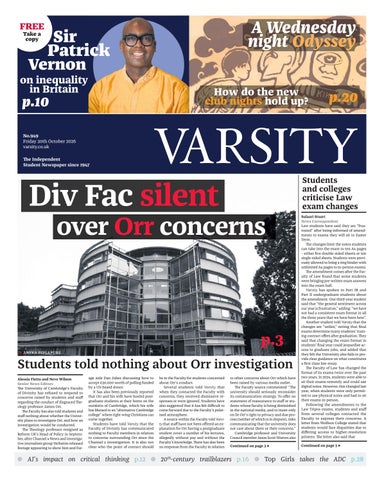
Div Fac silent
to other concerns about Orr which have been raised by various media outlet. The Faculty source commented: “The university should seriously reconsider its communication strategy. To offer no statement of reassurance to staff or students whose faculty is being diminished in the national media, and to insist only on Dr Orr’s right to privacy and due process (neither of which is in dispute), risks communicating that the university does not care about them or their concerns.” Cambridge professor and University Council member Jason Scott-Warren also
Sulaari Stuart News Correspondent Law students have said they are “frustrated” after being informed of amendments to exams they will sit in Easter Term. The changes limit the notes students can take into the exam to ten A4 pages – either five double-sided sheets or ten single-sided sheets. Students were previously allowed to bring a ring binder with unlimited A4 pages to in-person exams. The amendment comes after the Faculty of Law found that some students were bringing pre-written exam answers into the exam hall. Varsity has spoken to Part IB and Part II undergraduate students about the amendment. One third-year student said that “the general sentiment across our year is frustration,” adding: “we have not had a consistent exam format in all the three years that we have been here”. Another student told Varsity that the changes are “unfair,” noting that final exams determine many students’ training contract offers after graduation. They said that changing the exam format in students’ final year could jeopardise access to graduate jobs, and added that they felt the University also fails to provide clear guidance on what constitutes a first class law essay. The Faculty of Law has changed the format of its exams twice over the past two years. In 2024, students were able to sit their exams remotely and could use digital notes. However, this changed last year, when students were only permitted to use physical notes and had to sit their exams in-person. Following the amendments to the Law Tripos exams, students and staff from several colleges contacted the Faculty to express their concerns. A letter from Wolfson College stated that students would face disparities due to differing access to higher-resolution printers. The letter also said that
Continued on page 3 ▶
Continued on page 3 ▶
over Orr concerns
p.3 ▴ amika piplapure
Students told nothing about Orr investigation Alessia Fietta and Neve Wilson Senior News Editors The University of Cambridge’s Faculty of Divinity has refused to respond to concerns raised by students and staff regarding the conduct of disgraced Theology professor James Orr. The Faculty has also told students and staff nothing about whether the University plans to investigate Orr, and how an investigation would be conducted. The Theology professor resigned as Reform UK’s Head of Policy in September, after Channel 4 News and investigative journalism group Verbatim released footage appearing to show him and Far-
age aide Dan Jukes discussing how to accept £30,000 worth of polling funded by a US-based donor. It has also been previously reported that Orr and his wife have hosted postgraduate students at their home on the outskirts of Cambridge, which his wife has likened to an “alternative Cambridge college” where right-wing Christians can come together. Students have told Varsity that the Faculty of Divinity has communicated nothing to Faculty members in relation to concerns surrounding Orr since the Channel 4 investigation. It is also not clear who the point of contact should
be in the Faculty for students concerned about Orr’s conduct. Several students told Varsity that when they contacted the Faculty with concerns, they received dismissive responses or were ignored. Students have also suggested that it has felt difficult to come forward due to the Faculty’s polarised atmosphere. A source within the Faculty told Varsity that staff have not been offered an explanation for Orr having a postgraduate student cover a number of his lectures, allegedly without pay and without the Faculty’s knowledge. There has also been no response from the Faculty in relation
● AIʼs impact on critical thinking p.12 ● 20th-century trailblazers p.16 ● Top Girls takes the ADC p.28
Friday 30th October 2026
2
Michaelmas, Week 4
Editors’ Note This week, we wore multiple hats, as both Editors and cover stars. It can feel somewhat self-indulgent to publish your own articles as Editorsin-Chief, but when the news came in September that Rumboogie would be leaving Revs, we felt compelled to cover it. If, like us, you’re at a loss over how to spend your Wednesday evenings this term, turn to page 20 to find out what happens when you try all three clubs in one night – with a few Ancient Greek monsters along the way. In News, our reporters cover the many ways Cambridge students are feeling let down by the University. In our front page story, our Senior News Editors report on the staff and students left in the dark as the Divinity Faculty continues its silence on James Orr, while Sulaari Stuart covers criticism of the new Law exam policies. We’re always proud of our team,
and even more so in light of Emma Tenzler’s feature on page 12. She speaks to students and supervisors about the impact of AI on our critical thinking skills, following the results of a Varsity survey that found over half of participants used generative AI to summarise or explain academic texts. Now more than ever, amid a widely-claimed literacy crisis, we mustn’t neglect the brain power that got us here in the first place. In a wide-ranging conversation, cultural historian Sir Patrick Vernon opens up (p.10) about the importance of recognising the work of Black academics. After the events of this summer, many students have found their confidence in the University dwindling. Vernon assures us that there is a way forward, so long as action takes priority over words. On the back page, our Sports Editor Sophie Hardman reports live from the netball Blues match against Nottingham Trent – we’re thrilled to report
that we snatched a last minute win. Over in Vulture, the Fashion Editors band together for a shoot that puts curly hair in the spotlight, and we welcome Theatre reviews back to print on page 28 – find out what our reviewer thought of Top Girls there. We’d be remiss to forget that this week is Halloween. After heeding Lisa Sones’ spine-chilling advice on page 21, turn over to Arts to learn about the history of the jack-o’-lantern (p.22). While narrowly dodging scilla (freshers’ flu) and charybdis (9ams) ourselves, we’d like to wish you all a very happy Halloweekend. May the sweets and fake blood be plentiful.
Daisy Bates & Bibi Boyce Editors-in-Chief MICHAELMAS 2026
editors Daisy Bates & Bibi Boyce editor@ varsity.co.uk deputy editors Olivia Goodman & Emma Tenzler deputyeditor@varsity.co.uk vulture editors Emma Gower & Daniel Kamaluddin magazine@varsity.co.uk news Alessia Fietta & Neve Wilson (Senior); Maebh Carey, Jacob Smith, Hayley Butler, & Benjamin Pine (Deputy) news@ varsity.co.uk; Skyler Roberts (Investigations) comment Jasper Burnside, Lily O’Sullivan, & Dexter Twycross opinion@varsity.co.uk features Bryony Clarke & Phoebe Leung features@varsity.co.uk interviews Faron Smith & Sam Elgar interviews@varsity.co.uk science Sophie Patel & Yu Tong science@ varsity.co.uk sport Daisy Kaye & Sophe Hardman sport@varsity.co.uk lifestyle Cherie Wong & Ruby Randall lifestyle@varsity.co.uk arts Juliette Berry & Ben Bailey arts@ varsity.co.uk fashion Rachel Jones & Scarlett Prunty fashion@varsity.co.uk fashion shoot co-ordinator Emer Naylor Afram film & tv Daniella Adetoye & Amanda Ljunberg filmandtv@varsity.co.uk music Lauren Quinn & Dylan Ingram music@varsity.co.uk theatre Lucy Farmer & Barney Sayburn theatre@varsity.co.uk photography editors Clio Sze & Gabriella Douglas-Kitsis illustrations editor & cartoonist Rosie Beyfus sub-editors Ell Heeps, Joss HeddleBacon, Sophie Giles, Natasha Simm, Ariela Ohrenstein, & Lucia Taylor subeditor@varsity.co.uk associate editors Charlie Rowan, Ell Heeps, Sophie Ennis, Leo Kang Beevers, Joss Heddle-Bacon, & Ben Lubitsh associate@ varsity.co.uk business manager Mark Curtis business@ varsity.co.uk varsoc president Bibi Boyce president@ varsity.co.uk varsity board Dr Michael Franklin (Chairman), Dr Tim Harris, Michael Derringer, Mark Curtis (Company Secretary), Hugo Gye, Ell Heeps, Daisy Bates, Bibi Boyce (Directors), Lotte Brundle (Guest), & Zoah Hedges-Stocks (Guest) © VARSITY PUBLICATIONS LTD, 2026. All rights reserved. No part of this publication may be reproduced, stored in a retrieval system or transmitted in any form or by any means electronic, mechanical photocopying, recording or otherwise without prior permission of the publisher. Varsity, 1 Trumpington Street, Cambridge CB2 1QA. Telephone 01223 337575. Varsity is published by Varsity Publications Ltd. Varsity Publications also publishes The Mays. Printed at Iliffe Print Cambridge – Winship Road, Milton, Cambridge CB24 6PP on 42.5gsm newsprint. Registered as a newspaper at the Post Office. ISSN 1758-4442
Friday 30th October 2026
3
News
Students and staff kept in dark about Orr investigation Orr’s conduct may be examined via OSCCA rather than a formal investigation Continued from front page commented that the University and Faculty of Divinity “need to be clear about the nature and extent of any investigation into Orr’s activities,” and that “they should put a clear procedure in place for students who wish to express concerns about recent developments”. According to an investigation by the Financial Times, Orr quietly stood down from two of his academic commitments at the University this academic year. These commitments included his roles as the chair of the Faculty of Divinity’s undergraduate exam board, and as convenor of the Philosophy of Religion master’s degree pathway. The University suggested that the decision was made by the head of the Divinity Faculty, Professor Richard Rex, following discussions requested by Orr about his duties in light of “media scrutiny in recent weeks”. Orr continues to lecture undergraduate papers in ethics, although he no longer has a pigeonhole in the Faculty, and his picture has been removed from the board of staff in the department’s entrance hall. Orr told the Financial Times in August that he had expected to take up both of the roles.
The theology professor has previously come under scrutiny over concerns that he was not adequately attending to his duties as chair of the Faculty’s undergraduate exam board. While the list of examiners in the Faculty was provided at a Faculty Board meeting, the reassignment of Orr’s chief examiners role was not discussed. The Faculty Board is the nominating body for the chief examiners role. Orr also said that he had asked for “different administrative responsibilities” in light of “media scrutiny”. However, he declined to confirm what these new administrative responsibilities will entail. In early September, a University spokesperson told the Guardian and Varsity that “the University is looking into these matters”. However, it remains unclear whether an investigation into Orr’s conduct would be held internally, externally, or through the Office of Student Conduct, Complaints and Appeals (OSCCA). Members of the SU met with senior leadership at the beginning of October, and were told that the University was in the final stages of deciding whether to hold an internal or external investigation into Orr’s conduct. However, concerns
have since been raised over the possibility that the complaints will be processed through OSSCA. According to the University’s website, OSSCA “provides procedural advice, case handling and oversight of a number of student procedures”. University members have questioned whether it would be inappropriate to investigate Orr through a channel usually intended for student complaints. Earlier this year, OSCCA partially upheld a bullying complaint made by a theology PhD student against Orr, who did not complete their degree following their experience with the academic. The University subsequently paid the student £5,000 in compensation for tuition fees and distress caused. The former PhD candidate reopened their case against the University in September, after it emerged that Orr had not been disciplined by the University despite its assurance to the student that action would be taken. In a separate case, a student complained to the Faculty of Divinity about Orr’s conduct towards her in a number of incidents following an MPhil induction day. Orr also denied that he had been informed of this complaint or received any warnings about his conduct.
A number of posters with slogans including “Far-Right Criminal On Our Campus” and “Brought to you by Palantir” have appeared around Cambridge in recent days. The posters list a number of allegations against Orr, including claims that he is “under investigation for breaking electoral law” and was “complicit in the witchhunt of Jason Arday”. The University of Cambridge and the Faculty of Divinity were contacted for comment.
▴ wikicommons
Students slam ‘unfair’ law exam changes Continued from front page memorisation is an unfair metric to use when measuring the quality of students’ answers. The student representative for Part IA and IB Law, Harry Staddon, sent an open letter to the Chair of the Faculty of History about the changes. The letter cites concerns about a lack of consistency in examinations,
▴ ryan teh
including that “memorisation is not a skill that part IB or Part 2 students have had to cultivate during their degrees thus far”. Staddon also suggested that the amendments could affect students’ choices of papers, and urged the Faculty to revert the changes or make transitional arrangements. A form circulated by the student representative found that 212 of the 223 students surveyed said they were “dissatisfied” with the amendments to the tripos exam format, while 204 said they were satisfied with the letter sent by Staddon. A spokesperson for the Faculty of Law
said that the Faculty’s examination committee was discussing concerns raised by students and colleges, and would also look into them at the Faculty Board meeting on 5 November. In 2023, the Law Faculty also reduced exams by two hours for all years over concerns of academic misconduct. A letter sent to all law undergraduates outlined the Faculty’s plan to continue online, open-book exams but to cut down timing from five hours to three hours. The measure included finalists who had only ever taken five-hour online exams, which were implemented following the COVID-19 pandemic. One student, who received extra time and has seen their time reduced from seven hours to three hours and 45 minutes, expressed concerns about the change, stating: “it disproportionately affects students with extra time”. The Law Faculty is not the only faculty at the University to have introduced a note sheet ban in exams. Last November, Varsity reported that the English Faculty had announced changes to exam regulations prohibiting note sheets in exams, which prompted outcry from students. In an email seen by Varsity to all English undergraduates, the Faculty claimed that a reliance on note sheets was limiting students’ ability to engage sufficiently with their exam, stating note sheets were “hampering students from attending to and thinking with the terms of the ques-
tion”. The email also highlighted that the introduction of note sheets was only intended as a temporary measure postCOVID-19 to balance the impact of the pandemic on students who lacked a closed-book exam experience. At the time, one second-year English student told Varsity: “Removing notes and sheets completely undermines the point of my degree […] Coming from someone with exam adjustments, my hope was placed in the department to support, not to disadvantage. To say I’m disappointed is an understatement.” However, another student recognised that “creating the note sheet was perhaps taking up too much of students’ time”. In 2025, top UK universities including Cambridge and Oxford announced that they were moving away from “traditional” exam formats in favour of more “inclusive assessments” to lessen awarding gaps. It was reported that this included introducing open-book tests and takehome papers instead of in-person, unseen exams. These changes came as universities faced pressure to address the difference in the number of firsts and 2:i degrees awarded to white, middle-class students compared to other groups.
Friday 30th October 2026
4
News
Linguistics seminar hosting Tel Aviv University researcher cancelled Alessia Fietta and Neve Wilson Senior News Editors A meeting organised by the Semantics, Pragmatics and Philosophy (SPP) Research Group within the University of Cambridge’s linguistics department, which was set to host a researcher from Tel Aviv University, was cancelled with a day’s notice.The SPP Research Group originally planned the group discussion for 16 October, with linguistics researcher Itai Bassi expected to attend as the guest speaker. The event was advertised in an email to linguistics students at the start of term. In the email, Bassi was described as a “Postdoctoral Researcher in Linguistics at the Leibniz-Zentrum Allgemeine Sprachwissenschaft (ZAS) and Ben Gurion University”. On 12 October, the organisers of the SPP meeting sent another email to students, inviting them to the group’s first seminar of term. The email read: “We are delighted to welcome Dr Itai Bassi, who will present his paper with Dr Moshe E. BAR-Lev, ‘Infelicity with homogeneity: focus, not (necessarily) presupposition’”. On the same day, a student sent a message on a group chat for third-year
linguists, which contained 41 members, which called attention to the fact that “an active researcher from the Tel Aviv University has been invited to present their research” at the event. In one message seen by Varsity, the student said they were “sure many of you will be disappointed and shocked with the faculty’s choice to platform these speakers, especially considering […] our recent faculty-wide success regarding divestment from arms”. The message received six likes from members of the group chat. They encouraged other students to “consider avoiding” the event and to contact the organisers, claiming that they planned to do so. Varsity understands that several students contacted the organisers with concerns. On 15 October, the day before the event was due to take place, students were told that the meeting had been cancelled, with its organisers apologising for the “short notice”. One student expressed disappointment with the event’s cancellation, and emailed the organisers asking for the reason for the decision. The student received no response. One researcher at the University who
was involved in organising the event told Varsity that, after the invitation email was sent, “scheduling issues came up” which meant that they were offered the role of facilitator of the talk, which they could not take up due to illness. They also said that they “expected low attendance, as the talk was due to take place very early in term,” adding: “The seminar is a very small, studentled initiative, and talks are often cancelled for similar reasons.” The organiser claimed that, when responding to students who contacted them with concerns, they “confirm[ed] the author’s affiliation and report[ed] the students’ concerns to the faculty office”. They continued: “The faculty confirmed that its policy follows the University of Cambridge requirements under the University’s Code of Practice on Freedom of Speech when scheduling and managing events. The seminar has never engaged with political issues, and the paper in question was a theoretical linguistics article with no political content.” The organiser also said that the “one email asking for the reason for the can-
cellation was not left unanswered on purpose,” given that they were “very ill at the time”. Itai Bassi told Varsity: “When the organizers informed us that the event needed to be postponed (we are not aware that it was cancelled altogether), they explained that only a few students had registered, as the academic year had just started.” Bassi continued: “We currently have no particular reason to assume that the organizers’ decision was influenced by […] pressure
[from students]. Regardless, we wish to emphasize that we endorse academic freedom of speech (especially in research matters that have nothing to do with contentious political issues).”
yang ▴ ruying
Sum Fun Place the digits 1–5 once each in every row and column. All coloured boxes' sums are multiples of one another (e.g., the sums could include 2, 6, 1, 12, 2, 24...). The grey square does not have the smallest sum.
Your career at d-fine We are a European consultancy firm focussed on analytical and quantitative topics and the development of sustainable solutions to bring about positive change for our clients. What does d-fine offer you? - Diversity: Work with clients on topics ranging from financial engineering and machine learning through to climate risk and healthcare - International: Collaborate in project teams staffed across Europe - Education: Acquire new skillsets to broaden your technical and professional repertoire Who do we look for? Master’s or PhD-level graduates in STEM fields
www.d-fine.com
Berlin, Dusseldorf, Frankfurt, Hamburg, London, Milan, Munich, Stockholm, Utrecht, Vienna, Zurich
Friday 30th October 2026
5
News
Cambridge watchdog criticises Uni’s ‘vague’ GenAI guidance Alessia Fietta Senior News Editor The University of Cambridge’s Board of Scrutiny has raised concerns about the University’s approach to generative AI (GenAI) use in teaching and assessment. In its 31st annual report, published in the Cambridge University Reporter last Wednesday (21/10), the internal watchdog criticised the University’s Teaching Review, which was launched in December 2023, for failing to address concerns about AI. The Board argued that, although such concerns were relevant to the review’s objectives, they were “entirely absent” from its discussions and conclusions. The watchdog described GenAI as “an institution-wide governance issue affecting teaching, assessment, academic standards, procurement, legal compliance and information governance”. Guidance regarding AI use is provided at faculty or department level rather than being centralised. The Board’s report concluded that the current advice at the broader University level can be “contradictory and vague,” and is spread across several documents, making it less clear and easily accessible.
The Board acknowledged that the current discrepancies in AI policy “[allow] for flexibility and difference in approach across diverse disciplines”, However, the report also recommended that the University provide departments with “an authoritative and easily accessible central source” in order to communicate changes to the minimum legal and regulatory requirements concerning GenAI, as well as central definitions of academic misconduct and AI misuse. According to its current guidance on plagiarism and academic misconduct, the University “is continuing to develop guidance materials to support staff and students in the effective and appropriate use of Artificial Intelligence tools and Large Language Models”. However, the internal watchdog criticised this process, claiming that it remains “opaque”. Several students, supervisors, and examiners have also expressed concern that GenAI could undermine the reliability of student assessment. The University’s ‘Undergraduate supervisor guidance on the use of AI’ likewise notes that AI detection tools are often unreliable. Previously, proposals for addressing concerns about GenAI use at the
University have included creating GenAI working groups within disciplines and maintaining one-on-one teaching through supervisions, a system that other universities have started to replicate in light of the threat AI could pose to students’ critical thinking skills. However, the watchdog claimed that “supervisors are sometimes left to conduct supervisions with little support on how to deal with AI”. The Board recommended that departments inform students at the start of each year about their approach to GenAI, including guidance on how students should use it. The group also suggested that faculty boards and degree committees consider introducing ‘vivas’, or oral examinations, when AI misuse is suspected. Varsity has previously revealed that Cambridge recorded its first cases of academic misconduct involving AI in 2024. The previous year, the Human, Social and Political Sciences (HSPS) faculty announced handwritten exams would replace online assessments for first and second-year sociology and anthropology students, citing a rise in AI use in exams. The report ended by raising concerns over the University’s partnerships with
Why the INSEAD PhD? Join a global community of scholars advancing knowledge in management.
The INSEAD PhD offers a truly global experience. Research without borders Study across our campuses in Europe and Asia and collaborate with scholars from around the world.
Learn from leading experts Work closely with internationally recognised faculty in a highly collaborative environment.
Invest in your future You bring your time and talent. We provide full funding throughout the five-year programme.
Launch an academic career Our graduates secure faculty positions at leading business schools worldwide.
Could the INSEAD PhD be your next step? Apply now for entry to the mid-August 2027 intake. inse.ad/phd-apply | inse.ad/phd Scan to contact us.
Information is correct as of 10.09.26
firms that promote or sell GenAI products, highlighting the lack of transparency surrounding which products the University purchases and which partnerships are being developed. The watchdog said such partnerships could “pose special problems with respect to academic integrity, intellectual property and data protection”. These concerns come after the University released guidance on the use of GenAI last October, which stated that students may use AI “to support their personal study, research and formative work”. Earlier this month, Varsity revealed that the University had opposed plans by plagiarism detection tool Turnitin which could have allowed students’ work to be used to train AI models. The Students’ Union (SU) said that the University was exploring alternatives to the service. More broadly, in the introduction of the internal watchdog’s annual report, the group said that it “remains deeply concerned that both the matters canvassed in this Report and events subsequent to it may reflect an emerging culture in which insufficient challenge, as well as limited participation, ineffective listening and diminishing institu-
tional accountability and trust leads to a lack of robust decision-making [by the University]”. It continued: “The Board remains concerned that the scale and complexity of the University increasingly challenges traditional mechanisms of governance, assurance and coordination. The collegiate and devolved structures of the University remain one of its defining strengths; but they also require increasingly sophisticated systems of communication, reporting, financial understanding and operational management if institutional coherence is to be maintained.” The University’s Board of Scrutiny acts as an internal watchdog body, ensuring transparency and accountability in the University’s operations. The Board was established in 1995 to “ensure the accountability” of the University Council “to the Regent House” – these are the two principal decision-making bodies of the University. The Board consists of eight elected members of the Regent House, alongside two proctors and two pro-proctors.
6
Friday 30th October 2026
News
SU launches national campaign opposing govt study visa brake Neve Wilson and Alessia Fietta Senior News Editors Cambridge University Students’ Union (SU) has launched a national campaign calling on the UK government to immediately reverse its decision to suspend new student visas for individuals from Afghanistan, Cameroon, Myanmar, and Sudan. The UK government announced an ‘emergency brake’ on study visas for applicants from the four conflictaffected countries in March. The policy’s introduction meant that students from these countries were unable to take up their Cambridge offers in the last round of applications. The new student-led campaign was launched on Thursday (29/10) alongside the SUs of the University of Manchester, UCL, and the University of Birmingham. Varsity understands that the SU is in the process of collecting signatures for an open letter addressed to the government, which seeks the support of elected student representatives from UK universities, university leaders, and parliamentarians. According to the SU, the letter began circulating on Tuesday (27/10), and has gained a “significant” number of signatures thus far, including from several MPs. SU Postgraduate President Jeeves Rohilla, who is leading the campaign, told Varsity: “I am proud to lead this
▾ sa
r
on ders n a ah
national campaign on behalf of Cambridge Students’ Union […] Many of these students have overcome significant economic, political and cultural barriers to study in the UK. Despite their achievements, the imposed visa restrictions deny them access to education.”
200 Number of Sudanese students whose university offers were impacted Rohilla continued: “As the elected student body at the University of Cambridge, we believe that no prospective Cambridge student should be denied the opportunity to apply fairly to study at Cambridge on the basis of their nationality. I urge elected student representatives across UK universities, university leaders and MPs to sign our open letter and make their support for international students heard in a climate that is becoming increasingly hostile towards them.” A preview of the open letter seen by Varsity criticises the fact that the visa brake enables the Home Office “to unilaterally determine admissions outcomes at independent educational institutions,”
stating: “The UK government prides itself on defending the right to education, which cannot be reconciled with a policy that closes the doors of UK universities to those who have earned their place.” The letter also argues: “At a time when the UK is competing to attract global talent, the answer cannot be to turn individuals away.” The government said that they had implemented the study visa brake, effective from 26 March onwards, “to reduce asylum claims from people who enter the UK on a visa and later claim asylum”. The policy forms part of the Labour government’s crackdown on immigration amid mounting pressure from the political right, including Reform UK. In guidance issued to international students, the University of Cambridge said that they would not be able to “issue a Confirmation of Acceptance for Studies (CAS) to support a visa application for affected applicants”. The University’s guidance also stated: “The restriction is set by external immigration policy, and universities are therefore unable to change it or make exceptions. We recognise that this may cause considerable disappointment for applicants from the affected countries who are now unable to take up their offer.” Visas have remained valid for students already in the UK with a valid visa, and for dual nationals who hold a
passport from a country not affected by the brake. The government has described the visa brake, which has now lasted for seven months, as “temporary,” but is yet to issue an end date. In April, Osman Mohamed, a Sudanese student who had just received an offer for the MPhil in Energy Technologies at Cambridge, told Varsity that receiving his offer “was one of the happiest moments of my life”. “After months of preparation, stress, hope, and hard work, it felt like every effort had been worth it. But that happiness lasted only two days before the visa brake was announced. It felt like I was standing in front of the door of my dreams, but not allowed to step inside,” Mohamed said. He described the timing of the policy’s introduction as “painful,” and added: “I respect the government’s right to manage immigration and protect the integrity of its systems. But in Sudan’s case, this policy feels disproportionate and badly targeted.”
0.6% Percentage of UK international students from the four affected countries He cited the fact that Sudan is facing one of the world’s worst humanitarian crises, and that “much of its higher education infrastructure has been severely damaged”. All four countries affected by the study visa brake are experiencing political instability or conflict. Recent tensions between Afghanistan and Pakistan have led to violent clashes in border regions, Cameroon faces ongoing separatist unrest, and both Myanmar and Sudan are in civil war. The United Nations have described the conflict in Sudan as the world’s largest humanitarian crisis. In March, Afra Mohamed, another Sudanese student with a postgraduate Cambridge offer to study Computational Biology, told the Financial Times that she had experienced the “full arc of hope to humiliation” upon receiving her offer and being told the offer had been sent in “error” on the same day. O v e r a l l , 200 Sudanese applicants were sent offers from UK
universities, which were then impacted by the visa ban. 25 of these students received offers from Cambridge or Oxford. A parliamentary petition asking the government to publish evidence and methodology for the visa brake and create transitional arrangements for affected applicants was published on 13 April, and closed on 13 October. The petition received over 38,000 signatures. The Home Office responded to the petition in August, stating that it had “published the evidence and methodology for the 2026 visa brake, implemented transitional arrangements and committed to reviewing the policy”. The full response to the petition added that the government was designing a refugee work route for arrivals in autumn 2027 onwards, for which “no nationalities will be prevented from eligibility”. Amnesty International also released its own petition calling on the Home Secretary to reverse the visa brake. The petition stated: “stopping students from Afghanistan, Sudan, Myanmar and Cameroon from studying in the UK does not solve global instability. It harms students – especially women – who are seeking education, safety, and opportunity”. Amnesty’s petition focused in particular on women and girls in Afghanistan, who “under the Taliban have been systemically excluded from secondary and higher education”. The organisation added: “for many women and girls from Afghanistan, international study opportunities are one of the only remaining ways to continue learning and build a future”. In July, the University of Manchester SU said that they believe the policy is “unfair” because “the harm done to these prospective students far outweighs the small difference to asylum statistics” given that, according to the Higher Education Statistics Agency, only 0.6% of all UK international students are from the four affected countries. Following the announcement of the visa brake, Mike Nicholson, Director of Recruitment, Admissions, and Participation and Deputy Head of Education Services, commented: “The University has not withdrawn any offers for those intending to start in the 202627 academic year, but we have written to explain the changes to the visa regulations.” He added: “The University continues to work with Universities UK and others across the sector to secure changes to the visa brake where it can be demonstrated that offer holders present a low risk of not completing their studies and fulfilling the conditions of a study visa.” The University has fewer than ten undergraduate offer holders from the four affected countries on average each year, and fewer than 20 for postgraduate study. In most cases, these offer holders receive scholarships.
Friday 30th October 2026
7
News
Christ’s master tables question in Lords following Library+ development Neve Wilson Senior News Editor Lord Simon McDonald, the master of Christ’s College, has tabled a question in the House of Lords after the government froze Cambridge City Council’s approval of planning permission for a new Christ’s Library. Lord McDonald, who took his seat as a crossbench peer in 2021, asked “in what circumstances” the government “deem[s] it appropriate for the Secretary of State for Housing, Communities and Local Government to override a vote to grant planning permission by councillors on a local planning authority and call-in an application for central government decision.” The question is due for answer on 3 November. While it does not explicitly mention Christ’s Library, the question comes after the Ministry for Housing, Communities, and Local Government (MHCLG) froze the City Council's approval of the second planning permission for the scheme on 13 October. MHCLG has not yet made a final decision on the application. On 20 October, the High Court quashed the City Council's approval of the College's first planning application
for a library. Cambridge City Council had originally approved the application for a new fourstory library, also known as the Library+ Scheme, backing onto Christ’s Lane, in November 2025. The library would be constructed in place of a 1970s building which the College has been looking to replace for more than 15 years. Christ’s Lane Action Group (CLAG) filed a claim against the decision in December 2025, with a full hearing eventually scheduled for 20 October 2026. In April, Cambridge City Council and Christ’s College acknowledged that the original planning permission should be quashed on four grounds based on legal errors made in the decision-making process. These included the planning committee being misled regarding evidence from Historic England, the extent of harm the project would cause to heritage assets, that the concept of “optimum viable use” is misapplied, and that the committee had not taken into account the existence of less harmful alternatives. Following the High Court decision, Christ’s published the following statement on its website: “The College re-
mains fully committed to the Library+ scheme which Councillors resolved to grant planning permission for the second time last week. We hope that the Secretary of State for Housing, Communities and Local Government will authorise the Council to issue the decision notice in the next few weeks.” However, on 10 June, Christ’s submitted a second, identical, application. They argued that the ongoing legal case was not about the design itself, but the City Council's decision-making, and therefore that they could go ahead with a new scheme. The City Council approved the second application by six votes to one at a meeting on 7 October. At the time, Lord McDonald said that the vote “takes us a big step closer to having a beautiful, accessible and sustainable library”. He added: “the process has lasted longer than I hoped. All our opponents’ arguments have been confounded but they still have legal options. Watch this space”. In response to the hearing on 20 October, a spokesperson for CLAG said that “the council got it wrong on every ground,” and that “it was David against Goliath”.
They also said that they were not against a new library, but rather they were against one that Historic England called “too big for its location”. CLAG says it now intends to call for a public inquiry into how the scheme has been handled. Lord McDonald told Varsity that he declared his interest when asking his question in the Lords. He said that “In making its case to the department, CLAG failed (in Christ’s College view) to provide any evidence that issues of national importance were at stake. The truth is that a small group of
residents, led by a Professor in the University, do not want the view from their penthouse apartments to change.” Lord McDonald also said: “It’s not ‘David vs Goliath’, it’s ‘gown on gown’. “CLAG can call for a public inquiry, but the College would strongly urge the government not to waste its time and taxpayers’ money. For the second application, the Council has run an exemplary process; the fact that a small group of residents does not like the outcome does not invalidate it.”
▲RYAN TEH
Get in touch
THE HIGH-TECH RECRUITMENT EXPERTS
We’re excited to connect with ambitious and fresh talent ready to make an impact on our team.
CAMBRIDGE UK
davincitrading.com
Software • Electronics • Mechanical • Maths & Physics Applied Sciences • Consultancy • Graduate / PhD
Let us do the detective work. From knowing what jobs are out there to advice and guidance through the hiring process, we work with you.
01223 81 33 99 register@ecmselection.co.uk ecmselection.co.uk/university
Da Vinci is a propietary trading house made up of some of the sharpest minds and most passionate players in the industry.
8
Friday 30th October 2026
News in brief Rotten pumpkins
City centre success
Jellycat joy
Trinity time trials
Cambridge City Council is aiming to tackle the “gruesome” issue of pumpkins ending up in landfill by recycling them with other food waste to produce renewable energy and bio-fertiliser for crops. Greater Cambridge Shared Waste Services recommend eating the pumpkins if safe to do so, with the recycling service being the next best option. Residents can place their pumpkin in a carrier bag beside their food waste bin for collection between 3 and 6 November. However, households who go all-out for Halloween are advised that “excessively large or heavy” vegetables will not be recycled.
Cambridge has been named the best place to go shopping for the second year in a row. The 2026 Retail Vitality Rankings placed the city centre above Chelsea, Manchester City Centre, and Edinburgh. Cambridge topped the rankings due to its “tightly constrained” retail floorspace, “highly affluent catchment," and a “robust evening economy,” giving it a competitive advantage over major urban centres. Chief executive of Cambridge Business in Development, Maria Manion said the ranking illustrates “the city’s tremendous offer, both day and night” and is a point of pride in the area.
The highly popular soft toy company Jellycat has come to Cambridge via a concession stand in Sidney Street’s Waterstones store. Before the opening date was announced, advertisements displayed on the second floor of the building hinted that “something exciting is coming”. The display officially opened on Monday (26/10), stocking a large variety of Jellycat products alongside video screens and light-up signs. Jellycat does not yet have its own store in the city, but – on top of its expanding presence – it does already have a stand in the Ark Cambridge gift shop on Peas Hill.
Trinity College held its annual Great Court Run this week. The route is approximately 370 metres and the aim is to complete it before the College clock strikes twelve. Winner Benjamin Alcott finished the route in 50.7 seconds, with fellow student Lyra MacDonald being the first woman to complete this year's race in 59.5 seconds. The striking of the clock this year lasted 50.8 seconds in length, allowing three runners to finish before the clock finished striking. Among the runners this year was the College’s new master Sir David Baulcombe, who completed the race in 95 seconds.
Benjamin Pine rounds up student news from across the country ‘Longest strikes in living memory hit Goldsmiths studentsʼ Students at Goldsmiths, University of London, have called for compensation as staff strike action enters its fifth month. Staff are taking action – described by The Guardian as “the longest in living memory” in British higher education – after several rounds of redundancies and restructuring. One student said they had received “virtually no teaching” since the start of the year, with the Master of Fine Art course among the worst affected. Another student said they had suspended their studies as a result. Goldsmiths says around 8.5% of its staff are on strike and says it is doing everything it can “to monitor and mitigate disruption”.
20% OFF ALL BOOKS FOR HOLDERS OF CAMBRIDGE UNIVERSITY AND CAMCARDS SIMPLY PRESENT YOUR CARD IN STORE WE ALSO STOCK A WIDE RANGE OF CAMBRIDGE RELATED GIFTS AND SOUVENIRS
Uni of Leicester students allege BBC removed pride pins Two University of Leicester students who appeared on the BBC quiz show University Challenge have criticised the broadcaster, alleging that their LGBTQ+ pride pins were digitally edited out of the programme. Samuel Carlier, an Astrophysics student, says he wore an LGBTQ+ Progress Pride pin and a bisexual pin when appearing on the show, and described the edits as “weird” and “Orwellian”. A second student, Emmeline, says her pin in the shape of a feather was also removed. A BBC spokesperson said: “In line with our editorial guidelines, we advise that no badges, flags, and emblems or symbols are worn or visible during filming.”
Illustration by Richard Briggs
Oxford University Reform Society criticised for Cofnas speech plans
1 Trinity Street, Cambridge CB2 1SZ 01223 333333
bookshop@cambridge.org
Offer can’t be combined with other promotions
The Oxon Universities’ Reform Society is set to host former University of Cambridge fellow and self-described “race-realist” Nathan Cofnas at Oriel College next month. The decision has provoked controversy, with Oriel being urged to cancel the event in an open letter signed by several campaign groups and academics. While at Cambridge, Cofnas was criticised for a blog post in which he claimed the number of Black professors at Harvard would “approach zero” in a meritocracy. He was among those who accused Cambridge professor Jason Arday of plagiarism before his death in August. Oriel College said it is “committed to upholding freedom of speech within the law”.
Friday 30th October 2026
9
News in depth
Most colleges failed to meet plant-based catering targets Maebh Carey delivers news from around Cambridge Council to tighten rules on house shares Planning controls on houses in multiple occupation (HMOs) will be introduced next year, according to a motion passed by Cambridge City Council. HMOs will require planning permission to be created, which is currently not required for houses with fewer than six residents. The changes come amid growing controversy over HMOs, with the council’s deputy leader, Rosy Moore, saying they are “something that a lot of residents are concerned with”. Concerns include claims that HMOs undermine a sense of community because of higher resident turnover and the common use of former family homes. However, Moore also noted that HMOs provide “vital help for some groups of people” amid Cambridge’s housing crisis. County council developer falling behind on loan payments A council-owned property developer may struggle to pay back loans and interest owed to the local authority due to a predicted £7.7 million cash shortfall by 2029. ‘This Land’, a developer owned by Cambridgeshire County Council, said delayed deals had created a shortfall of £2.7 million before tax this year. An interest payment is due to the council in March 2029, but a report has said the company is unlikely to meet it without changes to the payment schedule or repayment timing. As of February, the developer owed Cambridge City Council £58 million and £22.5 million in interest. Guildhall at risk of falling apart, report warns Cambridge’s Guildhall on Market Square is at risk of falling apart, according to a new report. The historic building is being affected by ‘Regent Street Disease’, which can affect steel-framed buildings from the early 20th century. The report said that Guildhall was facing “significant challenges” including the risk of water in the roof space and masonry falling from its external facade. The current Guildhall was built in 1939, but the site has been used for civic purposes since at least the 13th century, including as a tollbooth and now as the seat of Cambridge City Council. The council will examine options to preserve the building at a meeting on Tuesday (03/11).
Neve Wilson and Alessia Fietta Senior News Editors Clare Hall and Jesus are the only colleges at the University of Cambridge who have met catering targets for 50% of main meals served to be plant-based by October 2026, Varsity can reveal. In March 2023, all 31 Cambridge colleges came together to publish their environmental sustainability progress in the Cambridge Colleges Environmental Sustainability Report. In the report, a target was set for 50% of catering in colleges to be plant-based by October 2026. The CamEATS ZERO initiative, inspired by the report, was launched in February 2024 across the collegiate university, with backing from Cambridge Zero – the University’s climate initiative – and funding from the Cambridge Judge Business School. The initiative outlined four priority actions for colleges to take in order to improve sustainability. These included reducing food waste by at least 50%, only serving sustainably sourced seafood, and reducing consumption of ruminant meats such as beef, lamb and venison. The fourth priority action was to increase the proportion of vegan meals offered, “with a view to these being at least half the meals offered”. According to the report, these four priority actions were chosen because they address the main sources of greenhouse gas emissions from food systems. The steering group for the initiative included representatives from across a
vast range of colleges, as well as some departments affiliated with the University. It is not clear how many colleges signed up to the CamEATS ZERO initiative, although, according to PlantBased Cambridge, Selwyn was one of only a handful of colleges who had not signed up. CamEATS ZERO guidance says that colleges are “responsible for developing their own policies and holding their respective committees responsible for their implementation,” but that the guidance is meant to help inform these policies and “where possible enable a consistent approach across colleges”. Varsity has heard concerns that there is now no internal mechanism to hold colleges to account in relation to this goal, following the dissolution of CamEATS ZERO last year. An investigation by Plant-Based Cambridge and the Cambridge Climate Society examining the proportion of plant-based meals served at colleges over a three-week period in the 202526 academic year found that no colleges offered at least 50% plant-based mains. Four colleges – Wolfson, Hughes Hall, Clare Hall, and Jesus – had over 50% plant-based options in total, including sides and desserts. The investigation also found that the weighted average of all colleges’ plantbased options was 41.6%, with the percentage of main meals being plant-based even lower at 34.6%. It highlighted that colleges includ-
ing Trinity and Darwin often provide more than one plant-based meal, but also offer around three or four options which are not plant-based. The report recommended that catering teams consider that “the objective is not only to increase the availability of plant-based options but to reduce animal-based products so that the proportion of highimpact food is reduced”. Using the sample of menus in the investigation, the report found instances of seven colleges not always offering a plant-based option. According to a press published on Clare Hall’s website in September, the College recently became the first Cambridge college to surpass plant-based catering thresholds for main meals set by the CamEATS ZERO initiative. The College said that it has implemented “readily available wholefood proteins such as lentils, tempeh and tofu into the plant-based meals, rather than relying on ultra-processed foods as substitutes”. Rishul Karia, Green Officer at Clare Hall, said: “With the support of our Kitchen Manager Sabrina Gyles, Clare Hall became the first Cambridge college to surpass the 50% plant-based menu target set out by CamEATS ZERO. We are also delighted to have recently partnered with Forward Food, and are excited about the further environmental impact this collaboration will bring.” Megan Hart-Jones, a member of Plant-Based Cambridge, also comment-
ed: “When we analysed menus last year, no college had met the CamEATS ZERO minimum target of 50% plant-based meals. We have repeated the analysis with October 2026 menus and found that two colleges have now reached this baseline. It’s great to see progress being made but hugely disappointing that 29 colleges are still failing on sustainable food.” They added: “To address the current climate and biodiversity crises, Cambridge colleges urgently need to align their catering with the scientific consensus and prioritise plant-rich menus.” Plant-Based Cambridge is set to produce a new college ranking in the near future, but has preliminarily found that only Clare Hall and Jesus have met the baseline target. The SU voted to support 100% plantbased catering in 2023, but dropped its campaign in 2025 to focus on more “important” sustainability issues. The SU is currently considering a motion to campaign for central university catering to be 75% plant-based, which would include locations such as the Whale Cafe. However, vote on this has not yet taken place. The Whale Cafe trialled a plant-based menu between October and November 2024, but the trial ended after the Estates Technical Sub-committee recommended that the menu not be made permanent.
▾ MADE WITH FLOURISH ▾faron smith
Friday 30th October 2026
10
Interviews
A
fter more than 20 years as an advocate for civil rights and social justice, Patrick Vernon has plenty to reflect on. Back in 2016, he wrote an article entitled: 'Where are all the Black historians?' - decrying the underrepresentation of Black academics in British universities. Speaking to him now, I am curious: does he feel the situation has improved at all? “I think definitely there have been more Black professors and more senior leaders in higher education […] compared to 2016, and there’s been a lot of work being done trying to widen the participation levels at undergrad[uate] level as well.” But Vernon is clear that more remains to be done, and is keen to build an intersectional understanding of the challenges facing advocates of equality in academia.
❝ There's only about 100 Black academics in the whole country “There’s been a campaign for having more Black women academics. There’s only about 100, or in the whole [country] 105, or something like that.” Even this small number marks a significant improvement since 2018, when just 25 of the UK’s professors were Black women - standing in stark contrast to over 12,500 white men. Vernon also has concerns about the level at which Black academics are able to be present within universities, with there being an ongoing issue of senior management lacking in diversity. “There’s been a lot of work over the last decade at having more Black and racialised people in senior management,” Vernon adds. “The question which I raised in my article [in 2016] is about the consistency of that, and it raises issues about how it’s mainstreamed as well, so it’s not just seen as a one-off.” The conversation turns to the events of the summer, when British academia was rocked by the death of Professor Jason Arday. Has Vernon felt a tone shift in how it feels to be a Black public figure in the weeks and months since? “I’ve spoken to lots of black academics who feel unsafe, […] would they be the next target, would they be victimised?” Vernon says. But he is clear that the ramifications of the event are still developing: “It’s still early days. I mean, sadly, Professor Arday died in August, and we’re just at the beginning of October. So everyone’s still processing, even [his] family.” Following Arday’s death, the University of Cambridge announced that there will be a full review of the circumstances that led both to his hiring and to the support that the University made available to him before his death. Following this announcement, Vernon called for the procedure to go beyond just a formal review of appointment procedures, instead going deeper and examining the culture of
the University. What should this process look like? Vernon tells me: “It’s not like a legal inquiry or employment or like a kind of a grievance inquiry. This is much deeper. You have to reach out to people who would normally not be considered to give evidence, or give a perspective. So you have to engage, which means that you have to build trust and confidence that whoever’s leading that process will find the truth and speak truth to power in a way that shares their needs.” Following recent events, and combined with a long history of the lack of representation, some students at Cambridge may not have this confidence in it as an institution. Given this history, how can the University start to rebuild trust? He thinks that just beginning the process of the report marks a good start: “[The] first thing is, it’s actually the process leading to the report that’s been done with the recommendations, and secondly, there has to be a commitment that they will follow through and implement the recommendations. So it goes hand in hand. […] You can have a fantastic report, get all the evidence and all the key issues and some good solutions, but there’s no commitment or drive to implement that. Then people will think, well, that there wasn’t that commitment in the first place.” Words, then, are clearly not enough, and nor is there a shortcut to rebuilding faith. The first part of the report into Arday’s death, which will examine the “support, interventions and protections available to Professor Arday during the period prior to his death,” is scheduled to be completed by the end of Michaelmas Term, although there is as yet no timeline as to when any recommendations will be implemented. Moving beyond the specific issues facing Cambridge, Vernon has spoken about the need for universities to recognise that knowledge production does not just take place in their hallowed halls, but across all sectors of society. What has this non-academic knowledge production looked like historically? “For many decades or even longer, some of the best thinking and writing, particularly around Black history, was done outside universities. […] other universities didn’t value or recognise the importance of this history, but that didn’t stop independent scholars, public intellectuals, community activists, community historians, and community educators from continuing with this work.” Vernon is particularly well-placed to discuss this form of knowledge production. As a campaigner and cultural historian, he played a key role in the campaign for Windrush Day to be recognised as a national celebration, while his movement, ‘100 Great Black Britons’, has attracted national attention ever since its initiation in 2003. Since then, Vernon has been personally recognised for his work - alongside a knighthood for services to racial justice, he was awarded an honorary doctorate from the University of Wolverhampton. However, difficulties remain embedded within British academia: “Universities can embrace [expertise outside academia] much more. I think that’s what places like Oxford and Cambridge can do […] I think that is part of academia. It’s about open knowledge production.” While Black History Month may have started in the USA, with the UK following suit more than 40 years later, America has more recently experienced
▼
Sir ▼ pa Pa tri c tri ck k ve r Ve rn non on
‘If we want to have a better Britain, we have to talk about inequality’ a strong backlash against diversity, equity and inclusion policies, alongside the rise of President Donald Trump to power.
❝ For many decades universities didn't value or recognise the importance of Black history How has this backlash been felt on our side of the Atlantic? “It’s connected,” says Vernon. He adds: “I think, what happens in America, we sort of replicate at some stage.” But the challenges facing British academia aren’t just brought in from abroad, but inherent to British politics: “There are financial challenges facing universities, and unfortunately courses around Black
history, Caribbean studies, […] African history get shut down because if they can’t get student numbers in, or there’s a lack of investment in the first place, it’s easy to close down those courses.” Given the strength of this backlash, then, is Vernon concerned that even established events, like Black History Month, could come under pressure from the right? “Well, of course, I mean it’s already happening. People say, ‘Oh, you know, you got Black History Month, what about White History Month? ’ and when we have the Black Lives Matter Movement, people say, ‘Well, what about White Lives Matter? ’” In contrast, for Vernon, and many other anti-racist campaigners, these movements were never about drawing lines along race, but rather recognising that “inequalities are disproportionately affecting a certain part of society. If we want to have a better Britain, then we have to talk about the inequality of Britain”. Clearly, he is frustrated with a narrative that “equalities for Black people [only] benefit black people,” insisting that “it benefits everyone – if you look at all the legislation from the women’s right to vote in 1918, to LGBT rights in the 2000s, we’ve had a long history of fighting for equality
for everyone. The black experience has played a key role in that, and everyone benefits from that.” Vernon tells me about the other initiatives he is working on: “I’m a part of a campaign to change the wording of the word empire [in the context of MBE or OBE awards], call it ‘excellence’, because it’s still one of the highest recognitions in this country, but we need to change it to reflect the times. For me personally, whether you have an honour or not, as long as you’ve achieved and made a difference for the community and for the country, that’s important.” That principle sums up Patrick Vernon perfectly – after decades of working both within and without traditional institutions of power, he can recognise how these organisations can, and should, be reformed to help the cause of social justice, without ever setting this as the only method by which change can happen. Clearly, if Cambridge wants to clean up its act, it must listen to voices like Vernon’s going forward.
– FARON SMITH INTERVIEWS EDITOR
FO R C A M B R I DG E S T U D E N T S
Boots that will outlast your degree. Enjoy 15% off in-store and complimentary personalised debossing. V I S I T US AT 7– 8 ROS E C R E SC E N T, C A M B R I D G E C B2 3L L
VALID UNTIL 30 NOVEMBER 2026
Friday 30th October 2026
12
Features
Is this the end of thinking? Emma Tenzler explores the impact of AI on critical thinking skills
W
hen Socrates’ relentless questioning forces Meno, in Plato’s eponymous dialogue, to confront how little he knows of what he thought he understood, Meno compares the philosopher to a stingray. To be confronted with one’s own ignorance, to discover the limits of one’s understanding, is an inevitable part of learning. It is uncomfortable, sometimes painful, “like being electrically shocked”. But it is also where knowledge begins. Giulia, a third-year Philosophy student, recognises something of Meno’s predicament in her own encounters with difficult texts: when what seemed familiar suddenly becomes incomprehensible, and thinking has to begin again. But what happens to thinking when the discomfort of not knowing, and the effort of overcoming it, can be bypassed altogether? In March 2026, a report published by the Higher Education Policy Institute found that 95% of UK undergraduates use generative AI in some capacity, while 94% use it to help with assessed work. Some 12% have directly incorporated AIgenerated material into assessed coursework. The figures have fuelled familiar anxieties about the cognitive decline of a generation, with headlines warning of a post-literate age in which the decline of reading threatens to become the decline of thinking itself. “Cambridge students are the last people in the country who are going to stop reading.” Sean McEvoy has been teaching and supervising English students at Murray Edwards for nine years. “As one of our undergraduates said to me recently: of course, we’re not going to use AI. We come here to write essays. What was the point of coming here if we’re not going to do that?” “I was really resistant at first to use AI for reading or writing because it feels dishonest.” Elsie is a third-year humanities student. “As this year went on, it almost felt like I was putting myself at a disadvantage by not using AI.” Her perception reflects the findings of a Varsity survey. Over half of respondents (51%) reported using generative AI to summarise or explain academic texts, while 28% had used it to write notes. As AI becomes embed-
ded in everyday study practices, the distinction between using it to support one’s thinking and allowing it to do the thinking becomes increasingly difficult to maintain. Almost a quarter of Varsity respondents (23%) admitted to having used AI to write essays or longer assignments.
❝ If youʼre allowed to use it to help you research and edit, then why not let it generate the text for you? One student confesses: “I had a piece of coursework I was completely lost on. And the amount of time it would have taken me to catch up or to have the level of knowledge necessary to do that coursework was crazy. “I used AI to create the knowledge. I did try and write a lot of it myself. But when you have such a daunting task and the AI can write it for you… “If you’re already allowed to use it, to help you research and to edit for you, then why not just let it generate the text for you at that point, you know? Like why go to that extra mile just to prove that there’s a little bit of human input and creativity in it? It’s so pointless.” Official University guidance remains unequivocal on one point: “A student using any unacknowledged content generated by artificial intelligence within a summative assessment as though it is their own work constitutes academic misconduct, unless explicitly stated otherwise in the assessment brief.”
However, while the guidance clearly defines academic dishonesty in assessed work, the permissible role of AI in supporting learning and producing unassessed work remains ambiguous. On 21 October 2026, Cambridge’s own Board of Scrutiny published a pointed assessment of the University’s approach in the Cambridge University Reporter, describing central guidance as “sometimes contradictory and vague”. Its recommendations include annual AI inductions and the possible use of oral examinations in cases of suspected misuse. If the boundaries of acceptable AI use are uncertain, so are its longer-term cognitive consequences. Professor Barbara Sahakian, a Cambridge neuroscientist and clinical psychologist whose research examines cognition and brain health, warns against allowing AI to replace the mental effort involved in learning. Sahakian stresses that “you have to keep neural networks in the brain active by engaging in cognitively stimulating activities in order to reduce the risk of cognitive decline. “If you let AI do all the important critical thinking and independent reasoning, you will eventually have problems reengaging and understanding how to do these important life skills.” Elsie’s experience confirms this. She admits that "I genuinely think I can remember more from first year, more readings, more lectures, than I can for second year, which only ended like a month and a half ago.” AI may affect what students remember. It may also change how they approach the difficulties through which learning takes place. Dr Megan Ennion, a researcher at Cambridge’s Faculty of Education and the Founder of the Cambridge University AI and Education Community, has grown more cautious about its educational implications. “The evidence currently points more clearly to risks for deep learning than to reliable benefits,” she says. AI-generated summaries can create a false sense of understanding. They offer the conclusions of a process in which the student has not necessarily participated. What risks disappearing is “the ability to engage with challenge and remain with a difficult text,” to “persist through the
confusion”. Ennion is particularly concerned about “independence of thought”. When students consult AI before approaching a text themselves, they may adopt an interpretation before they have had the chance to develop their own. She cautions, however, that “we do not have conclusive evidence that LLMs have already diminished students’ underlying capacity to read deeply or think critically.” In particular, technology might help students confront difficulties they would otherwise avoid. Professor Rupert Wegerif, whose work on dialogic education explores how thinking develops through encounters with different perspectives, sees potential in this. “Dialogic education is about learning from the tension between different perspectives,” he explains. AI does not need to be conscious, he argues, to introduce arguments that challenge a student’s understanding. The crucial distinction is between encountering AI before thinking and turning to it after an initial attempt at understanding. “AI is educationally productive when it follows an initial act of independent thought, and corrosive when it replaces one. “A student who wrestles with a difficult text first, forms even a confused interpretation, and then asks AI to explain, challenge, or clarify will benefit intellectually, whereas a student who asks for the summary first, to avoid the struggle, will probably find they are being drip-fed cognitive poison.” What would it mean to take this distinction seriously in university teaching? Professor Alexander Bird, chair of Cambridge’s Philosophy Faculty Board, acknowledges that the possible erosion of independent thinking is “a genuine concern”, but sees potential in AI-guided learning. Accurate AI summaries serve the same purpose as the introductory textbooks and he already recommends students consult before approaching primary texts. He himself uses AI to identify which articles in a large body of academic literature are worth reading. Bird offers a thought experiment: “If AI can generate an essay that would get, say, 62 under current marking criteria, then perhaps that level of quality should become the new standard for
s fu
i
ey eb
▼
s ro
just passing with a 40. To get a 2.i, essays would have to be what would get a First these days, and to get a First, work would have to be exceptional.” “Maybe academics will welcome this, with the pain of reading a hastily compiled 2.ii essay a thing of the past,” he muses. Lord Jim Knight, former Schools Minister and Chair of the AI education company CENTURY Tech, believes education needs to place greater emphasis on the application of knowledge. “The curriculum needs to be more diverse and apply knowledge as well as teach it. It is through the application of knowledge that we think critically about it,” he argues.
❝ The education system rewards the output more than the learning Proposals to reform assessment raise the question why students are so ready to surrender the intellectual work their education is meant to develop. For many, the answer is inseparable from the demands of university workload. Elsie recalls how an academic told her at the beginning of her first year: “we know this is too much to do, but you have to try and do it.” Ennion points to the contradiction inherent in an educational system that “rewards the output more clearly than it rewards the process and development of learning. Students face high stakes, intense workloads and severe time pressure,” she explains. Under such conditions, using AI to produce the required work more efficiently can seem an entirely rational decision. The difficulty, then, may lie partly in an education system that demands the results of independent thought while leaving students little time to undertake it. The capacity to endure uncertainty becomes a disadvantage when taking the time to sit with it may mean missing a deadline. “Much of the current education system rewards the superficial appearance of wisdom more than the reality,” Professor Wegerif argues. In his writing, Wegerif has called AI a “cognitive poison”. In our interview, he points to the word’s Greek root -pharmakon - and its dual meaning of both poison and remedy. AI seems a remedy with the potential to poison the skills it promises to enhance. How it will actually impact critical thinking may depend on how we choose to use it, and how the institutions entrusted with our education respond.
Friday 30th October 2026
13
Features
The ‘vacation’ reality for working students Hayley Butler discusses the hidden class divide in university breaks
“I
came back to second year feeling the exact same as when I left. It does not feel like there has been a break for me, but rather one long continuous [period] of work,” one student tells me, after working over the long vacation. “There is no ‘holiday’ for me. I finished my exams, had about a week to try and recover from the entire academic year and then spent the entire summer working non-stop.” Cambridge’s short and intense terms hit everyone hard, especially in exam season, when the burnout is even easier to succumb to. But for students who need to work over the holidays, even the break does not offer much of a reprieve. “Cambridge’s intensive eight-week terms already place considerable academic pressure on students, yet the expectation that vacations provide time for rest, consolidation and preparation for the following term often overlooks the realities of working-class students. For many students from lower socioeconomic backgrounds, working during the holidays is a financial necessity. […] What is considered a ‘vacation’ for one student can effectively become a second term of work for another,” says the 93% Club Cambridge. Trinity Hall’s Class Act Officer explains that for students who depend on full-time work outside of term time, they can feel “trapped in an unending cycle of extreme stress and endless work, with no time to enjoy the supposed ‘recovery’ the longer breaks from the intensive terms are supposed to provide”. Unsurprisingly, these students often speak of their fatigue upon returning to university after the vacation.
❝ The issue is not simply one of financial inequality, but of unequal access to the wider Cambridge experience Finding time to relax alongside a full-time job becomes “even more difficult when considering the often copious amounts of work courses set over the break,” the Class Act Officer remarks. “Particularly when looking at something like a dissertation, students who work full-time can end up having absolutely no time to themselves between their job and their uni work.” Madison, a student currently on intermission, describes how “in the vacation, assignments suffer in quality due to my job”. A fifth-year medic agrees: “it definitely makes an impact that I’m not able to study like other students over the holidays,” adding: “there is also the stress about interviewing for summer jobs during Lent term when we have exams in first and second year”. According to the Class Act Officer, the work
“can feel, and often is, unending”. “Especially when you are advised that the break is in fact not a break but a time to catch up and do extra study, it really does make you feel more disadvantaged than others who don’t need to work,” the Class Act Officer for Corpus Christi asserts. It is hardly difficult to see why several students responded “absolutely not,” when asked whether the Cambridge term times accommodate having a job in the holidays. “There is essentially no time to work during the holidays,” one student remarked. However, other students were keen to note that “the short length of terms is convenient for working during the holidays,” and “in the industry I work in – childcare – it aligns fairly well with the holidays”. Though, of course, this does not make it easier to balance academics and work, or to deal with the lack of a true rest period. For some students, it is not only mental fatigue and “time poverty” that they find themselves confronting, but the social stigma when they return to University. The Trinity Hall Class Act Officer explains: “It is commonly lower-income students who are required to work full-time to support themselves, and these students are also far more likely to be relied upon as caregivers and key supporters of their families. Because of this, these negative effects serve to reinforce the class issues which plague Cambridge, isolating working students from their peers.” One student echoes this, saying: “it definitely highlights the huge class divides within students. There is almost this sense of embarrassment when you’re sat there hearing everyone talk about their summers, where they went, what they did, knowing you share none of those experiences. Going on holiday wasn’t even an option for me. I genuinely didn’t even realise it was so normal for people here to go on holiday over the breaks. I thought going abroad was something you did once, maybe every 5-10 years, not just a casual outing.” They noted that even during termtime, these social divisions occur, sometimes making them feel “sad seeing people actually enjoy their degree and be so carefree, knowing I need to budget every single bit of money I get to make sure I can afford to live over the summer if I don’t end up being successful in securing job roles again this year”. The Corpus Class Act Officer also remarks how “there still remains a divide between people who do [student ambassador roles] just for fun and people who have no option but to do this to earn money, and these events can be very time consuming – especially when you have collections to revise for.” One fourth-year MMLer links her job to a lack of opportunities for “long term social mobility, given that working a customer service job in the holidays instead of a fancy internship (especially unpaid experience) has undoubtedly limited my career progression during uni, as well as making the terms themselves much more stressful. I’ve almost never had time to do pre-reading or other preparation which takes a lot of time”. The 93% Club Cambridge agrees, adding that the disparity in “opportunity to rest, prepare academically or participate in extracurricular activities […] can contribute to an often overlooked social divide, where students from less privileged backgrounds
find themselves navigating university life with fewer resources, less time and greater financial pressures. “At a university where social connections, networking and extracurricular involvement are such integral parts of the student experience, these disparities can be particularly significant,” the society remarks. While some students say that the financial support available to them through bursaries and student jobs such as college or University ambassadorships can make them worry about working during the holidays less, others argue that not working often comes “at the expense of sacrificing going out and treating myself to things I want,” and “is not enough to get me through the summer. I get enough money to live off but not enough money to enjoy myself.” Madison explains that she needs to work because “student finance does not cover my cost of living in Cambridge, and my parents are not financially capable of making up the difference”. Meanwhile, another student who receives full-bursary admits, “the costs of expensive trips
home, helping support my family, and the increasing prices of rent means I need the extra money”.
❝ Working a customer service job in the holidays has undoubtedly limited my career progression One Trinity Hall student said she feels “incredibly lucky” for the financial support she has received from the University, which has proven “absolutely instrumental to me being able to study at Cambridge without having to work parttime”. Yet, she does note the differences in funding which can result in some
Looking for an intellectually challenging career option?
Kick start your career as a patent attorney with us What does it involve? Training as a Patent Attorney is a career path that will enable you to combine your understanding of science with legal expertise. You will leave the academic environment yet remain at the cutting edge of science and technology, applying your knowledge and skill in a commercial context. You will help to protect intellectual property assets and grow businesses.
Sound interesting? J A Kemp is a leading irm of UK and European Patent and Trade Mark Attorneys with ofices in London, Oxford, Cambridge, Paris and Munich. Visit our website for more information about training as a Patent Attorney. We are presently looking for someone with the relevant academic background to join us as a trainee patent attorney in our Engineering and IT group in autumn 2027. jakemp.com/careers/trainees
students not getting the money they need, referencing “financial support for people whose parents aren’t willing to help them fund their degrees (or at least not to the extent they require)”. She also mentioned students who “have multiple siblings,” and people stuck in the ‘middle’ […] who might just about get something from the partial Cambridge Bursary but also won’t qualify for the maximum student loan”. The 93% Club Cambridge states: “We also believe that this reflects a broader issue of class inequality within higher education, where students are often held to the same academic expectations despite having vastly different financial circumstances and access to resources. […] The expectation that all students return to Cambridge equally rested, prepared and ready to undertake another demanding term fails to acknowledge these structural inequalities. “The issue is not simply one of financial inequality, but of unequal access to the wider Cambridge experience,” the society adds.
Friday 30th October 2026
14
Comment
I
n the wake of the 2024 General Election, I was conflicted about having used my vote to support Labour’s landslide victory. At the time I wrote in this paper that I hoped a win for Labour would not become “a loss for the planet”. Two years – and two prime ministers – later, my hopes have been rocked. The government has just allowed gas drilling at the controversial Jackdaw gas field. Admittedly, global conflict has made energy supplies more unstable. The states and corporations that supply our energy have always been a matter of national security. But the issue has now become more crucial than at any point since the 1970s. The Department for Energy Security and Net Zero insists that the decision to promote “homegrown energy [will] be a source of national strength”. This is not mere fearmongering; anyone who has read the news in recent days will have seen the government calling on the country to stockpile three days’ worth of food and water in case of disaster. Fun reading indeed. It is notable, however, that some of the disasters that the Cabinet Office’s ‘Be Ready’ campaign envisions are decidedly climate-induced. In addition to concerns about hybrid warfare targeting critical national infrastructure, Ministers have also pointed to potential
disruption as a result of the coming ‘super El-Niño’ year. The government clearly recognises the disruptive potential climate change holds, both at home and globally. To encourage the population to prepare for the worst, whilst also making decisions that catalyse climate change’s disasters, is thoroughly misguided. Some would take issue with this framing. New gas extracted from the North Sea is
only replacing existing gas that the UK imports from abroad (overwhelmingly from Norway and the US), and not energy from renewable sources. Energy Secretary Miatta Fahnbulleh insisted that promoting domestically extracted gas is a way of reducing the UK’s use of “imported higher emission fuels”. Overall, Jackdaw will increase British gas extraction by a modest 6% at its peak. Admittedly, the link to stockpiling is tenuous. While energy shortages this winter remain unlikely, any disruption to domestic supplies would more likely stem from supply issues than climaterelated events. But this is the kind of short-term thinking that is ultimately damaging, both for the UK’s national security and the likelihood of achieving net zero. I do not question that 'homegrown energy' is an admirable goal, nor am I under any illusions that a just renewable transition can happen overnight. However, the climate crisis is urgent, and policies like these do not foreclose hard decisions, but only delay them. Existing infrastructure ‘locks in’ future carbon emissions, and makes actually enacting any kind of energy transition increasingly difficult. Jackdaw will have a lifespan of up to 11 years. This amounts to the admission that in a decade’s time, this government envisions that the UK will still rely heavily on non-renewable energy sources. This
❝ This is the kind of logic that has produced decades of climate inaction
is not the Labour policy I voted for. Burnham has insisted that this is a pragmatic decision at a time when people are “struggling”. But the approval of Jackdaw is unlikely to have any shortterm impact on energy bills. Despite being sold to us as an immediate necessity, the approval of Jackdaw is hardly a quick fix for people or the planet. In recent years, climate change has fallen off the international agenda while its effects have worsened. Jackdaw is not just a symptom of the fragmentation of international climate consensus, but a catalyst for further decisions of its kind. The license for Rosebank, a North Sea oil and gas field which would have carbon emissions seven times higher than those of Jackdaw, is also currently under review. It is still possible that any license to drill at Rosebank will be rejected. But approving Jackdaw could well create a slippery slope towards ever more fossil fuel extraction. Burnham may be able to argue that channelling the profits from Jackdaw into an Energy Wealth Fund that can invest in “low carbon energy projects” will help the UK reach net zero in the long run. But increasing emissions today to secure emissions reductions tomorrow is exactly the kind of logic that has produced decades of climate inaction. It is an absurd rationale – and not one that I can get behind. A government urging its population to stockpile should not be making decisions that increase the likelihood of climate disaster.
Elsie McDowell
The Jackdaw approval is a betrayal
▲ GABRIEL XAVIER VIA UNSPLASH
Yet another article about AI They share the assumption that education is mainly technical training for joining the capitalist economy
market or a method for cultivating the person’s specific talent, but rather an attempt to create good citizens. If education is merely the accumulation of knowledge, then we may as well cast our lot with the robots. The individual can train and do wondrous works in the world without ever learning virtues. The question is not simply whether AI can do what it promises, or whether it exalts or degrades the mind of its user. In the battle raging across the world over the good or ill of AI in education, neither side seems to recognise that they are fighting on the same ground. For each, the student is someone passing by; the individual is the central unit, whether conceived as an economic datapoint or a mystical spirit that spawns the masterworks of art and literature. The relationship to the institution and the community is incidental. The rise of AI should not provoke a call for the straightforward language of ‘resistance’ with which modern leftliberals are so comfortable. The issue is not what AI can do, nor another conversation between people who claim AI’s potential is limitless and those who assert it can never reproduce the human spirit, partly because they do not want it to. If AI has been able to sweep away all that came before it, whether in the University or society at large, it is in part because it has sprung upon a society already fragmented and atomised. If our worth is judged by individual output, it is no wonder people are in thrall to the promise of the machine. What difference does it make who is responsible for the work, when the work
itself is hollow? So long as there is only the ethics of private production, all the execrations laid upon AI as amoral, soulless, and shallow are pointless – because they are merely descriptions of the age itself. What AI has not shown it can do, and was never intended to do, is provide the basis of a society. This society necessarily rests on the web of social bonds, duties, and obligations between persons, families, and institutions. No better place exists to foster the spirit behind these duties than in education, where the individual steps out of the private, guarded sphere of the family and realises
EN DE
❝
▼ ESME EK
Harry Cammish
D
espite all one hears about AI killing jobs, it has given journalists plenty to panic about. Among the slew of articles published in Varsity on the matter, it has been criticised as unemotive, soulless, and unable to replicate human creativity, scrutinised for its effects on graduate jobs, and defended as a valuable new technology subject to moral panic. In education, however, this debate is more notable for what is unsaid. We hear a lot about the danger of AI to the individual’s creativity, to the individual’s economic prospects, or to the individual’s emotional intelligence. Likewise, from AI’s defenders we hear a great deal about its potential to improve individual productivity and outsource the menial tasks of compiling reading lists, releasing us to plunge ever further into our specialist pursuits. The presuppositions of both sides, however, reflect a particular theory of education. They share the assumption that education is mainly technical training for joining the capitalist economy. Sometimes, there is a humanist pretence that education is the way the individual refines their genius and artistic sensibility. Occasionally, the idea of ‘knowledge for knowledge’s sake’ may spring up as a guide to developing desirable qualities in the individual: prudence, scepticism, and curiosity. I will be the last to dismiss the worthiness of these latter claims, but this is not the sum of education. Alongside them stands the idea, still worth subscribing to, that education is not merely an apprenticeship for exploitation by the
R
their dependence on others. Cambridge, with its tightly bound colleges, would be an ideal place for this: a university that could emerge as more than a repository of students, but a centre of civic education. Perhaps I speak too old a language, perhaps times have moved on. But so long as the University lives, it is still worth a fight. Without it, great works and greed alike, whether forged with AI’s help or not, are nothing more than petty testaments to the self. Without it, education is a bone removed from the body.
Friday 30th October 2026
15
Comment
C
❝
I
t seems to me that nearly every press release, social media campaign, and interview given by Cambridge University’s academics and constituent colleges paints a picture of a diverse, equal-opportunity, and meritocratic institution. But the statistics say otherwise. Less than 7% of UK pupils are educated in the independent sector. In Cambridge, non-state school students account for over a quarter of undergraduates, with the percentage reaching over a third at Robinson College. I often see these figures used, especially in more conservative media outlets, to evidence the idea that privately educated students are simply ‘better’, and in possession of greater academic prowess. After all, A-level grades are higher on average at independent schools. And yet there is a large body of evidence to suggest that state students with the same grade profile at A-level often perform better at university, meaning that these grades may often underestimate the potential of state school students in comparison to their independently educated peers. We often forget, in mindless computations of grade averages and UCAS points against Cambridge admissions tables, that A-levels are not a perfect measure of merit. Real meritocracy involves taking balancing factors into greater account. Some universities have been giving more contextual offers in light of this; yet Cambridge has ignored this approach. The opacity of the Cambridge application process does it few favours in the argument that it is a meritocratic institution. As Varsity readers will know, applying to Cambridge involves many stages. With little reliable information available online regarding the process, students preparing for interviews and admissions assessments often rely on advice provided by schools and personal connections. This obviously presents an advantage to those who go to schools with a track record of sending students to Cambridge, over equally intelligent students who don’t. I would argue that the Cambridge application process benefits those who are best coached through it, rather than those who have a better knowledge of their subject – not exactly a perfect recipe for meritocracy! Ironically, one of the main arguments made by defenders of the idea of a meritocratic Cambridge is that fewer pupils from lower socioeconomic backgrounds apply in the first place. This assumption leaves little room for introspection as to why that might be. People from disadvantaged backgrounds, those who attend schools with poorer educational outcomes, and those lacking connections or teachers who attended Cambridge or even understand the application process will obviously feel less inclined to apply. This creates a self-fulfilling prophecy.
A place is earned but then it’s earned again
Rajavel Kutralam
Abril Duarte González
ambridge is not a meritocracy because everyone starts equal. It is meritocratic because, at every stage, it judges what you do rather than who you are. It doesn’t even pretend to care who you are. Start with admissions. The obvious objection to the argument that Cambridge is meritocratic is that bridging routes lower the bar. They don’t. Foundation Year students are interviewed and assessed before they arrive, then need 65% in their exams to progress to a degree, and Bridging Course students still have to meet their full offer. What changes is who gets the chance to be tested, not the test itself. Could we really call ourselves meritocratic if the most diverse talent never reached the starting line? More people doesn’t mean less ability. If anything, the more inclusive Cambridge is, the more competitive it gets. Cambridge has never set quotas, and in 2024 it announced it would drop its target of admitting 69% of students from state schools. A university that judges applicants as individuals rather than as representatives of categories won’t hit the neat percentages we might want it to. A place is earned through ability, not connections or demographics, and the institution unapologetically guards the gate. That gate is only getting busier. There were 22,153 applications in the 2024 cycle, up 3% on the year before. But good applicants aren’t lost to bad luck. The pool exists so that strong candidates rejected by a crowded college get picked up by another: 18% of offers came out of the Winter Pool in 2025. They get in because they’re good. Then there’s life once you’re here. The sharpest critique is that cultural capital and money keep some students afloat while others sink. That’s real, and with some colleges wealthier than entire UK universities, so is the gap between them. But few institutions do more to counter it. One in three Cambridge undergraduates receives a bursary, with the University awarding over £10 million annually, alongside additional support such as travel grants and disability funding. The paperwork can be tedious, and it may never feel like enough, but these measures remove obstacles so that merit can show itself. And of course, merit is tested continuously: Tripos rankings, supervisions where you have to give ‘constructive criticism’ on a classmate’s essay, the ‘scholar’ title if you land a First. These aren’t side effects of the university experience; they are the selling points of Cambridge. Everyone seems buried in work because the standard never relaxes, whoever you are. A place is earned but then it’s earned again. As much as we try to deny it, that’s what makes people like us hopeful enough to apply and stubborn enough to stay.
Is Cambridge a meritocracy? Our writers go head-tohead over one of the Uni’s most contentious questions ▲ BEATRIX BIAGINI
SINCE 1989
START YOUR CAREER AT IMC We're a global trading firm that keeps markets liquid, built on our own research and technology. Start as a Graduate or Intern and join a live desk from day one, working alongside the traders and engineers who provide essential liquidity to markets.
AMSTERDAM · LONDON · ZUG · AARHUS
TRADING
TECHNOLOGY
Blend maths, market insight and technology to price, quote and act at exactly the right moment.
Build the ultra-low-latency systems and ML platforms that decide who wins.
RESEARCH
Cutting-edge models and agentic AI, already live in the market.
L E A R N FAS T
BUILD A NETWORK
ONE GLOBAL TEAM
Real projects, real ownership, from day one, taught by IMC's own experts.
Your cohort doesn't end with your traineeship. Build a global network from day one.
35+ years, 10 global offices, 70 nationalities, all building up 1 company.
APPLY NOW careers.imc.com
11/09/2026 9:18 am
16
Friday 30th October 2026
Science
Hope Redding brings you back in time to meet a few famous alumni
W
hen it comes to scientists, Cambridge is internationally renowned for producing some of the most celebrated names of all time. Figures such as Isaac Newton, Charles Darwin, Stephen Hawking or Ernest Rutherford have carried out phenomenal advancements in their respective fields and have perhaps inspired many of our STEM readers to pursue their degree as well. However, it is important to remember that for much of history, scientific fame has often been limited to only certain groups of people, with representation for minority and marginalised groups being modest in comparison. Below are some Cambridge alumni who were not only pioneers in their field, but also in their ambition to attend Cambridge – proving that scientific success is for everyone.
❝
Cecil Belfield Clarke Born in Barbados in 1894, Cecil Belfield Clarke was brought up in an era where the unofficial ‘colour bar’ in the UK led to frequent and legalised racial discrimination. However, when he won an island scholarship in 1914, he chose to leave home and sail to the UK to study Natural Sciences at St Catharine’s college. Clarke would go on to gain a First
❝ She recieved the national Rashtrapati Award After leaving Cambridge and pursuing further medical training, Clarke opened a medical practice in London that he ran for the next 50 years, a groundbreaking achievement that led to him being the first black district medical officer in London. He continued to cover new ground by becoming one of the first black doctors elected to the British Medical Association council as representative for the West Indies. At a time where his acceptance in British society may have often felt hesitant, Clarke was an ardent civil rights activist and committed pan-Africanist, founding the League of Coloured Peoples in 1931.
tradition of science – her father and uncle were both chemists. Sohonie seemed destined to follow in their footsteps, graduating from college in Bombay with top honours in Physics and Chemistry. However, she was initially rejected from securing a place at the Indian Institute of Science due to being a woman and it was only after she pushed back against this that she was reluctantly accepted – but on the condition that she had a one-year probation period. In 1937, Sohonie received a scholarship to travel to England to continue her education at Newnham College. Studying under the famed Sir Frederick Gowland Hopkins, who had by then been awarded the Nobel Prize for the discovery of vitamins, she published a concise 40-page thesis identifying the presence of respiratory protein cytochrome C in plant cells after it had only been discovered in animal cells. Sohonie had thus successfully become the first Indian woman to receive a PhD in the sciences at a British University.
▾ lyr
ab ro w
Davidson Nicol Davidson Nicol was born in Freetown, Sierra Leone, in 1924 to a family with Creole ancestry. Initially he began his career as a science teacher at the Prince of Wales School in Freetown, but he soon won a scholarship to read Natural Sciences at Christ’s College. In 1947, Nicol would go on to make history by becoming the first black African to graduate with a First class degree from Cambridge. A keen academic, Nicol continued in the field of scientific research. In 1957, after being elected as the first black African fellow of a Cambridge college at Christ’s, he focused on studying insulin. He was the first to analyse the breakdown of insulin in the human body,
invaluable knowledge for the treatment of diabetes and thus a significant contribution to medical science. Nicol later became Sierra Leone’s ambassador to the United Nations, as well
❝ Nicol was the first black African to graduate with a First from Cambridge as a published author and poet, proving the breadth of his ambition and leading him to be a true trailblazer of his time.
Kamala Sohonie Kamala Sohonie was born Kamala Bhagvat in Mumbai, thennamed Bombay, into a family with a
tum Networking Data Centres and three
brownin y ra l g ▾
Later in life, Sohonie would focus her work on the nutritional value of staple foods consumed in India, particularly in economically disadvantaged communities, and she received the national Rashtrapati Award for her discoveries.
ng ni
Clarke was an ardent civil rights activist and panAfricanist
class degree, and throughout his life he remained an active supporter of St. Catharine’s, culminating in him being elected president of St. Catharine’s College society from 1965-66. Furthermore, the Belfield Clarke prize for outstanding performance in Natural Sciences exams was established at his request in 1952 and is still awarded today.
The pathway to diagnosis has multiple
misdiagnoses. Females were
to the homogeneity and non-specificity of symptoms in ADs, it can be difficult for doctors to identify these disorders, especially in early stages. In a recent study, a team of researchers, including the University of Cambridge’s Sydnae Taylor, examined the pathway to diagnosis of 6,607 individuals with a range of different symptoms. Participants were recruited internationally, across eight countries, although the majority (69%) of participants were British. It was found that women were more likely than their male counterparts to have a complex and prolonged pathway to diagnosis, littered with misdiagnoses and referrals. The most commonly reported wait time for men was under three months, whereas women experienced waits of one to two years. However, the discrepancies were not only found in the frequency of misdiagnoses, but also the nature of these
also acknowledge the importance of nuance in discussions of diagnosis, emphasising the common comorbidity of neuropsychiatric disorders and ADs. The conclusion of the study emphasises that clinicians must become more nuanced in their thinking about disorders, and acknowledge the uncertainty that arises during the diagnostic process. Despite these nuances, it would be remiss to ignore the historical social prejudice against women. Women are seen as more “emotional”, which leads to them being more likely to receive misdiagnoses that are psychological in nature. The authors point to the necessity of further research in the area in order to more clearly understand the pathways to diagnosis for ADs.
Networking Nodes will also Rosalind Howell Quantum stages, and often medical knowledge is more likely to be misdiagnosed with be established. This network will make a gatekeeper in who gets diagnosed and a mental health psychosomatic disof quantum entangled particle pairs order whereas men were more often and Jahan Syed use treated for certain disorders. across separated nodes to ensure secure Autoimmune disorders (ADs) have, diagnosed with a different physical communication and quantum computunpack the for a long time, been associated with disorder. ing. In their research, IonQ has reached In their discussion, the researchers an elongated pathway to treatment, entanglement rates of 1kHz through a University's despite research indicating that precise do acknowledge that clinicians should hybrid photonic interconnect. early identification of ADs is essential for be careful in attributing symptoms to After this new centre’s first call for latest research funding, effective treatment of the disorder. Due an AD where a simpler explanation nine research projects have (e.g: fatigue) may be more likely. They
UK’s largest quantum computer now in Cambridge This month, the famous quantum computing hardware and software company, IonQ, based in the US, marked the start of a large-scale collaboration with the University of Cambridge. The IonQ Quantum Innovation Centre is located at the Ray Dolby Centre in West Cambridge. It has been established through a ten-year strategic partnership between the organisations. This collaboration was first announced in March 2026 and is an essential step in the development of advanced quantum technology and the UK’s most powerful quantum computer. As a part of this collaboration, IonQ
will install the UK’s most powerful quantum supercomputer, the 256-qubit Superion, at the University. This makes use of microwave and radiofrequency electronics built directly onto the chip surface instead of traditional laser-steering systems. It is able to run more complex instructional algorithms, while being less prone to errors. The qubits are trapped-ion, which means instead of superconductors, they are made from ions. IonQ makes use of high-precision oscillating electromagnetic fields to control these ions in a vacuum chamber. In addition to Superion, an entanglement-distribution quantum network made of two Quan-
been awarded it. The projects include using quantum computers to simulate neutrinos and cosmic structure, deterministic fabrication of solid-state quantum memory arrays and building errorcorrected fermion ion trap simulations. These projects are key accelerators of research to drive quantum systems into more complexity. Quantum algorithms will also be used to solve difficult problems in areas of chemistry, materials science, finance, engineering, medicine, physics and mathematics. This collaboration is a revolutionary investment in the future and growth of Cambridge science.
All in her head? Medical treatment is not as clear-cut as whether or not we have a cure for the ailment you have. Another factor that’s massively influential is whether or not this treatment is even accessible to you.
or 3 December 2026 for specific departments to be considered
Friday 30th October 2026
18
The Smoking Area Crossword: Blushing Women by Jafar
Sudoku
▴BIBI BOYCE
Word Wheel
Combine the following letters to make as many words as you can. Letters can be used more than once, but the central letter must be used in each word. There are 116 answers.
Seven across clues contain one extra word which must be set aside prior to solving; these words in clue order reveal next steps, with the title of the pubzzle as an additional clue. The answer to every down clue has one 'deficity letter' missing from the wordplay part of the clue but must be entered into the grid. To finish the puzzle, perform the relevant seasonal adjustmenet of the grid as instructed.
down clue has one ‘deicit letter’ missing from the wordplay part of the clue but m
ACROSS To inish Bagatelle the puzzle, perform the relevant seasonal adjustment to the grid 1 Nearly ample, arrange Belgian-composed (11, three words)Chambers Dictionary 8 Everyone left of centre lost? (3) DOWN 10 Fool gang, losing a revoked warrant the officer 1 Sex pro thrilled with spare Christmas film admitted (5) (12, two words) 11 Imprison? Nearly overturned legislation (3) 2 Mixed up known alias, almost? Let me see... 13 Witnessed Ye going into spread dupe (6, two words) (10, three words, colloq.) 15 One preceding bridge partners again (4) 3 Squandered warmth in Scotland (4) 16 Speak drunkenly, breaking rules but forgoing drug 4 Alas, struggling to get small girl (6) (4) 5 Foreshadowed the French Pixar film (5, two 17 Let jones wane (4) words) evoked warrant the ofitrinmo wrestling gardening tool (5) colloq. 18 Grasps new maths function (4) 6 Some 19 US city wrong to adopt Proto-Indo-European 7 Intuitions concerning beaten-up son on the externally (6) radar (12, three words) 21 What dams canals in Rwanda, wrapped up 9 Rejoice endlessly, coming back after ecstatic with ground axe? (6) extra (6) 23 Shredded wheat deficit taking hundred 10 Polish physicist cooking rice (5) American people (4) 12 Is in conflicts (5) 25 First of letters stated Jafar had eccentric aspect to 14 Granular dystrophies identified at first within personality (4) Jays (10) Let jones wane ( 27 Suture stitched up organ (6) 20 Varsity translated in Ghanaian language (3) Rejoice endlessly, coming b 29 Drink made from ingredients of pesto and a bit of 22 Almost succeed, suppose? (3) sugar (6) 23 Angsty mutuals shedding skin in the country 32 Amend list, we hear (4) (6) 33 Prison sentence’s beginning with reprimands (4) 24 Charging small battery, with Māori person (5) Is in conlicts (5) 34 Senior hosting drinking society in German mining 26 Boy’s power tool (5) land (4) 28 Timelines of blankets? (6) t deicit taking 35 Clock for work in it (4) 30 Chop, in almost spiral pattern (5) 36 Indulge further in painful noise, hitting barrier (6) 31 Mixing salt into bone (5) Varsity 37 Former Vietnamese president and Moroccan 35 Skipping church, playing Switch? One is hierarch part (3) lacking; it’s in the past (4) 38 Second team cheat instructions (5) 39 Swank, but inwardly pallid (3) 40 Categorise pickles as form of social discrimination (11, two words) ’
’
Vulture.
▲ ROSIE BEYFUS
Inside ● Checking out Catte Latte p.21 ● Life as a choral scholar p.24 ● Curl power! p.26
20 Vulture
friday 30th october 2026
Lifestyle
dled round Bibi’s spluttering ‘I HEART BERLIN’ MASH could offer better drink deals, blah blah blah. lighter for warmth, the Greek Inquisition pushed More importantly, he reassured us that Sunday some third years for comment. “And I don’t believe Kikis “isn’t going anywhere”. Long may she reign. in MASH because of the smoking area.” A fair point Two down, one to go. En route to Revolution, our – we also do not enjoy the view into Taco Bell while pillaged home turf, we encountered two freshers attempt to bum a cig as they squeeze past. foxes. This had to be a good omen, like But the gripes did not end there: they rated the magpies: one for sorrow, two for joy. music subpar and expressed concern over capac- Perhaps the same could be said for ity. The knife was twisted in Rumboogie’s agape seeing both Varsity Editors in the wild? wound when they vocalised the sentiment we’d Ploughing on, we soon learnt one of been sensing on the cold October breeze: “I would the foxes had to have been a mirage: not come out if it was not for the Fashion show. It’s the state in which we found Revs not worth it because it’s not Revs.” was nothing besides sorrowful. No As others settled onto the dancefloor, we were re- queue, free entry, the downstairs minded of our journalistic duty and bar closed and vacant – apart felt it was time to set sail. After from one man on a laptop who narrowly avoiding an emergency made frightened eye contact in the long line for the latrines with us both – we entered the and retrieving Daisy’s coat from sad stairwell of an establishment a cloakroom guarded by hordes that once stood so tall. of exceptionally chic Cambridge students, we escaped the perils of MASH just in time for midnight. We were one step closer to home. Now, to Kiki’s – though not before a perfunctory look at the MASH queue, which now looped round almost to Superdrug. OI MOI! Believe it or not, Daisy had never been to Kiki’s before. Neither of us were sure that a Wednesday night was the best time to pop that cherry, but needs must – it was time to Woo. The grapevine had promised us a Justin Trying to knock the calls of deja vu, we entered Bieber night, complete with complimentary wigs our second Bieber-themed club night of the evenand free pizza. Amid our genuine excitement, we’d ing; this one, however, complete with a tribute forgotten rule numero uno: no such thing as a free act and free… toast? It seems we are not alone in a lunch. After emptying our coin purses and sorting slightly skint Michaelmas. Fishies branding coated out the boiled sweets, we coughed up an egregious the walls, complete with some truly terrible puns eight drachm for entry. Spicing up the offer was a (and that’s coming from us). ‘You’re the Reel Deal’ ticket for a free shot, which we accepted gladly and ‘No Plaice Like Home’ on cheap, crumpled from a woman sporting an old-school Bieber swoop banners is hardly blowing new life into Revs – if and backwards cap, which was so exceptionally anything it felt like a final death knell. Spooky. camp Daisy had to ask if it was real. “You’d better Our attempts to climb the stairs by the toilets Belieb it,” she replied. Maybe the Gods really were were unsuccessful: they were entirely barricaded. looking out for us. The entire second level was shut, and when we Or maybe not. The ‘free shot’ was pure syrup, made our way to the top floor, it may as well have and the upstairs dance floor was shut. To make been. Not only was there not a single person, matters worse, the music was neither JB nor any but all of the tables and chairs were up. They of his contemporaries, just typical student club weren’t even anticipating a crowd. Countless night music. We had to admit, the vibe was slightly happy memories turned grey before our eyes: better than in MASH: the dance floor was just the who was Daisy supposed to pinch a vogue off right level of cramped, and there was no shoving of? Which NatSci will identify Bibi as the woman or excessive queuing for the bar. We allowed for ten who walks into every Physics lecture late and minutes of throwing some serious shapes (and a she has to then admit she doesn’t recognise sniff of some expired Liquid Gold) before dragging them in the slightest? This was chilling, ourselves upstairs to continue on our quest. and not in the fun Halloween way Despite the hubbub below, we struggled to they might hope to market it as. find many Cambridge students, and found It was a Wednesday night at ourselves in conversation with two over-eager Revs, and the crowd was ARU freshers, who’d pinned us as a potential two- entirely middleman. Our protestations – we were both born in 2005 aged, with a – were ignored: “Old doesn’t matter. Age is just a v i b e number”. Sorry boys, we’re married to the paper. When asked for our Instagrams, Daisy handed s fu over @VarsityCambridge. We’re always on the ey b hunt for new readers. sie We left Kiki’s shortly after asking a ro woman holding a tray of jagerbombs about the ‘free pizza,’ which resulted in a blank expression. Outraged and betrayed, we nipped outside and came face-to-face with our next obstacle: the owner of Kiki’s. He gave us the PR rundown of the takeover: it’s great for students, Revolution wasn’t listening to the complaints of students,
❝
The state in which we found Revs was nothing besides sorrowful
▾
S
ing to me, muse, of a night of twists and turns. Tell me how two Editors wandered and were lost. Tell me where they went and who they met, the pain they suffered, and how they worked to bring news of the Wednesday club night. Now goddess, child of Zeus, tell the old story for our modern times. Find the beginning. There comes a time in every young woman’s life where she must make a choice: stay a humble Editor-in-Chief, or don the crown of Ithaca. When the news came last summer that Rumboogie, the student night that launched a thousand ships, had been abducted by MASH, we knew that someone needed to come to its defence. In the aftermath of this atrocity, Woo was swept up by Kiki’s and Revolution lay claim to Fishies. We’d heard enough, and from the lowly streets of Luton and Norwich emerged two heroes in winged eyeliner and double denim. Dutifully, we heeded our call. You cannot speak of war until you have braced its frontlines. As we handed our IDs to the bouncers at Spoons, reality dawned: somewhere in this crowd were the MASH tickets we’d Ticketbridged. We would need to fight. We pushed through the hoards in desperate search, stopping briefly to face the treacherously long bar queue. Drinks in hand – two double vodkas, thank you – we continued our fight. We won’t bore you with the details, but let’s just say it put the Sack of Troy to shame. Battle-wearied and bloody with vodka cranberry, we turned. There in the distance, with more aura than Agamemmnon, was our ticket rep. We made our way through to gleefully accept our reward, and were met with an even better offer: queuejump, should we accompany her to the ATM. Uh, duh! Joined by our new ally, we began our perilous journey onwards. MASH. 11pm on a Wednesday. The scene? A little deserted. Nevertheless, we were keen to claim our perk. Waltzing past the three-person-long queue, our ticket rep pledged her fealty and we were quickly ushered through. Little did the bouncers know that they had let two student journalists through the city gates. Our Trojan queue jump had worked, and we gave our ally a hasty salute of thanks. “Are they VIPs? Are you sure that they’re VIPs?” we heard one of the student bouncers call as we darted up the stairs. Yes, yes we are. Alive with the rush of jumping the world’s shortest queue, we entered MASH on a high. The bar was buzzing and we quickly learned why: tonight was the Fashion Shoot Launch party. After dropping off Daisy’s coat, we made our way to the front – we wouldn’t be sticking around for long, but we would certainly take advantage of the £1000 bar tab. The drinks were heavily discounted, and we bought another two double vodkas for £6 total – not bad, but nowhere near the Ancient prices. Entering the dance floor was typical MASH – empty and oddly foggy. Perhaps in unjust anticipation of great numbers, the VIP section had been opened up. We sat down with two freshers, who said they’d heard of Wednesday Revs through folklore (their college parents) and pottery shards (Cambridge meme accounts). Otherwise, it seemed this new generation of students would be following Rumboogie to its new home. When we asked how MASH held up to their nightlife at home, they looked at us blankly. “We’re from London. So…” ’Nuff said. “I don’t believe in a Wednesday club night.” Hud-
like a very dull work Christmas party. The dance floor smelled like stale farts. One group of women we spoke to turned out to be promoters for Fishies. They were not keen to talk, and we understood why – the club was completely unrecognisable from the Revs of our first and second years. When we arrived downstairs to leave, something stopped us in our tracks. A siren’s song that was entirely impossible to avoid. Justin. Drew. Bieber. To say we fangirled would be an understatement. Sure, he was just a guy in a beanie and sunglasses. But he had charm, he had swagger, and tonight there would be two less lonely girls on the dancefloor. We boogied hard, belted ‘Cold Water’ at the top of our lungs, and were utterly seduced by the big JB. At the last chance, Fishies had… well, maybe not redeemed itself, but certainly left us with something to remember. Notes secured and night endured, we fled elusively into the night and found ourselves the only people on the dark streets of Cambridge. With not a Christian Union sandwich in sight, we made our way to Taco Bell. Cruelly tethered by our own Calypso, we found ourselves in the biggest queue of the night yet. The girls we spoke to by the screens lamented the death of the Wednesday club night, too: they’d never made it past Spoons. At Senate House, these two Editors parted ways, both searching for their own Ithaca. It was bittersweet. “Thus ends the story of two complicated women,” said Daisy. “I’ll see you on Saturday morning to set the adverts,” replied Bibi. Quesadillas in hand, we wished each other safe travels. Respective college houses in sight, we lamented over a home to which we could never truly return: the iconic Cambridge Wednesday night. That’s all ancient history now.
Vulture
friday 30th october 2026
21
Lifestyle
drink, and hoping for some feline affection. My hot chocolate was delicious, and connecting with the Lifestyle team made the experience all the more welcoming. Catte Latte’s atmosphere was comforting and acted as the perfect spot to hide away from the miserable weather outside. However, the cats themselves were a little less interested in making our visit memorable. Most weren’t keen on being petted, and had a curious habit of attempting to drink from cups. £17.99 for one hour was a minor drawback, especially when the cats weren’t particularly interactive. However, there’s a heartwarming silver lining: the cats are temporarily homed safely in this café and available for adoption, meaning your visit also supports a good cause and could help these furry residents find their forever homes. Adaeze Waiting outside the cafe until 5pm struck felt like waiting outside a VIP club. The cafe was much smaller than I imagined. It could only fit about 10 people, but for me, this supplied a more intimate and cosy atmosphere. I ordered a cup of peppermint tea,
P
How to Halloween
art feline rescue home, part cosy café, word on the street is that Mill Road’s Catte Latte is the cat’s whiskers. Our intrepid Lifestyle team decided to visit on a rainy Saturday afternoon and find out for themselves. Cherie I went into Catte Latte hoping to spend an hour buried beneath a pile of affectionate cats. The reality was slightly more aristocatic, let’s say. Most of them were content to observe us from the wallmounted platforms above, surveying the cafe like royalty from their thrones. One particularly feisty cat happily occupied seats, but objected violently to anyone attempting to stroke it. Still, the cafe itself felt clean and welcoming. There were climbing structures and toys everywhere, the cats had a fountain for their water, and the staff were lovely. Any food or drink also underwent intense feline inspection, presumably for quality-control purposes. What I enjoyed most, though, was how naturally conversation filled the hour. The cats may not have been especially cuddly, but as company, they did their job perfectly. Lisa On a dull, rainy day, there’s something comforting about stepping into a cosy cat la olabel cafe, wrapping your ▴ eve c hands around a warm
but of course, the main event was the cute little kitties. Plucking up a hot pink stick with a glitter ball at the end, I hoped to manipulate the cats into showering me with affection. No such luck. Some of the cats were quite sheepish and didn’t like to be touched. No worries – the sheer novelty of sipping a hot pot of tea surrounded by packs of cats perked up my spirits. I would recommend it to all, except those with
❝ I would recommend it to all, except those sensitive to animal rejection cat allergies and those sensitive to animal rejection. Lauren Leaving the house only after intensively inspecting my clothes for white dog fur, I was ready to face the feline panel. A newcomer to the cat world, and an old hand when it comes to caffeine, Catte Latte felt like a suitable compromise for a convergence of Lifestyle writers on a drizzly Saturday. I’m perhaps too used to the imposition of a large collie with zero etiquette falling directly onto my face, so I wasn’t entirely sure how to approach the cats. This was exacerbated by sitting under the watchful eye of a rather villainous tailed individual who seemed intent on drawing blood before the hour was up. A particular highlight for me was a small black cat’s foray into veganism: a cruel twist of fate as he went to lap up what turned out to be the remnants of a very oaty Earl Grey and seemingly didn’t notice the difference. Overall, I thought Catte Latte was a
worthy venture, though one that has made the gaps in my pet psychology evident… I think I’ll stick to dogs for the time being! Ruby They say curiosity killed the cat, so it was probably a good thing that I wasn’t that anxious to go to Catte Latte; my needy personality doesn’t seem to mesh with the aloof persona famous in felines. When we arrived, it became clear that I wasn’t alone – none of us owned a cat, and we didn’t really know how to deal with them. This was worsened by the small space Catte Latte offers – of five tables, we took up three. A fair dole of kitty was required to get in – £14.99 on weekdays, and for us on a Saturday evening, £17.99. Not to get catty, but by the end of our slot, I wasn’t convinced it was worth it. Catte Latte is probably a great spot for (deeppocketed) cat lovers, but unfortunately I’m just not one of them.
Lisa Sones offers some frightfully good tips this spooky season
S
easonal depression is back, which means you are obliged to romanticise your time here in Cambridge: whether it’s by drinking hot chocolate while reminiscing about hot summer days or planning cute and cosy autumnal outfits for the season. Given Cambridge’s already established Harry Potter-esque atmosphere, the Halloween spirit always feels prominent throughout Michaelmas term. Exploring the city for hidden gems this autumn, I have curated a list of fun activities for you to try and battle through the cold and dullness.
Autumn walks in Wandlebury Country Park Just south of Cambridge, Wandlebury features a massive ground of chalk meadows, woodlands, and orchards, as well as owls, bats, and deer, offering great potential for a
spooky dusk walk. Various myths rule its history, the most popular being ‘The Legend of the Ghostly Knight’, explaining that Wandlebury was once ruled by a knight who, to this day, appears on horseback upon moonlight. Any mortal brave enough to fight this dark war-
❝ There is something special about physically seeing nature shift to fiery reds rior is challenged to complete a call: ‘Knight to knight, come forth!’. Whether you believe in the supernatural or not, Wandlebury’s picturesque landscape still has an air of magic about it.
Cambridge University Botanic Garden While the Botanic Garden is largely popular during their peak blooming season, it’s just as mesmerising in autumn. Being free for students, the gardens offer the autumnal palette in its foliage, all reflected in its lake. If the autumn air turns chilly, you can always warm up inside the tropical and dry climate glasshouses or with a warm latte in the Garden cafe.
Brooklands Avenue Put on your boots: we’re going leaf pile jumping! As autumn creeps in, one of my favourite simple transitions from summer is stepping on crunchy leaves. There is something about physically seeing nature shift to fiery reds as leaves and branches begin to snap off. Walking back from lec- tures through this road truly turns my whole day around: leaves crunch under my boots, knees submerged. I had never seen so much ground covered by leaves before; so let this phenomenon amaze ywou!
Ghost
punting
A slightly closer and more accessible activity I would recommend is ‘Ghost Punting’: in other words, punting at night. This allows ▴ you to explore the a l ev e colabel dark and mysterious side of the river at night, immersed in Cambridge’s old Gothic architecture. Although I was lucky enough to carry it out at my friend’s river college on a spontaneous and whimsical, chilly evening, companies such as Rutherford’s Punting also organise night punting during the Halloween season, allowing everyone to experience an eerie and fun time.
Fitzbillies Additionally, if you are like me and love sweet treats, Fitzbillies is the bakery for you. To accompany your stroll around Cambridge’s
gothic architecture, a traditional cinnamon bun will hit the spot. From cinnamon to Nutella, cheese and Marmite to blueberry cheesecake, they are the perfect spooky season treat.
Halloween nights out One final tip for my clubbing people: buy Halloween tickets early! Making the mistake of relying on last-minute spaces last year, I had the most unfortunate night at Boom Battle Bar, mixing with middle-aged townies and questionable music. Check out college bops and bar events lingering in Cambridge. Otherwise, this is your chance to host and bring back house parties!
22 Vulture
friday 30th october 2026
Arts
The haunting tale of the Jack-oʼ-lantern Aisling Rogers explores the roots of this spooky tradition
Fascinating stories underlie this longstanding tradition It’s a dark and stormy night in medieval Ireland, which is unsurprising, given that it’s the month that will eventually be called October.
en de r
me ek
❝
They don’t know it as that yet – for the people of Cruachan (now Rathcroghan, county Roscommon), it’s Samhain. Pronounced sow-an, Samhain is the fourth of the ‘quarter days’. Samhain marks the turn from autumn to winter, one of the most important changes in the early Irish year. It’s also a time when the dead walk the earth. For the people of Cruachan, this night is especially prominent. This settlement is just over 500m from Uaimh na gCat (now Oweynagat): the Cave of the Cats. This is, according to legend, the doorway to Purgatory – the cave from which, on the night of Samhain, the spirits emerge to walk the earth. (Brief confessional interlude: I’ve been down it before and I didn’t see any spirits, but this was in December so maybe they were hibernating…) Back to the inhabitants of Cruachan, though. What do you do on a stormy night, when spirits are walking around and emerging directly outside your house? You ward them off, of course. And what better way to do so than with a jack o’lantern? In Irish, this is known as a ▾ es
H
alloween has become almost synonymous with jack o’lanterns nowadays. The two arrive in October together, swinging hand-in-hand through the rainy streets of Cambridge with a merriment entirely too gauche for Michaelmas. The pumpkins remain long into November on forgotten doorsteps, rotting and falling apart, and getting their faces eaten off by dogs. Yet fascinating stories underlie this longstanding tradition, drawn originally from Irish folklore and possibly originating as early as the 10th Century. These stories were passed down through oral tradition, and, as a stroll into Mainsburys at any point leading up to Halloween can attest, the pumpkin tradition is stronger than ever. Have you ever thought of the generations of people before you who have also taken the time to carve their jack o’lanterns? To properly consider it from its earliest form, we have to fling ourselves back in time a millennia or so.
‘Seán na Gealaí’. And how do you carve a face into a vegetable that won’t be introduced into Europe for another few hundred years? You don’t – you use a turnip (or a mangel-wurzel, or any other root vegetable you can get your hands on). There’s another story that accompanies this eerily-grinning vegetable, a folktale passed down through generations of Irish families that eventually made its way to America: that of Seán na Gealaí himself, or Stingy Jack. Jack is a dreadful man, who has lived a sinful life; he meets the Devil on a dark night, who attempts to take his soul. First Jack tricks the Devil into transforming himself into a coin, so that he can have one last b e e r before he dies, a n d t h e n traps t h e Devil in his pocket next to a crucifix for a decade. When the Devil finally gets out, he’s understandably annoyed, but while he’s preparing to
drag Jack to hell for the second time, Jack asks him for an apple. The Devil, who’s never the smartest in these sorts of stories, agrees, and as he reaches up to the tree, Jack pens him in with yet more crucifixes. The Devil is properly angry now, but Jack lets him out on one condition: that he promises that Jack’s soul will never go to hell. Reluctantly, the Devil agrees. When Jack eventually ascends to heaven, he’s stopped at the gate by St. Peter who denies him entry for his sinful life. Hell is equally not an option to him because of the promise that the Devil made him. But, because the Devil is a bit of a decent chap under it all, he tosses out a coal from hell for Jack’s lantern. Seán na Gealaí wanders the earth, so it is told, holding this lantern. We also know him as a Will o’The Wisp, a phantom light leading unwary travellers off the road to murky deaths, and carving representations of him became a way to ward off evil spirits. This story was recorded first by early Irish immigrants in America, but it had previously been a long-standing tradition, and the move to America catalysed the switch from turnips and mangel-wurzels to pumpkins, which are a lot easier to carve. Centuries of history and stories have culminated in our humble pumpkins, in their cheery glow protecting us against the spirits of Halloween for yet another year. Centuries of belief, of faith, and of community have all come together for a single purpose: to make my favourite post on my college’s Facebook page possible: “I’m up for a laugh as much as the next person, but pretending ur [sic] prime Joe Root and sending pumpkins down Malcolm Street at midnight on a Sunday is a bit far”. Let’s pray that the tradition continues!
‘Ranks on shivering ranks of greyʼ
N
imbostratus clouds had formed a homogeneous slab of grey above the Cam. It was snowing. The hulls of our boats were gradually filling with water as groups of eight bounced up and down the bank in an attempt to stave off the grip of cold on nylon-clad limbs. Any thought of morale-raising utterances were quashed by the procession of water down the napes of their necks. For us, foul weather was another challenge to be surmounted; something that could elicit further admiration from family members later on. It was something to be lived through and then griped about. Needless to say, experiences of cloudy days can be as heterogeneous as the days themselves. The 2021 ‘MIF21: Cloud Studies’ exhibition in Manchester’s Whitworth gallery pivoted around a curved screen in a darkened room, onto which evidence of herbicidal warfare and airborne pollutants was projected in meanders of heatmap red and green. Wilfred Owen’s ‘Exposure’– after which this article is glibly named – details how, in a war of attrition, weather can prove deadly. As insulated as student accommodation may be, retaining a reverence for clouds is no bad thing: indirectly, they can kill. Yet clouds themselves have no intrinsic proclivity towards helping or hindering humanity. If the clouds in ‘Exposure’ are oppressive and
▲ ADVAITH JAGANNATH
those in ‘Cloud Studies’ are evidence of human misdeeds, then those in Thomas Gainsborough’s Mr. and Mrs. Andrews are disinterested witnesses. The painting shows a husband and wife posing before an English countryside. Both figures are positioned far to the left, with the blue crest of the woman’s skirt roughly marking the canvas’ midpoint; the land and sky, replete with clouds, are denizens of the remaining space. Gainsborough’s painting is dated to around 1750. The Inclosure Act of 1773, which removed common access from enclosed land, did not exist at the time of composition, yet in the mid-ground of the painting there snakes a stone wall, distinguishing the cultivated field in which the couple pose from a neighbouring sheep’s pasture. Gainsborough’s clouds remain unconstrained by these boundaries. In Cambridge, the grand architecture strives ever upwards in spires, pinnacles, and buttresses. When the clouds part and a sliver of gold illuminates the stone visage of Henry VIII – resplendently pompous, carved into the facade of King’s College – while people below continue to scuttle in the artificially-fostered gloom, a twinge of envy may imbed itself into an anaemiated heart. Nevertheless, Gainsborough’s impartial clouds, as is their wont, are poised to obscure the sky for both livestock and lady; Henry VIII’s statue has yet to witness a languid sunset from the upper echelons of a college library. There is some justice.
It was an absence of justice that concerned the Whitworth gallery’s exhibition. So far, this article has presented clouds as both villainous and indifferent, following the ‘MIF21: Cloud Studies’ installation’s narrative. Walking the gallery in 2021 was not only a chronological journey from oil on canvas to moving pictures, but also a testimony towards a perception of the malevolence that clouds can herald. However, such an interpretation is unable to encompass the evening views from library windows; the downy peripheral of a cloud acting as a silhouette on a back-lit stage of peach, or the morning sunrise from Grantchester Meadows. Turner’s The Morning after the Storm completes the triad of experienced cloudy days. The yellowing-grey of the painting’s sky seems to give substance to the depicted light, which in its density becomes ponderous and introspective. Ultimately, for every cloudy day in Cambridge, when the sky encroaches on the earth and every pair of socks that you own seem to be sodden, there is a sunrise on Grantchester Meadows. For every soggy cycle back to college – cursing rain’s lack of deference to the private possession that is your bike saddle – there is the view of a reddening half-moon framed horizontally by clouds and vertically by inoffensive dorm curtains.
Vulture
friday 30th october 2026
23
Arts
The bookloverʼs guide to Cambridgeshire Freya Roodhouse explores Cambridgeʼs literary lore
I
t is a truth universally acknowledged that Cambridge has reared more writers and inspired more fiction than anyone can count. Some of the most famous writers of the past and present, from Marlowe and Byron to Zadie Smith and Salman Rushdie studied at the University. As such, it should be no surprise that the city and wider county’s environs are emblazoned on the pages of classic and contemporary literature. What better way to connect with the city’s rich fictional past, and perhaps be inspired yourself, than to visit some of these iconic literary locations? Grantchester Memorialised in The Old Vicarage, Grantchester by Rupert Brooke, Grantchester is the perfect retreat from the hustle and bustle of Cambridge life – plus it’s only a short walk along the river. The little village is as peaceful now as it was in 1912, and, though Brooke’s poem may be in part satirical, I can assure you that if you walk there, there will be “honey still for tea”, and some excellent scones to be had at the Orchard Tea Garden – incidentally a haunt of several famous writers, from Brooke to Virginia Woolf to E.M. Forster. Grantchester Meadows The walk to Grantchester is just as peaceful and beautiful in all seasons as the village itself. It is well known that both Sylvia Plath and Ted Hughes studied at the University, and the buildings and surrounding nature formed the scenes of their illfated courtship. Plath was often eager to escape the intellectual atmosphere that she found stultifying,
and enjoy the natural beauty surrounding the a memorial stone inscribed with lines from the poem city, a feeling which she recorded in ′Watercolor now sits on the backs of the college, by the “golden of Grantchester Meadows’: “While the students willows” that it speaks of so tenderly. stroll or sit, hands laced, in a moony indolence Magdalene Bridge of love – black-gowned, Few people but unaware how in connect such mild air Wo rd sthe owl shall worth’s stoop from poetry to his turret, the C a m rat cry out.” bridge: he King’s is far betCollege ter known One of for his resthe most idence in famous pothe Lakes. ems writYet Book ten about Three of Cambridge his auis Saying tobioGoodbye to graphical Cambridge work The Again, by Prelude Chinese (Residence author Xu at CamZhi Mo, bridge) a tenrecounts der and his time in ▴ lyra browning poignant poem the city while dwelling on the enduring peace and loveliness studying at St. John’s. The poem references a litany of the River Cam, in “a punt laden with starlight”. of locations across the city, including the college’s Composed after a visit to King’s College in 1928, three Gothic courts, but it is the drive across Mag-
dalene Bridge, and Wordsworth’s first impression of the city in 1787, that is the most compelling description: “Onward we drove beneath the Castle; caught, while crossing Magdalene Bridge, a glimpse of Cam.” It still evokes all the feelings that a fresher experiences today when arriving in the city for matriculation. The Fens The topography of Cambridgeshire is characterised by the wild surrounding Fenland. Nowhere is that uniquely bleak environment captured better than in Graham’s Swift’s Waterland. While Swift may perhaps not be particularly complimentary of the area’s residents, he certainly depicts its haunting geography, so flat that “God has a clear view”. Ely To end on a piece of nostalgia, no literary account of Cambridgeshire would be full without a mention of the iconic, heart-wrenching skate from Castleford (a fictionalised Cambridge) to Ely in Tom’s Midnight Garden, and the children’s nighttime climb of Ely Cathedral: ‘Look, Tom – the tower of Ely Cathedral! ’. The city will perennially be connected in my mind to these bittersweet final chapters. Cambridgeshire’s geography is entrenched in the novel: for a bonus literary location, Phillipa Pearce’s home, and the house that inspired Hatty’s Victorian idyll, stands nearby in Great Shelford. Cambridgeshire is a county steeped in literary history. A trip to any or all these locations would make an excellent break from studying, or an homage to your favourite author.
CLASSIC CAMBRIDGE BARBERING www.il-barbiere.uk 22 Magdalene St, Cambridge CB3 0AF 01223 506914
24 Vulture
friday 30th october 2026
Music
Escape playlist paralysis this Michaelmas
B
to the radio itself rewards the patient listener with otherwise-unheard musical gems. I owe my love for CMAT to Radio 6 Music, and the prime playlist position bestowed upon Joy Division’s ‘Atmosphere’ to Simon Armitage’s episode of Desert Island Discs – a show presenting tracks as varied as the life experiences of its interviewee. Maybe Freddie was on to something when he said that
brought out Robert Smith during her 2025 Glastonbury set. For my dad, watching the broadcast with me, this resulted in his newfound status as a Livie, and for me, a desperation to see The Cure live, which I was thrilled to fulfil this summer at Bordeaux’s Festival Pagaille. Thanks to their supporting set, I’m now listening to more of Slowdive’s music beyond the beloved ‘Alison’. The lost art of listening
“everything I had to know, I heard it on my radio.” Sometimes nothing can beat taking a walk on the live side. We all love Spotify Jam, but have you ever heard a JazzSoc jam among the shadowy recesses of Hidden Rooms? Enjoying music live enables you to meet new people alongside new musical styles. Listening to classically trained friends in college chapels has introduced me to the beauty of choral music. Likewise, the recreated Bateman Room Recital cast some of my Nick Drake favourites in a new light, and foregrounded some lesser-
for you
eing a choral scholar is a well-regarded role within college, but aside from seeing your friend meticulously plan their week around choir events, you might know less about the incredible life experiences that the choral scholarship can afford you. Beyond a very rewarding musical education, the friends,
❝ Friends, fancy formals, and travelling fancy formals, and travelling make singing one of the most fulfilling college activities. Socially, your choral scholar friends are offered a gem that greatly competes with the camaraderie of the ADC or rowing. Unless you’re a volunteer (which most choirs accept at any time), choral scholarship auditions take place in person in year thirteen. This, as daunting as it may seem, already provides a social warm up for university life. On the day, you meet a group of offer holders who are just as passionate about music as you are. The social rewards only multiply amid the frenzy of fresher’s week where you manage to ask at least one hundred times where someone is from, what they’re studying, and what their accommodation is like. You get to meet a group of people with whom you sing regularly in a peaceful environment fostered on mutual passions. No longer bound by desperate
known pieces like ‘My Love Left With The Rain.’ Rendering my personal favourite, ‘Northern Sky’, as a duet highlighted the human connection it celebrates. For those of you looking to overwrite your notso-fond memories of sitting at an exam desk in the Corn Exchange, why not check out the touring artists? Whether the Barenaked Ladies or Shed Seven are more on your frequency, try out local gigs to expose yourself to new bands. Expanding your personal music taste can start off small. Social media can help you discover emerging artists; intrigued by Matilda Mann’s ‘Say It Back’ when flicking through Instagram, I went to see her live at KOKO, Camden. After being introduced by Jo Hill, whose folky-pop has since made its way into my summer playlist, Mann delivered dreamy vocals from her debut, Roxwell. She closed the show clad in Cupid wings (Claire Danes style) to match two lucky concertgoers, in homage to her song ‘Meet Cute.' Fast forward to today – I’m still a fan, currently enjoying her sophomore album, Kismet. Without having to physically move a recordplayer’s arm to skip a song, it becomes all-tootempting to solely listen to favourite tracks. But why not ditch your curated playlists for some precurated musical storytelling? Returning to The Cure – you may be familiar with ‘The Caterpillar’ and ‘In Between Days’, but listening to their albums in full helped me find new favourites like ‘Birdmad Girl’ and ‘Push’. In short, stay open-eared and keep Shazam at the ready.
r supp
shouting over loud music in clubs and awkward renditions of ‘we’ve-met-but-I-don’t-remember-yourname’, you can emerge from freshers’ week with a group of friends who not only also love belting out primary school hymns at the top of their voices but who know far more about you than your name. The musical ability that is fostered is life changing. Singing around four new pieces per service is a practice which, although slightly intimidating at first, quickly hones your skills of sight reading. The beauty of a college choir is that the directors recognise that singers have come from very different musical backgrounds, and so sight-singing lessons, solos, and rehearsals are all provided to collectively ensure everyone is best equipped for college music making. Being a choral scholar also provides a pretty unique experience even within Cambridge – formal dinners. Most college choirs have a system in which choristers are able to dine after each service at formals, meaning that while the average student attends approximately one or two meals per term, choristers achieve this every week. Choral scholars will be found to have the most extensive and critical knowledge of formal hall menus and a surprising ability to recount the Latin graces that most colleges begin their meals with. The choral scheme also allows for insight into Cambridge traditions such as exclusive dinners. Choir tours are a common experience
er tLhauren Quin
n goes f a cho in ral sch side olar ❝
e life o
for the choral scholars too. Usually subsidised by the college, these become a staple of the choral scholars’ time at Cambridge. Filled with music and sightseeing, these trips allow choristers to experience other cultures through the lens of choral music. Joseph Haddo, a choral scholar at Magdalene, noted that the choir’s recent trip to Hungary was “a great way to make friends with wonderful people”. Bonding about w the chaos of language ro ab r barriers, plane check-in, y l ▴ and food, the typical three tours end up feeling once in a lifetime. The weekly routine (although varying in time commitment depending on college) provides a lovely rhythm amidst the chaos of academic life. Haddo, an Engineer as well as a choral scholar, also tells me that “choir has helped me to structure my weeks and
ng
Singin g
to their personal collections of all-killer, no-filler. The result? An unhealthy excitement at the echoey fade-in of The Cure’s ‘A Night Like This.’ Don’t get me wrong, I love donning my deerstalker as a Spotify sleuth to stalk friends’ playlists – but shared listening with family and friends is a great way to explore new genres. My musical worlds collided when Olivia Rodrigo
ni
I
’ve never considered myself a ‘musical’ person, yet what you lack in output, you can make up for in input. How do you discover new music while avoiding the Escher-like cycle of what the Spotify algorithm thinks you’ll like? With an immense musical catalogue available through digital streaming platforms, it can be easy to find your favourite artist and call it a day. Perhaps the key to discovering new music is ditching the Bluetooth connection for a real-life one. Consuming music via shared experience and challenging your music taste might help you find your next favourite artist. Firstly, tune into Radio Da-Da. “Guess who’s playing the guitar,” my dad quizzes, cranking up the volume on Siouxsie and the Banshees’ ‘Dazzle’. It’s time for carpool Mastermind, specialist subject: whatever’s on Keith’s playlist today. Much as I’d love to claim that my Robert Smith appreciation sprouted, fully formed, from some innate musical sixth sense, at least some credit is due to my parents. Since childhood, hours have been spent listening
The social rewards only multiply amidst the frenzy of fresher’s week take a break from the constant work of my course.” Scheduling time to disconnect from supervision stress means that your breaks offer a more fulfilling pause than scrolling. To be able to take a break from esays to sing incredible music by masters of their craft such as Byrd, Haydn, and Fauré provides an incredible stress reliever too, allowing your mind to focus on producing beautiful sound, rather than deadlines. Singing for your supper, for holidays, and for friendship doesn’t sound like a bad deal and did indeed transform my first year experience! The musical repertoire and enjoyable honing of skills with like-minded people is unlike anything else that can be experienced in Cambridge.
Vulture
friday 30th october 2026
25
Film & TV
Y
▾ e ve
co be ll
ou Can See Everything is one of this autumn’s most hotly anticipated releases. The documentary premiered as a surprise screening at the Telluride Film Festival on 6th September in a screening room for which admission required attendees to lock their phones in pouches. Such precaua tions are routine at advance showings, but the hush-hush secrecy surrounding Nathan Fielder and Lance Oppenheim’s latest work feels particularly apt, given the filmmakers’ tendency for mind-bending twists and turns. The documentary centres around Elizabeth Holmes, the founder of the defunct health technology and blood testing company Theranos. Having received a prison sentence in 2022 for defrauding investors, the businesswoman invited Fielder and Oppenheim’s film crew to document her and her partner in the weeks before her incarceration. Documentary coverage is not unprecedented: a unique intensity of work ethic, and infamous non-blinking glare made for fascinating footage of the Holmes long before the negative headlines. Given Fielder’s back-
catalogue, she seems the perfect candidate for one of his unsettling studies. You Can See Everything is his first feature film as a director, and the original teaser material suggests a promising debut. In the trailer, we see Fielder and Holmes, face to face, in a duel of discomfort. Holmes grins with a signature dissociative glare, reassuring her interviewer “of course I’m not deceiving you. I’m engaging with you as a human being.” The words would feel heavy-handed if lifted from the dialogue of a Hollywood villain – what a fantastically eerie subject Holmes makes for. I am intrigued to see how Fielder handles Holmes as a subject. The practice of rehearsing one’s life is a conceit, rather than a recommendation, of his HBO show, Nathan For You, You but a godlike control is key to the documentarian’s approach. Every element of his spectacles are precision-controlled like blood samples in test tubes, and the comedy comes from Fielder’s performed fear of spontaneity. A true portrait of this fraudulent figure will have to allow the interviewee to take twists and turns, necessitating an embracing of the unexpected. The power dynamic of documentarian and subject does seem to be at the core of promotional material. Fielder’s power behind the camera often
❝ A fantastically eerie subject comes from his labyrinthine twists. Viewers can be drawn into an apparently familiar landscape of subject-object relationships, only for Fielder to reveal a scenario to be totally artificial. Any narrative tricks up his sleeve will face new challenges in You Can See Everything, with the convict at the heart of the documentary, upping the stakes. With the arthouse backing of A24, we can expect the filmmaker to have committed to his metatextual bits like never before. How Holmes was made to feel an agent of her story, and a willing participant in Fielder’s experimental dollhouse, may end up being the most impressive element of
the project. Co-directing with Fielder is Lance Oppenheim, whose career has taken him from broadbrushstroke portraits of quirkiness, to the more acutely unsettling subjects of his film Primetime (coming out at the end of October). Paired with Primetime subject Chris Hansen, Elizabeth Holmes occupies a comparable, if more explicitly morally grey area to explore, making Oppenheim an exciting addition to Fielder’s creative vision. Themes of 21st century media, and the complicit nature of the act of watching, are at the centre of Oppenheim’s recent work. Fielder’s series are not lighthearted, but Oppenheim may bring a darker flavour to this collaboration. Documentaries, especially in terms of theatrical releases, often draw the short straw at the box office. If these filmmakers’ previous endeavours are anything to go on, I would urge readers to seek out the film from 16th October, they will together undoubtedly conjure up a punchy portrait of Holmes for fans and newcomers alike.
∙ CLEAN LINES ∙ SHARP FADES ∙ EASY APPOINTMENTS 39a St Andrew's St, Cambridge CB2 3AR 01223 471582
26 Vulture
friday 30th october 2026
Fashion
O
n the day of our photoshoot capturing curly hair at Cambridge, inevitably, it rained. Models sought shelter under umbrellas and in ancient doorways, trying to protect their curls from the weather as we braved the downpour to photograph their hair around the grounds of Trinity College and Trinity Hall. This felt like a fitting backdrop for our investigation into the barriers that students may face to embracing their natural hair. Studies have shown that curly hair, particularly natural and Afro hair, is often perceived as unprofessional or ‘casual’ in formal settings. A report by Creative Access, interviewing UK workers with curly and textured hair, found 32% would change their hair texture for a job interview. It also found 59% of Black candidates worry about discrimination when wearing their natural hair. What better place to challenge such prejudices than at one of the oldest and grandest institutions in the UK? Here, we have the opportunity to get dressed up multiple times a week, but ‘looking the part’ can feel like an expectation. We asked our models to wear their usual formal attire, gowns included, and to style their hair however they wished. The extra ribbons and flowers were chosen to emphasise the curls’ delicate grandeur that, ultimately, finds congruence with the sleek formalwear and dramatic collegiate backdrops. Behind the camera, we had conversations around the complex reality of having textured hair at Cambridge. Samah, who has 4b-4c curls, says that she feels she gets more attention when she wears her hair curly than when she has it in braids. “Not necessarily all good or all bad, but you can just feel people looking at you more. It’s not always the best when you want to be seen as just another person in the work-
place. You’re seen as something different, a bit exotic.” Maya, on the other hand, who has 3b-3c curls, says that her experience with curly hair in Cambridge has been generally good. Responses to our questionnaire reflect this range of experiences (although our sample only covered 2c-4c curls), with most respondents saying they’d had only positive reactions to their hair, while some expressed feeling like the odd one out due to Eurocentric beauty standards, as well as frustration at the presence of racial prejudices. “Systematically [as a Black student] you’re already going to be more discriminated against,” says Samah, “and if you’re standing out more, you’re less likely to be given a place.” There is a sense that formal settings can feel less accepting of curls, with respondents saying that they will redo their hair the day of the event so that it doesn’t look frizzy or “messy”. One respondent wrote that they will
always straighten their hair because their curls are “too unpredictable and won’t reliably look good”. The one practical barrier to having curly hair at
Cambridge that Maya, as well as several respondents, point to, is the hard water. At a university where the intense workload can mean that you’re constantly playing catch up, time, as respondents admitted, is also an issue when it comes to the longer haircare routines required for maintaining curls and afro styles. Samah also points out the incompatibility of bike helmets with her curly hair; wearing her hair out in an afro, she says, comes with a “thinking tax”. It is these practical barriers that Samah believes leads Black students at Cambridge to mostly wear their hair in braids. But there’s also a lot of joy associated with having curly or textured hair. “I love it,” Samah says, and Maya agrees: “I can’t remember the last time I straightened my hair.” Their feeling was shared by survey respondents, one of whom wrote, “I think it makes me unique, it is beautiful and it announces my personality before I even open my mouth.” Samah hints at curly hair’s potential for social rebellion: “[Hair] can definitely be a form of activism in a place where they want you to conform and [style it in a way] that they expect you to because that’s what’s seen as prim and proper. But if you have it in an afro, you’re saying, ‘no, no, actually, I can
still be in this space.’” The photos are testament to the pride that can come from embracing your natural curls. Most curly-haired people will have a story of their jour-
❝ If you have it in an afro, you’re saying, ‘no, actually, I can still be in this space’ ney with their hair, involving learning to love it and how to take care of it. Samah says she never used to wear her hair out in an Afro when she was younger; Maya would straighten it for formal occasions; Fashion editor Scarlett had a keratin treatment. To break this pattern, our respondents recommend trying out curly hair products to find one that works for you, investing in a diffuser and a silk pillowcase, and remembering that you are your own worst critic – no one is looking at your hair as closely as you are. Chances are (as our respondents can attest to) that it will become your most complimented feature. University is the perfect place to go on this journey of self-love
and discovery, accepting and celebrating the features that make us unique.
friday 30th october 2026
Vulture
27
Fashion
❝ I can’t remember the
last time I straightened my hair
▲ Advaith Jagannath
Models: Rachel Jones, Scarlett Prunty, Samah Jabir, Maya Haim, Joshua Paul-Rea
28 Vulture
friday 30th october 2026
Theatre
Rhys LeConte is wowed by this showʼs professionalism and punchy politics
I
n the quiet of the ADC Theatre this Tuesday night, I sat awaiting Top Girls as Toni Basil’s ‘Mickey’ resounded through the expanse of the theatre. I had a feeling I was in for a good ride... and Top Girls was indeed tip-top: I had a blast! This is a show where ensemble truly means ensemble. In the opening act, you’re placed in front of six chairs at a dining room table, as the actors join one-by-one and begin to regale you with their stories. It almost puts you in the spotlight, hanging onto every word as the actors make you laugh and think, safe in the knowledge that you are in the presence of great performers.
❝ It was perhaps the most fun I have had watching a production in Cambridge Top Girls is a play that is always keen to direct our attention. Frankly, I was all the more grateful and eager to let it take me away with it. The first act offered such a joyously
I
think I first heard the name Grace Campbell on The Rest is Politics, when her father Alastair Campbell ‘plugged’ one of her live shows. Before long, through Alastair and Rory Stewart’s appearance, I became something of a superfan of her brilliant, raucously funny podcast, Late to the Party, starring hilarious guests ranging from Jameela Jamil to Joe Lycett. I, therefore, jumped at the opportunity to sit down with Grace ahead of her headline show at Junction on 2 November. Starting simple, I asked Grace to give an overview of her latest tour, The Lady is a Tramp. She tells me enthusiastically that “this show is very different from the last one: it is set in a day of my life. The inciting incident is a male comedian telling me that I talk about sex too much to be taken seriously by the mainstream. Then,
irreverent and irresistible exchange between past women and our lead Marlene. It becomes a polyphonic panoply of wit and vim. This powerhouse of a play had such a powerful cast who no doubt had expert directing and aid from their production team. It was a show that simply worked from start to finish, and the dedication and the tact of every department was apparent every moment on stage. I was struck by the performer’s abilities to – in a millisecond – move from a serious moment to a throwaway line that kept the audience right in their palms. Mia Lomer’s performance here I can only describe as a titanic Katherine Hepburnesque lioness displaying with such graceful nonchalance the power to move from comedy to drama and keep the audience all the way. This duelled with Mina Strevens’ portrayal of Marlene’s sister Joyce who totally embodied what it’s like to stay at home and watch your sister leave. This was like watching
Williams vs Williams at Wimbledon and it was fantastic. I was equally agog at May Daws’s performance as the 15 year old Angie, perhaps one of the hardest characters to play. Daws captured the heart-wrenching innocence and tenderness of that mind in a way that put her in her own category. I know it feels gushing to say, but every actor was phenomenal in their role, each inhabited the humour and nuance and delivered this through the prisms of their personalities with such charm and skill. It was a script so snappy and quick on its
I go on this journey trying to write about mundane things, and the day turns out being very unmundane. The show is about saying fuck you to anyone who has told me to mundane myself.” Struck by the creativity which characterises the concepts behind Grace’s shows, I asked what advice she has for Cambridge’s budding comics. She tells me earnestly that “my best advice is to try not to take too much external influence. I write based on what my core group of best friends since I was eleven years old would find funny. That is my barometer of funniness, rather than obsessing over what gatekeepers might find funny.” “In In terms of breaking in,” in, Grace advises that “the internet is a great way of throwing shit at the wall and seeing what sticks, and then it’s just perseverance. The first six months I was bombing on stage pretty
much every time. I had a group of friends who reassured me it was going somewhere.” Having been disappointed by the cancellation of Late to the Party, I asked whether Grace would be interested in podcasting again. Excitingly, she reassures me that she is “about to launch a new podcast called Grace Campbell’s Vocal Fry, which is not guest-based. As much as I loved the last podcast, shaping my schedule around others was too complicated. It’s going to be more me, and I will have some of my best friends in the room there who are the best audience. I live to make my friends laugh.” Still recovering from a recent trip to Junction myself, I asked Grace about the venue, which she will soon have performed in twice, and how it differs from big-name venues like the London Palladium or Hammersmith Apollo. “The Palladium is on the Saturday after I come to Cambridge, and what’s great about playing different sized venues is you become comfortable in the material wherever you are,” Grace explains. “I am especially excited for the Palladium because London is where I’m from; all my friends will be there. Cambridge will be fun because my dad is coming. He loves to talk about the fact he went to Cambridge. I always have fun here; I hope students want to come and watch the show.” On the topic of her famous father, and aware of her activism, especially for feminism and LGBTQ+ rights, I asked Grace to talk more about the intersection between politics and comedy. She reflects that “politics has really influenced my comedy. My childhood has made me naturally a very opinionated person, and someone who needs to stay up to date with everything going on. The biggest influence on my stand-up, though, is my feminism because there are so many stupid ridiculous things which I can take the piss out
▾ tom mehrtens
feet and swelled from the actor’s mouths with grace and tact, landing with a bounce on stage. The play shuttled forth in a sharply directed and executed mode. From the get-go the audience is never left alone but thrown into the glorious thick of it. Top Girls was written in 1982, and I saw it in 2026. The 44 years could have never held it back. It was perhaps the most fun I have had watching a production in Cambridge so far, and I remain keen to see where every actor and crew member goes. If this doesn’t persuade you of the promise of Cambridge theatre, I don’t know what will. Do yourself a favour and head to the ADC Theatre for Top Girls – it won't disappoint.
▾georgia fullerto n
of, like a middle-aged straight white man telling me I’m not mainstream enough. The difference for me is that politics is not funny; I veered towards comedy because I am allergic to sincerity. At the end of the day, I like to be funny.”
❝ I live to make my friends laugh Picking up on the theme across her live shows of facing setbacks and having to prove yourself, I asked Grace what she would say to students about dealing with bumps in the road. Her words of wisdom are “to flow with it. When I was at university I felt like I knew so much more than I now realise. What I say to friends in their early twenties is not to think that you have to be everything all at once by a certain time. Life is so long; you have so much time to experiment and try things. In a way, some of the things I wish had happened to me when I was straight out of university, I am glad they didn’t happen because I wouldn’t have been prepared for them. The last decade, I’ve learnt so much more about myself and resilience. Those moments of disaster, which you feel like you’re never going to come back from, are so needed to become someone who knows that they always can bounce back because life is full of twists and turns.” The Lady is a Tramp plays at Cambridge Junction, 2 November.
Your Cambridge Connection in London Graduation doesn’t have to mean leaving the Cambridge community behind. For over 190 years, the Oxford and Cambridge Club has been bringing alumni together, helping members stay connected and opening the door to new friendships. As a recent graduate, you’ll enjoy: • Events, talks and networking opportunities • Restaurants, bars, accommodation and squash courts • Business and meeting facilities • Access to a global network of reciprocal clubs • Younger Member membership from just £375 per year
Come and see the Club for yourself. Enjoy a glass of champagne, meet current members and explore our beautiful Pall Mall Clubhouse. 3 March 2 June 8 September 3 November For details on membership or a tour of the Clubhouse scan the QR code or email membership@oandc.uk.com
30 Vulture
Friday 30th OctOber 2026
Vulture
WHAT’S ON? Film & TV
Music
Arts
heatre
30 October
1 November
October and November
27-31 October
Primetime release Arts Picturehouse
Jools Holland and his Rhythm and Blues Orchestra Corn Exchange, 7:30pm
Knowledge in a Fractured World, 25th anniversay edition Alison Richard Building, 9am-7pm
Top Girls ADC heatre, 7:45pm
4 November
November
Safron Trio and Jazzsoc open jam Hidden Rooms, 8pm
Creative cafe Cambridge Junction, Tuesdays 10:30am-12pm
Haunting the World: A Symposium on Film after Perkins & Cavell Cynthia Beerbower Room, Newnham College, 1-5pm
5 November
4 & 11 November World Cinema Society screenings
Chloe Slater Portland Arms, 7pm
8 November
5 November
Heated Rivalry: Season One All-Dayer Arts Picturehouse, 12-5:30pm
Wendy Eisenberg and Alula Down Blue Moon, 7:30pm
11 November
7 November
Madeleine Hunt-Ehrlichʼs The Ballad of Suzanne Cesare McCrum Lecture Theatre, 5:30pm
Cambridge New Music Group, Britten Sinfonia Saturday Churchill College Chapel, 7-9:30pm
27 October Footlights Smokers ADC heatre, 11pm
3-7 November
2 November
hings I Know to be True ADC heatre, 7:45pm
Peter Apps talk Department of Architecture, 5:30pm
6-7 November
6 November
he Gentlemanʼs Ruse Pembroke New Cellars, 7:30pm
Arcsoc life drawing Department of Architecture, 7pm
10-14 November
13 November
Journeyʼs End Corpus Playroom, 7pm
Emaad Damda, from Tuckey Design Studio talk, 5pm
Student Discount Only accepted with a valid student card
Monday to Friday
from
Skin Fade
from
Follow us
£16
£23 ni Dow
Silver
t Stree
Tel: 01223 566663 Online: luisbarbershop.co.uk
Mill
Lane
et re St ton
Contact us
m
g pin um Tr
5a Pembroke Street Cambridge CB2 3QY
Pe
et
Find us
an e lph L Boto
o br
et tre eS
oad ourt R nis C Ten
luisbarbershop2001
re gton St Trumpin
@luisbarbershop1
k
30 October
Friday 30th October 2026
31
Sport
‘How’s your knee?’:
▼ JE
SSI CA
LE ER
Life as an injured student Sofia Oppon shares her experience of injury at Cambridge
B
eing injured is never fun, but it’s a frequent part of being an athlete. As a former avid netballer since year five, I have had sprained fingers, twisted ankles and a broken wrist – yet this did not deter me from the sport. When I received my offer for Cambridge, the first thing I did was find the university netball team’s Instagram. I signed myself up to trials and I made the second team, something I was really proud of. I found the most amazing community in netball and made friends with people from all different courses from all different years. I loved my team, I loved playing (6 times a week including college netball!) and I loved being active.
❝ The possibility of recovering felt so far off and no one truly understood how it felt
more because standing for too long hurt! I can only say now that I have accepted my injury.
❝ While it has been a journey for my physical strength, it has perhaps been more trialling for my mental health Being injured in Cambridge gave me an insight into how disabled students access the city. I noticed how the usual gate into my college was no longer accessible, I became grateful for the ‘ugly’ ramps in the courts, I felt how tiring it was to walk with crutches. I never realised how grateful I should have been for little things such as walking down the stairs, running for a bus or sitting down on a chair. Against my surgeon’s advice I began to Voi everywhere (I know) because I couldn’t bend my knee enough to cycle, there was no direct bus to Sidgwick and taxis were too expensive. While this was certainly a
sad time, I wouldn’t have got through it if it weren’t for my friends (in and out of netball). I still went to all the training and netball socials. I became a kind of ‘junior assistant’ coach and I wore my suit to Varsity. I still loved netball and my team. After surgery, which went well thanks to my excellent surgeon, it felt like everything I achieved had purpose, as now I was building up my knee to full strength. Through daily physio at home and monthly physio in the gym I celebrated walking properly, going up and down stairs which has now progressed to jumping, to hopping, to jogging. Entering my second year, I have begun novicing in rowing and I teach Latin once a week to primary school children. At netball, I help coach the development squad and I occasionally commentate on a BUCS netball game.
❝ It does get better. I am proud to have gone through this with a smile on my face Nothing beats playing netball, but I still am unsure whether I will return (April earliest) as I have a ten percent chance of tearing my ACL in my other knee. I may not be at the end of my journey, but I am at least hopeful for the future. While it has been a journey for my physical strength, it has perhaps been m o r e trialling for my mental health. I still hate to explain how I can’t go on the ski trip as my knee isn’t better yet, or how I can’t go for a run with a friend. If you are an injured athlete reading this: it does get better. Ultimately, I am proud to have gone through this injury with a smile on my face.
▼
K DI
NG
This all changed in Michaelmas term, week seven, when I turned in the air to catch a ball - something I had done a thousand times - when I felt a pop in my knee. My legs gave way when I landed and I had to be taken out in a wheelchair. At the hospital, they told me I had some tissue damage that would fix itself within 6 weeks. Since it was nearly the end of term, I accepted sitting on the bench as a temporary measure and thought nothing more of it. Two days after the injury, I prematurely discarded my crutches. A week after, I attempted cycling (painfully) again. Limping around with a massively swollen knee over the Christmas holidays, I figured something wasn’t quite right. I discovered in January that I had torn my ACL (Anterior Cruciate Ligament) which is one of the main
stabilizing ligaments in the human knee joint. It is vital for jumping, turning, pivoting, running – practically everything that you need to do in netball. Young, hypermobile women in pivoting sports are the most at risk for this and unfortunately, I checked all the boxes. My surgeon explained that the lack of strength and conditioning for girls’ grassroot sports compared to boys’ is one factor that creates this higher risk. Other factors like anatomical differences and hormonal fluctuation are also significant. Then, I discovered that the timeline to return to sport was 9-12 months after surgery; surgery which could be scheduled at its earliest in April at a private hospital. I was distraught. I felt like my life revolved around netball at Cambridge. Part of my identity was being an athlete. The possibility of recovering felt so far off and no one truly understood how it felt. When I returned to Cambridge with my torn ACL, I was looking forward to my first team gym session, as this was the one thing I could still do. In the session, I could do some things, yet mostly, I had to adjust the exercises. Leaving the sports centre, I burst into tears. I felt so useless. I was still ‘part’ of the team, but the trainer’s encouragement for us to train harder for Varsity, even the next match, just didn’t apply to me. Going from being super active to incapable of kneeling was a huge shock. I couldn’t even club any-
Continued from back page ▶ Worst sporting memory: probably losing the regional championship in middle school. We’d gone undefeated all season, and that was our only loss. Ironically, it was almost the opposite of what happened at Varsity. How difficult is it to balance sport and work? I think basketball is one of the easier sports to balance with academics: we have two team practices and one BUCS fixture each week. Away games can be quite time-consuming, though, purely because of the travel. The season ends in Lent (including Varsity) while my exams have always been at the end of Easter. So, as long as you’ve kept on top of your supervision work throughout the year, that two-month period is a good amount of time to really focus on exam preparation. What does a typical training session look like? Dynamic stretches, some running, stationary shooting, game situation drills, then scrimmaging for the rest. Maybe Popeyes after. What’s your secret to success, and do you have any pre-game rituals? Success in basketball comes down to how well you adapt as a team. It’s a fast-paced sport where things can change quickly, so being able to adjust to different situations and work together to create opportunities is important. Often, it’s the small details that make the difference. I don’t have any particularly unusual pregame rituals. I try to get an early night, eat at least three hours before tip-off, and stay vocal during warm-ups. What are your season predictions? Stay in BUCS Division 2, make the final 4 for the Midlands Conference Cup and, of course, beat Oxford.
▼ DIK NG 32
Friday 30th October 2026
VARSITY
Sport Netball Blues extend winning streak Sophie Hardman reports on Cambridgeʼs last-minute victory against NTU
T
he netball Blues beat Nottingham Trent’s second team this Wednesday, with a tense match seeing the final score come to 42-41. This followed their victory over the University of East Anglia last Wednesday, beginning a winning streak. Despite only playing one other BUCS match together, the first quarter saw the Blues begin with an attack so slick it looked like second nature. But Nottingham Trent’s formidable defence converted an early replayed ball to an oppositional goal in the first minute. Trent’s centre pass following the goal looked to give them a two-goal lead over Cambridge, but a forced error by Cambridge got the ball back into the Blues’ hands. This was easily converted to goal by Blues vice-captain Freya Doyle, levelling the score. The crowd watching this match was also rich in Cambridge netball history and talent. Alis Francis, exBlue and last year’s CULNC coach, watched the team of her previous teammates and mentees. Alongside her, the training partners for the Jays and Blues, Sofia Oppon and Charlotte Yarrow, commented over the livestream, giving insight into
the game and the players on court.
❝ The Blues needed an interception to gain a lead It looked as if goal-for-goal was going to be the story of this first quarter, but two defensive turnovers in a row by Blues captain Nat McEvoy changed that narrative. As always, a highlight in attack was Annabelle Smith’s incredible circle feeds, enabling Player of the Match Jess Dalton to secure a long goal in the final 30 seconds of the first quarter. This brought the score to 12-13 to Nottingham Trent. Coming into the second quarter, the only change made by Cambridge was bringing Daisy Burnip onto centre. This gave this game the first look at the Blues duo ‘Fraisy’, made up of the two Blues freshers from last year who immediately stunned the team with their chem-
Captain’s Corner ▼MARCELL HUNYADI
Daisy Kaye speaks to Basketball Captain Yuu Kunisada
istry and similarity. The middle of this quarter also saw the implementation of the Blues’ unique defensive tactic, nicknamed the ‘firework’ after ex-Blues defender Katie Perry, who graduated last year. This defence resulted in Nottingham Trent throwing the ball off the sidelines, and after some back and forth in midcourt, gave Cambridge another goal. Levelling the score yet again meant the Blues needed an interception to gain a lead. This was delivered in the arms of Charlotte Sadler, the Blues’ fresher defender. As the commentators observed, Nottingham Trent fought back in this quarter, bringing the score to 22-21 to Cambridge at half time. Emily Folwell, the final Blues fresher, came onto the court at the beginning of the third quarter and immediately made her presence known by pressuring Nottingham’s passes to their goal shooter. Hope Campbell and Nat McEvoy joined her on defence, in their third year of working together. Their experience created a challenging wall for the Trent attack, with several balls flying off the sidelines. Cambridge’s defence snatched an interception in
the final minute of the quarter, and through the steady hands of Alice Lashua in midcourt, gave Cambridge a one-goal lead going into the fourth quarter. It was all to play for in the final quarter. One goal between teams in netball is nothing – it can be one single mistake that turns the tide. Thankfully for Cambridge, this mistake was Trent’s. With ideal timing, goalkeeper Grace Davis forced Trent to throw the ball off the back line, giving Cambridge a slightly more comfortable lead of two going into the final minute.
Who is your sporting idol? Yuki Kawamura. 5’8, Japanese basketball player in the NBA. I love the swagger that he plays with despite being undersized, and it’s really cool to see him win the national high school tournament on TV and now play in the largest professional basketball league in the world. How did you get into sport, and why did you choose basketball? I grew up playing a lot of different sports such as rugby, football, and swimming, but when I moved to Japan during primary school, all the kids at my new
school were really into basketball, so I hopped on the bandwagon. My best mate was also captain of the local club, and one day, he asked me to join practice, which is where I started to play more seriously. What is your favourite part of being captain? Everything. I’m grateful to have the opportunity to lead and represent a team I’ve played with throughout my time at university, and it’s also a great opportunity to grow, both as a player and as a person.
❝ This match saw a beautiful blend of old and new CULNC The final minute saw a slick Trent goal, a retaliatory Cambridge goal, and a wave of shouting from
both teams’ benches. The calm demeanour of Emma Pannett ensured Cambridge played possession, keeping the ball in the Blues’ hands. In the last ten seconds, Nottingham Trent sank a long goal, but it wasn’t enough. The final score came to 41-42 to the Blues, continuing their winning streak from last week. Watch all of this close match on the Cambridge University Sport’s YouTube channel, along with all of the netball home matches. Their new ball-tracking technology allows for a dynamic watching experience. The Blues’ next match is on the 4th November, away against Loughborough 5s. This match saw a beautiful blend of new and old for CULNC, with experienced players and new talent working seamlessly together. The presence of old coaches and names of old players echoing around the sports hall reminded the team that they were one squad in a long line of Blues. Despite their history, the new and innovative promise of this team uniquely shines through, with the netball mantra eventually ringing true: Blues don’t lose.
What are your best and worst sporting moments/memories? Best sporting memory: Winning Varsity last year. We were clear underdogs, but Alex Ramsay hit an incredible circus shot in the final seconds to complete a 15-point comeback and win (should’ve won best sporting moment last year, if you ask me). We’d struggled early in the season, so to persevere and finish on such a high was the best way to end it. ◀ Continued on page 31