FREE Take a copy
Maryam
Blind dates
are back!
Moshiri on living with chronic cancer
p.26-27 p.20-1
p.10 No.948 Friday 16th October 2026 varsity.co.uk The Independent Student Newspaper since 1947
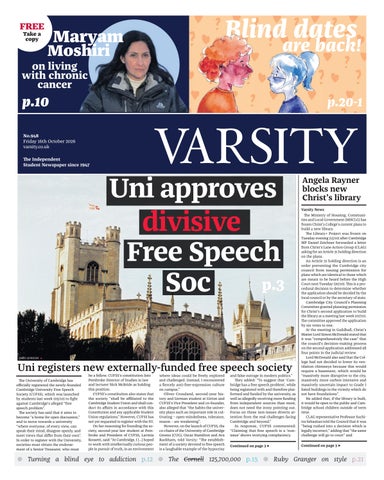
Uni approves divisive Free Speech p.3 Soc
and false outrage in modern politics.” They added: “To suggest that ‘Cambridge has a free speech problem’, while being registered with and therefore platformed and funded by the university, as well as allegedly receiving more funding from independent sources than most, does not need the irony pointing out. Focus on these non-issues diverts attention from the real challenges facing Cambridge and beyond.” In response, CUFSS commented: “Claiming that free speech is a ‘nonissue’ shows worrying complacency. Continued on page 3 ▶
Continued on page 3 ▶
Uni registers new externally-funded free speech society be a fellow. CUFSS’s constitution lists Pembroke Director of Studies in law and lecturer Nick McBride as holding this position. CUFSS’s constitution also states that the society “shall be affiliated to the Cambridge Student Union and shall conduct its affairs in accordance with this Constitution and any applicable Student Union regulations.” However, CUFSS has not yet requested to register with the SU. On her reasoning for founding the society, second-year law student at Pembroke and President of CUFSS, Lavinia Rossetti, said: “At Cambridge, I […] hoped to work with intellectually curious people in pursuit of truth, in an environment
where ideas could be freely explored and challenged. Instead, I encountered a fiercely anti-free-expression culture on campus.” Oliver Crossland, second-year history and German student at Girton and CUFSS’s Vice President and co-founder, also alleged that “the habits the university plays such an important role in cultivating – open-mindedness, tolerance, reason – are weakening”. However, on the launch of CUFSS, the co-chairs of the University of Cambridge Greens (CUG), Oscar Hamilton and Ava Rackham, told Varsity: “The establishment of a society devoted to free speech is a laughable example of the hypocrisy
Varsity News The Ministry of Housing, Communities and Local Government (MHCLG) has frozen Christ’s College’s current plans to build a new library. The Library+ Project was frozen on Tuesday evening (13/10) after Cambridge MP Daniel Zeichner forwarded a letter from Christ’s Lane Action Group (CLAG) asking for an Article 31 holding direction on the plans. An Article 31 holding direction is an order preventing the Cambridge city council from issuing permission for plans which are identical to those which are meant to be heard before the High Court next Tuesday (20/10). This is a procedural decision to determine whether the application should be decided by the local council or by the secretary of state. Cambridge City Council’s Planning Committee granted planning permission for Christ’s second application to build the library at a meeting last week (07/10). The committee approved the application by six votes to one. At the meeting in Guildhall, Christ’s Master Lord Simon McDonald stated that it was “comprehensively the case” that the council’s decision-making process on the second application addressed all four points in the judicial review. Lord McDonald also said that the College had not decided to lower its ventilation chimneys because this would require a basement, which would be “massively more disruptive to the city, massively more carbon intensive and massively uncertain impact to Grade I listed buildings in the vicinity which do not have foundations”. He added that, if the library is built, it would be open to the public and Cambridge school children outside of term time. CLAG representative Professor Suchitra Sebastian told the Council that it was “being rushed into a decision which is legally incorrect,” adding that “the same challenge will go to court” and
FARIS QURESHI ▲
The University of Cambridge has officially registered the newly-founded Cambridge University Free Speech Society (CUFSS), which was launched by students last week (05/10) to fight against Cambridge’s alleged “free speech problem”. The society has said that it aims to become “a home for open discussion,” and to move towards a university “where everyone, of every view, can speak their mind, disagree openly, and meet views that differ from their own”. In order to register with the University, societies must obtain the endorsement of a Senior Treasurer, who must
Angela Rayner blocks new Christ’s library
● Turning a blind eye to addiction p.12 ● The Cornell 125,700,000 p.15 ● Ruby Granger on style p.21
Friday 16th October 2026
2
Michaelmas, Week 2
Editors’ Note If you couldn’t tell by the uptick in foot traffic, bike collisions, and free Domino’s slices, a new term is firmly underway. We were lucky to find a moment of reprieve at the Varsity Open Evening last week, where, fuelled by biscuits and boxes of wine, we met many keen student journalists whose names will undoubtedly be splashed across this paper’s future pages. We also heard their anxieties: Cambridge is a prestigious place and imposter syndrome can run rampant. But, as Aisling Rogers writes on page 22, ‘Just because you’re not yet a Zadie Smith, it doesn’t mean you won’t be someday’. These pages are testament to that potential. On page 13, Phoebe Leung speaks to our power as students by breaking down student movements in Cambridge. Across the page, however, Bryony Clarke exposes how a found lack of signposting to resources can leave students struggling with substance abuse feeling powerless.
As two young women, the ‘Cornell 7’ case and all of the successive discourse has been at the forefront of our conscience, and Ben Lubitsh contributes to the conversation by expressing his disdain for the ‘not all men’ rhetoric (p.15). Turning back to News, Varsity reports on the University’s statement against self-swab DNA kits, a tool marketed as supporting rape survivors (p.9). The Cambridge bubble can be difficult to navigate at times, but, as Maryam Moshiri attests on page 10, anything is possible with a little hard work (and a sprinkling of luck). We’re less assured by Cambridge’s new Free Speech Society (p.3). When we heard of their launch, alongside their student journal (cough, Substack…) we had the same questions as Dexter Twycross (p.14): why this, why now, and – more importantly – who cares? In a world embroiled in political clashes, many of us would much rather have some peace and quiet.
In this issue, we hope to offer some of that solace. Our Blind Dates are back with a bang this Michaelmas, with David and Nina meeting on Regent Street for an axe-throw or two (p.20-1). Over in Fashion, Ruby Granger offers her best Victorianinspired style tips (p.26), while Jessica Kamimbaya explores her Congolese heritage by experimenting with colour, pattern, and silhouette (p.27). It’s a bit of everything this week, and we hope you find a story or two that suits. Our advice? Read it coverto-cover. Deadlines may looming, but we’re nothing without a moment to pause and think.
Daisy Bates & Bibi Boyce Editors-in-Chief MICHAELMAS 2026
editors Daisy Bates & Bibi Boyce editor@ varsity.co.uk deputy editors Olivia Goodman & Emma Tenzler deputyeditor@varsity.co.uk vulture editors Emma Gower & Daniel Kamaluddin magazine@varsity.co.uk news Alessia Fietta & Neve Wilson (Senior); Maebh Carey, Jacob Smith, Hayley Butler, & Benjamin Pine (Deputy) news@ varsity.co.uk; Skyler Roberts (Investigations) comment Jasper Burnside, Lily O’Sullivan, & Dexter Twycross opinion@varsity.co.uk features Bryony Clarke & Phoebe Leung features@varsity.co.uk interviews Faron Smith & Sam Elgar interviews@varsity.co.uk science Sophie Patel & Yu Tong science@ varsity.co.uk sport Daisy Kaye & Sophe Hardman sport@varsity.co.uk lifestyle Cherie Wong & Ruby Randall lifestyle@varsity.co.uk arts Juliette Berry & Ben Bailey arts@ varsity.co.uk fashion Rachel Jones & Scarlett Prunty fashion@varsity.co.uk fashion shoot co-ordinator Emer Naylor Afram film & tv Daniella Adetoye & Amanda Ljunberg filmandtv@varsity.co.uk music Lauren Quinn & Dylan Ingram music@varsity.co.uk theatre Lucy Farmer & Barney Sayburn theatre@varsity.co.uk photography editors Clio Sze & Gabriella Douglas-Kitsis illustrations editor Rosie Beyfus sub-editors Ell Heeps, Joss HeddleBacon, Sophie Giles, Natasha Simm, Ariela Ohrenstein & Lucia Taylor subeditor@ varsity.co.uk associate editors Charlie Rowan, Ell Heeps, Sophie Ennis, Leo Kang Beevers, Joss Heddle-Bacon, & Ben Lubitsh associate@ varsity.co.uk business manager Mark Curtis business@ varsity.co.uk varsoc president Bibi Boyce president@ varsity.co.uk varsity board Dr Michael Franklin (Chairman), Dr Tim Harris, Michael Derringer, Mark Curtis (Company Secretary), Hugo Gye, Ell Heeps, Daisy Bates, Bibi Boyce (Directors), Lotte Brundle (Guest), & Zoah Hedges-Stocks (Guest) © VARSITY PUBLICATIONS LTD, 2026. All rights reserved. No part of this publication may be reproduced, stored in a retrieval system or transmitted in any form or by any means electronic, mechanical photocopying, recording or otherwise without prior permission of the publisher. Varsity, 1 Trumpington Street, Cambridge CB2 1QA. Telephone 01223 337575. Varsity is published by Varsity Publications Ltd. Varsity Publications also publishes The Mays. Printed at Iliffe Print Cambridge – Winship Road, Milton, Cambridge CB24 6PP on 42.5gsm newsprint. Registered as a newspaper at the Post Office. ISSN 1758-4442
Friday 16th October 2026
3
News
Women’s soc members found free speech soc The society accepted donations from Free Speech Union and others Continued from front page “Free speech and the university ought to go hand-in-hand, and the fact that a society defending it is received as controversial […] is proving our point”. CUFSS has received financial support through the Ian Mactaggart Programme run by the Free Speech Union (FSU), a membership organisation which describes itself as non-partisan and aiming to defend free speech and oppose cancel culture. The programme awards grants to students “supporting free expression on […] campus”. CUFSS’s President told Varsity that the society has also “gratefully accepted donations from supporters of free speech, in addition to the Ian Mactaggart grant”. The same FSU programme also provided funding to the Cambridge University Society of Women (CUSW), launched by a group of students last October. Membership is restricted to those who
meet the definition of “woman” under the Equality Act 2010, in light of the 2025 Supreme Court ruling that the term refers to biological sex at birth. At the time, FSU’s founder and General Secretary, Toby Young, told Varsity that the Ian Mactaggart Programme provides student societies with up to £1,500 per term. Treasurer of CUSW and Secretary of CUFSS Ava Foyle commented: “CUFSS has indeed received funding from the FSU, due to shared motivations in promoting free speech between the two organisations. “[…] CUSW has also received funding from the same program, following claims from students that the idea that being male or female is a biological truth is offensive, and therefore CUSW should not be allowed to form officially.” The creation of CUSW last year provoked backlash from across the University, with the Cambridge University Labour Club (CULC) calling it “the latest assault on the trans community at Cambridge,” and accusing the society of promoting “transphobic
▴ gordon chung
rhetoric under the guise of ‘free speech’”. The President and Secretary of CUFSS are both also listed as committee members of CUSW. The President of CUFSS claimed that the society and CUSW “have similar values only insofar as both societies support free speech,” adding that there is no “relationship” between CUFSS and CUSW. She also called “the apparent hyperfixation” on her membership of CUSW “quite peculiar,” adding: “those who disagree with the aims of CUSW are more than welcome to join CUFSS and I’d very happily have a conversation with them about our differing views”. CUSW’s co-President, Serena Worley, also claimed that “CUSW has no official relationship with CUFSS,” though noting that “it is unsurprising that members of our society, having experienced the mistreatment of students who question prevailing orthodoxy at this university, would wish to found a society directly addressing that issue”. Reacting to the founding of CUFSS, the University of Cambridge Left Society (UCLS) said: “It is difficult to levy criticism of a society that has not began operation, and we do hope to be wrong in our understanding of what CUFSS appears to be – but it is clear that
its establishment is deeply partisan and will likely have an inverse effect on free speech at the University.” They added: “This is evident by looking first at their speakers - Don’t Divide Us, per a Byline Times investigation last year, was given a £20,000 donation in the year ending 2024 by the Institute for Policy Research, which has a long and checkered past of donations to right-wing think tanks such as the Institute of Economic Affairs and the Thatcherite Bruges Group. When one thinks of impartial free speech, their mind presumably does not think of Tufton Street, but that is the situation we appear to be in. […] The Society’s close ties to CUSW are perhaps, therefore, inevitable – CUSW were seemingly afforded endless column inches in the national press to denounce the state of discourse in Cambridge, without materially affecting it at all on the ground. Do not be surprised if CUFSS amounts to the same.” Responding to these claims, Rossetti reemphasised that the society “endeavour[s] to invite a broad range of speakers,” and to explore “a broad range of political viewpoints” during its Symposium events. While the FSU, which has funded both societies, describes itself as politically neutral, some have questioned whether the organisation is truly non-partisan. In August, the Financial Times reported that former employees had complained of the organisation’s increasing alignment with President Donald Trump’s MAGA movement. One former employee also suggested that the FSU had become a “political arm of the populist right,” although Young claimed that the FSU remained nonpartisan and represented “numerous people who identify as left wing”. The FSU supported self-defined “racerealist” and former Cambridge professor Nathan Cofnas in 2024 against criticisms over his research. In the same year, Cofnas
was fired from his research associate position at Emmanuel College following a blog post arguing that meritocracy would see the number of black professors at Harvard “approach 0%”. James Orr, Associate Professor of Philosophy of Religion at the University of Cambridge and former Reform UK Head of Policy, also serves on the FSU’s Advisory Council. Orr resigned as Reform’s Head of Policy in September, after Channel 4 News and investigative journalism group Verbatim released footage appearing to show him and Farage aide Dan Jukes discussing how to accept £30,000 worth of polling funded by a US-based donor. The University of Cambridge has since confirmed that it is examining Orr’s conduct. Orr and his wife have hosted postgraduate students at their home on the outskirts of Cambridge, which his wife has likened to an “alternative Cambridge college” where right-wing Christians can come together. Foyle, committee member of both CUSW and CUFSS, said: “it is true that many members of the FSU are more right-leaning […] however they would say that this is due to recent stigmatisation of these perspectives altogether. […] Despite Lord Toby Young, director of the FSU, being a selfproclaimed Zionist, it is the case that the FSU has previously represented a pro-Palestine protester and a member of the Social Democratic Party.” CUFSS’s President also said: “It is not the content of [Cofnas’s] speech that is being defended, but his right to say it and pursue truth within the context of the university – where claims are held up to testing, critique and revision. We take the same view.” According to its President, CUFSS has had “an encouraging number of memberships registered” thus far.
Christ’s Library plans blocked again Continued from front page that “what was quashed once will be quashed again”. Following the decision, Sebastian suggested that the council was not addressing CLAG’s concerns. In a post on Christ’s website following the decision, Lord McDonald wrote: “My first reaction is relief: so many people have worked so hard to secure planning permission for our Library+ project. Yesterday’s vote takes us a big step closer to having a beautiful, accessible and sustainable library.” However, he added: “all our opponent’s arguments have been confounded but they still have legal options. Watch this space.” If approved, the library would replace a 1970s building that Christ’s has been looking to replace for more than a decade. The College first considered replacing the library in 2010 and submitted a reconsidered design in 2023, motivated by a greater focus on accessibility and sustainability. Following an international competition in 2024, Grafton Architects won the bid to design the new library
out of five candidates. Christ’s submitted a planning application to build the new library in mid2025, which the City Council approved in October by four votes to two. CLAG successfully applied for a judicial review of this approval. The College and Council collectively agreed to a consent order seeking to quash the planning permission in April 2026. Despite this, Christ’s announced it was taking the “unusual step” of submitting a second application in June 2026, as the judicial review related to the City Council’s decision-making process and not the design itself. Following the decision, a spokesperson for the City Council said: “The decision taken on 7 October on a new application for planning permission had careful regard to those elements of the earlier decision that gave rise to the Judicial Review of the previous application. They added: “Whether planning permission should be granted for a particular development is not a matter for the Judicial Review process, which focuses on the planning processes that a decision maker should follow and the matters that it should consider in reaching its
decision. On that basis, there was no reason to prevent the Council from taking a decision on this latest application.” A spokesperson for CLAG stated: “The Council has already conceded that its first permission was unlawful on all four grounds. Thirteen days before the Court rules on those errors, members approved the identical scheme again, because they were told they could not wait. Whitehall says they can.” CLAG also said: “We do not oppose a new library for Christ’s College, but this scheme is too big for its location, as Historic England has warned.” In response to a request for comment, Christ’s College told Varsity: “This last-minute intervention is extremely disappointing following strong support (6-1) for the
Library+ scheme by the democratically elected planning committee of the City Council last Wednesday.” They continued: “We remain fully committed to our well-designed, accessible and sustainable Library scheme which will bring multiple benefits to our students and to the City of Cambridge.”
The judicial review connected to Christ’s first planning application is still scheduled for next Tuesday (20/10).
▲ AMIKA PIPLAPURE ▴ ryan teh
Friday 16th October 2026
4
News
Caius returns to single sex toilet signage citing EHRC code of practice Louis Welvaert News Correspondent Gonville and Caius College has changed the signage for toilets on the College’s Old Courts and Harvey Court sites, citing the Equality and Human Rights Commission’s (EHRC) code of practice. Over the summer, Caius alerted students via the College’s intranet, the Venn, that signs for the public toilets in the bottom of the Harvey Court building, as well as for the Old Courts’ ‘Gate of Necessity’ toilets, would be be renamed as ‘Female” and ‘Male’. The signs had previously read ‘Toilets with Stalls’ and ‘Toilets with Stalls and Urinals’. According to the College, the toilet signs were changed “according to the code of practice by the Equality and Human Rights Commission (EHRC) that states single-sex spaces open to the public should be organised based on biological sex”. The code of practice states that “‘sex,’ ‘woman’ and ‘man’ in the [Equality] Act mean biological sex, biological woman and biological man,” in light of the Supreme Court’s ruling in on the issue in 2025. Toilets in the Cockcroft Building, which is leased from the University and is the home of Caius’s library, will not be affected by the change, as they have
always had ‘Male’ and ‘Female’ signage. Last week (08/10), Caius’s Week One JCR Newsletter noted this change, and stated: “The [Gonville and Caius Students’ Union] remains committed to trans rights and to supporting all trans and gender non-conforming students”. The GCSU also offered support to students concerned by the change. According to the minutes of the latest JCR meeting, the LGBTQ+ Officer expressed concern with the lack of a formal statement on the change published by the College, as well as the absence of consultation with student representatives. The minutes added that the LGBTQ+ Officer “felt the announcement [was] insufficiently detailed and poorly circulated”. The student also registered an objection to the College’s action, emphasising the “potential harm caused to gender non-conforming students, staff, fellows, and visitors to the College” by the decision. One Caius student commented: “I think the College’s hands were tied as they have to comply with the Supreme Court ruling, but I think it’ll still be upsetting for a lot of people at Caius to see this kind of step being taken, especially when it wasn’t communicated as overtly as it could have been.”
Praising the GCSU’s response, they continued: “I do find it a bit strange that the College specifically chose not to issue a College-wide email about something that was bound to cause controversy”. Another student said it was “disappointing to see the College reverse what was clearly a positive policy […] however, what is particularly disappointing is that such a change would be made without any form of consultation with the people who will be affected.” The same student remarked that while “the college’s statement appears to suggest that recent EHRC guidance left them with no choice but to replace the signage […] it is far from clear that this is true; in fact, it is only because the signs now read ‘male’ and ‘female’ that college toilets could even be considered single-sex spaces under the guidance”. The student made reference to a section of the EHCR’s new code of practice that asks service providers to consider how transgender people could be disadvantaged before implementing singlesex services. The student added that they hoped the College would share the reasons for which it believes the change was legally necessary.
▲ BIBI BOYCE
Sum Fun Place the digits 1–5 once each in every row and column. All coloured boxes' sums are multiples of one another (e.g., the sums could include 2, 6, 1, 12, 2, 24...). The grey square does not have the smallest sum.
Your career at d-fine We are a European consultancy firm focussed on analytical and quantitative topics and the development of sustainable solutions to bring about positive change for our clients. What does d-fine offer you? - Diversity: Work with clients on topics ranging from financial engineering and machine learning through to climate risk and healthcare - International: Collaborate in project teams staffed across Europe - Education: Acquire new skillsets to broaden your technical and professional repertoire Who do we look for? Master’s or PhD-level graduates in STEM fields
www.d-fine.com
Berlin, Dusseldorf, Frankfurt, Hamburg, London, Milan, Munich, Stockholm, Utrecht, Vienna, Zurich
Friday 16th October 2026
5
News
Scammers target freshers by pushing fake flyers under student room doors Alessia Fietta Senior News Editor The University of Cambridge has warned students about a social media profiling phishing attack that is currently circulating at several colleges and targeting freshers. In a notice first published by the University Information Services (UIS) last week (05/10) and later circulated through college bulletin channels, the University alerted students to fake flyers, which had been “sometimes pushed under students’ doors”. The University’s warning claimed that there had been several versions of the scam, but gave the common example of a flyer titled ‘Fresher Week Form’, instructing students to “fill in by 9pm”. The QR codes on the flyers link to a Google form that pretends to be “helping freshers meet people both within and across colleges – friends, mentors, and research partners”. However, the form instead intends to steal personal data that could be used for social engineering and targeted spear-phishing attacks. The Google Form, seen by Varsity, asks students to fill in details such as their full name, Cambridge email address, phone number, college, and subject, as
well as asking biographical questions such as their hometown, interests, and academic and career ambitions. The form, which primarily targets freshers but also claims that “second years and above are welcome too,” also asks the recipient to submit a profile photo, and provides the option to submit additional photos showing the student’s hobbies or travels. One Homerton student told Varsity that they found a ‘Fresher Week Form’ flyer “halfway under” their door when arriving at College at the start of term, describing their placement under bedroom doors as “unnerving”. They continued: “From what I could see, all the other rooms on my corridor had one too. It didn’t seem especially out of place because other forms etc from college had been attached to our doors.” The student lives in an on-site accommodation building mostly designated for freshers. The building is controlled by SALTO keycards, although the student noted that a scammer could have entered by tailgating a resident. The student said that the flyer’s appearance was the same as the example scam flyer published in the UIS’s notice, and described it as light blue, with a picture of King’s Chapel and “University of Cambridge” written on the front.
They said that they scanned the QR code on the form “a couple of days after moving in,” and thought its request that the form be completed by 9pm “was weird without a specified date to go with it”. Although the student did not submit the Google Form, they recalled that it “didn’t cross [their] mind that it was a scam”. A Homerton ▼ RYAN TEH College spokesperson said: “The safety and security of our students is a key priority for Homerton College. When we became aware that some students had received fraudulent forms, we acted immediately, including warning students about scams through messages on our internal screens. We continue to remind students never to share personal or financial details in response to unexpected requests,
to check with the College if they have any doubt, and not to let anyone they do not know into College buildings.” The UIS’s notice highlighted several “red flags” associated with the scam, such as the false sense of urgency, the extensive personal information that it requests, and the fact that the QR code URL does not go to an @cam domain.
The University’s advice instructed students who had filled in the form to be “extra vigilant for potential follow-up phishing or social engineering attempts”. It also told students to complete the University’s mandatory cyber security online training course. In the University-wide Michaelmas newsletter sent to students on Monday (12/10), the University alerted students that fraudsters can also “target students by impersonating official bodies like the police, UK Visas and Immigration (UKVI) or the Student Loan Company (SLC)”. It recommended that students read the government’s latest advice about avoiding scammers pretending to be from UKVI or from SLC, and remember to be particularly cautious about emails, texts, and social media posts about student loans. This latest scam is one of several to have targeted Cambridge students this year. In March, Varsity reported that scammers posing as deaf fundraisers had approached students around Sidgwick Site in an attempt to steal their financial information. In April, students and staff at the University reported receiving phishing emails from the compromised email addresses of University members.
Could a PhD in Management be your next step? Develop the ideas that shape business and society. The INSEAD PhD prepares the next generation of management scholars through a fully funded, five-year doctoral programme*. Whether your background is in economics, engineering, computer science, psychology, or the social sciences, we welcome applicants with the foundations for rigorous research and the curiosity to ask meaningful questions.
INSEAD PhD in Management Five-year scholarships*, regardless of background Highly diverse academic community: 82 students from 26 nationalities Study in France and Singapore; PhD Exchange in the US with Wharton** Close collaboration with world-leading faculty Graduates placed at leading business schools worldwide Strategic alliances with Wharton and Sorbonne (dual-degree**; behavioural lab) Now accepting applications for the mid-August 2027 intake inse.ad/why-insead-phd | inse.ad/phd-apply | inse.ad/phd
Scan to contact us or click https://inse.ad/phd-inquiry-cambridge *more info at https://inse.ad/phd-financing; **optional
6
Friday 16th October 2026
News
Uni sets terms for Evans review Irina Echim and Benjamin Pine Deputy News Editor and News Correspondent The University of Cambridge has set out the terms of an independent review into how it handles complaints and whistleblowing after it lost an employment tribunal case brought by astrophysics professor Wyn Evans. The University says the review will operate “independently of, but alongside” the independent review commissioned after Professor Arday’s death. The review will be led by Laura Whyte, who has previously led an independent review into HMRC. Colin Riordan, a former vice-chancellor, and Mary Curnock Cook, a former chief executive of UCAS, will also sit on the panel, alongside consultant Helen Fairfoul and Independent Public Advocate Cindy Butts. The University also said the panel will be “supported by” consulting firm Deloitte. A first report is expected within three months, with a final summary of the findings due to be made available to the “university community”. The review comes after an employment tribunal held in August upheld 11 out of 14 complaints made by Evans, with the judge finding that the Professor had suffered detriments
for making protected disclosures. Evans was investigated by the University for over nearly two years, in what the tribunal ruled was “retaliation” for reports he made about misogyny towards female staff members at the University’s Institute of Astronomy. Although the University has previously said the independent review is a response to the tribunal’s findings, the terms of the review do not mention Evans by name. The review aims to assess whether whistleblowing, grievance and complaints handling practices are functional and adequately applied. While Whyte will be able to shape the review, the University said it expects interviews and focus groups will be conducted with staff to make recommendations for actionable improvements. The review will not investigate student-staff complaints, which will continue to be administered by the Office of Student Conduct, Complaints and Appeals (OSCCA), except when they interact with HR processes. Additionally, the University says it will not re-examine adjudicated cases or specific individuals. The 21 Group, a campaign group established by Evans in 2023, has criticised the makeup of the review’s panel, describing it as “seriously unbalanced” due to some of its
members’ previous work in the higher grievances and complaints. The review education sector. will also assess whether University In a post online, the group also practices referenced in the employment argued the panel lacks expertise in some tribunal outcome are fit for areas, writing: “Given the investigation purpose and consistently was prompted by a damaging applied,” they employment tribunal loss, the absence added. of an employment lawyer is absolutely astonishing. “The committee does not contain re a single, obvious independent lapu p i P voice whose career has ika been principally spent ▾Am representing university employees [sic].” A University spokesperson told Va r s i ty : ”The review panel consists of members drawn from outside the University and collectively possessing the expertise necessary to address the matters within the review’s terms of reference. “ Th e purpose of the review is to examine broader governance, oversight and reporting of the University’s process for co n s i d e r i n g and monitoring whistleblowing, staff
Get in touch
We’re excited to connect with ambitious and fresh talent ready to make an impact on our team. davincitrading.com
THE HIGH-TECH RECRUITMENT EXPERTS
CAMBRIDGE UK Software • Electronics • Mechanical • Maths & Physics Applied Sciences • Consultancy • Graduate / PhD
Let us do the detective work. Da Vinci is a propietary trading house made up of some of the sharpest minds and most passionate players in the industry.
From knowing what jobs are out there to advice and guidance through the hiring process, we work with you.
01223 81 33 99 register@ecmselection.co.uk ecmselection.co.uk/university
Friday 16th October 2026
7
News
Uni seeks 2% salary increase for staff On 7 October, the University Council, the University’s principal governing body, submitted a ‘Grace’, or petition, to the Regent House to approve the increase. Unless it is withdrawn or a ballot is requested, the salary increase will be approved by 4pm on Friday (16/10). This is despite all five trade unions involved in the New Joint Negotiating Committee for Higher Education Staff (New JNCHES) rejecting the pay offer. The New JNCHES includes UCU, UNISON, Unite the Union, EIS, and GMB. The UCEA has said that the formal dispute
ir sp
n ▾I
ag
m
i ed
Neve Wilson Senior News Editor The University of Cambridge is seeking approval for a 2% increase in the salaries and stipends of non-clinical staff for the year 2026-27. This includes staff on the general salary scale and non-clinical officers paid outside the general scale. The Universities and Colleges Employers Association (UCEA) has proposed the uplift across all participating higher education employers in the United Kingdom. If approved, the uplift will be paid in the November 2026 payroll, and backdated to 1 August 2026.
ia
v es
la sp
un
in the New JNCHES agreement has been exhausted after “extensive discussions could not resolve the key issues” between the Unions and the UCEA. The national award in 2025-26 was 1.4%, compared to 2% this year. Staff at point 48 or below on the “single salary spine,” which the University uses to establish wages, have received a 2.5% pay supplement since the 2024-25 pay year and will continue to do so. The University Council confirmed in July that the 2.5% pay supplement will only be removed when the pay review position is resolved. It added that affected staff would not have their pay reduced when the supplement ends. The 2% salary increase comes after more than 500 University staff participated in strike action during Easter term in response to the UCEA’s offer of a below-inflation pay rise of 1.4% last year, alongside concerns about the University’s use of its “wage spine” and the lack of a “Cambridge supplement” despite the city’s high cost of living. In response to a request for comment, UNISON told Varsity:
sh
“UNISON are disappointed with yet another pay cut in real terms for the hard working staff at Cambridge University. Members at all levels are finding real difficulties in their cost of living and Cambridge University is not listening. The Higher Education sector is in difficulties, but Cambridge has a financial security very few universities have. Despite this they would rather shoulder this burden on staff wages, than on spending elsewhere.” The trade union added: “Oxford University provides an additional £1,730 for their staff, [so] why can’t Cambridge do the same, or better?” The University’s pay increases are directly tied to the UK’s National Joint Negotiating Committee for Higher Education Staff (New JNCHES) Single Salary Spine. This is updated every year on 1 August and can be backdated to that date. Most universities in the UK use a salary spine, which is a structure that shows pay grades but also incremental points within that pay grade, which employees progress through over time. The UCEA makes annual adjustments to the national higher education salary spine but individual institutions can choose to adapt this. For instance, the University of Cambridge adapts the national spine quite significantly to include much higher pay grades, and also some
lower pay grades for trainees. There are 12 grades and a trainee grade in the salary scale, with 100 incremental points in total. As it stands, no University employees appointed to Grade 1 can be paid below spine point 21 and nobody in Grade 2 or Grade 3 can be paid below point 25 on the scale. Grade 12 professors and senior management can be paid up to Point 100 on the scale. Employees of the University can progress through pay points within their Grade in different ways, including through length of service and merit, although this can vary depending on the type of role. Not all people employed at the University are on the salary scale, including College employees, although Colleges often use the University’s salary spine as a reference point. In 2024, a Cambridge Student Union investigation found that ten colleges paid some of their employees below the real living wage in the academic year 2022-23. In contrast, Vice-Chancellor Deborah Prentice earned a base salary of £409,000 in her first year in the role in 2023-24. The University also publishes information about its gender pay gap. In its 2025-26 gender pay gap report, the University reported that women earned 91p for every £1 that men earned.
8
Friday 16th October 2026
News in brief Bad apples
All the King’s horses
The Cambridge University Botanic Garden has been forced to cancel its annual Apple Day because it doesn’t have enough apples. The event is typically held each year to celebrate apples, selling heritage varieties and offering apple identification and advice. On Monday (12/10) the Botanic Garden announced that the drought that occurred this summer led to the Garden being “unable to source enough quantities of heritage apples to make the event viable”. One disappointed student joked to Varsity: “The fact that they’ve run out is my recession indicator”.
Cambridge City Council and King’s College have collaborated to establish a wildflower meadow on the south of Parker’s Piece. The meadow was prepared using shire horses and centuryold equipment, technologies which King’s uses to harvest its meadow each year. The College’s head gardener Steve Coghill said: “It’s easier to do with horses because it’s carbon neutral, there’s no noise involved.” The meadow uses the same seeds as King's Meadow and will provide “fantastic sources for pollen and nectar for a wide range of wildlife,” Coghill added.
What a tortoise taught us Cambridge at conference A University of Cambridge researcher has helped study the oldest living giant tortoise to help understand the process of ageing. 194-year-old Johnathan is also thought to be the oldest living land mammal, born during the reign of Queen Victoria. He made headlines in April when news outlets reported his death, which turned out to be a hoax. Dr Justin Gerlach, a fellow at Peterhouse, said the tortoise’s “epigenome” – which affects how DNA is expressed – has “remained incredibly stable […] over almost two centuries”, leading to a slower ageing process.
Cambridge University Press held events at the Labour and Conservative party conferences to pressure politicians on education policy. Cambridge OCR called for a “stronger ecosystem” in vocational education at an event at the Labour Party Conference in Liverpool, encouraging the development of a strategy on the subject. Cambridge University Press ran events at both conferences, describing its English language teaching as “one of the essential tools in the UK’s soft power toolbox” and encouraging the government to invest in “high-quality teaching and testing”.
Jacob Smith rounds up student news from across the country US Office star to chase St Andrew’s dream Brian Baumgartner, best known for his role as Kevin Malone on the hit US remake of The Office, is among six candidates standing for election to the role of rector at the University of St Andrews. During his first speech to students, Baumgartner pledged to “continue the storied tradition of comics and performers serving as rector,” and to “engage with students, and bring his humour and love for St Andrew’s to the role”. Current rector Stella Maris spent much of her tenure engaged in a long-running dispute with the University, initially for comments she made on Israel’s military offensive in the Gaza strip, and later in 2026 after she objected to changes made to the governing body. Maris is not set to stand against Baumgartner.
20% OFF ALL BOOKS FOR HOLDERS OF CAMBRIDGE UNIVERSITY AND CAMCARDS SIMPLY PRESENT YOUR CARD IN STORE WE ALSO STOCK A WIDE RANGE OF CAMBRIDGE RELATED GIFTS AND SOUVENIRS
Birmingham meal deal society goes viral The Meal Deal Society at the University of Birmingham, which was originally founded before the Covid-19 pandemic before losing momentum, has been revived for the new academic year and gone viral on social media. The society, dedicated to discussing, buying, and enjoying meal deals, already has more than 100 members and had 60 student attendees at its first event, which involved members visiting a supermarket and buying their favourite meal deal combinations. A video documenting the trip on TikTok has been viewed more than a million times. One member told BBC Radio WM: “We got loads of people coming to us at our stall at the society’s fair, and we filmed a few TikToks and yeah, they just blew up.”
Illustration by Richard Briggs
University of Bristol celebrates 150th anniversary
1 Trinity Street, Cambridge CB2 1SZ 01223 333333
bookshop@cambridge.org
Offer can’t be combined with other promotions
Last Saturday (10/10), the University of Bristol celebrated its 150-year anniversary. Initially founded as University College Bristol, it was one of the first colleges in the UK to admit men and women on an equal basis. The College first opened on 10 October 1876, at a time when women had next to no access to higher education, and when the few who did were often unable to graduate with degrees. To commemorate its birthday, the University held events including a guest talk by historian and presenter David Olusoga, and the second showing of Bristol artist Luke Jerram’s immersive art installation, titled ‘Pollenarium’.
Friday 16th October 2026
9
News in depth
Self-swab options spark debate Olivia Goodman Deputy Editor
Hayley Butler delivers news from around Cambridge Waterbeach to Cambridge (W2C) busway approved Cambridgeshire County Council has approved a new busway link between Cambridge and Waterbeach, six miles north of Cambridge. The busway will connect Waterbeach’s new transport hub with Milton and then join the pre-existing guided busway between Cambridge and St Ives. The new travel hub at Waterbeach will have space for 1,600 cars to accommodate up to 11,000 new homes planned for the Waterbeach New Town development. While supporters of the scheme argue that the busway will reduce emissions in the city, opponents have questioned whether it will really fix traffic issues on the way into Cambridge. Engine stolen from charity’s van in “mind-blowing” theft A van belonging to Cambridge City Foodbank has been written off after it was towed from its warehouse, abandoned nearby, and had its engine removed, according to the charity’s chief executive Steve Clay. The chief executive said that CCTV suggested thieves broke a window and prepared the van to be towed in two previous visits, before the van was stolen at about 8pm. Clay said: “It’s mind-blowing, really, to think that somebody could be so callous.” The van was the charity’s primary mode of transport for taking donations to its warehouse and food parcels to its eight centres across Cambridge. The foodbank is raising funds to help cover the cost of a new van and has already raised over £5,000. In a statement, the charity said: “While criminals may have stolen our van, they will never take our hope and belief in the power of community.” Just Eat trialling robot delivery systems for Cambridgeshire residents Trials are underway for Cambridgeshire residents to have their groceries delivered by robots. Just Eat has expanded its autonomous delivery robot trial with Morrisons to deliver groceries to more than 12,000 residents in Cambourne, with each robot able to hold around 12 items. A spokesperson for Starship Technologies – which makes the robots – said: “Our smart robots bring advanced autonomous technology to something very ordinary, and they’re built for reliability, because their first job is to serve the community and make the grocery shop convenient and fast.”
The University of Cambridge has released a statement against the distribution and promotion of self-swab DNA kits, following a campaign from the non-profit organisation Enough. Self-swab DNA testing kits are marketed to survivors of rape and sexual assault as an alternative to a forensic medical examination for DNA collection. Charities in the sexual violence and abuse sector have raised concerns regarding the limitations and potential risks associated with the kits, including Rape Crisis England and Wales. They raise particular concerns over whether or not any evidence gathered can be legally admissible. The University’s statement, published on the Harassment and Violence Student Support Service (HVSS) website, states that: “The University does not support or endorse the use of commercially marketed self-swab DNA kits and strongly recommends accessing specialist sexual assault services instead.” The statement lists several concerns, including: “Discouraging survivors from utilising established and safe forensic and healthcare pathways which provide specialist support to survivors of rape and sexual assault,” “Lack of integrated medical, practical and emotional support,” and “Questions regarding the collection and storage of sensitive genetic data”. The Cambridge Students’ Union (SU) has also stated that “The kits have been promoted as a safety tool, but have done so with misleading promotional information” and that the SU does “not endorse or encourage the kits”. Enough, founded by Katie White and Tom Allchurch in 2024, is a non-profit organisation “focused on rape prevention and survivor support”. The organisation largely campaigns on university
▾faron smith
campuses. In a press release from March of this year, Enough states: “students are five times more likely to be raped than any other demographic group. Enough will be visiting university cities to raise awareness of their work and hand out self-testing rape kits.” In late March, Enough launched its Cambridge campaign by distributing kits on King’s Parade and partnering with the University’s rugby team. On 23 March, Enough representatives, including White, appeared on ITV News Anglia while on King’s Parade. Then-captain of the rugby team George Bland described Enough’s campaign as a “great initiative” to ITV News. Enough have claimed that self-swab DNA kits offer greater choice to survivors who may be unwilling or unable to access existing services immediately, providing an alternative way to collect and preserve potential forensic evidence. In their statement, the University “strongly encourages students who have experienced rape or sexual assault who wish to report an assault, preserve forensic evidence or access specialist support, to access established specialist services, including Sexual Assault Referral Centres (SARCs).” The nearest SARC to Cambridge is The Elms in Huntingdon – students can have their College or the University pay for a taxi to and from The Elms. Their website states that they “offer free, confidential healthcare and compassionate support, in Cambridgeshire, to people of all ages, who have experienced sexual assault, including rape”. The SARC operates between 9am-9pm (Monday-Sunday). In the statement on their “position on self-swab ‘rape kits’” posted on 18 June, Rape Crisis England & Wales list two of their concerns as: “Self-swab kits can’t collect all the evidence that might be needed” and “They don’t offer specialist, in-person support”. They continue: “In the aftermath of sexual assault, there is
more than just DNA to consider. A forensic medical examination would include an assessment of injuries, clothing, blood samples, and other medical findings, which can be crucial to any subsequent legal case. Self-swab kits don’t include any of this.” In response to the criticism, Enough told Varsity: “Enough’s existence exposes a system that is not working. Some of the organisations that run the system […] have responded by trying to discredit us rather than engage with evidence. “[…] The two arguments made against us are that our kits are inadmissible as evidence, and that we divert survivors away from existing routes. Neither holds up.” Addressing the admissibility of the kits, Enough continued: “Forensic evidence does not require a specific collection method to be admissible. Tampons and underwear have convicted rapists. Self-collected evidence is accepted by the same legal standard.” Another concern listed by Rape Crisis England & Wales is that “Any evidence gathered may not be legally admissible. Professional forensic medical examinations happen in forensically cleaned, controlled environments with strict rules to avoid contamination. […] At-home kits can’t offer that level of protection and may give survivors false hope that any evidence they gather could be relied on in a criminal trial.” Enough ambassador and Cambridge student Apolline Hastings spoke with HVSS in September. Hastings questioned the claims that the kits produce inadmissible evidence or divert survivors from established support services. She maintained that Enough presented itself as an additional reporting option, rather than a replacement for the police or SARCs. In correspondence seen by Varsity, HVSS said its concerns went beyond selfcollected DNA. The service said: “Forensic medical examinations happen in controlled, forensically clean environments precisely because that protects evidence from contamination; a self-collected sample can’t offer the same protection.” HVSS added that organisations across the wider sector had warned that selfswab kits risk giving survivors false hope about the evidential value of their samples. It said: “Our focus is on making sure students have accurate information about forensic evidence and access to the support most likely to help them.” Ahead of the meeting, HVSS told Hastings that it had “extensively considered all of the information” and was not proposing to change its positions, citing the need to publish guidance before the start of term. The University told Varsity that it reached its position through its Steering Group for Addressing Sexual Misconduct and Harassment, which is “chaired by the Senior Pro-Vice-Chancellor for Education and includes representatives from Colleges, students, departments and faculties, and central services including the Harassment and Violence Support Service, the Office of Student Conduct, Complaints and Appeals, HR and the Communications Office”. The Office for National Statistics has estimated that around 900,000 people aged 16 and over in England and Wales have experienced sexual assault, including attempts, in the year ending March 2025. This is equivalent to 1.9% of the population.
According to combined data from March 2020 and March 2025, 85.3% of assault victims do not report incidents to the police. Hastings, a rape survivor herself, commented that “the process of accessing support can itself feel retraumatizing,” and emphasised the need for greater awareness of SARCs among students. She continued: “Survivors who are not reporting today deserve, and are actively asking for another option.” In September the SU stated in an Instagram story: “We have been made aware that Enough Self-Swab Kits have been circulating across Colleges within the SU box of sexual health supplies. We would like to reiterate our previous statement that we do not endorse or encourage the use of these kits.” In an email to the SU, seen by Varsity, White states that “no such kits have been circulating across colleges within the SU box of sexual health supplies. […] I would imagine that your team has oversight of these boxes, and would know that there are no Enough kits inside.” Several Cambridge student societies have given their position on the selfswab kits. Student society End Sexual Violence Cambridge (ENDSV) cautioned against their use, commenting in an Instagram caption: “While these kits are often well-intentioned, it’s extremely important to know the limitations of self-swabbing and the potential harms it can cause.” This was reposted by Cambridge University for Reproductive Rights (CURR) and Cambridge Rape Justice (CRJ). ENDSV told Varsity: “The post in question aimed to ensure Cambridge students are aware of the questions and uncertainties surrounding the use of self-swab DNA kits in rape trials, so that they can make informed decisions about the options available to them.” CURR also told Varsity: “We consider it important that students have access to clear, informative resources about the options and support available to them.” They continued: “Reflecting our nonpartisan ethos, we are willing to be part of open discussion of issues regarding issues affecting students’ reproductive rights and access to support.” Speaking to Varsity, a survivor of rape reflected: “If [Cambridge] is truly proud to celebrate being a place for women, they have a responsibility to acknowledge the systemic nature of rape, to be proactive, and that can only start by recognising and honestly speaking about rape culture. To honour women is not merely to celebrate them, but to listen when they speak of harm and to answer with action rather than assurance.” The University of Cambridge and Cambridge SU were contacted for comment. Anyone who has experienced rape or sexual assault, or who would like advice or support, can contact the SU’s independent Advice Service. Students can also access support through the University’s Harassment, Violence and Support Service (HVSS), which provides support and guidance to students who have experienced harassment, sexual violence or other forms of abuse. Students can report sexual misconduct to the Office of Student Conduct, Complaints and Appeals (OSCCA).
Friday 16th October 2026
10
Interviews
Maryam Moshiri
▲ MARYAM MOSHIRI
I
only had to take one train to meet Maryam Moshiri, in a cafe just around the corner from Balham Station. The quietness of the areas seemed to confirm the subtle signs of West London gentrification I had already gathered from walking down the road. “Really? I hadn’t really noticed,” Moshiri considers. “I grew up in SW12, just down the road from where we are. My parents brought me here when I was 11 months old. They got me and my two sisters into a really nice school down the road called Streatham and Clapham High School; all three of us got full bursaries.” It turns out that Moshiri is a fellow alumna of an all-girls school. We ex-
change the usual anecdotes; she agrees, on a serious note, that “It gives you that kind of belief in yourself. I felt like I could do anything when I came out of that school, genuinely.” I am curious about when exactly this ambition was converted into journalistic success. Moshiri currently anchors the BBC programme The World Today, which reaches over 100 million viewers globally. As a chief presenter at BBC News, she has built a formidable reporting résumé, including 16 years as a business news anchor, and having covered breaking news such as the death of Queen Elizabeth II. Her journey didn’t begin with journalism, however. “Initially history was my
passion. I had an offer from Oxford to read history. Everything was set up for me, and I went to my UCL interview for History and Italian, really quite full of it. I was a 17-year-old thinking, I’ve got a place at Oxford, I don’t really need this. I think that hubris meant I just did not show my best side; I was rejected for History, but the Italian department at UCL was lovely, and that’s what I chose to study.” Although she gained formal broadcasting experience at the London School of Communication, Moshiri’s Italian degree didn’t go to waste. “I’ve interviewed an Italian pop star [Marco Mengoni] during the Eurovision Song Contest, and I reported on the Pope’s passing from the Vatican,” she recalls. Getting a foot in the door of the media industry is notoriously difficult. “My sister was already working in independent radio news,” Moshiri explains. “She said, look, I know the editor, I can get you some shifts, but you have to work for free. I’ve spent many years of my career working night shifts, getting up at two in the morning and working really long hours. That’s not glamorous, it’s not your own show, it’s not being in Rome. It is just hard work, day in and day out.” Moshiri credits other factors for her success, the first being “a massive dose of luck, always kind of finding myself in the right place at the right time”. But it’s not all luck, of course. “I think what sets me apart,” she says, “is that I’m a big believer in light and shade. I love showcasing lighter stories, uplifting stories, things that make people laugh. I don’t take myself massively seriously. Obviously, I take the job seriously. But I know that you can do both. People can do both. Nobody needs to be one-sided.” Recently, though, Moshiri has been in the headlines for a reason unrelated to her career. Two years ago, she was diagnosed with polycythaemia vera, a rare blood cancer that is incurable but can be managed as a chronic condition. She has now chosen to share the news publicly to raise awareness, and is supporting Blood Cancer UK’s campaign, Here for This.
“When I was first diagnosed, I was absolutely in shock,” she recalls. “It was going in one ear and out the other. I couldn’t get my head around the fact that this was happening to me.” She agreed with my suggestion that she must have a strong support network, but explained that people often struggle to understand what it’s like to navigate a chronic illness. “It’s difficult to tell people. It’s like, I’m ill, but it’s not terminal. And, well, I could actually die, but I’m treating myself, so I’m not going to die. I feel bored just listening to myself, so often I just don’t say anything.” “My outlook on life has definitely changed,” Moshiri reflects when I ask how she pictures her future. “Before, I could see myself growing old, retiring with my husband and travelling, but now I’m thinking, I’m going to do all that while medicalised. I could probably travel, but not that far, because I need to receive treatment.” Her career keeps her constantly on the go, and I sympathise with how difficult it must be to balance her workload with the pressure of ongoing illness.
❝ That’s not glamorous, it’s not your own show, it’s not being in Rome Moshiri agrees that it gets hard, but she carries herself with the kind of quiet assertion that hints at tremendous capability. “You kind of get on with it,” she shrugs. “Especially in journalism, if you’re working crazy hours. There are constant tight deadlines, and I just get on with it, trying not to think about it. But I would, at the end of the day, come back to my hotel
room and just collapse.” “And I know you’ll understand this because you’re a woman,” she adds. “As women, we go through all these different life events while facing monthly issues or other problems, and you just learn to get on with it quite quickly.” “I have good days and bad days,” she tells me. “My message would be that even though it’s taken me two years to really get a handle on this disease, it’s possible to live a fulfilling life with chronic conditions. It takes getting used to, and everyone’s different. But I feel that now I’m in a much better place than I was two years ago.”
– KAMILLA KHUSNUTDINOVA
2 St Mary’s Passage, Cambridge cambridgesatchel.com © University of Cambridge
Friday 16th October 2026
12
Features
Turning a blind eye to addiction Bryony Clarke investigates the open secret of substance abuse at Cambridge
“I
’ve become dependent on alcohol since starting at Cambridge. […] It got to the point where I didn’t feel I could concentrate on studying without at least a glass of wine to help me focus and quiet the pressure I constantly feel.” All students responding to an anonymous Varsity survey said that they or someone they knew had struggled with substance abuse since being at University. And yet, not a single one had sought help, or knew someone who had. “I don’t know of anyone who has felt comfortable to go the University,” one student wrote.
❝ If I wanted to, I could probably find an event with free alcohol every day of the week Addiction is on the rise across the UK, with alcohol dependency affecting almost a million people, deaths involving cocaine increasing by 14% from 2023 to 2024, and a huge surge in ketamine use and related medical treatment, especially among young people. In fact, ketamine has cemented itself so strongly as the drug of choice for university-age Brits that we have been nicknamed ‘Generation K’. For many, experimenting with substances is a natural part of university life. A representative of WithYou, a nationwide drug and alcohol charity, told me, “as a student, it’s normal to want to try new things and take risks, but when it comes to drugs and alcohol, sometimes those risks can be dangerous and harmful.” Whether for personal, familial, or situational reasons, addiction is a cruel adversary that can creep up on anyone. Collegiate Recovery UK estimates that around 12% of UK university students may already be in recovery from substance abuse or alcohol addiction, with nearly a fifth identifying as having struggled with a behavioural addiction. On the surface, Cambridge may appear to have “not as strong of a [drug and alcohol] culture as at other universities,” as one respondent pointed out. Yet, the incessant academic pressure and the ubiquity of alcohol at social events can trigger or exacerbate challenges with substance abuse and addiction for students. One Clare student elaborated on the normalisation of alcohol at Cambridge,
saying “I think it is a lot more tolerated because it’s an intense environment that makes everyone a lot more focused on themselves”. Relying on alcohol to relax, while a sign of dependency, is socially acceptable in a place “where everything can be brought back to stress management”. Josh*, a third-year student, agreed: “It’s treated as an escape from the relentless academic pressure, so it easily becomes an escape, like a selffulfilling prophecy.” As a result, alcohol becomes synonymous with one’s social life, not only among friends but also at after-hours academic events. “Even if a society doesn’t include drinking, the ‘socialising’ mostly does,” Josh said. Speaking to Maya*, another student who has struggled with alcohol, she added: “If I wanted to, I could probably find an event with free alcohol every day of the week.” For Maya, this has meant that “the hardest part is knowing where the line is,” as the distinction between normal and excessive drinking is “ambiguous” at Cambridge. She described herself as “not an addict” but admitted to having a “problem with alcohol”. Now in her final year, she is completely sober, to protect her friendships and academics from further damage. However, as Josh brought up, choosing not to drink at Cambridge can be incredibly isolating. “If you want to stop drinking, you’re either left out or questioned as if you’re not normal.” Maya found the same – if alcohol will be present at an event, “friends might not invite you,” instead of giving you the choice. And far from this well-intentioned exclusion protecting her, Maya told me, “I was drinking alone a lot”. As well as contributing to stress and the normalisation of alcohol as a “universal go-to” response, the academic intensity of Cambridge means that students struggling with substance use can quickly find themselves in a dire situation. Maya opened up about the im-
G WNIN A BRO R Y L ▲
pacts of alcohol abuse on her studies, telling me, “I just drank way too much for two weeks”. That fortnight proved impossible to come back from: “I couldn’t catch up”. Maya missed deadlines and the chaos “snowballed” until she began abusing Adderall (a prescription medication for ADHD) in exam season to “be able to study for longer” and attempt to catch up on missed work. This plan eventually “backfired,” leaving her with unpleasant symptoms like heart palpitations and poor sleep, and contributing to panic attacks, failed exams, and ultimately a year of intermission before she could return to Cambridge to finish her degree.
❝ Treating addiction as a taboo enemy to academic progress is not working Maya, unlike every other student I heard from, did seek help. She went to her college nurse to discuss her drinking, and was given some resources signposting her to Change Grow Live Cambridge, the local branch of a health and social care charity that supports those affected by drug and alcohol issues. But Maya did not feel able to pursue this, put off by the seriousness of this unfamiliar service and adding: “I don’t need to go to rehab!” Lacking a less intimidating or more student-focused option, she was left back where she started: without any real support. On a University-wide scale, a quick Google search reveals the apparent lack of any tailored support services for students struggling with substance use. The Student Union ‘Out of Hours Support’ page lists a handful of external hotlines and websites, predominantly focused on supporting victims of vicarious substance abuse, such as students with family members who are addicts. Individual colleges treat issues with drugs and alcohol at their own discretion, but at every stage it is clear that any pastoral duty of care is inextricable from the pressure to excel academically. Hughes Hall’s
Substance Use Policy, for example, lists impacting “attendance, time keeping, efficiency and conduct” among the ‘risks’ of substance misuse at Cambridge. Speaking to an SU representative about the support available to students, she mentioned the University Counselling Service and the Student Wellbeing Service, as well as College Wellbeing Leads, but confirmed that “we do not have a member of the team with a specialism in this field”. Currently, students can book a conversation with a counsellor or call Nightline anonymously, but will not receive tailored advice or resources from a specialist. The representative told me that the SU “regularly review our signposting resources, and discuss the most appropriate resources for students,” yet the students I asked all remarked on the lack of accessible information. “If [the University] does [make resources available] I don’t know about it,” one wrote. “I don’t think there is enough [information],” another added. In my own time at Cambridge, I can confidently say that I have never noticed more than one or two old posters about binge drinking outside the college nurse’s room. When asked about the importance of student-focused resources and support, the representative for WithYou told me, “the student cohort can feel separate from the wider populace,” while information and support “is key, given students’ likely exposure to substances and their vulnerability being away from home and support networks”. For students, accessing external services like AA or NA meetings can feel incredibly intimidating, while a one-off conversation with a college nurse or university counsellor lacking expertise often proves ineffective in creating change. “There needs to be a middle ground,” as Maya put it. Survey respondents all underscored the need for the University to invest in support groups or group therapy sessions for students struggling with substance issues. One student also suggested “wellbeing events” that would promote awareness, information and guidance around addiction, while another advocated for a “one on one hotline” offering advice, not just a listening ear. On the other
side of the country, WithYou runs regular drop-in sessions for University of Exeter and Falmouth students, in order to reduce barriers to access and focus on “breaking the stigma” around addiction. Proactively providing a place for students to ask questions, “access independent advice, and refer into the service if appropriate” allows the organisation to foster “open and honest conversations about the challenges around drugs and alcohol”.
❝ There needs to be a middle ground While the WithYou representative emphasised how each university must act independently, based on their own “ethos” and “budget,” it is clear that Cambridge’s current approach of treating addiction as a taboo enemy to academic progress, rather than an illness to be treated with specialist care, is not working. The Student Union representative told me that the number of students engaging with Student Support services for help with substance issues is unknown, and the SU itself “sees very few cases where addiction is mentioned” – an unsurprising fact given only around 4% of students nationally reach out for support with addiction. But it is dangerous to look the other way and cite a lack of engagement with unadvertised, underdeveloped services as a justification. Students struggling with drugs and alcohol do not just slip through the cracks while at Cambridge. Even if they cling onto academic success, they risk leaving university unable to manage their substance use, and unprepared for the real world. After all, as Maya pointed out, for all the institution’s lack of support, “this is the most safeguarded we’ll ever be”. If you are struggling with substance abuse, feeling affected by someone else’s, or seeking advice about drugs and alcohol, you can access online services through WithYou or visit Change Grow Live on Mill Road for in-person support. General mental health support services are available through your college or Student Services, and Nightline is open for an anonymous chat with student volunteers from 7pm to 7am. Students can access specialist input through the University Counselling Service (UCS) and Mental Health Advice Service (MHAS). *All student names are fictitious, and used only for clarity of speaker.
Friday 16th October 2026
13
Features
Anatomy of a student movement Phoebe Leung explores the potential of student activism in Cambridge
❝ Part of the value of student activism is keeping progressive ideas alive Sociologists have a term for the ethics-based friendships that bring people like Talulla into movements: “affective networks”. As political sociologist Dr. Ned Crowley explained, universities are hotbeds for activism. Not necessarily because of what is taught inside lecture halls, but simply because political identities are mostly formed in young adulthood, and the dense network of young adults in campuses allow information and debate to spread rapidly through personal networks. For Ken, an organiser for the Cambridge Socialist Workers Student Society (SWSS), a left-wing group focused on ‘on-the-ground’ action such as organising rallies for trans rights, peers at Cambridge have been indispensable to his political development. The University attracts people who are “sharp politically,” no matter their position on the political spectrum. “I have so much more joy talking to a conservative in this University […] because these conservatives have got stronger, more developed arguments.” Another factor, Dr. Crowley explained, is students’ “biographical availability”. This refers to the fact that most students do not have children or significant care responsibilities so they tend to have more time for activism
an additional lever of power. Both were also honest about the limitations of student activism. Talulla admitted they find C4P cliquey at times, with members sometimes competing to prove themselves by taking on risk. Ken, despite making an effort to keep the group transparent with no cliques (to the point of refusing to set up side group chats for specific tasks) admitted he I is “not sure” how he would keep the group horizontal as it grows. There’s also the fact that students’ “biographical availability” falls away, at least to some extent, when we graduate. Dr. Miley emphasised that he is in a “fortunate position” as he is tenured and won’t be risking his job, so he “won’t judge [other academics] for not wanting to get involved,” especially since academia has become more
N
and, crucially, are more willing to take on the risks it may entail. This is, interestingly, another way activism at Cambridge can be oxymoronic – Ken noted that the reason students have the time and energy to organise is also precisely why their experiences are different “material realities” of wage earners in the town. This is amplified by Cambridge’s persistent ‘town-gown’ divide. Ken found that reaching out to the town “takes effort” and that his group benefits hugely from their tie with the Cambridge Socialist Workers Party, the group’s point of contact with the town. Talulla described the town-gown divide as “an eternal thing” that’s “hard to combat,” but also believes that activism can help to break that divide. “If not for Cambridge for Palestine (C4P), I wouldn’t have met people from the town.” Nonetheless, there’s a limit to the extent student activists have broken out of the University bubble. Despite SWSS’s conscious effort to avoid being an “inward-looking book club,” Ken admitted only about 15% of their effort is directed at the town. Given most students leave Cambridge after a few years, this is perhaps no fault of their own, but it may limit their impact beyond University walls. As Dr. Crowley explained, the most successful movements through history, such as anti-apartheid, have leveraged cross-group ties to disrupt the status quo on multiple fronts. Student turnover also leads to the loss of institutional knowledge, noted Dr. Jeff Miley, a Cambridge-based political sociologist who “keep[s] one foot in activist circles”. Having watched generations of bright-eyed activists come and go, he described his role as the custodian of knowledge – the tried-and-true strategies that are at risk of being lost whenever a cohort graduates. He told me excitedly about the movements that swept Cambridge before I became a student: the anti-austerity Defend Education movement in 2014, the decolonial movement in 2016-17, the start of the Palestine solidarity movement in 2024 and its end following the University’s injunctions. Watching it all come and go, did he become jaded? Quite the opposite. Reflecting on the history of social movements from the 1960s until now, Dr. Miley explained that “success is always partial” but trying anyway helps him maintain a “sense of well-being”. He remains inspired by the progressive values and practices of students who are “not yet locked into a place in the system”. Part of the value of student activism, for him, is keeping these ideas alive and training students to participate in democratic life, not just disruption and direct action. Talulla and Ken defined success in similarly open-ended ways. Talulla didn’t sugar-coat the fact that C4P has yet to achieve divestment, but noted that the “network and friendships” created by the group have enabled much quicker response to a range of “anti-far right” issues, most recently being the treatment of Jason Arday. Similarly, while Ken would love to see full divestment by the time he graduates, he would count himself successful if he’s able to “build a large base of students who are politically informed and confident with the ability to organise in future campaigns,” especially when they enter the workforce and gain
EATRIX BIA GI ▼B
I
was 13 when my hometown, Hong Kong, put a de facto ban on organised protest, so it was in Cambridge that I first experienced one of my hometown’s greatest cultural exports – the student protest. Cambridge is characterised by a strange duality. Part of me knows it’s over 600 years older than my hometown (the Latin at dinner and occasionally dodgy Wi-Fi make it difficult to forget), but it’s also where I held a microphone and a placard for the first time, shouting my vision for a better future in the streets. For Talulla, the SU’s Vice President of Welfare and Liberation, Cambridge was also the unlikely backdrop of their political coming of age. As a fresher in summer 2024 during the height of Cambridge’s Palestine solidarity campaign, getting involved was “intimidating” at first. But after going to the encampments for the first time, it soon became routine, as the encampment was just “where people were if you had free time”. Flash forward to the summer of 2026, and they’re protesting graduation for divestment and speaking about it on Al Jazeera. “So, I have lots of love for the city and the University for what they’ve given me, but it’s also at the same time an oxymoron, because it’s come from a need to right these injustices.”
precarious in recent years. He sees getting involved as both a responsibility and a way to stay sane by living in accordance with his principles, now that he has the privilege of tenure. And maybe that – doing what we can because we care – is the point. At some point during my conversation with Talulla and Ken it struck me how absurd it is to define success only as full
Looking for an intellectually challenging career option?
Kick start your career as a patent attorney with us What does it involve? Training as a Patent Attorney is a career path that will enable you to combine your understanding of science with legal expertise. You will leave the academic environment yet remain at the cutting edge of science and technology, applying your knowledge and skill in a commercial context. You will help to protect intellectual property assets and grow businesses.
Sound interesting? J A Kemp is a leading irm of UK and European Patent and Trade Mark Attorneys with ofices in London, Oxford, Cambridge, Paris and Munich. Visit our website for more information about training as a Patent Attorney. We are presently looking for someone with the relevant academic background to join us as a trainee patent attorney in our Engineering and IT group in autumn 2027. jakemp.com/careers/trainees
divestment, an overhaul of the University curriculum, or an end to student fees; to expect 18-year-olds to reconstruct society in three years alongside a full-time degree, and to think of falling short as failure. It’s tempting to abstract student activists into symbols, to picture the French student with his hand blown up or the Indian student leaders rounded up by the government, these distant, martyr-like figures. But the conversations I’ve had paint a picture that’s messier, more grounded, but also more hopeful. One where I can see myself, with all my weaknesses and imperfections, as a part of a larger movement that doesn’t have to succeed now to matter.
Friday 16th October 2026
14
Comment
Jasper Burnside
T
wo weeks ago, the University announced that the investigation into the late Professor Jason Arday had been narrowed in scope and would no longer examine the process that led to his hiring. The Faculty of Divinity’s James Orr is now under investigation by the University – not for his self-proclaimed “compound”, nor for offloading six lectures onto a postgraduate, but because an undercover sting by Verbatim and Channel 4 caught him allegedly discussing an arrangement to channel over £30,000 in undeclared foreign funding into Reform UK. While each of these episodes is uniquely disastrous, the University’s response follows an identical script: the Whitehall crisis playbook immortalised in Antony Jay and Jonathan Lynn’s Yes, Prime Minister. In dealing with a crisis, we are told there are four stages. First, state that nothing is going to happen. Second, acknowledge that something might happen, but advocate for doing nothing. Third, suggest that action might be necessary, but assert that nothing can actually be done. Finally, concede that something could have been done, but declare it too late now. Given the University’s recent torpid strategy, one can easily picture these scenes playing out in rolling crisis meetings. First, deny there is a problem or that an investigation is necessary; then announce a watered-down investigation, only to expand its scope under pressure, and finally scuttle it once the press has abated. The University’s response to each of these incidents has been to engage in process and recrimination only when the media circus becomes so insurmountable that the administration is dragged into the appearance of action. But the question is:
Dexter Twycross
T
Yes, vice-chancellor... ❝ A body under investigation should not be able to decide unilaterally what is, and is not, worthy of investigation
what happens when the circus leaves? The University has answered this question by narrowing its scope and internalising processes. This institutional dysfunction was laid bare when academics initially had to push for an independent inquiry into Professor Arday. One unnamed academic told The Guardian that the initial investigation was designed to let the University “draw a line” under the fiasco. The recent mothballing of part of the investigation does more than vindicate that academic’s concern. Indeed, we should all be alarmed that Professor Oliver Linton, Chair of the University’s Faculty of Economics, told Varsity last week that “rather than undertaking a genuinely searching review of the wider institutional decisions and processes involved in that case, the University has now narrowed its review substantially”. That alarm has now crystallised into action, with an open letter signed by 40 senior academics to the Chancellor, Lord Smith, warning that the University has abandoned any pretence of a “thorough and transparent” investigation. I am not demanding the impossible here; in fact, I am demanding the eminently reasonable: a body under investigation should not be able to decide unilaterally what is, and is not, worthy of investigation. If there were no issues in the process, then why has this part of the investigation been halted while the University of Glasgow’s review continues? This was precisely the point Prof essorn Priyamvada Gopal made at the time of the initial review when she said: “This cannot be a case of the university
he terms “free speech” and proach this discussion from an entirely “freedom of expression” are different angle. If CUFSS advocates for notoriously tricky to pin the right to expression, then I would like down, and few can say clearly to advance the value of silence, merely what they really mean. Some take it as to shake up the stagnant ground of an a form of absolute liberty, where one is ever-contested topic. only free if they can speak without fear I’m aware that some readers will likeof authority’s interference. Others see ly be rolling their eyes at this point – but it as something more democratic: crudo please bear with me. As an anthropolcial for debate, but requiring consistent ogist-in-training, I had the great privilege limits within a community of speakers. this summer of conducting two weeks’ Yet more have raised the linguistic point fieldwork at the largest Zen monastery that speech can never be truly “free” if in Europe. I spent much of my it’s restricted by the rules of grammar time completely muted. and syntax. Smarter writers than myBreakfast was always self have tried and failed to solve this silent, with lunch complex puzzle. and dinner often Nevertheless, it’s because of the pitfalls that arise in defining free speech that I’ve taken an interest in Cambridge’s latest political group. The Cambridge University Free Speech Society (CUFSS) adopted its first constitution over the summer, and advocates for the advancement of free expression throughout the city. Its primary mechanisms for achieving this goal are a range of debates, speakers, socials, and symposiums throughout term, giving students the “confidence” to use their legal right to speak. Frankly, I see it as a worthy ambition. And yet, paradoxically, I struggle to see how a “free speech society” is best positioned to achieve it. Instead of wading unaided into the thorny territory of free ▲ ROSIE BEYFUS speech philosophy, I’d like to ap-
marking its own homework.” If the Arday debacle showed an administration determined to mark its own homework, the saga surrounding James Orr exposes an institution terrified of getting an honest grade. Orr was reminded not to host students with whom he had a professional relationship in his home. The University’s Office of Student Conduct, Complaints and Appeals upheld several complaints against him from former students. Orr said he was unaware of them, and that no disciplinary action had been taken against him. The University said: “appropriate action was taken.” None of this seems particularly shocking when viewed alongside leaked comments made by the vice-chancellor at a University Council meeting in late 2025, where she said: “For example, Russell Group Vice-Chancellors have been meeting with key people from Reform, and we’ve had people, in addition, who have been part of conversations with key members, key people from Reform.” This administration has spent years brushing aside
hushed as well. The meditation hall, of course, was entirely absent of chatter, but so were the surrounding fields and forests where I spent my time walking. There were exceptions, of course – the raucous tea hut, the farm – but, by and large, the environment was much more contemplative than almost anywhere in Cambridge. It’s in this space of silence that, to my mind, the value of words becomes that much greater. As monastics clear their heads, it becomes apparent how idle words tend to tie your thoughts in knots. Each sentence must be handled with care, so you don’t end up with a thought you didn’t intend. At times, the love of silence became an annoyance. Focused on collecting interview transcripts for my dissertation, I was frustrated when my new friend David insisted we drink tea together for an hour before starting our discussion. That left only a meagre 30 minutes for talk. Begrudgingly, I went along with it in the name of research. But I was pleasantly surprised to find that the preceding silence made the two of us much more elegant and heartfelt in the interview that followed. David later explained that he wanted to create the “conditions for right speech” before initiating conversation. A silent tea ceremony helped him achieve that. Here lies the trouble with CUFSS’s ambition. In advancing free expression, their constitution argues that offensive language must be remedied via “more
❝ If CUFSS advocates for the right to expression, then I would like to advance the value of silence
issues, springing into action only when cameras exposed the problem they had spent months trying to ignore. This paralysis is not an oversight. It is an operating model. What are we not aware of because the press has yet to show an interest? When the next crisis arrives, the threshold for action will not be the gravity of the situation, but the weight of press pressure. Demanding inquiries is not grandstanding; it is necessary. We are entitled to independent investigations into these affairs not for our own sakes, but for the sake of the community to which we all belong. If the only thing that moves the University is a journalist who starts asking difficult questions, then its self-governance is not a process but a reflex. The next crisis will be handled with identical cowardice, unless it happens in front of a camera.
▼ BEATRIX BI
AGINI
speech,” instead of cancellation or censorship. Yet I don’t think that simply increasing the frequency, variety, or volume of expression is likely to create the conversational style we need. Just look at the Cambridge Union, which has been proudly “defending free speech since 1815”. Commonly, the quality of argument at the Union is viewed as surprisingly low, with ill-defined key terms and speakers playing the audience for laughs. This is amid the continuous attempts to host controversial speakers such as Katie Hopkins, Mike Pence, and Charlie Kirk (a lineup no doubt enviable to the likes of CUFSS). I struggle to see how turning up the volume and polarity of speakers in Cambridge – beyond the current baseline – will help to quell the problems CUFSS diagnoses. As a result, I would ask Varsity readers to be sceptical of any individuals or groups who claim that “more speech” is the unremitting solution to censorship in Cambridge. Likewise, I’m inclined to oppose the goals of any 'Free Speech Society', on the grounds that they are fundamentally misleading. If a term cannot be pinned down, then a society organised around it has nothing to build towards, only things to push back against. The goal itself becomes a moving target. I offer a different question, in honour of my new friend David. What about a 'Skilful Speech Society'? Rather than rehash the Union’s antics, I ask CUFSS what it could gain by focusing on language as if it actually meant something, instead of peddling words willynilly. “More speech,” without greater awareness, is precisely the opposite of what this city needs.
Friday 16th October 2026
15
Comment to say that I see the system that leads to their actions for what it is, and that I am at least trying to acknowledge my role in perpetuating it. The analogy isn’t supposed to be perfect – it’s supposed to be the first sign of real male solidarity. That’s an important distinction for men to come to terms with, because the sooner we rid ourselves of the instinctive ‘not all men’ attitude, the sooner the women in our life will feel as though real progress is being made. It doesn’t mean that suddenly we must fill ourselves with the self-hatred worthy of a rapist, but simply that we make genuine efforts to understand our roles (even if small) in producing rapists. And there lies the real reason for needing to get more actionable about this. It’s the final, most fatal flaw of the “Cornell 7” discourse: the maths is wrong. Yes, seven men are the ones getting accused, but 43 others were on the group chat which included an explicit invitation to join the ones who happened to show up. Plenty more were part of the ‘Greek life’ that created the culture that resulted in those messages being received as normal, or even funny. Add up every assault that happens across universities, every sexist joke that gets ignored, and every man who thinks to himself that it’s not his problem, and you get a far, far greater sum. The grand total is ambiguous, but there are approximately 125.7 million male university students worldwide who need to use this as yet another wakeup call – so maybe that number is more fitting.
The Cornell 125, 125,700,000 tage of that fact. The importance of these details is that the discourse attempted to create perfect conditions for male students such as myself to look at what’s going on without actually responding to it. This doesn’t mean that there haven’t been some real calls to action; it means that they’ve come from an old, repeated script. Men, even progressive men, seem to say the right things. ‘Those men are disgusting’, ‘I’m appalled by those men’, ‘those men need to be brought to justice’. But what I’ve heard from the majority of women is that they don’t need us to talk about ‘those men’, they need us to talk about us. We seem to be willing to take the easy, rather obvious moral high ground over literal rapists. But are we willing to genuinely analyse our university life through a patriarchal lens? That is, without fear of getting accused of pandering or performativity, and without cringing at the thought of taking it more seriously. That means doing the little things that still seem like a little too much. Having the awkward conversations, both between ourselves and with ourselves, about how we behave at university. I often hear, for example, talk of certain inherently misogynistic practices at Cambridge – drinking societies, sport culture, and the like. I think the word “inherently” is a cop out. University life didn’t have to be this way – we made it as such and actively continue to do so.
❝ Are men comfortable enough to say that they, too, are Jane Doe’s rapists?
Reflecting on that is a necessity, because there’s nothing particularly unique about the structure of a Cornell frat house that you couldn’t find inside a Cambridge society. Nor is there likely much difference between how those boys across the pond behave compared to university students over here. Another way to look at this is to consider how women have responded to the case. Plenty have begun proclaiming that they, too, are Jane Doe. This symbolic gesture is designed to show solidarity toward the victim by protecting her anonymity should her true identity be later revealed. Yet it also serves the larger purpose of acting as a collective identity for women as victims of sexual assault or more general patriarchal practices. What’s most interesting about this is that plenty of men are willing to support this symbolic gesture. But it leads me to wonder – would we be willing to engage in an analogous one? Are men comfortable enough to say that they, too, are Jane Doe’s rapists? Not as a blind act of collective punishment against ourselves, but as an acknowledgement of the power dynamic that we are not exceptions to, regardless of our character. To say that I am Matthew Ingalls, or Diego Sarabia, or any one of the Cornell rapists, is not to say that I am worthy of equal moral blame. It is not to say that I am anything like them, or that I represent what they did, or that I myself have done anything of that sort. It is
TURN YOUR PASSION INTO A PROFESSION MA/MFA CREATIVE PRACTICE A unique opportunity to study Directing, Dramatic Writing or Producing within a uniied Creative Practice ecosystem. Designed for artistic practitioners who are inspired by collaboration and ambitious about meeting the demands of the modern creative industries.
Dramatic Writing - Producing - Directing
APPLY NOW FOR SEPTEMBER 2027 mountview.org.uk
Photo by Steve Gregson Photography
Ben Lubitsh
M
y social media feed’s latest obsession has been the Cornell 7 – never-ending discourse over seven men involved in a shocking gang rape case that recently reopened. While I had the privilege of learning about these men through a phone screen – a barrier that enabled the option of dubbing the issue as just another one of those extreme cases a million miles away from myself – the reality of the case is that it’s far closer to home than my feed wanted me to admit. And, as a man who has that involuntary but nonetheless present voice in the back of his head whispering ‘this isn’t you’, it became an important thing to reflect on. The first thing that the algorithm demanded was reference to the topic as “The Cornell 7 case”. That allowed me not only to give this shockingly dark incident a fun, catchy nickname, but to keep these men hidden behind a boy bandesque characterisation that stopped me from having to attach names and faces to the crimes I was being told about. Immediately, at its very core, even progressive discourse on the topic gifted the perpetrators a patriarchal cover. The next thing that my feed wanted me to do was to withhold judgement. At every turn, there was someone out there jumping on new information that they claimed as disqualifying evidence against the victim. The nature of the case allowed for it to be painted as a murky mishap, not a clear-cut assault. A mystery is more clickable than a tragedy, I suppose – and rape deniers took advan-
16
Friday 16th October 2026
Science
The politics pushing protein Asha Torczon argues that there’s more to the craze than just gains
The global average protein consumption is one third higher than the average daily adult requirement Before we understood the molecular structure of protein or its cellular importance, the macronutrient held close associations with colonial power. Meat
Kilometers of colour, with no pigment? Look closely at the feather of a peacock. The iridescent blues and greens you are seeing aren’t coming from pigments at all. Instead, they are structural colours; tiny, regularly arranged microstructures reflecting certain wavelengths of light into our eyes. Now, Cambridge researchers, along with researchers from Fudan University, have found new ways to continuously manufacture these microstructures on thin films, replicating nature’s kaleidoscopic colour palette at a scale not previously possible. The breakthrough trick was surprisingly simple. The researchers mixed small amounts of chemical building blocks (monomers used in everyday plastics) with microscopic particles. Then, shear forces cause the particles to rapidly transition from disordered clumps into an ordered structure capable of producing colour. Short exposure to UV light then locks this arrangement into a permanent array. Crucially, this process happens at room temperature and takes a matter of seconds rather than hours, overcoming previous limitations in producing structural colour films. Using this method, “the team has produced
contrasting cultural symbols of meat, milk, and eggs, as opposed to tofu, lentils, or beans. Animal-based protein has long been associated with (white, western) masculinity, and in today’s crisis of masculinity, “the more men sit at their desks all day, the more they want to be reassured about their maleness in eating those large slabs of bleeding meat which are the last symbol of machismo,” says Jean Mayer, nutritionist. Conversely, soy protein is demonised for supposedly feminising men due to its high levels of isoflavones, a type of phytoestrogens. Despite the name, these compounds have no impact on male endocrinology. However, the myth of oestrogen in soy is a convenient tactic to reinforce both toxic masculinity and consumption of animal protein. So, protein, especially that coming from animals, has undeniable cultural meaning beyond its health impacts. But independent of the sociopolitical reasons why it’s being pushed on us – should we actually be eating more protein? According to data from the World Resources Institute, “global average protein consumption is one third higher than the average daily adult requirement; this number rises further in wealthy countries”. Those looking to gain muscle might aim to consume more protein than the daily requirement; however, the risk of actual protein deficiency is very low in countries like the UK. In fact,
current evidence suggests that there are no health benefits for increasing protein intake beyond 1.6 g/kg/day, and some research even suggests detrimental effects on metabolic function may arise from excessively high protein consumption.
Combined with artificial intelligence, these scans allowed the group to identify six million trees across the 569km2 area surveyed, as well as their precise heights. This has revealed a much larger wood-
described as open habitat is now supporting young woodland. Much of this regeneration appears to be happening naturally, following peak deer culling in the mid 2000s. With fewer deer feeding on saplings, Scottish woodlands have had a chance to regenerate in areas which have not seen forests for centuries. Beyond the Cairngorms, the researchers hope that this approach could provide a powerful way to monitor habitat restoration. Rather than asking ourselves whether a habitat looks healthier, we can now begin to measure its recovery, one tree at a time!
searchers reported that newborn girls paid more attention to a human face, while newborn boys paid more attention to a mechanical mobile. However, these findings were contentious; the study had limitations in its method and was never replicated. Now, a team at the Autism Research Centre has tried again. They tested 130 newborns averaging an age of 33 hours at the Rosie Hospital in Cambridge, showing each of them a video of a moving face next to a Newton’s cradle (the classic desk toy demonstrating the conservation of momentum). On average, the infants tended to focus more on the moving face, but girls spent a greater amount of time doing so overall. Since the babies had so little experience of the social world, the team suggests prenatal factors such as hormones and genes contribute to behaviour. From this, the team stresses the idea of nature and nurture, not nature or nurture. For now, the babies aren’t telling. But a follow-up study is under way to see whether these early differences shape later development, and what they might reveal about autism, which is diagnosed about four times as often in boys.
rolls up to 4 kilometres long and 1.3 metres wide […] just 15 μm thick” – thinner than a human hair! This is not just a ‘lab trick’. The novel manufacturing process links what we observe at the molecular scale in nature to an industrial scale for real-world products. The researchers have already explored applications from coloured solar panels to sports tape which changes colour when stretched, providing visual evidence of strain.
g
❝
consumption was used by European colrecommendations at the time. But the onisers to distinguish themselves from cultural power of protein superseded those they colonise. 19th-century thinkscientific evidence. ers claimed that “the effeminate riceHealth recommendations predictably eaters of India and China have, again play out in cycles, and interestingly, the and again yielded to the superior moral rise of protein’s popularity in the 2020s courage of an infinitely smaller number coincides with the so-called ‘collapse of meat-eating Englishmen”. of the vegan boom’ of the Similarly, malnourishment in for2010s. merly colonised African and The Asian countries was attributed to the lower cultural importance of meat compared to Europe. According to this narrative, colonised countries were the victims of their own dietary choices, not of the violence done unto them by the colonisers. In the words of food researchers Tamsin Blaxter and Tara Garnett in their publication Primed for Power: A Short Cultural History of Protein, “whereas impoverishment would seem to imply colonial maladministration, if the explanation was something specific to the cultures of colonised populations, then colonial governance could ▲ LYRA BROWNING not be to blame”. A 20th-century American medical textbook states that “the prowess and achieveprotein sources that seem to be most ments of our early Anglo-Saxon ancesstrongly advertised come from animals, tors have been attributed in part to the be it whey protein powder or cottage energy-giving effects of the meat which cheese mixed into everything. This they consumed in liberal quantities”. cannot be simply explained by a higher By this point, nutritional science had nutritional value of animal-based prodemonstrated that protein requiretein (a myth that has repeatedly been ments were lower than government debunked). Instead, it arises from the
Ta o
P
rotein bars. Protein shakes. Protein cookies, pancakes, pasta – the list goes on. It seems that every conversation about healthier eating seems to come back to these chains of amino acids; protein has been heralded as the solution to a seemingly endless list of concerns regarding health, weight, and our cultural relationship to food. As a modern society, we appear to be in constant search of a quick fix to our dietary woes. For decades, the emphasis seemed to be on weight loss through extreme diets and exercise regimens. In recent years, strength and satiety have been prioritised, with protein as the main player. While this is a welcome break from restrictive diet culture, the conversation around protein has sparked an obsessive dietary craze in its own right.
Reub
n s a ru down o e n iv RA BROWNING ▼
LY
en
The forest you can’t see from the ground How do you count millions of trees without counting a single one? Researchers at the University of Cambridge have found a way. Using aircraft-mounted laser technology known as LiDAR (Light Detection and Ranging), the scientists have been able to produce 3D maps in the Scottish Cairngorms National Park at extraordinary detail, not seen before in these areas and not possible using ground-based studies. “The ability to map regenerating trees so precisely, at such a huge scale, is a breakthrough for monitoring nature restoration,” says Aland Chan, who co-led the work.
What do baby boys and girls care about? A newborn baby has th had barely any time to el experience the world g ate d i e r them, so b fi st Cam ndin around what can those first gs moments alive tell land comeback than previously thought. The results showed that over 40% of the trees counted were under five metres tall, providing evidence for active forest recovery as these newer trees extend beyond the previous forest’s periphery. This study, as published in the Journal of Applied Ecology, has found that more than 5235 hectares of land previously
us about behaviour shaped by nature rather than nurture? A new Cambridge study published last month in Biology of Sex Differences suggests that boys and girls already differ in what they pay attention to in the first days or hours of their lives. The work revisits a similar Cambridge experiment from the year 2000 when re-
❝ Meat consumption was used by European colonisers to distinguish themselves from those they colonised To be clear, this is not to say that protein is ‘bad for you’, and should be feared instead of favoured. However, it’s important to remember that our recent obsession with protein is based in culture just as much as it is in nutrition. The alt-right influencers of today promoting raw milk and carnivorous diets are just the latest contributors to protein’s long legacy as a cultural symbol wielding sociopolitical power, not merely an innocent macronutrient. So if you find yourself stressing over hitting a protein target or swayed by marketing campaigns of the latest highprotein product, maybe take a moment to consider – who really benefits from the protein craze?
Find your pathway Who we are Optiver is a leading technology- and researchdriven trading irm where engineers build the systems that power trading across global inancial markets. We’re a team of problem solvers, from mathematicians and physicists to computer scientists and researchers, working together to solve one of the world’s greatest quantitative challenges: global inancial markets.If you think in numbers, spot patterns in data and want to see your ideas shape real-time strategy, this is where theory meets impact.
+
+
2,000
10M
Total full-time employees
Trades executed every day
Nanosecond latency optimisation
+
20
Terabytes
Global colocation sites
of market data processed daily
Find your track Research Our quantitative researchers turn complex data into real-world impact, using maths, markets and machine learning to help us make better trading decisions, fast. From statistical modelling to predictive modelling and strategy design, they identify patterns, test hypotheses and optimise our edge in real time.
Opportunities at every stage Earlier years Five-day programmes offering hands-on challenges and tailored learning.
Technology Technology powers everything we do at Optiver, from low-latency infrastructure and trader tools to algorithms built at scale. Whether improving reliability, solving microsecond-level challenges or contributing to production systems, interns and graduates work on technology with real-world impact
Penultimate years Paid internships combining structured training with real-world experience.
Trading Optiver trades thousands of inancial instruments on exchanges worldwide, using our own capital and at our own risk. As markets constantly change, our traders reine strategies, optimise algorithms and make fast, precise decisions under pressure.
Final years Career programmes and full-time roles combining deep training, early ownership and impact.
Friday 16th October 2026
18
The Smoking Area
iding why (10)
Word Wheel
Sudoku
Sudoku
Normal Sudoku rules apply. Additionally, cells that have the same relative position within their box must not contain the same digit (for example, the top right cell of no two boxes may both contain fours).
Combine the following letters to make as many words as you can. Letters can be used more than once, but the central letter must be used in each word. There are 116 answers.
Crossword #948 by Jafar
ACROSS 7, 11, 12, 15 Musical exhortation played when distraught Hebrew farmer got to face this (4,2,2,3,7,3,7,2,9) 9
Rat Girl gets back at manifestation (6)
10 Laplander returning Spanish, once more (4) 11 See 7 12 See 7 14 Restrain details of manure incident (4) 15 See 7 19 Vehicle ploughing over English or Celtic fort (4) 20 Maryon, in a frenzy, sent back soup to cover sharing a root (10) 22 Perhaps lowerless plant a bed brought atop, hiding why (10) 25 Cost to cover entry to tea party (4) 26 Credit one is placed with effortlessly, initially (6) 27 In brewery, we convert by means of service book (8) DOWN 1
Girl gets warm cover (7)
2
Artist Damien in favour of following by coveting (10)
3
Breaking news attached (4)
4
Reproduced sham hide for Nepalese People (8)
5
In short, hallowed ring (4)
6
Inappropriately lauding in a low-energy state (7)
8
Coat or fashion trend (5)
’
13 Losing sleep, remember feeling gone by (5) 14 Spilling rum, again, over very loud rascal (10) 16 Shocked, when igniting papal lamp (8) 17 Cancer spreading as rising resistance leads to deep sleep (7) 18 Endlessly stern, in an upper-class way? (7) 21 One-off offender (5)
23 Horse whisperer (4) 24 What’s owed to German electronic telephone company? (4)
ACROSS
DOWN
Inside ● Cambridge’s new gig night p.24 ● Maximalist by blood p.27 ● Saving the Ultimate Picture Palace p.28
▲ ROSIE BEYFUS
Vulture.
20 Vulture
friday 16th october 2026
Lifestyle
At Namaste Village, the heat is on Henry Jaspars and Samuel Tarr take on a fiery challenge
T
o do the job of a restaurant critic is difficult, not to mention dangerous, and quite often requires one to step in harm’s way in the name of duty. So why do we subject ourselves to the two most taxing jobs in life – namely, writing and eating? Well, my dear reader, it is to humbly guide you towards the finest cuisine and beverage the greater Cambridgeshire region has to offer. And seeing the sort of things the students here eat, it’s clear that we are not the heroes you deserve, but merely the ones you need in these trying times.
Namaste Village is meticulously maintained. It’s an irritating tic of food reviews to circumscribe everything bar the food, so I had better be out with it. The restaurant was magnificent, but it was also, much to the initial disdain (and eventual conversion) of my carnivorous co-writer, a vegetarian one, the kind which serves dishes filed under ‘chick’n’ and ‘praw’n’ alongside the more traditional offerings. The menu also made no bones about its heat levels – presumably for those of our spice tolerance (there is a category of
Henry The fundamental paradox of a food reviewer is straightforward: what makes you a good critic makes for exceedingly poor company. We are constantly more focused on food for thought than thought for food. The solutions are simple, as I have learned the hard way: never mix work and pleasure, never wear high heels on a soggy lawn, and never, ever review alone. It was with this thought that Samuel and I, seasoned seamen that we are, hoisted our sails and made our maiden voyage to Namaste Village. Land ho! The restaurant itself is a real stunner: Namaste Village appears proper and refined – befitting the beflanneled and beleaguered postgraduate crowd who seemed to be the primary demographic (a glimpse into our dark future). Ever busy, but never overbearing, the restaurant was alive with the clatter of cutlery and the hum of contented patrons. Rather precarious-looking foliage draped from the ceiling, various art deco bibelots were stacked on the mantel, and sweeping charcoal illustrations covered the walls. From the designs over the doorways to the napkins, everything about
▼h
enry jaspers
❝ Ever busy, but never overbearing, the restaurant was alive relentless, vengeful heat, lingering like a straggler at a house party who just won’t let go. And yet, we persevered through the languorous, stringy globs of paneer, unable to stop. It was simply that good.
Samuel Henry and I sat in the corner, weeping between several empty dishes and tap water for the table, for we had failed to heed the waiter’s warnings about spice. I tried pacing myself with the naan knowing that it can be useful in a spicesurvival-situation, but I was taken aback by just how much better it was than oven naan
and got a bit carried away. Perhaps too much of my time has been spent at Wetherspoons’ curry night. I indulged in Beetroot Kebab with mint sauce on top; I tucked into veggie 'chick’n' curry (frankly it should’ve been called chick’nt) which evoked Ginsters Chicken Tikka Slice. Taking my garlic butter naan in hand I scooped merrily away, finding the daal to be agreeably beany and rounding things off with a tasty bhuna-esque vegan lamb. However, I had used up my naan and was to face the heat of the Paneer alone. The moment of truth had come. Trembling not a little, I raised a spoonful of the curry to my lips and, at last, I did eat. What happened next took me by surprise. It honestly wasn’t very spicy. Sure, my sinuses were cleared and sweat did stand on my skin like the morning dew on Grantchester meadows.But there was no sputtering, no wafting, no glugging of fluids. I felt I had triumphed. My mettle had been tested and I had come out mettley. It was then that I began to weep – with pride. So don’t be put off by the ‘Indian Hot’ label. Unless, of course, you’re a scaredy cat.
Blind Dates: ‘Indian Hot’ apart from ‘Hot’ for avoidance of doubt). It was encyclopaedic, making it hard to resist the comprehensive Celebration Thali and the Paneer Angara (marked in bold as ‘Indian Hot’). Upon ordering, the waiter gave us a somewhat worldweary look and reminded us, portentously, that such a dish was not to be undertaken lightly. A worthy challenge indeed. The food’s arrival was met with gusto, and after a struggle to fit the magnificent amount of scran upon the table, we settled down to eat. The Celebration Thali ali, whose intricate architecture comprised a smorgasbord of dishes centered around a generous helping of rice and crisp wodges of naan, was an instant hit. At the risk of parroting Nigella, the Praw’n Koliwada were rich, sumptuous, and fat. Meanwhile, the Raita, which was refreshingly tart, punctuated the dishes as the meal progressed. After the earthy, punchy Beetrot Kebab came the Chick’n Achaari, which was sweeter, simple and forgiving, whilst the Black Daal was wickedly dark and overcast, like a DoS’ expression as they hand over a marked essay. The Paneer Butter Masala gave off a generous waft of heat amidst the leviathan chunks of paneer. This brings us, finally, to the Paneer Angara. Bloody hell. The Paneer Angara isn’t just hot, it generates heat. Just thinking about it makes my nose run. Unforgiving,
Y
ou met on a Friday night at Boom Battle Bar. How did you find each other? Nina: I got there early, and it was just full of old people, so I tried to chill at the bar and avoid any massive groups – or any eye contact – waiting for a young person to walk in. David: To be honest, Boom Battle Bar reeks of disappointment and mid-life crises, so it wasn’t too hard finding Nina, since you’ve probably got good odds on anyone under 30 being the right person. What were your first impressions once you saw each other? David: It was a tiny bit awkward, mainly because where you’d normally have a chance to introduce yourself and say hi, we had a waiver to sign and then went straight upstairs and to be shown the correct way to handle an axe. But I thought she was a really lovely person – quite warm. Nina: I thought he seemed really sweet and nice and yeah… he’s tall. He bought my drink, which was gentlemanly, and he gave a lot of green flags during axe throwing. How so? Nina: He was pretty good at it, but I didn’t get any throws to stick. And it wasn’t even a thing like “oh I don’t know how, whoopsie!” I put in loads of effort but my technique was genuinely so poor. But David was very encouraging, which I appreciated. It’s always a green flag if he doesn’t laugh at you if you’re quite bad at something! Other than poor technique, how did the axe-throwing go? David: Well, it was quite difficult to have a conversation when you’re in there
throwing the axes, because there’s only one person in the pen throwing at a time. So we were yo-yoing back and forth between being in and being out. And there was also someone supervising ▼rosie beyfus
us t h e whole time, and they were the only one who was allowed to go pick up the axe once you threw it, which made it a bit disjointed. At least you had a chaperone, saving room for Jesus. But the conversation started out a bit choppy – did it improve? Nina: I managed to wrangle a free game of darts afterwards, because I whispered to the lady who was supervising us that “by the way… we’re on a blind date”. And she was
Vulture
friday 16th october 2026
21
Lifestyle
T
ravelling to London on none other than a bank holiday weekend, you can bet I was expecting chaos. On the journey down, seat allocations transformed into a game of musical chairs and I was greeted with an hourlong delay; so on the way back, I waited with baited breath for more problems to come. Yet this journey was surprising for entirely different reasons.
Having waved goodbye to a weekend of exploring, watching films, and chatter, I settled into the lengthy journey home. The teenage girl and older lady across were chatting quietly, introducing themselves and discussing their weekends. The final lady, having rushed aboard, was startled at our departure. A panicked check of her ticket revealed she had
rushed aboard the wrong train as she ran over from the wrong station. The older lady joked that when she’d be sipping piña coladas on the beach it would all be forgotten. This was when we discovered the late arriver was an army commander and travelling the world for work. She entered the army as a teenager and found a career she loved; never stationary for more than a few years, she had travelled extensively. She confessed her lack of certainty when she had joined up, yet it had been precisely what she was looking for. It had provided purpose, camaraderie – a second family of sorts. The older lady recounted the concert she had attended at the weekend and her frequency in attending now retired. She had installed a tent box on the roof of her car and spends her time attending festivals, concerts and even raves, sleeping above her car with her dog. If only I could maintain a social life as vibrant as hers during the busyness of term! Reclaiming her joy for adventure in retirement was admirable. It really is never too late to put yourself out there. The teenager had just finished her GCSEs and was about to begin college. When asked about her plans, she was confident in her reply of her desire to study law through an apprenticeship. Yet despite her surety on her course, she was torn
over where to apply. I was struck by how I had no answer for her. As we mourn the end of our teenage years and enter a new stage we are tested and shaped as we discover not what we’ll do, but who we will become. Call it coincidence or fate, but all four of us on the train happened to be wearing red tops. We were four strangers connected on a single journey, for only a few hours. Twhe older women sympathised with the difficulty of finding your way and where you were meant to be. Yet they were both fulfilled in their polar opposite lives. They both valued the lives they lived which brought them to where they wanted to go. Fretting over what comes next changes nothing: it simply removes the joy of here and now. I’m too type A to disparage planning, but the reminder to appreciate what I’ve got before it’s gone was timely. Perhaps this will be the year where I make more room for spontaneity, a last minute pub trip, formal or just a walk to jacks. Though hopefully I won’t be applying this philosophy to my essays…
▼
bbald t co t o sc
Will it be love axe first sight for David and Nina? like “Oh my god, have a free game!” Which I don’t think David noticed. But I ate up the darts game; I think I won. And it made chatting a bit easier. David: They gave us a free game of darts at the end, which was nice,
and after that we both thought we’d just go somewhere else, and have a good conversation, so we went to Spoons for a drink. The conversation got a bit better there, and we talked about our mutual love of hiking: how, when you’re out walking you never seem to run out of things to say, even if you’re with the same person for 8 hours or more. That’s so true. Oh, I should have sent you guys on a hike. Nina: I think at that point, the conversation
kind of fizzled out, because both of us couldn’t think of anything else to say, so it became quite limited. I think we’re slightly different people; he was pretty sporty, whereas I’m a bit more creative. David: I think she’s a really lovely person, but I just didn’t really feel like we clicked massively. So how did you end the date? David: I walked her back to her college, and just hugged her and said goodbye, and then she gave me her number. Have you been in contact since? David: No, I haven’t messaged her yet, but I will. I’m kind of torn over whether to give it another go and see what happens because she’s a really lovely person, but I just didn’t really feel like there was any strong connection. Nina: I don’t think we’re going to cross paths too much. If I see him, like, of course, I’ll be friendly, but yeah, probably not going out again. What would you rate the date out of ten? Nina: I’m glad I signed up, and it was a lot of fun, so probably a 6.5. David: I’d say a 7. And – final question – if you could change anything about the date, what would it be? David: I’d probably make more of an effort to talk with her during the games – the problem is, I get quite into this sort of thing, and I was probably more focussed on the game itself than remembering what the point of the whole activity was… Nina: I never thought I’d say this, but if I could do the date over, I would have worked on my axe-throwing beforehand. Since their date, David and Nina have agreed on mutual platonic feelings, so a second date, and (certainly not at the same venue), has been axed.
Names have been changed for privacy reasons.
● Large selection of good quality used cycles ● Bike accessories and parts ● Quote VARSITY10 for a 10% discount on bikes and accessories ● Repairs and Servicing ● Competitive prices and friendly service Come and see us at: 72 King Street, Cambridge, CB1 1LN Tel: 01223 661435
ADVERTISE WITH US. To advertise in any of our print publications or online, please contact our Business Manager: tel : 01223 33 75 75 email: business@varsity.co.uk web: varsitypublications.co.uk
22 Vulture
friday 16th october 2026
Arts ▼ IRIS CHAPMAN
Aisling Rogers considers Cambridgeʼs artistic alumni
I
t’s not at all surprising that Cambridge has such a high proportion of famous artsy alumni. It’s kind of its whole deal. If you go to the Wikipedia page for any college and click the little dropdown arrow for ‘Notable Alumni’, your computer may buffer and eduroam might fail you. It’s not as though we’re standing on the shoulders of one giant, here; it’s more like walking on a whole city of them, being raised so overly high on their reputations that it’s difficult to see the real world.
❝ Iʼm not sure there's a single student in Cambridge who hasn't experienced this I’m not sure there’s a single student in Cambridge who hasn’t experienced this. Maybe it was when you got your offer, or when you were pooled, that you looked up the alumni of your college and came to the uncomfortable realisation that a household name – even worse, someone directly linked to your subject – studied and lived exactly where you were about to. I’m at Jesus, which has turned out a good proportion of famous people: in my first year, I was informed that Prince Edward had lived in my staircase, which was why it had an extra floor (equipped, of course, with bulletproof glass). We peasants living lower in the staircase noted that we didn’t get that luxury. On a residential course in Corpus, many moons ago, I was shown the room that Christopher Marlowe,
my favourite playwright at the time before I turned to the light side and realised the pure genius of Ben Jonson, had stayed in during his time at Cambridge. What I wonder about is the pressure that this groundwork – these foundational people, experts and geniuses in their field – place on us mere students. For a struggling Engling at Kings, is the spirit of E.M. Forster a motivation or a figure looming over their shoulder? Are these shadows encouraging or do they simply inspire the depths of despair? Personally – because that seems to be the only way I can write – the biggest breakdown from last Easter came when I was stuttering my way through a tough supervision and then looked up to see a plaque proclaiming that we were sitting in the room that none other than Samuel Taylor-Coleridge had lived in as an undergrad. No pressure. He and Lawrence Sterne both have their portraits in our hall, staring down at you as you procrastinate finishing your food in a desperate attempt to delay the writing of the essay that’s going to earn you some weird looks from your supervisor. I can’t speak a huge amount for other colleges, but I imagine the feeling is the same. It surely can’t be a great feeling to be a Queens student receiving a rejection for a play, and then remembering that Sir Stephen Fry did so much drama during his time there that he wrote next-to-no essays. Just picture, if you will, a Christ’s Engling cannonballing into their lovely pool (which I’ve still not received an invite to, hint hint) beneath the stony gaze of John Milton. Most of all, I pity the poor Medwards students struggling with their hair and turning tear-streaked faces to the TV, on which Claudia Winkleman is acting ominously around a Scottish castle, her flawless fringe looking glossy in the candlelight. I’m not writing this to be cruel, though. I’m not trying to point and laugh – look at all these unsuccessful students in comparison to those who have gone before them! – but rather to hopefully calm a few nerves related to these comparisons.
▾ ro
sie b eyf
us
We exist, to butcher a turn of phrase from Kamala Harris, in the context of all in which we live and what came before us, but also in what is yet to come. Every generation of geniuses has its root somewhere; over the centuries, everyone who came out of Cambridge and went on to do great things matriculated the same way as everyone else. They were all young; the majority of them didn’t show their greatness until after graduation. There is time, is what I’m trying to say. Just because you’re not yet a Zadie Smith, it doesn’t mean that you won’t be someday. And please, for the love of God, don’t fall victim to the classic scifi writer’s error of attempting to imitate Douglas Adams’ style (looking at you, his descendants at Johns). Your education shapes you in different ways, everyone uniquely, and your style is the one most authentic to you, not the one that someone else developed in your position.
❝ The majority of them didn’t show their greatness until after graduation Pray to the spirit of your college’s most notable alumni if you must – god knows, it can help in an essay crisis – but never discount the fact that in 50 years, the poor put-upon students may, in fact, be praying to you.
The Arts editors reflect on Carol Ann Duffyʼs ‘The Map Womanʼ
Juliette I always read this poem as a depiction of homesickness; the idea that your childhood home is imprinted in your skin, ‘deep in the bone/old streets tunnelled and borrowed’, leaving its mark on you forever. Arriving at Cambridge, I was blown away by the quaintness and beauty of the city. Thus, the yearning for the comfort of my familiar streets and shops came as a surprise for me. Duffy captures this feeling perfectly, ‘her skin itched, like a rash, like a slow burn’. For me, this is the exact feeling of homesickness, a persistent feeling that lingers, always itching on the surface. Duffy then encapsulates the identity crisis that arises when entering a new place, her skin ‘felt stretched, as/though/ it belonged to somebody else’. During Freshers’ week there is an all too common feeling of attempting to mould yourself into what you think you should be. Attempting to assert your identity to a group of strangers is one of the hardest things I remember from joining university – how do you tell people who you are, when you don’t even know yourself ? Duffy offers a warning on this attempt at self-definition as her skin felt like ‘it belonged to somebody else’. I think there is a message here for everyone, while it is natural to feel ‘stretched’ and the ‘slow burn’ of homesickness when starting university, it is important to embrace yourself and not change yourself for others (even if you aren’t entirely sure who you are yet).
Ben Duffy’s winding poem on the importance of identity and place may strike a chord with many arriving in Cambridge this Michaelmas. Though she may want to escape her hometown, the extended metaphor of the map on her body acts as a constant reminder of its 'alleys and streets and walks' with their 'sensible shops'. Like Duffy, when students return to their home over the long vacation, they may have found their recollections to have been distorted by nostalgia. Mistakenly believing nothing will have changed, on her return the speaker gets lost in 'streets with new names' and finds that 'what was familiar / was only façade'. Though the landmarks mentioned relate to Duffy’s hometown of Stafford, the generic descriptions will feel familiar to many; 'from the Market Square to the Picture House / by way of St Mary’s Church' certainly resonates. Places provide a potential for escape, but with a sense of apathy and coldness. There is a marked progression throughout the poem. Asyndetic lists and enjambment provide a continuous journey towards an identity tied to the roots of a hometown but with the sometimes uncomfortable sense of becoming untethered. But, 'deep in the bone' tunnels provide direction, reminding the speaker of where they came from.
Vulture
friday 16th october 2026
23
Arts
RA
BRO WN ING
to receiving any kind of validation for the undertaking of art. I would argue that, as a consequence, the goal becomes valued over the journey. Our focus is redirected from the art itself to the platforms we measure it on - apps designed to keep us hooked on the thrill of our phone buzzing as *insert crush’s name* likes our status update. The process of experiencing art is eclipsed by the act of having consumed it. Yet this is paradoxical since art is inherently a process: its very purpose lies in feeling it, analysing it, being consumed by it. What use, then, is celebrating its cessation? What’s more, we don’t feel that our interaction with art is valid unless it fits the metrics of a given platform; for example, reading one ▼LY
“28
books read. Great pace you’re 2 books ahead of schedule!” The affirmation blinks up at me from my phone screen, but a doubt persists in the back of my mind. It had first struck me last December while everyone was avidly comparing the results of their Spotify Wrapped, and my friend had streamed almost twice as many minutes as I had. Did that make me less of a music fan? Over time, I started to notice a trend of quantification taking hold of many other arts and creative hobbies. While undeniably fun, platforms like Spotify Wrapped have turned art into a product to be consumed, rather than an experience to be felt. But once creative media is viewed as a trophy to win or a badge to earn, how does this change the way we interact with it? Our creativity and intellect increasingly seem to be assessed by an entourage of metrics. Literature is reduced to a reading goal on Goodreads, art to a number of likes on Instagram, languages to a learning streak on Duolingo. Even when we aren’t directly quantifying our experience of art, we are anxious to post our gallery visit or concert to social media in what becomes a performative display of how interesting and artsy we are. The moment of fulfilment is delayed from the event itself to the act of logging it, posting it - essentially
poem that cannot be logged on Goodreads becomes less of an ‘achievement’ than reading a lengthy novel. But what if that poem changes the way you think forever, while the novel was written by Colleen Hoover (shade intended)? As a result, quantity is often emphasised over quality. The number of streamed minutes, books read etc is naturally easier to quantify than the impact a work has had on us. Art therefore succumbs to the trend of overconsumption, just like clothes or accessories. But overconsumption is not meaningful consumption. Ironically, engaging with more works leaves us with less space to reflect, and we often rush to check other people’s opinions - reviews on Goodreads or Letterboxd, or a 20 second Tiktok analysis - before forming our own, further diminish-
ing the need for critical thought. Consuming a lot of art gets conflated with being more passionate or knowledgeable about it, but you’re hardly an art connoisseur if you sprint through the Louvre.
❝ Our focus is redirected from the art itself to the platforms we measure it on In a high pressure environment like Cambridge, these platforms can be helpful tools to keep us motivated, incentivising us to keep creating and consuming art even after a long day. I’m not calling for us to abolish them and throw our smartphones on the fire in an anti-tech rage. But, I would urge you to take a step back once in a while and remember to perceive art as an experience, not a product or achievement. Art should consume us, not the other way around.
24 Vulture
friday 16th october 2026
Music
Behind the scenes of Cambridgeʼs new gig night
T
his year, the Cambridge Centre for Music Performance (CMP) is starting a new event, 'Live on Wednesdays', to put on student music in their cosy and cool Hidden Rooms venue. The regular gig night is split between Jazz Society, and the new, student-led Gig Committee’s 'Ones to Watch',, which will be hosting fresh student music that might not otherwise have a dedicated space. In advance of the first Ones to Watch evening, I trekked across the slightly damp lawn of Parker’s Piece to meet with
Jemima and Xanthe from the Gig Committee to discuss their plans for the term ahead and Ones to Watch. They were packing up their Freshers’ Fair set as drummer and singer in the stellar metal band Ace of Babe. In an attempt to avoid the rain and with the noise of the next band drowning out all conversation, we moved our discussion of new music to the drier, if decrepit, venue of Peterhouse’s dining hall. I began by asking about the aims of the Gig Committee. Xanthe explained that they want to platform “genres that aren’t necessarily crowd pleasers,
it’s all about experimentation, people who are really pushing the boat out”. Jemima made it clear that part of the goal of the night and the committee was to scout out new artists and groups that aren’t currently being highlighted and put them on a stage: “we’re going to be on the doors to check people out – our branding is security cameras and surveillance, so we’re always on the lookout for hidden talent”. They wanted to highlight that the committee’s main aim is to find new talent, assuring fresh performers that “you could have not done a show ever before – we are just looking at the music and looking for something interesting and new.” Jemima maintained that they’re interested in “anyone who’s doing something a little bit weird, anything that fits the mould but also breaks it a little bit”. That doesn’t mean they’re only interested in bands p l ay i n g original songs –
Jemima pointed out that fitting songwriting into the Cambridge timetable is a big commitment, and cover artists are just as welcome.
▼ MILLIE WOOLER
MO of the band.” I notice that “being weird” comes up throughout the interview, so I ask if there’s a reason. Jimi tells me that “I was not a normal kid: I tried hard to fit in with all sorts of different people”. For generations, Bowie (amongst others) inspired music-lovers to express themselves, but Jimi fears that “people have lost that”. Social media has convinced us that being called “strange” or “weird” is a bad thing, but Poor Things asks “why does that have to be a hurtful thing?” Poor Things arrived in Cambridge earlier this month with Space. Having seen the band perform this September in Leeds, I already knew that its energy is infectious. Although a little skeptical about how Cambridge audiences might compare to the notoriously boisterous Yorkshire crowd, I was not disappointed. Poor Things is converting audiences to its cause in every town it visits. By part-way through the set, the novice audience were singing along to ‘Love’s Not Medicine’. “I don’t think there’s any greater joy really,” Jimi tells me. It’s a “collective sharing of emotion [that] isn’t fake, [but real] human connection, being able to reach deeper, tapping into who you are”. When I ask Jimi what we need to know before coming to a Poor Things gig for the first time, he advises “get dressed up – be you”. There’s only one rule: “be fucking weird”.
▲ ROSIE BEYFUS
W
e’re living in an “era of nostalgia” – at least, that’s what Jimi, the lead singer of Poor Things, thinks. Social media has ruled our music scene for so long that creatives are beginning to push back. The five musicians who make up Poor Things had been in various projects together before joining in a “confluence of all of our shared loves and influences”. Jimi explains to me that, having “internalise[d] the notion that you need to be a certain way,” he eventually kicked back. “I want to be weird” – and that’s just what Poor Things is doing. When I ask how social media has changed the scene for musicians in recent years, Jimi explains that, for the bands’ influences, “you weren’t growing up as a musician thinking […] ‘what do I need to do to appease the algorithm?’” Poor Things hopes to move away from this mentality, even if this is a time in which it is “remarkably difficult to know what the hell you want to do”. Their influences could be described as eclectic or broad to say the least, encompassing 60 years of “cultural flashpoints”. But they all revolve around “Glam Rock: Bowie, T-Rex, and The Velvet Underground”. Of course, there is another band, closer to Poor Things’ Liverpool home, who have done a little more than inspire them.
Considering they “don’t have a manager” and “don’t have a label,” many bands would struggle to make ends meet, but Poor Things has taken the DIY approach. They’re printing their own T-shirts and making their own records. “It’s something anyone can do,” Jimi tells me.
❝
Being weird is the MO of the band Back in June, Poor Things released its first single, ‘Kerosene’. Jimi assures me that a second single, ‘Witches’, is also on its way. The band are “really proud” of this one, and the “individual characters [of each member] are beginning to shine. We’re constantly trying to find new ways that intrigue [if] not all of us, one of us”. Poor Things certainly has big plans for the coming months – Jimi suggests that there could be an EP coming by the end of the tour. “What we’re trying to do is more than just a genre or sound”. Poor Things “stands for being yourself as an entity: being weird is the
❝ Fitting songwriting into the Cambridge timetable is a big commitment The committee hopes that the regularity of the event will help create a dedicated audience that can welcome less popular and more original music. Jemima said “when I first arrived, I did not expect the music scene to be this vibrant – I owe a lot to it and I’ve met so many people through it. This is just to make it even better. I hope we’ll get some regulars, and also new people coming each week”. Xanthe also wants the space to be welcoming to as many students as possible: “We really want to get ARU students in, because there’s so much talent we want to tap into; we want to have such a varied and large pool of talent that we can start to curate the nights more excitingly and tightly”. I went to the first night at the Hidden Rooms the evening after chatting with Jemima and Xanthe. It was a great night, bustling with freshers looking to jam, even if my third year friend and I felt a little out of place.
Vulture
friday 16th october 2026
25
Theatre
L
ast year saw the Cambridge theatre scene explode with musicals and stage adaptations of beloved literary classics. And whilst this undoubtedly provided some thoughtful and exquisite performances, I found myself also yearning to discover something new, something unseen and unique. Thus, I was delighted to be able to speak to Kaitlin Pryce, codirector and writer of Ghost, a play set to be performed at the Corpus Playroom in Week Two. Student writing is one of the joys of
Cambridge theatre, allowing new perspectives to be discovered, and Kaitlin certainly has embraced this creative opportunity. Ghost is “a play about death, but also about so much more than that”, in the words of Kaitlin, whose aim is to deconstruct the taboo that surrounds bereavement. Her play follows 17-year-old Sophie who has recently passed away but comes back as a ghost watching her family and friends struggle to process and grieve this loss. “It gets tricky for [Sophie] as she had very complex relationships with these people throughout her life, especially as they can’t see or hear her”. I was especially keen to find out more about Kaitlin’s writing process and what inspired her to create this play. “It’s been in the
works for a couple of years; I've been writing it on and off since first year”, Kaitlin recalls. “I remember wanting to write the play as I feel like there’s such a taboo around death, even in plays that are about it. The ugly specifics are avoided because (understandably) people don’t like talking about it”. Ghost aims to be different in its confrontation of death. It makes up the play’s entire reality; death is quite literally positioned centre stage. But the play is certainly not overly melancholic or pessimistic in its outlook; rather, Kaitlin wants audiences to come away with a sense of appreciation for life. “The play is just as much about living and appreciating the people in it. It ends on a positive note of reconciliation and growth, learning from traumatic experiences and how to live despite it. I hope people leave wanting to hug their mum!”. Creating this on stage seems a complex task, but Kaitlin has it all planned out, particularly in the metatheatrical moments she has interwoven throughout the play. “Don’t worry, there’s no audience participation!”, she jokes. “The Corpus playroom is a fun space because the audience are on the same physical level as the actors are. I want to play with Sophie particularly, who does not exist in the same place as the other characters do”. As Kaitlin spoke, by very well-timed coincidence, Irmak Yesilkaya, who plays Sophie's older sister Jade, walks in to get ready for rehearsal. She was eager to talk about the passion of Kaitlin and co-director Evelyn
Lewis. “The feedback we get is so constructive and collaborative, you can tell that [the play] means a lot to both of them and they have such a coherent vision”, she shares with me.
❝ Ghost is distinctive in its confrontation with death It can feel daunting trying to get involved in the Cambridge theatre scene, but Kaitlin’s advice is to “just go for it! It doesn’t have to be perfect or even finished when you pitch it, but you will learn so much from the process which makes it an unmissable opportunity”. Ghost is distinctive in its confrontation with death, handling serious topics in a manner neither depressing nor satirical. “I’m interested in the play being very real, ironically for a play called Ghost. It’s been fun to be able to set the supernatural in line with the normal world and a typical (albeit dysfunctional) family”. For a play centred around loss and the afterlife, the power of Ghost stems potently from its emphasis on life and love. Ghost comes to the Corpus Playroom from Wednesday 21 October and runs until Saturday 24 October.
J. S. Wilson & Son Bookbinders Ltd Cambridge Established 1830
Thesis Binding Conservation Leather Binding Journal Binding
Tel (01223) 212420 www.jswilsonandson.co.uk
26 Vulture
friday 16th october 2026
Fashion
Ruby Granger ‘I’m okay with dressing differently’ ▲ CLARE GRANGER
I
f you’ve ever encountered influencer Ruby Granger, it would probably have been either through a vlog of one of her literary exploits (most recently, tea on the Brontë moors), or tuning into one of her mammoth ‘study with me’ sessions in an exam season panic. But, over her many years online, and throughout her English Literature degrees at both Exeter and Oxford, the StudyTuber-turned-writer has earned herself another internet niche: vintage fashion. TikToks of Ruby’s unconventional outfits of the day, featuring 1920s sailor dresses, puff sleeves and long Victorian nightgowns, have provoked all sorts of comments, from praise to straight insults to ‘Do you ever wear jeans?’ When we sit down together over video call, Ruby tells me that the inspiration behind her vintage clothes is very specific: her favourite book characters. She describes her style as “quasi-historical”: instead of historical accuracy, the main criteria for her clothes is that they act as “little portals” or “connective objects” that can transport her back into different literary worlds. In particular, Ruby is drawn to late Victorian, early Edwardian literature – her favourite book, from the age of six, has been A Little Princess by Frances Hodgson Burnett. “I remember just being like, ‘I really want to dress like her […] I really want to have something which makes me feel like Sara Crewe’.” It was only once she was a bit older that she discovered the world of second-hand sites like eBay. Her first purchase, whilst re-reading the Malory Towers books as a teenager, was a 1940s-style pinafore dress. In this way, Ruby’s approach to fashion is very personal to her. “It could look awful,” she laughs – but it’s the way an outfit makes her feel which is the important
❝ A good outfit has colour and a collar of some kind thing. Ruby’s clothing choices, then, are less about cultivating a stable visual identity (she says that would put too much emphasis on appearance); she is more interested in temporary extensions of herself that reflect the mood or energy that she wants to embody that day. Yet consistently, she finds clothes to have a “transformative power,” just as a costume might help an actor to play a part, she muses. “You’re able to adopt these different faces and masks and identities through clothes.” There are even institutionalised examples of this kind of power being invested in clothing, Ruby points out, referring to the gowns at Cambridge graduations: “It’s the clothing which shows that transformation.” For Ruby, clothing’s transformative capacity also extends to confidence – wearing favourite items can immediately generate self-assuredness, while getting dressed can also be an exercise in self-fashioning: “Day to day, deciding what you are like ends up affecting the way that you then carry yourself in the world.” Ruby agrees that this can be especially pivotal
during university, when you have a chance to shift the assumptions that may have followed you through secondary school. “I think fashion is then a way for you to go into a new space, and you’re showing yourself, too, that you can show up in the way that you want to show up in the world.’” Clothes become a way to “enact that transition” from school to university, along with all the contingent identity shifts. Of course, this can come with new pressures to dress in a particular way, but Ruby stresses, “It’s not about dressing differently, it’s about dressing in whatever way makes you feel most assured.” Of course, dressing unapologetically as yourself comes with its risks in a society that often valorises, or defers to, conformity, especially as a metric for belonging. Ruby speaks from experience: “I’ll post an outfit and the comments can be, ‘This is such a horrible outfit, why would you wear this? ’ And my response to that has always been that I can’t look at comments like that […] I find them quite amusing, honestly, because they’re such pointless hate. And in many ways, it affirms exactly what I try to show online […] I’m trying to dress true to myself, and I’m okay with dressing differently.” She wants to be a representative for people who feel like she did in school, when it was harder to block out mean comments from her peers. “My real hope is that you have a 14 year old who sees [my videos] […] and they see a different perspective to what they might see at school.” For Ruby, it was, in part, support from this online community that allowed her to see that authentic difference could be celebrated, and that it wasn’t worth giving up the clothes she loved just for the sake of fitting in. Now, she says a good outfit has colour and ‘a collar of some kind’; her favourite item at the moment is a 1980s Laura Ashley dress that evokes – with its square collar, dropped waist and neck-tie – the Edwardian vogue for sailor style. She names her fashion role model Lewis Carroll’s Alice in Wonderland, especially Tim Burton’s 2010 imagining of her. If she could steal any item of clothing from a fictional character, it would be Alice’s gorgeous, iridescent blue dress, complete with button-up corset and full skirt. She
also loves an accessory, especially dandy-ish top hats, waistcoats and neckerchiefs, with their potential for a playful, androgynous approach to clothing. Her unapologetically authentic approach to fashion is refreshing - something to take into our own wardrobes, as is her insistence on shopping sustainably. She says she gives herself a rule: if there is something she likes online, she has to wait at least six months before considering buying it second hand, to prevent herself mindlessly subscribing to microtrends. Finally, for some more specific inspiration for the new term, what’s her idea of the perfect autumnal outfit? A calflength skirt, paired with a thick jumper with a collar. “It has to be browns and beiges, really warm colours. A check [pattern] is always nice in autumn as well.” (And yes, she does wear jeans – she bought her first pair just over a year ago from Anthropologie, although they are mainly reserved for surfing holidays.)
– RACHEL JONES FASHION EDITOR
Vulture
friday 16th october 2026
27
Fashion ❝
What is deemed ‘stylish’ is rooted in power dynamics
tery of colour coordination and unabashed self-expression. The subculture exploded across Africa, promoted by leading figures in popular culture such as the late musician Papa Wemba, the ultimate Sapeur. Larger than life silhouettes and dandyism represented hope and honouring oneself amid instability and political authoritarianism. Understanding the richness of Congolese fashion and subculture history allowed me to see that often what is deemed to be ‘stylish’ is rooted in power dynamics. Adapting Lamont and Molnar’s (2002) concept of ‘symbolic boundaries’ between social classes provides a useful framework for understanding the construction of binary oppositions in fashion. In the context of global power, cultural judgements such as ‘chic’ versus ‘tacky’ traditionally stem from elitist tastes in the Global North. The exuberance of Sapologie aimed to reinvent and subvert the fashion of their European colonisers according to a more maximalist Congolese tradition, adding furs from native animals, and reimagining three-piece suits in native fabrics. During the World Cup, the
Congolese national team (qualifying for the first time in 52 years) went viral for donning large leopard print bags and suit embellishments made by Congo-born designer Alvin Mak, honouring the prominent national emblem. The animal was a symbol of strength and leadership in the precolonial kingdom of Kongo, and is woven into the etymology of Congo: ally of the leopard. This display of Congolese flamboyance and ingenuity encouraged me to think about how I too can embrace this level of intention and vibrancy in my daily wardrobe. While the heatwave meant I could pull off wax fabric midi skirts, adapting the fashion of a largely tropical country to a Cambridge winter may call for a bit more creative thinking. For anyone looking to embrace more of their home culture, looking to what’s already at home is always your best bet! Revisiting beaded jewellery bought as souvenirs from my parents’ travels back home, and scouring my mum’s wardrobe has given me a whole new lease on autumn fashion. Mixing the variety of influences that have made me by celebrating my personal history through experimentation with colour, pattern, and silhouette, is what I call chic.
Student Discount Only accepted with a valid student card
Monday to Friday
from
Skin Fade
from
Follow us
£16
£23 ni Dow
t Stree Silver
Tel: 01223 566663 Online: luisbarbershop.co.uk
m
Mill
Lane
et re St ton
Contact us
Pe
g pin um Tr
5a Pembroke Street Cambridge CB2 3QY
e
et
Find us
an lph L Boto
o br
et tre eS
oad ourt R nis C Ten
luisbarbershop2001
re gton St Trumpin
@luisbarbershop1
k
W
ith the transition into autumn, the corals and teals that took this summer by storm linger in my mind. Nostalgia undoubtedly played a role in this push; people yearned for the vivid colours of the late 2000s and early 2010s. The emergence of this trend has pushed me to reflect on my relationship with maximalism, which stems from my Congolese ethnic background. Growing up, I shied away from the vibrancy of my culture’s fashion: the and how people affirmed their identities loud, patterned clothes, awkwardly through fashion. laughing at jokes about “crocodile” The persistence of traditional patterns shoes, headwraps piled high. As in wax fabrics were an assertion of pride someone born and raised in in a variety of pre-colonial influences, London, wearing my ethnic in spite of Belgian’s brutal imperial fashion was restricted to the rule starting in the late 19th century. occasional event and neatly The eclectic and campy tastes of la Sape compartmentalised into annual emerged in the mid 20th century as a reclamation of dignity and self-sover‘culture days’, and even then I’d eignty in the face of dehumanisation. tone things down with a pair of jeans or neutral trainers to appear Young professionals in the capital more ‘casual’. would rework pieces given to them I began to unpack this, readby colonial officials, and later source ing about nation-building in pieces from luxury fashion houses Benedict Anderson’s Imagacross the globe, styling them with ined Communities and Eric their own flair. French slang for Hobsbawm’s Nations and dressing up, ‘la Sape’ acronymised Nationalisms. I reflected on as the ‘society of ambiance makers Congo’s history following and elegant people’, birthed its own formal independence in 1960 ▲ROSIE BEYFUS belief system emphasising a mas-
28 Vulture
friday 16th october 2026
Film & TV
Saving the Ultimate Picture Palace Vivienne Howells tells the story of Oxfordʼs favourite cinema
L
ast Saturday, with nothing to do and an unexpected sadness that I only had two weeks left at home before Michaelmas, I booked tickets to my local cinema to see What Do You Do For An Encore? My local cinema is the Ultimate Picture Palace (affectionately known by Oxonians as the UPP), an art deco icon which has been a prominent part of Cowley Road’s bohemian and artistic community since it first opened its doors in 1911. In classic UPP fashion, Pulp’s feature film, which was advertised as a one-night-only celebration to be screened on Friday, was being played on Saturday. The cinema has always been special in this way: slightly askew. The Ultimate Picture Palace’s chequered history begins in 1911, when it opened as the East Oxford Picture Palace, Oxford’s first purpose-built cinema, under the management of local businessman Frank Stuart. Cinema had only been available to England’s public for 15 years at this point, ever since the Lumière Brothers’ magical premiere in London’s Regent Street Cinema in 1896. Opening the East Oxford Picture Palace was innovative – some saw cinema as a flash in the pan; others lauded it as the “photo-electric sensation of the age” – but Stuart’s ingenuity paved the way for 115 years of cinema in Oxford. From then on, the UPP has been a hub of artistry, of rebellion, and of community. Having been closed for nearly 60 years after its owner was called up in the First World War, the East Oxford Picture Palace reopened in 1976 in its new form: the Penultimate Picture Palace. Under the bawdy and adventurous management of Bill Heine and Pablo Butcher, two Oxford alums, and with the help of the Cowley Road community, the cinema was restored, with a new black facade and 3D sculptures of hands reaching from its walls. Heine and Butcher transfigured the cinema from what it once was – a novel, but comparatively tame, venture – to a hotspot for cultural rebellion. Their niche and daring programming, including Oshima’s In the Realm of the Senses and annual Halloween showings of The Rocky Horror Picture Show, made the cinema a haunt for students, film
buffs, and thrillseekers. But their programming wasn't just eclectic: it confronted censorship, advertising whole weeks during which only censored or banned films ran. “Why not sail in dangerous waters? Who wants to play around on the beach?” remarked Bill Heine mischievously in Philip Hind’s The Ultimate Survivor, a documentary about the UPP. Once, in 1988, the cinema even faced legal action over its unauthorized screening of Stanley Kubrick’s infamously violent anddisturbing A Clockwork Orange. But this – the UPP’s defiance, their devotion to the realities of cinema – is why it was, and remains, so beloved. Ian Hislop, recalling his time at Oxford in the same documentary, noted that visits to the Penultimate Picture Palace were considered, among students, a “pilgrimage to the altar of cinema”. The “pilgrimage” Hislop refers to is the trip over the Magdalen Bridge from Oxford’s city centre, where most colleges are congregated, to the more local – “town”, if you will – Cowley Road. It acted as Oxford’s epicentre of culture, for the University and for the local community, which attracted eager customers with its promise of unfiltered cinema. Despite the raucous run as the Penultimate Picture Palace, Heine and Butcher had to close the cinema in 1994. But never fear: it rose from the ashes that same year. In protest of the Criminal Justice and Public Order Act of 1994, which threatened squatter’s rights, squatters
commandeered the site and reformed it as Section 6 Cinema. This chapter in the UPP’s history was certainly bleak aesthetically. Section 6 Cinema upheld Butcher and Heine’s defiant attitude, despite the police’s and government’s attempts at suppression, by preserving the space for community events: children’s film showings, raves, live music. It was run humbly but devotedly as a not-for-profit organisation which offered a space for Oxford locals to connect with one another through the arts. Between 1994 and today, the UPP has cycled through many owners, including the Marham brothers, who renamed it the Ultimate Picture Palace. Most recently, honouring the wishes of its late owner, Becky Hallsmith, the UPP was bought by the community. Over 1200 Oxford locals, supporters, and cinema lovers purchased shares as part of this initiative. However, irrespective of shares purchased, influence was distributed evenly among the cinema’s shareholders and, in this way, commercialisation was rejected. Tom Jowett, Head of Programming and Partnerships at the UPP, remarks that the community ownership model reflected the space’s overall ethos and history. The UPP, Tom believes, is “about more than selling tickets” and is “more than a space to watch films”. The driving force behind the UPP is one of community. Just as Frank Stuart’s East Oxford Picture Palace provided a place for Cowley residents to flock together in the shared rapture of cinema, so did Section 6 Cinema, and so today does the UPP. Tom’s hopeful words that “there will always be a UPP”
comfort me; they act as testament not only to his passion, but that of the entire East Oxford community rallying behind this landmark cinema. Last Saturday, as I sat down in seat B10 to watch Pulp’s new film, I felt so grateful that the UPP had survived through the ages. It has been a part of my life, and that of so many Oxford natives, for as long as I can remember.
❝
The UPP is a hub of artistry, of rebellion, and of community Alas, the cinema’s future remains uncertain; anyone living in Oxford will have seen a ‘Save the UPP’ poster in a car window, a shopfront, a living room. While Philip Hind’s documentary title, The Ultimate Survivor, attests to the resilience of the UPP in spite of its dramatic and turbulent story, it is now, as the name suggests, the last of its kind. But, in a world where physical media is scarce and digital media thrives on isolation, we should all be grateful that a cinema like the UPP, a memento of cinemas past, remains in function. It is a space not only for the appreciation of great art, but also for passion, for conversation, and for community. If we do not fight to save this cinema, like Bill Heine and Pablo Butcher fought, like the squatters of 1994 fought, we will not only lose the cinema itself, but the human connection which it facilitates.
▼ THE ULTIMATE PICTURE PALACE
Your Cambridge Connection in London Graduation doesn’t have to mean leaving the Cambridge community behind. For over 190 years, the Oxford and Cambridge Club has been bringing alumni together, helping members stay connected and opening the door to new friendships. As a recent graduate, you’ll enjoy: • Events, talks and networking opportunities • Restaurants, bars, accommodation and squash courts • Business and meeting facilities • Access to a global network of reciprocal clubs • Younger Member membership from just £375 per year
Come and see the Club for yourself. Enjoy a glass of champagne, meet current members and explore our beautiful Pall Mall Clubhouse. 3 March 2 June 8 September 3 November For details on membership or a tour of the Clubhouse scan the QR code or email membership@oandc.uk.com
30 Vulture
friday 16th october 2026
Vulture
WHAT’S ON? Film & TV
Music
Arts
Theatre
20 October
20 October
18 October
15-17 October
CUFA screening of Watermelon Woman Jesus College JCR
Brown Horse & Neve Cariad Portland Arms, 7:30pm
The Gentleman Magazine issue 4 launch party Iris Bar, Newnham, 6pm
The Guy Who Didnʼt Like Musicals ADC Theatre, 9pm
22 October
21 October Interview and Q&A with Niyi Akin King’s College
Autumn Leaves concert, Lucy Crowe OBE & Anne Tilbook Clough Hall Newnham, 6:30pm
22 October - 1 November
23 October
45th Cambridge Film Festival Arts Picturehouse
RCMS Soloists Concert Robinson College Chapel, 6:30pm
23-25 October
26 October
48-hour film challenge Jesus College
Magdalene Music Society freshers' recital Benson Hall, 8pm
27 October
28 October
Halloween movie marathon Jesus College JCR
Ones to Watch Halloween DJ showcase Hidden Rooms, 7:30pm
GYM OFFER 3 MONTHS STUDENT MEMBERSHIP Ofer valid unil 31st October 2026
GYM MEMBERSHIP
ONLY £63
GYM MEMBERSHIP TO INCLUDE ALL CLASSES
ONLY £80
• NO joining fee or contract
• Pay as you go opions also available
From 20 October An Enamal Revolution: China and the World The Fitzwilliam Museum
23 October Arcsoc life drawing collab with Gender Agenda Department of Architecture, 7pm
From 23 October A Call to Art: William Morris and the Pre-Raphaelites The Fitzwilliam Museum
27 October Marta Cruz from Drawing Matter talk Department of Architecture, 5pm
20-24 October Follies Robinson Brickhouse Theatre, 7:30pm
25 October Impronauts Quickfire ADC Theatre bar, 8pm
26-27 October I Kassandra Howard Assembly Rooms, Downing, 7pm
27-31 October Top Girls ADC Theatre, 7:45pm
Friday 16th October 2026
31
Sport
Rick Rodgers
▼ JE
IN CONVERSATION WITH JOSIE RIDLEY-SMITH
on inspiring disabled athletes
I
n April, Rick Rodgers and the ParaCheer GB team found themselves re-choreographing their routine in an Orlando car park, the night before they performed at the International Cheer Union World Cheerleading Championships (ICUWC). Despite the challenges ParaCheer GB faced at the ICUWC, Rick Rodgers proudly told me the team produced “a very good showing”. The judges deducted zero points from their performance. After ParaCheer GB’s success, Rick won the Nimbus Unsung Hero Award at the Variety Disability Sports Awards on Monday (12/10) after recent nominations. Before Monday, Rick joined me on a call from his hotel room in Cardiff. He described how he first got into cheerleading after his friend, who “wanted not to be the only boy,” dragged him to what they thought was a come-try session, which turned out to be team try-outs. With his aspirations to be a stuntman, Rick had the perfect athletic attributes for cheer. Rick continued cheerleading for this team for “about 4 or 5 years” until “an accident as an acrobat at work” led him to needing to use a wheelchair. Rick tells me, “I was kicked off my team when I was first disabled” and “all sports turned me away because they didn’t work with disabled people or the disability I have was not appropriate for their Paralympic bracket”.
❝ I was kicked off my team when I was first disabled He turned back to cheerleading, the sport he loved, and joined “two athletes who had been doing partner stunt cheerleading”. Rick tells me that he “managed to blow away my quite low expectations out of the water within our first training session”. From 2010, Rick, alongside these two athletes, went on to perform showcases such as at the 2011 ICUWC. After seeing some of his showcases in 2014, the ICU contacted Rick to have a conversation about developing ParaCheer. With a bemused smile on his
face, Rick remembers his astonishment from the meeting, telling me they turned to him and asked, “So how do we do this, Rick?” Rick went from an athlete who just loved his sport to an advocate and pioneer, laughing as he says, “I didn’t really have a choice”. Rick explains how he “developed the rules and regulations” for ParaCheer. “I worked with the people at the ICU to push it into the world championships […] In 2016, we brought the first adaptive team,” he says. Adaptive abilities cheerleading is for all disability types, with disabled and non-disabled people. ParaSport Cheer is all disabled athletes and is classified by Paralympic criteria. Alongside working with the ICU in 2014, Rick became a founding trustee of the charity Cheer for Everyone, promoting adaptive abilities cheerleading and ParaCheer internationally. When asked what it means to be recognised for his work by being shortlisted for the ‘Unsung Hero’ award, Rick told me, “I was very honoured,” however, “my unsung hero is my partner Chantal, who is now my wife. She coached alongside me since 2018 and was with us for the team this year. I get to be the face”. It is clear for Rick the recognition is less about him but more about the impact for ParaCheer: “We’re getting more and more recognition towards being that valued valid sport. For so long cheerleading has struggled to be recognised as a sport in and of itself. And for disabled people, the struggle is an even wider gap.” Ultimately, to be welcomed into the same room as nominees, including Paralympic athletes Richard Whitehead MBE and Tully Kearney MBE, is a momentous step for ParaCheer. Information and reporting on disabled sports tend to be scarce, within and round the University. Varsity has very little coverage, and information is scarce on disabled sports within the University of Cambridge. Yet, the barriers for disabled people in sport start long before university. As Rick points out, “there are a
lot of challenges just to get a disabled person into university”. Rick brings this topic back to grassroots organisations advocating for participation, such as Paralympics GB’s newly launched ‘Equal Play’ campaign encouraging disabled children’s participation in school sports. He continues: “The way to get the high-level capable athletes is to have thousands of not as good athletes so people can play against each other.” Rick encourages universities to “care more about participation”. This starts with universities having “more appropriate equipment that can be on loan,” to break the cost barrier that prevents many disabled people from participating in sport. Rick also suggests universities implement “mixed ability sessions,” which benefits both disabled and non-disabled athletes: “Mixed ability sessions aren’t just about doing the sport together. I think they break down barriers of otherness within our society and stop people seeing the impairment first. They start seeing the person.” I asked Rick what the Cambridge Cougars, the University of Cambridge’s cheerleading club, could do to open their training to disabled athletes. He said,
SSI CA
LE ER
Continued from back page ▶ What is your best sporting moment?
“understand how to be welcoming,” and to adapt to the different needs of a disabled person. He would “love to see the Cougars encourage disabled participation. Not just wait around for someone to turn up, because people don’t do what they don’t see themselves in.”
❝ Rick encourages universities to ‘care more about participation’ Having to get back to his job as inclusion manager for British Fencing at the European ParaFencing Championships in Cardiff, Rick quickly reflects on the challenges the ParaCheer GB faced even to be shortlisted for the ‘Outstanding Team Achievement’ award. He explained that choreographing the routine for the ICUWC was “like doing a Rubik’s Cube without looking at it,” ending his anecdote saying, “adaptability is the number one thing. Everything else comes below it.” Adaptability emerged as the defining word of our conversation. It is a principle Rick demonstrates and promotes working in para-sports. Whether he is competing in or choreographing cheer, developing ParaCheer as a sport or suggesting how universities can make sport a more welcoming environment for disabled athletes, Rick turns to adaptability. From being kicked out of his cheer team after his accident, all he has wanted is “inclusion in the space” of ParaSport.
▾p ar
Probably winning Varsity in first year. The game stretched out to a long, full five-set match, and we were neck-and-neck with Oxford throughout the whole last set. One of our best players had rolled her ankle halfway through the match too, so we were on the back foot. But we pulled through, winning by just two points, and collapsing into the middle to celebrate. Then, the team got sprayed with prosecco outside the sports centre. We were the first match of the day too, so we set a good note for the day, and Cambridge ended up winning overall. Can beginners join? Beginners are always welcome. The best way to get involved is either starting at college level, the Give-it-a-Go scheme, or we have development training run by members of CUVC. Development training is open to those from beginner to intermediate; it’s fun and social but also more directly targeted at improving your skills as a player than the Give-ita-Go scheme, which is more about introducing people to the sport. They do play games too, and it’s mixed-gender, so you meet a range of people. How tricky is it balancing sport and work? Although volleyball does take a lot of time out of my week, with trainings and matches (especially away games), I find that it gives me more motivation to make time for and actually do my work if I know I’ll be busy certain evenings or afternoons. In Easter term, when training fell off, and there was only the occasional grass volleyball playing, I found it harder to use my time effectively. Although sometimes in the midst of term it can feel like I ought to skip training and try to get less behind on my work instead, I still make it to training, and when I come on court I leave my academic concerns at the door, and trust that I will make time for the work afterwards! Which I usually do. What are your predictions for this season?
ac h
ee
r Getting vengeance on O*ford for our loss last season, and securing a full-house CUVC Varsity win on home soil. But also, on a less bitter note, I predict many glorious CUVC socials. Team brunches, pub, club formals, and potlucks.
Friday 16th October 2026
32
Women row last!
Sport VARSITY
Sophie Hardman reports as women's teams celebrate their centenary year on the Thames beacon of victory, while reinterpreting and refining it for today.”
❝ We look forward to the next 100 years of the Women's Boat Race
100 years of the Women's Boat Race ▲ SOPHIE HARDMAN
T
▼
DI K
NG
he metaphorical starting gun has been fired for the launch of next year’s historic Oxbridge Boat Race. This began with the landmark announcement declaring that the Women’s Boat Race will take place in the later finale slot to mark the centenary of the event. The Presidents’ Challenge took place last Wednesday in the traditional ceremony, where last year’s losing teams challenged their opponents to a boat race on the Thames. At this event, Siobhan Cassidy, chair of The Boat Race Company Limited, announced the inversion of the usual broadcast order. Explaining the importance of this
event, Cassidy said: “The Boat Race only takes place after the Presidents’ Challenge, a tradition dating back more than 200 years, where the Presidents of the previous year’s losing crews formally challenge their victorious opponents to defend their titles. It is this tradition that we are glad to uphold as we look forward to the next 100 years of the Women’s Boat Race.” This means the women’s teams will take the 16:40 slot, while the men receive the earlier time of 15:40. This was to mark the importance of the Women’s Boat Race as they celebrate 100 years since their first race in 1927. The Men’s Boat Race will celebrate
its bicentenary in 2029, but at this year’s Presidents’ Challenge, women’s history was front and centre. Historical documents about the first Women’s Boat Race lined the walls, including pictures of the first race and diaries of one of the female rowers. Relatives and members of the first women’s crews were in attendance to celebrate this milestone. Alongside this announcement, CHANEL J12, the chief sponsor of the Boat Race, unveiled new trophies for this year’s victors. The trophies are the first CHANEL has ever made. Arnaud Chastaingt, Director of the CHANEL Watch Creation Studio, said: “The ambition was to preserve the trophy’s symbolism as a
Captain’s Corner
Why volleyball? I started playing casually back when I was about 12, just at my local club, Norwich Spikers. I loved the sociality of it, I loved that everyone high-fives way too often, I loved watching better players spike. Plus the freeing sense of abandonment in throwing yourself around on the floor; you really have to embrace the initial bruising and grazes before you can do it properly. So I stuck with volleyball, even when I got to an awkward middle stage of training where I wasn’t new enough to be forgiven for playing badly, but I wasn’t experienced
Barney Blackburn speaks to Volleyball Blues Captain Eloise Eley
Importantly, the new CHANEL trophies are the same size for both the Men’s and Women’s Races, with harmonious designs that show the importance of both races. The frame of the men’s trophy is black, and the women’s is white, using complimentary colours and similar designs to give an almost-identical look. Usually, the trophies of major sporting events have a size discrepancy between the men’s and the women’s trophies, but The Boat Race this year has levelled this. With the construction of the trophies, Frédéric Grangié, President of CHANEL Watches and Fine Jewellery, said: “Our ambition is to support and safeguard what makes this historic event so exceptional: its traditions, uncompromising standards and the remarkable collective endeavour it celebrates.”
❝ We'll deliver a good show [...] It'll be a fun day out They continued: “The creation of these trophies embodies that commitment. Conceived with humility and respect for the heritage of The CHANEL J12 Boat Race, they unite CHANEL’s creative vision in tribute to the athletes whose precision, discipline and teamwork define every edition. We hope they will become enduring symbols of
enough to feel confident playing with people better than me. A large part of why I’ve stuck with volleyball so long is the people! Because we’re not that big a sport in the UK, the community is all the more tight-knit. I hope to stick with volleyball until my knees eventually inevitably give out. Sporting idol? This isn’t at all relevant to volleyball, but I’d maybe have to go for Alysa Liu just for her general attitude and philosophy toward sport. I love the interviews with her after she won an Olympic medal: “I
achievement for the crews who raise them, today and for generations to come.” When asked about the experience of rowing in The Boat Race, Mia, from the Cambridge women’s side, said: “It’s always incredible. It’s so fun on the day […] I’ve won, I’ve lost, but either way, it’s always just an incredibly special day.” Simon, one of Cambridge’s male rowers, added: “I think it’s an impressive test, but also an impressive showcase of everything you’ve been building up to all year.” Winning is always better, he says, because “it’s very, very rewarding to see your hard labour pay off ”. Eloise Etherington is the president of the Cambridge women’s team entering 2027, with Simon Hatcher heading the men’s side. The Boat Race will be held on Sunday 11 April 2027, on the Thames Championship Course between Putney and Mortlake. It will be broadcast on Channel 4. The men’s race will be at 15:40 and the women’s race at 16:40. I asked Mia and Simon what they would say to encourage people to watch The Boat Race in London. “It will be the best day of your life,” Simon joked. “We’ll deliver a good show,” Mia added. “It’s really nice to be on the riverbanks; they have super good setups for watching”, Etherington concluded. “It’s just a fun day out.” 11 April will see the Cambridge men’s side seek to defend their title, while the women fight to take back a one-of-a-kind CHANEL trophy. As Simon told me, the river often becomes a third player in The Boat Race. The course will offer the rowers this year the same challenges as it always has, with a gruelling course through London to prove who, in this landmark year, is champion of the river. Both Cambridge sides will be training all year to prepare to race against their rivals, meaning blood, sweat, and, as always, chants of 'GDBO'.
connect with everything, but I’m not attached to anything […] what is there to lose, every second you’re there you’re gaining something.” I think she captures really well how the mindset you have with sport is equally applicable to life generally, how you should embrace difficulty and not place weight on losses. Obviously easier said than done, but I really admire her outlook. ◀ Continued on page 31